Creative Commons
ISBN 978-1-76051-051-0 (pdf)
ISBN 978-1-76051-052-7 (docx)
With the exception of the Safe Work Australia logo, this report is licensed by Safe Work Australia under a
Creative Commons 3.0 Australia Licence. To view a copy of this licence, visit
http://creativecommons.org/licenses/by/3.0/au/deed.en
In essence, you are free to copy, communicate and adapt the work, as long as you attribute the work to Safe
Work Australia and abide by the other licensing terms. The report should be attributed as ‘Australian Workers’
Compensation Statistics, 2014–15’
Enquiries regarding the licence and any use of the report are welcome at:
Copyright Officer
Safe Work Australia
GPO Box 641 Canberra ACT 2601
Email: copyrightrequests@swa.gov.au
Disclaimer
The information provided in this document can only assist you in the most general way. This document does
not replace any statutory requirements under any relevant state and territory legislation. Safe Work Australia
accepts no liability arising from the use of or reliance on the material contained on this document, which is
provided on the basis that Safe Work Australia is not thereby engaged in rendering professional advice.
Before relying on the material, users should carefully make their own assessment as to its accuracy, currency,
completeness and relevance for their purposes, and should obtain any appropriate professional advice
relevant to their particular circumstances. To the extent that the material in this document includes views or
recommendations of third parties, such views or recommendations do not necessarily reflect the views of Safe
Work Australia nor do they indicate a commitment to a particular course of action.
Note
This publication was revised and reissued on 28 July 2017. Specifically, serious claim incidence and
frequency rates for 2014–15 have been revised. The 2014–15 Injury Denominator Data that was
supplied to Safe Work Australia included an incomplete population which has now been corrected
(Tables 2-7 and 11-15 and Figures 1 and 3).
Any copies of this report that were downloaded or printed on or before 27 July 2017 are now
out-of-date and should be replaced with this revised version.
Australian Workers’ Compensation Statistics 2014–15 (revised July 2017) 3
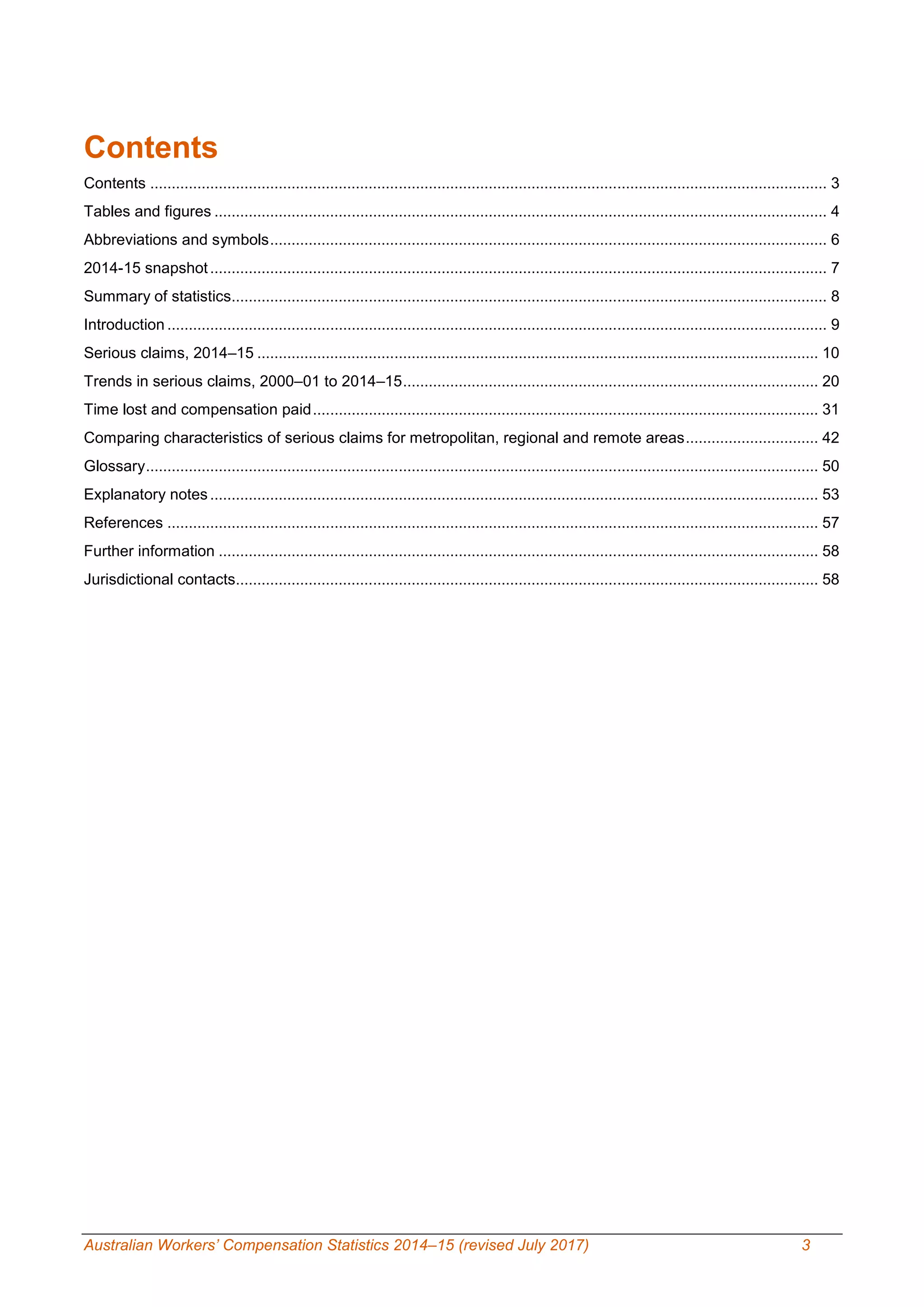
Contents
Contents .............................................................................................................................................................. 3
Tables and figures ............................................................................................................................................... 4
Abbreviations and symbols.................................................................................................................................. 6
2014-15 snapshot................................................................................................................................................ 7
Summary of statistics........................................................................................................................................... 8
Introduction .......................................................................................................................................................... 9
Serious claims, 2014–15 ................................................................................................................................... 10
Trends in serious claims, 2000–01 to 2014–15................................................................................................. 20
Time lost and compensation paid...................................................................................................................... 31
Comparing characteristics of serious claims for metropolitan, regional and remote areas............................... 42
Glossary............................................................................................................................................................. 50
Explanatory notes.............................................................................................................................................. 53
References ........................................................................................................................................................ 57
Further information ............................................................................................................................................ 58
Jurisdictional contacts........................................................................................................................................ 58
Safe Work Australia 4
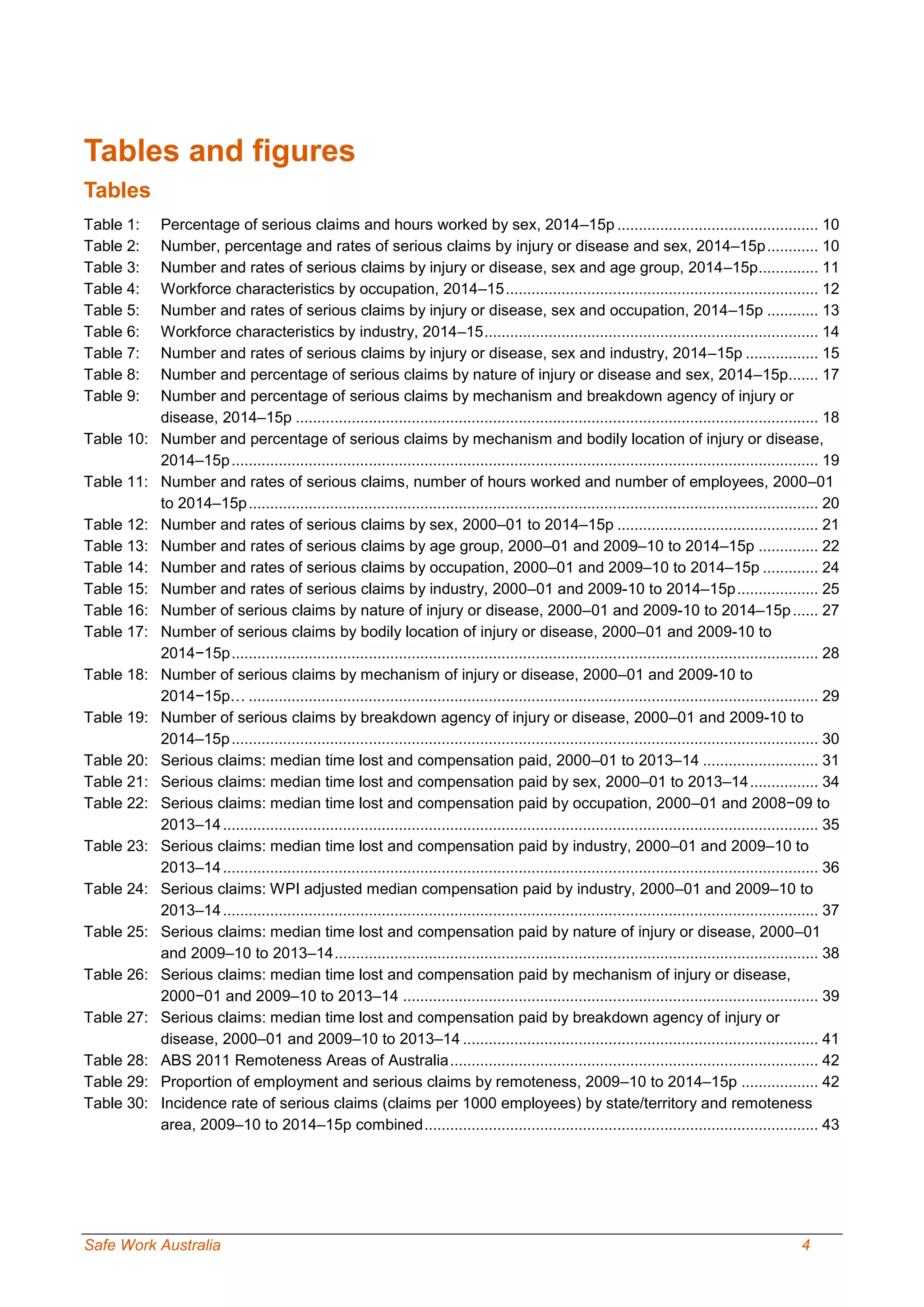
Tables and figures
Tables
Table 1: Percentage of serious claims and hours worked by sex, 2014–15p ............................................... 10
Table 2: Number, percentage and rates of serious claims by injury or disease and sex, 2014–15p............ 10
Table 3: Number and rates of serious claims by injury or disease, sex and age group, 2014–15p.............. 11
Table 4: Workforce characteristics by occupation, 2014–15......................................................................... 12
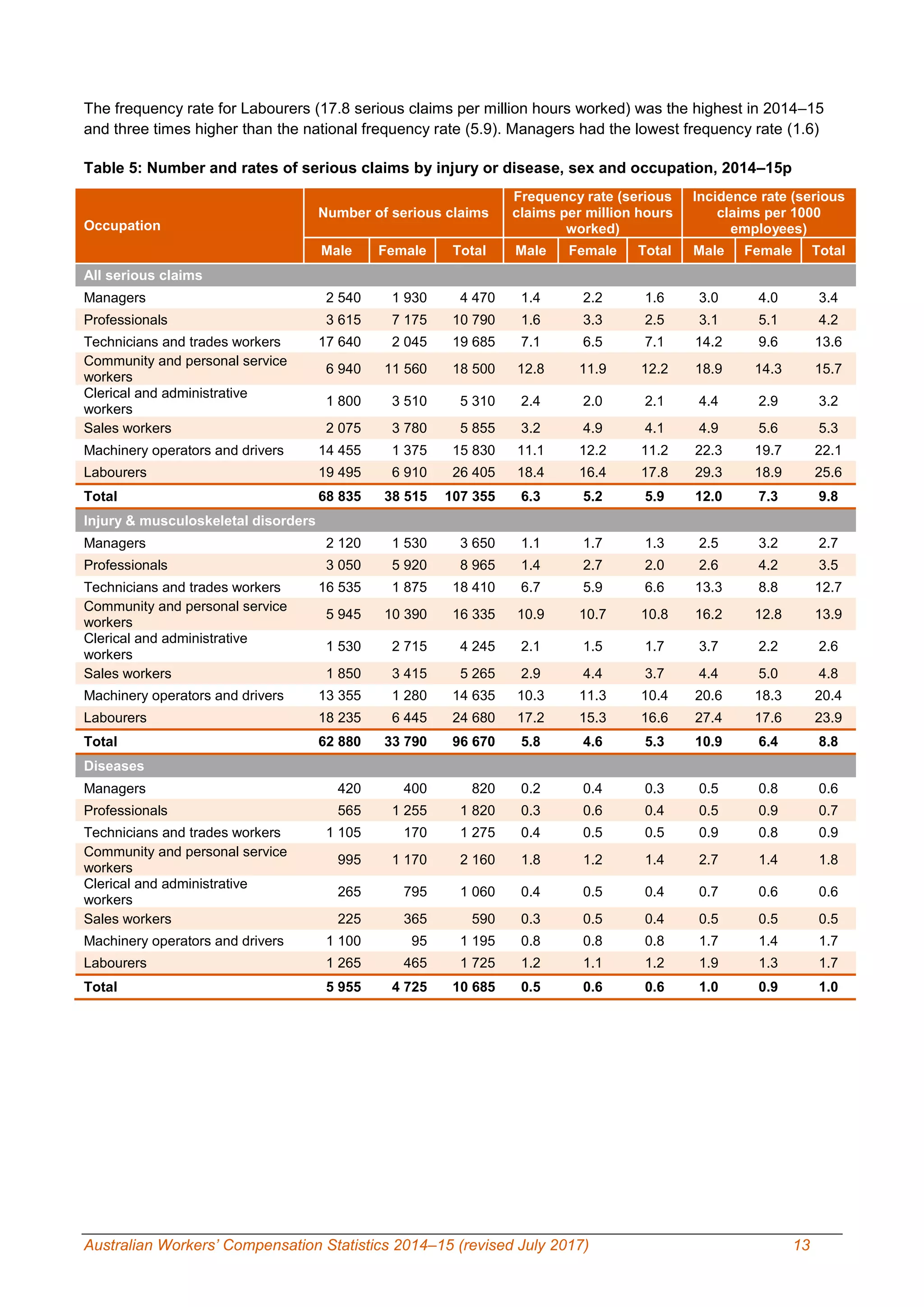
Table 5: Number and rates of serious claims by injury or disease, sex and occupation, 2014–15p ............ 13
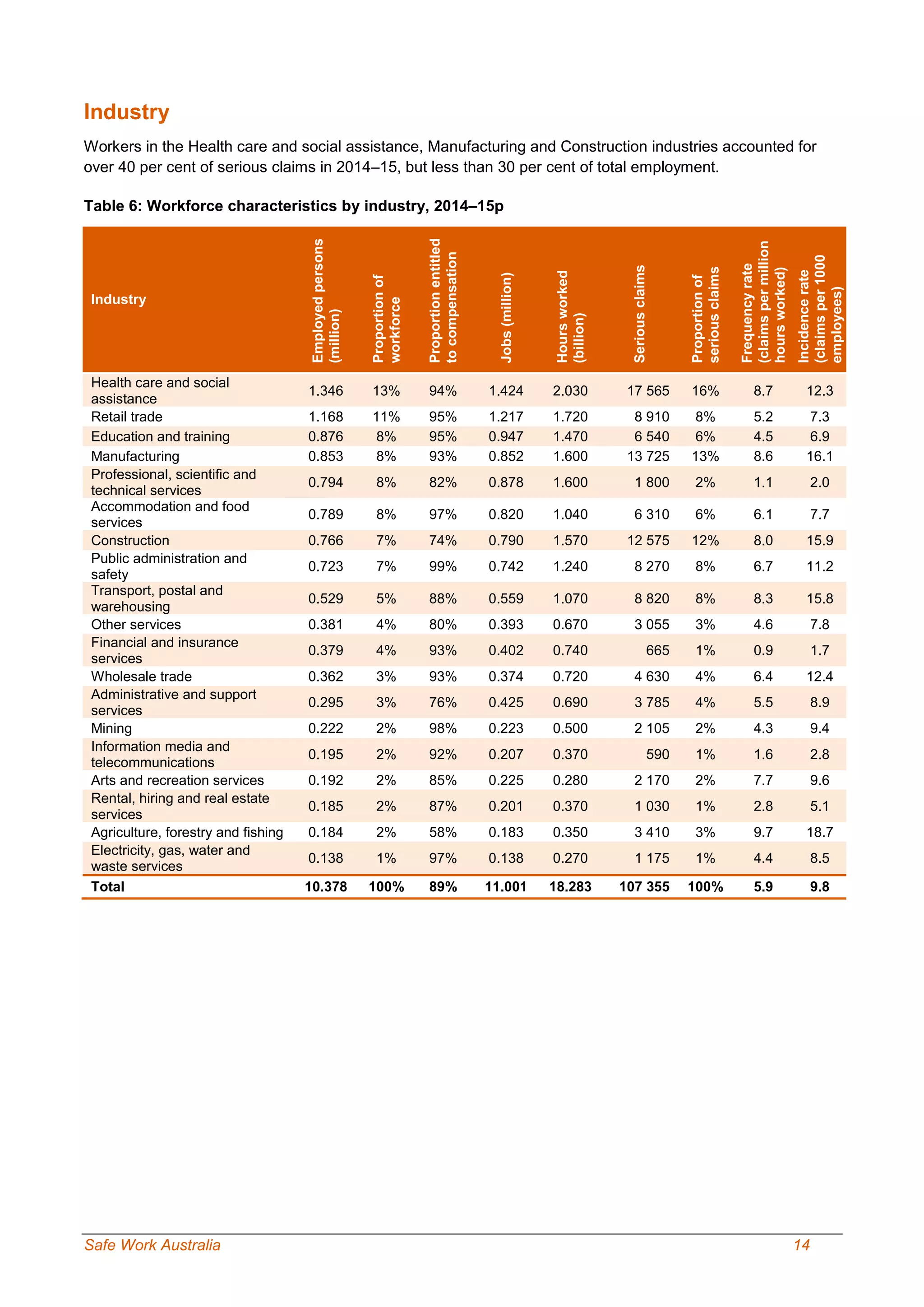
Table 6: Workforce characteristics by industry, 2014–15.............................................................................. 14
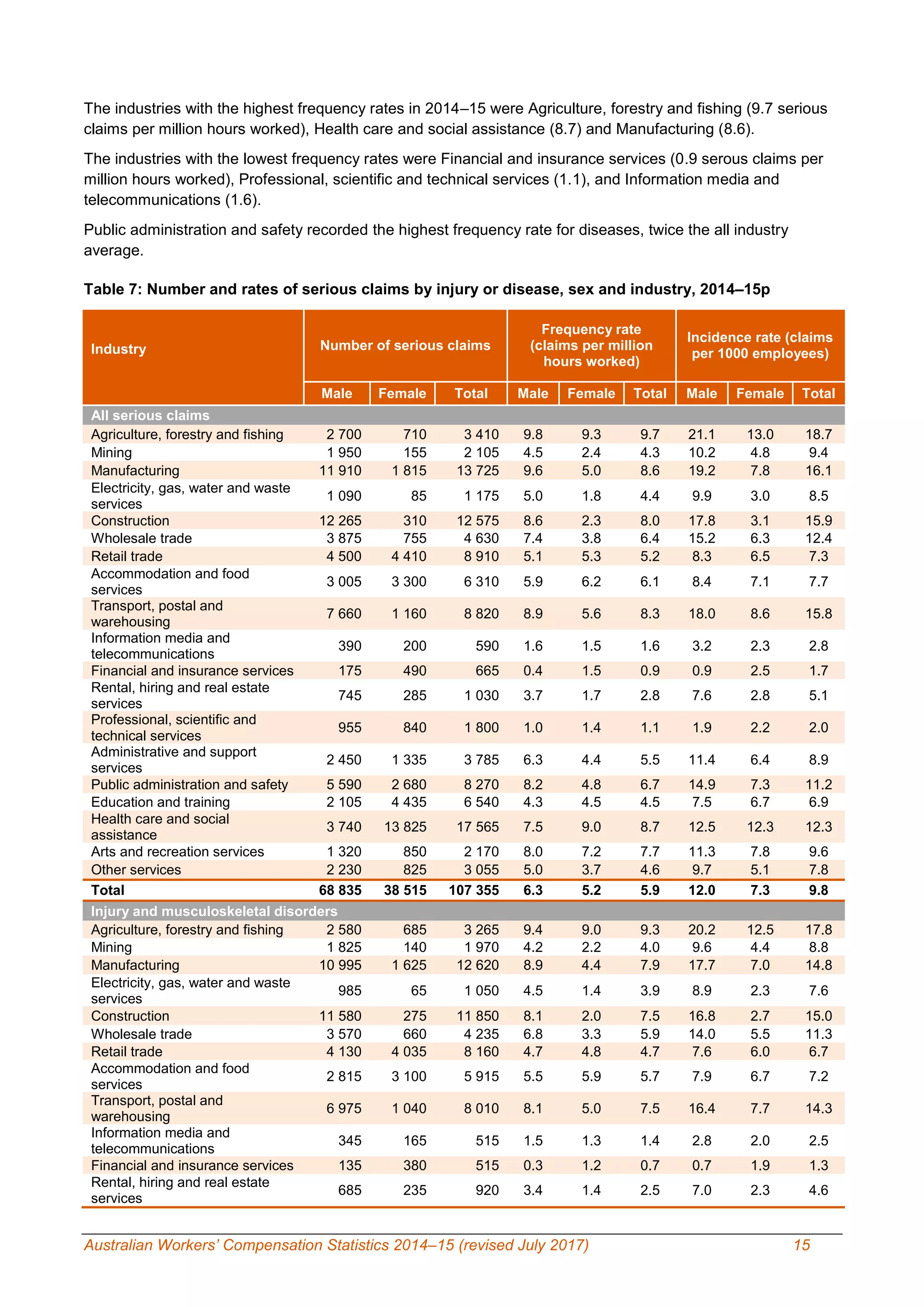
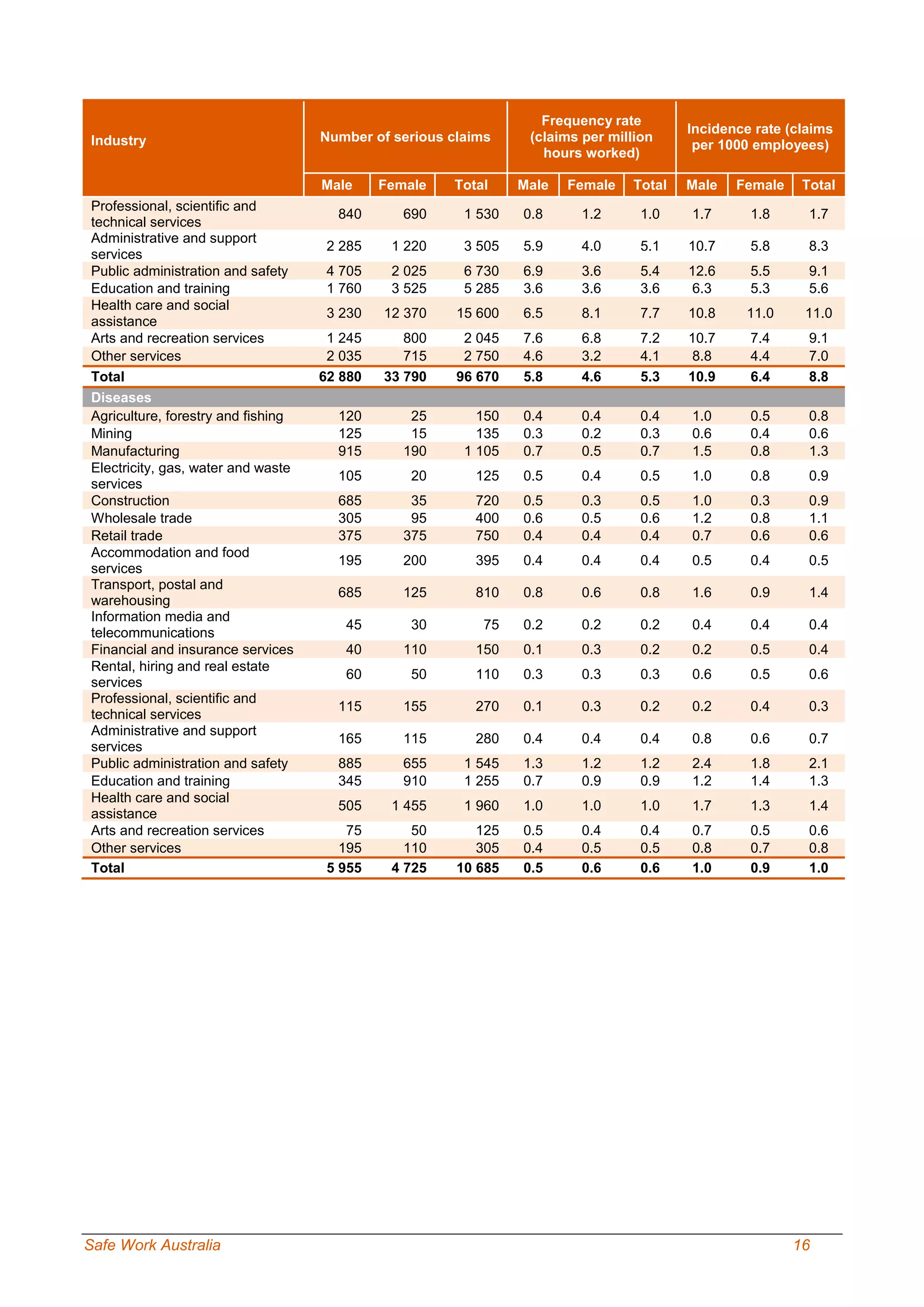
Table 7: Number and rates of serious claims by injury or disease, sex and industry, 2014–15p ................. 15
Table 8: Number and percentage of serious claims by nature of injury or disease and sex, 2014–15p....... 17
Table 9: Number and percentage of serious claims by mechanism and breakdown agency of injury or
disease, 2014–15p .......................................................................................................................... 18
Table 10: Number and percentage of serious claims by mechanism and bodily location of injury or disease,
2014–15p......................................................................................................................................... 19
Table 11: Number and rates of serious claims, number of hours worked and number of employees, 2000–01
to 2014–15p..................................................................................................................................... 20
Table 12: Number and rates of serious claims by sex, 2000–01 to 2014–15p ............................................... 21
Table 13: Number and rates of serious claims by age group, 2000–01 and 2009–10 to 2014–15p .............. 22
Table 14: Number and rates of serious claims by occupation, 2000–01 and 2009–10 to 2014–15p ............. 24
Table 15: Number and rates of serious claims by industry, 2000–01 and 2009-10 to 2014–15p................... 25
Table 16: Number of serious claims by nature of injury or disease, 2000–01 and 2009-10 to 2014–15p...... 27
Table 17: Number of serious claims by bodily location of injury or disease, 2000–01 and 2009-10 to
2014−15p......................................................................................................................................... 28
Table 18: Number of serious claims by mechanism of injury or disease, 2000–01 and 2009-10 to
2014−15p… ..................................................................................................................................... 29
Table 19: Number of serious claims by breakdown agency of injury or disease, 2000–01 and 2009-10 to
2014–15p......................................................................................................................................... 30
Table 20: Serious claims: median time lost and compensation paid, 2000–01 to 2013–14 ........................... 31
Table 21: Serious claims: median time lost and compensation paid by sex, 2000–01 to 2013–14................ 34
Table 22: Serious claims: median time lost and compensation paid by occupation, 2000–01 and 2008−09 to
2013–14........................................................................................................................................... 35
Table 23: Serious claims: median time lost and compensation paid by industry, 2000–01 and 2009–10 to
2013–14........................................................................................................................................... 36
Table 24: Serious claims: WPI adjusted median compensation paid by industry, 2000–01 and 2009–10 to
2013–14........................................................................................................................................... 37
Table 25: Serious claims: median time lost and compensation paid by nature of injury or disease, 2000–01
and 2009–10 to 2013–14................................................................................................................. 38
Table 26: Serious claims: median time lost and compensation paid by mechanism of injury or disease,
2000−01 and 2009–10 to 2013–14 ................................................................................................. 39
Table 27: Serious claims: median time lost and compensation paid by breakdown agency of injury or
disease, 2000–01 and 2009–10 to 2013–14 ................................................................................... 41
Table 28: ABS 2011 Remoteness Areas of Australia...................................................................................... 42
Table 29: Proportion of employment and serious claims by remoteness, 2009–10 to 2014–15p .................. 42
Table 30: Incidence rate of serious claims (claims per 1000 employees) by state/territory and remoteness
area, 2009–10 to 2014–15p combined............................................................................................ 43
Australian Workers’ Compensation Statistics 2014–15 (revised July 2017) 5
Figures
Figure 1: Frequency rates of serious claims by sex, 2000–01 to 2014–15p.................................................. 21
Figure 2: Percentage of serious claims by age group, 2000–01 to 2014–15p............................................... 23
Figure 3: Frequency rate by age group and occupation, 2000–01 to 2014–15p............................................ 23
Figure 4: Original and inflation adjusted median compensation paid, 2000–01 to 2013–14.......................... 32
Figure 5: Median time lost and inflation adjusted median compensation paid, 2000–01 to 2013–14............ 32
Figure 6: Serious claims: median time lost by age group, 2001–02 to 2013–14............................................ 33
Figure 7: Serious claims: median compensation paid by age group, 2000–01 to 2013–14........................... 33
Figure 8: Serious claims: median time lost by sex, 2000–01 to 2013–14 ...................................................... 34
Figure 9: Serious claims: median compensation paid by sex, 2000–01 to 2013–14 ..................................... 35
Figure 10: Proportion of employees and serious claims by remoteness area and state, 2009–10 to 2014–15p
combined ......................................................................................................................................... 43
Figure 11: Proportion of serious claims by remoteness area and industry, 2009–10 to 2014–15p combined 44
Figure 12: Proportion of serious claims by remoteness area and occupation major group, 2009–10 to
2014–15p combined ........................................................................................................................ 44
Figure 13: Proportion of serious claims by remoteness area and nature of injury or disease, 2009–10 to
2014–15p combined ........................................................................................................................ 45
Figure 14: Proportion of serious claims by remoteness area and mechanism of injury or disease, 2009–10 to
2014–15p combined ........................................................................................................................ 45
Figure 15: Proportion of serious claims by remoteness area and breakdown agency of injury or disease,
2009–10 to 2014–15p combined..................................................................................................... 46
Figure 16: Proportion of breakdown agency sub-groups in Animal, human and biological agencies, 2009–10
to 2014–15p combined .................................................................................................................... 47
Figure 17: Proportion of breakdown agency sub-groups in Mobile plant and transport, 2009–10 to 2014–15p
combined ......................................................................................................................................... 47
Figure 18: Proportion of serious claims by remoteness area, age group and sex, 2009–10 to 2014–15p
combined ......................................................................................................................................... 48
Figure 19: Average time lost (working weeks) by remoteness area and occupation, 2009–10 to 2014–15p
combined ......................................................................................................................................... 49
Figure 20: Average compensation paid by occupation and remoteness area, 2009–10 to 2014–15p combined
......................................................................................................................................................... 49
Safe Work Australia 6
Abbreviations and symbols
ABS Australian Bureau of Statistics
ANZSCO Australian and New Zealand Standard Classification of Occupations, First edition
ANZSIC Australian and New Zealand Standard Industrial Classification, 2006
NDS National Data Set for Compensation-Based Statistics
np data not available due to confidentiality restrictions
p preliminary data
TOOCS Type of Occurrence Classification System
* relative standard error is between 25 per cent and 50 per cent and should be used with
caution
% chg percentage change
Australian Workers’ Compensation Statistics 2014–15 (revised July 2017) 7
2014-15 snapshot
Safe Work Australia 8
Summary of statistics
 Preliminary data show that there were 107 355 serious workers’ compensation claims in 2014–15, which
equates to 5.9 serious claims per million hours worked.
 Between 2000–01 and 2013–14, the frequency rate of serious claims fell by 33 per cent from 9.5 serious
claims per million hours worked to 6.3.
 In 2014–15, the frequency rate for male employees was 6.3 serious claims per million hours worked, while
the frequency rate for female employees was 5.2.
 In 2014–15, the three occupations with the highest number of serious claims per million hours worked
were Labourers (17.8), Community and personal service workers (12.2), and Machinery operators and
drivers (11.2).
 In 2014–15, the three industries with the highest number of serious claims per million hours worked were
Agriculture, forestry and fishing (9.7), Health care and social assistance (8.7) and Manufacturing (8.6).
 In 2014-15, injury and musculoskeletal disorders led to 90 per cent of serious claims and the most
common were Traumatic joint/ligament and muscle/tendon injuries (43.8 per cent). Diseases led to 10 per
cent of serious claims and the most common were Mental disorders (5.7 per cent).
 Muscular stress while lifting or handling objects caused 32 per cent of serious claims in 2014–15, while
Falls, trips and slips led to 23 per cent of serious claims.
 Between 2000–01 and 2013–14, the median time lost for a serious claim rose by 33 per cent from 4.2
working weeks to 5.6. In 2013–14, the median time lost for a serious claim was 5.4 working weeks for
male employees and 6.0 working weeks for female employees.
 Between 2000–01 and 2013–14, the median compensation paid for a serious claim rose by 94 per cent
from $5 200 to $10 100. In 2013–14, the median compensation paid for a serious claim was $10 900 for
male employees and $8 900 for female employees. When accounting for wage inflation, however, median
compensation paid for serious claims increased by 23 per cent between 2000–01 and 2013–14, directly
comparable with the increase in median time lost.
 In 2014–15, the bodily location most commonly affected by injuries and diseases that led to serious claims
was the Back (21 per cent). Other common bodily locations were the Hand, fingers and thumb (13 per
cent), Shoulder (11 per cent), and Knee (10 per cent).
 The rate of serious claims per 1000 employees is highest in metropolitan areas (10.6 claims per 1000
employees)
 Between 2009-10 and 2014-15, 69 per cent of serious claims in Agriculture, forestry and fishing occurred
in regional areas, while 61 per cent of serious claims in Mining occurred in regional and remote areas. In
the same period, 85 per cent of serious claims in Finance and insurance services occurred in metropolitan
areas.
 Human agencies were the most common breakdown agency for serious claims in metropolitan (13 per
cent of all claims) and regional areas (13 per cent), while Outdoor environment (16 per cent of claims) and
Road transport (13 per cent) where the most common breakdown agencies in remote areas.
Australian Workers’ Compensation Statistics 2014–15 (revised July 2017) 9
Introduction
The statistics in this report are of Australian workers’ compensation claims that were lodged between 2000–01
and 2014–15. The statistics are an indicator of Australia’s work health and safety performance over the
15-year period between 2000–01 and 2014–15. The statistics are presented by:
 sex
 age group
 occupation
 industry
 nature of injury or disease
 mechanism of injury or disease
 breakdown agency of injury or disease, and
 bodily location of injury or disease.
Claim numbers are rounded to the nearest 5 to help protect confidential information about employers and
employees. Due to rounding, differences may appear between the reported totals and proportions and the
sums of rows or columns. Rates and percentages are calculated using unrounded numbers.
Definition of a serious claim
The statistics in this report are of serious claims only. A serious claim is an accepted workers’ compensation
claim for an incapacity that results in a total absence from work of one working week or more. Claims in
receipt of common-law payments are also included. Claims arising from a journey to or from work or during a
recess period are not compensable in all jurisdictions and are excluded.
Serious claims exclude compensated fatalities. Safe Work Australia produces other resources that provide
information on work-related fatalities in Australia. The most up-to-date count of worker fatalities is available
online on Safe Work Australia’s worker fatalities page. Comprehensive information on work-related injury
fatalities is available in the Work-Related Traumatic Injury Fatalities reports. The reports are based on
information from workers’ compensation data, coronial information, notifiable fatalities and the media.
Frequency and incidence rates
Frequency rates are expressed as the number of serious claims per million hours worked, while incidence
rates are expressed as the number of serious claims per 1000 employees.
Compared with an incidence rate, a frequency rate is a more precise and accurate measure of work health
and safety because it reflects the number of injuries and diseases per hour worked. It is important to account
for the number of hours worked because there are significant differences in the number of hours worked by
different groups of employees and employees at different points in time. The differences in the number of
hours worked mean that employees’ exposure to work-related risks vary considerably. A frequency rate
accounts for these differences and allows accurate comparisons to be made of different groups of employees
and employees at different points in time.
Safe Work Australia 10
Serious claims, 2014–15
This chapter provides workers’ compensation statistics for claims lodged during the 2014–15 financial year.
The 2014–15 data are preliminary and are likely to rise by around 3 per cent when updated.
Gender
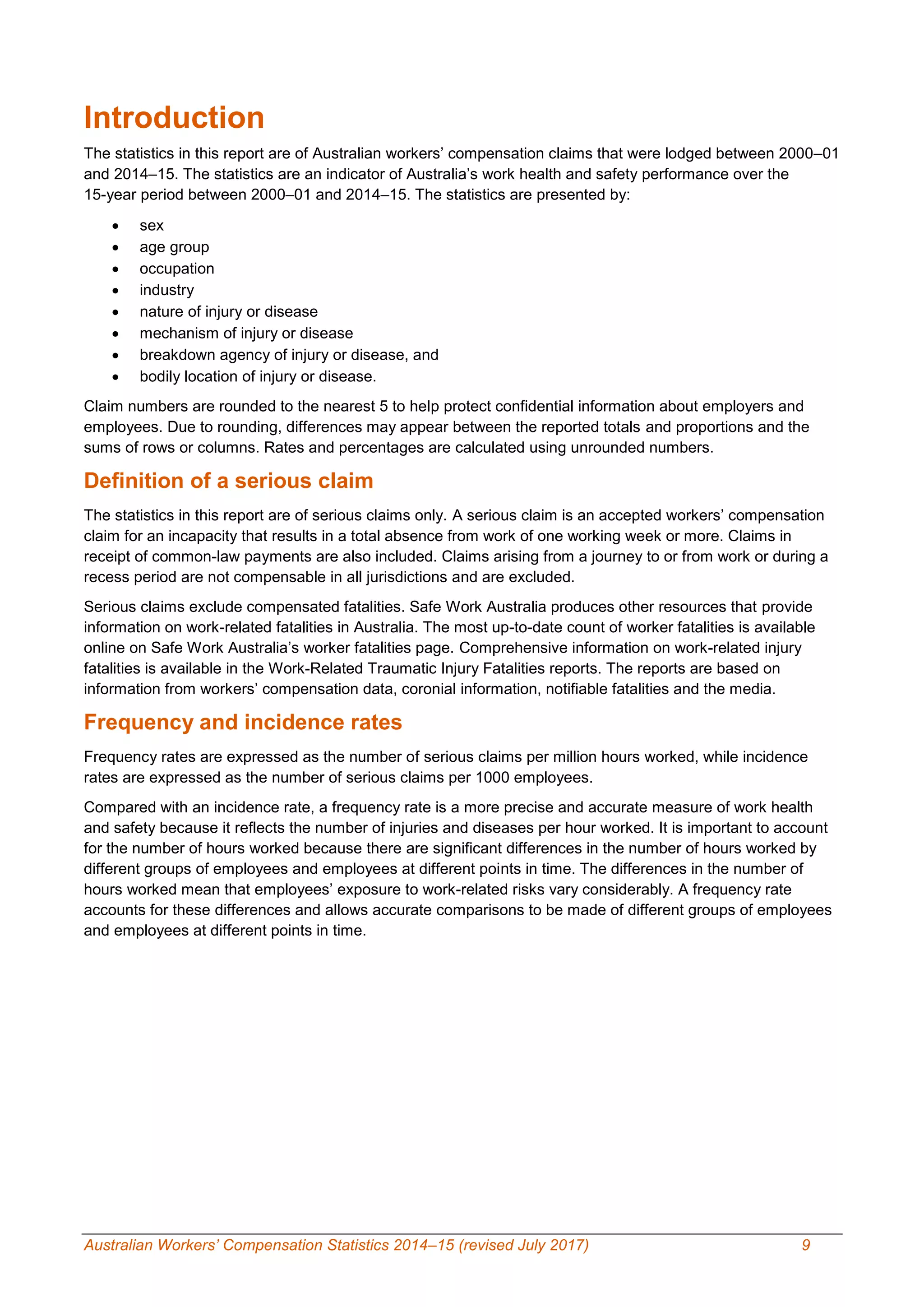
In 2014–15, male employees accounted for 58 per cent of hours worked and 64 per cent of serious claims,
while female employees accounted for 42 per cent of hours worked and 36 per cent of serious claims.
Table 1: Percentage of serious claims and hours worked by sex, 2014–15p
Percentage of serious claims Percentage of hours worked
Male 64% 58%
Female 36% 42%
Total 100% 100%
The frequency rate for male employees (6.3 serious claims per million hours worked) was 22 per cent higher
than the frequency rate for female employees (5.2).
A higher percentage of male employees’ serious claims arose from injury and musculoskeletal disorders
(91 per cent versus 87 per cent for female employees), while a higher percentage of female employees’
serious claims arose from diseases (13 per cent versus 9 per cent for male employees).
Table 2: Number, percentage and rates of serious claims by injury or disease and sex, 2014–15p
Number of
serious claims
Percentage of
serious claims
Frequency rate
(serious claims
per million
hours worked)
Incidence rate
(serious claims
per 1000
employees)
Male
Injury and musculoskeletal disorders 62 690 91% 5.8 10.9
Diseases 6 145 9% 0.5 1.0
Total 68 835 100% 6.3 12.0
Female
Injury and musculoskeletal disorders 33 685 87% 4.6 6.4
Diseases 4 830 13% 0.6 0.9
Total 38 515 100% 5.2 7.3
All serious claims
Injury and musculoskeletal disorders 96 375 90% 5.3 8.8
Diseases 10 975 10% 0.6 1.0
Total 107 355 100% 5.9 9.8
Australian Workers’ Compensation Statistics 2014–15 (revised July 2017) 11
Age group
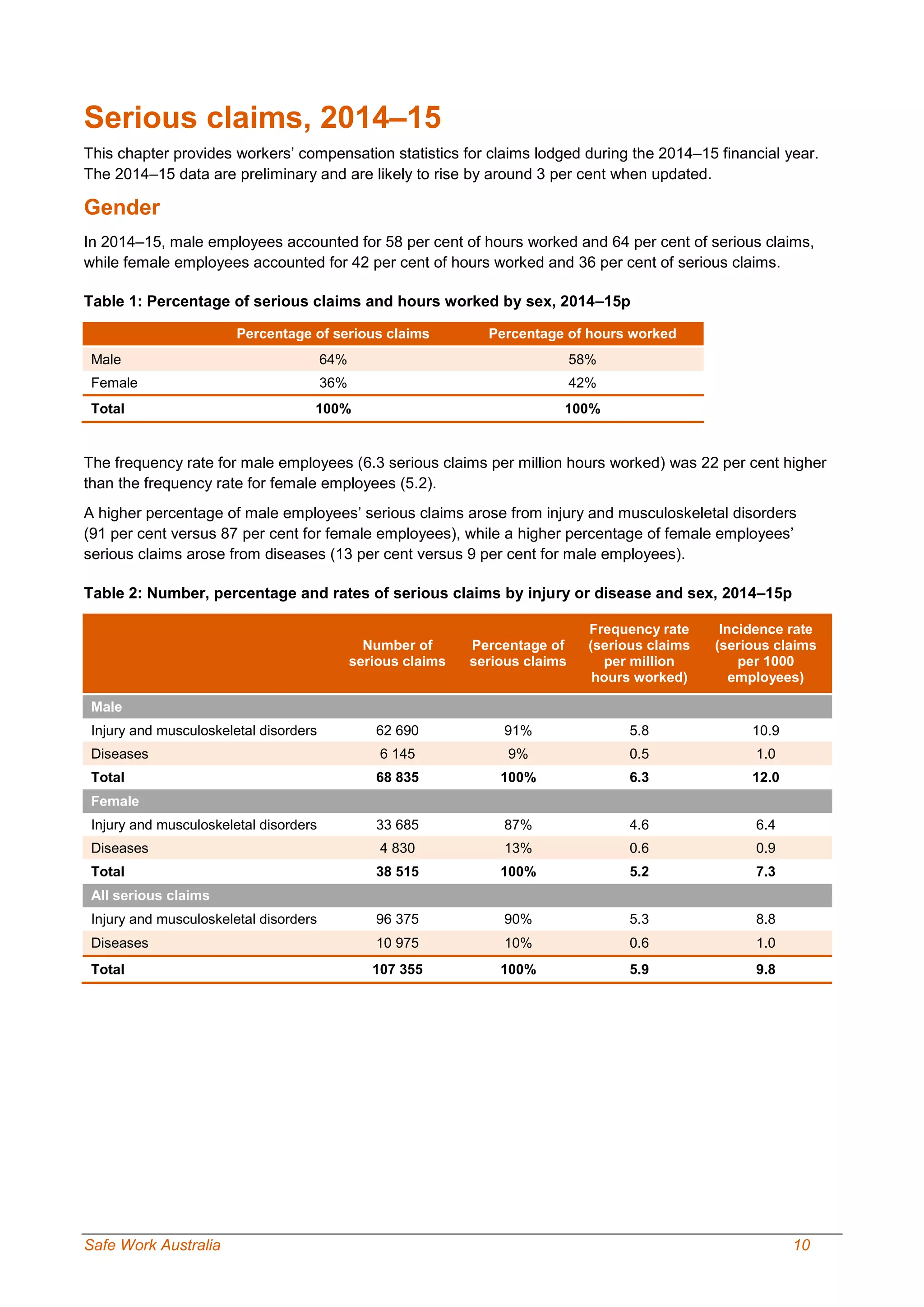
Among male, female and all employees, the highest frequency rates in 2014–15 were among employees
aged 60–64 years. By contrast, employees aged 25–29 years had the lowest frequency rate (4.6 serious
claims per million hours worked) in the workforce.
Table 3: Number and rates of serious claims by injury or disease, sex and age group, 2014–15p
Age Group
Number of serious claims
Frequency rate (serious
claims per million hours
worked)
Incidence rate (serious claims
per 1000 employees)
Male Female Total Male Female Total Male Female Total
All serious claims
<20 years 2 595 1 040 3 635 7.7 3.9 6.0 8.0 2.9 5.4
20-24 years 6 925 3 065 9 995 7.1 3.9 5.7 11.5 5.3 8.5
25-29 years 7 600 3 205 10 805 5.6 3.2 4.6 10.8 5.1 8.1
30-34 years 7 660 3 120 10 785 5.3 3.6 4.7 10.7 5.2 8.2
35-39 years 7 120 3 335 10 460 5.5 4.4 5.1 11.2 6.3 9.0
40-44 years 8 285 4 770 13 050 6.1 5.6 5.9 12.6 8.1 10.5
45-49 years 7 950 5 460 13 410 6.4 6.3 6.4 13.3 9.5 11.5
50-54 years 7 975 6 105 14 080 7.0 7.2 7.1 14.3 10.9 12.6
55-59 years 6 565 4 835 11 395 7.2 7.5 7.3 14.0 10.9 12.5
60-64 years 4 530 2 695 7 225 7.9 7.7 7.8 14.5 10.3 12.6
65 years+ 1 615 870 2 485 5.8 6.8 6.1 8.5 7.0 7.9
Total 68 835 38 515 107 355 6.3 5.2 5.9 12.0 7.3 9.8
Injury and musculoskeletal disorders
<20 years 2 535 1 000 3 540 7.6 3.7 5.9 7.9 2.8 5.2
20-24 years 6 670 2 815 9 485 6.8 3.6 5.4 11.1 4.9 8.0
25-29 years 7 190 2 835 10 020 5.3 2.8 4.3 10.2 4.5 7.5
30-34 years 7 085 2 705 9 790 4.9 3.1 4.2 9.9 4.5 7.5
35-39 years 6 460 2 800 9 260 5.0 3.7 4.5 10.2 5.3 7.9
40-44 years 7 370 4 020 11 390 5.5 4.7 5.2 11.2 6.9 9.2
45-49 years 7 075 4 750 11 825 5.7 5.4 5.6 11.9 8.3 10.1
50-54 years 7 130 5 330 12 455 6.3 6.2 6.3 12.8 9.5 11.2
55-59 years 5 855 4 275 10 125 6.4 6.6 6.5 12.5 9.6 11.1
60-64 years 4 040 2 440 6 480 7.0 7.0 7.0 12.9 9.3 11.3
65 years+ 1 465 810 2 275 5.3 6.3 5.6 7.7 6.5 7.2
Total 62 880 33 790 96 670 5.8 4.6 5.3 10.9 6.4 8.8
Diseases
<20 years 55 40 95 0.2 0.2 0.2 0.2 0.1 0.1
20-24 years 260 250 510 0.3 0.3 0.3 0.4 0.4 0.4
25-29 years 410 370 780 0.3 0.4 0.3 0.6 0.6 0.6
30-34 years 575 415 990 0.4 0.5 0.4 0.8 0.7 0.8
35-39 years 665 535 1 200 0.5 0.7 0.6 1.0 1.0 1.0
40-44 years 915 750 1 665 0.7 0.9 0.8 1.4 1.3 1.3
45-49 years 875 705 1 580 0.7 0.8 0.7 1.5 1.2 1.4
50-54 years 845 780 1 625 0.7 0.9 0.8 1.5 1.4 1.5
55-59 years 710 560 1 270 0.8 0.9 0.8 1.5 1.3 1.4
60-64 years 490 255 745 0.9 0.7 0.8 1.6 1.0 1.3
65 years+ 155 60 215 0.6 0.5 0.5 0.8 0.5 0.7
Total 5 955 4 725 10 685 0.5 0.6 0.6 1.0 0.9 1.0
Safe Work Australia 12
Occupation
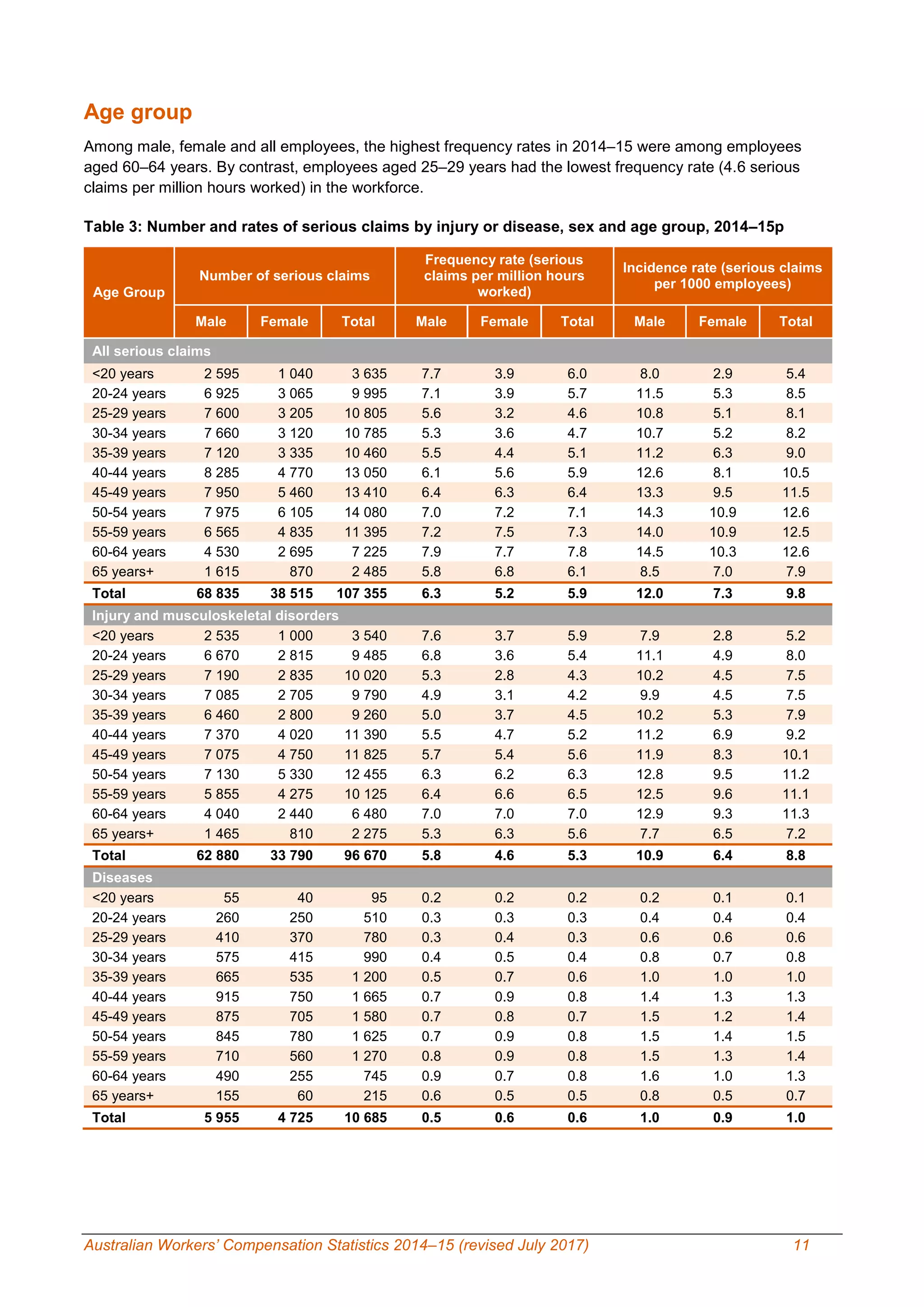
Workers in the Labourers and Technicians and trades workers occupations accounted for over 40 per cent of
serious claims in 2014–15, but only 23 per cent of total employment.
Table 4: Workforce characteristics by occupation, 2014–15p
Occupation
Employedpersons
(million)
Proportionof
workforce
Proportionentitled
tocompensation
Jobs(million)
Hoursworked
(billion)
Seriousclaims
Proportionof
seriousclaims
Frequencyrate
(claimspermillion
hoursworked)
Incidencerate
(claimsper1000
employees)
Professionals 2.361 23% 89% 2.564 4.403 10 790 10% 2.5 4.2
Clerical and administrative
workers
1.529 15% 93% 1.633 2.497 5 310 5% 2.1 3.2
Technicians and trades
workers
1.405 14% 82% 1.452 2.789 19 685 18% 7.1 13.6
Managers 1.287 12% 84% 1.327 2.765 4 470 4% 1.6 3.4
Community and personal
service workers
1.089 10% 93% 1.177 1.516 18 500 17% 12.2 15.7
Sales workers 1.039 10% 95% 1.099 1.419 5 855 5% 4.1 5.3
Labourers 0.982 9% 88% 1.032 1.483 26 405 25% 17.8 25.6
Machinery operators and
drivers
0.685 7% 91% 0.717 1.411 15 830 15% 11.2 22.1
Total 10.378 100% 89% 11.001 18.282 107 355 100% 5.9 9.8
Australian Workers’ Compensation Statistics 2014–15 (revised July 2017) 13
The frequency rate for Labourers (17.8 serious claims per million hours worked) was the highest in 2014–15
and three times higher than the national frequency rate (5.9). Managers had the lowest frequency rate (1.6)
Table 5: Number and rates of serious claims by injury or disease, sex and occupation, 2014–15p
Occupation
Number of serious claims
Frequency rate (serious
claims per million hours
worked)
Incidence rate (serious
claims per 1000
employees)
Male Female Total Male Female Total Male Female Total
All serious claims
Managers 2 540 1 930 4 470 1.4 2.2 1.6 3.0 4.0 3.4
Professionals 3 615 7 175 10 790 1.6 3.3 2.5 3.1 5.1 4.2
Technicians and trades workers 17 640 2 045 19 685 7.1 6.5 7.1 14.2 9.6 13.6
Community and personal service
workers
6 940 11 560 18 500 12.8 11.9 12.2 18.9 14.3 15.7
Clerical and administrative
workers
1 800 3 510 5 310 2.4 2.0 2.1 4.4 2.9 3.2
Sales workers 2 075 3 780 5 855 3.2 4.9 4.1 4.9 5.6 5.3
Machinery operators and drivers 14 455 1 375 15 830 11.1 12.2 11.2 22.3 19.7 22.1
Labourers 19 495 6 910 26 405 18.4 16.4 17.8 29.3 18.9 25.6
Total 68 835 38 515 107 355 6.3 5.2 5.9 12.0 7.3 9.8
Injury & musculoskeletal disorders
Managers 2 120 1 530 3 650 1.1 1.7 1.3 2.5 3.2 2.7
Professionals 3 050 5 920 8 965 1.4 2.7 2.0 2.6 4.2 3.5
Technicians and trades workers 16 535 1 875 18 410 6.7 5.9 6.6 13.3 8.8 12.7
Community and personal service
workers
5 945 10 390 16 335 10.9 10.7 10.8 16.2 12.8 13.9
Clerical and administrative
workers
1 530 2 715 4 245 2.1 1.5 1.7 3.7 2.2 2.6
Sales workers 1 850 3 415 5 265 2.9 4.4 3.7 4.4 5.0 4.8
Machinery operators and drivers 13 355 1 280 14 635 10.3 11.3 10.4 20.6 18.3 20.4
Labourers 18 235 6 445 24 680 17.2 15.3 16.6 27.4 17.6 23.9
Total 62 880 33 790 96 670 5.8 4.6 5.3 10.9 6.4 8.8
Diseases
Managers 420 400 820 0.2 0.4 0.3 0.5 0.8 0.6
Professionals 565 1 255 1 820 0.3 0.6 0.4 0.5 0.9 0.7
Technicians and trades workers 1 105 170 1 275 0.4 0.5 0.5 0.9 0.8 0.9
Community and personal service
workers
995 1 170 2 160 1.8 1.2 1.4 2.7 1.4 1.8
Clerical and administrative
workers
265 795 1 060 0.4 0.5 0.4 0.7 0.6 0.6
Sales workers 225 365 590 0.3 0.5 0.4 0.5 0.5 0.5
Machinery operators and drivers 1 100 95 1 195 0.8 0.8 0.8 1.7 1.4 1.7
Labourers 1 265 465 1 725 1.2 1.1 1.2 1.9 1.3 1.7
Total 5 955 4 725 10 685 0.5 0.6 0.6 1.0 0.9 1.0
Safe Work Australia 14
Industry
Workers in the Health care and social assistance, Manufacturing and Construction industries accounted for
over 40 per cent of serious claims in 2014–15, but less than 30 per cent of total employment.
Table 6: Workforce characteristics by industry, 2014–15p
Industry
Employedpersons
(million)
Proportionof
workforce
Proportionentitled
tocompensation
Jobs(million)
Hoursworked
(billion)
Seriousclaims
Proportionof
seriousclaims
Frequencyrate
(claimspermillion
hoursworked)
Incidencerate
(claimsper1000
employees)
Health care and social
assistance
1.346 13% 94% 1.424 2.030 17 565 16% 8.7 12.3
Retail trade 1.168 11% 95% 1.217 1.720 8 910 8% 5.2 7.3
Education and training 0.876 8% 95% 0.947 1.470 6 540 6% 4.5 6.9
Manufacturing 0.853 8% 93% 0.852 1.600 13 725 13% 8.6 16.1
Professional, scientific and
technical services
0.794 8% 82% 0.878 1.600 1 800 2% 1.1 2.0
Accommodation and food
services
0.789 8% 97% 0.820 1.040 6 310 6% 6.1 7.7
Construction 0.766 7% 74% 0.790 1.570 12 575 12% 8.0 15.9
Public administration and
safety
0.723 7% 99% 0.742 1.240 8 270 8% 6.7 11.2
Transport, postal and
warehousing
0.529 5% 88% 0.559 1.070 8 820 8% 8.3 15.8
Other services 0.381 4% 80% 0.393 0.670 3 055 3% 4.6 7.8
Financial and insurance
services
0.379 4% 93% 0.402 0.740 665 1% 0.9 1.7
Wholesale trade 0.362 3% 93% 0.374 0.720 4 630 4% 6.4 12.4
Administrative and support
services
0.295 3% 76% 0.425 0.690 3 785 4% 5.5 8.9
Mining 0.222 2% 98% 0.223 0.500 2 105 2% 4.3 9.4
Information media and
telecommunications
0.195 2% 92% 0.207 0.370 590 1% 1.6 2.8
Arts and recreation services 0.192 2% 85% 0.225 0.280 2 170 2% 7.7 9.6
Rental, hiring and real estate
services
0.185 2% 87% 0.201 0.370 1 030 1% 2.8 5.1
Agriculture, forestry and fishing 0.184 2% 58% 0.183 0.350 3 410 3% 9.7 18.7
Electricity, gas, water and
waste services
0.138 1% 97% 0.138 0.270 1 175 1% 4.4 8.5
Total 10.378 100% 89% 11.001 18.283 107 355 100% 5.9 9.8
Australian Workers’ Compensation Statistics 2014–15 (revised July 2017) 15
The industries with the highest frequency rates in 2014–15 were Agriculture, forestry and fishing (9.7 serious
claims per million hours worked), Health care and social assistance (8.7) and Manufacturing (8.6).
The industries with the lowest frequency rates were Financial and insurance services (0.9 serous claims per
million hours worked), Professional, scientific and technical services (1.1), and Information media and
telecommunications (1.6).
Public administration and safety recorded the highest frequency rate for diseases, twice the all industry
average.
Table 7: Number and rates of serious claims by injury or disease, sex and industry, 2014–15p
Industry Number of serious claims
Frequency rate
(claims per million
hours worked)
Incidence rate (claims
per 1000 employees)
Male Female Total Male Female Total Male Female Total
All serious claims
Agriculture, forestry and fishing 2 700 710 3 410 9.8 9.3 9.7 21.1 13.0 18.7
Mining 1 950 155 2 105 4.5 2.4 4.3 10.2 4.8 9.4
Manufacturing 11 910 1 815 13 725 9.6 5.0 8.6 19.2 7.8 16.1
Electricity, gas, water and waste
services
1 090 85 1 175 5.0 1.8 4.4 9.9 3.0 8.5
Construction 12 265 310 12 575 8.6 2.3 8.0 17.8 3.1 15.9
Wholesale trade 3 875 755 4 630 7.4 3.8 6.4 15.2 6.3 12.4
Retail trade 4 500 4 410 8 910 5.1 5.3 5.2 8.3 6.5 7.3
Accommodation and food
services
3 005 3 300 6 310 5.9 6.2 6.1 8.4 7.1 7.7
Transport, postal and
warehousing
7 660 1 160 8 820 8.9 5.6 8.3 18.0 8.6 15.8
Information media and
telecommunications
390 200 590 1.6 1.5 1.6 3.2 2.3 2.8
Financial and insurance services 175 490 665 0.4 1.5 0.9 0.9 2.5 1.7
Rental, hiring and real estate
services
745 285 1 030 3.7 1.7 2.8 7.6 2.8 5.1
Professional, scientific and
technical services
955 840 1 800 1.0 1.4 1.1 1.9 2.2 2.0
Administrative and support
services
2 450 1 335 3 785 6.3 4.4 5.5 11.4 6.4 8.9
Public administration and safety 5 590 2 680 8 270 8.2 4.8 6.7 14.9 7.3 11.2
Education and training 2 105 4 435 6 540 4.3 4.5 4.5 7.5 6.7 6.9
Health care and social
assistance
3 740 13 825 17 565 7.5 9.0 8.7 12.5 12.3 12.3
Arts and recreation services 1 320 850 2 170 8.0 7.2 7.7 11.3 7.8 9.6
Other services 2 230 825 3 055 5.0 3.7 4.6 9.7 5.1 7.8
Total 68 835 38 515 107 355 6.3 5.2 5.9 12.0 7.3 9.8
Injury and musculoskeletal disorders
Agriculture, forestry and fishing 2 580 685 3 265 9.4 9.0 9.3 20.2 12.5 17.8
Mining 1 825 140 1 970 4.2 2.2 4.0 9.6 4.4 8.8
Manufacturing 10 995 1 625 12 620 8.9 4.4 7.9 17.7 7.0 14.8
Electricity, gas, water and waste
services
985 65 1 050 4.5 1.4 3.9 8.9 2.3 7.6
Construction 11 580 275 11 850 8.1 2.0 7.5 16.8 2.7 15.0
Wholesale trade 3 570 660 4 235 6.8 3.3 5.9 14.0 5.5 11.3
Retail trade 4 130 4 035 8 160 4.7 4.8 4.7 7.6 6.0 6.7
Accommodation and food
services
2 815 3 100 5 915 5.5 5.9 5.7 7.9 6.7 7.2
Transport, postal and
warehousing
6 975 1 040 8 010 8.1 5.0 7.5 16.4 7.7 14.3
Information media and
telecommunications
345 165 515 1.5 1.3 1.4 2.8 2.0 2.5
Financial and insurance services 135 380 515 0.3 1.2 0.7 0.7 1.9 1.3
Rental, hiring and real estate
services
685 235 920 3.4 1.4 2.5 7.0 2.3 4.6
Safe Work Australia 16
Industry Number of serious claims
Frequency rate
(claims per million
hours worked)
Incidence rate (claims
per 1000 employees)
Male Female Total Male Female Total Male Female Total
Professional, scientific and
technical services
840 690 1 530 0.8 1.2 1.0 1.7 1.8 1.7
Administrative and support
services
2 285 1 220 3 505 5.9 4.0 5.1 10.7 5.8 8.3
Public administration and safety 4 705 2 025 6 730 6.9 3.6 5.4 12.6 5.5 9.1
Education and training 1 760 3 525 5 285 3.6 3.6 3.6 6.3 5.3 5.6
Health care and social
assistance
3 230 12 370 15 600 6.5 8.1 7.7 10.8 11.0 11.0
Arts and recreation services 1 245 800 2 045 7.6 6.8 7.2 10.7 7.4 9.1
Other services 2 035 715 2 750 4.6 3.2 4.1 8.8 4.4 7.0
Total 62 880 33 790 96 670 5.8 4.6 5.3 10.9 6.4 8.8
Diseases
Agriculture, forestry and fishing 120 25 150 0.4 0.4 0.4 1.0 0.5 0.8
Mining 125 15 135 0.3 0.2 0.3 0.6 0.4 0.6
Manufacturing 915 190 1 105 0.7 0.5 0.7 1.5 0.8 1.3
Electricity, gas, water and waste
services
105 20 125 0.5 0.4 0.5 1.0 0.8 0.9
Construction 685 35 720 0.5 0.3 0.5 1.0 0.3 0.9
Wholesale trade 305 95 400 0.6 0.5 0.6 1.2 0.8 1.1
Retail trade 375 375 750 0.4 0.4 0.4 0.7 0.6 0.6
Accommodation and food
services
195 200 395 0.4 0.4 0.4 0.5 0.4 0.5
Transport, postal and
warehousing
685 125 810 0.8 0.6 0.8 1.6 0.9 1.4
Information media and
telecommunications
45 30 75 0.2 0.2 0.2 0.4 0.4 0.4
Financial and insurance services 40 110 150 0.1 0.3 0.2 0.2 0.5 0.4
Rental, hiring and real estate
services
60 50 110 0.3 0.3 0.3 0.6 0.5 0.6
Professional, scientific and
technical services
115 155 270 0.1 0.3 0.2 0.2 0.4 0.3
Administrative and support
services
165 115 280 0.4 0.4 0.4 0.8 0.6 0.7
Public administration and safety 885 655 1 545 1.3 1.2 1.2 2.4 1.8 2.1
Education and training 345 910 1 255 0.7 0.9 0.9 1.2 1.4 1.3
Health care and social
assistance
505 1 455 1 960 1.0 1.0 1.0 1.7 1.3 1.4
Arts and recreation services 75 50 125 0.5 0.4 0.4 0.7 0.5 0.6
Other services 195 110 305 0.4 0.5 0.5 0.8 0.7 0.8
Total 5 955 4 725 10 685 0.5 0.6 0.6 1.0 0.9 1.0
Australian Workers’ Compensation Statistics 2014–15 (revised July 2017) 17
Nature of injury or disease
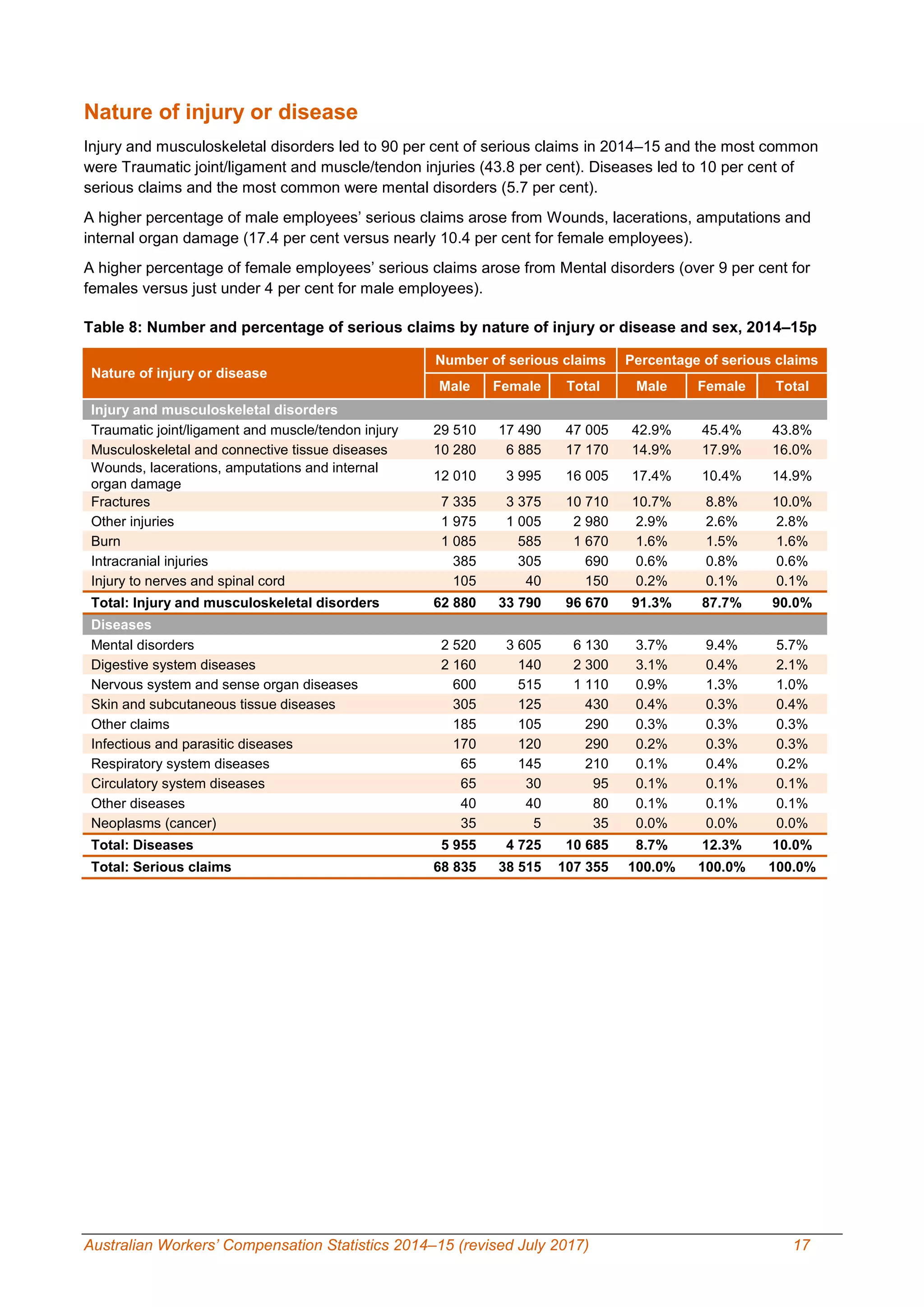
Injury and musculoskeletal disorders led to 90 per cent of serious claims in 2014–15 and the most common
were Traumatic joint/ligament and muscle/tendon injuries (43.8 per cent). Diseases led to 10 per cent of
serious claims and the most common were mental disorders (5.7 per cent).
A higher percentage of male employees’ serious claims arose from Wounds, lacerations, amputations and
internal organ damage (17.4 per cent versus nearly 10.4 per cent for female employees).
A higher percentage of female employees’ serious claims arose from Mental disorders (over 9 per cent for
females versus just under 4 per cent for male employees).
Table 8: Number and percentage of serious claims by nature of injury or disease and sex, 2014–15p
Nature of injury or disease
Number of serious claims Percentage of serious claims
Male Female Total Male Female Total
Injury and musculoskeletal disorders
Traumatic joint/ligament and muscle/tendon injury 29 510 17 490 47 005 42.9% 45.4% 43.8%
Musculoskeletal and connective tissue diseases 10 280 6 885 17 170 14.9% 17.9% 16.0%
Wounds, lacerations, amputations and internal
organ damage
12 010 3 995 16 005 17.4% 10.4% 14.9%
Fractures 7 335 3 375 10 710 10.7% 8.8% 10.0%
Other injuries 1 975 1 005 2 980 2.9% 2.6% 2.8%
Burn 1 085 585 1 670 1.6% 1.5% 1.6%
Intracranial injuries 385 305 690 0.6% 0.8% 0.6%
Injury to nerves and spinal cord 105 40 150 0.2% 0.1% 0.1%
Total: Injury and musculoskeletal disorders 62 880 33 790 96 670 91.3% 87.7% 90.0%
Diseases
Mental disorders 2 520 3 605 6 130 3.7% 9.4% 5.7%
Digestive system diseases 2 160 140 2 300 3.1% 0.4% 2.1%
Nervous system and sense organ diseases 600 515 1 110 0.9% 1.3% 1.0%
Skin and subcutaneous tissue diseases 305 125 430 0.4% 0.3% 0.4%
Other claims 185 105 290 0.3% 0.3% 0.3%
Infectious and parasitic diseases 170 120 290 0.2% 0.3% 0.3%
Respiratory system diseases 65 145 210 0.1% 0.4% 0.2%
Circulatory system diseases 65 30 95 0.1% 0.1% 0.1%
Other diseases 40 40 80 0.1% 0.1% 0.1%
Neoplasms (cancer) 35 5 35 0.0% 0.0% 0.0%
Total: Diseases 5 955 4 725 10 685 8.7% 12.3% 10.0%
Total: Serious claims 68 835 38 515 107 355 100.0% 100.0% 100.0%
Safe Work Australia 18
Mechanism of injury or disease and Breakdown agency
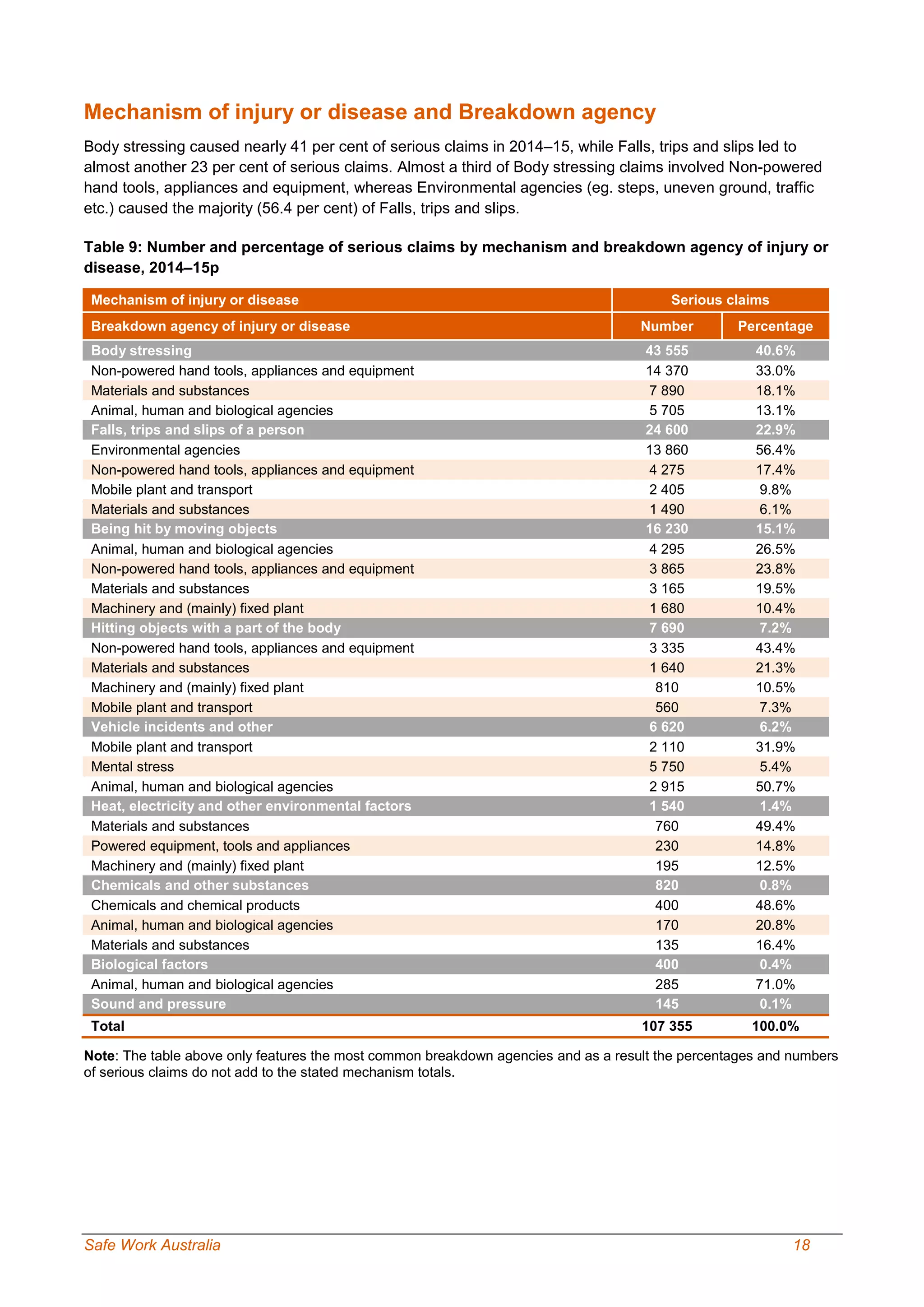
Body stressing caused nearly 41 per cent of serious claims in 2014–15, while Falls, trips and slips led to
almost another 23 per cent of serious claims. Almost a third of Body stressing claims involved Non-powered
hand tools, appliances and equipment, whereas Environmental agencies (eg. steps, uneven ground, traffic
etc.) caused the majority (56.4 per cent) of Falls, trips and slips.
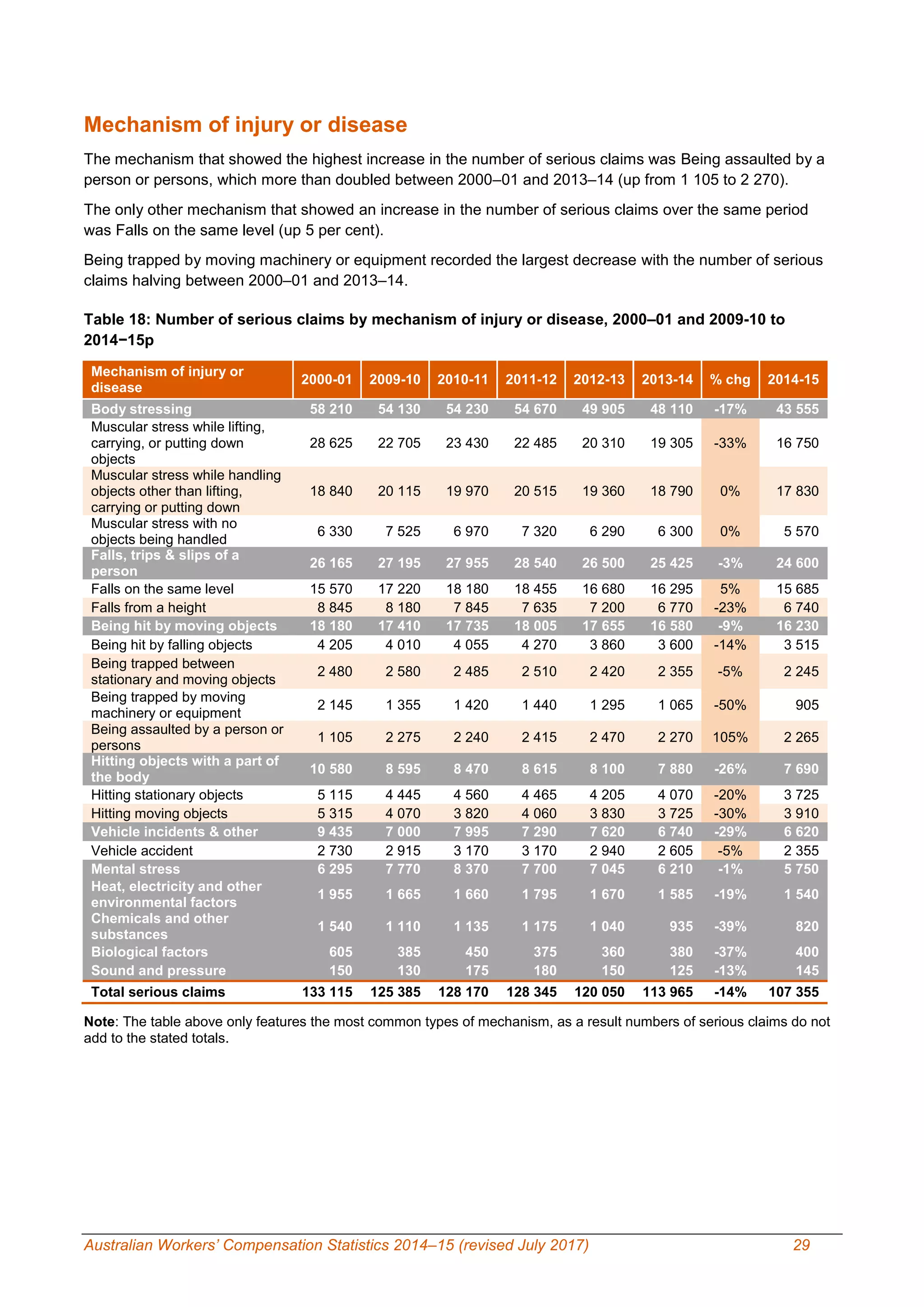
Table 9: Number and percentage of serious claims by mechanism and breakdown agency of injury or
disease, 2014–15p
Mechanism of injury or disease Serious claims
Breakdown agency of injury or disease Number Percentage
Body stressing 43 555 40.6%
Non-powered hand tools, appliances and equipment 14 370 33.0%
Materials and substances 7 890 18.1%
Animal, human and biological agencies 5 705 13.1%
Falls, trips and slips of a person 24 600 22.9%
Environmental agencies 13 860 56.4%
Non-powered hand tools, appliances and equipment 4 275 17.4%
Mobile plant and transport 2 405 9.8%
Materials and substances 1 490 6.1%
Being hit by moving objects 16 230 15.1%
Animal, human and biological agencies 4 295 26.5%
Non-powered hand tools, appliances and equipment 3 865 23.8%
Materials and substances 3 165 19.5%
Machinery and (mainly) fixed plant 1 680 10.4%
Hitting objects with a part of the body 7 690 7.2%
Non-powered hand tools, appliances and equipment 3 335 43.4%
Materials and substances 1 640 21.3%
Machinery and (mainly) fixed plant 810 10.5%
Mobile plant and transport 560 7.3%
Vehicle incidents and other 6 620 6.2%
Mobile plant and transport 2 110 31.9%
Mental stress 5 750 5.4%
Animal, human and biological agencies 2 915 50.7%
Heat, electricity and other environmental factors 1 540 1.4%
Materials and substances 760 49.4%
Powered equipment, tools and appliances 230 14.8%
Machinery and (mainly) fixed plant 195 12.5%
Chemicals and other substances 820 0.8%
Chemicals and chemical products 400 48.6%
Animal, human and biological agencies 170 20.8%
Materials and substances 135 16.4%
Biological factors 400 0.4%
Animal, human and biological agencies 285 71.0%
Sound and pressure 145 0.1%
Total 107 355 100.0%
Note: The table above only features the most common breakdown agencies and as a result the percentages and numbers
of serious claims do not add to the stated mechanism totals.
Australian Workers’ Compensation Statistics 2014–15 (revised July 2017) 19
Mechanism of injury or disease and Bodily location
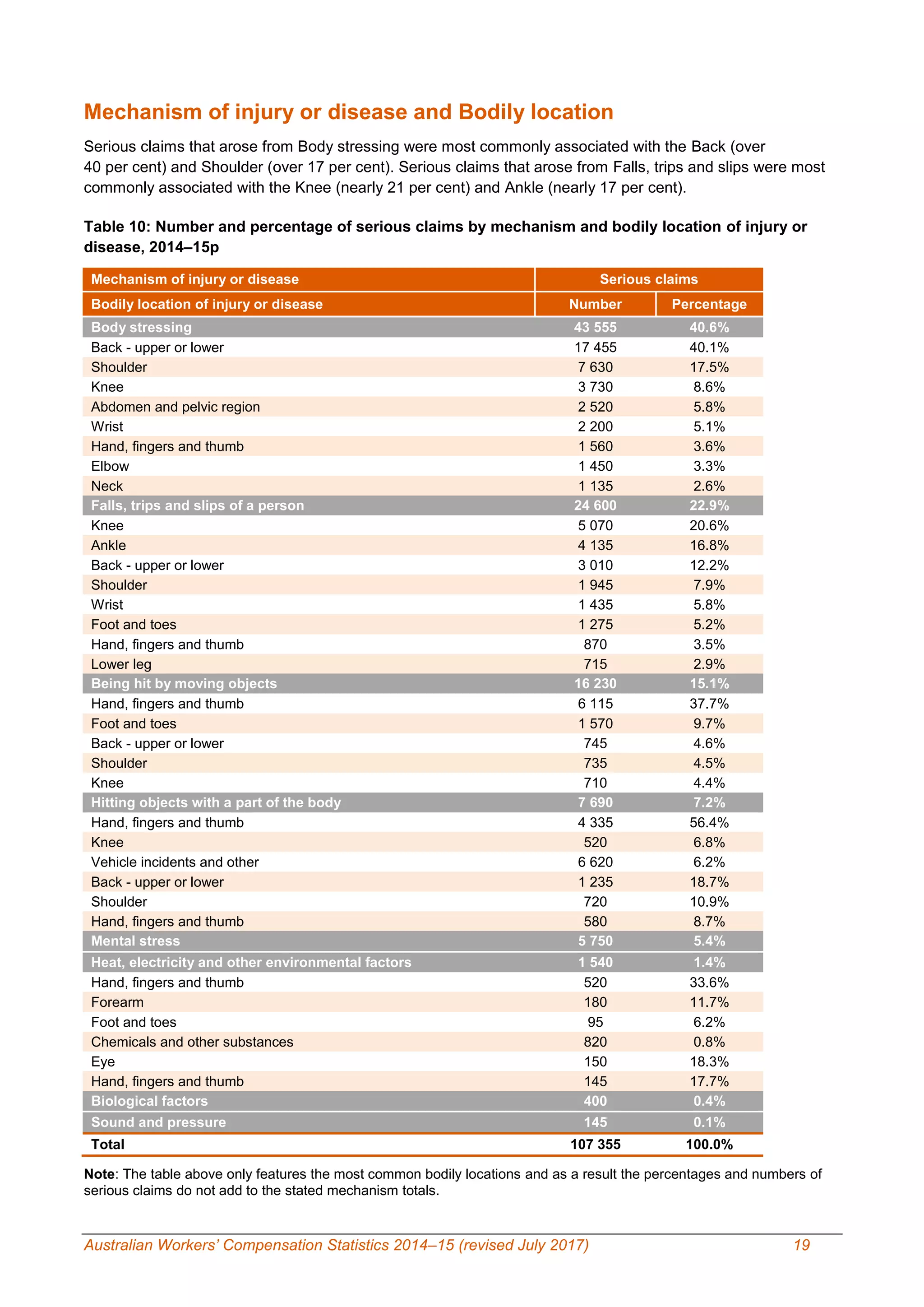
Serious claims that arose from Body stressing were most commonly associated with the Back (over
40 per cent) and Shoulder (over 17 per cent). Serious claims that arose from Falls, trips and slips were most
commonly associated with the Knee (nearly 21 per cent) and Ankle (nearly 17 per cent).
Table 10: Number and percentage of serious claims by mechanism and bodily location of injury or
disease, 2014–15p
Mechanism of injury or disease Serious claims
Bodily location of injury or disease Number Percentage
Body stressing 43 555 40.6%
Back - upper or lower 17 455 40.1%
Shoulder 7 630 17.5%
Knee 3 730 8.6%
Abdomen and pelvic region 2 520 5.8%
Wrist 2 200 5.1%
Hand, fingers and thumb 1 560 3.6%
Elbow 1 450 3.3%
Neck 1 135 2.6%
Falls, trips and slips of a person 24 600 22.9%
Knee 5 070 20.6%
Ankle 4 135 16.8%
Back - upper or lower 3 010 12.2%
Shoulder 1 945 7.9%
Wrist 1 435 5.8%
Foot and toes 1 275 5.2%
Hand, fingers and thumb 870 3.5%
Lower leg 715 2.9%
Being hit by moving objects 16 230 15.1%
Hand, fingers and thumb 6 115 37.7%
Foot and toes 1 570 9.7%
Back - upper or lower 745 4.6%
Shoulder 735 4.5%
Knee 710 4.4%
Hitting objects with a part of the body 7 690 7.2%
Hand, fingers and thumb 4 335 56.4%
Knee 520 6.8%
Vehicle incidents and other 6 620 6.2%
Back - upper or lower 1 235 18.7%
Shoulder 720 10.9%
Hand, fingers and thumb 580 8.7%
Mental stress 5 750 5.4%
Heat, electricity and other environmental factors 1 540 1.4%
Hand, fingers and thumb 520 33.6%
Forearm 180 11.7%
Foot and toes 95 6.2%
Chemicals and other substances 820 0.8%
Eye 150 18.3%
Hand, fingers and thumb 145 17.7%
Biological factors 400 0.4%
Sound and pressure 145 0.1%
Total 107 355 100.0%
Note: The table above only features the most common bodily locations and as a result the percentages and numbers of
serious claims do not add to the stated mechanism totals.
Australian Workers’ Compensation Statistics 2014–15 (revised July 2017) 20
Trends in serious claims, 2000–01 to 2014–15
The National Data Set for Compensation-Based Statistics (NDS) was first introduced as a standard set of data
items collected by each jurisdiction in 1987. Following a review of the NDS, reporting requirements were
changed significantly for the 2000–01 financial year. The statistics in this chapter cover serious claims that
were lodged between 2000–01 and 2014–15.
Data for 2014–15 are preliminary and are not used to calculate percentage changes. Percentage changes are
calculated using data for 2000–01 and 2013–14. When analysing trends over time, consideration needs to be
given to legislative changes that may influence trends in workers’ compensation data. Information on workers’
compensation arrangements can be found in Safe Work Australia’s Comparison of Workers’ Compensation
Arrangements in Australia and New Zealand available on the Safe Work Australia website.
Serious claims, number of hours worked and number of employees
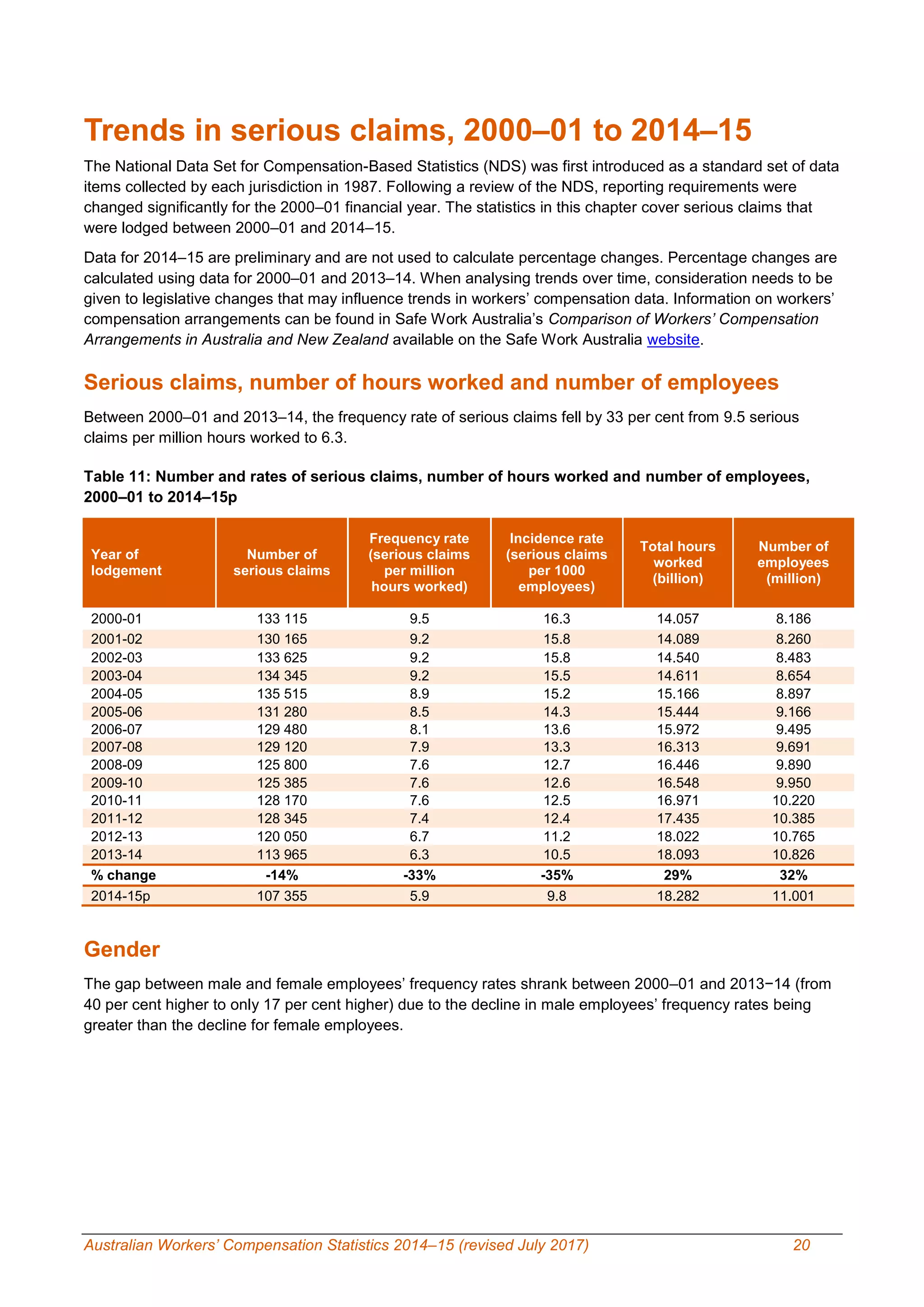
Between 2000–01 and 2013–14, the frequency rate of serious claims fell by 33 per cent from 9.5 serious
claims per million hours worked to 6.3.
Table 11: Number and rates of serious claims, number of hours worked and number of employees,
2000–01 to 2014–15p
Year of
lodgement
Number of
serious claims
Frequency rate
(serious claims
per million
hours worked)
Incidence rate
(serious claims
per 1000
employees)
Total hours
worked
(billion)
Number of
employees
(million)
2000-01 133 115 9.5 16.3 14.057 8.186
2001-02 130 165 9.2 15.8 14.089 8.260
2002-03 133 625 9.2 15.8 14.540 8.483
2003-04 134 345 9.2 15.5 14.611 8.654
2004-05 135 515 8.9 15.2 15.166 8.897
2005-06 131 280 8.5 14.3 15.444 9.166
2006-07 129 480 8.1 13.6 15.972 9.495
2007-08 129 120 7.9 13.3 16.313 9.691
2008-09 125 800 7.6 12.7 16.446 9.890
2009-10 125 385 7.6 12.6 16.548 9.950
2010-11 128 170 7.6 12.5 16.971 10.220
2011-12 128 345 7.4 12.4 17.435 10.385
2012-13 120 050 6.7 11.2 18.022 10.765
2013-14 113 965 6.3 10.5 18.093 10.826
% change -14% -33% -35% 29% 32%
2014-15p 107 355 5.9 9.8 18.282 11.001
Gender
The gap between male and female employees’ frequency rates shrank between 2000–01 and 2013−14 (from
40 per cent higher to only 17 per cent higher) due to the decline in male employees’ frequency rates being
greater than the decline for female employees.
Australian Workers’ Compensation Statistics 2014–15 (revised July 2017) 21
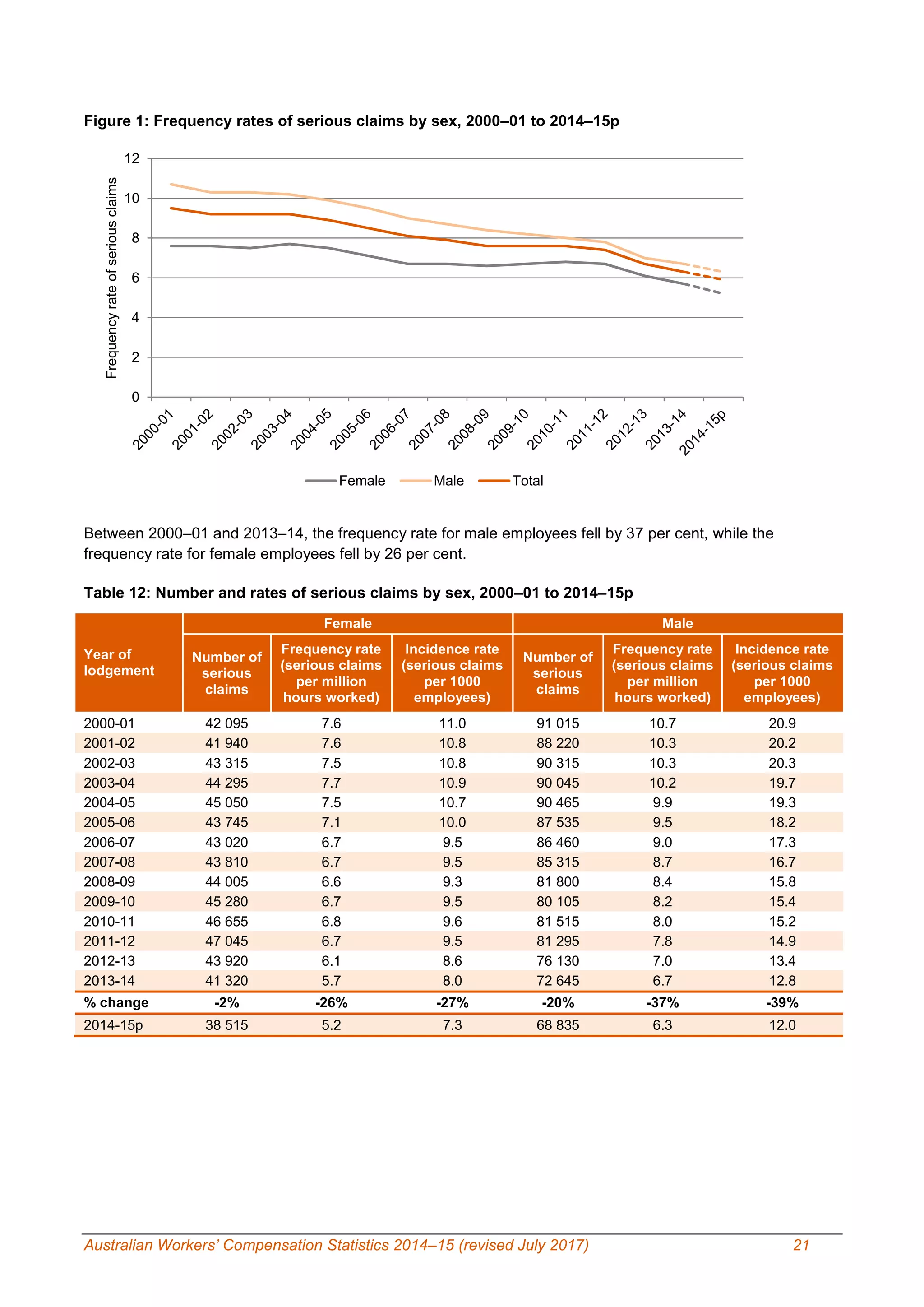
Figure 1: Frequency rates of serious claims by sex, 2000–01 to 2014–15p
Between 2000–01 and 2013–14, the frequency rate for male employees fell by 37 per cent, while the
frequency rate for female employees fell by 26 per cent.
Table 12: Number and rates of serious claims by sex, 2000–01 to 2014–15p
Year of
lodgement
Female Male
Number of
serious
claims
Frequency rate
(serious claims
per million
hours worked)
Incidence rate
(serious claims
per 1000
employees)
Number of
serious
claims
Frequency rate
(serious claims
per million
hours worked)
Incidence rate
(serious claims
per 1000
employees)
2000-01 42 095 7.6 11.0 91 015 10.7 20.9
2001-02 41 940 7.6 10.8 88 220 10.3 20.2
2002-03 43 315 7.5 10.8 90 315 10.3 20.3
2003-04 44 295 7.7 10.9 90 045 10.2 19.7
2004-05 45 050 7.5 10.7 90 465 9.9 19.3
2005-06 43 745 7.1 10.0 87 535 9.5 18.2
2006-07 43 020 6.7 9.5 86 460 9.0 17.3
2007-08 43 810 6.7 9.5 85 315 8.7 16.7
2008-09 44 005 6.6 9.3 81 800 8.4 15.8
2009-10 45 280 6.7 9.5 80 105 8.2 15.4
2010-11 46 655 6.8 9.6 81 515 8.0 15.2
2011-12 47 045 6.7 9.5 81 295 7.8 14.9
2012-13 43 920 6.1 8.6 76 130 7.0 13.4
2013-14 41 320 5.7 8.0 72 645 6.7 12.8
% change -2% -26% -27% -20% -37% -39%
2014-15p 38 515 5.2 7.3 68 835 6.3 12.0
0
2
4
6
8
10
12
Frequencyrateofseriousclaims
Female Male Total
Safe Work Australia 22
Age group
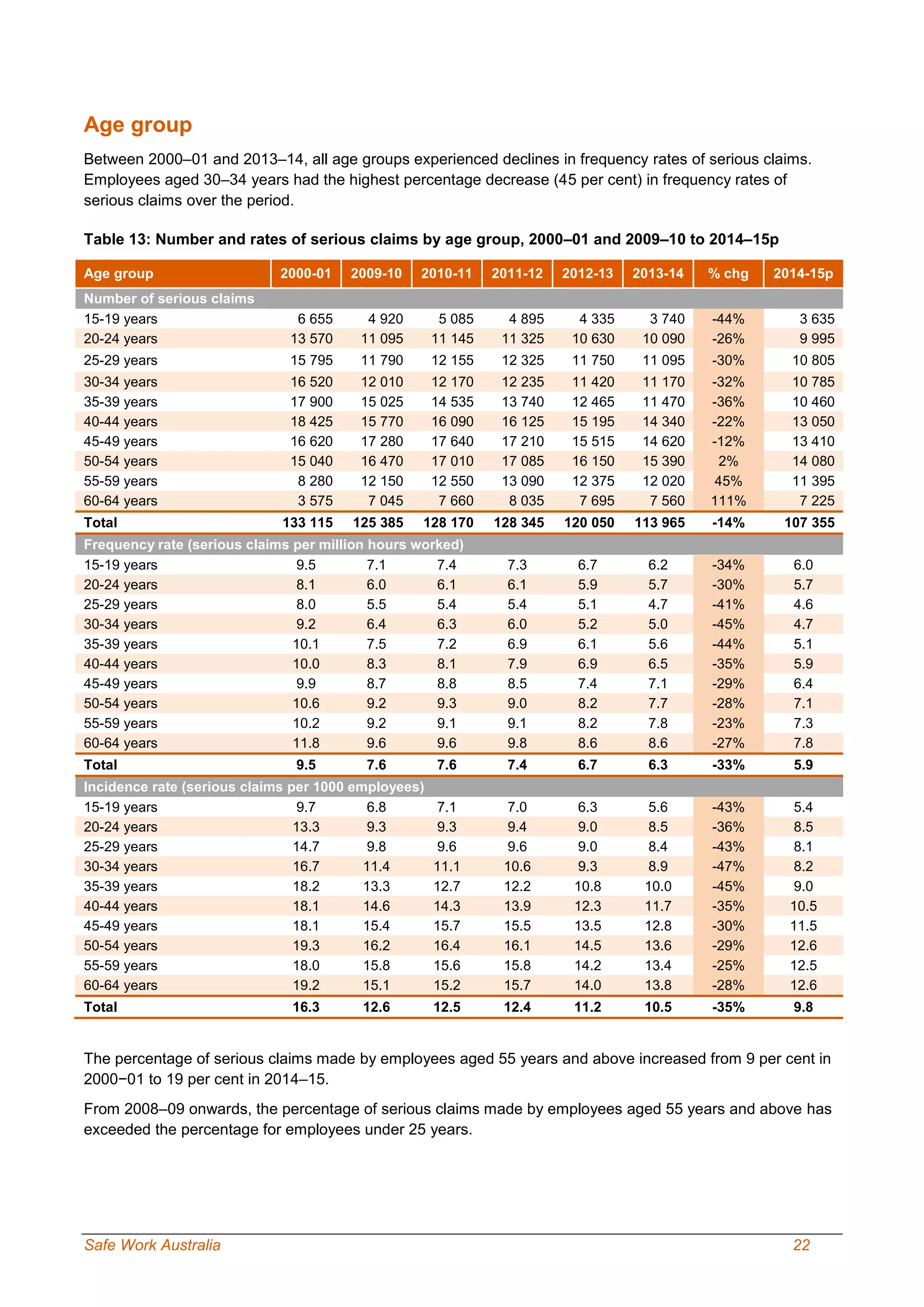
Between 2000–01 and 2013–14, all age groups experienced declines in frequency rates of serious claims.
Employees aged 30–34 years had the highest percentage decrease (45 per cent) in frequency rates of
serious claims over the period.
Table 13: Number and rates of serious claims by age group, 2000–01 and 2009–10 to 2014–15p
Age group 2000-01 2009-10 2010-11 2011-12 2012-13 2013-14 % chg 2014-15p
Number of serious claims
15-19 years 6 655 4 920 5 085 4 895 4 335 3 740 -44% 3 635
20-24 years 13 570 11 095 11 145 11 325 10 630 10 090 -26% 9 995
25-29 years 15 795 11 790 12 155 12 325 11 750 11 095 -30% 10 805
30-34 years 16 520 12 010 12 170 12 235 11 420 11 170 -32% 10 785
35-39 years 17 900 15 025 14 535 13 740 12 465 11 470 -36% 10 460
40-44 years 18 425 15 770 16 090 16 125 15 195 14 340 -22% 13 050
45-49 years 16 620 17 280 17 640 17 210 15 515 14 620 -12% 13 410
50-54 years 15 040 16 470 17 010 17 085 16 150 15 390 2% 14 080
55-59 years 8 280 12 150 12 550 13 090 12 375 12 020 45% 11 395
60-64 years 3 575 7 045 7 660 8 035 7 695 7 560 111% 7 225
Total 133 115 125 385 128 170 128 345 120 050 113 965 -14% 107 355
Frequency rate (serious claims per million hours worked)
15-19 years 9.5 7.1 7.4 7.3 6.7 6.2 -34% 6.0
20-24 years 8.1 6.0 6.1 6.1 5.9 5.7 -30% 5.7
25-29 years 8.0 5.5 5.4 5.4 5.1 4.7 -41% 4.6
30-34 years 9.2 6.4 6.3 6.0 5.2 5.0 -45% 4.7
35-39 years 10.1 7.5 7.2 6.9 6.1 5.6 -44% 5.1
40-44 years 10.0 8.3 8.1 7.9 6.9 6.5 -35% 5.9
45-49 years 9.9 8.7 8.8 8.5 7.4 7.1 -29% 6.4
50-54 years 10.6 9.2 9.3 9.0 8.2 7.7 -28% 7.1
55-59 years 10.2 9.2 9.1 9.1 8.2 7.8 -23% 7.3
60-64 years 11.8 9.6 9.6 9.8 8.6 8.6 -27% 7.8
Total 9.5 7.6 7.6 7.4 6.7 6.3 -33% 5.9
Incidence rate (serious claims per 1000 employees)
15-19 years 9.7 6.8 7.1 7.0 6.3 5.6 -43% 5.4
20-24 years 13.3 9.3 9.3 9.4 9.0 8.5 -36% 8.5
25-29 years 14.7 9.8 9.6 9.6 9.0 8.4 -43% 8.1
30-34 years 16.7 11.4 11.1 10.6 9.3 8.9 -47% 8.2
35-39 years 18.2 13.3 12.7 12.2 10.8 10.0 -45% 9.0
40-44 years 18.1 14.6 14.3 13.9 12.3 11.7 -35% 10.5
45-49 years 18.1 15.4 15.7 15.5 13.5 12.8 -30% 11.5
50-54 years 19.3 16.2 16.4 16.1 14.5 13.6 -29% 12.6
55-59 years 18.0 15.8 15.6 15.8 14.2 13.4 -25% 12.5
60-64 years 19.2 15.1 15.2 15.7 14.0 13.8 -28% 12.6
Total 16.3 12.6 12.5 12.4 11.2 10.5 -35% 9.8
The percentage of serious claims made by employees aged 55 years and above increased from 9 per cent in
2000−01 to 19 per cent in 2014–15.
From 2008–09 onwards, the percentage of serious claims made by employees aged 55 years and above has
exceeded the percentage for employees under 25 years.
Australian Workers’ Compensation Statistics 2014–15 (revised July 2017) 23
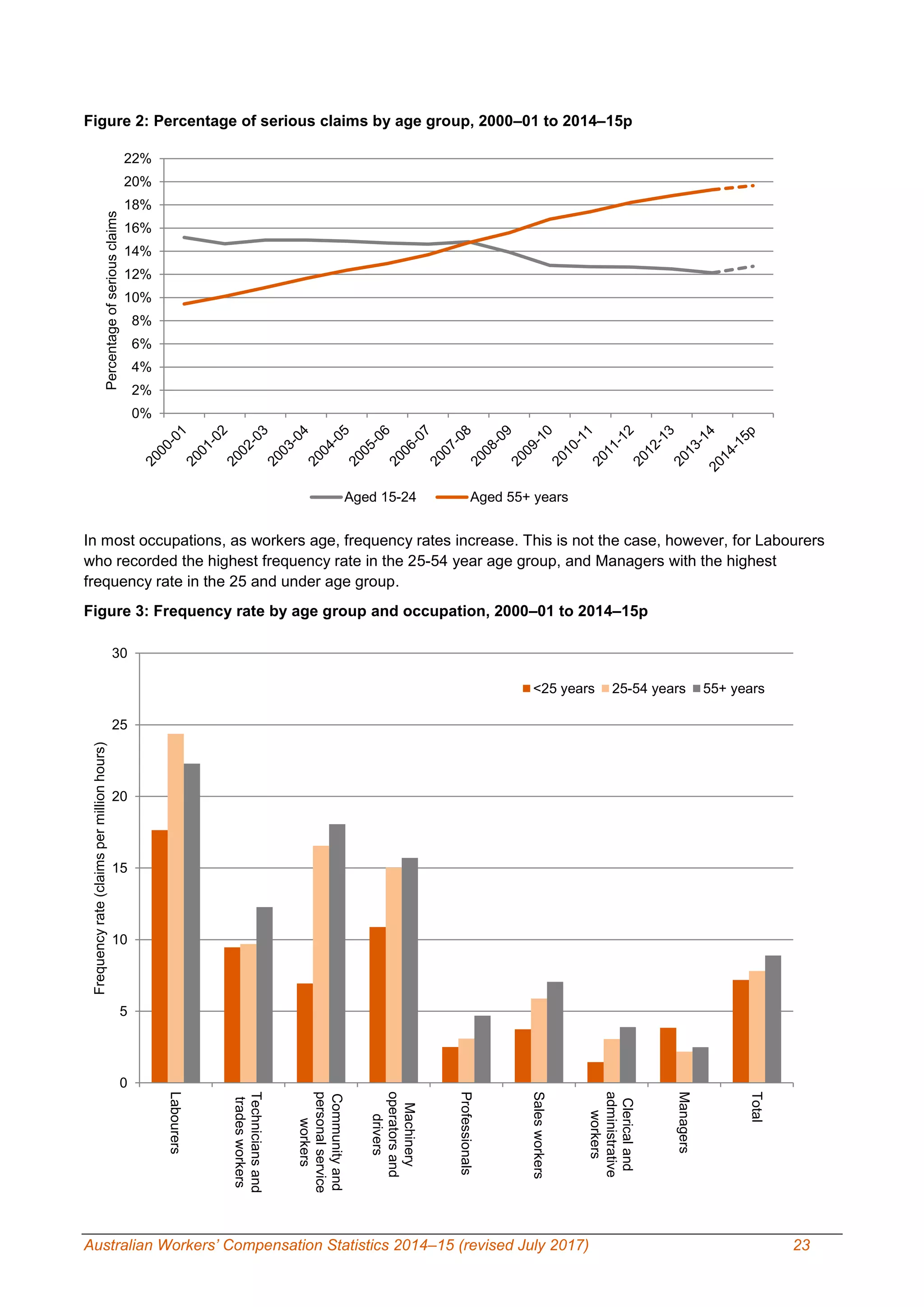
Figure 2: Percentage of serious claims by age group, 2000–01 to 2014–15p
In most occupations, as workers age, frequency rates increase. This is not the case, however, for Labourers
who recorded the highest frequency rate in the 25-54 year age group, and Managers with the highest
frequency rate in the 25 and under age group.
Figure 3: Frequency rate by age group and occupation, 2000–01 to 2014–15p
0%
2%
4%
6%
8%
10%
12%
14%
16%
18%
20%
22%
Percentageofseriousclaims
Aged 15-24 Aged 55+ years
0
5
10
15
20
25
30
Labourers
Techniciansand
tradesworkers
Communityand
personalservice
workers
Machinery
operatorsand
drivers
Professionals
Salesworkers
Clericaland
administrative
workers
Managers
Total
Frequencyrate(claimspermillionhours)
<25 years 25-54 years 55+ years
Safe Work Australia 24
Occupation
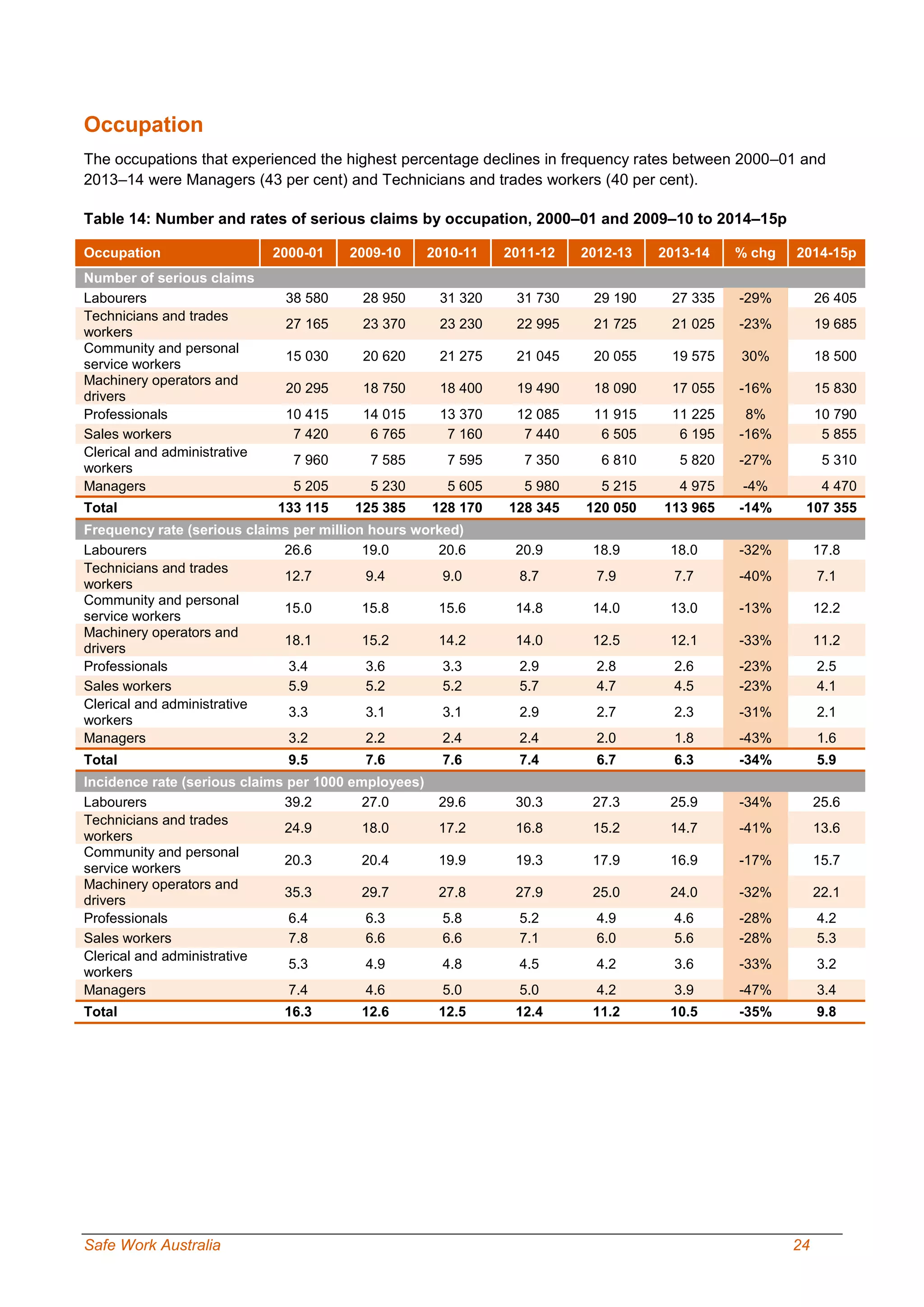
The occupations that experienced the highest percentage declines in frequency rates between 2000–01 and
2013–14 were Managers (43 per cent) and Technicians and trades workers (40 per cent).
Table 14: Number and rates of serious claims by occupation, 2000–01 and 2009–10 to 2014–15p
Occupation 2000-01 2009-10 2010-11 2011-12 2012-13 2013-14 % chg 2014-15p
Number of serious claims
Labourers 38 580 28 950 31 320 31 730 29 190 27 335 -29% 26 405
Technicians and trades
workers
27 165 23 370 23 230 22 995 21 725 21 025 -23% 19 685
Community and personal
service workers
15 030 20 620 21 275 21 045 20 055 19 575 30% 18 500
Machinery operators and
drivers
20 295 18 750 18 400 19 490 18 090 17 055 -16% 15 830
Professionals 10 415 14 015 13 370 12 085 11 915 11 225 8% 10 790
Sales workers 7 420 6 765 7 160 7 440 6 505 6 195 -16% 5 855
Clerical and administrative
workers
7 960 7 585 7 595 7 350 6 810 5 820 -27% 5 310
Managers 5 205 5 230 5 605 5 980 5 215 4 975 -4% 4 470
Total 133 115 125 385 128 170 128 345 120 050 113 965 -14% 107 355
Frequency rate (serious claims per million hours worked)
Labourers 26.6 19.0 20.6 20.9 18.9 18.0 -32% 17.8
Technicians and trades
workers
12.7 9.4 9.0 8.7 7.9 7.7 -40% 7.1
Community and personal
service workers
15.0 15.8 15.6 14.8 14.0 13.0 -13% 12.2
Machinery operators and
drivers
18.1 15.2 14.2 14.0 12.5 12.1 -33% 11.2
Professionals 3.4 3.6 3.3 2.9 2.8 2.6 -23% 2.5
Sales workers 5.9 5.2 5.2 5.7 4.7 4.5 -23% 4.1
Clerical and administrative
workers
3.3 3.1 3.1 2.9 2.7 2.3 -31% 2.1
Managers 3.2 2.2 2.4 2.4 2.0 1.8 -43% 1.6
Total 9.5 7.6 7.6 7.4 6.7 6.3 -34% 5.9
Incidence rate (serious claims per 1000 employees)
Labourers 39.2 27.0 29.6 30.3 27.3 25.9 -34% 25.6
Technicians and trades
workers
24.9 18.0 17.2 16.8 15.2 14.7 -41% 13.6
Community and personal
service workers
20.3 20.4 19.9 19.3 17.9 16.9 -17% 15.7
Machinery operators and
drivers
35.3 29.7 27.8 27.9 25.0 24.0 -32% 22.1
Professionals 6.4 6.3 5.8 5.2 4.9 4.6 -28% 4.2
Sales workers 7.8 6.6 6.6 7.1 6.0 5.6 -28% 5.3
Clerical and administrative
workers
5.3 4.9 4.8 4.5 4.2 3.6 -33% 3.2
Managers 7.4 4.6 5.0 5.0 4.2 3.9 -47% 3.4
Total 16.3 12.6 12.5 12.4 11.2 10.5 -35% 9.8
Australian Workers’ Compensation Statistics 2014–15 (revised July 2017) 25
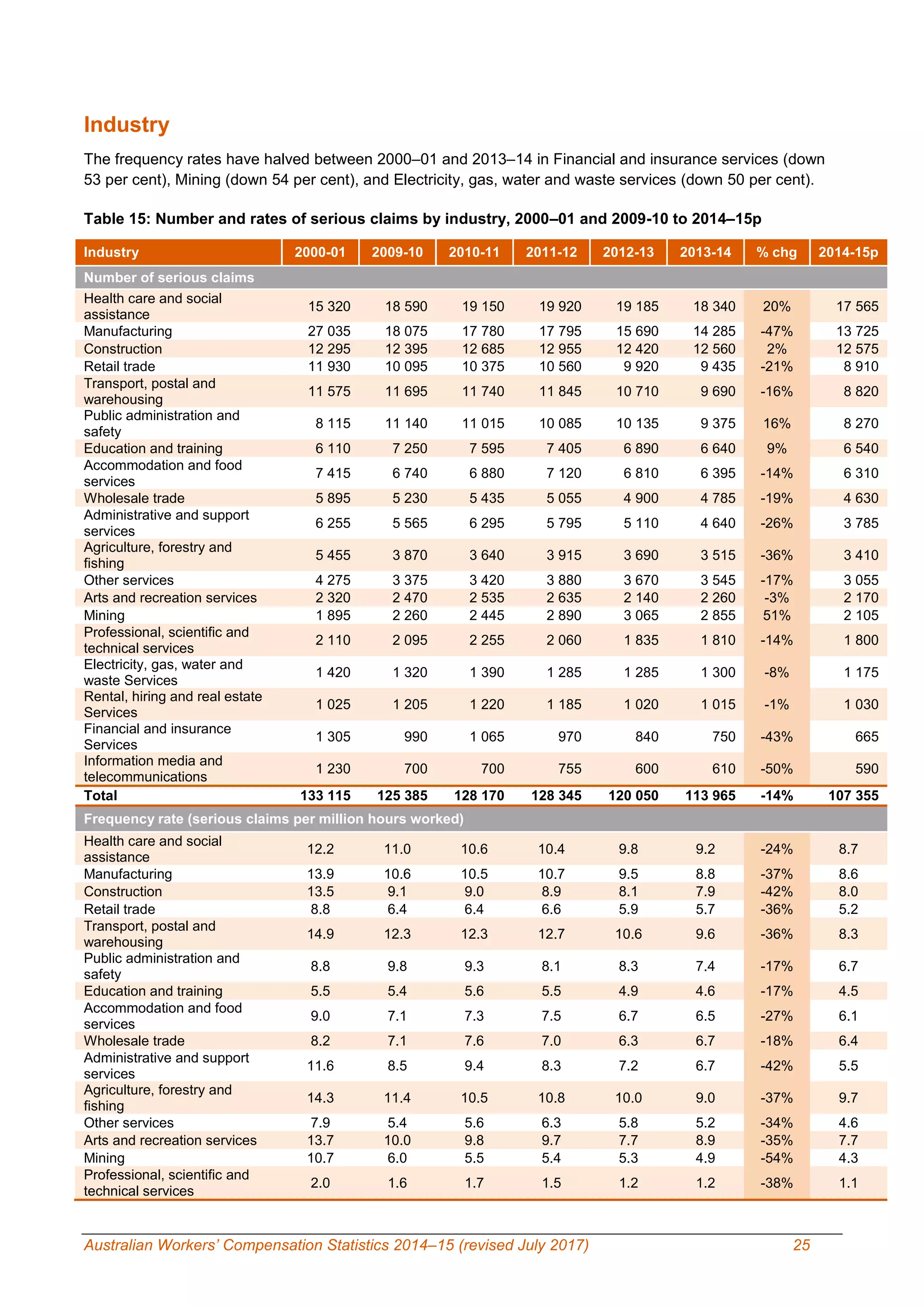
Industry
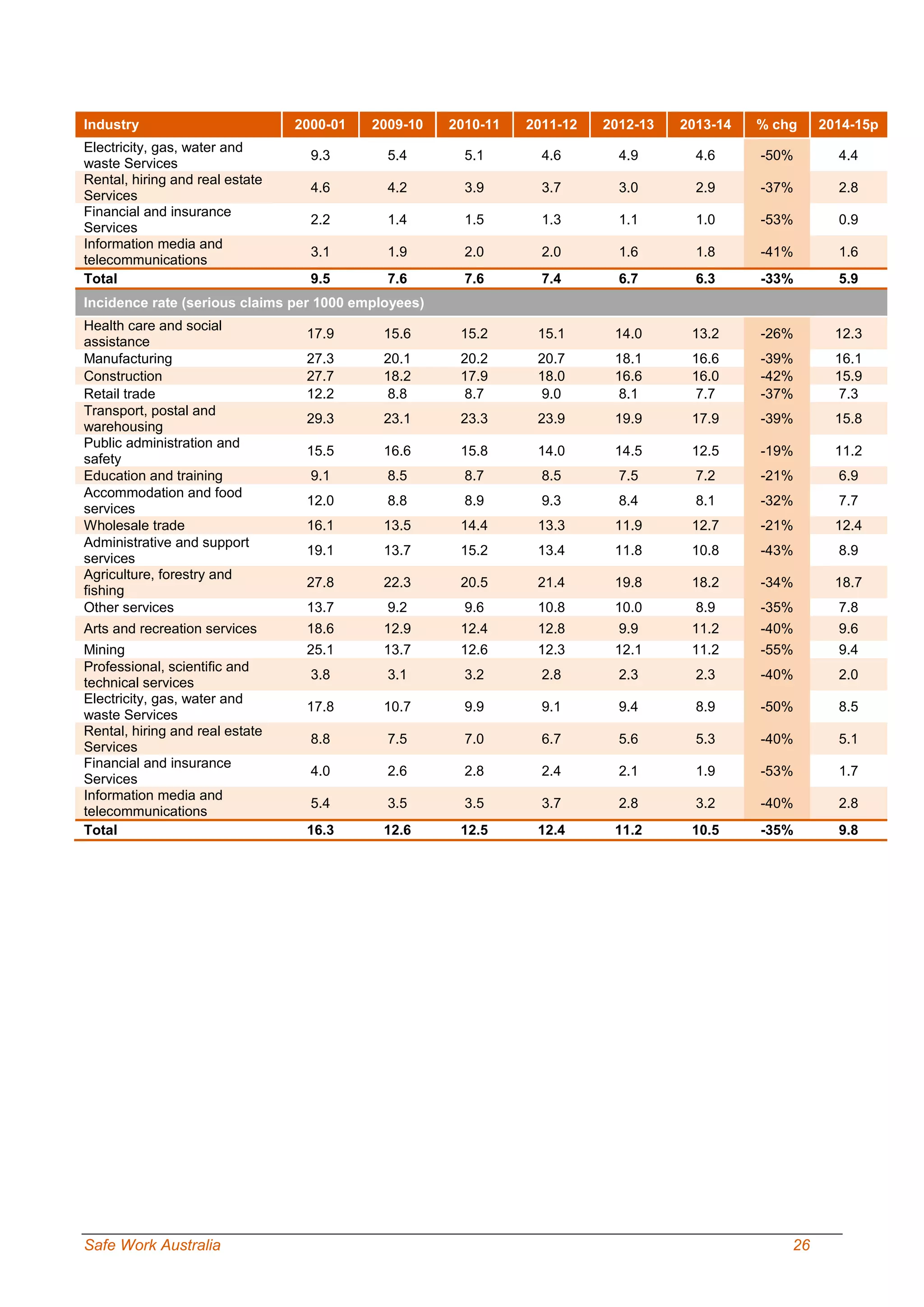
The frequency rates have halved between 2000–01 and 2013–14 in Financial and insurance services (down
53 per cent), Mining (down 54 per cent), and Electricity, gas, water and waste services (down 50 per cent).
Table 15: Number and rates of serious claims by industry, 2000–01 and 2009-10 to 2014–15p
Industry 2000-01 2009-10 2010-11 2011-12 2012-13 2013-14 % chg 2014-15p
Number of serious claims
Health care and social
assistance
15 320 18 590 19 150 19 920 19 185 18 340 20% 17 565
Manufacturing 27 035 18 075 17 780 17 795 15 690 14 285 -47% 13 725
Construction 12 295 12 395 12 685 12 955 12 420 12 560 2% 12 575
Retail trade 11 930 10 095 10 375 10 560 9 920 9 435 -21% 8 910
Transport, postal and
warehousing
11 575 11 695 11 740 11 845 10 710 9 690 -16% 8 820
Public administration and
safety
8 115 11 140 11 015 10 085 10 135 9 375 16% 8 270
Education and training 6 110 7 250 7 595 7 405 6 890 6 640 9% 6 540
Accommodation and food
services
7 415 6 740 6 880 7 120 6 810 6 395 -14% 6 310
Wholesale trade 5 895 5 230 5 435 5 055 4 900 4 785 -19% 4 630
Administrative and support
services
6 255 5 565 6 295 5 795 5 110 4 640 -26% 3 785
Agriculture, forestry and
fishing
5 455 3 870 3 640 3 915 3 690 3 515 -36% 3 410
Other services 4 275 3 375 3 420 3 880 3 670 3 545 -17% 3 055
Arts and recreation services 2 320 2 470 2 535 2 635 2 140 2 260 -3% 2 170
Mining 1 895 2 260 2 445 2 890 3 065 2 855 51% 2 105
Professional, scientific and
technical services
2 110 2 095 2 255 2 060 1 835 1 810 -14% 1 800
Electricity, gas, water and
waste Services
1 420 1 320 1 390 1 285 1 285 1 300 -8% 1 175
Rental, hiring and real estate
Services
1 025 1 205 1 220 1 185 1 020 1 015 -1% 1 030
Financial and insurance
Services
1 305 990 1 065 970 840 750 -43% 665
Information media and
telecommunications
1 230 700 700 755 600 610 -50% 590
Total 133 115 125 385 128 170 128 345 120 050 113 965 -14% 107 355
Frequency rate (serious claims per million hours worked)
Health care and social
assistance
12.2 11.0 10.6 10.4 9.8 9.2 -24% 8.7
Manufacturing 13.9 10.6 10.5 10.7 9.5 8.8 -37% 8.6
Construction 13.5 9.1 9.0 8.9 8.1 7.9 -42% 8.0
Retail trade 8.8 6.4 6.4 6.6 5.9 5.7 -36% 5.2
Transport, postal and
warehousing
14.9 12.3 12.3 12.7 10.6 9.6 -36% 8.3
Public administration and
safety
8.8 9.8 9.3 8.1 8.3 7.4 -17% 6.7
Education and training 5.5 5.4 5.6 5.5 4.9 4.6 -17% 4.5
Accommodation and food
services
9.0 7.1 7.3 7.5 6.7 6.5 -27% 6.1
Wholesale trade 8.2 7.1 7.6 7.0 6.3 6.7 -18% 6.4
Administrative and support
services
11.6 8.5 9.4 8.3 7.2 6.7 -42% 5.5
Agriculture, forestry and
fishing
14.3 11.4 10.5 10.8 10.0 9.0 -37% 9.7
Other services 7.9 5.4 5.6 6.3 5.8 5.2 -34% 4.6
Arts and recreation services 13.7 10.0 9.8 9.7 7.7 8.9 -35% 7.7
Mining 10.7 6.0 5.5 5.4 5.3 4.9 -54% 4.3
Professional, scientific and
technical services
2.0 1.6 1.7 1.5 1.2 1.2 -38% 1.1
Safe Work Australia 26
Industry 2000-01 2009-10 2010-11 2011-12 2012-13 2013-14 % chg 2014-15p
Electricity, gas, water and
waste Services
9.3 5.4 5.1 4.6 4.9 4.6 -50% 4.4
Rental, hiring and real estate
Services
4.6 4.2 3.9 3.7 3.0 2.9 -37% 2.8
Financial and insurance
Services
2.2 1.4 1.5 1.3 1.1 1.0 -53% 0.9
Information media and
telecommunications
3.1 1.9 2.0 2.0 1.6 1.8 -41% 1.6
Total 9.5 7.6 7.6 7.4 6.7 6.3 -33% 5.9
Incidence rate (serious claims per 1000 employees)
Health care and social
assistance
17.9 15.6 15.2 15.1 14.0 13.2 -26% 12.3
Manufacturing 27.3 20.1 20.2 20.7 18.1 16.6 -39% 16.1
Construction 27.7 18.2 17.9 18.0 16.6 16.0 -42% 15.9
Retail trade 12.2 8.8 8.7 9.0 8.1 7.7 -37% 7.3
Transport, postal and
warehousing
29.3 23.1 23.3 23.9 19.9 17.9 -39% 15.8
Public administration and
safety
15.5 16.6 15.8 14.0 14.5 12.5 -19% 11.2
Education and training 9.1 8.5 8.7 8.5 7.5 7.2 -21% 6.9
Accommodation and food
services
12.0 8.8 8.9 9.3 8.4 8.1 -32% 7.7
Wholesale trade 16.1 13.5 14.4 13.3 11.9 12.7 -21% 12.4
Administrative and support
services
19.1 13.7 15.2 13.4 11.8 10.8 -43% 8.9
Agriculture, forestry and
fishing
27.8 22.3 20.5 21.4 19.8 18.2 -34% 18.7
Other services 13.7 9.2 9.6 10.8 10.0 8.9 -35% 7.8
Arts and recreation services 18.6 12.9 12.4 12.8 9.9 11.2 -40% 9.6
Mining 25.1 13.7 12.6 12.3 12.1 11.2 -55% 9.4
Professional, scientific and
technical services
3.8 3.1 3.2 2.8 2.3 2.3 -40% 2.0
Electricity, gas, water and
waste Services
17.8 10.7 9.9 9.1 9.4 8.9 -50% 8.5
Rental, hiring and real estate
Services
8.8 7.5 7.0 6.7 5.6 5.3 -40% 5.1
Financial and insurance
Services
4.0 2.6 2.8 2.4 2.1 1.9 -53% 1.7
Information media and
telecommunications
5.4 3.5 3.5 3.7 2.8 3.2 -40% 2.8
Total 16.3 12.6 12.5 12.4 11.2 10.5 -35% 9.8
Australian Workers’ Compensation Statistics 2014–15 (revised July 2017) 27
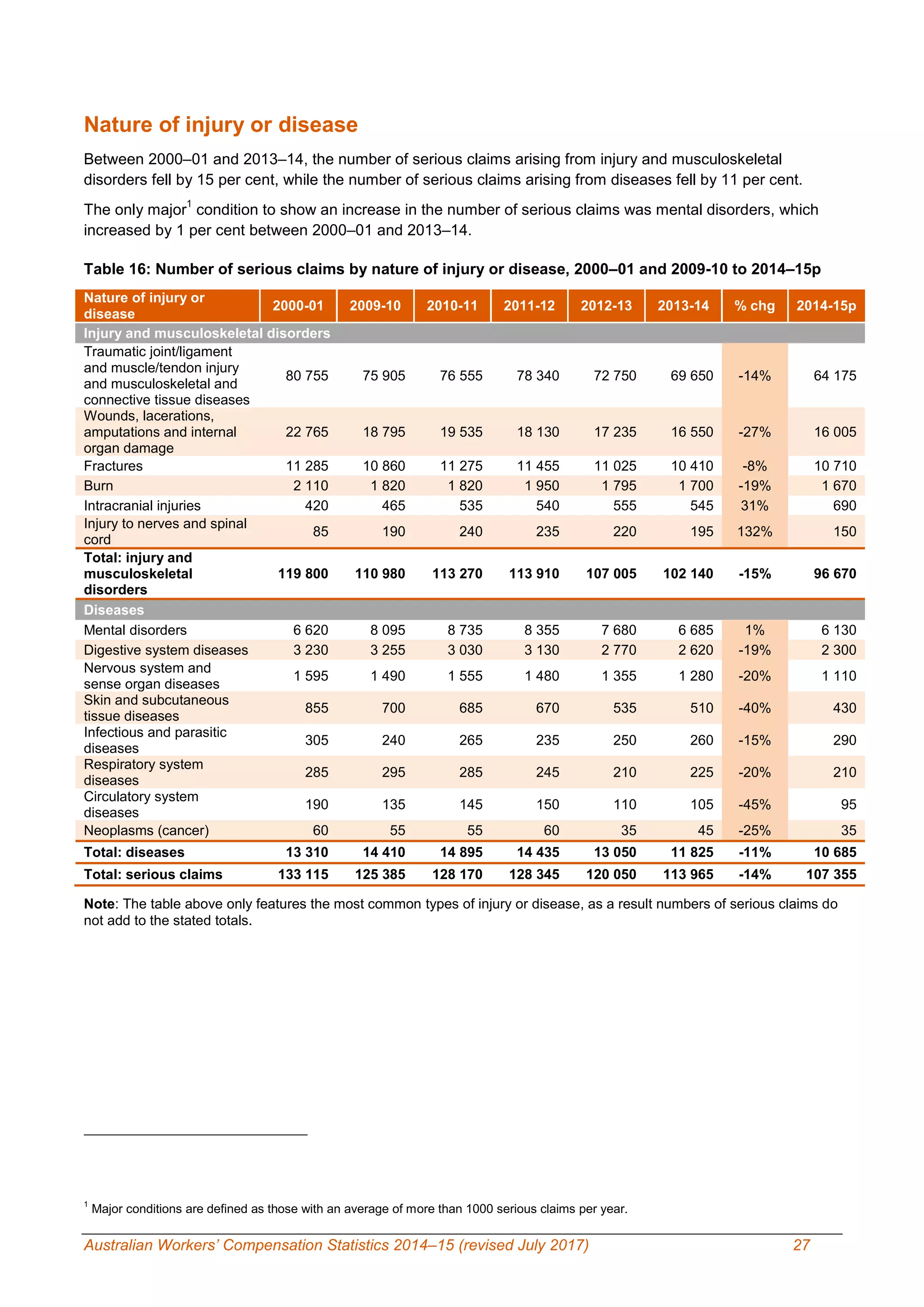
Nature of injury or disease
Between 2000–01 and 2013–14, the number of serious claims arising from injury and musculoskeletal
disorders fell by 15 per cent, while the number of serious claims arising from diseases fell by 11 per cent.
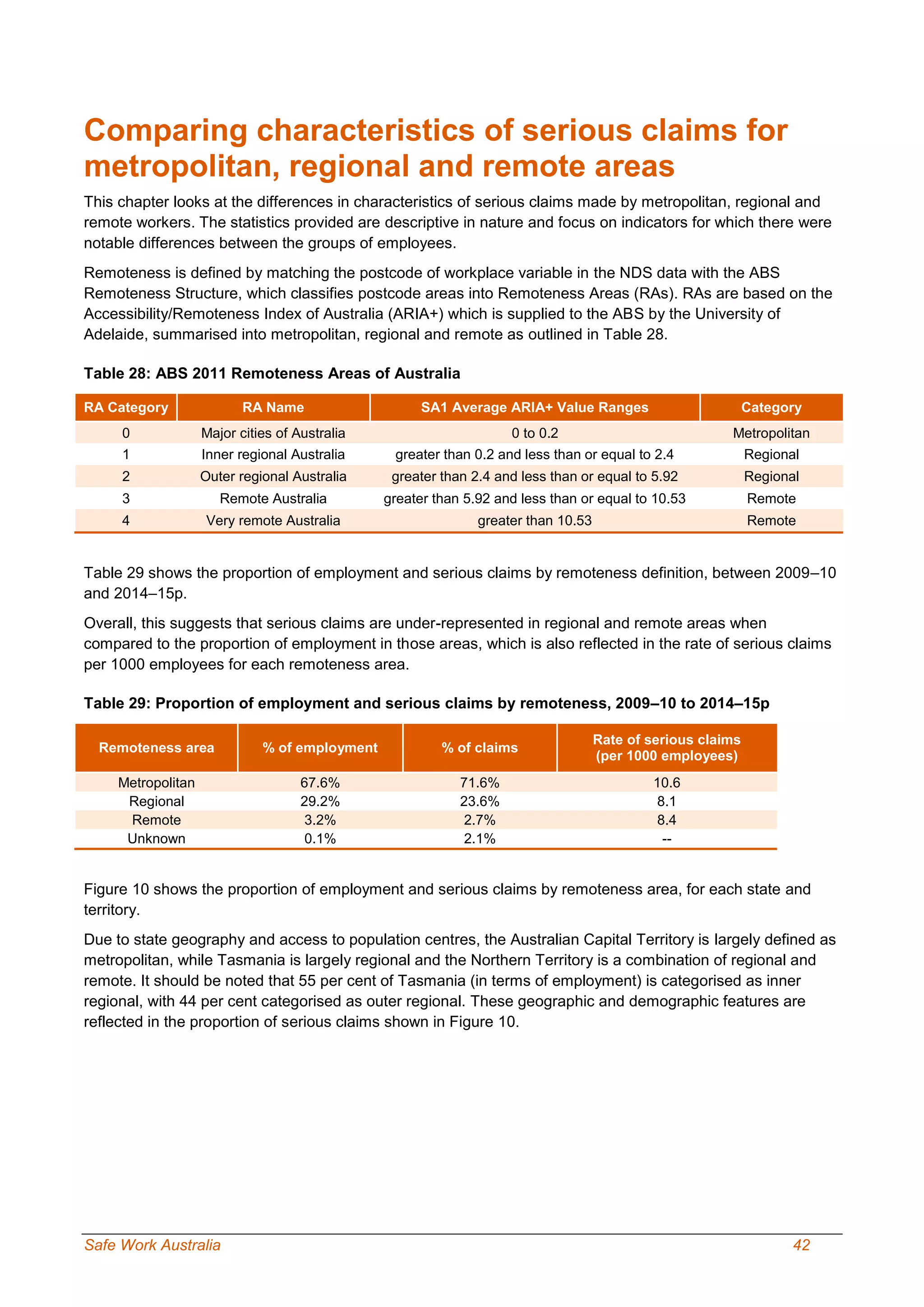
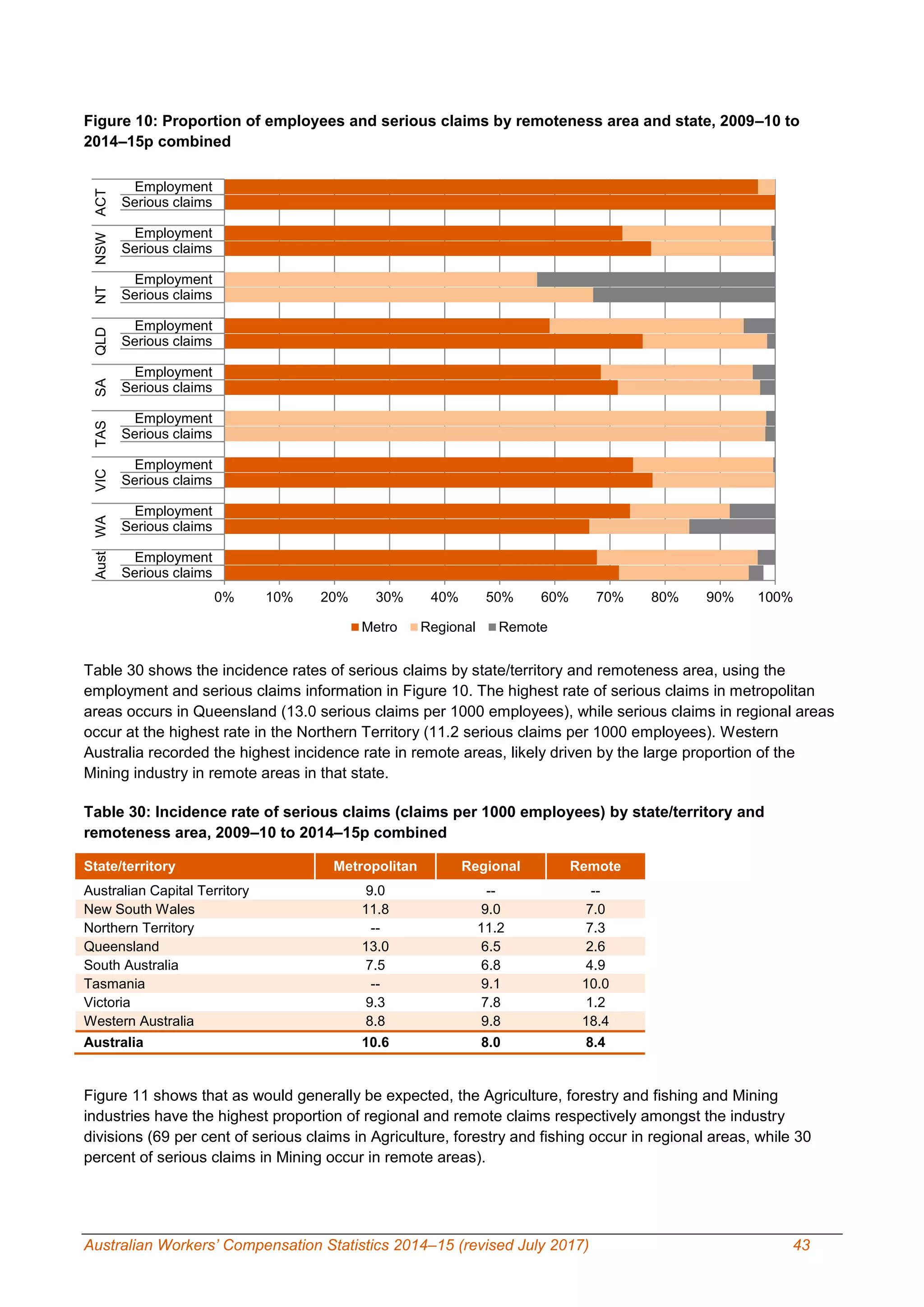
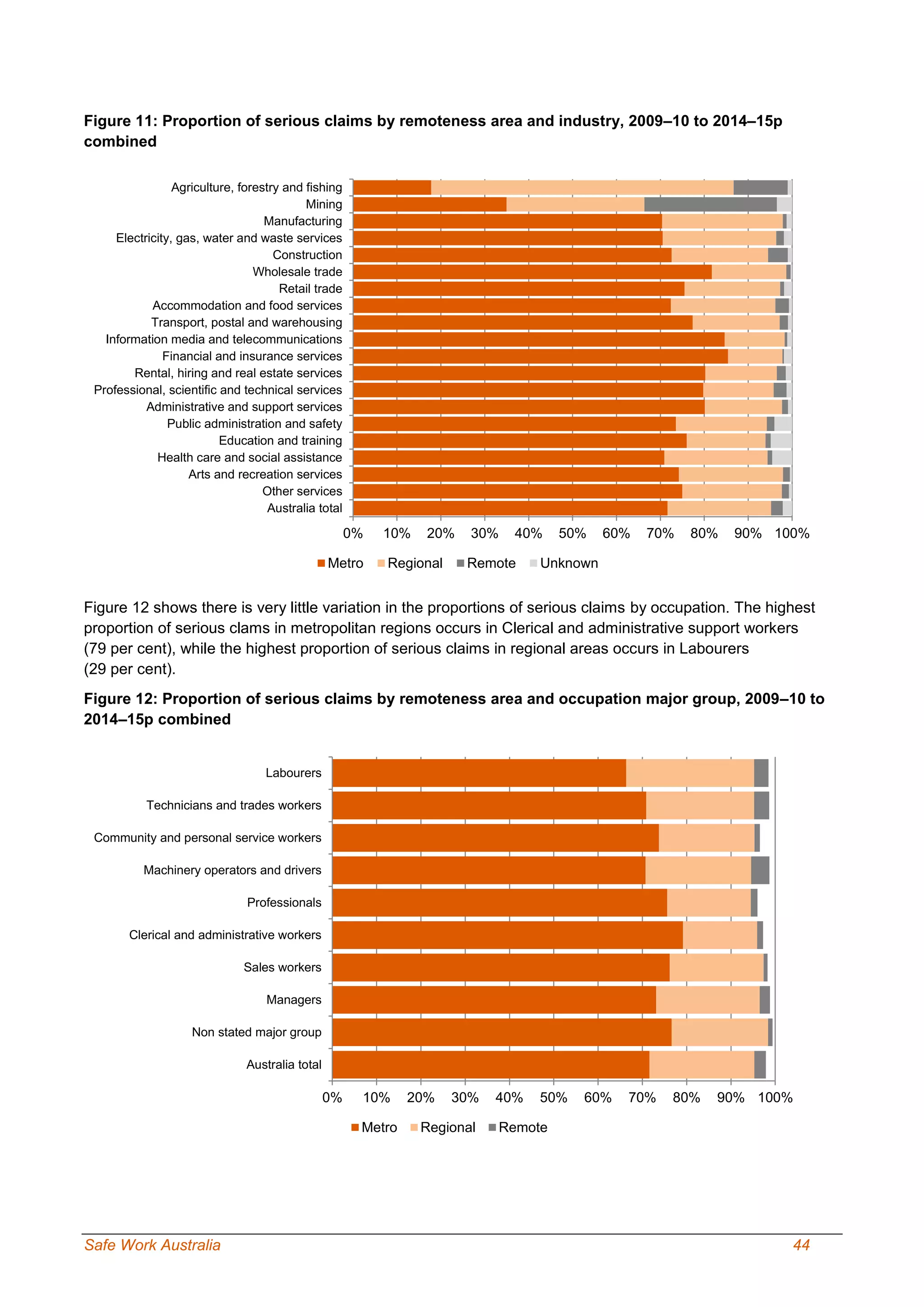
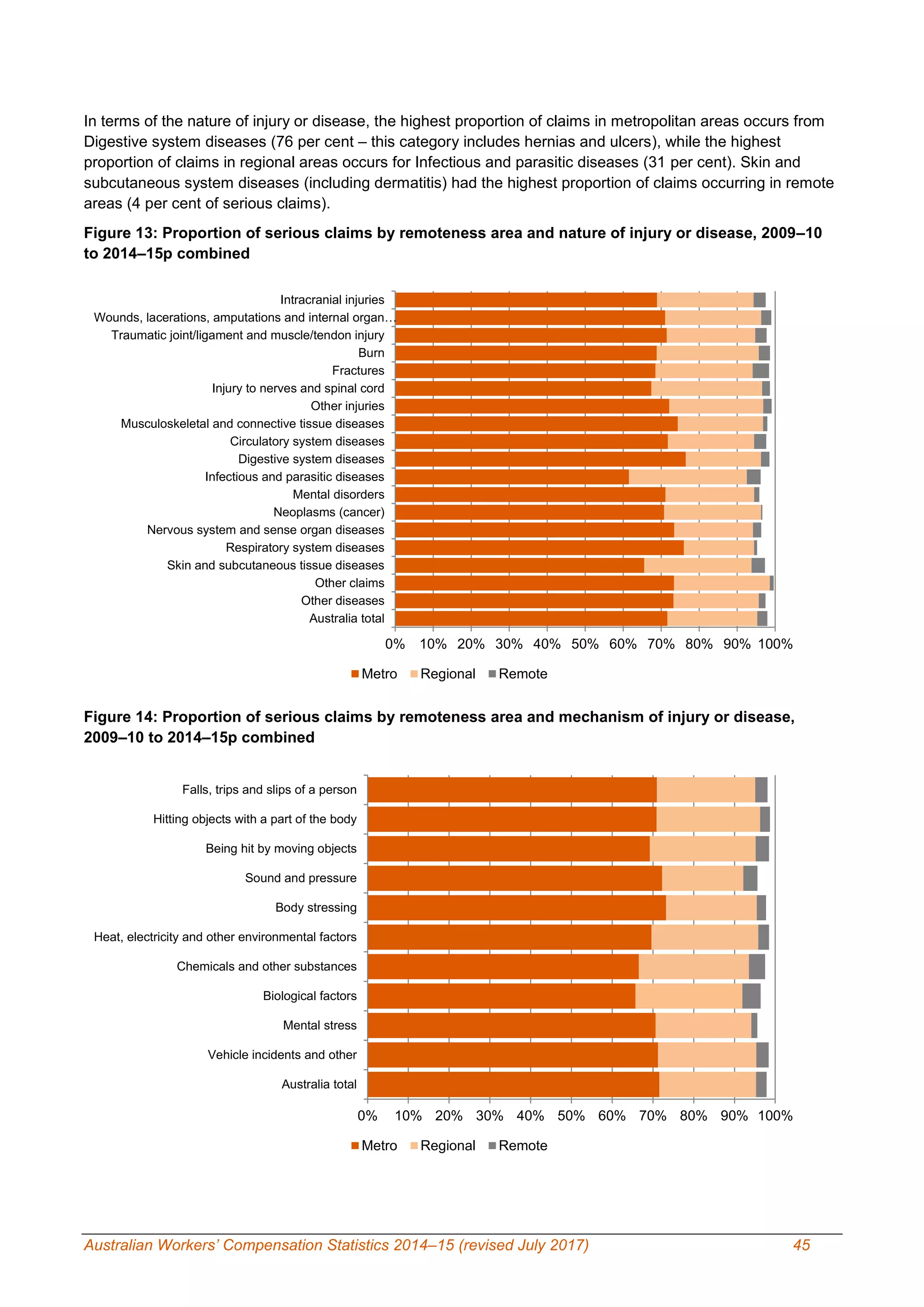
The only major
1
condition to show an increase in the number of serious claims was mental disorders, which
increased by 1 per cent between 2000–01 and 2013–14.
Table 16: Number of serious claims by nature of injury or disease, 2000–01 and 2009-10 to 2014–15p
Nature of injury or
disease
2000-01 2009-10 2010-11 2011-12 2012-13 2013-14 % chg 2014-15p
Injury and musculoskeletal disorders
Traumatic joint/ligament
and muscle/tendon injury
and musculoskeletal and
connective tissue diseases
80 755 75 905 76 555 78 340 72 750 69 650 -14% 64 175
Wounds, lacerations,
amputations and internal
organ damage
22 765 18 795 19 535 18 130 17 235 16 550 -27% 16 005
Fractures 11 285 10 860 11 275 11 455 11 025 10 410 -8% 10 710
Burn 2 110 1 820 1 820 1 950 1 795 1 700 -19% 1 670
Intracranial injuries 420 465 535 540 555 545 31% 690
Injury to nerves and spinal
cord
85 190 240 235 220 195 132% 150
Total: injury and
musculoskeletal
disorders
119 800 110 980 113 270 113 910 107 005 102 140 -15% 96 670
Diseases
Mental disorders 6 620 8 095 8 735 8 355 7 680 6 685 1% 6 130
Digestive system diseases 3 230 3 255 3 030 3 130 2 770 2 620 -19% 2 300
Nervous system and
sense organ diseases
1 595 1 490 1 555 1 480 1 355 1 280 -20% 1 110
Skin and subcutaneous
tissue diseases
855 700 685 670 535 510 -40% 430
Infectious and parasitic
diseases
305 240 265 235 250 260 -15% 290
Respiratory system
diseases
285 295 285 245 210 225 -20% 210
Circulatory system
diseases
190 135 145 150 110 105 -45% 95
Neoplasms (cancer) 60 55 55 60 35 45 -25% 35
Total: diseases 13 310 14 410 14 895 14 435 13 050 11 825 -11% 10 685
Total: serious claims 133 115 125 385 128 170 128 345 120 050 113 965 -14% 107 355
Note: The table above only features the most common types of injury or disease, as a result numbers of serious claims do
not add to the stated totals.
1
Major conditions are defined as those with an average of more than 1000 serious claims per year.
Safe Work Australia 28
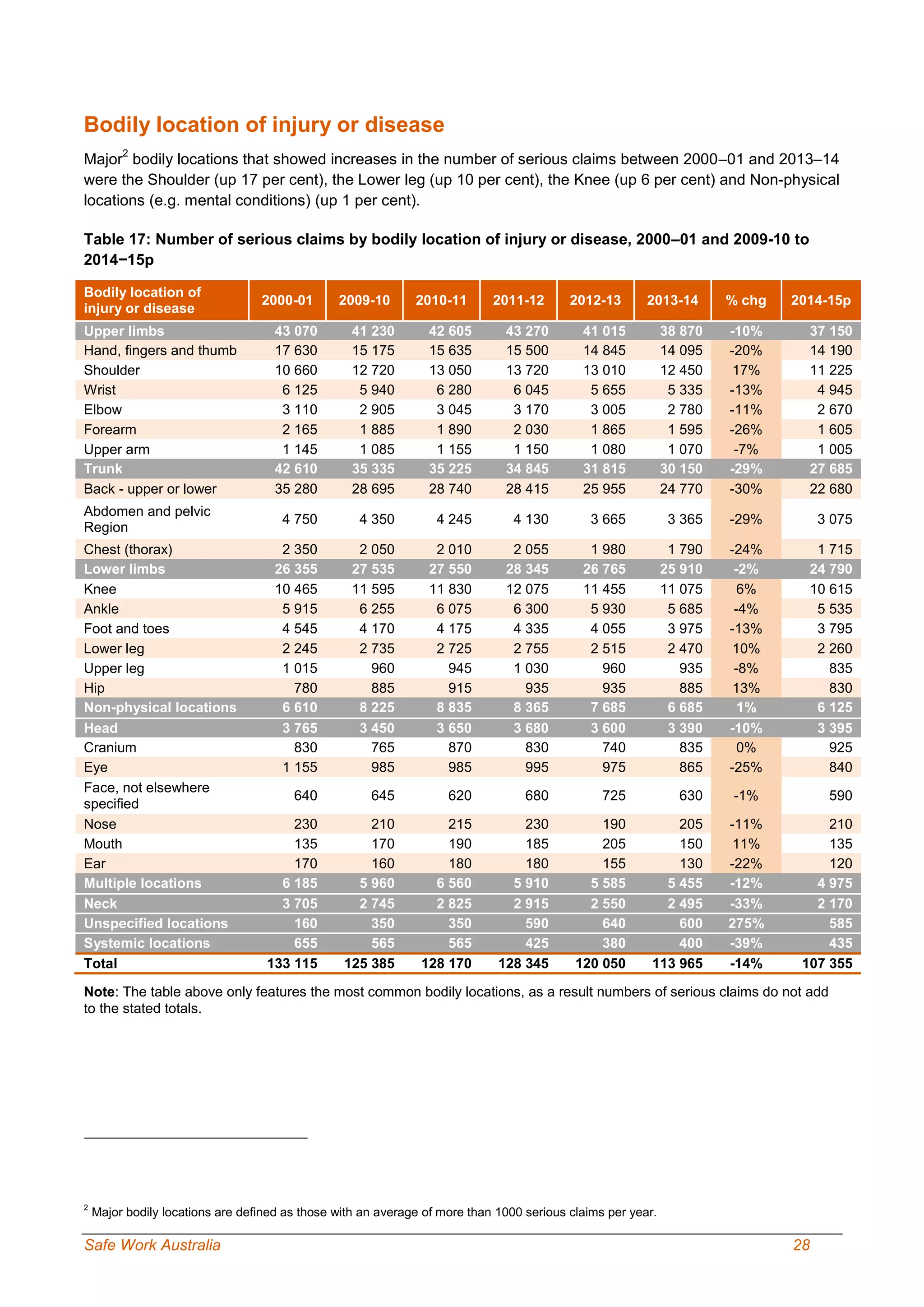
Bodily location of injury or disease
Major
2
bodily locations that showed increases in the number of serious claims between 2000–01 and 2013–14
were the Shoulder (up 17 per cent), the Lower leg (up 10 per cent), the Knee (up 6 per cent) and Non-physical
locations (e.g. mental conditions) (up 1 per cent).
Table 17: Number of serious claims by bodily location of injury or disease, 2000–01 and 2009-10 to
2014−15p
Bodily location of
injury or disease
2000-01 2009-10 2010-11 2011-12 2012-13 2013-14 % chg 2014-15p
Upper limbs 43 070 41 230 42 605 43 270 41 015 38 870 -10% 37 150
Hand, fingers and thumb 17 630 15 175 15 635 15 500 14 845 14 095 -20% 14 190
Shoulder 10 660 12 720 13 050 13 720 13 010 12 450 17% 11 225
Wrist 6 125 5 940 6 280 6 045 5 655 5 335 -13% 4 945
Elbow 3 110 2 905 3 045 3 170 3 005 2 780 -11% 2 670
Forearm 2 165 1 885 1 890 2 030 1 865 1 595 -26% 1 605
Upper arm 1 145 1 085 1 155 1 150 1 080 1 070 -7% 1 005
Trunk 42 610 35 335 35 225 34 845 31 815 30 150 -29% 27 685
Back - upper or lower 35 280 28 695 28 740 28 415 25 955 24 770 -30% 22 680
Abdomen and pelvic
Region
4 750 4 350 4 245 4 130 3 665 3 365 -29% 3 075
Chest (thorax) 2 350 2 050 2 010 2 055 1 980 1 790 -24% 1 715
Lower limbs 26 355 27 535 27 550 28 345 26 765 25 910 -2% 24 790
Knee 10 465 11 595 11 830 12 075 11 455 11 075 6% 10 615
Ankle 5 915 6 255 6 075 6 300 5 930 5 685 -4% 5 535
Foot and toes 4 545 4 170 4 175 4 335 4 055 3 975 -13% 3 795
Lower leg 2 245 2 735 2 725 2 755 2 515 2 470 10% 2 260
Upper leg 1 015 960 945 1 030 960 935 -8% 835
Hip 780 885 915 935 935 885 13% 830
Non-physical locations 6 610 8 225 8 835 8 365 7 685 6 685 1% 6 125
Head 3 765 3 450 3 650 3 680 3 600 3 390 -10% 3 395
Cranium 830 765 870 830 740 835 0% 925
Eye 1 155 985 985 995 975 865 -25% 840
Face, not elsewhere
specified
640 645 620 680 725 630 -1% 590
Nose 230 210 215 230 190 205 -11% 210
Mouth 135 170 190 185 205 150 11% 135
Ear 170 160 180 180 155 130 -22% 120
Multiple locations 6 185 5 960 6 560 5 910 5 585 5 455 -12% 4 975
Neck 3 705 2 745 2 825 2 915 2 550 2 495 -33% 2 170
Unspecified locations 160 350 350 590 640 600 275% 585
Systemic locations 655 565 565 425 380 400 -39% 435
Total 133 115 125 385 128 170 128 345 120 050 113 965 -14% 107 355
Note: The table above only features the most common bodily locations, as a result numbers of serious claims do not add
to the stated totals.
2
Major bodily locations are defined as those with an average of more than 1000 serious claims per year.
Australian Workers’ Compensation Statistics 2014–15 (revised July 2017) 29
Mechanism of injury or disease
The mechanism that showed the highest increase in the number of serious claims was Being assaulted by a
person or persons, which more than doubled between 2000–01 and 2013–14 (up from 1 105 to 2 270).
The only other mechanism that showed an increase in the number of serious claims over the same period
was Falls on the same level (up 5 per cent).
Being trapped by moving machinery or equipment recorded the largest decrease with the number of serious
claims halving between 2000–01 and 2013–14.
Table 18: Number of serious claims by mechanism of injury or disease, 2000–01 and 2009-10 to
2014−15p
Mechanism of injury or
disease
2000-01 2009-10 2010-11 2011-12 2012-13 2013-14 % chg 2014-15
Body stressing 58 210 54 130 54 230 54 670 49 905 48 110 -17% 43 555
Muscular stress while lifting,
carrying, or putting down
objects
28 625 22 705 23 430 22 485 20 310 19 305 -33% 16 750
Muscular stress while handling
objects other than lifting,
carrying or putting down
18 840 20 115 19 970 20 515 19 360 18 790 0% 17 830
Muscular stress with no
objects being handled
6 330 7 525 6 970 7 320 6 290 6 300 0% 5 570
Falls, trips & slips of a
person
26 165 27 195 27 955 28 540 26 500 25 425 -3% 24 600
Falls on the same level 15 570 17 220 18 180 18 455 16 680 16 295 5% 15 685
Falls from a height 8 845 8 180 7 845 7 635 7 200 6 770 -23% 6 740
Being hit by moving objects 18 180 17 410 17 735 18 005 17 655 16 580 -9% 16 230
Being hit by falling objects 4 205 4 010 4 055 4 270 3 860 3 600 -14% 3 515
Being trapped between
stationary and moving objects
2 480 2 580 2 485 2 510 2 420 2 355 -5% 2 245
Being trapped by moving
machinery or equipment
2 145 1 355 1 420 1 440 1 295 1 065 -50% 905
Being assaulted by a person or
persons
1 105 2 275 2 240 2 415 2 470 2 270 105% 2 265
Hitting objects with a part of
the body
10 580 8 595 8 470 8 615 8 100 7 880 -26% 7 690
Hitting stationary objects 5 115 4 445 4 560 4 465 4 205 4 070 -20% 3 725
Hitting moving objects 5 315 4 070 3 820 4 060 3 830 3 725 -30% 3 910
Vehicle incidents & other 9 435 7 000 7 995 7 290 7 620 6 740 -29% 6 620
Vehicle accident 2 730 2 915 3 170 3 170 2 940 2 605 -5% 2 355
Mental stress 6 295 7 770 8 370 7 700 7 045 6 210 -1% 5 750
Heat, electricity and other
environmental factors
1 955 1 665 1 660 1 795 1 670 1 585 -19% 1 540
Chemicals and other
substances
1 540 1 110 1 135 1 175 1 040 935 -39% 820
Biological factors 605 385 450 375 360 380 -37% 400
Sound and pressure 150 130 175 180 150 125 -13% 145
Total serious claims 133 115 125 385 128 170 128 345 120 050 113 965 -14% 107 355
Note: The table above only features the most common types of mechanism, as a result numbers of serious claims do not
add to the stated totals.
Safe Work Australia 30
Breakdown agency of injury or disease
Between 2000–01 and 2013–14, the breakdown agencies that showed increases in the number of serious
claims were Animal, human and biological agencies (up 16 per cent), Materials and substances (up
6 per cent), and Environmental agencies (up 2 per cent).
The largest falls were recorded for Chemical and chemical products (down 42 per cent) and Machinery and
fixed plant (down 40 per cent).
Table 19: Number of serious claims by breakdown agency of injury or disease, 2000–01 and 2009-10 to
2014–15p
Breakdown agency of
injury or disease
2000-01 2009-10 2010-11 2011-12 2012-13 2013-14 % chg 2014-15p
Non-powered hand tools,
appliances and equipment
35 695 31 325 30 895 32 505 29 455 27 595 -23% 26 320
Environmental agencies 18 070 19 405 19 475 21 015 19 480 18 350 2% 17 120
Materials and substances 14 835 15 365 15 330 16 935 16 040 15 650 6% 15 470
Animal, human and
biological agencies
13 965 16 545 16 550 17 235 16 875 16 150 16% 15 060
Mobile plant and transport 11 455 11 475 11 505 12 425 11 860 11 235 -2% 10 295
Machinery and (mainly)
fixed plant
9 300 6 125 6 025 6 565 5 935 5 590 -40% 5 075
Powered equipment, tools
and appliances
6 380 6 020 5 795 6 305 5 635 5 065 -21% 4 740
Chemicals and chemical
products
1 390 885 935 980 845 810 -42% 720
Other and unspecified
agencies
22 025 18 240 21 665 14 380 13 920 13 525 -39% 12 555
Total serious claims 133 115 125 385 128 170 128 345 120 050 113 965 -14% 107 355
Australian Workers’ Compensation Statistics 2014–15 (revised July 2017) 31
Time lost and compensation paid
This chapter provides statistics on time lost from work and compensation paid. Time lost is measured in
working weeks lost from work and excludes estimates of future absences. Time lost does not have to occur in
consecutive days or weeks. The time lost reflects the total period of time for which compensation was paid.
The median is used as the measure of central tendency because a few long-term claims involving lengthy
periods of time lost or high amounts of compensation would significantly skew an arithmetic mean. It is not
possible to calculate the total time lost or the total compensation paid by multiplying the median by the
number of claims.
Preliminary data (2014–15) are excluded when reporting time lost and compensation paid because claims
from the preliminary year are likely to be open and claimants may accrue more time lost or more
compensation payments in subsequent years.
Between 2000–01 and 2013–14, the median time lost for a serious claim rose by 33 per cent from 4.2 working
weeks to 5.6. Over the same period, the median compensation paid for a serious claim rose by 94 per cent
from $5 200 to $10 100 (Table 20).
Table 20 also shows an estimate of the inflation adjusted median compensation paid. The median
compensation is adjusted using the ABS Wage Price Index
3
(WPI) to remove the effects of wage inflation and
allow a more meaningful comparison with the median time lost time series. In all adjustments, the 2000–01
financial year is used as the base period for comparison. Due to the limited breakdowns provided by the WPI
series, WPI adjusted median compensation paid data are only able to be provided at the overall and industry
levels. For all other breakdowns in this chapter the non-adjusted median compensation paid is presented.
Table 20: Serious claims: median time lost and compensation paid, 2000–01 to 2013–14
Financial year of
lodgement
Serious
claims
Median time lost
(weeks)
Median
compensation paid
Median compensation
(WPI adjusted)
2000-01 133 115 4.2 $5 200 $5 200
2001-02 130 165 4.3 $5 400 $5 200
2002-03 133 625 4.2 $5 500 $5 100
2003-04 134 345 4.0 $5 100 $4 600
2004-05 135 515 4.0 $5 700 $5 000
2005-06 131 280 4.2 $5 700 $4 800
2006-07 129 480 4.4 $6 200 $5 000
2007-08 129 120 4.7 $6 800 $5 300
2008-09 125 800 5.0 $8 000 $6 000
2009-10 125 385 5.2 $8 400 $6 100
2010-11 128 170 5.5 $8 900 $6 300
2011-12 128 345 5.6 $9 500 $6 400
2012-13 120 050 5.6 $9 700 $6 300
2013-14 113 965 5.6 $10 100 $6 400
3
Wage Price Index, ABS Catalogue No. 6345.0, Australia, September 2016.
Safe Work Australia 32
Figure 4 shows the original and WPI adjusted median compensation payment from 2000–01 to 2013–14.
Figure 5 shows the comparison between median time lost and the WPI adjusted median compensation paid
series between 2000–01 and 2013–14, showing that in real terms median compensation paid has moved in
line with median time lost.
Figure 4: Original and inflation adjusted median compensation paid, 2000–01 to 2013–14
Figure 5: Median time lost and inflation adjusted median compensation paid, 2000–01 to 2013–14
$-
$2,000
$4,000
$6,000
$8,000
$10,000
$12,000
Mediancompensationpaid($)
Original WPI Adjust median compensation
0
1
2
3
4
5
6
$-
$1,000
$2,000
$3,000
$4,000
$5,000
$6,000
$7,000
Mediantimelost(workingweeks)
Mediancompensationpaid($)
WPI Adjust median compensation Median Timelost
Australian Workers’ Compensation Statistics 2014–15 (revised July 2017) 33
Age group
Figure 6 shows that median time lost increases with age and that all age groups have recorded an increase in
median time lost between 2001–02 and 2013–14.
Figure 6: Serious claims: median time lost by age group, 2001–02 to 2013–14
Similar to median time lost, Figure 7 shows that median compensation paid generally increases with age,
however, it levels out for workers aged over 50 and then falls slightly for those age 65 and over.
Figure 7: Serious claims: median compensation paid by age group, 2001–02 to 2013–14
Safe Work Australia 34
Gender
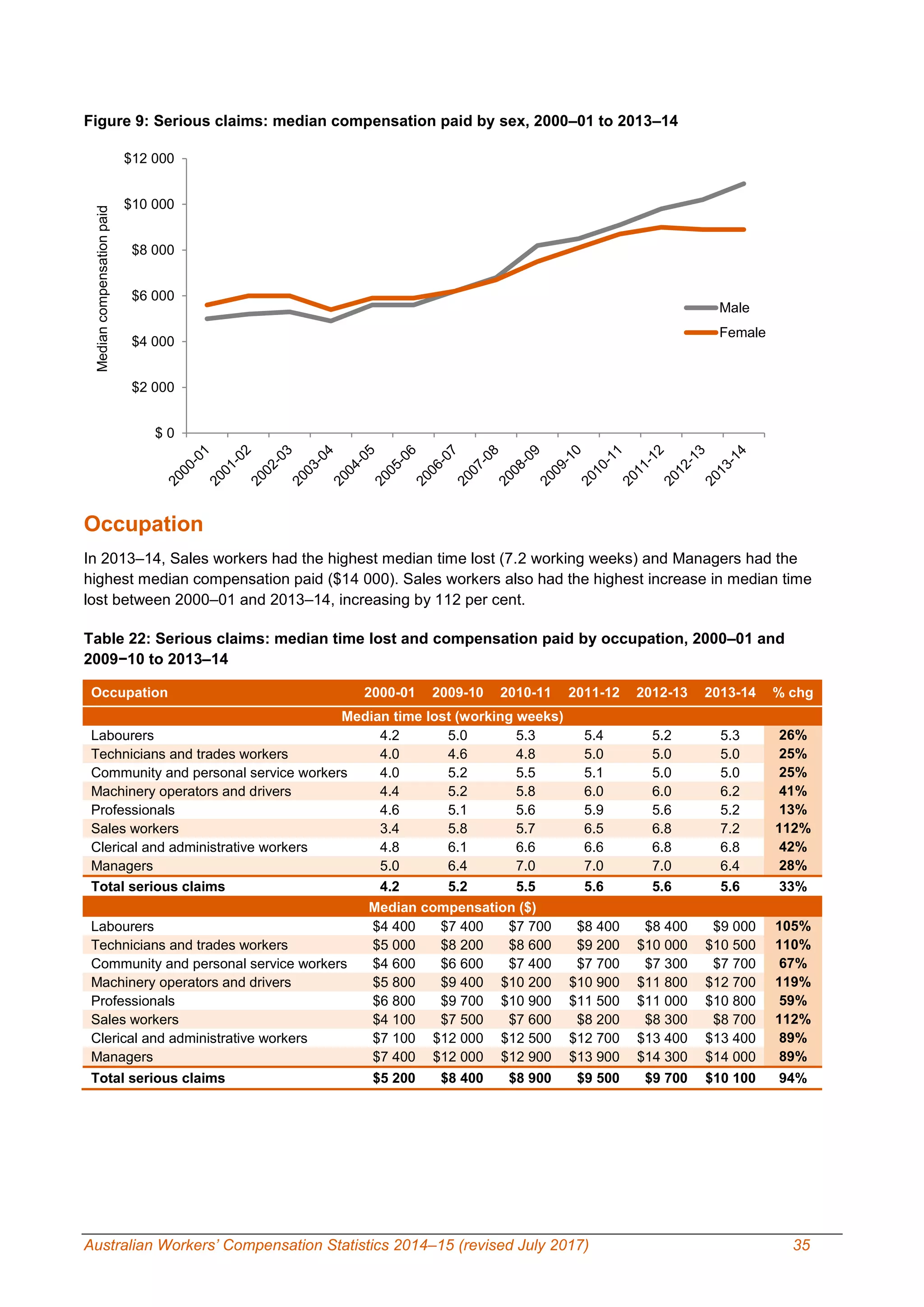
In 2013–14, the median time lost for a serious claim was 5.3 working weeks for male employees and
6.0 working weeks for female employees. The median compensation paid for a serious claim was $10 900 for
male employees and $8 900 for female employees.
Table 21: Serious claims: median time lost and compensation paid by sex, 2000–01 to 2013–14
Financial year
Median time lost
(working weeks)
Median compensation ($)
Male Female Male Female
2000-01 4.0 4.7 $5 000 $5 600
2001-02 4.0 5.0 $5 200 $6 000
2002-03 4.0 4.9 $5 300 $6 000
2003-04 3.8 4.6 $4 900 $5 400
2004-05 3.9 4.4 $5 600 $5 900
2005-06 4.0 5.0 $5 600 $5 900
2006-07 4.2 5.0 $6 200 $6 200
2007-08 4.4 5.4 $6 800 $6 700
2008-09 4.8 5.6 $8 200 $7 500
2009-10 4.8 5.8 $8 500 $8 100
2010-11 5.2 6.1 $9 100 $8 700
2011-12 5.3 6.2 $9 800 $9 000
2012-13 5.2 6.0 $10 200 $8 900
2013-14 5.3 6.0 $10 900 $8 900
Figure 8: Serious claims: median time lost by sex, 2000–01 to 2013–14
0
1
2
3
4
5
6
7
Mediantimelost(weeks)
Male
Female
Australian Workers’ Compensation Statistics 2014–15 (revised July 2017) 35
Figure 9: Serious claims: median compensation paid by sex, 2000–01 to 2013–14
Occupation
In 2013–14, Sales workers had the highest median time lost (7.2 working weeks) and Managers had the
highest median compensation paid ($14 000). Sales workers also had the highest increase in median time
lost between 2000–01 and 2013–14, increasing by 112 per cent.
Table 22: Serious claims: median time lost and compensation paid by occupation, 2000–01 and
2009−10 to 2013–14
Occupation 2000-01 2009-10 2010-11 2011-12 2012-13 2013-14 % chg
Median time lost (working weeks)
Labourers 4.2 5.0 5.3 5.4 5.2 5.3 26%
Technicians and trades workers 4.0 4.6 4.8 5.0 5.0 5.0 25%
Community and personal service workers 4.0 5.2 5.5 5.1 5.0 5.0 25%
Machinery operators and drivers 4.4 5.2 5.8 6.0 6.0 6.2 41%
Professionals 4.6 5.1 5.6 5.9 5.6 5.2 13%
Sales workers 3.4 5.8 5.7 6.5 6.8 7.2 112%
Clerical and administrative workers 4.8 6.1 6.6 6.6 6.8 6.8 42%
Managers 5.0 6.4 7.0 7.0 7.0 6.4 28%
Total serious claims 4.2 5.2 5.5 5.6 5.6 5.6 33%
Median compensation ($)
Labourers $4 400 $7 400 $7 700 $8 400 $8 400 $9 000 105%
Technicians and trades workers $5 000 $8 200 $8 600 $9 200 $10 000 $10 500 110%
Community and personal service workers $4 600 $6 600 $7 400 $7 700 $7 300 $7 700 67%
Machinery operators and drivers $5 800 $9 400 $10 200 $10 900 $11 800 $12 700 119%
Professionals $6 800 $9 700 $10 900 $11 500 $11 000 $10 800 59%
Sales workers $4 100 $7 500 $7 600 $8 200 $8 300 $8 700 112%
Clerical and administrative workers $7 100 $12 000 $12 500 $12 700 $13 400 $13 400 89%
Managers $7 400 $12 000 $12 900 $13 900 $14 300 $14 000 89%
Total serious claims $5 200 $8 400 $8 900 $9 500 $9 700 $10 100 94%
$ 0
$2 000
$4 000
$6 000
$8 000
$10 000
$12 000
Mediancompensationpaid
Male
Female
Safe Work Australia 36
Industry
In 2013–14, the Mining industry had both the highest median time lost (8.2 working weeks) and the highest
median compensation paid ($23 700).
Table 23: Serious claims: median time lost and compensation paid by industry, 2000–01 and 2009–10
to 2013–14
Industry 2000-01 2009-10 2010-11 2011-12 2012-13 2013-14 % chg
Median time lost (working weeks)
Health care and social
assistance
4.4 4.9 5.3 5.2 5.2 5.1 16%
Manufacturing 4.0 4.8 5.2 5.1 5.0 5.2 30%
Construction 5.0 6.0 6.0 6.4 6.6 6.4 28%
Retail trade 3.4 5.8 5.8 6.2 6.2 6.6 94%
Transport, postal and
warehousing
4.0 5.0 5.3 5.8 5.8 6.4 60%
Public administration and
safety
4.0 5.8 6.0 5.7 5.4 5.4 35%
Education and training 4.0 4.6 4.7 4.8 4.6 4.4 10%
Accommodation and food
services
3.7 3.8 4.0 4.2 4.0 4.0 8%
Wholesale trade 4.2 5.2 5.3 5.6 5.4 5.0 19%
Administrative and support
services
4.4 4.4 4.8 5.2 4.6 5.0 14%
Agriculture, forestry and fishing 4.8 5.2 5.9 6.0 5.6 5.6 17%
Other services 4.6 5.1 5.2 5.6 5.2 5.2 13%
Arts and recreation services 4.6 6.2 7.2 6.7 6.6 5.6 22%
Mining 5.1 6.6 7.8 7.5 8.0 8.2 61%
Professional, scientific and
technical services
4.6 5.4 6.4 7.0 6.8 7.0 52%
Electricity, gas, water and
waste services
3.4 4.6 4.8 5.6 5.6 5.0 47%
Rental, hiring and real estate
services
4.4 5.2 5.8 6.4 6.6 5.8 32%
Financial and insurance
services
4.8 7.6 7.4 7.2 6.4 6.8 42%
Information media and
telecommunications
4.0 5.4 4.8 6.0 6.2 4.6 15%
Total 4.2 5.2 5.5 5.6 5.6 5.6 33%
Median compensation ($)
Health care and social
assistance
$4 800 $6 900 $7 500 $7 700 $7 300 $7 400 54%
Manufacturing $5 400 $8 700 $9 400 $9 400 $9 900 $10 800 100%
Construction $6 200 $10 000 $10 700 $11 900 $13 100 $13 700 121%
Retail trade $4 100 $7 800 $7 700 $8 100 $8 300 $8 700 112%
Transport, postal and
warehousing
$5 100 $8 700 $9 100 $10 500 $11 200 $12 400 143%
Public administration and
safety
$6 400 $10 000 $11 600 $12 800 $11 200 $11 800 84%
Education and training $5 900 $9 500 $9 600 $10 000 $9 800 $9 700 64%
Accommodation and food
services
$3 400 $4 400 $4 700 $4 900 $5 400 $5 300 56%
Wholesale trade $5 500 $9 100 $9 700 $9 800 $10 500 $10 900 98%
Administrative and support
services
$4 100 $5 500 $6 400 $7 000 $6 800 $7 000 71%
Agriculture, forestry and fishing $4 000 $6 700 $7 300 $8 600 $8 000 $9 100 128%
Other services $5 200 $8 300 $8 500 $9 700 $9 800 $10 000 92%
Arts and recreation services $4 600 $7 100 $7 800 $8 000 $10 200 $8 700 89%
Mining $11 900 $19 300 $20 500 $20 700 $23 300 $23 700 99%
Professional, scientific and
technical services
$6 600 $10 400 $12 100 $14 000 $14 400 $15 200 130%
Australian Workers’ Compensation Statistics 2014–15 (revised July 2017) 37
Industry 2000-01 2009-10 2010-11 2011-12 2012-13 2013-14 % chg
Electricity, gas, water and
waste services
$5 000 $9 900 $9 900 $13 400 $12 400 $12 300 146%
Rental, hiring and real estate
services
$5 600 $9 100 $9 900 $10 000 $12 400 $11 900 113%
Financial and insurance
services
$7 400 $12 700 $12 200 $15 100 $13 200 $14 200 92%
Information media and
telecommunications
$6 300 $14 000 $11 600 $13 200 $14 500 $12 800 103%
Total $5 200 $8 400 $8 900 $9 500 $9 700 $10 100 94%
Table 24 shows the WPI adjusted median compensation paid by industry division, for 2000–01 and 2009–10
to 2013–14.
In real terms (adjusted for wage inflation), two industries showed a reduction in median compensation paid
between 2000–01 and 2013–14: Health care and social assistance showed a 4 per cent decline in median
compensation and Education and training showed a 1 per cent reduction. Transport, postal and warehousing
showed the largest increase in WPI adjusted median compensation paid, increasing by 56 per cent between
2000–01 and 2013–14.
Other industries, such as Retail trade, Agriculture, forestry and fishing, Professional, scientific and technical
services and Electricity, gas, water and waste services all showed an increase of over 40 per cent in WPI
adjusted compensation paid over the period. The Mining industry had the highest level of WPI adjusted
median compensation paid in 2013–14 at $13 700.
Table 24: Serious claims: WPI adjusted median compensation paid by industry, 2000–01 and 2009–10
to 2013–14
Industry 2000-01 2009-10 2010-11 2011-12 2012-13 2013-14 % chg
WPI adjusted Median compensation ($)
Health care and social assistance $4 800 $4 900 $5 100 $5 100 $4 700 $4 600 -4%
Manufacturing $5 400 $6 300 $6 600 $6 400 $6 500 $6 900 27%
Construction $6 200 $6 900 $7 100 $7 600 $8 100 $8 200 33%
Retail trade $4 100 $5 800 $5 600 $5 700 $5 700 $5 800 42%
Transport, postal and warehousing $5 100 $6 300 $6 400 $7 100 $7 400 $8 000 56%
Public administration and safety $6 400 $7 000 $7 800 $8 400 $7 100 $7 200 13%
Education and training $5 900 $6 500 $6 300 $6 400 $6 100 $5 800 -1%
Accommodation and food services $3 400 $3 400 $3 500 $3 600 $3 800 $3 700 8%
Wholesale trade $5 500 $6 800 $7 000 $6 700 $6 900 $7 000 28%
Administrative and support
services
$4 100 $4 100 $4 600 $4 800 $4 500 $4 600 11%
Agriculture, forestry and fishing $4 000 $4 900 $5 100 $5 800 $5 200 $5 800 44%
Other services $5 200 $6 200 $6 200 $6 700 $6 600 $6 600 27%
Arts and recreation services $4 600 $5 200 $5 500 $5 500 $6 800 $5 600 23%
Mining $11 900 $13 000 $13 300 $12 800 $13 800 $13 700 15%
Professional, scientific and
technical services
$6 600 $7 400 $8 300 $9 100 $9 100 $9 400 43%
Electricity, gas, water and waste
services
$5 000 $6 700 $6 400 $8 400 $7 500 $7 200 44%
Rental, hiring and real estate
services
$5 600 $6 600 $6 900 $6 700 $8 100 $7 600 36%
Financial and insurance services $7 400 $9 100 $8 400 $10 000 $8 500 $8 900 20%
Information media and
telecommunications
$6 300 $10 400 $8 400 $9 200 $9 800 $8 500 34%
Total $5 200 $6 100 $6 300 $6 400 $6 300 $6 400 23%
Safe Work Australia 38
Nature of injury and disease
In 2013–14, the median time lost for serious claims that arose from Mental disorders (15.4 working weeks)
was the highest and was more than double the median time lost for all serious claims (5.6 working weeks).
The median compensation paid for serious claims that arose from Mental disorders ($25 800) was also the
highest in 2013–14, significantly above the Australian total of $10 100.
Table 25: Serious claims: median time lost and compensation paid by nature of injury or disease,
2000–01 and 2009–10 to 2013–14
Nature of injury/disease 2000-01 2009-10 2010-11 2011-12 2012-13 2013-14 % chg
Median time lost (working weeks)
Injury and musculoskeletal disorders
Traumatic joint/ligament and
muscle/tendon injury
4.1 4.6 5.0 5.0 4.9 5.0 22%
Musculoskeletal and connective
tissue diseases
8.2 9.4 9.6 10.2 9.9 8.4 2%
Wounds, lacerations, amputations
and internal organ damage
2.4 2.7 2.8 2.8 2.8 2.8 17%
Fractures 6.8 7.8 7.8 8.0 8.0 8.0 18%
Other injuries 2.4 3.4 3.4 3.6 4.0 4.1 71%
Burn 2.0 2.0 2.0 2.0 2.0 2.0
Intracranial injuries 2.6 4.9 3.8 4.0 3.2 4.8 85%
Injury to nerves and spinal cord 26.2 10.2 12.6 9.8 10.0 9.3 -65%
Other claims 3.4 4.0 3.7 4.0 4.6 4.3 26%
Total: injury and
musculoskeletal disorders
3.9 4.8 5.0 5.2 5.1 5.2 33%
Diseases
Mental disorders 11.2 14.7 15.8 15.2 15.0 15.4 38%
Digestive system diseases 5.8 5.4 5.6 5.6 5.6 6.0 3%
Nervous system and sense organ
diseases
8.1 8.7 8.9 8.3 8.6 9.0 11%
Skin and subcutaneous tissue
diseases
2.3 2.2 3.0 2.6 3.0 2.6 13%
Infectious and parasitic diseases 2.0 2.4 2.4 3.0 2.6 2.4 20%
Respiratory system diseases 4.6 4.4 4.8 5.0 4.6 4.0 -13%
Circulatory system diseases 15.0 10.4 9.5 9.8 8.7 6.5 -57%
Neoplasms (cancer) 3.9 4.4 2.5 3.5 5.2 5.6 44%
Other diseases 5.7 5.3 5.4 4.2 5.6 3.0 -47%
Total: diseases 6.8 8.1 8.8 8.6 9.0 8.8 29%
Total: serious claims 4.2 5.2 5.5 5.6 5.6 5.6 33%
Median compensation ($)
Injury and musculoskeletal disorders
Traumatic joint/ligament and
muscle/tendon injury
$5 300 $7 100 $8 000 $8 400 $8 500 $9 100 72%
Musculoskeletal and connective
tissue diseases
$11 100 $15 900 $16 300 $16 100 $15 600 $14 600 32%
Wounds, lacerations, amputations
and internal organ damage
$2 700 $4 400 $4 800 $5 100 $5 300 $5 900 119%
Fractures $6 400 $10 700 $11 100 $11 900 $12 400 $12 800 100%
Other injuries $3 000 $4 700 $5 100 $6 400 $7 300 $7 800 160%
Burn $1 400 $2 000 $2 200 $2 300 $2 400 $2 600 86%
Intracranial injuries $3 100 $7 400 $7 100 $7 900 $6 900 $8 900 187%
Injury to nerves and spinal cord $60 100 $13 300 $20 200 $18 100 $15 800 $14 500 -76%
Other claims $4 700 $5 200 $5 200 $5 700 $8 300 $6 800 45%
Total: injury and
musculoskeletal disorders
$4 700 $7 600 $8 100 $8 700 $8 900 $9 300 98%
Australian Workers’ Compensation Statistics 2014–15 (revised July 2017) 39
Nature of injury/disease 2000-01 2009-10 2010-11 2011-12 2012-13 2013-14 % chg
Diseases
Mental disorders $14 300 $24 100 $25 900 $25 800 $26 700 $25 800 80%
Digestive system diseases $6 800 $10 100 $10 500 $11 200 $11 800 $12 500 84%
Nervous system and sense organ
diseases
$8 700 $14 900 $13 800 $14 700 $15 300 $15 700 80%
Skin and subcutaneous tissue
diseases
$2 300 $2 900 $3 900 $3 400 $4 200 $4 600 100%
Infectious and parasitic diseases $1 500 $3 000 $2 700 $4 700 $4 300 $4 000 167%
Respiratory system diseases $7 100 $8 100 $8 200 $8 500 $7 900 $8 300 17%
Circulatory system diseases $15 300 $17 700 $19 700 $16 000 $18 300 $14 800 -3%
Neoplasms (cancer) $8 700 $13 200 $9 800 $10 300 $11 200 $14 600 68%
Other diseases $6 000 $11 700 $7 700 $11 100 $9 800 $7 000 17%
Total: diseases $8 200 $13 400 $14 500 $15 000 $16 000 $15 900 94%
Total: serious claims $5 200 $8 400 $8 900 $9 500 $9 700 $10 100 94%
Mechanism of injury or disease
Serious claims associated with Muscular stress while lifting, carrying, or putting down objects has increased
40 per cent since 2000–01, however time lost has remained steady at six working weeks for the past three
years. Serious claims associated with Mental stress had the highest median compensation paid in 2013–14
($26 400)
Table 26: Serious claims: median time lost and compensation paid by mechanism of injury or disease,
2000−01 and 2009–10 to 2013–14
Mechanism of injury or disease 2000-01 2009-10 2010-11 2011-12 2012-13 2013-14 % chg
Median time lost (working weeks)
Body stressing 4.6 5.6 6.0 6.1 6.0 6.0 30%
Muscular stress while lifting,
carrying, or putting down objects
4.3 5.4 5.8 6.0 6.0 6.0 40%
Muscular stress while handling
objects other than lifting, carrying or
putting down
4.6 5.5 6.0 6.0 6.2 6.1 33%
Muscular stress with no objects
being handled
4.0 5.1 5.0 5.2 4.8 4.8 20%
Falls, trips and slips of a person 4.6 5.8 6.0 6.0 6.1 6.0 30%
Falls from a height 5.6 6.6 6.8 7.4 7.5 7.0 25%
Falls on the same level 4.2 5.4 5.5 5.6 5.8 5.8 38%
Being hit by moving objects 3.2 3.7 3.9 4.0 4.0 4.0 25%
Being hit by falling objects 3.2 3.9 4.2 4.3 4.0 4.4 38%
Being trapped between stationary
and moving objects
3.1 3.8 4.0 4.0 4.2 3.9 26%
Being trapped by moving machinery
or equipment
4.4 4.4 4.7 4.6 4.6 4.8 9%
Being assaulted by a person or
persons
4.2 4.4 4.7 5.0 4.5 4.4 5%
Hitting objects with a part of the
body
2.4 2.6 3.0 2.8 2.9 2.8 17%
Vehicle incidents and other 5.2 5.7 5.8 6.0 6.0 6.6 27%
Vehicle accident 6.0 6.1 6.2 6.6 6.2 7.4 23%
Mental stress 11.4 15.2 16.6 16.6 16.5 16.0 40%
Heat, electricity and other
environmental factors
2.0 2.0 2.0 2.0 2.0 2.2 10%
Chemicals and other substances 2.2 2.4 2.0 2.2 2.1 2.2 0%
Biological factors 2.0 2.2 2.4 2.6 2.6 2.2 10%
Sound and pressure 4.0 5.4 4.8 4.0 4.2 6.2 55%
Total 4.2 5.2 5.5 5.6 5.6 5.6 33%
Safe Work Australia 40
Mechanism of injury or disease 2000-01 2009-10 2010-11 2011-12 2012-13 2013-14 % chg
Median compensation ($)
Body stressing $5 900 $9 100 $9 800 $10 400 $10 600 $10 900 85%
Muscular stress while lifting,
carrying, or putting down objects
$5 400 $8 300 $9 000 $9 600 $9 700 $10 500 94%
Muscular stress while handling
objects other than lifting, carrying or
putting down
$5 600 $9 200 $10 000 $10 300 $10 700 $10 800 93%
Muscular stress with no objects
being handled
$6 000 $8 600 $8 800 $9 600 $9 500 $9 300 55%
Falls, trips and slips of a person $5 500 $8 700 $9 400 $10 000 $10 500 $10 800 96%
Falls from a height $6 800 $9 900 $10 900 $12 200 $12 900 $13 000 91%
Falls on the same level $4 900 $8 200 $8 600 $9 200 $9 700 $10 000 104%
Being hit by moving objects $4 000 $6 300 $6 500 $7 100 $7 200 $7 700 93%
Being hit by falling objects $3 400 $5 300 $5 700 $6 300 $6 300 $6 900 103%
Being trapped between stationary
and moving objects
$3 700 $6 700 $6 500 $7 300 $7 500 $8 000 116%
Being trapped by moving machinery
or equipment
$6 300 $9 500 $10 100 $9 200 $9 100 $10 900 73%
Being assaulted by a person or
persons
$6 000 $6 900 $7 800 $8 300 $7 700 $7 900 32%
Hitting objects with a part of the
body
$2 600 $4 300 $4 900 $4 800 $5 400 $5 600 115%
Vehicle incidents and other $5 700 $9 000 $9 400 $10 800 $11 000 $12 000 111%
Vehicle accident $7 200 $9 800 $10 900 $12 700 $12 100 $14 300 99%
Mental stress $14 500 $24 200 $26 200 $26 600 $27 200 $26 400 82%
Heat, electricity and other
environmental factors
$1 500 $2 000 $2 200 $2 400 $2 500 $2 900 93%
Chemicals and other substances $2 300 $2 900 $2 800 $3 300 $3 000 $3 700 61%
Biological factors $2 000 $2 700 $3 100 $3 900 $4 200 $4 000 100%
Sound and pressure $5 300 $8 700 $11 700 $10 100 $9 500 $12 800 142%
Total serious claims $5 200 $8 400 $8 900 $9 500 $9 700 $10 100 94%
Australian Workers’ Compensation Statistics 2014–15 (revised July 2017) 41
Breakdown agency of injury or disease
Serious claims associated with Mobile plant and transport had the highest median time lost from work in
2013–14 (6.3 working weeks), as well as the highest median compensation paid in 2013–14 ($12 100).
Table 27: Serious claims: median time lost and compensation paid by breakdown agency of injury or
disease, 2000–01 and 2009–10 to 2013–14
Breakdown agency of injury or
disease
2000-01 2009-10 2010-11 2011-12 2012-13 2013-14 % chg
Median time lost (working weeks)
Non-powered hand tools,
appliances and equipment
3.6 4.4 4.8 5.0 5.0 5.0 39%
Environmental agencies 4.0 5.0 5.4 5.6 5.7 5.6 40%
Materials and substances 3.8 4.2 4.7 5.0 4.8 4.8 26%
Animal, human and biological
agencies
4.6 5.7 6.2 6.4 6.0 6.0 30%
Mobile plant and transport 4.5 5.3 5.8 6.2 6.0 6.3 40%
Machinery and (mainly) fixed plant 4.0 4.6 4.7 4.8 4.8 4.8 20%
Powered equipment, tools and
appliances
4.2 4.6 4.9 5.0 4.9 5.1 21%
Chemicals and chemical products 2.6 2.8 2.6 3.1 3.3 3.0 15%
Other and unspecified agencies 5.8 8.1 7.4 7.4 7.0 7.0 21%
Total serious claims 4.2 5.2 5.5 5.6 5.6 5.6 33%
Median compensation ($)
Non-powered hand tools,
appliances and equipment
$4 400 $7 000 $7 400 $8 200 $8 500 $8 900 102%
Environmental agencies $5 000 $8 000 $8 600 $9 500 $10 000 $10 200 104%
Materials and substances $4 400 $7 200 $7 900 $8 700 $8 900 $9 700 120%
Animal, human and biological
agencies
$5 100 $8 300 $9 400 $10 000 $9 800 $9 400 84%
Mobile plant and transport $5 800 $8 800 $9 800 $10 700 $11 100 $12 100 109%
Machinery and (mainly) fixed plant $5 200 $8 500 $8 600 $9 100 $9 600 $10 200 96%
Powered equipment, tools and
appliances
$5 800 $8 300 $8 700 $9 400 $9 400 $9 800 69%
Chemicals and chemical products $3 100 $3 900 $3 700 $4 900 $5 100 $5 300 71%
Other and unspecified agencies $7 100 $13 800 $12 600 $12 600 $12 600 $12 800 80%
Total serious claims $5 200 $8 400 $8 900 $9 500 $9 700 $10 100 94%
Safe Work Australia 42
Comparing characteristics of serious claims for
metropolitan, regional and remote areas
This chapter looks at the differences in characteristics of serious claims made by metropolitan, regional and
remote workers. The statistics provided are descriptive in nature and focus on indicators for which there were
notable differences between the groups of employees.
Remoteness is defined by matching the postcode of workplace variable in the NDS data with the ABS
Remoteness Structure, which classifies postcode areas into Remoteness Areas (RAs). RAs are based on the
Accessibility/Remoteness Index of Australia (ARIA+) which is supplied to the ABS by the University of
Adelaide, summarised into metropolitan, regional and remote as outlined in Table 28.
Table 28: ABS 2011 Remoteness Areas of Australia
RA Category RA Name SA1 Average ARIA+ Value Ranges Category
0 Major cities of Australia 0 to 0.2 Metropolitan
1 Inner regional Australia greater than 0.2 and less than or equal to 2.4 Regional
2 Outer regional Australia greater than 2.4 and less than or equal to 5.92 Regional
3 Remote Australia greater than 5.92 and less than or equal to 10.53 Remote
4 Very remote Australia greater than 10.53 Remote
Table 29 shows the proportion of employment and serious claims by remoteness definition, between 2009–10
and 2014–15p.
Overall, this suggests that serious claims are under-represented in regional and remote areas when
compared to the proportion of employment in those areas, which is also reflected in the rate of serious claims
per 1000 employees for each remoteness area.
Table 29: Proportion of employment and serious claims by remoteness, 2009–10 to 2014–15p
Remoteness area % of employment % of claims
Rate of serious claims
(per 1000 employees)
Metropolitan 67.6% 71.6% 10.6
Regional 29.2% 23.6% 8.1
Remote 3.2% 2.7% 8.4
Unknown 0.1% 2.1% --
Figure 10 shows the proportion of employment and serious claims by remoteness area, for each state and
territory.
Due to state geography and access to population centres, the Australian Capital Territory is largely defined as
metropolitan, while Tasmania is largely regional and the Northern Territory is a combination of regional and
remote. It should be noted that 55 per cent of Tasmania (in terms of employment) is categorised as inner
regional, with 44 per cent categorised as outer regional. These geographic and demographic features are
reflected in the proportion of serious claims shown in Figure 10.
Australian Workers’ Compensation Statistics 2014–15 (revised July 2017) 43
Figure 10: Proportion of employees and serious claims by remoteness area and state, 2009–10 to
2014–15p combined
Table 30 shows the incidence rates of serious claims by state/territory and remoteness area, using the
employment and serious claims information in Figure 10. The highest rate of serious claims in metropolitan
areas occurs in Queensland (13.0 serious claims per 1000 employees), while serious claims in regional areas
occur at the highest rate in the Northern Territory (11.2 serious claims per 1000 employees). Western
Australia recorded the highest incidence rate in remote areas, likely driven by the large proportion of the
Mining industry in remote areas in that state.
Table 30: Incidence rate of serious claims (claims per 1000 employees) by state/territory and
remoteness area, 2009–10 to 2014–15p combined
State/territory Metropolitan Regional Remote
Australian Capital Territory 9.0 -- --
New South Wales 11.8 9.0 7.0
Northern Territory -- 11.2 7.3
Queensland 13.0 6.5 2.6
South Australia 7.5 6.8 4.9
Tasmania -- 9.1 10.0
Victoria 9.3 7.8 1.2
Western Australia 8.8 9.8 18.4
Australia 10.6 8.0 8.4
Figure 11 shows that as would generally be expected, the Agriculture, forestry and fishing and Mining
industries have the highest proportion of regional and remote claims respectively amongst the industry
divisions (69 per cent of serious claims in Agriculture, forestry and fishing occur in regional areas, while 30
percent of serious claims in Mining occur in remote areas).
0% 10% 20% 30% 40% 50% 60% 70% 80% 90% 100%
Employment
Serious claims
Employment
Serious claims
Employment
Serious claims
Employment
Serious claims
Employment
Serious claims
Employment
Serious claims
Employment
Serious claims
Employment
Serious claims
Employment
Serious claims
ACTNSWNTQLDSATASVICWAAust
Metro Regional Remote
Safe Work Australia 44
Figure 11: Proportion of serious claims by remoteness area and industry, 2009–10 to 2014–15p
combined
Figure 12 shows there is very little variation in the proportions of serious claims by occupation. The highest
proportion of serious clams in metropolitan regions occurs in Clerical and administrative support workers
(79 per cent), while the highest proportion of serious claims in regional areas occurs in Labourers
(29 per cent).
Figure 12: Proportion of serious claims by remoteness area and occupation major group, 2009–10 to
2014–15p combined
0% 10% 20% 30% 40% 50% 60% 70% 80% 90% 100%
Agriculture, forestry and fishing
Mining
Manufacturing
Electricity, gas, water and waste services
Construction
Wholesale trade
Retail trade
Accommodation and food services
Transport, postal and warehousing
Information media and telecommunications
Financial and insurance services
Rental, hiring and real estate services
Professional, scientific and technical services
Administrative and support services
Public administration and safety
Education and training
Health care and social assistance
Arts and recreation services
Other services
Australia total
Metro Regional Remote Unknown
0% 10% 20% 30% 40% 50% 60% 70% 80% 90% 100%
Labourers
Technicians and trades workers
Community and personal service workers
Machinery operators and drivers
Professionals
Clerical and administrative workers
Sales workers
Managers
Non stated major group
Australia total
Metro Regional Remote
Australian Workers’ Compensation Statistics 2014–15 (revised July 2017) 45
In terms of the nature of injury or disease, the highest proportion of claims in metropolitan areas occurs from
Digestive system diseases (76 per cent – this category includes hernias and ulcers), while the highest
proportion of claims in regional areas occurs for Infectious and parasitic diseases (31 per cent). Skin and
subcutaneous system diseases (including dermatitis) had the highest proportion of claims occurring in remote
areas (4 per cent of serious claims).
Figure 13: Proportion of serious claims by remoteness area and nature of injury or disease, 2009–10
to 2014–15p combined
Figure 14: Proportion of serious claims by remoteness area and mechanism of injury or disease,
2009–10 to 2014–15p combined
0% 10% 20% 30% 40% 50% 60% 70% 80% 90% 100%
Intracranial injuries
Wounds, lacerations, amputations and internal organ…
Traumatic joint/ligament and muscle/tendon injury
Burn
Fractures
Injury to nerves and spinal cord
Other injuries
Musculoskeletal and connective tissue diseases
Circulatory system diseases
Digestive system diseases
Infectious and parasitic diseases
Mental disorders
Neoplasms (cancer)
Nervous system and sense organ diseases
Respiratory system diseases
Skin and subcutaneous tissue diseases
Other claims
Other diseases
Australia total
Metro Regional Remote
0% 10% 20% 30% 40% 50% 60% 70% 80% 90% 100%
Falls, trips and slips of a person
Hitting objects with a part of the body
Being hit by moving objects
Sound and pressure
Body stressing
Heat, electricity and other environmental factors
Chemicals and other substances
Biological factors
Mental stress
Vehicle incidents and other
Australia total
Metro Regional Remote
Safe Work Australia 46
Claims for body stressing had the highest proportion of claims in metropolitan areas (73 per cent), while the
highest proportion of claims in regional areas were for Chemicals and other substances (27 per cent). Claims
for Chemicals and substances and Biological factors had the highest proportion of claims on remote areas
(4 per cent).
Materials and substances and Non-powered handtools, appliances and equipment were the breakdown
agency groups with the highest proportion of metropolitan area claims (74 per cent), while Animal, human and
biological agencies were the breakdown agency with the highest proportion of regional area claims
(27 per cent). Mobile plant and transport was the breakdown agency with the highest proportion of remote
area claims (5 per cent).
Figure 15: Proportion of serious claims by remoteness area and breakdown agency of injury or
disease, 2009–10 to 2014–15p combined
The breakdown agency sub-groups with the highest proportion of metropolitan claims are Rail transport
(84 per cent), Office and electronic equipment (82 per cent) and Air transport (81 per cent). By contrast, for
regional areas the breakdown agency sub-groups with the highest proportions are Live four-legged animals
(51 per cent), non-living animals (46 per cent) and Filling and bottling/packaging plant (40 per cent). The
breakdown agency sub-groups with the highest proportions of remote claims are Self-propelled plant
(16 per cent), Live four-legged animals (9 per cent), Water transport (8 per cent) and Biological agencies
(8 per cent).
Figure 16 shows the proportion of claims for Animal, human and biological agencies, showing that as would
generally be expected, the proportion of Human agencies is highest in metropolitan agencies, while Live
four-legged animals has the highest proportion in remote areas.
0% 10% 20% 30% 40% 50% 60% 70% 80% 90% 100%
Animal, human and biological agencies
Chemicals and chemical products
Environmental agencies
Machinery and (mainly) fixed plant
Materials and substances
Mobile plant and transport
Non-powered handtools, appliances and equipment
Other and unspecified agencies
Powered equipment, tools and appliances
Australia total
Metro Regional Remote
Australian Workers’ Compensation Statistics 2014–15 (revised July 2017) 47
Figure 16: Proportion of breakdown agency sub-groups in Animal, human and biological agencies,
2009–10 tto 2014–15p combined
Similarly, Figure 17 shows the proportion of claims in Mobile plant and transport by the breakdown agency
sub-groups, showing higher proportions of claims due to self-propelled plant in regional and remote areas
compared to metropolitan areas, whereas Road transport was highest in metropolitan areas.
Figure 17: Proportion of breakdown agency sub-groups in Mobile plant and transport, 2009–10 to
2014–15p combined
0%
10%
20%
30%
40%
50%
60%
70%
80%
90%
100%
Human agencies Live four-legged
animals
Non-living animals Other live animals Biological agencies
Metro Regional Remote
0%
10%
20%
30%
40%
50%
60%
70%
Road
transport
Other mobile
plant
Self-
propelled
plant
Semi-
portable
plant
Rail
transport
Other
transport
Water
transport
Air transport
Metro Regional Remote
Safe Work Australia 48
For both males and females, workers aged 20 and under had the lowest proportion of metropolitan area
claims (67 per cent for females and 65 per cent for males), while the highest proportion occurred for older
workers aged over 65, with 78 per cent for females and 73 per cent for males.
Figure 18: Proportion of serious claims by remoteness area, age group and sex, 2009–10 to 2014–15p
combined
While the differences in average time lost are similar across the three remoteness area categories, serious
claims in remote areas have a higher average payment than serious claims occurring in metropolitan or
regional areas. This is in part due to larger average payments for Machinery operators and drivers and
Technicians and trades workers in remote areas; however the average payment is higher across all the
occupational groups in remote areas than for metropolitan and regional areas.
The relatively high level of average compensation paid in remote areas is driven by claims in the Mining and
Construction industry. Overall, these two industries account for 41 per cent of claims in remote areas, 45 per
cent of total time lost and 52 per cent of total compensation paid. For Mining, average compensation in
remote areas is 36 per cent higher than the overall average, while for Construction, average compensation is
18 per cent higher than the overall average.
In contrast, the highest contributors in metropolitan and regional areas are Health care and social assistance,
Manufacturing and Construction. Of these industries, only Construction has an average compensation higher
than the overall average. The average compensation paid in Health care and social assistance is around
20 per cent lower than the overall average. These factors combine to explain the relatively large level of
average compensation paid for claims in Remote areas.
0% 10% 20% 30% 40% 50% 60% 70% 80% 90% 100%
Less than 20 years
20-24 years
25-29 years
30-34 years
35-39 years
40-44 years
45-49 years
50-54 years
55-59 years
60-64 years
65 years and over
Less than 20 years
20-24 years
25-29 years
30-34 years
35-39 years
40-44 years
45-49 years
50-54 years
55-59 years
60-64 years
65 years and over
FemaleMale
Metro Regional Remote
Australian Workers’ Compensation Statistics 2014–15 (revised July 2017) 49
Figure 19: Average time lost (working weeks) by remoteness area and occupation, 2009–10 to
2014–15p combined
Figure 20: Average compensation paid by occupation and remoteness area, 2009–10 to 2014–15p
combined
0
5
10
15
20
25
30
35 Clericalandadministrative
workers
Communityandpersonal
serviceworkers
Labourers
Machineryoperatorsand
drivers
Managers
Professionals
Salesworkers
Techniciansandtrades
workers
Nonstatedmajorgroup
Total
AverageTimelost(FTE)
Metro Regional Remote
0
10
20
30
40
50
60
70
Clericalandadministrative
workers
Communityandpersonal
serviceworkers
Labourers
Machineryoperatorsand
drivers
Managers
Professionals
Salesworkers
Techniciansandtrades
workers
Nonstatedmajorgroup
Total
Averagecompensationpaid($000)
Metro Regional Remote
Safe Work Australia 50
Glossary
Age
The age of the employee at the time of injury or the date when the disease was first reported to their
employer.
Bodily location of injury or disease
The part of the body most seriously affected by the most serious injury or disease experienced by the
employee.
Breakdown agency of injury or disease
The object, substance or circumstance that was principally involved in, or most closely associated with, the
point at which things started to go wrong and which ultimately led to the most serious injury or disease.
Compensation paid
Payments include compensation paid to claimants for: benefits paid to an employee or the employee’s
surviving dependents; outlays for goods and services such as medical treatment and funeral expenses;
rehabilitation services; non-compensation payments such as legal costs, transport and interpreter services;
and common law settlements, which may incorporate estimates of future liability and indirect costs such as
loss of productivity.
Disease
A condition resulting from repeated or long term exposure to an agent or event. This is consistent with the
International Conference of Labour Statisticians’ definition of occupational diseases: ‘a disease contracted as
a result of an exposure over a period of time to risk factors arising from work activity’ (International Labour
Organization 1998).
Employee
The ABS defines employee as ‘a person who works for a public or private employer and receives
remuneration in wages, salary, a retainer fee from their employer while working on a commission basis, tips,
piece-rates, or payment in kind; or a person who operates his or her own incorporated enterprise with or
without hiring employees’ (ABS 2007).
In calculating incidence rates, Safe Work Australia uses an estimate of the number of jobs worked by
employees. Employees with more than one job (multiple jobholders) face exposures to distinct risks of injury
and disease in each separate job. Therefore, the ABS supplies Safe Work Australia with derived estimates of
employee jobs for use as the denominators in calculating incidence rates (see explanatory note 12). The
employee count is an estimate of how many jobs were worked by people classified as employees in their main
jobs on average over the reference period.
Financial year
A financial year begins on 1 July and ends on 30 June.
Frequency rate
The number of serious claims per million hours worked is calculated using the following formula: number of
serious claims / number of hours worked annually by employees x 1 000 000.
Australian Workers’ Compensation Statistics 2014–15 (revised July 2017) 51
Hours usually worked
The number of hours the employee or claimant usually works in a week, whether full-time or part-time as
defined by the jurisdiction for compensation purposes.
Hours worked
The ABS supplies Safe Work Australia with estimates of the total number of hours worked by all employees in
the reference period. These estimates provide a measure of the time that employees are exposed to work-
related risks. Hours worked does not include paid leave such as annual leave or sick leave.
Incidence rate
The number of serious claims per 1000 employees is calculated using the following formula: number of
serious claims / number of employees x 1000.
Industry
The industry of the claimant’s employer, which is coded using the Australian and New Zealand Standard
Industrial Classification, 2006.
Injury
A condition resulting from a single traumatic event where the harm or hurt is immediately apparent. For
example, a cut resulting from an incident with a knife or burns resulting from an acid splash. This is consistent
with the International Conference of Labour Statisticians’ definition of occupational injuries: ‘any personal
injury, disease or death resulting from an occupational accident’ which is defined as ‘an unexpected and
unplanned occurrence, including acts of violence, arising out of or in connection with work which results in one
or more workers incurring a personal injury, disease or death’ (International Labour Organization 1998).
Mechanism of injury or disease
The action, exposure or event that directly caused the most serious injury or disease experienced by the
employee.
Median
The value that is in the middle when observations are ranked from lowest to highest. Half of the observations
are higher than the median and half are lower. For an even number of observations, the median is the
arithmetic mean of the two values in the middle.
Nature of injury or disease
The nature of injury or disease classification provides the framework for coding the most serious injury or
disease experienced by the employee.
Occupation
The claimant’s occupation, which is coded using the Australian and New Zealand Standard Classification of
Occupations, First Edition.
Serious claim
A serious claim is an accepted workers’ compensation claim for an incapacity that results in a total absence
from work of one working week or more. Claims in receipt of common-law payments are also included. Claims
arising from a journey to or from work or during a recess period are not compensable in all jurisdictions and
are excluded.
Serious claims exclude compensated fatalities. Safe Work Australia produces other resources that provide
information on work-related fatalities in Australia. The most up-to-date count of worker fatalities is available
Safe Work Australia 52
online on Safe Work Australia’s worker fatalities page. Comprehensive information on work-related injury
fatalities is available in the Work-Related Traumatic Injury Fatalities reports. The reports are based on
information from workers’ compensation data, coronial information, notifiable fatalities and the media.
Time lost from work
The number of compensated hours an employee was absent from work.
Working week
The number of working weeks lost is calculated by dividing the amount of time lost by the hours usually
worked by the employee per week. Claims requiring one working week or more of time off are classified as
serious claims.
Australian Workers’ Compensation Statistics 2014–15 (revised July 2017) 53
Explanatory notes
1. Scope and coverage
The NDS is comprised of accepted workers’ compensation claims, which are presented by the financial year
of lodgement. A financial year begins on 1 July and ends on 30 June.
The NDS does not cover all cases of work-related injuries and diseases for the reasons below:
 While state, territory and Commonwealth Government workers’ compensation legislation provides
coverage for the majority of employees, some specific groups of workers are covered under separate
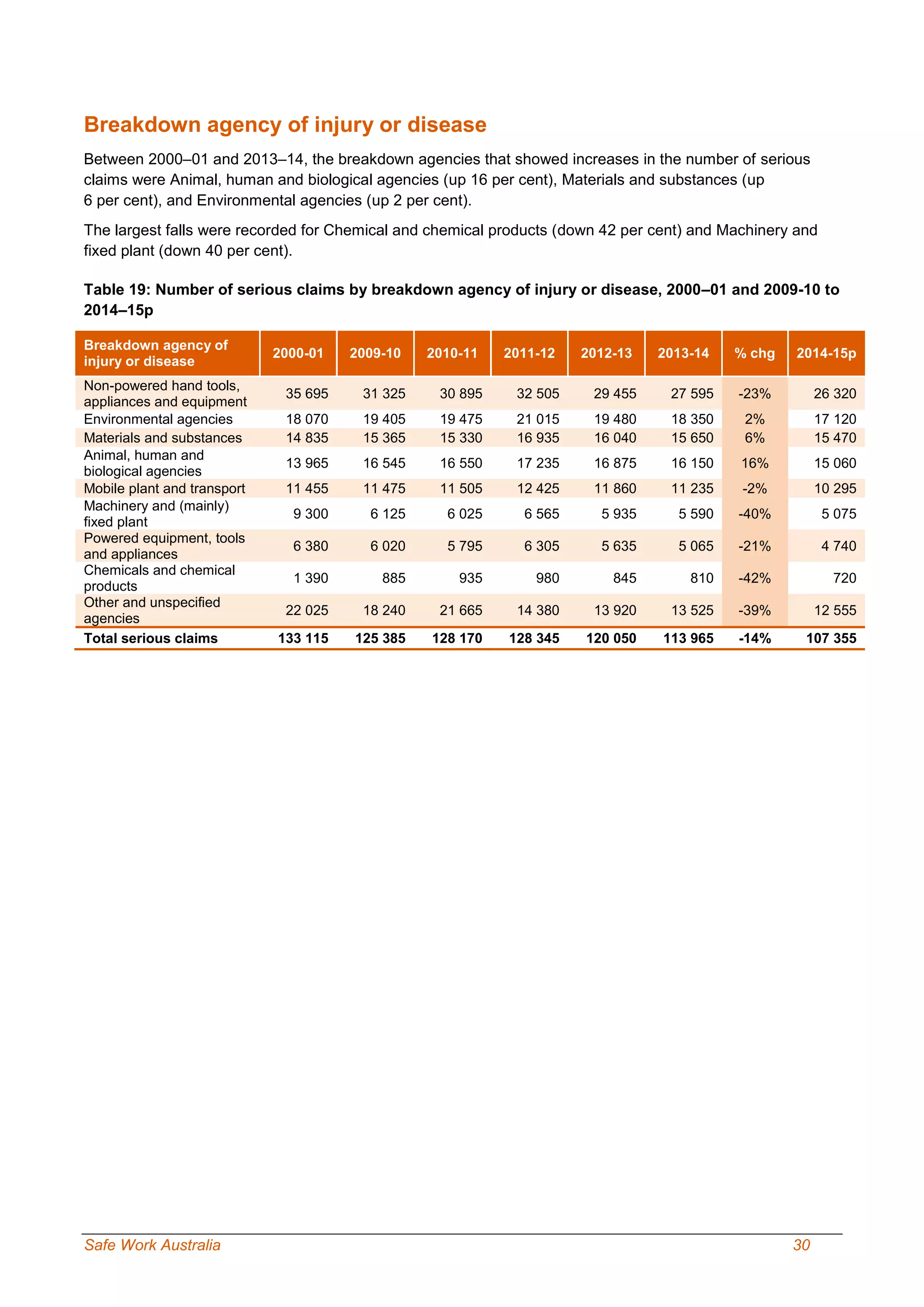
legislation. Claims lodged by police in Western Australia and military personnel of the Australian
Defence Forces are not included.
 Work-related injuries and diseases of self-employed workers are under-represented because workers’
compensation schemes do not generally cover self-employed workers. Around 10 per cent of
Australian workers are self-employed. Denominators used to calculate rates only include the jobs and
hours of employees who are eligible for workers’ compensation.
 Mesothelioma claims are under-represented because many mesothelioma cases, which are
commonly linked to work-related exposure to asbestos, are compensated through mechanisms other
than workers’ compensation.
 Diseases are under-represented because many diseases result from long-term exposure to agents or
have long latency periods, which makes the link between the work-related disease and the workplace
difficult to establish.
2. Age of employee
The age of an employee is derived from their date of birth and the date on which the injury occurred or the
disease was first reported to the employer. Data related to the open-ended age group of 65 years and above
should be used with caution as claims can be made by people who are no longer in the workforce, particularly
for work-related diseases that arise after employees retire. The employee estimates only count people who
are currently working. It is possible that rates for this age group overstate the actual rates.
3. Time lost from work
Time lost from work is measured in working weeks and excludes estimates of future absences. Time lost from
work comprises the total period of time for which compensation was paid. The time lost is not necessarily
continuous and may occur over a number of separate periods. Where an employee returns to work on a part-
time basis, they may continue to receive pro-rata payments and the total number of hours for which
compensation has been paid is included in calculating the time lost.
The median is used as the measure of central tendency because long-term claims that involve lengthy periods
of time lost from work would significantly skew an arithmetic mean.
Data from the preliminary year are excluded when reporting time lost from work because claims from the
preliminary year are likely to be open and claimants may accrue more time off work in subsequent years.
4. Compensation paid
The median is used as the measure of central tendency because long-term claims that involve lengthy periods
of time lost from work would significantly skew an arithmetic mean. The calculation of median payments
excludes claims where only payments for goods and services, such as medical treatment, have been made.
Amounts of compensation paid are rounded to the nearest $100.
Data from the preliminary year are excluded when reporting compensation paid because claims from the
preliminary year are likely to be open and claimants may accrue more compensation payments in subsequent
years.
Safe Work Australia 54
5. Industry classification
Information about the industry of the claimant’s employer is coded using the Australian and New Zealand
Standard Industrial Classification, 2006.
Because industry is based on the claimant’s employer, a claim made by a person employed under labour hire
arrangements is coded to the labour supply services industry class, which is in the administrative and support
services industry. Industry of employer will be different to industry of workplace for some employees.
6. Occupation classification
Information about the occupation of the claimant is coded using the Australian and New Zealand Standard
Classification of Occupations, First Edition.
7. Details of injuries and diseases
Information about injuries and diseases of claimants is coded using the Type of Occurrence Classification
System, Third Edition, Revision 1. The classification system is used to code the:
 nature of injury or disease
 bodily location of injury or disease
 mechanism of injury or disease
 breakdown agency of injury or disease, and
 agency of injury or disease.
8. Insufficiently coded data
Some claims are not fully coded due to insufficient information being provided at the time of the claim. Where
there is a significant number of incompletely coded claims, they may be separately identified in residual
categories like ‘other and unspecified’ or ‘not elsewhere classified’. These claims are included when totals are
calculated.
9. Confidentiality
Claim numbers are rounded to the nearest 5 to help protect confidential information about employers and
employees. Due to rounding, differences may appear between the reported totals and the sums of rows or
columns. Rates and percentages are calculated using unrounded numbers.
10. Time-series analyses
Comparison of preliminary and non-preliminary data should be done with caution. Non-preliminary data are
more likely to have been finalised and are generally more accurate than preliminary data.
When analysing trends over time, consideration needs to be given to legislative changes that may influence
trends in workers’ compensation data. Information on workers’ compensation arrangements can be found in
Safe Work Australia’s Comparison of Workers’ Compensation Arrangements in Australia and New Zealand.
11. Frequency and incidence rates
Frequency rates are expressed as the number of serious claims per million hours worked, while incidence
rates are expressed as the number of serious claims per 1000 employees.
Compared with an incidence rate, a frequency rate is a more precise and accurate measure of work health
and safety because it reflects the number of injuries and diseases per hour worked. It is important to account
for the number of hours worked because there are significant differences in the number of hours worked by
different groups of employees and employees at different points in time. The differences in the number of
hours worked mean that employees’ exposure to work-related risks vary considerably. A frequency rate
accounts for these differences and allows accurate comparisons to be made of different groups of employees
and employees at different points in time.
Australian Workers’ Compensation Statistics 2014–15 (revised July 2017) 55
12. Denominators used to calculate rates
Estimates of the number of employees and hours worked for each Australian workers’ compensation
jurisdiction are supplied annually by the ABS. The data are primarily derived from the Labour Force Survey,
which are adjusted to account for differences in scope between the Labour Force Survey and workers’
compensation coverage.
The ABS provides two sets of estimates for each jurisdiction—one is split by sex, age and industry and the
second is split by occupation. This restricts presentation of rates to the categories supported by the ABS data.
Therefore, it is not possible to calculate rates for occupational groups within specific industries. As these two
sets of estimates are based on different data sources, total employment and hours worked estimates may
vary slightly. As a result rates and percentage changes may also differ slightly for estimates calculated from
the occupation data set.
In 2008, the ABS conducted a review of the methodology used to calculate the number of employees in each
industry and the number of hours worked by each employee. After the review, the ABS implemented a
number of changes to its methodology, which increased its estimates. As the ABS could only supply new
estimates from 2005–06 onwards, estimates for previous years were adjusted based on the movement
between the old and new estimates for 2005–06 to avoid a break in the time series. Reports from 2007–08
use these new estimates. Therefore, comparison with previous reports should not be made.
Following the review, the major change to the estimates was in the industry coding of ‘jobs other than the
main job’ of multiple job holders. Where previously the second job was combined into the industry of the first
job, these have now been separated to be shown in the industry in which the employee works in each
separate job. This resulted in changes to rates in some industries. In particular, a decrease in employee
estimates occurred in Public administration and safety, Manufacturing, and Health care and social assistance
as these were the industries where a greater proportion held a second job. An increase occurred in Arts and
recreation services, and Accommodation and food services as these were the industries where the second job
was most commonly worked.
While the ABS is able to adjust the employee estimates to account for the industries where the second job
was worked, it is unable to adjust the hours worked in a similar manner. All hours worked are allocated to the
industry of the main job.
Because eligibility for workers’ compensation varies from jurisdiction to jurisdiction, further adjustments are
necessary. The most significant adjustments are outlined below:
 Police in Western Australia, who are covered by a separate scheme that does not report to Safe Work
Australia, are excluded from the denominators.
 Under previous Queensland legislation, owner-managers of incorporated enterprises (OMIEs), who
are included in the standard definition of ‘employee’, had the option of purchasing workers’
compensation insurance. Based on 2006 census data, 10 per cent of employed people in Queensland
were OMIEs, an unknown number of whom were covered by workers’ compensation. Prior to the
legislation change (1 July 2013), this population was excluded from denominator and claims data.
Data from 1 July 2013 onwards will explicitly include OMIEs in both denominator and numerator data.
13. Adjustment of Victorian and South Australian data
Safe Work Australia uses one working week of time lost from work as the cut-off for the classification of
accepted claims as serious claims. This cut-off was chosen because most jurisdictions have an employer
excess of one week or less. Since claims with an absence of at least one week are generally processed by
the workers’ compensation authority, the use of a one-week cut-off ensures comparable data are compiled
from all jurisdictions so that an accurate national estimate can be produced.
However, under the Victorian workers’ compensation scheme, the employer can be liable for the first 10
working days lost by the injured or ill worker (for an employee working two days per week, for instance, that
would amount to five weeks’ pay), plus the first $582 (as of 1 July 2010) of medical services, unless the
Safe Work Australia 56
employer elected the ‘excess buy-out’ option. Since information on claims paid solely by employers is not
always provided to the workers’ compensation authority, the national count of serious claims is affected.
To correct for this under-counting, Victorian claims of one to two weeks’ duration are increased by a factor to
represent the ‘missing claims’. The factor is calculated by comparing the percentage of claims of one to two
weeks’ duration for Victoria with the percentage of claims of one to two weeks’ duration for all other Australian
jurisdictions at the industry division level and by nature of injury or disease. The factoring makes the
percentage of claims in each industry and nature group in Victoria match the Australian average for claims of
this duration. This factoring increases Victorian claims by around 20 per cent and the Australian count by less
than 3 per cent.
While South Australia also has a 10-day excess, a waiver of the first two weeks of income maintenance is an
incentive that was introduced for employers to forward claims to WorkCoverSA within five days of receiving
claims from injured or ill workers. This incentive has been operational since 2009–10 and has significantly
improved the data quality and accuracy of time-lost information for the majority of short-duration claims.
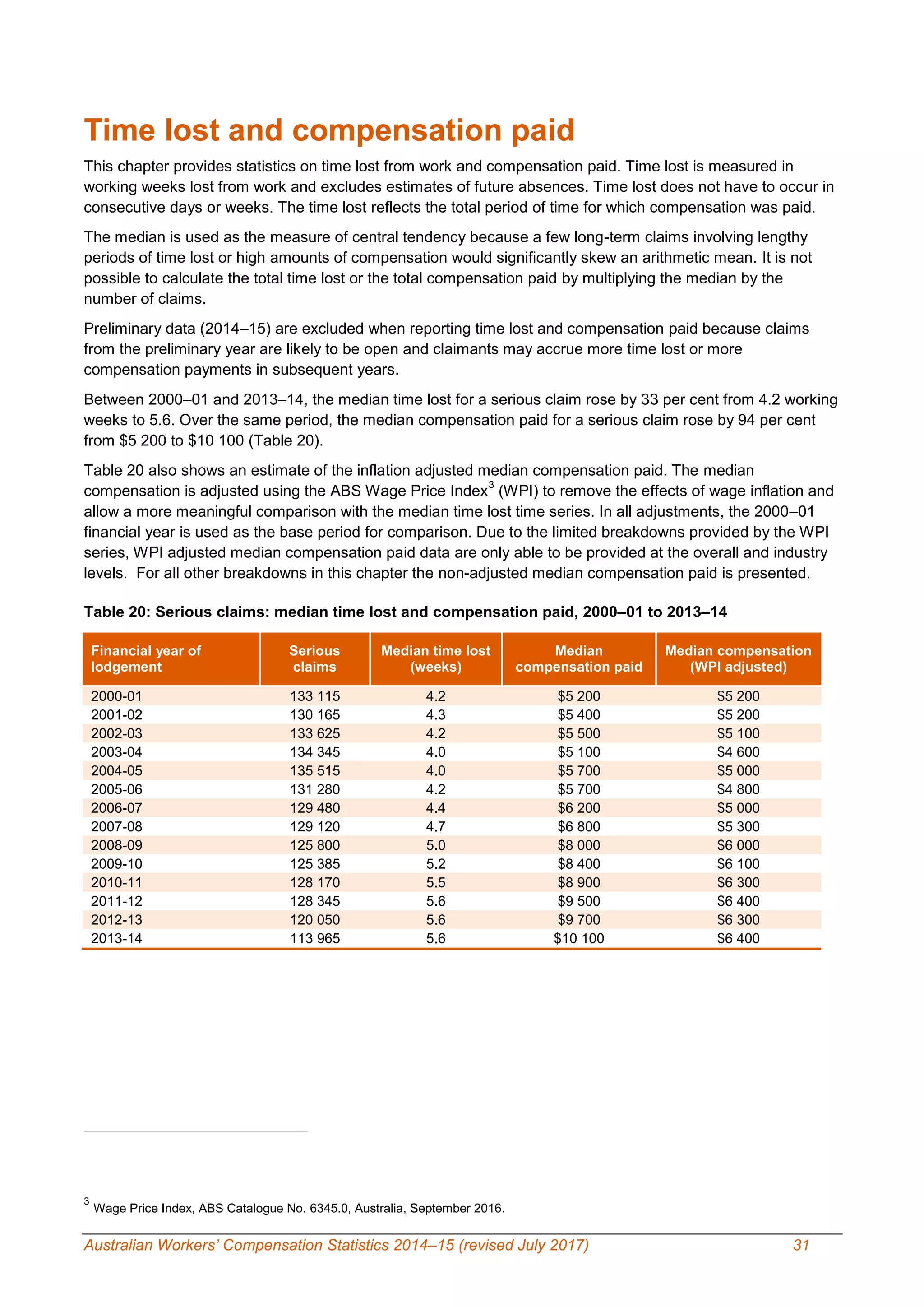
14. Reliability of data
Data are subject to two types of errors—non-sampling errors and sampling errors.
Non-sampling error
Non-sampling errors may occur in any statistical collection due to:
 incorrect inclusion or exclusion of respondents or cases
 non-response of respondents
 inaccurate information from respondents
 inaccurate recording of information by data collectors
 deficiencies in data collection materials and processes, and
 errors that occur during the entry, coding and editing of data.
Non-sampling errors may affect the numerator and denominator data. It is difficult to quantify non-sampling
error.
Sampling error
Sampling error is a measure of the variation that occurs when a sample, rather than an entire population, is
surveyed. Standard error indicates the extent to which an estimate of a sample varies from the estimate of the
population from which it is drawn. When a standard error is expressed as a percentage of the estimate to
which it relates, it is known as a relative standard error (RSE).
The denominator data used to calculate rates of serious claims are subject to sampling error. Rates that are
calculated using denominators with high RSEs are annotated with one asterisk (*) to indicate that the RSE of
the denominator is 25 per cent or higher and two asterisks (**) if the RSE is 50 per cent or higher.
Australian Workers’ Compensation Statistics 2014–15 (revised July 2017) 57
References
Australian Bureau of Statistics (ABS) 2007. Labour Statistics: Concepts, Sources and Methods, August 2006.
ABS catalogue number 6102.0.55.001. Canberra: ABS.
http://www.abs.gov.au/ausstats/abs@.nsf/allprimarymainfeatures/5cbef69b3f02291fca2572c100201026?open
document
Australian Bureau of Statistics (ABS) and Statistics New Zealand 2006. Australian and New Zealand Standard
Classification of Occupations, First Edition. ABS catalogue number 1220.0. Canberra: ABS.
http://www.abs.gov.au/ausstats/abs@.nsf/allprimarymainfeatures/f6a0bb67c088f217ca2575df001cadc7?open
document
Australian Bureau of Statistics (ABS) and Statistics New Zealand 2006. Australian and New Zealand Standard
Industrial Classification, 2006. ABS catalogue number 1292.0. Canberra: ABS.
http://www.abs.gov.au/ausstats/abs@.nsf/allprimarymainfeatures/a77d93484dc49d63ca25712300056842?op
endocument
Australian Bureau of Statistics (ABS) 2016, Wage Price Index, Australia, September 2016, ABS Catalogue
number 6345.0, Canberra: ABS.
http://www.abs.gov.au/ausstats/abs@.nsf/mf/6345.0
Australian Safety and Compensation Council (ASCC) 2008. Type of Occurrence Classification System, Third
Edition, Revision 1. Canberra: ASCC.
http://www.safeworkaustralia.gov.au/sites/swa/about/publications/pages/sr20080501toocs3rdeditionrevision
International Labour Organization (ILO) 1998. Resolution Concerning Statistics of Occupational Injuries. The
Sixteenth International Conference of Labour Statisticians. Geneva: ILO.
National Centre for Classification in Health (NCCH) 2006. The International Statistical Classification of
Diseases and Related Health Problems, Tenth Revision, Australian Modification (ICD-10-AM). Sydney:
NCCH.
National Occupational Health and Safety Commission (NOHSC) 2004. National Data Set for
Compensation-based Statistics, Third Edition. Canberra: NOHSC.
http://www.safeworkaustralia.gov.au/sites/swa/about/publications/pages/sr200407ndsforcompensationbasedst
atistics3rdedition
Safe Work Australia. Work-Related Traumatic Injury Fatalities. Canberra: Safe Work Australia.
http://www.safeworkaustralia.gov.au/sites/swa/statistics/work-related-
fatalities/pages/workrelatedtraumaticinjuryfatalities
Safe Work Australia 58
Further information
Data and Analysis
Safe Work Australia
statsonline@swa.gov.au
Safe Work Australia
GPO Box 641
Canberra ACT 2601
www.swa.gov.au
www.facebook.com/safeworkaus
Jurisdictional contacts
Contact details for jurisdictional work health and safety regulators are available on the following website:
http://www.safeworkaustralia.gov.au/sites/swa/about/who-we-work-with/regulators/pages/whs-regulators

Australian Workers’ Compensation Statistics Report - 2014-2015-revised 1

  • 2.
    Creative Commons ISBN 978-1-76051-051-0(pdf) ISBN 978-1-76051-052-7 (docx) With the exception of the Safe Work Australia logo, this report is licensed by Safe Work Australia under a Creative Commons 3.0 Australia Licence. To view a copy of this licence, visit http://creativecommons.org/licenses/by/3.0/au/deed.en In essence, you are free to copy, communicate and adapt the work, as long as you attribute the work to Safe Work Australia and abide by the other licensing terms. The report should be attributed as ‘Australian Workers’ Compensation Statistics, 2014–15’ Enquiries regarding the licence and any use of the report are welcome at: Copyright Officer Safe Work Australia GPO Box 641 Canberra ACT 2601 Email: copyrightrequests@swa.gov.au Disclaimer The information provided in this document can only assist you in the most general way. This document does not replace any statutory requirements under any relevant state and territory legislation. Safe Work Australia accepts no liability arising from the use of or reliance on the material contained on this document, which is provided on the basis that Safe Work Australia is not thereby engaged in rendering professional advice. Before relying on the material, users should carefully make their own assessment as to its accuracy, currency, completeness and relevance for their purposes, and should obtain any appropriate professional advice relevant to their particular circumstances. To the extent that the material in this document includes views or recommendations of third parties, such views or recommendations do not necessarily reflect the views of Safe Work Australia nor do they indicate a commitment to a particular course of action. Note This publication was revised and reissued on 28 July 2017. Specifically, serious claim incidence and frequency rates for 2014–15 have been revised. The 2014–15 Injury Denominator Data that was supplied to Safe Work Australia included an incomplete population which has now been corrected (Tables 2-7 and 11-15 and Figures 1 and 3). Any copies of this report that were downloaded or printed on or before 27 July 2017 are now out-of-date and should be replaced with this revised version.
  • 3.
    Australian Workers’ CompensationStatistics 2014–15 (revised July 2017) 3 Contents Contents .............................................................................................................................................................. 3 Tables and figures ............................................................................................................................................... 4 Abbreviations and symbols.................................................................................................................................. 6 2014-15 snapshot................................................................................................................................................ 7 Summary of statistics........................................................................................................................................... 8 Introduction .......................................................................................................................................................... 9 Serious claims, 2014–15 ................................................................................................................................... 10 Trends in serious claims, 2000–01 to 2014–15................................................................................................. 20 Time lost and compensation paid...................................................................................................................... 31 Comparing characteristics of serious claims for metropolitan, regional and remote areas............................... 42 Glossary............................................................................................................................................................. 50 Explanatory notes.............................................................................................................................................. 53 References ........................................................................................................................................................ 57 Further information ............................................................................................................................................ 58 Jurisdictional contacts........................................................................................................................................ 58
  • 4.
    Safe Work Australia4 Tables and figures Tables Table 1: Percentage of serious claims and hours worked by sex, 2014–15p ............................................... 10 Table 2: Number, percentage and rates of serious claims by injury or disease and sex, 2014–15p............ 10 Table 3: Number and rates of serious claims by injury or disease, sex and age group, 2014–15p.............. 11 Table 4: Workforce characteristics by occupation, 2014–15......................................................................... 12 Table 5: Number and rates of serious claims by injury or disease, sex and occupation, 2014–15p ............ 13 Table 6: Workforce characteristics by industry, 2014–15.............................................................................. 14 Table 7: Number and rates of serious claims by injury or disease, sex and industry, 2014–15p ................. 15 Table 8: Number and percentage of serious claims by nature of injury or disease and sex, 2014–15p....... 17 Table 9: Number and percentage of serious claims by mechanism and breakdown agency of injury or disease, 2014–15p .......................................................................................................................... 18 Table 10: Number and percentage of serious claims by mechanism and bodily location of injury or disease, 2014–15p......................................................................................................................................... 19 Table 11: Number and rates of serious claims, number of hours worked and number of employees, 2000–01 to 2014–15p..................................................................................................................................... 20 Table 12: Number and rates of serious claims by sex, 2000–01 to 2014–15p ............................................... 21 Table 13: Number and rates of serious claims by age group, 2000–01 and 2009–10 to 2014–15p .............. 22 Table 14: Number and rates of serious claims by occupation, 2000–01 and 2009–10 to 2014–15p ............. 24 Table 15: Number and rates of serious claims by industry, 2000–01 and 2009-10 to 2014–15p................... 25 Table 16: Number of serious claims by nature of injury or disease, 2000–01 and 2009-10 to 2014–15p...... 27 Table 17: Number of serious claims by bodily location of injury or disease, 2000–01 and 2009-10 to 2014−15p......................................................................................................................................... 28 Table 18: Number of serious claims by mechanism of injury or disease, 2000–01 and 2009-10 to 2014−15p… ..................................................................................................................................... 29 Table 19: Number of serious claims by breakdown agency of injury or disease, 2000–01 and 2009-10 to 2014–15p......................................................................................................................................... 30 Table 20: Serious claims: median time lost and compensation paid, 2000–01 to 2013–14 ........................... 31 Table 21: Serious claims: median time lost and compensation paid by sex, 2000–01 to 2013–14................ 34 Table 22: Serious claims: median time lost and compensation paid by occupation, 2000–01 and 2008−09 to 2013–14........................................................................................................................................... 35 Table 23: Serious claims: median time lost and compensation paid by industry, 2000–01 and 2009–10 to 2013–14........................................................................................................................................... 36 Table 24: Serious claims: WPI adjusted median compensation paid by industry, 2000–01 and 2009–10 to 2013–14........................................................................................................................................... 37 Table 25: Serious claims: median time lost and compensation paid by nature of injury or disease, 2000–01 and 2009–10 to 2013–14................................................................................................................. 38 Table 26: Serious claims: median time lost and compensation paid by mechanism of injury or disease, 2000−01 and 2009–10 to 2013–14 ................................................................................................. 39 Table 27: Serious claims: median time lost and compensation paid by breakdown agency of injury or disease, 2000–01 and 2009–10 to 2013–14 ................................................................................... 41 Table 28: ABS 2011 Remoteness Areas of Australia...................................................................................... 42 Table 29: Proportion of employment and serious claims by remoteness, 2009–10 to 2014–15p .................. 42 Table 30: Incidence rate of serious claims (claims per 1000 employees) by state/territory and remoteness area, 2009–10 to 2014–15p combined............................................................................................ 43
  • 5.
    Australian Workers’ CompensationStatistics 2014–15 (revised July 2017) 5 Figures Figure 1: Frequency rates of serious claims by sex, 2000–01 to 2014–15p.................................................. 21 Figure 2: Percentage of serious claims by age group, 2000–01 to 2014–15p............................................... 23 Figure 3: Frequency rate by age group and occupation, 2000–01 to 2014–15p............................................ 23 Figure 4: Original and inflation adjusted median compensation paid, 2000–01 to 2013–14.......................... 32 Figure 5: Median time lost and inflation adjusted median compensation paid, 2000–01 to 2013–14............ 32 Figure 6: Serious claims: median time lost by age group, 2001–02 to 2013–14............................................ 33 Figure 7: Serious claims: median compensation paid by age group, 2000–01 to 2013–14........................... 33 Figure 8: Serious claims: median time lost by sex, 2000–01 to 2013–14 ...................................................... 34 Figure 9: Serious claims: median compensation paid by sex, 2000–01 to 2013–14 ..................................... 35 Figure 10: Proportion of employees and serious claims by remoteness area and state, 2009–10 to 2014–15p combined ......................................................................................................................................... 43 Figure 11: Proportion of serious claims by remoteness area and industry, 2009–10 to 2014–15p combined 44 Figure 12: Proportion of serious claims by remoteness area and occupation major group, 2009–10 to 2014–15p combined ........................................................................................................................ 44 Figure 13: Proportion of serious claims by remoteness area and nature of injury or disease, 2009–10 to 2014–15p combined ........................................................................................................................ 45 Figure 14: Proportion of serious claims by remoteness area and mechanism of injury or disease, 2009–10 to 2014–15p combined ........................................................................................................................ 45 Figure 15: Proportion of serious claims by remoteness area and breakdown agency of injury or disease, 2009–10 to 2014–15p combined..................................................................................................... 46 Figure 16: Proportion of breakdown agency sub-groups in Animal, human and biological agencies, 2009–10 to 2014–15p combined .................................................................................................................... 47 Figure 17: Proportion of breakdown agency sub-groups in Mobile plant and transport, 2009–10 to 2014–15p combined ......................................................................................................................................... 47 Figure 18: Proportion of serious claims by remoteness area, age group and sex, 2009–10 to 2014–15p combined ......................................................................................................................................... 48 Figure 19: Average time lost (working weeks) by remoteness area and occupation, 2009–10 to 2014–15p combined ......................................................................................................................................... 49 Figure 20: Average compensation paid by occupation and remoteness area, 2009–10 to 2014–15p combined ......................................................................................................................................................... 49
  • 6.
    Safe Work Australia6 Abbreviations and symbols ABS Australian Bureau of Statistics ANZSCO Australian and New Zealand Standard Classification of Occupations, First edition ANZSIC Australian and New Zealand Standard Industrial Classification, 2006 NDS National Data Set for Compensation-Based Statistics np data not available due to confidentiality restrictions p preliminary data TOOCS Type of Occurrence Classification System * relative standard error is between 25 per cent and 50 per cent and should be used with caution % chg percentage change
  • 7.
    Australian Workers’ CompensationStatistics 2014–15 (revised July 2017) 7 2014-15 snapshot
  • 8.
    Safe Work Australia8 Summary of statistics  Preliminary data show that there were 107 355 serious workers’ compensation claims in 2014–15, which equates to 5.9 serious claims per million hours worked.  Between 2000–01 and 2013–14, the frequency rate of serious claims fell by 33 per cent from 9.5 serious claims per million hours worked to 6.3.  In 2014–15, the frequency rate for male employees was 6.3 serious claims per million hours worked, while the frequency rate for female employees was 5.2.  In 2014–15, the three occupations with the highest number of serious claims per million hours worked were Labourers (17.8), Community and personal service workers (12.2), and Machinery operators and drivers (11.2).  In 2014–15, the three industries with the highest number of serious claims per million hours worked were Agriculture, forestry and fishing (9.7), Health care and social assistance (8.7) and Manufacturing (8.6).  In 2014-15, injury and musculoskeletal disorders led to 90 per cent of serious claims and the most common were Traumatic joint/ligament and muscle/tendon injuries (43.8 per cent). Diseases led to 10 per cent of serious claims and the most common were Mental disorders (5.7 per cent).  Muscular stress while lifting or handling objects caused 32 per cent of serious claims in 2014–15, while Falls, trips and slips led to 23 per cent of serious claims.  Between 2000–01 and 2013–14, the median time lost for a serious claim rose by 33 per cent from 4.2 working weeks to 5.6. In 2013–14, the median time lost for a serious claim was 5.4 working weeks for male employees and 6.0 working weeks for female employees.  Between 2000–01 and 2013–14, the median compensation paid for a serious claim rose by 94 per cent from $5 200 to $10 100. In 2013–14, the median compensation paid for a serious claim was $10 900 for male employees and $8 900 for female employees. When accounting for wage inflation, however, median compensation paid for serious claims increased by 23 per cent between 2000–01 and 2013–14, directly comparable with the increase in median time lost.  In 2014–15, the bodily location most commonly affected by injuries and diseases that led to serious claims was the Back (21 per cent). Other common bodily locations were the Hand, fingers and thumb (13 per cent), Shoulder (11 per cent), and Knee (10 per cent).  The rate of serious claims per 1000 employees is highest in metropolitan areas (10.6 claims per 1000 employees)  Between 2009-10 and 2014-15, 69 per cent of serious claims in Agriculture, forestry and fishing occurred in regional areas, while 61 per cent of serious claims in Mining occurred in regional and remote areas. In the same period, 85 per cent of serious claims in Finance and insurance services occurred in metropolitan areas.  Human agencies were the most common breakdown agency for serious claims in metropolitan (13 per cent of all claims) and regional areas (13 per cent), while Outdoor environment (16 per cent of claims) and Road transport (13 per cent) where the most common breakdown agencies in remote areas.
  • 9.
    Australian Workers’ CompensationStatistics 2014–15 (revised July 2017) 9 Introduction The statistics in this report are of Australian workers’ compensation claims that were lodged between 2000–01 and 2014–15. The statistics are an indicator of Australia’s work health and safety performance over the 15-year period between 2000–01 and 2014–15. The statistics are presented by:  sex  age group  occupation  industry  nature of injury or disease  mechanism of injury or disease  breakdown agency of injury or disease, and  bodily location of injury or disease. Claim numbers are rounded to the nearest 5 to help protect confidential information about employers and employees. Due to rounding, differences may appear between the reported totals and proportions and the sums of rows or columns. Rates and percentages are calculated using unrounded numbers. Definition of a serious claim The statistics in this report are of serious claims only. A serious claim is an accepted workers’ compensation claim for an incapacity that results in a total absence from work of one working week or more. Claims in receipt of common-law payments are also included. Claims arising from a journey to or from work or during a recess period are not compensable in all jurisdictions and are excluded. Serious claims exclude compensated fatalities. Safe Work Australia produces other resources that provide information on work-related fatalities in Australia. The most up-to-date count of worker fatalities is available online on Safe Work Australia’s worker fatalities page. Comprehensive information on work-related injury fatalities is available in the Work-Related Traumatic Injury Fatalities reports. The reports are based on information from workers’ compensation data, coronial information, notifiable fatalities and the media. Frequency and incidence rates Frequency rates are expressed as the number of serious claims per million hours worked, while incidence rates are expressed as the number of serious claims per 1000 employees. Compared with an incidence rate, a frequency rate is a more precise and accurate measure of work health and safety because it reflects the number of injuries and diseases per hour worked. It is important to account for the number of hours worked because there are significant differences in the number of hours worked by different groups of employees and employees at different points in time. The differences in the number of hours worked mean that employees’ exposure to work-related risks vary considerably. A frequency rate accounts for these differences and allows accurate comparisons to be made of different groups of employees and employees at different points in time.
  • 10.
    Safe Work Australia10 Serious claims, 2014–15 This chapter provides workers’ compensation statistics for claims lodged during the 2014–15 financial year. The 2014–15 data are preliminary and are likely to rise by around 3 per cent when updated. Gender In 2014–15, male employees accounted for 58 per cent of hours worked and 64 per cent of serious claims, while female employees accounted for 42 per cent of hours worked and 36 per cent of serious claims. Table 1: Percentage of serious claims and hours worked by sex, 2014–15p Percentage of serious claims Percentage of hours worked Male 64% 58% Female 36% 42% Total 100% 100% The frequency rate for male employees (6.3 serious claims per million hours worked) was 22 per cent higher than the frequency rate for female employees (5.2). A higher percentage of male employees’ serious claims arose from injury and musculoskeletal disorders (91 per cent versus 87 per cent for female employees), while a higher percentage of female employees’ serious claims arose from diseases (13 per cent versus 9 per cent for male employees). Table 2: Number, percentage and rates of serious claims by injury or disease and sex, 2014–15p Number of serious claims Percentage of serious claims Frequency rate (serious claims per million hours worked) Incidence rate (serious claims per 1000 employees) Male Injury and musculoskeletal disorders 62 690 91% 5.8 10.9 Diseases 6 145 9% 0.5 1.0 Total 68 835 100% 6.3 12.0 Female Injury and musculoskeletal disorders 33 685 87% 4.6 6.4 Diseases 4 830 13% 0.6 0.9 Total 38 515 100% 5.2 7.3 All serious claims Injury and musculoskeletal disorders 96 375 90% 5.3 8.8 Diseases 10 975 10% 0.6 1.0 Total 107 355 100% 5.9 9.8
  • 11.
    Australian Workers’ CompensationStatistics 2014–15 (revised July 2017) 11 Age group Among male, female and all employees, the highest frequency rates in 2014–15 were among employees aged 60–64 years. By contrast, employees aged 25–29 years had the lowest frequency rate (4.6 serious claims per million hours worked) in the workforce. Table 3: Number and rates of serious claims by injury or disease, sex and age group, 2014–15p Age Group Number of serious claims Frequency rate (serious claims per million hours worked) Incidence rate (serious claims per 1000 employees) Male Female Total Male Female Total Male Female Total All serious claims <20 years 2 595 1 040 3 635 7.7 3.9 6.0 8.0 2.9 5.4 20-24 years 6 925 3 065 9 995 7.1 3.9 5.7 11.5 5.3 8.5 25-29 years 7 600 3 205 10 805 5.6 3.2 4.6 10.8 5.1 8.1 30-34 years 7 660 3 120 10 785 5.3 3.6 4.7 10.7 5.2 8.2 35-39 years 7 120 3 335 10 460 5.5 4.4 5.1 11.2 6.3 9.0 40-44 years 8 285 4 770 13 050 6.1 5.6 5.9 12.6 8.1 10.5 45-49 years 7 950 5 460 13 410 6.4 6.3 6.4 13.3 9.5 11.5 50-54 years 7 975 6 105 14 080 7.0 7.2 7.1 14.3 10.9 12.6 55-59 years 6 565 4 835 11 395 7.2 7.5 7.3 14.0 10.9 12.5 60-64 years 4 530 2 695 7 225 7.9 7.7 7.8 14.5 10.3 12.6 65 years+ 1 615 870 2 485 5.8 6.8 6.1 8.5 7.0 7.9 Total 68 835 38 515 107 355 6.3 5.2 5.9 12.0 7.3 9.8 Injury and musculoskeletal disorders <20 years 2 535 1 000 3 540 7.6 3.7 5.9 7.9 2.8 5.2 20-24 years 6 670 2 815 9 485 6.8 3.6 5.4 11.1 4.9 8.0 25-29 years 7 190 2 835 10 020 5.3 2.8 4.3 10.2 4.5 7.5 30-34 years 7 085 2 705 9 790 4.9 3.1 4.2 9.9 4.5 7.5 35-39 years 6 460 2 800 9 260 5.0 3.7 4.5 10.2 5.3 7.9 40-44 years 7 370 4 020 11 390 5.5 4.7 5.2 11.2 6.9 9.2 45-49 years 7 075 4 750 11 825 5.7 5.4 5.6 11.9 8.3 10.1 50-54 years 7 130 5 330 12 455 6.3 6.2 6.3 12.8 9.5 11.2 55-59 years 5 855 4 275 10 125 6.4 6.6 6.5 12.5 9.6 11.1 60-64 years 4 040 2 440 6 480 7.0 7.0 7.0 12.9 9.3 11.3 65 years+ 1 465 810 2 275 5.3 6.3 5.6 7.7 6.5 7.2 Total 62 880 33 790 96 670 5.8 4.6 5.3 10.9 6.4 8.8 Diseases <20 years 55 40 95 0.2 0.2 0.2 0.2 0.1 0.1 20-24 years 260 250 510 0.3 0.3 0.3 0.4 0.4 0.4 25-29 years 410 370 780 0.3 0.4 0.3 0.6 0.6 0.6 30-34 years 575 415 990 0.4 0.5 0.4 0.8 0.7 0.8 35-39 years 665 535 1 200 0.5 0.7 0.6 1.0 1.0 1.0 40-44 years 915 750 1 665 0.7 0.9 0.8 1.4 1.3 1.3 45-49 years 875 705 1 580 0.7 0.8 0.7 1.5 1.2 1.4 50-54 years 845 780 1 625 0.7 0.9 0.8 1.5 1.4 1.5 55-59 years 710 560 1 270 0.8 0.9 0.8 1.5 1.3 1.4 60-64 years 490 255 745 0.9 0.7 0.8 1.6 1.0 1.3 65 years+ 155 60 215 0.6 0.5 0.5 0.8 0.5 0.7 Total 5 955 4 725 10 685 0.5 0.6 0.6 1.0 0.9 1.0
  • 12.
    Safe Work Australia12 Occupation Workers in the Labourers and Technicians and trades workers occupations accounted for over 40 per cent of serious claims in 2014–15, but only 23 per cent of total employment. Table 4: Workforce characteristics by occupation, 2014–15p Occupation Employedpersons (million) Proportionof workforce Proportionentitled tocompensation Jobs(million) Hoursworked (billion) Seriousclaims Proportionof seriousclaims Frequencyrate (claimspermillion hoursworked) Incidencerate (claimsper1000 employees) Professionals 2.361 23% 89% 2.564 4.403 10 790 10% 2.5 4.2 Clerical and administrative workers 1.529 15% 93% 1.633 2.497 5 310 5% 2.1 3.2 Technicians and trades workers 1.405 14% 82% 1.452 2.789 19 685 18% 7.1 13.6 Managers 1.287 12% 84% 1.327 2.765 4 470 4% 1.6 3.4 Community and personal service workers 1.089 10% 93% 1.177 1.516 18 500 17% 12.2 15.7 Sales workers 1.039 10% 95% 1.099 1.419 5 855 5% 4.1 5.3 Labourers 0.982 9% 88% 1.032 1.483 26 405 25% 17.8 25.6 Machinery operators and drivers 0.685 7% 91% 0.717 1.411 15 830 15% 11.2 22.1 Total 10.378 100% 89% 11.001 18.282 107 355 100% 5.9 9.8
  • 13.
    Australian Workers’ CompensationStatistics 2014–15 (revised July 2017) 13 The frequency rate for Labourers (17.8 serious claims per million hours worked) was the highest in 2014–15 and three times higher than the national frequency rate (5.9). Managers had the lowest frequency rate (1.6) Table 5: Number and rates of serious claims by injury or disease, sex and occupation, 2014–15p Occupation Number of serious claims Frequency rate (serious claims per million hours worked) Incidence rate (serious claims per 1000 employees) Male Female Total Male Female Total Male Female Total All serious claims Managers 2 540 1 930 4 470 1.4 2.2 1.6 3.0 4.0 3.4 Professionals 3 615 7 175 10 790 1.6 3.3 2.5 3.1 5.1 4.2 Technicians and trades workers 17 640 2 045 19 685 7.1 6.5 7.1 14.2 9.6 13.6 Community and personal service workers 6 940 11 560 18 500 12.8 11.9 12.2 18.9 14.3 15.7 Clerical and administrative workers 1 800 3 510 5 310 2.4 2.0 2.1 4.4 2.9 3.2 Sales workers 2 075 3 780 5 855 3.2 4.9 4.1 4.9 5.6 5.3 Machinery operators and drivers 14 455 1 375 15 830 11.1 12.2 11.2 22.3 19.7 22.1 Labourers 19 495 6 910 26 405 18.4 16.4 17.8 29.3 18.9 25.6 Total 68 835 38 515 107 355 6.3 5.2 5.9 12.0 7.3 9.8 Injury & musculoskeletal disorders Managers 2 120 1 530 3 650 1.1 1.7 1.3 2.5 3.2 2.7 Professionals 3 050 5 920 8 965 1.4 2.7 2.0 2.6 4.2 3.5 Technicians and trades workers 16 535 1 875 18 410 6.7 5.9 6.6 13.3 8.8 12.7 Community and personal service workers 5 945 10 390 16 335 10.9 10.7 10.8 16.2 12.8 13.9 Clerical and administrative workers 1 530 2 715 4 245 2.1 1.5 1.7 3.7 2.2 2.6 Sales workers 1 850 3 415 5 265 2.9 4.4 3.7 4.4 5.0 4.8 Machinery operators and drivers 13 355 1 280 14 635 10.3 11.3 10.4 20.6 18.3 20.4 Labourers 18 235 6 445 24 680 17.2 15.3 16.6 27.4 17.6 23.9 Total 62 880 33 790 96 670 5.8 4.6 5.3 10.9 6.4 8.8 Diseases Managers 420 400 820 0.2 0.4 0.3 0.5 0.8 0.6 Professionals 565 1 255 1 820 0.3 0.6 0.4 0.5 0.9 0.7 Technicians and trades workers 1 105 170 1 275 0.4 0.5 0.5 0.9 0.8 0.9 Community and personal service workers 995 1 170 2 160 1.8 1.2 1.4 2.7 1.4 1.8 Clerical and administrative workers 265 795 1 060 0.4 0.5 0.4 0.7 0.6 0.6 Sales workers 225 365 590 0.3 0.5 0.4 0.5 0.5 0.5 Machinery operators and drivers 1 100 95 1 195 0.8 0.8 0.8 1.7 1.4 1.7 Labourers 1 265 465 1 725 1.2 1.1 1.2 1.9 1.3 1.7 Total 5 955 4 725 10 685 0.5 0.6 0.6 1.0 0.9 1.0
  • 14.
    Safe Work Australia14 Industry Workers in the Health care and social assistance, Manufacturing and Construction industries accounted for over 40 per cent of serious claims in 2014–15, but less than 30 per cent of total employment. Table 6: Workforce characteristics by industry, 2014–15p Industry Employedpersons (million) Proportionof workforce Proportionentitled tocompensation Jobs(million) Hoursworked (billion) Seriousclaims Proportionof seriousclaims Frequencyrate (claimspermillion hoursworked) Incidencerate (claimsper1000 employees) Health care and social assistance 1.346 13% 94% 1.424 2.030 17 565 16% 8.7 12.3 Retail trade 1.168 11% 95% 1.217 1.720 8 910 8% 5.2 7.3 Education and training 0.876 8% 95% 0.947 1.470 6 540 6% 4.5 6.9 Manufacturing 0.853 8% 93% 0.852 1.600 13 725 13% 8.6 16.1 Professional, scientific and technical services 0.794 8% 82% 0.878 1.600 1 800 2% 1.1 2.0 Accommodation and food services 0.789 8% 97% 0.820 1.040 6 310 6% 6.1 7.7 Construction 0.766 7% 74% 0.790 1.570 12 575 12% 8.0 15.9 Public administration and safety 0.723 7% 99% 0.742 1.240 8 270 8% 6.7 11.2 Transport, postal and warehousing 0.529 5% 88% 0.559 1.070 8 820 8% 8.3 15.8 Other services 0.381 4% 80% 0.393 0.670 3 055 3% 4.6 7.8 Financial and insurance services 0.379 4% 93% 0.402 0.740 665 1% 0.9 1.7 Wholesale trade 0.362 3% 93% 0.374 0.720 4 630 4% 6.4 12.4 Administrative and support services 0.295 3% 76% 0.425 0.690 3 785 4% 5.5 8.9 Mining 0.222 2% 98% 0.223 0.500 2 105 2% 4.3 9.4 Information media and telecommunications 0.195 2% 92% 0.207 0.370 590 1% 1.6 2.8 Arts and recreation services 0.192 2% 85% 0.225 0.280 2 170 2% 7.7 9.6 Rental, hiring and real estate services 0.185 2% 87% 0.201 0.370 1 030 1% 2.8 5.1 Agriculture, forestry and fishing 0.184 2% 58% 0.183 0.350 3 410 3% 9.7 18.7 Electricity, gas, water and waste services 0.138 1% 97% 0.138 0.270 1 175 1% 4.4 8.5 Total 10.378 100% 89% 11.001 18.283 107 355 100% 5.9 9.8
  • 15.
    Australian Workers’ CompensationStatistics 2014–15 (revised July 2017) 15 The industries with the highest frequency rates in 2014–15 were Agriculture, forestry and fishing (9.7 serious claims per million hours worked), Health care and social assistance (8.7) and Manufacturing (8.6). The industries with the lowest frequency rates were Financial and insurance services (0.9 serous claims per million hours worked), Professional, scientific and technical services (1.1), and Information media and telecommunications (1.6). Public administration and safety recorded the highest frequency rate for diseases, twice the all industry average. Table 7: Number and rates of serious claims by injury or disease, sex and industry, 2014–15p Industry Number of serious claims Frequency rate (claims per million hours worked) Incidence rate (claims per 1000 employees) Male Female Total Male Female Total Male Female Total All serious claims Agriculture, forestry and fishing 2 700 710 3 410 9.8 9.3 9.7 21.1 13.0 18.7 Mining 1 950 155 2 105 4.5 2.4 4.3 10.2 4.8 9.4 Manufacturing 11 910 1 815 13 725 9.6 5.0 8.6 19.2 7.8 16.1 Electricity, gas, water and waste services 1 090 85 1 175 5.0 1.8 4.4 9.9 3.0 8.5 Construction 12 265 310 12 575 8.6 2.3 8.0 17.8 3.1 15.9 Wholesale trade 3 875 755 4 630 7.4 3.8 6.4 15.2 6.3 12.4 Retail trade 4 500 4 410 8 910 5.1 5.3 5.2 8.3 6.5 7.3 Accommodation and food services 3 005 3 300 6 310 5.9 6.2 6.1 8.4 7.1 7.7 Transport, postal and warehousing 7 660 1 160 8 820 8.9 5.6 8.3 18.0 8.6 15.8 Information media and telecommunications 390 200 590 1.6 1.5 1.6 3.2 2.3 2.8 Financial and insurance services 175 490 665 0.4 1.5 0.9 0.9 2.5 1.7 Rental, hiring and real estate services 745 285 1 030 3.7 1.7 2.8 7.6 2.8 5.1 Professional, scientific and technical services 955 840 1 800 1.0 1.4 1.1 1.9 2.2 2.0 Administrative and support services 2 450 1 335 3 785 6.3 4.4 5.5 11.4 6.4 8.9 Public administration and safety 5 590 2 680 8 270 8.2 4.8 6.7 14.9 7.3 11.2 Education and training 2 105 4 435 6 540 4.3 4.5 4.5 7.5 6.7 6.9 Health care and social assistance 3 740 13 825 17 565 7.5 9.0 8.7 12.5 12.3 12.3 Arts and recreation services 1 320 850 2 170 8.0 7.2 7.7 11.3 7.8 9.6 Other services 2 230 825 3 055 5.0 3.7 4.6 9.7 5.1 7.8 Total 68 835 38 515 107 355 6.3 5.2 5.9 12.0 7.3 9.8 Injury and musculoskeletal disorders Agriculture, forestry and fishing 2 580 685 3 265 9.4 9.0 9.3 20.2 12.5 17.8 Mining 1 825 140 1 970 4.2 2.2 4.0 9.6 4.4 8.8 Manufacturing 10 995 1 625 12 620 8.9 4.4 7.9 17.7 7.0 14.8 Electricity, gas, water and waste services 985 65 1 050 4.5 1.4 3.9 8.9 2.3 7.6 Construction 11 580 275 11 850 8.1 2.0 7.5 16.8 2.7 15.0 Wholesale trade 3 570 660 4 235 6.8 3.3 5.9 14.0 5.5 11.3 Retail trade 4 130 4 035 8 160 4.7 4.8 4.7 7.6 6.0 6.7 Accommodation and food services 2 815 3 100 5 915 5.5 5.9 5.7 7.9 6.7 7.2 Transport, postal and warehousing 6 975 1 040 8 010 8.1 5.0 7.5 16.4 7.7 14.3 Information media and telecommunications 345 165 515 1.5 1.3 1.4 2.8 2.0 2.5 Financial and insurance services 135 380 515 0.3 1.2 0.7 0.7 1.9 1.3 Rental, hiring and real estate services 685 235 920 3.4 1.4 2.5 7.0 2.3 4.6
  • 16.
    Safe Work Australia16 Industry Number of serious claims Frequency rate (claims per million hours worked) Incidence rate (claims per 1000 employees) Male Female Total Male Female Total Male Female Total Professional, scientific and technical services 840 690 1 530 0.8 1.2 1.0 1.7 1.8 1.7 Administrative and support services 2 285 1 220 3 505 5.9 4.0 5.1 10.7 5.8 8.3 Public administration and safety 4 705 2 025 6 730 6.9 3.6 5.4 12.6 5.5 9.1 Education and training 1 760 3 525 5 285 3.6 3.6 3.6 6.3 5.3 5.6 Health care and social assistance 3 230 12 370 15 600 6.5 8.1 7.7 10.8 11.0 11.0 Arts and recreation services 1 245 800 2 045 7.6 6.8 7.2 10.7 7.4 9.1 Other services 2 035 715 2 750 4.6 3.2 4.1 8.8 4.4 7.0 Total 62 880 33 790 96 670 5.8 4.6 5.3 10.9 6.4 8.8 Diseases Agriculture, forestry and fishing 120 25 150 0.4 0.4 0.4 1.0 0.5 0.8 Mining 125 15 135 0.3 0.2 0.3 0.6 0.4 0.6 Manufacturing 915 190 1 105 0.7 0.5 0.7 1.5 0.8 1.3 Electricity, gas, water and waste services 105 20 125 0.5 0.4 0.5 1.0 0.8 0.9 Construction 685 35 720 0.5 0.3 0.5 1.0 0.3 0.9 Wholesale trade 305 95 400 0.6 0.5 0.6 1.2 0.8 1.1 Retail trade 375 375 750 0.4 0.4 0.4 0.7 0.6 0.6 Accommodation and food services 195 200 395 0.4 0.4 0.4 0.5 0.4 0.5 Transport, postal and warehousing 685 125 810 0.8 0.6 0.8 1.6 0.9 1.4 Information media and telecommunications 45 30 75 0.2 0.2 0.2 0.4 0.4 0.4 Financial and insurance services 40 110 150 0.1 0.3 0.2 0.2 0.5 0.4 Rental, hiring and real estate services 60 50 110 0.3 0.3 0.3 0.6 0.5 0.6 Professional, scientific and technical services 115 155 270 0.1 0.3 0.2 0.2 0.4 0.3 Administrative and support services 165 115 280 0.4 0.4 0.4 0.8 0.6 0.7 Public administration and safety 885 655 1 545 1.3 1.2 1.2 2.4 1.8 2.1 Education and training 345 910 1 255 0.7 0.9 0.9 1.2 1.4 1.3 Health care and social assistance 505 1 455 1 960 1.0 1.0 1.0 1.7 1.3 1.4 Arts and recreation services 75 50 125 0.5 0.4 0.4 0.7 0.5 0.6 Other services 195 110 305 0.4 0.5 0.5 0.8 0.7 0.8 Total 5 955 4 725 10 685 0.5 0.6 0.6 1.0 0.9 1.0
  • 17.
    Australian Workers’ CompensationStatistics 2014–15 (revised July 2017) 17 Nature of injury or disease Injury and musculoskeletal disorders led to 90 per cent of serious claims in 2014–15 and the most common were Traumatic joint/ligament and muscle/tendon injuries (43.8 per cent). Diseases led to 10 per cent of serious claims and the most common were mental disorders (5.7 per cent). A higher percentage of male employees’ serious claims arose from Wounds, lacerations, amputations and internal organ damage (17.4 per cent versus nearly 10.4 per cent for female employees). A higher percentage of female employees’ serious claims arose from Mental disorders (over 9 per cent for females versus just under 4 per cent for male employees). Table 8: Number and percentage of serious claims by nature of injury or disease and sex, 2014–15p Nature of injury or disease Number of serious claims Percentage of serious claims Male Female Total Male Female Total Injury and musculoskeletal disorders Traumatic joint/ligament and muscle/tendon injury 29 510 17 490 47 005 42.9% 45.4% 43.8% Musculoskeletal and connective tissue diseases 10 280 6 885 17 170 14.9% 17.9% 16.0% Wounds, lacerations, amputations and internal organ damage 12 010 3 995 16 005 17.4% 10.4% 14.9% Fractures 7 335 3 375 10 710 10.7% 8.8% 10.0% Other injuries 1 975 1 005 2 980 2.9% 2.6% 2.8% Burn 1 085 585 1 670 1.6% 1.5% 1.6% Intracranial injuries 385 305 690 0.6% 0.8% 0.6% Injury to nerves and spinal cord 105 40 150 0.2% 0.1% 0.1% Total: Injury and musculoskeletal disorders 62 880 33 790 96 670 91.3% 87.7% 90.0% Diseases Mental disorders 2 520 3 605 6 130 3.7% 9.4% 5.7% Digestive system diseases 2 160 140 2 300 3.1% 0.4% 2.1% Nervous system and sense organ diseases 600 515 1 110 0.9% 1.3% 1.0% Skin and subcutaneous tissue diseases 305 125 430 0.4% 0.3% 0.4% Other claims 185 105 290 0.3% 0.3% 0.3% Infectious and parasitic diseases 170 120 290 0.2% 0.3% 0.3% Respiratory system diseases 65 145 210 0.1% 0.4% 0.2% Circulatory system diseases 65 30 95 0.1% 0.1% 0.1% Other diseases 40 40 80 0.1% 0.1% 0.1% Neoplasms (cancer) 35 5 35 0.0% 0.0% 0.0% Total: Diseases 5 955 4 725 10 685 8.7% 12.3% 10.0% Total: Serious claims 68 835 38 515 107 355 100.0% 100.0% 100.0%
  • 18.
    Safe Work Australia18 Mechanism of injury or disease and Breakdown agency Body stressing caused nearly 41 per cent of serious claims in 2014–15, while Falls, trips and slips led to almost another 23 per cent of serious claims. Almost a third of Body stressing claims involved Non-powered hand tools, appliances and equipment, whereas Environmental agencies (eg. steps, uneven ground, traffic etc.) caused the majority (56.4 per cent) of Falls, trips and slips. Table 9: Number and percentage of serious claims by mechanism and breakdown agency of injury or disease, 2014–15p Mechanism of injury or disease Serious claims Breakdown agency of injury or disease Number Percentage Body stressing 43 555 40.6% Non-powered hand tools, appliances and equipment 14 370 33.0% Materials and substances 7 890 18.1% Animal, human and biological agencies 5 705 13.1% Falls, trips and slips of a person 24 600 22.9% Environmental agencies 13 860 56.4% Non-powered hand tools, appliances and equipment 4 275 17.4% Mobile plant and transport 2 405 9.8% Materials and substances 1 490 6.1% Being hit by moving objects 16 230 15.1% Animal, human and biological agencies 4 295 26.5% Non-powered hand tools, appliances and equipment 3 865 23.8% Materials and substances 3 165 19.5% Machinery and (mainly) fixed plant 1 680 10.4% Hitting objects with a part of the body 7 690 7.2% Non-powered hand tools, appliances and equipment 3 335 43.4% Materials and substances 1 640 21.3% Machinery and (mainly) fixed plant 810 10.5% Mobile plant and transport 560 7.3% Vehicle incidents and other 6 620 6.2% Mobile plant and transport 2 110 31.9% Mental stress 5 750 5.4% Animal, human and biological agencies 2 915 50.7% Heat, electricity and other environmental factors 1 540 1.4% Materials and substances 760 49.4% Powered equipment, tools and appliances 230 14.8% Machinery and (mainly) fixed plant 195 12.5% Chemicals and other substances 820 0.8% Chemicals and chemical products 400 48.6% Animal, human and biological agencies 170 20.8% Materials and substances 135 16.4% Biological factors 400 0.4% Animal, human and biological agencies 285 71.0% Sound and pressure 145 0.1% Total 107 355 100.0% Note: The table above only features the most common breakdown agencies and as a result the percentages and numbers of serious claims do not add to the stated mechanism totals.
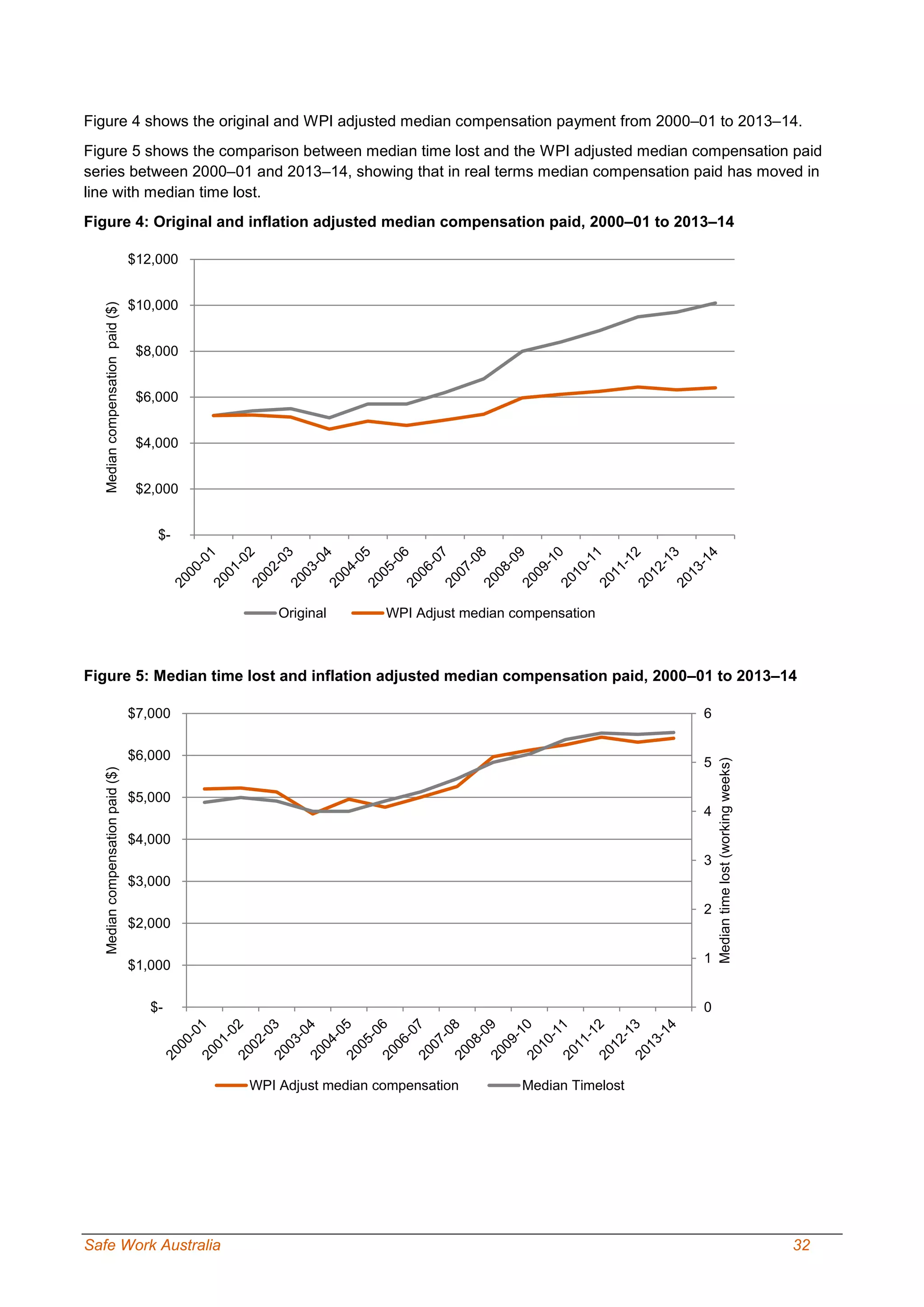
  • 19.
    Australian Workers’ CompensationStatistics 2014–15 (revised July 2017) 19 Mechanism of injury or disease and Bodily location Serious claims that arose from Body stressing were most commonly associated with the Back (over 40 per cent) and Shoulder (over 17 per cent). Serious claims that arose from Falls, trips and slips were most commonly associated with the Knee (nearly 21 per cent) and Ankle (nearly 17 per cent). Table 10: Number and percentage of serious claims by mechanism and bodily location of injury or disease, 2014–15p Mechanism of injury or disease Serious claims Bodily location of injury or disease Number Percentage Body stressing 43 555 40.6% Back - upper or lower 17 455 40.1% Shoulder 7 630 17.5% Knee 3 730 8.6% Abdomen and pelvic region 2 520 5.8% Wrist 2 200 5.1% Hand, fingers and thumb 1 560 3.6% Elbow 1 450 3.3% Neck 1 135 2.6% Falls, trips and slips of a person 24 600 22.9% Knee 5 070 20.6% Ankle 4 135 16.8% Back - upper or lower 3 010 12.2% Shoulder 1 945 7.9% Wrist 1 435 5.8% Foot and toes 1 275 5.2% Hand, fingers and thumb 870 3.5% Lower leg 715 2.9% Being hit by moving objects 16 230 15.1% Hand, fingers and thumb 6 115 37.7% Foot and toes 1 570 9.7% Back - upper or lower 745 4.6% Shoulder 735 4.5% Knee 710 4.4% Hitting objects with a part of the body 7 690 7.2% Hand, fingers and thumb 4 335 56.4% Knee 520 6.8% Vehicle incidents and other 6 620 6.2% Back - upper or lower 1 235 18.7% Shoulder 720 10.9% Hand, fingers and thumb 580 8.7% Mental stress 5 750 5.4% Heat, electricity and other environmental factors 1 540 1.4% Hand, fingers and thumb 520 33.6% Forearm 180 11.7% Foot and toes 95 6.2% Chemicals and other substances 820 0.8% Eye 150 18.3% Hand, fingers and thumb 145 17.7% Biological factors 400 0.4% Sound and pressure 145 0.1% Total 107 355 100.0% Note: The table above only features the most common bodily locations and as a result the percentages and numbers of serious claims do not add to the stated mechanism totals.
  • 20.
    Australian Workers’ CompensationStatistics 2014–15 (revised July 2017) 20 Trends in serious claims, 2000–01 to 2014–15 The National Data Set for Compensation-Based Statistics (NDS) was first introduced as a standard set of data items collected by each jurisdiction in 1987. Following a review of the NDS, reporting requirements were changed significantly for the 2000–01 financial year. The statistics in this chapter cover serious claims that were lodged between 2000–01 and 2014–15. Data for 2014–15 are preliminary and are not used to calculate percentage changes. Percentage changes are calculated using data for 2000–01 and 2013–14. When analysing trends over time, consideration needs to be given to legislative changes that may influence trends in workers’ compensation data. Information on workers’ compensation arrangements can be found in Safe Work Australia’s Comparison of Workers’ Compensation Arrangements in Australia and New Zealand available on the Safe Work Australia website. Serious claims, number of hours worked and number of employees Between 2000–01 and 2013–14, the frequency rate of serious claims fell by 33 per cent from 9.5 serious claims per million hours worked to 6.3. Table 11: Number and rates of serious claims, number of hours worked and number of employees, 2000–01 to 2014–15p Year of lodgement Number of serious claims Frequency rate (serious claims per million hours worked) Incidence rate (serious claims per 1000 employees) Total hours worked (billion) Number of employees (million) 2000-01 133 115 9.5 16.3 14.057 8.186 2001-02 130 165 9.2 15.8 14.089 8.260 2002-03 133 625 9.2 15.8 14.540 8.483 2003-04 134 345 9.2 15.5 14.611 8.654 2004-05 135 515 8.9 15.2 15.166 8.897 2005-06 131 280 8.5 14.3 15.444 9.166 2006-07 129 480 8.1 13.6 15.972 9.495 2007-08 129 120 7.9 13.3 16.313 9.691 2008-09 125 800 7.6 12.7 16.446 9.890 2009-10 125 385 7.6 12.6 16.548 9.950 2010-11 128 170 7.6 12.5 16.971 10.220 2011-12 128 345 7.4 12.4 17.435 10.385 2012-13 120 050 6.7 11.2 18.022 10.765 2013-14 113 965 6.3 10.5 18.093 10.826 % change -14% -33% -35% 29% 32% 2014-15p 107 355 5.9 9.8 18.282 11.001 Gender The gap between male and female employees’ frequency rates shrank between 2000–01 and 2013−14 (from 40 per cent higher to only 17 per cent higher) due to the decline in male employees’ frequency rates being greater than the decline for female employees.
  • 21.
    Australian Workers’ CompensationStatistics 2014–15 (revised July 2017) 21 Figure 1: Frequency rates of serious claims by sex, 2000–01 to 2014–15p Between 2000–01 and 2013–14, the frequency rate for male employees fell by 37 per cent, while the frequency rate for female employees fell by 26 per cent. Table 12: Number and rates of serious claims by sex, 2000–01 to 2014–15p Year of lodgement Female Male Number of serious claims Frequency rate (serious claims per million hours worked) Incidence rate (serious claims per 1000 employees) Number of serious claims Frequency rate (serious claims per million hours worked) Incidence rate (serious claims per 1000 employees) 2000-01 42 095 7.6 11.0 91 015 10.7 20.9 2001-02 41 940 7.6 10.8 88 220 10.3 20.2 2002-03 43 315 7.5 10.8 90 315 10.3 20.3 2003-04 44 295 7.7 10.9 90 045 10.2 19.7 2004-05 45 050 7.5 10.7 90 465 9.9 19.3 2005-06 43 745 7.1 10.0 87 535 9.5 18.2 2006-07 43 020 6.7 9.5 86 460 9.0 17.3 2007-08 43 810 6.7 9.5 85 315 8.7 16.7 2008-09 44 005 6.6 9.3 81 800 8.4 15.8 2009-10 45 280 6.7 9.5 80 105 8.2 15.4 2010-11 46 655 6.8 9.6 81 515 8.0 15.2 2011-12 47 045 6.7 9.5 81 295 7.8 14.9 2012-13 43 920 6.1 8.6 76 130 7.0 13.4 2013-14 41 320 5.7 8.0 72 645 6.7 12.8 % change -2% -26% -27% -20% -37% -39% 2014-15p 38 515 5.2 7.3 68 835 6.3 12.0 0 2 4 6 8 10 12 Frequencyrateofseriousclaims Female Male Total
  • 22.
    Safe Work Australia22 Age group Between 2000–01 and 2013–14, all age groups experienced declines in frequency rates of serious claims. Employees aged 30–34 years had the highest percentage decrease (45 per cent) in frequency rates of serious claims over the period. Table 13: Number and rates of serious claims by age group, 2000–01 and 2009–10 to 2014–15p Age group 2000-01 2009-10 2010-11 2011-12 2012-13 2013-14 % chg 2014-15p Number of serious claims 15-19 years 6 655 4 920 5 085 4 895 4 335 3 740 -44% 3 635 20-24 years 13 570 11 095 11 145 11 325 10 630 10 090 -26% 9 995 25-29 years 15 795 11 790 12 155 12 325 11 750 11 095 -30% 10 805 30-34 years 16 520 12 010 12 170 12 235 11 420 11 170 -32% 10 785 35-39 years 17 900 15 025 14 535 13 740 12 465 11 470 -36% 10 460 40-44 years 18 425 15 770 16 090 16 125 15 195 14 340 -22% 13 050 45-49 years 16 620 17 280 17 640 17 210 15 515 14 620 -12% 13 410 50-54 years 15 040 16 470 17 010 17 085 16 150 15 390 2% 14 080 55-59 years 8 280 12 150 12 550 13 090 12 375 12 020 45% 11 395 60-64 years 3 575 7 045 7 660 8 035 7 695 7 560 111% 7 225 Total 133 115 125 385 128 170 128 345 120 050 113 965 -14% 107 355 Frequency rate (serious claims per million hours worked) 15-19 years 9.5 7.1 7.4 7.3 6.7 6.2 -34% 6.0 20-24 years 8.1 6.0 6.1 6.1 5.9 5.7 -30% 5.7 25-29 years 8.0 5.5 5.4 5.4 5.1 4.7 -41% 4.6 30-34 years 9.2 6.4 6.3 6.0 5.2 5.0 -45% 4.7 35-39 years 10.1 7.5 7.2 6.9 6.1 5.6 -44% 5.1 40-44 years 10.0 8.3 8.1 7.9 6.9 6.5 -35% 5.9 45-49 years 9.9 8.7 8.8 8.5 7.4 7.1 -29% 6.4 50-54 years 10.6 9.2 9.3 9.0 8.2 7.7 -28% 7.1 55-59 years 10.2 9.2 9.1 9.1 8.2 7.8 -23% 7.3 60-64 years 11.8 9.6 9.6 9.8 8.6 8.6 -27% 7.8 Total 9.5 7.6 7.6 7.4 6.7 6.3 -33% 5.9 Incidence rate (serious claims per 1000 employees) 15-19 years 9.7 6.8 7.1 7.0 6.3 5.6 -43% 5.4 20-24 years 13.3 9.3 9.3 9.4 9.0 8.5 -36% 8.5 25-29 years 14.7 9.8 9.6 9.6 9.0 8.4 -43% 8.1 30-34 years 16.7 11.4 11.1 10.6 9.3 8.9 -47% 8.2 35-39 years 18.2 13.3 12.7 12.2 10.8 10.0 -45% 9.0 40-44 years 18.1 14.6 14.3 13.9 12.3 11.7 -35% 10.5 45-49 years 18.1 15.4 15.7 15.5 13.5 12.8 -30% 11.5 50-54 years 19.3 16.2 16.4 16.1 14.5 13.6 -29% 12.6 55-59 years 18.0 15.8 15.6 15.8 14.2 13.4 -25% 12.5 60-64 years 19.2 15.1 15.2 15.7 14.0 13.8 -28% 12.6 Total 16.3 12.6 12.5 12.4 11.2 10.5 -35% 9.8 The percentage of serious claims made by employees aged 55 years and above increased from 9 per cent in 2000−01 to 19 per cent in 2014–15. From 2008–09 onwards, the percentage of serious claims made by employees aged 55 years and above has exceeded the percentage for employees under 25 years.
  • 23.
    Australian Workers’ CompensationStatistics 2014–15 (revised July 2017) 23 Figure 2: Percentage of serious claims by age group, 2000–01 to 2014–15p In most occupations, as workers age, frequency rates increase. This is not the case, however, for Labourers who recorded the highest frequency rate in the 25-54 year age group, and Managers with the highest frequency rate in the 25 and under age group. Figure 3: Frequency rate by age group and occupation, 2000–01 to 2014–15p 0% 2% 4% 6% 8% 10% 12% 14% 16% 18% 20% 22% Percentageofseriousclaims Aged 15-24 Aged 55+ years 0 5 10 15 20 25 30 Labourers Techniciansand tradesworkers Communityand personalservice workers Machinery operatorsand drivers Professionals Salesworkers Clericaland administrative workers Managers Total Frequencyrate(claimspermillionhours) <25 years 25-54 years 55+ years
  • 24.
    Safe Work Australia24 Occupation The occupations that experienced the highest percentage declines in frequency rates between 2000–01 and 2013–14 were Managers (43 per cent) and Technicians and trades workers (40 per cent). Table 14: Number and rates of serious claims by occupation, 2000–01 and 2009–10 to 2014–15p Occupation 2000-01 2009-10 2010-11 2011-12 2012-13 2013-14 % chg 2014-15p Number of serious claims Labourers 38 580 28 950 31 320 31 730 29 190 27 335 -29% 26 405 Technicians and trades workers 27 165 23 370 23 230 22 995 21 725 21 025 -23% 19 685 Community and personal service workers 15 030 20 620 21 275 21 045 20 055 19 575 30% 18 500 Machinery operators and drivers 20 295 18 750 18 400 19 490 18 090 17 055 -16% 15 830 Professionals 10 415 14 015 13 370 12 085 11 915 11 225 8% 10 790 Sales workers 7 420 6 765 7 160 7 440 6 505 6 195 -16% 5 855 Clerical and administrative workers 7 960 7 585 7 595 7 350 6 810 5 820 -27% 5 310 Managers 5 205 5 230 5 605 5 980 5 215 4 975 -4% 4 470 Total 133 115 125 385 128 170 128 345 120 050 113 965 -14% 107 355 Frequency rate (serious claims per million hours worked) Labourers 26.6 19.0 20.6 20.9 18.9 18.0 -32% 17.8 Technicians and trades workers 12.7 9.4 9.0 8.7 7.9 7.7 -40% 7.1 Community and personal service workers 15.0 15.8 15.6 14.8 14.0 13.0 -13% 12.2 Machinery operators and drivers 18.1 15.2 14.2 14.0 12.5 12.1 -33% 11.2 Professionals 3.4 3.6 3.3 2.9 2.8 2.6 -23% 2.5 Sales workers 5.9 5.2 5.2 5.7 4.7 4.5 -23% 4.1 Clerical and administrative workers 3.3 3.1 3.1 2.9 2.7 2.3 -31% 2.1 Managers 3.2 2.2 2.4 2.4 2.0 1.8 -43% 1.6 Total 9.5 7.6 7.6 7.4 6.7 6.3 -34% 5.9 Incidence rate (serious claims per 1000 employees) Labourers 39.2 27.0 29.6 30.3 27.3 25.9 -34% 25.6 Technicians and trades workers 24.9 18.0 17.2 16.8 15.2 14.7 -41% 13.6 Community and personal service workers 20.3 20.4 19.9 19.3 17.9 16.9 -17% 15.7 Machinery operators and drivers 35.3 29.7 27.8 27.9 25.0 24.0 -32% 22.1 Professionals 6.4 6.3 5.8 5.2 4.9 4.6 -28% 4.2 Sales workers 7.8 6.6 6.6 7.1 6.0 5.6 -28% 5.3 Clerical and administrative workers 5.3 4.9 4.8 4.5 4.2 3.6 -33% 3.2 Managers 7.4 4.6 5.0 5.0 4.2 3.9 -47% 3.4 Total 16.3 12.6 12.5 12.4 11.2 10.5 -35% 9.8
  • 25.
    Australian Workers’ CompensationStatistics 2014–15 (revised July 2017) 25 Industry The frequency rates have halved between 2000–01 and 2013–14 in Financial and insurance services (down 53 per cent), Mining (down 54 per cent), and Electricity, gas, water and waste services (down 50 per cent). Table 15: Number and rates of serious claims by industry, 2000–01 and 2009-10 to 2014–15p Industry 2000-01 2009-10 2010-11 2011-12 2012-13 2013-14 % chg 2014-15p Number of serious claims Health care and social assistance 15 320 18 590 19 150 19 920 19 185 18 340 20% 17 565 Manufacturing 27 035 18 075 17 780 17 795 15 690 14 285 -47% 13 725 Construction 12 295 12 395 12 685 12 955 12 420 12 560 2% 12 575 Retail trade 11 930 10 095 10 375 10 560 9 920 9 435 -21% 8 910 Transport, postal and warehousing 11 575 11 695 11 740 11 845 10 710 9 690 -16% 8 820 Public administration and safety 8 115 11 140 11 015 10 085 10 135 9 375 16% 8 270 Education and training 6 110 7 250 7 595 7 405 6 890 6 640 9% 6 540 Accommodation and food services 7 415 6 740 6 880 7 120 6 810 6 395 -14% 6 310 Wholesale trade 5 895 5 230 5 435 5 055 4 900 4 785 -19% 4 630 Administrative and support services 6 255 5 565 6 295 5 795 5 110 4 640 -26% 3 785 Agriculture, forestry and fishing 5 455 3 870 3 640 3 915 3 690 3 515 -36% 3 410 Other services 4 275 3 375 3 420 3 880 3 670 3 545 -17% 3 055 Arts and recreation services 2 320 2 470 2 535 2 635 2 140 2 260 -3% 2 170 Mining 1 895 2 260 2 445 2 890 3 065 2 855 51% 2 105 Professional, scientific and technical services 2 110 2 095 2 255 2 060 1 835 1 810 -14% 1 800 Electricity, gas, water and waste Services 1 420 1 320 1 390 1 285 1 285 1 300 -8% 1 175 Rental, hiring and real estate Services 1 025 1 205 1 220 1 185 1 020 1 015 -1% 1 030 Financial and insurance Services 1 305 990 1 065 970 840 750 -43% 665 Information media and telecommunications 1 230 700 700 755 600 610 -50% 590 Total 133 115 125 385 128 170 128 345 120 050 113 965 -14% 107 355 Frequency rate (serious claims per million hours worked) Health care and social assistance 12.2 11.0 10.6 10.4 9.8 9.2 -24% 8.7 Manufacturing 13.9 10.6 10.5 10.7 9.5 8.8 -37% 8.6 Construction 13.5 9.1 9.0 8.9 8.1 7.9 -42% 8.0 Retail trade 8.8 6.4 6.4 6.6 5.9 5.7 -36% 5.2 Transport, postal and warehousing 14.9 12.3 12.3 12.7 10.6 9.6 -36% 8.3 Public administration and safety 8.8 9.8 9.3 8.1 8.3 7.4 -17% 6.7 Education and training 5.5 5.4 5.6 5.5 4.9 4.6 -17% 4.5 Accommodation and food services 9.0 7.1 7.3 7.5 6.7 6.5 -27% 6.1 Wholesale trade 8.2 7.1 7.6 7.0 6.3 6.7 -18% 6.4 Administrative and support services 11.6 8.5 9.4 8.3 7.2 6.7 -42% 5.5 Agriculture, forestry and fishing 14.3 11.4 10.5 10.8 10.0 9.0 -37% 9.7 Other services 7.9 5.4 5.6 6.3 5.8 5.2 -34% 4.6 Arts and recreation services 13.7 10.0 9.8 9.7 7.7 8.9 -35% 7.7 Mining 10.7 6.0 5.5 5.4 5.3 4.9 -54% 4.3 Professional, scientific and technical services 2.0 1.6 1.7 1.5 1.2 1.2 -38% 1.1
  • 26.
    Safe Work Australia26 Industry 2000-01 2009-10 2010-11 2011-12 2012-13 2013-14 % chg 2014-15p Electricity, gas, water and waste Services 9.3 5.4 5.1 4.6 4.9 4.6 -50% 4.4 Rental, hiring and real estate Services 4.6 4.2 3.9 3.7 3.0 2.9 -37% 2.8 Financial and insurance Services 2.2 1.4 1.5 1.3 1.1 1.0 -53% 0.9 Information media and telecommunications 3.1 1.9 2.0 2.0 1.6 1.8 -41% 1.6 Total 9.5 7.6 7.6 7.4 6.7 6.3 -33% 5.9 Incidence rate (serious claims per 1000 employees) Health care and social assistance 17.9 15.6 15.2 15.1 14.0 13.2 -26% 12.3 Manufacturing 27.3 20.1 20.2 20.7 18.1 16.6 -39% 16.1 Construction 27.7 18.2 17.9 18.0 16.6 16.0 -42% 15.9 Retail trade 12.2 8.8 8.7 9.0 8.1 7.7 -37% 7.3 Transport, postal and warehousing 29.3 23.1 23.3 23.9 19.9 17.9 -39% 15.8 Public administration and safety 15.5 16.6 15.8 14.0 14.5 12.5 -19% 11.2 Education and training 9.1 8.5 8.7 8.5 7.5 7.2 -21% 6.9 Accommodation and food services 12.0 8.8 8.9 9.3 8.4 8.1 -32% 7.7 Wholesale trade 16.1 13.5 14.4 13.3 11.9 12.7 -21% 12.4 Administrative and support services 19.1 13.7 15.2 13.4 11.8 10.8 -43% 8.9 Agriculture, forestry and fishing 27.8 22.3 20.5 21.4 19.8 18.2 -34% 18.7 Other services 13.7 9.2 9.6 10.8 10.0 8.9 -35% 7.8 Arts and recreation services 18.6 12.9 12.4 12.8 9.9 11.2 -40% 9.6 Mining 25.1 13.7 12.6 12.3 12.1 11.2 -55% 9.4 Professional, scientific and technical services 3.8 3.1 3.2 2.8 2.3 2.3 -40% 2.0 Electricity, gas, water and waste Services 17.8 10.7 9.9 9.1 9.4 8.9 -50% 8.5 Rental, hiring and real estate Services 8.8 7.5 7.0 6.7 5.6 5.3 -40% 5.1 Financial and insurance Services 4.0 2.6 2.8 2.4 2.1 1.9 -53% 1.7 Information media and telecommunications 5.4 3.5 3.5 3.7 2.8 3.2 -40% 2.8 Total 16.3 12.6 12.5 12.4 11.2 10.5 -35% 9.8
  • 27.
    Australian Workers’ CompensationStatistics 2014–15 (revised July 2017) 27 Nature of injury or disease Between 2000–01 and 2013–14, the number of serious claims arising from injury and musculoskeletal disorders fell by 15 per cent, while the number of serious claims arising from diseases fell by 11 per cent. The only major 1 condition to show an increase in the number of serious claims was mental disorders, which increased by 1 per cent between 2000–01 and 2013–14. Table 16: Number of serious claims by nature of injury or disease, 2000–01 and 2009-10 to 2014–15p Nature of injury or disease 2000-01 2009-10 2010-11 2011-12 2012-13 2013-14 % chg 2014-15p Injury and musculoskeletal disorders Traumatic joint/ligament and muscle/tendon injury and musculoskeletal and connective tissue diseases 80 755 75 905 76 555 78 340 72 750 69 650 -14% 64 175 Wounds, lacerations, amputations and internal organ damage 22 765 18 795 19 535 18 130 17 235 16 550 -27% 16 005 Fractures 11 285 10 860 11 275 11 455 11 025 10 410 -8% 10 710 Burn 2 110 1 820 1 820 1 950 1 795 1 700 -19% 1 670 Intracranial injuries 420 465 535 540 555 545 31% 690 Injury to nerves and spinal cord 85 190 240 235 220 195 132% 150 Total: injury and musculoskeletal disorders 119 800 110 980 113 270 113 910 107 005 102 140 -15% 96 670 Diseases Mental disorders 6 620 8 095 8 735 8 355 7 680 6 685 1% 6 130 Digestive system diseases 3 230 3 255 3 030 3 130 2 770 2 620 -19% 2 300 Nervous system and sense organ diseases 1 595 1 490 1 555 1 480 1 355 1 280 -20% 1 110 Skin and subcutaneous tissue diseases 855 700 685 670 535 510 -40% 430 Infectious and parasitic diseases 305 240 265 235 250 260 -15% 290 Respiratory system diseases 285 295 285 245 210 225 -20% 210 Circulatory system diseases 190 135 145 150 110 105 -45% 95 Neoplasms (cancer) 60 55 55 60 35 45 -25% 35 Total: diseases 13 310 14 410 14 895 14 435 13 050 11 825 -11% 10 685 Total: serious claims 133 115 125 385 128 170 128 345 120 050 113 965 -14% 107 355 Note: The table above only features the most common types of injury or disease, as a result numbers of serious claims do not add to the stated totals. 1 Major conditions are defined as those with an average of more than 1000 serious claims per year.
  • 28.
    Safe Work Australia28 Bodily location of injury or disease Major 2 bodily locations that showed increases in the number of serious claims between 2000–01 and 2013–14 were the Shoulder (up 17 per cent), the Lower leg (up 10 per cent), the Knee (up 6 per cent) and Non-physical locations (e.g. mental conditions) (up 1 per cent). Table 17: Number of serious claims by bodily location of injury or disease, 2000–01 and 2009-10 to 2014−15p Bodily location of injury or disease 2000-01 2009-10 2010-11 2011-12 2012-13 2013-14 % chg 2014-15p Upper limbs 43 070 41 230 42 605 43 270 41 015 38 870 -10% 37 150 Hand, fingers and thumb 17 630 15 175 15 635 15 500 14 845 14 095 -20% 14 190 Shoulder 10 660 12 720 13 050 13 720 13 010 12 450 17% 11 225 Wrist 6 125 5 940 6 280 6 045 5 655 5 335 -13% 4 945 Elbow 3 110 2 905 3 045 3 170 3 005 2 780 -11% 2 670 Forearm 2 165 1 885 1 890 2 030 1 865 1 595 -26% 1 605 Upper arm 1 145 1 085 1 155 1 150 1 080 1 070 -7% 1 005 Trunk 42 610 35 335 35 225 34 845 31 815 30 150 -29% 27 685 Back - upper or lower 35 280 28 695 28 740 28 415 25 955 24 770 -30% 22 680 Abdomen and pelvic Region 4 750 4 350 4 245 4 130 3 665 3 365 -29% 3 075 Chest (thorax) 2 350 2 050 2 010 2 055 1 980 1 790 -24% 1 715 Lower limbs 26 355 27 535 27 550 28 345 26 765 25 910 -2% 24 790 Knee 10 465 11 595 11 830 12 075 11 455 11 075 6% 10 615 Ankle 5 915 6 255 6 075 6 300 5 930 5 685 -4% 5 535 Foot and toes 4 545 4 170 4 175 4 335 4 055 3 975 -13% 3 795 Lower leg 2 245 2 735 2 725 2 755 2 515 2 470 10% 2 260 Upper leg 1 015 960 945 1 030 960 935 -8% 835 Hip 780 885 915 935 935 885 13% 830 Non-physical locations 6 610 8 225 8 835 8 365 7 685 6 685 1% 6 125 Head 3 765 3 450 3 650 3 680 3 600 3 390 -10% 3 395 Cranium 830 765 870 830 740 835 0% 925 Eye 1 155 985 985 995 975 865 -25% 840 Face, not elsewhere specified 640 645 620 680 725 630 -1% 590 Nose 230 210 215 230 190 205 -11% 210 Mouth 135 170 190 185 205 150 11% 135 Ear 170 160 180 180 155 130 -22% 120 Multiple locations 6 185 5 960 6 560 5 910 5 585 5 455 -12% 4 975 Neck 3 705 2 745 2 825 2 915 2 550 2 495 -33% 2 170 Unspecified locations 160 350 350 590 640 600 275% 585 Systemic locations 655 565 565 425 380 400 -39% 435 Total 133 115 125 385 128 170 128 345 120 050 113 965 -14% 107 355 Note: The table above only features the most common bodily locations, as a result numbers of serious claims do not add to the stated totals. 2 Major bodily locations are defined as those with an average of more than 1000 serious claims per year.
  • 29.
    Australian Workers’ CompensationStatistics 2014–15 (revised July 2017) 29 Mechanism of injury or disease The mechanism that showed the highest increase in the number of serious claims was Being assaulted by a person or persons, which more than doubled between 2000–01 and 2013–14 (up from 1 105 to 2 270). The only other mechanism that showed an increase in the number of serious claims over the same period was Falls on the same level (up 5 per cent). Being trapped by moving machinery or equipment recorded the largest decrease with the number of serious claims halving between 2000–01 and 2013–14. Table 18: Number of serious claims by mechanism of injury or disease, 2000–01 and 2009-10 to 2014−15p Mechanism of injury or disease 2000-01 2009-10 2010-11 2011-12 2012-13 2013-14 % chg 2014-15 Body stressing 58 210 54 130 54 230 54 670 49 905 48 110 -17% 43 555 Muscular stress while lifting, carrying, or putting down objects 28 625 22 705 23 430 22 485 20 310 19 305 -33% 16 750 Muscular stress while handling objects other than lifting, carrying or putting down 18 840 20 115 19 970 20 515 19 360 18 790 0% 17 830 Muscular stress with no objects being handled 6 330 7 525 6 970 7 320 6 290 6 300 0% 5 570 Falls, trips & slips of a person 26 165 27 195 27 955 28 540 26 500 25 425 -3% 24 600 Falls on the same level 15 570 17 220 18 180 18 455 16 680 16 295 5% 15 685 Falls from a height 8 845 8 180 7 845 7 635 7 200 6 770 -23% 6 740 Being hit by moving objects 18 180 17 410 17 735 18 005 17 655 16 580 -9% 16 230 Being hit by falling objects 4 205 4 010 4 055 4 270 3 860 3 600 -14% 3 515 Being trapped between stationary and moving objects 2 480 2 580 2 485 2 510 2 420 2 355 -5% 2 245 Being trapped by moving machinery or equipment 2 145 1 355 1 420 1 440 1 295 1 065 -50% 905 Being assaulted by a person or persons 1 105 2 275 2 240 2 415 2 470 2 270 105% 2 265 Hitting objects with a part of the body 10 580 8 595 8 470 8 615 8 100 7 880 -26% 7 690 Hitting stationary objects 5 115 4 445 4 560 4 465 4 205 4 070 -20% 3 725 Hitting moving objects 5 315 4 070 3 820 4 060 3 830 3 725 -30% 3 910 Vehicle incidents & other 9 435 7 000 7 995 7 290 7 620 6 740 -29% 6 620 Vehicle accident 2 730 2 915 3 170 3 170 2 940 2 605 -5% 2 355 Mental stress 6 295 7 770 8 370 7 700 7 045 6 210 -1% 5 750 Heat, electricity and other environmental factors 1 955 1 665 1 660 1 795 1 670 1 585 -19% 1 540 Chemicals and other substances 1 540 1 110 1 135 1 175 1 040 935 -39% 820 Biological factors 605 385 450 375 360 380 -37% 400 Sound and pressure 150 130 175 180 150 125 -13% 145 Total serious claims 133 115 125 385 128 170 128 345 120 050 113 965 -14% 107 355 Note: The table above only features the most common types of mechanism, as a result numbers of serious claims do not add to the stated totals.
  • 30.
    Safe Work Australia30 Breakdown agency of injury or disease Between 2000–01 and 2013–14, the breakdown agencies that showed increases in the number of serious claims were Animal, human and biological agencies (up 16 per cent), Materials and substances (up 6 per cent), and Environmental agencies (up 2 per cent). The largest falls were recorded for Chemical and chemical products (down 42 per cent) and Machinery and fixed plant (down 40 per cent). Table 19: Number of serious claims by breakdown agency of injury or disease, 2000–01 and 2009-10 to 2014–15p Breakdown agency of injury or disease 2000-01 2009-10 2010-11 2011-12 2012-13 2013-14 % chg 2014-15p Non-powered hand tools, appliances and equipment 35 695 31 325 30 895 32 505 29 455 27 595 -23% 26 320 Environmental agencies 18 070 19 405 19 475 21 015 19 480 18 350 2% 17 120 Materials and substances 14 835 15 365 15 330 16 935 16 040 15 650 6% 15 470 Animal, human and biological agencies 13 965 16 545 16 550 17 235 16 875 16 150 16% 15 060 Mobile plant and transport 11 455 11 475 11 505 12 425 11 860 11 235 -2% 10 295 Machinery and (mainly) fixed plant 9 300 6 125 6 025 6 565 5 935 5 590 -40% 5 075 Powered equipment, tools and appliances 6 380 6 020 5 795 6 305 5 635 5 065 -21% 4 740 Chemicals and chemical products 1 390 885 935 980 845 810 -42% 720 Other and unspecified agencies 22 025 18 240 21 665 14 380 13 920 13 525 -39% 12 555 Total serious claims 133 115 125 385 128 170 128 345 120 050 113 965 -14% 107 355
  • 31.
    Australian Workers’ CompensationStatistics 2014–15 (revised July 2017) 31 Time lost and compensation paid This chapter provides statistics on time lost from work and compensation paid. Time lost is measured in working weeks lost from work and excludes estimates of future absences. Time lost does not have to occur in consecutive days or weeks. The time lost reflects the total period of time for which compensation was paid. The median is used as the measure of central tendency because a few long-term claims involving lengthy periods of time lost or high amounts of compensation would significantly skew an arithmetic mean. It is not possible to calculate the total time lost or the total compensation paid by multiplying the median by the number of claims. Preliminary data (2014–15) are excluded when reporting time lost and compensation paid because claims from the preliminary year are likely to be open and claimants may accrue more time lost or more compensation payments in subsequent years. Between 2000–01 and 2013–14, the median time lost for a serious claim rose by 33 per cent from 4.2 working weeks to 5.6. Over the same period, the median compensation paid for a serious claim rose by 94 per cent from $5 200 to $10 100 (Table 20). Table 20 also shows an estimate of the inflation adjusted median compensation paid. The median compensation is adjusted using the ABS Wage Price Index 3 (WPI) to remove the effects of wage inflation and allow a more meaningful comparison with the median time lost time series. In all adjustments, the 2000–01 financial year is used as the base period for comparison. Due to the limited breakdowns provided by the WPI series, WPI adjusted median compensation paid data are only able to be provided at the overall and industry levels. For all other breakdowns in this chapter the non-adjusted median compensation paid is presented. Table 20: Serious claims: median time lost and compensation paid, 2000–01 to 2013–14 Financial year of lodgement Serious claims Median time lost (weeks) Median compensation paid Median compensation (WPI adjusted) 2000-01 133 115 4.2 $5 200 $5 200 2001-02 130 165 4.3 $5 400 $5 200 2002-03 133 625 4.2 $5 500 $5 100 2003-04 134 345 4.0 $5 100 $4 600 2004-05 135 515 4.0 $5 700 $5 000 2005-06 131 280 4.2 $5 700 $4 800 2006-07 129 480 4.4 $6 200 $5 000 2007-08 129 120 4.7 $6 800 $5 300 2008-09 125 800 5.0 $8 000 $6 000 2009-10 125 385 5.2 $8 400 $6 100 2010-11 128 170 5.5 $8 900 $6 300 2011-12 128 345 5.6 $9 500 $6 400 2012-13 120 050 5.6 $9 700 $6 300 2013-14 113 965 5.6 $10 100 $6 400 3 Wage Price Index, ABS Catalogue No. 6345.0, Australia, September 2016.
  • 32.
    Safe Work Australia32 Figure 4 shows the original and WPI adjusted median compensation payment from 2000–01 to 2013–14. Figure 5 shows the comparison between median time lost and the WPI adjusted median compensation paid series between 2000–01 and 2013–14, showing that in real terms median compensation paid has moved in line with median time lost. Figure 4: Original and inflation adjusted median compensation paid, 2000–01 to 2013–14 Figure 5: Median time lost and inflation adjusted median compensation paid, 2000–01 to 2013–14 $- $2,000 $4,000 $6,000 $8,000 $10,000 $12,000 Mediancompensationpaid($) Original WPI Adjust median compensation 0 1 2 3 4 5 6 $- $1,000 $2,000 $3,000 $4,000 $5,000 $6,000 $7,000 Mediantimelost(workingweeks) Mediancompensationpaid($) WPI Adjust median compensation Median Timelost
  • 33.
    Australian Workers’ CompensationStatistics 2014–15 (revised July 2017) 33 Age group Figure 6 shows that median time lost increases with age and that all age groups have recorded an increase in median time lost between 2001–02 and 2013–14. Figure 6: Serious claims: median time lost by age group, 2001–02 to 2013–14 Similar to median time lost, Figure 7 shows that median compensation paid generally increases with age, however, it levels out for workers aged over 50 and then falls slightly for those age 65 and over. Figure 7: Serious claims: median compensation paid by age group, 2001–02 to 2013–14
  • 34.
    Safe Work Australia34 Gender In 2013–14, the median time lost for a serious claim was 5.3 working weeks for male employees and 6.0 working weeks for female employees. The median compensation paid for a serious claim was $10 900 for male employees and $8 900 for female employees. Table 21: Serious claims: median time lost and compensation paid by sex, 2000–01 to 2013–14 Financial year Median time lost (working weeks) Median compensation ($) Male Female Male Female 2000-01 4.0 4.7 $5 000 $5 600 2001-02 4.0 5.0 $5 200 $6 000 2002-03 4.0 4.9 $5 300 $6 000 2003-04 3.8 4.6 $4 900 $5 400 2004-05 3.9 4.4 $5 600 $5 900 2005-06 4.0 5.0 $5 600 $5 900 2006-07 4.2 5.0 $6 200 $6 200 2007-08 4.4 5.4 $6 800 $6 700 2008-09 4.8 5.6 $8 200 $7 500 2009-10 4.8 5.8 $8 500 $8 100 2010-11 5.2 6.1 $9 100 $8 700 2011-12 5.3 6.2 $9 800 $9 000 2012-13 5.2 6.0 $10 200 $8 900 2013-14 5.3 6.0 $10 900 $8 900 Figure 8: Serious claims: median time lost by sex, 2000–01 to 2013–14 0 1 2 3 4 5 6 7 Mediantimelost(weeks) Male Female
  • 35.
    Australian Workers’ CompensationStatistics 2014–15 (revised July 2017) 35 Figure 9: Serious claims: median compensation paid by sex, 2000–01 to 2013–14 Occupation In 2013–14, Sales workers had the highest median time lost (7.2 working weeks) and Managers had the highest median compensation paid ($14 000). Sales workers also had the highest increase in median time lost between 2000–01 and 2013–14, increasing by 112 per cent. Table 22: Serious claims: median time lost and compensation paid by occupation, 2000–01 and 2009−10 to 2013–14 Occupation 2000-01 2009-10 2010-11 2011-12 2012-13 2013-14 % chg Median time lost (working weeks) Labourers 4.2 5.0 5.3 5.4 5.2 5.3 26% Technicians and trades workers 4.0 4.6 4.8 5.0 5.0 5.0 25% Community and personal service workers 4.0 5.2 5.5 5.1 5.0 5.0 25% Machinery operators and drivers 4.4 5.2 5.8 6.0 6.0 6.2 41% Professionals 4.6 5.1 5.6 5.9 5.6 5.2 13% Sales workers 3.4 5.8 5.7 6.5 6.8 7.2 112% Clerical and administrative workers 4.8 6.1 6.6 6.6 6.8 6.8 42% Managers 5.0 6.4 7.0 7.0 7.0 6.4 28% Total serious claims 4.2 5.2 5.5 5.6 5.6 5.6 33% Median compensation ($) Labourers $4 400 $7 400 $7 700 $8 400 $8 400 $9 000 105% Technicians and trades workers $5 000 $8 200 $8 600 $9 200 $10 000 $10 500 110% Community and personal service workers $4 600 $6 600 $7 400 $7 700 $7 300 $7 700 67% Machinery operators and drivers $5 800 $9 400 $10 200 $10 900 $11 800 $12 700 119% Professionals $6 800 $9 700 $10 900 $11 500 $11 000 $10 800 59% Sales workers $4 100 $7 500 $7 600 $8 200 $8 300 $8 700 112% Clerical and administrative workers $7 100 $12 000 $12 500 $12 700 $13 400 $13 400 89% Managers $7 400 $12 000 $12 900 $13 900 $14 300 $14 000 89% Total serious claims $5 200 $8 400 $8 900 $9 500 $9 700 $10 100 94% $ 0 $2 000 $4 000 $6 000 $8 000 $10 000 $12 000 Mediancompensationpaid Male Female
  • 36.
    Safe Work Australia36 Industry In 2013–14, the Mining industry had both the highest median time lost (8.2 working weeks) and the highest median compensation paid ($23 700). Table 23: Serious claims: median time lost and compensation paid by industry, 2000–01 and 2009–10 to 2013–14 Industry 2000-01 2009-10 2010-11 2011-12 2012-13 2013-14 % chg Median time lost (working weeks) Health care and social assistance 4.4 4.9 5.3 5.2 5.2 5.1 16% Manufacturing 4.0 4.8 5.2 5.1 5.0 5.2 30% Construction 5.0 6.0 6.0 6.4 6.6 6.4 28% Retail trade 3.4 5.8 5.8 6.2 6.2 6.6 94% Transport, postal and warehousing 4.0 5.0 5.3 5.8 5.8 6.4 60% Public administration and safety 4.0 5.8 6.0 5.7 5.4 5.4 35% Education and training 4.0 4.6 4.7 4.8 4.6 4.4 10% Accommodation and food services 3.7 3.8 4.0 4.2 4.0 4.0 8% Wholesale trade 4.2 5.2 5.3 5.6 5.4 5.0 19% Administrative and support services 4.4 4.4 4.8 5.2 4.6 5.0 14% Agriculture, forestry and fishing 4.8 5.2 5.9 6.0 5.6 5.6 17% Other services 4.6 5.1 5.2 5.6 5.2 5.2 13% Arts and recreation services 4.6 6.2 7.2 6.7 6.6 5.6 22% Mining 5.1 6.6 7.8 7.5 8.0 8.2 61% Professional, scientific and technical services 4.6 5.4 6.4 7.0 6.8 7.0 52% Electricity, gas, water and waste services 3.4 4.6 4.8 5.6 5.6 5.0 47% Rental, hiring and real estate services 4.4 5.2 5.8 6.4 6.6 5.8 32% Financial and insurance services 4.8 7.6 7.4 7.2 6.4 6.8 42% Information media and telecommunications 4.0 5.4 4.8 6.0 6.2 4.6 15% Total 4.2 5.2 5.5 5.6 5.6 5.6 33% Median compensation ($) Health care and social assistance $4 800 $6 900 $7 500 $7 700 $7 300 $7 400 54% Manufacturing $5 400 $8 700 $9 400 $9 400 $9 900 $10 800 100% Construction $6 200 $10 000 $10 700 $11 900 $13 100 $13 700 121% Retail trade $4 100 $7 800 $7 700 $8 100 $8 300 $8 700 112% Transport, postal and warehousing $5 100 $8 700 $9 100 $10 500 $11 200 $12 400 143% Public administration and safety $6 400 $10 000 $11 600 $12 800 $11 200 $11 800 84% Education and training $5 900 $9 500 $9 600 $10 000 $9 800 $9 700 64% Accommodation and food services $3 400 $4 400 $4 700 $4 900 $5 400 $5 300 56% Wholesale trade $5 500 $9 100 $9 700 $9 800 $10 500 $10 900 98% Administrative and support services $4 100 $5 500 $6 400 $7 000 $6 800 $7 000 71% Agriculture, forestry and fishing $4 000 $6 700 $7 300 $8 600 $8 000 $9 100 128% Other services $5 200 $8 300 $8 500 $9 700 $9 800 $10 000 92% Arts and recreation services $4 600 $7 100 $7 800 $8 000 $10 200 $8 700 89% Mining $11 900 $19 300 $20 500 $20 700 $23 300 $23 700 99% Professional, scientific and technical services $6 600 $10 400 $12 100 $14 000 $14 400 $15 200 130%
  • 37.
    Australian Workers’ CompensationStatistics 2014–15 (revised July 2017) 37 Industry 2000-01 2009-10 2010-11 2011-12 2012-13 2013-14 % chg Electricity, gas, water and waste services $5 000 $9 900 $9 900 $13 400 $12 400 $12 300 146% Rental, hiring and real estate services $5 600 $9 100 $9 900 $10 000 $12 400 $11 900 113% Financial and insurance services $7 400 $12 700 $12 200 $15 100 $13 200 $14 200 92% Information media and telecommunications $6 300 $14 000 $11 600 $13 200 $14 500 $12 800 103% Total $5 200 $8 400 $8 900 $9 500 $9 700 $10 100 94% Table 24 shows the WPI adjusted median compensation paid by industry division, for 2000–01 and 2009–10 to 2013–14. In real terms (adjusted for wage inflation), two industries showed a reduction in median compensation paid between 2000–01 and 2013–14: Health care and social assistance showed a 4 per cent decline in median compensation and Education and training showed a 1 per cent reduction. Transport, postal and warehousing showed the largest increase in WPI adjusted median compensation paid, increasing by 56 per cent between 2000–01 and 2013–14. Other industries, such as Retail trade, Agriculture, forestry and fishing, Professional, scientific and technical services and Electricity, gas, water and waste services all showed an increase of over 40 per cent in WPI adjusted compensation paid over the period. The Mining industry had the highest level of WPI adjusted median compensation paid in 2013–14 at $13 700. Table 24: Serious claims: WPI adjusted median compensation paid by industry, 2000–01 and 2009–10 to 2013–14 Industry 2000-01 2009-10 2010-11 2011-12 2012-13 2013-14 % chg WPI adjusted Median compensation ($) Health care and social assistance $4 800 $4 900 $5 100 $5 100 $4 700 $4 600 -4% Manufacturing $5 400 $6 300 $6 600 $6 400 $6 500 $6 900 27% Construction $6 200 $6 900 $7 100 $7 600 $8 100 $8 200 33% Retail trade $4 100 $5 800 $5 600 $5 700 $5 700 $5 800 42% Transport, postal and warehousing $5 100 $6 300 $6 400 $7 100 $7 400 $8 000 56% Public administration and safety $6 400 $7 000 $7 800 $8 400 $7 100 $7 200 13% Education and training $5 900 $6 500 $6 300 $6 400 $6 100 $5 800 -1% Accommodation and food services $3 400 $3 400 $3 500 $3 600 $3 800 $3 700 8% Wholesale trade $5 500 $6 800 $7 000 $6 700 $6 900 $7 000 28% Administrative and support services $4 100 $4 100 $4 600 $4 800 $4 500 $4 600 11% Agriculture, forestry and fishing $4 000 $4 900 $5 100 $5 800 $5 200 $5 800 44% Other services $5 200 $6 200 $6 200 $6 700 $6 600 $6 600 27% Arts and recreation services $4 600 $5 200 $5 500 $5 500 $6 800 $5 600 23% Mining $11 900 $13 000 $13 300 $12 800 $13 800 $13 700 15% Professional, scientific and technical services $6 600 $7 400 $8 300 $9 100 $9 100 $9 400 43% Electricity, gas, water and waste services $5 000 $6 700 $6 400 $8 400 $7 500 $7 200 44% Rental, hiring and real estate services $5 600 $6 600 $6 900 $6 700 $8 100 $7 600 36% Financial and insurance services $7 400 $9 100 $8 400 $10 000 $8 500 $8 900 20% Information media and telecommunications $6 300 $10 400 $8 400 $9 200 $9 800 $8 500 34% Total $5 200 $6 100 $6 300 $6 400 $6 300 $6 400 23%
  • 38.
    Safe Work Australia38 Nature of injury and disease In 2013–14, the median time lost for serious claims that arose from Mental disorders (15.4 working weeks) was the highest and was more than double the median time lost for all serious claims (5.6 working weeks). The median compensation paid for serious claims that arose from Mental disorders ($25 800) was also the highest in 2013–14, significantly above the Australian total of $10 100. Table 25: Serious claims: median time lost and compensation paid by nature of injury or disease, 2000–01 and 2009–10 to 2013–14 Nature of injury/disease 2000-01 2009-10 2010-11 2011-12 2012-13 2013-14 % chg Median time lost (working weeks) Injury and musculoskeletal disorders Traumatic joint/ligament and muscle/tendon injury 4.1 4.6 5.0 5.0 4.9 5.0 22% Musculoskeletal and connective tissue diseases 8.2 9.4 9.6 10.2 9.9 8.4 2% Wounds, lacerations, amputations and internal organ damage 2.4 2.7 2.8 2.8 2.8 2.8 17% Fractures 6.8 7.8 7.8 8.0 8.0 8.0 18% Other injuries 2.4 3.4 3.4 3.6 4.0 4.1 71% Burn 2.0 2.0 2.0 2.0 2.0 2.0 Intracranial injuries 2.6 4.9 3.8 4.0 3.2 4.8 85% Injury to nerves and spinal cord 26.2 10.2 12.6 9.8 10.0 9.3 -65% Other claims 3.4 4.0 3.7 4.0 4.6 4.3 26% Total: injury and musculoskeletal disorders 3.9 4.8 5.0 5.2 5.1 5.2 33% Diseases Mental disorders 11.2 14.7 15.8 15.2 15.0 15.4 38% Digestive system diseases 5.8 5.4 5.6 5.6 5.6 6.0 3% Nervous system and sense organ diseases 8.1 8.7 8.9 8.3 8.6 9.0 11% Skin and subcutaneous tissue diseases 2.3 2.2 3.0 2.6 3.0 2.6 13% Infectious and parasitic diseases 2.0 2.4 2.4 3.0 2.6 2.4 20% Respiratory system diseases 4.6 4.4 4.8 5.0 4.6 4.0 -13% Circulatory system diseases 15.0 10.4 9.5 9.8 8.7 6.5 -57% Neoplasms (cancer) 3.9 4.4 2.5 3.5 5.2 5.6 44% Other diseases 5.7 5.3 5.4 4.2 5.6 3.0 -47% Total: diseases 6.8 8.1 8.8 8.6 9.0 8.8 29% Total: serious claims 4.2 5.2 5.5 5.6 5.6 5.6 33% Median compensation ($) Injury and musculoskeletal disorders Traumatic joint/ligament and muscle/tendon injury $5 300 $7 100 $8 000 $8 400 $8 500 $9 100 72% Musculoskeletal and connective tissue diseases $11 100 $15 900 $16 300 $16 100 $15 600 $14 600 32% Wounds, lacerations, amputations and internal organ damage $2 700 $4 400 $4 800 $5 100 $5 300 $5 900 119% Fractures $6 400 $10 700 $11 100 $11 900 $12 400 $12 800 100% Other injuries $3 000 $4 700 $5 100 $6 400 $7 300 $7 800 160% Burn $1 400 $2 000 $2 200 $2 300 $2 400 $2 600 86% Intracranial injuries $3 100 $7 400 $7 100 $7 900 $6 900 $8 900 187% Injury to nerves and spinal cord $60 100 $13 300 $20 200 $18 100 $15 800 $14 500 -76% Other claims $4 700 $5 200 $5 200 $5 700 $8 300 $6 800 45% Total: injury and musculoskeletal disorders $4 700 $7 600 $8 100 $8 700 $8 900 $9 300 98%
  • 39.
    Australian Workers’ CompensationStatistics 2014–15 (revised July 2017) 39 Nature of injury/disease 2000-01 2009-10 2010-11 2011-12 2012-13 2013-14 % chg Diseases Mental disorders $14 300 $24 100 $25 900 $25 800 $26 700 $25 800 80% Digestive system diseases $6 800 $10 100 $10 500 $11 200 $11 800 $12 500 84% Nervous system and sense organ diseases $8 700 $14 900 $13 800 $14 700 $15 300 $15 700 80% Skin and subcutaneous tissue diseases $2 300 $2 900 $3 900 $3 400 $4 200 $4 600 100% Infectious and parasitic diseases $1 500 $3 000 $2 700 $4 700 $4 300 $4 000 167% Respiratory system diseases $7 100 $8 100 $8 200 $8 500 $7 900 $8 300 17% Circulatory system diseases $15 300 $17 700 $19 700 $16 000 $18 300 $14 800 -3% Neoplasms (cancer) $8 700 $13 200 $9 800 $10 300 $11 200 $14 600 68% Other diseases $6 000 $11 700 $7 700 $11 100 $9 800 $7 000 17% Total: diseases $8 200 $13 400 $14 500 $15 000 $16 000 $15 900 94% Total: serious claims $5 200 $8 400 $8 900 $9 500 $9 700 $10 100 94% Mechanism of injury or disease Serious claims associated with Muscular stress while lifting, carrying, or putting down objects has increased 40 per cent since 2000–01, however time lost has remained steady at six working weeks for the past three years. Serious claims associated with Mental stress had the highest median compensation paid in 2013–14 ($26 400) Table 26: Serious claims: median time lost and compensation paid by mechanism of injury or disease, 2000−01 and 2009–10 to 2013–14 Mechanism of injury or disease 2000-01 2009-10 2010-11 2011-12 2012-13 2013-14 % chg Median time lost (working weeks) Body stressing 4.6 5.6 6.0 6.1 6.0 6.0 30% Muscular stress while lifting, carrying, or putting down objects 4.3 5.4 5.8 6.0 6.0 6.0 40% Muscular stress while handling objects other than lifting, carrying or putting down 4.6 5.5 6.0 6.0 6.2 6.1 33% Muscular stress with no objects being handled 4.0 5.1 5.0 5.2 4.8 4.8 20% Falls, trips and slips of a person 4.6 5.8 6.0 6.0 6.1 6.0 30% Falls from a height 5.6 6.6 6.8 7.4 7.5 7.0 25% Falls on the same level 4.2 5.4 5.5 5.6 5.8 5.8 38% Being hit by moving objects 3.2 3.7 3.9 4.0 4.0 4.0 25% Being hit by falling objects 3.2 3.9 4.2 4.3 4.0 4.4 38% Being trapped between stationary and moving objects 3.1 3.8 4.0 4.0 4.2 3.9 26% Being trapped by moving machinery or equipment 4.4 4.4 4.7 4.6 4.6 4.8 9% Being assaulted by a person or persons 4.2 4.4 4.7 5.0 4.5 4.4 5% Hitting objects with a part of the body 2.4 2.6 3.0 2.8 2.9 2.8 17% Vehicle incidents and other 5.2 5.7 5.8 6.0 6.0 6.6 27% Vehicle accident 6.0 6.1 6.2 6.6 6.2 7.4 23% Mental stress 11.4 15.2 16.6 16.6 16.5 16.0 40% Heat, electricity and other environmental factors 2.0 2.0 2.0 2.0 2.0 2.2 10% Chemicals and other substances 2.2 2.4 2.0 2.2 2.1 2.2 0% Biological factors 2.0 2.2 2.4 2.6 2.6 2.2 10% Sound and pressure 4.0 5.4 4.8 4.0 4.2 6.2 55% Total 4.2 5.2 5.5 5.6 5.6 5.6 33%
  • 40.
    Safe Work Australia40 Mechanism of injury or disease 2000-01 2009-10 2010-11 2011-12 2012-13 2013-14 % chg Median compensation ($) Body stressing $5 900 $9 100 $9 800 $10 400 $10 600 $10 900 85% Muscular stress while lifting, carrying, or putting down objects $5 400 $8 300 $9 000 $9 600 $9 700 $10 500 94% Muscular stress while handling objects other than lifting, carrying or putting down $5 600 $9 200 $10 000 $10 300 $10 700 $10 800 93% Muscular stress with no objects being handled $6 000 $8 600 $8 800 $9 600 $9 500 $9 300 55% Falls, trips and slips of a person $5 500 $8 700 $9 400 $10 000 $10 500 $10 800 96% Falls from a height $6 800 $9 900 $10 900 $12 200 $12 900 $13 000 91% Falls on the same level $4 900 $8 200 $8 600 $9 200 $9 700 $10 000 104% Being hit by moving objects $4 000 $6 300 $6 500 $7 100 $7 200 $7 700 93% Being hit by falling objects $3 400 $5 300 $5 700 $6 300 $6 300 $6 900 103% Being trapped between stationary and moving objects $3 700 $6 700 $6 500 $7 300 $7 500 $8 000 116% Being trapped by moving machinery or equipment $6 300 $9 500 $10 100 $9 200 $9 100 $10 900 73% Being assaulted by a person or persons $6 000 $6 900 $7 800 $8 300 $7 700 $7 900 32% Hitting objects with a part of the body $2 600 $4 300 $4 900 $4 800 $5 400 $5 600 115% Vehicle incidents and other $5 700 $9 000 $9 400 $10 800 $11 000 $12 000 111% Vehicle accident $7 200 $9 800 $10 900 $12 700 $12 100 $14 300 99% Mental stress $14 500 $24 200 $26 200 $26 600 $27 200 $26 400 82% Heat, electricity and other environmental factors $1 500 $2 000 $2 200 $2 400 $2 500 $2 900 93% Chemicals and other substances $2 300 $2 900 $2 800 $3 300 $3 000 $3 700 61% Biological factors $2 000 $2 700 $3 100 $3 900 $4 200 $4 000 100% Sound and pressure $5 300 $8 700 $11 700 $10 100 $9 500 $12 800 142% Total serious claims $5 200 $8 400 $8 900 $9 500 $9 700 $10 100 94%
  • 41.
    Australian Workers’ CompensationStatistics 2014–15 (revised July 2017) 41 Breakdown agency of injury or disease Serious claims associated with Mobile plant and transport had the highest median time lost from work in 2013–14 (6.3 working weeks), as well as the highest median compensation paid in 2013–14 ($12 100). Table 27: Serious claims: median time lost and compensation paid by breakdown agency of injury or disease, 2000–01 and 2009–10 to 2013–14 Breakdown agency of injury or disease 2000-01 2009-10 2010-11 2011-12 2012-13 2013-14 % chg Median time lost (working weeks) Non-powered hand tools, appliances and equipment 3.6 4.4 4.8 5.0 5.0 5.0 39% Environmental agencies 4.0 5.0 5.4 5.6 5.7 5.6 40% Materials and substances 3.8 4.2 4.7 5.0 4.8 4.8 26% Animal, human and biological agencies 4.6 5.7 6.2 6.4 6.0 6.0 30% Mobile plant and transport 4.5 5.3 5.8 6.2 6.0 6.3 40% Machinery and (mainly) fixed plant 4.0 4.6 4.7 4.8 4.8 4.8 20% Powered equipment, tools and appliances 4.2 4.6 4.9 5.0 4.9 5.1 21% Chemicals and chemical products 2.6 2.8 2.6 3.1 3.3 3.0 15% Other and unspecified agencies 5.8 8.1 7.4 7.4 7.0 7.0 21% Total serious claims 4.2 5.2 5.5 5.6 5.6 5.6 33% Median compensation ($) Non-powered hand tools, appliances and equipment $4 400 $7 000 $7 400 $8 200 $8 500 $8 900 102% Environmental agencies $5 000 $8 000 $8 600 $9 500 $10 000 $10 200 104% Materials and substances $4 400 $7 200 $7 900 $8 700 $8 900 $9 700 120% Animal, human and biological agencies $5 100 $8 300 $9 400 $10 000 $9 800 $9 400 84% Mobile plant and transport $5 800 $8 800 $9 800 $10 700 $11 100 $12 100 109% Machinery and (mainly) fixed plant $5 200 $8 500 $8 600 $9 100 $9 600 $10 200 96% Powered equipment, tools and appliances $5 800 $8 300 $8 700 $9 400 $9 400 $9 800 69% Chemicals and chemical products $3 100 $3 900 $3 700 $4 900 $5 100 $5 300 71% Other and unspecified agencies $7 100 $13 800 $12 600 $12 600 $12 600 $12 800 80% Total serious claims $5 200 $8 400 $8 900 $9 500 $9 700 $10 100 94%
  • 42.
    Safe Work Australia42 Comparing characteristics of serious claims for metropolitan, regional and remote areas This chapter looks at the differences in characteristics of serious claims made by metropolitan, regional and remote workers. The statistics provided are descriptive in nature and focus on indicators for which there were notable differences between the groups of employees. Remoteness is defined by matching the postcode of workplace variable in the NDS data with the ABS Remoteness Structure, which classifies postcode areas into Remoteness Areas (RAs). RAs are based on the Accessibility/Remoteness Index of Australia (ARIA+) which is supplied to the ABS by the University of Adelaide, summarised into metropolitan, regional and remote as outlined in Table 28. Table 28: ABS 2011 Remoteness Areas of Australia RA Category RA Name SA1 Average ARIA+ Value Ranges Category 0 Major cities of Australia 0 to 0.2 Metropolitan 1 Inner regional Australia greater than 0.2 and less than or equal to 2.4 Regional 2 Outer regional Australia greater than 2.4 and less than or equal to 5.92 Regional 3 Remote Australia greater than 5.92 and less than or equal to 10.53 Remote 4 Very remote Australia greater than 10.53 Remote Table 29 shows the proportion of employment and serious claims by remoteness definition, between 2009–10 and 2014–15p. Overall, this suggests that serious claims are under-represented in regional and remote areas when compared to the proportion of employment in those areas, which is also reflected in the rate of serious claims per 1000 employees for each remoteness area. Table 29: Proportion of employment and serious claims by remoteness, 2009–10 to 2014–15p Remoteness area % of employment % of claims Rate of serious claims (per 1000 employees) Metropolitan 67.6% 71.6% 10.6 Regional 29.2% 23.6% 8.1 Remote 3.2% 2.7% 8.4 Unknown 0.1% 2.1% -- Figure 10 shows the proportion of employment and serious claims by remoteness area, for each state and territory. Due to state geography and access to population centres, the Australian Capital Territory is largely defined as metropolitan, while Tasmania is largely regional and the Northern Territory is a combination of regional and remote. It should be noted that 55 per cent of Tasmania (in terms of employment) is categorised as inner regional, with 44 per cent categorised as outer regional. These geographic and demographic features are reflected in the proportion of serious claims shown in Figure 10.
  • 43.
    Australian Workers’ CompensationStatistics 2014–15 (revised July 2017) 43 Figure 10: Proportion of employees and serious claims by remoteness area and state, 2009–10 to 2014–15p combined Table 30 shows the incidence rates of serious claims by state/territory and remoteness area, using the employment and serious claims information in Figure 10. The highest rate of serious claims in metropolitan areas occurs in Queensland (13.0 serious claims per 1000 employees), while serious claims in regional areas occur at the highest rate in the Northern Territory (11.2 serious claims per 1000 employees). Western Australia recorded the highest incidence rate in remote areas, likely driven by the large proportion of the Mining industry in remote areas in that state. Table 30: Incidence rate of serious claims (claims per 1000 employees) by state/territory and remoteness area, 2009–10 to 2014–15p combined State/territory Metropolitan Regional Remote Australian Capital Territory 9.0 -- -- New South Wales 11.8 9.0 7.0 Northern Territory -- 11.2 7.3 Queensland 13.0 6.5 2.6 South Australia 7.5 6.8 4.9 Tasmania -- 9.1 10.0 Victoria 9.3 7.8 1.2 Western Australia 8.8 9.8 18.4 Australia 10.6 8.0 8.4 Figure 11 shows that as would generally be expected, the Agriculture, forestry and fishing and Mining industries have the highest proportion of regional and remote claims respectively amongst the industry divisions (69 per cent of serious claims in Agriculture, forestry and fishing occur in regional areas, while 30 percent of serious claims in Mining occur in remote areas). 0% 10% 20% 30% 40% 50% 60% 70% 80% 90% 100% Employment Serious claims Employment Serious claims Employment Serious claims Employment Serious claims Employment Serious claims Employment Serious claims Employment Serious claims Employment Serious claims Employment Serious claims ACTNSWNTQLDSATASVICWAAust Metro Regional Remote
  • 44.
    Safe Work Australia44 Figure 11: Proportion of serious claims by remoteness area and industry, 2009–10 to 2014–15p combined Figure 12 shows there is very little variation in the proportions of serious claims by occupation. The highest proportion of serious clams in metropolitan regions occurs in Clerical and administrative support workers (79 per cent), while the highest proportion of serious claims in regional areas occurs in Labourers (29 per cent). Figure 12: Proportion of serious claims by remoteness area and occupation major group, 2009–10 to 2014–15p combined 0% 10% 20% 30% 40% 50% 60% 70% 80% 90% 100% Agriculture, forestry and fishing Mining Manufacturing Electricity, gas, water and waste services Construction Wholesale trade Retail trade Accommodation and food services Transport, postal and warehousing Information media and telecommunications Financial and insurance services Rental, hiring and real estate services Professional, scientific and technical services Administrative and support services Public administration and safety Education and training Health care and social assistance Arts and recreation services Other services Australia total Metro Regional Remote Unknown 0% 10% 20% 30% 40% 50% 60% 70% 80% 90% 100% Labourers Technicians and trades workers Community and personal service workers Machinery operators and drivers Professionals Clerical and administrative workers Sales workers Managers Non stated major group Australia total Metro Regional Remote
  • 45.
    Australian Workers’ CompensationStatistics 2014–15 (revised July 2017) 45 In terms of the nature of injury or disease, the highest proportion of claims in metropolitan areas occurs from Digestive system diseases (76 per cent – this category includes hernias and ulcers), while the highest proportion of claims in regional areas occurs for Infectious and parasitic diseases (31 per cent). Skin and subcutaneous system diseases (including dermatitis) had the highest proportion of claims occurring in remote areas (4 per cent of serious claims). Figure 13: Proportion of serious claims by remoteness area and nature of injury or disease, 2009–10 to 2014–15p combined Figure 14: Proportion of serious claims by remoteness area and mechanism of injury or disease, 2009–10 to 2014–15p combined 0% 10% 20% 30% 40% 50% 60% 70% 80% 90% 100% Intracranial injuries Wounds, lacerations, amputations and internal organ… Traumatic joint/ligament and muscle/tendon injury Burn Fractures Injury to nerves and spinal cord Other injuries Musculoskeletal and connective tissue diseases Circulatory system diseases Digestive system diseases Infectious and parasitic diseases Mental disorders Neoplasms (cancer) Nervous system and sense organ diseases Respiratory system diseases Skin and subcutaneous tissue diseases Other claims Other diseases Australia total Metro Regional Remote 0% 10% 20% 30% 40% 50% 60% 70% 80% 90% 100% Falls, trips and slips of a person Hitting objects with a part of the body Being hit by moving objects Sound and pressure Body stressing Heat, electricity and other environmental factors Chemicals and other substances Biological factors Mental stress Vehicle incidents and other Australia total Metro Regional Remote
  • 46.
    Safe Work Australia46 Claims for body stressing had the highest proportion of claims in metropolitan areas (73 per cent), while the highest proportion of claims in regional areas were for Chemicals and other substances (27 per cent). Claims for Chemicals and substances and Biological factors had the highest proportion of claims on remote areas (4 per cent). Materials and substances and Non-powered handtools, appliances and equipment were the breakdown agency groups with the highest proportion of metropolitan area claims (74 per cent), while Animal, human and biological agencies were the breakdown agency with the highest proportion of regional area claims (27 per cent). Mobile plant and transport was the breakdown agency with the highest proportion of remote area claims (5 per cent). Figure 15: Proportion of serious claims by remoteness area and breakdown agency of injury or disease, 2009–10 to 2014–15p combined The breakdown agency sub-groups with the highest proportion of metropolitan claims are Rail transport (84 per cent), Office and electronic equipment (82 per cent) and Air transport (81 per cent). By contrast, for regional areas the breakdown agency sub-groups with the highest proportions are Live four-legged animals (51 per cent), non-living animals (46 per cent) and Filling and bottling/packaging plant (40 per cent). The breakdown agency sub-groups with the highest proportions of remote claims are Self-propelled plant (16 per cent), Live four-legged animals (9 per cent), Water transport (8 per cent) and Biological agencies (8 per cent). Figure 16 shows the proportion of claims for Animal, human and biological agencies, showing that as would generally be expected, the proportion of Human agencies is highest in metropolitan agencies, while Live four-legged animals has the highest proportion in remote areas. 0% 10% 20% 30% 40% 50% 60% 70% 80% 90% 100% Animal, human and biological agencies Chemicals and chemical products Environmental agencies Machinery and (mainly) fixed plant Materials and substances Mobile plant and transport Non-powered handtools, appliances and equipment Other and unspecified agencies Powered equipment, tools and appliances Australia total Metro Regional Remote
  • 47.
    Australian Workers’ CompensationStatistics 2014–15 (revised July 2017) 47 Figure 16: Proportion of breakdown agency sub-groups in Animal, human and biological agencies, 2009–10 tto 2014–15p combined Similarly, Figure 17 shows the proportion of claims in Mobile plant and transport by the breakdown agency sub-groups, showing higher proportions of claims due to self-propelled plant in regional and remote areas compared to metropolitan areas, whereas Road transport was highest in metropolitan areas. Figure 17: Proportion of breakdown agency sub-groups in Mobile plant and transport, 2009–10 to 2014–15p combined 0% 10% 20% 30% 40% 50% 60% 70% 80% 90% 100% Human agencies Live four-legged animals Non-living animals Other live animals Biological agencies Metro Regional Remote 0% 10% 20% 30% 40% 50% 60% 70% Road transport Other mobile plant Self- propelled plant Semi- portable plant Rail transport Other transport Water transport Air transport Metro Regional Remote
  • 48.
    Safe Work Australia48 For both males and females, workers aged 20 and under had the lowest proportion of metropolitan area claims (67 per cent for females and 65 per cent for males), while the highest proportion occurred for older workers aged over 65, with 78 per cent for females and 73 per cent for males. Figure 18: Proportion of serious claims by remoteness area, age group and sex, 2009–10 to 2014–15p combined While the differences in average time lost are similar across the three remoteness area categories, serious claims in remote areas have a higher average payment than serious claims occurring in metropolitan or regional areas. This is in part due to larger average payments for Machinery operators and drivers and Technicians and trades workers in remote areas; however the average payment is higher across all the occupational groups in remote areas than for metropolitan and regional areas. The relatively high level of average compensation paid in remote areas is driven by claims in the Mining and Construction industry. Overall, these two industries account for 41 per cent of claims in remote areas, 45 per cent of total time lost and 52 per cent of total compensation paid. For Mining, average compensation in remote areas is 36 per cent higher than the overall average, while for Construction, average compensation is 18 per cent higher than the overall average. In contrast, the highest contributors in metropolitan and regional areas are Health care and social assistance, Manufacturing and Construction. Of these industries, only Construction has an average compensation higher than the overall average. The average compensation paid in Health care and social assistance is around 20 per cent lower than the overall average. These factors combine to explain the relatively large level of average compensation paid for claims in Remote areas. 0% 10% 20% 30% 40% 50% 60% 70% 80% 90% 100% Less than 20 years 20-24 years 25-29 years 30-34 years 35-39 years 40-44 years 45-49 years 50-54 years 55-59 years 60-64 years 65 years and over Less than 20 years 20-24 years 25-29 years 30-34 years 35-39 years 40-44 years 45-49 years 50-54 years 55-59 years 60-64 years 65 years and over FemaleMale Metro Regional Remote
  • 49.
    Australian Workers’ CompensationStatistics 2014–15 (revised July 2017) 49 Figure 19: Average time lost (working weeks) by remoteness area and occupation, 2009–10 to 2014–15p combined Figure 20: Average compensation paid by occupation and remoteness area, 2009–10 to 2014–15p combined 0 5 10 15 20 25 30 35 Clericalandadministrative workers Communityandpersonal serviceworkers Labourers Machineryoperatorsand drivers Managers Professionals Salesworkers Techniciansandtrades workers Nonstatedmajorgroup Total AverageTimelost(FTE) Metro Regional Remote 0 10 20 30 40 50 60 70 Clericalandadministrative workers Communityandpersonal serviceworkers Labourers Machineryoperatorsand drivers Managers Professionals Salesworkers Techniciansandtrades workers Nonstatedmajorgroup Total Averagecompensationpaid($000) Metro Regional Remote
  • 50.
    Safe Work Australia50 Glossary Age The age of the employee at the time of injury or the date when the disease was first reported to their employer. Bodily location of injury or disease The part of the body most seriously affected by the most serious injury or disease experienced by the employee. Breakdown agency of injury or disease The object, substance or circumstance that was principally involved in, or most closely associated with, the point at which things started to go wrong and which ultimately led to the most serious injury or disease. Compensation paid Payments include compensation paid to claimants for: benefits paid to an employee or the employee’s surviving dependents; outlays for goods and services such as medical treatment and funeral expenses; rehabilitation services; non-compensation payments such as legal costs, transport and interpreter services; and common law settlements, which may incorporate estimates of future liability and indirect costs such as loss of productivity. Disease A condition resulting from repeated or long term exposure to an agent or event. This is consistent with the International Conference of Labour Statisticians’ definition of occupational diseases: ‘a disease contracted as a result of an exposure over a period of time to risk factors arising from work activity’ (International Labour Organization 1998). Employee The ABS defines employee as ‘a person who works for a public or private employer and receives remuneration in wages, salary, a retainer fee from their employer while working on a commission basis, tips, piece-rates, or payment in kind; or a person who operates his or her own incorporated enterprise with or without hiring employees’ (ABS 2007). In calculating incidence rates, Safe Work Australia uses an estimate of the number of jobs worked by employees. Employees with more than one job (multiple jobholders) face exposures to distinct risks of injury and disease in each separate job. Therefore, the ABS supplies Safe Work Australia with derived estimates of employee jobs for use as the denominators in calculating incidence rates (see explanatory note 12). The employee count is an estimate of how many jobs were worked by people classified as employees in their main jobs on average over the reference period. Financial year A financial year begins on 1 July and ends on 30 June. Frequency rate The number of serious claims per million hours worked is calculated using the following formula: number of serious claims / number of hours worked annually by employees x 1 000 000.
  • 51.
    Australian Workers’ CompensationStatistics 2014–15 (revised July 2017) 51 Hours usually worked The number of hours the employee or claimant usually works in a week, whether full-time or part-time as defined by the jurisdiction for compensation purposes. Hours worked The ABS supplies Safe Work Australia with estimates of the total number of hours worked by all employees in the reference period. These estimates provide a measure of the time that employees are exposed to work- related risks. Hours worked does not include paid leave such as annual leave or sick leave. Incidence rate The number of serious claims per 1000 employees is calculated using the following formula: number of serious claims / number of employees x 1000. Industry The industry of the claimant’s employer, which is coded using the Australian and New Zealand Standard Industrial Classification, 2006. Injury A condition resulting from a single traumatic event where the harm or hurt is immediately apparent. For example, a cut resulting from an incident with a knife or burns resulting from an acid splash. This is consistent with the International Conference of Labour Statisticians’ definition of occupational injuries: ‘any personal injury, disease or death resulting from an occupational accident’ which is defined as ‘an unexpected and unplanned occurrence, including acts of violence, arising out of or in connection with work which results in one or more workers incurring a personal injury, disease or death’ (International Labour Organization 1998). Mechanism of injury or disease The action, exposure or event that directly caused the most serious injury or disease experienced by the employee. Median The value that is in the middle when observations are ranked from lowest to highest. Half of the observations are higher than the median and half are lower. For an even number of observations, the median is the arithmetic mean of the two values in the middle. Nature of injury or disease The nature of injury or disease classification provides the framework for coding the most serious injury or disease experienced by the employee. Occupation The claimant’s occupation, which is coded using the Australian and New Zealand Standard Classification of Occupations, First Edition. Serious claim A serious claim is an accepted workers’ compensation claim for an incapacity that results in a total absence from work of one working week or more. Claims in receipt of common-law payments are also included. Claims arising from a journey to or from work or during a recess period are not compensable in all jurisdictions and are excluded. Serious claims exclude compensated fatalities. Safe Work Australia produces other resources that provide information on work-related fatalities in Australia. The most up-to-date count of worker fatalities is available
  • 52.
    Safe Work Australia52 online on Safe Work Australia’s worker fatalities page. Comprehensive information on work-related injury fatalities is available in the Work-Related Traumatic Injury Fatalities reports. The reports are based on information from workers’ compensation data, coronial information, notifiable fatalities and the media. Time lost from work The number of compensated hours an employee was absent from work. Working week The number of working weeks lost is calculated by dividing the amount of time lost by the hours usually worked by the employee per week. Claims requiring one working week or more of time off are classified as serious claims.
  • 53.
    Australian Workers’ CompensationStatistics 2014–15 (revised July 2017) 53 Explanatory notes 1. Scope and coverage The NDS is comprised of accepted workers’ compensation claims, which are presented by the financial year of lodgement. A financial year begins on 1 July and ends on 30 June. The NDS does not cover all cases of work-related injuries and diseases for the reasons below:  While state, territory and Commonwealth Government workers’ compensation legislation provides coverage for the majority of employees, some specific groups of workers are covered under separate legislation. Claims lodged by police in Western Australia and military personnel of the Australian Defence Forces are not included.  Work-related injuries and diseases of self-employed workers are under-represented because workers’ compensation schemes do not generally cover self-employed workers. Around 10 per cent of Australian workers are self-employed. Denominators used to calculate rates only include the jobs and hours of employees who are eligible for workers’ compensation.  Mesothelioma claims are under-represented because many mesothelioma cases, which are commonly linked to work-related exposure to asbestos, are compensated through mechanisms other than workers’ compensation.  Diseases are under-represented because many diseases result from long-term exposure to agents or have long latency periods, which makes the link between the work-related disease and the workplace difficult to establish. 2. Age of employee The age of an employee is derived from their date of birth and the date on which the injury occurred or the disease was first reported to the employer. Data related to the open-ended age group of 65 years and above should be used with caution as claims can be made by people who are no longer in the workforce, particularly for work-related diseases that arise after employees retire. The employee estimates only count people who are currently working. It is possible that rates for this age group overstate the actual rates. 3. Time lost from work Time lost from work is measured in working weeks and excludes estimates of future absences. Time lost from work comprises the total period of time for which compensation was paid. The time lost is not necessarily continuous and may occur over a number of separate periods. Where an employee returns to work on a part- time basis, they may continue to receive pro-rata payments and the total number of hours for which compensation has been paid is included in calculating the time lost. The median is used as the measure of central tendency because long-term claims that involve lengthy periods of time lost from work would significantly skew an arithmetic mean. Data from the preliminary year are excluded when reporting time lost from work because claims from the preliminary year are likely to be open and claimants may accrue more time off work in subsequent years. 4. Compensation paid The median is used as the measure of central tendency because long-term claims that involve lengthy periods of time lost from work would significantly skew an arithmetic mean. The calculation of median payments excludes claims where only payments for goods and services, such as medical treatment, have been made. Amounts of compensation paid are rounded to the nearest $100. Data from the preliminary year are excluded when reporting compensation paid because claims from the preliminary year are likely to be open and claimants may accrue more compensation payments in subsequent years.
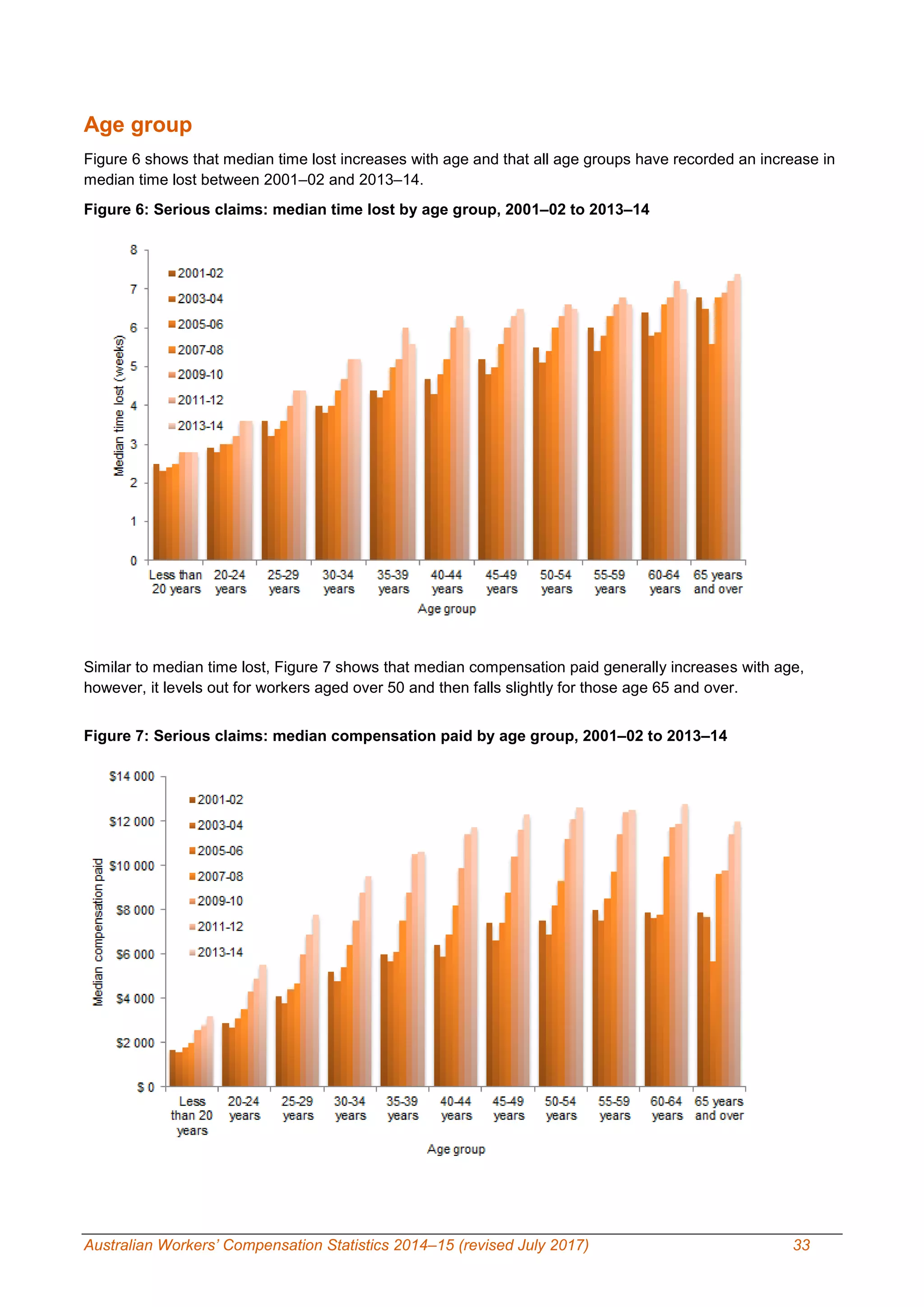
  • 54.
    Safe Work Australia54 5. Industry classification Information about the industry of the claimant’s employer is coded using the Australian and New Zealand Standard Industrial Classification, 2006. Because industry is based on the claimant’s employer, a claim made by a person employed under labour hire arrangements is coded to the labour supply services industry class, which is in the administrative and support services industry. Industry of employer will be different to industry of workplace for some employees. 6. Occupation classification Information about the occupation of the claimant is coded using the Australian and New Zealand Standard Classification of Occupations, First Edition. 7. Details of injuries and diseases Information about injuries and diseases of claimants is coded using the Type of Occurrence Classification System, Third Edition, Revision 1. The classification system is used to code the:  nature of injury or disease  bodily location of injury or disease  mechanism of injury or disease  breakdown agency of injury or disease, and  agency of injury or disease. 8. Insufficiently coded data Some claims are not fully coded due to insufficient information being provided at the time of the claim. Where there is a significant number of incompletely coded claims, they may be separately identified in residual categories like ‘other and unspecified’ or ‘not elsewhere classified’. These claims are included when totals are calculated. 9. Confidentiality Claim numbers are rounded to the nearest 5 to help protect confidential information about employers and employees. Due to rounding, differences may appear between the reported totals and the sums of rows or columns. Rates and percentages are calculated using unrounded numbers. 10. Time-series analyses Comparison of preliminary and non-preliminary data should be done with caution. Non-preliminary data are more likely to have been finalised and are generally more accurate than preliminary data. When analysing trends over time, consideration needs to be given to legislative changes that may influence trends in workers’ compensation data. Information on workers’ compensation arrangements can be found in Safe Work Australia’s Comparison of Workers’ Compensation Arrangements in Australia and New Zealand. 11. Frequency and incidence rates Frequency rates are expressed as the number of serious claims per million hours worked, while incidence rates are expressed as the number of serious claims per 1000 employees. Compared with an incidence rate, a frequency rate is a more precise and accurate measure of work health and safety because it reflects the number of injuries and diseases per hour worked. It is important to account for the number of hours worked because there are significant differences in the number of hours worked by different groups of employees and employees at different points in time. The differences in the number of hours worked mean that employees’ exposure to work-related risks vary considerably. A frequency rate accounts for these differences and allows accurate comparisons to be made of different groups of employees and employees at different points in time.
  • 55.
    Australian Workers’ CompensationStatistics 2014–15 (revised July 2017) 55 12. Denominators used to calculate rates Estimates of the number of employees and hours worked for each Australian workers’ compensation jurisdiction are supplied annually by the ABS. The data are primarily derived from the Labour Force Survey, which are adjusted to account for differences in scope between the Labour Force Survey and workers’ compensation coverage. The ABS provides two sets of estimates for each jurisdiction—one is split by sex, age and industry and the second is split by occupation. This restricts presentation of rates to the categories supported by the ABS data. Therefore, it is not possible to calculate rates for occupational groups within specific industries. As these two sets of estimates are based on different data sources, total employment and hours worked estimates may vary slightly. As a result rates and percentage changes may also differ slightly for estimates calculated from the occupation data set. In 2008, the ABS conducted a review of the methodology used to calculate the number of employees in each industry and the number of hours worked by each employee. After the review, the ABS implemented a number of changes to its methodology, which increased its estimates. As the ABS could only supply new estimates from 2005–06 onwards, estimates for previous years were adjusted based on the movement between the old and new estimates for 2005–06 to avoid a break in the time series. Reports from 2007–08 use these new estimates. Therefore, comparison with previous reports should not be made. Following the review, the major change to the estimates was in the industry coding of ‘jobs other than the main job’ of multiple job holders. Where previously the second job was combined into the industry of the first job, these have now been separated to be shown in the industry in which the employee works in each separate job. This resulted in changes to rates in some industries. In particular, a decrease in employee estimates occurred in Public administration and safety, Manufacturing, and Health care and social assistance as these were the industries where a greater proportion held a second job. An increase occurred in Arts and recreation services, and Accommodation and food services as these were the industries where the second job was most commonly worked. While the ABS is able to adjust the employee estimates to account for the industries where the second job was worked, it is unable to adjust the hours worked in a similar manner. All hours worked are allocated to the industry of the main job. Because eligibility for workers’ compensation varies from jurisdiction to jurisdiction, further adjustments are necessary. The most significant adjustments are outlined below:  Police in Western Australia, who are covered by a separate scheme that does not report to Safe Work Australia, are excluded from the denominators.  Under previous Queensland legislation, owner-managers of incorporated enterprises (OMIEs), who are included in the standard definition of ‘employee’, had the option of purchasing workers’ compensation insurance. Based on 2006 census data, 10 per cent of employed people in Queensland were OMIEs, an unknown number of whom were covered by workers’ compensation. Prior to the legislation change (1 July 2013), this population was excluded from denominator and claims data. Data from 1 July 2013 onwards will explicitly include OMIEs in both denominator and numerator data. 13. Adjustment of Victorian and South Australian data Safe Work Australia uses one working week of time lost from work as the cut-off for the classification of accepted claims as serious claims. This cut-off was chosen because most jurisdictions have an employer excess of one week or less. Since claims with an absence of at least one week are generally processed by the workers’ compensation authority, the use of a one-week cut-off ensures comparable data are compiled from all jurisdictions so that an accurate national estimate can be produced. However, under the Victorian workers’ compensation scheme, the employer can be liable for the first 10 working days lost by the injured or ill worker (for an employee working two days per week, for instance, that would amount to five weeks’ pay), plus the first $582 (as of 1 July 2010) of medical services, unless the
  • 56.
    Safe Work Australia56 employer elected the ‘excess buy-out’ option. Since information on claims paid solely by employers is not always provided to the workers’ compensation authority, the national count of serious claims is affected. To correct for this under-counting, Victorian claims of one to two weeks’ duration are increased by a factor to represent the ‘missing claims’. The factor is calculated by comparing the percentage of claims of one to two weeks’ duration for Victoria with the percentage of claims of one to two weeks’ duration for all other Australian jurisdictions at the industry division level and by nature of injury or disease. The factoring makes the percentage of claims in each industry and nature group in Victoria match the Australian average for claims of this duration. This factoring increases Victorian claims by around 20 per cent and the Australian count by less than 3 per cent. While South Australia also has a 10-day excess, a waiver of the first two weeks of income maintenance is an incentive that was introduced for employers to forward claims to WorkCoverSA within five days of receiving claims from injured or ill workers. This incentive has been operational since 2009–10 and has significantly improved the data quality and accuracy of time-lost information for the majority of short-duration claims. 14. Reliability of data Data are subject to two types of errors—non-sampling errors and sampling errors. Non-sampling error Non-sampling errors may occur in any statistical collection due to:  incorrect inclusion or exclusion of respondents or cases  non-response of respondents  inaccurate information from respondents  inaccurate recording of information by data collectors  deficiencies in data collection materials and processes, and  errors that occur during the entry, coding and editing of data. Non-sampling errors may affect the numerator and denominator data. It is difficult to quantify non-sampling error. Sampling error Sampling error is a measure of the variation that occurs when a sample, rather than an entire population, is surveyed. Standard error indicates the extent to which an estimate of a sample varies from the estimate of the population from which it is drawn. When a standard error is expressed as a percentage of the estimate to which it relates, it is known as a relative standard error (RSE). The denominator data used to calculate rates of serious claims are subject to sampling error. Rates that are calculated using denominators with high RSEs are annotated with one asterisk (*) to indicate that the RSE of the denominator is 25 per cent or higher and two asterisks (**) if the RSE is 50 per cent or higher.
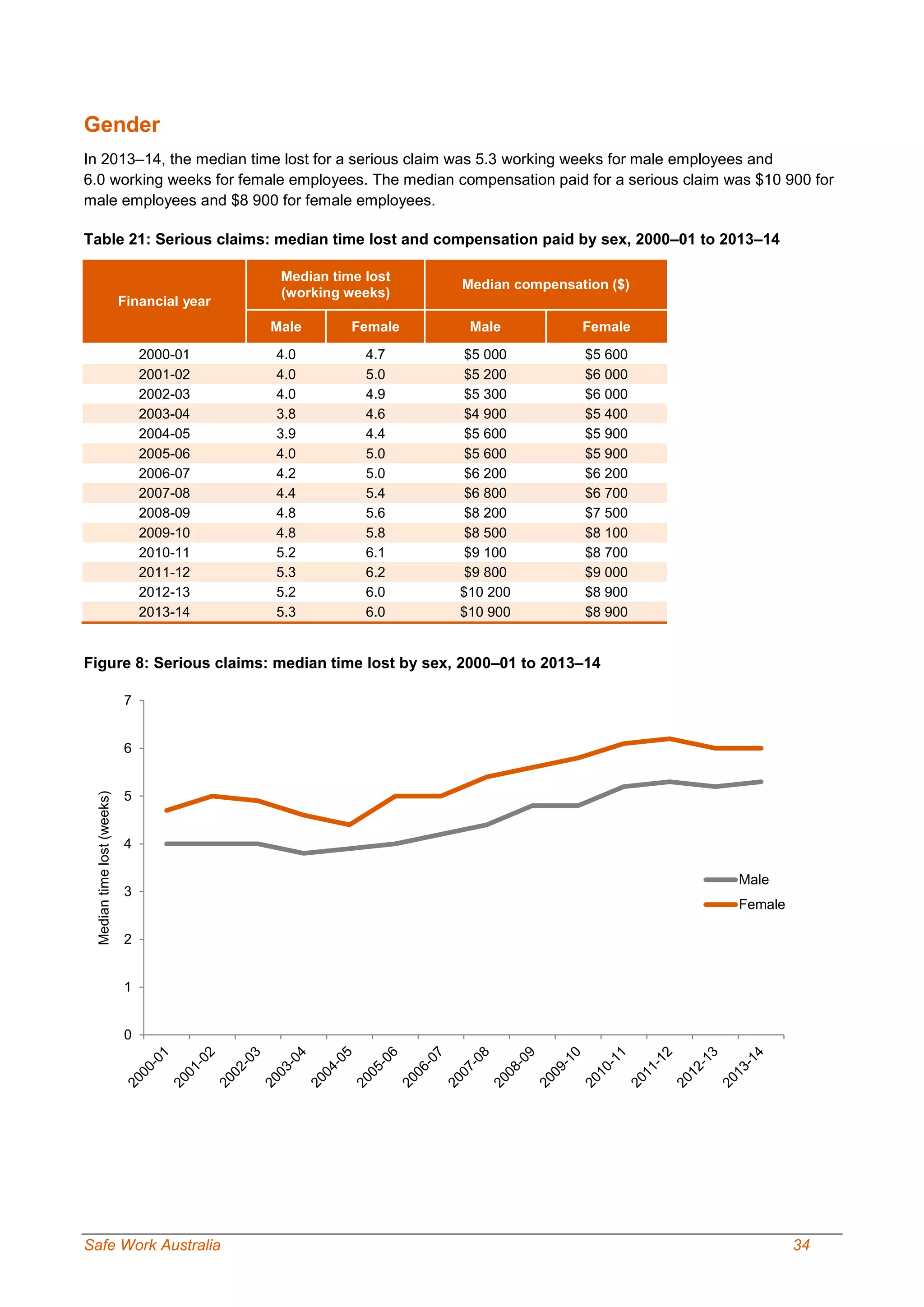
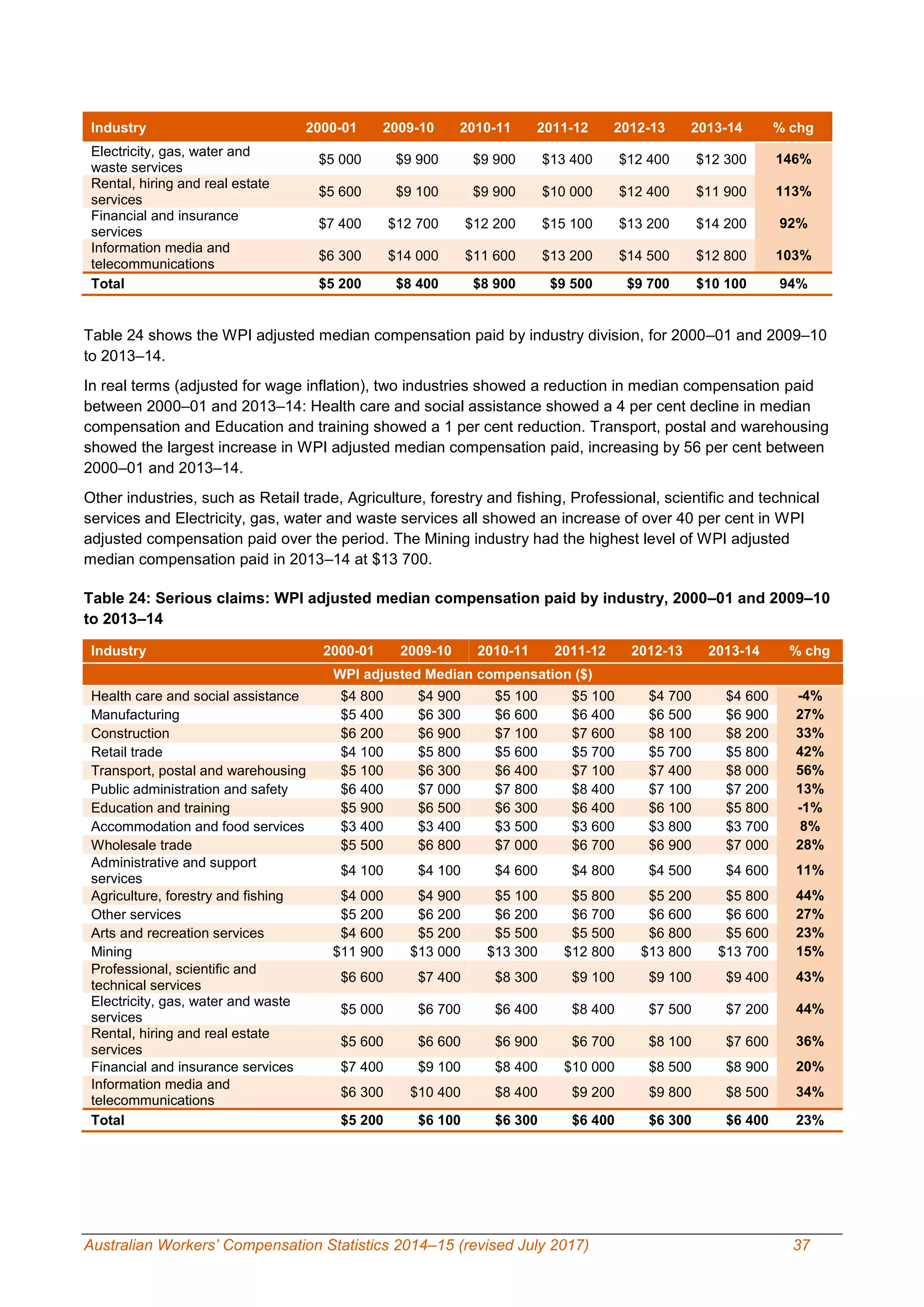
  • 57.
    Australian Workers’ CompensationStatistics 2014–15 (revised July 2017) 57 References Australian Bureau of Statistics (ABS) 2007. Labour Statistics: Concepts, Sources and Methods, August 2006. ABS catalogue number 6102.0.55.001. Canberra: ABS. http://www.abs.gov.au/ausstats/abs@.nsf/allprimarymainfeatures/5cbef69b3f02291fca2572c100201026?open document Australian Bureau of Statistics (ABS) and Statistics New Zealand 2006. Australian and New Zealand Standard Classification of Occupations, First Edition. ABS catalogue number 1220.0. Canberra: ABS. http://www.abs.gov.au/ausstats/abs@.nsf/allprimarymainfeatures/f6a0bb67c088f217ca2575df001cadc7?open document Australian Bureau of Statistics (ABS) and Statistics New Zealand 2006. Australian and New Zealand Standard Industrial Classification, 2006. ABS catalogue number 1292.0. Canberra: ABS. http://www.abs.gov.au/ausstats/abs@.nsf/allprimarymainfeatures/a77d93484dc49d63ca25712300056842?op endocument Australian Bureau of Statistics (ABS) 2016, Wage Price Index, Australia, September 2016, ABS Catalogue number 6345.0, Canberra: ABS. http://www.abs.gov.au/ausstats/abs@.nsf/mf/6345.0 Australian Safety and Compensation Council (ASCC) 2008. Type of Occurrence Classification System, Third Edition, Revision 1. Canberra: ASCC. http://www.safeworkaustralia.gov.au/sites/swa/about/publications/pages/sr20080501toocs3rdeditionrevision International Labour Organization (ILO) 1998. Resolution Concerning Statistics of Occupational Injuries. The Sixteenth International Conference of Labour Statisticians. Geneva: ILO. National Centre for Classification in Health (NCCH) 2006. The International Statistical Classification of Diseases and Related Health Problems, Tenth Revision, Australian Modification (ICD-10-AM). Sydney: NCCH. National Occupational Health and Safety Commission (NOHSC) 2004. National Data Set for Compensation-based Statistics, Third Edition. Canberra: NOHSC. http://www.safeworkaustralia.gov.au/sites/swa/about/publications/pages/sr200407ndsforcompensationbasedst atistics3rdedition Safe Work Australia. Work-Related Traumatic Injury Fatalities. Canberra: Safe Work Australia. http://www.safeworkaustralia.gov.au/sites/swa/statistics/work-related- fatalities/pages/workrelatedtraumaticinjuryfatalities
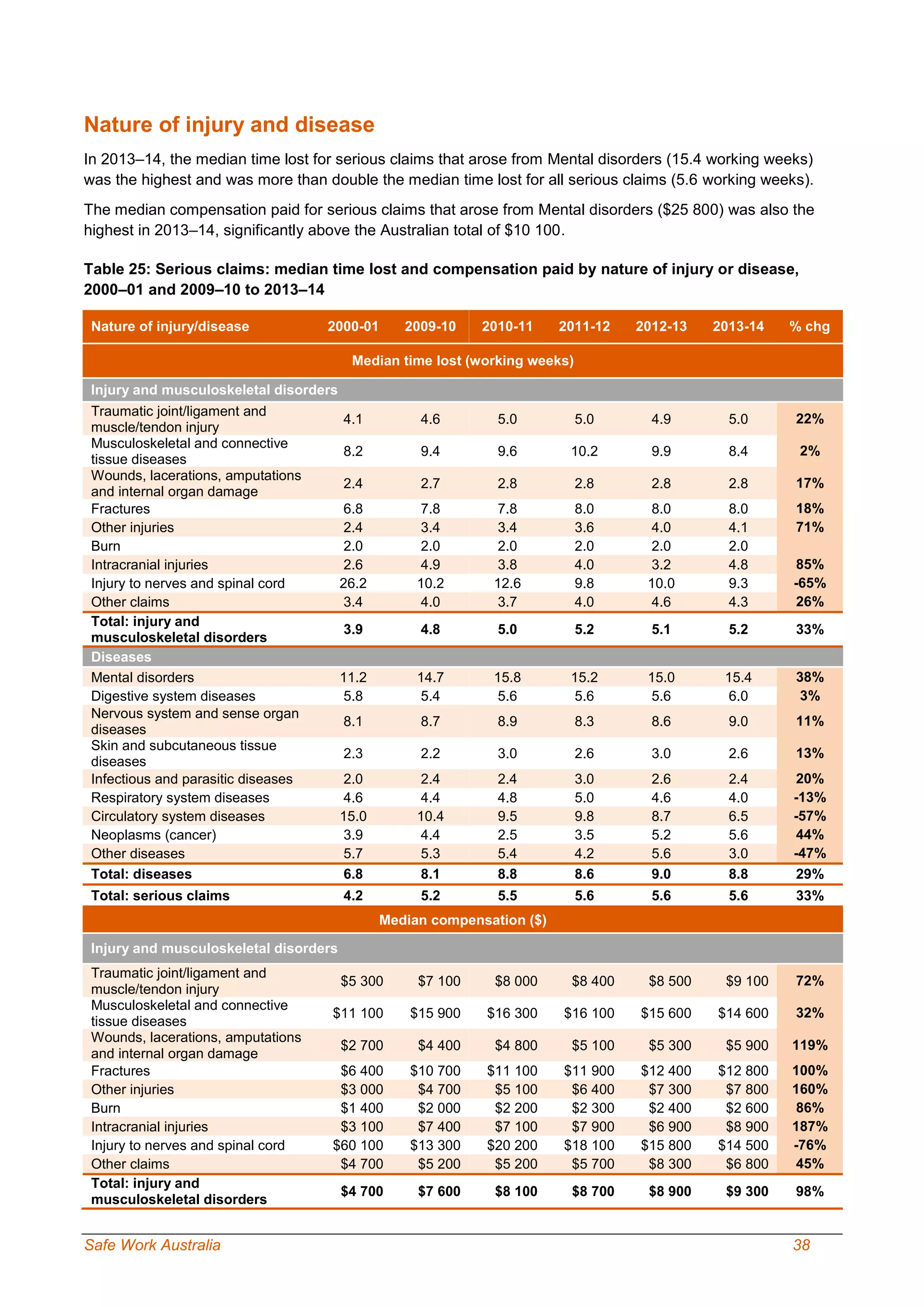
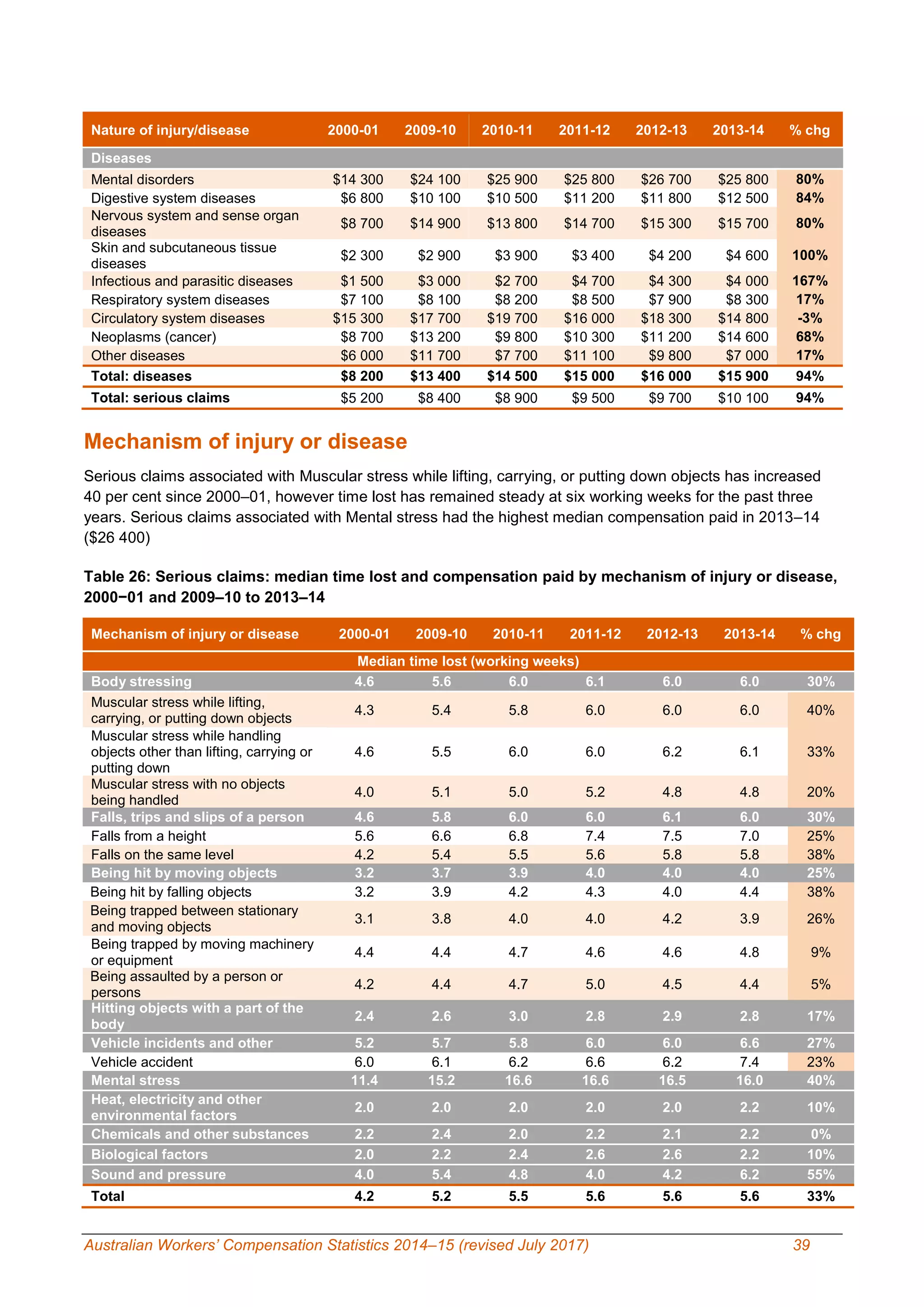
  • 58.
    Safe Work Australia58 Further information Data and Analysis Safe Work Australia statsonline@swa.gov.au Safe Work Australia GPO Box 641 Canberra ACT 2601 www.swa.gov.au www.facebook.com/safeworkaus Jurisdictional contacts Contact details for jurisdictional work health and safety regulators are available on the following website: http://www.safeworkaustralia.gov.au/sites/swa/about/who-we-work-with/regulators/pages/whs-regulators