SAEEDA TABASSUM SULTANA.S DATE: 04/08/2020
AUSTRALIAPOEM
A.D HOPE(SUMMARY&ANALYSIS).
AUTHORINTRO
Alec Derwent Hope AC OBE (21 July 1907 – 13 Ju
2000) was an Australian poet and essayist known fo
his satirical slant. He was also a critic, teacher and
academic. He was referred to in an American journa
as "the 20th century's greatest 18th-century poet
AUSTRALIAPOEMBACKGROUNDSTUDYWithin the 7 stanzas of "Australia", A.D hope gives us a very negative
one-sided approach to the poem. His poetry explores the spiritual
poverty of our land. He insinuates that it takes so much to survive which
has prevented Australians from reflecting upon their journey through
life. A.D hope is looking down on Australia and our way of life. The
sombre images of ' a nation of trees, drab green and desolate grey'
indicate that Australia is a monotonous and dreary place.
             Each stanza consists of four lines with the rhyme scheme being
ABBA. Little enjambment exists in the poem; most of the stanzas stand
alone as paragraphed.
POEMSUMMARY The poet describes Australia as being a "Nation of trees, drab green and desolate gray" that "Darkens her hills". We see that he sees Australia as a country that is bleak and almost colorless, as everything seems colorless and dull. This very much resembles the "field uniform of modern wars", where everything is in shade of gray and green. In this case, these lines could also be
interpreted as being a country that fades into the background, as the field uniform was meant to allow people to blend into the scenery. Probably highlighting Australia's tendency to fade into the shadows and not have much attention given to them.

• The poet likens the country to being like a "Sphinx" where "those endless, outstretched paws of Sphinx demolished or stone lion worn away." The sphinx was a figure from Egyptian myths, where it possessed the body of a lion, and the head of a man, ram or hawk. Appearance aside, the Sphinx was always seen as creatures of great wisdom, this comparison could be directly
related to the author's vision of Australia. In this case, Australia's reach and realm of intelligence and power have now been "worn away", possibly suggesting that Australia used to be better than it is presently and now that past reputation is now gone.

• The poet's next lines carry with it a great deal of negative residual images. He believes that Australia is a country that is old. People may call Australia "a young country, but they lie". Australia to him is the "last of lands, the emptiest. A woman beyond her change of life, a breast still tender but within the womb is dry." These series of lines could convey the message that Australia may
be considered young by the world's standards, yet it is the most empty. Its superficial image may be one comparable to a woman still fresh and alert, however, inside there is nothing, only emptiness. This again shows another disparaging view of Australia as having only external beauty but no inner one.

• Australia to him is devoid of culture. Which is "without songs, architecture, history" where he "rivers of water drown among inland sands, The river of her immense stupidity." The "her" he is referring to in this paragraph is Australia. He sees Australia as being a country that has neither historical background nor culture to speak off. Yet, he believes that it has the capabilities to do so,
however, the ideas are drowned among "inland sands". This can be seen as he blames the detractors for the slow erosion of Australia, where it has become a country that is no longer as intelligent as it was before. This attacked the writer's patriotic view where Australia is the victim here.

• Australia is next portrayed as a country that is nothing at all, where there are "monotonous tribes from Cairns to Perth" and the five main cities, compared to "five teeming sores." The people who come to live in Australia boast not of "live [ing]" but rather boast of merely "surviv [ing]."

• I believe that the author is trying to put forth a point here that people that move here are rather unwelcome, and that they are "second hand Europeans" that give birth rapidly on these "alien shores." He sees these people as people for "drain" Australia, a "vast parasite robber-state." This could be tied in to Australia's history, where it was then Great Britain's style of Exile Island,
where dangerous criminals were sent there in exile instead of being sent to prison. In this case, I believe that the author is trying to put forth that these newcomers are like giant leeches that take in all that is good in his country.
A nation of trees, drab green and desolate gray (draol: not attractive) (desolate: dull)

In the field uniform of modern wars,

Darkens her hills, those endless, outstretched paws

Of Sphinx demolished or stone lion worn away. (Sphinx: a statue with a lion's body and woman's head)
They call her a young country, but they lie:

She is the last of lands, the emptiest,

A woman beyond her change of life, a breast

still tender but within the womb is dry.
Without songs, architecture, history:

The emotions and superstitions of younger lands,

Her rivers of water drown among inland sands,

The river of her immense stupidity. (the rivers which run inland instead of running into the sea are said to be stupid)
Floods her monotonous tribes from Cairns to Perth.

In them at last the ultimate men arrive

Whose boast is not: "we live" but "we survive",

A type who will inhabit the dying earth.
And her five cities, like five teeming sores, (unhealed)

Each drains her: a vast parasite robber-state

Where second hand Europeans pullulate (sprout)

Timidly on the edge of alien shores.
Yet there are some like me turn gladly home

from the lush jungle of modern thought, to find the

Arabian desert of the human mind,

Hoping, if still from the deserts the prophets come, (such as Moses and Mohammed).
Such savage and scarlet as no green hills dare

springs in that waste, some spirit which escapes the

learned doubt, the chatter of cultured apes (people imitating western ways) which

is called civilization over there.

GLOSSARY

drab: lacking color and excitement

desolate: extremely sad and feeling alone

Sphinx: an ancient imaginary creature with a lion's body and a woman's head.

demolished: completely destroyed

architecture: the art of designing and making buildings

history: belief which is not based on reason or scientific knowledge

superstition: staying the same and not changing, boring

Cairns of Perth: Sea-port of NE Australia

teeming: containing large numbers of people or animals

parasite: an animal or plant that lives on or in another animal of a different type and feeds from it.

pullulate: to breed rapidly or abundantly.

alien: coming from a different country, race, or group, foreign.

prophets: A persons believed to have special powers, and wisdom, to prophesize is to foretell.

apes: animal like a large monkey which has no tail and uses its arms to swing through trees.

A Nation of trees, drab green and desolate gray (draol: not attractive) (desolate: dull)

In the field uniform of modern wars,

Darkens her hills, those endless, outstretched paws

Of
parasite: an animal or plant that lives on or in another animal of a different type and feeds from it.

pullulate: to breed rapidly or abundantly.

alien: coming from a different country, race, or group, foreign.

prophets: A persons believed to have special powers, and wisdom, to prophesize is to foretell.

apes: animal like a large monkey which has no tail and uses its arms to swing through trees.

A Nation of trees, drab green and desolate gray (draol: not attractive) (desolate: dull)

In the field uniform of modern wars,

Darkens her hills, those endless, outstretched paws

Of Sphinx demolished or stone lion worn away.

Annotations: AD Hope in his poem Australia presents a realistic picture of his mother country. The topography of the country is marked by unattractive features. The predominant color of the land is an unimpressive gray. The grim sight of dreary mountains
accentuate a sense of gloom. They appear to be dark and ominous as the outstretched hands of an ancient Sphinx or the demolished remains of a gigantic figure of a lion in stone. They are awesome and the least attractive.

According to Classical Mythology, Sphinx is a she-monster with a woman's head, a dog's body, a serpent's tail, a bird's wings, a lion's paw and a human voice. It finds mention in the play Oedipus by Sophocles.

Yet there are some like me turn gladly home

from the lush jungle of modern thought, to find the

Arabian desert of the human mind,

Hoping, if still from the deserts the prophets come,

Annotations: AD Hope in his poem Australia and the poet's love for his country. Being the youngest of civilization the country has no history. It has another kind of virtue which other countries do not possess. It is capable of giving independence of thought
and feeling and claim a sense of originality. The landscape is dry and arid and the people have to struggle to make a living. The state of the country is quite oppressive and does not hold the prospect of a prosperous future. But even a parched desert can
offer a boon to man. The poet entertains the hope that from a desert a prophet can emerge and give a soothing benediction to the hopeless residents. The poet cities the Biblical story that it was in Mount Sinai that Moses received the Ten Commandments
on two tablets of stone.
• His direct reference to patriotism comes in the last two stanza's, where he feels that there are "some like [him who] turn gladly home" to withdraw from the "lush jungle of modern thought" to seek the "Arabian desert of the human mind. " This to me as
seen that the author enjoys retreating from the expansive world and would rather stay in a rather desert. In that case, all the above detractions that he mentioned are seen as added benefits of being an Australian.

• The last two lines of the poem are most memorable; he states "The learned doubt, the chatter of cultured apes which is called civilization over there."

Authors Life: -

• ADHope was born in cooma, New South wales Australia on 1st July in 1907.

• He received degree from Sydney university and oxford university.

• He was a senior professor of English in Canbera university college.

• He became literary fellow in Canbera university.

• AD Hope (July 21, 1907 - July 13, 2000) was not only an Australian poet but also an essayist, critic, teacher and academic. (considered the greatest among Australian poets).

• Born in Cooma, New South Wales and educated partly at home and in Tasmania, Hope attended Fort Street Boys School, Sydney University and later the University of Oxford on a scholarship. (Having taken his degree from Sydney University he went for
further studies to Oxford).

• He started his career as a teacher and then became a member of the teaching faculty in the Canberra University.

• Hope made himself distinguished by his unconventional utterances and attitude.

• He rejects narrow nationalistic themes for poetry and holds high regard for classical decorum and formal order.

• He writes on social themes in a satirical vein.

• His prominent works are: (Hope has published the following volumes of poetry)

The Wandering Islands (1955),

Dunciad Minar: An Heroic Poem (1970) and

Collected Poems (1971).
• Hope returned to Australia in 1931 and trained as a teacher. From 1945 to 1950 he worked as a lecturer at the Melbourne University. He joined the Canberra University College in 1951. Hope's first collection of poems was The Wandering Islands
(1955). From the age of ten, AD Hope studied Latin from his father. This interest of his continued throughout his life. In his 87th year he wrote to Ann McCulloch saying that he was glad that he awakened to Latin before he encountered the Romance
languages.

• Hope saw himself primarily as a poet. In an interview with McCulloch in 1987, Hope said, "Poetry is not a thing you decide to do, or adopt a system or theory and proceed according to plan." It grows out of you and what you have in you ”. If we look at
Hope's poetry, we will find two features which are very significant they are, firstly, a fierce opposition to free verse and secondly, a re-invention of ancient stories included in myth.

• Catherine Cole, wrote a memoir of Hope and it was reviewed by Kevin Hart, a critic. Hart, on Hope's death in 2000 wrote that Australia had lost its greatest living poet.

Back ground of Australian poetry:

• Quite understandably any anthology of Australian poetry reveals the fact that Australian culture is attached to the same of the basics. Tenets of Romanticism.

• One of the aspects of romanticism is an urge to narrate a fascinating story.

• They portray the story of the white man's encounter with an alien landscape and alien tribes.

• Nature (or) land scape has received much greater attention than the human beings or the issues concerned with their lives.

• Australia is an enormous, diverse and dry continent. It has massive wealth, which is far-flung unexplored and unexploited. Most of Australia is said to be dry, and even those rivers found inland are empty, for the most part of the year. In addition to this even
the most fertile areas of Australia often suffer from drought.

Detailed Analysis of 'Australia'

• AD Hope lists all those notable aspects of the Australian nation. Australia is a nation of trees. There are tree everywhere. But hills especially are covered with trees various colors. There are drab green and pale gray the cold of the uniform of the soldiers of
modern wars are found a hills, darkening of sides. These endless hills resemble outstretched paws of the sphinx, the legendary figure of Egypt. Hills resemble head of a man and the body of a lion. Hills resemble the big paws of a stone lion.

• People all Australia a young nation. Geographically speaking she is a last of the lands in the map of the world. One can call Australia the emptiest nation in the world. Here Hope compares Australia to a bush woman re current character in Australia
Literature, who is beyond changes in her life. Her breast is still tender, but the world within is dry. She is empty and dry. Hope says Australia has no songs Architecture and History.

• Here in this poem poet compares the rivers of water and the metaphorical river of ignorance among her old folks. The tribes of Australia are described as 'monotonous' they resist all kinds of change and remain conservative and stupid. Hope says that
Australians can only boast that they live satisfactory life, and survive. They also seem like the type of people who will be the last residents of this earth.

• A significant feature of Australian life is that a majority of its population lives in the five big cities of Australia, namely Melbourne, Sydney, Perth, Canberra and Adelaide.

• Here Hope compares the cities to the ugly warts on man's body which drain their energy they are like parasites that live off the others. In this country the second hand Europeans deported ones multiply leading a humble life on an alien soil. He hopes to
find prophets from the aid deserts of Australia, reminding us of the prophets, Moses, Mohammed and others who had hailed from deserts in human history. According to Hope Australia is a waste land, it blossoms with flowers of scarlet which cannot be
found in any green hill-they are flowers of thought.

• People resemble apes. Australia, there is no tradition, wealth and culture of home land of Englishmen. England has glory and tradition. English people lead a full and whole life. Australia nation may be considered a failure. Hope says 'the chatter of the
cultured apes' He satirizes in an Angry tone Angry Australia might produce a prophet like Mohammed (or) Moses. He expresses his hope of the arrival of messiah.
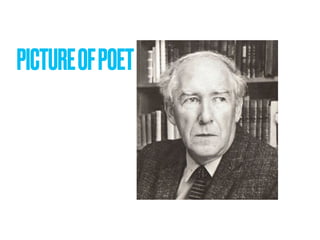
PICTUREOFPOET
THANK YOU !

Australia poem

  • 1.
    SAEEDA TABASSUM SULTANA.SDATE: 04/08/2020 AUSTRALIAPOEM A.D HOPE(SUMMARY&ANALYSIS).
  • 2.
    AUTHORINTRO Alec Derwent Hope AC OBE (21July 1907 – 13 Ju 2000) was an Australian poet and essayist known fo his satirical slant. He was also a critic, teacher and academic. He was referred to in an American journa as "the 20th century's greatest 18th-century poet
  • 3.
    AUSTRALIAPOEMBACKGROUNDSTUDYWithin the 7stanzas of "Australia", A.D hope gives us a very negative one-sided approach to the poem. His poetry explores the spiritual poverty of our land. He insinuates that it takes so much to survive which has prevented Australians from reflecting upon their journey through life. A.D hope is looking down on Australia and our way of life. The sombre images of ' a nation of trees, drab green and desolate grey' indicate that Australia is a monotonous and dreary place.              Each stanza consists of four lines with the rhyme scheme being ABBA. Little enjambment exists in the poem; most of the stanzas stand alone as paragraphed.
  • 4.
    POEMSUMMARY The poet describesAustralia as being a "Nation of trees, drab green and desolate gray" that "Darkens her hills". We see that he sees Australia as a country that is bleak and almost colorless, as everything seems colorless and dull. This very much resembles the "field uniform of modern wars", where everything is in shade of gray and green. In this case, these lines could also be interpreted as being a country that fades into the background, as the field uniform was meant to allow people to blend into the scenery. Probably highlighting Australia's tendency to fade into the shadows and not have much attention given to them.
 • The poet likens the country to being like a "Sphinx" where "those endless, outstretched paws of Sphinx demolished or stone lion worn away." The sphinx was a figure from Egyptian myths, where it possessed the body of a lion, and the head of a man, ram or hawk. Appearance aside, the Sphinx was always seen as creatures of great wisdom, this comparison could be directly related to the author's vision of Australia. In this case, Australia's reach and realm of intelligence and power have now been "worn away", possibly suggesting that Australia used to be better than it is presently and now that past reputation is now gone.
 • The poet's next lines carry with it a great deal of negative residual images. He believes that Australia is a country that is old. People may call Australia "a young country, but they lie". Australia to him is the "last of lands, the emptiest. A woman beyond her change of life, a breast still tender but within the womb is dry." These series of lines could convey the message that Australia may be considered young by the world's standards, yet it is the most empty. Its superficial image may be one comparable to a woman still fresh and alert, however, inside there is nothing, only emptiness. This again shows another disparaging view of Australia as having only external beauty but no inner one.
 • Australia to him is devoid of culture. Which is "without songs, architecture, history" where he "rivers of water drown among inland sands, The river of her immense stupidity." The "her" he is referring to in this paragraph is Australia. He sees Australia as being a country that has neither historical background nor culture to speak off. Yet, he believes that it has the capabilities to do so, however, the ideas are drowned among "inland sands". This can be seen as he blames the detractors for the slow erosion of Australia, where it has become a country that is no longer as intelligent as it was before. This attacked the writer's patriotic view where Australia is the victim here.
 • Australia is next portrayed as a country that is nothing at all, where there are "monotonous tribes from Cairns to Perth" and the five main cities, compared to "five teeming sores." The people who come to live in Australia boast not of "live [ing]" but rather boast of merely "surviv [ing]."
 • I believe that the author is trying to put forth a point here that people that move here are rather unwelcome, and that they are "second hand Europeans" that give birth rapidly on these "alien shores." He sees these people as people for "drain" Australia, a "vast parasite robber-state." This could be tied in to Australia's history, where it was then Great Britain's style of Exile Island, where dangerous criminals were sent there in exile instead of being sent to prison. In this case, I believe that the author is trying to put forth that these newcomers are like giant leeches that take in all that is good in his country. A nation of trees, drab green and desolate gray (draol: not attractive) (desolate: dull)
 In the field uniform of modern wars,
 Darkens her hills, those endless, outstretched paws
 Of Sphinx demolished or stone lion worn away. (Sphinx: a statue with a lion's body and woman's head) They call her a young country, but they lie:
 She is the last of lands, the emptiest,
 A woman beyond her change of life, a breast
 still tender but within the womb is dry. Without songs, architecture, history:
 The emotions and superstitions of younger lands,
 Her rivers of water drown among inland sands,
 The river of her immense stupidity. (the rivers which run inland instead of running into the sea are said to be stupid) Floods her monotonous tribes from Cairns to Perth.
 In them at last the ultimate men arrive
 Whose boast is not: "we live" but "we survive",
 A type who will inhabit the dying earth. And her five cities, like five teeming sores, (unhealed)
 Each drains her: a vast parasite robber-state
 Where second hand Europeans pullulate (sprout)
 Timidly on the edge of alien shores. Yet there are some like me turn gladly home
 from the lush jungle of modern thought, to find the
 Arabian desert of the human mind,
 Hoping, if still from the deserts the prophets come, (such as Moses and Mohammed). Such savage and scarlet as no green hills dare
 springs in that waste, some spirit which escapes the
 learned doubt, the chatter of cultured apes (people imitating western ways) which
 is called civilization over there.
 GLOSSARY
 drab: lacking color and excitement
 desolate: extremely sad and feeling alone
 Sphinx: an ancient imaginary creature with a lion's body and a woman's head.
 demolished: completely destroyed
 architecture: the art of designing and making buildings
 history: belief which is not based on reason or scientific knowledge
 superstition: staying the same and not changing, boring
 Cairns of Perth: Sea-port of NE Australia
 teeming: containing large numbers of people or animals
 parasite: an animal or plant that lives on or in another animal of a different type and feeds from it.
 pullulate: to breed rapidly or abundantly.
 alien: coming from a different country, race, or group, foreign.
 prophets: A persons believed to have special powers, and wisdom, to prophesize is to foretell.
 apes: animal like a large monkey which has no tail and uses its arms to swing through trees.
 A Nation of trees, drab green and desolate gray (draol: not attractive) (desolate: dull)
 In the field uniform of modern wars,
 Darkens her hills, those endless, outstretched paws
 Of
  • 5.
    parasite: an animalor plant that lives on or in another animal of a different type and feeds from it.
 pullulate: to breed rapidly or abundantly.
 alien: coming from a different country, race, or group, foreign.
 prophets: A persons believed to have special powers, and wisdom, to prophesize is to foretell.
 apes: animal like a large monkey which has no tail and uses its arms to swing through trees.
 A Nation of trees, drab green and desolate gray (draol: not attractive) (desolate: dull)
 In the field uniform of modern wars,
 Darkens her hills, those endless, outstretched paws
 Of Sphinx demolished or stone lion worn away.
 Annotations: AD Hope in his poem Australia presents a realistic picture of his mother country. The topography of the country is marked by unattractive features. The predominant color of the land is an unimpressive gray. The grim sight of dreary mountains accentuate a sense of gloom. They appear to be dark and ominous as the outstretched hands of an ancient Sphinx or the demolished remains of a gigantic figure of a lion in stone. They are awesome and the least attractive.
 According to Classical Mythology, Sphinx is a she-monster with a woman's head, a dog's body, a serpent's tail, a bird's wings, a lion's paw and a human voice. It finds mention in the play Oedipus by Sophocles.
 Yet there are some like me turn gladly home
 from the lush jungle of modern thought, to find the
 Arabian desert of the human mind,
 Hoping, if still from the deserts the prophets come,
 Annotations: AD Hope in his poem Australia and the poet's love for his country. Being the youngest of civilization the country has no history. It has another kind of virtue which other countries do not possess. It is capable of giving independence of thought and feeling and claim a sense of originality. The landscape is dry and arid and the people have to struggle to make a living. The state of the country is quite oppressive and does not hold the prospect of a prosperous future. But even a parched desert can offer a boon to man. The poet entertains the hope that from a desert a prophet can emerge and give a soothing benediction to the hopeless residents. The poet cities the Biblical story that it was in Mount Sinai that Moses received the Ten Commandments on two tablets of stone. • His direct reference to patriotism comes in the last two stanza's, where he feels that there are "some like [him who] turn gladly home" to withdraw from the "lush jungle of modern thought" to seek the "Arabian desert of the human mind. " This to me as seen that the author enjoys retreating from the expansive world and would rather stay in a rather desert. In that case, all the above detractions that he mentioned are seen as added benefits of being an Australian.
 • The last two lines of the poem are most memorable; he states "The learned doubt, the chatter of cultured apes which is called civilization over there."
 Authors Life: -
 • ADHope was born in cooma, New South wales Australia on 1st July in 1907.
 • He received degree from Sydney university and oxford university.
 • He was a senior professor of English in Canbera university college.
 • He became literary fellow in Canbera university.
 • AD Hope (July 21, 1907 - July 13, 2000) was not only an Australian poet but also an essayist, critic, teacher and academic. (considered the greatest among Australian poets).
 • Born in Cooma, New South Wales and educated partly at home and in Tasmania, Hope attended Fort Street Boys School, Sydney University and later the University of Oxford on a scholarship. (Having taken his degree from Sydney University he went for further studies to Oxford).
 • He started his career as a teacher and then became a member of the teaching faculty in the Canberra University.
 • Hope made himself distinguished by his unconventional utterances and attitude.
 • He rejects narrow nationalistic themes for poetry and holds high regard for classical decorum and formal order.
 • He writes on social themes in a satirical vein.
 • His prominent works are: (Hope has published the following volumes of poetry)
 The Wandering Islands (1955),
 Dunciad Minar: An Heroic Poem (1970) and
 Collected Poems (1971). • Hope returned to Australia in 1931 and trained as a teacher. From 1945 to 1950 he worked as a lecturer at the Melbourne University. He joined the Canberra University College in 1951. Hope's first collection of poems was The Wandering Islands (1955). From the age of ten, AD Hope studied Latin from his father. This interest of his continued throughout his life. In his 87th year he wrote to Ann McCulloch saying that he was glad that he awakened to Latin before he encountered the Romance languages.
 • Hope saw himself primarily as a poet. In an interview with McCulloch in 1987, Hope said, "Poetry is not a thing you decide to do, or adopt a system or theory and proceed according to plan." It grows out of you and what you have in you ”. If we look at Hope's poetry, we will find two features which are very significant they are, firstly, a fierce opposition to free verse and secondly, a re-invention of ancient stories included in myth.
 • Catherine Cole, wrote a memoir of Hope and it was reviewed by Kevin Hart, a critic. Hart, on Hope's death in 2000 wrote that Australia had lost its greatest living poet.
 Back ground of Australian poetry:
 • Quite understandably any anthology of Australian poetry reveals the fact that Australian culture is attached to the same of the basics. Tenets of Romanticism.
 • One of the aspects of romanticism is an urge to narrate a fascinating story.
 • They portray the story of the white man's encounter with an alien landscape and alien tribes.
 • Nature (or) land scape has received much greater attention than the human beings or the issues concerned with their lives.
 • Australia is an enormous, diverse and dry continent. It has massive wealth, which is far-flung unexplored and unexploited. Most of Australia is said to be dry, and even those rivers found inland are empty, for the most part of the year. In addition to this even the most fertile areas of Australia often suffer from drought.
 Detailed Analysis of 'Australia'
 • AD Hope lists all those notable aspects of the Australian nation. Australia is a nation of trees. There are tree everywhere. But hills especially are covered with trees various colors. There are drab green and pale gray the cold of the uniform of the soldiers of modern wars are found a hills, darkening of sides. These endless hills resemble outstretched paws of the sphinx, the legendary figure of Egypt. Hills resemble head of a man and the body of a lion. Hills resemble the big paws of a stone lion.
 • People all Australia a young nation. Geographically speaking she is a last of the lands in the map of the world. One can call Australia the emptiest nation in the world. Here Hope compares Australia to a bush woman re current character in Australia Literature, who is beyond changes in her life. Her breast is still tender, but the world within is dry. She is empty and dry. Hope says Australia has no songs Architecture and History.
 • Here in this poem poet compares the rivers of water and the metaphorical river of ignorance among her old folks. The tribes of Australia are described as 'monotonous' they resist all kinds of change and remain conservative and stupid. Hope says that Australians can only boast that they live satisfactory life, and survive. They also seem like the type of people who will be the last residents of this earth.
 • A significant feature of Australian life is that a majority of its population lives in the five big cities of Australia, namely Melbourne, Sydney, Perth, Canberra and Adelaide.
 • Here Hope compares the cities to the ugly warts on man's body which drain their energy they are like parasites that live off the others. In this country the second hand Europeans deported ones multiply leading a humble life on an alien soil. He hopes to find prophets from the aid deserts of Australia, reminding us of the prophets, Moses, Mohammed and others who had hailed from deserts in human history. According to Hope Australia is a waste land, it blossoms with flowers of scarlet which cannot be found in any green hill-they are flowers of thought.
 • People resemble apes. Australia, there is no tradition, wealth and culture of home land of Englishmen. England has glory and tradition. English people lead a full and whole life. Australia nation may be considered a failure. Hope says 'the chatter of the cultured apes' He satirizes in an Angry tone Angry Australia might produce a prophet like Mohammed (or) Moses. He expresses his hope of the arrival of messiah.
  • 6.
  • 7.