 Capital : Canberra
 Currency : Australian Dollar (AUD)
 Population : 24,772,247
 Area : 7.692 million sq.km
 Neighboring countries : New Zealand,
Indonesia, Papua New Guinea etc.
 Language : English
 The majority of Australians or their ancestors immigrated within
the past three centuries, with the exception of
the Indigenous population and other outer lying islands who
became Australian through expansion of the country. Despite its
multi-ethnic composition, the culture of Australia held in common
by most Australians can also be referred to as mainstream
Australian culture, a Western culture largely derived from the
traditions of British and Irish colonists, settlers, and immigrants.
 Large-scale immigration occurred after the First and Second
World Wars, with many post-World War II migrants coming
from Southern and Eastern Europe introducing a variety of
elements. Immigration from the Middle East, south and east
Asia, Pacific Islands, Africa, and Latin America has also been
having an impact.
 Indigenous Australians are descendants of the original inhabitants of
the Australian continent. Their ancestors are believed to have migrated
from Africa to Asia around 70,000 years ago and arrived in Australia around
50,000 years ago. The Torres Strait Islanders are a distinct people
of Melanesian ancestry, indigenous to the Torres Strait Islands, which are at
the northernmost tip of Queensland near Papua New Guinea, and some
nearby settlements on the mainland.
 The term "Aboriginal" is traditionally applied to only the indigenous inhabitants
of mainland Australia and Tasmania, along with some of the adjacent
islands. Indigenous Australians is an inclusive term used when referring to both
Aboriginal and Torres Strait islanders, i.e.: the "first peoples".
 Dispersing across the Australian continent over time, the ancient peoples
expanded and differentiated into hundreds of distinct groups, each with its own
language and culture. More than 400 distinct Australian Aboriginal
peoples have been identified across the continent, distinguished by unique
names designating their ancestral languages, dialects, or distinctive speech
patterns.
1. LANGUAGE
 Although Australia has no official language, English
has been entrenched as the de facto national
language since at least federation in 1901. According
to the 2011 census, 76.8% of people (16,509,291)
spoke only English. 20.4% of the population spoke
two or more languages at home. Other languages
spoken included Mandarin 1.6%, Italian
1.4%, Arabic1.3%, Cantonese 1.2% and Greek 1.2%.
 Australia has no official religion; the Constitution prohibits the
government from establishing one, or interfering with
the freedom of religion.
 Australians have various religions and spiritual beliefs. While
22.3% of the population reported as having no religion, of those
reporting as having religious affiliations, the majority (61.1%)
were Christian according to the 2011 census. As in many
Western countries, the level of active participation in church
worship is lower than would be indicated by the proportion of the
population identifying themselves as Christian; weekly
attendance at church services was about 1.5 million in
2001, about 7% of the population (21.5 million) that year.
 Australia is a land of dreams. From the sacred
legends of the aboriginal Dreamtime, when the
great spirits conjured the coral reefs, rainforests,
and scorched red deserts, to armchair travelers
who describe Australia as their dream destination,
the Land Down Under deserves all the hype.
 The world's smallest continent and largest island,
Australia is almost the same size as the United
States but with a population the size of New York
State and some of the quirkiest wildlife on the
planet.
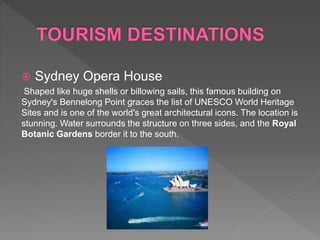
 Sydney Opera House
Shaped like huge shells or billowing sails, this famous building on
Sydney's Bennelong Point graces the list of UNESCO World Heritage
Sites and is one of the world's great architectural icons. The location is
stunning. Water surrounds the structure on three sides, and the Royal
Botanic Gardens border it to the south.
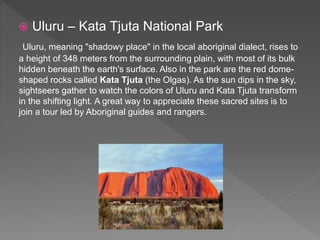
 Uluru – Kata Tjuta National Park
Uluru, meaning "shadowy place" in the local aboriginal dialect, rises to
a height of 348 meters from the surrounding plain, with most of its bulk
hidden beneath the earth's surface. Also in the park are the red dome-
shaped rocks called Kata Tjuta (the Olgas). As the sun dips in the sky,
sightseers gather to watch the colors of Uluru and Kata Tjuta transform
in the shifting light. A great way to appreciate these sacred sites is to
join a tour led by Aboriginal guides and rangers.
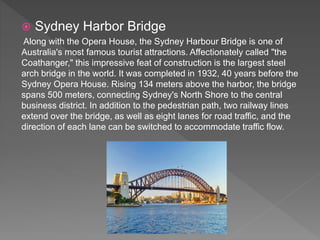
 Sydney Harbor Bridge
Along with the Opera House, the Sydney Harbour Bridge is one of
Australia's most famous tourist attractions. Affectionately called "the
Coathanger," this impressive feat of construction is the largest steel
arch bridge in the world. It was completed in 1932, 40 years before the
Sydney Opera House. Rising 134 meters above the harbor, the bridge
spans 500 meters, connecting Sydney's North Shore to the central
business district. In addition to the pedestrian path, two railway lines
extend over the bridge, as well as eight lanes for road traffic, and the
direction of each lane can be switched to accommodate traffic flow.
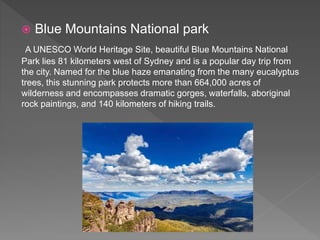
 Blue Mountains National park
A UNESCO World Heritage Site, beautiful Blue Mountains National
Park lies 81 kilometers west of Sydney and is a popular day trip from
the city. Named for the blue haze emanating from the many eucalyptus
trees, this stunning park protects more than 664,000 acres of
wilderness and encompasses dramatic gorges, waterfalls, aboriginal
rock paintings, and 140 kilometers of hiking trails.
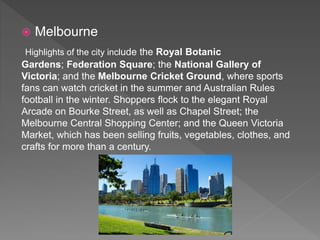
 Melbourne
Highlights of the city include the Royal Botanic
Gardens; Federation Square; the National Gallery of
Victoria; and the Melbourne Cricket Ground, where sports
fans can watch cricket in the summer and Australian Rules
football in the winter. Shoppers flock to the elegant Royal
Arcade on Bourke Street, as well as Chapel Street; the
Melbourne Central Shopping Center; and the Queen Victoria
Market, which has been selling fruits, vegetables, clothes, and
crafts for more than a century.
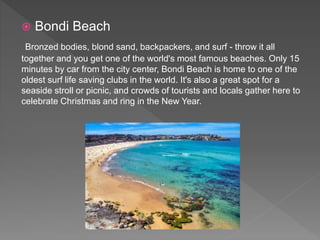
 Bondi Beach
Bronzed bodies, blond sand, backpackers, and surf - throw it all
together and you get one of the world's most famous beaches. Only 15
minutes by car from the city center, Bondi Beach is home to one of the
oldest surf life saving clubs in the world. It's also a great spot for a
seaside stroll or picnic, and crowds of tourists and locals gather here to
celebrate Christmas and ring in the New Year.
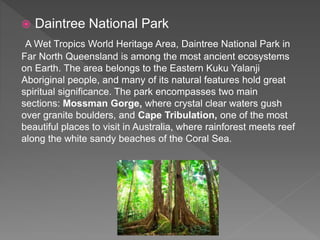
 Daintree National Park
A Wet Tropics World Heritage Area, Daintree National Park in
Far North Queensland is among the most ancient ecosystems
on Earth. The area belongs to the Eastern Kuku Yalanji
Aboriginal people, and many of its natural features hold great
spiritual significance. The park encompasses two main
sections: Mossman Gorge, where crystal clear waters gush
over granite boulders, and Cape Tribulation, one of the most
beautiful places to visit in Australia, where rainforest meets reef
along the white sandy beaches of the Coral Sea.
 PRESENTATION BY : SIDDHRAJSINH
GOHIL
 Guide- Mr. Barun Mohanty

Australia

  • 2.
     Capital :Canberra  Currency : Australian Dollar (AUD)  Population : 24,772,247  Area : 7.692 million sq.km  Neighboring countries : New Zealand, Indonesia, Papua New Guinea etc.  Language : English
  • 3.
     The majorityof Australians or their ancestors immigrated within the past three centuries, with the exception of the Indigenous population and other outer lying islands who became Australian through expansion of the country. Despite its multi-ethnic composition, the culture of Australia held in common by most Australians can also be referred to as mainstream Australian culture, a Western culture largely derived from the traditions of British and Irish colonists, settlers, and immigrants.  Large-scale immigration occurred after the First and Second World Wars, with many post-World War II migrants coming from Southern and Eastern Europe introducing a variety of elements. Immigration from the Middle East, south and east Asia, Pacific Islands, Africa, and Latin America has also been having an impact.
  • 4.
     Indigenous Australiansare descendants of the original inhabitants of the Australian continent. Their ancestors are believed to have migrated from Africa to Asia around 70,000 years ago and arrived in Australia around 50,000 years ago. The Torres Strait Islanders are a distinct people of Melanesian ancestry, indigenous to the Torres Strait Islands, which are at the northernmost tip of Queensland near Papua New Guinea, and some nearby settlements on the mainland.  The term "Aboriginal" is traditionally applied to only the indigenous inhabitants of mainland Australia and Tasmania, along with some of the adjacent islands. Indigenous Australians is an inclusive term used when referring to both Aboriginal and Torres Strait islanders, i.e.: the "first peoples".  Dispersing across the Australian continent over time, the ancient peoples expanded and differentiated into hundreds of distinct groups, each with its own language and culture. More than 400 distinct Australian Aboriginal peoples have been identified across the continent, distinguished by unique names designating their ancestral languages, dialects, or distinctive speech patterns.
  • 5.
    1. LANGUAGE  AlthoughAustralia has no official language, English has been entrenched as the de facto national language since at least federation in 1901. According to the 2011 census, 76.8% of people (16,509,291) spoke only English. 20.4% of the population spoke two or more languages at home. Other languages spoken included Mandarin 1.6%, Italian 1.4%, Arabic1.3%, Cantonese 1.2% and Greek 1.2%.
  • 6.
     Australia hasno official religion; the Constitution prohibits the government from establishing one, or interfering with the freedom of religion.  Australians have various religions and spiritual beliefs. While 22.3% of the population reported as having no religion, of those reporting as having religious affiliations, the majority (61.1%) were Christian according to the 2011 census. As in many Western countries, the level of active participation in church worship is lower than would be indicated by the proportion of the population identifying themselves as Christian; weekly attendance at church services was about 1.5 million in 2001, about 7% of the population (21.5 million) that year.
  • 7.
     Australia isa land of dreams. From the sacred legends of the aboriginal Dreamtime, when the great spirits conjured the coral reefs, rainforests, and scorched red deserts, to armchair travelers who describe Australia as their dream destination, the Land Down Under deserves all the hype.  The world's smallest continent and largest island, Australia is almost the same size as the United States but with a population the size of New York State and some of the quirkiest wildlife on the planet.
  • 8.
     Sydney OperaHouse Shaped like huge shells or billowing sails, this famous building on Sydney's Bennelong Point graces the list of UNESCO World Heritage Sites and is one of the world's great architectural icons. The location is stunning. Water surrounds the structure on three sides, and the Royal Botanic Gardens border it to the south.
  • 9.
     Uluru –Kata Tjuta National Park Uluru, meaning "shadowy place" in the local aboriginal dialect, rises to a height of 348 meters from the surrounding plain, with most of its bulk hidden beneath the earth's surface. Also in the park are the red dome- shaped rocks called Kata Tjuta (the Olgas). As the sun dips in the sky, sightseers gather to watch the colors of Uluru and Kata Tjuta transform in the shifting light. A great way to appreciate these sacred sites is to join a tour led by Aboriginal guides and rangers.
  • 10.
     Sydney HarborBridge Along with the Opera House, the Sydney Harbour Bridge is one of Australia's most famous tourist attractions. Affectionately called "the Coathanger," this impressive feat of construction is the largest steel arch bridge in the world. It was completed in 1932, 40 years before the Sydney Opera House. Rising 134 meters above the harbor, the bridge spans 500 meters, connecting Sydney's North Shore to the central business district. In addition to the pedestrian path, two railway lines extend over the bridge, as well as eight lanes for road traffic, and the direction of each lane can be switched to accommodate traffic flow.
  • 11.
     Blue MountainsNational park A UNESCO World Heritage Site, beautiful Blue Mountains National Park lies 81 kilometers west of Sydney and is a popular day trip from the city. Named for the blue haze emanating from the many eucalyptus trees, this stunning park protects more than 664,000 acres of wilderness and encompasses dramatic gorges, waterfalls, aboriginal rock paintings, and 140 kilometers of hiking trails.
  • 12.
     Melbourne Highlights ofthe city include the Royal Botanic Gardens; Federation Square; the National Gallery of Victoria; and the Melbourne Cricket Ground, where sports fans can watch cricket in the summer and Australian Rules football in the winter. Shoppers flock to the elegant Royal Arcade on Bourke Street, as well as Chapel Street; the Melbourne Central Shopping Center; and the Queen Victoria Market, which has been selling fruits, vegetables, clothes, and crafts for more than a century.
  • 13.
     Bondi Beach Bronzedbodies, blond sand, backpackers, and surf - throw it all together and you get one of the world's most famous beaches. Only 15 minutes by car from the city center, Bondi Beach is home to one of the oldest surf life saving clubs in the world. It's also a great spot for a seaside stroll or picnic, and crowds of tourists and locals gather here to celebrate Christmas and ring in the New Year.
  • 14.
     Daintree NationalPark A Wet Tropics World Heritage Area, Daintree National Park in Far North Queensland is among the most ancient ecosystems on Earth. The area belongs to the Eastern Kuku Yalanji Aboriginal people, and many of its natural features hold great spiritual significance. The park encompasses two main sections: Mossman Gorge, where crystal clear waters gush over granite boulders, and Cape Tribulation, one of the most beautiful places to visit in Australia, where rainforest meets reef along the white sandy beaches of the Coral Sea.
  • 15.
     PRESENTATION BY: SIDDHRAJSINH GOHIL  Guide- Mr. Barun Mohanty