PRESENTED BY –DR. MANALI NAGARIYA
PG 1ST
YEAR
AYURVEDA SAMHITA SIDDHANT EVUM
SANSKRIT
2.
• Aushadh SevanKala is the type of Avasthika Kala meant for the proper time of drug administration.
• Trisutra Ayurved is of prime importance while treating a patient. Hetu (causative factors), linga (signs and
symptoms) and aushadh (medicine) are considered as Trisutra Ayurved.
• According to Charaka medicines having opposite properties of desha (habitat), matra (dose) and kala (time)
are able to cure the diseases easily.
• Charaka have stated some more factors to be taken into consideration while treating a patient such as desha
(region), kala (time), pramana (dose), satmya (wholesomeness), asatmya (unwholesomeness), aahara (diet)
and aushadh (medicine).
3.
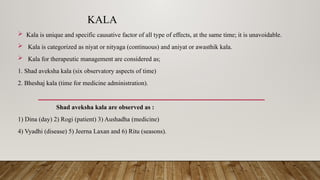
KALA
Kala isunique and specific causative factor of all type of effects, at the same time; it is unavoidable.
Kala is categorized as niyat or nityaga (continuous) and aniyat or awasthik kala.
Kala for therapeutic management are considered as;
1. Shad aveksha kala (six observatory aspects of time)
2. Bheshaj kala (time for medicine administration).
Shad aveksha kala are observed as :
1) Dina (day) 2) Rogi (patient) 3) Aushadha (medicine)
4) Vyadhi (disease) 5) Jeerna Laxan and 6) Ritu (seasons).
4.
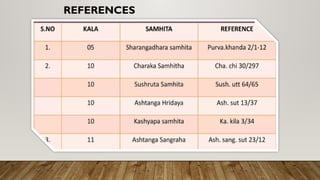
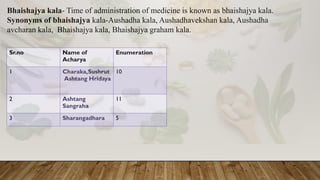
Bhaishajya kala- Timeof administration of medicine is known as bhaishajya kala.
Synonyms of bhaishajya kala-Aushadha kala, Aushadhavekshan kala, Aushadha
avcharan kala, Bhaishajya kala, Bhaishajya graham kala.
Sr.no Name of
Acharya
Enumeration
1 Charaka,Sushrut
Ashtang Hridaya
10
2 Ashtang
Sangraha
11
3 Sharangadhara 5
5.
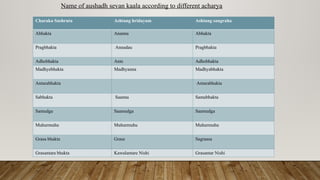
Charaka Sushruta Ashtanghridayam Ashtang sangraha
Abhakta Ananna Abhakta
Pragbhakta Annadau Pragbhakta
Adhobhakta Ante Adhobhakta
Madhyebhakta Madhyanna Madhyabhakta
Antarabhakta Antarabhakta
Sabhakta Saanna Samabhakta
Samudga Saamudga Saamudga
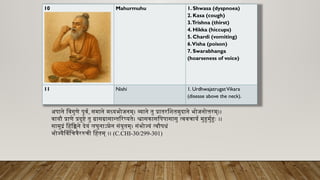
Muhurmuhu Muhurmuhu Muhurmuhu
Grasa bhakta Grase Sagraasa
Grasantara bhakta Kawalantare Nishi Grasantar Nishi
Name of aushadh sevan kaala according to different acharya
6.
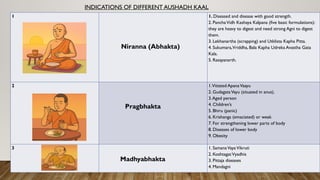
1
Niranna (Abhakta)
1. Diseasedand disease with good strength.
2. PanchaVidh Kashaya Kalpana (five basic formulations):
they are heavy to digest and need strong Agni to digest
them.
3. Lekhanartha (scrapping) and Utklista Kapha Pitta.
4. Sukumara,Vriddha, Bala Kapha Udreka Avastha Gata
Kala.
5. Rasayanarth.
2
Pragbhakta
1.Vitiated ApanaVaayu
2. GudagataVayu (situated in anus).
3.Aged person
4. Children’s
5. Bhiru (panic)
6. Krishanga (emaciated) or weak
7. For strengthening lower parts of body
8. Diseases of lower body
9. Obesity
3
Madhyabhakta
1. SamanaVayaVikruti
2. KoshtagatVyadhis
3. Pittaja diseases
4. Mandagni
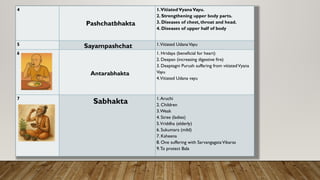
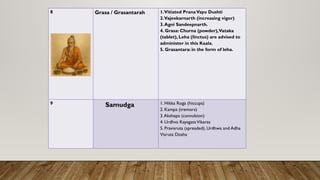
INDICATIONS OF DIFFERENT AUSHADH KAAL
7.
4
Pashchatbhakta
1.VitiatedVyanaVayu.
2. Strengthening upperbody parts.
3. Diseases of chest, throat and head.
4. Diseases of upper half of body
5 Sayampashchat 1.Vitiated UdanaVayu
6
Antarabhakta
1. Hridaya (beneficial for heart)
2. Deepan (increasing digestive fire)
3. Deeptagni Purush suffering from vitiatedVyana
Vayu
4.Vitiated Udana vayu
7
Sabhakta 1.Aruchi
2. Children
3.Weak
4. Stree (ladies)
5.Vriddha (elderly)
6. Sukumara (mild)
7. Ksheena
8. One suffering with SarvangagataVikaras
9.To protect Bala
8.
8 Grasa /Grasantarah 1.Vitiated PranaVayu Dushti
2.Vajeekarnarth (increasing vigor)
3.Agni Sandeepnarth.
4. Grasa: Churna (powder),Vataka
(tablet), Leha (linctus) are advised to
administer in this Kaala.
5. Grasantara: in the form of leha.
9 Samudga 1. Hikka Roga (hiccups)
2. Kampa (tremors)
3.Akshepa (convulsion)
4. Urdhva KayagataVikaras
5. Pravisruta (spreaded), Urdhwa and Adha
Visruta Dosha
Aushadh Sevan KalImportantance in Ayurveda
1. The treatment of any disease requires good conduction of life style, avoidance of
causative factors, Yoga, detoxification therapy and Aushadh. Aushadha play key role
towards the management of pathological conditions and it is very important to
administered Aushadha in right time to acquire desired biological responses.
2. The Aushadha synchronizes with Agni and exerted its effects depending on state of body
(Sariravastha) therefore rate of metabolism of Aushadha depends upon time factor since
potency of Agni varies during the various phases of day time.[16]
3. Aushadh SevanKaala are the essential tools for administration of Aushadha, negligence
may lead to the grave deficit in the treatment.
4. Aushadh Sevan Kala will help in food and drug interaction which is helpful to attain a quick
and sustainable relief to the patient.
11.
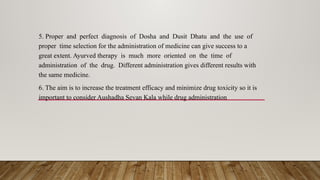
5. Proper andperfect diagnosis of Dosha and Dusit Dhatu and the use of
proper time selection for the administration of medicine can give success to a
great extent. Ayurved therapy is much more oriented on the time of
administration of the drug. Different administration gives different results with
the same medicine.
6. The aim is to increase the treatment efficacy and minimize drug toxicity so it is
important to consider Aushadha Sevan Kala while drug administration
12.
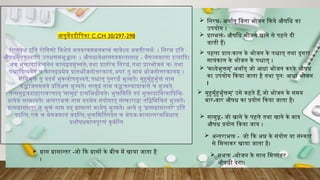
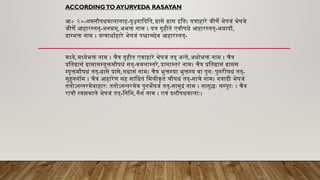
आयुर्वेददीपिका C.CH 30/297-298
रोग्यवेक्षइति रोगिणो विशेषं बलवत्त्वमबलवत्त्वं चावेक्ष्य भवतीत्यर्थः । निरन्न इति
औषधमुपयुज्यापि उपक्षणमभुञ्जानः । औषधावेक्षानगदकालानाह - भैषज्यकाला इत्यादि।
अत्र भुक्तादावित्यनेन कालद्वयमुच्यते; यथा प्रातरेव निरन्नं, तथा प्राग्भोजनं च। तथा
पश्चादित्यनेन च कालद्वयमेव प्रातर्भोजनोत्तरकालं, अपरं तु सायं भोजनोत्तरकालम् ।
मध्येभुक्तं तु यदर्थं भुक्त्वोपयुज्यते, पश्चात् पुनरर्धं भुज्यते। मुहुर्मुहुर्भुक्तं नाम
यद्भोजनसमये प्रतिक्षणं भुज्यते। सामुद्रं नाम यद्भक्तस्यादावन्ते च भुज्यते,
तत्समुद्गवदाहारावरणात् 'सामुद्रं' इत्यभिधीयते। भुक्तमिति पदं भुक्तादावित्यादिभिः
प्रत्येकं सम्बध्यते। अन्तराभक्तं नाम यदन्नेन संयोगात् संस्काराद्वा तद्विमिश्रितं भुज्यते।
ग्रासग्रासान्तरं तु भुक्तं नाम यद् ग्रासानां मध्येषु भुज्यते। अन्ये तु 'ग्रासग्रासान्तरे' इति
पठन्ति, एकं च भेषजकालं वदन्ति; भुक्तमितिपदेन च भेषज-कालान्तरमभिधाय
दशौषधकालपूरणं कुर्वन्ति
निरन्न- अर्थात् बिना भोजन किये औषधि का
उपयोग ।
प्राग्भक्तं - औषधि भोजन खाने से पहले दी
जाती हैं।
पहला प्रातःकाल के भोजन के पश्चात् तथा दूसरा
सायंकाल के भोजन के पश्चात् ।
'मध्येभुक्तम्' अर्थात् जो आधा भोजन करके औषध
का उपयोग किया जाता है तथा पुनः आधा भोजन
I
मुहुर्मुहुर्भुक्तम्' उसे कहते हैं, जो भोजन के समय
बार-बार औषध का प्रयोग किया जाता है।
सामुद्ग- जो खाने के पहले तथा खाने के बाद
औषध प्रयोग किया जाय ।
अन्तराभक्त - जो कि अन्न के संयोग या संस्कार
से मिलाकर खाया जाता है।
ग्रास ग्रासान्तर -जो कि ग्रासों के बीच में खाया जाता है
।
सभक्त -भोजन के साथ मिलाकर
औषधी देना।
13.
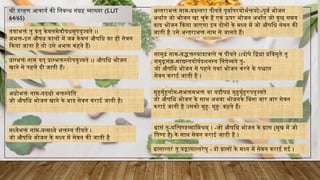
तत्राभक्तं तु यत्के वलमेवौषधमुपयुज्यते ।।
अभक्त-इन औषध कालों में जब केवल औषधि का ही सेवन
किया जाता है तो उसे अभक्त कहते हैं।
श्री डल्हण आचार्य की निबन्ध संग्रह व्याख्या (S.UT
64/65)
प्राग्भक्तं नाम यत् प्राग्भक्तस्योपयुज्यते ।। औषधि भोजन
खाने से पहले दी जाती हैं।
अधोभक्तं नाम-यदधो भक्तस्येति
जो औषधि भोजन खाने के बाद सेवन कराई जाती है।
मध्येभक्तं नाम-यन्मध्ये भक्तस्य पीयते ।
जो औषधि भोजन के मध्य में सेवन की जाती है
अन्तराभक्तं नाम-यदन्तरा पीयते पूर्वापरयोर्भक्तयोः-पूर्व भोजन
अर्थात जो भोजन खा चुके हैं एवं ऊपर भोजन अर्थात जो कुछ समय
बाद भोजन किया जाएगा इन दोनों के मध्य में जो औषधि सेवन की
जाती है उसे अन्तराभक्त नाम से जानते हैं।
सामुद्रं नाम-यद्भक्तस्यादावन्ते च पीयते ।।दोषे द्विधा प्रविसृते तु
समुद्गसंज्ञ-माद्यन्तयोर्यदशनस्य निषेव्यते तु-
जो औषधि भोजन से पहले तथा भोजन करने के पश्चात
सेवन कराई जाती है ।
मुहुर्मुहुर्नाम-सभक्तमभक्तं वा यदौषधं मुहुर्मुहुरुपयुज्यते
जो औषधि भोजन के साथ अथवा भोजनके बिना बार बार सेवन
कराई जाती है उसको मुहुः मुहुः कहते हैं।
ग्रासं तु-यत्पिण्डव्यामिश्रम् । -जो औषधि भोजन के ग्रास (मुख में जो
पिण्ड है) के साथ सेवन कराई जाती है ।
ग्रासान्तरं तु यद्गासान्तरेषु - दो ग्रासों के मध्य में सेवन कराई गई ।
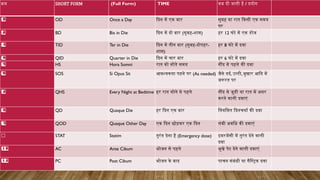
क्रम SHORT FORM(Full Form) TIME कब दी जाती है / प्रयोग
1️
1️
⃣ OD Once a Day दिन में एक बार सुबह या रात किसी एक समय
पर
2️
⃣ BD Bis in Die दिन में दो बार (सुबह-शाम) हर 12 घंटे में एक डोज
3️
3️
⃣ TID Ter in Die दिन में तीन बार (सुबह-दोपहर-
शाम)
हर 8 घंटे में दवा
4️
⃣ QID Quarter in Die दिन में चार बार हर 6 घंटे में दवा
5️
5️
⃣ HS Hora Somni रात को सोते समय नींद से पहले की दवा
6️
⃣ SOS Si Opus Sit आवश्यकता पड़ने पर (As needed) जैसे दर्द, उल्टी, बुखार आदि में
जरूरत पर
7️
7️
⃣ QHS Every Night at Bedtime हर रात सोने से पहले नींद से जुड़ी या रात में असर
करने वाली दवाएं
8️
⃣ QD Quaque Die हर दिन एक बार नियमित दिनचर्या की दवा
9️
9️
⃣ QOD Quaque Other Day एक दिन छोड़कर एक दिन लंबी अवधि की दवाएं
🔟 STAT Statim तुरंत देना है (Emergency dose) इमरजेंसी में तुरंत देने वाली
दवा
1️
1️
1️
⃣1️
⃣ AC Ante Cibum भोजन से पहले भूखे पेट देने वाली दवाएं
1️
2️
1️
⃣2️
⃣ PC Post Cibum भोजन के बाद पाचन संबंधी या गैस्ट्रिक दवा
17.
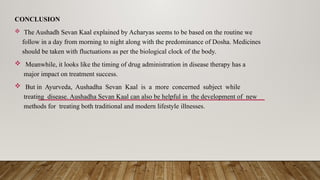
CONCLUSION
The AushadhSevan Kaal explained by Acharyas seems to be based on the routine we
follow in a day from morning to night along with the predominance of Dosha. Medicines
should be taken with fluctuations as per the biological clock of the body.
Meanwhile, it looks like the timing of drug administration in disease therapy has a
major impact on treatment success.
But in Ayurveda, Aushadha Sevan Kaal is a more concerned subject while
treating disease. Aushadha Sevan Kaal can also be helpful in the development of new
methods for treating both traditional and modern lifestyle illnesses.
![Aushadh Sevan Kal Importantance in Ayurveda
1. The treatment of any disease requires good conduction of life style, avoidance of
causative factors, Yoga, detoxification therapy and Aushadh. Aushadha play key role
towards the management of pathological conditions and it is very important to
administered Aushadha in right time to acquire desired biological responses.
2. The Aushadha synchronizes with Agni and exerted its effects depending on state of body
(Sariravastha) therefore rate of metabolism of Aushadha depends upon time factor since
potency of Agni varies during the various phases of day time.[16]
3. Aushadh SevanKaala are the essential tools for administration of Aushadha, negligence
may lead to the grave deficit in the treatment.
4. Aushadh Sevan Kala will help in food and drug interaction which is helpful to attain a quick
and sustainable relief to the patient.](https://image.slidesharecdn.com/ausadhsevankalappt-250705145918-71beea8e/85/ausadh-sevan-kala-power-point-presentation-10-320.jpg)