Sistemas de Informação
para a Indústria


                                                     Class 2

                   Impact of Informations Systems.
                          Typologies of IS.
                                                      Ano 2013


                                                                                     António Grilo
                                                                                     Prof. Auxiliar FCT-UNL

                                                   Sistemas de Informação para Indústria                      1
Departamento de Engenharia Mecânica e Industrial            © António Grilo   2013
DEFINING INFORMATION

What is an Information System?

A set of interrelated components that collect (or retrieve), process, store,
and distribute information to support decision making and control in an
organization. (Laudon, 2012)

Information systems are implemented within an organization for the
purpose of improving the effectiveness and efficiency of that organization.

Capabilities of the information system and characteristics of the
organization, its work systems, its people, and its development and
implementation methodologies together determine the extent to which that
purpose is achieved.


                                                    Sistemas de Informação para Indústria   2
 Departamento de Engenharia Mecânica e Industrial            © António Grilo   2013
DATA, INFORMATION, KNOWLEDGE


Data, Information and Knowledge have different meanings:

Data: Streams of raw facts representing events such as business
transactions

Information: Clusters of facts that are meaningful and useful to human
beings in the processes such as making decisions

Knowledge: Capability to transform information in something that is
valuable to the person or organization.


                                                    Sistemas de Informação para Indústria   3
 Departamento de Engenharia Mecânica e Industrial            © António Grilo   2013
INFORMATION SYSTEMS AS A SYSTEM…
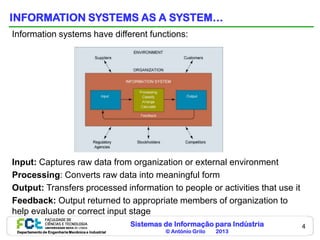
Information systems have different functions:


Input: Captures raw data from organization or external environment
Processing: Converts raw data into meaningful form
Output: Transfers processed information to people or activities that use it
Feedback: Output returned to appropriate members of organization to
help evaluate or correct input stage
                                                    Sistemas de Informação para Indústria   4
 Departamento de Engenharia Mecânica e Industrial            © António Grilo   2013
IMPACT OF INFORMATION SYSTEMS ON ORGANIZATIONS

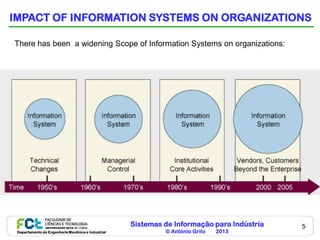
There has been a widening Scope of Information Systems on organizations:


                                                    Sistemas de Informação para Indústria   5
 Departamento de Engenharia Mecânica e Industrial            © António Grilo   2013
IMPACT OF INFORMATION SYSTEMS ON ORGANIZATIONS

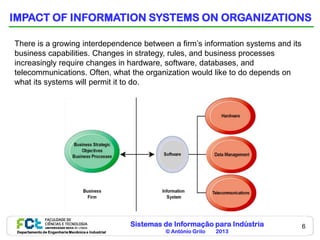
There is a growing interdependence between a firm’s information systems and its
business capabilities. Changes in strategy, rules, and business processes
increasingly require changes in hardware, software, databases, and
telecommunications. Often, what the organization would like to do depends on
what its systems will permit it to do.


                                                    Sistemas de Informação para Indústria   6
 Departamento de Engenharia Mecânica e Industrial            © António Grilo   2013
IMPACT OF INFORMATION SYSTEMS ON ORGANIZATIONS


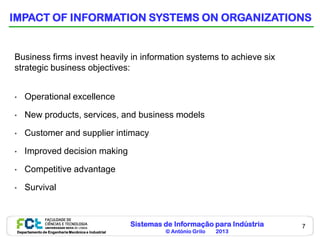
Business firms invest heavily in information systems to achieve six
strategic business objectives:


•       Operational excellence

•       New products, services, and business models

•       Customer and supplier intimacy

•       Improved decision making

•       Competitive advantage

•       Survival


                                                       Sistemas de Informação para Indústria   7
    Departamento de Engenharia Mecânica e Industrial            © António Grilo   2013
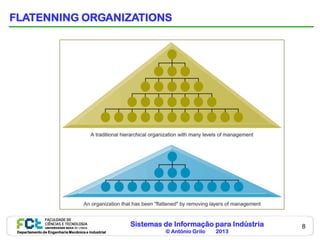
FLATENNING ORGANIZATIONS


                                                    Sistemas de Informação para Indústria   8
 Departamento de Engenharia Mecânica e Industrial            © António Grilo   2013
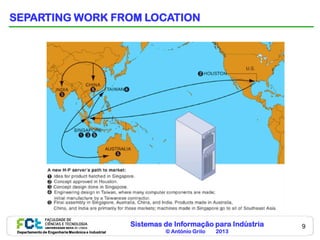
SEPARTING WORK FROM LOCATION


                                                    Sistemas de Informação para Indústria   9
 Departamento de Engenharia Mecânica e Industrial            © António Grilo   2013
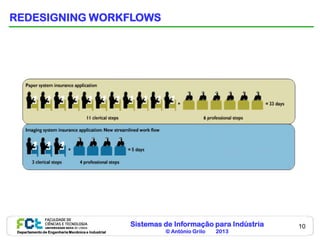
REDESIGNING WORKFLOWS


                                                    Sistemas de Informação para Indústria   10
 Departamento de Engenharia Mecânica e Industrial            © António Grilo   2013
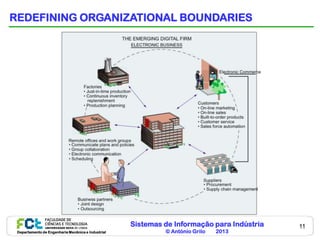
REDEFINING ORGANIZATIONAL BOUNDARIES


                                                    Sistemas de Informação para Indústria   11
 Departamento de Engenharia Mecânica e Industrial            © António Grilo   2013
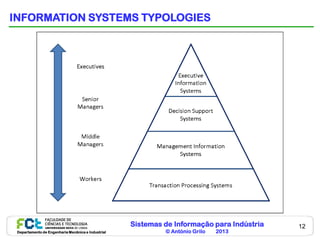
INFORMATION SYSTEMS TYPOLOGIES


                                                    Sistemas de Informação para Indústria   12
 Departamento de Engenharia Mecânica e Industrial            © António Grilo   2013
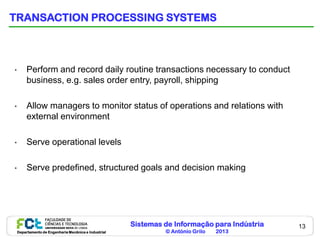
TRANSACTION PROCESSING SYSTEMS


•        Perform and record daily routine transactions necessary to conduct
         business, e.g. sales order entry, payroll, shipping

•        Allow managers to monitor status of operations and relations with
         external environment

•        Serve operational levels

•        Serve predefined, structured goals and decision making


                                                       Sistemas de Informação para Indústria   13
    Departamento de Engenharia Mecânica e Industrial            © António Grilo   2013
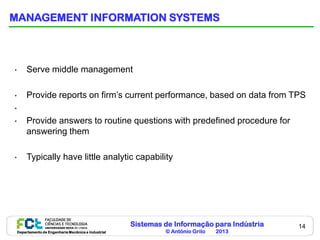
MANAGEMENT INFORMATION SYSTEMS


•        Serve middle management

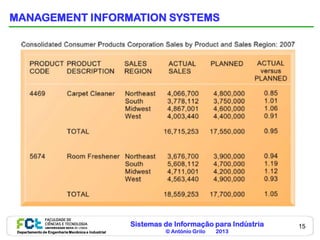
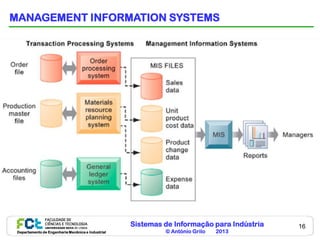
•        Provide reports on firm’s current performance, based on data from TPS
•
•        Provide answers to routine questions with predefined procedure for
         answering them

•        Typically have little analytic capability


                                                       Sistemas de Informação para Indústria   14
    Departamento de Engenharia Mecânica e Industrial            © António Grilo   2013
MANAGEMENT INFORMATION SYSTEMS


                                                    Sistemas de Informação para Indústria   15
 Departamento de Engenharia Mecânica e Industrial            © António Grilo   2013
MANAGEMENT INFORMATION SYSTEMS


                                                    Sistemas de Informação para Indústria   16
 Departamento de Engenharia Mecânica e Industrial            © António Grilo   2013
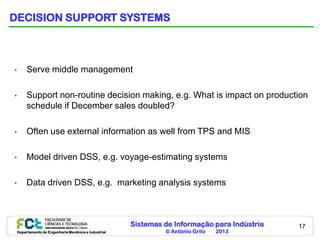
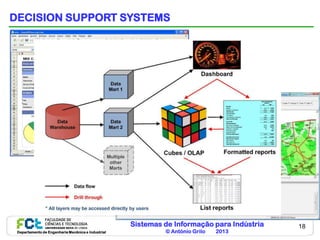
DECISION SUPPORT SYSTEMS


•        Serve middle management

•        Support non-routine decision making, e.g. What is impact on production
         schedule if December sales doubled?

•        Often use external information as well from TPS and MIS

•        Model driven DSS, e.g. voyage-estimating systems

•        Data driven DSS, e.g. marketing analysis systems


                                                       Sistemas de Informação para Indústria   17
    Departamento de Engenharia Mecânica e Industrial            © António Grilo   2013
DECISION SUPPORT SYSTEMS


                                                    Sistemas de Informação para Indústria   18
 Departamento de Engenharia Mecânica e Industrial            © António Grilo   2013
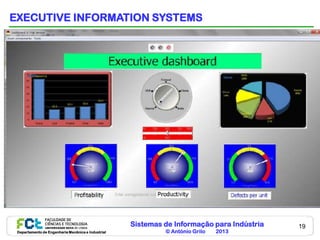
EXECUTIVE INFORMATION SYSTEMS


                                                    Sistemas de Informação para Indústria   19
 Departamento de Engenharia Mecânica e Industrial            © António Grilo   2013
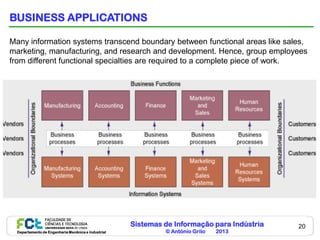
BUSINESS APPLICATIONS

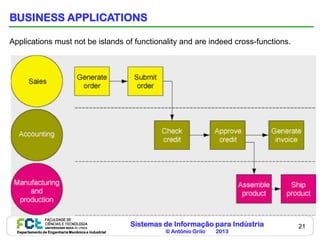
Many information systems transcend boundary between functional areas like sales,
marketing, manufacturing, and research and development. Hence, group employees
from different functional specialties are required to a complete piece of work.


                                                     Sistemas de Informação para Indústria   20
  Departamento de Engenharia Mecânica e Industrial            © António Grilo   2013
BUSINESS APPLICATIONS

Applications must not be islands of functionality and are indeed cross-functions.


                                                     Sistemas de Informação para Indústria   21
  Departamento de Engenharia Mecânica e Industrial            © António Grilo   2013
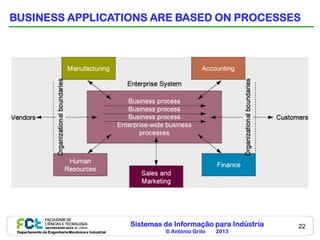
BUSINESS APPLICATIONS ARE BASED ON PROCESSES


                                                    Sistemas de Informação para Indústria   22
 Departamento de Engenharia Mecânica e Industrial            © António Grilo   2013
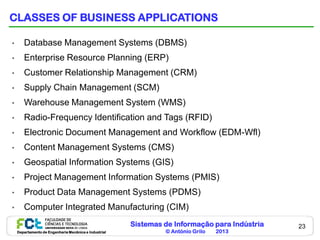
CLASSES OF BUSINESS APPLICATIONS

•      Database Management Systems (DBMS)
•      Enterprise Resource Planning (ERP)
•      Customer Relationship Management (CRM)
•      Supply Chain Management (SCM)
•      Warehouse Management System (WMS)
•      Radio-Frequency Identification and Tags (RFID)
•      Electronic Document Management and Workflow (EDM-Wfl)
•      Content Management Systems (CMS)
•      Geospatial Information Systems (GIS)
•      Project Management Information Systems (PMIS)
•      Product Data Management Systems (PDMS)
•      Computer Integrated Manufacturing (CIM)
                                                       Sistemas de Informação para Indústria   23
    Departamento de Engenharia Mecânica e Industrial            © António Grilo   2013
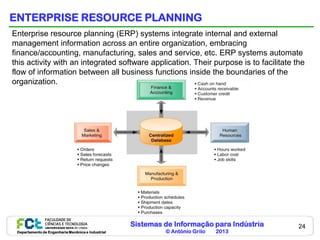
ENTERPRISE RESOURCE PLANNING
Enterprise resource planning (ERP) systems integrate internal and external
management information across an entire organization, embracing
finance/accounting, manufacturing, sales and service, etc. ERP systems automate
this activity with an integrated software application. Their purpose is to facilitate the
flow of information between all business functions inside the boundaries of the
organization.


                                                    Sistemas de Informação para Indústria   24
 Departamento de Engenharia Mecânica e Industrial            © António Grilo   2013
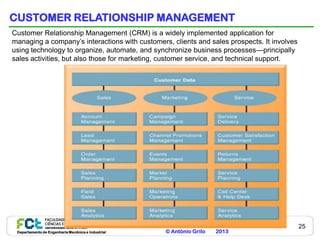
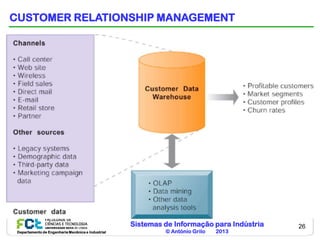
CUSTOMER RELATIONSHIP MANAGEMENT
Customer Relationship Management (CRM) is a widely implemented application for
managing a company’s interactions with customers, clients and sales prospects. It involves
using technology to organize, automate, and synchronize business processes—principally
sales activities, but also those for marketing, customer service, and technical support.


                                                    Sistemas de Informação para Indústria    25
 Departamento de Engenharia Mecânica e Industrial            © António Grilo   2013
CUSTOMER RELATIONSHIP MANAGEMENT


                                                    Sistemas de Informação para Indústria   26
 Departamento de Engenharia Mecânica e Industrial            © António Grilo   2013
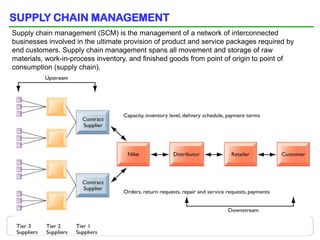
SUPPLY CHAIN MANAGEMENT
Supply chain management (SCM) is the management of a network of interconnected
businesses involved in the ultimate provision of product and service packages required by
end customers. Supply chain management spans all movement and storage of raw
materials, work-in-process inventory, and finished goods from point of origin to point of
consumption (supply chain).


                                                    Sistemas de Informação para Indústria   27
 Departamento de Engenharia Mecânica e Industrial            © António Grilo   2013
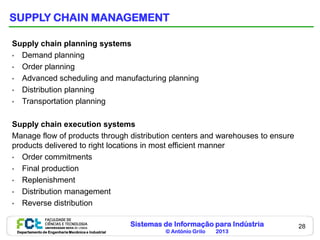
SUPPLY CHAIN MANAGEMENT

Supply chain planning systems
• Demand planning
• Order planning
• Advanced scheduling and manufacturing planning
• Distribution planning
• Transportation planning


Supply chain execution systems
Manage flow of products through distribution centers and warehouses to ensure
products delivered to right locations in most efficient manner
• Order commitments
• Final production
• Replenishment
• Distribution management
• Reverse distribution


                                                    Sistemas de Informação para Indústria   28
 Departamento de Engenharia Mecânica e Industrial            © António Grilo   2013
SUPPLY CHAIN MANAGEMENT


Push-based model (Build-to-stock) - Production master schedules based on
forecasts or best guesses of product demand; products “pushed” to customers

Pull-based model (Demand-driven, build-to-order) - With IT, manufacturers can
use only order demand information to drive schedules and procurement of
components or raw materials

Sequential supply chains - Information, materials move sequentially

Concurrent supply chains - With IT, information moves in many directions
simultaneously


                                                    Sistemas de Informação para Indústria   29
 Departamento de Engenharia Mecânica e Industrial            © António Grilo   2013

Aula 2 07032013 sii-v1

  • 1.
    Sistemas de Informação paraa Indústria Class 2 Impact of Informations Systems. Typologies of IS. Ano 2013 António Grilo Prof. Auxiliar FCT-UNL Sistemas de Informação para Indústria 1 Departamento de Engenharia Mecânica e Industrial © António Grilo 2013
  • 2.
    DEFINING INFORMATION What isan Information System? A set of interrelated components that collect (or retrieve), process, store, and distribute information to support decision making and control in an organization. (Laudon, 2012) Information systems are implemented within an organization for the purpose of improving the effectiveness and efficiency of that organization. Capabilities of the information system and characteristics of the organization, its work systems, its people, and its development and implementation methodologies together determine the extent to which that purpose is achieved. Sistemas de Informação para Indústria 2 Departamento de Engenharia Mecânica e Industrial © António Grilo 2013
  • 3.
    DATA, INFORMATION, KNOWLEDGE Data,Information and Knowledge have different meanings: Data: Streams of raw facts representing events such as business transactions Information: Clusters of facts that are meaningful and useful to human beings in the processes such as making decisions Knowledge: Capability to transform information in something that is valuable to the person or organization. Sistemas de Informação para Indústria 3 Departamento de Engenharia Mecânica e Industrial © António Grilo 2013
  • 4.
    INFORMATION SYSTEMS ASA SYSTEM… Information systems have different functions: Input: Captures raw data from organization or external environment Processing: Converts raw data into meaningful form Output: Transfers processed information to people or activities that use it Feedback: Output returned to appropriate members of organization to help evaluate or correct input stage Sistemas de Informação para Indústria 4 Departamento de Engenharia Mecânica e Industrial © António Grilo 2013
  • 5.
    IMPACT OF INFORMATIONSYSTEMS ON ORGANIZATIONS There has been a widening Scope of Information Systems on organizations: Sistemas de Informação para Indústria 5 Departamento de Engenharia Mecânica e Industrial © António Grilo 2013
  • 6.
    IMPACT OF INFORMATIONSYSTEMS ON ORGANIZATIONS There is a growing interdependence between a firm’s information systems and its business capabilities. Changes in strategy, rules, and business processes increasingly require changes in hardware, software, databases, and telecommunications. Often, what the organization would like to do depends on what its systems will permit it to do. Sistemas de Informação para Indústria 6 Departamento de Engenharia Mecânica e Industrial © António Grilo 2013
  • 7.
    IMPACT OF INFORMATIONSYSTEMS ON ORGANIZATIONS Business firms invest heavily in information systems to achieve six strategic business objectives: • Operational excellence • New products, services, and business models • Customer and supplier intimacy • Improved decision making • Competitive advantage • Survival Sistemas de Informação para Indústria 7 Departamento de Engenharia Mecânica e Industrial © António Grilo 2013
  • 8.
    FLATENNING ORGANIZATIONS Sistemas de Informação para Indústria 8 Departamento de Engenharia Mecânica e Industrial © António Grilo 2013
  • 9.
    SEPARTING WORK FROMLOCATION Sistemas de Informação para Indústria 9 Departamento de Engenharia Mecânica e Industrial © António Grilo 2013
  • 10.
    REDESIGNING WORKFLOWS Sistemas de Informação para Indústria 10 Departamento de Engenharia Mecânica e Industrial © António Grilo 2013
  • 11.
    REDEFINING ORGANIZATIONAL BOUNDARIES Sistemas de Informação para Indústria 11 Departamento de Engenharia Mecânica e Industrial © António Grilo 2013
  • 12.
    INFORMATION SYSTEMS TYPOLOGIES Sistemas de Informação para Indústria 12 Departamento de Engenharia Mecânica e Industrial © António Grilo 2013
  • 13.
    TRANSACTION PROCESSING SYSTEMS • Perform and record daily routine transactions necessary to conduct business, e.g. sales order entry, payroll, shipping • Allow managers to monitor status of operations and relations with external environment • Serve operational levels • Serve predefined, structured goals and decision making Sistemas de Informação para Indústria 13 Departamento de Engenharia Mecânica e Industrial © António Grilo 2013
  • 14.
    MANAGEMENT INFORMATION SYSTEMS • Serve middle management • Provide reports on firm’s current performance, based on data from TPS • • Provide answers to routine questions with predefined procedure for answering them • Typically have little analytic capability Sistemas de Informação para Indústria 14 Departamento de Engenharia Mecânica e Industrial © António Grilo 2013
  • 15.
    MANAGEMENT INFORMATION SYSTEMS Sistemas de Informação para Indústria 15 Departamento de Engenharia Mecânica e Industrial © António Grilo 2013
  • 16.
    MANAGEMENT INFORMATION SYSTEMS Sistemas de Informação para Indústria 16 Departamento de Engenharia Mecânica e Industrial © António Grilo 2013
  • 17.
    DECISION SUPPORT SYSTEMS • Serve middle management • Support non-routine decision making, e.g. What is impact on production schedule if December sales doubled? • Often use external information as well from TPS and MIS • Model driven DSS, e.g. voyage-estimating systems • Data driven DSS, e.g. marketing analysis systems Sistemas de Informação para Indústria 17 Departamento de Engenharia Mecânica e Industrial © António Grilo 2013
  • 18.
    DECISION SUPPORT SYSTEMS Sistemas de Informação para Indústria 18 Departamento de Engenharia Mecânica e Industrial © António Grilo 2013
  • 19.
    EXECUTIVE INFORMATION SYSTEMS Sistemas de Informação para Indústria 19 Departamento de Engenharia Mecânica e Industrial © António Grilo 2013
  • 20.
    BUSINESS APPLICATIONS Many informationsystems transcend boundary between functional areas like sales, marketing, manufacturing, and research and development. Hence, group employees from different functional specialties are required to a complete piece of work. Sistemas de Informação para Indústria 20 Departamento de Engenharia Mecânica e Industrial © António Grilo 2013
  • 21.
    BUSINESS APPLICATIONS Applications mustnot be islands of functionality and are indeed cross-functions. Sistemas de Informação para Indústria 21 Departamento de Engenharia Mecânica e Industrial © António Grilo 2013
  • 22.
    BUSINESS APPLICATIONS AREBASED ON PROCESSES Sistemas de Informação para Indústria 22 Departamento de Engenharia Mecânica e Industrial © António Grilo 2013
  • 23.
    CLASSES OF BUSINESSAPPLICATIONS • Database Management Systems (DBMS) • Enterprise Resource Planning (ERP) • Customer Relationship Management (CRM) • Supply Chain Management (SCM) • Warehouse Management System (WMS) • Radio-Frequency Identification and Tags (RFID) • Electronic Document Management and Workflow (EDM-Wfl) • Content Management Systems (CMS) • Geospatial Information Systems (GIS) • Project Management Information Systems (PMIS) • Product Data Management Systems (PDMS) • Computer Integrated Manufacturing (CIM) Sistemas de Informação para Indústria 23 Departamento de Engenharia Mecânica e Industrial © António Grilo 2013
  • 24.
    ENTERPRISE RESOURCE PLANNING Enterpriseresource planning (ERP) systems integrate internal and external management information across an entire organization, embracing finance/accounting, manufacturing, sales and service, etc. ERP systems automate this activity with an integrated software application. Their purpose is to facilitate the flow of information between all business functions inside the boundaries of the organization. Sistemas de Informação para Indústria 24 Departamento de Engenharia Mecânica e Industrial © António Grilo 2013
  • 25.
    CUSTOMER RELATIONSHIP MANAGEMENT CustomerRelationship Management (CRM) is a widely implemented application for managing a company’s interactions with customers, clients and sales prospects. It involves using technology to organize, automate, and synchronize business processes—principally sales activities, but also those for marketing, customer service, and technical support. Sistemas de Informação para Indústria 25 Departamento de Engenharia Mecânica e Industrial © António Grilo 2013
  • 26.
    CUSTOMER RELATIONSHIP MANAGEMENT Sistemas de Informação para Indústria 26 Departamento de Engenharia Mecânica e Industrial © António Grilo 2013
  • 27.
    SUPPLY CHAIN MANAGEMENT Supplychain management (SCM) is the management of a network of interconnected businesses involved in the ultimate provision of product and service packages required by end customers. Supply chain management spans all movement and storage of raw materials, work-in-process inventory, and finished goods from point of origin to point of consumption (supply chain). Sistemas de Informação para Indústria 27 Departamento de Engenharia Mecânica e Industrial © António Grilo 2013
  • 28.
    SUPPLY CHAIN MANAGEMENT Supplychain planning systems • Demand planning • Order planning • Advanced scheduling and manufacturing planning • Distribution planning • Transportation planning Supply chain execution systems Manage flow of products through distribution centers and warehouses to ensure products delivered to right locations in most efficient manner • Order commitments • Final production • Replenishment • Distribution management • Reverse distribution Sistemas de Informação para Indústria 28 Departamento de Engenharia Mecânica e Industrial © António Grilo 2013
  • 29.
    SUPPLY CHAIN MANAGEMENT Push-basedmodel (Build-to-stock) - Production master schedules based on forecasts or best guesses of product demand; products “pushed” to customers Pull-based model (Demand-driven, build-to-order) - With IT, manufacturers can use only order demand information to drive schedules and procurement of components or raw materials Sequential supply chains - Information, materials move sequentially Concurrent supply chains - With IT, information moves in many directions simultaneously Sistemas de Informação para Indústria 29 Departamento de Engenharia Mecânica e Industrial © António Grilo 2013