Augmented Reality
Video Storyboard
Catherine Brennan, Emilie Finney,
Fiona Howe, Jacqueline Foody
Title with music and graphic
Music: Provided by Redwoods
Title: Augmented Reality in Arts and Education by
Catherine Brennan, Emilie Finney, Fiona Howe and
Jacqueline Foody.
Graphic:
Time: 20 seconds
Catherine Brennan - Definition
Dialogue : Augmented reality is defined as 'the
technology of combining real world images
and video with computer-generated
information and imagery.
Image: Definition displayed to the right of
screen.
Catherine Brennan - Intro
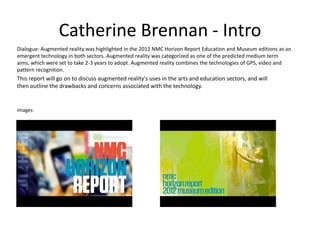
Dialogue: Augmented reality was highlighted in the 2012 NMC Horizon Report Education and Museum editions as an
emergent technology in both sectors. Augmented reality was categorized as one of the predicted medium term
aims, which were set to take 2-3 years to adopt. Augmented reality combines the technologies of GPS, video and
pattern recognition.

This report will go on to discuss augmented reality's uses in the arts and education sectors, and will
then outline the drawbacks and concerns associated with the technology.

Images:
Emilie Finney - Educational App
Aurasma - Is an application that has been created to integrate content, images and
videos in real time to enhance the learner and educators experience.
•
•
•
•

The student can gain a deep understanding and knowledge of the topic being
studied
New innovative and exciting ways of learning can be explored
Ability to engage and visualize 3D graphics in a explorative manner
Offers an enriched and fulfilled experience

Video:
http://www.youtube.com/watch?v=4nMqEA--aFI
00.32-00.59
Emilie Finney - Art App
ColAR App - Is an application that allows ones artistic expressions to be
explored and endeavored. It's similar to a coloring book with advanced
mechanisms that allows users to colour a picture which can then be
enhanced with Augmented Reality allowing for advanced creativity to be
explored and shared. This can be beneficial to younger learners allowing them
to experiment with the collaboration of augmented reality, art and
technology which can advance their learning in this area at a young age.
00.35-00.59
http://www.youtube.com/watch?v=tmfXgvT9h3s
Jacqueline Foody - Uses in Education
As mentioned earlier Augmented reality was highlighted as one of the key technologies in the 2012 Museum Edition Horizon Report. The report predicted
that the technology would take two to three years to become widespread. Augmented Reality has become increasingly popular amongst museum
educators as it allows visitors to interact with exhibits and information in an explorative manner that is readily available allowing easier access than before.
It can be beneficial within relation to Education as it allows the learner to indulge in a “learning to learn” attitude which can allow one to explore, interact
and engage with information and knowledge in a digital manner as well as enhancing their experience within an immersive environment.
It can contribute to learning environments in many ways such as some of the following:
•
•
Innovative and collaborative Learning
•
Project based Learning
•
E-Learning
•
Access to advanced information
•
Learning on the go (Integration of technologies such as mobiles and tablets accentuate mobility allowing for the user to integrate with learning in
various environments)
•
Enhance Storytelling
•
Collaboration of visual and literature with the usage of 3D graphics
•
Sensory Interaction
•
Exploratory and creative learning
•
It can allow learners to process information without having to heavily rely on note-taking
•
•
For example The University of Virginia has created a Campus App which uses augmented reality and was developed through WillowTree. It allows
users to engage with their surroundings through personalized maps as well as engaging with live events
Video:
1.10-1.29
http://www.youtube.com/watch?v=gTU73_i8AOg
Jacqueline Foody-Uses in the Arts
Augmented Reality has the potential of many uses within the arts such as some of the following:
Attendees of an exhibition can point their device towards a showcase allowing them to engage with the artists works in an advanced manner. It can allow
one to absorb extra information and knowledge on the artists piece, history, background and other showcases that they may have. It can be used as an
effective marketing strategy to create awareness e.g A digital message can be communicated to engage the public about upcoming or specific events. Many
arts organisations provide tours for those in educational institutions to attend tours of Gallery spaces, Theater spaces and exhibitions. It can be useful for
tours within an arts organization as attendees can gain additional knowledge and become indulged in an creative manner. Learners and educators can
mutually benefit from additional information that can be explored throughout the use of AR.
Arts organisations can use in various ways such as the following:
•
•
•
•
•
•
•

Communication, PR and marketing tool
Business cards with additional information
Audience interaction
Visual aspects can be enhanced through 3D and digital format
Usage of video can be embedded e.g additional information on artists works, inspiration and exhibitions
Gps Navigation e.g This can be useful to inform new attendees of location queries or additional information
Tour guides, educators and learners can disseminate additional information which can be seen through the use of AR

Video:
from 00.40-1.02 when Jacci says: 'Attendees of an exhibition can point their device towards a showcase allowing them to engage with the artists works in
an advanced manner.
http://www.youtube.com/watch?v=KJEfkljZ0Tk
Fiona Howe - Negatives
•
•
•
•

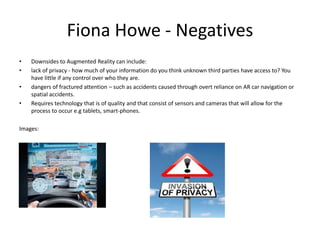
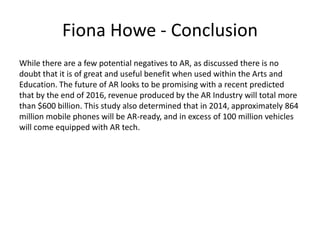
Downsides to Augmented Reality can include:
lack of privacy - how much of your information do you think unknown third parties have access to? You
have little if any control over who they are.
dangers of fractured attention – such as accidents caused through overt reliance on AR car navigation or
spatial accidents.
Requires technology that is of quality and that consist of sensors and cameras that will allow for the
process to occur e.g tablets, smart-phones.

Images:
Fiona Howe - Conclusion
While there are a few potential negatives to AR, as discussed there is no
doubt that it is of great and useful benefit when used within the Arts and
Education. The future of AR looks to be promising with a recent predicted
that by the end of 2016, revenue produced by the AR Industry will total more
than $600 billion. This study also determined that in 2014, approximately 864
million mobile phones will be AR-ready, and in excess of 100 million vehicles
will come equipped with AR tech.
Credits
Music: Redwoods to fade out
Script: Catherine Brennan, Fiona Howe, Emilie
Finney, Jacqueline Foody

Camera: Sean O’ Connor, Aaron Murphy
Editing: Sean O’ Connor, Aaron Murphy, Aoife
Cody
References

Augmented reality powerpoint

  • 1.
    Augmented Reality Video Storyboard CatherineBrennan, Emilie Finney, Fiona Howe, Jacqueline Foody
  • 2.
    Title with musicand graphic Music: Provided by Redwoods Title: Augmented Reality in Arts and Education by Catherine Brennan, Emilie Finney, Fiona Howe and Jacqueline Foody. Graphic: Time: 20 seconds
  • 3.
    Catherine Brennan -Definition Dialogue : Augmented reality is defined as 'the technology of combining real world images and video with computer-generated information and imagery. Image: Definition displayed to the right of screen.
  • 4.
    Catherine Brennan -Intro Dialogue: Augmented reality was highlighted in the 2012 NMC Horizon Report Education and Museum editions as an emergent technology in both sectors. Augmented reality was categorized as one of the predicted medium term aims, which were set to take 2-3 years to adopt. Augmented reality combines the technologies of GPS, video and pattern recognition. This report will go on to discuss augmented reality's uses in the arts and education sectors, and will then outline the drawbacks and concerns associated with the technology. Images:
  • 5.
    Emilie Finney -Educational App Aurasma - Is an application that has been created to integrate content, images and videos in real time to enhance the learner and educators experience. • • • • The student can gain a deep understanding and knowledge of the topic being studied New innovative and exciting ways of learning can be explored Ability to engage and visualize 3D graphics in a explorative manner Offers an enriched and fulfilled experience Video: http://www.youtube.com/watch?v=4nMqEA--aFI 00.32-00.59
  • 6.
    Emilie Finney -Art App ColAR App - Is an application that allows ones artistic expressions to be explored and endeavored. It's similar to a coloring book with advanced mechanisms that allows users to colour a picture which can then be enhanced with Augmented Reality allowing for advanced creativity to be explored and shared. This can be beneficial to younger learners allowing them to experiment with the collaboration of augmented reality, art and technology which can advance their learning in this area at a young age. 00.35-00.59 http://www.youtube.com/watch?v=tmfXgvT9h3s
  • 7.
    Jacqueline Foody -Uses in Education As mentioned earlier Augmented reality was highlighted as one of the key technologies in the 2012 Museum Edition Horizon Report. The report predicted that the technology would take two to three years to become widespread. Augmented Reality has become increasingly popular amongst museum educators as it allows visitors to interact with exhibits and information in an explorative manner that is readily available allowing easier access than before. It can be beneficial within relation to Education as it allows the learner to indulge in a “learning to learn” attitude which can allow one to explore, interact and engage with information and knowledge in a digital manner as well as enhancing their experience within an immersive environment. It can contribute to learning environments in many ways such as some of the following: • • Innovative and collaborative Learning • Project based Learning • E-Learning • Access to advanced information • Learning on the go (Integration of technologies such as mobiles and tablets accentuate mobility allowing for the user to integrate with learning in various environments) • Enhance Storytelling • Collaboration of visual and literature with the usage of 3D graphics • Sensory Interaction • Exploratory and creative learning • It can allow learners to process information without having to heavily rely on note-taking • • For example The University of Virginia has created a Campus App which uses augmented reality and was developed through WillowTree. It allows users to engage with their surroundings through personalized maps as well as engaging with live events Video: 1.10-1.29 http://www.youtube.com/watch?v=gTU73_i8AOg
  • 8.
    Jacqueline Foody-Uses inthe Arts Augmented Reality has the potential of many uses within the arts such as some of the following: Attendees of an exhibition can point their device towards a showcase allowing them to engage with the artists works in an advanced manner. It can allow one to absorb extra information and knowledge on the artists piece, history, background and other showcases that they may have. It can be used as an effective marketing strategy to create awareness e.g A digital message can be communicated to engage the public about upcoming or specific events. Many arts organisations provide tours for those in educational institutions to attend tours of Gallery spaces, Theater spaces and exhibitions. It can be useful for tours within an arts organization as attendees can gain additional knowledge and become indulged in an creative manner. Learners and educators can mutually benefit from additional information that can be explored throughout the use of AR. Arts organisations can use in various ways such as the following: • • • • • • • Communication, PR and marketing tool Business cards with additional information Audience interaction Visual aspects can be enhanced through 3D and digital format Usage of video can be embedded e.g additional information on artists works, inspiration and exhibitions Gps Navigation e.g This can be useful to inform new attendees of location queries or additional information Tour guides, educators and learners can disseminate additional information which can be seen through the use of AR Video: from 00.40-1.02 when Jacci says: 'Attendees of an exhibition can point their device towards a showcase allowing them to engage with the artists works in an advanced manner. http://www.youtube.com/watch?v=KJEfkljZ0Tk
  • 9.
    Fiona Howe -Negatives • • • • Downsides to Augmented Reality can include: lack of privacy - how much of your information do you think unknown third parties have access to? You have little if any control over who they are. dangers of fractured attention – such as accidents caused through overt reliance on AR car navigation or spatial accidents. Requires technology that is of quality and that consist of sensors and cameras that will allow for the process to occur e.g tablets, smart-phones. Images:
  • 10.
    Fiona Howe -Conclusion While there are a few potential negatives to AR, as discussed there is no doubt that it is of great and useful benefit when used within the Arts and Education. The future of AR looks to be promising with a recent predicted that by the end of 2016, revenue produced by the AR Industry will total more than $600 billion. This study also determined that in 2014, approximately 864 million mobile phones will be AR-ready, and in excess of 100 million vehicles will come equipped with AR tech.
  • 11.
    Credits Music: Redwoods tofade out Script: Catherine Brennan, Fiona Howe, Emilie Finney, Jacqueline Foody Camera: Sean O’ Connor, Aaron Murphy Editing: Sean O’ Connor, Aaron Murphy, Aoife Cody
  • 12.