AUGMENTED
REALITY
UTKARSH YADAV
2016KUCP1023
WHAT IS AUGMENTED REALITY ?
The term Augmented Reality (AR) is used to
describe a combination of technologies that
enable real-time mixing of computer-generated
content with live video display to give us additional
information.
COMPONENT OF AR
According to Bimber and Raskar ,
Augmented reality systems are built upon on three major
buildings blocks:
tracking and registration
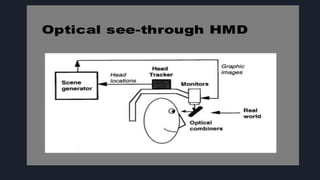
display technology
real time rendering.
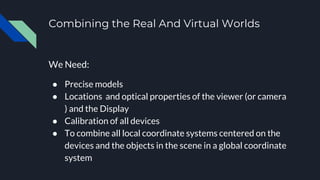
Combining the Real And Virtual Worlds
We Need:
● Precise models
● Locations and optical properties of the viewer (or camera
) and the Display
● Calibration of all devices
● To combine all local coordinate systems centered on the
devices and the objects in the scene in a global coordinate
system
Realistic Merging
Requires:
● Objects to behave in physically plausible manner when
manipulated
● Occlusion
● Collision Detection
● Shadows
Performance Issues
When trying to achieve a plausible augmented image,
● accurate tracking and registration is important, this because when aiming
to get a believable image across to the user, the real camera should be
mapped to the virtual one in such a way that that the perspectives of both
environments precisely match.
● Especially for a moving user, the system needs to constantly determine the
position within the environment of the user surrounding the virtual object,
this because the computer generated object should appear to be fixed [8].
If such a form of complete tracking with a global coordinate system is
required, one can distinguish between outside in and inside out tracking
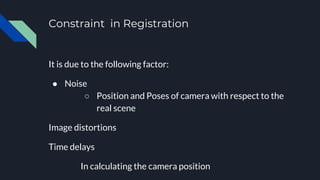
Constraint in Registration
It is due to the following factor:
● Noise
○ Position and Poses of camera with respect to the
real scene
Image distortions
Time delays
In calculating the camera position
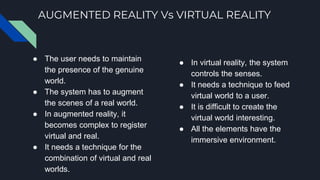
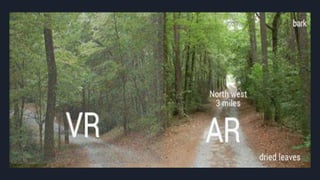
AUGMENTED REALITY Vs VIRTUAL REALITY
● The user needs to maintain
the presence of the genuine
world.
● The system has to augment
the scenes of a real world.
● In augmented reality, it
becomes complex to register
virtual and real.
● It needs a technique for the
combination of virtual and real
worlds.
● In virtual reality, the system
controls the senses.
● It needs a technique to feed
virtual world to a user.
● It is difficult to create the
virtual world interesting.
● All the elements have the
immersive environment.
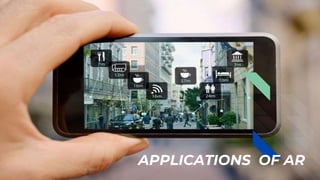
APPLICATIONS OF AR
Medical :
● Laser Scanned Patient
● LCD Screen above
patients.
●
In X-Rays,Ultrasound
etc.
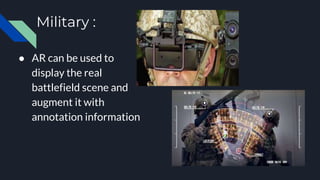
Military :
● AR can be used to
display the real
battlefield scene and
augment it with
annotation information
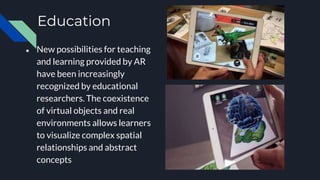
Education
● New possibilities for teaching
and learning provided by AR
have been increasingly
recognized by educational
researchers. The coexistence
of virtual objects and real
environments allows learners
to visualize complex spatial
relationships and abstract
concepts
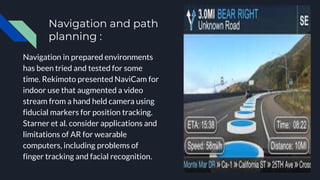
Navigation and path
planning :
Navigation in prepared environments
has been tried and tested for some
time. Rekimoto presented NaviCam for
indoor use that augmented a video
stream from a hand held camera using
fiducial markers for position tracking.
Starner et al. consider applications and
limitations of AR for wearable
computers, including problems of
finger tracking and facial recognition.
ADVANTAGES OF AR
The advantages of the augmented reality are as follows:
● It enhances the knowledge and data of the people.
● It aids the people in sharing the experiences over a long
distance.
● The games of augmented reality furnish more real
experience.
● It has a form of escapism.
DISADVANTAGES
The disadvantages of augmented reality are as follows:
● It has the feature of spam.
● The augmented reality does not have the strong security
features.
● The avail of augmented reality in social situations is
improper.
● In this, the people can advance their own layers of
content.
● It also has the problems like performance issues,
interaction issues, and alignment issues.
CHALLENGES AND ISSUES
● AR system has to deal with vast amount of information in
reality. Therefore the hardware used should be small, light, and
easily portable and fast enough to display graphics.
● Battery Life.
● AR tracking needs some system hardware such as GPS to
provide accurate marker, ask them to be both accurate and
reliable enough.
CONCLUSION
It is important to incorporate a recognition system to acquire a
reference representation of the real world. Further research on this
direction could provide promising results, but it is mostly a top-down
process and hard to deal with object dynamics, and evaluation of
different hypotheses. The challenge is to construct a pervasive
middleware to support the AR system.
[1] Wikipedia
[2] I. E. Sutherland and C. A. Mead, “Microelectronics and computer science,” Scientific
American, vol. 237, pp. 210–228, 1977. [4] T. P.
www.youtube.com
REFERENCES
THANK
YOU

Augmented reality And Its Application

  • 1.
  • 2.
    WHAT IS AUGMENTEDREALITY ? The term Augmented Reality (AR) is used to describe a combination of technologies that enable real-time mixing of computer-generated content with live video display to give us additional information.
  • 3.
    COMPONENT OF AR Accordingto Bimber and Raskar , Augmented reality systems are built upon on three major buildings blocks: tracking and registration display technology real time rendering.
  • 4.
    Combining the RealAnd Virtual Worlds We Need: ● Precise models ● Locations and optical properties of the viewer (or camera ) and the Display ● Calibration of all devices ● To combine all local coordinate systems centered on the devices and the objects in the scene in a global coordinate system
  • 5.
    Realistic Merging Requires: ● Objectsto behave in physically plausible manner when manipulated ● Occlusion ● Collision Detection ● Shadows
  • 7.
    Performance Issues When tryingto achieve a plausible augmented image, ● accurate tracking and registration is important, this because when aiming to get a believable image across to the user, the real camera should be mapped to the virtual one in such a way that that the perspectives of both environments precisely match. ● Especially for a moving user, the system needs to constantly determine the position within the environment of the user surrounding the virtual object, this because the computer generated object should appear to be fixed [8]. If such a form of complete tracking with a global coordinate system is required, one can distinguish between outside in and inside out tracking
  • 8.
    Constraint in Registration Itis due to the following factor: ● Noise ○ Position and Poses of camera with respect to the real scene Image distortions Time delays In calculating the camera position
  • 9.
    AUGMENTED REALITY VsVIRTUAL REALITY ● The user needs to maintain the presence of the genuine world. ● The system has to augment the scenes of a real world. ● In augmented reality, it becomes complex to register virtual and real. ● It needs a technique for the combination of virtual and real worlds. ● In virtual reality, the system controls the senses. ● It needs a technique to feed virtual world to a user. ● It is difficult to create the virtual world interesting. ● All the elements have the immersive environment.
  • 11.
  • 12.
    Medical : ● LaserScanned Patient ● LCD Screen above patients. ● In X-Rays,Ultrasound etc.
  • 13.
    Military : ● ARcan be used to display the real battlefield scene and augment it with annotation information
  • 14.
    Education ● New possibilitiesfor teaching and learning provided by AR have been increasingly recognized by educational researchers. The coexistence of virtual objects and real environments allows learners to visualize complex spatial relationships and abstract concepts
  • 15.
    Navigation and path planning: Navigation in prepared environments has been tried and tested for some time. Rekimoto presented NaviCam for indoor use that augmented a video stream from a hand held camera using fiducial markers for position tracking. Starner et al. consider applications and limitations of AR for wearable computers, including problems of finger tracking and facial recognition.
  • 16.
    ADVANTAGES OF AR Theadvantages of the augmented reality are as follows: ● It enhances the knowledge and data of the people. ● It aids the people in sharing the experiences over a long distance. ● The games of augmented reality furnish more real experience. ● It has a form of escapism.
  • 17.
    DISADVANTAGES The disadvantages ofaugmented reality are as follows: ● It has the feature of spam. ● The augmented reality does not have the strong security features. ● The avail of augmented reality in social situations is improper. ● In this, the people can advance their own layers of content. ● It also has the problems like performance issues, interaction issues, and alignment issues.
  • 18.
    CHALLENGES AND ISSUES ●AR system has to deal with vast amount of information in reality. Therefore the hardware used should be small, light, and easily portable and fast enough to display graphics. ● Battery Life. ● AR tracking needs some system hardware such as GPS to provide accurate marker, ask them to be both accurate and reliable enough.
  • 19.
    CONCLUSION It is importantto incorporate a recognition system to acquire a reference representation of the real world. Further research on this direction could provide promising results, but it is mostly a top-down process and hard to deal with object dynamics, and evaluation of different hypotheses. The challenge is to construct a pervasive middleware to support the AR system.
  • 20.
    [1] Wikipedia [2] I.E. Sutherland and C. A. Mead, “Microelectronics and computer science,” Scientific American, vol. 237, pp. 210–228, 1977. [4] T. P. www.youtube.com REFERENCES
  • 21.