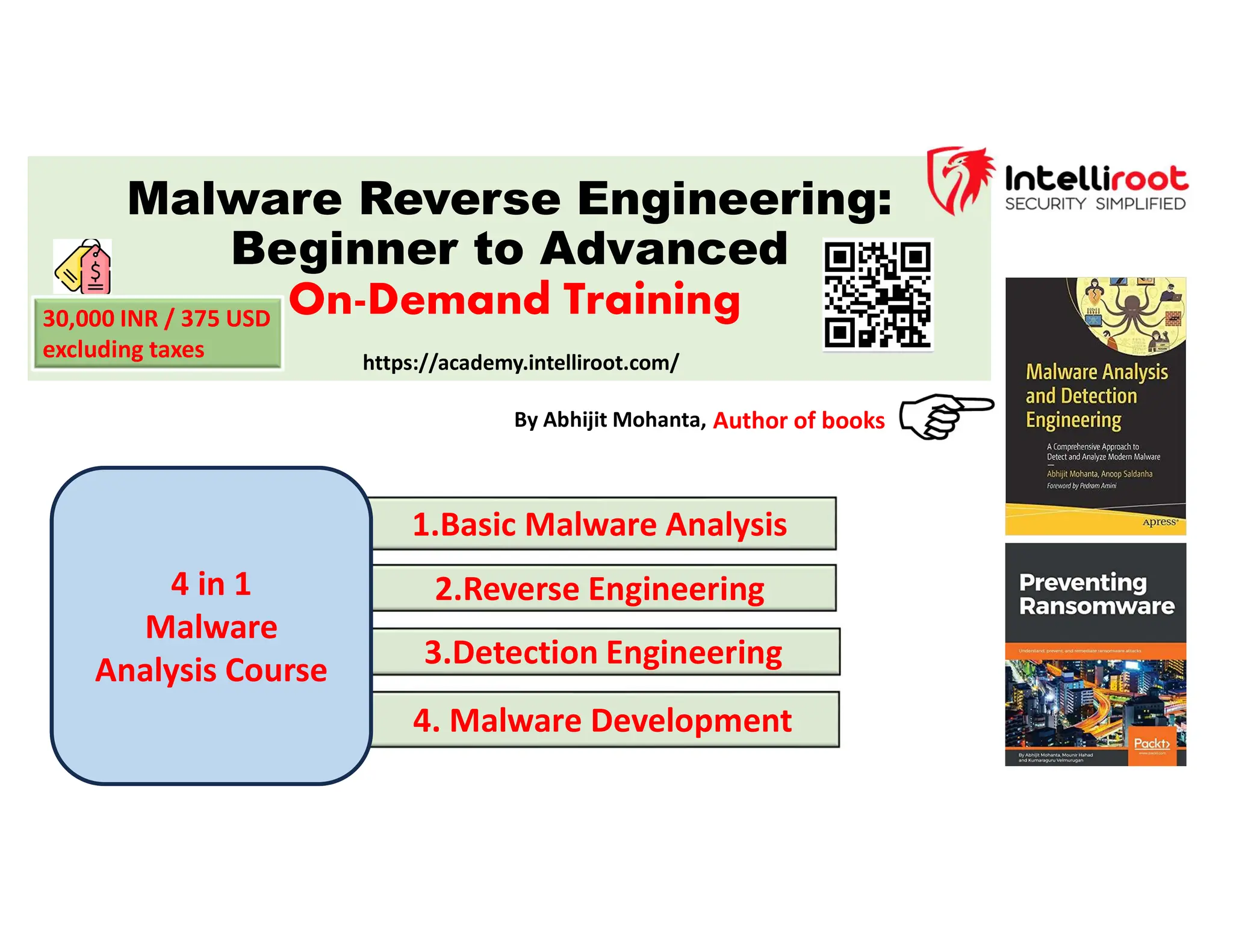
Malware Reverse Engineering:
Beginner to Advanced
On-Demand Training
30,000 INR / 375 USD
excluding taxes
Author of books
By Abhijit Mohanta,
https://academy.intelliroot.com/
1.Basic Malware Analysis
2.Reverse Engineering
3.Detection Engineering
4. Malware Development
4 in 1
Malware
Analysis Course
About Trainer : Abhijit Mohanta
CTO and Co-Founder, Intelliroot
17+ in malware industry as security researcher
2 books, 6 patents, multiple blogs, paper presentation in conferences
Development of Antivirus, Sandbox, EDR
Worked at Mcafee, Symantec, Juniper Labs
Worked Malware analysis and Detection, Reverse Engineering,
Vulnerability Research
provided training at NASSCOM, DIAT(Defense Institute of advanced
technology), AICTE
Spoke at various conferences DSCI, AVAR, SANS, x33Fcon, DMZCon
Testimonials from Students
Uniqueness
Uniqueness
Beginner friendly
Quick recap of basic Malware Analysis
Detailed Assembly Instructions explanation with labs
Detailed Windows Internals explanation with labs
Concepts explained with animations and custom samples
Covers all kind of diversities in Windows Malwares
Malwares written in various programming languages VC++, VB, Golang
Reverse Engineering of Ransomwares, POS malwares, Rootkits
Learn to de-obfuscate and unpack malwares
Learn to analyze variety of techniques used in Malware Anti-techniques, API hooking,
Code Injection, Rootkits
Learn to multiple RE tools
Ghidra, Ollydbg, x64Dg, IDA pro, Process Hacker
Close to 100 labs exercise covering
Approximate 40 hours for video
Student Material
Student Material
1(One) year access of the course online videos of “Malware Reverse
Engineering: Beginner to Advanced (On-Demand)” hosted on
https://academy.intelliroot.com/
Malware Samples provided
No pdf’s would be provided
Doubt clearance sessions
Career Guidance in Malware Analysis
Table Of Contents
Module 1. Introduction (1 hour)
Table Of Contents
Module 1. Introduction (1 hour)
The module covers the following : Malware Analysis in roles require
malware analysis.
The module covers the following topics:
Introduction
Lab setup
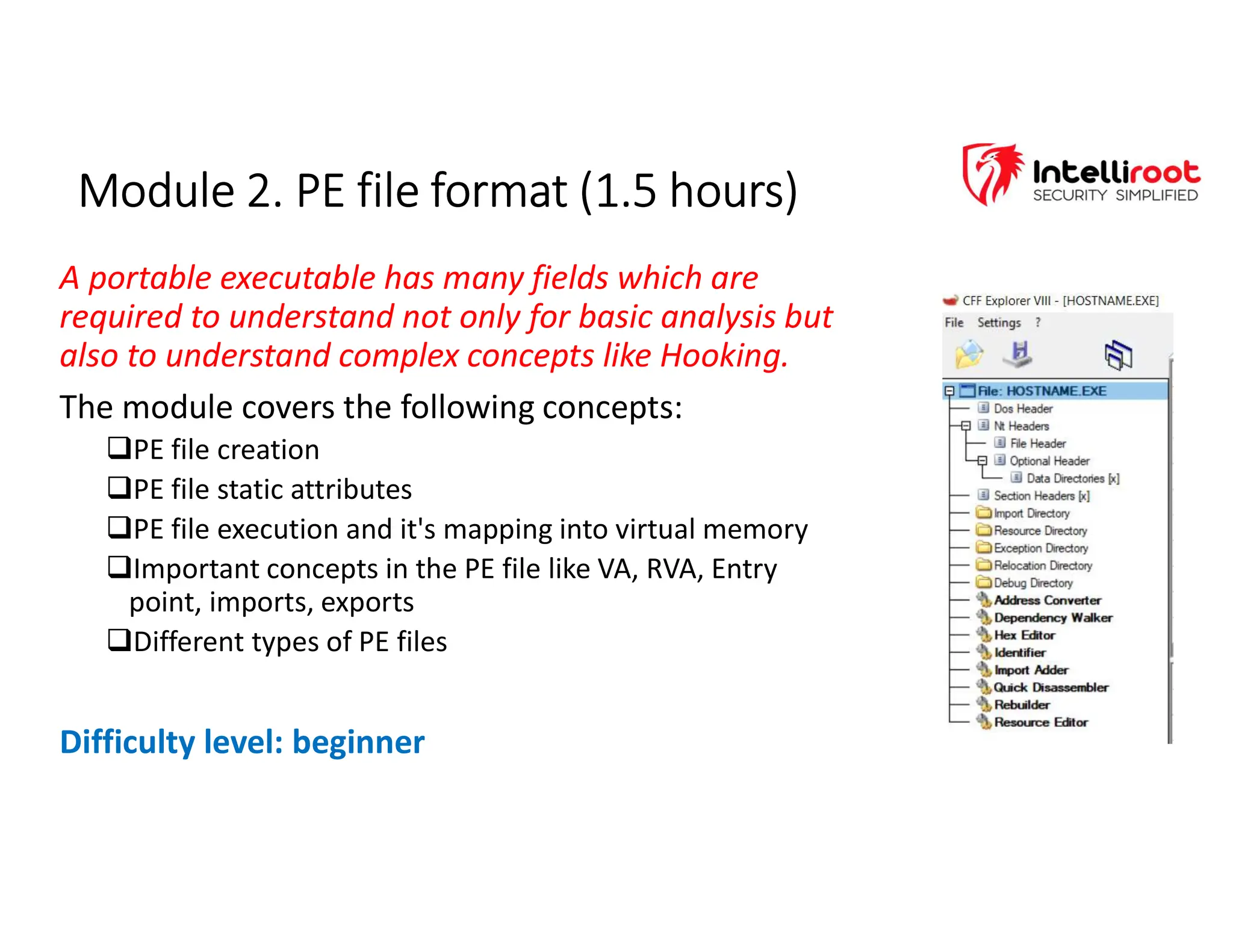
Module 2. PE file format (1.5 hours)
A portable executable has many fields which are
required to understand not only for basic analysis but
also to understand complex concepts like Hooking.
The module covers the following concepts:
PE file creation
PE file static attributes
PE file execution and it's mapping into virtual memory
Important concepts in the PE file like VA, RVA, Entry
point, imports, exports
Different types of PE files
Difficulty level: beginner
Module 3. Windows Internals (45 minutes)
The module gives a superficial idea on Windows Operating system
which is required for malware analysis.
The module covers the following concepts :
Windows File System
Basic Process internals like process virtual memory, handles, thread Thread
Context
Windows Registry
Difficulty level: beginner
Module 4. Basic Malware Analysis (45 mins)
This module serves as a quick revision review of both static and dynamic analysis
methodologies, encompassing critical topics such as virtual memory analysis and
API logging often overlooked by analysts. The module is also helpful for those who
are completely new to malware analysis.
The module covers the following:
 Malware Analysis steps
 Static analysis
 File format identification
Use of procmon
Virtual Memory analysis and string extraction
 API logging
Difficulty level: beginner
Module 5. Tools manual (2 hours)
Reverse Engineering necessitates proficiency with a set of tools such as
Ghidra, IDA, and x64Dbg. The module teaches about configuration and
basic usage of all the tools
The module covers the configuration and basic usage of following tools:
Ghidra
Ollydbg
x64Dbg
IDA
API loggers
Others
Difficulty level: beginner
Module 6. Assembly instruction (4 hours)
Assembly language is always a hurdle for those who aspire to learn Reverse Engineer.
The module has been specially designed for beginners so that they can learn assembly
easily. Learning process has been smoothened with help of animations and custom
tailored samples.
The module covers the following topics:
 Computer architecture - code execution, instructions, registers ,memory
 Data movement instruction
 String instructions
 Arithmetic instruction
 Control flow instructions
 Functions calls, parameters, stack
 Memory layout of arrays, stacks, local variables
Calling Conventions
Understanding Instructions, Opcodes
Difficulty level: beginner and intermediate
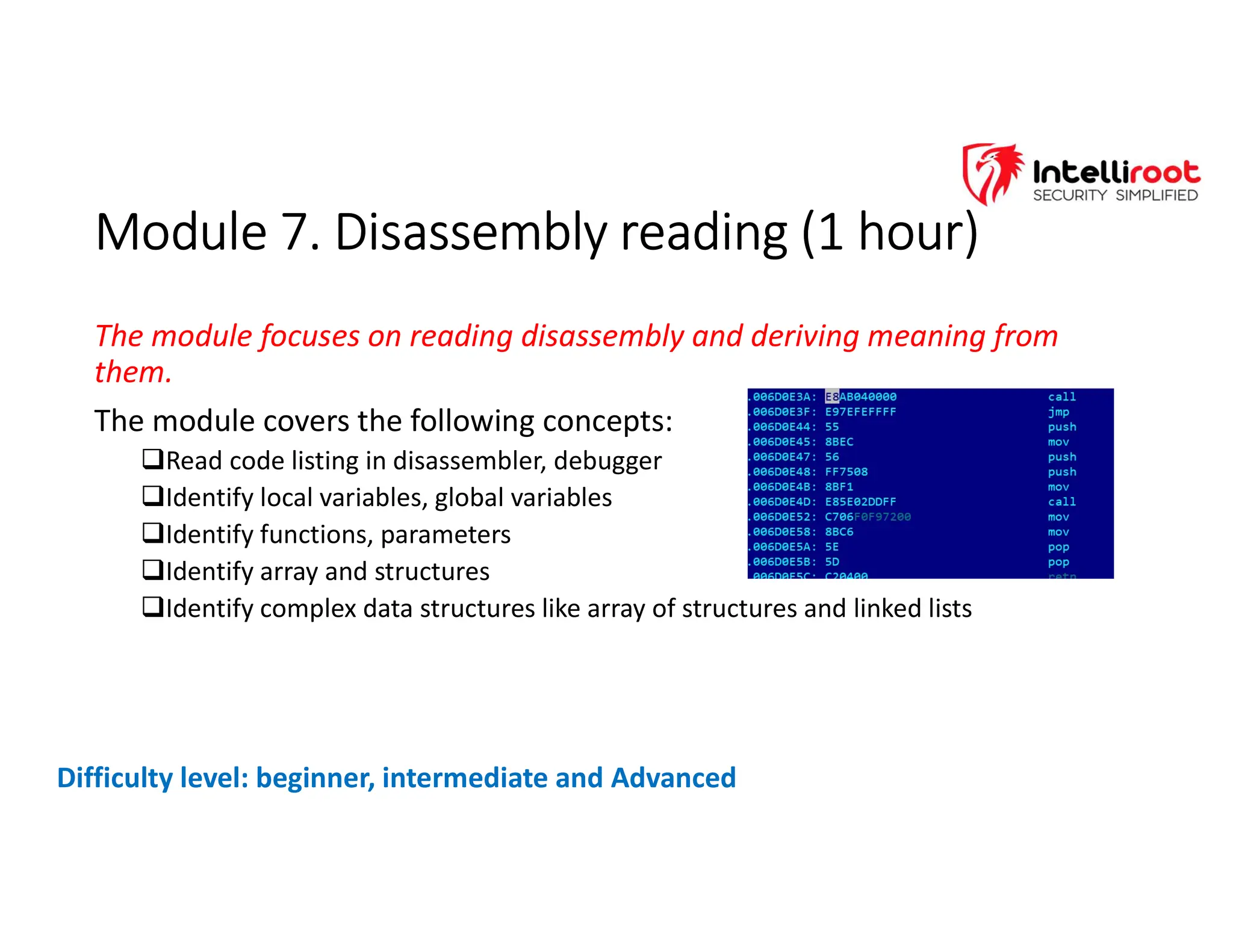
Module 7. Disassembly reading (1 hour)
The module focuses on reading disassembly and deriving meaning from
them.
The module covers the following concepts:
Read code listing in disassembler, debugger
Identify local variables, global variables
Identify functions, parameters
Identify array and structures
Identify complex data structures like array of structures and linked lists
Difficulty level: beginner, intermediate and Advanced
Module 8 - Windows Internals part 1 - Windows API Internals
(30 minutes)
Module 8 - Windows Internals part 1 - Windows API Internals
(30 minutes)
Windows malwares implements various malicious techniques with the help of
API’s. As such one needs to understand how to analyze the API’s. Also
understanding of API internals can be helpful to understand how detection
techniques are developed and even helpful to understand how malwares evade
detection.
The module covers the following concepts:
Referencing to API documentation
How to read API parameters
Analyze parameters passed as structures
API variations - NT versions, Ascii, Unicode
Understanding API call flow from user to kernel, Syscall - concept useful in analyzing
malwares, EDR bypass techniques, API hooking
Identifying API sequences in malware code to identify techniques employed by malwares
Difficulty level: beginner, intermediate and Advanced
Module 9 - windows Internals - part 2 - Common
API sequences in Malwares (1 hour)
Module 9 - windows Internals - part 2 - Common
API sequences in Malwares (1 hour)
Covers commonly seen API sequences across all kinds of malware. The
knowledge of commonly seen API's helps in accelerating Reverse
Engineering as they are common across most malwares hence one does
not need to re-analyse them.
The module covers the following concepts:
Process iteration
File iteration
API resolution
Resource extraction
Registry manipulation
Thread API’s
Difficulty level: beginner, intermediate and Advanced
Module 10 - windows Internals - part 3 - Debug
DLL, COM Objects, Services, PEB (1 hour)
Module 10 - windows Internals - part 3 - Debug
DLL, COM Objects, Services, PEB (1 hour)
Learn techniques to debug programs which cannot be debugged straight
forward like and exe files.
The module covers the following concepts:
Debugging DLL
Debugging COM Objects
Debugging Windows Services
Difficulty level: beginner, intermediate and Advanced
Module 11 - Cryptography in Malwares
( 1 hour 15 mins)
Module 11 - Cryptography in Malwares
( 1 hour 15 mins)
Cryptography is used in malwares to hide it’s own data and more
popularly in Ransomware. Understanding of the topic would help you to
debug ransomwares which is covered in the payload Analysis Module.
The module covers the following concepts:
Understand and Debug Windows Cryptographic API
Identify Crypto Algorithms in malwares
Difficulty level: beginner, intermediate and Advanced
Module 12 - Compilers used by Malwares
( 30 minutes)
Module 12 - Compilers used by Malwares
( 30 minutes)
Compilers play a critical role in generating both legitimate and
malicious binaries. Compilers insert it’s own code in compiled binaries
which can be common in both malwares and clean files. Hence analysts
might end up analyzing the compiler code instead of actual malicious
code.
The module covers the following topics:
Identify compiler used to write malware
Identify compiler stub
Identify main in VC++ binaries
Difficulty level: beginner, intermediate and Advanced
Module 13 - Networking in Malwares
(1 hour 45 mins)
Module 13 - Networking in Malwares
(1 hour 45 mins)
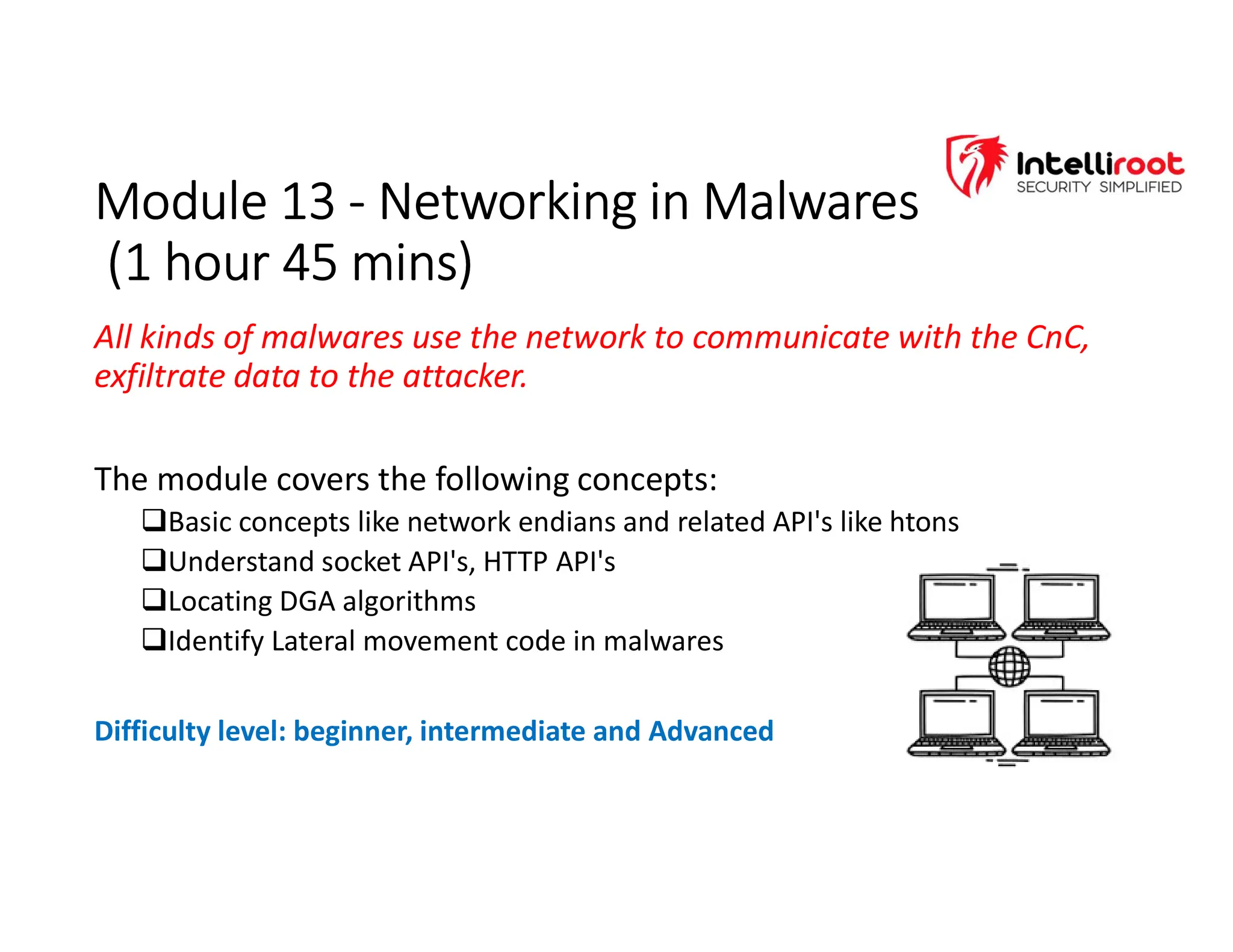
All kinds of malwares use the network to communicate with the CnC,
exfiltrate data to the attacker.
The module covers the following concepts:
Basic concepts like network endians and related API's like htons
Understand socket API's, HTTP API's
Locating DGA algorithms
Identify Lateral movement code in malwares
Difficulty level: beginner, intermediate and Advanced
Module 14- Packers and Unpacking(3 hours)
Malwares use packers to protect executables from static file detection
used in Antivirus. The packer hides the actual functionality of the malware.
In order to understand the actual functionality of the packer, one needs to
unpack it and extract the actual payload by unpacking.
The module covers the following concepts:
Understand packers and process of packing binaries
steps and code involved in packed binary execution
unconventional and undocumented ways to unpack malwares
systematic way to Reverse packed binaries rather than just putting breakpoint on
some API's
Difficulty level: beginner, intermediate and Advanced
Module 15 - Code Injection ( 2 hours)
Malware use code injection to conceal their actual functionality by
injecting code into clean processes. Code injection is further used in
concepts like API hooking which in turn is used by rootkits as well.
The module covers the following concepts:
Conventional code injection techniques like shellcode injection and DLL injection
Advanced techniques like Thread hijacking, section and views, process hollowing
Learn tricks to debug both the injector as well as injected code
Difficulty level: beginner, intermediate and Advanced
Module 16 -API Hooking - ( 2.5 hours)
API hooking is a method to modify functionality of a process by
manipulating the API in memory. The concept is used by anti-malware
softwares as well as malwares. API hooking is used by banking trojans
and rootkits. In the module, one would understand the working of hooks
and recognize them in disassembly.
The module covers the following concepts:
API hooking basics
Type of API hooks - inline hooking, IAT hooking etc
Identifying and Debugging hooks
Banking Trojans Web injects and debugging of Web Inject malware
Difficulty level: beginner, intermediate and Advanced
Module 17 - Rootkits - part 1 - User Mode Rootkit
( 1 hour)
Module 17 - Rootkits - part 1 - User Mode Rootkit
( 1 hour)
Malwares use rootkits to hide artifacts like file, processes. Rootkits can
be user mode or kernel mode. The module covers working of user mode
rootkits and their analysis.
The module covers the following concepts:
Use of API hooks in rootkits
Disassembly analysis of user mode rootkit
Difficulty level: Intermediate and Advanced
Module 18 - Rootkit - part 2 - Kernel Driver-basics
(15 mins)
Module 18 - Rootkit - part 2 - Kernel Driver-basics
(15 mins)
Kernel mode rootkits are implemented using kernel drivers. The module
explains the working of kernel drivers and teaches how to debug them.
Only basics are covered which are enough to kickstart analysis of kernel
drivers.
Following concepts are covered in the module
Basic concepts of windows driver - driver objects
irp’s
ioctl’s
Driver Installation
Difficulty level: Basic and Intermediate
Module 18 - Rootkit - part 3 – Kernel Debugging
( 1 hour)
Module 18 - Rootkit - part 3 – Kernel Debugging
( 1 hour)
The module talks about debugging a kernel rootkit starting with
configuration of Windbg for remote Debugging till debugging the driver
code.
The module covers the following topics:
Configuring Windbg for remote kernel debugging
Breaking at entry point of kernel drivers
SSDT rootkit concept
DKOM rootkit concept
Debug a DKOM rootkit
Difficulty level: Intermediate and Advanced
Module 19 - .net Reverse Engineering( 1.5 hours)
A lot of malwares today are known to use .net. In this module one would
learn various approaches to reverse engineer .net malwares.
The module covers the following concepts:
Basic working and analysis of .net executables
Debugging .net binaries
Unpacking de-obfuscating .net binaries
Use of tools like DNSpy, De4Dot
Difficulty level: Beginner, Intermediate and Advanced
Module 20 - VB Malware ( 30 mins)
Malware analysts might often encounter malwares written in Visual
basic. In this module one would learn to analyse visual basic binaries.
The module covers the following concepts:
Basics of visual basic binaries
Reverse Engineering visual basic binaries
Difficulty level: Beginner, Intermediate
Module 21 - Golang Malware RE ( 30 mins)
There is a growth in malwares written in golang. In this module one
would learn to analyse golang compiled binaries.
The module covers the following concepts:
Basic of golang binaries
Reverse Engineering golang binaries
Difficulty level: Beginner, Intermediate
Module 22 - Anti-Analysis / Evasion techniques in
malware( 1 hour)
Module 22 - Anti-Analysis / Evasion techniques in
malware( 1 hour)
Malwares use anti-techniques to evade analysis and evade security
software like EDR's, Antivirus, Sandboxes. In this module one is going to
learn about anti-techniques and how to locate and bypass them.
The module covers the following concepts:
Anti-VM
API hashing
UAC bypass
Anti-Debug
Sandbox evasion
EDR and endpoint evasion
Difficulty level: Beginner, Intermediate and Advanced
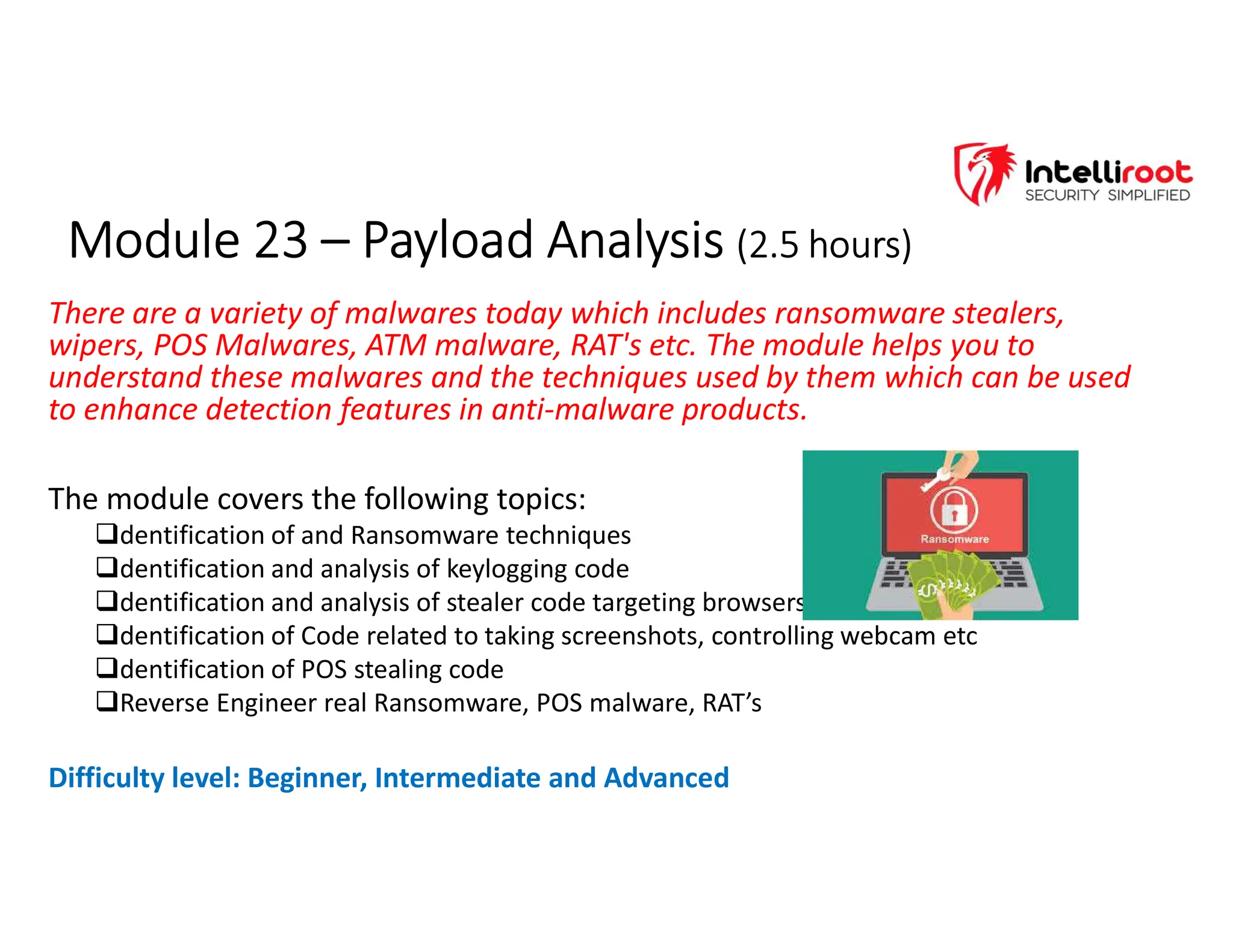
Module 23 – Payload Analysis (2.5 hours)
There are a variety of malwares today which includes ransomware stealers,
wipers, POS Malwares, ATM malware, RAT's etc. The module helps you to
understand these malwares and the techniques used by them which can be used
to enhance detection features in anti-malware products.
The module covers the following topics:
dentification of and Ransomware techniques
dentification and analysis of keylogging code
dentification and analysis of stealer code targeting browsers
dentification of Code related to taking screenshots, controlling webcam etc
dentification of POS stealing code
Reverse Engineer real Ransomware, POS malware, RAT’s
Difficulty level: Beginner, Intermediate and Advanced
Module 24 – Reverse Engineering Malicious Scripts
and Documents (1 hour)
Module 24 – Reverse Engineering Malicious Scripts
and Documents (1 hour)
The module covers analysis of malicious documents. Covers obfuscations
techniques and de-obfuscating word macros
The module covers the following:
Obfuscation techniques
File formats of word documents
VBA macros
De-obfuscating macros with MSOffice VBA debugger
Difficulty level: Beginner, Intermediate and Advanced
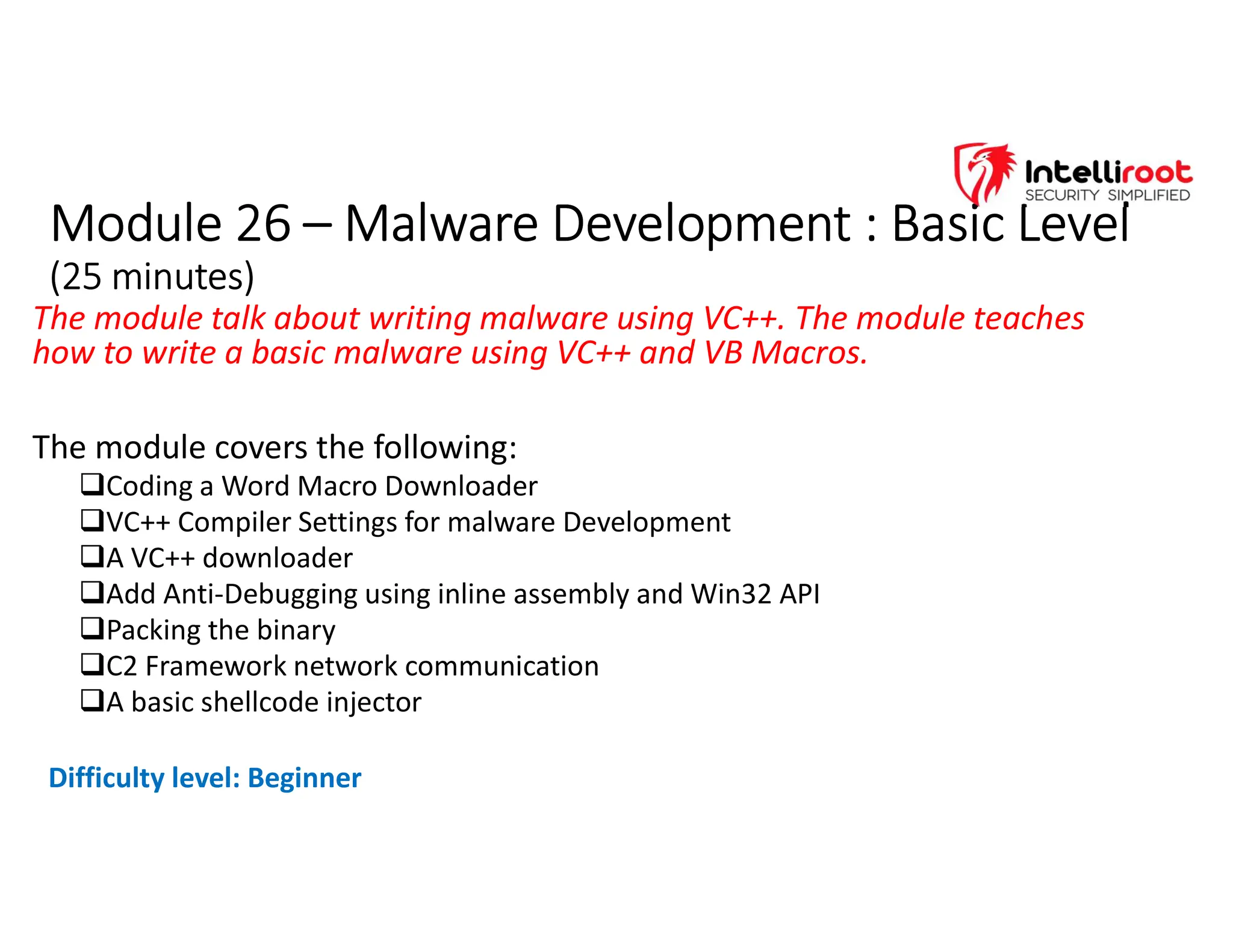
Module 26 – Malware Development : Basic Level
(25 minutes)
Module 26 – Malware Development : Basic Level
(25 minutes)
The module talk about writing malware using VC++. The module teaches
how to write a basic malware using VC++ and VB Macros.
The module covers the following:
Coding a Word Macro Downloader
VC++ Compiler Settings for malware Development
A VC++ downloader
Add Anti-Debugging using inline assembly and Win32 API
Packing the binary
C2 Framework network communication
A basic shellcode injector
Difficulty level: Beginner
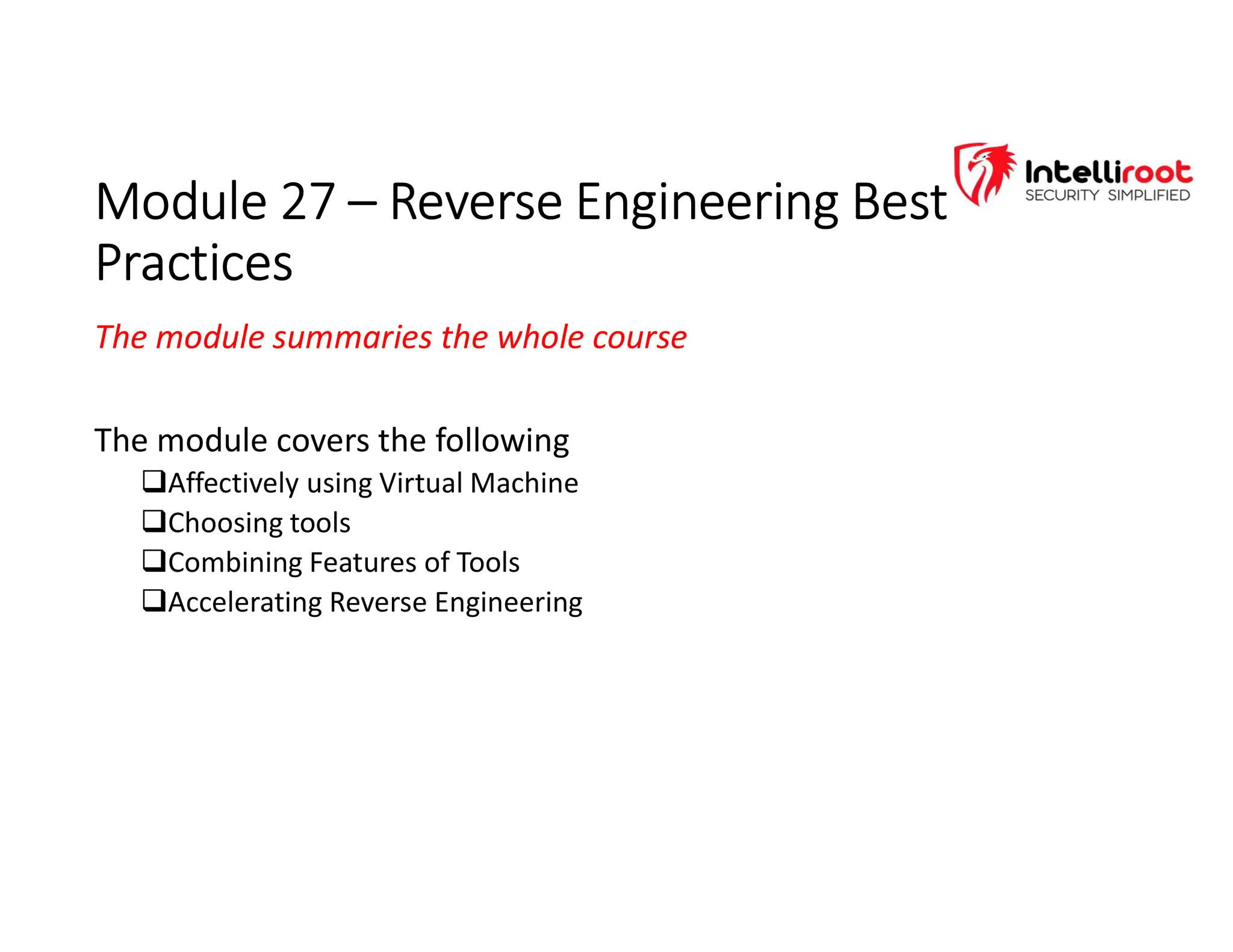
Module 27 – Reverse Engineering Best
Practices
Module 27 – Reverse Engineering Best
Practices
The module summaries the whole course
The module covers the following
Affectively using Virtual Machine
Choosing tools
Combining Features of Tools
Accelerating Reverse Engineering

Aug-On-Demand-Malware RE basic to Advanced.pdf

  • 1.
    Malware Reverse Engineering: Beginnerto Advanced On-Demand Training 30,000 INR / 375 USD excluding taxes Author of books By Abhijit Mohanta, https://academy.intelliroot.com/ 1.Basic Malware Analysis 2.Reverse Engineering 3.Detection Engineering 4. Malware Development 4 in 1 Malware Analysis Course
  • 2.
    About Trainer :Abhijit Mohanta About Trainer : Abhijit Mohanta CTO and Co-Founder, Intelliroot 17+ in malware industry as security researcher 2 books, 6 patents, multiple blogs, paper presentation in conferences Development of Antivirus, Sandbox, EDR Worked at Mcafee, Symantec, Juniper Labs Worked Malware analysis and Detection, Reverse Engineering, Vulnerability Research provided training at NASSCOM, DIAT(Defense Institute of advanced technology), AICTE Spoke at various conferences DSCI, AVAR, SANS, x33Fcon, DMZCon
  • 3.
  • 4.
    Uniqueness Uniqueness Beginner friendly Quick recapof basic Malware Analysis Detailed Assembly Instructions explanation with labs Detailed Windows Internals explanation with labs Concepts explained with animations and custom samples Covers all kind of diversities in Windows Malwares Malwares written in various programming languages VC++, VB, Golang Reverse Engineering of Ransomwares, POS malwares, Rootkits Learn to de-obfuscate and unpack malwares Learn to analyze variety of techniques used in Malware Anti-techniques, API hooking, Code Injection, Rootkits Learn to multiple RE tools Ghidra, Ollydbg, x64Dg, IDA pro, Process Hacker Close to 100 labs exercise covering Approximate 40 hours for video
  • 5.
    Student Material Student Material 1(One)year access of the course online videos of “Malware Reverse Engineering: Beginner to Advanced (On-Demand)” hosted on https://academy.intelliroot.com/ Malware Samples provided No pdf’s would be provided Doubt clearance sessions Career Guidance in Malware Analysis
  • 6.
    Table Of Contents Module1. Introduction (1 hour) Table Of Contents Module 1. Introduction (1 hour) The module covers the following : Malware Analysis in roles require malware analysis. The module covers the following topics: Introduction Lab setup
  • 7.
    Module 2. PEfile format (1.5 hours) Module 2. PE file format (1.5 hours) A portable executable has many fields which are required to understand not only for basic analysis but also to understand complex concepts like Hooking. The module covers the following concepts: PE file creation PE file static attributes PE file execution and it's mapping into virtual memory Important concepts in the PE file like VA, RVA, Entry point, imports, exports Different types of PE files Difficulty level: beginner
  • 8.
    Module 3. WindowsInternals (45 minutes) Module 3. Windows Internals (45 minutes) The module gives a superficial idea on Windows Operating system which is required for malware analysis. The module covers the following concepts : Windows File System Basic Process internals like process virtual memory, handles, thread Thread Context Windows Registry Difficulty level: beginner
  • 9.
    Module 4. BasicMalware Analysis (45 mins) Module 4. Basic Malware Analysis (45 mins) This module serves as a quick revision review of both static and dynamic analysis methodologies, encompassing critical topics such as virtual memory analysis and API logging often overlooked by analysts. The module is also helpful for those who are completely new to malware analysis. The module covers the following:  Malware Analysis steps  Static analysis  File format identification Use of procmon Virtual Memory analysis and string extraction  API logging Difficulty level: beginner
  • 10.
    Module 5. Toolsmanual (2 hours) Module 5. Tools manual (2 hours) Reverse Engineering necessitates proficiency with a set of tools such as Ghidra, IDA, and x64Dbg. The module teaches about configuration and basic usage of all the tools The module covers the configuration and basic usage of following tools: Ghidra Ollydbg x64Dbg IDA API loggers Others Difficulty level: beginner
  • 11.
    Module 6. Assemblyinstruction (4 hours) Module 6. Assembly instruction (4 hours) Assembly language is always a hurdle for those who aspire to learn Reverse Engineer. The module has been specially designed for beginners so that they can learn assembly easily. Learning process has been smoothened with help of animations and custom tailored samples. The module covers the following topics:  Computer architecture - code execution, instructions, registers ,memory  Data movement instruction  String instructions  Arithmetic instruction  Control flow instructions  Functions calls, parameters, stack  Memory layout of arrays, stacks, local variables Calling Conventions Understanding Instructions, Opcodes Difficulty level: beginner and intermediate
  • 12.
    Module 7. Disassemblyreading (1 hour) Module 7. Disassembly reading (1 hour) The module focuses on reading disassembly and deriving meaning from them. The module covers the following concepts: Read code listing in disassembler, debugger Identify local variables, global variables Identify functions, parameters Identify array and structures Identify complex data structures like array of structures and linked lists Difficulty level: beginner, intermediate and Advanced
  • 13.
    Module 8 -Windows Internals part 1 - Windows API Internals (30 minutes) Module 8 - Windows Internals part 1 - Windows API Internals (30 minutes) Windows malwares implements various malicious techniques with the help of API’s. As such one needs to understand how to analyze the API’s. Also understanding of API internals can be helpful to understand how detection techniques are developed and even helpful to understand how malwares evade detection. The module covers the following concepts: Referencing to API documentation How to read API parameters Analyze parameters passed as structures API variations - NT versions, Ascii, Unicode Understanding API call flow from user to kernel, Syscall - concept useful in analyzing malwares, EDR bypass techniques, API hooking Identifying API sequences in malware code to identify techniques employed by malwares Difficulty level: beginner, intermediate and Advanced
  • 14.
    Module 9 -windows Internals - part 2 - Common API sequences in Malwares (1 hour) Module 9 - windows Internals - part 2 - Common API sequences in Malwares (1 hour) Covers commonly seen API sequences across all kinds of malware. The knowledge of commonly seen API's helps in accelerating Reverse Engineering as they are common across most malwares hence one does not need to re-analyse them. The module covers the following concepts: Process iteration File iteration API resolution Resource extraction Registry manipulation Thread API’s Difficulty level: beginner, intermediate and Advanced
  • 15.
    Module 10 -windows Internals - part 3 - Debug DLL, COM Objects, Services, PEB (1 hour) Module 10 - windows Internals - part 3 - Debug DLL, COM Objects, Services, PEB (1 hour) Learn techniques to debug programs which cannot be debugged straight forward like and exe files. The module covers the following concepts: Debugging DLL Debugging COM Objects Debugging Windows Services Difficulty level: beginner, intermediate and Advanced
  • 16.
    Module 11 -Cryptography in Malwares ( 1 hour 15 mins) Module 11 - Cryptography in Malwares ( 1 hour 15 mins) Cryptography is used in malwares to hide it’s own data and more popularly in Ransomware. Understanding of the topic would help you to debug ransomwares which is covered in the payload Analysis Module. The module covers the following concepts: Understand and Debug Windows Cryptographic API Identify Crypto Algorithms in malwares Difficulty level: beginner, intermediate and Advanced
  • 17.
    Module 12 -Compilers used by Malwares ( 30 minutes) Module 12 - Compilers used by Malwares ( 30 minutes) Compilers play a critical role in generating both legitimate and malicious binaries. Compilers insert it’s own code in compiled binaries which can be common in both malwares and clean files. Hence analysts might end up analyzing the compiler code instead of actual malicious code. The module covers the following topics: Identify compiler used to write malware Identify compiler stub Identify main in VC++ binaries Difficulty level: beginner, intermediate and Advanced
  • 18.
    Module 13 -Networking in Malwares (1 hour 45 mins) Module 13 - Networking in Malwares (1 hour 45 mins) All kinds of malwares use the network to communicate with the CnC, exfiltrate data to the attacker. The module covers the following concepts: Basic concepts like network endians and related API's like htons Understand socket API's, HTTP API's Locating DGA algorithms Identify Lateral movement code in malwares Difficulty level: beginner, intermediate and Advanced
  • 19.
    Module 14- Packersand Unpacking(3 hours) Module 14- Packers and Unpacking(3 hours) Malwares use packers to protect executables from static file detection used in Antivirus. The packer hides the actual functionality of the malware. In order to understand the actual functionality of the packer, one needs to unpack it and extract the actual payload by unpacking. The module covers the following concepts: Understand packers and process of packing binaries steps and code involved in packed binary execution unconventional and undocumented ways to unpack malwares systematic way to Reverse packed binaries rather than just putting breakpoint on some API's Difficulty level: beginner, intermediate and Advanced
  • 20.
    Module 15 -Code Injection ( 2 hours) Module 15 - Code Injection ( 2 hours) Malware use code injection to conceal their actual functionality by injecting code into clean processes. Code injection is further used in concepts like API hooking which in turn is used by rootkits as well. The module covers the following concepts: Conventional code injection techniques like shellcode injection and DLL injection Advanced techniques like Thread hijacking, section and views, process hollowing Learn tricks to debug both the injector as well as injected code Difficulty level: beginner, intermediate and Advanced
  • 21.
    Module 16 -APIHooking - ( 2.5 hours) Module 16 -API Hooking - ( 2.5 hours) API hooking is a method to modify functionality of a process by manipulating the API in memory. The concept is used by anti-malware softwares as well as malwares. API hooking is used by banking trojans and rootkits. In the module, one would understand the working of hooks and recognize them in disassembly. The module covers the following concepts: API hooking basics Type of API hooks - inline hooking, IAT hooking etc Identifying and Debugging hooks Banking Trojans Web injects and debugging of Web Inject malware Difficulty level: beginner, intermediate and Advanced
  • 22.
    Module 17 -Rootkits - part 1 - User Mode Rootkit ( 1 hour) Module 17 - Rootkits - part 1 - User Mode Rootkit ( 1 hour) Malwares use rootkits to hide artifacts like file, processes. Rootkits can be user mode or kernel mode. The module covers working of user mode rootkits and their analysis. The module covers the following concepts: Use of API hooks in rootkits Disassembly analysis of user mode rootkit Difficulty level: Intermediate and Advanced
  • 23.
    Module 18 -Rootkit - part 2 - Kernel Driver-basics (15 mins) Module 18 - Rootkit - part 2 - Kernel Driver-basics (15 mins) Kernel mode rootkits are implemented using kernel drivers. The module explains the working of kernel drivers and teaches how to debug them. Only basics are covered which are enough to kickstart analysis of kernel drivers. Following concepts are covered in the module Basic concepts of windows driver - driver objects irp’s ioctl’s Driver Installation Difficulty level: Basic and Intermediate
  • 24.
    Module 18 -Rootkit - part 3 – Kernel Debugging ( 1 hour) Module 18 - Rootkit - part 3 – Kernel Debugging ( 1 hour) The module talks about debugging a kernel rootkit starting with configuration of Windbg for remote Debugging till debugging the driver code. The module covers the following topics: Configuring Windbg for remote kernel debugging Breaking at entry point of kernel drivers SSDT rootkit concept DKOM rootkit concept Debug a DKOM rootkit Difficulty level: Intermediate and Advanced
  • 25.
    Module 19 -.net Reverse Engineering( 1.5 hours) Module 19 - .net Reverse Engineering( 1.5 hours) A lot of malwares today are known to use .net. In this module one would learn various approaches to reverse engineer .net malwares. The module covers the following concepts: Basic working and analysis of .net executables Debugging .net binaries Unpacking de-obfuscating .net binaries Use of tools like DNSpy, De4Dot Difficulty level: Beginner, Intermediate and Advanced
  • 26.
    Module 20 -VB Malware ( 30 mins) Module 20 - VB Malware ( 30 mins) Malware analysts might often encounter malwares written in Visual basic. In this module one would learn to analyse visual basic binaries. The module covers the following concepts: Basics of visual basic binaries Reverse Engineering visual basic binaries Difficulty level: Beginner, Intermediate
  • 27.
    Module 21 -Golang Malware RE ( 30 mins) Module 21 - Golang Malware RE ( 30 mins) There is a growth in malwares written in golang. In this module one would learn to analyse golang compiled binaries. The module covers the following concepts: Basic of golang binaries Reverse Engineering golang binaries Difficulty level: Beginner, Intermediate
  • 28.
    Module 22 -Anti-Analysis / Evasion techniques in malware( 1 hour) Module 22 - Anti-Analysis / Evasion techniques in malware( 1 hour) Malwares use anti-techniques to evade analysis and evade security software like EDR's, Antivirus, Sandboxes. In this module one is going to learn about anti-techniques and how to locate and bypass them. The module covers the following concepts: Anti-VM API hashing UAC bypass Anti-Debug Sandbox evasion EDR and endpoint evasion Difficulty level: Beginner, Intermediate and Advanced
  • 29.
    Module 23 –Payload Analysis (2.5 hours) Module 23 – Payload Analysis (2.5 hours) There are a variety of malwares today which includes ransomware stealers, wipers, POS Malwares, ATM malware, RAT's etc. The module helps you to understand these malwares and the techniques used by them which can be used to enhance detection features in anti-malware products. The module covers the following topics: dentification of and Ransomware techniques dentification and analysis of keylogging code dentification and analysis of stealer code targeting browsers dentification of Code related to taking screenshots, controlling webcam etc dentification of POS stealing code Reverse Engineer real Ransomware, POS malware, RAT’s Difficulty level: Beginner, Intermediate and Advanced
  • 30.
    Module 24 –Reverse Engineering Malicious Scripts and Documents (1 hour) Module 24 – Reverse Engineering Malicious Scripts and Documents (1 hour) The module covers analysis of malicious documents. Covers obfuscations techniques and de-obfuscating word macros The module covers the following: Obfuscation techniques File formats of word documents VBA macros De-obfuscating macros with MSOffice VBA debugger Difficulty level: Beginner, Intermediate and Advanced
  • 31.
    Module 26 –Malware Development : Basic Level (25 minutes) Module 26 – Malware Development : Basic Level (25 minutes) The module talk about writing malware using VC++. The module teaches how to write a basic malware using VC++ and VB Macros. The module covers the following: Coding a Word Macro Downloader VC++ Compiler Settings for malware Development A VC++ downloader Add Anti-Debugging using inline assembly and Win32 API Packing the binary C2 Framework network communication A basic shellcode injector Difficulty level: Beginner
  • 32.
    Module 27 –Reverse Engineering Best Practices Module 27 – Reverse Engineering Best Practices The module summaries the whole course The module covers the following Affectively using Virtual Machine Choosing tools Combining Features of Tools Accelerating Reverse Engineering