Where to
Find What
youNeed:
• In your Blackboard course find Auditory
Presentation for FSA. You will see:
• Letter to Superintendents introducing the
accommodation and criteria
• Policy Document with examples of diagnostic
assessments (pages 3-5 guide the school IEP
team in documentation that will be required).
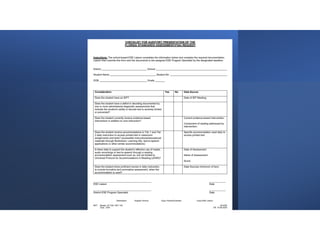
• District Checklist For Auditory Presentation of
Florida Standards Assessment (FSA) Request.
(Signed by the ESE Liaison and Program
Specialist)
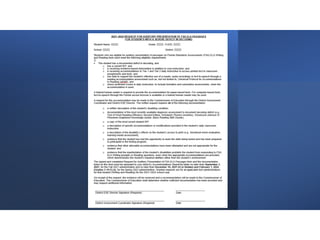
• 21-22 Request for Auditory Presentation of FSA
ELA Passages For Students With a Severe Deficit
in Decoding
• K-12 comprehensive reading plan link
• SCS Reading Excellence Website (reading
resources and decision trees for K-5)
3.
www.FLDOE.org
3
Chancellor’s Memo –October 16, 2020
“A process is now available for districts to request
auditory presentation of passage on the Florida
Standards Assessments (FSA) English Language Arts
(ELA) Reading and Writing assessment for eligible
students in Spring 2021 and beyond.”
4.
www.FLDOE.org
4
Unique Accommodations- intendedfor
• Eligible students that have proven (documented) success using this
accommodation in the classroom to access grade level content.
• It is not intended to be an additional accommodation to help a
student access the test, but to continue the access they have in the
classroom into the testing environment.
• The purpose of this unique auditory access accommodation is to give
the student access to the statewide English Language Arts (ELA) Reading
and Writing Assessment, which assesses reading and writing skills
beyond decoding in order to demonstrate their knowledge of Florida’s
ELA Standards.
5.
www.FLDOE.org
5
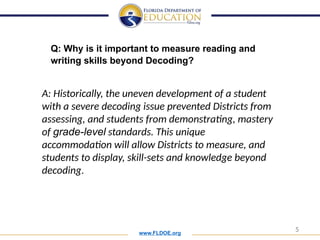
Q: Why isit important to measure reading and
writing skills beyond Decoding?
A: Historically, the uneven development of a student
with a severe decoding issue prevented Districts from
assessing, and students from demonstrating, mastery
of grade-level standards. This unique
accommodation will allow Districts to measure, and
students to display, skill-sets and knowledge beyond
decoding.
6.
www.FLDOE.org
6
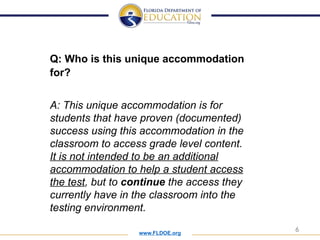
Q: Who isthis unique accommodation
for?
A: This unique accommodation is for
students that have proven (documented)
success using this accommodation in the
classroom to access grade level content.
It is not intended to be an additional
accommodation to help a student access
the test, but to continue the access they
currently have in the classroom into the
testing environment.
7.
www.FLDOE.org
7
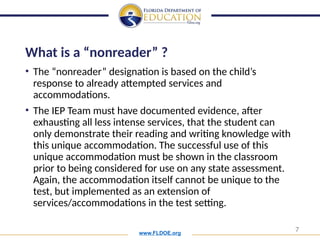
What is a“nonreader” ?
• The “nonreader” designation is based on the child’s
response to already attempted services and
accommodations.
• The IEP Team must have documented evidence, after
exhausting all less intense services, that the student can
only demonstrate their reading and writing knowledge with
this unique accommodation. The successful use of this
unique accommodation must be shown in the classroom
prior to being considered for use on any state assessment.
Again, the accommodation itself cannot be unique to the
test, but implemented as an extension of
services/accommodations in the test setting.
8.
www.FLDOE.org
8
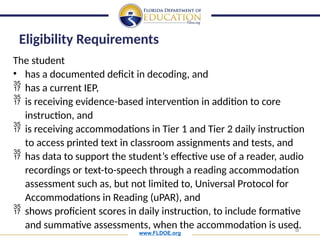
The student
• hasa documented deficit in decoding, and
has a current IEP,
is receiving evidence-based intervention in addition to core
instruction, and
is receiving accommodations in Tier 1 and Tier 2 daily instruction
to access printed text in classroom assignments and tests, and
has data to support the student’s effective use of a reader, audio
recordings or text-to-speech through a reading accommodation
assessment such as, but not limited to, Universal Protocol for
Accommodations in Reading (uPAR), and
shows proficient scores in daily instruction, to include formative
and summative assessments, when the accommodation is used.
Eligibility Requirements
9.
www.FLDOE.org
9
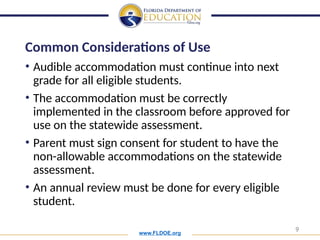
Common Considerations ofUse
• Audible accommodation must continue into next
grade for all eligible students.
• The accommodation must be correctly
implemented in the classroom before approved for
use on the statewide assessment.
• Parent must sign consent for student to have the
non-allowable accommodations on the statewide
assessment.
• An annual review must be done for every eligible
student.
10.
www.FLDOE.org
10
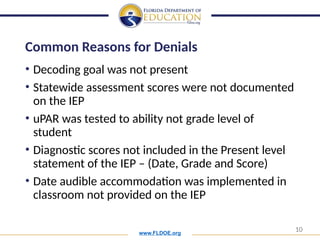
Common Reasons forDenials
• Decoding goal was not present
• Statewide assessment scores were not documented
on the IEP
• uPAR was tested to ability not grade level of
student
• Diagnostic scores not included in the Present level
statement of the IEP – (Date, Grade and Score)
• Date audible accommodation was implemented in
classroom not provided on the IEP
11.
www.FLDOE.org
11
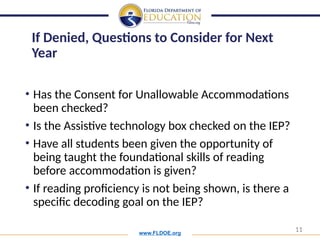
If Denied, Questionsto Consider for Next
Year
• Has the Consent for Unallowable Accommodations
been checked?
• Is the Assistive technology box checked on the IEP?
• Have all students been given the opportunity of
being taught the foundational skills of reading
before accommodation is given?
• If reading proficiency is not being shown, is there a
specific decoding goal on the IEP?
12.
www.FLDOE.org
12
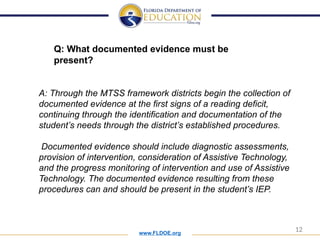
A: Through theMTSS framework districts begin the collection of
documented evidence at the first signs of a reading deficit,
continuing through the identification and documentation of the
student’s needs through the district’s established procedures.
Documented evidence should include diagnostic assessments,
provision of intervention, consideration of Assistive Technology,
and the progress monitoring of intervention and use of Assistive
Technology. The documented evidence resulting from these
procedures can and should be present in the student’s IEP.
Q: What documented evidence must be
present?
13.
www.FLDOE.org
13
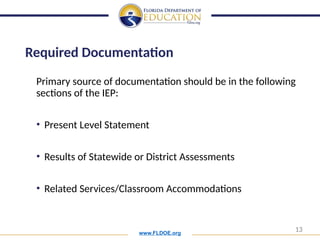
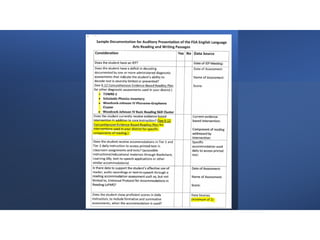
Primary source ofdocumentation should be in the following
sections of the IEP:
• Present Level Statement
• Results of Statewide or District Assessments
• Related Services/Classroom Accommodations
Required Documentation
14.
www.FLDOE.org
14
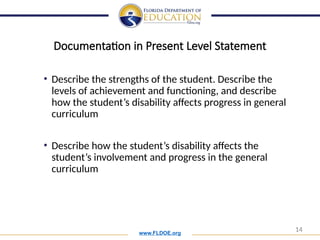
Documentation in PresentLevel Statement
• Describe the strengths of the student. Describe the
levels of achievement and functioning, and describe
how the student’s disability affects progress in general
curriculum
• Describe how the student’s disability affects the
student’s involvement and progress in the general
curriculum
15.
www.FLDOE.org
15
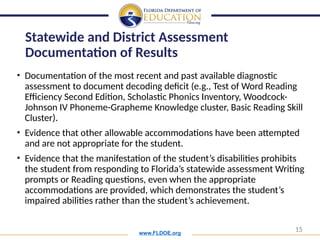
• Documentation ofthe most recent and past available diagnostic
assessment to document decoding deficit (e.g., Test of Word Reading
Efficiency Second Edition, Scholastic Phonics Inventory, Woodcock-
Johnson IV Phoneme-Grapheme Knowledge cluster, Basic Reading Skill
Cluster).
• Evidence that other allowable accommodations have been attempted
and are not appropriate for the student.
• Evidence that the manifestation of the student’s disabilities prohibits
the student from responding to Florida’s statewide assessment Writing
prompts or Reading questions, even when the appropriate
accommodations are provided, which demonstrates the student’s
impaired abilities rather than the student’s achievement.
Statewide and District Assessment
Documentation of Results
16.
www.FLDOE.org
16
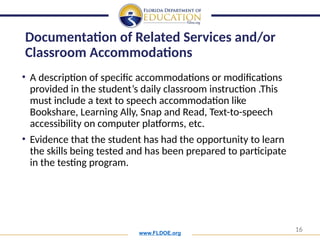
• A descriptionof specific accommodations or modifications
provided in the student’s daily classroom instruction .This
must include a text to speech accommodation like
Bookshare, Learning Ally, Snap and Read, Text-to-speech
accessibility on computer platforms, etc.
• Evidence that the student has had the opportunity to learn
the skills being tested and has been prepared to participate
in the testing program.
Documentation of Related Services and/or
Classroom Accommodations
17.
www.FLDOE.org
17
• IEP teammakes the decision to request the unique
accommodation based on specific guidelines and fills out
the request form;
• District gathers required documentation; and
• District ESE Director and District Assessment Coordinator
sign and submit form and documentation to the Office of
K-12 Student Assessment via Sharefile.
Submitting the Required Documentation
18.
www.FLDOE.org
18
After submission ofthe required documentation and on
receipt of the request, the submitted evidence will be
reviewed by a committee and a decision of approval or denial
will be made to the Office of K-12 Student Assessment.
Final Review Process:
#3 Heather
On October 16, 2020, a memo went out from the Chancellor alerting districts there was a new accommodation available to student that met the criteria. District were required to submit IEP’s and other specific documentation for a review and approval of the use of the accommodation. Once the review was completed, the district was then alerted to the approval or denial of the accommodation. This process will remain much the same this year for the retakes and the assessments occurring in the spring.
#4 Danielle
The accommodation means…. auditory presentation
which assesses reading and writing skills beyond decoding in order to demonstrate their knowledge of Florida’s ELA Standards.
#7 Danielle
One word that has been revisited and many questions asked about is nonreader. The “nonreader” designation is based on the child’s response to already attempted services and accommodations. The IEP Team must have documented evidence, after exhausting all less intense services, that the student can only demonstrate their reading and writing knowledge with this unique accommodation. The successful use of this unique accommodation must be shown in the classroom prior to being considered for use on any state assessment. Again, the accommodation itself cannot be unique to the test, but implemented as an extension of services/accommodations in the test setting.
#8 Heather
Demonstrates grade level proficiency in classroom with the accommodation.
#9 Heather
Annual review of the need for the accommodation- update IEP and submit request annually.
#10 Heather
These were some of the most common reasons for denial in the past submissions.
uPAR tests for grade level and for independent reading level.
Date first implemented- hx of auditory accommodation use.
#11 Heather
Accessible instructional/educational materials through Bookshare, Learning Ally, text-to-speech applications or other similar accommodations
#14 Danielle
A statement that describes how the decoding deficit, and other reading component deficits, affects progress in general curriculum.
For example…Without auditory reading support the student cannot independently read items to complete assignments and tests.
#17 Heather
Contact Program Specialist with data, or for support if needed while collecting data.
If no decoding goal, instruction data and RTI data regarding decoding and reading instruction; OR no auditory accommodation, does not need to be reviewed by district yet. Continue to work through the process for a later time.
Sharefile info can be accessed thought the district assessment coordinator
#18 Heather
This is an FDOE review team.
If the review team feels there may be more evidence that could be considered, the office of assessment will contact the district for that information.
#19
Testing window starts on February 1, 2022.
This is exactly 60 days prior to the Grade 3 Reading and Grades 4-10 Writing window which begins April 4th.
Documentation and request has to be uploaded to the state Sharefile by that date.
December 15th gives time to review the documentation and request anything additional from the school team.
#20 Danielle
District form that follows the policy from FDOE


![Cep 840 marty iep (2)[2]](https://cdn.slidesharecdn.com/ss_thumbnails/cep840martyiep22-141023203250-conversion-gate02-thumbnail.jpg?width=640&height=640&fit=bounds)


