C.S. Lewis writes that God has infinite attention for each individual person as if they were the only person God created. Though there are many people, God relates to each person with singular focus and care.
“God has infiniteattention to spare for
each one of us. He does not deal with us
in the mass. You are as much alone with
him as if you were the only being
he had created.”
C. S. Lewis, Mere Christianity
http://www.worldinterestingfacts.com/wp-content/uploads/2010/03/most-beautiful-mountain-in-the-world-Mount-Meru-Arusha-National-Park-Tanzania.jpg
2.
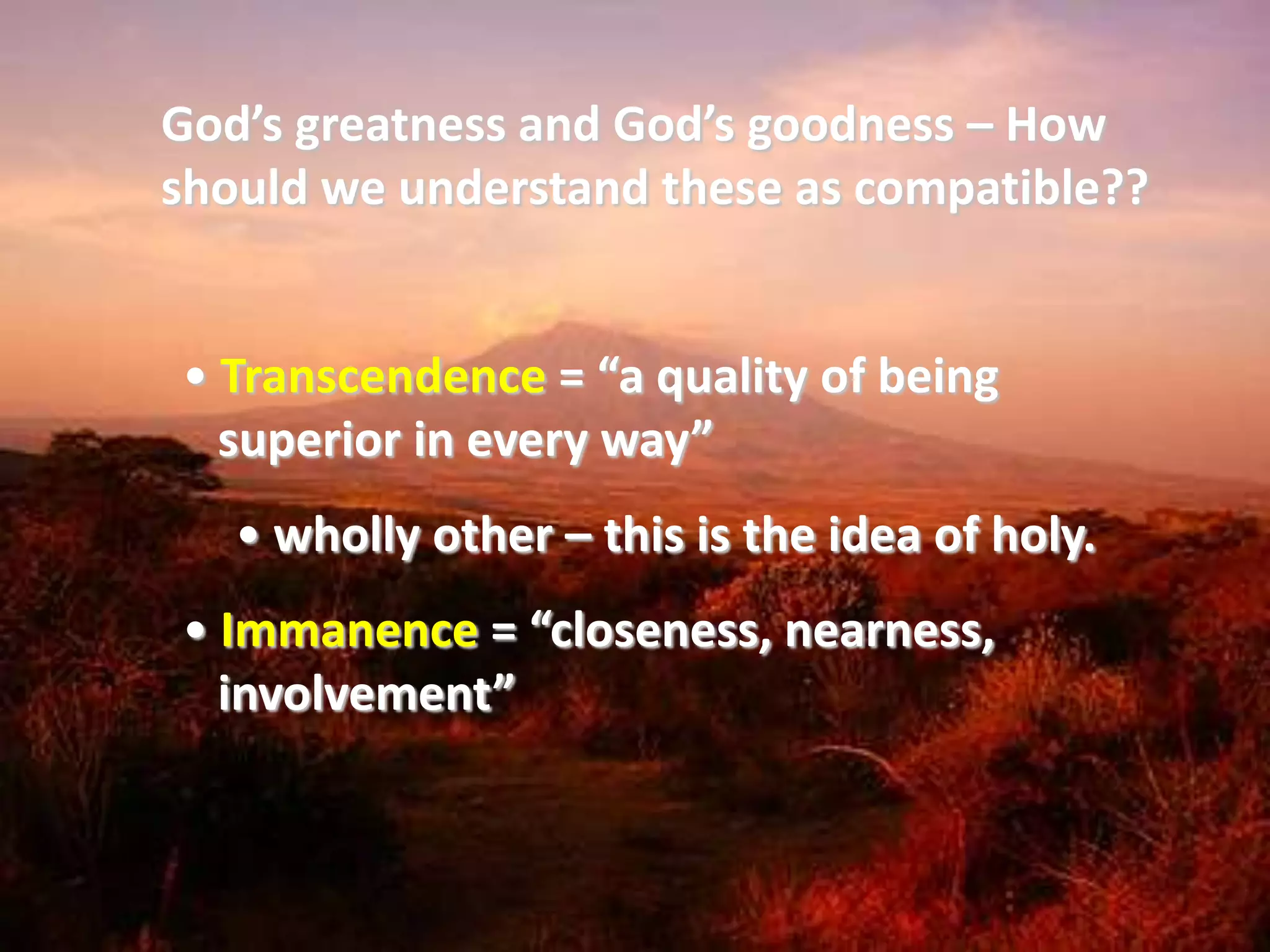
God’s greatness andGod’s goodness – How
should we understand these as compatible??
• Transcendence = “a quality of being
superior in every way”
• wholly other – this is the idea of holy.
• Immanence = “closeness, nearness,
involvement”
3.
All the attributesof God fall under one of these
categories of understanding.
Natural Attributes Moral Attributes
Heresy/Error -- > Result of the amount of emphasis
on one or the other.
4.
Errors that havesprung up surrounding
God’s greatness (transcendence) and God’s
goodness (immanence)
• Deism = “a portrayal of God as Creator of
the cosmos but uncaring for it”
• Panentheism = “God is greater than the
universe and the universe is contained
within God; the whole is in God.”
• Pantheism = “The substance of God and the
substance of the physical universe are the
same.”
• Process theology = “God is in process, he is
in process of becoming reality.”
5.
The Panentheist
would sayGod
created the tree and
needs the tree for His
continued self-
existence.
The Pantheist would
say God is the tree
and the tree is God.
6.
Accepted church traditionabout transcendence and
immanence:
• “hiddenness of God” =
• immutability = “inability to change”
strong immutability
weak immutability
7.
SO????
•We want a God who is incomparably
great and incomparably near!
• Tensions exist even up to today; perhaps the
best approach is just to live with the paradox.
Coming to some sense of acceptable explanation:
• We know only what God reveals to us; He has
revealed only so much of Himself.
• God may have chosen to self-limit Himself.
8.
GOD is
1. ATranscendent Being
--Prior to, distinct from, and not
dependent on anything or
anyone
--not contained within time or
space
--personal yet absolute
9.
GOD is
1. ATranscendent Being
--the “omnis”
--God “controlling” the limits of
his transcendence but not at
the expense of his sovereignty
10.
GOD is
2. ADynamic Being
--Dynamic within himself
--Dynamic in his activity
11.
GOD is
3. AbsoluteGoodness
**evidenced by his holiness
--Holy by virtue of transcendence
--Holy by virtue of actions and
relations with his creation
--Holy by being its restorer when
goodness was lost
12.
“Since holiness embracesevery distinctive attribute of the
Godhead, it may be defined as the outshining of all that
God is [an ontological attribute]. As the sun’s rays,
combining all the colors of the spectrum, come together
in the shining of the sun and blending into light, so in
God’s self-manifestation all the attributes of God come
together and blend into holiness. Holiness has, for that
reason, been called ‘the attribute of attributes’ – that
which lends unity to all the attributes of God.”
R. `A. Finlayson
13.
GOD is
3. AbsoluteGoodness
**evidenced by his giving love
--a love story
evidenced by his servant love
--God “resting”
--God’s response to rebellion
14.
Review:
GOD is
1.A Transcendent Being
2. A Dynamic Being
3. Absolute Goodness
http://www.worldinterestingfacts.com/wp-content/uploads/2010/03/most-beautiful-mountain-in-the-world-Mount-Meru-Arusha-National-Park-Tanzania.jpg



![“Since holiness embraces every distinctive attribute of the
Godhead, it may be defined as the outshining of all that
God is [an ontological attribute]. As the sun’s rays,
combining all the colors of the spectrum, come together
in the shining of the sun and blending into light, so in
God’s self-manifestation all the attributes of God come
together and blend into holiness. Holiness has, for that
reason, been called ‘the attribute of attributes’ – that
which lends unity to all the attributes of God.”
R. `A. Finlayson](https://image.slidesharecdn.com/transcendenceandimmanenceofgodv2-120217120929-phpapp01/75/Attributes-of-God-12-2048.jpg)


