





















Michael A. Gisondi, MD Jeremy Branzetti, MD
Northwestern University University of Washington
Society of Academic Emergency Medicine Annual Meeting
May 2016 – New Orleans, LA
GET
PUBLISHED!
Attention INNOVATIVE Educators:
DISCLOSURES:
The authors report no financial conflicts of interest
OBJECTIVES
1. Define the term educational innovation.
2. Describe innovative teaching methods that are publishable.
3. Define key elements of an educational innovations
publication.
4. Provide you with a list of peer-reviewed journals that publish
educational innovations.
Why do educators often fail to
disseminate their innovative
instructional methods?
Professional
Identity
Formation as an
Educator
Commitment to
Creativity
Ideate Collaborate
Obtain Data
Disseminate to
Colleagues
SIX STEPS TO
PUBLISHING
EDUCATIONAL
INNOVATIONS
Professional
Identity
Formation as an
Educator
Commitment to
Creativity
Ideate Collaborate
Obtain Data
Disseminate to
Colleagues
SIX STEPS TO
PUBLISHING
EDUCATIONAL
INNOVATIONS
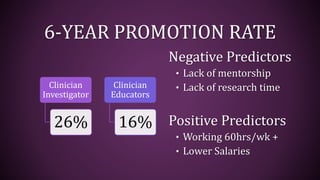
6-YEAR PROMOTION RATE
Clinician
Investigator
26%
Clinician
Educators
16%
Negative Predictors
• Lack of mentorship
• Lack of research time
Positive Predictors
• Working 60hrs/wk +
• Lower Salaries
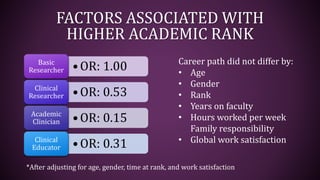
FACTORS ASSOCIATED WITH
HIGHER ACADEMIC RANK
•OR: 1.00Basic
Researcher
•OR: 0.53Clinical
Researcher
•OR: 0.15Academic
Clinician
•OR: 0.31Clinical
Educator
Career path did not differ by:
• Age
• Gender
• Rank
• Years on faculty
• Hours worked per week
Family responsibility
• Global work satisfaction
*After adjusting for age, gender, time at rank, and work satisfaction
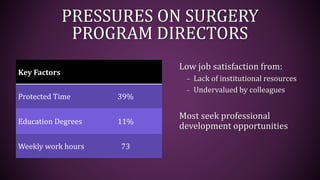
PRESSURES ON SURGERY
PROGRAM DIRECTORS
Key Factors
Protected Time 39%
Education Degrees 11%
Weekly work hours 73
Low job satisfaction from:
– Lack of institutional resources
– Undervalued by colleagues
Most seek professional
development opportunities
Lack of training
Administrative burden
Poor job satisfaction
Undervalued
Expertise
Creativity
Teaching
Academic Promotion
Professional
Identity
Formation as an
Educator
Commitment to
Creativity
Ideate Collaborate
Obtain Data
Disseminate to
Colleagues
SIX STEPS TO
PUBLISHING
EDUCATIONAL
INNOVATIONS
Professional
Identity
Formation as an
Educator
Commitment to
Creativity
Ideate Collaborate
Obtain Data
Disseminate to
Colleagues
SIX STEPS TO
PUBLISHING
EDUCATIONAL
INNOVATIONS
Professional
Identity
Formation as an
Educator
Commitment to
Creativity
Ideate Collaborate
Obtain Data
Disseminate to
Colleagues
SIX STEPS TO
PUBLISHING
EDUCATIONAL
INNOVATIONS
What is an
“Educational Innovation?”
EDUCATIONAL INNOVATION
Innovation: “a new method, idea, or product.”
Education: “the process of receiving or giving systematic
instruction”
Think Big?
Professional
Identity
Formation as an
Educator
Commitment to
Creativity
Ideate Collaborate
Obtain Data
Disseminate to
Colleagues
SIX STEPS TO
PUBLISHING
EDUCATIONAL
INNOVATIONS
Professional
Identity
Formation as an
Educator
Commitment to
Creativity
Ideate Collaborate
Obtain Data
Disseminate to
Colleagues
SIX STEPS TO
PUBLISHING
EDUCATIONAL
INNOVATIONS
SMALL GROUP ACTIVITY #1
(5 MIN)
1. Introduce yourself to your
neighbor
2. Describe your favorite teaching
activities to one another
3. Give feedback to your neighbor
about the aspect of their work
that is INNOVATIVE
Professional
Identity
Formation as an
Educator
Commitment to
Creativity
Ideate Collaborate
Obtain Data
Disseminate to
Colleagues
SIX STEPS TO
PUBLISHING
EDUCATIONAL
INNOVATIONS
Professional
Identity
Formation as an
Educator
Commitment to
Creativity
Ideate Collaborate
Obtain Data
Disseminate to
Colleagues
SIX STEPS TO
PUBLISHING
EDUCATIONAL
INNOVATIONS
Professional
Identity
Formation as an
Educator
Commitment to
Creativity
Ideate Collaborate
Obtain Data
Disseminate to
Colleagues
SIX STEPS TO
PUBLISHING
EDUCATIONAL
INNOVATIONS
Professional
Identity
Formation as an
Educator
Commitment to
Creativity
Ideate Collaborate
Obtain Data
Disseminate to
Colleagues
SIX STEPS TO
PUBLISHING
EDUCATIONAL
INNOVATIONS
EDUCATIONAL INNOVATION
PUBLICATION
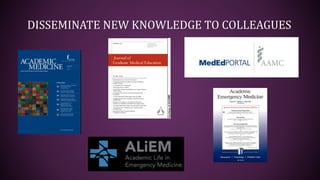
DISSEMINATE NEW KNOWLEDGE TO COLLEAGUES
ACADEMIC MEDICINE
Innovation reports (2000 words)
The report highlights first steps toward a
larger-scale solution to a challenge facing the
academic medicine community by describing
an innovative pilot/early-stage initiative at a
single institution or reporting preliminary
research that defines the challenge and/or
lays the groundwork for larger-scale
approaches.
The report demonstrates that the authors’
work has significant implications for the
continued study of the stated problem.
Problem – Approach – Outcomes – Next Steps
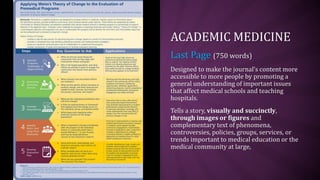
ACADEMIC MEDICINE
Last Page (750 words)
Designed to make the journal’s content more
accessible to more people by promoting a
general understanding of important issues
that affect medical schools and teaching
hospitals.
Tells a story, visually and succinctly,
through images or figures and
complementary text of phenomena,
controversies, policies, groups, services, or
trends important to medical education or the
medical community at large,
THE CLINICAL TEACHER
Insights (800 words)
These are shorter articles of structured
reflection on important topics in clinical
education, based on the principles of good
scholarship and evidence-guided education.
Content:
• Up to 2 tables, boxes or figures
• 5 references
• A structured abstract is not required for
these articles
MEDICAL TEACHER
Short Communications
(Max. 1700 words or 2 pages)
Brief articles on matters of topical interest or
work in progress.
Content:
• Title Page
• Notes on contributors
• Abstract
• References
• One small table (optional)
MEDICAL TEACHER
Twelve Tips
(Max. 3400 words or 4 pages)
Practical advice in the form of twelve short
hints or tips for those working in a selected
area.
Content:
• Abstract
• 12 “tip” sections, ideally EBM-based
• References, contributor notes
• Figures/tables as necessary
JOURNAL OF GME
Educational Innovation
(2000 words)
A description of a new approach or strategy
in medical education that has been
implemented and assessed.
Should answer: Should this innovation be
tried (or avoided) in other settings or
disciplines?
Of note, innovations do not have to be
successful; manuscripts may report on
approaches others should not try
JOURNAL OF GME
Brief Report (1200 words)
A summary of a new curriculum, assessment,
or teaching method, or successful best
practice that has at minimum been
implemented, at minimum on a pilot basis.
JOURNAL OF GME
Perspectives (1200 words)
Provide views and opinions on issues of
broad interest to program directors,
educators, researchers, and institutional GME
leaders.
Perspectives will be evidence-based but will
also reflect the authors’ expert opinion.
JOURNAL OF GME
On Teaching and Learning
(1200 words)
Personal essays or reflections, that speak to
the experience of teaching, learning, or
related topics, and that will be of interest to
multiple specialties.
Both educators and learners are encouraged
to submit articles for this category; the
quality of the writing will determine
acceptance.
MEDICAL EDUCATION
Really Good Stuff (500 words)
Short structured report organized into three
sections:
• What problem was addressed?
• What was tried?
• What lessons were learned?
Content:
- No figures/tables
- One allowable reference
- Maximum of 4 authors
MEDICAL EDUCATION
When I say… (1000 words)
These brief articles are aimed at clarifying
important terminology within the field in a
meaningful and entertaining way.
Five references or less
JAMA
Viewpoint (1000 words + small table)
These papers may address virtually any
important topic in medicine, public health,
research, ethics, health policy, or health law
and generally are not linked to a specific
article.
Content:
- No more than 3 authors
- No more than 7 references
JAMA
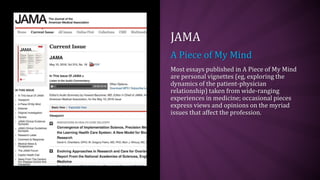
A Piece of My Mind
Most essays published in A Piece of My Mind
are personal vignettes (eg, exploring the
dynamics of the patient-physician
relationship) taken from wide-ranging
experiences in medicine; occasional pieces
express views and opinions on the myriad
issues that affect the profession.
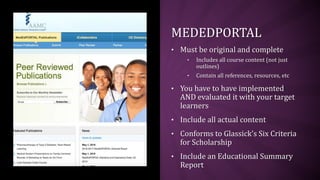
MEDEDPORTAL
• Must be original and complete
• Includes all course content (not just
outlines)
• Contain all references, resources, etc
• You have to have implemented
AND evaluated it with your target
learners
• Include all actual content
• Conforms to Glassick’s Six Criteria
for Scholarship
• Include an Educational Summary
Report
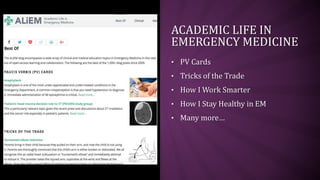
ACADEMIC LIFE IN
EMERGENCY MEDICINE
• PV Cards
• Tricks of the Trade
• How I Work Smarter
• How I Stay Healthy in EM
• Many more…
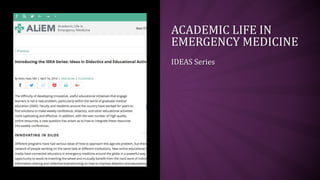
ACADEMIC LIFE IN
EMERGENCY MEDICINE
IDEAS Series
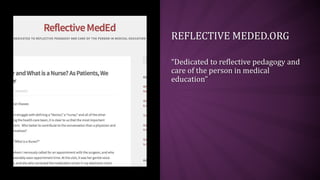
REFLECTIVE MEDED.ORG
“Dedicated to reflective pedagogy and
care of the person in medical
education”
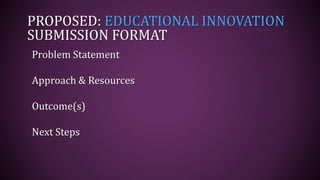
PROPOSED: EDUCATIONAL INNOVATION
SUBMISSION FORMAT
Problem Statement
Approach & Resources
Outcome(s)
Next Steps
SMALL GROUP ACTIVITY #2
(5 MIN)
• One innovation to share
• Sketch out your innovation in
the proposed format:
• Problem
• Approach & Resources
• Outcome(s)
• Next Steps
FACULTY DEVELOPMENT
Training opportunities that allow faculty members to attain
skills necessary for efficient academic promotion.
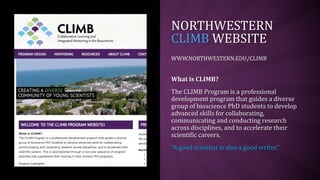
NORTHWESTERN
CLIMB WEBSITE
WWW.NORTHWESTERN.EDU/CLIMB
What is CLIMB?
The CLIMB Program is a professional
development program that guides a diverse
group of bioscience PhD students to develop
advanced skills for collaborating,
communicating and conducting research
across disciplines, and to accelerate their
scientific careers.
“A good scientist is also a good writer.”
Professional
Identity
Formation as an
Educator
Commitment to
Creativity
Ideate Collaborate
Obtain Data
Disseminate to
Colleagues
SIX STEPS TO
PUBLISHING
EDUCATIONAL
INNOVATIONS
QUESTIONS?

Attention innovative educators get published! gisondi branzetti

  • 1.
    Michael A. Gisondi,MD Jeremy Branzetti, MD Northwestern University University of Washington Society of Academic Emergency Medicine Annual Meeting May 2016 – New Orleans, LA GET PUBLISHED! Attention INNOVATIVE Educators:
  • 2.
    DISCLOSURES: The authors reportno financial conflicts of interest
  • 3.
    OBJECTIVES 1. Define theterm educational innovation. 2. Describe innovative teaching methods that are publishable. 3. Define key elements of an educational innovations publication. 4. Provide you with a list of peer-reviewed journals that publish educational innovations.
  • 4.
    Why do educatorsoften fail to disseminate their innovative instructional methods?
  • 5.
    Professional Identity Formation as an Educator Commitmentto Creativity Ideate Collaborate Obtain Data Disseminate to Colleagues SIX STEPS TO PUBLISHING EDUCATIONAL INNOVATIONS
  • 6.
    Professional Identity Formation as an Educator Commitmentto Creativity Ideate Collaborate Obtain Data Disseminate to Colleagues SIX STEPS TO PUBLISHING EDUCATIONAL INNOVATIONS
  • 8.
    6-YEAR PROMOTION RATE Clinician Investigator 26% Clinician Educators 16% NegativePredictors • Lack of mentorship • Lack of research time Positive Predictors • Working 60hrs/wk + • Lower Salaries
  • 9.
    FACTORS ASSOCIATED WITH HIGHERACADEMIC RANK •OR: 1.00Basic Researcher •OR: 0.53Clinical Researcher •OR: 0.15Academic Clinician •OR: 0.31Clinical Educator Career path did not differ by: • Age • Gender • Rank • Years on faculty • Hours worked per week Family responsibility • Global work satisfaction *After adjusting for age, gender, time at rank, and work satisfaction
  • 10.
    PRESSURES ON SURGERY PROGRAMDIRECTORS Key Factors Protected Time 39% Education Degrees 11% Weekly work hours 73 Low job satisfaction from: – Lack of institutional resources – Undervalued by colleagues Most seek professional development opportunities
  • 11.
    Lack of training Administrativeburden Poor job satisfaction Undervalued
  • 12.
  • 13.
    Professional Identity Formation as an Educator Commitmentto Creativity Ideate Collaborate Obtain Data Disseminate to Colleagues SIX STEPS TO PUBLISHING EDUCATIONAL INNOVATIONS
  • 14.
    Professional Identity Formation as an Educator Commitmentto Creativity Ideate Collaborate Obtain Data Disseminate to Colleagues SIX STEPS TO PUBLISHING EDUCATIONAL INNOVATIONS
  • 15.
    Professional Identity Formation as an Educator Commitmentto Creativity Ideate Collaborate Obtain Data Disseminate to Colleagues SIX STEPS TO PUBLISHING EDUCATIONAL INNOVATIONS
  • 16.
  • 17.
    EDUCATIONAL INNOVATION Innovation: “anew method, idea, or product.” Education: “the process of receiving or giving systematic instruction”
  • 18.
  • 19.
    Professional Identity Formation as an Educator Commitmentto Creativity Ideate Collaborate Obtain Data Disseminate to Colleagues SIX STEPS TO PUBLISHING EDUCATIONAL INNOVATIONS
  • 20.
    Professional Identity Formation as an Educator Commitmentto Creativity Ideate Collaborate Obtain Data Disseminate to Colleagues SIX STEPS TO PUBLISHING EDUCATIONAL INNOVATIONS
  • 21.
    SMALL GROUP ACTIVITY#1 (5 MIN) 1. Introduce yourself to your neighbor 2. Describe your favorite teaching activities to one another 3. Give feedback to your neighbor about the aspect of their work that is INNOVATIVE
  • 22.
    Professional Identity Formation as an Educator Commitmentto Creativity Ideate Collaborate Obtain Data Disseminate to Colleagues SIX STEPS TO PUBLISHING EDUCATIONAL INNOVATIONS
  • 23.
    Professional Identity Formation as an Educator Commitmentto Creativity Ideate Collaborate Obtain Data Disseminate to Colleagues SIX STEPS TO PUBLISHING EDUCATIONAL INNOVATIONS
  • 26.
    Professional Identity Formation as an Educator Commitmentto Creativity Ideate Collaborate Obtain Data Disseminate to Colleagues SIX STEPS TO PUBLISHING EDUCATIONAL INNOVATIONS
  • 27.
    Professional Identity Formation as an Educator Commitmentto Creativity Ideate Collaborate Obtain Data Disseminate to Colleagues SIX STEPS TO PUBLISHING EDUCATIONAL INNOVATIONS
  • 28.
  • 29.
  • 32.
    ACADEMIC MEDICINE Innovation reports(2000 words) The report highlights first steps toward a larger-scale solution to a challenge facing the academic medicine community by describing an innovative pilot/early-stage initiative at a single institution or reporting preliminary research that defines the challenge and/or lays the groundwork for larger-scale approaches. The report demonstrates that the authors’ work has significant implications for the continued study of the stated problem. Problem – Approach – Outcomes – Next Steps
  • 33.
    ACADEMIC MEDICINE Last Page(750 words) Designed to make the journal’s content more accessible to more people by promoting a general understanding of important issues that affect medical schools and teaching hospitals. Tells a story, visually and succinctly, through images or figures and complementary text of phenomena, controversies, policies, groups, services, or trends important to medical education or the medical community at large,
  • 34.
    THE CLINICAL TEACHER Insights(800 words) These are shorter articles of structured reflection on important topics in clinical education, based on the principles of good scholarship and evidence-guided education. Content: • Up to 2 tables, boxes or figures • 5 references • A structured abstract is not required for these articles
  • 35.
    MEDICAL TEACHER Short Communications (Max.1700 words or 2 pages) Brief articles on matters of topical interest or work in progress. Content: • Title Page • Notes on contributors • Abstract • References • One small table (optional)
  • 36.
    MEDICAL TEACHER Twelve Tips (Max.3400 words or 4 pages) Practical advice in the form of twelve short hints or tips for those working in a selected area. Content: • Abstract • 12 “tip” sections, ideally EBM-based • References, contributor notes • Figures/tables as necessary
  • 37.
    JOURNAL OF GME EducationalInnovation (2000 words) A description of a new approach or strategy in medical education that has been implemented and assessed. Should answer: Should this innovation be tried (or avoided) in other settings or disciplines? Of note, innovations do not have to be successful; manuscripts may report on approaches others should not try
  • 38.
    JOURNAL OF GME BriefReport (1200 words) A summary of a new curriculum, assessment, or teaching method, or successful best practice that has at minimum been implemented, at minimum on a pilot basis.
  • 39.
    JOURNAL OF GME Perspectives(1200 words) Provide views and opinions on issues of broad interest to program directors, educators, researchers, and institutional GME leaders. Perspectives will be evidence-based but will also reflect the authors’ expert opinion.
  • 40.
    JOURNAL OF GME OnTeaching and Learning (1200 words) Personal essays or reflections, that speak to the experience of teaching, learning, or related topics, and that will be of interest to multiple specialties. Both educators and learners are encouraged to submit articles for this category; the quality of the writing will determine acceptance.
  • 41.
    MEDICAL EDUCATION Really GoodStuff (500 words) Short structured report organized into three sections: • What problem was addressed? • What was tried? • What lessons were learned? Content: - No figures/tables - One allowable reference - Maximum of 4 authors
  • 42.
    MEDICAL EDUCATION When Isay… (1000 words) These brief articles are aimed at clarifying important terminology within the field in a meaningful and entertaining way. Five references or less
  • 43.
    JAMA Viewpoint (1000 words+ small table) These papers may address virtually any important topic in medicine, public health, research, ethics, health policy, or health law and generally are not linked to a specific article. Content: - No more than 3 authors - No more than 7 references
  • 44.
    JAMA A Piece ofMy Mind Most essays published in A Piece of My Mind are personal vignettes (eg, exploring the dynamics of the patient-physician relationship) taken from wide-ranging experiences in medicine; occasional pieces express views and opinions on the myriad issues that affect the profession.
  • 45.
    MEDEDPORTAL • Must beoriginal and complete • Includes all course content (not just outlines) • Contain all references, resources, etc • You have to have implemented AND evaluated it with your target learners • Include all actual content • Conforms to Glassick’s Six Criteria for Scholarship • Include an Educational Summary Report
  • 46.
    ACADEMIC LIFE IN EMERGENCYMEDICINE • PV Cards • Tricks of the Trade • How I Work Smarter • How I Stay Healthy in EM • Many more…
  • 47.
    ACADEMIC LIFE IN EMERGENCYMEDICINE IDEAS Series
  • 48.
    REFLECTIVE MEDED.ORG “Dedicated toreflective pedagogy and care of the person in medical education”
  • 51.
    PROPOSED: EDUCATIONAL INNOVATION SUBMISSIONFORMAT Problem Statement Approach & Resources Outcome(s) Next Steps
  • 52.
    SMALL GROUP ACTIVITY#2 (5 MIN) • One innovation to share • Sketch out your innovation in the proposed format: • Problem • Approach & Resources • Outcome(s) • Next Steps
  • 53.
    FACULTY DEVELOPMENT Training opportunitiesthat allow faculty members to attain skills necessary for efficient academic promotion.
  • 54.
    NORTHWESTERN CLIMB WEBSITE WWW.NORTHWESTERN.EDU/CLIMB What isCLIMB? The CLIMB Program is a professional development program that guides a diverse group of bioscience PhD students to develop advanced skills for collaborating, communicating and conducting research across disciplines, and to accelerate their scientific careers. “A good scientist is also a good writer.”
  • 57.
    Professional Identity Formation as an Educator Commitmentto Creativity Ideate Collaborate Obtain Data Disseminate to Colleagues SIX STEPS TO PUBLISHING EDUCATIONAL INNOVATIONS
  • 58.

Editor's Notes

  • #4 Our specialty is advanced when educators find novel and improved methods for teaching emergency medicine. However, educators often fail to disseminate their innovative instructional methods. Common barriers to publication include an inability to define what is truly innovative, a poor understanding of how to disseminate an educational innovation, and a perceived lack of opportunities for publishing in the field of medical education. This workshop will provide a conceptual framework for disseminating a novel teaching method as peer-reviewed scholarship. Audience members will participate in a ‘think-pair-share’ activity that will allow immediate feedback about their individual proposals for publication. Participants will receive a calendar that lists submission deadlines for annual calls to publish educational innovations in major EM and medical education journals.
  • #18  People understand that great ideas should be shared, but they never seem to understand what a great idea really is.
  • #19 BREADTH: Not just about teaching residents how to put the tube in better. Let’s be meta – everything from UME, GME, CME. Teaching Ras. Teaching mentorship. Teaching the community doctors absorbed by your health system. All of them require input of time and effort and brain. If you can come up with a better mousetrap for any of those things, then that’s an innovation. If you’ve come up with a way to save hours of work, why not share it? Full studies are arduous and unnecessary for many of the great innovations you’ve done. People understand that great ideas should be shared, but they never seem to understand what a great idea really is.
  • #25 No matter what your innovation, collect some post-experience data All innovations are improved by evaluative data Kern’s 6th step: woefully undervalued
  • #30 Lots to consider: Pros and cons Journals: Complete manuscripts matter Brief reports are useful too Peer-reviewed Choose based on quality of data Online: Med Ed Portal Blogs
  • #59 You are an educational innovator See the data all around you Know the opportunities available to you Follow the format: Problem Approach Outcome(s) Next Step(s) Commit to doing just one