2024 ESC Guidelines for the management
of atrial fibrillation developed in collaboration
with the European Association
for Cardio-Thoracic Surgery (EACTS)
Developed by the task force for the management of atrial fibrillation of the
European Society of Cardiology (ESC), with the special contribution of the
European Heart Rhythm Association (EHRA) of the ESC.
Endorsed by the European Stroke Organisation (ESO)
Authors/Task Force Members: Isabelle C. Van Gelder *†
, (Chairperson)
(Netherlands), Michiel Rienstra ±
, (Task Force Co-ordinator) (Netherlands),
Karina V. Bunting ±
, (Task Force Co-ordinator) (United Kingdom),
Ruben Casado-Arroyo (Belgium), Valeria Caso 1
(Italy), Harry J.G.M. Crijns
(Netherlands), Tom J.R. De Potter (Belgium), Jeremy Dwight (United Kingdom),
Luigina Guasti (Italy), Thorsten Hanke 2
(Germany), Tiny Jaarsma (Sweden),
Maddalena Lettino (Italy), Maja-Lisa Løchen (Norway), R. Thomas Lumbers
(United Kingdom), Bart Maesen 2
(Netherlands), Inge Mølgaard (Denmark),
Giuseppe M.C. Rosano (United Kingdom), Prashanthan Sanders (Australia),
Renate B. Schnabel (Germany), Piotr Suwalski 2
(Poland), Emma Svennberg
(Sweden), Juan Tamargo (Spain), Otilia Tica (Romania), Vassil Traykov
(Bulgaria), Stylianos Tzeis (Greece), Dipak Kotecha *†
, (Chairperson)
(United Kingdom), and ESC Scientific Document Group
© The European Society of Cardiology 2024. All rights reserved. For permissions, please email: journals.permissions@oup.com.
* Corresponding authors: Isabelle C. Van Gelder, Department of Cardiology, University of Groningen, University Medical Center Groningen, Groningen, Netherlands. Tel: +31 50 361 1327.
Email: i.c.van.gelder@umcg.nl; and Dipak Kotecha, Institute of Cardiovascular Sciences, University of Birmingham, United Kingdom & NIHR Birmingham Biomedical Research Centre,
University Hospitals Birmingham NHS Foundation Trust, Birmingham, United Kingdom. Tel: +44 121 371 8124. Email: d.kotecha@bham.ac.uk
†
The two Chairpersons contributed equally to the document and are joint corresponding authors.
±
The two Task Force Co-ordinators contributed equally to the document.
Author/Task Force Member affiliations are listed in author information.
1
Representing European Stroke Organisation (ESO).
2
Representing European Association for Cardio-Thoracic Surgery (EACTS).
ESC Clinical Practice Guidelines (CPG) Committee: listed in the Appendix.
ESC subspecialty communities having participated in the development of this document:
Associations: Association of Cardiovascular Nursing & Allied Professions (ACNAP), Association for Acute CardioVascular Care (ACVC), European Association of Cardiovascular Imaging
(EACVI), European Association of Preventive Cardiology (EAPC), European Association of Percutaneous Cardiovascular Interventions (EAPCI), European Heart Rhythm Association (EHRA),
Heart Failure Association (HFA).
Councils: Council for Cardiology Practice, Council of Cardio-Oncology, Council on Cardiovascular Genomics, Council on Stroke.
Working Groups: Cardiac Cellular Electrophysiology, Cardiovascular Pharmacotherapy, E-Cardiology, Thrombosis.
Patient Forum
European Heart Journal (2024) 45, 3314–3414
https://doi.org/10.1093/eurheartj/ehae176
ESC GUIDELINES
Downloaded
from
https://academic.oup.com/eurheartj/article/45/36/3314/7738779
by
guest
on
21
October
2024
Document Reviewers: Nikolaos Dagres, (CPG Review Co-ordinator) (Germany), Bianca Rocca, (CPG Review
Co-ordinator) (Italy), Syed Ahsan (United Kingdom)2
, Pietro Ameri (Italy), Elena Arbelo (Spain), Axel Bauer
(Austria), Michael A. Borger (Germany), Sergio Buccheri (Sweden), Barbara Casadei (United Kingdom),
Ovidiu Chioncel (Romania), Dobromir Dobrev (Germany), Laurent Fauchier (France), Bruna Gigante (Sweden),
Michael Glikson (Israel), Ziad Hijazi (Sweden), Gerhard Hindricks (Germany), Daniela Husser (Germany),
Borja Ibanez (Spain), Stefan James (Sweden), Stefan Kaab (Germany), Paulus Kirchhof (Germany), Lars Køber
(Denmark), Konstantinos C. Koskinas (Switzerland), Thomas Kumler (Denmark), Gregory Y.H. Lip
(United Kingdom), John Mandrola (United States of America), Nikolaus Marx (Germany), John William Mcevoy
(Ireland), Borislava Mihaylova (United Kingdom), Richard Mindham (United Kingdom), Denisa Muraru (Italy),
Lis Neubeck (United Kingdom), Jens Cosedis Nielsen (Denmark), Jonas Oldgren (Sweden), Maurizio Paciaroni
(Italy)1
, Agnes A. Pasquet (Belgium), Eva Prescott (Denmark), Filip Rega2
(Belgium), Francisco Javier Rossello
(Spain), Marcin Rucinski (Poland), Sacha P. Salzberg2
(Switzerland), Sam Schulman (Canada), Philipp Sommer
(Germany), Jesper Hastrup Svendsen (Denmark), Jurrien M. ten Berg (Netherlands), Hugo Ten Cate
(Netherlands), Ilonca Vaartjes (Netherlands), Christiaan Jm. Vrints (Belgium), Adam Witkowski (Poland), and
Katja Zeppenfeld (Netherlands)
All experts involved in the development of these guidelines have submitted declarations of interest
which are reported in a supplementary document to the guidelines. See the European Heart Journal online or
www.escardio.org/guidelines for supplementary documents as well as evidence tables.
Disclaimer. The ESC Guidelines represent the views of the ESC and were produced after careful consideration of the scientific and
medical knowledge and the evidence available at the time of their publication. The ESC is not responsible in the event of any contradiction,
discrepancy and/or ambiguity between the ESC Guidelines and any other official recommendations or guidelines issued by the relevant
public health authorities, in particular in relation to good use of healthcare or therapeutic strategies. Health professionals are encouraged
to take the ESC Guidelines fully into account when exercising their clinical judgment, as well as in the determination and the
implementation of preventive, diagnostic or therapeutic medical strategies; however, the ESC Guidelines do not override, in any way
whatsoever, the individual responsibility of health professionals to make appropriate and accurate decisions in consideration of each
patient’s health condition and in consultation with that patient and, where appropriate and/or necessary, the patient’s caregiver. Nor do
the ESC Guidelines exempt health professionals from taking into full and careful consideration the relevant official updated
recommendations or guidelines issued by the competent public health authorities, in order to manage each patient’s case in light of the
scientifically accepted data pursuant to their respective ethical and professional obligations. It is also the health professional’s
responsibility to verify the applicable rules and regulations relating to drugs and medical devices at the time of prescription. The ESC
warns readers that the technical language may be misinterpreted and declines any responsibility in this respect.
Permissions. The content of these European Society of Cardiology (ESC) Guidelines has been published for personal and educational
use only. No commercial use is authorized. No part of the ESC Guidelines may be translated or reproduced in any form without written
permission from the ESC. Permissions can be obtained upon submission of a written request to Oxford University Press, the publisher of
the European Heart Journal and the party authorized to handle such permissions on behalf of the ESC (journals.permissions@oup.com).
------------------------------------------------------------------------------------------------------------------------------------------------------------
Keywords Guidelines • Atrial fibrillation • AF-CARE • Comorbidity • Risk factors • Anticoagulation • Rate control • Rhythm
control • Cardioversion • Antiarrhythmic drugs • Catheter ablation • AF surgery • Evaluation • Stroke •
Thromboembolism
ESC Guidelines 3315
Downloaded
from
https://academic.oup.com/eurheartj/article/45/36/3314/7738779
by
guest
on
21
October
2024
Table of contents
1. Preamble .............................................................................................................. 3319
2. Introduction ....................................................................................................... 3321
2.1. What is new ............................................................................................. 3322
3. Definitions and clinical impact .................................................................... 3326
3.1. Definition and classification of AF ................................................... 3326
3.2. Diagnostic criteria for AF ................................................................... 3327
3.3. Symptoms attributable to AF ........................................................... 3328
3.4. Diagnostic evaluation of new AF ..................................................... 3328
3.5. Adverse events associated with AF ................................................ 3329
3.6. Atrial flutter .............................................................................................. 3330
4. Patient pathways and management of AF ............................................. 3330
4.1. Patient-centred, multidisciplinary AF management ................. 3330
4.1.1. The patient at the heart of care .............................................. 3330
4.1.2. Education and shared decision-making ................................. 3331
4.1.3. Education of healthcare professionals ................................... 3332
4.1.4. Inclusive management of AF ...................................................... 3332
4.2. Principles of AF-CARE ......................................................................... 3332
5. [C] Comorbidity and risk factor management ................................... 3338
5.1. Hypertension ............................................................................................ 3339
5.2. Heart failure .............................................................................................. 3339
5.3. Type 2 diabetes mellitus ...................................................................... 3340
5.4. Obesity ....................................................................................................... 3340
5.5. Obstructive sleep apnoea ................................................................... 3340
5.6. Physical inactivity .................................................................................... 3340
5.7. Alcohol excess ......................................................................................... 3341
6. [A] Avoid stroke and thromboembolism .............................................. 3341
6.1. Initiating oral anticoagulation ............................................................. 3341
6.1.1. Decision support for anticoagulation in AF ........................ 3341
6.2. Oral anticoagulants ................................................................................ 3343
6.2.1. Direct oral anticoagulants ........................................................... 3344
6.2.2. Vitamin K antagonists ................................................................... 3345
6.2.3. Clinical vs. device-detected subclinical AF ........................... 3345
6.3. Antiplatelet drugs and combinations with anticoagulants .... 3346
6.4. Residual ischaemic stroke risk despite anticoagulation .......... 3346
6.5. Percutaneous left atrial appendage occlusion ............................ 3346
6.6. Surgical left atrial appendage occlusion ........................................ 3347
6.7. Bleeding risk .............................................................................................. 3348
6.7.1. Assessment of bleeding risk ....................................................... 3348
6.7.2. Management of bleeding on anticoagulant therapy ......... 3348
7. [R] Reduce symptoms by rate and rhythm control ......................... 3351
7.1. Management of heart rate in patients with AF ......................... 3351
7.1.1. Indications and target heart rate .............................................. 3352
7.1.2. Heart rate control in the acute setting ................................. 3352
7.1.3. Long-term heart rate control .................................................... 3352
7.1.4. Atrioventricular node ablation and pacemaker
implantation ................................................................................................... 3353
7.2. Rhythm control strategies in patients with AF .......................... 3353
7.2.1. General principles and anticoagulation ................................. 3353
7.2.2. Electrical cardioversion ................................................................ 3356
7.2.3. Pharmacological cardioversion .................................................. 3356
7.2.4. Antiarrhythmic drugs .................................................................... 3357
7.2.5. Catheter ablation ............................................................................ 3358
7.2.6. Anticoagulation in patients undergoing catheter ablation 3359
7.2.7. Endoscopic and hybrid AF ablation ........................................ 3360
7.2.8. AF ablation during cardiac surgery .......................................... 3361
7.2.9. Atrial tachycardia after pulmonary vein isolation ............. 3361
8. [E] Evaluation and dynamic reassessment ............................................. 3361
8.1. Implementation of dynamic care ..................................................... 3362
8.2. Improving treatment adherence ...................................................... 3362
8.3. Cardiac imaging ....................................................................................... 3362
8.4. Patient-reported outcome measures ............................................ 3363
9. The AF-CARE pathway in specific clinical settings ............................ 3364
9.1. AF-CARE in unstable patients .......................................................... 3364
9.2. AF-CARE in acute and chronic coronary syndromes ............ 3364
9.3. AF-CARE in vascular disease ............................................................. 3366
9.4. AF-CARE in acute stroke or intracranial haemorrhage ........ 3366
9.4.1. Management of acute ischaemic stroke ................................ 3366
9.4.2. Introduction or re-introduction of anticoagulation after
ischaemic stroke .......................................................................................... 3367
9.4.3. Introduction or re-introduction of anticoagulation after
haemorrhagic stroke .................................................................................. 3367
9.5. AF-CARE for trigger-induced AF .................................................... 3367
9.6. AF-CARE in post-operative patients ............................................. 3368
9.7. AF-CARE in embolic stroke of unknown source ..................... 3368
9.8. AF-CARE during pregnancy ............................................................... 3369
9.9. AF-CARE in congenital heart disease ............................................ 3370
9.10. AF-CARE in endocrine disorders ................................................. 3370
9.11. AF-CARE in inherited cardiomyopathies and primary
arrhythmia syndromes .................................................................................. 3370
9.12. AF-CARE in cancer ............................................................................. 3371
9.13. AF-CARE in older, multimorbid, or frail patients .................. 3371
9.14. AF-CARE in atrial flutter .................................................................. 3371
10. Screening and prevention of AF ............................................................. 3371
10.1. Epidemiology of AF ............................................................................. 3371
10.2. Screening tools for AF ....................................................................... 3372
10.3. Screening strategies for AF .............................................................. 3373
10.3.1. Single timepoint screening ‘snapshot’ .................................. 3374
10.3.2. Prolonged screening ................................................................... 3374
10.4. Factors associated with incident AF ............................................ 3375
10.5. Primary prevention of AF ................................................................ 3375
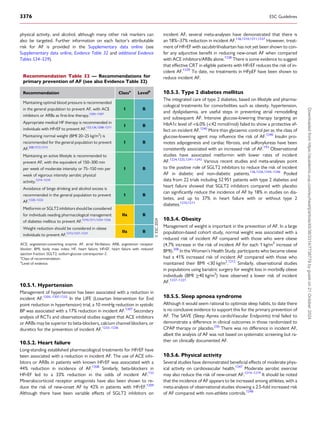
10.5.1. Hypertension ................................................................................. 3376
10.5.2. Heart failure ................................................................................... 3376
10.5.3. Type 2 diabetes mellitus ........................................................... 3376
10.5.4. Obesity ............................................................................................. 3376
10.5.5. Sleep apnoea syndrome ............................................................ 3376
10.5.6. Physical activity .............................................................................. 3376
10.5.7. Alcohol intake ................................................................................ 3377
11. Key messages .................................................................................................. 3377
12. Gaps in evidence ............................................................................................ 3377
13. ‘What to do’ and ‘What not to do’ messages from the
guidelines .................................................................................................................. 3379
14. Evidence tables ............................................................................................... 3382
15. Data availability statement ......................................................................... 3382
16. Author information ...................................................................................... 3382
17. Appendix ........................................................................................................... 3383
18. References ........................................................................................................ 3384
3316 ESC Guidelines
Downloaded
from
https://academic.oup.com/eurheartj/article/45/36/3314/7738779
by
guest
on
21
October
2024
Tables of Recommendations
Recommendation Table 1 — Recommendations for the diagnosis of
AF (see also Evidence Table 1) ....................................................................... 3328
Recommendation Table 2 — Recommendations for symptom
evaluation in patients with AF (see also Evidence Table 2) ................ 3328
Recommendation Table 3 — Recommendations for diagnostic
evaluation in patients with new AF (see also Evidence Table 3) ..... 3328
Recommendation Table 4 — Recommendations for patient-centred
care and education (see also Evidence Table 4) ...................................... 3332
Recommendation Table 5 — Recommendations for comorbidity
and risk factor management in AF (see also Evidence Table 5) ....... 3339
Recommendation Table 6 — Recommendations to assess and
manage thromboembolic risk in AF (see also Evidence Table 6) .... 3342
Recommendation Table 7 — Recommendations for oral
anticoagulation in AF (see also Evidence Table 7) .................................. 3344
Recommendation Table 8 — Recommendations for combining
antiplatelet drugs with anticoagulants for stroke prevention (see also
Evidence Table 8) .................................................................................................. 3346
Recommendation Table 9 — Recommendations for
thromboembolism despite anticoagulation (see also Evidence
Table 9) ..................................................................................................................... 3346
Recommendation Table 10 — Recommendations for percutaneous
left atrial appendage occlusion (see also Evidence Table 10) ............ 3347
Recommendation Table 11 — Recommendations for surgical left
atrial appendage occlusion (see also Evidence Table 11) .................... 3348
Recommendation Table 12 — Recommendations for assessment of
bleeding risk (see also Evidence Table 12) ................................................. 3348
Recommendation Table 13 — Recommendations for management
of bleeding in anticoagulated patients (see also Evidence Table 13) 3351
Recommendation Table 14 — Recommendations for heart rate
control in patients with AF (see also Evidence Table 14) ................... 3351
Recommendation Table 15 — Recommendations for general
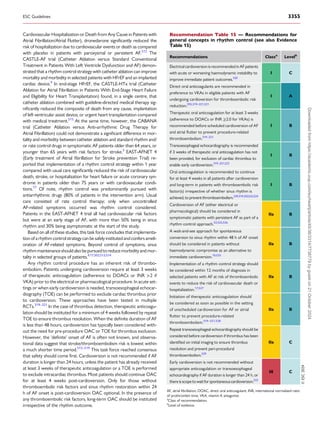
concepts in rhythm control (see also Evidence Table 15) .................. 3355
Recommendation Table 16 — Recommendations for electrical
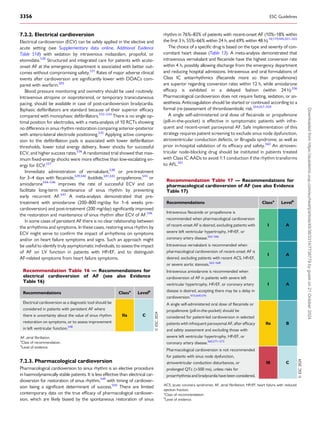
cardioversion of AF (see also Evidence Table 16) .................................. 3356
Recommendation Table 17 — Recommendations for
pharmacological cardioversion of AF (see also Evidence Table 17) 3356
Recommendation Table 18 — Recommendations for
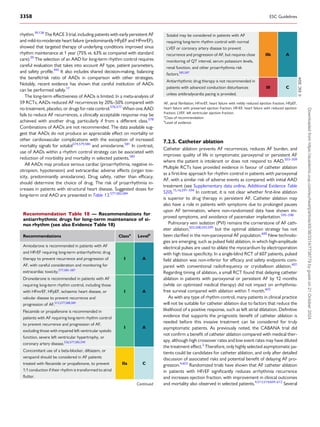
antiarrhythmic drugs for long-term maintenance of sinus rhythm
(see also Evidence Table 18) ............................................................................ 3358
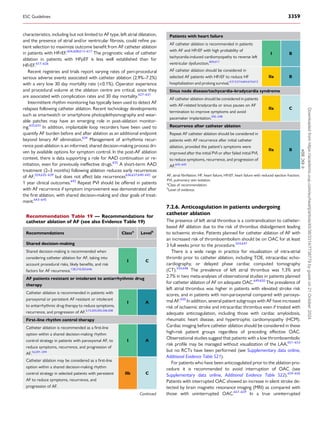
Recommendation Table 19 — Recommendations for catheter
ablation of AF (see also Evidence Table 19) ............................................. 3359
Recommendation Table 20 — Recommendations for
anticoagulation in patients undergoing catheter ablation (see also
Evidence Table 20) ............................................................................................... 3360
Recommendation Table 21 — Recommendations for endoscopic
and hybrid AF ablation (see also Evidence Table 21) ........................... 3360
Recommendation Table 22 — Recommendations for AF ablation
during cardiac surgery (see also Evidence Table 22) ............................. 3361
Recommendation Table 23 — Recommendations to improve
patient experience (see also Evidence Table 23) .................................... 3364
Recommendation Table 24 — Recommendations for patients with
acute coronary syndromes or undergoing percutaneous
intervention (see also Evidence Table 24) ................................................. 3366
Recommendation Table 25 — Recommendations for
trigger-induced AF (see also Evidence Table 25) .................................... 3368
Recommendation Table 26 — Recommendations for management
of post-operative AF (see also Evidence Table 26) ............................... 3368
Recommendation Table 27 — Recommendations for patients with
embolic stroke of unknown source (see also Evidence Table 27) .. 3369
Recommendation Table 28 — Recommendations for patients with
AF during pregnancy (see also Evidence Table 28) ................................ 3369
Recommendation Table 29 — Recommendations for patients with
AF and congenital heart disease (see also Evidence Table 29) ......... 3370
Recommendation Table 30 — Recommendations for prevention of
thromboembolism in atrial flutter (see also Evidence Table 30) ..... 3371
Recommendation Table 31 — Recommendations for screening for
AF (see also Evidence Table 31) .................................................................... 3374
Recommendation Table 32 — Recommendations for primary
prevention of AF (see also Evidence Table 32) ....................................... 3376
List of tables
Table 1 Classes of recommendations .......................................................... 3320
Table 2 Levels of evidence ................................................................................ 3320
Table 3 New recommendations .................................................................... 3322
Table 4 Revised recommendations ............................................................... 3325
Table 5 Definitions and classifications for the temporal pattern of
AF ................................................................................................................................. 3327
Table 6 Other clinical concepts relevant to AF ....................................... 3327
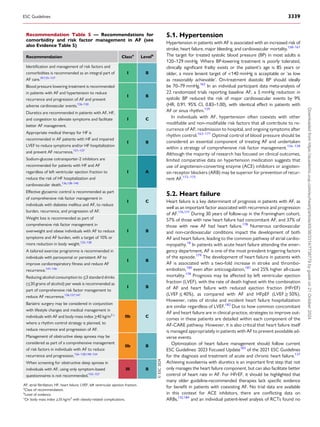
Table 7 The modified European Heart Rhythm Association
(mEHRA) symptom classification ................................................................... 3329
Table 8 Diagnostic work-up for patients with AF .................................. 3330
Table 9 Achieving patient-centred AF management ............................. 3331
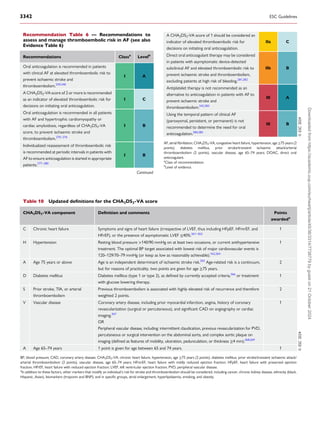
Table 10 Updated definitions for the CHA2DS2-VA score ............... 3342
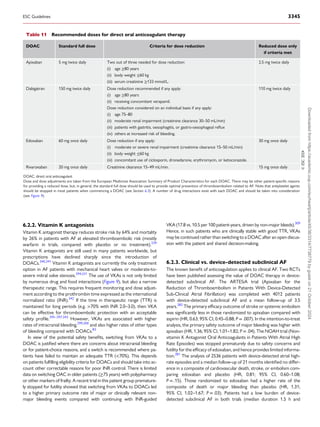
Table 11 Recommended doses for direct oral anticoagulant
therapy ....................................................................................................................... 3345
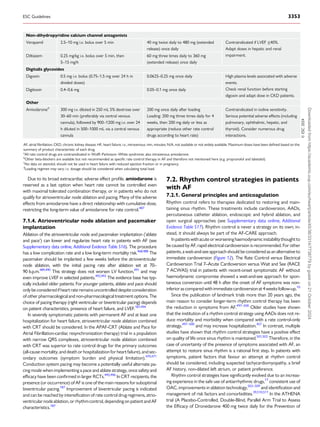
Table 12 Drugs for rate control in AF ........................................................ 3352
Table 13 Antiarrhythmic drugs for sinus rhythm restoration ........... 3357
Table 14 Non-cardiac conditions associated with trigger-induced
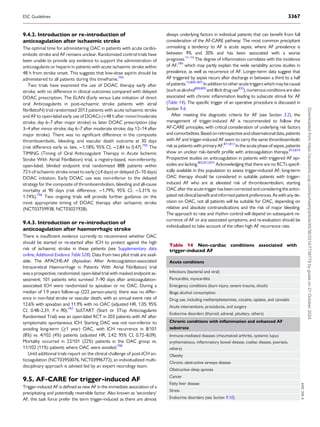
AF ................................................................................................................................. 3367
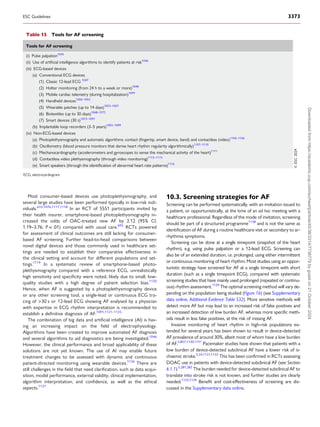
Table 15 Tools for AF screening .................................................................... 3373
Table 16 Factors associated with incident AF .......................................... 3375
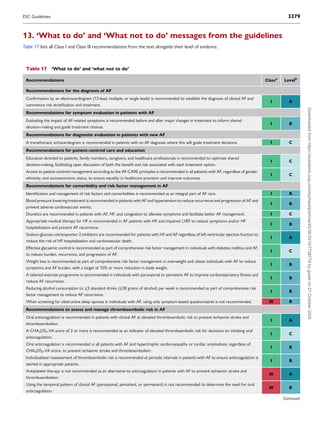
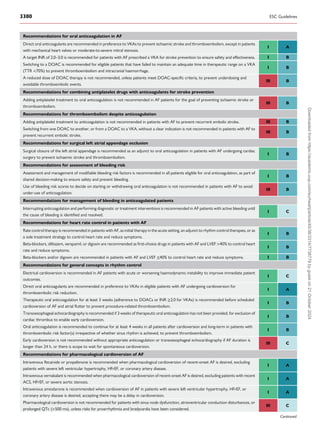
Table 17 ‘What to do’ and ‘what not to do’ ............................................ 3379
List of figures
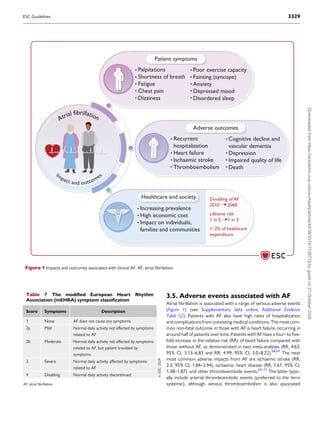
Figure 1 Impacts and outcomes associated with clinical AF. AF, atrial
fibrillation .................................................................................................................. 3329
Figure 2 Multidisciplinary approach to AF management ...................... 3331
Figure 3 Central illustration. Patient pathway for AF-CARE (see Figures
4, 5, 6, and 7 for the [R] pathways for first-diagnosed, paroxysmal,
persistent and permanent AF) ................................................................................ 3333
Figure 4 [R] Pathway for patients with first-diagnosed AF ................. 3334
Figure 5 [R] Pathway for patients with paroxysmal AF ....................... 3335
Figure 6 [R] Pathway for patients with persistent AF .......................... 3336
Figure 7 [R] Pathway for patients with permanent AF ........................ 3337
Figure 8 Management of key comorbidities to reduce AF
recurrence ................................................................................................................ 3338
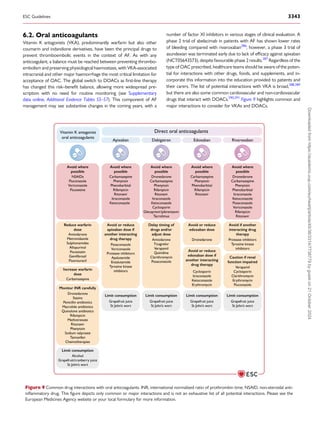
Figure 9 Common drug interactions with oral anticoagulants .......... 3343
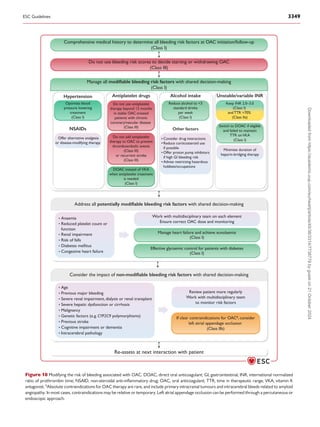
Figure 10 Modifying the risk of bleeding associated with OAC ....... 3349
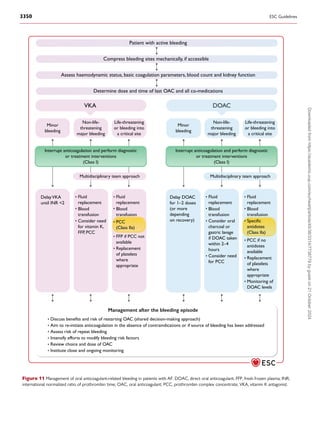
Figure 11 Management of oral anticoagulant-related bleeding in
patients with AF .................................................................................................... 3350
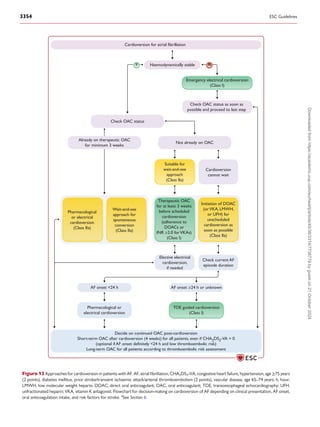
Figure 12 Approaches for cardioversion in patients with AF ............ 3354
Figure 13 Relevance of echocardiography in the AF-CARE pathway 3363
Figure 14 Antithrombotic therapy in patients with AF and acute or
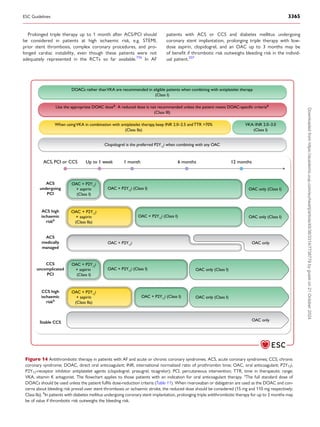
chronic coronary syndromes ........................................................................... 3365
ESC Guidelines 3317
Downloaded
from
https://academic.oup.com/eurheartj/article/45/36/3314/7738779
by
guest
on
21
October
2024
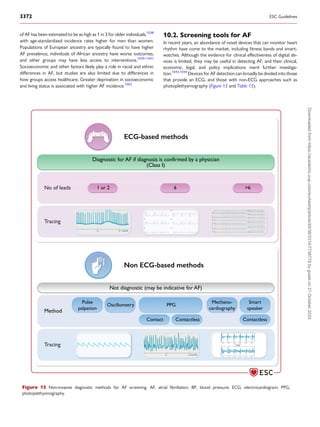
Figure 15 Non-invasive diagnostic methods for AF screening .......... 3372
Figure 16 Approaches to screening for AF ............................................... 3374
Abbreviations and acronyms
AAD Antiarrhythmic drugs
ACE Angiotensin-converting enzyme
ACEi Angiotensin-converting enzyme inhibitor
ACS Acute coronary syndromes
ACTIVE W Atrial fibrillation Clopidogrel Trial with Irbesartan
for prevention of Vascular Events (trial)
AF Atrial fibrillation
AF-CARE Atrial fibrillation—[C] Comorbidity and risk factor
management, [A] Avoid stroke and
thromboembolism,[R]Reducesymptomsbyrateand
rhythm control, [E] Evaluation and dynamic
reassessment
AFEQT Atrial Fibrillation Effect on QualiTy-of-Life
(questionnaire)
AFFIRM Atrial Fibrillation Follow-up Investigation of
Rhythm Management (trial)
AFL Atrial flutter
AFQLQ Atrial Fibrillation Quality of Life Questionnaire
AF-QoL Atrial Fibrillation Quality of Life (questionnaire)
AFSS Atrial Fibrillation Severity Scale
AI Artificial intelligence
APACHE-AF Apixaban After Anticoagulation-associated
Intracerebral Haemorrhage in Patients With Atrial
Fibrillation (trial)
APAF-CRT Ablate and Pace for Atrial Fibrillation—cardiac
resynchronization therapy
ARB Angiotensin receptor blocker
ARTESiA Apixaban for the Reduction of Thromboembolism
in Patients With Device-Detected Sub-Clinical
Atrial Fibrillation (trial)
AT Atrial tachycardia
ATHENA A Placebo-Controlled, Double-Blind, Parallel Arm
Trial to Assess the Efficacy of Dronedarone 400 mg
twice daily for the Prevention of Cardiovascular
Hospitalization or Death from Any Cause in
Patients with Atrial Fibrillation/Atrial Flutter (trial)
AUGUSTUS Anopen-label, 2 ×2 factorial, randomized controlled,
clinical trial to evaluate the safety of apixaban vs.
vitamin k antagonist and aspirin vs. aspirin placebo in
patients with atrial fibrillation and acute coronary
syndrome or percutaneous coronary intervention
AVERROES Apixaban Versus Acetylsalicylic Acid to Prevent
Stroke in Atrial Fibrillation Patients Who Have
Failed or Are Unsuitable for Vitamin K Antagonist
Treatment (trial)
AVN Atrioventricular node
b.p.m. Beats per minute
BMI Body mass index
BNP B-type natriuretic peptide
BP Blood pressure
C2HEST Coronary artery disease or chronic obstructive
pulmonary disease (1 point each); hypertension
(1 point); elderly (age ≥75 years, 2 points); systolic
heart failure (2 points); thyroid disease
(hyperthyroidism, 1 point)
CABANA Catheter Ablation versus Anti-arrhythmic Drug
Therapy for Atrial Fibrillation (trial)
CAD Coronary artery disease
CASTLE-AF Catheter Ablation versus Standard Conventional
Treatment in Patients With Left Ventricle (LV)
Dysfunction and AF (trial)
CASTLE-HTx Catheter Ablation for Atrial Fibrillation in Patients
With End-Stage Heart Failure and Eligibility for
Heart Transplantation (trial)
CCS Chronic coronary syndrome
CHADS2 Congestive heart failure, hypertension, age >75
years, diabetes; previous stroke (2 points)
CHA2DS2-VA Congestive heart failure, hypertension, age ≥75 years
(2 points), diabetes mellitus, prior stroke/transient
ischaemic attack/arterial thromboembolism (2
points), vascular disease, age 65–74 years (score)
CHA2DS2-VASc Congestive heart failure, hypertension, age ≥75
years (2 points), diabetes mellitus, prior stroke or
TIA or thromboembolism (2 points), vascular
disease, age 65–74 years, sex category
CKD Chronic kidney disease
CMR Cardiac magnetic resonance
COMPASS Cardiovascular Outcomes for People Using
Anticoagulation Strategies (trial)
CPAP Continuous positive airway pressure
CrCl Creatinine clearance
CRT Cardiac resynchronization therapy
CT Computed tomography
CTA Computed tomography angiography
CTI Cavo-tricuspid isthmus
DAPT Dual antiplatelet therapy
DOAC Direct oral anticoagulant
EAST-AFNET 4 Early treatment of Atrial fibrillation for Stroke
prevention Trial
ECG Electrocardiogram
ECV Electrical cardioversion
EHRA European Heart Rhythm Association
ELAN Early versus Late initiation of direct oral
Anticoagulants in post-ischaemic stroke patients
with atrial fibrillatioN (trial)
ESUS Embolic stroke of undetermined source
FFP Fresh frozen plasma
GI Gastrointestinal
GWAS Genome-wide association studies
HAS-BLED Hypertension, Abnormal renal/liver function,
Stroke, Bleeding history or predisposition, Labile
international normalized ratio, Elderly (>65 years),
Drugs/alcohol concomitantly (score)
HAVOC Hypertension, age, valvular heart disease,
peripheral vascular disease, obesity, congestive
heart failure, and coronary artery disease
HbA1c Haemoglobin A1c (glycated or glycosylated
haemoglobin)
HCM Hypertrophic cardiomyopathy
HF Heart failure
HFmrEF Heart failure with mildly reduced ejection fraction
HFpEF Heart failure with preserved ejection fraction
HFrEF Heart failure with reduced ejection fraction
HR Hazard ratio
i.v. Intravenous
3318 ESC Guidelines
Downloaded
from
https://academic.oup.com/eurheartj/article/45/36/3314/7738779
by
guest
on
21
October
2024
ICH Intracranial haemorrhage
ICHOM International Consortium for Health Outcomes
Measurement
IMT Intima-media thickness
INR International normalized ratio (of prothrombin
time)
LA Left atrium
LAA Left atrial appendage
LAAO Left atrial appendage occlusion
LAAOS III Left Atrial Appendage Occlusion Study
LEGACY Long-Term Effect of Goal directed weight
management on Atrial Fibrillation Cohort: a 5 Year
follow-up study
LMWH Low molecular weight heparin
LOOP Atrial Fibrillation Detected by Continuous ECG
Monitoring (trial)
LV Left ventricle
LVEF Left ventricular ejection fraction
LVH Left ventricular hypertrophy
mEHRA Modified European Heart Rhythm Association
score
MI Myocardial infarction
MRI Magnetic resonance imaging
NOAH Non-vitamin K Antagonist Oral Anticoagulants
in Patients With Atrial High Rate Episodes (trial)
NSAID Non-steroidal anti-inflammatory drug
NT-proBNP N-terminal pro-B-type natriuretic peptide
NYHA New York Heart Association
OAC Oral anticoagulant(s)
OR Odds ratio
OSA Obstructive sleep apnoea
PAD Peripheral arterial disease
PCC Prothrombin complex concentrate
PCI Percutaneous intervention
PFO Patent foramen ovale
POAF Post-operative atrial fibrillation
PPG Photoplethysmography
PROM Patient-reported outcome measure
PVD Peripheral vascular disease
PVI Pulmonary vein isolation
QLAF Quality of Life in Atrial Fibrillation (questionnaire)
QRS Q wave, R wave, and S wave, the ‘QRS complex’
represents ventricular depolarization
RACE 7
ACWAS
Rate Control versus Electrical Cardioversion
Trial 7—Acute Cardioversion versus Wait and See
(trial)
RACE I RAte Control versus Electrical cardioversion study
RACE II Rate Control Efficacy in Permanent Atrial
Fibrillation (trial)
RACE 3 Routine versus Aggressive upstream rhythm
Control for prevention of Early AF in heart failure
(trial)
RACE 4 IntegRAted Chronic Care Program at Specialized
AF Clinic Versus Usual CarE in Patients with Atrial
Fibrillation (trial)
RATE-AF RAte control Therapy Evaluation in permanent
Atrial Fibrillation (trial)
RCT Randomized controlled trial
RR Relative risk
SAVE Sleep Apnea cardioVascular Endpoints (trial)
SBP Systolic blood pressure
SGLT2 Sodium-glucose cotransporter-2
SIC-AF Successful Intravenous Cardioversion for Atrial
Fibrillation
SORT-AF Supervised Obesity Reduction Trial for AF
Ablation Patients (trial)
SoSTART Start or STop Anticoagulants Randomised Trial
SR Sinus rhythm
STEEER-AF Stroke prevention and rhythm control Therapy:
Evaluation of an Educational programme of the
European Society of Cardiology in a cluster-
Randomised trial in patients with Atrial Fibrillation
(trial)
STEMI ST-segment elevation myocardial infarction
STROKESTOP Systematic ECG Screening for Atrial Fibrillation
Among 75 Year Old Subjects in the Region of
Stockholm and Halland, Sweden (trial)
TE Thromboembolism
TIA Transient ischaemic attack
TIMING Timing of Oral Anticoagulant Therapy in Acute
Ischemic Stroke With Atrial Fibrillation (trial)
TOE Transoesophageal echocardiography
TSH Thyroid-stimulating hormone
TTE Transthoracic echocardiogram
TTR Time in therapeutic range
UFH Unfractionated heparin
VKA Vitamin K antagonist
1. Preamble
Guidelines evaluate and summarize available evidence with the aim of
assisting health professionals in proposing the best diagnostic or thera­
peutic approach for an individual patient with a given condition.
Guidelines are intended for use by health professionals and the
European Society of Cardiology (ESC) makes its Guidelines freely
available.
ESC Guidelines do not override the individual responsibility of
health professionals to make appropriate and accurate decisions in
consideration of each patient’s health condition and in consultation
with that patient or the patient’s caregiver where appropriate and/
or necessary. It is also the health professional’s responsibility to verify
the rules and regulations applicable in each country to drugs and de­
vices at the time of prescription and to respect the ethical rules of their
profession.
ESC Guidelines represent the official position of the ESC on a given
topic and are regularly updated when warranted by new evidence. ESC
Policies and Procedures for formulating and issuing ESC Guidelines can
be found on the ESC website (https://www.escardio.org/Guidelines/
Clinical-Practice-Guidelines/Guidelines-development/Writing-ESC-
Guidelines). This guideline updates and replaces the previous version
from 2020.
The Members of this task force were selected by the ESC to include
professionals involved with the medical care of patients with this path­
ology as well as patient representatives and methodologists. The selec­
tion procedure included an open call for authors and aimed to include
members from across the whole of the ESC region and from relevant
ESC Subspecialty Communities. Consideration was given to diversity
ESC Guidelines 3319
Downloaded
from
https://academic.oup.com/eurheartj/article/45/36/3314/7738779
by
guest
on
21
October
2024
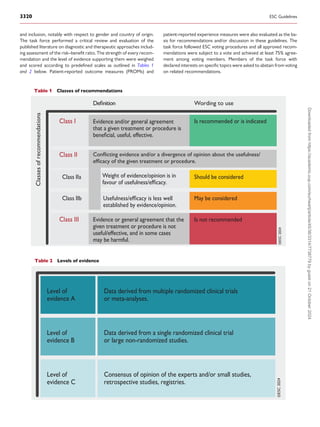
and inclusion, notably with respect to gender and country of origin.
The task force performed a critical review and evaluation of the
published literature on diagnostic and therapeutic approaches includ­
ing assessment of the risk–benefit ratio. The strength of every recom­
mendation and the level of evidence supporting them were weighed
and scored according to predefined scales as outlined in Tables 1
and 2 below. Patient-reported outcome measures (PROMs) and
patient-reported experience measures were also evaluated as the ba­
sis for recommendations and/or discussion in these guidelines. The
task force followed ESC voting procedures and all approved recom­
mendations were subject to a vote and achieved at least 75% agree­
ment among voting members. Members of the task force with
declared interests on specific topics were asked to abstain from voting
on related recommendations.
Table 1 Classes of recommendations
©ESC
2024
Classes
of
recommendations
Class I Evidence and/or general agreement
that a given treatment or procedure is
beneficial, useful, effective.
Conflicting evidence and/or a divergence of opinion about the usefulness/
efficacy of the given treatment or procedure.
Is recommended or is indicated
Wording to use
Definition
Class III Evidence or general agreement that the
given treatment or procedure is not
useful/effective, and in some cases
may be harmful.
Is not recommended
Class IIb Usefulness/efficacy is less well
established by evidence/opinion.
May be considered
Class IIa Weight of evidence/opinion is in
favour of usefulness/efficacy.
Should be considered
Class II
Table 2 Levels of evidence
Level of
evidence A
Level of
evidence B
Level of
evidence C
Data derived from multiple randomized clinical trials
or meta-analyses.
Data derived from a single randomized clinical trial
or large non-randomized studies.
Consensus of opinion of the experts and/or small studies,
retrospective studies, registries.
©ESC
2024
3320 ESC Guidelines
Downloaded
from
https://academic.oup.com/eurheartj/article/45/36/3314/7738779
by
guest
on
21
October
2024
Theexperts ofthewritingandreviewingpanelsprovideddeclarationof
interest forms for all relationships that might be perceived as real or po­
tential sources of conflicts of interest. Their declarations of interest were
reviewed according to the ESC declaration of interest rules which can be
found on the ESC website (http://www.escardio.org/guidelines) and have
been compiled in a report published in a supplementary document with
the guidelines. Funding for the development of ESC Guidelines is derived
entirely from the ESC with no involvement of the healthcare industry.
The ESC Clinical Practice Guidelines (CPG) Committee supervises and
co-ordinates the preparation of new guidelines and is responsible for the
approval process. In addition to review by the CPG Committee, ESC
Guidelines undergo multiple rounds of double-blind peer review by exter­
nalexperts,includingmembersfromacrossthewholeoftheESCregion,all
National Cardiac Societies of the ESC and from relevant ESC Subspecialty
Communities. After appropriate revisions, the guidelines are signed off by
all the experts in the task force. The finalized document is signed off by the
CPG Committee for publication in the European Heart Journal.
ESC Guidelines are based on analyses of published evidence, chiefly on
clinical trials and meta-analyses of trials, but potentially including other
types of studies. Evidence tables summarizing key information from rele­
vant studies are generated early in the guideline development process to
facilitate the formulation of recommendations, to enhance comprehension
of recommendations after publication, and reinforce transparency in the
guidelines development process. The tables are published in their
own section of ESC Guidelines and reference specific recommenda­
tion tables.
Off-label use of medication may be presented in this guideline if a suf­
ficient level of evidence shows that it can be considered medically
appropriate for a given condition. However, the final decisions con­
cerning an individual patient must be made by the responsible health
professional giving special consideration to:
• The specific situation of the patient. Unless otherwise provided for
by national regulations, off-label use of medication should be limited
to situations where it is in the patient’s interest with regard to the
quality, safety, and efficacy of care, and only after the patient has
been informed and has provided consent.
• Country-specific health regulations, indications by governmental
drug regulatory agencies, and the ethical rules to which health profes­
sionals are subject, where applicable.
2. Introduction
Atrial fibrillation (AF) is one of the most commonly encountered heart
conditions, with a broad impact on all health services across primary
and secondary care. The prevalence of AF is expected to double in
the next few decades as a consequence of the ageing population, an in­
creasing burden of comorbidities, improved awareness, and new tech­
nologies for detection.
The effects of AF are variable across individual patients; however, mor­
bidity from AF remains highly concerning. Patients with AF can suffer
from a variety of symptoms and poor quality of life. Stroke and heart
failure as consequences of AF are now well appreciated by healthcare
professionals, but AF is also linked to a range of other thromboembolic
outcomes. These include subclinical cerebral damage (potentially leading
to vascular dementia), and thromboembolism to every other organ, all of
which contribute to the higher risk of mortality associated with AF.
The typical drivers of AF onset and progression are a range of co­
morbidities and associated risk factors. To achieve optimal care for pa­
tients with AF, it is now widely accepted that these comorbidities and
risk factors must be managed early and in a dynamic way. Failure to do
so contributes to recurrent cycles of AF, treatment failure, poor patient
outcomes, and a waste of healthcare resources. In this iteration of the
European Society of Cardiology (ESC) practice guidelines on AF, the
task force has consolidated and evolved past approaches to develop
the AF-CARE framework (Atrial Fibrillation—[C] Comorbidity and
risk factor management, [A] Avoid stroke and thromboembolism, [R]
Reduce symptoms by rate and rhythm control, [E] Evaluation and dy­
namic reassessment). Comorbidities and risk factors is placed as the ini­
tial and central component of patient management. This should be
considered first as it applies to all patients with AF, regardless of their
thromboembolic risk factors or any symptoms that might warrant
intervention. This is followed by considering how best to [A] avoid
stroke and thromboembolism, and then the options available to reduce
symptoms, and in some cases improve prognosis, through [R] rate and
rhythm control. [E] Evaluation and reassessment should be individua­
lized for every patient, with a dynamic approach that accounts for
how AF and its associated conditions change over time.
Patient empowerment is critical in any long-term medical problem
to achieve better outcomes, encourage adherence, and to seek timely
guidance on changes in clinical status. A patient-centred, shared
decision-making approach will facilitate the choice of management
that suits each individual patient, particularly in AF where some ther­
apies and interventions improve clinical outcomes, and others are
focused on addressing symptoms and quality of life. Education and
awareness are essential, not only for patients but also healthcare pro­
fessionals in order to constrain the impact of AF on patients and
healthcare services.
With this in mind, the task force have created a range of patient
pathways that cover the major aspects of AF-CARE. At present, these re­
main based on the time-orientated classification of AF (first-diagnosed,
paroxysmal, persistent, and permanent), but ongoing research may allow
for pathology-based classifications and a future of personalized medicine.
Clinical practice guidelines can only cover common scenarios with an evi­
dence base, and so there remains a need for healthcare professionals to
care for patients within a local multidisciplinary team. While guideline-
adherent care has repeatedly been shown to improve patient outcomes,
the actual implementation of guidelines is often poor in many healthcare
settings. This has been demonstrated in the ESC’s first randomized con­
trolled trial (RCT), STEEER-AF (Stroke prevention and rhythm control
Therapy: Evaluation of an Educational programme of the European
Society of Cardiology in a cluster-Randomised trial in patients with Atrial
Fibrillation), which has sought to improve guideline adherence in parallel
to guideline production. The task force developing the 2024 AF
Guidelineshave madeimplementation a key goal by focusing on theunder­
pinning evidence and using a consistent writing style for each recommen­
dation (the intervention proposed, the population it should be applied to,
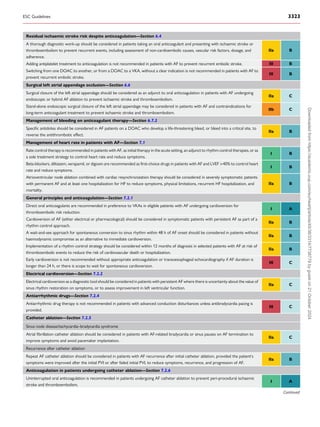
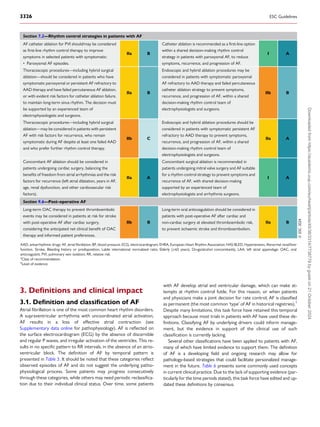
andthepotentialvaluetothepatient,followedbyanyexceptions).Tables3
and 4 below outline new recommendations and those with important re­
visions. These initiatives have been designed to make the 2024 ESC
Guidelines for the management of AF easier to read, follow, and implement,
with the aim of improving the lives of patients with AF. A patient version of
these guidelines is also available at http://www.escardio.org/Guidelines/
guidelines-for-patients.
ESC Guidelines 3321
Downloaded
from
https://academic.oup.com/eurheartj/article/45/36/3314/7738779
by
guest
on
21
October
2024
2.1. What is new
Table 3 New recommendations
Classa
Levelb
Diagnostic evaluation of new AF—Section 3.4
A transthoracic echocardiogram is recommended in patients with an AF diagnosis where this will guide treatment decisions. I C
Principles of AF-CARE—Section 4.2
Education directed to patients, family members, caregivers, and healthcare professionals is recommended to optimize shared
decision-making, facilitating open discussion of both the benefit and risk associated with each treatment option.
I C
Access to patient-centred management according to the AF-CARE principles is recommended in all patients with AF, regardless of gender,
ethnicity, and socioeconomic status, to ensure equality in healthcare provision and improve outcomes.
I C
Patient-centred AF management with a multidisciplinary approach should be considered in all patients with AF to optimize management and
improve outcomes.
IIa B
[C] Comorbidity and risk factor management—Section 5
Diuretics are recommended in patients with AF, HF, and congestion to alleviate symptoms and facilitate better AF management. I C
Appropriate medical therapy for HF is recommended in AF patients with HF and impaired LVEF to reduce symptoms and/or HF
hospitalization and prevent AF recurrence.
I B
Sodium-glucose cotransporter-2 inhibitors are recommended for patients with HF and AF regardless of left ventricular ejection fraction to
reduce the risk of HF hospitalization and cardiovascular death.
I A
Effective glycaemic control is recommended as part of comprehensive risk factor management in individuals with diabetes mellitus and AF,
to reduce burden, recurrence, and progression of AF.
I C
Bariatric surgery may be considered in conjunction with lifestyle changes and medical management in individuals with AF and body mass
index ≥40 kg/m2 c
where a rhythm control strategy is planned, to reduce recurrence and progression of AF.
IIb C
Management of obstructive sleep apnoea may be considered as part of a comprehensive management of risk factors in individuals with AF to
reduce recurrence and progression.
IIb B
When screening for obstructive sleep apnoea in individuals with AF, using only symptom-based questionnaires is not recommended. III B
Initiating oral anticoagulation—Section 6.1
Oral anticoagulation is recommended in patients with clinical AF at elevated thromboembolic risk to prevent ischaemic stroke and
thromboembolism.
I A
A CHA2DS2-VA score of 2 or more is recommended as an indicator of elevated thromboembolic risk for decisions on initiating oral
anticoagulation.
I C
A CHA2DS2-VA score of 1 should be considered an indicator of elevated thromboembolic risk for decisions on initiating oral
anticoagulation.
IIa C
Oral anticoagulation is recommended in all patients with AF and hypertrophic cardiomyopathy or cardiac amyloidosis, regardless of
CHA2DS2-VA score, to prevent ischaemic stroke and thromboembolism.
I B
Individualized reassessment of thromboembolic risk is recommended at periodic intervals in patients with AF to ensure anticoagulation is
started in appropriate patients.
I B
Direct oral anticoagulant therapy may be considered in patients with asymptomatic device-detected subclinical AF and elevated
thromboembolic risk to prevent ischaemic stroke and thromboembolism, excluding patients at high risk of bleeding.
IIb B
Oral anticoagulants—Section 6.2
A reduced dose of DOAC therapy is not recommended, unless patients meet DOAC-specific criteria, to prevent underdosing and
avoidable thromboembolic events.
III B
Maintaining VKA treatment rather than switching to a DOAC may be considered in patients aged ≥75 years on clinically stable therapeutic
VKA with polypharmacy to prevent excess bleeding risk.
IIb B
Antiplatelet drugs and combinations with anticoagulants—Section 6.3
Adding antiplatelet treatment to oral anticoagulation is not recommended in AF patients for the goal of preventing ischaemic stroke or
thromboembolism.
III B
Continued
3322 ESC Guidelines
Downloaded
from
https://academic.oup.com/eurheartj/article/45/36/3314/7738779
by
guest
on
21
October
2024
Residual ischaemic stroke risk despite anticoagulation—Section 6.4
A thorough diagnostic work-up should be considered in patients taking an oral anticoagulant and presenting with ischaemic stroke or
thromboembolism to prevent recurrent events, including assessment of non-cardioembolic causes, vascular risk factors, dosage, and
adherence.
IIa B
Adding antiplatelet treatment to anticoagulation is not recommended in patients with AF to prevent recurrent embolic stroke. III B
Switching from one DOAC to another, or from a DOAC to a VKA, without a clear indication is not recommended in patients with AF to
prevent recurrent embolic stroke.
III B
Surgical left atrial appendage occlusion—Section 6.6
Surgical closure of the left atrial appendage should be considered as an adjunct to oral anticoagulation in patients with AF undergoing
endoscopic or hybrid AF ablation to prevent ischaemic stroke and thromboembolism.
IIa C
Stand-alone endoscopic surgical closure of the left atrial appendage may be considered in patients with AF and contraindications for
long-term anticoagulant treatment to prevent ischaemic stroke and thromboembolism.
IIb C
Management of bleeding on anticoagulant therapy—Section 6.7.2
Specific antidotes should be considered in AF patients on a DOAC who develop a life-threatening bleed, or bleed into a critical site, to
reverse the antithrombotic effect.
IIa B
Management of heart rate in patients with AF—Section 7.1
Rate control therapy is recommended in patients with AF, as initial therapy in the acute setting, an adjunct to rhythm control therapies, or as
a sole treatment strategy to control heart rate and reduce symptoms.
I B
Beta-blockers, diltiazem, verapamil, or digoxin are recommended as first-choice drugs in patients with AF and LVEF >40% to control heart
rate and reduce symptoms.
I B
Atrioventricular node ablation combined with cardiac resynchronization therapy should be considered in severely symptomatic patients
with permanent AF and at least one hospitalization for HF to reduce symptoms, physical limitations, recurrent HF hospitalization, and
mortality.
IIa B
General principles and anticoagulation—Section 7.2.1
Direct oral anticoagulants are recommended in preference to VKAs in eligible patients with AF undergoing cardioversion for
thromboembolic risk reduction.
I A
Cardioversion of AF (either electrical or pharmacological) should be considered in symptomatic patients with persistent AF as part of a
rhythm control approach.
IIa B
A wait-and-see approach for spontaneous conversion to sinus rhythm within 48 h of AF onset should be considered in patients without
haemodynamic compromise as an alternative to immediate cardioversion.
IIa B
Implementation of a rhythm control strategy should be considered within 12 months of diagnosis in selected patients with AF at risk of
thromboembolic events to reduce the risk of cardiovascular death or hospitalization.
IIa B
Early cardioversion is not recommended without appropriate anticoagulation or transoesophageal echocardiography if AF duration is
longer than 24 h, or there is scope to wait for spontaneous cardioversion.
III C
Electrical cardioversion—Section 7.2.2
Electrical cardioversion as a diagnostic tool should be considered in patients with persistent AF where there is uncertainty about the value of
sinus rhythm restoration on symptoms, or to assess improvement in left ventricular function.
IIa C
Antiarrhythmic drugs—Section 7.2.4
Antiarrhythmic drug therapy is not recommended in patients with advanced conduction disturbances unless antibradycardia pacing is
provided.
III C
Catheter ablation—Section 7.2.5
Sinus node disease/tachycardia–bradycardia syndrome
Atrial fibrillation catheter ablation should be considered in patients with AF-related bradycardia or sinus pauses on AF termination to
improve symptoms and avoid pacemaker implantation.
IIa C
Recurrence after catheter ablation
Repeat AF catheter ablation should be considered in patients with AF recurrence after initial catheter ablation, provided the patient’s
symptoms were improved after the initial PVI or after failed initial PVI, to reduce symptoms, recurrence, and progression of AF.
IIa B
Anticoagulation in patients undergoing catheter ablation—Section 7.2.6
Uninterrupted oral anticoagulation is recommended in patients undergoing AF catheter ablation to prevent peri-procedural ischaemic
stroke and thromboembolism.
I A
Continued
ESC Guidelines 3323
Downloaded
from
https://academic.oup.com/eurheartj/article/45/36/3314/7738779
by
guest
on
21
October
2024
Endoscopic and hybrid AF ablation—Section 7.2.7
Continuation of oral anticoagulation is recommended in patients with AF at elevated thromboembolic risk after concomitant, endoscopic,
or hybrid AF ablation, independent of rhythm outcome or LAA exclusion, to prevent ischaemic stroke and thromboembolism.
I C
Endoscopic and hybrid ablation procedures should be considered in patients with symptomatic persistent AF refractory to AAD therapy to
prevent symptoms, recurrence, and progression of AF, within a shared decision-making rhythm control team of electrophysiologists and
surgeons.
IIa A
AF ablation during cardiac surgery—Section 7.2.8
Intraprocedural imaging for detection of left atrial thrombus in patients undergoing surgical ablation is recommended to guide surgical
strategy, independent of oral anticoagulant use, to prevent peri-procedural ischaemic stroke and thromboembolism.
I C
Concomitant surgical ablation should be considered in patients undergoing non-mitral valve cardiac surgery and AF suitable for a rhythm
control strategy to prevent symptoms and recurrence of AF, with shared decision-making supported by an experienced team of
electrophysiologists and arrhythmia surgeons.
IIa B
Patient-reported outcome measures—Section 8.4
Evaluating quality of care and identifying opportunities for improved treatment of AF should be considered by practitioners and institutions
to improve patient experiences.
IIa B
Acute and chronic coronary syndromes in patients with AF—Section 9.2
Recommendations for AF patients with chronic coronary or vascular disease
Antiplatelet therapy beyond 12 months is not recommended in stable patients with chronic coronary or vascular disease treated with oral
anticoagulation, due to lack of efficacy and to avoid major bleeding.
III B
Trigger-induced AF—Section 9.5
Long-term oral anticoagulation should be considered in suitable patients with trigger-induced AF at elevated thromboembolic risk to
prevent ischaemic stroke and systemic thromboembolism.
IIa C
Post-operative AF—Section 9.6
Peri-operative amiodarone therapy is recommended where drug therapy is desired to prevent post-operative AF after cardiac surgery. I A
Concomitant posterior peri-cardiotomy should be considered in patients undergoing cardiac surgery to prevent post-operative AF. IIa B
Patients with embolic stroke of unknown source (ESUS)—Section 9.7
Initiation of oral anticoagulation in ESUS patients without documented AF is not recommended due to lack of efficacy in preventing
ischaemic stroke and thromboembolism.
III A
Atrial flutter—Section 9.14
Oral anticoagulation is recommended in patients with atrial flutter at elevated thromboembolic risk to prevent ischaemic stroke and
thromboembolism.
I B
Screening strategies for AF—Section 10.3
Review of an ECG (12-lead, single, or multiple leads) by a physician is recommended to provide a definite diagnosis of AF and commence
appropriate management.
I B
Population-based screening for AF using a prolonged non-invasive ECG-based approach should be considered in individuals aged ≥75 years,
or ≥65 years with additional CHA2DS2-VA risk factors to ensure earlier detection of AF.
IIa B
Primary prevention of AF—Section 10.5
Maintaining optimal blood pressure is recommended in the general population to prevent AF, with ACE inhibitors or ARBs as first-line
therapy.
I B
Appropriate medical HF therapy is recommended in individuals with HFrEF to prevent AF. I B
Maintaining normal weight (BMI 20–25 kg/m2
) is recommended for the general population to prevent AF. I B
Maintaining an active lifestyle is recommended to prevent AF, with the equivalent of 150–300 min per week of moderate intensity or 75–
150 min per week of vigorous intensity aerobic physical activity.
I B
Avoidance of binge drinking and alcohol excess is recommended in the general population to prevent AF. I B
Metformin or SGLT2 inhibitors should be considered for individuals needing pharmacological management of diabetes mellitus to prevent
AF.
IIa B
Weight reduction should be considered in obese individuals to prevent AF. IIa B
©
ESC
2024
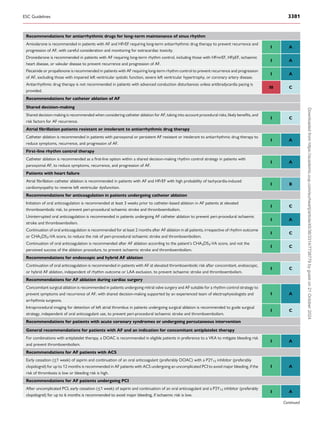
AAD, antiarrhythmic drugs; ACEi, angiotensin-converting enzyme inhibitor; AF, atrial fibrillation; AF-CARE, atrial fibrillation—[C] Comorbidity and risk factor management, [A] Avoid stroke
and thromboembolism, [R] Reduce symptoms by rate and rhythm control, [E] Evaluation and dynamic reassessment; ARB, angiotensin receptor blocker; BMI, body mass index; CHA2DS2-VA,
congestive heart failure, hypertension, age ≥75 years (2 points), diabetes mellitus, prior stroke/transient ischaemic attack/arterial thromboembolism (2 points), vascular disease, age 65–74
years; DOAC, direct oral anticoagulant; ECG, electrocardiogram; ESUS, embolic stroke of undetermined source; HF, heart failure; HFrEF, heart failure with reduced ejection fraction; LAA, left
atrial appendage; LVEF, left ventricular ejection fraction; PVI, pulmonary vein isolation; SGLT2, sodium-glucose cotransporter-2; VKA, vitamin K antagonist.
a
Class of recommendation.
b
Level of evidence.
c
Or body mass index ≥35 kg/m2
with obesity-related complications.
3324 ESC Guidelines
Downloaded
from
https://academic.oup.com/eurheartj/article/45/36/3314/7738779
by
guest
on
21
October
2024
Table 4 Revised recommendations
Recommendations in 2020 version Classa
Levelb
Recommendations in 2024 version Classa
Levelb
Section 3.2—Diagnostic criteria for AF
ECG documentation is required to establish the
diagnosis of AF. A standard 12-lead ECG recording or a
single-lead ECG tracing of ≥30 s showing heart rhythm
with no discernible repeating P waves and irregular RR
intervals (when atrioventricular conduction is not
impaired) is diagnostic of clinical AF.
I B
Confirmation by an electrocardiogram (12-lead,
multiple, or single leads) is recommended to establish
the diagnosis of clinical AF and commence risk
stratification and treatment.
I A
In patients with AF, it is recommended to:
• Evaluate AF-related symptoms (including fatigue,
tiredness, exertional shortness of breath, palpitations,
and chest pain) and quantify the patient symptom
status using the modified EHRA symptom scale
before and after initiation of treatment.
• Evaluate AF-related symptoms before and after
cardioversion of persistent AF to aid rhythm control
treatment decisions.
I C
Evaluating the impact of AF-related symptoms is
recommended before and after major changes in
treatment to inform shared decision-making and guide
treatment choices.
I B
Section 5—[C] Comorbidity and risk factor management
Attention to good BP control is recommended in AF
patients with hypertension to reduce AF recurrences
and risk of stroke and bleeding.
I B
Blood pressure lowering treatment is recommended in
patients with AF and hypertension to reduce
recurrence and progression of AF and prevent adverse
cardiovascular events.
I B
In obese patients with AF, weight loss together with
management of other risk factors should be considered
to reduce AF incidence, AF progression, AF
recurrences, and symptoms.
IIa B
Weight loss is recommended as part of comprehensive
risk factor management in overweight and obese
individuals with AF to reduce symptoms and AF burden,
with a target of 10% or more reduction in body weight.
I B
Physical activity should be considered to help prevent
AF incidence or recurrence, with the exception of
excessive endurance exercise, which may promote AF.
IIa C
A tailored exercise programme is recommended in
individuals with paroxysmal or persistent AF to improve
cardiorespiratory fitness and reduce AF recurrence.
I B
Advice and management to avoid alcohol excess should
be considered for AF prevention and in AF patients
considered for OAC therapy.
IIa B
Reducing alcohol consumption to ≤3 standard drinks
(≤30 grams of alcohol) per week is recommended as
part of comprehensive risk factor management to
reduce AF recurrence.
I B
Section 6.6—Surgical left atrial appendage occlusion
Surgical occlusion or exclusion of the LAA may be
considered for stroke prevention in patients with AF
undergoing cardiac surgery.
IIb C
Surgical closure of the left atrial appendage is
recommended as an adjunct to oral anticoagulation in
patients with AF undergoing cardiac surgery to prevent
ischaemic stroke and thromboembolism.
I B
Section 6.7—Bleeding risk
For a formal risk-score-based assessment of bleeding
risk, the HAS-BLED score should be considered to help
address modifiable bleeding risk factors, and to identify
patients at high risk of bleeding (HAS-BLED score ≥3)
for early and more frequent clinical review and
follow-up.
IIa B
Assessment and management of modifiable bleeding
risk factors is recommended in all patients eligible for
oral anticoagulation, as part of shared decision-making
to ensure safety and prevent bleeding.
I B
Continued
ESC Guidelines 3325
Downloaded
from
https://academic.oup.com/eurheartj/article/45/36/3314/7738779
by
guest
on
21
October
2024
3. Definitions and clinical impact
3.1. Definition and classification of AF
Atrial fibrillation is one of the most common heart rhythm disorders.
A supraventricular arrhythmia with uncoordinated atrial activation,
AF results in a loss of effective atrial contraction (see
Supplementary data online for pathophysiology). AF is reflected on
the surface electrocardiogram (ECG) by the absence of discernible
and regular P waves, and irregular activation of the ventricles. This re­
sults in no specific pattern to RR intervals, in the absence of an atrio­
ventricular block. The definition of AF by temporal pattern is
presented in Table 5. It should be noted that these categories reflect
observed episodes of AF and do not suggest the underlying patho­
physiological process. Some patients may progress consecutively
through these categories, while others may need periodic reclassifica­
tion due to their individual clinical status. Over time, some patients
with AF develop atrial and ventricular damage, which can make at­
tempts at rhythm control futile. For this reason, or when patients
and physicians make a joint decision for rate control, AF is classified
as permanent (the most common ‘type’ of AF in historical registries).1
Despite many limitations, this task force have retained this temporal
approach because most trials in patients with AF have used these de­
finitions. Classifying AF by underlying drivers could inform manage­
ment, but the evidence in support of the clinical use of such
classification is currently lacking.
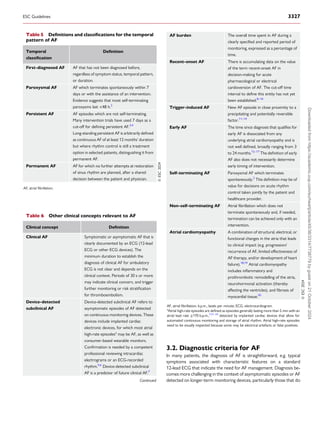
Several other classifications have been applied to patients with AF,
many of which have limited evidence to support them. The definition
of AF is a developing field and ongoing research may allow for
pathology-based strategies that could facilitate personalized manage­
ment in the future. Table 6 presents some commonly used concepts
in current clinical practice. Due to the lack of supporting evidence (par­
ticularly for the time periods stated), this task force have edited and up­
dated these definitions by consensus.
Section 7.2—Rhythm control strategies in patients with AF
AF catheter ablation for PVI should/may be considered
as first-line rhythm control therapy to improve
symptoms in selected patients with symptomatic:
• Paroxysmal AF episodes.
IIa B
Catheter ablation is recommended as a first-line option
within a shared decision-making rhythm control
strategy in patients with paroxysmal AF, to reduce
symptoms, recurrence, and progression of AF.
I A
Thoracoscopic procedures—including hybrid surgical
ablation—should be considered in patients who have
symptomatic paroxysmal or persistent AF refractory to
AAD therapy and have failed percutaneous AF ablation,
or with evident risk factors for catheter ablation failure,
to maintain long-term sinus rhythm. The decision must
be supported by an experienced team of
electrophysiologists and surgeons.
IIa B
Endoscopic and hybrid ablation procedures may be
considered in patients with symptomatic paroxysmal
AF refractory to AAD therapy and failed percutaneous
catheter ablation strategy to prevent symptoms,
recurrence, and progression of AF, within a shared
decision-making rhythm control team of
electrophysiologists and surgeons.
IIb B
Thoracoscopic procedures—including hybrid surgical
ablation—may be considered in patients with persistent
AF with risk factors for recurrence, who remain
symptomatic during AF despite at least one failed AAD
and who prefer further rhythm control therapy.
IIb C
Endoscopic and hybrid ablation procedures should be
considered in patients with symptomatic persistent AF
refractory to AAD therapy to prevent symptoms,
recurrence, and progression of AF, within a shared
decision-making rhythm control team of
electrophysiologists and surgeons.
IIa A
Concomitant AF ablation should be considered in
patients undergoing cardiac surgery, balancing the
benefits of freedom from atrial arrhythmias and the risk
factors for recurrence (left atrial dilatation, years in AF,
age, renal dysfunction, and other cardiovascular risk
factors).
IIa A
Concomitant surgical ablation is recommended in
patients undergoing mitral valve surgery and AF suitable
for a rhythm control strategy to prevent symptoms and
recurrence of AF, with shared decision-making
supported by an experienced team of
electrophysiologists and arrhythmia surgeons.
I A
Section 9.6—Post-operative AF
Long-term OAC therapy to prevent thromboembolic
events may be considered in patients at risk for stroke
with post-operative AF after cardiac surgery,
considering the anticipated net clinical benefit of OAC
therapy and informed patient preferences.
IIb B
Long-term oral anticoagulation should be considered in
patients with post-operative AF after cardiac and
non-cardiac surgery at elevated thromboembolic risk,
to prevent ischaemic stroke and thromboembolism.
IIa B
©
ESC
2024
AAD, antiarrhythmic drugs; AF, atrial fibrillation; BP, blood pressure; ECG, electrocardiogram; EHRA, European Heart Rhythm Association; HAS-BLED, Hypertension, Abnormal renal/liver
function, Stroke, Bleeding history or predisposition, Labile international normalized ratio, Elderly (>65 years), Drugs/alcohol concomitantly; LAA, left atrial appendage; OAC, oral
anticoagulant; PVI, pulmonary vein isolation; RR, relative risk.
a
Class of recommendation.
b
Level of evidence.
3326 ESC Guidelines
Downloaded
from
https://academic.oup.com/eurheartj/article/45/36/3314/7738779
by
guest
on
21
October
2024
3.2. Diagnostic criteria for AF
In many patients, the diagnosis of AF is straightforward, e.g. typical
symptoms associated with characteristic features on a standard
12-lead ECG that indicate the need for AF management. Diagnosis be­
comes more challenging in the context of asymptomatic episodes or AF
detected on longer-term monitoring devices, particularly those that do
Table 6 Other clinical concepts relevant to AF
Clinical concept Definition
Clinical AF Symptomatic or asymptomatic AF that is
clearly documented by an ECG (12-lead
ECG or other ECG devices). The
minimum duration to establish the
diagnosis of clinical AF for ambulatory
ECG is not clear and depends on the
clinical context. Periods of 30 s or more
may indicate clinical concern, and trigger
further monitoring or risk stratification
for thromboembolism.
Device-detected
subclinical AF
Device-detected subclinical AF refers to
asymptomatic episodes of AF detected
on continuous monitoring devices. These
devices include implanted cardiac
electronic devices, for which most atrial
high-rate episodesa
may be AF, as well as
consumer-based wearable monitors.
Confirmation is needed by a competent
professional reviewing intracardiac
electrograms or an ECG-recorded
rhythm.5,6
Device-detected subclinical
AF is a predictor of future clinical AF.7
Continued
Table 5 Definitions and classifications for the temporal
pattern of AF
Temporal
classification
Definition
First-diagnosed AF AF that has not been diagnosed before,
regardless of symptom status, temporal pattern,
or duration.
Paroxysmal AF AF which terminates spontaneously within 7
days or with the assistance of an intervention.
Evidence suggests that most self-terminating
paroxysms last <48 h.2
Persistent AF AF episodes which are not self-terminating.
Many intervention trials have used 7 days as a
cut-off for defining persistent AF.3,4
Long-standing persistent AF is arbitrarily defined
as continuous AF of at least 12 months’ duration
but where rhythm control is still a treatment
option in selected patients, distinguishing it from
permanent AF.
Permanent AF AF for which no further attempts at restoration
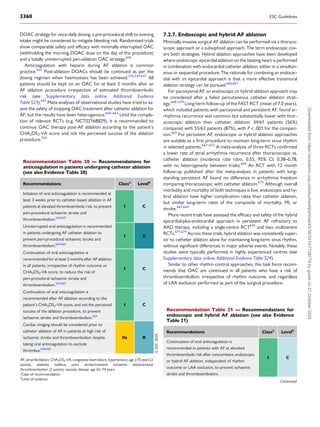
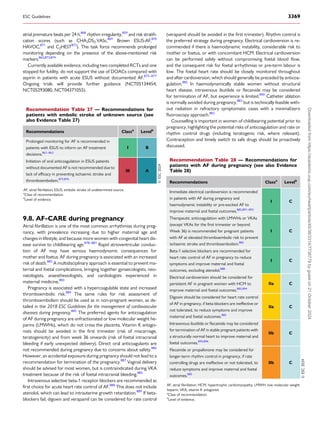
of sinus rhythm are planned, after a shared
decision between the patient and physician.
©
ESC
2024
AF, atrial fibrillation.
AF burden The overall time spent in AF during a
clearly specified and reported period of
monitoring, expressed as a percentage of
time.
Recent-onset AF There is accumulating data on the value
of the term recent-onset AF in
decision-making for acute
pharmacological or electrical
cardioversion of AF. The cut-off time
interval to define this entity has not yet
been established.8–10
Trigger-induced AF New AF episode in close proximity to a
precipitating and potentially reversible
factor.11–14
Early AF The time since diagnosis that qualifies for
early AF is dissociated from any
underlying atrial cardiomyopathy and is
not well defined, broadly ranging from 3
to 24 months.15–17
The definition of early
AF also does not necessarily determine
early timing of intervention.
Self-terminating AF Paroxysmal AF which terminates
spontaneously.2
This definition may be of
value for decisions on acute rhythm
control taken jointly by the patient and
healthcare provider.
Non-self-terminating AF Atrial fibrillation which does not
terminate spontaneously and, if needed,
termination can be achieved only with an
intervention.
Atrial cardiomyopathy A combination of structural, electrical, or
functional changes in the atria that leads
to clinical impact (e.g. progression/
recurrence of AF, limited effectiveness of
AF therapy, and/or development of heart
failure).18,19
Atrial cardiomyopathy
includes inflammatory and
prothrombotic remodelling of the atria,
neurohormonal activation (thereby
affecting the ventricles), and fibrosis of
myocardial tissue.20
©
ESC
2024
AF, atrial fibrillation; b.p.m., beats per minute; ECG, electrocardiogram.
a
Atrial high-rate episodes are defined as episodes generally lasting more than 5 min with an
atrial lead rate ≥170 b.p.m.,7,21–24
detected by implanted cardiac devices that allow for
automated continuous monitoring and storage of atrial rhythm. Atrial high-rate episodes
need to be visually inspected because some may be electrical artefacts or false positives.
ESC Guidelines 3327
Downloaded
from
https://academic.oup.com/eurheartj/article/45/36/3314/7738779
by
guest
on
21
October
2024
not provide an ECG (see Section 10). To guard against inappropriate
diagnosis of AF, this task force continues to recommend that ECG
documentation is required to initiate risk stratification and AF manage­
ment. In current practice, ECG confirmation can include multiple op­
tions: not only where AF persists across a standard 12-lead ECG, but
also single- and multiple-lead devices that provide an ECG (see
Supplementary data online, Additional Evidence Table S1). This does
not include non-ECG wearables and other devices that typically use
photoplethysmography. Note that many pivotal AF trials required
two or more ECGs documenting AF, or an established AF diagnosis be­
fore randomization.25–29
The time period of AF required for diagnosis
on monitoring devices is not clear cut. A standard 12-lead ECG mea­
sures 10 s, while 30 s or more on single-lead or multiple-lead ECG de­
vices has generally been the consensus opinion, albeit with limited
evidence.
3.3. Symptoms attributable to AF
Symptoms related to episodes of AF are variable and broad, and not
just typical palpitations (Figure 1). Asymptomatic episodes of AF can
occur,30
although 90% of patients with AF describe symptoms with
variable severity.31
Even in symptomatic patients, some episodes of
AF may remain asymptomatic.32,33
The presence or absence of symp­
toms is not related to incident stroke, systemic embolism, or mortal­
ity.34
However, symptoms do impact on patient quality of life.35,36
Cardiac-specific AF symptoms such as palpitations are less common
than non-specific symptoms such as fatigue, but they significantly
impair quality of life.36,37
Although women are often underrepresented
in clinical trials of AF,38–40
the available literature suggests that
women with AF appear to be more symptomatic and have poorer
quality of life.41,42
Patients with AF report a higher burden of anxiety
and severity of depression (odds ratio [OR], 1.08; 95% confidence
interval [CI], 1.02–1.15; P = .009) as compared with the general
population,43,44
with higher prevalence of these symptoms in women
with AF.45
Assessment of AF-related symptoms should be recorded initially,
after a change in treatment, or before and after intervention. The
modified European Heart Rhythm Association score (mEHRA)
symptom classification (Table 7) is similar to the New York
Heart Association (NYHA) functional class for heart failure. It cor­
relates with quality of life scores in clinical trials, is associated with
clinical progress and events, and may be a valuable starting point
in routine practice to assess the burden and impact of symptoms to­
gether with the patient.46–48
Note that symptoms may also relate to
associated comorbidities and not just the AF component. The
patient-related effects of symptoms from AF over time can alterna­
tively be evaluated using patient-reported outcome measures (see
Section 8.4).
3.4. Diagnostic evaluation of new AF
All patients with AF should be offered a comprehensive diagnostic as­
sessment and review of medical history to identify risk factors and/or
comorbidities needing active treatment. Table 8 displays the essential
diagnostic work-up for a patient with AF.
A 12-lead ECG is warranted in all AF patients to confirm rhythm, de­
termine ventricular rate, and look for signs of structural heart disease,
conduction defects, or ischaemia.56
Blood tests should be carried out
(kidney function, serum electrolytes, liver function, full blood count, glu­
cose/glycated haemoglobin [HbA1c], and thyroid tests) to detect any
concomitant conditions that may exacerbate AF or increase the risk
of bleeding and/or thromboembolism.57,58
Other investigations will depend on individualized assessment and
the planned treatment strategy.59–65
A transthoracic echocardiogram
(TTE) should be carried out in the initial work-up, where this will guide
management decisions, or in patients where there is a change in cardio­
vascular signs or symptoms. The task force recognizes that accessibility
to TTE might be limited or delayed in the primary care setting, but this
should not delay initiation of oral anticoagulation (OAC) or other com­
ponents of AF-CARE where indicated.66
Further details on TTE and re­
assessment (e.g. if elevated heart rate limits diagnostic imaging, or
where there is a change in clinical status) are presented in Section 8.3.
Additional imaging using different modalities may be required to assist
with comorbidity and AF-related management (see Supplementary
data online, Figure S1).
Recommendation Table 1 — Recommendations for the
diagnosis of AF (see also Evidence Table 1)
Recommendations Classa
Levelb
Confirmation by an electrocardiogram (12-lead,
multiple, or single leads) is recommended to establish
the diagnosis of clinical AF and commence risk
stratification and treatment.25–29
I A
©
ESC
2024
AF, atrial fibrillation.
a
Class of recommendation.
b
Level of evidence.
Recommendation Table 2 — Recommendations for
symptom evaluation in patients with AF (see also
Evidence Table 2)
Recommendations Classa
Levelb
Evaluating the impact of AF-related symptoms is
recommended before and after major changes in
treatment to inform shared decision-making and
guide treatment choices.17,36,46–55
I B
©
ESC
2024
AF, atrial fibrillation.
a
Class of recommendation.
b
Level of evidence.
Recommendation Table 3 — Recommendations for
diagnostic evaluation in patients with new AF (see also
Evidence Table 3)
Recommendations Classa
Levelb
A transthoracic echocardiogram is recommended in
patients with an AF diagnosis where this will guide
treatment decisions.59,65,67
I C
©
ESC
2024
AF, atrial fibrillation.
a
Class of recommendation.
b
Level of evidence.
3328 ESC Guidelines
Downloaded
from
https://academic.oup.com/eurheartj/article/45/36/3314/7738779
by
guest
on
21
October
2024
3.5. Adverse events associated with AF
Atrial fibrillation is associated with a range of serious adverse events
(Figure 1) (see Supplementary data online, Additional Evidence
Table S2). Patients with AF also have high rates of hospitalization
and complications from coexisting medical conditions. The most com­
mon non-fatal outcome in those with AF is heart failure, occurring in
around half of patients over time. Patients with AF have a four- to five-
fold increase in the relative risk (RR) of heart failure compared with
those without AF, as demonstrated in two meta-analyses (RR, 4.62;
95% CI, 3.13–6.83 and RR, 4.99; 95% CI, 3.0–8.22).68,69
The next
most common adverse impacts from AF are ischaemic stroke (RR,
2.3; 95% CI, 1.84–2.94), ischaemic heart disease (RR, 1.61; 95% CI,
1.38–1.87), and other thromboembolic events.69–71
The latter typic­
ally include arterial thromboembolic events (preferred to the term
systemic), although venous thromboembolism is also associated
Patient symptoms
Adverse outcomes
Healthcare and society
Atrial fibrillation
Impact and outcomes
Palpitations
Shortness of breath
Fatigue
Chest pain
Dizziness
Poor exercise capacity
Fainting (syncope)
Anxiety
Depressed mood
Disordered sleep
Recurrent
hospitalization
Heart failure
Ischaemic stroke
Thromboembolism
Cognitive decline and
vascular dementia
Depression
Impaired quality of life
Death
Increasing prevalence
High economic cost
Impact on individuals,
families and communities
Doubling of AF
2010 2060
Lifetime risk
1 in 5 1 in 3
1–2% of healthcare
expenditure
Figure 1 Impacts and outcomes associated with clinical AF. AF, atrial fibrillation.
Table 7 The modified European Heart Rhythm
Association (mEHRA) symptom classification
Score Symptoms Description
1 None AF does not cause any symptoms
2a Mild Normal daily activity not affected by symptoms
related to AF
2b Moderate Normal daily activity not affected by symptoms
related to AF, but patient troubled by
symptoms
3 Severe Normal daily activity affected by symptoms
related to AF
4 Disabling Normal daily activity discontinued
©
ESC
2024
AF, atrial fibrillation.
ESC Guidelines 3329
Downloaded
from
https://academic.oup.com/eurheartj/article/45/36/3314/7738779
by
guest
on
21
October
2024
with AF.72,73
Patients with AF also have an increased risk of cognitive
impairment (adjusted hazard ratio [HR], 1.39; 95% CI, 1.25–1.53)74
and dementia (OR, 1.6; 95% CI, 1.3–2.0).75–77
It should be noted
that most of the observational studies on adverse events have a mix
of patients taking and not taking OAC. When carefully controlling
for the confounding effects of stroke, comorbidities, and OAC, AF ex­
posure was still significantly associated with vascular dementia (HR,
1.68; 95% CI, 1.33–2.12; P < .001), but not Alzheimer’s disease (HR,
0.85; 95% CI, 0.70–1.03; P = .09).78
Hospital admission rates due to AF vary widely depending on the
population studied, and may be skewed by selection bias. In a Dutch
RCT including first-diagnosed AF patients (mean age 64 years), car­
diovascular hospitalization rates were 7.0% to 9.4% per year.79
An
Australian study identified 473 501 hospitalizations for AF during
15 years of follow-up (300 million person-years), with a relative in­
crease in AF hospitalizations of 203% over the study period, in con­
trast to an increase for all hospitalizations of 71%. The age-specific
incidence of hospital admission increased particularly in the older
age groups.80
Atrial fibrillation is also associated with increased mortality. In
2017, AF contributed to over 250 000 deaths globally, with an
age-standardized mortality rate of 4.0 per 100 000 people (95% un­
certainty interval 3.9–4.2).81
The most frequent cause of death in pa­
tients with AF is heart failure related,70
with complex relationships to
cardiovascular and non-cardiovascular disease.82
There is up to a
two-fold increased risk of all-cause mortality (RR, 1.95; 95% CI,
1.50–2.54),68
and cardiovascular mortality (RR, 2.03; 95% CI, 1.79–
2.30)69
in AF compared with sinus rhythm. Even in the absence of
major thromboembolic risk factors, the incidence of death is 15.5
per 1000 person-years in those with AF exposure, compared
with 9.4 per 1000 person-years without (adjusted HR, 1.44; 95% CI,
1.38–1.50; P < .001).78
Patients with OAC-related bleeding have
higher mortality, including both minor and major bleeding (as
defined by the International Society on Thrombosis and
Haemostasis scale).83
Despite OAC, patients with AF remain at high
residual risk of death, highlighting the importance of attention to con­
comitant disease.84
3.6. Atrial flutter
Atrial flutter (AFL) is the among the most common atrial tachyarrhyth­
mias, with an overall incidence rate of 88 per 100 000 person-years, ris­
ing to 317 per 100 000 person-years in people over 50 years of age.85
Risk factors for AFL and AF are similar, and more than half of all patients
with AFL will develop AF.85
Observational studies suggest that
thromboembolic risk is elevated in AFL.86
In direct comparison of
AFL with AF, some studies suggest a similar risk of stroke and others
a lower risk in AFL,87–90
possibly due to different comorbidity burdens
and the impact of confounders such as AFL/AF ablation and anticoagu­
lation (more frequently stopped in AFL).91
4. Patient pathways and
management of AF
4.1. Patient-centred, multidisciplinary AF
management
4.1.1. The patient at the heart of care
A patient-centred and integrated approach to AF management means
working with a model of care that respects the patient’s experience,
values, needs, and preferences for planning, co-ordination, and delivery
of care. A central component of this model is the therapeutic relationship
between the patient and the multidisciplinary team of healthcare profes­
sionals (Figure 2). In patient-centred AF management, patients are seen
not as passive recipients of health services, but as active participants
who work as partners alongside healthcare professionals. Patient-
centred AF management requires integration of all aspects of AF man­
agement. This includes symptom control, lifestyle recommendations,
psychosocial support, and management of comorbidities, alongside op­
timal medical treatment consisting of pharmacotherapy, cardioversion,
and interventional or surgical ablation (Table 9). Services should be de­
signed to ensure that all patients have access to an organized model of
AF management, including tertiary care specialist services when indi­
cated (see Supplementary data online, Table S1, Evidence Table 4 and
Additional Evidence Table S3). It is equally important to maintain path­
ways for patients to promptly re-engage with specialist services when
their condition alters.
Table 8 Diagnostic work-up for patients with AF
All patients Selected patients
• Medical history to determine AF
pattern, relevant family history,
and comorbidities, and to assess
risk factors for thromboembolism
and bleeding
• Ambulatory ECG monitoring for
assessing AF burden and
ventricular rate control
• Exercise ECG to evaluate rate
control or effects of class IC
antiarrhythmic drugs
• 12-lead ECG • Further blood tests for
investigation of cardiovascular
disease and refinement of stroke/
bleeding risk (e.g. NT-proBNP,
troponin)
• Assess symptoms and functional
impairment
• Transoesophageal
echocardiography for left atrial
thrombus and valvular disease
assessment
• Collect generic or AF-specific
patient-reported outcome
measures
• Coronary CT, angiography, or
ischaemia imaging for suspected
CAD
• Blood tests (full blood count,
kidney function, serum
electrolytes, liver function,
glucose/HbA1c, and thyroid
function)
• CMR for evaluation of atrial and
ventricular cardiomyopathies,
and to plan interventional
procedures
• Transthoracic echocardiography
where this will guide AF-CARE
management decisions
• Brain imaging and cognitive
function assessment for
cerebrovascular disease and
dementia risk
©
ESC
2024
AF, atrial fibrillation; AF-CARE, atrial fibrillation—[C] Comorbidity and risk factor
management, [A] Avoid stroke and thromboembolism, [R] Reduce symptoms by rate
and rhythm control, [E] Evaluation and dynamic reassessment; CAD, coronary artery
disease; CMR, cardiac magnetic resonance; CT, computed tomography; CTA, computed
tomography angiography; ECG, electrocardiogram; HbA1c, glycated haemoglobin;
NT-proBNP, N-terminal pro-B-type natriuretic peptide.
3330 ESC Guidelines
Downloaded
from
https://academic.oup.com/eurheartj/article/45/36/3314/7738779
by
guest
on
21
October
2024
4.1.2. Education and shared decision-making
Clear advice about the rationale for treatments, the possibility of
treatment modification, and shared decision-making can help patients
live with AF (see Supplementary data online, Table S2).92
An open and
effective relationship between the patient and the healthcare profes­
sional is critical, with shared decision-making found to improve
outcomes for OAC and arrhythmia management.93,94
In using a
shared approach, both the clinician and patient are involved in the
decision-making process (to the extent that the patient prefers).
Information is shared in both directions. Furthermore, both the
clinician and the patient express their preferences and discuss the
options. Of the potential treatment decisions, no treatment is
also a possibility.95
There are several toolkits available to facilitate
this, although most are focused on anticoagulation decisions. For ex­
ample, the Shared Decision-Making Toolkit (http://afibguide.com,
http://afibguide.com/clinician) and the Successful Intravenous
Cardioversion for Atrial Fibrillation (SIC-AF) score have been shown
to reduce decisional conflict compared with usual care in patients
with AF.93,94
Patient-support organizations can also make an import­
ant contribution to providing understandable and actionable knowl­
edge about AF and its treatments (e.g. local support groups and
international charities, such as http://afa-international.org). As AF is a
chronic or recurrent disease in most patients, education is central
to empower patients, their families, and caregivers.
Atrial fibrillation
Patient-centred
C
A R
E
Comorbidity
and risk factor
management
Lifestyle help
Primary care
Cardiology
Internal medicine
Nursing care
Other
Avoid stroke and
thromboembolism
Primary care
Cardiology
Neurology
Nursing care
Anticoagulation
services
e-Health
Reduce symptoms
by rate and
rhythm control
Evaluation and
dynamic
reassessment
Primary care
Cardiology
Pharmacy
Nursing
Family/carers
e-Health
Primary care
Cardiology
Electrophysiology
Cardiac surgeons
e-Health
integrated AF-CARE
Figure 2 Multidisciplinary approach to AF management. Principal caregivers are involved in the community and hospital settings to provide optimal,
patient-centred care for patients living with AF. AF-CARE, atrial fibrillation—[C] Comorbidity and risk factor management, [A] Avoid stroke and
thromboembolism, [R] Reduce symptoms by rate and rhythm control, [E] Evaluation and dynamic reassessment.
Table 9 Achieving patient-centred AF management
Components of patient-centred AF management:
• Optimal treatment according to the AF-CARE pathway, which includes:
∘ [C] Comorbidity and risk factor management
∘ [A] Avoid stroke and thromboembolism
∘ [R] Reduce symptoms by rate and rhythm control
∘ [E] Evaluation and dynamic reassessment
• Lifestyle recommendations
• Psychosocial support
• Education and awareness for patients, family members, and caregivers
• Seamless co-ordination between primary care and specialized AF care
How to implement patient-centred AF management:
• Shared decision-making
• Multidisciplinary team approach
• Patient education and empowerment, with emphasis on self-care
• Structured educational programmes for healthcare professionals
• Technology support (e-Health, m-Health, telemedicine)a
©
ESC
2024
AF, atrial fibrillation; AF-CARE, atrial fibrillation—[C] Comorbidity and risk factor
management, [A] Avoid stroke and thromboembolism, [R] Reduce symptoms by rate
and rhythm control, [E] Evaluation and dynamic reassessment.
a
e-Health refers to healthcare services provided using electronic methods; m-Health,
refers to healthcare services supported by mobile devices; and telemedicine refers to
remote diagnosis or treatment supported by telecommunications technology.
ESC Guidelines 3331
Downloaded
from
https://academic.oup.com/eurheartj/article/45/36/3314/7738779
by
guest
on
21
October
2024
4.1.3. Education of healthcare professionals
Gaps in knowledge and skills across all domains of AF care are consist­
ently described among cardiologists, neurologists, internal medicine
specialists, emergency physicians, general practitioners, nurses, and al­
lied health practitioners.96–98
Healthcare professionals involved in
multidisciplinary AF management should have a knowledge of all avail­
able options for diagnosis and treatment.99–101
In the STEEER-AF
trial,99
real-world adherence to clinical practice guidelines for AF
across six ESC countries was poor. These findings highlight the critical
need for appropriate training and education of healthcare
professionals.102
Specifically targeted education for healthcare professionals can in­
crease knowledge and lead to more appropriate use of OAC for
prevention of thromboembolism.103
However, educational interventions
for healthcare providers are often not enough to sustainably impact be­
haviour.104
Other tools may be needed, such as active feedback,103
clinical decision support tools,105
expert consultation,106
or e-Health
learning.107
4.1.4. Inclusive management of AF
Evidence is growing on differences in AF incidence, prevalence, risk fac­
tors, comorbidities, and outcomes according to gender.108
Women di­
agnosed with AF are generally older, have more hypertension and heart
failure with preserved ejection fraction (HFpEF), and have less diag­
nosed coronary artery disease (CAD).109
Registry studies have re­
ported differences in outcomes, with higher morbidity and mortality
in women, although these may be confounded by age and comorbidity
burden.110–112
Women with AF may be more symptomatic, and report
a lower quality of life.41,113
It is unclear whether this is related to de­
layed medical assessment in women, or whether there are genuine
sex differences. Despite a higher symptom load, women are less likely
to undergo AF ablation than men, even though antiarrhythmic drug
therapy seems to be associated with more proarrhythmic events in
women.109
These observations call for more research on gender
differences in order to prevent disparities and inequality in care.
Other diversity aspects such as age, race, ethnicity, and transgender
issues, as well as social determinants (including socioeconomic status,
disability, education level, health literacy, and rural/urban location) are
important contributors to inequality that should be actively considered
to improve patient outcomes.114
4.2. Principles of AF-CARE
The 2024 ESC Guidelines for the management of AF have compiled and
evolved past approaches to create principles of management to aid im­
plementation of these guidelines, and hence improve patient care and
outcomes. There is growing evidence that clinical support tools115–118
can aid best-practice management, with the caveat that any tool is a
guide only, and that all patients require personalized attention. The
AF-CARE approach covers many established principles in the manage­
ment of AF, but does so in a systematic, time-orientated format with
four essential treatment pillars (Figure 3; central illustration). Joint man­
agement with each patient forms the starting point of the AF-CARE ap­
proach. Notably, it takes account of the growing evidence base that
therapies for AF are most effective when associated health conditions
are addressed. A careful search for these comorbidities and risk factors
[C] is critical and should be applied in all patients with a diagnosis of AF.
Avoidance of stroke and thromboembolism [A] in patients with risk
factors is considered next, focused on appropriate use of anticoagu­
lant therapy. Reducing AF-related symptoms and morbidity by effect­
ive use of heart rate and rhythm control [R] is then applied, which in
selected patients may also reduce hospitalization or improve progno­
sis. The potential benefit of rhythm control, accompanied by consid­
eration of all risks involved, should be considered in all patients at each
contact point with healthcare professionals. As AF, and its related co­
morbidities, changes over time, different levels of evaluation [E] and
re-evaluation are required in each patient, and these approaches
should be dynamic. Due to the wide variability in response to therapy,
and the changing pathophysiology of AF as age and comorbidities ad­
vance, reassessment should be built into the standard care pathway to
prevent adverse outcomes for patients and improve population
health.
AF-CARE builds upon prior ESC Guidelines, e.g. the five-step
outcome-focused integrated approach in the 2016 ESC Guidelines for
the management of AF,119
and the AF Better Care (ABC) pathway in
the 2020 ESC Guidelines for the diagnosis and management of AF.120
The reorganization into AF-CARE was based on the parallel develop­
ments in new approaches and technologies (in particular for rhythm
control), with new evidence consistently suggesting that all aspects of
AF management are more effective when comorbidities and risk factors
have been considered. This includes management relating to symptom
benefit, improving prognosis, prevention of thromboembolism, and the
response to rate and rhythm control strategies. AF-CARE makes expli­
cit the need for individualized evaluation and follow-up in every patient,
with an active approach that accounts for how patients, their AF, and
associated comorbidities change over time. The AF-CARE principles
have been applied to different patient pathways for ease of implemen­
tation into routine clinical care. This includes the management of first-
diagnosed AF (Figure 4), paroxysmal AF (Figure 5), persistent AF
(Figure 6), and permanent AF (Figure 7).
Recommendation Table 4 — Recommendations for
patient-centred care and education (see also Evidence
Table 4)
Recommendation Classa
Levelb
Education directed to patients, family members,
caregivers, and healthcare professionals is
recommended to optimize shared decision-making,
facilitating open discussion of both the benefit and
risk associated with each treatment option.94,103
I C
Access to patient-centred management according to
the AF-CARE principles is recommended in all
patients with AF, regardless of gender, ethnicity, and
socioeconomic status, to ensure equality in
healthcare provision and improve outcomes.
I C
Patient-centred AF management with a
multidisciplinary approach should be considered in all
patients with AF to optimize management and
improve outcomes.79,121–124
IIa B
©
ESC
2024
AF, atrial fibrillation; AF-CARE, Atrial fibrillation—[C] Comorbidity and risk factor
management, [A] Avoid stroke and thromboembolism, [R] Reduce symptoms by rate
and rhythm control, [E] Evaluation and dynamic reassessment.
a
Class of recommendation.
b
Level of evidence.
3332 ESC Guidelines
Downloaded
from
https://academic.oup.com/eurheartj/article/45/36/3314/7738779
by
guest
on
21
October
2024
C
Comorbidity and risk factor management
Hypertension
Diabetes
mellitus
Blood pressure
lowering treatment
(Class I)
Patient-centred AF management with a multidisciplinary approach (Class IIa)
Education for patients, families and healthcare professionals (Class I)
Equality in healthcare provision (gender, ethnicity, socioeconomic) (Class I)
Heart failure
Diuretics for
congestion
(Class I)
Overweight
or obese
Weight loss
(target 10%)a
(Class I)
Obstructive sleep
apnoea
Management
of OSAa
(Class IIb)
Appropriate HFrEF
medical therapy
(Class I)
Bariatric surgery
if rhythm controla
(Class IIb)
SGLT2 inhibitors
(Class 1)
Alcohol
Reduce to �3
drinks per week
(Class I)
Effective
glycaemic controla
(Class I)
Exercise
capacity
Tailored
exercise programme
(Class I)
Other risk factors/
comorbidities
Identify and manage
aggressivelya
(Class I)
A
Avoid stroke and thromboembolism
Risk of
thrombo-
embolism
Start oral
anticoagulation
(Class I)
Use locally-validated
risk score
or CHA2
DS2
-VA
OAC if CHA2
DS2
-VA
score = 2 or more
(Class I)
Choice of
anticoagulant
Assess
bleeding risk
OAC if CHA2
DS2
-VA
score = 1
(Class IIa)
Use DOAC, except
mechanical valve or
mitral stenosis
(Class I)
Target INR 2.0–3.0;
(Class I)
>70% INR range;
(Class IIa)
or switch to DOAC
(Class I)
Assess and manage
all modifiable risk
factors for bleeding
(Class I)
Do not use risk
scores to withhold
anticoagulation
(Class III)
Do not combine
antiplatelets and OAC
for stroke prevention
(Class III)
Avoid antiplatelets
beyond 12 months
in OAC treated
CCS/PVD
(Class III)
Temporal pattern
of AF not relevant
(Class III)
Antiplatelet therapy
not an alternative
(Class III)
Prevent
bleeding
R
Reduce symptoms by rate and rhythm control
E
Evaluation and dynamic reassessment
See patient pathways for:
First-diagnosed AF Paroxysmal AF Persistent AF Permanent AF
Consider:
AF
C A R E
If VKA:
Rate control drugs Ablate and pace
Cardioversion Catheter ablation Endoscopic/hybrid ablation Surgical ablation
Antiarrhythmic drugs
Re-evaluate when AF episodes or non-AF admissions
ECG, blood tests,
cardiac imaging,
ambulatory ECG,
other imaging
as needed
Assess new and
existing risk factors
and comorbidities
(Class I)
Stratify risk
for stroke and
thromboembolism
(Class I)
Check impact of AF
symptoms before
and after treatment
(Class I)
Assess and manage
modifiable bleeding
risk factors
(Class I)
Continue OAC
despite rhythm
control if risk
of thromboembolism
(Class I)
Regular re-evaluation: 6 months after presentation, and then at least annually or based on clinical need
Figure 3 Central illustration. Patient pathway for AF-CARE (see Figures 4, 5, 6, and 7 for the [R] pathways for first-diagnosed, paroxysmal, persistent and
permanent AF). AF, atrial fibrillation; AF-CARE, atrial fibrillation—[C] Comorbidity and risk factor management, [A] Avoid stroke and thromboembolism,
[R] Reduce symptoms by rate and rhythm control, [E] Evaluation and dynamic reassessment; CCS, chronic coronary syndrome; CHA2DS2-VA, congest­
ive heart failure, hypertension, age ≥75 years (2 points), diabetes mellitus, prior stroke/transient ischaemic attack/arterial thromboembolism (2 points),
vascular disease, age 65–74 years; DOAC, direct oral anticoagulant; ECG, electrocardiogram; HFrEF, heart failure with reduced ejection fraction; INR,
international normalized ratio of prothrombin time; OAC, oral anticoagulant; OSA, obstructive sleep apnoea; PVD, peripheral vascular disease; SGLT2,
sodium-glucose cotransporter-2; VKA, vitamin K antagonist. a
As part of a comprehensive management of cardiometabolic risk factors.
ESC Guidelines 3333
Downloaded
from
https://academic.oup.com/eurheartj/article/45/36/3314/7738779
by
guest
on
21
October
2024
N
Patient with first-diagnosed AF
Y
Y N
Follow AF-CARE for [C] comorbidity and risk factor management & [A] avoid stroke and thromboembolism
Haemodynamically stable
Initial rate control
(Class I)
Electrical cardioversion
(Class I)
LVEF ≤40%
Beta-blocker, digoxin,
diltiazem or verapamil
(Class I)
Beta-blocker
or digoxin
(Class I)
Combination
rate control therapy
(Class IIa)
Combination
rate control therapy
(Class IIa)
Cardioversion of symptomatic
persistent AF
(Class I)
Wait-and-see if sinus rhythm
restores spontaneously <48 h
(Class IIa)
Figure 4 [R] Pathway for patients with first-diagnosed AF. AF, atrial fibrillation; AF-CARE, Atrial fibrillation—[C] Comorbidity and risk factor man­
agement, [A] Avoid stroke and thromboembolism, [R] Reduce symptoms by rate and rhythm control, [E] Evaluation and dynamic reassessment; LVEF,
left ventricular ejection fraction. After following the pathway for first-diagnosed AF, patients with recurrent AF should enter the AF-CARE [R] pathway
for paroxysmal, persistent, or permanent AF, depending on the type of their AF.
3334 ESC Guidelines
Downloaded
from
https://academic.oup.com/eurheartj/article/45/36/3314/7738779
by
guest
on
21
October
2024
Rate control target = resting heart rate <110 b.p.m. (lenient control),
with stricter control with continuing symptoms
(Class IIa)
Beta-blocker
or digoxin
(Class I)
Patient with paroxysmal AF
LVEF ≤40%
Beta-blocker, digoxin,
diltiazem or verapamil
(Class I)
Combination
rate control therapy
(Class IIa)
Combination
rate control therapy
(Class IIa)
Amiodarone
(Class I)
Dronedarone, flecainide
or propafenone
(Class I)
Catheter ablation
(Class I)
Amiodarone or
dronedarone
(Class I)
Sotalol
(Class IIb)
HFrEF
(LVEF ≤40%)
Stable HFmrEF
(LVEF 41–49%),
coronary heart disease,
valvular heart disease
Absence
or minimal heart
disease
Sotalol
(Class IIb)
Recurrence of AF symptoms
Antiarrhythmic drug therapy
Y N
Shared decision-making on rhythm control
(Class I)
If failed antiarrhythmic
drug therapy
If failed catheter
ablation
Re-do catheter ablation
(Class IIa)
Surgical/hybrid ablation
(Class IIb)
Antiarrhythmic drug
therapy (see above)
Catheter ablationa
(Class I)
Shared decision-making
(Class I)
Follow AF-CARE for [C] comorbidity and risk factor management & [A] avoid stroke and thromboembolism
Figure 5 [R] Pathway for patients with paroxysmal AF. AF, atrial fibrillation; AF-CARE, atrial fibrillation—[C] Comorbidity and risk factor manage­
ment, [A] Avoid stroke and thromboembolism, [R] Reduce symptoms by rate and rhythm control, [E] Evaluation and dynamic reassessment; b.p.m.,
beats per minute; HFmrEF, heart failure with mildly reduced ejection fraction; HFrEF, Heart failure with reduced ejection fraction; LVEF, left ventricular
ejection fraction. a
In patients with HFrEF: Class I if high probability of tachycardia-induced cardiomyopathy; and Class IIa in selected patients to improve
prognosis.
ESC Guidelines 3335
Downloaded
from
https://academic.oup.com/eurheartj/article/45/36/3314/7738779
by
guest
on
21
October
2024
Electrical
cardioversion
Rate control target = resting heart rate <110 b.p.m. (lenient control),
with stricter control with continuing symptoms
(Class IIa)
Beta-blocker
or digoxin
(Class I)
Patient with persistent AF
LVEF ≤40%
Combination
rate control therapy
(Class IIa)
Combination
rate control therapy
(Class IIa)
Amiodarone
(Class I)
Dronedarone, flecainide
or propafenone
(Class I)
Amiodarone or
dronedarone
(Class I)
Sotalol
(Class IIb)
HFrEF
(LVEF ≤40%)
Stable HFmrEF
(LVEF 41–49%),
coronary heart disease,
valvular heart disease
Absence
or minimal heart
disease
Sotalol
(Class IIb)
Recurrence of AF symptoms
Antiarrhythmic drug therapy
Y N
Shared decision-making on rhythm control
(Class I)
If failed antiarrhythmic
drug therapy
If failed catheter
ablation
Catheter ablationa
(Class IIb)
Shared decision-making, considering all rhythm control options
(Class I)
Beta-blocker, digoxin,
diltiazem or verapamil
(Class I)
Catheter
ablation
(Class I)
Re-do
catheter
ablation
Endoscopic
hybrid or
surgical ablation
Antiarrhythmic
drug therapy
(see above)
Consider
rate control
strategy
Follow AF-CARE for [C] comorbidity and risk factor management & [A] avoid stroke and thromboembolism
Haemodynamic instability (Class I)
Part of rhythm control strategy (Class IIa)
Clarify benefit from sinus rhythm (Class IIa)
Endoscopic/
hybrid ablation
(Class IIa)
Figure 6 [R] Pathway for patients with persistent AF. AF, atrial fibrillation; AF-CARE, Atrial fibrillation—[C] Comorbidity and risk factor management,
[A] Avoid stroke and thromboembolism, [R] Reduce symptoms by rate and rhythm control, [E] Evaluation and dynamic reassessment; b.p.m., beats per
minute; HFmrEF, heart failure with mildly reduced ejection fraction; HFrEF, heart failure with reduced ejection fraction; LVEF, left ventricular ejection
fraction. a
In patients with HFrEF: Class I if high probability of tachycardia-induced cardiomyopathy; and Class IIa in selected patients to improve prognosis.
3336 ESC Guidelines
Downloaded
from
https://academic.oup.com/eurheartj/article/45/36/3314/7738779
by
guest
on
21
October
2024
LVEF >40%
Patient with permanent AF
Y
Evaluation and dynamic
reassessment
Initiate beta-blocker,
digoxin, diltiazem
or verapamil
(Class I)
Continue beta-blocker,
digoxin, diltiazem
or verapamil
(Class I)
Combination beta-blocker
with digoxin, or diltiazem/
verapamil with digoxin;
avoiding bradycardia
(Class IIa)a
N
Rate control target = resting heart rate <110 b.p.m. (lenient control), with stricter control with continuing symptoms
(Class IIa)
Continue review and follow-up as per
AF-CARE approach
LVEF ≤40%
Continue beta-blocker
or digoxin
(Class I)
Combination
beta-blocker with digoxin,
avoiding bradycardia
(Class IIa)
Y
Evaluation and dynamic
reassessment
Initiate beta-blocker
or digoxin
(Class I)
Rate control target = resting
heart rate <110 b.p.m.
(lenient control),
with stricter control
with continuing symptoms
(Class IIa)
N
Severely symptomatic and
HF hospitalization
Atrioventricular node
ablation and CRT
(Class IIa)
Y
Intensify rate control therapy under
observation
Evaluation for atrioventricular node
ablation in combination with pacemaker
(Class IIa)
N
Follow AF-CARE for [C] comorbidity and risk factor management & [A] avoid stroke and thromboembolism
Rate control target = resting
heart rate <110 b.p.m.
(lenient control),
with stricter control
with continuing symptoms
(Class IIa)
Figure 7 [R] Pathway for patients with permanent AF. AF, atrial fibrillation; AF-CARE, Atrial fibrillation—[C] Comorbidity and risk factor manage­
ment, [A] Avoid stroke and thromboembolism, [R] Reduce symptoms by rate and rhythm control, [E] Evaluation and dynamic reassessment; b.p.m.,
beats per minute; CRT, cardiac resynchronization therapy; HF, heart failure; LVEF, left ventricular ejection fraction. Permanent AF is a shared decision
made between the patient and physician that no further attempts at restoration of sinus rhythm are planned. a
Note that the combination of beta-
blockers with diltiazem or verapamil should only be used under specialist advice, and monitored with an ambulatory ECG to check for bradycardia.
ESC Guidelines 3337
Downloaded
from
https://academic.oup.com/eurheartj/article/45/36/3314/7738779
by
guest
on
21
October
2024
5. [C] Comorbidity and risk factor
management
A broad array of comorbidities are associated with the recurrence
and progression of AF. Managing comorbidities is also central to the
success of other aspects of care for patients with AF, with evidence
available for hypertension, heart failure, diabetes mellitus, obesity,
and sleep apnoea, along with lifestyle changes that improve physical
activity and reduce alcohol intake (see Supplementary data online,
Additional Evidence Table S4). Identification and treatment of these
comorbidities and clusters of risk factors form an important part
of effective AF-CARE (Figure 8), with the evidence outlined in the
rest of this section highlighting where management can improve
patient outcomes or prevent AF recurrence. Many of these
factors (and more) are also associated with incident AF (see
Section 10).
Focus on key
risk factors
Provide information
without overloading
Suggested approach and targets
Setting individual
targets for
comorbidities
and risk factors
Key targets
Behavioural
change
Achievable
targets
Identify and actively manage all risk factors and comorbidities
(Class I)
Blood pressure treatment with target 120–129 mmHg /
70–79 mmHg in most adults (or as low as reasonably achievable)
(Class I)
Effective glycaemic control with diet/medication(s)
(Class I)
Weight loss programme if overweight /obese,
with 10% or more weight loss
(Class I)
Management of obstructive sleep apnoea to minimize
apnoeic episodes
(Class IIb)
Tailored exercise programme aiming for regular
moderate/vigorous activity
(Class I)
Reduce alcohol consumption to 3 or less standard
drinks per week
(Class I)
Shared
decision-making
Hypertension
Sleep
apnoea
Heart
failure
Diabetes
Obesity
Integrated
management
Physical
activity
Alcohol
intake
Optimize with diuretics to alleviate congestion appropriate,
medical therapy for reduced LVEF, and SGLT2 inhibitors for all LVEF
(Class I)
Figure 8 Management of key comorbidities to reduce AF recurrence. LVEF, left ventricular ejection fraction; SGLT2, sodium-glucose
cotransporter-2.
3338 ESC Guidelines
Downloaded
from
https://academic.oup.com/eurheartj/article/45/36/3314/7738779
by
guest
on
21
October
2024
5.1. Hypertension
Hypertension in patients with AF is associated with an increased risk of
stroke, heart failure, major bleeding, and cardiovascular mortality.158–161
The target for treated systolic blood pressure (BP) in most adults is
120–129 mmHg. Where BP-lowering treatment is poorly tolerated,
clinically significant frailty exists or the patient’s age is 85 years or
older, a more lenient target of <140 mmHg is acceptable or ‘as low
as reasonably achievable’. On-treatment diastolic BP should ideally
be 70–79 mmHg.162
In an individual participant data meta-analysis of
22 randomized trials reporting baseline AF, a 5 mmHg reduction in
systolic BP reduced the risk of major cardiovascular events by 9%
(HR, 0.91; 95% CI, 0.83–1.00), with identical effect in patients with
AF or sinus rhythm.129
In individuals with AF, hypertension often coexists with other
modifiable and non-modifiable risk factors that all contribute to re­
currence of AF, readmission to hospital, and ongoing symptoms after
rhythm control.163–171
Optimal control of blood pressure should be
considered an essential component of treating AF and undertaken
within a strategy of comprehensive risk factor management.126–128
Although the majority of research has focused on clinical outcomes,
limited comparative data on hypertension medication suggests that
use of angiotensin-converting enzyme (ACE) inhibitors or angioten­
sin receptor blockers (ARB) may be superior for prevention of recur­
rent AF.172–175
5.2. Heart failure
Heart failure is a key determinant of prognosis in patients with AF, as
well as an important factor associated with recurrence and progression
of AF.176,177
During 30 years of follow-up in the Framingham cohort,
57% of those with new heart failure had concomitant AF, and 37% of
those with new AF had heart failure.178
Numerous cardiovascular
and non-cardiovascular conditions impact the development of both
AF and heart failure, leading to the common pathway of atrial cardio­
myopathy.18
In patients with acute heart failure attending the emer­
gency department, AF is one of the most prevalent triggering factors
of the episode.179
The development of heart failure in patients with
AF is associated with a two-fold increase in stroke and thrombo­
embolism,180
even after anticoagulation,181
and 25% higher all-cause
mortality.178
Prognosis may be affected by left ventricular ejection
fraction (LVEF), with the rate of death highest with the combination
of AF and heart failure with reduced ejection fraction (HFrEF)
(LVEF ≤ 40%), as compared with AF and HFpEF (LVEF ≥ 50%).
However, rates of stroke and incident heart failure hospitalization
are similar regardless of LVEF.182
Due to how common concomitant
AF and heart failure are in clinical practice, strategies to improve out­
comes in these patients are detailed within each component of the
AF-CARE pathway. However, it is also critical that heart failure itself
is managed appropriately in patients with AF to prevent avoidable ad­
verse events.
Optimization of heart failure management should follow current
ESC Guidelines: 2023 Focused Update183
of the 2021 ESC Guidelines
for the diagnosis and treatment of acute and chronic heart failure.137
Achieving euvolaemia with diuretics is an important first step that not
only manages the heart failure component, but can also facilitate better
control of heart rate in AF. For HFrEF, it should be highlighted that
many older guideline-recommended therapies lack specific evidence
for benefit in patients with coexisting AF. No trial data are available
in this context for ACE inhibitors, there are conflicting data on
ARBs,132,184
and an individual patient-level analysis of RCTs found no
Recommendation Table 5 — Recommendations for
comorbidity and risk factor management in AF (see
also Evidence Table 5)
Recommendation Classa
Levelb
Identification and management of risk factors and
comorbidities is recommended as an integral part of
AF care.39,125–127
I B
Blood pressure lowering treatment is recommended
in patients with AF and hypertension to reduce
recurrence and progression of AF and prevent
adverse cardiovascular events.126–130
I B
Diuretics are recommended in patients with AF, HF,
and congestion to alleviate symptoms and facilitate
better AF management.
I C
Appropriate medical therapy for HF is
recommended in AF patients with HF and impaired
LVEF to reduce symptoms and/or HF hospitalization
and prevent AF recurrence.131–137
I B
Sodium-glucose cotransporter-2 inhibitors are
recommended for patients with HF and AF
regardless of left ventricular ejection fraction to
reduce the risk of HF hospitalization and
cardiovascular death.136,138–140
I A
Effective glycaemic control is recommended as part
of comprehensive risk factor management in
individuals with diabetes mellitus and AF, to reduce
burden, recurrence, and progression of AF.
I C
Weight loss is recommended as part of
comprehensive risk factor management in
overweight and obese individuals with AF to reduce
symptoms and AF burden, with a target of 10% or
more reduction in body weight.125–128
I B
A tailored exercise programme is recommended in
individuals with paroxysmal or persistent AF to
improve cardiorespiratory fitness and reduce AF
recurrence.141–146
I B
Reducing alcohol consumption to ≤3 standard drinks
(≤30 grams of alcohol) per week is recommended as
part of comprehensive risk factor management to
reduce AF recurrence.126,127,147
I B
Bariatric surgery may be considered in conjunction
with lifestyle changes and medical management in
individuals with AF and body mass index ≥40 kg/m2 c
where a rhythm control strategy is planned, to
reduce recurrence and progression of AF.
IIb C
Management of obstructive sleep apnoea may be
considered as part of a comprehensive management
of risk factors in individuals with AF to reduce
recurrence and progression.126–128,148–154
IIb B
When screening for obstructive sleep apnoea in
individuals with AF, using only symptom-based
questionnaires is not recommended.155–157
III B
©
ESC
2024
AF, atrial fibrillation; HF, heart failure; LVEF, left ventricular ejection fraction.
a
Class of recommendation.
b
Level of evidence.
c
Or body mass index ≥35 kg/m2
with obesity-related complications.
ESC Guidelines 3339
Downloaded
from
https://academic.oup.com/eurheartj/article/45/36/3314/7738779
by
guest
on
21
October
2024
difference between beta-blockers and placebo for all-cause mortality in
HFrEF with AF.133
However, these drugs have clear proof of safety and
there may be other indications for these therapies beyond prognosis,
including comorbidity management and symptom improvement.
These and other therapies may also have dual functions, for example,
beta-blockers or digoxin for rate control of AF, in addition to improving
heart failure metrics and reducing hospitalization.48,185,186
More recent
additions to HFrEF management, such as eplerenone, sacubitril-
valsartan, and sodium-glucose cotransporter-2 (SGLT2) inhibitors,
had substantial numbers of patients with AF enrolled in RCTs, with
no evidence that AF status affected their ability to reduce cardiovascu­
lar mortality/heart failure hospitalization.134–136
Cardiac resynchroniza­
tion therapy (CRT) in the context of HFrEF and AF is discussed in detail
in the 2021 ESC Guidelines on cardiac pacing and cardiac resynchroni­
zation therapy, with an important focus on ensuring effective biventri­
cular pacing (with a low threshold for considering atrioventricular node
ablation).187
Patients who have heart failure with mildly reduced ejec­
tion fraction (HFmrEF) (LVEF 41%–49%) and AF should generally be
treated according to guidance for HFrEF,137
albeit with limited evidence
to date in AF.188–190
For treatment of HFpEF and AF,191
pre-specified
subgroup data on AF from multiple large trials show that the SGLT2
inhibitors dapagliflozin, empaglifozin, and sotagliflozin are effective in
improving prognosis.138–140
Appropriate management of heart failure has the potential to reduce
recurrence of AF, e.g. by reducing adverse atrial and ventricular myo­
cardial remodelling, but there are limited data for specific therapies.
In the Routine versus Aggressive upstream rhythm Control for preven­
tion of Early AF in heart failure (RACE 3) trial, combined management
of mild-to-moderate heart failure with ACE inhibitors/ARBs, mineralo­
corticoid receptor antagonists, statins, and cardiac rehabilitation in­
creased the maintenance of sinus rhythm on ambulatory monitoring
at 12 months.39
This benefit was not preserved at the 5 year follow-up,
although this may have been confounded by the lack of ongoing inter­
vention beyond the initial 12 months.192
5.3. Type 2 diabetes mellitus
Diabetes mellitus is present in around 25% of patients with AF.193–195
Patients with both diabetes and AF have a worse prognosis,196
with in­
creased healthcare utilization and excess mortality and cardiovascular
events. The prevalence and incidence of AF and type 2 diabetes are
widely increasing, thus making the association of these two conditions
a public health challenge.195,197
Moreover, diabetes is a major factor in­
fluencing thromboembolic risk.198,199
Following catheter ablation of AF,
diabetes and higher HbA1c are associated with increased length of stay
and a greater recurrence of AF.200–203
In cohort studies, the management of diabetes mellitus as part of
comprehensive risk factor management has been associated with re­
duced AF symptoms, burden, reversal of the type of AF (from persist­
ent to paroxysmal or no AF), and improved maintenance of sinus
rhythm.126–128
However, robust evidence is limited, and individual
glucose-lowering medications have had variable effects on AF.204–206
There are emerging data of the use of SGLT2 and glucagon-like
peptide-1 antagonists in patients with diabetes and AF that may impact
on treatment choice in the near future. Importantly, diabetes frequently
coexists with multiple risk factors in patients with AF, and a compre­
hensive approach to management is required. Further details are
provided in the 2023 ESC Guidelines for the management of cardiovas­
cular disease in patients with diabetes.207
5.4. Obesity
Obesity frequently coexists with other risk factors that have been inde­
pendently associated with the development of AF.208,209
Obesity (body
mass index [BMI] ≥30 kg/m2
) and being overweight (BMI >25 kg/m2
)
are associated with a greater risk of recurrent atrial arrhythmias after
AF ablation (13% increase for every 5 kg/m2
higher BMI).210–212
In
the setting of comprehensive risk factor management, weight loss of
≥10% in overweight and obese individuals with AF has been associated
with reduced AF symptoms and AF burden in an RCT (aiming for BMI
<27 kg/m2
).125
Cohort studies have also shown a graded response to
maintenance of sinus rhythm,126
improved ablation outcomes,128
and
reversal of the type of AF127
commensurate with the degree of weight
loss and risk factor management. However, in the Supervised Obesity
Reduction Trial for AF Ablation Patients (SORT-AF) randomized trial
in AF ablation patients, a sole weight loss intervention that achieved
4% loss in weight over 12 months did not impact ablation outcomes.213
This is consistent with the findings in LEGACY (Long-Term Effect of
Goal directed weight management on Atrial Fibrillation Cohort: a 5
Year follow-up study) that showed that weight loss of ≤3% had no im­
pact on AF recurrence.126
Observational studies have raised the possi­
bility of a point of no return in terms of the benefit of weight loss,214
but
also the possibility that bariatric surgery can improve symptoms and re­
duce AF recurrence.215–217
5.5. Obstructive sleep apnoea
Obstructive sleep apnoea (OSA) is a highly prevalent condition, particu­
larly in patients with AF.157,218
Optimal screening tools in the AF popu­
lation are still under evaluation, although it may be reasonable to screen
for OSA in patients where a rhythm control strategy is being pursued.
Polysomnography or home sleep apnoea testing are suggested in pref­
erence to screening questionnaires.155–157,219
Questionnaires assessing
daytime sleepiness are poor predictors of moderate-to-severe OSA.155
Which parameter should be used to focus on risk of AF in patients with
OSA, and to guide OSA treatment in patients with AF, is still
unclear.220,221
Observational studies have suggested that individuals with OSA not
treated with continuous positive airway pressure (CPAP) respond
poorly to treatments for AF, with an increased risk of recurrence
after cardioversion or ablation.222
Conversely, OSA patients treated
with CPAP seem to mitigate their propensity toward developing
AF.148–153,222–224
A small randomized trial of CPAP vs. no therapy de­
monstrated reversal of atrial remodelling in individuals with moderate
OSA.154
However, other small RCTs have failed to show a benefit of
CPAP therapy on ablation outcomes225
or post-cardioversion.226
Data on the cardiovascular mortality benefit of CPAP therapy in
OSA are inconclusive.227–230
5.6. Physical inactivity
Reduced cardiorespiratory fitness frequently coexists with other modi­
fiable risk factors and has been associated with a greater recurrence of
AF after catheter ablation.141
Better cardiorespiratory fitness has a de­
monstrated inverse relationship to AF burden in both middle-aged and
elderly people.141
Small RCTs, meta-analyses, and observational
3340 ESC Guidelines
Downloaded
from
https://academic.oup.com/eurheartj/article/45/36/3314/7738779
by
guest
on
21
October
2024
cohorts have shown that regular aerobic exercise may also improve
AF-related symptoms, quality of life, and exercise capacity.142,143
Better cardiorespiratory fitness and a gain in cardiorespiratory fitness
over time are associated with a greater reduction in AF burden and im­
proved maintenance of sinus rhythm.141–145
5.7. Alcohol excess
Alcohol consumption can increase the risk of adverse events in patients
with AF, such as thromboembolism, death, or AF-related hospitaliza­
tion.231,232
Alcohol is associated with an increased risk of ischaemic
stroke in patients with newly diagnosed AF, and alcohol abstinence after
AF diagnosis can reduce the risk of ischaemic stroke.233
In patients re­
ceiving OAC, alcohol excess is associated with a greater risk of bleed­
ing,234
mediated by poor adherence, alcohol–drug interactions, liver
disease, and variceal bleeding.
Alcohol consumption is associated with a dose-dependent increase
in the recurrence of AF after catheter ablation.147,235
In an RCT among
regular non-binge drinkers with AF, the goal of abstinence led to a sig­
nificant reduction in AF recurrence and burden; alcohol intake was re­
duced from 16.8 to 2.1 standard drinks per week (≤30 grams or 3
standard drinks of alcohol) in the intervention arm, with 61% attaining
abstinence.147
In observational data of patients undergoing catheter ab­
lation, reduction of consumption to ≤7 standard drinks (≤70 grams of
alcohol) per week was associated with improved maintenance of sinus
rhythm.128,235
6. [A] Avoid stroke and
thromboembolism
6.1. Initiating oral anticoagulation
Atrial fibrillation is a major risk factor for thromboembolism, irre­
spective of whether it is paroxysmal, persistent, or permanent.236,237
Left untreated, and dependent on other patient-specific factors, the
risk of ischaemic stroke in AF is increased five-fold, and one in every
five strokes is associated with AF.238
The default approach should
therefore be to provide OAC to all eligible patients, except those
at low risk of incident stroke or thromboembolism. The effectiveness
of OAC to prevent ischaemic stroke in patients with AF is well estab­
lished.239,240
Antiplatelet drugs alone (aspirin, or aspirin in combin­
ation with clopidogrel) are not recommended for stroke prevention
in AF.241,242
6.1.1. Decision support for anticoagulation in AF
Tools have been developed to enable easier implementation of OAC
in patients with clinical AF. The majority of OAC clinical trials have
used variations of the CHADS2 score to indicate those at risk (with
points for chronic heart failure, hypertension, age, diabetes, and 2
points for prior stroke/transient ischaemic attack [TIA]). Although
most available stroke risk scores are simple and practical, the predict­
ive value of scores is generally modest (see Supplementary data
online, Table S3).243–245
Classification and discrimination of adverse
events is relatively poor for all scores and hence the benefit of using
them to select patients for OAC is unclear. There is also considerable
variation in the definition of risk factors across countries,246
and a lack
of evidence from clinical trials on the ability of stroke risk scoring to
enhance clinical practice.243
This guideline continues to provide a
Class IA recommendation for the use of OAC in patients at risk of
thromboembolism. However, in the absence of strong evidence for
how to apply risk scores in real-world patients, this has been sepa­
rated from the use of any particular risk score. This is also in line
with regulatory approvals for direct oral anticoagulants (DOACs),
which do not stipulate risk scores or numerical thresholds.25–28,245
Substantive changes have occurred in the decades since these risk
scores were developed in regards to population-level risk factor pro­
files, therapies, and targets.198
Historical scores do not take into ac­
count parameters that have been associated with thromboembolism
in contemporary cohorts, such as cancer, chronic kidney disease
(CKD), ethnicity, and a range of circulating biomarkers (including tropo­
nin and B-type natriuretic peptide [BNP]). As an example, for CKD
there is a correlation between decreasing glomerular filtration rate
and proteinuria with stroke risk,247–250
and cohort data suggest a two-
fold increased risk of ischaemic stroke and mortality in AF patients with
CKD vs. without.251
Other factors, such as atrial enlargement, hyperlip­
idaemia, smoking, and obesity, have been identified in specific cohort
studies as additional risk factors for ischaemic stroke in AF.70,252,253
Biomarkers, such as troponin, natriuretic peptides, growth differenti­
ation factor-15, cystatin C, and interleukin-6, can also indicate residual
stroke risk among anticoagulated AF patients.254,255
Biomarker-guided
stroke prevention is currently being evaluated in an ongoing RCT
(NCT03753490). Until further validation within RCTs is available, this
task force continues to support using simple clinical classification for im­
plementation of OAC. Clinicians should use tools that have been vali­
dated in their local population and take an individualized approach to
thromboembolic risk stratification that considers the full range of
each patient’s specific risk factors. The absolute risk level at which to
start OAC in individual patients cannot be estimated from population-
level studies. It will vary depending on how those factors interact with
other medical issues, and the degree of risk acceptable or tolerated by
that person. In general, most of the available risk scores have a thresh­
old of 0.6%–1.0% per annum of thromboembolic events for clinical AF
to warrant OAC prescription.
Across Europe, the most popular risk score is CHA2DS2–VASc, giv­
ing points for congestive heart failure, hypertension, age ≥75 years
(2 points), diabetes mellitus, prior stroke/TIA/thromboembolism
(2 points), vascular disease, age 65–74 years and female sex.
However, implementation has varied in terms of gender. Female sex
is an age-dependent stroke risk modifier rather than a risk factor per
se.112,256,257
The inclusion of gender complicates clinical practice both
for healthcare professionals and patients.258
It also omits individuals
who identify as non-binary, transgender, or are undergoing sex hor­
mone therapy. Previous guidelines from the ESC (and globally) have
not actually used CHA2DS2-VASc; instead providing different score le­
vels for women and men with AF to qualify for OAC. Hence,
CHA2DS2-VA (excluding gender) has effectively been in place
(Table 10).78
This task force proposes, in the absence of other locally
validated alternatives, that clinicians and patients should use the
CHA2DS2-VA score to assist in decisions on OAC therapy (i.e. without
a criterion for birth sex or gender). Pending further trials in lower risk
patients (NCT04700826,259
NCT02387229260
), OAC are recom­
mended in those with a CHA2DS2-VA score of 2 or more and should
be considered in those with a CHA2DS2-VA score of 1, following a
patient-centred and shared care approach. Healthcare professionals
should take care to assess for other thromboembolic risk factors
that may also indicate the need for OAC prescription.
ESC Guidelines 3341
Downloaded
from
https://academic.oup.com/eurheartj/article/45/36/3314/7738779
by
guest
on
21
October
2024
Recommendation Table 6 — Recommendations to
assess and manage thromboembolic risk in AF (see also
Evidence Table 6)
Recommendations Classa
Levelb
Oral anticoagulation is recommended in patients
with clinical AF at elevated thromboembolic risk to
prevent ischaemic stroke and
thromboembolism.239,240
I A
A CHA2DS2-VA score of 2 or more is recommended
as an indicator of elevated thromboembolic risk for
decisions on initiating oral anticoagulation.
I C
Oral anticoagulation is recommended in all patients
with AF and hypertrophic cardiomyopathy or
cardiac amyloidosis, regardless of CHA2DS2-VA
score, to prevent ischaemic stroke and
thromboembolism.270–276
I B
Individualized reassessment of thromboembolic risk
is recommended at periodic intervals in patients with
AF to ensure anticoagulation is started in appropriate
patients.277–280
I B
Continued
A CHA2DS2-VA score of 1 should be considered an
indicator of elevated thromboembolic risk for
decisions on initiating oral anticoagulation.
IIa C
Direct oral anticoagulant therapy may be considered
in patients with asymptomatic device-detected
subclinical AF and elevated thromboembolic risk to
prevent ischaemic stroke and thromboembolism,
excluding patients at high risk of bleeding.281,282
IIb B
Antiplatelet therapy is not recommended as an
alternative to anticoagulation in patients with AF to
prevent ischaemic stroke and
thromboembolism.242,283
III A
Using the temporal pattern of clinical AF
(paroxysmal, persistent, or permanent) is not
recommended to determine the need for oral
anticoagulation.284,285
III B
©
ESC
2024
AF, atrial fibrillation; CHA2DS2-VA, congestive heart failure, hypertension, age ≥75 years (2
points), diabetes mellitus, prior stroke/transient ischaemic attack/arterial
thromboembolism (2 points), vascular disease, age 65–74 years; DOAC, direct oral
anticoagulant.
a
Class of recommendation.
b
Level of evidence.
Table 10 Updated definitions for the CHA2DS2-VA score
CHA2DS2-VA component Definition and comments Points
awardeda
C Chronic heart failure Symptoms and signs of heart failure (irrespective of LVEF, thus including HFpEF, HFmrEF, and
HFrEF), or the presence of asymptomatic LVEF ≤40%.261–263
1
H Hypertension Resting blood pressure >140/90 mmHg on at least two occasions, or current antihypertensive
treatment. The optimal BP target associated with lowest risk of major cardiovascular events is
120–129/70–79 mmHg (or keep as low as reasonably achievable).162,264
1
A Age 75 years or above Age is an independent determinant of ischaemic stroke risk.265
Age-related risk is a continuum,
but for reasons of practicality, two points are given for age ≥75 years.
2
D Diabetes mellitus Diabetes mellitus (type 1 or type 2), as defined by currently accepted criteria,266
or treatment
with glucose lowering therapy.
1
S Prior stroke, TIA, or arterial
thromboembolism
Previous thromboembolism is associated with highly elevated risk of recurrence and therefore
weighted 2 points.
2
V Vascular disease Coronary artery disease, including prior myocardial infarction, angina, history of coronary
revascularization (surgical or percutaneous), and significant CAD on angiography or cardiac
imaging.267
OR
Peripheral vascular disease, including: intermittent claudication, previous revascularization for PVD,
percutaneous or surgical intervention on the abdominal aorta, and complex aortic plaque on
imaging (defined as features of mobility, ulceration, pedunculation, or thickness ≥4 mm).268,269
1
A Age 65–74 years 1 point is given for age between 65 and 74 years. 1
©
ESC
2024
BP, blood pressure; CAD, coronary artery disease; CHA2DS2-VA, chronic heart failure, hypertension, age ≥75 years (2 points), diabetes mellitus, prior stroke/transient ischaemic attack/
arterial thromboembolism (2 points), vascular disease, age 65–74 years; HFmrEF, heart failure with mildly reduced ejection fraction; HFpEF, heart failure with preserved ejection
fraction; HFrEF, heart failure with reduced ejection fraction; LVEF, left ventricular ejection fraction; PVD, peripheral vascular disease.
a
In addition to these factors, other markers that modify an individual’s risk for stroke and thromboembolism should be considered, including cancer, chronic kidney disease, ethnicity (black,
Hispanic, Asian), biomarkers (troponin and BNP), and in specific groups, atrial enlargement, hyperlipidaemia, smoking, and obesity.
3342 ESC Guidelines
Downloaded
from
https://academic.oup.com/eurheartj/article/45/36/3314/7738779
by
guest
on
21
October
2024
6.2. Oral anticoagulants
Vitamin K antagonists (VKA), predominantly warfarin but also other
coumarin and indandione derivatives, have been the principal drugs to
prevent thromboembolic events in the context of AF. As with any
anticoagulant, a balance must be reached between preventing thrombo­
embolism and preserving physiological haemostasis, with VKA-associated
intracranial and other major haemorrhage the most critical limitation for
acceptance of OAC. The global switch to DOACs as first-line therapy
has changed this risk–benefit balance, allowing more widespread pre­
scription with no need for routine monitoring (see Supplementary
data online, Additional Evidence Tables S5–S7). This component of AF
management may see substantive changes in the coming years, with a
number of factor XI inhibitors in various stages of clinical evaluation. A
phase 2 trial of abelacimab in patients with AF has shown lower rates
of bleeding compared with rivaroxaban286
; however, a phase 3 trial of
asundexian was terminated early due to lack of efficacy against apixaban
(NCT05643573), despite favourable phase 2 results.287
Regardless of the
type of OAC prescribed, healthcare teams should be aware of the poten­
tial for interactions with other drugs, foods, and supplements, and in­
corporate this information into the education provided to patients and
their carers. The list of potential interactions with VKA is broad,288,289
but there are also some common cardiovascular and non-cardiovascular
drugs that interact with DOACs.290,291
Figure 9 highlights common and
major interactions to consider for VKAs and DOACs.
Caution if renal
function impaired
Vitamin K antagonist
oral anticoagulants
Avoid where
possible
NSAIDs
Fluconazole
Voriconazole
Fluoxetine
Avoid where
possible
Carbamazepine
Phenytoin
Phenobarbital
Rifampicin
Ritonavir
Itraconazole
Ketoconazole
Avoid where
possible
Dronedarone
Carbamazepine
Phenytoin
Rifampicin
Ritonavir
Itraconazole
Ketoconazole
Cyclosporin
Glecaprevir/pibrentasvir
Tacrolimus
Avoid where
possible
Carbamazepine
Phenytoin
Phenobarbital
Rifampicin
Ritonavir
Avoid where
possible
Dronedarone
Carbamazepine
Phenytoin
Phenobarbital
Itraconazole
Ketoconazole
Posaconazole
Voriconazole
Rifampicin
Ritonavir
Limit consumption
Avoid or reduce
apixaban dose if
another interacting
drug therapy
Avoid if another
interacting drug
therapy
Avoid or reduce
edoxaban dose if
another interacting
drug therapy
Avoid or reduce
edoxaban dose
Reduce warfarin
dose
Apixaban Dabigatran Edoxaban
Delay timing of
drugs and/or
adjust dose
Amiodarone
Metronidazole
Sulphonamides
Allopurinol
Fluvastatin
Gemfibrozil
Fluorouracil
Increase warfarin
dose
Carbamazepine
Monitor INR carefully
Dronedarone
Statins
Penicillin antibiotics
Macrolide antibiotics
Quinolone antibiotics
Rifampicin
Methotrexate
Ritonavir
Phenytoin
Sodium valproate
Tamoxifen
Chemotherapies
Posaconazole
Voriconazole
Protease inhibitors
Apalutamide
Enzalutamide
Tyrosine kinase
inhibitors
Limit consumption
Grapefruit juice
St John’s wort
Limit consumption
Grapefruit juice
St John’s wort
Limit consumption
Grapefruit juice
St John’s wort
Limit consumption
Grapefruit juice
St John’s wort
Amiodarone
Ticagrelor
Verapamil
Quinidine
Clarithromycin
Posaconazole
Dronedarone Protease inhibitors
Tyrosine kinase
inhibitors
Verapamil
Cyclosporin
Clarithromycin
Erythromycin
Fluconazole
Cyclosporin
Itraconazole
Ketoconazole
Erythromycin
Alcohol
Grapefruit/cranberry juice
St John’s wort
Rivaroxaban
Direct oral anticoagulants
Figure 9 Common drug interactions with oral anticoagulants. INR, international normalized ratio of prothrombin time; NSAID, non-steroidal anti-
inflammatory drug. This figure depicts only common or major interactions and is not an exhaustive list of all potential interactions. Please see the
European Medicines Agency website or your local formulary for more information.
ESC Guidelines 3343
Downloaded
from
https://academic.oup.com/eurheartj/article/45/36/3314/7738779
by
guest
on
21
October
2024
6.2.1. Direct oral anticoagulants
The DOACs (apixaban, dabigatran, edoxaban, and rivaroxaban) have all
demonstrated at least non-inferior efficacy compared with warfarin for
the prevention of thromboembolism, but with the added benefit of a
50% reduction in intracranial haemorrhage (ICH).25–28
Meta-analyses of
individual data from 71 683 RCT patients showed that standard, full-dose
DOAC treatment compared with warfarin reduces the risk of stroke or
systemic embolism (HR, 0.81; 95% CI, 0.73–0.91), all-cause mortality (HR,
0.90; 95% CI, 0.85–0.95), and intracranial bleeding (HR, 0.48; 95% CI,
0.39–0.59), with no significant difference in other major bleeding (HR,
0.86; 95% CI, 0.73–1.00) and little or no between-trial heterogeneity.292
Post-marketing observational data on the effectiveness and safety of
dabigatran,313,314
rivaroxaban,315,316
apixaban,317
and edoxaban318
vs.
warfarin show general consistency with the respective phase 3 RCTs.
For patients undergoing cardioversion, three underpowered trials
showed non-significantly lower rates of cardiovascular events with
DOACs compared with warfarin.319–321
In meta-analysis of these
5203 patients predominantly undergoing electrical cardioversion, the
composite of stroke, systemic embolism, myocardial infarction (MI),
and cardiovascular death was significantly lower at 0.42% in
patients randomized to a DOAC vs. 0.98% in those allocated VKA
(risk ratio, 0.42; 95% CI, 0.21–0.86; P = .017), with no heterogeneity be­
tween trials and no significant difference in major bleeding.293
Specific patient subgroups show consistent benefit with DOACs vs.
VKAs. For heart failure, major thromboembolic events were lower in
DOAC-treated patients vs. warfarin in subgroup analysis of landmark
RCTs,322
confirmed in large-scale real-world data.323
In a retrospective
cohort of patients aged over 80 years, DOAC use was associated with a
lower risk of ischaemic stroke, dementia, mortality, and major bleeding
than warfarin,324
but this may be confounded by prescription bias.
Direct oral anticoagulants retain their efficacy and safety over VKAs
in patients with mild-to-moderate CKD (creatinine clearance
[CrCl] >30 mL/min),325
although specific dosing adjustments
apply.25–28,326
In Europe, reduced doses of rivaroxaban, apixaban, and
edoxaban are approved in patients with severe CKD (CrCl 15–29 mL/
min), although limited numbers of patients were included in the major
RCTs against VKA.327
Dabigatran is more dependent on renal elimination
and so is contraindicated with an estimated glomerular filtration rate
<30 mL/min/1.73 m2
. Small trials have been performed in patients on
haemodialysis, with two finding no difference between apixaban 2.5 mg
twice daily and VKA for efficacy or safety outcomes,328,329
and one trial
showingthatrivaroxaban10 mgledtosignificantlylowerratesofcardiovas­
cular events and major bleeding compared with VKA.330
Careful institution
and regular follow-up are advised when instituting anticoagulants in any pa­
tient with impaired renal function (See Supplementary data online,
Additional Evidence Table 8).326
Direct oral anticoagulants as a class should be avoided in specific pa­
tient groups, such as those with mechanical heart valves or
moderate-to-severe mitral stenosis. In patients with mechanical heart
valves, an excess of thromboembolic and major bleeding events among
patients on dabigatran therapy vs. VKA was observed, with an RCT ter­
minated prematurely.331
A trial of apixaban vs. VKA after implantation
of a mechanical aortic valve was also stopped due to excess thrombo­
embolic events in the apixaban group.332
The restriction on DOAC use
does not apply to bioprosthetic heart valves (including mitral) or after
transcatheter aortic valve implantation, where DOACs can be used and
trial data show non-inferiority for clinical events compared with
VKAs.304,333,334
With regards to mitral stenosis, the DOAC vs. VKA
trials excluded patients with moderate-to-severe disease. In 4531 ran­
domized patients with rheumatic heart disease and AF, VKAs led to a
lower rate of composite cardiovascular events and death than rivarox­
aban, without a higher rate of bleeding.294
Eighty-two per cent of the
patients included had a mitral valve area ≤2 cm, supporting the restric­
tion of DOAC use in patients with moderate-to-severe mitral stenosis.
Note that patients with other types of valve disease (mitral regurgita­
tion and others) should preferentially be prescribed a DOAC, and
the term ‘valvular’ AF is obsolete and should be avoided.
Inappropriate dose reductions for DOACs are frequent in clinical
practice,311
but need to be avoided as they increase the risk of stroke with­
out decreasing bleeding risk.310
Hence, DOAC therapy should be instituted
according to the standard full dose as tested in phase 3 RCTs and approved
byregulators(Table 11). Theprescribeddosage should considertheindivid­
ual patient’s profile.335
Drug interactions need to be considered in all pa­
tients taking or planned for DOACs (see Figure 9 for common drug
interactions).336
Thereisinsufficient evidencecurrentlytoadviseonroutine
laboratory testing for DOAC levels. However, in certain situations, meas­
urement of DOAC levels (where available) may be helpful, such as severe
bleeding, the need for urgent surgery, or thromboembolic events despite
apparent DOAC compliance.337,338
Patients should always be involved in
decision-makingonanticoagulation,339
leadingtobetteralignmentwithper­
sonal preferences that can help to increase understanding and adherence.
Recommendation Table 7 — Recommendations for
oral anticoagulation in AF (see also Evidence Table 7)
Recommendations Classa
Levelb
Direct oral anticoagulants are recommended in
preference to VKAs to prevent ischaemic stroke and
thromboembolism, except in patients with
mechanical heart valves or moderate-to-severe
mitral stenosis.25–28,292–294
I A
A target INR of 2.0–3.0 is recommended for patients
with AF prescribed a VKA for stroke prevention to
ensure safety and effectiveness.295–298
I B
Switching to a DOAC is recommended for eligible
patients that have failed to maintain an adequate time
in therapeutic range on a VKA (TTR <70%) to
prevent thromboembolism and intracranial
haemorrhage.299–303
I B
Keeping the time in therapeutic range above 70%
should be considered in patients taking a VKA to
ensure safety and effectiveness, with INR checks at
appropriate frequency and patient-directed
education and counselling.304–308
IIa A
Maintaining VKA treatment rather than switching to
a DOAC may be considered in patients aged ≥75
years on clinically stable therapeutic VKA with
polypharmacy to prevent excess bleeding risk.309
IIb B
A reduced dose of DOAC therapy is not
recommended, unless patients meet DOAC-specific
criteria,c
to prevent underdosing and avoidable
thromboembolic events.310–312
III B
©
ESC
2024
AF, atrial fibrillation; DOAC, direct oral anticoagulant; INR, international normalized ratio
of prothrombin time; TTR, time in therapeutic range; VKA, vitamin K antagonist.
a
Class of recommendation.
b
Level of evidence.
c
See Table 11.
3344 ESC Guidelines
Downloaded
from
https://academic.oup.com/eurheartj/article/45/36/3314/7738779
by
guest
on
21
October
2024
6.2.2. Vitamin K antagonists
Vitamin K antagonist therapy reduces stroke risk by 64% and mortality
by 26% in patients with AF at elevated thromboembolic risk (mostly
warfarin in trials, compared with placebo or no treatment).239
Vitamin K antagonists are still used in many patients worldwide, but
prescriptions have declined sharply since the introduction of
DOACs.340,341
Vitamin K antagonists are currently the only treatment
option in AF patients with mechanical heart valves or moderate-to-
severe mitral valve stenosis.294,331
The use of VKAs is not only limited
by numerous drug and food interactions (Figure 9), but also a narrow
therapeutic range. This requires frequent monitoring and dose adjust­
ment according to the prothrombin time expressed as the international
normalized ratio (INR).342
If the time in therapeutic range (TTR) is
maintained for long periods (e.g. >70% with INR 2.0–3.0), then VKA
can be effective for thromboembolic protection with an acceptable
safety profile.295–297,343
However, VKAs are associated with higher
rates of intracranial bleeding,299,300
and also higher rates of other types
of bleeding compared with DOACs.83
In view of the potential safety benefits, switching from VKAs to a
DOAC is justified where there are concerns about intracranial bleeding
or for patient-choice reasons, and a switch is recommended where pa­
tients have failed to maintain an adequate TTR (<70%). This depends
on patients fulfilling eligibility criteria for DOACs and should take into ac­
count other correctable reasons for poor INR control. There is limited
data on switching OAC in older patients (≥75 years) with polypharmacy
or other markers of frailty. A recent trial in this patient group premature­
ly stopped for futility showed that switching from VKAs to DOACs led
to a higher primary outcome rate of major or clinically relevant non-
major bleeding events compared with continuing with INR-guided
VKA (17.8 vs. 10.5 per 100 patient-years, driven by non-major bleeds).309
Hence, in such patients who are clinically stable with good TTR, VKAs
may be continued rather than switching to a DOAC after an open discus­
sion with the patient and shared decision-making.
6.2.3. Clinical vs. device-detected subclinical AF
The known benefit of anticoagulation applies to clinical AF. Two RCTs
have been published assessing the value of DOAC therapy in device-
detected subclinical AF. The ARTESiA trial (Apixaban for the
Reduction of Thromboembolism in Patients With Device-Detected
Sub-Clinical Atrial Fibrillation) was completed with 4012 patients
with device-detected subclinical AF and a mean follow-up of 3.5
years.282
The primary efficacy outcome of stroke or systemic embolism
was significantly less in those randomized to apixaban compared with
aspirin (HR, 0.63; 95% CI, 0.45–0.88; P = .007). In the intention-to-treat
analysis, the primary safety outcome of major bleeding was higher with
apixaban (HR, 1.36; 95% CI, 1.01–1.82; P = .04). The NOAH trial (Non-
vitamin K Antagonist Oral Anticoagulants in Patients With Atrial High
Rate Episodes) was stopped prematurely due to safety concerns and
futility for the efficacy of edoxaban, and hence provides limited informa­
tion.281
The analysis of 2536 patients with device-detected atrial high-
rate episodes and a median follow-up of 21 months identified no differ­
ence in a composite of cardiovascular death, stroke, or embolism com­
paring edoxaban and placebo (HR, 0.81; 95% CI, 0.60–1.08;
P = .15). Those randomized to edoxaban had a higher rate of the
composite of death or major bleeding than placebo (HR, 1.31;
95% CI, 1.02–1.67; P = .03). Patients had a low burden of device-
detected subclinical AF in both trials (median duration 1.5 h and
Table 11 Recommended doses for direct oral anticoagulant therapy
DOAC Standard full dose Criteria for dose reduction Reduced dose only
if criteria met
Apixaban 5 mg twice daily Two out of three needed for dose reduction:
(i) age ≥80 years
(ii) body weight ≤60 kg
(iii) serum creatinine ≥133 mmol/L.
2.5 mg twice daily
Dabigatran 150 mg twice daily Dose reduction recommended if any apply:
(i) age ≥80 years
(ii) receiving concomitant verapamil.
Dose reduction considered on an individual basis if any apply:
(i) age 75–80
(ii) moderate renal impairment (creatinine clearance 30–50 mL/min)
(iii) patients with gastritis, oesophagitis, or gastro-oesophageal reflux
(iv) others at increased risk of bleeding.
110 mg twice daily
Edoxaban 60 mg once daily Dose reduction if any apply:
(i) moderate or severe renal impairment (creatinine clearance 15–50 mL/min)
(ii) body weight ≤60 kg
(iii) concomitant use of ciclosporin, dronedarone, erythromycin, or ketoconazole.
30 mg once daily
Rivaroxaban 20 mg once daily Creatinine clearance 15–49 mL/min. 15 mg once daily
©
ESC
2024
DOAC, direct oral anticoagulant.
Dose and dose adjustments are taken from the European Medicines Association Summary of Product Characteristics for each DOAC. There may be other patient-specific reasons
for providing a reduced dose, but, in general, the standard full dose should be used to provide optimal prevention of thromboembolism related to AF. Note that antiplatelet agents
should be stopped in most patients when commencing a DOAC (see Section 6.3). A number of drug interactions exist with each DOAC and should be taken into consideration
(see Figure 9).
ESC Guidelines 3345
Downloaded
from
https://academic.oup.com/eurheartj/article/45/36/3314/7738779
by
guest
on
21
October
2024
2.8 h, respectively), with lower rates of thromboembolism (around 1%
per patient-year) than would be expected for an equivalent cohort of
patients with clinical AF and a CHA2DS2-VASc score of 4.
Considering the trade-off between potential benefit and the risk of
major bleeding, this task force concludes that DOAC therapy may be
considered in subgroups of patients with asymptomatic device-
detected subclinical AF who have high estimated stroke risk and an ab­
sence of major bleeding risk factors (see Section 6.7). The duration and
burden of subclinical AF that could indicate potential benefit from OAC
remains uncertain.344
Regardless of the initial decision on OAC, pa­
tients with subclinical AF should receive management and follow-up
for all aspects of AF-CARE as the risk of developing clinical AF is high
(6%–9% per year).
6.3. Antiplatelet drugs and combinations
with anticoagulants
Antiplatelet drugs, such as aspirin and clopidogrel, are not an alternative
to OAC. They should not be used for stroke prevention, and can lead
to potential harm (especially among elderly patients with AF).345–347
In
ACTIVE W (Atrial fibrillation Clopidogrel Trial with Irbesartan for
prevention of Vascular Events), dual antiplatelet therapy (DAPT) with
aspirin and clopidogrel was less effective than warfarin for the preven­
tion of stroke, systemic embolism, MI, or vascular death (annual risk of
events 5.6% vs. 3.9%, respectively; P = .0003), with similar rates of
major bleeding.348
The AVERROES (Apixaban Versus Acetylsalicylic
Acid to Prevent Stroke in Atrial Fibrillation Patients Who Have Failed
or Are Unsuitable for Vitamin K Antagonist Treatment) trial demon­
strated a lower rate of stroke or systemic embolism with apixaban
compared with aspirin (HR, 0.45; 95% CI, 0.32–0.62; P < .001), with
no significant difference in major bleeding (there were 11 cases of intra­
cranial bleeding with apixaban and 13 with aspirin).242
The combination of OAC with antiplatelet agents (especially aspirin)
without an adequate indication occurs frequently in clinical practice
(see Supplementary data online, Additional Evidence Table S9).349,350
Bleeding events are more common when antithrombotic agents are
combined, and no clear benefit has been observed in terms of preven­
tion of stroke or death.349
In general, combining antiplatelet drugs with
anticoagulants (DOACs or VKAs) should only occur in selected pa­
tients with acute vascular disease (e.g. acute coronary syndromes; see
Section 9.2). The combination of low-dose rivaroxaban (2.5 mg) with
aspirin reduced the risk of stroke in patients with chronic vascular dis­
ease in a subanalysis of the COMPASS (Cardiovascular Outcomes for
People Using Anticoagulation Strategies) trial,351,352
but this cannot
be generalized to AF patients because those with an indication for full-
dose anticoagulants were excluded.
6.4. Residual ischaemic stroke risk despite
anticoagulation
Although OAC significantly reduces the risk of ischaemic stroke in pa­
tients with AF, there remains a residual risk.252,354
One-third of patients
with AF presenting with an ischaemic stroke are already on anticoagu­
lation,355
with heterogeneous aetiology.356
This may include non-AF-
related competing stroke mechanisms (such as large artery and small
vessel diseases), non-adherence to therapy, an inappropriately low
dose of anticoagulant, or thromboembolism despite sufficient anticoa­
gulation.357
Laboratory measurement of INR or DOAC levels may con­
tribute to revealing an amenable cause of the stroke. Regardless of
anticoagulation status, patients with ischaemic stroke are more likely
to have cardiovascular risk factors.358
Many clinicians managing patients
with an incident stroke despite taking anticoagulation will be tempted
to switch their anticoagulant regimen. While there may be some advan­
tage in switching from VKAs to DOACs for protection against future
recurrent ischaemic or haemorrhagic stroke, this task force does not
recommend routinely switching from one DOAC to another, or
from a DOAC to a VKA, since this has no proven efficacy.252,356,359
There may be individual reasons for switching, including potential inter­
actions with new drugs; however, there is no consistent data across
countries that adherence or efficacy differs between once- and twice-
daily approaches.360,361
Emerging, but observational evidence suggests
that switching provides limited reduction in the risk of recurrent ischae­
mic stroke.252,356,359
The alternative strategy of adding antiplatelet
therapy to OAC may lead to an increased risk of bleeding.356,359
Aside from thorough attention to underlying risk factors and co­
morbidities, the approach to management of patients with a stroke des­
pite OAC remains a distinct challenge.
6.5. Percutaneous left atrial appendage
occlusion
Percutaneous left atrial appendage occlusion (LAAO) is a device-based
therapy that aims to prevent ischaemic stroke in patients with AF.362,363
In the VKA era, two RCTs compared warfarin with LAAO using the
Recommendation Table 9 — Recommendations for
thromboembolism despite anticoagulation (see also
Evidence Table 9)
Recommendation Classa
Levelb
A thorough diagnostic work-up should be
considered in patients taking an oral anticoagulant
and presenting with ischaemic stroke or
thromboembolism to prevent recurrent events,
including assessment of non-cardioembolic causes,
vascular risk factors, dosage, and adherence.356,357
IIa B
Adding antiplatelet treatment to anticoagulation is
not recommended in patients with AF to prevent
recurrent embolic stroke.356,359
III B
Switching from one DOAC to another, or from a
DOAC to a VKA, without a clear indication is not
recommended in patients with AF to prevent
recurrent embolic stroke.252,356,359
III B
©
ESC
2024
AF, atrial fibrillation; DOAC, direct oral anticoagulant; VKA, vitamin K antagonist.
a
Class of recommendation.
b
Level of evidence.
Recommendation Table 8 — Recommendations for
combining antiplatelet drugs with anticoagulants for
stroke prevention (see also Evidence Table 8)
Recommendation Classa
Levelb
Adding antiplatelet treatment to oral anticoagulation
is not recommended in AF patients for the goal of
preventing ischaemic stroke or
thromboembolism.345,347,353
III B
©
ESC
2024
AF, atrial fibrillation.
a
Class of recommendation.
b
Level of evidence.
3346 ESC Guidelines
Downloaded
from
https://academic.oup.com/eurheartj/article/45/36/3314/7738779
by
guest
on
21
October
2024
Watchman device. The 5-year pooled outcomes demonstrated a simi­
lar rate of the composite endpoint (cardiovascular or unexplained
death, systemic embolism, and stroke) between the LAAO and war­
farin arms. Those randomized to LAAO had significantly lower rates
of haemorrhagic stroke and all-cause death, but also a 71% non-
significant increase in ischaemic stroke and systemic embolism.364
With DOACs demonstrating similar rates of major bleeding to as­
pirin,242
warfarin in the control arms in these trials is no longer standard
of care and hence the place of LAAO in current practice is unclear. The
Amulet occluder is an alternative LAAO device which was non-inferior
in an RCT to the Watchman device for safety events
(procedure-related complications, death, or major bleeding) and
thromboembolism.365
In the PRAGUE-17 trial, 402 AF patients were
randomized to DOAC or LAAO (Watchman or Amulet), with non-
inferiority reported for a broad composite primary endpoint of stroke,
TIA, systemic embolism, cardiovascular death, major or non-major clin­
ically relevant bleeding, and procedure/device-related complica­
tions.366,367
Larger trials368,369
are expected to provide more
comprehensive data that can add to the current evidence base (see
Supplementary data online, Additional Evidence Table S10).
Pending further RCTs (see Supplementary data online, Table S4), pa­
tients with a contraindication to all of the OAC options (the four
DOACs and VKAs) have the most appropriate rationale for LAAO im­
plantation, despite the paradox that the need for post-procedure
antithrombotic treatment exposes the patient to a bleeding risk that
may be equivalent to that of DOACs. Regulatory approvals based on
RCT protocols suggest the need for 45 days of VKA plus aspirin after
implantation, followed by 6 months of DAPT in patients with no major
peri-device leaks, and then ongoing aspirin (see Supplementary data
online, Figure S2).370–372
However, real-world practice is markedly dif­
ferent and also varied. Direct oral anticoagulant administration at full
or reduced dose has been proposed as a treatment alternative to
warfarin.373
Observational studies have also supported the use of anti­
platelet therapy without associated increases in device-related throm­
bosis or stroke.374–376
In a propensity-matched comparison of patients
receiving limited early OAC vs. antiplatelet treatment post-Watchman
implantation, thromboembolic event rates and bleeding complications
were similar.377
While waiting for solid RCT data (NCT03445949,
NCT03568890),378
pertinent decisions on antithrombotic treatment
are usually made on an individualized basis.379–381
Prevention of recur­
rent stroke, in addition to OAC, is another potential indication for
LAAO. Only limited data are so far available from registries,382
with on­
going trials expected to provide more insight (NCT03642509,
NCT05963698).
Left atrial appendage occlusion device implantation is associated
with procedural risk including stroke, major bleeding, device-
related thrombus, pericardial effusion, vascular complications, and
death.362,383–385
Voluntary registries enrolling patients considered
ineligible for OAC have reported low peri-procedural
risk,372,376,386,387
although national registries report in-hospital ma­
jor adverse event rates of 9.5% in centres performing 5–15 LAAO
cases per year, and 5.6% performing 32–211 cases per year
(P < .001).388
Registries with new-generation devices report a low­
er complication rate compared with RCT data.389,390
Device-
related thrombi occur with an incidence of 1.7%–7.2% and are
associated with a higher risk of ischaemic stroke.386,391–397
Their
detection can be documented as late as 1 year post-implantation
in one-fifth of patients, thus mandating a late ‘rule-out’ imaging ap­
proach.391
Likewise, follow-up screening for peri-device leaks is
relevant, as small leaks (0–5 mm) are present in ∼25% and have
been associated with higher thromboembolic and bleeding events
during 1 year follow-up in a large observational registry of one par­
ticular device.398
6.6. Surgical left atrial appendage occlusion
Surgical occlusion or exclusion of the left atrial appendage (LAA) can
contribute to stroke prevention in patients with AF undergoing
cardiac surgery.399,400
The Left Atrial Appendage Occlusion Study
(LAAOS III) randomized 4811 patients with AF to undergo or not
undergo LAAO at the time of cardiac surgery for another indication.
During a mean of 3.8 years follow-up, ischaemic stroke or systemic em­
bolism occurred in 114 patients (4.8%) in the occlusion group and 168
(7.0%) in the control arm (HR, 0.67; 95% CI, 0.53–0.85; P = .001).401
The LAAOS III trial did not compare appendage occlusion with anticoa­
gulation (77% of participants continued to receive OAC), and there­
fore, surgical LAA closure should be considered as an adjunct
therapy to prevent thromboembolism in addition to anticoagulation
in patients with AF.
There are no RCT data showing a beneficial effect on ischaemic
stroke or systemic embolism in patients with AF undergoing LAAO
during endoscopic or hybrid AF ablation. A meta-analysis of RCT and
observational data showed no differences in stroke prevention or all-
cause mortality when comparing LAA clipping during thoracoscopic
AF ablation with percutaneous LAAO and catheter ablation.402
While the percutaneous LAAO/catheter ablation group showed a high­
er acute success rate, it was also associated with a higher risk of haem­
orrhage during the peri-operative period. In an observational study
evaluating 222 AF patients undergoing LAA closure using a clipping de­
vice as a part of endoscopic or hybrid AF ablation, complete closure
was achieved in 95% of patients.403
There were no intra-operative
complications, and freedom from a combined endpoint of ischaemic
stroke, haemorrhagic stroke, or TIA was 99.1% over 369 patient-years
of follow-up. Trials evaluating the beneficial effect of surgical LAA clos­
ure in patients undergoing cardiac surgery but without a known history
of AF are ongoing (NCT03724318, NCT02701062).404
There is a potential advantage for stand-alone epicardial over
percutaneous LAA closure in patients with a contraindication for
OAC, as there is no need for post-procedure anticoagulation after epi­
cardial closure. Observational data show that stand-alone LAA closure
using an epicardial clip is feasible and safe.405
A multidisciplinary team
approach can facilitate the choice between epicardial or percutaneous
LAA closure in such patients.406
The majority of safety data and experi­
ence in epicardial LAA closure originate from a single clipping device
(AtriClip)403,407,408
(see Supplementary data online, Additional
Evidence Table S11).
Recommendation Table 10 — Recommendations for
percutaneous left atrial appendage occlusion (see also
Evidence Table 10)
Recommendation Classa
Levelb
Percutaneous LAA occlusion may be considered in
patients with AF and contraindications for long-term
anticoagulant treatment to prevent ischaemic stroke
and thromboembolism.372,376,386,387
IIb C
©
ESC
2024
AF, atrial fibrillation; LAA, left atrial appendage.
a
Class of recommendation.
b
Level of evidence.
ESC Guidelines 3347
Downloaded
from
https://academic.oup.com/eurheartj/article/45/36/3314/7738779
by
guest
on
21
October
2024
6.7. Bleeding risk
6.7.1. Assessment of bleeding risk
When initiating antithrombotic therapy, modifiable bleeding risk factors
should be managed to improve safety (Figure 10).414–418
This includes
strict control of hypertension, advice to reduce excess alcohol intake,
avoidance of unnecessary antiplatelet or anti-inflammatory agents,
and attention to OAC therapy (adherence, control of TTR if on
VKAs, and review of interacting medications). Clinicians should con­
sider the balance between stroke and bleeding risk—as factors for
both are dynamic and overlapping, they should be re-assessed at
each review depending on the individual patient.419–421
Bleeding risk
factors are rarely a reason to withdraw or withhold OAC in eligible
patients, as the risk of stroke without anticoagulation often outweighs
the risk of major bleeding.422,423
Patients with non-modifiable risk
factors should be reviewed more often, and where appropriate,
a multidisciplinary team approach should be instituted to guide
management.
Several bleeding risk scores have been developed to account for a
wide range of clinical factors (see Supplementary data online,
Table S5 and Additional Evidence Tables S12 and S13).424
Systematic re­
views and validation studies in external cohorts have shown contrasting
results and only modest predictive ability.244,425–434
This task force
does not recommend a specific bleeding risk score given the uncer­
tainty in accuracy and potential adverse implications of not providing
appropriate OAC to those at thromboembolic risk. There are very
few absolute contraindications to OAC (especially DOAC therapy).
Whereas primary intracranial tumours435
or an intracerebral bleed re­
lated to cerebral amyloid angiopathy436
are examples where OAC
should be avoided, many other contraindications are relative or tem­
porary. For example, a DOAC can often be safely initiated or re-
initiated after acute bleeding has stopped, as long as the source has
been fully investigated and managed. Co-prescription of proton
pump inhibitors is common in clinical practice for patients receiving
OAC that are at high risk of gastrointestinal bleeding. However, the evi­
dence base is limited and not specifically in patients with AF. Whereas
observational studies have shown potential benefit from proton pump
inhibitors,437
a large RCT in patients receiving low-dose anticoagulation
and/or aspirin for stable cardiovascular disease found that pantoprazole
had no significant impact on upper gastrointestinal bleeding events
compared with placebo (HR, 0.88; 95% CI, 0.67–1.15).438
Hence, the
use of gastric protection should be individualized for each patient
according to the totality of their perceived bleeding risk.
6.7.2. Management of bleeding on anticoagulant
therapy
General management of bleeding in patients receiving OAC is outlined
in Figure 11. Cause-specific management is beyond the scope of these
guidelines, and will depend on the individual circumstances of the pa­
tient and the healthcare environment.447
Assessment of patients with
active bleeding should include confirmation of the bleeding site,
bleeding severity, type/dose/timepoint of last anticoagulant intake,
concomitant use of other antithrombotic agents, and other factors in­
fluencing bleeding risk (renal function, platelet count, and medications
such as non-steroidal anti-inflammatories). INR testing and information
on recent results are invaluable for patients taking VKAs. Specific
coagulation tests for DOACs include diluted thrombin time, ecarin
clotting time, ecarin chromogenic assay for dabigatran, and chro­
mogenic anti-factor Xa assay for rivaroxaban, apixaban, and edoxa­
ban.447–449
Diagnostic and treatment interventions to identify and
manage the cause of bleeding (e.g. gastroscopy) should be performed
promptly.
In cases of minor bleeding, temporary withdrawal of OAC while the
cause is managed is usually sufficient, noting that the reduction in anti­
coagulant effect is dependent on the INR level for VKAs or the half-life
of the particular DOAC.
For major bleeding events in patients taking VKAs, administration
of fresh frozen plasma restores coagulation more rapidly than
vitamin K, but prothrombin complex concentrates achieve even
faster blood coagulation with fewer complications, and so are
preferrable to achieve haemostasis.450
In DOAC-treated patients
where the last DOAC dose was taken within 2–4 h, charcoal
administration and/or gastric lavage may reduce further exposure.
If the patient is taking dabigatran, idarucizumab can fully reverse its anti­
coagulant effect and help to achieve haemostasis within 2–4 h in
Recommendation Table 12 — Recommendations for
assessment of bleeding risk (see also Evidence Table 12)
Recommendations Classa
Levelb
Assessment and management of modifiable bleeding
risk factors is recommended in all patients eligible for
oral anticoagulation, as part of shared
decision-making to ensure safety and prevent
bleeding.439–444
I B
Use of bleeding risk scores to decide on starting or
withdrawing oral anticoagulation is not
recommended in patients with AF to avoid
under-use of anticoagulation.431,445,446
III B
©
ESC
2024
AF, atrial fibrillation.
a
Class of recommendation.
b
Level of evidence.
Recommendation Table 11 — Recommendations for
surgical left atrial appendage occlusion (see also
Evidence Table 11)
Recommendations Classa
Levelb
Surgical closure of the left atrial appendage is
recommended as an adjunct to oral anticoagulation
in patients with AF undergoing cardiac surgery to
prevent ischaemic stroke and
thromboembolism.400,401,408–412
I B
Surgical closure of the left atrial appendage should be
considered as an adjunct to oral anticoagulation in
patients with AF undergoing endoscopic or hybrid
AF ablation to prevent ischaemic stroke and
thromboembolism.402,403
IIa C
Stand-alone endoscopic surgical closure of the left
atrial appendage may be considered in patients with
AF and contraindications for long-term anticoagulant
treatment to prevent ischaemic stroke and
thromboembolism.399,405,406,413
IIb C
©
ESC
2024
AF, atrial fibrillation.
a
Class of recommendation.
b
Level of evidence.
3348 ESC Guidelines
Downloaded
from
https://academic.oup.com/eurheartj/article/45/36/3314/7738779
by
guest
on
21
October
2024
Hypertension
NSAIDs Other factors
Optimize blood
pressure lowering
treatment
(Class I)
Do not use antiplatelet
therapy beyond 12 months
in stable OAC-treated
patients with chronic
coronary/vascular disease
(Class III)
Do not add antiplatelet
therapy to OAC to prevent
thromboembolic events
(Class III)
or recurrent stroke
(Class III)
Reduce alcohol to <3
standard drinks
per week
(Class I)
DOAC instead of VKA
when antiplatelet treatment
is needed
(Class I)
Keep INR 2.0–3.0
(Class I)
and TTR >70%
(Class IIa)
Switch to DOAC if eligible
and failed to maintain
TTR onVKA
(Class I)
Minimize duration of
heparin-bridging therapy
Manage all modifiable bleeding risk factors with shared decision-making
(Class I)
Do not use bleeding risk scores to decide starting or withdrawing OAC
(Class III)
Comprehensive medical history to determine all bleeding risk factors at OAC initiation/follow-up
(Class I)
Review patient more regularly
Work with multidisciplinary team
to monitor risk factors
If clear contraindications for OACa, consider
left atrial appendage occlusion
(Class IIb)
Work with multidisciplinary team on each element
Ensure correct OAC dose and monitoring
Manage heart failure and achieve euvolaemia
(Class I)
Effective glycaemic control for patients with diabetes
(Class I)
Antiplatelet drugs Alcohol intake Unstable/variable INR
Offer alternative analgesia
or disease-modifying therapy
Re-assess at next interaction with patient
Renal impairment
Risk of falls
Diabetes mellitus
Congestive heart failure
Reduced platelet count or
function
Anaemia
Severe renal impairment, dialysis or renal transplant
Severe hepatic dysfunction or cirrhosis
Malignancy
Previous major bleeding
Age
Genetic factors (e.g. CYP2C9 polymorphisms)
Previous stroke
Intracerebral pathology
Cognitive impairment or dementia
Consider drug interactions
Reduce corticosteroid use
if possible
Offer proton pump inhibitors
if high GI bleeding risk
Advise restricting hazardous
hobbies/occupations
Address all potentially modifiable bleeding risk factors with shared decision-making
Consider the impact of non-modifiable bleeding risk factors with shared decision-making
Figure 10 Modifying the risk of bleeding associated with OAC. DOAC, direct oral anticoagulant; GI, gastrointestinal; INR, international normalized
ratio of prothrombin time; NSAID, non-steroidal anti-inflammatory drug; OAC, oral anticoagulant; TTR, time in therapeutic range; VKA, vitamin K
antagonist. a
Absolute contraindications for OAC therapy are rare, and include primary intracranial tumours and intracerebral bleeds related to amyloid
angiopathy. In most cases, contraindications may be relative or temporary. Left atrial appendage occlusion can be performed through a percutaneous or
endoscopic approach.
ESC Guidelines 3349
Downloaded
from
https://academic.oup.com/eurheartj/article/45/36/3314/7738779
by
guest
on
21
October
2024
Assess haemodynamic status, basic coagulation parameters, blood count and kidney function
Determine dose and time of last OAC and all co-medications
Compress bleeding sites mechanically, if accessible
Patient with active bleeding
DOAC
VKA
Interrupt anticoagulation and perform diagnostic
or treatment interventions
(Class I)
Aim to re-initiate anticoagulation in the absence of contraindications or if source of bleeding has been addressed
Assess risk of repeat bleeding
Intensify efforts to modify bleeding risk factors
Discuss benefits and risk of restarting OAC (shared decision-making approach)
Review choice and dose of OAC
Institute close and ongoing monitoring
Management after the bleeding episode
Minor
bleeding
Non-life-
threatening
major bleeding
Life-threatening
or bleeding into
a critical site
DelayVKA
until INR <2
Delay DOAC
for 1–2 doses
(or more
depending
on recovery)
Interrupt anticoagulation and perform diagnostic
or treatment interventions
(Class I)
Minor
bleeding
Non-life-
threatening
major bleeding
Life-threatening
or bleeding into
a critical site
Fluid
replacement
Blood
transfusion
Consider need
for vitamin K,
FFP, PCC
Fluid
replacement
Blood
transfusion
PCC
(Class IIa)
FFP if PCC not
available
Replacement
of platelets
where
appropriate
Fluid
replacement
Blood
transfusion
Consider oral
charcoal or
gastric lavage
if DOAC taken
within 2–4
hours
Consider need
for PCC
Fluid
replacement
Blood
transfusion
Specific
antidotes
(Class IIa)
PCC if no
antidotes
available
Replacement
of platelets
where
appropriate
Monitoring of
DOAC levels
Multidisciplinary team approach Multidisciplinary team approach
Figure 11 Management of oral anticoagulant-related bleeding in patients with AF. DOAC, direct oral anticoagulant; FFP, fresh frozen plasma; INR,
international normalized ratio of prothrombin time; OAC, oral anticoagulant; PCC, prothrombin complex concentrate; VKA, vitamin K antagonist.
3350 ESC Guidelines
Downloaded
from
https://academic.oup.com/eurheartj/article/45/36/3314/7738779
by
guest
on
21
October
2024
uncontrolled bleeding.451
Dialysis can also be effective in reducing dabiga­
tran concentration. Andexanet alfa rapidly reverses the activity of factor
Xa inhibitors (apixaban, edoxaban, rivaroxaban) (see Supplementary data
online, Additional evidence Table S14). An open-label RCT comparing
andexanet alfa to usual care in patients presenting with acute ICH within
6 h of symptom onset was stopped early due to improved control of
bleeding after 450 patients had been randomized.452
As DOAC-specific
antidotes are not yet available in all institutions, prothrombin complex
concentrates are often used in cases of serious bleeding on factor Xa in­
hibitors, with evidence limited to observational studies.453
Due to the complexities of managing bleeding in patients taking
OAC, it is advisable that each institution develop specific policies involv­
ing a multidisciplinary team that includes cardiologists, haematologists,
emergency physicians/intensive care specialists, surgeons, and others.
It is also important to educate patients taking anticoagulants on the
signs and symptoms of bleeding events and to alert their healthcare
provider when such events occur.335
The decision to reinstate OAC will be determined by the severity,
cause, and subsequent management of bleeding, preferably by a multidis­
ciplinary team and with close monitoring. Failure to reinstitute OAC after
a bleed significantly increases the risk of MI, stroke, and death.454
However, if the cause of severe or life-threatening bleeds cannot be trea­
ted or reversed, the risk of ongoing bleeding may outweigh the benefit of
thromboembolic protection.335
7. [R] Reduce symptoms by rate
and rhythm control
Most patients diagnosed with AF will need therapies and/or interven­
tions to control heart rate, revert to sinus rhythm, or maintain sinus
rhythm to limit symptoms or improve outcomes. While the concept
of choosing between rate and rhythm control is often discussed, in real­
ity most patients require a combination approach which should be con­
sciously re-evaluated during follow-up. Within a patient-centred and
shared-management approach, rhythm control should be a consider­
ation in all suitable AF patients, with explicit discussion of benefits
and risks.
7.1. Management of heart rate in patients
with AF
Limiting tachycardia is an integral part of AF management and is often
sufficient to improve AF-related symptoms. Rate control is indicated as
initial therapy in the acute setting, in combination with rhythm control
therapies, or as the sole treatment strategy to control heart rate and
reduce symptoms. Limited evidence exists to inform the best type
and intensity of rate control treatment.457
The approach to heart
rate control presented in Figure 7 can be used for all types of AF, includ­
ing paroxysmal, persistent, and permanent AF.
Recommendation Table 14 — Recommendations for
heart rate control in patients with AF (see also
Evidence Table 14)
Recommendations Classa
Levelb
Rate control therapy is recommended in patients
with AF, as initial therapy in the acute setting, an
adjunct to rhythm control therapies, or as a sole
treatment strategy to control heart rate and reduce
symptoms.458–460
I B
Beta-blockers, diltiazem, verapamil, or digoxin are
recommended as first-choice drugs in patients with
AF and LVEF >40% to control heart rate and reduce
symptoms.48,461,462
I B
Beta-blockers and/or digoxin are recommended in
patients with AF and LVEF ≤40% to control heart
rate and reduce symptoms.40,185,463–465
I B
Combination rate control therapy should be
considered if a single drug does not control
symptoms or heart rate in patients with AF,
providing that bradycardia can be avoided, to control
heart rate and reduce symptoms.
IIa C
Lenient rate control with a resting heart rate of
< 110 b.p.m. should be considered as the initial
target for patients with AF, with stricter control
reserved for those with continuing AF-related
symptoms.459,460,466
IIa B
Atrioventricular node ablation in combination with
pacemaker implantation should be considered in
patients unresponsive to, or ineligible for, intensive
rate and rhythm control therapy to control heart
rate and reduce symptoms.467–469
IIa B
Atrioventricular node ablation combined with
cardiac resynchronization therapy should be
considered in severely symptomatic patients with
permanent AF and at least one hospitalization for HF
to reduce symptoms, physical limitations, recurrent
HF hospitalization, and mortality.470,471
IIa B
Intravenous amiodarone, digoxin, esmolol, or
landiolol may be considered in patients with AF who
have haemodynamic instability or severely depressed
LVEF to achieve acute control of heart rate.472,473
IIb B
©
ESC
2024
AF, atrial fibrillation; b.p.m., beats per minute; HF, heart failure; LVEF, left ventricular
ejection fraction.
a
Class of recommendation.
b
Level of evidence.
Recommendation Table 13 — Recommendations for
management of bleeding in anticoagulated patients
(see also Evidence Table 13)
Recommendations Classa
Levelb
Interrupting anticoagulation and performing
diagnostic or treatment interventions is
recommended in AF patients with active bleeding
until the cause of bleeding is identified and resolved.
I C
Prothrombin complex concentrates should be
considered in AF patients on VKAs who develop a
life-threatening bleed, or bleed into a critical site, to
reverse the antithrombotic effect.450
IIa C
Specific antidotes should be considered in AF
patients on a DOAC who develop a life-threatening
bleed, or bleed into a critical site, to reverse the
antithrombotic effect.451,455,456
IIa B
©
ESC
2024
AF, atrial fibrillation; DOAC, direct oral anticoagulant; VKA, vitamin K antagonist.
a
Class of recommendation.
b
Level of evidence.
ESC Guidelines 3351
Downloaded
from
https://academic.oup.com/eurheartj/article/45/36/3314/7738779
by
guest
on
21
October
2024
7.1.1. Indications and target heart rate
The optimal heart rate target in AF patients depends on the setting,
symptom burden, presence of heart failure, and whether rate control
is combined with a rhythm control strategy. In the RACE II (Rate
Control Efficacy in Permanent Atrial Fibrillation) RCT of patients
with permanent AF, lenient rate control (target heart rate <110 [beats
per minute] b.p.m.) was non-inferior to a strict approach (<80 b.p.m. at
rest; <110 b.p.m. during exercise; Holter for safety) for a composite of
clinical events, NYHA class, or hospitalization.186,459
Similar results
were found in a post-hoc combined analysis from the AFFIRM (Atrial
Fibrillation Follow-up Investigation of Rhythm Management) and the
RACE (Rate Control versus Electrical cardioversion) studies.474
Therefore, lenient rate control is an acceptable initial approach, unless
there are ongoing symptoms or suspicion of tachycardia-induced car­
diomyopathy, where stricter targets may be indicated.
7.1.2. Heart rate control in the acute setting
In acute settings, physicians should always evaluate and manage under­
lying causes for the initiation of AF prior to, or in parallel to, instituting
acute rate and/or rhythm control. These include treating sepsis, addres­
sing fluid overload, or managing cardiogenic shock. The choice of drug
(Table 12) will depend on the patient’s characteristics, presence of heart
failure and LVEF, and haemodynamic profile (Figure 7). In general for
acute rate control, beta-blockers (for all LVEF) and diltiazem/verapamil
(for LVEF >40%) are preferred over digoxin because of their more
rapid onset of action and dose-dependent effects.462,475,476
More se­
lective beta-1 receptor blockers have a better efficacy and safety profile
than unselective beta-blockers.477
Combination therapy with digoxin
may be required in acute settings (combination of beta-blockers with
diltiazem/verapamil should be avoided except in closely monitored
situations).177,478
In selected patients who are haemodynamically
unstable or with severely impaired LVEF, intravenous amiodarone,
landiolol, or digoxin can be used.472,473,479
7.1.3. Long-term heart rate control
Pharmacological rate control can be achieved with beta-blockers,
diltiazem, verapamil, digoxin, or combination therapy (Table 12) (see
Supplementary data online, Additional Evidence Table S15).480
The choice of rate control drugs depends on symptoms, comorbid­
ities, and the potential for side effects and interactions. Combination
therapy of different rate-controlling drugs should be considered only
when needed to achieve the target heart rate, and careful follow-up
to avoid bradycardia is advised. Combining beta-blockers with verap­
amil or diltiazem should only be performed in secondary care
with regular monitoring of heart rate by 24 h ECG to check for
bradycardia.459
Some antiarrhythmic drugs (AADs) also have rate-
limiting properties (e.g. amiodarone, sotalol), but they should generally
be used only for rhythm control. Dronedarone should not be instituted
for rate control since it increases rates of heart failure, stroke, and
cardiovascular death in permanent AF.481
Beta-blockers, specifically beta-1 selective adrenoreceptor an­
tagonists, are often first-line rate-controlling agents largely based on
their acute effect on heart rate and the beneficial effects demonstrated
in patients with chronic HFrEF. However, the prognostic benefit of
beta-blockers seen in HFrEF patients with sinus rhythm may not be pre­
sent in patients with AF.133,482
Verapamil and diltiazem are non-dihydropyridine calcium channel
blockers. They provide rate control461
and have a different adverse effect
profile, making verapamil or diltiazem useful for those experiencing side
effects from beta-blockers.483
In a 60 patient crossover RCT, verapamil
and diltiazem did not lead to the same reduction in exercise capacity as
seen with beta-blockers, and had a beneficial impact on BNP.480
Digoxin and digitoxin are cardiac glycosides that inhibit the
sodium–potassium adenosine triphosphatase and augment parasympa­
thetic tone. In RCTs, there is no association between the use of digoxin
and any increase in all-cause mortality.185,484
Lower doses of digoxin
may be associated with better prognosis.185
Serum digoxin concentra­
tions can be monitored to avoid toxicity,485
especially in patients at
higher risk due to older age, renal dysfunction, or use of interacting
medications. In RATE-AF (RAte control Therapy Evaluation in perman­
ent Atrial Fibrillation), a trial in patients with symptomatic permanent
AF, there was no difference between low-dose digoxin and bisoprolol
for patient-reported quality of life outcomes at 6 months. However,
those randomized to digoxin demonstrated fewer adverse effects, a
greater improvement in mEHRA and NYHA scores, and a reduction
in BNP.48
Two ongoing RCTs are addressing digoxin and digitoxin
use in patients with HFrEF with and without AF (EudraCT-
2013-005326-38, NCT03783429).486
Table 12 Drugs for rate control in AF
Agenta
Intravenous administration Usual range for oral maintenance
dose
Contraindicated
Beta-blockersb
Metoprolol
tartrate
2.5–5 mg bolus over 2 mins; up to 15 mg
maximal cumulative dose
25–100 mg twice daily In case of asthma, non-selective
beta-blockers should be avoided.
Contraindicated in acute HF and history of
severe bronchospasm.
Metoprolol XL
(succinate)
N/A 50–200 mg once daily
Bisoprolol N/A 1.25–20 mg once daily
Atenololc
N/A 25–100 mg once daily
Esmolol 500 µg/kg i.v. bolus over 1 min; followed by
50–300 µg/kg/min
N/A
Landiolol 100 µg/kg i.v. bolus over 1 min; followed by
10–40 µg/kg/min
N/A
Nebivolol N/A 2.5–10 mg once daily
Carvedilol N/A 3.125–50 mg twice daily
Continued
3352 ESC Guidelines
Downloaded
from
https://academic.oup.com/eurheartj/article/45/36/3314/7738779
by
guest
on
21
October
2024
Due to its broad extracardiac adverse effect profile, amiodarone is
reserved as a last option when heart rate cannot be controlled even
with maximal tolerated combination therapy, or in patients who do not
qualify for atrioventricular node ablation and pacing. Many of the adverse
effects from amiodarone have a direct relationship with cumulative dose,
restricting the long-term value of amiodarone for rate control.487
7.1.4. Atrioventricular node ablation and pacemaker
implantation
Ablation of the atrioventricular node and pacemaker implantation (‘ablate
and pace’) can lower and regularize heart rate in patients with AF (see
Supplementary data online, Additional Evidence Table S16). The procedure
has a low complication rate and a low long-term mortality risk.468,488
The
pacemaker should be implanted a few weeks before the atrioventricular
node ablation, with the initial pacing rate after ablation set at 70–
90 b.p.m.489,490
This strategy does not worsen LV function,491
and may
even improve LVEF in selected patients.492,493
The evidence base has typ­
ically included older patients. For younger patients, ablate and pace should
onlybe consideredifheartrateremainsuncontrolleddespiteconsideration
of other pharmacological and non-pharmacologicaltreatment options. The
choice of pacing therapy (right ventricular or biventricular pacing) depends
on patient characteristics, presence of heart failure, and LVEF.187,494
In severely symptomatic patients with permanent AF and at least one
hospitalization for heart failure, atrioventricular node ablation combined
with CRT should be considered. In the APAF-CRT (Ablate and Pace for
Atrial Fibrillation-cardiac resynchronization therapy) trial in a population
with narrow QRS complexes, atrioventricular node ablation combined
with CRT was superior to rate control drugs for the primary outcomes
(all-causemortality,anddeathorhospitalizationforheartfailure),andsec­
ondary outcomes (symptom burden and physical limitation).470,471
Conduction system pacing may become a potentially useful alternate pa­
cing mode when implementing a pace and ablate strategy, once safety and
efficacy have been confirmed in larger RCTs.495,496
In CRT recipients, the
presence (or occurrence) of AF is one of the main reasons for suboptimal
biventricular pacing.187
Improvement of biventricular pacing is indicated
and can be reached by intensification of rate control drug regimens, atrio­
ventricularnodeablation,orrhythmcontrol,dependingonpatientandAF
characteristics.187
7.2. Rhythm control strategies in patients
with AF
7.2.1. General principles and anticoagulation
Rhythm control refers to therapies dedicated to restoring and main­
taining sinus rhythm. These treatments include cardioversion, AADs,
percutaneous catheter ablation, endoscopic and hybrid ablation, and
open surgical approaches (see Supplementary data online, Additional
Evidence Table S17). Rhythm control is never a strategy on its own; in­
stead, it should always be part of the AF-CARE approach.
Inpatientswithacuteorworseninghaemodynamicinstabilitythoughtto
be caused by AF, rapid electrical cardioversion is recommended. For other
patients,a wait-and-seeapproach should beconsidered asan alternative to
immediate cardioversion (Figure 12). The Rate Control versus Electrical
Cardioversion Trial 7–Acute Cardioversion versus Wait and See (RACE
7 ACWAS) trial in patients with recent-onset symptomatic AF without
haemodynamic compromise showed a wait-and-see approach for spon­
taneous conversion until 48 h after the onset of AF symptoms was non-
inferiorascomparedwithimmediatecardioversionat4weeksfollow-up.10
Since the publication of landmark trials more than 20 years ago, the
main reason to consider longer-term rhythm control therapy has been
the reduction in symptoms from AF.497–500
Older studies have shown
that the institution of a rhythm control strategy using AADs does not re­
duce mortality and morbidity when compared with a rate control-only
strategy,497–500
and may increase hospitalization.457
In contrast, multiple
studies have shown that rhythm control strategies have a positive effect
on quality of life once sinus rhythm is maintained.501,502
Therefore, in the
case of uncertainty of the presence of symptoms associated with AF, an
attempt to restore sinus rhythm is a rational first step. In patients with
symptoms, patient factors that favour an attempt at rhythm control
should be considered, including suspected tachycardiomyopathy, a brief
AF history, non-dilated left atrium, or patient preference.
Rhythm control strategies have significantly evolved due to an increas­
ing experience in the safe use of antiarrhythmic drugs,17
consistent use of
OAC, improvements in ablation technology,503–509
and identification and
management of risk factors and comorbidities.39,510,511
In the ATHENA
trial (A Placebo-Controlled, Double-Blind, Parallel Arm Trial to Assess
the Efficacy of Dronedarone 400 mg twice daily for the Prevention of
Non-dihydropyridine calcium channel antagonists
Verapamil 2.5–10 mg i.v. bolus over 5 min 40 mg twice daily to 480 mg (extended
release) once daily
Contraindicated if LVEF ≤40%.
Adapt doses in hepatic and renal
impairment.
Diltiazem 0.25 mg/kg i.v. bolus over 5 min, then
5–15 mg/h
60 mg three times daily to 360 mg
(extended release) once daily
Digitalis glycosides
Digoxin 0.5 mg i.v. bolus (0.75–1.5 mg over 24 h in
divided doses)
0.0625–0.25 mg once daily High plasma levels associated with adverse
events.
Check renal function before starting
digoxin and adapt dose in CKD patients.
Digitoxin 0.4–0.6 mg 0.05–0.1 mg once daily
Other
Amiodaroned
300 mg i.v. diluted in 250 mL 5% dextrose over
30–60 min (preferably via central venous
cannula), followed by 900–1200 mg i.v. over 24
h diluted in 500–1000 mL via a central venous
cannula
200 mg once daily after loading
Loading: 200 mg three times daily for 4
weeks, then 200 mg daily or less as
appropriate (reduce other rate control
drugs according to heart rate)
Contraindicated in iodine sensitivity.
Serious potential adverse effects (including
pulmonary, ophthalmic, hepatic, and
thyroid). Consider numerous drug
interactions.
©
ESC
2024
AF, atrial fibrillation; CKD, chronic kidney disease; HF, heart failure; i.v., intravenous; min, minutes; N/A, not available or not widely available. Maximum doses have been defined based on the
summary of product characteristic of each drug.
a
All rate control drugs are contraindicated in Wolff–Parkinson–White syndrome; also intravenous amiodarone.
b
Other beta-blockers are available but not recommended as specific rate control therapy in AF and therefore not mentioned here (e.g. propranolol and labetalol).
c
No data on atenolol; should not be used in heart failure with reduced ejection fraction or in pregnancy.
d
Loading regimen may vary; i.v. dosage should be considered when calculating total load.
ESC Guidelines 3353
Downloaded
from
https://academic.oup.com/eurheartj/article/45/36/3314/7738779
by
guest
on
21
October
2024
N
Cardioversion for atrial fibrillation
Y
Check OAC status as soon as
possible and proceed to last step
Pharmacological
or electrical
cardioversion
(Class IIa)
Decide on continued OAC post-cardioversion
Short-term OAC after cardioversion (4 weeks) for all patients, even if CHA2DS2-VA = 0
(optional if AF onset definitely <24 h and low thromboembolic risk)
Long-term OAC for all patients according to thromboembolic risk assessment
Already on therapeutic OAC
for minimum 3 weeks
Not already on OAC
Wait-and-see
approach for
spontaneous
conversion
(Class IIa)
Initiation of DOAC
(orVKA, LMWH,
or UFH) for
unscheduled
cardioversion as
soon as possible
(Class IIa)
Therapeutic OAC
for at least 3 weeks
before scheduled
cardioversion
(adherence to
DOACs or
INR ≥2.0 forVKAs)
(Class I)
Suitable for
wait-and-see
approach
(Class IIa)
Cardioversion
cannot wait
Haemodynamically stable
Emergency electrical cardioversion
(Class I)
AF onset ≥24 h or unknown
AF onset <24 h
Elective electrical
cardioversion,
if needed
Check OAC status
Check current AF
episode duration
Pharmacological or
electrical cardioversion
TOE guided cardioversion
(Class I)
Figure 12 Approaches for cardioversion in patients with AF. AF, atrial fibrillation; CHA2DS2-VA, congestive heart failure, hypertension, age ≥75 years
(2 points), diabetes mellitus, prior stroke/transient ischaemic attack/arterial thromboembolism (2 points), vascular disease, age 65–74 years; h, hour;
LMWH, low molecular weight heparin; DOAC, direct oral anticoagulant; OAC, oral anticoagulant; TOE, transoesophageal echocardiography; UFH,
unfractionated heparin; VKA, vitamin K antagonist. Flowchart for decision-making on cardioversion of AF depending on clinical presentation, AF onset,
oral anticoagulation intake, and risk factors for stroke. a
See Section 6.
3354 ESC Guidelines
Downloaded
from
https://academic.oup.com/eurheartj/article/45/36/3314/7738779
by
guest
on
21
October
2024
Cardiovascular Hospitalization or Death from Any Cause in Patients with
Atrial Fibrillation/Atrial Flutter), dronedarone significantly reduced the
risk of hospitalization due to cardiovascular events or death as compared
with placebo in patients with paroxysmal or persistent AF.512
The
CASTLE-AF trial (Catheter Ablation versus Standard Conventional
Treatment in Patients With Left Ventricle Dysfunction and AF) demon­
strated that a rhythm control strategy with catheter ablation can improve
mortality and morbidity in selected patients with HFrEF and an implanted
cardiac device.4
In end-stage HFrEF, the CASTLE-HTx trial (Catheter
Ablation for Atrial Fibrillation in Patients With End-Stage Heart Failure
and Eligibility for Heart Transplantation) found, in a single centre, that
catheter ablation combined with guideline-directed medical therapy sig­
nificantly reduced the composite of death from any cause, implantation
of left ventricular assist device, or urgent heart transplantation compared
with medical treatment.513
At the same time, however, the CABANA
trial (Catheter Ablation versus Anti-arrhythmic Drug Therapy for
Atrial Fibrillation) could not demonstrate a significant difference in mor­
tality and morbidity between catheter ablation and standard rhythm and/
or rate control drugs in symptomatic AF patients older than 64 years, or
younger than 65 years with risk factors for stroke.3
EAST-AFNET 4
(Early treatment of Atrial fibrillation for Stroke prevention Trial) re­
ported that implementation of a rhythm control strategy within 1 year
compared with usual care significantly reduced the risk of cardiovascular
death, stroke, or hospitalization for heart failure or acute coronary syn­
drome in patients older than 75 years or with cardiovascular condi­
tions.17
Of note, rhythm control was predominantly pursued with
antiarrhythmic drugs (80% of patients in the intervention arm). Usual
care consisted of rate control therapy; only when uncontrolled
AF-related symptoms occurred was rhythm control considered.
Patients in the EAST-AFNET 4 trial all had cardiovascular risk factors
but were at an early stage of AF, with more than 50% being in sinus
rhythm and 30% being asymptomatic at the start of the study.
Based on all of these studies, this task force concludes that implementa­
tion of a rhythm control strategy can be safely instituted and confers ameli­
oration of AF-related symptoms. Beyond control of symptoms, sinus
rhythmmaintenanceshouldalsobepursuedtoreducemorbidityandmor­
tality in selected groups of patients.4,17,502,513,514
Any rhythm control procedure has an inherent risk of thrombo­
embolism. Patients undergoing cardioversion require at least 3 weeks
of therapeutic anticoagulation (adherence to DOACs or INR >2 if
VKA) prior to the electrical or pharmacological procedure. In acute set­
tings or when early cardioversion is needed, transoesophageal echocar­
diography (TOE) can be performed to exclude cardiac thrombus prior
to cardioversion. These approaches have been tested in multiple
RCTs.319–321
In the case of thrombus detection, therapeutic anticoagu­
lation should be instituted for a minimum of 4 weeks followed by repeat
TOE to ensure thrombus resolution. When the definite duration of AF
is less than 48 hours, cardioversion has typically been considered with­
out the need for pre-procedure OAC or TOE for thrombus exclusion.
However, the ‘definite’ onset of AF is often not known, and observa­
tional data suggest that stroke/thromboembolism risk is lowest within
a much shorter time period.515–519
This task force reached consensus
that safety should come first. Cardioversion is not recommended if AF
duration is longer than 24 hours, unless the patient has already received
at least 3 weeks of therapeutic anticoagulation or a TOE is performed
to exclude intracardiac thrombus. Most patients should continue OAC
for at least 4 weeks post-cardioversion. Only for those without
thromboembolic risk factors and sinus rhythm restoration within 24
h of AF onset is post-cardioversion OAC optional. In the presence of
any thromboembolic risk factors, long-term OAC should be instituted
irrespective of the rhythm outcome.
Recommendation Table 15 — Recommendations for
general concepts in rhythm control (see also Evidence
Table 15)
Recommendations Classa
Levelb
Electricalcardioversionis recommendedinAFpatients
with acute or worsening haemodynamic instability to
improve immediate patient outcomes.520
I C
Direct oral anticoagulants are recommended in
preference to VKAs in eligible patients with AF
undergoing cardioversion for thromboembolic risk
reduction.293,319–321,521
I A
Therapeutic oral anticoagulation for at least 3 weeks
(adherence to DOACs or INR ≥2.0 for VKAs) is
recommended before scheduled cardioversion of AF
and atrial flutter to prevent procedure-related
thromboembolism.319–321
I B
Transoesophageal echocardiography is recommended
if 3 weeks of therapeutic oral anticoagulation has not
been provided, for exclusion of cardiac thrombus to
enable early cardioversion.319–321,522
I B
Oral anticoagulation is recommended to continue
for at least 4 weeks in all patients after cardioversion
and long-term in patients with thromboembolic risk
factor(s) irrespective of whether sinus rhythm is
achieved, to prevent thromboembolism.239,319,320,523,524
I B
Cardioversion of AF (either electrical or
pharmacological) should be considered in
symptomatic patients with persistent AF as part of a
rhythm control approach.52,525,526
IIa B
A wait-and-see approach for spontaneous
conversion to sinus rhythm within 48 h of AF onset
should be considered in patients without
haemodynamic compromise as an alternative to
immediate cardioversion.10,525
IIa B
Implementation of a rhythm control strategy should
be considered within 12 months of diagnosis in
selected patients with AF at risk of thromboembolic
events to reduce the risk of cardiovascular death or
hospitalization.17,527
IIa B
Initiation of therapeutic anticoagulation should
be considered as soon as possible in the setting
of unscheduled cardioversion for AF or atrial
flutter to prevent procedure-related
thromboembolism.319–321,528
IIa B
Repeat transoesophageal echocardiography should be
considered before cardioversion if thrombus has been
identified on initial imaging to ensure thrombus
resolution and prevent peri-procedural
thromboembolism.529
IIa C
Early cardioversion is not recommended without
appropriate anticoagulation or transoesophageal
echocardiography if AF duration is longer than 24 h, or
thereisscope towaitforspontaneouscardioversion.522
III C
©
ESC
2024
AF, atrial fibrillation; DOAC, direct oral anticoagulant; INR, international normalized ratio
of prothrombin time; VKA, vitamin K antagonist.
a
Class of recommendation.
b
Level of evidence.
ESC Guidelines 3355
Downloaded
from
https://academic.oup.com/eurheartj/article/45/36/3314/7738779
by
guest
on
21
October
2024
7.2.2. Electrical cardioversion
Electrical cardioversion (ECV) can be safely applied in the elective and
acute setting (see Supplementary data online, Additional Evidence
Table S18) with sedation by intravenous midazolam, propofol, or
etomidate.530
Structured and integrated care for patients with acute-
onset AF at the emergency department is associated with better out­
comes without compromising safety.531
Rates of major adverse clinical
events after cardioversion are significantly lower with DOACs com­
pared with warfarin.293
Blood pressure monitoring and oximetry should be used routinely.
Intravenous atropine or isoproterenol, or temporary transcutaneous
pacing, should be available in case of post-cardioversion bradycardia.
Biphasic defibrillators are standard because of their superior efficacy
compared with monophasic defibrillators.532–534
There is no single op­
timal position for electrodes, with a meta-analysis of 10 RCTs showing
no difference in sinus rhythm restoration comparing anterior-posterior
with antero-lateral electrode positioning.535
Applying active compres­
sion to the defibrillation pads is associated with lower defibrillation
thresholds, lower total energy delivery, fewer shocks for successful
ECV, and higher success rates.536
A randomized trial showed that max­
imum fixed-energy shocks were more effective than low-escalating en­
ergy for ECV.537
Immediate administration of vernakalant,538
or pre-treatment
for 3–4 days with flecainide,539,540
ibutilide,541,542
propafenone,543
or
amiodarone544–546
improves the rate of successful ECV and can
facilitate long-term maintenance of sinus rhythm by preventing
early recurrent AF.547
A meta-analysis demonstrated that pre-
treatment with amiodarone (200–800 mg/day for 1–6 weeks pre-
cardioversion) and post-treatment (200 mg/day) significantly improved
the restoration and maintenance of sinus rhythm after ECV of AF.546
In some cases of persistent AF there is no clear relationship between
the arrhythmia and symptoms. In these cases, restoring sinus rhythm by
ECV might serve to confirm the impact of arrhythmia on symptoms
and/or on heart failure symptoms and signs. Such an approach might
be useful to identify truly asymptomatic individuals, to assess the impact
of AF on LV function in patients with HFrEF, and to distinguish
AF-related symptoms from heart failure symptoms.
7.2.3. Pharmacological cardioversion
Pharmacological cardioversion to sinus rhythm is an elective procedure
in haemodynamically stable patients. It is less effective than electrical car­
dioversion for restoration of sinus rhythm,549
with timing of cardiover­
sion being a significant determinant of success.550
There are limited
contemporary data on the true efficacy of pharmacological cardiover­
sion, which are likely biased by the spontaneous restoration of sinus
rhythm in 76%–83% of patients with recent-onset AF (10%–18% within
the first 3 h, 55%–66% within 24 h, and 69% within 48 h).10,119,445,551–555
The choice of a specific drug is based on the type and severity of con­
comitant heart disease (Table 13). A meta-analysis demonstrated that
intravenous vernakalant and flecainide have the highest conversion rate
within 4 h, possibly allowing discharge from the emergency department
and reducing hospital admissions. Intravenous and oral formulations of
Class IC antiarrhythmics (flecainide more so than propafenone)
are superior regarding conversion rates within 12 h, while amiodarone
efficacy is exhibited in a delayed fashion (within 24 h).556
Pharmacological cardioversion does not require fasting, sedation, or an­
aesthesia. Anticoagulation should be started or continued according to a
formal (re-)assessment of thromboembolic risk.554,557–559
A single self-administered oral dose of flecainide or propafenone
(pill-in-the-pocket) is effective in symptomatic patients with infre­
quent and recent-onset paroxysmal AF. Safe implementation of this
strategy requires patient screening to exclude sinus node dysfunction,
atrioventricular conduction defects, or Brugada syndrome, as well as
prior in-hospital validation of its efficacy and safety.560
An atrioven­
tricular node-blocking drug should be instituted in patients treated
with Class IC AADs to avoid 1:1 conduction if the rhythm transforms
to AFL.561
Recommendation Table 17 — Recommendations for
pharmacological cardioversion of AF (see also Evidence
Table 17)
Recommendations Classa
Levelb
Intravenous flecainide or propafenone is
recommended when pharmacological cardioversion
of recent-onset AF is desired, excluding patients with
severe left ventricular hypertrophy, HFrEF, or
coronary artery disease.562–566
I A
Intravenous vernakalant is recommended when
pharmacological cardioversion of recent-onset AF is
desired, excluding patients with recent ACS, HFrEF,
or severe aortic stenosis.562–568
I A
Intravenous amiodarone is recommended when
cardioversion of AF in patients with severe left
ventricular hypertrophy, HFrEF, or coronary artery
disease is desired, accepting there may be a delay in
cardioversion.473,569,570
I A
A single self-administered oral dose of flecainide or
propafenone (pill-in-the-pocket) should be
considered for patient-led cardioversion in selected
patients with infrequent paroxysmal AF, after efficacy
and safety assessment and excluding those with
severe left ventricular hypertrophy, HFrEF, or
coronary artery disease.560,571–573
IIa B
Pharmacological cardioversion is not recommended
for patients with sinus node dysfunction,
atrioventricular conduction disturbances, or
prolonged QTc (>500 ms), unless risks for
proarrhythmia and bradycardia have been considered.
III C
©
ESC
2024
ACS, acute coronary syndromes; AF, atrial fibrillation; HFrEF, heart failure with reduced
ejection fraction.
a
Class of recommendation.
b
Level of evidence.
Recommendation Table 16 — Recommendations for
electrical cardioversion of AF (see also Evidence
Table 16)
Recommendations Classa
Levelb
Electrical cardioversion as a diagnostic tool should be
considered in patients with persistent AF where
there is uncertainty about the value of sinus rhythm
restoration on symptoms, or to assess improvement
in left ventricular function.548
IIa C
©
ESC
2024
AF, atrial fibrillation.
a
Class of recommendation.
b
Level of evidence.
3356 ESC Guidelines
Downloaded
from
https://academic.oup.com/eurheartj/article/45/36/3314/7738779
by
guest
on
21
October
2024
7.2.4. Antiarrhythmic drugs
The aims of long-term rhythm control are to maintain sinus rhythm, im­
prove quality of life, slow the progression of AF, and potentially reduce
morbidity related to AF episodes (see Supplementary data online,
Additional Evidence Table S19).17,445,574,575
Antiarrhythmic drugs do
not eliminate recurrences of AF, but in patients with paroxysmal
or persistent AF, a recurrence is not equivalent to treatment
failure if episodes are less frequent, briefer, or less symptomatic.
Antiarrhythmic drugs also have a role for long-term rhythm control in
AF patients that are considered ineligible or unwilling to undergo cath­
eter or surgical ablation.
Before starting AAD treatment, reversible triggers should be identified
and underlying comorbidities treated to reduce the arrhythmogenic sub­
strate, prevent progression of AF, and facilitate maintenance of sinus
Table 13 Antiarrhythmic drugs for sinus rhythm restoration
Drug Administration
route
Initial dosing Subsequent
dosing [long-
term approach]
Acute success
rate and time
to sinus
rhythm
Contraindications and precautions
Flecainide Oral 200–300 mg [long-term
50−150 mg twice
daily]
50%–60% at 3 h
and 75%–85% at
6–8 h (3–8 h)
• Should not be used in patients with severe
structural or coronary artery disease, Brugada
syndrome, or severe renal failure (CrCl
<35 mL/min/1.73 m2
).
• Prior documentation of safety and efficacy in
an inpatient setting is recommended prior to
pill-in-the-pocket use.
• An AVN-blocking agent should be
administered to avoid 1:1 conduction if
transformation to AFL.
• Drug infusion should be discontinued in case
of QRS widening >25% or bundle branch
block occurrence.
• Caution is needed in patients with sinus node
disease and AVN dysfunction.
• Do NOT use for conversion of atrial flutter.
Intravenous 1–2 mg/kg over
10 min
52%–95%
(Up to 6 h)
Propafenone Oral 450–600 mg [long-term
150-300 mg three
times daily]
45%–55% at 3 h,
69%–78% at 8 h
(3–8 h)
Intravenous 1.5–2 mg/kg over
10 min
43%–89%
(Up to 6 h)
Amiodarone Intravenous (/oral) 300 mg intravenous
over 30–60 min
900-1200 mg
intravenous over 24
hours (or 200 mg
oral three times
daily for 4 weeks).
[long-term 200 mg
oral daily]
44% (8–12 h to
several days)
• May cause phlebitis (use a large peripheral
vein, avoid i.v. administration >24 h and use
preferably volumetric pump).
• May cause hypotension, bradycardia/
atrioventricular block, QT prolongation.
• Only if no other option in patients with
hyperthyroidism (risk of thyrotoxicosis).
• Consider the broad range of drug
interactions.
Ibutilide Intravenous 1 mg over 10 min
(0.01 mg/kg if body
weight <60 kg)
1 mg over 10 min
(10–20 min after
the initial dose)
31%–51%
(30–90 min)
in AF
60–75% in AFL
(60 min)
• Should be used in the setting of a cardiac care
unit as it may cause QT prolongation and
torsades de pointes.
• ECG monitoring for at least 4 h after
administration to detect any proarrhythmic
effects.
• Should not be used in patients with prolonged
QT, severe LVH, or low LVEF.
Vernakalant Intravenous 3 mg/kg over 10 min
(maximum 339 mg)
2 mg/kg over 10 min
(10–15 min after
the initial dose)
(maximum 226 mg)
50% within
10 min
• Should not be used in patients with arterial
hypotension (SBP <100 mmHg), recent ACS
(within 1 month), NYHA III or IV HF, QT
prolongation or severe aortic stenosis.
• May cause arterial hypotension, QT
prolongation, QRS widening, or
non-sustained ventricular tachycardia.
©
ESC
2024
ACS, acute coronary syndromes; AF, atrial fibrillation; AFL, atrial flutter; AVN, atrioventricular node; CrCl, creatinine clearance; ECG, electrocardiogram; HF, heart failure; LVEF, left
ventricular ejection fraction; LVH, left ventricular hypertrophy; NYHA, New York Heart Association; QT, QT interval; SBP, systolic blood pressure. Long-term dosage for maintenance
of sinus rhythm is indicated in [square brackets]. Long-term oral dosing for dronedarone is 400 mg twice daily, and for sotalol 80-160 mg twice daily.
ESC Guidelines 3357
Downloaded
from
https://academic.oup.com/eurheartj/article/45/36/3314/7738779
by
guest
on
21
October
2024
rhythm.39,128
The RACE 3 trial, including patients with early persistent AF
and mild-to-moderate heart failure (predominantly HFpEF and HFmrEF),
showed that targeted therapy of underlying conditions improved sinus
rhythm maintenance at 1 year (75% vs. 63% as compared with standard
care).39
The selection of an AAD for long-term rhythm control requires
careful evaluation that takes into account AF type, patient parameters,
and safety profile.445
It also includes shared decision-making, balancing
the benefit/risk ratio of AADs in comparison with other strategies.
Notably, recent evidence has shown that careful institution of AADs
can be performed safely.17
The long-term effectiveness of AADs is limited. In a meta-analysis of
59 RCTs, AADs reduced AF recurrences by 20%–50% compared with
no treatment, placebo, or drugs for rate control.576,577
When one AAD
fails to reduce AF recurrences, a clinically acceptable response may be
achieved with another drug, particularly if from a different class.578
Combinations of AADs are not recommended. The data available sug­
gest that AADs do not produce an appreciable effect on mortality or
other cardiovascular complications with the exception of increased
mortality signals for sotalol574,579,580
and amiodarone.581
In contrast,
use of AADs within a rhythm control strategy can be associated with
reduction of morbidity and mortality in selected patients.582
All AADs may produce serious cardiac (proarrhythmia, negative in­
otropism, hypotension) and extracardiac adverse effects (organ tox­
icity, predominantly amiodarone). Drug safety, rather than efficacy,
should determine the choice of drug. The risk of proarrhythmia in­
creases in patients with structural heart disease. Suggested doses for
long-term oral AAD are presented in Table 13.577,583,584
7.2.5. Catheter ablation
Catheter ablation prevents AF recurrences, reduces AF burden, and
improves quality of life in symptomatic paroxysmal or persistent AF
where the patient is intolerant or does not respond to AAD.503–509
Multiple RCTs have provided evidence in favour of catheter ablation
as a first-line approach for rhythm control in patients with paroxysmal
AF, with a similar risk of adverse events as compared with initial AAD
treatment (see Supplementary data online, Additional Evidence Table
S20).15,16,591–594
In contrast, it is not clear whether first-line ablation
is superior to drug therapy in persistent AF. Catheter ablation may
also have a role in patients with symptoms due to prolonged pauses
upon AF termination, where non-randomized data have shown im­
proved symptoms, and avoidance of pacemaker implantation.595–598
Pulmonary vein isolation (PVI) remains the cornerstone of AF cath­
eter ablation,503,508,593,599
but the optimal ablation strategy has not
been clarified in the non-paroxysmal AF population.600
New technolo­
gies are emerging, such as pulsed field ablation, in which high-amplitude
electrical pulses are used to ablate the myocardium by electroporation
with high tissue specificity. In a single-blind RCT of 607 patients, pulsed
field ablation was non-inferior for efficacy and safety endpoints com­
pared with conventional radiofrequency or cryoballoon ablation.601
Regarding timing of ablation, a small RCT found that delaying catheter
ablation in patients with paroxysmal or persistent AF by 12 months
(while on optimized medical therapy) did not impact on arrhythmia-
free survival compared with ablation within 1 month.602
As with any type of rhythm control, many patients in clinical practice
will not be suitable for catheter ablation due to factors that reduce the
likelihood of a positive response, such as left atrial dilatation. Definitive
evidence that supports the prognostic benefit of catheter ablation is
needed before this invasive treatment can be considered for truly
asymptomatic patients. As previously noted, the CABANA trial did
not confirm a benefit of catheter ablation compared with medical ther­
apy, although high crossover rates and low event rates may have diluted
the treatment effect.3
Therefore, only highly selected asymptomatic pa­
tients could be candidates for catheter ablation, and only after detailed
discussion of associated risks and potential benefit of delaying AF pro­
gression.4,603
Randomized trials have shown that AF catheter ablation
in patients with HFrEF significantly reduces arrhythmia recurrence
and increases ejection fraction, with improvement in clinical outcomes
and mortality also observed in selected patients.4,513,514,604–612
Several
Recommendation Table 18 — Recommendations for
antiarrhythmic drugs for long-term maintenance of si­
nus rhythm (see also Evidence Table 18)
Recommendations Classa
Levelb
Amiodarone is recommended in patients with AF
and HFrEF requiring long-term antiarrhythmic drug
therapy to prevent recurrence and progression of
AF, with careful consideration and monitoring for
extracardiac toxicity.577,585–587
I A
Dronedarone is recommended in patients with AF
requiring long-term rhythm control, including those
with HFmrEF, HFpEF, ischaemic heart disease, or
valvular disease to prevent recurrence and
progression of AF.512,577,588,589
I A
Flecainide or propafenone is recommended in
patients with AF requiring long-term rhythm control
to prevent recurrence and progression of AF,
excluding those with impaired left ventricular systolic
function, severe left ventricular hypertrophy, or
coronary artery disease.526,577,585,590
I A
Concomitant use of a beta-blocker, diltiazem, or
verapamil should be considered in AF patients
treated with flecainide or propafenone, to prevent
1:1 conduction if their rhythm is transformed to atrial
flutter.
IIa C
Continued
Sotalol may be considered in patients with AF
requiring long-term rhythm control with normal
LVEF or coronary artery disease to prevent
recurrence and progression of AF, but requires close
monitoring of QT interval, serum potassium levels,
renal function, and other proarrhythmia risk
factors.585,587
IIb A
Antiarrhythmic drug therapy is not recommended in
patients with advanced conduction disturbances
unless antibradycardia pacing is provided.
III C
©
ESC
2024
AF, atrial fibrillation; HFmrEF, heart failure with mildly reduced ejection fraction; HFpEF,
heart failure with preserved ejection fraction; HFrEF, heart failure with reduced ejection
fraction; LVEF, left ventricular ejection fraction.
a
Class of recommendation.
b
Level of evidence.
3358 ESC Guidelines
Downloaded
from
https://academic.oup.com/eurheartj/article/45/36/3314/7738779
by
guest
on
21
October
2024
characteristics, including but not limited to AF type, left atrial dilatation,
and the presence of atrial and/or ventricular fibrosis, could refine pa­
tient selection to maximize outcome benefit from AF catheter ablation
in patients with HFrEF.604,608,613–617
The prognostic value of catheter
ablation in patients with HFpEF is less well established than for
HFrEF.617–626
Recent registries and trials report varying rates of peri-procedural
serious adverse events associated with catheter ablation (2.9%–7.2%)
with a very low 30 day mortality rate (<0.1%). Operator experience
and procedural volume at the ablation centre are critical, since they
are associated with complication rates and 30 day mortality.627–631
Intermittent rhythm monitoring has typically been used to detect AF
relapses following catheter ablation. Recent technology developments
such as smartwatch or smartphone photoplethysmography and wear­
able patches may have an emerging role in post-ablation monitor­
ing.632,633
In addition, implantable loop recorders have been used to
quantify AF burden before and after ablation as an additional endpoint
beyond binary AF elimination.634
Management of arrhythmia recur­
rence post-ablation is an informed, shared decision-making process dri­
ven by available options for symptom control. In the post-AF ablation
context, there is data supporting a role for AAD continuation or re-
initiation, even for previously ineffective drugs.635
A short-term AAD
treatment (2–3 months) following ablation reduces early recurrences
of AF,554,635–639
but does not affect late recurrences636,637,640–642
or
1 year clinical outcomes.642
Repeat PVI should be offered in patients
with AF recurrence if symptom improvement was demonstrated after
the first ablation, with shared decision-making and clear goals of treat­
ment.643–645
7.2.6. Anticoagulation in patients undergoing
catheter ablation
The presence of left atrial thrombus is a contraindication to catheter-
based AF ablation due to the risk of thrombus dislodgement leading
to ischaemic stroke. Patients planned for catheter ablation of AF with
an increased risk of thromboembolism should be on OAC for at least
3 full weeks prior to the procedure.554,647
There is a wide range in practice for visualization of intra-atrial
thrombi prior to catheter ablation, including TOE, intracardiac echo­
cardiography, or delayed phase cardiac computed tomography
(CT).554,648
The prevalence of left atrial thrombus was 1.3% and
2.7% in two meta-analyses of observational studies in patients planned
for catheter ablation of AF on adequate OAC.649,650
The prevalence of
left atrial thrombus was higher in patients with elevated stroke risk
scores, and in patients with non-paroxysmal compared with paroxys­
mal AF.650
In addition, several patient subgroups with AF have increased
risk of ischaemic stroke and intracardiac thrombus even if treated with
adequate anticoagulation, including those with cardiac amyloidosis,
rheumatic heart disease, and hypertrophic cardiomyopathy (HCM).
Cardiac imaging before catheter ablation should be considered in these
high-risk patient groups regardless of preceding effective OAC.
Observational studies suggest that patients with a low thromboembolic
risk profile may be managed without visualization of the LAA,651–653
but no RCTs have been performed (see Supplementary data online,
Additional Evidence Table S21).
For patients who have been anticoagulated prior to the ablation pro­
cedure it is recommended to avoid interruption of OAC (see
Supplementary data online, Additional Evidence Table S22).654–656
Patients with interrupted OAC showed an increase in silent stroke de­
tected by brain magnetic resonance imaging (MRI) as compared with
those with uninterrupted OAC.657–659
In a true uninterrupted
Recommendation Table 19 — Recommendations for
catheter ablation of AF (see also Evidence Table 19)
Recommendations Classa
Levelb
Shared decision-making
Shared decision-making is recommended when
considering catheter ablation for AF, taking into
account procedural risks, likely benefits, and risk
factors for AF recurrence.128,210,503,646
I C
AF patients resistant or intolerant to antiarrhythmic drug
therapy
Catheter ablation is recommended in patients with
paroxysmal or persistent AF resistant or intolerant
to antiarrhythmic drug therapy to reduce symptoms,
recurrence, and progression of AF.3,15,503,505,506,508
I A
First-line rhythm control therapy
Catheter ablation is recommended as a first-line
option within a shared decision-making rhythm
control strategy in patients with paroxysmal AF, to
reduce symptoms, recurrence, and progression of
AF.16,591–594
I A
Catheter ablation may be considered as a first-line
option within a shared decision-making rhythm
control strategy in selected patients with persistent
AF to reduce symptoms, recurrence, and
progression of AF.
IIb C
Continued
Patients with heart failure
AF catheter ablation is recommended in patients
with AF and HFrEF with high probability of
tachycardia-induced cardiomyopathy to reverse left
ventricular dysfunction.604,611
I B
AF catheter ablation should be considered in
selected AF patients with HFrEF to reduce HF
hospitalization and prolong survival.4,513,514,604,610,612
IIa B
Sinus node disease/tachycardia–bradycardia syndrome
AF catheter ablation should be considered in patients
with AF-related bradycardia or sinus pauses on AF
termination to improve symptoms and avoid
pacemaker implantation.595–598
IIa C
Recurrence after catheter ablation
Repeat AF catheter ablation should be considered in
patients with AF recurrence after initial catheter
ablation, provided the patient’s symptoms were
improved after the initial PVI or after failed initial PVI,
to reduce symptoms, recurrence, and progression of
AF.643–645
IIa B
©
ESC
2024
AF, atrial fibrillation; HF, heart failure; HFrEF, heart failure with reduced ejection fraction;
PVI, pulmonary vein isolation.
a
Class of recommendation.
b
Level of evidence.
ESC Guidelines 3359
Downloaded
from
https://academic.oup.com/eurheartj/article/45/36/3314/7738779
by
guest
on
21
October
2024
DOAC strategy for once-daily dosing, a pre-procedural shift to evening
intake might be considered to mitigate bleeding risk. Randomized trials
show comparable safety and efficacy with minimally interrupted OAC
(withholding the morning DOAC dose on the day of the procedure)
and a totally uninterrupted peri-ablation OAC strategy.655
Anticoagulation with heparin during AF ablation is common
practice.554
Post-ablation DOACs should be continued as per the
dosing regimen when haemostasis has been achieved.335,554,647
All
patients should be kept on an OAC for at least 2 months after an
AF ablation procedure irrespective of estimated thromboembolic
risk (see Supplementary data online, Additional Evidence
Table S23).647
Meta-analyses of observational studies have tried to as­
sess the safety of stopping OAC treatment after catheter ablation for
AF, but the results have been heterogenous.660–663
Until the comple­
tion of relevant RCTs (e.g. NCT02168829), it is recommended to
continue OAC therapy post-AF ablation according to the patient’s
CHA2DS2-VA score and not the perceived success of the ablation
procedure.554
7.2.7. Endoscopic and hybrid AF ablation
Minimally invasive surgical AF ablation can be performed via a thoraco­
scopic approach or a subxiphoid approach. The term endoscopic cov­
ers both strategies. Hybrid ablation approaches have been developed
where endoscopic epicardial ablation on the beating heart is performed
in combination with endocardial catheter ablation, either in a simultan­
eous or sequential procedure. The rationale for combining an endocar­
dial with an epicardial approach is that a more effective transmural
ablation strategy can be pursued.666,667
For paroxysmal AF, an endoscopic or hybrid ablation approach may
be considered after a failed percutaneous catheter ablation strat­
egy.668–670
Long-term follow-up of the FAST RCT (mean of 7.0 years),
which included patients with paroxysmal and persistent AF, found ar­
rhythmia recurrence was common but substantially lower with thor­
acoscopic ablation than catheter ablation: 34/61 patients (56%)
compared with 55/63 patients (87%), with P < .001 for the compari­
son.669
For persistent AF, endoscopic or hybrid ablation approaches
are suitable as a first procedure to maintain long-term sinus rhythm
in selected patients.667–672
A meta-analysis of three RCTs confirmed
a lower rate of atrial arrhythmia recurrence after thoracoscopic vs.
catheter ablation (incidence rate ratio, 0.55; 95% CI, 0.38–0.78;
with no heterogeneity between trials).669
An RCT with 12 month
follow-up published after the meta-analysis in patients with long-
standing persistent AF found no difference in arrhythmia freedom
comparing thoracoscopic with catheter ablation.673
Although overall
morbidity and mortality of both techniques is low, endoscopic and hy­
brid ablation have higher complication rates than catheter ablation,
but similar long-term rates of the composite of mortality, MI, or
stroke.667,669
More recent trials have assessed the efficacy and safety of the hybrid
epicardial-plus-endocardial approach in persistent AF refractory to
AAD therapy, including a single-centre RCT670
and two multicentre
RCTs.671,674
Across these trials, hybrid ablation was consistently super­
ior to catheter ablation alone for maintaining long-term sinus rhythm,
without significant differences in major adverse events. Notably, these
studies were typically performed in highly experienced centres (see
Supplementary data online, Additional Evidence Table S24).
Similar to other rhythm control approaches, this task force recom­
mends that OAC are continued in all patients who have a risk of
thromboembolism, irrespective of rhythm outcome, and regardless
of LAA exclusion performed as part of the surgical procedure.
Recommendation Table 21 — Recommendations for
endoscopic and hybrid AF ablation (see also Evidence
Table 21)
Recommendations Classa
Levelb
Continuation of oral anticoagulation is
recommended in patients with AF at elevated
thromboembolic risk after concomitant, endoscopic,
or hybrid AF ablation, independent of rhythm
outcome or LAA exclusion, to prevent ischaemic
stroke and thromboembolism.
I C
Continued
Recommendation Table 20 — Recommendations for
anticoagulation in patients undergoing catheter ablation
(see also Evidence Table 20)
Recommendations Classa
Levelb
Initiation of oral anticoagulation is recommended at
least 3 weeks prior to catheter-based ablation in AF
patients at elevated thromboembolic risk, to prevent
peri-procedural ischaemic stroke and
thromboembolism.554,647
I C
Uninterrupted oral anticoagulation is recommended
in patients undergoing AF catheter ablation to
prevent peri-procedural ischaemic stroke and
thromboembolism.664,665
I A
Continuation of oral anticoagulation is
recommended for at least 2 months after AF ablation
in all patients, irrespective of rhythm outcome or
CHA2DS2-VA score, to reduce the risk of
peri-procedural ischaemic stroke and
thromboembolism.554,663
I C
Continuation of oral anticoagulation is
recommended after AF ablation according to the
patient’s CHA2DS2-VA score, and not the perceived
success of the ablation procedure, to prevent
ischaemic stroke and thromboembolism.554
I C
Cardiac imaging should be considered prior to
catheter ablation of AF in patients at high risk of
ischaemic stroke and thromboembolism despite
taking oral anticoagulation to exclude
thrombus.649,650
IIa B
©
ESC
2024
AF, atrial fibrillation; CHA2DS2-VA, congestive heart failure, hypertension, age ≥75 years (2
points), diabetes mellitus, prior stroke/transient ischaemic attack/arterial
thromboembolism (2 points), vascular disease, age 65–74 years.
a
Class of recommendation.
b
Level of evidence.
3360 ESC Guidelines
Downloaded
from
https://academic.oup.com/eurheartj/article/45/36/3314/7738779
by
guest
on
21
October
2024
7.2.8. AF ablation during cardiac surgery
Atrial fibrillation is a significant risk factor for early mortality, late mor­
tality, and stroke in patients referred for cardiac surgery.675–677
The
best validated method of surgical ablation is the Maze procedure,
consisting of a pattern of transmural lesions including PVI, with
subsequent modifications using bipolar radiofrequency and/or
cryothermy ablation with LAA amputation (see Supplementary data
online, Additional Evidence Table S25).678–681
Education and training,
close co-operation within a multidisciplinary team, and shared
decision-making can improve the quality and outcomes of surgical
ablation.682
A number of RCTs have shown that surgical AF ablation during
cardiac surgery increases freedom from arrhythmia recur­
rence.683–688
Performing surgical AF ablation, mainly targeting
those patients needing mitral valve surgery, is not associated with
increased morbidity or mortality.678,683–685
Observational data,
including large registries, have supported the potential value of
surgical AF ablation,689–700
but further RCTs are needed to evaluate
which patients should be selected, and whether this approach
contributes to the prevention of stroke, thromboembolism, and
death.
Data on pacemaker implantation rates after surgical AF ablation
are variable and are likely influenced by centre experience and the
patients treated (e.g. underlying sinus node disease). In a systematic
review of 22 RCTs (1726 patients), permanent pacemaker implant­
ation rates were higher with surgical AF ablation than without con­
comitant AF surgery (6.0% vs. 4.1%; RR, 1.69; 95% CI, 1.12–2.54).701
Observational registry data from contemporary cohorts (2011–
2020) suggest an overall pacemaker rate post-operatively of 2.1%
in patients selected for surgical AF ablation, with no discernible
impact of surgical ablation on the need for a pacemaker, but
higher rates in those needing multivalve surgery.702
With a safety-
first approach in mind, imaging is advised during surgical AF ablation
to exclude thrombus and help to plan the surgical approach
(e.g. with TOE), regardless of effective pre-procedural anticoagulant
use.
7.2.9. Atrial tachycardia after pulmonary vein
isolation
After any ablation for AF, recurrent arrhythmias may manifest as AF,
but also as atrial tachycardia (AT). Although AT may be perceived as
a step in the right direction by the treating physician, this view is often
not shared by the patient because AT can be equally or more symptom­
atic than the original AF. Conventionally, an early arrhythmia recur­
rence post-PVI (whether AT, AF, or flutter) is considered potentially
transitory.708
Recent trials using continuous implantable loop recorders
for peri-procedural monitoring have provided insight into the incidence
and significance of early arrhythmia recurrences, and have confirmed a
link between early and later recurrence.709
Discussion of management
options for AT post-ablation should ideally involve a multidisciplinary
team with experience in interventional management of complex ar­
rhythmias, considering technical challenges, procedural efficacy, and
safety, in the context of patient preferences.
8. [E] Evaluation and dynamic
reassessment
The development and progression of AF results from continuous
interactions between underlying mechanisms (electrical, cellular,
neurohormonal, and haemodynamic), coupled with a broad range of
clinical factors and associated comorbidities. Each individual factor
Endoscopic and hybrid ablation procedures should
be considered in patients with symptomatic
persistent AF refractory to AAD therapy to
prevent symptoms, recurrence, and progression of
AF, within a shared decision-making rhythm
control team of electrophysiologists and
surgeons.667–671,674
IIa A
Endoscopic and hybrid ablation procedures may
be considered in patients with symptomatic
paroxysmal AF refractory to AAD therapy and
failed percutaneous catheter ablation strategy to
prevent symptoms, recurrence, and progression of
AF, within a shared decision-making rhythm
control team of electrophysiologists and
surgeons.668,669
IIb B
©
ESC
2024
AAD, antiarrhythmic drugs; AF, atrial fibrillation; LAA, left atrial appendage.
a
Class of recommendation.
b
Level of evidence.
Recommendation Table 22 — Recommendations for
AF ablation during cardiac surgery (see also Evidence
Table 22)
Recommendations Classa
Levelb
Concomitant surgical ablation is recommended in
patients undergoing mitral valve surgery and AF
suitable for a rhythm control strategy to prevent
symptoms and recurrence of AF, with shared
decision-making supported by an experienced team
of electrophysiologists and arrhythmia surgeons.683–
685,701
I A
Intraprocedural imaging for detection of left atrial
thrombus in patients undergoing surgical ablation is
recommended to guide surgical strategy,
independent of oral anticoagulant use, to prevent
peri-procedural ischaemic stroke and
thromboembolism.
I C
Concomitant surgical ablation should be considered
in patients undergoing non-mitral valve cardiac
surgery and AF suitable for a rhythm control strategy
to prevent symptoms and recurrence of AF, with
shared decision-making supported by an
experienced team of electrophysiologists and
arrhythmia surgeons.701,703–707
IIa B
©
ESC
2024
AF, atrial fibrillation.
a
Class of recommendation.
b
Level of evidence.
ESC Guidelines 3361
Downloaded
from
https://academic.oup.com/eurheartj/article/45/36/3314/7738779
by
guest
on
21
October
2024
has considerable variability over time, affecting its contribution to the
AF-promoting substrate. The risk profile of each patient is also far
from static, and requires a dynamic mode of care to ensure optimal
AF management.710,711
Patients with AF require periodic reassessment
of therapy based on this changing risk status if we are to improve the
overall quality of care. Timely attention to modifiable factors and
underpinning comorbidities has the potential to slow or reverse the
progression of AF, increase quality of life, and prevent adverse out­
comes such as heart failure, thromboembolism, and major bleeding.
The [E] in AF-CARE encompasses the range of activity needed by
healthcare professionals and patients to: (i) thoroughly evaluate asso­
ciated comorbidities and risk factors that can guide treatment; and
(ii) provide the dynamic assessment needed to ensure that treatment
plans remain suited to that particular patient. This task force recom­
mends an adaptive strategy that not only reacts to changes notified
by a patient, but also proactively seeks out issues where altering man­
agement could impact on patient wellbeing. Avoidance of unnecessary
and costly follow-up is also inherent in this framework, with educated
and empowered patients contributing to identifying the need for access
to specialist care or an escalation of management. The patient-centred,
shared decision philosophy is embedded to improve efficiency in mod­
els of care and to address the needs of patients with AF.
Medical history and the results of any tests should be regularly re-
evaluated to address the dynamic nature of comorbidities and risk fac­
tors.712
This may have impact on therapeutic decisions; e.g. resumption
of full-dose DOAC therapy after improvement in the patient’s renal
function. The timing of review of the AF-CARE pathway is patient spe­
cific and should respond to changes in clinical status. In most cases, this
task force advises re-evaluation 6 months after initial presentation, and
then at least annually by a healthcare professional in primary or second­
ary care (see Figure 3).
8.1. Implementation of dynamic care
A multidisciplinary-based approach is advocated to improve implemen­
tation of dynamic AF-CARE (see Figure 2); although potentially re­
source intensive, this is preferred to more simplistic or opportunistic
methods. For example, in a pragmatic trial of 47 333 AF patients iden­
tified through health insurance claims, there was no difference in OAC
initiation at 1 year in those randomized to a single mailout of patient and
clinician education, compared with those in the usual care group.713
For
co-ordination of care there is a core role for cardiologists, general prac­
titioners, specialized nurses, and pharmacists.714
If needed, and depend­
ing on local resources, others may also be involved (cardiac surgeons,
physiotherapists, neurologists, psychologists, and other allied health
professionals). It is strongly advocated that one core team member co-
ordinates care, and that additional team members become involved ac­
cording to the needs of the individual patient throughout their AF
trajectory.
Several organizational models of integrated care for AF have been
evaluated, but which components are most useful remains unclear.
Some models include a multidisciplinary team,715,716
while others are
nurse-led79,122,124,717
or cardiologist-led.79,122,124,717
Several published
models used computerized decision support systems or electronic
health applications.79,122,715,718
Evaluation within RCTs has demon­
strated mixed results due to the variety of methods tested and differ­
ences in regional care. Several studies report significant improvements
with respect to adherence to anticoagulation, cardiovascular mortality,
and hospitalization relative to standard of care.121–123
However, the
RACE 4 (IntegRAted Chronic Care Program at Specialized AF Clinic
Versus Usual CarE in Patients with Atrial Fibrillation) trial, which in­
cluded 1375 patients, failed to demonstrate superiority of nurse-led
over usual care.79
New studies of the components and optimal models
for delivery for integrated care approaches in routine practice are on­
going (ACTRN12616001109493, NCT03924739).
8.2. Improving treatment adherence
Advances in the care of patients with AF can only be effective if appro­
priate tools are available to support the implementation of the treat­
ment regimen.719
A number of factors are related to the optimal
implementation of care at the level of: (i) the individual patient (culture,
cognitive impairment, and psychological status); (ii) the treatment
(complexity, side effects, polypharmacy, impact on daily life, and
cost); (iii) the healthcare system (access to treatment and multidiscip­
linary approach); and (iv) the healthcare professional (knowledge,
awareness of guidelines, expertise, and communication skills). A collab­
orative approach to patient care, based upon shared decision-making
and goals tailored to individual patient needs, is crucial in promoting on­
going patient adherence to the agreed treatment regimen.720
Even
when treatment seems feasible for the individual, patients often lack ac­
cess to reliable and up-to-date information about risks and benefits of
various treatment options, and consequently are not empowered to
engage in their own management. A sense of ownership that promotes
the achievement of joint goals can be encouraged through the use of
educational programmes, websites (such as https://afibmatters.org),
app-based tools, and individually tailored treatment protocols which
take into account gender, ethnic, socioeconomic, environmental, and
work factors. In addition, practical tools (e.g. schedules, apps, bro­
chures, reminders, pillboxes) can help to implement treatment in daily
life.721,722
Regular review by members of the multidisciplinary team en­
ables the evolution of a flexible and responsive management regimen
that the patient will find easier to follow.
8.3. Cardiac imaging
A TTE is a valuable asset across all four AF-CARE domains when
there are changes in the clinical status of an individual patient
(Figure 13).723–725
The key findings to consider from an echocardiogram
are any structural heart disease (e.g. valvular disease or left ventricular
hypertrophy), impairment of left ventricular function (systolic and/or
diastolic to classify heart failure subtype), left atrial dilatation, and right
heart dysfunction.59,67,726
To counter irregularity when in AF, obtaining
measurements in cardiac cycles that follow two similar RR intervals can
improve the value of parameters compared with sequential averaging of
cardiac cycles.723,727
Contrast TTE or alternative imaging modalities
may be required where image quality is poor, and quantification of
left ventricular systolic function is needed for decisions on rate or
rhythm control. Other cardiac imaging techniques, such as cardiac mag­
netic resonance (CMR), CT, TOE, and nuclear imaging can be valuable
when: (i) TTE quality is suboptimal for diagnostic purposes; (ii) addition­
al information is needed on structure, substrate, or function; and (iii) to
support decisions on interventional procedures (see Supplementary
data online, Figure S1).59,724,725,728
As with TTE, other types of cardiac
imaging can be challenging in the context of AF irregularity or with rapid
heart rate, requiring technique-specific modifications when acquiring
ECG-gated sequences.729–731
3362 ESC Guidelines
Downloaded
from
https://academic.oup.com/eurheartj/article/45/36/3314/7738779
by
guest
on
21
October
2024
8.4. Patient-reported outcome measures
Patients with AF have a lower quality of life compared with the general
population.732
Improvement in quality of life and functional status should
play a key role in assessing and reassessing treatment decisions (see
Supplementary data online, Additional Evidence Table S26).36
Patient-reported outcome measures are valuable to measure quality of
life, functional status, symptoms, and treatment burden for patients
with AF over time.55,733–735
Patient-reported outcome measures are
playing an increasing role in clinical trials to assess the success of treat­
ment; however, they remain under-utilized.736,737
They can be divided
into generic or disease-specific tools, with the latter helping to provide
insight into AF-related impacts.738
However, multimorbidity can still con­
found the sensitivity of all PROMs, impacting on association with other
established metrics of treatment performance such as mEHRA symptom
AF-CARE
pathway
Objective for
imaging
To identify
comorbidities which
are associated with
recurrence and
progression of AF
To determine
stroke risk, choice
of anticoagulant
drug and ensure
safety for
cardioversion
To determine optimal
choice of rate and
rhythm control
strategy and likely
success of ablation
To detect changes in
the patient's heart
structure and function
which would affect
their management plan
C
Comorbidity and risk
factor management
R
Reduce symptoms
by rate and
rhythm control
Avoid stroke and
thromboembolism
A
Evaluation and
dynamic
reassessment
E
Assessment
Left ventricular ejection fraction,
wall motion abnormalities, diastolic
indices, right ventricular function and
left ventricular hypertrophy to
determine subtype and aetiology of
heart failure
Detection of valvular disease
Detection of pericardial fluid or
pericardial disease
Detection of heart failure for
CHA2
DS2
-VA score
Transoesophageal echocardiogram
for left atrial appendage assessment
to exclude thrombus prior to
cardioversion
Detection of moderate-severe
mitral stenosis to determine choice
of anticoagulation
Reassess known valve disease for
increase in severity
Reassess left ventricular size and
function if there is a change in the
patient’s clinical status or symptoms
Left ventricular ejection fraction to
determine choice of rate control
Left ventricular size and function to
determine choice of rhythm control
Severity of valvular disease to
determine choice of rhythm control
Left atrial size and function to
determine risk of arrhythmia
recurrence following ablation
Example of
pathology
Cardiac amyloid
Clot in LAA
Severe LV
impairment
Mixed mitral
valve disease
Figure 13 Relevance of echocardiography in the AF-CARE pathway. AF, atrial fibrillation; AF-CARE, atrial fibrillation—[C] Comorbidity and risk fac­
tor management, [A] Avoid stroke and thromboembolism, [R] Reduce symptoms by rate and rhythm control, [E] Evaluation and dynamic reassessment;
CHA2DS2-VA, congestive heart failure, hypertension, age ≥75 years (2 points), diabetes mellitus, prior stroke/transient ischaemic attack/arterial
thromboembolism (2 points), vascular disease, age 65–74 years; LAA, left atrial appendage; LV, left ventricle.
ESC Guidelines 3363
Downloaded
from
https://academic.oup.com/eurheartj/article/45/36/3314/7738779
by
guest
on
21
October
2024
class and natriuretic peptides.48
Intervention studies have demonstrated
an association between improvement in PROM scores and reduction in
AF burden and symptoms.48,738
Atrial fibrillation-specific questionnaires include the AF 6 (AF6),739
Atrial Fibrillation Effect on QualiTy-of-Life (AFEQT),740
the Atrial
Fibrillation Quality of Life Questionnaire (AFQLQ),741
the Atrial
Fibrillation Quality of Life (AF-QoL),742
and the Quality of Life in
Atrial Fibrillation (QLAF).743
The measurement properties of most of
these tools lack sufficient validation.49
The International Consortium
for Health Outcomes Measurement (ICHOM) working group recom­
mends the use of the AFEQT PROM or a symptom questionnaire called
the Atrial Fibrillation Severity Scale (AFSS) for measuring exercise tol­
erance and the impact of symptoms in AF.744
Through wider use of pa­
tient experience measures, there is an opportunity at the institutional
level to improve the quality of care delivered to patients with AF.49–55
9. The AF-CARE pathway in specific
clinical settings
The following sections detail specific clinical settings where approaches
to AF-CARE may vary. Unless specially discussed, measures for [C] co­
morbidity and risk factor management, [A] avoidance of stroke and
thromboembolism, [R] rate and rhythm control, and [E] evaluation
and dynamic reassessment should follow the standard pathways intro­
duced in Section 4.
9.1. AF-CARE in unstable patients
Unstable patients with AF include those with haemodynamic instability
caused by the arrhythmia or acute cardiac conditions, and severely ill
patients who develop AF (sepsis, trauma, surgery, and particularly
cancer-related surgery). Conditions such as sepsis, adrenergic over­
stimulation, and electrolyte disturbances contribute to onset and recur­
rence of AF in these patients. Spontaneous restoration of sinus rhythm
has been reported in up to 83% during the first 48 h after appropriate
treatment of the underlying cause.551,745
Emergency electrical cardioversion is still considered the first-choice
treatment if sinus rhythm is thought to be beneficial, despite the limita­
tion of having a high rate of immediate relapse.746
Amiodarone is a
second-line option because of its delayed activity; however, it may be
an appropriate alternative in the acute setting.747,748
In a multicentre co­
hort study carried out in the United Kingdom and the United States of
America, amiodarone and beta-blockers were similarly effective for
rate control in intensive care patients, and superior to digoxin and cal­
cium channel blockers.749
The ultra-short acting and highly selective beta-
blocker landiolol can safely control rapid AF in patients with low ejection
fraction and acutely decompensated heart failure, with a limited impact
on myocardial contractility or blood pressure.477,750,751
9.2. AF-CARE in acute and chronic
coronary syndromes
The incidence of AF in acute coronary syndromes (ACS) ranges from
2% to 23%.752
The risk of new-onset AF is increased by 60%–77% in
patients suffering an MI,753
and AF may be associated with an increased
risk of ST-segment elevation myocardial infarction (STEMI) or
non-STEMI ACS.754
Overall, 10%–15% of AF patients undergo percu­
taneous intervention (PCI) for CAD.755
In addition, AF is a common
precipitant for type 2 MI.756
Observational studies show that patients
with both ACS and AF are less likely to receive appropriate antithrom­
botic therapy757
and more likely to experience adverse outcomes.758
Peri-procedural management of patients with ACS or chronic coronary
syndromes (CCS) are detailed in the 2023 ESC Guidelines for the man­
agement of acute coronary syndromes and 2024 ESC Guidelines for the
management of chronic coronary syndromes.759,760
The combination of AF with ACS is the area where use of multiple
antithrombotic drugs is most frequently indicated, consisting of antiplate­
let agents plus OAC (Figure 14) (see Supplementary data online,
Additional Evidence Table S27). There is a general trend to decrease the
duration of DAPT to reduce bleeding; however, this may increase ischae­
mic events and stent thrombosis.761,762
In ACS there is a high risk of pre­
dominantly platelet-driven atherothrombosis and thus of coronary
ischaemic events. Acute coronary syndromes treated by PCI require
DAPT for improved short- and long-term prognosis. Therefore, a peri-
procedural triple antithrombotic regimen including an OAC, aspirin, and
a P2Y12 inhibitor should be the default strategy for most patients. Major
thrombotic events vs. major bleeding risk need to be balanced when pre­
scribing antiplatelet therapy and OAC after the acute phase and/or after
PCI. The combination of OAC (preferably a DOAC) and a P2Y12 inhibi­
tor results in less major bleeding than triple therapy that includes aspirin.
Clopidogrel is the preferred P2Y12 inhibitor, as the evidence for ticagre­
lor and prasugrel is less clear with higher bleeding risk.763–769
Ongoing
trials will add to our knowledge about safely combining DOACs with
antiplatelet agents (NCT04981041, NCT04436978). When using
VKAs with antiplatelet agents, there is consensus opinion to use an
INR range of 2.0–2.5 to mitigate excess bleeding risk.
Short–term triple therapy (≤1 week) is recommended for all pa­
tients without diabetes after ACS or PCI. In pooled analyses of
RCTs, omitting aspirin in patients with ACS undergoing PCI has
the potential for higher rates of ischaemic/stent thrombosis, without
impact on incident stroke.761,762,770–772
None of the trials were
powered for ischaemic events. All patients in AUGUSTUS (an open–
label, 2 × 2 factorial, randomized controlled clinical trial to evaluate
the safety of apixaban vs. vitamin k antagonist and aspirin vs. aspirin pla­
cebo in patients with AF and ACS or PCI) received aspirin plus a P2Y12
inhibitor for a median time of 6 days.773
At the end of the trial, apixaban
and a P2Y12 inhibitor without aspirin was the optimal treatment regi­
men for most patients with AF and ACS and/or PCI, irrespective of
the patient’s baseline bleeding and stroke risk.774,775
Recommendation Table 23 — Recommendations to
improve patient experience (see also Evidence Table 23)
Recommendations Classa
Levelb
Evaluating quality of care and identifying
opportunities for improved treatment of AF should
be considered by practitioners and institutions to
improve patient experiences.49–55
IIa B
©
ESC
2024
AF, atrial fibrillation.
a
Class of recommendation.
b
Level of evidence.
3364 ESC Guidelines
Downloaded
from
https://academic.oup.com/eurheartj/article/45/36/3314/7738779
by
guest
on
21
October
2024
Prolonged triple therapy up to 1 month after ACS/PCI should
be considered in patients at high ischaemic risk, e.g. STEMI,
prior stent thrombosis, complex coronary procedures, and pro­
longed cardiac instability, even though these patients were not
adequately represented in the RCTs so far available.776
In AF
patients with ACS or CCS and diabetes mellitus undergoing
coronary stent implantation, prolonging triple therapy with low-
dose aspirin, clopidogrel, and an OAC up to 3 months may be
of benefit if thrombotic risk outweighs bleeding risk in the individ­
ual patient.207
When usingVKA in combination with antiplatelet therapy, keep INR 2.0–2.5 andTTR >70%
(Class IIa)
VKA: INR 2.0–3.0
(Class I)
Clopidogrel is the preferred P2Y12
i when combining with any OAC
Use the appropriate DOAC dosea. A reduced dose is not recommended unless the patient meets DOAC-specific criteriaa
(Class III)
DOACs rather thanVKA are recommended in eligible patients when combining with antiplatelet therapy
(Class I)
ACS, PCI or CCS Up to 1 week 1 month 6 months 12 months
CCS
uncomplicated
PCI
CCS high
ischaemic
riskb
OAC + P2Y12
i
+ aspirin
(Class I)
OAC only (Class I)
ACS
undergoing
PCI
OAC + P2Y12
i (Class I)
OAC + P2Y12
i
+ aspirin
(Class I)
OAC only (Class I)
OAC + P2Y12
i (Class I)
Stable CCS
OAC + P2Y12
i
+ aspirin
(Class IIa)
OAC only (Class I)
OAC + P2Y12
i (Class I)
ACS high
ischaemic
riskb
OAC + P2Y12
i
+ aspirin
(Class IIa)
OAC only (Class I)
OAC + P2Y12
i (Class I)
ACS
medically
managed
OAC only
OAC only
OAC + P2Y12
i
Figure 14 Antithrombotic therapy in patients with AF and acute or chronic coronary syndromes. ACS, acute coronary syndromes; CCS, chronic
coronary syndrome; DOAC, direct oral anticoagulant; INR, international normalized ratio of prothrombin time; OAC, oral anticoagulant; P2Y12i,
P2Y12-receptor inhibitor antiplatelet agents (clopidogrel, prasugrel, ticagrelor); PCI, percutaneous intervention; TTR, time in therapeutic range;
VKA, vitamin K antagonist. The flowchart applies to those patients with an indication for oral anticoagulant therapy. a
The full standard dose of
DOACs should be used unless the patient fulfils dose-reduction criteria (Table 11). When rivaroxaban or dabigatran are used as the DOAC and con­
cerns about bleeding risk prevail over stent thrombosis or ischaemic stroke, the reduced dose should be considered (15 mg and 110 mg respectively;
Class IIa). b
In patients with diabetes mellitus undergoing coronary stent implantation, prolonging triple antithrombotic therapy for up to 3 months may
be of value if thrombotic risk outweighs the bleeding risk.
ESC Guidelines 3365
Downloaded
from
https://academic.oup.com/eurheartj/article/45/36/3314/7738779
by
guest
on
21
October
2024
The evidence for ACS treated without revascularization is
limited. Six to 12 months of a single antiplatelet agent in addition to a
long-term DOAC is usually sufficient and can minimize bleeding
risk.760,764,774
Although there are no head-to-head comparisons be­
tween aspirin and clopidogrel, studies have typically used clopidogrel.
In patients with stable CCS for more than 12 months, sole
therapy with a DOAC is sufficient and no additional antiplatelet therapy
is required.353
In patients at potential risk of gastrointestinal bleeding,
use of proton pump inhibitors is reasonable during combined
antithrombotic therapy, although evidence in AF patients is
limited.437,777–779
Multimorbid patients with ACS or CCS need careful
assessment of ischaemic risk and management of modifiable bleeding
risk factors, with a comprehensive work-up to individually adapt
antithrombotic therapy.
9.3. AF-CARE in vascular disease
Peripheral arterial disease (PAD) is common in patients with AF, ran­
ging from 6.7% to 14% of patients.783,784
Manifest PAD is associated
with incident AF.785
PAD predicts a higher mortality in patients with
AF and is an independent predictor of stroke in those not on
OAC.783,786
Patients with lower extremity artery disease and AF
also have a higher overall mortality and risk of major cardiac
events.784,787,788
A public health database of >40 000 patients
hospitalized for PAD or critical limb ischaemia showed AF to be an
independent predictor for mortality (HR, 1.46; 95% CI, 1.39–1.52)
and ischaemic stroke (HR, 1.63; 95% CI, 1.44–1.85) as compared
with propensity-matched controls.784
Similarly, in patients undergoing
carotid endarterectomy or stenting, the presence of AF is associated
with higher mortality (OR, 1.59; 95% CI, 1.11–2.26).789
Anticoagulation alone is usually sufficient in the chronic disease
phase, with DOACs being the preferred agents despite one RCT sub­
analysis showing a higher risk of bleeding as compared with warfarin.790
In the case of recent endovascular revascularization, a period of com­
bination with single antiplatelet therapy should be considered, weighing
bleeding and thrombotic risks and keeping the period of combination
antithrombotic therapy as brief as possible (ranging between 1 month
for peripheral791
and 90 days for neuro-interventional procedures).792
9.4. AF-CARE in acute stroke or
intracranial haemorrhage
9.4.1. Management of acute ischaemic stroke
Management of acute stroke in patients with AF is beyond the scope of
these guidelines. In AF patients presenting with acute ischaemic stroke
while taking OAC, acute therapy depends on the treatment regimen
and intensity of OAC. Management should be co-ordinated by a spe­
cialist neurologist team according to relevant guidelines.793
Recommendation Table 24 — Recommendations for
patients with acute coronary syndromes or undergoing
percutaneous intervention (see also Evidence Table 24)
Recommendations Classa
Levelb
General recommendations for patients with AF and an
indication for concomitant antiplatelet therapy
For combinations with antiplatelet therapy, a DOAC
is recommended in eligible patients in preference to a
VKA to mitigate bleeding risk and prevent
thromboembolism.764,766
I A
Rivaroxaban 15 mg once daily should be considered
in preference to rivaroxaban 20 mg once daily when
combined with antiplatelet therapy in patients where
concerns about bleeding risk prevail over concerns
about stent thrombosis or ischaemic stroke.765
IIa B
Dabigatran 110 mg twice daily should be considered
in preference to dabigatran 150 mg twice daily when
combined with antiplatelet therapy in patients where
concerns about bleeding risk prevail over concerns
about stent thrombosis or ischaemic stroke.766
IIa B
Carefully regulated VKA dosing with a target INR of
2.0–2.5 and TTR >70% should be considered when
combined with antiplatelet therapy in AF patients to
mitigate bleeding risk.
IIa C
Recommendations for AF patients with ACS
Early cessation (≤1 week) of aspirin and continuation
of an oral anticoagulant (preferably DOAC) with a
P2Y12 inhibitor (preferably clopidogrel) for up to 12
months is recommended in AF patients with ACS
undergoing an uncomplicated PCI to avoid major
bleeding, if the risk of thrombosis is low or bleeding
risk is high.764–767
I A
Triple therapy with aspirin, clopidogrel, and oral
anticoagulation for longer than 1 week after an ACS
should be considered in patients with AF when
ischaemic risk outweighs the bleeding risk, with the
total duration (≤1 month) decided according to
assessment of these risks and clear documentation of
the discharge treatment plan.776
IIa C
Continued
Recommendations for AF patients undergoing PCI
After uncomplicated PCI, early cessation (≤1 week)
of aspirin and continuation of an oral anticoagulant
and a P2Y12 inhibitor (preferably clopidogrel) for up
to 6 months is recommended to avoid major
bleeding, if ischaemic risk is low.763–766,776,780
I A
Triple therapy with aspirin, clopidogrel, and an oral
anticoagulant for longer than 1 week should be
considered after PCI when the risk of stent
thrombosis outweighs the bleeding risk, with the total
duration (≤1 month) decided according to
assessment of these risks and clear documentation.776
IIa B
Recommendations for AF patients with chronic coronary or
vascular disease
Antiplatelet therapy beyond 12 months is not
recommended in stable patients with chronic
coronary or vascular disease treated with oral
anticoagulation, due to lack of efficacy and to avoid
major bleeding.353,781,782
III B
©
ESC
2024
ACS, acute coronary syndromes; AF, atrial fibrillation; DOAC, direct oral anticoagulant;
INR, international normalized ratio of prothrombin time; PCI, percutaneous
intervention; TTR, time in therapeutic range; VKA, vitamin K antagonist.
a
Class of recommendation.
b
Level of evidence.
3366 ESC Guidelines
Downloaded
from
https://academic.oup.com/eurheartj/article/45/36/3314/7738779
by
guest
on
21
October
2024
9.4.2. Introduction or re-introduction of
anticoagulation after ischaemic stroke
The optimal time for administering OAC in patients with acute cardio­
embolic stroke and AF remains unclear. Randomized control trials have
been unable to provide any evidence to support the administration of
anticoagulants or heparin in patients with acute ischaemic stroke within
48 h from stroke onset. This suggests that low-dose aspirin should be
administered to all patients during this timeframe.794
Two trials have examined the use of DOAC therapy early after
stroke, with no difference in clinical outcomes compared with delayed
DOAC prescription. The ELAN (Early versus Late initiation of direct
oral Anticoagulants in post-ischaemic stroke patients with atrial
fibrillatioN) trial randomized 2013 patients with acute ischaemic stroke
and AF to open-label early use of DOACs (<48 h after minor/moderate
stroke; day 6–7 after major stroke) vs. later DOAC prescription (day
3–4 after minor stroke; day 6–7 after moderate stroke; day 12–14 after
major stroke). There was no significant difference in the composite
thromboembolic, bleeding, and vascular death outcome at 30 days
(risk difference early vs. late, −1.18%; 95% CI, −2.84 to 0.47).795
The
TIMING (Timing of Oral Anticoagulant Therapy in Acute Ischemic
Stroke With Atrial Fibrillation) trial, a registry-based, non-inferiority,
open-label, blinded endpoint trial randomized 888 patients within
72 h of ischaemic stroke onset to early (≤4 days) or delayed (5–10 days)
DOAC initiation. Early DOAC use was non-inferior to the delayed
strategy for the composite of thromboembolism, bleeding and all-cause
mortality at 90 days (risk difference, −1.79%; 95% CI, −5.31% to
1.74%).796
Two ongoing trials will provide further guidance on the
most appropriate timing of DOAC therapy after ischaemic stroke
(NCT03759938, NCT03021928).
9.4.3. Introduction or re-introduction of
anticoagulation after haemorrhagic stroke
There is insufficient evidence currently to recommend whether OAC
should be started or re-started after ICH to protect against the high
risk of ischaemic stroke in these patients (see Supplementary data
online, Additional Evidence Table S28). Data from two pilot trials are avail­
able. The APACHE-AF (Apixaban After Anticoagulation-associated
Intracerebral Haemorrhage in Patients With Atrial Fibrillation) trial
was a prospective, randomized, open-label trial with masked endpoint as­
sessment; 101 patients who survived 7–90 days after anticoagulation-
associated ICH were randomized to apixaban or no OAC. During a
median of 1.9 years follow-up (222 person-years), there was no differ­
ence in non-fatal stroke or vascular death, with an annual event rate of
12.6% with apixaban and 11.9% with no OAC (adjusted HR, 1.05; 95%
CI, 0.48–2.31; P = .90).797
SoSTART (Start or STop Anticoagulants
Randomised Trial) was an open-label RCT in 203 patients with AF after
symptomatic spontaneous ICH. Starting OAC was not non-inferior to
avoiding long-term (≥1 year) OAC, with ICH recurrence in 8/101
(8%) vs. 4/102 (4%) patients (adjusted HR, 2.42; 95% CI, 0.72–8.09).
Mortality occurred in 22/101 (22%) patients in the OAC group vs.
11/102 (11%) patients where OAC were avoided.798
Until additional trials report on the clinical challenge of post-ICH an­
ticoagulation (NCT03950076, NCT03996772), an individualized multi­
disciplinary approach is advised led by an expert neurology team.
9.5. AF-CARE for trigger-induced AF
Trigger-induced AF is defined as new AF in the immediate association of a
precipitating and potentially reversible factor. Also known as ‘secondary’
AF, this task force prefer the term trigger-induced as there are almost
always underlying factors in individual patients that can benefit from full
consideration of the AF-CARE pathway. The most common precipitant
unmasking a tendency to AF is acute sepsis, where AF prevalence is
between 9% and 20% and has been associated with a worse
prognosis.11–14
The degree of inflammation correlates with the incidence
of AF,799
which may partly explain the wide variability across studies in
prevalence, as well as recurrence of AF. Longer-term data suggest that
AF triggered by sepsis recurs after discharge in between a third to a half
ofpatients.12,800–807
Inadditiontootheracutetriggerswhichmaybecausal
(such as alcohol808,809
and illicit drug use810
), numerous conditions are also
associated with chronic inflammation leading to subacute stimuli for AF
(Table 14). The specific trigger of an operative procedure is discussed in
Section 9.6.
After meeting the diagnostic criteria for AF (see Section 3.2), the
management of trigger-induced AF is recommended to follow the
AF-CARE principles, with critical consideration of underlying risk factors
andcomorbidities.Basedonretrospectiveandobservationaldata,patients
with AF and trigger-induced AF seem to carry the same thromboembolic
risk as patients with primary AF.811,812
In the acute phase of sepsis, patients
show an unclear risk–benefit profile with anticoagulation therapy.813,814
Prospective studies on anticoagulation in patients with triggered AF epi­
sodes are lacking.802,812,815
Acknowledging that there are no RCTs specif­
ically available in this population to assess trigger-induced AF, long-term
OAC therapy should be considered in suitable patients with trigger-
induced AF who are at elevated risk of thromboembolism, starting
OAC after the acute trigger has been corrected and considering the antici­
patednetclinicalbenefitandinformedpatientpreferences.Aswithanyde­
cision on OAC, not all patients will be suitable for OAC, depending on
relative and absolute contraindications and the risk of major bleeding.
The approach to rate and rhythm control will depend on subsequent re­
currence of AF or any associated symptoms, and re-evaluation should be
individualized to take account of the often high AF recurrence rate.
Table 14 Non-cardiac conditions associated with
trigger-induced AF
Acute conditions
Infections (bacterial and viral)
Pericarditis, myocarditis
Emergency conditions (burn injury, severe trauma, shock)
Binge alcohol consumption
Drug use, including methamphetamines, cocaine, opiates, and cannabis
Acute interventions, procedures, and surgery
Endocrine disorders (thyroid, adrenal, pituitary, others)
Chronic conditions with inflammation and enhanced AF
substrate
Immune-mediated diseases (rheumatoid arthritis, systemic lupus
erythematosus, inflammatory bowel disease, coeliac disease, psoriasis,
others)
Obesity
Chronic obstructive airways disease
Obstructive sleep apnoea
Cancer
Fatty liver disease
Stress
Endocrine disorders (see Section 9.10)
©
ESC
2024
ESC Guidelines 3367
Downloaded
from
https://academic.oup.com/eurheartj/article/45/36/3314/7738779
by
guest
on
21
October
2024
9.6. AF-CARE in post-operative patients
Peri-operative AF describes the onset of the arrhythmia during an
ongoing intervention. Post-operative AF (POAF), defined as new-
onset AF in the immediate post-operative period, is a common com­
plication with clinical impact that occurs in 30%–50% of patients
undergoing cardiac surgery,816–818
and in 5%–30% of patients under­
going non-cardiac surgery. Intra- and post-operative changes and
specific AF triggers (including peri-operative complications) and
pre-existing AF-related risk factors and comorbidities increase the
susceptibility to POAF.819
Although POAF episodes may be self-
terminating, POAF is associated with 4–5 times increase in recurrent
AF during the next 5 years,820,821
and is a risk factor for stroke, MI,
heart failure, and death.822–827
Other adverse events associated
with POAF include haemodynamic instability, prolonged hospital
stay, infections, renal complications, bleeding, increased in-hospital
death, and greater healthcare cost.828–830
While multiple strategies to prevent POAF with pre-treatment or acute
drug treatment have been described, there is a lack of evidence from large
RCTs. Pre-operative use of propranolol or carvedilol plus N-acetyl
cysteine in cardiac and non-cardiac surgery is associated with a reduced
incidence of POAF,831–834
but not major adverse events.835
An umbrella
review of 89 RCTs from 23 meta-analyses (19 211 patients, but not neces­
sarily in AF) showed no benefit from beta-blockers in cardiac surgery for
mortality, MI, or stroke. In non-cardiac surgery, beta-blockers were asso­
ciated with reduced rates of MI after surgery (RR range, 0.08–0.92), but
higher mortality (RR range, 1.03–1.31), and increased risk of stroke (RR
range, 1.33–7.72).836
Prevention of peri-operative AF can also be achieved
with amiodarone. In a meta-analyses, amiodarone (oral or intravenous
[i.v.]) and beta-blockers were equally effective in reducing post-operative
AF,837
but their combination was better than beta-blockers alone.838
Lower cumulative doses of amiodarone (<3000 mg during the
loading phase) could be effective, with fewer adverse events.837,839,840
Withdrawal of beta-blockers should be avoided due to increased risk
of POAF.841
Other treatment strategies (steroids, magnesium, sotalol,
(bi)atrial pacing, and botulium injection into the epicardial fat pad) lack
scientific evidence for the prevention of peri-operative AF.842,843
Peri-operative posterior pericardiotomy, due to the reduction of post-
operative pericardial effusion, showed a significant decrease in POAF
in patients undergoing cardiac surgery (OR, 0.44; 95% CI, 0.27–0.70;
P = .0005).844–846
In 3209 patients undergoing non-cardiac thoracic sur­
gery, colchicine did not lead to any significant reduction in AF compared
with placebo (HR, 0.85; 95% CI, 0.65–1.10; P = .22).847
The evidence for prevention of ischaemic stroke in POAF by OAC
is limited.822,827
Oral anticoagulant therapy is associated with a high
bleeding risk soon after cardiac surgery or major non-cardiac inter­
ventions.827
Conversely, meta-analyses of observational cohort stud­
ies suggest a possible protective impact of OAC in POAF for all-cause
mortality848
and a lower risk of thromboembolic events following car­
diac surgery, accompanied by higher rates of bleeding.849
This task
force recommends to treat post-operative AF according to the
AF-CARE pathway as discussed for trigger-induced AF (with the [R]
pathway the same as for first-diagnosed AF). Ongoing RCTs in cardiac
surgery (NCT04045665) and non-cardiac surgery (NCT03968393)
will inform optimal long-term OAC use among patients with POAF.
While awaiting the results of these trials, this task force recommends
that after acute bleeding risk has settled, long-term OAC should be
considered in patients with POAF according to their thromboembolic
risk factors.
9.7. AF-CARE in embolic stroke of
unknown source
Theterm‘embolicstrokeofundeterminedsource’(ESUS)wasintroduced
to identify non-lacunar strokes whose mechanism is likely to be embolic,
but the source remains unidentified.856
Of note, these patients have a re­
current risk of stroke of 4%–5% per year.856
The main embolic sources as­
sociated with ESUS are concealed AF, atrial cardiomyopathy, left
ventricular disease, atherosclerotic plaques, patent foramen ovale (PFO),
valvulardiseases,andcancer.Atrialcardiomyopathyandleftventriculardis­
ease are the most prevalent causes.856
AF is reported to be the underlying
mechanism in 30% of ESUS patients.857–859
The detection of AF among
ESUS patients increases the longer cardiac monitoring is provided (see
Supplementary data online, Additional Evidence Table S29).857,860–864
This
also holds for the duration of implantable cardiac monitoring, with prob­
ability of AF detection ranging from 2% with 1 week to over 20% by 3
years.865
In patients with ESUS, factors associated with an increased detec­
tion of AF are increasing age,866,867
left atrial enlargement,866
cortical loca­
tion of stroke,868
large or small vessel disease,863
an increased number of
Recommendation Table 26 — Recommendations for
management of post-operative AF (see also Evidence
Table 26)
Recommendations Classa
Levelb
Peri-operative amiodarone therapy is recommended
where drug therapy is desired to prevent
post-operative AF after cardiac surgery.838,839,850,851
I A
Concomitant posterior peri-cardiotomy should be
considered in patients undergoing cardiac surgery to
prevent post-operative AF.845,846
IIa B
Long-term oral anticoagulation should be considered
in patients with post-operative AF after cardiac and
non-cardiac surgery at elevated thromboembolic
risk, to prevent ischaemic stroke and
thromboembolism.811,852–854
IIa B
Routine use of beta-blockers is not recommended in
patients undergoing non-cardiac surgery for the
prevention of post-operative AF.836,855
III B
©
ESC
2024
AF, atrial fibrillation.
a
Class of recommendation.
b
Level of evidence.
Recommendation Table 25 — Recommendations for
trigger-induced AF (see also Evidence Table 25)
Recommendation Classa
Levelb
Long-term oral anticoagulation should be considered
in suitable patients with trigger-induced AF at
elevated thromboembolic risk to prevent ischaemic
stroke and systemic thromboembolism.13,800,806,807,815
IIa C
©
ESC
2024
AF, atrial fibrillation.
a
Class of recommendation.
b
Level of evidence.
3368 ESC Guidelines
Downloaded
from
https://academic.oup.com/eurheartj/article/45/36/3314/7738779
by
guest
on
21
October
2024
atrial premature beats per 24 h,868
rhythm irregularity,859
and risk stratifi­
cation scores (such as CHA2DS2-VASc,869
Brown ESUS-AF,870
HAVOC,871
and C2HEST872
). This task force recommends prolonged
monitoring depending on the presence of the above-mentioned risk
markers.865,873,874
Currently available evidence, including two completed RCTs and one
stopped for futility, do not support the use of DOACs compared with
aspirin in patients with acute ESUS without documented AF.875–877
Ongoing trials will provide further guidance (NCT05134454,
NCT05293080, NCT04371055).
9.8. AF-CARE during pregnancy
Atrial fibrillation is one of the most common arrhythmias during preg­
nancy, with prevalence increasing due to higher maternal age and
changes in lifestyle, and because more women with congenital heart dis­
ease survive to childbearing age.878–881
Rapid atrioventricular conduc­
tion of AF may have serious haemodynamic consequences for
mother and foetus. AF during pregnancy is associated with an increased
risk of death.882
A multidisciplinary approach is essential to prevent ma­
ternal and foetal complications, bringing together gynaecologists, neo­
natologists, anaesthesiologists, and cardiologists experienced in
maternal medicine.883
Pregnancy is associated with a hypercoagulable state and increased
thromboembolic risk.884
The same rules for risk assessment of
thromboembolism should be used as in non-pregnant women, as de­
tailed in the 2018 ESC Guidelines for the management of cardiovascular
diseases during pregnancy.885
The preferred agents for anticoagulation
of AF during pregnancy are unfractionated or low molecular weight he­
parins (LMWHs), which do not cross the placenta. Vitamin K antago­
nists should be avoided in the first trimester (risk of miscarriage,
teratogenicity) and from week 36 onwards (risk of foetal intracranial
bleeding if early unexpected delivery). Direct oral anticoagulants are
not recommended during pregnancy due to concerns about safety.886
However, an accidental exposure during pregnancy should not lead to a
recommendation for termination of the pregnancy.887
Vaginal delivery
should be advised for most women, but is contraindicated during VKA
treatment because of the risk of foetal intracranial bleeding.885
Intravenous selective beta-1 receptor blockers are recommended as
first choice for acute heart rate control of AF.888
This does not include
atenolol, which can lead to intrauterine growth retardation.889
If beta-
blockers fail, digoxin and verapamil can be considered for rate control
(verapamil should be avoided in the first trimester). Rhythm control is
the preferred strategy during pregnancy. Electrical cardioversion is re­
commended if there is haemodynamic instability, considerable risk to
mother or foetus, or with concomitant HCM. Electrical cardioversion
can be performed safely without compromising foetal blood flow,
and the consequent risk for foetal arrhythmias or pre-term labour is
low. The foetal heart rate should be closely monitored throughout
and after cardioversion, which should generally be preceded by anticoa­
gulation.885
In haemodynamically stable women without structural
heart disease, intravenous ibutilide or flecainide may be considered
for termination of AF, but experience is limited.890
Catheter ablation
is normally avoided during pregnancy,883
but is technically feasible with­
out radiation in refractory symptomatic cases with a minimal/zero
fluoroscopy approach.883
Counselling is important in women of childbearing potential prior to
pregnancy, highlighting the potential risks of anticoagulation and rate or
rhythm control drugs (including teratogenic risk, where relevant).
Contraception and timely switch to safe drugs should be proactively
discussed.
Recommendation Table 27 — Recommendations for
patients with embolic stroke of unknown source (see
also Evidence Table 27)
Recommendations Classa
Levelb
Prolonged monitoring for AF is recommended in
patients with ESUS to inform on AF treatment
decisions.861–863
I B
Initiation of oral anticoagulation in ESUS patients
without documented AF is not recommended due to
lack of efficacy in preventing ischaemic stroke and
thromboembolism.875,876
III A
©
ESC
2024
AF, atrial fibrillation; ESUS, embolic stroke of undetermined source.
a
Class of recommendation.
b
Level of evidence.
Recommendation Table 28 — Recommendations for
patients with AF during pregnancy (see also Evidence
Table 28)
Recommendations Classa
Levelb
Immediate electrical cardioversion is recommended
in patients with AF during pregnancy and
haemodynamic instability or pre-excited AF to
improve maternal and foetal outcomes.885,891–893
I C
Therapeutic anticoagulation with LMWHs or VKAs
(except VKAs for the first trimester or beyond
Week 36) is recommended for pregnant patients
with AF at elevated thromboembolic risk to prevent
ischaemic stroke and thromboembolism.885
I C
Beta-1 selective blockers are recommended for
heart rate control of AF in pregnancy to reduce
symptoms and improve maternal and foetal
outcomes, excluding atenolol.888
I C
Electrical cardioversion should be considered for
persistent AF in pregnant women with HCM to
improve maternal and foetal outcomes.885,894
IIa C
Digoxin should be considered for heart rate control
of AF in pregnancy, if beta-blockers are ineffective or
not tolerated, to reduce symptoms and improve
maternal and foetal outcomes.885
IIa C
Intravenous ibutilide or flecainide may be considered
for termination of AF in stable pregnant patients with
a structurally normal heart to improve maternal and
foetal outcomes.895,896
IIb C
Flecainide or propafenone may be considered for
longer-term rhythm control in pregnancy, if rate
controlling drugs are ineffective or not tolerated, to
reduce symptoms and improve maternal and foetal
outcomes.885
IIb C
©
ESC
2024
AF, atrial fibrillation; HCM, hypertrophic cardiomyopathy; LMWH, low molecular weight
heparin; VKA, vitamin K antagonist.
a
Class of recommendation.
b
Level of evidence.
ESC Guidelines 3369
Downloaded
from
https://academic.oup.com/eurheartj/article/45/36/3314/7738779
by
guest
on
21
October
2024
9.9. AF-CARE in congenital heart disease
Survival of patients with congenital heart disease has increased over
time, but robust data on the management of AF are missing and avail­
able evidence is derived mainly from observational studies. Oral anti­
coagulants are recommended for all patients with AF and intracardiac
repair, cyanotic congenital heart disease, Fontan palliation, or systemic
right ventricle irrespective of the individuals’ thromboembolic risk
factors.897
Patients with AF and other congenital heart diseases should
follow the general risk stratification for OAC use in AF (i.e. depending
on the thromboembolic risk or CHA2DS2-VA score). Direct oral
anticoagulants are contraindicated in patients with mechanical heart
valves,331
but appear safe in patients with congenital heart dis­
ease,898,899
or those with a valvular bioprosthesis.900,901
Rate control drugs such as selective beta-1 receptor blockers,
verapamil, diltiazem, and digoxin can be used with caution, with moni­
toring for bradycardia and hypotension. Rhythm control strategies such
as amiodarone may be effective, but warrant monitoring for bradycar­
dia. When cardioversion is planned, both 3 weeks of OAC and TOE
should be considered because thrombi are common in patients with
congenital heart disease and atrial arrhythmias.902,903
Ablation ap­
proaches can be successful in patients with congenital heart disease,
but AF recurrence rates may be high (see Supplementary data online,
Additional Evidence Table S30).
In patients with atrial septal defect, closure may be performed be­
fore the fourth decade of life to decrease the risk of AF or AFL.904
Patients with stroke who underwent closure of their PFO may have
an increased risk of AF,905
but in patients with PFO and AF, PFO clos­
ure is not recommended for stroke prevention. AF surgery or cath­
eter ablation can be considered at the time of closure of the atrial
septal defect within a multidisciplinary team.906–908
AF catheter
ablation of late atrial arrhythmias is likely to be effective after surgical
atrial septal closure.909
9.10. AF-CARE in endocrine disorders
Endocrine dysfunction is closely related to AF, both as the direct action
of endocrine hormones and as a consequence of treatments for endo­
crine disease. Optimal management of endocrine disorders is therefore
part of the AF-CARE pathway.910,911
Clinical and subclinical hyperthyroidism, as well as subclinical hypo­
thyroidism, are associated with an increased risk of AF.912,913
Patients
presenting with new-onset or recurrent AF should be tested for
thyroid-stimulating hormone (TSH) levels. The risk of AF is enhanced
in vulnerable patients, including the elderly and those with structural
atrial diseases,914,915
as well as cancer patients on immune checkpoint
inhibitors.916,917
In hyperthyroidism, and even in the euthyroid range,
the risk of AF increases according to the reduction in TSH and elevated
levels of thyroxine.918,919
Moreover, the risk of stroke is higher in
patients with hyperthyroidism, which can be mitigated by treating the
thyroid disorder.920,921
Amiodarone induces thyroid dysfunction in
15%–20% of treated patients, leading to both hypo- and hyperthyroid­
ism,922,923
which warrants referral to an endocrinologist (see
Supplementary data online for further details).
Hypercalcaemia may also induce arrhythmias, but the role of primary
hyperparathyroidism in incident AF is poorly studied. Surgical para­
thyroidectomy has been foundto reduce both supraventricularand ven­
tricular premature beats.924–926
Primary aldosteronism is related to an
increased risk of AF through direct actions and vascular effects,927,928
with a three-fold higher rate of incident AF compared with patients
with essential hypertension.929
Increases in genetically predicted plasma
cortisol are associated with greater risk of AF, and patients with adrenal
incidentalomas with subclinical cortisol secretion have a higher preva­
lence of AF.930,931
Acromegaly may predispose to an increased sub­
strate for AF, with incident AF rates significantly higher than controls
in long-term follow-up, even after adjusting for AF risk factors.932
The association between type 2 diabetes and AF is discussed in
Sections 5.3 (AF recurrence) and Section 10.5 (incident AF). In addition
to insulin-resistance mechanisms typical of type 2 diabetes, the loss of
insulin signalling has recently been associated with electrical changes
that can lead to AF. Type 1 diabetes is associated with an increased
risk of several cardiovascular diseases including AF.933–937
9.11. AF-CARE in inherited
cardiomyopathies and primary
arrhythmia syndromes
A higher incidence and prevalence of AF have been described in pa­
tients with inherited cardiomyopathies and primary arrhythmia syn­
dromes.271,938–970
AF can be the presenting or only clinically overt
feature.969,971–975
AF in these patients is associated with adverse clinical
outcomes,947,954,959,963,965,976–978
and has important implications on
management (see Supplementary data online, Additional Evidence
Table S31). When AF presents at a young age, there should be a careful
interrogation about family history and a search for underlying
disease.979
Rhythm control approaches may be challenging in patients with inher­
ited cardiomyopathies and primary arrhythmia syndromes. For example,
manydrugs have a higher riskof adverse events ormay becontraindicated
(e.g.amiodaroneandsotalolincongenitallongQTsyndrome,andClassIC
AADs in Brugada syndrome) (see Supplementary Data online, Table S6).
Owing to long-term adverse effects, chronic use of amiodarone is prob­
lematic in these typically young individuals. In patients with an implantable
cardioverter defibrillator, AF is a common cause of inappropriate
shocks.959,966,980,981
Programming a single high-rate ventricular fibrillation
zone ≥210–220 b.p.m. with long detection time is safe,950,953,982
and is
suggested in patients without documented slow monomorphic ventricu­
lartachycardia.Implantation ofan atriallead maybeconsidered inthecase
of significant bradycardia with beta-blocker treatment.
Patients with Wolff–Parkinson–White syndrome and AF are at risk
of fast ventricular rates from rapid conduction of atrial electrical activity
to the ventricles via the accessory pathway, potentially leading to ven­
tricular fibrillation and sudden death.983,984
Immediate electrical cardi­
oversion is needed for haemodynamically compromised patients with
Recommendation Table 29 — Recommendations for
patients with AF and congenital heart disease (see also
Evidence Table 29)
Recommendation Classa
Levelb
Oral anticoagulation should be considered in all adult
congenital heart disease patients with AF/AFL and
intracardiac repair, cyanosis, Fontan palliation, or
systemic right ventricle to prevent ischaemic stroke
and thromboembolism, regardless of other
thromboembolic risk factors.897
IIa C
©
ESC
2024
AF, atrial fibrillation; AFL, atrial flutter.
a
Class of recommendation.
b
Level of evidence.
3370 ESC Guidelines
Downloaded
from
https://academic.oup.com/eurheartj/article/45/36/3314/7738779
by
guest
on
21
October
2024
pre-excited AF, and atrioventricular node-modulating drugs should be
avoided.985,986
Pharmacological cardioversion can be attempted using
ibutilide987
or flecainide, while propafenone should be used with cau­
tion due to effects on the atrioventricular node.988,989
Amiodarone
should be avoided in pre-excited AF due to its delayed action.
Further details on inherited cardiomyopathies can be found in the
2023 ESC Guidelines for the management of cardiomyopathies.990
9.12. AF-CARE in cancer
All types of cancer show an increased risk of AF, with prevalence vary­
ing from 2% to 28%.991–995
The occurrence of AF may often be related
to a pre-existing atrial substrate with vulnerability to AF. AF may be an
indicator of an occult cancer, but also can appear in the context of con­
comitant surgery, chemotherapy, or radiotherapy.916,994,996
Risk of AF
is dependent on, among other factors, the cancer type and stage,997
and
is greater in older patients with pre-existing cardiovascular dis­
ease.991,993,994
Some procedures are associated with higher incidence
of AF, including lung surgery (from 6% to 32%) and non-thoracic sur­
gery such as a colectomy (4%–5%).994
Atrial fibrillation in the context of cancer is associated with a two-
fold higher risk of systemic thromboembolism and stroke, and six-fold
increased risk of heart failure.991,994
On the other hand, the coexistence
of cancer increases the risk of all-cause mortality and major bleeding in
patients with AF.998
Bleeding in those receiving OAC can also unmask
the presence of cancer.999
Stroke risk scores may underestimate thromboembolic risk in cancer
patients.1000
The association between cancer, AF, and ischaemic stroke
also differs between cancer types. In some types of cancer, the risk of
bleeding seems to exceed the risk of thromboembolism.998
Risk strati­
fication is therefore complex in this population, and should be per­
formed on an individual basis considering cancer type, stage,
prognosis, bleeding risk, and other risk factors. These aspects can
change within a short period of time, requiring dynamic assessment
and management.
As with non-cancer patients, DOACs in those with cancer have simi­
lar efficacy and better safety compared with VKAs.1001–1010
Low
molecular weight heparin is a short-term anticoagulation option, mostly
during some cancer treatments, recent active bleeding, or thrombo­
cytopaenia.1011
Decision-making on AF management, including on
rhythm control, is best performed within a cardio-oncology multi­
disciplinary team.916,1012
Attention is required on interactions with can­
cer treatments, in particular QT-interval prolongation with AADs.
9.13. AF-CARE in older, multimorbid, or
frail patients
Atrial fibrillation increases with age, and older patients more frequently
have multimorbidity and frailty which are associated with worse clinical
outcomes.1013–1016
Multimorbidity is the coexistence of two or more
medically diagnosed diseases in the same individual. Frailty is defined
as a person more vulnerable and less able to respond to a stressor
or acute event, increasing the risk of adverse outcomes.1016,1017
The
prevalence of frailty in AF varies due to different methods of assess­
ment from 4.4% to 75.4%, and AF prevalence in the frail population
ranges from 48.2% to 75.4%.1018
Frailty status is a strong independent
risk factor for new-onset AF among older adults with hypertension.1019
Atrial fibrillation in frail patients is associated with less use of
OAC and lower rates of management with a rhythm control
strategy.1015,1018,1020
Oral anticoagulation initiation in older, frail
multimorbid AF patients has improved since the introduction of
DOACs, but is still lower in AF patients at older age (OR, 0.98 per
year; 95% CI, 0.98–0.98), with dementia (OR, 0.57; 95% CI,
0.55–0.58), or frailty (OR, 0.74; 95% CI, 0.72–0.76).1021
The value of
observational data which show potential benefit from OAC (in particu­
lar, DOACs) is limited due to prescription biases.1022–1027
Frail patients
aged ≥75 years with polypharmacy and stable on a VKA may remain on
the VKA rather than switching to a DOAC (Section 6.2).309
9.14. AF-CARE in atrial flutter
Due to the association between AFL and thromboembolic outcomes,
and the frequent development of AF in patients with AFL, the manage­
ment of comorbidities and risk factors in AFL should mirror that for AF
(see Section 5). Similarly, the approach to prevent thromboembolism in
AFL includes peri-procedural and long-term OAC (see Section 6). Rate
control can be difficult to achieve in AFL, despite combination therapy.
Rhythm control is often the first-line approach,983
with small rando­
mized trials showing that cavo-tricuspid isthmus (CTI) ablation is super­
ior to AADs.1028,1029
Recurrence of AFL is uncommon after achieving
and confirming bidirectional block in typical CTI-dependent AFL.
However, the majority of patients (50%–70%) have manifested AF
during long-term follow-up in observational studies after AFL
ablation.1030,1031
Hence the necessity for long-term dynamic re-
evaluation in all patients with AFL in keeping with the AF-CARE
approach. More detail on the management of AFL and other atrial ar­
rhythmias is described in the 2019 ESC Guidelines for the management of
patients with supraventricular tachycardia.983
10. Screening and prevention of AF
10.1. Epidemiology of AF
Atrial fibrillation is the most common sustained arrhythmia worldwide,
with an estimated global prevalence in 2019 of 59.7 million persons
with AF.1033
Incident cases of AF are doubling every few decades.1034
Future increases are anticipated, in particular in middle-income coun­
tries.1034
In community-based individuals, the prevalence of AF in a
United States of America cohort was up to 5.9%.1035
The
age-standardized prevalence and incidence rates have remained con­
stant over time.1033,1036
The increase in overall prevalence is largely at­
tributable to population growth, ageing, and survival from other cardiac
conditions. In parallel, increases in risk factor burden, better awareness,
and improved detection of AF have been observed.1037
The lifetime risk
Recommendation Table 30 — Recommendations for
prevention of thromboembolism in atrial flutter (see
also Evidence Table 30)
Recommendation Classa
Levelb
Oral anticoagulation is recommended in patients
with atrial flutter at elevated thromboembolic risk to
prevent ischaemic stroke and
thromboembolism.86,1032
I B
©
ESC
2024
AF, atrial fibrillation; AFL, atrial flutter.
a
Class of recommendation.
b
Level of evidence.
ESC Guidelines 3371
Downloaded
from
https://academic.oup.com/eurheartj/article/45/36/3314/7738779
by
guest
on
21
October
2024
of AF has been estimated to be as high as 1 in 3 for older individuals,1038
with age-standardized incidence rates higher for men than women.
Populations of European ancestry are typically found to have higher
AF prevalence, individuals of African ancestry have worse outcomes,
and other groups may have less access to interventions.1039–1041
Socioeconomic and other factors likely play a role in racial and ethnic
differences in AF, but studies are also limited due to differences in
how groups access healthcare. Greater deprivation in socioeconomic
and living status is associated with higher AF incidence.1042
10.2. Screening tools for AF
In recent years, an abundance of novel devices that can monitor heart
rhythm have come to the market, including fitness bands and smart­
watches. Although the evidence for clinical effectiveness of digital de­
vices is limited, they may be useful in detecting AF, and their clinical,
economic, legal, and policy implications merit further investiga­
tion.1043,1044
Devices for AF detection can broadly be divided into those
that provide an ECG, and those with non-ECG approaches such as
photoplethysmography (Figure 15 and Table 15).
Diagnostic for AF if diagnosis is confirmed by a physician
(Class I)
Not diagnostic (may be indicative for AF)
No of leads
Tracing
1 or 2
ECG-based methods
Non ECG-based methods
6 >6
Method
Tracing
Pulse
palpation
Oscillometry
Contact Contactless Contactless
PPG
Smart
speaker
Mechano-
cardiography
Figure 15 Non-invasive diagnostic methods for AF screening. AF, atrial fibrillation; BP, blood pressure; ECG, electrocardiogram; PPG,
photoplethysmography.
3372 ESC Guidelines
Downloaded
from
https://academic.oup.com/eurheartj/article/45/36/3314/7738779
by
guest
on
21
October
2024
Most consumer-based devices use photoplethysmography, and
several large studies have been performed typically in low-risk indi­
viduals.633,1076,1117,1118
In an RCT of 5551 participants invited by
their health insurer, smartphone-based photoplethysmography in­
creased the odds of OAC-treated new AF by 2.12 (95% CI,
1.19–3.76; P = .01) compared with usual care.605
RCTs powered
for assessment of clinical outcomes are still lacking for consumer-
based AF screening. Further head-to-head comparisons between
novel digital devices and those commonly used in healthcare set­
tings are needed to establish their comparative effectiveness in
the clinical setting and account for different populations and set­
tings.1119
In a systematic review of smartphone-based photo­
plethysmography compared with a reference ECG, unrealistically
high sensitivity and specificity were noted, likely due to small, low-
quality studies with a high degree of patient selection bias.1120
Hence, when AF is suggested by a photoplethysmography device
or any other screening tool, a single-lead or continuous ECG tra­
cing of >30 s or 12-lead ECG showing AF analysed by a physician
with expertise in ECG rhythm interpretation is recommended to
establish a definitive diagnosis of AF.1091,1121–1125
The combination of big data and artificial intelligence (AI) is hav­
ing an increasing impact on the field of electrophysiology.
Algorithms have been created to improve automated AF diagnosis
and several algorithms to aid diagnostics are being investigated.1046
However, the clinical performance and broad applicability of these
solutions are not yet known. The use of AI may enable future
treatment changes to be assessed with dynamic and continuous
patient-directed monitoring using wearable devices.1126
There are
still challenges in the field that need clarification, such as data acqui­
sition, model performance, external validity, clinical implementation,
algorithm interpretation, and confidence, as well as the ethical
aspects.1127
10.3. Screening strategies for AF
Screening can be performed systematically, with an invitation issued to
a patient, or opportunistically, at the time of an ad hoc meeting with a
healthcare professional. Regardless of the mode of invitation, screening
should be part of a structured programme1128
and is not the same as
identification of AF during a routine healthcare visit or secondary to ar­
rhythmia symptoms.
Screening can be done at a single timepoint (snapshot of the heart
rhythm), e.g. using pulse palpation or a 12-lead ECG. Screening can
also be of an extended duration, i.e. prolonged, using either intermittent
or continuous monitoring of heart rhythm. Most studies using an oppor­
tunistic strategy have screened for AF at a single timepoint with short
duration (such as a single timepoint ECG), compared with systematic
screening studies that have mainly used prolonged (repeated or continu­
ous) rhythm assessment.1129
The optimal screening method will vary de­
pending on the population being studied (Figure 16) (see Supplementary
data online, Additional Evidence Table S32). More sensitive methods will
detect more AF but may lead to an increased risk of false positives and
an increased detection of low burden AF, whereas more specific meth­
ods result in less false positives, at the risk of missing AF.
Invasive monitoring of heart rhythm in high-risk populations ex­
tended for several years has been shown to result in device-detected
AF prevalence of around 30%, albeit most of whom have a low burden
of AF.5,857,1130,1131
Pacemaker studies have shown that patients with a
low burden of device-detected subclinical AF have a lower risk of is­
chaemic stroke.5,24,1131,1132
This has been confirmed in RCTs assessing
DOAC use in patients with device-detected subclinical AF (see Section
6.1.1).5,281,282
The burden needed for device-detected subclinical AF to
translate into stroke risk is not known, and further studies are clearly
needed.1133,1134
Benefit and cost-effectiveness of screening are dis­
cussed in the Supplementary data online.
Table 15 Tools for AF screening
Tools for AF screening
(i) Pulse palpation1045
(ii) Use of artificial intelligence algorithms to identify patients at risk1046
(iii) ECG-based devices
(a) Conventional ECG devices
(1) Classic 12-lead ECG 1047
(2) Holter monitoring (from 24 h to a week or more)1048
(3) Mobile cardiac telemetry (during hospitalization)1049
(4) Handheld devices1050–1052
(5) Wearable patches (up to 14 days)1053–1067
(6) Biotextiles (up to 30 days)1068–1072
(7) Smart devices (30 s)1073–1091
(b) Implantable loop recorders (3–5 years)1092–1099
(iv) Non-ECG-based devices
(a) Photoplethysmography and automatic algorithms: contact (fingertip, smart device, band) and contactless (video)1100–1106
(b) Oscillometry (blood pressure monitors that derive heart rhythm regularity algorithmically)1107–1110
(c) Mechanocardiography (accelerometers and gyroscopes to sense the mechanical activity of the heart)1111
(d) Contactless video plethysmography (through video monitoring)1112–1115
(e) Smart speakers (through the identification of abnormal heart rate patterns)1116
©
ESC
2024
ECG, electrocardiogram.
ESC Guidelines 3373
Downloaded
from
https://academic.oup.com/eurheartj/article/45/36/3314/7738779
by
guest
on
21
October
2024
10.3.1. Single timepoint screening ‘snapshot’
Several cluster RCTs in primary care settings have explored whether
screening performed as a snapshot of the heart rhythm at one time­
point can detect more AF compared with usual care in individuals
aged ≥65 years.1138–1140
No increased detection of AF was seen in
groups randomized to single timepoint screening.1138–1140
These find­
ings were confirmed in a meta-analysis of RCTs showing that screening
as a one-time event did not increase detection of AF compared with
usual care.1135
Notably, these studies were performed in healthcare
settings where the detection of AF in the population might be high,
hence the results might not be generalizable to healthcare settings
with a lower spontaneous AF detection. There are no RCTs addressing
clinical outcomes in patients with AF detected by single timepoint
screening.1123,1135
10.3.2. Prolonged screening
Studies using prolonged screening have shown an increased detection
of AF leading to initiation of OAC.1129,1135,1141
Two RCTs have inves­
tigated the effect on clinical outcomes in prolonged screening for AF.5,6
In the STROKESTOP trial (Systematic ECG Screening for Atrial
Fibrillation Among 75 Year Old Subjects in the Region of Stockholm
Recommendation Table 31 — Recommendations for
screening for AF (see also Evidence Table 31)
Recommendations Classa
Levelb
Review of an ECG (12-lead, single, or multiple leads)
by a physician is recommended to provide a definite
diagnosis of AF and commence appropriate
management.1091,1121–1123,1125
I B
Routine heart rhythm assessment during healthcare
contact is recommended in all individuals aged ≥65
years for earlier detection of AF.
I C
Population-based screening for AF using a prolonged
non-invasive ECG-based approach should be
considered in individuals aged ≥75 years, or ≥65
years with additional CHA2DS2-VA risk factors to
ensure earlier detection of AF.6,1135–1137
IIa B
©
ESC
2024
AF, atrial fibrillation; CHA2DS2-VA, congestive heart failure, hypertension, age ≥75 years
(2 points), diabetes mellitus, prior stroke/transient ischaemic attack/arterial
thromboembolism (2 points), vascular disease, age 65–74 years; ECG, electrocardiogram.
a
Class of recommendation.
b
Level of evidence.
Screening
approach
Population
example
Setting for
AF detection
Type of
screening
Follow
AF-CARE
After
thromboembolic
event
Patients with
embolic stroke of
unknown source
Age ≥65 years,
or risk of
thromboembolism
Age ≥75 years,
or ≥65 years plus
other
CHA2
DS2
-VA
factors
Initiated after
index event
At the time of
routine healthcare
contact
Structured national
or regional
screening
programmes
Ad-hoc to
catch AF
In patients with
risk factors
Patient
informed
about
implications
of AF
detection
C
Comorbidity and risk
factor management
A
Avoid stroke and
thromboembolism
R
Reduce symptoms by
rate and rhythm control
E
Evaluation and
dynamic reassessment
Any rhythm check,
confirmed by ECG
Routine heart
rhythm assessment
(Class I)
Invasive or
non-invasive ECG
Prolonged
monitoring
(Class I)
Population-based
Non-invasive ECG
(Class IIa)
Figure 16 Approaches to screening for AF. AF, atrial fibrillation; AF-CARE, atrial fibrillation—[C] Comorbidity and risk factor management, [A] Avoid
stroke and thromboembolism, [R] Reduce symptoms by rate and rhythm control, [E] Evaluation and dynamic reassessment; CHA2DS2-VA, congestive
heart failure, hypertension, age ≥75 years (2 points), diabetes mellitus, prior stroke/TIA/arterial thromboembolism (2 points), vascular disease, age 65–
74 years; ECG, electrocardiogram. See Figure 15 for non-invasive ECG methods.
3374 ESC Guidelines
Downloaded
from
https://academic.oup.com/eurheartj/article/45/36/3314/7738779
by
guest
on
21
October
2024
and Halland, Sweden), 75- and 76-year-olds were randomized to be in­
vited to prolonged screening for AF using single-lead ECGs twice daily
for 2 weeks, or to standard of care. After a median of 6.9 years there
was a small reduction in the primary combined endpoint of all-cause
mortality, stroke, systematic embolism, and severe bleeding in favour
of prolonged screening (HR, 0.96; 95% CI, 0.92–1.00; P = .045).6
In
the LOOP (Atrial Fibrillation Detected by Continuous ECG
Monitoring) trial, individuals at increased risk of stroke were rando­
mized to receive an implantable loop recorder that monitored heart
rhythm for an average of 3.3 years, or to a control group receiving
standard of care. Although there was a higher detection of AF
(31.8%) and subsequent initiation of OAC in the loop recorder
group compared with standard of care (12.2%), this was not accom­
panied by a difference in the primary outcome of stroke or systemic
embolism.5
In a meta-analysis of recent RCTs on the outcome of
stroke, a small but significant benefit was seen in favour of prolonged
screening (RR, 0.91; 95% CI, 0.84–0.99).1136
This was not repeated
in a second meta-analysis including older RCTs, where no risk reduc­
tion was seen with regard to mortality or stroke.1135
Notably, both
these meta-analyses are likely underpowered to assess clinical
outcomes.
10.4. Factors associated with incident AF
The most common risk predictors for incident (new-onset) AF are
shown in Table 16. While the factors listed are robustly associated
with incident AF in observational studies, it is not known whether
the relationships are causal. Studies using Mendelian randomization
(genetic proxies for risk factors to estimate causal effects) robustly im­
plicate systolic BP and higher BMI as causal risk factors for incident
AF.1142
A high degree of interaction occurs between all factors related to AF
development (see Supplementary data online, Additional Evidence
Table S33).1038,1039,1143–1145
For ease of clinical application, risk predic­
tion tools have combined various factors, and have recently employed
machine learning algorithms for prediction.1146,1147
Classical risk scores
are also available with variable predictive ability and model performance
(see Supplementary data online, Table S7).1148
Improved outcomes
when using these risk scores have yet to be demonstrated. Although
knowledge is rapidly increasing about the genetic basis for AF in
some patients, the value of genetic screening is limited at the present
time (see Supplementary data online).
10.5. Primary prevention of AF
Preventing the onset of AF before clinical manifestation has clear
potential to improve the lives of the general population and reduce
the considerable health and social care costs associated with
development of AF. Whereas the [C] in AF-CARE is focused on the
effective management of risk factors and comorbidities to limit AF
recurrence and progression, there is also evidence they can be targeted
to prevent AF. Available data are presented below for hypertension,
heart failure, type 2 diabetes mellitus, obesity, sleep apnoea syndrome,
Table 16 Factors associated with incident AF
Demographic factors Age1149–1151
Male sex1149–1152
European ancestry1149,1150
Lower socioeconomic status1150
Lifestyle behaviours Smoking/tobacco use1149–1151
Alcohol intake1149,1150
Physical inactivity1149,1150
Vigorous exercise1153–1156
Competitive or athlete-level endurance
sports1151,1157
Caffeine1158–1160
Continued
Comorbidities and risk
factors
Hypertension1149–1151
Heart failure178,1149–1151,1161
Valvular disease1149,1151,1162–1164
Coronary artery disease1149,1151,1161,1165
Peripheral arterial disease785
Congenital heart disease1149,1166
Heart rate, heart rate variability1167,1168
Total cholesterol1149,1150
Low-density lipoprotein cholesterol1150
High-density lipoprotein cholesterol1150
Triglycerides1150
Impaired glucose tolerance,1169–1172
diabetes
mellitus1149–1151,1169
Renal dysfunction/CKD1149–1151,1173,1174
Obesity1149–1151,1175,1176
Body mass index, weight1149–1151
Height1150
Sleep apnoea1149,1151,1177,1178
Chronic obstructive pulmonary disease1179
Subclinical
atherosclerosis
Coronary artery calcification1149,1151,1180
Carotid IMT and carotid plaque1149,1151,1181,1182
ECG abnormalities PR interval prolongation1149,1151,1183
Sick sinus syndrome1149,1184,1185
Wolff–Parkinson–White1149,1186
Genetic factors Family history of AF1149,1151,1187–1190
AF-susceptible loci identified by
GWAS1149,1151,1191,1192
Short QT syndrome1149
Genetic cardiomyopathies990,1193
Biomarkers C-reactive protein1150,1151
Fibrinogen1150
Growth differentiation factor-151194
Natriuretic peptides (atrial and B-type)1195–1200
Cardiac troponins1199
Inflammatory biomarkers 1149,1151
Others Thyroid dysfunction912,1149–1151
Autoimmune diseases1150
Air pollution1149,1201
Sepsis1149,1202
Psychological factors 1203,1204
©
ESC
2024
AF, atrial fibrillation; CKD, chronic kidney disease; GWAS, genome-wide association
studies; HF, heart failure; IMT, intima-media thickness.
ESC Guidelines 3375
Downloaded
from
https://academic.oup.com/eurheartj/article/45/36/3314/7738779
by
guest
on
21
October
2024
physical activity, and alcohol, although many other risk markers can
also be targeted. Further information on each factor’s attributable
risk for AF is provided in the Supplementary data online (see
Supplementary data online, Evidence Table 32 and additional Evidence
Tables S34–S39).
10.5.1. Hypertension
Management of hypertension has been associated with a reduction in
incident AF.1205–1207,1232
In the LIFE (Losartan Intervention for End
point reduction in hypertension) trial, a 10 mmHg reduction in systolic
BP was associated with a 17% reduction in incident AF.1207
Secondary
analysis of RCTs and observational studies suggest that ACE inhibitors
or ARBs may be superior to beta-blockers, calcium channel blockers, or
diuretics for the prevention of incident AF.1233–1236
10.5.2. Heart failure
Long-standing established pharmacological treatments for HFrEF have
been associated with a reduction in incident AF. The use of ACE inhi­
bitors or ARBs in patients with known HFrEF was associated with a
44% reduction in incidence of AF.1208
Similarly, beta-blockers in
HFrEF led to a 33% reduction in the odds of incident AF.133
Mineralocorticoid receptor antagonists have also been shown to re­
duce the risk of new-onset AF by 42% in patients with HFrEF.1209
Although there have been variable effects of SGLT2 inhibitors on
incident AF, several meta-analyses have demonstrated that there is
an 18%–37% reduction in incident AF.136,1210,1211,1237
However, treat­
ment of HFrEF with sacubitril/valsartan has not yet been shown to con­
fer any adjunctive benefit in reducing new-onset AF when compared
with ACE inhibitors/ARBs alone.1238
There is some evidence to suggest
that effective CRT in eligible patients with HFrEF reduces the risk of in­
cident AF.1239
To date, no treatments in HFpEF have been shown to
reduce incident AF.
10.5.3. Type 2 diabetes mellitus
The integrated care of type 2 diabetes, based on lifestyle and pharma­
cological treatments for comorbidities such as obesity, hypertension,
and dyslipidaemia, are useful steps in preventing atrial remodelling
and subsequent AF. Intensive glucose-lowering therapy targeting an
HbA1c level of <6.0% (<42 mmol/mol) failed to show a protective ef­
fect on incident AF.1240
More than glycaemic control per se, the class of
glucose-lowering agent may influence the risk of AF.1240
Insulin pro­
motes adipogenesis and cardiac fibrosis, and sulfonylureas have been
consistently associated with an increased risk of AF.193
Observational
studies have associated metformin with lower rates of incident
AF.1224,1225,1241–1243
Various recent studies and meta-analyses point
to the positive role of SGLT2 inhibitors to reduce the risk of incident
AF in diabetic and non-diabetic patients.136,1226,1244–1246
Pooled
data from 22 trials including 52 951 patients with type 2 diabetes and
heart failure showed that SGLT2 inhibitors compared with placebo
can significantly reduce the incidence of AF by 18% in studies on dia­
betes, and up to 37% in heart failure with or without type 2
diabetes.1210,1211
10.5.4. Obesity
Management of weight is important in the prevention of AF. In a large
population-based cohort study, normal weight was associated with a
reduced risk of incident AF compared with those who were obese
(4.7% increase in the risk of incident AF for each 1 kg/m2
increase of
BMI).208
In the Women’s Health Study, participants who became obese
had a 41% increased risk of incident AF compared with those who
maintained their BMI <30 kg/m2
.1212
Similarly, observational studies
in populations using bariatric surgery for weight loss in morbidly obese
individuals (BMI ≥40 kg/m2
) have observed a lower risk of incident
AF.1227–1231
10.5.5. Sleep apnoea syndrome
Although it would seem rational to optimize sleep habits, to date there
is no conclusive evidence to support this for the primary prevention of
AF. The SAVE (Sleep Apnea cardioVascular Endpoints) trial failed to
demonstrate a difference in clinical outcomes in those randomized to
CPAP therapy or placebo.230
There was no difference in incident AF,
albeit the analysis of AF was not based on systematic screening but ra­
ther on clinically documented AF.
10.5.6. Physical activity
Several studies have demonstrated beneficial effects of moderate phys­
ical activity on cardiovascular health.1247
Moderate aerobic exercise
may also reduce the risk of new-onset AF.1214–1219
It should be noted
that the incidence of AF appears to be increased among athletes, with a
meta-analysis of observational studies showing a 2.5-fold increased risk
of AF compared with non-athlete controls.1248
Recommendation Table 32 — Recommendations for
primary prevention of AF (see also Evidence Table 32)
Recommendation Classa
Levelb
Maintaining optimal blood pressure is recommended
in the general population to prevent AF, with ACE
inhibitors or ARBs as first-line therapy.1205–1207
I B
Appropriate medical HF therapy is recommended in
individuals with HFrEF to prevent AF.133,136,1208–1211
I B
Maintaining normal weight (BMI 20–25 kg/m2
) is
recommended for the general population to prevent
AF.208,1212,1213
I B
Maintaining an active lifestyle is recommended to
prevent AF, with the equivalent of 150–300 min
per week of moderate intensity or 75–150 min per
week of vigorous intensity aerobic physical
activity.1214–1219
I B
Avoidance of binge drinking and alcohol excess is
recommended in the general population to prevent
AF.1220–1223
I B
Metformin or SGLT2 inhibitors should be considered
for individuals needing pharmacological management
of diabetes mellitus to prevent AF.1210,1211,1224–1226
IIa B
Weight reduction should be considered in obese
individuals to prevent AF.1212,1227–1231 IIa B
©
ESC
2024
ACE, angiotensin-converting enzyme; AF, atrial fibrillation; ARB, angiotensin receptor
blocker; BMI, body mass index; HF, heart failure; HFrEF, heart failure with reduced
ejection fraction; SGLT2, sodium-glucose cotransporter-2.
a
Class of recommendation.
b
Level of evidence.
3376 ESC Guidelines
Downloaded
from
https://academic.oup.com/eurheartj/article/45/36/3314/7738779
by
guest
on
21
October
2024
10.5.7. Alcohol intake
The premise that reducing alcohol intake can prevent AF is based on
observational studies linking alcohol to an excess risk of incident AF
in a dose-dependent manner (see Supplementary data online).1220–1222
In addition, a population cohort study of those with high alcohol con­
sumption (>60 g/day for men and >40 g/day for women) found that ab­
stinence from alcohol was associated with a lower incidence of AF
compared with patients who continued heavy drinking.1223
11. Key messages
(1) General management: optimal treatment according to the
AF-CARE pathway, which includes: [C] Comorbidity and risk fac­
tor management; [A] Avoid stroke and thromboembolism; [R]
Reduce symptoms by rate and rhythm control; and [E]
Evaluation and dynamic reassessment.
(2) Shared care: patient-centred AF management with joint decision-
making and a multidisciplinary team.
(3) Equal care: avoid health inequalities based on gender, ethnicity,
disability, and socioeconomic factors.
(4) Education: for patients, family members, caregivers, and health­
care professionals to aid shared decision-making.
(5) Diagnosis: clinical AF requires confirmation on an ECG device to
initiate risk stratification and AF management.
(6) Initial evaluation: medical history, assessment of symptoms and
their impact, blood tests, echocardiography/other imaging,
patient-reported outcome measures, and risk factors for
thromboembolism and bleeding.
(7) Comorbidities and risk factors: thorough evaluation and manage­
ment critical to all aspects of care for patients with AF to avoid
recurrence and progression of AF, improve success of AF treat­
ments, and prevent AF-related adverse outcomes.
(8) Focus on conditions associated with AF: including hypertension,
heart failure, diabetes mellitus, obesity, obstructive sleep apnoea,
physical inactivity, and high alcohol intake.
(9) Assessing the risk of thromboembolism: use locally validated risk
tools or the CHA2DS2-VA score and assessment of other risk fac­
tors, with reassessment at periodic intervals to assist in decisions
on anticoagulant prescription.
(10) Oral anticoagulants: recommended for all eligible patients, except
those at low risk of incident stroke or thromboembolism
(CHA2DS2-VA = 1 anticoagulation should be considered;
CHA2DS2-VA ≥2 anticoagulation recommended).
(11) Choice of anticoagulant: DOACs (apixaban, dabigatran, edoxa­
ban, and rivaroxaban) are preferred over VKAs (warfarin and
others), except in patients with mechanical heart valves and mitral
stenosis.
(12) Dose/range of anticoagulant: use full standard doses for DOACs
unless the patient meets specific dose-reduction criteria; for
VKAs, keep INR generally 2.0–3.0, and in range for >70% of the
time.
(13) Switching anticoagulants: switch from a VKA to DOAC if risk of
intracranial haemorrhage or poor control of INR levels.
(14) Bleeding risk: modifiable bleeding risk factors should be managed
to improve safety; bleeding risk scores should not be used to de­
cide on starting or withdrawing anticoagulants.
(15) Antiplatelet therapy: avoid combining anticoagulants and antipla­
telet agents, unless the patient has an acute vascular event or
needs interim treatment for procedures.
(16) Rate control therapy: use beta-blockers (any ejection fraction), di­
goxin (any ejection fraction), or diltiazem/verapamil (LVEF >40%)
as initial therapy in the acute setting, an adjunct to rhythm control
therapies, or as a sole treatment strategy to control heart rate and
symptoms.
(17) Rhythm control: consider in all suitable AF patients, explicitly dis­
cussing with patients all potential benefits and risks of cardiover­
sion, antiarrhythmic drugs, and catheter or surgical ablation to
reduce symptoms and morbidity.
(18) Safety first: keep safety and anticoagulation in mind when consid­
ering rhythm control; e.g. delay cardioversion and provide at least
3 weeks of anticoagulation beforehand if AF duration >24 h, and
consider toxicity and drug interactions for antiarrhythmic
therapy.
(19) Cardioversion: use electrical cardioversion in cases of haemo­
dynamic instability; otherwise choose electrical or pharmacologic­
al cardioversion based on patient characteristics and preferences.
(20) Indication for long-term rhythm control: the primary indication
should be reduction in AF-related symptoms and improvement
in quality of life; for selected patient groups, sinus rhythm main­
tenance can be pursued to reduce morbidity and mortality.
(21) Success or failure of rhythm control: continue anticoagulation ac­
cording to the patient’s individual risk of thromboembolism, irre­
spective of whether they are in AF or sinus rhythm.
(22) Catheter ablation: consider as second-line option if antiarrhyth­
mic drugs fail to control AF, or first-line option in patients with
paroxysmal AF.
(23) Endoscopic or hybrid ablation: consider if catheter ablation fails,
or an alternative to catheter ablation in persistent AF despite anti­
arrhythmic drugs.
(24) Atrial fibrillation ablation during cardiac surgery: perform in cen­
tres with experienced teams, especially for patients undergoing
mitral valve surgery.
(25) Dynamic evaluation: periodically reassess therapy and give atten­
tion to new modifiable risk factors that could slow/reverse the
progression of AF, increase quality of life, and prevent adverse
outcomes.
12. Gaps in evidence
The following bullet list gives the most important gaps in evidence
where new clinical trials could substantially aid the patient pathway:
Definition and clinical impact of AF
• Paroxysmal AF is not one entity, and patterns of AF progression and
regression are highly variable. It is uncertain what the relevance is for
treatment strategies and management decisions.
• Thirty seconds as definition for clinical AF needs validation and evalu­
ation whether it is related to AF-related outcomes.
• Definition, clinical features, diagnosis, and implementation for treat­
ment choices of atrial cardiomyopathy in patients with AF is
unsettled.
• Diversity in AF presentation, underlying pathophysiological mechan­
isms, and associated comorbidities is incompletely understood with
regard to differences in sex, gender, race/ethnicity, socioeconomic
state, education, and differences between low-, moderate-, and high-
income countries.
• Personalized risk prediction for AF incidence, AF progression, and as­
sociated outcomes remains challenging.
ESC Guidelines 3377
Downloaded
from
https://academic.oup.com/eurheartj/article/45/36/3314/7738779
by
guest
on
21
October
2024
• Insights into psychosocial and environmental factors and risk of AF
and adverse outcomes in AF are understudied.
Patient-centred, multidisciplinary AF management
• The benefit of additional education directed to patients, to family
members, and to healthcare professionals in order to optimize
shared decision-making still needs to be proved.
• Access to patient-centred management according to the AF-CARE
principles to ensure equality in healthcare provision and improve out­
comes warrants evidence.
• The place of remote monitoring and telemedicine for identification
and follow-up of patients with AF, or its subgroups is non-established,
though widely applied.
[C] Comorbidity and risk factor management
• Methods to achieve consistent and reproducible weight loss in pa­
tients with AF requires substantial improvement. Despite some evi­
dence demonstrating the benefits of weight loss, widespread
adoption has been limited by the need for reproducible strategies.
• The importance of sleep apnoea syndrome and its treatment on
AF-related outcomes remains to be elucidated.
[A] Avoid stroke and thromboembolism
• Data are lacking on how to treat patients with low risk of stroke (with
a CHA2DS2-VA score of 0 or 1), as these patients were excluded
from large RCTs.
• Not enough evidence is available for OAC in elderly patients, frail
polypharmacy patients, those with cognitive impairment/dementia,
recent bleeding, previous ICH, severe end-stage renal failure, liver im­
pairment, cancer, or severe obesity.
• In elderly patients, routinely switching VKAs to DOACs is associated
with increased bleeding risk; however, the reasons why this happens
are unclear.
• The selection of which patients with asymptomatic device-detected
subclinical AF benefit from OAC therapy needs to be defined.
• There is a lack of evidence whether and when to (re)start anticoagu­
lation after intracranial haemorrhage.
• There is lack of evidence about optimal anticoagulation in patients
with ischaemic stroke or left atrial thrombus while being treated
with OAC.
• There is uncertainty about the place of LAA closure and how to man­
age antithrombotic post-procedural management when LAAO is
performed.
• Balance of thromboembolism and bleeding is unclear in patients with
AF and incidental cerebral artery aneurysms identified on brain MRI.
[R] Reduce symptoms by rate and rhythm control
• In some patients, AF can be benign in terms of symptoms and out­
comes. In which patients rhythm control is not needed warrants
investigation.
• Application of antiarrhythmic drugs has been hampered by poor ef­
fectiveness and side effects; however, new antiarrhythmic drugs are
needed to increase the therapeutic arsenal for AF patients.
• The amount of AF reduction obtained by rhythm control to improve
outcomes is unknown.
• Large catheter ablation studies showed no improved outcome of
patients with AF. Some small studies in specific subpopulations
have observed an improved outcome. This warrants further inves­
tigation to provide each patient with AF with personalized treat­
ment goals.
• Uncertainty exists on the time of duration of AF and risk of stroke
when performing a cardioversion.
• The value of diagnostic cardioversion for persistent AF in steering
management of AF is unknown.
• Decisions on continuation of OAC are completely based on stroke
risk scores and irrespective of having (episodes) of AF; whether
this holds for patients undergoing successful catheter ablation is
uncertain.
• Large variability in ablation strategies and techniques exist for pa­
tients with persistent AF, or after first failed catheter ablation for par­
oxysmal AF. The optimal catheter ablation strategy and techniques,
however, are unknown.
• Sham-controlled intervention studies are lacking to determine the ef­
fects on AF symptoms, quality of life, and PROMS, accounting for the
placebo effect that is associated with interventions.
The AF-CARE pathway in specific clinical settings
• The optimal duration of triple therapy in patients with AF at high risk
of recurrent coronary events after acute coronary syndrome is
unclear.
• The role of the coronary vessel involved and whether this should im­
pact on the duration of combined OAC and antiplatelet treatment
needs further study.
• The role of antiplatelet therapy in patients with AF and peripheral ar­
tery disease on OAC is uncertain.
• The use of DOACs in patients with congenital heart disease, particu­
larly in patients with complex corrected congenital defects, is poorly
studied.
• Improved risk stratification for stroke in patients with AF and cancer,
or with post-operative or trigger-induced AF is needed to inform on
OAC treatment decisions.
Screening and prevention of AF
• There are a lack of adequately powered randomized controlled stud­
ies on ischaemic stroke rate in patients screened for AF, both in the
primary prevention setting and in secondary prevention (post-
stroke), and its cost-effectiveness.
• Population selection that might benefit the most from screening, the
optimal duration of screening, and the burden of AF that might in­
crease the risk for patients with screening-detected AF are uncertain.
• Evaluation of strategies to support longer-term use of technologies
for AF detection are awaited.
• The role of photoplethysmography technology for AF screening in an
effort to assess AF burden and reduce stroke is still unclear.
• How new consumer devices and wearable technology can be used
for diagnostic and monitoring purposes in routine clinical practice
needs to be clarified.
3378 ESC Guidelines
Downloaded
from
https://academic.oup.com/eurheartj/article/45/36/3314/7738779
by
guest
on
21
October
2024
13. ‘What to do’ and ‘What not to do’ messages from the guidelines
Table 17 lists all Class I and Class III recommendations from the text alongside their level of evidence.
Table 17 ‘What to do’ and ‘what not to do’
Recommendations Classa
Levelb
Recommendations for the diagnosis of AF
Confirmation by an electrocardiogram (12-lead, multiple, or single leads) is recommended to establish the diagnosis of clinical AF and
commence risk stratification and treatment.
I A
Recommendations for symptom evaluation in patients with AF
Evaluating the impact of AF-related symptoms is recommended before and after major changes in treatment to inform shared
decision-making and guide treatment choices.
I B
Recommendations for diagnostic evaluation in patients with new AF
A transthoracic echocardiogram is recommended in patients with an AF diagnosis where this will guide treatment decisions. I C
Recommendations for patient-centred care and education
Education directed to patients, family members, caregivers, and healthcare professionals is recommended to optimize shared
decision-making, facilitating open discussion of both the benefit and risk associated with each treatment option.
I C
Access to patient-centred management according to the AF-CARE principles is recommended in all patients with AF, regardless of gender,
ethnicity, and socioeconomic status, to ensure equality in healthcare provision and improve outcomes.
I C
Recommendations for comorbidity and risk factor management in AF
Identification and management of risk factors and comorbidities is recommended as an integral part of AF care. I B
Blood pressure lowering treatment is recommended in patients with AF and hypertension to reduce recurrence and progression of AF and
prevent adverse cardiovascular events.
I B
Diuretics are recommended in patients with AF, HF, and congestion to alleviate symptoms and facilitate better AF management. I C
Appropriate medical therapy for HF is recommended in AF patients with HF and impaired LVEF to reduce symptoms and/or HF
hospitalization and prevent AF recurrence.
I B
Sodium-glucose cotransporter-2 inhibitors are recommended for patients with HF and AF regardless of left ventricular ejection fraction to
reduce the risk of HF hospitalization and cardiovascular death.
I A
Effective glycaemic control is recommended as part of comprehensive risk factor management in individuals with diabetes mellitus and AF,
to reduce burden, recurrence, and progression of AF.
I C
Weight loss is recommended as part of comprehensive risk factor management in overweight and obese individuals with AF to reduce
symptoms and AF burden, with a target of 10% or more reduction in body weight.
I B
A tailored exercise programme is recommended in individuals with paroxysmal or persistent AF to improve cardiorespiratory fitness and
reduce AF recurrence.
I B
Reducing alcohol consumption to ≤3 standard drinks (≤30 grams of alcohol) per week is recommended as part of comprehensive risk
factor management to reduce AF recurrence.
I B
When screening for obstructive sleep apnoea in individuals with AF, using only symptom-based questionnaires is not recommended. III B
Recommendations to assess and manage thromboembolic risk in AF
Oral anticoagulation is recommended in patients with clinical AF at elevated thromboembolic risk to prevent ischaemic stroke and
thromboembolism.
I A
A CHA2DS2-VA score of 2 or more is recommended as an indicator of elevated thromboembolic risk for decisions on initiating oral
anticoagulation.
I C
Oral anticoagulation is recommended in all patients with AF and hypertrophic cardiomyopathy or cardiac amyloidosis, regardless of
CHA2DS2-VA score, to prevent ischaemic stroke and thromboembolism.
I B
Individualized reassessment of thromboembolic risk is recommended at periodic intervals in patients with AF to ensure anticoagulation is
started in appropriate patients.
I B
Antiplatelet therapy is not recommended as an alternative to anticoagulation in patients with AF to prevent ischaemic stroke and
thromboembolism.
III A
Using the temporal pattern of clinical AF (paroxysmal, persistent, or permanent) is not recommended to determine the need for oral
anticoagulation.
III B
Continued
ESC Guidelines 3379
Downloaded
from
https://academic.oup.com/eurheartj/article/45/36/3314/7738779
by
guest
on
21
October
2024
Recommendations for oral anticoagulation in AF
Direct oral anticoagulants are recommended in preference to VKAs to prevent ischaemic stroke and thromboembolism, except in patients
with mechanical heart valves or moderate-to-severe mitral stenosis.
I A
A target INR of 2.0–3.0 is recommended for patients with AF prescribed a VKA for stroke prevention to ensure safety and effectiveness. I B
Switching to a DOAC is recommended for eligible patients that have failed to maintain an adequate time in therapeutic range on a VKA
(TTR <70%) to prevent thromboembolism and intracranial haemorrhage.
I B
A reduced dose of DOAC therapy is not recommended, unless patients meet DOAC-specific criteria, to prevent underdosing and
avoidable thromboembolic events.
III B
Recommendations for combining antiplatelet drugs with anticoagulants for stroke prevention
Adding antiplatelet treatment to oral anticoagulation is not recommended in AF patients for the goal of preventing ischaemic stroke or
thromboembolism.
III B
Recommendations for thromboembolism despite anticoagulation
Adding antiplatelet treatment to anticoagulation is not recommended in patients with AF to prevent recurrent embolic stroke. III B
Switching from one DOAC to another, or from a DOAC to a VKA, without a clear indication is not recommended in patients with AF to
prevent recurrent embolic stroke.
III B
Recommendations for surgical left atrial appendage occlusion
Surgical closure of the left atrial appendage is recommended as an adjunct to oral anticoagulation in patients with AF undergoing cardiac
surgery to prevent ischaemic stroke and thromboembolism.
I B
Recommendations for assessment of bleeding risk
Assessment and management of modifiable bleeding risk factors is recommended in all patients eligible for oral anticoagulation, as part of
shared decision-making to ensure safety and prevent bleeding.
I B
Use of bleeding risk scores to decide on starting or withdrawing oral anticoagulation is not recommended in patients with AF to avoid
under-use of anticoagulation.
III B
Recommendations for management of bleeding in anticoagulated patients
Interrupting anticoagulation and performing diagnostic or treatment interventions is recommended in AF patients with active bleeding until
the cause of bleeding is identified and resolved.
I C
Recommendations for heart rate control in patients with AF
Rate control therapy is recommended in patients with AF, as initial therapy in the acute setting, an adjunct to rhythm control therapies, or as
a sole treatment strategy to control heart rate and reduce symptoms.
I B
Beta-blockers, diltiazem, verapamil, or digoxin are recommended as first-choice drugs in patients with AF and LVEF >40% to control heart
rate and reduce symptoms.
I B
Beta-blockers and/or digoxin are recommended in patients with AF and LVEF ≤40% to control heart rate and reduce symptoms. I B
Recommendations for general concepts in rhythm control
Electrical cardioversion is recommended in AF patients with acute or worsening haemodynamic instability to improve immediate patient
outcomes.
I C
Direct oral anticoagulants are recommended in preference to VKAs in eligible patients with AF undergoing cardioversion for
thromboembolic risk reduction.
I A
Therapeutic oral anticoagulation for at least 3 weeks (adherence to DOACs or INR ≥2.0 for VKAs) is recommended before scheduled
cardioversion of AF and atrial flutter to prevent procedure-related thromboembolism.
I B
Transoesophageal echocardiography is recommended if 3 weeks of therapeutic oral anticoagulation has not been provided, for exclusion of
cardiac thrombus to enable early cardioversion.
I B
Oral anticoagulation is recommended to continue for at least 4 weeks in all patients after cardioversion and long-term in patients with
thromboembolic risk factor(s) irrespective of whether sinus rhythm is achieved, to prevent thromboembolism.
I B
Early cardioversion is not recommended without appropriate anticoagulation or transoesophageal echocardiography if AF duration is
longer than 24 h, or there is scope to wait for spontaneous cardioversion.
III C
Recommendations for pharmacological cardioversion of AF
Intravenous flecainide or propafenone is recommended when pharmacological cardioversion of recent-onset AF is desired, excluding
patients with severe left ventricular hypertrophy, HFrEF, or coronary artery disease.
I A
Intravenous vernakalant is recommended when pharmacological cardioversion of recent-onset AF is desired, excluding patients with recent
ACS, HFrEF, or severe aortic stenosis.
I A
Intravenous amiodarone is recommended when cardioversion of AF in patients with severe left ventricular hypertrophy, HFrEF, or
coronary artery disease is desired, accepting there may be a delay in cardioversion.
I A
Pharmacological cardioversion is not recommended for patients with sinus node dysfunction, atrioventricular conduction disturbances, or
prolonged QTc (>500 ms), unless risks for proarrhythmia and bradycardia have been considered.
III C
Continued
3380 ESC Guidelines
Downloaded
from
https://academic.oup.com/eurheartj/article/45/36/3314/7738779
by
guest
on
21
October
2024
Recommendations for antiarrhythmic drugs for long-term maintenance of sinus rhythm
Amiodarone is recommended in patients with AF and HFrEF requiring long-term antiarrhythmic drug therapy to prevent recurrence and
progression of AF, with careful consideration and monitoring for extracardiac toxicity.
I A
Dronedarone is recommended in patients with AF requiring long-term rhythm control, including those with HFmrEF, HFpEF, ischaemic
heart disease, or valvular disease to prevent recurrence and progression of AF.
I A
Flecainide or propafenone is recommended in patients with AF requiring long-term rhythm control to prevent recurrence and progression
of AF, excluding those with impaired left ventricular systolic function, severe left ventricular hypertrophy, or coronary artery disease.
I A
Antiarrhythmic drug therapy is not recommended in patients with advanced conduction disturbances unless antibradycardia pacing is
provided.
III C
Recommendations for catheter ablation of AF
Shared decision-making
Shared decision-making is recommended when considering catheter ablation for AF, taking into account procedural risks, likely benefits, and
risk factors for AF recurrence.
I C
Atrial fibrillation patients resistant or intolerant to antiarrhythmic drug therapy
Catheter ablation is recommended in patients with paroxysmal or persistent AF resistant or intolerant to antiarrhythmic drug therapy to
reduce symptoms, recurrence, and progression of AF.
I A
First-line rhythm control therapy
Catheter ablation is recommended as a first-line option within a shared decision-making rhythm control strategy in patients with
paroxysmal AF, to reduce symptoms, recurrence, and progression of AF.
I A
Patients with heart failure
Atrial fibrillation catheter ablation is recommended in patients with AF and HFrEF with high probability of tachycardia-induced
cardiomyopathy to reverse left ventricular dysfunction.
I B
Recommendations for anticoagulation in patients undergoing catheter ablation
Initiation of oral anticoagulation is recommended at least 3 weeks prior to catheter-based ablation in AF patients at elevated
thromboembolic risk, to prevent peri-procedural ischaemic stroke and thromboembolism.
I C
Uninterrupted oral anticoagulation is recommended in patients undergoing AF catheter ablation to prevent peri-procedural ischaemic
stroke and thromboembolism.
I A
Continuation of oral anticoagulation is recommended for at least 2 months after AF ablation in all patients, irrespective of rhythm outcome
or CHA2DS2-VA score, to reduce the risk of peri-procedural ischaemic stroke and thromboembolism.
I C
Continuation of oral anticoagulation is recommended after AF ablation according to the patient’s CHA2DS2-VA score, and not the
perceived success of the ablation procedure, to prevent ischaemic stroke and thromboembolism.
I C
Recommendations for endoscopic and hybrid AF ablation
Continuation of oral anticoagulation is recommended in patients with AF at elevated thromboembolic risk after concomitant, endoscopic,
or hybrid AF ablation, independent of rhythm outcome or LAA exclusion, to prevent ischaemic stroke and thromboembolism.
I C
Recommendations for AF ablation during cardiac surgery
Concomitant surgical ablation is recommended in patients undergoing mitral valve surgery and AF suitable for a rhythm control strategy to
prevent symptoms and recurrence of AF, with shared decision-making supported by an experienced team of electrophysiologists and
arrhythmia surgeons.
I A
Intraprocedural imaging for detection of left atrial thrombus in patients undergoing surgical ablation is recommended to guide surgical
strategy, independent of oral anticoagulant use, to prevent peri-procedural ischaemic stroke and thromboembolism.
I C
Recommendations for patients with acute coronary syndromes or undergoing percutaneous intervention
General recommendations for patients with AF and an indication for concomitant antiplatelet therapy
For combinations with antiplatelet therapy, a DOAC is recommended in eligible patients in preference to a VKA to mitigate bleeding risk
and prevent thromboembolism.
I A
Recommendations for AF patients with ACS
Early cessation (≤1 week) of aspirin and continuation of an oral anticoagulant (preferably DOAC) with a P2Y12 inhibitor (preferably
clopidogrel) for up to 12 months is recommended in AF patients with ACS undergoing an uncomplicated PCI to avoid major bleeding, if the
risk of thrombosis is low or bleeding risk is high.
I A
Recommendations for AF patients undergoing PCI
After uncomplicated PCI, early cessation (≤1 week) of aspirin and continuation of an oral anticoagulant and a P2Y12 inhibitor (preferably
clopidogrel) for up to 6 months is recommended to avoid major bleeding, if ischaemic risk is low.
I A
Continued
ESC Guidelines 3381
Downloaded
from
https://academic.oup.com/eurheartj/article/45/36/3314/7738779
by
guest
on
21
October
2024
14. Evidence tables
Evidence tables are available at European Heart Journal online.
15. Data availability statement
No new data were generated or analysed in support of this research.
16. Author information
Author/Task Force Member Affiliations: Michiel Rienstra,
Department of Cardiology, University of Groningen, University
Medical Center Groningen, Groningen, Netherlands; Karina
V. Bunting, Institute of Cardiovascular Sciences, University of
Birmingham, Birmingham, United Kingdom, Cardiology Department,
Queen Elizabeth Hospital, University Hospitals Birmingham NHS
Foundation Trust, Birmingham, United Kingdom; Ruben
Casado-Arroyo, Department of Cardiology, H.U.B.-Hôpital
Erasme, Université Libre de Bruxelles, Brussels, Belgium; Valeria
Caso, Stroke Unit, Santa della Misericordia Hospital, Perugia, Italy;
Harry J.G.M. Crijns, Cardiology Maastricht University Medical
Centre, Maastricht, Netherlands, Cardiology Cardiovascular Research
Institute Maastricht, Maastricht University, Maastricht, Netherlands;
Tom J. R. De Potter, Department of Cardiology, OLV Hospital,
Recommendations for AF patients with chronic coronary or vascular disease
Antiplatelet therapy beyond 12 months is not recommended in stable patients with chronic coronary or vascular disease treated with oral
anticoagulation, due to lack of efficacy and to avoid major bleeding.
III B
Recommendations for management of post-operative AF
Peri-operative amiodarone therapy is recommended where drug therapy is desired to prevent post-operative AF after cardiac surgery. I A
Routine use of beta-blockers is not recommended in patients undergoing non-cardiac surgery for the prevention of post-operative AF. III B
Recommendations for patients with embolic stroke of unknown source
Prolonged monitoring for AF is recommended in patients with ESUS to inform on AF treatment decisions. I B
Initiation of oral anticoagulation in ESUS patients without documented AF is not recommended due to lack of efficacy in preventing
ischaemic stroke and thromboembolism.
III A
Recommendations for patients with AF during pregnancy
Immediate electrical cardioversion is recommended in patients with AF during pregnancy and haemodynamic instability or pre-excited AF
to improve maternal and foetal outcomes.
I C
Therapeutic anticoagulation with LMWHs or VKAs (except VKAs for the first trimester or beyond Week 36) is recommended for pregnant
patients with AF at elevated thromboembolic risk to prevent ischaemic stroke and thromboembolism.
I C
Beta-1 selective blockers are recommended for heart rate control of AF in pregnancy to reduce symptoms and improve maternal and foetal
outcomes, excluding atenolol.
I C
Recommendations for prevention of thromboembolism in atrial flutter
Oral anticoagulation is recommended in patients with atrial flutter at elevated thromboembolic risk to prevent ischaemic stroke and
thromboembolism.
I B
Recommendations for screening for AF
Review of an ECG (12-lead, single, or multiple leads) by a physician is recommended to provide a definite diagnosis of AF and commence
appropriate management.
I B
Routine heart rhythm assessment during healthcare contact is recommended in all individuals aged ≥65 years for earlier detection of AF. I C
Recommendations for primary prevention of AF
Maintaining optimal blood pressure is recommended in the general population to prevent AF, with ACE inhibitors or ARBs as first-line
therapy.
I B
Appropriate medical HF therapy is recommended in individuals with HFrEF to prevent AF. I B
Maintaining normal weight (BMI 20–25 kg/m2
) is recommended for the general population to prevent AF. I B
Maintaining an active lifestyle is recommended to prevent AF, with the equivalent of 150–300 min per week of moderate intensity or 75–
150 min per week of vigorous intensity aerobic physical activity.
I B
Avoidance of binge drinking and alcohol excess is recommended in the general population to prevent AF. I B
©
ESC
2024
AAD, antiarrhythmic drugs; ACEi, angiotensin-converting enzyme inhibitor; ACS, acute coronary syndromes; AF, atrial fibrillation; AF-CARE, atrial fibrillation—[C] Comorbidity and risk
factor management, [A] Avoid stroke and thromboembolism, [R] Reduce symptoms by rate and rhythm control, [E] Evaluation and dynamic reassessment; AFL, atrial flutter; ARB,
angiotensin receptor blocker; BMI, body mass index; CHA2DS2-VA, congestive heart failure, hypertension, age ≥75 years (2 points), diabetes mellitus, prior stroke/transient ischaemic
attack/arterial thromboembolism (2 points), vascular disease, age 65–74 years; DOAC, direct oral anticoagulant; ECG, electrocardiogram; ESUS, embolic stroke of undetermined source;
HF, heart failure; HFmrEF, heart failure with mildly reduced ejection fraction; HFpEF, heart failure with preserved ejection fraction; HFrEF, heart failure with reduced ejection fraction;
INR, international normalized ratio of prothrombin time; LAA, left atrial appendage; LMWH, low molecular weight heparin; LVEF, left ventricular ejection fraction; PCI, percutaneous
intervention; SGLT2, sodium-glucose cotransporter-2; TTR, time in therapeutic range; VKA, vitamin K antagonist.
a
Class of recommendation.
b
Level of evidence.
3382 ESC Guidelines
Downloaded
from
https://academic.oup.com/eurheartj/article/45/36/3314/7738779
by
guest
on
21
October
2024
Aalst, Belgium; Jeremy Dwight (United Kingdom), ESC Patient
Forum, Sophia Antipolis, France; Luigina Guasti, Department of
Medicine and Surgery, University of Insubria, Varese, Italy, Division of
Geriatrics and Clinical Gerontology, ASST-Settelaghi, Varese, Italy;
Thorsten Hanke, Clinic For Cardiac Surgery, Asklepios Klinikum,
Harburg, Hamburg, Germany; Tiny Jaarsma, Department of
Cardiology, Linkoping University, Linkoping, Sweden, Julius Center
for Health Sciences and Primary Care, University Medical Center
Utrecht, Utrecht, Netherlands; Maddalena Lettino, Department
for Cardiac, Thoracic and Vascular Diseases, Fondazione IRCCS San
Gerardo dei Tintori, Monza, Italy; Maja-Lisa Løchen, Deparment
of Clincal Medicine UiT, The Arctic University of Norway, Tromsø,
Norway, Department of Cardiology, University Hospital of North
Norway, Tromsø, Norway; R. Thomas Lumbers, Institute of
Health Informatics, University College London, London, United
Kingdom, Saint Bartholomew’s Hospital, Barts Health NHS Trust,
London, United Kingdom, University College Hospital, University
College London Hospitals NHS Trust, London, United Kingdom;
Bart Maesen, Department of Cardiothoracic Surgery, Maastricht
University Medical Centre+, Maastricht, Netherlands, Cardiovascular
Research Institute Maastricht, Maastricht University, Maastricht,
Netherlands; Inge Mølgaard (Denmark), ESC Patient Forum,
Sophia Antipolis, France; Giuseppe M.C. Rosano, Department of
Human Sciences and Promotion of Quality of Life, Chair of
Pharmacology, San Raffaele University of Rome, Rome, Italy,
Cardiology, San Raffaele Cassino Hospital, Cassino, Italy,
Cardiovascular Academic Group, St George’s University Medical
School, London, United Kingdom; Prashanthan Sanders, Centre
for Heart Rhythm Disorders, University of Adelaide, Adelaide,
Australia, Department of Cardiology, Royal Adelaide Hospital,
Adelaide, Australia; Renate B. Schnabel, Cardiology University
Heart & Vascular Center Hamburg, University Medical Center
Hamburg-Eppendorf, Hamburg, Germany, German Center for
Cardiovascular Research (DZHK) Partner site Hamburg/Kiel/Lübeck,
Germany; Piotr Suwalski, Department of Cardiac Surgery and
Transplantology, National Medical Institute of the Ministry of Interior
and Administration, Centre of Postgraduate Medical Education,
Warsaw, Poland; Emma Svennberg, Department of Medicine,
Karolinska University Hospital Huddinge, Karolinska Institutet,
Stockholm, Sweden, Department of Cardiology, Karolinska University
Hospital, Stockholm, Sweden; Juan Tamargo, Pharmacology and
Toxicology School of Medicine, Universidad Complutense, Madrid,
Spain; Otilia Tica, Department of Cardiology, Emergency County
Clinical Hospital of Bihor, Oradea, Romania, Institute of
Cardiovascular Sciences, University of Birmingham, Birmingham,
United Kingdom; Vassil Traykov, Department of Invasive
Electrophysiology, Acibadem City Clinic Tokuda University Hospital,
Sofia, Bulgaria; and Stylianos Tzeis, Cardiology Department, Mitera
Hospital, Athens, Greece.
17. Appendix
ESC Scientific Document Group
Includes Document Reviewers and ESC National Cardiac Societies.
Document Reviewers: Nikolaos Dagres (CPG Review
Co-ordinator) (Germany), Bianca Rocca (CPG Review Co-ordinator)
(Italy), Syed Ahsan (United Kingdom), Pietro Ameri (Italy), Elena
Arbelo (Spain), Axel Bauer (Austria), Michael A. Borger (Germany),
Sergio Buccheri (Sweden), Barbara Casadei (United Kingdom), Ovidiu
Chioncel (Romania), Dobromir Dobrev (Germany), Laurent Fauchier
(France), Bruna Gigante (Sweden), Michael Glikson (Israel), Ziad
Hijazi (Sweden), Gerhard Hindricks (Germany), Daniela Husser
(Germany), Borja Ibanez (Spain), Stefan James (Sweden), Stefan Kaab
(Germany), Paulus Kirchhof (Germany), Lars Køber (Denmark),
Konstantinos C. Koskinas (Switzerland), Thomas Kumler (Denmark),
Gregory Y.H. Lip (United Kingdom), John Mandrola (United States of
America), Nikolaus Marx (Germany), John William Mcevoy (Ireland),
Borislava Mihaylova (United Kingdom), Richard Mindham (United
Kingdom), Denisa Muraru (Italy), Lis Neubeck (United Kingdom), Jens
Cosedis Nielsen (Denmark), Jonas Oldgren (Sweden), Maurizio
Paciaroni (Italy), Agnes A. Pasquet (Belgium), Eva Prescott
(Denmark), Filip Rega (Belgium), Francisco Javier Rossello (Spain),
Marcin Rucinski (Poland), Sacha P. Salzberg (Switzerland), Sam
Schulman (Canada), Philipp Sommer (Germany), Jesper Hastrup
Svendsen (Denmark), Jurrien M. ten Berg (Netherlands), Hugo Ten
Cate (Netherlands), Ilonca Vaartjes (Netherlands), Christiaan Jm.
Vrints (Belgium), Adam Witkowski (Poland), and Katja Zeppenfeld
(Netherlands).
ESC National Cardiac Societies actively involved in the review
process of the 2024 ESC Guidelines for the management of atrial
fibrillation:
Albania: Albanian Society of Cardiology, Leonard Simoni; Algeria:
Algerian Society of Cardiology, Brahim Kichou; Armenia: Armenian
Cardiologists Association, Hamayak S. Sisakian; Austria: Austrian
Society of Cardiology, Daniel Scherr; Belgium: Belgian Society of
Cardiology, Frank Cools; Bosnia and Herzegovina: Association of
Cardiologists of Bosnia and Herzegovina, Elnur Smajić; Bulgaria:
Bulgarian Society of Cardiology, Tchavdar Shalganov; Croatia:
Croatian Cardiac Society, Sime Manola; Cyprus: Cyprus Society
of Cardiology, Panayiotis Avraamides; Czechia: Czech Society of
Cardiology, Milos Taborsky; Denmark: Danish Society of
Cardiology, Axel Brandes; Egypt: Egyptian Society of Cardiology,
Ahmed M. El-Damaty; Estonia: Estonian Society of Cardiology, Priit
Kampus; Finland: Finnish Cardiac Society, Pekka Raatikainen;
France: French Society of Cardiology, Rodrigue Garcia; Georgia:
Georgian Society of Cardiology, Kakhaber Etsadashvili; Germany:
German Cardiac Society, Lars Eckardt; Greece: Hellenic Society of
Cardiology, Eleftherios Kallergis; Hungary: Hungarian Society of
Cardiology, László Gellér; Iceland: Icelandic Society of Cardiology,
Kristján Guðmundsson; Ireland: Irish Cardiac Society, Jonathan
Lyne; Israel: Israel Heart Society, Ibrahim Marai; Italy: Italian
Federation of Cardiology, Furio Colivicchi; Kazakhstan: Association
of Cardiologists of Kazakhstan, Ayan Suleimenovich Abdrakhmanov;
Kosovo (Republic of): Kosovo Society of Cardiology, Ibadete
Bytyci; Kyrgyzstan: Kyrgyz Society of Cardiology, Alina
Kerimkulova; Latvia: Latvian Society of Cardiology, Kaspars Kupics;
Lebanon: Lebanese Society of Cardiology, Marwan Refaat; Libya:
Libyan Cardiac Society, Osama Abdulmajed Bheleel; Lithuania:
Lithuanian Society of Cardiology, Jūratė Barysienė; Luxembourg:
Luxembourg Society of Cardiology, Patrick Leitz; Malta: Maltese
Cardiac Society, Mark A. Sammut; Moldova (Republic of):
Moldavian Society of Cardiology, Aurel Grosu; Montenegro:
Montenegro Society of Cardiology, Nikola Pavlovic; Morocco:
Moroccan Society of Cardiology, Abdelhamid Moustaghfir;
Netherlands: Netherlands Society of Cardiology, Sing-Chien Yap;
North Macedonia: National Society of Cardiology of North
Macedonia, Jane Taleski; Norway: Norwegian Society of Cardiology,
Trine Fink; Poland: Polish Cardiac Society, Jaroslaw Kazmierczak;
Portugal: Portuguese Society of Cardiology, Victor M. Sanfins;
Romania: Romanian Society of Cardiology, Dragos Cozma; San
ESC Guidelines 3383
Downloaded
from
https://academic.oup.com/eurheartj/article/45/36/3314/7738779
by
guest
on
21
October
2024
Marino: San Marino Society of Cardiology, Marco Zavatta; Serbia:
Cardiology Society of Serbia, Dragan V. Kovačević; Slovakia: Slovak
Society of Cardiology, Peter Hlivak; Slovenia: Slovenian Society of
Cardiology, Igor Zupan; Spain: Spanish Society of Cardiology, David
Calvo; Sweden: Swedish Society of Cardiology, Anna Björkenheim;
Switzerland: Swiss Society of Cardiology, Michael Kühne; Tunisia:
Tunisian Society of Cardiology and Cardiovascular Surgery, Sana
Ouali; Turkey: Turkish Society of Cardiology, Sabri Demircan;
Ukraine: Ukrainian Association of Cardiology, Oleg S. Sychov;
United Kingdom of Great Britain and Northern Ireland:
British Cardiovascular Society, Andre Ng; and Uzbekistan:
Association of Cardiologists of Uzbekistan, Husniddin Kuchkarov.
ESC Clinical Practice Guidelines (CPG) Committee: Eva
Prescott (Chairperson) (Denmark), Stefan James (Co-Chairperson)
(Sweden), Elena Arbelo (Spain), Colin Baigent (United Kingdom),
Michael A. Borger (Germany), Sergio Buccheri (Sweden), Borja
Ibanez (Spain), Lars Køber (Denmark), Konstantinos C. Koskinas
(Switzerland), John William McEvoy (Ireland), Borislava Mihaylova
(United Kingdom), Richard Mindham (United Kingdom), Lis Neubeck
(United Kingdom), Jens Cosedis Nielsen (Denmark), Agnes
A. Pasquet (Belgium), Amina Rakisheva (Kazakhstan), Bianca Rocca
(Italy), Xavier Rossello (Spain), Ilonca Vaartjes (Netherlands),
Christiaan Vrints (Belgium), Adam Witkowski (Poland), and Katja
Zeppenfeld (Netherlands). Andrea Sarkozy* (Belgium) *Contributor ei­
ther stepped down or was engaged in only a part of the review process.
18. References
1. Alam M, Bandeali SJ, Shahzad SA, Lakkis N. Real-life global survey evaluating
patients with atrial fibrillation (REALISE-AF): results of an international observa­
tional registry. Expert Rev Cardiovasc Ther 2012;10:283–91. https://doi.org/10.
1586/erc.12.8
2. De With RR, Erküner Ö, Rienstra M, Nguyen BO, Körver FWJ, Linz D, et al. Temporal
patterns and short-term progression of paroxysmal atrial fibrillation: data from RACE
V. Europace 2020;22:1162–72. https://doi.org/10.1093/europace/euaa123
3. Packer DL, Mark DB, Robb RA, Monahan KH, Bahnson TD, Poole JE, et al. Effect of
catheter ablation vs antiarrhythmic drug therapy on mortality, stroke, bleeding, and
cardiac arrest among patients with atrial fibrillation: the CABANA randomized clinical
trial. JAMA 2019;321:1261–74. https://doi.org/10.1001/jama.2019.0693
4. Marrouche NF, Brachmann J, Andresen D, Siebels J, Boersma L, Jordaens L, et al.
Catheter ablation for atrial fibrillation with heart failure. N Engl J Med 2018;378:
417–27. https://doi.org/10.1056/NEJMoa1707855
5. Svendsen JH, Diederichsen SZ, Højberg S, Krieger DW, Graff C, Kronborg C, et al.
Implantable loop recorder detection of atrial fibrillation to prevent stroke (The
LOOP Study): a randomised controlled trial. Lancet 2021;398:1507–16. https://doi.
org/10.1016/S0140-6736(21)01698-6
6. Svennberg E, Friberg L, Frykman V, Al-Khalili F, Engdahl J, Rosenqvist M. Clinical out­
comes in systematic screening for atrial fibrillation (STROKESTOP): a multicentre,
parallel group, unmasked, randomised controlled trial. Lancet 2021;398:1498–506.
https://doi.org/10.1016/S0140-6736(21)01637-8
7. Healey JS, Connolly SJ, Gold MR, Israel CW, Van Gelder IC, Capucci A, et al. Subclinical
atrial fibrillation and the risk of stroke. N Engl J Med 2012;366:120–9. https://doi.org/
10.1056/NEJMoa1105575
8. McIntyre WF, Healey JS, Bhatnagar AK, Wang P, Gordon JA, Baranchuk A, et al.
Vernakalant for cardioversion of recent-onset atrial fibrillation: a systematic review
and meta-analysis. Europace 2019;21:1159–66. https://doi.org/10.1093/europace/
euz175
9. Bager JE, Martín A, Carbajosa Dalmau J, Simon A, Merino JL, Ritz B, et al. Vernakalant
for cardioversion of recent-onset atrial fibrillation in the emergency department:
the SPECTRUM study. Cardiology 2022;147:566–77. https://doi.org/10.1159/000
526831
10. Pluymaekers N, Dudink E, Luermans J, Meeder JG, Lenderink T, Widdershoven J, et al.
Early or delayed cardioversion in recent-onset atrial fibrillation. N Engl J Med 2019;380:
1499–508. https://doi.org/10.1056/NEJMoa1900353
11. Lubitz SA, Yin X, Rienstra M, Schnabel RB, Walkey AJ, Magnani JW, et al. Long-term
outcomes of secondary atrial fibrillation in the community: the Framingham Heart
Study. Circulation 2015;131:1648–55. https://doi.org/10.1161/CIRCULATIONAHA.
114.014058
12. Wang EY, Hulme OL, Khurshid S, Weng LC, Choi SH, Walkey AJ, et al. Initial precipi­
tants and recurrence of atrial fibrillation. Circ Arrhythm Electrophysiol 2020;13:e007716.
https://doi.org/10.1161/CIRCEP.119.007716
13. Corica B, Romiti GF, Basili S, Proietti M. Prevalence of new-onset atrial fibrillation and
associated outcomes in patients with sepsis: a systematic review and meta-analysis.
J Pers Med 2022;12:547. https://doi.org/10.3390/jpm12040547
14. Bedford JP, Ferrando-Vivas P, Redfern O, Rajappan K, Harrison DA, Watkinson PJ,
et al. New-onset atrial fibrillation in intensive care: epidemiology and outcomes. Eur
Heart J Acute Cardiovasc Care 2022;11:620–8. https://doi.org/10.1093/ehjacc/zuac080
15. Wazni OM, Marrouche NF, Martin DO, Verma A, Bhargava M, Saliba W, et al.
Radiofrequency ablation vs antiarrhythmic drugs as first-line treatment of symptomat­
ic atrial fibrillation: a randomized trial. JAMA 2005;293:2634–40. https://doi.org/10.
1001/jama.293.21.2634
16. Andrade JG, Wells GA, Deyell MW, Bennett M, Essebag V, Champagne J, et al.
Cryoablation or drug therapy for initial treatment of atrial fibrillation. N Engl J Med
2021;384:305–15. https://doi.org/10.1056/NEJMoa2029980
17. Kirchhof P, Camm AJ, Goette A, Brandes A, Eckardt L, Elvan A, et al. Early rhythm-
control therapy in patients with atrial fibrillation. N Engl J Med 2020;383:1305–16.
https://doi.org/10.1056/NEJMoa2019422
18. Coats AJS, Heymans S, Farmakis D, Anker SD, Backs J, Bauersachs J, et al. Atrial disease
and heart failure: the common soil hypothesis proposed by the heart failure associ­
ation of the European Society of Cardiology. Eur Heart J 2022:43:863–7. https://doi.
org/10.1093/eurheartj/ehab834
19. Schnabel RB, Marinelli EA, Arbelo E, Boriani G, Boveda S, Buckley CM, et al. Early diag­
nosis and better rhythm management to improve outcomes in patients with atrial fib­
rillation: the 8th AFNET/EHRA consensus conference. Europace 2023;25:6–27. https://
doi.org/10.1093/europace/euac062
20. Goette A, Kalman JM, Aguinaga L, Akar J, Cabrera JA, Chen SA, et al. EHRA/HRS/
APHRS/SOLAECE expert consensus on atrial cardiomyopathies: definition, character­
ization, and clinical implication. Europace 2016;18:1455–90. https://doi.org/10.1093/
europace/euw161
21. Sagris D, Georgiopoulos G, Pateras K, Perlepe K, Korompoki E, Milionis H, et al. Atrial
high-rate episode duration thresholds and thromboembolic risk: a systematic review
and meta-analysis. J Am Heart Assoc 2021;10:e022487. https://doi.org/10.1161/JAHA.
121.022487
22. Kaufman ES, Israel CW, Nair GM, Armaganijan L, Divakaramenon S, Mairesse GH,
et al. Positive predictive value of device-detected atrial high-rate episodes at different
rates and durations: an analysis from ASSERT. Heart Rhythm 2012;9:1241–6. https://
doi.org/10.1016/j.hrthm.2012.03.017
23. Miyazawa K, Pastori D, Martin DT, Choucair WK, Halperin JL, Lip GYH.
Characteristics of patients with atrial high rate episodes detected by implanted defib­
rillator and resynchronization devices. Europace 2022;24:375–83. https://doi.org/10.
1093/europace/euab186
24. Vitolo M, Imberti JF, Maisano A, Albini A, Bonini N, Valenti AC, et al. Device-detected
atrial high rate episodes and the risk of stroke/thromboembolism and atrial fibrillation
incidence: a systematic review and meta-analysis. Eur J Intern Med 2021;92:100–6.
https://doi.org/10.1016/j.ejim.2021.05.038
25. Connolly SJ, Ezekowitz MD, Yusuf S, Eikelboom J, Oldgren J, Parekh A, et al. Dabigatran
versus warfarin in patients with atrial fibrillation. N Engl J Med 2009;361:1139–51.
https://doi.org/10.1056/NEJMoa0905561
26. Giugliano RP, Ruff CT, Braunwald E, Murphy SA, Wiviott SD, Halperin JL, et al.
Edoxaban versus warfarin in patients with atrial fibrillation. N Engl J Med 2013;369:
2093–104. https://doi.org/10.1056/NEJMoa1310907
27. Granger CB, Alexander JH, McMurray JJ, Lopes RD, Hylek EM, Hanna M, et al.
Apixaban versus warfarin in patients with atrial fibrillation. N Engl J Med 2011;365:
981–92. https://doi.org/10.1056/NEJMoa1107039
28. Patel MR, Mahaffey KW, Garg J, Pan G, Singer DE, Hacke W, et al. Rivaroxaban versus
warfarin in nonvalvular atrial fibrillation. N Engl J Med 2011;365:883–91. https://doi.
org/10.1056/NEJMoa1009638
29. Stroke prevention in atrial fibrillation study. Final results. Circulation 1991;84:527–39.
https://doi.org/10.1161/01.CIR.84.2.527
30. Mannina C, Jin Z, Matsumoto K, Ito K, Biviano A, Elkind MSV, et al. Frequency of cardiac
arrhythmias in older adults: findings from the subclinical atrial fibrillation and risk of is­
chemic stroke (SAFARIS) study. Int J Cardiol 2021;337:64–70. https://doi.org/10.1016/j.
ijcard.2021.05.006
31. Schnabel RB, Pecen L, Ojeda FM, Lucerna M, Rzayeva N, Blankenberg S, et al. Gender
differences in clinical presentation and 1-year outcomes in atrial fibrillation. Heart
2017;103:1024–30. https://doi.org/10.1136/heartjnl-2016-310406
32. Simantirakis EN, Papakonstantinou PE, Chlouverakis GI, Kanoupakis EM, Mavrakis HE,
Kallergis EM, et al. Asymptomatic versus symptomatic episodes in patients with parox­
ysmal atrial fibrillation via long-term monitoring with implantable loop recorders. Int J
Cardiol 2017;231:125–30. https://doi.org/10.1016/j.ijcard.2016.12.025
33. Verma A, Champagne J, Sapp J, Essebag V, Novak P, Skanes A, et al. Discerning the in­
cidence of symptomatic and asymptomatic episodes of atrial fibrillation before and
after catheter ablation (DISCERN AF): a prospective, multicenter study. JAMA Intern
Med 2013;173:149–56. https://doi.org/10.1001/jamainternmed.2013.1561
3384 ESC Guidelines
Downloaded
from
https://academic.oup.com/eurheartj/article/45/36/3314/7738779
by
guest
on
21
October
2024
34. Sgreccia D, Manicardi M, Malavasi VL, Vitolo M, Valenti AC, Proietti M, et al.
Comparing outcomes in asymptomatic and symptomatic atrial fibrillation: a systematic
review and meta-analysis of 81,462 patients. J Clin Med 2021;10:3979. https://doi.org/
10.3390/jcm10173979
35. Holmes DN, Piccini JP, Allen LA, Fonarow GC, Gersh BJ, Kowey PR, et al. Defining
clinically important difference in the atrial fibrillation effect on quality-of-life score.
Circ Cardiovasc Qual Outcomes 2019;12:e005358. https://doi.org/10.1161/
CIRCOUTCOMES.118.005358
36. Jones J, Stanbury M, Haynes S, Bunting KV, Lobban T, Camm AJ, et al. Importance and
assessment of quality of life in symptomatic permanent atrial fibrillation: patient focus
groups from the RATE-AF trial. Cardiology 2020;145:666–75. https://doi.org/10.1159/
000511048
37. Abu HO, Wang W, Otabil EM, Saczynski JS, Mehawej J, Mishra A, et al. Perception of
atrial fibrillation symptoms: impact on quality of life and treatment in older adults. J Am
Geriatr Soc 2022;70:2805–17. https://doi.org/10.1111/jgs.17954
38. Rienstra M, Vermond RA, Crijns HJ, Tijssen JG, Van Gelder IC; RACE Investigators.
Asymptomatic persistent atrial fibrillation and outcome: results of the RACE study.
Heart Rhythm 2014;11:939–45. https://doi.org/10.1016/j.hrthm.2014.03.016
39. Rienstra M, Hobbelt AH, Alings M, Tijssen JGP, Smit MD, Brugemann J, et al. Targeted
therapy of underlying conditions improves sinus rhythm maintenance in patients with
persistent atrial fibrillation: results of the RACE 3 trial. Eur Heart J 2018;39:2987–96.
https://doi.org/10.1093/eurheartj/ehx739
40. Mulder BA, Van Veldhuisen DJ, Crijns HJ, Tijssen JG, Hillege HL, Alings M, et al. Digoxin
in patients with permanent atrial fibrillation: data from the RACE II study. Heart Rhythm
2014;11:1543–50. https://doi.org/10.1016/j.hrthm.2014.06.007
41. Kloosterman M, Crijns H, Mulder BA, Groenveld HF, Van Veldhuisen DJ, Rienstra M,
et al. Sex-related differences in risk factors, outcome, and quality of life in patients with
permanent atrial fibrillation: results from the RACE II study. Europace 2020;22:
1619–27. https://doi.org/10.1093/europace/euz300
42. Park YJ, Park JW, Yu HT, Kim TH, Uhm JS, Joung B, et al. Sex difference in atrial fibril­
lation recurrence after catheter ablation and antiarrhythmic drugs. Heart 2023;109:
519–26. https://doi.org/10.1136/heartjnl-2021-320601
43. Kupper N, van den Broek KC, Widdershoven J, Denollet J. Subjectively reported
symptoms in patients with persistent atrial fibrillation and emotional distress. Front
Psychol 2013;4:192. https://doi.org/10.3389/fpsyg.2013.00192
44. Schnabel RB, Michal M, Wilde S, Wiltink J, Wild PS, Sinning CR, et al. Depression in
atrial fibrillation in the general population. PLoS One 2013;8:e79109. https://doi.org/
10.1371/journal.pone.0079109
45. Gleason KT, Dennison Himmelfarb CR, Ford DE, Lehmann H, Samuel L, Han HR, et al.
Association of sex, age and education level with patient reported outcomes in atrial
fibrillation. BMC Cardiovasc Disord 2019;19:85. https://doi.org/10.1186/s12872-019-
1059-6
46. Schnabel RB, Pecen L, Rzayeva N, Lucerna M, Purmah Y, Ojeda FM, et al. Symptom
burden of atrial fibrillation and its relation to interventions and outcome in Europe.
J Am Heart Assoc 2018;7:e007559. https://doi.org/10.1161/JAHA.117.007559
47. Wynn GJ, Todd DM, Webber M, Bonnett L, McShane J, Kirchhof P, et al. The European
Heart Rhythm Association symptom classification for atrial fibrillation: validation and
improvement through a simple modification. Europace 2014;16:965–72. https://doi.
org/10.1093/europace/eut395
48. Kotecha D, Bunting KV, Gill SK, Mehta S, Stanbury M, Jones JC, et al. Effect of digoxin vs
bisoprolol for heart rate control in atrial fibrillation on patient-reported quality of life:
the RATE-AF randomized clinical trial. JAMA 2020;324:2497–508. https://doi.org/10.
1001/jama.2020.23138
49. Kotecha D, Ahmed A, Calvert M, Lencioni M, Terwee CB, Lane DA. Patient-reported
outcomes for quality of life assessment in atrial fibrillation: a systematic review of
measurement properties. PLoS One 2016;11:e0165790. https://doi.org/10.1371/
journal.pone.0165790
50. Mantovan R, Macle L, De Martino G, Chen J, Morillo CA, Novak P, et al. Relationship of
quality of life with procedural success of atrial fibrillation (AF) ablation and postablation
AF burden: substudy of the STAR AF randomized trial. Can J Cardiol 2013;29:1211–7.
https://doi.org/10.1016/j.cjca.2013.06.006
51. Samuel M, Khairy P, Champagne J, Deyell MW, Macle L, Leong-Sit P, et al. Association
of atrial fibrillation burden with health-related quality of life after atrial fibrillation ab­
lation: substudy of the cryoballoon vs contact-force atrial fibrillation ablation
(CIRCA-DOSE) randomized clinical trial. JAMA Cardiol 2021;6:1324–8. https://doi.
org/10.1001/jamacardio.2021.3063
52. Sandhu RK, Smigorowsky M, Lockwood E, Savu A, Kaul P, McAlister FA. Impact of elec­
trical cardioversion on quality of life for the treatment of atrial fibrillation. Can J Cardiol
2017;33:450–5. https://doi.org/10.1016/j.cjca.2016.11.013
53. Terricabras M, Mantovan R, Jiang CY, Betts TR, Chen J, Deisenhofer I, et al. Association
between quality of life and procedural outcome after catheter ablation for atrial fibril­
lation: a secondary analysis of a randomized clinical trial. JAMA Netw Open 2020;3:
e2025473. https://doi.org/10.1001/jamanetworkopen.2020.25473
54. Zenger B, Zhang M, Lyons A, Bunch TJ, Fang JC, Freedman RA, et al. Patient-reported
outcomes and subsequent management in atrial fibrillation clinical practice: results
from the Utah mEVAL AF program. J Cardiovasc Electrophysiol 2020;31:3187–95.
https://doi.org/10.1111/jce.14795
55. Arbelo E, Aktaa S, Bollmann A, D’Avila A, Drossart I, Dwight J, et al. Quality indicators
for the care and outcomes of adults with atrial fibrillation. Europace 2021;23:494–5.
https://doi.org/10.1093/europace/euaa253
56. Kvist LM, Vinter N, Urbonaviciene G, Lindholt JS, Diederichsen ACP, Frost L.
Diagnostic accuracies of screening for atrial fibrillation by cardiac nurses versus radio­
graphers. Open Heart 2019;6:e000942. https://doi.org/10.1136/openhrt-2018-000942
57. Hijazi Z, Oldgren J, Siegbahn A, Granger CB, Wallentin L. Biomarkers in atrial fibrilla­
tion: a clinical review. Eur Heart J 2013;34:1475–80. https://doi.org/10.1093/eurheartj/
eht024
58. Berg DD, Ruff CT, Morrow DA. Biomarkers for risk assessment in atrial fibrillation.
Clin Chem 2021;67:87–95. https://doi.org/10.1093/clinchem/hvaa298
59. Tops LF, Schalij MJ, Bax JJ. Imaging and atrial fibrillation: the role of multimodality im­
aging in patient evaluation and management of atrial fibrillation. Eur Heart J 2010;31:
542–51. https://doi.org/10.1093/eurheartj/ehq005
60. Obeng-Gyimah E, Nazarian S. Advancements in imaging for atrial fibrillation ablation: is
there a potential to improve procedural outcomes? J Innov Card Rhythm Manag 2020;
11:4172–8. https://doi.org/10.19102/icrm.2020.110701
61. Romero J, Husain SA, Kelesidis I, Sanz J, Medina HM, Garcia MJ. Detection of left atrial
appendage thrombus by cardiac computed tomography in patients with atrial fibrilla­
tion: a meta-analysis. Circ Cardiovasc Imaging 2013;6:185–94. https://doi.org/10.1161/
CIRCIMAGING.112.000153
62. Bisbal F, Benito E, Teis A, Alarcón F, Sarrias A, Caixal G, et al. Magnetic resonance
imaging-guided fibrosis ablation for the treatment of atrial fibrillation: the ALICIA trial.
Circ Arrhythm Electrophysiol 2020;13:e008707. https://doi.org/10.1161/CIRCEP.120.
008707
63. Khurram IM, Habibi M, Gucuk Ipek E, Chrispin J, Yang E, Fukumoto K, et al. Left atrial
LGE and arrhythmia recurrence following pulmonary vein isolation for paroxysmal and
persistent AF. JACC Cardiovasc Imaging 2016;9:142–8. https://doi.org/10.1016/j.jcmg.
2015.10.015
64. Marrouche NF, Wilber D, Hindricks G, Jais P, Akoum N, Marchlinski F, et al.
Association of atrial tissue fibrosis identified by delayed enhancement MRI and atrial
fibrillation catheter ablation: the DECAAF study. JAMA 2014;311:498–506. https://
doi.org/10.1001/jama.2014.3
65. Roney CH, Sillett C, Whitaker J, Lemus JAS, Sim I, Kotadia I, et al. Applications of multi­
modality imaging for left atrial catheter ablation. Eur Heart J Cardiovasc Imaging 2021;
23:31–41. https://doi.org/10.1093/ehjci/jeab205
66. Potter A, Augustine DX, Ingram TE. Referring for echocardiography: when not to test.
Br J Gen Pract 2021;71:333–4. https://doi.org/10.3399/bjgp21X716441
67. Troughton RW, Asher CR, Klein AL. The role of echocardiography in atrial fibrillation
and cardioversion. Heart 2003;89:1447–54. https://doi.org/10.1136/heart.89.12.1447
68. Odutayo A, Wong CX, Hsiao AJ, Hopewell S, Altman DG, Emdin CA. Atrial fibrillation
and risks of cardiovascular disease, renal disease, and death: systematic review and
meta-analysis. BMJ 2016;354:i4482. https://doi.org/10.1136/bmj.i4482
69. Ruddox V, Sandven I, Munkhaugen J, Skattebu J, Edvardsen T, Otterstad JE. Atrial fib­
rillation and the risk for myocardial infarction, all-cause mortality and heart failure: a
systematic review and meta-analysis. Eur J Prev Cardiol 2017;24:1555–66. https://doi.
org/10.1177/2047487317715769
70. Bassand JP, Accetta G, Al Mahmeed W, Corbalan R, Eikelboom J, Fitzmaurice DA, et al.
Risk factors for death, stroke, and bleeding in 28,628 patients from the GARFIELD-AF
registry: rationale for comprehensive management of atrial fibrillation. PLoS One 2018;
13:e0191592. https://doi.org/10.1371/journal.pone.0191592
71. Bassand JP, Accetta G, Camm AJ, Cools F, Fitzmaurice DA, Fox KA, et al. Two-year
outcomes of patients with newly diagnosed atrial fibrillation: results from
GARFIELD-AF. Eur Heart J 2016;37:2882–9. https://doi.org/10.1093/eurheartj/
ehw233
72. Hornestam B, Adiels M, Wai Giang K, Hansson PO, Björck L, Rosengren A. Atrial fib­
rillation and risk of venous thromboembolism: a Swedish nationwide registry study.
Europace 2021;23:1913–21. https://doi.org/10.1093/europace/euab180
73. Lutsey PL, Norby FL, Alonso A, Cushman M, Chen LY, Michos ED, et al. Atrial fibril­
lation and venous thromboembolism: evidence of bidirectionality in the atheroscler­
osis risk in communities study. J Thromb Haemost 2018;16:670–9. https://doi.org/10.
1111/jth.13974
74. Koh YH, Lew LZW, Franke KB, Elliott AD, Lau DH, Thiyagarajah A, et al. Predictive
role of atrial fibrillation in cognitive decline: a systematic review and meta-analysis of
2.8 million individuals. Europace 2022;24:1229–39. https://doi.org/10.1093/europace/
euac003
75. Papanastasiou CA, Theochari CA, Zareifopoulos N, Arfaras-Melainis A, Giannakoulas
G, Karamitsos TD, et al. Atrial fibrillation is associated with cognitive impairment, all-
cause dementia, vascular dementia, and Alzheimer’s disease: a systematic review and
meta-analysis. J Gen Intern Med 2021;36:3122–35. https://doi.org/10.1007/s11606-
021-06954-8
76. Giannone ME, Filippini T, Whelton PK, Chiari A, Vitolo M, Boriani G, et al. Atrial fib­
rillation and the risk of early-onset dementia: a systematic review and meta-analysis.
J Am Heart Assoc 2022;11:e025653. https://doi.org/10.1161/JAHA.122.025653
ESC Guidelines 3385
Downloaded
from
https://academic.oup.com/eurheartj/article/45/36/3314/7738779
by
guest
on
21
October
2024
77. Zuin M, Roncon L, Passaro A, Bosi C, Cervellati C, Zuliani G. Risk of dementia in pa­
tients with atrial fibrillation: short versus long follow-up. A systematic review and
meta-analysis. Int J Geriatr Psychiatry 2021;36:1488–500. https://doi.org/10.1002/gps.
5582
78. Mobley AR, Subramanian A, Champsi A, Wang X, Myles P, McGreavy P, et al.
Thromboembolic events and vascular dementia in patients with atrial fibrillation and
low apparent stroke risk. Nat Med 2024. https://doi.org/10.1038/s41591-024-
03049-9.
79. Wijtvliet E, Tieleman RG, van Gelder IC, Pluymaekers N, Rienstra M, Folkeringa RJ,
et al. Nurse-led vs. usual-care for atrial fibrillation. Eur Heart J 2020;41:634–41.
https://doi.org/10.1093/eurheartj/ehz666
80. Wong CX, Brooks AG, Lau DH, Leong DP, Sun MT, Sullivan T, et al. Factors associated
with the epidemic of hospitalizations due to atrial fibrillation. Am J Cardiol 2012;110:
1496–9. https://doi.org/10.1016/j.amjcard.2012.07.011
81. Dai H, Zhang Q, Much AA, Maor E, Segev A, Beinart R, et al. Global, regional, and na­
tional prevalence, incidence, mortality, and risk factors for atrial fibrillation, 1990–
2017: results from the Global Burden of Disease Study 2017. Eur Heart J Qual Care
Clin Outcomes 2021;7:574–82. https://doi.org/10.1093/ehjqcco/qcaa061
82. Țica O, Țica O, Bunting KV, deBono J, Gkoutos GV, Popescu MI, et al. Post-mortem
examination of high mortality in patients with heart failure and atrial fibrillation. BMC
Med 2022;20:331. https://doi.org/10.1186/s12916-022-02533-8
83. Bassand JP, Virdone S, Badoz M, Verheugt FWA, Camm AJ, Cools F, et al. Bleeding and
related mortality with NOACs and VKAs in newly diagnosed atrial fibrillation: results
from the GARFIELD-AF registry. Blood Adv 2021;5:1081–91. https://doi.org/10.1182/
bloodadvances.2020003560
84. Pokorney SD, Piccini JP, Stevens SR, Patel MR, Pieper KS, Halperin JL, et al. Cause of
death and predictors of all-cause mortality in anticoagulated patients with nonvalvular
atrial fibrillation: data from ROCKET AF. J Am Heart Assoc 2016;5:e002197. https://doi.
org/10.1161/JAHA.115.002197
85. Granada J, Uribe W, Chyou PH, Maassen K, Vierkant R, Smith PN, et al. Incidence and
predictors of atrial flutter in the general population. J Am Coll Cardiol 2000;36:2242–6.
https://doi.org/10.1016/S0735-1097(00)00982-7
86. Vadmann H, Nielsen PB, Hjortshoj SP, Riahi S, Rasmussen LH, Lip GY, et al. Atrial flut­
ter and thromboembolic risk: a systematic review. Heart 2015;101:1446–55. https://
doi.org/10.1136/heartjnl-2015-307550
87. Lelorier P, Humphries KH, Krahn A, Connolly SJ, Talajic M, Green M, et al. Prognostic
differences between atrial fibrillation and atrial flutter. Am J Cardiol 2004;93:647–9.
https://doi.org/10.1016/j.amjcard.2003.11.042
88. Biblo LA, Yuan Z, Quan KJ, Mackall JA, Rimm AA. Risk of stroke in patients with atrial
flutter. Am J Cardiol 2001;87:346–9, A9. https://doi.org/10.1016/S0002-9149(00)
01374-6
89. Corrado G, Sgalambro A, Mantero A, Gentile F, Gasparini M, Bufalino R, et al.
Thromboembolic risk in atrial flutter. The FLASIEC (FLutter Atriale Società Italiana
di Ecografia Cardiovascolare) multicentre study. Eur Heart J 2001;22:1042–51.
https://doi.org/10.1053/euhj.2000.2427
90. Lin YS, Chen TH, Chi CC, Lin MS, Tung TH, Liu CH, et al. Different implications of
heart failure, ischemic stroke, and mortality between nonvalvular atrial fibrillation
and atrial flutter–a view from a national cohort study. J Am Heart Assoc 2017;6:
e006406. https://doi.org/10.1161/JAHA.117.006406
91. Giehm-Reese M, Johansen MN, Kronborg MB, Jensen HK, Gerdes C, Kristensen J, et al.
Discontinuation of oral anticoagulation and risk of stroke and death after ablation for
typical atrial flutter: a nation-wide Danish cohort study. Int J Cardiol 2021;333:110–6.
https://doi.org/10.1016/j.ijcard.2021.02.057
92. Gallagher C, Rowett D, Nyfort-Hansen K, Simmons S, Brooks AG, Moss JR, et al.
Patient-centered educational resources for atrial fibrillation. JACC Clin Electrophysiol
2019;5:1101–14. https://doi.org/10.1016/j.jacep.2019.08.007
93. Chung MK, Fagerlin A, Wang PJ, Ajayi TB, Allen LA, Baykaner T, et al. Shared decision
making in cardiac electrophysiology procedures and arrhythmia management. Circ
Arrhythm Electrophysiol 2021;14:e007958. https://doi.org/10.1161/CIRCEP.121.
007958
94. Wang PJ, Lu Y, Mahaffey KW, Lin A, Morin DP, Sears SF, et al. A randomized clinical
trial to evaluate an atrial fibrillation stroke prevention shared decision-making pathway.
J Am Heart Assoc 2022;12:e028562. https://doi.org/10.1161/JAHA.122.028562
95. Seaburg L, Hess EP, Coylewright M, Ting HH, McLeod CJ, Montori VM. Shared
decision making in atrial fibrillation: where we are and where we should be going.
Circulation 2014;129:704–10. https://doi.org/10.1161/CIRCULATIONAHA.113.
004498
96. Zhang J, Lenarczyk R, Marin F, Malaczynska-Rajpold K, Kosiuk J, Doehner W, et al. The
interpretation of CHA2DS2-VASc score components in clinical practice: a joint survey
by the European Heart Rhythm Association (EHRA) scientific initiatives committee,
the EHRA young electrophysiologists, the Association of Cardiovascular Nursing
and Allied Professionals, and the European Society of Cardiology council on stroke.
Europace 2021;23:314–22. https://doi.org/10.1093/europace/euaa358
97. Omoush A, Aloush S, Albashtawy M, Rayan A, Alkhawaldeh A, Eshah N, et al. Nurses’
knowledge of anticoagulation therapy for atrial fibrillation patients: effectiveness of an
educational course. Nurs Forum 2022;57:825–32. https://doi.org/10.1111/nuf.12770
98. Heidbuchel H, Dagres N, Antz M, Kuck KH, Lazure P, Murray S, et al. Major knowledge
gaps and system barriers to guideline implementation among European physicians
treating patients with atrial fibrillation: a European Society of Cardiology international
educational needs assessment. Europace 2018;20:1919–28. https://doi.org/10.1093/
europace/euy039
99. Bunting KV, Van Gelder IC, Kotecha D. STEEER-AF: a cluster-randomized education
trial from the ESC. Eur Heart J 2020;41:1952–4. https://doi.org/10.1093/eurheartj/
ehaa421
100. Tanner FC, Brooks N, Fox KF, Gonçalves L, Kearney P, Michalis L, et al. ESC core cur­
riculum for the cardiologist. Eur Heart J 2020;41:3605–92. https://doi.org/10.1093/
eurheartj/ehaa641
101. Astin F, Carroll D, De Geest S, Fernandez-Oliver AL, Holt J, Hinterbuchner L, et al. A
core curriculum for the continuing professional development of nurses working in car­
diovascular settings: developed by the education committee of the Council on
Cardiovascular Nursing and Allied Professions (CCNAP) on behalf of the European
Society of Cardiology. Eur J Cardiovasc Nurs 2015;14:S1–17. https://doi.org/10.1177/
1474515115580905
102. Sterlinski M, Bunting KV, Boriani G, Boveda S, Guasch E, Mont L, et al. STEEER-AF Trial
Team. Design and deployment of the STEEER-AF trial to evaluate and improve guide­
line adherence: a cluster-randomised trial by the European Society of Cardiology and
European Heart Rhythm Association. Europace 2024:euae178. https://doi.org/
10.1093/europace/euae178
103. Vinereanu D, Lopes RD, Bahit MC, Xavier D, Jiang J, Al-Khalidi HR, et al. A multifaceted
intervention to improve treatment with oral anticoagulants in atrial fibrillation
(IMPACT-AF): an international, cluster-randomised trial. Lancet 2017;390:1737–46.
https://doi.org/10.1016/S0140-6736(17)32165-7
104. Franchi C, Antoniazzi S, Ardoino I, Proietti M, Marcucci M, Santalucia P, et al.
Simulation-based education for physicians to increase oral anticoagulants in hospita­
lized elderly patients with atrial fibrillation. Am J Med 2019;132:e634–47. https://doi.
org/10.1016/j.amjmed.2019.03.052
105. Baicus C, Delcea C, Dima A, Oprisan E, Jurcut C, Dan GA. Influence of decision aids on
oral anticoagulant prescribing among physicians: a randomised trial. Eur J Clin Invest
2017;47:649–58. https://doi.org/10.1111/eci.12786
106. Ono F, Akiyama S, Suzuki A, Ikeda Y, Takahashi A, Matsuoka H, et al. Impact of care
coordination on oral anticoagulant therapy among patients with atrial fibrillation in
routine clinical practice in Japan: a prospective, observational study. BMC Cardiovasc
Disord 2019;19:235. https://doi.org/10.1186/s12872-019-1216-y
107. Ferguson C, Hickman LD, Phillips J, Newton PJ, Inglis SC, Lam L, et al. An mHealth
intervention to improve nurses’ atrial fibrillation and anticoagulation knowledge and
practice: the EVICOAG study. Eur J Cardiovasc Nurs 2019;18:7–15. https://doi.org/
10.1177/1474515118793051
108. Lip GY, Laroche C, Popescu MI, Rasmussen LH, Vitali-Serdoz L, Dan GA, et al.
Improved outcomes with European Society of Cardiology guideline-adherent antith­
rombotic treatment in high-risk patients with atrial fibrillation: a report from the
EORP-AF general pilot registry. Europace 2015;17:1777–86. https://doi.org/10.1093/
europace/euv269
109. Linde C, Bongiorni MG, Birgersdotter-Green U, Curtis AB, Deisenhofer I, Furokawa T,
et al. Sex differences in cardiac arrhythmia: a consensus document of the European
Heart Rhythm Association, endorsed by the Heart Rhythm Society and Asia Pacific
Heart Rhythm Society. Europace 2018;20:1565–1565ao. https://doi.org/10.1093/
europace/euy067
110. Camm AJ, Accetta G, Al Mahmeed W, Ambrosio G, Goldhaber SZ, Haas S, et al.
Impact of gender on event rates at 1 year in patients with newly diagnosed non-valvular
atrial fibrillation: contemporary perspective from the GARFIELD-AF registry. BMJ
Open 2017;7:e014579. https://doi.org/10.1136/bmjopen-2016-014579
111. Emdin CA, Wong CX, Hsiao AJ, Altman DG, Peters SA, Woodward M, et al. Atrial
fibrillation as risk factor for cardiovascular disease and death in women compared
with men: systematic review and meta-analysis of cohort studies. BMJ 2016;532:
h7013. https://doi.org/10.1136/bmj.h7013
112. Tomasdottir M, Friberg L, Hijazi Z, Lindback J, Oldgren J. Risk of ischemic stroke and
utility of CHA2 DS2 -VASc score in women and men with atrial fibrillation. Clin Cardiol
2019;42:1003–9. https://doi.org/10.1002/clc.23257
113. Kloosterman M, Chua W, Fabritz L, Al-Khalidi HR, Schotten U, Nielsen JC, et al. Sex
differences in catheter ablation of atrial fibrillation: results from AXAFA-AFNET 5.
Europace 2020;22:1026–35. https://doi.org/10.1093/europace/euaa015
114. Benjamin EJ, Thomas KL, Go AS, Desvigne-Nickens P, Albert CM, Alonso A, et al.
Transforming atrial fibrillation research to integrate social determinants of health: a na­
tional heart, lung, and blood institute workshop report. JAMA Cardiol 2023;8:182–91.
https://doi.org/10.1001/jamacardio.2022.4091
115. Karlsson LO, Nilsson S, Bang M, Nilsson L, Charitakis E, Janzon M. A clinical decision
support tool for improving adherence to guidelines on anticoagulant therapy in pa­
tients with atrial fibrillation at risk of stroke: a cluster-randomized trial in a Swedish
primary care setting (the CDS-AF study). PLoS Med 2018;15:e1002528. https://doi.
org/10.1371/journal.pmed.1002528
3386 ESC Guidelines
Downloaded
from
https://academic.oup.com/eurheartj/article/45/36/3314/7738779
by
guest
on
21
October
2024
116. Biersteker TE, Schalij MJ, Treskes RW. Impact of mobile health devices for the detec­
tion of atrial fibrillation: systematic review. JMIR Mhealth Uhealth 2021;9:e26161.
https://doi.org/10.2196/26161
117. Romiti GF, Pastori D, Rivera-Caravaca JM, Ding WY, Gue YX, Menichelli D, et al.
Adherence to the ‘atrial fibrillation better care’ pathway in patients with atrial fibrilla­
tion: impact on clinical outcomes—a systematic review and meta-analysis of 285,000
patients. Thromb Haemost 2022;122:406–14. https://doi.org/10.1055/a-1515-9630
118. Gallagher C, Elliott AD, Wong CX, Rangnekar G, Middeldorp ME, Mahajan R, et al.
Integrated care in atrial fibrillation: a systematic review and meta-analysis. Heart
2017;103:1947–53. https://doi.org/10.1136/heartjnl-2016-310952
119. Kirchhof P, Benussi S, Kotecha D, Ahlsson A, Atar D, Casadei B, et al. 2016 ESC
Guidelines for the management of atrial fibrillation developed in collaboration with
EACTS. Eur Heart J 2016;37:2893–962. https://doi.org/10.1093/eurheartj/ehw210
120. Hindricks G, Potpara T, Dagres N, Arbelo E, Bax JJ, Blomström-Lundqvist C, et al. 2020
ESC Guidelines for the diagnosis and management of atrial fibrillation developed in col­
laboration with the European Association for Cardio-Thoracic Surgery (EACTS): the
task force for the diagnosis and management of atrial fibrillation of the European
Society of Cardiology (ESC) developed with the special contribution of the
European Heart Rhythm Association (EHRA) of the ESC. Eur Heart J 2021;42:
373–498. https://doi.org/10.1093/eurheartj/ehaa612
121. Qvist I, Hendriks JM, Møller DS, Albertsen AE, Mogensen HM, Oddershede GD, et al.
Effectiveness of structured, hospital-based, nurse-led atrial fibrillation clinics: a com­
parison between a real-world population and a clinical trial population. Open Heart
2016;3:e000335. https://doi.org/10.1136/openhrt-2015-000335
122. Hendriks JM, de Wit R, Crijns HJ, Vrijhoef HJ, Prins MH, Pisters R, et al. Nurse-led care
vs. usual care for patients with atrial fibrillation: results of a randomized trial of inte­
grated chronic care vs. routine clinical care in ambulatory patients with atrial fibrilla­
tion. Eur Heart J 2012;33:2692–9. https://doi.org/10.1093/eurheartj/ehs071
123. Carter L, Gardner M, Magee K, Fearon A, Morgulis I, Doucette S, et al. An integrated
management approach to atrial fibrillation. J Am Heart Assoc 2016;5:e002950. https://
doi.org/10.1161/JAHA.115.002950
124. van den Dries CJ, van Doorn S, Rutten FH, Oudega R, van de Leur S, Elvan A, et al.
Integrated management of atrial fibrillation in primary care: results of the ALL-IN clus­
ter randomized trial. Eur Heart J 2020;41:2836–44. https://doi.org/10.1093/eurheartj/
ehaa055
125. Abed HS, Wittert GA, Leong DP, Shirazi MG, Bahrami B, Middeldorp ME, et al. Effect
of weight reduction and cardiometabolic risk factor management on symptom burden
and severity in patients with atrial fibrillation: a randomized clinical trial. JAMA 2013;
310:2050–60. https://doi.org/10.1001/jama.2013.280521
126. Pathak RK, Middeldorp ME, Meredith M, Mehta AB, Mahajan R, Wong CX, et al.
Long-term effect of goal-directed weight management in an atrial fibrillation cohort:
a long-term follow-up study (LEGACY). J Am Coll Cardiol 2015;65:2159–69. https://
doi.org/10.1016/j.jacc.2015.03.002
127. Middeldorp ME, Pathak RK, Meredith M, Mehta AB, Elliott AD, Mahajan R, et al.
PREVEntion and regReSsive effect of weight-loss and risk factor modification on atrial
fibrillation: the REVERSE-AF study. Europace 2018;20:1929–35. https://doi.org/10.
1093/europace/euy117
128. Pathak RK, Middeldorp ME, Lau DH, Mehta AB, Mahajan R, Twomey D, et al.
Aggressive risk factor reduction study for atrial fibrillation and implications for the out­
come of ablation: the ARREST-AF cohort study. J Am Coll Cardiol 2014;64:2222–31.
https://doi.org/10.1016/j.jacc.2014.09.028
129. Pinho-Gomes AC, Azevedo L, Copland E, Canoy D, Nazarzadeh M, Ramakrishnan R,
et al. Blood pressure-lowering treatment for the prevention of cardiovascular events in
patients with atrial fibrillation: an individual participant data meta-analysis. PLoS Med
2021;18:e1003599. https://doi.org/10.1371/journal.pmed.1003599
130. Parkash R, Wells GA, Sapp JL, Healey JS, Tardif J-C, Greiss I, et al. Effect of aggressive
blood pressure control on the recurrence of atrial fibrillation after catheter ablation: a
randomized, open-label clinical trial (SMAC-AF [Substrate Modification with
Aggressive Blood Pressure Control]). Circulation 2017;135:1788–98. https://doi.org/
10.1161/CIRCULATIONAHA.116.026230
131. McMurray JJ, Adamopoulos S, Anker SD, Auricchio A, Bohm M, Dickstein K, et al. ESC
guidelines for the diagnosis and treatment of acute and chronic heart failure 2012: the
task force for the diagnosis and treatment of acute and chronic heart failure 2012 of
the European Society of Cardiology. Developed in collaboration with the Heart Failure
Association (HFA) of the ESC. Eur Heart J 2012;33:1787–847. https://doi.org/10.1093/
eurheartj/ehs104
132. Olsson LG, Swedberg K, Ducharme A, Granger CB, Michelson EL, McMurray JJ, et al.
Atrial fibrillation and risk of clinical events in chronic heart failure with and without left
ventricular systolic dysfunction: results from the Candesartan in Heart
failure-Assessment of Reduction in Mortality and morbidity (CHARM) program.
J Am Coll Cardiol 2006;47:1997–2004. https://doi.org/10.1016/j.jacc.2006.01.060
133. Kotecha D, Holmes J, Krum H, Altman DG, Manzano L, Cleland JG, et al. Efficacy of
beta blockers in patients with heart failure plus atrial fibrillation: an individual-patient
data meta-analysis. Lancet 2014;384:2235–43. https://doi.org/10.1016/S0140-
6736(14)61373-8
134. Zannad F, McMurray JJ, Krum H, van Veldhuisen DJ, Swedberg K, Shi H, et al.
Eplerenone in patients with systolic heart failure and mild symptoms. N Engl J Med
2011;364:11–21. https://doi.org/10.1056/NEJMoa1009492
135. McMurray JJ, Packer M, Desai AS, Gong J, Lefkowitz MP, Rizkala AR, et al.
Angiotensin-neprilysin inhibition versus enalapril in heart failure. N Engl J Med 2014;
371:993–1004. https://doi.org/10.1056/NEJMoa1409077
136. Pandey AK, Okaj I, Kaur H, Belley-Cote EP, Wang J, Oraii A, et al. Sodium-glucose co-
transporter inhibitors and atrial fibrillation: a systematic review and meta-analysis of
randomized controlled trials. J Am Heart Assoc 2021;10:e022222. https://doi.org/10.
1161/JAHA.121.022222
137. McDonagh TA, Metra M, Adamo M, Gardner RS, Baumbach A, Bohm M, et al. 2021
ESC Guidelines for the diagnosis and treatment of acute and chronic heart failure.
Eur Heart J 2021;42:3599–726. https://doi.org/10.1093/eurheartj/ehab368
138. Solomon SD, McMurray JJV, Claggett B, de Boer RA, DeMets D, Hernandez AF, et al.
Dapagliflozin in heart failure with mildly reduced or preserved ejection fraction. N Engl
J Med 2022;387:1089–98. https://doi.org/10.1056/NEJMoa2206286
139. Anker SD, Butler J, Filippatos G, Ferreira JP, Bocchi E, Böhm M, et al. Empagliflozin in
heart failure with a preserved ejection fraction. N Engl J Med 2021;385:1451–61.
https://doi.org/10.1056/NEJMoa2107038
140. Bhatt DL, Szarek M, Steg PG, Cannon CP, Leiter LA, McGuire DK, et al. Sotagliflozin in
patients with diabetes and recent worsening heart failure. N Engl J Med 2021;384:
117–28. https://doi.org/10.1056/NEJMoa2030183
141. Pathak RK, Elliott A, Middeldorp ME, Meredith M, Mehta AB, Mahajan R, et al. Impact of
CARDIOrespiratory FITness on arrhythmia recurrence in obese individuals with atrial
fibrillation: the CARDIO-FIT study. J Am Coll Cardiol 2015;66:985–96. https://doi.org/
10.1016/j.jacc.2015.06.488
142. Hegbom F, Stavem K, Sire S, Heldal M, Orning OM, Gjesdal K. Effects of short-term
exercise training on symptoms and quality of life in patients with chronic atrial fibrilla­
tion. Int J Cardiol 2007;116:86–92. https://doi.org/10.1016/j.ijcard.2006.03.034
143. Osbak PS, Mourier M, Kjaer A, Henriksen JH, Kofoed KF, Jensen GB. A randomized
study of the effects of exercise training on patients with atrial fibrillation. Am Heart J
2011;162:1080–7. https://doi.org/10.1016/j.ahj.2011.09.013
144. Malmo V, Nes BM, Amundsen BH, Tjonna AE, Stoylen A, Rossvoll O, et al. Aerobic
interval training reduces the burden of atrial fibrillation in the short term: a randomized
trial. Circulation 2016;133:466–73. https://doi.org/10.1161/CIRCULATIONAHA.115.
018220
145. Oesterle A, Giancaterino S, Van Noord MG, Pellegrini CN, Fan D, Srivatsa UN, et al.
Effects of supervised exercise training on atrial fibrillation: a meta-analysis of rando­
mized controlled trials. J Cardiopulm Rehabil Prev 2022;42:258–65. https://doi.org/10.
1097/HCR.0000000000000665
146. Elliott AD, Verdicchio CV, Mahajan R, Middeldorp ME, Gallagher C, Mishima RS, et al.
An exercise and physical activity program in patients with atrial fibrillation: the
ACTIVE-AF randomized controlled trial. JACC Clin Electrophysiol 2023;9:455–65.
https://doi.org/10.1016/j.jacep.2022.12.002
147. Voskoboinik A, Kalman JM, De Silva A, Nicholls T, Costello B, Nanayakkara S, et al.
Alcohol abstinence in drinkers with atrial fibrillation. N Engl J Med 2020;382:20–8.
https://doi.org/10.1056/NEJMoa1817591
148. Holmqvist F, Guan N, Zhu Z, Kowey PR, Allen LA, Fonarow GC, et al. Impact of ob­
structive sleep apnea and continuous positive airway pressure therapy on outcomes in
patients with atrial fibrillation-results from the Outcomes Registry for Better Informed
Treatment of Atrial Fibrillation (ORBIT-AF). Am Heart J 2015;169:647–654.e2. https://
doi.org/10.1016/j.ahj.2014.12.024
149. Fein AS, Shvilkin A, Shah D, Haffajee CI, Das S, Kumar K, et al. Treatment of obstructive
sleep apnea reduces the risk of atrial fibrillation recurrence after catheter ablation. J Am
Coll Cardiol 2013;62:300–5. https://doi.org/10.1016/j.jacc.2013.03.052
150. Li L, Wang ZW, Li J, Ge X, Guo LZ, Wang Y, et al. Efficacy of catheter ablation of atrial
fibrillation in patients with obstructive sleep apnoea with and without continuous posi­
tive airway pressure treatment: a meta-analysis of observational studies. Europace
2014;16:1309–14. https://doi.org/10.1093/europace/euu066
151. Naruse Y, Tada H, Satoh M, Yanagihara M, Tsuneoka H, Hirata Y, et al. Concomitant
obstructive sleep apnea increases the recurrence of atrial fibrillation following radio­
frequency catheter ablation of atrial fibrillation: clinical impact of continuous positive
airway pressure therapy. Heart Rhythm 2013;10:331–7. https://doi.org/10.1016/j.
hrthm.2012.11.015
152. Qureshi WT, Nasir UB, Alqalyoobi S, O’Neal WT, Mawri S, Sabbagh S, et al.
Meta-analysis of continuous positive airway pressure as a therapy of atrial fibrillation
in obstructive sleep apnea. Am J Cardiol 2015;116:1767–73. https://doi.org/10.1016/j.
amjcard.2015.08.046
153. Shukla A, Aizer A, Holmes D, Fowler S, Park DS, Bernstein S, et al. Effect of obstructive
sleep apnea treatment on atrial fibrillation recurrence: a meta-analysis. JACC Clin
Electrophysiol 2015;1:41–51. https://doi.org/10.1016/j.jacep.2015.02.014
154. Nalliah CJ, Wong GR, Lee G, Voskoboinik A, Kee K, Goldin J, et al. Impact of CPAP on
the atrial fibrillation substrate in obstructive sleep apnea: the SLEEP-AF study. JACC Clin
Electrophysiol 2022;8:869–77. https://doi.org/10.1016/j.jacep.2022.04.015
155. Kadhim K, Middeldorp ME, Elliott AD, Jones D, Hendriks JML, Gallagher C, et al.
Self-reported daytime sleepiness and sleep-disordered breathing in patients with atrial
ESC Guidelines 3387
Downloaded
from
https://academic.oup.com/eurheartj/article/45/36/3314/7738779
by
guest
on
21
October
2024
fibrillation: SNOozE-AF. Can J Cardiol 2019;35:1457–64. https://doi.org/10.1016/j.cjca.
2019.07.627
156. Traaen GM, Overland B, Aakeroy L, Hunt TE, Bendz C, Sande L, et al. Prevalence, risk
factors, and type of sleep apnea in patients with paroxysmal atrial fibrillation. Int J
Cardiol Heart Vasc 2020;26:100447. https://doi.org/10.1016/j.ijcha.2019.100447
157. Kadhim K, Middeldorp ME, Elliott AD, Agbaedeng T, Gallagher C, Malik V, et al.
Prevalence and assessment of sleep-disordered breathing in patients with atrial fibril­
lation: a systematic review and meta-analysis. Can J Cardiol 2021;37:1846–56. https://
doi.org/10.1016/j.cjca.2021.09.026
158. Friberg L, Rosenqvist M, Lip GY. Evaluation of risk stratification schemes for ischaemic
stroke and bleeding in 182 678 patients with atrial fibrillation: the Swedish atrial fibril­
lation cohort study. Eur Heart J 2012;33:1500–10. https://doi.org/10.1093/eurheartj/
ehr488
159. Lopes LC, Spencer FA, Neumann I, Ventresca M, Ebrahim S, Zhou Q, et al. Systematic
review of observational studies assessing bleeding risk in patients with atrial fibrillation
not using anticoagulants. PLoS One 2014;9:e88131. https://doi.org/10.1371/journal.
pone.0088131
160. Potpara TS, Polovina MM, Licina MM, Marinkovic JM, Lip GY. Predictors and prognos­
tic implications of incident heart failure following the first diagnosis of atrial fibrillation
in patients with structurally normal hearts: the Belgrade atrial fibrillation study. Eur J
Heart Fail 2013;15:415–24. https://doi.org/10.1093/eurjhf/hft004
161. Noubiap JJ, Feteh VF, Middeldorp ME, Fitzgerald JL, Thomas G, Kleinig T, et al. A
meta-analysis of clinical risk factors for stroke in anticoagulant-naive patients with atrial
fibrillation. Europace 2021;23:1528–38. https://doi.org/10.1093/europace/euab087
162. McEvoy JW, Touyz RM, McCarthy CP, Bruno RM, Brouwers S, Canavan MD, et al.
2024 ESC Guidelines for the management of elevated blood pressure and hyperten­
sion. Eur Heart J 2024. https://doi.org/10.1093/eurheartj/ehae178
163. Santoro F, Di Biase L, Trivedi C, Burkhardt JD, Paoletti Perini A, Sanchez J, et al. Impact
of uncontrolled hypertension on atrial fibrillation ablation outcome. JACC Clin
Electrophysiol 2015;1:164–73. https://doi.org/10.1016/j.jacep.2015.04.002
164. Trines SA, Stabile G, Arbelo E, Dagres N, Brugada J, Kautzner J, et al. Influence of risk
factors in the ESC-EHRA EORP atrial fibrillation ablation long-term registry. Pacing Clin
Electrophysiol 2019;42:1365–73. https://doi.org/10.1111/pace.13763
165. Shah AN, Mittal S, Sichrovsky TC, Cotiga D, Arshad A, Maleki K, et al. Long-term out­
come following successful pulmonary vein isolation: pattern and prediction of very late
recurrence. J Cardiovasc Electrophysiol 2008;19:661–7. https://doi.org/10.1111/j.1540-
8167.2008.01101.x
166. Berruezo A, Tamborero D, Mont L, Benito B, Tolosana JM, Sitges M, et al.
Pre-procedural predictors of atrial fibrillation recurrence after circumferential pul­
monary vein ablation. Eur Heart J 2007;28:836–41. https://doi.org/10.1093/eurheartj/
ehm027
167. Themistoclakis S, Schweikert RA, Saliba WI, Bonso A, Rossillo A, Bader G, et al. Clinical
predictors and relationship between early and late atrial tachyarrhythmias after pul­
monary vein antrum isolation. Heart Rhythm 2008;5:679–85. https://doi.org/10.1016/
j.hrthm.2008.01.031
168. Letsas KP, Weber R, Burkle G, Mihas CC, Minners J, Kalusche D, et al. Pre-ablative pre­
dictors of atrial fibrillation recurrence following pulmonary vein isolation: the potential
role of inflammation. Europace 2009;11:158–63. https://doi.org/10.1093/europace/
eun309
169. Khaykin Y, Oosthuizen R, Zarnett L, Essebag V, Parkash R, Seabrook C, et al. Clinical
predictors of arrhythmia recurrences following pulmonary vein antrum isolation for
atrial fibrillation: predicting arrhythmia recurrence post-PVAI. J Cardiovasc
Electrophysiol 2011;22:1206–14. https://doi.org/10.1111/j.1540-8167.2011.02108.x
170. Kamioka M, Hijioka N, Matsumoto Y, Nodera M, Kaneshiro T, Suzuki H, et al.
Uncontrolled blood pressure affects atrial remodeling and adverse clinical outcome
in paroxysmal atrial fibrillation. Pacing Clin Electrophysiol 2018;41:402–10. https://doi.
org/10.1111/pace.13311
171. Zylla MM, Hochadel M, Andresen D, Brachmann J, Eckardt L, Hoffmann E, et al.
Ablation of atrial fibrillation in patients with hypertension—an analysis from the
German ablation registry. J Clin Med 2020;9:1–14. https://doi.org/10.3390/jcm9082402
172. Galzerano D, Di Michele S, Paolisso G, Tuccillo B, Lama D, Carbotta S, et al. A multi­
centre, randomized study of telmisartan versus carvedilol for prevention of atrial fib­
rillation recurrence in hypertensive patients. J Renin Angiotensin Aldosterone Syst 2012;
13:496–503. https://doi.org/10.1177/1470320312443909
173. Du H, Fan J, Ling Z, Woo K, Su L, Chen S, et al. Effect of nifedipine versus telmisartan on
prevention of atrial fibrillation recurrence in hypertensive patients. Hypertension 2013;
61:786–92. https://doi.org/10.1161/HYPERTENSIONAHA.111.202309
174. Giannopoulos G, Kossyvakis C, Efremidis M, Katsivas A, Panagopoulou V, Doudoumis
K, et al. Central sympathetic inhibition to reduce postablation atrial fibrillation recur­
rences in hypertensive patients: a randomized, controlled study. Circulation 2014;130:
1346–52. https://doi.org/10.1161/CIRCULATIONAHA.114.010999
175. Schneider MP, Hua TA, Bohm M, Wachtell K, Kjeldsen SE, Schmieder RE. Prevention
of atrial fibrillation by renin-angiotensin system inhibition a meta-analysis. J Am Coll
Cardiol 2010;55:2299–307. https://doi.org/10.1016/j.jacc.2010.01.043
176. Blum S, Aeschbacher S, Meyre P, Zwimpfer L, Reichlin T, Beer JH, et al. Incidence and
predictors of atrial fibrillation progression. J Am Heart Assoc 2019;8:e012554. https://
doi.org/10.1161/JAHA.119.012554
177. Kotecha D, Piccini JP. Atrial fibrillation in heart failure: what should we do? Eur Heart J
2015;36:3250–7. https://doi.org/10.1093/eurheartj/ehv513
178. Santhanakrishnan R, Wang N, Larson MG, Magnani JW, McManus DD, Lubitz SA, et al.
Atrial fibrillation begets heart failure and vice versa: temporal associations and differ­
ences in preserved versus reduced ejection fraction. Circulation 2016;133:484–92.
https://doi.org/10.1161/CIRCULATIONAHA.115.018614
179. Rossello X, Gil V, Escoda R, Jacob J, Aguirre A, Martín-Sánchez FJ, et al. Editor’s choice
– impact of identifying precipitating factors on 30-day mortality in acute heart failure
patients. Eur Heart J Acute Cardiovasc Care 2019;8:667–80. https://doi.org/10.1177/
2048872619869328
180. Atrial Fibrillation Investigators. Echocardiographic predictors of stroke in patients with
atrial fibrillation: a prospective study of 1066 patients from 3 clinical trials. Arch Intern
Med 1998;158:1316–20. https://doi.org/10.1001/archinte.158.12.1316
181. Rohla M, Weiss TW, Pecen L, Patti G, Siller-Matula JM, Schnabel RB, et al. Risk factors
for thromboembolic and bleeding events in anticoagulated patients with atrial fibrilla­
tion: the prospective, multicentre observational PREvention oF thromboembolic
events—European Registry in Atrial Fibrillation (PREFER in AF). BMJ Open 2019;9:
e022478. https://doi.org/10.1136/bmjopen-2018-022478
182. Kotecha D, Chudasama R, Lane DA, Kirchhof P, Lip GY. Atrial fibrillation and heart
failure due to reduced versus preserved ejection fraction: a systematic review and
meta-analysis of death and adverse outcomes. Int J Cardiol 2016;203:660–6. https://
doi.org/10.1016/j.ijcard.2015.10.220
183. McDonagh TA, Metra M, Adamo M, Gardner RS, Baumbach A, Böhm M, et al. 2023
focused update of the 2021 ESC Guidelines for the diagnosis and treatment of acute
and chronic heart failure. Eur Heart J 2023;44:3627–39. https://doi.org/10.1093/
eurheartj/ehad195
184. ACTIVE I Investigators; Yusuf S, Healey JS, Pogue J, Chrolavicius S, Flather M, et al.
Irbesartan in patients with atrial fibrillation. N Engl J Med 2011;364:928–38. https://
doi.org/10.1056/NEJMoa1008816
185. Ziff OJ, Lane DA, Samra M, Griffith M, Kirchhof P, Lip GY, et al. Safety and efficacy of
digoxin: systematic review and meta-analysis of observational and controlled trial data.
BMJ 2015;351:h4451. https://doi.org/10.1136/bmj.h4451
186. Groenveld HF, Crijns HJ, Van den Berg MP, Van Sonderen E, Alings AM, Tijssen JG,
et al. The effect of rate control on quality of life in patients with permanent atrial fib­
rillation: data from the RACE II (Rate Control Efficacy in Permanent Atrial Fibrillation
II) study. J Am Coll Cardiol 2011;58:1795–803. https://doi.org/10.1016/j.jacc.2011.06.
055
187. Glikson M, Nielsen JC, Kronborg MB, Michowitz Y, Auricchio A, Barbash IM, et al. 2021
ESC Guidelines on cardiac pacing and cardiac resynchronization therapy. Eur Heart J
2021;42:3427–520. https://doi.org/10.1093/eurheartj/ehab364
188. Solomon SD, Claggett B, Lewis EF, Desai A, Anand I, Sweitzer NK, et al. Influence of
ejection fraction on outcomes and efficacy of spironolactone in patients with heart fail­
ure with preserved ejection fraction. Eur Heart J 2016;37:455–62. https://doi.org/10.
1093/eurheartj/ehv464
189. Lund LH, Claggett B, Liu J, Lam CS, Jhund PS, Rosano GM, et al. Heart failure with mid-
range ejection fraction in CHARM: characteristics, outcomes and effect of candesartan
across the entire ejection fraction spectrum. Eur J Heart Fail 2018;20:1230–9. https://
doi.org/10.1002/ejhf.1149
190. Cleland JGF, Bunting KV, Flather MD, Altman DG, Holmes J, Coats AJS, et al.
Beta-blockers for heart failure with reduced, mid-range, and preserved ejection frac­
tion: an individual patient-level analysis of double-blind randomized trials. Eur Heart J
2018;39:26–35. https://doi.org/10.1093/eurheartj/ehx564
191. Țica O, Khamboo W, Kotecha D. Breaking the cycle of heart failure with preserved
ejection fraction and atrial fibrillation. Card Fail Rev 2022;8:e32. https://doi.org/10.
15420/cfr.2022.03
192. Nguyen BO, Crijns H, Tijssen JGP, Geelhoed B, Hobbelt AH, Hemels MEW, et al.
Long-term outcome of targeted therapy of underlying conditions in patients with early
persistent atrial fibrillation and heart failure: data of the RACE 3 trial. Europace 2022;
24:910–20. https://doi.org/10.1093/europace/euab270
193. Wang A, Green JB, Halperin JL, Piccini JP, Sr. Atrial fibrillation and diabetes mellitus:
JACC review topic of the week. J Am Coll Cardiol 2019;74:1107–15. https://doi.org/
10.1016/j.jacc.2019.07.020
194. Alijla F, Buttia C, Reichlin T, Razvi S, Minder B, Wilhelm M, et al. Association of diabetes
with atrial fibrillation types: a systematic review and meta-analysis. Cardiovasc Diabetol
2021;20:230. https://doi.org/10.1186/s12933-021-01423-2
195. Ding WY, Kotalczyk A, Boriani G, Marin F, Blomstrom-Lundqvist C, Potpara TS, et al.
Impact of diabetes on the management and outcomes in atrial fibrillation: an analysis
from the ESC-EHRA EORP-AF long-term general registry. Eur J Intern Med 2022;
103:41–9. https://doi.org/10.1016/j.ejim.2022.04.026
196. Proietti M, Romiti GF, Basili S. The case of diabetes mellitus and atrial fibrillation:
underlining the importance of non-cardiovascular comorbidities. Eur J Intern Med
2022;103:38–40. https://doi.org/10.1016/j.ejim.2022.06.017
3388 ESC Guidelines
Downloaded
from
https://academic.oup.com/eurheartj/article/45/36/3314/7738779
by
guest
on
21
October
2024
197. Karayiannides S, Norhammar A, Landstedt-Hallin L, Friberg L, Lundman P. Prognostic
impact of type 1 and type 2 diabetes mellitus in atrial fibrillation and the effect of severe
hypoglycaemia: a nationwide cohort study. Eur J Prev Cardiol 2022;29:1759–69. https://
doi.org/10.1093/eurjpc/zwac093
198. Lip GY, Nieuwlaat R, Pisters R, Lane DA, Crijns HJ. Refining clinical risk stratification
for predicting stroke and thromboembolism in atrial fibrillation using a novel risk
factor-based approach: the Euro Heart Survey on atrial fibrillation. Chest 2010;137:
263–72. https://doi.org/10.1378/chest.09-1584
199. Abdel-Qadir H, Gunn M, Lega IC, Pang A, Austin PC, Singh SM, et al. Association of
diabetes duration and glycemic control with stroke rate in patients with atrial fibrilla­
tion and diabetes: a population-based cohort study. J Am Heart Assoc 2022;11:
e023643. https://doi.org/10.1161/JAHA.121.023643
200. Donnellan E, Aagaard P, Kanj M, Jaber W, Elshazly M, Hoosien M, et al. Association be­
tween pre-ablation glycemic control and outcomes among patients with diabetes
undergoing atrial fibrillation ablation. JACC Clin Electrophysiol 2019;5:897–903. https://
doi.org/10.1016/j.jacep.2019.05.018
201. D’Souza S, Elshazly MB, Dargham SR, Donnellan E, Asaad N, Hayat S, et al. Atrial fib­
rillation catheter ablation complications in obese and diabetic patients: insights from
the US nationwide inpatient sample 2005–2013. Clin Cardiol 2021;44:1151–60.
https://doi.org/10.1002/clc.23667
202. Creta A, Providencia R, Adragao P, de Asmundis C, Chun J, Chierchia G, et al. Impact of
type-2 diabetes mellitus on the outcomes of catheter ablation of atrial fibrillation
(European Observational Multicentre Study). Am J Cardiol 2020;125:901–6. https://
doi.org/10.1016/j.amjcard.2019.12.037
203. Wang Z, Wang YJ, Liu ZY, Li Q, Kong YW, Chen YW, et al. Effect of insulin resistance
on recurrence after radiofrequency catheter ablation in patients with atrial fibrillation.
Cardiovasc Drugs Ther 2023;37:705–13. https://doi.org/10.1007/s10557-022-07317-z
204. Papazoglou AS, Kartas A, Moysidis DV, Tsagkaris C, Papadakos SP, Bekiaridou A, et al.
Glycemic control and atrial fibrillation: an intricate relationship, yet under investigation.
Cardiovasc Diabetol 2022;21:39. https://doi.org/10.1186/s12933-022-01473-0
205. Zhang Z, Zhang X, Korantzopoulos P, Letsas KP, Tse G, Gong M, et al.
Thiazolidinedione use and atrial fibrillation in diabetic patients: a meta-analysis. BMC
Cardiovasc Disord 2017;17:96. https://doi.org/10.1186/s12872-017-0531-4
206. Bell DSH, Goncalves E. Atrial fibrillation and type 2 diabetes: prevalence, etiology,
pathophysiology and effect of anti-diabetic therapies. Diabetes Obes Metab 2019;21:
210–7. https://doi.org/10.1111/dom.13512
207. Marx N, Federici M, Schütt K, Müller-Wieland D, Ajjan RA, Antunes MJ, et al. 2023 ESC
Guidelines for the management of cardiovascular disease in patients with diabetes. Eur
Heart J 2023;44:4043–140. https://doi.org/10.1093/eurheartj/ehad192
208. Di Benedetto L, Michels G, Luben R, Khaw KT, Pfister R. Individual and combined im­
pact of lifestyle factors on atrial fibrillation in apparently healthy men and women: the
EPIC-Norfolk prospective population study. Eur J Prev Cardiol 2018;25:1374–83.
https://doi.org/10.1177/2047487318782379
209. Grundvold I, Bodegard J, Nilsson PM, Svennblad B, Johansson G, Ostgren CJ, et al. Body
weight and risk of atrial fibrillation in 7,169 patients with newly diagnosed type 2 dia­
betes; an observational study. Cardiovasc Diabetol 2015;14:5. https://doi.org/10.1186/
s12933-014-0170-3
210. Wong CX, Sullivan T, Sun MT, Mahajan R, Pathak RK, Middeldorp M, et al. Obesity and
the risk of incident, post-operative, and post-ablation atrial fibrillation: a meta-analysis
of 626,603 individuals in 51 studies. JACC Clin Electrophysiol 2015;1:139–52. https://doi.
org/10.1016/j.jacep.2015.04.004
211. Providencia R, Adragao P, de Asmundis C, Chun J, Chierchia G, Defaye P, et al. Impact
of body mass index on the outcomes of catheter ablation of atrial fibrillation: a
European observational multicenter study. J Am Heart Assoc 2019;8:e012253. https://
doi.org/10.1161/JAHA.119.012253
212. Glover BM, Hong KL, Dagres N, Arbelo E, Laroche C, Riahi S, et al. Impact of body
mass index on the outcome of catheter ablation of atrial fibrillation. Heart 2019;
105:244–50. https://doi.org/10.1136/heartjnl-2018-313490
213. Gessler N, Willems S, Steven D, Aberle J, Akbulak RO, Gosau N, et al. Supervised
obesity reduction trial for AF ablation patients: results from the SORT-AF trial.
Europace 2021;23:1548–58. https://doi.org/10.1093/europace/euab122
214. Mohanty S, Mohanty P, Natale V, Trivedi C, Gianni C, Burkhardt JD, et al. Impact of
weight loss on ablation outcome in obese patients with longstanding persistent atrial
fibrillation. J Cardiovasc Electrophysiol 2018;29:246–53. https://doi.org/10.1111/jce.
13394
215. Donnellan E, Wazni OM, Kanj M, Elshazly M, Hussein AA, Patel DR, et al. Impact of
risk-factor modification on arrhythmia recurrence among morbidly obese patients
undergoing atrial fibrillation ablation. J Cardiovasc Electrophysiol 2020;31:1979–86.
https://doi.org/10.1111/jce.14607
216. Donnellan E, Wazni OM, Kanj M, Baranowski B, Cremer P, Harb S, et al. Association
between pre-ablation bariatric surgery and atrial fibrillation recurrence in morbidly ob­
ese patients undergoing atrial fibrillation ablation. Europace 2019;21:1476–83. https://
doi.org/10.1093/europace/euz183
217. Donnellan E, Wazni O, Kanj M, Hussein A, Baranowski B, Lindsay B, et al. Outcomes of
atrial fibrillation ablation in morbidly obese patients following bariatric surgery
compared with a nonobese cohort. Circ Arrhythm Electrophysiol 2019;12:e007598.
https://doi.org/10.1161/CIRCEP.119.007598
218. Moula AI, Parrini I, Tetta C, Lucà F, Parise G, Rao CM, et al. Obstructive sleep apnea
and atrial fibrillation. J Clin Med 2022;11:1242. https://doi.org/10.3390/jcm11051242
219. Kapur VK, Auckley DH, Chowdhuri S, Kuhlmann DC, Mehra R, Ramar K, et al. Clinical
practice guideline for diagnostic testing for adult obstructive sleep apnea: an American
academy of sleep medicine clinical practice guideline. J Clin Sleep Med 2017;13:
479–504. https://doi.org/10.5664/jcsm.6506
220. Linz D, Brooks AG, Elliott AD, Nalliah CJ, Hendriks JML, Middeldorp ME, et al.
Variability of sleep apnea severity and risk of atrial fibrillation: the VARIOSA-AF study.
JACC Clin Electrophysiol 2019;5:692–701. https://doi.org/10.1016/j.jacep.2019.03.005
221. Linz D, Linz B, Dobrev D, Baumert M, Hendriks JM, Pepin JL, et al. Personalized man­
agement of sleep apnea in patients with atrial fibrillation: an interdisciplinary and trans­
lational challenge. Int J Cardiol Heart Vasc 2021;35:100843. https://doi.org/10.1016/j.
ijcha.2021.100843.
222. Kanagala R, Murali NS, Friedman PA, Ammash NM, Gersh BJ, Ballman KV, et al.
Obstructive sleep apnea and the recurrence of atrial fibrillation. Circulation 2003;
107:2589–94. https://doi.org/10.1161/01.CIR.0000068337.25994.21
223. Abumuamar AM, Newman D, Dorian P, Shapiro CM. Cardiac effects of CPAP treat­
ment in patients with obstructive sleep apnea and atrial fibrillation. J Interv Card
Electrophysiol 2019;54:289–97. https://doi.org/10.1007/s10840-018-0482-4
224. Mittal S, Golombeck D, Pimienta J. Sleep apnoea and AF: where do we stand? Practical
advice for clinicians. Arrhythm Electrophysiol Rev 2021;10:140–6. https://doi.org/10.
15420/aer.2021.05
225. Hunt TE, Traaen GM, Aakeroy L, Bendz C, Overland B, Akre H, et al. Effect of continu­
ous positive airway pressure therapy on recurrence of atrial fibrillation after pulmon­
ary vein isolation in patients with obstructive sleep apnea: a randomized controlled
trial. Heart Rhythm 2022;19:1433–41. https://doi.org/10.1016/j.hrthm.2022.06.016
226. Caples SM, Mansukhani MP, Friedman PA, Somers VK. The impact of continuous posi­
tive airway pressure treatment on the recurrence of atrial fibrillation post cardiover­
sion: a randomized controlled trial. Int J Cardiol 2019;278:133–6. https://doi.org/10.
1016/j.ijcard.2018.11.100
227. Labarca G, Dreyse J, Drake L, Jorquera J, Barbe F. Efficacy of continuous positive airway
pressure (CPAP) in the prevention of cardiovascular events in patients with obstruct­
ive sleep apnea: systematic review and meta-analysis. Sleep Med Rev 2020;52:101312.
https://doi.org/10.1016/j.smrv.2020.101312
228. Abuzaid AS, Al Ashry HS, Elbadawi A, Ld H, Saad M, Elgendy IY, et al. Meta-analysis of
cardiovascular outcomes with continuous positive airway pressure therapy in patients
with obstructive sleep apnea. Am J Cardiol 2017;120:693–9. https://doi.org/10.1016/j.
amjcard.2017.05.042
229. Yu J, Zhou Z, McEvoy RD, Anderson CS, Rodgers A, Perkovic V, et al. Association of
positive airway pressure with cardiovascular events and death in adults with sleep ap­
nea: a systematic review and meta-analysis. JAMA 2017;318:156–66. https://doi.org/10.
1001/jama.2017.7967
230. McEvoy RD, Antic NA, Heeley E, Luo Y, Ou Q, Zhang X, et al. CPAP for prevention of
cardiovascular events in obstructive sleep apnea. N Engl J Med 2016;375:919–31.
https://doi.org/10.1056/NEJMoa1606599
231. Overvad TF, Rasmussen LH, Skjøth F, Overvad K, Albertsen IE, Lane DA, et al. Alcohol
intake and prognosis of atrial fibrillation. Heart 2013;99:1093–9. https://doi.org/10.
1136/heartjnl-2013-304036
232. Lim C, Kim T-H, Yu HT, Lee S-R, Cha M-J, Lee J-M, et al. Effect of alcohol consumption
on the risk of adverse events in atrial fibrillation: from the COmparison study of Drugs
for symptom control and complication prEvention of Atrial Fibrillation (CODE-AF)
registry. EP Europace 2021;23:548–56. https://doi.org/10.1093/europace/euaa340
233. Lee SR, Choi EK, Jung JH, Han KD, Oh S, Lip GYH. Lower risk of stroke after alcohol
abstinence in patients with incident atrial fibrillation: a nationwide population-based
cohort study. Eur Heart J 2021;42:4759–68. https://doi.org/10.1093/eurheartj/ehab315
234. Pisters R, Lane DA, Nieuwlaat R, de Vos CB, Crijns HJ, Lip GY. A novel user-friendly
score (HAS-BLED) to assess 1-year risk of major bleeding in patients with atrial fibril­
lation: the Euro Heart Survey. Chest 2010;138:1093–100. https://doi.org/10.1378/
chest.10-0134
235. Takahashi Y, Nitta J, Kobori A, Sakamoto Y, Nagata Y, Tanimoto K, et al. Alcohol con­
sumption reduction and clinical outcomes of catheter ablation for atrial fibrillation. Circ
Arrhythm Electrophysiol 2021;14:e009770. https://doi.org/10.1161/CIRCEP.121.
009770
236. Friberg L, Hammar N, Rosenqvist M. Stroke in paroxysmal atrial fibrillation: report
from the Stockholm cohort of atrial fibrillation. Eur Heart J 2010;31:967–75. https://
doi.org/10.1093/eurheartj/ehn599
237. Banerjee A, Taillandier S, Olesen JB, Lane DA, Lallemand B, Lip GY, et al. Pattern of
atrial fibrillation and risk of outcomes: the Loire valley atrial fibrillation project. Int J
Cardiol 2013;167:2682–7. https://doi.org/10.1016/j.ijcard.2012.06.118
238. Wolf PA, Abbott RD, Kannel WB. Atrial fibrillation as an independent risk factor for
stroke: the Framingham study. Stroke 1991;22:983–8. https://doi.org/10.1161/01.STR.
22.8.983
ESC Guidelines 3389
Downloaded
from
https://academic.oup.com/eurheartj/article/45/36/3314/7738779
by
guest
on
21
October
2024
239. Hart RG, Pearce LA, Aguilar MI. Meta-analysis: antithrombotic therapy to prevent
stroke in patients who have nonvalvular atrial fibrillation. Ann Intern Med 2007;146:
857–67. https://doi.org/10.7326/0003-4819-146-12-200706190-00007
240. Ruff CT, Giugliano RP, Braunwald E, Hoffman EB, Deenadayalu N, Ezekowitz MD, et al.
Comparison of the efficacy and safety of new oral anticoagulants with warfarin in pa­
tients with atrial fibrillation: a meta-analysis of randomised trials. Lancet 2014;383:
955–62. https://doi.org/10.1016/S0140-6736(13)62343-0
241. Sjalander S, Sjalander A, Svensson PJ, Friberg L. Atrial fibrillation patients do not benefit
from acetylsalicylic acid. Europace 2014;16:631–8. https://doi.org/10.1093/europace/
eut333
242. Connolly SJ, Eikelboom J, Joyner C, Diener HC, Hart R, Golitsyn S, et al. Apixaban in
patients with atrial fibrillation. N Engl J Med 2011;364:806–17. https://doi.org/10.1056/
NEJMoa1007432
243. van Doorn S, Rutten FH, O’Flynn CM, Oudega R, Hoes AW, Moons KGM, et al.
Effectiveness of CHA2DS2-VASc based decision support on stroke prevention in atrial
fibrillation: a cluster randomised trial in general practice. Int J Cardiol 2018;273:123–9.
https://doi.org/10.1016/j.ijcard.2018.08.096
244. Borre ED, Goode A, Raitz G, Shah B, Lowenstern A, Chatterjee R, et al. Predicting
thromboembolic and bleeding event risk in patients with non-valvular atrial fibrillation:
a systematic review. Thromb Haemost 2018;118:2171–87. https://doi.org/10.1055/s-
0038-1675400
245. van der Endt VHW, Milders J, de Vries BBLP, Trines SA, Groenwold RHH, Dekkers
OM, et al. Comprehensive comparison of stroke risk score performance: a systematic
review and meta-analysis among 6 267 728 patients with atrial fibrillation. Europace
2022;24:1739–53. https://doi.org/10.1093/europace/euac096
246. Quinn GR, Severdija ON, Chang Y, Singer DE. Wide variation in reported rates of
stroke across cohorts of patients with atrial fibrillation. Circulation 2017;135:
208–19. https://doi.org/10.1161/CIRCULATIONAHA.116.024057
247. Pisters R, Lane DA, Marin F, Camm AJ, Lip GY. Stroke and thromboembolism in atrial
fibrillation. Circ J 2012;76:2289–304. https://doi.org/10.1253/circj.CJ-12-1036
248. Hohnloser SH, Hijazi Z, Thomas L, Alexander JH, Amerena J, Hanna M, et al. Efficacy of
apixaban when compared with warfarin in relation to renal function in patients with
atrial fibrillation: insights from the ARISTOTLE trial. Eur Heart J 2012;33:2821–30.
https://doi.org/10.1093/eurheartj/ehs274
249. Fox KA, Piccini JP, Wojdyla D, Becker RC, Halperin JL, Nessel CC, et al. Prevention of
stroke and systemic embolism with rivaroxaban compared with warfarin in patients
with non-valvular atrial fibrillation and moderate renal impairment. Eur Heart J 2011;
32:2387–94. https://doi.org/10.1093/eurheartj/ehr342
250. Yaghi S, Henninger N, Giles JA, Leon Guerrero C, Mistry E, Liberman AL, et al.
Ischaemic stroke on anticoagulation therapy and early recurrence in acute cardioem­
bolic stroke: the IAC study. J Neurol Neurosurg Psychiatry 2021;92:1062–7. https://doi.
org/10.1136/jnnp-2021-326166
251. Ocak G, Khairoun M, Khairoun O, Bos WJW, Fu EL, Cramer MJ, et al. Chronic kidney
disease and atrial fibrillation: a dangerous combination. PLoS One 2022;17:e0266046.
https://doi.org/10.1371/journal.pone.0266046
252. Seiffge DJ, De Marchis GM, Koga M, Paciaroni M, Wilson D, Cappellari M, et al.
Ischemic stroke despite oral anticoagulant therapy in patients with atrial fibrillation.
Ann Neurol 2020;87:677–87. https://doi.org/10.1002/ana.25700
253. Paciaroni M, Agnelli G, Falocci N, Caso V, Becattini C, Marcheselli S, et al. Prognostic
value of trans-thoracic echocardiography in patients with acute stroke and atrial fibril­
lation: findings from the RAF study. J Neurol 2016;263:231–7. https://doi.org/10.1007/
s00415-015-7957-3
254. Hijazi Z, Oldgren J, Siegbahn A, Wallentin L. Application of biomarkers for risk strati­
fication in patients with atrial fibrillation. Clin Chem 2017;63:152–64. https://doi.org/10.
1373/clinchem.2016.255182
255. Singleton MJ, Yuan Y, Dawood FZ, Howard G, Judd SE, Zakai NA, et al. Multiple blood
biomarkers and stroke risk in atrial fibrillation: the REGARDS study. J Am Heart Assoc
2021;10:e020157. https://doi.org/10.1161/JAHA.120.020157
256. Wu VC, Wu M, Aboyans V, Chang SH, Chen SW, Chen MC, et al. Female sex as a risk
factor for ischaemic stroke varies with age in patients with atrial fibrillation. Heart 2020;
106:534–40. https://doi.org/10.1136/heartjnl-2019-315065
257. Mikkelsen AP, Lindhardsen J, Lip GY, Gislason GH, Torp-Pedersen C, Olesen JB.
Female sex as a risk factor for stroke in atrial fibrillation: a nationwide cohort study.
J Thromb Haemost 2012;10:1745–51. https://doi.org/10.1111/j.1538-7836.2012.
04853.x
258. Antonenko K, Paciaroni M, Agnelli G, Falocci N, Becattini C, Marcheselli S, et al.
Sex-related differences in risk factors, type of treatment received and outcomes in pa­
tients with atrial fibrillation and acute stroke: results from the RAF study (early recur­
rence and cerebral bleeding in patients with acute ischemic stroke and atrial
fibrillation). Eur Stroke J 2017;2:46–53. https://doi.org/10.1177/2396987316679577
259. Wang X, Mobley AR, Tica O, Okoth K, Ghosh RE, Myles P, et al. Systematic approach
to outcome assessment from coded electronic healthcare records in the
DaRe2THINK NHS-embedded randomized trial. Eur Heart J - Dig Health 2022;3:
426–36. https://doi.org/10.1093/ehjdh/ztac046
260. Rivard L, Khairy P, Talajic M, Tardif JC, Nattel S, Bherer L, et al. Blinded randomized trial
of anticoagulation to prevent ischemic stroke and neurocognitive impairment in atrial
fibrillation (BRAIN-AF): methods and design. Can J Cardiol 2019;35:1069–77. https://
doi.org/10.1016/j.cjca.2019.04.022
261. Chung S, Kim TH, Uhm JS, Cha MJ, Lee JM, Park J, et al. Stroke and systemic embolism
and other adverse outcomes of heart failure with preserved and reduced ejection frac­
tion in patients with atrial fibrillation (from the COmparison study of Drugs for symp­
tom control and complication prEvention of Atrial Fibrillation [CODE-AF]). Am J
Cardiol 2020;125:68–75. https://doi.org/10.1016/j.amjcard.2019.09.035
262. Uhm JS, Kim J, Yu HT, Kim TH, Lee SR, Cha MJ, et al. Stroke and systemic embolism in
patients with atrial fibrillation and heart failure according to heart failure type. ESC
Heart Fail 2021;8:1582–9. https://doi.org/10.1002/ehf2.13264
263. McMurray JJ, Ezekowitz JA, Lewis BS, Gersh BJ, van Diepen S, Amerena J, et al. Left ven­
tricular systolic dysfunction, heart failure, and the risk of stroke and systemic embolism
in patients with atrial fibrillation: insights from the ARISTOTLE trial. Circ Heart Fail
2013;6:451–60. https://doi.org/10.1161/CIRCHEARTFAILURE.112.000143
264. Kim D, Yang PS, Kim TH, Jang E, Shin H, Kim HY, et al. Ideal blood pressure in patients
with atrial fibrillation. J Am Coll Cardiol 2018;72:1233–45. https://doi.org/10.1016/j.jacc.
2018.05.076
265. Lip GY, Clementy N, Pericart L, Banerjee A, Fauchier L. Stroke and major bleeding risk
in elderly patients aged ≥75 years with atrial fibrillation: the Loire valley atrial fibrilla­
tion project. Stroke 2015;46:143–50. https://doi.org/10.1161/STROKEAHA.114.
007199
266. American Diabetes Association Professional Practice Committee. 2. Classification and
diagnosis of diabetes: standards of medical care in diabetes—2022. Diabetes Care 2022;
45:S17–38. https://doi.org/10.2337/dc22-S002
267. Steensig K, Olesen KKW, Thim T, Nielsen JC, Jensen SE, Jensen LO, et al. Should the
presence or extent of coronary artery disease be quantified in the CHA2DS2-VASc
score in atrial fibrillation? A report from the western Denmark heart registry.
Thromb Haemost 2018;118:2162–70. https://doi.org/10.1055/s-0038-1675401
268. Zabalgoitia M, Halperin JL, Pearce LA, Blackshear JL, Asinger RW, Hart RG.
Transesophageal echocardiographic correlates of clinical risk of thromboembolism
in nonvalvular atrial fibrillation. Stroke prevention in atrial fibrillation III investigators.
J Am Coll Cardiol 1998;31:1622–6. https://doi.org/10.1016/S0735-1097(98)00146-6
269. Stroke Prevention in Atrial Fibrillation Investigators Committee on Echocardiography.
Transesophageal echocardiography in atrial fibrillation: standards for acquisition and
interpretation and assessment of interobserver variability. Stroke prevention in atrial
fibrillation investigators committee on echocardiography. J Am Soc Echocardiogr 1996;
9:556–66. https://doi.org/10.1016/S0894-7317(96)90127-3
270. Lozier MR, Sanchez AM, Lee JJ, Donath EM, Font VE, Escolar E. Thromboembolic out­
comes of different anticoagulation strategies for patients with atrial fibrillation in the
setting of hypertrophic cardiomyopathy: a systematic review. J Atr Fibrillation 2019;
12:2207. https://doi.org/10.4022/jafib.2207
271. Guttmann OP, Rahman MS, O’Mahony C, Anastasakis A, Elliott PM. Atrial fibrillation
and thromboembolism in patients with hypertrophic cardiomyopathy: systematic re­
view. Heart 2014;100:465–72. https://doi.org/10.1136/heartjnl-2013-304276
272. Guttmann OP, Pavlou M, O’Mahony C, Monserrat L, Anastasakis A, Rapezzi C, et al.
Prediction of thromboembolic risk in patients with hypertrophic cardiomyopathy
(HCM risk-CVA). Eur J Heart Fail 2015;17:837–45. https://doi.org/10.1002/ejhf.316
273. Vilches S, Fontana M, Gonzalez-Lopez E, Mitrani L, Saturi G, Renju M, et al. Systemic
embolism in amyloid transthyretin cardiomyopathy. Eur J Heart Fail 2022;24:
1387–96. https://doi.org/10.1002/ejhf.2566
274. Lee SE, Park JK, Uhm JS, Kim JY, Pak HN, Lee MH, et al. Impact of atrial fibrillation on
the clinical course of apical hypertrophic cardiomyopathy. Heart 2017;103:1496–501.
https://doi.org/10.1136/heartjnl-2016-310720
275. Hirota T, Kubo T, Baba Y, Ochi Y, Takahashi A, Yamasaki N, et al. Clinical profile of
thromboembolic events in patients with hypertrophic cardiomyopathy in a regional
Japanese cohort–results from Kochi RYOMA study. Circ J 2019;83:1747–54. https://
doi.org/10.1253/circj.CJ-19-0186
276. Hsu JC, Huang YT, Lin LY. Stroke risk in hypertrophic cardiomyopathy patients with
atrial fibrillation: a nationwide database study. Aging (Albany NY) 2020;12:24219–27.
https://doi.org/10.18632/aging.104133
277. Chao TF, Lip GYH, Liu CJ, Lin YJ, Chang SL, Lo LW, et al. Relationship of aging and
incident comorbidities to stroke risk in patients with atrial fibrillation. J Am Coll
Cardiol 2018;71:122–32. https://doi.org/10.1016/j.jacc.2017.10.085
278. Weijs B, Dudink E, de Vos CB, Limantoro I, Tieleman RG, Pisters R, et al. Idiopathic
atrial fibrillation patients rapidly outgrow their low thromboembolic risk: a 10-year
follow-up study. Neth Heart J 2019;27:487–97. https://doi.org/10.1007/s12471-019-
1272-z
279. Bezabhe WM, Bereznicki LR, Radford J, Wimmer BC, Salahudeen MS, Garrahy E, et al.
Stroke risk reassessment and oral anticoagulant initiation in primary care patients with
atrial fibrillation: A ten-year follow-up. Eur J Clin Invest 2021;51:e13489. https://doi.org/
10.1111/eci.13489
280. Fauchier L, Bodin A, Bisson A, Herbert J, Spiesser P, Clementy N, et al. Incident co­
morbidities, aging and the risk of stroke in 608,108 patients with atrial fibrillation: a na­
tionwide analysis. J Clin Med 2020;9:1234. https://doi.org/10.3390/jcm9041234
3390 ESC Guidelines
Downloaded
from
https://academic.oup.com/eurheartj/article/45/36/3314/7738779
by
guest
on
21
October
2024
281. Kirchhof P, Toennis T, Goette A, Camm AJ, Diener HC, Becher N, et al.
Anticoagulation with edoxaban in patients with atrial high-rate episodes. N Engl J
Med 2023;389:1167–79. https://doi.org/10.1056/NEJMoa2303062
282. Healey JS, Lopes RD, Granger CB, Alings M, Rivard L, McIntyre WF, et al. Apixaban for
stroke prevention in subclinical atrial fibrillation. N Engl J Med 2024;390:107–17.
https://doi.org/10.1056/NEJMoa2310234
283. van Walraven C, Hart RG, Singer DE, Laupacis A, Connolly S, Petersen P, et al. Oral
anticoagulants vs aspirin in nonvalvular atrial fibrillation: an individual patient
meta-analysis. JAMA 2002;288:2441–8. https://doi.org/10.1001/jama.288.19.2441
284. Hart RG, Pearce LA, Rothbart RM, McAnulty JH, Asinger RW, Halperin JL. Stroke with
intermittent atrial fibrillation: incidence and predictors during aspirin therapy. Stroke
prevention in atrial fibrillation investigators. J Am Coll Cardiol 2000;35:183–7. https://
doi.org/10.1016/S0735-1097(99)00489-1
285. Nieuwlaat R, Dinh T, Olsson SB, Camm AJ, Capucci A, Tieleman RG, et al. Should we
abandon the common practice of withholding oral anticoagulation in paroxysmal atrial
fibrillation? Eur Heart J 2008;29:915–22. https://doi.org/10.1093/eurheartj/ehn101
286. Ruff CT. AZALEA-TIMI 71 Steering Committee. Abelacimab, a novel factor XI/XIa in­
hibitor, vs rivaroxaban in patients with atrial fibrillation: primary results of the
AZALEA-TIMI 71 randomized trial. Circulation 2024;148:e282–317. https://doi.org/
10.1161/CIR.0000000000001200
287. Piccini JP, Caso V, Connolly SJ, Fox KAA, Oldgren J, Jones WS, et al. Safety of the oral
factor XIa inhibitor asundexian compared with apixaban in patients with atrial fibrilla­
tion (PACIFIC-AF): a multicentre, randomised, double-blind, double-dummy, dose-
finding phase 2 study. Lancet 2022;399:1383–90. https://doi.org/10.1016/S0140-
6736(22)00456-1
288. Tan CSS, Lee SWH. Warfarin and food, herbal or dietary supplement interactions: a
systematic review. Br J Clin Pharmacol 2021;87:352–74. https://doi.org/10.1111/bcp.
14404
289. Holbrook AM, Pereira JA, Labiris R, McDonald H, Douketis JD, Crowther M, et al.
Systematic overview of warfarin and its drug and food interactions. Arch Intern Med
2005;165:1095–106. https://doi.org/10.1001/archinte.165.10.1095
290. Ferri N, Colombo E, Tenconi M, Baldessin L, Corsini A. Drug-drug interactions of dir­
ect oral anticoagulants (DOACs): from pharmacological to clinical practice.
Pharmaceutics 2022;14:1120. https://doi.org/10.3390/pharmaceutics14061120
291. Mar PL, Gopinathannair R, Gengler BE, Chung MK, Perez A, Dukes J, et al. Drug inter­
actions affecting oral anticoagulant use. Circ Arrhythm Electrophysiol 2022;15:e007956.
https://doi.org/10.1161/CIRCEP.121.007956
292. Carnicelli AP, Hong H, Connolly SJ, Eikelboom J, Giugliano RP, Morrow DA, et al.
Direct oral anticoagulants versus warfarin in patients with atrial fibrillation: patient-
level network meta-analyses of randomized clinical trials with interaction testing by
age and sex. Circulation 2022;145:242–55. https://doi.org/10.1161/
CIRCULATIONAHA.121.056355
293. Kotecha D, Pollack CV, Jr, De Caterina R, Renda G, Kirchhof P. Direct oral anticoagu­
lants halve thromboembolic events after cardioversion of AF compared with warfarin.
J Am Coll Cardiol 2018;72:1984–6. https://doi.org/10.1016/j.jacc.2018.07.083
294. Connolly SJ, Karthikeyan G, Ntsekhe M, Haileamlak A, El Sayed A, El Ghamrawy A,
et al. Rivaroxaban in rheumatic heart disease-associated atrial fibrillation. N Engl J
Med 2022;387:978–88. https://doi.org/10.1056/NEJMoa2209051
295. Halperin JL, Hart RG, Kronmal RA, McBride R. Warfarin versus aspirin for prevention
of thromboembolism in atrial fibrillation: stroke prevention in atrial fibrillation II study.
Lancet 1994;343:687–91. https://doi.org/10.1016/S0140-6736(94)91577-6
296. Singer DE, Hughes RA, Gress DR, Sheehan MA, Oertel LB, Maraventano SW, et al. The
effect of low-dose warfarin on the risk of stroke in patients with nonrheumatic atrial
fibrillation. N Engl J Med 1990;323:1505–11. https://doi.org/10.1056/
NEJM199011293232201
297. Gulløv AL, Koefoed BG, Petersen P, Pedersen TS, Andersen ED, Godtfredsen J, et al.
Fixed minidose warfarin and aspirin alone and in combination vs adjusted-dose war­
farin for stroke prevention in atrial fibrillation: second Copenhagen atrial fibrillation,
aspirin, and anticoagulation study. Arch Intern Med 1998;158:1513–21. https://doi.
org/10.1001/archinte.158.14.1513
298. Blackshear JL, Halperin JL, Hart RG, Laupacis A. Adjusted-dose warfarin versus low-
intensity, fixed-dose warfarin plus aspirin for high-risk patients with atrial fibrillation:
stroke prevention in atrial fibrillation III randomised clinical trial. Lancet 1996;348:
633–8. https://doi.org/10.1016/S0140-6736(96)03487-3
299. Amin A, Deitelzweig S, Jing Y, Makenbaeva D, Wiederkehr D, Lin J, et al. Estimation of
the impact of warfarin’s time-in-therapeutic range on stroke and major bleeding rates
and its influence on the medical cost avoidance associated with novel oral anticoagu­
lant use–learnings from ARISTOTLE, ROCKET-AF, and RE-LY trials. J Thromb
Thrombolysis 2014;38:150–9. https://doi.org/10.1007/s11239-013-1048-z
300. Själander S, Sjögren V, Renlund H, Norrving B, Själander A. Dabigatran, rivaroxaban
and apixaban vs. high TTR warfarin in atrial fibrillation. Thromb Res 2018;167:113–8.
https://doi.org/10.1016/j.thromres.2018.05.022
301. van Miert JHA, Kooistra HAM, Veeger N, Westerterp A, Piersma-Wichers M, Meijer
K. Choosing between continuing vitamin K antagonists (VKA) or switching to a direct
oral anticoagulant in currently well-controlled patients on VKA for atrial fibrillation: a
randomised controlled trial (GAInN). Br J Haematol 2019;186:e21–3. https://doi.org/
10.1111/bjh.15856
302. Krittayaphong R, Chantrarat T, Rojjarekampai R, Jittham P, Sairat P, Lip GYH. Poor
time in therapeutic range control is associated with adverse clinical outcomes in pa­
tients with non-valvular atrial fibrillation: a report from the nationwide COOL-AF
registry. J Clin Med 2020;9:1698. https://doi.org/10.3390/jcm9061698
303. Szummer K, Gasparini A, Eliasson S, Ärnlöv J, Qureshi AR, Bárány P, et al. Time in
therapeutic range and outcomes after warfarin initiation in newly diagnosed atrial fib­
rillation patients with renal dysfunction. J Am Heart Assoc 2017;6:e004925. https://doi.
org/10.1161/JAHA.116.004925
304. Cardoso R, Ternes CMP, Justino GB, Fernandes A, Rocha AV, Knijnik L, et al.
Non-vitamin K antagonists versus warfarin in patients with atrial fibrillation and bio­
prosthetic valves: a systematic review and meta-analysis. Am J Med 2022;135:228–­
234.e1. https://doi.org/10.1016/j.amjmed.2021.08.026
305. Wan Y, Heneghan C, Perera R, Roberts N, Hollowell J, Glasziou P, et al.
Anticoagulation control and prediction of adverse events in patients with atrial fibril­
lation: a systematic review. Circ Cardiovasc Qual Outcomes 2008;1:84–91. https://doi.
org/10.1161/CIRCOUTCOMES.108.796185
306. Vestergaard AS, Skjøth F, Larsen TB, Ehlers LH. The importance of mean time in thera­
peutic range for complication rates in warfarin therapy of patients with atrial fibrilla­
tion: a systematic review and meta-regression analysis. PLoS One 2017;12:e0188482.
https://doi.org/10.1371/journal.pone.0188482
307. Macaluso GP, Pagani FD, Slaughter MS, Milano CA, Feller ED, Tatooles AJ, et al. Time in
therapeutic range significantly impacts survival and adverse events in destination therapy
patients. ASAIO J 2022;68:14–20. https://doi.org/10.1097/MAT.0000000000001572
308. Heneghan C, Ward A, Perera R, Bankhead C, Fuller A, Stevens R, et al. Self-monitoring
of oral anticoagulation: systematic review and meta-analysis of individual patient data.
Lancet 2012;379:322–34. https://doi.org/10.1016/S0140-6736(11)61294-4
309. Joosten LPT, van Doorn S, van de Ven PM, Köhlen BTG, Nierman MC, Koek HL, et al.
Safety of switching from a vitamin K antagonist to a non-vitamin K antagonist oral anti­
coagulant in frail older patients with atrial fibrillation: results of the FRAIL-AF rando­
mized controlled trial. Circulation 2024;149:279–89. https://doi.org/10.1161/
CIRCULATIONAHA.123.066485
310. Yao X, Shah ND, Sangaralingham LR, Gersh BJ, Noseworthy PA. Non-vitamin K antag­
onist oral anticoagulant dosing in patients with atrial fibrillation and renal dysfunction.
J Am Coll Cardiol 2017;69:2779–90. https://doi.org/10.1016/j.jacc.2017.03.600
311. Steinberg BA, Shrader P, Thomas L, Ansell J, Fonarow GC, Gersh BJ, et al. Off-label
dosing of non-vitamin K antagonist oral anticoagulants and adverse outcomes: the
ORBIT-AF II registry. J Am Coll Cardiol 2016;68:2597–604. https://doi.org/10.1016/j.
jacc.2016.09.966
312. Alexander JH, Andersson U, Lopes RD, Hijazi Z, Hohnloser SH, Ezekowitz JA, et al.
Apixaban 5 mg twice daily and clinical outcomes in patients with atrial fibrillation
and advanced age, low body weight, or high creatinine: a secondary analysis of a ran­
domized clinical trial. JAMA Cardiol 2016;1:673–81. https://doi.org/10.1001/jamacardio.
2016.1829
313. Carmo J, Moscoso Costa F, Ferreira J, Mendes M. Dabigatran in real-world atrial fibril­
lation. Meta-analysis of observational comparison studies with vitamin K antagonists.
Thromb Haemost 2016;116:754–63. https://doi.org/10.1160/TH16-03-0203
314. Huisman MV, Rothman KJ, Paquette M, Teutsch C, Diener HC, Dubner SJ, et al.
Two-year follow-up of patients treated with dabigatran for stroke prevention in atrial
fibrillation: global registry on long-term antithrombotic treatment in patients with at­
rial fibrillation (GLORIA-AF) registry. Am Heart J 2018;198:55–63. https://doi.org/10.
1016/j.ahj.2017.08.018
315. Camm AJ, Amarenco P, Haas S, Hess S, Kirchhof P, Kuhls S, et al. XANTUS: a real-
world, prospective, observational study of patients treated with rivaroxaban for stroke
prevention in atrial fibrillation. Eur Heart J 2016;37:1145–53. https://doi.org/10.1093/
eurheartj/ehv466
316. Martinez CAA, Lanas F, Radaideh G, Kharabsheh SM, Lambelet M, Viaud MAL, et al.
XANTUS-EL: a real-world, prospective, observational study of patients treated with
rivaroxaban for stroke prevention in atrial fibrillation in Eastern Europe, Middle
East, Africa and Latin America. Egypt Heart J 2018;70:307–13. https://doi.org/10.
1016/j.ehj.2018.09.002
317. Li XS, Deitelzweig S, Keshishian A, Hamilton M, Horblyuk R, Gupta K, et al.
Effectiveness and safety of apixaban versus warfarin in non-valvular atrial fibrillation pa­
tients in “real-world” clinical practice. A propensity-matched analysis of 76,940 pa­
tients. Thromb Haemost 2017;117:1072–82. https://doi.org/10.1160/TH17-01-0068
318. Lee SR, Choi EK, Han KD, Jung JH, Oh S, Lip GYH. Edoxaban in Asian patients with
atrial fibrillation: effectiveness and safety. J Am Coll Cardiol 2018;72:838–53. https://
doi.org/10.1016/j.jacc.2018.05.066
319. Cappato R, Ezekowitz MD, Klein AL, Camm AJ, Ma CS, Le Heuzey JY, et al.
Rivaroxaban vs. vitamin K antagonists for cardioversion in atrial fibrillation. Eur
Heart J 2014;35:3346–55. https://doi.org/10.1093/eurheartj/ehu367
320. Goette A, Merino JL, Ezekowitz MD, Zamoryakhin D, Melino M, Jin J, et al. Edoxaban
versus enoxaparin-warfarin in patients undergoing cardioversion of atrial fibrillation
(ENSURE-AF): a randomised, open-label, phase 3b trial. Lancet 2016;388:
1995–2003. https://doi.org/10.1016/S0140-6736(16)31474-X
ESC Guidelines 3391
Downloaded
from
https://academic.oup.com/eurheartj/article/45/36/3314/7738779
by
guest
on
21
October
2024
321. Ezekowitz MD, Pollack CV, Jr, Halperin JL, England RD, VanPelt Nguyen S, Spahr J, et al.
Apixaban compared to heparin/vitamin K antagonist in patients with atrial fibrillation
scheduled for cardioversion: the EMANATE trial. Eur Heart J 2018;39:2959–71. https://
doi.org/10.1093/eurheartj/ehy148
322. Savarese G, Giugliano RP, Rosano GM, McMurray J, Magnani G, Filippatos G, et al.
Efficacy and safety of novel oral anticoagulants in patients with atrial fibrillation and
heart failure: a meta-analysis. JACC Heart Fail 2016;4:870–80. https://doi.org/10.1016/
j.jchf.2016.07.012
323. von Lueder TG, Atar D, Agewall S, Jensen JK, Hopper I, Kotecha D, et al. All-cause
mortality and cardiovascular outcomes with non-vitamin K oral anticoagulants versus
warfarin in patients with heart failure in the food and drug administration adverse
event reporting system. Am J Ther 2019;26:e671–8. https://doi.org/10.1097/MJT.
0000000000000883
324. Harrison SL, Buckley BJR, Ritchie LA, Proietti R, Underhill P, Lane DA, et al. Oral antic­
oagulants and outcomes in adults >/=80 years with atrial fibrillation: a global federated
health network analysis. J Am Geriatr Soc 2022;70:2386–92. https://doi.org/10.1111/jgs.
17884
325. Malhotra K, Ishfaq MF, Goyal N, Katsanos AH, Parissis J, Alexandrov AW, et al. Oral
anticoagulation in patients with chronic kidney disease: a systematic review and
meta-analysis. Neurology 2019;92:e2421–31. https://doi.org/10.1212/WNL.00000000
00007534
326. Steffel J, Verhamme P, Potpara TS, Albaladejo P, Antz M, Desteghe L, et al. The 2018
European heart rhythm association practical guide on the use of non-vitamin K antag­
onist oral anticoagulants in patients with atrial fibrillation. Eur Heart J 2018;39:
1330–93. https://doi.org/10.1093/eurheartj/ehy136
327. Rhee TM, Lee SR, Choi EK, Oh S, Lip GYH. Efficacy and safety of oral anticoagulants for
atrial fibrillation patients with chronic kidney disease: a systematic review and
meta-analysis. Front Cardiovasc Med 2022;9:885548. https://doi.org/10.3389/fcvm.
2022.885548
328. Reinecke H, Engelbertz C, Bauersachs R, Breithardt G, Echterhoff HH, Gerß J, et al. A
randomized controlled trial comparing apixaban with the vitamin K antagonist phen­
procoumon in patients on chronic hemodialysis: the AXADIA-AFNET 8 study.
Circulation 2023;147:296–309. https://doi.org/10.1161/CIRCULATIONAHA.122.
062779
329. Pokorney SD, Chertow GM, Al-Khalidi HR, Gallup D, Dignacco P, Mussina K, et al.
Apixaban for patients with atrial fibrillation on hemodialysis: a multicenter randomized
controlled trial. Circulation 2022;146:1735–45. https://doi.org/10.1161/
CIRCULATIONAHA.121.054990
330. De Vriese AS, Caluwé R, Van Der Meersch H, De Boeck K, De Bacquer D. Safety and
efficacy of vitamin K antagonists versus rivaroxaban in hemodialysis patients with atrial
fibrillation: a multicenter randomized controlled trial. J Am Soc Nephrol 2021;32:
1474–83. https://doi.org/10.1681/ASN.2020111566
331. Eikelboom JW, Connolly SJ, Brueckmann M, Granger CB, Kappetein AP, Mack MJ, et al.
Dabigatran versus warfarin in patients with mechanical heart valves. N Engl J Med 2013;
369:1206–14. https://doi.org/10.1056/NEJMoa1300615
332. Wang TY, Svensson LG, Wen J, Vekstein A, Gerdisch M, Rao VU, et al. Apixaban or
warfarin in patients with an on-X mechanical aortic valve. NEJM Evid 2023;2:
EVIDoa2300067. https://doi.org/10.1056/EVIDoa2300067
333. Guimarães HP, Lopes RD, de Barros ESPGM, Liporace IL, Sampaio RO, Tarasoutchi F,
et al. Rivaroxaban in patients with atrial fibrillation and a bioprosthetic mitral valve. N
Engl J Med 2020;383:2117–26. https://doi.org/10.1056/NEJMoa2029603
334. Collet JP, Van Belle E, Thiele H, Berti S, Lhermusier T, Manigold T, et al. Apixaban vs.
standard of care after transcatheter aortic valve implantation: the ATLANTIS trial. Eur
Heart J 2022;43:2783–97. https://doi.org/10.1093/eurheartj/ehac242
335. Steffel J, Collins R, Antz M, Cornu P, Desteghe L, Haeusler KG, et al. 2021 European
heart rhythm association practical guide on the use of non-vitamin K antagonist oral
anticoagulants in patients with atrial fibrillation. Europace 2021;23:1612–76. https://
doi.org/10.1093/europace/euab065
336. Grymonprez M, Carnoy L, Capiau A, Boussery K, Mehuys E, De Backer TL, et al.
Impact of P-glycoprotein and CYP3A4-interacting drugs on clinical outcomes in pa­
tients with atrial fibrillation using non-vitamin K antagonist oral anticoagulants: a na­
tionwide cohort study. Eur Heart J Cardiovasc Pharmacother 2023;9:722–30. https://
doi.org/10.1093/ehjcvp/pvad070
337. Testa S, Legnani C, Antonucci E, Paoletti O, Dellanoce C, Cosmi B, et al. Drug levels
and bleeding complications in atrial fibrillation patients treated with direct oral antic­
oagulants. J Thromb Haemost 2019;17:1064–72. https://doi.org/10.1111/jth.14457
338. Suwa M, Nohara Y, Morii I, Kino M. Safety and efficacy re-evaluation of edoxaban and
rivaroxaban dosing with plasma concentration monitoring in non-valvular atrial fibril­
lation: with observations of on-label and off-label dosing. Circ Rep 2023;5:80–9. https://
doi.org/10.1253/circrep.CR-22-0076
339. Song D, Zhou J, Fan T, Chang J, Qiu Y, Zhuang Z, et al. Decision aids for shared
decision-making and appropriate anticoagulation therapy in patients with atrial fibrilla­
tion: a systematic review and meta-analysis. Eur J Cardiovasc Nurs 2022;21:97–106.
https://doi.org/10.1093/eurjcn/zvab085
340. Vora P, Morgan Stewart H, Russell B, Asiimwe A, Brobert G. Time trends and treat­
ment pathways in prescribing individual oral anticoagulants in patients with nonvalvular
atrial fibrillation: an observational study of more than three million patients from
Europe and the United States. Int J Clin Pract 2022;2022:6707985. https://doi.org/10.
1155/2022/6707985
341. Grymonprez M, Simoens C, Steurbaut S, De Backer TL, Lahousse L. Worldwide
trends in oral anticoagulant use in patients with atrial fibrillation from 2010 to 2018:
a systematic review and meta-analysis. Europace 2022;24:887–98. https://doi.org/10.
1093/europace/euab303
342. De Caterina R, Husted S, Wallentin L, Andreotti F, Arnesen H, Bachmann F, et al.
Vitamin K antagonists in heart disease: current status and perspectives (section III).
Position paper of the ESC working group on thrombosis—task force on anticoagu­
lants in heart disease. Thromb Haemost 2013;110:1087–107. https://doi.org/10.1160/
TH13-06-0443
343. Pandey AK, Xu K, Zhang L, Gupta S, Eikelboom J, Cook O, et al. Lower versus standard
INR targets in atrial fibrillation: a systematic review and meta-analysis of randomized
controlled trials. Thromb Haemost 2020;120:484–94. https://doi.org/10.1055/s-0039-
3401823
344. Sanders P, Svennberg E, Diederichsen SZ, Crijns HJGM, Lambiase PD, Boriani G, et al.
Great debate: device-detected subclinical atrial fibrillation should be treated like clinical at­
rial fibrillation. Eur Heart J 2024;45:2594–603. https://doi.org/10.1093/eurheartj/ehae365
345. ACTIVE Investigators; Connolly SJ, Pogue J, Hart RG, Hohnloser SH, Pfeffer M, et al.
Effect of clopidogrel added to aspirin in patients with atrial fibrillation. N Engl J Med
2009;360:2066–78. https://doi.org/10.1056/NEJMoa0901301
346. Mant J, Hobbs FD, Fletcher K, Roalfe A, Fitzmaurice D, Lip GY, et al. Warfarin versus
aspirin for stroke prevention in an elderly community population with atrial fibrillation
(the Birmingham Atrial Fibrillation Treatment of the Aged Study, BAFTA): a rando­
mised controlled trial. Lancet 2007;370:493–503. https://doi.org/10.1016/S0140-
6736(07)61233-1
347. Lip GY. The role of aspirin for stroke prevention in atrial fibrillation. Nat Rev Cardiol
2011;8:602–6. https://doi.org/10.1038/nrcardio.2011.112
348. ACTIVE Writing Group of the ACTIVE Investigators; Connolly S, Pogue J, Hart R,
Pfeffer M, Hohnloser S, et al. Clopidogrel plus aspirin versus oral anticoagulation for
atrial fibrillation in the Atrial fibrillation Clopidogrel Trial with Irbesartan for preven­
tion of Vascular Events (ACTIVE W): a randomised controlled trial. Lancet 2006;
367:1903–12. https://doi.org/10.1016/S0140-6736(06)68845-4
349. Fox KAA, Velentgas P, Camm AJ, Bassand JP, Fitzmaurice DA, Gersh BJ, et al.
Outcomes associated with oral anticoagulants plus antiplatelets in patients with newly
diagnosed atrial fibrillation. JAMA Netw Open 2020;3:e200107. https://doi.org/10.1001/
jamanetworkopen.2020.0107
350. Verheugt FWA, Gao H, Al Mahmeed W, Ambrosio G, Angchaisuksiri P, Atar D, et al.
Characteristics of patients with atrial fibrillation prescribed antiplatelet monotherapy
compared with those on anticoagulants: insights from the GARFIELD-AF registry. Eur
Heart J 2018;39:464–73. https://doi.org/10.1093/eurheartj/ehx730
351. Steffel J, Eikelboom JW, Anand SS, Shestakovska O, Yusuf S, Fox KAA. The COMPASS
trial: net clinical benefit of low-dose rivaroxaban plus aspirin as compared with aspirin
in patients with chronic vascular disease. Circulation 2020;142:40–8. https://doi.org/10.
1161/CIRCULATIONAHA.120.046048
352. Sharma M, Hart RG, Connolly SJ, Bosch J, Shestakovska O, Ng KKH, et al. Stroke out­
comes in the COMPASS trial. Circulation 2019;139:1134–45. https://doi.org/10.1161/
CIRCULATIONAHA.118.035864
353. Yasuda S, Kaikita K, Akao M, Ako J, Matoba T, Nakamura M, et al. Antithrombotic ther­
apy for atrial fibrillation with stable coronary disease. N Engl J Med 2019;381:1103–13.
https://doi.org/10.1056/NEJMoa1904143
354. Senoo K, Lip GY, Lane DA, Büller HR, Kotecha D. Residual risk of stroke and death in
anticoagulated patients according to the type of atrial fibrillation: AMADEUS trial.
Stroke 2015;46:2523–8. https://doi.org/10.1161/STROKEAHA.115.009487
355. Meinel TR, Branca M, De Marchis GM, Nedeltchev K, Kahles T, Bonati L, et al. Prior
anticoagulation in patients with ischemic stroke and atrial fibrillation. Ann Neurol
2021;89:42–53. https://doi.org/10.1002/ana.25917
356. Polymeris AA, Meinel TR, Oehler H, Hölscher K, Zietz A, Scheitz JF, et al. Aetiology,
secondary prevention strategies and outcomes of ischaemic stroke despite oral anti­
coagulant therapy in patients with atrial fibrillation. J Neurol Neurosurg Psychiatry
2022;93:588–98. https://doi.org/10.1136/jnnp-2021-328391
357. Paciaroni M, Agnelli G, Caso V, Silvestrelli G, Seiffge DJ, Engelter S, et al. Causes and risk
factors of cerebral ischemic events in patients with atrial fibrillation treated with non-
vitamin K antagonist oral anticoagulants for stroke prevention. Stroke 2019;50:
2168–74. https://doi.org/10.1161/STROKEAHA.119.025350
358. Purrucker JC, Hölscher K, Kollmer J, Ringleb PA. Etiology of ischemic strokes of pa­
tients with atrial fibrillation and therapy with anticoagulants. J Clin Med 2020;9:2938.
https://doi.org/10.3390/jcm9092938
359. Paciaroni M, Caso V, Agnelli G, Mosconi MG, Giustozzi M, Seiffge DJ, et al. Recurrent
ischemic stroke and bleeding in patients with atrial fibrillation who suffered an acute
stroke while on treatment with nonvitamin K antagonist oral anticoagulants: the
RENO-EXTEND study. Stroke 2022;53:2620–7. https://doi.org/10.1161/
STROKEAHA.121.038239
360. Smits E, Andreotti F, Houben E, Crijns H, Haas S, Spentzouris G, et al. Adherence and
persistence with once-daily vs twice-daily direct oral anticoagulants among patients
3392 ESC Guidelines
Downloaded
from
https://academic.oup.com/eurheartj/article/45/36/3314/7738779
by
guest
on
21
October
2024
with atrial fibrillation: real-world analyses from The Netherlands, Italy and Germany.
Drugs Real World Outcomes 2022;9:199–209. https://doi.org/10.1007/s40801-021-
00289-w
361. Polymeris AA, Zietz A, Schaub F, Meya L, Traenka C, Thilemann S, et al. Once versus
twice daily direct oral anticoagulants in patients with recent stroke and atrial fibrilla­
tion. Eur Stroke J 2022;7:221–9. https://doi.org/10.1177/23969873221099477
362. Glikson M, Wolff R, Hindricks G, Mandrola J, Camm AJ, Lip GYH, et al. EHRA/EAPCI
expert consensus statement on catheter-based left atrial appendage occlusion—an
update. Europace 2020;22:184. https://doi.org/10.1093/europace/euz258
363. Blackshear JL, Odell JA. Appendage obliteration to reduce stroke in cardiac surgical pa­
tients with atrial fibrillation. Ann Thorac Surg 1996;61:755–9. https://doi.org/10.1016/
0003-4975(95)00887-X
364. Reddy VY, Doshi SK, Kar S, Gibson DN, Price MJ, Huber K, et al. 5-Year outcomes
after left atrial appendage closure: from the PREVAIL and PROTECT AF trials. J Am
Coll Cardiol 2017;70:2964–75. https://doi.org/10.1016/j.jacc.2017.10.021
365. Lakkireddy D, Thaler D, Ellis CR, Swarup V, Sondergaard L, Carroll J, et al. Amplatzer
amulet left atrial appendage occluder versus watchman device for stroke prophylaxis
(amulet IDE): a randomized, controlled trial. Circulation 2021;144:1543–52. https://doi.
org/10.1161/CIRCULATIONAHA.121.057063
366. Osmancik P, Herman D, Neuzil P, Hala P, Taborsky M, Kala P, et al. Left atrial append­
age closure versus direct oral anticoagulants in high-risk patients with atrial fibrillation.
J Am Coll Cardiol 2020;75:3122–35. https://doi.org/10.1016/j.jacc.2020.04.067
367. Osmancik P, Herman D, Neuzil P, Hala P, Taborsky M, Kala P, et al. 4-Year outcomes
after left atrial appendage closure versus nonwarfarin oral anticoagulation for atrial fib­
rillation. J Am Coll Cardiol 2022;79:1–14. https://doi.org/10.1016/j.jacc.2021.10.023
368. Korsholm K, Damgaard D, Valentin JB, Packer EJS, Odenstedt J, Sinisalo J, et al. Left at­
rial appendage occlusion vs novel oral anticoagulation for stroke prevention in atrial
fibrillation: rationale and design of the multicenter randomized occlusion-AF trial.
Am Heart J 2022;243:28–38. https://doi.org/10.1016/j.ahj.2021.08.020
369. Huijboom M, Maarse M, Aarnink E, van Dijk V, Swaans M, van der Heijden J, et al.
COMPARE LAAO: rationale and design of the randomized controlled trial
“COMPARing Effectiveness and safety of Left Atrial Appendage Occlusion to standard
of care for atrial fibrillation patients at high stroke risk and ineligible to use oral antic­
oagulation therapy”. Am Heart J 2022;250:45–56. https://doi.org/10.1016/j.ahj.2022.05.
001
370. Freeman JV, Higgins AY, Wang Y, Du C, Friedman DJ, Daimee UA, et al.
Antithrombotic therapy after left atrial appendage occlusion in patients with atrial fib­
rillation. J Am Coll Cardiol 2022;79:1785–98. https://doi.org/10.1016/j.jacc.2022.02.047
371. Patti G, Sticchi A, Verolino G, Pasceri V, Vizzi V, Brscic E, et al. Safety and efficacy of
single versus dual antiplatelet therapy after left atrial appendage occlusion. Am J
Cardiol 2020;134:83–90. https://doi.org/10.1016/j.amjcard.2020.08.013
372. Boersma LV, Schmidt B, Betts TR, Sievert H, Tamburino C, Teiger E, et al. Implant
success and safety of left atrial appendage closure with the WATCHMAN device: peri-
procedural outcomes from the EWOLUTION registry. Eur Heart J 2016;37:2465–74.
https://doi.org/10.1093/eurheartj/ehv730
373. Garg J, Shah S, Shah K, Turagam MK, Tzou W, Natale A, et al. Direct oral anticoagulant
versus warfarin for watchman left atrial appendage occlusion—systematic review.
JACC Clin Electrophysiol 2020;6:1735–7. https://doi.org/10.1016/j.jacep.2020.08.020
374. Osman M, Busu T, Osman K, Khan SU, Daniels M, Holmes DR, et al. Short-term anti­
platelet versus anticoagulant therapy after left atrial appendage occlusion: a systematic
review and meta-analysis. JACC Clin Electrophysiol 2020;6:494–506. https://doi.org/10.
1016/j.jacep.2019.11.009
375. Hildick-Smith D, Landmesser U, Camm AJ, Diener HC, Paul V, Schmidt B, et al. Left
atrial appendage occlusion with the Amplatzer Amulet device: full results of the pro­
spective global observational study. Eur Heart J 2020;41:2894–901. https://doi.org/10.
1093/eurheartj/ehaa169
376. Reddy VY, Mobius-Winkler S, Miller MA, Neuzil P, Schuler G, Wiebe J, et al. Left atrial
appendage closure with the Watchman device in patients with a contraindication for
oral anticoagulation: the ASAP study (ASA Plavix Feasibility Study with Watchman Left
Atrial Appendage Closure Technology). J Am Coll Cardiol 2013;61:2551–6. https://doi.
org/10.1016/j.jacc.2013.03.035
377. Sondergaard L, Wong YH, Reddy VY, Boersma LVA, Bergmann MW, Doshi S, et al.
Propensity-matched comparison of oral anticoagulation versus antiplatelet therapy
after left atrial appendage closure with Watchman. JACC Cardiovasc Interv 2019;12:
1055–63. https://doi.org/10.1016/j.jcin.2019.04.004
378. Flores-Umanzor EJ, Cepas-Guillen PL, Arzamendi D, Cruz-Gonzalez I, Regueiro A,
Freixa X. Rationale and design of a randomized clinical trial to compare two antithrom­
botic strategies after left atrial appendage occlusion: double antiplatelet therapy vs.
apixaban (ADALA study). J Interv Card Electrophysiol 2020;59:471–7. https://doi.org/
10.1007/s10840-020-00884-x
379. Aminian A, Schmidt B, Mazzone P, Berti S, Fischer S, Montorfano M, et al. Incidence,
characterization, and clinical impact of device-related thrombus following left atrial ap­
pendage occlusion in the prospective global AMPLATZER amulet observational study.
JACC Cardiovasc Interv 2019;12:1003–14. https://doi.org/10.1016/j.jcin.2019.02.003
380. Kany S, Metzner A, Lubos E, Kirchhof P. The atrial fibrillation heart team-guiding ther­
apy in left atrial appendage occlusion with increasingly complex patients and little evi­
dence. Eur Heart J 2022;43:1691–2. https://doi.org/10.1093/eurheartj/ehab744
381. Saw J, Holmes DR, Cavalcante JL, Freeman JV, Goldsweig AM, Kavinsky CJ, et al. SCAI/
HRS expert consensus statement on transcatheter left atrial appendage closure. Heart
Rhythm 2023;20:e1–16. https://doi.org/10.1016/j.hrthm.2023.01.007
382. Cruz-González I, González-Ferreiro R, Freixa X, Gafoor S, Shakir S, Omran H, et al.
Left atrial appendage occlusion for stroke despite oral anticoagulation (resistant
stroke). Results from the Amplatzer Cardiac Plug registry. Rev Esp Cardiol (Engl Ed)
2020;73:28–34. https://doi.org/10.1016/j.rec.2019.02.013
383. Willits I, Keltie K, Linker N, de Belder M, Henderson R, Patrick H, et al. Left atrial ap­
pendage occlusion in the UK: prospective registry and data linkage to hospital episode
statistics. Eur Heart J Qual Care Clin Outcomes 2021;7:468–75. https://doi.org/10.1093/
ehjqcco/qcab042
384. Price MJ, Valderrabano M, Zimmerman S, Friedman DJ, Kar S, Curtis JP, et al.
Periprocedural pericardial effusion complicating transcatheter left atrial appendage oc­
clusion: a report from the NCDR LAAO registry. Circ Cardiovasc Interv 2022;15:
e011718. https://doi.org/10.1161/CIRCINTERVENTIONS.121.011718
385. Aminian A, De Backer O, Nielsen-Kudsk JE, Mazzone P, Berti S, Fischer S, et al.
Incidence and clinical impact of major bleeding following left atrial appendage occlu­
sion: insights from the amplatzer amulet observational post-market study.
EuroIntervention 2021;17:774–82. https://doi.org/10.4244/EIJ-D-20-01309
386. Boersma LV, Ince H, Kische S, Pokushalov E, Schmitz T, Schmidt B, et al. Evaluating real-
world clinical outcomes in atrial fibrillation patients receiving the WATCHMAN
left atrial appendage closure technology: final 2–year outcome data of the
EWOLUTION trial focusing on history of stroke and hemorrhage. Circ Arrhythm
Electrophysiol 2019;12:e006841. https://doi.org/10.1161/CIRCEP.118.006841
387. Tzikas A, Shakir S, Gafoor S, Omran H, Berti S, Santoro G, et al. Left atrial appendage
occlusion for stroke prevention in atrial fibrillation: multicentre experience with the
AMPLATZER cardiac plug. EuroIntervention 2016;11:1170–9. https://doi.org/10.4244/
EIJY15M01_06
388. Nazir S, Ahuja KR, Kolte D, Isogai T, Michihata N, Saad AM, et al. Association of hos­
pital procedural volume with outcomes of percutaneous left atrial appendage occlu­
sion. JACC Cardiovasc Interv 2021;14:554–61. https://doi.org/10.1016/j.jcin.2020.11.029
389. Freeman JV, Varosy P, Price MJ, Slotwiner D, Kusumoto FM, Rammohan C, et al. The
NCDR left atrial appendage occlusion registry. J Am Coll Cardiol 2020;75:1503–18.
https://doi.org/10.1016/j.jacc.2019.12.040
390. Cruz-Gonzalez I, Korsholm K, Trejo-Velasco B, Thambo JB, Mazzone P, Rioufol G,
et al. Procedural and short-term results with the new watchman FLX left atrial append­
age occlusion device. JACC Cardiovasc Interv 2020;13:2732–41. https://doi.org/10.1016/
j.jcin.2020.06.056
391. Simard T, Jung RG, Lehenbauer K, Piayda K, Pracon R, Jackson GG, et al. Predictors of
device-related thrombus following percutaneous left atrial appendage occlusion. J Am
Coll Cardiol 2021;78:297–313. https://doi.org/10.1016/j.jacc.2021.04.098
392. Simard TJ, Hibbert B, Alkhouli MA, Abraham NS, Holmes DR, Jr. Device-related
thrombus following left atrial appendage occlusion. EuroIntervention 2022;18:
224–32. https://doi.org/10.4244/EIJ-D-21-01010
393. Lempereur M, Aminian A, Freixa X, Gafoor S, Kefer J, Tzikas A, et al. Device-associated
thrombus formation after left atrial appendage occlusion: a systematic review of events
reported with the Watchman, the Amplatzer Cardiac Plug and the Amulet. Catheter
Cardiovasc Interv 2017;90:E111–21. https://doi.org/10.1002/ccd.26903
394. Saw J, Tzikas A, Shakir S, Gafoor S, Omran H, Nielsen-Kudsk JE, et al. Incidence and
clinical impact of device-associated thrombus and peri-device leak following left atrial
appendage closure with the amplatzer cardiac plug. JACC Cardiovasc Interv 2017;10:
391–9. https://doi.org/10.1016/j.jcin.2016.11.029
395. Fauchier L, Cinaud A, Brigadeau F, Lepillier A, Pierre B, Abbey S, et al. Device-related
thrombosis after percutaneous left atrial appendage occlusion for atrial fibrillation.
J Am Coll Cardiol 2018;71:1528–36. https://doi.org/10.1016/j.jacc.2018.01.076
396. Dukkipati SR, Kar S, Holmes DR, Doshi SK, Swarup V, Gibson DN, et al.
Device-related thrombus after left atrial appendage closure: incidence, predictors,
and outcomes. Circulation 2018;138:874–85. https://doi.org/10.1161/CIRCULATI
ONAHA.118.035090
397. Kar S, Doshi SK, Sadhu A, Horton R, Osorio J, Ellis C, et al. Primary outcome evaluation
of a next-generation left atrial appendage closure device: results from the PINNACLE
FLX trial. Circulation 2021;143:1754–62. https://doi.org/10.1161/CIRCULATIONAHA.
120.050117
398. Alkhouli M, Du C, Killu A, Simard T, Noseworthy PA, Friedman PA, et al. Clinical im­
pact of residual leaks following left atrial appendage occlusion: insights from the NCDR
LAAO registry. JACC Clin Electrophysiol 2022;8:766–78. https://doi.org/10.1016/j.jacep.
2022.03.001
399. Tsai YC, Phan K, Munkholm-Larsen S, Tian DH, La Meir M, Yan TD. Surgical left atrial
appendage occlusion during cardiac surgery for patients with atrial fibrillation: a
meta-analysis. Eur J Cardiothorac Surg 2015;47:847–54. https://doi.org/10.1093/ejcts/
ezu291
ESC Guidelines 3393
Downloaded
from
https://academic.oup.com/eurheartj/article/45/36/3314/7738779
by
guest
on
21
October
2024
400. Whitlock RP, Vincent J, Blackall MH, Hirsh J, Fremes S, Novick R, et al. Left atrial ap­
pendage occlusion study II (LAAOS II). Can J Cardiol 2013;29:1443–7. https://doi.org/
10.1016/j.cjca.2013.06.015
401. Whitlock RP, Belley-Cote EP, Paparella D, Healey JS, Brady K, Sharma M, et al. Left at­
rial appendage occlusion during cardiac surgery to prevent stroke. N Engl J Med 2021;
384:2081–91. https://doi.org/10.1056/NEJMoa2101897
402. Zhang S, Cui Y, Li J, Tian H, Yun Y, Zhou X, et al. Concomitant transcatheter occlusion
versus thoracoscopic surgical clipping for left atrial appendage in patients undergoing
ablation for atrial fibrillation: a meta-analysis. Front Cardiovasc Med 2022;9:970847.
https://doi.org/10.3389/fcvm.2022.970847
403. van Laar C, Verberkmoes NJ, van Es HW, Lewalter T, Dunnington G, Stark S, et al.
Thoracoscopic left atrial appendage clipping: a multicenter cohort analysis. JACC Clin
Electrophysiol 2018;4:893–901. https://doi.org/10.1016/j.jacep.2018.03.009
404. Kiviniemi T, Bustamante-Munguira J, Olsson C, Jeppsson A, Halfwerk FR, Hartikainen J,
et al. A randomized prospective multicenter trial for stroke prevention by prophylactic
surgical closure of the left atrial appendage in patients undergoing bioprosthetic aortic
valve surgery–LAA-CLOSURE trial protocol. Am Heart J 2021;237:127–34. https://doi.
org/10.1016/j.ahj.2021.03.014
405. Cartledge R, Suwalski G, Witkowska A, Gottlieb G, Cioci A, Chidiac G, et al.
Standalone epicardial left atrial appendage exclusion for thromboembolism prevention
in atrial fibrillation. Interact Cardiovasc Thorac Surg 2022;34:548–55. https://doi.org/10.
1093/icvts/ivab334
406. Branzoli S, Guarracini F, Marini M, D’Onghia G, Penzo D, Piffer S, et al. Heart team for
left atrial appendage occlusion: a patient-tailored approach. J Clin Med 2022;11:176.
https://doi.org/10.3390/jcm11010176
407. Toale C, Fitzmaurice GJ, Eaton D, Lyne J, Redmond KC. Outcomes of left atrial ap­
pendage occlusion using the AtriClip device: a systematic review. Interact Cardiovasc
Thorac Surg 2019;29:655–62. https://doi.org/10.1093/icvts/ivz156
408. Caliskan E, Sahin A, Yilmaz M, Seifert B, Hinzpeter R, Alkadhi H, et al. Epicardial left
atrial appendage AtriClip occlusion reduces the incidence of stroke in patients with
atrial fibrillation undergoing cardiac surgery. Europace 2018;20:e105–14. https://doi.
org/10.1093/europace/eux211
409. Nso N, Nassar M, Zirkiyeva M, Lakhdar S, Shaukat T, Guzman L, et al. Outcomes of
cardiac surgery with left atrial appendage occlusion versus no occlusion, direct oral an­
ticoagulants, and vitamin K antagonists: a systematic review with meta-analysis. Int J
Cardiol Heart Vasc 2022;40:100998. https://doi.org/10.1016/j.ijcha.2022.100998
410. Ibrahim AM, Tandan N, Koester C, Al-Akchar M, Bhandari B, Botchway A, et al.
Meta-analysis evaluating outcomes of surgical left atrial appendage occlusion during
cardiac surgery. Am J Cardiol 2019;124:1218–25. https://doi.org/10.1016/j.amjcard.
2019.07.032
411. Park-Hansen J, Holme SJV, Irmukhamedov A, Carranza CL, Greve AM, Al-Farra G,
et al. Adding left atrial appendage closure to open heart surgery provides protection
from ischemic brain injury six years after surgery independently of atrial fibrillation his­
tory: the LAACS randomized study. J Cardiothorac Surg 2018;13:53. https://doi.org/10.
1186/s13019-018-0740-7
412. Soltesz EG, Dewan KC, Anderson LH, Ferguson MA, Gillinov AM. Improved outcomes
in CABG patients with atrial fibrillation associated with surgical left atrial appendage
exclusion. J Card Surg 2021;36:1201–8. https://doi.org/10.1111/jocs.15335
413. Fu M, Qin Z, Zheng S, Li Y, Yang S, Zhao Y, et al. Thoracoscopic left atrial appendage
occlusion for stroke prevention compared with long-term warfarin therapy in patients
with nonvalvular atrial fibrillation. Am J Cardiol 2019;123:50–6. https://doi.org/10.1016/
j.amjcard.2018.09.025
414. Peterson D, Geison E. Pharmacist interventions to reduce modifiable bleeding risk fac­
tors using HAS-BLED in patients taking warfarin. Fed Pract 2017;34:S16–20.
415. Chao TF, Lip GYH, Lin YJ, Chang SL, Lo LW, Hu YF, et al. Incident risk factors and ma­
jor bleeding in patients with atrial fibrillation treated with oral anticoagulants: a com­
parison of baseline, follow-up and Delta HAS-BLED scores with an approach focused
on modifiable bleeding risk factors. Thromb Haemost 2018;47:768–77. https://doi.org/
10.1055/s-0038-1636534
416. Linkins LA, Choi PT, Douketis JD. Clinical impact of bleeding in patients taking oral
anticoagulant therapy for venous thromboembolism: a meta-analysis. Ann Intern Med
2003;139:893–900. https://doi.org/10.7326/0003-4819-139-11-200312020-00007
417. Kirchhof P, Haas S, Amarenco P, Hess S, Lambelet M, van Eickels M, et al. Impact of
modifiable bleeding risk factors on major bleeding in patients with atrial fibrillation an­
ticoagulated with rivaroxaban. J Am Heart Assoc 2020;9:e009530. https://doi.org/10.
1161/JAHA.118.009530
418. Guo Y, Lane DA, Chen Y, Lip GYH; mAF-App II Trial investigators. Regular bleeding
risk assessment associated with reduction in bleeding outcomes: the mAFA-II rando­
mized trial. Am J Med 2020;133:1195–1202.e2. https://doi.org/10.1016/j.amjmed.2020.
03.019
419. Lane DA, Lip GYH. Stroke and bleeding risk stratification in atrial fibrillation: a critical
appraisal. Eur Heart J Suppl 2020;22:O14–27. https://doi.org/10.1093/eurheartj/
suaa178
420. Lip GYH, Lane DA. Bleeding risk assessment in atrial fibrillation: observations on the
use and misuse of bleeding risk scores. J Thromb Haemost 2016;14:1711–4. https://doi.
org/10.1111/jth.13386
421. Gorog DA, Gue YX, Chao TF, Fauchier L, Ferreiro JL, Huber K, et al. Assessment and
mitigation of bleeding risk in atrial fibrillation and venous thromboembolism: a position
paper from the ESC working group on thrombosis, in collaboration with the European
Heart Rhythm Association, the Association for Acute CardioVascular Care and the
Asia-Pacific Heart Rhythm Society. Europace 2022;24:1844–71. https://doi.org/10.
1093/europace/euac020
422. Nelson WW, Laliberté F, Patel AA, Germain G, Pilon D, McCormick N, et al. Stroke
risk reduction outweighed bleeding risk increase from vitamin K antagonist treatment
among nonvalvular atrial fibrillation patients with high stroke risk and low bleeding risk.
Curr Med Res Opin 2017;33:631–8. https://doi.org/10.1080/03007995.2016.1275936
423. Hijazi Z, Lindbäck J, Oldgren J, Benz AP, Alexander JH, Connolly SJ, et al. Individual net
clinical outcome with oral anticoagulation in atrial fibrillation using the ABC-AF risk
scores. Am Heart J 2023;261:55–63. https://doi.org/10.1016/j.ahj.2023.03.012
424. Hijazi Z, Lindbäck J, Alexander JH, Hanna M, Held C, Hylek EM, et al. The ABC (age,
biomarkers, clinical history) stroke risk score: a biomarker-based risk score for pre­
dicting stroke in atrial fibrillation. Eur Heart J 2016;37:1582–90. https://doi.org/10.
1093/eurheartj/ehw054
425. Gao X, Cai X, Yang Y, Zhou Y, Zhu W. Diagnostic accuracy of the HAS-BLED bleeding
score in VKA- or DOAC-treated patients with atrial fibrillation: a systematic review
and meta-analysis. Front Cardiovasc Med 2021;8:757087. https://doi.org/10.3389/
fcvm.2021.757087
426. Zhu W, He W, Guo L, Wang X, Hong K. The HAS-BLED score for predicting major
bleeding risk in anticoagulated patients with atrial fibrillation: a systematic review and
meta-analysis. Clin Cardiol 2015;38:555–61. https://doi.org/10.1002/clc.22435
427. Caldeira D, Costa J, Fernandes RM, Pinto FJ, Ferreira JJ. Performance of the HAS-BLED
high bleeding-risk category, compared to ATRIA and HEMORR2HAGES in patients
with atrial fibrillation: a systematic review and meta-analysis. J Interv Card
Electrophysiol 2014;40:277–84. https://doi.org/10.1007/s10840-014-9930-y
428. Zeng J, Yu P, Cui W, Wang X, Ma J, Zeng C. Comparison of HAS-BLED with other risk
models for predicting the bleeding risk in anticoagulated patients with atrial fibrillation:
a PRISMA-compliant article. Medicine (Baltimore) 2020;99:e20782. https://doi.org/10.
1097/MD.0000000000020782
429. Wang C, Yu Y, Zhu W, Yu J, Lip GYH, Hong K. Comparing the ORBIT and HAS-BLED
bleeding risk scores in anticoagulated atrial fibrillation patients: a systematic review and
meta-analysis. Oncotarget 2017;8:109703–11. https://doi.org/10.18632/oncotarget.
19858
430. Loewen P, Dahri K. Risk of bleeding with oral anticoagulants: an updated systematic
review and performance analysis of clinical prediction rules. Ann Hematol 2011;90:
1191–200. https://doi.org/10.1007/s00277-011-1267-3
431. Hilkens NA, Algra A, Greving JP. Predicting major bleeding in ischemic stroke patients
with atrial fibrillation. Stroke 2017;48:3142–4. https://doi.org/10.1161/STROKEAHA.
117.019183
432. Dalgaard F, Pieper K, Verheugt F, Camm AJ, Fox KA, Kakkar AK, et al. GARFIELD-AF
model for prediction of stroke and major bleeding in atrial fibrillation: a Danish nation­
wide validation study. BMJ Open 2019;9:e033283. https://doi.org/10.1136/bmjopen-
2019-033283
433. Mori N, Sotomi Y, Hirata A, Hirayama A, Sakata Y, Higuchi Y. External validation of the
ORBIT bleeding score and the HAS-BLED score in nonvalvular atrial fibrillation pa­
tients using direct oral anticoagulants (Asian Data from the DIRECT Registry). Am J
Cardiol 2019;124:1044–8. https://doi.org/10.1016/j.amjcard.2019.07.005
434. Yao X, Gersh BJ, Sangaralingham LR, Kent DM, Shah ND, Abraham NS, et al.
Comparison of the CHA2DS2-VASc, CHADS2, HAS-BLED, ORBIT, and ATRIA
risk scores in predicting non-vitamin K antagonist oral anticoagulants-associated bleed­
ing in patients with atrial fibrillation. Am J Cardiol 2017;120:1549–56. https://doi.org/10.
1016/j.amjcard.2017.07.051
435. Giustozzi M, Proietti G, Becattini C, Roila F, Agnelli G, Mandalà M. ICH in primary or
metastatic brain cancer patients with or without anticoagulant treatment: a systematic
review and meta-analysis. Blood Adv 2022;6:4873–83. https://doi.org/10.1182/
bloodadvances.2022008086
436. Shoamanesh A. Anticoagulation in patients with cerebral amyloid angiopathy. Lancet
2023;402:1418–9. https://doi.org/10.1016/S0140-6736(23)02025-1
437. Kurlander JE, Barnes GD, Fisher A, Gonzalez JJ, Helminski D, Saini SD, et al. Association
of antisecretory drugs with upper gastrointestinal bleeding in patients using oral antic­
oagulants: a systematic review and meta-analysis. Am J Med 2022;135:1231–1243.e8.
https://doi.org/10.1016/j.amjmed.2022.05.031
438. Moayyedi P, Eikelboom JW, Bosch J, Connolly SJ, Dyal L, Shestakovska O, et al.
Pantoprazole to prevent gastroduodenal events in patients receiving rivaroxaban
and/or aspirin in a randomized, double-blind, placebo-controlled trial. Gastroenterology
2019;157:403–412.e5. https://doi.org/10.1053/j.gastro.2019.04.041
439. DiMarco JP, Flaker G, Waldo AL, Corley SD, Greene HL, Safford RE, et al. Factors af­
fecting bleeding risk during anticoagulant therapy in patients with atrial fibrillation: ob­
servations from the Atrial Fibrillation Follow-up Investigation of Rhythm Management
(AFFIRM) study. Am Heart J 2005;149:650–6. https://doi.org/10.1016/j.ahj.2004.11.015
440. Harskamp RE, Lucassen WAM, Lopes RD, Himmelreich JCL, Parati G, Weert H. Risk
of stroke and bleeding in relation to hypertension in anticoagulated patients with atrial
3394 ESC Guidelines
Downloaded
from
https://academic.oup.com/eurheartj/article/45/36/3314/7738779
by
guest
on
21
October
2024
fibrillation: a meta-analysis of randomised controlled trials. Acta Cardiol 2022;77:
191–5. https://doi.org/10.1080/00015385.2021.1882111
441. Schulman S, Beyth RJ, Kearon C, Levine MN. Hemorrhagic complications of anticoagu­
lant and thrombolytic treatment: American College of Chest Physicians evidence-
based clinical practice guidelines (8th Edition). Chest 2008;133:257s–98s. https://doi.
org/10.1378/chest.08-0674
442. Gallego P, Roldán V, Torregrosa JM, Gálvez J, Valdés M, Vicente V, et al. Relation of the
HAS-BLED bleeding risk score to major bleeding, cardiovascular events, and mortality
in anticoagulated patients with atrial fibrillation. Circ Arrhythm Electrophysiol 2012;5:
312–8. https://doi.org/10.1161/CIRCEP.111.967000
443. Bouillon K, Bertrand M, Boudali L, Ducimetière P, Dray-Spira R, Zureik M. Short-term
risk of bleeding during heparin bridging at initiation of vitamin K antagonist therapy in
more than 90 000 patients with nonvalvular atrial fibrillation managed in outpatient
care. J Am Heart Assoc 2016;5:e004065. https://doi.org/10.1161/JAHA.116.004065
444. White HD, Gruber M, Feyzi J, Kaatz S, Tse HF, Husted S, et al. Comparison of out­
comes among patients randomized to warfarin therapy according to anticoagulant
control: results from SPORTIF III and V. Arch Intern Med 2007;167:239–45. https://
doi.org/10.1001/archinte.167.3.239
445. January CT, Wann LS, Alpert JS, Calkins H, Cigarroa JE, Cleveland JC, Jr, et al. 2014
AHA/ACC/HRS guideline for the management of patients with atrial fibrillation: ex­
ecutive summary: a report of the American College of Cardiology/American Heart
Association Task Force on practice guidelines and the Heart Rhythm Society.
Circulation 2014;130:2071–104. https://doi.org/10.1161/CIR.0000000000000040
446. Olesen JB, Lip GY, Lindhardsen J, Lane DA, Ahlehoff O, Hansen ML, et al. Risks of
thromboembolism and bleeding with thromboprophylaxis in patients with atrial fibril­
lation: a net clinical benefit analysis using a ‘real world’ nationwide cohort study.
Thromb Haemost 2011;106:739–49. https://doi.org/10.1160/TH11-05-0364
447. Tomaselli GF, Mahaffey KW, Cuker A, Dobesh PP, Doherty JU, Eikelboom JW, et al.
2020 ACC expert consensus decision pathway on management of bleeding in patients
on oral anticoagulants: a report of the American College of Cardiology Solution Set
Oversight Committee. J Am Coll Cardiol 2020;76:594–622. https://doi.org/10.1016/j.
jacc.2020.04.053
448. Cuker A. Laboratory measurement of the non-vitamin K antagonist oral anticoagu­
lants: selecting the optimal assay based on drug, assay availability, and clinical indication.
J Thromb Thrombolysis 2016;41:241–7. https://doi.org/10.1007/s11239-015-1282-7
449. Douxfils J, Ageno W, Samama CM, Lessire S, Ten Cate H, Verhamme P, et al.
Laboratory testing in patients treated with direct oral anticoagulants: a practical guide
for clinicians. J Thromb Haemost 2018;16:209–19. https://doi.org/10.1111/jth.13912
450. Milling TJ, Jr, Refaai MA, Sarode R, Lewis B, Mangione A, Durn BL, et al. Safety of a four-
factor prothrombin complex concentrate versus plasma for vitamin K antagonist re­
versal: an integrated analysis of two phase IIIb clinical trials. Acad Emerg Med 2016;
23:466–75. https://doi.org/10.1111/acem.12911
451. Pollack CV, Jr, Reilly PA, van Ryn J, Eikelboom JW, Glund S, Bernstein RA, et al.
Idarucizumab for dabigatran reversal—full cohort analysis. N Engl J Med 2017;377:
431–41. https://doi.org/10.1056/NEJMoa1707278
452. Connolly SJ, Sharma M, Cohen AT, Demchuk AM, Członkowska A, Lindgren AG, et al.
ANNEXA–I investigators. Andexanet for factor Xa inhibitor–associated acute intra­
cerebral hemorrhage. N Engl J Med 2024;390:1745–55. https://doi.org/10.1056/
NEJMoa2313040
453. Milioglou I, Farmakis I, Neudeker M, Hussain Z, Guha A, Giannakoulas G, et al.
Prothrombin complex concentrate in major bleeding associated with DOACs; an up­
dated systematic review and meta-analysis. J Thromb Thrombolysis 2021;52:1137–50.
https://doi.org/10.1007/s11239-021-02480-w
454. Meyre PB, Blum S, Hennings E, Aeschbacher S, Reichlin T, Rodondi N, et al. Bleeding
and ischaemic events after first bleed in anticoagulated atrial fibrillation patients: risk
and timing. Eur Heart J 2022;43:4899–908. https://doi.org/10.1093/eurheartj/ehac587
455. Connolly SJ, Crowther M, Eikelboom JW, Gibson CM, Curnutte JT, Lawrence JH, et al.
Full study report of andexanet alfa for bleeding associated with factor Xa inhibitors. N
Engl J Med 2019;380:1326–35. https://doi.org/10.1056/NEJMoa1814051
456. Fanikos J, Murwin D, Gruenenfelder F, Tartakovsky I, França LR, Reilly PA, et al. Global
use of idarucizumab in clinical practice: outcomes of the RE-VECTO surveillance pro­
gram. Thromb Haemost 2020;120:27–35. https://doi.org/10.1055/s-0039-1695771
457. Kotecha D, Calvert M, Deeks JJ, Griffith M, Kirchhof P, Lip GY, et al. A review of rate
control in atrial fibrillation, and the rationale and protocol for the RATE-AF trial. BMJ
Open 2017;7:e015099. https://doi.org/10.1136/bmjopen-2016-015099
458. Hess PL, Sheng S, Matsouaka R, DeVore AD, Heidenreich PA, Yancy CW, et al. Strict
versus lenient versus poor rate control among patients with atrial fibrillation and heart
failure (from the get with the guidelines—heart failure program). Am J Cardiol 2020;
125:894–900. https://doi.org/10.1016/j.amjcard.2019.12.025
459. Van Gelder IC, Groenveld HF, Crijns HJ, Tuininga YS, Tijssen JG, Alings AM, et al.
Lenient versus strict rate control in patients with atrial fibrillation. N Engl J Med
2010;362:1363–73. https://doi.org/10.1056/NEJMoa1001337
460. Olshansky B, Rosenfeld LE, Warner AL, Solomon AJ, O’Neill G, Sharma A, et al. The
Atrial Fibrillation Follow-up Investigation of Rhythm Management (AFFIRM) study: ap­
proaches to control rate in atrial fibrillation. J Am Coll Cardiol 2004;43:1201–8. https://
doi.org/10.1016/j.jacc.2003.11.032
461. Ulimoen SR, Enger S, Carlson J, Platonov PG, Pripp AH, Abdelnoor M, et al.
Comparison of four single-drug regimens on ventricular rate and arrhythmia-related
symptoms in patients with permanent atrial fibrillation. Am J Cardiol 2013;111:
225–30. https://doi.org/10.1016/j.amjcard.2012.09.020
462. Tisdale JE, Padhi ID, Goldberg AD, Silverman NA, Webb CR, Higgins RS, et al. A ran­
domized, double-blind comparison of intravenous diltiazem and digoxin for atrial fib­
rillation after coronary artery bypass surgery. Am Heart J 1998;135:739–47. https://doi.
org/10.1016/S0002-8703(98)70031-6
463. Khand AU, Rankin AC, Martin W, Taylor J, Gemmell I, Cleland JG. Carvedilol alone or
in combination with digoxin for the management of atrial fibrillation in patients with
heart failure? J Am Coll Cardiol 2003;42:1944–51. https://doi.org/10.1016/j.jacc.2003.
07.020
464. Nikolaidou T, Channer KS. Chronic atrial fibrillation: a systematic review of medical
heart rate control management. Postgrad Med J 2009;85:303–12. https://doi.org/10.
1136/pgmj.2008.068908
465. Figulla HR, Gietzen F, Zeymer U, Raiber M, Hegselmann J, Soballa R, et al. Diltiazem
improves cardiac function and exercise capacity in patients with idiopathic dilated car­
diomyopathy. Results of the Diltiazem in Dilated Cardiomyopathy Trial. Circulation
1996;94:346–52. https://doi.org/10.1161/01.CIR.94.3.346
466. Andrade JG, Roy D, Wyse DG, Tardif JC, Talajic M, Leduc H, et al. Heart rate and ad­
verse outcomes in patients with atrial fibrillation: a combined AFFIRM and AF-CHF
substudy. Heart Rhythm 2016;13:54–61. https://doi.org/10.1016/j.hrthm.2015.08.028
467. Weerasooriya R, Davis M, Powell A, Szili-Torok T, Shah C, Whalley D, et al. The
Australian Intervention Randomized Control of Rate in Atrial Fibrillation Trial
(AIRCRAFT). J Am Coll Cardiol 2003;41:1697–702. https://doi.org/10.1016/S0735-
1097(03)00338-3
468. Lim KT, Davis MJ, Powell A, Arnolda L, Moulden K, Bulsara M, et al. Ablate and pace
strategy for atrial fibrillation: long-term outcome of AIRCRAFT trial. Europace 2007;9:
498–505. https://doi.org/10.1093/europace/eum091
469. Vijayaraman P, Subzposh FA, Naperkowski A. Atrioventricular node ablation and His
bundle pacing. Europace 2017;19:iv10–6. https://doi.org/10.1093/europace/eux263
470. Brignole M, Pokushalov E, Pentimalli F, Palmisano P, Chieffo E, Occhetta E, et al. A ran­
domized controlled trial of atrioventricular junction ablation and cardiac resynchroni­
zation therapy in patients with permanent atrial fibrillation and narrow QRS. Eur Heart
J 2018;39:3999–4008. https://doi.org/10.1093/eurheartj/ehy555
471. Brignole M, Pentimalli F, Palmisano P, Landolina M, Quartieri F, Occhetta E, et al. AV
junction ablation and cardiac resynchronization for patients with permanent atrial fib­
rillation and narrow QRS: the APAF-CRT mortality trial. Eur Heart J 2021;42:4731–9.
https://doi.org/10.1093/eurheartj/ehab569
472. Delle Karth G, Geppert A, Neunteufl T, Priglinger U, Haumer M, Gschwandtner M,
et al. Amiodarone versus diltiazem for rate control in critically ill patients with atrial
tachyarrhythmias. Crit Care Med 2001;29:1149–53. https://doi.org/10.1097/
00003246-200106000-00011
473. Hou ZY, Chang MS, Chen CY, Tu MS, Lin SL, Chiang HT, et al. Acute treatment of
recent-onset atrial fibrillation and flutter with a tailored dosing regimen of intravenous
amiodarone. A randomized, digoxin-controlled study. Eur Heart J 1995;16:521–8.
https://doi.org/10.1093/oxfordjournals.eurheartj.a060945
474. Van Gelder IC, Wyse DG, Chandler ML, Cooper HA, Olshansky B, Hagens VE, et al.
Does intensity of rate-control influence outcome in atrial fibrillation? An analysis of
pooled data from the RACE and AFFIRM studies. Europace 2006;8:935–42. https://
doi.org/10.1093/europace/eul106
475. Scheuermeyer FX, Grafstein E, Stenstrom R, Christenson J, Heslop C, Heilbron B, et al.
Safety and efficiency of calcium channel blockers versus beta-blockers for rate control
in patients with atrial fibrillation and no acute underlying medical illness. Acad Emerg
Med 2013;20:222–30. https://doi.org/10.1111/acem.12091
476. Siu CW, Lau CP, Lee WL, Lam KF, Tse HF. Intravenous diltiazem is superior to intra­
venous amiodarone or digoxin for achieving ventricular rate control in patients with
acute uncomplicated atrial fibrillation. Crit Care Med 2009;37:2174–9, quiz 2180.
https://doi.org/10.1097/CCM.0b013e3181a02f56
477. Perrett M, Gohil N, Tica O, Bunting KV, Kotecha D. Efficacy and safety of intravenous
beta-blockers in acute atrial fibrillation and flutter is dependent on beta-1 selectivity: a
systematic review and meta-analysis of randomised trials. Clin Res Cardiol 2023;
113:831–41. https://doi.org/10.1007/s00392-023-02295-0
478. Darby AE, Dimarco JP. Management of atrial fibrillation in patients with structural
heart disease. Circulation 2012;125:945–57. https://doi.org/10.1161/
CIRCULATIONAHA.111.019935
479. Imamura T, Kinugawa K. Novel rate control strategy with landiolol in patients with car­
diac dysfunction and atrial fibrillation. ESC Heart Fail 2020;7:2208–13. https://doi.org/
10.1002/ehf2.12879
480. Ulimoen SR, Enger S, Pripp AH, Abdelnoor M, Arnesen H, Gjesdal K, et al. Calcium
channel blockers improve exercise capacity and reduce N-terminal Pro-B-type natri­
uretic peptide levels compared with beta-blockers in patients with permanent atrial
fibrillation. Eur Heart J 2014;35:517–24. https://doi.org/10.1093/eurheartj/eht429
481. Connolly SJ, Camm AJ, Halperin JL, Joyner C, Alings M, Amerena J, et al. Dronedarone
in high-risk permanent atrial fibrillation. N Engl J Med 2011;365:2268–76. https://doi.
org/10.1056/NEJMoa1109867
ESC Guidelines 3395
Downloaded
from
https://academic.oup.com/eurheartj/article/45/36/3314/7738779
by
guest
on
21
October
2024
482. Karwath A, Bunting KV, Gill SK, Tica O, Pendleton S, Aziz F, et al. Redefining beta­
blocker response in heart failure patients with sinus rhythm and atrial fibrillation: a ma­
chine learning cluster analysis. Lancet 2021;398:1427–35. https://doi.org/10.1016/
S0140-6736(21)01638-X
483. Koldenhof T, Wijtvliet P, Pluymaekers N, Rienstra M, Folkeringa RJ, Bronzwaer P, et al.
Rate control drugs differ in the prevention of progression of atrial fibrillation. Europace
2022;24:384–9. https://doi.org/10.1093/europace/euab191
484. Champsi A, Mitchell C, Tica O, Ziff OJ, Bunting KV, Mobley AR, et al. Digoxin in pa­
tients with heart failure and/or atrial fibrillation: a systematic review and meta-analysis
of 5.9 million patient years of follow-up. SSRN preprint. 2023. https://doi.org/10.2139/
ssrn.4544769.
485. Andrews P, Anseeuw K, Kotecha D, Lapostolle F, Thanacoody R. Diagnosis and prac­
tical management of digoxin toxicity: a narrative review and consensus. Eur J Emerg
Med 2023;30:395–401. https://doi.org/10.1097/MEJ.0000000000001065
486. Bavendiek U, Berliner D, Dávila LA, Schwab J, Maier L, Philipp SA, et al. Rationale and
design of the DIGIT-HF trial (DIGitoxin to Improve ouTcomes in patients with ad­
vanced chronic Heart Failure): a randomized, double-blind, placebo-controlled study.
Eur J Heart Fail 2019;21:676–84. https://doi.org/10.1002/ejhf.1452
487. Clemo HF, Wood MA, Gilligan DM, Ellenbogen KA. Intravenous amiodarone for acute
heart rate control in the critically ill patient with atrial tachyarrhythmias. Am J Cardiol
1998;81:594–8. https://doi.org/10.1016/S0002-9149(97)00962-4
488. Queiroga A, Marshall HJ, Clune M, Gammage MD. Ablate and pace revisited: long term
survival and predictors of permanent atrial fibrillation. Heart 2003;89:1035–8. https://
doi.org/10.1136/heart.89.9.1035
489. Geelen P, Brugada J, Andries E, Brugada P. Ventricular fibrillation and sudden death
after radiofrequency catheter ablation of the atrioventricular junction. Pacing Clin
Electrophysiol 1997;20:343–8. https://doi.org/10.1111/j.1540-8159.1997.tb06179.x
490. Wang RX, Lee HC, Hodge DO, Cha YM, Friedman PA, Rea RF, et al. Effect of pacing
method on risk of sudden death after atrioventricular node ablation and pacemaker
implantation in patients with atrial fibrillation. Heart Rhythm 2013;10:696–701.
https://doi.org/10.1016/j.hrthm.2013.01.021
491. Chatterjee NA, Upadhyay GA, Ellenbogen KA, McAlister FA, Choudhry NK, Singh JP.
Atrioventricular nodal ablation in atrial fibrillation: a meta-analysis and systematic re­
view. Circ Arrhythm Electrophysiol 2012;5:68–76. https://doi.org/10.1161/CIRCEP.111.
967810
492. Bradley DJ, Shen WK. Overview of management of atrial fibrillation in symptomatic
elderly patients: pharmacologic therapy versus AV node ablation. Clin Pharmacol
Ther 2007;81:284–7. https://doi.org/10.1038/sj.clpt.6100062
493. Ozcan C, Jahangir A, Friedman PA, Patel PJ, Munger TM, Rea RF, et al. Long-term sur­
vival after ablation of the atrioventricular node and implantation of a permanent pace­
maker in patients with atrial fibrillation. N Engl J Med 2001;344:1043–51. https://doi.
org/10.1056/NEJM200104053441403
494. Chatterjee NA, Upadhyay GA, Ellenbogen KA, Hayes DL, Singh JP. Atrioventricular
nodal ablation in atrial fibrillation: a meta-analysis of biventricular vs. right ventricular
pacing mode. Eur J Heart Fail 2012;14:661–7. https://doi.org/10.1093/eurjhf/hfs036
495. Huang W, Su L, Wu S. Pacing treatment of atrial fibrillation patients with heart failure:
His bundle pacing combined with atrioventricular node ablation. Card Electrophysiol
Clin 2018;10:519–35. https://doi.org/10.1016/j.ccep.2018.05.016
496. Huang W, Su L, Wu S, Xu L, Xiao F, Zhou X, et al. Benefits of permanent His bundle
pacing combined with atrioventricular node ablation in atrial fibrillation patients with
heart failure with both preserved and reduced left ventricular ejection fraction. J Am
Heart Assoc 2017;6:e005309. https://doi.org/10.1161/JAHA.116.005309
497. Van Gelder IC, Hagens VE, Bosker HA, Kingma JH, Kamp O, Kingma T, et al. A com­
parison of rate control and rhythm control in patients with recurrent persistent atrial
fibrillation. N Engl J Med 2002;347:1834–40. https://doi.org/10.1056/NEJMoa021375
498. Wyse DG, Waldo AL, DiMarco JP, Domanski MJ, Rosenberg Y, Schron EB, et al. A
comparison of rate control and rhythm control in patients with atrial fibrillation. N
Engl J Med 2002;347:1825–33. https://doi.org/10.1056/NEJMoa021328
499. Hohnloser SH, Kuck KH, Lilienthal J. Rhythm or rate control in atrial fibrillation—
pharmacological intervention in atrial fibrillation (PIAF): a randomised trial. Lancet
2000;356:1789–94. https://doi.org/10.1016/S0140-6736(00)03230-X
500. Roy D, Talajic M, Nattel S, Wyse DG, Dorian P, Lee KL, et al. Rhythm control versus
rate control for atrial fibrillation and heart failure. N Engl J Med 2008;358:2667–77.
https://doi.org/10.1056/NEJMoa0708789
501. Blomström-Lundqvist C, Gizurarson S, Schwieler J, Jensen SM, Bergfeldt L, Kennebäck
G, et al. Effect of catheter ablation vs antiarrhythmic medication on quality of life in
patients with atrial fibrillation: the CAPTAF randomized clinical trial. JAMA 2019;
321:1059–68. https://doi.org/10.1001/jama.2019.0335
502. Mark DB, Anstrom KJ, Sheng S, Piccini JP, Baloch KN, Monahan KH, et al. Effect of cath­
eter ablation vs medical therapy on quality of life among patients with atrial fibrillation:
the CABANA randomized clinical trial. JAMA 2019;321:1275–85. https://doi.org/10.
1001/jama.2019.0692
503. Wilber DJ, Pappone C, Neuzil P, De Paola A, Marchlinski F, Natale A, et al. Comparison
of antiarrhythmic drug therapy and radiofrequency catheter ablation in patients with
paroxysmal atrial fibrillation: a randomized controlled trial. JAMA 2010;303:333–40.
https://doi.org/10.1001/jama.2009.2029
504. Calkins H, Reynolds MR, Spector P, Sondhi M, Xu Y, Martin A, et al. Treatment of atrial
fibrillation with antiarrhythmic drugs or radiofrequency ablation: two systematic litera­
ture reviews and meta-analyses. Circ Arrhythm Electrophysiol 2009;2:349–61. https://doi.
org/10.1161/CIRCEP.108.824789
505. Jais P, Cauchemez B, Macle L, Daoud E, Khairy P, Subbiah R, et al. Catheter ablation
versus antiarrhythmic drugs for atrial fibrillation: the A4 study. Circulation 2008;118:
2498–505. https://doi.org/10.1161/CIRCULATIONAHA.108.772582
506. Packer DL, Kowal RC, Wheelan KR, Irwin JM, Champagne J, Guerra PG, et al.
Cryoballoon ablation of pulmonary veins for paroxysmal atrial fibrillation: first results
of the North American Arctic Front (STOP AF) pivotal trial. J Am Coll Cardiol 2013;61:
1713–23. https://doi.org/10.1016/j.jacc.2012.11.064
507. Poole JE, Bahnson TD, Monahan KH, Johnson G, Rostami H, Silverstein AP, et al.
Recurrence of atrial fibrillation after catheter ablation or antiarrhythmic drug therapy
in the CABANA trial. J Am Coll Cardiol 2020;75:3105–18. https://doi.org/10.1016/j.jacc.
2020.04.065
508. Mont L, Bisbal F, Hernandez-Madrid A, Perez-Castellano N, Vinolas X, Arenal A, et al.
Catheter ablation vs. antiarrhythmic drug treatment of persistent atrial fibrillation: a
multicentre, randomized, controlled trial (SARA study). Eur Heart J 2014;35:501–7.
https://doi.org/10.1093/eurheartj/eht457
509. Scherr D, Khairy P, Miyazaki S, Aurillac-Lavignolle V, Pascale P, Wilton SB, et al.
Five-year outcome of catheter ablation of persistent atrial fibrillation using termination
of atrial fibrillation as a procedural endpoint. Circ Arrhythm Electrophysiol 2015;8:18–24.
https://doi.org/10.1161/CIRCEP.114.001943
510. Lau DH, Nattel S, Kalman JM, Sanders P. Modifiable risk factors and atrial fibrillation.
Circulation 2017;136:583–96. https://doi.org/10.1161/CIRCULATIONAHA.116.
023163
511. Sanders P, Elliott AD, Linz D. Upstream targets to treat atrial fibrillation. J Am Coll
Cardiol 2017;70:2906–8. https://doi.org/10.1016/j.jacc.2017.10.043
512. Hohnloser SH, Crijns HJ, van Eickels M, Gaudin C, Page RL, Torp-Pedersen C, et al.
Effect of dronedarone on cardiovascular events in atrial fibrillation. N Engl J Med
2009;360:668–78. https://doi.org/10.1056/NEJMoa0803778
513. Sohns C, Fox H, Marrouche NF, Crijns H, Costard-Jaeckle A, Bergau L, et al. Catheter
ablation in end-stage heart failure with atrial fibrillation. N Engl J Med 2023;389:
1380–9. https://doi.org/10.1056/NEJMoa2306037
514. Di Biase L, Mohanty P, Mohanty S, Santangeli P, Trivedi C, Lakkireddy D, et al.
Ablation versus amiodarone for treatment of persistent atrial fibrillation in patients
with congestive heart failure and an implanted device: results from the AATAC multi­
center randomized trial. Circulation 2016;133:1637–44. https://doi.org/10.1161/
CIRCULATIONAHA.115.019406
515. Nuotio I, Hartikainen JE, Gronberg T, Biancari F, Airaksinen KE. Time to cardioversion
for acute atrial fibrillation and thromboembolic complications. JAMA 2014;312:647–9.
https://doi.org/10.1001/jama.2014.3824
516. Garg A, Khunger M, Seicean S, Chung MK, Tchou PJ. Incidence of thromboembolic
complications within 30 days of electrical cardioversion performed within 48 hours
of atrial fibrillation onset. JACC Clin Electrophysiol 2016;2:487–94. https://doi.org/10.
1016/j.jacep.2016.01.018
517. Tampieri A, Cipriano V, Mucci F, Rusconi AM, Lenzi T, Cenni P. Safety of cardioversion
in atrial fibrillation lasting less than 48 h without post-procedural anticoagulation in pa­
tients at low cardioembolic risk. Intern Emerg Med 2018;13:87–93. https://doi.org/10.
1007/s11739-016-1589-1
518. Airaksinen KE, Gronberg T, Nuotio I, Nikkinen M, Ylitalo A, Biancari F, et al.
Thromboembolic complications after cardioversion of acute atrial fibrillation: the
FinCV (Finnish CardioVersion) study. J Am Coll Cardiol 2013;62:1187–92. https://doi.
org/10.1016/j.jacc.2013.04.089
519. Hansen ML, Jepsen RM, Olesen JB, Ruwald MH, Karasoy D, Gislason GH, et al.
Thromboembolic risk in 16 274 atrial fibrillation patients undergoing direct current
cardioversion with and without oral anticoagulant therapy. Europace 2015;17:18–23.
https://doi.org/10.1093/europace/euu189
520. Bonfanti L, Annovi A, Sanchis-Gomar F, Saccenti C, Meschi T, Ticinesi A, et al.
Effectiveness and safety of electrical cardioversion for acute-onset atrial fibrillation
in the emergency department: a real-world 10-year single center experience. Clin
Exp Emerg Med 2019;6:64–9. https://doi.org/10.15441/ceem.17.286
521. Telles-Garcia N, Dahal K, Kocherla C, Lip GYH, Reddy P, Dominic P. Non-vitamin K
antagonists oral anticoagulants are as safe and effective as warfarin for cardioversion of
atrial fibrillation: a systematic review and meta-analysis. Int J Cardiol 2018;268:143–8.
https://doi.org/10.1016/j.ijcard.2018.04.034
522. Klein AL, Grimm RA, Murray RD, Apperson-Hansen C, Asinger RW, Black IW, et al.
Use of transesophageal echocardiography to guide cardioversion in patients with atrial
fibrillation. N Engl J Med 2001;344:1411–20. https://doi.org/10.1056/NEJM200105
103441901
523. Brunetti ND, Tarantino N, De Gennaro L, Correale M, Santoro F, Di Biase M. Direct
oral anti-coagulants compared to vitamin-K antagonists in cardioversion of atrial fibril­
lation: an updated meta-analysis. J Thromb Thrombolysis 2018;45:550–6. https://doi.org/
10.1007/s11239-018-1622-5
524. Steinberg JS, Sadaniantz A, Kron J, Krahn A, Denny DM, Daubert J, et al. Analysis of
cause-specific mortality in the Atrial Fibrillation Follow-up Investigation of Rhythm
3396 ESC Guidelines
Downloaded
from
https://academic.oup.com/eurheartj/article/45/36/3314/7738779
by
guest
on
21
October
2024
Management (AFFIRM) study. Circulation 2004;109:1973–80. https://doi.org/10.1161/
01.CIR.0000118472.77237.FA
525. Crijns HJ, Weijs B, Fairley AM, Lewalter T, Maggioni AP, Martín A, et al. Contemporary
real life cardioversion of atrial fibrillation: results from the multinational RHYTHM-AF
study. Int J Cardiol 2014;172:588–94. https://doi.org/10.1016/j.ijcard.2014.01.099
526. Kirchhof P, Andresen D, Bosch R, Borggrefe M, Meinertz T, Parade U, et al. Short-term
versus long-term antiarrhythmic drug treatment after cardioversion of atrial fibrillation
(Flec-SL): a prospective, randomised, open-label, blinded endpoint assessment trial.
Lancet 2012;380:238–46. https://doi.org/10.1016/S0140-6736(12)60570-4
527. Zhu W, Wu Z, Dong Y, Lip GYH, Liu C. Effectiveness of early rhythm control in im­
proving clinical outcomes in patients with atrial fibrillation: a systematic review and
meta-analysis. BMC Med 2022;20:340. https://doi.org/10.1186/s12916-022-02545-4
528. Stellbrink C, Nixdorff U, Hofmann T, Lehmacher W, Daniel WG, Hanrath P, et al.
Safety and efficacy of enoxaparin compared with unfractionated heparin and oral an­
ticoagulants for prevention of thromboembolic complications in cardioversion of non­
valvular atrial fibrillation: the Anticoagulation in Cardioversion using Enoxaparin (ACE)
trial. Circulation 2004;109:997–1003. https://doi.org/10.1161/01.CIR.0000120509.
64740.DC
529. Lip GY, Hammerstingl C, Marin F, Cappato R, Meng IL, Kirsch B, et al. Left atrial throm­
bus resolution in atrial fibrillation or flutter: results of a prospective study with rivar­
oxaban (X-TRA) and a retrospective observational registry providing baseline data
(CLOT-AF). Am Heart J 2016;178:126–34. https://doi.org/10.1016/j.ahj.2016.05.007
530. Stiell IG, Eagles D, Nemnom MJ, Brown E, Taljaard M, Archambault PM, et al. Adverse
events associated with electrical cardioversion in patients with acute atrial fibrillation
and atrial flutter. Can J Cardiol 2021;37:1775–82. https://doi.org/10.1016/j.cjca.2021.08.
018
531. Stiell IG, Archambault PM, Morris J, Mercier E, Eagles D, Perry JJ, et al. RAFF-3 Trial: a
stepped-wedge cluster randomised trial to improve care of acute atrial fibrillation and
flutter in the emergency department. Can J Cardiol 2021;37:1569–77. https://doi.org/
10.1016/j.cjca.2021.06.016
532. Gurevitz OT, Ammash NM, Malouf JF, Chandrasekaran K, Rosales AG, Ballman KV,
et al. Comparative efficacy of monophasic and biphasic waveforms for transthoracic
cardioversion of atrial fibrillation and atrial flutter. Am Heart J 2005;149:316–21.
https://doi.org/10.1016/j.ahj.2004.07.007
533. Mortensen K, Risius T, Schwemer TF, Aydin MA, Köster R, Klemm HU, et al. Biphasic
versus monophasic shock for external cardioversion of atrial flutter: a prospective,
randomized trial. Cardiology 2008;111:57–62. https://doi.org/10.1159/000113429
534. Inácio JF, da Rosa Mdos S, Shah J, Rosário J, Vissoci JR, Manica AL, et al. Monophasic and
biphasic shock for transthoracic conversion of atrial fibrillation: systematic review and
network meta-analysis. Resuscitation 2016;100:66–75. https://doi.org/10.1016/j.
resuscitation.2015.12.009
535. Eid M, Abu Jazar D, Medhekar A, Khalife W, Javaid A, Ahsan C, et al. Anterior-posterior
versus anterior-lateral electrodes position for electrical cardioversion of atrial fibrilla­
tion: a meta-analysis of randomized controlled trials. Int J Cardiol Heart Vasc 2022;43:
101129. https://doi.org/10.1016/j.ijcha.2022.101129
536. Squara F, Elbaum C, Garret G, Liprandi L, Scarlatti D, Bun SS, et al. Active compression
versus standard anterior-posterior defibrillation for external cardioversion of atrial fib­
rillation: a prospective randomized study. Heart Rhythm 2021;18:360–5. https://doi.
org/10.1016/j.hrthm.2020.11.005
537. Schmidt AS, Lauridsen KG, Torp P, Bach LF, Rickers H, Løfgren B. Maximum-fixed en­
ergy shocks for cardioverting atrial fibrillation. Eur Heart J 2020;41:626–31. https://doi.
org/10.1093/eurheartj/ehz585
538. Müssigbrodt A, John S, Kosiuk J, Richter S, Hindricks G, Bollmann A.
Vernakalant-facilitated electrical cardioversion: comparison of intravenous vernakalant
and amiodarone for drug-enhanced electrical cardioversion of atrial fibrillation after
failed electrical cardioversion. Europace 2016;18:51–6. https://doi.org/10.1093/
europace/euv194
539. Climent VE, Marin F, Mainar L, Gomez-Aldaravi R, Martinez JG, Chorro FJ, et al. Effects
of pretreatment with intravenous flecainide on efficacy of external cardioversion of
persistent atrial fibrillation. Pacing Clin Electrophysiol 2004;27:368–72. https://doi.org/
10.1111/j.1540-8159.2004.00444.x
540. Tieleman RG, Van Gelder IC, Bosker HA, Kingma T, Wilde AA, Kirchhof CJ, et al. Does
flecainide regain its antiarrhythmic activity after electrical cardioversion of persistent
atrial fibrillation? Heart Rhythm 2005;2:223–30. https://doi.org/10.1016/j.hrthm.2004.
11.014
541. Oral H, Souza JJ, Michaud GF, Knight BP, Goyal R, Strickberger SA, et al. Facilitating
transthoracic cardioversion of atrial fibrillation with ibutilide pretreatment. N Engl J
Med 1999;340:1849–54. https://doi.org/10.1056/NEJM199906173402401
542. Nair M, George LK, Koshy SK. Safety and efficacy of ibutilide in cardioversion of atrial
flutter and fibrillation. J Am Board Fam Med 2011;24:86–92. https://doi.org/10.3122/
jabfm.2011.01.080096
543. Bianconi L, Mennuni M, Lukic V, Castro A, Chieffi M, Santini M. Effects of oral propa­
fenone administration before electrical cardioversion of chronic atrial fibrillation: a
placebo-controlled study. J Am Coll Cardiol 1996;28:700–6. https://doi.org/10.1016/
S0735-1097(96)00230-6
544. Channer KS, Birchall A, Steeds RP, Walters SJ, Yeo WW, West JN, et al. A randomized
placebo-controlled trial of pre-treatment and short- or long-term maintenance ther­
apy with amiodarone supporting DC cardioversion for persistent atrial fibrillation. Eur
Heart J 2004;25:144–50. https://doi.org/10.1016/j.ehj.2003.10.020
545. Capucci A, Villani GQ, Aschieri D, Rosi A, Piepoli MF. Oral amiodarone increases the
efficacy of direct-current cardioversion in restoration of sinus rhythm in patients with
chronic atrial fibrillation. Eur Heart J 2000;21:66–73. https://doi.org/10.1053/euhj.1999.
1734
546. Um KJ, McIntyre WF, Healey JS, Mendoza PA, Koziarz A, Amit G, et al. Pre- and post-
treatment with amiodarone for elective electrical cardioversion of atrial fibrillation: a
systematic review and meta-analysis. Europace 2019;21:856–63. https://doi.org/10.
1093/europace/euy310
547. Toso E, Iannaccone M, Caponi D, Rotondi F, Santoro A, Gallo C, et al. Does antiar­
rhythmic drugs premedication improve electrical cardioversion success in persistent
atrial fibrillation? J Electrocardiol 2017;50:294–300. https://doi.org/10.1016/j.
jelectrocard.2016.12.004
548. Ganapathy AV, Monjazeb S, Ganapathy KS, Shanoon F, Razavi M. “Asymptomatic” per­
sistent or permanent atrial fibrillation: a misnomer in selected patients. Int J Cardiol
2015;185:112–3. https://doi.org/10.1016/j.ijcard.2015.03.122
549. Voskoboinik A, Kalman E, Plunkett G, Knott J, Moskovitch J, Sanders P, et al. A com­
parison of early versus delayed elective electrical cardioversion for recurrent episodes
of persistent atrial fibrillation: a multi-center study. Int J Cardiol 2019;284:33–7. https://
doi.org/10.1016/j.ijcard.2018.10.068
550. Airaksinen KEJ. Early versus delayed cardioversion: why should we wait? Expert Rev
Cardiovasc Ther 2020;18:149–54. https://doi.org/10.1080/14779072.2020.1736563
551. Boriani G, Diemberger I, Biffi M, Martignani C, Branzi A. Pharmacological cardioversion
of atrial fibrillation: current management and treatment options. Drugs 2004;64:
2741–62. https://doi.org/10.2165/00003495-200464240-00003
552. Dan GA, Martinez-Rubio A, Agewall S, Boriani G, Borggrefe M, Gaita F, et al.
Antiarrhythmic drugs–clinical use and clinical decision making: a consensus document
from the European Heart Rhythm Association (EHRA) and European Society of
Cardiology (ESC) Working Group on Cardiovascular Pharmacology, endorsed by
the Heart Rhythm Society (HRS), Asia-Pacific Heart Rhythm Society (APHRS) and
International Society of Cardiovascular Pharmacotherapy (ISCP). Europace 2018;20:
731–732an. https://doi.org/10.1093/europace/eux373
553. Gitt AK, Smolka W, Michailov G, Bernhardt A, Pittrow D, Lewalter T. Types and out­
comes of cardioversion in patients admitted to hospital for atrial fibrillation: results of
the German RHYTHM-AF study. Clin Res Cardiol 2013;102:713–23. https://doi.org/10.
1007/s00392-013-0586-x
554. Calkins H, Hindricks G, Cappato R, Kim YH, Saad EB, Aguinaga L, et al. 2017 HRS/
EHRA/ECAS/APHRS/SOLAECE expert consensus statement on catheter and surgical
ablation of atrial fibrillation: executive summary. Europace 2018;20:157–208. https://
doi.org/10.1093/europace/eux275
555. Danias PG, Caulfield TA, Weigner MJ, Silverman DI, Manning WJ. Likelihood of spon­
taneous conversion of atrial fibrillation to sinus rhythm. J Am Coll Cardiol 1998;31:
588–92. https://doi.org/10.1016/S0735-1097(97)00534-2
556. Tsiachris D, Doundoulakis I, Pagkalidou E, Kordalis A, Deftereos S, Gatzoulis KA, et al.
Pharmacologic cardioversion in patients with paroxysmal atrial fibrillation: a network
meta-analysis. Cardiovasc Drugs Ther 2021;35:293–308. https://doi.org/10.1007/
s10557-020-07127-1
557. Grönberg T, Nuotio I, Nikkinen M, Ylitalo A, Vasankari T, Hartikainen JE, et al.
Arrhythmic complications after electrical cardioversion of acute atrial fibrillation: the
FinCV study. Europace 2013;15:1432–5. https://doi.org/10.1093/europace/eut106
558. Brandes A, Crijns H, Rienstra M, Kirchhof P, Grove EL, Pedersen KB, et al.
Cardioversion of atrial fibrillation and atrial flutter revisited: current evidence and prac­
tical guidance for a common procedure. Europace 2020;22:1149–61. https://doi.org/
10.1093/europace/euaa057
559. Stiell IG, Sivilotti MLA, Taljaard M, Birnie D, Vadeboncoeur A, Hohl CM, et al. Electrical
versus pharmacological cardioversion for emergency department patients with acute
atrial fibrillation (RAFF2): a partial factorial randomised trial. Lancet 2020;395:339–49.
https://doi.org/10.1016/S0140-6736(19)32994-0
560. Alboni P, Botto GL, Baldi N, Luzi M, Russo V, Gianfranchi L, et al. Outpatient treatment
of recent-onset atrial fibrillation with the “pill-in-the-pocket” approach. N Engl J Med
2004;351:2384–91. https://doi.org/10.1056/NEJMoa041233
561. Brembilla-Perrot B, Houriez P, Beurrier D, Claudon O, Terrier de la Chaise A, Louis P.
Predictors of atrial flutter with 1:1 conduction in patients treated with class I antiar­
rhythmic drugs for atrial tachyarrhythmias. Int J Cardiol 2001;80:7–15. https://doi.
org/10.1016/S0167-5273(01)00459-4
562. Conde D, Costabel JP, Caro M, Ferro A, Lambardi F, Corrales Barboza A, et al.
Flecainide versus vernakalant for conversion of recent-onset atrial fibrillation. Int J
Cardiol 2013;168:2423–5. https://doi.org/10.1016/j.ijcard.2013.02.006
563. Markey GC, Salter N, Ryan J. Intravenous flecainide for emergency department man­
agement of acute atrial fibrillation. J Emerg Med 2018;54:320–7. https://doi.org/10.
1016/j.jemermed.2017.11.016
564. Martinez-Marcos FJ, Garcia-Garmendia JL, Ortega-Carpio A, Fernandez-Gomez JM,
Santos JM, Camacho C. Comparison of intravenous flecainide, propafenone, and
ESC Guidelines 3397
Downloaded
from
https://academic.oup.com/eurheartj/article/45/36/3314/7738779
by
guest
on
21
October
2024
amiodarone for conversion of acute atrial fibrillation to sinus rhythm. Am J Cardiol
2000;86:950–3. https://doi.org/10.1016/S0002-9149(00)01128-0
565. Reisinger J, Gatterer E, Lang W, Vanicek T, Eisserer G, Bachleitner T, et al. Flecainide
versus ibutilide for immediate cardioversion of atrial fibrillation of recent onset. Eur
Heart J 2004;25:1318–24. https://doi.org/10.1016/j.ehj.2004.04.030
566. Zhang N, Guo JH, Zhang H, Li XB, Zhang P, Xn Y. Comparison of intravenous ibutilide
vs. propafenone for rapid termination of recent onset atrial fibrillation. Int J Clin Pract
2005;59:1395–400. https://doi.org/10.1111/j.1368-5031.2005.00705.x
567. Camm AJ, Capucci A, Hohnloser SH, Torp-Pedersen C, Van Gelder IC, Mangal B, et al.
A randomized active-controlled study comparing the efficacy and safety of vernakalant
to amiodarone in recent-onset atrial fibrillation. J Am Coll Cardiol 2011;57:313–21.
https://doi.org/10.1016/j.jacc.2010.07.046
568. Roy D, Pratt CM, Torp-Pedersen C, Wyse DG, Toft E, Juul-Moller S, et al. Vernakalant
hydrochloride for rapid conversion of atrial fibrillation: a phase 3, randomized,
placebo-controlled trial. Circulation 2008;117:1518–25. https://doi.org/10.1161/
CIRCULATIONAHA.107.723866
569. Deedwania PC, Singh BN, Ellenbogen K, Fisher S, Fletcher R, Singh SN. Spontaneous
conversion and maintenance of sinus rhythm by amiodarone in patients with heart fail­
ure and atrial fibrillation: observations from the veterans affairs congestive heart failure
survival trial of antiarrhythmic therapy (CHF-STAT). The Department of Veterans
Affairs CHF-STAT Investigators. Circulation 1998;98:2574–9. https://doi.org/10.1161/
01.cir.98.23.2574
570. Hofmann R, Steinwender C, Kammler J, Kypta A, Wimmer G, Leisch F. Intravenous
amiodarone bolus for treatment of atrial fibrillation in patients with advanced congest­
ive heart failure or cardiogenic shock. Wien Klin Wochenschr 2004;116:744–9. https://
doi.org/10.1007/s00508-004-0264-0
571. Alboni P, Botto GL, Boriani G, Russo G, Pacchioni F, Iori M, et al. Intravenous admin­
istration of flecainide or propafenone in patients with recent-onset atrial fibrillation
does not predict adverse effects during ‘pill-in-the-pocket’ treatment. Heart 2010;
96:546–9. https://doi.org/10.1136/hrt.2009.187963
572. Khan IA. Single oral loading dose of propafenone for pharmacological cardioversion of
recent-onset atrial fibrillation. J Am Coll Cardiol 2001;37:542–7. https://doi.org/10.1016/
S0735-1097(00)01116-5
573. Khan IA. Oral loading single dose flecainide for pharmacological cardioversion of
recent-onset atrial fibrillation. Int J Cardiol 2003;87:121–8. https://doi.org/10.1016/
S0167-5273(02)00467-9
574. Al-Khatib SM, Allen LaPointe NM, Chatterjee R, Crowley MJ, Dupre ME, Kong DF,
et al. Rate- and rhythm-control therapies in patients with atrial fibrillation: a systematic
review. Ann Intern Med 2014;160:760–73. https://doi.org/10.7326/M13-1467
575. Andrade JG, Aguilar M, Atzema C, Bell A, Cairns JA, Cheung CC, et al. The 2020
Canadian Cardiovascular Society/Canadian Heart Rhythm Society Comprehensive
Guidelines for the Management of Atrial Fibrillation. Can J Cardiol 2020;36:
1847–948. https://doi.org/10.1016/j.cjca.2020.09.001
576. Lafuente-Lafuente C, Valembois L, Bergmann JF, Belmin J. Antiarrhythmics for main­
taining sinus rhythm after cardioversion of atrial fibrillation. Cochrane Database Syst
Rev 2015;3:CD005049. https://doi.org/10.1002/14651858.CD005049.pub4
577. Valembois L, Audureau E, Takeda A, Jarzebowski W, Belmin J, Lafuente-Lafuente C.
Antiarrhythmics for maintaining sinus rhythm after cardioversion of atrial fibrillation.
Cochrane Database Syst Rev 2019;2019:Cd005049. https://doi.org/10.1002/
14651858.CD005049.pub5
578. Crijns HJ, Van Gelder IC, Van Gilst WH, Hillege H, Gosselink AM, Lie KI. Serial antiar­
rhythmic drug treatment to maintain sinus rhythm after electrical cardioversion for
chronic atrial fibrillation or atrial flutter. Am J Cardiol 1991;68:335–41. https://doi.
org/10.1016/0002-9149(91)90828-9
579. Chatterjee S, Sardar P, Lichstein E, Mukherjee D, Aikat S. Pharmacologic rate versus
rhythm-control strategies in atrial fibrillation: an updated comprehensive review and
meta-analysis. Pacing Clin Electrophysiol 2013;36:122–33. https://doi.org/10.1111/j.
1540-8159.2012.03513.x
580. Kotecha D, Kirchhof P. Rate and rhythm control have comparable effects on mortality
and stroke in atrial fibrillation but better data are needed. Evid Based Med 2014;19:
222–3. https://doi.org/10.1136/ebmed-2014-110062
581. Piccini JP, Hasselblad V, Peterson ED, Washam JB, Califf RM, Kong DF. Comparative
efficacy of dronedarone and amiodarone for the maintenance of sinus rhythm in pa­
tients with atrial fibrillation. J Am Coll Cardiol 2009;54:1089–95. https://doi.org/10.
1016/j.jacc.2009.04.085
582. Eckardt L, Sehner S, Suling A, Borof K, Breithardt G, Crijns H, et al. Attaining sinus
rhythm mediates improved outcome with early rhythm control therapy of atrial fibril­
lation: the EAST-AFNET 4 trial. Eur Heart J 2022;43:4127–44. https://doi.org/10.1093/
eurheartj/ehac471
583. Freemantle N, Lafuente-Lafuente C, Mitchell S, Eckert L, Reynolds M. Mixed treatment
comparison of dronedarone, amiodarone, sotalol, flecainide, and propafenone, for the
management of atrial fibrillation. Europace 2011;13:329–45. https://doi.org/10.1093/
europace/euq450
584. Frommeyer G, Eckardt L. Drug-induced proarrhythmia: risk factors and electrophysio­
logical mechanisms. Nat Rev Cardiol 2016;13:36–47. https://doi.org/10.1038/nrcardio.
2015.110
585. Kochiadakis GE, Marketou ME, Igoumenidis NE, Chrysostomakis SI, Mavrakis HE,
Kaleboubas MD, et al. Amiodarone, sotalol, or propafenone in atrial fibrillation: which
is preferred to maintain normal sinus rhythm? Pacing Clin Electrophysiol 2000;23:
1883–7. https://doi.org/10.1111/j.1540-8159.2000.tb07044.x
586. Roy D, Talajic M, Dorian P, Connolly S, Eisenberg MJ, Green M, et al. Amiodarone to
prevent recurrence of atrial fibrillation. Canadian Trial of Atrial Fibrillation
Investigators. N Engl J Med 2000;342:913–20. https://doi.org/10.1056/
NEJM200003303421302
587. Singh BN, Singh SN, Reda DJ, Tang XC, Lopez B, Harris CL, et al. Amiodarone versus
sotalol for atrial fibrillation. N Engl J Med 2005;352:1861–72. https://doi.org/10.1056/
NEJMoa041705
588. Ehrlich JR, Look C, Kostev K, Israel CW, Goette A. Impact of dronedarone on the risk
of myocardial infarction and stroke in atrial fibrillation patients followed in general
practices in Germany. Int J Cardiol 2019;278:126–32. https://doi.org/10.1016/j.ijcard.
2018.11.133
589. Singh BN, Connolly SJ, Crijns HJ, Roy D, Kowey PR, Capucci A, et al. Dronedarone for
maintenance of sinus rhythm in atrial fibrillation or flutter. N Engl J Med 2007;357:
987–99. https://doi.org/10.1056/NEJMoa054686
590. Stroobandt R, Stiels B, Hoebrechts R. Propafenone for conversion and prophylaxis of
atrial fibrillation. Propafenone Atrial Fibrillation Trial Investigators. Am J Cardiol 1997;
79:418–23. https://doi.org/10.1016/S0002-9149(96)00779-5
591. Wazni OM, Dandamudi G, Sood N, Hoyt R, Tyler J, Durrani S, et al. Cryoballoon ab­
lation as initial therapy for atrial fibrillation. N Engl J Med 2021;384:316–24. https://doi.
org/10.1056/NEJMoa2029554
592. Cosedis Nielsen J, Johannessen A, Raatikainen P, Hindricks G, Walfridsson H, Kongstad
O, et al. Radiofrequency ablation as initial therapy in paroxysmal atrial fibrillation. N
Engl J Med 2012;367:1587–95. https://doi.org/10.1056/NEJMoa1113566
593. Morillo CA, Verma A, Connolly SJ, Kuck KH, Nair GM, Champagne J, et al.
Radiofrequency ablation vs antiarrhythmic drugs as first-line treatment of paroxysmal
atrial fibrillation (RAAFT-2): a randomized trial. JAMA 2014;311:692–700. https://doi.
org/10.1001/jama.2014.467
594. Kuniss M, Pavlovic N, Velagic V, Hermida JS, Healey S, Arena G, et al. Cryoballoon ab­
lation vs. antiarrhythmic drugs: first-line therapy for patients with paroxysmal atrial fib­
rillation. Europace 2021;23:1033–41. https://doi.org/10.1093/europace/euab029
595. Hocini M, Sanders P, Deisenhofer I, Jais P, Hsu LF, Scavee C, et al. Reverse remodeling
of sinus node function after catheter ablation of atrial fibrillation in patients with pro­
longed sinus pauses. Circulation 2003;108:1172–5. https://doi.org/10.1161/01.CIR.
0000090685.13169.07
596. Inada K, Yamane T, Tokutake K, Yokoyama K, Mishima T, Hioki M, et al. The role of
successful catheter ablation in patients with paroxysmal atrial fibrillation and pro­
longed sinus pauses: outcome during a 5-year follow-up. Europace 2014;16:208–13.
https://doi.org/10.1093/europace/eut159
597. Chen YW, Bai R, Lin T, Salim M, Sang CH, Long DY, et al. Pacing or ablation: which is
better for paroxysmal atrial fibrillation-related tachycardia-bradycardia syndrome?
Pacing Clin Electrophysiol 2014;37:403–11. https://doi.org/10.1111/pace.12340
598. Zhang R, Wang Y, Yang M, Yang Y, Wang Z, Yin X, et al. Risk stratification for atrial
fibrillation and outcomes in tachycardia-bradycardia syndrome: ablation vs. pacing.
Front Cardiovasc Med 2021;8:674471. https://doi.org/10.3389/fcvm.2021.674471
599. Oral H, Pappone C, Chugh A, Good E, Bogun F, Pelosi F, Jr, et al. Circumferential
pulmonary-vein ablation for chronic atrial fibrillation. N Engl J Med 2006;354:
934–41. https://doi.org/10.1056/NEJMoa050955
600. Yan Huo TG, Schönbauer R, Wójcik M, Fiedler L, Roithinger FX, Martinek M, et al.
Low-voltage myocardium-guided ablation trial of persistent atrial fibrillation. NEJM
Evid 2022;1:EVIDoa2200141. https://doi.org/10.1056/EVIDoa2200141.
601. Reddy VY, Gerstenfeld EP, Natale A, Whang W, Cuoco FA, Patel C, et al. Pulsed field
or conventional thermal ablation for paroxysmal atrial fibrillation. N Engl J Med 2023;
389:1660–71. https://doi.org/10.1056/NEJMoa2307291
602. Kalman JM, Al-Kaisey AM, Parameswaran R, Hawson J, Anderson RD, Lim M, et al.
Impact of early vs. delayed atrial fibrillation catheter ablation on atrial arrhythmia re­
currences. Eur Heart J 2023;44:2447–54. https://doi.org/10.1093/eurheartj/ehad247
603. Kalman JM, Sanders P, Rosso R, Calkins H. Should we perform catheter ablation for
asymptomatic atrial fibrillation? Circulation 2017;136:490–9. https://doi.org/10.1161/
CIRCULATIONAHA.116.024926
604. Hunter RJ, Berriman TJ, Diab I, Kamdar R, Richmond L, Baker V, et al. A randomized
controlled trial of catheter ablation versus medical treatment of atrial fibrillation in
heart failure (the CAMTAF trial). Circ Arrhythm Electrophysiol 2014;7:31–8. https://
doi.org/10.1161/CIRCEP.113.000806
605. Jones DG, Haldar SK, Hussain W, Sharma R, Francis DP, Rahman-Haley SL, et al. A ran­
domized trial to assess catheter ablation versus rate control in the management of per­
sistent atrial fibrillation in heart failure. J Am Coll Cardiol 2013;61:1894–903. https://doi.
org/10.1016/j.jacc.2013.01.069
606. Kuck KH, Merkely B, Zahn R, Arentz T, Seidl K, Schluter M, et al. Catheter ablation
versus best medical therapy in patients with persistent atrial fibrillation and congestive
heart failure: the randomized AMICA trial. Circ Arrhythm Electrophysiol 2019;12:
e007731. https://doi.org/10.1161/CIRCEP.119.007731
3398 ESC Guidelines
Downloaded
from
https://academic.oup.com/eurheartj/article/45/36/3314/7738779
by
guest
on
21
October
2024
607. MacDonald MR, Connelly DT, Hawkins NM, Steedman T, Payne J, Shaw M, et al.
Radiofrequency ablation for persistent atrial fibrillation in patients with advanced heart
failure and severe left ventricular systolic dysfunction: a randomised controlled trial.
Heart 2011;97:740–7. https://doi.org/10.1136/hrt.2010.207340
608. Parkash R, Wells GA, Rouleau J, Talajic M, Essebag V, Skanes A, et al. Randomized
ablation-based rhythm-control versus rate-control trial in patients with heart failure
and atrial fibrillation: results from the RAFT-AF trial. Circulation 2022;145:
1693–704. https://doi.org/10.1161/CIRCULATIONAHA.121.057095
609. Romero J, Gabr M, Alviz I, Briceno D, Diaz JC, Rodriguez D, et al. Improved survival in
patients with atrial fibrillation and heart failure undergoing catheter ablation compared
to medical treatment: a systematic review and meta-analysis of randomized controlled
trials. J Cardiovasc Electrophysiol 2022;33:2356–66. https://doi.org/10.1111/jce.15622
610. Chen S, Purerfellner H, Meyer C, Acou WJ, Schratter A, Ling Z, et al. Rhythm control
for patients with atrial fibrillation complicated with heart failure in the contemporary
era of catheter ablation: a stratified pooled analysis of randomized data. Eur Heart J
2020;41:2863–73. https://doi.org/10.1093/eurheartj/ehz443
611. Prabhu S, Taylor AJ, Costello BT, Kaye DM, McLellan AJA, Voskoboinik A, et al.
Catheter ablation versus medical rate control in atrial fibrillation and systolic dysfunc­
tion: the CAMERA-MRI study. J Am Coll Cardiol 2017;70:1949–61. https://doi.org/10.
1016/j.jacc.2017.08.041
612. Packer DL, Piccini JP, Monahan KH, Al-Khalidi HR, Silverstein AP, Noseworthy PA,
et al. Ablation versus drug therapy for atrial fibrillation in heart failure: results from
the CABANA trial. Circulation 2021;143:1377–90. https://doi.org/10.1161/
CIRCULATIONAHA.120.050991
613. Smit MD, Moes ML, Maass AH, Achekar ID, Van Geel PP, Hillege HL, et al. The import­
ance of whether atrial fibrillation or heart failure develops first. Eur J Heart Fail 2012;14:
1030–40. https://doi.org/10.1093/eurjhf/hfs097
614. Sohns C, Zintl K, Zhao Y, Dagher L, Andresen D, Siebels J, et al. Impact of left ventricu­
lar function and heart failure symptoms on outcomes post ablation of atrial fibrillation
in heart failure: CASTLE-AF trial. Circ Arrhythm Electrophysiol 2020;13:e008461. https://
doi.org/10.1161/CIRCEP.120.008461
615. Sugumar H, Prabhu S, Costello B, Chieng D, Azzopardi S, Voskoboinik A, et al.
Catheter ablation versus medication in atrial fibrillation and systolic dysfunction: late
outcomes of CAMERA-MRI study. JACC Clin Electrophysiol 2020;6:1721–31. https://
doi.org/10.1016/j.jacep.2020.08.019
616. Kirstein B, Neudeck S, Gaspar T, Piorkowski J, Wechselberger S, Kronborg MB, et al.
Left atrial fibrosis predicts left ventricular ejection fraction response after atrial fibril­
lation ablation in heart failure patients: the fibrosis-HF study. Europace 2020;22:
1812–21. https://doi.org/10.1093/europace/euaa179
617. Ishiguchi H, Yoshiga Y, Shimizu A, Ueyama T, Fukuda M, Kato T, et al. Long-term events
following catheter-ablation for atrial fibrillation in heart failure with preserved ejection
fraction. ESC Heart Fail 2022;9:3505–18. https://doi.org/10.1002/ehf2.14079
618. Gu G, Wu J, Gao X, Liu M, Jin C, Xu Y. Catheter ablation of atrial fibrillation in patients
with heart failure and preserved ejection fraction: a meta-analysis. Clin Cardiol 2022;45:
786–93. https://doi.org/10.1002/clc.23841
619. Yamauchi R, Morishima I, Okumura K, Kanzaki Y, Morita Y, Takagi K, et al. Catheter
ablation for non-paroxysmal atrial fibrillation accompanied by heart failure with pre­
served ejection fraction: feasibility and benefits in functions and B-type natriuretic pep­
tide. Europace 2021;23:1252–61. https://doi.org/10.1093/europace/euaa420
620. Rordorf R, Scazzuso F, Chun KRJ, Khelae SK, Kueffer FJ, Braegelmann KM, et al.
Cryoballoon ablation for the treatment of atrial fibrillation in patients with concomi­
tant heart failure and either reduced or preserved left ventricular ejection fraction: re­
sults from the Cryo AF global registry. J Am Heart Assoc 2021;10:e021323. https://doi.
org/10.1161/JAHA.121.021323
621. Cha YM, Wokhlu A, Asirvatham SJ, Shen WK, Friedman PA, Munger TM, et al. Success
of ablation for atrial fibrillation in isolated left ventricular diastolic dysfunction: a com­
parison to systolic dysfunction and normal ventricular function. Circ Arrhythm
Electrophysiol 2011;4:724–32. https://doi.org/10.1161/CIRCEP.110.960690
622. Machino-Ohtsuka T, Seo Y, Ishizu T, Sugano A, Atsumi A, Yamamoto M, et al. Efficacy,
safety, and outcomes of catheter ablation of atrial fibrillation in patients with heart fail­
ure with preserved ejection fraction. J Am Coll Cardiol 2013;62:1857–65. https://doi.
org/10.1016/j.jacc.2013.07.020
623. Aldaas OM, Lupercio F, Darden D, Mylavarapu PS, Malladi CL, Han FT, et al.
Meta-analysis of the usefulness of catheter ablation of atrial fibrillation in patients
with heart failure with preserved ejection fraction. Am J Cardiol 2021;142:66–73.
https://doi.org/10.1016/j.amjcard.2020.11.039
624. Black-Maier E, Ren X, Steinberg BA, Green CL, Barnett AS, Rosa NS, et al. Catheter
ablation of atrial fibrillation in patients with heart failure and preserved ejection frac­
tion. Heart Rhythm 2018;15:651–7. https://doi.org/10.1016/j.hrthm.2017.12.001
625. von Olshausen G, Benson L, Dahlström U, Lund LH, Savarese G, Braunschweig F.
Catheter ablation for patients with atrial fibrillation and heart failure: insights from
the Swedish Heart Failure Registry. Eur J Heart Fail 2022;24:1636–46. https://doi.org/
10.1002/ejhf.2604
626. Shiraishi Y, Kohsaka S, Ikemura N, Kimura T, Katsumata Y, Tanimoto K, et al. Catheter
ablation for patients with atrial fibrillation and heart failure with reduced and preserved
ejection fraction: insights from the KiCS-AF multicentre cohort study. Europace 2023;
25:83–91. https://doi.org/10.1093/europace/euac108
627. Wu L, Narasimhan B, Ho KS, Zheng Y, Shah AN, Kantharia BK. Safety and complica­
tions of catheter ablation for atrial fibrillation: predictors of complications from an up­
dated analysis the national inpatient database. J Cardiovasc Electrophysiol 2021;32:
1024–34. https://doi.org/10.1111/jce.14979
628. Tripathi B, Arora S, Kumar V, Abdelrahman M, Lahewala S, Dave M, et al. Temporal
trends of in-hospital complications associated with catheter ablation of atrial fibrilla­
tion in the United States: an update from nationwide inpatient sample database
(2011–2014). J Cardiovasc Electrophysiol 2018;29:715–24. https://doi.org/10.1111/jce.
13471
629. Steinbeck G, Sinner MF, Lutz M, Muller-Nurasyid M, Kaab S, Reinecke H. Incidence of
complications related to catheter ablation of atrial fibrillation and atrial flutter: a na­
tionwide in-hospital analysis of administrative data for Germany in 2014. Eur Heart J
2018;39:4020–9. https://doi.org/10.1093/eurheartj/ehy452
630. Deshmukh A, Patel NJ, Pant S, Shah N, Chothani A, Mehta K, et al. In-hospital compli­
cations associated with catheter ablation of atrial fibrillation in the United States be­
tween 2000 and 2010: analysis of 93 801 procedures. Circulation 2013;128:
2104–12. https://doi.org/10.1161/CIRCULATIONAHA.113.003862
631. Cheng EP, Liu CF, Yeo I, Markowitz SM, Thomas G, Ip JE, et al. Risk of mortality follow­
ing catheter ablation of atrial fibrillation. J Am Coll Cardiol 2019;74:2254–64. https://doi.
org/10.1016/j.jacc.2019.08.1036
632. Gawalko M, Duncker D, Manninger M, van der Velden RMJ, Hermans ANL, Verhaert
DVM, et al. The European TeleCheck-AF project on remote app-based management
of atrial fibrillation during the COVID-19 pandemic: centre and patient experiences.
Europace 2021;23:1003–15. https://doi.org/10.1093/europace/euab050
633. Rizas KD, Freyer L, Sappler N, von Stülpnagel L, Spielbichler P, Krasniqi A, et al.
Smartphone-based screening for atrial fibrillation: a pragmatic randomized clinical trial.
Nat Med 2022;28:1823–30. https://doi.org/10.1038/s41591-022-01979-w
634. Andrade JG, Champagne J, Dubuc M, Deyell MW, Verma A, Macle L, et al. Cryoballoon
or radiofrequency ablation for atrial fibrillation assessed by continuous monitoring: a
randomized clinical trial. Circulation 2019;140:1779–88. https://doi.org/10.1161/
CIRCULATIONAHA.119.042622
635. Duytschaever M, Demolder A, Phlips T, Sarkozy A, El Haddad M, Taghji P, et al.
PulmOnary vein isolation with vs. without continued antiarrhythmic Drug
trEatment in subjects with Recurrent Atrial Fibrillation (POWDER AF): results from
a multicentre randomized trial. Eur Heart J 2018;39:1429–37. https://doi.org/10.
1093/eurheartj/ehx666
636. Darkner S, Chen X, Hansen J, Pehrson S, Johannessen A, Nielsen JB, et al. Recurrence
of arrhythmia following short-term oral AMIOdarone after CATheter ablation for at­
rial fibrillation: a double-blind, randomized, placebo-controlled study (AMIO-CAT
trial). Eur Heart J 2014;35:3356–64. https://doi.org/10.1093/eurheartj/ehu354
637. Leong-Sit P, Roux JF, Zado E, Callans DJ, Garcia F, Lin D, et al. Antiarrhythmics after
ablation of atrial fibrillation (5A study): six-month follow-up study. Circ Arrhythm
Electrophysiol 2011;4:11–4. https://doi.org/10.1161/CIRCEP.110.955393
638. Kaitani K, Inoue K, Kobori A, Nakazawa Y, Ozawa T, Kurotobi T, et al. Efficacy of anti­
arrhythmic drugs short-term use after catheter ablation for atrial fibrillation
(EAST-AF) trial. Eur Heart J 2016;37:610–8. https://doi.org/10.1093/eurheartj/ehv501
639. Noseworthy PA, Van Houten HK, Sangaralingham LR, Deshmukh AJ, Kapa S, Mulpuru
SK, et al. Effect of antiarrhythmic drug initiation on readmission after catheter ablation
for atrial fibrillation. JACC Clin Electrophysiol 2015;1:238–44. https://doi.org/10.1016/j.
jacep.2015.04.016
640. Xu X, Alida CT, Yu B. Administration of antiarrhythmic drugs to maintain sinus rhythm
after catheter ablation for atrial fibrillation: a meta-analysis. Cardiovasc Ther 2015;33:
242–6. https://doi.org/10.1111/1755-5922.12133
641. Chen W, Liu H, Ling Z, Xu Y, Fan J, Du H, et al. Efficacy of short-term antiarrhythmic
drugs use after catheter ablation of atrial fibrillation—a systematic review with
meta-analyses and trial sequential analyses of randomized controlled trials. PLoS One
2016;11:e0156121. https://doi.org/10.1371/journal.pone.0156121
642. Schleberger R, Metzner A, Kuck KH, Andresen D, Willems S, Hoffmann E, et al.
Antiarrhythmic drug therapy after catheter ablation for atrial fibrillation–insights
from the German Ablation Registry. Pharmacol Res Perspect 2021;9:e00880. https://
doi.org/10.1002/prp2.880
643. Zhang XD, Gu J, Jiang WF, Zhao L, Zhou L, Wang YL, et al. Optimal rhythm-control
strategy for recurrent atrial tachycardia after catheter ablation of persistent atrial fib­
rillation: a randomized clinical trial. Eur Heart J 2014;35:1327–34. https://doi.org/10.
1093/eurheartj/ehu017
644. Zhou L, He L, Wang W, Li C, Li S, Tang R, et al. Effect of repeat catheter ablation vs.
antiarrhythmic drug therapy among patients with recurrent atrial tachycardia/atrial fib­
rillation after atrial fibrillation catheter ablation: data from CHINA-AF registry.
Europace 2023;25:382–9. https://doi.org/10.1093/europace/euac169
645. Fink T, Metzner A, Willems S, Eckardt L, Ince H, Brachmann J, et al. Procedural success,
safety and patients satisfaction after second ablation of atrial fibrillation in the elderly:
results from the German ablation registry. Clin Res Cardiol 2019;108:1354–63. https://
doi.org/10.1007/s00392-019-01471-5
ESC Guidelines 3399
Downloaded
from
https://academic.oup.com/eurheartj/article/45/36/3314/7738779
by
guest
on
21
October
2024
646. Winkle RA, Mead RH, Engel G, Kong MH, Fleming W, Salcedo J, et al. Impact of obesity
on atrial fibrillation ablation: patient characteristics, long-term outcomes, and compli­
cations. Heart Rhythm 2017;14:819–27. https://doi.org/10.1016/j.hrthm.2017.02.023
647. Sticherling C, Marin F, Birnie D, Boriani G, Calkins H, Dan G-A, et al. Antithrombotic
management in patients undergoing electrophysiological procedures: a European
Heart Rhythm Association (EHRA) position document endorsed by the ESC
Working Group Thrombosis, Heart Rhythm Society (HRS), and Asia Pacific Heart
Rhythm Society (APHRS). EP Europace 2015;17:1197–214. https://doi.org/10.1093/
europace/euv190
648. Calkins H, Kuck KH, Cappato R, Brugada J, Camm AJ, Chen SA, et al. 2012 HRS/EHRA/
ECAS expert consensus statement on catheter and surgical ablation of atrial fibrilla­
tion: recommendations for patient selection, procedural techniques, patient manage­
ment and follow-up, definitions, endpoints, and research trial design. J Interv Card
Electrophysiol 2012;33:171–257. https://doi.org/10.1007/s10840-012-9672-7
649. Noubiap JJ, Agbaedeng TA, Ndoadoumgue AL, Nyaga UF, Kengne AP. Atrial thrombus
detection on transoesophageal echocardiography in patients with atrial fibrillation
undergoing cardioversion or catheter ablation: a pooled analysis of rates and predic­
tors. J Cardiovasc Electrophysiol 2021;32:2179–88. https://doi.org/10.1111/jce.15082
650. Lurie A, Wang J, Hinnegan KJ, McIntyre WF, Belley-Côté EP, Amit G, et al. Prevalence
of left atrial thrombus in anticoagulated patients with atrial fibrillation. J Am Coll Cardiol
2021;77:2875–86. https://doi.org/10.1016/j.jacc.2021.04.036
651. Efremidis M, Bazoukis G, Vlachos K, Prappa E, Megarisiotou A, Dragasis S, et al. Safety
of catheter ablation of atrial fibrillation without pre- or peri-procedural imaging for the
detection of left atrial thrombus in the era of uninterrupted anticoagulation. J Arrhythm
2021;37:28–32. https://doi.org/10.1002/joa3.12466
652. Diab M, Wazni OM, Saliba WI, Tarakji KG, Ballout JA, Hutt E, et al. Ablation of atrial
fibrillation without left atrial appendage imaging in patients treated with direct oral an­
ticoagulants. Circ Arrhythm Electrophysiol 2020;13:e008301. https://doi.org/10.1161/
CIRCEP.119.008301
653. Patel K, Natale A, Yang R, Trivedi C, Romero J, Briceno D, et al. Is transesophageal
echocardiography necessary in patients undergoing ablation of atrial fibrillation on
an uninterrupted direct oral anticoagulant regimen? Results from a prospective multi­
center registry. Heart Rhythm 2020;17:2093–9. https://doi.org/10.1016/j.hrthm.2020.
07.017
654. Mao YJ, Wang H, Huang PF. Meta-analysis of the safety and efficacy of using minimally
interrupted novel oral anticoagulants in patients undergoing catheter ablation for atrial
fibrillation. J Interv Card Electrophysiol 2021;60:407–17. https://doi.org/10.1007/s10840-
020-00754-6
655. van Vugt SPG, Westra SW, Volleberg R, Hannink G, Nakamura R, de Asmundis C, et al.
Meta-analysis of controlled studies on minimally interrupted vs. continuous use of non-
vitamin K antagonist oral anticoagulants in catheter ablation for atrial fibrillation.
Europace 2021;23:1961–9. https://doi.org/10.1093/europace/euab175
656. Ge Z, Faggioni M, Baber U, Sartori S, Sorrentino S, Farhan S, et al. Safety and efficacy of
nonvitamin K antagonist oral anticoagulants during catheter ablation of atrial fibrilla­
tion: a systematic review and meta-analysis. Cardiovasc Ther 2018;36:e12457. https://
doi.org/10.1111/1755-5922.12457
657. Asad ZUA, Akhtar KH, Jafry AH, Khan MH, Khan MS, Munir MB, et al. Uninterrupted
versus interrupted direct oral anticoagulation for catheter ablation of atrial fibrillation:
a systematic review and meta-analysis. J Cardiovasc Electrophysiol 2021;32:1995–2004.
https://doi.org/10.1111/jce.15043
658. Mao YJ, Wang H, Huang PF. Peri-procedural novel oral anticoagulants dosing strategy
during atrial fibrillation ablation: a meta-analysis. Pacing Clin Electrophysiol 2020;43:
1104–14. https://doi.org/10.1111/pace.14040
659. Basu-Ray I, Khanra D, Kupó P, Bunch J, Theus SA, Mukherjee A, et al. Outcomes of
uninterrupted vs interrupted periprocedural direct oral anticoagulants in atrial fibrilla­
tion ablation: a meta-analysis. J Arrhythm 2021;37:384–93. https://doi.org/10.1002/joa3.
12507
660. Romero J, Cerrud-Rodriguez RC, Diaz JC, Rodriguez D, Arshad S, Alviz I, et al. Oral
anticoagulation after catheter ablation of atrial fibrillation and the associated risk of
thromboembolic events and intracranial hemorrhage: a systematic review and
meta-analysis. J Cardiovasc Electrophysiol 2019;30:1250–7. https://doi.org/10.1111/jce.
14052
661. Liu XH, Xu Q, Luo T, Zhang L, Liu HJ. Discontinuation of oral anticoagulation therapy
after successful atrial fibrillation ablation: a systematic review and meta-analysis of pro­
spective studies. PLoS One 2021;16:e0253709. https://doi.org/10.1371/journal.pone.
0253709
662. Proietti R, AlTurki A, Di Biase L, China P, Forleo G, Corrado A, et al. Anticoagulation
after catheter ablation of atrial fibrillation: an unnecessary evil? A systematic review and
meta-analysis. J Cardiovasc Electrophysiol 2019;30:468–78. https://doi.org/10.1111/jce.
13822
663. Maduray K, Moneruzzaman M, Changwe GJ, Zhong J. Benefits and risks associated with
long-term oral anticoagulation after successful atrial fibrillation catheter ablation: sys­
tematic review and meta-analysis. Clin Appl Thromb Hemost 2022;28:1076029622
1118480. https://doi.org/10.1177/10760296221118480
664. Brockmeyer M, Lin Y, Parco C, Karathanos A, Krieger T, Schulze V, et al.
Uninterrupted anticoagulation during catheter ablation for atrial fibrillation: no
difference in major bleeding and stroke between direct oral anticoagulants and vitamin
K antagonists in an updated meta-analysis of randomised controlled trials. Acta Cardiol
2021;76:288–95. https://doi.org/10.1080/00015385.2020.1724689
665. Di Monaco A, Guida P, Vitulano N, Quadrini F, Troisi F, Langialonga T, et al. Catheter
ablation of atrial fibrillation with uninterrupted anticoagulation: a meta-analysis of six
randomized controlled trials. J Cardiovasc Med (Hagerstown) 2020;21:483–90. https://
doi.org/10.2459/JCM.0000000000000939
666. Maesen B, Luermans J, Bidar E, Chaldoupi SM, Gelsomino S, Maessen JG, et al. A hybrid
approach to complex arrhythmias. Europace 2021;23:ii28–33. https://doi.org/10.1093/
europace/euab027
667. van der Heijden CAJ, Vroomen M, Luermans JG, Vos R, Crijns H, Gelsomino S, et al.
Hybrid versus catheter ablation in patients with persistent and longstanding persistent
atrial fibrillation: a systematic review and meta-analysis. Eur J Cardiothorac Surg 2019;56:
433–43. https://doi.org/10.1093/ejcts/ezy475
668. Boersma LV, Castella M, van Boven W, Berruezo A, Yilmaz A, Nadal M, et al. Atrial
fibrillation catheter ablation versus surgical ablation treatment (FAST): a 2-center ran­
domized clinical trial. Circulation 2012;125:23–30. https://doi.org/10.1161/
CIRCULATIONAHA.111.074047
669. Castella M, Kotecha D, van Laar C, Wintgens L, Castillo Y, Kelder J, et al.
Thoracoscopic vs. catheter ablation for atrial fibrillation: long-term follow-up of the
FAST randomized trial. Europace 2019;21:746–53. https://doi.org/10.1093/europace/
euy325
670. van der Heijden CAJ, Weberndörfer V, Vroomen M, Luermans JG, Chaldoupi SM,
Bidar E, et al. Hybrid ablation versus repeated catheter ablation in persistent atrial fib­
rillation: a randomized controlled trial. JACC Clin Electrophysiol 2023;9:1013–23. https://
doi.org/10.1016/j.jacep.2022.12.011
671. DeLurgio DB, Crossen KJ, Gill J, Blauth C, Oza SR, Magnano AR, et al. Hybrid conver­
gent procedure for the treatment of persistent and long-standing persistent atrial fib­
rillation: results of CONVERGE clinical trial. Circ Arrhythm Electrophysiol 2020;13:
e009288. https://doi.org/10.1161/CIRCEP.120.009288
672. Pokushalov E, Romanov A, Elesin D, Bogachev-Prokophiev A, Losik D, Bairamova S,
et al. Catheter versus surgical ablation of atrial fibrillation after a failed initial pulmonary
vein isolation procedure: a randomized controlled trial. J Cardiovasc Electrophysiol 2013;
24:1338–43. https://doi.org/10.1111/jce.12245
673. Haldar S, Khan HR, Boyalla V, Kralj-Hans I, Jones S, Lord J, et al. Catheter ablation vs.
thoracoscopic surgical ablation in long-standing persistent atrial fibrillation: CASA-AF
randomized controlled trial. Eur Heart J 2020;41:4471–80. https://doi.org/10.1093/
eurheartj/ehaa658
674. Doll N, Weimar T, Kosior DA, Bulava A, Mokracek A, Mönnig G, et al. Efficacy and
safety of hybrid epicardial and endocardial ablation versus endocardial ablation in pa­
tients with persistent and longstanding persistent atrial fibrillation: a randomised, con­
trolled trial. EClinicalMedicine 2023;61:102052. https://doi.org/10.1016/j.eclinm.2023.
102052
675. Malaisrie SC, McCarthy PM, Kruse J, Matsouaka R, Andrei AC, Grau-Sepulveda MV,
et al. Burden of preoperative atrial fibrillation in patients undergoing coronary artery
bypass grafting. J Thorac Cardiovasc Surg 2018;155:2358–2367 e1. https://doi.org/10.
1016/j.jtcvs.2018.01.069
676. Saxena A, Dinh DT, Reid CM, Smith JA, Shardey GC, Newcomb AE. Does preopera­
tive atrial fibrillation portend a poorer prognosis in patients undergoing isolated aortic
valve replacement? A multicentre Australian study. Can J Cardiol 2013;29:697–703.
https://doi.org/10.1016/j.cjca.2012.08.016
677. Quader MA, McCarthy PM, Gillinov AM, Alster JM, Cosgrove DM, 3rd, Lytle BW, et al.
Does preoperative atrial fibrillation reduce survival after coronary artery bypass graft­
ing? Ann Thorac Surg 2004;77:1514–22; discussion 1522–4. https://doi.org/10.1016/j.
athoracsur.2003.09.069
678. Damiano RJ, Jr, Schwartz FH, Bailey MS, Maniar HS, Munfakh NA, Moon MR, et al. The
Cox Maze IV procedure: predictors of late recurrence. J Thorac Cardiovasc Surg 2011;
141:113–21. https://doi.org/10.1016/j.jtcvs.2010.08.067
679. Cox JL, Schuessler RB, Boineau JP. The development of the Maze procedure for the
treatment of atrial fibrillation. Semin Thorac Cardiovasc Surg 2000;12:2–14. https://
doi.org/10.1016/S1043-0679(00)70010-4
680. Melby SJ, Zierer A, Bailey MS, Cox JL, Lawton JS, Munfakh N, et al. A new era in the
surgical treatment of atrial fibrillation: the impact of ablation technology and lesion
set on procedural efficacy. Ann Surg 2006;244:583–92. https://doi.org/10.1097/01.sla.
0000237654.00841.26
681. Badhwar V, Rankin JS, Damiano RJ, Jr, Gillinov AM, Bakaeen FG, Edgerton JR, et al. The
Society of Thoracic Surgeons 2017 clinical practice guidelines for the surgical treat­
ment of atrial fibrillation. Ann Thorac Surg 2017;103:329–41. https://doi.org/10.1016/
j.athoracsur.2016.10.076
682. Ad N, Henry L, Hunt S, Holmes SD. Impact of clinical presentation and surgeon experi­
ence on the decision to perform surgical ablation. Ann Thorac Surg 2013;96:763–8; dis­
cussion 768–9. https://doi.org/10.1016/j.athoracsur.2013.03.066
683. Cheng DC, Ad N, Martin J, Berglin EE, Chang BC, Doukas G, et al. Surgical ablation for
atrial fibrillation in cardiac surgery: a meta-analysis and systematic review. Innovations
(Phila) 2010;5:84–96. https://doi.org/10.1177/155698451000500204
3400 ESC Guidelines
Downloaded
from
https://academic.oup.com/eurheartj/article/45/36/3314/7738779
by
guest
on
21
October
2024
684. McClure GR, Belley-Cote EP, Jaffer IH, Dvirnik N, An KR, Fortin G, et al. Surgical ab­
lation of atrial fibrillation: a systematic review and meta-analysis of randomized con­
trolled trials. Europace 2018;20:1442–50. https://doi.org/10.1093/europace/eux336
685. Phan K, Xie A, La Meir M, Black D, Yan TD. Surgical ablation for treatment of atrial
fibrillation in cardiac surgery: a cumulative meta-analysis of randomised controlled
trials. Heart 2014;100:722–30. https://doi.org/10.1136/heartjnl-2013-305351
686. Barnett SD, Ad N. Surgical ablation as treatment for the elimination of atrial fibrillation:
a meta-analysis. J Thorac Cardiovasc Surg 2006;131:1029–35. https://doi.org/10.1016/j.
jtcvs.2005.10.020
687. Gillinov AM, Gelijns AC, Parides MK, DeRose JJ, Jr, Moskowitz AJ, Voisine P, et al.
Surgical ablation of atrial fibrillation during mitral-valve surgery. N Engl J Med 2015;
372:1399–409. https://doi.org/10.1056/NEJMoa1500528
688. MacGregor RM, Bakir NH, Pedamallu H, Sinn LA, Maniar HS, Melby SJ, et al. Late re­
sults after stand-alone surgical ablation for atrial fibrillation. J Thorac Cardiovasc Surg
2022;164:1515–1528.e8. https://doi.org/10.1016/j.jtcvs.2021.03.109
689. Musharbash FN, Schill MR, Sinn LA, Schuessler RB, Maniar HS, Moon MR, et al.
Performance of the Cox-Maze IV procedure is associated with improved long-term
survival in patients with atrial fibrillation undergoing cardiac surgery. J Thorac
Cardiovasc Surg 2018;155:159–70. https://doi.org/10.1016/j.jtcvs.2017.09.095
690. Rankin JS, Lerner DJ, Braid-Forbes MJ, McCrea MM, Badhwar V. Surgical ablation of
atrial fibrillation concomitant to coronary-artery bypass grafting provides cost-
effective mortality reduction. J Thorac Cardiovasc Surg 2020;160:675–686 e13.
https://doi.org/10.1016/j.jtcvs.2019.07.131
691. Suwalski P, Kowalewski M, Jasinski M, Staromlynski J, Zembala M, Widenka K, et al.
Survival after surgical ablation for atrial fibrillation in mitral valve surgery: analysis
from the Polish National Registry of Cardiac Surgery Procedures (KROK). J Thorac
Cardiovasc Surg 2019;157:1007–1018 e4. https://doi.org/10.1016/j.jtcvs.2018.07.099
692. Suwalski P, Kowalewski M, Jasinski M, Staromlynski J, Zembala M, Widenka K, et al.
Surgical ablation for atrial fibrillation during isolated coronary artery bypass surgery.
Eur J Cardiothorac Surg 2020;57:691–700. https://doi.org/10.1093/ejcts/ezz298
693. Wehbe M, Albert M, Lewalter T, Ouarrak T, Senges J, Hanke T, et al. The German car­
diosurgery atrial fibrillation registry: 1-year follow-up outcomes. Thorac Cardiovasc Surg
2023;71:255–63. https://doi.org/10.1055/s-0042-1750311
694. Kim HJ, Kim YJ, Kim M, Yoo JS, Kim DH, Park DW, et al. Surgical ablation for atrial
fibrillation during aortic and mitral valve surgery: a nationwide population-based co­
hort study. J Thorac Cardiovasc Surg 2024;167:981–93. https://doi.org/10.1016/j.jtcvs.
2022.08.038
695. Ad N, Henry L, Hunt S, Holmes SD. Do we increase the operative risk by adding the
Cox Maze III procedure to aortic valve replacement and coronary artery bypass sur­
gery? J Thorac Cardiovasc Surg 2012;143:936–44. https://doi.org/10.1016/j.jtcvs.2011.
12.018
696. Maesen B, van der Heijden CAJ, Bidar E, Vos R, Athanasiou T, Maessen JG.
Patient-reported quality of life after stand-alone and concomitant arrhythmia surgery:
a systematic review and meta-analysis. Interact Cardiovasc Thorac Surg 2022;34:339–48.
https://doi.org/10.1093/icvts/ivab282
697. Osmancik P, Budera P, Talavera D, Hlavicka J, Herman D, Holy J, et al. Five-year out­
comes in cardiac surgery patients with atrial fibrillation undergoing concomitant sur­
gical ablation versus no ablation. The long-term follow-up of the PRAGUE-12 study.
Heart Rhythm 2019;16:1334–40. https://doi.org/10.1016/j.hrthm.2019.05.001
698. Lee R, Jivan A, Kruse J, McGee EC, Jr, Malaisrie SC, Bernstein R, et al. Late neurologic
events after surgery for atrial fibrillation: rare but relevant. Ann Thorac Surg 2013;95:
126–31; discussion 131–2. https://doi.org/10.1016/j.athoracsur.2012.08.048
699. Kowalewski M, Pasierski M, Kołodziejczak M, Litwinowicz R, Kowalówka A, Wańha W,
et al. Atrial fibrillation ablation improves late survival after concomitant cardiac surgery.
J Thorac Cardiovasc Surg 2023;166:1656–1668.e8. https://doi.org/10.1016/j.jtcvs.2022.
04.035
700. Cox JL, Ad N, Palazzo T. Impact of the maze procedure on the stroke rate in patients
with atrial fibrillation. J Thorac Cardiovasc Surg 1999;118:833–40. https://doi.org/10.
1016/S0022-5223(99)70052-8
701. Huffman MD, Karmali KN, Berendsen MA, Andrei AC, Kruse J, McCarthy PM, et al.
Concomitant atrial fibrillation surgery for people undergoing cardiac surgery.
Cochrane Database Syst Rev 2016;8:CD011814. https://doi.org/10.1002/14651858.
CD011814.pub2
702. Kowalewski M, Pasierski M, Finke J, Kolodziejczak M, Staromlynski J, Litwinowicz R,
et al. Permanent pacemaker implantation after valve and arrhythmia surgery in patients
with preoperative atrial fibrillation. Heart Rhythm 2022;19:1442–9. https://doi.org/10.
1016/j.hrthm.2022.04.007
703. Pokushalov E, Romanov A, Corbucci G, Cherniavsky A, Karaskov A. Benefit of ablation
of first diagnosed paroxysmal atrial fibrillation during coronary artery bypass grafting: a
pilot study. Eur J Cardiothorac Surg 2012;41:556–60. https://doi.org/10.1093/ejcts/
ezr101
704. Yoo JS, Kim JB, Ro SK, Jung Y, Jung SH, Choo SJ, et al. Impact of concomitant surgical
atrial fibrillation ablation in patients undergoing aortic valve replacement. Circ J 2014;
78:1364–71. https://doi.org/10.1253/circj.CJ-13-1533
705. Malaisrie SC, Lee R, Kruse J, Lapin B, Wang EC, Bonow RO, et al. Atrial fibrillation ab­
lation in patients undergoing aortic valve replacement. J Heart Valve Dis 2012;21:
350–7.
706. Rankin JS, Lerner DJ, Braid-Forbes MJ, Ferguson MA, Badhwar V. One-year mortality
and costs associated with surgical ablation for atrial fibrillation concomitant to coron­
ary artery bypass grafting. Eur J Cardiothorac Surg 2017;52:471–7. https://doi.org/10.
1093/ejcts/ezx126
707. Schill MR, Musharbash FN, Hansalia V, Greenberg JW, Melby SJ, Maniar HS, et al. Late
results of the Cox-Maze IV procedure in patients undergoing coronary artery bypass
grafting. J Thorac Cardiovasc Surg 2017;153:1087–94. https://doi.org/10.1016/j.jtcvs.
2016.12.034
708. Gupta D, Ding WY, Calvert P, Williams E, Das M, Tovmassian L, et al. Cryoballoon
pulmonary vein isolation as first-line treatment for typical atrial flutter. Heart 2023;
109:364–71. https://doi.org/10.1136/heartjnl-2022-321729
709. Steinberg C, Champagne J, Deyell MW, Dubuc M, Leong-Sit P, Calkins H, et al.
Prevalence and outcome of early recurrence of atrial tachyarrhythmias in the cryobal­
loon vs irrigated radiofrequency catheter ablation (CIRCA-DOSE) study. Heart
Rhythm 2021;18:1463–70. https://doi.org/10.1016/j.hrthm.2021.06.1172
710. Heijman J, Linz D, Schotten U. Dynamics of atrial fibrillation mechanisms and co­
morbidities. Annu Rev Physiol 2021;83:83–106. https://doi.org/10.1146/annurev-
physiol-031720-085307
711. Fabritz L, Crijns H, Guasch E, Goette A, Hausler KG, Kotecha D, et al. Dynamic risk
assessment to improve quality of care in patients with atrial fibrillation: the 7th
AFNET/EHRA consensus conference. Europace 2021;23:329–44. https://doi.org/10.
1093/europace/euaa279
712. Brandes A, Smit MD, Nguyen BO, Rienstra M, Van Gelder IC. Risk factor management
in atrial fibrillation. Arrhythm Electrophysiol Rev 2018;7:118–27. https://doi.org/10.
15420/aer.2018.18.2
713. Pokorney SD, Cocoros N, Al-Khalidi HR, Haynes K, Li S, Al-Khatib SM, et al. Effect of
mailing educational material to patients with atrial fibrillation and their clinicians on use
of oral anticoagulants: a randomized clinical trial. JAMA Netw Open 2022;5:e2214321.
https://doi.org/10.1001/jamanetworkopen.2022.14321
714. Ritchie LA, Penson PE, Akpan A, Lip GYH, Lane DA. Integrated care for atrial fibrilla­
tion management: the role of the pharmacist. Am J Med 2022;135:1410–26. https://doi.
org/10.1016/j.amjmed.2022.07.014
715. Guo Y, Guo J, Shi X, Yao Y, Sun Y, Xia Y, et al. Mobile health technology-supported
atrial fibrillation screening and integrated care: a report from the mAFA-II trial long-
term extension cohort. Eur J Intern Med 2020;82:105–11. https://doi.org/10.1016/j.
ejim.2020.09.024
716. Yan H, Du YX, Wu FQ, Lu XY, Chen RM, Zhang Y. Effects of nurse-led multidisciplin­
ary team management on cardiovascular hospitalization and quality of life in patients
with atrial fibrillation: randomized controlled trial. Int J Nurs Stud 2022;127:104159.
https://doi.org/10.1016/j.ijnurstu.2021.104159
717. Stewart S, Ball J, Horowitz JD, Marwick TH, Mahadevan G, Wong C, et al. Standard
versus atrial fibrillation-specific management strategy (SAFETY) to reduce recurrent
admission and prolong survival: pragmatic, multicentre, randomised controlled trial.
Lancet 2015;385:775–84. https://doi.org/10.1016/S0140-6736(14)61992-9
718. Cox JL, Parkash R, Foster GA, Xie F, MacKillop JH, Ciaccia A, et al. Integrated manage­
ment program advancing community treatment of atrial fibrillation (IMPACT-AF): a
cluster randomized trial of a computerized clinical decision support tool. Am Heart J
2020;224:35–46. https://doi.org/10.1016/j.ahj.2020.02.019
719. Sposato LA, Stirling D, Saposnik G. Therapeutic decisions in atrial fibrillation for stroke
prevention: the role of aversion to ambiguity and physicians’ risk preferences. J Stroke
Cerebrovasc Dis 2018;27:2088–95. https://doi.org/10.1016/j.jstrokecerebrovasdis.
2018.03.005
720. Noseworthy PA, Brito JP, Kunneman M, Hargraves IG, Zeballos-Palacios C, Montori
VM, et al. Shared decision-making in atrial fibrillation: navigating complex issues in part­
nership with the patient. J Interv Card Electrophysiol 2019;56:159–63. https://doi.org/10.
1007/s10840-018-0465-5
721. Poorcheraghi H, Negarandeh R, Pashaeypoor S, Jorian J. Effect of using a mobile drug
management application on medication adherence and hospital readmission among
elderly patients with polypharmacy: a randomized controlled trial. BMC Health Serv
Res 2023;23:1192. https://doi.org/10.1186/s12913-023-10177-4
722. Kotecha D, Chua WWL, Fabritz L, Hendriks J, Casadei B, Schotten U, et al. European
Society of Cardiology (ESC) Atrial Fibrillation Guidelines Taskforce, the CATCH ME
consortium, and the European Heart Rhythm Association (EHRA). European
Society of Cardiology smartphone and tablet applications for patients with atrial fibril­
lation and their health care providers. Europace 2018;20:225–33. https://doi.org/10.
1093/europace/eux299
723. Bunting KV, Gill SK, Sitch A, Mehta S, O’Connor K, Lip GY, et al. Improving the diag­
nosis of heart failure in patients with atrial fibrillation. Heart 2021;107:902–8. https://
doi.org/10.1136/heartjnl-2020-318557
724. Donal E, Lip GY, Galderisi M, Goette A, Shah D, Marwan M, et al. EACVI/EHRA expert
consensus document on the role of multi-modality imaging for the evaluation of pa­
tients with atrial fibrillation. Eur Heart J Cardiovasc Imaging 2016;17:355–83. https://
doi.org/10.1093/ehjci/jev354
ESC Guidelines 3401
Downloaded
from
https://academic.oup.com/eurheartj/article/45/36/3314/7738779
by
guest
on
21
October
2024
725. Bunting KV, O’Connor K, Steeds RP, Kotecha D. Cardiac imaging to assess left ven­
tricular systolic function in atrial fibrillation. Am J Cardiol 2021;139:40–9. https://doi.
org/10.1016/j.amjcard.2020.10.012
726. Timperley J, Mitchell AR, Becher H. Contrast echocardiography for left ventricular
opacification. Heart 2003;89:1394–7. https://doi.org/10.1136/heart.89.12.1394
727. Kotecha D, Mohamed M, Shantsila E, Popescu BA, Steeds RP. Is echocardiography valid
and reproducible in patients with atrial fibrillation? A systematic review. Europace 2017;
19:1427–38. https://doi.org/10.1093/europace/eux027
728. Quintana RA, Dong T, Vajapey R, Reyaldeen R, Kwon DH, Harb S, et al. Preprocedural
multimodality imaging in atrial fibrillation. Circ Cardiovasc Imaging 2022;15:e014386.
https://doi.org/10.1161/CIRCIMAGING.122.014386
729. Laubrock K, von Loesch T, Steinmetz M, Lotz J, Frahm J, Uecker M, et al. Imaging of
arrhythmia: real-time cardiac magnetic resonance imaging in atrial fibrillation. Eur J
Radiol Open 2022;9:100404. https://doi.org/10.1016/j.ejro.2022.100404
730. Sciagrà R, Sotgia B, Boni N, Pupi A. Assessment of the influence of atrial fibrillation on
gated SPECT perfusion data by comparison with simultaneously acquired nongated
SPECT data. J Nucl Med 2008;49:1283–7. https://doi.org/10.2967/jnumed.108.051797
731. Clayton B, Roobottom C, Morgan-Hughes G. CT coronary angiography in atrial fibril­
lation: a comparison of radiation dose and diagnostic confidence with retrospective
gating vs prospective gating with systolic acquisition. Br J Radiol 2015;88:20150533.
https://doi.org/10.1259/bjr.20150533
732. Thrall G, Lane D, Carroll D, Lip GY. Quality of life in patients with atrial fibrillation: a
systematic review. Am J Med 2006;119:448.e1–19. https://doi.org/10.1016/j.amjmed.
2005.10.057
733. Steinberg BA, Dorian P, Anstrom KJ, Hess R, Mark DB, Noseworthy PA, et al.
Patient-reported outcomes in atrial fibrillation research: results of a Clinicaltrials.gov
analysis. JACC Clin Electrophysiol 2019;5:599–605. https://doi.org/10.1016/j.jacep.2019.
03.008
734. Potpara TS, Mihajlovic M, Zec N, Marinkovic M, Kovacevic V, Simic J, et al.
Self-reported treatment burden in patients with atrial fibrillation: quantification, major
determinants, and implications for integrated holistic management of the arrhythmia.
Europace 2020;22:1788–97. https://doi.org/10.1093/europace/euaa210
735. Moons P, Norekvål TM, Arbelo E, Borregaard B, Casadei B, Cosyns B, et al. Placing
patient-reported outcomes at the centre of cardiovascular clinical practice: implica­
tions for quality of care and management. Eur Heart J 2023;44:3405–22. https://doi.
org/10.1093/eurheartj/ehad514
736. Allan KS, Aves T, Henry S, Banfield L, Victor JC, Dorian P, et al. Health-related quality of
life in patients with atrial fibrillation treated with catheter ablation or antiarrhythmic
drug therapy: a systematic review and meta-analysis. CJC Open 2020;2:286–95.
https://doi.org/10.1016/j.cjco.2020.03.013
737. Vanderhout S, Fergusson DA, Cook JA, Taljaard M. Patient-reported outcomes and
target effect sizes in pragmatic randomized trials in ClinicalTrials.gov: a cross-sectional
analysis. PLoS Med 2022;19:e1003896. https://doi.org/10.1371/journal.pmed.1003896
738. Steinberg BA, Piccini JP, Sr. Tackling patient-reported outcomes in atrial fibrillation and
heart failure: identifying disease-specific symptoms? Cardiol Clin 2019;37:139–46.
https://doi.org/10.1016/j.ccl.2019.01.013
739. Härdén M, Nyström B, Bengtson A, Medin J, Frison L, Edvardsson N. Responsiveness
of AF6, a new, short, validated, atrial fibrillation-specific questionnaire—symptomatic
benefit of direct current cardioversion. J Interv Card Electrophysiol 2010;28:185–91.
https://doi.org/10.1007/s10840-010-9487-3
740. Tailachidis P, Tsimtsiou Z, Galanis P, Theodorou M, Kouvelas D, Athanasakis K. The
atrial fibrillation effect on QualiTy-of-Life (AFEQT) questionnaire: cultural adaptation
and validation of the Greek version. Hippokratia 2016;20:264–7.
741. Moreira RS, Bassolli L, Coutinho E, Ferrer P, Bragança ÉO, Carvalho AC, et al.
Reproducibility and reliability of the quality of life questionnaire in patients with atrial
fibrillation. Arq Bras Cardiol 2016;106:171–81. https://doi.org/10.5935/abc.20160026
742. Arribas F, Ormaetxe JM, Peinado R, Perulero N, Ramírez P, Badia X. Validation of the
AF-QoL, a disease-specific quality of life questionnaire for patients with atrial fibrilla­
tion. Europace 2010;12:364–70. https://doi.org/10.1093/europace/eup421
743. Braganca EO, Filho BL, Maria VH, Levy D, de Paola AA. Validating a new quality of life
questionnaire for atrial fibrillation patients. Int J Cardiol 2010;143:391–8. https://doi.
org/10.1016/j.ijcard.2009.03.087
744. International Consortium for Health Outcomes Measurement. Atrial fibrillation data
collection reference guide Version 5.0.1. https://connect.ichom.org/wp-content/
uploads/2023/02/03-Atrial-Fibrillation-Reference-Guide-2023.5.0.1.pdf.
745. Dan GA, Dan AR, Ivanescu A, Buzea AC. Acute rate control in atrial fibrillation: an ur­
gent need for the clinician. Eur Heart J Suppl 2022;24:D3–D10. https://doi.org/10.1093/
eurheartjsupp/suac022
746. Shima N, Miyamoto K, Kato S, Yoshida T, Uchino S; AFTER-ICU study group. Primary
success of electrical cardioversion for new-onset atrial fibrillation and its association
with clinical course in non-cardiac critically ill patients: sub-analysis of a multicenter ob­
servational study. J Intensive Care 2021;9:46. https://doi.org/10.1186/s40560-021-
00562-8
747. Betthauser KD, Gibson GA, Piche SL, Pope HE. Evaluation of amiodarone use for new-
onset atrial fibrillation in critically ill patients with septic shock. Hosp Pharm 2021;56:
116–23. https://doi.org/10.1177/0018578719868405
748. Drikite L, Bedford JP, O’Bryan L, Petrinic T, Rajappan K, Doidge J, et al. Treatment
strategies for new onset atrial fibrillation in patients treated on an intensive care
unit: a systematic scoping review. Crit Care 2021;25:257. https://doi.org/10.1186/
s13054-021-03684-5
749. Bedford JP, Johnson A, Redfern O, Gerry S, Doidge J, Harrison D, et al. Comparative
effectiveness of common treatments for new-onset atrial fibrillation within the ICU:
accounting for physiological status. J Crit Care 2022;67:149–56. https://doi.org/10.
1016/j.jcrc.2021.11.005
750. Iwahashi N, Takahashi H, Abe T, Okada K, Akiyama E, Matsuzawa Y, et al. Urgent con­
trol of rapid atrial fibrillation by landiolol in patients with acute decompensated heart
failure with severely reduced ejection fraction. Circ Rep 2019;1:422–30. https://doi.org/
10.1253/circrep.CR-19-0076
751. Unger M, Morelli A, Singer M, Radermacher P, Rehberg S, Trimmel H, et al. Landiolol in
patients with septic shock resident in an intensive care unit (LANDI-SEP): study proto­
col for a randomized controlled trial. Trials 2018;19:637. https://doi.org/10.1186/
s13063-018-3024-6
752. Gonzalez-Pacheco H, Marquez MF, Arias-Mendoza A, Alvarez-Sangabriel A, Eid-Lidt
G, Gonzalez-Hermosillo A, et al. Clinical features and in-hospital mortality associated
with different types of atrial fibrillation in patients with acute coronary syndrome with
and without ST elevation. J Cardiol 2015;66:148–54. https://doi.org/10.1016/j.jjcc.2014.
11.001
753. Krijthe BP, Leening MJ, Heeringa J, Kors JA, Hofman A, Franco OH, et al. Unrecognized
myocardial infarction and risk of atrial fibrillation: the Rotterdam Study. Int J Cardiol
2013;168:1453–7. https://doi.org/10.1016/j.ijcard.2012.12.057
754. Soliman EZ, Safford MM, Muntner P, Khodneva Y, Dawood FZ, Zakai NA, et al. Atrial
fibrillation and the risk of myocardial infarction. JAMA Intern Med 2014;174:107–14.
https://doi.org/10.1001/jamainternmed.2013.11912
755. Kralev S, Schneider K, Lang S, Suselbeck T, Borggrefe M. Incidence and severity of cor­
onary artery disease in patients with atrial fibrillation undergoing first-time coronary
angiography. PLoS One 2011;6:e24964. https://doi.org/10.1371/journal.pone.0024964
756. Coscia T, Nestelberger T, Boeddinghaus J, Lopez-Ayala P, Koechlin L, Miró Ò, et al.
Characteristics and outcomes of type 2 myocardial infarction. JAMA Cardiol 2022;7:
427–34. https://doi.org/10.1001/jamacardio.2022.0043
757. Guimaraes PO, Zakroysky P, Goyal A, Lopes RD, Kaltenbach LA, Wang TY. Usefulness
of antithrombotic therapy in patients with atrial fibrillation and acute myocardial in­
farction. Am J Cardiol 2019;123:12–8. https://doi.org/10.1016/j.amjcard.2018.09.031
758. Erez A, Goldenberg I, Sabbag A, Nof E, Zahger D, Atar S, et al. Temporal trends and
outcomes associated with atrial fibrillation observed during acute coronary syndrome:
real-world data from the Acute Coronary Syndrome Israeli Survey (ACSIS), 2000–
2013. Clin Cardiol 2017;40:275–80. https://doi.org/10.1002/clc.22654
759. Vrints C, Andreotti F, Koskinas K, Rossell X, Adamo M, Ainslie J, et al. 2024 ESC
Guidelines for the management of chronic coronary syndromes. Eur Heart J 2024;
45:3415–537. https://doi.org/10.1093/eurheartj/ehae177
760. Byrne RA, Rossello X, Coughlan JJ, Barbato E, Berry C, Chieffo A, et al. 2023 ESC
Guidelines for the management of acute coronary syndromes. Eur Heart J 2023;44:
3720–826. https://doi.org/10.1093/eurheartj/ehad191
761. Park DY, Wang P, An S, Grimshaw AA, Frampton J, Ohman EM, et al. Shortening the
duration of dual antiplatelet therapy after percutaneous coronary intervention for
acute coronary syndrome: a systematic review and meta-analysis. Am Heart J 2022;
251:101–14. https://doi.org/10.1016/j.ahj.2022.05.019
762. Gargiulo G, Goette A, Tijssen J, Eckardt L, Lewalter T, Vranckx P, et al. Safety and ef­
ficacy outcomes of double vs. triple antithrombotic therapy in patients with atrial fib­
rillation following percutaneous coronary intervention: a systematic review and
meta-analysis of non-vitamin K antagonist oral anticoagulant-based randomized clinical
trials. Eur Heart J 2019;40:3757–67. https://doi.org/10.1093/eurheartj/ehz732
763. Dewilde WJ, Oirbans T, Verheugt FW, Kelder JC, De Smet BJ, Herrman JP, et al. Use of
clopidogrel with or without aspirin in patients taking oral anticoagulant therapy and
undergoing percutaneous coronary intervention: an open-label, randomised, con­
trolled trial. Lancet 2013;381:1107–15. https://doi.org/10.1016/S0140-6736(12)
62177-1
764. Lopes RD, Heizer G, Aronson R, Vora AN, Massaro T, Mehran R, et al. Antithrombotic
therapy after acute coronary syndrome or PCI in atrial fibrillation. N Engl J Med 2019;
380:1509–24. https://doi.org/10.1056/NEJMoa1817083
765. Gibson CM, Mehran R, Bode C, Halperin J, Verheugt FW, Wildgoose P, et al.
Prevention of bleeding in patients with atrial fibrillation undergoing PCI. N Engl J
Med 2016;375:2423–34. https://doi.org/10.1056/NEJMoa1611594
766. Cannon CP, Bhatt DL, Oldgren J, Lip GYH, Ellis SG, Kimura T, et al. Dual antithrom­
botic therapy with dabigatran after PCI in atrial fibrillation. N Engl J Med 2017;377:
1513–24. https://doi.org/10.1056/NEJMoa1708454
767. Vranckx P, Valgimigli M, Eckardt L, Tijssen J, Lewalter T, Gargiulo G, et al.
Edoxaban-based versus vitamin K antagonist-based antithrombotic regimen after suc­
cessful coronary stenting in patients with atrial fibrillation (ENTRUST-AF PCI): a ran­
domised, open-label, phase 3b trial. Lancet 2019;394:1335–43. https://doi.org/10.
1016/S0140-6736(19)31872-0
768. Lopes RD, Hong H, Harskamp RE, Bhatt DL, Mehran R, Cannon CP, et al. Safety and
efficacy of antithrombotic strategies in patients with atrial fibrillation undergoing
3402 ESC Guidelines
Downloaded
from
https://academic.oup.com/eurheartj/article/45/36/3314/7738779
by
guest
on
21
October
2024
percutaneous coronary intervention: a network meta-analysis of randomized con­
trolled trials. JAMA Cardiol 2019;4:747–55. https://doi.org/10.1001/jamacardio.2019.
1880
769. Oldgren J, Steg PG, Hohnloser SH, Lip GYH, Kimura T, Nordaby M, et al. Dabigatran
dual therapy with ticagrelor or clopidogrel after percutaneous coronary intervention
in atrial fibrillation patients with or without acute coronary syndrome: a subgroup ana­
lysis from the RE-DUAL PCI trial. Eur Heart J 2019;40:1553–62. https://doi.org/10.
1093/eurheartj/ehz059
770. Potpara TS, Mujovic N, Proietti M, Dagres N, Hindricks G, Collet JP, et al. Revisiting the
effects of omitting aspirin in combined antithrombotic therapies for atrial fibrillation
and acute coronary syndromes or percutaneous coronary interventions: meta-analysis
of pooled data from the PIONEER AF-PCI, RE-DUAL PCI, and AUGUSTUS trials.
Europace 2020;22:33–46. https://doi.org/10.1093/europace/euz259
771. Haller PM, Sulzgruber P, Kaufmann C, Geelhoed B, Tamargo J, Wassmann S, et al.
Bleeding and ischaemic outcomes in patients treated with dual or triple antithrombotic
therapy: systematic review and meta-analysis. Eur Heart J Cardiovasc Pharmacother
2019;5:226–36. https://doi.org/10.1093/ehjcvp/pvz021
772. Lopes RD, Hong H, Harskamp RE, Bhatt DL, Mehran R, Cannon CP, et al. Optimal an­
tithrombotic regimens for patients with atrial fibrillation undergoing percutaneous
coronary intervention: an updated network meta-analysis. JAMA Cardiol 2020;5:
582–9. https://doi.org/10.1001/jamacardio.2019.6175
773. Lopes RD, Vora AN, Liaw D, Granger CB, Darius H, Goodman SG, et al. An open-
label, 2 × 2 factorial, randomized controlled trial to evaluate the safety of apixaban
vs. vitamin K antagonist and aspirin vs. placebo in patients with atrial fibrillation and
acute coronary syndrome and/or percutaneous coronary intervention: rationale and
design of the AUGUSTUS trial. Am Heart J 2018;200:17–23. https://doi.org/10.1016/
j.ahj.2018.03.001
774. Windecker S, Lopes RD, Massaro T, Jones-Burton C, Granger CB, Aronson R, et al.
Antithrombotic therapy in patients with atrial fibrillation and acute coronary syn­
drome treated medically or with percutaneous coronary intervention or undergoing
elective percutaneous coronary intervention: insights from the AUGUSTUS trial.
Circulation 2019;140:1921–32. https://doi.org/10.1161/CIRCULATIONAHA.119.
043308
775. Harskamp RE, Fanaroff AC, Lopes RD, Wojdyla DM, Goodman SG, Thomas LE, et al.
Antithrombotic therapy in patients with atrial fibrillation after acute coronary syn­
dromes or percutaneous intervention. J Am Coll Cardiol 2022;79:417–27. https://doi.
org/10.1016/j.jacc.2021.11.035
776. Alexander JH, Wojdyla D, Vora AN, Thomas L, Granger CB, Goodman SG, et al. Risk/
benefit tradeoff of antithrombotic therapy in patients with atrial fibrillation early and
late after an acute coronary syndrome or percutaneous coronary intervention: insights
from AUGUSTUS. Circulation 2020;141:1618–27. https://doi.org/10.1161/CIRCULA
TIONAHA.120.046534
777. Moayyedi P, Eikelboom JW, Bosch J, Connolly SJ, Dyal L, Shestakovska O, et al. Safety
of proton pump inhibitors based on a large, multi-year, randomized trial of patients
receiving rivaroxaban or aspirin. Gastroenterology 2019;157:682–691.e2. https://doi.
org/10.1053/j.gastro.2019.05.056
778. Jeridi D, Pellat A, Ginestet C, Assaf A, Hallit R, Corre F, et al. The safety of long-term
proton pump inhibitor use on cardiovascular health: a meta-analysis. J Clin Med 2022;
11:4096. https://doi.org/10.3390/jcm11144096
779. Scally B, Emberson JR, Spata E, Reith C, Davies K, Halls H, et al. Effects of gastropro­
tectant drugs for the prevention and treatment of peptic ulcer disease and its compli­
cations: a meta-analysis of randomised trials. Lancet Gastroenterol Hepatol 2018;3:
231–41. https://doi.org/10.1016/S2468-1253(18)30037-2
780. Fiedler KA, Maeng M, Mehilli J, Schulz-Schupke S, Byrne RA, Sibbing D, et al. Duration
of triple therapy in patients requiring oral anticoagulation after drug-eluting stent im­
plantation: the ISAR-TRIPLE trial. J Am Coll Cardiol 2015;65:1619–29. https://doi.org/
10.1016/j.jacc.2015.02.050
781. Matsumura-Nakano Y, Shizuta S, Komasa A, Morimoto T, Masuda H, Shiomi H, et al.
Open-label randomized trial comparing oral anticoagulation with and without single
antiplatelet therapy in patients with atrial fibrillation and stable coronary artery disease
beyond 1 year after coronary stent implantation. Circulation 2019;139:604–16. https://
doi.org/10.1161/CIRCULATIONAHA.118.036768
782. Jensen T, Thrane PG, Olesen KKW, Würtz M, Mortensen MB, Gyldenkerne C, et al.
Antithrombotic treatment beyond 1 year after percutaneous coronary intervention
in patients with atrial fibrillation. Eur Heart J Cardiovasc Pharmacother 2023;9:208–19.
https://doi.org/10.1093/ehjcvp/pvac058
783. Vitalis A, Shantsila A, Proietti M, Vohra RK, Kay M, Olshansky B, et al. Peripheral arterial
disease in patients with atrial fibrillation: the AFFIRM study. Am J Med 2021;134:514–8.
https://doi.org/10.1016/j.amjmed.2020.08.026
784. Wasmer K, Unrath M, Köbe J, Malyar NM, Freisinger E, Meyborg M, et al. Atrial fibril­
lation is a risk marker for worse in-hospital and long-term outcome in patients with
peripheral artery disease. Int J Cardiol 2015;199:223–8. https://doi.org/10.1016/j.
ijcard.2015.06.094
785. Griffin WF, Salahuddin T, O’Neal WT, Soliman EZ. Peripheral arterial disease is asso­
ciated with an increased risk of atrial fibrillation in the elderly. Europace 2016;18:794–8.
https://doi.org/10.1093/europace/euv369
786. Lin LY, Lee CH, Yu CC, Tsai CT, Lai LP, Hwang JJ, et al. Risk factors and incidence
of ischemic stroke in Taiwanese with nonvalvular atrial fibrillation—a nation wide
database analysis. Atherosclerosis 2011;217:292–5. https://doi.org/10.1016/j.
atherosclerosis.2011.03.033
787. Su MI, Cheng YC, Huang YC, Liu CW. The impact of atrial fibrillation on one-year mor­
tality in patients with severe lower extremity arterial disease. J Clin Med 2022;11:1936.
https://doi.org/10.3390/jcm11071936
788. Winkel TA, Hoeks SE, Schouten O, Zeymer U, Limbourg T, Baumgartner I, et al.
Prognosis of atrial fibrillation in patients with symptomatic peripheral arterial disease:
data from the REduction of Atherothrombosis for Continued Health (REACH)
Registry. Eur J Vasc Endovasc Surg 2010;40:9–16. https://doi.org/10.1016/j.ejvs.2010.
03.003
789. Nejim B, Mathlouthi A, Weaver L, Faateh M, Arhuidese I, Malas MB. Safety of carotid
artery revascularization procedures in patients with atrial fibrillation. J Vasc Surg 2020;
72:2069–2078.e4. https://doi.org/10.1016/j.jvs.2020.01.074
790. Jones WS, Hellkamp AS, Halperin J, Piccini JP, Breithardt G, Singer DE, et al. Efficacy
and safety of rivaroxaban compared with warfarin in patients with peripheral artery
disease and non-valvular atrial fibrillation: insights from ROCKET AF. Eur Heart J
2014;35:242–9. https://doi.org/10.1093/eurheartj/eht492
791. Aboyans V, Ricco JB, Bartelink MEL, Björck M, Brodmann M, Cohnert T, et al. 2017
ESC Guidelines on the diagnosis and treatment of peripheral arterial diseases, in col­
laboration with the European Society for Vascular Surgery (ESVS): document covering
atherosclerotic disease of extracranial carotid and vertebral, mesenteric, renal, upper
and lower extremity arteries. Endorsed by: the European Stroke Organization (ESO)
The Task Force for the Diagnosis and Treatment of Peripheral Arterial Diseases of the
European Society of Cardiology (ESC) and of the European Society for Vascular
Surgery (ESVS). Eur Heart J 2018;39:763–816. https://doi.org/10.1093/eurheartj/
ehx095
792. Schirmer CM, Bulsara KR, Al-Mufti F, Haranhalli N, Thibault L, Hetts SW. Antiplatelets
and antithrombotics in neurointerventional procedures: guideline update. J Neurointerv
Surg 2023;15:1155–62. https://doi.org/10.1136/jnis-2022-019844
793. Berge E, Whiteley W, Audebert H, De Marchis GM, Fonseca AC, Padiglioni C, et al.
European Stroke Organisation (ESO) guidelines on intravenous thrombolysis for acute
ischaemic stroke. Eur Stroke J 2021;6:I–LXII. https://doi.org/10.1177/239698732198
9865
794. Caso V, Masuhr F. A narrative review of nonvitamin K antagonist oral anticoagulant use
in secondary stroke prevention. J Stroke Cerebrovasc Dis 2019;28:2363–75. https://doi.
org/10.1016/j.jstrokecerebrovasdis.2019.05.017
795. Fischer U, Koga M, Strbian D, Branca M, Abend S, Trelle S, et al. Early versus later antic­
oagulation for stroke with atrial fibrillation. N Engl J Med 2023;388:2411–21. https://
doi.org/10.1056/NEJMoa2303048
796. Oldgren J, Åsberg S, Hijazi Z, Wester P, Bertilsson M, Norrving B. Early versus delayed
non-vitamin K antagonist oral anticoagulant therapy after acute ischemic stroke in at­
rial fibrillation (TIMING): a registry-based randomized controlled noninferiority study.
Circulation 2022;146:1056–66. https://doi.org/10.1161/CIRCULATIONAHA.122.
060666
797. Schreuder F, van Nieuwenhuizen KM, Hofmeijer J, Vermeer SE, Kerkhoff H, Zock E,
et al. Apixaban versus no anticoagulation after anticoagulation-associated intracerebral
haemorrhage in patients with atrial fibrillation in The Netherlands (APACHE-AF): a
randomised, open-label, phase 2 trial. Lancet Neurol 2021;20:907–16. https://doi.org/
10.1016/S1474-4422(21)00298-2
798. SoSTART Collaboration. Effects of oral anticoagulation for atrial fibrillation after spon­
taneous intracranial haemorrhage in the UK: a randomised, open-label, assessor-
masked, pilot-phase, non-inferiority trial. Lancet Neurol 2021;20:842–53. https://doi.
org/10.1016/S1474-4422(21)00264-7
799. Klein Klouwenberg PM, Frencken JF, Kuipers S, Ong DS, Peelen LM, van Vught LA, et al.
Incidence, predictors, and outcomes of new-onset atrial fibrillation in critically ill pa­
tients with sepsis. A cohort study. Am J Respir Crit Care Med 2017;195:205–11.
https://doi.org/10.1164/rccm.201603-0618OC
800. Gundlund A, Olesen JB, Butt JH, Christensen MA, Gislason GH, Torp-Pedersen C,
et al. One-year outcomes in atrial fibrillation presenting during infections: a nationwide
registry-based study. Eur Heart J 2020;41:1112–9. https://doi.org/10.1093/eurheartj/
ehz873
801. Induruwa I, Hennebry E, Hennebry J, Thakur M, Warburton EA, Khadjooi K.
Sepsis-driven atrial fibrillation and ischaemic stroke. Is there enough evidence to rec­
ommend anticoagulation? Eur J Intern Med 2022;98:32–6. https://doi.org/10.1016/j.
ejim.2021.10.022
802. Ko D, Saleeba C, Sadiq H, Crawford S, Paul T, Shi Q, et al. Secondary precipitants of
atrial fibrillation and anticoagulation therapy. J Am Heart Assoc 2021;10:e021746.
https://doi.org/10.1161/JAHA.121.021746
803. Li YG, Borgi M, Lip GY. Atrial fibrillation occurring initially during acute medical illness:
the heterogeneous nature of disease, outcomes and management strategies. Eur Heart
J Acute Cardiovasc Care 2018;10:2048872618801763. https://doi.org/10.1177/
2048872618801763
804. Lowres N, Hillis GS, Gladman MA, Kol M, Rogers J, Chow V, et al. Self-monitoring for
recurrence of secondary atrial fibrillation following non-cardiac surgery or acute
ESC Guidelines 3403
Downloaded
from
https://academic.oup.com/eurheartj/article/45/36/3314/7738779
by
guest
on
21
October
2024
illness: a pilot study. Int J Cardiol Heart Vasc 2020;29:100566. https://doi.org/10.1016/j.
ijcha.2020.100566
805. Søgaard M, Skjøth F, Nielsen PB, Smit J, Dalager-Pedersen M, Larsen TB, et al.
Thromboembolic risk in patients with pneumonia and new-onset atrial fibrillation
not receiving anticoagulation therapy. JAMA Netw Open 2022;5:e2213945. https://
doi.org/10.1001/jamanetworkopen.2022.13945
806. Walkey AJ, Hammill BG, Curtis LH, Benjamin EJ. Long-term outcomes following devel­
opment of new-onset atrial fibrillation during sepsis. Chest 2014;146:1187–95. https://
doi.org/10.1378/chest.14-0003
807. McIntyre WF, Um KJ, Cheung CC, Belley-Côté EP, Dingwall O, Devereaux PJ, et al.
Atrial fibrillation detected initially during acute medical illness: a systematic review.
Eur Heart J Acute Cardiovasc Care 2019;8:130–41. https://doi.org/10.1177/
2048872618799748
808. Marcus GM, Vittinghoff E, Whitman IR, Joyce S, Yang V, Nah G, et al. Acute consump­
tion of alcohol and discrete atrial fibrillation events. Ann Intern Med 2021;174:1503–9.
https://doi.org/10.7326/M21-0228
809. Marcus GM, Modrow MF, Schmid CH, Sigona K, Nah G, Yang J, et al. Individualized
studies of triggers of paroxysmal atrial fibrillation: the I-STOP-AFib randomized clinical
trial. JAMA Cardiol 2022;7:167–74. https://doi.org/10.1001/jamacardio.2021.5010
810. Lin AL, Nah G, Tang JJ, Vittinghoff E, Dewland TA, Marcus GM. Cannabis, cocaine,
methamphetamine, and opiates increase the risk of incident atrial fibrillation. Eur
Heart J 2022;43:4933–42. https://doi.org/10.1093/eurheartj/ehac558
811. Butt JH, Olesen JB, Havers-Borgersen E, Gundlund A, Andersson C, Gislason GH, et al.
Risk of thromboembolism associated with atrial fibrillation following noncardiac sur­
gery. J Am Coll Cardiol 2018;72:2027–36. https://doi.org/10.1016/j.jacc.2018.07.088
812. Gundlund A, Kümler T, Bonde AN, Butt JH, Gislason GH, Torp-Pedersen C, et al.
Comparative thromboembolic risk in atrial fibrillation with and without a secondary
precipitant–Danish nationwide cohort study. BMJ Open 2019;9:e028468. https://doi.
org/10.1136/bmjopen-2018-028468
813. Walkey AJ, Quinn EK, Winter MR, McManus DD, Benjamin EJ. Practice patterns and
outcomes associated with use of anticoagulation among patients with atrial fibrillation
during sepsis. JAMA Cardiol 2016;1:682–90. https://doi.org/10.1001/jamacardio.2016.
2181
814. Darwish OS, Strube S, Nguyen HM, Tanios MA. Challenges of anticoagulation for atrial
fibrillation in patients with severe sepsis. Ann Pharmacother 2013;47:1266–71. https://
doi.org/10.1177/1060028013500938
815. Quon MJ, Behlouli H, Pilote L. Anticoagulant use and risk of ischemic stroke and bleed­
ing in patients with secondary atrial fibrillation associated with acute coronary syn­
dromes, acute pulmonary disease, or sepsis. JACC Clin Electrophysiol 2018;4:386–93.
https://doi.org/10.1016/j.jacep.2017.08.003
816. Echahidi N, Pibarot P, O’Hara G, Mathieu P. Mechanisms, prevention, and treatment of
atrial fibrillation after cardiac surgery. J Am Coll Cardiol 2008;51:793–801. https://doi.
org/10.1016/j.jacc.2007.10.043
817. Gillinov AM, Bagiella E, Moskowitz AJ, Raiten JM, Groh MA, Bowdish ME, et al. Rate
control versus rhythm control for atrial fibrillation after cardiac surgery. N Engl J
Med 2016;374:1911–21. https://doi.org/10.1056/NEJMoa1602002
818. Gaudino M, Di Franco A, Rong LQ, Piccini J, Mack M. Postoperative atrial fibrillation:
from mechanisms to treatment. Eur Heart J 2023;44:1020–39. https://doi.org/10.1093/
eurheartj/ehad019
819. Kotecha D, Castella M. Is it time to treat post-operative atrial fibrillation just like regu­
lar atrial fibrillation? Eur Heart J 2020;41:652–654a. https://doi.org/10.1093/eurheartj/
ehz412
820. Konstantino Y, Zelnik Yovel D, Friger MD, Sahar G, Knyazer B, Amit G. Postoperative
atrial fibrillation following coronary artery bypass graft surgery predicts long-term at­
rial fibrillation and stroke. Isr Med Assoc J 2016;18:744–8.
821. Lee SH, Kang DR, Uhm JS, Shim J, Sung JH, Kim JY, et al. New-onset atrial fibrillation
predicts long-term newly developed atrial fibrillation after coronary artery bypass
graft. Am Heart J 2014;167:593–600.e1. https://doi.org/10.1016/j.ahj.2013.12.010
822. Lin MH, Kamel H, Singer DE, Wu YL, Lee M, Ovbiagele B. Perioperative/postoperative
atrial fibrillation and risk of subsequent stroke and/or mortality. Stroke 2019;50:
1364–71. https://doi.org/10.1161/STROKEAHA.118.023921
823. AlTurki A, Marafi M, Proietti R, Cardinale D, Blackwell R, Dorian P, et al. Major adverse
cardiovascular events associated with postoperative atrial fibrillation after noncardiac
surgery: a systematic review and meta-analysis. Circ Arrhythm Electrophysiol 2020;13:
e007437. https://doi.org/10.1161/CIRCEP.119.007437
824. Goyal P, Kim M, Krishnan U, McCullough SA, Cheung JW, Kim LK, et al. Post-operative
atrial fibrillation and risk of heart failure hospitalization. Eur Heart J 2022;43:2971–80.
https://doi.org/10.1093/eurheartj/ehac285
825. Eikelboom R, Sanjanwala R, Le ML, Yamashita MH, Arora RC. Postoperative atrial fib­
rillation after cardiac surgery: a systematic review and meta-analysis. Ann Thorac Surg
2021;111:544–54. https://doi.org/10.1016/j.athoracsur.2020.05.104
826. Benedetto U, Gaudino MF, Dimagli A, Gerry S, Gray A, Lees B, et al. Postoperative
atrial fibrillation and long-term risk of stroke after isolated coronary artery bypass graft
surgery. Circulation 2020;142:1320–9. https://doi.org/10.1161/CIRCULATIONAHA.
120.046940
827. Taha A, Nielsen SJ, Bergfeldt L, Ahlsson A, Friberg L, Björck S, et al. New-onset atrial
fibrillation after coronary artery bypass grafting and long-term outcome: a population-
based nationwide study from the SWEDEHEART registry. J Am Heart Assoc 2021;10:
e017966. https://doi.org/10.1161/JAHA.120.017966
828. Dobrev D, Aguilar M, Heijman J, Guichard JB, Nattel S. Postoperative atrial fibrillation:
mechanisms, manifestations and management. Nat Rev Cardiol 2019;16:417–36.
https://doi.org/10.1038/s41569-019-0166-5
829. Mathew JP, Fontes ML, Tudor IC, Ramsay J, Duke P, Mazer CD, et al. A multicenter risk
index for atrial fibrillation after cardiac surgery. JAMA 2004;291:1720–9. https://doi.
org/10.1001/jama.291.14.1720
830. Villareal RP, Hariharan R, Liu BC, Kar B, Lee VV, Elayda M, et al. Postoperative atrial
fibrillation and mortality after coronary artery bypass surgery. J Am Coll Cardiol
2004;43:742–8. https://doi.org/10.1016/j.jacc.2003.11.023
831. Cardinale D, Sandri MT, Colombo A, Salvatici M, Tedeschi I, Bacchiani G, et al.
Prevention of atrial fibrillation in high-risk patients undergoing lung cancer surgery:
the PRESAGE trial. Ann Surg 2016;264:244–51. https://doi.org/10.1097/SLA.
0000000000001626
832. Ojima T, Nakamori M, Nakamura M, Katsuda M, Hayata K, Kato T, et al. Randomized
clinical trial of landiolol hydrochloride for the prevention of atrial fibrillation and post­
operative complications after oesophagectomy for cancer. Br J Surg 2017;104:1003–9.
https://doi.org/10.1002/bjs.10548
833. Arsenault KA, Yusuf AM, Crystal E, Healey JS, Morillo CA, Nair GM, et al. Interventions
for preventing post-operative atrial fibrillation in patients undergoing heart surgery.
Cochrane Database Syst Rev 2013;1:CD003611. https://doi.org/10.1002/14651858.
CD003611.pub3
834. Ozaydin M, Icli A, Yucel H, Akcay S, Peker O, Erdogan D, et al. Metoprolol vs. carvedilol
or carvedilol plus N-acetyl cysteine on post-operative atrial fibrillation: a randomized,
double-blind, placebo-controlled study. Eur Heart J 2013;34:597–604. https://doi.org/
10.1093/eurheartj/ehs423
835. O’Neal JB, Billings F, Liu X, Shotwell MS, Liang Y, Shah AS, et al. Effect of preoperative
beta-blocker use on outcomes following cardiac surgery. Am J Cardiol 2017;120:
1293–7. https://doi.org/10.1016/j.amjcard.2017.07.012
836. Ziff OJ, Samra M, Howard JP, Bromage DI, Ruschitzka F, Francis DP, et al. Beta-blocker
efficacy across different cardiovascular indications: an umbrella review and
meta-analytic assessment. BMC Med 2020;18:103. https://doi.org/10.1186/s12916-
020-01564-3
837. Tisdale JE, Wroblewski HA, Wall DS, Rieger KM, Hammoud ZT, Young JV, et al. A ran­
domized trial evaluating amiodarone for prevention of atrial fibrillation after pulmon­
ary resection. Ann Thorac Surg 2009;88:886–93; discussion 894–5. https://doi.org/10.
1016/j.athoracsur.2009.04.074
838. Auer J, Weber T, Berent R, Puschmann R, Hartl P, Ng CK, et al. A comparison between
oral antiarrhythmic drugs in the prevention of atrial fibrillation after cardiac surgery:
the pilot Study of Prevention of Postoperative Atrial Fibrillation (SPPAF), a rando­
mized, placebo-controlled trial. Am Heart J 2004;147:636–43. https://doi.org/10.
1016/j.ahj.2003.10.041
839. Buckley MS, Nolan PE, Jr, Slack MK, Tisdale JE, Hilleman DE, Copeland JG. Amiodarone
prophylaxis for atrial fibrillation after cardiac surgery: meta-analysis of dose response
and timing of initiation. Pharmacotherapy 2007;27:360–8. https://doi.org/10.1592/phco.
27.3.360
840. Riber LP, Christensen TD, Jensen HK, Hoejsgaard A, Pilegaard HK. Amiodarone signifi­
cantly decreases atrial fibrillation in patients undergoing surgery for lung cancer. Ann
Thorac Surg 2012;94:339–44; discussion 345–6. https://doi.org/10.1016/j.athoracsur.
2011.12.096
841. Couffignal C, Amour J, Ait-Hamou N, Cholley B, Fellahi JL, Duval X, et al. Timing of
β-blocker reintroduction and the occurrence of postoperative atrial fibrillation after
cardiac surgery: a prospective cohort study. Anesthesiology 2020;132:267–79.
https://doi.org/10.1097/ALN.0000000000003064
842. Piccini JP, Ahlsson A, Dorian P, Gillinov MA, Kowey PR, Mack MJ, et al. Design and ra­
tionale of a phase 2 study of NeurOtoxin (Botulinum Toxin Type A) for the
PreVention of post-operative atrial fibrillation—the NOVA study. Am Heart J 2022;
245:51–9. https://doi.org/10.1016/j.ahj.2021.10.114
843. O’Brien B, Burrage PS, Ngai JY, Prutkin JM, Huang CC, Xu X, et al. Society of
Cardiovascular Anesthesiologists/European Association of Cardiothoracic
Anaesthetists Practice Advisory for the management of perioperative atrial fibrillation
in patients undergoing cardiac surgery. J Cardiothorac Vasc Anesth 2019;33:12–26.
https://doi.org/10.1053/j.jvca.2018.09.039
844. Gaudino M, Sanna T, Ballman KV, Robinson NB, Hameed I, Audisio K, et al. Posterior
left pericardiotomy for the prevention of atrial fibrillation after cardiac surgery: an
adaptive, single-centre, single-blind, randomised, controlled trial. Lancet 2021;398:
2075–83. https://doi.org/10.1016/S0140-6736(21)02490-9
845. Abdelaziz A, Hafez AH, Elaraby A, Roshdy MR, Abdelaziz M, Eltobgy MA, et al.
Posterior pericardiotomy for the prevention of atrial fibrillation after cardiac surgery:
a systematic review and meta-analysis of 25 randomised controlled trials.
EuroIntervention 2023;19:e305–17. https://doi.org/10.4244/EIJ-D-22-00948
846. Soletti GJ, Perezgrovas-Olaria R, Harik L, Rahouma M, Dimagli A, Alzghari T, et al.
Effect of posterior pericardiotomy in cardiac surgery: a systematic review and
3404 ESC Guidelines
Downloaded
from
https://academic.oup.com/eurheartj/article/45/36/3314/7738779
by
guest
on
21
October
2024
meta-analysis of randomized controlled trials. Front Cardiovasc Med 2022;9:1090102.
https://doi.org/10.3389/fcvm.2022.1090102
847. Conen D, Ke Wang M, Popova E, Chan MTV, Landoni G, Cata JP, et al. Effect of col­
chicine on perioperative atrial fibrillation and myocardial injury after non-cardiac sur­
gery in patients undergoing major thoracic surgery (COP-AF): an international
randomised trial. Lancet 2023;402:1627–35. https://doi.org/10.1016/S0140-6736(23)
01689-6
848. Fragão-Marques M, Teixeira F, Mancio J, Seixas N, Rocha-Neves J, Falcão-Pires I, et al.
Impact of oral anticoagulation therapy on postoperative atrial fibrillation outcomes: a
systematic review and meta-analysis. Thromb J 2021;19:89. https://doi.org/10.1186/
s12959-021-00342-2
849. Neves IA, Magalhães A, Lima da Silva G, Almeida AG, Borges M, Costa J, et al.
Anticoagulation therapy in patients with post-operative atrial fibrillation: systematic
review with meta-analysis. Vascul Pharmacol 2022;142:106929. https://doi.org/10.
1016/j.vph.2021.106929
850. Daoud EG, Strickberger SA, Man KC, Goyal R, Deeb GM, Bolling SF, et al. Preoperative
amiodarone as prophylaxis against atrial fibrillation after heart surgery. N Engl J Med
1997;337:1785–91. https://doi.org/10.1056/NEJM199712183372501
851. Yagdi T, Nalbantgil S, Ayik F, Apaydin A, Islamoglu F, Posacioglu H, et al. Amiodarone
reduces the incidence of atrial fibrillation after coronary artery bypass grafting. J Thorac
Cardiovasc Surg 2003;125:1420–5. https://doi.org/10.1016/S0022-5223(02)73292-3
852. Butt JH, Xian Y, Peterson ED, Olsen PS, Rorth R, Gundlund A, et al. Long-term
thromboembolic risk in patients with postoperative atrial fibrillation after coronary ar­
tery bypass graft surgery and patients with nonvalvular atrial fibrillation. JAMA Cardiol
2018;3:417–24. https://doi.org/10.1001/jamacardio.2018.0405
853. Gialdini G, Nearing K, Bhave PD, Bonuccelli U, Iadecola C, Healey JS, et al.
Perioperative atrial fibrillation and the long-term risk of ischemic stroke. JAMA 2014;
312:616–22. https://doi.org/10.1001/jama.2014.9143
854. Horwich P, Buth KJ, Legare JF. New onset postoperative atrial fibrillation is associated
with a long-term risk for stroke and death following cardiac surgery. J Card Surg 2013;
28:8–13. https://doi.org/10.1111/jocs.12033
855. Devereaux PJ, Yang H, Yusuf S, Guyatt G, Leslie K, et al. Effects of extended-release
metoprolol succinate in patients undergoing non-cardiac surgery (POISE trial): a ran­
domised controlled trial. Lancet 2008;371:1839–47. https://doi.org/10.1016/S0140-
6736(08)60601-7
856. Hart RG, Diener HC, Coutts SB, Easton JD, Granger CB, O’Donnell MJ, et al. Embolic
strokes of undetermined source: the case for a new clinical construct. Lancet Neurol
2014;13:429–38. https://doi.org/10.1016/S1474-4422(13)70310-7
857. Sanna T, Diener HC, Passman RS, Di Lazzaro V, Bernstein RA, Morillo CA, et al.
Cryptogenic stroke and underlying atrial fibrillation. N Engl J Med 2014;370:
2478–86. https://doi.org/10.1056/NEJMoa1313600
858. Rubiera M, Aires A, Antonenko K, Lémeret S, Nolte CH, Putaala J, et al. European
Stroke Organisation (ESO) guideline on screening for subclinical atrial fibrillation after
stroke or transient ischaemic attack of undetermined origin. Eur Stroke J 2022;7:VI.
https://doi.org/10.1177/23969873221099478
859. von Falkenhausen AS, Feil K, Sinner MF, Schönecker S, Müller J, Wischmann J, et al.
Atrial fibrillation risk assessment after embolic stroke of undetermined source. Ann
Neurol 2023;93:479–88. https://doi.org/10.1002/ana.26545
860. Gladstone DJ, Spring M, Dorian P, Panzov V, Thorpe KE, Hall J, et al. Atrial fibrillation in
patients with cryptogenic stroke. N Engl J Med 2014;370:2467–77. https://doi.org/10.
1056/NEJMoa1311376
861. Wachter R, Gröschel K, Gelbrich G, Hamann GF, Kermer P, Liman J, et al.
Holter-electrocardiogram-monitoring in patients with acute ischaemic stroke
(Find-AF(RANDOMISED)): an open-label randomised controlled trial. Lancet Neurol
2017;16:282–90. https://doi.org/10.1016/S1474-4422(17)30002-9
862. Buck BH, Hill MD, Quinn FR, Butcher KS, Menon BK, Gulamhusein S, et al. Effect of
implantable vs prolonged external electrocardiographic monitoring on atrial fibrillation
detection in patients with ischemic stroke: the PER DIEM randomized clinical trial.
JAMA 2021;325:2160–8. https://doi.org/10.1001/jama.2021.6128
863. Bernstein RA, Kamel H, Granger CB, Piccini JP, Sethi PP, Katz JM, et al. Effect of long-
term continuous cardiac monitoring vs usual care on detection of atrial fibrillation in
patients with stroke attributed to large- or small-vessel disease: the STROKE-AF ran­
domized clinical trial. JAMA 2021;325:2169–77. https://doi.org/10.1001/jama.2021.
6470
864. Tsivgoulis G, Katsanos AH, Köhrmann M, Caso V, Perren F, Palaiodimou L, et al.
Duration of implantable cardiac monitoring and detection of atrial fibrillation in ische­
mic stroke patients: a systematic review and meta-analysis. J Stroke 2019;21:302–11.
https://doi.org/10.5853/jos.2019.01067
865. Sagris D, Harrison SL, Buckley BJR, Ntaios G, Lip GYH. Long-term cardiac monitoring
after embolic stroke of undetermined source: search longer, look harder. Am J Med
2022;135:e311–7. https://doi.org/10.1016/j.amjmed.2022.04.030
866. Liantinioti C, Palaiodimou L, Tympas K, Parissis J, Theodorou A, Ikonomidis I, et al.
Potential utility of neurosonology in paroxysmal atrial fibrillation detection in patients
with cryptogenic stroke. J Clin Med 2019;8:2002. https://doi.org/10.3390/jcm8112002
867. Tsivgoulis G, Katsanos AH, Grory BM, Köhrmann M, Ricci BA, Tsioufis K, et al.
Prolonged cardiac rhythm monitoring and secondary stroke prevention in patients
with cryptogenic cerebral ischemia. Stroke 2019;50:2175–80. https://doi.org/10.
1161/STROKEAHA.119.025169
868. Favilla CG, Ingala E, Jara J, Fessler E, Cucchiara B, Messé SR, et al. Predictors of finding
occult atrial fibrillation after cryptogenic stroke. Stroke 2015;46:1210–5. https://doi.
org/10.1161/STROKEAHA.114.007763
869. Lip GY, Nielsen PB. Should patients with atrial fibrillation and 1 stroke risk factor
(CHA2DS2-VASc score 1 in men, 2 in women) be anticoagulated? Yes: even 1 stroke
risk factor confers a real risk of stroke. Circulation 2016;133:1498–503; discussion
1503. https://doi.org/10.1161/CIRCULATIONAHA.115.016713
870. Ricci B, Chang AD, Hemendinger M, Dakay K, Cutting S, Burton T, et al. A simple score
that predicts paroxysmal atrial fibrillation on outpatient cardiac monitoring after em­
bolic stroke of unknown source. J Stroke Cerebrovasc Dis 2018;27:1692–6. https://doi.
org/10.1016/j.jstrokecerebrovasdis.2018.01.028
871. Kwong C, Ling AY, Crawford MH, Zhao SX, Shah NH. A clinical score for predicting
atrial fibrillation in patients with cryptogenic stroke or transient ischemic attack.
Cardiology 2017;138:133–40. https://doi.org/10.1159/000476030
872. Li YG, Bisson A, Bodin A, Herbert J, Grammatico-Guillon L, Joung B, et al. C(2) HEST
score and prediction of incident atrial fibrillation in poststroke patients: a French na­
tionwide study. J Am Heart Assoc 2019;8:e012546. https://doi.org/10.1161/JAHA.119.
012546
873. Haeusler KG, Gröschel K, Köhrmann M, Anker SD, Brachmann J, Böhm M, et al. Expert
opinion paper on atrial fibrillation detection after ischemic stroke. Clin Res Cardiol
2018;107:871–80. https://doi.org/10.1007/s00392-018-1256-9
874. Dilaveris PE, Antoniou CK, Caiani EG, Casado-Arroyo R, Climent A, Cluitmans M,
et al. ESC working group on e-cardiology position paper: accuracy and reliability of
electrocardiogram monitoring in the detection of atrial fibrillation in cryptogenic
stroke patients: in collaboration with the Council on Stroke, the European Heart
Rhythm Association, and the Digital Health Committee. Eur Heart J Digit Health
2022;3:341–58. https://doi.org/10.1093/ehjdh/ztac026
875. Diener HC, Sacco RL, Easton JD, Granger CB, Bernstein RA, Uchiyama S, et al.
Dabigatran for prevention of stroke after embolic stroke of undetermined source.
N Engl J Med 2019;380:1906–17. https://doi.org/10.1056/NEJMoa1813959
876. Hart RG, Sharma M, Mundl H, Kasner SE, Bangdiwala SI, Berkowitz SD, et al.
Rivaroxaban for stroke prevention after embolic stroke of undetermined source. N
Engl J Med 2018;378:2191–201. https://doi.org/10.1056/NEJMoa1802686
877. Poli S, Meissner C, Baezner HJ, Kraft A, Hillenbrand F, Hobohm C, et al. Apixaban for
treatment of embolic stroke of undetermined source (ATTICUS) randomized trial—
update of patient characteristics and study timeline after interim analysis. Eur Heart J
2021;42:ehab724.2070. https://doi.org/10.1093/eurheartj/ehab724.2070
878. Vaidya VR, Arora S, Patel N, Badheka AO, Patel N, Agnihotri K, et al. Burden of ar­
rhythmia in pregnancy. Circulation 2017;135:619–21. https://doi.org/10.1161/
CIRCULATIONAHA.116.026681
879. Lee MS, Chen W, Zhang Z, Duan L, Ng A, Spencer HT, et al. Atrial fibrillation and atrial
flutter in pregnant women—a population-based study. J Am Heart Assoc 2016;5:
e003182. https://doi.org/10.1161/JAHA.115.003182
880. Tamirisa KP, Elkayam U, Briller JE, Mason PK, Pillarisetti J, Merchant FM, et al.
Arrhythmias in pregnancy. JACC Clin Electrophysiol 2022;8:120–35. https://doi.org/10.
1016/j.jacep.2021.10.004
881. Salam AM, Ertekin E, van Hagen IM, Al Suwaidi J, Ruys TPE, Johnson MR, et al. Atrial
fibrillation or flutter during pregnancy in patients with structural heart disease: data
from the ROPAC (Registry on Pregnancy and Cardiac Disease). JACC Clin
Electrophysiol 2015;1:284–92. https://doi.org/10.1016/j.jacep.2015.04.013
882. Chokesuwattanaskul R, Thongprayoon C, Bathini T, O’Corragain OA, Sharma K,
Prechawat S, et al. Incidence of atrial fibrillation in pregnancy and clinical significance:
a meta-analysis. Adv Med Sci 2019;64:415–22. https://doi.org/10.1016/j.advms.2019.
07.003
883. Tamirisa KP, Dye C, Bond RM, Hollier LM, Marinescu K, Vaseghi M, et al. Arrhythmias
and heart failure in pregnancy: a dialogue on multidisciplinary collaboration. J Cardiovasc
Dev Dis 2022;9:199. https://doi.org/10.3390/jcdd9070199
884. Al Bahhawi T, Aqeeli A, Harrison SL, Lane DA, Skjøth F, Buchan I, et al.
Pregnancy-related complications and incidence of atrial fibrillation: a systematic re­
view. J Clin Med 2023;12:1316. https://doi.org/10.3390/jcm12041316
885. Regitz-Zagrosek V, Roos-Hesselink JW, Bauersachs J, Blomstrom-Lundqvist C, Cifkova
R, De Bonis M, et al. 2018 ESC Guidelines for the management of cardiovascular dis­
eases during pregnancy. Eur Heart J 2018;39:3165–241. https://doi.org/10.1093/
eurheartj/ehy340
886. Areia AL, Mota-Pinto A. Experience with direct oral anticoagulants in pregnancy—a
systematic review. J Perinat Med 2022;50:457–61. https://doi.org/10.1515/jpm-2021-
0457
887. Ueberham L, Hindricks G. Anticoagulation in special patient populations with atrial fib­
rillation. Herz 2021;46:323–8. https://doi.org/10.1007/s00059-021-05042-1
888. Bateman BT, Heide-Jørgensen U, Einarsdóttir K, Engeland A, Furu K, Gissler M, et al.
β-Blocker use in pregnancy and the risk for congenital malformations: an international
cohort study. Ann Intern Med 2018;169:665–73. https://doi.org/10.7326/M18-0338
889. Butters L, Kennedy S, Rubin PC. Atenolol in essential hypertension during pregnancy.
BMJ 1990;301:587–9. https://doi.org/10.1136/bmj.301.6752.587
ESC Guidelines 3405
Downloaded
from
https://academic.oup.com/eurheartj/article/45/36/3314/7738779
by
guest
on
21
October
2024
890. Ramlakhan KP, Kauling RM, Schenkelaars N, Segers D, Yap SC, Post MC, et al.
Supraventricular arrhythmia in pregnancy. Heart 2022;108:1674–81. https://doi.org/
10.1136/heartjnl-2021-320451
891. Katritsis DG, Boriani G, Cosio FG, Hindricks G, Jais P, Josephson ME, et al. European
Heart Rhythm Association (EHRA) consensus document on the management of su­
praventricular arrhythmias, endorsed by Heart Rhythm Society (HRS), Asia-Pacific
Heart Rhythm Society (APHRS), and Sociedad Latinoamericana de Estimulacion
Cardiaca y Electrofisiologia (SOLAECE). Eur Heart J 2017;19:465–511. https://doi.
org/10.1093/europace/euw301
892. Moore JS, Teefey P, Rao K, Berlowitz MS, Chae SH, Yankowitz J. Maternal arrhythmia:
a case report and review of the literature. Obstet Gynecol Surv 2012;67:298–312.
https://doi.org/10.1097/OGX.0b013e318253a76e
893. Wang YC, Chen CH, Su HY, Yu MH. The impact of maternal cardioversion on fetal
haemodynamics. Eur J Obstet Gynecol Reprod Biol 2006;126:268–9. https://doi.org/10.
1016/j.ejogrb.2005.11.021
894. European Heart Rhythm Association; European Association for Cardio-Thoracic
Surgery; Camm AJ, Kirchhof P, Lip GY, Schotten U, et al. Guidelines for the manage­
ment of atrial fibrillation: the Task Force for the Management of Atrial Fibrillation of
the European Society of Cardiology (ESC). Eur Heart J 2010;31:2369–429. https://
doi.org/10.1093/eurheartj/ehq278
895. Kockova R, Kocka V, Kiernan T, Fahy GJ. Ibutilide-induced cardioversion of atrial fib­
rillation during pregnancy. J Cardiovasc Electrophysiol 2007;18:545–7. https://doi.org/
10.1111/j.1540-8167.2006.00752.x
896. Georgiopoulos G, Tsiachris D, Kordalis A, Kontogiannis C, Spartalis M, Pietri P, et al.
Pharmacotherapeutic strategies for atrial fibrillation in pregnancy. Expert Opin
Pharmacother 2019;20:1625–36. https://doi.org/10.1080/14656566.2019.1621290
897. Jensen AS, Idorn L, Nørager B, Vejlstrup N, Sondergaard L. Anticoagulation in adults
with congenital heart disease: the who, the when and the how? Heart 2015;101:
424–9. https://doi.org/10.1136/heartjnl-2014-305576
898. Pujol C, Niesert AC, Engelhardt A, Schoen P, Kusmenkov E, Pittrow D, et al.
Usefulness of direct oral anticoagulants in adult congenital heart disease. Am J
Cardiol 2016;117:450–5. https://doi.org/10.1016/j.amjcard.2015.10.062
899. Yang H, Bouma BJ, Dimopoulos K, Khairy P, Ladouceur M, Niwa K, et al. Non-vitamin K
antagonist oral anticoagulants (NOACs) for thromboembolic prevention, are they
safe in congenital heart disease? Results of a worldwide study. Int J Cardiol 2020;
299:123–30. https://doi.org/10.1016/j.ijcard.2019.06.014
900. Renda G, Ricci F, Giugliano RP, De Caterina R. Non-vitamin K antagonist oral anticoa­
gulants in patients with atrial fibrillation and valvular heart disease. J Am Coll Cardiol
2017;69:1363–71. https://doi.org/10.1016/j.jacc.2016.12.038
901. Caldeira D, David C, Costa J, Ferreira JJ, Pinto FJ. Non-vitamin K antagonist oral antic­
oagulants in patients with atrial fibrillation and valvular heart disease: systematic review
and meta-analysis. Eur Heart J Cardiovasc Pharmacother 2018;4:111–8. https://doi.org/
10.1093/ehjcvp/pvx028
902. Ammash NM, Phillips SD, Hodge DO, Connolly HM, Grogan MA, Friedman PA, et al.
Outcome of direct current cardioversion for atrial arrhythmias in adults with congeni­
tal heart disease. Int J Cardiol 2012;154:270–4. https://doi.org/10.1016/j.ijcard.2010.09.
028
903. Feltes TF, Friedman RA. Transesophageal echocardiographic detection of atrial throm­
bi in patients with nonfibrillation atrial tachyarrhythmias and congenital heart disease.
J Am Coll Cardiol 1994;24:1365–70. https://doi.org/10.1016/0735-1097(94)90121-X
904. Roos-Hesselink JW, Meijboom FJ, Spitaels SE, van Domburg R, van Rijen EH, Utens EM,
et al. Excellent survival and low incidence of arrhythmias, stroke and heart failure long-
term after surgical ASD closure at young age. A prospective follow-up study of 21–33
years. Eur Heart J 2003;24:190–7. https://doi.org/10.1016/S0195-668X(02)00383-4
905. Mas JL, Derumeaux G, Guillon B, Massardier E, Hosseini H, Mechtouff L, et al. Patent
foramen ovale closure or anticoagulation vs. antiplatelets after stroke. N Engl J Med
2017;377:1011–21. https://doi.org/10.1056/NEJMoa1705915
906. Gutierrez SD, Earing MG, Singh AK, Tweddell JS, Bartz PJ. Atrial tachyarrhythmias and
the Cox-Maze procedure in congenital heart disease. Congenit Heart Dis 2013;8:434–9.
https://doi.org/10.1111/chd.12031
907. Kobayashi J, Yamamoto F, Nakano K, Sasako Y, Kitamura S, Kosakai Y. Maze procedure
for atrial fibrillation associated with atrial septal defect. Circulation 1998;98:II399–402.
908. Shim H, Yang JH, Park PW, Jeong DS, Jun TG. Efficacy of the Maze procedure for atrial
fibrillation associated with atrial septal defect. Korean J Thorac Cardiovasc Surg 2013;46:
98–103. https://doi.org/10.5090/kjtcs.2013.46.2.98
909. Sherwin ED, Triedman JK, Walsh EP. Update on interventional electrophysiology in
congenital heart disease: evolving solutions for complex hearts. Circ Arrhythm
Electrophysiol 2013;6:1032–40. https://doi.org/10.1161/CIRCEP.113.000313
910. Chiha M, Samarasinghe S, Kabaker AS. Thyroid storm: an updated review. J Intensive
Care Med 2015;30:131–40. https://doi.org/10.1177/0885066613498053
911. Y-Hassan S, Falhammar H. Cardiovascular manifestations and complications of pheo­
chromocytomas and paragangliomas. J Clin Med 2020;9:2435. https://doi.org/10.3390/
jcm9082435
912. Baumgartner C, da Costa BR, Collet TH, Feller M, Floriani C, Bauer DC, et al. Thyroid
function within the normal range, subclinical hypothyroidism, and the risk of atrial
fibrillation. Circulation 2017;136:2100–16. https://doi.org/10.1161/CIRCULATIONAHA.
117.028753
913. Huang M, Yang S, Ge G, Zhi H, Wang L. Effects of thyroid dysfunction and the thyroid-
stimulating hormone levels on the risk of atrial fibrillation: a systematic review and
dose-response meta-analysis from cohort studies. Endocr Pract 2022;28:822–31.
https://doi.org/10.1016/j.eprac.2022.05.008
914. Shin DG, Kang MK, Han D, Choi S, Cho JR, Lee N. Enlarged left atrium and decreased
left atrial strain are associated with atrial fibrillation in patients with hyperthyroidism
irrespective of conventional risk factors. Int J Cardiovasc Imaging 2022;38:613–20.
https://doi.org/10.1007/s10554-021-02450-6
915. Sawin CT, Geller A, Wolf PA, Belanger AJ, Baker E, Bacharach P, et al. Low serum
thyrotropin concentrations as a risk factor for atrial fibrillation in older persons. N
Engl J Med 1994;331:1249–52. https://doi.org/10.1056/NEJM199411103311901
916. Lyon AR, López-Fernández T, Couch LS, Asteggiano R, Aznar MC, Bergler-Klein J, et al.
2022 ESC Guidelines on cardio-oncology developed in collaboration with the
European Hematology Association (EHA), the European Society for Therapeutic
Radiology and Oncology (ESTRO) and the International Cardio-Oncology Society
(IC-OS). Eur Heart J 2022;43:4229–361. https://doi.org/10.1093/eurheartj/ehac244
917. El Sabbagh R, Azar NS, Eid AA, Azar ST. Thyroid dysfunctions due to immune check­
point inhibitors: a review. Int J Gen Med 2020;13:1003–9. https://doi.org/10.2147/IJGM.
S261433
918. Gammage MD, Parle JV, Holder RL, Roberts LM, Hobbs FD, Wilson S, et al.
Association between serum free thyroxine concentration and atrial fibrillation. Arch
Intern Med 2007;167:928–34. https://doi.org/10.1001/archinte.167.9.928
919. Selmer C, Olesen JB, Hansen ML, Lindhardsen J, Olsen AM, Madsen JC, et al. The spec­
trum of thyroid disease and risk of new onset atrial fibrillation: a large population co­
hort study. BMJ 2012;345:e7895. https://doi.org/10.1136/bmj.e7895
920. Kim K, Yang PS, Jang E, Yu HT, Kim TH, Uhm JS, et al. Increased risk of ischemic stroke
and systemic embolism in hyperthyroidism-related atrial fibrillation: a nationwide co­
hort study. Am Heart J 2021;242:123–31. https://doi.org/10.1016/j.ahj.2021.08.018
921. Zhang J, Bisson A, Fauchier G, Bodin A, Herbert J, Ducluzeau PH, et al. Yearly incidence
of stroke and bleeding in atrial fibrillation with concomitant hyperthyroidism: a nation­
al discharge database study. J Clin Med 2022;11:1342. https://doi.org/10.3390/
jcm11051342
922. Bartalena L, Bogazzi F, Chiovato L, Hubalewska-Dydejczyk A, Links TP, Vanderpump
M. 2018 European Thyroid Association (ETA) guidelines for the management of
amiodarone-associated thyroid dysfunction. Eur Thyroid J 2018;7:55–66. https://doi.
org/10.1159/000486957
923. Cappellani D, Papini P, Di Certo AM, Morganti R, Urbani C, Manetti L, et al. Duration
of exposure to thyrotoxicosis increases mortality of compromised AIT patients: the
role of early thyroidectomy. J Clin Endocrinol Metab 2020;105:dgaa464. https://doi.
org/10.1210/clinem/dgaa464
924. Trevisan C, Piovesan F, Lucato P, Zanforlini BM, De Rui M, Maggi S, et al.
Parathormone, vitamin D and the risk of atrial fibrillation in older adults: a prospective
study. Nutr Metab Cardiovasc Dis 2019;29:939–45. https://doi.org/10.1016/j.numecd.
2019.05.064
925. Pepe J, Cipriani C, Curione M, Biamonte F, Colangelo L, Danese V, et al. Reduction of
arrhythmias in primary hyperparathyroidism, by parathyroidectomy, evaluated with
24-h ECG monitoring. Eur J Endocrinol 2018;179:117–24. https://doi.org/10.1530/
EJE-17-0948
926. Pepe J, Cipriani C, Sonato C, Raimo O, Biamonte F, Minisola S. Cardiovascular mani­
festations of primary hyperparathyroidism: a narrative review. Eur J Endocrinol 2017;
177:R297–308. https://doi.org/10.1530/EJE-17-0485
927. Monticone S, D’Ascenzo F, Moretti C, Williams TA, Veglio F, Gaita F, et al.
Cardiovascular events and target organ damage in primary aldosteronism compared
with essential hypertension: a systematic review and meta-analysis. Lancet Diabetes
Endocrinol 2018;6:41–50. https://doi.org/10.1016/S2213-8587(17)30319-4
928. Bollati M, Lopez C, Bioletto F, Ponzetto F, Ghigo E, Maccario M, et al. Atrial fibrillation
and aortic ectasia as complications of primary aldosteronism: focus on pathophysio­
logical aspects. Int J Mol Sci 2022;23:2111. https://doi.org/10.3390/ijms23042111
929. Kim KJ, Hong N, Yu MH, Lee H, Lee S, Lim JS, et al. Time-dependent risk of atrial
fibrillation in patients with primary aldosteronism after medical or surgical treatment
initiation. Hypertension 2021;77:1964–73. https://doi.org/10.1161/HYPERTENSIONA
HA.120.16909
930. Larsson SC, Lee WH, Burgess S, Allara E. Plasma cortisol and risk of atrial fibrillation: a
Mendelian randomization study. J Clin Endocrinol Metab 2021;106:e2521–6. https://doi.
org/10.1210/clinem/dgab219
931. Di Dalmazi G, Vicennati V, Pizzi C, Mosconi C, Tucci L, Balacchi C, et al. Prevalence and
incidence of atrial fibrillation in a large cohort of adrenal incidentalomas: a long-term
study. J Clin Endocrinol Metab 2020;105:dgaa270. https://doi.org/10.1210/clinem/
dgaa270
932. Hong S, Kim KS, Han K, Park CY. Acromegaly and cardiovascular outcomes: a cohort
study. Eur Heart J 2022;43:1491–9. https://doi.org/10.1093/eurheartj/ehab822
933. Polina I, Jansen HJ, Li T, Moghtadaei M, Bohne LJ, Liu Y, et al. Loss of insulin signaling
may contribute to atrial fibrillation and atrial electrical remodeling in type 1 diabetes.
3406 ESC Guidelines
Downloaded
from
https://academic.oup.com/eurheartj/article/45/36/3314/7738779
by
guest
on
21
October
2024
Proc Natl Acad Sci USA 2020;117:7990–8000. https://doi.org/10.1073/pnas.19148
53117
934. Lee YB, Han K, Kim B, Lee SE, Jun JE, Ahn J, et al. Risk of early mortality and cardiovas­
cular disease in type 1 diabetes: a comparison with type 2 diabetes, a nationwide study.
Cardiovasc Diabetol 2019;18:157. https://doi.org/10.1186/s12933-019-0953-7
935. Bisson A, Bodin A, Fauchier G, Herbert J, Angoulvant D, Ducluzeau PH, et al. Sex, age,
type of diabetes and incidence of atrial fibrillation in patients with diabetes mellitus: a
nationwide analysis. Cardiovasc Diabetol 2021;20:24. https://doi.org/10.1186/s12933-
021-01216-7
936. Dahlqvist S, Rosengren A, Gudbjörnsdottir S, Pivodic A, Wedel H, Kosiborod M, et al.
Risk of atrial fibrillation in people with type 1 diabetes compared with matched con­
trols from the general population: a prospective case-control study. Lancet Diabetes
Endocrinol 2017;5:799–807. https://doi.org/10.1016/S2213-8587(17)30262-0
937. Cai X, Li J, Cai W, Chen C, Ma J, Xie Z, et al. Meta-analysis of type 1 diabetes mellitus
and risk of cardiovascular disease. J Diabetes Complications 2021;35:107833. https://doi.
org/10.1016/j.jdiacomp.2020.107833
938. Zellerhoff S, Pistulli R, Monnig G, Hinterseer M, Beckmann BM, Kobe J, et al. Atrial ar­
rhythmias in long-QT syndrome under daily life conditions: a nested case control
study. J Cardiovasc Electrophysiol 2009;20:401–7. https://doi.org/10.1111/j.1540-8167.
2008.01339.x
939. Johnson JN, Tester DJ, Perry J, Salisbury BA, Reed CR, Ackerman MJ. Prevalence of
early-onset atrial fibrillation in congenital long QT syndrome. Heart Rhythm 2008;5:
704–9. https://doi.org/10.1016/j.hrthm.2008.02.007
940. Gaita F, Giustetto C, Bianchi F, Wolpert C, Schimpf R, Riccardi R, et al. Short QT syn­
drome: a familial cause of sudden death. Circulation 2003;108:965–70. https://doi.org/
10.1161/01.CIR.0000085071.28695.C4
941. Borggrefe M, Wolpert C, Antzelevitch C, Veltmann C, Giustetto C, Gaita F, et al. Short
QT syndrome genotype-phenotype correlations. J Electrocardiol 2005;38:75–80.
https://doi.org/10.1016/j.jelectrocard.2005.06.009
942. Giustetto C, Di Monte F, Wolpert C, Borggrefe M, Schimpf R, Sbragia P, et al. Short
QT syndrome: clinical findings and diagnostic-therapeutic implications. Eur Heart J
2006;27:2440–7. https://doi.org/10.1093/eurheartj/ehl185
943. Bordachar P, Reuter S, Garrigue S, Cai X, Hocini M, Jais P, et al. Incidence, clinical im­
plications and prognosis of atrial arrhythmias in Brugada syndrome. Eur Heart J 2004;
25:879–84. https://doi.org/10.1016/j.ehj.2004.01.004
944. Francis J, Antzelevitch C. Atrial fibrillation and Brugada syndrome. J Am Coll Cardiol
2008;51:1149–53. https://doi.org/10.1016/j.jacc.2007.10.062
945. Giustetto C, Schimpf R, Mazzanti A, Scrocco C, Maury P, Anttonen O, et al. Long-term
follow-up of patients with short QT syndrome. J Am Coll Cardiol 2011;58:587–95.
https://doi.org/10.1016/j.jacc.2011.03.038
946. Gollob MH, Redpath CJ, Roberts JD. The short QT syndrome: proposed diagnostic
criteria. J Am Coll Cardiol 2011;57:802–12. https://doi.org/10.1016/j.jacc.2010.09.048
947. Kusano KF, Taniyama M, Nakamura K, Miura D, Banba K, Nagase S, et al. Atrial fibril­
lation in patients with Brugada syndrome relationships of gene mutation, electrophysi­
ology, and clinical backgrounds. J Am Coll Cardiol 2008;51:1169–75. https://doi.org/10.
1016/j.jacc.2007.10.060
948. Rodriguez-Manero M, Namdar M, Sarkozy A, Casado-Arroyo R, Ricciardi D, de
Asmundis C, et al. Prevalence, clinical characteristics and management of atrial fibrilla­
tion in patients with Brugada syndrome. Am J Cardiol 2013;111:362–7. https://doi.org/
10.1016/j.amjcard.2012.10.012
949. Choi YJ, Choi EK, Han KD, Jung JH, Park J, Lee E, et al. Temporal trends of the preva­
lence and incidence of atrial fibrillation and stroke among Asian patients with hyper­
trophic cardiomyopathy: a nationwide population-based study. Int J Cardiol 2018;
273:130–5. https://doi.org/10.1016/j.ijcard.2018.08.038
950. Hernandez-Ojeda J, Arbelo E, Borras R, Berne P, Tolosana JM, Gomez-Juanatey A,
et al. Patients with Brugada syndrome and implanted cardioverter-defibrillators: long-
term follow-up. J Am Coll Cardiol 2017;70:1991–2002. https://doi.org/10.1016/j.jacc.
2017.08.029
951. Klopotowski M, Kwapiszewska A, Kukula K, Jamiolkowski J, Dabrowski M, Derejko P,
et al. Clinical and echocardiographic parameters as risk factors for atrial fibrillation in
patients with hypertrophic cardiomyopathy. Clin Cardiol 2018;41:1336–40. https://doi.
org/10.1002/clc.23050
952. Rowin EJ, Orfanos A, Estes NAM, Wang W, Link MS, Maron MS, et al. Occurrence and
natural history of clinically silent episodes of atrial fibrillation in hypertrophic cardiomy­
opathy. Am J Cardiol 2017;119:1862–5. https://doi.org/10.1016/j.amjcard.2017.02.040
953. Sacher F, Probst V, Maury P, Babuty D, Mansourati J, Komatsu Y, et al. Outcome after
implantation of a cardioverter-defibrillator in patients with Brugada syndrome: a multi­
center study-part 2. Circulation 2013;128:1739–47. https://doi.org/10.1161/
CIRCULATIONAHA.113.001941
954. Siontis KC, Geske JB, Ong K, Nishimura RA, Ommen SR, Gersh BJ. Atrial fibrillation in
hypertrophic cardiomyopathy: prevalence, clinical correlations, and mortality in a large
high-risk population. J Am Heart Assoc 2014;3:e001002. https://doi.org/10.1161/JAHA.
114.001002
955. Sumitomo N, Sakurada H, Taniguchi K, Matsumura M, Abe O, Miyashita M, et al.
Association of atrial arrhythmia and sinus node dysfunction in patients with
catecholaminergic polymorphic ventricular tachycardia. Circ J 2007;71:1606–9.
https://doi.org/10.1253/circj.71.1606
956. Sy RW, Gollob MH, Klein GJ, Yee R, Skanes AC, Gula LJ, et al. Arrhythmia character­
ization and long-term outcomes in catecholaminergic polymorphic ventricular tachy­
cardia. Heart Rhythm 2011;8:864–71. https://doi.org/10.1016/j.hrthm.2011.01.048
957. van Velzen HG, Theuns DA, Yap SC, Michels M, Schinkel AF. Incidence of device-
detected atrial fibrillation and long-term outcomes in patients with hypertrophic car­
diomyopathy. Am J Cardiol 2017;119:100–5. https://doi.org/10.1016/j.amjcard.2016.08.
092
958. Bourfiss M, Te Riele AS, Mast TP, Cramer MJ, Van Der Heijden J, Van Veen TAB, et al.
Influence of genotype on structural atrial abnormalities and atrial fibrillation or flutter
in arrhythmogenic right ventricular dysplasia/cardiomyopathy. J Cardiovasc
Electrophysiol 2016;27:1420–8. https://doi.org/10.1111/jce.13094
959. Camm CF, James CA, Tichnell C, Murray B, Bhonsale A, te Riele AS, et al. Prevalence of
atrial arrhythmias in arrhythmogenic right ventricular dysplasia/cardiomyopathy. Heart
Rhythm 2013;10:1661–8. https://doi.org/10.1016/j.hrthm.2013.08.032
960. Chu AF, Zado E, Marchlinski FE. Atrial arrhythmias in patients with arrhythmogenic
right ventricular cardiomyopathy/dysplasia and ventricular tachycardia. Am J Cardiol
2010;106:720–2. https://doi.org/10.1016/j.amjcard.2010.04.031
961. Hasselberg NE, Haland TF, Saberniak J, Brekke PH, Berge KE, Leren TP, et al. Lamin A/
C cardiomyopathy: young onset, high penetrance, and frequent need for heart trans­
plantation. Eur Heart J 2018;39:853–60. https://doi.org/10.1093/eurheartj/ehx596
962. Kumar S, Baldinger SH, Gandjbakhch E, Maury P, Sellal JM, Androulakis AF, et al.
Long-term arrhythmic and nonarrhythmic outcomes of lamin A/C mutation carriers.
J Am Coll Cardiol 2016;68:2299–307. https://doi.org/10.1016/j.jacc.2016.08.058
963. Mussigbrodt A, Knopp H, Efimova E, Weber A, Bertagnolli L, Hilbert S, et al.
Supraventricular arrhythmias in patients with arrhythmogenic right ventricular dyspla­
sia/cardiomyopathy associate with long-term outcome after catheter ablation of ven­
tricular tachycardias. Europace 2018;20:1182–7. https://doi.org/10.1093/europace/
eux179
964. Pasotti M, Klersy C, Pilotto A, Marziliano N, Rapezzi C, Serio A, et al. Long-term out­
come and risk stratification in dilated cardiolaminopathies. J Am Coll Cardiol 2008;52:
1250–60. https://doi.org/10.1016/j.jacc.2008.06.044
965. Saguner AM, Ganahl S, Kraus A, Baldinger SH, Medeiros-Domingo A, Saguner AR, et al.
Clinical role of atrial arrhythmias in patients with arrhythmogenic right ventricular dys­
plasia. Circ J 2014;78:2854–61. https://doi.org/10.1253/circj.CJ-14-0474
966. Tonet JL, Castro-Miranda R, Iwa T, Poulain F, Frank R, Fontaine GH. Frequency of su­
praventricular tachyarrhythmias in arrhythmogenic right ventricular dysplasia. Am J
Cardiol 1991;67:1153. https://doi.org/10.1016/0002-9149(91)90886-P
967. van Rijsingen IA, Nannenberg EA, Arbustini E, Elliott PM, Mogensen J, Hermans-van Ast
JF, et al. Gender-specific differences in major cardiac events and mortality in lamin A/C
mutation carriers. Eur J Heart Fail 2013;15:376–84. https://doi.org/10.1093/eurjhf/
hfs191
968. Aras D, Tufekcioglu O, Ergun K, Ozeke O, Yildiz A, Topaloglu S, et al. Clinical features
of isolated ventricular noncompaction in adults long-term clinical course, echocardio­
graphic properties, and predictors of left ventricular failure. J Card Fail 2006;12:
726–33. https://doi.org/10.1016/j.cardfail.2006.08.002
969. Li S, Zhang C, Liu N, Bai H, Hou C, Wang J, et al. Genotype-positive status is associated
with poor prognoses in patients with left ventricular noncompaction cardiomyopathy.
J Am Heart Assoc 2018;7:e009910. https://doi.org/10.1161/JAHA.118.009910
970. Stollberger C, Blazek G, Winkler-Dworak M, Finsterer J. Atrial fibrillation in left ven­
tricular noncompaction with and without neuromuscular disorders is associated
with a poor prognosis. Int J Cardiol 2009;133:41–5. https://doi.org/10.1016/j.ijcard.
2007.11.099
971. Fatkin D, MacRae C, Sasaki T, Wolff MR, Porcu M, Frenneaux M, et al. Missense muta­
tions in the rod domain of the lamin A/C gene as causes of dilated cardiomyopathy and
conduction-system disease. N Engl J Med 1999;341:1715–24. https://doi.org/10.1056/
NEJM199912023412302
972. Hong K, Bjerregaard P, Gussak I, Brugada R. Short QT syndrome and atrial fibrillation
caused by mutation in KCNH2. J Cardiovasc Electrophysiol 2005;16:394–6. https://doi.
org/10.1046/j.1540-8167.2005.40621.x
973. Olesen MS, Yuan L, Liang B, Holst AG, Nielsen N, Nielsen JB, et al. High prevalence of
long QT syndrome-associated SCN5A variants in patients with early-onset lone atrial
fibrillation. Circ Cardiovasc Genet 2012;5:450–9. https://doi.org/10.1161/
CIRCGENETICS.111.962597
974. Pappone C, Radinovic A, Manguso F, Vicedomini G, Sala S, Sacco FM, et al. New-onset
atrial fibrillation as first clinical manifestation of latent Brugada syndrome: prevalence
and clinical significance. Eur Heart J 2009;30:2985–92. https://doi.org/10.1093/
eurheartj/ehp326
975. Peters S. Atrial arrhythmias in arrhythmogenic cardiomyopathy: at the beginning or at
the end of the disease story? Circ J 2015;79:446. https://doi.org/10.1253/circj.CJ-14-
1193
976. Rowin EJ, Hausvater A, Link MS, Abt P, Gionfriddo W, Wang W, et al. Clinical profile
and consequences of atrial fibrillation in hypertrophic cardiomyopathy. Circulation
2017;136:2420–36. https://doi.org/10.1161/CIRCULATIONAHA.117.029267
ESC Guidelines 3407
Downloaded
from
https://academic.oup.com/eurheartj/article/45/36/3314/7738779
by
guest
on
21
October
2024
977. Mazzanti A, Ng K, Faragli A, Maragna R, Chiodaroli E, Orphanou N, et al.
Arrhythmogenic right ventricular cardiomyopathy: clinical course and predictors of ar­
rhythmic risk. J Am Coll Cardiol 2016;68:2540–50. https://doi.org/10.1016/j.jacc.2016.
09.951
978. Giustetto C, Cerrato N, Gribaudo E, Scrocco C, Castagno D, Richiardi E, et al. Atrial
fibrillation in a large population with Brugada electrocardiographic pattern: prevalence,
management, and correlation with prognosis. Heart Rhythm 2014;11:259–65. https://
doi.org/10.1016/j.hrthm.2013.10.043
979. Beckmann BM, Holinski-Feder E, Walter MC, Haserück N, Reithmann C, Hinterseer
M, et al. Laminopathy presenting as familial atrial fibrillation. Int J Cardiol 2010;145:
394–6. https://doi.org/10.1016/j.ijcard.2010.04.024
980. Pizzale S, Gollob MH, Gow R, Birnie DH. Sudden death in a young man with catecho­
laminergic polymorphic ventricular tachycardia and paroxysmal atrial fibrillation.
J Cardiovasc Electrophysiol 2008;19:1319–21. https://doi.org/10.1111/j.1540-8167.
2008.01211.x
981. Sugiyasu A, Oginosawa Y, Nogami A, Hata Y. A case with catecholaminergic poly­
morphic ventricular tachycardia unmasked after successful ablation of atrial tachycar­
dias from pulmonary veins. Pacing Clin Electrophysiol 2009;32:e21–4. https://doi.org/10.
1111/j.1540-8159.2009.02519.x
982. Veltmann C, Kuschyk J, Schimpf R, Streitner F, Schoene N, Borggrefe M, et al.
Prevention of inappropriate ICD shocks in patients with Brugada syndrome. Clin Res
Cardiol 2010;99:37–44. https://doi.org/10.1007/s00392-009-0075-4
983. Brugada J, Katritsis DG, Arbelo E, Arribas F, Bax JJ, Blomstrom-Lundqvist C, et al. 2019
ESC Guidelines for the management of patients with supraventricular tachycardia. The
Task Force for the management of patients with supraventricular tachycardia of the
European Society of Cardiology (ESC). Eur Heart J 2020;41:655–720. https://doi.org/
10.1093/eurheartj/ehz467
984. Klein GJ, Bashore TM, Sellers TD, Pritchett EL, Smith WM, Gallagher JJ. Ventricular fib­
rillation in the Wolff–Parkinson–White syndrome. N Engl J Med 1979;301:1080–5.
https://doi.org/10.1056/NEJM197911153012003
985. Morady F, DiCarlo LA, Jr, Baerman JM, De Buitleir M. Effect of propranolol on ven­
tricular rate during atrial fibrillation in the Wolff–Parkinson–White syndrome.
Pacing Clin Electrophysiol 1987;10:492–6. https://doi.org/10.1111/j.1540-8159.1987.
tb04511.x
986. Sellers TD, Jr, Bashore TM, Gallagher JJ. Digitalis in the pre-excitation syndrome.
Analysis during atrial fibrillation. Circulation 1977;56:260–7. https://doi.org/10.1161/
01.CIR.56.2.260
987. Glatter KA, Dorostkar PC, Yang Y, Lee RJ, Van Hare GF, Keung E, et al.
Electrophysiological effects of ibutilide in patients with accessory pathways.
Circulation 2001;104:1933–9. https://doi.org/10.1161/hc4101.097538
988. Ludmer PL, McGowan NE, Antman EM, Friedman PL. Efficacy of propafenone in
Wolff–Parkinson–White syndrome: electrophysiologic findings and long-term follow-
up. J Am Coll Cardiol 1987;9:1357–63. https://doi.org/10.1016/S0735-1097(87)80478-3
989. Simonian SM, Lotfipour S, Wall C, Langdorf MI. Challenging the superiority of amiodar­
one for rate control in Wolff–Parkinson–White and atrial fibrillation. Intern Emerg Med
2010;5:421–6. https://doi.org/10.1007/s11739-010-0385-6
990. Arbelo E, Protonotarios A, Gimeno JR, Arbustini E, Barriales-Villa R, Basso C, et al.
2023 ESC Guidelines for the management of cardiomyopathies. Eur Heart J 2023;
44:3503–626. https://doi.org/10.1093/eurheartj/ehad194
991. Hu YF, Liu CJ, Chang PM, Tsao HM, Lin YJ, Chang SL, et al. Incident thromboembolism
and heart failure associated with new-onset atrial fibrillation in cancer patients. Int J
Cardiol 2013;165:355–7. https://doi.org/10.1016/j.ijcard.2012.08.036
992. Mosarla RC, Vaduganathan M, Qamar A, Moslehi J, Piazza G, Giugliano RP.
Anticoagulation strategies in patients with cancer: JACC review topic of the week.
J Am Coll Cardiol 2019;73:1336–49. https://doi.org/10.1016/j.jacc.2019.01.017
993. Malavasi VL, Fantecchi E, Gianolio L, Pesce F, Longo G, Marietta M, et al. Atrial fibril­
lation in patients with active malignancy and use of anticoagulants: under-prescription
but no adverse impact on all-cause mortality. Eur J Intern Med 2019;59:27–33. https://
doi.org/10.1016/j.ejim.2018.10.012
994. Farmakis D, Parissis J, Filippatos G. Insights into onco-cardiology: atrial fibrillation in
cancer. J Am Coll Cardiol 2014;63:945–53. https://doi.org/10.1016/j.jacc.2013.11.026
995. Yun JP, Choi EK, Han KD, Park SH, Jung JH, Ahn HJ, et al. Risk of atrial fibrillation ac­
cording to cancer type: a nationwide population-based study. JACC CardioOncol 2021;3:
221–32. https://doi.org/10.1016/j.jaccao.2021.03.006
996. Alexandre J, Salem JE, Moslehi J, Sassier M, Ropert C, Cautela J, et al. Identification of
anticancer drugs associated with atrial fibrillation: analysis of the WHO pharmacovigi­
lance database. Eur Heart J Cardiovasc Pharmacother 2021;7:312–20. https://doi.org/10.
1093/ehjcvp/pvaa037
997. Guha A, Fradley MG, Dent SF, Weintraub NL, Lustberg MB, Alonso A, et al. Incidence,
risk factors, and mortality of atrial fibrillation in breast cancer: a SEER-medicare ana­
lysis. Eur Heart J 2022;43:300–12. https://doi.org/10.1093/eurheartj/ehab745
998. Pastori D, Marang A, Bisson A, Menichelli D, Herbert J, Lip GYH, et al.
Thromboembolism, mortality, and bleeding in 2,435,541 atrial fibrillation patients
with and without cancer: a nationwide cohort study. Cancer 2021;127:2122–9.
https://doi.org/10.1002/cncr.33470
999. Aspberg S, Yu L, Gigante B, Smedby KE, Singer DE. Risk of ischemic stroke and major
bleeding in patients with atrial fibrillation and cancer. J Stroke Cerebrovasc Dis 2020;29:
104560. https://doi.org/10.1016/j.jstrokecerebrovasdis.2019.104560
1000. D’Souza M, Carlson N, Fosbøl E, Lamberts M, Smedegaard L, Nielsen D, et al.
CHA(2)DS(2)-VASc score and risk of thromboembolism and bleeding in patients
with atrial fibrillation and recent cancer. Eur J Prev Cardiol 2018;25:651–8. https://
doi.org/10.1177/2047487318759858
1001. Chen ST, Hellkamp AS, Becker RC, Berkowitz SD, Breithardt G, Fox KAA, et al.
Efficacy and safety of rivaroxaban vs. warfarin in patients with non-valvular atrial fib­
rillation and a history of cancer: observations from ROCKET AF. Eur Heart J Qual Care
Clin Outcomes 2019;5:145–52. https://doi.org/10.1093/ehjqcco/qcy040
1002. Melloni C, Dunning A, Granger CB, Thomas L, Khouri MG, Garcia DA, et al. Efficacy
and safety of apixaban versus warfarin in patients with atrial fibrillation and a history
of cancer: insights from the ARISTOTLE trial. Am J Med 2017;130:1440–8.e1. https://
doi.org/10.1016/j.amjmed.2017.06.026
1003. Fanola CL, Ruff CT, Murphy SA, Jin J, Duggal A, Babilonia NA, et al. Efficacy and safety
of edoxaban in patients with active malignancy and atrial fibrillation: analysis of the
ENGAGE AF-TIMI 48 trial. J Am Heart Assoc 2018;7:e008987. https://doi.org/10.
1161/JAHA.118.008987
1004. Sawant AC, Kumar A, McCray W, Tetewsky S, Parone L, Sridhara S, et al. Superior
safety of direct oral anticoagulants compared to warfarin in patients with atrial fibril­
lation and underlying cancer: a national veterans affairs database study. J Geriatr
Cardiol 2019;16:706–9. https://doi.org/10.11909/j.issn.1671-5411.2019.09.006
1005. Shah S, Norby FL, Datta YH, Lutsey PL, MacLehose RF, Chen LY, et al. Comparative
effectiveness of direct oral anticoagulants and warfarin in patients with cancer and
atrial fibrillation. Blood Adv 2018;2:200–9. https://doi.org/10.1182/bloodadvances.
2017010694
1006. Mariani MV, Magnocavallo M, Straito M, Piro A, Severino P, Iannucci G, et al. Direct
oral anticoagulants versus vitamin K antagonists in patients with atrial fibrillation and
cancer a meta-analysis. J Thromb Thrombolysis 2021;51:419–29. https://doi.org/10.
1007/s11239-020-02304-3
1007. Deitelzweig S, Keshishian AV, Zhang Y, Kang A, Dhamane AD, Luo X, et al.
Effectiveness and safety of oral anticoagulants among nonvalvular atrial fibrillation pa­
tients with active cancer. JACC CardioOncol 2021;3:411–24. https://doi.org/10.1016/j.
jaccao.2021.06.004
1008. Lin YS, Kuan FC, Chao TF, Wu M, Chen SW, Chen MC, et al. Mortality associated
with the use of non-vitamin K antagonist oral anticoagulants in cancer patients: dabi­
gatran versus rivaroxaban. Cancer Med 2021;10:7079–88. https://doi.org/10.1002/
cam4.4241
1009. Atterman A, Asplund K, Friberg L, Engdahl J. Use of oral anticoagulants after ischae­
mic stroke in patients with atrial fibrillation and cancer. J Intern Med 2020;288:
457–68. https://doi.org/10.1111/joim.13092
1010. Atterman A, Friberg L, Asplund K, Engdahl J. Net benefit of oral anticoagulants in pa­
tients with atrial fibrillation and active cancer: a nationwide cohort study. Europace
2020;22:58–65. https://doi.org/10.1093/europace/euz306
1011. Falanga A, Leader A, Ambaglio C, Bagoly Z, Castaman G, Elalamy I, et al. EHA guide­
lines on management of antithrombotic treatments in thrombocytopenic patients
with cancer. Hemasphere 2022;6:e750. https://doi.org/10.1097/HS9.00000000000
00750
1012. Lancellotti P, Suter TM, López-Fernández T, Galderisi M, Lyon AR, Van der Meer P,
et al. Cardio-oncology services: rationale, organization, and implementation. Eur
Heart J 2019;40:1756–63. https://doi.org/10.1093/eurheartj/ehy453
1013. Richter D, Guasti L, Walker D, Lambrinou E, Lionis C, Abreu A, et al. Frailty in car­
diology: definition, assessment and clinical implications for general cardiology. A con­
sensus document of the Council for Cardiology Practice (CCP), Association for
Acute Cardio Vascular Care (ACVC), Association of Cardiovascular Nursing and
Allied Professions (ACNAP), European Association of Preventive Cardiology
(EAPC), European Heart Rhythm Association (EHRA), Council on Valvular Heart
Diseases (VHD), Council on Hypertension (CHT), Council of Cardio-Oncology
(CCO), Working Group (WG) aorta and peripheral vascular diseases, WG e-cardi­
ology, WG thrombosis, of the European Society of Cardiology, European Primary
Care Cardiology Society (EPCCS). Eur J Prev Cardiol 2022;29:216–27. https://doi.
org/10.1093/eurjpc/zwaa167
1014. Proietti M, Vitolo M, Harrison SL, Lane DA, Fauchier L, Marin F, et al. Impact of clinical
phenotypes on management and outcomes in European atrial fibrillation patients: a
report from the ESC-EHRA EURObservational Research Programme in AF
(EORP-AF) general long-term registry. BMC Med 2021;19:256. https://doi.org/10.
1186/s12916-021-02120-3
1015. Proietti M, Romiti GF, Vitolo M, Harrison SL, Lane DA, Fauchier L, et al. Epidemiology
and impact of frailty in patients with atrial fibrillation in Europe. Age Ageing 2022;51:
afac192. https://doi.org/10.1093/ageing/afac192
1016. Savelieva I, Fumagalli S, Kenny RA, Anker S, Benetos A, Boriani G, et al. EHRA expert
consensus document on the management of arrhythmias in frailty syndrome, en­
dorsed by the Heart Rhythm Society (HRS), Asia Pacific Heart Rhythm Society
(APHRS), Latin America Heart Rhythm Society (LAHRS), and Cardiac Arrhythmia
3408 ESC Guidelines
Downloaded
from
https://academic.oup.com/eurheartj/article/45/36/3314/7738779
by
guest
on
21
October
2024
Society of Southern Africa (CASSA). Europace 2023;25:1249–76. https://doi.org/10.
1093/europace/euac123
1017. Clegg A, Young J, Iliffe S, Rikkert MO, Rockwood K. Frailty in elderly people. Lancet
2013;381:752–62. https://doi.org/10.1016/S0140-6736(12)62167-9
1018. Villani ER, Tummolo AM, Palmer K, Gravina EM, Vetrano DL, Bernabei R, et al. Frailty
and atrial fibrillation: a systematic review. Eur J Intern Med 2018;56:33–8. https://doi.
org/10.1016/j.ejim.2018.04.018
1019. Hang F, Chen J, Wang Z, Yan J, Wu Y. Association between the frailty and new-onset
atrial fibrillation/flutter among elderly hypertensive patients. Front Cardiovasc Med
2022;9:881946. https://doi.org/10.3389/fcvm.2022.881946
1020. Steinberg BA, Holmes DN, Ezekowitz MD, Fonarow GC, Kowey PR, Mahaffey KW,
et al. Rate versus rhythm control for management of atrial fibrillation in clinical prac­
tice: results from the Outcomes Registry for Better Informed Treatment of Atrial
Fibrillation (ORBIT-AF) registry. Am Heart J 2013;165:622–9. https://doi.org/10.
1016/j.ahj.2012.12.019
1021. Ko D, Lin KJ, Bessette LG, Lee SB, Walkey AJ, Cheng S, et al. Trends in use of oral
anticoagulants in older adults with newly diagnosed atrial fibrillation, 2010–2020.
JAMA Netw Open 2022;5:e2242964. https://doi.org/10.1001/jamanetworkopen.
2022.42964
1022. Bul M, Shaikh F, McDonagh J, Ferguson C. Frailty and oral anticoagulant prescription
in adults with atrial fibrillation: a systematic review. Aging Med (Milton) 2023;6:
195–206. https://doi.org/10.1002/agm2.12214
1023. Hu J, Zhou Y, Cai Z. Outcome of novel oral anticoagulant versus warfarin in frail eld­
erly patients with atrial fibrillation: a systematic review and meta-analysis of retro­
spective studies. Acta Clin Belg 2023;78:367–77. https://doi.org/10.1080/17843286.
2023.2179908
1024. Zeng S, Zheng Y, Jiang J, Ma J, Zhu W, Cai X. Effectiveness and safety of DOACs vs.
warfarin in patients with atrial fibrillation and frailty: a systematic review and
meta-analysis. Front Cardiovasc Med 2022;9:907197. https://doi.org/10.3389/fcvm.
2022.907197
1025. Grymonprez M, Petrovic M, De Backer TL, Steurbaut S, Lahousse L. Impact of frailty
on the effectiveness and safety of non-vitamin K antagonist oral anticoagulants
(NOACs) in patients with atrial fibrillation: a nationwide cohort study. Eur Heart J
Qual Care Clin Outcomes 2024;10:55–65. https://doi.org/10.1093/ehjqcco/qcad019
1026. Kim D, Yang PS, Sung JH, Jang E, Yu HT, Kim TH, et al. Effectiveness and safety of an­
ticoagulation therapy in frail patients with atrial fibrillation. Stroke 2022;53:1873–82.
https://doi.org/10.1161/STROKEAHA.121.036757
1027. Chao TF, Liu CJ, Lin YJ, Chang SL, Lo LW, Hu YF, et al. Oral anticoagulation in very
elderly patients with atrial fibrillation: a nationwide cohort study. Circulation 2018;
138:37–47. https://doi.org/10.1161/CIRCULATIONAHA.117.031658
1028. Da Costa A, Thévenin J, Roche F, Romeyer-Bouchard C, Abdellaoui L, Messier M,
et al. Results from the Loire-Ardèche-Drôme-Isère-Puy-de-Dôme (LADIP) trial on
atrial flutter, a multicentric prospective randomized study comparing amiodarone
and radiofrequency ablation after the first episode of symptomatic atrial flutter.
Circulation 2006;114:1676–81. https://doi.org/10.1161/CIRCULATIONAHA.106.
638395
1029. Natale A, Newby KH, Pisano E, Leonelli F, Fanelli R, Potenza D, et al. Prospective ran­
domized comparison of antiarrhythmic therapy versus first-line radiofrequency abla­
tion in patients with atrial flutter. J Am Coll Cardiol 2000;35:1898–904. https://doi.org/
10.1016/S0735-1097(00)00635-5
1030. Chinitz JS, Gerstenfeld EP, Marchlinski FE, Callans DJ. Atrial fibrillation is common
after ablation of isolated atrial flutter during long-term follow-up. Heart Rhythm
2007;4:1029–33. https://doi.org/10.1016/j.hrthm.2007.04.002
1031. De Bortoli A, Shi LB, Ohm OJ, Hoff PI, Schuster P, Solheim E, et al. Incidence and clin­
ical predictors of subsequent atrial fibrillation requiring additional ablation after cavo­
tricuspid isthmus ablation for typical atrial flutter. Scand Cardiovasc J 2017;51:123–8.
https://doi.org/10.1080/14017431.2017.1304570
1032. Rahman F, Wang N, Yin X, Ellinor PT, Lubitz SA, LeLorier PA, et al. Atrial flutter: clin­
ical risk factors and adverse outcomes in the Framingham Heart Study. Heart Rhythm
2016;13:233–40. https://doi.org/10.1016/j.hrthm.2015.07.031
1033. Roth GA, Mensah GA, Johnson CO, Addolorato G, Ammirati E, Baddour LM, et al.
Global burden of cardiovascular diseases and risk factors, 1990–2019: update from
the GBD 2019 study. J Am Coll Cardiol 2020;76:2982–3021. https://doi.org/10.
1016/j.jacc.2020.11.010
1034. Lippi G, Sanchis-Gomar F, Cervellin G. Global epidemiology of atrial fibrillation: an
increasing epidemic and public health challenge. Int J Stroke 2021;16:217–21.
https://doi.org/10.1177/1747493019897870
1035. Alonso A, Alam AB, Kamel H, Subbian V, Qian J, Boerwinkle E, et al. Epidemiology of
atrial fibrillation in the all of US research program. PLoS One 2022;17:e0265498.
https://doi.org/10.1371/journal.pone.0265498
1036. Ghelani KP, Chen LY, Norby FL, Soliman EZ, Koton S, Alonso A. Thirty-year trends in
the incidence of atrial fibrillation: the ARIC study. J Am Heart Assoc 2022;11:e023583.
https://doi.org/10.1161/JAHA.121.023583
1037. Williams BA, Chamberlain AM, Blankenship JC, Hylek EM, Voyce S. Trends in atrial
fibrillation incidence rates within an integrated health care delivery system, 2006 to
2018. JAMA Netw Open 2020;3:e2014874. https://doi.org/10.1001/jamanetwork
open.2020.14874
1038. Magnussen C, Niiranen TJ, Ojeda FM, Gianfagna F, Blankenberg S, Njølstad I, et al. Sex
differences and similarities in atrial fibrillation epidemiology, risk factors, and mortality
in community cohorts: results from the BiomarCaRE consortium (Biomarker for
Cardiovascular Risk Assessment in Europe). Circulation 2017;136:1588–97. https://
doi.org/10.1161/CIRCULATIONAHA.117.028981
1039. Rodriguez CJ, Soliman EZ, Alonso A, Swett K, Okin PM, Goff DC, Jr, et al. Atrial fib­
rillation incidence and risk factors in relation to race-ethnicity and the population at­
tributable fraction of atrial fibrillation risk factors: the multi-ethnic study of
atherosclerosis. Ann Epidemiol 2015;25:71–6, 76.e1. https://doi.org/10.1016/j.
annepidem.2014.11.024
1040. Ugowe FE, Jackson LR, 2nd, Thomas KL. Racial and ethnic differences in the preva­
lence, management, and outcomes in patients with atrial fibrillation: a systematic re­
view. Heart Rhythm 2018;15:1337–45. https://doi.org/10.1016/j.hrthm.2018.05.019
1041. Volgman AS, Bairey Merz CN, Benjamin EJ, Curtis AB, Fang MC, Lindley KJ, et al. Sex
and race/ethnicity differences in atrial fibrillation. J Am Coll Cardiol 2019;74:2812–5.
https://doi.org/10.1016/j.jacc.2019.09.045
1042. Chung SC, Sofat R, Acosta-Mena D, Taylor JA, Lambiase PD, Casas JP, et al. Atrial
fibrillation epidemiology, disparity and healthcare contacts: a population-wide study
of 5.6 million individuals. Lancet Reg Health Eur 2021;7:100157. https://doi.org/10.
1016/j.lanepe.2021.100157
1043. Svennberg E, Tjong F, Goette A, Akoum N, Di Biase L, Bordachar P, et al. How to use
digital devices to detect and manage arrhythmias: an EHRA practical guide. Europace
2022;24:979–1005. https://doi.org/10.1093/europace/euac038
1044. Spatz ES, Ginsburg GS, Rumsfeld JS, Turakhia MP. Wearable digital health technolo­
gies for monitoring in cardiovascular medicine. N Engl J Med 2024;390:346–56.
https://doi.org/10.1056/NEJMra2301903
1045. Cooke G, Doust J, Sanders S. Is pulse palpation helpful in detecting atrial fibrillation?
A systematic review. J Fam Pract 2006;55:130–4.
1046. Attia ZI, Noseworthy PA, Lopez-Jimenez F, Asirvatham SJ, Deshmukh AJ, Gersh BJ,
et al. An artificial intelligence-enabled ECG algorithm for the identification of patients
with atrial fibrillation during sinus rhythm: a retrospective analysis of outcome predic­
tion. Lancet 2019;394:861–7. https://doi.org/10.1016/S0140-6736(19)31721-0
1047. Hobbs FD, Fitzmaurice DA, Mant J, Murray E, Jowett S, Bryan S, et al. A randomised
controlled trial and cost-effectiveness study of systematic screening (targeted and to­
tal population screening) versus routine practice for the detection of atrial fibrillation
in people aged 65 and over. The SAFE study. Health Technol Assess 2005;9:iii–iv, ix-x,
1–74. https://doi.org/10.3310/hta9400
1048. Grond M, Jauss M, Hamann G, Stark E, Veltkamp R, Nabavi D, et al. Improved detec­
tion of silent atrial fibrillation using 72-hour Holter ECG in patients with ischemic
stroke: a prospective multicenter cohort study. Stroke 2013;44:3357–64. https://
doi.org/10.1161/STROKEAHA.113.001884
1049. Rizos T, Guntner J, Jenetzky E, Marquardt L, Reichardt C, Becker R, et al. Continuous
stroke unit electrocardiographic monitoring versus 24-hour Holter electrocardiog­
raphy for detection of paroxysmal atrial fibrillation after stroke. Stroke 2012;43:
2689–94. https://doi.org/10.1161/STROKEAHA.112.654954
1050. Doliwa PS, Frykman V, Rosenqvist M. Short-term ECG for out of hospital detection
of silent atrial fibrillation episodes. Scand Cardiovasc J 2009;43:163–8. https://doi.org/
10.1080/14017430802593435
1051. Tieleman RG, Plantinga Y, Rinkes D, Bartels GL, Posma JL, Cator R, et al. Validation
and clinical use of a novel diagnostic device for screening of atrial fibrillation. Europace
2014;16:1291–5. https://doi.org/10.1093/europace/euu057
1052. Kearley K, Selwood M, Van den Bruel A, Thompson M, Mant D, Hobbs FR, et al.
Triage tests for identifying atrial fibrillation in primary care: a diagnostic accuracy
study comparing single-lead ECG and modified BP monitors. BMJ Open 2014;4:
e004565. https://doi.org/10.1136/bmjopen-2013-004565
1053. Barrett PM, Komatireddy R, Haaser S, Topol S, Sheard J, Encinas J, et al. Comparison
of 24-hour Holter monitoring with 14-day novel adhesive patch electrocardiographic
monitoring. Am J Med 2014;127:95.e11–7. https://doi.org/10.1016/j.amjmed.2013.10.
003
1054. Turakhia MP, Hoang DD, Zimetbaum P, Miller JD, Froelicher VF, Kumar UN, et al.
Diagnostic utility of a novel leadless arrhythmia monitoring device. Am J Cardiol
2013;112:520–4. https://doi.org/10.1016/j.amjcard.2013.04.017
1055. Rosenberg MA, Samuel M, Thosani A, Zimetbaum PJ. Use of a noninvasive continu­
ous monitoring device in the management of atrial fibrillation: a pilot study. Pacing Clin
Electrophysiol 2013;36:328–33. https://doi.org/10.1111/pace.12053
1056. Turakhia MP, Ullal AJ, Hoang DD, Than CT, Miller JD, Friday KJ, et al. Feasibility of
extended ambulatory electrocardiogram monitoring to identify silent atrial fibrillation
in high-risk patients: the Screening Study for Undiagnosed Atrial Fibrillation
(STUDY-AF). Clin Cardiol 2015;38:285–92. https://doi.org/10.1002/clc.22387
1057. Rooney MR, Soliman EZ, Lutsey PL, Norby FL, Loehr LR, Mosley TH, et al. Prevalence
and characteristics of subclinical atrial fibrillation in a community-dwelling elderly
population: the ARIC study. Circ Arrhythm Electrophysiol 2019;12:e007390. https://
doi.org/10.1161/CIRCEP.119.007390
ESC Guidelines 3409
Downloaded
from
https://academic.oup.com/eurheartj/article/45/36/3314/7738779
by
guest
on
21
October
2024
1058. Stehlik J, Schmalfuss C, Bozkurt B, Nativi-Nicolau J, Wohlfahrt P, Wegerich S, et al.
Continuous wearable monitoring analytics predict heart failure hospitalization: the
LINK-HF multicenter study. Circ Heart Fail 2020;13:e006513. https://doi.org/10.
1161/CIRCHEARTFAILURE.119.006513
1059. Ganne C, Talkad SN, Srinivas D, Somanna S. Ruptured blebs and racing hearts: auto­
nomic cardiac changes in neurosurgeons during microsurgical clipping of aneurysms.
Br J Neurosurg 2016;30:450–2. https://doi.org/10.3109/02688697.2016.1159656
1060. Smith WM, Riddell F, Madon M, Gleva MJ. Comparison of diagnostic value using a
small, single channel, P-wave centric sternal ECG monitoring patch with a standard
3-lead Holter system over 24 hours. Am Heart J 2017;185:67–73. https://doi.org/
10.1016/j.ahj.2016.11.006
1061. Olson JA, Fouts AM, Padanilam BJ, Prystowsky EN. Utility of mobile cardiac out­
patient telemetry for the diagnosis of palpitations, presyncope, syncope, and the as­
sessment of therapy efficacy. J Cardiovasc Electrophysiol 2007;18:473–7. https://doi.
org/10.1111/j.1540-8167.2007.00779.x
1062. Derkac WM, Finkelmeier JR, Horgan DJ, Hutchinson MD. Diagnostic yield of asymp­
tomatic arrhythmias detected by mobile cardiac outpatient telemetry and autotrigger
looping event cardiac monitors. J Cardiovasc Electrophysiol 2017;28:1475–8. https://
doi.org/10.1111/jce.13342
1063. Teplitzky BA, McRoberts M, Ghanbari H. Deep learning for comprehensive ECG an­
notation. Heart Rhythm 2020;17:881–8. https://doi.org/10.1016/j.hrthm.2020.02.015
1064. Jeon E, Oh K, Kwon S, Son H, Yun Y, Jung ES, et al. A lightweight deep learning model
for fast electrocardiographic beats classification with a wearable cardiac monitor: de­
velopment and validation study. JMIR Med Inform 2020;8:e17037. https://doi.org/10.
2196/17037
1065. Breteler MJMM, Huizinga E, van Loon K, Leenen LPH, Dohmen DAJ, Kalkman CJ, et al.
Reliability of wireless monitoring using a wearable patch sensor in high-risk surgical
patients at a step-down unit in The Netherlands: a clinical validation study. BMJ
Open 2018;8:e020162. https://doi.org/10.1136/bmjopen-2017-020162
1066. Hopkins L, Stacey B, Robinson DBT, James OP, Brown C, Egan RJ, et al.
Consumer-grade biosensor validation for examining stress in healthcare profes­
sionals. Physiol Rep 2020;8:e14454. https://doi.org/10.14814/phy2.14454
1067. Steinhubl SR, Waalen J, Edwards AM, Ariniello LM, Mehta RR, Ebner GS, et al. Effect
of a home-based wearable continuous ECG monitoring patch on detection of undiag­
nosed atrial fibrillation: the mSToPS randomized clinical trial. JAMA 2018;320:
146–55. https://doi.org/10.1001/jama.2018.8102
1068. Elliot CA, Hamlin MJ, Lizamore CA. Validity and reliability of the hexoskin wearable
biometric vest during maximal aerobic power testing in elite cyclists. J Strength Cond
Res 2019;33:1437–44. https://doi.org/10.1519/JSC.0000000000002005
1069. Eysenck W, Freemantle N, Sulke N. A randomized trial evaluating the accuracy of AF
detection by four external ambulatory ECG monitors compared to permanent pace­
maker AF detection. J Interv Card Electrophysiol 2020;57:361–9. https://doi.org/10.
1007/s10840-019-00515-0
1070. Fabregat-Andres O, Munoz-Macho A, Adell-Beltran G, Ibanez-Catala X, Macia A,
Facila L. Evaluation of a new shirt-based electrocardiogram device for cardiac screen­
ing in soccer players: comparative study with treadmill ergospirometry. Cardiol Res
2014;5:101–7. https://doi.org/10.14740/cr333w
1071. Feito Y, Moriarty TA, Mangine G, Monahan J. The use of a smart-textile garment dur­
ing high-intensity functional training: a pilot study. J Sports Med Phys Fitness 2019;59:
947–54. https://doi.org/10.23736/S0022-4707.18.08689-9
1072. Pagola J, Juega J, Francisco-Pascual J, Moya A, Sanchis M, Bustamante A, et al. Yield of
atrial fibrillation detection with textile wearable Holter from the acute phase of
stroke: pilot study of crypto-AF registry. Int J Cardiol 2018;251:45–50. https://doi.
org/10.1016/j.ijcard.2017.10.063
1073. Lau JK, Lowres N, Neubeck L, Brieger DB, Sy RW, Galloway CD, et al. iphone ECG
application for community screening to detect silent atrial fibrillation: a novel technol­
ogy to prevent stroke. Int J Cardiol 2013;165:193–4. https://doi.org/10.1016/j.ijcard.
2013.01.220
1074. Bumgarner JM, Lambert CT, Hussein AA, Cantillon DJ, Baranowski B, Wolski K, et al.
Smartwatch algorithm for automated detection of atrial fibrillation. J Am Coll Cardiol
2018;71:2381–8. https://doi.org/10.1016/j.jacc.2018.03.003
1075. Lubitz SA, Faranesh AZ, Atlas SJ, McManus DD, Singer DE, Pagoto S, et al. Rationale
and design of a large population study to validate software for the assessment of atrial
fibrillation from data acquired by a consumer tracker or smartwatch: the Fitbit heart
study. Am Heart J 2021;238:16–26. https://doi.org/10.1016/j.ahj.2021.04.003
1076. Perez MV, Mahaffey KW, Hedlin H, Rumsfeld JS, Garcia A, Ferris T, et al. Large-scale
assessment of a smartwatch to identify atrial fibrillation. N Engl J Med 2019;381:
1909–17. https://doi.org/10.1056/NEJMoa1901183
1077. Saghir N, Aggarwal A, Soneji N, Valencia V, Rodgers G, Kurian T. A comparison of
manual electrocardiographic interval and waveform analysis in lead 1 of 12-lead
ECG and apple watch ECG: a validation study. Cardiovasc Digit Health J 2020;1:
30–6. https://doi.org/10.1016/j.cvdhj.2020.07.002
1078. Seshadri DR, Bittel B, Browsky D, Houghtaling P, Drummond CK, Desai MY, et al.
Accuracy of apple watch for detection of atrial fibrillation. Circulation 2020;141:
702–3. https://doi.org/10.1161/CIRCULATIONAHA.119.044126
1079. Zhang H, Zhang J, Li HB, Chen YX, Yang B, Guo YT, et al. Validation of single centre
pre-mobile atrial fibrillation apps for continuous monitoring of atrial fibrillation in a
real-world setting: pilot cohort study. J Med Internet Res 2019;21:e14909. https://
doi.org/10.2196/14909
1080. Fan YY, Li YG, Li J, Cheng WK, Shan ZL, Wang YT, et al. Diagnostic performance of a
smart device with photoplethysmography technology for atrial fibrillation detection:
pilot study (Pre-mAFA II registry). JMIR Mhealth Uhealth 2019;7:e11437. https://doi.
org/10.2196/11437
1081. Brito R, Mondouagne LP, Stettler C, Combescure C, Burri H. Automatic atrial fibril­
lation and flutter detection by a handheld ECG recorder, and utility of sequential fin­
ger and precordial recordings. J Electrocardiol 2018;51:1135–40. https://doi.org/10.
1016/j.jelectrocard.2018.10.093
1082. Desteghe L, Raymaekers Z, Lutin M, Vijgen J, Dilling-Boer D, Koopman P, et al.
Performance of handheld electrocardiogram devices to detect atrial fibrillation in a
cardiology and geriatric ward setting. Europace 2017;19:29–39. https://doi.org/10.
1093/europace/euw025
1083. Nigolian A, Dayal N, Nigolian H, Stettler C, Burri H. Diagnostic accuracy of multi-lead
ECGs obtained using a pocket-sized bipolar handheld event recorder. J Electrocardiol
2018;51:278–81. https://doi.org/10.1016/j.jelectrocard.2017.11.004
1084. Magnusson P, Lyren A, Mattsson G. Diagnostic yield of chest and thumb ECG after
cryptogenic stroke, Transient ECG Assessment in Stroke Evaluation (TEASE): an ob­
servational trial. BMJ Open 2020;10:e037573. https://doi.org/10.1136/bmjopen-2020-
037573
1085. Carnlöf C, Schenck-Gustafsson K, Jensen-Urstad M, Insulander P. Instant electrocar­
diogram feedback with a new digital technique reduces symptoms caused by palpita­
tions and increases health-related quality of life (the RedHeart study). Eur J Cardiovasc
Nurs 2021;20:402–10. https://doi.org/10.1093/eurjcn/zvaa031
1086. Haverkamp HT, Fosse SO, Schuster P. Accuracy and usability of single-lead ECG from
smartphones—a clinical study. Indian Pacing Electrophysiol J 2019;19:145–9. https://
doi.org/10.1016/j.ipej.2019.02.006
1087. Attia ZI, Kapa S, Lopez-Jimenez F, McKie PM, Ladewig DJ, Satam G, et al. Screening for
cardiac contractile dysfunction using an artificial intelligence-enabled electrocardio­
gram. Nat Med 2019;25:70–4. https://doi.org/10.1038/s41591-018-0240-2
1088. Bekker CL, Noordergraaf F, Teerenstra S, Pop G, van den Bemt BJF. Diagnostic ac­
curacy of a single-lead portable ECG device for measuring QTc prolongation. Ann
Noninvasive Electrocardiol 2020;25:e12683. https://doi.org/10.1111/anec.12683
1089. Kaleschke G, Hoffmann B, Drewitz I, Steinbeck G, Naebauer M, Goette A, et al.
Prospective, multicentre validation of a simple, patient-operated electrocardiograph­
ic system for the detection of arrhythmias and electrocardiographic changes.
Europace 2009;11:1362–8. https://doi.org/10.1093/europace/eup262
1090. Guan J, Wang A, Song W, Obore N, He P, Fan S, et al. Screening for arrhythmia with
the new portable single-lead electrocardiographic device (SnapECG): an application
study in community-based elderly population in Nanjing, China. Aging Clin Exp Res
2021;33:133–40. https://doi.org/10.1007/s40520-020-01512-4
1091. Svennberg E, Stridh M, Engdahl J, Al-Khalili F, Friberg L, Frykman V, et al. Safe auto­
matic one-lead electrocardiogram analysis in screening for atrial fibrillation.
Europace 2017;19:1449–53. https://doi.org/10.1093/europace/euw286
1092. Musat DL, Milstein N, Mittal S. Implantable loop recorders for cryptogenic stroke
(plus real-world atrial fibrillation detection rate with implantable loop recorders).
Card Electrophysiol Clin 2018;10:111–8. https://doi.org/10.1016/j.ccep.2017.11.011
1093. Sakhi R, Theuns D, Szili-Torok T, Yap SC. Insertable cardiac monitors: current indica­
tions and devices. Expert Rev Med Devices 2019;16:45–55. https://doi.org/10.1080/
17434440.2018.1557046
1094. Tomson TT, Passman R. The reveal LINQ insertable cardiac monitor. Expert Rev Med
Devices 2015;12:7–18. https://doi.org/10.1586/17434440.2014.953059
1095. Ciconte G, Saviano M, Giannelli L, Calovic Z, Baldi M, Ciaccio C, et al. Atrial fibrillation
detection using a novel three-vector cardiac implantable monitor: the atrial fibrilla­
tion detect study. Europace 2017;19:1101–8. https://doi.org/10.1093/europace/
euw181
1096. Hindricks G, Pokushalov E, Urban L, Taborsky M, Kuck KH, Lebedev D, et al.
Performance of a new leadless implantable cardiac monitor in detecting and quanti­
fying atrial fibrillation: results of the XPECT trial. Circ Arrhythm Electrophysiol 2010;3:
141–7. https://doi.org/10.1161/CIRCEP.109.877852
1097. Mittal S, Rogers J, Sarkar S, Koehler J, Warman EN, Tomson TT, et al. Real-world per­
formance of an enhanced atrial fibrillation detection algorithm in an insertable cardiac
monitor. Heart Rhythm 2016;13:1624–30. https://doi.org/10.1016/j.hrthm.2016.05.
010
1098. Nölker G, Mayer J, Boldt LH, Seidl K VVAND, Massa T, Kollum M, et al. Performance
of an implantable cardiac monitor to detect atrial fibrillation: results of the DETECT
AF study. J Cardiovasc Electrophysiol 2016;27:1403–10. https://doi.org/10.1111/jce.
13089
1099. Sanders P, Pürerfellner H, Pokushalov E, Sarkar S, Di Bacco M, Maus B, et al.
Performance of a new atrial fibrillation detection algorithm in a miniaturized insert­
able cardiac monitor: results from the reveal LINQ usability study. Heart Rhythm
2016;13:1425–30. https://doi.org/10.1016/j.hrthm.2016.03.005
3410 ESC Guidelines
Downloaded
from
https://academic.oup.com/eurheartj/article/45/36/3314/7738779
by
guest
on
21
October
2024
1100. Chan PH, Wong CK, Poh YC, Pun L, Leung WW, Wong YF, et al. Diagnostic per­
formance of a smartphone-based photoplethysmographic application for atrial fibril­
lation screening in a primary care setting. J Am Heart Assoc 2016;5:e003428. https://
doi.org/10.1161/JAHA.116.003428
1101. Mc MD, Chong JW, Soni A, Saczynski JS, Esa N, Napolitano C, et al. PULSE-SMART:
pulse-based arrhythmia discrimination using a novel smartphone application.
J Cardiovasc Electrophysiol 2016;27:51–7. https://doi.org/10.1111/jce.12842
1102. Proesmans T, Mortelmans C, Van Haelst R, Verbrugge F, Vandervoort P, Vaes B.
Mobile phone-based use of the photoplethysmography technique to detect atrial fib­
rillation in primary care: diagnostic accuracy study of the FibriCheck app. JMIR
Mhealth Uhealth 2019;7:e12284. https://doi.org/10.2196/12284
1103. Rozen G, Vaid J, Hosseini SM, Kaadan MI, Rafael A, Roka A, et al. Diagnostic accuracy
of a novel mobile phone application for the detection and monitoring of atrial fibril­
lation. Am J Cardiol 2018;121:1187–91. https://doi.org/10.1016/j.amjcard.2018.01.035
1104. O’Sullivan JW, Grigg S, Crawford W, Turakhia MP, Perez M, Ingelsson E, et al.
Accuracy of smartphone camera applications for detecting atrial fibrillation: a system­
atic review and meta-analysis. JAMA Netw Open 2020;3:e202064. https://doi.org/10.
1001/jamanetworkopen.2020.2064
1105. Koenig N, Seeck A, Eckstein J, Mainka A, Huebner T, Voss A, et al. Validation of a new
heart rate measurement algorithm for fingertip recording of video signals with smart­
phones. Telemed J E Health 2016;22:631–6. https://doi.org/10.1089/tmj.2015.0212
1106. Krivoshei L, Weber S, Burkard T, Maseli A, Brasier N, Kühne M, et al. Smart detection
of atrial fibrillation†. Europace 2017;19:753–7. https://doi.org/10.1093/europace/
euw125
1107. Wiesel J, Fitzig L, Herschman Y, Messineo FC. Detection of atrial fibrillation using a
modified microlife blood pressure monitor. Am J Hypertens 2009;22:848–52.
https://doi.org/10.1038/ajh.2009.98
1108. Chen Y, Lei L, Wang JG. Atrial fibrillation screening during automated blood pressure
measurement—comment on “diagnostic accuracy of new algorithm to detect atrial
fibrillation in a home blood pressure monitor”. J Clin Hypertens (Greenwich) 2017;19:
1148–51. https://doi.org/10.1111/jch.13081
1109. Kane SA, Blake JR, McArdle FJ, Langley P, Sims AJ. Opportunistic detection of atrial
fibrillation using blood pressure monitors: a systematic review. Open Heart 2016;3:
e000362. https://doi.org/10.1136/openhrt-2015-000362
1110. Kario K. Evidence and perspectives on the 24-hour management of hypertension:
hemodynamic biomarker-initiated ‘anticipation medicine’ for zero cardiovascular
event. Prog Cardiovasc Dis 2016;59:262–81. https://doi.org/10.1016/j.pcad.2016.04.
001
1111. Jaakkola J, Jaakkola S, Lahdenoja O, Hurnanen T, Koivisto T, Pänkäälä M, et al. Mobile
phone detection of atrial fibrillation with mechanocardiography: the MODE-AF study
(mobile phone detection of atrial fibrillation). Circulation 2018;137:1524–7. https://
doi.org/10.1161/CIRCULATIONAHA.117.032804
1112. Couderc JP, Kyal S, Mestha LK, Xu B, Peterson DR, Xia X, et al. Detection of atrial
fibrillation using contactless facial video monitoring. Heart Rhythm 2015;12:
195–201. https://doi.org/10.1016/j.hrthm.2014.08.035
1113. Yan BP, Lai WHS, Chan CKY, Au ACK, Freedman B, Poh YC, et al. High-throughput,
contact-free detection of atrial fibrillation from video with deep learning. JAMA Cardiol
2020;5:105–7. https://doi.org/10.1001/jamacardio.2019.4004
1114. Yan BP, Lai WHS, Chan CKY, Chan SC, Chan LH, Lam KM, et al. Contact-free screen­
ing of atrial fibrillation by a smartphone using facial pulsatile photoplethysmographic
signals. J Am Heart Assoc 2018;7:e008585. https://doi.org/10.1161/JAHA.118.008585
1115. Tsouri GR, Li Z. On the benefits of alternative color spaces for noncontact heart rate
measurements using standard red-green-blue cameras. J Biomed Opt 2015;20:
048002. https://doi.org/10.1117/1.JBO.20.4.048002
1116. Chan J, Rea T, Gollakota S, Sunshine JE. Contactless cardiac arrest detection using
smart devices. NPJ Digit Med 2019;2:52. https://doi.org/10.1038/s41746-019-0128-7
1117. Guo Y, Wang H, Zhang H, Liu T, Liang Z, Xia Y, et al. Mobile photoplethysmographic
technology to detect atrial fibrillation. J Am Coll Cardiol 2019;74:2365–75. https://doi.
org/10.1016/j.jacc.2019.08.019
1118. Lubitz SA, Faranesh AZ, Selvaggi C, Atlas SJ, McManus DD, Singer DE, et al. Detection
of atrial fibrillation in a large population using wearable devices: the Fitbit heart study.
Circulation 2022;146:1415–24. https://doi.org/10.1161/CIRCULATIONAHA.122.
060291
1119. Lopez Perales CR, Van Spall HGC, Maeda S, Jimenez A, Laţcu DG, Milman A, et al.
Mobile health applications for the detection of atrial fibrillation: a systematic review.
Europace 2021;23:11–28. https://doi.org/10.1093/europace/euaa139
1120. Gill S, Bunting KV, Sartini C, Cardoso VR, Ghoreishi N, Uh HW, et al. Smartphone
detection of atrial fibrillation using photoplethysmography: a systematic review and
meta-analysis. Heart 2022;108:1600–7. https://doi.org/10.1136/heartjnl-2021-
320417
1121. Mant J, Fitzmaurice DA, Hobbs FD, Jowett S, Murray ET, Holder R, et al. Accuracy of
diagnosing atrial fibrillation on electrocardiogram by primary care practitioners and
interpretative diagnostic software: analysis of data from screening for atrial fibrillation
in the elderly (SAFE) trial. BMJ 2007;335:380. https://doi.org/10.1136/bmj.39227.
551713.AE
1122. Halcox JPJ, Wareham K, Cardew A, Gilmore M, Barry JP, Phillips C, et al. Assessment
of remote heart rhythm sampling using the AliveCor heart monitor to screen for at­
rial fibrillation: the REHEARSE-AF study. Circulation 2017;136:1784–94. https://doi.
org/10.1161/CIRCULATIONAHA.117.030583
1123. Duarte R, Stainthorpe A, Greenhalgh J, Richardson M, Nevitt S, Mahon J, et al. Lead-I
ECG for detecting atrial fibrillation in patients with an irregular pulse using single time
point testing: a systematic review and economic evaluation. Health Technol Assess
2020;24:1–164. https://doi.org/10.3310/hta24030
1124. Mannhart D, Lischer M, Knecht S, du Fay de Lavallaz J, Strebel I, Serban T, et al. Clinical
validation of 5 direct-to-consumer wearable smart devices to detect atrial fibrillation:
BASEL wearable study. JACC Clin Electrophysiol 2023;9:232–42. https://doi.org/10.
1016/j.jacep.2022.09.011
1125. Paul Nordin A, Carnlöf C, Insulander P, Mohammad Ali A, Jensen-Urstad M, Saluveer
O, et al. Validation of diagnostic accuracy of a handheld, smartphone-based rhythm
recording device. Expert Rev Med Devices 2023;20:55–61. https://doi.org/10.1080/
17434440.2023.2171290
1126. Gill SK, Barsky A, Guan X, Bunting KV, Karwath A, Tica O, et al. Consumer wearable
devices to evaluate dynamic heart rate with digoxin versus beta-blockers: the
RATE-AF randomised trial. Nat Med 2024;30:2030–2036. https://doi.org/10.1038/
s41591-024-03094-4.
1127. Kahwati LC, Asher GN, Kadro ZO, Keen S, Ali R, Coker-Schwimmer E, et al.
Screening for atrial fibrillation: updated evidence report and systematic review for
the US preventive services task force. JAMA 2022;327:368–83. https://doi.org/10.
1001/jama.2021.21811
1128. Strong K, Wald N, Miller A, Alwan A. Current concepts in screening for noncommu­
nicable disease: World Health Organization Consultation Group Report on method­
ology of noncommunicable disease screening. J Med Screen 2005;12:12–9. https://doi.
org/10.1258/0969141053279086
1129. Whitfield R, Ascenção R, da Silva GL, Almeida AG, Pinto FJ, Caldeira D. Screening
strategies for atrial fibrillation in the elderly population: a systematic review and net­
work meta-analysis. Clin Res Cardiol 2023;112:705–15. https://doi.org/10.1007/
s00392-022-02117-9
1130. Proietti M, Romiti GF, Vitolo M, Borgi M, Rocco AD, Farcomeni A, et al. Epidemiology
of subclinical atrial fibrillation in patients with cardiac implantable electronic devices: a
systematic review and meta-regression. Eur J Intern Med 2022;103:84–94. https://doi.
org/10.1016/j.ejim.2022.06.023
1131. Healey JS, Alings M, Ha A, Leong-Sit P, Birnie DH, de Graaf JJ, et al. Subclinical atrial
fibrillation in older patients. Circulation 2017;136:1276–83. https://doi.org/10.1161/
CIRCULATIONAHA.117.028845
1132. Van Gelder IC, Healey JS, Crijns H, Wang J, Hohnloser SH, Gold MR, et al. Duration of
device-detected subclinical atrial fibrillation and occurrence of stroke in ASSERT. Eur
Heart J 2017;38:1339–44. https://doi.org/10.1093/eurheartj/ehx042
1133. Kemp Gudmundsdottir K, Fredriksson T, Svennberg E, Al-Khalili F, Friberg L, Frykman
V, et al. Stepwise mass screening for atrial fibrillation using N-terminal B-type natri­
uretic peptide: the STROKESTOP II study. Europace 2020;22:24–32. https://doi.org/
10.1093/europace/euz255
1134. Williams K, Modi RN, Dymond A, Hoare S, Powell A, Burt J, et al. Cluster randomised
controlled trial of screening for atrial fibrillation in people aged 70 years and over to
reduce stroke: protocol for the pilot study for the SAFER trial. BMJ Open 2022;12:
e065066. https://doi.org/10.1136/bmjopen-2022-065066
1135. Elbadawi A, Sedhom R, Gad M, Hamed M, Elwagdy A, Barakat AF, et al. Screening for
atrial fibrillation in the elderly: a network meta-analysis of randomized trials. Eur J
Intern Med 2022;105:38–45. https://doi.org/10.1016/j.ejim.2022.07.015
1136. McIntyre WF, Diederichsen SZ, Freedman B, Schnabel RB, Svennberg E, Healey JS.
Screening for atrial fibrillation to prevent stroke: a meta-analysis. Eur Heart J Open
2022;2:oeac044. https://doi.org/10.1093/ehjopen/oeac044
1137. Lyth J, Svennberg E, Bernfort L, Aronsson M, Frykman V, Al-Khalili F, et al.
Cost-effectiveness of population screening for atrial fibrillation: the STROKESTOP
study. Eur Heart J 2023;44:196–204. https://doi.org/10.1093/eurheartj/ehac547
1138. Lubitz SA, Atlas SJ, Ashburner JM, Lipsanopoulos ATT, Borowsky LH, Guan W, et al.
Screening for atrial fibrillation in older adults at primary care visits: VITAL-AF rando­
mized controlled trial. Circulation 2022;145:946–54. https://doi.org/10.1161/
CIRCULATIONAHA.121.057014
1139. Uittenbogaart SB, Verbiest-van Gurp N, Lucassen WAM, Winkens B, Nielen M,
Erkens PMG, et al. Opportunistic screening versus usual care for detection of atrial
fibrillation in primary care: cluster randomised controlled trial. BMJ 2020;370:
m3208. https://doi.org/10.1136/bmj.m3208
1140. Kaasenbrood F, Hollander M, de Bruijn SH, Dolmans CP, Tieleman RG, Hoes AW,
et al. Opportunistic screening versus usual care for diagnosing atrial fibrillation in gen­
eral practice: a cluster randomised controlled trial. Br J Gen Pract 2020;70:e427–33.
https://doi.org/10.3399/bjgp20X708161
1141. Petryszyn P, Niewinski P, Staniak A, Piotrowski P, Well A, Well M, et al. Effectiveness
of screening for atrial fibrillation and its determinants. A meta-analysis. PLoS One
2019;14:e0213198. https://doi.org/10.1371/journal.pone.0213198
ESC Guidelines 3411
Downloaded
from
https://academic.oup.com/eurheartj/article/45/36/3314/7738779
by
guest
on
21
October
2024
1142. Wang Q, Richardson TG, Sanderson E, Tudball MJ, Ala-Korpela M, Davey Smith G,
et al. A phenome-wide bidirectional Mendelian randomization analysis of atrial fibril­
lation. Int J Epidemiol 2022;51:1153–66. https://doi.org/10.1093/ije/dyac041
1143. Siddiqi HK, Vinayagamoorthy M, Gencer B, Ng C, Pester J, Cook NR, et al. Sex differ­
ences in atrial fibrillation risk: the VITAL rhythm study. JAMA Cardiol 2022;7:1027–35.
https://doi.org/10.1001/jamacardio.2022.2825
1144. Lu Z, Aribas E, Geurts S, Roeters van Lennep JE, Ikram MA, Bos MM, et al. Association
between sex-specific risk factors and risk of new-onset atrial fibrillation among wo­
men. JAMA Netw Open 2022;5:e2229716. https://doi.org/10.1001/jamanetworkopen.
2022.29716
1145. Wong GR, Nalliah CJ, Lee G, Voskoboinik A, Chieng D, Prabhu S, et al. Sex-related
differences in atrial remodeling in patients with atrial fibrillation: relationship to abla­
tion outcomes. Circ Arrhythm Electrophysiol 2022;15:e009925. https://doi.org/10.
1161/CIRCEP.121.009925
1146. Mokgokong R, Schnabel R, Witt H, Miller R, Lee TC. Performance of an electronic
health record-based predictive model to identify patients with atrial fibrillation across
countries. PLoS One 2022;17:e0269867. https://doi.org/10.1371/journal.pone.
0269867
1147. Schnabel RB, Witt H, Walker J, Ludwig M, Geelhoed B, Kossack N, et al. Machine
learning-based identification of risk-factor signatures for undiagnosed atrial fibrillation
in primary prevention and post-stroke in clinical practice. Eur Heart J Qual Care Clin
Outcomes 2022;9:16–23. https://doi.org/10.1093/ehjqcco/qcac013
1148. Himmelreich JCL, Veelers L, Lucassen WAM, Schnabel RB, Rienstra M, van Weert H,
et al. Prediction models for atrial fibrillation applicable in the community: a systematic
review and meta-analysis. Europace 2020;22:684–94. https://doi.org/10.1093/
europace/euaa005
1149. Benjamin EJ, Muntner P, Alonso A, Bittencourt MS, Callaway CW, Carson AP, et al.
Heart disease and stroke statistics—2019 update: a report from the American Heart
Association. Circulation 2019;139:e56–528. https://doi.org/10.1161/CIR.000000000
0000659
1150. Allan V, Honarbakhsh S, Casas JP, Wallace J, Hunter R, Schilling R, et al. Are cardio­
vascular risk factors also associated with the incidence of atrial fibrillation? A system­
atic review and field synopsis of 23 factors in 32 population-based cohorts of 20
million participants. Thromb Haemost 2017;117:837–50. https://doi.org/10.1160/
TH16-11-0825
1151. Kirchhof P, Lip GY, Van Gelder IC, Bax J, Hylek E, Kaab S, et al. Comprehensive risk
reduction in patients with atrial fibrillation: emerging diagnostic and therapeutic op­
tions—a report from the 3rd Atrial Fibrillation Competence NETwork/European
Heart Rhythm Association consensus conference. Europace 2012;14:8–27. https://
doi.org/10.1093/europace/eur241
1152. Lu Z, Tilly MJ, Geurts S, Aribas E, Roeters van Lennep J, de Groot NMS, et al.
Sex-specific anthropometric and blood pressure trajectories and risk of incident atrial
fibrillation: the Rotterdam study. Eur J Prev Cardiol 2022;29:1744–55. https://doi.org/
10.1093/eurjpc/zwac083
1153. Giacomantonio NB, Bredin SS, Foulds HJ, Warburton DE. A systematic review of the
health benefits of exercise rehabilitation in persons living with atrial fibrillation. Can J
Cardiol 2013;29:483–91. https://doi.org/10.1016/j.cjca.2012.07.003
1154. Andersen K, Farahmand B, Ahlbom A, Held C, Ljunghall S, Michaelsson K, et al. Risk of
arrhythmias in 52 755 long-distance cross-country skiers: a cohort study. Eur Heart J
2013;34:3624–31. https://doi.org/10.1093/eurheartj/eht188
1155. Qureshi WT, Alirhayim Z, Blaha MJ, Juraschek SP, Keteyian SJ, Brawner CA, et al.
Cardiorespiratory fitness and risk of incident atrial fibrillation: results from the
Henry Ford exercise testing (FIT) project. Circulation 2015;131:1827–34. https://
doi.org/10.1161/CIRCULATIONAHA.114.014833
1156. Kwok CS, Anderson SG, Myint PK, Mamas MA, Loke YK. Physical activity and inci­
dence of atrial fibrillation: a systematic review and meta-analysis. Int J Cardiol 2014;
177:467–76. https://doi.org/10.1016/j.ijcard.2014.09.104
1157. Abdulla J, Nielsen JR. Is the risk of atrial fibrillation higher in athletes than in the gen­
eral population? A systematic review and meta-analysis. Europace 2009;11:1156–9.
https://doi.org/10.1093/europace/eup197
1158. Cheng M, Hu Z, Lu X, Huang J, Gu D. Caffeine intake and atrial fibrillation incidence:
dose response meta-analysis of prospective cohort studies. Can J Cardiol 2014;30:
448–54. https://doi.org/10.1016/j.cjca.2013.12.026
1159. Conen D, Chiuve SE, Everett BM, Zhang SM, Buring JE, Albert CM. Caffeine con­
sumption and incident atrial fibrillation in women. Am J Clin Nutr 2010;92:509–14.
https://doi.org/10.3945/ajcn.2010.29627
1160. Shen J, Johnson VM, Sullivan LM, Jacques PF, Magnani JW, Lubitz SA, et al. Dietary fac­
tors and incident atrial fibrillation: the Framingham heart study. Am J Clin Nutr 2011;
93:261–6. https://doi.org/10.3945/ajcn.110.001305
1161. Schnabel RB, Yin X, Gona P, Larson MG, Beiser AS, McManus DD, et al. 50 year
trends in atrial fibrillation prevalence, incidence, risk factors, and mortality in the
Framingham heart study: a cohort study. Lancet 2015;386:154–62. https://doi.org/
10.1016/S0140-6736(14)61774-8
1162. Furberg CD, Psaty BM, Manolio TA, Gardin JM, Smith VE, Rautaharju PM. Prevalence
of atrial fibrillation in elderly subjects (the cardiovascular health study). Am J Cardiol
1994;74:236–41. https://doi.org/10.1016/0002-9149(94)90363-8
1163. Lip GYH, Collet JP, de Caterina R, Fauchier L, Lane DA, Larsen TB, et al.
Antithrombotic therapy in atrial fibrillation associated with valvular heart disease: ex­
ecutive summary of a joint consensus document from the European Heart Rhythm
Association (EHRA) and European Society of Cardiology Working Group on
Thrombosis, Endorsed by the ESC Working Group on Valvular Heart Disease,
Cardiac Arrhythmia Society of Southern Africa (CASSA), Heart Rhythm Society
(HRS), Asia Pacific Heart Rhythm Society (APHRS), South African Heart (SA
Heart) Association and Sociedad Latinoamericana de Estimulacion Cardiaca y
Electrofisiologia (SOLEACE). Thromb Haemost 2017;117:2215–36. https://doi.org/
10.1160/TH-17-10-0709
1164. Benjamin EJ, Levy D, Vaziri SM, D’Agostino RB, Belanger AJ, Wolf PA. Independent
risk factors for atrial fibrillation in a population-based cohort. The Framingham heart
study. JAMA 1994;271:840–4. https://doi.org/10.1001/jama.1994.03510350050036
1165. Michniewicz E, Mlodawska E, Lopatowska P, Tomaszuk-Kazberuk A, Malyszko J.
Patients with atrial fibrillation and coronary artery disease—double trouble. Adv
Med Sci 2018;63:30–5. https://doi.org/10.1016/j.advms.2017.06.005
1166. Loomba RS, Buelow MW, Aggarwal S, Arora RR, Kovach J, Ginde S. Arrhythmias in
adults with congenital heart disease: what are risk factors for specific arrhythmias?
Pacing Clin Electrophysiol 2017;40:353–61. https://doi.org/10.1111/pace.12983
1167. Siland JE, Geelhoed B, Roselli C, Wang B, Lin HJ, Weiss S, et al. Resting heart rate and
incident atrial fibrillation: a stratified Mendelian randomization in the AFGen consor­
tium. PLoS One 2022;17:e0268768. https://doi.org/10.1371/journal.pone.0268768
1168. Geurts S, Tilly MJ, Arshi B, Stricker BHC, Kors JA, Deckers JW, et al. Heart rate vari­
ability and atrial fibrillation in the general population: a longitudinal and Mendelian
randomization study. Clin Res Cardiol 2023;112:747–58. https://doi.org/10.1007/
s00392-022-02072-5
1169. Aune D, Feng T, Schlesinger S, Janszky I, Norat T, Riboli E. Diabetes mellitus, blood
glucose and the risk of atrial fibrillation: a systematic review and meta-analysis of co­
hort studies. J Diabetes Complications 2018;32:501–11. https://doi.org/10.1016/j.
jdiacomp.2018.02.004
1170. Nakanishi K, Daimon M, Fujiu K, Iwama K, Yoshida Y, Hirose K, et al. Prevalence of
glucose metabolism disorders and its association with left atrial remodelling before
and after catheter ablation in patients with atrial fibrillation. Europace 2023;25:
euad119. https://doi.org/10.1093/europace/euad119
1171. Kim J, Kim D, Jang E, Kim D, You SC, Yu HT, et al. Associations of high-normal blood
pressure and impaired fasting glucose with atrial fibrillation. Heart 2023;109:929–35.
https://doi.org/10.1136/heartjnl-2022-322094
1172. Lee SS, Ae Kong K, Kim D, Lim YM, Yang PS, Yi JE, et al. Clinical implication of an im­
paired fasting glucose and prehypertension related to new onset atrial fibrillation in a
healthy Asian population without underlying disease: a nationwide cohort study in
Korea. Eur Heart J 2017;38:2599–607. https://doi.org/10.1093/eurheartj/ehx316
1173. Alonso A, Lopez FL, Matsushita K, Loehr LR, Agarwal SK, Chen LY, et al. Chronic kid­
ney disease is associated with the incidence of atrial fibrillation: the Atherosclerosis
Risk in Communities (ARIC) study. Circulation 2011;123:2946–53. https://doi.org/
10.1161/CIRCULATIONAHA.111.020982
1174. Bansal N, Zelnick LR, Alonso A, Benjamin EJ, de Boer IH, Deo R, et al. eGFR and al­
buminuria in relation to risk of incident atrial fibrillation: a meta-analysis of the Jackson
heart study, the multi-ethnic study of atherosclerosis, and the cardiovascular health
study. Clin J Am Soc Nephrol 2017;12:1386–98. https://doi.org/10.2215/CJN.
01860217
1175. Asad Z, Abbas M, Javed I, Korantzopoulos P, Stavrakis S. Obesity is associated with
incident atrial fibrillation independent of gender: a meta-analysis. J Cardiovasc
Electrophysiol 2018;29:725–32. https://doi.org/10.1111/jce.13458
1176. Aune D, Sen A, Schlesinger S, Norat T, Janszky I, Romundstad P, et al. Body mass in­
dex, abdominal fatness, fat mass and the risk of atrial fibrillation: a systematic review
and dose-response meta-analysis of prospective studies. Eur J Epidemiol 2017;32:
181–92. https://doi.org/10.1007/s10654-017-0232-4
1177. May AM, Blackwell T, Stone PH, Stone KL, Cawthon PM, Sauer WH, et al. Central
sleep-disordered breathing predicts incident atrial fibrillation in older men. Am J
Respir Crit Care Med 2016;193:783–91. https://doi.org/10.1164/rccm.201508-
1523OC
1178. Tung P, Levitzky YS, Wang R, Weng J, Quan SF, Gottlieb DJ, et al. Obstructive and
central sleep apnea and the risk of incident atrial fibrillation in a community cohort
of men and women. J Am Heart Assoc 2017;6:e004500. https://doi.org/10.1161/
JAHA.116.004500
1179. Desai R, Patel U, Singh S, Bhuva R, Fong HK, Nunna P, et al. The burden and impact of
arrhythmia in chronic obstructive pulmonary disease: insights from the national in­
patient sample. Int J Cardiol 2019;281:49–55. https://doi.org/10.1016/j.ijcard.2019.
01.074
1180. O’Neal WT, Efird JT, Qureshi WT, Yeboah J, Alonso A, Heckbert SR, et al. Coronary
artery calcium progression and atrial fibrillation: the multi-ethnic study of athero­
sclerosis. Circ Cardiovasc Imaging 2015;8:e003786. https://doi.org/10.1161/
CIRCIMAGING.115.003786
1181. Chen LY, Leening MJ, Norby FL, Roetker NS, Hofman A, Franco OH, et al. Carotid
intima-media thickness and arterial stiffness and the risk of atrial fibrillation: the
Atherosclerosis Risk in Communities (ARIC) study, Multi-Ethnic Study of
3412 ESC Guidelines
Downloaded
from
https://academic.oup.com/eurheartj/article/45/36/3314/7738779
by
guest
on
21
October
2024
Atherosclerosis (MESA), and the Rotterdam study. J Am Heart Assoc 2016;5:e002907.
https://doi.org/10.1161/JAHA.115.002907
1182. Geurts S, Brunborg C, Papageorgiou G, Ikram MA, Kavousi M. Subclinical measures of
peripheral atherosclerosis and the risk of new-onset atrial fibrillation in the general
population: the Rotterdam study. J Am Heart Assoc 2022;11:e023967. https://doi.
org/10.1161/JAHA.121.023967
1183. Cheng S, Keyes MJ, Larson MG, McCabe EL, Newton-Cheh C, Levy D, et al.
Long-term outcomes in individuals with prolonged PR interval or first-degree atrio­
ventricular block. JAMA 2009;301:2571–7. https://doi.org/10.1001/jama.2009.888
1184. Alonso A, Jensen PN, Lopez FL, Chen LY, Psaty BM, Folsom AR, et al. Association of
sick sinus syndrome with incident cardiovascular disease and mortality: the athero­
sclerosis risk in communities study and cardiovascular health study. PLoS One 2014;
9:e109662. https://doi.org/10.1371/journal.pone.0109662
1185. Bodin A, Bisson A, Gaborit C, Herbert J, Clementy N, Babuty D, et al. Ischemic stroke
in patients with sinus node disease, atrial fibrillation, and other cardiac conditions.
Stroke 2020;51:1674–81. https://doi.org/10.1161/STROKEAHA.120.029048
1186. Bunch TJ, May HT, Bair TL, Anderson JL, Crandall BG, Cutler MJ, et al. Long-term nat­
ural history of adult Wolff–Parkinson–White syndrome patients treated with and
without catheter ablation. Circ Arrhythm Electrophysiol 2015;8:1465–71. https://doi.
org/10.1161/CIRCEP.115.003013
1187. Chang SH, Kuo CF, Chou IJ, See LC, Yu KH, Luo SF, et al. Association of a family his­
tory of atrial fibrillation with incidence and outcomes of atrial fibrillation: a
population-based family cohort study. JAMA Cardiol 2017;2:863–70. https://doi.org/
10.1001/jamacardio.2017.1855
1188. Fox CS, Parise H, D’Agostino RB, Sr, Lloyd-Jones DM, Vasan RS, Wang TJ, et al.
Parental atrial fibrillation as a risk factor for atrial fibrillation in offspring. JAMA
2004;291:2851–5. https://doi.org/10.1001/jama.291.23.2851
1189. Lubitz SA, Yin X, Fontes JD, Magnani JW, Rienstra M, Pai M, et al. Association be­
tween familial atrial fibrillation and risk of new-onset atrial fibrillation. JAMA 2010;
304:2263–9. https://doi.org/10.1001/jama.2010.1690
1190. Zoller B, Ohlsson H, Sundquist J, Sundquist K. High familial risk of atrial fibrillation/at­
rial flutter in multiplex families: a nationwide family study in Sweden. J Am Heart Assoc
2013;2:e003384. https://doi.org/10.1161/JAHA.112.003384
1191. Ko D, Benson MD, Ngo D, Yang Q, Larson MG, Wang TJ, et al. Proteomics profiling
and risk of new-onset atrial fibrillation: Framingham heart study. J Am Heart Assoc
2019;8:e010976. https://doi.org/10.1161/JAHA.118.010976
1192. Khera AV, Chaffin M, Aragam KG, Haas ME, Roselli C, Choi SH, et al. Genome-wide
polygenic scores for common diseases identify individuals with risk equivalent to
monogenic mutations. Nat Genet 2018;50:1219–24. https://doi.org/10.1038/
s41588-018-0183-z
1193. Buckley BJR, Harrison SL, Gupta D, Fazio-Eynullayeva E, Underhill P, Lip GYH. Atrial
fibrillation in patients with cardiomyopathy: prevalence and clinical outcomes from
real-world data. J Am Heart Assoc 2021;10:e021970. https://doi.org/10.1161/JAHA.
121.021970
1194. Chen M, Ding N, Mok Y, Mathews L, Hoogeveen RC, Ballantyne CM, et al. Growth
differentiation factor 15 and the subsequent risk of atrial fibrillation: the atheroscler­
osis risk in communities study. Clin Chem 2022;68:1084–93. https://doi.org/10.1093/
clinchem/hvac096
1195. Chua W, Purmah Y, Cardoso VR, Gkoutos GV, Tull SP, Neculau G, et al. Data-driven
discovery and validation of circulating blood-based biomarkers associated with preva­
lent atrial fibrillation. Eur Heart J 2019;40:1268–76. https://doi.org/10.1093/eurheartj/
ehy815
1196. Brady PF, Chua W, Nehaj F, Connolly DL, Khashaba A, Purmah YJV, et al. Interactions
between atrial fibrillation and natriuretic peptide in predicting heart failure hospital­
ization or cardiovascular death. J Am Heart Assoc 2022;11:e022833. https://doi.org/10.
1161/JAHA.121.022833
1197. Werhahn SM, Becker C, Mende M, Haarmann H, Nolte K, Laufs U, et al. NT-proBNP
as a marker for atrial fibrillation and heart failure in four observational outpatient
trials. ESC Heart Fail 2022;9:100–9. https://doi.org/10.1002/ehf2.13703
1198. Geelhoed B, Börschel CS, Niiranen T, Palosaari T, Havulinna AS, Fouodo CJK, et al.
Assessment of causality of natriuretic peptides and atrial fibrillation and heart failure:
a Mendelian randomization study in the FINRISK cohort. Europace 2020;22:1463–9.
https://doi.org/10.1093/europace/euaa158
1199. Toprak B, Brandt S, Brederecke J, Gianfagna F, Vishram-Nielsen JKK, Ojeda FM, et al.
Exploring the incremental utility of circulating biomarkers for robust risk prediction
of incident atrial fibrillation in European cohorts using regressions and modern ma­
chine learning methods. Europace 2023;25:812–9. https://doi.org/10.1093/
europace/euac260
1200. Benz AP, Hijazi Z, Lindbäck J, Connolly SJ, Eikelboom JW, Oldgren J, et al.
Biomarker-based risk prediction with the ABC-AF scores in patients with atrial fib­
rillation not receiving oral anticoagulation. Circulation 2021;143:1863–73. https://
doi.org/10.1161/CIRCULATIONAHA.120.053100
1201. Monrad M, Sajadieh A, Christensen JS, Ketzel M, Raaschou-Nielsen O, Tjonneland A,
et al. Long-term exposure to traffic-related air pollution and risk of incident atrial fib­
rillation: a cohort study. Environ Health Perspect 2017;125:422–7. https://doi.org/10.
1289/EHP392
1202. Walkey AJ, Greiner MA, Heckbert SR, Jensen PN, Piccini JP, Sinner MF, et al. Atrial
fibrillation among medicare beneficiaries hospitalized with sepsis: incidence and risk
factors. Am Heart J 2013;165:949–955.e3. https://doi.org/10.1016/j.ahj.2013.03.020
1203. Svensson T, Kitlinski M, Engstrom G, Melander O. Psychological stress and risk of in­
cident atrial fibrillation in men and women with known atrial fibrillation genetic risk
scores. Sci Rep 2017;7:42613. https://doi.org/10.1038/srep42613
1204. Eaker ED, Sullivan LM, Kelly-Hayes M, D’Agostino RB, Sr, Benjamin EJ. Anger and hos­
tility predict the development of atrial fibrillation in men in the Framingham offspring
study. Circulation 2004;109:1267–71. https://doi.org/10.1161/01.CIR.0000118535.
15205.8F
1205. Chen LY, Bigger JT, Hickey KT, Chen H, Lopez-Jimenez C, Banerji MA, et al. Effect of
intensive blood pressure lowering on incident atrial fibrillation and P-wave indices in
the ACCORD blood pressure trial. Am J Hypertens 2016;29:1276–82. https://doi.org/
10.1093/ajh/hpv172
1206. Soliman EZ, Rahman AF, Zhang ZM, Rodriguez CJ, Chang TI, Bates JT, et al. Effect of
intensive blood pressure lowering on the risk of atrial fibrillation. Hypertension 2020;
75:1491–6. https://doi.org/10.1161/HYPERTENSIONAHA.120.14766
1207. Larstorp ACK, Stokke IM, Kjeldsen SE, Hecht Olsen M, Okin PM, Devereux RB, et al.
Antihypertensive therapy prevents new-onset atrial fibrillation in patients with iso­
lated systolic hypertension: the LIFE study. Blood Press 2019;28:317–26. https://doi.
org/10.1080/08037051.2019.1633905
1208. Healey JS, Baranchuk A, Crystal E, Morillo CA, Garfinkle M, Yusuf S, et al. Prevention
of atrial fibrillation with angiotensin-converting enzyme inhibitors and angiotensin re­
ceptor blockers: a meta-analysis. J Am Coll Cardiol 2005;45:1832–9. https://doi.org/10.
1016/j.jacc.2004.11.070
1209. Swedberg K, Zannad F, McMurray JJ, Krum H, van Veldhuisen DJ, Shi H, et al.
Eplerenone and atrial fibrillation in mild systolic heart failure: results from the
EMPHASIS-HF (eplerenone in mild patients hospitalization and SurvIval study in heart
failure) study. J Am Coll Cardiol 2012;59:1598–603. https://doi.org/10.1016/j.jacc.2011.
11.063
1210. Wang M, Zhang Y, Wang Z, Liu D, Mao S, Liang B. The effectiveness of SGLT2 inhibi­
tor in the incidence of atrial fibrillation/atrial flutter in patients with type 2 diabetes
mellitus/heart failure: a systematic review and meta-analysis. J Thorac Dis 2022;14:
1620–37. https://doi.org/10.21037/jtd-22-550
1211. Yin Z, Zheng H, Guo Z. Effect of sodium-glucose co-transporter protein 2 inhibitors
on arrhythmia in heart failure patients with or without type 2 diabetes: a
meta-analysis of randomized controlled trials. Front Cardiovasc Med 2022;9:902923.
https://doi.org/10.3389/fcvm.2022.902923
1212. Tedrow UB, Conen D, Ridker PM, Cook NR, Koplan BA, Manson JE, et al. The long-
and short-term impact of elevated body mass index on the risk of new atrial fibrilla­
tion the WHS (Women’s Health Study). J Am Coll Cardiol 2010;55:2319–27. https://
doi.org/10.1016/j.jacc.2010.02.029
1213. Chan YH, Chen SW, Chao TF, Kao YW, Huang CY, Chu PH. The impact of weight
loss related to risk of new-onset atrial fibrillation in patients with type 2 diabetes mel­
litus treated with sodium-glucose cotransporter 2 inhibitor. Cardiovasc Diabetol 2021;
20:93. https://doi.org/10.1186/s12933-021-01285-8
1214. Mishima RS, Verdicchio CV, Noubiap JJ, Ariyaratnam JP, Gallagher C, Jones D, et al.
Self-reported physical activity and atrial fibrillation risk: a systematic review and
meta-analysis. Heart Rhythm 2021;18:520–8. https://doi.org/10.1016/j.hrthm.2020.
12.017
1215. Elliott AD, Linz D, Mishima R, Kadhim K, Gallagher C, Middeldorp ME, et al.
Association between physical activity and risk of incident arrhythmias in 402 406 in­
dividuals: evidence from the UK Biobank cohort. Eur Heart J 2020;41:1479–86.
https://doi.org/10.1093/eurheartj/ehz897
1216. Jin MN, Yang PS, Song C, Yu HT, Kim TH, Uhm JS, et al. Physical activity and risk of
atrial fibrillation: a nationwide cohort study in general population. Sci Rep 2019;9:
13270. https://doi.org/10.1038/s41598-019-49686-w
1217. Khurshid S, Weng LC, Al-Alusi MA, Halford JL, Haimovich JS, Benjamin EJ, et al.
Accelerometer-derived physical activity and risk of atrial fibrillation. Eur Heart J
2021;42:2472–83. https://doi.org/10.1093/eurheartj/ehab250
1218. Tikkanen E, Gustafsson S, Ingelsson E. Associations of fitness, physical activity,
strength, and genetic risk with cardiovascular disease: longitudinal analyses in the
UK biobank study. Circulation 2018;137:2583–91. https://doi.org/10.1161/
CIRCULATIONAHA.117.032432
1219. Morseth B, Graff-Iversen S, Jacobsen BK, Jørgensen L, Nyrnes A, Thelle DS, et al.
Physical activity, resting heart rate, and atrial fibrillation: the Tromsø study. Eur
Heart J 2016;37:2307–13. https://doi.org/10.1093/eurheartj/ehw059
1220. Csengeri D, Sprünker NA, Di Castelnuovo A, Niiranen T, Vishram-Nielsen JK,
Costanzo S, et al. Alcohol consumption, cardiac biomarkers, and risk of atrial fibrilla­
tion and adverse outcomes. Eur Heart J 2021;42:1170–7. https://doi.org/10.1093/
eurheartj/ehaa953
1221. Gallagher C, Hendriks JML, Elliott AD, Wong CX, Rangnekar G, Middeldorp ME, et al.
Alcohol and incident atrial fibrillation – a systematic review and meta-analysis. Int J
Cardiol 2017;246:46–52. https://doi.org/10.1016/j.ijcard.2017.05.133
ESC Guidelines 3413
Downloaded
from
https://academic.oup.com/eurheartj/article/45/36/3314/7738779
by
guest
on
21
October
2024
1222. Tu SJ, Gallagher C, Elliott AD, Linz D, Pitman BM, Hendriks JML, et al. Risk thresholds
for total and beverage-specific alcohol consumption and incident atrial fibrillation.
JACC Clin Electrophysiol 2021;7:1561–9. https://doi.org/10.1016/j.jacep.2021.05.013
1223. Lee JW, Roh SY, Yoon WS, Kim J, Jo E, Bae DH, et al. Changes in alcohol consumption
habits and risk of atrial fibrillation: a nationwide population-based study. Eur J Prev
Cardiol 2024;31:49–58. https://doi.org/10.1093/eurjpc/zwad270
1224. Chang SH, Wu LS, Chiou MJ, Liu JR, Yu KH, Kuo CF, et al. Association of metformin
with lower atrial fibrillation risk among patients with type 2 diabetes mellitus: a
population-based dynamic cohort and in vitro studies. Cardiovasc Diabetol 2014;13:
123. https://doi.org/10.1186/s12933-014-0123-x
1225. Tseng CH. Metformin use is associated with a lower incidence of hospitalization for
atrial fibrillation in patients with type 2 diabetes mellitus. Front Med (Lausanne) 2021;
7:592901. https://doi.org/10.3389/fmed.2020.592901
1226. Li WJ, Chen XQ, Xu LL, Li YQ, Luo BH. SGLT2 inhibitors and atrial fibrillation in type
2 diabetes: a systematic review with meta-analysis of 16 randomized controlled trials.
Cardiovasc Diabetol 2020;19:130. https://doi.org/10.1186/s12933-020-01105-5
1227. Srivatsa UN, Malhotra P, Zhang XJ, Beri N, Xing G, Brunson A, et al. Bariatric surgery
to aLleviate OCcurrence of atrial fibrillation hospitalization—BLOC-AF. Heart
Rhythm O2 2020;1:96–102. https://doi.org/10.1016/j.hroo.2020.04.004
1228. Hoskuldsdottir G, Sattar N, Miftaraj M, Naslund I, Ottosson J, Franzen S, et al.
Potential effects of bariatric surgery on the incidence of heart failure and atrial fibril­
lation in patients with type 2 diabetes mellitus and obesity and on mortality in patients
with preexisting heart failure: a nationwide, matched, observational cohort study.
J Am Heart Assoc 2021;10:e019323. https://doi.org/10.1161/JAHA.120.019323
1229. Chokesuwattanaskul R, Thongprayoon C, Bathini T, Sharma K, Watthanasuntorn K,
Lertjitbanjong P, et al. Incident atrial fibrillation in patients undergoing bariatric sur­
gery: a systematic review and meta-analysis. Intern Med J 2020;50:810–7. https://
doi.org/10.1111/imj.14436
1230. Lynch KT, Mehaffey JH, Hawkins RB, Hassinger TE, Hallowell PT, Kirby JL. Bariatric
surgery reduces incidence of atrial fibrillation: a propensity score-matched analysis.
Surg Obes Relat Dis 2019;15:279–85. https://doi.org/10.1016/j.soard.2018.11.021
1231. Jamaly S, Carlsson L, Peltonen M, Jacobson P, Sjostrom L, Karason K. Bariatric surgery
and the risk of new-onset atrial fibrillation in Swedish obese subjects. J Am Coll Cardiol
2016;68:2497–504. https://doi.org/10.1016/j.jacc.2016.09.940
1232. Okin PM, Hille DA, Larstorp AC, Wachtell K, Kjeldsen SE, Dahlöf B, et al. Effect
of lower on-treatment systolic blood pressure on the risk of atrial fibrillation in
hypertensive patients. Hypertension 2015;66:368–73. https://doi.org/10.1161/
HYPERTENSIONAHA.115.05728
1233. Wachtell K, Lehto M, Gerdts E, Olsen MH, Hornestam B, Dahlof B, et al. Angiotensin
II receptor blockade reduces new-onset atrial fibrillation and subsequent stroke com­
pared to atenolol: the Losartan Intervention for End point reduction in hypertension
(LIFE) study. J Am Coll Cardiol 2005;45:712–9. https://doi.org/10.1016/j.jacc.2004.10.
068
1234. Schmieder RE, Kjeldsen SE, Julius S, McInnes GT, Zanchetti A, Hua TA, et al. Reduced
incidence of new-onset atrial fibrillation with angiotensin II receptor blockade: the
VALUE trial. J Hypertens 2008;26:403–11. https://doi.org/10.1097/HJH.0b013e
3282f35c67
1235. Schaer BA, Schneider C, Jick SS, Conen D, Osswald S, Meier CR. Risk for incident at­
rial fibrillation in patients who receive antihypertensive drugs: a nested case-control
study. Ann Intern Med 2010;152:78–84. https://doi.org/10.7326/0003-4819-152-2-
201001190-00005
1236. Dewland TA, Soliman EZ, Yamal JM, Davis BR, Alonso A, Albert CM, et al.
Pharmacologic prevention of incident atrial fibrillation: long-term results from the
ALLHAT (antihypertensive and lipid-lowering treatment to prevent heart attack
trial). Circ Arrhythm Electrophysiol 2017;10:e005463. https://doi.org/10.1161/
CIRCEP.117.005463
1237. Butt JH, Docherty KF, Jhund PS, de Boer RA, Böhm M, Desai AS, et al. Dapagliflozin
and atrial fibrillation in heart failure with reduced ejection fraction: insights from
DAPA-HF. Eur J Heart Fail 2022;24:513–25. https://doi.org/10.1002/ejhf.2381
1238. Liu X, Liu H, Wang L, Zhang L, Xu Q. Role of sacubitril-valsartan in the prevention of
atrial fibrillation occurrence in patients with heart failure: a systematic review and
meta-analysis of randomized controlled trials. PLOS ONE 2022;17:e0263131.
https://doi.org/10.1371/journal.pone.0263131
1239. Hess PL, Jackson KP, Hasselblad V, Al-Khatib SM. Is cardiac resynchronization therapy
an antiarrhythmic therapy for atrial fibrillation? A systematic review and
meta-analysis. Curr Cardiol Rep 2013;15:330. https://doi.org/10.1007/s11886-012-
0330-6
1240. Fatemi O, Yuriditsky E, Tsioufis C, Tsachris D, Morgan T, Basile J, et al. Impact of in­
tensive glycemic control on the incidence of atrial fibrillation and associated cardio­
vascular outcomes in patients with type 2 diabetes mellitus (from the action to
control cardiovascular risk in diabetes study). Am J Cardiol 2014;114:1217–22.
https://doi.org/10.1016/j.amjcard.2014.07.045
1241. Nantsupawat T, Wongcharoen W, Chattipakorn SC, Chattipakorn N. Effects of met­
formin on atrial and ventricular arrhythmias: evidence from cell to patient. Cardiovasc
Diabetol 2020;19:198. https://doi.org/10.1186/s12933-020-01176-4
1242. Chang CY, Yeh YH, Chan YH, Liu JR, Chang SH, Lee HF, et al. Dipeptidyl peptidase-4
inhibitor decreases the risk of atrial fibrillation in patients with type 2 diabetes: a na­
tionwide cohort study in Taiwan. Cardiovasc Diabetol 2017;16:159. https://doi.org/10.
1186/s12933-017-0640-5
1243. Ostropolets A, Elias PA, Reyes MV, Wan EY, Pajvani UB, Hripcsak G, et al. Metformin
is associated with a lower risk of atrial fibrillation and ventricular arrhythmias com­
pared with sulfonylureas: an observational study. Circ Arrhythm Electrophysiol 2021;
14:e009115. https://doi.org/10.1161/CIRCEP.120.009115
1244. Proietti R, Lip GYH. Sodium-glucose cotransporter 2 inhibitors: an additional man­
agement option for patients with atrial fibrillation? Diabetes Obes Metab 2022;24:
1897–900. https://doi.org/10.1111/dom.14818
1245. Karamichalakis N, Kolovos V, Paraskevaidis I, Tsougos E. A new hope: sodium-
glucose cotransporter-2 inhibition to prevent atrial fibrillation. J Cardiovasc Dev Dis
2022;9:236. https://doi.org/10.3390/jcdd9080236
1246. Lee S, Zhou J, Leung KSK, Wai AKC, Jeevaratnam K, King E, et al. Comparison of
sodium-glucose cotransporter-2 inhibitor and dipeptidyl peptidase-4 inhibitor on
the risks of new-onset atrial fibrillation, stroke and mortality in diabetic patients: a
propensity score-matched study in Hong Kong. Cardiovasc Drugs Ther 2023;37:
561–9. https://doi.org/10.1007/s10557-022-07319-x
1247. Elliott AD, Maatman B, Emery MS, Sanders P. The role of exercise in atrial fibrillation
prevention and promotion: finding optimal ranges for health. Heart Rhythm 2017;14:
1713–20. https://doi.org/10.1016/j.hrthm.2017.07.001
1248. Newman W, Parry-Williams G, Wiles J, Edwards J, Hulbert S, Kipourou K, et al. Risk
of atrial fibrillation in athletes: a systematic review and meta-analysis. Br J Sports Med
2021;55:1233–8. https://doi.org/10.1136/bjsports-2021-103994
3414 ESC Guidelines
Downloaded
from
https://academic.oup.com/eurheartj/article/45/36/3314/7738779
by
guest
on
21
October
2024

ATRIAL FIBRILLATION- 2024 Guidelines ESC

  • 1.
    2024 ESC Guidelinesfor the management of atrial fibrillation developed in collaboration with the European Association for Cardio-Thoracic Surgery (EACTS) Developed by the task force for the management of atrial fibrillation of the European Society of Cardiology (ESC), with the special contribution of the European Heart Rhythm Association (EHRA) of the ESC. Endorsed by the European Stroke Organisation (ESO) Authors/Task Force Members: Isabelle C. Van Gelder *† , (Chairperson) (Netherlands), Michiel Rienstra ± , (Task Force Co-ordinator) (Netherlands), Karina V. Bunting ± , (Task Force Co-ordinator) (United Kingdom), Ruben Casado-Arroyo (Belgium), Valeria Caso 1 (Italy), Harry J.G.M. Crijns (Netherlands), Tom J.R. De Potter (Belgium), Jeremy Dwight (United Kingdom), Luigina Guasti (Italy), Thorsten Hanke 2 (Germany), Tiny Jaarsma (Sweden), Maddalena Lettino (Italy), Maja-Lisa Løchen (Norway), R. Thomas Lumbers (United Kingdom), Bart Maesen 2 (Netherlands), Inge Mølgaard (Denmark), Giuseppe M.C. Rosano (United Kingdom), Prashanthan Sanders (Australia), Renate B. Schnabel (Germany), Piotr Suwalski 2 (Poland), Emma Svennberg (Sweden), Juan Tamargo (Spain), Otilia Tica (Romania), Vassil Traykov (Bulgaria), Stylianos Tzeis (Greece), Dipak Kotecha *† , (Chairperson) (United Kingdom), and ESC Scientific Document Group © The European Society of Cardiology 2024. All rights reserved. For permissions, please email: journals.permissions@oup.com. * Corresponding authors: Isabelle C. Van Gelder, Department of Cardiology, University of Groningen, University Medical Center Groningen, Groningen, Netherlands. Tel: +31 50 361 1327. Email: i.c.van.gelder@umcg.nl; and Dipak Kotecha, Institute of Cardiovascular Sciences, University of Birmingham, United Kingdom & NIHR Birmingham Biomedical Research Centre, University Hospitals Birmingham NHS Foundation Trust, Birmingham, United Kingdom. Tel: +44 121 371 8124. Email: d.kotecha@bham.ac.uk † The two Chairpersons contributed equally to the document and are joint corresponding authors. ± The two Task Force Co-ordinators contributed equally to the document. Author/Task Force Member affiliations are listed in author information. 1 Representing European Stroke Organisation (ESO). 2 Representing European Association for Cardio-Thoracic Surgery (EACTS). ESC Clinical Practice Guidelines (CPG) Committee: listed in the Appendix. ESC subspecialty communities having participated in the development of this document: Associations: Association of Cardiovascular Nursing & Allied Professions (ACNAP), Association for Acute CardioVascular Care (ACVC), European Association of Cardiovascular Imaging (EACVI), European Association of Preventive Cardiology (EAPC), European Association of Percutaneous Cardiovascular Interventions (EAPCI), European Heart Rhythm Association (EHRA), Heart Failure Association (HFA). Councils: Council for Cardiology Practice, Council of Cardio-Oncology, Council on Cardiovascular Genomics, Council on Stroke. Working Groups: Cardiac Cellular Electrophysiology, Cardiovascular Pharmacotherapy, E-Cardiology, Thrombosis. Patient Forum European Heart Journal (2024) 45, 3314–3414 https://doi.org/10.1093/eurheartj/ehae176 ESC GUIDELINES Downloaded from https://academic.oup.com/eurheartj/article/45/36/3314/7738779 by guest on 21 October 2024
  • 2.
    Document Reviewers: NikolaosDagres, (CPG Review Co-ordinator) (Germany), Bianca Rocca, (CPG Review Co-ordinator) (Italy), Syed Ahsan (United Kingdom)2 , Pietro Ameri (Italy), Elena Arbelo (Spain), Axel Bauer (Austria), Michael A. Borger (Germany), Sergio Buccheri (Sweden), Barbara Casadei (United Kingdom), Ovidiu Chioncel (Romania), Dobromir Dobrev (Germany), Laurent Fauchier (France), Bruna Gigante (Sweden), Michael Glikson (Israel), Ziad Hijazi (Sweden), Gerhard Hindricks (Germany), Daniela Husser (Germany), Borja Ibanez (Spain), Stefan James (Sweden), Stefan Kaab (Germany), Paulus Kirchhof (Germany), Lars Køber (Denmark), Konstantinos C. Koskinas (Switzerland), Thomas Kumler (Denmark), Gregory Y.H. Lip (United Kingdom), John Mandrola (United States of America), Nikolaus Marx (Germany), John William Mcevoy (Ireland), Borislava Mihaylova (United Kingdom), Richard Mindham (United Kingdom), Denisa Muraru (Italy), Lis Neubeck (United Kingdom), Jens Cosedis Nielsen (Denmark), Jonas Oldgren (Sweden), Maurizio Paciaroni (Italy)1 , Agnes A. Pasquet (Belgium), Eva Prescott (Denmark), Filip Rega2 (Belgium), Francisco Javier Rossello (Spain), Marcin Rucinski (Poland), Sacha P. Salzberg2 (Switzerland), Sam Schulman (Canada), Philipp Sommer (Germany), Jesper Hastrup Svendsen (Denmark), Jurrien M. ten Berg (Netherlands), Hugo Ten Cate (Netherlands), Ilonca Vaartjes (Netherlands), Christiaan Jm. Vrints (Belgium), Adam Witkowski (Poland), and Katja Zeppenfeld (Netherlands) All experts involved in the development of these guidelines have submitted declarations of interest which are reported in a supplementary document to the guidelines. See the European Heart Journal online or www.escardio.org/guidelines for supplementary documents as well as evidence tables. Disclaimer. The ESC Guidelines represent the views of the ESC and were produced after careful consideration of the scientific and medical knowledge and the evidence available at the time of their publication. The ESC is not responsible in the event of any contradiction, discrepancy and/or ambiguity between the ESC Guidelines and any other official recommendations or guidelines issued by the relevant public health authorities, in particular in relation to good use of healthcare or therapeutic strategies. Health professionals are encouraged to take the ESC Guidelines fully into account when exercising their clinical judgment, as well as in the determination and the implementation of preventive, diagnostic or therapeutic medical strategies; however, the ESC Guidelines do not override, in any way whatsoever, the individual responsibility of health professionals to make appropriate and accurate decisions in consideration of each patient’s health condition and in consultation with that patient and, where appropriate and/or necessary, the patient’s caregiver. Nor do the ESC Guidelines exempt health professionals from taking into full and careful consideration the relevant official updated recommendations or guidelines issued by the competent public health authorities, in order to manage each patient’s case in light of the scientifically accepted data pursuant to their respective ethical and professional obligations. It is also the health professional’s responsibility to verify the applicable rules and regulations relating to drugs and medical devices at the time of prescription. The ESC warns readers that the technical language may be misinterpreted and declines any responsibility in this respect. Permissions. The content of these European Society of Cardiology (ESC) Guidelines has been published for personal and educational use only. No commercial use is authorized. No part of the ESC Guidelines may be translated or reproduced in any form without written permission from the ESC. Permissions can be obtained upon submission of a written request to Oxford University Press, the publisher of the European Heart Journal and the party authorized to handle such permissions on behalf of the ESC (journals.permissions@oup.com). ------------------------------------------------------------------------------------------------------------------------------------------------------------ Keywords Guidelines • Atrial fibrillation • AF-CARE • Comorbidity • Risk factors • Anticoagulation • Rate control • Rhythm control • Cardioversion • Antiarrhythmic drugs • Catheter ablation • AF surgery • Evaluation • Stroke • Thromboembolism ESC Guidelines 3315 Downloaded from https://academic.oup.com/eurheartj/article/45/36/3314/7738779 by guest on 21 October 2024
  • 3.
    Table of contents 1.Preamble .............................................................................................................. 3319 2. Introduction ....................................................................................................... 3321 2.1. What is new ............................................................................................. 3322 3. Definitions and clinical impact .................................................................... 3326 3.1. Definition and classification of AF ................................................... 3326 3.2. Diagnostic criteria for AF ................................................................... 3327 3.3. Symptoms attributable to AF ........................................................... 3328 3.4. Diagnostic evaluation of new AF ..................................................... 3328 3.5. Adverse events associated with AF ................................................ 3329 3.6. Atrial flutter .............................................................................................. 3330 4. Patient pathways and management of AF ............................................. 3330 4.1. Patient-centred, multidisciplinary AF management ................. 3330 4.1.1. The patient at the heart of care .............................................. 3330 4.1.2. Education and shared decision-making ................................. 3331 4.1.3. Education of healthcare professionals ................................... 3332 4.1.4. Inclusive management of AF ...................................................... 3332 4.2. Principles of AF-CARE ......................................................................... 3332 5. [C] Comorbidity and risk factor management ................................... 3338 5.1. Hypertension ............................................................................................ 3339 5.2. Heart failure .............................................................................................. 3339 5.3. Type 2 diabetes mellitus ...................................................................... 3340 5.4. Obesity ....................................................................................................... 3340 5.5. Obstructive sleep apnoea ................................................................... 3340 5.6. Physical inactivity .................................................................................... 3340 5.7. Alcohol excess ......................................................................................... 3341 6. [A] Avoid stroke and thromboembolism .............................................. 3341 6.1. Initiating oral anticoagulation ............................................................. 3341 6.1.1. Decision support for anticoagulation in AF ........................ 3341 6.2. Oral anticoagulants ................................................................................ 3343 6.2.1. Direct oral anticoagulants ........................................................... 3344 6.2.2. Vitamin K antagonists ................................................................... 3345 6.2.3. Clinical vs. device-detected subclinical AF ........................... 3345 6.3. Antiplatelet drugs and combinations with anticoagulants .... 3346 6.4. Residual ischaemic stroke risk despite anticoagulation .......... 3346 6.5. Percutaneous left atrial appendage occlusion ............................ 3346 6.6. Surgical left atrial appendage occlusion ........................................ 3347 6.7. Bleeding risk .............................................................................................. 3348 6.7.1. Assessment of bleeding risk ....................................................... 3348 6.7.2. Management of bleeding on anticoagulant therapy ......... 3348 7. [R] Reduce symptoms by rate and rhythm control ......................... 3351 7.1. Management of heart rate in patients with AF ......................... 3351 7.1.1. Indications and target heart rate .............................................. 3352 7.1.2. Heart rate control in the acute setting ................................. 3352 7.1.3. Long-term heart rate control .................................................... 3352 7.1.4. Atrioventricular node ablation and pacemaker implantation ................................................................................................... 3353 7.2. Rhythm control strategies in patients with AF .......................... 3353 7.2.1. General principles and anticoagulation ................................. 3353 7.2.2. Electrical cardioversion ................................................................ 3356 7.2.3. Pharmacological cardioversion .................................................. 3356 7.2.4. Antiarrhythmic drugs .................................................................... 3357 7.2.5. Catheter ablation ............................................................................ 3358 7.2.6. Anticoagulation in patients undergoing catheter ablation 3359 7.2.7. Endoscopic and hybrid AF ablation ........................................ 3360 7.2.8. AF ablation during cardiac surgery .......................................... 3361 7.2.9. Atrial tachycardia after pulmonary vein isolation ............. 3361 8. [E] Evaluation and dynamic reassessment ............................................. 3361 8.1. Implementation of dynamic care ..................................................... 3362 8.2. Improving treatment adherence ...................................................... 3362 8.3. Cardiac imaging ....................................................................................... 3362 8.4. Patient-reported outcome measures ............................................ 3363 9. The AF-CARE pathway in specific clinical settings ............................ 3364 9.1. AF-CARE in unstable patients .......................................................... 3364 9.2. AF-CARE in acute and chronic coronary syndromes ............ 3364 9.3. AF-CARE in vascular disease ............................................................. 3366 9.4. AF-CARE in acute stroke or intracranial haemorrhage ........ 3366 9.4.1. Management of acute ischaemic stroke ................................ 3366 9.4.2. Introduction or re-introduction of anticoagulation after ischaemic stroke .......................................................................................... 3367 9.4.3. Introduction or re-introduction of anticoagulation after haemorrhagic stroke .................................................................................. 3367 9.5. AF-CARE for trigger-induced AF .................................................... 3367 9.6. AF-CARE in post-operative patients ............................................. 3368 9.7. AF-CARE in embolic stroke of unknown source ..................... 3368 9.8. AF-CARE during pregnancy ............................................................... 3369 9.9. AF-CARE in congenital heart disease ............................................ 3370 9.10. AF-CARE in endocrine disorders ................................................. 3370 9.11. AF-CARE in inherited cardiomyopathies and primary arrhythmia syndromes .................................................................................. 3370 9.12. AF-CARE in cancer ............................................................................. 3371 9.13. AF-CARE in older, multimorbid, or frail patients .................. 3371 9.14. AF-CARE in atrial flutter .................................................................. 3371 10. Screening and prevention of AF ............................................................. 3371 10.1. Epidemiology of AF ............................................................................. 3371 10.2. Screening tools for AF ....................................................................... 3372 10.3. Screening strategies for AF .............................................................. 3373 10.3.1. Single timepoint screening ‘snapshot’ .................................. 3374 10.3.2. Prolonged screening ................................................................... 3374 10.4. Factors associated with incident AF ............................................ 3375 10.5. Primary prevention of AF ................................................................ 3375 10.5.1. Hypertension ................................................................................. 3376 10.5.2. Heart failure ................................................................................... 3376 10.5.3. Type 2 diabetes mellitus ........................................................... 3376 10.5.4. Obesity ............................................................................................. 3376 10.5.5. Sleep apnoea syndrome ............................................................ 3376 10.5.6. Physical activity .............................................................................. 3376 10.5.7. Alcohol intake ................................................................................ 3377 11. Key messages .................................................................................................. 3377 12. Gaps in evidence ............................................................................................ 3377 13. ‘What to do’ and ‘What not to do’ messages from the guidelines .................................................................................................................. 3379 14. Evidence tables ............................................................................................... 3382 15. Data availability statement ......................................................................... 3382 16. Author information ...................................................................................... 3382 17. Appendix ........................................................................................................... 3383 18. References ........................................................................................................ 3384 3316 ESC Guidelines Downloaded from https://academic.oup.com/eurheartj/article/45/36/3314/7738779 by guest on 21 October 2024
  • 4.
    Tables of Recommendations RecommendationTable 1 — Recommendations for the diagnosis of AF (see also Evidence Table 1) ....................................................................... 3328 Recommendation Table 2 — Recommendations for symptom evaluation in patients with AF (see also Evidence Table 2) ................ 3328 Recommendation Table 3 — Recommendations for diagnostic evaluation in patients with new AF (see also Evidence Table 3) ..... 3328 Recommendation Table 4 — Recommendations for patient-centred care and education (see also Evidence Table 4) ...................................... 3332 Recommendation Table 5 — Recommendations for comorbidity and risk factor management in AF (see also Evidence Table 5) ....... 3339 Recommendation Table 6 — Recommendations to assess and manage thromboembolic risk in AF (see also Evidence Table 6) .... 3342 Recommendation Table 7 — Recommendations for oral anticoagulation in AF (see also Evidence Table 7) .................................. 3344 Recommendation Table 8 — Recommendations for combining antiplatelet drugs with anticoagulants for stroke prevention (see also Evidence Table 8) .................................................................................................. 3346 Recommendation Table 9 — Recommendations for thromboembolism despite anticoagulation (see also Evidence Table 9) ..................................................................................................................... 3346 Recommendation Table 10 — Recommendations for percutaneous left atrial appendage occlusion (see also Evidence Table 10) ............ 3347 Recommendation Table 11 — Recommendations for surgical left atrial appendage occlusion (see also Evidence Table 11) .................... 3348 Recommendation Table 12 — Recommendations for assessment of bleeding risk (see also Evidence Table 12) ................................................. 3348 Recommendation Table 13 — Recommendations for management of bleeding in anticoagulated patients (see also Evidence Table 13) 3351 Recommendation Table 14 — Recommendations for heart rate control in patients with AF (see also Evidence Table 14) ................... 3351 Recommendation Table 15 — Recommendations for general concepts in rhythm control (see also Evidence Table 15) .................. 3355 Recommendation Table 16 — Recommendations for electrical cardioversion of AF (see also Evidence Table 16) .................................. 3356 Recommendation Table 17 — Recommendations for pharmacological cardioversion of AF (see also Evidence Table 17) 3356 Recommendation Table 18 — Recommendations for antiarrhythmic drugs for long-term maintenance of sinus rhythm (see also Evidence Table 18) ............................................................................ 3358 Recommendation Table 19 — Recommendations for catheter ablation of AF (see also Evidence Table 19) ............................................. 3359 Recommendation Table 20 — Recommendations for anticoagulation in patients undergoing catheter ablation (see also Evidence Table 20) ............................................................................................... 3360 Recommendation Table 21 — Recommendations for endoscopic and hybrid AF ablation (see also Evidence Table 21) ........................... 3360 Recommendation Table 22 — Recommendations for AF ablation during cardiac surgery (see also Evidence Table 22) ............................. 3361 Recommendation Table 23 — Recommendations to improve patient experience (see also Evidence Table 23) .................................... 3364 Recommendation Table 24 — Recommendations for patients with acute coronary syndromes or undergoing percutaneous intervention (see also Evidence Table 24) ................................................. 3366 Recommendation Table 25 — Recommendations for trigger-induced AF (see also Evidence Table 25) .................................... 3368 Recommendation Table 26 — Recommendations for management of post-operative AF (see also Evidence Table 26) ............................... 3368 Recommendation Table 27 — Recommendations for patients with embolic stroke of unknown source (see also Evidence Table 27) .. 3369 Recommendation Table 28 — Recommendations for patients with AF during pregnancy (see also Evidence Table 28) ................................ 3369 Recommendation Table 29 — Recommendations for patients with AF and congenital heart disease (see also Evidence Table 29) ......... 3370 Recommendation Table 30 — Recommendations for prevention of thromboembolism in atrial flutter (see also Evidence Table 30) ..... 3371 Recommendation Table 31 — Recommendations for screening for AF (see also Evidence Table 31) .................................................................... 3374 Recommendation Table 32 — Recommendations for primary prevention of AF (see also Evidence Table 32) ....................................... 3376 List of tables Table 1 Classes of recommendations .......................................................... 3320 Table 2 Levels of evidence ................................................................................ 3320 Table 3 New recommendations .................................................................... 3322 Table 4 Revised recommendations ............................................................... 3325 Table 5 Definitions and classifications for the temporal pattern of AF ................................................................................................................................. 3327 Table 6 Other clinical concepts relevant to AF ....................................... 3327 Table 7 The modified European Heart Rhythm Association (mEHRA) symptom classification ................................................................... 3329 Table 8 Diagnostic work-up for patients with AF .................................. 3330 Table 9 Achieving patient-centred AF management ............................. 3331 Table 10 Updated definitions for the CHA2DS2-VA score ............... 3342 Table 11 Recommended doses for direct oral anticoagulant therapy ....................................................................................................................... 3345 Table 12 Drugs for rate control in AF ........................................................ 3352 Table 13 Antiarrhythmic drugs for sinus rhythm restoration ........... 3357 Table 14 Non-cardiac conditions associated with trigger-induced AF ................................................................................................................................. 3367 Table 15 Tools for AF screening .................................................................... 3373 Table 16 Factors associated with incident AF .......................................... 3375 Table 17 ‘What to do’ and ‘what not to do’ ............................................ 3379 List of figures Figure 1 Impacts and outcomes associated with clinical AF. AF, atrial fibrillation .................................................................................................................. 3329 Figure 2 Multidisciplinary approach to AF management ...................... 3331 Figure 3 Central illustration. Patient pathway for AF-CARE (see Figures 4, 5, 6, and 7 for the [R] pathways for first-diagnosed, paroxysmal, persistent and permanent AF) ................................................................................ 3333 Figure 4 [R] Pathway for patients with first-diagnosed AF ................. 3334 Figure 5 [R] Pathway for patients with paroxysmal AF ....................... 3335 Figure 6 [R] Pathway for patients with persistent AF .......................... 3336 Figure 7 [R] Pathway for patients with permanent AF ........................ 3337 Figure 8 Management of key comorbidities to reduce AF recurrence ................................................................................................................ 3338 Figure 9 Common drug interactions with oral anticoagulants .......... 3343 Figure 10 Modifying the risk of bleeding associated with OAC ....... 3349 Figure 11 Management of oral anticoagulant-related bleeding in patients with AF .................................................................................................... 3350 Figure 12 Approaches for cardioversion in patients with AF ............ 3354 Figure 13 Relevance of echocardiography in the AF-CARE pathway 3363 Figure 14 Antithrombotic therapy in patients with AF and acute or chronic coronary syndromes ........................................................................... 3365 ESC Guidelines 3317 Downloaded from https://academic.oup.com/eurheartj/article/45/36/3314/7738779 by guest on 21 October 2024
  • 5.
    Figure 15 Non-invasivediagnostic methods for AF screening .......... 3372 Figure 16 Approaches to screening for AF ............................................... 3374 Abbreviations and acronyms AAD Antiarrhythmic drugs ACE Angiotensin-converting enzyme ACEi Angiotensin-converting enzyme inhibitor ACS Acute coronary syndromes ACTIVE W Atrial fibrillation Clopidogrel Trial with Irbesartan for prevention of Vascular Events (trial) AF Atrial fibrillation AF-CARE Atrial fibrillation—[C] Comorbidity and risk factor management, [A] Avoid stroke and thromboembolism,[R]Reducesymptomsbyrateand rhythm control, [E] Evaluation and dynamic reassessment AFEQT Atrial Fibrillation Effect on QualiTy-of-Life (questionnaire) AFFIRM Atrial Fibrillation Follow-up Investigation of Rhythm Management (trial) AFL Atrial flutter AFQLQ Atrial Fibrillation Quality of Life Questionnaire AF-QoL Atrial Fibrillation Quality of Life (questionnaire) AFSS Atrial Fibrillation Severity Scale AI Artificial intelligence APACHE-AF Apixaban After Anticoagulation-associated Intracerebral Haemorrhage in Patients With Atrial Fibrillation (trial) APAF-CRT Ablate and Pace for Atrial Fibrillation—cardiac resynchronization therapy ARB Angiotensin receptor blocker ARTESiA Apixaban for the Reduction of Thromboembolism in Patients With Device-Detected Sub-Clinical Atrial Fibrillation (trial) AT Atrial tachycardia ATHENA A Placebo-Controlled, Double-Blind, Parallel Arm Trial to Assess the Efficacy of Dronedarone 400 mg twice daily for the Prevention of Cardiovascular Hospitalization or Death from Any Cause in Patients with Atrial Fibrillation/Atrial Flutter (trial) AUGUSTUS Anopen-label, 2 ×2 factorial, randomized controlled, clinical trial to evaluate the safety of apixaban vs. vitamin k antagonist and aspirin vs. aspirin placebo in patients with atrial fibrillation and acute coronary syndrome or percutaneous coronary intervention AVERROES Apixaban Versus Acetylsalicylic Acid to Prevent Stroke in Atrial Fibrillation Patients Who Have Failed or Are Unsuitable for Vitamin K Antagonist Treatment (trial) AVN Atrioventricular node b.p.m. Beats per minute BMI Body mass index BNP B-type natriuretic peptide BP Blood pressure C2HEST Coronary artery disease or chronic obstructive pulmonary disease (1 point each); hypertension (1 point); elderly (age ≥75 years, 2 points); systolic heart failure (2 points); thyroid disease (hyperthyroidism, 1 point) CABANA Catheter Ablation versus Anti-arrhythmic Drug Therapy for Atrial Fibrillation (trial) CAD Coronary artery disease CASTLE-AF Catheter Ablation versus Standard Conventional Treatment in Patients With Left Ventricle (LV) Dysfunction and AF (trial) CASTLE-HTx Catheter Ablation for Atrial Fibrillation in Patients With End-Stage Heart Failure and Eligibility for Heart Transplantation (trial) CCS Chronic coronary syndrome CHADS2 Congestive heart failure, hypertension, age >75 years, diabetes; previous stroke (2 points) CHA2DS2-VA Congestive heart failure, hypertension, age ≥75 years (2 points), diabetes mellitus, prior stroke/transient ischaemic attack/arterial thromboembolism (2 points), vascular disease, age 65–74 years (score) CHA2DS2-VASc Congestive heart failure, hypertension, age ≥75 years (2 points), diabetes mellitus, prior stroke or TIA or thromboembolism (2 points), vascular disease, age 65–74 years, sex category CKD Chronic kidney disease CMR Cardiac magnetic resonance COMPASS Cardiovascular Outcomes for People Using Anticoagulation Strategies (trial) CPAP Continuous positive airway pressure CrCl Creatinine clearance CRT Cardiac resynchronization therapy CT Computed tomography CTA Computed tomography angiography CTI Cavo-tricuspid isthmus DAPT Dual antiplatelet therapy DOAC Direct oral anticoagulant EAST-AFNET 4 Early treatment of Atrial fibrillation for Stroke prevention Trial ECG Electrocardiogram ECV Electrical cardioversion EHRA European Heart Rhythm Association ELAN Early versus Late initiation of direct oral Anticoagulants in post-ischaemic stroke patients with atrial fibrillatioN (trial) ESUS Embolic stroke of undetermined source FFP Fresh frozen plasma GI Gastrointestinal GWAS Genome-wide association studies HAS-BLED Hypertension, Abnormal renal/liver function, Stroke, Bleeding history or predisposition, Labile international normalized ratio, Elderly (>65 years), Drugs/alcohol concomitantly (score) HAVOC Hypertension, age, valvular heart disease, peripheral vascular disease, obesity, congestive heart failure, and coronary artery disease HbA1c Haemoglobin A1c (glycated or glycosylated haemoglobin) HCM Hypertrophic cardiomyopathy HF Heart failure HFmrEF Heart failure with mildly reduced ejection fraction HFpEF Heart failure with preserved ejection fraction HFrEF Heart failure with reduced ejection fraction HR Hazard ratio i.v. Intravenous 3318 ESC Guidelines Downloaded from https://academic.oup.com/eurheartj/article/45/36/3314/7738779 by guest on 21 October 2024
  • 6.
    ICH Intracranial haemorrhage ICHOMInternational Consortium for Health Outcomes Measurement IMT Intima-media thickness INR International normalized ratio (of prothrombin time) LA Left atrium LAA Left atrial appendage LAAO Left atrial appendage occlusion LAAOS III Left Atrial Appendage Occlusion Study LEGACY Long-Term Effect of Goal directed weight management on Atrial Fibrillation Cohort: a 5 Year follow-up study LMWH Low molecular weight heparin LOOP Atrial Fibrillation Detected by Continuous ECG Monitoring (trial) LV Left ventricle LVEF Left ventricular ejection fraction LVH Left ventricular hypertrophy mEHRA Modified European Heart Rhythm Association score MI Myocardial infarction MRI Magnetic resonance imaging NOAH Non-vitamin K Antagonist Oral Anticoagulants in Patients With Atrial High Rate Episodes (trial) NSAID Non-steroidal anti-inflammatory drug NT-proBNP N-terminal pro-B-type natriuretic peptide NYHA New York Heart Association OAC Oral anticoagulant(s) OR Odds ratio OSA Obstructive sleep apnoea PAD Peripheral arterial disease PCC Prothrombin complex concentrate PCI Percutaneous intervention PFO Patent foramen ovale POAF Post-operative atrial fibrillation PPG Photoplethysmography PROM Patient-reported outcome measure PVD Peripheral vascular disease PVI Pulmonary vein isolation QLAF Quality of Life in Atrial Fibrillation (questionnaire) QRS Q wave, R wave, and S wave, the ‘QRS complex’ represents ventricular depolarization RACE 7 ACWAS Rate Control versus Electrical Cardioversion Trial 7—Acute Cardioversion versus Wait and See (trial) RACE I RAte Control versus Electrical cardioversion study RACE II Rate Control Efficacy in Permanent Atrial Fibrillation (trial) RACE 3 Routine versus Aggressive upstream rhythm Control for prevention of Early AF in heart failure (trial) RACE 4 IntegRAted Chronic Care Program at Specialized AF Clinic Versus Usual CarE in Patients with Atrial Fibrillation (trial) RATE-AF RAte control Therapy Evaluation in permanent Atrial Fibrillation (trial) RCT Randomized controlled trial RR Relative risk SAVE Sleep Apnea cardioVascular Endpoints (trial) SBP Systolic blood pressure SGLT2 Sodium-glucose cotransporter-2 SIC-AF Successful Intravenous Cardioversion for Atrial Fibrillation SORT-AF Supervised Obesity Reduction Trial for AF Ablation Patients (trial) SoSTART Start or STop Anticoagulants Randomised Trial SR Sinus rhythm STEEER-AF Stroke prevention and rhythm control Therapy: Evaluation of an Educational programme of the European Society of Cardiology in a cluster- Randomised trial in patients with Atrial Fibrillation (trial) STEMI ST-segment elevation myocardial infarction STROKESTOP Systematic ECG Screening for Atrial Fibrillation Among 75 Year Old Subjects in the Region of Stockholm and Halland, Sweden (trial) TE Thromboembolism TIA Transient ischaemic attack TIMING Timing of Oral Anticoagulant Therapy in Acute Ischemic Stroke With Atrial Fibrillation (trial) TOE Transoesophageal echocardiography TSH Thyroid-stimulating hormone TTE Transthoracic echocardiogram TTR Time in therapeutic range UFH Unfractionated heparin VKA Vitamin K antagonist 1. Preamble Guidelines evaluate and summarize available evidence with the aim of assisting health professionals in proposing the best diagnostic or thera­ peutic approach for an individual patient with a given condition. Guidelines are intended for use by health professionals and the European Society of Cardiology (ESC) makes its Guidelines freely available. ESC Guidelines do not override the individual responsibility of health professionals to make appropriate and accurate decisions in consideration of each patient’s health condition and in consultation with that patient or the patient’s caregiver where appropriate and/ or necessary. It is also the health professional’s responsibility to verify the rules and regulations applicable in each country to drugs and de­ vices at the time of prescription and to respect the ethical rules of their profession. ESC Guidelines represent the official position of the ESC on a given topic and are regularly updated when warranted by new evidence. ESC Policies and Procedures for formulating and issuing ESC Guidelines can be found on the ESC website (https://www.escardio.org/Guidelines/ Clinical-Practice-Guidelines/Guidelines-development/Writing-ESC- Guidelines). This guideline updates and replaces the previous version from 2020. The Members of this task force were selected by the ESC to include professionals involved with the medical care of patients with this path­ ology as well as patient representatives and methodologists. The selec­ tion procedure included an open call for authors and aimed to include members from across the whole of the ESC region and from relevant ESC Subspecialty Communities. Consideration was given to diversity ESC Guidelines 3319 Downloaded from https://academic.oup.com/eurheartj/article/45/36/3314/7738779 by guest on 21 October 2024
  • 7.
    and inclusion, notablywith respect to gender and country of origin. The task force performed a critical review and evaluation of the published literature on diagnostic and therapeutic approaches includ­ ing assessment of the risk–benefit ratio. The strength of every recom­ mendation and the level of evidence supporting them were weighed and scored according to predefined scales as outlined in Tables 1 and 2 below. Patient-reported outcome measures (PROMs) and patient-reported experience measures were also evaluated as the ba­ sis for recommendations and/or discussion in these guidelines. The task force followed ESC voting procedures and all approved recom­ mendations were subject to a vote and achieved at least 75% agree­ ment among voting members. Members of the task force with declared interests on specific topics were asked to abstain from voting on related recommendations. Table 1 Classes of recommendations ©ESC 2024 Classes of recommendations Class I Evidence and/or general agreement that a given treatment or procedure is beneficial, useful, effective. Conflicting evidence and/or a divergence of opinion about the usefulness/ efficacy of the given treatment or procedure. Is recommended or is indicated Wording to use Definition Class III Evidence or general agreement that the given treatment or procedure is not useful/effective, and in some cases may be harmful. Is not recommended Class IIb Usefulness/efficacy is less well established by evidence/opinion. May be considered Class IIa Weight of evidence/opinion is in favour of usefulness/efficacy. Should be considered Class II Table 2 Levels of evidence Level of evidence A Level of evidence B Level of evidence C Data derived from multiple randomized clinical trials or meta-analyses. Data derived from a single randomized clinical trial or large non-randomized studies. Consensus of opinion of the experts and/or small studies, retrospective studies, registries. ©ESC 2024 3320 ESC Guidelines Downloaded from https://academic.oup.com/eurheartj/article/45/36/3314/7738779 by guest on 21 October 2024
  • 8.
    Theexperts ofthewritingandreviewingpanelsprovideddeclarationof interest formsfor all relationships that might be perceived as real or po­ tential sources of conflicts of interest. Their declarations of interest were reviewed according to the ESC declaration of interest rules which can be found on the ESC website (http://www.escardio.org/guidelines) and have been compiled in a report published in a supplementary document with the guidelines. Funding for the development of ESC Guidelines is derived entirely from the ESC with no involvement of the healthcare industry. The ESC Clinical Practice Guidelines (CPG) Committee supervises and co-ordinates the preparation of new guidelines and is responsible for the approval process. In addition to review by the CPG Committee, ESC Guidelines undergo multiple rounds of double-blind peer review by exter­ nalexperts,includingmembersfromacrossthewholeoftheESCregion,all National Cardiac Societies of the ESC and from relevant ESC Subspecialty Communities. After appropriate revisions, the guidelines are signed off by all the experts in the task force. The finalized document is signed off by the CPG Committee for publication in the European Heart Journal. ESC Guidelines are based on analyses of published evidence, chiefly on clinical trials and meta-analyses of trials, but potentially including other types of studies. Evidence tables summarizing key information from rele­ vant studies are generated early in the guideline development process to facilitate the formulation of recommendations, to enhance comprehension of recommendations after publication, and reinforce transparency in the guidelines development process. The tables are published in their own section of ESC Guidelines and reference specific recommenda­ tion tables. Off-label use of medication may be presented in this guideline if a suf­ ficient level of evidence shows that it can be considered medically appropriate for a given condition. However, the final decisions con­ cerning an individual patient must be made by the responsible health professional giving special consideration to: • The specific situation of the patient. Unless otherwise provided for by national regulations, off-label use of medication should be limited to situations where it is in the patient’s interest with regard to the quality, safety, and efficacy of care, and only after the patient has been informed and has provided consent. • Country-specific health regulations, indications by governmental drug regulatory agencies, and the ethical rules to which health profes­ sionals are subject, where applicable. 2. Introduction Atrial fibrillation (AF) is one of the most commonly encountered heart conditions, with a broad impact on all health services across primary and secondary care. The prevalence of AF is expected to double in the next few decades as a consequence of the ageing population, an in­ creasing burden of comorbidities, improved awareness, and new tech­ nologies for detection. The effects of AF are variable across individual patients; however, mor­ bidity from AF remains highly concerning. Patients with AF can suffer from a variety of symptoms and poor quality of life. Stroke and heart failure as consequences of AF are now well appreciated by healthcare professionals, but AF is also linked to a range of other thromboembolic outcomes. These include subclinical cerebral damage (potentially leading to vascular dementia), and thromboembolism to every other organ, all of which contribute to the higher risk of mortality associated with AF. The typical drivers of AF onset and progression are a range of co­ morbidities and associated risk factors. To achieve optimal care for pa­ tients with AF, it is now widely accepted that these comorbidities and risk factors must be managed early and in a dynamic way. Failure to do so contributes to recurrent cycles of AF, treatment failure, poor patient outcomes, and a waste of healthcare resources. In this iteration of the European Society of Cardiology (ESC) practice guidelines on AF, the task force has consolidated and evolved past approaches to develop the AF-CARE framework (Atrial Fibrillation—[C] Comorbidity and risk factor management, [A] Avoid stroke and thromboembolism, [R] Reduce symptoms by rate and rhythm control, [E] Evaluation and dy­ namic reassessment). Comorbidities and risk factors is placed as the ini­ tial and central component of patient management. This should be considered first as it applies to all patients with AF, regardless of their thromboembolic risk factors or any symptoms that might warrant intervention. This is followed by considering how best to [A] avoid stroke and thromboembolism, and then the options available to reduce symptoms, and in some cases improve prognosis, through [R] rate and rhythm control. [E] Evaluation and reassessment should be individua­ lized for every patient, with a dynamic approach that accounts for how AF and its associated conditions change over time. Patient empowerment is critical in any long-term medical problem to achieve better outcomes, encourage adherence, and to seek timely guidance on changes in clinical status. A patient-centred, shared decision-making approach will facilitate the choice of management that suits each individual patient, particularly in AF where some ther­ apies and interventions improve clinical outcomes, and others are focused on addressing symptoms and quality of life. Education and awareness are essential, not only for patients but also healthcare pro­ fessionals in order to constrain the impact of AF on patients and healthcare services. With this in mind, the task force have created a range of patient pathways that cover the major aspects of AF-CARE. At present, these re­ main based on the time-orientated classification of AF (first-diagnosed, paroxysmal, persistent, and permanent), but ongoing research may allow for pathology-based classifications and a future of personalized medicine. Clinical practice guidelines can only cover common scenarios with an evi­ dence base, and so there remains a need for healthcare professionals to care for patients within a local multidisciplinary team. While guideline- adherent care has repeatedly been shown to improve patient outcomes, the actual implementation of guidelines is often poor in many healthcare settings. This has been demonstrated in the ESC’s first randomized con­ trolled trial (RCT), STEEER-AF (Stroke prevention and rhythm control Therapy: Evaluation of an Educational programme of the European Society of Cardiology in a cluster-Randomised trial in patients with Atrial Fibrillation), which has sought to improve guideline adherence in parallel to guideline production. The task force developing the 2024 AF Guidelineshave madeimplementation a key goal by focusing on theunder­ pinning evidence and using a consistent writing style for each recommen­ dation (the intervention proposed, the population it should be applied to, andthepotentialvaluetothepatient,followedbyanyexceptions).Tables3 and 4 below outline new recommendations and those with important re­ visions. These initiatives have been designed to make the 2024 ESC Guidelines for the management of AF easier to read, follow, and implement, with the aim of improving the lives of patients with AF. A patient version of these guidelines is also available at http://www.escardio.org/Guidelines/ guidelines-for-patients. ESC Guidelines 3321 Downloaded from https://academic.oup.com/eurheartj/article/45/36/3314/7738779 by guest on 21 October 2024
  • 9.
    2.1. What isnew Table 3 New recommendations Classa Levelb Diagnostic evaluation of new AF—Section 3.4 A transthoracic echocardiogram is recommended in patients with an AF diagnosis where this will guide treatment decisions. I C Principles of AF-CARE—Section 4.2 Education directed to patients, family members, caregivers, and healthcare professionals is recommended to optimize shared decision-making, facilitating open discussion of both the benefit and risk associated with each treatment option. I C Access to patient-centred management according to the AF-CARE principles is recommended in all patients with AF, regardless of gender, ethnicity, and socioeconomic status, to ensure equality in healthcare provision and improve outcomes. I C Patient-centred AF management with a multidisciplinary approach should be considered in all patients with AF to optimize management and improve outcomes. IIa B [C] Comorbidity and risk factor management—Section 5 Diuretics are recommended in patients with AF, HF, and congestion to alleviate symptoms and facilitate better AF management. I C Appropriate medical therapy for HF is recommended in AF patients with HF and impaired LVEF to reduce symptoms and/or HF hospitalization and prevent AF recurrence. I B Sodium-glucose cotransporter-2 inhibitors are recommended for patients with HF and AF regardless of left ventricular ejection fraction to reduce the risk of HF hospitalization and cardiovascular death. I A Effective glycaemic control is recommended as part of comprehensive risk factor management in individuals with diabetes mellitus and AF, to reduce burden, recurrence, and progression of AF. I C Bariatric surgery may be considered in conjunction with lifestyle changes and medical management in individuals with AF and body mass index ≥40 kg/m2 c where a rhythm control strategy is planned, to reduce recurrence and progression of AF. IIb C Management of obstructive sleep apnoea may be considered as part of a comprehensive management of risk factors in individuals with AF to reduce recurrence and progression. IIb B When screening for obstructive sleep apnoea in individuals with AF, using only symptom-based questionnaires is not recommended. III B Initiating oral anticoagulation—Section 6.1 Oral anticoagulation is recommended in patients with clinical AF at elevated thromboembolic risk to prevent ischaemic stroke and thromboembolism. I A A CHA2DS2-VA score of 2 or more is recommended as an indicator of elevated thromboembolic risk for decisions on initiating oral anticoagulation. I C A CHA2DS2-VA score of 1 should be considered an indicator of elevated thromboembolic risk for decisions on initiating oral anticoagulation. IIa C Oral anticoagulation is recommended in all patients with AF and hypertrophic cardiomyopathy or cardiac amyloidosis, regardless of CHA2DS2-VA score, to prevent ischaemic stroke and thromboembolism. I B Individualized reassessment of thromboembolic risk is recommended at periodic intervals in patients with AF to ensure anticoagulation is started in appropriate patients. I B Direct oral anticoagulant therapy may be considered in patients with asymptomatic device-detected subclinical AF and elevated thromboembolic risk to prevent ischaemic stroke and thromboembolism, excluding patients at high risk of bleeding. IIb B Oral anticoagulants—Section 6.2 A reduced dose of DOAC therapy is not recommended, unless patients meet DOAC-specific criteria, to prevent underdosing and avoidable thromboembolic events. III B Maintaining VKA treatment rather than switching to a DOAC may be considered in patients aged ≥75 years on clinically stable therapeutic VKA with polypharmacy to prevent excess bleeding risk. IIb B Antiplatelet drugs and combinations with anticoagulants—Section 6.3 Adding antiplatelet treatment to oral anticoagulation is not recommended in AF patients for the goal of preventing ischaemic stroke or thromboembolism. III B Continued 3322 ESC Guidelines Downloaded from https://academic.oup.com/eurheartj/article/45/36/3314/7738779 by guest on 21 October 2024
  • 10.
    Residual ischaemic strokerisk despite anticoagulation—Section 6.4 A thorough diagnostic work-up should be considered in patients taking an oral anticoagulant and presenting with ischaemic stroke or thromboembolism to prevent recurrent events, including assessment of non-cardioembolic causes, vascular risk factors, dosage, and adherence. IIa B Adding antiplatelet treatment to anticoagulation is not recommended in patients with AF to prevent recurrent embolic stroke. III B Switching from one DOAC to another, or from a DOAC to a VKA, without a clear indication is not recommended in patients with AF to prevent recurrent embolic stroke. III B Surgical left atrial appendage occlusion—Section 6.6 Surgical closure of the left atrial appendage should be considered as an adjunct to oral anticoagulation in patients with AF undergoing endoscopic or hybrid AF ablation to prevent ischaemic stroke and thromboembolism. IIa C Stand-alone endoscopic surgical closure of the left atrial appendage may be considered in patients with AF and contraindications for long-term anticoagulant treatment to prevent ischaemic stroke and thromboembolism. IIb C Management of bleeding on anticoagulant therapy—Section 6.7.2 Specific antidotes should be considered in AF patients on a DOAC who develop a life-threatening bleed, or bleed into a critical site, to reverse the antithrombotic effect. IIa B Management of heart rate in patients with AF—Section 7.1 Rate control therapy is recommended in patients with AF, as initial therapy in the acute setting, an adjunct to rhythm control therapies, or as a sole treatment strategy to control heart rate and reduce symptoms. I B Beta-blockers, diltiazem, verapamil, or digoxin are recommended as first-choice drugs in patients with AF and LVEF >40% to control heart rate and reduce symptoms. I B Atrioventricular node ablation combined with cardiac resynchronization therapy should be considered in severely symptomatic patients with permanent AF and at least one hospitalization for HF to reduce symptoms, physical limitations, recurrent HF hospitalization, and mortality. IIa B General principles and anticoagulation—Section 7.2.1 Direct oral anticoagulants are recommended in preference to VKAs in eligible patients with AF undergoing cardioversion for thromboembolic risk reduction. I A Cardioversion of AF (either electrical or pharmacological) should be considered in symptomatic patients with persistent AF as part of a rhythm control approach. IIa B A wait-and-see approach for spontaneous conversion to sinus rhythm within 48 h of AF onset should be considered in patients without haemodynamic compromise as an alternative to immediate cardioversion. IIa B Implementation of a rhythm control strategy should be considered within 12 months of diagnosis in selected patients with AF at risk of thromboembolic events to reduce the risk of cardiovascular death or hospitalization. IIa B Early cardioversion is not recommended without appropriate anticoagulation or transoesophageal echocardiography if AF duration is longer than 24 h, or there is scope to wait for spontaneous cardioversion. III C Electrical cardioversion—Section 7.2.2 Electrical cardioversion as a diagnostic tool should be considered in patients with persistent AF where there is uncertainty about the value of sinus rhythm restoration on symptoms, or to assess improvement in left ventricular function. IIa C Antiarrhythmic drugs—Section 7.2.4 Antiarrhythmic drug therapy is not recommended in patients with advanced conduction disturbances unless antibradycardia pacing is provided. III C Catheter ablation—Section 7.2.5 Sinus node disease/tachycardia–bradycardia syndrome Atrial fibrillation catheter ablation should be considered in patients with AF-related bradycardia or sinus pauses on AF termination to improve symptoms and avoid pacemaker implantation. IIa C Recurrence after catheter ablation Repeat AF catheter ablation should be considered in patients with AF recurrence after initial catheter ablation, provided the patient’s symptoms were improved after the initial PVI or after failed initial PVI, to reduce symptoms, recurrence, and progression of AF. IIa B Anticoagulation in patients undergoing catheter ablation—Section 7.2.6 Uninterrupted oral anticoagulation is recommended in patients undergoing AF catheter ablation to prevent peri-procedural ischaemic stroke and thromboembolism. I A Continued ESC Guidelines 3323 Downloaded from https://academic.oup.com/eurheartj/article/45/36/3314/7738779 by guest on 21 October 2024
  • 11.
    Endoscopic and hybridAF ablation—Section 7.2.7 Continuation of oral anticoagulation is recommended in patients with AF at elevated thromboembolic risk after concomitant, endoscopic, or hybrid AF ablation, independent of rhythm outcome or LAA exclusion, to prevent ischaemic stroke and thromboembolism. I C Endoscopic and hybrid ablation procedures should be considered in patients with symptomatic persistent AF refractory to AAD therapy to prevent symptoms, recurrence, and progression of AF, within a shared decision-making rhythm control team of electrophysiologists and surgeons. IIa A AF ablation during cardiac surgery—Section 7.2.8 Intraprocedural imaging for detection of left atrial thrombus in patients undergoing surgical ablation is recommended to guide surgical strategy, independent of oral anticoagulant use, to prevent peri-procedural ischaemic stroke and thromboembolism. I C Concomitant surgical ablation should be considered in patients undergoing non-mitral valve cardiac surgery and AF suitable for a rhythm control strategy to prevent symptoms and recurrence of AF, with shared decision-making supported by an experienced team of electrophysiologists and arrhythmia surgeons. IIa B Patient-reported outcome measures—Section 8.4 Evaluating quality of care and identifying opportunities for improved treatment of AF should be considered by practitioners and institutions to improve patient experiences. IIa B Acute and chronic coronary syndromes in patients with AF—Section 9.2 Recommendations for AF patients with chronic coronary or vascular disease Antiplatelet therapy beyond 12 months is not recommended in stable patients with chronic coronary or vascular disease treated with oral anticoagulation, due to lack of efficacy and to avoid major bleeding. III B Trigger-induced AF—Section 9.5 Long-term oral anticoagulation should be considered in suitable patients with trigger-induced AF at elevated thromboembolic risk to prevent ischaemic stroke and systemic thromboembolism. IIa C Post-operative AF—Section 9.6 Peri-operative amiodarone therapy is recommended where drug therapy is desired to prevent post-operative AF after cardiac surgery. I A Concomitant posterior peri-cardiotomy should be considered in patients undergoing cardiac surgery to prevent post-operative AF. IIa B Patients with embolic stroke of unknown source (ESUS)—Section 9.7 Initiation of oral anticoagulation in ESUS patients without documented AF is not recommended due to lack of efficacy in preventing ischaemic stroke and thromboembolism. III A Atrial flutter—Section 9.14 Oral anticoagulation is recommended in patients with atrial flutter at elevated thromboembolic risk to prevent ischaemic stroke and thromboembolism. I B Screening strategies for AF—Section 10.3 Review of an ECG (12-lead, single, or multiple leads) by a physician is recommended to provide a definite diagnosis of AF and commence appropriate management. I B Population-based screening for AF using a prolonged non-invasive ECG-based approach should be considered in individuals aged ≥75 years, or ≥65 years with additional CHA2DS2-VA risk factors to ensure earlier detection of AF. IIa B Primary prevention of AF—Section 10.5 Maintaining optimal blood pressure is recommended in the general population to prevent AF, with ACE inhibitors or ARBs as first-line therapy. I B Appropriate medical HF therapy is recommended in individuals with HFrEF to prevent AF. I B Maintaining normal weight (BMI 20–25 kg/m2 ) is recommended for the general population to prevent AF. I B Maintaining an active lifestyle is recommended to prevent AF, with the equivalent of 150–300 min per week of moderate intensity or 75– 150 min per week of vigorous intensity aerobic physical activity. I B Avoidance of binge drinking and alcohol excess is recommended in the general population to prevent AF. I B Metformin or SGLT2 inhibitors should be considered for individuals needing pharmacological management of diabetes mellitus to prevent AF. IIa B Weight reduction should be considered in obese individuals to prevent AF. IIa B © ESC 2024 AAD, antiarrhythmic drugs; ACEi, angiotensin-converting enzyme inhibitor; AF, atrial fibrillation; AF-CARE, atrial fibrillation—[C] Comorbidity and risk factor management, [A] Avoid stroke and thromboembolism, [R] Reduce symptoms by rate and rhythm control, [E] Evaluation and dynamic reassessment; ARB, angiotensin receptor blocker; BMI, body mass index; CHA2DS2-VA, congestive heart failure, hypertension, age ≥75 years (2 points), diabetes mellitus, prior stroke/transient ischaemic attack/arterial thromboembolism (2 points), vascular disease, age 65–74 years; DOAC, direct oral anticoagulant; ECG, electrocardiogram; ESUS, embolic stroke of undetermined source; HF, heart failure; HFrEF, heart failure with reduced ejection fraction; LAA, left atrial appendage; LVEF, left ventricular ejection fraction; PVI, pulmonary vein isolation; SGLT2, sodium-glucose cotransporter-2; VKA, vitamin K antagonist. a Class of recommendation. b Level of evidence. c Or body mass index ≥35 kg/m2 with obesity-related complications. 3324 ESC Guidelines Downloaded from https://academic.oup.com/eurheartj/article/45/36/3314/7738779 by guest on 21 October 2024
  • 12.
    Table 4 Revisedrecommendations Recommendations in 2020 version Classa Levelb Recommendations in 2024 version Classa Levelb Section 3.2—Diagnostic criteria for AF ECG documentation is required to establish the diagnosis of AF. A standard 12-lead ECG recording or a single-lead ECG tracing of ≥30 s showing heart rhythm with no discernible repeating P waves and irregular RR intervals (when atrioventricular conduction is not impaired) is diagnostic of clinical AF. I B Confirmation by an electrocardiogram (12-lead, multiple, or single leads) is recommended to establish the diagnosis of clinical AF and commence risk stratification and treatment. I A In patients with AF, it is recommended to: • Evaluate AF-related symptoms (including fatigue, tiredness, exertional shortness of breath, palpitations, and chest pain) and quantify the patient symptom status using the modified EHRA symptom scale before and after initiation of treatment. • Evaluate AF-related symptoms before and after cardioversion of persistent AF to aid rhythm control treatment decisions. I C Evaluating the impact of AF-related symptoms is recommended before and after major changes in treatment to inform shared decision-making and guide treatment choices. I B Section 5—[C] Comorbidity and risk factor management Attention to good BP control is recommended in AF patients with hypertension to reduce AF recurrences and risk of stroke and bleeding. I B Blood pressure lowering treatment is recommended in patients with AF and hypertension to reduce recurrence and progression of AF and prevent adverse cardiovascular events. I B In obese patients with AF, weight loss together with management of other risk factors should be considered to reduce AF incidence, AF progression, AF recurrences, and symptoms. IIa B Weight loss is recommended as part of comprehensive risk factor management in overweight and obese individuals with AF to reduce symptoms and AF burden, with a target of 10% or more reduction in body weight. I B Physical activity should be considered to help prevent AF incidence or recurrence, with the exception of excessive endurance exercise, which may promote AF. IIa C A tailored exercise programme is recommended in individuals with paroxysmal or persistent AF to improve cardiorespiratory fitness and reduce AF recurrence. I B Advice and management to avoid alcohol excess should be considered for AF prevention and in AF patients considered for OAC therapy. IIa B Reducing alcohol consumption to ≤3 standard drinks (≤30 grams of alcohol) per week is recommended as part of comprehensive risk factor management to reduce AF recurrence. I B Section 6.6—Surgical left atrial appendage occlusion Surgical occlusion or exclusion of the LAA may be considered for stroke prevention in patients with AF undergoing cardiac surgery. IIb C Surgical closure of the left atrial appendage is recommended as an adjunct to oral anticoagulation in patients with AF undergoing cardiac surgery to prevent ischaemic stroke and thromboembolism. I B Section 6.7—Bleeding risk For a formal risk-score-based assessment of bleeding risk, the HAS-BLED score should be considered to help address modifiable bleeding risk factors, and to identify patients at high risk of bleeding (HAS-BLED score ≥3) for early and more frequent clinical review and follow-up. IIa B Assessment and management of modifiable bleeding risk factors is recommended in all patients eligible for oral anticoagulation, as part of shared decision-making to ensure safety and prevent bleeding. I B Continued ESC Guidelines 3325 Downloaded from https://academic.oup.com/eurheartj/article/45/36/3314/7738779 by guest on 21 October 2024
  • 13.
    3. Definitions andclinical impact 3.1. Definition and classification of AF Atrial fibrillation is one of the most common heart rhythm disorders. A supraventricular arrhythmia with uncoordinated atrial activation, AF results in a loss of effective atrial contraction (see Supplementary data online for pathophysiology). AF is reflected on the surface electrocardiogram (ECG) by the absence of discernible and regular P waves, and irregular activation of the ventricles. This re­ sults in no specific pattern to RR intervals, in the absence of an atrio­ ventricular block. The definition of AF by temporal pattern is presented in Table 5. It should be noted that these categories reflect observed episodes of AF and do not suggest the underlying patho­ physiological process. Some patients may progress consecutively through these categories, while others may need periodic reclassifica­ tion due to their individual clinical status. Over time, some patients with AF develop atrial and ventricular damage, which can make at­ tempts at rhythm control futile. For this reason, or when patients and physicians make a joint decision for rate control, AF is classified as permanent (the most common ‘type’ of AF in historical registries).1 Despite many limitations, this task force have retained this temporal approach because most trials in patients with AF have used these de­ finitions. Classifying AF by underlying drivers could inform manage­ ment, but the evidence in support of the clinical use of such classification is currently lacking. Several other classifications have been applied to patients with AF, many of which have limited evidence to support them. The definition of AF is a developing field and ongoing research may allow for pathology-based strategies that could facilitate personalized manage­ ment in the future. Table 6 presents some commonly used concepts in current clinical practice. Due to the lack of supporting evidence (par­ ticularly for the time periods stated), this task force have edited and up­ dated these definitions by consensus. Section 7.2—Rhythm control strategies in patients with AF AF catheter ablation for PVI should/may be considered as first-line rhythm control therapy to improve symptoms in selected patients with symptomatic: • Paroxysmal AF episodes. IIa B Catheter ablation is recommended as a first-line option within a shared decision-making rhythm control strategy in patients with paroxysmal AF, to reduce symptoms, recurrence, and progression of AF. I A Thoracoscopic procedures—including hybrid surgical ablation—should be considered in patients who have symptomatic paroxysmal or persistent AF refractory to AAD therapy and have failed percutaneous AF ablation, or with evident risk factors for catheter ablation failure, to maintain long-term sinus rhythm. The decision must be supported by an experienced team of electrophysiologists and surgeons. IIa B Endoscopic and hybrid ablation procedures may be considered in patients with symptomatic paroxysmal AF refractory to AAD therapy and failed percutaneous catheter ablation strategy to prevent symptoms, recurrence, and progression of AF, within a shared decision-making rhythm control team of electrophysiologists and surgeons. IIb B Thoracoscopic procedures—including hybrid surgical ablation—may be considered in patients with persistent AF with risk factors for recurrence, who remain symptomatic during AF despite at least one failed AAD and who prefer further rhythm control therapy. IIb C Endoscopic and hybrid ablation procedures should be considered in patients with symptomatic persistent AF refractory to AAD therapy to prevent symptoms, recurrence, and progression of AF, within a shared decision-making rhythm control team of electrophysiologists and surgeons. IIa A Concomitant AF ablation should be considered in patients undergoing cardiac surgery, balancing the benefits of freedom from atrial arrhythmias and the risk factors for recurrence (left atrial dilatation, years in AF, age, renal dysfunction, and other cardiovascular risk factors). IIa A Concomitant surgical ablation is recommended in patients undergoing mitral valve surgery and AF suitable for a rhythm control strategy to prevent symptoms and recurrence of AF, with shared decision-making supported by an experienced team of electrophysiologists and arrhythmia surgeons. I A Section 9.6—Post-operative AF Long-term OAC therapy to prevent thromboembolic events may be considered in patients at risk for stroke with post-operative AF after cardiac surgery, considering the anticipated net clinical benefit of OAC therapy and informed patient preferences. IIb B Long-term oral anticoagulation should be considered in patients with post-operative AF after cardiac and non-cardiac surgery at elevated thromboembolic risk, to prevent ischaemic stroke and thromboembolism. IIa B © ESC 2024 AAD, antiarrhythmic drugs; AF, atrial fibrillation; BP, blood pressure; ECG, electrocardiogram; EHRA, European Heart Rhythm Association; HAS-BLED, Hypertension, Abnormal renal/liver function, Stroke, Bleeding history or predisposition, Labile international normalized ratio, Elderly (>65 years), Drugs/alcohol concomitantly; LAA, left atrial appendage; OAC, oral anticoagulant; PVI, pulmonary vein isolation; RR, relative risk. a Class of recommendation. b Level of evidence. 3326 ESC Guidelines Downloaded from https://academic.oup.com/eurheartj/article/45/36/3314/7738779 by guest on 21 October 2024
  • 14.
    3.2. Diagnostic criteriafor AF In many patients, the diagnosis of AF is straightforward, e.g. typical symptoms associated with characteristic features on a standard 12-lead ECG that indicate the need for AF management. Diagnosis be­ comes more challenging in the context of asymptomatic episodes or AF detected on longer-term monitoring devices, particularly those that do Table 6 Other clinical concepts relevant to AF Clinical concept Definition Clinical AF Symptomatic or asymptomatic AF that is clearly documented by an ECG (12-lead ECG or other ECG devices). The minimum duration to establish the diagnosis of clinical AF for ambulatory ECG is not clear and depends on the clinical context. Periods of 30 s or more may indicate clinical concern, and trigger further monitoring or risk stratification for thromboembolism. Device-detected subclinical AF Device-detected subclinical AF refers to asymptomatic episodes of AF detected on continuous monitoring devices. These devices include implanted cardiac electronic devices, for which most atrial high-rate episodesa may be AF, as well as consumer-based wearable monitors. Confirmation is needed by a competent professional reviewing intracardiac electrograms or an ECG-recorded rhythm.5,6 Device-detected subclinical AF is a predictor of future clinical AF.7 Continued Table 5 Definitions and classifications for the temporal pattern of AF Temporal classification Definition First-diagnosed AF AF that has not been diagnosed before, regardless of symptom status, temporal pattern, or duration. Paroxysmal AF AF which terminates spontaneously within 7 days or with the assistance of an intervention. Evidence suggests that most self-terminating paroxysms last <48 h.2 Persistent AF AF episodes which are not self-terminating. Many intervention trials have used 7 days as a cut-off for defining persistent AF.3,4 Long-standing persistent AF is arbitrarily defined as continuous AF of at least 12 months’ duration but where rhythm control is still a treatment option in selected patients, distinguishing it from permanent AF. Permanent AF AF for which no further attempts at restoration of sinus rhythm are planned, after a shared decision between the patient and physician. © ESC 2024 AF, atrial fibrillation. AF burden The overall time spent in AF during a clearly specified and reported period of monitoring, expressed as a percentage of time. Recent-onset AF There is accumulating data on the value of the term recent-onset AF in decision-making for acute pharmacological or electrical cardioversion of AF. The cut-off time interval to define this entity has not yet been established.8–10 Trigger-induced AF New AF episode in close proximity to a precipitating and potentially reversible factor.11–14 Early AF The time since diagnosis that qualifies for early AF is dissociated from any underlying atrial cardiomyopathy and is not well defined, broadly ranging from 3 to 24 months.15–17 The definition of early AF also does not necessarily determine early timing of intervention. Self-terminating AF Paroxysmal AF which terminates spontaneously.2 This definition may be of value for decisions on acute rhythm control taken jointly by the patient and healthcare provider. Non-self-terminating AF Atrial fibrillation which does not terminate spontaneously and, if needed, termination can be achieved only with an intervention. Atrial cardiomyopathy A combination of structural, electrical, or functional changes in the atria that leads to clinical impact (e.g. progression/ recurrence of AF, limited effectiveness of AF therapy, and/or development of heart failure).18,19 Atrial cardiomyopathy includes inflammatory and prothrombotic remodelling of the atria, neurohormonal activation (thereby affecting the ventricles), and fibrosis of myocardial tissue.20 © ESC 2024 AF, atrial fibrillation; b.p.m., beats per minute; ECG, electrocardiogram. a Atrial high-rate episodes are defined as episodes generally lasting more than 5 min with an atrial lead rate ≥170 b.p.m.,7,21–24 detected by implanted cardiac devices that allow for automated continuous monitoring and storage of atrial rhythm. Atrial high-rate episodes need to be visually inspected because some may be electrical artefacts or false positives. ESC Guidelines 3327 Downloaded from https://academic.oup.com/eurheartj/article/45/36/3314/7738779 by guest on 21 October 2024
  • 15.
    not provide anECG (see Section 10). To guard against inappropriate diagnosis of AF, this task force continues to recommend that ECG documentation is required to initiate risk stratification and AF manage­ ment. In current practice, ECG confirmation can include multiple op­ tions: not only where AF persists across a standard 12-lead ECG, but also single- and multiple-lead devices that provide an ECG (see Supplementary data online, Additional Evidence Table S1). This does not include non-ECG wearables and other devices that typically use photoplethysmography. Note that many pivotal AF trials required two or more ECGs documenting AF, or an established AF diagnosis be­ fore randomization.25–29 The time period of AF required for diagnosis on monitoring devices is not clear cut. A standard 12-lead ECG mea­ sures 10 s, while 30 s or more on single-lead or multiple-lead ECG de­ vices has generally been the consensus opinion, albeit with limited evidence. 3.3. Symptoms attributable to AF Symptoms related to episodes of AF are variable and broad, and not just typical palpitations (Figure 1). Asymptomatic episodes of AF can occur,30 although 90% of patients with AF describe symptoms with variable severity.31 Even in symptomatic patients, some episodes of AF may remain asymptomatic.32,33 The presence or absence of symp­ toms is not related to incident stroke, systemic embolism, or mortal­ ity.34 However, symptoms do impact on patient quality of life.35,36 Cardiac-specific AF symptoms such as palpitations are less common than non-specific symptoms such as fatigue, but they significantly impair quality of life.36,37 Although women are often underrepresented in clinical trials of AF,38–40 the available literature suggests that women with AF appear to be more symptomatic and have poorer quality of life.41,42 Patients with AF report a higher burden of anxiety and severity of depression (odds ratio [OR], 1.08; 95% confidence interval [CI], 1.02–1.15; P = .009) as compared with the general population,43,44 with higher prevalence of these symptoms in women with AF.45 Assessment of AF-related symptoms should be recorded initially, after a change in treatment, or before and after intervention. The modified European Heart Rhythm Association score (mEHRA) symptom classification (Table 7) is similar to the New York Heart Association (NYHA) functional class for heart failure. It cor­ relates with quality of life scores in clinical trials, is associated with clinical progress and events, and may be a valuable starting point in routine practice to assess the burden and impact of symptoms to­ gether with the patient.46–48 Note that symptoms may also relate to associated comorbidities and not just the AF component. The patient-related effects of symptoms from AF over time can alterna­ tively be evaluated using patient-reported outcome measures (see Section 8.4). 3.4. Diagnostic evaluation of new AF All patients with AF should be offered a comprehensive diagnostic as­ sessment and review of medical history to identify risk factors and/or comorbidities needing active treatment. Table 8 displays the essential diagnostic work-up for a patient with AF. A 12-lead ECG is warranted in all AF patients to confirm rhythm, de­ termine ventricular rate, and look for signs of structural heart disease, conduction defects, or ischaemia.56 Blood tests should be carried out (kidney function, serum electrolytes, liver function, full blood count, glu­ cose/glycated haemoglobin [HbA1c], and thyroid tests) to detect any concomitant conditions that may exacerbate AF or increase the risk of bleeding and/or thromboembolism.57,58 Other investigations will depend on individualized assessment and the planned treatment strategy.59–65 A transthoracic echocardiogram (TTE) should be carried out in the initial work-up, where this will guide management decisions, or in patients where there is a change in cardio­ vascular signs or symptoms. The task force recognizes that accessibility to TTE might be limited or delayed in the primary care setting, but this should not delay initiation of oral anticoagulation (OAC) or other com­ ponents of AF-CARE where indicated.66 Further details on TTE and re­ assessment (e.g. if elevated heart rate limits diagnostic imaging, or where there is a change in clinical status) are presented in Section 8.3. Additional imaging using different modalities may be required to assist with comorbidity and AF-related management (see Supplementary data online, Figure S1). Recommendation Table 1 — Recommendations for the diagnosis of AF (see also Evidence Table 1) Recommendations Classa Levelb Confirmation by an electrocardiogram (12-lead, multiple, or single leads) is recommended to establish the diagnosis of clinical AF and commence risk stratification and treatment.25–29 I A © ESC 2024 AF, atrial fibrillation. a Class of recommendation. b Level of evidence. Recommendation Table 2 — Recommendations for symptom evaluation in patients with AF (see also Evidence Table 2) Recommendations Classa Levelb Evaluating the impact of AF-related symptoms is recommended before and after major changes in treatment to inform shared decision-making and guide treatment choices.17,36,46–55 I B © ESC 2024 AF, atrial fibrillation. a Class of recommendation. b Level of evidence. Recommendation Table 3 — Recommendations for diagnostic evaluation in patients with new AF (see also Evidence Table 3) Recommendations Classa Levelb A transthoracic echocardiogram is recommended in patients with an AF diagnosis where this will guide treatment decisions.59,65,67 I C © ESC 2024 AF, atrial fibrillation. a Class of recommendation. b Level of evidence. 3328 ESC Guidelines Downloaded from https://academic.oup.com/eurheartj/article/45/36/3314/7738779 by guest on 21 October 2024
  • 16.
    3.5. Adverse eventsassociated with AF Atrial fibrillation is associated with a range of serious adverse events (Figure 1) (see Supplementary data online, Additional Evidence Table S2). Patients with AF also have high rates of hospitalization and complications from coexisting medical conditions. The most com­ mon non-fatal outcome in those with AF is heart failure, occurring in around half of patients over time. Patients with AF have a four- to five- fold increase in the relative risk (RR) of heart failure compared with those without AF, as demonstrated in two meta-analyses (RR, 4.62; 95% CI, 3.13–6.83 and RR, 4.99; 95% CI, 3.0–8.22).68,69 The next most common adverse impacts from AF are ischaemic stroke (RR, 2.3; 95% CI, 1.84–2.94), ischaemic heart disease (RR, 1.61; 95% CI, 1.38–1.87), and other thromboembolic events.69–71 The latter typic­ ally include arterial thromboembolic events (preferred to the term systemic), although venous thromboembolism is also associated Patient symptoms Adverse outcomes Healthcare and society Atrial fibrillation Impact and outcomes Palpitations Shortness of breath Fatigue Chest pain Dizziness Poor exercise capacity Fainting (syncope) Anxiety Depressed mood Disordered sleep Recurrent hospitalization Heart failure Ischaemic stroke Thromboembolism Cognitive decline and vascular dementia Depression Impaired quality of life Death Increasing prevalence High economic cost Impact on individuals, families and communities Doubling of AF 2010 2060 Lifetime risk 1 in 5 1 in 3 1–2% of healthcare expenditure Figure 1 Impacts and outcomes associated with clinical AF. AF, atrial fibrillation. Table 7 The modified European Heart Rhythm Association (mEHRA) symptom classification Score Symptoms Description 1 None AF does not cause any symptoms 2a Mild Normal daily activity not affected by symptoms related to AF 2b Moderate Normal daily activity not affected by symptoms related to AF, but patient troubled by symptoms 3 Severe Normal daily activity affected by symptoms related to AF 4 Disabling Normal daily activity discontinued © ESC 2024 AF, atrial fibrillation. ESC Guidelines 3329 Downloaded from https://academic.oup.com/eurheartj/article/45/36/3314/7738779 by guest on 21 October 2024
  • 17.
    with AF.72,73 Patients withAF also have an increased risk of cognitive impairment (adjusted hazard ratio [HR], 1.39; 95% CI, 1.25–1.53)74 and dementia (OR, 1.6; 95% CI, 1.3–2.0).75–77 It should be noted that most of the observational studies on adverse events have a mix of patients taking and not taking OAC. When carefully controlling for the confounding effects of stroke, comorbidities, and OAC, AF ex­ posure was still significantly associated with vascular dementia (HR, 1.68; 95% CI, 1.33–2.12; P < .001), but not Alzheimer’s disease (HR, 0.85; 95% CI, 0.70–1.03; P = .09).78 Hospital admission rates due to AF vary widely depending on the population studied, and may be skewed by selection bias. In a Dutch RCT including first-diagnosed AF patients (mean age 64 years), car­ diovascular hospitalization rates were 7.0% to 9.4% per year.79 An Australian study identified 473 501 hospitalizations for AF during 15 years of follow-up (300 million person-years), with a relative in­ crease in AF hospitalizations of 203% over the study period, in con­ trast to an increase for all hospitalizations of 71%. The age-specific incidence of hospital admission increased particularly in the older age groups.80 Atrial fibrillation is also associated with increased mortality. In 2017, AF contributed to over 250 000 deaths globally, with an age-standardized mortality rate of 4.0 per 100 000 people (95% un­ certainty interval 3.9–4.2).81 The most frequent cause of death in pa­ tients with AF is heart failure related,70 with complex relationships to cardiovascular and non-cardiovascular disease.82 There is up to a two-fold increased risk of all-cause mortality (RR, 1.95; 95% CI, 1.50–2.54),68 and cardiovascular mortality (RR, 2.03; 95% CI, 1.79– 2.30)69 in AF compared with sinus rhythm. Even in the absence of major thromboembolic risk factors, the incidence of death is 15.5 per 1000 person-years in those with AF exposure, compared with 9.4 per 1000 person-years without (adjusted HR, 1.44; 95% CI, 1.38–1.50; P < .001).78 Patients with OAC-related bleeding have higher mortality, including both minor and major bleeding (as defined by the International Society on Thrombosis and Haemostasis scale).83 Despite OAC, patients with AF remain at high residual risk of death, highlighting the importance of attention to con­ comitant disease.84 3.6. Atrial flutter Atrial flutter (AFL) is the among the most common atrial tachyarrhyth­ mias, with an overall incidence rate of 88 per 100 000 person-years, ris­ ing to 317 per 100 000 person-years in people over 50 years of age.85 Risk factors for AFL and AF are similar, and more than half of all patients with AFL will develop AF.85 Observational studies suggest that thromboembolic risk is elevated in AFL.86 In direct comparison of AFL with AF, some studies suggest a similar risk of stroke and others a lower risk in AFL,87–90 possibly due to different comorbidity burdens and the impact of confounders such as AFL/AF ablation and anticoagu­ lation (more frequently stopped in AFL).91 4. Patient pathways and management of AF 4.1. Patient-centred, multidisciplinary AF management 4.1.1. The patient at the heart of care A patient-centred and integrated approach to AF management means working with a model of care that respects the patient’s experience, values, needs, and preferences for planning, co-ordination, and delivery of care. A central component of this model is the therapeutic relationship between the patient and the multidisciplinary team of healthcare profes­ sionals (Figure 2). In patient-centred AF management, patients are seen not as passive recipients of health services, but as active participants who work as partners alongside healthcare professionals. Patient- centred AF management requires integration of all aspects of AF man­ agement. This includes symptom control, lifestyle recommendations, psychosocial support, and management of comorbidities, alongside op­ timal medical treatment consisting of pharmacotherapy, cardioversion, and interventional or surgical ablation (Table 9). Services should be de­ signed to ensure that all patients have access to an organized model of AF management, including tertiary care specialist services when indi­ cated (see Supplementary data online, Table S1, Evidence Table 4 and Additional Evidence Table S3). It is equally important to maintain path­ ways for patients to promptly re-engage with specialist services when their condition alters. Table 8 Diagnostic work-up for patients with AF All patients Selected patients • Medical history to determine AF pattern, relevant family history, and comorbidities, and to assess risk factors for thromboembolism and bleeding • Ambulatory ECG monitoring for assessing AF burden and ventricular rate control • Exercise ECG to evaluate rate control or effects of class IC antiarrhythmic drugs • 12-lead ECG • Further blood tests for investigation of cardiovascular disease and refinement of stroke/ bleeding risk (e.g. NT-proBNP, troponin) • Assess symptoms and functional impairment • Transoesophageal echocardiography for left atrial thrombus and valvular disease assessment • Collect generic or AF-specific patient-reported outcome measures • Coronary CT, angiography, or ischaemia imaging for suspected CAD • Blood tests (full blood count, kidney function, serum electrolytes, liver function, glucose/HbA1c, and thyroid function) • CMR for evaluation of atrial and ventricular cardiomyopathies, and to plan interventional procedures • Transthoracic echocardiography where this will guide AF-CARE management decisions • Brain imaging and cognitive function assessment for cerebrovascular disease and dementia risk © ESC 2024 AF, atrial fibrillation; AF-CARE, atrial fibrillation—[C] Comorbidity and risk factor management, [A] Avoid stroke and thromboembolism, [R] Reduce symptoms by rate and rhythm control, [E] Evaluation and dynamic reassessment; CAD, coronary artery disease; CMR, cardiac magnetic resonance; CT, computed tomography; CTA, computed tomography angiography; ECG, electrocardiogram; HbA1c, glycated haemoglobin; NT-proBNP, N-terminal pro-B-type natriuretic peptide. 3330 ESC Guidelines Downloaded from https://academic.oup.com/eurheartj/article/45/36/3314/7738779 by guest on 21 October 2024
  • 18.
    4.1.2. Education andshared decision-making Clear advice about the rationale for treatments, the possibility of treatment modification, and shared decision-making can help patients live with AF (see Supplementary data online, Table S2).92 An open and effective relationship between the patient and the healthcare profes­ sional is critical, with shared decision-making found to improve outcomes for OAC and arrhythmia management.93,94 In using a shared approach, both the clinician and patient are involved in the decision-making process (to the extent that the patient prefers). Information is shared in both directions. Furthermore, both the clinician and the patient express their preferences and discuss the options. Of the potential treatment decisions, no treatment is also a possibility.95 There are several toolkits available to facilitate this, although most are focused on anticoagulation decisions. For ex­ ample, the Shared Decision-Making Toolkit (http://afibguide.com, http://afibguide.com/clinician) and the Successful Intravenous Cardioversion for Atrial Fibrillation (SIC-AF) score have been shown to reduce decisional conflict compared with usual care in patients with AF.93,94 Patient-support organizations can also make an import­ ant contribution to providing understandable and actionable knowl­ edge about AF and its treatments (e.g. local support groups and international charities, such as http://afa-international.org). As AF is a chronic or recurrent disease in most patients, education is central to empower patients, their families, and caregivers. Atrial fibrillation Patient-centred C A R E Comorbidity and risk factor management Lifestyle help Primary care Cardiology Internal medicine Nursing care Other Avoid stroke and thromboembolism Primary care Cardiology Neurology Nursing care Anticoagulation services e-Health Reduce symptoms by rate and rhythm control Evaluation and dynamic reassessment Primary care Cardiology Pharmacy Nursing Family/carers e-Health Primary care Cardiology Electrophysiology Cardiac surgeons e-Health integrated AF-CARE Figure 2 Multidisciplinary approach to AF management. Principal caregivers are involved in the community and hospital settings to provide optimal, patient-centred care for patients living with AF. AF-CARE, atrial fibrillation—[C] Comorbidity and risk factor management, [A] Avoid stroke and thromboembolism, [R] Reduce symptoms by rate and rhythm control, [E] Evaluation and dynamic reassessment. Table 9 Achieving patient-centred AF management Components of patient-centred AF management: • Optimal treatment according to the AF-CARE pathway, which includes: ∘ [C] Comorbidity and risk factor management ∘ [A] Avoid stroke and thromboembolism ∘ [R] Reduce symptoms by rate and rhythm control ∘ [E] Evaluation and dynamic reassessment • Lifestyle recommendations • Psychosocial support • Education and awareness for patients, family members, and caregivers • Seamless co-ordination between primary care and specialized AF care How to implement patient-centred AF management: • Shared decision-making • Multidisciplinary team approach • Patient education and empowerment, with emphasis on self-care • Structured educational programmes for healthcare professionals • Technology support (e-Health, m-Health, telemedicine)a © ESC 2024 AF, atrial fibrillation; AF-CARE, atrial fibrillation—[C] Comorbidity and risk factor management, [A] Avoid stroke and thromboembolism, [R] Reduce symptoms by rate and rhythm control, [E] Evaluation and dynamic reassessment. a e-Health refers to healthcare services provided using electronic methods; m-Health, refers to healthcare services supported by mobile devices; and telemedicine refers to remote diagnosis or treatment supported by telecommunications technology. ESC Guidelines 3331 Downloaded from https://academic.oup.com/eurheartj/article/45/36/3314/7738779 by guest on 21 October 2024
  • 19.
    4.1.3. Education ofhealthcare professionals Gaps in knowledge and skills across all domains of AF care are consist­ ently described among cardiologists, neurologists, internal medicine specialists, emergency physicians, general practitioners, nurses, and al­ lied health practitioners.96–98 Healthcare professionals involved in multidisciplinary AF management should have a knowledge of all avail­ able options for diagnosis and treatment.99–101 In the STEEER-AF trial,99 real-world adherence to clinical practice guidelines for AF across six ESC countries was poor. These findings highlight the critical need for appropriate training and education of healthcare professionals.102 Specifically targeted education for healthcare professionals can in­ crease knowledge and lead to more appropriate use of OAC for prevention of thromboembolism.103 However, educational interventions for healthcare providers are often not enough to sustainably impact be­ haviour.104 Other tools may be needed, such as active feedback,103 clinical decision support tools,105 expert consultation,106 or e-Health learning.107 4.1.4. Inclusive management of AF Evidence is growing on differences in AF incidence, prevalence, risk fac­ tors, comorbidities, and outcomes according to gender.108 Women di­ agnosed with AF are generally older, have more hypertension and heart failure with preserved ejection fraction (HFpEF), and have less diag­ nosed coronary artery disease (CAD).109 Registry studies have re­ ported differences in outcomes, with higher morbidity and mortality in women, although these may be confounded by age and comorbidity burden.110–112 Women with AF may be more symptomatic, and report a lower quality of life.41,113 It is unclear whether this is related to de­ layed medical assessment in women, or whether there are genuine sex differences. Despite a higher symptom load, women are less likely to undergo AF ablation than men, even though antiarrhythmic drug therapy seems to be associated with more proarrhythmic events in women.109 These observations call for more research on gender differences in order to prevent disparities and inequality in care. Other diversity aspects such as age, race, ethnicity, and transgender issues, as well as social determinants (including socioeconomic status, disability, education level, health literacy, and rural/urban location) are important contributors to inequality that should be actively considered to improve patient outcomes.114 4.2. Principles of AF-CARE The 2024 ESC Guidelines for the management of AF have compiled and evolved past approaches to create principles of management to aid im­ plementation of these guidelines, and hence improve patient care and outcomes. There is growing evidence that clinical support tools115–118 can aid best-practice management, with the caveat that any tool is a guide only, and that all patients require personalized attention. The AF-CARE approach covers many established principles in the manage­ ment of AF, but does so in a systematic, time-orientated format with four essential treatment pillars (Figure 3; central illustration). Joint man­ agement with each patient forms the starting point of the AF-CARE ap­ proach. Notably, it takes account of the growing evidence base that therapies for AF are most effective when associated health conditions are addressed. A careful search for these comorbidities and risk factors [C] is critical and should be applied in all patients with a diagnosis of AF. Avoidance of stroke and thromboembolism [A] in patients with risk factors is considered next, focused on appropriate use of anticoagu­ lant therapy. Reducing AF-related symptoms and morbidity by effect­ ive use of heart rate and rhythm control [R] is then applied, which in selected patients may also reduce hospitalization or improve progno­ sis. The potential benefit of rhythm control, accompanied by consid­ eration of all risks involved, should be considered in all patients at each contact point with healthcare professionals. As AF, and its related co­ morbidities, changes over time, different levels of evaluation [E] and re-evaluation are required in each patient, and these approaches should be dynamic. Due to the wide variability in response to therapy, and the changing pathophysiology of AF as age and comorbidities ad­ vance, reassessment should be built into the standard care pathway to prevent adverse outcomes for patients and improve population health. AF-CARE builds upon prior ESC Guidelines, e.g. the five-step outcome-focused integrated approach in the 2016 ESC Guidelines for the management of AF,119 and the AF Better Care (ABC) pathway in the 2020 ESC Guidelines for the diagnosis and management of AF.120 The reorganization into AF-CARE was based on the parallel develop­ ments in new approaches and technologies (in particular for rhythm control), with new evidence consistently suggesting that all aspects of AF management are more effective when comorbidities and risk factors have been considered. This includes management relating to symptom benefit, improving prognosis, prevention of thromboembolism, and the response to rate and rhythm control strategies. AF-CARE makes expli­ cit the need for individualized evaluation and follow-up in every patient, with an active approach that accounts for how patients, their AF, and associated comorbidities change over time. The AF-CARE principles have been applied to different patient pathways for ease of implemen­ tation into routine clinical care. This includes the management of first- diagnosed AF (Figure 4), paroxysmal AF (Figure 5), persistent AF (Figure 6), and permanent AF (Figure 7). Recommendation Table 4 — Recommendations for patient-centred care and education (see also Evidence Table 4) Recommendation Classa Levelb Education directed to patients, family members, caregivers, and healthcare professionals is recommended to optimize shared decision-making, facilitating open discussion of both the benefit and risk associated with each treatment option.94,103 I C Access to patient-centred management according to the AF-CARE principles is recommended in all patients with AF, regardless of gender, ethnicity, and socioeconomic status, to ensure equality in healthcare provision and improve outcomes. I C Patient-centred AF management with a multidisciplinary approach should be considered in all patients with AF to optimize management and improve outcomes.79,121–124 IIa B © ESC 2024 AF, atrial fibrillation; AF-CARE, Atrial fibrillation—[C] Comorbidity and risk factor management, [A] Avoid stroke and thromboembolism, [R] Reduce symptoms by rate and rhythm control, [E] Evaluation and dynamic reassessment. a Class of recommendation. b Level of evidence. 3332 ESC Guidelines Downloaded from https://academic.oup.com/eurheartj/article/45/36/3314/7738779 by guest on 21 October 2024
  • 20.
    C Comorbidity and riskfactor management Hypertension Diabetes mellitus Blood pressure lowering treatment (Class I) Patient-centred AF management with a multidisciplinary approach (Class IIa) Education for patients, families and healthcare professionals (Class I) Equality in healthcare provision (gender, ethnicity, socioeconomic) (Class I) Heart failure Diuretics for congestion (Class I) Overweight or obese Weight loss (target 10%)a (Class I) Obstructive sleep apnoea Management of OSAa (Class IIb) Appropriate HFrEF medical therapy (Class I) Bariatric surgery if rhythm controla (Class IIb) SGLT2 inhibitors (Class 1) Alcohol Reduce to �3 drinks per week (Class I) Effective glycaemic controla (Class I) Exercise capacity Tailored exercise programme (Class I) Other risk factors/ comorbidities Identify and manage aggressivelya (Class I) A Avoid stroke and thromboembolism Risk of thrombo- embolism Start oral anticoagulation (Class I) Use locally-validated risk score or CHA2 DS2 -VA OAC if CHA2 DS2 -VA score = 2 or more (Class I) Choice of anticoagulant Assess bleeding risk OAC if CHA2 DS2 -VA score = 1 (Class IIa) Use DOAC, except mechanical valve or mitral stenosis (Class I) Target INR 2.0–3.0; (Class I) >70% INR range; (Class IIa) or switch to DOAC (Class I) Assess and manage all modifiable risk factors for bleeding (Class I) Do not use risk scores to withhold anticoagulation (Class III) Do not combine antiplatelets and OAC for stroke prevention (Class III) Avoid antiplatelets beyond 12 months in OAC treated CCS/PVD (Class III) Temporal pattern of AF not relevant (Class III) Antiplatelet therapy not an alternative (Class III) Prevent bleeding R Reduce symptoms by rate and rhythm control E Evaluation and dynamic reassessment See patient pathways for: First-diagnosed AF Paroxysmal AF Persistent AF Permanent AF Consider: AF C A R E If VKA: Rate control drugs Ablate and pace Cardioversion Catheter ablation Endoscopic/hybrid ablation Surgical ablation Antiarrhythmic drugs Re-evaluate when AF episodes or non-AF admissions ECG, blood tests, cardiac imaging, ambulatory ECG, other imaging as needed Assess new and existing risk factors and comorbidities (Class I) Stratify risk for stroke and thromboembolism (Class I) Check impact of AF symptoms before and after treatment (Class I) Assess and manage modifiable bleeding risk factors (Class I) Continue OAC despite rhythm control if risk of thromboembolism (Class I) Regular re-evaluation: 6 months after presentation, and then at least annually or based on clinical need Figure 3 Central illustration. Patient pathway for AF-CARE (see Figures 4, 5, 6, and 7 for the [R] pathways for first-diagnosed, paroxysmal, persistent and permanent AF). AF, atrial fibrillation; AF-CARE, atrial fibrillation—[C] Comorbidity and risk factor management, [A] Avoid stroke and thromboembolism, [R] Reduce symptoms by rate and rhythm control, [E] Evaluation and dynamic reassessment; CCS, chronic coronary syndrome; CHA2DS2-VA, congest­ ive heart failure, hypertension, age ≥75 years (2 points), diabetes mellitus, prior stroke/transient ischaemic attack/arterial thromboembolism (2 points), vascular disease, age 65–74 years; DOAC, direct oral anticoagulant; ECG, electrocardiogram; HFrEF, heart failure with reduced ejection fraction; INR, international normalized ratio of prothrombin time; OAC, oral anticoagulant; OSA, obstructive sleep apnoea; PVD, peripheral vascular disease; SGLT2, sodium-glucose cotransporter-2; VKA, vitamin K antagonist. a As part of a comprehensive management of cardiometabolic risk factors. ESC Guidelines 3333 Downloaded from https://academic.oup.com/eurheartj/article/45/36/3314/7738779 by guest on 21 October 2024
  • 21.
    N Patient with first-diagnosedAF Y Y N Follow AF-CARE for [C] comorbidity and risk factor management & [A] avoid stroke and thromboembolism Haemodynamically stable Initial rate control (Class I) Electrical cardioversion (Class I) LVEF ≤40% Beta-blocker, digoxin, diltiazem or verapamil (Class I) Beta-blocker or digoxin (Class I) Combination rate control therapy (Class IIa) Combination rate control therapy (Class IIa) Cardioversion of symptomatic persistent AF (Class I) Wait-and-see if sinus rhythm restores spontaneously <48 h (Class IIa) Figure 4 [R] Pathway for patients with first-diagnosed AF. AF, atrial fibrillation; AF-CARE, Atrial fibrillation—[C] Comorbidity and risk factor man­ agement, [A] Avoid stroke and thromboembolism, [R] Reduce symptoms by rate and rhythm control, [E] Evaluation and dynamic reassessment; LVEF, left ventricular ejection fraction. After following the pathway for first-diagnosed AF, patients with recurrent AF should enter the AF-CARE [R] pathway for paroxysmal, persistent, or permanent AF, depending on the type of their AF. 3334 ESC Guidelines Downloaded from https://academic.oup.com/eurheartj/article/45/36/3314/7738779 by guest on 21 October 2024
  • 22.
    Rate control target= resting heart rate <110 b.p.m. (lenient control), with stricter control with continuing symptoms (Class IIa) Beta-blocker or digoxin (Class I) Patient with paroxysmal AF LVEF ≤40% Beta-blocker, digoxin, diltiazem or verapamil (Class I) Combination rate control therapy (Class IIa) Combination rate control therapy (Class IIa) Amiodarone (Class I) Dronedarone, flecainide or propafenone (Class I) Catheter ablation (Class I) Amiodarone or dronedarone (Class I) Sotalol (Class IIb) HFrEF (LVEF ≤40%) Stable HFmrEF (LVEF 41–49%), coronary heart disease, valvular heart disease Absence or minimal heart disease Sotalol (Class IIb) Recurrence of AF symptoms Antiarrhythmic drug therapy Y N Shared decision-making on rhythm control (Class I) If failed antiarrhythmic drug therapy If failed catheter ablation Re-do catheter ablation (Class IIa) Surgical/hybrid ablation (Class IIb) Antiarrhythmic drug therapy (see above) Catheter ablationa (Class I) Shared decision-making (Class I) Follow AF-CARE for [C] comorbidity and risk factor management & [A] avoid stroke and thromboembolism Figure 5 [R] Pathway for patients with paroxysmal AF. AF, atrial fibrillation; AF-CARE, atrial fibrillation—[C] Comorbidity and risk factor manage­ ment, [A] Avoid stroke and thromboembolism, [R] Reduce symptoms by rate and rhythm control, [E] Evaluation and dynamic reassessment; b.p.m., beats per minute; HFmrEF, heart failure with mildly reduced ejection fraction; HFrEF, Heart failure with reduced ejection fraction; LVEF, left ventricular ejection fraction. a In patients with HFrEF: Class I if high probability of tachycardia-induced cardiomyopathy; and Class IIa in selected patients to improve prognosis. ESC Guidelines 3335 Downloaded from https://academic.oup.com/eurheartj/article/45/36/3314/7738779 by guest on 21 October 2024
  • 23.
    Electrical cardioversion Rate control target= resting heart rate <110 b.p.m. (lenient control), with stricter control with continuing symptoms (Class IIa) Beta-blocker or digoxin (Class I) Patient with persistent AF LVEF ≤40% Combination rate control therapy (Class IIa) Combination rate control therapy (Class IIa) Amiodarone (Class I) Dronedarone, flecainide or propafenone (Class I) Amiodarone or dronedarone (Class I) Sotalol (Class IIb) HFrEF (LVEF ≤40%) Stable HFmrEF (LVEF 41–49%), coronary heart disease, valvular heart disease Absence or minimal heart disease Sotalol (Class IIb) Recurrence of AF symptoms Antiarrhythmic drug therapy Y N Shared decision-making on rhythm control (Class I) If failed antiarrhythmic drug therapy If failed catheter ablation Catheter ablationa (Class IIb) Shared decision-making, considering all rhythm control options (Class I) Beta-blocker, digoxin, diltiazem or verapamil (Class I) Catheter ablation (Class I) Re-do catheter ablation Endoscopic hybrid or surgical ablation Antiarrhythmic drug therapy (see above) Consider rate control strategy Follow AF-CARE for [C] comorbidity and risk factor management & [A] avoid stroke and thromboembolism Haemodynamic instability (Class I) Part of rhythm control strategy (Class IIa) Clarify benefit from sinus rhythm (Class IIa) Endoscopic/ hybrid ablation (Class IIa) Figure 6 [R] Pathway for patients with persistent AF. AF, atrial fibrillation; AF-CARE, Atrial fibrillation—[C] Comorbidity and risk factor management, [A] Avoid stroke and thromboembolism, [R] Reduce symptoms by rate and rhythm control, [E] Evaluation and dynamic reassessment; b.p.m., beats per minute; HFmrEF, heart failure with mildly reduced ejection fraction; HFrEF, heart failure with reduced ejection fraction; LVEF, left ventricular ejection fraction. a In patients with HFrEF: Class I if high probability of tachycardia-induced cardiomyopathy; and Class IIa in selected patients to improve prognosis. 3336 ESC Guidelines Downloaded from https://academic.oup.com/eurheartj/article/45/36/3314/7738779 by guest on 21 October 2024
  • 24.
    LVEF >40% Patient withpermanent AF Y Evaluation and dynamic reassessment Initiate beta-blocker, digoxin, diltiazem or verapamil (Class I) Continue beta-blocker, digoxin, diltiazem or verapamil (Class I) Combination beta-blocker with digoxin, or diltiazem/ verapamil with digoxin; avoiding bradycardia (Class IIa)a N Rate control target = resting heart rate <110 b.p.m. (lenient control), with stricter control with continuing symptoms (Class IIa) Continue review and follow-up as per AF-CARE approach LVEF ≤40% Continue beta-blocker or digoxin (Class I) Combination beta-blocker with digoxin, avoiding bradycardia (Class IIa) Y Evaluation and dynamic reassessment Initiate beta-blocker or digoxin (Class I) Rate control target = resting heart rate <110 b.p.m. (lenient control), with stricter control with continuing symptoms (Class IIa) N Severely symptomatic and HF hospitalization Atrioventricular node ablation and CRT (Class IIa) Y Intensify rate control therapy under observation Evaluation for atrioventricular node ablation in combination with pacemaker (Class IIa) N Follow AF-CARE for [C] comorbidity and risk factor management & [A] avoid stroke and thromboembolism Rate control target = resting heart rate <110 b.p.m. (lenient control), with stricter control with continuing symptoms (Class IIa) Figure 7 [R] Pathway for patients with permanent AF. AF, atrial fibrillation; AF-CARE, Atrial fibrillation—[C] Comorbidity and risk factor manage­ ment, [A] Avoid stroke and thromboembolism, [R] Reduce symptoms by rate and rhythm control, [E] Evaluation and dynamic reassessment; b.p.m., beats per minute; CRT, cardiac resynchronization therapy; HF, heart failure; LVEF, left ventricular ejection fraction. Permanent AF is a shared decision made between the patient and physician that no further attempts at restoration of sinus rhythm are planned. a Note that the combination of beta- blockers with diltiazem or verapamil should only be used under specialist advice, and monitored with an ambulatory ECG to check for bradycardia. ESC Guidelines 3337 Downloaded from https://academic.oup.com/eurheartj/article/45/36/3314/7738779 by guest on 21 October 2024
  • 25.
    5. [C] Comorbidityand risk factor management A broad array of comorbidities are associated with the recurrence and progression of AF. Managing comorbidities is also central to the success of other aspects of care for patients with AF, with evidence available for hypertension, heart failure, diabetes mellitus, obesity, and sleep apnoea, along with lifestyle changes that improve physical activity and reduce alcohol intake (see Supplementary data online, Additional Evidence Table S4). Identification and treatment of these comorbidities and clusters of risk factors form an important part of effective AF-CARE (Figure 8), with the evidence outlined in the rest of this section highlighting where management can improve patient outcomes or prevent AF recurrence. Many of these factors (and more) are also associated with incident AF (see Section 10). Focus on key risk factors Provide information without overloading Suggested approach and targets Setting individual targets for comorbidities and risk factors Key targets Behavioural change Achievable targets Identify and actively manage all risk factors and comorbidities (Class I) Blood pressure treatment with target 120–129 mmHg / 70–79 mmHg in most adults (or as low as reasonably achievable) (Class I) Effective glycaemic control with diet/medication(s) (Class I) Weight loss programme if overweight /obese, with 10% or more weight loss (Class I) Management of obstructive sleep apnoea to minimize apnoeic episodes (Class IIb) Tailored exercise programme aiming for regular moderate/vigorous activity (Class I) Reduce alcohol consumption to 3 or less standard drinks per week (Class I) Shared decision-making Hypertension Sleep apnoea Heart failure Diabetes Obesity Integrated management Physical activity Alcohol intake Optimize with diuretics to alleviate congestion appropriate, medical therapy for reduced LVEF, and SGLT2 inhibitors for all LVEF (Class I) Figure 8 Management of key comorbidities to reduce AF recurrence. LVEF, left ventricular ejection fraction; SGLT2, sodium-glucose cotransporter-2. 3338 ESC Guidelines Downloaded from https://academic.oup.com/eurheartj/article/45/36/3314/7738779 by guest on 21 October 2024
  • 26.
    5.1. Hypertension Hypertension inpatients with AF is associated with an increased risk of stroke, heart failure, major bleeding, and cardiovascular mortality.158–161 The target for treated systolic blood pressure (BP) in most adults is 120–129 mmHg. Where BP-lowering treatment is poorly tolerated, clinically significant frailty exists or the patient’s age is 85 years or older, a more lenient target of <140 mmHg is acceptable or ‘as low as reasonably achievable’. On-treatment diastolic BP should ideally be 70–79 mmHg.162 In an individual participant data meta-analysis of 22 randomized trials reporting baseline AF, a 5 mmHg reduction in systolic BP reduced the risk of major cardiovascular events by 9% (HR, 0.91; 95% CI, 0.83–1.00), with identical effect in patients with AF or sinus rhythm.129 In individuals with AF, hypertension often coexists with other modifiable and non-modifiable risk factors that all contribute to re­ currence of AF, readmission to hospital, and ongoing symptoms after rhythm control.163–171 Optimal control of blood pressure should be considered an essential component of treating AF and undertaken within a strategy of comprehensive risk factor management.126–128 Although the majority of research has focused on clinical outcomes, limited comparative data on hypertension medication suggests that use of angiotensin-converting enzyme (ACE) inhibitors or angioten­ sin receptor blockers (ARB) may be superior for prevention of recur­ rent AF.172–175 5.2. Heart failure Heart failure is a key determinant of prognosis in patients with AF, as well as an important factor associated with recurrence and progression of AF.176,177 During 30 years of follow-up in the Framingham cohort, 57% of those with new heart failure had concomitant AF, and 37% of those with new AF had heart failure.178 Numerous cardiovascular and non-cardiovascular conditions impact the development of both AF and heart failure, leading to the common pathway of atrial cardio­ myopathy.18 In patients with acute heart failure attending the emer­ gency department, AF is one of the most prevalent triggering factors of the episode.179 The development of heart failure in patients with AF is associated with a two-fold increase in stroke and thrombo­ embolism,180 even after anticoagulation,181 and 25% higher all-cause mortality.178 Prognosis may be affected by left ventricular ejection fraction (LVEF), with the rate of death highest with the combination of AF and heart failure with reduced ejection fraction (HFrEF) (LVEF ≤ 40%), as compared with AF and HFpEF (LVEF ≥ 50%). However, rates of stroke and incident heart failure hospitalization are similar regardless of LVEF.182 Due to how common concomitant AF and heart failure are in clinical practice, strategies to improve out­ comes in these patients are detailed within each component of the AF-CARE pathway. However, it is also critical that heart failure itself is managed appropriately in patients with AF to prevent avoidable ad­ verse events. Optimization of heart failure management should follow current ESC Guidelines: 2023 Focused Update183 of the 2021 ESC Guidelines for the diagnosis and treatment of acute and chronic heart failure.137 Achieving euvolaemia with diuretics is an important first step that not only manages the heart failure component, but can also facilitate better control of heart rate in AF. For HFrEF, it should be highlighted that many older guideline-recommended therapies lack specific evidence for benefit in patients with coexisting AF. No trial data are available in this context for ACE inhibitors, there are conflicting data on ARBs,132,184 and an individual patient-level analysis of RCTs found no Recommendation Table 5 — Recommendations for comorbidity and risk factor management in AF (see also Evidence Table 5) Recommendation Classa Levelb Identification and management of risk factors and comorbidities is recommended as an integral part of AF care.39,125–127 I B Blood pressure lowering treatment is recommended in patients with AF and hypertension to reduce recurrence and progression of AF and prevent adverse cardiovascular events.126–130 I B Diuretics are recommended in patients with AF, HF, and congestion to alleviate symptoms and facilitate better AF management. I C Appropriate medical therapy for HF is recommended in AF patients with HF and impaired LVEF to reduce symptoms and/or HF hospitalization and prevent AF recurrence.131–137 I B Sodium-glucose cotransporter-2 inhibitors are recommended for patients with HF and AF regardless of left ventricular ejection fraction to reduce the risk of HF hospitalization and cardiovascular death.136,138–140 I A Effective glycaemic control is recommended as part of comprehensive risk factor management in individuals with diabetes mellitus and AF, to reduce burden, recurrence, and progression of AF. I C Weight loss is recommended as part of comprehensive risk factor management in overweight and obese individuals with AF to reduce symptoms and AF burden, with a target of 10% or more reduction in body weight.125–128 I B A tailored exercise programme is recommended in individuals with paroxysmal or persistent AF to improve cardiorespiratory fitness and reduce AF recurrence.141–146 I B Reducing alcohol consumption to ≤3 standard drinks (≤30 grams of alcohol) per week is recommended as part of comprehensive risk factor management to reduce AF recurrence.126,127,147 I B Bariatric surgery may be considered in conjunction with lifestyle changes and medical management in individuals with AF and body mass index ≥40 kg/m2 c where a rhythm control strategy is planned, to reduce recurrence and progression of AF. IIb C Management of obstructive sleep apnoea may be considered as part of a comprehensive management of risk factors in individuals with AF to reduce recurrence and progression.126–128,148–154 IIb B When screening for obstructive sleep apnoea in individuals with AF, using only symptom-based questionnaires is not recommended.155–157 III B © ESC 2024 AF, atrial fibrillation; HF, heart failure; LVEF, left ventricular ejection fraction. a Class of recommendation. b Level of evidence. c Or body mass index ≥35 kg/m2 with obesity-related complications. ESC Guidelines 3339 Downloaded from https://academic.oup.com/eurheartj/article/45/36/3314/7738779 by guest on 21 October 2024
  • 27.
    difference between beta-blockersand placebo for all-cause mortality in HFrEF with AF.133 However, these drugs have clear proof of safety and there may be other indications for these therapies beyond prognosis, including comorbidity management and symptom improvement. These and other therapies may also have dual functions, for example, beta-blockers or digoxin for rate control of AF, in addition to improving heart failure metrics and reducing hospitalization.48,185,186 More recent additions to HFrEF management, such as eplerenone, sacubitril- valsartan, and sodium-glucose cotransporter-2 (SGLT2) inhibitors, had substantial numbers of patients with AF enrolled in RCTs, with no evidence that AF status affected their ability to reduce cardiovascu­ lar mortality/heart failure hospitalization.134–136 Cardiac resynchroniza­ tion therapy (CRT) in the context of HFrEF and AF is discussed in detail in the 2021 ESC Guidelines on cardiac pacing and cardiac resynchroni­ zation therapy, with an important focus on ensuring effective biventri­ cular pacing (with a low threshold for considering atrioventricular node ablation).187 Patients who have heart failure with mildly reduced ejec­ tion fraction (HFmrEF) (LVEF 41%–49%) and AF should generally be treated according to guidance for HFrEF,137 albeit with limited evidence to date in AF.188–190 For treatment of HFpEF and AF,191 pre-specified subgroup data on AF from multiple large trials show that the SGLT2 inhibitors dapagliflozin, empaglifozin, and sotagliflozin are effective in improving prognosis.138–140 Appropriate management of heart failure has the potential to reduce recurrence of AF, e.g. by reducing adverse atrial and ventricular myo­ cardial remodelling, but there are limited data for specific therapies. In the Routine versus Aggressive upstream rhythm Control for preven­ tion of Early AF in heart failure (RACE 3) trial, combined management of mild-to-moderate heart failure with ACE inhibitors/ARBs, mineralo­ corticoid receptor antagonists, statins, and cardiac rehabilitation in­ creased the maintenance of sinus rhythm on ambulatory monitoring at 12 months.39 This benefit was not preserved at the 5 year follow-up, although this may have been confounded by the lack of ongoing inter­ vention beyond the initial 12 months.192 5.3. Type 2 diabetes mellitus Diabetes mellitus is present in around 25% of patients with AF.193–195 Patients with both diabetes and AF have a worse prognosis,196 with in­ creased healthcare utilization and excess mortality and cardiovascular events. The prevalence and incidence of AF and type 2 diabetes are widely increasing, thus making the association of these two conditions a public health challenge.195,197 Moreover, diabetes is a major factor in­ fluencing thromboembolic risk.198,199 Following catheter ablation of AF, diabetes and higher HbA1c are associated with increased length of stay and a greater recurrence of AF.200–203 In cohort studies, the management of diabetes mellitus as part of comprehensive risk factor management has been associated with re­ duced AF symptoms, burden, reversal of the type of AF (from persist­ ent to paroxysmal or no AF), and improved maintenance of sinus rhythm.126–128 However, robust evidence is limited, and individual glucose-lowering medications have had variable effects on AF.204–206 There are emerging data of the use of SGLT2 and glucagon-like peptide-1 antagonists in patients with diabetes and AF that may impact on treatment choice in the near future. Importantly, diabetes frequently coexists with multiple risk factors in patients with AF, and a compre­ hensive approach to management is required. Further details are provided in the 2023 ESC Guidelines for the management of cardiovas­ cular disease in patients with diabetes.207 5.4. Obesity Obesity frequently coexists with other risk factors that have been inde­ pendently associated with the development of AF.208,209 Obesity (body mass index [BMI] ≥30 kg/m2 ) and being overweight (BMI >25 kg/m2 ) are associated with a greater risk of recurrent atrial arrhythmias after AF ablation (13% increase for every 5 kg/m2 higher BMI).210–212 In the setting of comprehensive risk factor management, weight loss of ≥10% in overweight and obese individuals with AF has been associated with reduced AF symptoms and AF burden in an RCT (aiming for BMI <27 kg/m2 ).125 Cohort studies have also shown a graded response to maintenance of sinus rhythm,126 improved ablation outcomes,128 and reversal of the type of AF127 commensurate with the degree of weight loss and risk factor management. However, in the Supervised Obesity Reduction Trial for AF Ablation Patients (SORT-AF) randomized trial in AF ablation patients, a sole weight loss intervention that achieved 4% loss in weight over 12 months did not impact ablation outcomes.213 This is consistent with the findings in LEGACY (Long-Term Effect of Goal directed weight management on Atrial Fibrillation Cohort: a 5 Year follow-up study) that showed that weight loss of ≤3% had no im­ pact on AF recurrence.126 Observational studies have raised the possi­ bility of a point of no return in terms of the benefit of weight loss,214 but also the possibility that bariatric surgery can improve symptoms and re­ duce AF recurrence.215–217 5.5. Obstructive sleep apnoea Obstructive sleep apnoea (OSA) is a highly prevalent condition, particu­ larly in patients with AF.157,218 Optimal screening tools in the AF popu­ lation are still under evaluation, although it may be reasonable to screen for OSA in patients where a rhythm control strategy is being pursued. Polysomnography or home sleep apnoea testing are suggested in pref­ erence to screening questionnaires.155–157,219 Questionnaires assessing daytime sleepiness are poor predictors of moderate-to-severe OSA.155 Which parameter should be used to focus on risk of AF in patients with OSA, and to guide OSA treatment in patients with AF, is still unclear.220,221 Observational studies have suggested that individuals with OSA not treated with continuous positive airway pressure (CPAP) respond poorly to treatments for AF, with an increased risk of recurrence after cardioversion or ablation.222 Conversely, OSA patients treated with CPAP seem to mitigate their propensity toward developing AF.148–153,222–224 A small randomized trial of CPAP vs. no therapy de­ monstrated reversal of atrial remodelling in individuals with moderate OSA.154 However, other small RCTs have failed to show a benefit of CPAP therapy on ablation outcomes225 or post-cardioversion.226 Data on the cardiovascular mortality benefit of CPAP therapy in OSA are inconclusive.227–230 5.6. Physical inactivity Reduced cardiorespiratory fitness frequently coexists with other modi­ fiable risk factors and has been associated with a greater recurrence of AF after catheter ablation.141 Better cardiorespiratory fitness has a de­ monstrated inverse relationship to AF burden in both middle-aged and elderly people.141 Small RCTs, meta-analyses, and observational 3340 ESC Guidelines Downloaded from https://academic.oup.com/eurheartj/article/45/36/3314/7738779 by guest on 21 October 2024
  • 28.
    cohorts have shownthat regular aerobic exercise may also improve AF-related symptoms, quality of life, and exercise capacity.142,143 Better cardiorespiratory fitness and a gain in cardiorespiratory fitness over time are associated with a greater reduction in AF burden and im­ proved maintenance of sinus rhythm.141–145 5.7. Alcohol excess Alcohol consumption can increase the risk of adverse events in patients with AF, such as thromboembolism, death, or AF-related hospitaliza­ tion.231,232 Alcohol is associated with an increased risk of ischaemic stroke in patients with newly diagnosed AF, and alcohol abstinence after AF diagnosis can reduce the risk of ischaemic stroke.233 In patients re­ ceiving OAC, alcohol excess is associated with a greater risk of bleed­ ing,234 mediated by poor adherence, alcohol–drug interactions, liver disease, and variceal bleeding. Alcohol consumption is associated with a dose-dependent increase in the recurrence of AF after catheter ablation.147,235 In an RCT among regular non-binge drinkers with AF, the goal of abstinence led to a sig­ nificant reduction in AF recurrence and burden; alcohol intake was re­ duced from 16.8 to 2.1 standard drinks per week (≤30 grams or 3 standard drinks of alcohol) in the intervention arm, with 61% attaining abstinence.147 In observational data of patients undergoing catheter ab­ lation, reduction of consumption to ≤7 standard drinks (≤70 grams of alcohol) per week was associated with improved maintenance of sinus rhythm.128,235 6. [A] Avoid stroke and thromboembolism 6.1. Initiating oral anticoagulation Atrial fibrillation is a major risk factor for thromboembolism, irre­ spective of whether it is paroxysmal, persistent, or permanent.236,237 Left untreated, and dependent on other patient-specific factors, the risk of ischaemic stroke in AF is increased five-fold, and one in every five strokes is associated with AF.238 The default approach should therefore be to provide OAC to all eligible patients, except those at low risk of incident stroke or thromboembolism. The effectiveness of OAC to prevent ischaemic stroke in patients with AF is well estab­ lished.239,240 Antiplatelet drugs alone (aspirin, or aspirin in combin­ ation with clopidogrel) are not recommended for stroke prevention in AF.241,242 6.1.1. Decision support for anticoagulation in AF Tools have been developed to enable easier implementation of OAC in patients with clinical AF. The majority of OAC clinical trials have used variations of the CHADS2 score to indicate those at risk (with points for chronic heart failure, hypertension, age, diabetes, and 2 points for prior stroke/transient ischaemic attack [TIA]). Although most available stroke risk scores are simple and practical, the predict­ ive value of scores is generally modest (see Supplementary data online, Table S3).243–245 Classification and discrimination of adverse events is relatively poor for all scores and hence the benefit of using them to select patients for OAC is unclear. There is also considerable variation in the definition of risk factors across countries,246 and a lack of evidence from clinical trials on the ability of stroke risk scoring to enhance clinical practice.243 This guideline continues to provide a Class IA recommendation for the use of OAC in patients at risk of thromboembolism. However, in the absence of strong evidence for how to apply risk scores in real-world patients, this has been sepa­ rated from the use of any particular risk score. This is also in line with regulatory approvals for direct oral anticoagulants (DOACs), which do not stipulate risk scores or numerical thresholds.25–28,245 Substantive changes have occurred in the decades since these risk scores were developed in regards to population-level risk factor pro­ files, therapies, and targets.198 Historical scores do not take into ac­ count parameters that have been associated with thromboembolism in contemporary cohorts, such as cancer, chronic kidney disease (CKD), ethnicity, and a range of circulating biomarkers (including tropo­ nin and B-type natriuretic peptide [BNP]). As an example, for CKD there is a correlation between decreasing glomerular filtration rate and proteinuria with stroke risk,247–250 and cohort data suggest a two- fold increased risk of ischaemic stroke and mortality in AF patients with CKD vs. without.251 Other factors, such as atrial enlargement, hyperlip­ idaemia, smoking, and obesity, have been identified in specific cohort studies as additional risk factors for ischaemic stroke in AF.70,252,253 Biomarkers, such as troponin, natriuretic peptides, growth differenti­ ation factor-15, cystatin C, and interleukin-6, can also indicate residual stroke risk among anticoagulated AF patients.254,255 Biomarker-guided stroke prevention is currently being evaluated in an ongoing RCT (NCT03753490). Until further validation within RCTs is available, this task force continues to support using simple clinical classification for im­ plementation of OAC. Clinicians should use tools that have been vali­ dated in their local population and take an individualized approach to thromboembolic risk stratification that considers the full range of each patient’s specific risk factors. The absolute risk level at which to start OAC in individual patients cannot be estimated from population- level studies. It will vary depending on how those factors interact with other medical issues, and the degree of risk acceptable or tolerated by that person. In general, most of the available risk scores have a thresh­ old of 0.6%–1.0% per annum of thromboembolic events for clinical AF to warrant OAC prescription. Across Europe, the most popular risk score is CHA2DS2–VASc, giv­ ing points for congestive heart failure, hypertension, age ≥75 years (2 points), diabetes mellitus, prior stroke/TIA/thromboembolism (2 points), vascular disease, age 65–74 years and female sex. However, implementation has varied in terms of gender. Female sex is an age-dependent stroke risk modifier rather than a risk factor per se.112,256,257 The inclusion of gender complicates clinical practice both for healthcare professionals and patients.258 It also omits individuals who identify as non-binary, transgender, or are undergoing sex hor­ mone therapy. Previous guidelines from the ESC (and globally) have not actually used CHA2DS2-VASc; instead providing different score le­ vels for women and men with AF to qualify for OAC. Hence, CHA2DS2-VA (excluding gender) has effectively been in place (Table 10).78 This task force proposes, in the absence of other locally validated alternatives, that clinicians and patients should use the CHA2DS2-VA score to assist in decisions on OAC therapy (i.e. without a criterion for birth sex or gender). Pending further trials in lower risk patients (NCT04700826,259 NCT02387229260 ), OAC are recom­ mended in those with a CHA2DS2-VA score of 2 or more and should be considered in those with a CHA2DS2-VA score of 1, following a patient-centred and shared care approach. Healthcare professionals should take care to assess for other thromboembolic risk factors that may also indicate the need for OAC prescription. ESC Guidelines 3341 Downloaded from https://academic.oup.com/eurheartj/article/45/36/3314/7738779 by guest on 21 October 2024
  • 29.
    Recommendation Table 6— Recommendations to assess and manage thromboembolic risk in AF (see also Evidence Table 6) Recommendations Classa Levelb Oral anticoagulation is recommended in patients with clinical AF at elevated thromboembolic risk to prevent ischaemic stroke and thromboembolism.239,240 I A A CHA2DS2-VA score of 2 or more is recommended as an indicator of elevated thromboembolic risk for decisions on initiating oral anticoagulation. I C Oral anticoagulation is recommended in all patients with AF and hypertrophic cardiomyopathy or cardiac amyloidosis, regardless of CHA2DS2-VA score, to prevent ischaemic stroke and thromboembolism.270–276 I B Individualized reassessment of thromboembolic risk is recommended at periodic intervals in patients with AF to ensure anticoagulation is started in appropriate patients.277–280 I B Continued A CHA2DS2-VA score of 1 should be considered an indicator of elevated thromboembolic risk for decisions on initiating oral anticoagulation. IIa C Direct oral anticoagulant therapy may be considered in patients with asymptomatic device-detected subclinical AF and elevated thromboembolic risk to prevent ischaemic stroke and thromboembolism, excluding patients at high risk of bleeding.281,282 IIb B Antiplatelet therapy is not recommended as an alternative to anticoagulation in patients with AF to prevent ischaemic stroke and thromboembolism.242,283 III A Using the temporal pattern of clinical AF (paroxysmal, persistent, or permanent) is not recommended to determine the need for oral anticoagulation.284,285 III B © ESC 2024 AF, atrial fibrillation; CHA2DS2-VA, congestive heart failure, hypertension, age ≥75 years (2 points), diabetes mellitus, prior stroke/transient ischaemic attack/arterial thromboembolism (2 points), vascular disease, age 65–74 years; DOAC, direct oral anticoagulant. a Class of recommendation. b Level of evidence. Table 10 Updated definitions for the CHA2DS2-VA score CHA2DS2-VA component Definition and comments Points awardeda C Chronic heart failure Symptoms and signs of heart failure (irrespective of LVEF, thus including HFpEF, HFmrEF, and HFrEF), or the presence of asymptomatic LVEF ≤40%.261–263 1 H Hypertension Resting blood pressure >140/90 mmHg on at least two occasions, or current antihypertensive treatment. The optimal BP target associated with lowest risk of major cardiovascular events is 120–129/70–79 mmHg (or keep as low as reasonably achievable).162,264 1 A Age 75 years or above Age is an independent determinant of ischaemic stroke risk.265 Age-related risk is a continuum, but for reasons of practicality, two points are given for age ≥75 years. 2 D Diabetes mellitus Diabetes mellitus (type 1 or type 2), as defined by currently accepted criteria,266 or treatment with glucose lowering therapy. 1 S Prior stroke, TIA, or arterial thromboembolism Previous thromboembolism is associated with highly elevated risk of recurrence and therefore weighted 2 points. 2 V Vascular disease Coronary artery disease, including prior myocardial infarction, angina, history of coronary revascularization (surgical or percutaneous), and significant CAD on angiography or cardiac imaging.267 OR Peripheral vascular disease, including: intermittent claudication, previous revascularization for PVD, percutaneous or surgical intervention on the abdominal aorta, and complex aortic plaque on imaging (defined as features of mobility, ulceration, pedunculation, or thickness ≥4 mm).268,269 1 A Age 65–74 years 1 point is given for age between 65 and 74 years. 1 © ESC 2024 BP, blood pressure; CAD, coronary artery disease; CHA2DS2-VA, chronic heart failure, hypertension, age ≥75 years (2 points), diabetes mellitus, prior stroke/transient ischaemic attack/ arterial thromboembolism (2 points), vascular disease, age 65–74 years; HFmrEF, heart failure with mildly reduced ejection fraction; HFpEF, heart failure with preserved ejection fraction; HFrEF, heart failure with reduced ejection fraction; LVEF, left ventricular ejection fraction; PVD, peripheral vascular disease. a In addition to these factors, other markers that modify an individual’s risk for stroke and thromboembolism should be considered, including cancer, chronic kidney disease, ethnicity (black, Hispanic, Asian), biomarkers (troponin and BNP), and in specific groups, atrial enlargement, hyperlipidaemia, smoking, and obesity. 3342 ESC Guidelines Downloaded from https://academic.oup.com/eurheartj/article/45/36/3314/7738779 by guest on 21 October 2024
  • 30.
    6.2. Oral anticoagulants VitaminK antagonists (VKA), predominantly warfarin but also other coumarin and indandione derivatives, have been the principal drugs to prevent thromboembolic events in the context of AF. As with any anticoagulant, a balance must be reached between preventing thrombo­ embolism and preserving physiological haemostasis, with VKA-associated intracranial and other major haemorrhage the most critical limitation for acceptance of OAC. The global switch to DOACs as first-line therapy has changed this risk–benefit balance, allowing more widespread pre­ scription with no need for routine monitoring (see Supplementary data online, Additional Evidence Tables S5–S7). This component of AF management may see substantive changes in the coming years, with a number of factor XI inhibitors in various stages of clinical evaluation. A phase 2 trial of abelacimab in patients with AF has shown lower rates of bleeding compared with rivaroxaban286 ; however, a phase 3 trial of asundexian was terminated early due to lack of efficacy against apixaban (NCT05643573), despite favourable phase 2 results.287 Regardless of the type of OAC prescribed, healthcare teams should be aware of the poten­ tial for interactions with other drugs, foods, and supplements, and in­ corporate this information into the education provided to patients and their carers. The list of potential interactions with VKA is broad,288,289 but there are also some common cardiovascular and non-cardiovascular drugs that interact with DOACs.290,291 Figure 9 highlights common and major interactions to consider for VKAs and DOACs. Caution if renal function impaired Vitamin K antagonist oral anticoagulants Avoid where possible NSAIDs Fluconazole Voriconazole Fluoxetine Avoid where possible Carbamazepine Phenytoin Phenobarbital Rifampicin Ritonavir Itraconazole Ketoconazole Avoid where possible Dronedarone Carbamazepine Phenytoin Rifampicin Ritonavir Itraconazole Ketoconazole Cyclosporin Glecaprevir/pibrentasvir Tacrolimus Avoid where possible Carbamazepine Phenytoin Phenobarbital Rifampicin Ritonavir Avoid where possible Dronedarone Carbamazepine Phenytoin Phenobarbital Itraconazole Ketoconazole Posaconazole Voriconazole Rifampicin Ritonavir Limit consumption Avoid or reduce apixaban dose if another interacting drug therapy Avoid if another interacting drug therapy Avoid or reduce edoxaban dose if another interacting drug therapy Avoid or reduce edoxaban dose Reduce warfarin dose Apixaban Dabigatran Edoxaban Delay timing of drugs and/or adjust dose Amiodarone Metronidazole Sulphonamides Allopurinol Fluvastatin Gemfibrozil Fluorouracil Increase warfarin dose Carbamazepine Monitor INR carefully Dronedarone Statins Penicillin antibiotics Macrolide antibiotics Quinolone antibiotics Rifampicin Methotrexate Ritonavir Phenytoin Sodium valproate Tamoxifen Chemotherapies Posaconazole Voriconazole Protease inhibitors Apalutamide Enzalutamide Tyrosine kinase inhibitors Limit consumption Grapefruit juice St John’s wort Limit consumption Grapefruit juice St John’s wort Limit consumption Grapefruit juice St John’s wort Limit consumption Grapefruit juice St John’s wort Amiodarone Ticagrelor Verapamil Quinidine Clarithromycin Posaconazole Dronedarone Protease inhibitors Tyrosine kinase inhibitors Verapamil Cyclosporin Clarithromycin Erythromycin Fluconazole Cyclosporin Itraconazole Ketoconazole Erythromycin Alcohol Grapefruit/cranberry juice St John’s wort Rivaroxaban Direct oral anticoagulants Figure 9 Common drug interactions with oral anticoagulants. INR, international normalized ratio of prothrombin time; NSAID, non-steroidal anti- inflammatory drug. This figure depicts only common or major interactions and is not an exhaustive list of all potential interactions. Please see the European Medicines Agency website or your local formulary for more information. ESC Guidelines 3343 Downloaded from https://academic.oup.com/eurheartj/article/45/36/3314/7738779 by guest on 21 October 2024
  • 31.
    6.2.1. Direct oralanticoagulants The DOACs (apixaban, dabigatran, edoxaban, and rivaroxaban) have all demonstrated at least non-inferior efficacy compared with warfarin for the prevention of thromboembolism, but with the added benefit of a 50% reduction in intracranial haemorrhage (ICH).25–28 Meta-analyses of individual data from 71 683 RCT patients showed that standard, full-dose DOAC treatment compared with warfarin reduces the risk of stroke or systemic embolism (HR, 0.81; 95% CI, 0.73–0.91), all-cause mortality (HR, 0.90; 95% CI, 0.85–0.95), and intracranial bleeding (HR, 0.48; 95% CI, 0.39–0.59), with no significant difference in other major bleeding (HR, 0.86; 95% CI, 0.73–1.00) and little or no between-trial heterogeneity.292 Post-marketing observational data on the effectiveness and safety of dabigatran,313,314 rivaroxaban,315,316 apixaban,317 and edoxaban318 vs. warfarin show general consistency with the respective phase 3 RCTs. For patients undergoing cardioversion, three underpowered trials showed non-significantly lower rates of cardiovascular events with DOACs compared with warfarin.319–321 In meta-analysis of these 5203 patients predominantly undergoing electrical cardioversion, the composite of stroke, systemic embolism, myocardial infarction (MI), and cardiovascular death was significantly lower at 0.42% in patients randomized to a DOAC vs. 0.98% in those allocated VKA (risk ratio, 0.42; 95% CI, 0.21–0.86; P = .017), with no heterogeneity be­ tween trials and no significant difference in major bleeding.293 Specific patient subgroups show consistent benefit with DOACs vs. VKAs. For heart failure, major thromboembolic events were lower in DOAC-treated patients vs. warfarin in subgroup analysis of landmark RCTs,322 confirmed in large-scale real-world data.323 In a retrospective cohort of patients aged over 80 years, DOAC use was associated with a lower risk of ischaemic stroke, dementia, mortality, and major bleeding than warfarin,324 but this may be confounded by prescription bias. Direct oral anticoagulants retain their efficacy and safety over VKAs in patients with mild-to-moderate CKD (creatinine clearance [CrCl] >30 mL/min),325 although specific dosing adjustments apply.25–28,326 In Europe, reduced doses of rivaroxaban, apixaban, and edoxaban are approved in patients with severe CKD (CrCl 15–29 mL/ min), although limited numbers of patients were included in the major RCTs against VKA.327 Dabigatran is more dependent on renal elimination and so is contraindicated with an estimated glomerular filtration rate <30 mL/min/1.73 m2 . Small trials have been performed in patients on haemodialysis, with two finding no difference between apixaban 2.5 mg twice daily and VKA for efficacy or safety outcomes,328,329 and one trial showingthatrivaroxaban10 mgledtosignificantlylowerratesofcardiovas­ cular events and major bleeding compared with VKA.330 Careful institution and regular follow-up are advised when instituting anticoagulants in any pa­ tient with impaired renal function (See Supplementary data online, Additional Evidence Table 8).326 Direct oral anticoagulants as a class should be avoided in specific pa­ tient groups, such as those with mechanical heart valves or moderate-to-severe mitral stenosis. In patients with mechanical heart valves, an excess of thromboembolic and major bleeding events among patients on dabigatran therapy vs. VKA was observed, with an RCT ter­ minated prematurely.331 A trial of apixaban vs. VKA after implantation of a mechanical aortic valve was also stopped due to excess thrombo­ embolic events in the apixaban group.332 The restriction on DOAC use does not apply to bioprosthetic heart valves (including mitral) or after transcatheter aortic valve implantation, where DOACs can be used and trial data show non-inferiority for clinical events compared with VKAs.304,333,334 With regards to mitral stenosis, the DOAC vs. VKA trials excluded patients with moderate-to-severe disease. In 4531 ran­ domized patients with rheumatic heart disease and AF, VKAs led to a lower rate of composite cardiovascular events and death than rivarox­ aban, without a higher rate of bleeding.294 Eighty-two per cent of the patients included had a mitral valve area ≤2 cm, supporting the restric­ tion of DOAC use in patients with moderate-to-severe mitral stenosis. Note that patients with other types of valve disease (mitral regurgita­ tion and others) should preferentially be prescribed a DOAC, and the term ‘valvular’ AF is obsolete and should be avoided. Inappropriate dose reductions for DOACs are frequent in clinical practice,311 but need to be avoided as they increase the risk of stroke with­ out decreasing bleeding risk.310 Hence, DOAC therapy should be instituted according to the standard full dose as tested in phase 3 RCTs and approved byregulators(Table 11). Theprescribeddosage should considertheindivid­ ual patient’s profile.335 Drug interactions need to be considered in all pa­ tients taking or planned for DOACs (see Figure 9 for common drug interactions).336 Thereisinsufficient evidencecurrentlytoadviseonroutine laboratory testing for DOAC levels. However, in certain situations, meas­ urement of DOAC levels (where available) may be helpful, such as severe bleeding, the need for urgent surgery, or thromboembolic events despite apparent DOAC compliance.337,338 Patients should always be involved in decision-makingonanticoagulation,339 leadingtobetteralignmentwithper­ sonal preferences that can help to increase understanding and adherence. Recommendation Table 7 — Recommendations for oral anticoagulation in AF (see also Evidence Table 7) Recommendations Classa Levelb Direct oral anticoagulants are recommended in preference to VKAs to prevent ischaemic stroke and thromboembolism, except in patients with mechanical heart valves or moderate-to-severe mitral stenosis.25–28,292–294 I A A target INR of 2.0–3.0 is recommended for patients with AF prescribed a VKA for stroke prevention to ensure safety and effectiveness.295–298 I B Switching to a DOAC is recommended for eligible patients that have failed to maintain an adequate time in therapeutic range on a VKA (TTR <70%) to prevent thromboembolism and intracranial haemorrhage.299–303 I B Keeping the time in therapeutic range above 70% should be considered in patients taking a VKA to ensure safety and effectiveness, with INR checks at appropriate frequency and patient-directed education and counselling.304–308 IIa A Maintaining VKA treatment rather than switching to a DOAC may be considered in patients aged ≥75 years on clinically stable therapeutic VKA with polypharmacy to prevent excess bleeding risk.309 IIb B A reduced dose of DOAC therapy is not recommended, unless patients meet DOAC-specific criteria,c to prevent underdosing and avoidable thromboembolic events.310–312 III B © ESC 2024 AF, atrial fibrillation; DOAC, direct oral anticoagulant; INR, international normalized ratio of prothrombin time; TTR, time in therapeutic range; VKA, vitamin K antagonist. a Class of recommendation. b Level of evidence. c See Table 11. 3344 ESC Guidelines Downloaded from https://academic.oup.com/eurheartj/article/45/36/3314/7738779 by guest on 21 October 2024
  • 32.
    6.2.2. Vitamin Kantagonists Vitamin K antagonist therapy reduces stroke risk by 64% and mortality by 26% in patients with AF at elevated thromboembolic risk (mostly warfarin in trials, compared with placebo or no treatment).239 Vitamin K antagonists are still used in many patients worldwide, but prescriptions have declined sharply since the introduction of DOACs.340,341 Vitamin K antagonists are currently the only treatment option in AF patients with mechanical heart valves or moderate-to- severe mitral valve stenosis.294,331 The use of VKAs is not only limited by numerous drug and food interactions (Figure 9), but also a narrow therapeutic range. This requires frequent monitoring and dose adjust­ ment according to the prothrombin time expressed as the international normalized ratio (INR).342 If the time in therapeutic range (TTR) is maintained for long periods (e.g. >70% with INR 2.0–3.0), then VKA can be effective for thromboembolic protection with an acceptable safety profile.295–297,343 However, VKAs are associated with higher rates of intracranial bleeding,299,300 and also higher rates of other types of bleeding compared with DOACs.83 In view of the potential safety benefits, switching from VKAs to a DOAC is justified where there are concerns about intracranial bleeding or for patient-choice reasons, and a switch is recommended where pa­ tients have failed to maintain an adequate TTR (<70%). This depends on patients fulfilling eligibility criteria for DOACs and should take into ac­ count other correctable reasons for poor INR control. There is limited data on switching OAC in older patients (≥75 years) with polypharmacy or other markers of frailty. A recent trial in this patient group premature­ ly stopped for futility showed that switching from VKAs to DOACs led to a higher primary outcome rate of major or clinically relevant non- major bleeding events compared with continuing with INR-guided VKA (17.8 vs. 10.5 per 100 patient-years, driven by non-major bleeds).309 Hence, in such patients who are clinically stable with good TTR, VKAs may be continued rather than switching to a DOAC after an open discus­ sion with the patient and shared decision-making. 6.2.3. Clinical vs. device-detected subclinical AF The known benefit of anticoagulation applies to clinical AF. Two RCTs have been published assessing the value of DOAC therapy in device- detected subclinical AF. The ARTESiA trial (Apixaban for the Reduction of Thromboembolism in Patients With Device-Detected Sub-Clinical Atrial Fibrillation) was completed with 4012 patients with device-detected subclinical AF and a mean follow-up of 3.5 years.282 The primary efficacy outcome of stroke or systemic embolism was significantly less in those randomized to apixaban compared with aspirin (HR, 0.63; 95% CI, 0.45–0.88; P = .007). In the intention-to-treat analysis, the primary safety outcome of major bleeding was higher with apixaban (HR, 1.36; 95% CI, 1.01–1.82; P = .04). The NOAH trial (Non- vitamin K Antagonist Oral Anticoagulants in Patients With Atrial High Rate Episodes) was stopped prematurely due to safety concerns and futility for the efficacy of edoxaban, and hence provides limited informa­ tion.281 The analysis of 2536 patients with device-detected atrial high- rate episodes and a median follow-up of 21 months identified no differ­ ence in a composite of cardiovascular death, stroke, or embolism com­ paring edoxaban and placebo (HR, 0.81; 95% CI, 0.60–1.08; P = .15). Those randomized to edoxaban had a higher rate of the composite of death or major bleeding than placebo (HR, 1.31; 95% CI, 1.02–1.67; P = .03). Patients had a low burden of device- detected subclinical AF in both trials (median duration 1.5 h and Table 11 Recommended doses for direct oral anticoagulant therapy DOAC Standard full dose Criteria for dose reduction Reduced dose only if criteria met Apixaban 5 mg twice daily Two out of three needed for dose reduction: (i) age ≥80 years (ii) body weight ≤60 kg (iii) serum creatinine ≥133 mmol/L. 2.5 mg twice daily Dabigatran 150 mg twice daily Dose reduction recommended if any apply: (i) age ≥80 years (ii) receiving concomitant verapamil. Dose reduction considered on an individual basis if any apply: (i) age 75–80 (ii) moderate renal impairment (creatinine clearance 30–50 mL/min) (iii) patients with gastritis, oesophagitis, or gastro-oesophageal reflux (iv) others at increased risk of bleeding. 110 mg twice daily Edoxaban 60 mg once daily Dose reduction if any apply: (i) moderate or severe renal impairment (creatinine clearance 15–50 mL/min) (ii) body weight ≤60 kg (iii) concomitant use of ciclosporin, dronedarone, erythromycin, or ketoconazole. 30 mg once daily Rivaroxaban 20 mg once daily Creatinine clearance 15–49 mL/min. 15 mg once daily © ESC 2024 DOAC, direct oral anticoagulant. Dose and dose adjustments are taken from the European Medicines Association Summary of Product Characteristics for each DOAC. There may be other patient-specific reasons for providing a reduced dose, but, in general, the standard full dose should be used to provide optimal prevention of thromboembolism related to AF. Note that antiplatelet agents should be stopped in most patients when commencing a DOAC (see Section 6.3). A number of drug interactions exist with each DOAC and should be taken into consideration (see Figure 9). ESC Guidelines 3345 Downloaded from https://academic.oup.com/eurheartj/article/45/36/3314/7738779 by guest on 21 October 2024
  • 33.
    2.8 h, respectively),with lower rates of thromboembolism (around 1% per patient-year) than would be expected for an equivalent cohort of patients with clinical AF and a CHA2DS2-VASc score of 4. Considering the trade-off between potential benefit and the risk of major bleeding, this task force concludes that DOAC therapy may be considered in subgroups of patients with asymptomatic device- detected subclinical AF who have high estimated stroke risk and an ab­ sence of major bleeding risk factors (see Section 6.7). The duration and burden of subclinical AF that could indicate potential benefit from OAC remains uncertain.344 Regardless of the initial decision on OAC, pa­ tients with subclinical AF should receive management and follow-up for all aspects of AF-CARE as the risk of developing clinical AF is high (6%–9% per year). 6.3. Antiplatelet drugs and combinations with anticoagulants Antiplatelet drugs, such as aspirin and clopidogrel, are not an alternative to OAC. They should not be used for stroke prevention, and can lead to potential harm (especially among elderly patients with AF).345–347 In ACTIVE W (Atrial fibrillation Clopidogrel Trial with Irbesartan for prevention of Vascular Events), dual antiplatelet therapy (DAPT) with aspirin and clopidogrel was less effective than warfarin for the preven­ tion of stroke, systemic embolism, MI, or vascular death (annual risk of events 5.6% vs. 3.9%, respectively; P = .0003), with similar rates of major bleeding.348 The AVERROES (Apixaban Versus Acetylsalicylic Acid to Prevent Stroke in Atrial Fibrillation Patients Who Have Failed or Are Unsuitable for Vitamin K Antagonist Treatment) trial demon­ strated a lower rate of stroke or systemic embolism with apixaban compared with aspirin (HR, 0.45; 95% CI, 0.32–0.62; P < .001), with no significant difference in major bleeding (there were 11 cases of intra­ cranial bleeding with apixaban and 13 with aspirin).242 The combination of OAC with antiplatelet agents (especially aspirin) without an adequate indication occurs frequently in clinical practice (see Supplementary data online, Additional Evidence Table S9).349,350 Bleeding events are more common when antithrombotic agents are combined, and no clear benefit has been observed in terms of preven­ tion of stroke or death.349 In general, combining antiplatelet drugs with anticoagulants (DOACs or VKAs) should only occur in selected pa­ tients with acute vascular disease (e.g. acute coronary syndromes; see Section 9.2). The combination of low-dose rivaroxaban (2.5 mg) with aspirin reduced the risk of stroke in patients with chronic vascular dis­ ease in a subanalysis of the COMPASS (Cardiovascular Outcomes for People Using Anticoagulation Strategies) trial,351,352 but this cannot be generalized to AF patients because those with an indication for full- dose anticoagulants were excluded. 6.4. Residual ischaemic stroke risk despite anticoagulation Although OAC significantly reduces the risk of ischaemic stroke in pa­ tients with AF, there remains a residual risk.252,354 One-third of patients with AF presenting with an ischaemic stroke are already on anticoagu­ lation,355 with heterogeneous aetiology.356 This may include non-AF- related competing stroke mechanisms (such as large artery and small vessel diseases), non-adherence to therapy, an inappropriately low dose of anticoagulant, or thromboembolism despite sufficient anticoa­ gulation.357 Laboratory measurement of INR or DOAC levels may con­ tribute to revealing an amenable cause of the stroke. Regardless of anticoagulation status, patients with ischaemic stroke are more likely to have cardiovascular risk factors.358 Many clinicians managing patients with an incident stroke despite taking anticoagulation will be tempted to switch their anticoagulant regimen. While there may be some advan­ tage in switching from VKAs to DOACs for protection against future recurrent ischaemic or haemorrhagic stroke, this task force does not recommend routinely switching from one DOAC to another, or from a DOAC to a VKA, since this has no proven efficacy.252,356,359 There may be individual reasons for switching, including potential inter­ actions with new drugs; however, there is no consistent data across countries that adherence or efficacy differs between once- and twice- daily approaches.360,361 Emerging, but observational evidence suggests that switching provides limited reduction in the risk of recurrent ischae­ mic stroke.252,356,359 The alternative strategy of adding antiplatelet therapy to OAC may lead to an increased risk of bleeding.356,359 Aside from thorough attention to underlying risk factors and co­ morbidities, the approach to management of patients with a stroke des­ pite OAC remains a distinct challenge. 6.5. Percutaneous left atrial appendage occlusion Percutaneous left atrial appendage occlusion (LAAO) is a device-based therapy that aims to prevent ischaemic stroke in patients with AF.362,363 In the VKA era, two RCTs compared warfarin with LAAO using the Recommendation Table 9 — Recommendations for thromboembolism despite anticoagulation (see also Evidence Table 9) Recommendation Classa Levelb A thorough diagnostic work-up should be considered in patients taking an oral anticoagulant and presenting with ischaemic stroke or thromboembolism to prevent recurrent events, including assessment of non-cardioembolic causes, vascular risk factors, dosage, and adherence.356,357 IIa B Adding antiplatelet treatment to anticoagulation is not recommended in patients with AF to prevent recurrent embolic stroke.356,359 III B Switching from one DOAC to another, or from a DOAC to a VKA, without a clear indication is not recommended in patients with AF to prevent recurrent embolic stroke.252,356,359 III B © ESC 2024 AF, atrial fibrillation; DOAC, direct oral anticoagulant; VKA, vitamin K antagonist. a Class of recommendation. b Level of evidence. Recommendation Table 8 — Recommendations for combining antiplatelet drugs with anticoagulants for stroke prevention (see also Evidence Table 8) Recommendation Classa Levelb Adding antiplatelet treatment to oral anticoagulation is not recommended in AF patients for the goal of preventing ischaemic stroke or thromboembolism.345,347,353 III B © ESC 2024 AF, atrial fibrillation. a Class of recommendation. b Level of evidence. 3346 ESC Guidelines Downloaded from https://academic.oup.com/eurheartj/article/45/36/3314/7738779 by guest on 21 October 2024
  • 34.
    Watchman device. The5-year pooled outcomes demonstrated a simi­ lar rate of the composite endpoint (cardiovascular or unexplained death, systemic embolism, and stroke) between the LAAO and war­ farin arms. Those randomized to LAAO had significantly lower rates of haemorrhagic stroke and all-cause death, but also a 71% non- significant increase in ischaemic stroke and systemic embolism.364 With DOACs demonstrating similar rates of major bleeding to as­ pirin,242 warfarin in the control arms in these trials is no longer standard of care and hence the place of LAAO in current practice is unclear. The Amulet occluder is an alternative LAAO device which was non-inferior in an RCT to the Watchman device for safety events (procedure-related complications, death, or major bleeding) and thromboembolism.365 In the PRAGUE-17 trial, 402 AF patients were randomized to DOAC or LAAO (Watchman or Amulet), with non- inferiority reported for a broad composite primary endpoint of stroke, TIA, systemic embolism, cardiovascular death, major or non-major clin­ ically relevant bleeding, and procedure/device-related complica­ tions.366,367 Larger trials368,369 are expected to provide more comprehensive data that can add to the current evidence base (see Supplementary data online, Additional Evidence Table S10). Pending further RCTs (see Supplementary data online, Table S4), pa­ tients with a contraindication to all of the OAC options (the four DOACs and VKAs) have the most appropriate rationale for LAAO im­ plantation, despite the paradox that the need for post-procedure antithrombotic treatment exposes the patient to a bleeding risk that may be equivalent to that of DOACs. Regulatory approvals based on RCT protocols suggest the need for 45 days of VKA plus aspirin after implantation, followed by 6 months of DAPT in patients with no major peri-device leaks, and then ongoing aspirin (see Supplementary data online, Figure S2).370–372 However, real-world practice is markedly dif­ ferent and also varied. Direct oral anticoagulant administration at full or reduced dose has been proposed as a treatment alternative to warfarin.373 Observational studies have also supported the use of anti­ platelet therapy without associated increases in device-related throm­ bosis or stroke.374–376 In a propensity-matched comparison of patients receiving limited early OAC vs. antiplatelet treatment post-Watchman implantation, thromboembolic event rates and bleeding complications were similar.377 While waiting for solid RCT data (NCT03445949, NCT03568890),378 pertinent decisions on antithrombotic treatment are usually made on an individualized basis.379–381 Prevention of recur­ rent stroke, in addition to OAC, is another potential indication for LAAO. Only limited data are so far available from registries,382 with on­ going trials expected to provide more insight (NCT03642509, NCT05963698). Left atrial appendage occlusion device implantation is associated with procedural risk including stroke, major bleeding, device- related thrombus, pericardial effusion, vascular complications, and death.362,383–385 Voluntary registries enrolling patients considered ineligible for OAC have reported low peri-procedural risk,372,376,386,387 although national registries report in-hospital ma­ jor adverse event rates of 9.5% in centres performing 5–15 LAAO cases per year, and 5.6% performing 32–211 cases per year (P < .001).388 Registries with new-generation devices report a low­ er complication rate compared with RCT data.389,390 Device- related thrombi occur with an incidence of 1.7%–7.2% and are associated with a higher risk of ischaemic stroke.386,391–397 Their detection can be documented as late as 1 year post-implantation in one-fifth of patients, thus mandating a late ‘rule-out’ imaging ap­ proach.391 Likewise, follow-up screening for peri-device leaks is relevant, as small leaks (0–5 mm) are present in ∼25% and have been associated with higher thromboembolic and bleeding events during 1 year follow-up in a large observational registry of one par­ ticular device.398 6.6. Surgical left atrial appendage occlusion Surgical occlusion or exclusion of the left atrial appendage (LAA) can contribute to stroke prevention in patients with AF undergoing cardiac surgery.399,400 The Left Atrial Appendage Occlusion Study (LAAOS III) randomized 4811 patients with AF to undergo or not undergo LAAO at the time of cardiac surgery for another indication. During a mean of 3.8 years follow-up, ischaemic stroke or systemic em­ bolism occurred in 114 patients (4.8%) in the occlusion group and 168 (7.0%) in the control arm (HR, 0.67; 95% CI, 0.53–0.85; P = .001).401 The LAAOS III trial did not compare appendage occlusion with anticoa­ gulation (77% of participants continued to receive OAC), and there­ fore, surgical LAA closure should be considered as an adjunct therapy to prevent thromboembolism in addition to anticoagulation in patients with AF. There are no RCT data showing a beneficial effect on ischaemic stroke or systemic embolism in patients with AF undergoing LAAO during endoscopic or hybrid AF ablation. A meta-analysis of RCT and observational data showed no differences in stroke prevention or all- cause mortality when comparing LAA clipping during thoracoscopic AF ablation with percutaneous LAAO and catheter ablation.402 While the percutaneous LAAO/catheter ablation group showed a high­ er acute success rate, it was also associated with a higher risk of haem­ orrhage during the peri-operative period. In an observational study evaluating 222 AF patients undergoing LAA closure using a clipping de­ vice as a part of endoscopic or hybrid AF ablation, complete closure was achieved in 95% of patients.403 There were no intra-operative complications, and freedom from a combined endpoint of ischaemic stroke, haemorrhagic stroke, or TIA was 99.1% over 369 patient-years of follow-up. Trials evaluating the beneficial effect of surgical LAA clos­ ure in patients undergoing cardiac surgery but without a known history of AF are ongoing (NCT03724318, NCT02701062).404 There is a potential advantage for stand-alone epicardial over percutaneous LAA closure in patients with a contraindication for OAC, as there is no need for post-procedure anticoagulation after epi­ cardial closure. Observational data show that stand-alone LAA closure using an epicardial clip is feasible and safe.405 A multidisciplinary team approach can facilitate the choice between epicardial or percutaneous LAA closure in such patients.406 The majority of safety data and experi­ ence in epicardial LAA closure originate from a single clipping device (AtriClip)403,407,408 (see Supplementary data online, Additional Evidence Table S11). Recommendation Table 10 — Recommendations for percutaneous left atrial appendage occlusion (see also Evidence Table 10) Recommendation Classa Levelb Percutaneous LAA occlusion may be considered in patients with AF and contraindications for long-term anticoagulant treatment to prevent ischaemic stroke and thromboembolism.372,376,386,387 IIb C © ESC 2024 AF, atrial fibrillation; LAA, left atrial appendage. a Class of recommendation. b Level of evidence. ESC Guidelines 3347 Downloaded from https://academic.oup.com/eurheartj/article/45/36/3314/7738779 by guest on 21 October 2024
  • 35.
    6.7. Bleeding risk 6.7.1.Assessment of bleeding risk When initiating antithrombotic therapy, modifiable bleeding risk factors should be managed to improve safety (Figure 10).414–418 This includes strict control of hypertension, advice to reduce excess alcohol intake, avoidance of unnecessary antiplatelet or anti-inflammatory agents, and attention to OAC therapy (adherence, control of TTR if on VKAs, and review of interacting medications). Clinicians should con­ sider the balance between stroke and bleeding risk—as factors for both are dynamic and overlapping, they should be re-assessed at each review depending on the individual patient.419–421 Bleeding risk factors are rarely a reason to withdraw or withhold OAC in eligible patients, as the risk of stroke without anticoagulation often outweighs the risk of major bleeding.422,423 Patients with non-modifiable risk factors should be reviewed more often, and where appropriate, a multidisciplinary team approach should be instituted to guide management. Several bleeding risk scores have been developed to account for a wide range of clinical factors (see Supplementary data online, Table S5 and Additional Evidence Tables S12 and S13).424 Systematic re­ views and validation studies in external cohorts have shown contrasting results and only modest predictive ability.244,425–434 This task force does not recommend a specific bleeding risk score given the uncer­ tainty in accuracy and potential adverse implications of not providing appropriate OAC to those at thromboembolic risk. There are very few absolute contraindications to OAC (especially DOAC therapy). Whereas primary intracranial tumours435 or an intracerebral bleed re­ lated to cerebral amyloid angiopathy436 are examples where OAC should be avoided, many other contraindications are relative or tem­ porary. For example, a DOAC can often be safely initiated or re- initiated after acute bleeding has stopped, as long as the source has been fully investigated and managed. Co-prescription of proton pump inhibitors is common in clinical practice for patients receiving OAC that are at high risk of gastrointestinal bleeding. However, the evi­ dence base is limited and not specifically in patients with AF. Whereas observational studies have shown potential benefit from proton pump inhibitors,437 a large RCT in patients receiving low-dose anticoagulation and/or aspirin for stable cardiovascular disease found that pantoprazole had no significant impact on upper gastrointestinal bleeding events compared with placebo (HR, 0.88; 95% CI, 0.67–1.15).438 Hence, the use of gastric protection should be individualized for each patient according to the totality of their perceived bleeding risk. 6.7.2. Management of bleeding on anticoagulant therapy General management of bleeding in patients receiving OAC is outlined in Figure 11. Cause-specific management is beyond the scope of these guidelines, and will depend on the individual circumstances of the pa­ tient and the healthcare environment.447 Assessment of patients with active bleeding should include confirmation of the bleeding site, bleeding severity, type/dose/timepoint of last anticoagulant intake, concomitant use of other antithrombotic agents, and other factors in­ fluencing bleeding risk (renal function, platelet count, and medications such as non-steroidal anti-inflammatories). INR testing and information on recent results are invaluable for patients taking VKAs. Specific coagulation tests for DOACs include diluted thrombin time, ecarin clotting time, ecarin chromogenic assay for dabigatran, and chro­ mogenic anti-factor Xa assay for rivaroxaban, apixaban, and edoxa­ ban.447–449 Diagnostic and treatment interventions to identify and manage the cause of bleeding (e.g. gastroscopy) should be performed promptly. In cases of minor bleeding, temporary withdrawal of OAC while the cause is managed is usually sufficient, noting that the reduction in anti­ coagulant effect is dependent on the INR level for VKAs or the half-life of the particular DOAC. For major bleeding events in patients taking VKAs, administration of fresh frozen plasma restores coagulation more rapidly than vitamin K, but prothrombin complex concentrates achieve even faster blood coagulation with fewer complications, and so are preferrable to achieve haemostasis.450 In DOAC-treated patients where the last DOAC dose was taken within 2–4 h, charcoal administration and/or gastric lavage may reduce further exposure. If the patient is taking dabigatran, idarucizumab can fully reverse its anti­ coagulant effect and help to achieve haemostasis within 2–4 h in Recommendation Table 12 — Recommendations for assessment of bleeding risk (see also Evidence Table 12) Recommendations Classa Levelb Assessment and management of modifiable bleeding risk factors is recommended in all patients eligible for oral anticoagulation, as part of shared decision-making to ensure safety and prevent bleeding.439–444 I B Use of bleeding risk scores to decide on starting or withdrawing oral anticoagulation is not recommended in patients with AF to avoid under-use of anticoagulation.431,445,446 III B © ESC 2024 AF, atrial fibrillation. a Class of recommendation. b Level of evidence. Recommendation Table 11 — Recommendations for surgical left atrial appendage occlusion (see also Evidence Table 11) Recommendations Classa Levelb Surgical closure of the left atrial appendage is recommended as an adjunct to oral anticoagulation in patients with AF undergoing cardiac surgery to prevent ischaemic stroke and thromboembolism.400,401,408–412 I B Surgical closure of the left atrial appendage should be considered as an adjunct to oral anticoagulation in patients with AF undergoing endoscopic or hybrid AF ablation to prevent ischaemic stroke and thromboembolism.402,403 IIa C Stand-alone endoscopic surgical closure of the left atrial appendage may be considered in patients with AF and contraindications for long-term anticoagulant treatment to prevent ischaemic stroke and thromboembolism.399,405,406,413 IIb C © ESC 2024 AF, atrial fibrillation. a Class of recommendation. b Level of evidence. 3348 ESC Guidelines Downloaded from https://academic.oup.com/eurheartj/article/45/36/3314/7738779 by guest on 21 October 2024
  • 36.
    Hypertension NSAIDs Other factors Optimizeblood pressure lowering treatment (Class I) Do not use antiplatelet therapy beyond 12 months in stable OAC-treated patients with chronic coronary/vascular disease (Class III) Do not add antiplatelet therapy to OAC to prevent thromboembolic events (Class III) or recurrent stroke (Class III) Reduce alcohol to <3 standard drinks per week (Class I) DOAC instead of VKA when antiplatelet treatment is needed (Class I) Keep INR 2.0–3.0 (Class I) and TTR >70% (Class IIa) Switch to DOAC if eligible and failed to maintain TTR onVKA (Class I) Minimize duration of heparin-bridging therapy Manage all modifiable bleeding risk factors with shared decision-making (Class I) Do not use bleeding risk scores to decide starting or withdrawing OAC (Class III) Comprehensive medical history to determine all bleeding risk factors at OAC initiation/follow-up (Class I) Review patient more regularly Work with multidisciplinary team to monitor risk factors If clear contraindications for OACa, consider left atrial appendage occlusion (Class IIb) Work with multidisciplinary team on each element Ensure correct OAC dose and monitoring Manage heart failure and achieve euvolaemia (Class I) Effective glycaemic control for patients with diabetes (Class I) Antiplatelet drugs Alcohol intake Unstable/variable INR Offer alternative analgesia or disease-modifying therapy Re-assess at next interaction with patient Renal impairment Risk of falls Diabetes mellitus Congestive heart failure Reduced platelet count or function Anaemia Severe renal impairment, dialysis or renal transplant Severe hepatic dysfunction or cirrhosis Malignancy Previous major bleeding Age Genetic factors (e.g. CYP2C9 polymorphisms) Previous stroke Intracerebral pathology Cognitive impairment or dementia Consider drug interactions Reduce corticosteroid use if possible Offer proton pump inhibitors if high GI bleeding risk Advise restricting hazardous hobbies/occupations Address all potentially modifiable bleeding risk factors with shared decision-making Consider the impact of non-modifiable bleeding risk factors with shared decision-making Figure 10 Modifying the risk of bleeding associated with OAC. DOAC, direct oral anticoagulant; GI, gastrointestinal; INR, international normalized ratio of prothrombin time; NSAID, non-steroidal anti-inflammatory drug; OAC, oral anticoagulant; TTR, time in therapeutic range; VKA, vitamin K antagonist. a Absolute contraindications for OAC therapy are rare, and include primary intracranial tumours and intracerebral bleeds related to amyloid angiopathy. In most cases, contraindications may be relative or temporary. Left atrial appendage occlusion can be performed through a percutaneous or endoscopic approach. ESC Guidelines 3349 Downloaded from https://academic.oup.com/eurheartj/article/45/36/3314/7738779 by guest on 21 October 2024
  • 37.
    Assess haemodynamic status,basic coagulation parameters, blood count and kidney function Determine dose and time of last OAC and all co-medications Compress bleeding sites mechanically, if accessible Patient with active bleeding DOAC VKA Interrupt anticoagulation and perform diagnostic or treatment interventions (Class I) Aim to re-initiate anticoagulation in the absence of contraindications or if source of bleeding has been addressed Assess risk of repeat bleeding Intensify efforts to modify bleeding risk factors Discuss benefits and risk of restarting OAC (shared decision-making approach) Review choice and dose of OAC Institute close and ongoing monitoring Management after the bleeding episode Minor bleeding Non-life- threatening major bleeding Life-threatening or bleeding into a critical site DelayVKA until INR <2 Delay DOAC for 1–2 doses (or more depending on recovery) Interrupt anticoagulation and perform diagnostic or treatment interventions (Class I) Minor bleeding Non-life- threatening major bleeding Life-threatening or bleeding into a critical site Fluid replacement Blood transfusion Consider need for vitamin K, FFP, PCC Fluid replacement Blood transfusion PCC (Class IIa) FFP if PCC not available Replacement of platelets where appropriate Fluid replacement Blood transfusion Consider oral charcoal or gastric lavage if DOAC taken within 2–4 hours Consider need for PCC Fluid replacement Blood transfusion Specific antidotes (Class IIa) PCC if no antidotes available Replacement of platelets where appropriate Monitoring of DOAC levels Multidisciplinary team approach Multidisciplinary team approach Figure 11 Management of oral anticoagulant-related bleeding in patients with AF. DOAC, direct oral anticoagulant; FFP, fresh frozen plasma; INR, international normalized ratio of prothrombin time; OAC, oral anticoagulant; PCC, prothrombin complex concentrate; VKA, vitamin K antagonist. 3350 ESC Guidelines Downloaded from https://academic.oup.com/eurheartj/article/45/36/3314/7738779 by guest on 21 October 2024
  • 38.
    uncontrolled bleeding.451 Dialysis canalso be effective in reducing dabiga­ tran concentration. Andexanet alfa rapidly reverses the activity of factor Xa inhibitors (apixaban, edoxaban, rivaroxaban) (see Supplementary data online, Additional evidence Table S14). An open-label RCT comparing andexanet alfa to usual care in patients presenting with acute ICH within 6 h of symptom onset was stopped early due to improved control of bleeding after 450 patients had been randomized.452 As DOAC-specific antidotes are not yet available in all institutions, prothrombin complex concentrates are often used in cases of serious bleeding on factor Xa in­ hibitors, with evidence limited to observational studies.453 Due to the complexities of managing bleeding in patients taking OAC, it is advisable that each institution develop specific policies involv­ ing a multidisciplinary team that includes cardiologists, haematologists, emergency physicians/intensive care specialists, surgeons, and others. It is also important to educate patients taking anticoagulants on the signs and symptoms of bleeding events and to alert their healthcare provider when such events occur.335 The decision to reinstate OAC will be determined by the severity, cause, and subsequent management of bleeding, preferably by a multidis­ ciplinary team and with close monitoring. Failure to reinstitute OAC after a bleed significantly increases the risk of MI, stroke, and death.454 However, if the cause of severe or life-threatening bleeds cannot be trea­ ted or reversed, the risk of ongoing bleeding may outweigh the benefit of thromboembolic protection.335 7. [R] Reduce symptoms by rate and rhythm control Most patients diagnosed with AF will need therapies and/or interven­ tions to control heart rate, revert to sinus rhythm, or maintain sinus rhythm to limit symptoms or improve outcomes. While the concept of choosing between rate and rhythm control is often discussed, in real­ ity most patients require a combination approach which should be con­ sciously re-evaluated during follow-up. Within a patient-centred and shared-management approach, rhythm control should be a consider­ ation in all suitable AF patients, with explicit discussion of benefits and risks. 7.1. Management of heart rate in patients with AF Limiting tachycardia is an integral part of AF management and is often sufficient to improve AF-related symptoms. Rate control is indicated as initial therapy in the acute setting, in combination with rhythm control therapies, or as the sole treatment strategy to control heart rate and reduce symptoms. Limited evidence exists to inform the best type and intensity of rate control treatment.457 The approach to heart rate control presented in Figure 7 can be used for all types of AF, includ­ ing paroxysmal, persistent, and permanent AF. Recommendation Table 14 — Recommendations for heart rate control in patients with AF (see also Evidence Table 14) Recommendations Classa Levelb Rate control therapy is recommended in patients with AF, as initial therapy in the acute setting, an adjunct to rhythm control therapies, or as a sole treatment strategy to control heart rate and reduce symptoms.458–460 I B Beta-blockers, diltiazem, verapamil, or digoxin are recommended as first-choice drugs in patients with AF and LVEF >40% to control heart rate and reduce symptoms.48,461,462 I B Beta-blockers and/or digoxin are recommended in patients with AF and LVEF ≤40% to control heart rate and reduce symptoms.40,185,463–465 I B Combination rate control therapy should be considered if a single drug does not control symptoms or heart rate in patients with AF, providing that bradycardia can be avoided, to control heart rate and reduce symptoms. IIa C Lenient rate control with a resting heart rate of < 110 b.p.m. should be considered as the initial target for patients with AF, with stricter control reserved for those with continuing AF-related symptoms.459,460,466 IIa B Atrioventricular node ablation in combination with pacemaker implantation should be considered in patients unresponsive to, or ineligible for, intensive rate and rhythm control therapy to control heart rate and reduce symptoms.467–469 IIa B Atrioventricular node ablation combined with cardiac resynchronization therapy should be considered in severely symptomatic patients with permanent AF and at least one hospitalization for HF to reduce symptoms, physical limitations, recurrent HF hospitalization, and mortality.470,471 IIa B Intravenous amiodarone, digoxin, esmolol, or landiolol may be considered in patients with AF who have haemodynamic instability or severely depressed LVEF to achieve acute control of heart rate.472,473 IIb B © ESC 2024 AF, atrial fibrillation; b.p.m., beats per minute; HF, heart failure; LVEF, left ventricular ejection fraction. a Class of recommendation. b Level of evidence. Recommendation Table 13 — Recommendations for management of bleeding in anticoagulated patients (see also Evidence Table 13) Recommendations Classa Levelb Interrupting anticoagulation and performing diagnostic or treatment interventions is recommended in AF patients with active bleeding until the cause of bleeding is identified and resolved. I C Prothrombin complex concentrates should be considered in AF patients on VKAs who develop a life-threatening bleed, or bleed into a critical site, to reverse the antithrombotic effect.450 IIa C Specific antidotes should be considered in AF patients on a DOAC who develop a life-threatening bleed, or bleed into a critical site, to reverse the antithrombotic effect.451,455,456 IIa B © ESC 2024 AF, atrial fibrillation; DOAC, direct oral anticoagulant; VKA, vitamin K antagonist. a Class of recommendation. b Level of evidence. ESC Guidelines 3351 Downloaded from https://academic.oup.com/eurheartj/article/45/36/3314/7738779 by guest on 21 October 2024
  • 39.
    7.1.1. Indications andtarget heart rate The optimal heart rate target in AF patients depends on the setting, symptom burden, presence of heart failure, and whether rate control is combined with a rhythm control strategy. In the RACE II (Rate Control Efficacy in Permanent Atrial Fibrillation) RCT of patients with permanent AF, lenient rate control (target heart rate <110 [beats per minute] b.p.m.) was non-inferior to a strict approach (<80 b.p.m. at rest; <110 b.p.m. during exercise; Holter for safety) for a composite of clinical events, NYHA class, or hospitalization.186,459 Similar results were found in a post-hoc combined analysis from the AFFIRM (Atrial Fibrillation Follow-up Investigation of Rhythm Management) and the RACE (Rate Control versus Electrical cardioversion) studies.474 Therefore, lenient rate control is an acceptable initial approach, unless there are ongoing symptoms or suspicion of tachycardia-induced car­ diomyopathy, where stricter targets may be indicated. 7.1.2. Heart rate control in the acute setting In acute settings, physicians should always evaluate and manage under­ lying causes for the initiation of AF prior to, or in parallel to, instituting acute rate and/or rhythm control. These include treating sepsis, addres­ sing fluid overload, or managing cardiogenic shock. The choice of drug (Table 12) will depend on the patient’s characteristics, presence of heart failure and LVEF, and haemodynamic profile (Figure 7). In general for acute rate control, beta-blockers (for all LVEF) and diltiazem/verapamil (for LVEF >40%) are preferred over digoxin because of their more rapid onset of action and dose-dependent effects.462,475,476 More se­ lective beta-1 receptor blockers have a better efficacy and safety profile than unselective beta-blockers.477 Combination therapy with digoxin may be required in acute settings (combination of beta-blockers with diltiazem/verapamil should be avoided except in closely monitored situations).177,478 In selected patients who are haemodynamically unstable or with severely impaired LVEF, intravenous amiodarone, landiolol, or digoxin can be used.472,473,479 7.1.3. Long-term heart rate control Pharmacological rate control can be achieved with beta-blockers, diltiazem, verapamil, digoxin, or combination therapy (Table 12) (see Supplementary data online, Additional Evidence Table S15).480 The choice of rate control drugs depends on symptoms, comorbid­ ities, and the potential for side effects and interactions. Combination therapy of different rate-controlling drugs should be considered only when needed to achieve the target heart rate, and careful follow-up to avoid bradycardia is advised. Combining beta-blockers with verap­ amil or diltiazem should only be performed in secondary care with regular monitoring of heart rate by 24 h ECG to check for bradycardia.459 Some antiarrhythmic drugs (AADs) also have rate- limiting properties (e.g. amiodarone, sotalol), but they should generally be used only for rhythm control. Dronedarone should not be instituted for rate control since it increases rates of heart failure, stroke, and cardiovascular death in permanent AF.481 Beta-blockers, specifically beta-1 selective adrenoreceptor an­ tagonists, are often first-line rate-controlling agents largely based on their acute effect on heart rate and the beneficial effects demonstrated in patients with chronic HFrEF. However, the prognostic benefit of beta-blockers seen in HFrEF patients with sinus rhythm may not be pre­ sent in patients with AF.133,482 Verapamil and diltiazem are non-dihydropyridine calcium channel blockers. They provide rate control461 and have a different adverse effect profile, making verapamil or diltiazem useful for those experiencing side effects from beta-blockers.483 In a 60 patient crossover RCT, verapamil and diltiazem did not lead to the same reduction in exercise capacity as seen with beta-blockers, and had a beneficial impact on BNP.480 Digoxin and digitoxin are cardiac glycosides that inhibit the sodium–potassium adenosine triphosphatase and augment parasympa­ thetic tone. In RCTs, there is no association between the use of digoxin and any increase in all-cause mortality.185,484 Lower doses of digoxin may be associated with better prognosis.185 Serum digoxin concentra­ tions can be monitored to avoid toxicity,485 especially in patients at higher risk due to older age, renal dysfunction, or use of interacting medications. In RATE-AF (RAte control Therapy Evaluation in perman­ ent Atrial Fibrillation), a trial in patients with symptomatic permanent AF, there was no difference between low-dose digoxin and bisoprolol for patient-reported quality of life outcomes at 6 months. However, those randomized to digoxin demonstrated fewer adverse effects, a greater improvement in mEHRA and NYHA scores, and a reduction in BNP.48 Two ongoing RCTs are addressing digoxin and digitoxin use in patients with HFrEF with and without AF (EudraCT- 2013-005326-38, NCT03783429).486 Table 12 Drugs for rate control in AF Agenta Intravenous administration Usual range for oral maintenance dose Contraindicated Beta-blockersb Metoprolol tartrate 2.5–5 mg bolus over 2 mins; up to 15 mg maximal cumulative dose 25–100 mg twice daily In case of asthma, non-selective beta-blockers should be avoided. Contraindicated in acute HF and history of severe bronchospasm. Metoprolol XL (succinate) N/A 50–200 mg once daily Bisoprolol N/A 1.25–20 mg once daily Atenololc N/A 25–100 mg once daily Esmolol 500 µg/kg i.v. bolus over 1 min; followed by 50–300 µg/kg/min N/A Landiolol 100 µg/kg i.v. bolus over 1 min; followed by 10–40 µg/kg/min N/A Nebivolol N/A 2.5–10 mg once daily Carvedilol N/A 3.125–50 mg twice daily Continued 3352 ESC Guidelines Downloaded from https://academic.oup.com/eurheartj/article/45/36/3314/7738779 by guest on 21 October 2024
  • 40.
    Due to itsbroad extracardiac adverse effect profile, amiodarone is reserved as a last option when heart rate cannot be controlled even with maximal tolerated combination therapy, or in patients who do not qualify for atrioventricular node ablation and pacing. Many of the adverse effects from amiodarone have a direct relationship with cumulative dose, restricting the long-term value of amiodarone for rate control.487 7.1.4. Atrioventricular node ablation and pacemaker implantation Ablation of the atrioventricular node and pacemaker implantation (‘ablate and pace’) can lower and regularize heart rate in patients with AF (see Supplementary data online, Additional Evidence Table S16). The procedure has a low complication rate and a low long-term mortality risk.468,488 The pacemaker should be implanted a few weeks before the atrioventricular node ablation, with the initial pacing rate after ablation set at 70– 90 b.p.m.489,490 This strategy does not worsen LV function,491 and may even improve LVEF in selected patients.492,493 The evidence base has typ­ ically included older patients. For younger patients, ablate and pace should onlybe consideredifheartrateremainsuncontrolleddespiteconsideration of other pharmacological and non-pharmacologicaltreatment options. The choice of pacing therapy (right ventricular or biventricular pacing) depends on patient characteristics, presence of heart failure, and LVEF.187,494 In severely symptomatic patients with permanent AF and at least one hospitalization for heart failure, atrioventricular node ablation combined with CRT should be considered. In the APAF-CRT (Ablate and Pace for Atrial Fibrillation-cardiac resynchronization therapy) trial in a population with narrow QRS complexes, atrioventricular node ablation combined with CRT was superior to rate control drugs for the primary outcomes (all-causemortality,anddeathorhospitalizationforheartfailure),andsec­ ondary outcomes (symptom burden and physical limitation).470,471 Conduction system pacing may become a potentially useful alternate pa­ cing mode when implementing a pace and ablate strategy, once safety and efficacy have been confirmed in larger RCTs.495,496 In CRT recipients, the presence (or occurrence) of AF is one of the main reasons for suboptimal biventricular pacing.187 Improvement of biventricular pacing is indicated and can be reached by intensification of rate control drug regimens, atrio­ ventricularnodeablation,orrhythmcontrol,dependingonpatientandAF characteristics.187 7.2. Rhythm control strategies in patients with AF 7.2.1. General principles and anticoagulation Rhythm control refers to therapies dedicated to restoring and main­ taining sinus rhythm. These treatments include cardioversion, AADs, percutaneous catheter ablation, endoscopic and hybrid ablation, and open surgical approaches (see Supplementary data online, Additional Evidence Table S17). Rhythm control is never a strategy on its own; in­ stead, it should always be part of the AF-CARE approach. Inpatientswithacuteorworseninghaemodynamicinstabilitythoughtto be caused by AF, rapid electrical cardioversion is recommended. For other patients,a wait-and-seeapproach should beconsidered asan alternative to immediate cardioversion (Figure 12). The Rate Control versus Electrical Cardioversion Trial 7–Acute Cardioversion versus Wait and See (RACE 7 ACWAS) trial in patients with recent-onset symptomatic AF without haemodynamic compromise showed a wait-and-see approach for spon­ taneous conversion until 48 h after the onset of AF symptoms was non- inferiorascomparedwithimmediatecardioversionat4weeksfollow-up.10 Since the publication of landmark trials more than 20 years ago, the main reason to consider longer-term rhythm control therapy has been the reduction in symptoms from AF.497–500 Older studies have shown that the institution of a rhythm control strategy using AADs does not re­ duce mortality and morbidity when compared with a rate control-only strategy,497–500 and may increase hospitalization.457 In contrast, multiple studies have shown that rhythm control strategies have a positive effect on quality of life once sinus rhythm is maintained.501,502 Therefore, in the case of uncertainty of the presence of symptoms associated with AF, an attempt to restore sinus rhythm is a rational first step. In patients with symptoms, patient factors that favour an attempt at rhythm control should be considered, including suspected tachycardiomyopathy, a brief AF history, non-dilated left atrium, or patient preference. Rhythm control strategies have significantly evolved due to an increas­ ing experience in the safe use of antiarrhythmic drugs,17 consistent use of OAC, improvements in ablation technology,503–509 and identification and management of risk factors and comorbidities.39,510,511 In the ATHENA trial (A Placebo-Controlled, Double-Blind, Parallel Arm Trial to Assess the Efficacy of Dronedarone 400 mg twice daily for the Prevention of Non-dihydropyridine calcium channel antagonists Verapamil 2.5–10 mg i.v. bolus over 5 min 40 mg twice daily to 480 mg (extended release) once daily Contraindicated if LVEF ≤40%. Adapt doses in hepatic and renal impairment. Diltiazem 0.25 mg/kg i.v. bolus over 5 min, then 5–15 mg/h 60 mg three times daily to 360 mg (extended release) once daily Digitalis glycosides Digoxin 0.5 mg i.v. bolus (0.75–1.5 mg over 24 h in divided doses) 0.0625–0.25 mg once daily High plasma levels associated with adverse events. Check renal function before starting digoxin and adapt dose in CKD patients. Digitoxin 0.4–0.6 mg 0.05–0.1 mg once daily Other Amiodaroned 300 mg i.v. diluted in 250 mL 5% dextrose over 30–60 min (preferably via central venous cannula), followed by 900–1200 mg i.v. over 24 h diluted in 500–1000 mL via a central venous cannula 200 mg once daily after loading Loading: 200 mg three times daily for 4 weeks, then 200 mg daily or less as appropriate (reduce other rate control drugs according to heart rate) Contraindicated in iodine sensitivity. Serious potential adverse effects (including pulmonary, ophthalmic, hepatic, and thyroid). Consider numerous drug interactions. © ESC 2024 AF, atrial fibrillation; CKD, chronic kidney disease; HF, heart failure; i.v., intravenous; min, minutes; N/A, not available or not widely available. Maximum doses have been defined based on the summary of product characteristic of each drug. a All rate control drugs are contraindicated in Wolff–Parkinson–White syndrome; also intravenous amiodarone. b Other beta-blockers are available but not recommended as specific rate control therapy in AF and therefore not mentioned here (e.g. propranolol and labetalol). c No data on atenolol; should not be used in heart failure with reduced ejection fraction or in pregnancy. d Loading regimen may vary; i.v. dosage should be considered when calculating total load. ESC Guidelines 3353 Downloaded from https://academic.oup.com/eurheartj/article/45/36/3314/7738779 by guest on 21 October 2024
  • 41.
    N Cardioversion for atrialfibrillation Y Check OAC status as soon as possible and proceed to last step Pharmacological or electrical cardioversion (Class IIa) Decide on continued OAC post-cardioversion Short-term OAC after cardioversion (4 weeks) for all patients, even if CHA2DS2-VA = 0 (optional if AF onset definitely <24 h and low thromboembolic risk) Long-term OAC for all patients according to thromboembolic risk assessment Already on therapeutic OAC for minimum 3 weeks Not already on OAC Wait-and-see approach for spontaneous conversion (Class IIa) Initiation of DOAC (orVKA, LMWH, or UFH) for unscheduled cardioversion as soon as possible (Class IIa) Therapeutic OAC for at least 3 weeks before scheduled cardioversion (adherence to DOACs or INR ≥2.0 forVKAs) (Class I) Suitable for wait-and-see approach (Class IIa) Cardioversion cannot wait Haemodynamically stable Emergency electrical cardioversion (Class I) AF onset ≥24 h or unknown AF onset <24 h Elective electrical cardioversion, if needed Check OAC status Check current AF episode duration Pharmacological or electrical cardioversion TOE guided cardioversion (Class I) Figure 12 Approaches for cardioversion in patients with AF. AF, atrial fibrillation; CHA2DS2-VA, congestive heart failure, hypertension, age ≥75 years (2 points), diabetes mellitus, prior stroke/transient ischaemic attack/arterial thromboembolism (2 points), vascular disease, age 65–74 years; h, hour; LMWH, low molecular weight heparin; DOAC, direct oral anticoagulant; OAC, oral anticoagulant; TOE, transoesophageal echocardiography; UFH, unfractionated heparin; VKA, vitamin K antagonist. Flowchart for decision-making on cardioversion of AF depending on clinical presentation, AF onset, oral anticoagulation intake, and risk factors for stroke. a See Section 6. 3354 ESC Guidelines Downloaded from https://academic.oup.com/eurheartj/article/45/36/3314/7738779 by guest on 21 October 2024
  • 42.
    Cardiovascular Hospitalization orDeath from Any Cause in Patients with Atrial Fibrillation/Atrial Flutter), dronedarone significantly reduced the risk of hospitalization due to cardiovascular events or death as compared with placebo in patients with paroxysmal or persistent AF.512 The CASTLE-AF trial (Catheter Ablation versus Standard Conventional Treatment in Patients With Left Ventricle Dysfunction and AF) demon­ strated that a rhythm control strategy with catheter ablation can improve mortality and morbidity in selected patients with HFrEF and an implanted cardiac device.4 In end-stage HFrEF, the CASTLE-HTx trial (Catheter Ablation for Atrial Fibrillation in Patients With End-Stage Heart Failure and Eligibility for Heart Transplantation) found, in a single centre, that catheter ablation combined with guideline-directed medical therapy sig­ nificantly reduced the composite of death from any cause, implantation of left ventricular assist device, or urgent heart transplantation compared with medical treatment.513 At the same time, however, the CABANA trial (Catheter Ablation versus Anti-arrhythmic Drug Therapy for Atrial Fibrillation) could not demonstrate a significant difference in mor­ tality and morbidity between catheter ablation and standard rhythm and/ or rate control drugs in symptomatic AF patients older than 64 years, or younger than 65 years with risk factors for stroke.3 EAST-AFNET 4 (Early treatment of Atrial fibrillation for Stroke prevention Trial) re­ ported that implementation of a rhythm control strategy within 1 year compared with usual care significantly reduced the risk of cardiovascular death, stroke, or hospitalization for heart failure or acute coronary syn­ drome in patients older than 75 years or with cardiovascular condi­ tions.17 Of note, rhythm control was predominantly pursued with antiarrhythmic drugs (80% of patients in the intervention arm). Usual care consisted of rate control therapy; only when uncontrolled AF-related symptoms occurred was rhythm control considered. Patients in the EAST-AFNET 4 trial all had cardiovascular risk factors but were at an early stage of AF, with more than 50% being in sinus rhythm and 30% being asymptomatic at the start of the study. Based on all of these studies, this task force concludes that implementa­ tion of a rhythm control strategy can be safely instituted and confers ameli­ oration of AF-related symptoms. Beyond control of symptoms, sinus rhythmmaintenanceshouldalsobepursuedtoreducemorbidityandmor­ tality in selected groups of patients.4,17,502,513,514 Any rhythm control procedure has an inherent risk of thrombo­ embolism. Patients undergoing cardioversion require at least 3 weeks of therapeutic anticoagulation (adherence to DOACs or INR >2 if VKA) prior to the electrical or pharmacological procedure. In acute set­ tings or when early cardioversion is needed, transoesophageal echocar­ diography (TOE) can be performed to exclude cardiac thrombus prior to cardioversion. These approaches have been tested in multiple RCTs.319–321 In the case of thrombus detection, therapeutic anticoagu­ lation should be instituted for a minimum of 4 weeks followed by repeat TOE to ensure thrombus resolution. When the definite duration of AF is less than 48 hours, cardioversion has typically been considered with­ out the need for pre-procedure OAC or TOE for thrombus exclusion. However, the ‘definite’ onset of AF is often not known, and observa­ tional data suggest that stroke/thromboembolism risk is lowest within a much shorter time period.515–519 This task force reached consensus that safety should come first. Cardioversion is not recommended if AF duration is longer than 24 hours, unless the patient has already received at least 3 weeks of therapeutic anticoagulation or a TOE is performed to exclude intracardiac thrombus. Most patients should continue OAC for at least 4 weeks post-cardioversion. Only for those without thromboembolic risk factors and sinus rhythm restoration within 24 h of AF onset is post-cardioversion OAC optional. In the presence of any thromboembolic risk factors, long-term OAC should be instituted irrespective of the rhythm outcome. Recommendation Table 15 — Recommendations for general concepts in rhythm control (see also Evidence Table 15) Recommendations Classa Levelb Electricalcardioversionis recommendedinAFpatients with acute or worsening haemodynamic instability to improve immediate patient outcomes.520 I C Direct oral anticoagulants are recommended in preference to VKAs in eligible patients with AF undergoing cardioversion for thromboembolic risk reduction.293,319–321,521 I A Therapeutic oral anticoagulation for at least 3 weeks (adherence to DOACs or INR ≥2.0 for VKAs) is recommended before scheduled cardioversion of AF and atrial flutter to prevent procedure-related thromboembolism.319–321 I B Transoesophageal echocardiography is recommended if 3 weeks of therapeutic oral anticoagulation has not been provided, for exclusion of cardiac thrombus to enable early cardioversion.319–321,522 I B Oral anticoagulation is recommended to continue for at least 4 weeks in all patients after cardioversion and long-term in patients with thromboembolic risk factor(s) irrespective of whether sinus rhythm is achieved, to prevent thromboembolism.239,319,320,523,524 I B Cardioversion of AF (either electrical or pharmacological) should be considered in symptomatic patients with persistent AF as part of a rhythm control approach.52,525,526 IIa B A wait-and-see approach for spontaneous conversion to sinus rhythm within 48 h of AF onset should be considered in patients without haemodynamic compromise as an alternative to immediate cardioversion.10,525 IIa B Implementation of a rhythm control strategy should be considered within 12 months of diagnosis in selected patients with AF at risk of thromboembolic events to reduce the risk of cardiovascular death or hospitalization.17,527 IIa B Initiation of therapeutic anticoagulation should be considered as soon as possible in the setting of unscheduled cardioversion for AF or atrial flutter to prevent procedure-related thromboembolism.319–321,528 IIa B Repeat transoesophageal echocardiography should be considered before cardioversion if thrombus has been identified on initial imaging to ensure thrombus resolution and prevent peri-procedural thromboembolism.529 IIa C Early cardioversion is not recommended without appropriate anticoagulation or transoesophageal echocardiography if AF duration is longer than 24 h, or thereisscope towaitforspontaneouscardioversion.522 III C © ESC 2024 AF, atrial fibrillation; DOAC, direct oral anticoagulant; INR, international normalized ratio of prothrombin time; VKA, vitamin K antagonist. a Class of recommendation. b Level of evidence. ESC Guidelines 3355 Downloaded from https://academic.oup.com/eurheartj/article/45/36/3314/7738779 by guest on 21 October 2024
  • 43.
    7.2.2. Electrical cardioversion Electricalcardioversion (ECV) can be safely applied in the elective and acute setting (see Supplementary data online, Additional Evidence Table S18) with sedation by intravenous midazolam, propofol, or etomidate.530 Structured and integrated care for patients with acute- onset AF at the emergency department is associated with better out­ comes without compromising safety.531 Rates of major adverse clinical events after cardioversion are significantly lower with DOACs com­ pared with warfarin.293 Blood pressure monitoring and oximetry should be used routinely. Intravenous atropine or isoproterenol, or temporary transcutaneous pacing, should be available in case of post-cardioversion bradycardia. Biphasic defibrillators are standard because of their superior efficacy compared with monophasic defibrillators.532–534 There is no single op­ timal position for electrodes, with a meta-analysis of 10 RCTs showing no difference in sinus rhythm restoration comparing anterior-posterior with antero-lateral electrode positioning.535 Applying active compres­ sion to the defibrillation pads is associated with lower defibrillation thresholds, lower total energy delivery, fewer shocks for successful ECV, and higher success rates.536 A randomized trial showed that max­ imum fixed-energy shocks were more effective than low-escalating en­ ergy for ECV.537 Immediate administration of vernakalant,538 or pre-treatment for 3–4 days with flecainide,539,540 ibutilide,541,542 propafenone,543 or amiodarone544–546 improves the rate of successful ECV and can facilitate long-term maintenance of sinus rhythm by preventing early recurrent AF.547 A meta-analysis demonstrated that pre- treatment with amiodarone (200–800 mg/day for 1–6 weeks pre- cardioversion) and post-treatment (200 mg/day) significantly improved the restoration and maintenance of sinus rhythm after ECV of AF.546 In some cases of persistent AF there is no clear relationship between the arrhythmia and symptoms. In these cases, restoring sinus rhythm by ECV might serve to confirm the impact of arrhythmia on symptoms and/or on heart failure symptoms and signs. Such an approach might be useful to identify truly asymptomatic individuals, to assess the impact of AF on LV function in patients with HFrEF, and to distinguish AF-related symptoms from heart failure symptoms. 7.2.3. Pharmacological cardioversion Pharmacological cardioversion to sinus rhythm is an elective procedure in haemodynamically stable patients. It is less effective than electrical car­ dioversion for restoration of sinus rhythm,549 with timing of cardiover­ sion being a significant determinant of success.550 There are limited contemporary data on the true efficacy of pharmacological cardiover­ sion, which are likely biased by the spontaneous restoration of sinus rhythm in 76%–83% of patients with recent-onset AF (10%–18% within the first 3 h, 55%–66% within 24 h, and 69% within 48 h).10,119,445,551–555 The choice of a specific drug is based on the type and severity of con­ comitant heart disease (Table 13). A meta-analysis demonstrated that intravenous vernakalant and flecainide have the highest conversion rate within 4 h, possibly allowing discharge from the emergency department and reducing hospital admissions. Intravenous and oral formulations of Class IC antiarrhythmics (flecainide more so than propafenone) are superior regarding conversion rates within 12 h, while amiodarone efficacy is exhibited in a delayed fashion (within 24 h).556 Pharmacological cardioversion does not require fasting, sedation, or an­ aesthesia. Anticoagulation should be started or continued according to a formal (re-)assessment of thromboembolic risk.554,557–559 A single self-administered oral dose of flecainide or propafenone (pill-in-the-pocket) is effective in symptomatic patients with infre­ quent and recent-onset paroxysmal AF. Safe implementation of this strategy requires patient screening to exclude sinus node dysfunction, atrioventricular conduction defects, or Brugada syndrome, as well as prior in-hospital validation of its efficacy and safety.560 An atrioven­ tricular node-blocking drug should be instituted in patients treated with Class IC AADs to avoid 1:1 conduction if the rhythm transforms to AFL.561 Recommendation Table 17 — Recommendations for pharmacological cardioversion of AF (see also Evidence Table 17) Recommendations Classa Levelb Intravenous flecainide or propafenone is recommended when pharmacological cardioversion of recent-onset AF is desired, excluding patients with severe left ventricular hypertrophy, HFrEF, or coronary artery disease.562–566 I A Intravenous vernakalant is recommended when pharmacological cardioversion of recent-onset AF is desired, excluding patients with recent ACS, HFrEF, or severe aortic stenosis.562–568 I A Intravenous amiodarone is recommended when cardioversion of AF in patients with severe left ventricular hypertrophy, HFrEF, or coronary artery disease is desired, accepting there may be a delay in cardioversion.473,569,570 I A A single self-administered oral dose of flecainide or propafenone (pill-in-the-pocket) should be considered for patient-led cardioversion in selected patients with infrequent paroxysmal AF, after efficacy and safety assessment and excluding those with severe left ventricular hypertrophy, HFrEF, or coronary artery disease.560,571–573 IIa B Pharmacological cardioversion is not recommended for patients with sinus node dysfunction, atrioventricular conduction disturbances, or prolonged QTc (>500 ms), unless risks for proarrhythmia and bradycardia have been considered. III C © ESC 2024 ACS, acute coronary syndromes; AF, atrial fibrillation; HFrEF, heart failure with reduced ejection fraction. a Class of recommendation. b Level of evidence. Recommendation Table 16 — Recommendations for electrical cardioversion of AF (see also Evidence Table 16) Recommendations Classa Levelb Electrical cardioversion as a diagnostic tool should be considered in patients with persistent AF where there is uncertainty about the value of sinus rhythm restoration on symptoms, or to assess improvement in left ventricular function.548 IIa C © ESC 2024 AF, atrial fibrillation. a Class of recommendation. b Level of evidence. 3356 ESC Guidelines Downloaded from https://academic.oup.com/eurheartj/article/45/36/3314/7738779 by guest on 21 October 2024
  • 44.
    7.2.4. Antiarrhythmic drugs Theaims of long-term rhythm control are to maintain sinus rhythm, im­ prove quality of life, slow the progression of AF, and potentially reduce morbidity related to AF episodes (see Supplementary data online, Additional Evidence Table S19).17,445,574,575 Antiarrhythmic drugs do not eliminate recurrences of AF, but in patients with paroxysmal or persistent AF, a recurrence is not equivalent to treatment failure if episodes are less frequent, briefer, or less symptomatic. Antiarrhythmic drugs also have a role for long-term rhythm control in AF patients that are considered ineligible or unwilling to undergo cath­ eter or surgical ablation. Before starting AAD treatment, reversible triggers should be identified and underlying comorbidities treated to reduce the arrhythmogenic sub­ strate, prevent progression of AF, and facilitate maintenance of sinus Table 13 Antiarrhythmic drugs for sinus rhythm restoration Drug Administration route Initial dosing Subsequent dosing [long- term approach] Acute success rate and time to sinus rhythm Contraindications and precautions Flecainide Oral 200–300 mg [long-term 50−150 mg twice daily] 50%–60% at 3 h and 75%–85% at 6–8 h (3–8 h) • Should not be used in patients with severe structural or coronary artery disease, Brugada syndrome, or severe renal failure (CrCl <35 mL/min/1.73 m2 ). • Prior documentation of safety and efficacy in an inpatient setting is recommended prior to pill-in-the-pocket use. • An AVN-blocking agent should be administered to avoid 1:1 conduction if transformation to AFL. • Drug infusion should be discontinued in case of QRS widening >25% or bundle branch block occurrence. • Caution is needed in patients with sinus node disease and AVN dysfunction. • Do NOT use for conversion of atrial flutter. Intravenous 1–2 mg/kg over 10 min 52%–95% (Up to 6 h) Propafenone Oral 450–600 mg [long-term 150-300 mg three times daily] 45%–55% at 3 h, 69%–78% at 8 h (3–8 h) Intravenous 1.5–2 mg/kg over 10 min 43%–89% (Up to 6 h) Amiodarone Intravenous (/oral) 300 mg intravenous over 30–60 min 900-1200 mg intravenous over 24 hours (or 200 mg oral three times daily for 4 weeks). [long-term 200 mg oral daily] 44% (8–12 h to several days) • May cause phlebitis (use a large peripheral vein, avoid i.v. administration >24 h and use preferably volumetric pump). • May cause hypotension, bradycardia/ atrioventricular block, QT prolongation. • Only if no other option in patients with hyperthyroidism (risk of thyrotoxicosis). • Consider the broad range of drug interactions. Ibutilide Intravenous 1 mg over 10 min (0.01 mg/kg if body weight <60 kg) 1 mg over 10 min (10–20 min after the initial dose) 31%–51% (30–90 min) in AF 60–75% in AFL (60 min) • Should be used in the setting of a cardiac care unit as it may cause QT prolongation and torsades de pointes. • ECG monitoring for at least 4 h after administration to detect any proarrhythmic effects. • Should not be used in patients with prolonged QT, severe LVH, or low LVEF. Vernakalant Intravenous 3 mg/kg over 10 min (maximum 339 mg) 2 mg/kg over 10 min (10–15 min after the initial dose) (maximum 226 mg) 50% within 10 min • Should not be used in patients with arterial hypotension (SBP <100 mmHg), recent ACS (within 1 month), NYHA III or IV HF, QT prolongation or severe aortic stenosis. • May cause arterial hypotension, QT prolongation, QRS widening, or non-sustained ventricular tachycardia. © ESC 2024 ACS, acute coronary syndromes; AF, atrial fibrillation; AFL, atrial flutter; AVN, atrioventricular node; CrCl, creatinine clearance; ECG, electrocardiogram; HF, heart failure; LVEF, left ventricular ejection fraction; LVH, left ventricular hypertrophy; NYHA, New York Heart Association; QT, QT interval; SBP, systolic blood pressure. Long-term dosage for maintenance of sinus rhythm is indicated in [square brackets]. Long-term oral dosing for dronedarone is 400 mg twice daily, and for sotalol 80-160 mg twice daily. ESC Guidelines 3357 Downloaded from https://academic.oup.com/eurheartj/article/45/36/3314/7738779 by guest on 21 October 2024
  • 45.
    rhythm.39,128 The RACE 3trial, including patients with early persistent AF and mild-to-moderate heart failure (predominantly HFpEF and HFmrEF), showed that targeted therapy of underlying conditions improved sinus rhythm maintenance at 1 year (75% vs. 63% as compared with standard care).39 The selection of an AAD for long-term rhythm control requires careful evaluation that takes into account AF type, patient parameters, and safety profile.445 It also includes shared decision-making, balancing the benefit/risk ratio of AADs in comparison with other strategies. Notably, recent evidence has shown that careful institution of AADs can be performed safely.17 The long-term effectiveness of AADs is limited. In a meta-analysis of 59 RCTs, AADs reduced AF recurrences by 20%–50% compared with no treatment, placebo, or drugs for rate control.576,577 When one AAD fails to reduce AF recurrences, a clinically acceptable response may be achieved with another drug, particularly if from a different class.578 Combinations of AADs are not recommended. The data available sug­ gest that AADs do not produce an appreciable effect on mortality or other cardiovascular complications with the exception of increased mortality signals for sotalol574,579,580 and amiodarone.581 In contrast, use of AADs within a rhythm control strategy can be associated with reduction of morbidity and mortality in selected patients.582 All AADs may produce serious cardiac (proarrhythmia, negative in­ otropism, hypotension) and extracardiac adverse effects (organ tox­ icity, predominantly amiodarone). Drug safety, rather than efficacy, should determine the choice of drug. The risk of proarrhythmia in­ creases in patients with structural heart disease. Suggested doses for long-term oral AAD are presented in Table 13.577,583,584 7.2.5. Catheter ablation Catheter ablation prevents AF recurrences, reduces AF burden, and improves quality of life in symptomatic paroxysmal or persistent AF where the patient is intolerant or does not respond to AAD.503–509 Multiple RCTs have provided evidence in favour of catheter ablation as a first-line approach for rhythm control in patients with paroxysmal AF, with a similar risk of adverse events as compared with initial AAD treatment (see Supplementary data online, Additional Evidence Table S20).15,16,591–594 In contrast, it is not clear whether first-line ablation is superior to drug therapy in persistent AF. Catheter ablation may also have a role in patients with symptoms due to prolonged pauses upon AF termination, where non-randomized data have shown im­ proved symptoms, and avoidance of pacemaker implantation.595–598 Pulmonary vein isolation (PVI) remains the cornerstone of AF cath­ eter ablation,503,508,593,599 but the optimal ablation strategy has not been clarified in the non-paroxysmal AF population.600 New technolo­ gies are emerging, such as pulsed field ablation, in which high-amplitude electrical pulses are used to ablate the myocardium by electroporation with high tissue specificity. In a single-blind RCT of 607 patients, pulsed field ablation was non-inferior for efficacy and safety endpoints com­ pared with conventional radiofrequency or cryoballoon ablation.601 Regarding timing of ablation, a small RCT found that delaying catheter ablation in patients with paroxysmal or persistent AF by 12 months (while on optimized medical therapy) did not impact on arrhythmia- free survival compared with ablation within 1 month.602 As with any type of rhythm control, many patients in clinical practice will not be suitable for catheter ablation due to factors that reduce the likelihood of a positive response, such as left atrial dilatation. Definitive evidence that supports the prognostic benefit of catheter ablation is needed before this invasive treatment can be considered for truly asymptomatic patients. As previously noted, the CABANA trial did not confirm a benefit of catheter ablation compared with medical ther­ apy, although high crossover rates and low event rates may have diluted the treatment effect.3 Therefore, only highly selected asymptomatic pa­ tients could be candidates for catheter ablation, and only after detailed discussion of associated risks and potential benefit of delaying AF pro­ gression.4,603 Randomized trials have shown that AF catheter ablation in patients with HFrEF significantly reduces arrhythmia recurrence and increases ejection fraction, with improvement in clinical outcomes and mortality also observed in selected patients.4,513,514,604–612 Several Recommendation Table 18 — Recommendations for antiarrhythmic drugs for long-term maintenance of si­ nus rhythm (see also Evidence Table 18) Recommendations Classa Levelb Amiodarone is recommended in patients with AF and HFrEF requiring long-term antiarrhythmic drug therapy to prevent recurrence and progression of AF, with careful consideration and monitoring for extracardiac toxicity.577,585–587 I A Dronedarone is recommended in patients with AF requiring long-term rhythm control, including those with HFmrEF, HFpEF, ischaemic heart disease, or valvular disease to prevent recurrence and progression of AF.512,577,588,589 I A Flecainide or propafenone is recommended in patients with AF requiring long-term rhythm control to prevent recurrence and progression of AF, excluding those with impaired left ventricular systolic function, severe left ventricular hypertrophy, or coronary artery disease.526,577,585,590 I A Concomitant use of a beta-blocker, diltiazem, or verapamil should be considered in AF patients treated with flecainide or propafenone, to prevent 1:1 conduction if their rhythm is transformed to atrial flutter. IIa C Continued Sotalol may be considered in patients with AF requiring long-term rhythm control with normal LVEF or coronary artery disease to prevent recurrence and progression of AF, but requires close monitoring of QT interval, serum potassium levels, renal function, and other proarrhythmia risk factors.585,587 IIb A Antiarrhythmic drug therapy is not recommended in patients with advanced conduction disturbances unless antibradycardia pacing is provided. III C © ESC 2024 AF, atrial fibrillation; HFmrEF, heart failure with mildly reduced ejection fraction; HFpEF, heart failure with preserved ejection fraction; HFrEF, heart failure with reduced ejection fraction; LVEF, left ventricular ejection fraction. a Class of recommendation. b Level of evidence. 3358 ESC Guidelines Downloaded from https://academic.oup.com/eurheartj/article/45/36/3314/7738779 by guest on 21 October 2024
  • 46.
    characteristics, including butnot limited to AF type, left atrial dilatation, and the presence of atrial and/or ventricular fibrosis, could refine pa­ tient selection to maximize outcome benefit from AF catheter ablation in patients with HFrEF.604,608,613–617 The prognostic value of catheter ablation in patients with HFpEF is less well established than for HFrEF.617–626 Recent registries and trials report varying rates of peri-procedural serious adverse events associated with catheter ablation (2.9%–7.2%) with a very low 30 day mortality rate (<0.1%). Operator experience and procedural volume at the ablation centre are critical, since they are associated with complication rates and 30 day mortality.627–631 Intermittent rhythm monitoring has typically been used to detect AF relapses following catheter ablation. Recent technology developments such as smartwatch or smartphone photoplethysmography and wear­ able patches may have an emerging role in post-ablation monitor­ ing.632,633 In addition, implantable loop recorders have been used to quantify AF burden before and after ablation as an additional endpoint beyond binary AF elimination.634 Management of arrhythmia recur­ rence post-ablation is an informed, shared decision-making process dri­ ven by available options for symptom control. In the post-AF ablation context, there is data supporting a role for AAD continuation or re- initiation, even for previously ineffective drugs.635 A short-term AAD treatment (2–3 months) following ablation reduces early recurrences of AF,554,635–639 but does not affect late recurrences636,637,640–642 or 1 year clinical outcomes.642 Repeat PVI should be offered in patients with AF recurrence if symptom improvement was demonstrated after the first ablation, with shared decision-making and clear goals of treat­ ment.643–645 7.2.6. Anticoagulation in patients undergoing catheter ablation The presence of left atrial thrombus is a contraindication to catheter- based AF ablation due to the risk of thrombus dislodgement leading to ischaemic stroke. Patients planned for catheter ablation of AF with an increased risk of thromboembolism should be on OAC for at least 3 full weeks prior to the procedure.554,647 There is a wide range in practice for visualization of intra-atrial thrombi prior to catheter ablation, including TOE, intracardiac echo­ cardiography, or delayed phase cardiac computed tomography (CT).554,648 The prevalence of left atrial thrombus was 1.3% and 2.7% in two meta-analyses of observational studies in patients planned for catheter ablation of AF on adequate OAC.649,650 The prevalence of left atrial thrombus was higher in patients with elevated stroke risk scores, and in patients with non-paroxysmal compared with paroxys­ mal AF.650 In addition, several patient subgroups with AF have increased risk of ischaemic stroke and intracardiac thrombus even if treated with adequate anticoagulation, including those with cardiac amyloidosis, rheumatic heart disease, and hypertrophic cardiomyopathy (HCM). Cardiac imaging before catheter ablation should be considered in these high-risk patient groups regardless of preceding effective OAC. Observational studies suggest that patients with a low thromboembolic risk profile may be managed without visualization of the LAA,651–653 but no RCTs have been performed (see Supplementary data online, Additional Evidence Table S21). For patients who have been anticoagulated prior to the ablation pro­ cedure it is recommended to avoid interruption of OAC (see Supplementary data online, Additional Evidence Table S22).654–656 Patients with interrupted OAC showed an increase in silent stroke de­ tected by brain magnetic resonance imaging (MRI) as compared with those with uninterrupted OAC.657–659 In a true uninterrupted Recommendation Table 19 — Recommendations for catheter ablation of AF (see also Evidence Table 19) Recommendations Classa Levelb Shared decision-making Shared decision-making is recommended when considering catheter ablation for AF, taking into account procedural risks, likely benefits, and risk factors for AF recurrence.128,210,503,646 I C AF patients resistant or intolerant to antiarrhythmic drug therapy Catheter ablation is recommended in patients with paroxysmal or persistent AF resistant or intolerant to antiarrhythmic drug therapy to reduce symptoms, recurrence, and progression of AF.3,15,503,505,506,508 I A First-line rhythm control therapy Catheter ablation is recommended as a first-line option within a shared decision-making rhythm control strategy in patients with paroxysmal AF, to reduce symptoms, recurrence, and progression of AF.16,591–594 I A Catheter ablation may be considered as a first-line option within a shared decision-making rhythm control strategy in selected patients with persistent AF to reduce symptoms, recurrence, and progression of AF. IIb C Continued Patients with heart failure AF catheter ablation is recommended in patients with AF and HFrEF with high probability of tachycardia-induced cardiomyopathy to reverse left ventricular dysfunction.604,611 I B AF catheter ablation should be considered in selected AF patients with HFrEF to reduce HF hospitalization and prolong survival.4,513,514,604,610,612 IIa B Sinus node disease/tachycardia–bradycardia syndrome AF catheter ablation should be considered in patients with AF-related bradycardia or sinus pauses on AF termination to improve symptoms and avoid pacemaker implantation.595–598 IIa C Recurrence after catheter ablation Repeat AF catheter ablation should be considered in patients with AF recurrence after initial catheter ablation, provided the patient’s symptoms were improved after the initial PVI or after failed initial PVI, to reduce symptoms, recurrence, and progression of AF.643–645 IIa B © ESC 2024 AF, atrial fibrillation; HF, heart failure; HFrEF, heart failure with reduced ejection fraction; PVI, pulmonary vein isolation. a Class of recommendation. b Level of evidence. ESC Guidelines 3359 Downloaded from https://academic.oup.com/eurheartj/article/45/36/3314/7738779 by guest on 21 October 2024
  • 47.
    DOAC strategy foronce-daily dosing, a pre-procedural shift to evening intake might be considered to mitigate bleeding risk. Randomized trials show comparable safety and efficacy with minimally interrupted OAC (withholding the morning DOAC dose on the day of the procedure) and a totally uninterrupted peri-ablation OAC strategy.655 Anticoagulation with heparin during AF ablation is common practice.554 Post-ablation DOACs should be continued as per the dosing regimen when haemostasis has been achieved.335,554,647 All patients should be kept on an OAC for at least 2 months after an AF ablation procedure irrespective of estimated thromboembolic risk (see Supplementary data online, Additional Evidence Table S23).647 Meta-analyses of observational studies have tried to as­ sess the safety of stopping OAC treatment after catheter ablation for AF, but the results have been heterogenous.660–663 Until the comple­ tion of relevant RCTs (e.g. NCT02168829), it is recommended to continue OAC therapy post-AF ablation according to the patient’s CHA2DS2-VA score and not the perceived success of the ablation procedure.554 7.2.7. Endoscopic and hybrid AF ablation Minimally invasive surgical AF ablation can be performed via a thoraco­ scopic approach or a subxiphoid approach. The term endoscopic cov­ ers both strategies. Hybrid ablation approaches have been developed where endoscopic epicardial ablation on the beating heart is performed in combination with endocardial catheter ablation, either in a simultan­ eous or sequential procedure. The rationale for combining an endocar­ dial with an epicardial approach is that a more effective transmural ablation strategy can be pursued.666,667 For paroxysmal AF, an endoscopic or hybrid ablation approach may be considered after a failed percutaneous catheter ablation strat­ egy.668–670 Long-term follow-up of the FAST RCT (mean of 7.0 years), which included patients with paroxysmal and persistent AF, found ar­ rhythmia recurrence was common but substantially lower with thor­ acoscopic ablation than catheter ablation: 34/61 patients (56%) compared with 55/63 patients (87%), with P < .001 for the compari­ son.669 For persistent AF, endoscopic or hybrid ablation approaches are suitable as a first procedure to maintain long-term sinus rhythm in selected patients.667–672 A meta-analysis of three RCTs confirmed a lower rate of atrial arrhythmia recurrence after thoracoscopic vs. catheter ablation (incidence rate ratio, 0.55; 95% CI, 0.38–0.78; with no heterogeneity between trials).669 An RCT with 12 month follow-up published after the meta-analysis in patients with long- standing persistent AF found no difference in arrhythmia freedom comparing thoracoscopic with catheter ablation.673 Although overall morbidity and mortality of both techniques is low, endoscopic and hy­ brid ablation have higher complication rates than catheter ablation, but similar long-term rates of the composite of mortality, MI, or stroke.667,669 More recent trials have assessed the efficacy and safety of the hybrid epicardial-plus-endocardial approach in persistent AF refractory to AAD therapy, including a single-centre RCT670 and two multicentre RCTs.671,674 Across these trials, hybrid ablation was consistently super­ ior to catheter ablation alone for maintaining long-term sinus rhythm, without significant differences in major adverse events. Notably, these studies were typically performed in highly experienced centres (see Supplementary data online, Additional Evidence Table S24). Similar to other rhythm control approaches, this task force recom­ mends that OAC are continued in all patients who have a risk of thromboembolism, irrespective of rhythm outcome, and regardless of LAA exclusion performed as part of the surgical procedure. Recommendation Table 21 — Recommendations for endoscopic and hybrid AF ablation (see also Evidence Table 21) Recommendations Classa Levelb Continuation of oral anticoagulation is recommended in patients with AF at elevated thromboembolic risk after concomitant, endoscopic, or hybrid AF ablation, independent of rhythm outcome or LAA exclusion, to prevent ischaemic stroke and thromboembolism. I C Continued Recommendation Table 20 — Recommendations for anticoagulation in patients undergoing catheter ablation (see also Evidence Table 20) Recommendations Classa Levelb Initiation of oral anticoagulation is recommended at least 3 weeks prior to catheter-based ablation in AF patients at elevated thromboembolic risk, to prevent peri-procedural ischaemic stroke and thromboembolism.554,647 I C Uninterrupted oral anticoagulation is recommended in patients undergoing AF catheter ablation to prevent peri-procedural ischaemic stroke and thromboembolism.664,665 I A Continuation of oral anticoagulation is recommended for at least 2 months after AF ablation in all patients, irrespective of rhythm outcome or CHA2DS2-VA score, to reduce the risk of peri-procedural ischaemic stroke and thromboembolism.554,663 I C Continuation of oral anticoagulation is recommended after AF ablation according to the patient’s CHA2DS2-VA score, and not the perceived success of the ablation procedure, to prevent ischaemic stroke and thromboembolism.554 I C Cardiac imaging should be considered prior to catheter ablation of AF in patients at high risk of ischaemic stroke and thromboembolism despite taking oral anticoagulation to exclude thrombus.649,650 IIa B © ESC 2024 AF, atrial fibrillation; CHA2DS2-VA, congestive heart failure, hypertension, age ≥75 years (2 points), diabetes mellitus, prior stroke/transient ischaemic attack/arterial thromboembolism (2 points), vascular disease, age 65–74 years. a Class of recommendation. b Level of evidence. 3360 ESC Guidelines Downloaded from https://academic.oup.com/eurheartj/article/45/36/3314/7738779 by guest on 21 October 2024
  • 48.
    7.2.8. AF ablationduring cardiac surgery Atrial fibrillation is a significant risk factor for early mortality, late mor­ tality, and stroke in patients referred for cardiac surgery.675–677 The best validated method of surgical ablation is the Maze procedure, consisting of a pattern of transmural lesions including PVI, with subsequent modifications using bipolar radiofrequency and/or cryothermy ablation with LAA amputation (see Supplementary data online, Additional Evidence Table S25).678–681 Education and training, close co-operation within a multidisciplinary team, and shared decision-making can improve the quality and outcomes of surgical ablation.682 A number of RCTs have shown that surgical AF ablation during cardiac surgery increases freedom from arrhythmia recur­ rence.683–688 Performing surgical AF ablation, mainly targeting those patients needing mitral valve surgery, is not associated with increased morbidity or mortality.678,683–685 Observational data, including large registries, have supported the potential value of surgical AF ablation,689–700 but further RCTs are needed to evaluate which patients should be selected, and whether this approach contributes to the prevention of stroke, thromboembolism, and death. Data on pacemaker implantation rates after surgical AF ablation are variable and are likely influenced by centre experience and the patients treated (e.g. underlying sinus node disease). In a systematic review of 22 RCTs (1726 patients), permanent pacemaker implant­ ation rates were higher with surgical AF ablation than without con­ comitant AF surgery (6.0% vs. 4.1%; RR, 1.69; 95% CI, 1.12–2.54).701 Observational registry data from contemporary cohorts (2011– 2020) suggest an overall pacemaker rate post-operatively of 2.1% in patients selected for surgical AF ablation, with no discernible impact of surgical ablation on the need for a pacemaker, but higher rates in those needing multivalve surgery.702 With a safety- first approach in mind, imaging is advised during surgical AF ablation to exclude thrombus and help to plan the surgical approach (e.g. with TOE), regardless of effective pre-procedural anticoagulant use. 7.2.9. Atrial tachycardia after pulmonary vein isolation After any ablation for AF, recurrent arrhythmias may manifest as AF, but also as atrial tachycardia (AT). Although AT may be perceived as a step in the right direction by the treating physician, this view is often not shared by the patient because AT can be equally or more symptom­ atic than the original AF. Conventionally, an early arrhythmia recur­ rence post-PVI (whether AT, AF, or flutter) is considered potentially transitory.708 Recent trials using continuous implantable loop recorders for peri-procedural monitoring have provided insight into the incidence and significance of early arrhythmia recurrences, and have confirmed a link between early and later recurrence.709 Discussion of management options for AT post-ablation should ideally involve a multidisciplinary team with experience in interventional management of complex ar­ rhythmias, considering technical challenges, procedural efficacy, and safety, in the context of patient preferences. 8. [E] Evaluation and dynamic reassessment The development and progression of AF results from continuous interactions between underlying mechanisms (electrical, cellular, neurohormonal, and haemodynamic), coupled with a broad range of clinical factors and associated comorbidities. Each individual factor Endoscopic and hybrid ablation procedures should be considered in patients with symptomatic persistent AF refractory to AAD therapy to prevent symptoms, recurrence, and progression of AF, within a shared decision-making rhythm control team of electrophysiologists and surgeons.667–671,674 IIa A Endoscopic and hybrid ablation procedures may be considered in patients with symptomatic paroxysmal AF refractory to AAD therapy and failed percutaneous catheter ablation strategy to prevent symptoms, recurrence, and progression of AF, within a shared decision-making rhythm control team of electrophysiologists and surgeons.668,669 IIb B © ESC 2024 AAD, antiarrhythmic drugs; AF, atrial fibrillation; LAA, left atrial appendage. a Class of recommendation. b Level of evidence. Recommendation Table 22 — Recommendations for AF ablation during cardiac surgery (see also Evidence Table 22) Recommendations Classa Levelb Concomitant surgical ablation is recommended in patients undergoing mitral valve surgery and AF suitable for a rhythm control strategy to prevent symptoms and recurrence of AF, with shared decision-making supported by an experienced team of electrophysiologists and arrhythmia surgeons.683– 685,701 I A Intraprocedural imaging for detection of left atrial thrombus in patients undergoing surgical ablation is recommended to guide surgical strategy, independent of oral anticoagulant use, to prevent peri-procedural ischaemic stroke and thromboembolism. I C Concomitant surgical ablation should be considered in patients undergoing non-mitral valve cardiac surgery and AF suitable for a rhythm control strategy to prevent symptoms and recurrence of AF, with shared decision-making supported by an experienced team of electrophysiologists and arrhythmia surgeons.701,703–707 IIa B © ESC 2024 AF, atrial fibrillation. a Class of recommendation. b Level of evidence. ESC Guidelines 3361 Downloaded from https://academic.oup.com/eurheartj/article/45/36/3314/7738779 by guest on 21 October 2024
  • 49.
    has considerable variabilityover time, affecting its contribution to the AF-promoting substrate. The risk profile of each patient is also far from static, and requires a dynamic mode of care to ensure optimal AF management.710,711 Patients with AF require periodic reassessment of therapy based on this changing risk status if we are to improve the overall quality of care. Timely attention to modifiable factors and underpinning comorbidities has the potential to slow or reverse the progression of AF, increase quality of life, and prevent adverse out­ comes such as heart failure, thromboembolism, and major bleeding. The [E] in AF-CARE encompasses the range of activity needed by healthcare professionals and patients to: (i) thoroughly evaluate asso­ ciated comorbidities and risk factors that can guide treatment; and (ii) provide the dynamic assessment needed to ensure that treatment plans remain suited to that particular patient. This task force recom­ mends an adaptive strategy that not only reacts to changes notified by a patient, but also proactively seeks out issues where altering man­ agement could impact on patient wellbeing. Avoidance of unnecessary and costly follow-up is also inherent in this framework, with educated and empowered patients contributing to identifying the need for access to specialist care or an escalation of management. The patient-centred, shared decision philosophy is embedded to improve efficiency in mod­ els of care and to address the needs of patients with AF. Medical history and the results of any tests should be regularly re- evaluated to address the dynamic nature of comorbidities and risk fac­ tors.712 This may have impact on therapeutic decisions; e.g. resumption of full-dose DOAC therapy after improvement in the patient’s renal function. The timing of review of the AF-CARE pathway is patient spe­ cific and should respond to changes in clinical status. In most cases, this task force advises re-evaluation 6 months after initial presentation, and then at least annually by a healthcare professional in primary or second­ ary care (see Figure 3). 8.1. Implementation of dynamic care A multidisciplinary-based approach is advocated to improve implemen­ tation of dynamic AF-CARE (see Figure 2); although potentially re­ source intensive, this is preferred to more simplistic or opportunistic methods. For example, in a pragmatic trial of 47 333 AF patients iden­ tified through health insurance claims, there was no difference in OAC initiation at 1 year in those randomized to a single mailout of patient and clinician education, compared with those in the usual care group.713 For co-ordination of care there is a core role for cardiologists, general prac­ titioners, specialized nurses, and pharmacists.714 If needed, and depend­ ing on local resources, others may also be involved (cardiac surgeons, physiotherapists, neurologists, psychologists, and other allied health professionals). It is strongly advocated that one core team member co- ordinates care, and that additional team members become involved ac­ cording to the needs of the individual patient throughout their AF trajectory. Several organizational models of integrated care for AF have been evaluated, but which components are most useful remains unclear. Some models include a multidisciplinary team,715,716 while others are nurse-led79,122,124,717 or cardiologist-led.79,122,124,717 Several published models used computerized decision support systems or electronic health applications.79,122,715,718 Evaluation within RCTs has demon­ strated mixed results due to the variety of methods tested and differ­ ences in regional care. Several studies report significant improvements with respect to adherence to anticoagulation, cardiovascular mortality, and hospitalization relative to standard of care.121–123 However, the RACE 4 (IntegRAted Chronic Care Program at Specialized AF Clinic Versus Usual CarE in Patients with Atrial Fibrillation) trial, which in­ cluded 1375 patients, failed to demonstrate superiority of nurse-led over usual care.79 New studies of the components and optimal models for delivery for integrated care approaches in routine practice are on­ going (ACTRN12616001109493, NCT03924739). 8.2. Improving treatment adherence Advances in the care of patients with AF can only be effective if appro­ priate tools are available to support the implementation of the treat­ ment regimen.719 A number of factors are related to the optimal implementation of care at the level of: (i) the individual patient (culture, cognitive impairment, and psychological status); (ii) the treatment (complexity, side effects, polypharmacy, impact on daily life, and cost); (iii) the healthcare system (access to treatment and multidiscip­ linary approach); and (iv) the healthcare professional (knowledge, awareness of guidelines, expertise, and communication skills). A collab­ orative approach to patient care, based upon shared decision-making and goals tailored to individual patient needs, is crucial in promoting on­ going patient adherence to the agreed treatment regimen.720 Even when treatment seems feasible for the individual, patients often lack ac­ cess to reliable and up-to-date information about risks and benefits of various treatment options, and consequently are not empowered to engage in their own management. A sense of ownership that promotes the achievement of joint goals can be encouraged through the use of educational programmes, websites (such as https://afibmatters.org), app-based tools, and individually tailored treatment protocols which take into account gender, ethnic, socioeconomic, environmental, and work factors. In addition, practical tools (e.g. schedules, apps, bro­ chures, reminders, pillboxes) can help to implement treatment in daily life.721,722 Regular review by members of the multidisciplinary team en­ ables the evolution of a flexible and responsive management regimen that the patient will find easier to follow. 8.3. Cardiac imaging A TTE is a valuable asset across all four AF-CARE domains when there are changes in the clinical status of an individual patient (Figure 13).723–725 The key findings to consider from an echocardiogram are any structural heart disease (e.g. valvular disease or left ventricular hypertrophy), impairment of left ventricular function (systolic and/or diastolic to classify heart failure subtype), left atrial dilatation, and right heart dysfunction.59,67,726 To counter irregularity when in AF, obtaining measurements in cardiac cycles that follow two similar RR intervals can improve the value of parameters compared with sequential averaging of cardiac cycles.723,727 Contrast TTE or alternative imaging modalities may be required where image quality is poor, and quantification of left ventricular systolic function is needed for decisions on rate or rhythm control. Other cardiac imaging techniques, such as cardiac mag­ netic resonance (CMR), CT, TOE, and nuclear imaging can be valuable when: (i) TTE quality is suboptimal for diagnostic purposes; (ii) addition­ al information is needed on structure, substrate, or function; and (iii) to support decisions on interventional procedures (see Supplementary data online, Figure S1).59,724,725,728 As with TTE, other types of cardiac imaging can be challenging in the context of AF irregularity or with rapid heart rate, requiring technique-specific modifications when acquiring ECG-gated sequences.729–731 3362 ESC Guidelines Downloaded from https://academic.oup.com/eurheartj/article/45/36/3314/7738779 by guest on 21 October 2024
  • 50.
    8.4. Patient-reported outcomemeasures Patients with AF have a lower quality of life compared with the general population.732 Improvement in quality of life and functional status should play a key role in assessing and reassessing treatment decisions (see Supplementary data online, Additional Evidence Table S26).36 Patient-reported outcome measures are valuable to measure quality of life, functional status, symptoms, and treatment burden for patients with AF over time.55,733–735 Patient-reported outcome measures are playing an increasing role in clinical trials to assess the success of treat­ ment; however, they remain under-utilized.736,737 They can be divided into generic or disease-specific tools, with the latter helping to provide insight into AF-related impacts.738 However, multimorbidity can still con­ found the sensitivity of all PROMs, impacting on association with other established metrics of treatment performance such as mEHRA symptom AF-CARE pathway Objective for imaging To identify comorbidities which are associated with recurrence and progression of AF To determine stroke risk, choice of anticoagulant drug and ensure safety for cardioversion To determine optimal choice of rate and rhythm control strategy and likely success of ablation To detect changes in the patient's heart structure and function which would affect their management plan C Comorbidity and risk factor management R Reduce symptoms by rate and rhythm control Avoid stroke and thromboembolism A Evaluation and dynamic reassessment E Assessment Left ventricular ejection fraction, wall motion abnormalities, diastolic indices, right ventricular function and left ventricular hypertrophy to determine subtype and aetiology of heart failure Detection of valvular disease Detection of pericardial fluid or pericardial disease Detection of heart failure for CHA2 DS2 -VA score Transoesophageal echocardiogram for left atrial appendage assessment to exclude thrombus prior to cardioversion Detection of moderate-severe mitral stenosis to determine choice of anticoagulation Reassess known valve disease for increase in severity Reassess left ventricular size and function if there is a change in the patient’s clinical status or symptoms Left ventricular ejection fraction to determine choice of rate control Left ventricular size and function to determine choice of rhythm control Severity of valvular disease to determine choice of rhythm control Left atrial size and function to determine risk of arrhythmia recurrence following ablation Example of pathology Cardiac amyloid Clot in LAA Severe LV impairment Mixed mitral valve disease Figure 13 Relevance of echocardiography in the AF-CARE pathway. AF, atrial fibrillation; AF-CARE, atrial fibrillation—[C] Comorbidity and risk fac­ tor management, [A] Avoid stroke and thromboembolism, [R] Reduce symptoms by rate and rhythm control, [E] Evaluation and dynamic reassessment; CHA2DS2-VA, congestive heart failure, hypertension, age ≥75 years (2 points), diabetes mellitus, prior stroke/transient ischaemic attack/arterial thromboembolism (2 points), vascular disease, age 65–74 years; LAA, left atrial appendage; LV, left ventricle. ESC Guidelines 3363 Downloaded from https://academic.oup.com/eurheartj/article/45/36/3314/7738779 by guest on 21 October 2024
  • 51.
    class and natriureticpeptides.48 Intervention studies have demonstrated an association between improvement in PROM scores and reduction in AF burden and symptoms.48,738 Atrial fibrillation-specific questionnaires include the AF 6 (AF6),739 Atrial Fibrillation Effect on QualiTy-of-Life (AFEQT),740 the Atrial Fibrillation Quality of Life Questionnaire (AFQLQ),741 the Atrial Fibrillation Quality of Life (AF-QoL),742 and the Quality of Life in Atrial Fibrillation (QLAF).743 The measurement properties of most of these tools lack sufficient validation.49 The International Consortium for Health Outcomes Measurement (ICHOM) working group recom­ mends the use of the AFEQT PROM or a symptom questionnaire called the Atrial Fibrillation Severity Scale (AFSS) for measuring exercise tol­ erance and the impact of symptoms in AF.744 Through wider use of pa­ tient experience measures, there is an opportunity at the institutional level to improve the quality of care delivered to patients with AF.49–55 9. The AF-CARE pathway in specific clinical settings The following sections detail specific clinical settings where approaches to AF-CARE may vary. Unless specially discussed, measures for [C] co­ morbidity and risk factor management, [A] avoidance of stroke and thromboembolism, [R] rate and rhythm control, and [E] evaluation and dynamic reassessment should follow the standard pathways intro­ duced in Section 4. 9.1. AF-CARE in unstable patients Unstable patients with AF include those with haemodynamic instability caused by the arrhythmia or acute cardiac conditions, and severely ill patients who develop AF (sepsis, trauma, surgery, and particularly cancer-related surgery). Conditions such as sepsis, adrenergic over­ stimulation, and electrolyte disturbances contribute to onset and recur­ rence of AF in these patients. Spontaneous restoration of sinus rhythm has been reported in up to 83% during the first 48 h after appropriate treatment of the underlying cause.551,745 Emergency electrical cardioversion is still considered the first-choice treatment if sinus rhythm is thought to be beneficial, despite the limita­ tion of having a high rate of immediate relapse.746 Amiodarone is a second-line option because of its delayed activity; however, it may be an appropriate alternative in the acute setting.747,748 In a multicentre co­ hort study carried out in the United Kingdom and the United States of America, amiodarone and beta-blockers were similarly effective for rate control in intensive care patients, and superior to digoxin and cal­ cium channel blockers.749 The ultra-short acting and highly selective beta- blocker landiolol can safely control rapid AF in patients with low ejection fraction and acutely decompensated heart failure, with a limited impact on myocardial contractility or blood pressure.477,750,751 9.2. AF-CARE in acute and chronic coronary syndromes The incidence of AF in acute coronary syndromes (ACS) ranges from 2% to 23%.752 The risk of new-onset AF is increased by 60%–77% in patients suffering an MI,753 and AF may be associated with an increased risk of ST-segment elevation myocardial infarction (STEMI) or non-STEMI ACS.754 Overall, 10%–15% of AF patients undergo percu­ taneous intervention (PCI) for CAD.755 In addition, AF is a common precipitant for type 2 MI.756 Observational studies show that patients with both ACS and AF are less likely to receive appropriate antithrom­ botic therapy757 and more likely to experience adverse outcomes.758 Peri-procedural management of patients with ACS or chronic coronary syndromes (CCS) are detailed in the 2023 ESC Guidelines for the man­ agement of acute coronary syndromes and 2024 ESC Guidelines for the management of chronic coronary syndromes.759,760 The combination of AF with ACS is the area where use of multiple antithrombotic drugs is most frequently indicated, consisting of antiplate­ let agents plus OAC (Figure 14) (see Supplementary data online, Additional Evidence Table S27). There is a general trend to decrease the duration of DAPT to reduce bleeding; however, this may increase ischae­ mic events and stent thrombosis.761,762 In ACS there is a high risk of pre­ dominantly platelet-driven atherothrombosis and thus of coronary ischaemic events. Acute coronary syndromes treated by PCI require DAPT for improved short- and long-term prognosis. Therefore, a peri- procedural triple antithrombotic regimen including an OAC, aspirin, and a P2Y12 inhibitor should be the default strategy for most patients. Major thrombotic events vs. major bleeding risk need to be balanced when pre­ scribing antiplatelet therapy and OAC after the acute phase and/or after PCI. The combination of OAC (preferably a DOAC) and a P2Y12 inhibi­ tor results in less major bleeding than triple therapy that includes aspirin. Clopidogrel is the preferred P2Y12 inhibitor, as the evidence for ticagre­ lor and prasugrel is less clear with higher bleeding risk.763–769 Ongoing trials will add to our knowledge about safely combining DOACs with antiplatelet agents (NCT04981041, NCT04436978). When using VKAs with antiplatelet agents, there is consensus opinion to use an INR range of 2.0–2.5 to mitigate excess bleeding risk. Short–term triple therapy (≤1 week) is recommended for all pa­ tients without diabetes after ACS or PCI. In pooled analyses of RCTs, omitting aspirin in patients with ACS undergoing PCI has the potential for higher rates of ischaemic/stent thrombosis, without impact on incident stroke.761,762,770–772 None of the trials were powered for ischaemic events. All patients in AUGUSTUS (an open– label, 2 × 2 factorial, randomized controlled clinical trial to evaluate the safety of apixaban vs. vitamin k antagonist and aspirin vs. aspirin pla­ cebo in patients with AF and ACS or PCI) received aspirin plus a P2Y12 inhibitor for a median time of 6 days.773 At the end of the trial, apixaban and a P2Y12 inhibitor without aspirin was the optimal treatment regi­ men for most patients with AF and ACS and/or PCI, irrespective of the patient’s baseline bleeding and stroke risk.774,775 Recommendation Table 23 — Recommendations to improve patient experience (see also Evidence Table 23) Recommendations Classa Levelb Evaluating quality of care and identifying opportunities for improved treatment of AF should be considered by practitioners and institutions to improve patient experiences.49–55 IIa B © ESC 2024 AF, atrial fibrillation. a Class of recommendation. b Level of evidence. 3364 ESC Guidelines Downloaded from https://academic.oup.com/eurheartj/article/45/36/3314/7738779 by guest on 21 October 2024
  • 52.
    Prolonged triple therapyup to 1 month after ACS/PCI should be considered in patients at high ischaemic risk, e.g. STEMI, prior stent thrombosis, complex coronary procedures, and pro­ longed cardiac instability, even though these patients were not adequately represented in the RCTs so far available.776 In AF patients with ACS or CCS and diabetes mellitus undergoing coronary stent implantation, prolonging triple therapy with low- dose aspirin, clopidogrel, and an OAC up to 3 months may be of benefit if thrombotic risk outweighs bleeding risk in the individ­ ual patient.207 When usingVKA in combination with antiplatelet therapy, keep INR 2.0–2.5 andTTR >70% (Class IIa) VKA: INR 2.0–3.0 (Class I) Clopidogrel is the preferred P2Y12 i when combining with any OAC Use the appropriate DOAC dosea. A reduced dose is not recommended unless the patient meets DOAC-specific criteriaa (Class III) DOACs rather thanVKA are recommended in eligible patients when combining with antiplatelet therapy (Class I) ACS, PCI or CCS Up to 1 week 1 month 6 months 12 months CCS uncomplicated PCI CCS high ischaemic riskb OAC + P2Y12 i + aspirin (Class I) OAC only (Class I) ACS undergoing PCI OAC + P2Y12 i (Class I) OAC + P2Y12 i + aspirin (Class I) OAC only (Class I) OAC + P2Y12 i (Class I) Stable CCS OAC + P2Y12 i + aspirin (Class IIa) OAC only (Class I) OAC + P2Y12 i (Class I) ACS high ischaemic riskb OAC + P2Y12 i + aspirin (Class IIa) OAC only (Class I) OAC + P2Y12 i (Class I) ACS medically managed OAC only OAC only OAC + P2Y12 i Figure 14 Antithrombotic therapy in patients with AF and acute or chronic coronary syndromes. ACS, acute coronary syndromes; CCS, chronic coronary syndrome; DOAC, direct oral anticoagulant; INR, international normalized ratio of prothrombin time; OAC, oral anticoagulant; P2Y12i, P2Y12-receptor inhibitor antiplatelet agents (clopidogrel, prasugrel, ticagrelor); PCI, percutaneous intervention; TTR, time in therapeutic range; VKA, vitamin K antagonist. The flowchart applies to those patients with an indication for oral anticoagulant therapy. a The full standard dose of DOACs should be used unless the patient fulfils dose-reduction criteria (Table 11). When rivaroxaban or dabigatran are used as the DOAC and con­ cerns about bleeding risk prevail over stent thrombosis or ischaemic stroke, the reduced dose should be considered (15 mg and 110 mg respectively; Class IIa). b In patients with diabetes mellitus undergoing coronary stent implantation, prolonging triple antithrombotic therapy for up to 3 months may be of value if thrombotic risk outweighs the bleeding risk. ESC Guidelines 3365 Downloaded from https://academic.oup.com/eurheartj/article/45/36/3314/7738779 by guest on 21 October 2024
  • 53.
    The evidence forACS treated without revascularization is limited. Six to 12 months of a single antiplatelet agent in addition to a long-term DOAC is usually sufficient and can minimize bleeding risk.760,764,774 Although there are no head-to-head comparisons be­ tween aspirin and clopidogrel, studies have typically used clopidogrel. In patients with stable CCS for more than 12 months, sole therapy with a DOAC is sufficient and no additional antiplatelet therapy is required.353 In patients at potential risk of gastrointestinal bleeding, use of proton pump inhibitors is reasonable during combined antithrombotic therapy, although evidence in AF patients is limited.437,777–779 Multimorbid patients with ACS or CCS need careful assessment of ischaemic risk and management of modifiable bleeding risk factors, with a comprehensive work-up to individually adapt antithrombotic therapy. 9.3. AF-CARE in vascular disease Peripheral arterial disease (PAD) is common in patients with AF, ran­ ging from 6.7% to 14% of patients.783,784 Manifest PAD is associated with incident AF.785 PAD predicts a higher mortality in patients with AF and is an independent predictor of stroke in those not on OAC.783,786 Patients with lower extremity artery disease and AF also have a higher overall mortality and risk of major cardiac events.784,787,788 A public health database of >40 000 patients hospitalized for PAD or critical limb ischaemia showed AF to be an independent predictor for mortality (HR, 1.46; 95% CI, 1.39–1.52) and ischaemic stroke (HR, 1.63; 95% CI, 1.44–1.85) as compared with propensity-matched controls.784 Similarly, in patients undergoing carotid endarterectomy or stenting, the presence of AF is associated with higher mortality (OR, 1.59; 95% CI, 1.11–2.26).789 Anticoagulation alone is usually sufficient in the chronic disease phase, with DOACs being the preferred agents despite one RCT sub­ analysis showing a higher risk of bleeding as compared with warfarin.790 In the case of recent endovascular revascularization, a period of com­ bination with single antiplatelet therapy should be considered, weighing bleeding and thrombotic risks and keeping the period of combination antithrombotic therapy as brief as possible (ranging between 1 month for peripheral791 and 90 days for neuro-interventional procedures).792 9.4. AF-CARE in acute stroke or intracranial haemorrhage 9.4.1. Management of acute ischaemic stroke Management of acute stroke in patients with AF is beyond the scope of these guidelines. In AF patients presenting with acute ischaemic stroke while taking OAC, acute therapy depends on the treatment regimen and intensity of OAC. Management should be co-ordinated by a spe­ cialist neurologist team according to relevant guidelines.793 Recommendation Table 24 — Recommendations for patients with acute coronary syndromes or undergoing percutaneous intervention (see also Evidence Table 24) Recommendations Classa Levelb General recommendations for patients with AF and an indication for concomitant antiplatelet therapy For combinations with antiplatelet therapy, a DOAC is recommended in eligible patients in preference to a VKA to mitigate bleeding risk and prevent thromboembolism.764,766 I A Rivaroxaban 15 mg once daily should be considered in preference to rivaroxaban 20 mg once daily when combined with antiplatelet therapy in patients where concerns about bleeding risk prevail over concerns about stent thrombosis or ischaemic stroke.765 IIa B Dabigatran 110 mg twice daily should be considered in preference to dabigatran 150 mg twice daily when combined with antiplatelet therapy in patients where concerns about bleeding risk prevail over concerns about stent thrombosis or ischaemic stroke.766 IIa B Carefully regulated VKA dosing with a target INR of 2.0–2.5 and TTR >70% should be considered when combined with antiplatelet therapy in AF patients to mitigate bleeding risk. IIa C Recommendations for AF patients with ACS Early cessation (≤1 week) of aspirin and continuation of an oral anticoagulant (preferably DOAC) with a P2Y12 inhibitor (preferably clopidogrel) for up to 12 months is recommended in AF patients with ACS undergoing an uncomplicated PCI to avoid major bleeding, if the risk of thrombosis is low or bleeding risk is high.764–767 I A Triple therapy with aspirin, clopidogrel, and oral anticoagulation for longer than 1 week after an ACS should be considered in patients with AF when ischaemic risk outweighs the bleeding risk, with the total duration (≤1 month) decided according to assessment of these risks and clear documentation of the discharge treatment plan.776 IIa C Continued Recommendations for AF patients undergoing PCI After uncomplicated PCI, early cessation (≤1 week) of aspirin and continuation of an oral anticoagulant and a P2Y12 inhibitor (preferably clopidogrel) for up to 6 months is recommended to avoid major bleeding, if ischaemic risk is low.763–766,776,780 I A Triple therapy with aspirin, clopidogrel, and an oral anticoagulant for longer than 1 week should be considered after PCI when the risk of stent thrombosis outweighs the bleeding risk, with the total duration (≤1 month) decided according to assessment of these risks and clear documentation.776 IIa B Recommendations for AF patients with chronic coronary or vascular disease Antiplatelet therapy beyond 12 months is not recommended in stable patients with chronic coronary or vascular disease treated with oral anticoagulation, due to lack of efficacy and to avoid major bleeding.353,781,782 III B © ESC 2024 ACS, acute coronary syndromes; AF, atrial fibrillation; DOAC, direct oral anticoagulant; INR, international normalized ratio of prothrombin time; PCI, percutaneous intervention; TTR, time in therapeutic range; VKA, vitamin K antagonist. a Class of recommendation. b Level of evidence. 3366 ESC Guidelines Downloaded from https://academic.oup.com/eurheartj/article/45/36/3314/7738779 by guest on 21 October 2024
  • 54.
    9.4.2. Introduction orre-introduction of anticoagulation after ischaemic stroke The optimal time for administering OAC in patients with acute cardio­ embolic stroke and AF remains unclear. Randomized control trials have been unable to provide any evidence to support the administration of anticoagulants or heparin in patients with acute ischaemic stroke within 48 h from stroke onset. This suggests that low-dose aspirin should be administered to all patients during this timeframe.794 Two trials have examined the use of DOAC therapy early after stroke, with no difference in clinical outcomes compared with delayed DOAC prescription. The ELAN (Early versus Late initiation of direct oral Anticoagulants in post-ischaemic stroke patients with atrial fibrillatioN) trial randomized 2013 patients with acute ischaemic stroke and AF to open-label early use of DOACs (<48 h after minor/moderate stroke; day 6–7 after major stroke) vs. later DOAC prescription (day 3–4 after minor stroke; day 6–7 after moderate stroke; day 12–14 after major stroke). There was no significant difference in the composite thromboembolic, bleeding, and vascular death outcome at 30 days (risk difference early vs. late, −1.18%; 95% CI, −2.84 to 0.47).795 The TIMING (Timing of Oral Anticoagulant Therapy in Acute Ischemic Stroke With Atrial Fibrillation) trial, a registry-based, non-inferiority, open-label, blinded endpoint trial randomized 888 patients within 72 h of ischaemic stroke onset to early (≤4 days) or delayed (5–10 days) DOAC initiation. Early DOAC use was non-inferior to the delayed strategy for the composite of thromboembolism, bleeding and all-cause mortality at 90 days (risk difference, −1.79%; 95% CI, −5.31% to 1.74%).796 Two ongoing trials will provide further guidance on the most appropriate timing of DOAC therapy after ischaemic stroke (NCT03759938, NCT03021928). 9.4.3. Introduction or re-introduction of anticoagulation after haemorrhagic stroke There is insufficient evidence currently to recommend whether OAC should be started or re-started after ICH to protect against the high risk of ischaemic stroke in these patients (see Supplementary data online, Additional Evidence Table S28). Data from two pilot trials are avail­ able. The APACHE-AF (Apixaban After Anticoagulation-associated Intracerebral Haemorrhage in Patients With Atrial Fibrillation) trial was a prospective, randomized, open-label trial with masked endpoint as­ sessment; 101 patients who survived 7–90 days after anticoagulation- associated ICH were randomized to apixaban or no OAC. During a median of 1.9 years follow-up (222 person-years), there was no differ­ ence in non-fatal stroke or vascular death, with an annual event rate of 12.6% with apixaban and 11.9% with no OAC (adjusted HR, 1.05; 95% CI, 0.48–2.31; P = .90).797 SoSTART (Start or STop Anticoagulants Randomised Trial) was an open-label RCT in 203 patients with AF after symptomatic spontaneous ICH. Starting OAC was not non-inferior to avoiding long-term (≥1 year) OAC, with ICH recurrence in 8/101 (8%) vs. 4/102 (4%) patients (adjusted HR, 2.42; 95% CI, 0.72–8.09). Mortality occurred in 22/101 (22%) patients in the OAC group vs. 11/102 (11%) patients where OAC were avoided.798 Until additional trials report on the clinical challenge of post-ICH an­ ticoagulation (NCT03950076, NCT03996772), an individualized multi­ disciplinary approach is advised led by an expert neurology team. 9.5. AF-CARE for trigger-induced AF Trigger-induced AF is defined as new AF in the immediate association of a precipitating and potentially reversible factor. Also known as ‘secondary’ AF, this task force prefer the term trigger-induced as there are almost always underlying factors in individual patients that can benefit from full consideration of the AF-CARE pathway. The most common precipitant unmasking a tendency to AF is acute sepsis, where AF prevalence is between 9% and 20% and has been associated with a worse prognosis.11–14 The degree of inflammation correlates with the incidence of AF,799 which may partly explain the wide variability across studies in prevalence, as well as recurrence of AF. Longer-term data suggest that AF triggered by sepsis recurs after discharge in between a third to a half ofpatients.12,800–807 Inadditiontootheracutetriggerswhichmaybecausal (such as alcohol808,809 and illicit drug use810 ), numerous conditions are also associated with chronic inflammation leading to subacute stimuli for AF (Table 14). The specific trigger of an operative procedure is discussed in Section 9.6. After meeting the diagnostic criteria for AF (see Section 3.2), the management of trigger-induced AF is recommended to follow the AF-CARE principles, with critical consideration of underlying risk factors andcomorbidities.Basedonretrospectiveandobservationaldata,patients with AF and trigger-induced AF seem to carry the same thromboembolic risk as patients with primary AF.811,812 In the acute phase of sepsis, patients show an unclear risk–benefit profile with anticoagulation therapy.813,814 Prospective studies on anticoagulation in patients with triggered AF epi­ sodes are lacking.802,812,815 Acknowledging that there are no RCTs specif­ ically available in this population to assess trigger-induced AF, long-term OAC therapy should be considered in suitable patients with trigger- induced AF who are at elevated risk of thromboembolism, starting OAC after the acute trigger has been corrected and considering the antici­ patednetclinicalbenefitandinformedpatientpreferences.Aswithanyde­ cision on OAC, not all patients will be suitable for OAC, depending on relative and absolute contraindications and the risk of major bleeding. The approach to rate and rhythm control will depend on subsequent re­ currence of AF or any associated symptoms, and re-evaluation should be individualized to take account of the often high AF recurrence rate. Table 14 Non-cardiac conditions associated with trigger-induced AF Acute conditions Infections (bacterial and viral) Pericarditis, myocarditis Emergency conditions (burn injury, severe trauma, shock) Binge alcohol consumption Drug use, including methamphetamines, cocaine, opiates, and cannabis Acute interventions, procedures, and surgery Endocrine disorders (thyroid, adrenal, pituitary, others) Chronic conditions with inflammation and enhanced AF substrate Immune-mediated diseases (rheumatoid arthritis, systemic lupus erythematosus, inflammatory bowel disease, coeliac disease, psoriasis, others) Obesity Chronic obstructive airways disease Obstructive sleep apnoea Cancer Fatty liver disease Stress Endocrine disorders (see Section 9.10) © ESC 2024 ESC Guidelines 3367 Downloaded from https://academic.oup.com/eurheartj/article/45/36/3314/7738779 by guest on 21 October 2024
  • 55.
    9.6. AF-CARE inpost-operative patients Peri-operative AF describes the onset of the arrhythmia during an ongoing intervention. Post-operative AF (POAF), defined as new- onset AF in the immediate post-operative period, is a common com­ plication with clinical impact that occurs in 30%–50% of patients undergoing cardiac surgery,816–818 and in 5%–30% of patients under­ going non-cardiac surgery. Intra- and post-operative changes and specific AF triggers (including peri-operative complications) and pre-existing AF-related risk factors and comorbidities increase the susceptibility to POAF.819 Although POAF episodes may be self- terminating, POAF is associated with 4–5 times increase in recurrent AF during the next 5 years,820,821 and is a risk factor for stroke, MI, heart failure, and death.822–827 Other adverse events associated with POAF include haemodynamic instability, prolonged hospital stay, infections, renal complications, bleeding, increased in-hospital death, and greater healthcare cost.828–830 While multiple strategies to prevent POAF with pre-treatment or acute drug treatment have been described, there is a lack of evidence from large RCTs. Pre-operative use of propranolol or carvedilol plus N-acetyl cysteine in cardiac and non-cardiac surgery is associated with a reduced incidence of POAF,831–834 but not major adverse events.835 An umbrella review of 89 RCTs from 23 meta-analyses (19 211 patients, but not neces­ sarily in AF) showed no benefit from beta-blockers in cardiac surgery for mortality, MI, or stroke. In non-cardiac surgery, beta-blockers were asso­ ciated with reduced rates of MI after surgery (RR range, 0.08–0.92), but higher mortality (RR range, 1.03–1.31), and increased risk of stroke (RR range, 1.33–7.72).836 Prevention of peri-operative AF can also be achieved with amiodarone. In a meta-analyses, amiodarone (oral or intravenous [i.v.]) and beta-blockers were equally effective in reducing post-operative AF,837 but their combination was better than beta-blockers alone.838 Lower cumulative doses of amiodarone (<3000 mg during the loading phase) could be effective, with fewer adverse events.837,839,840 Withdrawal of beta-blockers should be avoided due to increased risk of POAF.841 Other treatment strategies (steroids, magnesium, sotalol, (bi)atrial pacing, and botulium injection into the epicardial fat pad) lack scientific evidence for the prevention of peri-operative AF.842,843 Peri-operative posterior pericardiotomy, due to the reduction of post- operative pericardial effusion, showed a significant decrease in POAF in patients undergoing cardiac surgery (OR, 0.44; 95% CI, 0.27–0.70; P = .0005).844–846 In 3209 patients undergoing non-cardiac thoracic sur­ gery, colchicine did not lead to any significant reduction in AF compared with placebo (HR, 0.85; 95% CI, 0.65–1.10; P = .22).847 The evidence for prevention of ischaemic stroke in POAF by OAC is limited.822,827 Oral anticoagulant therapy is associated with a high bleeding risk soon after cardiac surgery or major non-cardiac inter­ ventions.827 Conversely, meta-analyses of observational cohort stud­ ies suggest a possible protective impact of OAC in POAF for all-cause mortality848 and a lower risk of thromboembolic events following car­ diac surgery, accompanied by higher rates of bleeding.849 This task force recommends to treat post-operative AF according to the AF-CARE pathway as discussed for trigger-induced AF (with the [R] pathway the same as for first-diagnosed AF). Ongoing RCTs in cardiac surgery (NCT04045665) and non-cardiac surgery (NCT03968393) will inform optimal long-term OAC use among patients with POAF. While awaiting the results of these trials, this task force recommends that after acute bleeding risk has settled, long-term OAC should be considered in patients with POAF according to their thromboembolic risk factors. 9.7. AF-CARE in embolic stroke of unknown source Theterm‘embolicstrokeofundeterminedsource’(ESUS)wasintroduced to identify non-lacunar strokes whose mechanism is likely to be embolic, but the source remains unidentified.856 Of note, these patients have a re­ current risk of stroke of 4%–5% per year.856 The main embolic sources as­ sociated with ESUS are concealed AF, atrial cardiomyopathy, left ventricular disease, atherosclerotic plaques, patent foramen ovale (PFO), valvulardiseases,andcancer.Atrialcardiomyopathyandleftventriculardis­ ease are the most prevalent causes.856 AF is reported to be the underlying mechanism in 30% of ESUS patients.857–859 The detection of AF among ESUS patients increases the longer cardiac monitoring is provided (see Supplementary data online, Additional Evidence Table S29).857,860–864 This also holds for the duration of implantable cardiac monitoring, with prob­ ability of AF detection ranging from 2% with 1 week to over 20% by 3 years.865 In patients with ESUS, factors associated with an increased detec­ tion of AF are increasing age,866,867 left atrial enlargement,866 cortical loca­ tion of stroke,868 large or small vessel disease,863 an increased number of Recommendation Table 26 — Recommendations for management of post-operative AF (see also Evidence Table 26) Recommendations Classa Levelb Peri-operative amiodarone therapy is recommended where drug therapy is desired to prevent post-operative AF after cardiac surgery.838,839,850,851 I A Concomitant posterior peri-cardiotomy should be considered in patients undergoing cardiac surgery to prevent post-operative AF.845,846 IIa B Long-term oral anticoagulation should be considered in patients with post-operative AF after cardiac and non-cardiac surgery at elevated thromboembolic risk, to prevent ischaemic stroke and thromboembolism.811,852–854 IIa B Routine use of beta-blockers is not recommended in patients undergoing non-cardiac surgery for the prevention of post-operative AF.836,855 III B © ESC 2024 AF, atrial fibrillation. a Class of recommendation. b Level of evidence. Recommendation Table 25 — Recommendations for trigger-induced AF (see also Evidence Table 25) Recommendation Classa Levelb Long-term oral anticoagulation should be considered in suitable patients with trigger-induced AF at elevated thromboembolic risk to prevent ischaemic stroke and systemic thromboembolism.13,800,806,807,815 IIa C © ESC 2024 AF, atrial fibrillation. a Class of recommendation. b Level of evidence. 3368 ESC Guidelines Downloaded from https://academic.oup.com/eurheartj/article/45/36/3314/7738779 by guest on 21 October 2024
  • 56.
    atrial premature beatsper 24 h,868 rhythm irregularity,859 and risk stratifi­ cation scores (such as CHA2DS2-VASc,869 Brown ESUS-AF,870 HAVOC,871 and C2HEST872 ). This task force recommends prolonged monitoring depending on the presence of the above-mentioned risk markers.865,873,874 Currently available evidence, including two completed RCTs and one stopped for futility, do not support the use of DOACs compared with aspirin in patients with acute ESUS without documented AF.875–877 Ongoing trials will provide further guidance (NCT05134454, NCT05293080, NCT04371055). 9.8. AF-CARE during pregnancy Atrial fibrillation is one of the most common arrhythmias during preg­ nancy, with prevalence increasing due to higher maternal age and changes in lifestyle, and because more women with congenital heart dis­ ease survive to childbearing age.878–881 Rapid atrioventricular conduc­ tion of AF may have serious haemodynamic consequences for mother and foetus. AF during pregnancy is associated with an increased risk of death.882 A multidisciplinary approach is essential to prevent ma­ ternal and foetal complications, bringing together gynaecologists, neo­ natologists, anaesthesiologists, and cardiologists experienced in maternal medicine.883 Pregnancy is associated with a hypercoagulable state and increased thromboembolic risk.884 The same rules for risk assessment of thromboembolism should be used as in non-pregnant women, as de­ tailed in the 2018 ESC Guidelines for the management of cardiovascular diseases during pregnancy.885 The preferred agents for anticoagulation of AF during pregnancy are unfractionated or low molecular weight he­ parins (LMWHs), which do not cross the placenta. Vitamin K antago­ nists should be avoided in the first trimester (risk of miscarriage, teratogenicity) and from week 36 onwards (risk of foetal intracranial bleeding if early unexpected delivery). Direct oral anticoagulants are not recommended during pregnancy due to concerns about safety.886 However, an accidental exposure during pregnancy should not lead to a recommendation for termination of the pregnancy.887 Vaginal delivery should be advised for most women, but is contraindicated during VKA treatment because of the risk of foetal intracranial bleeding.885 Intravenous selective beta-1 receptor blockers are recommended as first choice for acute heart rate control of AF.888 This does not include atenolol, which can lead to intrauterine growth retardation.889 If beta- blockers fail, digoxin and verapamil can be considered for rate control (verapamil should be avoided in the first trimester). Rhythm control is the preferred strategy during pregnancy. Electrical cardioversion is re­ commended if there is haemodynamic instability, considerable risk to mother or foetus, or with concomitant HCM. Electrical cardioversion can be performed safely without compromising foetal blood flow, and the consequent risk for foetal arrhythmias or pre-term labour is low. The foetal heart rate should be closely monitored throughout and after cardioversion, which should generally be preceded by anticoa­ gulation.885 In haemodynamically stable women without structural heart disease, intravenous ibutilide or flecainide may be considered for termination of AF, but experience is limited.890 Catheter ablation is normally avoided during pregnancy,883 but is technically feasible with­ out radiation in refractory symptomatic cases with a minimal/zero fluoroscopy approach.883 Counselling is important in women of childbearing potential prior to pregnancy, highlighting the potential risks of anticoagulation and rate or rhythm control drugs (including teratogenic risk, where relevant). Contraception and timely switch to safe drugs should be proactively discussed. Recommendation Table 27 — Recommendations for patients with embolic stroke of unknown source (see also Evidence Table 27) Recommendations Classa Levelb Prolonged monitoring for AF is recommended in patients with ESUS to inform on AF treatment decisions.861–863 I B Initiation of oral anticoagulation in ESUS patients without documented AF is not recommended due to lack of efficacy in preventing ischaemic stroke and thromboembolism.875,876 III A © ESC 2024 AF, atrial fibrillation; ESUS, embolic stroke of undetermined source. a Class of recommendation. b Level of evidence. Recommendation Table 28 — Recommendations for patients with AF during pregnancy (see also Evidence Table 28) Recommendations Classa Levelb Immediate electrical cardioversion is recommended in patients with AF during pregnancy and haemodynamic instability or pre-excited AF to improve maternal and foetal outcomes.885,891–893 I C Therapeutic anticoagulation with LMWHs or VKAs (except VKAs for the first trimester or beyond Week 36) is recommended for pregnant patients with AF at elevated thromboembolic risk to prevent ischaemic stroke and thromboembolism.885 I C Beta-1 selective blockers are recommended for heart rate control of AF in pregnancy to reduce symptoms and improve maternal and foetal outcomes, excluding atenolol.888 I C Electrical cardioversion should be considered for persistent AF in pregnant women with HCM to improve maternal and foetal outcomes.885,894 IIa C Digoxin should be considered for heart rate control of AF in pregnancy, if beta-blockers are ineffective or not tolerated, to reduce symptoms and improve maternal and foetal outcomes.885 IIa C Intravenous ibutilide or flecainide may be considered for termination of AF in stable pregnant patients with a structurally normal heart to improve maternal and foetal outcomes.895,896 IIb C Flecainide or propafenone may be considered for longer-term rhythm control in pregnancy, if rate controlling drugs are ineffective or not tolerated, to reduce symptoms and improve maternal and foetal outcomes.885 IIb C © ESC 2024 AF, atrial fibrillation; HCM, hypertrophic cardiomyopathy; LMWH, low molecular weight heparin; VKA, vitamin K antagonist. a Class of recommendation. b Level of evidence. ESC Guidelines 3369 Downloaded from https://academic.oup.com/eurheartj/article/45/36/3314/7738779 by guest on 21 October 2024
  • 57.
    9.9. AF-CARE incongenital heart disease Survival of patients with congenital heart disease has increased over time, but robust data on the management of AF are missing and avail­ able evidence is derived mainly from observational studies. Oral anti­ coagulants are recommended for all patients with AF and intracardiac repair, cyanotic congenital heart disease, Fontan palliation, or systemic right ventricle irrespective of the individuals’ thromboembolic risk factors.897 Patients with AF and other congenital heart diseases should follow the general risk stratification for OAC use in AF (i.e. depending on the thromboembolic risk or CHA2DS2-VA score). Direct oral anticoagulants are contraindicated in patients with mechanical heart valves,331 but appear safe in patients with congenital heart dis­ ease,898,899 or those with a valvular bioprosthesis.900,901 Rate control drugs such as selective beta-1 receptor blockers, verapamil, diltiazem, and digoxin can be used with caution, with moni­ toring for bradycardia and hypotension. Rhythm control strategies such as amiodarone may be effective, but warrant monitoring for bradycar­ dia. When cardioversion is planned, both 3 weeks of OAC and TOE should be considered because thrombi are common in patients with congenital heart disease and atrial arrhythmias.902,903 Ablation ap­ proaches can be successful in patients with congenital heart disease, but AF recurrence rates may be high (see Supplementary data online, Additional Evidence Table S30). In patients with atrial septal defect, closure may be performed be­ fore the fourth decade of life to decrease the risk of AF or AFL.904 Patients with stroke who underwent closure of their PFO may have an increased risk of AF,905 but in patients with PFO and AF, PFO clos­ ure is not recommended for stroke prevention. AF surgery or cath­ eter ablation can be considered at the time of closure of the atrial septal defect within a multidisciplinary team.906–908 AF catheter ablation of late atrial arrhythmias is likely to be effective after surgical atrial septal closure.909 9.10. AF-CARE in endocrine disorders Endocrine dysfunction is closely related to AF, both as the direct action of endocrine hormones and as a consequence of treatments for endo­ crine disease. Optimal management of endocrine disorders is therefore part of the AF-CARE pathway.910,911 Clinical and subclinical hyperthyroidism, as well as subclinical hypo­ thyroidism, are associated with an increased risk of AF.912,913 Patients presenting with new-onset or recurrent AF should be tested for thyroid-stimulating hormone (TSH) levels. The risk of AF is enhanced in vulnerable patients, including the elderly and those with structural atrial diseases,914,915 as well as cancer patients on immune checkpoint inhibitors.916,917 In hyperthyroidism, and even in the euthyroid range, the risk of AF increases according to the reduction in TSH and elevated levels of thyroxine.918,919 Moreover, the risk of stroke is higher in patients with hyperthyroidism, which can be mitigated by treating the thyroid disorder.920,921 Amiodarone induces thyroid dysfunction in 15%–20% of treated patients, leading to both hypo- and hyperthyroid­ ism,922,923 which warrants referral to an endocrinologist (see Supplementary data online for further details). Hypercalcaemia may also induce arrhythmias, but the role of primary hyperparathyroidism in incident AF is poorly studied. Surgical para­ thyroidectomy has been foundto reduce both supraventricularand ven­ tricular premature beats.924–926 Primary aldosteronism is related to an increased risk of AF through direct actions and vascular effects,927,928 with a three-fold higher rate of incident AF compared with patients with essential hypertension.929 Increases in genetically predicted plasma cortisol are associated with greater risk of AF, and patients with adrenal incidentalomas with subclinical cortisol secretion have a higher preva­ lence of AF.930,931 Acromegaly may predispose to an increased sub­ strate for AF, with incident AF rates significantly higher than controls in long-term follow-up, even after adjusting for AF risk factors.932 The association between type 2 diabetes and AF is discussed in Sections 5.3 (AF recurrence) and Section 10.5 (incident AF). In addition to insulin-resistance mechanisms typical of type 2 diabetes, the loss of insulin signalling has recently been associated with electrical changes that can lead to AF. Type 1 diabetes is associated with an increased risk of several cardiovascular diseases including AF.933–937 9.11. AF-CARE in inherited cardiomyopathies and primary arrhythmia syndromes A higher incidence and prevalence of AF have been described in pa­ tients with inherited cardiomyopathies and primary arrhythmia syn­ dromes.271,938–970 AF can be the presenting or only clinically overt feature.969,971–975 AF in these patients is associated with adverse clinical outcomes,947,954,959,963,965,976–978 and has important implications on management (see Supplementary data online, Additional Evidence Table S31). When AF presents at a young age, there should be a careful interrogation about family history and a search for underlying disease.979 Rhythm control approaches may be challenging in patients with inher­ ited cardiomyopathies and primary arrhythmia syndromes. For example, manydrugs have a higher riskof adverse events ormay becontraindicated (e.g.amiodaroneandsotalolincongenitallongQTsyndrome,andClassIC AADs in Brugada syndrome) (see Supplementary Data online, Table S6). Owing to long-term adverse effects, chronic use of amiodarone is prob­ lematic in these typically young individuals. In patients with an implantable cardioverter defibrillator, AF is a common cause of inappropriate shocks.959,966,980,981 Programming a single high-rate ventricular fibrillation zone ≥210–220 b.p.m. with long detection time is safe,950,953,982 and is suggested in patients without documented slow monomorphic ventricu­ lartachycardia.Implantation ofan atriallead maybeconsidered inthecase of significant bradycardia with beta-blocker treatment. Patients with Wolff–Parkinson–White syndrome and AF are at risk of fast ventricular rates from rapid conduction of atrial electrical activity to the ventricles via the accessory pathway, potentially leading to ven­ tricular fibrillation and sudden death.983,984 Immediate electrical cardi­ oversion is needed for haemodynamically compromised patients with Recommendation Table 29 — Recommendations for patients with AF and congenital heart disease (see also Evidence Table 29) Recommendation Classa Levelb Oral anticoagulation should be considered in all adult congenital heart disease patients with AF/AFL and intracardiac repair, cyanosis, Fontan palliation, or systemic right ventricle to prevent ischaemic stroke and thromboembolism, regardless of other thromboembolic risk factors.897 IIa C © ESC 2024 AF, atrial fibrillation; AFL, atrial flutter. a Class of recommendation. b Level of evidence. 3370 ESC Guidelines Downloaded from https://academic.oup.com/eurheartj/article/45/36/3314/7738779 by guest on 21 October 2024
  • 58.
    pre-excited AF, andatrioventricular node-modulating drugs should be avoided.985,986 Pharmacological cardioversion can be attempted using ibutilide987 or flecainide, while propafenone should be used with cau­ tion due to effects on the atrioventricular node.988,989 Amiodarone should be avoided in pre-excited AF due to its delayed action. Further details on inherited cardiomyopathies can be found in the 2023 ESC Guidelines for the management of cardiomyopathies.990 9.12. AF-CARE in cancer All types of cancer show an increased risk of AF, with prevalence vary­ ing from 2% to 28%.991–995 The occurrence of AF may often be related to a pre-existing atrial substrate with vulnerability to AF. AF may be an indicator of an occult cancer, but also can appear in the context of con­ comitant surgery, chemotherapy, or radiotherapy.916,994,996 Risk of AF is dependent on, among other factors, the cancer type and stage,997 and is greater in older patients with pre-existing cardiovascular dis­ ease.991,993,994 Some procedures are associated with higher incidence of AF, including lung surgery (from 6% to 32%) and non-thoracic sur­ gery such as a colectomy (4%–5%).994 Atrial fibrillation in the context of cancer is associated with a two- fold higher risk of systemic thromboembolism and stroke, and six-fold increased risk of heart failure.991,994 On the other hand, the coexistence of cancer increases the risk of all-cause mortality and major bleeding in patients with AF.998 Bleeding in those receiving OAC can also unmask the presence of cancer.999 Stroke risk scores may underestimate thromboembolic risk in cancer patients.1000 The association between cancer, AF, and ischaemic stroke also differs between cancer types. In some types of cancer, the risk of bleeding seems to exceed the risk of thromboembolism.998 Risk strati­ fication is therefore complex in this population, and should be per­ formed on an individual basis considering cancer type, stage, prognosis, bleeding risk, and other risk factors. These aspects can change within a short period of time, requiring dynamic assessment and management. As with non-cancer patients, DOACs in those with cancer have simi­ lar efficacy and better safety compared with VKAs.1001–1010 Low molecular weight heparin is a short-term anticoagulation option, mostly during some cancer treatments, recent active bleeding, or thrombo­ cytopaenia.1011 Decision-making on AF management, including on rhythm control, is best performed within a cardio-oncology multi­ disciplinary team.916,1012 Attention is required on interactions with can­ cer treatments, in particular QT-interval prolongation with AADs. 9.13. AF-CARE in older, multimorbid, or frail patients Atrial fibrillation increases with age, and older patients more frequently have multimorbidity and frailty which are associated with worse clinical outcomes.1013–1016 Multimorbidity is the coexistence of two or more medically diagnosed diseases in the same individual. Frailty is defined as a person more vulnerable and less able to respond to a stressor or acute event, increasing the risk of adverse outcomes.1016,1017 The prevalence of frailty in AF varies due to different methods of assess­ ment from 4.4% to 75.4%, and AF prevalence in the frail population ranges from 48.2% to 75.4%.1018 Frailty status is a strong independent risk factor for new-onset AF among older adults with hypertension.1019 Atrial fibrillation in frail patients is associated with less use of OAC and lower rates of management with a rhythm control strategy.1015,1018,1020 Oral anticoagulation initiation in older, frail multimorbid AF patients has improved since the introduction of DOACs, but is still lower in AF patients at older age (OR, 0.98 per year; 95% CI, 0.98–0.98), with dementia (OR, 0.57; 95% CI, 0.55–0.58), or frailty (OR, 0.74; 95% CI, 0.72–0.76).1021 The value of observational data which show potential benefit from OAC (in particu­ lar, DOACs) is limited due to prescription biases.1022–1027 Frail patients aged ≥75 years with polypharmacy and stable on a VKA may remain on the VKA rather than switching to a DOAC (Section 6.2).309 9.14. AF-CARE in atrial flutter Due to the association between AFL and thromboembolic outcomes, and the frequent development of AF in patients with AFL, the manage­ ment of comorbidities and risk factors in AFL should mirror that for AF (see Section 5). Similarly, the approach to prevent thromboembolism in AFL includes peri-procedural and long-term OAC (see Section 6). Rate control can be difficult to achieve in AFL, despite combination therapy. Rhythm control is often the first-line approach,983 with small rando­ mized trials showing that cavo-tricuspid isthmus (CTI) ablation is super­ ior to AADs.1028,1029 Recurrence of AFL is uncommon after achieving and confirming bidirectional block in typical CTI-dependent AFL. However, the majority of patients (50%–70%) have manifested AF during long-term follow-up in observational studies after AFL ablation.1030,1031 Hence the necessity for long-term dynamic re- evaluation in all patients with AFL in keeping with the AF-CARE approach. More detail on the management of AFL and other atrial ar­ rhythmias is described in the 2019 ESC Guidelines for the management of patients with supraventricular tachycardia.983 10. Screening and prevention of AF 10.1. Epidemiology of AF Atrial fibrillation is the most common sustained arrhythmia worldwide, with an estimated global prevalence in 2019 of 59.7 million persons with AF.1033 Incident cases of AF are doubling every few decades.1034 Future increases are anticipated, in particular in middle-income coun­ tries.1034 In community-based individuals, the prevalence of AF in a United States of America cohort was up to 5.9%.1035 The age-standardized prevalence and incidence rates have remained con­ stant over time.1033,1036 The increase in overall prevalence is largely at­ tributable to population growth, ageing, and survival from other cardiac conditions. In parallel, increases in risk factor burden, better awareness, and improved detection of AF have been observed.1037 The lifetime risk Recommendation Table 30 — Recommendations for prevention of thromboembolism in atrial flutter (see also Evidence Table 30) Recommendation Classa Levelb Oral anticoagulation is recommended in patients with atrial flutter at elevated thromboembolic risk to prevent ischaemic stroke and thromboembolism.86,1032 I B © ESC 2024 AF, atrial fibrillation; AFL, atrial flutter. a Class of recommendation. b Level of evidence. ESC Guidelines 3371 Downloaded from https://academic.oup.com/eurheartj/article/45/36/3314/7738779 by guest on 21 October 2024
  • 59.
    of AF hasbeen estimated to be as high as 1 in 3 for older individuals,1038 with age-standardized incidence rates higher for men than women. Populations of European ancestry are typically found to have higher AF prevalence, individuals of African ancestry have worse outcomes, and other groups may have less access to interventions.1039–1041 Socioeconomic and other factors likely play a role in racial and ethnic differences in AF, but studies are also limited due to differences in how groups access healthcare. Greater deprivation in socioeconomic and living status is associated with higher AF incidence.1042 10.2. Screening tools for AF In recent years, an abundance of novel devices that can monitor heart rhythm have come to the market, including fitness bands and smart­ watches. Although the evidence for clinical effectiveness of digital de­ vices is limited, they may be useful in detecting AF, and their clinical, economic, legal, and policy implications merit further investiga­ tion.1043,1044 Devices for AF detection can broadly be divided into those that provide an ECG, and those with non-ECG approaches such as photoplethysmography (Figure 15 and Table 15). Diagnostic for AF if diagnosis is confirmed by a physician (Class I) Not diagnostic (may be indicative for AF) No of leads Tracing 1 or 2 ECG-based methods Non ECG-based methods 6 >6 Method Tracing Pulse palpation Oscillometry Contact Contactless Contactless PPG Smart speaker Mechano- cardiography Figure 15 Non-invasive diagnostic methods for AF screening. AF, atrial fibrillation; BP, blood pressure; ECG, electrocardiogram; PPG, photoplethysmography. 3372 ESC Guidelines Downloaded from https://academic.oup.com/eurheartj/article/45/36/3314/7738779 by guest on 21 October 2024
  • 60.
    Most consumer-based devicesuse photoplethysmography, and several large studies have been performed typically in low-risk indi­ viduals.633,1076,1117,1118 In an RCT of 5551 participants invited by their health insurer, smartphone-based photoplethysmography in­ creased the odds of OAC-treated new AF by 2.12 (95% CI, 1.19–3.76; P = .01) compared with usual care.605 RCTs powered for assessment of clinical outcomes are still lacking for consumer- based AF screening. Further head-to-head comparisons between novel digital devices and those commonly used in healthcare set­ tings are needed to establish their comparative effectiveness in the clinical setting and account for different populations and set­ tings.1119 In a systematic review of smartphone-based photo­ plethysmography compared with a reference ECG, unrealistically high sensitivity and specificity were noted, likely due to small, low- quality studies with a high degree of patient selection bias.1120 Hence, when AF is suggested by a photoplethysmography device or any other screening tool, a single-lead or continuous ECG tra­ cing of >30 s or 12-lead ECG showing AF analysed by a physician with expertise in ECG rhythm interpretation is recommended to establish a definitive diagnosis of AF.1091,1121–1125 The combination of big data and artificial intelligence (AI) is hav­ ing an increasing impact on the field of electrophysiology. Algorithms have been created to improve automated AF diagnosis and several algorithms to aid diagnostics are being investigated.1046 However, the clinical performance and broad applicability of these solutions are not yet known. The use of AI may enable future treatment changes to be assessed with dynamic and continuous patient-directed monitoring using wearable devices.1126 There are still challenges in the field that need clarification, such as data acqui­ sition, model performance, external validity, clinical implementation, algorithm interpretation, and confidence, as well as the ethical aspects.1127 10.3. Screening strategies for AF Screening can be performed systematically, with an invitation issued to a patient, or opportunistically, at the time of an ad hoc meeting with a healthcare professional. Regardless of the mode of invitation, screening should be part of a structured programme1128 and is not the same as identification of AF during a routine healthcare visit or secondary to ar­ rhythmia symptoms. Screening can be done at a single timepoint (snapshot of the heart rhythm), e.g. using pulse palpation or a 12-lead ECG. Screening can also be of an extended duration, i.e. prolonged, using either intermittent or continuous monitoring of heart rhythm. Most studies using an oppor­ tunistic strategy have screened for AF at a single timepoint with short duration (such as a single timepoint ECG), compared with systematic screening studies that have mainly used prolonged (repeated or continu­ ous) rhythm assessment.1129 The optimal screening method will vary de­ pending on the population being studied (Figure 16) (see Supplementary data online, Additional Evidence Table S32). More sensitive methods will detect more AF but may lead to an increased risk of false positives and an increased detection of low burden AF, whereas more specific meth­ ods result in less false positives, at the risk of missing AF. Invasive monitoring of heart rhythm in high-risk populations ex­ tended for several years has been shown to result in device-detected AF prevalence of around 30%, albeit most of whom have a low burden of AF.5,857,1130,1131 Pacemaker studies have shown that patients with a low burden of device-detected subclinical AF have a lower risk of is­ chaemic stroke.5,24,1131,1132 This has been confirmed in RCTs assessing DOAC use in patients with device-detected subclinical AF (see Section 6.1.1).5,281,282 The burden needed for device-detected subclinical AF to translate into stroke risk is not known, and further studies are clearly needed.1133,1134 Benefit and cost-effectiveness of screening are dis­ cussed in the Supplementary data online. Table 15 Tools for AF screening Tools for AF screening (i) Pulse palpation1045 (ii) Use of artificial intelligence algorithms to identify patients at risk1046 (iii) ECG-based devices (a) Conventional ECG devices (1) Classic 12-lead ECG 1047 (2) Holter monitoring (from 24 h to a week or more)1048 (3) Mobile cardiac telemetry (during hospitalization)1049 (4) Handheld devices1050–1052 (5) Wearable patches (up to 14 days)1053–1067 (6) Biotextiles (up to 30 days)1068–1072 (7) Smart devices (30 s)1073–1091 (b) Implantable loop recorders (3–5 years)1092–1099 (iv) Non-ECG-based devices (a) Photoplethysmography and automatic algorithms: contact (fingertip, smart device, band) and contactless (video)1100–1106 (b) Oscillometry (blood pressure monitors that derive heart rhythm regularity algorithmically)1107–1110 (c) Mechanocardiography (accelerometers and gyroscopes to sense the mechanical activity of the heart)1111 (d) Contactless video plethysmography (through video monitoring)1112–1115 (e) Smart speakers (through the identification of abnormal heart rate patterns)1116 © ESC 2024 ECG, electrocardiogram. ESC Guidelines 3373 Downloaded from https://academic.oup.com/eurheartj/article/45/36/3314/7738779 by guest on 21 October 2024
  • 61.
    10.3.1. Single timepointscreening ‘snapshot’ Several cluster RCTs in primary care settings have explored whether screening performed as a snapshot of the heart rhythm at one time­ point can detect more AF compared with usual care in individuals aged ≥65 years.1138–1140 No increased detection of AF was seen in groups randomized to single timepoint screening.1138–1140 These find­ ings were confirmed in a meta-analysis of RCTs showing that screening as a one-time event did not increase detection of AF compared with usual care.1135 Notably, these studies were performed in healthcare settings where the detection of AF in the population might be high, hence the results might not be generalizable to healthcare settings with a lower spontaneous AF detection. There are no RCTs addressing clinical outcomes in patients with AF detected by single timepoint screening.1123,1135 10.3.2. Prolonged screening Studies using prolonged screening have shown an increased detection of AF leading to initiation of OAC.1129,1135,1141 Two RCTs have inves­ tigated the effect on clinical outcomes in prolonged screening for AF.5,6 In the STROKESTOP trial (Systematic ECG Screening for Atrial Fibrillation Among 75 Year Old Subjects in the Region of Stockholm Recommendation Table 31 — Recommendations for screening for AF (see also Evidence Table 31) Recommendations Classa Levelb Review of an ECG (12-lead, single, or multiple leads) by a physician is recommended to provide a definite diagnosis of AF and commence appropriate management.1091,1121–1123,1125 I B Routine heart rhythm assessment during healthcare contact is recommended in all individuals aged ≥65 years for earlier detection of AF. I C Population-based screening for AF using a prolonged non-invasive ECG-based approach should be considered in individuals aged ≥75 years, or ≥65 years with additional CHA2DS2-VA risk factors to ensure earlier detection of AF.6,1135–1137 IIa B © ESC 2024 AF, atrial fibrillation; CHA2DS2-VA, congestive heart failure, hypertension, age ≥75 years (2 points), diabetes mellitus, prior stroke/transient ischaemic attack/arterial thromboembolism (2 points), vascular disease, age 65–74 years; ECG, electrocardiogram. a Class of recommendation. b Level of evidence. Screening approach Population example Setting for AF detection Type of screening Follow AF-CARE After thromboembolic event Patients with embolic stroke of unknown source Age ≥65 years, or risk of thromboembolism Age ≥75 years, or ≥65 years plus other CHA2 DS2 -VA factors Initiated after index event At the time of routine healthcare contact Structured national or regional screening programmes Ad-hoc to catch AF In patients with risk factors Patient informed about implications of AF detection C Comorbidity and risk factor management A Avoid stroke and thromboembolism R Reduce symptoms by rate and rhythm control E Evaluation and dynamic reassessment Any rhythm check, confirmed by ECG Routine heart rhythm assessment (Class I) Invasive or non-invasive ECG Prolonged monitoring (Class I) Population-based Non-invasive ECG (Class IIa) Figure 16 Approaches to screening for AF. AF, atrial fibrillation; AF-CARE, atrial fibrillation—[C] Comorbidity and risk factor management, [A] Avoid stroke and thromboembolism, [R] Reduce symptoms by rate and rhythm control, [E] Evaluation and dynamic reassessment; CHA2DS2-VA, congestive heart failure, hypertension, age ≥75 years (2 points), diabetes mellitus, prior stroke/TIA/arterial thromboembolism (2 points), vascular disease, age 65– 74 years; ECG, electrocardiogram. See Figure 15 for non-invasive ECG methods. 3374 ESC Guidelines Downloaded from https://academic.oup.com/eurheartj/article/45/36/3314/7738779 by guest on 21 October 2024
  • 62.
    and Halland, Sweden),75- and 76-year-olds were randomized to be in­ vited to prolonged screening for AF using single-lead ECGs twice daily for 2 weeks, or to standard of care. After a median of 6.9 years there was a small reduction in the primary combined endpoint of all-cause mortality, stroke, systematic embolism, and severe bleeding in favour of prolonged screening (HR, 0.96; 95% CI, 0.92–1.00; P = .045).6 In the LOOP (Atrial Fibrillation Detected by Continuous ECG Monitoring) trial, individuals at increased risk of stroke were rando­ mized to receive an implantable loop recorder that monitored heart rhythm for an average of 3.3 years, or to a control group receiving standard of care. Although there was a higher detection of AF (31.8%) and subsequent initiation of OAC in the loop recorder group compared with standard of care (12.2%), this was not accom­ panied by a difference in the primary outcome of stroke or systemic embolism.5 In a meta-analysis of recent RCTs on the outcome of stroke, a small but significant benefit was seen in favour of prolonged screening (RR, 0.91; 95% CI, 0.84–0.99).1136 This was not repeated in a second meta-analysis including older RCTs, where no risk reduc­ tion was seen with regard to mortality or stroke.1135 Notably, both these meta-analyses are likely underpowered to assess clinical outcomes. 10.4. Factors associated with incident AF The most common risk predictors for incident (new-onset) AF are shown in Table 16. While the factors listed are robustly associated with incident AF in observational studies, it is not known whether the relationships are causal. Studies using Mendelian randomization (genetic proxies for risk factors to estimate causal effects) robustly im­ plicate systolic BP and higher BMI as causal risk factors for incident AF.1142 A high degree of interaction occurs between all factors related to AF development (see Supplementary data online, Additional Evidence Table S33).1038,1039,1143–1145 For ease of clinical application, risk predic­ tion tools have combined various factors, and have recently employed machine learning algorithms for prediction.1146,1147 Classical risk scores are also available with variable predictive ability and model performance (see Supplementary data online, Table S7).1148 Improved outcomes when using these risk scores have yet to be demonstrated. Although knowledge is rapidly increasing about the genetic basis for AF in some patients, the value of genetic screening is limited at the present time (see Supplementary data online). 10.5. Primary prevention of AF Preventing the onset of AF before clinical manifestation has clear potential to improve the lives of the general population and reduce the considerable health and social care costs associated with development of AF. Whereas the [C] in AF-CARE is focused on the effective management of risk factors and comorbidities to limit AF recurrence and progression, there is also evidence they can be targeted to prevent AF. Available data are presented below for hypertension, heart failure, type 2 diabetes mellitus, obesity, sleep apnoea syndrome, Table 16 Factors associated with incident AF Demographic factors Age1149–1151 Male sex1149–1152 European ancestry1149,1150 Lower socioeconomic status1150 Lifestyle behaviours Smoking/tobacco use1149–1151 Alcohol intake1149,1150 Physical inactivity1149,1150 Vigorous exercise1153–1156 Competitive or athlete-level endurance sports1151,1157 Caffeine1158–1160 Continued Comorbidities and risk factors Hypertension1149–1151 Heart failure178,1149–1151,1161 Valvular disease1149,1151,1162–1164 Coronary artery disease1149,1151,1161,1165 Peripheral arterial disease785 Congenital heart disease1149,1166 Heart rate, heart rate variability1167,1168 Total cholesterol1149,1150 Low-density lipoprotein cholesterol1150 High-density lipoprotein cholesterol1150 Triglycerides1150 Impaired glucose tolerance,1169–1172 diabetes mellitus1149–1151,1169 Renal dysfunction/CKD1149–1151,1173,1174 Obesity1149–1151,1175,1176 Body mass index, weight1149–1151 Height1150 Sleep apnoea1149,1151,1177,1178 Chronic obstructive pulmonary disease1179 Subclinical atherosclerosis Coronary artery calcification1149,1151,1180 Carotid IMT and carotid plaque1149,1151,1181,1182 ECG abnormalities PR interval prolongation1149,1151,1183 Sick sinus syndrome1149,1184,1185 Wolff–Parkinson–White1149,1186 Genetic factors Family history of AF1149,1151,1187–1190 AF-susceptible loci identified by GWAS1149,1151,1191,1192 Short QT syndrome1149 Genetic cardiomyopathies990,1193 Biomarkers C-reactive protein1150,1151 Fibrinogen1150 Growth differentiation factor-151194 Natriuretic peptides (atrial and B-type)1195–1200 Cardiac troponins1199 Inflammatory biomarkers 1149,1151 Others Thyroid dysfunction912,1149–1151 Autoimmune diseases1150 Air pollution1149,1201 Sepsis1149,1202 Psychological factors 1203,1204 © ESC 2024 AF, atrial fibrillation; CKD, chronic kidney disease; GWAS, genome-wide association studies; HF, heart failure; IMT, intima-media thickness. ESC Guidelines 3375 Downloaded from https://academic.oup.com/eurheartj/article/45/36/3314/7738779 by guest on 21 October 2024
  • 63.
    physical activity, andalcohol, although many other risk markers can also be targeted. Further information on each factor’s attributable risk for AF is provided in the Supplementary data online (see Supplementary data online, Evidence Table 32 and additional Evidence Tables S34–S39). 10.5.1. Hypertension Management of hypertension has been associated with a reduction in incident AF.1205–1207,1232 In the LIFE (Losartan Intervention for End point reduction in hypertension) trial, a 10 mmHg reduction in systolic BP was associated with a 17% reduction in incident AF.1207 Secondary analysis of RCTs and observational studies suggest that ACE inhibitors or ARBs may be superior to beta-blockers, calcium channel blockers, or diuretics for the prevention of incident AF.1233–1236 10.5.2. Heart failure Long-standing established pharmacological treatments for HFrEF have been associated with a reduction in incident AF. The use of ACE inhi­ bitors or ARBs in patients with known HFrEF was associated with a 44% reduction in incidence of AF.1208 Similarly, beta-blockers in HFrEF led to a 33% reduction in the odds of incident AF.133 Mineralocorticoid receptor antagonists have also been shown to re­ duce the risk of new-onset AF by 42% in patients with HFrEF.1209 Although there have been variable effects of SGLT2 inhibitors on incident AF, several meta-analyses have demonstrated that there is an 18%–37% reduction in incident AF.136,1210,1211,1237 However, treat­ ment of HFrEF with sacubitril/valsartan has not yet been shown to con­ fer any adjunctive benefit in reducing new-onset AF when compared with ACE inhibitors/ARBs alone.1238 There is some evidence to suggest that effective CRT in eligible patients with HFrEF reduces the risk of in­ cident AF.1239 To date, no treatments in HFpEF have been shown to reduce incident AF. 10.5.3. Type 2 diabetes mellitus The integrated care of type 2 diabetes, based on lifestyle and pharma­ cological treatments for comorbidities such as obesity, hypertension, and dyslipidaemia, are useful steps in preventing atrial remodelling and subsequent AF. Intensive glucose-lowering therapy targeting an HbA1c level of <6.0% (<42 mmol/mol) failed to show a protective ef­ fect on incident AF.1240 More than glycaemic control per se, the class of glucose-lowering agent may influence the risk of AF.1240 Insulin pro­ motes adipogenesis and cardiac fibrosis, and sulfonylureas have been consistently associated with an increased risk of AF.193 Observational studies have associated metformin with lower rates of incident AF.1224,1225,1241–1243 Various recent studies and meta-analyses point to the positive role of SGLT2 inhibitors to reduce the risk of incident AF in diabetic and non-diabetic patients.136,1226,1244–1246 Pooled data from 22 trials including 52 951 patients with type 2 diabetes and heart failure showed that SGLT2 inhibitors compared with placebo can significantly reduce the incidence of AF by 18% in studies on dia­ betes, and up to 37% in heart failure with or without type 2 diabetes.1210,1211 10.5.4. Obesity Management of weight is important in the prevention of AF. In a large population-based cohort study, normal weight was associated with a reduced risk of incident AF compared with those who were obese (4.7% increase in the risk of incident AF for each 1 kg/m2 increase of BMI).208 In the Women’s Health Study, participants who became obese had a 41% increased risk of incident AF compared with those who maintained their BMI <30 kg/m2 .1212 Similarly, observational studies in populations using bariatric surgery for weight loss in morbidly obese individuals (BMI ≥40 kg/m2 ) have observed a lower risk of incident AF.1227–1231 10.5.5. Sleep apnoea syndrome Although it would seem rational to optimize sleep habits, to date there is no conclusive evidence to support this for the primary prevention of AF. The SAVE (Sleep Apnea cardioVascular Endpoints) trial failed to demonstrate a difference in clinical outcomes in those randomized to CPAP therapy or placebo.230 There was no difference in incident AF, albeit the analysis of AF was not based on systematic screening but ra­ ther on clinically documented AF. 10.5.6. Physical activity Several studies have demonstrated beneficial effects of moderate phys­ ical activity on cardiovascular health.1247 Moderate aerobic exercise may also reduce the risk of new-onset AF.1214–1219 It should be noted that the incidence of AF appears to be increased among athletes, with a meta-analysis of observational studies showing a 2.5-fold increased risk of AF compared with non-athlete controls.1248 Recommendation Table 32 — Recommendations for primary prevention of AF (see also Evidence Table 32) Recommendation Classa Levelb Maintaining optimal blood pressure is recommended in the general population to prevent AF, with ACE inhibitors or ARBs as first-line therapy.1205–1207 I B Appropriate medical HF therapy is recommended in individuals with HFrEF to prevent AF.133,136,1208–1211 I B Maintaining normal weight (BMI 20–25 kg/m2 ) is recommended for the general population to prevent AF.208,1212,1213 I B Maintaining an active lifestyle is recommended to prevent AF, with the equivalent of 150–300 min per week of moderate intensity or 75–150 min per week of vigorous intensity aerobic physical activity.1214–1219 I B Avoidance of binge drinking and alcohol excess is recommended in the general population to prevent AF.1220–1223 I B Metformin or SGLT2 inhibitors should be considered for individuals needing pharmacological management of diabetes mellitus to prevent AF.1210,1211,1224–1226 IIa B Weight reduction should be considered in obese individuals to prevent AF.1212,1227–1231 IIa B © ESC 2024 ACE, angiotensin-converting enzyme; AF, atrial fibrillation; ARB, angiotensin receptor blocker; BMI, body mass index; HF, heart failure; HFrEF, heart failure with reduced ejection fraction; SGLT2, sodium-glucose cotransporter-2. a Class of recommendation. b Level of evidence. 3376 ESC Guidelines Downloaded from https://academic.oup.com/eurheartj/article/45/36/3314/7738779 by guest on 21 October 2024
  • 64.
    10.5.7. Alcohol intake Thepremise that reducing alcohol intake can prevent AF is based on observational studies linking alcohol to an excess risk of incident AF in a dose-dependent manner (see Supplementary data online).1220–1222 In addition, a population cohort study of those with high alcohol con­ sumption (>60 g/day for men and >40 g/day for women) found that ab­ stinence from alcohol was associated with a lower incidence of AF compared with patients who continued heavy drinking.1223 11. Key messages (1) General management: optimal treatment according to the AF-CARE pathway, which includes: [C] Comorbidity and risk fac­ tor management; [A] Avoid stroke and thromboembolism; [R] Reduce symptoms by rate and rhythm control; and [E] Evaluation and dynamic reassessment. (2) Shared care: patient-centred AF management with joint decision- making and a multidisciplinary team. (3) Equal care: avoid health inequalities based on gender, ethnicity, disability, and socioeconomic factors. (4) Education: for patients, family members, caregivers, and health­ care professionals to aid shared decision-making. (5) Diagnosis: clinical AF requires confirmation on an ECG device to initiate risk stratification and AF management. (6) Initial evaluation: medical history, assessment of symptoms and their impact, blood tests, echocardiography/other imaging, patient-reported outcome measures, and risk factors for thromboembolism and bleeding. (7) Comorbidities and risk factors: thorough evaluation and manage­ ment critical to all aspects of care for patients with AF to avoid recurrence and progression of AF, improve success of AF treat­ ments, and prevent AF-related adverse outcomes. (8) Focus on conditions associated with AF: including hypertension, heart failure, diabetes mellitus, obesity, obstructive sleep apnoea, physical inactivity, and high alcohol intake. (9) Assessing the risk of thromboembolism: use locally validated risk tools or the CHA2DS2-VA score and assessment of other risk fac­ tors, with reassessment at periodic intervals to assist in decisions on anticoagulant prescription. (10) Oral anticoagulants: recommended for all eligible patients, except those at low risk of incident stroke or thromboembolism (CHA2DS2-VA = 1 anticoagulation should be considered; CHA2DS2-VA ≥2 anticoagulation recommended). (11) Choice of anticoagulant: DOACs (apixaban, dabigatran, edoxa­ ban, and rivaroxaban) are preferred over VKAs (warfarin and others), except in patients with mechanical heart valves and mitral stenosis. (12) Dose/range of anticoagulant: use full standard doses for DOACs unless the patient meets specific dose-reduction criteria; for VKAs, keep INR generally 2.0–3.0, and in range for >70% of the time. (13) Switching anticoagulants: switch from a VKA to DOAC if risk of intracranial haemorrhage or poor control of INR levels. (14) Bleeding risk: modifiable bleeding risk factors should be managed to improve safety; bleeding risk scores should not be used to de­ cide on starting or withdrawing anticoagulants. (15) Antiplatelet therapy: avoid combining anticoagulants and antipla­ telet agents, unless the patient has an acute vascular event or needs interim treatment for procedures. (16) Rate control therapy: use beta-blockers (any ejection fraction), di­ goxin (any ejection fraction), or diltiazem/verapamil (LVEF >40%) as initial therapy in the acute setting, an adjunct to rhythm control therapies, or as a sole treatment strategy to control heart rate and symptoms. (17) Rhythm control: consider in all suitable AF patients, explicitly dis­ cussing with patients all potential benefits and risks of cardiover­ sion, antiarrhythmic drugs, and catheter or surgical ablation to reduce symptoms and morbidity. (18) Safety first: keep safety and anticoagulation in mind when consid­ ering rhythm control; e.g. delay cardioversion and provide at least 3 weeks of anticoagulation beforehand if AF duration >24 h, and consider toxicity and drug interactions for antiarrhythmic therapy. (19) Cardioversion: use electrical cardioversion in cases of haemo­ dynamic instability; otherwise choose electrical or pharmacologic­ al cardioversion based on patient characteristics and preferences. (20) Indication for long-term rhythm control: the primary indication should be reduction in AF-related symptoms and improvement in quality of life; for selected patient groups, sinus rhythm main­ tenance can be pursued to reduce morbidity and mortality. (21) Success or failure of rhythm control: continue anticoagulation ac­ cording to the patient’s individual risk of thromboembolism, irre­ spective of whether they are in AF or sinus rhythm. (22) Catheter ablation: consider as second-line option if antiarrhyth­ mic drugs fail to control AF, or first-line option in patients with paroxysmal AF. (23) Endoscopic or hybrid ablation: consider if catheter ablation fails, or an alternative to catheter ablation in persistent AF despite anti­ arrhythmic drugs. (24) Atrial fibrillation ablation during cardiac surgery: perform in cen­ tres with experienced teams, especially for patients undergoing mitral valve surgery. (25) Dynamic evaluation: periodically reassess therapy and give atten­ tion to new modifiable risk factors that could slow/reverse the progression of AF, increase quality of life, and prevent adverse outcomes. 12. Gaps in evidence The following bullet list gives the most important gaps in evidence where new clinical trials could substantially aid the patient pathway: Definition and clinical impact of AF • Paroxysmal AF is not one entity, and patterns of AF progression and regression are highly variable. It is uncertain what the relevance is for treatment strategies and management decisions. • Thirty seconds as definition for clinical AF needs validation and evalu­ ation whether it is related to AF-related outcomes. • Definition, clinical features, diagnosis, and implementation for treat­ ment choices of atrial cardiomyopathy in patients with AF is unsettled. • Diversity in AF presentation, underlying pathophysiological mechan­ isms, and associated comorbidities is incompletely understood with regard to differences in sex, gender, race/ethnicity, socioeconomic state, education, and differences between low-, moderate-, and high- income countries. • Personalized risk prediction for AF incidence, AF progression, and as­ sociated outcomes remains challenging. ESC Guidelines 3377 Downloaded from https://academic.oup.com/eurheartj/article/45/36/3314/7738779 by guest on 21 October 2024
  • 65.
    • Insights intopsychosocial and environmental factors and risk of AF and adverse outcomes in AF are understudied. Patient-centred, multidisciplinary AF management • The benefit of additional education directed to patients, to family members, and to healthcare professionals in order to optimize shared decision-making still needs to be proved. • Access to patient-centred management according to the AF-CARE principles to ensure equality in healthcare provision and improve out­ comes warrants evidence. • The place of remote monitoring and telemedicine for identification and follow-up of patients with AF, or its subgroups is non-established, though widely applied. [C] Comorbidity and risk factor management • Methods to achieve consistent and reproducible weight loss in pa­ tients with AF requires substantial improvement. Despite some evi­ dence demonstrating the benefits of weight loss, widespread adoption has been limited by the need for reproducible strategies. • The importance of sleep apnoea syndrome and its treatment on AF-related outcomes remains to be elucidated. [A] Avoid stroke and thromboembolism • Data are lacking on how to treat patients with low risk of stroke (with a CHA2DS2-VA score of 0 or 1), as these patients were excluded from large RCTs. • Not enough evidence is available for OAC in elderly patients, frail polypharmacy patients, those with cognitive impairment/dementia, recent bleeding, previous ICH, severe end-stage renal failure, liver im­ pairment, cancer, or severe obesity. • In elderly patients, routinely switching VKAs to DOACs is associated with increased bleeding risk; however, the reasons why this happens are unclear. • The selection of which patients with asymptomatic device-detected subclinical AF benefit from OAC therapy needs to be defined. • There is a lack of evidence whether and when to (re)start anticoagu­ lation after intracranial haemorrhage. • There is lack of evidence about optimal anticoagulation in patients with ischaemic stroke or left atrial thrombus while being treated with OAC. • There is uncertainty about the place of LAA closure and how to man­ age antithrombotic post-procedural management when LAAO is performed. • Balance of thromboembolism and bleeding is unclear in patients with AF and incidental cerebral artery aneurysms identified on brain MRI. [R] Reduce symptoms by rate and rhythm control • In some patients, AF can be benign in terms of symptoms and out­ comes. In which patients rhythm control is not needed warrants investigation. • Application of antiarrhythmic drugs has been hampered by poor ef­ fectiveness and side effects; however, new antiarrhythmic drugs are needed to increase the therapeutic arsenal for AF patients. • The amount of AF reduction obtained by rhythm control to improve outcomes is unknown. • Large catheter ablation studies showed no improved outcome of patients with AF. Some small studies in specific subpopulations have observed an improved outcome. This warrants further inves­ tigation to provide each patient with AF with personalized treat­ ment goals. • Uncertainty exists on the time of duration of AF and risk of stroke when performing a cardioversion. • The value of diagnostic cardioversion for persistent AF in steering management of AF is unknown. • Decisions on continuation of OAC are completely based on stroke risk scores and irrespective of having (episodes) of AF; whether this holds for patients undergoing successful catheter ablation is uncertain. • Large variability in ablation strategies and techniques exist for pa­ tients with persistent AF, or after first failed catheter ablation for par­ oxysmal AF. The optimal catheter ablation strategy and techniques, however, are unknown. • Sham-controlled intervention studies are lacking to determine the ef­ fects on AF symptoms, quality of life, and PROMS, accounting for the placebo effect that is associated with interventions. The AF-CARE pathway in specific clinical settings • The optimal duration of triple therapy in patients with AF at high risk of recurrent coronary events after acute coronary syndrome is unclear. • The role of the coronary vessel involved and whether this should im­ pact on the duration of combined OAC and antiplatelet treatment needs further study. • The role of antiplatelet therapy in patients with AF and peripheral ar­ tery disease on OAC is uncertain. • The use of DOACs in patients with congenital heart disease, particu­ larly in patients with complex corrected congenital defects, is poorly studied. • Improved risk stratification for stroke in patients with AF and cancer, or with post-operative or trigger-induced AF is needed to inform on OAC treatment decisions. Screening and prevention of AF • There are a lack of adequately powered randomized controlled stud­ ies on ischaemic stroke rate in patients screened for AF, both in the primary prevention setting and in secondary prevention (post- stroke), and its cost-effectiveness. • Population selection that might benefit the most from screening, the optimal duration of screening, and the burden of AF that might in­ crease the risk for patients with screening-detected AF are uncertain. • Evaluation of strategies to support longer-term use of technologies for AF detection are awaited. • The role of photoplethysmography technology for AF screening in an effort to assess AF burden and reduce stroke is still unclear. • How new consumer devices and wearable technology can be used for diagnostic and monitoring purposes in routine clinical practice needs to be clarified. 3378 ESC Guidelines Downloaded from https://academic.oup.com/eurheartj/article/45/36/3314/7738779 by guest on 21 October 2024
  • 66.
    13. ‘What todo’ and ‘What not to do’ messages from the guidelines Table 17 lists all Class I and Class III recommendations from the text alongside their level of evidence. Table 17 ‘What to do’ and ‘what not to do’ Recommendations Classa Levelb Recommendations for the diagnosis of AF Confirmation by an electrocardiogram (12-lead, multiple, or single leads) is recommended to establish the diagnosis of clinical AF and commence risk stratification and treatment. I A Recommendations for symptom evaluation in patients with AF Evaluating the impact of AF-related symptoms is recommended before and after major changes in treatment to inform shared decision-making and guide treatment choices. I B Recommendations for diagnostic evaluation in patients with new AF A transthoracic echocardiogram is recommended in patients with an AF diagnosis where this will guide treatment decisions. I C Recommendations for patient-centred care and education Education directed to patients, family members, caregivers, and healthcare professionals is recommended to optimize shared decision-making, facilitating open discussion of both the benefit and risk associated with each treatment option. I C Access to patient-centred management according to the AF-CARE principles is recommended in all patients with AF, regardless of gender, ethnicity, and socioeconomic status, to ensure equality in healthcare provision and improve outcomes. I C Recommendations for comorbidity and risk factor management in AF Identification and management of risk factors and comorbidities is recommended as an integral part of AF care. I B Blood pressure lowering treatment is recommended in patients with AF and hypertension to reduce recurrence and progression of AF and prevent adverse cardiovascular events. I B Diuretics are recommended in patients with AF, HF, and congestion to alleviate symptoms and facilitate better AF management. I C Appropriate medical therapy for HF is recommended in AF patients with HF and impaired LVEF to reduce symptoms and/or HF hospitalization and prevent AF recurrence. I B Sodium-glucose cotransporter-2 inhibitors are recommended for patients with HF and AF regardless of left ventricular ejection fraction to reduce the risk of HF hospitalization and cardiovascular death. I A Effective glycaemic control is recommended as part of comprehensive risk factor management in individuals with diabetes mellitus and AF, to reduce burden, recurrence, and progression of AF. I C Weight loss is recommended as part of comprehensive risk factor management in overweight and obese individuals with AF to reduce symptoms and AF burden, with a target of 10% or more reduction in body weight. I B A tailored exercise programme is recommended in individuals with paroxysmal or persistent AF to improve cardiorespiratory fitness and reduce AF recurrence. I B Reducing alcohol consumption to ≤3 standard drinks (≤30 grams of alcohol) per week is recommended as part of comprehensive risk factor management to reduce AF recurrence. I B When screening for obstructive sleep apnoea in individuals with AF, using only symptom-based questionnaires is not recommended. III B Recommendations to assess and manage thromboembolic risk in AF Oral anticoagulation is recommended in patients with clinical AF at elevated thromboembolic risk to prevent ischaemic stroke and thromboembolism. I A A CHA2DS2-VA score of 2 or more is recommended as an indicator of elevated thromboembolic risk for decisions on initiating oral anticoagulation. I C Oral anticoagulation is recommended in all patients with AF and hypertrophic cardiomyopathy or cardiac amyloidosis, regardless of CHA2DS2-VA score, to prevent ischaemic stroke and thromboembolism. I B Individualized reassessment of thromboembolic risk is recommended at periodic intervals in patients with AF to ensure anticoagulation is started in appropriate patients. I B Antiplatelet therapy is not recommended as an alternative to anticoagulation in patients with AF to prevent ischaemic stroke and thromboembolism. III A Using the temporal pattern of clinical AF (paroxysmal, persistent, or permanent) is not recommended to determine the need for oral anticoagulation. III B Continued ESC Guidelines 3379 Downloaded from https://academic.oup.com/eurheartj/article/45/36/3314/7738779 by guest on 21 October 2024
  • 67.
    Recommendations for oralanticoagulation in AF Direct oral anticoagulants are recommended in preference to VKAs to prevent ischaemic stroke and thromboembolism, except in patients with mechanical heart valves or moderate-to-severe mitral stenosis. I A A target INR of 2.0–3.0 is recommended for patients with AF prescribed a VKA for stroke prevention to ensure safety and effectiveness. I B Switching to a DOAC is recommended for eligible patients that have failed to maintain an adequate time in therapeutic range on a VKA (TTR <70%) to prevent thromboembolism and intracranial haemorrhage. I B A reduced dose of DOAC therapy is not recommended, unless patients meet DOAC-specific criteria, to prevent underdosing and avoidable thromboembolic events. III B Recommendations for combining antiplatelet drugs with anticoagulants for stroke prevention Adding antiplatelet treatment to oral anticoagulation is not recommended in AF patients for the goal of preventing ischaemic stroke or thromboembolism. III B Recommendations for thromboembolism despite anticoagulation Adding antiplatelet treatment to anticoagulation is not recommended in patients with AF to prevent recurrent embolic stroke. III B Switching from one DOAC to another, or from a DOAC to a VKA, without a clear indication is not recommended in patients with AF to prevent recurrent embolic stroke. III B Recommendations for surgical left atrial appendage occlusion Surgical closure of the left atrial appendage is recommended as an adjunct to oral anticoagulation in patients with AF undergoing cardiac surgery to prevent ischaemic stroke and thromboembolism. I B Recommendations for assessment of bleeding risk Assessment and management of modifiable bleeding risk factors is recommended in all patients eligible for oral anticoagulation, as part of shared decision-making to ensure safety and prevent bleeding. I B Use of bleeding risk scores to decide on starting or withdrawing oral anticoagulation is not recommended in patients with AF to avoid under-use of anticoagulation. III B Recommendations for management of bleeding in anticoagulated patients Interrupting anticoagulation and performing diagnostic or treatment interventions is recommended in AF patients with active bleeding until the cause of bleeding is identified and resolved. I C Recommendations for heart rate control in patients with AF Rate control therapy is recommended in patients with AF, as initial therapy in the acute setting, an adjunct to rhythm control therapies, or as a sole treatment strategy to control heart rate and reduce symptoms. I B Beta-blockers, diltiazem, verapamil, or digoxin are recommended as first-choice drugs in patients with AF and LVEF >40% to control heart rate and reduce symptoms. I B Beta-blockers and/or digoxin are recommended in patients with AF and LVEF ≤40% to control heart rate and reduce symptoms. I B Recommendations for general concepts in rhythm control Electrical cardioversion is recommended in AF patients with acute or worsening haemodynamic instability to improve immediate patient outcomes. I C Direct oral anticoagulants are recommended in preference to VKAs in eligible patients with AF undergoing cardioversion for thromboembolic risk reduction. I A Therapeutic oral anticoagulation for at least 3 weeks (adherence to DOACs or INR ≥2.0 for VKAs) is recommended before scheduled cardioversion of AF and atrial flutter to prevent procedure-related thromboembolism. I B Transoesophageal echocardiography is recommended if 3 weeks of therapeutic oral anticoagulation has not been provided, for exclusion of cardiac thrombus to enable early cardioversion. I B Oral anticoagulation is recommended to continue for at least 4 weeks in all patients after cardioversion and long-term in patients with thromboembolic risk factor(s) irrespective of whether sinus rhythm is achieved, to prevent thromboembolism. I B Early cardioversion is not recommended without appropriate anticoagulation or transoesophageal echocardiography if AF duration is longer than 24 h, or there is scope to wait for spontaneous cardioversion. III C Recommendations for pharmacological cardioversion of AF Intravenous flecainide or propafenone is recommended when pharmacological cardioversion of recent-onset AF is desired, excluding patients with severe left ventricular hypertrophy, HFrEF, or coronary artery disease. I A Intravenous vernakalant is recommended when pharmacological cardioversion of recent-onset AF is desired, excluding patients with recent ACS, HFrEF, or severe aortic stenosis. I A Intravenous amiodarone is recommended when cardioversion of AF in patients with severe left ventricular hypertrophy, HFrEF, or coronary artery disease is desired, accepting there may be a delay in cardioversion. I A Pharmacological cardioversion is not recommended for patients with sinus node dysfunction, atrioventricular conduction disturbances, or prolonged QTc (>500 ms), unless risks for proarrhythmia and bradycardia have been considered. III C Continued 3380 ESC Guidelines Downloaded from https://academic.oup.com/eurheartj/article/45/36/3314/7738779 by guest on 21 October 2024
  • 68.
    Recommendations for antiarrhythmicdrugs for long-term maintenance of sinus rhythm Amiodarone is recommended in patients with AF and HFrEF requiring long-term antiarrhythmic drug therapy to prevent recurrence and progression of AF, with careful consideration and monitoring for extracardiac toxicity. I A Dronedarone is recommended in patients with AF requiring long-term rhythm control, including those with HFmrEF, HFpEF, ischaemic heart disease, or valvular disease to prevent recurrence and progression of AF. I A Flecainide or propafenone is recommended in patients with AF requiring long-term rhythm control to prevent recurrence and progression of AF, excluding those with impaired left ventricular systolic function, severe left ventricular hypertrophy, or coronary artery disease. I A Antiarrhythmic drug therapy is not recommended in patients with advanced conduction disturbances unless antibradycardia pacing is provided. III C Recommendations for catheter ablation of AF Shared decision-making Shared decision-making is recommended when considering catheter ablation for AF, taking into account procedural risks, likely benefits, and risk factors for AF recurrence. I C Atrial fibrillation patients resistant or intolerant to antiarrhythmic drug therapy Catheter ablation is recommended in patients with paroxysmal or persistent AF resistant or intolerant to antiarrhythmic drug therapy to reduce symptoms, recurrence, and progression of AF. I A First-line rhythm control therapy Catheter ablation is recommended as a first-line option within a shared decision-making rhythm control strategy in patients with paroxysmal AF, to reduce symptoms, recurrence, and progression of AF. I A Patients with heart failure Atrial fibrillation catheter ablation is recommended in patients with AF and HFrEF with high probability of tachycardia-induced cardiomyopathy to reverse left ventricular dysfunction. I B Recommendations for anticoagulation in patients undergoing catheter ablation Initiation of oral anticoagulation is recommended at least 3 weeks prior to catheter-based ablation in AF patients at elevated thromboembolic risk, to prevent peri-procedural ischaemic stroke and thromboembolism. I C Uninterrupted oral anticoagulation is recommended in patients undergoing AF catheter ablation to prevent peri-procedural ischaemic stroke and thromboembolism. I A Continuation of oral anticoagulation is recommended for at least 2 months after AF ablation in all patients, irrespective of rhythm outcome or CHA2DS2-VA score, to reduce the risk of peri-procedural ischaemic stroke and thromboembolism. I C Continuation of oral anticoagulation is recommended after AF ablation according to the patient’s CHA2DS2-VA score, and not the perceived success of the ablation procedure, to prevent ischaemic stroke and thromboembolism. I C Recommendations for endoscopic and hybrid AF ablation Continuation of oral anticoagulation is recommended in patients with AF at elevated thromboembolic risk after concomitant, endoscopic, or hybrid AF ablation, independent of rhythm outcome or LAA exclusion, to prevent ischaemic stroke and thromboembolism. I C Recommendations for AF ablation during cardiac surgery Concomitant surgical ablation is recommended in patients undergoing mitral valve surgery and AF suitable for a rhythm control strategy to prevent symptoms and recurrence of AF, with shared decision-making supported by an experienced team of electrophysiologists and arrhythmia surgeons. I A Intraprocedural imaging for detection of left atrial thrombus in patients undergoing surgical ablation is recommended to guide surgical strategy, independent of oral anticoagulant use, to prevent peri-procedural ischaemic stroke and thromboembolism. I C Recommendations for patients with acute coronary syndromes or undergoing percutaneous intervention General recommendations for patients with AF and an indication for concomitant antiplatelet therapy For combinations with antiplatelet therapy, a DOAC is recommended in eligible patients in preference to a VKA to mitigate bleeding risk and prevent thromboembolism. I A Recommendations for AF patients with ACS Early cessation (≤1 week) of aspirin and continuation of an oral anticoagulant (preferably DOAC) with a P2Y12 inhibitor (preferably clopidogrel) for up to 12 months is recommended in AF patients with ACS undergoing an uncomplicated PCI to avoid major bleeding, if the risk of thrombosis is low or bleeding risk is high. I A Recommendations for AF patients undergoing PCI After uncomplicated PCI, early cessation (≤1 week) of aspirin and continuation of an oral anticoagulant and a P2Y12 inhibitor (preferably clopidogrel) for up to 6 months is recommended to avoid major bleeding, if ischaemic risk is low. I A Continued ESC Guidelines 3381 Downloaded from https://academic.oup.com/eurheartj/article/45/36/3314/7738779 by guest on 21 October 2024
  • 69.
    14. Evidence tables Evidencetables are available at European Heart Journal online. 15. Data availability statement No new data were generated or analysed in support of this research. 16. Author information Author/Task Force Member Affiliations: Michiel Rienstra, Department of Cardiology, University of Groningen, University Medical Center Groningen, Groningen, Netherlands; Karina V. Bunting, Institute of Cardiovascular Sciences, University of Birmingham, Birmingham, United Kingdom, Cardiology Department, Queen Elizabeth Hospital, University Hospitals Birmingham NHS Foundation Trust, Birmingham, United Kingdom; Ruben Casado-Arroyo, Department of Cardiology, H.U.B.-Hôpital Erasme, Université Libre de Bruxelles, Brussels, Belgium; Valeria Caso, Stroke Unit, Santa della Misericordia Hospital, Perugia, Italy; Harry J.G.M. Crijns, Cardiology Maastricht University Medical Centre, Maastricht, Netherlands, Cardiology Cardiovascular Research Institute Maastricht, Maastricht University, Maastricht, Netherlands; Tom J. R. De Potter, Department of Cardiology, OLV Hospital, Recommendations for AF patients with chronic coronary or vascular disease Antiplatelet therapy beyond 12 months is not recommended in stable patients with chronic coronary or vascular disease treated with oral anticoagulation, due to lack of efficacy and to avoid major bleeding. III B Recommendations for management of post-operative AF Peri-operative amiodarone therapy is recommended where drug therapy is desired to prevent post-operative AF after cardiac surgery. I A Routine use of beta-blockers is not recommended in patients undergoing non-cardiac surgery for the prevention of post-operative AF. III B Recommendations for patients with embolic stroke of unknown source Prolonged monitoring for AF is recommended in patients with ESUS to inform on AF treatment decisions. I B Initiation of oral anticoagulation in ESUS patients without documented AF is not recommended due to lack of efficacy in preventing ischaemic stroke and thromboembolism. III A Recommendations for patients with AF during pregnancy Immediate electrical cardioversion is recommended in patients with AF during pregnancy and haemodynamic instability or pre-excited AF to improve maternal and foetal outcomes. I C Therapeutic anticoagulation with LMWHs or VKAs (except VKAs for the first trimester or beyond Week 36) is recommended for pregnant patients with AF at elevated thromboembolic risk to prevent ischaemic stroke and thromboembolism. I C Beta-1 selective blockers are recommended for heart rate control of AF in pregnancy to reduce symptoms and improve maternal and foetal outcomes, excluding atenolol. I C Recommendations for prevention of thromboembolism in atrial flutter Oral anticoagulation is recommended in patients with atrial flutter at elevated thromboembolic risk to prevent ischaemic stroke and thromboembolism. I B Recommendations for screening for AF Review of an ECG (12-lead, single, or multiple leads) by a physician is recommended to provide a definite diagnosis of AF and commence appropriate management. I B Routine heart rhythm assessment during healthcare contact is recommended in all individuals aged ≥65 years for earlier detection of AF. I C Recommendations for primary prevention of AF Maintaining optimal blood pressure is recommended in the general population to prevent AF, with ACE inhibitors or ARBs as first-line therapy. I B Appropriate medical HF therapy is recommended in individuals with HFrEF to prevent AF. I B Maintaining normal weight (BMI 20–25 kg/m2 ) is recommended for the general population to prevent AF. I B Maintaining an active lifestyle is recommended to prevent AF, with the equivalent of 150–300 min per week of moderate intensity or 75– 150 min per week of vigorous intensity aerobic physical activity. I B Avoidance of binge drinking and alcohol excess is recommended in the general population to prevent AF. I B © ESC 2024 AAD, antiarrhythmic drugs; ACEi, angiotensin-converting enzyme inhibitor; ACS, acute coronary syndromes; AF, atrial fibrillation; AF-CARE, atrial fibrillation—[C] Comorbidity and risk factor management, [A] Avoid stroke and thromboembolism, [R] Reduce symptoms by rate and rhythm control, [E] Evaluation and dynamic reassessment; AFL, atrial flutter; ARB, angiotensin receptor blocker; BMI, body mass index; CHA2DS2-VA, congestive heart failure, hypertension, age ≥75 years (2 points), diabetes mellitus, prior stroke/transient ischaemic attack/arterial thromboembolism (2 points), vascular disease, age 65–74 years; DOAC, direct oral anticoagulant; ECG, electrocardiogram; ESUS, embolic stroke of undetermined source; HF, heart failure; HFmrEF, heart failure with mildly reduced ejection fraction; HFpEF, heart failure with preserved ejection fraction; HFrEF, heart failure with reduced ejection fraction; INR, international normalized ratio of prothrombin time; LAA, left atrial appendage; LMWH, low molecular weight heparin; LVEF, left ventricular ejection fraction; PCI, percutaneous intervention; SGLT2, sodium-glucose cotransporter-2; TTR, time in therapeutic range; VKA, vitamin K antagonist. a Class of recommendation. b Level of evidence. 3382 ESC Guidelines Downloaded from https://academic.oup.com/eurheartj/article/45/36/3314/7738779 by guest on 21 October 2024
  • 70.
    Aalst, Belgium; JeremyDwight (United Kingdom), ESC Patient Forum, Sophia Antipolis, France; Luigina Guasti, Department of Medicine and Surgery, University of Insubria, Varese, Italy, Division of Geriatrics and Clinical Gerontology, ASST-Settelaghi, Varese, Italy; Thorsten Hanke, Clinic For Cardiac Surgery, Asklepios Klinikum, Harburg, Hamburg, Germany; Tiny Jaarsma, Department of Cardiology, Linkoping University, Linkoping, Sweden, Julius Center for Health Sciences and Primary Care, University Medical Center Utrecht, Utrecht, Netherlands; Maddalena Lettino, Department for Cardiac, Thoracic and Vascular Diseases, Fondazione IRCCS San Gerardo dei Tintori, Monza, Italy; Maja-Lisa Løchen, Deparment of Clincal Medicine UiT, The Arctic University of Norway, Tromsø, Norway, Department of Cardiology, University Hospital of North Norway, Tromsø, Norway; R. Thomas Lumbers, Institute of Health Informatics, University College London, London, United Kingdom, Saint Bartholomew’s Hospital, Barts Health NHS Trust, London, United Kingdom, University College Hospital, University College London Hospitals NHS Trust, London, United Kingdom; Bart Maesen, Department of Cardiothoracic Surgery, Maastricht University Medical Centre+, Maastricht, Netherlands, Cardiovascular Research Institute Maastricht, Maastricht University, Maastricht, Netherlands; Inge Mølgaard (Denmark), ESC Patient Forum, Sophia Antipolis, France; Giuseppe M.C. Rosano, Department of Human Sciences and Promotion of Quality of Life, Chair of Pharmacology, San Raffaele University of Rome, Rome, Italy, Cardiology, San Raffaele Cassino Hospital, Cassino, Italy, Cardiovascular Academic Group, St George’s University Medical School, London, United Kingdom; Prashanthan Sanders, Centre for Heart Rhythm Disorders, University of Adelaide, Adelaide, Australia, Department of Cardiology, Royal Adelaide Hospital, Adelaide, Australia; Renate B. Schnabel, Cardiology University Heart & Vascular Center Hamburg, University Medical Center Hamburg-Eppendorf, Hamburg, Germany, German Center for Cardiovascular Research (DZHK) Partner site Hamburg/Kiel/Lübeck, Germany; Piotr Suwalski, Department of Cardiac Surgery and Transplantology, National Medical Institute of the Ministry of Interior and Administration, Centre of Postgraduate Medical Education, Warsaw, Poland; Emma Svennberg, Department of Medicine, Karolinska University Hospital Huddinge, Karolinska Institutet, Stockholm, Sweden, Department of Cardiology, Karolinska University Hospital, Stockholm, Sweden; Juan Tamargo, Pharmacology and Toxicology School of Medicine, Universidad Complutense, Madrid, Spain; Otilia Tica, Department of Cardiology, Emergency County Clinical Hospital of Bihor, Oradea, Romania, Institute of Cardiovascular Sciences, University of Birmingham, Birmingham, United Kingdom; Vassil Traykov, Department of Invasive Electrophysiology, Acibadem City Clinic Tokuda University Hospital, Sofia, Bulgaria; and Stylianos Tzeis, Cardiology Department, Mitera Hospital, Athens, Greece. 17. Appendix ESC Scientific Document Group Includes Document Reviewers and ESC National Cardiac Societies. Document Reviewers: Nikolaos Dagres (CPG Review Co-ordinator) (Germany), Bianca Rocca (CPG Review Co-ordinator) (Italy), Syed Ahsan (United Kingdom), Pietro Ameri (Italy), Elena Arbelo (Spain), Axel Bauer (Austria), Michael A. Borger (Germany), Sergio Buccheri (Sweden), Barbara Casadei (United Kingdom), Ovidiu Chioncel (Romania), Dobromir Dobrev (Germany), Laurent Fauchier (France), Bruna Gigante (Sweden), Michael Glikson (Israel), Ziad Hijazi (Sweden), Gerhard Hindricks (Germany), Daniela Husser (Germany), Borja Ibanez (Spain), Stefan James (Sweden), Stefan Kaab (Germany), Paulus Kirchhof (Germany), Lars Køber (Denmark), Konstantinos C. Koskinas (Switzerland), Thomas Kumler (Denmark), Gregory Y.H. Lip (United Kingdom), John Mandrola (United States of America), Nikolaus Marx (Germany), John William Mcevoy (Ireland), Borislava Mihaylova (United Kingdom), Richard Mindham (United Kingdom), Denisa Muraru (Italy), Lis Neubeck (United Kingdom), Jens Cosedis Nielsen (Denmark), Jonas Oldgren (Sweden), Maurizio Paciaroni (Italy), Agnes A. Pasquet (Belgium), Eva Prescott (Denmark), Filip Rega (Belgium), Francisco Javier Rossello (Spain), Marcin Rucinski (Poland), Sacha P. Salzberg (Switzerland), Sam Schulman (Canada), Philipp Sommer (Germany), Jesper Hastrup Svendsen (Denmark), Jurrien M. ten Berg (Netherlands), Hugo Ten Cate (Netherlands), Ilonca Vaartjes (Netherlands), Christiaan Jm. Vrints (Belgium), Adam Witkowski (Poland), and Katja Zeppenfeld (Netherlands). ESC National Cardiac Societies actively involved in the review process of the 2024 ESC Guidelines for the management of atrial fibrillation: Albania: Albanian Society of Cardiology, Leonard Simoni; Algeria: Algerian Society of Cardiology, Brahim Kichou; Armenia: Armenian Cardiologists Association, Hamayak S. Sisakian; Austria: Austrian Society of Cardiology, Daniel Scherr; Belgium: Belgian Society of Cardiology, Frank Cools; Bosnia and Herzegovina: Association of Cardiologists of Bosnia and Herzegovina, Elnur Smajić; Bulgaria: Bulgarian Society of Cardiology, Tchavdar Shalganov; Croatia: Croatian Cardiac Society, Sime Manola; Cyprus: Cyprus Society of Cardiology, Panayiotis Avraamides; Czechia: Czech Society of Cardiology, Milos Taborsky; Denmark: Danish Society of Cardiology, Axel Brandes; Egypt: Egyptian Society of Cardiology, Ahmed M. El-Damaty; Estonia: Estonian Society of Cardiology, Priit Kampus; Finland: Finnish Cardiac Society, Pekka Raatikainen; France: French Society of Cardiology, Rodrigue Garcia; Georgia: Georgian Society of Cardiology, Kakhaber Etsadashvili; Germany: German Cardiac Society, Lars Eckardt; Greece: Hellenic Society of Cardiology, Eleftherios Kallergis; Hungary: Hungarian Society of Cardiology, László Gellér; Iceland: Icelandic Society of Cardiology, Kristján Guðmundsson; Ireland: Irish Cardiac Society, Jonathan Lyne; Israel: Israel Heart Society, Ibrahim Marai; Italy: Italian Federation of Cardiology, Furio Colivicchi; Kazakhstan: Association of Cardiologists of Kazakhstan, Ayan Suleimenovich Abdrakhmanov; Kosovo (Republic of): Kosovo Society of Cardiology, Ibadete Bytyci; Kyrgyzstan: Kyrgyz Society of Cardiology, Alina Kerimkulova; Latvia: Latvian Society of Cardiology, Kaspars Kupics; Lebanon: Lebanese Society of Cardiology, Marwan Refaat; Libya: Libyan Cardiac Society, Osama Abdulmajed Bheleel; Lithuania: Lithuanian Society of Cardiology, Jūratė Barysienė; Luxembourg: Luxembourg Society of Cardiology, Patrick Leitz; Malta: Maltese Cardiac Society, Mark A. Sammut; Moldova (Republic of): Moldavian Society of Cardiology, Aurel Grosu; Montenegro: Montenegro Society of Cardiology, Nikola Pavlovic; Morocco: Moroccan Society of Cardiology, Abdelhamid Moustaghfir; Netherlands: Netherlands Society of Cardiology, Sing-Chien Yap; North Macedonia: National Society of Cardiology of North Macedonia, Jane Taleski; Norway: Norwegian Society of Cardiology, Trine Fink; Poland: Polish Cardiac Society, Jaroslaw Kazmierczak; Portugal: Portuguese Society of Cardiology, Victor M. Sanfins; Romania: Romanian Society of Cardiology, Dragos Cozma; San ESC Guidelines 3383 Downloaded from https://academic.oup.com/eurheartj/article/45/36/3314/7738779 by guest on 21 October 2024
  • 71.
    Marino: San MarinoSociety of Cardiology, Marco Zavatta; Serbia: Cardiology Society of Serbia, Dragan V. Kovačević; Slovakia: Slovak Society of Cardiology, Peter Hlivak; Slovenia: Slovenian Society of Cardiology, Igor Zupan; Spain: Spanish Society of Cardiology, David Calvo; Sweden: Swedish Society of Cardiology, Anna Björkenheim; Switzerland: Swiss Society of Cardiology, Michael Kühne; Tunisia: Tunisian Society of Cardiology and Cardiovascular Surgery, Sana Ouali; Turkey: Turkish Society of Cardiology, Sabri Demircan; Ukraine: Ukrainian Association of Cardiology, Oleg S. Sychov; United Kingdom of Great Britain and Northern Ireland: British Cardiovascular Society, Andre Ng; and Uzbekistan: Association of Cardiologists of Uzbekistan, Husniddin Kuchkarov. ESC Clinical Practice Guidelines (CPG) Committee: Eva Prescott (Chairperson) (Denmark), Stefan James (Co-Chairperson) (Sweden), Elena Arbelo (Spain), Colin Baigent (United Kingdom), Michael A. Borger (Germany), Sergio Buccheri (Sweden), Borja Ibanez (Spain), Lars Køber (Denmark), Konstantinos C. Koskinas (Switzerland), John William McEvoy (Ireland), Borislava Mihaylova (United Kingdom), Richard Mindham (United Kingdom), Lis Neubeck (United Kingdom), Jens Cosedis Nielsen (Denmark), Agnes A. Pasquet (Belgium), Amina Rakisheva (Kazakhstan), Bianca Rocca (Italy), Xavier Rossello (Spain), Ilonca Vaartjes (Netherlands), Christiaan Vrints (Belgium), Adam Witkowski (Poland), and Katja Zeppenfeld (Netherlands). Andrea Sarkozy* (Belgium) *Contributor ei­ ther stepped down or was engaged in only a part of the review process. 18. References 1. Alam M, Bandeali SJ, Shahzad SA, Lakkis N. Real-life global survey evaluating patients with atrial fibrillation (REALISE-AF): results of an international observa­ tional registry. Expert Rev Cardiovasc Ther 2012;10:283–91. https://doi.org/10. 1586/erc.12.8 2. De With RR, Erküner Ö, Rienstra M, Nguyen BO, Körver FWJ, Linz D, et al. Temporal patterns and short-term progression of paroxysmal atrial fibrillation: data from RACE V. Europace 2020;22:1162–72. https://doi.org/10.1093/europace/euaa123 3. Packer DL, Mark DB, Robb RA, Monahan KH, Bahnson TD, Poole JE, et al. Effect of catheter ablation vs antiarrhythmic drug therapy on mortality, stroke, bleeding, and cardiac arrest among patients with atrial fibrillation: the CABANA randomized clinical trial. JAMA 2019;321:1261–74. https://doi.org/10.1001/jama.2019.0693 4. Marrouche NF, Brachmann J, Andresen D, Siebels J, Boersma L, Jordaens L, et al. Catheter ablation for atrial fibrillation with heart failure. N Engl J Med 2018;378: 417–27. https://doi.org/10.1056/NEJMoa1707855 5. Svendsen JH, Diederichsen SZ, Højberg S, Krieger DW, Graff C, Kronborg C, et al. Implantable loop recorder detection of atrial fibrillation to prevent stroke (The LOOP Study): a randomised controlled trial. Lancet 2021;398:1507–16. https://doi. org/10.1016/S0140-6736(21)01698-6 6. Svennberg E, Friberg L, Frykman V, Al-Khalili F, Engdahl J, Rosenqvist M. Clinical out­ comes in systematic screening for atrial fibrillation (STROKESTOP): a multicentre, parallel group, unmasked, randomised controlled trial. Lancet 2021;398:1498–506. https://doi.org/10.1016/S0140-6736(21)01637-8 7. Healey JS, Connolly SJ, Gold MR, Israel CW, Van Gelder IC, Capucci A, et al. Subclinical atrial fibrillation and the risk of stroke. N Engl J Med 2012;366:120–9. https://doi.org/ 10.1056/NEJMoa1105575 8. McIntyre WF, Healey JS, Bhatnagar AK, Wang P, Gordon JA, Baranchuk A, et al. Vernakalant for cardioversion of recent-onset atrial fibrillation: a systematic review and meta-analysis. Europace 2019;21:1159–66. https://doi.org/10.1093/europace/ euz175 9. Bager JE, Martín A, Carbajosa Dalmau J, Simon A, Merino JL, Ritz B, et al. Vernakalant for cardioversion of recent-onset atrial fibrillation in the emergency department: the SPECTRUM study. Cardiology 2022;147:566–77. https://doi.org/10.1159/000 526831 10. Pluymaekers N, Dudink E, Luermans J, Meeder JG, Lenderink T, Widdershoven J, et al. Early or delayed cardioversion in recent-onset atrial fibrillation. N Engl J Med 2019;380: 1499–508. https://doi.org/10.1056/NEJMoa1900353 11. Lubitz SA, Yin X, Rienstra M, Schnabel RB, Walkey AJ, Magnani JW, et al. Long-term outcomes of secondary atrial fibrillation in the community: the Framingham Heart Study. Circulation 2015;131:1648–55. https://doi.org/10.1161/CIRCULATIONAHA. 114.014058 12. Wang EY, Hulme OL, Khurshid S, Weng LC, Choi SH, Walkey AJ, et al. Initial precipi­ tants and recurrence of atrial fibrillation. Circ Arrhythm Electrophysiol 2020;13:e007716. https://doi.org/10.1161/CIRCEP.119.007716 13. Corica B, Romiti GF, Basili S, Proietti M. Prevalence of new-onset atrial fibrillation and associated outcomes in patients with sepsis: a systematic review and meta-analysis. J Pers Med 2022;12:547. https://doi.org/10.3390/jpm12040547 14. Bedford JP, Ferrando-Vivas P, Redfern O, Rajappan K, Harrison DA, Watkinson PJ, et al. New-onset atrial fibrillation in intensive care: epidemiology and outcomes. Eur Heart J Acute Cardiovasc Care 2022;11:620–8. https://doi.org/10.1093/ehjacc/zuac080 15. Wazni OM, Marrouche NF, Martin DO, Verma A, Bhargava M, Saliba W, et al. Radiofrequency ablation vs antiarrhythmic drugs as first-line treatment of symptomat­ ic atrial fibrillation: a randomized trial. JAMA 2005;293:2634–40. https://doi.org/10. 1001/jama.293.21.2634 16. Andrade JG, Wells GA, Deyell MW, Bennett M, Essebag V, Champagne J, et al. Cryoablation or drug therapy for initial treatment of atrial fibrillation. N Engl J Med 2021;384:305–15. https://doi.org/10.1056/NEJMoa2029980 17. Kirchhof P, Camm AJ, Goette A, Brandes A, Eckardt L, Elvan A, et al. Early rhythm- control therapy in patients with atrial fibrillation. N Engl J Med 2020;383:1305–16. https://doi.org/10.1056/NEJMoa2019422 18. Coats AJS, Heymans S, Farmakis D, Anker SD, Backs J, Bauersachs J, et al. Atrial disease and heart failure: the common soil hypothesis proposed by the heart failure associ­ ation of the European Society of Cardiology. Eur Heart J 2022:43:863–7. https://doi. org/10.1093/eurheartj/ehab834 19. Schnabel RB, Marinelli EA, Arbelo E, Boriani G, Boveda S, Buckley CM, et al. Early diag­ nosis and better rhythm management to improve outcomes in patients with atrial fib­ rillation: the 8th AFNET/EHRA consensus conference. Europace 2023;25:6–27. https:// doi.org/10.1093/europace/euac062 20. Goette A, Kalman JM, Aguinaga L, Akar J, Cabrera JA, Chen SA, et al. EHRA/HRS/ APHRS/SOLAECE expert consensus on atrial cardiomyopathies: definition, character­ ization, and clinical implication. Europace 2016;18:1455–90. https://doi.org/10.1093/ europace/euw161 21. Sagris D, Georgiopoulos G, Pateras K, Perlepe K, Korompoki E, Milionis H, et al. Atrial high-rate episode duration thresholds and thromboembolic risk: a systematic review and meta-analysis. J Am Heart Assoc 2021;10:e022487. https://doi.org/10.1161/JAHA. 121.022487 22. Kaufman ES, Israel CW, Nair GM, Armaganijan L, Divakaramenon S, Mairesse GH, et al. Positive predictive value of device-detected atrial high-rate episodes at different rates and durations: an analysis from ASSERT. Heart Rhythm 2012;9:1241–6. https:// doi.org/10.1016/j.hrthm.2012.03.017 23. Miyazawa K, Pastori D, Martin DT, Choucair WK, Halperin JL, Lip GYH. Characteristics of patients with atrial high rate episodes detected by implanted defib­ rillator and resynchronization devices. Europace 2022;24:375–83. https://doi.org/10. 1093/europace/euab186 24. Vitolo M, Imberti JF, Maisano A, Albini A, Bonini N, Valenti AC, et al. Device-detected atrial high rate episodes and the risk of stroke/thromboembolism and atrial fibrillation incidence: a systematic review and meta-analysis. Eur J Intern Med 2021;92:100–6. https://doi.org/10.1016/j.ejim.2021.05.038 25. Connolly SJ, Ezekowitz MD, Yusuf S, Eikelboom J, Oldgren J, Parekh A, et al. Dabigatran versus warfarin in patients with atrial fibrillation. N Engl J Med 2009;361:1139–51. https://doi.org/10.1056/NEJMoa0905561 26. Giugliano RP, Ruff CT, Braunwald E, Murphy SA, Wiviott SD, Halperin JL, et al. Edoxaban versus warfarin in patients with atrial fibrillation. N Engl J Med 2013;369: 2093–104. https://doi.org/10.1056/NEJMoa1310907 27. Granger CB, Alexander JH, McMurray JJ, Lopes RD, Hylek EM, Hanna M, et al. Apixaban versus warfarin in patients with atrial fibrillation. N Engl J Med 2011;365: 981–92. https://doi.org/10.1056/NEJMoa1107039 28. Patel MR, Mahaffey KW, Garg J, Pan G, Singer DE, Hacke W, et al. Rivaroxaban versus warfarin in nonvalvular atrial fibrillation. N Engl J Med 2011;365:883–91. https://doi. org/10.1056/NEJMoa1009638 29. Stroke prevention in atrial fibrillation study. Final results. Circulation 1991;84:527–39. https://doi.org/10.1161/01.CIR.84.2.527 30. Mannina C, Jin Z, Matsumoto K, Ito K, Biviano A, Elkind MSV, et al. Frequency of cardiac arrhythmias in older adults: findings from the subclinical atrial fibrillation and risk of is­ chemic stroke (SAFARIS) study. Int J Cardiol 2021;337:64–70. https://doi.org/10.1016/j. ijcard.2021.05.006 31. Schnabel RB, Pecen L, Ojeda FM, Lucerna M, Rzayeva N, Blankenberg S, et al. Gender differences in clinical presentation and 1-year outcomes in atrial fibrillation. Heart 2017;103:1024–30. https://doi.org/10.1136/heartjnl-2016-310406 32. Simantirakis EN, Papakonstantinou PE, Chlouverakis GI, Kanoupakis EM, Mavrakis HE, Kallergis EM, et al. Asymptomatic versus symptomatic episodes in patients with parox­ ysmal atrial fibrillation via long-term monitoring with implantable loop recorders. Int J Cardiol 2017;231:125–30. https://doi.org/10.1016/j.ijcard.2016.12.025 33. Verma A, Champagne J, Sapp J, Essebag V, Novak P, Skanes A, et al. Discerning the in­ cidence of symptomatic and asymptomatic episodes of atrial fibrillation before and after catheter ablation (DISCERN AF): a prospective, multicenter study. JAMA Intern Med 2013;173:149–56. https://doi.org/10.1001/jamainternmed.2013.1561 3384 ESC Guidelines Downloaded from https://academic.oup.com/eurheartj/article/45/36/3314/7738779 by guest on 21 October 2024
  • 72.
    34. Sgreccia D,Manicardi M, Malavasi VL, Vitolo M, Valenti AC, Proietti M, et al. Comparing outcomes in asymptomatic and symptomatic atrial fibrillation: a systematic review and meta-analysis of 81,462 patients. J Clin Med 2021;10:3979. https://doi.org/ 10.3390/jcm10173979 35. Holmes DN, Piccini JP, Allen LA, Fonarow GC, Gersh BJ, Kowey PR, et al. Defining clinically important difference in the atrial fibrillation effect on quality-of-life score. Circ Cardiovasc Qual Outcomes 2019;12:e005358. https://doi.org/10.1161/ CIRCOUTCOMES.118.005358 36. Jones J, Stanbury M, Haynes S, Bunting KV, Lobban T, Camm AJ, et al. Importance and assessment of quality of life in symptomatic permanent atrial fibrillation: patient focus groups from the RATE-AF trial. Cardiology 2020;145:666–75. https://doi.org/10.1159/ 000511048 37. Abu HO, Wang W, Otabil EM, Saczynski JS, Mehawej J, Mishra A, et al. Perception of atrial fibrillation symptoms: impact on quality of life and treatment in older adults. J Am Geriatr Soc 2022;70:2805–17. https://doi.org/10.1111/jgs.17954 38. Rienstra M, Vermond RA, Crijns HJ, Tijssen JG, Van Gelder IC; RACE Investigators. Asymptomatic persistent atrial fibrillation and outcome: results of the RACE study. Heart Rhythm 2014;11:939–45. https://doi.org/10.1016/j.hrthm.2014.03.016 39. Rienstra M, Hobbelt AH, Alings M, Tijssen JGP, Smit MD, Brugemann J, et al. Targeted therapy of underlying conditions improves sinus rhythm maintenance in patients with persistent atrial fibrillation: results of the RACE 3 trial. Eur Heart J 2018;39:2987–96. https://doi.org/10.1093/eurheartj/ehx739 40. Mulder BA, Van Veldhuisen DJ, Crijns HJ, Tijssen JG, Hillege HL, Alings M, et al. Digoxin in patients with permanent atrial fibrillation: data from the RACE II study. Heart Rhythm 2014;11:1543–50. https://doi.org/10.1016/j.hrthm.2014.06.007 41. Kloosterman M, Crijns H, Mulder BA, Groenveld HF, Van Veldhuisen DJ, Rienstra M, et al. Sex-related differences in risk factors, outcome, and quality of life in patients with permanent atrial fibrillation: results from the RACE II study. Europace 2020;22: 1619–27. https://doi.org/10.1093/europace/euz300 42. Park YJ, Park JW, Yu HT, Kim TH, Uhm JS, Joung B, et al. Sex difference in atrial fibril­ lation recurrence after catheter ablation and antiarrhythmic drugs. Heart 2023;109: 519–26. https://doi.org/10.1136/heartjnl-2021-320601 43. Kupper N, van den Broek KC, Widdershoven J, Denollet J. Subjectively reported symptoms in patients with persistent atrial fibrillation and emotional distress. Front Psychol 2013;4:192. https://doi.org/10.3389/fpsyg.2013.00192 44. Schnabel RB, Michal M, Wilde S, Wiltink J, Wild PS, Sinning CR, et al. Depression in atrial fibrillation in the general population. PLoS One 2013;8:e79109. https://doi.org/ 10.1371/journal.pone.0079109 45. Gleason KT, Dennison Himmelfarb CR, Ford DE, Lehmann H, Samuel L, Han HR, et al. Association of sex, age and education level with patient reported outcomes in atrial fibrillation. BMC Cardiovasc Disord 2019;19:85. https://doi.org/10.1186/s12872-019- 1059-6 46. Schnabel RB, Pecen L, Rzayeva N, Lucerna M, Purmah Y, Ojeda FM, et al. Symptom burden of atrial fibrillation and its relation to interventions and outcome in Europe. J Am Heart Assoc 2018;7:e007559. https://doi.org/10.1161/JAHA.117.007559 47. Wynn GJ, Todd DM, Webber M, Bonnett L, McShane J, Kirchhof P, et al. The European Heart Rhythm Association symptom classification for atrial fibrillation: validation and improvement through a simple modification. Europace 2014;16:965–72. https://doi. org/10.1093/europace/eut395 48. Kotecha D, Bunting KV, Gill SK, Mehta S, Stanbury M, Jones JC, et al. Effect of digoxin vs bisoprolol for heart rate control in atrial fibrillation on patient-reported quality of life: the RATE-AF randomized clinical trial. JAMA 2020;324:2497–508. https://doi.org/10. 1001/jama.2020.23138 49. Kotecha D, Ahmed A, Calvert M, Lencioni M, Terwee CB, Lane DA. Patient-reported outcomes for quality of life assessment in atrial fibrillation: a systematic review of measurement properties. PLoS One 2016;11:e0165790. https://doi.org/10.1371/ journal.pone.0165790 50. Mantovan R, Macle L, De Martino G, Chen J, Morillo CA, Novak P, et al. Relationship of quality of life with procedural success of atrial fibrillation (AF) ablation and postablation AF burden: substudy of the STAR AF randomized trial. Can J Cardiol 2013;29:1211–7. https://doi.org/10.1016/j.cjca.2013.06.006 51. Samuel M, Khairy P, Champagne J, Deyell MW, Macle L, Leong-Sit P, et al. Association of atrial fibrillation burden with health-related quality of life after atrial fibrillation ab­ lation: substudy of the cryoballoon vs contact-force atrial fibrillation ablation (CIRCA-DOSE) randomized clinical trial. JAMA Cardiol 2021;6:1324–8. https://doi. org/10.1001/jamacardio.2021.3063 52. Sandhu RK, Smigorowsky M, Lockwood E, Savu A, Kaul P, McAlister FA. Impact of elec­ trical cardioversion on quality of life for the treatment of atrial fibrillation. Can J Cardiol 2017;33:450–5. https://doi.org/10.1016/j.cjca.2016.11.013 53. Terricabras M, Mantovan R, Jiang CY, Betts TR, Chen J, Deisenhofer I, et al. Association between quality of life and procedural outcome after catheter ablation for atrial fibril­ lation: a secondary analysis of a randomized clinical trial. JAMA Netw Open 2020;3: e2025473. https://doi.org/10.1001/jamanetworkopen.2020.25473 54. Zenger B, Zhang M, Lyons A, Bunch TJ, Fang JC, Freedman RA, et al. Patient-reported outcomes and subsequent management in atrial fibrillation clinical practice: results from the Utah mEVAL AF program. J Cardiovasc Electrophysiol 2020;31:3187–95. https://doi.org/10.1111/jce.14795 55. Arbelo E, Aktaa S, Bollmann A, D’Avila A, Drossart I, Dwight J, et al. Quality indicators for the care and outcomes of adults with atrial fibrillation. Europace 2021;23:494–5. https://doi.org/10.1093/europace/euaa253 56. Kvist LM, Vinter N, Urbonaviciene G, Lindholt JS, Diederichsen ACP, Frost L. Diagnostic accuracies of screening for atrial fibrillation by cardiac nurses versus radio­ graphers. Open Heart 2019;6:e000942. https://doi.org/10.1136/openhrt-2018-000942 57. Hijazi Z, Oldgren J, Siegbahn A, Granger CB, Wallentin L. Biomarkers in atrial fibrilla­ tion: a clinical review. Eur Heart J 2013;34:1475–80. https://doi.org/10.1093/eurheartj/ eht024 58. Berg DD, Ruff CT, Morrow DA. Biomarkers for risk assessment in atrial fibrillation. Clin Chem 2021;67:87–95. https://doi.org/10.1093/clinchem/hvaa298 59. Tops LF, Schalij MJ, Bax JJ. Imaging and atrial fibrillation: the role of multimodality im­ aging in patient evaluation and management of atrial fibrillation. Eur Heart J 2010;31: 542–51. https://doi.org/10.1093/eurheartj/ehq005 60. Obeng-Gyimah E, Nazarian S. Advancements in imaging for atrial fibrillation ablation: is there a potential to improve procedural outcomes? J Innov Card Rhythm Manag 2020; 11:4172–8. https://doi.org/10.19102/icrm.2020.110701 61. Romero J, Husain SA, Kelesidis I, Sanz J, Medina HM, Garcia MJ. Detection of left atrial appendage thrombus by cardiac computed tomography in patients with atrial fibrilla­ tion: a meta-analysis. Circ Cardiovasc Imaging 2013;6:185–94. https://doi.org/10.1161/ CIRCIMAGING.112.000153 62. Bisbal F, Benito E, Teis A, Alarcón F, Sarrias A, Caixal G, et al. Magnetic resonance imaging-guided fibrosis ablation for the treatment of atrial fibrillation: the ALICIA trial. Circ Arrhythm Electrophysiol 2020;13:e008707. https://doi.org/10.1161/CIRCEP.120. 008707 63. Khurram IM, Habibi M, Gucuk Ipek E, Chrispin J, Yang E, Fukumoto K, et al. Left atrial LGE and arrhythmia recurrence following pulmonary vein isolation for paroxysmal and persistent AF. JACC Cardiovasc Imaging 2016;9:142–8. https://doi.org/10.1016/j.jcmg. 2015.10.015 64. Marrouche NF, Wilber D, Hindricks G, Jais P, Akoum N, Marchlinski F, et al. Association of atrial tissue fibrosis identified by delayed enhancement MRI and atrial fibrillation catheter ablation: the DECAAF study. JAMA 2014;311:498–506. https:// doi.org/10.1001/jama.2014.3 65. Roney CH, Sillett C, Whitaker J, Lemus JAS, Sim I, Kotadia I, et al. Applications of multi­ modality imaging for left atrial catheter ablation. Eur Heart J Cardiovasc Imaging 2021; 23:31–41. https://doi.org/10.1093/ehjci/jeab205 66. Potter A, Augustine DX, Ingram TE. Referring for echocardiography: when not to test. Br J Gen Pract 2021;71:333–4. https://doi.org/10.3399/bjgp21X716441 67. Troughton RW, Asher CR, Klein AL. The role of echocardiography in atrial fibrillation and cardioversion. Heart 2003;89:1447–54. https://doi.org/10.1136/heart.89.12.1447 68. Odutayo A, Wong CX, Hsiao AJ, Hopewell S, Altman DG, Emdin CA. Atrial fibrillation and risks of cardiovascular disease, renal disease, and death: systematic review and meta-analysis. BMJ 2016;354:i4482. https://doi.org/10.1136/bmj.i4482 69. Ruddox V, Sandven I, Munkhaugen J, Skattebu J, Edvardsen T, Otterstad JE. Atrial fib­ rillation and the risk for myocardial infarction, all-cause mortality and heart failure: a systematic review and meta-analysis. Eur J Prev Cardiol 2017;24:1555–66. https://doi. org/10.1177/2047487317715769 70. Bassand JP, Accetta G, Al Mahmeed W, Corbalan R, Eikelboom J, Fitzmaurice DA, et al. Risk factors for death, stroke, and bleeding in 28,628 patients from the GARFIELD-AF registry: rationale for comprehensive management of atrial fibrillation. PLoS One 2018; 13:e0191592. https://doi.org/10.1371/journal.pone.0191592 71. Bassand JP, Accetta G, Camm AJ, Cools F, Fitzmaurice DA, Fox KA, et al. Two-year outcomes of patients with newly diagnosed atrial fibrillation: results from GARFIELD-AF. Eur Heart J 2016;37:2882–9. https://doi.org/10.1093/eurheartj/ ehw233 72. Hornestam B, Adiels M, Wai Giang K, Hansson PO, Björck L, Rosengren A. Atrial fib­ rillation and risk of venous thromboembolism: a Swedish nationwide registry study. Europace 2021;23:1913–21. https://doi.org/10.1093/europace/euab180 73. Lutsey PL, Norby FL, Alonso A, Cushman M, Chen LY, Michos ED, et al. Atrial fibril­ lation and venous thromboembolism: evidence of bidirectionality in the atheroscler­ osis risk in communities study. J Thromb Haemost 2018;16:670–9. https://doi.org/10. 1111/jth.13974 74. Koh YH, Lew LZW, Franke KB, Elliott AD, Lau DH, Thiyagarajah A, et al. Predictive role of atrial fibrillation in cognitive decline: a systematic review and meta-analysis of 2.8 million individuals. Europace 2022;24:1229–39. https://doi.org/10.1093/europace/ euac003 75. Papanastasiou CA, Theochari CA, Zareifopoulos N, Arfaras-Melainis A, Giannakoulas G, Karamitsos TD, et al. Atrial fibrillation is associated with cognitive impairment, all- cause dementia, vascular dementia, and Alzheimer’s disease: a systematic review and meta-analysis. J Gen Intern Med 2021;36:3122–35. https://doi.org/10.1007/s11606- 021-06954-8 76. Giannone ME, Filippini T, Whelton PK, Chiari A, Vitolo M, Boriani G, et al. Atrial fib­ rillation and the risk of early-onset dementia: a systematic review and meta-analysis. J Am Heart Assoc 2022;11:e025653. https://doi.org/10.1161/JAHA.122.025653 ESC Guidelines 3385 Downloaded from https://academic.oup.com/eurheartj/article/45/36/3314/7738779 by guest on 21 October 2024
  • 73.
    77. Zuin M,Roncon L, Passaro A, Bosi C, Cervellati C, Zuliani G. Risk of dementia in pa­ tients with atrial fibrillation: short versus long follow-up. A systematic review and meta-analysis. Int J Geriatr Psychiatry 2021;36:1488–500. https://doi.org/10.1002/gps. 5582 78. Mobley AR, Subramanian A, Champsi A, Wang X, Myles P, McGreavy P, et al. Thromboembolic events and vascular dementia in patients with atrial fibrillation and low apparent stroke risk. Nat Med 2024. https://doi.org/10.1038/s41591-024- 03049-9. 79. Wijtvliet E, Tieleman RG, van Gelder IC, Pluymaekers N, Rienstra M, Folkeringa RJ, et al. Nurse-led vs. usual-care for atrial fibrillation. Eur Heart J 2020;41:634–41. https://doi.org/10.1093/eurheartj/ehz666 80. Wong CX, Brooks AG, Lau DH, Leong DP, Sun MT, Sullivan T, et al. Factors associated with the epidemic of hospitalizations due to atrial fibrillation. Am J Cardiol 2012;110: 1496–9. https://doi.org/10.1016/j.amjcard.2012.07.011 81. Dai H, Zhang Q, Much AA, Maor E, Segev A, Beinart R, et al. Global, regional, and na­ tional prevalence, incidence, mortality, and risk factors for atrial fibrillation, 1990– 2017: results from the Global Burden of Disease Study 2017. Eur Heart J Qual Care Clin Outcomes 2021;7:574–82. https://doi.org/10.1093/ehjqcco/qcaa061 82. Țica O, Țica O, Bunting KV, deBono J, Gkoutos GV, Popescu MI, et al. Post-mortem examination of high mortality in patients with heart failure and atrial fibrillation. BMC Med 2022;20:331. https://doi.org/10.1186/s12916-022-02533-8 83. Bassand JP, Virdone S, Badoz M, Verheugt FWA, Camm AJ, Cools F, et al. Bleeding and related mortality with NOACs and VKAs in newly diagnosed atrial fibrillation: results from the GARFIELD-AF registry. Blood Adv 2021;5:1081–91. https://doi.org/10.1182/ bloodadvances.2020003560 84. Pokorney SD, Piccini JP, Stevens SR, Patel MR, Pieper KS, Halperin JL, et al. Cause of death and predictors of all-cause mortality in anticoagulated patients with nonvalvular atrial fibrillation: data from ROCKET AF. J Am Heart Assoc 2016;5:e002197. https://doi. org/10.1161/JAHA.115.002197 85. Granada J, Uribe W, Chyou PH, Maassen K, Vierkant R, Smith PN, et al. Incidence and predictors of atrial flutter in the general population. J Am Coll Cardiol 2000;36:2242–6. https://doi.org/10.1016/S0735-1097(00)00982-7 86. Vadmann H, Nielsen PB, Hjortshoj SP, Riahi S, Rasmussen LH, Lip GY, et al. Atrial flut­ ter and thromboembolic risk: a systematic review. Heart 2015;101:1446–55. https:// doi.org/10.1136/heartjnl-2015-307550 87. Lelorier P, Humphries KH, Krahn A, Connolly SJ, Talajic M, Green M, et al. Prognostic differences between atrial fibrillation and atrial flutter. Am J Cardiol 2004;93:647–9. https://doi.org/10.1016/j.amjcard.2003.11.042 88. Biblo LA, Yuan Z, Quan KJ, Mackall JA, Rimm AA. Risk of stroke in patients with atrial flutter. Am J Cardiol 2001;87:346–9, A9. https://doi.org/10.1016/S0002-9149(00) 01374-6 89. Corrado G, Sgalambro A, Mantero A, Gentile F, Gasparini M, Bufalino R, et al. Thromboembolic risk in atrial flutter. The FLASIEC (FLutter Atriale Società Italiana di Ecografia Cardiovascolare) multicentre study. Eur Heart J 2001;22:1042–51. https://doi.org/10.1053/euhj.2000.2427 90. Lin YS, Chen TH, Chi CC, Lin MS, Tung TH, Liu CH, et al. Different implications of heart failure, ischemic stroke, and mortality between nonvalvular atrial fibrillation and atrial flutter–a view from a national cohort study. J Am Heart Assoc 2017;6: e006406. https://doi.org/10.1161/JAHA.117.006406 91. Giehm-Reese M, Johansen MN, Kronborg MB, Jensen HK, Gerdes C, Kristensen J, et al. Discontinuation of oral anticoagulation and risk of stroke and death after ablation for typical atrial flutter: a nation-wide Danish cohort study. Int J Cardiol 2021;333:110–6. https://doi.org/10.1016/j.ijcard.2021.02.057 92. Gallagher C, Rowett D, Nyfort-Hansen K, Simmons S, Brooks AG, Moss JR, et al. Patient-centered educational resources for atrial fibrillation. JACC Clin Electrophysiol 2019;5:1101–14. https://doi.org/10.1016/j.jacep.2019.08.007 93. Chung MK, Fagerlin A, Wang PJ, Ajayi TB, Allen LA, Baykaner T, et al. Shared decision making in cardiac electrophysiology procedures and arrhythmia management. Circ Arrhythm Electrophysiol 2021;14:e007958. https://doi.org/10.1161/CIRCEP.121. 007958 94. Wang PJ, Lu Y, Mahaffey KW, Lin A, Morin DP, Sears SF, et al. A randomized clinical trial to evaluate an atrial fibrillation stroke prevention shared decision-making pathway. J Am Heart Assoc 2022;12:e028562. https://doi.org/10.1161/JAHA.122.028562 95. Seaburg L, Hess EP, Coylewright M, Ting HH, McLeod CJ, Montori VM. Shared decision making in atrial fibrillation: where we are and where we should be going. Circulation 2014;129:704–10. https://doi.org/10.1161/CIRCULATIONAHA.113. 004498 96. Zhang J, Lenarczyk R, Marin F, Malaczynska-Rajpold K, Kosiuk J, Doehner W, et al. The interpretation of CHA2DS2-VASc score components in clinical practice: a joint survey by the European Heart Rhythm Association (EHRA) scientific initiatives committee, the EHRA young electrophysiologists, the Association of Cardiovascular Nursing and Allied Professionals, and the European Society of Cardiology council on stroke. Europace 2021;23:314–22. https://doi.org/10.1093/europace/euaa358 97. Omoush A, Aloush S, Albashtawy M, Rayan A, Alkhawaldeh A, Eshah N, et al. Nurses’ knowledge of anticoagulation therapy for atrial fibrillation patients: effectiveness of an educational course. Nurs Forum 2022;57:825–32. https://doi.org/10.1111/nuf.12770 98. Heidbuchel H, Dagres N, Antz M, Kuck KH, Lazure P, Murray S, et al. Major knowledge gaps and system barriers to guideline implementation among European physicians treating patients with atrial fibrillation: a European Society of Cardiology international educational needs assessment. Europace 2018;20:1919–28. https://doi.org/10.1093/ europace/euy039 99. Bunting KV, Van Gelder IC, Kotecha D. STEEER-AF: a cluster-randomized education trial from the ESC. Eur Heart J 2020;41:1952–4. https://doi.org/10.1093/eurheartj/ ehaa421 100. Tanner FC, Brooks N, Fox KF, Gonçalves L, Kearney P, Michalis L, et al. ESC core cur­ riculum for the cardiologist. Eur Heart J 2020;41:3605–92. https://doi.org/10.1093/ eurheartj/ehaa641 101. Astin F, Carroll D, De Geest S, Fernandez-Oliver AL, Holt J, Hinterbuchner L, et al. A core curriculum for the continuing professional development of nurses working in car­ diovascular settings: developed by the education committee of the Council on Cardiovascular Nursing and Allied Professions (CCNAP) on behalf of the European Society of Cardiology. Eur J Cardiovasc Nurs 2015;14:S1–17. https://doi.org/10.1177/ 1474515115580905 102. Sterlinski M, Bunting KV, Boriani G, Boveda S, Guasch E, Mont L, et al. STEEER-AF Trial Team. Design and deployment of the STEEER-AF trial to evaluate and improve guide­ line adherence: a cluster-randomised trial by the European Society of Cardiology and European Heart Rhythm Association. Europace 2024:euae178. https://doi.org/ 10.1093/europace/euae178 103. Vinereanu D, Lopes RD, Bahit MC, Xavier D, Jiang J, Al-Khalidi HR, et al. A multifaceted intervention to improve treatment with oral anticoagulants in atrial fibrillation (IMPACT-AF): an international, cluster-randomised trial. Lancet 2017;390:1737–46. https://doi.org/10.1016/S0140-6736(17)32165-7 104. Franchi C, Antoniazzi S, Ardoino I, Proietti M, Marcucci M, Santalucia P, et al. Simulation-based education for physicians to increase oral anticoagulants in hospita­ lized elderly patients with atrial fibrillation. Am J Med 2019;132:e634–47. https://doi. org/10.1016/j.amjmed.2019.03.052 105. Baicus C, Delcea C, Dima A, Oprisan E, Jurcut C, Dan GA. Influence of decision aids on oral anticoagulant prescribing among physicians: a randomised trial. Eur J Clin Invest 2017;47:649–58. https://doi.org/10.1111/eci.12786 106. Ono F, Akiyama S, Suzuki A, Ikeda Y, Takahashi A, Matsuoka H, et al. Impact of care coordination on oral anticoagulant therapy among patients with atrial fibrillation in routine clinical practice in Japan: a prospective, observational study. BMC Cardiovasc Disord 2019;19:235. https://doi.org/10.1186/s12872-019-1216-y 107. Ferguson C, Hickman LD, Phillips J, Newton PJ, Inglis SC, Lam L, et al. An mHealth intervention to improve nurses’ atrial fibrillation and anticoagulation knowledge and practice: the EVICOAG study. Eur J Cardiovasc Nurs 2019;18:7–15. https://doi.org/ 10.1177/1474515118793051 108. Lip GY, Laroche C, Popescu MI, Rasmussen LH, Vitali-Serdoz L, Dan GA, et al. Improved outcomes with European Society of Cardiology guideline-adherent antith­ rombotic treatment in high-risk patients with atrial fibrillation: a report from the EORP-AF general pilot registry. Europace 2015;17:1777–86. https://doi.org/10.1093/ europace/euv269 109. Linde C, Bongiorni MG, Birgersdotter-Green U, Curtis AB, Deisenhofer I, Furokawa T, et al. Sex differences in cardiac arrhythmia: a consensus document of the European Heart Rhythm Association, endorsed by the Heart Rhythm Society and Asia Pacific Heart Rhythm Society. Europace 2018;20:1565–1565ao. https://doi.org/10.1093/ europace/euy067 110. Camm AJ, Accetta G, Al Mahmeed W, Ambrosio G, Goldhaber SZ, Haas S, et al. Impact of gender on event rates at 1 year in patients with newly diagnosed non-valvular atrial fibrillation: contemporary perspective from the GARFIELD-AF registry. BMJ Open 2017;7:e014579. https://doi.org/10.1136/bmjopen-2016-014579 111. Emdin CA, Wong CX, Hsiao AJ, Altman DG, Peters SA, Woodward M, et al. Atrial fibrillation as risk factor for cardiovascular disease and death in women compared with men: systematic review and meta-analysis of cohort studies. BMJ 2016;532: h7013. https://doi.org/10.1136/bmj.h7013 112. Tomasdottir M, Friberg L, Hijazi Z, Lindback J, Oldgren J. Risk of ischemic stroke and utility of CHA2 DS2 -VASc score in women and men with atrial fibrillation. Clin Cardiol 2019;42:1003–9. https://doi.org/10.1002/clc.23257 113. Kloosterman M, Chua W, Fabritz L, Al-Khalidi HR, Schotten U, Nielsen JC, et al. Sex differences in catheter ablation of atrial fibrillation: results from AXAFA-AFNET 5. Europace 2020;22:1026–35. https://doi.org/10.1093/europace/euaa015 114. Benjamin EJ, Thomas KL, Go AS, Desvigne-Nickens P, Albert CM, Alonso A, et al. Transforming atrial fibrillation research to integrate social determinants of health: a na­ tional heart, lung, and blood institute workshop report. JAMA Cardiol 2023;8:182–91. https://doi.org/10.1001/jamacardio.2022.4091 115. Karlsson LO, Nilsson S, Bang M, Nilsson L, Charitakis E, Janzon M. A clinical decision support tool for improving adherence to guidelines on anticoagulant therapy in pa­ tients with atrial fibrillation at risk of stroke: a cluster-randomized trial in a Swedish primary care setting (the CDS-AF study). PLoS Med 2018;15:e1002528. https://doi. org/10.1371/journal.pmed.1002528 3386 ESC Guidelines Downloaded from https://academic.oup.com/eurheartj/article/45/36/3314/7738779 by guest on 21 October 2024
  • 74.
    116. Biersteker TE,Schalij MJ, Treskes RW. Impact of mobile health devices for the detec­ tion of atrial fibrillation: systematic review. JMIR Mhealth Uhealth 2021;9:e26161. https://doi.org/10.2196/26161 117. Romiti GF, Pastori D, Rivera-Caravaca JM, Ding WY, Gue YX, Menichelli D, et al. Adherence to the ‘atrial fibrillation better care’ pathway in patients with atrial fibrilla­ tion: impact on clinical outcomes—a systematic review and meta-analysis of 285,000 patients. Thromb Haemost 2022;122:406–14. https://doi.org/10.1055/a-1515-9630 118. Gallagher C, Elliott AD, Wong CX, Rangnekar G, Middeldorp ME, Mahajan R, et al. Integrated care in atrial fibrillation: a systematic review and meta-analysis. Heart 2017;103:1947–53. https://doi.org/10.1136/heartjnl-2016-310952 119. Kirchhof P, Benussi S, Kotecha D, Ahlsson A, Atar D, Casadei B, et al. 2016 ESC Guidelines for the management of atrial fibrillation developed in collaboration with EACTS. Eur Heart J 2016;37:2893–962. https://doi.org/10.1093/eurheartj/ehw210 120. Hindricks G, Potpara T, Dagres N, Arbelo E, Bax JJ, Blomström-Lundqvist C, et al. 2020 ESC Guidelines for the diagnosis and management of atrial fibrillation developed in col­ laboration with the European Association for Cardio-Thoracic Surgery (EACTS): the task force for the diagnosis and management of atrial fibrillation of the European Society of Cardiology (ESC) developed with the special contribution of the European Heart Rhythm Association (EHRA) of the ESC. Eur Heart J 2021;42: 373–498. https://doi.org/10.1093/eurheartj/ehaa612 121. Qvist I, Hendriks JM, Møller DS, Albertsen AE, Mogensen HM, Oddershede GD, et al. Effectiveness of structured, hospital-based, nurse-led atrial fibrillation clinics: a com­ parison between a real-world population and a clinical trial population. Open Heart 2016;3:e000335. https://doi.org/10.1136/openhrt-2015-000335 122. Hendriks JM, de Wit R, Crijns HJ, Vrijhoef HJ, Prins MH, Pisters R, et al. Nurse-led care vs. usual care for patients with atrial fibrillation: results of a randomized trial of inte­ grated chronic care vs. routine clinical care in ambulatory patients with atrial fibrilla­ tion. Eur Heart J 2012;33:2692–9. https://doi.org/10.1093/eurheartj/ehs071 123. Carter L, Gardner M, Magee K, Fearon A, Morgulis I, Doucette S, et al. An integrated management approach to atrial fibrillation. J Am Heart Assoc 2016;5:e002950. https:// doi.org/10.1161/JAHA.115.002950 124. van den Dries CJ, van Doorn S, Rutten FH, Oudega R, van de Leur S, Elvan A, et al. Integrated management of atrial fibrillation in primary care: results of the ALL-IN clus­ ter randomized trial. Eur Heart J 2020;41:2836–44. https://doi.org/10.1093/eurheartj/ ehaa055 125. Abed HS, Wittert GA, Leong DP, Shirazi MG, Bahrami B, Middeldorp ME, et al. Effect of weight reduction and cardiometabolic risk factor management on symptom burden and severity in patients with atrial fibrillation: a randomized clinical trial. JAMA 2013; 310:2050–60. https://doi.org/10.1001/jama.2013.280521 126. Pathak RK, Middeldorp ME, Meredith M, Mehta AB, Mahajan R, Wong CX, et al. Long-term effect of goal-directed weight management in an atrial fibrillation cohort: a long-term follow-up study (LEGACY). J Am Coll Cardiol 2015;65:2159–69. https:// doi.org/10.1016/j.jacc.2015.03.002 127. Middeldorp ME, Pathak RK, Meredith M, Mehta AB, Elliott AD, Mahajan R, et al. PREVEntion and regReSsive effect of weight-loss and risk factor modification on atrial fibrillation: the REVERSE-AF study. Europace 2018;20:1929–35. https://doi.org/10. 1093/europace/euy117 128. Pathak RK, Middeldorp ME, Lau DH, Mehta AB, Mahajan R, Twomey D, et al. Aggressive risk factor reduction study for atrial fibrillation and implications for the out­ come of ablation: the ARREST-AF cohort study. J Am Coll Cardiol 2014;64:2222–31. https://doi.org/10.1016/j.jacc.2014.09.028 129. Pinho-Gomes AC, Azevedo L, Copland E, Canoy D, Nazarzadeh M, Ramakrishnan R, et al. Blood pressure-lowering treatment for the prevention of cardiovascular events in patients with atrial fibrillation: an individual participant data meta-analysis. PLoS Med 2021;18:e1003599. https://doi.org/10.1371/journal.pmed.1003599 130. Parkash R, Wells GA, Sapp JL, Healey JS, Tardif J-C, Greiss I, et al. Effect of aggressive blood pressure control on the recurrence of atrial fibrillation after catheter ablation: a randomized, open-label clinical trial (SMAC-AF [Substrate Modification with Aggressive Blood Pressure Control]). Circulation 2017;135:1788–98. https://doi.org/ 10.1161/CIRCULATIONAHA.116.026230 131. McMurray JJ, Adamopoulos S, Anker SD, Auricchio A, Bohm M, Dickstein K, et al. ESC guidelines for the diagnosis and treatment of acute and chronic heart failure 2012: the task force for the diagnosis and treatment of acute and chronic heart failure 2012 of the European Society of Cardiology. Developed in collaboration with the Heart Failure Association (HFA) of the ESC. Eur Heart J 2012;33:1787–847. https://doi.org/10.1093/ eurheartj/ehs104 132. Olsson LG, Swedberg K, Ducharme A, Granger CB, Michelson EL, McMurray JJ, et al. Atrial fibrillation and risk of clinical events in chronic heart failure with and without left ventricular systolic dysfunction: results from the Candesartan in Heart failure-Assessment of Reduction in Mortality and morbidity (CHARM) program. J Am Coll Cardiol 2006;47:1997–2004. https://doi.org/10.1016/j.jacc.2006.01.060 133. Kotecha D, Holmes J, Krum H, Altman DG, Manzano L, Cleland JG, et al. Efficacy of beta blockers in patients with heart failure plus atrial fibrillation: an individual-patient data meta-analysis. Lancet 2014;384:2235–43. https://doi.org/10.1016/S0140- 6736(14)61373-8 134. Zannad F, McMurray JJ, Krum H, van Veldhuisen DJ, Swedberg K, Shi H, et al. Eplerenone in patients with systolic heart failure and mild symptoms. N Engl J Med 2011;364:11–21. https://doi.org/10.1056/NEJMoa1009492 135. McMurray JJ, Packer M, Desai AS, Gong J, Lefkowitz MP, Rizkala AR, et al. Angiotensin-neprilysin inhibition versus enalapril in heart failure. N Engl J Med 2014; 371:993–1004. https://doi.org/10.1056/NEJMoa1409077 136. Pandey AK, Okaj I, Kaur H, Belley-Cote EP, Wang J, Oraii A, et al. Sodium-glucose co- transporter inhibitors and atrial fibrillation: a systematic review and meta-analysis of randomized controlled trials. J Am Heart Assoc 2021;10:e022222. https://doi.org/10. 1161/JAHA.121.022222 137. McDonagh TA, Metra M, Adamo M, Gardner RS, Baumbach A, Bohm M, et al. 2021 ESC Guidelines for the diagnosis and treatment of acute and chronic heart failure. Eur Heart J 2021;42:3599–726. https://doi.org/10.1093/eurheartj/ehab368 138. Solomon SD, McMurray JJV, Claggett B, de Boer RA, DeMets D, Hernandez AF, et al. Dapagliflozin in heart failure with mildly reduced or preserved ejection fraction. N Engl J Med 2022;387:1089–98. https://doi.org/10.1056/NEJMoa2206286 139. Anker SD, Butler J, Filippatos G, Ferreira JP, Bocchi E, Böhm M, et al. Empagliflozin in heart failure with a preserved ejection fraction. N Engl J Med 2021;385:1451–61. https://doi.org/10.1056/NEJMoa2107038 140. Bhatt DL, Szarek M, Steg PG, Cannon CP, Leiter LA, McGuire DK, et al. Sotagliflozin in patients with diabetes and recent worsening heart failure. N Engl J Med 2021;384: 117–28. https://doi.org/10.1056/NEJMoa2030183 141. Pathak RK, Elliott A, Middeldorp ME, Meredith M, Mehta AB, Mahajan R, et al. Impact of CARDIOrespiratory FITness on arrhythmia recurrence in obese individuals with atrial fibrillation: the CARDIO-FIT study. J Am Coll Cardiol 2015;66:985–96. https://doi.org/ 10.1016/j.jacc.2015.06.488 142. Hegbom F, Stavem K, Sire S, Heldal M, Orning OM, Gjesdal K. Effects of short-term exercise training on symptoms and quality of life in patients with chronic atrial fibrilla­ tion. Int J Cardiol 2007;116:86–92. https://doi.org/10.1016/j.ijcard.2006.03.034 143. Osbak PS, Mourier M, Kjaer A, Henriksen JH, Kofoed KF, Jensen GB. A randomized study of the effects of exercise training on patients with atrial fibrillation. Am Heart J 2011;162:1080–7. https://doi.org/10.1016/j.ahj.2011.09.013 144. Malmo V, Nes BM, Amundsen BH, Tjonna AE, Stoylen A, Rossvoll O, et al. Aerobic interval training reduces the burden of atrial fibrillation in the short term: a randomized trial. Circulation 2016;133:466–73. https://doi.org/10.1161/CIRCULATIONAHA.115. 018220 145. Oesterle A, Giancaterino S, Van Noord MG, Pellegrini CN, Fan D, Srivatsa UN, et al. Effects of supervised exercise training on atrial fibrillation: a meta-analysis of rando­ mized controlled trials. J Cardiopulm Rehabil Prev 2022;42:258–65. https://doi.org/10. 1097/HCR.0000000000000665 146. Elliott AD, Verdicchio CV, Mahajan R, Middeldorp ME, Gallagher C, Mishima RS, et al. An exercise and physical activity program in patients with atrial fibrillation: the ACTIVE-AF randomized controlled trial. JACC Clin Electrophysiol 2023;9:455–65. https://doi.org/10.1016/j.jacep.2022.12.002 147. Voskoboinik A, Kalman JM, De Silva A, Nicholls T, Costello B, Nanayakkara S, et al. Alcohol abstinence in drinkers with atrial fibrillation. N Engl J Med 2020;382:20–8. https://doi.org/10.1056/NEJMoa1817591 148. Holmqvist F, Guan N, Zhu Z, Kowey PR, Allen LA, Fonarow GC, et al. Impact of ob­ structive sleep apnea and continuous positive airway pressure therapy on outcomes in patients with atrial fibrillation-results from the Outcomes Registry for Better Informed Treatment of Atrial Fibrillation (ORBIT-AF). Am Heart J 2015;169:647–654.e2. https:// doi.org/10.1016/j.ahj.2014.12.024 149. Fein AS, Shvilkin A, Shah D, Haffajee CI, Das S, Kumar K, et al. Treatment of obstructive sleep apnea reduces the risk of atrial fibrillation recurrence after catheter ablation. J Am Coll Cardiol 2013;62:300–5. https://doi.org/10.1016/j.jacc.2013.03.052 150. Li L, Wang ZW, Li J, Ge X, Guo LZ, Wang Y, et al. Efficacy of catheter ablation of atrial fibrillation in patients with obstructive sleep apnoea with and without continuous posi­ tive airway pressure treatment: a meta-analysis of observational studies. Europace 2014;16:1309–14. https://doi.org/10.1093/europace/euu066 151. Naruse Y, Tada H, Satoh M, Yanagihara M, Tsuneoka H, Hirata Y, et al. Concomitant obstructive sleep apnea increases the recurrence of atrial fibrillation following radio­ frequency catheter ablation of atrial fibrillation: clinical impact of continuous positive airway pressure therapy. Heart Rhythm 2013;10:331–7. https://doi.org/10.1016/j. hrthm.2012.11.015 152. Qureshi WT, Nasir UB, Alqalyoobi S, O’Neal WT, Mawri S, Sabbagh S, et al. Meta-analysis of continuous positive airway pressure as a therapy of atrial fibrillation in obstructive sleep apnea. Am J Cardiol 2015;116:1767–73. https://doi.org/10.1016/j. amjcard.2015.08.046 153. Shukla A, Aizer A, Holmes D, Fowler S, Park DS, Bernstein S, et al. Effect of obstructive sleep apnea treatment on atrial fibrillation recurrence: a meta-analysis. JACC Clin Electrophysiol 2015;1:41–51. https://doi.org/10.1016/j.jacep.2015.02.014 154. Nalliah CJ, Wong GR, Lee G, Voskoboinik A, Kee K, Goldin J, et al. Impact of CPAP on the atrial fibrillation substrate in obstructive sleep apnea: the SLEEP-AF study. JACC Clin Electrophysiol 2022;8:869–77. https://doi.org/10.1016/j.jacep.2022.04.015 155. Kadhim K, Middeldorp ME, Elliott AD, Jones D, Hendriks JML, Gallagher C, et al. Self-reported daytime sleepiness and sleep-disordered breathing in patients with atrial ESC Guidelines 3387 Downloaded from https://academic.oup.com/eurheartj/article/45/36/3314/7738779 by guest on 21 October 2024
  • 75.
    fibrillation: SNOozE-AF. CanJ Cardiol 2019;35:1457–64. https://doi.org/10.1016/j.cjca. 2019.07.627 156. Traaen GM, Overland B, Aakeroy L, Hunt TE, Bendz C, Sande L, et al. Prevalence, risk factors, and type of sleep apnea in patients with paroxysmal atrial fibrillation. Int J Cardiol Heart Vasc 2020;26:100447. https://doi.org/10.1016/j.ijcha.2019.100447 157. Kadhim K, Middeldorp ME, Elliott AD, Agbaedeng T, Gallagher C, Malik V, et al. Prevalence and assessment of sleep-disordered breathing in patients with atrial fibril­ lation: a systematic review and meta-analysis. Can J Cardiol 2021;37:1846–56. https:// doi.org/10.1016/j.cjca.2021.09.026 158. Friberg L, Rosenqvist M, Lip GY. Evaluation of risk stratification schemes for ischaemic stroke and bleeding in 182 678 patients with atrial fibrillation: the Swedish atrial fibril­ lation cohort study. Eur Heart J 2012;33:1500–10. https://doi.org/10.1093/eurheartj/ ehr488 159. Lopes LC, Spencer FA, Neumann I, Ventresca M, Ebrahim S, Zhou Q, et al. Systematic review of observational studies assessing bleeding risk in patients with atrial fibrillation not using anticoagulants. PLoS One 2014;9:e88131. https://doi.org/10.1371/journal. pone.0088131 160. Potpara TS, Polovina MM, Licina MM, Marinkovic JM, Lip GY. Predictors and prognos­ tic implications of incident heart failure following the first diagnosis of atrial fibrillation in patients with structurally normal hearts: the Belgrade atrial fibrillation study. Eur J Heart Fail 2013;15:415–24. https://doi.org/10.1093/eurjhf/hft004 161. Noubiap JJ, Feteh VF, Middeldorp ME, Fitzgerald JL, Thomas G, Kleinig T, et al. A meta-analysis of clinical risk factors for stroke in anticoagulant-naive patients with atrial fibrillation. Europace 2021;23:1528–38. https://doi.org/10.1093/europace/euab087 162. McEvoy JW, Touyz RM, McCarthy CP, Bruno RM, Brouwers S, Canavan MD, et al. 2024 ESC Guidelines for the management of elevated blood pressure and hyperten­ sion. Eur Heart J 2024. https://doi.org/10.1093/eurheartj/ehae178 163. Santoro F, Di Biase L, Trivedi C, Burkhardt JD, Paoletti Perini A, Sanchez J, et al. Impact of uncontrolled hypertension on atrial fibrillation ablation outcome. JACC Clin Electrophysiol 2015;1:164–73. https://doi.org/10.1016/j.jacep.2015.04.002 164. Trines SA, Stabile G, Arbelo E, Dagres N, Brugada J, Kautzner J, et al. Influence of risk factors in the ESC-EHRA EORP atrial fibrillation ablation long-term registry. Pacing Clin Electrophysiol 2019;42:1365–73. https://doi.org/10.1111/pace.13763 165. Shah AN, Mittal S, Sichrovsky TC, Cotiga D, Arshad A, Maleki K, et al. Long-term out­ come following successful pulmonary vein isolation: pattern and prediction of very late recurrence. J Cardiovasc Electrophysiol 2008;19:661–7. https://doi.org/10.1111/j.1540- 8167.2008.01101.x 166. Berruezo A, Tamborero D, Mont L, Benito B, Tolosana JM, Sitges M, et al. Pre-procedural predictors of atrial fibrillation recurrence after circumferential pul­ monary vein ablation. Eur Heart J 2007;28:836–41. https://doi.org/10.1093/eurheartj/ ehm027 167. Themistoclakis S, Schweikert RA, Saliba WI, Bonso A, Rossillo A, Bader G, et al. Clinical predictors and relationship between early and late atrial tachyarrhythmias after pul­ monary vein antrum isolation. Heart Rhythm 2008;5:679–85. https://doi.org/10.1016/ j.hrthm.2008.01.031 168. Letsas KP, Weber R, Burkle G, Mihas CC, Minners J, Kalusche D, et al. Pre-ablative pre­ dictors of atrial fibrillation recurrence following pulmonary vein isolation: the potential role of inflammation. Europace 2009;11:158–63. https://doi.org/10.1093/europace/ eun309 169. Khaykin Y, Oosthuizen R, Zarnett L, Essebag V, Parkash R, Seabrook C, et al. Clinical predictors of arrhythmia recurrences following pulmonary vein antrum isolation for atrial fibrillation: predicting arrhythmia recurrence post-PVAI. J Cardiovasc Electrophysiol 2011;22:1206–14. https://doi.org/10.1111/j.1540-8167.2011.02108.x 170. Kamioka M, Hijioka N, Matsumoto Y, Nodera M, Kaneshiro T, Suzuki H, et al. Uncontrolled blood pressure affects atrial remodeling and adverse clinical outcome in paroxysmal atrial fibrillation. Pacing Clin Electrophysiol 2018;41:402–10. https://doi. org/10.1111/pace.13311 171. Zylla MM, Hochadel M, Andresen D, Brachmann J, Eckardt L, Hoffmann E, et al. Ablation of atrial fibrillation in patients with hypertension—an analysis from the German ablation registry. J Clin Med 2020;9:1–14. https://doi.org/10.3390/jcm9082402 172. Galzerano D, Di Michele S, Paolisso G, Tuccillo B, Lama D, Carbotta S, et al. A multi­ centre, randomized study of telmisartan versus carvedilol for prevention of atrial fib­ rillation recurrence in hypertensive patients. J Renin Angiotensin Aldosterone Syst 2012; 13:496–503. https://doi.org/10.1177/1470320312443909 173. Du H, Fan J, Ling Z, Woo K, Su L, Chen S, et al. Effect of nifedipine versus telmisartan on prevention of atrial fibrillation recurrence in hypertensive patients. Hypertension 2013; 61:786–92. https://doi.org/10.1161/HYPERTENSIONAHA.111.202309 174. Giannopoulos G, Kossyvakis C, Efremidis M, Katsivas A, Panagopoulou V, Doudoumis K, et al. Central sympathetic inhibition to reduce postablation atrial fibrillation recur­ rences in hypertensive patients: a randomized, controlled study. Circulation 2014;130: 1346–52. https://doi.org/10.1161/CIRCULATIONAHA.114.010999 175. Schneider MP, Hua TA, Bohm M, Wachtell K, Kjeldsen SE, Schmieder RE. Prevention of atrial fibrillation by renin-angiotensin system inhibition a meta-analysis. J Am Coll Cardiol 2010;55:2299–307. https://doi.org/10.1016/j.jacc.2010.01.043 176. Blum S, Aeschbacher S, Meyre P, Zwimpfer L, Reichlin T, Beer JH, et al. Incidence and predictors of atrial fibrillation progression. J Am Heart Assoc 2019;8:e012554. https:// doi.org/10.1161/JAHA.119.012554 177. Kotecha D, Piccini JP. Atrial fibrillation in heart failure: what should we do? Eur Heart J 2015;36:3250–7. https://doi.org/10.1093/eurheartj/ehv513 178. Santhanakrishnan R, Wang N, Larson MG, Magnani JW, McManus DD, Lubitz SA, et al. Atrial fibrillation begets heart failure and vice versa: temporal associations and differ­ ences in preserved versus reduced ejection fraction. Circulation 2016;133:484–92. https://doi.org/10.1161/CIRCULATIONAHA.115.018614 179. Rossello X, Gil V, Escoda R, Jacob J, Aguirre A, Martín-Sánchez FJ, et al. Editor’s choice – impact of identifying precipitating factors on 30-day mortality in acute heart failure patients. Eur Heart J Acute Cardiovasc Care 2019;8:667–80. https://doi.org/10.1177/ 2048872619869328 180. Atrial Fibrillation Investigators. Echocardiographic predictors of stroke in patients with atrial fibrillation: a prospective study of 1066 patients from 3 clinical trials. Arch Intern Med 1998;158:1316–20. https://doi.org/10.1001/archinte.158.12.1316 181. Rohla M, Weiss TW, Pecen L, Patti G, Siller-Matula JM, Schnabel RB, et al. Risk factors for thromboembolic and bleeding events in anticoagulated patients with atrial fibrilla­ tion: the prospective, multicentre observational PREvention oF thromboembolic events—European Registry in Atrial Fibrillation (PREFER in AF). BMJ Open 2019;9: e022478. https://doi.org/10.1136/bmjopen-2018-022478 182. Kotecha D, Chudasama R, Lane DA, Kirchhof P, Lip GY. Atrial fibrillation and heart failure due to reduced versus preserved ejection fraction: a systematic review and meta-analysis of death and adverse outcomes. Int J Cardiol 2016;203:660–6. https:// doi.org/10.1016/j.ijcard.2015.10.220 183. McDonagh TA, Metra M, Adamo M, Gardner RS, Baumbach A, Böhm M, et al. 2023 focused update of the 2021 ESC Guidelines for the diagnosis and treatment of acute and chronic heart failure. Eur Heart J 2023;44:3627–39. https://doi.org/10.1093/ eurheartj/ehad195 184. ACTIVE I Investigators; Yusuf S, Healey JS, Pogue J, Chrolavicius S, Flather M, et al. Irbesartan in patients with atrial fibrillation. N Engl J Med 2011;364:928–38. https:// doi.org/10.1056/NEJMoa1008816 185. Ziff OJ, Lane DA, Samra M, Griffith M, Kirchhof P, Lip GY, et al. Safety and efficacy of digoxin: systematic review and meta-analysis of observational and controlled trial data. BMJ 2015;351:h4451. https://doi.org/10.1136/bmj.h4451 186. Groenveld HF, Crijns HJ, Van den Berg MP, Van Sonderen E, Alings AM, Tijssen JG, et al. The effect of rate control on quality of life in patients with permanent atrial fib­ rillation: data from the RACE II (Rate Control Efficacy in Permanent Atrial Fibrillation II) study. J Am Coll Cardiol 2011;58:1795–803. https://doi.org/10.1016/j.jacc.2011.06. 055 187. Glikson M, Nielsen JC, Kronborg MB, Michowitz Y, Auricchio A, Barbash IM, et al. 2021 ESC Guidelines on cardiac pacing and cardiac resynchronization therapy. Eur Heart J 2021;42:3427–520. https://doi.org/10.1093/eurheartj/ehab364 188. Solomon SD, Claggett B, Lewis EF, Desai A, Anand I, Sweitzer NK, et al. Influence of ejection fraction on outcomes and efficacy of spironolactone in patients with heart fail­ ure with preserved ejection fraction. Eur Heart J 2016;37:455–62. https://doi.org/10. 1093/eurheartj/ehv464 189. Lund LH, Claggett B, Liu J, Lam CS, Jhund PS, Rosano GM, et al. Heart failure with mid- range ejection fraction in CHARM: characteristics, outcomes and effect of candesartan across the entire ejection fraction spectrum. Eur J Heart Fail 2018;20:1230–9. https:// doi.org/10.1002/ejhf.1149 190. Cleland JGF, Bunting KV, Flather MD, Altman DG, Holmes J, Coats AJS, et al. Beta-blockers for heart failure with reduced, mid-range, and preserved ejection frac­ tion: an individual patient-level analysis of double-blind randomized trials. Eur Heart J 2018;39:26–35. https://doi.org/10.1093/eurheartj/ehx564 191. Țica O, Khamboo W, Kotecha D. Breaking the cycle of heart failure with preserved ejection fraction and atrial fibrillation. Card Fail Rev 2022;8:e32. https://doi.org/10. 15420/cfr.2022.03 192. Nguyen BO, Crijns H, Tijssen JGP, Geelhoed B, Hobbelt AH, Hemels MEW, et al. Long-term outcome of targeted therapy of underlying conditions in patients with early persistent atrial fibrillation and heart failure: data of the RACE 3 trial. Europace 2022; 24:910–20. https://doi.org/10.1093/europace/euab270 193. Wang A, Green JB, Halperin JL, Piccini JP, Sr. Atrial fibrillation and diabetes mellitus: JACC review topic of the week. J Am Coll Cardiol 2019;74:1107–15. https://doi.org/ 10.1016/j.jacc.2019.07.020 194. Alijla F, Buttia C, Reichlin T, Razvi S, Minder B, Wilhelm M, et al. Association of diabetes with atrial fibrillation types: a systematic review and meta-analysis. Cardiovasc Diabetol 2021;20:230. https://doi.org/10.1186/s12933-021-01423-2 195. Ding WY, Kotalczyk A, Boriani G, Marin F, Blomstrom-Lundqvist C, Potpara TS, et al. Impact of diabetes on the management and outcomes in atrial fibrillation: an analysis from the ESC-EHRA EORP-AF long-term general registry. Eur J Intern Med 2022; 103:41–9. https://doi.org/10.1016/j.ejim.2022.04.026 196. Proietti M, Romiti GF, Basili S. The case of diabetes mellitus and atrial fibrillation: underlining the importance of non-cardiovascular comorbidities. Eur J Intern Med 2022;103:38–40. https://doi.org/10.1016/j.ejim.2022.06.017 3388 ESC Guidelines Downloaded from https://academic.oup.com/eurheartj/article/45/36/3314/7738779 by guest on 21 October 2024
  • 76.
    197. Karayiannides S,Norhammar A, Landstedt-Hallin L, Friberg L, Lundman P. Prognostic impact of type 1 and type 2 diabetes mellitus in atrial fibrillation and the effect of severe hypoglycaemia: a nationwide cohort study. Eur J Prev Cardiol 2022;29:1759–69. https:// doi.org/10.1093/eurjpc/zwac093 198. Lip GY, Nieuwlaat R, Pisters R, Lane DA, Crijns HJ. Refining clinical risk stratification for predicting stroke and thromboembolism in atrial fibrillation using a novel risk factor-based approach: the Euro Heart Survey on atrial fibrillation. Chest 2010;137: 263–72. https://doi.org/10.1378/chest.09-1584 199. Abdel-Qadir H, Gunn M, Lega IC, Pang A, Austin PC, Singh SM, et al. Association of diabetes duration and glycemic control with stroke rate in patients with atrial fibrilla­ tion and diabetes: a population-based cohort study. J Am Heart Assoc 2022;11: e023643. https://doi.org/10.1161/JAHA.121.023643 200. Donnellan E, Aagaard P, Kanj M, Jaber W, Elshazly M, Hoosien M, et al. Association be­ tween pre-ablation glycemic control and outcomes among patients with diabetes undergoing atrial fibrillation ablation. JACC Clin Electrophysiol 2019;5:897–903. https:// doi.org/10.1016/j.jacep.2019.05.018 201. D’Souza S, Elshazly MB, Dargham SR, Donnellan E, Asaad N, Hayat S, et al. Atrial fib­ rillation catheter ablation complications in obese and diabetic patients: insights from the US nationwide inpatient sample 2005–2013. Clin Cardiol 2021;44:1151–60. https://doi.org/10.1002/clc.23667 202. Creta A, Providencia R, Adragao P, de Asmundis C, Chun J, Chierchia G, et al. Impact of type-2 diabetes mellitus on the outcomes of catheter ablation of atrial fibrillation (European Observational Multicentre Study). Am J Cardiol 2020;125:901–6. https:// doi.org/10.1016/j.amjcard.2019.12.037 203. Wang Z, Wang YJ, Liu ZY, Li Q, Kong YW, Chen YW, et al. Effect of insulin resistance on recurrence after radiofrequency catheter ablation in patients with atrial fibrillation. Cardiovasc Drugs Ther 2023;37:705–13. https://doi.org/10.1007/s10557-022-07317-z 204. Papazoglou AS, Kartas A, Moysidis DV, Tsagkaris C, Papadakos SP, Bekiaridou A, et al. Glycemic control and atrial fibrillation: an intricate relationship, yet under investigation. Cardiovasc Diabetol 2022;21:39. https://doi.org/10.1186/s12933-022-01473-0 205. Zhang Z, Zhang X, Korantzopoulos P, Letsas KP, Tse G, Gong M, et al. Thiazolidinedione use and atrial fibrillation in diabetic patients: a meta-analysis. BMC Cardiovasc Disord 2017;17:96. https://doi.org/10.1186/s12872-017-0531-4 206. Bell DSH, Goncalves E. Atrial fibrillation and type 2 diabetes: prevalence, etiology, pathophysiology and effect of anti-diabetic therapies. Diabetes Obes Metab 2019;21: 210–7. https://doi.org/10.1111/dom.13512 207. Marx N, Federici M, Schütt K, Müller-Wieland D, Ajjan RA, Antunes MJ, et al. 2023 ESC Guidelines for the management of cardiovascular disease in patients with diabetes. Eur Heart J 2023;44:4043–140. https://doi.org/10.1093/eurheartj/ehad192 208. Di Benedetto L, Michels G, Luben R, Khaw KT, Pfister R. Individual and combined im­ pact of lifestyle factors on atrial fibrillation in apparently healthy men and women: the EPIC-Norfolk prospective population study. Eur J Prev Cardiol 2018;25:1374–83. https://doi.org/10.1177/2047487318782379 209. Grundvold I, Bodegard J, Nilsson PM, Svennblad B, Johansson G, Ostgren CJ, et al. Body weight and risk of atrial fibrillation in 7,169 patients with newly diagnosed type 2 dia­ betes; an observational study. Cardiovasc Diabetol 2015;14:5. https://doi.org/10.1186/ s12933-014-0170-3 210. Wong CX, Sullivan T, Sun MT, Mahajan R, Pathak RK, Middeldorp M, et al. Obesity and the risk of incident, post-operative, and post-ablation atrial fibrillation: a meta-analysis of 626,603 individuals in 51 studies. JACC Clin Electrophysiol 2015;1:139–52. https://doi. org/10.1016/j.jacep.2015.04.004 211. Providencia R, Adragao P, de Asmundis C, Chun J, Chierchia G, Defaye P, et al. Impact of body mass index on the outcomes of catheter ablation of atrial fibrillation: a European observational multicenter study. J Am Heart Assoc 2019;8:e012253. https:// doi.org/10.1161/JAHA.119.012253 212. Glover BM, Hong KL, Dagres N, Arbelo E, Laroche C, Riahi S, et al. Impact of body mass index on the outcome of catheter ablation of atrial fibrillation. Heart 2019; 105:244–50. https://doi.org/10.1136/heartjnl-2018-313490 213. Gessler N, Willems S, Steven D, Aberle J, Akbulak RO, Gosau N, et al. Supervised obesity reduction trial for AF ablation patients: results from the SORT-AF trial. Europace 2021;23:1548–58. https://doi.org/10.1093/europace/euab122 214. Mohanty S, Mohanty P, Natale V, Trivedi C, Gianni C, Burkhardt JD, et al. Impact of weight loss on ablation outcome in obese patients with longstanding persistent atrial fibrillation. J Cardiovasc Electrophysiol 2018;29:246–53. https://doi.org/10.1111/jce. 13394 215. Donnellan E, Wazni OM, Kanj M, Elshazly M, Hussein AA, Patel DR, et al. Impact of risk-factor modification on arrhythmia recurrence among morbidly obese patients undergoing atrial fibrillation ablation. J Cardiovasc Electrophysiol 2020;31:1979–86. https://doi.org/10.1111/jce.14607 216. Donnellan E, Wazni OM, Kanj M, Baranowski B, Cremer P, Harb S, et al. Association between pre-ablation bariatric surgery and atrial fibrillation recurrence in morbidly ob­ ese patients undergoing atrial fibrillation ablation. Europace 2019;21:1476–83. https:// doi.org/10.1093/europace/euz183 217. Donnellan E, Wazni O, Kanj M, Hussein A, Baranowski B, Lindsay B, et al. Outcomes of atrial fibrillation ablation in morbidly obese patients following bariatric surgery compared with a nonobese cohort. Circ Arrhythm Electrophysiol 2019;12:e007598. https://doi.org/10.1161/CIRCEP.119.007598 218. Moula AI, Parrini I, Tetta C, Lucà F, Parise G, Rao CM, et al. Obstructive sleep apnea and atrial fibrillation. J Clin Med 2022;11:1242. https://doi.org/10.3390/jcm11051242 219. Kapur VK, Auckley DH, Chowdhuri S, Kuhlmann DC, Mehra R, Ramar K, et al. Clinical practice guideline for diagnostic testing for adult obstructive sleep apnea: an American academy of sleep medicine clinical practice guideline. J Clin Sleep Med 2017;13: 479–504. https://doi.org/10.5664/jcsm.6506 220. Linz D, Brooks AG, Elliott AD, Nalliah CJ, Hendriks JML, Middeldorp ME, et al. Variability of sleep apnea severity and risk of atrial fibrillation: the VARIOSA-AF study. JACC Clin Electrophysiol 2019;5:692–701. https://doi.org/10.1016/j.jacep.2019.03.005 221. Linz D, Linz B, Dobrev D, Baumert M, Hendriks JM, Pepin JL, et al. Personalized man­ agement of sleep apnea in patients with atrial fibrillation: an interdisciplinary and trans­ lational challenge. Int J Cardiol Heart Vasc 2021;35:100843. https://doi.org/10.1016/j. ijcha.2021.100843. 222. Kanagala R, Murali NS, Friedman PA, Ammash NM, Gersh BJ, Ballman KV, et al. Obstructive sleep apnea and the recurrence of atrial fibrillation. Circulation 2003; 107:2589–94. https://doi.org/10.1161/01.CIR.0000068337.25994.21 223. Abumuamar AM, Newman D, Dorian P, Shapiro CM. Cardiac effects of CPAP treat­ ment in patients with obstructive sleep apnea and atrial fibrillation. J Interv Card Electrophysiol 2019;54:289–97. https://doi.org/10.1007/s10840-018-0482-4 224. Mittal S, Golombeck D, Pimienta J. Sleep apnoea and AF: where do we stand? Practical advice for clinicians. Arrhythm Electrophysiol Rev 2021;10:140–6. https://doi.org/10. 15420/aer.2021.05 225. Hunt TE, Traaen GM, Aakeroy L, Bendz C, Overland B, Akre H, et al. Effect of continu­ ous positive airway pressure therapy on recurrence of atrial fibrillation after pulmon­ ary vein isolation in patients with obstructive sleep apnea: a randomized controlled trial. Heart Rhythm 2022;19:1433–41. https://doi.org/10.1016/j.hrthm.2022.06.016 226. Caples SM, Mansukhani MP, Friedman PA, Somers VK. The impact of continuous posi­ tive airway pressure treatment on the recurrence of atrial fibrillation post cardiover­ sion: a randomized controlled trial. Int J Cardiol 2019;278:133–6. https://doi.org/10. 1016/j.ijcard.2018.11.100 227. Labarca G, Dreyse J, Drake L, Jorquera J, Barbe F. Efficacy of continuous positive airway pressure (CPAP) in the prevention of cardiovascular events in patients with obstruct­ ive sleep apnea: systematic review and meta-analysis. Sleep Med Rev 2020;52:101312. https://doi.org/10.1016/j.smrv.2020.101312 228. Abuzaid AS, Al Ashry HS, Elbadawi A, Ld H, Saad M, Elgendy IY, et al. Meta-analysis of cardiovascular outcomes with continuous positive airway pressure therapy in patients with obstructive sleep apnea. Am J Cardiol 2017;120:693–9. https://doi.org/10.1016/j. amjcard.2017.05.042 229. Yu J, Zhou Z, McEvoy RD, Anderson CS, Rodgers A, Perkovic V, et al. Association of positive airway pressure with cardiovascular events and death in adults with sleep ap­ nea: a systematic review and meta-analysis. JAMA 2017;318:156–66. https://doi.org/10. 1001/jama.2017.7967 230. McEvoy RD, Antic NA, Heeley E, Luo Y, Ou Q, Zhang X, et al. CPAP for prevention of cardiovascular events in obstructive sleep apnea. N Engl J Med 2016;375:919–31. https://doi.org/10.1056/NEJMoa1606599 231. Overvad TF, Rasmussen LH, Skjøth F, Overvad K, Albertsen IE, Lane DA, et al. Alcohol intake and prognosis of atrial fibrillation. Heart 2013;99:1093–9. https://doi.org/10. 1136/heartjnl-2013-304036 232. Lim C, Kim T-H, Yu HT, Lee S-R, Cha M-J, Lee J-M, et al. Effect of alcohol consumption on the risk of adverse events in atrial fibrillation: from the COmparison study of Drugs for symptom control and complication prEvention of Atrial Fibrillation (CODE-AF) registry. EP Europace 2021;23:548–56. https://doi.org/10.1093/europace/euaa340 233. Lee SR, Choi EK, Jung JH, Han KD, Oh S, Lip GYH. Lower risk of stroke after alcohol abstinence in patients with incident atrial fibrillation: a nationwide population-based cohort study. Eur Heart J 2021;42:4759–68. https://doi.org/10.1093/eurheartj/ehab315 234. Pisters R, Lane DA, Nieuwlaat R, de Vos CB, Crijns HJ, Lip GY. A novel user-friendly score (HAS-BLED) to assess 1-year risk of major bleeding in patients with atrial fibril­ lation: the Euro Heart Survey. Chest 2010;138:1093–100. https://doi.org/10.1378/ chest.10-0134 235. Takahashi Y, Nitta J, Kobori A, Sakamoto Y, Nagata Y, Tanimoto K, et al. Alcohol con­ sumption reduction and clinical outcomes of catheter ablation for atrial fibrillation. Circ Arrhythm Electrophysiol 2021;14:e009770. https://doi.org/10.1161/CIRCEP.121. 009770 236. Friberg L, Hammar N, Rosenqvist M. Stroke in paroxysmal atrial fibrillation: report from the Stockholm cohort of atrial fibrillation. Eur Heart J 2010;31:967–75. https:// doi.org/10.1093/eurheartj/ehn599 237. Banerjee A, Taillandier S, Olesen JB, Lane DA, Lallemand B, Lip GY, et al. Pattern of atrial fibrillation and risk of outcomes: the Loire valley atrial fibrillation project. Int J Cardiol 2013;167:2682–7. https://doi.org/10.1016/j.ijcard.2012.06.118 238. Wolf PA, Abbott RD, Kannel WB. Atrial fibrillation as an independent risk factor for stroke: the Framingham study. Stroke 1991;22:983–8. https://doi.org/10.1161/01.STR. 22.8.983 ESC Guidelines 3389 Downloaded from https://academic.oup.com/eurheartj/article/45/36/3314/7738779 by guest on 21 October 2024
  • 77.
    239. Hart RG,Pearce LA, Aguilar MI. Meta-analysis: antithrombotic therapy to prevent stroke in patients who have nonvalvular atrial fibrillation. Ann Intern Med 2007;146: 857–67. https://doi.org/10.7326/0003-4819-146-12-200706190-00007 240. Ruff CT, Giugliano RP, Braunwald E, Hoffman EB, Deenadayalu N, Ezekowitz MD, et al. Comparison of the efficacy and safety of new oral anticoagulants with warfarin in pa­ tients with atrial fibrillation: a meta-analysis of randomised trials. Lancet 2014;383: 955–62. https://doi.org/10.1016/S0140-6736(13)62343-0 241. Sjalander S, Sjalander A, Svensson PJ, Friberg L. Atrial fibrillation patients do not benefit from acetylsalicylic acid. Europace 2014;16:631–8. https://doi.org/10.1093/europace/ eut333 242. Connolly SJ, Eikelboom J, Joyner C, Diener HC, Hart R, Golitsyn S, et al. Apixaban in patients with atrial fibrillation. N Engl J Med 2011;364:806–17. https://doi.org/10.1056/ NEJMoa1007432 243. van Doorn S, Rutten FH, O’Flynn CM, Oudega R, Hoes AW, Moons KGM, et al. Effectiveness of CHA2DS2-VASc based decision support on stroke prevention in atrial fibrillation: a cluster randomised trial in general practice. Int J Cardiol 2018;273:123–9. https://doi.org/10.1016/j.ijcard.2018.08.096 244. Borre ED, Goode A, Raitz G, Shah B, Lowenstern A, Chatterjee R, et al. Predicting thromboembolic and bleeding event risk in patients with non-valvular atrial fibrillation: a systematic review. Thromb Haemost 2018;118:2171–87. https://doi.org/10.1055/s- 0038-1675400 245. van der Endt VHW, Milders J, de Vries BBLP, Trines SA, Groenwold RHH, Dekkers OM, et al. Comprehensive comparison of stroke risk score performance: a systematic review and meta-analysis among 6 267 728 patients with atrial fibrillation. Europace 2022;24:1739–53. https://doi.org/10.1093/europace/euac096 246. Quinn GR, Severdija ON, Chang Y, Singer DE. Wide variation in reported rates of stroke across cohorts of patients with atrial fibrillation. Circulation 2017;135: 208–19. https://doi.org/10.1161/CIRCULATIONAHA.116.024057 247. Pisters R, Lane DA, Marin F, Camm AJ, Lip GY. Stroke and thromboembolism in atrial fibrillation. Circ J 2012;76:2289–304. https://doi.org/10.1253/circj.CJ-12-1036 248. Hohnloser SH, Hijazi Z, Thomas L, Alexander JH, Amerena J, Hanna M, et al. Efficacy of apixaban when compared with warfarin in relation to renal function in patients with atrial fibrillation: insights from the ARISTOTLE trial. Eur Heart J 2012;33:2821–30. https://doi.org/10.1093/eurheartj/ehs274 249. Fox KA, Piccini JP, Wojdyla D, Becker RC, Halperin JL, Nessel CC, et al. Prevention of stroke and systemic embolism with rivaroxaban compared with warfarin in patients with non-valvular atrial fibrillation and moderate renal impairment. Eur Heart J 2011; 32:2387–94. https://doi.org/10.1093/eurheartj/ehr342 250. Yaghi S, Henninger N, Giles JA, Leon Guerrero C, Mistry E, Liberman AL, et al. Ischaemic stroke on anticoagulation therapy and early recurrence in acute cardioem­ bolic stroke: the IAC study. J Neurol Neurosurg Psychiatry 2021;92:1062–7. https://doi. org/10.1136/jnnp-2021-326166 251. Ocak G, Khairoun M, Khairoun O, Bos WJW, Fu EL, Cramer MJ, et al. Chronic kidney disease and atrial fibrillation: a dangerous combination. PLoS One 2022;17:e0266046. https://doi.org/10.1371/journal.pone.0266046 252. Seiffge DJ, De Marchis GM, Koga M, Paciaroni M, Wilson D, Cappellari M, et al. Ischemic stroke despite oral anticoagulant therapy in patients with atrial fibrillation. Ann Neurol 2020;87:677–87. https://doi.org/10.1002/ana.25700 253. Paciaroni M, Agnelli G, Falocci N, Caso V, Becattini C, Marcheselli S, et al. Prognostic value of trans-thoracic echocardiography in patients with acute stroke and atrial fibril­ lation: findings from the RAF study. J Neurol 2016;263:231–7. https://doi.org/10.1007/ s00415-015-7957-3 254. Hijazi Z, Oldgren J, Siegbahn A, Wallentin L. Application of biomarkers for risk strati­ fication in patients with atrial fibrillation. Clin Chem 2017;63:152–64. https://doi.org/10. 1373/clinchem.2016.255182 255. Singleton MJ, Yuan Y, Dawood FZ, Howard G, Judd SE, Zakai NA, et al. Multiple blood biomarkers and stroke risk in atrial fibrillation: the REGARDS study. J Am Heart Assoc 2021;10:e020157. https://doi.org/10.1161/JAHA.120.020157 256. Wu VC, Wu M, Aboyans V, Chang SH, Chen SW, Chen MC, et al. Female sex as a risk factor for ischaemic stroke varies with age in patients with atrial fibrillation. Heart 2020; 106:534–40. https://doi.org/10.1136/heartjnl-2019-315065 257. Mikkelsen AP, Lindhardsen J, Lip GY, Gislason GH, Torp-Pedersen C, Olesen JB. Female sex as a risk factor for stroke in atrial fibrillation: a nationwide cohort study. J Thromb Haemost 2012;10:1745–51. https://doi.org/10.1111/j.1538-7836.2012. 04853.x 258. Antonenko K, Paciaroni M, Agnelli G, Falocci N, Becattini C, Marcheselli S, et al. Sex-related differences in risk factors, type of treatment received and outcomes in pa­ tients with atrial fibrillation and acute stroke: results from the RAF study (early recur­ rence and cerebral bleeding in patients with acute ischemic stroke and atrial fibrillation). Eur Stroke J 2017;2:46–53. https://doi.org/10.1177/2396987316679577 259. Wang X, Mobley AR, Tica O, Okoth K, Ghosh RE, Myles P, et al. Systematic approach to outcome assessment from coded electronic healthcare records in the DaRe2THINK NHS-embedded randomized trial. Eur Heart J - Dig Health 2022;3: 426–36. https://doi.org/10.1093/ehjdh/ztac046 260. Rivard L, Khairy P, Talajic M, Tardif JC, Nattel S, Bherer L, et al. Blinded randomized trial of anticoagulation to prevent ischemic stroke and neurocognitive impairment in atrial fibrillation (BRAIN-AF): methods and design. Can J Cardiol 2019;35:1069–77. https:// doi.org/10.1016/j.cjca.2019.04.022 261. Chung S, Kim TH, Uhm JS, Cha MJ, Lee JM, Park J, et al. Stroke and systemic embolism and other adverse outcomes of heart failure with preserved and reduced ejection frac­ tion in patients with atrial fibrillation (from the COmparison study of Drugs for symp­ tom control and complication prEvention of Atrial Fibrillation [CODE-AF]). Am J Cardiol 2020;125:68–75. https://doi.org/10.1016/j.amjcard.2019.09.035 262. Uhm JS, Kim J, Yu HT, Kim TH, Lee SR, Cha MJ, et al. Stroke and systemic embolism in patients with atrial fibrillation and heart failure according to heart failure type. ESC Heart Fail 2021;8:1582–9. https://doi.org/10.1002/ehf2.13264 263. McMurray JJ, Ezekowitz JA, Lewis BS, Gersh BJ, van Diepen S, Amerena J, et al. Left ven­ tricular systolic dysfunction, heart failure, and the risk of stroke and systemic embolism in patients with atrial fibrillation: insights from the ARISTOTLE trial. Circ Heart Fail 2013;6:451–60. https://doi.org/10.1161/CIRCHEARTFAILURE.112.000143 264. Kim D, Yang PS, Kim TH, Jang E, Shin H, Kim HY, et al. Ideal blood pressure in patients with atrial fibrillation. J Am Coll Cardiol 2018;72:1233–45. https://doi.org/10.1016/j.jacc. 2018.05.076 265. Lip GY, Clementy N, Pericart L, Banerjee A, Fauchier L. Stroke and major bleeding risk in elderly patients aged ≥75 years with atrial fibrillation: the Loire valley atrial fibrilla­ tion project. Stroke 2015;46:143–50. https://doi.org/10.1161/STROKEAHA.114. 007199 266. American Diabetes Association Professional Practice Committee. 2. Classification and diagnosis of diabetes: standards of medical care in diabetes—2022. Diabetes Care 2022; 45:S17–38. https://doi.org/10.2337/dc22-S002 267. Steensig K, Olesen KKW, Thim T, Nielsen JC, Jensen SE, Jensen LO, et al. Should the presence or extent of coronary artery disease be quantified in the CHA2DS2-VASc score in atrial fibrillation? A report from the western Denmark heart registry. Thromb Haemost 2018;118:2162–70. https://doi.org/10.1055/s-0038-1675401 268. Zabalgoitia M, Halperin JL, Pearce LA, Blackshear JL, Asinger RW, Hart RG. Transesophageal echocardiographic correlates of clinical risk of thromboembolism in nonvalvular atrial fibrillation. Stroke prevention in atrial fibrillation III investigators. J Am Coll Cardiol 1998;31:1622–6. https://doi.org/10.1016/S0735-1097(98)00146-6 269. Stroke Prevention in Atrial Fibrillation Investigators Committee on Echocardiography. Transesophageal echocardiography in atrial fibrillation: standards for acquisition and interpretation and assessment of interobserver variability. Stroke prevention in atrial fibrillation investigators committee on echocardiography. J Am Soc Echocardiogr 1996; 9:556–66. https://doi.org/10.1016/S0894-7317(96)90127-3 270. Lozier MR, Sanchez AM, Lee JJ, Donath EM, Font VE, Escolar E. Thromboembolic out­ comes of different anticoagulation strategies for patients with atrial fibrillation in the setting of hypertrophic cardiomyopathy: a systematic review. J Atr Fibrillation 2019; 12:2207. https://doi.org/10.4022/jafib.2207 271. Guttmann OP, Rahman MS, O’Mahony C, Anastasakis A, Elliott PM. Atrial fibrillation and thromboembolism in patients with hypertrophic cardiomyopathy: systematic re­ view. Heart 2014;100:465–72. https://doi.org/10.1136/heartjnl-2013-304276 272. Guttmann OP, Pavlou M, O’Mahony C, Monserrat L, Anastasakis A, Rapezzi C, et al. Prediction of thromboembolic risk in patients with hypertrophic cardiomyopathy (HCM risk-CVA). Eur J Heart Fail 2015;17:837–45. https://doi.org/10.1002/ejhf.316 273. Vilches S, Fontana M, Gonzalez-Lopez E, Mitrani L, Saturi G, Renju M, et al. Systemic embolism in amyloid transthyretin cardiomyopathy. Eur J Heart Fail 2022;24: 1387–96. https://doi.org/10.1002/ejhf.2566 274. Lee SE, Park JK, Uhm JS, Kim JY, Pak HN, Lee MH, et al. Impact of atrial fibrillation on the clinical course of apical hypertrophic cardiomyopathy. Heart 2017;103:1496–501. https://doi.org/10.1136/heartjnl-2016-310720 275. Hirota T, Kubo T, Baba Y, Ochi Y, Takahashi A, Yamasaki N, et al. Clinical profile of thromboembolic events in patients with hypertrophic cardiomyopathy in a regional Japanese cohort–results from Kochi RYOMA study. Circ J 2019;83:1747–54. https:// doi.org/10.1253/circj.CJ-19-0186 276. Hsu JC, Huang YT, Lin LY. Stroke risk in hypertrophic cardiomyopathy patients with atrial fibrillation: a nationwide database study. Aging (Albany NY) 2020;12:24219–27. https://doi.org/10.18632/aging.104133 277. Chao TF, Lip GYH, Liu CJ, Lin YJ, Chang SL, Lo LW, et al. Relationship of aging and incident comorbidities to stroke risk in patients with atrial fibrillation. J Am Coll Cardiol 2018;71:122–32. https://doi.org/10.1016/j.jacc.2017.10.085 278. Weijs B, Dudink E, de Vos CB, Limantoro I, Tieleman RG, Pisters R, et al. Idiopathic atrial fibrillation patients rapidly outgrow their low thromboembolic risk: a 10-year follow-up study. Neth Heart J 2019;27:487–97. https://doi.org/10.1007/s12471-019- 1272-z 279. Bezabhe WM, Bereznicki LR, Radford J, Wimmer BC, Salahudeen MS, Garrahy E, et al. Stroke risk reassessment and oral anticoagulant initiation in primary care patients with atrial fibrillation: A ten-year follow-up. Eur J Clin Invest 2021;51:e13489. https://doi.org/ 10.1111/eci.13489 280. Fauchier L, Bodin A, Bisson A, Herbert J, Spiesser P, Clementy N, et al. Incident co­ morbidities, aging and the risk of stroke in 608,108 patients with atrial fibrillation: a na­ tionwide analysis. J Clin Med 2020;9:1234. https://doi.org/10.3390/jcm9041234 3390 ESC Guidelines Downloaded from https://academic.oup.com/eurheartj/article/45/36/3314/7738779 by guest on 21 October 2024
  • 78.
    281. Kirchhof P,Toennis T, Goette A, Camm AJ, Diener HC, Becher N, et al. Anticoagulation with edoxaban in patients with atrial high-rate episodes. N Engl J Med 2023;389:1167–79. https://doi.org/10.1056/NEJMoa2303062 282. Healey JS, Lopes RD, Granger CB, Alings M, Rivard L, McIntyre WF, et al. Apixaban for stroke prevention in subclinical atrial fibrillation. N Engl J Med 2024;390:107–17. https://doi.org/10.1056/NEJMoa2310234 283. van Walraven C, Hart RG, Singer DE, Laupacis A, Connolly S, Petersen P, et al. Oral anticoagulants vs aspirin in nonvalvular atrial fibrillation: an individual patient meta-analysis. JAMA 2002;288:2441–8. https://doi.org/10.1001/jama.288.19.2441 284. Hart RG, Pearce LA, Rothbart RM, McAnulty JH, Asinger RW, Halperin JL. Stroke with intermittent atrial fibrillation: incidence and predictors during aspirin therapy. Stroke prevention in atrial fibrillation investigators. J Am Coll Cardiol 2000;35:183–7. https:// doi.org/10.1016/S0735-1097(99)00489-1 285. Nieuwlaat R, Dinh T, Olsson SB, Camm AJ, Capucci A, Tieleman RG, et al. Should we abandon the common practice of withholding oral anticoagulation in paroxysmal atrial fibrillation? Eur Heart J 2008;29:915–22. https://doi.org/10.1093/eurheartj/ehn101 286. Ruff CT. AZALEA-TIMI 71 Steering Committee. Abelacimab, a novel factor XI/XIa in­ hibitor, vs rivaroxaban in patients with atrial fibrillation: primary results of the AZALEA-TIMI 71 randomized trial. Circulation 2024;148:e282–317. https://doi.org/ 10.1161/CIR.0000000000001200 287. Piccini JP, Caso V, Connolly SJ, Fox KAA, Oldgren J, Jones WS, et al. Safety of the oral factor XIa inhibitor asundexian compared with apixaban in patients with atrial fibrilla­ tion (PACIFIC-AF): a multicentre, randomised, double-blind, double-dummy, dose- finding phase 2 study. Lancet 2022;399:1383–90. https://doi.org/10.1016/S0140- 6736(22)00456-1 288. Tan CSS, Lee SWH. Warfarin and food, herbal or dietary supplement interactions: a systematic review. Br J Clin Pharmacol 2021;87:352–74. https://doi.org/10.1111/bcp. 14404 289. Holbrook AM, Pereira JA, Labiris R, McDonald H, Douketis JD, Crowther M, et al. Systematic overview of warfarin and its drug and food interactions. Arch Intern Med 2005;165:1095–106. https://doi.org/10.1001/archinte.165.10.1095 290. Ferri N, Colombo E, Tenconi M, Baldessin L, Corsini A. Drug-drug interactions of dir­ ect oral anticoagulants (DOACs): from pharmacological to clinical practice. Pharmaceutics 2022;14:1120. https://doi.org/10.3390/pharmaceutics14061120 291. Mar PL, Gopinathannair R, Gengler BE, Chung MK, Perez A, Dukes J, et al. Drug inter­ actions affecting oral anticoagulant use. Circ Arrhythm Electrophysiol 2022;15:e007956. https://doi.org/10.1161/CIRCEP.121.007956 292. Carnicelli AP, Hong H, Connolly SJ, Eikelboom J, Giugliano RP, Morrow DA, et al. Direct oral anticoagulants versus warfarin in patients with atrial fibrillation: patient- level network meta-analyses of randomized clinical trials with interaction testing by age and sex. Circulation 2022;145:242–55. https://doi.org/10.1161/ CIRCULATIONAHA.121.056355 293. Kotecha D, Pollack CV, Jr, De Caterina R, Renda G, Kirchhof P. Direct oral anticoagu­ lants halve thromboembolic events after cardioversion of AF compared with warfarin. J Am Coll Cardiol 2018;72:1984–6. https://doi.org/10.1016/j.jacc.2018.07.083 294. Connolly SJ, Karthikeyan G, Ntsekhe M, Haileamlak A, El Sayed A, El Ghamrawy A, et al. Rivaroxaban in rheumatic heart disease-associated atrial fibrillation. N Engl J Med 2022;387:978–88. https://doi.org/10.1056/NEJMoa2209051 295. Halperin JL, Hart RG, Kronmal RA, McBride R. Warfarin versus aspirin for prevention of thromboembolism in atrial fibrillation: stroke prevention in atrial fibrillation II study. Lancet 1994;343:687–91. https://doi.org/10.1016/S0140-6736(94)91577-6 296. Singer DE, Hughes RA, Gress DR, Sheehan MA, Oertel LB, Maraventano SW, et al. The effect of low-dose warfarin on the risk of stroke in patients with nonrheumatic atrial fibrillation. N Engl J Med 1990;323:1505–11. https://doi.org/10.1056/ NEJM199011293232201 297. Gulløv AL, Koefoed BG, Petersen P, Pedersen TS, Andersen ED, Godtfredsen J, et al. Fixed minidose warfarin and aspirin alone and in combination vs adjusted-dose war­ farin for stroke prevention in atrial fibrillation: second Copenhagen atrial fibrillation, aspirin, and anticoagulation study. Arch Intern Med 1998;158:1513–21. https://doi. org/10.1001/archinte.158.14.1513 298. Blackshear JL, Halperin JL, Hart RG, Laupacis A. Adjusted-dose warfarin versus low- intensity, fixed-dose warfarin plus aspirin for high-risk patients with atrial fibrillation: stroke prevention in atrial fibrillation III randomised clinical trial. Lancet 1996;348: 633–8. https://doi.org/10.1016/S0140-6736(96)03487-3 299. Amin A, Deitelzweig S, Jing Y, Makenbaeva D, Wiederkehr D, Lin J, et al. Estimation of the impact of warfarin’s time-in-therapeutic range on stroke and major bleeding rates and its influence on the medical cost avoidance associated with novel oral anticoagu­ lant use–learnings from ARISTOTLE, ROCKET-AF, and RE-LY trials. J Thromb Thrombolysis 2014;38:150–9. https://doi.org/10.1007/s11239-013-1048-z 300. Själander S, Sjögren V, Renlund H, Norrving B, Själander A. Dabigatran, rivaroxaban and apixaban vs. high TTR warfarin in atrial fibrillation. Thromb Res 2018;167:113–8. https://doi.org/10.1016/j.thromres.2018.05.022 301. van Miert JHA, Kooistra HAM, Veeger N, Westerterp A, Piersma-Wichers M, Meijer K. Choosing between continuing vitamin K antagonists (VKA) or switching to a direct oral anticoagulant in currently well-controlled patients on VKA for atrial fibrillation: a randomised controlled trial (GAInN). Br J Haematol 2019;186:e21–3. https://doi.org/ 10.1111/bjh.15856 302. Krittayaphong R, Chantrarat T, Rojjarekampai R, Jittham P, Sairat P, Lip GYH. Poor time in therapeutic range control is associated with adverse clinical outcomes in pa­ tients with non-valvular atrial fibrillation: a report from the nationwide COOL-AF registry. J Clin Med 2020;9:1698. https://doi.org/10.3390/jcm9061698 303. Szummer K, Gasparini A, Eliasson S, Ärnlöv J, Qureshi AR, Bárány P, et al. Time in therapeutic range and outcomes after warfarin initiation in newly diagnosed atrial fib­ rillation patients with renal dysfunction. J Am Heart Assoc 2017;6:e004925. https://doi. org/10.1161/JAHA.116.004925 304. Cardoso R, Ternes CMP, Justino GB, Fernandes A, Rocha AV, Knijnik L, et al. Non-vitamin K antagonists versus warfarin in patients with atrial fibrillation and bio­ prosthetic valves: a systematic review and meta-analysis. Am J Med 2022;135:228–­ 234.e1. https://doi.org/10.1016/j.amjmed.2021.08.026 305. Wan Y, Heneghan C, Perera R, Roberts N, Hollowell J, Glasziou P, et al. Anticoagulation control and prediction of adverse events in patients with atrial fibril­ lation: a systematic review. Circ Cardiovasc Qual Outcomes 2008;1:84–91. https://doi. org/10.1161/CIRCOUTCOMES.108.796185 306. Vestergaard AS, Skjøth F, Larsen TB, Ehlers LH. The importance of mean time in thera­ peutic range for complication rates in warfarin therapy of patients with atrial fibrilla­ tion: a systematic review and meta-regression analysis. PLoS One 2017;12:e0188482. https://doi.org/10.1371/journal.pone.0188482 307. Macaluso GP, Pagani FD, Slaughter MS, Milano CA, Feller ED, Tatooles AJ, et al. Time in therapeutic range significantly impacts survival and adverse events in destination therapy patients. ASAIO J 2022;68:14–20. https://doi.org/10.1097/MAT.0000000000001572 308. Heneghan C, Ward A, Perera R, Bankhead C, Fuller A, Stevens R, et al. Self-monitoring of oral anticoagulation: systematic review and meta-analysis of individual patient data. Lancet 2012;379:322–34. https://doi.org/10.1016/S0140-6736(11)61294-4 309. Joosten LPT, van Doorn S, van de Ven PM, Köhlen BTG, Nierman MC, Koek HL, et al. Safety of switching from a vitamin K antagonist to a non-vitamin K antagonist oral anti­ coagulant in frail older patients with atrial fibrillation: results of the FRAIL-AF rando­ mized controlled trial. Circulation 2024;149:279–89. https://doi.org/10.1161/ CIRCULATIONAHA.123.066485 310. Yao X, Shah ND, Sangaralingham LR, Gersh BJ, Noseworthy PA. Non-vitamin K antag­ onist oral anticoagulant dosing in patients with atrial fibrillation and renal dysfunction. J Am Coll Cardiol 2017;69:2779–90. https://doi.org/10.1016/j.jacc.2017.03.600 311. Steinberg BA, Shrader P, Thomas L, Ansell J, Fonarow GC, Gersh BJ, et al. Off-label dosing of non-vitamin K antagonist oral anticoagulants and adverse outcomes: the ORBIT-AF II registry. J Am Coll Cardiol 2016;68:2597–604. https://doi.org/10.1016/j. jacc.2016.09.966 312. Alexander JH, Andersson U, Lopes RD, Hijazi Z, Hohnloser SH, Ezekowitz JA, et al. Apixaban 5 mg twice daily and clinical outcomes in patients with atrial fibrillation and advanced age, low body weight, or high creatinine: a secondary analysis of a ran­ domized clinical trial. JAMA Cardiol 2016;1:673–81. https://doi.org/10.1001/jamacardio. 2016.1829 313. Carmo J, Moscoso Costa F, Ferreira J, Mendes M. Dabigatran in real-world atrial fibril­ lation. Meta-analysis of observational comparison studies with vitamin K antagonists. Thromb Haemost 2016;116:754–63. https://doi.org/10.1160/TH16-03-0203 314. Huisman MV, Rothman KJ, Paquette M, Teutsch C, Diener HC, Dubner SJ, et al. Two-year follow-up of patients treated with dabigatran for stroke prevention in atrial fibrillation: global registry on long-term antithrombotic treatment in patients with at­ rial fibrillation (GLORIA-AF) registry. Am Heart J 2018;198:55–63. https://doi.org/10. 1016/j.ahj.2017.08.018 315. Camm AJ, Amarenco P, Haas S, Hess S, Kirchhof P, Kuhls S, et al. XANTUS: a real- world, prospective, observational study of patients treated with rivaroxaban for stroke prevention in atrial fibrillation. Eur Heart J 2016;37:1145–53. https://doi.org/10.1093/ eurheartj/ehv466 316. Martinez CAA, Lanas F, Radaideh G, Kharabsheh SM, Lambelet M, Viaud MAL, et al. XANTUS-EL: a real-world, prospective, observational study of patients treated with rivaroxaban for stroke prevention in atrial fibrillation in Eastern Europe, Middle East, Africa and Latin America. Egypt Heart J 2018;70:307–13. https://doi.org/10. 1016/j.ehj.2018.09.002 317. Li XS, Deitelzweig S, Keshishian A, Hamilton M, Horblyuk R, Gupta K, et al. Effectiveness and safety of apixaban versus warfarin in non-valvular atrial fibrillation pa­ tients in “real-world” clinical practice. A propensity-matched analysis of 76,940 pa­ tients. Thromb Haemost 2017;117:1072–82. https://doi.org/10.1160/TH17-01-0068 318. Lee SR, Choi EK, Han KD, Jung JH, Oh S, Lip GYH. Edoxaban in Asian patients with atrial fibrillation: effectiveness and safety. J Am Coll Cardiol 2018;72:838–53. https:// doi.org/10.1016/j.jacc.2018.05.066 319. Cappato R, Ezekowitz MD, Klein AL, Camm AJ, Ma CS, Le Heuzey JY, et al. Rivaroxaban vs. vitamin K antagonists for cardioversion in atrial fibrillation. Eur Heart J 2014;35:3346–55. https://doi.org/10.1093/eurheartj/ehu367 320. Goette A, Merino JL, Ezekowitz MD, Zamoryakhin D, Melino M, Jin J, et al. Edoxaban versus enoxaparin-warfarin in patients undergoing cardioversion of atrial fibrillation (ENSURE-AF): a randomised, open-label, phase 3b trial. Lancet 2016;388: 1995–2003. https://doi.org/10.1016/S0140-6736(16)31474-X ESC Guidelines 3391 Downloaded from https://academic.oup.com/eurheartj/article/45/36/3314/7738779 by guest on 21 October 2024
  • 79.
    321. Ezekowitz MD,Pollack CV, Jr, Halperin JL, England RD, VanPelt Nguyen S, Spahr J, et al. Apixaban compared to heparin/vitamin K antagonist in patients with atrial fibrillation scheduled for cardioversion: the EMANATE trial. Eur Heart J 2018;39:2959–71. https:// doi.org/10.1093/eurheartj/ehy148 322. Savarese G, Giugliano RP, Rosano GM, McMurray J, Magnani G, Filippatos G, et al. Efficacy and safety of novel oral anticoagulants in patients with atrial fibrillation and heart failure: a meta-analysis. JACC Heart Fail 2016;4:870–80. https://doi.org/10.1016/ j.jchf.2016.07.012 323. von Lueder TG, Atar D, Agewall S, Jensen JK, Hopper I, Kotecha D, et al. All-cause mortality and cardiovascular outcomes with non-vitamin K oral anticoagulants versus warfarin in patients with heart failure in the food and drug administration adverse event reporting system. Am J Ther 2019;26:e671–8. https://doi.org/10.1097/MJT. 0000000000000883 324. Harrison SL, Buckley BJR, Ritchie LA, Proietti R, Underhill P, Lane DA, et al. Oral antic­ oagulants and outcomes in adults >/=80 years with atrial fibrillation: a global federated health network analysis. J Am Geriatr Soc 2022;70:2386–92. https://doi.org/10.1111/jgs. 17884 325. Malhotra K, Ishfaq MF, Goyal N, Katsanos AH, Parissis J, Alexandrov AW, et al. Oral anticoagulation in patients with chronic kidney disease: a systematic review and meta-analysis. Neurology 2019;92:e2421–31. https://doi.org/10.1212/WNL.00000000 00007534 326. Steffel J, Verhamme P, Potpara TS, Albaladejo P, Antz M, Desteghe L, et al. The 2018 European heart rhythm association practical guide on the use of non-vitamin K antag­ onist oral anticoagulants in patients with atrial fibrillation. Eur Heart J 2018;39: 1330–93. https://doi.org/10.1093/eurheartj/ehy136 327. Rhee TM, Lee SR, Choi EK, Oh S, Lip GYH. Efficacy and safety of oral anticoagulants for atrial fibrillation patients with chronic kidney disease: a systematic review and meta-analysis. Front Cardiovasc Med 2022;9:885548. https://doi.org/10.3389/fcvm. 2022.885548 328. Reinecke H, Engelbertz C, Bauersachs R, Breithardt G, Echterhoff HH, Gerß J, et al. A randomized controlled trial comparing apixaban with the vitamin K antagonist phen­ procoumon in patients on chronic hemodialysis: the AXADIA-AFNET 8 study. Circulation 2023;147:296–309. https://doi.org/10.1161/CIRCULATIONAHA.122. 062779 329. Pokorney SD, Chertow GM, Al-Khalidi HR, Gallup D, Dignacco P, Mussina K, et al. Apixaban for patients with atrial fibrillation on hemodialysis: a multicenter randomized controlled trial. Circulation 2022;146:1735–45. https://doi.org/10.1161/ CIRCULATIONAHA.121.054990 330. De Vriese AS, Caluwé R, Van Der Meersch H, De Boeck K, De Bacquer D. Safety and efficacy of vitamin K antagonists versus rivaroxaban in hemodialysis patients with atrial fibrillation: a multicenter randomized controlled trial. J Am Soc Nephrol 2021;32: 1474–83. https://doi.org/10.1681/ASN.2020111566 331. Eikelboom JW, Connolly SJ, Brueckmann M, Granger CB, Kappetein AP, Mack MJ, et al. Dabigatran versus warfarin in patients with mechanical heart valves. N Engl J Med 2013; 369:1206–14. https://doi.org/10.1056/NEJMoa1300615 332. Wang TY, Svensson LG, Wen J, Vekstein A, Gerdisch M, Rao VU, et al. Apixaban or warfarin in patients with an on-X mechanical aortic valve. NEJM Evid 2023;2: EVIDoa2300067. https://doi.org/10.1056/EVIDoa2300067 333. Guimarães HP, Lopes RD, de Barros ESPGM, Liporace IL, Sampaio RO, Tarasoutchi F, et al. Rivaroxaban in patients with atrial fibrillation and a bioprosthetic mitral valve. N Engl J Med 2020;383:2117–26. https://doi.org/10.1056/NEJMoa2029603 334. Collet JP, Van Belle E, Thiele H, Berti S, Lhermusier T, Manigold T, et al. Apixaban vs. standard of care after transcatheter aortic valve implantation: the ATLANTIS trial. Eur Heart J 2022;43:2783–97. https://doi.org/10.1093/eurheartj/ehac242 335. Steffel J, Collins R, Antz M, Cornu P, Desteghe L, Haeusler KG, et al. 2021 European heart rhythm association practical guide on the use of non-vitamin K antagonist oral anticoagulants in patients with atrial fibrillation. Europace 2021;23:1612–76. https:// doi.org/10.1093/europace/euab065 336. Grymonprez M, Carnoy L, Capiau A, Boussery K, Mehuys E, De Backer TL, et al. Impact of P-glycoprotein and CYP3A4-interacting drugs on clinical outcomes in pa­ tients with atrial fibrillation using non-vitamin K antagonist oral anticoagulants: a na­ tionwide cohort study. Eur Heart J Cardiovasc Pharmacother 2023;9:722–30. https:// doi.org/10.1093/ehjcvp/pvad070 337. Testa S, Legnani C, Antonucci E, Paoletti O, Dellanoce C, Cosmi B, et al. Drug levels and bleeding complications in atrial fibrillation patients treated with direct oral antic­ oagulants. J Thromb Haemost 2019;17:1064–72. https://doi.org/10.1111/jth.14457 338. Suwa M, Nohara Y, Morii I, Kino M. Safety and efficacy re-evaluation of edoxaban and rivaroxaban dosing with plasma concentration monitoring in non-valvular atrial fibril­ lation: with observations of on-label and off-label dosing. Circ Rep 2023;5:80–9. https:// doi.org/10.1253/circrep.CR-22-0076 339. Song D, Zhou J, Fan T, Chang J, Qiu Y, Zhuang Z, et al. Decision aids for shared decision-making and appropriate anticoagulation therapy in patients with atrial fibrilla­ tion: a systematic review and meta-analysis. Eur J Cardiovasc Nurs 2022;21:97–106. https://doi.org/10.1093/eurjcn/zvab085 340. Vora P, Morgan Stewart H, Russell B, Asiimwe A, Brobert G. Time trends and treat­ ment pathways in prescribing individual oral anticoagulants in patients with nonvalvular atrial fibrillation: an observational study of more than three million patients from Europe and the United States. Int J Clin Pract 2022;2022:6707985. https://doi.org/10. 1155/2022/6707985 341. Grymonprez M, Simoens C, Steurbaut S, De Backer TL, Lahousse L. Worldwide trends in oral anticoagulant use in patients with atrial fibrillation from 2010 to 2018: a systematic review and meta-analysis. Europace 2022;24:887–98. https://doi.org/10. 1093/europace/euab303 342. De Caterina R, Husted S, Wallentin L, Andreotti F, Arnesen H, Bachmann F, et al. Vitamin K antagonists in heart disease: current status and perspectives (section III). Position paper of the ESC working group on thrombosis—task force on anticoagu­ lants in heart disease. Thromb Haemost 2013;110:1087–107. https://doi.org/10.1160/ TH13-06-0443 343. Pandey AK, Xu K, Zhang L, Gupta S, Eikelboom J, Cook O, et al. Lower versus standard INR targets in atrial fibrillation: a systematic review and meta-analysis of randomized controlled trials. Thromb Haemost 2020;120:484–94. https://doi.org/10.1055/s-0039- 3401823 344. Sanders P, Svennberg E, Diederichsen SZ, Crijns HJGM, Lambiase PD, Boriani G, et al. Great debate: device-detected subclinical atrial fibrillation should be treated like clinical at­ rial fibrillation. Eur Heart J 2024;45:2594–603. https://doi.org/10.1093/eurheartj/ehae365 345. ACTIVE Investigators; Connolly SJ, Pogue J, Hart RG, Hohnloser SH, Pfeffer M, et al. Effect of clopidogrel added to aspirin in patients with atrial fibrillation. N Engl J Med 2009;360:2066–78. https://doi.org/10.1056/NEJMoa0901301 346. Mant J, Hobbs FD, Fletcher K, Roalfe A, Fitzmaurice D, Lip GY, et al. Warfarin versus aspirin for stroke prevention in an elderly community population with atrial fibrillation (the Birmingham Atrial Fibrillation Treatment of the Aged Study, BAFTA): a rando­ mised controlled trial. Lancet 2007;370:493–503. https://doi.org/10.1016/S0140- 6736(07)61233-1 347. Lip GY. The role of aspirin for stroke prevention in atrial fibrillation. Nat Rev Cardiol 2011;8:602–6. https://doi.org/10.1038/nrcardio.2011.112 348. ACTIVE Writing Group of the ACTIVE Investigators; Connolly S, Pogue J, Hart R, Pfeffer M, Hohnloser S, et al. Clopidogrel plus aspirin versus oral anticoagulation for atrial fibrillation in the Atrial fibrillation Clopidogrel Trial with Irbesartan for preven­ tion of Vascular Events (ACTIVE W): a randomised controlled trial. Lancet 2006; 367:1903–12. https://doi.org/10.1016/S0140-6736(06)68845-4 349. Fox KAA, Velentgas P, Camm AJ, Bassand JP, Fitzmaurice DA, Gersh BJ, et al. Outcomes associated with oral anticoagulants plus antiplatelets in patients with newly diagnosed atrial fibrillation. JAMA Netw Open 2020;3:e200107. https://doi.org/10.1001/ jamanetworkopen.2020.0107 350. Verheugt FWA, Gao H, Al Mahmeed W, Ambrosio G, Angchaisuksiri P, Atar D, et al. Characteristics of patients with atrial fibrillation prescribed antiplatelet monotherapy compared with those on anticoagulants: insights from the GARFIELD-AF registry. Eur Heart J 2018;39:464–73. https://doi.org/10.1093/eurheartj/ehx730 351. Steffel J, Eikelboom JW, Anand SS, Shestakovska O, Yusuf S, Fox KAA. The COMPASS trial: net clinical benefit of low-dose rivaroxaban plus aspirin as compared with aspirin in patients with chronic vascular disease. Circulation 2020;142:40–8. https://doi.org/10. 1161/CIRCULATIONAHA.120.046048 352. Sharma M, Hart RG, Connolly SJ, Bosch J, Shestakovska O, Ng KKH, et al. Stroke out­ comes in the COMPASS trial. Circulation 2019;139:1134–45. https://doi.org/10.1161/ CIRCULATIONAHA.118.035864 353. Yasuda S, Kaikita K, Akao M, Ako J, Matoba T, Nakamura M, et al. Antithrombotic ther­ apy for atrial fibrillation with stable coronary disease. N Engl J Med 2019;381:1103–13. https://doi.org/10.1056/NEJMoa1904143 354. Senoo K, Lip GY, Lane DA, Büller HR, Kotecha D. Residual risk of stroke and death in anticoagulated patients according to the type of atrial fibrillation: AMADEUS trial. Stroke 2015;46:2523–8. https://doi.org/10.1161/STROKEAHA.115.009487 355. Meinel TR, Branca M, De Marchis GM, Nedeltchev K, Kahles T, Bonati L, et al. Prior anticoagulation in patients with ischemic stroke and atrial fibrillation. Ann Neurol 2021;89:42–53. https://doi.org/10.1002/ana.25917 356. Polymeris AA, Meinel TR, Oehler H, Hölscher K, Zietz A, Scheitz JF, et al. Aetiology, secondary prevention strategies and outcomes of ischaemic stroke despite oral anti­ coagulant therapy in patients with atrial fibrillation. J Neurol Neurosurg Psychiatry 2022;93:588–98. https://doi.org/10.1136/jnnp-2021-328391 357. Paciaroni M, Agnelli G, Caso V, Silvestrelli G, Seiffge DJ, Engelter S, et al. Causes and risk factors of cerebral ischemic events in patients with atrial fibrillation treated with non- vitamin K antagonist oral anticoagulants for stroke prevention. Stroke 2019;50: 2168–74. https://doi.org/10.1161/STROKEAHA.119.025350 358. Purrucker JC, Hölscher K, Kollmer J, Ringleb PA. Etiology of ischemic strokes of pa­ tients with atrial fibrillation and therapy with anticoagulants. J Clin Med 2020;9:2938. https://doi.org/10.3390/jcm9092938 359. Paciaroni M, Caso V, Agnelli G, Mosconi MG, Giustozzi M, Seiffge DJ, et al. Recurrent ischemic stroke and bleeding in patients with atrial fibrillation who suffered an acute stroke while on treatment with nonvitamin K antagonist oral anticoagulants: the RENO-EXTEND study. Stroke 2022;53:2620–7. https://doi.org/10.1161/ STROKEAHA.121.038239 360. Smits E, Andreotti F, Houben E, Crijns H, Haas S, Spentzouris G, et al. Adherence and persistence with once-daily vs twice-daily direct oral anticoagulants among patients 3392 ESC Guidelines Downloaded from https://academic.oup.com/eurheartj/article/45/36/3314/7738779 by guest on 21 October 2024
  • 80.
    with atrial fibrillation:real-world analyses from The Netherlands, Italy and Germany. Drugs Real World Outcomes 2022;9:199–209. https://doi.org/10.1007/s40801-021- 00289-w 361. Polymeris AA, Zietz A, Schaub F, Meya L, Traenka C, Thilemann S, et al. Once versus twice daily direct oral anticoagulants in patients with recent stroke and atrial fibrilla­ tion. Eur Stroke J 2022;7:221–9. https://doi.org/10.1177/23969873221099477 362. Glikson M, Wolff R, Hindricks G, Mandrola J, Camm AJ, Lip GYH, et al. EHRA/EAPCI expert consensus statement on catheter-based left atrial appendage occlusion—an update. Europace 2020;22:184. https://doi.org/10.1093/europace/euz258 363. Blackshear JL, Odell JA. Appendage obliteration to reduce stroke in cardiac surgical pa­ tients with atrial fibrillation. Ann Thorac Surg 1996;61:755–9. https://doi.org/10.1016/ 0003-4975(95)00887-X 364. Reddy VY, Doshi SK, Kar S, Gibson DN, Price MJ, Huber K, et al. 5-Year outcomes after left atrial appendage closure: from the PREVAIL and PROTECT AF trials. J Am Coll Cardiol 2017;70:2964–75. https://doi.org/10.1016/j.jacc.2017.10.021 365. Lakkireddy D, Thaler D, Ellis CR, Swarup V, Sondergaard L, Carroll J, et al. Amplatzer amulet left atrial appendage occluder versus watchman device for stroke prophylaxis (amulet IDE): a randomized, controlled trial. Circulation 2021;144:1543–52. https://doi. org/10.1161/CIRCULATIONAHA.121.057063 366. Osmancik P, Herman D, Neuzil P, Hala P, Taborsky M, Kala P, et al. Left atrial append­ age closure versus direct oral anticoagulants in high-risk patients with atrial fibrillation. J Am Coll Cardiol 2020;75:3122–35. https://doi.org/10.1016/j.jacc.2020.04.067 367. Osmancik P, Herman D, Neuzil P, Hala P, Taborsky M, Kala P, et al. 4-Year outcomes after left atrial appendage closure versus nonwarfarin oral anticoagulation for atrial fib­ rillation. J Am Coll Cardiol 2022;79:1–14. https://doi.org/10.1016/j.jacc.2021.10.023 368. Korsholm K, Damgaard D, Valentin JB, Packer EJS, Odenstedt J, Sinisalo J, et al. Left at­ rial appendage occlusion vs novel oral anticoagulation for stroke prevention in atrial fibrillation: rationale and design of the multicenter randomized occlusion-AF trial. Am Heart J 2022;243:28–38. https://doi.org/10.1016/j.ahj.2021.08.020 369. Huijboom M, Maarse M, Aarnink E, van Dijk V, Swaans M, van der Heijden J, et al. COMPARE LAAO: rationale and design of the randomized controlled trial “COMPARing Effectiveness and safety of Left Atrial Appendage Occlusion to standard of care for atrial fibrillation patients at high stroke risk and ineligible to use oral antic­ oagulation therapy”. Am Heart J 2022;250:45–56. https://doi.org/10.1016/j.ahj.2022.05. 001 370. Freeman JV, Higgins AY, Wang Y, Du C, Friedman DJ, Daimee UA, et al. Antithrombotic therapy after left atrial appendage occlusion in patients with atrial fib­ rillation. J Am Coll Cardiol 2022;79:1785–98. https://doi.org/10.1016/j.jacc.2022.02.047 371. Patti G, Sticchi A, Verolino G, Pasceri V, Vizzi V, Brscic E, et al. Safety and efficacy of single versus dual antiplatelet therapy after left atrial appendage occlusion. Am J Cardiol 2020;134:83–90. https://doi.org/10.1016/j.amjcard.2020.08.013 372. Boersma LV, Schmidt B, Betts TR, Sievert H, Tamburino C, Teiger E, et al. Implant success and safety of left atrial appendage closure with the WATCHMAN device: peri- procedural outcomes from the EWOLUTION registry. Eur Heart J 2016;37:2465–74. https://doi.org/10.1093/eurheartj/ehv730 373. Garg J, Shah S, Shah K, Turagam MK, Tzou W, Natale A, et al. Direct oral anticoagulant versus warfarin for watchman left atrial appendage occlusion—systematic review. JACC Clin Electrophysiol 2020;6:1735–7. https://doi.org/10.1016/j.jacep.2020.08.020 374. Osman M, Busu T, Osman K, Khan SU, Daniels M, Holmes DR, et al. Short-term anti­ platelet versus anticoagulant therapy after left atrial appendage occlusion: a systematic review and meta-analysis. JACC Clin Electrophysiol 2020;6:494–506. https://doi.org/10. 1016/j.jacep.2019.11.009 375. Hildick-Smith D, Landmesser U, Camm AJ, Diener HC, Paul V, Schmidt B, et al. Left atrial appendage occlusion with the Amplatzer Amulet device: full results of the pro­ spective global observational study. Eur Heart J 2020;41:2894–901. https://doi.org/10. 1093/eurheartj/ehaa169 376. Reddy VY, Mobius-Winkler S, Miller MA, Neuzil P, Schuler G, Wiebe J, et al. Left atrial appendage closure with the Watchman device in patients with a contraindication for oral anticoagulation: the ASAP study (ASA Plavix Feasibility Study with Watchman Left Atrial Appendage Closure Technology). J Am Coll Cardiol 2013;61:2551–6. https://doi. org/10.1016/j.jacc.2013.03.035 377. Sondergaard L, Wong YH, Reddy VY, Boersma LVA, Bergmann MW, Doshi S, et al. Propensity-matched comparison of oral anticoagulation versus antiplatelet therapy after left atrial appendage closure with Watchman. JACC Cardiovasc Interv 2019;12: 1055–63. https://doi.org/10.1016/j.jcin.2019.04.004 378. Flores-Umanzor EJ, Cepas-Guillen PL, Arzamendi D, Cruz-Gonzalez I, Regueiro A, Freixa X. Rationale and design of a randomized clinical trial to compare two antithrom­ botic strategies after left atrial appendage occlusion: double antiplatelet therapy vs. apixaban (ADALA study). J Interv Card Electrophysiol 2020;59:471–7. https://doi.org/ 10.1007/s10840-020-00884-x 379. Aminian A, Schmidt B, Mazzone P, Berti S, Fischer S, Montorfano M, et al. Incidence, characterization, and clinical impact of device-related thrombus following left atrial ap­ pendage occlusion in the prospective global AMPLATZER amulet observational study. JACC Cardiovasc Interv 2019;12:1003–14. https://doi.org/10.1016/j.jcin.2019.02.003 380. Kany S, Metzner A, Lubos E, Kirchhof P. The atrial fibrillation heart team-guiding ther­ apy in left atrial appendage occlusion with increasingly complex patients and little evi­ dence. Eur Heart J 2022;43:1691–2. https://doi.org/10.1093/eurheartj/ehab744 381. Saw J, Holmes DR, Cavalcante JL, Freeman JV, Goldsweig AM, Kavinsky CJ, et al. SCAI/ HRS expert consensus statement on transcatheter left atrial appendage closure. Heart Rhythm 2023;20:e1–16. https://doi.org/10.1016/j.hrthm.2023.01.007 382. Cruz-González I, González-Ferreiro R, Freixa X, Gafoor S, Shakir S, Omran H, et al. Left atrial appendage occlusion for stroke despite oral anticoagulation (resistant stroke). Results from the Amplatzer Cardiac Plug registry. Rev Esp Cardiol (Engl Ed) 2020;73:28–34. https://doi.org/10.1016/j.rec.2019.02.013 383. Willits I, Keltie K, Linker N, de Belder M, Henderson R, Patrick H, et al. Left atrial ap­ pendage occlusion in the UK: prospective registry and data linkage to hospital episode statistics. Eur Heart J Qual Care Clin Outcomes 2021;7:468–75. https://doi.org/10.1093/ ehjqcco/qcab042 384. Price MJ, Valderrabano M, Zimmerman S, Friedman DJ, Kar S, Curtis JP, et al. Periprocedural pericardial effusion complicating transcatheter left atrial appendage oc­ clusion: a report from the NCDR LAAO registry. Circ Cardiovasc Interv 2022;15: e011718. https://doi.org/10.1161/CIRCINTERVENTIONS.121.011718 385. Aminian A, De Backer O, Nielsen-Kudsk JE, Mazzone P, Berti S, Fischer S, et al. Incidence and clinical impact of major bleeding following left atrial appendage occlu­ sion: insights from the amplatzer amulet observational post-market study. EuroIntervention 2021;17:774–82. https://doi.org/10.4244/EIJ-D-20-01309 386. Boersma LV, Ince H, Kische S, Pokushalov E, Schmitz T, Schmidt B, et al. Evaluating real- world clinical outcomes in atrial fibrillation patients receiving the WATCHMAN left atrial appendage closure technology: final 2–year outcome data of the EWOLUTION trial focusing on history of stroke and hemorrhage. Circ Arrhythm Electrophysiol 2019;12:e006841. https://doi.org/10.1161/CIRCEP.118.006841 387. Tzikas A, Shakir S, Gafoor S, Omran H, Berti S, Santoro G, et al. Left atrial appendage occlusion for stroke prevention in atrial fibrillation: multicentre experience with the AMPLATZER cardiac plug. EuroIntervention 2016;11:1170–9. https://doi.org/10.4244/ EIJY15M01_06 388. Nazir S, Ahuja KR, Kolte D, Isogai T, Michihata N, Saad AM, et al. Association of hos­ pital procedural volume with outcomes of percutaneous left atrial appendage occlu­ sion. JACC Cardiovasc Interv 2021;14:554–61. https://doi.org/10.1016/j.jcin.2020.11.029 389. Freeman JV, Varosy P, Price MJ, Slotwiner D, Kusumoto FM, Rammohan C, et al. The NCDR left atrial appendage occlusion registry. J Am Coll Cardiol 2020;75:1503–18. https://doi.org/10.1016/j.jacc.2019.12.040 390. Cruz-Gonzalez I, Korsholm K, Trejo-Velasco B, Thambo JB, Mazzone P, Rioufol G, et al. Procedural and short-term results with the new watchman FLX left atrial append­ age occlusion device. JACC Cardiovasc Interv 2020;13:2732–41. https://doi.org/10.1016/ j.jcin.2020.06.056 391. Simard T, Jung RG, Lehenbauer K, Piayda K, Pracon R, Jackson GG, et al. Predictors of device-related thrombus following percutaneous left atrial appendage occlusion. J Am Coll Cardiol 2021;78:297–313. https://doi.org/10.1016/j.jacc.2021.04.098 392. Simard TJ, Hibbert B, Alkhouli MA, Abraham NS, Holmes DR, Jr. Device-related thrombus following left atrial appendage occlusion. EuroIntervention 2022;18: 224–32. https://doi.org/10.4244/EIJ-D-21-01010 393. Lempereur M, Aminian A, Freixa X, Gafoor S, Kefer J, Tzikas A, et al. Device-associated thrombus formation after left atrial appendage occlusion: a systematic review of events reported with the Watchman, the Amplatzer Cardiac Plug and the Amulet. Catheter Cardiovasc Interv 2017;90:E111–21. https://doi.org/10.1002/ccd.26903 394. Saw J, Tzikas A, Shakir S, Gafoor S, Omran H, Nielsen-Kudsk JE, et al. Incidence and clinical impact of device-associated thrombus and peri-device leak following left atrial appendage closure with the amplatzer cardiac plug. JACC Cardiovasc Interv 2017;10: 391–9. https://doi.org/10.1016/j.jcin.2016.11.029 395. Fauchier L, Cinaud A, Brigadeau F, Lepillier A, Pierre B, Abbey S, et al. Device-related thrombosis after percutaneous left atrial appendage occlusion for atrial fibrillation. J Am Coll Cardiol 2018;71:1528–36. https://doi.org/10.1016/j.jacc.2018.01.076 396. Dukkipati SR, Kar S, Holmes DR, Doshi SK, Swarup V, Gibson DN, et al. Device-related thrombus after left atrial appendage closure: incidence, predictors, and outcomes. Circulation 2018;138:874–85. https://doi.org/10.1161/CIRCULATI ONAHA.118.035090 397. Kar S, Doshi SK, Sadhu A, Horton R, Osorio J, Ellis C, et al. Primary outcome evaluation of a next-generation left atrial appendage closure device: results from the PINNACLE FLX trial. Circulation 2021;143:1754–62. https://doi.org/10.1161/CIRCULATIONAHA. 120.050117 398. Alkhouli M, Du C, Killu A, Simard T, Noseworthy PA, Friedman PA, et al. Clinical im­ pact of residual leaks following left atrial appendage occlusion: insights from the NCDR LAAO registry. JACC Clin Electrophysiol 2022;8:766–78. https://doi.org/10.1016/j.jacep. 2022.03.001 399. Tsai YC, Phan K, Munkholm-Larsen S, Tian DH, La Meir M, Yan TD. Surgical left atrial appendage occlusion during cardiac surgery for patients with atrial fibrillation: a meta-analysis. Eur J Cardiothorac Surg 2015;47:847–54. https://doi.org/10.1093/ejcts/ ezu291 ESC Guidelines 3393 Downloaded from https://academic.oup.com/eurheartj/article/45/36/3314/7738779 by guest on 21 October 2024
  • 81.
    400. Whitlock RP,Vincent J, Blackall MH, Hirsh J, Fremes S, Novick R, et al. Left atrial ap­ pendage occlusion study II (LAAOS II). Can J Cardiol 2013;29:1443–7. https://doi.org/ 10.1016/j.cjca.2013.06.015 401. Whitlock RP, Belley-Cote EP, Paparella D, Healey JS, Brady K, Sharma M, et al. Left at­ rial appendage occlusion during cardiac surgery to prevent stroke. N Engl J Med 2021; 384:2081–91. https://doi.org/10.1056/NEJMoa2101897 402. Zhang S, Cui Y, Li J, Tian H, Yun Y, Zhou X, et al. Concomitant transcatheter occlusion versus thoracoscopic surgical clipping for left atrial appendage in patients undergoing ablation for atrial fibrillation: a meta-analysis. Front Cardiovasc Med 2022;9:970847. https://doi.org/10.3389/fcvm.2022.970847 403. van Laar C, Verberkmoes NJ, van Es HW, Lewalter T, Dunnington G, Stark S, et al. Thoracoscopic left atrial appendage clipping: a multicenter cohort analysis. JACC Clin Electrophysiol 2018;4:893–901. https://doi.org/10.1016/j.jacep.2018.03.009 404. Kiviniemi T, Bustamante-Munguira J, Olsson C, Jeppsson A, Halfwerk FR, Hartikainen J, et al. A randomized prospective multicenter trial for stroke prevention by prophylactic surgical closure of the left atrial appendage in patients undergoing bioprosthetic aortic valve surgery–LAA-CLOSURE trial protocol. Am Heart J 2021;237:127–34. https://doi. org/10.1016/j.ahj.2021.03.014 405. Cartledge R, Suwalski G, Witkowska A, Gottlieb G, Cioci A, Chidiac G, et al. Standalone epicardial left atrial appendage exclusion for thromboembolism prevention in atrial fibrillation. Interact Cardiovasc Thorac Surg 2022;34:548–55. https://doi.org/10. 1093/icvts/ivab334 406. Branzoli S, Guarracini F, Marini M, D’Onghia G, Penzo D, Piffer S, et al. Heart team for left atrial appendage occlusion: a patient-tailored approach. J Clin Med 2022;11:176. https://doi.org/10.3390/jcm11010176 407. Toale C, Fitzmaurice GJ, Eaton D, Lyne J, Redmond KC. Outcomes of left atrial ap­ pendage occlusion using the AtriClip device: a systematic review. Interact Cardiovasc Thorac Surg 2019;29:655–62. https://doi.org/10.1093/icvts/ivz156 408. Caliskan E, Sahin A, Yilmaz M, Seifert B, Hinzpeter R, Alkadhi H, et al. Epicardial left atrial appendage AtriClip occlusion reduces the incidence of stroke in patients with atrial fibrillation undergoing cardiac surgery. Europace 2018;20:e105–14. https://doi. org/10.1093/europace/eux211 409. Nso N, Nassar M, Zirkiyeva M, Lakhdar S, Shaukat T, Guzman L, et al. Outcomes of cardiac surgery with left atrial appendage occlusion versus no occlusion, direct oral an­ ticoagulants, and vitamin K antagonists: a systematic review with meta-analysis. Int J Cardiol Heart Vasc 2022;40:100998. https://doi.org/10.1016/j.ijcha.2022.100998 410. Ibrahim AM, Tandan N, Koester C, Al-Akchar M, Bhandari B, Botchway A, et al. Meta-analysis evaluating outcomes of surgical left atrial appendage occlusion during cardiac surgery. Am J Cardiol 2019;124:1218–25. https://doi.org/10.1016/j.amjcard. 2019.07.032 411. Park-Hansen J, Holme SJV, Irmukhamedov A, Carranza CL, Greve AM, Al-Farra G, et al. Adding left atrial appendage closure to open heart surgery provides protection from ischemic brain injury six years after surgery independently of atrial fibrillation his­ tory: the LAACS randomized study. J Cardiothorac Surg 2018;13:53. https://doi.org/10. 1186/s13019-018-0740-7 412. Soltesz EG, Dewan KC, Anderson LH, Ferguson MA, Gillinov AM. Improved outcomes in CABG patients with atrial fibrillation associated with surgical left atrial appendage exclusion. J Card Surg 2021;36:1201–8. https://doi.org/10.1111/jocs.15335 413. Fu M, Qin Z, Zheng S, Li Y, Yang S, Zhao Y, et al. Thoracoscopic left atrial appendage occlusion for stroke prevention compared with long-term warfarin therapy in patients with nonvalvular atrial fibrillation. Am J Cardiol 2019;123:50–6. https://doi.org/10.1016/ j.amjcard.2018.09.025 414. Peterson D, Geison E. Pharmacist interventions to reduce modifiable bleeding risk fac­ tors using HAS-BLED in patients taking warfarin. Fed Pract 2017;34:S16–20. 415. Chao TF, Lip GYH, Lin YJ, Chang SL, Lo LW, Hu YF, et al. Incident risk factors and ma­ jor bleeding in patients with atrial fibrillation treated with oral anticoagulants: a com­ parison of baseline, follow-up and Delta HAS-BLED scores with an approach focused on modifiable bleeding risk factors. Thromb Haemost 2018;47:768–77. https://doi.org/ 10.1055/s-0038-1636534 416. Linkins LA, Choi PT, Douketis JD. Clinical impact of bleeding in patients taking oral anticoagulant therapy for venous thromboembolism: a meta-analysis. Ann Intern Med 2003;139:893–900. https://doi.org/10.7326/0003-4819-139-11-200312020-00007 417. Kirchhof P, Haas S, Amarenco P, Hess S, Lambelet M, van Eickels M, et al. Impact of modifiable bleeding risk factors on major bleeding in patients with atrial fibrillation an­ ticoagulated with rivaroxaban. J Am Heart Assoc 2020;9:e009530. https://doi.org/10. 1161/JAHA.118.009530 418. Guo Y, Lane DA, Chen Y, Lip GYH; mAF-App II Trial investigators. Regular bleeding risk assessment associated with reduction in bleeding outcomes: the mAFA-II rando­ mized trial. Am J Med 2020;133:1195–1202.e2. https://doi.org/10.1016/j.amjmed.2020. 03.019 419. Lane DA, Lip GYH. Stroke and bleeding risk stratification in atrial fibrillation: a critical appraisal. Eur Heart J Suppl 2020;22:O14–27. https://doi.org/10.1093/eurheartj/ suaa178 420. Lip GYH, Lane DA. Bleeding risk assessment in atrial fibrillation: observations on the use and misuse of bleeding risk scores. J Thromb Haemost 2016;14:1711–4. https://doi. org/10.1111/jth.13386 421. Gorog DA, Gue YX, Chao TF, Fauchier L, Ferreiro JL, Huber K, et al. Assessment and mitigation of bleeding risk in atrial fibrillation and venous thromboembolism: a position paper from the ESC working group on thrombosis, in collaboration with the European Heart Rhythm Association, the Association for Acute CardioVascular Care and the Asia-Pacific Heart Rhythm Society. Europace 2022;24:1844–71. https://doi.org/10. 1093/europace/euac020 422. Nelson WW, Laliberté F, Patel AA, Germain G, Pilon D, McCormick N, et al. Stroke risk reduction outweighed bleeding risk increase from vitamin K antagonist treatment among nonvalvular atrial fibrillation patients with high stroke risk and low bleeding risk. Curr Med Res Opin 2017;33:631–8. https://doi.org/10.1080/03007995.2016.1275936 423. Hijazi Z, Lindbäck J, Oldgren J, Benz AP, Alexander JH, Connolly SJ, et al. Individual net clinical outcome with oral anticoagulation in atrial fibrillation using the ABC-AF risk scores. Am Heart J 2023;261:55–63. https://doi.org/10.1016/j.ahj.2023.03.012 424. Hijazi Z, Lindbäck J, Alexander JH, Hanna M, Held C, Hylek EM, et al. The ABC (age, biomarkers, clinical history) stroke risk score: a biomarker-based risk score for pre­ dicting stroke in atrial fibrillation. Eur Heart J 2016;37:1582–90. https://doi.org/10. 1093/eurheartj/ehw054 425. Gao X, Cai X, Yang Y, Zhou Y, Zhu W. Diagnostic accuracy of the HAS-BLED bleeding score in VKA- or DOAC-treated patients with atrial fibrillation: a systematic review and meta-analysis. Front Cardiovasc Med 2021;8:757087. https://doi.org/10.3389/ fcvm.2021.757087 426. Zhu W, He W, Guo L, Wang X, Hong K. The HAS-BLED score for predicting major bleeding risk in anticoagulated patients with atrial fibrillation: a systematic review and meta-analysis. Clin Cardiol 2015;38:555–61. https://doi.org/10.1002/clc.22435 427. Caldeira D, Costa J, Fernandes RM, Pinto FJ, Ferreira JJ. Performance of the HAS-BLED high bleeding-risk category, compared to ATRIA and HEMORR2HAGES in patients with atrial fibrillation: a systematic review and meta-analysis. J Interv Card Electrophysiol 2014;40:277–84. https://doi.org/10.1007/s10840-014-9930-y 428. Zeng J, Yu P, Cui W, Wang X, Ma J, Zeng C. Comparison of HAS-BLED with other risk models for predicting the bleeding risk in anticoagulated patients with atrial fibrillation: a PRISMA-compliant article. Medicine (Baltimore) 2020;99:e20782. https://doi.org/10. 1097/MD.0000000000020782 429. Wang C, Yu Y, Zhu W, Yu J, Lip GYH, Hong K. Comparing the ORBIT and HAS-BLED bleeding risk scores in anticoagulated atrial fibrillation patients: a systematic review and meta-analysis. Oncotarget 2017;8:109703–11. https://doi.org/10.18632/oncotarget. 19858 430. Loewen P, Dahri K. Risk of bleeding with oral anticoagulants: an updated systematic review and performance analysis of clinical prediction rules. Ann Hematol 2011;90: 1191–200. https://doi.org/10.1007/s00277-011-1267-3 431. Hilkens NA, Algra A, Greving JP. Predicting major bleeding in ischemic stroke patients with atrial fibrillation. Stroke 2017;48:3142–4. https://doi.org/10.1161/STROKEAHA. 117.019183 432. Dalgaard F, Pieper K, Verheugt F, Camm AJ, Fox KA, Kakkar AK, et al. GARFIELD-AF model for prediction of stroke and major bleeding in atrial fibrillation: a Danish nation­ wide validation study. BMJ Open 2019;9:e033283. https://doi.org/10.1136/bmjopen- 2019-033283 433. Mori N, Sotomi Y, Hirata A, Hirayama A, Sakata Y, Higuchi Y. External validation of the ORBIT bleeding score and the HAS-BLED score in nonvalvular atrial fibrillation pa­ tients using direct oral anticoagulants (Asian Data from the DIRECT Registry). Am J Cardiol 2019;124:1044–8. https://doi.org/10.1016/j.amjcard.2019.07.005 434. Yao X, Gersh BJ, Sangaralingham LR, Kent DM, Shah ND, Abraham NS, et al. Comparison of the CHA2DS2-VASc, CHADS2, HAS-BLED, ORBIT, and ATRIA risk scores in predicting non-vitamin K antagonist oral anticoagulants-associated bleed­ ing in patients with atrial fibrillation. Am J Cardiol 2017;120:1549–56. https://doi.org/10. 1016/j.amjcard.2017.07.051 435. Giustozzi M, Proietti G, Becattini C, Roila F, Agnelli G, Mandalà M. ICH in primary or metastatic brain cancer patients with or without anticoagulant treatment: a systematic review and meta-analysis. Blood Adv 2022;6:4873–83. https://doi.org/10.1182/ bloodadvances.2022008086 436. Shoamanesh A. Anticoagulation in patients with cerebral amyloid angiopathy. Lancet 2023;402:1418–9. https://doi.org/10.1016/S0140-6736(23)02025-1 437. Kurlander JE, Barnes GD, Fisher A, Gonzalez JJ, Helminski D, Saini SD, et al. Association of antisecretory drugs with upper gastrointestinal bleeding in patients using oral antic­ oagulants: a systematic review and meta-analysis. Am J Med 2022;135:1231–1243.e8. https://doi.org/10.1016/j.amjmed.2022.05.031 438. Moayyedi P, Eikelboom JW, Bosch J, Connolly SJ, Dyal L, Shestakovska O, et al. Pantoprazole to prevent gastroduodenal events in patients receiving rivaroxaban and/or aspirin in a randomized, double-blind, placebo-controlled trial. Gastroenterology 2019;157:403–412.e5. https://doi.org/10.1053/j.gastro.2019.04.041 439. DiMarco JP, Flaker G, Waldo AL, Corley SD, Greene HL, Safford RE, et al. Factors af­ fecting bleeding risk during anticoagulant therapy in patients with atrial fibrillation: ob­ servations from the Atrial Fibrillation Follow-up Investigation of Rhythm Management (AFFIRM) study. Am Heart J 2005;149:650–6. https://doi.org/10.1016/j.ahj.2004.11.015 440. Harskamp RE, Lucassen WAM, Lopes RD, Himmelreich JCL, Parati G, Weert H. Risk of stroke and bleeding in relation to hypertension in anticoagulated patients with atrial 3394 ESC Guidelines Downloaded from https://academic.oup.com/eurheartj/article/45/36/3314/7738779 by guest on 21 October 2024
  • 82.
    fibrillation: a meta-analysisof randomised controlled trials. Acta Cardiol 2022;77: 191–5. https://doi.org/10.1080/00015385.2021.1882111 441. Schulman S, Beyth RJ, Kearon C, Levine MN. Hemorrhagic complications of anticoagu­ lant and thrombolytic treatment: American College of Chest Physicians evidence- based clinical practice guidelines (8th Edition). Chest 2008;133:257s–98s. https://doi. org/10.1378/chest.08-0674 442. Gallego P, Roldán V, Torregrosa JM, Gálvez J, Valdés M, Vicente V, et al. Relation of the HAS-BLED bleeding risk score to major bleeding, cardiovascular events, and mortality in anticoagulated patients with atrial fibrillation. Circ Arrhythm Electrophysiol 2012;5: 312–8. https://doi.org/10.1161/CIRCEP.111.967000 443. Bouillon K, Bertrand M, Boudali L, Ducimetière P, Dray-Spira R, Zureik M. Short-term risk of bleeding during heparin bridging at initiation of vitamin K antagonist therapy in more than 90 000 patients with nonvalvular atrial fibrillation managed in outpatient care. J Am Heart Assoc 2016;5:e004065. https://doi.org/10.1161/JAHA.116.004065 444. White HD, Gruber M, Feyzi J, Kaatz S, Tse HF, Husted S, et al. Comparison of out­ comes among patients randomized to warfarin therapy according to anticoagulant control: results from SPORTIF III and V. Arch Intern Med 2007;167:239–45. https:// doi.org/10.1001/archinte.167.3.239 445. January CT, Wann LS, Alpert JS, Calkins H, Cigarroa JE, Cleveland JC, Jr, et al. 2014 AHA/ACC/HRS guideline for the management of patients with atrial fibrillation: ex­ ecutive summary: a report of the American College of Cardiology/American Heart Association Task Force on practice guidelines and the Heart Rhythm Society. Circulation 2014;130:2071–104. https://doi.org/10.1161/CIR.0000000000000040 446. Olesen JB, Lip GY, Lindhardsen J, Lane DA, Ahlehoff O, Hansen ML, et al. Risks of thromboembolism and bleeding with thromboprophylaxis in patients with atrial fibril­ lation: a net clinical benefit analysis using a ‘real world’ nationwide cohort study. Thromb Haemost 2011;106:739–49. https://doi.org/10.1160/TH11-05-0364 447. Tomaselli GF, Mahaffey KW, Cuker A, Dobesh PP, Doherty JU, Eikelboom JW, et al. 2020 ACC expert consensus decision pathway on management of bleeding in patients on oral anticoagulants: a report of the American College of Cardiology Solution Set Oversight Committee. J Am Coll Cardiol 2020;76:594–622. https://doi.org/10.1016/j. jacc.2020.04.053 448. Cuker A. Laboratory measurement of the non-vitamin K antagonist oral anticoagu­ lants: selecting the optimal assay based on drug, assay availability, and clinical indication. J Thromb Thrombolysis 2016;41:241–7. https://doi.org/10.1007/s11239-015-1282-7 449. Douxfils J, Ageno W, Samama CM, Lessire S, Ten Cate H, Verhamme P, et al. Laboratory testing in patients treated with direct oral anticoagulants: a practical guide for clinicians. J Thromb Haemost 2018;16:209–19. https://doi.org/10.1111/jth.13912 450. Milling TJ, Jr, Refaai MA, Sarode R, Lewis B, Mangione A, Durn BL, et al. Safety of a four- factor prothrombin complex concentrate versus plasma for vitamin K antagonist re­ versal: an integrated analysis of two phase IIIb clinical trials. Acad Emerg Med 2016; 23:466–75. https://doi.org/10.1111/acem.12911 451. Pollack CV, Jr, Reilly PA, van Ryn J, Eikelboom JW, Glund S, Bernstein RA, et al. Idarucizumab for dabigatran reversal—full cohort analysis. N Engl J Med 2017;377: 431–41. https://doi.org/10.1056/NEJMoa1707278 452. Connolly SJ, Sharma M, Cohen AT, Demchuk AM, Członkowska A, Lindgren AG, et al. ANNEXA–I investigators. Andexanet for factor Xa inhibitor–associated acute intra­ cerebral hemorrhage. N Engl J Med 2024;390:1745–55. https://doi.org/10.1056/ NEJMoa2313040 453. Milioglou I, Farmakis I, Neudeker M, Hussain Z, Guha A, Giannakoulas G, et al. Prothrombin complex concentrate in major bleeding associated with DOACs; an up­ dated systematic review and meta-analysis. J Thromb Thrombolysis 2021;52:1137–50. https://doi.org/10.1007/s11239-021-02480-w 454. Meyre PB, Blum S, Hennings E, Aeschbacher S, Reichlin T, Rodondi N, et al. Bleeding and ischaemic events after first bleed in anticoagulated atrial fibrillation patients: risk and timing. Eur Heart J 2022;43:4899–908. https://doi.org/10.1093/eurheartj/ehac587 455. Connolly SJ, Crowther M, Eikelboom JW, Gibson CM, Curnutte JT, Lawrence JH, et al. Full study report of andexanet alfa for bleeding associated with factor Xa inhibitors. N Engl J Med 2019;380:1326–35. https://doi.org/10.1056/NEJMoa1814051 456. Fanikos J, Murwin D, Gruenenfelder F, Tartakovsky I, França LR, Reilly PA, et al. Global use of idarucizumab in clinical practice: outcomes of the RE-VECTO surveillance pro­ gram. Thromb Haemost 2020;120:27–35. https://doi.org/10.1055/s-0039-1695771 457. Kotecha D, Calvert M, Deeks JJ, Griffith M, Kirchhof P, Lip GY, et al. A review of rate control in atrial fibrillation, and the rationale and protocol for the RATE-AF trial. BMJ Open 2017;7:e015099. https://doi.org/10.1136/bmjopen-2016-015099 458. Hess PL, Sheng S, Matsouaka R, DeVore AD, Heidenreich PA, Yancy CW, et al. Strict versus lenient versus poor rate control among patients with atrial fibrillation and heart failure (from the get with the guidelines—heart failure program). Am J Cardiol 2020; 125:894–900. https://doi.org/10.1016/j.amjcard.2019.12.025 459. Van Gelder IC, Groenveld HF, Crijns HJ, Tuininga YS, Tijssen JG, Alings AM, et al. Lenient versus strict rate control in patients with atrial fibrillation. N Engl J Med 2010;362:1363–73. https://doi.org/10.1056/NEJMoa1001337 460. Olshansky B, Rosenfeld LE, Warner AL, Solomon AJ, O’Neill G, Sharma A, et al. The Atrial Fibrillation Follow-up Investigation of Rhythm Management (AFFIRM) study: ap­ proaches to control rate in atrial fibrillation. J Am Coll Cardiol 2004;43:1201–8. https:// doi.org/10.1016/j.jacc.2003.11.032 461. Ulimoen SR, Enger S, Carlson J, Platonov PG, Pripp AH, Abdelnoor M, et al. Comparison of four single-drug regimens on ventricular rate and arrhythmia-related symptoms in patients with permanent atrial fibrillation. Am J Cardiol 2013;111: 225–30. https://doi.org/10.1016/j.amjcard.2012.09.020 462. Tisdale JE, Padhi ID, Goldberg AD, Silverman NA, Webb CR, Higgins RS, et al. A ran­ domized, double-blind comparison of intravenous diltiazem and digoxin for atrial fib­ rillation after coronary artery bypass surgery. Am Heart J 1998;135:739–47. https://doi. org/10.1016/S0002-8703(98)70031-6 463. Khand AU, Rankin AC, Martin W, Taylor J, Gemmell I, Cleland JG. Carvedilol alone or in combination with digoxin for the management of atrial fibrillation in patients with heart failure? J Am Coll Cardiol 2003;42:1944–51. https://doi.org/10.1016/j.jacc.2003. 07.020 464. Nikolaidou T, Channer KS. Chronic atrial fibrillation: a systematic review of medical heart rate control management. Postgrad Med J 2009;85:303–12. https://doi.org/10. 1136/pgmj.2008.068908 465. Figulla HR, Gietzen F, Zeymer U, Raiber M, Hegselmann J, Soballa R, et al. Diltiazem improves cardiac function and exercise capacity in patients with idiopathic dilated car­ diomyopathy. Results of the Diltiazem in Dilated Cardiomyopathy Trial. Circulation 1996;94:346–52. https://doi.org/10.1161/01.CIR.94.3.346 466. Andrade JG, Roy D, Wyse DG, Tardif JC, Talajic M, Leduc H, et al. Heart rate and ad­ verse outcomes in patients with atrial fibrillation: a combined AFFIRM and AF-CHF substudy. Heart Rhythm 2016;13:54–61. https://doi.org/10.1016/j.hrthm.2015.08.028 467. Weerasooriya R, Davis M, Powell A, Szili-Torok T, Shah C, Whalley D, et al. The Australian Intervention Randomized Control of Rate in Atrial Fibrillation Trial (AIRCRAFT). J Am Coll Cardiol 2003;41:1697–702. https://doi.org/10.1016/S0735- 1097(03)00338-3 468. Lim KT, Davis MJ, Powell A, Arnolda L, Moulden K, Bulsara M, et al. Ablate and pace strategy for atrial fibrillation: long-term outcome of AIRCRAFT trial. Europace 2007;9: 498–505. https://doi.org/10.1093/europace/eum091 469. Vijayaraman P, Subzposh FA, Naperkowski A. Atrioventricular node ablation and His bundle pacing. Europace 2017;19:iv10–6. https://doi.org/10.1093/europace/eux263 470. Brignole M, Pokushalov E, Pentimalli F, Palmisano P, Chieffo E, Occhetta E, et al. A ran­ domized controlled trial of atrioventricular junction ablation and cardiac resynchroni­ zation therapy in patients with permanent atrial fibrillation and narrow QRS. Eur Heart J 2018;39:3999–4008. https://doi.org/10.1093/eurheartj/ehy555 471. Brignole M, Pentimalli F, Palmisano P, Landolina M, Quartieri F, Occhetta E, et al. AV junction ablation and cardiac resynchronization for patients with permanent atrial fib­ rillation and narrow QRS: the APAF-CRT mortality trial. Eur Heart J 2021;42:4731–9. https://doi.org/10.1093/eurheartj/ehab569 472. Delle Karth G, Geppert A, Neunteufl T, Priglinger U, Haumer M, Gschwandtner M, et al. Amiodarone versus diltiazem for rate control in critically ill patients with atrial tachyarrhythmias. Crit Care Med 2001;29:1149–53. https://doi.org/10.1097/ 00003246-200106000-00011 473. Hou ZY, Chang MS, Chen CY, Tu MS, Lin SL, Chiang HT, et al. Acute treatment of recent-onset atrial fibrillation and flutter with a tailored dosing regimen of intravenous amiodarone. A randomized, digoxin-controlled study. Eur Heart J 1995;16:521–8. https://doi.org/10.1093/oxfordjournals.eurheartj.a060945 474. Van Gelder IC, Wyse DG, Chandler ML, Cooper HA, Olshansky B, Hagens VE, et al. Does intensity of rate-control influence outcome in atrial fibrillation? An analysis of pooled data from the RACE and AFFIRM studies. Europace 2006;8:935–42. https:// doi.org/10.1093/europace/eul106 475. Scheuermeyer FX, Grafstein E, Stenstrom R, Christenson J, Heslop C, Heilbron B, et al. Safety and efficiency of calcium channel blockers versus beta-blockers for rate control in patients with atrial fibrillation and no acute underlying medical illness. Acad Emerg Med 2013;20:222–30. https://doi.org/10.1111/acem.12091 476. Siu CW, Lau CP, Lee WL, Lam KF, Tse HF. Intravenous diltiazem is superior to intra­ venous amiodarone or digoxin for achieving ventricular rate control in patients with acute uncomplicated atrial fibrillation. Crit Care Med 2009;37:2174–9, quiz 2180. https://doi.org/10.1097/CCM.0b013e3181a02f56 477. Perrett M, Gohil N, Tica O, Bunting KV, Kotecha D. Efficacy and safety of intravenous beta-blockers in acute atrial fibrillation and flutter is dependent on beta-1 selectivity: a systematic review and meta-analysis of randomised trials. Clin Res Cardiol 2023; 113:831–41. https://doi.org/10.1007/s00392-023-02295-0 478. Darby AE, Dimarco JP. Management of atrial fibrillation in patients with structural heart disease. Circulation 2012;125:945–57. https://doi.org/10.1161/ CIRCULATIONAHA.111.019935 479. Imamura T, Kinugawa K. Novel rate control strategy with landiolol in patients with car­ diac dysfunction and atrial fibrillation. ESC Heart Fail 2020;7:2208–13. https://doi.org/ 10.1002/ehf2.12879 480. Ulimoen SR, Enger S, Pripp AH, Abdelnoor M, Arnesen H, Gjesdal K, et al. Calcium channel blockers improve exercise capacity and reduce N-terminal Pro-B-type natri­ uretic peptide levels compared with beta-blockers in patients with permanent atrial fibrillation. Eur Heart J 2014;35:517–24. https://doi.org/10.1093/eurheartj/eht429 481. Connolly SJ, Camm AJ, Halperin JL, Joyner C, Alings M, Amerena J, et al. Dronedarone in high-risk permanent atrial fibrillation. N Engl J Med 2011;365:2268–76. https://doi. org/10.1056/NEJMoa1109867 ESC Guidelines 3395 Downloaded from https://academic.oup.com/eurheartj/article/45/36/3314/7738779 by guest on 21 October 2024
  • 83.
    482. Karwath A,Bunting KV, Gill SK, Tica O, Pendleton S, Aziz F, et al. Redefining beta­ blocker response in heart failure patients with sinus rhythm and atrial fibrillation: a ma­ chine learning cluster analysis. Lancet 2021;398:1427–35. https://doi.org/10.1016/ S0140-6736(21)01638-X 483. Koldenhof T, Wijtvliet P, Pluymaekers N, Rienstra M, Folkeringa RJ, Bronzwaer P, et al. Rate control drugs differ in the prevention of progression of atrial fibrillation. Europace 2022;24:384–9. https://doi.org/10.1093/europace/euab191 484. Champsi A, Mitchell C, Tica O, Ziff OJ, Bunting KV, Mobley AR, et al. Digoxin in pa­ tients with heart failure and/or atrial fibrillation: a systematic review and meta-analysis of 5.9 million patient years of follow-up. SSRN preprint. 2023. https://doi.org/10.2139/ ssrn.4544769. 485. Andrews P, Anseeuw K, Kotecha D, Lapostolle F, Thanacoody R. Diagnosis and prac­ tical management of digoxin toxicity: a narrative review and consensus. Eur J Emerg Med 2023;30:395–401. https://doi.org/10.1097/MEJ.0000000000001065 486. Bavendiek U, Berliner D, Dávila LA, Schwab J, Maier L, Philipp SA, et al. Rationale and design of the DIGIT-HF trial (DIGitoxin to Improve ouTcomes in patients with ad­ vanced chronic Heart Failure): a randomized, double-blind, placebo-controlled study. Eur J Heart Fail 2019;21:676–84. https://doi.org/10.1002/ejhf.1452 487. Clemo HF, Wood MA, Gilligan DM, Ellenbogen KA. Intravenous amiodarone for acute heart rate control in the critically ill patient with atrial tachyarrhythmias. Am J Cardiol 1998;81:594–8. https://doi.org/10.1016/S0002-9149(97)00962-4 488. Queiroga A, Marshall HJ, Clune M, Gammage MD. Ablate and pace revisited: long term survival and predictors of permanent atrial fibrillation. Heart 2003;89:1035–8. https:// doi.org/10.1136/heart.89.9.1035 489. Geelen P, Brugada J, Andries E, Brugada P. Ventricular fibrillation and sudden death after radiofrequency catheter ablation of the atrioventricular junction. Pacing Clin Electrophysiol 1997;20:343–8. https://doi.org/10.1111/j.1540-8159.1997.tb06179.x 490. Wang RX, Lee HC, Hodge DO, Cha YM, Friedman PA, Rea RF, et al. Effect of pacing method on risk of sudden death after atrioventricular node ablation and pacemaker implantation in patients with atrial fibrillation. Heart Rhythm 2013;10:696–701. https://doi.org/10.1016/j.hrthm.2013.01.021 491. Chatterjee NA, Upadhyay GA, Ellenbogen KA, McAlister FA, Choudhry NK, Singh JP. Atrioventricular nodal ablation in atrial fibrillation: a meta-analysis and systematic re­ view. Circ Arrhythm Electrophysiol 2012;5:68–76. https://doi.org/10.1161/CIRCEP.111. 967810 492. Bradley DJ, Shen WK. Overview of management of atrial fibrillation in symptomatic elderly patients: pharmacologic therapy versus AV node ablation. Clin Pharmacol Ther 2007;81:284–7. https://doi.org/10.1038/sj.clpt.6100062 493. Ozcan C, Jahangir A, Friedman PA, Patel PJ, Munger TM, Rea RF, et al. Long-term sur­ vival after ablation of the atrioventricular node and implantation of a permanent pace­ maker in patients with atrial fibrillation. N Engl J Med 2001;344:1043–51. https://doi. org/10.1056/NEJM200104053441403 494. Chatterjee NA, Upadhyay GA, Ellenbogen KA, Hayes DL, Singh JP. Atrioventricular nodal ablation in atrial fibrillation: a meta-analysis of biventricular vs. right ventricular pacing mode. Eur J Heart Fail 2012;14:661–7. https://doi.org/10.1093/eurjhf/hfs036 495. Huang W, Su L, Wu S. Pacing treatment of atrial fibrillation patients with heart failure: His bundle pacing combined with atrioventricular node ablation. Card Electrophysiol Clin 2018;10:519–35. https://doi.org/10.1016/j.ccep.2018.05.016 496. Huang W, Su L, Wu S, Xu L, Xiao F, Zhou X, et al. Benefits of permanent His bundle pacing combined with atrioventricular node ablation in atrial fibrillation patients with heart failure with both preserved and reduced left ventricular ejection fraction. J Am Heart Assoc 2017;6:e005309. https://doi.org/10.1161/JAHA.116.005309 497. Van Gelder IC, Hagens VE, Bosker HA, Kingma JH, Kamp O, Kingma T, et al. A com­ parison of rate control and rhythm control in patients with recurrent persistent atrial fibrillation. N Engl J Med 2002;347:1834–40. https://doi.org/10.1056/NEJMoa021375 498. Wyse DG, Waldo AL, DiMarco JP, Domanski MJ, Rosenberg Y, Schron EB, et al. A comparison of rate control and rhythm control in patients with atrial fibrillation. N Engl J Med 2002;347:1825–33. https://doi.org/10.1056/NEJMoa021328 499. Hohnloser SH, Kuck KH, Lilienthal J. Rhythm or rate control in atrial fibrillation— pharmacological intervention in atrial fibrillation (PIAF): a randomised trial. Lancet 2000;356:1789–94. https://doi.org/10.1016/S0140-6736(00)03230-X 500. Roy D, Talajic M, Nattel S, Wyse DG, Dorian P, Lee KL, et al. Rhythm control versus rate control for atrial fibrillation and heart failure. N Engl J Med 2008;358:2667–77. https://doi.org/10.1056/NEJMoa0708789 501. Blomström-Lundqvist C, Gizurarson S, Schwieler J, Jensen SM, Bergfeldt L, Kennebäck G, et al. Effect of catheter ablation vs antiarrhythmic medication on quality of life in patients with atrial fibrillation: the CAPTAF randomized clinical trial. JAMA 2019; 321:1059–68. https://doi.org/10.1001/jama.2019.0335 502. Mark DB, Anstrom KJ, Sheng S, Piccini JP, Baloch KN, Monahan KH, et al. Effect of cath­ eter ablation vs medical therapy on quality of life among patients with atrial fibrillation: the CABANA randomized clinical trial. JAMA 2019;321:1275–85. https://doi.org/10. 1001/jama.2019.0692 503. Wilber DJ, Pappone C, Neuzil P, De Paola A, Marchlinski F, Natale A, et al. Comparison of antiarrhythmic drug therapy and radiofrequency catheter ablation in patients with paroxysmal atrial fibrillation: a randomized controlled trial. JAMA 2010;303:333–40. https://doi.org/10.1001/jama.2009.2029 504. Calkins H, Reynolds MR, Spector P, Sondhi M, Xu Y, Martin A, et al. Treatment of atrial fibrillation with antiarrhythmic drugs or radiofrequency ablation: two systematic litera­ ture reviews and meta-analyses. Circ Arrhythm Electrophysiol 2009;2:349–61. https://doi. org/10.1161/CIRCEP.108.824789 505. Jais P, Cauchemez B, Macle L, Daoud E, Khairy P, Subbiah R, et al. Catheter ablation versus antiarrhythmic drugs for atrial fibrillation: the A4 study. Circulation 2008;118: 2498–505. https://doi.org/10.1161/CIRCULATIONAHA.108.772582 506. Packer DL, Kowal RC, Wheelan KR, Irwin JM, Champagne J, Guerra PG, et al. Cryoballoon ablation of pulmonary veins for paroxysmal atrial fibrillation: first results of the North American Arctic Front (STOP AF) pivotal trial. J Am Coll Cardiol 2013;61: 1713–23. https://doi.org/10.1016/j.jacc.2012.11.064 507. Poole JE, Bahnson TD, Monahan KH, Johnson G, Rostami H, Silverstein AP, et al. Recurrence of atrial fibrillation after catheter ablation or antiarrhythmic drug therapy in the CABANA trial. J Am Coll Cardiol 2020;75:3105–18. https://doi.org/10.1016/j.jacc. 2020.04.065 508. Mont L, Bisbal F, Hernandez-Madrid A, Perez-Castellano N, Vinolas X, Arenal A, et al. Catheter ablation vs. antiarrhythmic drug treatment of persistent atrial fibrillation: a multicentre, randomized, controlled trial (SARA study). Eur Heart J 2014;35:501–7. https://doi.org/10.1093/eurheartj/eht457 509. Scherr D, Khairy P, Miyazaki S, Aurillac-Lavignolle V, Pascale P, Wilton SB, et al. Five-year outcome of catheter ablation of persistent atrial fibrillation using termination of atrial fibrillation as a procedural endpoint. Circ Arrhythm Electrophysiol 2015;8:18–24. https://doi.org/10.1161/CIRCEP.114.001943 510. Lau DH, Nattel S, Kalman JM, Sanders P. Modifiable risk factors and atrial fibrillation. Circulation 2017;136:583–96. https://doi.org/10.1161/CIRCULATIONAHA.116. 023163 511. Sanders P, Elliott AD, Linz D. Upstream targets to treat atrial fibrillation. J Am Coll Cardiol 2017;70:2906–8. https://doi.org/10.1016/j.jacc.2017.10.043 512. Hohnloser SH, Crijns HJ, van Eickels M, Gaudin C, Page RL, Torp-Pedersen C, et al. Effect of dronedarone on cardiovascular events in atrial fibrillation. N Engl J Med 2009;360:668–78. https://doi.org/10.1056/NEJMoa0803778 513. Sohns C, Fox H, Marrouche NF, Crijns H, Costard-Jaeckle A, Bergau L, et al. Catheter ablation in end-stage heart failure with atrial fibrillation. N Engl J Med 2023;389: 1380–9. https://doi.org/10.1056/NEJMoa2306037 514. Di Biase L, Mohanty P, Mohanty S, Santangeli P, Trivedi C, Lakkireddy D, et al. Ablation versus amiodarone for treatment of persistent atrial fibrillation in patients with congestive heart failure and an implanted device: results from the AATAC multi­ center randomized trial. Circulation 2016;133:1637–44. https://doi.org/10.1161/ CIRCULATIONAHA.115.019406 515. Nuotio I, Hartikainen JE, Gronberg T, Biancari F, Airaksinen KE. Time to cardioversion for acute atrial fibrillation and thromboembolic complications. JAMA 2014;312:647–9. https://doi.org/10.1001/jama.2014.3824 516. Garg A, Khunger M, Seicean S, Chung MK, Tchou PJ. Incidence of thromboembolic complications within 30 days of electrical cardioversion performed within 48 hours of atrial fibrillation onset. JACC Clin Electrophysiol 2016;2:487–94. https://doi.org/10. 1016/j.jacep.2016.01.018 517. Tampieri A, Cipriano V, Mucci F, Rusconi AM, Lenzi T, Cenni P. Safety of cardioversion in atrial fibrillation lasting less than 48 h without post-procedural anticoagulation in pa­ tients at low cardioembolic risk. Intern Emerg Med 2018;13:87–93. https://doi.org/10. 1007/s11739-016-1589-1 518. Airaksinen KE, Gronberg T, Nuotio I, Nikkinen M, Ylitalo A, Biancari F, et al. Thromboembolic complications after cardioversion of acute atrial fibrillation: the FinCV (Finnish CardioVersion) study. J Am Coll Cardiol 2013;62:1187–92. https://doi. org/10.1016/j.jacc.2013.04.089 519. Hansen ML, Jepsen RM, Olesen JB, Ruwald MH, Karasoy D, Gislason GH, et al. Thromboembolic risk in 16 274 atrial fibrillation patients undergoing direct current cardioversion with and without oral anticoagulant therapy. Europace 2015;17:18–23. https://doi.org/10.1093/europace/euu189 520. Bonfanti L, Annovi A, Sanchis-Gomar F, Saccenti C, Meschi T, Ticinesi A, et al. Effectiveness and safety of electrical cardioversion for acute-onset atrial fibrillation in the emergency department: a real-world 10-year single center experience. Clin Exp Emerg Med 2019;6:64–9. https://doi.org/10.15441/ceem.17.286 521. Telles-Garcia N, Dahal K, Kocherla C, Lip GYH, Reddy P, Dominic P. Non-vitamin K antagonists oral anticoagulants are as safe and effective as warfarin for cardioversion of atrial fibrillation: a systematic review and meta-analysis. Int J Cardiol 2018;268:143–8. https://doi.org/10.1016/j.ijcard.2018.04.034 522. Klein AL, Grimm RA, Murray RD, Apperson-Hansen C, Asinger RW, Black IW, et al. Use of transesophageal echocardiography to guide cardioversion in patients with atrial fibrillation. N Engl J Med 2001;344:1411–20. https://doi.org/10.1056/NEJM200105 103441901 523. Brunetti ND, Tarantino N, De Gennaro L, Correale M, Santoro F, Di Biase M. Direct oral anti-coagulants compared to vitamin-K antagonists in cardioversion of atrial fibril­ lation: an updated meta-analysis. J Thromb Thrombolysis 2018;45:550–6. https://doi.org/ 10.1007/s11239-018-1622-5 524. Steinberg JS, Sadaniantz A, Kron J, Krahn A, Denny DM, Daubert J, et al. Analysis of cause-specific mortality in the Atrial Fibrillation Follow-up Investigation of Rhythm 3396 ESC Guidelines Downloaded from https://academic.oup.com/eurheartj/article/45/36/3314/7738779 by guest on 21 October 2024
  • 84.
    Management (AFFIRM) study.Circulation 2004;109:1973–80. https://doi.org/10.1161/ 01.CIR.0000118472.77237.FA 525. Crijns HJ, Weijs B, Fairley AM, Lewalter T, Maggioni AP, Martín A, et al. Contemporary real life cardioversion of atrial fibrillation: results from the multinational RHYTHM-AF study. Int J Cardiol 2014;172:588–94. https://doi.org/10.1016/j.ijcard.2014.01.099 526. Kirchhof P, Andresen D, Bosch R, Borggrefe M, Meinertz T, Parade U, et al. Short-term versus long-term antiarrhythmic drug treatment after cardioversion of atrial fibrillation (Flec-SL): a prospective, randomised, open-label, blinded endpoint assessment trial. Lancet 2012;380:238–46. https://doi.org/10.1016/S0140-6736(12)60570-4 527. Zhu W, Wu Z, Dong Y, Lip GYH, Liu C. Effectiveness of early rhythm control in im­ proving clinical outcomes in patients with atrial fibrillation: a systematic review and meta-analysis. BMC Med 2022;20:340. https://doi.org/10.1186/s12916-022-02545-4 528. Stellbrink C, Nixdorff U, Hofmann T, Lehmacher W, Daniel WG, Hanrath P, et al. Safety and efficacy of enoxaparin compared with unfractionated heparin and oral an­ ticoagulants for prevention of thromboembolic complications in cardioversion of non­ valvular atrial fibrillation: the Anticoagulation in Cardioversion using Enoxaparin (ACE) trial. Circulation 2004;109:997–1003. https://doi.org/10.1161/01.CIR.0000120509. 64740.DC 529. Lip GY, Hammerstingl C, Marin F, Cappato R, Meng IL, Kirsch B, et al. Left atrial throm­ bus resolution in atrial fibrillation or flutter: results of a prospective study with rivar­ oxaban (X-TRA) and a retrospective observational registry providing baseline data (CLOT-AF). Am Heart J 2016;178:126–34. https://doi.org/10.1016/j.ahj.2016.05.007 530. Stiell IG, Eagles D, Nemnom MJ, Brown E, Taljaard M, Archambault PM, et al. Adverse events associated with electrical cardioversion in patients with acute atrial fibrillation and atrial flutter. Can J Cardiol 2021;37:1775–82. https://doi.org/10.1016/j.cjca.2021.08. 018 531. Stiell IG, Archambault PM, Morris J, Mercier E, Eagles D, Perry JJ, et al. RAFF-3 Trial: a stepped-wedge cluster randomised trial to improve care of acute atrial fibrillation and flutter in the emergency department. Can J Cardiol 2021;37:1569–77. https://doi.org/ 10.1016/j.cjca.2021.06.016 532. Gurevitz OT, Ammash NM, Malouf JF, Chandrasekaran K, Rosales AG, Ballman KV, et al. Comparative efficacy of monophasic and biphasic waveforms for transthoracic cardioversion of atrial fibrillation and atrial flutter. Am Heart J 2005;149:316–21. https://doi.org/10.1016/j.ahj.2004.07.007 533. Mortensen K, Risius T, Schwemer TF, Aydin MA, Köster R, Klemm HU, et al. Biphasic versus monophasic shock for external cardioversion of atrial flutter: a prospective, randomized trial. Cardiology 2008;111:57–62. https://doi.org/10.1159/000113429 534. Inácio JF, da Rosa Mdos S, Shah J, Rosário J, Vissoci JR, Manica AL, et al. Monophasic and biphasic shock for transthoracic conversion of atrial fibrillation: systematic review and network meta-analysis. Resuscitation 2016;100:66–75. https://doi.org/10.1016/j. resuscitation.2015.12.009 535. Eid M, Abu Jazar D, Medhekar A, Khalife W, Javaid A, Ahsan C, et al. Anterior-posterior versus anterior-lateral electrodes position for electrical cardioversion of atrial fibrilla­ tion: a meta-analysis of randomized controlled trials. Int J Cardiol Heart Vasc 2022;43: 101129. https://doi.org/10.1016/j.ijcha.2022.101129 536. Squara F, Elbaum C, Garret G, Liprandi L, Scarlatti D, Bun SS, et al. Active compression versus standard anterior-posterior defibrillation for external cardioversion of atrial fib­ rillation: a prospective randomized study. Heart Rhythm 2021;18:360–5. https://doi. org/10.1016/j.hrthm.2020.11.005 537. Schmidt AS, Lauridsen KG, Torp P, Bach LF, Rickers H, Løfgren B. Maximum-fixed en­ ergy shocks for cardioverting atrial fibrillation. Eur Heart J 2020;41:626–31. https://doi. org/10.1093/eurheartj/ehz585 538. Müssigbrodt A, John S, Kosiuk J, Richter S, Hindricks G, Bollmann A. Vernakalant-facilitated electrical cardioversion: comparison of intravenous vernakalant and amiodarone for drug-enhanced electrical cardioversion of atrial fibrillation after failed electrical cardioversion. Europace 2016;18:51–6. https://doi.org/10.1093/ europace/euv194 539. Climent VE, Marin F, Mainar L, Gomez-Aldaravi R, Martinez JG, Chorro FJ, et al. Effects of pretreatment with intravenous flecainide on efficacy of external cardioversion of persistent atrial fibrillation. Pacing Clin Electrophysiol 2004;27:368–72. https://doi.org/ 10.1111/j.1540-8159.2004.00444.x 540. Tieleman RG, Van Gelder IC, Bosker HA, Kingma T, Wilde AA, Kirchhof CJ, et al. Does flecainide regain its antiarrhythmic activity after electrical cardioversion of persistent atrial fibrillation? Heart Rhythm 2005;2:223–30. https://doi.org/10.1016/j.hrthm.2004. 11.014 541. Oral H, Souza JJ, Michaud GF, Knight BP, Goyal R, Strickberger SA, et al. Facilitating transthoracic cardioversion of atrial fibrillation with ibutilide pretreatment. N Engl J Med 1999;340:1849–54. https://doi.org/10.1056/NEJM199906173402401 542. Nair M, George LK, Koshy SK. Safety and efficacy of ibutilide in cardioversion of atrial flutter and fibrillation. J Am Board Fam Med 2011;24:86–92. https://doi.org/10.3122/ jabfm.2011.01.080096 543. Bianconi L, Mennuni M, Lukic V, Castro A, Chieffi M, Santini M. Effects of oral propa­ fenone administration before electrical cardioversion of chronic atrial fibrillation: a placebo-controlled study. J Am Coll Cardiol 1996;28:700–6. https://doi.org/10.1016/ S0735-1097(96)00230-6 544. Channer KS, Birchall A, Steeds RP, Walters SJ, Yeo WW, West JN, et al. A randomized placebo-controlled trial of pre-treatment and short- or long-term maintenance ther­ apy with amiodarone supporting DC cardioversion for persistent atrial fibrillation. Eur Heart J 2004;25:144–50. https://doi.org/10.1016/j.ehj.2003.10.020 545. Capucci A, Villani GQ, Aschieri D, Rosi A, Piepoli MF. Oral amiodarone increases the efficacy of direct-current cardioversion in restoration of sinus rhythm in patients with chronic atrial fibrillation. Eur Heart J 2000;21:66–73. https://doi.org/10.1053/euhj.1999. 1734 546. Um KJ, McIntyre WF, Healey JS, Mendoza PA, Koziarz A, Amit G, et al. Pre- and post- treatment with amiodarone for elective electrical cardioversion of atrial fibrillation: a systematic review and meta-analysis. Europace 2019;21:856–63. https://doi.org/10. 1093/europace/euy310 547. Toso E, Iannaccone M, Caponi D, Rotondi F, Santoro A, Gallo C, et al. Does antiar­ rhythmic drugs premedication improve electrical cardioversion success in persistent atrial fibrillation? J Electrocardiol 2017;50:294–300. https://doi.org/10.1016/j. jelectrocard.2016.12.004 548. Ganapathy AV, Monjazeb S, Ganapathy KS, Shanoon F, Razavi M. “Asymptomatic” per­ sistent or permanent atrial fibrillation: a misnomer in selected patients. Int J Cardiol 2015;185:112–3. https://doi.org/10.1016/j.ijcard.2015.03.122 549. Voskoboinik A, Kalman E, Plunkett G, Knott J, Moskovitch J, Sanders P, et al. A com­ parison of early versus delayed elective electrical cardioversion for recurrent episodes of persistent atrial fibrillation: a multi-center study. Int J Cardiol 2019;284:33–7. https:// doi.org/10.1016/j.ijcard.2018.10.068 550. Airaksinen KEJ. Early versus delayed cardioversion: why should we wait? Expert Rev Cardiovasc Ther 2020;18:149–54. https://doi.org/10.1080/14779072.2020.1736563 551. Boriani G, Diemberger I, Biffi M, Martignani C, Branzi A. Pharmacological cardioversion of atrial fibrillation: current management and treatment options. Drugs 2004;64: 2741–62. https://doi.org/10.2165/00003495-200464240-00003 552. Dan GA, Martinez-Rubio A, Agewall S, Boriani G, Borggrefe M, Gaita F, et al. Antiarrhythmic drugs–clinical use and clinical decision making: a consensus document from the European Heart Rhythm Association (EHRA) and European Society of Cardiology (ESC) Working Group on Cardiovascular Pharmacology, endorsed by the Heart Rhythm Society (HRS), Asia-Pacific Heart Rhythm Society (APHRS) and International Society of Cardiovascular Pharmacotherapy (ISCP). Europace 2018;20: 731–732an. https://doi.org/10.1093/europace/eux373 553. Gitt AK, Smolka W, Michailov G, Bernhardt A, Pittrow D, Lewalter T. Types and out­ comes of cardioversion in patients admitted to hospital for atrial fibrillation: results of the German RHYTHM-AF study. Clin Res Cardiol 2013;102:713–23. https://doi.org/10. 1007/s00392-013-0586-x 554. Calkins H, Hindricks G, Cappato R, Kim YH, Saad EB, Aguinaga L, et al. 2017 HRS/ EHRA/ECAS/APHRS/SOLAECE expert consensus statement on catheter and surgical ablation of atrial fibrillation: executive summary. Europace 2018;20:157–208. https:// doi.org/10.1093/europace/eux275 555. Danias PG, Caulfield TA, Weigner MJ, Silverman DI, Manning WJ. Likelihood of spon­ taneous conversion of atrial fibrillation to sinus rhythm. J Am Coll Cardiol 1998;31: 588–92. https://doi.org/10.1016/S0735-1097(97)00534-2 556. Tsiachris D, Doundoulakis I, Pagkalidou E, Kordalis A, Deftereos S, Gatzoulis KA, et al. Pharmacologic cardioversion in patients with paroxysmal atrial fibrillation: a network meta-analysis. Cardiovasc Drugs Ther 2021;35:293–308. https://doi.org/10.1007/ s10557-020-07127-1 557. Grönberg T, Nuotio I, Nikkinen M, Ylitalo A, Vasankari T, Hartikainen JE, et al. Arrhythmic complications after electrical cardioversion of acute atrial fibrillation: the FinCV study. Europace 2013;15:1432–5. https://doi.org/10.1093/europace/eut106 558. Brandes A, Crijns H, Rienstra M, Kirchhof P, Grove EL, Pedersen KB, et al. Cardioversion of atrial fibrillation and atrial flutter revisited: current evidence and prac­ tical guidance for a common procedure. Europace 2020;22:1149–61. https://doi.org/ 10.1093/europace/euaa057 559. Stiell IG, Sivilotti MLA, Taljaard M, Birnie D, Vadeboncoeur A, Hohl CM, et al. Electrical versus pharmacological cardioversion for emergency department patients with acute atrial fibrillation (RAFF2): a partial factorial randomised trial. Lancet 2020;395:339–49. https://doi.org/10.1016/S0140-6736(19)32994-0 560. Alboni P, Botto GL, Baldi N, Luzi M, Russo V, Gianfranchi L, et al. Outpatient treatment of recent-onset atrial fibrillation with the “pill-in-the-pocket” approach. N Engl J Med 2004;351:2384–91. https://doi.org/10.1056/NEJMoa041233 561. Brembilla-Perrot B, Houriez P, Beurrier D, Claudon O, Terrier de la Chaise A, Louis P. Predictors of atrial flutter with 1:1 conduction in patients treated with class I antiar­ rhythmic drugs for atrial tachyarrhythmias. Int J Cardiol 2001;80:7–15. https://doi. org/10.1016/S0167-5273(01)00459-4 562. Conde D, Costabel JP, Caro M, Ferro A, Lambardi F, Corrales Barboza A, et al. Flecainide versus vernakalant for conversion of recent-onset atrial fibrillation. Int J Cardiol 2013;168:2423–5. https://doi.org/10.1016/j.ijcard.2013.02.006 563. Markey GC, Salter N, Ryan J. Intravenous flecainide for emergency department man­ agement of acute atrial fibrillation. J Emerg Med 2018;54:320–7. https://doi.org/10. 1016/j.jemermed.2017.11.016 564. Martinez-Marcos FJ, Garcia-Garmendia JL, Ortega-Carpio A, Fernandez-Gomez JM, Santos JM, Camacho C. Comparison of intravenous flecainide, propafenone, and ESC Guidelines 3397 Downloaded from https://academic.oup.com/eurheartj/article/45/36/3314/7738779 by guest on 21 October 2024
  • 85.
    amiodarone for conversionof acute atrial fibrillation to sinus rhythm. Am J Cardiol 2000;86:950–3. https://doi.org/10.1016/S0002-9149(00)01128-0 565. Reisinger J, Gatterer E, Lang W, Vanicek T, Eisserer G, Bachleitner T, et al. Flecainide versus ibutilide for immediate cardioversion of atrial fibrillation of recent onset. Eur Heart J 2004;25:1318–24. https://doi.org/10.1016/j.ehj.2004.04.030 566. Zhang N, Guo JH, Zhang H, Li XB, Zhang P, Xn Y. Comparison of intravenous ibutilide vs. propafenone for rapid termination of recent onset atrial fibrillation. Int J Clin Pract 2005;59:1395–400. https://doi.org/10.1111/j.1368-5031.2005.00705.x 567. Camm AJ, Capucci A, Hohnloser SH, Torp-Pedersen C, Van Gelder IC, Mangal B, et al. A randomized active-controlled study comparing the efficacy and safety of vernakalant to amiodarone in recent-onset atrial fibrillation. J Am Coll Cardiol 2011;57:313–21. https://doi.org/10.1016/j.jacc.2010.07.046 568. Roy D, Pratt CM, Torp-Pedersen C, Wyse DG, Toft E, Juul-Moller S, et al. Vernakalant hydrochloride for rapid conversion of atrial fibrillation: a phase 3, randomized, placebo-controlled trial. Circulation 2008;117:1518–25. https://doi.org/10.1161/ CIRCULATIONAHA.107.723866 569. Deedwania PC, Singh BN, Ellenbogen K, Fisher S, Fletcher R, Singh SN. Spontaneous conversion and maintenance of sinus rhythm by amiodarone in patients with heart fail­ ure and atrial fibrillation: observations from the veterans affairs congestive heart failure survival trial of antiarrhythmic therapy (CHF-STAT). The Department of Veterans Affairs CHF-STAT Investigators. Circulation 1998;98:2574–9. https://doi.org/10.1161/ 01.cir.98.23.2574 570. Hofmann R, Steinwender C, Kammler J, Kypta A, Wimmer G, Leisch F. Intravenous amiodarone bolus for treatment of atrial fibrillation in patients with advanced congest­ ive heart failure or cardiogenic shock. Wien Klin Wochenschr 2004;116:744–9. https:// doi.org/10.1007/s00508-004-0264-0 571. Alboni P, Botto GL, Boriani G, Russo G, Pacchioni F, Iori M, et al. Intravenous admin­ istration of flecainide or propafenone in patients with recent-onset atrial fibrillation does not predict adverse effects during ‘pill-in-the-pocket’ treatment. Heart 2010; 96:546–9. https://doi.org/10.1136/hrt.2009.187963 572. Khan IA. Single oral loading dose of propafenone for pharmacological cardioversion of recent-onset atrial fibrillation. J Am Coll Cardiol 2001;37:542–7. https://doi.org/10.1016/ S0735-1097(00)01116-5 573. Khan IA. Oral loading single dose flecainide for pharmacological cardioversion of recent-onset atrial fibrillation. Int J Cardiol 2003;87:121–8. https://doi.org/10.1016/ S0167-5273(02)00467-9 574. Al-Khatib SM, Allen LaPointe NM, Chatterjee R, Crowley MJ, Dupre ME, Kong DF, et al. Rate- and rhythm-control therapies in patients with atrial fibrillation: a systematic review. Ann Intern Med 2014;160:760–73. https://doi.org/10.7326/M13-1467 575. Andrade JG, Aguilar M, Atzema C, Bell A, Cairns JA, Cheung CC, et al. The 2020 Canadian Cardiovascular Society/Canadian Heart Rhythm Society Comprehensive Guidelines for the Management of Atrial Fibrillation. Can J Cardiol 2020;36: 1847–948. https://doi.org/10.1016/j.cjca.2020.09.001 576. Lafuente-Lafuente C, Valembois L, Bergmann JF, Belmin J. Antiarrhythmics for main­ taining sinus rhythm after cardioversion of atrial fibrillation. Cochrane Database Syst Rev 2015;3:CD005049. https://doi.org/10.1002/14651858.CD005049.pub4 577. Valembois L, Audureau E, Takeda A, Jarzebowski W, Belmin J, Lafuente-Lafuente C. Antiarrhythmics for maintaining sinus rhythm after cardioversion of atrial fibrillation. Cochrane Database Syst Rev 2019;2019:Cd005049. https://doi.org/10.1002/ 14651858.CD005049.pub5 578. Crijns HJ, Van Gelder IC, Van Gilst WH, Hillege H, Gosselink AM, Lie KI. Serial antiar­ rhythmic drug treatment to maintain sinus rhythm after electrical cardioversion for chronic atrial fibrillation or atrial flutter. Am J Cardiol 1991;68:335–41. https://doi. org/10.1016/0002-9149(91)90828-9 579. Chatterjee S, Sardar P, Lichstein E, Mukherjee D, Aikat S. Pharmacologic rate versus rhythm-control strategies in atrial fibrillation: an updated comprehensive review and meta-analysis. Pacing Clin Electrophysiol 2013;36:122–33. https://doi.org/10.1111/j. 1540-8159.2012.03513.x 580. Kotecha D, Kirchhof P. Rate and rhythm control have comparable effects on mortality and stroke in atrial fibrillation but better data are needed. Evid Based Med 2014;19: 222–3. https://doi.org/10.1136/ebmed-2014-110062 581. Piccini JP, Hasselblad V, Peterson ED, Washam JB, Califf RM, Kong DF. Comparative efficacy of dronedarone and amiodarone for the maintenance of sinus rhythm in pa­ tients with atrial fibrillation. J Am Coll Cardiol 2009;54:1089–95. https://doi.org/10. 1016/j.jacc.2009.04.085 582. Eckardt L, Sehner S, Suling A, Borof K, Breithardt G, Crijns H, et al. Attaining sinus rhythm mediates improved outcome with early rhythm control therapy of atrial fibril­ lation: the EAST-AFNET 4 trial. Eur Heart J 2022;43:4127–44. https://doi.org/10.1093/ eurheartj/ehac471 583. Freemantle N, Lafuente-Lafuente C, Mitchell S, Eckert L, Reynolds M. Mixed treatment comparison of dronedarone, amiodarone, sotalol, flecainide, and propafenone, for the management of atrial fibrillation. Europace 2011;13:329–45. https://doi.org/10.1093/ europace/euq450 584. Frommeyer G, Eckardt L. Drug-induced proarrhythmia: risk factors and electrophysio­ logical mechanisms. Nat Rev Cardiol 2016;13:36–47. https://doi.org/10.1038/nrcardio. 2015.110 585. Kochiadakis GE, Marketou ME, Igoumenidis NE, Chrysostomakis SI, Mavrakis HE, Kaleboubas MD, et al. Amiodarone, sotalol, or propafenone in atrial fibrillation: which is preferred to maintain normal sinus rhythm? Pacing Clin Electrophysiol 2000;23: 1883–7. https://doi.org/10.1111/j.1540-8159.2000.tb07044.x 586. Roy D, Talajic M, Dorian P, Connolly S, Eisenberg MJ, Green M, et al. Amiodarone to prevent recurrence of atrial fibrillation. Canadian Trial of Atrial Fibrillation Investigators. N Engl J Med 2000;342:913–20. https://doi.org/10.1056/ NEJM200003303421302 587. Singh BN, Singh SN, Reda DJ, Tang XC, Lopez B, Harris CL, et al. Amiodarone versus sotalol for atrial fibrillation. N Engl J Med 2005;352:1861–72. https://doi.org/10.1056/ NEJMoa041705 588. Ehrlich JR, Look C, Kostev K, Israel CW, Goette A. Impact of dronedarone on the risk of myocardial infarction and stroke in atrial fibrillation patients followed in general practices in Germany. Int J Cardiol 2019;278:126–32. https://doi.org/10.1016/j.ijcard. 2018.11.133 589. Singh BN, Connolly SJ, Crijns HJ, Roy D, Kowey PR, Capucci A, et al. Dronedarone for maintenance of sinus rhythm in atrial fibrillation or flutter. N Engl J Med 2007;357: 987–99. https://doi.org/10.1056/NEJMoa054686 590. Stroobandt R, Stiels B, Hoebrechts R. Propafenone for conversion and prophylaxis of atrial fibrillation. Propafenone Atrial Fibrillation Trial Investigators. Am J Cardiol 1997; 79:418–23. https://doi.org/10.1016/S0002-9149(96)00779-5 591. Wazni OM, Dandamudi G, Sood N, Hoyt R, Tyler J, Durrani S, et al. Cryoballoon ab­ lation as initial therapy for atrial fibrillation. N Engl J Med 2021;384:316–24. https://doi. org/10.1056/NEJMoa2029554 592. Cosedis Nielsen J, Johannessen A, Raatikainen P, Hindricks G, Walfridsson H, Kongstad O, et al. Radiofrequency ablation as initial therapy in paroxysmal atrial fibrillation. N Engl J Med 2012;367:1587–95. https://doi.org/10.1056/NEJMoa1113566 593. Morillo CA, Verma A, Connolly SJ, Kuck KH, Nair GM, Champagne J, et al. Radiofrequency ablation vs antiarrhythmic drugs as first-line treatment of paroxysmal atrial fibrillation (RAAFT-2): a randomized trial. JAMA 2014;311:692–700. https://doi. org/10.1001/jama.2014.467 594. Kuniss M, Pavlovic N, Velagic V, Hermida JS, Healey S, Arena G, et al. Cryoballoon ab­ lation vs. antiarrhythmic drugs: first-line therapy for patients with paroxysmal atrial fib­ rillation. Europace 2021;23:1033–41. https://doi.org/10.1093/europace/euab029 595. Hocini M, Sanders P, Deisenhofer I, Jais P, Hsu LF, Scavee C, et al. Reverse remodeling of sinus node function after catheter ablation of atrial fibrillation in patients with pro­ longed sinus pauses. Circulation 2003;108:1172–5. https://doi.org/10.1161/01.CIR. 0000090685.13169.07 596. Inada K, Yamane T, Tokutake K, Yokoyama K, Mishima T, Hioki M, et al. The role of successful catheter ablation in patients with paroxysmal atrial fibrillation and pro­ longed sinus pauses: outcome during a 5-year follow-up. Europace 2014;16:208–13. https://doi.org/10.1093/europace/eut159 597. Chen YW, Bai R, Lin T, Salim M, Sang CH, Long DY, et al. Pacing or ablation: which is better for paroxysmal atrial fibrillation-related tachycardia-bradycardia syndrome? Pacing Clin Electrophysiol 2014;37:403–11. https://doi.org/10.1111/pace.12340 598. Zhang R, Wang Y, Yang M, Yang Y, Wang Z, Yin X, et al. Risk stratification for atrial fibrillation and outcomes in tachycardia-bradycardia syndrome: ablation vs. pacing. Front Cardiovasc Med 2021;8:674471. https://doi.org/10.3389/fcvm.2021.674471 599. Oral H, Pappone C, Chugh A, Good E, Bogun F, Pelosi F, Jr, et al. Circumferential pulmonary-vein ablation for chronic atrial fibrillation. N Engl J Med 2006;354: 934–41. https://doi.org/10.1056/NEJMoa050955 600. Yan Huo TG, Schönbauer R, Wójcik M, Fiedler L, Roithinger FX, Martinek M, et al. Low-voltage myocardium-guided ablation trial of persistent atrial fibrillation. NEJM Evid 2022;1:EVIDoa2200141. https://doi.org/10.1056/EVIDoa2200141. 601. Reddy VY, Gerstenfeld EP, Natale A, Whang W, Cuoco FA, Patel C, et al. Pulsed field or conventional thermal ablation for paroxysmal atrial fibrillation. N Engl J Med 2023; 389:1660–71. https://doi.org/10.1056/NEJMoa2307291 602. Kalman JM, Al-Kaisey AM, Parameswaran R, Hawson J, Anderson RD, Lim M, et al. Impact of early vs. delayed atrial fibrillation catheter ablation on atrial arrhythmia re­ currences. Eur Heart J 2023;44:2447–54. https://doi.org/10.1093/eurheartj/ehad247 603. Kalman JM, Sanders P, Rosso R, Calkins H. Should we perform catheter ablation for asymptomatic atrial fibrillation? Circulation 2017;136:490–9. https://doi.org/10.1161/ CIRCULATIONAHA.116.024926 604. Hunter RJ, Berriman TJ, Diab I, Kamdar R, Richmond L, Baker V, et al. A randomized controlled trial of catheter ablation versus medical treatment of atrial fibrillation in heart failure (the CAMTAF trial). Circ Arrhythm Electrophysiol 2014;7:31–8. https:// doi.org/10.1161/CIRCEP.113.000806 605. Jones DG, Haldar SK, Hussain W, Sharma R, Francis DP, Rahman-Haley SL, et al. A ran­ domized trial to assess catheter ablation versus rate control in the management of per­ sistent atrial fibrillation in heart failure. J Am Coll Cardiol 2013;61:1894–903. https://doi. org/10.1016/j.jacc.2013.01.069 606. Kuck KH, Merkely B, Zahn R, Arentz T, Seidl K, Schluter M, et al. Catheter ablation versus best medical therapy in patients with persistent atrial fibrillation and congestive heart failure: the randomized AMICA trial. Circ Arrhythm Electrophysiol 2019;12: e007731. https://doi.org/10.1161/CIRCEP.119.007731 3398 ESC Guidelines Downloaded from https://academic.oup.com/eurheartj/article/45/36/3314/7738779 by guest on 21 October 2024
  • 86.
    607. MacDonald MR,Connelly DT, Hawkins NM, Steedman T, Payne J, Shaw M, et al. Radiofrequency ablation for persistent atrial fibrillation in patients with advanced heart failure and severe left ventricular systolic dysfunction: a randomised controlled trial. Heart 2011;97:740–7. https://doi.org/10.1136/hrt.2010.207340 608. Parkash R, Wells GA, Rouleau J, Talajic M, Essebag V, Skanes A, et al. Randomized ablation-based rhythm-control versus rate-control trial in patients with heart failure and atrial fibrillation: results from the RAFT-AF trial. Circulation 2022;145: 1693–704. https://doi.org/10.1161/CIRCULATIONAHA.121.057095 609. Romero J, Gabr M, Alviz I, Briceno D, Diaz JC, Rodriguez D, et al. Improved survival in patients with atrial fibrillation and heart failure undergoing catheter ablation compared to medical treatment: a systematic review and meta-analysis of randomized controlled trials. J Cardiovasc Electrophysiol 2022;33:2356–66. https://doi.org/10.1111/jce.15622 610. Chen S, Purerfellner H, Meyer C, Acou WJ, Schratter A, Ling Z, et al. Rhythm control for patients with atrial fibrillation complicated with heart failure in the contemporary era of catheter ablation: a stratified pooled analysis of randomized data. Eur Heart J 2020;41:2863–73. https://doi.org/10.1093/eurheartj/ehz443 611. Prabhu S, Taylor AJ, Costello BT, Kaye DM, McLellan AJA, Voskoboinik A, et al. Catheter ablation versus medical rate control in atrial fibrillation and systolic dysfunc­ tion: the CAMERA-MRI study. J Am Coll Cardiol 2017;70:1949–61. https://doi.org/10. 1016/j.jacc.2017.08.041 612. Packer DL, Piccini JP, Monahan KH, Al-Khalidi HR, Silverstein AP, Noseworthy PA, et al. Ablation versus drug therapy for atrial fibrillation in heart failure: results from the CABANA trial. Circulation 2021;143:1377–90. https://doi.org/10.1161/ CIRCULATIONAHA.120.050991 613. Smit MD, Moes ML, Maass AH, Achekar ID, Van Geel PP, Hillege HL, et al. The import­ ance of whether atrial fibrillation or heart failure develops first. Eur J Heart Fail 2012;14: 1030–40. https://doi.org/10.1093/eurjhf/hfs097 614. Sohns C, Zintl K, Zhao Y, Dagher L, Andresen D, Siebels J, et al. Impact of left ventricu­ lar function and heart failure symptoms on outcomes post ablation of atrial fibrillation in heart failure: CASTLE-AF trial. Circ Arrhythm Electrophysiol 2020;13:e008461. https:// doi.org/10.1161/CIRCEP.120.008461 615. Sugumar H, Prabhu S, Costello B, Chieng D, Azzopardi S, Voskoboinik A, et al. Catheter ablation versus medication in atrial fibrillation and systolic dysfunction: late outcomes of CAMERA-MRI study. JACC Clin Electrophysiol 2020;6:1721–31. https:// doi.org/10.1016/j.jacep.2020.08.019 616. Kirstein B, Neudeck S, Gaspar T, Piorkowski J, Wechselberger S, Kronborg MB, et al. Left atrial fibrosis predicts left ventricular ejection fraction response after atrial fibril­ lation ablation in heart failure patients: the fibrosis-HF study. Europace 2020;22: 1812–21. https://doi.org/10.1093/europace/euaa179 617. Ishiguchi H, Yoshiga Y, Shimizu A, Ueyama T, Fukuda M, Kato T, et al. Long-term events following catheter-ablation for atrial fibrillation in heart failure with preserved ejection fraction. ESC Heart Fail 2022;9:3505–18. https://doi.org/10.1002/ehf2.14079 618. Gu G, Wu J, Gao X, Liu M, Jin C, Xu Y. Catheter ablation of atrial fibrillation in patients with heart failure and preserved ejection fraction: a meta-analysis. Clin Cardiol 2022;45: 786–93. https://doi.org/10.1002/clc.23841 619. Yamauchi R, Morishima I, Okumura K, Kanzaki Y, Morita Y, Takagi K, et al. Catheter ablation for non-paroxysmal atrial fibrillation accompanied by heart failure with pre­ served ejection fraction: feasibility and benefits in functions and B-type natriuretic pep­ tide. Europace 2021;23:1252–61. https://doi.org/10.1093/europace/euaa420 620. Rordorf R, Scazzuso F, Chun KRJ, Khelae SK, Kueffer FJ, Braegelmann KM, et al. Cryoballoon ablation for the treatment of atrial fibrillation in patients with concomi­ tant heart failure and either reduced or preserved left ventricular ejection fraction: re­ sults from the Cryo AF global registry. J Am Heart Assoc 2021;10:e021323. https://doi. org/10.1161/JAHA.121.021323 621. Cha YM, Wokhlu A, Asirvatham SJ, Shen WK, Friedman PA, Munger TM, et al. Success of ablation for atrial fibrillation in isolated left ventricular diastolic dysfunction: a com­ parison to systolic dysfunction and normal ventricular function. Circ Arrhythm Electrophysiol 2011;4:724–32. https://doi.org/10.1161/CIRCEP.110.960690 622. Machino-Ohtsuka T, Seo Y, Ishizu T, Sugano A, Atsumi A, Yamamoto M, et al. Efficacy, safety, and outcomes of catheter ablation of atrial fibrillation in patients with heart fail­ ure with preserved ejection fraction. J Am Coll Cardiol 2013;62:1857–65. https://doi. org/10.1016/j.jacc.2013.07.020 623. Aldaas OM, Lupercio F, Darden D, Mylavarapu PS, Malladi CL, Han FT, et al. Meta-analysis of the usefulness of catheter ablation of atrial fibrillation in patients with heart failure with preserved ejection fraction. Am J Cardiol 2021;142:66–73. https://doi.org/10.1016/j.amjcard.2020.11.039 624. Black-Maier E, Ren X, Steinberg BA, Green CL, Barnett AS, Rosa NS, et al. Catheter ablation of atrial fibrillation in patients with heart failure and preserved ejection frac­ tion. Heart Rhythm 2018;15:651–7. https://doi.org/10.1016/j.hrthm.2017.12.001 625. von Olshausen G, Benson L, Dahlström U, Lund LH, Savarese G, Braunschweig F. Catheter ablation for patients with atrial fibrillation and heart failure: insights from the Swedish Heart Failure Registry. Eur J Heart Fail 2022;24:1636–46. https://doi.org/ 10.1002/ejhf.2604 626. Shiraishi Y, Kohsaka S, Ikemura N, Kimura T, Katsumata Y, Tanimoto K, et al. Catheter ablation for patients with atrial fibrillation and heart failure with reduced and preserved ejection fraction: insights from the KiCS-AF multicentre cohort study. Europace 2023; 25:83–91. https://doi.org/10.1093/europace/euac108 627. Wu L, Narasimhan B, Ho KS, Zheng Y, Shah AN, Kantharia BK. Safety and complica­ tions of catheter ablation for atrial fibrillation: predictors of complications from an up­ dated analysis the national inpatient database. J Cardiovasc Electrophysiol 2021;32: 1024–34. https://doi.org/10.1111/jce.14979 628. Tripathi B, Arora S, Kumar V, Abdelrahman M, Lahewala S, Dave M, et al. Temporal trends of in-hospital complications associated with catheter ablation of atrial fibrilla­ tion in the United States: an update from nationwide inpatient sample database (2011–2014). J Cardiovasc Electrophysiol 2018;29:715–24. https://doi.org/10.1111/jce. 13471 629. Steinbeck G, Sinner MF, Lutz M, Muller-Nurasyid M, Kaab S, Reinecke H. Incidence of complications related to catheter ablation of atrial fibrillation and atrial flutter: a na­ tionwide in-hospital analysis of administrative data for Germany in 2014. Eur Heart J 2018;39:4020–9. https://doi.org/10.1093/eurheartj/ehy452 630. Deshmukh A, Patel NJ, Pant S, Shah N, Chothani A, Mehta K, et al. In-hospital compli­ cations associated with catheter ablation of atrial fibrillation in the United States be­ tween 2000 and 2010: analysis of 93 801 procedures. Circulation 2013;128: 2104–12. https://doi.org/10.1161/CIRCULATIONAHA.113.003862 631. Cheng EP, Liu CF, Yeo I, Markowitz SM, Thomas G, Ip JE, et al. Risk of mortality follow­ ing catheter ablation of atrial fibrillation. J Am Coll Cardiol 2019;74:2254–64. https://doi. org/10.1016/j.jacc.2019.08.1036 632. Gawalko M, Duncker D, Manninger M, van der Velden RMJ, Hermans ANL, Verhaert DVM, et al. The European TeleCheck-AF project on remote app-based management of atrial fibrillation during the COVID-19 pandemic: centre and patient experiences. Europace 2021;23:1003–15. https://doi.org/10.1093/europace/euab050 633. Rizas KD, Freyer L, Sappler N, von Stülpnagel L, Spielbichler P, Krasniqi A, et al. Smartphone-based screening for atrial fibrillation: a pragmatic randomized clinical trial. Nat Med 2022;28:1823–30. https://doi.org/10.1038/s41591-022-01979-w 634. Andrade JG, Champagne J, Dubuc M, Deyell MW, Verma A, Macle L, et al. Cryoballoon or radiofrequency ablation for atrial fibrillation assessed by continuous monitoring: a randomized clinical trial. Circulation 2019;140:1779–88. https://doi.org/10.1161/ CIRCULATIONAHA.119.042622 635. Duytschaever M, Demolder A, Phlips T, Sarkozy A, El Haddad M, Taghji P, et al. PulmOnary vein isolation with vs. without continued antiarrhythmic Drug trEatment in subjects with Recurrent Atrial Fibrillation (POWDER AF): results from a multicentre randomized trial. Eur Heart J 2018;39:1429–37. https://doi.org/10. 1093/eurheartj/ehx666 636. Darkner S, Chen X, Hansen J, Pehrson S, Johannessen A, Nielsen JB, et al. Recurrence of arrhythmia following short-term oral AMIOdarone after CATheter ablation for at­ rial fibrillation: a double-blind, randomized, placebo-controlled study (AMIO-CAT trial). Eur Heart J 2014;35:3356–64. https://doi.org/10.1093/eurheartj/ehu354 637. Leong-Sit P, Roux JF, Zado E, Callans DJ, Garcia F, Lin D, et al. Antiarrhythmics after ablation of atrial fibrillation (5A study): six-month follow-up study. Circ Arrhythm Electrophysiol 2011;4:11–4. https://doi.org/10.1161/CIRCEP.110.955393 638. Kaitani K, Inoue K, Kobori A, Nakazawa Y, Ozawa T, Kurotobi T, et al. Efficacy of anti­ arrhythmic drugs short-term use after catheter ablation for atrial fibrillation (EAST-AF) trial. Eur Heart J 2016;37:610–8. https://doi.org/10.1093/eurheartj/ehv501 639. Noseworthy PA, Van Houten HK, Sangaralingham LR, Deshmukh AJ, Kapa S, Mulpuru SK, et al. Effect of antiarrhythmic drug initiation on readmission after catheter ablation for atrial fibrillation. JACC Clin Electrophysiol 2015;1:238–44. https://doi.org/10.1016/j. jacep.2015.04.016 640. Xu X, Alida CT, Yu B. Administration of antiarrhythmic drugs to maintain sinus rhythm after catheter ablation for atrial fibrillation: a meta-analysis. Cardiovasc Ther 2015;33: 242–6. https://doi.org/10.1111/1755-5922.12133 641. Chen W, Liu H, Ling Z, Xu Y, Fan J, Du H, et al. Efficacy of short-term antiarrhythmic drugs use after catheter ablation of atrial fibrillation—a systematic review with meta-analyses and trial sequential analyses of randomized controlled trials. PLoS One 2016;11:e0156121. https://doi.org/10.1371/journal.pone.0156121 642. Schleberger R, Metzner A, Kuck KH, Andresen D, Willems S, Hoffmann E, et al. Antiarrhythmic drug therapy after catheter ablation for atrial fibrillation–insights from the German Ablation Registry. Pharmacol Res Perspect 2021;9:e00880. https:// doi.org/10.1002/prp2.880 643. Zhang XD, Gu J, Jiang WF, Zhao L, Zhou L, Wang YL, et al. Optimal rhythm-control strategy for recurrent atrial tachycardia after catheter ablation of persistent atrial fib­ rillation: a randomized clinical trial. Eur Heart J 2014;35:1327–34. https://doi.org/10. 1093/eurheartj/ehu017 644. Zhou L, He L, Wang W, Li C, Li S, Tang R, et al. Effect of repeat catheter ablation vs. antiarrhythmic drug therapy among patients with recurrent atrial tachycardia/atrial fib­ rillation after atrial fibrillation catheter ablation: data from CHINA-AF registry. Europace 2023;25:382–9. https://doi.org/10.1093/europace/euac169 645. Fink T, Metzner A, Willems S, Eckardt L, Ince H, Brachmann J, et al. Procedural success, safety and patients satisfaction after second ablation of atrial fibrillation in the elderly: results from the German ablation registry. Clin Res Cardiol 2019;108:1354–63. https:// doi.org/10.1007/s00392-019-01471-5 ESC Guidelines 3399 Downloaded from https://academic.oup.com/eurheartj/article/45/36/3314/7738779 by guest on 21 October 2024
  • 87.
    646. Winkle RA,Mead RH, Engel G, Kong MH, Fleming W, Salcedo J, et al. Impact of obesity on atrial fibrillation ablation: patient characteristics, long-term outcomes, and compli­ cations. Heart Rhythm 2017;14:819–27. https://doi.org/10.1016/j.hrthm.2017.02.023 647. Sticherling C, Marin F, Birnie D, Boriani G, Calkins H, Dan G-A, et al. Antithrombotic management in patients undergoing electrophysiological procedures: a European Heart Rhythm Association (EHRA) position document endorsed by the ESC Working Group Thrombosis, Heart Rhythm Society (HRS), and Asia Pacific Heart Rhythm Society (APHRS). EP Europace 2015;17:1197–214. https://doi.org/10.1093/ europace/euv190 648. Calkins H, Kuck KH, Cappato R, Brugada J, Camm AJ, Chen SA, et al. 2012 HRS/EHRA/ ECAS expert consensus statement on catheter and surgical ablation of atrial fibrilla­ tion: recommendations for patient selection, procedural techniques, patient manage­ ment and follow-up, definitions, endpoints, and research trial design. J Interv Card Electrophysiol 2012;33:171–257. https://doi.org/10.1007/s10840-012-9672-7 649. Noubiap JJ, Agbaedeng TA, Ndoadoumgue AL, Nyaga UF, Kengne AP. Atrial thrombus detection on transoesophageal echocardiography in patients with atrial fibrillation undergoing cardioversion or catheter ablation: a pooled analysis of rates and predic­ tors. J Cardiovasc Electrophysiol 2021;32:2179–88. https://doi.org/10.1111/jce.15082 650. Lurie A, Wang J, Hinnegan KJ, McIntyre WF, Belley-Côté EP, Amit G, et al. Prevalence of left atrial thrombus in anticoagulated patients with atrial fibrillation. J Am Coll Cardiol 2021;77:2875–86. https://doi.org/10.1016/j.jacc.2021.04.036 651. Efremidis M, Bazoukis G, Vlachos K, Prappa E, Megarisiotou A, Dragasis S, et al. Safety of catheter ablation of atrial fibrillation without pre- or peri-procedural imaging for the detection of left atrial thrombus in the era of uninterrupted anticoagulation. J Arrhythm 2021;37:28–32. https://doi.org/10.1002/joa3.12466 652. Diab M, Wazni OM, Saliba WI, Tarakji KG, Ballout JA, Hutt E, et al. Ablation of atrial fibrillation without left atrial appendage imaging in patients treated with direct oral an­ ticoagulants. Circ Arrhythm Electrophysiol 2020;13:e008301. https://doi.org/10.1161/ CIRCEP.119.008301 653. Patel K, Natale A, Yang R, Trivedi C, Romero J, Briceno D, et al. Is transesophageal echocardiography necessary in patients undergoing ablation of atrial fibrillation on an uninterrupted direct oral anticoagulant regimen? Results from a prospective multi­ center registry. Heart Rhythm 2020;17:2093–9. https://doi.org/10.1016/j.hrthm.2020. 07.017 654. Mao YJ, Wang H, Huang PF. Meta-analysis of the safety and efficacy of using minimally interrupted novel oral anticoagulants in patients undergoing catheter ablation for atrial fibrillation. J Interv Card Electrophysiol 2021;60:407–17. https://doi.org/10.1007/s10840- 020-00754-6 655. van Vugt SPG, Westra SW, Volleberg R, Hannink G, Nakamura R, de Asmundis C, et al. Meta-analysis of controlled studies on minimally interrupted vs. continuous use of non- vitamin K antagonist oral anticoagulants in catheter ablation for atrial fibrillation. Europace 2021;23:1961–9. https://doi.org/10.1093/europace/euab175 656. Ge Z, Faggioni M, Baber U, Sartori S, Sorrentino S, Farhan S, et al. Safety and efficacy of nonvitamin K antagonist oral anticoagulants during catheter ablation of atrial fibrilla­ tion: a systematic review and meta-analysis. Cardiovasc Ther 2018;36:e12457. https:// doi.org/10.1111/1755-5922.12457 657. Asad ZUA, Akhtar KH, Jafry AH, Khan MH, Khan MS, Munir MB, et al. Uninterrupted versus interrupted direct oral anticoagulation for catheter ablation of atrial fibrillation: a systematic review and meta-analysis. J Cardiovasc Electrophysiol 2021;32:1995–2004. https://doi.org/10.1111/jce.15043 658. Mao YJ, Wang H, Huang PF. Peri-procedural novel oral anticoagulants dosing strategy during atrial fibrillation ablation: a meta-analysis. Pacing Clin Electrophysiol 2020;43: 1104–14. https://doi.org/10.1111/pace.14040 659. Basu-Ray I, Khanra D, Kupó P, Bunch J, Theus SA, Mukherjee A, et al. Outcomes of uninterrupted vs interrupted periprocedural direct oral anticoagulants in atrial fibrilla­ tion ablation: a meta-analysis. J Arrhythm 2021;37:384–93. https://doi.org/10.1002/joa3. 12507 660. Romero J, Cerrud-Rodriguez RC, Diaz JC, Rodriguez D, Arshad S, Alviz I, et al. Oral anticoagulation after catheter ablation of atrial fibrillation and the associated risk of thromboembolic events and intracranial hemorrhage: a systematic review and meta-analysis. J Cardiovasc Electrophysiol 2019;30:1250–7. https://doi.org/10.1111/jce. 14052 661. Liu XH, Xu Q, Luo T, Zhang L, Liu HJ. Discontinuation of oral anticoagulation therapy after successful atrial fibrillation ablation: a systematic review and meta-analysis of pro­ spective studies. PLoS One 2021;16:e0253709. https://doi.org/10.1371/journal.pone. 0253709 662. Proietti R, AlTurki A, Di Biase L, China P, Forleo G, Corrado A, et al. Anticoagulation after catheter ablation of atrial fibrillation: an unnecessary evil? A systematic review and meta-analysis. J Cardiovasc Electrophysiol 2019;30:468–78. https://doi.org/10.1111/jce. 13822 663. Maduray K, Moneruzzaman M, Changwe GJ, Zhong J. Benefits and risks associated with long-term oral anticoagulation after successful atrial fibrillation catheter ablation: sys­ tematic review and meta-analysis. Clin Appl Thromb Hemost 2022;28:1076029622 1118480. https://doi.org/10.1177/10760296221118480 664. Brockmeyer M, Lin Y, Parco C, Karathanos A, Krieger T, Schulze V, et al. Uninterrupted anticoagulation during catheter ablation for atrial fibrillation: no difference in major bleeding and stroke between direct oral anticoagulants and vitamin K antagonists in an updated meta-analysis of randomised controlled trials. Acta Cardiol 2021;76:288–95. https://doi.org/10.1080/00015385.2020.1724689 665. Di Monaco A, Guida P, Vitulano N, Quadrini F, Troisi F, Langialonga T, et al. Catheter ablation of atrial fibrillation with uninterrupted anticoagulation: a meta-analysis of six randomized controlled trials. J Cardiovasc Med (Hagerstown) 2020;21:483–90. https:// doi.org/10.2459/JCM.0000000000000939 666. Maesen B, Luermans J, Bidar E, Chaldoupi SM, Gelsomino S, Maessen JG, et al. A hybrid approach to complex arrhythmias. Europace 2021;23:ii28–33. https://doi.org/10.1093/ europace/euab027 667. van der Heijden CAJ, Vroomen M, Luermans JG, Vos R, Crijns H, Gelsomino S, et al. Hybrid versus catheter ablation in patients with persistent and longstanding persistent atrial fibrillation: a systematic review and meta-analysis. Eur J Cardiothorac Surg 2019;56: 433–43. https://doi.org/10.1093/ejcts/ezy475 668. Boersma LV, Castella M, van Boven W, Berruezo A, Yilmaz A, Nadal M, et al. Atrial fibrillation catheter ablation versus surgical ablation treatment (FAST): a 2-center ran­ domized clinical trial. Circulation 2012;125:23–30. https://doi.org/10.1161/ CIRCULATIONAHA.111.074047 669. Castella M, Kotecha D, van Laar C, Wintgens L, Castillo Y, Kelder J, et al. Thoracoscopic vs. catheter ablation for atrial fibrillation: long-term follow-up of the FAST randomized trial. Europace 2019;21:746–53. https://doi.org/10.1093/europace/ euy325 670. van der Heijden CAJ, Weberndörfer V, Vroomen M, Luermans JG, Chaldoupi SM, Bidar E, et al. Hybrid ablation versus repeated catheter ablation in persistent atrial fib­ rillation: a randomized controlled trial. JACC Clin Electrophysiol 2023;9:1013–23. https:// doi.org/10.1016/j.jacep.2022.12.011 671. DeLurgio DB, Crossen KJ, Gill J, Blauth C, Oza SR, Magnano AR, et al. Hybrid conver­ gent procedure for the treatment of persistent and long-standing persistent atrial fib­ rillation: results of CONVERGE clinical trial. Circ Arrhythm Electrophysiol 2020;13: e009288. https://doi.org/10.1161/CIRCEP.120.009288 672. Pokushalov E, Romanov A, Elesin D, Bogachev-Prokophiev A, Losik D, Bairamova S, et al. Catheter versus surgical ablation of atrial fibrillation after a failed initial pulmonary vein isolation procedure: a randomized controlled trial. J Cardiovasc Electrophysiol 2013; 24:1338–43. https://doi.org/10.1111/jce.12245 673. Haldar S, Khan HR, Boyalla V, Kralj-Hans I, Jones S, Lord J, et al. Catheter ablation vs. thoracoscopic surgical ablation in long-standing persistent atrial fibrillation: CASA-AF randomized controlled trial. Eur Heart J 2020;41:4471–80. https://doi.org/10.1093/ eurheartj/ehaa658 674. Doll N, Weimar T, Kosior DA, Bulava A, Mokracek A, Mönnig G, et al. Efficacy and safety of hybrid epicardial and endocardial ablation versus endocardial ablation in pa­ tients with persistent and longstanding persistent atrial fibrillation: a randomised, con­ trolled trial. EClinicalMedicine 2023;61:102052. https://doi.org/10.1016/j.eclinm.2023. 102052 675. Malaisrie SC, McCarthy PM, Kruse J, Matsouaka R, Andrei AC, Grau-Sepulveda MV, et al. Burden of preoperative atrial fibrillation in patients undergoing coronary artery bypass grafting. J Thorac Cardiovasc Surg 2018;155:2358–2367 e1. https://doi.org/10. 1016/j.jtcvs.2018.01.069 676. Saxena A, Dinh DT, Reid CM, Smith JA, Shardey GC, Newcomb AE. Does preopera­ tive atrial fibrillation portend a poorer prognosis in patients undergoing isolated aortic valve replacement? A multicentre Australian study. Can J Cardiol 2013;29:697–703. https://doi.org/10.1016/j.cjca.2012.08.016 677. Quader MA, McCarthy PM, Gillinov AM, Alster JM, Cosgrove DM, 3rd, Lytle BW, et al. Does preoperative atrial fibrillation reduce survival after coronary artery bypass graft­ ing? Ann Thorac Surg 2004;77:1514–22; discussion 1522–4. https://doi.org/10.1016/j. athoracsur.2003.09.069 678. Damiano RJ, Jr, Schwartz FH, Bailey MS, Maniar HS, Munfakh NA, Moon MR, et al. The Cox Maze IV procedure: predictors of late recurrence. J Thorac Cardiovasc Surg 2011; 141:113–21. https://doi.org/10.1016/j.jtcvs.2010.08.067 679. Cox JL, Schuessler RB, Boineau JP. The development of the Maze procedure for the treatment of atrial fibrillation. Semin Thorac Cardiovasc Surg 2000;12:2–14. https:// doi.org/10.1016/S1043-0679(00)70010-4 680. Melby SJ, Zierer A, Bailey MS, Cox JL, Lawton JS, Munfakh N, et al. A new era in the surgical treatment of atrial fibrillation: the impact of ablation technology and lesion set on procedural efficacy. Ann Surg 2006;244:583–92. https://doi.org/10.1097/01.sla. 0000237654.00841.26 681. Badhwar V, Rankin JS, Damiano RJ, Jr, Gillinov AM, Bakaeen FG, Edgerton JR, et al. The Society of Thoracic Surgeons 2017 clinical practice guidelines for the surgical treat­ ment of atrial fibrillation. Ann Thorac Surg 2017;103:329–41. https://doi.org/10.1016/ j.athoracsur.2016.10.076 682. Ad N, Henry L, Hunt S, Holmes SD. Impact of clinical presentation and surgeon experi­ ence on the decision to perform surgical ablation. Ann Thorac Surg 2013;96:763–8; dis­ cussion 768–9. https://doi.org/10.1016/j.athoracsur.2013.03.066 683. Cheng DC, Ad N, Martin J, Berglin EE, Chang BC, Doukas G, et al. Surgical ablation for atrial fibrillation in cardiac surgery: a meta-analysis and systematic review. Innovations (Phila) 2010;5:84–96. https://doi.org/10.1177/155698451000500204 3400 ESC Guidelines Downloaded from https://academic.oup.com/eurheartj/article/45/36/3314/7738779 by guest on 21 October 2024
  • 88.
    684. McClure GR,Belley-Cote EP, Jaffer IH, Dvirnik N, An KR, Fortin G, et al. Surgical ab­ lation of atrial fibrillation: a systematic review and meta-analysis of randomized con­ trolled trials. Europace 2018;20:1442–50. https://doi.org/10.1093/europace/eux336 685. Phan K, Xie A, La Meir M, Black D, Yan TD. Surgical ablation for treatment of atrial fibrillation in cardiac surgery: a cumulative meta-analysis of randomised controlled trials. Heart 2014;100:722–30. https://doi.org/10.1136/heartjnl-2013-305351 686. Barnett SD, Ad N. Surgical ablation as treatment for the elimination of atrial fibrillation: a meta-analysis. J Thorac Cardiovasc Surg 2006;131:1029–35. https://doi.org/10.1016/j. jtcvs.2005.10.020 687. Gillinov AM, Gelijns AC, Parides MK, DeRose JJ, Jr, Moskowitz AJ, Voisine P, et al. Surgical ablation of atrial fibrillation during mitral-valve surgery. N Engl J Med 2015; 372:1399–409. https://doi.org/10.1056/NEJMoa1500528 688. MacGregor RM, Bakir NH, Pedamallu H, Sinn LA, Maniar HS, Melby SJ, et al. Late re­ sults after stand-alone surgical ablation for atrial fibrillation. J Thorac Cardiovasc Surg 2022;164:1515–1528.e8. https://doi.org/10.1016/j.jtcvs.2021.03.109 689. Musharbash FN, Schill MR, Sinn LA, Schuessler RB, Maniar HS, Moon MR, et al. Performance of the Cox-Maze IV procedure is associated with improved long-term survival in patients with atrial fibrillation undergoing cardiac surgery. J Thorac Cardiovasc Surg 2018;155:159–70. https://doi.org/10.1016/j.jtcvs.2017.09.095 690. Rankin JS, Lerner DJ, Braid-Forbes MJ, McCrea MM, Badhwar V. Surgical ablation of atrial fibrillation concomitant to coronary-artery bypass grafting provides cost- effective mortality reduction. J Thorac Cardiovasc Surg 2020;160:675–686 e13. https://doi.org/10.1016/j.jtcvs.2019.07.131 691. Suwalski P, Kowalewski M, Jasinski M, Staromlynski J, Zembala M, Widenka K, et al. Survival after surgical ablation for atrial fibrillation in mitral valve surgery: analysis from the Polish National Registry of Cardiac Surgery Procedures (KROK). J Thorac Cardiovasc Surg 2019;157:1007–1018 e4. https://doi.org/10.1016/j.jtcvs.2018.07.099 692. Suwalski P, Kowalewski M, Jasinski M, Staromlynski J, Zembala M, Widenka K, et al. Surgical ablation for atrial fibrillation during isolated coronary artery bypass surgery. Eur J Cardiothorac Surg 2020;57:691–700. https://doi.org/10.1093/ejcts/ezz298 693. Wehbe M, Albert M, Lewalter T, Ouarrak T, Senges J, Hanke T, et al. The German car­ diosurgery atrial fibrillation registry: 1-year follow-up outcomes. Thorac Cardiovasc Surg 2023;71:255–63. https://doi.org/10.1055/s-0042-1750311 694. Kim HJ, Kim YJ, Kim M, Yoo JS, Kim DH, Park DW, et al. Surgical ablation for atrial fibrillation during aortic and mitral valve surgery: a nationwide population-based co­ hort study. J Thorac Cardiovasc Surg 2024;167:981–93. https://doi.org/10.1016/j.jtcvs. 2022.08.038 695. Ad N, Henry L, Hunt S, Holmes SD. Do we increase the operative risk by adding the Cox Maze III procedure to aortic valve replacement and coronary artery bypass sur­ gery? J Thorac Cardiovasc Surg 2012;143:936–44. https://doi.org/10.1016/j.jtcvs.2011. 12.018 696. Maesen B, van der Heijden CAJ, Bidar E, Vos R, Athanasiou T, Maessen JG. Patient-reported quality of life after stand-alone and concomitant arrhythmia surgery: a systematic review and meta-analysis. Interact Cardiovasc Thorac Surg 2022;34:339–48. https://doi.org/10.1093/icvts/ivab282 697. Osmancik P, Budera P, Talavera D, Hlavicka J, Herman D, Holy J, et al. Five-year out­ comes in cardiac surgery patients with atrial fibrillation undergoing concomitant sur­ gical ablation versus no ablation. The long-term follow-up of the PRAGUE-12 study. Heart Rhythm 2019;16:1334–40. https://doi.org/10.1016/j.hrthm.2019.05.001 698. Lee R, Jivan A, Kruse J, McGee EC, Jr, Malaisrie SC, Bernstein R, et al. Late neurologic events after surgery for atrial fibrillation: rare but relevant. Ann Thorac Surg 2013;95: 126–31; discussion 131–2. https://doi.org/10.1016/j.athoracsur.2012.08.048 699. Kowalewski M, Pasierski M, Kołodziejczak M, Litwinowicz R, Kowalówka A, Wańha W, et al. Atrial fibrillation ablation improves late survival after concomitant cardiac surgery. J Thorac Cardiovasc Surg 2023;166:1656–1668.e8. https://doi.org/10.1016/j.jtcvs.2022. 04.035 700. Cox JL, Ad N, Palazzo T. Impact of the maze procedure on the stroke rate in patients with atrial fibrillation. J Thorac Cardiovasc Surg 1999;118:833–40. https://doi.org/10. 1016/S0022-5223(99)70052-8 701. Huffman MD, Karmali KN, Berendsen MA, Andrei AC, Kruse J, McCarthy PM, et al. Concomitant atrial fibrillation surgery for people undergoing cardiac surgery. Cochrane Database Syst Rev 2016;8:CD011814. https://doi.org/10.1002/14651858. CD011814.pub2 702. Kowalewski M, Pasierski M, Finke J, Kolodziejczak M, Staromlynski J, Litwinowicz R, et al. Permanent pacemaker implantation after valve and arrhythmia surgery in patients with preoperative atrial fibrillation. Heart Rhythm 2022;19:1442–9. https://doi.org/10. 1016/j.hrthm.2022.04.007 703. Pokushalov E, Romanov A, Corbucci G, Cherniavsky A, Karaskov A. Benefit of ablation of first diagnosed paroxysmal atrial fibrillation during coronary artery bypass grafting: a pilot study. Eur J Cardiothorac Surg 2012;41:556–60. https://doi.org/10.1093/ejcts/ ezr101 704. Yoo JS, Kim JB, Ro SK, Jung Y, Jung SH, Choo SJ, et al. Impact of concomitant surgical atrial fibrillation ablation in patients undergoing aortic valve replacement. Circ J 2014; 78:1364–71. https://doi.org/10.1253/circj.CJ-13-1533 705. Malaisrie SC, Lee R, Kruse J, Lapin B, Wang EC, Bonow RO, et al. Atrial fibrillation ab­ lation in patients undergoing aortic valve replacement. J Heart Valve Dis 2012;21: 350–7. 706. Rankin JS, Lerner DJ, Braid-Forbes MJ, Ferguson MA, Badhwar V. One-year mortality and costs associated with surgical ablation for atrial fibrillation concomitant to coron­ ary artery bypass grafting. Eur J Cardiothorac Surg 2017;52:471–7. https://doi.org/10. 1093/ejcts/ezx126 707. Schill MR, Musharbash FN, Hansalia V, Greenberg JW, Melby SJ, Maniar HS, et al. Late results of the Cox-Maze IV procedure in patients undergoing coronary artery bypass grafting. J Thorac Cardiovasc Surg 2017;153:1087–94. https://doi.org/10.1016/j.jtcvs. 2016.12.034 708. Gupta D, Ding WY, Calvert P, Williams E, Das M, Tovmassian L, et al. Cryoballoon pulmonary vein isolation as first-line treatment for typical atrial flutter. Heart 2023; 109:364–71. https://doi.org/10.1136/heartjnl-2022-321729 709. Steinberg C, Champagne J, Deyell MW, Dubuc M, Leong-Sit P, Calkins H, et al. Prevalence and outcome of early recurrence of atrial tachyarrhythmias in the cryobal­ loon vs irrigated radiofrequency catheter ablation (CIRCA-DOSE) study. Heart Rhythm 2021;18:1463–70. https://doi.org/10.1016/j.hrthm.2021.06.1172 710. Heijman J, Linz D, Schotten U. Dynamics of atrial fibrillation mechanisms and co­ morbidities. Annu Rev Physiol 2021;83:83–106. https://doi.org/10.1146/annurev- physiol-031720-085307 711. Fabritz L, Crijns H, Guasch E, Goette A, Hausler KG, Kotecha D, et al. Dynamic risk assessment to improve quality of care in patients with atrial fibrillation: the 7th AFNET/EHRA consensus conference. Europace 2021;23:329–44. https://doi.org/10. 1093/europace/euaa279 712. Brandes A, Smit MD, Nguyen BO, Rienstra M, Van Gelder IC. Risk factor management in atrial fibrillation. Arrhythm Electrophysiol Rev 2018;7:118–27. https://doi.org/10. 15420/aer.2018.18.2 713. Pokorney SD, Cocoros N, Al-Khalidi HR, Haynes K, Li S, Al-Khatib SM, et al. Effect of mailing educational material to patients with atrial fibrillation and their clinicians on use of oral anticoagulants: a randomized clinical trial. JAMA Netw Open 2022;5:e2214321. https://doi.org/10.1001/jamanetworkopen.2022.14321 714. Ritchie LA, Penson PE, Akpan A, Lip GYH, Lane DA. Integrated care for atrial fibrilla­ tion management: the role of the pharmacist. Am J Med 2022;135:1410–26. https://doi. org/10.1016/j.amjmed.2022.07.014 715. Guo Y, Guo J, Shi X, Yao Y, Sun Y, Xia Y, et al. Mobile health technology-supported atrial fibrillation screening and integrated care: a report from the mAFA-II trial long- term extension cohort. Eur J Intern Med 2020;82:105–11. https://doi.org/10.1016/j. ejim.2020.09.024 716. Yan H, Du YX, Wu FQ, Lu XY, Chen RM, Zhang Y. Effects of nurse-led multidisciplin­ ary team management on cardiovascular hospitalization and quality of life in patients with atrial fibrillation: randomized controlled trial. Int J Nurs Stud 2022;127:104159. https://doi.org/10.1016/j.ijnurstu.2021.104159 717. Stewart S, Ball J, Horowitz JD, Marwick TH, Mahadevan G, Wong C, et al. Standard versus atrial fibrillation-specific management strategy (SAFETY) to reduce recurrent admission and prolong survival: pragmatic, multicentre, randomised controlled trial. Lancet 2015;385:775–84. https://doi.org/10.1016/S0140-6736(14)61992-9 718. Cox JL, Parkash R, Foster GA, Xie F, MacKillop JH, Ciaccia A, et al. Integrated manage­ ment program advancing community treatment of atrial fibrillation (IMPACT-AF): a cluster randomized trial of a computerized clinical decision support tool. Am Heart J 2020;224:35–46. https://doi.org/10.1016/j.ahj.2020.02.019 719. Sposato LA, Stirling D, Saposnik G. Therapeutic decisions in atrial fibrillation for stroke prevention: the role of aversion to ambiguity and physicians’ risk preferences. J Stroke Cerebrovasc Dis 2018;27:2088–95. https://doi.org/10.1016/j.jstrokecerebrovasdis. 2018.03.005 720. Noseworthy PA, Brito JP, Kunneman M, Hargraves IG, Zeballos-Palacios C, Montori VM, et al. Shared decision-making in atrial fibrillation: navigating complex issues in part­ nership with the patient. J Interv Card Electrophysiol 2019;56:159–63. https://doi.org/10. 1007/s10840-018-0465-5 721. Poorcheraghi H, Negarandeh R, Pashaeypoor S, Jorian J. Effect of using a mobile drug management application on medication adherence and hospital readmission among elderly patients with polypharmacy: a randomized controlled trial. BMC Health Serv Res 2023;23:1192. https://doi.org/10.1186/s12913-023-10177-4 722. Kotecha D, Chua WWL, Fabritz L, Hendriks J, Casadei B, Schotten U, et al. European Society of Cardiology (ESC) Atrial Fibrillation Guidelines Taskforce, the CATCH ME consortium, and the European Heart Rhythm Association (EHRA). European Society of Cardiology smartphone and tablet applications for patients with atrial fibril­ lation and their health care providers. Europace 2018;20:225–33. https://doi.org/10. 1093/europace/eux299 723. Bunting KV, Gill SK, Sitch A, Mehta S, O’Connor K, Lip GY, et al. Improving the diag­ nosis of heart failure in patients with atrial fibrillation. Heart 2021;107:902–8. https:// doi.org/10.1136/heartjnl-2020-318557 724. Donal E, Lip GY, Galderisi M, Goette A, Shah D, Marwan M, et al. EACVI/EHRA expert consensus document on the role of multi-modality imaging for the evaluation of pa­ tients with atrial fibrillation. Eur Heart J Cardiovasc Imaging 2016;17:355–83. https:// doi.org/10.1093/ehjci/jev354 ESC Guidelines 3401 Downloaded from https://academic.oup.com/eurheartj/article/45/36/3314/7738779 by guest on 21 October 2024
  • 89.
    725. Bunting KV,O’Connor K, Steeds RP, Kotecha D. Cardiac imaging to assess left ven­ tricular systolic function in atrial fibrillation. Am J Cardiol 2021;139:40–9. https://doi. org/10.1016/j.amjcard.2020.10.012 726. Timperley J, Mitchell AR, Becher H. Contrast echocardiography for left ventricular opacification. Heart 2003;89:1394–7. https://doi.org/10.1136/heart.89.12.1394 727. Kotecha D, Mohamed M, Shantsila E, Popescu BA, Steeds RP. Is echocardiography valid and reproducible in patients with atrial fibrillation? A systematic review. Europace 2017; 19:1427–38. https://doi.org/10.1093/europace/eux027 728. Quintana RA, Dong T, Vajapey R, Reyaldeen R, Kwon DH, Harb S, et al. Preprocedural multimodality imaging in atrial fibrillation. Circ Cardiovasc Imaging 2022;15:e014386. https://doi.org/10.1161/CIRCIMAGING.122.014386 729. Laubrock K, von Loesch T, Steinmetz M, Lotz J, Frahm J, Uecker M, et al. Imaging of arrhythmia: real-time cardiac magnetic resonance imaging in atrial fibrillation. Eur J Radiol Open 2022;9:100404. https://doi.org/10.1016/j.ejro.2022.100404 730. Sciagrà R, Sotgia B, Boni N, Pupi A. Assessment of the influence of atrial fibrillation on gated SPECT perfusion data by comparison with simultaneously acquired nongated SPECT data. J Nucl Med 2008;49:1283–7. https://doi.org/10.2967/jnumed.108.051797 731. Clayton B, Roobottom C, Morgan-Hughes G. CT coronary angiography in atrial fibril­ lation: a comparison of radiation dose and diagnostic confidence with retrospective gating vs prospective gating with systolic acquisition. Br J Radiol 2015;88:20150533. https://doi.org/10.1259/bjr.20150533 732. Thrall G, Lane D, Carroll D, Lip GY. Quality of life in patients with atrial fibrillation: a systematic review. Am J Med 2006;119:448.e1–19. https://doi.org/10.1016/j.amjmed. 2005.10.057 733. Steinberg BA, Dorian P, Anstrom KJ, Hess R, Mark DB, Noseworthy PA, et al. Patient-reported outcomes in atrial fibrillation research: results of a Clinicaltrials.gov analysis. JACC Clin Electrophysiol 2019;5:599–605. https://doi.org/10.1016/j.jacep.2019. 03.008 734. Potpara TS, Mihajlovic M, Zec N, Marinkovic M, Kovacevic V, Simic J, et al. Self-reported treatment burden in patients with atrial fibrillation: quantification, major determinants, and implications for integrated holistic management of the arrhythmia. Europace 2020;22:1788–97. https://doi.org/10.1093/europace/euaa210 735. Moons P, Norekvål TM, Arbelo E, Borregaard B, Casadei B, Cosyns B, et al. Placing patient-reported outcomes at the centre of cardiovascular clinical practice: implica­ tions for quality of care and management. Eur Heart J 2023;44:3405–22. https://doi. org/10.1093/eurheartj/ehad514 736. Allan KS, Aves T, Henry S, Banfield L, Victor JC, Dorian P, et al. Health-related quality of life in patients with atrial fibrillation treated with catheter ablation or antiarrhythmic drug therapy: a systematic review and meta-analysis. CJC Open 2020;2:286–95. https://doi.org/10.1016/j.cjco.2020.03.013 737. Vanderhout S, Fergusson DA, Cook JA, Taljaard M. Patient-reported outcomes and target effect sizes in pragmatic randomized trials in ClinicalTrials.gov: a cross-sectional analysis. PLoS Med 2022;19:e1003896. https://doi.org/10.1371/journal.pmed.1003896 738. Steinberg BA, Piccini JP, Sr. Tackling patient-reported outcomes in atrial fibrillation and heart failure: identifying disease-specific symptoms? Cardiol Clin 2019;37:139–46. https://doi.org/10.1016/j.ccl.2019.01.013 739. Härdén M, Nyström B, Bengtson A, Medin J, Frison L, Edvardsson N. Responsiveness of AF6, a new, short, validated, atrial fibrillation-specific questionnaire—symptomatic benefit of direct current cardioversion. J Interv Card Electrophysiol 2010;28:185–91. https://doi.org/10.1007/s10840-010-9487-3 740. Tailachidis P, Tsimtsiou Z, Galanis P, Theodorou M, Kouvelas D, Athanasakis K. The atrial fibrillation effect on QualiTy-of-Life (AFEQT) questionnaire: cultural adaptation and validation of the Greek version. Hippokratia 2016;20:264–7. 741. Moreira RS, Bassolli L, Coutinho E, Ferrer P, Bragança ÉO, Carvalho AC, et al. Reproducibility and reliability of the quality of life questionnaire in patients with atrial fibrillation. Arq Bras Cardiol 2016;106:171–81. https://doi.org/10.5935/abc.20160026 742. Arribas F, Ormaetxe JM, Peinado R, Perulero N, Ramírez P, Badia X. Validation of the AF-QoL, a disease-specific quality of life questionnaire for patients with atrial fibrilla­ tion. Europace 2010;12:364–70. https://doi.org/10.1093/europace/eup421 743. Braganca EO, Filho BL, Maria VH, Levy D, de Paola AA. Validating a new quality of life questionnaire for atrial fibrillation patients. Int J Cardiol 2010;143:391–8. https://doi. org/10.1016/j.ijcard.2009.03.087 744. International Consortium for Health Outcomes Measurement. Atrial fibrillation data collection reference guide Version 5.0.1. https://connect.ichom.org/wp-content/ uploads/2023/02/03-Atrial-Fibrillation-Reference-Guide-2023.5.0.1.pdf. 745. Dan GA, Dan AR, Ivanescu A, Buzea AC. Acute rate control in atrial fibrillation: an ur­ gent need for the clinician. Eur Heart J Suppl 2022;24:D3–D10. https://doi.org/10.1093/ eurheartjsupp/suac022 746. Shima N, Miyamoto K, Kato S, Yoshida T, Uchino S; AFTER-ICU study group. Primary success of electrical cardioversion for new-onset atrial fibrillation and its association with clinical course in non-cardiac critically ill patients: sub-analysis of a multicenter ob­ servational study. J Intensive Care 2021;9:46. https://doi.org/10.1186/s40560-021- 00562-8 747. Betthauser KD, Gibson GA, Piche SL, Pope HE. Evaluation of amiodarone use for new- onset atrial fibrillation in critically ill patients with septic shock. Hosp Pharm 2021;56: 116–23. https://doi.org/10.1177/0018578719868405 748. Drikite L, Bedford JP, O’Bryan L, Petrinic T, Rajappan K, Doidge J, et al. Treatment strategies for new onset atrial fibrillation in patients treated on an intensive care unit: a systematic scoping review. Crit Care 2021;25:257. https://doi.org/10.1186/ s13054-021-03684-5 749. Bedford JP, Johnson A, Redfern O, Gerry S, Doidge J, Harrison D, et al. Comparative effectiveness of common treatments for new-onset atrial fibrillation within the ICU: accounting for physiological status. J Crit Care 2022;67:149–56. https://doi.org/10. 1016/j.jcrc.2021.11.005 750. Iwahashi N, Takahashi H, Abe T, Okada K, Akiyama E, Matsuzawa Y, et al. Urgent con­ trol of rapid atrial fibrillation by landiolol in patients with acute decompensated heart failure with severely reduced ejection fraction. Circ Rep 2019;1:422–30. https://doi.org/ 10.1253/circrep.CR-19-0076 751. Unger M, Morelli A, Singer M, Radermacher P, Rehberg S, Trimmel H, et al. Landiolol in patients with septic shock resident in an intensive care unit (LANDI-SEP): study proto­ col for a randomized controlled trial. Trials 2018;19:637. https://doi.org/10.1186/ s13063-018-3024-6 752. Gonzalez-Pacheco H, Marquez MF, Arias-Mendoza A, Alvarez-Sangabriel A, Eid-Lidt G, Gonzalez-Hermosillo A, et al. Clinical features and in-hospital mortality associated with different types of atrial fibrillation in patients with acute coronary syndrome with and without ST elevation. J Cardiol 2015;66:148–54. https://doi.org/10.1016/j.jjcc.2014. 11.001 753. Krijthe BP, Leening MJ, Heeringa J, Kors JA, Hofman A, Franco OH, et al. Unrecognized myocardial infarction and risk of atrial fibrillation: the Rotterdam Study. Int J Cardiol 2013;168:1453–7. https://doi.org/10.1016/j.ijcard.2012.12.057 754. Soliman EZ, Safford MM, Muntner P, Khodneva Y, Dawood FZ, Zakai NA, et al. Atrial fibrillation and the risk of myocardial infarction. JAMA Intern Med 2014;174:107–14. https://doi.org/10.1001/jamainternmed.2013.11912 755. Kralev S, Schneider K, Lang S, Suselbeck T, Borggrefe M. Incidence and severity of cor­ onary artery disease in patients with atrial fibrillation undergoing first-time coronary angiography. PLoS One 2011;6:e24964. https://doi.org/10.1371/journal.pone.0024964 756. Coscia T, Nestelberger T, Boeddinghaus J, Lopez-Ayala P, Koechlin L, Miró Ò, et al. Characteristics and outcomes of type 2 myocardial infarction. JAMA Cardiol 2022;7: 427–34. https://doi.org/10.1001/jamacardio.2022.0043 757. Guimaraes PO, Zakroysky P, Goyal A, Lopes RD, Kaltenbach LA, Wang TY. Usefulness of antithrombotic therapy in patients with atrial fibrillation and acute myocardial in­ farction. Am J Cardiol 2019;123:12–8. https://doi.org/10.1016/j.amjcard.2018.09.031 758. Erez A, Goldenberg I, Sabbag A, Nof E, Zahger D, Atar S, et al. Temporal trends and outcomes associated with atrial fibrillation observed during acute coronary syndrome: real-world data from the Acute Coronary Syndrome Israeli Survey (ACSIS), 2000– 2013. Clin Cardiol 2017;40:275–80. https://doi.org/10.1002/clc.22654 759. Vrints C, Andreotti F, Koskinas K, Rossell X, Adamo M, Ainslie J, et al. 2024 ESC Guidelines for the management of chronic coronary syndromes. Eur Heart J 2024; 45:3415–537. https://doi.org/10.1093/eurheartj/ehae177 760. Byrne RA, Rossello X, Coughlan JJ, Barbato E, Berry C, Chieffo A, et al. 2023 ESC Guidelines for the management of acute coronary syndromes. Eur Heart J 2023;44: 3720–826. https://doi.org/10.1093/eurheartj/ehad191 761. Park DY, Wang P, An S, Grimshaw AA, Frampton J, Ohman EM, et al. Shortening the duration of dual antiplatelet therapy after percutaneous coronary intervention for acute coronary syndrome: a systematic review and meta-analysis. Am Heart J 2022; 251:101–14. https://doi.org/10.1016/j.ahj.2022.05.019 762. Gargiulo G, Goette A, Tijssen J, Eckardt L, Lewalter T, Vranckx P, et al. Safety and ef­ ficacy outcomes of double vs. triple antithrombotic therapy in patients with atrial fib­ rillation following percutaneous coronary intervention: a systematic review and meta-analysis of non-vitamin K antagonist oral anticoagulant-based randomized clinical trials. Eur Heart J 2019;40:3757–67. https://doi.org/10.1093/eurheartj/ehz732 763. Dewilde WJ, Oirbans T, Verheugt FW, Kelder JC, De Smet BJ, Herrman JP, et al. Use of clopidogrel with or without aspirin in patients taking oral anticoagulant therapy and undergoing percutaneous coronary intervention: an open-label, randomised, con­ trolled trial. Lancet 2013;381:1107–15. https://doi.org/10.1016/S0140-6736(12) 62177-1 764. Lopes RD, Heizer G, Aronson R, Vora AN, Massaro T, Mehran R, et al. Antithrombotic therapy after acute coronary syndrome or PCI in atrial fibrillation. N Engl J Med 2019; 380:1509–24. https://doi.org/10.1056/NEJMoa1817083 765. Gibson CM, Mehran R, Bode C, Halperin J, Verheugt FW, Wildgoose P, et al. Prevention of bleeding in patients with atrial fibrillation undergoing PCI. N Engl J Med 2016;375:2423–34. https://doi.org/10.1056/NEJMoa1611594 766. Cannon CP, Bhatt DL, Oldgren J, Lip GYH, Ellis SG, Kimura T, et al. Dual antithrom­ botic therapy with dabigatran after PCI in atrial fibrillation. N Engl J Med 2017;377: 1513–24. https://doi.org/10.1056/NEJMoa1708454 767. Vranckx P, Valgimigli M, Eckardt L, Tijssen J, Lewalter T, Gargiulo G, et al. Edoxaban-based versus vitamin K antagonist-based antithrombotic regimen after suc­ cessful coronary stenting in patients with atrial fibrillation (ENTRUST-AF PCI): a ran­ domised, open-label, phase 3b trial. Lancet 2019;394:1335–43. https://doi.org/10. 1016/S0140-6736(19)31872-0 768. Lopes RD, Hong H, Harskamp RE, Bhatt DL, Mehran R, Cannon CP, et al. Safety and efficacy of antithrombotic strategies in patients with atrial fibrillation undergoing 3402 ESC Guidelines Downloaded from https://academic.oup.com/eurheartj/article/45/36/3314/7738779 by guest on 21 October 2024
  • 90.
    percutaneous coronary intervention:a network meta-analysis of randomized con­ trolled trials. JAMA Cardiol 2019;4:747–55. https://doi.org/10.1001/jamacardio.2019. 1880 769. Oldgren J, Steg PG, Hohnloser SH, Lip GYH, Kimura T, Nordaby M, et al. Dabigatran dual therapy with ticagrelor or clopidogrel after percutaneous coronary intervention in atrial fibrillation patients with or without acute coronary syndrome: a subgroup ana­ lysis from the RE-DUAL PCI trial. Eur Heart J 2019;40:1553–62. https://doi.org/10. 1093/eurheartj/ehz059 770. Potpara TS, Mujovic N, Proietti M, Dagres N, Hindricks G, Collet JP, et al. Revisiting the effects of omitting aspirin in combined antithrombotic therapies for atrial fibrillation and acute coronary syndromes or percutaneous coronary interventions: meta-analysis of pooled data from the PIONEER AF-PCI, RE-DUAL PCI, and AUGUSTUS trials. Europace 2020;22:33–46. https://doi.org/10.1093/europace/euz259 771. Haller PM, Sulzgruber P, Kaufmann C, Geelhoed B, Tamargo J, Wassmann S, et al. Bleeding and ischaemic outcomes in patients treated with dual or triple antithrombotic therapy: systematic review and meta-analysis. Eur Heart J Cardiovasc Pharmacother 2019;5:226–36. https://doi.org/10.1093/ehjcvp/pvz021 772. Lopes RD, Hong H, Harskamp RE, Bhatt DL, Mehran R, Cannon CP, et al. Optimal an­ tithrombotic regimens for patients with atrial fibrillation undergoing percutaneous coronary intervention: an updated network meta-analysis. JAMA Cardiol 2020;5: 582–9. https://doi.org/10.1001/jamacardio.2019.6175 773. Lopes RD, Vora AN, Liaw D, Granger CB, Darius H, Goodman SG, et al. An open- label, 2 × 2 factorial, randomized controlled trial to evaluate the safety of apixaban vs. vitamin K antagonist and aspirin vs. placebo in patients with atrial fibrillation and acute coronary syndrome and/or percutaneous coronary intervention: rationale and design of the AUGUSTUS trial. Am Heart J 2018;200:17–23. https://doi.org/10.1016/ j.ahj.2018.03.001 774. Windecker S, Lopes RD, Massaro T, Jones-Burton C, Granger CB, Aronson R, et al. Antithrombotic therapy in patients with atrial fibrillation and acute coronary syn­ drome treated medically or with percutaneous coronary intervention or undergoing elective percutaneous coronary intervention: insights from the AUGUSTUS trial. Circulation 2019;140:1921–32. https://doi.org/10.1161/CIRCULATIONAHA.119. 043308 775. Harskamp RE, Fanaroff AC, Lopes RD, Wojdyla DM, Goodman SG, Thomas LE, et al. Antithrombotic therapy in patients with atrial fibrillation after acute coronary syn­ dromes or percutaneous intervention. J Am Coll Cardiol 2022;79:417–27. https://doi. org/10.1016/j.jacc.2021.11.035 776. Alexander JH, Wojdyla D, Vora AN, Thomas L, Granger CB, Goodman SG, et al. Risk/ benefit tradeoff of antithrombotic therapy in patients with atrial fibrillation early and late after an acute coronary syndrome or percutaneous coronary intervention: insights from AUGUSTUS. Circulation 2020;141:1618–27. https://doi.org/10.1161/CIRCULA TIONAHA.120.046534 777. Moayyedi P, Eikelboom JW, Bosch J, Connolly SJ, Dyal L, Shestakovska O, et al. Safety of proton pump inhibitors based on a large, multi-year, randomized trial of patients receiving rivaroxaban or aspirin. Gastroenterology 2019;157:682–691.e2. https://doi. org/10.1053/j.gastro.2019.05.056 778. Jeridi D, Pellat A, Ginestet C, Assaf A, Hallit R, Corre F, et al. The safety of long-term proton pump inhibitor use on cardiovascular health: a meta-analysis. J Clin Med 2022; 11:4096. https://doi.org/10.3390/jcm11144096 779. Scally B, Emberson JR, Spata E, Reith C, Davies K, Halls H, et al. Effects of gastropro­ tectant drugs for the prevention and treatment of peptic ulcer disease and its compli­ cations: a meta-analysis of randomised trials. Lancet Gastroenterol Hepatol 2018;3: 231–41. https://doi.org/10.1016/S2468-1253(18)30037-2 780. Fiedler KA, Maeng M, Mehilli J, Schulz-Schupke S, Byrne RA, Sibbing D, et al. Duration of triple therapy in patients requiring oral anticoagulation after drug-eluting stent im­ plantation: the ISAR-TRIPLE trial. J Am Coll Cardiol 2015;65:1619–29. https://doi.org/ 10.1016/j.jacc.2015.02.050 781. Matsumura-Nakano Y, Shizuta S, Komasa A, Morimoto T, Masuda H, Shiomi H, et al. Open-label randomized trial comparing oral anticoagulation with and without single antiplatelet therapy in patients with atrial fibrillation and stable coronary artery disease beyond 1 year after coronary stent implantation. Circulation 2019;139:604–16. https:// doi.org/10.1161/CIRCULATIONAHA.118.036768 782. Jensen T, Thrane PG, Olesen KKW, Würtz M, Mortensen MB, Gyldenkerne C, et al. Antithrombotic treatment beyond 1 year after percutaneous coronary intervention in patients with atrial fibrillation. Eur Heart J Cardiovasc Pharmacother 2023;9:208–19. https://doi.org/10.1093/ehjcvp/pvac058 783. Vitalis A, Shantsila A, Proietti M, Vohra RK, Kay M, Olshansky B, et al. Peripheral arterial disease in patients with atrial fibrillation: the AFFIRM study. Am J Med 2021;134:514–8. https://doi.org/10.1016/j.amjmed.2020.08.026 784. Wasmer K, Unrath M, Köbe J, Malyar NM, Freisinger E, Meyborg M, et al. Atrial fibril­ lation is a risk marker for worse in-hospital and long-term outcome in patients with peripheral artery disease. Int J Cardiol 2015;199:223–8. https://doi.org/10.1016/j. ijcard.2015.06.094 785. Griffin WF, Salahuddin T, O’Neal WT, Soliman EZ. Peripheral arterial disease is asso­ ciated with an increased risk of atrial fibrillation in the elderly. Europace 2016;18:794–8. https://doi.org/10.1093/europace/euv369 786. Lin LY, Lee CH, Yu CC, Tsai CT, Lai LP, Hwang JJ, et al. Risk factors and incidence of ischemic stroke in Taiwanese with nonvalvular atrial fibrillation—a nation wide database analysis. Atherosclerosis 2011;217:292–5. https://doi.org/10.1016/j. atherosclerosis.2011.03.033 787. Su MI, Cheng YC, Huang YC, Liu CW. The impact of atrial fibrillation on one-year mor­ tality in patients with severe lower extremity arterial disease. J Clin Med 2022;11:1936. https://doi.org/10.3390/jcm11071936 788. Winkel TA, Hoeks SE, Schouten O, Zeymer U, Limbourg T, Baumgartner I, et al. Prognosis of atrial fibrillation in patients with symptomatic peripheral arterial disease: data from the REduction of Atherothrombosis for Continued Health (REACH) Registry. Eur J Vasc Endovasc Surg 2010;40:9–16. https://doi.org/10.1016/j.ejvs.2010. 03.003 789. Nejim B, Mathlouthi A, Weaver L, Faateh M, Arhuidese I, Malas MB. Safety of carotid artery revascularization procedures in patients with atrial fibrillation. J Vasc Surg 2020; 72:2069–2078.e4. https://doi.org/10.1016/j.jvs.2020.01.074 790. Jones WS, Hellkamp AS, Halperin J, Piccini JP, Breithardt G, Singer DE, et al. Efficacy and safety of rivaroxaban compared with warfarin in patients with peripheral artery disease and non-valvular atrial fibrillation: insights from ROCKET AF. Eur Heart J 2014;35:242–9. https://doi.org/10.1093/eurheartj/eht492 791. Aboyans V, Ricco JB, Bartelink MEL, Björck M, Brodmann M, Cohnert T, et al. 2017 ESC Guidelines on the diagnosis and treatment of peripheral arterial diseases, in col­ laboration with the European Society for Vascular Surgery (ESVS): document covering atherosclerotic disease of extracranial carotid and vertebral, mesenteric, renal, upper and lower extremity arteries. Endorsed by: the European Stroke Organization (ESO) The Task Force for the Diagnosis and Treatment of Peripheral Arterial Diseases of the European Society of Cardiology (ESC) and of the European Society for Vascular Surgery (ESVS). Eur Heart J 2018;39:763–816. https://doi.org/10.1093/eurheartj/ ehx095 792. Schirmer CM, Bulsara KR, Al-Mufti F, Haranhalli N, Thibault L, Hetts SW. Antiplatelets and antithrombotics in neurointerventional procedures: guideline update. J Neurointerv Surg 2023;15:1155–62. https://doi.org/10.1136/jnis-2022-019844 793. Berge E, Whiteley W, Audebert H, De Marchis GM, Fonseca AC, Padiglioni C, et al. European Stroke Organisation (ESO) guidelines on intravenous thrombolysis for acute ischaemic stroke. Eur Stroke J 2021;6:I–LXII. https://doi.org/10.1177/239698732198 9865 794. Caso V, Masuhr F. A narrative review of nonvitamin K antagonist oral anticoagulant use in secondary stroke prevention. J Stroke Cerebrovasc Dis 2019;28:2363–75. https://doi. org/10.1016/j.jstrokecerebrovasdis.2019.05.017 795. Fischer U, Koga M, Strbian D, Branca M, Abend S, Trelle S, et al. Early versus later antic­ oagulation for stroke with atrial fibrillation. N Engl J Med 2023;388:2411–21. https:// doi.org/10.1056/NEJMoa2303048 796. Oldgren J, Åsberg S, Hijazi Z, Wester P, Bertilsson M, Norrving B. Early versus delayed non-vitamin K antagonist oral anticoagulant therapy after acute ischemic stroke in at­ rial fibrillation (TIMING): a registry-based randomized controlled noninferiority study. Circulation 2022;146:1056–66. https://doi.org/10.1161/CIRCULATIONAHA.122. 060666 797. Schreuder F, van Nieuwenhuizen KM, Hofmeijer J, Vermeer SE, Kerkhoff H, Zock E, et al. Apixaban versus no anticoagulation after anticoagulation-associated intracerebral haemorrhage in patients with atrial fibrillation in The Netherlands (APACHE-AF): a randomised, open-label, phase 2 trial. Lancet Neurol 2021;20:907–16. https://doi.org/ 10.1016/S1474-4422(21)00298-2 798. SoSTART Collaboration. Effects of oral anticoagulation for atrial fibrillation after spon­ taneous intracranial haemorrhage in the UK: a randomised, open-label, assessor- masked, pilot-phase, non-inferiority trial. Lancet Neurol 2021;20:842–53. https://doi. org/10.1016/S1474-4422(21)00264-7 799. Klein Klouwenberg PM, Frencken JF, Kuipers S, Ong DS, Peelen LM, van Vught LA, et al. Incidence, predictors, and outcomes of new-onset atrial fibrillation in critically ill pa­ tients with sepsis. A cohort study. Am J Respir Crit Care Med 2017;195:205–11. https://doi.org/10.1164/rccm.201603-0618OC 800. Gundlund A, Olesen JB, Butt JH, Christensen MA, Gislason GH, Torp-Pedersen C, et al. One-year outcomes in atrial fibrillation presenting during infections: a nationwide registry-based study. Eur Heart J 2020;41:1112–9. https://doi.org/10.1093/eurheartj/ ehz873 801. Induruwa I, Hennebry E, Hennebry J, Thakur M, Warburton EA, Khadjooi K. Sepsis-driven atrial fibrillation and ischaemic stroke. Is there enough evidence to rec­ ommend anticoagulation? Eur J Intern Med 2022;98:32–6. https://doi.org/10.1016/j. ejim.2021.10.022 802. Ko D, Saleeba C, Sadiq H, Crawford S, Paul T, Shi Q, et al. Secondary precipitants of atrial fibrillation and anticoagulation therapy. J Am Heart Assoc 2021;10:e021746. https://doi.org/10.1161/JAHA.121.021746 803. Li YG, Borgi M, Lip GY. Atrial fibrillation occurring initially during acute medical illness: the heterogeneous nature of disease, outcomes and management strategies. Eur Heart J Acute Cardiovasc Care 2018;10:2048872618801763. https://doi.org/10.1177/ 2048872618801763 804. Lowres N, Hillis GS, Gladman MA, Kol M, Rogers J, Chow V, et al. Self-monitoring for recurrence of secondary atrial fibrillation following non-cardiac surgery or acute ESC Guidelines 3403 Downloaded from https://academic.oup.com/eurheartj/article/45/36/3314/7738779 by guest on 21 October 2024
  • 91.
    illness: a pilotstudy. Int J Cardiol Heart Vasc 2020;29:100566. https://doi.org/10.1016/j. ijcha.2020.100566 805. Søgaard M, Skjøth F, Nielsen PB, Smit J, Dalager-Pedersen M, Larsen TB, et al. Thromboembolic risk in patients with pneumonia and new-onset atrial fibrillation not receiving anticoagulation therapy. JAMA Netw Open 2022;5:e2213945. https:// doi.org/10.1001/jamanetworkopen.2022.13945 806. Walkey AJ, Hammill BG, Curtis LH, Benjamin EJ. Long-term outcomes following devel­ opment of new-onset atrial fibrillation during sepsis. Chest 2014;146:1187–95. https:// doi.org/10.1378/chest.14-0003 807. McIntyre WF, Um KJ, Cheung CC, Belley-Côté EP, Dingwall O, Devereaux PJ, et al. Atrial fibrillation detected initially during acute medical illness: a systematic review. Eur Heart J Acute Cardiovasc Care 2019;8:130–41. https://doi.org/10.1177/ 2048872618799748 808. Marcus GM, Vittinghoff E, Whitman IR, Joyce S, Yang V, Nah G, et al. Acute consump­ tion of alcohol and discrete atrial fibrillation events. Ann Intern Med 2021;174:1503–9. https://doi.org/10.7326/M21-0228 809. Marcus GM, Modrow MF, Schmid CH, Sigona K, Nah G, Yang J, et al. Individualized studies of triggers of paroxysmal atrial fibrillation: the I-STOP-AFib randomized clinical trial. JAMA Cardiol 2022;7:167–74. https://doi.org/10.1001/jamacardio.2021.5010 810. Lin AL, Nah G, Tang JJ, Vittinghoff E, Dewland TA, Marcus GM. Cannabis, cocaine, methamphetamine, and opiates increase the risk of incident atrial fibrillation. Eur Heart J 2022;43:4933–42. https://doi.org/10.1093/eurheartj/ehac558 811. Butt JH, Olesen JB, Havers-Borgersen E, Gundlund A, Andersson C, Gislason GH, et al. Risk of thromboembolism associated with atrial fibrillation following noncardiac sur­ gery. J Am Coll Cardiol 2018;72:2027–36. https://doi.org/10.1016/j.jacc.2018.07.088 812. Gundlund A, Kümler T, Bonde AN, Butt JH, Gislason GH, Torp-Pedersen C, et al. Comparative thromboembolic risk in atrial fibrillation with and without a secondary precipitant–Danish nationwide cohort study. BMJ Open 2019;9:e028468. https://doi. org/10.1136/bmjopen-2018-028468 813. Walkey AJ, Quinn EK, Winter MR, McManus DD, Benjamin EJ. Practice patterns and outcomes associated with use of anticoagulation among patients with atrial fibrillation during sepsis. JAMA Cardiol 2016;1:682–90. https://doi.org/10.1001/jamacardio.2016. 2181 814. Darwish OS, Strube S, Nguyen HM, Tanios MA. Challenges of anticoagulation for atrial fibrillation in patients with severe sepsis. Ann Pharmacother 2013;47:1266–71. https:// doi.org/10.1177/1060028013500938 815. Quon MJ, Behlouli H, Pilote L. Anticoagulant use and risk of ischemic stroke and bleed­ ing in patients with secondary atrial fibrillation associated with acute coronary syn­ dromes, acute pulmonary disease, or sepsis. JACC Clin Electrophysiol 2018;4:386–93. https://doi.org/10.1016/j.jacep.2017.08.003 816. Echahidi N, Pibarot P, O’Hara G, Mathieu P. Mechanisms, prevention, and treatment of atrial fibrillation after cardiac surgery. J Am Coll Cardiol 2008;51:793–801. https://doi. org/10.1016/j.jacc.2007.10.043 817. Gillinov AM, Bagiella E, Moskowitz AJ, Raiten JM, Groh MA, Bowdish ME, et al. Rate control versus rhythm control for atrial fibrillation after cardiac surgery. N Engl J Med 2016;374:1911–21. https://doi.org/10.1056/NEJMoa1602002 818. Gaudino M, Di Franco A, Rong LQ, Piccini J, Mack M. Postoperative atrial fibrillation: from mechanisms to treatment. Eur Heart J 2023;44:1020–39. https://doi.org/10.1093/ eurheartj/ehad019 819. Kotecha D, Castella M. Is it time to treat post-operative atrial fibrillation just like regu­ lar atrial fibrillation? Eur Heart J 2020;41:652–654a. https://doi.org/10.1093/eurheartj/ ehz412 820. Konstantino Y, Zelnik Yovel D, Friger MD, Sahar G, Knyazer B, Amit G. Postoperative atrial fibrillation following coronary artery bypass graft surgery predicts long-term at­ rial fibrillation and stroke. Isr Med Assoc J 2016;18:744–8. 821. Lee SH, Kang DR, Uhm JS, Shim J, Sung JH, Kim JY, et al. New-onset atrial fibrillation predicts long-term newly developed atrial fibrillation after coronary artery bypass graft. Am Heart J 2014;167:593–600.e1. https://doi.org/10.1016/j.ahj.2013.12.010 822. Lin MH, Kamel H, Singer DE, Wu YL, Lee M, Ovbiagele B. Perioperative/postoperative atrial fibrillation and risk of subsequent stroke and/or mortality. Stroke 2019;50: 1364–71. https://doi.org/10.1161/STROKEAHA.118.023921 823. AlTurki A, Marafi M, Proietti R, Cardinale D, Blackwell R, Dorian P, et al. Major adverse cardiovascular events associated with postoperative atrial fibrillation after noncardiac surgery: a systematic review and meta-analysis. Circ Arrhythm Electrophysiol 2020;13: e007437. https://doi.org/10.1161/CIRCEP.119.007437 824. Goyal P, Kim M, Krishnan U, McCullough SA, Cheung JW, Kim LK, et al. Post-operative atrial fibrillation and risk of heart failure hospitalization. Eur Heart J 2022;43:2971–80. https://doi.org/10.1093/eurheartj/ehac285 825. Eikelboom R, Sanjanwala R, Le ML, Yamashita MH, Arora RC. Postoperative atrial fib­ rillation after cardiac surgery: a systematic review and meta-analysis. Ann Thorac Surg 2021;111:544–54. https://doi.org/10.1016/j.athoracsur.2020.05.104 826. Benedetto U, Gaudino MF, Dimagli A, Gerry S, Gray A, Lees B, et al. Postoperative atrial fibrillation and long-term risk of stroke after isolated coronary artery bypass graft surgery. Circulation 2020;142:1320–9. https://doi.org/10.1161/CIRCULATIONAHA. 120.046940 827. Taha A, Nielsen SJ, Bergfeldt L, Ahlsson A, Friberg L, Björck S, et al. New-onset atrial fibrillation after coronary artery bypass grafting and long-term outcome: a population- based nationwide study from the SWEDEHEART registry. J Am Heart Assoc 2021;10: e017966. https://doi.org/10.1161/JAHA.120.017966 828. Dobrev D, Aguilar M, Heijman J, Guichard JB, Nattel S. Postoperative atrial fibrillation: mechanisms, manifestations and management. Nat Rev Cardiol 2019;16:417–36. https://doi.org/10.1038/s41569-019-0166-5 829. Mathew JP, Fontes ML, Tudor IC, Ramsay J, Duke P, Mazer CD, et al. A multicenter risk index for atrial fibrillation after cardiac surgery. JAMA 2004;291:1720–9. https://doi. org/10.1001/jama.291.14.1720 830. Villareal RP, Hariharan R, Liu BC, Kar B, Lee VV, Elayda M, et al. Postoperative atrial fibrillation and mortality after coronary artery bypass surgery. J Am Coll Cardiol 2004;43:742–8. https://doi.org/10.1016/j.jacc.2003.11.023 831. Cardinale D, Sandri MT, Colombo A, Salvatici M, Tedeschi I, Bacchiani G, et al. Prevention of atrial fibrillation in high-risk patients undergoing lung cancer surgery: the PRESAGE trial. Ann Surg 2016;264:244–51. https://doi.org/10.1097/SLA. 0000000000001626 832. Ojima T, Nakamori M, Nakamura M, Katsuda M, Hayata K, Kato T, et al. Randomized clinical trial of landiolol hydrochloride for the prevention of atrial fibrillation and post­ operative complications after oesophagectomy for cancer. Br J Surg 2017;104:1003–9. https://doi.org/10.1002/bjs.10548 833. Arsenault KA, Yusuf AM, Crystal E, Healey JS, Morillo CA, Nair GM, et al. Interventions for preventing post-operative atrial fibrillation in patients undergoing heart surgery. Cochrane Database Syst Rev 2013;1:CD003611. https://doi.org/10.1002/14651858. CD003611.pub3 834. Ozaydin M, Icli A, Yucel H, Akcay S, Peker O, Erdogan D, et al. Metoprolol vs. carvedilol or carvedilol plus N-acetyl cysteine on post-operative atrial fibrillation: a randomized, double-blind, placebo-controlled study. Eur Heart J 2013;34:597–604. https://doi.org/ 10.1093/eurheartj/ehs423 835. O’Neal JB, Billings F, Liu X, Shotwell MS, Liang Y, Shah AS, et al. Effect of preoperative beta-blocker use on outcomes following cardiac surgery. Am J Cardiol 2017;120: 1293–7. https://doi.org/10.1016/j.amjcard.2017.07.012 836. Ziff OJ, Samra M, Howard JP, Bromage DI, Ruschitzka F, Francis DP, et al. Beta-blocker efficacy across different cardiovascular indications: an umbrella review and meta-analytic assessment. BMC Med 2020;18:103. https://doi.org/10.1186/s12916- 020-01564-3 837. Tisdale JE, Wroblewski HA, Wall DS, Rieger KM, Hammoud ZT, Young JV, et al. A ran­ domized trial evaluating amiodarone for prevention of atrial fibrillation after pulmon­ ary resection. Ann Thorac Surg 2009;88:886–93; discussion 894–5. https://doi.org/10. 1016/j.athoracsur.2009.04.074 838. Auer J, Weber T, Berent R, Puschmann R, Hartl P, Ng CK, et al. A comparison between oral antiarrhythmic drugs in the prevention of atrial fibrillation after cardiac surgery: the pilot Study of Prevention of Postoperative Atrial Fibrillation (SPPAF), a rando­ mized, placebo-controlled trial. Am Heart J 2004;147:636–43. https://doi.org/10. 1016/j.ahj.2003.10.041 839. Buckley MS, Nolan PE, Jr, Slack MK, Tisdale JE, Hilleman DE, Copeland JG. Amiodarone prophylaxis for atrial fibrillation after cardiac surgery: meta-analysis of dose response and timing of initiation. Pharmacotherapy 2007;27:360–8. https://doi.org/10.1592/phco. 27.3.360 840. Riber LP, Christensen TD, Jensen HK, Hoejsgaard A, Pilegaard HK. Amiodarone signifi­ cantly decreases atrial fibrillation in patients undergoing surgery for lung cancer. Ann Thorac Surg 2012;94:339–44; discussion 345–6. https://doi.org/10.1016/j.athoracsur. 2011.12.096 841. Couffignal C, Amour J, Ait-Hamou N, Cholley B, Fellahi JL, Duval X, et al. Timing of β-blocker reintroduction and the occurrence of postoperative atrial fibrillation after cardiac surgery: a prospective cohort study. Anesthesiology 2020;132:267–79. https://doi.org/10.1097/ALN.0000000000003064 842. Piccini JP, Ahlsson A, Dorian P, Gillinov MA, Kowey PR, Mack MJ, et al. Design and ra­ tionale of a phase 2 study of NeurOtoxin (Botulinum Toxin Type A) for the PreVention of post-operative atrial fibrillation—the NOVA study. Am Heart J 2022; 245:51–9. https://doi.org/10.1016/j.ahj.2021.10.114 843. O’Brien B, Burrage PS, Ngai JY, Prutkin JM, Huang CC, Xu X, et al. Society of Cardiovascular Anesthesiologists/European Association of Cardiothoracic Anaesthetists Practice Advisory for the management of perioperative atrial fibrillation in patients undergoing cardiac surgery. J Cardiothorac Vasc Anesth 2019;33:12–26. https://doi.org/10.1053/j.jvca.2018.09.039 844. Gaudino M, Sanna T, Ballman KV, Robinson NB, Hameed I, Audisio K, et al. Posterior left pericardiotomy for the prevention of atrial fibrillation after cardiac surgery: an adaptive, single-centre, single-blind, randomised, controlled trial. Lancet 2021;398: 2075–83. https://doi.org/10.1016/S0140-6736(21)02490-9 845. Abdelaziz A, Hafez AH, Elaraby A, Roshdy MR, Abdelaziz M, Eltobgy MA, et al. Posterior pericardiotomy for the prevention of atrial fibrillation after cardiac surgery: a systematic review and meta-analysis of 25 randomised controlled trials. EuroIntervention 2023;19:e305–17. https://doi.org/10.4244/EIJ-D-22-00948 846. Soletti GJ, Perezgrovas-Olaria R, Harik L, Rahouma M, Dimagli A, Alzghari T, et al. Effect of posterior pericardiotomy in cardiac surgery: a systematic review and 3404 ESC Guidelines Downloaded from https://academic.oup.com/eurheartj/article/45/36/3314/7738779 by guest on 21 October 2024
  • 92.
    meta-analysis of randomizedcontrolled trials. Front Cardiovasc Med 2022;9:1090102. https://doi.org/10.3389/fcvm.2022.1090102 847. Conen D, Ke Wang M, Popova E, Chan MTV, Landoni G, Cata JP, et al. Effect of col­ chicine on perioperative atrial fibrillation and myocardial injury after non-cardiac sur­ gery in patients undergoing major thoracic surgery (COP-AF): an international randomised trial. Lancet 2023;402:1627–35. https://doi.org/10.1016/S0140-6736(23) 01689-6 848. Fragão-Marques M, Teixeira F, Mancio J, Seixas N, Rocha-Neves J, Falcão-Pires I, et al. Impact of oral anticoagulation therapy on postoperative atrial fibrillation outcomes: a systematic review and meta-analysis. Thromb J 2021;19:89. https://doi.org/10.1186/ s12959-021-00342-2 849. Neves IA, Magalhães A, Lima da Silva G, Almeida AG, Borges M, Costa J, et al. Anticoagulation therapy in patients with post-operative atrial fibrillation: systematic review with meta-analysis. Vascul Pharmacol 2022;142:106929. https://doi.org/10. 1016/j.vph.2021.106929 850. Daoud EG, Strickberger SA, Man KC, Goyal R, Deeb GM, Bolling SF, et al. Preoperative amiodarone as prophylaxis against atrial fibrillation after heart surgery. N Engl J Med 1997;337:1785–91. https://doi.org/10.1056/NEJM199712183372501 851. Yagdi T, Nalbantgil S, Ayik F, Apaydin A, Islamoglu F, Posacioglu H, et al. Amiodarone reduces the incidence of atrial fibrillation after coronary artery bypass grafting. J Thorac Cardiovasc Surg 2003;125:1420–5. https://doi.org/10.1016/S0022-5223(02)73292-3 852. Butt JH, Xian Y, Peterson ED, Olsen PS, Rorth R, Gundlund A, et al. Long-term thromboembolic risk in patients with postoperative atrial fibrillation after coronary ar­ tery bypass graft surgery and patients with nonvalvular atrial fibrillation. JAMA Cardiol 2018;3:417–24. https://doi.org/10.1001/jamacardio.2018.0405 853. Gialdini G, Nearing K, Bhave PD, Bonuccelli U, Iadecola C, Healey JS, et al. Perioperative atrial fibrillation and the long-term risk of ischemic stroke. JAMA 2014; 312:616–22. https://doi.org/10.1001/jama.2014.9143 854. Horwich P, Buth KJ, Legare JF. New onset postoperative atrial fibrillation is associated with a long-term risk for stroke and death following cardiac surgery. J Card Surg 2013; 28:8–13. https://doi.org/10.1111/jocs.12033 855. Devereaux PJ, Yang H, Yusuf S, Guyatt G, Leslie K, et al. Effects of extended-release metoprolol succinate in patients undergoing non-cardiac surgery (POISE trial): a ran­ domised controlled trial. Lancet 2008;371:1839–47. https://doi.org/10.1016/S0140- 6736(08)60601-7 856. Hart RG, Diener HC, Coutts SB, Easton JD, Granger CB, O’Donnell MJ, et al. Embolic strokes of undetermined source: the case for a new clinical construct. Lancet Neurol 2014;13:429–38. https://doi.org/10.1016/S1474-4422(13)70310-7 857. Sanna T, Diener HC, Passman RS, Di Lazzaro V, Bernstein RA, Morillo CA, et al. Cryptogenic stroke and underlying atrial fibrillation. N Engl J Med 2014;370: 2478–86. https://doi.org/10.1056/NEJMoa1313600 858. Rubiera M, Aires A, Antonenko K, Lémeret S, Nolte CH, Putaala J, et al. European Stroke Organisation (ESO) guideline on screening for subclinical atrial fibrillation after stroke or transient ischaemic attack of undetermined origin. Eur Stroke J 2022;7:VI. https://doi.org/10.1177/23969873221099478 859. von Falkenhausen AS, Feil K, Sinner MF, Schönecker S, Müller J, Wischmann J, et al. Atrial fibrillation risk assessment after embolic stroke of undetermined source. Ann Neurol 2023;93:479–88. https://doi.org/10.1002/ana.26545 860. Gladstone DJ, Spring M, Dorian P, Panzov V, Thorpe KE, Hall J, et al. Atrial fibrillation in patients with cryptogenic stroke. N Engl J Med 2014;370:2467–77. https://doi.org/10. 1056/NEJMoa1311376 861. Wachter R, Gröschel K, Gelbrich G, Hamann GF, Kermer P, Liman J, et al. Holter-electrocardiogram-monitoring in patients with acute ischaemic stroke (Find-AF(RANDOMISED)): an open-label randomised controlled trial. Lancet Neurol 2017;16:282–90. https://doi.org/10.1016/S1474-4422(17)30002-9 862. Buck BH, Hill MD, Quinn FR, Butcher KS, Menon BK, Gulamhusein S, et al. Effect of implantable vs prolonged external electrocardiographic monitoring on atrial fibrillation detection in patients with ischemic stroke: the PER DIEM randomized clinical trial. JAMA 2021;325:2160–8. https://doi.org/10.1001/jama.2021.6128 863. Bernstein RA, Kamel H, Granger CB, Piccini JP, Sethi PP, Katz JM, et al. Effect of long- term continuous cardiac monitoring vs usual care on detection of atrial fibrillation in patients with stroke attributed to large- or small-vessel disease: the STROKE-AF ran­ domized clinical trial. JAMA 2021;325:2169–77. https://doi.org/10.1001/jama.2021. 6470 864. Tsivgoulis G, Katsanos AH, Köhrmann M, Caso V, Perren F, Palaiodimou L, et al. Duration of implantable cardiac monitoring and detection of atrial fibrillation in ische­ mic stroke patients: a systematic review and meta-analysis. J Stroke 2019;21:302–11. https://doi.org/10.5853/jos.2019.01067 865. Sagris D, Harrison SL, Buckley BJR, Ntaios G, Lip GYH. Long-term cardiac monitoring after embolic stroke of undetermined source: search longer, look harder. Am J Med 2022;135:e311–7. https://doi.org/10.1016/j.amjmed.2022.04.030 866. Liantinioti C, Palaiodimou L, Tympas K, Parissis J, Theodorou A, Ikonomidis I, et al. Potential utility of neurosonology in paroxysmal atrial fibrillation detection in patients with cryptogenic stroke. J Clin Med 2019;8:2002. https://doi.org/10.3390/jcm8112002 867. Tsivgoulis G, Katsanos AH, Grory BM, Köhrmann M, Ricci BA, Tsioufis K, et al. Prolonged cardiac rhythm monitoring and secondary stroke prevention in patients with cryptogenic cerebral ischemia. Stroke 2019;50:2175–80. https://doi.org/10. 1161/STROKEAHA.119.025169 868. Favilla CG, Ingala E, Jara J, Fessler E, Cucchiara B, Messé SR, et al. Predictors of finding occult atrial fibrillation after cryptogenic stroke. Stroke 2015;46:1210–5. https://doi. org/10.1161/STROKEAHA.114.007763 869. Lip GY, Nielsen PB. Should patients with atrial fibrillation and 1 stroke risk factor (CHA2DS2-VASc score 1 in men, 2 in women) be anticoagulated? Yes: even 1 stroke risk factor confers a real risk of stroke. Circulation 2016;133:1498–503; discussion 1503. https://doi.org/10.1161/CIRCULATIONAHA.115.016713 870. Ricci B, Chang AD, Hemendinger M, Dakay K, Cutting S, Burton T, et al. A simple score that predicts paroxysmal atrial fibrillation on outpatient cardiac monitoring after em­ bolic stroke of unknown source. J Stroke Cerebrovasc Dis 2018;27:1692–6. https://doi. org/10.1016/j.jstrokecerebrovasdis.2018.01.028 871. Kwong C, Ling AY, Crawford MH, Zhao SX, Shah NH. A clinical score for predicting atrial fibrillation in patients with cryptogenic stroke or transient ischemic attack. Cardiology 2017;138:133–40. https://doi.org/10.1159/000476030 872. Li YG, Bisson A, Bodin A, Herbert J, Grammatico-Guillon L, Joung B, et al. C(2) HEST score and prediction of incident atrial fibrillation in poststroke patients: a French na­ tionwide study. J Am Heart Assoc 2019;8:e012546. https://doi.org/10.1161/JAHA.119. 012546 873. Haeusler KG, Gröschel K, Köhrmann M, Anker SD, Brachmann J, Böhm M, et al. Expert opinion paper on atrial fibrillation detection after ischemic stroke. Clin Res Cardiol 2018;107:871–80. https://doi.org/10.1007/s00392-018-1256-9 874. Dilaveris PE, Antoniou CK, Caiani EG, Casado-Arroyo R, Climent A, Cluitmans M, et al. ESC working group on e-cardiology position paper: accuracy and reliability of electrocardiogram monitoring in the detection of atrial fibrillation in cryptogenic stroke patients: in collaboration with the Council on Stroke, the European Heart Rhythm Association, and the Digital Health Committee. Eur Heart J Digit Health 2022;3:341–58. https://doi.org/10.1093/ehjdh/ztac026 875. Diener HC, Sacco RL, Easton JD, Granger CB, Bernstein RA, Uchiyama S, et al. Dabigatran for prevention of stroke after embolic stroke of undetermined source. N Engl J Med 2019;380:1906–17. https://doi.org/10.1056/NEJMoa1813959 876. Hart RG, Sharma M, Mundl H, Kasner SE, Bangdiwala SI, Berkowitz SD, et al. Rivaroxaban for stroke prevention after embolic stroke of undetermined source. N Engl J Med 2018;378:2191–201. https://doi.org/10.1056/NEJMoa1802686 877. Poli S, Meissner C, Baezner HJ, Kraft A, Hillenbrand F, Hobohm C, et al. Apixaban for treatment of embolic stroke of undetermined source (ATTICUS) randomized trial— update of patient characteristics and study timeline after interim analysis. Eur Heart J 2021;42:ehab724.2070. https://doi.org/10.1093/eurheartj/ehab724.2070 878. Vaidya VR, Arora S, Patel N, Badheka AO, Patel N, Agnihotri K, et al. Burden of ar­ rhythmia in pregnancy. Circulation 2017;135:619–21. https://doi.org/10.1161/ CIRCULATIONAHA.116.026681 879. Lee MS, Chen W, Zhang Z, Duan L, Ng A, Spencer HT, et al. Atrial fibrillation and atrial flutter in pregnant women—a population-based study. J Am Heart Assoc 2016;5: e003182. https://doi.org/10.1161/JAHA.115.003182 880. Tamirisa KP, Elkayam U, Briller JE, Mason PK, Pillarisetti J, Merchant FM, et al. Arrhythmias in pregnancy. JACC Clin Electrophysiol 2022;8:120–35. https://doi.org/10. 1016/j.jacep.2021.10.004 881. Salam AM, Ertekin E, van Hagen IM, Al Suwaidi J, Ruys TPE, Johnson MR, et al. Atrial fibrillation or flutter during pregnancy in patients with structural heart disease: data from the ROPAC (Registry on Pregnancy and Cardiac Disease). JACC Clin Electrophysiol 2015;1:284–92. https://doi.org/10.1016/j.jacep.2015.04.013 882. Chokesuwattanaskul R, Thongprayoon C, Bathini T, O’Corragain OA, Sharma K, Prechawat S, et al. Incidence of atrial fibrillation in pregnancy and clinical significance: a meta-analysis. Adv Med Sci 2019;64:415–22. https://doi.org/10.1016/j.advms.2019. 07.003 883. Tamirisa KP, Dye C, Bond RM, Hollier LM, Marinescu K, Vaseghi M, et al. Arrhythmias and heart failure in pregnancy: a dialogue on multidisciplinary collaboration. J Cardiovasc Dev Dis 2022;9:199. https://doi.org/10.3390/jcdd9070199 884. Al Bahhawi T, Aqeeli A, Harrison SL, Lane DA, Skjøth F, Buchan I, et al. Pregnancy-related complications and incidence of atrial fibrillation: a systematic re­ view. J Clin Med 2023;12:1316. https://doi.org/10.3390/jcm12041316 885. Regitz-Zagrosek V, Roos-Hesselink JW, Bauersachs J, Blomstrom-Lundqvist C, Cifkova R, De Bonis M, et al. 2018 ESC Guidelines for the management of cardiovascular dis­ eases during pregnancy. Eur Heart J 2018;39:3165–241. https://doi.org/10.1093/ eurheartj/ehy340 886. Areia AL, Mota-Pinto A. Experience with direct oral anticoagulants in pregnancy—a systematic review. J Perinat Med 2022;50:457–61. https://doi.org/10.1515/jpm-2021- 0457 887. Ueberham L, Hindricks G. Anticoagulation in special patient populations with atrial fib­ rillation. Herz 2021;46:323–8. https://doi.org/10.1007/s00059-021-05042-1 888. Bateman BT, Heide-Jørgensen U, Einarsdóttir K, Engeland A, Furu K, Gissler M, et al. β-Blocker use in pregnancy and the risk for congenital malformations: an international cohort study. Ann Intern Med 2018;169:665–73. https://doi.org/10.7326/M18-0338 889. Butters L, Kennedy S, Rubin PC. Atenolol in essential hypertension during pregnancy. BMJ 1990;301:587–9. https://doi.org/10.1136/bmj.301.6752.587 ESC Guidelines 3405 Downloaded from https://academic.oup.com/eurheartj/article/45/36/3314/7738779 by guest on 21 October 2024
  • 93.
    890. Ramlakhan KP,Kauling RM, Schenkelaars N, Segers D, Yap SC, Post MC, et al. Supraventricular arrhythmia in pregnancy. Heart 2022;108:1674–81. https://doi.org/ 10.1136/heartjnl-2021-320451 891. Katritsis DG, Boriani G, Cosio FG, Hindricks G, Jais P, Josephson ME, et al. European Heart Rhythm Association (EHRA) consensus document on the management of su­ praventricular arrhythmias, endorsed by Heart Rhythm Society (HRS), Asia-Pacific Heart Rhythm Society (APHRS), and Sociedad Latinoamericana de Estimulacion Cardiaca y Electrofisiologia (SOLAECE). Eur Heart J 2017;19:465–511. https://doi. org/10.1093/europace/euw301 892. Moore JS, Teefey P, Rao K, Berlowitz MS, Chae SH, Yankowitz J. Maternal arrhythmia: a case report and review of the literature. Obstet Gynecol Surv 2012;67:298–312. https://doi.org/10.1097/OGX.0b013e318253a76e 893. Wang YC, Chen CH, Su HY, Yu MH. The impact of maternal cardioversion on fetal haemodynamics. Eur J Obstet Gynecol Reprod Biol 2006;126:268–9. https://doi.org/10. 1016/j.ejogrb.2005.11.021 894. European Heart Rhythm Association; European Association for Cardio-Thoracic Surgery; Camm AJ, Kirchhof P, Lip GY, Schotten U, et al. Guidelines for the manage­ ment of atrial fibrillation: the Task Force for the Management of Atrial Fibrillation of the European Society of Cardiology (ESC). Eur Heart J 2010;31:2369–429. https:// doi.org/10.1093/eurheartj/ehq278 895. Kockova R, Kocka V, Kiernan T, Fahy GJ. Ibutilide-induced cardioversion of atrial fib­ rillation during pregnancy. J Cardiovasc Electrophysiol 2007;18:545–7. https://doi.org/ 10.1111/j.1540-8167.2006.00752.x 896. Georgiopoulos G, Tsiachris D, Kordalis A, Kontogiannis C, Spartalis M, Pietri P, et al. Pharmacotherapeutic strategies for atrial fibrillation in pregnancy. Expert Opin Pharmacother 2019;20:1625–36. https://doi.org/10.1080/14656566.2019.1621290 897. Jensen AS, Idorn L, Nørager B, Vejlstrup N, Sondergaard L. Anticoagulation in adults with congenital heart disease: the who, the when and the how? Heart 2015;101: 424–9. https://doi.org/10.1136/heartjnl-2014-305576 898. Pujol C, Niesert AC, Engelhardt A, Schoen P, Kusmenkov E, Pittrow D, et al. Usefulness of direct oral anticoagulants in adult congenital heart disease. Am J Cardiol 2016;117:450–5. https://doi.org/10.1016/j.amjcard.2015.10.062 899. Yang H, Bouma BJ, Dimopoulos K, Khairy P, Ladouceur M, Niwa K, et al. Non-vitamin K antagonist oral anticoagulants (NOACs) for thromboembolic prevention, are they safe in congenital heart disease? Results of a worldwide study. Int J Cardiol 2020; 299:123–30. https://doi.org/10.1016/j.ijcard.2019.06.014 900. Renda G, Ricci F, Giugliano RP, De Caterina R. Non-vitamin K antagonist oral anticoa­ gulants in patients with atrial fibrillation and valvular heart disease. J Am Coll Cardiol 2017;69:1363–71. https://doi.org/10.1016/j.jacc.2016.12.038 901. Caldeira D, David C, Costa J, Ferreira JJ, Pinto FJ. Non-vitamin K antagonist oral antic­ oagulants in patients with atrial fibrillation and valvular heart disease: systematic review and meta-analysis. Eur Heart J Cardiovasc Pharmacother 2018;4:111–8. https://doi.org/ 10.1093/ehjcvp/pvx028 902. Ammash NM, Phillips SD, Hodge DO, Connolly HM, Grogan MA, Friedman PA, et al. Outcome of direct current cardioversion for atrial arrhythmias in adults with congeni­ tal heart disease. Int J Cardiol 2012;154:270–4. https://doi.org/10.1016/j.ijcard.2010.09. 028 903. Feltes TF, Friedman RA. Transesophageal echocardiographic detection of atrial throm­ bi in patients with nonfibrillation atrial tachyarrhythmias and congenital heart disease. J Am Coll Cardiol 1994;24:1365–70. https://doi.org/10.1016/0735-1097(94)90121-X 904. Roos-Hesselink JW, Meijboom FJ, Spitaels SE, van Domburg R, van Rijen EH, Utens EM, et al. Excellent survival and low incidence of arrhythmias, stroke and heart failure long- term after surgical ASD closure at young age. A prospective follow-up study of 21–33 years. Eur Heart J 2003;24:190–7. https://doi.org/10.1016/S0195-668X(02)00383-4 905. Mas JL, Derumeaux G, Guillon B, Massardier E, Hosseini H, Mechtouff L, et al. Patent foramen ovale closure or anticoagulation vs. antiplatelets after stroke. N Engl J Med 2017;377:1011–21. https://doi.org/10.1056/NEJMoa1705915 906. Gutierrez SD, Earing MG, Singh AK, Tweddell JS, Bartz PJ. Atrial tachyarrhythmias and the Cox-Maze procedure in congenital heart disease. Congenit Heart Dis 2013;8:434–9. https://doi.org/10.1111/chd.12031 907. Kobayashi J, Yamamoto F, Nakano K, Sasako Y, Kitamura S, Kosakai Y. Maze procedure for atrial fibrillation associated with atrial septal defect. Circulation 1998;98:II399–402. 908. Shim H, Yang JH, Park PW, Jeong DS, Jun TG. Efficacy of the Maze procedure for atrial fibrillation associated with atrial septal defect. Korean J Thorac Cardiovasc Surg 2013;46: 98–103. https://doi.org/10.5090/kjtcs.2013.46.2.98 909. Sherwin ED, Triedman JK, Walsh EP. Update on interventional electrophysiology in congenital heart disease: evolving solutions for complex hearts. Circ Arrhythm Electrophysiol 2013;6:1032–40. https://doi.org/10.1161/CIRCEP.113.000313 910. Chiha M, Samarasinghe S, Kabaker AS. Thyroid storm: an updated review. J Intensive Care Med 2015;30:131–40. https://doi.org/10.1177/0885066613498053 911. Y-Hassan S, Falhammar H. Cardiovascular manifestations and complications of pheo­ chromocytomas and paragangliomas. J Clin Med 2020;9:2435. https://doi.org/10.3390/ jcm9082435 912. Baumgartner C, da Costa BR, Collet TH, Feller M, Floriani C, Bauer DC, et al. Thyroid function within the normal range, subclinical hypothyroidism, and the risk of atrial fibrillation. Circulation 2017;136:2100–16. https://doi.org/10.1161/CIRCULATIONAHA. 117.028753 913. Huang M, Yang S, Ge G, Zhi H, Wang L. Effects of thyroid dysfunction and the thyroid- stimulating hormone levels on the risk of atrial fibrillation: a systematic review and dose-response meta-analysis from cohort studies. Endocr Pract 2022;28:822–31. https://doi.org/10.1016/j.eprac.2022.05.008 914. Shin DG, Kang MK, Han D, Choi S, Cho JR, Lee N. Enlarged left atrium and decreased left atrial strain are associated with atrial fibrillation in patients with hyperthyroidism irrespective of conventional risk factors. Int J Cardiovasc Imaging 2022;38:613–20. https://doi.org/10.1007/s10554-021-02450-6 915. Sawin CT, Geller A, Wolf PA, Belanger AJ, Baker E, Bacharach P, et al. Low serum thyrotropin concentrations as a risk factor for atrial fibrillation in older persons. N Engl J Med 1994;331:1249–52. https://doi.org/10.1056/NEJM199411103311901 916. Lyon AR, López-Fernández T, Couch LS, Asteggiano R, Aznar MC, Bergler-Klein J, et al. 2022 ESC Guidelines on cardio-oncology developed in collaboration with the European Hematology Association (EHA), the European Society for Therapeutic Radiology and Oncology (ESTRO) and the International Cardio-Oncology Society (IC-OS). Eur Heart J 2022;43:4229–361. https://doi.org/10.1093/eurheartj/ehac244 917. El Sabbagh R, Azar NS, Eid AA, Azar ST. Thyroid dysfunctions due to immune check­ point inhibitors: a review. Int J Gen Med 2020;13:1003–9. https://doi.org/10.2147/IJGM. S261433 918. Gammage MD, Parle JV, Holder RL, Roberts LM, Hobbs FD, Wilson S, et al. Association between serum free thyroxine concentration and atrial fibrillation. Arch Intern Med 2007;167:928–34. https://doi.org/10.1001/archinte.167.9.928 919. Selmer C, Olesen JB, Hansen ML, Lindhardsen J, Olsen AM, Madsen JC, et al. The spec­ trum of thyroid disease and risk of new onset atrial fibrillation: a large population co­ hort study. BMJ 2012;345:e7895. https://doi.org/10.1136/bmj.e7895 920. Kim K, Yang PS, Jang E, Yu HT, Kim TH, Uhm JS, et al. Increased risk of ischemic stroke and systemic embolism in hyperthyroidism-related atrial fibrillation: a nationwide co­ hort study. Am Heart J 2021;242:123–31. https://doi.org/10.1016/j.ahj.2021.08.018 921. Zhang J, Bisson A, Fauchier G, Bodin A, Herbert J, Ducluzeau PH, et al. Yearly incidence of stroke and bleeding in atrial fibrillation with concomitant hyperthyroidism: a nation­ al discharge database study. J Clin Med 2022;11:1342. https://doi.org/10.3390/ jcm11051342 922. Bartalena L, Bogazzi F, Chiovato L, Hubalewska-Dydejczyk A, Links TP, Vanderpump M. 2018 European Thyroid Association (ETA) guidelines for the management of amiodarone-associated thyroid dysfunction. Eur Thyroid J 2018;7:55–66. https://doi. org/10.1159/000486957 923. Cappellani D, Papini P, Di Certo AM, Morganti R, Urbani C, Manetti L, et al. Duration of exposure to thyrotoxicosis increases mortality of compromised AIT patients: the role of early thyroidectomy. J Clin Endocrinol Metab 2020;105:dgaa464. https://doi. org/10.1210/clinem/dgaa464 924. Trevisan C, Piovesan F, Lucato P, Zanforlini BM, De Rui M, Maggi S, et al. Parathormone, vitamin D and the risk of atrial fibrillation in older adults: a prospective study. Nutr Metab Cardiovasc Dis 2019;29:939–45. https://doi.org/10.1016/j.numecd. 2019.05.064 925. Pepe J, Cipriani C, Curione M, Biamonte F, Colangelo L, Danese V, et al. Reduction of arrhythmias in primary hyperparathyroidism, by parathyroidectomy, evaluated with 24-h ECG monitoring. Eur J Endocrinol 2018;179:117–24. https://doi.org/10.1530/ EJE-17-0948 926. Pepe J, Cipriani C, Sonato C, Raimo O, Biamonte F, Minisola S. Cardiovascular mani­ festations of primary hyperparathyroidism: a narrative review. Eur J Endocrinol 2017; 177:R297–308. https://doi.org/10.1530/EJE-17-0485 927. Monticone S, D’Ascenzo F, Moretti C, Williams TA, Veglio F, Gaita F, et al. Cardiovascular events and target organ damage in primary aldosteronism compared with essential hypertension: a systematic review and meta-analysis. Lancet Diabetes Endocrinol 2018;6:41–50. https://doi.org/10.1016/S2213-8587(17)30319-4 928. Bollati M, Lopez C, Bioletto F, Ponzetto F, Ghigo E, Maccario M, et al. Atrial fibrillation and aortic ectasia as complications of primary aldosteronism: focus on pathophysio­ logical aspects. Int J Mol Sci 2022;23:2111. https://doi.org/10.3390/ijms23042111 929. Kim KJ, Hong N, Yu MH, Lee H, Lee S, Lim JS, et al. Time-dependent risk of atrial fibrillation in patients with primary aldosteronism after medical or surgical treatment initiation. Hypertension 2021;77:1964–73. https://doi.org/10.1161/HYPERTENSIONA HA.120.16909 930. Larsson SC, Lee WH, Burgess S, Allara E. Plasma cortisol and risk of atrial fibrillation: a Mendelian randomization study. J Clin Endocrinol Metab 2021;106:e2521–6. https://doi. org/10.1210/clinem/dgab219 931. Di Dalmazi G, Vicennati V, Pizzi C, Mosconi C, Tucci L, Balacchi C, et al. Prevalence and incidence of atrial fibrillation in a large cohort of adrenal incidentalomas: a long-term study. J Clin Endocrinol Metab 2020;105:dgaa270. https://doi.org/10.1210/clinem/ dgaa270 932. Hong S, Kim KS, Han K, Park CY. Acromegaly and cardiovascular outcomes: a cohort study. Eur Heart J 2022;43:1491–9. https://doi.org/10.1093/eurheartj/ehab822 933. Polina I, Jansen HJ, Li T, Moghtadaei M, Bohne LJ, Liu Y, et al. Loss of insulin signaling may contribute to atrial fibrillation and atrial electrical remodeling in type 1 diabetes. 3406 ESC Guidelines Downloaded from https://academic.oup.com/eurheartj/article/45/36/3314/7738779 by guest on 21 October 2024
  • 94.
    Proc Natl AcadSci USA 2020;117:7990–8000. https://doi.org/10.1073/pnas.19148 53117 934. Lee YB, Han K, Kim B, Lee SE, Jun JE, Ahn J, et al. Risk of early mortality and cardiovas­ cular disease in type 1 diabetes: a comparison with type 2 diabetes, a nationwide study. Cardiovasc Diabetol 2019;18:157. https://doi.org/10.1186/s12933-019-0953-7 935. Bisson A, Bodin A, Fauchier G, Herbert J, Angoulvant D, Ducluzeau PH, et al. Sex, age, type of diabetes and incidence of atrial fibrillation in patients with diabetes mellitus: a nationwide analysis. Cardiovasc Diabetol 2021;20:24. https://doi.org/10.1186/s12933- 021-01216-7 936. Dahlqvist S, Rosengren A, Gudbjörnsdottir S, Pivodic A, Wedel H, Kosiborod M, et al. Risk of atrial fibrillation in people with type 1 diabetes compared with matched con­ trols from the general population: a prospective case-control study. Lancet Diabetes Endocrinol 2017;5:799–807. https://doi.org/10.1016/S2213-8587(17)30262-0 937. Cai X, Li J, Cai W, Chen C, Ma J, Xie Z, et al. Meta-analysis of type 1 diabetes mellitus and risk of cardiovascular disease. J Diabetes Complications 2021;35:107833. https://doi. org/10.1016/j.jdiacomp.2020.107833 938. Zellerhoff S, Pistulli R, Monnig G, Hinterseer M, Beckmann BM, Kobe J, et al. Atrial ar­ rhythmias in long-QT syndrome under daily life conditions: a nested case control study. J Cardiovasc Electrophysiol 2009;20:401–7. https://doi.org/10.1111/j.1540-8167. 2008.01339.x 939. Johnson JN, Tester DJ, Perry J, Salisbury BA, Reed CR, Ackerman MJ. Prevalence of early-onset atrial fibrillation in congenital long QT syndrome. Heart Rhythm 2008;5: 704–9. https://doi.org/10.1016/j.hrthm.2008.02.007 940. Gaita F, Giustetto C, Bianchi F, Wolpert C, Schimpf R, Riccardi R, et al. Short QT syn­ drome: a familial cause of sudden death. Circulation 2003;108:965–70. https://doi.org/ 10.1161/01.CIR.0000085071.28695.C4 941. Borggrefe M, Wolpert C, Antzelevitch C, Veltmann C, Giustetto C, Gaita F, et al. Short QT syndrome genotype-phenotype correlations. J Electrocardiol 2005;38:75–80. https://doi.org/10.1016/j.jelectrocard.2005.06.009 942. Giustetto C, Di Monte F, Wolpert C, Borggrefe M, Schimpf R, Sbragia P, et al. Short QT syndrome: clinical findings and diagnostic-therapeutic implications. Eur Heart J 2006;27:2440–7. https://doi.org/10.1093/eurheartj/ehl185 943. Bordachar P, Reuter S, Garrigue S, Cai X, Hocini M, Jais P, et al. Incidence, clinical im­ plications and prognosis of atrial arrhythmias in Brugada syndrome. Eur Heart J 2004; 25:879–84. https://doi.org/10.1016/j.ehj.2004.01.004 944. Francis J, Antzelevitch C. Atrial fibrillation and Brugada syndrome. J Am Coll Cardiol 2008;51:1149–53. https://doi.org/10.1016/j.jacc.2007.10.062 945. Giustetto C, Schimpf R, Mazzanti A, Scrocco C, Maury P, Anttonen O, et al. Long-term follow-up of patients with short QT syndrome. J Am Coll Cardiol 2011;58:587–95. https://doi.org/10.1016/j.jacc.2011.03.038 946. Gollob MH, Redpath CJ, Roberts JD. The short QT syndrome: proposed diagnostic criteria. J Am Coll Cardiol 2011;57:802–12. https://doi.org/10.1016/j.jacc.2010.09.048 947. Kusano KF, Taniyama M, Nakamura K, Miura D, Banba K, Nagase S, et al. Atrial fibril­ lation in patients with Brugada syndrome relationships of gene mutation, electrophysi­ ology, and clinical backgrounds. J Am Coll Cardiol 2008;51:1169–75. https://doi.org/10. 1016/j.jacc.2007.10.060 948. Rodriguez-Manero M, Namdar M, Sarkozy A, Casado-Arroyo R, Ricciardi D, de Asmundis C, et al. Prevalence, clinical characteristics and management of atrial fibrilla­ tion in patients with Brugada syndrome. Am J Cardiol 2013;111:362–7. https://doi.org/ 10.1016/j.amjcard.2012.10.012 949. Choi YJ, Choi EK, Han KD, Jung JH, Park J, Lee E, et al. Temporal trends of the preva­ lence and incidence of atrial fibrillation and stroke among Asian patients with hyper­ trophic cardiomyopathy: a nationwide population-based study. Int J Cardiol 2018; 273:130–5. https://doi.org/10.1016/j.ijcard.2018.08.038 950. Hernandez-Ojeda J, Arbelo E, Borras R, Berne P, Tolosana JM, Gomez-Juanatey A, et al. Patients with Brugada syndrome and implanted cardioverter-defibrillators: long- term follow-up. J Am Coll Cardiol 2017;70:1991–2002. https://doi.org/10.1016/j.jacc. 2017.08.029 951. Klopotowski M, Kwapiszewska A, Kukula K, Jamiolkowski J, Dabrowski M, Derejko P, et al. Clinical and echocardiographic parameters as risk factors for atrial fibrillation in patients with hypertrophic cardiomyopathy. Clin Cardiol 2018;41:1336–40. https://doi. org/10.1002/clc.23050 952. Rowin EJ, Orfanos A, Estes NAM, Wang W, Link MS, Maron MS, et al. Occurrence and natural history of clinically silent episodes of atrial fibrillation in hypertrophic cardiomy­ opathy. Am J Cardiol 2017;119:1862–5. https://doi.org/10.1016/j.amjcard.2017.02.040 953. Sacher F, Probst V, Maury P, Babuty D, Mansourati J, Komatsu Y, et al. Outcome after implantation of a cardioverter-defibrillator in patients with Brugada syndrome: a multi­ center study-part 2. Circulation 2013;128:1739–47. https://doi.org/10.1161/ CIRCULATIONAHA.113.001941 954. Siontis KC, Geske JB, Ong K, Nishimura RA, Ommen SR, Gersh BJ. Atrial fibrillation in hypertrophic cardiomyopathy: prevalence, clinical correlations, and mortality in a large high-risk population. J Am Heart Assoc 2014;3:e001002. https://doi.org/10.1161/JAHA. 114.001002 955. Sumitomo N, Sakurada H, Taniguchi K, Matsumura M, Abe O, Miyashita M, et al. Association of atrial arrhythmia and sinus node dysfunction in patients with catecholaminergic polymorphic ventricular tachycardia. Circ J 2007;71:1606–9. https://doi.org/10.1253/circj.71.1606 956. Sy RW, Gollob MH, Klein GJ, Yee R, Skanes AC, Gula LJ, et al. Arrhythmia character­ ization and long-term outcomes in catecholaminergic polymorphic ventricular tachy­ cardia. Heart Rhythm 2011;8:864–71. https://doi.org/10.1016/j.hrthm.2011.01.048 957. van Velzen HG, Theuns DA, Yap SC, Michels M, Schinkel AF. Incidence of device- detected atrial fibrillation and long-term outcomes in patients with hypertrophic car­ diomyopathy. Am J Cardiol 2017;119:100–5. https://doi.org/10.1016/j.amjcard.2016.08. 092 958. Bourfiss M, Te Riele AS, Mast TP, Cramer MJ, Van Der Heijden J, Van Veen TAB, et al. Influence of genotype on structural atrial abnormalities and atrial fibrillation or flutter in arrhythmogenic right ventricular dysplasia/cardiomyopathy. J Cardiovasc Electrophysiol 2016;27:1420–8. https://doi.org/10.1111/jce.13094 959. Camm CF, James CA, Tichnell C, Murray B, Bhonsale A, te Riele AS, et al. Prevalence of atrial arrhythmias in arrhythmogenic right ventricular dysplasia/cardiomyopathy. Heart Rhythm 2013;10:1661–8. https://doi.org/10.1016/j.hrthm.2013.08.032 960. Chu AF, Zado E, Marchlinski FE. Atrial arrhythmias in patients with arrhythmogenic right ventricular cardiomyopathy/dysplasia and ventricular tachycardia. Am J Cardiol 2010;106:720–2. https://doi.org/10.1016/j.amjcard.2010.04.031 961. Hasselberg NE, Haland TF, Saberniak J, Brekke PH, Berge KE, Leren TP, et al. Lamin A/ C cardiomyopathy: young onset, high penetrance, and frequent need for heart trans­ plantation. Eur Heart J 2018;39:853–60. https://doi.org/10.1093/eurheartj/ehx596 962. Kumar S, Baldinger SH, Gandjbakhch E, Maury P, Sellal JM, Androulakis AF, et al. Long-term arrhythmic and nonarrhythmic outcomes of lamin A/C mutation carriers. J Am Coll Cardiol 2016;68:2299–307. https://doi.org/10.1016/j.jacc.2016.08.058 963. Mussigbrodt A, Knopp H, Efimova E, Weber A, Bertagnolli L, Hilbert S, et al. Supraventricular arrhythmias in patients with arrhythmogenic right ventricular dyspla­ sia/cardiomyopathy associate with long-term outcome after catheter ablation of ven­ tricular tachycardias. Europace 2018;20:1182–7. https://doi.org/10.1093/europace/ eux179 964. Pasotti M, Klersy C, Pilotto A, Marziliano N, Rapezzi C, Serio A, et al. Long-term out­ come and risk stratification in dilated cardiolaminopathies. J Am Coll Cardiol 2008;52: 1250–60. https://doi.org/10.1016/j.jacc.2008.06.044 965. Saguner AM, Ganahl S, Kraus A, Baldinger SH, Medeiros-Domingo A, Saguner AR, et al. Clinical role of atrial arrhythmias in patients with arrhythmogenic right ventricular dys­ plasia. Circ J 2014;78:2854–61. https://doi.org/10.1253/circj.CJ-14-0474 966. Tonet JL, Castro-Miranda R, Iwa T, Poulain F, Frank R, Fontaine GH. Frequency of su­ praventricular tachyarrhythmias in arrhythmogenic right ventricular dysplasia. Am J Cardiol 1991;67:1153. https://doi.org/10.1016/0002-9149(91)90886-P 967. van Rijsingen IA, Nannenberg EA, Arbustini E, Elliott PM, Mogensen J, Hermans-van Ast JF, et al. Gender-specific differences in major cardiac events and mortality in lamin A/C mutation carriers. Eur J Heart Fail 2013;15:376–84. https://doi.org/10.1093/eurjhf/ hfs191 968. Aras D, Tufekcioglu O, Ergun K, Ozeke O, Yildiz A, Topaloglu S, et al. Clinical features of isolated ventricular noncompaction in adults long-term clinical course, echocardio­ graphic properties, and predictors of left ventricular failure. J Card Fail 2006;12: 726–33. https://doi.org/10.1016/j.cardfail.2006.08.002 969. Li S, Zhang C, Liu N, Bai H, Hou C, Wang J, et al. Genotype-positive status is associated with poor prognoses in patients with left ventricular noncompaction cardiomyopathy. J Am Heart Assoc 2018;7:e009910. https://doi.org/10.1161/JAHA.118.009910 970. Stollberger C, Blazek G, Winkler-Dworak M, Finsterer J. Atrial fibrillation in left ven­ tricular noncompaction with and without neuromuscular disorders is associated with a poor prognosis. Int J Cardiol 2009;133:41–5. https://doi.org/10.1016/j.ijcard. 2007.11.099 971. Fatkin D, MacRae C, Sasaki T, Wolff MR, Porcu M, Frenneaux M, et al. Missense muta­ tions in the rod domain of the lamin A/C gene as causes of dilated cardiomyopathy and conduction-system disease. N Engl J Med 1999;341:1715–24. https://doi.org/10.1056/ NEJM199912023412302 972. Hong K, Bjerregaard P, Gussak I, Brugada R. Short QT syndrome and atrial fibrillation caused by mutation in KCNH2. J Cardiovasc Electrophysiol 2005;16:394–6. https://doi. org/10.1046/j.1540-8167.2005.40621.x 973. Olesen MS, Yuan L, Liang B, Holst AG, Nielsen N, Nielsen JB, et al. High prevalence of long QT syndrome-associated SCN5A variants in patients with early-onset lone atrial fibrillation. Circ Cardiovasc Genet 2012;5:450–9. https://doi.org/10.1161/ CIRCGENETICS.111.962597 974. Pappone C, Radinovic A, Manguso F, Vicedomini G, Sala S, Sacco FM, et al. New-onset atrial fibrillation as first clinical manifestation of latent Brugada syndrome: prevalence and clinical significance. Eur Heart J 2009;30:2985–92. https://doi.org/10.1093/ eurheartj/ehp326 975. Peters S. Atrial arrhythmias in arrhythmogenic cardiomyopathy: at the beginning or at the end of the disease story? Circ J 2015;79:446. https://doi.org/10.1253/circj.CJ-14- 1193 976. Rowin EJ, Hausvater A, Link MS, Abt P, Gionfriddo W, Wang W, et al. Clinical profile and consequences of atrial fibrillation in hypertrophic cardiomyopathy. Circulation 2017;136:2420–36. https://doi.org/10.1161/CIRCULATIONAHA.117.029267 ESC Guidelines 3407 Downloaded from https://academic.oup.com/eurheartj/article/45/36/3314/7738779 by guest on 21 October 2024
  • 95.
    977. Mazzanti A,Ng K, Faragli A, Maragna R, Chiodaroli E, Orphanou N, et al. Arrhythmogenic right ventricular cardiomyopathy: clinical course and predictors of ar­ rhythmic risk. J Am Coll Cardiol 2016;68:2540–50. https://doi.org/10.1016/j.jacc.2016. 09.951 978. Giustetto C, Cerrato N, Gribaudo E, Scrocco C, Castagno D, Richiardi E, et al. Atrial fibrillation in a large population with Brugada electrocardiographic pattern: prevalence, management, and correlation with prognosis. Heart Rhythm 2014;11:259–65. https:// doi.org/10.1016/j.hrthm.2013.10.043 979. Beckmann BM, Holinski-Feder E, Walter MC, Haserück N, Reithmann C, Hinterseer M, et al. Laminopathy presenting as familial atrial fibrillation. Int J Cardiol 2010;145: 394–6. https://doi.org/10.1016/j.ijcard.2010.04.024 980. Pizzale S, Gollob MH, Gow R, Birnie DH. Sudden death in a young man with catecho­ laminergic polymorphic ventricular tachycardia and paroxysmal atrial fibrillation. J Cardiovasc Electrophysiol 2008;19:1319–21. https://doi.org/10.1111/j.1540-8167. 2008.01211.x 981. Sugiyasu A, Oginosawa Y, Nogami A, Hata Y. A case with catecholaminergic poly­ morphic ventricular tachycardia unmasked after successful ablation of atrial tachycar­ dias from pulmonary veins. Pacing Clin Electrophysiol 2009;32:e21–4. https://doi.org/10. 1111/j.1540-8159.2009.02519.x 982. Veltmann C, Kuschyk J, Schimpf R, Streitner F, Schoene N, Borggrefe M, et al. Prevention of inappropriate ICD shocks in patients with Brugada syndrome. Clin Res Cardiol 2010;99:37–44. https://doi.org/10.1007/s00392-009-0075-4 983. Brugada J, Katritsis DG, Arbelo E, Arribas F, Bax JJ, Blomstrom-Lundqvist C, et al. 2019 ESC Guidelines for the management of patients with supraventricular tachycardia. The Task Force for the management of patients with supraventricular tachycardia of the European Society of Cardiology (ESC). Eur Heart J 2020;41:655–720. https://doi.org/ 10.1093/eurheartj/ehz467 984. Klein GJ, Bashore TM, Sellers TD, Pritchett EL, Smith WM, Gallagher JJ. Ventricular fib­ rillation in the Wolff–Parkinson–White syndrome. N Engl J Med 1979;301:1080–5. https://doi.org/10.1056/NEJM197911153012003 985. Morady F, DiCarlo LA, Jr, Baerman JM, De Buitleir M. Effect of propranolol on ven­ tricular rate during atrial fibrillation in the Wolff–Parkinson–White syndrome. Pacing Clin Electrophysiol 1987;10:492–6. https://doi.org/10.1111/j.1540-8159.1987. tb04511.x 986. Sellers TD, Jr, Bashore TM, Gallagher JJ. Digitalis in the pre-excitation syndrome. Analysis during atrial fibrillation. Circulation 1977;56:260–7. https://doi.org/10.1161/ 01.CIR.56.2.260 987. Glatter KA, Dorostkar PC, Yang Y, Lee RJ, Van Hare GF, Keung E, et al. Electrophysiological effects of ibutilide in patients with accessory pathways. Circulation 2001;104:1933–9. https://doi.org/10.1161/hc4101.097538 988. Ludmer PL, McGowan NE, Antman EM, Friedman PL. Efficacy of propafenone in Wolff–Parkinson–White syndrome: electrophysiologic findings and long-term follow- up. J Am Coll Cardiol 1987;9:1357–63. https://doi.org/10.1016/S0735-1097(87)80478-3 989. Simonian SM, Lotfipour S, Wall C, Langdorf MI. Challenging the superiority of amiodar­ one for rate control in Wolff–Parkinson–White and atrial fibrillation. Intern Emerg Med 2010;5:421–6. https://doi.org/10.1007/s11739-010-0385-6 990. Arbelo E, Protonotarios A, Gimeno JR, Arbustini E, Barriales-Villa R, Basso C, et al. 2023 ESC Guidelines for the management of cardiomyopathies. Eur Heart J 2023; 44:3503–626. https://doi.org/10.1093/eurheartj/ehad194 991. Hu YF, Liu CJ, Chang PM, Tsao HM, Lin YJ, Chang SL, et al. Incident thromboembolism and heart failure associated with new-onset atrial fibrillation in cancer patients. Int J Cardiol 2013;165:355–7. https://doi.org/10.1016/j.ijcard.2012.08.036 992. Mosarla RC, Vaduganathan M, Qamar A, Moslehi J, Piazza G, Giugliano RP. Anticoagulation strategies in patients with cancer: JACC review topic of the week. J Am Coll Cardiol 2019;73:1336–49. https://doi.org/10.1016/j.jacc.2019.01.017 993. Malavasi VL, Fantecchi E, Gianolio L, Pesce F, Longo G, Marietta M, et al. Atrial fibril­ lation in patients with active malignancy and use of anticoagulants: under-prescription but no adverse impact on all-cause mortality. Eur J Intern Med 2019;59:27–33. https:// doi.org/10.1016/j.ejim.2018.10.012 994. Farmakis D, Parissis J, Filippatos G. Insights into onco-cardiology: atrial fibrillation in cancer. J Am Coll Cardiol 2014;63:945–53. https://doi.org/10.1016/j.jacc.2013.11.026 995. Yun JP, Choi EK, Han KD, Park SH, Jung JH, Ahn HJ, et al. Risk of atrial fibrillation ac­ cording to cancer type: a nationwide population-based study. JACC CardioOncol 2021;3: 221–32. https://doi.org/10.1016/j.jaccao.2021.03.006 996. Alexandre J, Salem JE, Moslehi J, Sassier M, Ropert C, Cautela J, et al. Identification of anticancer drugs associated with atrial fibrillation: analysis of the WHO pharmacovigi­ lance database. Eur Heart J Cardiovasc Pharmacother 2021;7:312–20. https://doi.org/10. 1093/ehjcvp/pvaa037 997. Guha A, Fradley MG, Dent SF, Weintraub NL, Lustberg MB, Alonso A, et al. Incidence, risk factors, and mortality of atrial fibrillation in breast cancer: a SEER-medicare ana­ lysis. Eur Heart J 2022;43:300–12. https://doi.org/10.1093/eurheartj/ehab745 998. Pastori D, Marang A, Bisson A, Menichelli D, Herbert J, Lip GYH, et al. Thromboembolism, mortality, and bleeding in 2,435,541 atrial fibrillation patients with and without cancer: a nationwide cohort study. Cancer 2021;127:2122–9. https://doi.org/10.1002/cncr.33470 999. Aspberg S, Yu L, Gigante B, Smedby KE, Singer DE. Risk of ischemic stroke and major bleeding in patients with atrial fibrillation and cancer. J Stroke Cerebrovasc Dis 2020;29: 104560. https://doi.org/10.1016/j.jstrokecerebrovasdis.2019.104560 1000. D’Souza M, Carlson N, Fosbøl E, Lamberts M, Smedegaard L, Nielsen D, et al. CHA(2)DS(2)-VASc score and risk of thromboembolism and bleeding in patients with atrial fibrillation and recent cancer. Eur J Prev Cardiol 2018;25:651–8. https:// doi.org/10.1177/2047487318759858 1001. Chen ST, Hellkamp AS, Becker RC, Berkowitz SD, Breithardt G, Fox KAA, et al. Efficacy and safety of rivaroxaban vs. warfarin in patients with non-valvular atrial fib­ rillation and a history of cancer: observations from ROCKET AF. Eur Heart J Qual Care Clin Outcomes 2019;5:145–52. https://doi.org/10.1093/ehjqcco/qcy040 1002. Melloni C, Dunning A, Granger CB, Thomas L, Khouri MG, Garcia DA, et al. Efficacy and safety of apixaban versus warfarin in patients with atrial fibrillation and a history of cancer: insights from the ARISTOTLE trial. Am J Med 2017;130:1440–8.e1. https:// doi.org/10.1016/j.amjmed.2017.06.026 1003. Fanola CL, Ruff CT, Murphy SA, Jin J, Duggal A, Babilonia NA, et al. Efficacy and safety of edoxaban in patients with active malignancy and atrial fibrillation: analysis of the ENGAGE AF-TIMI 48 trial. J Am Heart Assoc 2018;7:e008987. https://doi.org/10. 1161/JAHA.118.008987 1004. Sawant AC, Kumar A, McCray W, Tetewsky S, Parone L, Sridhara S, et al. Superior safety of direct oral anticoagulants compared to warfarin in patients with atrial fibril­ lation and underlying cancer: a national veterans affairs database study. J Geriatr Cardiol 2019;16:706–9. https://doi.org/10.11909/j.issn.1671-5411.2019.09.006 1005. Shah S, Norby FL, Datta YH, Lutsey PL, MacLehose RF, Chen LY, et al. Comparative effectiveness of direct oral anticoagulants and warfarin in patients with cancer and atrial fibrillation. Blood Adv 2018;2:200–9. https://doi.org/10.1182/bloodadvances. 2017010694 1006. Mariani MV, Magnocavallo M, Straito M, Piro A, Severino P, Iannucci G, et al. Direct oral anticoagulants versus vitamin K antagonists in patients with atrial fibrillation and cancer a meta-analysis. J Thromb Thrombolysis 2021;51:419–29. https://doi.org/10. 1007/s11239-020-02304-3 1007. Deitelzweig S, Keshishian AV, Zhang Y, Kang A, Dhamane AD, Luo X, et al. Effectiveness and safety of oral anticoagulants among nonvalvular atrial fibrillation pa­ tients with active cancer. JACC CardioOncol 2021;3:411–24. https://doi.org/10.1016/j. jaccao.2021.06.004 1008. Lin YS, Kuan FC, Chao TF, Wu M, Chen SW, Chen MC, et al. Mortality associated with the use of non-vitamin K antagonist oral anticoagulants in cancer patients: dabi­ gatran versus rivaroxaban. Cancer Med 2021;10:7079–88. https://doi.org/10.1002/ cam4.4241 1009. Atterman A, Asplund K, Friberg L, Engdahl J. Use of oral anticoagulants after ischae­ mic stroke in patients with atrial fibrillation and cancer. J Intern Med 2020;288: 457–68. https://doi.org/10.1111/joim.13092 1010. Atterman A, Friberg L, Asplund K, Engdahl J. Net benefit of oral anticoagulants in pa­ tients with atrial fibrillation and active cancer: a nationwide cohort study. Europace 2020;22:58–65. https://doi.org/10.1093/europace/euz306 1011. Falanga A, Leader A, Ambaglio C, Bagoly Z, Castaman G, Elalamy I, et al. EHA guide­ lines on management of antithrombotic treatments in thrombocytopenic patients with cancer. Hemasphere 2022;6:e750. https://doi.org/10.1097/HS9.00000000000 00750 1012. Lancellotti P, Suter TM, López-Fernández T, Galderisi M, Lyon AR, Van der Meer P, et al. Cardio-oncology services: rationale, organization, and implementation. Eur Heart J 2019;40:1756–63. https://doi.org/10.1093/eurheartj/ehy453 1013. Richter D, Guasti L, Walker D, Lambrinou E, Lionis C, Abreu A, et al. Frailty in car­ diology: definition, assessment and clinical implications for general cardiology. A con­ sensus document of the Council for Cardiology Practice (CCP), Association for Acute Cardio Vascular Care (ACVC), Association of Cardiovascular Nursing and Allied Professions (ACNAP), European Association of Preventive Cardiology (EAPC), European Heart Rhythm Association (EHRA), Council on Valvular Heart Diseases (VHD), Council on Hypertension (CHT), Council of Cardio-Oncology (CCO), Working Group (WG) aorta and peripheral vascular diseases, WG e-cardi­ ology, WG thrombosis, of the European Society of Cardiology, European Primary Care Cardiology Society (EPCCS). Eur J Prev Cardiol 2022;29:216–27. https://doi. org/10.1093/eurjpc/zwaa167 1014. Proietti M, Vitolo M, Harrison SL, Lane DA, Fauchier L, Marin F, et al. Impact of clinical phenotypes on management and outcomes in European atrial fibrillation patients: a report from the ESC-EHRA EURObservational Research Programme in AF (EORP-AF) general long-term registry. BMC Med 2021;19:256. https://doi.org/10. 1186/s12916-021-02120-3 1015. Proietti M, Romiti GF, Vitolo M, Harrison SL, Lane DA, Fauchier L, et al. Epidemiology and impact of frailty in patients with atrial fibrillation in Europe. Age Ageing 2022;51: afac192. https://doi.org/10.1093/ageing/afac192 1016. Savelieva I, Fumagalli S, Kenny RA, Anker S, Benetos A, Boriani G, et al. EHRA expert consensus document on the management of arrhythmias in frailty syndrome, en­ dorsed by the Heart Rhythm Society (HRS), Asia Pacific Heart Rhythm Society (APHRS), Latin America Heart Rhythm Society (LAHRS), and Cardiac Arrhythmia 3408 ESC Guidelines Downloaded from https://academic.oup.com/eurheartj/article/45/36/3314/7738779 by guest on 21 October 2024
  • 96.
    Society of SouthernAfrica (CASSA). Europace 2023;25:1249–76. https://doi.org/10. 1093/europace/euac123 1017. Clegg A, Young J, Iliffe S, Rikkert MO, Rockwood K. Frailty in elderly people. Lancet 2013;381:752–62. https://doi.org/10.1016/S0140-6736(12)62167-9 1018. Villani ER, Tummolo AM, Palmer K, Gravina EM, Vetrano DL, Bernabei R, et al. Frailty and atrial fibrillation: a systematic review. Eur J Intern Med 2018;56:33–8. https://doi. org/10.1016/j.ejim.2018.04.018 1019. Hang F, Chen J, Wang Z, Yan J, Wu Y. Association between the frailty and new-onset atrial fibrillation/flutter among elderly hypertensive patients. Front Cardiovasc Med 2022;9:881946. https://doi.org/10.3389/fcvm.2022.881946 1020. Steinberg BA, Holmes DN, Ezekowitz MD, Fonarow GC, Kowey PR, Mahaffey KW, et al. Rate versus rhythm control for management of atrial fibrillation in clinical prac­ tice: results from the Outcomes Registry for Better Informed Treatment of Atrial Fibrillation (ORBIT-AF) registry. Am Heart J 2013;165:622–9. https://doi.org/10. 1016/j.ahj.2012.12.019 1021. Ko D, Lin KJ, Bessette LG, Lee SB, Walkey AJ, Cheng S, et al. Trends in use of oral anticoagulants in older adults with newly diagnosed atrial fibrillation, 2010–2020. JAMA Netw Open 2022;5:e2242964. https://doi.org/10.1001/jamanetworkopen. 2022.42964 1022. Bul M, Shaikh F, McDonagh J, Ferguson C. Frailty and oral anticoagulant prescription in adults with atrial fibrillation: a systematic review. Aging Med (Milton) 2023;6: 195–206. https://doi.org/10.1002/agm2.12214 1023. Hu J, Zhou Y, Cai Z. Outcome of novel oral anticoagulant versus warfarin in frail eld­ erly patients with atrial fibrillation: a systematic review and meta-analysis of retro­ spective studies. Acta Clin Belg 2023;78:367–77. https://doi.org/10.1080/17843286. 2023.2179908 1024. Zeng S, Zheng Y, Jiang J, Ma J, Zhu W, Cai X. Effectiveness and safety of DOACs vs. warfarin in patients with atrial fibrillation and frailty: a systematic review and meta-analysis. Front Cardiovasc Med 2022;9:907197. https://doi.org/10.3389/fcvm. 2022.907197 1025. Grymonprez M, Petrovic M, De Backer TL, Steurbaut S, Lahousse L. Impact of frailty on the effectiveness and safety of non-vitamin K antagonist oral anticoagulants (NOACs) in patients with atrial fibrillation: a nationwide cohort study. Eur Heart J Qual Care Clin Outcomes 2024;10:55–65. https://doi.org/10.1093/ehjqcco/qcad019 1026. Kim D, Yang PS, Sung JH, Jang E, Yu HT, Kim TH, et al. Effectiveness and safety of an­ ticoagulation therapy in frail patients with atrial fibrillation. Stroke 2022;53:1873–82. https://doi.org/10.1161/STROKEAHA.121.036757 1027. Chao TF, Liu CJ, Lin YJ, Chang SL, Lo LW, Hu YF, et al. Oral anticoagulation in very elderly patients with atrial fibrillation: a nationwide cohort study. Circulation 2018; 138:37–47. https://doi.org/10.1161/CIRCULATIONAHA.117.031658 1028. Da Costa A, Thévenin J, Roche F, Romeyer-Bouchard C, Abdellaoui L, Messier M, et al. Results from the Loire-Ardèche-Drôme-Isère-Puy-de-Dôme (LADIP) trial on atrial flutter, a multicentric prospective randomized study comparing amiodarone and radiofrequency ablation after the first episode of symptomatic atrial flutter. Circulation 2006;114:1676–81. https://doi.org/10.1161/CIRCULATIONAHA.106. 638395 1029. Natale A, Newby KH, Pisano E, Leonelli F, Fanelli R, Potenza D, et al. Prospective ran­ domized comparison of antiarrhythmic therapy versus first-line radiofrequency abla­ tion in patients with atrial flutter. J Am Coll Cardiol 2000;35:1898–904. https://doi.org/ 10.1016/S0735-1097(00)00635-5 1030. Chinitz JS, Gerstenfeld EP, Marchlinski FE, Callans DJ. Atrial fibrillation is common after ablation of isolated atrial flutter during long-term follow-up. Heart Rhythm 2007;4:1029–33. https://doi.org/10.1016/j.hrthm.2007.04.002 1031. De Bortoli A, Shi LB, Ohm OJ, Hoff PI, Schuster P, Solheim E, et al. Incidence and clin­ ical predictors of subsequent atrial fibrillation requiring additional ablation after cavo­ tricuspid isthmus ablation for typical atrial flutter. Scand Cardiovasc J 2017;51:123–8. https://doi.org/10.1080/14017431.2017.1304570 1032. Rahman F, Wang N, Yin X, Ellinor PT, Lubitz SA, LeLorier PA, et al. Atrial flutter: clin­ ical risk factors and adverse outcomes in the Framingham Heart Study. Heart Rhythm 2016;13:233–40. https://doi.org/10.1016/j.hrthm.2015.07.031 1033. Roth GA, Mensah GA, Johnson CO, Addolorato G, Ammirati E, Baddour LM, et al. Global burden of cardiovascular diseases and risk factors, 1990–2019: update from the GBD 2019 study. J Am Coll Cardiol 2020;76:2982–3021. https://doi.org/10. 1016/j.jacc.2020.11.010 1034. Lippi G, Sanchis-Gomar F, Cervellin G. Global epidemiology of atrial fibrillation: an increasing epidemic and public health challenge. Int J Stroke 2021;16:217–21. https://doi.org/10.1177/1747493019897870 1035. Alonso A, Alam AB, Kamel H, Subbian V, Qian J, Boerwinkle E, et al. Epidemiology of atrial fibrillation in the all of US research program. PLoS One 2022;17:e0265498. https://doi.org/10.1371/journal.pone.0265498 1036. Ghelani KP, Chen LY, Norby FL, Soliman EZ, Koton S, Alonso A. Thirty-year trends in the incidence of atrial fibrillation: the ARIC study. J Am Heart Assoc 2022;11:e023583. https://doi.org/10.1161/JAHA.121.023583 1037. Williams BA, Chamberlain AM, Blankenship JC, Hylek EM, Voyce S. Trends in atrial fibrillation incidence rates within an integrated health care delivery system, 2006 to 2018. JAMA Netw Open 2020;3:e2014874. https://doi.org/10.1001/jamanetwork open.2020.14874 1038. Magnussen C, Niiranen TJ, Ojeda FM, Gianfagna F, Blankenberg S, Njølstad I, et al. Sex differences and similarities in atrial fibrillation epidemiology, risk factors, and mortality in community cohorts: results from the BiomarCaRE consortium (Biomarker for Cardiovascular Risk Assessment in Europe). Circulation 2017;136:1588–97. https:// doi.org/10.1161/CIRCULATIONAHA.117.028981 1039. Rodriguez CJ, Soliman EZ, Alonso A, Swett K, Okin PM, Goff DC, Jr, et al. Atrial fib­ rillation incidence and risk factors in relation to race-ethnicity and the population at­ tributable fraction of atrial fibrillation risk factors: the multi-ethnic study of atherosclerosis. Ann Epidemiol 2015;25:71–6, 76.e1. https://doi.org/10.1016/j. annepidem.2014.11.024 1040. Ugowe FE, Jackson LR, 2nd, Thomas KL. Racial and ethnic differences in the preva­ lence, management, and outcomes in patients with atrial fibrillation: a systematic re­ view. Heart Rhythm 2018;15:1337–45. https://doi.org/10.1016/j.hrthm.2018.05.019 1041. Volgman AS, Bairey Merz CN, Benjamin EJ, Curtis AB, Fang MC, Lindley KJ, et al. Sex and race/ethnicity differences in atrial fibrillation. J Am Coll Cardiol 2019;74:2812–5. https://doi.org/10.1016/j.jacc.2019.09.045 1042. Chung SC, Sofat R, Acosta-Mena D, Taylor JA, Lambiase PD, Casas JP, et al. Atrial fibrillation epidemiology, disparity and healthcare contacts: a population-wide study of 5.6 million individuals. Lancet Reg Health Eur 2021;7:100157. https://doi.org/10. 1016/j.lanepe.2021.100157 1043. Svennberg E, Tjong F, Goette A, Akoum N, Di Biase L, Bordachar P, et al. How to use digital devices to detect and manage arrhythmias: an EHRA practical guide. Europace 2022;24:979–1005. https://doi.org/10.1093/europace/euac038 1044. Spatz ES, Ginsburg GS, Rumsfeld JS, Turakhia MP. Wearable digital health technolo­ gies for monitoring in cardiovascular medicine. N Engl J Med 2024;390:346–56. https://doi.org/10.1056/NEJMra2301903 1045. Cooke G, Doust J, Sanders S. Is pulse palpation helpful in detecting atrial fibrillation? A systematic review. J Fam Pract 2006;55:130–4. 1046. Attia ZI, Noseworthy PA, Lopez-Jimenez F, Asirvatham SJ, Deshmukh AJ, Gersh BJ, et al. An artificial intelligence-enabled ECG algorithm for the identification of patients with atrial fibrillation during sinus rhythm: a retrospective analysis of outcome predic­ tion. Lancet 2019;394:861–7. https://doi.org/10.1016/S0140-6736(19)31721-0 1047. Hobbs FD, Fitzmaurice DA, Mant J, Murray E, Jowett S, Bryan S, et al. A randomised controlled trial and cost-effectiveness study of systematic screening (targeted and to­ tal population screening) versus routine practice for the detection of atrial fibrillation in people aged 65 and over. The SAFE study. Health Technol Assess 2005;9:iii–iv, ix-x, 1–74. https://doi.org/10.3310/hta9400 1048. Grond M, Jauss M, Hamann G, Stark E, Veltkamp R, Nabavi D, et al. Improved detec­ tion of silent atrial fibrillation using 72-hour Holter ECG in patients with ischemic stroke: a prospective multicenter cohort study. Stroke 2013;44:3357–64. https:// doi.org/10.1161/STROKEAHA.113.001884 1049. Rizos T, Guntner J, Jenetzky E, Marquardt L, Reichardt C, Becker R, et al. Continuous stroke unit electrocardiographic monitoring versus 24-hour Holter electrocardiog­ raphy for detection of paroxysmal atrial fibrillation after stroke. Stroke 2012;43: 2689–94. https://doi.org/10.1161/STROKEAHA.112.654954 1050. Doliwa PS, Frykman V, Rosenqvist M. Short-term ECG for out of hospital detection of silent atrial fibrillation episodes. Scand Cardiovasc J 2009;43:163–8. https://doi.org/ 10.1080/14017430802593435 1051. Tieleman RG, Plantinga Y, Rinkes D, Bartels GL, Posma JL, Cator R, et al. Validation and clinical use of a novel diagnostic device for screening of atrial fibrillation. Europace 2014;16:1291–5. https://doi.org/10.1093/europace/euu057 1052. Kearley K, Selwood M, Van den Bruel A, Thompson M, Mant D, Hobbs FR, et al. Triage tests for identifying atrial fibrillation in primary care: a diagnostic accuracy study comparing single-lead ECG and modified BP monitors. BMJ Open 2014;4: e004565. https://doi.org/10.1136/bmjopen-2013-004565 1053. Barrett PM, Komatireddy R, Haaser S, Topol S, Sheard J, Encinas J, et al. Comparison of 24-hour Holter monitoring with 14-day novel adhesive patch electrocardiographic monitoring. Am J Med 2014;127:95.e11–7. https://doi.org/10.1016/j.amjmed.2013.10. 003 1054. Turakhia MP, Hoang DD, Zimetbaum P, Miller JD, Froelicher VF, Kumar UN, et al. Diagnostic utility of a novel leadless arrhythmia monitoring device. Am J Cardiol 2013;112:520–4. https://doi.org/10.1016/j.amjcard.2013.04.017 1055. Rosenberg MA, Samuel M, Thosani A, Zimetbaum PJ. Use of a noninvasive continu­ ous monitoring device in the management of atrial fibrillation: a pilot study. Pacing Clin Electrophysiol 2013;36:328–33. https://doi.org/10.1111/pace.12053 1056. Turakhia MP, Ullal AJ, Hoang DD, Than CT, Miller JD, Friday KJ, et al. Feasibility of extended ambulatory electrocardiogram monitoring to identify silent atrial fibrillation in high-risk patients: the Screening Study for Undiagnosed Atrial Fibrillation (STUDY-AF). Clin Cardiol 2015;38:285–92. https://doi.org/10.1002/clc.22387 1057. Rooney MR, Soliman EZ, Lutsey PL, Norby FL, Loehr LR, Mosley TH, et al. Prevalence and characteristics of subclinical atrial fibrillation in a community-dwelling elderly population: the ARIC study. Circ Arrhythm Electrophysiol 2019;12:e007390. https:// doi.org/10.1161/CIRCEP.119.007390 ESC Guidelines 3409 Downloaded from https://academic.oup.com/eurheartj/article/45/36/3314/7738779 by guest on 21 October 2024
  • 97.
    1058. Stehlik J,Schmalfuss C, Bozkurt B, Nativi-Nicolau J, Wohlfahrt P, Wegerich S, et al. Continuous wearable monitoring analytics predict heart failure hospitalization: the LINK-HF multicenter study. Circ Heart Fail 2020;13:e006513. https://doi.org/10. 1161/CIRCHEARTFAILURE.119.006513 1059. Ganne C, Talkad SN, Srinivas D, Somanna S. Ruptured blebs and racing hearts: auto­ nomic cardiac changes in neurosurgeons during microsurgical clipping of aneurysms. Br J Neurosurg 2016;30:450–2. https://doi.org/10.3109/02688697.2016.1159656 1060. Smith WM, Riddell F, Madon M, Gleva MJ. Comparison of diagnostic value using a small, single channel, P-wave centric sternal ECG monitoring patch with a standard 3-lead Holter system over 24 hours. Am Heart J 2017;185:67–73. https://doi.org/ 10.1016/j.ahj.2016.11.006 1061. Olson JA, Fouts AM, Padanilam BJ, Prystowsky EN. Utility of mobile cardiac out­ patient telemetry for the diagnosis of palpitations, presyncope, syncope, and the as­ sessment of therapy efficacy. J Cardiovasc Electrophysiol 2007;18:473–7. https://doi. org/10.1111/j.1540-8167.2007.00779.x 1062. Derkac WM, Finkelmeier JR, Horgan DJ, Hutchinson MD. Diagnostic yield of asymp­ tomatic arrhythmias detected by mobile cardiac outpatient telemetry and autotrigger looping event cardiac monitors. J Cardiovasc Electrophysiol 2017;28:1475–8. https:// doi.org/10.1111/jce.13342 1063. Teplitzky BA, McRoberts M, Ghanbari H. Deep learning for comprehensive ECG an­ notation. Heart Rhythm 2020;17:881–8. https://doi.org/10.1016/j.hrthm.2020.02.015 1064. Jeon E, Oh K, Kwon S, Son H, Yun Y, Jung ES, et al. A lightweight deep learning model for fast electrocardiographic beats classification with a wearable cardiac monitor: de­ velopment and validation study. JMIR Med Inform 2020;8:e17037. https://doi.org/10. 2196/17037 1065. Breteler MJMM, Huizinga E, van Loon K, Leenen LPH, Dohmen DAJ, Kalkman CJ, et al. Reliability of wireless monitoring using a wearable patch sensor in high-risk surgical patients at a step-down unit in The Netherlands: a clinical validation study. BMJ Open 2018;8:e020162. https://doi.org/10.1136/bmjopen-2017-020162 1066. Hopkins L, Stacey B, Robinson DBT, James OP, Brown C, Egan RJ, et al. Consumer-grade biosensor validation for examining stress in healthcare profes­ sionals. Physiol Rep 2020;8:e14454. https://doi.org/10.14814/phy2.14454 1067. Steinhubl SR, Waalen J, Edwards AM, Ariniello LM, Mehta RR, Ebner GS, et al. Effect of a home-based wearable continuous ECG monitoring patch on detection of undiag­ nosed atrial fibrillation: the mSToPS randomized clinical trial. JAMA 2018;320: 146–55. https://doi.org/10.1001/jama.2018.8102 1068. Elliot CA, Hamlin MJ, Lizamore CA. Validity and reliability of the hexoskin wearable biometric vest during maximal aerobic power testing in elite cyclists. J Strength Cond Res 2019;33:1437–44. https://doi.org/10.1519/JSC.0000000000002005 1069. Eysenck W, Freemantle N, Sulke N. A randomized trial evaluating the accuracy of AF detection by four external ambulatory ECG monitors compared to permanent pace­ maker AF detection. J Interv Card Electrophysiol 2020;57:361–9. https://doi.org/10. 1007/s10840-019-00515-0 1070. Fabregat-Andres O, Munoz-Macho A, Adell-Beltran G, Ibanez-Catala X, Macia A, Facila L. Evaluation of a new shirt-based electrocardiogram device for cardiac screen­ ing in soccer players: comparative study with treadmill ergospirometry. Cardiol Res 2014;5:101–7. https://doi.org/10.14740/cr333w 1071. Feito Y, Moriarty TA, Mangine G, Monahan J. The use of a smart-textile garment dur­ ing high-intensity functional training: a pilot study. J Sports Med Phys Fitness 2019;59: 947–54. https://doi.org/10.23736/S0022-4707.18.08689-9 1072. Pagola J, Juega J, Francisco-Pascual J, Moya A, Sanchis M, Bustamante A, et al. Yield of atrial fibrillation detection with textile wearable Holter from the acute phase of stroke: pilot study of crypto-AF registry. Int J Cardiol 2018;251:45–50. https://doi. org/10.1016/j.ijcard.2017.10.063 1073. Lau JK, Lowres N, Neubeck L, Brieger DB, Sy RW, Galloway CD, et al. iphone ECG application for community screening to detect silent atrial fibrillation: a novel technol­ ogy to prevent stroke. Int J Cardiol 2013;165:193–4. https://doi.org/10.1016/j.ijcard. 2013.01.220 1074. Bumgarner JM, Lambert CT, Hussein AA, Cantillon DJ, Baranowski B, Wolski K, et al. Smartwatch algorithm for automated detection of atrial fibrillation. J Am Coll Cardiol 2018;71:2381–8. https://doi.org/10.1016/j.jacc.2018.03.003 1075. Lubitz SA, Faranesh AZ, Atlas SJ, McManus DD, Singer DE, Pagoto S, et al. Rationale and design of a large population study to validate software for the assessment of atrial fibrillation from data acquired by a consumer tracker or smartwatch: the Fitbit heart study. Am Heart J 2021;238:16–26. https://doi.org/10.1016/j.ahj.2021.04.003 1076. Perez MV, Mahaffey KW, Hedlin H, Rumsfeld JS, Garcia A, Ferris T, et al. Large-scale assessment of a smartwatch to identify atrial fibrillation. N Engl J Med 2019;381: 1909–17. https://doi.org/10.1056/NEJMoa1901183 1077. Saghir N, Aggarwal A, Soneji N, Valencia V, Rodgers G, Kurian T. A comparison of manual electrocardiographic interval and waveform analysis in lead 1 of 12-lead ECG and apple watch ECG: a validation study. Cardiovasc Digit Health J 2020;1: 30–6. https://doi.org/10.1016/j.cvdhj.2020.07.002 1078. Seshadri DR, Bittel B, Browsky D, Houghtaling P, Drummond CK, Desai MY, et al. Accuracy of apple watch for detection of atrial fibrillation. Circulation 2020;141: 702–3. https://doi.org/10.1161/CIRCULATIONAHA.119.044126 1079. Zhang H, Zhang J, Li HB, Chen YX, Yang B, Guo YT, et al. Validation of single centre pre-mobile atrial fibrillation apps for continuous monitoring of atrial fibrillation in a real-world setting: pilot cohort study. J Med Internet Res 2019;21:e14909. https:// doi.org/10.2196/14909 1080. Fan YY, Li YG, Li J, Cheng WK, Shan ZL, Wang YT, et al. Diagnostic performance of a smart device with photoplethysmography technology for atrial fibrillation detection: pilot study (Pre-mAFA II registry). JMIR Mhealth Uhealth 2019;7:e11437. https://doi. org/10.2196/11437 1081. Brito R, Mondouagne LP, Stettler C, Combescure C, Burri H. Automatic atrial fibril­ lation and flutter detection by a handheld ECG recorder, and utility of sequential fin­ ger and precordial recordings. J Electrocardiol 2018;51:1135–40. https://doi.org/10. 1016/j.jelectrocard.2018.10.093 1082. Desteghe L, Raymaekers Z, Lutin M, Vijgen J, Dilling-Boer D, Koopman P, et al. Performance of handheld electrocardiogram devices to detect atrial fibrillation in a cardiology and geriatric ward setting. Europace 2017;19:29–39. https://doi.org/10. 1093/europace/euw025 1083. Nigolian A, Dayal N, Nigolian H, Stettler C, Burri H. Diagnostic accuracy of multi-lead ECGs obtained using a pocket-sized bipolar handheld event recorder. J Electrocardiol 2018;51:278–81. https://doi.org/10.1016/j.jelectrocard.2017.11.004 1084. Magnusson P, Lyren A, Mattsson G. Diagnostic yield of chest and thumb ECG after cryptogenic stroke, Transient ECG Assessment in Stroke Evaluation (TEASE): an ob­ servational trial. BMJ Open 2020;10:e037573. https://doi.org/10.1136/bmjopen-2020- 037573 1085. Carnlöf C, Schenck-Gustafsson K, Jensen-Urstad M, Insulander P. Instant electrocar­ diogram feedback with a new digital technique reduces symptoms caused by palpita­ tions and increases health-related quality of life (the RedHeart study). Eur J Cardiovasc Nurs 2021;20:402–10. https://doi.org/10.1093/eurjcn/zvaa031 1086. Haverkamp HT, Fosse SO, Schuster P. Accuracy and usability of single-lead ECG from smartphones—a clinical study. Indian Pacing Electrophysiol J 2019;19:145–9. https:// doi.org/10.1016/j.ipej.2019.02.006 1087. Attia ZI, Kapa S, Lopez-Jimenez F, McKie PM, Ladewig DJ, Satam G, et al. Screening for cardiac contractile dysfunction using an artificial intelligence-enabled electrocardio­ gram. Nat Med 2019;25:70–4. https://doi.org/10.1038/s41591-018-0240-2 1088. Bekker CL, Noordergraaf F, Teerenstra S, Pop G, van den Bemt BJF. Diagnostic ac­ curacy of a single-lead portable ECG device for measuring QTc prolongation. Ann Noninvasive Electrocardiol 2020;25:e12683. https://doi.org/10.1111/anec.12683 1089. Kaleschke G, Hoffmann B, Drewitz I, Steinbeck G, Naebauer M, Goette A, et al. Prospective, multicentre validation of a simple, patient-operated electrocardiograph­ ic system for the detection of arrhythmias and electrocardiographic changes. Europace 2009;11:1362–8. https://doi.org/10.1093/europace/eup262 1090. Guan J, Wang A, Song W, Obore N, He P, Fan S, et al. Screening for arrhythmia with the new portable single-lead electrocardiographic device (SnapECG): an application study in community-based elderly population in Nanjing, China. Aging Clin Exp Res 2021;33:133–40. https://doi.org/10.1007/s40520-020-01512-4 1091. Svennberg E, Stridh M, Engdahl J, Al-Khalili F, Friberg L, Frykman V, et al. Safe auto­ matic one-lead electrocardiogram analysis in screening for atrial fibrillation. Europace 2017;19:1449–53. https://doi.org/10.1093/europace/euw286 1092. Musat DL, Milstein N, Mittal S. Implantable loop recorders for cryptogenic stroke (plus real-world atrial fibrillation detection rate with implantable loop recorders). Card Electrophysiol Clin 2018;10:111–8. https://doi.org/10.1016/j.ccep.2017.11.011 1093. Sakhi R, Theuns D, Szili-Torok T, Yap SC. Insertable cardiac monitors: current indica­ tions and devices. Expert Rev Med Devices 2019;16:45–55. https://doi.org/10.1080/ 17434440.2018.1557046 1094. Tomson TT, Passman R. The reveal LINQ insertable cardiac monitor. Expert Rev Med Devices 2015;12:7–18. https://doi.org/10.1586/17434440.2014.953059 1095. Ciconte G, Saviano M, Giannelli L, Calovic Z, Baldi M, Ciaccio C, et al. Atrial fibrillation detection using a novel three-vector cardiac implantable monitor: the atrial fibrilla­ tion detect study. Europace 2017;19:1101–8. https://doi.org/10.1093/europace/ euw181 1096. Hindricks G, Pokushalov E, Urban L, Taborsky M, Kuck KH, Lebedev D, et al. Performance of a new leadless implantable cardiac monitor in detecting and quanti­ fying atrial fibrillation: results of the XPECT trial. Circ Arrhythm Electrophysiol 2010;3: 141–7. https://doi.org/10.1161/CIRCEP.109.877852 1097. Mittal S, Rogers J, Sarkar S, Koehler J, Warman EN, Tomson TT, et al. Real-world per­ formance of an enhanced atrial fibrillation detection algorithm in an insertable cardiac monitor. Heart Rhythm 2016;13:1624–30. https://doi.org/10.1016/j.hrthm.2016.05. 010 1098. Nölker G, Mayer J, Boldt LH, Seidl K VVAND, Massa T, Kollum M, et al. Performance of an implantable cardiac monitor to detect atrial fibrillation: results of the DETECT AF study. J Cardiovasc Electrophysiol 2016;27:1403–10. https://doi.org/10.1111/jce. 13089 1099. Sanders P, Pürerfellner H, Pokushalov E, Sarkar S, Di Bacco M, Maus B, et al. Performance of a new atrial fibrillation detection algorithm in a miniaturized insert­ able cardiac monitor: results from the reveal LINQ usability study. Heart Rhythm 2016;13:1425–30. https://doi.org/10.1016/j.hrthm.2016.03.005 3410 ESC Guidelines Downloaded from https://academic.oup.com/eurheartj/article/45/36/3314/7738779 by guest on 21 October 2024
  • 98.
    1100. Chan PH,Wong CK, Poh YC, Pun L, Leung WW, Wong YF, et al. Diagnostic per­ formance of a smartphone-based photoplethysmographic application for atrial fibril­ lation screening in a primary care setting. J Am Heart Assoc 2016;5:e003428. https:// doi.org/10.1161/JAHA.116.003428 1101. Mc MD, Chong JW, Soni A, Saczynski JS, Esa N, Napolitano C, et al. PULSE-SMART: pulse-based arrhythmia discrimination using a novel smartphone application. J Cardiovasc Electrophysiol 2016;27:51–7. https://doi.org/10.1111/jce.12842 1102. Proesmans T, Mortelmans C, Van Haelst R, Verbrugge F, Vandervoort P, Vaes B. Mobile phone-based use of the photoplethysmography technique to detect atrial fib­ rillation in primary care: diagnostic accuracy study of the FibriCheck app. JMIR Mhealth Uhealth 2019;7:e12284. https://doi.org/10.2196/12284 1103. Rozen G, Vaid J, Hosseini SM, Kaadan MI, Rafael A, Roka A, et al. Diagnostic accuracy of a novel mobile phone application for the detection and monitoring of atrial fibril­ lation. Am J Cardiol 2018;121:1187–91. https://doi.org/10.1016/j.amjcard.2018.01.035 1104. O’Sullivan JW, Grigg S, Crawford W, Turakhia MP, Perez M, Ingelsson E, et al. Accuracy of smartphone camera applications for detecting atrial fibrillation: a system­ atic review and meta-analysis. JAMA Netw Open 2020;3:e202064. https://doi.org/10. 1001/jamanetworkopen.2020.2064 1105. Koenig N, Seeck A, Eckstein J, Mainka A, Huebner T, Voss A, et al. Validation of a new heart rate measurement algorithm for fingertip recording of video signals with smart­ phones. Telemed J E Health 2016;22:631–6. https://doi.org/10.1089/tmj.2015.0212 1106. Krivoshei L, Weber S, Burkard T, Maseli A, Brasier N, Kühne M, et al. Smart detection of atrial fibrillation†. Europace 2017;19:753–7. https://doi.org/10.1093/europace/ euw125 1107. Wiesel J, Fitzig L, Herschman Y, Messineo FC. Detection of atrial fibrillation using a modified microlife blood pressure monitor. Am J Hypertens 2009;22:848–52. https://doi.org/10.1038/ajh.2009.98 1108. Chen Y, Lei L, Wang JG. Atrial fibrillation screening during automated blood pressure measurement—comment on “diagnostic accuracy of new algorithm to detect atrial fibrillation in a home blood pressure monitor”. J Clin Hypertens (Greenwich) 2017;19: 1148–51. https://doi.org/10.1111/jch.13081 1109. Kane SA, Blake JR, McArdle FJ, Langley P, Sims AJ. Opportunistic detection of atrial fibrillation using blood pressure monitors: a systematic review. Open Heart 2016;3: e000362. https://doi.org/10.1136/openhrt-2015-000362 1110. Kario K. Evidence and perspectives on the 24-hour management of hypertension: hemodynamic biomarker-initiated ‘anticipation medicine’ for zero cardiovascular event. Prog Cardiovasc Dis 2016;59:262–81. https://doi.org/10.1016/j.pcad.2016.04. 001 1111. Jaakkola J, Jaakkola S, Lahdenoja O, Hurnanen T, Koivisto T, Pänkäälä M, et al. Mobile phone detection of atrial fibrillation with mechanocardiography: the MODE-AF study (mobile phone detection of atrial fibrillation). Circulation 2018;137:1524–7. https:// doi.org/10.1161/CIRCULATIONAHA.117.032804 1112. Couderc JP, Kyal S, Mestha LK, Xu B, Peterson DR, Xia X, et al. Detection of atrial fibrillation using contactless facial video monitoring. Heart Rhythm 2015;12: 195–201. https://doi.org/10.1016/j.hrthm.2014.08.035 1113. Yan BP, Lai WHS, Chan CKY, Au ACK, Freedman B, Poh YC, et al. High-throughput, contact-free detection of atrial fibrillation from video with deep learning. JAMA Cardiol 2020;5:105–7. https://doi.org/10.1001/jamacardio.2019.4004 1114. Yan BP, Lai WHS, Chan CKY, Chan SC, Chan LH, Lam KM, et al. Contact-free screen­ ing of atrial fibrillation by a smartphone using facial pulsatile photoplethysmographic signals. J Am Heart Assoc 2018;7:e008585. https://doi.org/10.1161/JAHA.118.008585 1115. Tsouri GR, Li Z. On the benefits of alternative color spaces for noncontact heart rate measurements using standard red-green-blue cameras. J Biomed Opt 2015;20: 048002. https://doi.org/10.1117/1.JBO.20.4.048002 1116. Chan J, Rea T, Gollakota S, Sunshine JE. Contactless cardiac arrest detection using smart devices. NPJ Digit Med 2019;2:52. https://doi.org/10.1038/s41746-019-0128-7 1117. Guo Y, Wang H, Zhang H, Liu T, Liang Z, Xia Y, et al. Mobile photoplethysmographic technology to detect atrial fibrillation. J Am Coll Cardiol 2019;74:2365–75. https://doi. org/10.1016/j.jacc.2019.08.019 1118. Lubitz SA, Faranesh AZ, Selvaggi C, Atlas SJ, McManus DD, Singer DE, et al. Detection of atrial fibrillation in a large population using wearable devices: the Fitbit heart study. Circulation 2022;146:1415–24. https://doi.org/10.1161/CIRCULATIONAHA.122. 060291 1119. Lopez Perales CR, Van Spall HGC, Maeda S, Jimenez A, Laţcu DG, Milman A, et al. Mobile health applications for the detection of atrial fibrillation: a systematic review. Europace 2021;23:11–28. https://doi.org/10.1093/europace/euaa139 1120. Gill S, Bunting KV, Sartini C, Cardoso VR, Ghoreishi N, Uh HW, et al. Smartphone detection of atrial fibrillation using photoplethysmography: a systematic review and meta-analysis. Heart 2022;108:1600–7. https://doi.org/10.1136/heartjnl-2021- 320417 1121. Mant J, Fitzmaurice DA, Hobbs FD, Jowett S, Murray ET, Holder R, et al. Accuracy of diagnosing atrial fibrillation on electrocardiogram by primary care practitioners and interpretative diagnostic software: analysis of data from screening for atrial fibrillation in the elderly (SAFE) trial. BMJ 2007;335:380. https://doi.org/10.1136/bmj.39227. 551713.AE 1122. Halcox JPJ, Wareham K, Cardew A, Gilmore M, Barry JP, Phillips C, et al. Assessment of remote heart rhythm sampling using the AliveCor heart monitor to screen for at­ rial fibrillation: the REHEARSE-AF study. Circulation 2017;136:1784–94. https://doi. org/10.1161/CIRCULATIONAHA.117.030583 1123. Duarte R, Stainthorpe A, Greenhalgh J, Richardson M, Nevitt S, Mahon J, et al. Lead-I ECG for detecting atrial fibrillation in patients with an irregular pulse using single time point testing: a systematic review and economic evaluation. Health Technol Assess 2020;24:1–164. https://doi.org/10.3310/hta24030 1124. Mannhart D, Lischer M, Knecht S, du Fay de Lavallaz J, Strebel I, Serban T, et al. Clinical validation of 5 direct-to-consumer wearable smart devices to detect atrial fibrillation: BASEL wearable study. JACC Clin Electrophysiol 2023;9:232–42. https://doi.org/10. 1016/j.jacep.2022.09.011 1125. Paul Nordin A, Carnlöf C, Insulander P, Mohammad Ali A, Jensen-Urstad M, Saluveer O, et al. Validation of diagnostic accuracy of a handheld, smartphone-based rhythm recording device. Expert Rev Med Devices 2023;20:55–61. https://doi.org/10.1080/ 17434440.2023.2171290 1126. Gill SK, Barsky A, Guan X, Bunting KV, Karwath A, Tica O, et al. Consumer wearable devices to evaluate dynamic heart rate with digoxin versus beta-blockers: the RATE-AF randomised trial. Nat Med 2024;30:2030–2036. https://doi.org/10.1038/ s41591-024-03094-4. 1127. Kahwati LC, Asher GN, Kadro ZO, Keen S, Ali R, Coker-Schwimmer E, et al. Screening for atrial fibrillation: updated evidence report and systematic review for the US preventive services task force. JAMA 2022;327:368–83. https://doi.org/10. 1001/jama.2021.21811 1128. Strong K, Wald N, Miller A, Alwan A. Current concepts in screening for noncommu­ nicable disease: World Health Organization Consultation Group Report on method­ ology of noncommunicable disease screening. J Med Screen 2005;12:12–9. https://doi. org/10.1258/0969141053279086 1129. Whitfield R, Ascenção R, da Silva GL, Almeida AG, Pinto FJ, Caldeira D. Screening strategies for atrial fibrillation in the elderly population: a systematic review and net­ work meta-analysis. Clin Res Cardiol 2023;112:705–15. https://doi.org/10.1007/ s00392-022-02117-9 1130. Proietti M, Romiti GF, Vitolo M, Borgi M, Rocco AD, Farcomeni A, et al. Epidemiology of subclinical atrial fibrillation in patients with cardiac implantable electronic devices: a systematic review and meta-regression. Eur J Intern Med 2022;103:84–94. https://doi. org/10.1016/j.ejim.2022.06.023 1131. Healey JS, Alings M, Ha A, Leong-Sit P, Birnie DH, de Graaf JJ, et al. Subclinical atrial fibrillation in older patients. Circulation 2017;136:1276–83. https://doi.org/10.1161/ CIRCULATIONAHA.117.028845 1132. Van Gelder IC, Healey JS, Crijns H, Wang J, Hohnloser SH, Gold MR, et al. Duration of device-detected subclinical atrial fibrillation and occurrence of stroke in ASSERT. Eur Heart J 2017;38:1339–44. https://doi.org/10.1093/eurheartj/ehx042 1133. Kemp Gudmundsdottir K, Fredriksson T, Svennberg E, Al-Khalili F, Friberg L, Frykman V, et al. Stepwise mass screening for atrial fibrillation using N-terminal B-type natri­ uretic peptide: the STROKESTOP II study. Europace 2020;22:24–32. https://doi.org/ 10.1093/europace/euz255 1134. Williams K, Modi RN, Dymond A, Hoare S, Powell A, Burt J, et al. Cluster randomised controlled trial of screening for atrial fibrillation in people aged 70 years and over to reduce stroke: protocol for the pilot study for the SAFER trial. BMJ Open 2022;12: e065066. https://doi.org/10.1136/bmjopen-2022-065066 1135. Elbadawi A, Sedhom R, Gad M, Hamed M, Elwagdy A, Barakat AF, et al. Screening for atrial fibrillation in the elderly: a network meta-analysis of randomized trials. Eur J Intern Med 2022;105:38–45. https://doi.org/10.1016/j.ejim.2022.07.015 1136. McIntyre WF, Diederichsen SZ, Freedman B, Schnabel RB, Svennberg E, Healey JS. Screening for atrial fibrillation to prevent stroke: a meta-analysis. Eur Heart J Open 2022;2:oeac044. https://doi.org/10.1093/ehjopen/oeac044 1137. Lyth J, Svennberg E, Bernfort L, Aronsson M, Frykman V, Al-Khalili F, et al. Cost-effectiveness of population screening for atrial fibrillation: the STROKESTOP study. Eur Heart J 2023;44:196–204. https://doi.org/10.1093/eurheartj/ehac547 1138. Lubitz SA, Atlas SJ, Ashburner JM, Lipsanopoulos ATT, Borowsky LH, Guan W, et al. Screening for atrial fibrillation in older adults at primary care visits: VITAL-AF rando­ mized controlled trial. Circulation 2022;145:946–54. https://doi.org/10.1161/ CIRCULATIONAHA.121.057014 1139. Uittenbogaart SB, Verbiest-van Gurp N, Lucassen WAM, Winkens B, Nielen M, Erkens PMG, et al. Opportunistic screening versus usual care for detection of atrial fibrillation in primary care: cluster randomised controlled trial. BMJ 2020;370: m3208. https://doi.org/10.1136/bmj.m3208 1140. Kaasenbrood F, Hollander M, de Bruijn SH, Dolmans CP, Tieleman RG, Hoes AW, et al. Opportunistic screening versus usual care for diagnosing atrial fibrillation in gen­ eral practice: a cluster randomised controlled trial. Br J Gen Pract 2020;70:e427–33. https://doi.org/10.3399/bjgp20X708161 1141. Petryszyn P, Niewinski P, Staniak A, Piotrowski P, Well A, Well M, et al. Effectiveness of screening for atrial fibrillation and its determinants. A meta-analysis. PLoS One 2019;14:e0213198. https://doi.org/10.1371/journal.pone.0213198 ESC Guidelines 3411 Downloaded from https://academic.oup.com/eurheartj/article/45/36/3314/7738779 by guest on 21 October 2024
  • 99.
    1142. Wang Q,Richardson TG, Sanderson E, Tudball MJ, Ala-Korpela M, Davey Smith G, et al. A phenome-wide bidirectional Mendelian randomization analysis of atrial fibril­ lation. Int J Epidemiol 2022;51:1153–66. https://doi.org/10.1093/ije/dyac041 1143. Siddiqi HK, Vinayagamoorthy M, Gencer B, Ng C, Pester J, Cook NR, et al. Sex differ­ ences in atrial fibrillation risk: the VITAL rhythm study. JAMA Cardiol 2022;7:1027–35. https://doi.org/10.1001/jamacardio.2022.2825 1144. Lu Z, Aribas E, Geurts S, Roeters van Lennep JE, Ikram MA, Bos MM, et al. Association between sex-specific risk factors and risk of new-onset atrial fibrillation among wo­ men. JAMA Netw Open 2022;5:e2229716. https://doi.org/10.1001/jamanetworkopen. 2022.29716 1145. Wong GR, Nalliah CJ, Lee G, Voskoboinik A, Chieng D, Prabhu S, et al. Sex-related differences in atrial remodeling in patients with atrial fibrillation: relationship to abla­ tion outcomes. Circ Arrhythm Electrophysiol 2022;15:e009925. https://doi.org/10. 1161/CIRCEP.121.009925 1146. Mokgokong R, Schnabel R, Witt H, Miller R, Lee TC. Performance of an electronic health record-based predictive model to identify patients with atrial fibrillation across countries. PLoS One 2022;17:e0269867. https://doi.org/10.1371/journal.pone. 0269867 1147. Schnabel RB, Witt H, Walker J, Ludwig M, Geelhoed B, Kossack N, et al. Machine learning-based identification of risk-factor signatures for undiagnosed atrial fibrillation in primary prevention and post-stroke in clinical practice. Eur Heart J Qual Care Clin Outcomes 2022;9:16–23. https://doi.org/10.1093/ehjqcco/qcac013 1148. Himmelreich JCL, Veelers L, Lucassen WAM, Schnabel RB, Rienstra M, van Weert H, et al. Prediction models for atrial fibrillation applicable in the community: a systematic review and meta-analysis. Europace 2020;22:684–94. https://doi.org/10.1093/ europace/euaa005 1149. Benjamin EJ, Muntner P, Alonso A, Bittencourt MS, Callaway CW, Carson AP, et al. Heart disease and stroke statistics—2019 update: a report from the American Heart Association. Circulation 2019;139:e56–528. https://doi.org/10.1161/CIR.000000000 0000659 1150. Allan V, Honarbakhsh S, Casas JP, Wallace J, Hunter R, Schilling R, et al. Are cardio­ vascular risk factors also associated with the incidence of atrial fibrillation? A system­ atic review and field synopsis of 23 factors in 32 population-based cohorts of 20 million participants. Thromb Haemost 2017;117:837–50. https://doi.org/10.1160/ TH16-11-0825 1151. Kirchhof P, Lip GY, Van Gelder IC, Bax J, Hylek E, Kaab S, et al. Comprehensive risk reduction in patients with atrial fibrillation: emerging diagnostic and therapeutic op­ tions—a report from the 3rd Atrial Fibrillation Competence NETwork/European Heart Rhythm Association consensus conference. Europace 2012;14:8–27. https:// doi.org/10.1093/europace/eur241 1152. Lu Z, Tilly MJ, Geurts S, Aribas E, Roeters van Lennep J, de Groot NMS, et al. Sex-specific anthropometric and blood pressure trajectories and risk of incident atrial fibrillation: the Rotterdam study. Eur J Prev Cardiol 2022;29:1744–55. https://doi.org/ 10.1093/eurjpc/zwac083 1153. Giacomantonio NB, Bredin SS, Foulds HJ, Warburton DE. A systematic review of the health benefits of exercise rehabilitation in persons living with atrial fibrillation. Can J Cardiol 2013;29:483–91. https://doi.org/10.1016/j.cjca.2012.07.003 1154. Andersen K, Farahmand B, Ahlbom A, Held C, Ljunghall S, Michaelsson K, et al. Risk of arrhythmias in 52 755 long-distance cross-country skiers: a cohort study. Eur Heart J 2013;34:3624–31. https://doi.org/10.1093/eurheartj/eht188 1155. Qureshi WT, Alirhayim Z, Blaha MJ, Juraschek SP, Keteyian SJ, Brawner CA, et al. Cardiorespiratory fitness and risk of incident atrial fibrillation: results from the Henry Ford exercise testing (FIT) project. Circulation 2015;131:1827–34. https:// doi.org/10.1161/CIRCULATIONAHA.114.014833 1156. Kwok CS, Anderson SG, Myint PK, Mamas MA, Loke YK. Physical activity and inci­ dence of atrial fibrillation: a systematic review and meta-analysis. Int J Cardiol 2014; 177:467–76. https://doi.org/10.1016/j.ijcard.2014.09.104 1157. Abdulla J, Nielsen JR. Is the risk of atrial fibrillation higher in athletes than in the gen­ eral population? A systematic review and meta-analysis. Europace 2009;11:1156–9. https://doi.org/10.1093/europace/eup197 1158. Cheng M, Hu Z, Lu X, Huang J, Gu D. Caffeine intake and atrial fibrillation incidence: dose response meta-analysis of prospective cohort studies. Can J Cardiol 2014;30: 448–54. https://doi.org/10.1016/j.cjca.2013.12.026 1159. Conen D, Chiuve SE, Everett BM, Zhang SM, Buring JE, Albert CM. Caffeine con­ sumption and incident atrial fibrillation in women. Am J Clin Nutr 2010;92:509–14. https://doi.org/10.3945/ajcn.2010.29627 1160. Shen J, Johnson VM, Sullivan LM, Jacques PF, Magnani JW, Lubitz SA, et al. Dietary fac­ tors and incident atrial fibrillation: the Framingham heart study. Am J Clin Nutr 2011; 93:261–6. https://doi.org/10.3945/ajcn.110.001305 1161. Schnabel RB, Yin X, Gona P, Larson MG, Beiser AS, McManus DD, et al. 50 year trends in atrial fibrillation prevalence, incidence, risk factors, and mortality in the Framingham heart study: a cohort study. Lancet 2015;386:154–62. https://doi.org/ 10.1016/S0140-6736(14)61774-8 1162. Furberg CD, Psaty BM, Manolio TA, Gardin JM, Smith VE, Rautaharju PM. Prevalence of atrial fibrillation in elderly subjects (the cardiovascular health study). Am J Cardiol 1994;74:236–41. https://doi.org/10.1016/0002-9149(94)90363-8 1163. Lip GYH, Collet JP, de Caterina R, Fauchier L, Lane DA, Larsen TB, et al. Antithrombotic therapy in atrial fibrillation associated with valvular heart disease: ex­ ecutive summary of a joint consensus document from the European Heart Rhythm Association (EHRA) and European Society of Cardiology Working Group on Thrombosis, Endorsed by the ESC Working Group on Valvular Heart Disease, Cardiac Arrhythmia Society of Southern Africa (CASSA), Heart Rhythm Society (HRS), Asia Pacific Heart Rhythm Society (APHRS), South African Heart (SA Heart) Association and Sociedad Latinoamericana de Estimulacion Cardiaca y Electrofisiologia (SOLEACE). Thromb Haemost 2017;117:2215–36. https://doi.org/ 10.1160/TH-17-10-0709 1164. Benjamin EJ, Levy D, Vaziri SM, D’Agostino RB, Belanger AJ, Wolf PA. Independent risk factors for atrial fibrillation in a population-based cohort. The Framingham heart study. JAMA 1994;271:840–4. https://doi.org/10.1001/jama.1994.03510350050036 1165. Michniewicz E, Mlodawska E, Lopatowska P, Tomaszuk-Kazberuk A, Malyszko J. Patients with atrial fibrillation and coronary artery disease—double trouble. Adv Med Sci 2018;63:30–5. https://doi.org/10.1016/j.advms.2017.06.005 1166. Loomba RS, Buelow MW, Aggarwal S, Arora RR, Kovach J, Ginde S. Arrhythmias in adults with congenital heart disease: what are risk factors for specific arrhythmias? Pacing Clin Electrophysiol 2017;40:353–61. https://doi.org/10.1111/pace.12983 1167. Siland JE, Geelhoed B, Roselli C, Wang B, Lin HJ, Weiss S, et al. Resting heart rate and incident atrial fibrillation: a stratified Mendelian randomization in the AFGen consor­ tium. PLoS One 2022;17:e0268768. https://doi.org/10.1371/journal.pone.0268768 1168. Geurts S, Tilly MJ, Arshi B, Stricker BHC, Kors JA, Deckers JW, et al. Heart rate vari­ ability and atrial fibrillation in the general population: a longitudinal and Mendelian randomization study. Clin Res Cardiol 2023;112:747–58. https://doi.org/10.1007/ s00392-022-02072-5 1169. Aune D, Feng T, Schlesinger S, Janszky I, Norat T, Riboli E. Diabetes mellitus, blood glucose and the risk of atrial fibrillation: a systematic review and meta-analysis of co­ hort studies. J Diabetes Complications 2018;32:501–11. https://doi.org/10.1016/j. jdiacomp.2018.02.004 1170. Nakanishi K, Daimon M, Fujiu K, Iwama K, Yoshida Y, Hirose K, et al. Prevalence of glucose metabolism disorders and its association with left atrial remodelling before and after catheter ablation in patients with atrial fibrillation. Europace 2023;25: euad119. https://doi.org/10.1093/europace/euad119 1171. Kim J, Kim D, Jang E, Kim D, You SC, Yu HT, et al. Associations of high-normal blood pressure and impaired fasting glucose with atrial fibrillation. Heart 2023;109:929–35. https://doi.org/10.1136/heartjnl-2022-322094 1172. Lee SS, Ae Kong K, Kim D, Lim YM, Yang PS, Yi JE, et al. Clinical implication of an im­ paired fasting glucose and prehypertension related to new onset atrial fibrillation in a healthy Asian population without underlying disease: a nationwide cohort study in Korea. Eur Heart J 2017;38:2599–607. https://doi.org/10.1093/eurheartj/ehx316 1173. Alonso A, Lopez FL, Matsushita K, Loehr LR, Agarwal SK, Chen LY, et al. Chronic kid­ ney disease is associated with the incidence of atrial fibrillation: the Atherosclerosis Risk in Communities (ARIC) study. Circulation 2011;123:2946–53. https://doi.org/ 10.1161/CIRCULATIONAHA.111.020982 1174. Bansal N, Zelnick LR, Alonso A, Benjamin EJ, de Boer IH, Deo R, et al. eGFR and al­ buminuria in relation to risk of incident atrial fibrillation: a meta-analysis of the Jackson heart study, the multi-ethnic study of atherosclerosis, and the cardiovascular health study. Clin J Am Soc Nephrol 2017;12:1386–98. https://doi.org/10.2215/CJN. 01860217 1175. Asad Z, Abbas M, Javed I, Korantzopoulos P, Stavrakis S. Obesity is associated with incident atrial fibrillation independent of gender: a meta-analysis. J Cardiovasc Electrophysiol 2018;29:725–32. https://doi.org/10.1111/jce.13458 1176. Aune D, Sen A, Schlesinger S, Norat T, Janszky I, Romundstad P, et al. Body mass in­ dex, abdominal fatness, fat mass and the risk of atrial fibrillation: a systematic review and dose-response meta-analysis of prospective studies. Eur J Epidemiol 2017;32: 181–92. https://doi.org/10.1007/s10654-017-0232-4 1177. May AM, Blackwell T, Stone PH, Stone KL, Cawthon PM, Sauer WH, et al. Central sleep-disordered breathing predicts incident atrial fibrillation in older men. Am J Respir Crit Care Med 2016;193:783–91. https://doi.org/10.1164/rccm.201508- 1523OC 1178. Tung P, Levitzky YS, Wang R, Weng J, Quan SF, Gottlieb DJ, et al. Obstructive and central sleep apnea and the risk of incident atrial fibrillation in a community cohort of men and women. J Am Heart Assoc 2017;6:e004500. https://doi.org/10.1161/ JAHA.116.004500 1179. Desai R, Patel U, Singh S, Bhuva R, Fong HK, Nunna P, et al. The burden and impact of arrhythmia in chronic obstructive pulmonary disease: insights from the national in­ patient sample. Int J Cardiol 2019;281:49–55. https://doi.org/10.1016/j.ijcard.2019. 01.074 1180. O’Neal WT, Efird JT, Qureshi WT, Yeboah J, Alonso A, Heckbert SR, et al. Coronary artery calcium progression and atrial fibrillation: the multi-ethnic study of athero­ sclerosis. Circ Cardiovasc Imaging 2015;8:e003786. https://doi.org/10.1161/ CIRCIMAGING.115.003786 1181. Chen LY, Leening MJ, Norby FL, Roetker NS, Hofman A, Franco OH, et al. Carotid intima-media thickness and arterial stiffness and the risk of atrial fibrillation: the Atherosclerosis Risk in Communities (ARIC) study, Multi-Ethnic Study of 3412 ESC Guidelines Downloaded from https://academic.oup.com/eurheartj/article/45/36/3314/7738779 by guest on 21 October 2024
  • 100.
    Atherosclerosis (MESA), andthe Rotterdam study. J Am Heart Assoc 2016;5:e002907. https://doi.org/10.1161/JAHA.115.002907 1182. Geurts S, Brunborg C, Papageorgiou G, Ikram MA, Kavousi M. Subclinical measures of peripheral atherosclerosis and the risk of new-onset atrial fibrillation in the general population: the Rotterdam study. J Am Heart Assoc 2022;11:e023967. https://doi. org/10.1161/JAHA.121.023967 1183. Cheng S, Keyes MJ, Larson MG, McCabe EL, Newton-Cheh C, Levy D, et al. Long-term outcomes in individuals with prolonged PR interval or first-degree atrio­ ventricular block. JAMA 2009;301:2571–7. https://doi.org/10.1001/jama.2009.888 1184. Alonso A, Jensen PN, Lopez FL, Chen LY, Psaty BM, Folsom AR, et al. Association of sick sinus syndrome with incident cardiovascular disease and mortality: the athero­ sclerosis risk in communities study and cardiovascular health study. PLoS One 2014; 9:e109662. https://doi.org/10.1371/journal.pone.0109662 1185. Bodin A, Bisson A, Gaborit C, Herbert J, Clementy N, Babuty D, et al. Ischemic stroke in patients with sinus node disease, atrial fibrillation, and other cardiac conditions. Stroke 2020;51:1674–81. https://doi.org/10.1161/STROKEAHA.120.029048 1186. Bunch TJ, May HT, Bair TL, Anderson JL, Crandall BG, Cutler MJ, et al. Long-term nat­ ural history of adult Wolff–Parkinson–White syndrome patients treated with and without catheter ablation. Circ Arrhythm Electrophysiol 2015;8:1465–71. https://doi. org/10.1161/CIRCEP.115.003013 1187. Chang SH, Kuo CF, Chou IJ, See LC, Yu KH, Luo SF, et al. Association of a family his­ tory of atrial fibrillation with incidence and outcomes of atrial fibrillation: a population-based family cohort study. JAMA Cardiol 2017;2:863–70. https://doi.org/ 10.1001/jamacardio.2017.1855 1188. Fox CS, Parise H, D’Agostino RB, Sr, Lloyd-Jones DM, Vasan RS, Wang TJ, et al. Parental atrial fibrillation as a risk factor for atrial fibrillation in offspring. JAMA 2004;291:2851–5. https://doi.org/10.1001/jama.291.23.2851 1189. Lubitz SA, Yin X, Fontes JD, Magnani JW, Rienstra M, Pai M, et al. Association be­ tween familial atrial fibrillation and risk of new-onset atrial fibrillation. JAMA 2010; 304:2263–9. https://doi.org/10.1001/jama.2010.1690 1190. Zoller B, Ohlsson H, Sundquist J, Sundquist K. High familial risk of atrial fibrillation/at­ rial flutter in multiplex families: a nationwide family study in Sweden. J Am Heart Assoc 2013;2:e003384. https://doi.org/10.1161/JAHA.112.003384 1191. Ko D, Benson MD, Ngo D, Yang Q, Larson MG, Wang TJ, et al. Proteomics profiling and risk of new-onset atrial fibrillation: Framingham heart study. J Am Heart Assoc 2019;8:e010976. https://doi.org/10.1161/JAHA.118.010976 1192. Khera AV, Chaffin M, Aragam KG, Haas ME, Roselli C, Choi SH, et al. Genome-wide polygenic scores for common diseases identify individuals with risk equivalent to monogenic mutations. Nat Genet 2018;50:1219–24. https://doi.org/10.1038/ s41588-018-0183-z 1193. Buckley BJR, Harrison SL, Gupta D, Fazio-Eynullayeva E, Underhill P, Lip GYH. Atrial fibrillation in patients with cardiomyopathy: prevalence and clinical outcomes from real-world data. J Am Heart Assoc 2021;10:e021970. https://doi.org/10.1161/JAHA. 121.021970 1194. Chen M, Ding N, Mok Y, Mathews L, Hoogeveen RC, Ballantyne CM, et al. Growth differentiation factor 15 and the subsequent risk of atrial fibrillation: the atheroscler­ osis risk in communities study. Clin Chem 2022;68:1084–93. https://doi.org/10.1093/ clinchem/hvac096 1195. Chua W, Purmah Y, Cardoso VR, Gkoutos GV, Tull SP, Neculau G, et al. Data-driven discovery and validation of circulating blood-based biomarkers associated with preva­ lent atrial fibrillation. Eur Heart J 2019;40:1268–76. https://doi.org/10.1093/eurheartj/ ehy815 1196. Brady PF, Chua W, Nehaj F, Connolly DL, Khashaba A, Purmah YJV, et al. Interactions between atrial fibrillation and natriuretic peptide in predicting heart failure hospital­ ization or cardiovascular death. J Am Heart Assoc 2022;11:e022833. https://doi.org/10. 1161/JAHA.121.022833 1197. Werhahn SM, Becker C, Mende M, Haarmann H, Nolte K, Laufs U, et al. NT-proBNP as a marker for atrial fibrillation and heart failure in four observational outpatient trials. ESC Heart Fail 2022;9:100–9. https://doi.org/10.1002/ehf2.13703 1198. Geelhoed B, Börschel CS, Niiranen T, Palosaari T, Havulinna AS, Fouodo CJK, et al. Assessment of causality of natriuretic peptides and atrial fibrillation and heart failure: a Mendelian randomization study in the FINRISK cohort. Europace 2020;22:1463–9. https://doi.org/10.1093/europace/euaa158 1199. Toprak B, Brandt S, Brederecke J, Gianfagna F, Vishram-Nielsen JKK, Ojeda FM, et al. Exploring the incremental utility of circulating biomarkers for robust risk prediction of incident atrial fibrillation in European cohorts using regressions and modern ma­ chine learning methods. Europace 2023;25:812–9. https://doi.org/10.1093/ europace/euac260 1200. Benz AP, Hijazi Z, Lindbäck J, Connolly SJ, Eikelboom JW, Oldgren J, et al. Biomarker-based risk prediction with the ABC-AF scores in patients with atrial fib­ rillation not receiving oral anticoagulation. Circulation 2021;143:1863–73. https:// doi.org/10.1161/CIRCULATIONAHA.120.053100 1201. Monrad M, Sajadieh A, Christensen JS, Ketzel M, Raaschou-Nielsen O, Tjonneland A, et al. Long-term exposure to traffic-related air pollution and risk of incident atrial fib­ rillation: a cohort study. Environ Health Perspect 2017;125:422–7. https://doi.org/10. 1289/EHP392 1202. Walkey AJ, Greiner MA, Heckbert SR, Jensen PN, Piccini JP, Sinner MF, et al. Atrial fibrillation among medicare beneficiaries hospitalized with sepsis: incidence and risk factors. Am Heart J 2013;165:949–955.e3. https://doi.org/10.1016/j.ahj.2013.03.020 1203. Svensson T, Kitlinski M, Engstrom G, Melander O. Psychological stress and risk of in­ cident atrial fibrillation in men and women with known atrial fibrillation genetic risk scores. Sci Rep 2017;7:42613. https://doi.org/10.1038/srep42613 1204. Eaker ED, Sullivan LM, Kelly-Hayes M, D’Agostino RB, Sr, Benjamin EJ. Anger and hos­ tility predict the development of atrial fibrillation in men in the Framingham offspring study. Circulation 2004;109:1267–71. https://doi.org/10.1161/01.CIR.0000118535. 15205.8F 1205. Chen LY, Bigger JT, Hickey KT, Chen H, Lopez-Jimenez C, Banerji MA, et al. Effect of intensive blood pressure lowering on incident atrial fibrillation and P-wave indices in the ACCORD blood pressure trial. Am J Hypertens 2016;29:1276–82. https://doi.org/ 10.1093/ajh/hpv172 1206. Soliman EZ, Rahman AF, Zhang ZM, Rodriguez CJ, Chang TI, Bates JT, et al. Effect of intensive blood pressure lowering on the risk of atrial fibrillation. Hypertension 2020; 75:1491–6. https://doi.org/10.1161/HYPERTENSIONAHA.120.14766 1207. Larstorp ACK, Stokke IM, Kjeldsen SE, Hecht Olsen M, Okin PM, Devereux RB, et al. Antihypertensive therapy prevents new-onset atrial fibrillation in patients with iso­ lated systolic hypertension: the LIFE study. Blood Press 2019;28:317–26. https://doi. org/10.1080/08037051.2019.1633905 1208. Healey JS, Baranchuk A, Crystal E, Morillo CA, Garfinkle M, Yusuf S, et al. Prevention of atrial fibrillation with angiotensin-converting enzyme inhibitors and angiotensin re­ ceptor blockers: a meta-analysis. J Am Coll Cardiol 2005;45:1832–9. https://doi.org/10. 1016/j.jacc.2004.11.070 1209. Swedberg K, Zannad F, McMurray JJ, Krum H, van Veldhuisen DJ, Shi H, et al. Eplerenone and atrial fibrillation in mild systolic heart failure: results from the EMPHASIS-HF (eplerenone in mild patients hospitalization and SurvIval study in heart failure) study. J Am Coll Cardiol 2012;59:1598–603. https://doi.org/10.1016/j.jacc.2011. 11.063 1210. Wang M, Zhang Y, Wang Z, Liu D, Mao S, Liang B. The effectiveness of SGLT2 inhibi­ tor in the incidence of atrial fibrillation/atrial flutter in patients with type 2 diabetes mellitus/heart failure: a systematic review and meta-analysis. J Thorac Dis 2022;14: 1620–37. https://doi.org/10.21037/jtd-22-550 1211. Yin Z, Zheng H, Guo Z. Effect of sodium-glucose co-transporter protein 2 inhibitors on arrhythmia in heart failure patients with or without type 2 diabetes: a meta-analysis of randomized controlled trials. Front Cardiovasc Med 2022;9:902923. https://doi.org/10.3389/fcvm.2022.902923 1212. Tedrow UB, Conen D, Ridker PM, Cook NR, Koplan BA, Manson JE, et al. The long- and short-term impact of elevated body mass index on the risk of new atrial fibrilla­ tion the WHS (Women’s Health Study). J Am Coll Cardiol 2010;55:2319–27. https:// doi.org/10.1016/j.jacc.2010.02.029 1213. Chan YH, Chen SW, Chao TF, Kao YW, Huang CY, Chu PH. The impact of weight loss related to risk of new-onset atrial fibrillation in patients with type 2 diabetes mel­ litus treated with sodium-glucose cotransporter 2 inhibitor. Cardiovasc Diabetol 2021; 20:93. https://doi.org/10.1186/s12933-021-01285-8 1214. Mishima RS, Verdicchio CV, Noubiap JJ, Ariyaratnam JP, Gallagher C, Jones D, et al. Self-reported physical activity and atrial fibrillation risk: a systematic review and meta-analysis. Heart Rhythm 2021;18:520–8. https://doi.org/10.1016/j.hrthm.2020. 12.017 1215. Elliott AD, Linz D, Mishima R, Kadhim K, Gallagher C, Middeldorp ME, et al. Association between physical activity and risk of incident arrhythmias in 402 406 in­ dividuals: evidence from the UK Biobank cohort. Eur Heart J 2020;41:1479–86. https://doi.org/10.1093/eurheartj/ehz897 1216. Jin MN, Yang PS, Song C, Yu HT, Kim TH, Uhm JS, et al. Physical activity and risk of atrial fibrillation: a nationwide cohort study in general population. Sci Rep 2019;9: 13270. https://doi.org/10.1038/s41598-019-49686-w 1217. Khurshid S, Weng LC, Al-Alusi MA, Halford JL, Haimovich JS, Benjamin EJ, et al. Accelerometer-derived physical activity and risk of atrial fibrillation. Eur Heart J 2021;42:2472–83. https://doi.org/10.1093/eurheartj/ehab250 1218. Tikkanen E, Gustafsson S, Ingelsson E. Associations of fitness, physical activity, strength, and genetic risk with cardiovascular disease: longitudinal analyses in the UK biobank study. Circulation 2018;137:2583–91. https://doi.org/10.1161/ CIRCULATIONAHA.117.032432 1219. Morseth B, Graff-Iversen S, Jacobsen BK, Jørgensen L, Nyrnes A, Thelle DS, et al. Physical activity, resting heart rate, and atrial fibrillation: the Tromsø study. Eur Heart J 2016;37:2307–13. https://doi.org/10.1093/eurheartj/ehw059 1220. Csengeri D, Sprünker NA, Di Castelnuovo A, Niiranen T, Vishram-Nielsen JK, Costanzo S, et al. Alcohol consumption, cardiac biomarkers, and risk of atrial fibrilla­ tion and adverse outcomes. Eur Heart J 2021;42:1170–7. https://doi.org/10.1093/ eurheartj/ehaa953 1221. Gallagher C, Hendriks JML, Elliott AD, Wong CX, Rangnekar G, Middeldorp ME, et al. Alcohol and incident atrial fibrillation – a systematic review and meta-analysis. Int J Cardiol 2017;246:46–52. https://doi.org/10.1016/j.ijcard.2017.05.133 ESC Guidelines 3413 Downloaded from https://academic.oup.com/eurheartj/article/45/36/3314/7738779 by guest on 21 October 2024
  • 101.
    1222. Tu SJ,Gallagher C, Elliott AD, Linz D, Pitman BM, Hendriks JML, et al. Risk thresholds for total and beverage-specific alcohol consumption and incident atrial fibrillation. JACC Clin Electrophysiol 2021;7:1561–9. https://doi.org/10.1016/j.jacep.2021.05.013 1223. Lee JW, Roh SY, Yoon WS, Kim J, Jo E, Bae DH, et al. Changes in alcohol consumption habits and risk of atrial fibrillation: a nationwide population-based study. Eur J Prev Cardiol 2024;31:49–58. https://doi.org/10.1093/eurjpc/zwad270 1224. Chang SH, Wu LS, Chiou MJ, Liu JR, Yu KH, Kuo CF, et al. Association of metformin with lower atrial fibrillation risk among patients with type 2 diabetes mellitus: a population-based dynamic cohort and in vitro studies. Cardiovasc Diabetol 2014;13: 123. https://doi.org/10.1186/s12933-014-0123-x 1225. Tseng CH. Metformin use is associated with a lower incidence of hospitalization for atrial fibrillation in patients with type 2 diabetes mellitus. Front Med (Lausanne) 2021; 7:592901. https://doi.org/10.3389/fmed.2020.592901 1226. Li WJ, Chen XQ, Xu LL, Li YQ, Luo BH. SGLT2 inhibitors and atrial fibrillation in type 2 diabetes: a systematic review with meta-analysis of 16 randomized controlled trials. Cardiovasc Diabetol 2020;19:130. https://doi.org/10.1186/s12933-020-01105-5 1227. Srivatsa UN, Malhotra P, Zhang XJ, Beri N, Xing G, Brunson A, et al. Bariatric surgery to aLleviate OCcurrence of atrial fibrillation hospitalization—BLOC-AF. Heart Rhythm O2 2020;1:96–102. https://doi.org/10.1016/j.hroo.2020.04.004 1228. Hoskuldsdottir G, Sattar N, Miftaraj M, Naslund I, Ottosson J, Franzen S, et al. Potential effects of bariatric surgery on the incidence of heart failure and atrial fibril­ lation in patients with type 2 diabetes mellitus and obesity and on mortality in patients with preexisting heart failure: a nationwide, matched, observational cohort study. J Am Heart Assoc 2021;10:e019323. https://doi.org/10.1161/JAHA.120.019323 1229. Chokesuwattanaskul R, Thongprayoon C, Bathini T, Sharma K, Watthanasuntorn K, Lertjitbanjong P, et al. Incident atrial fibrillation in patients undergoing bariatric sur­ gery: a systematic review and meta-analysis. Intern Med J 2020;50:810–7. https:// doi.org/10.1111/imj.14436 1230. Lynch KT, Mehaffey JH, Hawkins RB, Hassinger TE, Hallowell PT, Kirby JL. Bariatric surgery reduces incidence of atrial fibrillation: a propensity score-matched analysis. Surg Obes Relat Dis 2019;15:279–85. https://doi.org/10.1016/j.soard.2018.11.021 1231. Jamaly S, Carlsson L, Peltonen M, Jacobson P, Sjostrom L, Karason K. Bariatric surgery and the risk of new-onset atrial fibrillation in Swedish obese subjects. J Am Coll Cardiol 2016;68:2497–504. https://doi.org/10.1016/j.jacc.2016.09.940 1232. Okin PM, Hille DA, Larstorp AC, Wachtell K, Kjeldsen SE, Dahlöf B, et al. Effect of lower on-treatment systolic blood pressure on the risk of atrial fibrillation in hypertensive patients. Hypertension 2015;66:368–73. https://doi.org/10.1161/ HYPERTENSIONAHA.115.05728 1233. Wachtell K, Lehto M, Gerdts E, Olsen MH, Hornestam B, Dahlof B, et al. Angiotensin II receptor blockade reduces new-onset atrial fibrillation and subsequent stroke com­ pared to atenolol: the Losartan Intervention for End point reduction in hypertension (LIFE) study. J Am Coll Cardiol 2005;45:712–9. https://doi.org/10.1016/j.jacc.2004.10. 068 1234. Schmieder RE, Kjeldsen SE, Julius S, McInnes GT, Zanchetti A, Hua TA, et al. Reduced incidence of new-onset atrial fibrillation with angiotensin II receptor blockade: the VALUE trial. J Hypertens 2008;26:403–11. https://doi.org/10.1097/HJH.0b013e 3282f35c67 1235. Schaer BA, Schneider C, Jick SS, Conen D, Osswald S, Meier CR. Risk for incident at­ rial fibrillation in patients who receive antihypertensive drugs: a nested case-control study. Ann Intern Med 2010;152:78–84. https://doi.org/10.7326/0003-4819-152-2- 201001190-00005 1236. Dewland TA, Soliman EZ, Yamal JM, Davis BR, Alonso A, Albert CM, et al. Pharmacologic prevention of incident atrial fibrillation: long-term results from the ALLHAT (antihypertensive and lipid-lowering treatment to prevent heart attack trial). Circ Arrhythm Electrophysiol 2017;10:e005463. https://doi.org/10.1161/ CIRCEP.117.005463 1237. Butt JH, Docherty KF, Jhund PS, de Boer RA, Böhm M, Desai AS, et al. Dapagliflozin and atrial fibrillation in heart failure with reduced ejection fraction: insights from DAPA-HF. Eur J Heart Fail 2022;24:513–25. https://doi.org/10.1002/ejhf.2381 1238. Liu X, Liu H, Wang L, Zhang L, Xu Q. Role of sacubitril-valsartan in the prevention of atrial fibrillation occurrence in patients with heart failure: a systematic review and meta-analysis of randomized controlled trials. PLOS ONE 2022;17:e0263131. https://doi.org/10.1371/journal.pone.0263131 1239. Hess PL, Jackson KP, Hasselblad V, Al-Khatib SM. Is cardiac resynchronization therapy an antiarrhythmic therapy for atrial fibrillation? A systematic review and meta-analysis. Curr Cardiol Rep 2013;15:330. https://doi.org/10.1007/s11886-012- 0330-6 1240. Fatemi O, Yuriditsky E, Tsioufis C, Tsachris D, Morgan T, Basile J, et al. Impact of in­ tensive glycemic control on the incidence of atrial fibrillation and associated cardio­ vascular outcomes in patients with type 2 diabetes mellitus (from the action to control cardiovascular risk in diabetes study). Am J Cardiol 2014;114:1217–22. https://doi.org/10.1016/j.amjcard.2014.07.045 1241. Nantsupawat T, Wongcharoen W, Chattipakorn SC, Chattipakorn N. Effects of met­ formin on atrial and ventricular arrhythmias: evidence from cell to patient. Cardiovasc Diabetol 2020;19:198. https://doi.org/10.1186/s12933-020-01176-4 1242. Chang CY, Yeh YH, Chan YH, Liu JR, Chang SH, Lee HF, et al. Dipeptidyl peptidase-4 inhibitor decreases the risk of atrial fibrillation in patients with type 2 diabetes: a na­ tionwide cohort study in Taiwan. Cardiovasc Diabetol 2017;16:159. https://doi.org/10. 1186/s12933-017-0640-5 1243. Ostropolets A, Elias PA, Reyes MV, Wan EY, Pajvani UB, Hripcsak G, et al. Metformin is associated with a lower risk of atrial fibrillation and ventricular arrhythmias com­ pared with sulfonylureas: an observational study. Circ Arrhythm Electrophysiol 2021; 14:e009115. https://doi.org/10.1161/CIRCEP.120.009115 1244. Proietti R, Lip GYH. Sodium-glucose cotransporter 2 inhibitors: an additional man­ agement option for patients with atrial fibrillation? Diabetes Obes Metab 2022;24: 1897–900. https://doi.org/10.1111/dom.14818 1245. Karamichalakis N, Kolovos V, Paraskevaidis I, Tsougos E. A new hope: sodium- glucose cotransporter-2 inhibition to prevent atrial fibrillation. J Cardiovasc Dev Dis 2022;9:236. https://doi.org/10.3390/jcdd9080236 1246. Lee S, Zhou J, Leung KSK, Wai AKC, Jeevaratnam K, King E, et al. Comparison of sodium-glucose cotransporter-2 inhibitor and dipeptidyl peptidase-4 inhibitor on the risks of new-onset atrial fibrillation, stroke and mortality in diabetic patients: a propensity score-matched study in Hong Kong. Cardiovasc Drugs Ther 2023;37: 561–9. https://doi.org/10.1007/s10557-022-07319-x 1247. Elliott AD, Maatman B, Emery MS, Sanders P. The role of exercise in atrial fibrillation prevention and promotion: finding optimal ranges for health. Heart Rhythm 2017;14: 1713–20. https://doi.org/10.1016/j.hrthm.2017.07.001 1248. Newman W, Parry-Williams G, Wiles J, Edwards J, Hulbert S, Kipourou K, et al. Risk of atrial fibrillation in athletes: a systematic review and meta-analysis. Br J Sports Med 2021;55:1233–8. https://doi.org/10.1136/bjsports-2021-103994 3414 ESC Guidelines Downloaded from https://academic.oup.com/eurheartj/article/45/36/3314/7738779 by guest on 21 October 2024