Presentation
Topic:-
Atomic Force
Microscopy
Presented By: 1
Atomic Force
Microscopy
AFM works by scanning a probe over the sample
surface, building up a map of the height or
topography of the surface as it goes along.
2
Background of
AFM
3
In 1929 Shmalz described Stylus Profiler.
In 1950 Becker suggested oscillating the
probe that approach contact with surface.
In 1971 Young described non contact type Stylus
Profiler.
In 1981 Binning and Rohrer described STM.
AFM Invented in 1986 by Binning.
DifferentFrom other
Microscopy
4
No need of focusing, illumination, Depth of field.
It also have height information that make it simple to
quickly measure the height, volume, width of any
feature in the sample.
It physically feels the sample’s surface with a sharp
probe, building up a map of the height of samples
surface.
It provides single atomic level structure so provide
high resolution.
5
The first AFM instrument built by
Binning, Quate and Gerber
The STM with a lever
made by carefully gluing
a tiny diamond onto the
end of a spring made of
a thin strip of gold. This
was the cantilever of
the first AFM.
6
AFM
Instrument
7
The main components of an AFM are
1.Microscope stage – Moving AFM tip, Sample
holder, Force Sensor
2.Control electronics - Optical Microscope, Vibration
controller
3.Computer - The control electronics usually takes the
form of a large box interfaced to both the microscope
stage and the computer.
Basic concept of AFM
Instrumentation
8
The piezoelectric transducer moves the tip over the
sample surface, the force transducer senses the
force between the tip and the surface, and the
feedback control feeds the signal from the force
transducer back in to the piezoelectric, to maintain a
fixed force between the tip and the sample.
Piezoelectric
transducers
amorphous lead barium
titanate,
Convert electrical potential into
mechanical
PdBaTiO3
motion
. or
lea
d
zirconate titanate, Pb[ZrxTi1–
x]O3,0<x<1
9
Force
transducers
It may be constructed that measure forces as low as10
piconewtons.
10
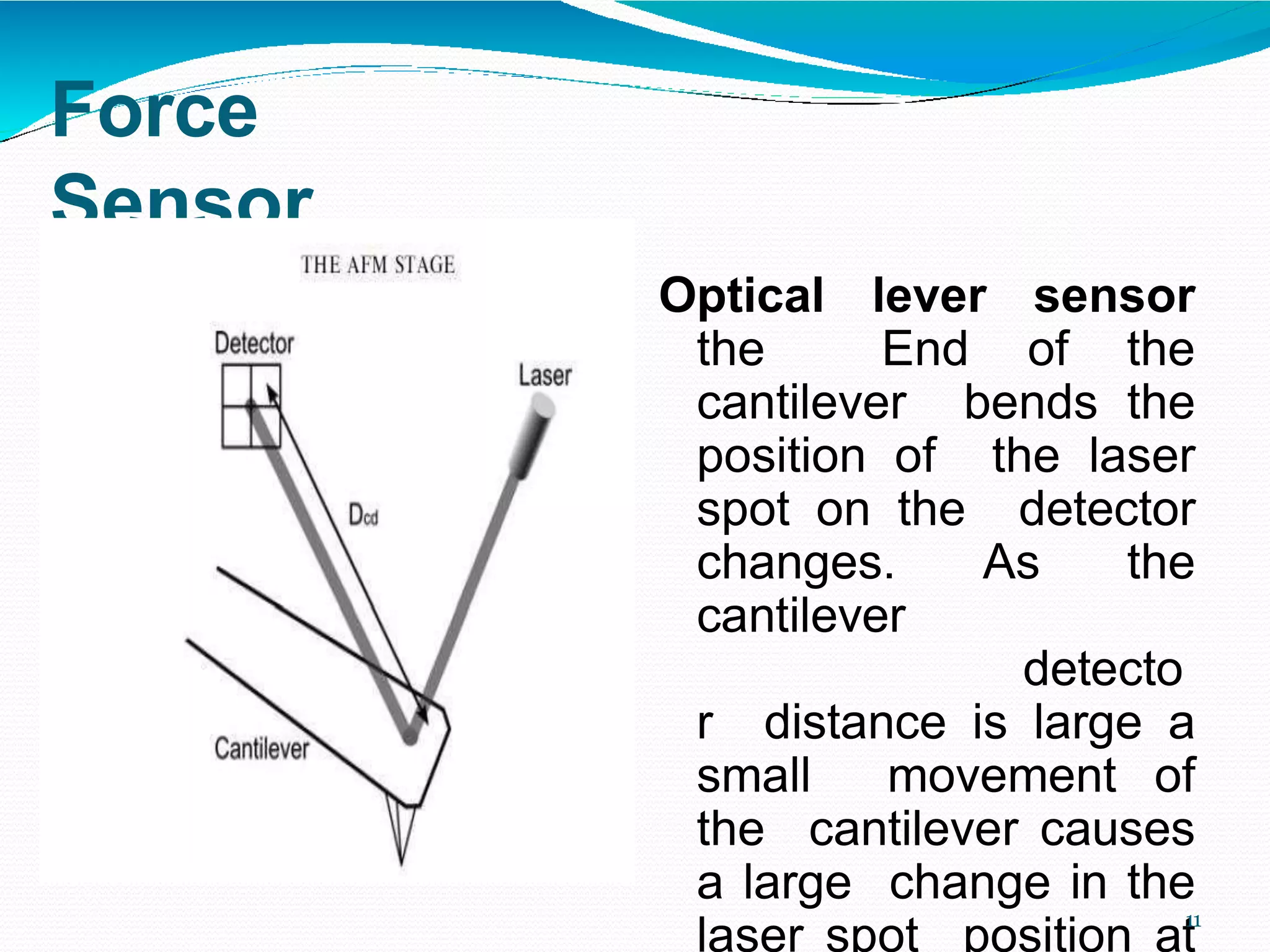
Force
Sensor
Optical lever sensor
the End of the
cantilever bends the
position of the laser
spot on the detector
changes. As the
cantilever
detecto
r distance is large a
small movement of
the cantilever causes
a large change in the
laser spot position at
11
Feedback
control
Feedback control is used to maintain a set force
between the probe and the sample.
12
13
Challenges of AFM regarding
Design
14
Requirement of sharp probe for high resolution.
The force between probe and sample should be
1nN or less than that.
The feedback controller should have a rapid
control so adjust topographic film can be formed.
A high speed computer that can generate the
images in real time.
Vibration free stage.
Scanning
Modes
15
There are different imaging modes of
AFM
 Contact Mode
 Non Contact Mode
 Tapping Mode
Modes of Operation in
AFM
16
Mode of Operation
Contact mode strong(repulsive)
-
Force of Interaction
constant force or
constant Height
Non-contact mode weak
(attractive) -
Tapping mode strong (repulsive) -
vibrating
probe
vibrating
probe
Contact
Mode
17
High Resolution Images.
Tip of the probe always touching the sample.
Fastest of all the topographic modes.
Because of repulsive forces tip and sample may
damage.
Sensitive to the nature of sample.
Not good for soft samples.
Non Contact
Mode
Signal-to-noise benefits associated with
modulated signals.
Oscillating modes can measure images with a
small probe–sample force.
18
Tapping
Mode
19
No Capillary effect.
Amplitude signals are used infeedback.
Used for Imaging in Air.
Limitation
s
21
AFM can only image a maximum height on the
order of 10-20 micrometers and a maximum
scanning area of about 150×150 micrometers.
The scanning speed of an AFM is also a limitation.
Highly Dependent on AFM probes.
Application
s
22
It can image far more biological processes,
such as imaging of proteins.
Any sample like ceramic material, human cells
or individual molecules of DNA, Dispersion of
metallic Nanoparticles can be imaged.
Thank
you
23

atomicforcemicroscopy-150320212250-conversion-gate01 (1).pptx

  • 1.
  • 2.
    Atomic Force Microscopy AFM worksby scanning a probe over the sample surface, building up a map of the height or topography of the surface as it goes along. 2
  • 3.
    Background of AFM 3 In 1929Shmalz described Stylus Profiler. In 1950 Becker suggested oscillating the probe that approach contact with surface. In 1971 Young described non contact type Stylus Profiler. In 1981 Binning and Rohrer described STM. AFM Invented in 1986 by Binning.
  • 4.
    DifferentFrom other Microscopy 4 No needof focusing, illumination, Depth of field. It also have height information that make it simple to quickly measure the height, volume, width of any feature in the sample. It physically feels the sample’s surface with a sharp probe, building up a map of the height of samples surface. It provides single atomic level structure so provide high resolution.
  • 5.
  • 6.
    The first AFMinstrument built by Binning, Quate and Gerber The STM with a lever made by carefully gluing a tiny diamond onto the end of a spring made of a thin strip of gold. This was the cantilever of the first AFM. 6
  • 7.
    AFM Instrument 7 The main componentsof an AFM are 1.Microscope stage – Moving AFM tip, Sample holder, Force Sensor 2.Control electronics - Optical Microscope, Vibration controller 3.Computer - The control electronics usually takes the form of a large box interfaced to both the microscope stage and the computer.
  • 8.
    Basic concept ofAFM Instrumentation 8 The piezoelectric transducer moves the tip over the sample surface, the force transducer senses the force between the tip and the surface, and the feedback control feeds the signal from the force transducer back in to the piezoelectric, to maintain a fixed force between the tip and the sample.
  • 9.
    Piezoelectric transducers amorphous lead barium titanate, Convertelectrical potential into mechanical PdBaTiO3 motion . or lea d zirconate titanate, Pb[ZrxTi1– x]O3,0<x<1 9
  • 10.
    Force transducers It may beconstructed that measure forces as low as10 piconewtons. 10
  • 11.
    Force Sensor Optical lever sensor theEnd of the cantilever bends the position of the laser spot on the detector changes. As the cantilever detecto r distance is large a small movement of the cantilever causes a large change in the laser spot position at 11
  • 12.
    Feedback control Feedback control isused to maintain a set force between the probe and the sample. 12
  • 13.
  • 14.
    Challenges of AFMregarding Design 14 Requirement of sharp probe for high resolution. The force between probe and sample should be 1nN or less than that. The feedback controller should have a rapid control so adjust topographic film can be formed. A high speed computer that can generate the images in real time. Vibration free stage.
  • 15.
    Scanning Modes 15 There are differentimaging modes of AFM  Contact Mode  Non Contact Mode  Tapping Mode
  • 16.
    Modes of Operationin AFM 16 Mode of Operation Contact mode strong(repulsive) - Force of Interaction constant force or constant Height Non-contact mode weak (attractive) - Tapping mode strong (repulsive) - vibrating probe vibrating probe
  • 17.
    Contact Mode 17 High Resolution Images. Tipof the probe always touching the sample. Fastest of all the topographic modes. Because of repulsive forces tip and sample may damage. Sensitive to the nature of sample. Not good for soft samples.
  • 18.
    Non Contact Mode Signal-to-noise benefitsassociated with modulated signals. Oscillating modes can measure images with a small probe–sample force. 18
  • 19.
    Tapping Mode 19 No Capillary effect. Amplitudesignals are used infeedback. Used for Imaging in Air.
  • 21.
    Limitation s 21 AFM can onlyimage a maximum height on the order of 10-20 micrometers and a maximum scanning area of about 150×150 micrometers. The scanning speed of an AFM is also a limitation. Highly Dependent on AFM probes.
  • 22.
    Application s 22 It can imagefar more biological processes, such as imaging of proteins. Any sample like ceramic material, human cells or individual molecules of DNA, Dispersion of metallic Nanoparticles can be imaged.
  • 23.