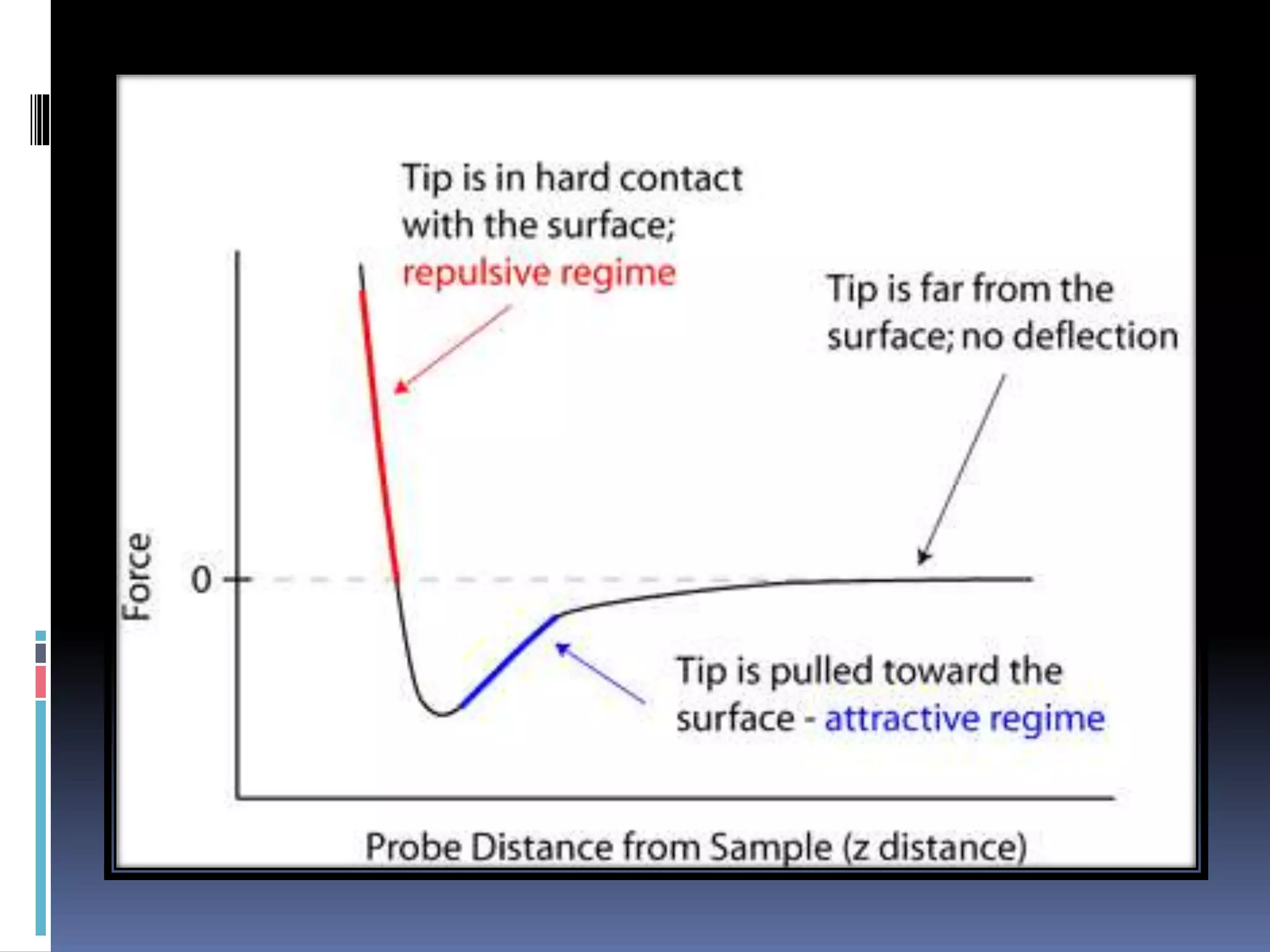
Atomic force microscopy (AFM) was developed in 1986 as an extension of scanning tunneling microscopy to image non-conductive surfaces. AFM uses a sharp probe at the end of a flexible cantilever to measure the tiny forces between the probe and sample surface. As the probe scans the surface, these interatomic forces cause the cantilever to deflect, and a laser detects these deflections to create a 3D topographic image of the surface with angstrom-scale resolution. AFM provides topographic and force measurements and can image surfaces in open air or liquid with minimal sample preparation. It has applications in fields including solid state physics, molecular biology, and materials science.