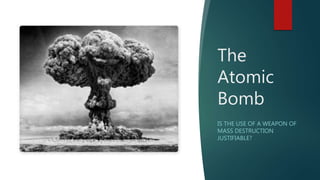
The
Atomic
Bomb
IS THE USE OF A WEAPON OF
MASS DESTRUCTION
JUSTIFIABLE?
Learning Intentions
 Students will know about the ending phase of the war in Europe and the
Pacific
 Students will describe the strategies used to defeat Japan
 Students will know the details of the Hiroshima and Nagasaki bombings
 Students will debate why the atomic bomb was used
The European Theatre of War’s End
 6 June 1944 – D-Day landings in Normandy, France.
 Russia pushes in on Germany from the East, US and British Forces close
from the West.
 Soviet flag flies over the Reichstag on 2 May 1945.
 Allies accept Germany’s unconditional surrender on 8 May 1945 (VE Day)
 https://www.youtube.com/watch?v=vv4VhZy2L5Y
Winning the
Pacific War
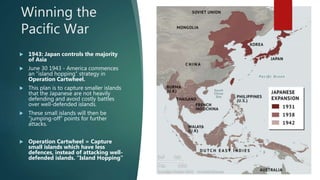
 1943: Japan controls the majority
of Asia
 June 30 1943 - America commences
an “island hopping” strategy in
Operation Cartwheel.
 This plan is to capture smaller islands
that the Japanese are not heavily
defending and avoid costly battles
over well-defended islands.
 These small islands will then be
“jumping-off” points for further
attacks.
 Operation Cartwheel = Capture
small islands which have less
defences, instead of attacking well-
defended islands. “Island Hopping”
Pacific Island
Warfare
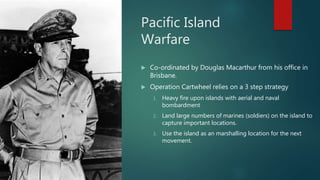
 Co-ordinated by Douglas Macarthur from his office in
Brisbane.
 Operation Cartwheel relies on a 3 step strategy
1. Heavy fire upon islands with aerial and naval
bombardment
2. Land large numbers of marines (soldiers) on the island to
capture important locations.
3. Use the island as an marshalling location for the next
movement.
Brutal combat is common
 Believing that they should die rather than surrender (part
of Bushido) Japanese soldiers engage in suicidal Banzai
charges and Kamikaze plane attacks.
 The largest tactical difficulty of the Pacific war was the
ability of the Japanese to hide in the jungles on the
islands.
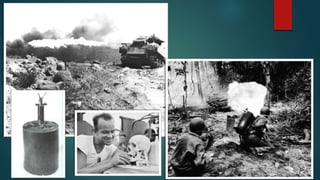
 The M4A3R3 Sherman flame tank and the M1A1
Flamethrower become important tools in the battle.
 The use of flamethrowers is later outlawed as inhumane
as part of the Geneva conventions.
 Traps like the “Bouncing Betty” bomb are also used.
Manhattan
Project
 Runs from 1942 to
1946
 Costing nearly $2
billion USD
 Race to build a nuclear
weapon before
Germany does.
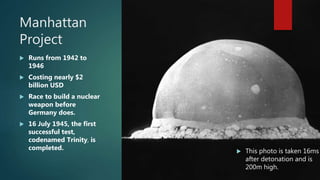
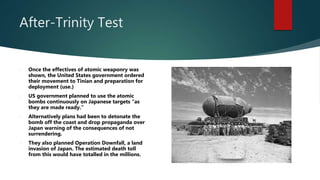
 16 July 1945, the first
successful test,
codenamed Trinity, is
completed.  This photo is taken 16ms
after detonation and is
200m high.
After-Trinity Test
 Once the effectives of atomic weaponry was
shown, the United States government ordered
their movement to Tinian and preparation for
deployment (use.)
 US government planned to use the atomic
bombs continuously on Japanese targets “as
they are made ready.”
 Alternatively plans had been to detonate the
bomb off the coast and drop propaganda over
Japan warning of the consequences of not
surrendering.
 They also planned Operation Downfall, a land
invasion of Japan. The estimated death toll
from this would have totalled in the millions.
Hiroshima
 26 July 1945 – Potsdam Declaration issued demanding surrender for Japan,
Harry S. Truman states that if Japan does not surrender they will suffer,
“prompt and utter destruction.”
 Japan ignores this.
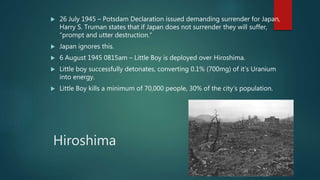
 6 August 1945 0815am – Little Boy is deployed over Hiroshima.
 Little boy successfully detonates, converting 0.1% (700mg) of it’s Uranium
into energy.
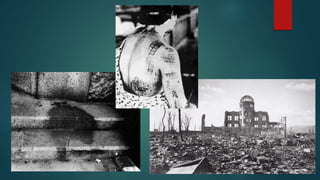
 Little Boy kills a minimum of 70,000 people, 30% of the city’s population.
Nagasaki
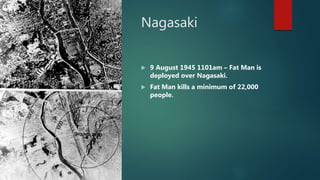
 9 August 1945 1101am – Fat Man is
deployed over Nagasaki.
 Fat Man kills a minimum of 22,000
people.
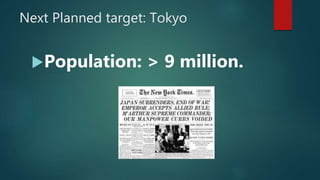
Next Planned target: Tokyo
Population: > 9 million.
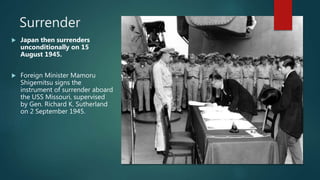
Surrender
 Japan then surrenders
unconditionally on 15
August 1945.
 Foreign Minister Mamoru
Shigemitsu signs the
instrument of surrender aboard
the USS Missouri, supervised
by Gen. Richard K. Sutherland
on 2 September 1945.
 https://www.historyextra.com/period/second-world-war/atomic-bomb-
hiroshima-nagasaki-justified-us-debate-bombs-death-toll-japan-how-
many-died-nuclear/

Atomic Bomb PPT.pptx

  • 1.
    The Atomic Bomb IS THE USEOF A WEAPON OF MASS DESTRUCTION JUSTIFIABLE?
  • 2.
    Learning Intentions  Studentswill know about the ending phase of the war in Europe and the Pacific  Students will describe the strategies used to defeat Japan  Students will know the details of the Hiroshima and Nagasaki bombings  Students will debate why the atomic bomb was used
  • 3.
    The European Theatreof War’s End  6 June 1944 – D-Day landings in Normandy, France.  Russia pushes in on Germany from the East, US and British Forces close from the West.  Soviet flag flies over the Reichstag on 2 May 1945.  Allies accept Germany’s unconditional surrender on 8 May 1945 (VE Day)  https://www.youtube.com/watch?v=vv4VhZy2L5Y
  • 4.
    Winning the Pacific War 1943: Japan controls the majority of Asia  June 30 1943 - America commences an “island hopping” strategy in Operation Cartwheel.  This plan is to capture smaller islands that the Japanese are not heavily defending and avoid costly battles over well-defended islands.  These small islands will then be “jumping-off” points for further attacks.  Operation Cartwheel = Capture small islands which have less defences, instead of attacking well- defended islands. “Island Hopping”
  • 5.
    Pacific Island Warfare  Co-ordinatedby Douglas Macarthur from his office in Brisbane.  Operation Cartwheel relies on a 3 step strategy 1. Heavy fire upon islands with aerial and naval bombardment 2. Land large numbers of marines (soldiers) on the island to capture important locations. 3. Use the island as an marshalling location for the next movement.
  • 6.
    Brutal combat iscommon  Believing that they should die rather than surrender (part of Bushido) Japanese soldiers engage in suicidal Banzai charges and Kamikaze plane attacks.  The largest tactical difficulty of the Pacific war was the ability of the Japanese to hide in the jungles on the islands.  The M4A3R3 Sherman flame tank and the M1A1 Flamethrower become important tools in the battle.  The use of flamethrowers is later outlawed as inhumane as part of the Geneva conventions.  Traps like the “Bouncing Betty” bomb are also used.
  • 9.
    Manhattan Project  Runs from1942 to 1946  Costing nearly $2 billion USD  Race to build a nuclear weapon before Germany does.  16 July 1945, the first successful test, codenamed Trinity, is completed.  This photo is taken 16ms after detonation and is 200m high.
  • 10.
    After-Trinity Test  Oncethe effectives of atomic weaponry was shown, the United States government ordered their movement to Tinian and preparation for deployment (use.)  US government planned to use the atomic bombs continuously on Japanese targets “as they are made ready.”  Alternatively plans had been to detonate the bomb off the coast and drop propaganda over Japan warning of the consequences of not surrendering.  They also planned Operation Downfall, a land invasion of Japan. The estimated death toll from this would have totalled in the millions.
  • 11.
    Hiroshima  26 July1945 – Potsdam Declaration issued demanding surrender for Japan, Harry S. Truman states that if Japan does not surrender they will suffer, “prompt and utter destruction.”  Japan ignores this.  6 August 1945 0815am – Little Boy is deployed over Hiroshima.  Little boy successfully detonates, converting 0.1% (700mg) of it’s Uranium into energy.  Little Boy kills a minimum of 70,000 people, 30% of the city’s population.
  • 13.
    Nagasaki  9 August1945 1101am – Fat Man is deployed over Nagasaki.  Fat Man kills a minimum of 22,000 people.
  • 14.
    Next Planned target:Tokyo Population: > 9 million.
  • 15.
    Surrender  Japan thensurrenders unconditionally on 15 August 1945.  Foreign Minister Mamoru Shigemitsu signs the instrument of surrender aboard the USS Missouri, supervised by Gen. Richard K. Sutherland on 2 September 1945.
  • 16.