MST Reviewer
Day 1 (September 26, 2022)
PERSONAL DEVELOPMENT
Holism tendency in nature to form wholes which are greater than
the sum of the parts through creative evolution.
Five Areas of Personal Development
1. Physiological Development – It include the five senses and
other physical characteristics. Physical attributes and Organ
systems.
2. Cognitive Development - cognition and cognitive processes.
 Cognition - processes of knowing which includes
remembering, attending, and reasoning. It also involves
the contents of these processes like memories and
concepts.
 Cognitive processes – It include the higher mental
processes like memory, language, perception, problem-
solving, and abstract thinking.
 Attitude – It is one of the aspects that is influenced by
mental skills. Stand or a belief that came from previous
learning and understanding.
Elements of Attitude:
Cognitive. This is made up of knowledge and specific
beliefs. (Rats are dirty)
Affective. This is made up of emotional responses. (I find
rats repulsive)
Behavioral. This is the manner in which an attitude
influences the observable action or behavior. (When I see
a rat, I get disgusted and jump so I could avoid it)
3. Social and Emotional Development - This is described as our
inherent or innate capability and needs to reach out and form
relationships with other people.
 Emotions are responses that create biochemical reactions
in the body. Four basic emotions are being happy, sad,
fearful or surprised, and disgusted or angry.
 Feelings are the mental reactions and association to
emotions. Subjective because they are influenced by
personal beliefs, experiences, and memories.
4. Spiritual development - Characterized by the discovery and
experience of the inner guide that steers the values and beliefs
of a person.
 Values - They are the judgment that people make about
issues, people, or things. They are subjective because their
formation is shaped by their upbringing and life
experiences.
 Virtue - It is the quality that echoes or reflects the values.
A person who values truthfulness will be honest (virtue)
and trustworthy (virtue).
5. Psychological Development - Focuses on how these three
elements of attitude acts in accordance or opposition of
another. Growth and development of a person’s cognitive,
emotional, and social skills.
Self-Concept - Perception of yourself, how you define and
understand yourself as a multi-dimensional (physical, spiritual,
emotional, social, and moral) human being. Involves present, past,
and future self.
Essential components:
Physical characteristics are used to describe how you look in
either a positive or negative way. “I am fair-skinned.” “I am
chubby.”
Personality traits are the stable characteristics that determine
your behavior. “I am trustworthy.” “I am outgoing.”
Social identity would refer to the social group where you
belong. Self-concepts are never simple, given the differences in
backgrounds of individuals. “I am the daughter of Leni.” “I am a
Muslim.”
 Self-complexity - The different ways in which you think about
yourself, can be high or low.
 Self-esteem - It is a positive or negative self-evaluation of the
self-concept.
It affects:
- self-worth (how much you value yourself)
- self-efficacy (the belief and confidence that you can
accomplish tasks and control your environment)
 Looking glass self - Charles Horton Cooley theorizes that
people around you serve as mirrors that reflect how you see
yourself.
 Factors that influence self-concept and self-esteem: The ways
others react to an individual; the way an individual compares
himself to others; and the extent to which an individual
identifies with these other people.
Self-awareness – Ability to know yourself extensively, not just
regarding traits and characteristics, but also knowing your inner
state and how you think.
 Self-Awareness Theory - When you focus on yourself, there is
the tendency to compare what you currently observe to the
standards you set for yourself.
 Self-Discrepancy Theory - When there is a mismatch between
your ideal self and your actual self, this becomes a source of
distress for you and is much likely to affect your self-esteem.
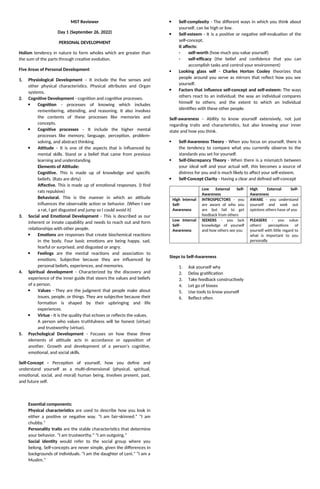
 Self-Concept Clarity - Having a clear and defined self-concept
Low External Self-
Awareness
High External Self-
Awareness
High Internal
Self-
Awareness
INTROSPECTORS - you
are aware of who you
are but fail to get
feedback from others
AWARE - you understand
yourself and seek out
opinions others have of you
Low Internal
Self-
Awareness
SEEKERS - you lack
knowledge of yourself
and how others see you
PLEASERS - you value
others’ perceptions of
yourself with little regard to
what is important to you
personally
Steps to Self-Awareness
1. Ask yourself why
2. Delay gratification
3. Take feedback constructively
4. Let go of biases
5. Use tools to know yourself
6. Reflect often
MST Reviewer
Day 1 (September 26, 2022)
GENERAL BIOLOGY 1
Biology is a branch of science that deals with living organisms and
their vital processes.
Cell - The basic unit of life and structure of organization in all
organisms.
Principles of the Cell Theory
1. Every living organism consists of one or more cells. (Theodor
Schwann)
2. The cell is the fundamental unit of life. It is the smallest
structural and functional unit of all organisms. (Matthias
Schleiden)
3. Cells come from preexisting cells. Cells contain hereditary
material, which they pass to their offspring when they divide.
(Rudolf Virchow)
Scientists and Contribution
 Zacharias Janssen - A spectacle maker who came up with the
first compound microscope.
 Anton van Leeuwenhoek – He discovered bacteria by looking
at dental scrapings. Named it “animalcules” after discovering it.
 Robert Hooke – Coined the term “CELL”. Observed microscopic
cork cells.
 Matthias Schleiden – Botanist that studies plants under
microscope later concluded that all plants are made up of cells.
 Theodor Schwann – Concluded that all animals were made of
cells.
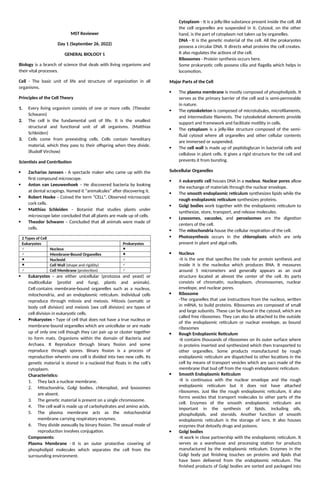
2 Types of Cell
Eukaryotes Prokaryotes
✓ Nucleus ✖
✓ Membrane-Bound Organelles ✖
✖ Nucleoid ✓
✖ Cell Wall (shape and rigidity) ✓
✓ Cell Membrane (protection) ✓
 Eukaryotes - are either unicellular (protozoa and yeast) or
multicellular (protist and fungi, plants and animals).
Cell contains membrane-bound organelles such as a nucleus,
mitochondria, and an endoplasmic reticulum. Individual cells
reproduce through mitosis and meiosis. Mitosis (somatic or
body cell division) and meiosis (sex cell division) are types of
cell division in eukaryotic cells.
 Prokaryotes - Type of cell that does not have a true nucleus or
membrane-bound organelles which are unicellular or are made
up of only one cell though they can pair up or cluster together
to form mats. Organisms within the domain of Bacteria and
Archaea. It Reproduce through binary fission and some
reproduce through spores. Binary fission is a process of
reproduction wherein one cell is divided into two new cells. Its
genetic material is stored in a nucleoid that floats in the cell’s
cytoplasm.
Characteristics:
1. They lack a nuclear membrane.
2. Mitochondria, Golgi bodies, chloroplast, and lysosomes
are absent.
3. The genetic material is present on a single chromosome.
4. The cell wall is made up of carbohydrates and amino acids.
5. The plasma membrane acts as the mitochondrial
membrane carrying respiratory enzymes.
6. They divide asexually by binary fission. The sexual mode of
reproduction involves conjugation.
Components:
Plasma Membrane - It is an outer protective covering of
phospholipid molecules which separates the cell from the
surrounding environment.
Cytoplasm - It is a jelly-like substance present inside the cell. All
the cell organelles are suspended in it. Cytosol, on the other
hand, is the part of cytoplasm not taken up by organelles.
DNA - It is the genetic material of the cell. All the prokaryotes
possess a circular DNA. It directs what proteins the cell creates.
It also regulates the actions of the cell.
Ribosomes - Protein synthesis occurs here.
Some prokaryotic cells possess cilia and flagella which helps in
locomotion.
Major Parts of the Cell
 The plasma membrane is mostly composed of phospholipids. It
serves as the primary barrier of the cell and is semi-permeable
in nature.
 The cytoskeleton is composed of microtubules, microfilaments,
and intermediate filaments. The cytoskeletal elements provide
support and framework and facilitate motility in cells.
 The cytoplasm is a jelly-like structure composed of the semi-
fluid cytosol where all organelles and other cellular contents
are immersed or suspended.
 The cell wall is made up of peptidoglycan in bacterial cells and
cellulose in plant cells. It gives a rigid structure for the cell and
prevents it from bursting.
Subcellular Organelles
 A eukaryotic cell houses DNA in a nucleus. Nuclear pores allow
the exchange of materials through the nuclear envelope.
 The smooth endoplasmic reticulum synthesizes lipids while the
rough endoplasmic reticulum synthesizes proteins.
 Golgi bodies work together with the endoplasmic reticulum to
synthesize, store, transport, and release molecules.
 Lysosomes, vacuoles, and peroxisomes are the digestion
centers of the cell.
 The mitochondria house the cellular respiration of the cell.
 Photosynthesis occurs in the chloroplasts which are only
present in plant and algal cells.
 Nucleus
-it is the one that specifies the code for protein synthesis and
inside it is the nucleolus which produces RNA. It measures
around 5 micrometers and generally appears as an oval
structure located at almost the center of the cell. Its parts
consists of chromatin, nucleoplasm, chromosomes, nuclear
envelope, and nuclear pores.
 Ribosome
-The organelles that use instructions from the nucleus, written
in mRNA, to build proteins. Ribosomes are composed of small
and large subunits. These can be found in the cytosol, which are
called free ribosomes. They can also be attached to the outside
of the endoplasmic reticulum or nuclear envelope, as bound
ribosomes
 Rough Endoplasmic Reticulum
-It contains thousands of ribosomes on its outer surface where
in proteins inserted and synthesized which then transported to
other organelles. Some products manufactured by rough
endoplasmic reticulum are dispatched to other locations in the
cell by means of transport vesicles which are sacs made of the
membrane that bud off from the rough endoplasmic reticulum.
 Smooth Endoplasmic Reticulum
-It is continuous with the nuclear envelope and the rough
endoplasmic reticulum but it does not have attached
ribosomes. Just like the rough endoplasmic reticulum, it also
forms vesicles that transport molecules to other parts of the
cell. Enzymes of the smooth endoplasmic reticulum are
important in the synthesis of lipids, including oils,
phospholipids, and steroids. Another function of smooth
endoplasmic reticulum is the storage of ions. It also houses
enzymes that detoxify drugs and poisons.
 Golgi bodies
-It work in close partnership with the endoplasmic reticulum. It
serves as a warehouse and processing station for products
manufactured by the endoplasmic reticulum. Enzymes in the
Golgi body put finishing touches on proteins and lipids that
have been delivered from the endoplasmic reticulum. The
finished products of Golgi bodies are sorted and packaged into
new vesicles that carry them to the plasma membrane or to
lysosomes.
 Lysosomes
-It is a membrane-enclosed sac of digestive enzymes that is
absent in plant cells. It is developed from vesicles that bud off
from the Golgi bodies. It has a very low pH and stores powerful
hydrolytic-enzymes in an inactive state. It destroy
nonfunctional organelles and portions of cytoplasm, breakdown
wastes, ingests cells, and cellular debris delivered by other
vesicles. It provides an acidic environment for its enzymes
without affecting other organelles of the cell.
 Peroxisomes
-These are membrane-bounded vesicles that enclose enzymes.
These enzymes are synthesized by free ribosomes. It originate
from the endoplasmic reticulum and contains different
enzymes from lysosomes. Peroxisomes perform metabolic
assistance to organelles. They have varied functions but they
specialize in synthesizing and breaking down lipids. They also
break down fatty acids, amino acids, and toxins such as alcohol.
 Vacuoles
-The large sacs of membrane or vesicles that bud from the
endoplasmic reticulum, Golgi bodies, or plasma membrane. The
central vacuole of a plant cell is a versatile compartment that
stores organic nutrients, such as proteins and poisons that
protect against plant-eating animals. It also contributes to plant
growth by absorbing water and causing cells to expand.
 Mitochondria
-They are often called the powerhouse of the cell because it
converts the chemical energy of foods that produce most of the
cell’s ATP in the process of cellular respiration, wherein the
oxygen is used and the carbon dioxide is given off. They have
two membranes — the outer membrane and the inner
membrane. Both membranes have a phospholipid bilayer with
a unique collection of embedded proteins.
 Chloroplasts
-These are unique to plant and algal cells which perform
photosynthesis. This is the process in which the light energy
from the sun is converted to chemical energy and other organic
molecules.
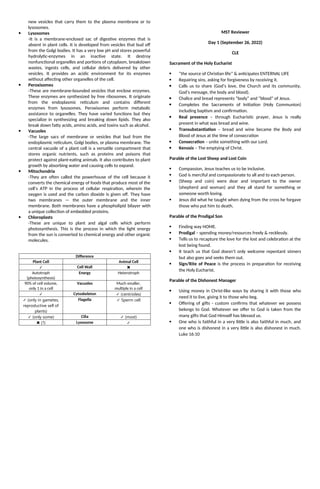
Difference
Plant Cell Animal Cell
✓ Cell Wall ✖
Autotroph
(photosynthesis)
Energy Heterotroph
90% of cell volume,
only 1 in a cell
Vacuoles Much smaller,
multiple in a cell
✓ Cytoskeleton (centrioles)
✓
(only in gametes,
✓
reproductive sell of
plants)
Flagella Sperm cell
✓
(only some)
✓ Cilia (most)
✓
(?)
✖ Lysosome ✓
MST Reviewer
Day 1 (September 26, 2022)
CLE
Sacrament of the Holy Eucharist
 “the source of Christian life” & anticipates ENTERNAL LIFE
 Repairing sins, asking for forgiveness by receiving it.
 Calls us to share (God’s love, the Church and its community,
God’s message, the body and blood).
 Chalice and bread represents “body” and “blood” of Jesus.
 Completes the Sacraments of Initiation (Holy Communion)
including baptism and confirmation.
 Real presence – through Eucharistic prayer, Jesus is really
present in what was bread and wine.
 Transubstantiation – bread and wine became the Body and
Blood of Jesus at the time of consecration
 Consecration – unite something with our Lord.
 Kenosis – The emptying of Christ.
Parable of the Lost Sheep and Lost Coin
 Compassion, Jesus teaches us to be inclusive.
 God is merciful and compassionate to all and to each person.
 (Sheep and coin) were dear and important to the owner
(shepherd and woman) and they all stand for something or
someone worth loving.
 Jesus did what he taught when dying from the cross he forgave
those who put him to death.
Parable of the Prodigal Son
 Finding way HOME.
 Prodigal – spending money/resources freely & recklessly.
 Tells us to recapture the love for the lost and celebration at the
lost being found.
 It teach us that God doesn’t only welcome repentant sinners
but also goes and seeks them out.
 Sign/Rite of Peace is the process in preparation for receiving
the Holy Eucharist.
Parable of the Dishonest Manager
 Using money in Christ-like ways by sharing it with those who
need it to live, giving it to those who beg.
 Offering of gifts - custom confirms that whatever we possess
belongs to God. Whatever we offer to God is taken from the
many gifts that God Himself has blessed us.
 One who is faithful in a very little is also faithful in much, and
one who is dishonest in a very little is also dishonest in much.
Luke 16:10
MST Reviewer
Day 1 (September 26, 2022)
PRACTICAL RESEARCH
Research - It is a thorough examination of a study regarding a
particular phenomenon using scientific methods.
Quantitative Research
 Explaining phenomena by collecting numerical data that are
analyzed using mathematically based methods. (Aliaga &
Gunderson, 2000).
 A means for testing objective theories by examining the
relationship among variables. (Creswell, 2009)
A. Characteristics
 Controllability. To understand a specific relationship or
phenomenon, quantitative research should be in an
environment where all variables are identified and can be
controlled
 Generalizability. It is from larger sample sizes that the
results are based on as a representative of the population.
 Objectivity. The results of the data are observable and
measurable using structured instruments.
 Replicability. The research study should be replicable by
other teams of researchers that will eventually come up
with similar outcomes.
B. Strengths
 Reliability – More reliable results are gathered because of
the big population.
 Simplified – Easier process because of the systematic flow.
 Bias free – Personal interaction is not part of the process.
 Numbers nail it! – Results are interpreted in few
statements only.
C. Weaknesses
 Time consuming, costly, and difficult
 Limited results
 Extensive statistical treatments
Kinds of Quantitative Research
1. Descriptive - Descriptive research aims to accurately and
systematically describe a population, situation or phenomenon.
2. Correlational - A correlational research design investigates
relationships between two variables (or more) without the
researcher controlling or manipulating any of them.
3. Experimental - Experimental research is a study that strictly
adheres to a scientific research design. It includes a hypothesis,
a variable that can be manipulated by the researcher, and
variables that can be measured, calculated and compared.
4. Quasi-experimental - Aims to establish a cause-and-effect
relationship between an independent and dependent variable.
Types of Quantitative Research
A. Correlational Research - involves identifying relationships
between two variables. A correlation is “a statistical measure of
association between two variables”
B. Causal Research - looks at causes and effects. Causation refers
to the claim that a change in one variable creates a change in
another variable.
Main Types of Quantitative Research
A. Survey research - is a correlational type of quantitative
research. This design makes use of a questionnaire as its main
data collection tool.
 Survey design - cross-sectional survey acquires
information at one point in time while longitudinal survey
in multiple points in time. (compare & contrast)
 Population and Sample - population is a general group of
people with similar characteristics. A sample is a subgroup
of the population that is chosen either randomly or
purposively to participate in the survey research.
 Survey Instrument – Questionnaire is the main data
collection tool containing closed-ended questions with
fixed answers.
 Data Analysis and interpretation – A descriptive analysis
provides a numerical report of the results of the survey,
which may include frequencies or average scores. An
inferential analysis makes comparisons among the survey
results to establish and explain relationships.
B. Experimental Research - With the use of the cause and effect
logic, it looks at whether the application of a treatment,
otherwise known as an intervention, causes an effect on the
sample being experimented on.
 Respondents – called groups. Subgroups are experimental
group (receives the experimental treatment or
intervention) and control group (does not receive the
experimental treatment or intervention).
 Variables - Namely independent (It causes and explains
the effect) and dependent (outcome variable or the
effect).
 Stages of the experimental procedure – 1st
is the pretest
(stage prior to application of intervention), 2nd
actual
intervention (execution phase of the planned experimental
procedure/s), lastly 3rd
posttest (after the application of
intervention).
 Instrumentation and materials – Instruments used to
records the observations at any stage of the experiment.
 Experimental procedures - pre-experimental design
(single experimental group, no control group), true
experiment (uses both experimental and control group
with randomly assigned respondents), quasi-experiment
(same as true experiment but respondents are not
randomly assigned into groups), and single subject design
(single individual as the lone respondent).
 Data Analysis and interpretation – descriptive or
inferential manner.
Research Background – brief and general discussion of the study
based on existing literature and should introduce its purpose and
relevance to the field while highlighting the research problem.
A. Studies – 5 to 10 years
 World View – International Studies
 National View – conducted in the PH
 Locale – conducted in the province, city, region
 Rationale – researchers POV, evidence-based
info
B. Literature – 20 years
Steps in Writing Research Background
1. Conduct preliminary research – parameters of the study
2. Identify writing style – deductive (gen –spec) & inductive
3. Emphasize the field
4. Read and use related literature
5. Focus on the relevance and contribution of the study
6. Summarize the research background
Characteristics of Research Background
1. Written in formal and academic language.
2. Concise. Written in brief, organized and coherent manner.
3. Evidence based, no personal opinions
4. Explains the goal of the study
5. Introduces the variables
6. Cites related literatures and studies
MST Reviewer
Day 1 (September 26, 2022)
ENTREPRENEURSHIP
 An entrepreneur is a person who creates unique ideas that will
be useful for starting a business.
 Entrepreneurship - The science of converting processed ideas
into a remarkable business venture.
 Competencies are considered as the capability, capacity, and
ability of a person to handle situations.
 Core Competencies are the defining characteristics that make a
business or an individual stand out from the competition.
 A core competence is something unique that a business has or
can do strategically well.
Entrepreneurship Common Competencies
 Specific Goal Setting - Entrepreneurs should set goals that are
specific, measurable, attainable, realistic, and time-bound
because it will increase the chances of achieving that goal.
 Self-Efficacy - Entrepreneurs must believe in their ability.
Entrepreneurs with high self-efficacy will turn negative
feedback into positive and use this as a basis for improvement.
 Need for Achievement – Entrepreneurs must have a high
desire to accomplish goals. This includes repeated efforts to
achieve success.
 Ambition - Entrepreneurs must have motivation and
persistence to pursue their goals.
 Willingness to Learn - Entrepreneurs should have a strong
willingness to acquire new knowledge and skills.
 Adaptability and Flexibility - Entrepreneurs must learn how to
be adaptable and flexible in every situation. They can manage
change well and generate new actions even with undesirable
events.
 Willingness to Take Risk - Entrepreneurs must be willing to
accept the consequences of every decision. They must know
how to calculate and identify risk. They are skilled in developing
new plans.
 Interpersonal Skills - Entrepreneurs should have strong skills in
working with people. They should have an understanding of the
behavior of others
Competencies for Entrepreneurial Success
 Integrity positive sense of values and personal beliefs.
 Conceptual Thinking open to new approaches and analyzes
ideas.
 Strategic Thinking understand and use strategies as a way to
accomplish goals.
 Decisiveness make choices and resolve issues quickly
 Customer Relations Service build trust and long-term
relationships with customers.
 Risk-taking - An entrepreneur anticipates future conflicts but
knows how to solve problems that may arise in business
organizations.
 Collaboration - Entrepreneurs should know how to work with
people or groups to attain common goals and to promote
teamwork.
 Commercial Aptitude - An entrepreneur should be updated
with the developments in the locality and with knowledge to
identify opportunities that can be attained by the business.
 Optimism – An entrepreneur should always think positively
even when faced with unexpected problems.
 People-centered – An entrepreneur should know how to
motivate people and see and value the best in others.
Core Competencies of Entrepreneur
 Entrepreneur as a missionary – Entrepreneurs considers the
business as a mission. There is passion to them.
 Entrepreneurs are goal-driven – Entrepreneurs think of what
they want and how to get it.
 Entrepreneur as a marketing man - Entrepreneurs must
differentiate their company’s product or service so its
uniqueness and value are clear to the customer.
 Entrepreneurs start small to big - Many entrepreneurs start a
small scale business but with their managerial talents and
persistence, they will be able to make the company grow.
Factors that Develop Entrepreneurial Activity
 Entrepreneur’s initiative - The ability to plan and manage
projects with creativity, innovation, and risk-taking in order to
achieve goals.
 Organization of capital resources - Entrepreneurs may ask their
trusted family members or friends that could help them to start
their dream business.
 Development of administrative machinery - Duties and
responsibilities are assigned to individuals with skills that will fit
to their position and qualifications.
 Development of entrepreneurial autonomy – Entrepreneurs
knows the best direction because he also knows how to
calculate the risk involved.
 Development of SWOT analysis - Strengths are the things that
the company does well. Weaknesses are the things that the
company lacks. Opportunities are factors/events in the
environment of the business which are favorable for its growth
and success. Threats are the elements that could endanger the
profitability of the business.
Job Opportunities
 Advertising, Marketing, and Public Relations - will help you
gain ideas on how to reach a target customer when you already
have your own product or services.
 Business Development - Employed by companies to develop
and execute strategies to increase sales and profits.
 Design - these skills will help you create your own product
design, especially on the packaging and labels of your product.
 E-commerce and Social Media - If you are knowledgeable in
online selling and search engine optimization (SEO), it will be a
great help for your starting business.
 Management –will give you the leadership, people, and
communication experience.
 Software, Web or App Developer - enhance your skill set that
will be vital when you start to grow your own business.
 Sales Manager/ Account Executive - provide experiences and
opportunities that will allow you to generate income for the
business, meet and achieve sales goals.
 Business Consultant - help companies find solutions to the
different business challenges and obstacles being met.
 Product Manager –work on the enhancement of a product
through research, development, engineering, manufacturing,
and distribution.
Steps for Entrepreneurial Success
1. Start to be on your own – get ideas and develop own skills
2. Explore the business environment – internal and external
3. Be in control – be involve in every decision-making
4. Have a good accountant or financial adviser – trusted in
financial and business transaction involving funds.
5. Seek the advice of professionals – legal matters
Profile of a Successful Entrepreneur
1. Strong desire for independence – strives to develop own
business.
2. Strong drive to succeed – excited by the prospect of work.
3. Strong determination in decision making – ability to make
right decision based on logic, practicality, and gut feel.
4. Develops a feedback mechanism for results – Uses
feedback to guide, make observations and corrections.
5. Result-driven individual – focuses on the end result of
task assigned. Fully grasps the goal to be achieved.
MST Reviewer
Day 2 (September 27, 2022)
PAGSULAT SA FILIPINO SA PILING LARANGAN
Akademikong pagsulat - Nangangailangan ng mataas na antas ng
kasanayang akademiko. Pangunahing layunin nito ang makapagbigay
ng tamang impormasyon. Nakasalalay sa kritikal na pagbasa ang
pagbuo ng akademikong pagsulat (Arrogante, 2007).
Katangiang kailangan ng isang manunulat - mahusay mangalap ng
impormasyon; kritikal na nagsusuri; magaling mag-organisa ng
mga ideya; at lohikal. Marunong magpahalaga at kumilala sa may-
akda ng tekstong binabasa
Katangian ng Akademikong Pagsulat
 Pormal – Hindi mabulaklak na pananalita, hindi paligoyligoy,
walang kolokyal at balbal na salita.
 Malinaw - Organisadong pagtatahi ng mga ideya.
 Tiyak – Batid kung ano ang tunguhin upang magbigay katiyakan
kung para saan ang isinusulat. Mahalagang bumuo ng mga
tanong na masisilbing gabay sa tunguhin.
 May Paninindigan – Sapat ang impormasyon at datos (hitik sa
katotohanan), pagkakaroon ng mga parenthetic citations, at
tuwirang sipi at paraphrasing.
 May Pananagutan - Mahalagang pahalagahan at kilalanin ang
may-akda ng tekstong pinaghanguan o pinagbatayan ng
isinusulat.
Katangian sa Paraan ng Paggawa ng Isang Akademikong Sulatin
 Komprehensibong Paksa - dito nag-uumpisa ang pagpaplano
upang maisakatuparan ang makabuluhang sulatin.
 Angkop na Layunin – Layunin ang magtatakda ng dahilan ng
akademikong sulatin. Magpahayag ng iba’t ibang impormasyon,
manghikayat, suportahan o pasublian ang mga dating
impormasyon.
 Gabay na Balangkas – Maisaayos and ideya ng sulatin (burador)
1. Balangkas na paksa
2. Balangkas na pangungusap
3. Balangkas na talata
 Halaga ng Datos - Nakasalalay ang tagumpay ng akademikong
sulatin sa datos. Maituturing na pinakamahalagang yunit ng
pananaliksik ang datos ng anomang akda.
 Epektibong Pagsusuri - Nakabatay sa ugat o sanhi ng suliranin
at nagpapaki.
 Tugon ng Kongklusyon - Pangkalahatang paliwanag sa nais na
maipahayag ng akademikong sulatin.
Yugto sa Pagbuo ng Akademikong Pagsulat
 Bago Sumulat – Nagaganap ang integrasyon ng paunang
kaalaman at bagong kaalaman. Higit na yumayaman ang dating
kaalaman at karanasan mula sa pagbabasa, panonood, at
pakikinig. nagsasagawa ng pananaliksik sa kaalamang nais
niyang ipahayag. pPagsagot sa mga tanong na: ano, sino,
kailan, saan, bakit, at paano.
 Pagbuo ng Unang Burador - Matiyagang iniisa-isa ng manunulat
ang mga konsepto na maaaring maging laman ng akademikong
sulatin.
 Pagwawasto (Editing) at Pagrerebisa - inaayos ang unang
burador. Iniwawasto ang mga mali tulad ng baybay, bantas, at
mismong nilalaman.
 Huli o Pinal na Sipi - Inaasahang kahusayan at kakinisan.
Pulidong isinulat at handang ibahagi at mabasa ng iba upang
ipabatid ang layunin ng pagsusulat.
 Paglalathala o Paglilimbag - Maibabahagi ang impormasyong
nais ipabatid bilang ambag sa produksyon ng karunungan.
Layunin sa Paglilinang ng Kasanayan sa Akademikong Pagsulat
 Kakayahan sa Kritikal na Pag-iisip - Kabilang sa proseso
ang pagsasagawa ng saliksik at pagtataya ng mga kaalaman at
pagtukoy sa pagkakaugnay-ugnay ng mga ito sa nais na ibahagi
sa mambabasa.
 Pagpapalawak at Pagpapalalim ng Kaalaman - Matutuhan ng
isang indibidwal ang iba’t ibang konsepto at/o mga teoryang
kinakailangan sa isang larangan.
 Kakayahang Propesyonal – Bukod sa konseptong teknikal ay
maunawaan at matutuhan ang propesyonalidad. Maging
maingat, mapanuri, at matapat.
1. Pormal na tono gamit ang pormal na wika
2. Katapatan sa oras sa paglikha ng sulatin
3. Katapatan dulot ng taglay na pagkilala sa mga
pinagmumulan ng mga kaalaman at/o datos.
4. Pagiging masinop
 Kasanayan sa Saliksik - Hindi lamang sumasandig sa iisang batis
o batayan, sapagkat nangangailangan itong makapagbigay ng
isang kongkreto at makabuluhang kahulugan at/o kaalaman.
Uri ng Akademikong Pagsulat
 Malikhaing pagsulat – Nilalayon na magbigay ng kasiyahan,
mapukaw ang damdamin, at magising ang isipan ng
mambabasa. Karaniwan itong bunga ng mapaglarong isipan ng
manunulat.
 Teknikal na pagsulat - Isinasagawa upang pag-aralan ang isang
proyekto o kaya naman ay bumuo ng isang pag-aaral na sasagot
sa isang suliranin. Kinabibilangan lahat ng mga
dokumentasyong may teknikal na proseso.
 Propresyonal na pagsulat - May kinalaman sa isang tiyak na
larangang pang-akademiya. Nagbibigay ng tuon ito sa mga
sulating may kinalaman o kabuluhan sa isang tiyak na
propesyon.
 Dyornalistik na pagsulat - May kaugnayan sa pamamahayag.
Kasanayan sa pangangalap ng impormasyon, pagiging
obhektibo, at paningin sa mga makabuluhang isyu.
 Reperensyal na pagsulat - Pagkilala sa mga pinagkunan ng
impormasyon upang maging balido at mapagkakatiwalaan.
Nakatuon sa makatotohanang impormasyon.
 Akademikong pagsulat - May kumbensiyon na naglalayong
maipakita ang resulta mula sa pagsisiyasat tungkol sa ideyang
nais pangatwiranan.
Bionote (biographical note) - Anyo ng sulating nagpapakilala sa isang
tao. Nasa likod ng pabalat at sa huling bahagi ng isang pag-aaral o
papel-pananaliksik. (ikatlong panauhan)(100-150 salita)
 personal na impormasyon tungkol sa manunulat
 kaligirang pang-edukasyon; at
 ambag sa larangang kinabibilangan
Nilalaman ng Bionote - pangalan ng may-akda, pangunahing
trabaho, edukasyong natamo, akademikong parangal, iba pang
trabaho, organisasyong kinabibilangan, tungkulin sa komunidad, at
mga proyektong ginagawa.
Talambuhay (biography) - Masmahaba at detalyado ang nilalaman.
Kasaysayan ng buhay ng tao.
Layunin sa Pagsulat ng Bionote
1. Maipakilala ang manunulat at mananaliksik upang magkaroon
din sila ng pahapyaw na ideya sa pinagmulang pananaw,
paniniwala, o kaalaman ng manunulat.
2. Serbisyo para sa mga mambabasa - Maunawaan ang
pinanggalingan ng idea, impormasyon o pananaw.
3. Serbisyo sa mga publikasyon o palimbagan - Makilala ng
mambabasa ang kredibilidad ng publikasyon.
Katangian ng Bionote
 Maikli ang Nilalaman – maikli ngunit nagtataglay ng
makabuluhang impormasyon.
 Gumagamit ng Ikatlong Panauhang Pananaw – maging
obehtibo at maiwasan ang waring pagmamayabang.
 Gumagamit ng Inverted Pyramid – pinakamahalaga hanggang
di gaanong mahahalagang impormasyon.
 Nakatuon lamang sa mga Angkop na Kasanayan o Katangian –
kaugnay sa paksa lamang ang nakasulat.
 Matapat sa Pagbabahagi ng Impormasyon – makatotohanan
Dapat Tandaan sa Paggawa ng Bionote
1. Dapat maging maikli ang bionote.
2. Siguraduhing tama ang mga natipong impormasyon tungkol sa
taong ipinakikilala.
3. Gumamit ng ikatlong panauhan sa paglalahad.
4. Tukuyin at kilalanin ang mga mambabasang pagtutuonan ng
pagpapakilala.
5. Tiyaking impormatibo ang nilalaman ng bionote kaya dapat na
inuunang ilahad ang pinakamahahalagang impormasyon
tungkol sa ipinakikilala.
6. Bigyang-diin lamang ang mga angkop na kasanayan at/o
katangiang kaugnay ng layunin ng pagpapakilala.
7. Maging tapat sa paglalahad ng impormasyong iuugnay sa
paksa.
Hakbang sa Pagsulat ng Bionote
A. Bago Sumulat ng Bionote
1. Itakda at tiyakin ang layunin ng pagsulat ng bionote.
2. Pagpasyahan ang haba ng susulating bionote.
 target na mambabasa o makikinig
 kahingian o layunin ang tinutugunan
(pampropersyonal o organisasyonal)
 pamamaraan ng paglalahad (pasalita o pasulat)
3. Bumuo ng balangkas ng susulating bionote.
B. Aktuwal na Pagsulat ng Bionote
1. Gumamit ng ikatlong panauhan sa paglalahad
2. Simulan sa pangalan ang pagpapakilala.
3. Tukuyin ang edukasyong natamo.
4. Ilahad ang propesyong kinabibilangan
5. Isa-isahin ang mahahalagang tagumpay na nakamit ng
paksang inilalarawan
6. Idagdag ang ilang di-inaasahang detalye
C. Muling Pagsulat ng Bionote
1. Basahin ang unang borador
2. Muling isulat ang bionote para sa huling borador
Talumpati - Pagpapahayag ng mga kaisipan, pananaw, at saloobin ng
isang tao sa harap ng madla. Maaaring magdulot ng sigla o lugod,
magbigay papuri, o magbigay ng katwiran. (pasalita o pasulat)
Naging mabisa ang talumpati batay sa:
 pagtugon ng mga tagapakinig
 pagtindig ng tagapagsalita sa kaniyang paniniwala—ang
paggamit ng katotohanan sa pagbabahagi
 kalinawan ng layunin at tunguhin ng tagapagsalita
 katapatan sa prinsipyo ng sining ng mahusay na pagtatalumpati
Bahagi ng Talumpati
1. Panimula – Mapukaw ang interes. (paglalahad ng layunin)
2. Katawan – Paggamit ng paraan upang mapatibay ang ideya,
kaisipan, at pinaninindigan. (paggamit ng batayan at
estadistika)
3. Katapusan – pagbibigay linaw sa pinaninindigan (pag-iwan ng
impresyon sa huli upang makahikayat sa pakikibaka o pagkilos)
Sangkap ng Talumpati
A. Kaisahan – Tumtukoy sa iisang paksa at ideya kada bahagi.
B. Kaugnayan - Wastong pagkakasunod-sunod (Ayos ayon sa
lohika, panahon, at espasyo)
C. Diin o Emphasis – pagbibigay diin ayon sa posisyon,
proporsiyon, at pag-uulit ng salita at tunog.
Layunin at Gamit ng Talumpati – Magturo, magbigay-kabatiran,
manghikayat, manlibang, magbigay-puna.
Katangian ng Talumpati
 Kalinawan (mensahe at pagbigkas)
 Kawastuhan
 Maikli
 Mapanghikayat (makabuluhang kwento, halimbawa, biro)
 Impormal na ugnayan
 Pagbibigay-pansin sa mga tagapakinig (edad, interes, kasarian)
 Malakas na tinig at malinaw na pagbigkas
 Kontroladong damdamin o emosyon
 Maayos na tindig at kumpas
 Angkop na kilos o gala
Uri ng Talumpati
A. Ayon sa Anyo at Kahandaan
1. Impromptu (biglaang talumpati)
2. Extempore (limitadong kahandaan)
3. Isinaulo (binigyang oras sa pagsulat at pagsaulo)
4. BInabasa o Manuskrito (babasahin sa kumperensiya)
B. Ayon sa Layunin - Nagbibigay impormasyon, Naghihikayat,
Nagpapaliwanag, Nang-aaliw, Nagpapakilala, Pagbibigay
Gantimpala, Pamamaalam, at Eulohiya.
MST Reviewer
Day 2 (September 27, 2022)
GENERAL PHYSICS 1
MST Reviewer
Day 2 (September 27, 2022)
PHYSICAL EDUCATION AND HEALTH
History of Dance – word dance come from the German word
“Damson” which means to stretch or to drag. Dancing may be the
oldest among all the arts. Developed as a natural expression of
united feeling and action. Music of early man came from stamping
feet, clapping of hands, snapping of fingers, or any sounds that
produces rhythm.
Prehistoric dance – involved everyday movement, served as
important means of communication, revolved around life events
that were meaningful: birth, puberty, courtship, marriage, and
death. Tribes incorporates dance in religious ceremonies, festival,
activities based on superstition and magic.
Ancient Civilization
 Ancient Egypt – Expressing religious services and teaching of
ancient myths. Major dancers: the King, priests, virgin dancers.
 Ancient Crete – existed 3000 to 1400B, cultural link between
Egyptians and Greeks. Dance themes: military training, healing,
religious rituals and entertainment. According to Greek writer
Homer, Cretans had excellent army because they used dance to
perfect their training.
 Ancient Greece – Extremely organized and structured dances.
95, 140 combined body movements existed. Incorporated:
ritualistic, symbolic, or representative gestures accompanied by
music both vocal and instrumental. Dancers required to sing
during performance.
- Phoria and cheironomia - Greek terms describing the
carriage of the body during dance.
- Schemata – from and shape of gestures
- Deixis – pure dance performed by a male Greek dancer
who portrayed the essence of a human character, an
animal or natural element such as fire or wind.
Rome – performed for religious, social, and entertainment purposes.
Highlighted: burlesque, overtly erotic. Comic and frightening
elements.
- Salii – college of 24 dancing priests, member of noble class, did
war dance in full armor.
- Pantomine – performance by an actor or solo dancer who
doesn’t speak but acts in a stylized form.
The middle Ages and the Renaissance – vital in people’s lives, way
to show their manners and as form of celebration, amusement, and
entertainment. Associated with either the church (liturgical or
sacred) or the society (secular). Themes: sacred dance and life-span
events connected to religious activities and other occasions.
Modern History (late 16th
and 17th
centuries) – History of dance in
Italy, France, and England was deep and rich. In Renaissance and
Baroque Periods, dancers and personalities exerted remarkable
influence as the builders of ballet.
18th
Century – Dance in ballroom and theatrical began to separate
technically and aesthetically. French & English grew as major dance
centers while Austria & Germany reduced.
19th
Century – Romantic era, females took lead roles in ballet.
Ballroom Dances of the 19th
Century
 Cotillion – Forerunner of the American square dance.
 Polanaise – Performed in triple time, had one step
repeated.
 Quadrille – Performed in a stately manner, later on,
accelerated one.
 Waltz – Derived from German landler. Performed in triple
time by single couples.
 Polka – originated in Poland. Half-step dance in 2/4 time.
20th
Century – “Dance Fever” not limited to express emotions
through dance.
 Tango – highly sensual and erotic dance (Paris, Europe, London,
NY)
 Foxtrot – 1914 another animal dance was developed. 2 slow
and 4 quick steps.
 Lindy Hop – American dance originated in Harlem, New York.
 YMCA – popular fad dance emerged in the 80s and 90s.
 Macarena – hit the US 100 song chart for 60 weeks, dance
craze
 Street Dance – began in California, performed in nightclubs and
street
Ballet - act as backbone for many other genres of dance. Ballet
movements require an erect spine, turned out hips proportioned
and balanced action, and carving fluid lines. Elevation, alignment,
pointing of foot, port de bras, flexibility and lightness are the
foundations for all ballet dancer.
FUNDAMENTAL BALLET DANCE MOVEMENTS - these are the
movements that ballet or dance beginners must learn.
 PLIE – to bend, keep both feet flat then bend knees.
 RELEVE – done on one or both feet together. (lift the heels)
 SAUTE – jump performed two feet to two feet.
 ARABESQUE – body supported on one leg with opposite leg
extended behind
 BALANCE – rocking step where the weight shifts
 CHAINES – series of rapid, traveling turns
 CHANGEMENT – petit allegro step
 CHASSE- or to chase, connection step
 DEVELOP – to develop, working leg is drawn up
Modern Dance - rejects many of strict rules of classical ballet,
focusing instead on the expression of inner feelings.
 Laterals - stands with the head and the spine in alignment.
 Spiral - torso twist that begins in pelvis.
 Stag Leap – very high hump in a split
 Stag Turn – supporting knee is slightly bent, other leg is in the
air
 Primitive Squat – hop that lands in a deep second position
 Flat Back – “table top” of the body
 Hinge – balances on the balls of feet as torso tilts back.
 Contraction – action begins in the pelvis and articulates up
spine
 Release – occurs upon inhalation
 High Release – tilts the breastbone up
Ballroom Dancing – began in the 18 and 19th
centuries in Europe
when kings and queens were entertained by dancing performances.
Originated from the word “Ballere” means to dance. May refer to
any recreational dance with a partner (emergence of dance
competition aka dance sport)
Main Types of Ballroom Dance
 Latin Dances – stays in one place on the dance floor
 Standard Dances - smooth flowing ballroom dances
 Foxtrot- elegant dance, travel smoothly around dance floor
 Waltz – travel around the line of dance, rise and fall action
 Tango – originated in South America “tango” closed space
 Cha-Cha – Latin dance originated in Cuba, lots of hip
movements
 Samba – developed in Brazil, dance of celebration and joy
 Rumba – sexiest of the ballroom dances, love and passion
 Latin Technique – mechanics of Latin involves posture, hold
(close and open hold), leg action – keep legs together, feet
position (flat foot and pointe), twisting (right and left), and
walk (ever step commences with a slight flex knee). Side Step-
Step with one foot and point the other foot to the side.
Forward Check- The left foot or right foot forward.
Spin-Stand correctly first and pull the stomach in. Exhale to
have chest down to the floor keep shoulders down and look
straight ahead.
MST Reviewer
Day 2 (September 27, 2022)
21ST
CENTURY LITERATURE
Philippine Literature is the body of works, both oral and written,
that Filipinos, whether native, naturalized, or foreign born, have
created about the experience of people living in or relating to
Philippines society.
4 Dimensions of Philippine Literature
PRE-SPANISH PERIOD
 Our ancient literature shows our customs and traditions in
everyday life as traced in our folk stories, old plays, and short
stories.
 The first alphabet (“Baybayin” was derived from the Tagalog
word “Baybay” which means Spelling) used by our ancestors
was similar to the Malayo-Polynesian alphabet.
 Whatever record our ancestors left were either burned by
Spanish friar.
Arsenio Manuel’s Division of Philippine Literature
A. Mythology – creation of human beings, natural phenomena,
deities and spirits. (The Creation Story [Tagalogs] and How the
Stars and the Moon Came to Be [Bukidnon])
B. Epics – deeds and adventures of legendary hero, warrior, god,
or king. (Biag ni Lam-ang, Hinilawod, Ibalon, Hudhud, and
Darangan)
C. Folktales – characteristically anonymous, timeless, and
placeless tales circulated orally among people. (The Monkey
and the Turtle, Why the Fish has Scales, and Juan Tamad)
 Salawikain – “Kapag may tiyaga, may nilaga”; “Ang
pagaasawa ay hindi biro, hindi tulad ng kanin na iluluwa
kapag napaso.”
 Sawikain – “Saksi ako sa kanilang pag-iisang dibdib” (kasal)
 Bugtong – “Malambot na parang ulap, kasama ko sa
pangangarap.” (unan)
 Legends – stories about origins of something.
 Our ancestors passed their literature from one generation to
another through Oral Traditions/Word of Mouth.
 Our ancestors used to record/write their literature on materials
that are easy to perish such as Bark of Trees, Dried Leaves, and
Bamboo Cylinders.
 Spaniards destroy the records of our ancestors’ literature
because they believed that these are works of the Devil.
 Folktale Age are the three major divisions/literary forms of
Philippine Literature.
 Mythological stories answer questions on the creation, natural
phenomena, and everything that happens around us.
 Epigrams/Proverbs/Kasabihan- is to serve as an advice to the
youth.
 Bugtong’s/Riddles is associated with death
SPANISH PERIOD
Ferdinand Magellan - landed in the Philippines in 1521 and was
killed by Lapu-Lapu in Battle of Mactan (Datus of Mactan vs. Datus of
Cebu c/o Rajah Humabon).
First Three Books in the Philippines
1. Doctrina Christiana (The Christian Doctrine) - First book in the
Philippines in 1593. Talks about the catechism of the Catholic
Church.
2. Pasion - Epic narrative of passion, death, & resurrection of
Jesus.
3. Ang Pagsusulatan ng Dalawang Binibini na si Urbana at Feliza
– (by Modesto de Castro, Father of Classical Prose in Tagalog)
relates the importance of purity and ideal virtues that married
people should practice and enrich.
The Focus of Literature in the Spanish Period - Christian Faith, Lives
of Saints, and Religious Hymns.
Non-Secular Literature
 TIBAG – A ritual about the search of St. Helena and Constantine
for the Holy Cross on which Jesus died.
 CENACULO – The reenactment of Christ’s passion and death.
 PANUNULUYAN – The dramatization of the search for
Bethlehem by Joseph and Mary right before the birth of Jesus
Christ.
 SALUBONG – This ritual reenacts the meeting of Jesus Christ
and Mary after his resurrection.
 LAGAYLAY – A two-hour praise to the holy cross and a
reenactment of the finding of the Holy Cross by St. Helena and
her female entourage.
 CARILLO – a shadow play that usually features religious stories
Secular Literature
 AWIT – a poem written in 12 syllables with rhyming stanzas;
tales of chivalry (Florante at Laura by Francisco Balagtas)
 KORIDO – generic name for Philippine romances; 8 syllables
(Ibong Adarna)
 PROSE NARRATIVES – a literary work that tells a definite story
which uses paragraphs instead of stanzas (Urbana at Feliza)
Period of Enlightenment
A. PROPAGANDA MOVEMENT - spearheaded by the
ILLUSTRADOS (Jose Rizal, Mariano Ponce, Antonio Luna,
Marcelo H. Del Pilar, Graciano Lopez Jaena)
 LA SOLIDARIDAD – voice of the propaganda movement
 DIARIONG TAGALOG – first bilingual newspaper exposing
the maladministration of the Spaniards and the oppression
of the friars
 DASALAN AT TOCSOHAN – Marcelo H. Del Pilar; satirical
versions of Catholic Prayers
 EVERYTHING IS HAMBUG – Graciano Lopez Jaena
 FRAY BOTOD – Graciano Lopez Jaena
 NOLI ME TANGERE – Jose Rizal
B. REVOLUTIONARY LITERATURE – Katungkulang Gagawin ng mga
Anak ng Bayan (Andres Bonifacio); Ang Dapat Mabatid ng mga
Tagalog (Andres Bonifacio); Liwanag at Dilim (Emilio Jacinto); El
Filibusterismo (Jose Rizal)
JAPANESE-AMERICAN PERIOD
Forms of Literature Used by Filipinos in Japanese-American Period -
News Reporting, Poetry, Stories, Plays, Essays, and Novels. Spanish
Writers: wrote about Nationalism. Tagalog Writers: wrote about
lamentations, and love for native tongue
 Voice of Freedom - an underground radio program which
became the contact of the country with the outside world
 Carlos P. Romulo - one of the Filipino writers who could write
freely. Works: I Saw the Fall of the Philippines, Mother America,
I see the Philippines Rise.
 President Manuel L. Quezon - The Good Fight
 Liwayway Magazine was put into strict surveillance, managed
by Japanese, Ishiwara
 Nippongo/Nihonggo - was forcefully introduced by the
Japanese but not well embraced by Filipinos.
 Filipino Literature - was also given a break
 Tagalog and Other vernacular Language - used by Filipino
writers in writing plays, poems, short stories, etc.
Life in Provinces to Escape Japanese control and censorship - used
topics and themes
 JOSE CORAZON DE JESUS – “Huseng Batute”; Tagalog poetry on
the desires of the Filipinos for independence; Gintong Dahon;
Sa Dakong Silangan.
 SEVERINO REYES – The Father of Tagalog Drama; Walang Sugat
(talks about the cruelty and corruption of the friars)
 PAZ MARQUEZ BENITEZ – Dead Stars; Doing what is right vs.
Doing what the heart says
JAPANESE LITERATURE INFLUENCE
 HAIKU – a poem with three lines (5-7-5 or 7-5-7); the first Haiku
written in the Philippines was TUTUBI by Gonzalo K. Flores
 SENRYU – similar to haiku although themes are more satiric
and ironic
 TANKA – a 31-syllable poem (5-7-5-7-7 or 7-5-7-5-5)
POST-COLONIAL PERIOD
4 Timelines of Post-Colonial Period
 Assassination of Benigno “Ninoy” Aquino, Jr.
 Literature became true-to-life and talked about grief, poverty,
aspirations for freedom, love of God, countrymen, and the
country
 Writers wrote openly of their criticism against the government
and used insulting, violent, and profane language
 Don Carlos Palanca Memorial Awards for Literature (1950)
 Dekada ’70 – Lualhati Bautista
A. Post-War Philippines
 Main Themes of Literature – Romanticism, Nationalism,
Independence, Nature, and Expression of Feelings.
 Short Stories and Novels - character-driven and emphasized
the growth and impact of the characters
B. Period of Activism
 Youth - became vocal with their sentiments demanded change
in the government
 Youth Activism (1970-1972) - they seek reforms was due to
domestic and worldwide causes according to Pociano Pineda
many became rebellious: campus newspaper showed rebellious
emotions
 Rolando Tinio - wrote poetic collections (Works: Rage and
Ritual, Sitsit sa Kuliglig)
 Rogelio Mangahas - wrote “Mga Duguang Plakard”, a collection
of poems which won a Palanca 1st Prize Award
C. Post-EDSA Revolution
 Happened after the downfall of late President Ferdinand
Marcos (Enemy of the people).
 1986 - Marked a new beginning for a new scene for Filipino
writers and artists. Award giving bodies, Annual Competitions
and Publication were produced to identify significant
established writers and give attention to emerging new talents
many gambled on “non-traditional” projects.
 Killing Time in a Warm Place - one of the famous novels during
the post-colonial period written by Jose Dalisay. It tells the story
of every man, woman, and child who lived during the time of
Martial law, the human desire to stay alive, thus, silencing the
inner cries that long to be heard and simply learning to survive.
 Kabilang Sa Mga Nawawala - talks about a person who lost
during the time of martial law and because of his fear and pain
he experienced with the people who adopted him, he was able
to escape and find himself in the middle of nowhere.
 “Sa Wakas, nagbalik na ang nawawala” - a famous line in
Ricardo Lee’s novel, Kabilang Sa Mga Nawawala.
21ST
CENTURY PERIOD - includes usage of new trends to meet the
needs and tastes of the new generation.
 21st Century Learners - they are demanded to be ICT
inclined to compete with the style and format of writing as
well.
 New Codes or Lingos - used to add flavor in the literary
pieces produced nowadays.
 21st Century started at the year 2000-present
Traditional Literary Genres
A. Non-Fiction- real-life; facts; truth (La Solidaridad at Diariong
Tagalog)
B. Fiction- imagination (Noli Me Tangere)
C. Poetry- rhymes; lines; stanza; meter (Florante at Laura)
D. Drama- acting; theatre; play (Cenaculo at Walang Sugat)
21st
Century Fiction
 Graphic Novel - A graphic novel is a narrative in a comic book
format. Features the use of graphic arts divided by Panels, the
boxes we can see every page. Combination of illustrations and
texts. (Trese, Katipunan Warrior, Pasig Unbound)
 Flash Fiction - (Dagli in Filipino) Works of extreme brevity; very
concise; observes maximum number of words to use. Does
exceed 1500 words. Delivers complete narrative with plot,
characters, and settings (Balut Vendor)
Variations of Flash Fiction
Twitterature – Flash fictions that are being published in the
Social Media Platform, Twitter; 280 words
Nanofiction – stories that would not exceed 300 words
Dribble – around 50 words are only used
Drabble – exactly 100 words
Six-Word Story – 6 words are being used to narrate a story
 Realistic Fiction - could possibly happen in real life, realistic
fictional stories that are based on real life; characters face real
life problems, plot is on present time; situations are true but
characters are still fictional. (Sid and Aya, Starting Over Again)
 Chicklit - usually written by women for women, lead characters
are mostly younger women (our age), talks about important
issues about womanhood such as Romantic relationships,
Female friendships, Puberty/Adolescence Struggles, and Daily
Struggles (Diary ng Panget, Girlfriend for Hire)
 Speculative Fiction - encompasses genres with elements that
do not actually exists in reality impossible to happen in real life
such as Fantasy, Sci-Fi, Time Travel, Futuristic, Supernatural
(Lawriat, I Love You Since 1892)
 Text-Talk Novel - it stimulates social network exchange; are
called through dialogues in a social network conversation
format, involves 2 people talking over text, messenger, etc.
21st Century Poetry
 Fliptop Battle - a contemporary type of poetry and it combines
theater (drama), poetry, and music. It trains us its origin to the
Hip-Hop culture (Rap, DJ, Breakdancing). In 2010, Alaric Riam
Yuson (Anygma) started fliptop battle in the Philippines
“Modern Balagtasan”- like a debate but poetic format. 3
Elements: (Content- poetry component of Fliptop Battle, Flow,
Rhythm, and Rhyme of Verses, Delivery- being observed. It
observes freedom of expression and from censorship.
 TextTula- traces its origin to the traditional Tagalog from of
poetry called Tanaga (4 lines with 7 syllables)
Tanaga – Filipino adaptation of Haiku and Tanka
Frank G. Rivera – “Makata ng Cellphones” (2005); sends poems
about different criticisms and opinions about issues to close
friends unique feature is the way of typing or writing ( /- slash)
Different Rhyme Scheme
 The Basic- same from start to end (A, A, A, A)
 Sunuran- first and second same, third & fourth same (A, A, B, B)
 Salitan- alternating (A, B, A, B)
 Inipit- one set between another set (A, B, B, A)
 Spoken Word Poetry - spoken word refers to an oral poetic
performance art that is based mainly on the poem as the
performer’s aesthetic qualities. Also incorporates drama like
Fliptop performed on stage; has roots in storytelling and
Monologue Theater (“Mga Basang Unan” at “Ang Huling Tulang
Isusulat ko Para sayo”- Juan Miguel Severo)
Elements that Convey Meaning to the Poem - Stone of Voice,
Energy, Gestures, Facial expressions.
 Blogs - written or published in a website; “Web Blog” – refers to
a regularly updated journal on the internet. (“HAHA”-
Araby/Twitter)
Forms of Blog – Diary, Letter, Short Story, and Poem.

asteral notes and assignments and reviewer

  • 1.
    MST Reviewer Day 1(September 26, 2022) PERSONAL DEVELOPMENT Holism tendency in nature to form wholes which are greater than the sum of the parts through creative evolution. Five Areas of Personal Development 1. Physiological Development – It include the five senses and other physical characteristics. Physical attributes and Organ systems. 2. Cognitive Development - cognition and cognitive processes.  Cognition - processes of knowing which includes remembering, attending, and reasoning. It also involves the contents of these processes like memories and concepts.  Cognitive processes – It include the higher mental processes like memory, language, perception, problem- solving, and abstract thinking.  Attitude – It is one of the aspects that is influenced by mental skills. Stand or a belief that came from previous learning and understanding. Elements of Attitude: Cognitive. This is made up of knowledge and specific beliefs. (Rats are dirty) Affective. This is made up of emotional responses. (I find rats repulsive) Behavioral. This is the manner in which an attitude influences the observable action or behavior. (When I see a rat, I get disgusted and jump so I could avoid it) 3. Social and Emotional Development - This is described as our inherent or innate capability and needs to reach out and form relationships with other people.  Emotions are responses that create biochemical reactions in the body. Four basic emotions are being happy, sad, fearful or surprised, and disgusted or angry.  Feelings are the mental reactions and association to emotions. Subjective because they are influenced by personal beliefs, experiences, and memories. 4. Spiritual development - Characterized by the discovery and experience of the inner guide that steers the values and beliefs of a person.  Values - They are the judgment that people make about issues, people, or things. They are subjective because their formation is shaped by their upbringing and life experiences.  Virtue - It is the quality that echoes or reflects the values. A person who values truthfulness will be honest (virtue) and trustworthy (virtue). 5. Psychological Development - Focuses on how these three elements of attitude acts in accordance or opposition of another. Growth and development of a person’s cognitive, emotional, and social skills. Self-Concept - Perception of yourself, how you define and understand yourself as a multi-dimensional (physical, spiritual, emotional, social, and moral) human being. Involves present, past, and future self. Essential components: Physical characteristics are used to describe how you look in either a positive or negative way. “I am fair-skinned.” “I am chubby.” Personality traits are the stable characteristics that determine your behavior. “I am trustworthy.” “I am outgoing.” Social identity would refer to the social group where you belong. Self-concepts are never simple, given the differences in backgrounds of individuals. “I am the daughter of Leni.” “I am a Muslim.”  Self-complexity - The different ways in which you think about yourself, can be high or low.  Self-esteem - It is a positive or negative self-evaluation of the self-concept. It affects: - self-worth (how much you value yourself) - self-efficacy (the belief and confidence that you can accomplish tasks and control your environment)  Looking glass self - Charles Horton Cooley theorizes that people around you serve as mirrors that reflect how you see yourself.  Factors that influence self-concept and self-esteem: The ways others react to an individual; the way an individual compares himself to others; and the extent to which an individual identifies with these other people. Self-awareness – Ability to know yourself extensively, not just regarding traits and characteristics, but also knowing your inner state and how you think.  Self-Awareness Theory - When you focus on yourself, there is the tendency to compare what you currently observe to the standards you set for yourself.  Self-Discrepancy Theory - When there is a mismatch between your ideal self and your actual self, this becomes a source of distress for you and is much likely to affect your self-esteem.  Self-Concept Clarity - Having a clear and defined self-concept Low External Self- Awareness High External Self- Awareness High Internal Self- Awareness INTROSPECTORS - you are aware of who you are but fail to get feedback from others AWARE - you understand yourself and seek out opinions others have of you Low Internal Self- Awareness SEEKERS - you lack knowledge of yourself and how others see you PLEASERS - you value others’ perceptions of yourself with little regard to what is important to you personally Steps to Self-Awareness 1. Ask yourself why 2. Delay gratification 3. Take feedback constructively 4. Let go of biases 5. Use tools to know yourself 6. Reflect often
  • 2.
    MST Reviewer Day 1(September 26, 2022) GENERAL BIOLOGY 1 Biology is a branch of science that deals with living organisms and their vital processes. Cell - The basic unit of life and structure of organization in all organisms. Principles of the Cell Theory 1. Every living organism consists of one or more cells. (Theodor Schwann) 2. The cell is the fundamental unit of life. It is the smallest structural and functional unit of all organisms. (Matthias Schleiden) 3. Cells come from preexisting cells. Cells contain hereditary material, which they pass to their offspring when they divide. (Rudolf Virchow) Scientists and Contribution  Zacharias Janssen - A spectacle maker who came up with the first compound microscope.  Anton van Leeuwenhoek – He discovered bacteria by looking at dental scrapings. Named it “animalcules” after discovering it.  Robert Hooke – Coined the term “CELL”. Observed microscopic cork cells.  Matthias Schleiden – Botanist that studies plants under microscope later concluded that all plants are made up of cells.  Theodor Schwann – Concluded that all animals were made of cells. 2 Types of Cell Eukaryotes Prokaryotes ✓ Nucleus ✖ ✓ Membrane-Bound Organelles ✖ ✖ Nucleoid ✓ ✖ Cell Wall (shape and rigidity) ✓ ✓ Cell Membrane (protection) ✓  Eukaryotes - are either unicellular (protozoa and yeast) or multicellular (protist and fungi, plants and animals). Cell contains membrane-bound organelles such as a nucleus, mitochondria, and an endoplasmic reticulum. Individual cells reproduce through mitosis and meiosis. Mitosis (somatic or body cell division) and meiosis (sex cell division) are types of cell division in eukaryotic cells.  Prokaryotes - Type of cell that does not have a true nucleus or membrane-bound organelles which are unicellular or are made up of only one cell though they can pair up or cluster together to form mats. Organisms within the domain of Bacteria and Archaea. It Reproduce through binary fission and some reproduce through spores. Binary fission is a process of reproduction wherein one cell is divided into two new cells. Its genetic material is stored in a nucleoid that floats in the cell’s cytoplasm. Characteristics: 1. They lack a nuclear membrane. 2. Mitochondria, Golgi bodies, chloroplast, and lysosomes are absent. 3. The genetic material is present on a single chromosome. 4. The cell wall is made up of carbohydrates and amino acids. 5. The plasma membrane acts as the mitochondrial membrane carrying respiratory enzymes. 6. They divide asexually by binary fission. The sexual mode of reproduction involves conjugation. Components: Plasma Membrane - It is an outer protective covering of phospholipid molecules which separates the cell from the surrounding environment. Cytoplasm - It is a jelly-like substance present inside the cell. All the cell organelles are suspended in it. Cytosol, on the other hand, is the part of cytoplasm not taken up by organelles. DNA - It is the genetic material of the cell. All the prokaryotes possess a circular DNA. It directs what proteins the cell creates. It also regulates the actions of the cell. Ribosomes - Protein synthesis occurs here. Some prokaryotic cells possess cilia and flagella which helps in locomotion. Major Parts of the Cell  The plasma membrane is mostly composed of phospholipids. It serves as the primary barrier of the cell and is semi-permeable in nature.  The cytoskeleton is composed of microtubules, microfilaments, and intermediate filaments. The cytoskeletal elements provide support and framework and facilitate motility in cells.  The cytoplasm is a jelly-like structure composed of the semi- fluid cytosol where all organelles and other cellular contents are immersed or suspended.  The cell wall is made up of peptidoglycan in bacterial cells and cellulose in plant cells. It gives a rigid structure for the cell and prevents it from bursting. Subcellular Organelles  A eukaryotic cell houses DNA in a nucleus. Nuclear pores allow the exchange of materials through the nuclear envelope.  The smooth endoplasmic reticulum synthesizes lipids while the rough endoplasmic reticulum synthesizes proteins.  Golgi bodies work together with the endoplasmic reticulum to synthesize, store, transport, and release molecules.  Lysosomes, vacuoles, and peroxisomes are the digestion centers of the cell.  The mitochondria house the cellular respiration of the cell.  Photosynthesis occurs in the chloroplasts which are only present in plant and algal cells.  Nucleus -it is the one that specifies the code for protein synthesis and inside it is the nucleolus which produces RNA. It measures around 5 micrometers and generally appears as an oval structure located at almost the center of the cell. Its parts consists of chromatin, nucleoplasm, chromosomes, nuclear envelope, and nuclear pores.  Ribosome -The organelles that use instructions from the nucleus, written in mRNA, to build proteins. Ribosomes are composed of small and large subunits. These can be found in the cytosol, which are called free ribosomes. They can also be attached to the outside of the endoplasmic reticulum or nuclear envelope, as bound ribosomes  Rough Endoplasmic Reticulum -It contains thousands of ribosomes on its outer surface where in proteins inserted and synthesized which then transported to other organelles. Some products manufactured by rough endoplasmic reticulum are dispatched to other locations in the cell by means of transport vesicles which are sacs made of the membrane that bud off from the rough endoplasmic reticulum.  Smooth Endoplasmic Reticulum -It is continuous with the nuclear envelope and the rough endoplasmic reticulum but it does not have attached ribosomes. Just like the rough endoplasmic reticulum, it also forms vesicles that transport molecules to other parts of the cell. Enzymes of the smooth endoplasmic reticulum are important in the synthesis of lipids, including oils, phospholipids, and steroids. Another function of smooth endoplasmic reticulum is the storage of ions. It also houses enzymes that detoxify drugs and poisons.  Golgi bodies -It work in close partnership with the endoplasmic reticulum. It serves as a warehouse and processing station for products manufactured by the endoplasmic reticulum. Enzymes in the Golgi body put finishing touches on proteins and lipids that have been delivered from the endoplasmic reticulum. The finished products of Golgi bodies are sorted and packaged into
  • 3.
    new vesicles thatcarry them to the plasma membrane or to lysosomes.  Lysosomes -It is a membrane-enclosed sac of digestive enzymes that is absent in plant cells. It is developed from vesicles that bud off from the Golgi bodies. It has a very low pH and stores powerful hydrolytic-enzymes in an inactive state. It destroy nonfunctional organelles and portions of cytoplasm, breakdown wastes, ingests cells, and cellular debris delivered by other vesicles. It provides an acidic environment for its enzymes without affecting other organelles of the cell.  Peroxisomes -These are membrane-bounded vesicles that enclose enzymes. These enzymes are synthesized by free ribosomes. It originate from the endoplasmic reticulum and contains different enzymes from lysosomes. Peroxisomes perform metabolic assistance to organelles. They have varied functions but they specialize in synthesizing and breaking down lipids. They also break down fatty acids, amino acids, and toxins such as alcohol.  Vacuoles -The large sacs of membrane or vesicles that bud from the endoplasmic reticulum, Golgi bodies, or plasma membrane. The central vacuole of a plant cell is a versatile compartment that stores organic nutrients, such as proteins and poisons that protect against plant-eating animals. It also contributes to plant growth by absorbing water and causing cells to expand.  Mitochondria -They are often called the powerhouse of the cell because it converts the chemical energy of foods that produce most of the cell’s ATP in the process of cellular respiration, wherein the oxygen is used and the carbon dioxide is given off. They have two membranes — the outer membrane and the inner membrane. Both membranes have a phospholipid bilayer with a unique collection of embedded proteins.  Chloroplasts -These are unique to plant and algal cells which perform photosynthesis. This is the process in which the light energy from the sun is converted to chemical energy and other organic molecules. Difference Plant Cell Animal Cell ✓ Cell Wall ✖ Autotroph (photosynthesis) Energy Heterotroph 90% of cell volume, only 1 in a cell Vacuoles Much smaller, multiple in a cell ✓ Cytoskeleton (centrioles) ✓ (only in gametes, ✓ reproductive sell of plants) Flagella Sperm cell ✓ (only some) ✓ Cilia (most) ✓ (?) ✖ Lysosome ✓ MST Reviewer Day 1 (September 26, 2022) CLE Sacrament of the Holy Eucharist  “the source of Christian life” & anticipates ENTERNAL LIFE  Repairing sins, asking for forgiveness by receiving it.  Calls us to share (God’s love, the Church and its community, God’s message, the body and blood).  Chalice and bread represents “body” and “blood” of Jesus.  Completes the Sacraments of Initiation (Holy Communion) including baptism and confirmation.  Real presence – through Eucharistic prayer, Jesus is really present in what was bread and wine.  Transubstantiation – bread and wine became the Body and Blood of Jesus at the time of consecration  Consecration – unite something with our Lord.  Kenosis – The emptying of Christ. Parable of the Lost Sheep and Lost Coin  Compassion, Jesus teaches us to be inclusive.  God is merciful and compassionate to all and to each person.  (Sheep and coin) were dear and important to the owner (shepherd and woman) and they all stand for something or someone worth loving.  Jesus did what he taught when dying from the cross he forgave those who put him to death. Parable of the Prodigal Son  Finding way HOME.  Prodigal – spending money/resources freely & recklessly.  Tells us to recapture the love for the lost and celebration at the lost being found.  It teach us that God doesn’t only welcome repentant sinners but also goes and seeks them out.  Sign/Rite of Peace is the process in preparation for receiving the Holy Eucharist. Parable of the Dishonest Manager  Using money in Christ-like ways by sharing it with those who need it to live, giving it to those who beg.  Offering of gifts - custom confirms that whatever we possess belongs to God. Whatever we offer to God is taken from the many gifts that God Himself has blessed us.  One who is faithful in a very little is also faithful in much, and one who is dishonest in a very little is also dishonest in much. Luke 16:10
  • 4.
    MST Reviewer Day 1(September 26, 2022) PRACTICAL RESEARCH Research - It is a thorough examination of a study regarding a particular phenomenon using scientific methods. Quantitative Research  Explaining phenomena by collecting numerical data that are analyzed using mathematically based methods. (Aliaga & Gunderson, 2000).  A means for testing objective theories by examining the relationship among variables. (Creswell, 2009) A. Characteristics  Controllability. To understand a specific relationship or phenomenon, quantitative research should be in an environment where all variables are identified and can be controlled  Generalizability. It is from larger sample sizes that the results are based on as a representative of the population.  Objectivity. The results of the data are observable and measurable using structured instruments.  Replicability. The research study should be replicable by other teams of researchers that will eventually come up with similar outcomes. B. Strengths  Reliability – More reliable results are gathered because of the big population.  Simplified – Easier process because of the systematic flow.  Bias free – Personal interaction is not part of the process.  Numbers nail it! – Results are interpreted in few statements only. C. Weaknesses  Time consuming, costly, and difficult  Limited results  Extensive statistical treatments Kinds of Quantitative Research 1. Descriptive - Descriptive research aims to accurately and systematically describe a population, situation or phenomenon. 2. Correlational - A correlational research design investigates relationships between two variables (or more) without the researcher controlling or manipulating any of them. 3. Experimental - Experimental research is a study that strictly adheres to a scientific research design. It includes a hypothesis, a variable that can be manipulated by the researcher, and variables that can be measured, calculated and compared. 4. Quasi-experimental - Aims to establish a cause-and-effect relationship between an independent and dependent variable. Types of Quantitative Research A. Correlational Research - involves identifying relationships between two variables. A correlation is “a statistical measure of association between two variables” B. Causal Research - looks at causes and effects. Causation refers to the claim that a change in one variable creates a change in another variable. Main Types of Quantitative Research A. Survey research - is a correlational type of quantitative research. This design makes use of a questionnaire as its main data collection tool.  Survey design - cross-sectional survey acquires information at one point in time while longitudinal survey in multiple points in time. (compare & contrast)  Population and Sample - population is a general group of people with similar characteristics. A sample is a subgroup of the population that is chosen either randomly or purposively to participate in the survey research.  Survey Instrument – Questionnaire is the main data collection tool containing closed-ended questions with fixed answers.  Data Analysis and interpretation – A descriptive analysis provides a numerical report of the results of the survey, which may include frequencies or average scores. An inferential analysis makes comparisons among the survey results to establish and explain relationships. B. Experimental Research - With the use of the cause and effect logic, it looks at whether the application of a treatment, otherwise known as an intervention, causes an effect on the sample being experimented on.  Respondents – called groups. Subgroups are experimental group (receives the experimental treatment or intervention) and control group (does not receive the experimental treatment or intervention).  Variables - Namely independent (It causes and explains the effect) and dependent (outcome variable or the effect).  Stages of the experimental procedure – 1st is the pretest (stage prior to application of intervention), 2nd actual intervention (execution phase of the planned experimental procedure/s), lastly 3rd posttest (after the application of intervention).  Instrumentation and materials – Instruments used to records the observations at any stage of the experiment.  Experimental procedures - pre-experimental design (single experimental group, no control group), true experiment (uses both experimental and control group with randomly assigned respondents), quasi-experiment (same as true experiment but respondents are not randomly assigned into groups), and single subject design (single individual as the lone respondent).  Data Analysis and interpretation – descriptive or inferential manner. Research Background – brief and general discussion of the study based on existing literature and should introduce its purpose and relevance to the field while highlighting the research problem. A. Studies – 5 to 10 years  World View – International Studies  National View – conducted in the PH  Locale – conducted in the province, city, region  Rationale – researchers POV, evidence-based info B. Literature – 20 years Steps in Writing Research Background 1. Conduct preliminary research – parameters of the study 2. Identify writing style – deductive (gen –spec) & inductive 3. Emphasize the field 4. Read and use related literature 5. Focus on the relevance and contribution of the study 6. Summarize the research background Characteristics of Research Background 1. Written in formal and academic language. 2. Concise. Written in brief, organized and coherent manner. 3. Evidence based, no personal opinions 4. Explains the goal of the study 5. Introduces the variables 6. Cites related literatures and studies
  • 5.
    MST Reviewer Day 1(September 26, 2022) ENTREPRENEURSHIP  An entrepreneur is a person who creates unique ideas that will be useful for starting a business.  Entrepreneurship - The science of converting processed ideas into a remarkable business venture.  Competencies are considered as the capability, capacity, and ability of a person to handle situations.  Core Competencies are the defining characteristics that make a business or an individual stand out from the competition.  A core competence is something unique that a business has or can do strategically well. Entrepreneurship Common Competencies  Specific Goal Setting - Entrepreneurs should set goals that are specific, measurable, attainable, realistic, and time-bound because it will increase the chances of achieving that goal.  Self-Efficacy - Entrepreneurs must believe in their ability. Entrepreneurs with high self-efficacy will turn negative feedback into positive and use this as a basis for improvement.  Need for Achievement – Entrepreneurs must have a high desire to accomplish goals. This includes repeated efforts to achieve success.  Ambition - Entrepreneurs must have motivation and persistence to pursue their goals.  Willingness to Learn - Entrepreneurs should have a strong willingness to acquire new knowledge and skills.  Adaptability and Flexibility - Entrepreneurs must learn how to be adaptable and flexible in every situation. They can manage change well and generate new actions even with undesirable events.  Willingness to Take Risk - Entrepreneurs must be willing to accept the consequences of every decision. They must know how to calculate and identify risk. They are skilled in developing new plans.  Interpersonal Skills - Entrepreneurs should have strong skills in working with people. They should have an understanding of the behavior of others Competencies for Entrepreneurial Success  Integrity positive sense of values and personal beliefs.  Conceptual Thinking open to new approaches and analyzes ideas.  Strategic Thinking understand and use strategies as a way to accomplish goals.  Decisiveness make choices and resolve issues quickly  Customer Relations Service build trust and long-term relationships with customers.  Risk-taking - An entrepreneur anticipates future conflicts but knows how to solve problems that may arise in business organizations.  Collaboration - Entrepreneurs should know how to work with people or groups to attain common goals and to promote teamwork.  Commercial Aptitude - An entrepreneur should be updated with the developments in the locality and with knowledge to identify opportunities that can be attained by the business.  Optimism – An entrepreneur should always think positively even when faced with unexpected problems.  People-centered – An entrepreneur should know how to motivate people and see and value the best in others. Core Competencies of Entrepreneur  Entrepreneur as a missionary – Entrepreneurs considers the business as a mission. There is passion to them.  Entrepreneurs are goal-driven – Entrepreneurs think of what they want and how to get it.  Entrepreneur as a marketing man - Entrepreneurs must differentiate their company’s product or service so its uniqueness and value are clear to the customer.  Entrepreneurs start small to big - Many entrepreneurs start a small scale business but with their managerial talents and persistence, they will be able to make the company grow. Factors that Develop Entrepreneurial Activity  Entrepreneur’s initiative - The ability to plan and manage projects with creativity, innovation, and risk-taking in order to achieve goals.  Organization of capital resources - Entrepreneurs may ask their trusted family members or friends that could help them to start their dream business.  Development of administrative machinery - Duties and responsibilities are assigned to individuals with skills that will fit to their position and qualifications.  Development of entrepreneurial autonomy – Entrepreneurs knows the best direction because he also knows how to calculate the risk involved.  Development of SWOT analysis - Strengths are the things that the company does well. Weaknesses are the things that the company lacks. Opportunities are factors/events in the environment of the business which are favorable for its growth and success. Threats are the elements that could endanger the profitability of the business. Job Opportunities  Advertising, Marketing, and Public Relations - will help you gain ideas on how to reach a target customer when you already have your own product or services.  Business Development - Employed by companies to develop and execute strategies to increase sales and profits.  Design - these skills will help you create your own product design, especially on the packaging and labels of your product.  E-commerce and Social Media - If you are knowledgeable in online selling and search engine optimization (SEO), it will be a great help for your starting business.  Management –will give you the leadership, people, and communication experience.  Software, Web or App Developer - enhance your skill set that will be vital when you start to grow your own business.  Sales Manager/ Account Executive - provide experiences and opportunities that will allow you to generate income for the business, meet and achieve sales goals.  Business Consultant - help companies find solutions to the different business challenges and obstacles being met.  Product Manager –work on the enhancement of a product through research, development, engineering, manufacturing, and distribution. Steps for Entrepreneurial Success 1. Start to be on your own – get ideas and develop own skills 2. Explore the business environment – internal and external 3. Be in control – be involve in every decision-making 4. Have a good accountant or financial adviser – trusted in financial and business transaction involving funds. 5. Seek the advice of professionals – legal matters Profile of a Successful Entrepreneur 1. Strong desire for independence – strives to develop own business. 2. Strong drive to succeed – excited by the prospect of work. 3. Strong determination in decision making – ability to make right decision based on logic, practicality, and gut feel. 4. Develops a feedback mechanism for results – Uses feedback to guide, make observations and corrections. 5. Result-driven individual – focuses on the end result of task assigned. Fully grasps the goal to be achieved.
  • 6.
    MST Reviewer Day 2(September 27, 2022) PAGSULAT SA FILIPINO SA PILING LARANGAN Akademikong pagsulat - Nangangailangan ng mataas na antas ng kasanayang akademiko. Pangunahing layunin nito ang makapagbigay ng tamang impormasyon. Nakasalalay sa kritikal na pagbasa ang pagbuo ng akademikong pagsulat (Arrogante, 2007). Katangiang kailangan ng isang manunulat - mahusay mangalap ng impormasyon; kritikal na nagsusuri; magaling mag-organisa ng mga ideya; at lohikal. Marunong magpahalaga at kumilala sa may- akda ng tekstong binabasa Katangian ng Akademikong Pagsulat  Pormal – Hindi mabulaklak na pananalita, hindi paligoyligoy, walang kolokyal at balbal na salita.  Malinaw - Organisadong pagtatahi ng mga ideya.  Tiyak – Batid kung ano ang tunguhin upang magbigay katiyakan kung para saan ang isinusulat. Mahalagang bumuo ng mga tanong na masisilbing gabay sa tunguhin.  May Paninindigan – Sapat ang impormasyon at datos (hitik sa katotohanan), pagkakaroon ng mga parenthetic citations, at tuwirang sipi at paraphrasing.  May Pananagutan - Mahalagang pahalagahan at kilalanin ang may-akda ng tekstong pinaghanguan o pinagbatayan ng isinusulat. Katangian sa Paraan ng Paggawa ng Isang Akademikong Sulatin  Komprehensibong Paksa - dito nag-uumpisa ang pagpaplano upang maisakatuparan ang makabuluhang sulatin.  Angkop na Layunin – Layunin ang magtatakda ng dahilan ng akademikong sulatin. Magpahayag ng iba’t ibang impormasyon, manghikayat, suportahan o pasublian ang mga dating impormasyon.  Gabay na Balangkas – Maisaayos and ideya ng sulatin (burador) 1. Balangkas na paksa 2. Balangkas na pangungusap 3. Balangkas na talata  Halaga ng Datos - Nakasalalay ang tagumpay ng akademikong sulatin sa datos. Maituturing na pinakamahalagang yunit ng pananaliksik ang datos ng anomang akda.  Epektibong Pagsusuri - Nakabatay sa ugat o sanhi ng suliranin at nagpapaki.  Tugon ng Kongklusyon - Pangkalahatang paliwanag sa nais na maipahayag ng akademikong sulatin. Yugto sa Pagbuo ng Akademikong Pagsulat  Bago Sumulat – Nagaganap ang integrasyon ng paunang kaalaman at bagong kaalaman. Higit na yumayaman ang dating kaalaman at karanasan mula sa pagbabasa, panonood, at pakikinig. nagsasagawa ng pananaliksik sa kaalamang nais niyang ipahayag. pPagsagot sa mga tanong na: ano, sino, kailan, saan, bakit, at paano.  Pagbuo ng Unang Burador - Matiyagang iniisa-isa ng manunulat ang mga konsepto na maaaring maging laman ng akademikong sulatin.  Pagwawasto (Editing) at Pagrerebisa - inaayos ang unang burador. Iniwawasto ang mga mali tulad ng baybay, bantas, at mismong nilalaman.  Huli o Pinal na Sipi - Inaasahang kahusayan at kakinisan. Pulidong isinulat at handang ibahagi at mabasa ng iba upang ipabatid ang layunin ng pagsusulat.  Paglalathala o Paglilimbag - Maibabahagi ang impormasyong nais ipabatid bilang ambag sa produksyon ng karunungan. Layunin sa Paglilinang ng Kasanayan sa Akademikong Pagsulat  Kakayahan sa Kritikal na Pag-iisip - Kabilang sa proseso ang pagsasagawa ng saliksik at pagtataya ng mga kaalaman at pagtukoy sa pagkakaugnay-ugnay ng mga ito sa nais na ibahagi sa mambabasa.  Pagpapalawak at Pagpapalalim ng Kaalaman - Matutuhan ng isang indibidwal ang iba’t ibang konsepto at/o mga teoryang kinakailangan sa isang larangan.  Kakayahang Propesyonal – Bukod sa konseptong teknikal ay maunawaan at matutuhan ang propesyonalidad. Maging maingat, mapanuri, at matapat. 1. Pormal na tono gamit ang pormal na wika 2. Katapatan sa oras sa paglikha ng sulatin 3. Katapatan dulot ng taglay na pagkilala sa mga pinagmumulan ng mga kaalaman at/o datos. 4. Pagiging masinop  Kasanayan sa Saliksik - Hindi lamang sumasandig sa iisang batis o batayan, sapagkat nangangailangan itong makapagbigay ng isang kongkreto at makabuluhang kahulugan at/o kaalaman. Uri ng Akademikong Pagsulat  Malikhaing pagsulat – Nilalayon na magbigay ng kasiyahan, mapukaw ang damdamin, at magising ang isipan ng mambabasa. Karaniwan itong bunga ng mapaglarong isipan ng manunulat.  Teknikal na pagsulat - Isinasagawa upang pag-aralan ang isang proyekto o kaya naman ay bumuo ng isang pag-aaral na sasagot sa isang suliranin. Kinabibilangan lahat ng mga dokumentasyong may teknikal na proseso.  Propresyonal na pagsulat - May kinalaman sa isang tiyak na larangang pang-akademiya. Nagbibigay ng tuon ito sa mga sulating may kinalaman o kabuluhan sa isang tiyak na propesyon.  Dyornalistik na pagsulat - May kaugnayan sa pamamahayag. Kasanayan sa pangangalap ng impormasyon, pagiging obhektibo, at paningin sa mga makabuluhang isyu.  Reperensyal na pagsulat - Pagkilala sa mga pinagkunan ng impormasyon upang maging balido at mapagkakatiwalaan. Nakatuon sa makatotohanang impormasyon.  Akademikong pagsulat - May kumbensiyon na naglalayong maipakita ang resulta mula sa pagsisiyasat tungkol sa ideyang nais pangatwiranan. Bionote (biographical note) - Anyo ng sulating nagpapakilala sa isang tao. Nasa likod ng pabalat at sa huling bahagi ng isang pag-aaral o papel-pananaliksik. (ikatlong panauhan)(100-150 salita)  personal na impormasyon tungkol sa manunulat  kaligirang pang-edukasyon; at  ambag sa larangang kinabibilangan Nilalaman ng Bionote - pangalan ng may-akda, pangunahing trabaho, edukasyong natamo, akademikong parangal, iba pang trabaho, organisasyong kinabibilangan, tungkulin sa komunidad, at mga proyektong ginagawa. Talambuhay (biography) - Masmahaba at detalyado ang nilalaman. Kasaysayan ng buhay ng tao. Layunin sa Pagsulat ng Bionote 1. Maipakilala ang manunulat at mananaliksik upang magkaroon din sila ng pahapyaw na ideya sa pinagmulang pananaw, paniniwala, o kaalaman ng manunulat. 2. Serbisyo para sa mga mambabasa - Maunawaan ang pinanggalingan ng idea, impormasyon o pananaw. 3. Serbisyo sa mga publikasyon o palimbagan - Makilala ng mambabasa ang kredibilidad ng publikasyon. Katangian ng Bionote
  • 7.
     Maikli angNilalaman – maikli ngunit nagtataglay ng makabuluhang impormasyon.  Gumagamit ng Ikatlong Panauhang Pananaw – maging obehtibo at maiwasan ang waring pagmamayabang.  Gumagamit ng Inverted Pyramid – pinakamahalaga hanggang di gaanong mahahalagang impormasyon.  Nakatuon lamang sa mga Angkop na Kasanayan o Katangian – kaugnay sa paksa lamang ang nakasulat.  Matapat sa Pagbabahagi ng Impormasyon – makatotohanan Dapat Tandaan sa Paggawa ng Bionote 1. Dapat maging maikli ang bionote. 2. Siguraduhing tama ang mga natipong impormasyon tungkol sa taong ipinakikilala. 3. Gumamit ng ikatlong panauhan sa paglalahad. 4. Tukuyin at kilalanin ang mga mambabasang pagtutuonan ng pagpapakilala. 5. Tiyaking impormatibo ang nilalaman ng bionote kaya dapat na inuunang ilahad ang pinakamahahalagang impormasyon tungkol sa ipinakikilala. 6. Bigyang-diin lamang ang mga angkop na kasanayan at/o katangiang kaugnay ng layunin ng pagpapakilala. 7. Maging tapat sa paglalahad ng impormasyong iuugnay sa paksa. Hakbang sa Pagsulat ng Bionote A. Bago Sumulat ng Bionote 1. Itakda at tiyakin ang layunin ng pagsulat ng bionote. 2. Pagpasyahan ang haba ng susulating bionote.  target na mambabasa o makikinig  kahingian o layunin ang tinutugunan (pampropersyonal o organisasyonal)  pamamaraan ng paglalahad (pasalita o pasulat) 3. Bumuo ng balangkas ng susulating bionote. B. Aktuwal na Pagsulat ng Bionote 1. Gumamit ng ikatlong panauhan sa paglalahad 2. Simulan sa pangalan ang pagpapakilala. 3. Tukuyin ang edukasyong natamo. 4. Ilahad ang propesyong kinabibilangan 5. Isa-isahin ang mahahalagang tagumpay na nakamit ng paksang inilalarawan 6. Idagdag ang ilang di-inaasahang detalye C. Muling Pagsulat ng Bionote 1. Basahin ang unang borador 2. Muling isulat ang bionote para sa huling borador Talumpati - Pagpapahayag ng mga kaisipan, pananaw, at saloobin ng isang tao sa harap ng madla. Maaaring magdulot ng sigla o lugod, magbigay papuri, o magbigay ng katwiran. (pasalita o pasulat) Naging mabisa ang talumpati batay sa:  pagtugon ng mga tagapakinig  pagtindig ng tagapagsalita sa kaniyang paniniwala—ang paggamit ng katotohanan sa pagbabahagi  kalinawan ng layunin at tunguhin ng tagapagsalita  katapatan sa prinsipyo ng sining ng mahusay na pagtatalumpati Bahagi ng Talumpati 1. Panimula – Mapukaw ang interes. (paglalahad ng layunin) 2. Katawan – Paggamit ng paraan upang mapatibay ang ideya, kaisipan, at pinaninindigan. (paggamit ng batayan at estadistika) 3. Katapusan – pagbibigay linaw sa pinaninindigan (pag-iwan ng impresyon sa huli upang makahikayat sa pakikibaka o pagkilos) Sangkap ng Talumpati A. Kaisahan – Tumtukoy sa iisang paksa at ideya kada bahagi. B. Kaugnayan - Wastong pagkakasunod-sunod (Ayos ayon sa lohika, panahon, at espasyo) C. Diin o Emphasis – pagbibigay diin ayon sa posisyon, proporsiyon, at pag-uulit ng salita at tunog. Layunin at Gamit ng Talumpati – Magturo, magbigay-kabatiran, manghikayat, manlibang, magbigay-puna. Katangian ng Talumpati  Kalinawan (mensahe at pagbigkas)  Kawastuhan  Maikli  Mapanghikayat (makabuluhang kwento, halimbawa, biro)  Impormal na ugnayan  Pagbibigay-pansin sa mga tagapakinig (edad, interes, kasarian)  Malakas na tinig at malinaw na pagbigkas  Kontroladong damdamin o emosyon  Maayos na tindig at kumpas  Angkop na kilos o gala Uri ng Talumpati A. Ayon sa Anyo at Kahandaan 1. Impromptu (biglaang talumpati) 2. Extempore (limitadong kahandaan) 3. Isinaulo (binigyang oras sa pagsulat at pagsaulo) 4. BInabasa o Manuskrito (babasahin sa kumperensiya) B. Ayon sa Layunin - Nagbibigay impormasyon, Naghihikayat, Nagpapaliwanag, Nang-aaliw, Nagpapakilala, Pagbibigay Gantimpala, Pamamaalam, at Eulohiya. MST Reviewer Day 2 (September 27, 2022) GENERAL PHYSICS 1
  • 8.
    MST Reviewer Day 2(September 27, 2022) PHYSICAL EDUCATION AND HEALTH History of Dance – word dance come from the German word “Damson” which means to stretch or to drag. Dancing may be the oldest among all the arts. Developed as a natural expression of united feeling and action. Music of early man came from stamping feet, clapping of hands, snapping of fingers, or any sounds that produces rhythm. Prehistoric dance – involved everyday movement, served as important means of communication, revolved around life events that were meaningful: birth, puberty, courtship, marriage, and death. Tribes incorporates dance in religious ceremonies, festival, activities based on superstition and magic. Ancient Civilization  Ancient Egypt – Expressing religious services and teaching of ancient myths. Major dancers: the King, priests, virgin dancers.  Ancient Crete – existed 3000 to 1400B, cultural link between Egyptians and Greeks. Dance themes: military training, healing, religious rituals and entertainment. According to Greek writer Homer, Cretans had excellent army because they used dance to perfect their training.  Ancient Greece – Extremely organized and structured dances. 95, 140 combined body movements existed. Incorporated: ritualistic, symbolic, or representative gestures accompanied by music both vocal and instrumental. Dancers required to sing during performance. - Phoria and cheironomia - Greek terms describing the carriage of the body during dance. - Schemata – from and shape of gestures - Deixis – pure dance performed by a male Greek dancer who portrayed the essence of a human character, an animal or natural element such as fire or wind. Rome – performed for religious, social, and entertainment purposes. Highlighted: burlesque, overtly erotic. Comic and frightening elements. - Salii – college of 24 dancing priests, member of noble class, did war dance in full armor. - Pantomine – performance by an actor or solo dancer who doesn’t speak but acts in a stylized form. The middle Ages and the Renaissance – vital in people’s lives, way to show their manners and as form of celebration, amusement, and entertainment. Associated with either the church (liturgical or sacred) or the society (secular). Themes: sacred dance and life-span events connected to religious activities and other occasions. Modern History (late 16th and 17th centuries) – History of dance in Italy, France, and England was deep and rich. In Renaissance and Baroque Periods, dancers and personalities exerted remarkable influence as the builders of ballet. 18th Century – Dance in ballroom and theatrical began to separate technically and aesthetically. French & English grew as major dance centers while Austria & Germany reduced. 19th Century – Romantic era, females took lead roles in ballet. Ballroom Dances of the 19th Century  Cotillion – Forerunner of the American square dance.  Polanaise – Performed in triple time, had one step repeated.  Quadrille – Performed in a stately manner, later on, accelerated one.  Waltz – Derived from German landler. Performed in triple time by single couples.  Polka – originated in Poland. Half-step dance in 2/4 time. 20th Century – “Dance Fever” not limited to express emotions through dance.  Tango – highly sensual and erotic dance (Paris, Europe, London, NY)  Foxtrot – 1914 another animal dance was developed. 2 slow and 4 quick steps.  Lindy Hop – American dance originated in Harlem, New York.  YMCA – popular fad dance emerged in the 80s and 90s.  Macarena – hit the US 100 song chart for 60 weeks, dance craze  Street Dance – began in California, performed in nightclubs and street Ballet - act as backbone for many other genres of dance. Ballet movements require an erect spine, turned out hips proportioned and balanced action, and carving fluid lines. Elevation, alignment, pointing of foot, port de bras, flexibility and lightness are the foundations for all ballet dancer. FUNDAMENTAL BALLET DANCE MOVEMENTS - these are the movements that ballet or dance beginners must learn.  PLIE – to bend, keep both feet flat then bend knees.  RELEVE – done on one or both feet together. (lift the heels)  SAUTE – jump performed two feet to two feet.  ARABESQUE – body supported on one leg with opposite leg extended behind  BALANCE – rocking step where the weight shifts  CHAINES – series of rapid, traveling turns  CHANGEMENT – petit allegro step  CHASSE- or to chase, connection step  DEVELOP – to develop, working leg is drawn up Modern Dance - rejects many of strict rules of classical ballet, focusing instead on the expression of inner feelings.  Laterals - stands with the head and the spine in alignment.  Spiral - torso twist that begins in pelvis.  Stag Leap – very high hump in a split  Stag Turn – supporting knee is slightly bent, other leg is in the air  Primitive Squat – hop that lands in a deep second position  Flat Back – “table top” of the body  Hinge – balances on the balls of feet as torso tilts back.  Contraction – action begins in the pelvis and articulates up spine  Release – occurs upon inhalation  High Release – tilts the breastbone up Ballroom Dancing – began in the 18 and 19th centuries in Europe when kings and queens were entertained by dancing performances. Originated from the word “Ballere” means to dance. May refer to any recreational dance with a partner (emergence of dance competition aka dance sport) Main Types of Ballroom Dance  Latin Dances – stays in one place on the dance floor  Standard Dances - smooth flowing ballroom dances  Foxtrot- elegant dance, travel smoothly around dance floor  Waltz – travel around the line of dance, rise and fall action  Tango – originated in South America “tango” closed space
  • 9.
     Cha-Cha –Latin dance originated in Cuba, lots of hip movements  Samba – developed in Brazil, dance of celebration and joy  Rumba – sexiest of the ballroom dances, love and passion  Latin Technique – mechanics of Latin involves posture, hold (close and open hold), leg action – keep legs together, feet position (flat foot and pointe), twisting (right and left), and walk (ever step commences with a slight flex knee). Side Step- Step with one foot and point the other foot to the side. Forward Check- The left foot or right foot forward. Spin-Stand correctly first and pull the stomach in. Exhale to have chest down to the floor keep shoulders down and look straight ahead. MST Reviewer Day 2 (September 27, 2022) 21ST CENTURY LITERATURE Philippine Literature is the body of works, both oral and written, that Filipinos, whether native, naturalized, or foreign born, have created about the experience of people living in or relating to Philippines society. 4 Dimensions of Philippine Literature PRE-SPANISH PERIOD  Our ancient literature shows our customs and traditions in everyday life as traced in our folk stories, old plays, and short stories.  The first alphabet (“Baybayin” was derived from the Tagalog word “Baybay” which means Spelling) used by our ancestors was similar to the Malayo-Polynesian alphabet.  Whatever record our ancestors left were either burned by Spanish friar. Arsenio Manuel’s Division of Philippine Literature A. Mythology – creation of human beings, natural phenomena, deities and spirits. (The Creation Story [Tagalogs] and How the Stars and the Moon Came to Be [Bukidnon]) B. Epics – deeds and adventures of legendary hero, warrior, god, or king. (Biag ni Lam-ang, Hinilawod, Ibalon, Hudhud, and Darangan) C. Folktales – characteristically anonymous, timeless, and placeless tales circulated orally among people. (The Monkey and the Turtle, Why the Fish has Scales, and Juan Tamad)  Salawikain – “Kapag may tiyaga, may nilaga”; “Ang pagaasawa ay hindi biro, hindi tulad ng kanin na iluluwa kapag napaso.”  Sawikain – “Saksi ako sa kanilang pag-iisang dibdib” (kasal)  Bugtong – “Malambot na parang ulap, kasama ko sa pangangarap.” (unan)  Legends – stories about origins of something.  Our ancestors passed their literature from one generation to another through Oral Traditions/Word of Mouth.  Our ancestors used to record/write their literature on materials that are easy to perish such as Bark of Trees, Dried Leaves, and Bamboo Cylinders.  Spaniards destroy the records of our ancestors’ literature because they believed that these are works of the Devil.  Folktale Age are the three major divisions/literary forms of Philippine Literature.  Mythological stories answer questions on the creation, natural phenomena, and everything that happens around us.  Epigrams/Proverbs/Kasabihan- is to serve as an advice to the youth.  Bugtong’s/Riddles is associated with death SPANISH PERIOD Ferdinand Magellan - landed in the Philippines in 1521 and was killed by Lapu-Lapu in Battle of Mactan (Datus of Mactan vs. Datus of Cebu c/o Rajah Humabon). First Three Books in the Philippines 1. Doctrina Christiana (The Christian Doctrine) - First book in the Philippines in 1593. Talks about the catechism of the Catholic Church. 2. Pasion - Epic narrative of passion, death, & resurrection of Jesus. 3. Ang Pagsusulatan ng Dalawang Binibini na si Urbana at Feliza – (by Modesto de Castro, Father of Classical Prose in Tagalog) relates the importance of purity and ideal virtues that married people should practice and enrich. The Focus of Literature in the Spanish Period - Christian Faith, Lives of Saints, and Religious Hymns. Non-Secular Literature  TIBAG – A ritual about the search of St. Helena and Constantine for the Holy Cross on which Jesus died.  CENACULO – The reenactment of Christ’s passion and death.  PANUNULUYAN – The dramatization of the search for Bethlehem by Joseph and Mary right before the birth of Jesus Christ.  SALUBONG – This ritual reenacts the meeting of Jesus Christ and Mary after his resurrection.  LAGAYLAY – A two-hour praise to the holy cross and a reenactment of the finding of the Holy Cross by St. Helena and her female entourage.  CARILLO – a shadow play that usually features religious stories Secular Literature  AWIT – a poem written in 12 syllables with rhyming stanzas; tales of chivalry (Florante at Laura by Francisco Balagtas)  KORIDO – generic name for Philippine romances; 8 syllables (Ibong Adarna)  PROSE NARRATIVES – a literary work that tells a definite story which uses paragraphs instead of stanzas (Urbana at Feliza) Period of Enlightenment A. PROPAGANDA MOVEMENT - spearheaded by the ILLUSTRADOS (Jose Rizal, Mariano Ponce, Antonio Luna, Marcelo H. Del Pilar, Graciano Lopez Jaena)  LA SOLIDARIDAD – voice of the propaganda movement  DIARIONG TAGALOG – first bilingual newspaper exposing the maladministration of the Spaniards and the oppression of the friars  DASALAN AT TOCSOHAN – Marcelo H. Del Pilar; satirical versions of Catholic Prayers  EVERYTHING IS HAMBUG – Graciano Lopez Jaena  FRAY BOTOD – Graciano Lopez Jaena  NOLI ME TANGERE – Jose Rizal B. REVOLUTIONARY LITERATURE – Katungkulang Gagawin ng mga Anak ng Bayan (Andres Bonifacio); Ang Dapat Mabatid ng mga Tagalog (Andres Bonifacio); Liwanag at Dilim (Emilio Jacinto); El Filibusterismo (Jose Rizal) JAPANESE-AMERICAN PERIOD Forms of Literature Used by Filipinos in Japanese-American Period - News Reporting, Poetry, Stories, Plays, Essays, and Novels. Spanish Writers: wrote about Nationalism. Tagalog Writers: wrote about lamentations, and love for native tongue  Voice of Freedom - an underground radio program which became the contact of the country with the outside world  Carlos P. Romulo - one of the Filipino writers who could write freely. Works: I Saw the Fall of the Philippines, Mother America, I see the Philippines Rise.  President Manuel L. Quezon - The Good Fight
  • 10.
     Liwayway Magazinewas put into strict surveillance, managed by Japanese, Ishiwara  Nippongo/Nihonggo - was forcefully introduced by the Japanese but not well embraced by Filipinos.  Filipino Literature - was also given a break  Tagalog and Other vernacular Language - used by Filipino writers in writing plays, poems, short stories, etc. Life in Provinces to Escape Japanese control and censorship - used topics and themes  JOSE CORAZON DE JESUS – “Huseng Batute”; Tagalog poetry on the desires of the Filipinos for independence; Gintong Dahon; Sa Dakong Silangan.  SEVERINO REYES – The Father of Tagalog Drama; Walang Sugat (talks about the cruelty and corruption of the friars)  PAZ MARQUEZ BENITEZ – Dead Stars; Doing what is right vs. Doing what the heart says JAPANESE LITERATURE INFLUENCE  HAIKU – a poem with three lines (5-7-5 or 7-5-7); the first Haiku written in the Philippines was TUTUBI by Gonzalo K. Flores  SENRYU – similar to haiku although themes are more satiric and ironic  TANKA – a 31-syllable poem (5-7-5-7-7 or 7-5-7-5-5) POST-COLONIAL PERIOD 4 Timelines of Post-Colonial Period  Assassination of Benigno “Ninoy” Aquino, Jr.  Literature became true-to-life and talked about grief, poverty, aspirations for freedom, love of God, countrymen, and the country  Writers wrote openly of their criticism against the government and used insulting, violent, and profane language  Don Carlos Palanca Memorial Awards for Literature (1950)  Dekada ’70 – Lualhati Bautista A. Post-War Philippines  Main Themes of Literature – Romanticism, Nationalism, Independence, Nature, and Expression of Feelings.  Short Stories and Novels - character-driven and emphasized the growth and impact of the characters B. Period of Activism  Youth - became vocal with their sentiments demanded change in the government  Youth Activism (1970-1972) - they seek reforms was due to domestic and worldwide causes according to Pociano Pineda many became rebellious: campus newspaper showed rebellious emotions  Rolando Tinio - wrote poetic collections (Works: Rage and Ritual, Sitsit sa Kuliglig)  Rogelio Mangahas - wrote “Mga Duguang Plakard”, a collection of poems which won a Palanca 1st Prize Award C. Post-EDSA Revolution  Happened after the downfall of late President Ferdinand Marcos (Enemy of the people).  1986 - Marked a new beginning for a new scene for Filipino writers and artists. Award giving bodies, Annual Competitions and Publication were produced to identify significant established writers and give attention to emerging new talents many gambled on “non-traditional” projects.  Killing Time in a Warm Place - one of the famous novels during the post-colonial period written by Jose Dalisay. It tells the story of every man, woman, and child who lived during the time of Martial law, the human desire to stay alive, thus, silencing the inner cries that long to be heard and simply learning to survive.  Kabilang Sa Mga Nawawala - talks about a person who lost during the time of martial law and because of his fear and pain he experienced with the people who adopted him, he was able to escape and find himself in the middle of nowhere.  “Sa Wakas, nagbalik na ang nawawala” - a famous line in Ricardo Lee’s novel, Kabilang Sa Mga Nawawala. 21ST CENTURY PERIOD - includes usage of new trends to meet the needs and tastes of the new generation.  21st Century Learners - they are demanded to be ICT inclined to compete with the style and format of writing as well.  New Codes or Lingos - used to add flavor in the literary pieces produced nowadays.  21st Century started at the year 2000-present Traditional Literary Genres A. Non-Fiction- real-life; facts; truth (La Solidaridad at Diariong Tagalog) B. Fiction- imagination (Noli Me Tangere) C. Poetry- rhymes; lines; stanza; meter (Florante at Laura) D. Drama- acting; theatre; play (Cenaculo at Walang Sugat) 21st Century Fiction  Graphic Novel - A graphic novel is a narrative in a comic book format. Features the use of graphic arts divided by Panels, the boxes we can see every page. Combination of illustrations and texts. (Trese, Katipunan Warrior, Pasig Unbound)  Flash Fiction - (Dagli in Filipino) Works of extreme brevity; very concise; observes maximum number of words to use. Does exceed 1500 words. Delivers complete narrative with plot, characters, and settings (Balut Vendor) Variations of Flash Fiction Twitterature – Flash fictions that are being published in the Social Media Platform, Twitter; 280 words Nanofiction – stories that would not exceed 300 words Dribble – around 50 words are only used Drabble – exactly 100 words Six-Word Story – 6 words are being used to narrate a story  Realistic Fiction - could possibly happen in real life, realistic fictional stories that are based on real life; characters face real life problems, plot is on present time; situations are true but characters are still fictional. (Sid and Aya, Starting Over Again)  Chicklit - usually written by women for women, lead characters are mostly younger women (our age), talks about important issues about womanhood such as Romantic relationships, Female friendships, Puberty/Adolescence Struggles, and Daily Struggles (Diary ng Panget, Girlfriend for Hire)  Speculative Fiction - encompasses genres with elements that do not actually exists in reality impossible to happen in real life such as Fantasy, Sci-Fi, Time Travel, Futuristic, Supernatural (Lawriat, I Love You Since 1892)  Text-Talk Novel - it stimulates social network exchange; are called through dialogues in a social network conversation format, involves 2 people talking over text, messenger, etc. 21st Century Poetry  Fliptop Battle - a contemporary type of poetry and it combines theater (drama), poetry, and music. It trains us its origin to the Hip-Hop culture (Rap, DJ, Breakdancing). In 2010, Alaric Riam Yuson (Anygma) started fliptop battle in the Philippines “Modern Balagtasan”- like a debate but poetic format. 3 Elements: (Content- poetry component of Fliptop Battle, Flow, Rhythm, and Rhyme of Verses, Delivery- being observed. It observes freedom of expression and from censorship.  TextTula- traces its origin to the traditional Tagalog from of poetry called Tanaga (4 lines with 7 syllables) Tanaga – Filipino adaptation of Haiku and Tanka Frank G. Rivera – “Makata ng Cellphones” (2005); sends poems about different criticisms and opinions about issues to close friends unique feature is the way of typing or writing ( /- slash) Different Rhyme Scheme  The Basic- same from start to end (A, A, A, A)  Sunuran- first and second same, third & fourth same (A, A, B, B)
  • 11.
     Salitan- alternating(A, B, A, B)  Inipit- one set between another set (A, B, B, A)  Spoken Word Poetry - spoken word refers to an oral poetic performance art that is based mainly on the poem as the performer’s aesthetic qualities. Also incorporates drama like Fliptop performed on stage; has roots in storytelling and Monologue Theater (“Mga Basang Unan” at “Ang Huling Tulang Isusulat ko Para sayo”- Juan Miguel Severo) Elements that Convey Meaning to the Poem - Stone of Voice, Energy, Gestures, Facial expressions.  Blogs - written or published in a website; “Web Blog” – refers to a regularly updated journal on the internet. (“HAHA”- Araby/Twitter) Forms of Blog – Diary, Letter, Short Story, and Poem.