www.saiglobal.com/ehs-software
SAFETY MANAGEMENT SOFTWARE
Practical guidance on choosing the right solution for your business
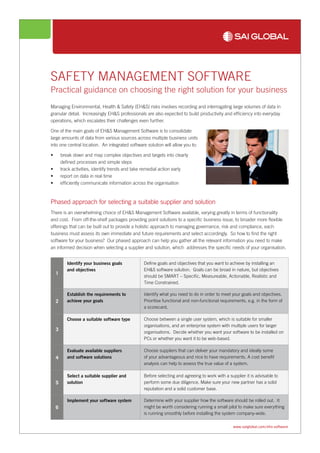
Managing Environmental, Health & Safety (EH&S) risks involves recording and interrogating large volumes of data in
granular detail. Increasingly EH&S professionals are also expected to build productivity and efficiency into everyday
operations, which escalates their challenges even further.
One of the main goals of EH&S Management Software is to consolidate
large amounts of data from various sources across multiple business units
into one central location. An integrated software solution will allow you to:
•	 break down and map complex objectives and targets into clearly
defined processes and simple steps
•	 track activities, identify trends and take remedial action early
•	 report on data in real time
•	 efficiently communicate information across the organisation
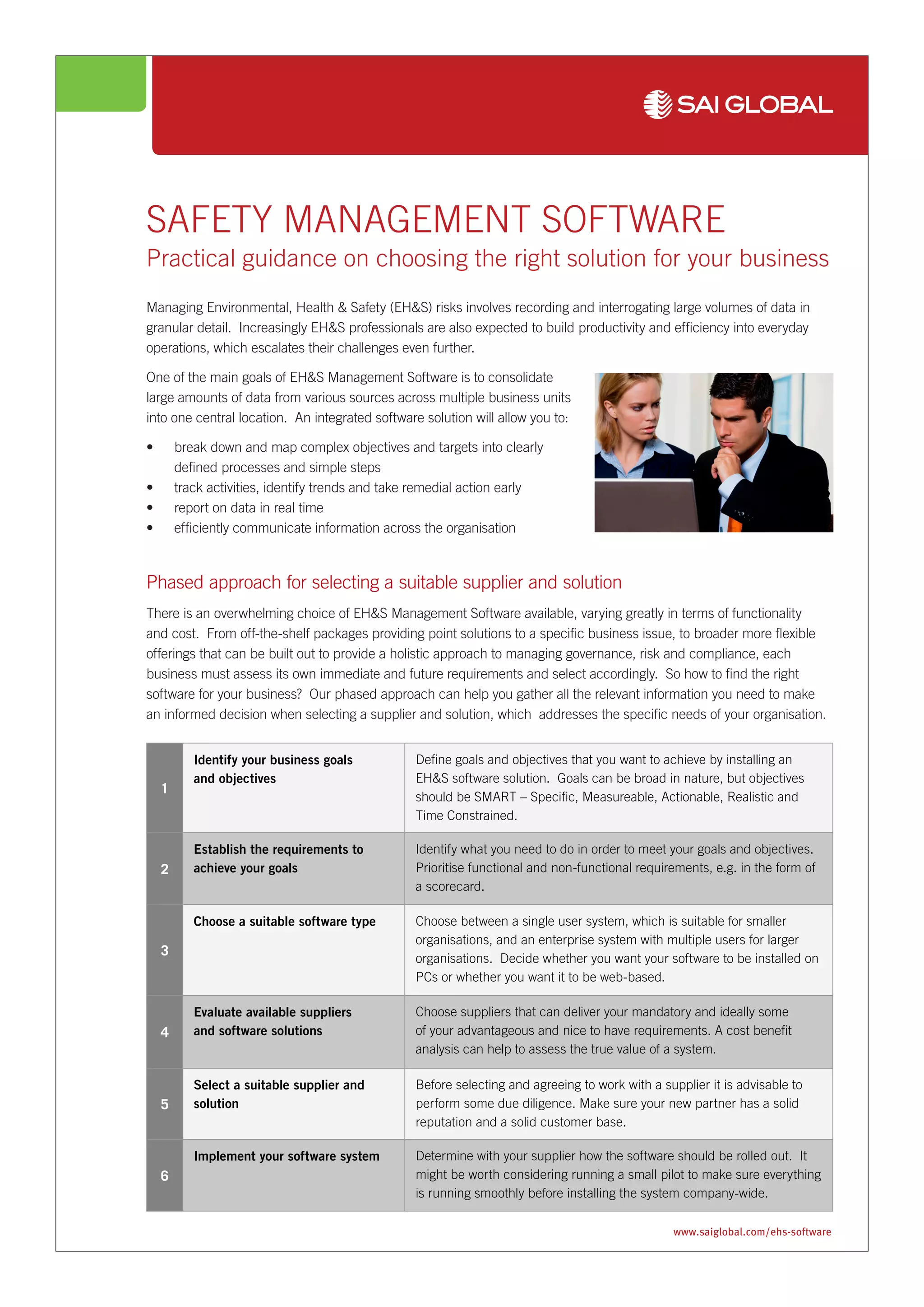
Phased approach for selecting a suitable supplier and solution
There is an overwhelming choice of EH&S Management Software available, varying greatly in terms of functionality
and cost. From off-the-shelf packages providing point solutions to a specific business issue, to broader more flexible
offerings that can be built out to provide a holistic approach to managing governance, risk and compliance, each
business must assess its own immediate and future requirements and select accordingly. So how to find the right
software for your business? Our phased approach can help you gather all the relevant information you need to make
an informed decision when selecting a supplier and solution, which addresses the specific needs of your organisation.
1
Identify your business goals
and objectives
Define goals and objectives that you want to achieve by installing an
EH&S software solution. Goals can be broad in nature, but objectives
should be SMART – Specific, Measureable, Actionable, Realistic and
Time Constrained.
2
Establish the requirements to
achieve your goals
Identify what you need to do in order to meet your goals and objectives.
Prioritise functional and non-functional requirements, e.g. in the form of
a scorecard.
3
Choose a suitable software type Choose between a single user system, which is suitable for smaller
organisations, and an enterprise system with multiple users for larger
organisations. Decide whether you want your software to be installed on
PCs or whether you want it to be web-based.
4
Evaluate available suppliers
and software solutions
Choose suppliers that can deliver your mandatory and ideally some
of your advantageous and nice to have requirements. A cost benefit
analysis can help to assess the true value of a system.
5
Select a suitable supplier and
solution
Before selecting and agreeing to work with a supplier it is advisable to
perform some due diligence. Make sure your new partner has a solid
reputation and a solid customer base.
6
Implement your software system Determine with your supplier how the software should be rolled out. It
might be worth considering running a small pilot to make sure everything
is running smoothly before installing the system company-wide.
© 2012 SAI Global Ltd. The SAI Global name and logo and Cintellate name are trademarks of SAI Global Ltd. All Rights Reserved.
www.saiglobal.com/ehs-software
Practical steps for choosing the right Safety Management Software
HSSWDS1209a
About CintellateTM
The SAI Global Cintellate™ EH&S Software Suite addresses key issues in operational environmental, health and safety
management. With a global client base, our software is robust, scalable and extremely flexible. For more information
on Cintellate™ or to request an online demo of our system, please visit us on www.saiglobal.com/ehs-software.

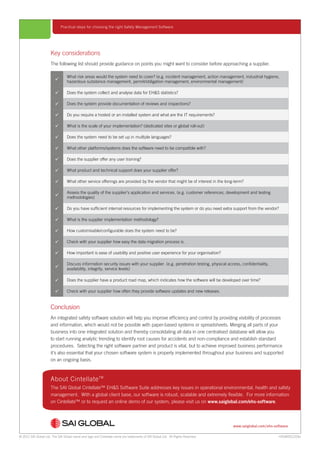
What risk areas would the system need to cover? (e.g. incident management, action management, industrial hygiene,
hazardous substance management, permit/obligation management, environmental management)
 Does the system collect and analyse data for EH&S statistics?
 Does the system provide documentation of reviews and inspections?
 Do you require a hosted or an installed system and what are the IT requirements?
 What is the scale of your implementation? (dedicated sites or global roll-out)
 Does the system need to be set up in multiple languages?
 What other platforms/systems does the software need to be compatible with?
 Does the supplier offer any user training?
 What product and technical support does your supplier offer?
 What other service offerings are provided by the vendor that might be of interest in the long-term?

Assess the quality of the supplier’s application and services. (e.g. customer references, development and testing
methodologies)
 Do you have sufficient internal resources for implementing the system or do you need extra support from the vendor?
 What is the supplier implementation methodology?
 How customisable/configurable does the system need to be?
 Check with your supplier how easy the data migration process is.
 How important is ease of usability and positive user experience for your organisation?

Discuss information security issues with your supplier. (e.g. penetration testing, physical access, confidentiality,
availability, integrity, service levels)
 Does the supplier have a product road map, which indicates how the software will be developed over time?
 Check with your supplier how often they provide software updates and new releases.
Key considerations
The following list should provide guidance on points you might want to consider before approaching a supplier.
Conclusion
An integrated safety software solution will help you improve efficiency and control by providing visibility of processes
and information, which would not be possible with paper-based systems or spreadsheets. Merging all parts of your
business into one integrated solution and thereby consolidating all data in one centralised database will allow you
to start running analytic trending to identify root causes for accidents and non-compliance and establish standard
procedures. Selecting the right software partner and product is vital, but to achieve improved business performance
it’s also essential that your chosen software system is properly implemented throughout your business and supported
on an ongoing basis.

EHS Software Buyer Checklist

  • 1.
    www.saiglobal.com/ehs-software SAFETY MANAGEMENT SOFTWARE Practicalguidance on choosing the right solution for your business Managing Environmental, Health & Safety (EH&S) risks involves recording and interrogating large volumes of data in granular detail. Increasingly EH&S professionals are also expected to build productivity and efficiency into everyday operations, which escalates their challenges even further. One of the main goals of EH&S Management Software is to consolidate large amounts of data from various sources across multiple business units into one central location. An integrated software solution will allow you to: • break down and map complex objectives and targets into clearly defined processes and simple steps • track activities, identify trends and take remedial action early • report on data in real time • efficiently communicate information across the organisation Phased approach for selecting a suitable supplier and solution There is an overwhelming choice of EH&S Management Software available, varying greatly in terms of functionality and cost. From off-the-shelf packages providing point solutions to a specific business issue, to broader more flexible offerings that can be built out to provide a holistic approach to managing governance, risk and compliance, each business must assess its own immediate and future requirements and select accordingly. So how to find the right software for your business? Our phased approach can help you gather all the relevant information you need to make an informed decision when selecting a supplier and solution, which addresses the specific needs of your organisation. 1 Identify your business goals and objectives Define goals and objectives that you want to achieve by installing an EH&S software solution. Goals can be broad in nature, but objectives should be SMART – Specific, Measureable, Actionable, Realistic and Time Constrained. 2 Establish the requirements to achieve your goals Identify what you need to do in order to meet your goals and objectives. Prioritise functional and non-functional requirements, e.g. in the form of a scorecard. 3 Choose a suitable software type Choose between a single user system, which is suitable for smaller organisations, and an enterprise system with multiple users for larger organisations. Decide whether you want your software to be installed on PCs or whether you want it to be web-based. 4 Evaluate available suppliers and software solutions Choose suppliers that can deliver your mandatory and ideally some of your advantageous and nice to have requirements. A cost benefit analysis can help to assess the true value of a system. 5 Select a suitable supplier and solution Before selecting and agreeing to work with a supplier it is advisable to perform some due diligence. Make sure your new partner has a solid reputation and a solid customer base. 6 Implement your software system Determine with your supplier how the software should be rolled out. It might be worth considering running a small pilot to make sure everything is running smoothly before installing the system company-wide.
  • 2.
    © 2012 SAIGlobal Ltd. The SAI Global name and logo and Cintellate name are trademarks of SAI Global Ltd. All Rights Reserved. www.saiglobal.com/ehs-software Practical steps for choosing the right Safety Management Software HSSWDS1209a About CintellateTM The SAI Global Cintellate™ EH&S Software Suite addresses key issues in operational environmental, health and safety management. With a global client base, our software is robust, scalable and extremely flexible. For more information on Cintellate™ or to request an online demo of our system, please visit us on www.saiglobal.com/ehs-software.  What risk areas would the system need to cover? (e.g. incident management, action management, industrial hygiene, hazardous substance management, permit/obligation management, environmental management)  Does the system collect and analyse data for EH&S statistics?  Does the system provide documentation of reviews and inspections?  Do you require a hosted or an installed system and what are the IT requirements?  What is the scale of your implementation? (dedicated sites or global roll-out)  Does the system need to be set up in multiple languages?  What other platforms/systems does the software need to be compatible with?  Does the supplier offer any user training?  What product and technical support does your supplier offer?  What other service offerings are provided by the vendor that might be of interest in the long-term?  Assess the quality of the supplier’s application and services. (e.g. customer references, development and testing methodologies)  Do you have sufficient internal resources for implementing the system or do you need extra support from the vendor?  What is the supplier implementation methodology?  How customisable/configurable does the system need to be?  Check with your supplier how easy the data migration process is.  How important is ease of usability and positive user experience for your organisation?  Discuss information security issues with your supplier. (e.g. penetration testing, physical access, confidentiality, availability, integrity, service levels)  Does the supplier have a product road map, which indicates how the software will be developed over time?  Check with your supplier how often they provide software updates and new releases. Key considerations The following list should provide guidance on points you might want to consider before approaching a supplier. Conclusion An integrated safety software solution will help you improve efficiency and control by providing visibility of processes and information, which would not be possible with paper-based systems or spreadsheets. Merging all parts of your business into one integrated solution and thereby consolidating all data in one centralised database will allow you to start running analytic trending to identify root causes for accidents and non-compliance and establish standard procedures. Selecting the right software partner and product is vital, but to achieve improved business performance it’s also essential that your chosen software system is properly implemented throughout your business and supported on an ongoing basis.