Material Science Assignment #2 Semester 2, 2022/23
DURING YOUR SOLUTION:
1. Write the equation you are using, then substitute the symbols with the appropriate values.
This guides me in following your procedure. If you don’t, marks will be deducted.
2. Indicate the part of question being answered, using the same designation on the question
paper. If you don’t, it may not be marked.
3. ALL answers must be given to TWO decimal places, unless otherwise stated. Note: Your
working should be to at least one more decimal place than what is requested.
4. Ensure your name and ID are in your document, and include your name in the filename
that is submitted, for example, Winston Jones - Assignment 2.pdf
ANSWER ALL QUESTIONS
Question 1
Distinguish between an octahedral and a tetrahedral void. Show one location of each complete
void in separate FCC cells by connecting lines to the atoms that surround the void. Name the
void that is larger. (10 marks)
Question 2
(a) FCC is a more close packed structure yet solubility of carbon in austenite, which is FCC is,
higher than that in ferrite, which is BCC. Why is it so? (2 marks)
(b) Consider 10 kg of austenite containing 0.65 wt.% C cooled slowly. Use the simplified the
Iron-Carbon phase diagram given class to answer the following:
(i) What is the pro-eutectoid phase, and what is its mass at the eutectoid temperature?
(3 marks)
(ii) How many kg each of pearlite and the pro-eutectoid phase form just below the
eutectoid temperature (4 marks)
(iii) How many kg each of ferrite and cementite form at room temperature? (4 marks)
(iv) What is the mass of the pearlite at room temperature? If the answer is different from
(ii), why? (4 marks)
(v) Calculate the fraction of ferrite in pearlite at room temperature. (3 marks)
Question 3
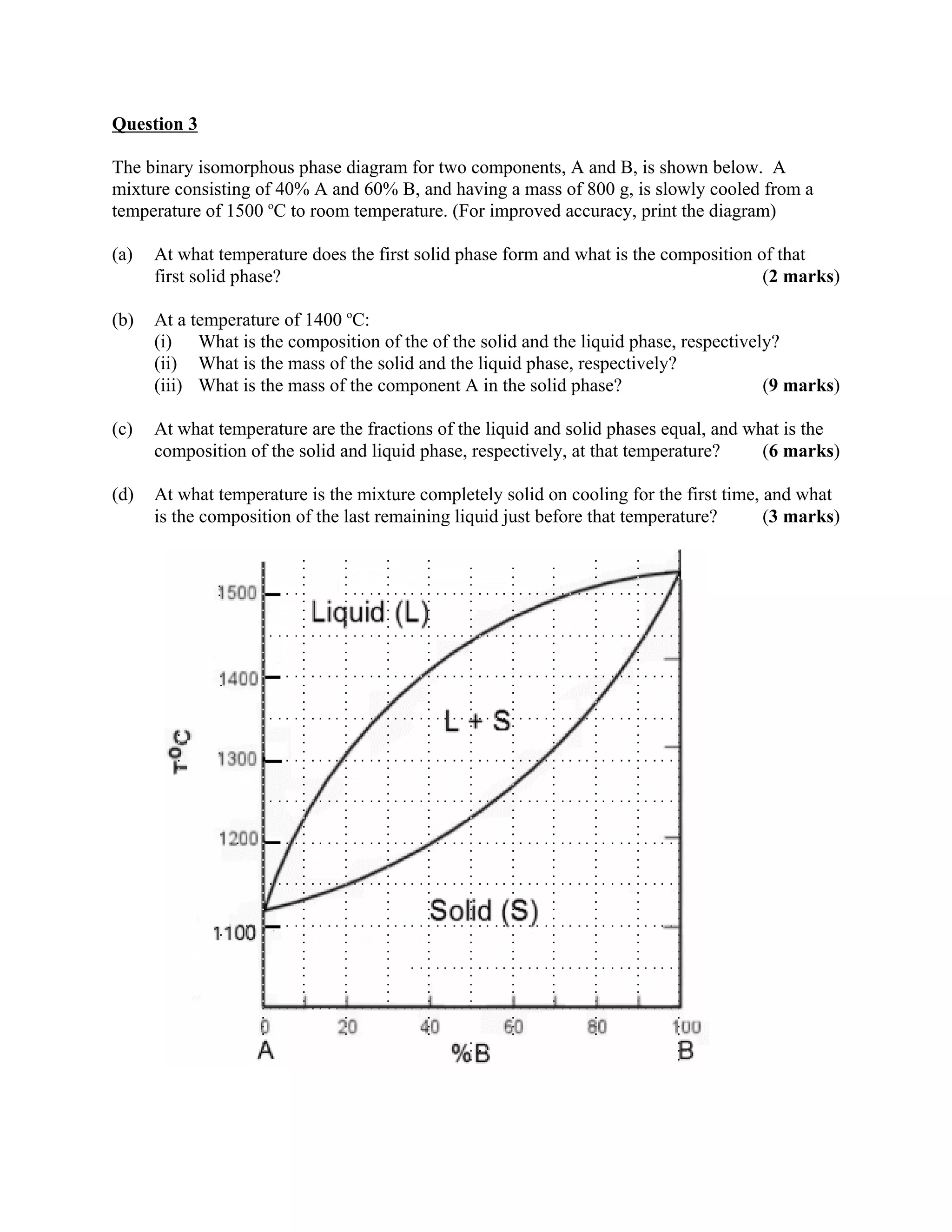
The binary isomorphous phase diagram for two components, A and B, is shown below. A
mixture consisting of 40% A and 60% B, and having a mass of 800 g, is slowly cooled from a
temperature of 1500 o
C to room temperature. (For improved accuracy, print the diagram)
(a) At what temperature does the first solid phase form and what is the composition of that
first solid phase? (2 marks)
(b) At a temperature of 1400 o
C:
(i) What is the composition of the of the solid and the liquid phase, respectively?
(ii) What is the mass of the solid and the liquid phase, respectively?
(iii) What is the mass of the component A in the solid phase? (9 marks)
(c) At what temperature are the fractions of the liquid and solid phases equal, and what is the
composition of the solid and liquid phase, respectively, at that temperature? (6 marks)
(d) At what temperature is the mixture completely solid on cooling for the first time, and what
is the composition of the last remaining liquid just before that temperature? (3 marks)

Assignment.pdf

  • 1.
    Material Science Assignment#2 Semester 2, 2022/23 DURING YOUR SOLUTION: 1. Write the equation you are using, then substitute the symbols with the appropriate values. This guides me in following your procedure. If you don’t, marks will be deducted. 2. Indicate the part of question being answered, using the same designation on the question paper. If you don’t, it may not be marked. 3. ALL answers must be given to TWO decimal places, unless otherwise stated. Note: Your working should be to at least one more decimal place than what is requested. 4. Ensure your name and ID are in your document, and include your name in the filename that is submitted, for example, Winston Jones - Assignment 2.pdf ANSWER ALL QUESTIONS Question 1 Distinguish between an octahedral and a tetrahedral void. Show one location of each complete void in separate FCC cells by connecting lines to the atoms that surround the void. Name the void that is larger. (10 marks) Question 2 (a) FCC is a more close packed structure yet solubility of carbon in austenite, which is FCC is, higher than that in ferrite, which is BCC. Why is it so? (2 marks) (b) Consider 10 kg of austenite containing 0.65 wt.% C cooled slowly. Use the simplified the Iron-Carbon phase diagram given class to answer the following: (i) What is the pro-eutectoid phase, and what is its mass at the eutectoid temperature? (3 marks) (ii) How many kg each of pearlite and the pro-eutectoid phase form just below the eutectoid temperature (4 marks) (iii) How many kg each of ferrite and cementite form at room temperature? (4 marks) (iv) What is the mass of the pearlite at room temperature? If the answer is different from (ii), why? (4 marks) (v) Calculate the fraction of ferrite in pearlite at room temperature. (3 marks)
  • 2.
    Question 3 The binaryisomorphous phase diagram for two components, A and B, is shown below. A mixture consisting of 40% A and 60% B, and having a mass of 800 g, is slowly cooled from a temperature of 1500 o C to room temperature. (For improved accuracy, print the diagram) (a) At what temperature does the first solid phase form and what is the composition of that first solid phase? (2 marks) (b) At a temperature of 1400 o C: (i) What is the composition of the of the solid and the liquid phase, respectively? (ii) What is the mass of the solid and the liquid phase, respectively? (iii) What is the mass of the component A in the solid phase? (9 marks) (c) At what temperature are the fractions of the liquid and solid phases equal, and what is the composition of the solid and liquid phase, respectively, at that temperature? (6 marks) (d) At what temperature is the mixture completely solid on cooling for the first time, and what is the composition of the last remaining liquid just before that temperature? (3 marks)