Assignment Exercise 4–1: Contractual Allowances
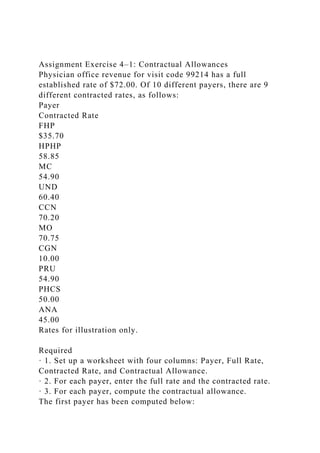
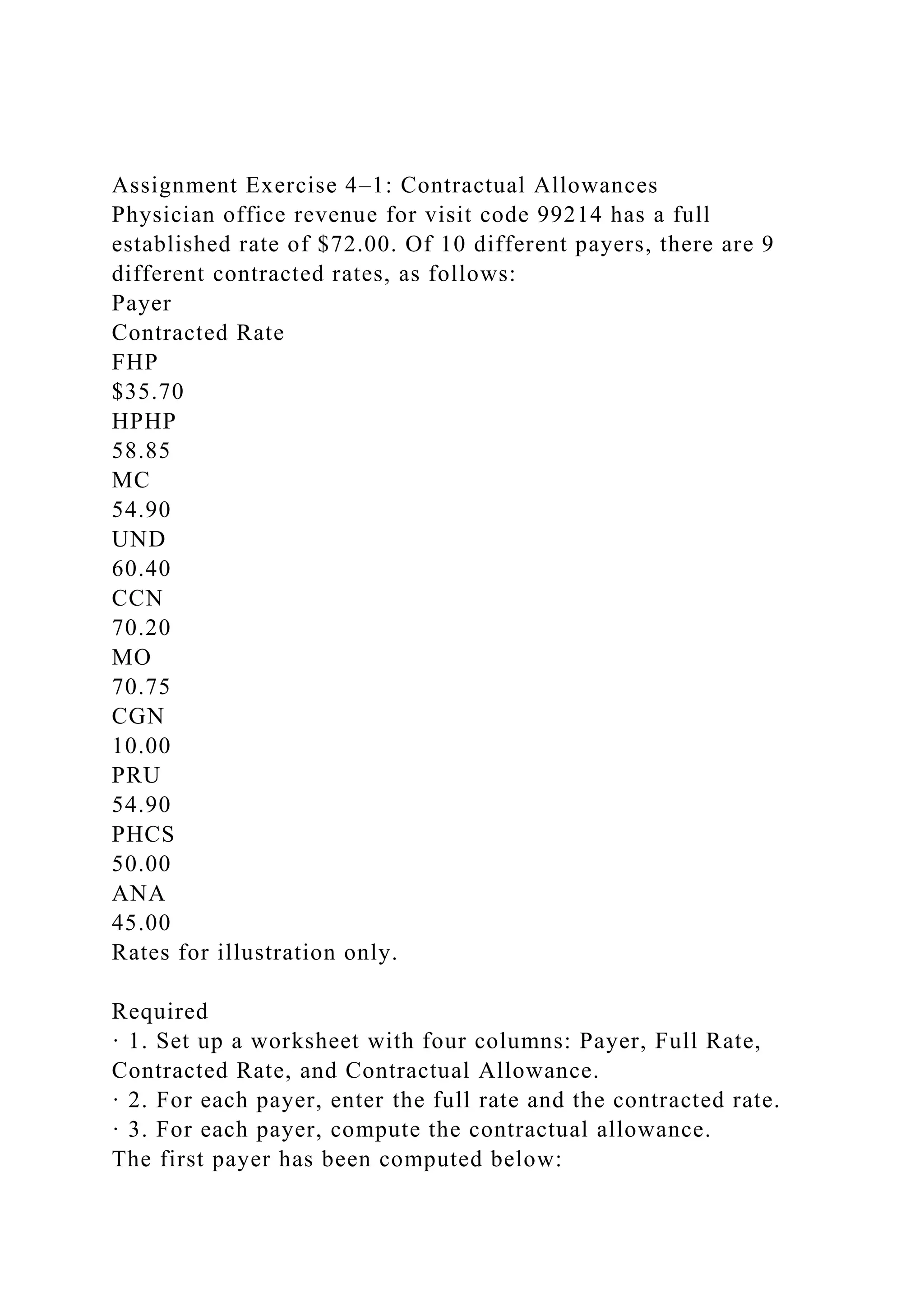
Physician office revenue for visit code 99214 has a full
established rate of $72.00. Of 10 different payers, there are 9
different contracted rates, as follows:
Payer
Contracted Rate
FHP
$35.70
HPHP
58.85
MC
54.90
UND
60.40
CCN
70.20
MO
70.75
CGN
10.00
PRU
54.90
PHCS
50.00
ANA
45.00
Rates for illustration only.
Required
· 1. Set up a worksheet with four columns: Payer, Full Rate,
Contracted Rate, and Contractual Allowance.
· 2. For each payer, enter the full rate and the contracted rate.
· 3. For each payer, compute the contractual allowance.
The first payer has been computed below:
Full
Contracted
Contractual
Payer
Rate
(less)
Rate
(equals)
Allowance
FHP
$72.00
$35.70
$36.30
Example 4B: Revenue Sources and Grouping Revenue
Sources of healthcare revenue are often grouped by payer. Thus,
services might be grouped as follows:
· Revenue from the Medicare Program (payer = Medicare)
· Revenue from the Medicaid Program (payer = Medicaid)
· Revenue from Blue Cross Blue Shield (payer = Commercial
Insurance)
· or
· Revenue from Blue Cross Blue Shield (payer = Managed Care
Contract) Assignment Exercise 4–2: Revenue Sources and
Grouping Revenue
The Metropolis Health System (MHS) has revenue sources from
operations, donations, and interest income. The revenue from
operations is primarily received for services. MHS groups its
revenue first by cost center. Within each cost center the services
revenue is then grouped by payer.Required
· 1. Set up a worksheet with individual columns across the top
for six revenue sources (payers): Medicare, Medicaid, Other
Public Programs, Patients, Commercial Insurance, and Managed
Care Contracts.
· 2. Certain situations concerning the Intensive Care Unit and
the Laboratory are described below. Set up six vertical line
items on your worksheet, numbered 1 through 6. Six situations
are described below. For each of the six situations, indicate its
number (1 through 6) and enter the appropriate cost center
(either Intensive Care Unit or Laboratory). Then place an X in
the column(s) that represents the correct revenue source(s) for
the item. The six situations are as follows:
· (1) ICU stay billed to employee’s insurance program.
· (2) Lab test paid for by an individual.
· (3) Pathology work performed for the state.
· (4) ICU stay billed to member’s health plan.
· (5) ICU stay billed for Medicare beneficiary.
· (6) Series of allergy tests run for eligible Medicaid
beneficiary.
Headings for your worksheet:
Medicare
Medicaid
Other Public Programs
Patients
Commercial Insurance
Managed Care Contracts
(1)
(2)
(3)
(4)
(5)
(6)
Example 4B: Revenue Sources and Grouping Revenue
Sources of healthcare revenue are often grouped by payer. Thus,
services might be grouped as follows:
· Revenue from the Medicare Program (payer = Medicare)
· Revenue from the Medicaid Program (payer = Medicaid)
· Revenue from Blue Cross Blue Shield (payer = Commercial
Insurance)
· or
· Revenue from Blue Cross Blue Shield (payer = Managed Care
Contract) Assignment Exercise 4–2: Revenue Sources and
Grouping Revenue
The Metropolis Health System (MHS) has revenue sources from
operations, donations, and interest income. The revenue from
operations is primarily received for services. MHS groups its
revenue first by cost center. Within each cost center the services
revenue is then grouped by payer.Required
· 1. Set up a worksheet with individual columns across the top
for six revenue sources (payers): Medicare, Medicaid, Other
Public Programs, Patients, Commercial Insurance, and Managed
Care Contracts.
· 2. Certain situations concerning the Intensive Care Unit and
the Laboratory are described below. Set up six vertical line
items on your worksheet, numbered 1 through 6. Six situations
are described below. For each of the six situations, indicate its
number (1 through 6) and enter the appropriate cost center
(either Intensive Care Unit or Laboratory). Then place an X in
the column(s) that represents the correct revenue source(s) for
the item. The six situations are as follows:
· (1) ICU stay billed to employee’s insurance program.
· (2) Lab test paid for by an individual.
· (3) Pathology work performed for the state.
· (4) ICU stay billed to member’s health plan.
· (5) ICU stay billed for Medicare beneficiary.
· (6) Series of allergy tests run for eligible Medicaid
beneficiary.
Headings for your worksheet:
Medicare
Medicaid
Other Public Programs
Patients
Commercial Insurance
Managed Care Contracts
(1)
(2)
(3)
(4)
(5)
(6)
Example 5B
Study the chapter text concerning grouping expenses by
diagnoses and procedures. Refer to Exhibits 5–3 and 5–4 (about
major diagnostic categories), Exhibit 5–5 (about DRGs and
MDCs), and Table 5–1 (about procedure codes) for examples of
different ways to group expenses by diagnoses and
procedures.Assignment Exercise 5–2 Required
Find a listing of expenses by diagnosis or by procedure. The
source of the list can be internal (within a healthcare facility of
some type) or external (such as a published article, report, or
survey). Comment upon whether you believe the expense
grouping used is appropriate. Would you have grouped the
expenses in another way?
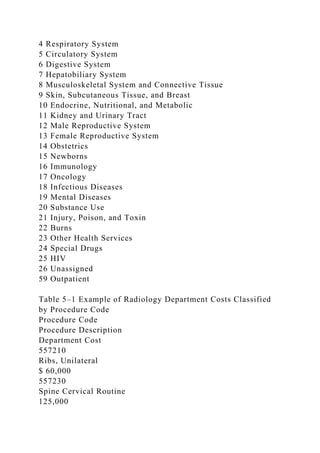
Exhibit 5–3 Major Diagnostic Categories
MDC 1
Diseases and Disorders of the Nervous System
MDC 2
Eye
MDC 3
Ear, Nose, Mouth, and Throat
MDC 4
Respiratory System
MDC 5
Circulatory System
MDC 6
Digestive System
MDC 7
Hepatobiliary System and Pancreas
MDC 8
Musculoskeletal System and Connective Tissue
MDC 9
Skin, Subcutaneous Tissue, and Breast
MDC 10
Endocrine, Nutritional, and Metabolic
MDC 11
Kidney and Urinary Tract
MDC 12
Male Reproductive System
MDC 13
Female Reproductive System
MDC 14
Pregnancy, Childbirth, and the Puerperium
MDC 15
Newborns and Other Neonates with Conditions Originating in
the Perinatal Period
MDC 16
Blood and Blood-Forming Organs and Immunological Disorders
MDC 17
Myeloproliferative and Poorly and Differentiated Neoplasms
MDC 18
Infections and Parasitic Diseases (Systemic or Unspecified
Sites)
MDC 19
Mental Diseases and Disorders
MDC 20
Alcohol/Drug Use and Alcohol/Drug-Induced Organic Mental
Disorders
MDC 21
Injuries, Poisoning, and Toxic Effect of Drugs
MDC 22
Burns
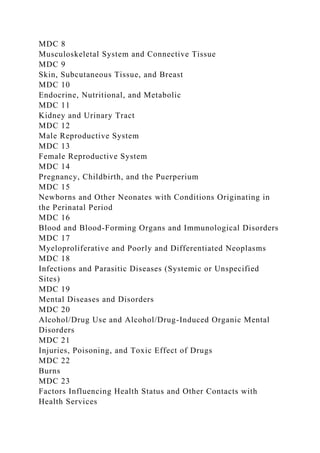
MDC 23
Factors Influencing Health Status and Other Contacts with
Health Services
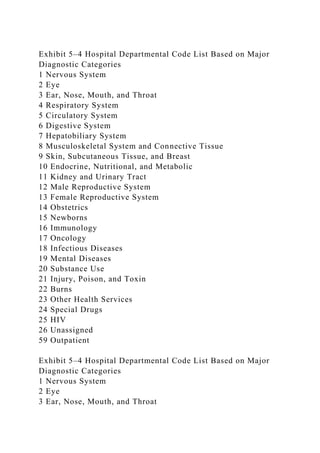
Exhibit 5–4 Hospital Departmental Code List Based on Major
Diagnostic Categories
1 Nervous System
2 Eye
3 Ear, Nose, Mouth, and Throat
4 Respiratory System
5 Circulatory System
6 Digestive System
7 Hepatobiliary System
8 Musculoskeletal System and Connective Tissue
9 Skin, Subcutaneous Tissue, and Breast
10 Endocrine, Nutritional, and Metabolic
11 Kidney and Urinary Tract
12 Male Reproductive System
13 Female Reproductive System
14 Obstetrics
15 Newborns
16 Immunology
17 Oncology
18 Infectious Diseases
19 Mental Diseases
20 Substance Use
21 Injury, Poison, and Toxin
22 Burns
23 Other Health Services
24 Special Drugs
25 HIV
26 Unassigned
59 Outpatient
Exhibit 5–4 Hospital Departmental Code List Based on Major
Diagnostic Categories
1 Nervous System
2 Eye
3 Ear, Nose, Mouth, and Throat
4 Respiratory System
5 Circulatory System
6 Digestive System
7 Hepatobiliary System
8 Musculoskeletal System and Connective Tissue
9 Skin, Subcutaneous Tissue, and Breast
10 Endocrine, Nutritional, and Metabolic
11 Kidney and Urinary Tract
12 Male Reproductive System
13 Female Reproductive System
14 Obstetrics
15 Newborns
16 Immunology
17 Oncology
18 Infectious Diseases
19 Mental Diseases
20 Substance Use
21 Injury, Poison, and Toxin
22 Burns
23 Other Health Services
24 Special Drugs
25 HIV
26 Unassigned
59 Outpatient
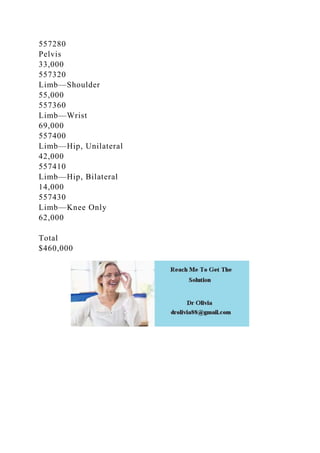
Table 5–1 Example of Radiology Department Costs Classified
by Procedure Code
Procedure Code
Procedure Description
Department Cost
557210
Ribs, Unilateral
$ 60,000
557230
Spine Cervical Routine
125,000
557280
Pelvis
33,000
557320
Limb—Shoulder
55,000
557360
Limb—Wrist
69,000
557400
Limb—Hip, Unilateral
42,000
557410
Limb—Hip, Bilateral
14,000
557430
Limb—Knee Only
62,000
Total
$460,000

Assignment Exercise 4–1 Contractual Allowances Physician office.docx

  • 1.
    Assignment Exercise 4–1:Contractual Allowances Physician office revenue for visit code 99214 has a full established rate of $72.00. Of 10 different payers, there are 9 different contracted rates, as follows: Payer Contracted Rate FHP $35.70 HPHP 58.85 MC 54.90 UND 60.40 CCN 70.20 MO 70.75 CGN 10.00 PRU 54.90 PHCS 50.00 ANA 45.00 Rates for illustration only. Required · 1. Set up a worksheet with four columns: Payer, Full Rate, Contracted Rate, and Contractual Allowance. · 2. For each payer, enter the full rate and the contracted rate. · 3. For each payer, compute the contractual allowance. The first payer has been computed below:
  • 2.
    Full Contracted Contractual Payer Rate (less) Rate (equals) Allowance FHP $72.00 $35.70 $36.30 Example 4B: RevenueSources and Grouping Revenue Sources of healthcare revenue are often grouped by payer. Thus, services might be grouped as follows: · Revenue from the Medicare Program (payer = Medicare) · Revenue from the Medicaid Program (payer = Medicaid) · Revenue from Blue Cross Blue Shield (payer = Commercial Insurance) · or · Revenue from Blue Cross Blue Shield (payer = Managed Care Contract) Assignment Exercise 4–2: Revenue Sources and Grouping Revenue The Metropolis Health System (MHS) has revenue sources from operations, donations, and interest income. The revenue from operations is primarily received for services. MHS groups its revenue first by cost center. Within each cost center the services revenue is then grouped by payer.Required · 1. Set up a worksheet with individual columns across the top for six revenue sources (payers): Medicare, Medicaid, Other
  • 3.
    Public Programs, Patients,Commercial Insurance, and Managed Care Contracts. · 2. Certain situations concerning the Intensive Care Unit and the Laboratory are described below. Set up six vertical line items on your worksheet, numbered 1 through 6. Six situations are described below. For each of the six situations, indicate its number (1 through 6) and enter the appropriate cost center (either Intensive Care Unit or Laboratory). Then place an X in the column(s) that represents the correct revenue source(s) for the item. The six situations are as follows: · (1) ICU stay billed to employee’s insurance program. · (2) Lab test paid for by an individual. · (3) Pathology work performed for the state. · (4) ICU stay billed to member’s health plan. · (5) ICU stay billed for Medicare beneficiary. · (6) Series of allergy tests run for eligible Medicaid beneficiary. Headings for your worksheet: Medicare Medicaid Other Public Programs Patients Commercial Insurance Managed Care Contracts (1) (2)
  • 4.
    (3) (4) (5) (6) Example 4B: RevenueSources and Grouping Revenue Sources of healthcare revenue are often grouped by payer. Thus, services might be grouped as follows: · Revenue from the Medicare Program (payer = Medicare) · Revenue from the Medicaid Program (payer = Medicaid)
  • 5.
    · Revenue fromBlue Cross Blue Shield (payer = Commercial Insurance) · or · Revenue from Blue Cross Blue Shield (payer = Managed Care Contract) Assignment Exercise 4–2: Revenue Sources and Grouping Revenue The Metropolis Health System (MHS) has revenue sources from operations, donations, and interest income. The revenue from operations is primarily received for services. MHS groups its revenue first by cost center. Within each cost center the services revenue is then grouped by payer.Required · 1. Set up a worksheet with individual columns across the top for six revenue sources (payers): Medicare, Medicaid, Other Public Programs, Patients, Commercial Insurance, and Managed Care Contracts. · 2. Certain situations concerning the Intensive Care Unit and the Laboratory are described below. Set up six vertical line items on your worksheet, numbered 1 through 6. Six situations are described below. For each of the six situations, indicate its number (1 through 6) and enter the appropriate cost center (either Intensive Care Unit or Laboratory). Then place an X in the column(s) that represents the correct revenue source(s) for the item. The six situations are as follows: · (1) ICU stay billed to employee’s insurance program. · (2) Lab test paid for by an individual. · (3) Pathology work performed for the state. · (4) ICU stay billed to member’s health plan. · (5) ICU stay billed for Medicare beneficiary. · (6) Series of allergy tests run for eligible Medicaid beneficiary. Headings for your worksheet: Medicare Medicaid Other Public Programs Patients
  • 6.
    Commercial Insurance Managed CareContracts (1) (2) (3) (4) (5)
  • 7.
    (6) Example 5B Study thechapter text concerning grouping expenses by diagnoses and procedures. Refer to Exhibits 5–3 and 5–4 (about major diagnostic categories), Exhibit 5–5 (about DRGs and MDCs), and Table 5–1 (about procedure codes) for examples of different ways to group expenses by diagnoses and procedures.Assignment Exercise 5–2 Required Find a listing of expenses by diagnosis or by procedure. The source of the list can be internal (within a healthcare facility of some type) or external (such as a published article, report, or survey). Comment upon whether you believe the expense grouping used is appropriate. Would you have grouped the expenses in another way? Exhibit 5–3 Major Diagnostic Categories MDC 1 Diseases and Disorders of the Nervous System MDC 2 Eye MDC 3 Ear, Nose, Mouth, and Throat MDC 4 Respiratory System MDC 5 Circulatory System MDC 6 Digestive System MDC 7 Hepatobiliary System and Pancreas
  • 8.
    MDC 8 Musculoskeletal Systemand Connective Tissue MDC 9 Skin, Subcutaneous Tissue, and Breast MDC 10 Endocrine, Nutritional, and Metabolic MDC 11 Kidney and Urinary Tract MDC 12 Male Reproductive System MDC 13 Female Reproductive System MDC 14 Pregnancy, Childbirth, and the Puerperium MDC 15 Newborns and Other Neonates with Conditions Originating in the Perinatal Period MDC 16 Blood and Blood-Forming Organs and Immunological Disorders MDC 17 Myeloproliferative and Poorly and Differentiated Neoplasms MDC 18 Infections and Parasitic Diseases (Systemic or Unspecified Sites) MDC 19 Mental Diseases and Disorders MDC 20 Alcohol/Drug Use and Alcohol/Drug-Induced Organic Mental Disorders MDC 21 Injuries, Poisoning, and Toxic Effect of Drugs MDC 22 Burns MDC 23 Factors Influencing Health Status and Other Contacts with Health Services
  • 9.
    Exhibit 5–4 HospitalDepartmental Code List Based on Major Diagnostic Categories 1 Nervous System 2 Eye 3 Ear, Nose, Mouth, and Throat 4 Respiratory System 5 Circulatory System 6 Digestive System 7 Hepatobiliary System 8 Musculoskeletal System and Connective Tissue 9 Skin, Subcutaneous Tissue, and Breast 10 Endocrine, Nutritional, and Metabolic 11 Kidney and Urinary Tract 12 Male Reproductive System 13 Female Reproductive System 14 Obstetrics 15 Newborns 16 Immunology 17 Oncology 18 Infectious Diseases 19 Mental Diseases 20 Substance Use 21 Injury, Poison, and Toxin 22 Burns 23 Other Health Services 24 Special Drugs 25 HIV 26 Unassigned 59 Outpatient Exhibit 5–4 Hospital Departmental Code List Based on Major Diagnostic Categories 1 Nervous System 2 Eye 3 Ear, Nose, Mouth, and Throat
  • 10.
    4 Respiratory System 5Circulatory System 6 Digestive System 7 Hepatobiliary System 8 Musculoskeletal System and Connective Tissue 9 Skin, Subcutaneous Tissue, and Breast 10 Endocrine, Nutritional, and Metabolic 11 Kidney and Urinary Tract 12 Male Reproductive System 13 Female Reproductive System 14 Obstetrics 15 Newborns 16 Immunology 17 Oncology 18 Infectious Diseases 19 Mental Diseases 20 Substance Use 21 Injury, Poison, and Toxin 22 Burns 23 Other Health Services 24 Special Drugs 25 HIV 26 Unassigned 59 Outpatient Table 5–1 Example of Radiology Department Costs Classified by Procedure Code Procedure Code Procedure Description Department Cost 557210 Ribs, Unilateral $ 60,000 557230 Spine Cervical Routine 125,000
  • 11.