SECTION 5: CH. 9&10
MIDDLE AND LATE CHILDHOOD
By: Twinkle Patel and Shiri McDaniel
QUESTION 1: HEALTH
CONCERNS
WHAT ARE SOME MAJOR CHILDHOOD HEALTH CONCERNS? HOW CAN THEY BE PREVENTED OR
ADDRESSED? WHAT RESOURCES ARE AVAILABLE TO HELP CHILDREN AND THEIR FAMILIES?
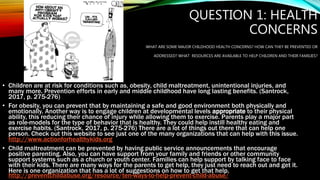
• Children are at risk for conditions such as, obesity, child maltreatment, unintentional injuries, and
many more. Prevention efforts in early and middle childhood have long lasting benefits. (Santrock,
2017, p. 275-276)
• For obesity, you can prevent that by maintaining a safe and good environment both physically and
emotionally. Another way is to engage children at developmental levels appropriate to their physical
ability, this reducing their chance of injury while allowing them to exercise. Parents play a major part
as role-models for the type of behavior that is healthy. They could help instill healthy eating and
exercise habits. (Santrock, 2017, p. 275-276) There are a lot of things out there that can help one
person. Check out this website to see just one of the many organizations that can help with this issue.
http://www.actionforhealthykids.org
• Child maltreatment can be prevented by having public service announcements that encourage
positive parenting. Also, you can have support from your family and friends or other community
support systems such as a church or youth center. Families can help support by talking face to face
with their kids. There are many ways for the parents to get help, they just need to reach out and get it.
Here is one organization that has a lot of suggestions on how to get that help.
http://preventchildabuse.org/resource/ten-ways-to-help-prevent-child-abuse/
QUESTION 2: CHANGES HOW DO CHANGES IN BRAIN
COORDINATION, REACTION TIME, ATTENTION AND AUTOMATIZATION AFFECT CHILDREN’S ABILITIES AT
THIS STAGE?
• Brain functioning changes because the increase in androgens
occurs in both girls and boys around age seven to eight years old.
The cerebral cortex thickens, and the temporal and frontal lobe
areas also grow larger and gain better circuit pathways. As shown
in the figure to the left, the brain grows larger with age. The
frontal and temporal lobe affect language, and its development
reflect better language abilities. (Santrock, 2017)
• Motor development makes the child's movement more smooth,
and they have more agility when they play. They are able to run,
jump and climb better as they get older. They also begin to
develop better fine motor skills, which is evidenced in the children
developing a more legible handwriting.
• There is also an important development in childrens thinking. In
Piaget’s Concrete Operational stage, the children “can perform
concrete operations, and they can reason logically as long as
reasoning can be applies to specific examples”. He has the
children perform conservation tasks to test where they are
developmentally. (Santrock, 2017 p. 283)
• Check out the video link below to see the a video example of how
the concrete operations is performed and see the results.
https://www.youtube.com/watch?v=Lg8IBW9qtxc
QUESTION 3:SUCCESS IN
SCHOOL
IS IT NECESSARY TO ASSESS CHILDREN (STANDARD IQ TESTS)? OR WHAT ARE
ALTERNATIVE WAYS TO HELP CHILDREN SUCCEED IN SCHOOL?
• The IQ test is a standardized question that is supposed to test for an individuals intelligence level. The results
are used to place children in advanced learning and also help for some employers to choose who to hire. But
there is a large debate about the test, and questions about the accuracy of truly being able to judge someone’
intelligence from one simple, standardized test. One scientist was quoted saying “IQ tests are misleading
because they do not accurately reflect intelligence, according to a study which found that a minimum of three
different exams are needed to measure someone's brainpower.” (Collins, 2012) I believe this to be true and the
usage of the IQ test should not be used as heavily as it is, especially not in schools. Each child has individual
needs, and it has been proven that there are many different learning styles.
• There are different ways to help your kid succeed in school. I feel if you are a parent, then you are the child’s
first and foremost important teacher. It’s better when the parents are more involved because that can help the
child in school. They can help their child succeed by being there and helping with homework or communicatin
with them about anything they don’t understand. The parent should help because it can help the child be a
better learner and it can help them in school.
• Another way for the school to help children succeed is to access their learning style and try to teach according
There are seven different styles recognized: visual, aural, verbal, physical, logical, social, and solitary. (Overview
of Learning Styles, 2018) These styles should be used more often to impact children and utilize their full
potential. These styles are also great for college students to know about them selves, so click the link and tak
the quick test to see how you would best benefit. https://www.how-to-study.com/learning-style-assessment/
QUESTION 4: DISABILITY WHAT SHOULD YOU DO IF YOU
SUSPECT YOUR CHILD MAY HAVE ADHD OR ANOTHER CHILDHOOD DISABILITY? COULD IT BE
SOMETHING ELSE? HOW CAN YOU TELL?
• There are a variety of disabilities that become aparant
during midlechilhood as the child begins to learn. There are
reading disabilities such as dyslexia, attention disorders
such as ADHD, more severe behavior disorders such as
Austism.Some symptoms are easy to notice but some can
be hard to see. (Spantrock, 2017) For the some of the
disorders schools have programs that can teach the
children, but sometimes these students will fall through
the cracks. A friend of mine had dyslexia, which made it
hard for him to read, but he was too embarrassed to speak
up about it and didn’t get the help he needed.
• If a person does not know if they have ADHD, or another
disability then they and adults around them should look for
the symptoms. The symptoms for ADHD can be distraction,
forgetfulness, different mood swings, and depression can
be one of them. (Santrock, 2017)
• ADHD is an issue that effects children's ability to learn,
however there has been an increase in diagnosis “with
rates that have skyrocketed from only 3-5 percent of kids
to 15 percent” (Frances, 2016, para. 1). This increase has
sparked a debate: is ADHD over diagnosed. Many of the
symptoms can be confused with normal child hyper
activeness or inattention, yet many Doctor’s and parents
could be too quick to medicate a problem a child may not
even have. M.D. Allen Frances provides compelling proof
the the overdiagnosis problem, take the time to read his
article at :
https://www.psychologytoday.com/us/blog/saving-
normal/201605/adhd-is-overdiagnosed-heres-proof
Here’s a video of one woman’s observations on her sons
development with Autism:
https://www.youtube.com/watch?v=JiwZQNYlGQI
QUESTION 5: WHAT KINDS OF SUPPORT AND THERAPY
ARE AVAILABLE FOR PARENTS WITH CHILDREN WHO HAVE ASD?
• Autism has a range of different severities. There is Asperger, which is more mild, and
the child is able to appear almost normal duing social interaction. And there is the
more severe autistic cases in which the child has difficulty with social interactions such
as communication, controlling emotions and behavior. (Santorck, 2017) This can be
difficult for the family as well. Click the following link to see how a mother has
recognizes her sons autistic behavior, shows examples of his behavior, and reaches out
to help other people be aware. https://www.youtube.com/watch?v=Ouel56c_26Q
• Treatment for autism is commonly a very in-depth, extensive operation that involves
the child’s entire family and a team of professionals. Children with autism normally
have social interaction and communication impairments as well as confined interests,
activities, and play skills. (Santrock, 2017) Occupational therapy can help children with
autism achieve better in school and home settings. If you’re a parent and you have
found out that your child has autism, then you should immediately start treatment. The
earlier children with autism spectrum disorder get help, the higher their chance of
treatment success.
• Follow the link https://www.scarymommy.com/the-perks-of-autism/ , to see a point of
view from a mother who focused on the positive aspects of having a child with autism.
Her point of view is refreshing and I think that parents who are struggling could use a
little bit of positivity and support.
QUESTION 6:ACHIEVEMENT &STATUS
THERE IS A STRONG CORRELATION BETWEEN ACADEMIC ACHIEVEMENT AND SOCIOECONOMIC STATUS. WHAT DOES THIS
MEAN? WHAT ARE SOME OF THE FACTORS THAT CONTRIBUTE TO THIS? WHAT CAN BE DONE CHANGE THIS?
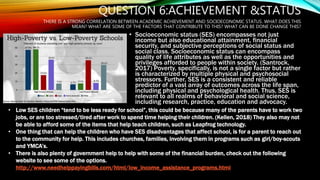
• Socioeconomic status (SES) encompasses not just
income but also educational attainment, financial
security, and subjective perceptions of social status and
social class. Socioeconomic status can encompass
quality of life attributes as well as the opportunities and
privileges afforded to people within society. (Santrock,
2017) Poverty, specifically, is not a single factor but rather
is characterized by multiple physical and psychosocial
stressors. Further, SES is a consistent and reliable
predictor of a vast array of outcomes across the life span,
including physical and psychological health. Thus, SES is
relevant to all realms of behavioral and social science,
including research, practice, education and advocacy.
• Low SES children “tend to be less ready for school”, this could be because many of the parents have to work two
jobs, or are too stressed/tired after work to spend time helping their children. (Kellen, 2018) They also may not
be able to afford some of the items that help teach children, such as Leapfrog technology.
• One thing that can help the children who have SES disadvantages that affect school, is for a parent to reach out
to the community for help. This includes churches, families, involving them in programs such as girl/boy-scouts
and YMCA’s.
• There is also plenty of government help to help with some of the financial burden, check out the following
website to see some of the options.
http://www.needhelppayingbills.com/html/low_income_assistance_programs.html
QUESTION 7: EDUCATION
WE ARE CONSTANTLY STRUGGLING TO FIGURE OUT HOW TO MAKE SURE ALL U.S. SCHOOL-CHILDREN
REACH A BASIC LEVEL OF PROFICIENCY. WHAT’S THE MOST CURRENT LEGISLATION REGARDING
NATIONAL STANDARDS FOR “IMPROVING EDUCATION”?
Some of the changes that are trying to be
made in school include: (Santrock, 2017)
• Keep most existing staff but change the
culture through, performance evaluation
and support, training and mentoring.
• Stronger curriculum and instruction
• More learning time for kids (afternoons,
weekends, summer) and more time for
teachers to collaborate.
• More flexibility for principals in budgeting,
staffing and calendar.
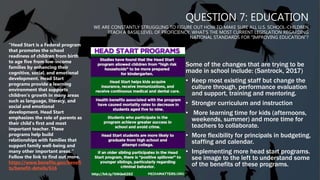
• Implementing more head start programs.
see image to the left to understand some
of the benefits of these programs.
“Head Start is a Federal program
that promotes the school
readiness of children from birth
to age five from low-income
families by enhancing their
cognitive, social, and emotional
development. Head Start
programs provide a learning
environment that supports
children's growth in many areas
such as language, literacy, and
social and emotional
development. Head Start
emphasizes the role of parents as
their child's first and most
important teacher. These
programs help build
relationships with families that
support family well-being and
many other important areas.”
Follow the link to find out more.
https://www.benefits.gov/benefi
ts/benefit-details/616
QUESTION 8: SELF-UNDERSTANDING AND SELF-AWARENESS
INCREASE IN MIDDLE CHILDHOOD. WHAT IS THE PRICE OF THESE
DEVELOPMENTS? HOW CAN WE AVOID SOME OF THE PITFALLS OR HELP
CHILDREN GET THROUGH THEM?
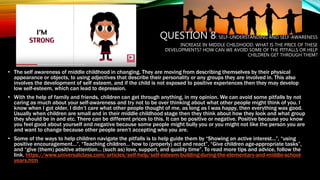
• The self awareness of middle childhood in changing. They are moving from describing themselves by their physical
appearance or objects, to using adjectives that describe their personality or any groups they are involved in. This also
involves the development of self esteem, and if the child is not exposed to positive experiences then they may develop
low self-esteem, which can lead to depression.
• With the help of family and friends, children can get through anything, in my opinion. We can avoid some pitfalls by not
caring as much about your self-awareness and try not to be over thinking about what other people might think of you. I
know when I got older, I didn’t care what other people thought of me, as long as I was happy, then everything was good.
Usually when children are small and in their middle childhood stage then they think about how they look and what group
they should be in and etc. There can be different prices to this. It can be positive or negative. Positive because you know
you feel good about yourself and negative because some people might bully you or you might not like the person you are
and want to change because other people aren’t accepting who you are.
• Some of the ways to help children navigate the pitfalls is to help guide them by “Showing an active interest...”, “using
positive encouragement…”, “Teaching children… how to (properly) act and react”, “Give children age-appropriate tasks”,
and “give (them) positive attention… (such as) love, support, and quality time”. To read more tips and advice, follow the
link. https://www.universalclass.com/articles/self-help/self-esteem-building-during-the-elementary-and-middle-school-
years.htm
QUESTION 9: BULLYING
PEER GROUPS BEGIN TO BE IMPORTANT IN MIDDLE CHILDHOOD; UNFORTUNATELY,
BULLYING ALSO INCREASES. HOW CAN BULLYING BE PREVENTED?
• Bullying can be prevented by
trying your best to ignore the
bullies. Have the support of
your family and friends. Try
to stand up for yourself.
Parents, school staff, and
other adults in the
community can help kids
prevent bullying by talking
about it, building a safe
school environment, and
creating a community-wide
bullying prevention strategy.
• Here’s a video on bullying:
https://www.youtube.com/wat
ch?v=9HsuuRt_OdY
• One of the ways to prevent bullying is to have school intervention. One of the government programs to
stop bullying can be viewed at https://www.stopbullying.gov/ It educates children on how to recognize,
prevent, and react effectively to bullying. I believe this is something that children should be exposed to at
a young age, so they develop more positive relationships instead of becoming a bully. It is also a great
idea to teach children how to stand up to bullies so that the more drastic outcomes don’t happen.
QUESTION 10: GENDER IDENTITY
HOW DOES GENDER IDENTITY CONTINUE TO FORM IN THIS STAGE? WHAT ARE THE MAJOR
CONTRIBUTORS AND GIVE SPECIFIC EXAMPLES HOW THEY HELP/HURT THIS DEVELOPMENT.
• It is true that the path to gender development begins at conception. Gender is what actually
gets expressed, how we look, how we act and how we feel.
• Before the age of five, children don’t seem to think that gender has any permanence at all. A
preschooler might ask his female teacher whether she was a boy or girl when she was little, or
a little boy might say that he wants to grow up to be a mommy. It can hurt someone because
people might bully that person because they are transgender or just don’t know what gender
they are yet. The person can help themselves because if they know what gender they are, they
can be more comfortable and be themselves more. (Santrock, 2017)
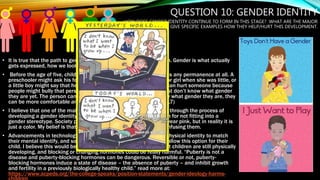
• I believe that one of the main ways we could confuse a child going through the process of
developing a gender identity is to be angry/disappointed with them for not fitting into a
gender stereotype. Society puts emphasis on things such as girls wear pink, but in reality it is
just a color. My belief is that it hurts the child's development by confusing them.
• Advancements in technology are allowing people to change their physical identity to match
their mental identify, and some doctors and parents would like to allow this option for their
child. I believe this would be harmful because we have learned that children are still physically
developing, and blocking or changing hormones could be really harmful. “Puberty is not a
disease and puberty-blocking hormones can be dangerous. Reversible or not, puberty-
blocking hormones induce a state of disease – the absence of puberty – and inhibit growth
and fertility in a previously biologically healthy child.” read more at:
https://www.acpeds.org/the-college-speaks/position-statements/gender-ideology-harms-
QUESTION 11:ROLE WHAT ROLE DO FAMILIES PLAY IN DEVELOPMENT OF
AN INDIVIDUAL IN THIS STAGE? HOW IS THIS PORTRAYED IN THE MEDIA/SOCIETY/RELIGION/POP
CULTURE? DOES IT HELP OR HINDER THIS DEVELOPMENT?
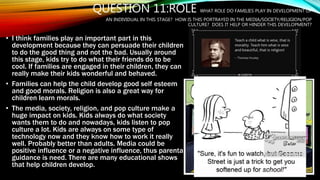
• I think families play an important part in this
development because they can persuade their children
to do the good thing and not the bad. Usually around
this stage, kids try to do what their friends do to be
cool. If families are engaged in their children, they can
really make their kids wonderful and behaved.
• Families can help the child develop good self esteem
and good morals. Religion is also a great way for
children learn morals.
• The media, society, religion, and pop culture make a
huge impact on kids. Kids always do what society
wants them to do and nowadays, kids listen to pop
culture a lot. Kids are always on some type of
technology now and they know how to work it really
well. Probably better than adults. Media could be
positive influence or a negative influence, thus parental
guidance is need. There are many educational shows
that help children develop.
vs
CONCLUSION: END OF A
CHILDHOOD
• Twinkel: After reading this chapter, I found out that there are kids who take their life at a very young
age. Something that bothered me about this topic was that children can take their life at a young
age and not even live their life completely. That’s something people should take more care of. If
anyone sees a sign that a small kid is thinking about taking their life, then we should all take it
seriously. There also kids who figure out that they are transgender. That was interesting to me
because I didn’t know kids would realize that they are not the gender they were born with. That is
something to read more about, in my opinion. I actually learned a lot by doing this assignment. It was
a very fascinating assignment to do.
• Shiri: These chapters have made me think about a lot of the developments that my future child may
go though. It made me reflect on the type of parent I want to be, as far as being supportive with
helping them develop a good self-esteem, good morals, and values. One of the major concerns for
me was bullying I like the idea of teaching a child how to react to bullying before it ever happens. The
thing that bothers me the most is the idea of gender identity confusion in children. I feel that there
are a lot of parents that my confuse nonconformity to gender stereotypes as the child having gender
confusion. I also believe that as awareness of the issue, and media hype with more transgender
shows, that there may be a case of overdiagnosis similar to what we saw with ADHD. The children
are just too young to be going through hormone treatments.
• I believe all of the material cited is accurate. There were some articles that were included that were
opinion based that supported the findings in the book. We also stayed away from websites such as
Wikipedia. A few of the articles were written by scientists and included statistics that was concurrent
to what was in the psychology book we read for the class.
REFERENCES
Collins, N. (2012, Dec 19th). IQ Tests do not Reflect Intelligence. The Telegraph. Retrieved from
https://www.telegraph.co.uk/news/science/science-news/9755929/IQ-tests-do-not-reflect-
intelligence.html
Frances, A.J. (2016, may 23). ADHD Is Over Diagnosed, Here's Proof: Let’s Stop Turning Immaturity into a
Mental Disorder. Psychology Today. Retrieved from https://www.psychologytoday.com/us/blog/saving-
normal/201605/adhd-is-overdiagnosed- heres-proof
Gender Ideology Harms Children (2017, September). American College of Pediatricians. Retrieved from
https://www.acpeds.org/the-college-speaks/position-statements/gender-ideology- harms-children
Head Start and Early Head Start. Benefits . gov. Retrieved from https://www.benefits.gov/benefits/benefit-
details/616
Kellen, D. (2018, June 21). How Socioeconomic Status Affects a Child’s Future. Medical News Bulletin.
Retrieved from https://www.medicalnewsbulletin.com/how-socioeconomic-status-affects-
childs-future/
Overview of Learning Styles. (2018) Learning styles online. Retrieved from https://www.learning-styles-
online.com/overview/
Santrock, J. W. (2017). Life-Span Development (16th ed.). New York, NY: McGraw-Hill Education.
Self-Esteem Building During the Elementary and Middle School Years (2018) Universal class. Retrieved from
https://www.universalclass.com/articles/self-help/self-esteem-building-during-the- elementary-and-middle-
school-years.htm

Assignment A

  • 1.
    SECTION 5: CH.9&10 MIDDLE AND LATE CHILDHOOD By: Twinkle Patel and Shiri McDaniel
  • 2.
    QUESTION 1: HEALTH CONCERNS WHATARE SOME MAJOR CHILDHOOD HEALTH CONCERNS? HOW CAN THEY BE PREVENTED OR ADDRESSED? WHAT RESOURCES ARE AVAILABLE TO HELP CHILDREN AND THEIR FAMILIES? • Children are at risk for conditions such as, obesity, child maltreatment, unintentional injuries, and many more. Prevention efforts in early and middle childhood have long lasting benefits. (Santrock, 2017, p. 275-276) • For obesity, you can prevent that by maintaining a safe and good environment both physically and emotionally. Another way is to engage children at developmental levels appropriate to their physical ability, this reducing their chance of injury while allowing them to exercise. Parents play a major part as role-models for the type of behavior that is healthy. They could help instill healthy eating and exercise habits. (Santrock, 2017, p. 275-276) There are a lot of things out there that can help one person. Check out this website to see just one of the many organizations that can help with this issue. http://www.actionforhealthykids.org • Child maltreatment can be prevented by having public service announcements that encourage positive parenting. Also, you can have support from your family and friends or other community support systems such as a church or youth center. Families can help support by talking face to face with their kids. There are many ways for the parents to get help, they just need to reach out and get it. Here is one organization that has a lot of suggestions on how to get that help. http://preventchildabuse.org/resource/ten-ways-to-help-prevent-child-abuse/
  • 3.
    QUESTION 2: CHANGESHOW DO CHANGES IN BRAIN COORDINATION, REACTION TIME, ATTENTION AND AUTOMATIZATION AFFECT CHILDREN’S ABILITIES AT THIS STAGE? • Brain functioning changes because the increase in androgens occurs in both girls and boys around age seven to eight years old. The cerebral cortex thickens, and the temporal and frontal lobe areas also grow larger and gain better circuit pathways. As shown in the figure to the left, the brain grows larger with age. The frontal and temporal lobe affect language, and its development reflect better language abilities. (Santrock, 2017) • Motor development makes the child's movement more smooth, and they have more agility when they play. They are able to run, jump and climb better as they get older. They also begin to develop better fine motor skills, which is evidenced in the children developing a more legible handwriting. • There is also an important development in childrens thinking. In Piaget’s Concrete Operational stage, the children “can perform concrete operations, and they can reason logically as long as reasoning can be applies to specific examples”. He has the children perform conservation tasks to test where they are developmentally. (Santrock, 2017 p. 283) • Check out the video link below to see the a video example of how the concrete operations is performed and see the results. https://www.youtube.com/watch?v=Lg8IBW9qtxc
  • 4.
    QUESTION 3:SUCCESS IN SCHOOL ISIT NECESSARY TO ASSESS CHILDREN (STANDARD IQ TESTS)? OR WHAT ARE ALTERNATIVE WAYS TO HELP CHILDREN SUCCEED IN SCHOOL? • The IQ test is a standardized question that is supposed to test for an individuals intelligence level. The results are used to place children in advanced learning and also help for some employers to choose who to hire. But there is a large debate about the test, and questions about the accuracy of truly being able to judge someone’ intelligence from one simple, standardized test. One scientist was quoted saying “IQ tests are misleading because they do not accurately reflect intelligence, according to a study which found that a minimum of three different exams are needed to measure someone's brainpower.” (Collins, 2012) I believe this to be true and the usage of the IQ test should not be used as heavily as it is, especially not in schools. Each child has individual needs, and it has been proven that there are many different learning styles. • There are different ways to help your kid succeed in school. I feel if you are a parent, then you are the child’s first and foremost important teacher. It’s better when the parents are more involved because that can help the child in school. They can help their child succeed by being there and helping with homework or communicatin with them about anything they don’t understand. The parent should help because it can help the child be a better learner and it can help them in school. • Another way for the school to help children succeed is to access their learning style and try to teach according There are seven different styles recognized: visual, aural, verbal, physical, logical, social, and solitary. (Overview of Learning Styles, 2018) These styles should be used more often to impact children and utilize their full potential. These styles are also great for college students to know about them selves, so click the link and tak the quick test to see how you would best benefit. https://www.how-to-study.com/learning-style-assessment/
  • 5.
    QUESTION 4: DISABILITYWHAT SHOULD YOU DO IF YOU SUSPECT YOUR CHILD MAY HAVE ADHD OR ANOTHER CHILDHOOD DISABILITY? COULD IT BE SOMETHING ELSE? HOW CAN YOU TELL? • There are a variety of disabilities that become aparant during midlechilhood as the child begins to learn. There are reading disabilities such as dyslexia, attention disorders such as ADHD, more severe behavior disorders such as Austism.Some symptoms are easy to notice but some can be hard to see. (Spantrock, 2017) For the some of the disorders schools have programs that can teach the children, but sometimes these students will fall through the cracks. A friend of mine had dyslexia, which made it hard for him to read, but he was too embarrassed to speak up about it and didn’t get the help he needed. • If a person does not know if they have ADHD, or another disability then they and adults around them should look for the symptoms. The symptoms for ADHD can be distraction, forgetfulness, different mood swings, and depression can be one of them. (Santrock, 2017) • ADHD is an issue that effects children's ability to learn, however there has been an increase in diagnosis “with rates that have skyrocketed from only 3-5 percent of kids to 15 percent” (Frances, 2016, para. 1). This increase has sparked a debate: is ADHD over diagnosed. Many of the symptoms can be confused with normal child hyper activeness or inattention, yet many Doctor’s and parents could be too quick to medicate a problem a child may not even have. M.D. Allen Frances provides compelling proof the the overdiagnosis problem, take the time to read his article at : https://www.psychologytoday.com/us/blog/saving- normal/201605/adhd-is-overdiagnosed-heres-proof Here’s a video of one woman’s observations on her sons development with Autism: https://www.youtube.com/watch?v=JiwZQNYlGQI
  • 6.
    QUESTION 5: WHATKINDS OF SUPPORT AND THERAPY ARE AVAILABLE FOR PARENTS WITH CHILDREN WHO HAVE ASD? • Autism has a range of different severities. There is Asperger, which is more mild, and the child is able to appear almost normal duing social interaction. And there is the more severe autistic cases in which the child has difficulty with social interactions such as communication, controlling emotions and behavior. (Santorck, 2017) This can be difficult for the family as well. Click the following link to see how a mother has recognizes her sons autistic behavior, shows examples of his behavior, and reaches out to help other people be aware. https://www.youtube.com/watch?v=Ouel56c_26Q • Treatment for autism is commonly a very in-depth, extensive operation that involves the child’s entire family and a team of professionals. Children with autism normally have social interaction and communication impairments as well as confined interests, activities, and play skills. (Santrock, 2017) Occupational therapy can help children with autism achieve better in school and home settings. If you’re a parent and you have found out that your child has autism, then you should immediately start treatment. The earlier children with autism spectrum disorder get help, the higher their chance of treatment success. • Follow the link https://www.scarymommy.com/the-perks-of-autism/ , to see a point of view from a mother who focused on the positive aspects of having a child with autism. Her point of view is refreshing and I think that parents who are struggling could use a little bit of positivity and support.
  • 7.
    QUESTION 6:ACHIEVEMENT &STATUS THEREIS A STRONG CORRELATION BETWEEN ACADEMIC ACHIEVEMENT AND SOCIOECONOMIC STATUS. WHAT DOES THIS MEAN? WHAT ARE SOME OF THE FACTORS THAT CONTRIBUTE TO THIS? WHAT CAN BE DONE CHANGE THIS? • Socioeconomic status (SES) encompasses not just income but also educational attainment, financial security, and subjective perceptions of social status and social class. Socioeconomic status can encompass quality of life attributes as well as the opportunities and privileges afforded to people within society. (Santrock, 2017) Poverty, specifically, is not a single factor but rather is characterized by multiple physical and psychosocial stressors. Further, SES is a consistent and reliable predictor of a vast array of outcomes across the life span, including physical and psychological health. Thus, SES is relevant to all realms of behavioral and social science, including research, practice, education and advocacy. • Low SES children “tend to be less ready for school”, this could be because many of the parents have to work two jobs, or are too stressed/tired after work to spend time helping their children. (Kellen, 2018) They also may not be able to afford some of the items that help teach children, such as Leapfrog technology. • One thing that can help the children who have SES disadvantages that affect school, is for a parent to reach out to the community for help. This includes churches, families, involving them in programs such as girl/boy-scouts and YMCA’s. • There is also plenty of government help to help with some of the financial burden, check out the following website to see some of the options. http://www.needhelppayingbills.com/html/low_income_assistance_programs.html
  • 8.
    QUESTION 7: EDUCATION WEARE CONSTANTLY STRUGGLING TO FIGURE OUT HOW TO MAKE SURE ALL U.S. SCHOOL-CHILDREN REACH A BASIC LEVEL OF PROFICIENCY. WHAT’S THE MOST CURRENT LEGISLATION REGARDING NATIONAL STANDARDS FOR “IMPROVING EDUCATION”? Some of the changes that are trying to be made in school include: (Santrock, 2017) • Keep most existing staff but change the culture through, performance evaluation and support, training and mentoring. • Stronger curriculum and instruction • More learning time for kids (afternoons, weekends, summer) and more time for teachers to collaborate. • More flexibility for principals in budgeting, staffing and calendar. • Implementing more head start programs. see image to the left to understand some of the benefits of these programs. “Head Start is a Federal program that promotes the school readiness of children from birth to age five from low-income families by enhancing their cognitive, social, and emotional development. Head Start programs provide a learning environment that supports children's growth in many areas such as language, literacy, and social and emotional development. Head Start emphasizes the role of parents as their child's first and most important teacher. These programs help build relationships with families that support family well-being and many other important areas.” Follow the link to find out more. https://www.benefits.gov/benefi ts/benefit-details/616
  • 9.
    QUESTION 8: SELF-UNDERSTANDINGAND SELF-AWARENESS INCREASE IN MIDDLE CHILDHOOD. WHAT IS THE PRICE OF THESE DEVELOPMENTS? HOW CAN WE AVOID SOME OF THE PITFALLS OR HELP CHILDREN GET THROUGH THEM? • The self awareness of middle childhood in changing. They are moving from describing themselves by their physical appearance or objects, to using adjectives that describe their personality or any groups they are involved in. This also involves the development of self esteem, and if the child is not exposed to positive experiences then they may develop low self-esteem, which can lead to depression. • With the help of family and friends, children can get through anything, in my opinion. We can avoid some pitfalls by not caring as much about your self-awareness and try not to be over thinking about what other people might think of you. I know when I got older, I didn’t care what other people thought of me, as long as I was happy, then everything was good. Usually when children are small and in their middle childhood stage then they think about how they look and what group they should be in and etc. There can be different prices to this. It can be positive or negative. Positive because you know you feel good about yourself and negative because some people might bully you or you might not like the person you are and want to change because other people aren’t accepting who you are. • Some of the ways to help children navigate the pitfalls is to help guide them by “Showing an active interest...”, “using positive encouragement…”, “Teaching children… how to (properly) act and react”, “Give children age-appropriate tasks”, and “give (them) positive attention… (such as) love, support, and quality time”. To read more tips and advice, follow the link. https://www.universalclass.com/articles/self-help/self-esteem-building-during-the-elementary-and-middle-school- years.htm
  • 10.
    QUESTION 9: BULLYING PEERGROUPS BEGIN TO BE IMPORTANT IN MIDDLE CHILDHOOD; UNFORTUNATELY, BULLYING ALSO INCREASES. HOW CAN BULLYING BE PREVENTED? • Bullying can be prevented by trying your best to ignore the bullies. Have the support of your family and friends. Try to stand up for yourself. Parents, school staff, and other adults in the community can help kids prevent bullying by talking about it, building a safe school environment, and creating a community-wide bullying prevention strategy. • Here’s a video on bullying: https://www.youtube.com/wat ch?v=9HsuuRt_OdY • One of the ways to prevent bullying is to have school intervention. One of the government programs to stop bullying can be viewed at https://www.stopbullying.gov/ It educates children on how to recognize, prevent, and react effectively to bullying. I believe this is something that children should be exposed to at a young age, so they develop more positive relationships instead of becoming a bully. It is also a great idea to teach children how to stand up to bullies so that the more drastic outcomes don’t happen.
  • 11.
    QUESTION 10: GENDERIDENTITY HOW DOES GENDER IDENTITY CONTINUE TO FORM IN THIS STAGE? WHAT ARE THE MAJOR CONTRIBUTORS AND GIVE SPECIFIC EXAMPLES HOW THEY HELP/HURT THIS DEVELOPMENT. • It is true that the path to gender development begins at conception. Gender is what actually gets expressed, how we look, how we act and how we feel. • Before the age of five, children don’t seem to think that gender has any permanence at all. A preschooler might ask his female teacher whether she was a boy or girl when she was little, or a little boy might say that he wants to grow up to be a mommy. It can hurt someone because people might bully that person because they are transgender or just don’t know what gender they are yet. The person can help themselves because if they know what gender they are, they can be more comfortable and be themselves more. (Santrock, 2017) • I believe that one of the main ways we could confuse a child going through the process of developing a gender identity is to be angry/disappointed with them for not fitting into a gender stereotype. Society puts emphasis on things such as girls wear pink, but in reality it is just a color. My belief is that it hurts the child's development by confusing them. • Advancements in technology are allowing people to change their physical identity to match their mental identify, and some doctors and parents would like to allow this option for their child. I believe this would be harmful because we have learned that children are still physically developing, and blocking or changing hormones could be really harmful. “Puberty is not a disease and puberty-blocking hormones can be dangerous. Reversible or not, puberty- blocking hormones induce a state of disease – the absence of puberty – and inhibit growth and fertility in a previously biologically healthy child.” read more at: https://www.acpeds.org/the-college-speaks/position-statements/gender-ideology-harms-
  • 12.
    QUESTION 11:ROLE WHATROLE DO FAMILIES PLAY IN DEVELOPMENT OF AN INDIVIDUAL IN THIS STAGE? HOW IS THIS PORTRAYED IN THE MEDIA/SOCIETY/RELIGION/POP CULTURE? DOES IT HELP OR HINDER THIS DEVELOPMENT? • I think families play an important part in this development because they can persuade their children to do the good thing and not the bad. Usually around this stage, kids try to do what their friends do to be cool. If families are engaged in their children, they can really make their kids wonderful and behaved. • Families can help the child develop good self esteem and good morals. Religion is also a great way for children learn morals. • The media, society, religion, and pop culture make a huge impact on kids. Kids always do what society wants them to do and nowadays, kids listen to pop culture a lot. Kids are always on some type of technology now and they know how to work it really well. Probably better than adults. Media could be positive influence or a negative influence, thus parental guidance is need. There are many educational shows that help children develop. vs
  • 13.
    CONCLUSION: END OFA CHILDHOOD • Twinkel: After reading this chapter, I found out that there are kids who take their life at a very young age. Something that bothered me about this topic was that children can take their life at a young age and not even live their life completely. That’s something people should take more care of. If anyone sees a sign that a small kid is thinking about taking their life, then we should all take it seriously. There also kids who figure out that they are transgender. That was interesting to me because I didn’t know kids would realize that they are not the gender they were born with. That is something to read more about, in my opinion. I actually learned a lot by doing this assignment. It was a very fascinating assignment to do. • Shiri: These chapters have made me think about a lot of the developments that my future child may go though. It made me reflect on the type of parent I want to be, as far as being supportive with helping them develop a good self-esteem, good morals, and values. One of the major concerns for me was bullying I like the idea of teaching a child how to react to bullying before it ever happens. The thing that bothers me the most is the idea of gender identity confusion in children. I feel that there are a lot of parents that my confuse nonconformity to gender stereotypes as the child having gender confusion. I also believe that as awareness of the issue, and media hype with more transgender shows, that there may be a case of overdiagnosis similar to what we saw with ADHD. The children are just too young to be going through hormone treatments. • I believe all of the material cited is accurate. There were some articles that were included that were opinion based that supported the findings in the book. We also stayed away from websites such as Wikipedia. A few of the articles were written by scientists and included statistics that was concurrent to what was in the psychology book we read for the class.
  • 14.
    REFERENCES Collins, N. (2012,Dec 19th). IQ Tests do not Reflect Intelligence. The Telegraph. Retrieved from https://www.telegraph.co.uk/news/science/science-news/9755929/IQ-tests-do-not-reflect- intelligence.html Frances, A.J. (2016, may 23). ADHD Is Over Diagnosed, Here's Proof: Let’s Stop Turning Immaturity into a Mental Disorder. Psychology Today. Retrieved from https://www.psychologytoday.com/us/blog/saving- normal/201605/adhd-is-overdiagnosed- heres-proof Gender Ideology Harms Children (2017, September). American College of Pediatricians. Retrieved from https://www.acpeds.org/the-college-speaks/position-statements/gender-ideology- harms-children Head Start and Early Head Start. Benefits . gov. Retrieved from https://www.benefits.gov/benefits/benefit- details/616 Kellen, D. (2018, June 21). How Socioeconomic Status Affects a Child’s Future. Medical News Bulletin. Retrieved from https://www.medicalnewsbulletin.com/how-socioeconomic-status-affects- childs-future/ Overview of Learning Styles. (2018) Learning styles online. Retrieved from https://www.learning-styles- online.com/overview/ Santrock, J. W. (2017). Life-Span Development (16th ed.). New York, NY: McGraw-Hill Education. Self-Esteem Building During the Elementary and Middle School Years (2018) Universal class. Retrieved from https://www.universalclass.com/articles/self-help/self-esteem-building-during-the- elementary-and-middle- school-years.htm