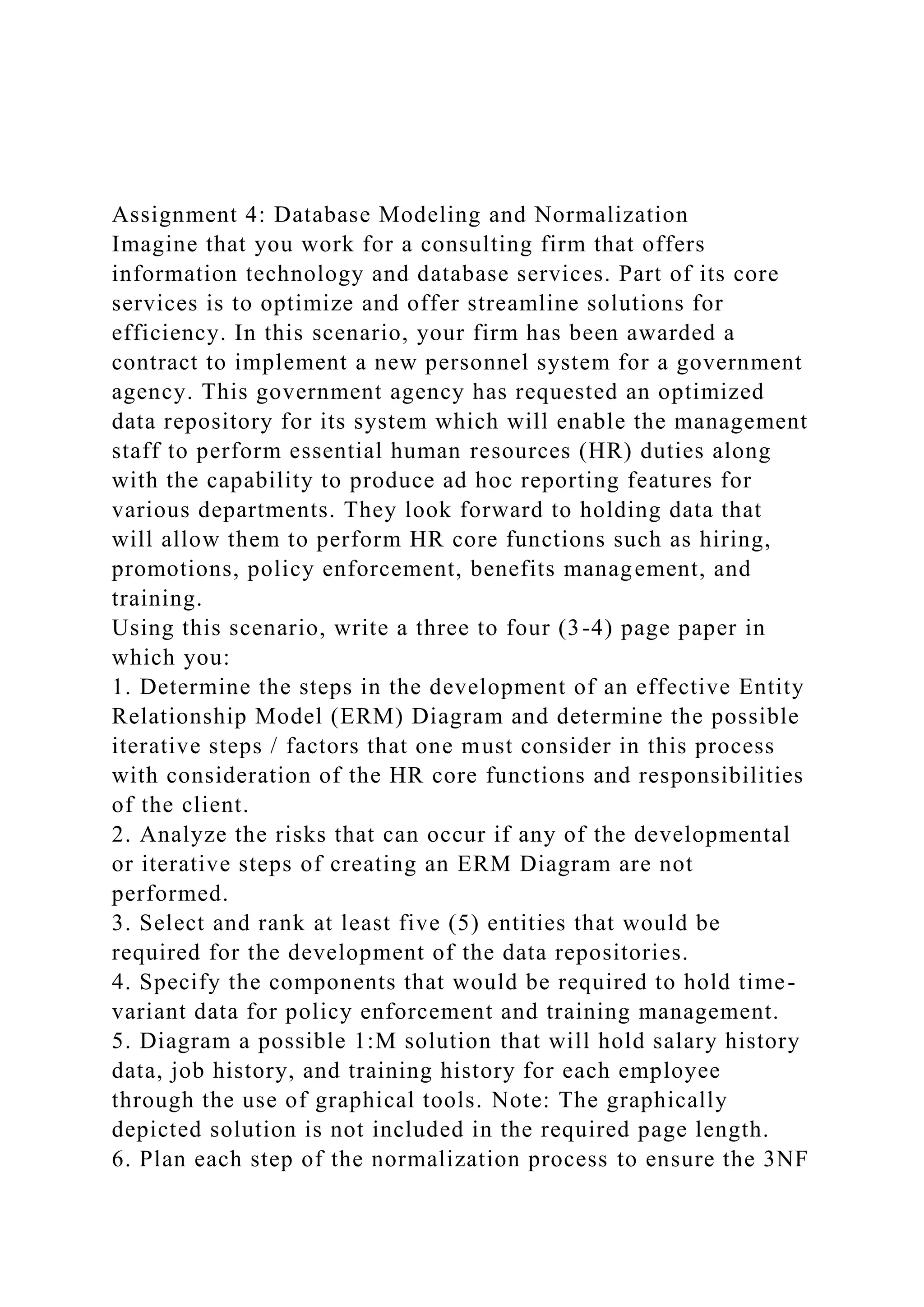
Assignment 4: Database Modeling and Normalization
Imagine that you work for a consulting firm that offers
information technology and database services. Part of its core
services is to optimize and offer streamline solutions for
efficiency. In this scenario, your firm has been awarded a
contract to implement a new personnel system for a government
agency. This government agency has requested an optimized
data repository for its system which will enable the management
staff to perform essential human resources (HR) duties along
with the capability to produce ad hoc reporting features for
various departments. They look forward to holding data that
will allow them to perform HR core functions such as hiring,
promotions, policy enforcement, benefits management, and
training.
Using this scenario, write a three to four (3-4) page paper in
which you:
1. Determine the steps in the development of an effective Entity
Relationship Model (ERM) Diagram and determine the possible
iterative steps / factors that one must consider in this process
with consideration of the HR core functions and responsibilities
of the client.
2. Analyze the risks that can occur if any of the developmental
or iterative steps of creating an ERM Diagram are not
performed.
3. Select and rank at least five (5) entities that would be
required for the development of the data repositories.
4. Specify the components that would be required to hold time-
variant data for policy enforcement and training management.
5. Diagram a possible 1:M solution that will hold salary history
data, job history, and training history for each employee
through the use of graphical tools. Note: The graphically
depicted solution is not included in the required page length.
6. Plan each step of the normalization process to ensure the 3NF
level of normalization using the selected five (5) entities of the
personnel database solution. Document each step of the process
and justify your assumptions in the process.
7. Diagram at least five (5) possible entities that will be
required to sustain a personnel solution. The diagram should
include the following:
1. Dependency diagrams
2. Multivalued dependencies
Note: The graphically depicted solution is not included in the
required page length.
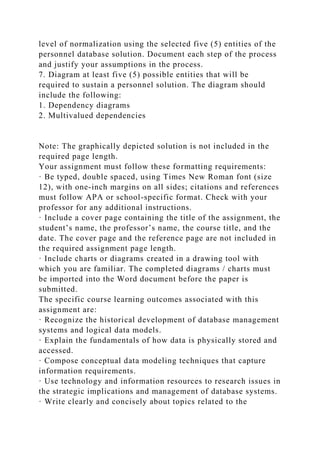
Your assignment must follow these formatting requirements:
· Be typed, double spaced, using Times New Roman font (size
12), with one-inch margins on all sides; citations and references
must follow APA or school-specific format. Check with your
professor for any additional instructions.
· Include a cover page containing the title of the assignment, the
student’s name, the professor’s name, the course title, and the
date. The cover page and the reference page are not included in
the required assignment page length.
· Include charts or diagrams created in a drawing tool with
which you are familiar. The completed diagrams / charts must
be imported into the Word document before the paper is
submitted.
The specific course learning outcomes associated with this
assignment are:
· Recognize the historical development of database management
systems and logical data models.
· Explain the fundamentals of how data is physically stored and
accessed.
· Compose conceptual data modeling techniques that capture
information requirements.
· Use technology and information resources to research issues in
the strategic implications and management of database systems.
· Write clearly and concisely about topics related to the
strategic planning for database systems using proper writing
mechanics and technical style conventions.
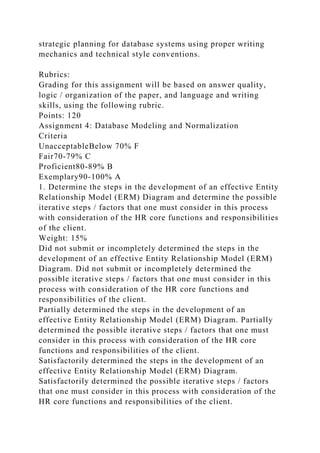
Rubrics:
Grading for this assignment will be based on answer quality,
logic / organization of the paper, and language and writing
skills, using the following rubric.
Points: 120
Assignment 4: Database Modeling and Normalization
Criteria
UnacceptableBelow 70% F
Fair70-79% C
Proficient80-89% B
Exemplary90-100% A
1. Determine the steps in the development of an effective Entity
Relationship Model (ERM) Diagram and determine the possible
iterative steps / factors that one must consider in this process
with consideration of the HR core functions and responsibilities
of the client.
Weight: 15%
Did not submit or incompletely determined the steps in the
development of an effective Entity Relationship Model (ERM)
Diagram. Did not submit or incompletely determined the
possible iterative steps / factors that one must consider in this
process with consideration of the HR core functions and
responsibilities of the client.
Partially determined the steps in the development of an
effective Entity Relationship Model (ERM) Diagram. Partially
determined the possible iterative steps / factors that one must
consider in this process with consideration of the HR core
functions and responsibilities of the client.
Satisfactorily determined the steps in the development of an
effective Entity Relationship Model (ERM) Diagram.
Satisfactorily determined the possible iterative steps / factors
that one must consider in this process with consideration of the
HR core functions and responsibilities of the client.
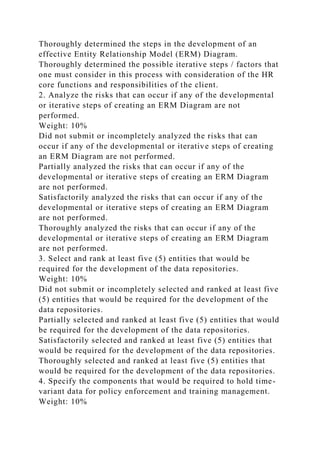
Thoroughly determined the steps in the development of an
effective Entity Relationship Model (ERM) Diagram.
Thoroughly determined the possible iterative steps / factors that
one must consider in this process with consideration of the HR
core functions and responsibilities of the client.
2. Analyze the risks that can occur if any of the developmental
or iterative steps of creating an ERM Diagram are not
performed.
Weight: 10%
Did not submit or incompletely analyzed the risks that can
occur if any of the developmental or iterative steps of creating
an ERM Diagram are not performed.
Partially analyzed the risks that can occur if any of the
developmental or iterative steps of creating an ERM Diagram
are not performed.
Satisfactorily analyzed the risks that can occur if any of the
developmental or iterative steps of creating an ERM Diagram
are not performed.
Thoroughly analyzed the risks that can occur if any of the
developmental or iterative steps of creating an ERM Diagram
are not performed.
3. Select and rank at least five (5) entities that would be
required for the development of the data repositories.
Weight: 10%
Did not submit or incompletely selected and ranked at least five
(5) entities that would be required for the development of the
data repositories.
Partially selected and ranked at least five (5) entities that would
be required for the development of the data repositories.
Satisfactorily selected and ranked at least five (5) entities that
would be required for the development of the data repositories.
Thoroughly selected and ranked at least five (5) entities that
would be required for the development of the data repositories.
4. Specify the components that would be required to hold time-
variant data for policy enforcement and training management.
Weight: 10%
Did not submit or incompletely specified the components that
would be required to hold time-variant data for policy
enforcement and training management.
Partially specified the components that would be required to
hold time-variant data for policy enforcement and training
management.
Satisfactorily specified the components that would be required
to hold time-variant data for policy enforcement and training
management.
Thoroughly specified the components that would be required to
hold time-variant data for policy enforcement and training
management.
5. Diagram a possible 1:M solution that will hold salary history
data, job history, and training history for each employee
through the use of graphical tools.
Weight: 15%
Did not submit or incompletely diagramed a possible 1:M
solution that will hold salary history, data, job history and
training history for each employee through the use of graphical
tools.
Partially diagramed a possible 1:M solution that will hold salary
history data, job history and training history, for each employee
through the use of graphical tools.
Satisfactorily diagramed a possible 1:M solution that will hold
salary history data, job history, and training history for each
employee through the use of graphical tools.
Thoroughly diagramed a possible 1:M solution that will hold
salary history data, job history, and training history for each
employee through the use of graphical tools.
6. Plan each step of the normalization process to ensure the 3NF
level of normalization using the selected five (5) entities of the
personnel database solution. Document each step of the process
and justify your assumptions in the process.
Weight: 20%
Did not submit or incompletely planned each step of the
normalization process to ensure the 3NF level of normalization
using the selected five (5) entities of the personnel database
solution. Did not submit or incompletely documented each step
of the process and did not submit or incompletely justified your
assumptions in the process.
Partially planned each step of the normalization process to
ensure the 3NF level of normalization using the selected five
(5) entities of the personnel database solution. Partially
documented each step of the process and partially justified your
assumptions in the process.
Satisfactorily planned each step of the normalization process to
ensure the 3NF level of normalization using the selected five
(5) entities of the personnel database solution. Satisfactorily
documented each step of the process and satisfactorily justified
your assumptions in the process.
Thoroughly planned each step of the normalization process to
ensure the 3NF level of normalization using the selected five
(5) entities of the personnel database solution. Thoroughly
documented each step of the process and thoroughly justified
your assumptions in the process.
7a. Diagram at least five (5) possible entities that will be
required to sustain a personnel solution. Include the dependency
diagrams in your diagram.
Weight: 5%
Did not submit or incompletely diagramed at least five (5)
possible entities that will be required to sustain a personnel
solution. Did not submit or incompletely included the
dependency diagrams in your diagram.
Partially diagramed at least five (5) possible entities that will be
required to sustain a personnel solution. Partially included the
dependency diagrams in your diagram.
Satisfactorily diagramed at least five (5) possible entities that
will be required to sustain a personnel solution. Satisfactorily
included the dependency diagrams in your diagram.
Thoroughly diagramed at least five (5) possible entities that
will be required to sustain a personnel solution. Thoroughly
included the dependency diagrams in your diagram.
7b. Diagram at least five (5) possible entities that will be
required to sustain a personnel solution. Include multivalued
dependencies in your diagram.
Weight: 5%
Did not submit or incompletely diagramed at least five (5)
possible entities that will be required to sustain a personnel
solution. Did not submit or incompletely included multivalued
dependencies in your diagram.
Partially diagramed at least five (5) possible entities that will be
required to sustain a personnel solution. Partially included
multivalued dependencies in your diagram.
Satisfactorily diagramed at least five (5) possible entities that
will be required to sustain a personnel solution. Satisfactorily
included multivalued dependencies in your diagram.
Thoroughly diagramed at least five (5) possible entities that
will be required to sustain a personnel solution. Thoroughly
included multivalued dependencies in your diagram.
8. Clarity, writing mechanics, and formatting requirements
Weight: 10%
More than 6 errors present
5-6 errors present
3-4 errors present
0-2 errors present
M5D1: Impact on Individuals
In this discussion, you are to explore the effects of addiction on
the individual by providing an holistic assessment of a
hypothetical client’s potential difficulties. You have reviewed
many effects of addiction on individuals, including these ones
related to alcohol. Consider again please and apply these
websites’ insights on alcohol addiction’s individual effects.
-free world (2008). Short- and long-term
effects(Links to an external site.)Links to an external
site. (Links to an external site.). In The truth about alcohol.
Retrieved
from http://www.drugfreeworld.org/drugfacts/alcohol/short-
term-long-term-effects.html (Links to an external site.)Links to
an external site. (Links to an external site.)
Department of Health and Human Services
(2004). Alcohol’s damaging effects on the brain(Links to an
external site.)Links to an external site. (Links to an external
site.). Alcohol Alert, Number 63. National Institute on Alcohol
Abuse and Alcoholism (NIAAA) Publications Distribution
Center. Retrieved from
http://pubs.niaaa.nih.gov/publications/aa63/aa63.htm
After reviewing all of the readings and viewings, please choose
an addiction (e.g., substance abuse, alcohol, gambling etc.),
then imagine that a new client of yours has this behavioral
addiction. For this client, write an initial post that:
· Identifies the possible difficulties that the individual client
may experience in each of the major life areas (e.g., personal
health and wellness; family and social life; workplace or school;
and, legal or financial difficulties).
· Explores in some ways how this type of addiction differs from
others (such as alcohol), or brings with it unique individual
difficulties.M5D2: Impact on Families
Addiction is not only a personal issue. Addiction has profound
effects on those with whom the addict comes into contact,
particularly family members. In this discussion, you will
explore how the individual addict affects a family’s members
and how they in turn affect the addict and his/her behavior.
Review the following articles and video on codependent
relationships
Lander, L., Howsare, J., & Byrne, M. (2013). The impact of
substance use disorders on families and children: from theory to
practice. (Links to an external site.) Social work in public
health, 28(3-4), 194-205.
Ackerman, R. J. (n.d.). Alcoholism and the family. (Links to an
external site.) [PDFfile size 77.2 KB]. National Association for
Children of Alcoholics.
Films Media Group. (Producer). (1990). Codependent
relationships (Links to an external site.)Links to an external
site. (Links to an external site.). [Video file] [06 mins 28 secs].
In Adult Children of Alcoholics: A Family Secret. Retrieved
from
http://vlib.excelsior.edu/login?url=http://digital.films.com.vlib.
excelsior.edu/PortalPlaylists.aspx?aid=8496&xtid=2629&loid=2
8081
After having reviewed these, please address yourself to these
questions:
· How has addiction affected the family members of the addict?
In what ways has/might any of their behavior(s) or thinking
about their addicted relative change(d)?
· In what ways might the family dynamic affect the addicted
individual?
M5D1: Impact on Individuals
In this discussion, you are to explore the effects of addiction on
the individual by providing an
holistic assessment of a hypothetical client’s potential
difficulties.
You have reviewed many
effects of addiction on individuals, including these ones relat
ed to alcohol.
Consider again
please and apply these websites’ insights on alcohol addiction’s
individual effects
.
?
Foundation for drug
-
free world (2008).
Short
-
and long
-
term effects(Links to an external
site.)Links to an external site.
(Links to an external site.)
. In
The truth about alcohol
. Retrie
ved
from
http://www.drugfreeworld.org/drugfacts/alcohol/short
-
term
-
long
-
term
-
effects.html
(Links
to an external site.)Links to an external site.
(L
inks to an external site.)
?
S.
Department of Health and Human Services (2004).
Alcohol’s damaging effects on the
brain(Links to an external site.)Links to an external site
.
(Links to an external site.)
.
Alcohol
Alert,
Number 63. National Institute on Alcohol Abuse and
Alcoholism (NIAAA) Publications
Distribution Center. Retrieved from
http://pu
bs.niaaa.nih.gov/publications/aa63/aa63.htm
After reviewing all of the rea
dings and vi
ewings
, please choose an addiction (e.g., substance
abuse, alcohol, gambling etc.), then imagine that a new client of
yours has this behavioral
addiction.
For this client, write an initial post that:
·
Identifies the possible difficulties that the individual client may
experience in each of
the major life areas (e.g., personal health and wellness; family
and social life;
wor
kplace or school; and, legal or financial difficulties).
·
Explores in some ways how this type of addiction differs from
others (such as
alcohol), or brings with it unique individual difficulties.

Assignment 4 Database Modeling and Normalization Imagine that.docx

  • 1.
    Assignment 4: DatabaseModeling and Normalization Imagine that you work for a consulting firm that offers information technology and database services. Part of its core services is to optimize and offer streamline solutions for efficiency. In this scenario, your firm has been awarded a contract to implement a new personnel system for a government agency. This government agency has requested an optimized data repository for its system which will enable the management staff to perform essential human resources (HR) duties along with the capability to produce ad hoc reporting features for various departments. They look forward to holding data that will allow them to perform HR core functions such as hiring, promotions, policy enforcement, benefits management, and training. Using this scenario, write a three to four (3-4) page paper in which you: 1. Determine the steps in the development of an effective Entity Relationship Model (ERM) Diagram and determine the possible iterative steps / factors that one must consider in this process with consideration of the HR core functions and responsibilities of the client. 2. Analyze the risks that can occur if any of the developmental or iterative steps of creating an ERM Diagram are not performed. 3. Select and rank at least five (5) entities that would be required for the development of the data repositories. 4. Specify the components that would be required to hold time- variant data for policy enforcement and training management. 5. Diagram a possible 1:M solution that will hold salary history data, job history, and training history for each employee through the use of graphical tools. Note: The graphically depicted solution is not included in the required page length. 6. Plan each step of the normalization process to ensure the 3NF
  • 2.
    level of normalizationusing the selected five (5) entities of the personnel database solution. Document each step of the process and justify your assumptions in the process. 7. Diagram at least five (5) possible entities that will be required to sustain a personnel solution. The diagram should include the following: 1. Dependency diagrams 2. Multivalued dependencies Note: The graphically depicted solution is not included in the required page length. Your assignment must follow these formatting requirements: · Be typed, double spaced, using Times New Roman font (size 12), with one-inch margins on all sides; citations and references must follow APA or school-specific format. Check with your professor for any additional instructions. · Include a cover page containing the title of the assignment, the student’s name, the professor’s name, the course title, and the date. The cover page and the reference page are not included in the required assignment page length. · Include charts or diagrams created in a drawing tool with which you are familiar. The completed diagrams / charts must be imported into the Word document before the paper is submitted. The specific course learning outcomes associated with this assignment are: · Recognize the historical development of database management systems and logical data models. · Explain the fundamentals of how data is physically stored and accessed. · Compose conceptual data modeling techniques that capture information requirements. · Use technology and information resources to research issues in the strategic implications and management of database systems. · Write clearly and concisely about topics related to the
  • 3.
    strategic planning fordatabase systems using proper writing mechanics and technical style conventions. Rubrics: Grading for this assignment will be based on answer quality, logic / organization of the paper, and language and writing skills, using the following rubric. Points: 120 Assignment 4: Database Modeling and Normalization Criteria UnacceptableBelow 70% F Fair70-79% C Proficient80-89% B Exemplary90-100% A 1. Determine the steps in the development of an effective Entity Relationship Model (ERM) Diagram and determine the possible iterative steps / factors that one must consider in this process with consideration of the HR core functions and responsibilities of the client. Weight: 15% Did not submit or incompletely determined the steps in the development of an effective Entity Relationship Model (ERM) Diagram. Did not submit or incompletely determined the possible iterative steps / factors that one must consider in this process with consideration of the HR core functions and responsibilities of the client. Partially determined the steps in the development of an effective Entity Relationship Model (ERM) Diagram. Partially determined the possible iterative steps / factors that one must consider in this process with consideration of the HR core functions and responsibilities of the client. Satisfactorily determined the steps in the development of an effective Entity Relationship Model (ERM) Diagram. Satisfactorily determined the possible iterative steps / factors that one must consider in this process with consideration of the HR core functions and responsibilities of the client.
  • 4.
    Thoroughly determined thesteps in the development of an effective Entity Relationship Model (ERM) Diagram. Thoroughly determined the possible iterative steps / factors that one must consider in this process with consideration of the HR core functions and responsibilities of the client. 2. Analyze the risks that can occur if any of the developmental or iterative steps of creating an ERM Diagram are not performed. Weight: 10% Did not submit or incompletely analyzed the risks that can occur if any of the developmental or iterative steps of creating an ERM Diagram are not performed. Partially analyzed the risks that can occur if any of the developmental or iterative steps of creating an ERM Diagram are not performed. Satisfactorily analyzed the risks that can occur if any of the developmental or iterative steps of creating an ERM Diagram are not performed. Thoroughly analyzed the risks that can occur if any of the developmental or iterative steps of creating an ERM Diagram are not performed. 3. Select and rank at least five (5) entities that would be required for the development of the data repositories. Weight: 10% Did not submit or incompletely selected and ranked at least five (5) entities that would be required for the development of the data repositories. Partially selected and ranked at least five (5) entities that would be required for the development of the data repositories. Satisfactorily selected and ranked at least five (5) entities that would be required for the development of the data repositories. Thoroughly selected and ranked at least five (5) entities that would be required for the development of the data repositories. 4. Specify the components that would be required to hold time- variant data for policy enforcement and training management. Weight: 10%
  • 5.
    Did not submitor incompletely specified the components that would be required to hold time-variant data for policy enforcement and training management. Partially specified the components that would be required to hold time-variant data for policy enforcement and training management. Satisfactorily specified the components that would be required to hold time-variant data for policy enforcement and training management. Thoroughly specified the components that would be required to hold time-variant data for policy enforcement and training management. 5. Diagram a possible 1:M solution that will hold salary history data, job history, and training history for each employee through the use of graphical tools. Weight: 15% Did not submit or incompletely diagramed a possible 1:M solution that will hold salary history, data, job history and training history for each employee through the use of graphical tools. Partially diagramed a possible 1:M solution that will hold salary history data, job history and training history, for each employee through the use of graphical tools. Satisfactorily diagramed a possible 1:M solution that will hold salary history data, job history, and training history for each employee through the use of graphical tools. Thoroughly diagramed a possible 1:M solution that will hold salary history data, job history, and training history for each employee through the use of graphical tools. 6. Plan each step of the normalization process to ensure the 3NF level of normalization using the selected five (5) entities of the personnel database solution. Document each step of the process and justify your assumptions in the process. Weight: 20% Did not submit or incompletely planned each step of the normalization process to ensure the 3NF level of normalization
  • 6.
    using the selectedfive (5) entities of the personnel database solution. Did not submit or incompletely documented each step of the process and did not submit or incompletely justified your assumptions in the process. Partially planned each step of the normalization process to ensure the 3NF level of normalization using the selected five (5) entities of the personnel database solution. Partially documented each step of the process and partially justified your assumptions in the process. Satisfactorily planned each step of the normalization process to ensure the 3NF level of normalization using the selected five (5) entities of the personnel database solution. Satisfactorily documented each step of the process and satisfactorily justified your assumptions in the process. Thoroughly planned each step of the normalization process to ensure the 3NF level of normalization using the selected five (5) entities of the personnel database solution. Thoroughly documented each step of the process and thoroughly justified your assumptions in the process. 7a. Diagram at least five (5) possible entities that will be required to sustain a personnel solution. Include the dependency diagrams in your diagram. Weight: 5% Did not submit or incompletely diagramed at least five (5) possible entities that will be required to sustain a personnel solution. Did not submit or incompletely included the dependency diagrams in your diagram. Partially diagramed at least five (5) possible entities that will be required to sustain a personnel solution. Partially included the dependency diagrams in your diagram. Satisfactorily diagramed at least five (5) possible entities that will be required to sustain a personnel solution. Satisfactorily included the dependency diagrams in your diagram. Thoroughly diagramed at least five (5) possible entities that will be required to sustain a personnel solution. Thoroughly included the dependency diagrams in your diagram.
  • 7.
    7b. Diagram atleast five (5) possible entities that will be required to sustain a personnel solution. Include multivalued dependencies in your diagram. Weight: 5% Did not submit or incompletely diagramed at least five (5) possible entities that will be required to sustain a personnel solution. Did not submit or incompletely included multivalued dependencies in your diagram. Partially diagramed at least five (5) possible entities that will be required to sustain a personnel solution. Partially included multivalued dependencies in your diagram. Satisfactorily diagramed at least five (5) possible entities that will be required to sustain a personnel solution. Satisfactorily included multivalued dependencies in your diagram. Thoroughly diagramed at least five (5) possible entities that will be required to sustain a personnel solution. Thoroughly included multivalued dependencies in your diagram. 8. Clarity, writing mechanics, and formatting requirements Weight: 10% More than 6 errors present 5-6 errors present 3-4 errors present 0-2 errors present M5D1: Impact on Individuals In this discussion, you are to explore the effects of addiction on the individual by providing an holistic assessment of a hypothetical client’s potential difficulties. You have reviewed many effects of addiction on individuals, including these ones related to alcohol. Consider again please and apply these websites’ insights on alcohol addiction’s individual effects. -free world (2008). Short- and long-term effects(Links to an external site.)Links to an external site. (Links to an external site.). In The truth about alcohol.
  • 8.
    Retrieved from http://www.drugfreeworld.org/drugfacts/alcohol/short- term-long-term-effects.html (Linksto an external site.)Links to an external site. (Links to an external site.) Department of Health and Human Services (2004). Alcohol’s damaging effects on the brain(Links to an external site.)Links to an external site. (Links to an external site.). Alcohol Alert, Number 63. National Institute on Alcohol Abuse and Alcoholism (NIAAA) Publications Distribution Center. Retrieved from http://pubs.niaaa.nih.gov/publications/aa63/aa63.htm After reviewing all of the readings and viewings, please choose an addiction (e.g., substance abuse, alcohol, gambling etc.), then imagine that a new client of yours has this behavioral addiction. For this client, write an initial post that: · Identifies the possible difficulties that the individual client may experience in each of the major life areas (e.g., personal health and wellness; family and social life; workplace or school; and, legal or financial difficulties). · Explores in some ways how this type of addiction differs from others (such as alcohol), or brings with it unique individual difficulties.M5D2: Impact on Families Addiction is not only a personal issue. Addiction has profound effects on those with whom the addict comes into contact, particularly family members. In this discussion, you will explore how the individual addict affects a family’s members and how they in turn affect the addict and his/her behavior. Review the following articles and video on codependent relationships Lander, L., Howsare, J., & Byrne, M. (2013). The impact of substance use disorders on families and children: from theory to practice. (Links to an external site.) Social work in public health, 28(3-4), 194-205. Ackerman, R. J. (n.d.). Alcoholism and the family. (Links to an external site.) [PDFfile size 77.2 KB]. National Association for Children of Alcoholics.
  • 9.
    Films Media Group.(Producer). (1990). Codependent relationships (Links to an external site.)Links to an external site. (Links to an external site.). [Video file] [06 mins 28 secs]. In Adult Children of Alcoholics: A Family Secret. Retrieved from http://vlib.excelsior.edu/login?url=http://digital.films.com.vlib. excelsior.edu/PortalPlaylists.aspx?aid=8496&xtid=2629&loid=2 8081 After having reviewed these, please address yourself to these questions: · How has addiction affected the family members of the addict? In what ways has/might any of their behavior(s) or thinking about their addicted relative change(d)? · In what ways might the family dynamic affect the addicted individual? M5D1: Impact on Individuals In this discussion, you are to explore the effects of addiction on the individual by providing an holistic assessment of a hypothetical client’s potential difficulties. You have reviewed many effects of addiction on individuals, including these ones relat ed to alcohol. Consider again please and apply these websites’ insights on alcohol addiction’s individual effects .
  • 10.
    ? Foundation for drug - freeworld (2008). Short - and long - term effects(Links to an external site.)Links to an external site. (Links to an external site.) . In The truth about alcohol . Retrie ved from http://www.drugfreeworld.org/drugfacts/alcohol/short - term - long - term - effects.html (Links to an external site.)Links to an external site.
  • 11.
    (L inks to anexternal site.) ? S. Department of Health and Human Services (2004). Alcohol’s damaging effects on the brain(Links to an external site.)Links to an external site . (Links to an external site.) . Alcohol Alert, Number 63. National Institute on Alcohol Abuse and Alcoholism (NIAAA) Publications Distribution Center. Retrieved from http://pu bs.niaaa.nih.gov/publications/aa63/aa63.htm After reviewing all of the rea dings and vi ewings , please choose an addiction (e.g., substance abuse, alcohol, gambling etc.), then imagine that a new client of yours has this behavioral addiction.
  • 12.
    For this client,write an initial post that: · Identifies the possible difficulties that the individual client may experience in each of the major life areas (e.g., personal health and wellness; family and social life; wor kplace or school; and, legal or financial difficulties). · Explores in some ways how this type of addiction differs from others (such as alcohol), or brings with it unique individual difficulties.