Dove:
Real Beauty Campaign
By: Clarissa, Annelisse, Elana, Ashley, Logan, and Jacqueline
The Campaign
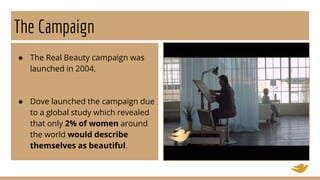
● The Real Beauty campaign was
launched in 2004.
● Dove launched the campaign due
to a global study which revealed
that only 2% of women around
the world would describe
themselves as beautiful.
Success
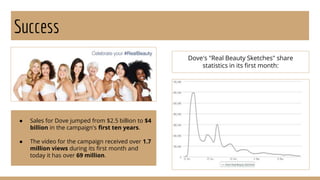
Dove's "Real Beauty Sketches" share
statistics in its first month:
● Sales for Dove jumped from $2.5 billion to $4
billion in the campaign's first ten years.
● The video for the campaign received over 1.7
million views during its first month and
today it has over 69 million.
Replicability
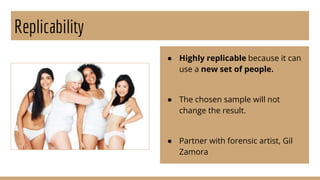
● Highly replicable because it can
use a new set of people.
● The chosen sample will not
change the result.
● Partner with forensic artist, Gil
Zamora
Replicability
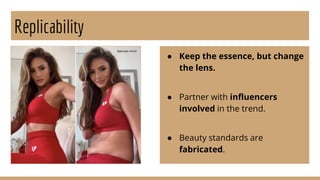
● Keep the essence, but change
the lens.
● Partner with influencers
involved in the trend.
● Beauty standards are
fabricated.
@georgie.clarke
Extendibility
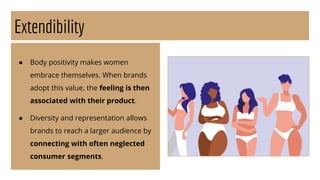
● Body positivity makes women
embrace themselves. When brands
adopt this value, the feeling is then
associated with their product.
● Diversity and representation allows
brands to reach a larger audience by
connecting with often neglected
consumer segments.
Extendibility
Other companies that have similar campaigns
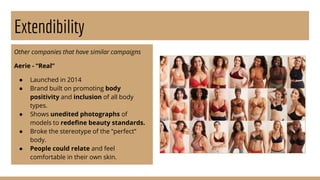
Aerie - “Real”
● Launched in 2014
● Brand built on promoting body
positivity and inclusion of all body
types.
● Shows unedited photographs of
models to redefine beauty standards.
● Broke the stereotype of the “perfect”
body.
● People could relate and feel
comfortable in their own skin.
Extendibility
Other companies that similar campaigns
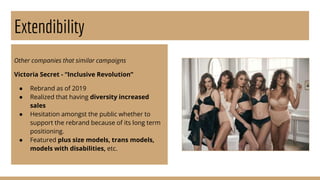
Victoria Secret - “Inclusive Revolution”
● Rebrand as of 2019
● Realized that having diversity increased
sales
● Hesitation amongst the public whether to
support the rebrand because of its long term
positioning.
● Featured plus size models, trans models,
models with disabilities, etc.
Weaknesses
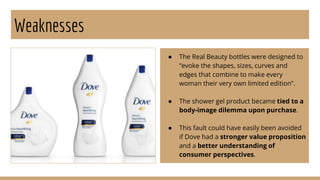
● The Real Beauty bottles were designed to
“evoke the shapes, sizes, curves and
edges that combine to make every
woman their very own limited edition”.
● The shower gel product became tied to a
body-image dilemma upon purchase.
● This fault could have easily been avoided
if Dove had a stronger value proposition
and a better understanding of
consumer perspectives.
Conclusion
● The increase in sales and company impressions
speak to the campaign’s success.
● 41% of people said they had a more favorable
view of Dove after seeing the “Real Beauty”
images, while 68% said they plan to buy a Dove
product over the next few months.
(1) Streamline the value proposition
(2) Conduct consumer research
(3) Modernize the campaign
(4) Partner with influencers
Sources
https://www.prweek.com/article/1582147/doves-real-beauty-campaign-won-nearly-lost-its-
audience#:~:text=The%20campaign's%20impact%20extended%20beyond,best%20selling%20product%20company%
2Dwide.
https://www.globalbrandsmagazine.com/the-success-of-doves-real-beauty-campaign/
https://www.businessinsider.com/how-doves-real-beauty-sketches-became-the-most-viral-ad-video-of-all-time-2013-5
https://www.in-mind.org/article/the-good-the-bad-and-the-ugly-of-the-dove-campaign-for-real-beauty
https://www.theguardian.com/fashion/2017/may/15/beauty-giant-dove-body-shaped-bottles-repair-damage
https://morningconsult.com/2017/05/17/many-still-love-dove-brand-despite-mixed-reaction-body-shaped-bottles/
https://www.forbes.com/sites/shelleykohan/2020/06/28/aeos-aerie-brand-built-on-body-positivity-and-inclusion-is-
slowly-edging-out-sexy-supermodel-juggernaut-victorias-secret/?sh=33b0f7ee42ba
https://www.teenvogue.com/story/unpacking-the-victorias-secret-
rebrand#:~:text=We%20could%20argue%20that%20the,first%20trans%20model%2C%20Valentina%20Sampaio.

Assignment 3 Presentation

Editor's Notes

  • #2 Hello! My name is ____________________. The social media campaign we choose to analyze is the Dove Real Beauty campaign.
  • #3 Overview before playing the video: The Real Beauty campaign was launched in 2004 when Dove realized that many people were becoming increasingly dissatisfied with how they looked and felt about their bodies. They launched the campaign due to a global study that revealed that only 2% of women around the world would describe themselves as beautiful Overall, much of the campaign’s success can be attributed to it being the first digital campaign to drive participants to a supportive online community that reached over 200 million people worldwide, with over 26 million people participating in the campaign online. Here is the campaign *play video*
  • #4 Dove’s marketing strategy was viewed as a social mission to help inspire young girls and women to develop a positive relationship with beauty. The goal was to help raise their self-esteem and encourage them to push for their dreams, and as we can see today, their strategy was extremely successful. An article from 2019 stated that the campaign's impact extended beyond promoting a vision for beauty equality. Sales for Dove jumped from $2.5 billion to $4 billion in the campaign's first ten years. We also found that Dove bars became the number one preferred soap brand in the U.S. and Unilever's best-selling product company-wide. Another factor that made this campaign so impressive was that the video that we played for you guys received over 1.7 million views during its first month, making it the most viewed video on YouTube in October 2006. Today, we see that the video has over 69 million views.
  • #5 The campaign is highly replicable as it can be done every year. This is because, in order to replicate it, you will simply need a new set of people to undergo the experiment as it does not change the outcome. This is because it has been scientifically proven that one sees oneself uglier than others do. In fact, as studied in class, the documentary Social Dilemma reveals how the percentage of depressed people and individuals that suffer from body dysmorphia has increased due to the use of social media and its implementation in our daily routines. This occurs because our aspirational groups, which tend to be influencers or celebrities, upload highly photoshopped pictures which creates an unrealistic beauty standard. Consequently, any sample group of women to undergo the experiment will display the same data. To make this possible and make it exactly like the sample campaign, Dove should partner with Gil Zamora, the forensic artist used in the video campaign, and rely on him for future experiments. This will generate an accurate representation of the original situation and will emphasize credibility and a more accurate outcome regarding replicability.
  • #6 In addition to replicating the campaign exactly as is Dove can also replicate their Real Beauty Campaign each year by keeping the essence of the campaign “you’re more beautiful than you think” but looking at it (or proving it) using a different lens that is in line with modern times. Currently, a popular trend among social media and fitness influencers is to post pictures of themselves posed vs. unposed, pointing out that EVEN their bodies are not “perfect” according to today’s beauty standards As part of the replicated campaign, Dove can partner with influencers who have taken part in this trend Connecting the platforms of influencers who are idolized by (and are in aspiration groups) of many Dove consumers will strengthen the claim of this replicated campaign that beauty standards are fabricated and help consumers realize that they truly ARE more beautiful than they think.
  • #7 Dove’s campaign is centered around the concept that true beauty comes from within and women’s unique differences should be celebrated, making it easily modifiable by other companies, who can focus on body positivity and diversity. The message behind body positivity is impactful because it makes women embrace themselves. When the brand adopts this value, the feeling is then associated with the product Like Dove, companies can use women of different sizes to appeal to a larger audience as more people are able to relate to the advertisements. This also challenges the negative stereotypes created by the fashion and beauty industry, while creating a positive brand image and connecting with the consumer’s emotions. Additionally, diversity and representation allows brands to reach a larger audience by connecting with often neglected consumer segments. Other companies can and have looked to modify and replicate the message and values behind Dove’s Real Beauty campaign.
  • #8 There are a few similar campaigns, involving body positivity and inclusion of all women. Aerie: Aerie was a pioneer in the lingerie industry where they decided to be more inclusive of all different body types and races, but most importantly the idea of being real and including unedited photos in their websites and sm campaigns. The campaign was launched in 2014 where the brand built an image of promoting body positivity and inclusion of all body types. Increased the sales for the company.
  • #9 Victoria Secret: Victoria Secret took a similar approach in 2019 to rebrand and be more inclusive of all body types and people. However, they joined this marketing approach after their competitors following the idea that companies were making greater profits following their re-brand. Because of their long lasting brand image of portraying a perfect body standard through their models so some people were hesitant whether to support the rebranding because of the intentions behind it. Due to this Victoria Secret decided to change their angels for trans models, plus size models and models with disabilities, yet still maintained this distinction and did not just transmit the idea of everyone's natural beauty.
  • #10 Dove’s Real Beauty campaign was revolutionary, and for the most part, received well by consumers. However, the company’s Real Beauty bottles counteracted their body-positive message and received significant criticism on social media. The Real Beauty bottles were designed to “evoke the shapes, sizes, curves, and edges that combine to make every woman their very own limited edition”. While the bottles never went into production, six archetypes were released as online images. Packaging and marketing are essential ways that brands communicate with their consumers. Having women choose between bottle shapes that either represent their own image or aspirations is counterintuitive to body positivity. This marketing media tied the shower gel product to a body-image dilemma upon purchase. While the Real Beauty bottles may have been designed to exhibit diversity and representation from the marketer’s perspective, they represented categorization and identification to consumers. Fortunately, this poorly thought-out advertisement didn’t do significant damage to the campaign’s message or Dove’s reputation. However, this fault could have easily been avoided if Dove had a stronger value proposition and a better understanding of consumer perspectives.
  • #11 Despite the criticism and minor failures of Dove’s marketing, the increase in sales and company impressions speak to the campaign’s success. 41% of people said they had a more favorable view of Dove after seeing the “Real Beauty” images, while 68% said they plan to buy a Dove product over the next few months. Going forward, we suggest Dove adopt our four prong plan to strengthen the Real Beauty campaign. (1) Streamline and clarify the value proposition to better understand the objective and values of the campaign. (2) Conduct consumer research to accurately represents the needs and values of the target market. As we mentioned in replicability, new women can undergo the same experiment. We recommend doing such and (3) modernize the campaign by featuring the new subjects. Lastly, to address extendability (4) partner with influencers who are trying to deconstruct beauty standard and use their platforms to expand exposure. This concludes our presentation, are there any questions?