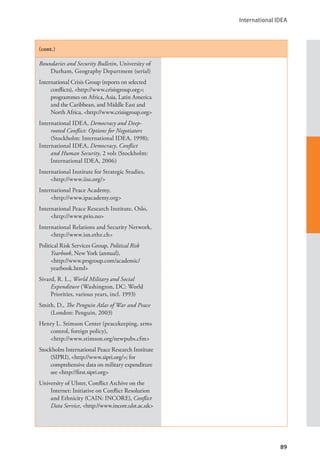
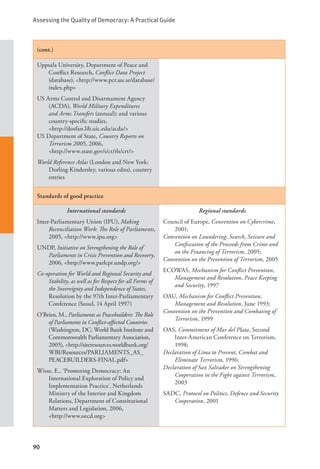
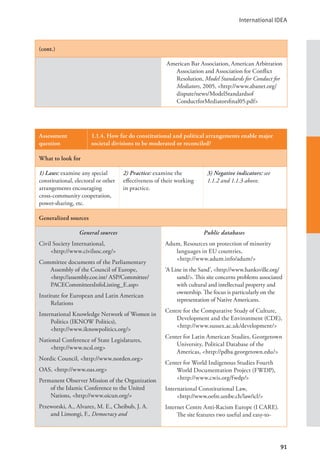
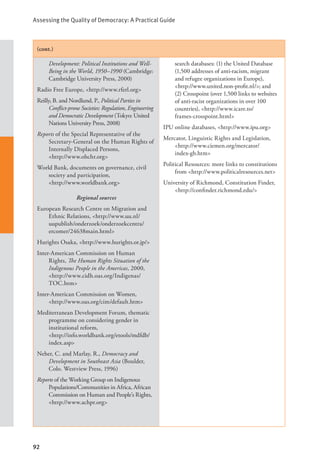
Assessing the Quality of
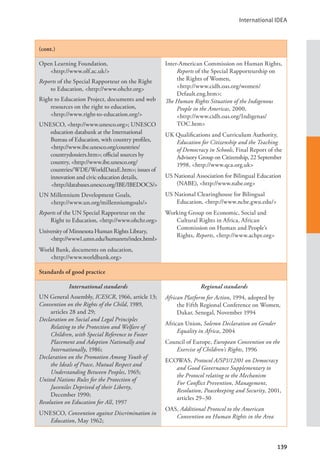
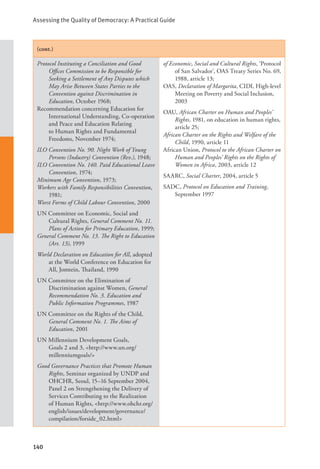
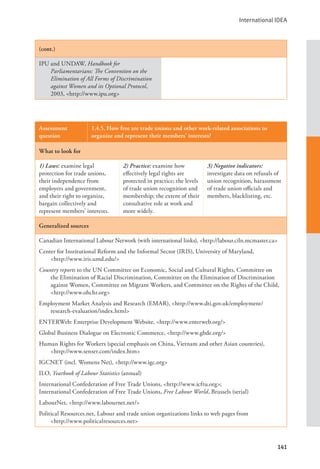
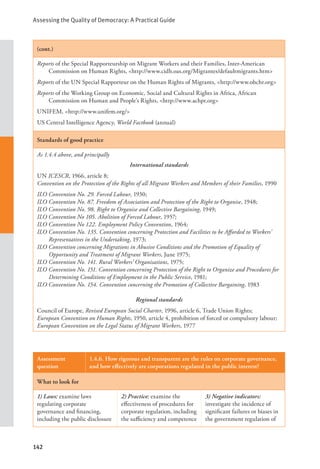
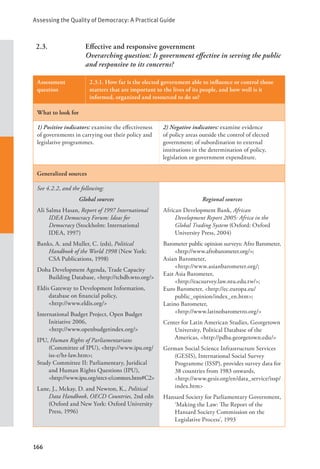
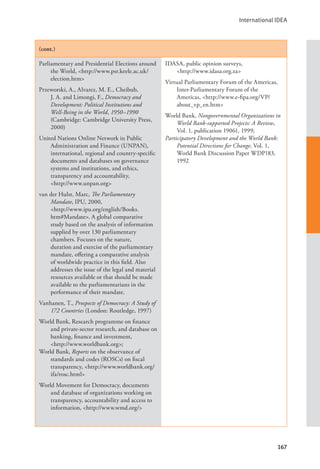
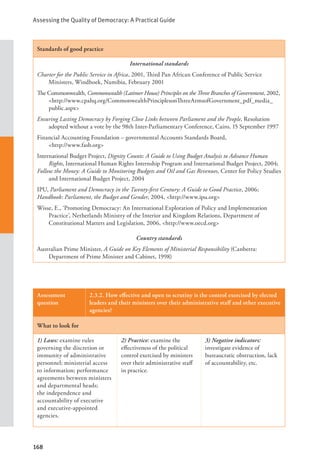
Democracy
A Practical Guide
David Beetham
Edzia Carvalho
Todd Landman
Stuart Weir
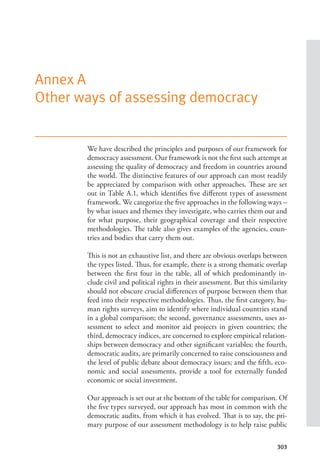
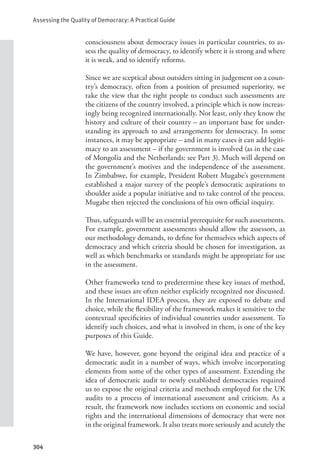
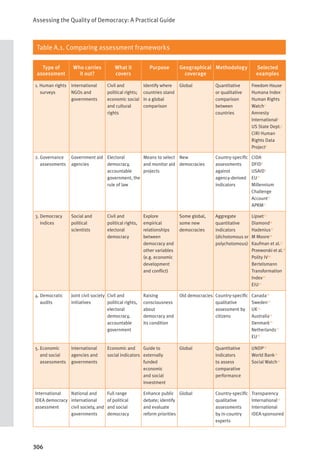
Assessing the Quality of
Democracy
A Practical Guide
© International Institute for Democracy and Electoral Assistance 2008
International IDEA publications are independent of specific national or political
interests. Views expressed in this publication do not necessarily represent the views
of International IDEA, its Board or its Council Members.
Applications for permission to reproduce or translate all or any part of this
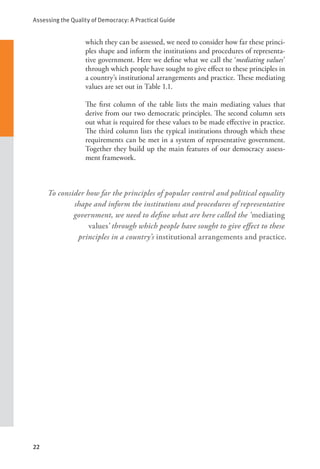
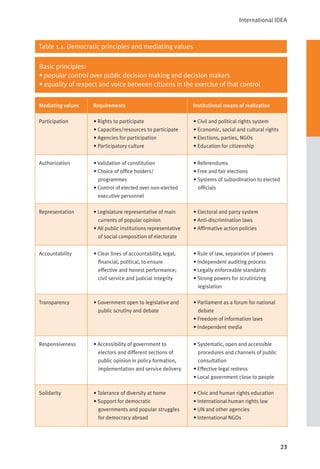
publication should be made to:
International IDEA
SE -103 34 Stockholm
Sweden
Graphic design by: Santángelo Diseño
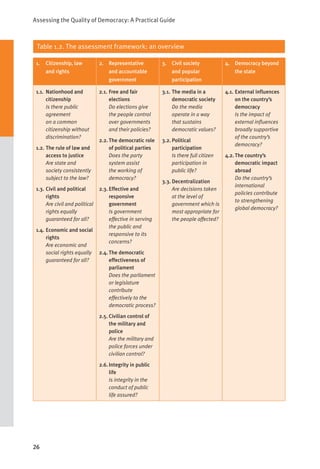
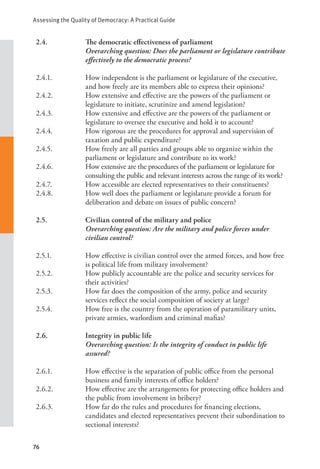
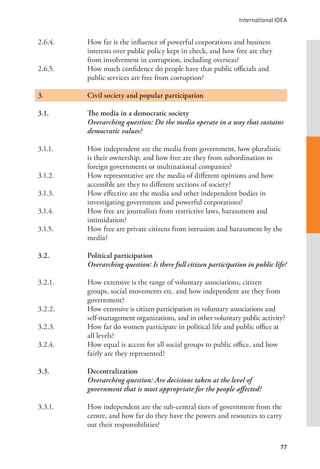
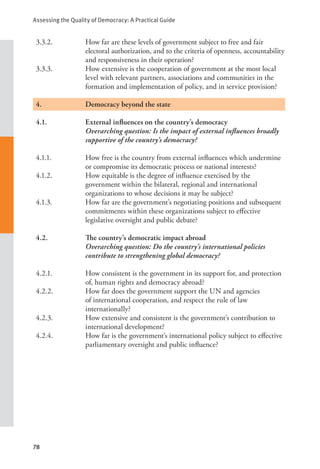
Printed by: Bulls Graphics
Cover illustration © Alberto Ruggieri/Illustration Works/Corbis/Scanpix
ISBN: 978-91-85724-43-7
5
Foreword: the state of democracy
Democracy is the predominant form of government in the world to-
day. For the greater part of the world democracy has been a rare or re-
cent phenomenon, but successive waves of democracy throughout the
20th century meant that by the new millennium more countries were
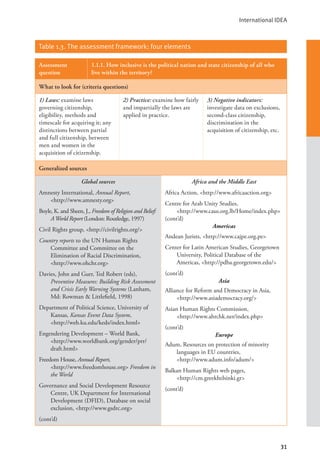
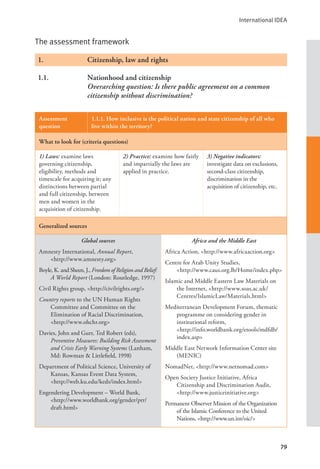
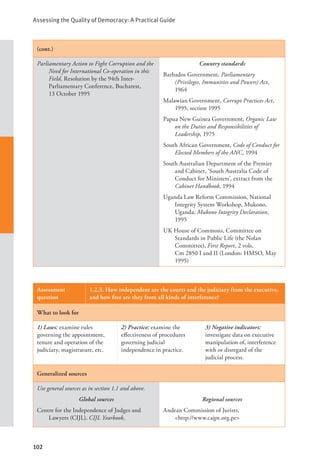
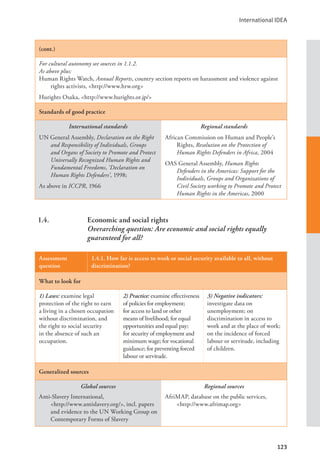
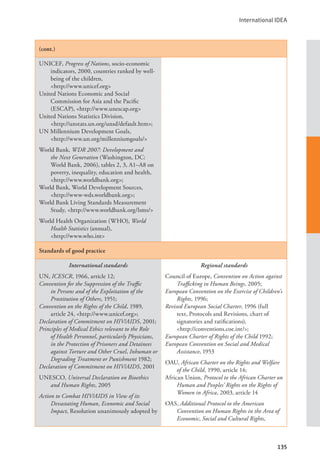
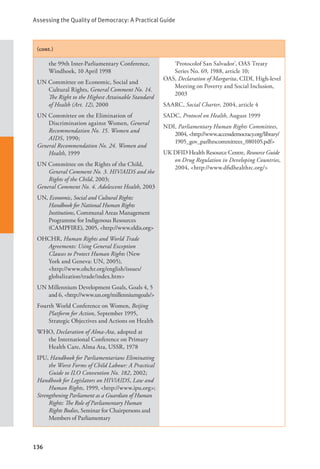
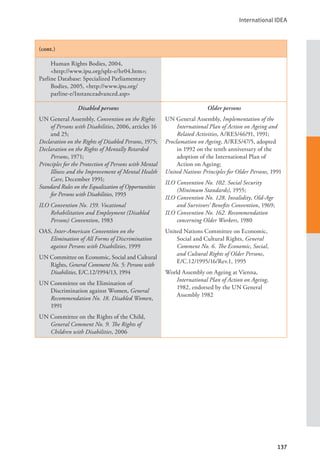
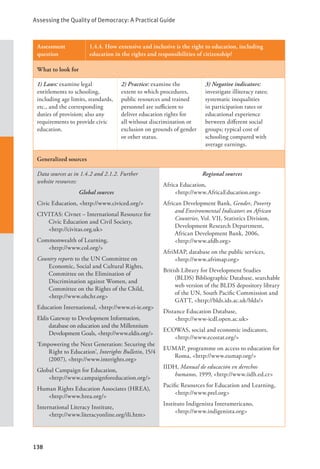
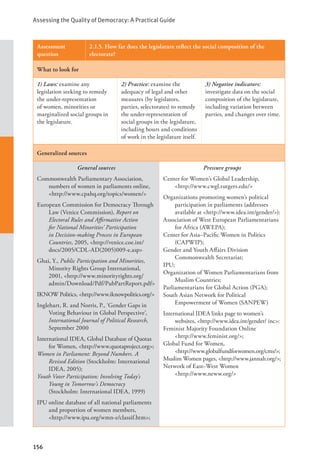
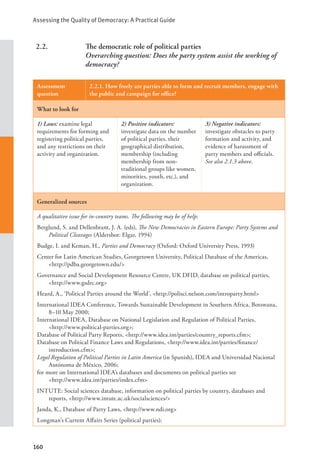
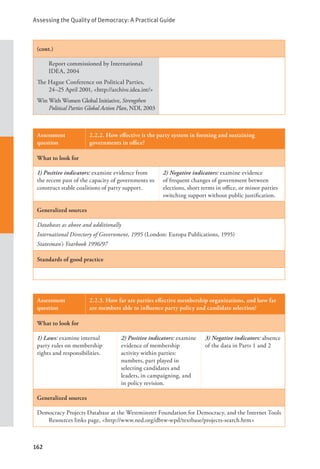
governed through democratic than through non-democratic forms of
rule. Various attempts to enumerate democracies in the world agree
that more than 60 per cent of all countries today have in place at
least some form of minimal democratic institutions and procedures.
The Community of Democracies lists more than 100 countries while
the United Nations International Conference on New or Restored
Democracies (ICNRD) has grown in depth, breadth and importance
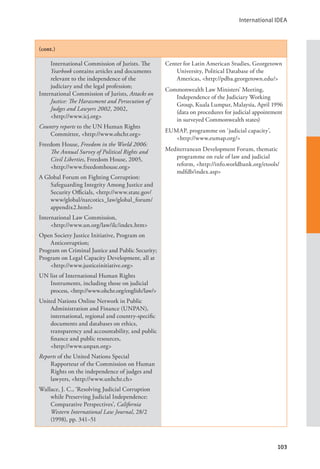
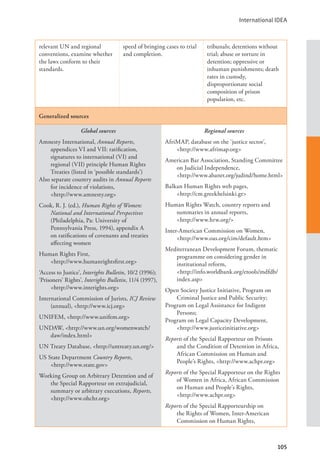
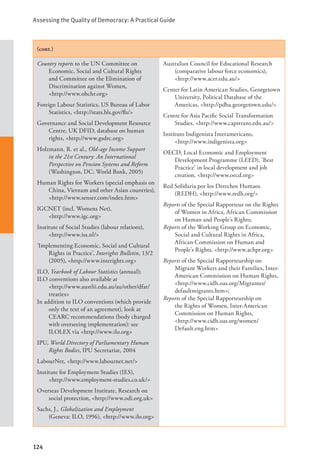
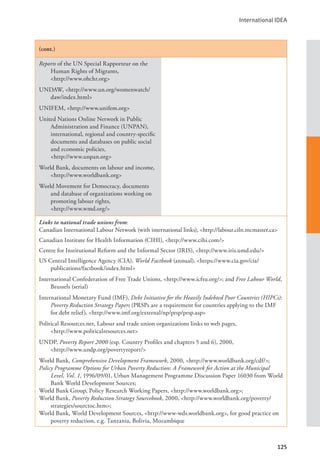
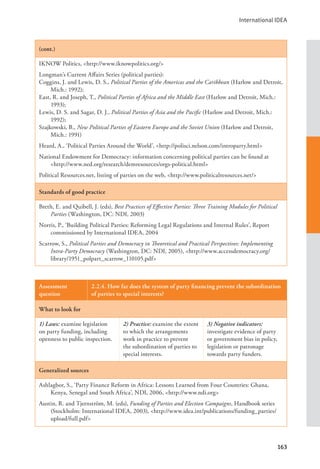
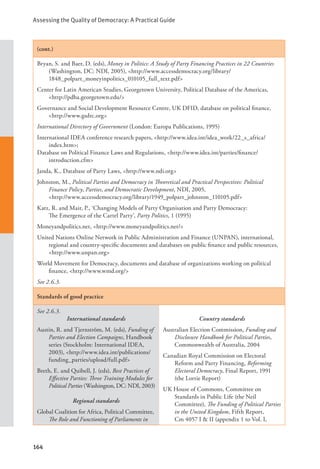
since it was inaugurated in 1988 as a forum for global democratic de-
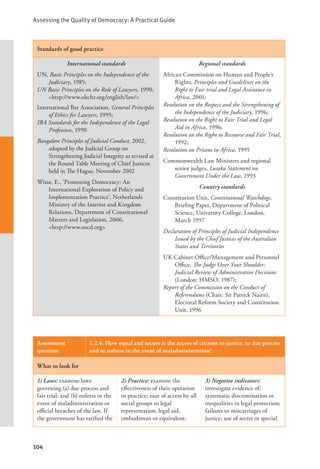
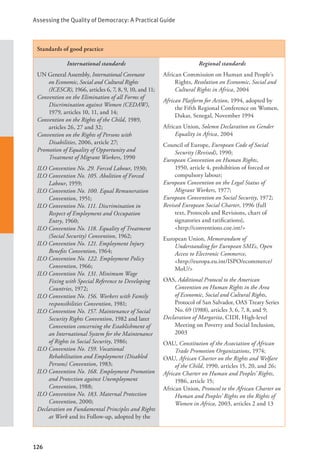
velopment. Increasingly, governmental, intergovernmental and non-
governmental organizations emphasize that democracy is an end in
itself, as well as an important means to other ends, such as economic
development, poverty reduction and greater protection of interna-
tionally recognized human rights.
There have been many explanations for the remarkable growth, spread
and pace of democratization. Internal explanations focus on major
socio-economic transformations; mobilization by social movements
and civil society organizations; class alliances, challenges and revolu-
tions (‘coloured’ or otherwise); and elite agreements and concessions.
External explanations focus on the defeat of an incumbent regime in
war; the role of ‘contagion’ from democratization processes in neigh-
bouring states; the diffusion of democratic values through processes
of globalization and various forms of international intervention, in-
cluding support for civil society groups and nascent political party or-
ganizations, state building, institutionalization, and the specification
of criteria for appropriate and acceptable forms of democratic rule;
and armed intervention to depose existing regimes and construct de-
mocracy by force.
6
A crucial element in mapping, explaining and encouraging this
growth in democracy has been the need for valid, meaningful and re-
liable ways to measure and assess democratic progress and the quality
of democracy itself. Scholars and practitioners have adopted a number
of strategies to measure democracy, including categorical measures,
scale measures, objective measures and hybrid measures of democrat-
ic practices, as well as perceptions of democracy based on mass public
opinion surveys. In certain instances, measures have been developed
for particular needs and then used for other purposes, while in other
instances general measures of democracy have been developed for a
wide range of applications by the academic and policy community.
The quest for comparability and broad geographical and historical
coverage, however, has meant a certain sacrifice of these measures’
ability to capture the context-specific features of democracy, while
the turn to good governance, accountability and aid conditionality
among leading international donors has created additional demand
for measures of democracy that can be used for country, sector and
programme-level assessments.
In response to these many developments and the proliferation of de-
mocracy measures, International Institute for Democracy and Elec-
toral Assistance (International IDEA) has developed an alternative
framework for democracy assessment that moves away from country
ranking and external judgement to comprehensive assessment based
on national assessment teams led by governments or civil society and
academic institutions. The framework combines a commitment to
the fundamental principles of democracy, the mediating values that
are related to these principles, and a range of questions about demo-
cratic performance. There is scope in the framework for using existing
measures while at the same time incorporating much more context-
specific information on the quality of democracy that can then be
linked to domestic processes of democratic reform. Its use across new
and old democracies as diverse as Mongolia and Italy, Bangladesh
and Kenya, Peru and Australia has shown that it works, and demand
continues for the framework to be applied in new and challenging
contexts around the world.
After the successful application of its democracy assessment framework
in over 20 countries, International IDEA, along with the UK-based
Democratic Audit, the Human Rights Centre at the University of Es-
sex in the United Kingdom, and the larger ‘State of Democracy’ net-
work, has drawn on the lessons, built further on the strengths of the
framework, and incorporated these into the thoroughly revised frame-
work contained here. Assessing the Quality of Democracy: A Practical
7
Guide includes all the normative principles and practical elements of
the framework, experiences from those countries that have used the
framework, and the ways in which democracy assessment can be linked
to the process of democratic reform.
The assessment framework outlined here upholds International
IDEA’s fundamental principles in supporting democracy worldwide:
• Democratization is a process that requires time and patience.
• Democracy is not achieved through elections alone.
• Democratic practices can be compared but not prescribed.
• Democracy is built from within societies.
• Democracy cannot be imported, or exported, but supported
(International IDEA 2005: 12).
This Guide provides a robust package of materials that are ground-
ed in many years of experience and practical application in old and
new democracies across the world. This volume is complemented by
another, entitled Assessing the Quality of Democracy: An Overview,
which provides an introduction to the framework, including its fun-
damental democratic principles, its mediating values, the assessment
search questions, examples of its application around the world, the
typical steps in carrying out an assessment, and its value as a tool
for promoting democratic reform. Both volumes should prove highly
attractive to grass roots democracy activists, civil society organiza-
tions, reform-minded actors in political society and in government,
and those international donor agencies and intergovernmental and
non-governmental organizations that are committed to building de-
mocracy for the future.
8
Preface
Democracy has spread and taken root in many parts of the world in
the past three decades. While the performance and quality of these
democracies differ, more people than ever before are governed by
elected representatives. The democratic form of government has thus
achieved global dominance. Regimes that have so far failed to usher
in a democratic dispensation lack legitimacy. Citizens in such coun-
tries continue to demonstrate their aspirations for freedom, dignity
and the opportunity to elect governments of their choice through
engagement in various forms of struggle – regardless of the risks they
may encounter in doing so.
While ‘transitional moments’ such as the first democratic elections
or the departure of an authoritarian government can be formative
moments of democracy, historical evidence shows that the building
of democracy and the consolidation of democratic institutions are
long and complex processes. Along this road it becomes essential to
assess the performance of democratic institutions and the quality of
democratic processes.
Various institutions have developed and continue to develop meas-
ures and tools for gauging democratic performance and quality. Since
2000, International IDEA has contributed to this field through the
development of the State of Democracy (SoD) assessment method-
ology outlined in this Guide. International IDEA is guided by the
premise that democracy is a universal value and aspiration. However,
it is also an inherently local political process that must be supported
through context-sensitive approaches which are anchored on local
leadership and local ownership of democracy-building processes.
This principle underpins International IDEA’s approach to democ-
racy building generally and to the SoD assessment methodology in
particular.
9
In this guide we set out a democracy assessment methodology that
puts the responsibility for evaluating the quality of democracy in the
hands of citizens and others who reside in the country being assessed.
Notwithstanding the invaluable role played by external actors in sup-
porting democratization processes in various countries, it is our con-
viction that sustainable democracy can only be achieved if those who
are affected by its daily practice are the people who ultimately pass
judgement on its strengths and weaknesses, and that they are the ones
who determine priority areas for reform. The SoD assessment meth-
odology is a tool for citizens to use in undertaking these tasks. It is a
global public good that presents an opportunity for citizens of coun-
tries with developing and developed economies, and of new and old
democracies, to take charge of and contribute in meaningful ways to
bettering the performance and quality of their democracies.
Since the methodology was launched in 2000, a network of its users
has developed in different parts of the world. The lessons and experi-
ences they shared with us have greatly enriched this Guide. Others
seeking to undertake a democracy assessment using the methodology
stand to benefit from lessons learned so far in the application of the
methodology in different contexts. Importantly, they will be better
informed about how to plan and implement SoD assessments in ways
that maximize the possibility of the findings being used and linked
to actual reform.
In putting together this guide, International IDEA seeks to provide
a user-friendly knowledge resource for those seeking to improve the
quality of their democracies. At a time when the debate on democracy
and governance assessment is very much on the radar screen of devel-
opment agencies, bilateral and multilateral organizations, and national
actors, International IDEA offers a methodology for ‘self-assessment’
which has so far been applied in no fewer than 20 countries in differ-
ent parts of the world. For those engaged in democracy assistance, the
SoD methodology provides an opportunity for such assistance to be
informed by locally defined priorities for democratic reform.
Vidar Helgesen
Secretary-General
International IDEA
10
Contents
Foreword: the state of democracy 5
Preface 8
Acronyms and abbreviations 14
Part 1 Democracy assessment:
explaining the method
Democracy assessment: explaining the method 17
The assessment framework 20
Mediating values 24
Democratic institutions 24
What the framework assesses 25
Citizenship, law and rights 27
Representative and accountable government 27
Civil society and popular participation 28
Democracy beyond the state 28
The different elements of assessment 30
The assessment questions 32
What to look for 34
Generalized sources 34
Standards of good practice 35
Charting the process of assessment 38
Legitimizing the assessment 38
Key stages of the assessment process 41
Preliminary decisions for the assessment process 41
Data collection, analysis and organization 53
Convening a national workshop 58
Strategies for making democracy
assessments public 60
11
Publications and media strategies 63
Engaging the media 63
From assessment to reform 67
Part 2 The framework
The framework 71
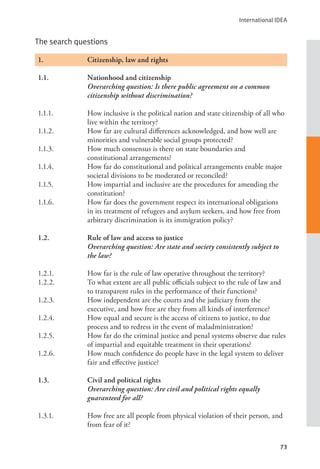
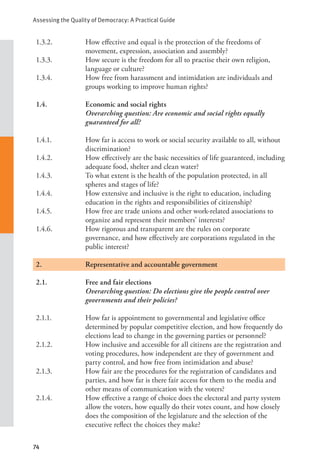
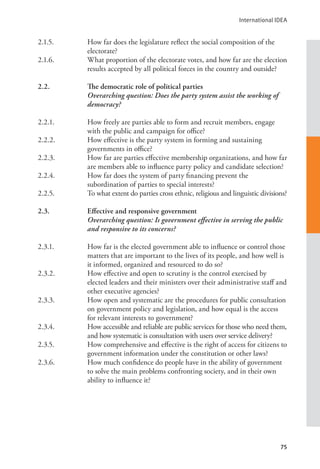
The search questions 73
The assessment framework 79
Part 3 The assessment experiences
The assessment experiences 251
Democracy has many stories 253
Democracy assessments: origins, funding and form 262
Coordinating the assessments 265
Putting the democratic messages across 269
Dissemination 275
Engaging the public 277
Engaging with the public 279
The lessons are clear 282
Part 4 From assessment to reform:
influencing the democratic process
From assessment to reform: influencing
the democratic process 285
Achievements and challenges 288
Context, influence, audience and outputs 290
Context 290
12
The main agent of the assessment 291
The relative openness of the political process 293
Public space 294
Types of audience, output and impact 295
Areas for reform 296
Institutional reforms 297
Resource-based reforms 298
Long-term cultural shifts 298
Tables
1.1. Democratic principles and mediating values 23
1.2. The assessment framework: an overview 26
1.3. The assessment framework: four elements 31
1.4. Possible comparators for standard setting 36
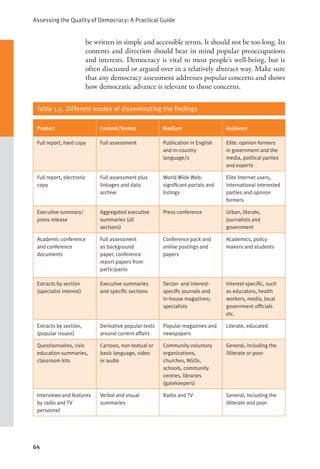
1.5. Different modes of disseminating the findings 64
3.1. Trust in public institutions, Latvia 259
3.2. Opinions about politics and social trust,
the Netherlands 260
3.3. Perceptions of the most important feature
of democracy, Ireland 262
3.4. Expert indicator scores for citizenship,
law and rights, Mongolia 271
4.1. Typical achievements and challenges drawn
from the pilot studies 300
A.1. Comparing assessment frameworks 306
Figures
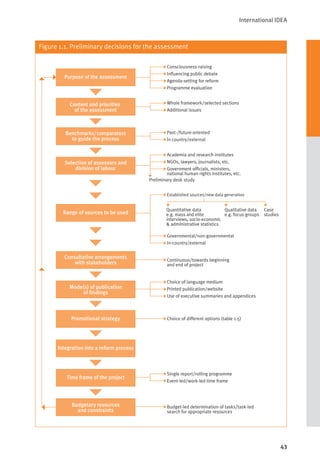
1.1. Preliminary decisions for the assessment 43
1.2. Stages in data collection and analysis 53
13
3.1. Multiple meanings of democracy in South Asia 261
3.2. The UK DA target 272
Boxes
1.1. Mobilizing a pluralist approach:
the State of Democracy in South Asia Project 42
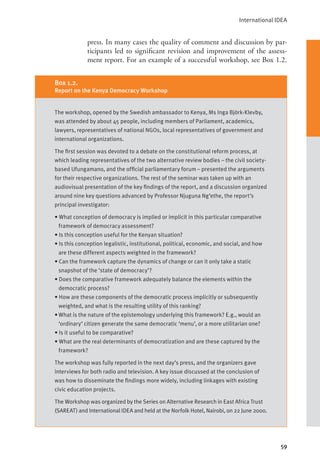
1.2. Report on the Kenya Democracy Workshop 59
1.3. A media strategy for raising democratic awareness 62
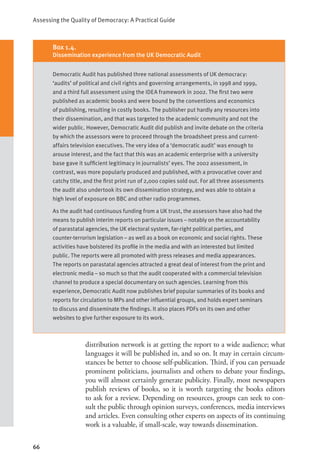
1.4. Dissemination experience from the UK
Democratic Audit 66
3.1. Excerpts from dialogues conducted for
the State of Democracy in South Asia study 255
3.2. Ordinary people’s views on the meaning
of democracy, Mongolia 258
3.3. Announcing the State of Our Democracy
report in the Netherlands 267
3.4. Party systems and social diversities
in South Asia 268
3.5. How well does Australian democracy serve
Australian women? 273
3.6. Terrorism, community and human rights 274
3.7. The challenge of corruption in the Philippines 275
Annexes
A. Other ways of assessing democracy 303
B. The democracy assessment questionnaire 309
C. Bibliography 311
D. About the authors 313
E. Acknowledgements 315
F. About International IDEA 317
14
Acronyms and abbreviations
ACDA Arms Control and Disarmament Agency (USA)
CEDAW Convention on the Elimination of all Forms of Discrimination
against Women, 1979
CIDA Canadian International Development Agency
CSCE Conference on Security and Co-operation in Europe
DAC Development Assistance Committee (OECD)
DFID Department for International Development (UK)
ECOWAS Economic Community of West African States
EU European Union
EUMAP EU Monitoring and Advocacy Programme (OSI)
FAO Food and Agriculture Organization of the United Nations
GATT General Agreement on Tariffs and Trade
ICAC Independent Commission against Corruption (Hong Kong)
ICCPR International Covenant on Civil and Political Rights, 1966
ICESCR International Covenant on Economic, Social and Cultural
Rights, 1966
IDASA Institute for Democracy in South Africa
International IDEA International Institute for Democracy and Electoral Assistance
IIDH Interamerican Institute for Human Rights
(Instituto Interamericano de Derechos Humanos)
IKNOW International Knowledge Network (of Women in Politics)
ILO International Labour Organization
IMER International Migration and Ethnic Relations (Bergen, Norway)
IMF International Monetary Fund
IPU Inter-Parliamentary Union
NDI National Democratic Institute for International Affairs
NEPAD New Partnership for Africa’s Development
NGO non-governmental organization
OAS Organization of American States
OAU Organization of African Unity
ODIHR Office for Democratic Institutions and Human Rights (OSCE)
OECD Organisation for Economic Co-operation and Development
OHCHR Office of the UN High Commissioner for Human Rights
OSCE Organization for Security and Co-operation in Europe
OSF Open Society Forum
OSI Open Society Institute
SAARC South Asian Association for Regional Cooperation
SADC Southern African Development Community
SoD State of Democracy (methodology)
TASC Think Tank for Action on Social Change (Ireland)
UK United Kingdom
UN United Nations
UNCTAD United Nations Conference on Trade and Development
UNDAW United Nations, Division for the Advancement of Women
UNDP United Nations Development Programme
UNEP United Nations Environment Programme
UNESCO United Nations Educational, Scientific and Cultural Organization
UNHCHR United Nations High Commissioner for Human Rights
UNICEF United Nations Children’s Fund
UNIFEM United Nations Development Fund for Women
UNODC United Nations Office on Drugs and Crime
UNTS United Nations Treaty Series
USAID United States Agency for International Development
WHO World Health Organization
Democracy assessment:
explaining the method
Part 1
17
Democracy assessment:
explaining the method
[1]   Every person is entitled to live their life in dignity and free from fear,
with a fair share in their country’s resources and an equal say in how
they are governed. Democracy is an attractive form of government
because its principles embrace these human needs and desires and
can often deliver them in reality. And the more experience people
have of living in a democracy, as the democracy assessment in South
Asia found (see Part 3), the more they support democracy.
[2]   The democratic ideal in and of itself seeks to guarantee equality and
basic freedoms; to empower ordinary people; to resolve disagree-
ments through peaceful dialogue; to respect difference; and to bring
about political and social renewal without convulsions. The principle
of ‘popular rule’, or rule by popularly elected representatives, is at the
heart of this ideal, but it also has different and overlapping meanings
for different people within and between nations and regions. Broadly,
for people around the world it means popular control over elected
rulers, equal rights and liberties, political freedom and freedom from
want, the rule of law, justice and security, but with differing em-
phases. Thus, in countries in South Asia, equality of outcomes and
community rights are a significant aspect of what people want from
democracy; in Western Europe, political freedom and the rule of law
are valued, although social rights also figure largely.
[3]   But these democratic ideals are easier to endorse in principle than
to realize in practice. There is no such thing as a perfect democracy.
Democracy is not an all-or-nothing affair, but rather a shifting con-
tinuum. Countries are more or less democratic overall, and more or
less democratic in the various aspects of their political and social life.
[4]   The International IDEA democracy assessment framework gives groups
of people in any one country a mirror with which they can assess the
quality of their democracy and which will help them answer, in brief,
Assessing the Quality of Democracy: A Practical Guide
18
the apparently simple questions ‘How democratic are our country and
its government?’ and ‘What are the strengths of our democracy, and
what are its weaknesses?’. Yet these questions in turn raise others. How
do we know exactly what we should be assessing, and by what crite-
ria should we judge it as democratic? To answer these questions, the
framework offers a clear conception of representative democracy and
its core principles, and an understanding of how these principles may
be realized through institutional, political and social practices.
[5]   Since 2000, no fewer than 20 countries around the world – as differ-
ent as Mongolia and Italy, Bangladesh and Kenya, Peru and Australia
– have used the framework for democracy assessment to evaluate how
well their democracies are working, to raise popular consciousness and
to identify areas where they can be improved. Some assessments were
pilot schemes promoted by International IDEA to test the viability of
the assessment framework (Bangladesh, El Salvador, Italy, Kenya, Ma-
lawi, New Zealand, Peru, South Korea). Later ones have been initiated
entirely from within the countries concerned, although by widely dif-
fering agencies – academic institutes, non-governmental organizations
(NGOs) and think tanks, and even governments themselves (Mongo-
lia, the Netherlands). Some have been full assessments, as in the United
Kingdom (UK), some a series of investigative reports, as in Australia,
some a patient assembly of reports as funds become available, as in the
Philippines; some have drawn heavily on extensive polling, as in the
South Asia study of Bangladesh, India, Nepal, Pakistan and Sri Lanka.
Some assessment teams have sought to measure the changing strengths
of their democracy over time. In the UK, Democratic Audit has car-
ried out three assessments since 1998 and is committed to a further
assessment in the next few years; Latvia will be conducting a smaller
assessment exercise to monitor progress since its first in 2005.
[6]   There are striking differences between the countries in which assess-
ments have taken place, which suggests that the methodology has a
universal application. The countries range in size from India, the
world’s largest democracy, to El Salvador, in experience of democra-
cy from New Zealand to Mongolia, and in level of economic devel-
opment from European nations such as the Netherlands to Malawi
in sub-Saharan Africa. Mongolia is a sparsely populated land with a
largely nomadic way of life; the Netherlands is a densely populated
There is no such thing as a perfect democracy. Democracy is not
an all-or-nothing affair, but rather a shifting continuum.
International IDEA
19
modern state. Australia and India are federal states; the rest are unitary
states. The modes of funding and costs of the 17 projects so far have
varied enormously (see Part 3 for a detailed analysis). But all the assess-
ment projects share a common core. They have all adhered to the basic
proposition that the only people who can have legitimacy in assessing
the quality of their country’s democracy are citizens of that country,
and that country ownership of the assessment is necessary for it to be
able to influence the course of democratic progress and reform.
[7]   In Annex A, ‘Other ways of assessing democracy’, we compare the
IDEA framework with other methodologies for assessing democracy
current in the world today and explain the essential differences in
principle and practice between them. The International IDEA frame-
work is, in brief, the only one to insist that only those who know a
country’s culture, traditions and aspirations are properly qualified to
assess its democracy. The purpose of International IDEA’s SoD as-
sessment programme is to put the future of democracies around the
world in the hands of their own citizens.
[8]   The main features of the International IDEA approach may be sum-
marized as follows.
•    Only citizens and others who live in the country being assessed
should carry out a democracy assessment, since only they can know
from experience how their country’s history and culture shape its ap-
proach to democratic principles.
•    A democracy assessment by citizens and residents of a country may
be mobilized by government or external agencies only under strict
safeguards of the independence of the assessment.
•    The prime purpose of democracy assessment is to contribute to pub-
lic debate and consciousness raising, and the exercise ought to al-
low for the expression of popular understanding as well as any elite
consensus.
•    The assessment should assist in identifying priorities for reform and
monitoring their progress.
•    The criteria for assessment should be derived from clearly defined
democratic principles and should embrace the widest range of de-
mocracy issues, while allowing assessors to choose priorities for ex-
amination according to local needs.
The International IDEA democracy assessment
methodology has a universal application.
Assessing the Quality of Democracy: A Practical Guide
20
•    The assessments should be qualitative judgements of strengths and
weaknesses in each area, strengthened by quantitative measures
where appropriate.
•    The assessors should choose benchmarks or standards for assessment,
based on the country’s history, regional practice and international
norms, as they think appropriate.
•    The assessment process should involve wide public consultation, in-
cluding a national workshop to validate the findings.
•    Old as well as new democracies can and should be subject to a similar
framework of assessment.
The assessment framework
[9]   We stated above that the answer to the apparently simple question
‘How democratic are our country and its government?’ required first
that we start with a clear conception of democracy and its core princi-
ples, and an understanding of how these principles may be embodied
in institutional, political and social practices.
[10] First, then, what is democracy? If we examine the main currents of
theorizing about democracy from the ancient Greeks onwards; if
we pay attention to what those claiming to struggle for democracy
have been struggling for; if, in particular, we have regard for the
objections of opponents of democracy throughout the ages, then
a relatively clear and consistent set of ideas emerges. Democracy
is a political concept, concerning the collectively binding decisions
about the rules and policies of a group, association or society. Such
decision making can be said to be democratic to the extent that it is
subject to the controlling influence of all members of the collectiv-
ity considered as equals.
[11] The key democratic principles are those of popular control and politi-
cal equality. These principles define what democrats at all times and
in all places have struggled for – to make popular control over public
decision making both more effective and more inclusive; to remove
an elite monopoly over decision making and its benefits; and to over-
come obstacles such as those of gender, ethnicity, religion, language,
class, wealth and so on to the equal exercise of citizenship rights.
Only those who know a country’s culture, traditions and
aspirations are properly qualified to assess its democracy.
International IDEA
21
[12] These two principles are most fully realized in small groups or associa-
tions where everyone is guaranteed an effective equal right to speak
and vote on rules and policies in person. In larger associations, and
especially at the level of a whole society, practical considerations of
time and space demand that collective decisions be taken by desig-
nated agents or representatives acting on behalf of the rest. For most
people, then, democracy is realized in the first instance not as direct
popular control over public decision making, but as control over the
decision makers who act in their place. How effective that control
is and how equally distributed it is between individual citizens, and
between different groups of citizens, according to their numbers, are
key criteria for determining how democratic a system of representative
government actually is, whether at national, regional or local level.
[13] Where does freedom or liberty fit into these two principles? It should
be evident that there can be no ongoing popular control or influ-
ence over public decision making unless people are able to speak their
minds freely, to debate openly with others, to associate freely with
them, to receive and impart information without hindrance, and to
have the means and the confidence to undertake and share in these
activities. Popular liberties have been recognized as integral to the
democratic principles of the recognized body politic since democ-
racy’s early days in ancient Athens. In this sense, therefore, liberty
is entailed by the idea of democracy, and does not have to be ‘added
on’ as something extra to it; nor is it even a uniquely modern politi-
cal concept (although the growing emphasis in democratic ideals on
economic, social and cultural rights is a modern concept).
[14] These two principles, then, of popular control and political equality,
form the guiding thread of a democracy assessment. The more they
are present, the more democratic we can judge a system of public de-
cision making to be. As they stand, however, these principles are too
general to serve as a precise assessment tool.
[15] In order to see how we get from them to the institutional procedures
of representative government, and to a set of more precise criteria by
The key democratic principles are those of popular control and
political equality. For most people, democracy is realized in the first
instance not as direct popular control over public decision making,
but as control over the decision makers who act in their place.
Assessing the Quality of Democracy: A Practical Guide
22
which they can be assessed, we need to consider how far these princi-
ples shape and inform the institutions and procedures of representa-
tive government. Here we define what we call the ‘mediating values’
through which people have sought to give effect to these principles in
a country’s institutional arrangements and practice. These mediating
values are set out in Table 1.1.
The first column of the table lists the main mediating values that
derive from our two democratic principles. The second column sets
out what is required for these values to be made effective in practice.
The third column lists the typical institutions through which these
requirements can be met in a system of representative government.
Together they build up the main features of our democracy assess-
ment framework.
To consider how far the principles of popular control and political equality
shape and inform the institutions and procedures of representative
government, we need to define what are here called the ‘mediating
values’ through which people have sought to give effect to these
principles in a country’s institutional arrangements and practice.
International IDEA
23
Table 1.1. Democratic principles and mediating values
Mediating values Requirements Institutional means of realization
Participation • Rights to participate
• Capacities/resources to participate
• Agencies for participation
• Participatory culture
• Civil and political rights system
• Economic, social and cultural rights
• Elections, parties, NGOs
• Education for citizenship
Authorization • Validation of constitution
• Choice of office holders/
programmes
• Control of elected over non-elected
executive personnel
• Referendums
• Free and fair elections
• Systems of subordination to elected
officials
Representation • Legislature representative of main
currents of popular opinion
• All public institutions representative
of social composition of electorate
• Electoral and party system
• Anti-discrimination laws
• Affirmative action policies
Accountability • Clear lines of accountability, legal,
financial, political, to ensure
effective and honest performance;
civil service and judicial integrity
• Rule of law, separation of powers
• Independent auditing process
• Legally enforceable standards
• Strong powers for scrutinizing
legislation
Transparency • Government open to legislative and
public scrutiny and debate
• Parliament as a forum for national
debate
• Freedom of information laws
• Independent media
Responsiveness • Accessibility of government to
electors and different sections of
public opinion in policy formation,
implementation and service delivery
• Systematic, open and accessible
procedures and channels of public
consultation
• Effective legal redress
• Local government close to people
Solidarity • Tolerance of diversity at home
• Support for democratic
governments and popular struggles
for democracy abroad
• Civic and human rights education
• International human rights law
• UN and other agencies
• International NGOs
Basic principles:
• popular control over public decision making and decision makers
• equality of respect and voice between citizens in the exercise of that control
Assessing the Quality of Democracy: A Practical Guide
24
Mediating values
[16] The list of mediating values is largely self-explanatory.
•    Without citizen participation and the rights, the freedoms and the
means to participate, the principle of popular control over govern-
ment cannot begin to be realized.
•    The starting point of participation is to authorize public representa-
tives or officials through free and fair electoral choice, and in a man-
ner which produces a legislature that is representative of the different
tendencies of public opinion.
•    If different groups of citizens are treated on an equal footing, accord-
ing to their numbers, then the main public institutions will also be
socially representative of the citizen body as a whole.
•    The accountability of all officials, both to the public directly, and
through the mediating institutions of parliament, the courts, the om-
budsman and other watchdog agencies, is crucial if officials are to act
as agents or servants of the people rather than as their masters.
•    Without openness or transparency in government, no effective ac-
countability is possible.
•    Responsiveness to public needs, through a variety of institutions through
which those needs can be articulated, is a key indication of the level of
controlling influence which people have over government.
•     Finally, while equality runs as a principle through all the mediating
values, it finds particular expression in the solidarity which citizens of
democracies show to those who differ from themselves at home, and
towards popular struggles for democracy abroad.
[17] Much more could be said about each of these mediating values. Per-
haps it will be sufficient here to clarify the distinction between the
ideas of accountability and responsiveness, since they are frequently
confused. Accountability involves office holders being required to ac-
count for actions they have taken after they have taken them (ex post),
with the realistic prospect of appropriate sanctions being applied in
the event of misconduct, negligence or failure. Responsiveness, on
the other hand, involves having systematic procedures for consult-
ing public opinion and relevant interests before policy or legislation
is decided (ex ante), so that its content will reflect the views of those
affected by it. Both responsiveness and accountability are necessary
for effective popular control over government.
Democratic institutions
[18] The third column of Table 1.1 then sets out the institutions that
provide the means to realize these mediating values. The list in this
International IDEA
25
column presents examples and is not exhaustive. And it will be ob-
served that some institutions serve, or may serve, to realize more than
one value. Thus the electoral process serves to realize the values of
participation, authorization, representation and accountability simul-
taneously, and it is therefore against all these criteria that it can be
judged. Similarly, the associational life of what is called ‘civil society’,
including political parties, NGOs and other associations, contributes
to a number of different values, and again it is consequently against
a number of different criteria that it can be assessed. From the other
side, a value such as participation also underpins the accountability
and responsiveness of the process of government, and so ensures the
interconnectedness of different elements in the assessment frame-
work. If these complexities are understood, as well as the basic logic
of the progression from key principles, through mediating values and
their requirements, to institutional processes, then the account of the
assessment framework that follows below should be readily under-
stood. Our aim is to construct the assessment framework around a
coherent narrative of democracy, rather than as a random set of items
put together without explanation.
[19] Democracy, then, begins with a set of principles or ‘regulative ideals’,
and only then come the institutional arrangements and procedures
through which these principles are realized. Although these arrange-
ments and procedures form the subject of our assessment, as in the
framework set out below, the criteria against which they are to be
assessed are the core principles themselves, and the mediating values
of accountability, representativeness, responsiveness and so on. It is
these that determine how democratic we should judge our institu-
tional arrangements to be.
What the framework assesses
[20] The full assessment framework is set out in Part 2 of this guide, which
contains first the criteria (or search questions) that are used to system-
atize the assessment process, and then the full four-pillar framework
itself. Here we describe and explain the framework (see Table 1.2).
Assessing the Quality of Democracy: A Practical Guide
26
Table 1.2. The assessment framework: an overview
1. Citizenship, law
and rights
2. Representative
and accountable
government
3. Civil society
and popular
participation
4. Democracy beyond
the state
1.1. Nationhood and
citizenship
Is there public
agreement
on a common
citizenship without
discrimination?
1.2. The rule of law and
access to justice
Are state and
society consistently
subject to the law?
1.3. Civil and political
rights
Are civil and political
rights equally
guaranteed for all?
1.4. Economic and social
rights
Are economic and
social rights equally
guaranteed for all?
2.1. Free and fair
elections
Do elections give
the people control
over governments
and their policies?
2.2. The democratic role
of political parties
Does the party
system assist
the working of
democracy?
2.3. Effective and
responsive
government
Is government
effective in serving
the public and
responsive to its
concerns?
2.4. The democratic
effectiveness of
parliament
Does the parliament
or legislature
contribute
effectively to the
democratic process?
2.5. Civilian control of
the military and
police
Are the military and
police forces under
civilian control?
2.6. Integrity in public
life
Is integrity in the
conduct of public
life assured?
3.1. The media in a
democratic society
Do the media
operate in a way
that sustains
democratic values?
3.2. Political
participation
Is there full citizen
participation in
public life?
3.3. Decentralization
Are decisions taken
at the level of
government which is
most appropriate for
the people affected?
4.1. External influences
on the country’s
democracy
Is the impact of
external influences
broadly supportive
of the country’s
democracy?
4.2. The country’s
democratic impact
abroad
Do the country’s
international
policies contribute
to strengthening
global democracy?
International IDEA
27
Citizenship, law and rights
[21] Democracy starts with the citizen, and the subject of the first pillar of
the framework is the rights of the citizen and the ability of the state to
guarantee equal rights of citizenship to all through its constitutional
and legal processes. This starting point is made more complex in a
globalized world by the presence in many countries of non-citizens –
migrant workers, refugees, asylum seekers and so on – whose rights
are often severely restricted or denied. The guarantee of civil and po-
litical rights needs no special justification in a democracy assessment,
since these rights are manifestly necessary for participation in the
political process in association with others. To include economic and
social rights, however, is more contestable (and especially so in the case
of non-citizens). Many political scientists take the view that democ-
racy is about the processes of public decision making, rather than its
outcomes, and that the delivery of economic and social rights is only
one possible outcome of government, which is contested between dif-
ferent political parties in their policy programmes. Our view, in con-
trast, is that the inclusion of an economic and social rights audit is
justifiable in terms of both process and outcome. As regards process,
it is a necessary condition for the exercise of civil and political rights
that people should be alive to exercise them and should have the ca-
pacities and resources to do so effectively. At the same time, people
do – rightly – judge the quality of a democracy in terms of its ability
to secure them the basic economic and social rights on which a mini-
mally decent human life depends. If democracy cannot deliver bet-
ter outcomes in this respect than authoritarianism, why should they
support it? Such considerations have been especially strongly urged
by our partners in the South in discussions about the content of the
assessment framework.
Representative and accountable government
[22] If the first pillar of democracy is the guarantee of basic human rights
to citizens and non-citizens, the second comprises the institutions of
representative and accountable government. The sections here include
The guarantee of civil and political rights needs no special justification
in a democracy assessment, since these rights are manifestly necessary
for participation in the political process in association with others. In
our view, it is also justifiable to include economic and social rights.
Assessing the Quality of Democracy: A Practical Guide
28
the familiar agenda of the electoral process, the political party sys-
tem, the role of the parliament or legislature and other institutions
in securing the integrity and accountability of government officials,
and civilian control over the military and police forces. A separate
section is devoted to integrity in public life, on the ground that the
trustworthiness of public officials is an issue of central concern to all
democracies and their citizens.
Civil society and popular participation
[23] The third pillar of our assessment framework is devoted to what is
conventionally called ‘civil society’. Democratic institutions depend
for their effective functioning both on guaranteed rights upheld by
the legal process and on an alert and active citizen body. Key elements
contributing to the latter are independent and pluralistic media of
communication, and a vigorous network of voluntary associations of
all kinds, through which citizens can act to manage their own affairs
and influence public policy. The vigour of associational life is in turn
an important condition for securing the responsiveness of govern-
ment policy, and ensuring that the delivery of public services meets
the needs of the population, especially at the most local level.
Democracy beyond the state
[24] The fourth pillar concerns the international dimensions of democ-
racy. Its rationale is that countries do not form isolated units but
are mutually interdependent, especially in their degree of democratic
progress. So it is entirely relevant to consider how far the external pro-
file of a country’s policy is supportive of democracy abroad. Ideally, in
any global survey of democracy, the democratic character of the key
international institutions, such as the World Bank and the United
Nations (UN), should also be the subject of assessment, alongside
that of individual countries. For reasons of space this cannot be un-
dertaken here. However, we have included considerations of how far
a country’s internal policy is determined by unaccountable external
powers in our assessment framework at this point. Again, this has
been especially urged in contributions from experts in the South.
[25] In federal systems of government, these international aspects may be
more clearly relevant at the federal than the level of the individual
state. Any assessment of countries with a federal structure will de-
pend on the precise distribution of functions and powers between
the different levels. Although assessing such countries, whether at
federal or state level, or some combination of the two, will be more
International IDEA
29
complicated than assessing a unitary state, our framework is applica-
ble to both levels, and can readily be adjusted to the circumstances of
the particular country.
[26] The complete framework, with the full list of assessment questions
for each section, is contained in Part 2 of the guide. Even a cursory
glance will reveal that it constitutes a substantial agenda of enquiry,
which may be quite discouraging to undertake. Various possibilities
are open to minimize the difficulty. One is to enlist a team of asses-
sors with different types of expertise, as the assessment team in Latvia
did, and to arrange an appropriate division of labour between them.
Another is to go for a ‘broad but shallow’ approach which will ad-
dress the full agenda but in a more impressionistic manner. A third
is to select particular sections for assessment, in view of their signifi-
cance in terms of current debate or priority of concern, or even in
the light of the resources available, as the Philippines assessment has
done. These and other strategies will be discussed more fully in the
section on the assessment process below. But it is worth pointing out
here that in the Philippines Edna Estefania Co was able to establish
her rolling programme of assessments by taking advantage of the fact
that individual sections of the framework have been constructed so
that they form self-contained units of assessment (albeit in such a way
that their location within an overall account of democracy and its
components can be readily identified and understood).
[27] This assessment framework, in conclusion, is one that can be used
for both old and new democracies alike. This conclusion is based on
the belief that democracy is a universal value that, as we have seen,
incorporates a variety of perspectives and values within and between
different nations and regions. However, many of the institutions and
procedures created in the West over many generations of democratic
struggle to subject the modern state to popular control, and to make
that control more equal and inclusive, have a value for the new de-
mocracies as well, while the assessment process is enriched by the
distinctive experience and perspectives of those engaged in establish-
ing systems of democratic government for the first time. We hope
that these perspectives are sufficiently reflected in our assessment
In countries with a federal structure, the International IDEA framework
is applicable to both the federal and the state levels, and it can readily
be adjusted to the circumstances of the particular country.
Assessing the Quality of Democracy: A Practical Guide
30
framework. In any case the framework is open to further modifica-
tion to suit local conditions. We all need to learn from each other’s
experience. As democrats, we confront similar problems wherever we
are, and similar resistances to making government representative, ac-
countable or responsive, even if these are more acute in some places
than others. And we are all engaged in processes of democratization,
whether these are understood as an original institutionalization and
consolidation of democratic procedures, or as their necessary reasser-
tion and renewal in the face of decline.
The different elements of assessment
[28] The process of democracy assessment should begin with a full ac-
count of those cultural, political and economic aspects of the country
and its history that have to be taken into account in order to provide
an intelligible context for understanding the character of its demo-
cratic condition. We have not provided a checklist of these contextual
aspects, as they will vary enormously from one country to the next.
But assessors could well begin by asking themselves ‘what is the basic
information about the country that is necessary for a reader to make
sense of our answers to the assessment questions?’. This introduction
will also provide an opportunity to answer the question ‘why are we
conducting an assessment, and why now?’.
[29] Once this introductory task has been accomplished, we move to the
main work of addressing each section of the assessment framework.
The framework in Part 2 is divided into four different analytical
components or rows: (a) the assessment questions; (b) what to look
for; (c) generalized sources; and (d) standards of good practice. The
four sections in Table 1.3 provide an example of these distinctive
elements at work. They need to be distinguished, as they represent
analytically separate elements of the assessment process. Each of
these is explained in turn below.
The framework is flexible. It can be used for old and new democracies
alike, and reflects the experiences of both. Individual sections
have been constructed so that they form self-contained units of
assessment, and it is open to modification to suit local conditions.
International IDEA
31
Table 1.3. The assessment framework: four elements
Assessment
question
1.1.1. How inclusive is the political nation and state citizenship of all who
live within the territory?
What to look for (criteria questions)
1) Laws: examine laws
governing citizenship,
eligibility, methods and
timescale for acquiring it; any
distinctions between partial
and full citizenship, between
men and women in the
acquisition of citizenship.
2) Practice: examine how fairly
and impartially the laws are
applied in practice.
3) Negative indicators:
investigate data on exclusions,
second-class citizenship,
discrimination in the
acquisition of citizenship, etc.
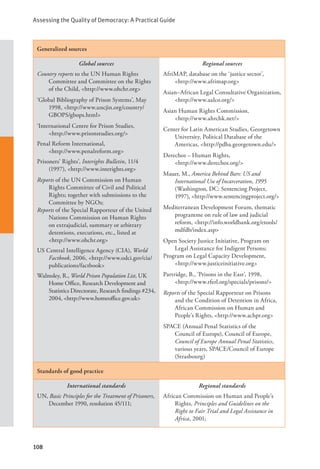
Generalized sources
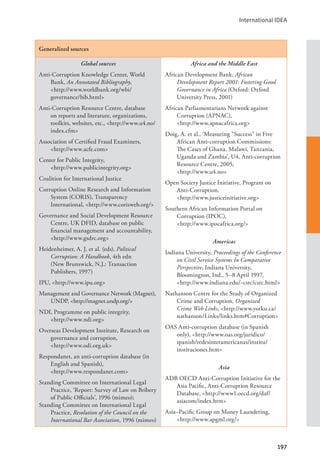
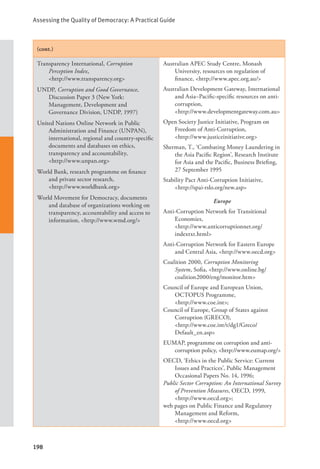
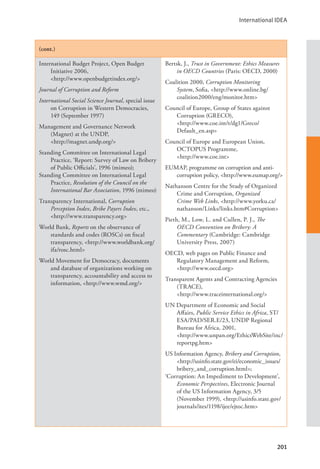
Global sources
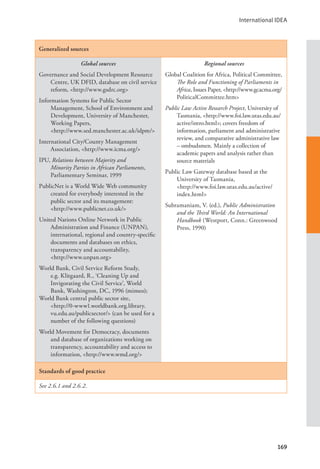
Amnesty International, Annual Report, 		
<http://www.amnesty.org>
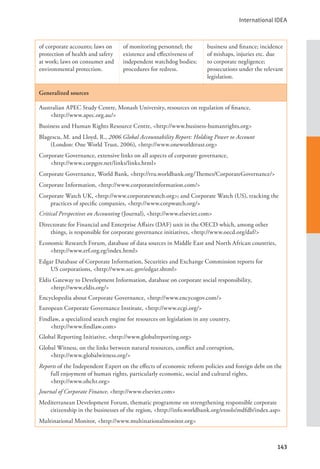
Boyle, K. and Sheen, J., Freedom of Religion and Belief:
AWorld Report (London: Routledge, 1997)
Civil Rights group, <http://civilrights.org/>
Country reports to the UN Human Rights
Committee and Committee on the
Elimination of Racial Discrimination,
<http://www.ohchr.org>
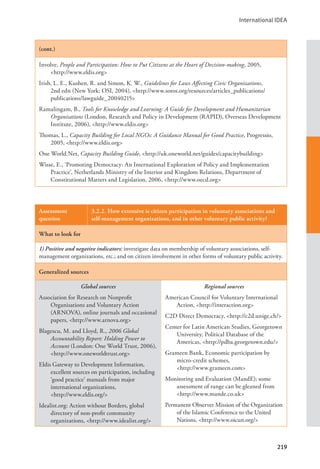
Davies, John and Gurr, Ted Robert (eds),
Preventive Measures: Building Risk Assessment
and Crisis Early Warning Systems (Lanham,
Md: Rowman & Littlefield, 1998)
Department of Political Science, University of
Kansas, Kansas Event Data System, 		
<http://web.ku.edu/keds/index.html>
Engendering Development – World Bank,
<http://www.worldbank.org/gender/prr/
draft.html>
Freedom House, Annual Report,
<http://www.freedomhouse.org> Freedom in
the World
Governance and Social Development Resource
Centre, UK Department for International
Development (DFID), Database on social
exclusion, <http://www.gsdrc.org>
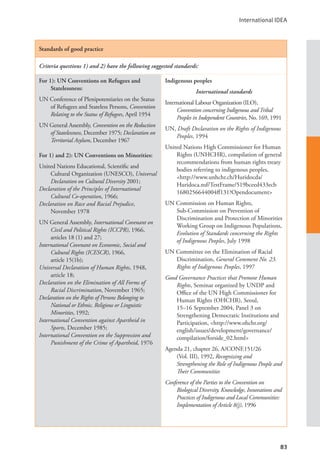
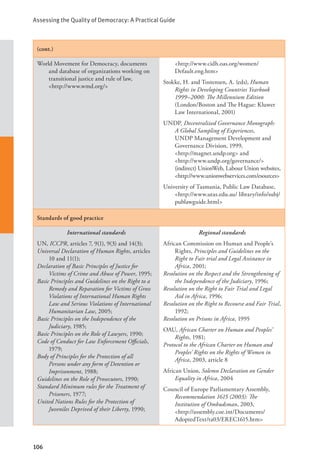
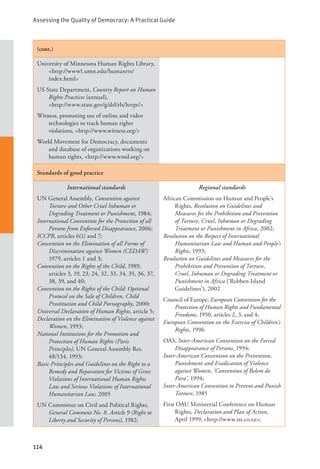
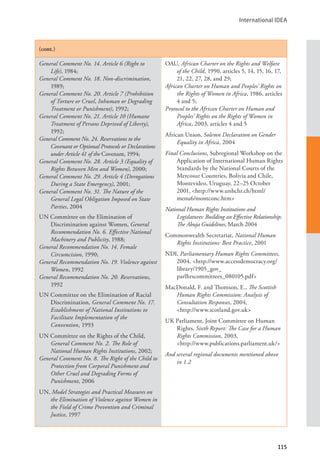
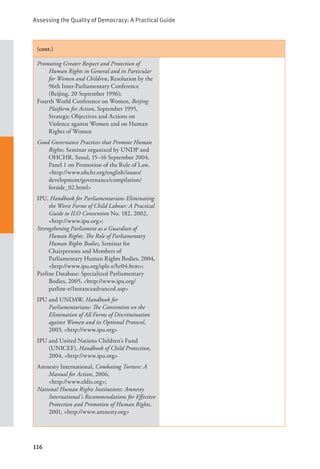
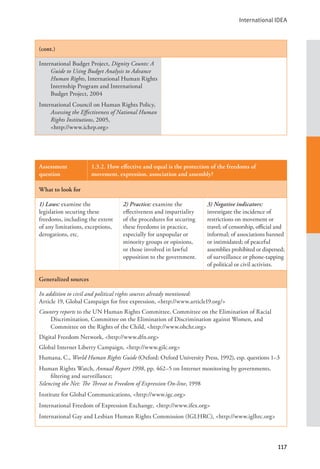
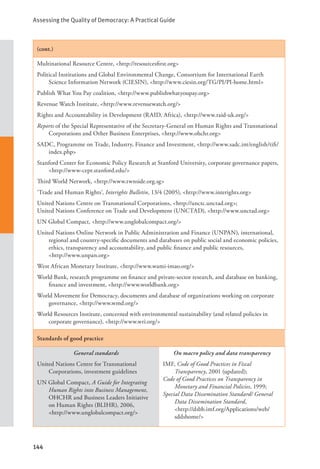
(cont’d)
Africa and the Middle East
Africa Action, <http://www.africaaction.org>
Centre for Arab Unity Studies,
<http://www.caus.org.lb/Home/index.php>
(cont’d)
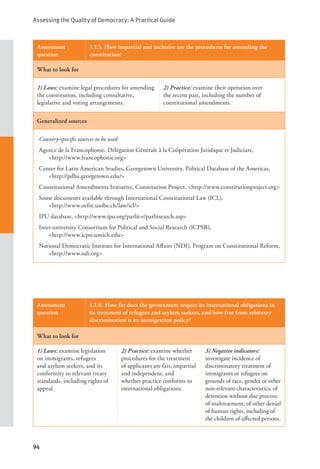
Americas
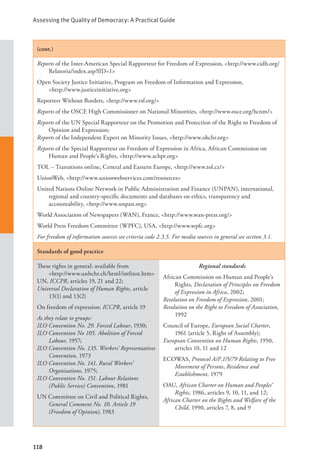
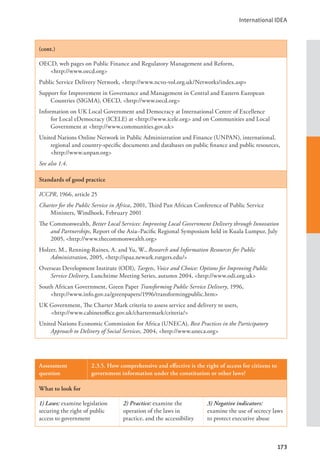
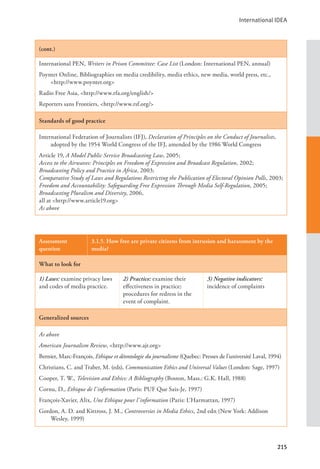
Andean Jurists, <http://www.cajpe.org.pe>
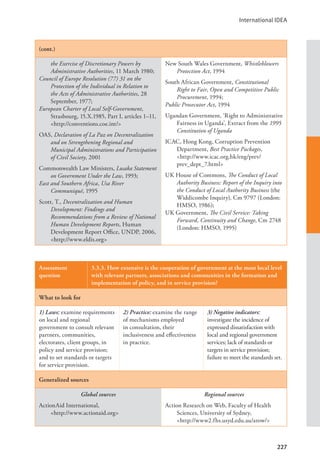
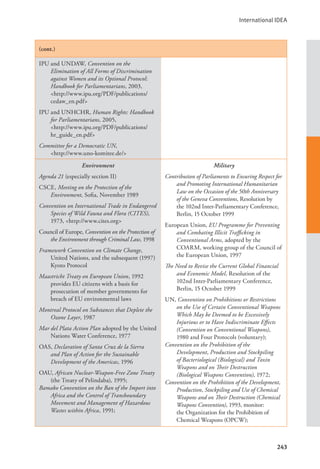
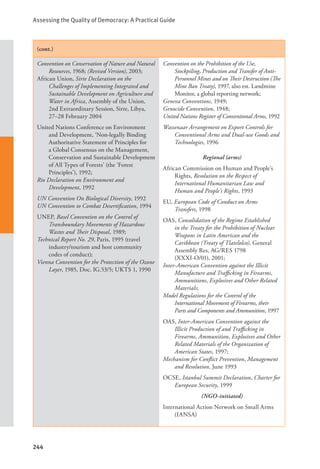
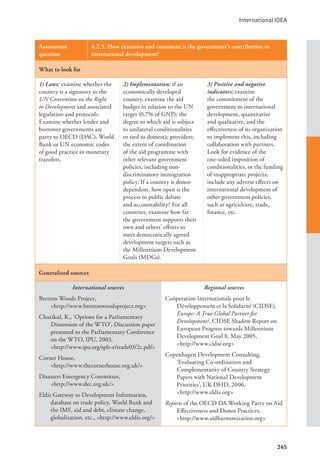
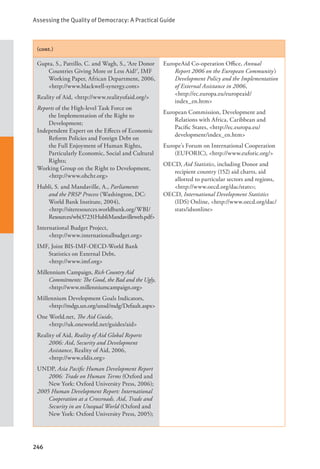
Center for Latin American Studies, Georgetown
University, Political Database of the
Americas, <http://pdba.georgetown.edu/>
(cont’d)
Asia
Alliance for Reform and Democracy in Asia,
<http://www.asiademocracy.org/>
Asian Human Rights Commission, 		
<http://www.ahrchk.net/index.php>
(cont’d)
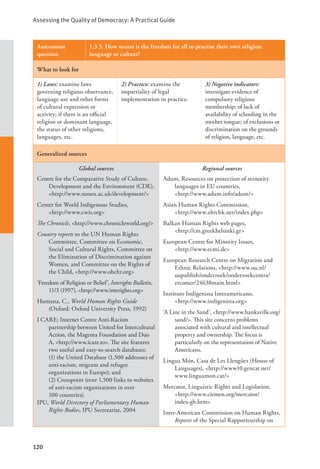
Europe
Adum, Resources on protection of minority
languages in EU countries, 		
<http://www.adum.info/adum/>
Balkan Human Rights web pages, 		
<http://cm.greekhelsinki.gr>
(cont’d)
Assessing the Quality of Democracy: A Practical Guide
32
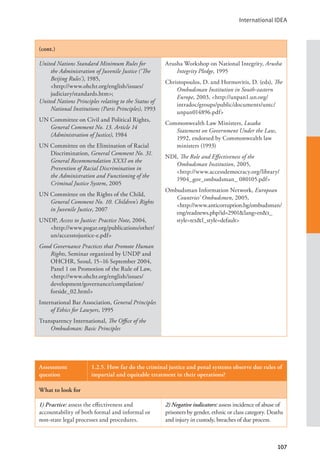
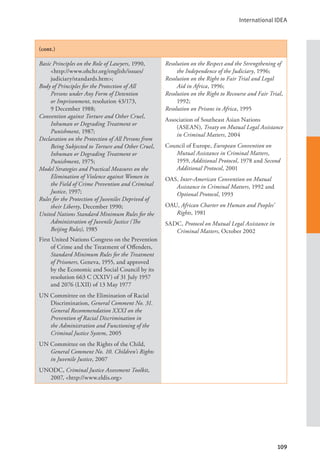
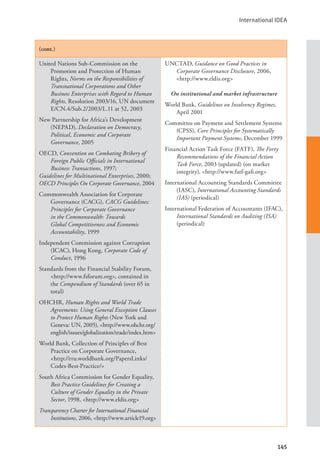
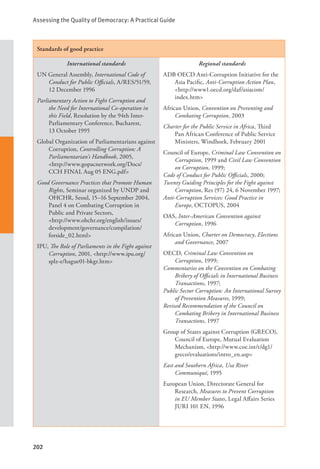
Standards of good practice
Criteria questions 1) and 2) have the following suggested standards:
For 1): UN Conventions on Refugees and
Statelessness:
UN Conference of Plenipotentiaries on the Status
of Refugees and Stateless Persons, Convention
Relating to the Status of Refugees, April 1954
UN General Assembly, Convention on the Reduction
of Statelessness, December 1975; Declaration on
Territorial Asylum, December 1967
(cont’d)
For 1) and 2): UN Conventions on Minorities:
United Nations Educational, Scientific and
Cultural Organization (UNESCO), Universal
Declaration on Cultural Diversity 2001;
Declaration of the Principles of International
Cultural Co-operation, 1966;
Declaration on Race and Racial Prejudice,
November 1978
(cont’d)
Indigenous peoples
International standards
International Labour Organization (ILO),
Convention concerning Indigenous and
Tribal Peoples in Independent Countries,
No. 169, 1991
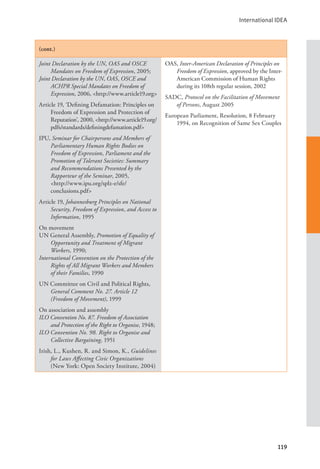
UN, Draft Declaration on the Rights of Indigenous
Peoples, 1994
(cont’d)
Regional standards
African Commission on Human and People’s
Rights, Resolution on the Rights of Indigenous
Peoples’ Communities in Africa, 2000
OAS, American Declaration on the Rights of
Indigenous Peoples, 2002, 2003;
Declaration of the Inter-American Human Rights
Commission on the Rights of Indigenous
Peoples, 1995
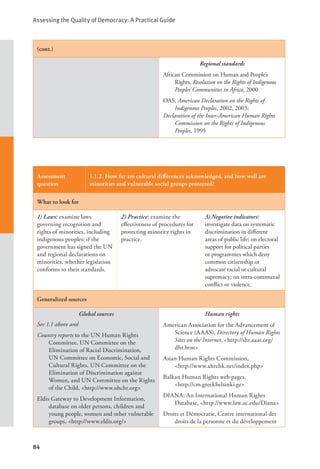
The assessment questions
[30] The first element comprises the questions that drive the assessment
process and determine what we should be looking for. As is indicated
above, these are set out separately at the start of Part 2 of the guide for
ease of reference. The search questions share four distinctive features.
[31] The first is that they are all quite broadly framed so as to provide
room for all relevant issues, some of which cannot be precisely iden-
tified in a general framework. We recommend that assessors con-
sider each search question in the light of row 2 (what to look for)
to ensure that a particular issue of concern to their assessment is
appropriately placed.
[32] Second, the assessment questions are phrased in the comparative
mode: how inclusive…? how equal…? how representative…? how
impartial…? how accountable…? how effective…? and so on. This
is because democracy is not an all-or-nothing affair, which a coun-
try either has or does not have. Rather it is a matter of degree – of
International IDEA
33
the extent to which the democratic principles and mediating values
are realized in practice. What counts as ‘to a good degree’, and the
concept of an appropriate comparator, are considered below. For the
moment it is sufficient to emphasize that democracy is a continuum,
and that the questions for assessment are phrased comparatively.
[33] A third feature of the assessment questions is that they each address a
different aspect of the thematic area, or a different mediating value in
respect of which it can be assessed. It follows that a country may per-
form better in some areas than in others, or better in some respects
than in others. Not all the democratic values or practices necessarily
fit neatly together. An electoral system may produce a highly repre-
sentative legislature, but one that is also less clearly accountable to its
electorate. A legislature may have strong checking powers over the
executive, but the executive may have difficulty in achieving the pol-
icy programme on which it was elected. Government may be highly
responsive to the public, but some sections of the public may have
disproportionate influence over it. And so on. The form of the ques-
tions enables such distinctions to be readily drawn, and so encourages
more complex or nuanced judgements to be made.
[34] Fourth, the questions are all phrased in such a way that a more posi-
tive answer would indicate a better outcome from a democratic point
of view. In other words, they all ‘point in the same direction’ along
the democratic continuum. As such, they also entail a judgement
about what is better or worse in democratic terms. Such judgements
have already been justified explicitly by reference to the key principles
and mediating values outlined earlier. One advantage of this direc-
tional uniformity is that the framework can easily be constructed as
a questionnaire for preliminary use for training or educational pur-
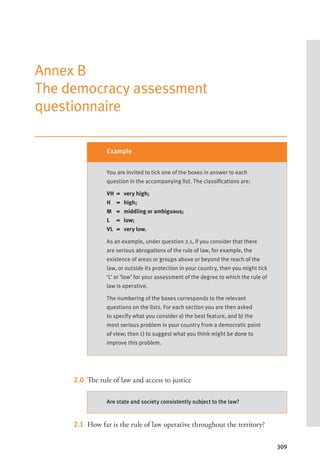
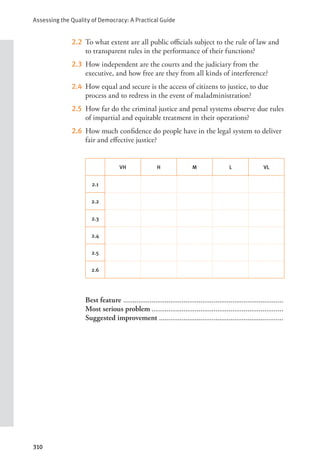
poses. A sample section is set out in questionnaire form in Annex B.
The democracy assessment questions are phrased in the comparative
mode: how inclusive…? how equal…? how representative…? how
impartial…? how accountable…? how effective…? They entail a
judgement about what is better or worse in democratic terms.
Assessing the Quality of Democracy: A Practical Guide
34
What to look for
[35] The second row in the framework has sometimes been overlooked by
assessors, but it plays a flexible and important part in complementing
the search questions by indicating the types of issue that they cover
and outlining the kinds of data that are needed to help answer the
questions. Typically, they are structured in terms, first, of the legal
position; then of how effectively the law is implemented in practice;
then of any positive or negative indicators which are relevant to the
question. So, for example, in answering a question about the freedom
of assembly, we would need to know what rights are guaranteed in
the country’s laws and constitution, and any legal restrictions on their
exercise. We would then need to know how effectively these rights are
upheld in practice, and how any restrictions are interpreted, and at
whose discretion. Finally, we would need to examine data on meet-
ings or assemblies refused permission, or disrupted officially or unof-
ficially, on levels of violence, injuries or deaths incurred, and so on,
and to assess their incidence and significance in relation to those that
have been allowed and held peacefully. A regrettably common feature
of many countries is that rights that look perfectly secure in legal or
constitutional terms are not upheld in practice. In other words, there
is a significant gap between the de jure protection and de facto reali-
zation of such rights. The list of data suggested in the second section
enables the assessment process to probe systematically behind the for-
mal legal or constitutional position, and to examine how government
is actually experienced in the everyday life of the citizens.
Generalized sources
[36] The third section provides a list of suggested sources for the data re-
quired in the second section. At this point it is important to register
the first of many caveats about our framework. The most useful sourc-
es for each question are likely to be those compiled in the country con-
cerned – government statistics, opinion surveys, NGO investigations,
academic analyses, and so on. To list all of these for every country
in the world would be an impossible undertaking. We have itemized
those sources that contain information either on most countries in a
region, or globally. Although these require continual updating, they
can provide a useful reference point. However, we do not pretend that
they are a substitute for in-country sources, or that they are necessarily
the most reliable, even when they come from a prestigious institution.
Most have their own biases, which may well be Western ones, and
they should therefore be treated with some caution. Most assessors in
practice will want to use sources of data that are already in the public
International IDEA
35
domain, and judging their reliability is an important part of the as-
sessment process, and important for its legitimacy.
Standards of good practice
[37] The final row concerns standards of good practice. Here, an even
stronger reservation is in order. The issue of what are appropriate
standards against which a given country’s performance should be as-
sessed is a contestable one, and must be a matter for decision by as-
sessors in the country concerned. What counts as a good standard of
performance in respect of each item for assessment? Who should we
be comparing ourselves with to determine this? Is it some point in
our country’s own past, or the level attained by comparable countries
in our situation, or some international standard beyond both? In this
row we have made the best compilation we can of possible interna-
tional standards and examples of good practice to serve as a point
of reference. However, we do not want it to pre-empt discussion of
which comparators are most appropriate for any given country assess-
ment. To assist this discussion we have set out a full range of possible
comparators in Table 1.4, with the rationale for each indicated, and
also some of their methodological difficulties. A brief review of these
will be useful at this point.
[38] First are internally generated standards. These have the great merit
of local legitimacy. They can either look back, to some point in the
country’s recent past, from which progress (or regression) can be
charted. Or they can be determined on the basis of popular expecta-
tions about the standards of democratic performance, for which there
may be evidence from survey data, from participatory poverty analy-
ses, or from scenario-based planning surveys. Or the government’s
own targets for the delivery of its policies or services may be used as a
reference point. Or there can be a combination of all three.
What are appropriate standards against which a given country’s
performance should be assessed? This must be a matter for decision by
assessors in the country concerned. What counts as a good standard
of performance in respect of each item for assessment? Who should
we be comparing ourselves with to determine this? Is it some point in
our country’s own past, or the level attained by comparable countries
in our situation, or some international standard beyond both?
Assessing the Quality of Democracy: A Practical Guide
36
Table 1.4. Possible comparators for standard setting
Comparator Rationale
Methodological
difficulties
A. Internally
generated
benchmarks
The country’s past It is important to chart
a country’s capacity to
progress, or the dangers of
regression.
Which point in a country’s
past to select as a
benchmark and why
Popular expectations of
performance
In a democracy, the people
provide the appropriate
measure of what should
be expected from
government.
How to determine
popular expectations. The
possibility of depressed
expectations
Government-set targets Governments should be
assessed against their own
performance claims.
Governments have an
interest in setting low
targets that are easily
attainable.
B.Externally
derived
standards
Comparator countries Comparison with other
countries can provide
a useful measure of
performance, and guide
good practice especially
where:
Inadequately standardized
data collection and
differences of context may
make comparison between
countries unreliable. Such
comparisons may carry
little legitimacy internally.
Regional they are close neighbours
or culturally similar;
Economic ranking they are at similar levels of
economic development;
Time since democratic
transition
similar periods of time
have elapsed since the end
of authoritarian rule;
Size/diversity they experience similar
problems or opportunities
of size or diversity;
Good practice they show examples of
good practice that works.
International standards Bodies such as the UN
possess widespread
legitimacy and have long
experience of authoritative
standard setting in many
fields.
Not all international
bodies carry the same
authority, nor are all
international standards
equally recognized.
[39] External standards can be derived through comparison with similarly
placed countries, whether regionally, economically, or in terms of size
International IDEA
37
or of the timing of the democratic transition. Or the assessment can
refer to international standards of good practice as these are set out in
United Nations and other international treaties, or as developed by
authoritative bodies such as the Inter-Parliamentary Union (IPU). It
is the international standards that we have brought together in our
fourth row, because they are the only ones that can be generalized;
but we would emphasize that they are only one of a number of differ-
ent possible bases for standard setting.
[40] Assessors may in fact choose to use a number of different assessment
standards, or to employ different ones for different sections of the
framework. Thus using government-set targets may be appropriate in
the field of economic and social rights, while allowing popular expec-
tations of performance to set the standard for access to justice or the
conduct of elected representatives. This must be a matter for country-
based decision. Two general points are worth making, however.
[41] The first is that the purpose of the assessment is to identify strengths
as well as weaknesses, and to chart progress as well as to identify
what most needs improving. An unrelieved diet of bad news is simply
debilitating. So a combination of looking back to a reference point
in the past, from which improvement can be charted, with a future-
oriented standard or benchmark which helps identify what still has
to be done, may well have merit. Like athletes in training who use
past performance to measure their progress as well as a national or
international standard to provide a target to aim for, a democracy as-
sessment can also employ benchmarks of both kinds.
[42] The second point to make is that we cannot avoid taking a position
on relevant standards or benchmarks if we are engaged in a democ-
racy assessment. What position we take will determine both what
data we look for in answering a given question and how we present
it. ‘Letting the facts speak for themselves’ does not relieve us from
making a judgement, even if this is only done by implication. So,
for example, if our question is about public access to government
information, then the examples of government non-disclosure that
Assessors choose to use a number of different assessment standards or to employ
different ones for different sections of the democracy assessment framework.
Assessing the Quality of Democracy: A Practical Guide
38
we draw attention to in any findings will depend on a prior concep-
tion we have of what count as legitimate exceptions from the norm of
disclosure (to protect privacy, say, or national security, or commercial
confidentiality), and what do not – as well as, of course, whether
the government manipulates such categories to withhold information
which could properly be released.
Charting the process of the assessment
[43] The purpose of this section is to explore the assessment process itself
and to identify the kinds of choices that have to be made in each of
its stages. The basic assumptions guiding our account are that the
primary, though by no means the only, purpose of a democracy as-
sessment is to contribute to public debate and consciousness raising,
and that the appropriate people to undertake an assessment are the
citizens of the country concerned.
Legitimizing the assessment
[44] The starting point should be the coming together of a group of people
committed to the idea of a democracy assessment in their country,
some of whom may become involved in the assessment process itself.
We could call this group the ‘steering group’, which will take respon-
sibility for raising funds for the project and overseeing its execution.
At two key points at least, this group will need to call in the help of
a much larger body of people, which is representative of civil society
in its different aspects, and may also include sympathetic individuals
from government and the public sector. These people are required
first, at the start of the project, to discuss the issues that will serve to
guide the focus and direction of the assessment, and to help launch
the enterprise; and, second, towards the end, to discuss the prelimi-
nary findings of the assessment, to suggest improvements, and to pre-
pare the ground for it to be disseminated as widely as possible. The
more representative this wider body is, the greater the legitimacy the
resulting assessment will have, and the greater will be the chance of
its influencing public debate and the policy process itself. Key mem-
We cannot avoid taking a position on relevant standards or
benchmarks if we are engaged in a democracy assessment.
International IDEA
39
bers of this body might be identified and brought in from the first
meeting to act as a standing advisory group available for consultation
throughout the assessment process.
[45] It is worth giving further consideration to the issue of how to enhance
the legitimacy of a democracy assessment. Since conducting such an as-
sessment necessarily entails assessing, or making judgements (even if the
judgements are positive as well as critical), a common question asked is
‘By what or whose authority are you doing this?’. Anyone who is likely
to be offended by critical aspects of the assessment will be inclined
to question the credentials of the assessors by claiming that they have
‘axes to grind’ or that they are identified with a narrow group of disaf-
fected or oppositional elements in the country’s politics. Alternatively,
if the assessment is thought to be too soft on known deficiencies, the
assessors run the risk of being typecast as ‘loyalists’ or supporters of the
government. Their legitimacy is thus an important issue.
[46] Two different ways of increasing the legitimacy of the assessment can
be distinguished, both of which are required.
The initiators of democracy assessment will need the help of a much larger
body of people that is representative of civil society in its different aspects, and
may include sympathetic individuals from government and the public sector.
These people are required to discuss the issues that will guide the focus and
direction of the assessment, help launch the enterprise, discuss the preliminary
findings, suggest improvements and prepare the ground for the assessment to
be disseminated as widely as possible. The more representative this wider body
is, the greater the legitimacy the resulting assessment will have, and the greater
will be the chance of it influencing public debate and the policy process itself.
The legitimacy of the assessors is an important issue. Anyone who is
likely to be offended by critical aspects of the assessment will be inclined
to question the credentials of the assessors, or they run the risk of being
typecast as ‘loyalists’ or supporters of the government. It is essential to
choose assessors whose professionalism and objectivity are beyond question,
and the assessment should have a broad social and political base.
Assessing the Quality of Democracy: A Practical Guide
40
Every group of assessors, however well qualified, should involve the public and
other interested parties as fully as possible. Public involvement and scrutiny
should broaden the sweep of issues and information, lessen the dangers of
bias and accusations of bias, and broaden the ‘ownership’ of the project.
[47] The first is professional: the enterprise should be systematic, rigorous,
and conducted according to the highest possible standards in terms of
the quality of data used, the verification of sources, and so on. In this
context it is essential to choose assessors whose professionalism and
objectivity are beyond question. A comparative knowledge of good
and bad practice in the different aspects of democratic government is
also important. It is here that external or international experts with
experience of conducting such assessments elsewhere can make a posi-
tive contribution, by giving added professional legitimacy to the work.
[48] The second form of legitimacy is political: the assessment should
have a broad social and political base, through the wider consultative
body, which should be referred to for advice on potentially conten-
tious issues around the focus, priorities and benchmarks of the as-
sessment, and for comment on its findings. This body should be as
widely representative as possible, and some care may be required in
selecting members to make up a body that is representative of poten-
tial stakeholders without being too unwieldy. A consultative body
should be socially representative, in terms of gender, ethnicity and so
on, as well as representative of different political viewpoints. People
who are publicly recognized as having independent voices will prove
particularly valuable in such a context, as they will help to ensure the
objectivity of the assessment process.
[49] A key point to make is that every group of assessors, however well
qualified, should involve the public and other interested parties as
fully as possible in their inquiries and deliberations from the very
beginning, and conduct the assessment in a wholly transparent way.
A number of benefits derive from the early adoption of an inclusive
and transparent process. One is that constant public involvement and
scrutiny should broaden the sweep of issues and information that the
group takes into account and lessen the dangers of bias and accusa-
tions of bias. A second is that public involvement and knowledge will
broaden the ‘ownership’ of the project beyond the immediate group
of assessors. Finally, the earlier the process of information and con-
sultation begins, the more effective will be the final dissemination of
the findings, and the greater the readiness to take them seriously.
International IDEA
41
[50] Focus groups, consultative workshops or deliberative polls are all
means by which a wider public can become included in the project.
Focus groups are especially useful for soliciting the views and experi-
ence of identifiable groups or minorities within wider society, as well
as for obtaining views on specific issues. The South Asia study made
extensive use of opinion polling in the five nations it assessed, as well
as dialogues and case studies (see Box 1.1). In the UK, Democratic
Audit has also collaborated closely in a regular series of polls on de-
mocracy issues commissioned by a major trust, framing and inter-
preting the majority of the questions asked. In Ireland a survey of
public attitudes to democracy and the rule of law was undertaken at
the outset of the assessment process, and its remarkable findings pro-
vided considerable publicity for the launch of the assessment. Such
initiatives, if they can be afforded, can do much to legitimize and
sharpen the conclusions of democracy assessments. It is also possible
to make use of existing polls, but care should be taken about the
built-in assumptions of the pollsters, any potential bias in the fram-
ing of questions, the sample size and similar questions.
Key stages of the assessment process
[51] It is now time to turn to the assessment process itself, and explore
more fully what is involved. In what follows we have selected three
key stages of the process for analysis in turn: (a) the initial decisions
which will set the direction for the assessment as a whole, and which
might form the agenda for a consultative workshop; (b) the process
of data collection, analysis and organization, which forms the core
of the assessment; and (c) the convening of a national workshop to
consider the report and its provisional findings.
Preliminary decisions for the assessment process
[52] A programme of issues to be discussed and decisions to be taken at an
early stage of the assessment process, say at an orientation workshop
with a consultative group, is set out in Figure 1.1. Many of the issues
are in practice interconnected, such that decisions on one will con-
strain or complement choices on others. Most obviously, if financial
resources are modest and there is little chance of additional sources
of income being available for the project, this will have implications
throughout the decisional process. For purposes of analytical clarity,
however, we have separated the issues into discrete decisions, and ar-
ranged them into a logical sequence, or ‘decision tree’, to serve as a
guide. We discuss each issue briefly in turn below.
Assessing the Quality of Democracy: A Practical Guide
42
The State of Democracy in South Asia study deliberately chose a strategy of using
a plurality of methods. This was not only because what was being attempted was a
comparative study of five democracies – Bangladesh, India, Nepal, Pakistan and Sri
Lanka – at various stages of democratic development and contending with different
internal forces, but also because of the firm belief that a single method would only
give a partial picture and, a limited reading of a complex reality. A single method is
bound to be deficient.
The epistemic starting point of the study was the assumption that we must
simultaneously use both qualitative and quantitative approaches to give a more
comprehensive account of the working of democracy in South Asia. The challenge
would be to integrate the findings of the different approaches and present a coherent
story. This was done with some difficulty. The study adopted four research pathways:
(a) a cross-section attitudinal survey; (b) dialogues; (c) qualitative assessments
similar to the State of Democracy framework; and (d) case studies, because each
gave us an insight into a different slice of political reality.
The cross-sectional survey of citizen’s attitudes on issues of politics in South Asia,
which was the principal pathway, sought to investigate citizens’ views on a range
of issues such as the meaning of democracy, trust in institutions, levels of activity,
human security, etc. This produced a huge data set of the attitudes and perceptions
of different sections of the population on democracy in South Asia.
The dialogues sought to elicit the views of people from civil society organizations
and political movements on the working of democracy in South Asia. Since such
activists have to continuously campaign and mobilize they have a different view of
accountable power and popular control. These views are necessary to complement
the aggregate picture emerging from the cross-sectional survey. The dialogues give a
more cynical reading of the working of democracy (see the quotations in Box 3.1).
The qualitative assessment was based on the template developed by International
IDEA whereby experts were asked to respond to questions that were given to them.
The same methodology of the democracy assessment of the State of Democracy
framework was followed.
The case studies commissioned were intended to give an in-depth account of some
aspects of the working of democracy in South Asia, particularly those considered as
‘inconvenient facts’. These refer to the puzzles and paradoxes that emerge as each
country tries both to domesticate and to become domesticated by democracy. These
intensive studies serve as theoretical challenges – hence the ‘inconvenient facts’ – to
global debates on democracy since it is not quite clear whether they constitute an
advance towards or a retreat from the process of deepening democracy.
Box 1.1.
Mobilizing a pluralist approach: the State of Democracy in South Asia Project
International IDEA
43
Purpose of the assessment
Consciousness-raising
Influencing public debate
Agenda-setting for reform
Programme evaluation
Whole framework/selected sections
Additional issues
Past-/future-oriented
In country/external
Academia and research institutes
NGOs, lawyers, journalists, etc.
Government officials, ministers,
national human rights institutes, etc.
Preliminary desk study
Continuous/towards beginning
and end of project
Choice of language medium
Printed publication/website
Use of executive summaries and appendices
Choice of different options (table 1.5)
Single report/rolling programme
Event-led/work-led time frame
Budget-led determination of tasks/task-led
search for appropriate resources
Content and priorities
of the assessment
Benchmarks/comparators
to guide the process
Selection of assessors and
division of labour
Range of sources to be used
Consultative arrangements
with stakeholders
Mode(s) of publication
of findings
Promotional strategy
Integration into a reform process
Time frame of the project
Budgetary resources
and constraints
Established sources/new data generation
Quantitative data
e.g. mass and elite
interviews, socio-economic
& administrative statistics
Qualitative data
e.g. focus groups
Case
studies
Governmental/non-governmental
In-country/external
Figure 1.1. Preliminary decisions for the assessment
Assessing the Quality of Democracy: A Practical Guide
44
(a) The Purpose of the assessment
[53] The options set out here are not mutually exclusive, as it is perfectly
possible to incorporate an agenda-setting or programme-evaluation di-
mension into a wider goal of influencing public debate about the state of
democracy in the country. However, it is important at the outset to come
to a clear and agreed understanding of the main aims of the assessment,
as this will help justify it to a wider public, including possible funding
bodies. Decisions here will also help shape much of what follows. In
particular, the timescale of the project is likely to depend on its precise
purpose. Thus the broader purpose of influencing public debate about
the country’s democracy might well suggest orienting publication of the
results to the election calendar or other significant national occasion to
which the assessment can contribute. A more specific reform purpose
might require focusing the assessment more narrowly on a constitutional
reform process with a timetable already established for public consulta-
tion. And evaluating reforms that are already under way might involve
adapting to a review timetable which has already been officially set.
[54] These examples are only suggestive. What is important is to recognize
the integral link between the purpose of the assessment, its possible
content, and its mode and timetable of publication. A further point to
make here is that, as regards a possible reform agenda, it is better to use
a democracy assessment to identify priorities for reform, or to clarify
the principles to guide such reform, than to set out precise proposals or
blueprints for change. The disadvantage of the latter is that the assess-
ment process as a whole may become discredited in the eyes of those
who do not agree with specific proposals for reform being made, even
if otherwise they would be sympathetic to its larger purpose. So, for ex-
ample, an assessment might well draw attention to the deficiencies of a
First Past The Post (FPTP) electoral system, from a democratic point of
view, in the context of a given country. But it should stop short of rec-
ommending some specific alternative which might prove much more
contentious, not least because all electoral systems have some disadvan-
tages. Specific reform proposals could form a supplementary agenda for
research, but should be kept separate from the assessment itself (see the
section ‘from assessment to reform’ below, paras 110–11).
(b) The content and priorities of the assessment
[55] We have already acknowledged that the assessment framework we
have developed is very extensive, and may seem discouragingly large
at first sight. Its advantage lies precisely in its completeness, and in
the way in which the different aspects of a country’s democratic life
International IDEA
45
can be located in the context of the whole. It may well be that the
expertise and information required to answer the questions already
exist in the country, and that the main problem lies in identifying
it and bringing it together. Thus a legal expert might well be able to
access the data relevant to the section on the rule of law quite read-
ily, a human rights lawyer the section on civil and political rights,
an electoral analyst the section on free and fair elections, and so on.
So what appears a formidable task at first sight becomes more man-
ageable once it is broken down into its component sections, as the
Advanced Social and Political Research Institute (ASPRI) found for
its assessment of Latvia. But it remains a large and complex task to
pull it all together.
[56] The experience that International IDEA has developed through pilot-
ing the assessment framework with in-country experts suggests that a
group of three or four people, each with different expertise, and work-
ing with research assistance, requires a minimum of six months to
complete a preliminary assessment that covers the whole framework.
However, this involves using existing data and sources, and means that
some questions can be answered more fully than others. Generating
new data, say, through opinion surveys, or through consultative bench-
marking with consumer groups, or through other forms of research,
would extend the time and cost considerably. Much depends, therefore,
on the depth to which the issues are to be investigated.
[57] If the cost in time and resources of undertaking the whole assessment
proves prohibitive, then a number of possibilities suggest themselves,
all involving selection of some kind. One is to select those issues or sec-
tions that are most salient to public concern and political debate, and
to concentrate on those. If this approach is adopted, it is important
that the selection be made explicitly, and in the context of the frame-
work as a whole, so that it is possible to see how the assessment is to be
A group of three or four people, each with different expertise, and working
with research assistance, requires a minimum of six months to complete
a preliminary assessment that covers the whole framework. Generating
new data by means of consultative benchmarking with consumer groups
or other forms of research would extend the time and cost considerably.
Assessing the Quality of Democracy: A Practical Guide
46
If the cost in time and resources of undertaking the whole assessment
is prohibitive, it is possible to concentrate on those issues or sections
that are most salient in public concern and political debate, or to
undertake different sections of the framework successively.
located within the overall context of the country’s democratic life. If
this sense of overall context is lost, there is a danger that any resulting
assessment will appear partial and one-sided. It should also be remem-
bered that one purpose of a democracy assessment may be to raise the
profile of issues which have so far escaped public attention.
[58] A second strategy is that of the ‘rolling programme’, with different
issues and sections undertaken successively as time and resources per-
mit. This was the approach adopted by the first Democratic Audit of
the UK and in the Philippines. In the UK, Democratic Audit began
by investigating the state of citizens’ rights, before proceeding to an
audit of the country’s central political institutions, with the findings
of each published in separate volumes. These large studies were com-
plemented by the interim publication of original research papers on
more specific issues with a reform focus, which helped bring the au-
diting process to public attention before the fuller studies were com-
pleted. In the Philippines, the assessment received piecemeal funding
to carry out assessments on each of the four main pillars of the frame-
work, thereby allowing a complete assessment to be carried out over a
longer period of time.
[59] In Australia, the assessment has been built up with a series of re-
search projects on issues judged particularly salient for the country’s
democracy, including political finance, the representation of minori-
ties, how well Australian democracy serves women, and many others.
[60] Whichever of these approaches is adopted, the important thing is that
any selection that is required should be consonant with the identified
purpose, proposed timescale and anticipated impact of the assess-
ment. These goals will naturally depend on country-specific consid-
erations, for which generalizations are difficult to make. By the same
token, there may well be some distinctive issues or questions that
call for investigation, which are not fully covered in our assessment
framework. Adding questions or adapting them to the conditions or
International IDEA
47
priorities of the individual country must be a matter for local discre-
tion, although the advantage of maintaining comparability with as-
sessments being conducted elsewhere should also be recognized.
(c) Benchmarks or comparators to guide the process
[61] The importance of being clear about possible benchmarks or compar-
ators against which a country’s level of democracy might appropriate-
ly be assessed has been discussed above, and the different possibilities
are set out and explained in Table 1.4. We have also emphasized the
advantage of combining both a backward-looking frame of reference,
to chart possible progress, and a present- or future-oriented standard,
to identify levels of attainment. Here we discuss possible practical
difficulties associated with the different choices.
[62] The purpose of selecting a reference point in the country’s past is to
provide a sense of historical perspective to what is otherwise a con-
temporary snapshot without any context, as well as to assess possible
progress. Two practical problems present themselves. The first is how
to select an appropriate time-point for reference; the second, how to
make an effective comparison in the absence of any systematic assess-
ment having been conducted for the earlier period in question. These
problems are much less acute for the new democracies: the point of
transition from a previous authoritarian regime provides an obvious
reference point. There is also likely to be considerable public agree-
ment on what the defects of that regime were, to provide a basis for
assessing change. Finally, there will probably already be a programme
of constitutional and public sector reform under way, and there may
be ample material for assessing its effectiveness. For longer-established
democracies, the selection of a past reference point may be somewhat
arbitrary, and its logic therefore less compelling, unless there has been
a clear moment of substantial political or constitutional change in the
recent past.
Some country-specific considerations or questions, which are not
fully covered in our assessment framework, may call for additional
investigation. Adding or adapting questions to the conditions or
priorities of the country must be a matter for local discretion.
Assessing the Quality of Democracy: A Practical Guide
48
Benchmarks or comparators have to be selected against which a country’s
level of democracy can appropriately be assessed. These may be a reference
point in the country’s past, or other internal or external target standards.
[63] The selection of target standards as the comparator often proves more
controversial. As is suggested above, domestic benchmarks are likely
to have greater legitimacy than external ones, especially for newly
established democracies. Using popular expectations of government
performance would seem an entirely appropriate standard for a de-
mocracy assessment, but there are some practical difficulties. One is
that clear evidence of such expectations may not exist in the public
domain, and the cost in time and resources of collecting new survey
data, conducting focus group discussions or other participatory ex-
ercises, is high. When collected, the evidence from public opinion
may be ambiguous or uncertain, especially on issues such as the inner
workings of government, say, as compared with the delivery of public
services. However, the collection of evidence about popular expecta-
tions of government in appropriate areas could form a very useful
product of a democracy assessment, especially when coupled with
people’s own assessment of the extent to which their expectations are
actually met in practice.
[64] A complementary strategy to the above, which is also much cheaper,
is to identify official targets for areas of public life, which can be used
as possible benchmarks. Most constitutions contain statements of
rights and responsibilities, and it is entirely appropriate to investigate
how far these are realized in practice. Governments themselves set
standards or targets for many areas of public life – standards for the
conduct of public officials, or for the practice of open government;
future targets for the improvement of health and education or the
reduction of poverty; citizens’ charters for the delivery of public ser-
vices; goals and mission statements of all kinds. Again, identifying
these and relating them systematically to the assessment framework
can itself be a useful part of the assessment process. Moreover, no
benchmark can have greater legitimacy than assessing institutions
against their own self-proclaimed standards, even if these are merely
intended for declamatory or public-relations effect.
[65] The usefulness of externally derived standards, by contrast, depends
very much on how far these are likely to be endorsed by domestic
public opinion. If there are natural regional or other comparators, to
International IDEA
49
which a country’s people will usually relate, then their comparative
attainment in different areas could be used to establish a standard
of good practice for domestic assessment. Where neighbours are re-
garded with hostility, on the other hand, such a course may simply
prove counterproductive. A familiar practical difficulty with com-
parative tables is that of standardization: data may be collected in
quite different ways in different countries, and differences of context
and significance may render them less truly comparable.
[66] Similar qualifications apply to the international standards and exam-
ples of good practice that we have collected in row 4 of our assessment
framework. Not all of these have been developed by official interna-
tional or regional bodies of which the country being assessed may be
a member. Nor do such standards necessarily command legitimacy in
the country itself. However, where the standards are long-established
and are widely recognized internationally or regionally they constitute
a valuable resource. What is needed is a sensitive application of them
that acknowledges such contextual circumstances as the time frame of
the country’s democratic evolution and its level of economic develop-
ment. A useful starting point is to identify which of the main interna-
tional or regional conventions identified in our fourth row a country
has signed up to, and with what reservations or qualifications. This
process will at least establish where the country stands officially with
regard to the standards that the respective conventions seek to uphold.
[67] As is explained above, there are more firmly accepted international
standards for some sections of our framework than others, for exam-
ple, covering human rights in all their aspects, refugees and asylum
seekers, social and environmental targets, and some others. Agree-
ment on standards for political institutions is mostly a long way off,
although many states’ legislatures have signed up to the IPU’s decla-
ration of standards for free and fair elections. However, it is a distinc-
tive feature of the current international scene that all kinds of bodies,
international, regional and national, both official and civil society-
based, are engaged in developing standards for all aspects of public
life; and it can be expected that some of these will gain increasing
international acceptance over the coming years.
Internal target standards are likely to have greater legitimacy than
external ones. They include popular expectations of government
performance (if evidence exists), statements of rights and
responsibilities contained in the constitution, and official targets.
Assessing the Quality of Democracy: A Practical Guide
50
The usefulness of externally derived standards will depend very much on
how far these are likely to be endorsed by domestic public opinion. Not
all internal standards command legitimacy in the country itself; a
country may not have signed the relevant conventions; and in general
agreement on standards for political institutions is a long way off. The
international standards in some sections of the International IDEA
framework are more generally accepted than those in other sections.
[68] In conclusion, and in the light of what we might describe as an un-
even patchwork of different kinds of benchmarks or standards, we
would expect that agreement on these will evolve over the course
of the assessment, and be clearer for some sections and issues than
others. The important thing at the outset, however, is to be aware of
the range of options available, and their respective implications, as a
matter for early discussion.
(d) Selection of assessors and division of labour
[69] As already discussed, a democracy assessment will need to call on a
variety of different kinds of expertise to cover the different sections of
the framework. Between them the assessors will need to cover human
rights, legal affairs, social and labour issues, the media and public
opinion, as well as the more institutional aspects of politics and pub-
lic participation. The team of assessors ought to be an interdiscipli-
nary group, which might include lawyers, journalists and academics
working in the social sciences.
[70] Listing all the desirable qualities of assessors runs the risk of postulat-
ing some super-heroic norm for our prospective group! It goes without
saying that they will need professional experience in data collection and
analysis. At the same time, conducting a democracy assessment is dif-
ferent from producing a standard academic or journalistic article, and
involves a readiness to identify the strengths and weaknesses of the
country’s democratic life within an explicitly evaluative framework, and
to do so with sufficient detachment and impartiality to avoid charges of
bias and with sufficient writing skills to make the report accessible.
[71] The process adopted by International IDEA for some of its pilot as-
sessments was to use researchers experienced in its methodology to
International IDEA
51
undertake a preliminary desk assessment using country-based as well
as international sources, so as to provide a starting point for the in-
country experts. Desk studies were also prepared for the Mongolian
assessment. They helped to identify gaps in information on the coun-
try that needed to be addressed and complemented the full range of
outputs for the assessment project (see Part 3). It is important to note
that as a preliminary sifting device desk studies have generally proved
useful to the in-country assessors, but they are not a substitute for
their own judgement and expertise. Dividing the assessment into two
stages in this way is neither necessary nor always desirable.
(e) The use of sources
[72] The use of sources is discussed more fully in the next section (see
paras 78–88). Here it is sufficient to note a couple of issues that
merit preliminary discussion within a consultative group. The first is
whether the resources available will permit new research into public
opinion of the kind that is typically quite expensive, whether involv-
ing opinion surveys, consultative forums or other research. The use-
fulness of these to the assessment, both for identifying public expec-
tations and for gauging popular assessment of government or regime
performance in specific areas, has already been indicated. A prelimi-
nary review of what is already available in the public domain would
make a useful contribution to such a discussion.
[73] A further contribution that a consultative group could make to the
discussion of possible sources would be to identify from their own
contacts and experience those agencies, organizations or individuals
already engaged in data collection and analysis in areas relevant to
the democracy assessment. It may well be the case that there are cam-
paigning groups or organizations based in the country which already
keep systematic data on human rights violations, prison conditions,
the incidence of corruption, the harassment of journalists and so on
which could provide an invaluable source of information alongside
official statistics and academic investigations. Identifying such or-
ganizations and linking them where appropriate to the assessment
process would offer an additional resource to the project.
(f) Consultative arrangements with stakeholders
[74] The importance of involving a wider consultative group of stakehold-
ers at the beginning of the assessment process, and benefiting from
their comments on a draft of the report and its conclusions towards
the end, has already been stressed. Whether this group, or some of
Assessing the Quality of Democracy: A Practical Guide
52
its members, should have a standing advisory role throughout must
be a matter of judgement, according to the expected timescale of the
project, and whether significant decisions affecting focus, content or
funding are likely to have to be made as the work progresses.
(g) Publication and promotion
[75] The issues to be considered under this heading are reviewed in para-
graphs 96–108. The essential point to make here is that it pays to give
careful consideration at the outset of the project to the questions of
who the target readership or readerships of the assessment may be,
what form or forms of publication are appropriate for this anticipated
readership, whether translation will be required, and so on. Choice
of publisher or publishing outlet and a promotional strategy can then
also be planned at an early stage. As well as publishing the report
in hard copy, modern dissemination strategies also involve publica-
tion on a website (with links as far as possible), email distribution,
and brief popular summaries in hard copy and electronic form. Such
strategies require forward planning.
(h) Timescale and financial resources
[76] The decision on a timescale for the project will largely depend on de-
cisions already made on a number of the issues identified above. Even
if the assessment is not directed towards a clearly defined future mo-
ment in the country’s constitutional or political evolution, potential
funding sources will expect a realistic deadline for completion of the
programme of work. And the resources obtained will in turn condi-
tion the extent or coverage of the assessment, or the depth to which
it can probe. An initial exploration of these resourcing considerations
may well have to be undertaken prior to a wider consultative meet-
ing. Indeed, the programme of decisions to be taken in the forma-
tive stage of the project may better be understood as an evolving or
iterative process, in view of their interconnectedness, rather than as
the agenda for a single meeting. However, it is important that all
the issues should be subject to consultation and made the focus of a
workshop with potential stakeholders in the project, so that the pro-
ject can benefit from their experience and contacts, and the issues can
be tested against the widest possible range of viewpoints.
International IDEA
53
Data collection, analysis and organization
[77] This section concerns the core process of a democracy assessment,
and offers guidance on data collection and analysis. Most assessors
will develop their own method of working, and there is no one cor-
rect method for proceeding in what is inevitably a time-consuming
and sometimes laborious activity. However, Figure 1.2 itemizes the
stages and tasks that we have found useful in conducting an assess-
ment. Again, each stage is discussed briefly in turn.
Figure 1.2. Stages in data collection and analysis
(a) Constructing a bibliography
[78] The simplest way of constructing a bibliography is to take each sec-
tion of the framework in turn, using standard bibliographical searches
and other information to hand about likely sources. Academic books
and articles are useful for their quality of analysis. Online sources
from government departments, official statistical services, polling
It is important that all the issues should be subject to consultation and
made the focus of a workshop with potential stakeholders in the project,
so that the project can benefit from their experience and contacts, and
the issues can be tested against the widest range of viewpoints.
Constructing a bibliography
Identifying appropriate sources
Compiling and coding sources
Searching sources for each question
Identifying appropriate data for inclusion
Summarizing the items and locating them under each question
Referencing the source of each item to be included
Ordering the items collected in the previous stage for each
question by theme, date or other organizing principle
Prioritizing the items according to their importance
Editing material collected under each question and writing up
as a finished text according to an agreed style
Choosing features for boxed quotations and tables
Constructing a reference list for each question or section
Confirming that items are in the best place and cross-referencing
them to other questions
Checking for inaccuracies, inconsistencies, etc.
Identifying gaps for further searches
Identifying and sorting data
Arranging and prioritizing
items for inclusion
Writing a draft text
Assessing the Quality of Democracy: A Practical Guide
54
organizations, NGOs, news reports, and so on, tend to be more up
to date. Our experience is that most sources will be specific to one
section of the framework, although they will most likely be relevant
to more than one question within it. So it makes good sense to con-
struct the bibliography on a sectional basis, with coding for specific
questions where appropriate. Cross-referencing to other sections or
questions is a relatively straightforward matter. When the exercise has
been completed once, it will become clear which sections or questions
are less well covered, and where a more concentrated further round of
searching may be required. Adding further items to the bibliography
is likely to be an ongoing process throughout the assessment.
[79] Two features of our assessment framework will be of assistance in
this stage. Row 2 of the framework sets out the typical data required
for answering each question, and thus provides pointers to possible
sources. So, for example, many begin with the state of the law, which
suggests that the country’s constitution, its bill of rights and more
specific legal codes will be necessary sources. Investigating how the
law is implemented in practice, on the other hand, is likely to require
the use of less official sources of information, such as NGO reports or
academic studies. Sometimes an official report, say, from the legisla-
ture or ombudsman’s office, on implementation of the law can throw
light on whole areas of government practice.
[80] Row 3 of the framework identifies international or regional sources
covering more than one country, organized by section and question.
They are the ones we have ourselves found useful, and they are organ-
ized in a way that is precisely geared to the assessment process and its
requirements. Many tend to be written from a Western perspective,
however, and in any case they are no substitute for country-specific
sources, to which they should be seen as a potentially valuable com-
plement, rather than as an alternative.
[81] Assessing the reliability of different sources is obviously an important
task, but depends on local knowledge and experience, and it is impossi-
ble to generalize about it. The value of official sources, for example, may
well depend on whether the statistical office is genuinely independent of
government or is merely another arm of the government’s propaganda
machine. Past experience will be an essential guide in this context.
(b) Identifying and sorting data
[82] This stage comprises the painstaking work of reading and, identi-
fying relevant data or evidence and filing or recording it under the
International IDEA
55
appropriate question. Again it makes sense to proceed on a section-
by-section basis, since most of the sources will contain material that
is relevant to more than one question (although rarely to more than
one section). An important point to bear in mind is that few, if any, of
the sources used will be structured towards answering the assessment
questions, since they will have been compiled or written for quite
different purposes. So the data will need to be ‘dug out’ from the
sources, and a lot of irrelevant material either ignored or discarded.
[83] In identifying what is relevant, the main search questions of row 1 of
the assessment framework obviously provide the chief guide, supple-
mented by two further search tools. Row 2 of the framework provides
a systematic account of the data relevant to answering each question,
and is particularly helpful at this point. Any decisions already taken
about benchmarks, whether past attainments, present standards or
future targets, provide what can be described as the fine-tuning for
the search process.
[84] What sort of data will the assessor be looking for? Anything which
throws light on the general condition of the body politic in the rel-
evant area, or which is symptomatic of its condition, is germane. This
may be a brief summary by an authoritative expert, the findings of a
report, official or unofficial, a statistical table, a legal judgement, an
opinion survey, a newspaper or media investigation, some key event
or series of events or experiences which typifies a more general con-
dition, or any combination of these. At this stage the more kinds of
evidence that can be collected, the better.
[85] It is clear, and has been so from the various experiences in using the
framework around the world, that a mixture of qualitative and quan-
titative data should be collected and analysed. Historical, legal and
contextual information provides important background for establish-
ing a baseline assessment of democracy. Qualitative data on people’s
experiences of democracy, their perceptions, and areas in need of re-
form can be collected through a variety of means, including in-depth
interviews, participant observation, focus groups, national reflective
workshops and conferences. Quantitative data collection and analy-
sis can complement the qualitative work, where numerous indicators
across the rows of the framework can be collected to provide a de-
scriptive mapping of democracy. These can be used for ‘second order’
analysis that seeks to identify explanatory factors that account for the
patterns observed in the descriptive analysis. If the data are available,
such analysis can identify the broad contours in the democratic ex-
perience as well as examine significant differences in that experience
Assessing the Quality of Democracy: A Practical Guide
56
A mixture of qualitative and quantitative data
should be collected and analysed.
Avoid making a judgement about the answer to a given
question before looking for the data. Most answers will
involve evidence that points to a mixed state of affairs.
across different social demographic categories, such as age, gender,
income, occupation, geographical location, race, ethnicity, religious
affiliation and indigenous identity.
[86] The goal of combining qualitative and quantitative methods is to pro-
vide as rich and robust a portrait of the democratic experience as pos-
sible within the resource constraints of any one assessment project. It
is also possible that carefully selected quantitative data can provide a
‘snapshot’ to illuminate a whole area of public life. For example, fig-
ures of the size of the prison population compared with the supposed
prison capacity, of the proportion of prisoners awaiting trial, of the
average time taken to bring a case to court – all these can give a rapid
insight into the state of a country’s criminal justice system.
[87] Two pieces of cautionary advice are worth giving here. First, avoid mak-
ing a judgement about the answer to a given question before looking
for the data and in this way predetermining the selection of data. Most
answers will involve evidence that points to a mixed state of affairs,
neither wholly good nor wholly bad, and assessors should try to keep an
open mind until the bulk of the relevant data has been collected. The
second caution is more elementary: make sure that all verbatim extracts
from other sources are placed within quotation marks, so that they do
not end up in a finished draft as if they are an original text.
[88] The product of this stage of the assessment might thus be a substantial
list of items collected under each question, of very different kinds,
with the sources of each identified, and cross-referenced to other ques-
tions to which they might also be relevant. They may well be in no
particular order and contain much overlap and duplication. But bet-
ter more than less at this stage. By now it should also be clear where
substantial gaps in the record occur, and where new research might be
commissioned for the most urgent issues, if funding permits.
International IDEA
57
(c) Arranging and prioritizing the items
[89] This is the stage of arranging the material collected so that it provides
a clear picture, or tells a coherent story, even if it is a complex one. It
is a good idea at this point to go back to the original question and re-
mind yourself what would count as a relevant answer to it. Then it is
a matter of arranging the items in an appropriate order, whether it be
of thematic type, order of significance, or historical priority, accord-
ing to what seems best for the particular question and in the light of
the overall focus of the assessment. This stage may well overlap with
the start of writing a draft text, since arranging material in order is
itself part of the process of ‘telling a story’ which will link the discrete
items of data or evidence together. One way of thinking of an answer
to the assessment questions is as a brief summarizing judgement, with
the evidence arranged so that it supports, expands or explains the
judgement in a systematic way.
[90] Two issues are likely to emerge at this stage, if not before. The first
is that there may well be inconsistencies, as well as duplication, be-
tween the different sources from which data have been collected, and
further investigation will be needed to resolve any possible contradic-
tion. A second issue concerns continuing gaps in the evidence, for
which further sources may still need to be identified.
(d) Writing a draft report
[91] If the above stages have all been carried out, writing the report
should not prove unduly onerous. Presumably by now a decision
will have been taken on the form and length of a finished draft,
although both may need to be modified in the light of the mate-
rial assembled. It makes for easier reading to avoid long unbroken
chunks of text, which may be varied with tables, summaries, quota-
tions, exemplary events or experiences, and so on, to complement a
more discursive account.
(e) Setting the report in context
[92] It will be important at this point to consider the kind of introduction
the report will need. How will you explain and justify the assessment
process to the potential reader? What information is needed to make
the assessment intelligible in the context of the country’s distinc-
tive character and present condition? This information will almost
certainly include a discursive summary of the country’s recent pro-
cess of democratic development, and of any features in the country’s
Assessing the Quality of Democracy: A Practical Guide
58
A key point in the assessment process is the convening of a national
workshop to discuss the draft report and its provisional findings.
political traditions and culture that may have given the process its
distinctive trajectory and help explain its current condition. An in-
troductory narrative of this kind will also help provide a justification
for conducting a democracy assessment at this particular juncture.
[93] Other items that might be included in an introduction to the report
are basic facts about the country’s current political system, and lead-
ing socio-economic and human development indicators, if these are
not already included in the relevant sections of the assessment.
Convening a national workshop
[94] A key point in the assessment process is the convening of a national
workshop to discuss the draft report and its provisional findings in
order to improve its content and presentation. Although this event
could be confined to professional and academic experts, it will have
much more impact if it is widened to include leading public figures,
government and party officials, and representatives of human rights
and other campaigning organizations, as well as media personnel and
sympathetic figures from neighbouring countries. A wider body of
this kind, representative of political society as a whole, will subject
the findings to a more searching test and improve the analysis and
its presentation, and also enable the findings to reach a much wider
audience and give them much greater legitimacy.
[95] Workshops undertaken by International IDEA in countries selected
for our pilot study have included in their membership such figures as
the chairmen of the official and unofficial constitutional review bod-
ies (Kenya); party delegates and leading diplomats (Malawi); senior
representatives from the police and human rights organizations (El
Salvador); the clerk of Parliament and the chief electoral commis-
sioner (New Zealand); and a regional prosecutor and a senior journal-
ist (Italy). The two international conferences organized by the Mon-
golians included a variety of international and national stakeholders
who provided reflection and advice on the design, implementation
and follow-up activities of the assessment. The proceedings of the
workshops for the pilot studies as well as those in Mongolia aroused
substantial public interest and were widely reported in the national
International IDEA
59
press. In many cases the quality of comment and discussion by par-
ticipants led to significant revision and improvement of the assess-
ment report. For an example of a successful workshop, see Box 1.2.
The workshop, opened by the Swedish ambassador to Kenya, Ms Inga Björk-Klevby,
was attended by about 45 people, including members of Parliament, academics,
lawyers, representatives of national NGOs, local representatives of government and
international organizations.
The first session was devoted to a debate on the constitutional reform process, at
which leading representatives of the two alternative review bodies – the civil society-
based Ufungamano, and the official parliamentary forum – presented the arguments
for their respective organizations. The rest of the seminar was taken up with an
audiovisual presentation of the key findings of the report, and a discussion organized
around nine key questions advanced by Professor Njuguna Ng’ethe, the report’s
principal investigator:
• What conception of democracy is implied or implicit in this particular comparative
framework of democracy assessment?
• Is this conception useful for the Kenyan situation?
• Is this conception legalistic, institutional, political, economic, and social, and how
are these different aspects weighted in the framework?
• Can the framework capture the dynamics of change or can it only take a static
snapshot of the ‘state of democracy’?
• Does the comparative framework adequately balance the elements within the
democratic process?
• How are these components of the democratic process implicitly or subsequently
weighted, and what is the resulting utility of this ranking?
• What is the nature of the epistemology underlying this framework? E.g., would an
‘ordinary’ citizen generate the same democratic ‘menu’, or a more utilitarian one?
• Is it useful to be comparative?
• What are the real determinants of democratization and are these captured by the
framework?
The workshop was fully reported in the next day’s press, and the organizers gave
interviews for both radio and television. A key issue discussed at the conclusion of
was how to disseminate the findings more widely, including linkages with existing
civic education projects.
The Workshop was organized by the Series on Alternative Research in East Africa Trust
(SAREAT) and International IDEA and held at the Norfolk Hotel, Nairobi, on 22 June 2000.
Box 1.2.
Report on the Kenya Democracy Workshop
Assessing the Quality of Democracy: A Practical Guide
60
Democratic Audit in the UK held a workshop on a recent report
on the country’s counter-terrorism laws and strategy which benefited
from a wide-ranging and diverse composition, including a former
senior judge, a high-ranking intelligence official, human rights law-
yers, leading politicians from the three largest parties, defence law-
yers, representatives of relevant NGOs and national journalists.
Strategies for making democracy assessments public
[96] The ultimate aim of a democracy assessment is to give a country’s
society a thorough analysis of the strengths and weaknesses of its
democratic arrangements for people to consider and (if possible) act
on. So the final report has to be widely disseminated and promoted to
ensure that its findings are fully debated. One of the major benefits of
adopting the transparent and inclusive strategy that we recommend
above for the process of democracy assessment is that it provides a
public platform from which to disseminate and promote these find-
ings. The earlier the process of information and consultation begins,
the more effective will be the final dissemination of the findings. The
interested parties and the wider public will be better prepared to un-
derstand, assimilate and, as necessary, act on the findings if they have
already been informed and involved in shaping them.
[97] The job of disseminating information on a subject like democracy is
often a difficult one for groups to undertake. Moreover, almost any
group undertaking a democracy analysis is likely to be constrained
by limited resources. None has the kind of promotional resources
that a major commercial company can mobilize. The assessors’ own
circumstances and resources will vary considerably, as will the condi-
tions in the countries they are assessing. Many groups of assessors
will be attached to academic institutions without practical experience
of promotional campaigns and with only very limited opportunities
for direct access to the public or to NGOs, which may well have more
promotional experience.
[98] In many countries, state control of the media deliberately constrains
coverage. Consequently, public interest in analysis of a political system
is rarely strong, except where tyranny, misrule, persecution of minori-
ties and corruption have inspired desire for change towards a more
democratic polity. Then it can emerge, even where state control of the
media is very strong and intimidation of journalists is common.
[99] The difficulties of communication in poorer countries with largely
rural and illiterate populations, usually with no or limited access to
International IDEA
61
the print or electronic media, are frequently – and rightly – stressed.
But there are also immense difficulties in more developed societies
with more educated populations and diverse media sources. In such
countries, attempts to raise questions of the quality of democracy,
human rights abuse, discrimination and so on tend to be drowned
out in the clamour of commercial and entertainment matter on most
media. Moreover, modern media tend to be interested in politics only
at the level of the major political figures and their activities rather
than at that of detailed analysis of political arrangements. This trend
is intensified by the emphasis on ‘personalities’ in the commercial
and entertainment worlds. Across the spectrum of countries, the state
and major interests are usually able to dominate communications and
block or downplay messages which they find unpalatable.
[100] It is therefore essential for assessment groups to adopt realistic strate-
gies for getting their messages across. As we argue above, the earlier
they seek to inform and involve outsiders in their processes and the
more transparent these processes are, the stronger their hold on pub-
lic interest will be. The wider the range of those who are involved, the
more likely it is that people will regard their findings as broadly rep-
resentative and relevant. They can begin by issuing information on
the assessment task that they are undertaking and inviting comments
on and contributions to their work through press releases, leaflets,
conferences (not necessarily their own) and, if possible, an interactive
website of their own. It is useful at an early stage to try to establish a
constructive relationship with journalists from the most sympathetic
media outlets. An example of how to do this, and of a practical media
strategy more generally, is provided from the experience of the Insti-
tute for Democracy in South Africa (IDASA), an organization which
aims to promote democracy in South Africa (see Box 1.3).
In many countries, even where the media are free and communications are
good, the job of disseminating information on a subject like democracy is
often difficult. No assessment group has the kind of promotional resources
that a major commercial company can mobilize. The state and major
interests are usually able to dominate communications and block or
downplay messages which they find unpalatable. It is essential for assessment
groups to adopt realistic strategies for getting their messages across.
Assessing the Quality of Democracy: A Practical Guide
62
[101] These first stages will not make a very wide impact. The aim should be
to inform and involve interested parties – scholars, journalists, lawyers,
public officials, politicians and other people of influence – with the
underlying purpose of using them, in turn, to pass the information on
and raise wider interest. This kind of ‘ripple effect’ is usually the most
any group could hope for, and the IDASA media strategy is a model for
this way of operating. It targets the media that are most appropriate for
the groups it is aiming at and the messages it wants to get across.
Box 1.3.
A media strategy for raising democratic awareness
IDASA employs different tactics in trying to get a message across, depending on
who it wants to inform or influence. If it wants to increase public awareness, it uses a
mixture of media to inform people – through radio first of all, using African-language
radio stations and their own Democracy Radio programme, and then through either
South African television or mainstream newspapers such as The Sowetan or the
Sunday Times.
If IDASA wants to speak to those in power and to influence the opinion-forming class,
it tends to use the English-language radio (SAFm) and Business Day, a serious and
highly respected newspaper. IDASA has established good working relationships with
SAFm and the political staff of Business Day, which makes it more likely that its press
releases and information will be followed up.
IDASA’s media experience has taught it how to ‘package’ an issue as a media story
and to identify the appropriate ‘hook’ – that is, an event or report on which IDASA
has relevant data and views. IDASA realizes that it does not have the resources to
reach out to the whole population of South Africa, especially given the diversity of
socio-economic, ethnic and cultural groups that are to some extent reflected in the
demography of the media and their range. So choosing the right media and the right
outlets for any given message is critical.
Instead of seeking to reach the whole population or ‘wider society’, IDASA concentrates
on serving ‘civil society’ – that is, the policy-making, opinion-forming and active
elements in society, and sympathetic and interested groups within these active
elements. It operates a ‘niche’ marketing strategy. When lobbying, it targets such
‘niche’ groups as its links to wider communities and the population as a whole. Its
media strategies, described above, are its main routes for informing and influencing
these key groups and recruiting friendly organizations and individuals within them.
Source: Institute for Democracy in South Africa (IDASA)
International IDEA
63
[102] The most likely weaknesses for any assessment group attempting to pro-
mote its work and findings are, as is stated above, the limited resources
at hand and its inexperience in using the media. If it is possible to recruit
an experienced journalist or public relations officer, this should be done,
even in a voluntary capacity. However, the great strength of a group will
generally lie in its collective expertise and knowledge. Issuing individual
reports, briefing journalists and submitting articles for publication are
all ways of building up a reputation for expertise in the media.
[103] During its work the group should therefore seek to develop and sustain
interest and involvement by publishing reports of preliminary inquir-
ies or findings; holding seminars or conferences; submitting articles to
journals, newspapers and magazines; publishing and updating infor-
mation on its findings, if this is available; and encouraging others to
contribute. Table 1.5 summarizes the different forms of product, means
of dissemination and potential audiences for the democracy assessment.
Publication and media strategies
[104] Publication and media strategies are interconnected and should be
considered and planned for together – the main aim being to reach as
wide an audience as possible through the media and the distribution
of a book or report, with a significant secondary aim of influencing
policy makers and opinion leaders. The more relevant and policy-ori-
ented an assessment is, the easier it will be to attract attention. To be-
gin with, it is usually possible to engage political and academic circles
in a country. With the pilot IDEA studies, for example, we were able
to ensure that the initial findings of the assessment teams were sub-
jected to scrutiny and comment by informed outsiders at a specially
convened seminar and were revealed to the public gaze, if only to a
limited degree, through the Internet. The final assessments were then
published as printed reports and the body of information and argu-
ment on which these reports were based was placed on the Internet.
Engaging the media
[105] It is important to plan well in advance for the release of the final re-
port. All manner of media events can be organized around the report.
The national workshops mentioned above are only one means of dis-
seminating the findings. Another may well be a speech by a single
highly-respected individual, or a simple press conference. If a com-
mercial publisher is involved, it will usually have some resources for
publicity and experience of book launches. The report should be writ-
ten with some thought as to its reception. Above all, the report should
Assessing the Quality of Democracy: A Practical Guide
64
be written in simple and accessible terms. It should not be too long. Its
contents and direction should bear in mind popular preoccupations
and interests. Democracy is vital to most people’s well-being, but is
often discussed or argued over in a relatively abstract way. Make sure
that any democracy assessment addresses popular concerns and shows
how democratic advance is relevant to those concerns.
Table 1.5. Different modes of disseminating the findings
Product Content/format Medium Audience
Full report, hard copy Full assessment Publication in English
and in-country
language/s
Elite: opinion formers
in government and the
media, political parties
and experts
Full report, electronic
copy
Full assessment plus
linkages and data
archive
World Wide Web:
significant portals and
listings
Elite Internet users,
international interested
parties and opinion
formers
Executive summary/
press release
Aggregated executive
summaries (all
sections)
Press conference Urban, literate,
journalists and
government
Academic conference
and conference
documents
Full assessment
as background
paper, conference
report papers from
participants
Conference pack and
online postings and
papers
Academics, policy
makers and students
Extracts by section
(specialist interest)
Executive summaries
and specific sections
Sector- and interest-
specific journals and
in-house magazines;
specialists
Interest-specific, such
as educators, health
workers, media, local
government officials
etc.
Extracts by section,
(popular issues)
Derivative popular texts
around current affairs
Popular magazines and
newspapers
Literate, educated
Questionnaires, civic
education summaries,
classroom kits
Cartoon, non-textual or
basic language, video
or audio
Community voluntary
organizations,
churches, NGOs,
schools, community
centres, libraries
(gatekeepers)
General, including the
illiterate or poor
Interviews and features
by radio and TV
personnel
Verbal and visual
summaries
Radio and TV General, including the
illiterate and poor
International IDEA
65
[106] It is important to issue a media notice of the report that bears these
issues in mind. A media notice or press release should go to all the
media, print and broadcast. It should be brief and to the point. Do not
try to summarize the whole report, except perhaps as a final paragraph.
Instead, go for the key points or most controversial or surprising find-
ings and highlight these. If there is strong public interest in a particular
political issue, relate the findings to that issue. Furthermore, it is no
good just sending out press releases. Think first about the best day of
the week to release the information and which of the media that day
will be likely to follow up the notice. Decide which are the best media
outlets for reaching the audience that you want. If possible, prepare
certain journalists in advance. Try to obtain the fax numbers or email
addresses that get to the right people. Always follow up a press release
with a polite telephone inquiry to ask whether it has been received and
noticed; too often, it will otherwise simply go unread and unnoticed,
or rejected. Such an inquiry gives you the chance to ‘sell the story’. We
have frequently found that a polite reminder can gain media attention
that the initial press release has failed to engender.
[107] The natural course is to go for a ‘big bang’ release of a report or docu-
ment, but it is possible to vary this approach considerably. A democ-
racy assessment will usually raise a variety of key issues, and each of
these can be raised independently during the course of the work and
after the release of the final document, for example, in interim reports,
articles in specialist magazines, television or radio current affairs pro-
grammes or interviews, evidence to official bodies, evidence to politi-
cal parties, attendance at other seminars and conferences, and leaflets
addressed to a variety of audiences. All these and other means can be
used to promote and disseminate the findings of a democracy assess-
ment. It is also important to think carefully about the media chosen.
Who reads this or that newspaper? Is television tightly controlled? Are
radio stations the rural population’s main source of information? Is
that or this columnist, reporter or radio producer more sympathetic
and interested than others? Examples of the different dissemination
strategies used by a variety of country assessment teams are given in
Part 3 (see paras 146–9). The experience of the UK Democratic Audit
can be summarized here by way of example (see Box 1.4).
[108] One or two lessons from this experience may be relevant to others.
First, the idea of choosing topics that will be of interest for separate
publication early on, and which will provide ‘hooks’ for media atten-
tion, is a good way of publicizing the whole enterprise. Second, the
choice of publisher is a key question. You need to consider at what price
the publisher will market the country report; how good the publisher’s
Assessing the Quality of Democracy: A Practical Guide
66
distribution network is at getting the report to a wide audience; what
languages it will be published in, and so on. It may in certain circum-
stances be better to choose self-publication. Third, if you can persuade
prominent politicians, journalists and others to debate your findings,
you will almost certainly generate publicity. Finally, most newspapers
publish reviews of books, so it is worth targeting the books editors
to ask for a review. Depending on resources, groups can seek to con-
sult the public through opinion surveys, conferences, media interviews
and articles. Even consulting other experts on aspects of its continuing
work is a valuable, if small-scale, way towards dissemination.
Box 1.4.
Dissemination experience from the UK Democratic Audit
Democratic Audit has published three national assessments of UK democracy:
‘audits’ of political and civil rights and governing arrangements, in 1998 and 1999,
and a third full assessment using the IDEA framework in 2002. The first two were
published as academic books and were bound by the conventions and economics
of publishing, resulting in costly books. The publisher put hardly any resources into
their dissemination, and that was targeted to the academic community and not the
wider public. However, Democratic Audit did publish and invite debate on the criteria
by which the assessors were to proceed through the broadsheet press and current-
affairs television executives. The very idea of a ‘democratic audit’ was enough to
arouse interest, and the fact that this was an academic enterprise with a university
base gave it sufficient legitimacy in journalists’ eyes. The 2002 assessment, in
contrast, was more popularly produced and published, with a provocative cover and
catchy title, and the first print run of 2,000 copies sold out. For all three assessments
the audit also undertook its own dissemination strategy, and was able to obtain a
high level of exposure on BBC and other radio programmes.
As the audit had continuous funding from a UK trust, the assessors have also had the
means to publish interim reports on particular issues – notably on the accountability
of parastatal agencies, the UK electoral system, far-right political parties, and
counter-terrorism legislation – as well as a book on economic and social rights. These
activities have bolstered its profile in the media and with an interested but limited
public. The reports were all promoted with press releases and media appearances.
The reports on parastatal agencies attracted a great deal of interest from the print and
electronic media – so much so that the audit cooperated with a commercial television
channel to produce a special documentary on such agencies. Learning from this
experience, Democratic Audit now publishes brief popular summaries of its books and
reports for circulation to MPs and other influential groups, and holds expert seminars
to discuss and disseminate the findings. It also places PDFs on its own and other
websites to give further exposure to its work.
International IDEA
67
[109] A group of assessors will need to adopt a media strategy very early on to
ensure that it is able to disseminate its findings effectively. The media,
imperfect though they may be, are the principal means by which all ac-
tors in civil society can inform and influence public opinion. However,
no group can hope to reach all sections of society through one medium
on its own – the national press, a television station or a specialist jour-
nal. Usually, only governments and major commercial organizations
can achieve a wide dissemination of information to a country’s popula-
tion. Groups should therefore identify their main targets for particular
aspects of their findings and cultivate and employ the specific media
most likely to reach those groups. For the most part, they should aim
for opinion formers, interest groups and other active elements. Their
greatest weaknesses are likely to be limited resources and inexperience
in dealing with the media. Their greatest strength will be the knowl-
edge base that they can assemble through their work and its objectivity
and relevance to the concerns of their society and country.
From assessment to reform
[110] Throughout this account we have stressed that a democracy assess-
ment is not an end in itself but a means to assist a democratic reform
process by providing the systematic evidence, argument and com-
parative data on which reforms might be based. The influence of an
assessment, whether in whole or part, whether as a full assessment or
as thematic research projects, may work directly, through its influ-
ence on relevant government ministers and officials, or indirectly, by
strengthening the pressure from campaigning groups and key organi-
zations. Or the influence may be more diffuse, through its broader
informational and educational effect on a wider public.
Assessment groups should identify their main targets for particular aspects of
their findings and cultivate and employ the specific media most likely to reach
those groups. For the most part, they should aim for opinion formers, interest
groups and other active elements. Their greatest weaknesses are likely to be
limited resources and inexperience in dealing with the media. Their greatest
strength will be the knowledge base they can assemble through their work
and its objectivity and relevance to the concerns of their society and country.
Assessing the Quality of Democracy: A Practical Guide
68
[111] This means that publication of the assessment findings should not
necessarily be regarded as a final step. The assessment will usually
remain relevant to a country’s politics for some time to come, and be
an ongoing point of reference for campaigning. Moreover, it could
well form the basis for a further and separate stage, which is that of
working up specific reform proposals, perhaps in association with rel-
evant campaigning groups and experts in key areas identified by the
assessment. Part 4 of the guide examines this further stage in more
detail, using experience from assessments carried out to date.
Part 2
The framework
71
[112] Part 1 has shown that the assessment framework is based on the two
core principles of popular control over public decision making and
decision makers, and equality of respect and voice between citizens
in the exercise of that control. It is from these two core principles
that our seven mediating values, requirements for those values and the
institutional means for their realization are derived (see Table 1.1). This
combination of core principles, values, requirements and means has
in turn been used to generate the list of general overarching questions
and more specific search questions that ought to be answered when
carrying out a democracy assessment.
[113] This part of the Guide outlines the elements of the framework as they
relate to the search questions by providing guidance on relevant data,
generalized sources and standards of good practice.
[114] The search questions are framed in such a way that they elicit answers
measuring and assessing the relative degree to which the values and
principles of democracy have been realized and the degree to which
the institutional means have contributed to that realization. For ex-
ample, the search questions ask:
•    How far…?
•    To what extent…?
•    How inclusive…?
•    How much…?
•    What measures have been taken…?
•    How free…?
[115] These questions are phrased in ways that allow the assessment team
to examine the variation in democratic features, institutions, prac-
tices and perceptions in ways that are broken down according to the
columns and rows of the framework. They ask for the assessment to
The framework
Assessing the Quality of Democracy: A Practical Guide
72
provide a sense of the degree of realization, which can vary from very
little to highly significant.
For example, in section 1.3, the overarching question asks,
‘Are civil and political rights equally guaranteed for all?’
The first search question asks
‘1.3.1. How free are all people from physical violation of their person,
and from fear of it?’
The relevant data for this particular search question may include indi-
cators in the de jure protection of personal integrity rights, including
relevant international (e.g. the ratification of the 1966 International
Covenant on Civil and Political Rights, ICCPR) and national (e.g.
the national constitution) legal documents, and the de facto realiza-
tion of such rights, including the implementation of rights protec-
tions, events data on actual incidences of personal integrity rights
violations over time, interval scale data on the protection of personal
integrity rights, crime statistics, and survey data on perceptions of
personal integrity protections in the country.
Examples of the relevant sources for these types of data include the
annual reports on human rights published by governmental and non-
governmental organizations (e.g. the US State Department, Amnesty
International, Human Rights Watch), and academic databases of
violations of personal integrity rights (e.g. the ‘Political Terror Scale’
or <http://www.humanrightsdata.com>). Examples of good practice
include particular articles from international human rights treaties,
such as the ICCPR, the first and second optional protocols to the
ICCPR, and the 1984 Convention Against Torture and Other Cruel,
Inhuman or Degrading Treatment or Punishment.
Using the different rows of the framework, the assessment team can
move from the overarching question to the ‘row one’ search question,
‘row two’ relevant data, ‘row three’ generalized sources, and ‘row four’
standards of good practice. In this way, each search question is support-
ed by data gathered from sources that reflect standards of good prac-
tice, and each search question generates a robust profile that is linked to
the mediating values and underlying principles of the framework.
[116] This part of the Guide provides the complete list of overarching and
search questions and the complete framework.
International IDEA
73
The search questions
1.		 Citizenship, law and rights
1.1. Nationhood and citizenship
Overarching question: Is there public agreement on a common
citizenship without discrimination?
1.1.1. How inclusive is the political nation and state citizenship of all who
live within the territory?
1.1.2. How far are cultural differences acknowledged, and how well are
minorities and vulnerable social groups protected?
1.1.3. How much consensus is there on state boundaries and
constitutional arrangements?
1.1.4. How far do constitutional and political arrangements enable major
societal divisions to be moderated or reconciled?
1.1.5. How impartial and inclusive are the procedures for amending the
constitution?
1.1.6. How far does the government respect its international obligations
in its treatment of refugees and asylum seekers, and how free from
arbitrary discrimination is its immigration policy?
1.2. Rule of law and access to justice
Overarching question: Are state and society consistently subject to
the law?
1.2.1. How far is the rule of law operative throughout the territory?
1.2.2. To what extent are all public officials subject to the rule of law and
to transparent rules in the performance of their functions?
1.2.3. How independent are the courts and the judiciary from the
executive, and how free are they from all kinds of interference?
1.2.4. How equal and secure is the access of citizens to justice, to due
process and to redress in the event of maladministration?
1.2.5. How far do the criminal justice and penal systems observe due rules
of impartial and equitable treatment in their operations?
1.2.6. How much confidence do people have in the legal system to deliver
fair and effective justice?
1.3. Civil and political rights
Overarching question: Are civil and political rights equally
guaranteed for all?
1.3.1. How free are all people from physical violation of their person, and
from fear of it?
Assessing the Quality of Democracy: A Practical Guide
74
1.3.2. How effective and equal is the protection of the freedoms of
movement, expression, association and assembly?
1.3.3. How secure is the freedom for all to practise their own religion,
language or culture?
1.3.4. How free from harassment and intimidation are individuals and
groups working to improve human rights?
1.4. Economic and social rights
Overarching question: Are economic and social rights equally
guaranteed for all?
1.4.1. How far is access to work or social security available to all, without
discrimination?
1.4.2. How effectively are the basic necessities of life guaranteed, including
adequate food, shelter and clean water?
1.4.3. To what extent is the health of the population protected, in all
spheres and stages of life?
1.4.4. How extensive and inclusive is the right to education, including
education in the rights and responsibilities of citizenship?
1.4.5. How free are trade unions and other work-related associations to
organize and represent their members’ interests?
1.4.6. How rigorous and transparent are the rules on corporate
governance, and how effectively are corporations regulated in the
public interest?
2.		 Representative and accountable government
2.1. Free and fair elections
Overarching question: Do elections give the people control over
governments and their policies?
2.1.1. How far is appointment to governmental and legislative office
determined by popular competitive election, and how frequently do
elections lead to change in the governing parties or personnel?
2.1.2. How inclusive and accessible for all citizens are the registration and
voting procedures, how independent are they of government and
party control, and how free from intimidation and abuse?
2.1.3. How fair are the procedures for the registration of candidates and
parties, and how far is there fair access for them to the media and
other means of communication with the voters?
2.1.4. How effective a range of choice does the electoral and party system
allow the voters, how equally do their votes count, and how closely
does the composition of the legislature and the selection of the
executive reflect the choices they make?
International IDEA
75
2.1.5. How far does the legislature reflect the social composition of the
electorate?
2.1.6. What proportion of the electorate votes, and how far are the election
results accepted by all political forces in the country and outside?
2.2. The democratic role of political parties
Overarching question: Does the party system assist the working of
democracy?
2.2.1. How freely are parties able to form and recruit members, engage
with the public and campaign for office?
2.2.2. How effective is the party system in forming and sustaining
governments in office?
2.2.3. How far are parties effective membership organizations, and how far
are members able to influence party policy and candidate selection?
2.2.4. How far does the system of party financing prevent the
subordination of parties to special interests?
2.2.5. To what extent do parties cross ethnic, religious and linguistic divisions?
2.3. Effective and responsive government
Overarching question: Is government effective in serving the public
and responsive to its concerns?
2.3.1. How far is the elected government able to influence or control those
matters that are important to the lives of its people, and how well is
it informed, organized and resourced to do so?
2.3.2. How effective and open to scrutiny is the control exercised by
elected leaders and their ministers over their administrative staff and
other executive agencies?
2.3.3. How open and systematic are the procedures for public consultation
on government policy and legislation, and how equal is the access
for relevant interests to government?
2.3.4. How accessible and reliable are public services for those who need them,
and how systematic is consultation with users over service delivery?
2.3.5. How comprehensive and effective is the right of access for citizens to
government information under the constitution or other laws?
2.3.6. How much confidence do people have in the ability of government
to solve the main problems confronting society, and in their own
ability to influence it?
Assessing the Quality of Democracy: A Practical Guide
76
2.4. The democratic effectiveness of parliament
Overarching question: Does the parliament or legislature contribute
effectively to the democratic process?
2.4.1. How independent is the parliament or legislature of the executive,
and how freely are its members able to express their opinions?
2.4.2. How extensive and effective are the powers of the parliament or
legislature to initiate, scrutinize and amend legislation?
2.4.3. How extensive and effective are the powers of the parliament or
legislature to oversee the executive and hold it to account?
2.4.4. How rigorous are the procedures for approval and supervision of
taxation and public expenditure?
2.4.5. How freely are all parties and groups able to organize within the
parliament or legislature and contribute to its work?
2.4.6. How extensive are the procedures of the parliament or legislature for
consulting the public and relevant interests across the range of its work?
2.4.7. How accessible are elected representatives to their constituents?
2.4.8. How well does the parliament or legislature provide a forum for
deliberation and debate on issues of public concern?
2.5. Civilian control of the military and police
Overarching question: Are the military and police forces under
civilian control?
2.5.1. How effective is civilian control over the armed forces, and how free
is political life from military involvement?
2.5.2. How publicly accountable are the police and security services for
their activities?
2.5.3. How far does the composition of the army, police and security
services reflect the social composition of society at large?
2.5.4. How free is the country from the operation of paramilitary units,
private armies, warlordism and criminal mafias?
2.6. Integrity in public life
Overarching question: Is the integrity of conduct in public life
assured?
2.6.1. How effective is the separation of public office from the personal
business and family interests of office holders?
2.6.2. How effective are the arrangements for protecting office holders and
the public from involvement in bribery?
2.6.3. How far do the rules and procedures for financing elections,
candidates and elected representatives prevent their subordination to
sectional interests?
International IDEA
77
2.6.4. How far is the influence of powerful corporations and business
interests over public policy kept in check, and how free are they
from involvement in corruption, including overseas?
2.6.5. How much confidence do people have that public officials and
public services are free from corruption?
3.		 Civil society and popular participation
3.1. The media in a democratic society
Overarching question: Do the media operate in a way that sustains
democratic values?
3.1.1. How independent are the media from government, how pluralistic
is their ownership, and how free are they from subordination to
foreign governments or multinational companies?
3.1.2. How representative are the media of different opinions and how
accessible are they to different sections of society?
3.1.3. How effective are the media and other independent bodies in
investigating government and powerful corporations?
3.1.4. How free are journalists from restrictive laws, harassment and
intimidation?
3.1.5. How free are private citizens from intrusion and harassment by the
media?
3.2. Political participation
Overarching question: Is there full citizen participation in public life?
3.2.1. How extensive is the range of voluntary associations, citizen
groups, social movements etc. and how independent are they from
government?
3.2.2. How extensive is citizen participation in voluntary associations and
self-management organizations, and in other voluntary public activity?
3.2.3. How far do women participate in political life and public office at
all levels?
3.2.4. How equal is access for all social groups to public office, and how
fairly are they represented?
3.3. Decentralization
Overarching question: Are decisions taken at the level of
government that is most appropriate for the people affected?
3.3.1. How independent are the sub-central tiers of government from the
centre, and how far do they have the powers and resources to carry
out their responsibilities?
Assessing the Quality of Democracy: A Practical Guide
78
3.3.2. How far are these levels of government subject to free and fair
electoral authorization, and to the criteria of openness, accountability
and responsiveness in their operation?
3.3.3. How extensive is the cooperation of government at the most local
level with relevant partners, associations and communities in the
formation and implementation of policy, and in service provision?
4.		 Democracy beyond the state
4.1. External influences on the country’s democracy
Overarching question: Is the impact of external influences broadly
supportive of the country’s democracy?
4.1.1. How free is the country from external influences which undermine
or compromise its democratic process or national interests?
4.1.2. How equitable is the degree of influence exercised by the
government within the bilateral, regional and international
organizations to whose decisions it may be subject?
4.1.3. How far are the government’s negotiating positions and subsequent
commitments within these organizations subject to effective
legislative oversight and public debate?
4.2. The country’s democratic impact abroad
Overarching question: Do the country’s international policies
contribute to strengthening global democracy?
4.2.1. How consistent is the government in its support for, and protection
of, human rights and democracy abroad?
4.2.2. How far does the government support the UN and agencies
of international cooperation, and respect the rule of law
internationally?
4.2.3. How extensive and consistent is the government’s contribution to
international development?
4.2.4. How far is the government’s international policy subject to effective
parliamentary oversight and public influence?
International IDEA
79
The assessment framework
1.		 Citizenship, law and rights
1.1. Nationhood and citizenship
Overarching question: Is there public agreement on a common
citizenship without discrimination?
Assessment
question
1.1.1. How inclusive is the political nation and state citizenship of all who
live within the territory?
What to look for (criteria questions)
1) Laws: examine laws
governing citizenship,
eligibility, methods and
timescale for acquiring it; any
distinctions between partial
and full citizenship, between
men and women in the
acquisition of citizenship.
2) Practice: examine how fairly
and impartially the laws are
applied in practice.
3) Negative indicators:
investigate data on exclusions,
second-class citizenship,
discrimination in the
acquisition of citizenship, etc.
Generalized sources
Global sources
Amnesty International, Annual Report,
<http://www.amnesty.org>
Boyle, K. and Sheen, J., Freedom of Religion and Belief:
A World Report (London: Routledge, 1997)
Civil Rights group, <http://civilrights.org/>
Country reports to the UN Human Rights
Committee and Committee on the
Elimination of Racial Discrimination,
<http://www.ohchr.org>
Davies, John and Gurr, Ted Robert (eds),
Preventive Measures: Building Risk Assessment
and Crisis Early Warning Systems (Lanham,
Md: Rowman & Littlefield, 1998)
Department of Political Science, University of
Kansas, Kansas Event Data System,
<http://web.ku.edu/keds/index.html>
Engendering Development – World Bank,
<http://www.worldbank.org/gender/prr/
draft.html>
Africa and the Middle East
Africa Action, <http://www.africaaction.org>
Centre for Arab Unity Studies, 		
<http://www.caus.org.lb/Home/index.php>
Islamic and Middle Eastern Law Materials on
the Internet, <http://www.soas.ac.uk/
Centres/IslamicLaw/Materials.html>
Mediterranean Development Forum, thematic
programme on considering gender in
institutional reform,
<http://info.worldbank.org/etools/mdfdb/
index.asp>
Middle East Network Information Center site
(MENIC)
NomadNet, <http://www.netnomad.com>
Open Society Justice Initiative, Africa
Citizenship and Discrimination Audit,
<http://www.justiceinitiative.org>
Permanent Observer Mission of the Organization
of the Islamic Conference to the United
Nations, <http://www.un.int/oic/>
Assessing the Quality of Democracy: A Practical Guide
80
(cont.)
Freedom House, Annual Report 		
<http://www.freedomhouse.org> Freedom in
the World
Governance and Social Development Resource
Centre, UK Department for International
Development (DFID), database on social
exclusion, <http://www.gsdrc.org>
Green, Richard (ed.), State of the World’s
Minorities 2006 (London: Minority Rights
Group International, December 2005)
Humana, C., World Human Rights Guide
(Oxford: Oxford University Press, 1992)
Human Rights Watch, Annual Report,
<http://www.hrw.org>
International Constitutional Law (ICL) Project,
<http://www.oefre.unibe.ch/law/icl/>
Journal of Ethnic and Racial Studies;
International Journal on Minority and Group Rights;
Nationalism and Ethnic Politics
Library of Congress, Area Handbook Series,
<http://www.loc.gov/index.html>
Linguapax, <http://www.linguapax.org>
Minorities at Risk Project, 1999 Dataset and
Codebook (profiles the rights and prospects
of 260 major ethnic groups),		
<http://www.cidcm.umd.edu/inscr/mar/>
Minority Rights Group International, 		
<http://www.minorityrights.org>; and
1997 World Directory of Minorities (Harlow:
Longman, 1997)
Poe, S., Tate, C. N. and Keith, L. C., ‘Repression
of Human Rights to Personal Integrity
Revisited: A Global Cross-National Study
Covering the Years 1976–1993’,
International Studies Quarterly, 43 (1999),
pp. 291–313
Reports of the United Nations Working Group on
Minorities;
State party reports;
Reports of the UN Commission on Human
Rights Committees and on Human Rights
Working on the human rights of migrants;
Reports of the Special Rapporteur on the Rights
of Women in Africa, African Commission
on Human and People’s Rights;
Reports of the Working Group on Indigenous
Populations/Communities in Africa, African
Commission on Human and People’s
Rights, <http://www.achpr.org>
Schulze, K. E. et al. (eds), Nationalism, Minorities
and Diasporas: Identities and Rights in the
Middle East (London: Tauris, 1996)
Segal, R., The Black Diaspora (London: 		
Faber & Faber, 1995)
Southern Africa Research and Development Centre,
<http://www.sardc.net/sd/sd_info.htm>
United Nations Development Programme
(UNDP), Arab Human Development Report
2005: Empowerment of Arab Women 		
(New York: Oxford University Press, 2005),
<http://hdr.undp.org>
Union Interafricaine des Droits de l’Homme,
<http://www.multimania.com/uidh/>
Americas
Andean Jurists, <http://www.cajpe.org.pe>
Center for Latin American Studies, Georgetown
University, Political Database of the
Americas, <http://pdba.georgetown.edu/>
Center for World Indigenous Studies, 		
<http://www.cwis.org>
Instituto Indigenista Interamericano, 		
<http://www.indigenista.org>
Inter-American Commission on Women,
<http://www.oas.org/cim/default.htm>
Lingua Món, Casa de Les Llengües (House of
Languages), <http://www10.gencat.net/
www.linguamon.cat/>
Nativeweb, <http://www.nativeweb.org>
Organization of American States (OAS), Inter-
American Commission on Human Rights,
<http://www.cidh.oas.org>;
Reports of the Special Rapporteurship on Migrant
Workers and their Families, Inter-American
International IDEA
81
(cont.)
Reports of the Special Rapporteur on the
Situation of Human Rights and
Fundamental Freedoms of Indigenous
Peoples;
Reports of the Special Representative of the
Secretary-General on the Human Rights of
Internally Displaced Persons;
Reports of the Independent Expert on Minority
Issues, <http://www.ohchr.org>
Suffrage Universel, <http://users.skynet.be/
suffrage-universel/>
United Nations Division for the Advancement of
Women (UNDAW), <http://www.un.org/
womenwatch/daw/index.html>
United Nations Development Fund for Women
(UNIFEM), <http://www.unifem.org>
University of Minnesota Human Rights Library,
<http://www1.umn.edu/humanrts/index.html>
Unrepresented Nations and Peoples Organisation
at <http://www.politicalresources.net>
US Law Library of Congress, ‘Nations of the
World’, in Guide to Law Online, 		
<http://www.loc.gov/law/guide/nations.html>
US State Department, Bureau of Democracy,
Human Rights, and Labor, Country Reports on
Human Rights Practices, <http://www.state.gov/
g/drl/hr/c1470.htm>
Women’s Legal Rights Initiative, Women in
Development, United States Agency for
International Development (USAID),
<http://www.usaid.gov/our_work/		
cross-cutting_programs/wid/activities/
womens_legalrights_rc.html>
Commission on Human Rights,
<http://www.cidh.oas.org/Migrantes/
defaultmigrants.htm>;
Reports of the Special Rapporteurship on the Rights
of Women, Inter-American Commission on
Human Rights, <http://www.cidh.oas.org/
women/Default.eng.htm>;
The Human Rights Situation of the Indigenous
People in the Americas, 2000, 		
<http://www.cidh.oas.org/Indigenas/TOC.htm>
Asia
Alliance for Reform and Democracy in Asia,
<http://www.asiademocracy.org/>
Asian Human Rights Commission, 		
<http://www.ahrchk.net/index.php>
Asian Legal Resource Centre, 			
<http://www.alrc.net/>
Association of Southeast Asian Nations
(ASEAN), <http://www.aseansec.org/>
Howitt, R. et al. (eds), Resources, Nations and
Indigenous Peoples: Case Studies from
Australasia, Melanesia and Southeast Asia
(Melbourne and New York: Oxford
University Press, 1996)
UNDP, Human Development in South Asia
(Oxford: Oxford University Press, 2000),
<http://hdr.undp.org>
Europe
Adum, Resources on protection of minority
languages in EU countries, 		
<http://www.adum.info/adum/>
Balkan Human Rights web pages, 		
<http://cm.greekhelsinki.gr>
Bulgarian Helsinki Committee, 		
<http://www.bghelsinki.org/index.php?lg=en>
The Chronicle (UK), <http://www.chronicleworld.org>
European Centre for Minority Issues, 		
<http://www.ecmi.de>
Assessing the Quality of Democracy: A Practical Guide
82
(cont.)
European Research Centre on Migration and
Ethnic Relations, <http://www.uu.nl/
uupublish/onderzoek/onderzoekcentra/
ercomer/24638main.html>
European Roma Rights Center, <http://errc.org>
Forced Migration Projects, 1999 (initiative of the
Soros Institute), <http://www2.soros.org/
fmp2/index.html>
Koopmans, R. et al., Contested Citizenship:
Immigration and Cultural Diversity in Europe
(Minneapolis, Minn.: University of
Minnesota Press, 2005)
Korhecz, T., The Minority Rights of the Hungarian
National Group in Yugoslavia: Legal
Framework and Actual Practice (Budapest:
Minority Protection Association, 1998)
Minority Electronic Resources (MINELRES),
Directory of resources on minority human
rights and related problems of the transition
period in Eastern and Central Europe,
<http://www.minelres.lv/>
Organization for Security and Co-operation in
Europe (OSCE), <http://www.osce.org>
Ramet, S., Whose Democracy?: Nationalism,
Religion, and the Doctrine of Collective Rights
in Post-1989 Eastern Europe (Lanham,
Md: Rowman & Littlefield, 1997)
UNDP, Avoiding the Dependency Trap: The Roma
Human Development Report 2003 (Oxford:
Oxford University Press, 2003), 		
<http://hdr.undp.org>
University of Warwick, Centre for Research in
Ethnic Relations, <http://www.warwick.ac.uk/
CRER/research.html>
Weinberg, M., Schutz der deutschen Minderheit in
Polen nach den Weltkriegen: ein Vergleich unter
Berücksichtigung der aktuellen Rechtslage
(Frankfurt am Main: P. Lang:, 1997)
International IDEA
83
Standards of good practice
Criteria questions 1) and 2) have the following suggested standards:
For 1): UN Conventions on Refugees and
Statelessness:
UN Conference of Plenipotentiaries on the Status
of Refugees and Stateless Persons, Convention
Relating to the Status of Refugees, April 1954
UN General Assembly, Convention on the Reduction
of Statelessness, December 1975; Declaration on
Territorial Asylum, December 1967
For 1) and 2): UN Conventions on Minorities:
United Nations Educational, Scientific and
Cultural Organization (UNESCO), Universal
Declaration on Cultural Diversity 2001;
Declaration of the Principles of International
Cultural Co-operation, 1966;
Declaration on Race and Racial Prejudice,
November 1978
UN General Assembly, International Covenant on
Civil and Political Rights (ICCPR), 1966,
articles 18 (1) and 27;
International Covenant on Economic, Social and
Cultural Rights (ICESCR), 1966,
article 15(1b);
Universal Declaration of Human Rights, 1948,
article 18;
Declaration on the Elimination of All Forms of
Racial Discrimination, November 1965;
Declaration on the Rights of Persons Belonging to
National or Ethnic, Religious or Linguistic
Minorities, 1992;
International Convention against Apartheid in
Sports, December 1985;
International Convention on the Suppression and
Punishment of the Crime of Apartheid, 1976
Indigenous peoples
International standards
International Labour Organization (ILO),
Convention concerning Indigenous andTribal
Peoples in Independent Countries, No. 169, 1991
UN, Draft Declaration on the Rights of Indigenous
Peoples, 1994
United Nations High Commissioner for Human
Rights (UNHCHR), compilation of general
recommendations from human rights treaty
bodies referring to indigenous peoples,
<http://www.unhchr.ch/Huridocda/
Huridoca.nsf/TestFrame/519bceed433ecb
1680256644004ff131?Opendocument>
UN Commission on Human Rights, 		
Sub-Commission on Prevention of
Discrimination and Protection of Minorities
Working Group on Indigenous Populations,
Evolution of Standards concerning the Rights
of Indigenous Peoples, July 1998
UN Committee on the Elimination of Racial
Discrimination, General Comment No. 23.
Rights of Indigenous Peoples, 1997
Good Governance Practices that Promote Human
Rights, Seminar organized by UNDP and
Office of the UN High Commissioner for
Human Rights (OHCHR), Seoul, 		
15–16 September 2004, Panel 3 on
Strengthening Democratic Institutions and
Participation, <http://www.ohchr.org/
english/issues/development/governance/
compilation/forside_02.html>
Agenda 21, chapter 26, A/CONF.151/26
(Vol. III), 1992, Recognizing and
Strengthening the Role of Indigenous People and
Their Communities
Conference of the Parties to the Convention on
Biological Diversity, Knowledge, Innovations and
Practices of Indigenous and Local Communities:
Implementation of Article 8(j), 1996
Assessing the Quality of Democracy: A Practical Guide
84
(cont.)
Regional standards
African Commission on Human and People’s
Rights, Resolution on the Rights of Indigenous
Peoples’ Communities in Africa, 2000
OAS, American Declaration on the Rights of
Indigenous Peoples, 2002, 2003;
Declaration of the Inter-American Human Rights
Commission on the Rights of Indigenous
Peoples, 1995
Assessment
question
1.1.2. How far are cultural differences acknowledged, and how well are
minorities and vulnerable social groups protected?
What to look for
1) Laws: examine laws
governing recognition and
rights of minorities, including
indigenous peoples; if the
government has signed the UN
and regional declarations on
minorities, whether legislation
conforms to their standards.
2) Practice: examine the
effectiveness of procedures for
protecting minority rights in
practice.
3) Negative indicators:
investigate data on systematic
discrimination in different
areas of public life; on electoral
support for political parties
or programmes which deny
common citizenship or
advocate racial or cultural
supremacy; on intra-communal
conflict or violence.
Generalized sources
Global sources
See 1.1 above and
Country reports to the UN Human Rights
Committee, UN Committee on the
Elimination of Racial Discrimination,
UN Committee on Economic, Social and
Cultural Rights, UN Committee on the
Elimination of Discrimination against
Women, and UN Committee on the Rights
of the Child, <http://www.ohchr.org>
Eldis Gateway to Development Information,
database on older persons, children and
young people, women and other vulnerable
groups, <http://www.eldis.org/>
Human rights
American Association for the Advancement of
Science (AAAS), Directory of Human Rights
Sites on the Internet, <http://shr.aaas.org/
dhr.htm>
Asian Human Rights Commission, 		
<http://www.ahrchk.net/index.php>
Balkan Human Rights web pages, 		
<http://cm.greekhelsinki.gr>
DIANA: An International Human Rights
Database, <http://www.law.uc.edu/Diana>
Droits et Démocratie, Centre international des
droits de la personne et du développement
International IDEA
85
(cont.)
‘Enabling People: Human Rights Law and
Disability’, Interights Bulletin, 14/3 (2006),
<http://www.interights.org>
Open Society Institute (OSI) EU Monitoring
and Advocacy Programme (EUMAP),
programme on minority protection,
<http://www.eumap.org/>
Heidelberg Institute for International Conflict
Research, Department of Political Science,
University of Heidelberg,
<http://www.hiik.de/start/index.html.en>
Hess, C., Bibliography of Indigenous Institutions
and Indigenous Knowledge, 2006, 		
<http://www.indiana.edu/~workshop/wsl/
indigbib.html>
Internal Displacement Monitoring Centre,
<http://www.internal-displacement.org/>
International Center for Research on Women,
<http://www.icrw.org/>
Minorities at Risk Project, University of
Maryland, College Park, Md: Center for
International Development and Conflict
Management, 2005, 			
<http://www.cidcm.umd.edu/inscr/mar/
data.asp>
Overseas Development Institute, research on
gender issues, <http://www.odi.org.uk>
UNIFEM, <http://www.unifem.org>
UNDAW, <http://www.un.org/womenwatch/
daw/index.html>
UNDP, Human Development Report 2004:
Cultural Liberty in Today’s Diverse World
(Oxford: Oxford University Press, 2004),
<http://hdr.undp.org>
‘Women’s Rights in the 21st Century’, Interights
Bulletin, 14/4 (2006)
World Bank, documents on governance, civil
society and participation,
<http://www.worldbank.org>
démocratique, (English, French and
Spanish), <http://www.ichrdd.ca>
Interamerican Institute for Human Rights
(IIDH) (English and Spanish), 		
<http://www.iidh.ed.cr>
Instituto Indigenista Interamericano,
<http://www.indigenista.org>
Humana, C., World Human Rights Guide
(Oxford: Oxford University Press, 1992)
Human Rights First,
<http://www.humanrightsfirst.org/index.asp>
Human Rights Watch, Annual Report, 		
<http://www.hrw.org>
Inter-American Commission on Human
Rights, The Human Rights Situation of the
Indigenous People in the Americas, 2000,
<http://www.cidh.oas.org/Indigenas/
TOC.htm>
Inter-American Commission on Women,
<http://www.oas.org/cim/default.htm>
Journal of Ethnic and Racial Studies; International
Journal on Minority and Group Rights;
Nationalism and Ethnic Politics
Mercator, Linguistic Rights and Legislation,
<http://www.ciemen.org/mercator/ 		
index-gb.htm>
Reports of the Independent Expert on Minority
Issues, <http://www.ohchr.org>
Reports of the Special Rapporteur on the Rights
of Women in Africa, African Commission
on Human and People’s Rights;
Reports of the Working Group on Economic,
Social and Cultural Rights in Africa,
African Commission on Human and
People’s Rights;
Reports of the Working Group on Indigenous
Populations/Communities in Africa,
African Commission on Human and
People’s Rights, <http://www.achpr.org>
Assessing the Quality of Democracy: A Practical Guide
86
(cont.)
Regional sources
Adum, Resources on protection of minority
languages in EU countries, 		
<http://www.adum.info/adum/>
Open Society Justice Initiative, Africa Citizenship
and Discrimination Audit, 		
<http://www.justiceinitiative.org>
Center for Latin American Studies, Georgetown
University, Political Database of the
Americas, <http://pdba.georgetown.edu/>
Lingua Món, Casa de Les Llengües, 		
<http://www10.gencat.net/		
www.linguamon.cat/>
Mediterranean Development Forum, thematic
programme on considering gender in
institutional reform, 			
<http://info.worldbank.org/etools/mdfdb/
index.asp>
Ramet, S., Whose Democracy? Nationalism,
Religion, and the Doctrine of Collective Rights
in Post-1989 Eastern Europe (Lanham,
Md: Rowman & Littlefield, 1997)
Reports of the OSCE High Commissioner on
National Minorities,
<http://www.osce.org/hcnm/>
Schulze, K. E. et al. (eds), Nationalism, Minorities
and Diasporas: Identities and Rights in the
Middle East (London: Tauris, 1996)
University of Warwick, Centre for Research in
Ethnic Relations, <http://www.warwick.ac.uk/
CRER/research.html>
Reports of the Special Rapporteurship on
the Rights of Women, Inter-American
Commission on Human Rights, 		
<http://www.cidh.oas.org/women/
Default.eng.htm>
Union Interafricaine des Droits de l’Homme,
<http://membres.lycos.fr/uidh/>
University of Minnesota Human Rights Library,
<http://www1.umn.edu/humanrts/index.html>
US State Department Bureau of Democracy,
Human Rights and Labor, Country Reports
on Human Rights Practices, 		
<http://www.state.gov>
World Movement for Democracy, documents
and database of organizations working on
human rights, <http://www.wmd.org/>
See also 1.3 and 1.4.
Standards of good practice
International standards
UN General Assembly, International Convention on
the Elimination of Racial Discrimination, 1965;
International Convention on the Elimination of
Discrimination against Women, 1979;
UN Declaration on the Rights of Persons belonging
to National, Ethnic, Religious and Linguistic
Minorities 1992;
Regional standards
African Commission on Human and People’s
Rights, Resolution on the Rights of Indigenous
Peoples’ Communities in Africa, 2000
African Platform for Action, 1994, adopted by
the Fifth Regional Conference on Women,
Dakar, Senegal, November 1994
International IDEA
87
(cont.)
Universal Declaration of Linguistic Rights 1996,
<http://www.linguistic-declaration.org/
decl-gb.htm>
ILO Convention No. 118. Equality of Treatment
(Social Security) Convention, 1962
UN Committee on Civil and Political Rights,
General Comment No. 23. Article 27 (Rights
of Minorities), 1994
The Protection of Minorities as a Global Issue
and a Prerequisite for Stability, Security
and Peace, Resolution by the 95th Inter-
Parliamentary Conference, 1996
12th Seminar of the International Association
for the Development of Intercultural
Communication, Recife, Brazil,
Declaration 1987
Good Governance Practices that Promote Human
Rights, Seminar organized by UNDP and
OHCHR, Seoul, 15–16 September 2004,
Panel 3 on Strengthening Democratic
Institutions and Participation, 		
<http://www.ohchr.org/english/issues/
development/governance/compilation/
forside_02.html>
Wisse, E., ‘Promoting Democracy: An
International Exploration of Policy and
Implementation Practice’, Netherlands
Ministry of the Interior and Kingdom
Relations, Department of Constitutional
Matters and Legislation, 2006,		
<http://www.oecd.org>
Council of Europe, Convention for the Protection
of Human Rights and Fundamental Freedoms,
Rome, 4.XI.1950; Convention of the Council
of Ministers of the European Charter for
Regional or Minority Languages, 1992;
European Charter for Regional or Minority
Languages, 1992;
European Convention on Human Rights and
Fundamental Freedoms, Protocol No. 7,
22.XI.1984;
Revised European Social Charter, 1996;
Framework Convention and Minority Languages
Charter 1998;
Framework Convention for the Protection of
National Minorities, 1995;
Framework Convention on the Value of Cultural
Heritage for Society, 2005
Economic Community of West African
States (ECOWAS), Protocol A/SP1/12/01
on Democracy and Good Governance
Supplementary to the Protocol relating to
the Mechanism For Conflict Prevention,
Management, Resolution, Peacekeeping and
Security, 2001, articles 40–43
Organization of African Unity (OAU), African
[Banjul] Charter on Human and Peoples’
Rights, 17 June 1981, and Protocol to the
African Charter on Human and Peoples’
Rights on the Rights of Women in Africa,
2003, article 2
African Union, Solemn Declaration on Gender
Equality in Africa, 2004
OAS, American Convention on Human Rights, OAS
Treaty Series No. 36, 1144 United Nations
Treaty Series (UNTS) 123, July 1978
Santiago de Compostela Declaration of the
International PEN Club
South Asian Association for Regional
Cooperation (SAARC), Social Charter,
2004, articles 6 and 7
Southern African Development Community
(SADC), Protocol on Culture, Information
and Sport, 2000, articles 9–15
Assessing the Quality of Democracy: A Practical Guide
88
Assessment
question
1.1.3. How much consensus is there on state boundaries and constitutional
arrangements?
What to look for
1) Positive indicators: examine survey data on
satisfaction with existing territorial boundaries
and constitutional arrangements.
2) Negative indicators: examine data on incidence
of dissent over territory or constitution; on support
for separatist or autonomy-seeking parties; on
conflict or violence relating to the same.
Generalized sources
Global sources
Border and Territorial Disputes, 3rd edn
(Harlow: Longman, 1992)
Carter, I., A Measure of Freedom (Oxford:
Oxford University Press, 1999)
Center for International Development and
Conflict Management, Internal Wars and
Failures of Governance, 2005, 		
<http://globalpolicy.gmu.edu/pitf/>
Center for Systemic Peace 2000 (extensive online
resources covering political violence and
armed conflict), <http://members.aol.com/
CSPmgm/cspframe.htm>
Demilitarization for Democracy,
<http://www.dfd.net/>
The Hague Justice Portal,
<http://www.haguejusticeportal.net>
Handbook for Indigenous Organisations,
<http://www.nativeweb.org/pages/legal/
guide.html>
Heidelberg Institute for International Conflict
Research, Department of Political Science,
University of Heidelberg, 			
<http://www.hiik.de/start/index.html.en>
Internal Displacement Monitoring Centre,
<http://www.internal-displacement.org/>
International Migration and Ethnic Relations
(IMER), Bergen, Norway, 		
<http://www.svf.uib.no/sfu/imer/>
International Boundaries Research Unit (IBRU),
University of Durham, 			
<http://www.dur.ac.uk/ibru/>;
Regional sources
Bonn International Center for Conversion
(BICC), <http://www.bicc.de/>
Center for Latin American Studies, Georgetown
University, Political Database of the
Americas, <http://pdba.georgetown.edu/>
Euromonitor, Centre for the Study of Public
Policy, University of Strathclyde, New
Democracies Barometers (surveys),
<http://www.cspp.strath.ac.uk> (includes
Eurobarometers and Latino Barometers)
Forced Migration Monitor (former USSR),
<http://www.osi.hu/fmp/html/
fm_monitor.html>
German Social Science Infrastructure Services
(GESIS), International Social Survey
Programme (ISSP), provides survey data for
38 countries from 1983 onwards, 		
<http://www.gesis.org/en/data_service/issp/
index.htm>
Jane’s military database, <http://www2.janes.com>
Neher, C. and Marlay, R., Democracy and
Development in Southeast Asia (Boulder,
Colo. Westview Press, 1996)
Olds, K. (ed.), Globalisation and the Asia Pacific:
Contested Territories (New York: Routledge,
1999)
Shamir, J. and Shamir, M., The Dynamics of Israeli
Public Opinion on Peace and the Territories
(Tel Aviv: Tel Aviv University, Tami
Steinmetz Center for Peace Research, 1993)
Soviet Archives, <http://sunsite.unc.edu/expo/
soviet.exhibit/soviet.archive.html>
International IDEA
89
(cont.)
Boundaries and Security Bulletin, University of
Durham, Geography Department (serial)
International Crisis Group (reports on selected
conflicts), <http://www.crisisgroup.org>;
programmes on Africa, Asia, Latin America
and the Caribbean, and Middle East and
North Africa, <http://www.crisisgroup.org>
International IDEA, Democracy and Deep-
rooted Conflict: Options for Negotiators
(Stockholm: International IDEA, 1998);
International IDEA, Democracy, Conflict
and Human Security, 2 vols (Stockholm:
International IDEA, 2006)
International Institute for Strategic Studies,
<http://www.iiss.org/>
International Peace Academy, 			
<http://www.ipacademy.org>
International Peace Research Institute, Oslo,
<http://www.prio.no>
International Relations and Security Network,
<http://www.isn.ethz.ch>
Political Risk Services Group, Political Risk
Yearbook, New York (annual), 		
<http://www.prsgroup.com/academic/
yearbook.html>
Sivard, R. L., World Military and Social
Expenditure (Washington, DC: World
Priorities, various years, incl. 1993)
Smith, D., The Penguin Atlas of War and Peace
(London: Penguin, 2003)
Henry L. Stimson Center (peacekeeping, arms
control, foreign policy), 			
<http://www.stimson.org/newpubs.cfm>
Stockholm International Peace Research Institute
(SIPRI), <http://www.sipri.org/>; for
comprehensive data on military expenditure
see <http://first.sipri.org>
University of Ulster, Conflict Archive on the
Internet: Initiative on Conflict Resolution
and Ethnicity (CAIN: INCORE), Conflict
Data Service, <http://www.incore.ulst.ac.uk>
Assessing the Quality of Democracy: A Practical Guide
90
(cont.)
Uppsala University, Department of Peace and
Conflict Research, Conflict Data Project
(database), <http://www.pcr.uu.se/database/
index.php>
US Arms Control and Disarmament Agency
(ACDA), World Military Expenditures
and Arms Transfers (annual); and various
country-specific studies,			
<http://dosfan.lib.uic.edu/acda/>
US Department of State, Country Reports on
Terrorism 2005, 2006,		
<http://www.state.gov/s/ct/rls/crt/>
World Reference Atlas (London and New York:
Dorling Kindersley, various edns), country
entries
Standards of good practice
International standards
Inter-Parliamentary Union (IPU), Making
Reconciliation Work: The Role of Parliaments,
2005, <http://www.ipu.org>
UNDP, Initiative on Strengthening the Role of
Parliaments in Crisis Prevention and Recovery,
2006, <http://www.parlcpr.undp.org/>
Co-operation for World and Regional Security and
Stability, as well as for Respect for all Forms of
the Sovereignty and Independence of States,
Resolution by the 97th Inter-Parliamentary
Conference (Seoul, 14 April 1997)
O’Brien, M., Parliaments as Peacebuilders: The Role
of Parliaments in Conflict-affected Countries
(Washington, DC: World Bank Institute and
Commonwealth Parliamentary Association,
2005), <http://siteresources.worldbank.org/
WBI/Resources/PARLIAMENTS_AS_
PEACEBUILDERS-FINAL.pdf>
Wisse, E., ‘Promoting Democracy: An
International Exploration of Policy and
Implementation Practice’, Netherlands
Ministry of the Interior and Kingdom
Relations, Department of Constitutional
Matters and Legislation, 2006, 		
<http://www.oecd.org>
Regional standards
Council of Europe, Convention on Cybercrime,
2001;
Convention on Laundering, Search, Seizure and
Confiscation of the Proceeds from Crime and
on the Financing of Terrorism, 2005;
Convention on the Prevention of Terrorism, 2005
ECOWAS, Mechanism for Conflict Prevention,
Management and Resolution, Peace Keeping
and Security, 1997
OAU, Mechanism for Conflict Prevention,
Management and Resolution, June 1993;
Convention on the Prevention and Combating of
Terrorism, 1999
OAS, Commitment of Mar del Plata, Second
Inter-American Conference on Terrorism,
1998;
Declaration of Lima to Prevent, Combat and
Eliminate Terrorism, 1996;
Declaration of San Salvador on Strengthening
Cooperation in the Fight against Terrorism,
2003
SADC, Protocol on Politics, Defence and Security
Cooperation, 2001
International IDEA
91
(cont.)
American Bar Association, American Arbitration
Association and Association for Conflict
Resolution, Model Standards for Conduct for
Mediators, 2005, <http://www.abanet.org/
dispute/news/ModelStandardsof
ConductforMediatorsfinal05.pdf>
Assessment
question
1.1.4. How far do constitutional and political arrangements enable major
societal divisions to be moderated or reconciled?
What to look for
1) Laws: examine any special
constitutional, electoral or other
arrangements encouraging
cross-community cooperation,
power-sharing, etc.
2) Practice: examine the
effectiveness of their working
in practice.
3) Negative indicators: see
1.1.2 and 1.1.3 above.
Generalized sources
General sources
Civil Society International,
<http://www.civilsoc.org/>
Committee documents of the Parliamentary
Assembly of the Council of Europe,
<http://assembly.coe.int/ ASP/Committee/
PACECommitteesInfoListing_E.asp>
Institute for European and Latin American
Relations
International Knowledge Network of Women in
Politics (IKNOW Politics),
<http://www.iknowpolitics.org/>
National Conference of State Legislatures,
<http://www.ncsl.org>
Nordic Council, <http://www.norden.org>
OAS, <http://www.oas.org>
Permanent Observer Mission of the Organization
of the Islamic Conference to the United
Nations, <http://www.oicun.org/>
Przeworski, A., Alvarez, M. E., Cheibub, J. A.
and Limongi, F., Democracy and
Public databases
Adum, Resources on protection of minority
languages in EU countries,
<http://www.adum.info/adum/>
‘A Line in the Sand’, <http://www.hanksville.org/
sand/>. This site concerns problems associated
with cultural and intellectual property and
ownership. The focus is particularly on the
representation of Native Americans.
Centre for the Comparative Study of Culture,
Development and the Environment (CDE),
<http://www.sussex.ac.uk/development/>
Center for Latin American Studies, Georgetown
University, Political Database of the
Americas, <http://pdba.georgetown.edu/>
Center for World Indigenous Studies Fourth
World Documentation Project (FWDP),
<http://www.cwis.org/fwdp/>
International Constitutional Law,
<http://www.oefre.unibe.ch/law/icl/>
Internet Centre Anti-Racism Europe (I CARE).
The site features two useful and easy-to-
Assessing the Quality of Democracy: A Practical Guide
92
(cont.)
Development: Political Institutions and Well-
Being in the World, 1950–1990 (Cambridge:
Cambridge University Press, 2000)
Radio Free Europe, <http://www.rferl.org>
Reilly, B. and Nordlund, P., Political Parties in
Conflict-prone Societies: Regulation, Engineering
and Democratic Development (Tokyo: United
Nations University Press, 2008)
Reports of the Special Representative of the
Secretary-General on the Human Rights of
Internally Displaced Persons,
<http://www.ohchr.org>
World Bank, documents on governance, civil
society and participation,
<http://www.worldbank.org>
Regional sources
European Research Centre on Migration and
Ethnic Relations, <http://www.uu.nl/
uupublish/onderzoek/onderzoekcentra/
ercomer/24638main.html>
Hurights Osaka, <http://www.hurights.or.jp/>
Inter-American Commission on Human
Rights, The Human Rights Situation of the
Indigenous People in the Americas, 2000,
<http://www.cidh.oas.org/Indigenas/
TOC.htm>
Inter-American Commission on Women,
<http://www.oas.org/cim/default.htm>
Mediterranean Development Forum, thematic
programme on considering gender in
institutional reform, 			
<http://info.worldbank.org/etools/mdfdb/
index.asp>
Neher, C. and Marlay, R., Democracy and
Development in Southeast Asia (Boulder,
Colo. Westview Press, 1996)
Reports of the Working Group on Indigenous
Populations/Communities in Africa, African
Commission on Human and People’s Rights,
<http://www.achpr.org>
search databases: (1) the United Database
(1,500 addresses of anti-racism, migrant
and refugee organizations in Europe),
<http://www.united.non-profit.nl/>; and
(2) Crosspoint (over 1,500 links to websites
of anti-racist organizations in over 100
countries), <http://www.icare.to/		
frames-crosspoint.html>
IPU online databases, <http://www.ipu.org>
Mercator, Linguistic Rights and Legislation,
<http://www.ciemen.org/mercator/		
index-gb.htm>
Political Resources: more links to constitutions
from <http://www.politicalresources.net>
University of Richmond, Constitution Finder,
<http://confinder.richmond.edu/>
International IDEA
93
Standards of good practice
International standards
UNESCO, Universal Declaration on Cultural
Diversity, 2001
ILO Convention No. 118. Equality of Treatment
(Social Security) Convention, 1962
UN Committee on the Elimination of Racial
Discrimination, General Comment No. 22.
Article 5 on Refugees and Displaced Persons,
1996
The Contribution of Parliaments to the Peaceful
Coexistence of Ethnic, Cultural and Religious
Minorities, including Migrant Populations,
within one State, Marked by Tolerance
and the Full Respect for their Human
Rights, Resolution adopted by the 102nd
Inter-Parliamentary Conference (Berlin,
15 October 1999)
IPU, Handbook for Parliamentarians. Refugee
Protection: A Guide to International Refugee
Law, 2001, <http://www.ipu.org>
Regional standards
Council of Europe, Convention for Protection of
Human Rights and Fundamental Freedoms,
Rome, 1950;
European Convention on Human Rights and
Fundamental Freedoms, Protocol No. 7, 1984;
European Charter for Regional or Minority
Languages, 1992;
Declaration on National Minorities, 1993;
Framework Convention for the Protection of
National Minorities, 1994;
Revised European Social Charter, 1996;
Framework Convention on the Value of Cultural
Heritage for Society, 2005
OAU, African [Banjul] Charter on Human and
Peoples’ Rights, 1981, 06/17/81;
Convention Governing Specific Aspects of Refugee
Problems in Africa, 1969;
Cultural Charter for Africa, 1976
OAS, American Convention on Human Rights,
OAS Treaty Series No. 36, 1144 UNTS
123, July 1978;
Declaration of La Paz on Decentralization and
on Strengthening Regional and Municipal
Administrations and Participation of Civil
Society, 2001
General Assembly of the Conference of
European Stateless Nations (CONSEU),
Universal Declaration of the Collective Rights
of Peoples, Barcelona, 1990
Commonwealth Parliamentary Association, Role
of Parliament in Conflict-affected Countries,
2004, <http://www.cpahq.org/activities/
ParliamentarySeminars/
roleofparliamentnconflict/>
Assessing the Quality of Democracy: A Practical Guide
94
Assessment
question
1.1.5. How impartial and inclusive are the procedures for amending the
constitution?
What to look for
1) Laws: examine legal procedures for amending
the constitution, including consultative,
legislative and voting arrangements.
2) Practice: examine their operation over
the recent past, including the number of
constitutional amendments.
Generalized sources
Country-specific sources to be used
Agence de la Francophonie, Délégation Générale à la Coöpération Juridique et Judiciare, 		
<http://www.francophonie.org>
Center for Latin American Studies, Georgetown University, Political Database of the Americas,
<http://pdba.georgetown.edu/>
Constitutional Amendments Initiative, Constitution Project, <http://www.constitutionproject.org>
Some documents available through International Constitutional Law (ICL), 			
<http://www.oefre.unibe.ch/law/icl/>
IPU database, <http://www.ipu.org/parlit-e/parlitsearch.asp>
Inter-university Consortium for Political and Social Research (ICPSR), 			
<http://www.icpsr.umich.edu>
National Democratic Institute for International Affairs (NDI), Program on Constitutional Reform,
<http://www.ndi.org>
Assessment
question
1.1.6. How far does the government respect its international obligations in
its treatment of refugees and asylum seekers, and how free from arbitrary
discrimination is its immigration policy?
What to look for
1) Laws: examine legislation
on immigrants, refugees
and asylum seekers, and its
conformity to relevant treaty
standards, including rights of
appeal.
2) Practice: examine whether
procedures for the treatment
of applicants are fair, impartial
and independent, and
whether practice conforms to
international obligations.
3) Negative indicators:
investigate incidence of
discriminatory treatment of
immigrants or refugees on
grounds of race, gender or other
non-relevant characteristics; of
detention without due process;
of maltreatment; of other denial
of human rights, including of
the children of affected persons.
International IDEA
95
Generalized sources
Amnesty International, Annual Report, appendix VI, signatories and ratifications of the Convention
Relating to the Status of Refugees, 1951; Protocol Relating to the Status of Refugees, 1967, pp. 382–90
Center for Latin American Studies, Georgetown University, Political Database of the Americas,
<http://pdba.georgetown.edu/>
Country reports to the UN Human Rights Committee, Committee on the Elimination of Racial
Discrimination, and Committee on Migrant Workers, <http://www.ohchr.org>
Forced Migration Projects, 1999 (initiative of the Soros Institute), <http://www2.soros.org/fmp2/
index.html>
Human Rights Watch, country reports on refugee treatment and status;
Uncertain Refuge: International Failures to Protect Refugees, HRW, 9/1 (1997)
International Crisis Group, country reports, <http://www.crisisweb.org>
IMER (Bergen, Norway), <http://www.svf.uib.no/sfu/imer/>
International Ombudsman Centre for the Environment and Development, <http://www.omced.org/>
International Committee of the Red Cross, <http://www.icrc.org>
OneWorld.net, The Migration Guide, <http://www.oneworld.org>
‘Refugee Rights’, Interights Bulletin, 11/2 (1997), <http://www.interights.org>
Reports of the Special Representative of the Secretary-General on the Human Rights of Internally
Displaced Persons;
Reports of the Special Rapporteur on the Human Rights of Migrants, <http://www.ohchr.org>
Reports of the Special Rapporteur on Refugees, Asylum Seekers, and Internally Displaced Persons in
Africa, African Commission on Human and People’s Rights, <http://www.achpr.org>
UN High Commissioner for Refugees (UNHCR), RefWorld, information on refugees worldwide,
<http://www.unhcr.org/refworld/>;
UNHCR, The State of the World’s Refugees 2006: Human Displacement in the New Millennium
(Oxford: Oxford University Press, 2006)
United States Committee for Refugees, World Refugee Survey, Washington DC (annual), 		
<http://www.refugees.org/>
Standards of good practice
UN General Assembly, Convention and Protocol relating to the Status of Refugees, 1951;
Convention on the Reduction of Statelessness, December 1975;
International Convention on the Protection of the Rights of all Migrant Workers and Members of their
Families, 1990;
Declaration on Territorial Asylum, December 1967;
Statute of the Office of the United Nations High Commissioner for Refugees, December 1950
UN, Protocol Relating to the Status of Refugees, October 1967
UN Conference of Plenipotentiaries on the Status of Refugees and Stateless Persons, Convention
Relating to the Status of Refugees, April 1954;
Convention Relating to the Status of Stateless Persons, June 1960
UN Committee on the Elimination of Racial Discrimination, General Comment No. 22. Article 5 on
Refugees and Displaced Persons, 1996
Assessing the Quality of Democracy: A Practical Guide
96
(cont.)
ILO Convention concerning Migrations in Abusive Conditions and the Promotion of Equality of
Opportunity and Treatment of Migrant Workers, June 1975
IPU and UNDAW, Convention on the Elimination of All Forms of Discrimination against Women and
its Optional protocol: Handbook for Parliamentarians, 2003, <http://www.ipu.org>
Support of Parliaments for the Rights of Refugees and Persons Displaced by War and Occupation, and
Assistance with a view to their Repatriation, and for International Cooperation to Develop and
Implement Strategies to Combat the Criminal Activity of People-Smuggling, Resolution of the 103rd
Inter-Parliamentary Conference, Amman, 5 May 2000
OAU Convention Governing Specific Aspects of Refugee Problems in Africa, 1969
1.2. Rule of law and access to justice
Overarching question: Are state and society consistently subject to
the law?
Assessment
question
1.2.1. How far is the rule of law operative throughout the territory?
What to look for
1) Laws: examine legal
arrangements governing the
adjudication and enforcement
of the law throughout the
territory, including customary
law where relevant.
2) Practice: examine the
effectiveness of the procedures
and personnel responsible
for law adjudication and
enforcement.
3) Negative indicators:
investigate evidence of areas,
groups or individuals (a) above
or beyond the law (territorial
enclaves, mafia, drugs cartels),
and (b) outside its protection
(vulnerable sections of the
population).
Generalized sources
General sources
Canadian Security Intelligence Service,
Transnational Criminal Activity, 		
<http://www.csis-scrs.gc.ca/en/priorities/
transnational.asp>
Center for Latin American Studies, Georgetown
University, Political Database of the
Americas, <http://pdba.georgetown.edu/>
Center for Strategic and International Studies,
Transnational Threats Project,
<http://www.csis.org/tnt/>
Drugs
Human Rights Watch, World Report 1998,
pp. 460–2, section on drugs and human rights;
Punishment and Prejudice: Racial Disparities in
the War on Drugs, <http://www.hrw.org/
reports/2000/usa/>
UNODC, World Drug Report 2006, New York,
2005, <http://www.unodc.org>
Economic
Asia Pacific Economic Cooperation forum 21
Pacific Rim countries, <http://www.apec.org/>
International IDEA
97
(cont.)
Country reports to the UN Human Rights
Committee, <http://www.ohchr.org>
European Institute for Crime Prevention and
Control, affiliated with the United Nations
(HEUNI), <http://www.heuni.fi/>
Governance and Social Development Resource
Centre, UK DFID, database on justice,
<http://www.gsdrc.org>
Heidelberg Institute for International Conflict
Research, Department of Political Science,
University of Heidelberg, 			
<http://www.hiik.de/start/index.html.en>
Institute for Security Studies based in South
Africa, <http://www.iss.co.za/>
Institute for War and Peace Reporting, Caucasus
Reporting Service, <http://iwpr.net>
International Center for Peace and
Development, <http://www.icpd.org/>
International Crisis Group, Crisiswatch
database, <http://www.crisisgroup.org>
International IDEA, Democracy and Deep-rooted
Conflict: Options for Negotiators (Stockholm:
International IDEA, 1998)
International Institute for Strategic Studies,
<http://www.iiss.org/>; for comprehensive
data on military expenditure, updated,
<http://first.sipri.org/index.php>
International Peace Academy, 			
<http://www.ipacademy.org/>
International Society for Military Law and the
Law of War, based at the Palais de Justice in
Brussels, <http://www.soc-mil-law.org/>
Jane’s military database, <http://www2.janes.com>
Mediterranean Development Forum, 		
<http://info.worldbank.org/etools/mdfdb/
index.asp>
Michigan State University Library, Criminal
Justice Resources: Organized Crime,
<http://www.lib.msu.edu/harris23/
crimjust/orgcrime.htm>
Nathanson Centre for the Study of Organized
Crime and Corruption, <http://www.yorku.ca/
nathanson/>
Control Risks Group Ltd, Country Risk Forecasts
and Worldwide Risk Ratings (subscription),
<http://www.crg.com>
Kane, T., Holmes, K. R. and O’Grady, M. A.,
2007 Index of Economic Freedom
(Washington, DC: Heritage Foundation
and Wall Street Journal, 2006),
<http://www.heritage.org>
Pacific Islands Forum Secretariat, 		
<http://www.forumsec.org.fj/>
Political Risk Services, International Country
Risk Guide Time Series Data 1982–1995
(College Park, Md: IRIS Centre, University
of Maryland, 1998)
Research Guide to International Law on the
Internet, <http://www.spfo.unibo.it/spolfo/
ILGUIDE.html>
Assessing the Quality of Democracy: A Practical Guide
98
(cont.)
OAS Permanent Council, Special Committee
on Transnational Organised Crime,
<http://www.oas.org>
Sivard, R. L., World Military and Social
Expenditure (Washington, DC: World
Priorities, various years, incl. 1993)
Henry L. Stimson Center (peacekeeping, arms
control, foreign policy), 			
<http://www.stimson.org/newpubs.cfm>
Terrorism Research Center,
<http://www.terrorism.com/>
UN Office on Drugs and Crime (UNODC),
<http://www.unodc.org/ unodc/		
crime_prevention.html>
United Nations Integrated Regional Intelligence
Network (IRIN), <http://www.irinnews.org/
United Nations Interregional Crime and Justice
Research Institute, <http://www.unicri.it/>
Reports of the UN Working Group on Enforced
or Involuntary Disappearances,
<http://www.unhchr.ch>
ACDA, World Military Expenditures and Arms
Transfers (annual); and various country-
specific studies
World Movement for Democracy, documents
and database of organizations working on
rule of law, <http://www.wmd.org/>
Standards of good practice
International standards
UN General Assembly, International Convention
for the Suppression of the Financing of
Terrorism, 1999;
International Convention for the Suppression of
Acts of Nuclear Terrorism, 2005;
United Nations Convention against Corruption,
2003;
United Nations Convention against Transnational
Organized Crime, 2000;
United Nations Declaration on Crime and Public
Security, 1996;
Regional standards
Council of Europe, Convention on Cybercrime,
2001;
Criminal Law Convention on Corruption, 1999
and Civil Law Convention on Corruption,
1999;
Convention on Laundering, Search, Seizure and
Confiscation of the Proceeds from Crime and
on the Financing of Terrorism, 2005;
Convention on the Prevention of Terrorism, 2005
OAS, Inter-American Convention against
Corruption, 1996;
International IDEA
99
(cont.)
Vienna Declaration on Crime and Justice:
Meeting the Challenges of the Twenty-First
Century, 2000;
Convention against Transnational Organized
Crime, 2000
World Bank, Guidelines on Insolvency Regimes,
2001, <http://www.worldbank.org/gild>
World Intellectual Property Organization
(various conventions covering rights to
industrial and artistic property),
<http://www.wipo.org>
International Accounting Standards Committee
(IASC), International Accounting Standards
(IAS) and International Financial Reporting
Standards (IFRS), <http://www.iasb.org>
International Federation of Accountants (IFAC),
International Standards on Auditing (ISA),
<http://www.ifac.org/Guidance/>
Committee on Payment and Settlement Systems
(CPSS), Core Principles for Systematically
Important Payment Systems: Report of the
Task Force on Payment System Principles and
Practices, Bank for International
Settlements, Switzerland, 2001,
<http://www.bis.org>
Financial Action Task Force (FATF), The Forty
Recommendations of the Financial Action
Task Force, 2003 (on market integrity),
<http://www.fatf-gafi.org>
Action to Combat the Consumption and Illicit
Trafficking of Drugs and Organised Crime,
Resolution unanimously adopted by the
100th Inter-Parliamentary Conference,
Moscow, 11 September 1998
Fighting Terrorism, an International Phenomenon
which Threatens Democracy and Human
Rights as well as International Peace and
Security and which hampers Development;
Measures needed on the National and
International Levels to Prevent Acts of
Terrorism, Resolution by the 95th Inter-
Parliamentary Conference, Istanbul,
19 April 1996
Inter-American Convention against the Illicit
Manufacture and Trafficking in Firearms,
Ammunitions, Explosives and Other Related
Materials;
Model Regulations for the Control of the
International Movement of Firearms, their
Parts and Components and Ammunition, 1997
African Union, African Union Convention on
Preventing and Combating Corruption, 2003;
Convention for the Elimination of Mercenaries in
Africa, 1977;
Mechanism for Conflict Prevention, Management
and Resolution, June 1993;
OAU, Convention on the Prevention and
Combating of Terrorism, 1999
Organisation for Economic Co-operation and
Development (OECD), Principles of
Corporate Governance, 2004
SADC, Protocol on Combating Illicit Drugs,
August 1996
Assessing the Quality of Democracy: A Practical Guide
100
(cont.)
Good Governance Practices that Promote Human
Rights, Seminar organized by UNDP and
OHCHR, Seoul, 15–16 September 2004,
Panel 1 on Promotion of the Rule of Law,
<http://www.ohchr.org/english/issues/
development/governance/compilation/
forside_02.html>
Wisse, E., ‘Promoting Democracy: An
International Exploration of Policy and
Implementation Practice’, Netherlands
Ministry of the Interior and Kingdom
Relations, Department of Constitutional
Matters and Legislation, 2006,
<http://www.oecd.org>
Assessment
question
1.2.2. To what extent are all public officials subject to the rule of law and to
transparent rules in the performance of their functions?
What to look for
1) Laws: examine rules, codes
of conduct etc. governing the
performance of public officials,
elected and non-elected; and
their transparency.
2) Practice: examine
the independence and
effectiveness of procedures
for their enforcement in
practice, including successful
prosecutions.
3) Negative indicators:
investigate data on exclusions,
loopholes, impunities, etc.; on
executive use of exceptional
or emergency powers; on
personal relations systematically
determining decisional outcomes.
Generalized sources
Global sources
Freedom House, Freedom in the World 2006:
The Annual Survey of Political Rights and
Civil Liberties, Freedom House, 2005,
<http://www.freedomhouse.org>
Indigenous Peoples’ Law and Legal Issues,
<http://www.nativeweb.org>
International Centre for Criminal Law Reform
and Criminal Justice Policy (Canada),
<http://www.icclr.law.ubc.ca/>
International Commission of Jurists, ICJ Review
(annual), <http://www.icj.org>
IPU, <http://www.ipu.org>
Regional sources
AfriMAP, database on the ‘justice sector’,
<http://www.afrimap.org>
Andean Commission of Jurists, 		
<http://www.cajpe.org.pe>
Center for Latin American Studies, Georgetown
University, Political Database of the
Americas, <http://pdba.georgetown.edu/>
Commonwealth Law Ministers’ Meeting,
Independence of the Judiciary Working
Group, Kuala Lumpur, Malaysia, April 1996
(data on procedures for judicial appointment
in the Commonwealth states surveyed)
International IDEA
101
(cont.)
Human Rights First,
<http://www.humanrightsfirst.org>
Przeworski, A., Alvarez, M. E., Cheibub, J. A,
and Limongi, F., Democracy and
Development: Political Institutions and Well-
Being in the World, 1950–1990 (Cambridge:
Cambridge University Press, 2000)
Transparency International, country reports,
<http://www.transparency.org>
UNODC Crime Programme, 			
<http://www.unodc.org>
United Nations Online Network in Public
Administration and Finance (UNPAN),
international, regional and country-specific
documents and databases on ethics,
transparency and accountability, public
finance and public resources, and
governance systems and institutions,
<http://www.unpan.org>
Reports of the United Nations Special
Rapporteur of the Commission on Human
Rights on the independence of judges and
lawyers, <http://www.unhchr.ch>
World Movement for Democracy, documents
and database of organizations working on
transitional justice and rule of law, 		
<http://www.wmd.org/>
For all other corruption-related sources see section 2.5.
EUMAP, programme on corruption and anti-
corruption policy, <http://www.eumap.org/>
Mediterranean Development Forum, thematic
programme on rule of law and judicial
reform, <http://info.worldbank.org/etools/
mdfdb/index.asp>
Open Society Justice Initiative, Program on
Anticorruption, 			
<http://www.justiceinitiative.org>
Tenth United Nations Congress on the
Prevention of Crime and the Treatment of
Offenders, Vienna, 10–17 April 2000,
<http://www.uncjin.org/Documents/
10thcongress/10thcongress.html>
Standards of good practice
International standards
UN Committee on Civil and Political Rights,
General Comment No. 13. Article 14
(Administration of Justice), 1984
UN Committee on the Elimination of Racial
Discrimination, General Comment No. 31.
General Recommendation XXXI on the
Prevention of Racial Discrimination in the
Administration and Functioning of the
Criminal Justice System, 2005
UN Crime Prevention and Control Division,
Draft International Code of Conduct for
Public Officials
Regional standards
Charter for the Public Service in Africa, 2001,
Third Pan African Conference of Public
Service Ministers, Windhoek, Namibia,
February 2001
European Union, Directorate General for Research,
Measures to Prevent Corruption in EU Member
States, Paper JURI 101 EN, March 1998
OAS, Inter-American Convention against
Corruption, 1996
African Union, African Union Convention on
Preventing and Combating Corruption, 2003
Assessing the Quality of Democracy: A Practical Guide
102
(cont.)
Parliamentary Action to Fight Corruption and the
Need for International Co-operation in this
Field, Resolution by the 94th Inter-
Parliamentary Conference, Bucharest,
13 October 1995
Country standards
Barbados Government, Parliamentary
(Privileges, Immunities and Powers) Act,
1964
Malawian Government, Corrupt Practices Act,
1995, section 1995
Papua New Guinea Government, Organic Law
on the Duties and Responsibilities of
Leadership, 1975
South African Government, Code of Conduct for
Elected Members of the ANC, 1994
South Australian Department of the Premier
and Cabinet, ‘South Australia Code of
Conduct for Ministers’, extract from the
Cabinet Handbook, 1994
Uganda Law Reform Commission, National
Integrity System Workshop, Mukono,
Uganda, Mukono Integrity Declaration,
1995
UK House of Commons, Committee on
Standards in Public Life (the Nolan
Committee), First Report, 2 vols,
Cm 2850 I and II (London: HMSO, May
1995)
Assessment
question
1.2.3. How independent are the courts and the judiciary from the executive,
and how free are they from all kinds of interference?
What to look for
1) Laws: examine rules
governing the appointment,
tenure and operation of the
judiciary, magistrature, etc.
2) Practice: examine the
effectiveness of procedures
governing judicial
independence in practice.
3) Negative indicators:
investigate data on executive
manipulation of, interference
with or disregard of the
judicial process.
Generalized sources
Use general sources as in section 1.1 and above.
Global sources
Centre for the Independence of Judges and
Lawyers (CIJL), CIJL Yearbook,
Regional sources
Andean Commission of Jurists,
<http://www.cajpe.org.pe>
International IDEA
103
(cont.)
International Commission of Jurists. The
Yearbook contains articles and documents
relevant to the independence of the
judiciary and the legal profession;
International Commission of Jurists, Attacks on
Justice: The Harassment and Persecution of
Judges and Lawyers 2002, 2002,
<http://www.icj.org>
Country reports to the UN Human Rights
Committee, <http://www.ohchr.org>
Freedom House, Freedom in the World 2006:
The Annual Survey of Political Rights and
Civil Liberties, Freedom House, 2005,
<http://www.freedomhouse.org>
A Global Forum on Fighting Corruption:
Safeguarding Integrity Among Justice and
Security Officials, <http://www.state.gov/
www/global/narcotics_law/global_forum/
appendix2.html>
International Law Commission, 		
<http://www.un.org/law/ilc/index.htm>
Open Society Justice Initiative, Program on
Anticorruption;
Program on Criminal Justice and Public Security;
Program on Legal Capacity Development, all at
<http://www.justiceinitiative.org>
UN list of International Human Rights
Instruments, including those on judicial
process, <http://www.ohchr.org/english/law/>
United Nations Online Network in Public
Administration and Finance (UNPAN),
international, regional and country-specific
documents and databases on ethics,
transparency and accountability, and public
finance and public resources, 		
<http://www.unpan.org>
Reports of the United Nations Special
Rapporteur of the Commission on Human
Rights on the independence of judges and
lawyers, <http://www.unhchr.ch>
Wallace, J. C., ‘Resolving Judicial Corruption
while Preserving Judicial Independence:
Comparative Perspectives’, California
Western International Law Journal, 28/2
(1998), pp. 341–51
Center for Latin American Studies, Georgetown
University, Political Database of the
Americas, <http://pdba.georgetown.edu/>
Commonwealth Law Ministers’ Meeting,
Independence of the Judiciary Working
Group, Kuala Lumpur, Malaysia, April 1996
(data on procedures for judicial appointment
in surveyed Commonwealth states)
EUMAP, programme on ‘judicial capacity’,
<http://www.eumap.org/>
Mediterranean Development Forum, thematic
programme on rule of law and judicial
reform, <http://info.worldbank.org/etools/
mdfdb/index.asp>
Assessing the Quality of Democracy: A Practical Guide
104
Standards of good practice
International standards
UN, Basic Principles on the Independence of the
Judiciary, 1985;
UN Basic Principles on the Role of Lawyers, 1990,
<http://www.ohchr.org/english/law/>
International Bar Association, General Principles
of Ethics for Lawyers, 1995;
IBA Standards for the Independence of the Legal
Profession, 1990
Bangalore Principles of Judicial Conduct, 2002,
adopted by the Judicial Group on
Strengthening Judicial Integrity as revised at
the Round Table Meeting of Chief Justices
held in The Hague, November 2002
Wisse, E., ‘Promoting Democracy: An
International Exploration of Policy and
Implementation Practice’, Netherlands
Ministry of the Interior and Kingdom
Relations, Department of Constitutional
Matters and Legislation, 2006,
<http://www.oecd.org>
Regional standards
African Commission on Human and People’s
Rights, Principles and Guidelines on the
Right to Fair trial and Legal Assistance in
Africa, 2001;
Resolution on the Respect and the Strengthening of
the Independence of the Judiciary, 1996;
Resolution on the Right to Fair Trial and Legal
Aid in Africa, 1996;
Resolution on the Right to Recourse and Fair Trial,
1992;
Resolution on Prisons in Africa, 1995
Commonwealth Law Ministers and regional
senior judges, Lusaka Statement on
Government Under the Law, 1993
Country standards
Constitution Unit, Constitutional Watchdogs,
Briefing Paper, Department of Political
Science, University College, London,
March 1997
Declaration of Principles of Judicial Independence
Issued by the Chief Justices of the Australian
States and Territories
UK Cabinet Office/Management and Personnel
Office, The Judge Over Your Shoulder:
Judicial Review of Administrative Decisions
(London: HMSO, 1987);
Report of the Commission on the Conduct of
Referendums (Chair: Sir Patrick Nairn),
Electoral Reform Society and Constitution
Unit, 1996
Assessment
question
1.2.4. How equal and secure is the access of citizens to justice, to due process
and to redress in the event of maladministration?
What to look for
1) Laws: examine laws
governing (a) due process and
fair trial; and (b) redress in the
event of maladministration or
official breaches of the law. If
the government has ratified the
2) Practice: examine the
effectiveness of their operation
in practice; ease of access by all
social groups to legal
representation, legal aid,
ombudsman or equivalent;
3) Negative indicators:
investigate evidence of:
systematic discrimination or
inequalities in legal protection;
failures or miscarriages of
justice; use of secret or special
International IDEA
105
relevant UN and regional
conventions, examine whether
the laws conform to their
standards.
speed of bringing cases to trial
and completion.
tribunals; detentions without
trial; abuse or torture in
detention; oppressive or
inhuman punishments; death
rates in custody,
disproportionate social
composition of prison
population, etc.
Generalized sources
Global sources
Amnesty International, Annual Reports,
appendices VI and VII: ratification,
signatures to international (VI) and
regional (VII) principle Human Rights
Treaties (listed in ‘possible standards’)
Also separate country audits in Annual Reports
for incidence of violations,
<http://www.amnesty.org>
Cook, R. J. (ed.), Human Rights of Women:
National and International Perspectives
(Philadelphia, Pa: University of
Pennsylvania Press, 1994), appendix A
on ratifications of covenants and treaties
affecting women
Human Rights First,
<http://www.humanrightsfirst.org>
‘Access to Justice’, Interights Bulletin, 10/2 (1996);
‘Prisoners’ Rights’, Interights Bulletin, 11/4 (1997),
<http://www.interights.org>
International Commission of Jurists, ICJ Review
(annual), <http://www.icj.org>
UNIFEM, <http://www.unifem.org>
UNDAW, <http://www.un.org/womenwatch/
daw/index.html>
UN Treaty Database, <http://untreaty.un.org/>
US State Department Country Reports, 		
<http://www.state.gov>
Working Group on Arbitrary Detention and of
the Special Rapporteur on extrajudicial,
summary or arbitrary executions, Reports,
<http://www.ohchr.org>
Regional sources
AfriMAP, database on the ‘justice sector’,
<http://www.afrimap.org>
American Bar Association, Standing Committee
on Judicial Independence, 		
<http://www.abanet.org/judind/home.html>
Balkan Human Rights web pages, 		
<http://cm.greekhelsinki.gr>
Human Rights Watch, country reports and
summaries in annual reports, 		
<http://www.hrw.org/>
Inter-American Commission on Women,
<http://www.oas.org/cim/default.htm>
Mediterranean Development Forum, thematic
programme on considering gender in
institutional reform, 			
<http://info.worldbank.org/etools/mdfdb/
index.asp>
Open Society Justice Initiative, Program on
Criminal Justice and Public Security;
Program on Legal Assistance for Indigent
Persons;
Program on Legal Capacity Development,
<http://www.justiceinitiative.org>
Reports of the Special Rapporteur on Prisons
and the Condition of Detention in Africa,
African Commission on Human and
People’s Rights, <http://www.achpr.org>
Reports of the Special Rapporteur on the Rights
of Women in Africa, African Commission
on Human and People’s Rights,
<http://www.achpr.org>
Reports of the Special Rapporteurship on
the Rights of Women, Inter-American
Commission on Human Rights,
Assessing the Quality of Democracy: A Practical Guide
106
(cont.)
World Movement for Democracy, documents
and database of organizations working on
transitional justice and rule of law, 		
<http://www.wmd.org/>
<http://www.cidh.oas.org/women/
Default.eng.htm>
Stokke, H. and Tostensen, A. (eds), Human
Rights in Developing Countries Yearbook
1999–2000: The Millennium Edition
(London/Boston and The Hague: Kluwer
Law International, 2001)
UNDP, Decentralized Governance Monograph:
A Global Sampling of Experiences,
UNDP Management Development and
Governance Division, 1999,
<http://magnet.undp.org> and 		
<http://www.undp.org/governance/>
(indirect) UnionWeb, Labour Union websites,
<http://www.unionwebservices.com/esources>
University of Tasmania, Public Law Database,
<http://www.utas.edu.au/ library/info/subj/
publawguide.html>
Standards of good practice
International standards
UN, ICCPR, articles 7, 9(1), 9(3) and 14(3);
Universal Declaration of Human Rights, articles
10 and 11(1);
Declaration of Basic Principles of Justice for
Victims of Crime and Abuse of Power, 1995;
Basic Principles and Guidelines on the Right to a
Remedy and Reparation for Victims of Gross
Violations of International Human Rights
Law and Serious Violations of International
Humanitarian Law, 2005;
Basic Principles on the Independence of the
Judiciary, 1985;
Basic Principles on the Role of Lawyers, 1990;
Code of Conduct for Law Enforcement Officials,
1979;
Body of Principles for the Protection of all
Persons under any form of Detention or
Imprisonment, 1988;
Guidelines on the Role of Prosecutors, 1990;
Standard Minimum rules for the Treatment of
Prisoners, 1977;
United Nations Rules for the Protection of
Juveniles Deprived of their Liberty, 1990;
Regional standards
African Commission on Human and People’s
Rights, Principles and Guidelines on the
Right to Fair trial and Legal Assistance in
Africa, 2001;
Resolution on the Respect and the Strengthening of
the Independence of the Judiciary, 1996;
Resolution on the Right to Fair Trial and Legal
Aid in Africa, 1996;
Resolution on the Right to Recourse and Fair Trial,
1992;
Resolution on Prisons in Africa, 1995
OAU, African Charter on Human and Peoples’
Rights, 1981;
Protocol to the African Charter on Human and
Peoples’ Rights on the Rights of Women in
Africa, 2003, article 8
African Union, Solemn Declaration on Gender
Equality in Africa, 2004
Council of Europe Parliamentary Assembly,
Recommendation 1615 (2003): The
Institution of Ombudsman, 2003,
<http://assembly.coe.int/Documents/
AdoptedText/ta03/EREC1615.htm>
International IDEA
107
(cont.)
United Nations Standard Minimum Rules for
the Administration of Juvenile Justice (‘The
Beijing Rules’), 1985, 			
<http://www.ohchr.org/english/issues/
judiciary/standards.htm>;
United Nations Principles relating to the Status of
National Institutions (Paris Principles), 1993
UN Committee on Civil and Political Rights,
General Comment No. 13. Article 14
(Administration of Justice), 1984
UN Committee on the Elimination of Racial
Discrimination, General Comment No. 31.
General Recommendation XXXI on the
Prevention of Racial Discrimination in
the Administration and Functioning of the
Criminal Justice System, 2005
UN Committee on the Rights of the Child,
General Comment No. 10. Children’s Rights
in Juvenile Justice, 2007
UNDP, Access to Justice: Practice Note, 2004,
<http://www.pogar.org/publications/other/
un/accesstojustice-e.pdf>
Good Governance Practices that Promote Human
Rights, Seminar organized by UNDP and
OHCHR, Seoul, 15–16 September 2004,
Panel 1 on Promotion of the Rule of Law,
<http://www.ohchr.org/english/issues/
development/governance/compilation/
forside_02.html>
International Bar Association, General Principles
of Ethics for Lawyers, 1995
Transparency International, The Office of the
Ombudsman: Basic Principles
Arusha Workshop on National Integrity, Arusha
Integrity Pledge, 1995
Christopoulos, D. and Hormovitis, D. (eds), The
Ombudsman Institution in South-eastern
Europe, 2003, <http://unpan1.un.org/
intradoc/groups/public/documents/untc/
unpan014896.pdf>
Commonwealth Law Ministers, Lusaka
Statement on Government Under the Law,
1992, endorsed by Commonwealth law
ministers (1993)
NDI, The Role and Effectiveness of the
Ombudsman Institution, 2005, 		
<http://www.accessdemocracy.org/library/
1904_gov_ombudsman_ 080105.pdf>
Ombudsman Information Network, European
Countries’ Ombudsmen, 2005,
<http://www.anticorruption.bg/ombudsman/
eng/readnews.php?id=2901&lang=en&t_
style=tex&l_style=default>
Assessment
question
1.2.5. How far do the criminal justice and penal systems observe due rules of
impartial and equitable treatment in their operations?
What to look for
1) Practice: assess the effectiveness and
accountability of both formal and informal or
non-state legal processes and procedures.
2) Negative indicators: assess incidence of abuse of
prisoners by gender, ethnic or class category. Deaths
and injury in custody, breaches of due process.
Assessing the Quality of Democracy: A Practical Guide
108
Generalized sources
Global sources
Country reports to the UN Human Rights
Committee and Committee on the Rights
of the Child, <http://www.ohchr.org>
‘Global Bibliography of Prison Systems’, May
1998, <http://www.uncjin.org/country/
GBOPS/gbops.html>
‘International Centre for Prison Studies,
<http://www.prisonstudies.org/>
Penal Reform International,
<http://www.penalreform.org>
Prisoners’ Rights’, Interights Bulletin, 11/4
(1997), <http://www.interights.org>
Reports of the UN Commission on Human
Rights Committee of Civil and Political
Rights; together with submissions to the
Committee by NGOs;
Reports of the Special Rapporteur of the United
Nations Commission on Human Rights
on extrajudicial, summary or arbitrary
detentions, executions, etc., listed at
<http://www.ohchr.org>
US Central Intelligence Agency (CIA), World
Factbook, 2006, <http://www.odci.gov/cia/
publications/factbook>
Walmsley, R., World Prison Population List, UK
Home Office, Research Development and
Statistics Directorate, Research findings #234,
2004, <http://www.homeoffice.gov.uk>
Regional sources
AfriMAP, database on the ‘justice sector’,
<http://www.afrimap.org>
Asian–African Legal Consultative Organization,
<http://www.aalco.org/>
Asian Human Rights Commission, 		
<http://www.ahrchk.net/>
Center for Latin American Studies, Georgetown
University, Political Database of the
Americas, <http://pdba.georgetown.edu/>
Derechos – Human Rights,
<http://www.derechos.org/>
Mauer, M., America Behind Bars: US and
International Use of Incarceration, 1995
(Washington, DC: Sentencing Project,
1997), <http://www.sentencingproject.org/>
Mediterranean Development Forum, thematic
programme on rule of law and judicial
reform, <http://info.worldbank.org/etools/
mdfdb/index.asp>
Open Society Justice Initiative, Program on
Legal Assistance for Indigent Persons;
Program on Legal Capacity Development,
<http://www.justiceinitiative.org>
Partridge, B., ‘Prisons in the East’, 1998,
<http://www.rferl.org/specials/prisons/>
Reports of the Special Rapporteur on Prisons
and the Condition of Detention in Africa,
African Commission on Human and
People’s Rights, <http://www.achpr.org>
SPACE (Annual Penal Statistics of the
Council of Europe), Council of Europe,
Council of Europe Annual Penal Statistics,
various years, SPACE/Council of Europe
(Strasbourg)
Standards of good practice
International standards
UN, Basic Principles for the Treatment of Prisoners,
December 1990, resolution 45/111;
Regional standards
African Commission on Human and People’s
Rights, Principles and Guidelines on the
Right to Fair Trial and Legal Assistance in
Africa, 2001;
International IDEA
109
(cont.)
Basic Principles on the Role of Lawyers, 1990,
<http://www.ohchr.org/english/issues/
judiciary/standards.htm>;
Body of Principles for the Protection of All
Persons under Any Form of Detention
or Imprisonment, resolution 43/173,
9 December 1988;
Convention against Torture and Other Cruel,
Inhuman or Degrading Treatment or
Punishment, 1987;
Declaration on the Protection of All Persons from
Being Subjected to Torture and Other Cruel,
Inhuman or Degrading Treatment or
Punishment, 1975;
Model Strategies and Practical Measures on the
Elimination of Violence against Women in
the Field of Crime Prevention and Criminal
Justice, 1997;
Rules for the Protection of Juveniles Deprived of
their Liberty, December 1990;
United Nations Standard Minimum Rules for the
Administration of Juvenile Justice (The
Beijing Rules), 1985
First United Nations Congress on the Prevention
of Crime and the Treatment of Offenders,
Standard Minimum Rules for the Treatment
of Prisoners, Geneva, 1955, and approved
by the Economic and Social Council by its
resolution 663 C (XXIV) of 31 July 1957
and 2076 (LXII) of 13 May 1977
UN Committee on the Elimination of Racial
Discrimination, General Comment No. 31.
General Recommendation XXXI on the
Prevention of Racial Discrimination in
the Administration and Functioning of the
Criminal Justice System, 2005
UN Committee on the Rights of the Child,
General Comment No. 10. Children’s Rights
in Juvenile Justice, 2007
UNODC, Criminal Justice Assessment Toolkit,
2007, <http://www.eldis.org>
Resolution on the Respect and the Strengthening of
the Independence of the Judiciary, 1996;
Resolution on the Right to Fair Trial and Legal
Aid in Africa, 1996;
Resolution on the Right to Recourse and Fair Trial,
1992;
Resolution on Prisons in Africa, 1995
Association of Southeast Asian Nations
(ASEAN), Treaty on Mutual Legal Assistance
in Criminal Matters, 2004
Council of Europe, European Convention on
Mutual Assistance in Criminal Matters,
1959, Additional Protocol, 1978 and Second
Additional Protocol, 2001
OAS, Inter-American Convention on Mutual
Assistance in Criminal Matters, 1992 and
Optional Protocol, 1993
OAU, African Charter on Human and Peoples’
Rights, 1981
SADC, Protocol on Mutual Legal Assistance in
Criminal Matters, October 2002
Assessing the Quality of Democracy: A Practical Guide
110
Assessment
question
1.2.6. How much confidence do people have in the legal system to deliver
fair and effective justice?
What to look for
Positive and negative indicators: assess public opinion surveys and evidence of confidence in the
legal and penal systems.
Generalized sources
Requires local data and opinion polling.
Afro Barometer, <http://www.afrobarometer.org/>;
Asian Barometer, <http://www.asianbarometer.org/>;
East Asia Barometer, <http://eacsurvey.law.ntu.edu.tw/>;
Euro Barometer, <http://ec.europa.eu/public_opinion/index_en.htm>;
Latino Barometer, <http://www.latinobarometro.org/>
Bratton, M., Chu, Y.-H., Lagos, M. and Rose, R., ‘The People’s Voice: Trust in Political Institutions’, in
International IDEA, Ten Years of Supporting Democracy Worldwide (Stockholm: International IDEA,
2005), <http://www.idea.int/publications/anniversary/upload/Inlay_senttoprint_30May05.pdf>
Centre for the Study of Public Policy, University of Aberdeen, <http://www.abdn.ac.uk/cspp/>
Développement Institutions & Analyses de Long terme (DIAL), Household surveys on democracy
and human rights, <http://www.dial.prd.fr/>
Thompson, G. and Conley, S., ‘Guide to Public Opinion Poll Websites: Polling Data from Around
the World’, College & Research Libraries News, 67/9 (October 2006), <http://www.ala.org>
Indirect testimonies at:
UN Committee on Civil and Political Rights and Special Rapporteur reports, listed at 		
<http://www.ohchr.org>
Wallace, J. C., ‘Resolving Judicial Corruption while Preserving Judicial Independence: Comparative
Perspectives’, California Western International Law Journal, 28/2 (1998), pp. 341–51
International IDEA
111
1.3. Civil and political rights
		 Overarching question: Are civil and political rights equally
guaranteed for all?
Assessment
question
1.3.1. How free are all people from physical violation of their person, and
from fear of it?
What to look for
1) Laws: examine laws
governing (a) the official use of
the means of violence;
(b) violence between civil
persons; (c) physical abuse
within the home. If the
government has ratified relevant
conventions, examine whether
the laws conform to their
standards (and throughout
sections 1.3 and 1.4).
2) Practice: examine how
effectively the laws are enforced
in practice; procedures for
redress or compensation;
effectiveness of systems for
protecting women and children
against violence, including
provision of refuges, etc.;
existence, independence and
effectiveness of a Human Rights
Commission (and throughout
sections 1.3 and 1.4).
3) Negative indicators:
investigate data on incidence
of official or officially
condoned violence; of civil
murder, assault, rape, and the
physical abuse of women and
children.
Generalized sources
Global sources
Action Without Borders, <http://www.idealist.org/>
American Association for the Advancement
of Science (AAAS), Science and Human
Rights Program, <http://shr.aaas.org/
aaashran/>
American Society of International Law
(ASIL), Guide to Electronic Resources for
International Law: Human Rights, 		
<http://www.asil.org/resource/Home.htm>
Anti-Slavery International,
<http://www.antislavery.org>
Carter Center, <http://www.cartercenter.org>
Center for Human Rights and Humanitarian
Law, Washington College of Law, 		
<http://www.wcl.american.edu/humright/
center/>
Cingranelli-Richards (CIRI) Human Rights Data
Project, <http://www.humanrightsdata.org>
Regional sources
Alliance for Reform and Democracy in Asia,
<http://www.asiademocracy.org/>
Asian Human Rights Commission, 		
<http://www.ahrchk.net/index.php>
Balkan Human Rights web pages, 		
<http://cm.greekhelsinki.gr>
British Helsinki Human Rights Group, 		
<http://www.bhhrg.org/>
Center for Latin American Studies, Georgetown
University, Political Database of the
Americas, <http://pdba.georgetown.edu/>
Droits et Démocratie, Centre international des
droits de la personne et du développement
démocratique (English, French and
Spanish), <http://www.ichrdd.ca>
Equality Now, <http://www.equalitynow.org>
European Research Centre on Migration and
Ethnic Relations, <http://www.uu.nl/
uupublish/onderzoek/onderzoekcentra/
ercomer/24638main.html>
Assessing the Quality of Democracy: A Practical Guide
112
(cont.)
ConflictNet and PeaceNet, 			
<http://www.jca.apc.org/~y-okada/igc/
conflictnet/ and <http://www.igc.org/igc/
peacenet/index.html>
Conflict Resolution in the Field from the
Transnational Foundation for Peace and
Future Research, 			
<http://www.transnational.org/links/
conf_resolution.html>
Country reports to the UN Human Rights
Committee and Committee against
Torture, and Committee on Migrant
Workers, <http://www.ohchr.org>
DIANA: An International Human Rights
Database, <http://www.law.uc.edu/Diana>
Giffard, C., The Torture Reporting Handbook
(Colchester: Essex University Human
Rights Centre and UK Foreign and
Commonwealth Office, 2000). A reference
guide for those wishing to take action
internationally in response to allegations
Governance and Social Development Resource
Centre, UK DFID, database on human
rights, <http://www.gsdrc.org>
Human Rights Internet, <http://www.hri.ca>
Human Rights Watch (HRW), country reports
and summaries in annual reports, 		
<http://www.hrw.org>. Also HRW books,
e.g. Slaughter Among Neighbors: The Political
Origins of Communal Violence, 1998, and
The Human Rights Watch Global Report on
Women’s Human Rights, 1998
International Center for Research on Women,
Research on violence against women,
<http://www.icrw.org/>
Internal Displacement Monitoring Centre,
<http://www.internal-displacement.org/>
International Council on Human Rights Policy,
Performance and Legitimacy: National
Human Rights Institutions. Main Report,
2004, <http://www.ichrp.org>
IPU, World Directory of Parliamentary Human
Rights Bodies, IPU Secretariat, 2004
Human Rights Asia Pacific, <http://art.qut.edu.au/
humanrights>
Human Rights Watch, ‘Protectors or
Pretenders? Government Human Rights
Commissions in Africa’, in Human Rights
Watch Annual Report 2001, 2001,
<http://www.hrw.org>
IIDH, Directorio de organizaciones de derechos
humanos de Centroamérica y Panamá and El
Sistema Interamericano de Protección de los
Derechos Humanos. Aspectos Institucionales y
Procesales (3rd rev. edn, 2004) 		
<http://www.iidh.ed.cr>
Inter-American Commission on Human Rights,
Access to Justice for Women Victims in the
Americas, OEA/Ser.L/V/II, Doc. 68, OAS,
General Secretariat, 2007, 		
<http://www.cidh.oas.org>
Inter-American Commission on Women,
<http://www.oas.org/cim/default.htm>
OSCE, Office for Democratic Institutions and
Human Rights (ODIHR), Preventing
Torture: A Handbook for OSCE Fieldstaff,
1999, <http://www.osce.org/odihr/>
Red Solidaria por los Derechos Humaos
(REDH), <http://www.redh.org/>
Reports of the Special Rapporteur on Extra-
judicial, Summary or Arbitrary Executions
in Africa, African Commission on Human
and People’s Rights
Reports of the Special Rapporteur on the Rights
of Women in Africa, African Commission
on Humanand People’s Rights,
<http://www.achpr.org>
Reports of the Special Rapporteurship on the
Rights of Women, Inter-American
Commission on Human Rights,		
<http://www.cidh.oas.org/women/
Default.eng.htm>
South Asia Human Rights Documentation
Centre, <http://www.hri.ca/partners/
sahrdc/>
International IDEA
113
(cont.)
National Human Rights Institutions Forum,
<http://www.nhri.net/>
Political Terror Scale, data from 1980–2005,
available from Prof. Mark Gibney’s
homepage, <http://www.unca.edu/
politicalscience/images/Colloquium/
faculty-staff/gibney.html>
‘Racism and Related Intolerance’, Interights
Bulletin, 13/3 (2005), 			
<http://www.interights.org>
Reports of the Special Rapporteur on
Extrajudicial, Summary or Arbitrary
Executions;
Special Rapporteur on the Sale of Children,
Child Prostitution, and Child Pornography;
Working Group on Arbitrary Detention;
Working Group on Enforced or Involuntary
Disappearances;
Reports of the Special Rapporteur on
Contemporary Forms of Racism, Racial
Discrimination, Xenophobia and Related
Intolerance;
Reports of the Special Rapporteur on Torture,
and Other Cruel, Inhuman or Degrading
Treatment or Punishment;
Reports of the Special Rapporteur on Trafficking
of Persons, Especially in Women and
Children;
Reports of the Special Rapporteur on
Violence against Women, Its Causes and
Consequences, <http://www.ohchr.org>
UNIFEM, <http://www.unifem.org>
UNHCHR, National Institutions for the
Promotion and Protection of Human Rights,
Fact Sheet No. 19, <http://www.unhchr.ch>
UNDAW, <http://www.un.org/womenwatch/
daw/index.html>
United Nations Online Network in Public
Administration and Finance (UNPAN),
international, regional and country-specific
documents and databases on public social
and economic policies and public finance
and resources, <http://www.unpan.org>
Assessing the Quality of Democracy: A Practical Guide
114
(cont.)
University of Minnesota Human Rights Library,
<http://www1.umn.edu/humanrts/		
index.html>
US State Department, Country Report on Human
Rights Practices (annual), 			
<http://www.state.gov/g/drl/rls/hrrpt/>
Witness, promoting use of online and video
technologies to track human rights
violations, <http://www.witness.org/>
World Movement for Democracy, documents
and database of organizations working on
human rights, <http://www.wmd.org/>
Standards of good practice
International standards
UN General Assembly, Convention against
Torture and Other Cruel Inhuman or
Degrading Treatment or Punishment, 1984;
International Convention for the Protection of all
Persons from Enforced Disappearance, 2006;
ICCPR, articles 6(1) and 7;
Convention on the Elimination of all Forms of
Discrimination against Women (CEDAW)
1979, articles 1 and 3;
Convention on the Rights of the Child, 1989,
articles 3, 19, 23, 24, 32, 33, 34, 35, 36, 37,
38, 39, and 40;
Convention on the Rights of the Child: Optional
Protocol on the Sale of Children, Child
Prostitution and Child Pornography, 2000;
Universal Declaration of Human Rights, article 5;
Declaration on the Elimination of Violence against
Women, 1993;
National Institutions for the Promotion and
Protection of Human Rights (Paris
Principles), UN General Assembly Res.
48/134, 1993;
Basic Principles and Guidelines on the Right to a
Remedy and Reparation for Victims of Gross
Violations of International Human Rights
Law and Serious Violations of International
Humanitarian Law, 2005
UN Committee on Civil and Political Rights,
General Comment No. 8. Article 9 (Right to
Liberty and Security of Persons), 1982;
Regional standards
African Commission on Human and People’s
Rights, Resolution on Guidelines and
Measures for the Prohibition and Prevention
of Torture, Cruel, Inhuman or Degrading
Treatment or Punishment in Africa, 2002;
Resolution on the Respect of International
Humanitarian Law and Human and People’s
Rights, 1993;
Resolution on Guidelines and Measures for the
Prohibition and Prevention of Torture,
Cruel, Inhuman or Degrading Treatment or
Punishment in Africa (‘Robben Island
Guidelines’), 2002
Council of Europe, European Convention for the
Protection of Human Rights and Fundamental
Freedoms, 1950, articles 2, 3, and 4;
European Convention on the Exercise of Children’s
Rights, 1996
OAS, Inter-American Convention on the Forced
Disappearance of Persons, 1994;
Inter-American Convention on the Prevention,
Punishment and Eradication of Violence
against Women, ‘Convention of Belem do
Para’, 1994;
Inter-American Convention to Prevent and Punish
Torture, 1985
First OAU Ministerial Conference on Human
Rights, Declaration and Plan of Action,
April 1999, <http://www.iss.co.za>;
International IDEA
115
(cont.)
General Comment No. 14. Article 6 (Right to
Life), 1984;
General Comment No. 18. Non-discrimination,
1989;
General Comment No. 20. Article 7 (Prohibition
of Torture or Cruel, Inhuman or Degrading
Treatment or Punishment), 1992;
General Comment No. 21. Article 10 (Humane
Treatment of Persons Deprived of Liberty),
1992;
General Comment No. 24. Reservations to the
Covenant or Optional Protocols or Declarations
under Article 41 of the Covenant, 1994;
General Comment No. 28. Article 3 (Equality of
Rights Between Men and Women), 2000;
General Comment No. 29. Article 4 (Derogations
During a State Emergency), 2001;
General Comment No. 31. The Nature of the
General Legal Obligation Imposed on State
Parties, 2004
UN Committee on the Elimination of
Discrimination against Women, General
Recommendation No. 6. Effective National
Machinery and Publicity, 1988;
General Recommendation No. 14. Female
Circumcision, 1990;
General Recommendation No. 19. Violence against
Women, 1992
General Recommendation No. 20. Reservations,
1992
UN Committee on the Elimination of Racial
Discrimination, General Comment No. 17.
Establishment of National Institutions to
Facilitate Implementation of the
Convention, 1993
UN Committee on the Rights of the Child,
General Comment No. 2. The Role of
National Human Rights Institutions, 2002;
General Comment No. 8. The Right of the Child to
Protection from Corporal Punishment and
Other Cruel and Degrading Forms of
Punishment, 2006
UN, Model Strategies and Practical Measures on
the Elimination of Violence against Women in
the Field of Crime Prevention and Criminal
Justice, 1997
OAU, African Charter on the Rights and Welfare
of the Child, 1990, articles 5, 14, 15, 16, 17,
21, 22, 27, 28, and 29;
African Charter on Human and Peoples’ Rights on
the Rights of Women in Africa, 1986, articles
4 and 5;
Protocol to the African Charter on Human and
Peoples’ Rights on the Rights of Women in
Africa, 2003, articles 4 and 5
African Union, Solemn Declaration on Gender
Equality in Africa, 2004
Final Conclusions, Subregional Workshop on the
Application of International Human Rights
Standards by the National Courts of the
Mercosur Countries, Bolivia and Chile,
Montevideo, Uruguay, 22–25 October
2001, <http://www.unhchr.ch/html/
menu6/montconc.htm>
National Human Rights Institutions and
Legislatures: Building an Effective Relationship:
The Abuja Guidelines, March 2004
Commonwealth Secretariat, National Human
Rights Institutions: Best Practice, 2001
NDI, Parliamentary Human Rights Committees,
2004, <http://www.accessdemocracy.org/
library/1905_gov_
parlhrscommittees_080105.pdf>
MacDonald, F. and Thomson, E., The Scottish
Human Rights Commission: Analysis of
Consultation Responses, 2004,
<http://www.scotland.gov.uk>
UK Parliament, Joint Committee on Human
Rights, Sixth Report: The Case for a Human
Rights Commission, 2003,
<http://www.publications.parliament.uk/>
And several regional documents mentioned above
in 1.2
Assessing the Quality of Democracy: A Practical Guide
116
(cont.)
Promoting Greater Respect and Protection of
Human Rights in General and in Particular
for Women and Children, Resolution by the
96th Inter-Parliamentary Conference
(Beijing, 20 September 1996);
Fourth World Conference on Women, Beijing
Platform for Action, September 1995,
Strategic Objectives and Actions on
Violence against Women and on Human
Rights of Women
Good Governance Practices that Promote Human
Rights, Seminar organized by UNDP and
OHCHR, Seoul, 15–16 September 2004,
Panel 1 on Promotion of the Rule of Law,
<http://www.ohchr.org/english/issues/
development/governance/compilation/
forside_02.html>
IPU, Handbook for Parliamentarians Eliminating
the Worst Forms of Child Labour: A Practical
Guide to ILO Convention No. 182, 2002,
<http://www.ipu.org>;
Strengthening Parliament as a Guardian of
Human Rights: The Role of Parliamentary
Human Rights Bodies, Seminar for
Chairpersons and Members of
Parliamentary Human Rights Bodies, 2004,
<http://www.ipu.org/splz-e/hr04.htm>;
Parline Database: Specialized Parliamentary
Bodies, 2005, <http://www.ipu.org/
parline-e/Instanceadvanced.asp>
IPU and UNDAW, Handbook for
Parliamentarians: The Convention on the
Elimination of All Forms of Discrimination
against Women and its Optional Protocol,
2003, <http://www.ipu.org>
IPU and United Nations Children’s Fund
(UNICEF), Handbook of Child Protection,
2004, <http://www.ipu.org>
Amnesty International, Combating Torture: A
Manual for Action, 2006, 		
<http://www.eldis.org>;
National Human Rights Institutions: Amnesty
International’s Recommendations for Effective
Protection and Promotion of Human Rights,
2001, <http://www.amnesty.org>
International IDEA
117
(cont.)
International Budget Project, Dignity Counts: A
Guide to Using Budget Analysis to Advance
Human Rights, International Human Rights
Internship Program and International
Budget Project, 2004
International Council on Human Rights Policy,
Assessing the Effectiveness of National Human
Rights Institutions, 2005,
<http://www.ichrp.org>
Assessment
question
1.3.2. How effective and equal is the protection of the freedoms of
movement, expression, association and assembly?
What to look for
1) Laws: examine the
legislation securing these
freedoms, including the extent
of any limitations, exceptions,
derogations, etc.
2) Practice: examine the
effectiveness and impartiality
of the procedures for securing
these freedoms in practice,
especially for unpopular or
minority groups or opinions,
or those involved in lawful
opposition to the government.
3) Negative indicators:
investigate the incidence of
restrictions on movement or
travel; of censorship, official and
informal; of associations banned
or intimidated; of peaceful
assemblies prohibited or dispersed;
of surveillance or phone-tapping
of political or civil activists.
Generalized sources
In addition to civil and political rights sources already mentioned:
Article 19, Global Campaign for free expression, <http://www.article19.org/>
Country reports to the UN Human Rights Committee, Committee on the Elimination of Racial
Discrimination, Committee on the Elimination of Discrimination against Women, and
Committee on the Rights of the Child, <http://www.ohchr.org>
Digital Freedom Network, <http://www.dfn.org>
Global Internet Liberty Campaign, <http://www.gilc.org>
Humana, C., World Human Rights Guide (Oxford: Oxford University Press, 1992), esp. questions 1–3
Human Rights Watch, Annual Report 1998, pp. 462–5 on Internet monitoring by governments,
filtering and surveillance;
Silencing the Net: The Threat to Freedom of Expression On-line, 1998
Institute for Global Communications, <http://www.igc.org>
International Freedom of Expression Exchange, <http://www.ifex.org>
International Gay and Lesbian Human Rights Commission (IGLHRC), <http://www.iglhrc.org>
Assessing the Quality of Democracy: A Practical Guide
118
(cont.)
Reports of the Inter-American Special Rapporteur for Freedom of Expression, <http://www.cidh.org/
Relatoria/index.asp?lID=1>
Open Society Justice Initiative, Program on Freedom of Information and Expression, 		
<http://www.justiceinitiative.org>
Reporters Without Borders, <http://www.rsf.org/>
Reports of the OSCE High Commissioner on National Minorities, <http://www.osce.org/hcnm/>
Reports of the UN Special Rapporteur on the Promotion and Protection of the Right to Freedom of
Opinion and Expression;
Reports of the Independent Expert on Minority Issues, <http://www.ohchr.org>
Reports of the Special Rapporteur on Freedom of Expression in Africa, African Commission on
Human and People’s Rights, <http://www.achpr.org>
TOL – Transitions online, Central and Eastern Europe, <http://www.tol.cz/>
UnionWeb, <http://www.unionwebservices.com/resources>
United Nations Online Network in Public Administration and Finance (UNPAN), international,
regional and country-specific documents and databases on ethics, transparency and
accountability, <http://www.unpan.org>
World Association of Newspapers (WAN), France, <http://www.wan-press.org/>
World Press Freedom Committee (WPFC), USA, <http://www.wpfc.org>
For freedom of information sources see criteria code 2.3.5. For media sources in general see section 3.1.
Standards of good practice
These rights in general: available from 		
<http://www.unhchr.ch/html/intlinst.htm>
UN, ICCPR, articles 19, 21 and 22;
Universal Declaration of Human Rights, article
13(1) and 13(2)
On freedom of expression: ICCPR, article 19
As they relate to groups:
ILO Convention No. 29. Forced Labour, 1930;
ILO Convention No 105. Abolition of Forced
Labour, 1957;
ILO Convention No. 135. Workers’ Representatives
Convention, 1973
ILO Convention No. 141. Rural Workers’
Organisations, 1975;
ILO Convention No. 151. Labour Relations
(Public Service) Convention, 1981
UN Committee on Civil and Political Rights,
General Comment No. 10. Article 19
(Freedom of Opinion), 1983
Regional standards
African Commission on Human and People’s
Rights, Declaration of Principles on Freedom
of Expression in Africa, 2002;
Resolution on Freedom of Expression, 2001;
Resolution on the Right to Freedom of Association,
1992
Council of Europe, European Social Charter,
1961 (article 5, Right of Assembly);
European Convention on Human Rights, 1950,
articles 10, 11 and 12
ECOWAS, Protocol A/P.1/5/79 Relating to Free
Movement of Persons, Residence and
Establishment, 1979
OAU, African Charter on Human and Peoples’
Rights, 1986, articles 9, 10, 11, and 12;
African Charter on the Rights and Welfare of the
Child, 1990, articles 7, 8, and 9
International IDEA
119
(cont.)
Joint Declaration by the UN, OAS and OSCE
Mandates on Freedom of Expression, 2005;
Joint Declaration by the UN, OAS, OSCE and
ACHPR Special Mandates on Freedom of
Expression, 2006, <http://www.article19.org>
Article 19, ‘Defining Defamation: Principles on
Freedom of Expression and Protection of
Reputation’, 2000, <http://www.article19.org/
pdfs/standards/definingdefamation.pdf>
IPU, Seminar for Chairpersons and Members of
Parliamentary Human Rights Bodies on
Freedom of Expression, Parliament and the
Promotion of Tolerant Societies: Summary
and Recommendations Presented by the
Rapporteur of the Seminar, 2005, 		
<http://www.ipu.org/splz-e/sfe/
conclusions.pdf>
Article 19, Johannesburg Principles on National
Security, Freedom of Expression, and Access to
Information, 1995
On movement
UN General Assembly, Promotion of Equality of
Opportunity and Treatment of Migrant
Workers, 1990;
International Convention on the Protection of the
Rights of All Migrant Workers and Members
of their Families, 1990
UN Committee on Civil and Political Rights,
General Comment No. 27. Article 12
(Freedom of Movement), 1999
On association and assembly
ILO Convention No. 87. Freedom of Association
and Protection of the Right to Organise, 1948;
ILO Convention No. 98. Right to Organise and
Collective Bargaining, 1951
Irish, L., Kushen, R. and Simon, K., Guidelines
for Laws Affecting Civic Organizations
(New York: Open Society Institute, 2004)
OAS, Inter-American Declaration of Principles on
Freedom of Expression, approved by the Inter-
American Commission of Human Rights
during its 108th regular session, 2002
SADC, Protocol on the Facilitation of Movement
of Persons, August 2005
European Parliament, Resolution, 8 February
1994, on Recognition of Same Sex Couples
Assessing the Quality of Democracy: A Practical Guide
120
Assessment
question
1.3.3. How secure is the freedom for all to practise their own religion,
language or culture?
What to look for
1) Laws: examine laws
governing religious observance,
language use and other forms
of cultural expression or
activity; if there is an official
religion or dominant language,
the status of other religions,
languages, etc.
2) Practice: examine the
impartiality of legal
implementation in practice.
3) Negative indicators:
investigate evidence of
compulsory religious
membership; of lack of
availability of schooling in the
mother tongue; of exclusions or
discrimination on the grounds
of religion, language, etc.
Generalized sources
Global sources
Centre for the Comparative Study of Culture,
Development and the Environment (CDE),
<http://www.sussex.ac.uk/development/>
Center for World Indigenous Studies, 		
<http://www.cwis.org>
The Chronicle, <http://www.chronicleworld.org/>
Country reports to the UN Human Rights
Committee, Committee on Economic,
Social and Cultural Rights, Committee on
the Elimination of Discrimination against
Women, and Committee on the Rights of
the Child, <http://www.ohchr.org>
‘Freedom of Religion or Belief’, Interights Bulletin,
11/3 (1997), <http://www.interights.org>
Humana, C., World Human Rights Guide
(Oxford: Oxford University Press, 1992)
I CARE; Internet Centre Anti-Racism
partnership between United for Intercultural
Action, the Magenta Foundation and Duo
A, <http://www.icare.to>. The site features
two useful and easy-to-search databases:
(1) the United Database (1,500 addresses of
anti-racism, migrant and refugee
organizations in Europe); and
(2) Crosspoint (over 1,500 links to websites
of anti-racism organizations in over
100 countries).
IPU, World Directory of Parliamentary Human
Rights Bodies, IPU Secretariat, 2004
Regional sources
Adum, Resources on protection of minority
languages in EU countries, 		
<http://www.adum.info/adum/>
Asian Human Rights Commission, 		
<http://www.ahrchk.net/index.php>
Balkan Human Rights web pages, 		
<http://cm.greekhelsinki.gr>
European Centre for Minority Issues, 		
<http://www.ecmi.de>
European Research Centre on Migration and
Ethnic Relations, <http://www.uu.nl/
uupublish/onderzoek/onderzoekcentra/
ercomer/24638main.html>
Instituto Indigenista Interamericano,
<http://www.indigenista.org>
‘A Line in the Sand’, <http://www.hanksville.org/
sand/>. This site concerns problems
associated with cultural and intellectual
property and ownership. The focus is
particularly on the representation of Native
Americans.
Lingua Món, Casa de Les Llengües (House of
Languages), <http://www10.gencat.net/
www.linguamon.cat/>
Mercator, Linguistic Rights and Legislation,
<http://www.ciemen.org/mercator/		
index-gb.htm>
Inter-American Commission on Human Rights,
Reports of the Special Rapporteurship on
International IDEA
121
(cont.)
O’Brien, J. and Palmer, M., The State of Religion
Atlas (London and New York: Simon &
Schuster, 1993)
Reports of the Special Rapporteur on Freedom of
Religion or Belief;
Reports of the Special Representative of the
Secretary-General on the Human Rights of
Internally Displaced Persons;
Reports of the Independent Expert on Minority
Issues, <http://www.ohchr.org>
Universal Black Pages, <http://www.ubp.com>
University of Minnesota Human Rights Library,
<http://www1.umn.edu/humanrts/		
index.html>
Migrant Workers and their Families,
<http://www.cidh.oas.org/Migrantes/
defaultmigrants.htm>;
The Human Rights Situation of the Indigenous
People in the Americas, 2000, 		
<http://www.cidh.oas.org/Indigenas/
TOC.htm>
Reports of the OSCE High Commissioner on
National Minorities, <http://www.osce.org/
hcnm/>
Permanent Observer Mission of the Organization
of the Islamic Conference to the United
Nations, <http://www.oicun.org/>
Reports of the Working Group on Indigenous
Populations/Communities in Africa,
African Commission on Human and
People’s Rights, <http://www.achpr.org>
Standards of good practice
International standards
UN General Assembly, Convention on the
Elimination of all Forms of Racial
Discrimination, 1965;
ICCPR, 1966, article 18;
Declaration on the Elimination of all Forms of
Intolerance and of Discrimination based on
Religion or Belief, 1981;
Declaration on the Rights of Persons Belonging to
National or Ethnic, Religious and Linguistic
Minorities, 1992
UN Committee on Civil and Political Rights,
General Comment No. 22. Article 18 (Freedom
of Thought, Conscience or Religion), 1993
IPU, Handbook for Parliamentarians. Refugee
Protection: A Guide to International Refugee
Law, 2001, <http://www.ipu.org>;
Strengthening Parliament as a Guardian of
Human Rights: The Role of Parliamentary
Human Rights Bodies, Seminar for
Chairpersons and Members of
Parliamentary Human Rights Bodies, 2004,
<http://www.ipu.org/splz-e/hr04.htm>;
Parline Database: Specialized Parliamentary
Bodies, 2005, <http://www.ipu.org/
parline-e/Instanceadvanced.asp>
Regional standards
African Commission on Human and People’s
Rights, Resolution on the Rights of Indigenous
Peoples’ Communities in Africa, 2000
Council of Europe, European Charter for
Regional or Minority Languages, 1992;
European Convention for the Protection of Human
Rights and Fundamental Freedoms, 1950,
article 9 and associated Protocol;
Framework Convention on the Value of Cultural
Heritage for Society, 2005
OAU, African [Banjul] Charter on Human and
Peoples’ Rights, 1986, 06/17/81, article 8;
Convention Governing Specific Aspects of Refugee
Problems in Africa, 1969, articles 1 and 4;
African Charter on the Rights and Welfare of the
Child, 1990, article 9
OAS, Inter-American Declaration of Principles on
Freedom of Expression, approved by the Inter-
American Commission of Human Rights
during its 108th regular session, 2002
NDI, Parliamentary Human Rights Committees,
2004, <http://www.accessdemocracy.org/
library/1905_gov_parlhrscommittees_
080105.pdf>
Assessing the Quality of Democracy: A Practical Guide
122
(cont.)
IPU and UNDAW, Handbook for
Parliamentarians: The Convention on the
Elimination of All Forms of Discrimination
against Women and its Optional Protocol,
2003, <http://www.ipu.org>
And others as listed in 1.1.2
Assessment
question
1.3.4. How free from harassment and intimidation are individuals and
groups working to improve human rights?
What to look for
1) Laws: see under 1.3.2. 2) Positive indicators:
investigate number of and
support for human rights
NGOs; and whether NGOs
have contributed to the
reporting processes under
human rights conventions.
3) Negative indicators:
investigate data on incidence of
harassment and intimidation
of human rights workers and
NGOs, especially women’s and
minority groups.
Generalized sources
Amnesty International, <http://www.amnesty.org>
Barrett, D. B. (ed.), World Christian Encyclopedia: A Comparative Study of Churches and Religion in
the Modern World, AD 1900–2000 (Nairobi and New York: Oxford University Press, 1982)
Country reports to the UN Human Rights Committee, <http://www.ohchr.org>
Defending Women Defending Rights.org, <http://www.defendingwomen-defendingrights.org/>
Euro-Mediterranean Foundation of Support to Human Rights Defenders, <http://www.emhrf.org>
Frontline, Defenders of Human Rights Defenders, <http://www.frontlinedefenders.org/>
Human Rights First, <http://www.humanrightsfirst.org>
Inter-American Commission on Human Rights, Report on the Situation of Human Rights Defenders
in the Americas, OEA/Ser.L/V/II.124, Doc. 5 rev. 1, 2006, <http://www.cidh.oas.org/
countryrep/Defenders/defenderstoc.htm>
Reports of the Special Rapporteur on the Situation of Human Rights Defenders, African
Commission on Human and People’s Rights, <http://www.achpr.org>
Reports of the Special Representative of the Secretary-General on Human Rights Defenders,
<http://www.ohchr.org>
On languages (general):
Gordon, Raymond G. Jr (ed.), Ethnologue: Languages of the World, 15th edn (Dallas, Tex.: Summer
Institute of Linguistics, 2005), <http://www.ethnologue.com>
Gunnemark, E. V., Countries, Peoples and Their Languages: The Geolinguistic Handbook (Gothenberg:
Geolingua, 1991)
International IDEA
123
(cont.)
For cultural autonomy see sources in 1.1.2.
As above plus:
Human Rights Watch, Annual Reports, country section reports on harassment and violence against
rights activists, <http://www.hrw.org>
Hurights Osaka, <http://www.hurights.or.jp/>
Standards of good practice
International standards
UN General Assembly, Declaration on the Right
and Responsibility of Individuals, Groups
and Organs of Society to Promote and Protect
Universally Recognized Human Rights and
Fundamental Freedoms, ‘Declaration on
Human Rights Defenders’, 1998;
As above in ICCPR, 1966
Regional standards
African Commission on Human and People’s
Rights, Resolution on the Protection of
Human Rights Defenders in Africa, 2004
OAS General Assembly, Human Rights
Defenders in the Americas: Support for the
Individuals, Groups and Organizations of
Civil Society working to Promote and Protect
Human Rights in the Americas, 2000
1.4. Economic and social rights
		 Overarching question: Are economic and social rights equally
guaranteed for all?
Assessment
question
1.4.1. How far is access to work or social security available to all, without
discrimination?
What to look for
1) Laws: examine legal
protection of the right to earn
a living in a chosen occupation
without discrimination, and
the right to social security
in the absence of such an
occupation.
2) Practice: examine effectiveness
of policies for employment;
for access to land or other
means of livelihood; for equal
opportunities and equal pay;
for security of employment and
minimum wage; for vocational
guidance; for preventing forced
labour or servitude.
3) Negative indicators:
investigate data on
unemployment; on
discrimination in access to
work and at the place of work;
on the incidence of forced
labour or servitude, including
of children.
Generalized sources
Global sources
Anti-Slavery International, 			
<http://www.antislavery.org/>, incl. papers
and evidence to the UN Working Group on
Contemporary Forms of Slavery
Regional sources
AfriMAP, database on the public services,
<http://www.afrimap.org>
Assessing the Quality of Democracy: A Practical Guide
124
(cont.)
Country reports to the UN Committee on
Economic, Social and Cultural Rights
and Committee on the Elimination of
Discrimination against Women, 		
<http://www.ohchr.org>
Foreign Labour Statistics, US Bureau of Labor
Statistics, <http://stats.bls.gov/fls/>
Governance and Social Development Resource
Centre, UK DFID, database on human
rights, <http://www.gsdrc.org>
Holzmann, R. et al., Old-age Income Support
in the 21st Century: An International
Perspective on Pension Systems and Reform
(Washington, DC: World Bank, 2005)
Human Rights for Workers (special emphasis on
China, Vietnam and other Asian countries),
<http://www.senser.com/index.htm>
IGCNET (incl. Womens Net), 		
<http://www.igc.org>
Institute of Social Studies (labour relations),
<http://www.iss.nl/>
‘Implementing Economic, Social and Cultural
Rights in Practice’, Interights Bulletin, 13/2
(2005), <http://www.interights.org>
ILO, Yearbook of Labour Statistics (annual);
ILO conventions also available at 		
<http://www.austlii.edu.au/au/other/dfat/
treaties>
In addition to ILO conventions (which provide
only the text of an agreement), look at
CEARC recommendations (body charged
with overseeing implementation): see
ILOLEX via <http://www.ilo.org>
IPU, World Directory of Parliamentary Human
Rights Bodies, IPU Secretariat, 2004
LabourNet, <http://www.labournet.net/>
Institute for Employment Studies (IES),
<http://www.employment-studies.co.uk/>
Overseas Development Institute, Research on
social protection, <http://www.odi.org.uk>
Sachs, J., Globalization and Employment
(Geneva: ILO, 1996), <http://www.ilo.org>
Australian Council for Educational Research
(comparative labour force economics),
<http://www.acer.edu.au/>
Center for Latin American Studies, Georgetown
University, Political Database of the
Americas, <http://pdba.georgetown.edu/>
Centre for Asia Pacific Social Transformation
Studies, <http://www.capstrans.edu.au/>
Instituto Indigenista Interamericano, 		
<http://www.indigenista.org>
OECD, Local Economic and Employment
Development Programme (LEED), ‘Best
Practice’ in local development and job
creation, <http://www.oecd.org>
Red Solidaria por los Derechos Humaos
(REDH), <http://www.redh.org/>
Reports of the Special Rapporteur on the Rights
of Women in Africa, African Commission
on Human and People’s Rights;
Reports of the Working Group on Economic,
Social and Cultural Rights in Africa,
African Commission on Human and
People’s Rights, <http://www.achpr.org>
Reports of the Special Rapporteurship on
Migrant Workers and their Families, Inter-
American Commission on Human Rights,
<http://www.cidh.oas.org/Migrantes/
defaultmigrants.htm>;
Reports of the Special Rapporteurship on
the Rights of Women, Inter-American
Commission on Human Rights, 		
<http://www.cidh.oas.org/women/
Default.eng.htm>
International IDEA
125
(cont.)
Reports of the UN Special Rapporteur on the
Human Rights of Migrants, 		
<http://www.ohchr.org>
UNDAW, <http://www.un.org/womenwatch/
daw/index.html>
UNIFEM, <http://www.unifem.org>
United Nations Online Network in Public
Administration and Finance (UNPAN),
international, regional and country-specific
documents and databases on public social
and economic policies,
<http://www.unpan.org>
World Bank, documents on labour and income,
<http://www.worldbank.org>
World Movement for Democracy, documents
and database of organizations working on
promoting labour rights, 			
<http://www.wmd.org/>
Links to national trade unions from:
Canadian International Labour Network (with international links), <http://labour.ciln.mcmaster.ca>
Canadian Institute for Health Information (CIHI), <http://www.cihi.com/>
Centre for Institutional Reform and the Informal Sector (IRIS), <http://www.iris.umd.edu/>
US Central Intelligence Agency (CIA), World Factbook (annual), <https://www.cia.gov/cia/
publications/factbook/index.html>
International Confederation of Free Trade Unions, <http://www.icftu.org/>; and Free Labour World,
Brussels (serial)
International Monetary Fund (IMF), Debt Initiative for the Heavily Indebted Poor Countries (HIPCs):
Poverty Reduction Strategy Papers (PRSPs are a requirement for countries applying to the IMF
for debt relief), <http://www.imf.org/external/np/prsp/prsp.asp>
Political Resources.net, Labour and trade union organizations links to web pages, 		
<http://www.politicalresources.net>
UNDP, Poverty Report 2000 (esp. Country Profiles and chapters 5 and 6), 2000, 			
<http://www.undp.org/povertyreport/>
World Bank, Comprehensive Development Framework, 2000, <http://www.worldbank.org/cdf/>;
Policy Programme Options for Urban Poverty Reduction: A Framework for Action at the Municipal
Level, Vol. 1, 1996/09/01, Urban Management Programme Discussion Paper 16030 from World
Bank World Development Sources;
World Bank Group, Policy Research Working Papers, <http://www.worldbank.org>;
World Bank, Poverty Reduction Strategy Sourcebook, 2000, <http://www.worldbank.org/poverty/
strategies/sourctoc.htm>;
World Bank, World Development Sources, <http://www-wds.worldbank.org>, for good practice on
poverty reduction, e.g. Tanzania, Bolivia, Mozambique
Assessing the Quality of Democracy: A Practical Guide
126
Standards of good practice
International standards
UN General Assembly, International Covenant
on Economic, Social and Cultural Rights
(ICESCR), 1966, articles 6, 7, 8, 9, 10, and 11;
Convention on the Elimination of all Forms of
Discrimination against Women (CEDAW),
1979, articles 10, 11, and 14;
Convention on the Rights of the Child, 1989,
articles 26, 27 and 32;
Convention on the Rights of Persons with
Disabilities, 2006, article 27;
Promotion of Equality of Opportunity and
Treatment of Migrant Workers, 1990
ILO Convention No. 29. Forced Labour, 1930;
ILO Convention No. 105. Abolition of Forced
Labour, 1959;
ILO Convention No. 100. Equal Remuneration
Convention, 1951;
ILO Convention No. 111. Discrimination in
Respect of Employment and Occupation
Entry, 1960;
ILO Convention No. 118. Equality of Treatment
(Social Security) Convention, 1962;
ILO Convention No. 121. Employment Injury
Benefits Convention, 1964;
ILO Convention No. 122. Employment Policy
Convention, 1966;
ILO Convention No. 131. Minimum Wage
Fixing with Special Reference to Developing
Countries, 1972;
ILO Convention No. 156. Workers with Family
responsibilities Convention, 1981;
ILO Convention No. 157. Maintenance of Social
Security Rights Convention, 1982 and later
Convention concerning the Establishment of
an International System for the Maintenance
of Rights in Social Security, 1986;
ILO Convention No. 159. Vocational
Rehabilitation and Employment (Disabled
Persons) Convention, 1983;
ILO Convention No. 168. Employment Promotion
and Protection against Unemployment
Convention, 1988;
ILO Convention No. 183. Maternal Protection
Convention, 2000;
Declaration on Fundamental Principles and Rights
at Work and its Follow-up, adopted by the
Regional standards
African Commission on Human and People’s
Rights, Resolution on Economic, Social and
Cultural Rights in Africa, 2004
African Platform for Action, 1994, adopted by
the Fifth Regional Conference on Women,
Dakar, Senegal, November 1994
African Union, Solemn Declaration on Gender
Equality in Africa, 2004
Council of Europe, European Code of Social
Security (Revised), 1990;
European Convention on Human Rights,
1950, article 4, prohibition of forced or
compulsory labour;
European Convention on the Legal Status of
Migrant Workers, 1977;
European Convention on Social Security, 1972;
Revised European Social Charter, 1996 (full
text, Protocols and Revisions, chart of
signatories and ratifications), 		
<http://conventions.coe.int/>
European Union, Memorandum of
Understanding for European SMEs, Open
Access to Electronic Commerce, 		
<http://europa.eu.int/ISPO/ecommerce/
MoU/>
OAS, Additional Protocol to the American
Convention on Human Rights in the Area
of Economic, Social and Cultural Rights,
Protocol of San Salvador, OAS Treaty Series
No. 69 (1988), articles 3, 6, 7, 8, and 9;
Declaration of Margarita, CIDI, High-level
Meeting on Poverty and Social Inclusion,
2003
OAU, Constitution of the Association of African
Trade Promotion Organizations, 1974;
OAU, African Charter on the Rights and Welfare
of the Child, 1990, articles 15, 20, and 26;
African Charter on Human and Peoples’ Rights,
1986, article 15;
African Union, Protocol to the African Charter on
Human and Peoples’ Rights on the Rights of
Women in Africa, 2003, articles 2 and 13
International IDEA
127
(cont.)
International Labour Conference at its 86th
Session, 18 June 1998, 			
<http://www.ilo.org/dyn/declaris/
DECLARATIONWEB.INDEXPAGE>
United Nations Economic and Social Council,
Draft optional protocol to the International
Covenant on Economic, Social and Cultural
Rights, 1997
UN Committee on Economic, Social and Cultural
Rights, General Comment No. 9. The Domestic
Application of the Covenant, 1998;
General Comment No. 10. The Role of National
Human Rights Institutions in the Protection
of Economic, Social and Cultural Rights, 1998;
General Comment No. 16. The Equal Right of Men
and Women to the Enjoyment of all Economic,
Social and Cultural Rights (Art. 3), 2005;
General Comment No. 18. The Right to Work
(Art. 6), 2005
UN Committee on the Elimination of
Discrimination against Women,
General Recommendation No. 13. Equal
Remuneration for Work of Equal Value, 1989;
General Recommendation No. 16. Unpaid
Women Workers in Rural and Urban Family
Enterprises, 1991
UN, Economic, Social and Cultural Rights:
Handbook for National Human Rights
Institutions, Communal Areas Management
Programme for Indigenous Resources
(CAMPFIRE), 2005, <http://www.eldis.org>
OHCHR, Human Rights and World Trade
Agreements: Using General Exception
Clauses to Protect Human Rights (New
York and Geneva: UN, 2005), 		
<http://www.ohchr.org/english/issues/
globalization/trade/index.htm>
Fourth World Conference on Women, Beijing
Platform for Action, September 1995,
Strategic Objectives and Actions on
Human Rights of Women
IPU, Strengthening Parliament as a Guardian of
Human Rights: The Role of Parliamentary
Human Rights Bodies, Seminar for
Chairpersons and Members of
Maastricht Guidelines on Violations of Economic,
Social and Cultural Rights, Maastricht,
22–26 January 1997, 		
<http://www1.umn.edu/humanrts/instree/
Maastrichtguidelines_.html>
SADC, Protocol on Culture, Information and
Sport, August 2000, article 10
NDI, Parliamentary Human Rights Committees,
2004, 				
<http://www.accessdemocracy.org/library/
1905_gov_parlhrscommittees_080105.pdf>
Assessing the Quality of Democracy: A Practical Guide
128
(cont.)
Parliamentary Human Right Bodies, 2004,
<http://www.ipu.org/splz-e/hr04.htm>;
Parline Database: Specialized Parliamentary
Bodies, 2005, <http://www.ipu.org/
parline-e/Instanceadvanced.asp>
IPU and UNDAW, Handbook for
Parliamentarians: The Convention on the
Elimination of All Forms of Discrimination
against Women and its Optional Protocol,
2003, <http://www.ipu.org>
International Budget Project, Dignity Counts:
A Guide to Using Budget Analysis to
Advance Human Rights, International
Human Rights Internship Program and
International Budget Project, 2004
Assessment
question
1.4.2. How effectively are the basic necessities of life guaranteed, including
adequate food, shelter and clean water?
What to look for
1) Laws: examine legal
entitlements to social security,
housing, sanitation and clean
water, and the corresponding
duties of provision.
2) Practice: examine the
adequacy of procedures and
resources to provide the above
rights.
3) Negative indicators:
investigate data on
undernourishment,
homelessness, mortality, etc.,
especially among vulnerable
groups among the population.
Generalized sources
General sources
British Library for Development Studies (BLDS)
Bibliographic Database, searchable web
version of the BLDS depository library of
the UN, South Pacific Commission and the
General Agreement on Tariffs and Trade
(GATT), <http://blds.ids.ac.uk/blds/>
Comparative Research Programme on Poverty
(CROP), <http://www.crop.org/>
Country reports to the UN Committee on
Economic, Social and Cultural Rights,
Committee on the Elimination of Racial
Discrimination, Committee on the
Elimination of Discrimination against
Regional sources
Africa South of the Sahara: Selected Internet
Resources – Human Rights, 		
<http://www-sul.stanford.edu/depts/ssrg/
africa/hurights.html>
AfriMAP, database on public services, 		
<http://www.afrimap.org>
Alliance for Reform and Democracy in Asia,
<http://www.asiademocracy.org/>
Australian Development Gateway, International
and Asia–Pacific-specific resources on water
and sanitation, 			
<http://www.developmentgateway.com.au>
International IDEA
129
(cont.)
Women, and Committee on the Rights of
the Child, <http://www.ohchr.org>
Eldis Gateway to Development Information,
database on food security and on the
Millennium Development Goals,
<http://www.eldis.org/>
Hansen, S.A., Thesaurus of Economic, Social and
Cultural Rights: Terminology and Potential
Violations (Washington, DC: American
Association for the Advancement of
Science, 2000)
HUD USER, State of the Cities, 2000, 		
<http://socds.huduser.org/>
Institute for Children and Poverty, 		
<http://www.homesforthehomeless.com/>
International Budget Project, Research theme
on applied budget analysis and economic,
social and cultural rights,
<http://www.internationalbudget.org>
International Center for Research on Women,
Research on nutrition and food security,
<http://www.icrw.org/>
International Fund for Agricultural
Development (rural poverty
knowledgebase), <http://www.ifad.org/>
International Institute for Sustainable
Development, <http://www.iisd.org/>
Kane, T., Holmes, K.R. and O’Grady, M.
A., 2007 Index of Economic Freedom
(Washington, DC: Heritage Foundation
and Wall Street Journal, 2006),
<http://www.heritage.org>
Multilaterals Project,
<http://fletcher.tufts.edu/multilaterals.html>
National Bureau of Economic Research, Penn
World Tables, <http://pwt.econ.upenn.edu/>
Oxfam Policy Papers, <http://www.oxfam.org/
en/policy/>
Segal, R., The Black Diaspora (London: Faber &
Faber, 1995)
Physicians for Human Rights, 		
<http://physiciansforhumanrights.org/>
Centre for World and Indigenous Studies,
<http://www.cwis.org/>
ECOWAS, social and economic indicators,
<http://www.ecostat.org/>
Groupe d’Études et de Recherches sur
la Démocratie et le Développement
Economique et Social (Research Group
on the Democratic, Economic and Social
Development of Africa) (GERDDES),
<http://www.gerddes.org/>
Institute for Democracy in South Africa (IDASA),
papers, <http://www.idasa.org.za/>
Instituto Indigenista Interamericano,
<http://www.indigenista.org>
Luxembourg Income Study database, 		
<http://www.lisproject.org/>
Shack Dwellers International in Africa and
Slum Dwellers International in Asia
network, <http://www.sdinet.org> and
<http://www.utshani.org.za/>
Southern Africa Research and Documentation
Centre, <http://www.sardc.net/>
Reports of the Special Rapporteurship on
the Rights of Women, Inter-American
Commission on Human Rights,		
<http://www.cidh.oas.org/women/
Default.eng.htm>;
Inter-American Commission on Human
Rights, The Human Rights Situation of the
Indigenous People in the Americas, 2000,
<http://www.cidh.oas.org/Indigenas/
TOC.htm>
United Nations Economic and Social
Commission for Asia and the Pacific
(ESCAP), <http://www.unescap.org>
Reports of the Working Group on Economic,
Social and Cultural Rights in Africa,
African Commission on Human and
People’s Rights;
Reports of the Working Group on Indigenous
Populations/Communities in Africa,
African Commission on Human and
People’s Rights, <http://www.achpr.org>
Assessing the Quality of Democracy: A Practical Guide
130
(cont.)
Overseas Development Institute, Research on
water resources and related issues,
<http://www.odi.org.uk>
UN, Update on the Nutrition Situation (Geneva:
UN, various years);
Food and Agriculture Organization of the United
Nations (FAO), <http://apps.fao.org>;
UNDP, <http://www.undp.org>;
UNESCO, Statistical Yearbook;
UN Habitat, <http://www.unhabitat.org>;
UNICEF, Progress of Nations, 2000, socio-
economic indicators, countries ranked by
well-being of the children, 		
<http://www.unicef.org>;
UNICEF-World Health Organization (WHO),
Global Water and Sanitation Assessment Reports,
<http://www.who.int/water_saniotation_
health/globalassessment/global/TOC.htm>;
United Nations Statistics Division, 		
<http://unstats.un.org/unsd/default.htm>
UN Millennium Development Goals, 		
<http://www.un.org/millenniumgoals/>
University of Minnesota Human Rights Library,
<http://www1.umn.edu/humanrts/		
index.html>
Reports of the UN Special Rapporteur on
Adequate Housing as a Component of the
Right to an Adequate Standard of Living;
Special Rapporteur on the Right to Food,
<http://www.ohchr.org>
USAID Famine Early Warning System, 		
<http://www.fews.net/>;
USAID, Office of US Foreign Disaster Assistance,
Reports Index, <http://www.usaid.gov/
our_work/humanitarian_assistance/
disaster_assistance/>
World Bank, documents on water supply and
sanitation;
World Bank, WDR 2007: Development and
the Next Generation (Washington, DC:
World Bank, 2006), tables 2, 3, A1–A8 on
poverty, inequality, education and health,
<http://www.worldbank.org>;
World Bank – World Development Sources,
<http://www-wds.worldbank.org>;
WWW Virtual Library: Public Health is also
part of the Asian Studies WWW Virtual
Library, <http://www.ldb.org/vl/		
index.htm> and <http://coombs.anu.edu.au/
WWWVL-AsianStudies.html>
International IDEA
131
(cont.)
World Bank Living Standards Measurement
Study, <http://www.worldbank.org/lsms/>
WHO, World Health Statistics (annual)
World Movement for Democracy, documents
and database of organizations working on
human rights, <http://www.wmd.org/>
Standards of good practice
International standards
UN General Assembly, Convention on the Rights
of the Child 1989, articles 6, 24 and 27,
<http://www.unicef.org/crc/text.htm>;
Declaration on Social Progress and Development,
1969;
Declaration on the Right to Development, 1986;
ICESCR, 1966, articles 11 and 12;
Global Strategy for Shelter to the Year 2000,
A/RES/43/181, December 1988;
Universal Declaration on the Eradication of Hunger
and Malnutrition, adopted on 16 November
1974 by the World Food Conference
convened under General Assembly Resolution
3180 (XXVIII) of 17 December 1973 and
endorsed by General Assembly Resolution
3348 (XXIX) of 17 December 1974
UN Committee on Economic, Social and Cultural
Rights, General Comment No. 4. The Right to
Adequate Housing (Art. 11 (1)), 1991;
General Comment No. 7, The Right to Adequate
Housing: Forced Evictions (Art. 11 (1)), 1997;
General Comment No. 12. The Right to Adequate
Food, 1999;
General Comment No. 15. The Right to Water
(Arts 11 and 12), 2005
United Nations Economic and Social Council,
Draft optional protocol to the International
Covenant on Economic, Social and Cultural
Rights, 1997
FAO, Voluntary Guidelines to Support the Progressive
Realization of the Right to Adequate Food in
the Context of National Food Security, annex
I of the Report of the 30th Session of the
Committee on World Food Security (WFS),
Rome, 20–23 September 2004
Regional standards
Council of Europe, European Convention on the
Exercise of Children’s Rights, 1996;
Revised European Social Charter, 1996 (full
text, Protocols and Revisions, chart of
signatories and ratifications),
<http://conventions.coe.int/>
OAS, Additional Protocol to the American
Convention on Human Rights in the Area
of Economic, Social and Cultural Rights,
Protocol of San Salvador, OAS Treaty
Series No. 69, 1988, articles 10 and 12;
Declaration of Margarita, CIDI, High-level
Meeting on Poverty and Social Inclusion,
2003;
Declaration of Santa Cruz de la Sierra and Plan
of Action for the Sustainable Development of
the Americas, 1996
OAU, African Charter on the Rights and Welfare
of the Child, 1990, article 14;
African Union, Protocol to the African Charter on
Human and Peoples’ Rights on the Rights of
Women in Africa, 2003, articles 15 and 16;
Constitution of the Association of African Trade
Promotion Organizations, 1974
Maastricht Guidelines on Violations of Economic,
Social and Cultural Rights, Maastricht,
22–26 January 1997
General standards
Bangalore Declaration and Plan of Action, 2000
Compilation of General Comments and General
Recommendations Adopted by Human Rights
Treaty Bodies, UN document HRIGEN1
Rev. 1 at 53, 1994
Assessing the Quality of Democracy: A Practical Guide
132
(cont.)
UNDP, Bureau for Development Policy (good
practice), <http://magnet.undp.org>,
<http://www.undp.org/governance/>
and <http://www.undp.org/policy/>
UN Millennium Development Goals, Goal 1,
<http://www.un.org/millenniumgoals/>
Policies and Strategies to Ensure the Right to Food
in this Time of Globalization of the Economy
and Trade Liberalization, Resolution by
the 96th Inter-Parliamentary Conference
(Beijing, 20 September 1996)
UN, Economic, Social and Cultural Rights:
Handbook for National Human Rights
Institutions, Communal Areas Management
Programme for Indigenous Resources
(CAMPFIRE), 2005, <http://www.eldis.org>
International Commission of Jurists on
economic, social and cultural rights),
A Compilation of Essential Documents,
Geneva, ICJ-Centre for the Independence
of Judges and Lawyers (CIJL), 1997,
<http://www.icj.org>
Assessment
question
1.4.3. To what extent is the health of the population protected, in all spheres
and stages of life?
What to look for
1) Laws: examine legislation
protecting the health and
safety of people as workers,
consumers, residents and
travellers; the extent of
the right to health and
other personal care; the
corresponding duties of
provision.
2) Practice: examine the
adequacy of procedures
and personnel to enforce
regulations on health and
safety; and the effectiveness of
delivery of health and other
care, including equality of
access to services.
3) Negative indicators:
investigate statistics on
death and injury in different
circumstances; comparative life
expectancy among different
social groups; incidence of
disease and disablement of
different kinds.
Generalized sources
Global sources
Amnesty International, Bibliography of
documents and standards on health and
human rights, <http://web.amnesty.org/
pages/health-index-eng>
Carter Center, <http://www.cartercenter.org>
Centers for Disease Control and Prevention,
Country reports, <http://www.cdc.org>
Regional sources
African Development Bank, Gender, Poverty
and Environmental Indicators on African
Countries, Vol. VII (Tunis: African
Development Bank, Statistics Division,
Development Research Department,
2006), <http://www.afdb.org>
AfriMAP, database on the public services,
<http://www.afrimap.org>
International IDEA
133
(cont.)
Center for Public Health and Human Rights,
Johns Hopkins Bloomberg School of
Public Health, <http://www.jhsph.edu/
humanrights/index.html>
Center for Reproductive Rights, 		
<http://www.reproductiverights.org/>
Comparative Research Programme on Poverty
(CROP), <http://www.crop.org>
Countdown 2015. Sexual and Reproductive
Health for All, International Conference
on Population and Development (IPCD) at
Ten, database of indicators on sexual and
reproductive health, 			
<http://www.countdown2015.org>
Country reports to the UN Committee on
Economic, Social and Cultural Rights,
Committee on the Elimination of Racial
Discrimination, Committee on the
Elimination of Discrimination against
Women, and Committee on the Rights of
the Child, <http://www.ohchr.org>
Eldis Gateway to Development Information,
database on the Millennium Development
Goals, health, health systems, and HIV/
AIDS, <http://www.eldis.org/>
Global Development Network, 		
<http://www.gdnet.org/>
Hansen, S. A., Thesaurus of Economic, Social and
Cultural Rights: Terminology and Potential
Violations (Washington, DC: American
Association for the Advancement of
Science, 2000)
Health and Human Rights: An International
Journal, published by Francois-Xavier
Bagnoud Center for Health and Human
Rights, <http://www.hsph.harvard.edu/
fxbcenter/journal.htm>
‘HIV/AIDS and Human Rights’, Interights
Bulletin, 15/2 (2007), 			
<http://www.interights.org>
IGCNET (incl. PeaceNet, EcoNet and Womens
Net), <http://www.igc.org>
Australian Development Gateway, International
and Asia–Pacific-specific resources on
health (HIV/AIDS, alcohol, tobacco and
drugs, disabilities, disease control, maternal
and child health, mental health, nutrition,
reproductive health, etc.), 		
<http://www.developmentgateway.com.au>
Child Research Net (special focus Japan and
Asia) plus CRN Navigator links to child-
related sites, 				
<http://www.childresearch.net/>
Daniels, N. et al., ‘Benchmarks of Fairness for
Health Care Reform: A Policy Tool for
Developing Countries’, Bulletin of the World
Health Organization, 78/6 (2000), pp. 740–50
ECOWAS, social and economic indicators,
<http://www.ecostat.org/>
Groupe d’Études et de Recherches sur
la Démocratie et le Développement
Economique et Social (Research Group
on the Democratic, Economic and Social
Development of Africa) (GERDDES),
<http://www.gerddes.org/>
Instituto Indigenista Interamericano, 		
<http://www.indigenista.org>
Open Society Mental Health Initiative, 		
<http://www.osmhi.org/>
Pan American Health Organization, 		
<http://www.paho.org/>
Reports of the Special Rapporteur on Prisons
and the Condition of Detention in Africa,
African Commission on Human and
People’s Rights;
Reports of the Special Rapporteur on the Rights
of Women in Africa, African Commission
on Human and People’s Rights;
Reports of the Working Group on Economic,
Social and Cultural Rights in Africa,
African Commission on Human and
People’s Rights,
all at <http://www.achpr.org>
Reports of the Special Rapporteurship on the
Rights of Women, Inter-American
Assessing the Quality of Democracy: A Practical Guide
134
(cont.)
Institute for Children and Poverty, 		
<http://www.homesforthehomeless.com>
International Center for Research on Women,
Research on HIV/AIDS, adolescent health,
and reproductive health and population,
<http://www.icrw.org/>
International Society for Health and Human
Rights, <http://www.ishhr.org/>
International Society for the Prevention of Child
Abuse and Neglect, Cornell University,
<http://child.cornell.edu/ispcan/		
ispcan.html>
IPU, World Directory of Parliamentary Human
Rights Bodies, IPU Secretariat, 2004
Overseas Development Institute, Research on
HIV/AIDS, <http://www.odi.org.uk>
Physicians for Human Rights, 		
<http://physiciansforhumanrights.org/>
Population Action International, Expanding
Access to Safe Abortion: Key Policy Issues
(Washington, DC: PAI, 1993)
World Access to Birth Control (Washington, DC:
PAI, 1992), 				
<http://www.populationaction.org/>
Researching Health and Human Rights,
<http://www.rhhr.net/>
Ryan, M., ‘Bibliography on Health and Human
Rights’, 1997, <http://globetrotter.berkeley.edu/
humanrights/bibliographies/
healthbib.general.html>
Save the Children UK, Resources on the child’s
right to health, 			
<http://www.savethechildren.org.uk>
Reports of the Special Rapporteur on the Right
of Everyone to the Enjoyment of the
Highest Attainable Standard of Physical
and Mental Health, 			
<http://www.ohchr.org>
UN, Update on the Nutrition Situation (Geneva:
UN, various years)
UNAIDS Epidemic updates and reports,
<http://www.unaids.org/epidemic_update>;
Commission on Human Rights, 		
<http://www.cidh.oas.org/women/
Default.eng.htm>;
The Human Rights Situation of the Indigenous
People in the Americas, 2000, 		
<http://www.cidh.oas.org/Indigenas/
TOC.htm>
UNDP, HIV and Human Development in
Central and Eastern Europe and the
Commonwealth of Independent States
(Oxford: Oxford University Press, 2004);
UNDP, HIV/AIDS and Development in South
Asia 2003 (Oxford: Oxford University
Press, 2003), <http://hdr.undp.org>
West African Health Organisation, database of
health policies, indicators and documents,
<http://www.waho.ecowas.int/>
WWW Virtual Library: Public Health is also
part of the Asian Studies WWW Virtual
Library, <http://www.ldb.org/vl/		
index.htm> and <http://coombs.anu.edu.au/
WWWVL-AsianStudies.html>
International IDEA
135
(cont.)
UNICEF, Progress of Nations, socio-economic
indicators, 2000, countries ranked by well-
being of the children, 			
<http://www.unicef.org>
United Nations Economic and Social
Commission for Asia and the Pacific
(ESCAP), <http://www.unescap.org>
United Nations Statistics Division, 		
<http://unstats.un.org/unsd/default.htm>;
UN Millennium Development Goals, 		
<http://www.un.org/millenniumgoals/>
World Bank, WDR 2007: Development and
the Next Generation (Washington, DC:
World Bank, 2006), tables 2, 3, A1–A8 on
poverty, inequality, education and health,
<http://www.worldbank.org>;
World Bank, World Development Sources,
<http://www-wds.worldbank.org>;
World Bank Living Standards Measurement
Study, <http://www.worldbank.org/lsms/>
World Health Organization (WHO), World
Health Statistics (annual), 		
<http://www.who.int>
Standards of good practice
International standards
UN, ICESCR, 1966, article 12;
Convention for the Suppression of the Traffic
in Persons and of the Exploitation of the
Prostitution of Others, 1951;
Convention on the Rights of the Child, 1989,
article 24, <http://www.unicef.org>;
Declaration of Commitment on HIV/AIDS, 2001;
Principles of Medical Ethics relevant to the Role
of Health Personnel, particularly Physicians,
in the Protection of Prisoners and Detainees
against Torture and Other Cruel, Inhuman or
Degrading Treatment or Punishment 1982;
Declaration of Commitment on HIV/AIDS, 2001
UNESCO, Universal Declaration on Bioethics
and Human Rights, 2005
Action to Combat HIV/AIDS in View of its
Devastating Human, Economic and Social
Impact, Resolution unanimously adopted by
Regional standards
Council of Europe, Convention on Action against
Trafficking in Human Beings, 2005;
European Convention on the Exercise of Children’s
Rights, 1996;
Revised European Social Charter, 1996 (full
text, Protocols and Revisions, chart of
signatories and ratifications), 		
<http://conventions.coe.int/>;
European Charter of Rights of the Child 1992;
European Convention on Social and Medical
Assistance, 1953
OAU, African Charter on the Rights and Welfare
of the Child, 1990, article 14;
African Union, Protocol to the African Charter on
Human and Peoples’ Rights on the Rights of
Women in Africa, 2003, article 14
OAS, Additional Protocol to the American
Convention on Human Rights in the Area of
Economic, Social and Cultural Rights,
Assessing the Quality of Democracy: A Practical Guide
136
(cont.)
the 99th Inter-Parliamentary Conference,
Windhoek, 10 April 1998
UN Committee on Economic, Social and
Cultural Rights, General Comment No. 14.
The Right to the Highest Attainable Standard
of Health (Art. 12), 2000
UN Committee on the Elimination of
Discrimination against Women, General
Recommendation No. 15. Women and
AIDS, 1990;
General Recommendation No. 24. Women and
Health, 1999
UN Committee on the Rights of the Child,
General Comment No. 3. HIV/AIDS and the
Rights of the Child, 2003;
General Comment No. 4. Adolescent Health, 2003
UN, Economic, Social and Cultural Rights:
Handbook for National Human Rights
Institutions, Communal Areas Management
Programme for Indigenous Resources
(CAMPFIRE), 2005, <http://www.eldis.org>
OHCHR, Human Rights and World Trade
Agreements: Using General Exception
Clauses to Protect Human Rights (New
York and Geneva: UN, 2005), 		
<http://www.ohchr.org/english/issues/
globalization/trade/index.htm>
UN Millennium Development Goals, Goals 4, 5
and 6, <http://www.un.org/millenniumgoals/>
Fourth World Conference on Women, Beijing
Platform for Action, September 1995,
Strategic Objectives and Actions on Health
WHO, Declaration of Alma-Ata, adopted at
the International Conference on Primary
Health Care, Alma Ata, USSR, 1978
IPU, Handbook for Parliamentarians Eliminating
the Worst Forms of Child Labour: A Practical
Guide to ILO Convention No. 182, 2002;
Handbook for Legislators on HIV/AIDS, Law and
Human Rights, 1999, <http://www.ipu.org>;
Strengthening Parliament as a Guardian of Human
Rights: The Role of Parliamentary Human
Rights Bodies, Seminar for Chairpersons and
Members of Parliamentary
‘Protocolof San Salvador’, OAS Treaty
Series No. 69, 1988, article 10;
OAS, Declaration of Margarita, CIDI, High-level
Meeting on Poverty and Social Inclusion,
2003
SAARC, Social Charter, 2004, article 4
SADC, Protocol on Health, August 1999
NDI, Parliamentary Human Rights Committees,
2004, <http://www.accessdemocracy.org/library/
1905_gov_parlhrscommittees_080105.pdf>
UK DFID Health Resource Centre, Resource Guide
on Drug Regulation in Developing Countries,
2004, <http://www.dfidhealthrc.org/>
International IDEA
137
(cont.)
Human Rights Bodies, 2004, 		
<http://www.ipu.org/splz-e/hr04.htm>;
Parline Database: Specialized Parliamentary
Bodies, 2005, <http://www.ipu.org/
parline-e/Instanceadvanced.asp>
Disabled persons
UN General Assembly, Convention on the Rights
of Persons with Disabilities, 2006, articles 16
and 25;
Declaration on the Rights of Disabled Persons, 1975;
Declaration on the Rights of Mentally Retarded
Persons, 1971;
Principles for the Protection of Persons with Mental
Illness and the Improvement of Mental Health
Care, December 1991;
Standard Rules on the Equalization of Opportunities
for Persons with Disabilities, 1993
ILO Convention No. 159. Vocational
Rehabilitation and Employment (Disabled
Persons) Convention, 1983
OAS, Inter-American Convention on the
Elimination of All Forms of Discrimination
against Persons with Disabilities, 1999
UN Committee on Economic, Social and Cultural
Rights, General Comment No. 5: Persons with
Disabilities, E/C.12/1994/13, 1994
UN Committee on the Elimination of
Discrimination against Women, General
Recommendation No. 18. Disabled Women,
1991
UN Committee on the Rights of the Child,
General Comment No. 9. The Rights of
Children with Disabilities, 2006
Older persons
UN General Assembly, Implementation of the
International Plan of Action on Ageing and
Related Activities, A/RES/46/91, 1991;
Proclamation on Ageing, A/RES/47/5, adopted
in 1992 on the tenth anniversary of the
adoption of the International Plan of
Action on Ageing;
United Nations Principles for Older Persons, 1991
ILO Convention No. 102. Social Security
(Minimum Standards), 1955;
ILO Convention No. 128. Invalidity, Old-Age
and Survivors’ Benefits Convention, 1969;
ILO Convention No. 162. Recommendation
concerning Older Workers, 1980
United Nations Committee on Economic,
Social and Cultural Rights, General
Comment No. 6. The Economic, Social,
and Cultural Rights of Older Persons,
E/C.12/1995/16/Rev.1, 1995
World Assembly on Ageing at Vienna,
International Plan of Action on Ageing,
1982, endorsed by the UN General
Assembly 1982
Assessing the Quality of Democracy: A Practical Guide
138
Assessment
question
1.4.4. How extensive and inclusive is the right to education, including
education in the rights and responsibilities of citizenship?
What to look for
1) Laws: examine legal
entitlements to schooling,
including age limits, standards,
etc., and the corresponding
duties of provision; also any
requirements to provide civic
education.
2) Practice: examine the
extent to which procedures,
public resources and trained
personnel are sufficient to
deliver education rights for
all without discrimination or
exclusion on grounds of gender
or other status.
3) Negative indicators:
investigate illiteracy rates;
systematic inequalities
in participation rates or
educational experience
between different social
groups; typical cost of
schooling compared with
average earnings.
Generalized sources
Data sources as in 1.4.2 and 2.1.2. Further
website resources:
Global sources
Civic Education, <http://www.civiced.org/>
CIVITAS: Civnet – International Resource for
Civic Education and Civil Society, 		
<http://civitas.org.uk>
Commonwealth of Learning, 			
<http://www.col.org/>
Country reports to the UN Committee on
Economic, Social and Cultural Rights,
Committee on the Elimination of
Discrimination against Women, and
Committee on the Rights of the Child,
<http://www.ohchr.org>
Education International, <http://www.ei-ie.org>
Eldis Gateway to Development Information,
database on education and the Millennium
Development Goals, <http://www.eldis.org/>
‘Empowering the Next Generation: Securing the
Right to Education’, Interights Bulletin, 15/4
(2007), <http://www.interights.org>
Global Campaign for Education, 		
<http://www.campaignforeducation.org/>
Human Rights Education Associates (HREA),
<http://www.hrea.org/>
International Literacy Institute, 		
<http://www.literacyonline.org/ili.htm>
Regional sources
Africa Education, 				
<http://www.AfricaEducation.org>
African Development Bank, Gender, Poverty
and Environmental Indicators on African
Countries, Vol. VII, Statistics Division,
Development Research Department,
African Development Bank, 2006, 		
<http://www.afdb.org>
AfriMAP, database on the public services,
<http://www.afrimap.org>
British Library for Development Studies
(BLDS) Bibliographic Database, searchable
web version of the BLDS depository library
of the UN, South Pacific Commission and
GATT, <http://blds.ids.ac.uk/blds/>
Distance Education Database, 		
<http://www-icdl.open.ac.uk>
ECOWAS, social and economic indicators,
<http://www.ecostat.org/>
EUMAP, programme on access to education for
Roma, <http://www.eumap.org/>
IIDH, Manual de educación en derechos
humanos, 1999, <http://www.iidh.ed.cr>
Pacific Resources for Education and Learning,
<http://www.prel.org>
Instituto Indigenista Interamericano, 		
<http://www.indigenista.org>
International IDEA
139
(cont.)
Open Learning Foundation, 			
<http://www.olf.ac.uk/>
Reports of the Special Rapporteur on the Right
to Education, <http://www.ohchr.org>
Right to Education Project, documents and web
resources on the right to education,
<http://www.right-to-education.org/>
UNESCO, <http://www.unesco.org>; UNESCO
education databank at the International
Bureau of Education, with country profiles,
<http://www.ibe.unesco.org/countries/
countrydossiers.htm>; official sources by
country, <http://www.ibe.unesco.org/
countries/WDE/WorldDataE.htm>; issues of
innovation and civic education details,
<http://databases.unesco.org/IBE/IBEDOCS/>
UN Millennium Development Goals, 		
<http://www.un.org/millenniumgoals/>
Reports of the UN Special Rapporteur on the
Right to Education, <http://www.ohchr.org>
University of Minnesota Human Rights Library,
<http://www1.umn.edu/humanrts/index.html>
World Bank, documents on education, 		
<http://www.worldbank.org>
Inter-American Commission on Human Rights,
Reports of the Special Rapporteurship on
the Rights of Women, 			
<http://www.cidh.oas.org/women/
Default.eng.htm>;
The Human Rights Situation of the Indigenous
People in the Americas, 2000, 		
<http://www.cidh.oas.org/Indigenas/
TOC.htm>
UK Qualifications and Curriculum Authority,
Education for Citizenship and the Teaching
of Democracy in Schools, Final Report of the
Advisory Group on Citizenship, 22 September
1998, <http://www.qca.org.uk>
US National Association for Bilingual Education
(NABE), <http://www.nabe.org>
US National Clearinghouse for Bilingual
Education, <http://www.ncbe.gwu.edu/>
Working Group on Economic, Social and
Cultural Rights in Africa, African
Commission on Human and People’s
Rights, Reports, <http://www.achpr.org>
Standards of good practice
International standards
UN General Assembly, ICESCR, 1966, article 13;
Convention on the Rights of the Child, 1989,
articles 28 and 29;
Declaration on Social and Legal Principles
Relating to the Protection and Welfare of
Children, with Special Reference to Foster
Placement and Adoption Nationally and
Internationally, 1986;
Declaration on the Promotion Among Youth of
the Ideals of Peace, Mutual Respect and
Understanding Between Peoples, 1965;
United Nations Rules for the Protection of
Juveniles Deprived of their Liberty,
December 1990;
Resolution on Education for All, 1997
UNESCO, Convention against Discrimination in
Education, May 1962;
Regional standards
African Platform for Action, 1994, adopted by
the Fifth Regional Conference on Women,
Dakar, Senegal, November 1994
African Union, Solemn Declaration on Gender
Equality in Africa, 2004
Council of Europe, European Convention on the
Exercise of Children’s Rights, 1996
ECOWAS, Protocol A/SP1/12/01 on Democracy
and Good Governance Supplementary to
the Protocol relating to the Mechanism
For Conflict Prevention, Management,
Resolution, Peacekeeping and Security, 2001,
articles 29–30
OAS, Additional Protocol to the American
Convention on Human Rights in the Area
Assessing the Quality of Democracy: A Practical Guide
140
(cont.)
Protocol Instituting a Conciliation and Good
Offices Commission to be Responsible for
Seeking a Settlement of Any Disputes which
May Arise Between States Parties to the
Convention against Discrimination in
Education, October 1968;
Recommendation concerning Education for
International Understanding, Co-operation
and Peace and Education Relating
to Human Rights and Fundamental
Freedoms, November 1974;
ILO Convention No. 90. Night Work of Young
Persons (Industry) Convention (Rev.), 1948;
ILO Convention No. 140. Paid Educational Leave
Convention, 1974;
Minimum Age Convention, 1973;
Workers with Family Responsibilities Convention,
1981;
Worst Forms of Child Labour Convention, 2000
UN Committee on Economic, Social and
Cultural Rights, General Comment No. 11.
Plans of Action for Primary Education, 1999;
General Comment No. 13. The Right to Education
(Art. 13), 1999
World Declaration on Education for All, adopted
at the World Conference on Education for
All, Jomtein, Thailand, 1990
UN Committee on the Elimination of
Discrimination against Women, General
Recommendation No. 3. Education and
Public Information Programmes, 1987
UN Committee on the Rights of the Child,
General Comment No. 1. The Aims of
Education, 2001
UN Millennium Development Goals,
Goals 2 and 3, <http://www.un.org/
millenniumgoals/>
Good Governance Practices that Promote Human
Rights, Seminar organized by UNDP and
OHCHR, Seoul, 15–16 September 2004,
Panel 2 on Strengthening the Delivery of
Services Contributing to the Realization
of Human Rights, <http://www.ohchr.org/
english/issues/development/governance/
compilation/forside_02.html>
of Economic, Social and Cultural Rights, ‘Protocol
of San Salvador’, OAS Treaty Series No. 69,
1988, article 13;
OAS, Declaration of Margarita, CIDI, High-level
Meeting on Poverty and Social Inclusion,
2003
OAU, African Charter on Human and Peoples’
Rights, 1981, on education in human rights,
article 25;
African Charter on the Rights and Welfare of the
Child, 1990, article 11
African Union, Protocol to the African Charter on
Human and Peoples’ Rights on the Rights of
Women in Africa, 2003, article 12
SAARC, Social Charter, 2004, article 5
SADC, Protocol on Education and Training,
September 1997
International IDEA
141
(cont.)
IPU and UNDAW, Handbook for
Parliamentarians: The Convention on the
Elimination of All Forms of Discrimination
against Women and its Optional Protocol,
2003, <http://www.ipu.org>
Assessment
question
1.4.5. How free are trade unions and other work-related associations to
organize and represent their members’ interests?
What to look for
1) Laws: examine legal
protection for trade unions,
their independence from
employers and government,
and their right to organize,
bargain collectively and
represent members’ interests.
2) Practice: examine how
effectively legal rights are
protected in practice; the levels
of trade union recognition and
membership; the extent of their
consultative role at work and
more widely.
3) Negative indicators:
investigate data on refusals of
union recognition, harassment
of trade union officials and
members, blacklisting, etc.
Generalized sources
Canadian International Labour Network (with international links), <http://labour.ciln.mcmaster.ca>
Center for Institutional Reform and the Informal Sector (IRIS), University of Maryland, 		
<http://www.iris.umd.edu/>
Country reports to the UN Committee on Economic, Social and Cultural Rights, Committee on
the Elimination of Racial Discrimination, Committee on the Elimination of Discrimination
against Women, Committee on Migrant Workers, and Committee on the Rights of the Child,
<http://www.ohchr.org>
Employment Market Analysis and Research (EMAR), <http://www.dti.gov.uk/employment/
research-evaluation/index.html>
ENTERWeb: Enterprise Development Website, <http://www.enterweb.org/>
Global Business Dialogue on Electronic Commerce, <http://www.gbde.org/>
Human Rights for Workers (special emphasis on China, Vietnam and other Asian countries),
<http://www.senser.com/index.htm>
IGCNET (incl. Womens Net), <http://www.igc.org>
ILO, Yearbook of Labour Statistics (annual)
International Confederation of Free Trade Unions, <http://www.icftu.org>;
International Confederation of Free Trade Unions, Free Labour World, Brussels (serial)
LabourNet, <http://www.labournet.net/>
Political Resources.net, Labour and trade union organizations links to web pages from 		
<http://www.politicalresources.net>
Assessing the Quality of Democracy: A Practical Guide
142
(cont.)
Reports of the Special Rapporteurship on Migrant Workers and their Families, Inter-American
Commission on Human Rights, <http://www.cidh.oas.org/Migrantes/defaultmigrants.htm>
Reports of the UN Special Rapporteur on the Human Rights of Migrants, <http://www.ohchr.org>
Reports of the Working Group on Economic, Social and Cultural Rights in Africa, African
Commission on Human and People’s Rights, <http://www.achpr.org>
UNIFEM, <http://www.unifem.org/>
US Central Intelligence Agency, World Factbook (annual)
Standards of good practice
As 1.4.4 above, and principally
International standards
UN ICESCR, 1966, article 8;
Convention on the Protection of the Rights of all Migrant Workers and Members of their Families, 1990
ILO Convention No. 29. Forced Labour, 1930;
ILO Convention No. 87. Freedom of Association and Protection of the Right to Organise, 1948;
ILO Convention No. 98. Right to Organise and Collective Bargaining, 1949;
ILO Convention No 105. Abolition of Forced Labour, 1957;
ILO Convention No 122. Employment Policy Convention, 1964;
ILO Convention No. 135. Convention concerning Protection and Facilities to be Afforded to Workers’
Representatives in the Undertaking, 1973;
ILO Convention concerning Migrations in Abusive Conditions and the Promotion of Equality of
Opportunity and Treatment of Migrant Workers, June 1975;
ILO Convention No. 141. Rural Workers’ Organisations, 1975;
ILO Convention No. 151. Convention concerning Protection of the Right to Organize and Procedures for
Determining Conditions of Employment in the Public Service, 1981;
ILO Convention No. 154. Convention concerning the Promotion of Collective Bargaining, 1983
Regional standards
Council of Europe, Revised European Social Charter, 1996, article 6, Trade Union Rights;
European Convention on Human Rights, 1950, article 4, prohibition of forced or compulsory labour;
European Convention on the Legal Status of Migrant Workers, 1977
Assessment
question
1.4.6. How rigorous and transparent are the rules on corporate governance,
and how effectively are corporations regulated in the public interest?
What to look for
1) Laws: examine laws
regulating corporate
governance and financing,
including the public disclosure
2) Practice: examine the
effectiveness of procedures for
corporate regulation, including
the sufficiency and competence
3) Negative indicators:
investigate the incidence of
significant failures or biases in
the government regulation of
International IDEA
143
of corporate accounts; laws on
protection of health and safety
at work; laws on consumer and
environmental protection.
of monitoring personnel; the
existence and effectiveness of
independent watchdog bodies;
procedures for redress.
business and finance; incidence
of mishaps, injuries etc. due
to corporate negligence;
prosecutions under the relevant
legislation.
Generalized sources
Australian APEC Study Centre, Monash University, resources on regulation of finance, 		
<http://www.apec.org.au/>
Business and Human Rights Resource Centre, <http://www.business-humanrights.org>
Blagescu, M. and Lloyd, R., 2006 Global Accountability Report: Holding Power to Account
(London: One World Trust, 2006), <http://www.oneworldtrust.org>
Corporate Governance, extensive links on all aspects of corporate governance, 			
<http://www.corpgov.net/links/links.html>
Corporate Governance, World Bank, <http://rru.worldbank.org/Themes/CorporateGovernance/>
Corporate Information, <http://www.corporateinformation.com/>
Corporate Watch UK, <http://www.corporatewatch.org>; and Corporate Watch (US), tracking the
practices of specific companies, <http://www.corpwatch.org/>
Critical Perspectives on Accounting (Journal), <http://www.elsevier.com>
Directorate for Financial and Enterprise Affairs (DAF) unit in the OECD which, among other
things, is responsible for corporate governance initiatives, <http://www.oecd.org/daf/>
Economic Research Forum, database of data sources in Middle East and North African countries,
<http://www.erf.org.eg/index.html>
Edgar Database of Corporate Information, Securities and Exchange Commission reports for
US corporations, <http://www.sec.gov/edgar.shtml>
Eldis Gateway to Development Information, database on corporate social responsibility, 		
<http://www.eldis.org/>
Encyclopedia about Corporate Governance, <http://www.encycogov.com/>
European Corporate Governance Institute, <http://www.ecgi.org/>
Findlaw, a specialized search engine for resources on legislation in any country, 			
<http://www.findlaw.com>
Global Reporting Initiative, <http://www.globalreporting.org>
Global Witness, on the links between natural resources, conflict and corruption, 			
<http://www.globalwitness.org/>
Reports of the Independent Expert on the effects of economic reform policies and foreign debt on the
full enjoyment of human rights, particularly economic, social and cultural rights, 		
<http://www.ohchr.org>
Journal of Corporate Finance, <http://www.elsevier.com>
Mediterranean Development Forum, thematic programme on strengthening responsible corporate
citizenship in the businesses of the region, <http://info.worldbank.org/etools/mdfdb/index.asp>
Multinational Monitor, <http://www.multinationalmonitor.org>
Assessing the Quality of Democracy: A Practical Guide
144
(cont.)
Multinational Resource Centre, <http://resourcesfirst.org>
Political Institutions and Global Environmental Change, Consortium for International Earth
Science Information Network (CIESIN), <http://www.ciesin.org/TG/PI/PI-home.html>
Publish What You Pay coalition, <http://www.publishwhatyoupay.org>
Revenue Watch Institute, <http://www.revenuewatch.org/>
Rights and Accountability in Development (RAID, Africa), <http://www.raid-uk.org/>
Reports of the Special Representative of the Secretary-General on Human Rights and Transnational
Corporations and Other Business Enterprises, <http://www.ohchr.org>
SADC, Programme on Trade, Industry, Finance and Investment, <http://www.sadc.int/english/tifi/
index.php>
Stanford Center for Economic Policy Research at Stanford University, corporate governance papers,
<http://www-cepr.stanford.edu/>
Third World Network, <http://www.twnside.org.sg>
‘Trade and Human Rights’, Interights Bulletin, 13/4 (2005), <http://www.interights.org>
United Nations Centre on Transnational Corporations, <http://unctc.unctad.org>;
United Nations Conference on Trade and Development (UNCTAD), <http://www.unctad.org>
UN Global Compact, <http://www.unglobalcompact.org/>
United Nations Online Network in Public Administration and Finance (UNPAN), international,
regional and country-specific documents and databases on public social and economic policies,
ethics, transparency and accountability, and public finance and public resources, 		
<http://www.unpan.org>
West African Monetary Institute, <http://www.wami-imao.org/>
World Bank, research programme on finance and private-sector research, and database on banking,
finance and investment, <http://www.worldbank.org>
World Movement for Democracy, documents and database of organizations working on corporate
governance, <http://www.wmd.org/>
World Resources Institute, concerned with environmental sustainability (and related policies in
corporate governance), <http://www.wri.org/>
Standards of good practice
General standards
United Nations Centre for Transnational
Corporations, investment guidelines
UN Global Compact, A Guide for Integrating
Human Rights into Business Management,
OHCHR and Business Leaders Initiative
on Human Rights (BLIHR), 2006,
<http://www.unglobalcompact.org/>
On macro policy and data transparency
IMF, Code of Good Practices in Fiscal
Transparency, 2001 (updated);
Code of Good Practices on Transparency in
Monetary and Financial Policies, 1999;
Special Data Dissemination Standard/ General
Data Dissemination Standard, 		
<http://dsbb.imf.org/Applications/web/
sddshome/>
International IDEA
145
(cont.)
United Nations Sub-Commission on the
Promotion and Protection of Human
Rights, Norms on the Responsibilities of
Transnational Corporations and Other
Business Enterprises with Regard to Human
Rights, Resolution 2003/16, UN document
E/CN.4/Sub.2/2003/L.11 at 52, 2003
New Partnership for Africa’s Development
(NEPAD), Declaration on Democracy,
Political, Economic and Corporate
Governance, 2005
OECD, Convention on Combating Bribery of
Foreign Public Officials in International
Business Transactions, 1997;
Guidelines for Multinational Enterprises, 2000;
OECD Principles On Corporate Governance, 2004
Commonwealth Association for Corporate
Governance (CACG), CACG Guidelines:
Principles for Corporate Governance
in the Commonwealth: Towards
Global Competitiveness and Economic
Accountability, 1999
Independent Commission against Corruption
(ICAC), Hong Kong, Corporate Code of
Conduct, 1996
Standards from the Financial Stability Forum,
<http://www.fsforum.org>, contained in
the Compendium of Standards (over 65 in
total)
OHCHR, Human Rights and World Trade
Agreements: Using General Exception Clauses
to Protect Human Rights (New York and
Geneva: UN, 2005), <http://www.ohchr.org/
english/issues/globalization/trade/index.htm>
World Bank, Collection of Principles of Best
Practice on Corporate Governance,
<http://rru.worldbank.org/PapersLinks/
Codes-Best-Practice/>
South Africa Commission for Gender Equality,
Best Practice Guidelines for Creating a
Culture of Gender Equality in the Private
Sector, 1998, <http://www.eldis.org>
Transparency Charter for International Financial
Institutions, 2006, <http://www.article19.org>
UNCTAD, Guidance on Good Practices in
Corporate Governance Disclosure, 2006,
<http://www.eldis.org>
On institutional and market infrastructure
World Bank, Guidelines on Insolvency Regimes,
April 2001
Committee on Payment and Settlement Systems
(CPSS), Core Principles for Systematically
Important Payment Systems, December 1999
Financial Action Task Force (FATF), The Forty
Recommendations of the Financial Action
Task Force, 2003 (updated) (on market
integrity), <http://www.fatf-gafi.org>
International Accounting Standards Committee
(IASC), International Accounting Standards
(IAS) (periodical)
International Federation of Accountants (IFAC),
International Standards on Auditing (ISA)
(periodical)
Assessing the Quality of Democracy: A Practical Guide
146
2.		 Representative and accountable government
2.1. Free and fair elections
		 Overarching question: Do elections give the people control over
governments and their policies?
Assessment
question
2.1.1. How far is appointment to governmental and legislative office
determined by popular competitive election, and how frequently do elections
lead to change in the governing parties or personnel?
What to look for
1) Laws: examine legislation
governing appointment to
executive and legislative office,
and the frequency and timing
of elections.
2) Practice: examine the
impartiality of the procedures
for implementing the
legislation.
3) Negative indicators:
investigate data on key political
offices not subject to electoral
authorization or accountability
and on party turnover in office;
extent to which a party retains
control of government and
its patronage (a) across the
territory, (b) over time.
Generalized sources
Global sources
ACE (Administration and Cost of Elections)
Electoral Knowledge Network, 		
<http://www.aceproject.org/>
Centre for Voting and Democracy, 		
<http://www.fairvote.org>
Election Resources on the Internet, 		
<http://www.electionresources.org/>
Elections around the World, 			
<http://www.electionworld.org/>
Farrell, D., Electoral Systems: A Comparative
Introduction, (London and New York:
Palgrave, 2001);
Farrell, D., Comparing Electoral Systems (London
and New York: Prentice Hall/Harvester
Wheatsheaf, 1997)
Gallagher, M. and Mitchell, P. (eds), The Politics
of Electoral Systems (Oxford and New York:
Oxford University Press, 2005)
Governance and Social Development Resource
Centre, UK DFID, database on elections,
<http://www.gsdrc.org>
Regional sources
Africa Action, <http://www.africaaction.org>
Association of African Election Authorities,
<http://www.ifes.org/afrassoc/index.htm>
Association of Asian Election Authorities,
<http://www.ifes.org/AsiaAssocSite/
index.htm>
Center for Latin American Studies, Georgetown
University, Political Database of the
Americas, <http://pdba.georgetown.edu/>
Common Borders, Elections in Latin America,
<http://www.commonborders.org/>
Eurasianet, <http://www.eurasianet.org/>
Midgett, D., Eastern Caribbean Elections
1950–1982, Development Series No. 13
(Iowa City: Centre for Development
Studies, Institute of Urban and Regional
Research, University of Iowa, 1983)
Nohlen, D. (ed.), Elections in the Americas, 2 vols
(Oxford: Oxford University Press, 2005)
Nohlen, D., Catón, M. and Stöver, P. (eds),
Elections in Europe, 3 vols (Oxford: Oxford
University Press, 2008)
International IDEA
147
(cont.)
IFES (formerly the International Foundation for
Election Systems), <http://www.ifes.org>
National IFES sites <http://www.ifes.org/
regions.html>;
International Elections Guide, 			
<http://www.electionguide.org/>
International IDEA, <http://www.idea.int>;
Electoral System Design: The New International
IDEA Handbook (Stockholm: International
IDEA, 2005), and corresponding database
of electoral systems design, 		
<http://www.idea.int/esd/index.cfm>;
International Electoral Standards: Guidelines for
Reviewing the Legal Framework of Elections
(Stockholm: International IDEA, 2002);
Voter Turnout from 1945 to 1997: A Global Report
on Political Participation (Varberg, 1997)
IPU, two databases, <http://www.ipu.org/
parline-e/parlinesearch.asp> and 		
<http://www.ipu.org/parlit-e/parlitsearch.asp>;
Chronicle of Parliamentary Elections (annual);
Chronicle of Parliamentary Elections and
Developments 1967–1997
Lijphart Elections Archive, 			
<http://dodgson.ucsd.edu/lij>
Mackie, T. and Rose, R., A Decade of Elections
Results: Updating the International Almanac
(Glasgow: University of Strathclyde, 1997);
Mackie, T. and Rose, R., The International
Almanac of Electoral History (London:
Macmillan, 1991)
NDI, Programme on Election and Political
Processes: Election Law Reform, 		
<http://www.ndi.org>
Przeworski, A., Alvarez, M. E., Cheibub,
J. A. and Limongi, F., Democracy and
Development: Political Institutions and Well-
Being in the World, 1950–1990 (Cambridge:
Cambridge University Press, 2000)
Nohlen, D., Grotz, F. and Hartmann, C. (eds),
Elections in Asia and the Pacific, 2 vols
(Oxford: Oxford University Press, 2001)
Nohlen, D., Krennerich, M. and Thibaut, B.
(eds), Elections in Africa (Oxford: Oxford
University Press, 1999)
Nordic Institute of Asian Studies, 		
<http://nias.ku.dk>
Political Database of the Americas, 		
<http://pdba.georgetown.edu>
Proportional Representation Library, 		
<http://www.mtholyoke.edu/acad/polit/
damy/prlib.htm>
Standards of good practice
International standards
ICCPR, 1966, article 25
Declaration of Principles for International Election
Observation, 7 July 2005
Regional standards
African Commission on Human and People’s
Rights, Resolution on Electoral Process and
Participatory Governance, 1996
Assessing the Quality of Democracy: A Practical Guide
148
(cont.)
UN Committee on Civil and Political Rights,
General Comment No. 25. The Right to
Participate in Public Affairs, Voting Rights
and the Right to Equal Access to Public
Service, 1996
Goodwin-Gill, G. S., Codes of Conduct for
Elections (Geneva: IPU, 1998);
Goodwin-Gill, G. S., Free and Fair Elections,
new expanded edn (Geneva: IPU, 2006)
[model code covering all aspects of the
election process], pp. 160–6
International IDEA, Code of Conduct for the
Ethical and Professional Administration of
Elections, 1997;
Code of Conduct for the Ethical and Professional
Observation of Elections, 1997;
Electoral Management Design: The International
IDEA Handbook (Stockholm: IDEA,
2006);
Electoral System Design: The New International
IDEA Handbook (Stockholm: International
IDEA, 2005)
IPU, Declaration on Criteria for Free and Fair
Elections, 1994, esp. section 4, ‘The Rights
and Responsibilities of States’
Nelson, S., Standards to Judge Elections.
Administration and Cost of Elections
Project, 2003, <http://www.aceproject.org/
main/english/ei/eig04b.htm>
Wisse, E., ‘Promoting Democracy: An
International Exploration of Policy and
Implementation Practice’, Netherlands
Ministry of the Interior and Kingdom
Relations, Department of Constitutional
Matters and Legislation, 2006, 		
<http://www.oecd.org>
Council of Europe, Handbook for Election
Observers, 1997
ECOWAS, Protocol A/SP1/12/01 on Democracy
and Good Governance Supplementary to
the Protocol relating to the Mechanism
For Conflict Prevention, Management,
Resolution, Peacekeeping and Security, 2001,
articles 2–18
The Commonwealth, Good Commonwealth
Electoral Practice: A Working Document, 1997;
Harare Commonwealth Declaration, 1991;
Millbrook Commonwealth Action Programme on
the Harare Declaration, 1995
ECOWAS, Protocol A/SP1/12/01 on Democracy
and Good Governance Supplementary to
the Protocol relating to the Mechanism
For Conflict Prevention, Management,
Resolution, Peacekeeping and Security, 2001,
articles 2–18
European Commission for Democracy through
Law (Venice Commission), Code of Good
Practice in Electoral Matters: Guidelines
and Explanatory Report, adopted by the
Venice Commission at its 51st and 52nd
sessions, 2002
NEPAD, Declaration on Democracy, Political,
Economic and Corporate Governance, 2005
OAU/African Union, Charter on Democracy,
Elections and Governance, 2007;
Declaration on the Principles Governing
Democratic Elections in Africa, 2002
OSCE, ODIHR, Common Responsibility:
Commitments and Implementation,
2006, Report submitted to the OSCE
Ministerial Council in response to MC
Decision No. 17/05 on Strengthening the
Effectiveness of the OSCE;
Election Observation Handbook, 5th edn (2005);
Existing Commitments for Democratic Elections
in OSCE Participating States, 2003,
<http://www.osce.org/documents/
odihr/2003/10/772_en.pdf>;
‘International Standards and Commitments
on the Right to Democratic Elections: A
Practical Guide to Democratic Elections
International IDEA
149
(cont.)
Best Practice’, OSCE, ODIHR Draft
Paper, ODIHR GAL/44/02Rev.1,
20 November 2002;
Resolving Election Disputes in the OSCE Area:
Towards a Standard Election Dispute
Monitoring System, OSCE, ODIHR, 2000,
<http://www.osce.org>
SADC, SADC Principles and Guidelines
Governing Democratic Elections, 2004,
<http://www.iss.co.za/AF/RegOrg/		
unity_to_union/pdfs/sadc/elecprinciples.pdf>
SADC Parliamentary Forum, Norms and
Standards for Elections in the SADC Region,
2001, <http://www.sadcpf.org/documents/
SADCPF_ElectionNormsStandards.pdf>;
Principles and Guidelines Governing Democratic
Elections, <http://www.sadc.int/english/
documents/risdp/index.php>
Assessment
question
2.1.2. How inclusive and accessible for all citizens are the registration and
voting procedures, how independent are they of government and party
control, and how free from intimidation and abuse?
What to look for
1) Laws: examine legislation
on electoral registration
and voting procedures
for inclusiveness; non-
discrimination on grounds of
gender, race, ethnicity, etc.;
ease of access, security and
independence of supervision.
2) Practice: examine the
adequacy of procedures,
resources and personnel to
ensure that the right to vote is
secured for all in practice; the
degree of separation of electoral
supervision from the governing
party or parties.
3) Negative indicators:
investigate data on voter
exclusions, the ratio of
registered to eligible voters,
intimidation of voters or
candidates, and vote buying;
malpractice in registration,
voting or ballot counting;
evidence of bias in the
operation or personnel of the
electoral commission.
Generalized sources
Requires in-country sources.
Some general resources
Alianza Civica,
<http://www.alianzacivica.org.mx/>
Some civic education resources
APSANET: Teaching Political Science, 		
<http://www.apsanet.org/section_168.cfm>
Assessing the Quality of Democracy: A Practical Guide
150
(cont.)
Comparative Study of Electoral Systems,
<http://www.umich.edu/~cses/>
Goodwin-Gill, G. S., Free and Fair Elections:
International Law and Practice (Geneva:
IPU, 1994)
International IDEA, Electoral System Design:
The New International IDEA Handbook
(Stockholm: International IDEA, 2005);
Youth Voter Participation: Involving Today’s
Young in Tomorrow´s Democracy
(Stockholm: International IDEA, 1999)
IFES, <http://www.ifes.org>
IKNOW Politics, <http://www.iknowpolitics.org/>
Kestlemann, P., ‘Quantifying Representativity’,
Voting Matters (journal of the Electoral
Reform Society [UK]), 10 (March 1999),
<http://www.electoral-reform.org.uk>
Mediterranean Development Forum, thematic
programme on considering gender in
institutional reform, 			
<http://info.worldbank.org/etools/mdfdb/
index.asp>
NDI, Program on Election and Political
Processes: Non-Partisan Domestic
Monitors, <http://www.ndi.org>
Rule, W. and Zimmerman, J., Electoral Systems
in Comparative Perspective: Their Impact on
Women and Minorities (Westport, Conn.:
Greenwood Press, 1994)
Win With Women Global Initiative, 		
<http://winwithwomen.ndi.org/>
World Movement for Democracy, documents
and database of organizations working on
increasing women’s participation in politics,
<http://www.wmd.org/>
Civic Education, <http://www.civiced.org/>
CIVITAS: Civnet – International Resource for
Civic Education and Civil Society, 		
<http://civitas.org.uk>
ELDIS Gateway to Development Information,
sources on participation, 			
<http://www.eldis.org/participation/
index.htm>
ERIC Clearinghouse for Social Studies/Social
Science Education, <http://www.eric.ed.gov/
ERICWebPortal/Home.portal>
International Bureau of Education (UNESCO),
<http://www.ibe.unesco.org/>; including
databanks with country profiles, issues
of innovation and civic education, details
at <http://databases.unesco.org/IBE/
IBEDOCS/>; and official sources by
country from <http://www.ibe.unesco.org/
countries/WDE/WorldDataE.htm>
Policy Action Network, 			
<http://www.movingideas.org/>
UK Qualifications and Curriculum Authority,
Education for Citizenship and the Teaching
of Democracy in Schools, Final Report of the
Advisory Group on Citizenship, 22 September
1998, <http://www.qca.org.uk>
Standards of good practice
International standards
Declaration of Principles for International Election
Observation and the Code of Conduct for
International Election Observers, 7 July 2005
Regional standards
African Commission on Human and Peoples’
Rights, Resolution on Electoral Process and
Participatory Governance, 1996
International IDEA
151
(cont.)
Office of the Special Adviser on Gender Issues
and Advancement of Women (OSAGI),
UN Department of Economic and Social
Affairs, Women in Elections: Guide to
Promoting the Participation of Women in
Elections (New York: UN, 2005), 		
<http://www.un.org/womenwatch/osagi/>
UN Human Rights Committee, General
Comment No. 25. The Right to Participate in
Public Affairs, Voting Rights and the Right to
Equal Access to Public Service, 1996
Fourth World Conference on Women, Beijing
Platform for Action, September 1995,
Strategic Objectives and Actions on Women
in Power and Decision Making
Baxter, J. C., Strategic Planning For Election
Organisations: A Practical Guide for
Conducting a Strategic Planning Exercise,
International Foundation for Election
Systems (IFES), 1999
Butler, D., The Case for an Electoral Commission
(London: Hansard Society, 1998)
Estok, M., Neville, N. and Cowan, G., The
Quick Count and Election Observation: An
NDI Handbook for Civic Organizations and
Political Parties (Washington, DC: NDI,
2002)
Goodwin-Gill, G. S., Codes of Conduct for
Elections (Geneva: IPU, 1998);
Goodwin-Gill, G. S., Free and Fair Elections,
new expanded edn (Geneva: IPU, 2006)
[model code covering all aspects of the
election process], pp. 160–6
International IDEA, Code of Conduct for
Political Parties: Campaigning in Democratic
Elections (Stockholm: International IDEA,
1999);
Brigham, T. The Internet and the Electoral
Process, Technical Paper Series for Election
Administrators (Stockholm: International
IDEA, 1998)
IPU, Declaration on Criteria for Free and Fair
Elections, 1994, section 2, Voting and
Elections Rights
Council of Europe, Handbook for Election
Observers, 1997
ECOWAS, Protocol A/SP1/12/01 on Democracy
and Good Governance Supplementary to
the Protocol relating to the Mechanism
For Conflict Prevention, Management,
Resolution, Peacekeeping and Security, 2001,
articles 2–18
European Commission for Democracy through
Law (Venice Commission), Code of Good
Practice in Electoral Matters: Guidelines and
Explanatory Report, adopted by the Venice
Commission at its 51st and 52nd sessions,
2002
Report on Electoral Rules and Affirmative Action
for National Minorities’ Participation
in Decision-making Process in European
Countries, adopted by the Council for
Democratic Elections at its 12th meeting
(Venice, 10 March 2005) and the Venice
Commission at its 62nd Plenary Session
(Venice, 11–12 March 2005)
African Union, Protocol to the African Charter on
Human and Peoples’ Rights on the Rights of
Women in Africa, 2003, article 9
OSCE, ODIHR, Guidelines to Assist National
Minority Participation in the Electoral
Process, 2001;
Handbook for Monitoring Women’s Participation
in Elections, 2004, <http://www.osce.org>
Cooperative for Research and Education
(CORE), Election Administration Manual
(Johannesburg: CORE, 1995)
Country standards
Commissioner of Canada Elections,
Investigators’ Manual, 2004
Ghanaian Electoral Commission, Voter
Registration Official’s Manual, 1995
IFES Albania, General Guide for International
Observers, 1996
Indonesian Constitutional Court, Handbook on
Election Result Dispute Settlement, 2004
Assessing the Quality of Democracy: A Practical Guide
152
(cont.)
Klein, R. L. and Merloe, P., Building Confidence
in the Voter Registration Process: An NDI
Monitoring Guide for Political Parties and
Civic Organizations (Washington, DC:
NDI, 2001)
NDI, NDI Handbook: How Domestic
Organizations Monitor Elections. An A to Z
Guide (Washington, DC: NDI, 1995)
Win With Women Global Initiative, Strengthen
Political Parties Global Action Plan, NDI,
2003
South Africa, Independent Electoral
Commission, South Africa: Handbook for
Presiding Officers and Voting Officers, 1994
Western Australian Electoral Commission, Code
of Conduct, 2002
Assessment
question
2.1.3. How fair are the procedures for the registration of candidates and
parties, and how far is there fair access for them to the media and other
means of communication with the voters?
What to look for
1) Laws: examine legal
regulations governing the
registration of candidates
(especially women and
minorities) and parties, and
their freedom to campaign
and to communicate with
the electors; rules governing
election expenditure by
candidates and parties; rules
governing media reporting of
elections.
2) Practice: examine the
even-handedness in practice
of access for candidates
and parties to the means of
communication with voters;
the balance in media coverage
of elections; the independence
of the public media from
government or governing party
control; access by independent
candidates to the electorate.
3) Negative indicators:
investigate data on exclusions
from registration, official and
informal obstructions on
campaigning, and inequalities
in access to campaign finance,
to the media, to other means
of communication with the
voters.
Generalized sources
As above, plus, General sources
Butler, D. and Ranney, A., Electioneering (Oxford: Oxford University Press, 1992)
Comparative Study of Electoral Systems, <http://www.umich.edu/~cses/>
Lange, B.-P. and Ward, D., The Media and Elections: A Handbook and Comparative Study (Mahwah,
N.J.: Lawrence Erlbaum Associates, 2004)
Lijphart, A., Electoral Systems and Party Systems (Oxford: Oxford University Press, 1995)
NDI, Program on Election and Political Processes: Non-Partisan Domestic Monitors, 		
<http://www.ndi.org>
Proportional Representation Library, <http://www.mtholyoke.edu/acad/polit/damy/prlib.htm>
International IDEA
153
(cont.)
Reilly, B. and Nordlund, P. (eds), Political Parties in Conflict-prone Societies: Regulation, Engineering
and Democratic Development (Tokyo: United Nations University Press, 2008)
World Reference Atlas (London and New York: Dorling Kindersley, various edns), media censorship
assessment in country entries
Country-specific data needed
Standards of good practice
Declaration of Principles for International Election Observation and the Code of Conduct for
International Election Observers, 7 July 2005
International IDEA, Electoral System Design: The New International IDEA Handbook (Stockholm:
International IDEA, 2005);
International Electoral Standards: Guidelines for Reviewing the Legal Framework of Elections
(Stockholm: International IDEA, 2002);
Code of Conduct: Political Parties Campaigning in Democratic Elections (Stockholm: International
IDEA, 1999);
Draft Code of Conduct on Media and Elections (no date)
IPU, Declaration on Criteria for Free and Fair Elections, 1994, section 3, Candidature, Party and
Campaign Rights and Responsibilities
International Federation of Journalists, Election Reporting Handbook: A Media for Democracy Handbook
([Brussels]: publisher, no date), <http://www.ifj.org/default.asp?index=1620&Language=EN>
OSCE, ODIHR, Guidelines for Reviewing a Legal framework for Elections, OSCE/ODIHR, 2001;
‘International Standards and Commitments on the Right to Democratic Elections: A Practical
Guide to Democratic Elections Best Practice’, OSCE/ODIHR Draft Paper, ODIHR
GAL/44/02Rev.1, 20 November 2002, <http://www.osce.org>
Australian Election Commission, Candidates’ Handbook: Elections ’96, Commonwealth of Australia, 1996;
Funding and Disclosure Handbook for Political Parties, Commonwealth of Australia, 2004
Estok, M., Neville, N. and Cowan, G., The Quick Count and Election Observation: An NDI
Handbook for Civic Organizations and Political Parties (Washington, DC: NDI, 2002)
NDI, NDI Handbook: How Domestic Organizations Monitor Elections. An A to Z Guide (Washington,
DC: NDI, 1995)
Howard, R., Media and Elections: An Elections Reporting Handbook (Institute for Media, Policy and
Civil Society (IMPACS), 2004)
Norris, R. and Merloe, P., Media Monitoring to Promote Democratic Elections: An NDI Handbook for
Citizen Organizations (Washington, DC: NDI, 2002)
Assessing the Quality of Democracy: A Practical Guide
154
Assessment
question
2.1.4. How effective a range of choice does the electoral and party system
allow the voters, how equally do their votes count, and how closely do the
composition of the legislature and the selection of the executive reflect the
choices they make?
What to look for
1) Laws: examine legislation on
the form of electoral system,
constituency boundaries, etc.
2) Practice: examine how
the electoral system works in
practice to affect voter choice,
equality between voters, voter
turnout and the political
composition of the legislature
and executive.
3) Negative indicators:
investigate data on deviation
from proportionality, arbitrary
relation between votes and
seats won, and limited range
of parties represented in the
legislature.
Generalized sources
Global sources
Budge, I. and Keman, H., Parties and Democracy
(Oxford: Oxford University Press, 1993)
Country reports to the UN Human Rights
Committee, <http://www.ohchr.org>
Electoral Disproportionality – two datasets from
Lijphart and Zelaznik calculated using the
Gallagher index:
Lijphart, A., Electoral Systems and Party Systems:
A Study of 27 Democracies, 1945–1990
(New York: Oxford University Press, 1994);
Zelaznik, J., Electoral Disproportionality Dataset
(Colchester: Department of Government,
University of Essex, 1999)
Farrell, D. and Scully, R., Representing Europe’s
Citizens? Electoral Institutions and the
Failure of Parliamentary Representation
(Oxford: Oxford University Press, 2007)
International IDEA, The User’s Guide to the
ACE Project Electronic Resources, 1998;
and Administration and Cost of Elections
project (ACE) Project CD-ROM, Beta
Version 1, April 1999
IFES, Elections Today (periodical)
IKNOW Politics, <http://www.iknowpolitics.org/>
Leonard, D. and Natkiel, R., World Atlas of
Elections: Voting Patterns in 39 Democracies
(London: Hodder & Stoughton, 1987)
Regional sources
Berglund, S. and Dellenbrant, J. A. (eds), The
New Democracies in Eastern Europe: Party
Systems and Political Cleavages (Aldershot:
Elgar, 1994)
Center for Latin American Studies, Georgetown
University, Political Database of the
Americas, <http://pdba.georgetown.edu/>
Longman’s Current Affairs Series (political
parties):
Coggins, J. and Lewis, D. S., Political Parties
of the Americas and the Caribbean (Harlow
and Detroit, Mich.: 1992);
East, R. and Joseph, T., Political Parties of Africa
and the Middle East (Harlow and Detroit,
Mich.: 1993);
Lewis, D. S. and Sagar, D. J., Political Parties of
Asia and the Pacific (Harlow and Detroit,
Mich.: 1992);
Szajkowski, B., New Political Parties of Eastern
Europe and the Soviet Union (Harlow and
Detroit, Mich.: 1991)
Proportional Representation Library, 		
<http://www.mtholyoke.edu/acad/polit/
damy/prlib.htm>
Williams, K., ‘Judicial Review of Electoral
Thresholds in Germany, Russia and the Czech
Republic’, Election Law Journal, 4/3 (2005)
International IDEA
155
(cont.)
Mackie, T. and Rose, R., A Decade of Elections
Results: Updating the International Almanac
(Glasgow: University of Strathclyde, 1997);
Mackie, T. and Rose, R., The International
Almanac of Electoral History (London:
Macmillan, 1991)
Morgenstern, S. and Potthoff, R., District-level
electoral data for 19 countries, used in ‘The
Components of Elections’, Electoral Studies
(forthcoming), <http://www.duke.edu/
%7Esmorgens/componentsdata.html>
Statesman’s Yearbook 1996/97
UNIFEM, <http://www.unifem.org>
UNDAW, <http://www.un.org/womenwatch/
daw/index.html>
World Movement for Democracy, documents
and database of organizations working on
increasing women’s participation in politics,
<http://www.wmd.org/>
Standards of good practice
International IDEA, Electoral System Design: The New International IDEA Handbook (Stockholm:
International IDEA, 2005);
International Electoral Standards: Guidelines for Reviewing the Legal Framework of Elections
(Stockholm: International IDEA, 2002)
Council of Europe, Honouring of Obligations and Commitments by Turkey, Parliamentary Assembly
Resolution 1380, 2004, <http://assembly.coe.int>, para. 6 (on the national threshold of votes for
political parties to be represented in Parliament)
European Commission for Democracy through Law (Venice Commission), Report on Electoral
Systems: Overview of Available Solutions and Selection Criteria, adopted 12–13 February 2003,
Study no. 250/2003, CDL-AD (2004) 003, Strasbourg, 4 February 2004
European Court of Human Rights, Sadak v. Turkey (application no. 10226/03), decided 31 January
2007. In the light of political instability in Turkey and keeping in mind its system of
proportional representation, the court accepted the national threshold of 10% for recognition
as a political party to be a measure ‘to prevent excessive and debilitating parliamentary
fragmentation and thus strengthen governmental stability’.
OSCE, ODIHR, ‘International Standards and Commitments on the Right to Democratic Elections:
A Practical Guide to Democratic Elections Best Practice’, OSCE/ODIHR Draft Paper,
ODIHR GAL/44/02Rev.1, 20 November 2002, <http://www.osce.org>
African Commission on Human and Peoples’ Rights, Constitutional Rights Project and Civil Liberties
Organisation v. Nigeria, Comm. No. 102/93, 1998, para. 50 on the respect to be accorded to
the results of free and fair elections to render the right to vote meaningful
Assessing the Quality of Democracy: A Practical Guide
156
Assessment
question
2.1.5. How far does the legislature reflect the social composition of the
electorate?
What to look for
1) Laws: examine any
legislation seeking to remedy
the under-representation
of women, minorities or
marginalized social groups in
the legislature.
2) Practice: examine the
adequacy of legal and other
measures (by legislators,
parties, selectorates) to remedy
the under-representation of
social groups in the legislature,
including hours and conditions
of work in the legislature itself.
3) Negative indicators:
investigate data on the social
composition of the legislature,
including variation between
parties, and changes over time.
Generalized sources
General sources
Commonwealth Parliamentary Association,
numbers of women in parliaments online,
<http://www.cpahq.org/topics/women/>
European Commission for Democracy Through
Law (Venice Commission), Report on
Electoral Rules and Affirmative Action
for National Minorities’ Participation
in Decision-making Process in European
Countries, 2005, <http://venice.coe.int/
docs/2005/CDL-AD(2005)009-e.asp>
Ghai, Y., Public Participation and Minorities,
Minority Rights Group International,
2001, <http://www.minorityrights.org/
admin/Download/Pdf/PubPartReport.pdf>
IKNOW Politics, <http://www.iknowpolitics.org/>
Inglehart, R. and Norris, P., ‘Gender Gaps in
Voting Behaviour in Global Perspective’,
International Journal of Political Research,
September 2000
International IDEA, Global Database of Quotas
for Women, <http://www.quotaproject.org>;
Women in Parliament: Beyond Numbers. A
Revised Edition (Stockholm: International
IDEA, 2005);
Youth Voter Participation: Involving Today’s
Young in Tomorrow’s Democracy
(Stockholm: International IDEA, 1999)
IPU online database of all national parliaments
and proportion of women members,
<http://www.ipu.org/wmn-e/classif.htm>;
Pressure groups
Center for Women’s Global Leadership, 		
<http://www.cwgl.rutgers.edu/>
Organizations promoting women’s political
participation in parliaments (addresses
available at <http://www.idea.int/gender/>):
Association of West European Parliamentarians
for Africa (AWEPA);
Center for Asia–Pacific Women in Politics
(CAPWIP);
Gender and Youth Affairs Division
Commonwealth Secretariat;
IPU;
Organization of Women Parliamentarians from
Muslim Countries;
Parliamentarians for Global Action (PGA);
South Asian Network for Political
Empowerment of Women (SANPEW)
International IDEA links page to women’s
websites, <http://www.idea.int/gender/ inc>:
Feminist Majority Foundation Online 		
<http://www.feminist.org/>;
Global Fund for Women, 			
<http://www.globalfundforwomen.org/cms/>;
Muslim Women pages, <http://www.jannah.org/>;
Network of East–West Women 		
<http://www.neww.org/>
International IDEA
157
(cont.)
Politics: Women’s Insight, 2000,
<http://www.ipu.org/PDF/publications/
womeninsight_en.pdf>
IPU and UNDP, National Seminar on ‘The
Process of Engendering a New Constitution
for Rwanda’, 2002, <http://www.ipu.org/
pdf/publications/kigali_bi.pdf>
Mediterranean Development Forum, thematic
programme on considering gender in
institutional reform, 			
<http://info.worldbank.org/etools/mdfdb/
index.asp>
Morgenstern, S. and Potthoff, R., ‘District-level
Electoral Data for 19 Countries, used in
“The Components of Elections”’, Electoral
Studies (forthcoming), 		
<http://www.duke.edu/%7Esmorgens/
componentsdata.html>
NDI, Program on Training Women Candidates
and Elected Women Leaders, 		
<http://www.ndi.org>
Norris, P., Electoral Engineering: Voting Rules
and Political Behavior, 2004, 		
<http://ksghome.harvard.edu/~pnorris/
ACROBAT/Institutions/Chapter 9.pdf>
Reynolds, A., ‘Women in the Legislatures and
Executives of the World’, World Politics,
51/4 (July 1999)
Salih, M. (ed.), African Parliaments: Between
Governance and Government (New York:
Palgrave Macmillan, 2005)
UNIFEM, <http://www.unifem.org>
UNDAW, <http://www.un.org/womenwatch/
daw/index.html>
World Movement for Democracy, documents
and database of organizations working on
increasing women’s participation in politics,
<http://www.wmd.org/>
Standards of good practice
Standards on women
African Union, Solemn Declaration on Gender
Equality in Africa, 2004
Standards on minorities
European Commission for Democracy Through
Law (Venice Commission), Electoral Law
Assessing the Quality of Democracy: A Practical Guide
158
(cont.)
Fourth World Conference on Women, Beijing
Platform for Action, September 1995,
Strategic Objectives and Actions on Women
in Power and Decision Making
IPU, Enhancing the Role of Women in Electoral
Processes in Post-conflict Countries: Post-
election Support, 2004, <http://www.un.org/
womenwatch/osagi/meetings/2004/
EGMelectoral/EP3-IPU.PDF>
OAS, Declaration of La Paz on Decentralization
and on Strengthening Regional and
Municipal Administrations and Participation
of Civil Society, 2001;
Inter-American Convention on the Elimination of
All Forms of Discrimination against Persons
with Disabilities, 1999
OAU, Protocol to the African Charter on Human
and Peoples’ Rights on the Rights of Women in
Africa, 2003, article 9
Parliamentary Action for Women’s Access to
and Participation in Decision-Making
Structures aimed at Achieving True Equality
for Women, Resolution by the 93rd Inter-
Parliamentary Conference, Madrid, 1 April
1995
San Juan Declaration on the Political Rights of
Persons with Disabilities, 1998, 		
<http://www.electionaccess.org>
UN Office of the Special Adviser on Gender
Issues and Advancement of Women
(OSAGI), Department of Economic and
Social Affairs, Women in Elections: Guide
to Promoting the Participation of Women in
Elections (New York: UN, 2005), <http://
www.un.org/womenwatch/osagi/>
and National Minorities, 2000, 		
<http://www.venice.coe.int/docs/2000/
CDL-INF(2000)004-e.asp>
Foundation on Inter-Ethnic Relations, The
Lund Recommendations on the Effective
Participation of National Minorities in
Public Life and Explanatory Note, 1999,
<http://www.osce.org/documents/
hcnm/1999/09/2698_en.pdf>
OSCE, ODIHR, ‘Guidelines to Assist National
Minority Participation in the Electoral
Process’, 2001, <http://www.osce.org/
item/13589.html?ch=129>
The Commonwealth, Gender-sensitizing
Commonwealth Parliaments, 2001,
<http://www.cpahq.org/uploadstore/docs/
gendersensitizingcwparliaments.pdf>
Assessment
question
2.1.6. What proportion of the electorate votes, and how far are the election
results accepted by all political forces in the country and outside?
What to look for
Indicators: investigate data on voter turnout over time, especially turnout of women and minorities;
on effect of compulsory voting legislation if enforced; on rejections of the electoral process or its
results by significant political forces; and on electoral and post-electoral violence.
International IDEA
159
Generalized sources
International IDEA, Voter Turnout since 1945: A Global Report (Stockholm: International IDEA, 2002);
Voter Turnout website, <http://www.idea.int/vt/index.cfm>
LeDuc, L., Niemi, R. G. and Norris, P. (eds), Comparing Democracies: Elections and Voting in Global
Perspective (Thousand Oaks, Calif.: Sage, 1996)
Reynolds, A., Electoral Systems and Democratization in Southern Africa (Oxford: Oxford University
Press, 1999)
Thompson, G. and Conley, S., ‘Guide to Public Opinion Poll Websites: Polling Data from Around
the World’, College & Research Libraries News, 67/9 (October 2006), <http://www.ala.org>
In terms of pre- and post-electoral violence, see sources in 1.1.3, 1.1.4 and 1.3.1.
Standards of good practice
International standards
Goodwin-Gill, G. S., Codes of Conduct for
Elections (Geneva: IPU, 1998);
Goodwin-Gill, G. S., Free and Fair Elections,
new expanded edn (Geneva: IPU, 2006)
[model code covering all aspects of the
election process], pp. 160–6
International IDEA, Code of Conduct for the
Ethical and Professional Administration of
Elections, 1997;
Code of Conduct for the Ethical and Professional
Observation of Elections, 1997;
Electoral Management Design: The International
IDEA Handbook (Stockholm: International
IDEA, 2006);
Electoral System Design: The New International
IDEA Handbook (Stockholm: International
IDEA, 2005)
Regional standards
European Commission for Democracy through
Law (Venice Commission), Code of Good
Practice in Electoral Matters: Guidelines
and Explanatory Report, adopted by the
Venice Commission at its 51st and 52nd
sessions, 2002
Assessing the Quality of Democracy: A Practical Guide
160
2.2. The democratic role of political parties
		 Overarching question: Does the party system assist the working of
democracy?
Assessment
question
2.2.1. How freely are parties able to form and recruit members, engage with
the public and campaign for office?
What to look for
1) Laws: examine legal
requirements for forming and
registering political parties,
and any restrictions on their
activity and organization.
2) Positive indicators:
investigate data on the number
of political parties, their
geographical distribution,
membership (including
membership from non-
traditional groups like women,
minorities, youth, etc.), and
organization.
3) Negative indicators:
investigate obstacles to party
formation and activity, and
evidence of harassment of
party members and officials.
See also 2.1.3 above.
Generalized sources
A qualitative issue for in-country teams. The following may be of help:
Berglund, S. and Dellenbrant, J. A. (eds), The New Democracies in Eastern Europe: Party Systems and
Political Cleavages (Aldershot: Elgar, 1994)
Budge, I. and Keman, H., Parties and Democracy (Oxford: Oxford University Press, 1993)
Center for Latin American Studies, Georgetown University, Political Database of the Americas,
<http://pdba.georgetown.edu/>
Governance and Social Development Resource Centre, UK DFID, database on political parties,
<http://www.gsdrc.org>
Heard, A., ‘Political Parties around the World’, <http://polisci.nelson.com/introparty.html>
International IDEA Conference, Towards Sustainable Development in Southern Africa, Botswana,
8–10 May 2000;
International IDEA, Database on National Legislation and Regulation of Political Parties, 		
<http://www.political-parties.org>;
Database of Political Party Reports, <http://www.idea.int/parties/country_reports.cfm>;
Database on Political Finance Laws and Regulations, <http://www.idea.int/parties/finance/
introduction.cfm>;
Legal Regulation of Political Parties in Latin America (in Spanish), IDEA and Universidad Nacional
Autónoma de México, 2006;
for more on International IDEA’s databases and documents on political parties see 		
<http://www.idea.int/parties/index.cfm>
INTUTE: Social sciences database, information on political parties by country, databases and
reports, <http://www.intute.ac.uk/socialsciences/>
Janda, K., Database of Party Laws, <http://www.ndi.org>
Longman’s Current Affairs Series (political parties):
International IDEA
161
(cont.)
Coggins, J. and Lewis, D. S., Political Parties of the Americas and the Caribbean (Harlow and Detroit,
Mich.: 1992);
East, R. and Joseph, T., Political Parties of Africa and the Middle East (Harlow and Detroit, Mich.: 1993);
Lewis, D. S. and Sagar, D. J., Political Parties of Asia and the Pacific (Harlow and Detroit, Mich.: 1992);
Szajkowski, B., New Political Parties of Eastern Europe and the Soviet Union (Harlow and Detroit,
Mich.: 1991)
NDI, Program on Women and Political Parties Assistance and Program on Political Party
Development, <http://www.ndi.org>
Political Resources.net, number of parties names and links to home pages, 			
<http://www.politicalresources.net>
Reilly, B. and Nordlund, P., Political Parties in Conflict-prone Societies: Regulation, Engineering and
Democratic Development (Tokyo: United Nations University Press, 2008)
Statesman’s Yearbook 1996/97
Webb, P., Farrell, D. and Holliday, I. (eds), Political Parties in Advanced Industrial Democracies
(Oxford: Oxford University Press, 2002)
Win With Women Global Initiative, <http://winwithwomen.ndi.org/>
Standards of good practice
International standards
Austin, R. and Tjernström, M. (eds), Funding
of Political Parties and Election Campaigns,
Handbook series (Stockholm: International
IDEA, 2003), <http://www.idea.int/
publications/funding_parties/upload/full.pdf>
Breth, E. and Quibell, J. (eds), Best Practices of
Effective Parties: Three Training Modules for
Political Parties (Washington, DC: NDI,
2003)
Goodwin-Gill, G. S., Codes of Conduct for
Elections (Geneva: IPU, 1998);
Goodwin-Gill, G. S., Free and Fair Elections,
new expanded edn (Geneva: IPU, 2006)
[model code covering all aspects of the
election process], pp. 160–6
International IDEA, Code of Conduct: Political
Parties Campaigning in Democratic Elections
(Stockholm: International IDEA, 1999);
International Electoral Standards: Guidelines for
Reviewing the Legal Framework of Elections
(Stockholm: International IDEA, 2002)
Norris, P., ‘Building Political Parties: Reforming
Legal Regulations and Internal Rules’,
Regional standards
African Union, Charter on Democracy, Elections
and Good Governance, 2007
European Commission for Democracy through
Law (Venice Commission), Code of Good
Practice in Electoral Matters: Guidelines
and Explanatory Report, adopted by the
Venice Commission at its 51st and 52nd
Sessions, 2002
The Commonwealth, Commonwealth (Latimer
House) Principles on the Three Branches of
Government, 2002, <http://www.cpahq.org/
CommonwealthPrinciplesonThree Arms
ofGovernment_pdf_media_public.aspx>
Country standards
Australian Election Commission, Funding and
Disclosure Handbook for Political Parties,
Commonwealth of Australia, 2004
Assessing the Quality of Democracy: A Practical Guide
162
(cont.)
Report commissioned by International
IDEA, 2004
The Hague Conference on Political Parties,
24–25 April 2001, <http://archive.idea.int/>
Win With Women Global Initiative, Strengthen
Political Parties Global Action Plan, NDI, 2003
Assessment
question
2.2.2. How effective is the party system in forming and sustaining
governments in office?
What to look for
1) Positive indicators: examine evidence from
the recent past of the capacity of governments to
construct stable coalitions of party support.
2) Negative indicators: examine evidence
of frequent changes of government between
elections, short terms in office, or minor parties
switching support without public justification.
Generalized sources
Databases as above and additionally
International Directory of Government, 1995 (London: Europa Publications, 1995)
Statesman’s Yearbook 1996/97
Standards of good practice
Assessment
question
2.2.3. How far are parties effective membership organizations, and how far
are members able to influence party policy and candidate selection?
What to look for
1) Laws: examine internal
party rules on membership
rights and responsibilities.
2) Positive indicators: examine
evidence of membership
activity within parties:
numbers, part played in
selecting candidates and
leaders, in campaigning, and
in policy revision.
3) Negative indicators: absence
of the data in Parts 1 and 2
Generalized sources
Democracy Projects Database at the Westminster Foundation for Democracy, and the Internet Tools
Resources links page, <http://www.ned.org/dbtw-wpd/textbase/projects-search.htm>
International IDEA
163
(cont.)
IKNOW Politics, <http://www.iknowpolitics.org/>
Longman’s Current Affairs Series (political parties):
Coggins, J. and Lewis, D. S., Political Parties of the Americas and the Caribbean (Harlow and Detroit,
Mich.: 1992);
East, R. and Joseph, T., Political Parties of Africa and the Middle East (Harlow and Detroit, Mich.:
1993);
Lewis, D. S. and Sagar, D. J., Political Parties of Asia and the Pacific (Harlow and Detroit, Mich.:
1992);
Szajkowski, B., New Political Parties of Eastern Europe and the Soviet Union (Harlow and Detroit,
Mich.: 1991)
Heard, A., ‘Political Parties Around the World’, <http://polisci.nelson.com/introparty.html>
National Endowment for Democracy: information concerning political parties can be found at
<http://www.ned.org/research/demresources/orgs-political.html>
Political Resources.net, listing of parties on the web, <http://www.politicalresources.net/>
Standards of good practice
Breth, E. and Quibell, J. (eds), Best Practices of Effective Parties: Three Training Modules for Political
Parties (Washington, DC: NDI, 2003)
Norris, P., ‘Building Political Parties: Reforming Legal Regulations and Internal Rules’, Report
commissioned by International IDEA, 2004
Scarrow, S., Political Parties and Democracy in Theoretical and Practical Perspectives: Implementing
Intra-Party Democracy (Washington, DC: NDI, 2005), <http://www.accessdemocracy.org/
library/1951_polpart_scarrow_110105.pdf>
Assessment
question
2.2.4. How far does the system of party financing prevent the subordination
of parties to special interests?
What to look for
1) Laws: examine legislation
on party funding, including
openness to public inspection.
2) Practice: examine the extent
to which the arrangements
work in practice to prevent
the subordination of parties to
special interests.
3) Negative indicators:
investigate evidence of party
or government bias in policy,
legislation or patronage
towards party funders.
Generalized sources
Ashlagbor, S., ‘Party Finance Reform in Africa: Lessons Learned from Four Countries: Ghana,
Kenya, Senegal and South Africa’, NDI, 2006, <http://www.ndi.org>
Austin, R. and Tjernström, M. (eds), Funding of Parties and Election Campaigns, Handbook series
(Stockholm: International IDEA, 2003), <http://www.idea.int/publications/funding_parties/
upload/full.pdf>
Assessing the Quality of Democracy: A Practical Guide
164
(cont.)
Bryan, S. and Baer, D. (eds), Money in Politics: A Study of Party Financing Practices in 22 Countries
(Washington, DC: NDI, 2005), <http://www.accessdemocracy.org/library/			
1848_polpart_moneyinpolitics_010105_full_text.pdf>
Center for Latin American Studies, Georgetown University, Political Database of the Americas,
<http://pdba.georgetown.edu/>
Governance and Social Development Resource Centre, UK DFID, database on political finance,
<http://www.gsdrc.org>
International Directory of Government (London: Europa Publications, 1995)
International IDEA conference research papers, <http://www.idea.int/idea_work/22_s_africa/
index.htm>;
Database on Political Finance Laws and Regulations, <http://www.idea.int/parties/finance/
introduction.cfm>
Janda, K., Database of Party Laws, <http://www.ndi.org>
Johnston, M., Political Parties and Democracy in Theoretical and Practical Perspectives: Political
Finance Policy, Parties, and Democratic Development, NDI, 2005, 				
<http://www.accessdemocracy.org/library/1949_polpart_johnston_110105.pdf>
Katz, R. and Mair, P., ‘Changing Models of Party Organisation and Party Democracy: 		
The Emergence of the Cartel Party’, Party Politics, 1 (1995)
Moneyandpolitics.net, <http://www.moneyandpolitics.net/>
United Nations Online Network in Public Administration and Finance (UNPAN), international,
regional and country-specific documents and databases on public finance and public resources,
<http://www.unpan.org>
World Movement for Democracy, documents and database of organizations working on political
finance, <http://www.wmd.org/>
See 2.6.3.
Standards of good practice
See 2.6.3.
International standards
Austin, R. and Tjernström, M. (eds), Funding of
Parties and Election Campaigns, Handbook
series (Stockholm: International IDEA,
2003), <http://www.idea.int/publications/
funding_parties/upload/full.pdf>
Breth, E. and Quibell, J. (eds), Best Practices of
Effective Parties: Three Training Modules for
Political Parties (Washington, DC: NDI, 2003)
Regional standards
Global Coalition for Africa, Political Committee,
The Role and Functioning of Parliaments in
Country standards
Australian Election Commission, Funding and
Disclosure Handbook for Political Parties,
Commonwealth of Australia, 2004
Canadian Royal Commission on Electoral
Reform and Party Financing, Reforming
Electoral Democracy, Final Report, 1991
(the Lortie Report)
UK House of Commons, Committee on
Standards in Public Life (the Neil
Committee), The Funding of Political Parties
in the United Kingdom, Fifth Report,
Cm 4057 I & II (appendix 1 to Vol. I,
International IDEA
165
(cont.)
Africa, Issues Paper, <http://www.gcacma.org/
PoliticalCommittee.htm>, section on
Political Parties and Campaign Finance
Open Society Justice Initiative, Monitoring Election
Campaign Finance: A Handbook for NGOs,
2004, <http://www.justiceinitiative.org>
Centre for Transnational and Post-Conflict
Governance, Training in Detection and
Enforcement (TIDE), Enforcing Political
Finance Laws: Training Handbook, USAID,
2005, <http://www.moneyandpolitics.net>
‘International Survey of Best Practice on
Political Funding: Germany, Sweden,
Canada, USA’), (London: The Stationery
Office, 1998)
South African Government, Code of Conduct for
Elected Members of the ANC, 1994
UK House of Commons, Home Affairs
Committee, Funding of Political Parties:
Second Report, Session 1993/94 Cm 301
(London: HMSO, 1994)
Assessment
question
2.2.5. To what extent does support for parties cross ethnic, religious and
linguistic divisions?
What to look for
1) Indicators: examine the level and distribution of the support for the different parties across
communal divisions.
Generalized sources
Afro Barometer, <http://www.afrobarometer.org/>
Asian Barometer, <http://www.asianbarometer.org/>
East Asia Barometer, <http://eacsurvey.law.ntu.edu.tw/>
Euro Barometer, <http://ec.europa.eu/public_opinion/index_en.htm>
Latino Barometer, <http://www.latinobarometro.org/>
Standards of good practice
OAU, Ministerial Review Meeting on the Calabashes of the Conference on Security, Stability,
Development and Cooperation in Africa, Memorandum of Understanding on Security, Stability,
Development and Cooperation in Africa, articles I (n) and III (23), July 2002
Assessing the Quality of Democracy: A Practical Guide
166
2.3. Effective and responsive government
		 Overarching question: Is government effective in serving the public
and responsive to its concerns?
Assessment
question
2.3.1. How far is the elected government able to influence or control those
matters that are important to the lives of its people, and how well is it
informed, organized and resourced to do so?
What to look for
1) Positive indicators: examine the effectiveness
of governments in carrying out their policy and
legislative programmes.
2) Negative indicators: examine evidence
of policy areas outside the control of elected
government; of subordination to external
institutions in the determination of policy,
legislation or government expenditure.
Generalized sources
See 4.2.2, and the following:
Global sources
Ali Salma Hasan, Report of 1997 International
IDEA Democracy Forum: Ideas for
Democracy (Stockholm: International
IDEA, 1997)
Banks, A. and Muller, C. (eds), Political
Handbook of the World 1998 (New York:
CSA Publications, 1998)
Doha Development Agenda, Trade Capacity
Building Database, <http://tcbdb.wto.org/>
Eldis Gateway to Development Information,
database on financial policy, 		
<http://www.eldis.org/>
International Budget Project, Open Budget
Initiative 2006, 			
<http://www.openbudgetindex.org/>
IPU, Human Rights of Parliamentarians
(Committee of IPU), <http://www.ipu.org/
iss-e/hr-law.htm>;
Study Committee II: Parliamentary, Juridical
and Human Rights Questions (IPU),
<http://www.ipu.org/strct-e/comtees.htm#C2>
Lane, J., Mckay, D. and Newton, K., Political
Data Handbook, OECD Countries, 2nd edn
(Oxford and New York: Oxford University
Press, 1996)
Regional sources
African Development Bank, African
Development Report 2005: Africa in the
Global Trading System (Oxford: Oxford
University Press, 2004)
Barometer public opinion surveys: Afro Barometer,
<http://www.afrobarometer.org/>;
Asian Barometer, 				
<http://www.asianbarometer.org/;
East Asia Barometer, 			
<http://eacsurvey.law.ntu.edu.tw/>;
Euro Barometer, <http://ec.europa.eu/		
public_opinion/index_en.htm>;
Latino Barometer, 				
<http://www.latinobarometro.org/>
Center for Latin American Studies, Georgetown
University, Political Database of the
Americas, <http://pdba.georgetown.edu/>
German Social Science Infrastructure Services
(GESIS), International Social Survey
Programme (ISSP), provides survey data for
38 countries from 1983 onwards,		
<http://www.gesis.org/en/data_service/issp/
index.htm>
Hansard Society for Parliamentary Government,
‘Making the Law: The Report of the
Hansard Society Commission on the
Legislative Process’, 1993
International IDEA
167
(cont.)
Parliamentary and Presidential Elections around
the World, <http://www.psr.keele.ac.uk/
election.htm>
Przeworski, A., Alvarez, M. E., Cheibub,
J. A. and Limongi, F., Democracy and
Development: Political Institutions and
Well-Being in the World, 1950–1990
(Cambridge: Cambridge University Press,
2000)
United Nations Online Network in Public
Administration and Finance (UNPAN),
international, regional and country-specific
documents and databases on governance
systems and institutions, and ethics,
transparency and accountability, 		
<http://www.unpan.org>
van der Hulst, Marc, The Parliamentary
Mandate, IPU, 2000, 		
<http://www.ipu.org/english/Books.
htm#Mandate>. A global comparative
study based on the analysis of information
supplied by over 130 parliamentary
chambers. Focuses on the nature,
duration and exercise of the parliamentary
mandate, offering a comparative analysis
of worldwide practice in this field. Also
addresses the issue of the legal and material
resources available or that should be made
available to the parliamentarians in the
performance of their mandate.
Vanhanen, T., Prospects of Democracy: A Study of
172 Countries (London: Routledge, 1997)
World Bank, Research programme on finance
and private-sector research, and database on
banking, finance and investment, 		
<http://www.worldbank.org>;
World Bank, Reports on the observance of
standards and codes (ROSCs) on fiscal
transparency, <http://www.worldbank.org/
ifa/rosc.html>
World Movement for Democracy, documents
and database of organizations working on
transparency, accountability and access to
information, <http://www.wmd.org/>
IDASA, public opinion surveys, 		
<http://www.idasa.org.za>
Virtual Parliamentary Forum of the Americas,
Inter-Parliamentary Forum of the
Americas, <http://www.e-fipa.org/VP/
about_vp_en.htm>
World Bank, Nongovernmental Organizations in
World Bank-supported Projects: A Review,
Vol. 1, publication 19061, 1999;
Participatory Development and the World Bank:
Potential Directions for Change, Vol. 1,
World Bank Discussion Paper WDP183,
1992
Assessing the Quality of Democracy: A Practical Guide
168
Standards of good practice
International standards
Charter for the Public Service in Africa, 2001, Third Pan African Conference of Public Service
Ministers, Windhoek, Namibia, February 2001
The Commonwealth, Commonwealth (Latimer House) Principles on the Three Branches of Government, 2002,
<http://www.cpahq.org/CommonwealthPrinciplesonThreeArmsofGovernment_pdf_media_
public.aspx>
Ensuring Lasting Democracy by Forging Close Links between Parliament and the People, Resolution
adopted without a vote by the 98th Inter-Parliamentary Conference, Cairo, 15 September 1997
Financial Accounting Foundation – governmental Accounts Standards Board, 			
<http://www.fasb.org>
International Budget Project, Dignity Counts: A Guide to Using Budget Analysis to Advance Human
Rights, International Human Rights Internship Program and International Budget Project, 2004;
Follow the Money: A Guide to Monitoring Budgets and Oil and Gas Revenues, Center for Policy Studies
and International Budget Project, 2004
IPU, Parliament and Democracy in the Twenty-first Century: A Guide to Good Practice, 2006;
Handbook: Parliament, the Budget and Gender, 2004, <http://www.ipu.org>
Wisse, E., ‘Promoting Democracy: An International Exploration of Policy and Implementation
Practice’, Netherlands Ministry of the Interior and Kingdom Relations, Department of
Constitutional Matters and Legislation, 2006, <http://www.oecd.org>
Country standards
Australian Prime Minister, A Guide on Key Elements of Ministerial Responsibility (Canberra:
Department of Prime Minister and Cabinet, 1998)
Assessment
question
2.3.2. How effective and open to scrutiny is the control exercised by elected
leaders and their ministers over their administrative staff and other executive
agencies?
What to look for
1) Laws: examine rules
governing the discretion or
immunity of administrative
personnel; ministerial access
to information; performance
agreements between ministers
and departmental heads;
the independence and
accountability of executive
and executive-appointed
agencies.
2) Practice: examine the
effectiveness of the political
control exercised by ministers
over their administrative staff
in practice.
3) Negative indicators:
investigate evidence of
bureaucratic obstruction, lack
of accountability, etc.
International IDEA
169
Generalized sources
Global sources
Governance and Social Development Resource
Centre, UK DFID, database on civil service
reform, <http://www.gsdrc.org>
Information Systems for Public Sector
Management, School of Environment and
Development, University of Manchester,
Working Papers, 			
<http://www.sed.manchester.ac.uk/idpm/>
International City/County Management
Association, <http://www.icma.org/>
IPU, Relations between Majority and
Minority Parties in African Parliaments,
Parliamentary Seminar, 1999
PublicNet is a World Wide Web community
created for everybody interested in the
public sector and its management: 		
<http://www.publicnet.co.uk/>
United Nations Online Network in Public
Administration and Finance (UNPAN),
international, regional and country-specific
documents and databases on ethics,
transparency and accountability, 		
<http://www.unpan.org>
World Bank, Civil Service Reform Study,
e.g. Klitgaard, R., ‘Cleaning Up and
Invigorating the Civil Service’, World
Bank, Washington, DC, 1996 (mimeo);
World Bank central public sector site, 		
<http://0-www1.worldbank.org.library.
vu.edu.au/publicsector/> (can be used for a
number of the following questions)
World Movement for Democracy, documents
and database of organizations working on
transparency, accountability and access to
information, <http://www.wmd.org/>
Regional sources
Global Coalition for Africa, Political Committee,
The Role and Functioning of Parliaments in
Africa, Issues Paper, <http://www.gcacma.org/
PoliticalCommittee.htm>
Public Law Active Research Project, University of
Tasmania, <http://www.foi.law.utas.edu.au/
active/intro.html>; covers freedom of
information, parliament and administrative
review, and comparative administrative law
– ombudsmen. Mainly a collection of
academic papers and analysis rather than
source materials
Public Law Gateway database based at the
University of Tasmania, 			
<http://www.foi.law.utas.edu.au/active/
index.html>
Subramaniam, V. (ed.), Public Administration
and the Third World: An International
Handbook (Westport, Conn.: Greenwood
Press, 1990)
Standards of good practice
See 2.6.1 and 2.6.2.
Assessing the Quality of Democracy: A Practical Guide
170
Assessment
question
2.3.3. How open and systematic are the procedures for public consultation
on government policy and legislation, and how equal is the access for
relevant interests to government?
What to look for
1) Laws: examine legal
requirements for public
consultation in different
areas of government activity,
including requirements for
openness.
2) Practice: examine how
inclusive and transparent
procedures for consultation are
in practice.
3) Negative indicators:
investigate systematic
exclusions from consultative
processes, formal and
informal; government bias in
the consultation or treatment
of relevant interests; incidence
of organized protest against
government policy. See 2.6.4.
Generalized sources
Global sources
Blagescu, M. and Lloyd, R., 2006 Global
Accountability Report: Holding Power to
Account (London: One World Trust, 2006),
<http://www.oneworldtrust.org>
C2D – Research and Documentation Centre on
Direct Democracy, <http://c2d.unige.ch>
Center for Civil Society Studies, Johns Hopkins
University Institute for Policy Studies, The
Comparative Nonprofit Sector Project and the
UN Nonprofit Handbook Project, 		
<http://www.jhu.edu/~ccss/about.html>
Gender Responsive Budget Initiatives, 		
<http://www.gender-budgets.org>
International Budget Project, Related Websites
– by Topic Area: Gender, Youth and
Development, 2006, 			
<http://www.internationalbudget.org>;
International Budget Project, Open Budget
Initiative 2006, 			
<http://www.openbudgetindex.org/>
Krafchik, W., Can Civil Society Add Value to
Budget Decision-making? A Description of
Civil Society Budget Work, International
Budget Project (no date), 			
<http://www.internationalbudget.org/
resources/library/civilsociety.pdf>
Participation Power and Social Change team at
the Institute of Development Studies,
Regional sources
Action Research on Web, Faculty of Health
Sciences, University of Sydney, 		
<http://www2.fhs.usyd.edu.au/arow/>
International Centre for Learning and Promotion
of Participation and Democratic Governance
(PRIA), <http://www.pria.org/>
NGO Information Centre, 			
<http://www.ngo.or.jp/>
Office for Public Management, 		
<http://www.opm.co.uk>
Salih, M. (ed.), African Parliaments: Between
Governance and Government (New York:
Palgrave Macmillan, 2005)
UK Local Government and Democracy,
<http://www.icele.org> and 		
<http://www.communities.gov.uk>
International IDEA
171
(cont.)
University of Sussex, <http://www.ids.ac.uk/
ids/particip/index.html>
Participatory Initiatives, University of Guelph,
<http://www.oac.uoguelph.ca>
UNDAW, <http://www.un.org/womenwatch/
daw/index.html>
UNDP and Civil Society Organizations,
<http://www.undp.org/partners/cso/>
UNIFEM, <http://www.unifem.org>
Union of International Associations, NGO
websites from the searchable website
(derivative from their Yearbook of
International Associations), 		
<http://www.uia.org/extlinks/pub.php>
World Bank, Nongovernmental Organizations
in World Bank-supported Projects: A Review
(Vol. 1), publication 19061, 1999;
Reports on the observance of standards and
codes (ROSCs) on fiscal transparency,
<http://www.worldbank.org/ifa/rosc.html>
Standards of good practice
International standards
UNDP, Empowering People: A Guide to
Participation, 1998; Civil Society
Organizations and Participation
Programme
World Bank, The World Bank Participation
Sourcebook, 1996, 			
<http://www.worldbank.org/wbi/
sourcebook/sbhome.htm>;
Participatory Development and the World Bank:
Potential Directions for Change Vol. 1,
World Bank Discussion Paper WDP183,
1992
ACE project, Citizen Initiatives, Focus on Direct
Democracy, 2004, <http://focus.at.org/
direct-democracy/citizen-initiatives>
Zimmerman, J., Citizen Initiative, ACE Project,
2001, <http://www.aceproject.org/main/
english/es/esc01b.htm>
Regional standards
Council of Europe, Council of Europe
Recommendation No. R(80) 2 concerning
the Exercise of Discretionary Powers by
Administrative Authorities, 11 March 1980;
Council of Europe Resolution (77) 31 on the
Protection of the Individual in Relation
to the Acts of Administrative Authorities,
28 September 1977
OAS, Declaration of La Paz on Decentralization
and on Strengthening Regional and
Municipal Administrations and Participation
of Civil Society, 2001
Commonwealth law ministers and regional
senior judges, Lusaka Statement on
Government Under the Law, 1993
Inter-American Development Bank, Resource
Book on Participation, 1996, 		
<http://www.iadb.org/exr/english/
POLICIES/participate/index.htm>
Assessing the Quality of Democracy: A Practical Guide
172
(cont.)
Country standards
Constitution Unit, Constitutional Watchdogs,
Briefing paper, March 1997
South African Government, Constitutional
Right to Fair, Open and Competitive Public
Procurement, 1994
UK Cabinet Office/Management and Personnel
Office, The Judge Over Your Shoulder:
Judicial Review of Administrative Decisions
(London: HMSO, 1987);
Report of the Commission on the Conduct of
Referendums (Chair: Sir Patrick Nairn)
(London: Electoral Reform Society and
Constitution Unit, 1996)
See 1.2.2, 2.6.1 and 2.6.2.
Assessment
question
2.3.4. How accessible and reliable are public services for those who need
them, and how systematic is consultation with users over service delivery?
What to look for
1) Laws: examine requirements
on public service providers
to set open standards or
targets for service delivery,
and to consult with clients
over their formulation and
implementation; procedures for
complaint and redress.
2) Practice: examine the
effectiveness of procedures
in practice to ensure the
responsiveness of public service
providers.
3) Negative indicators:
investigate data on levels of
complaint or dissatisfaction
expressed with the respective
service.
Generalized sources
AfriMAP, documents and data on public services, <http://www.afrimap.org>
Association for Public Policy Analysis and Management (APPAM), <http://www.appam.org>
The Commonwealth, Governance Unit, <http://www.thecommonwealth.org>
Governance and Social Development Resource Centre, UK DFID, database on service delivery,
<http://www.gsdrc.org>
Group of Eight industrialized countries (G8), Democracy and Government On-line Services:
Contributions from Public Administrations Around the World, United States, 1999, 		
<http://siyaset.bilkent.edu.tr/gol-democracy/>
London School of Economics (LSE) Public Policy Group, <http://www.lse.ac.uk/collections/
LSEPublicPolicy/>
International IDEA
173
(cont.)
OECD, web pages on Public Finance and Regulatory Management and Reform, 			
<http://www.oecd.org>
Public Service Delivery Network, <http://www.ncvo-vol.org.uk/Networks/index.asp>
Support for Improvement in Governance and Management in Central and Eastern European
Countries (SIGMA), OECD, <http://www.oecd.org>
Information on UK Local Government and Democracy at International Centre of Excellence
for Local eDemocracy (ICELE) at <http://www.icele.org> and on Communities and Local
Government at <http://www.communities.gov.uk>
United Nations Online Network in Public Administration and Finance (UNPAN), international,
regional and country-specific documents and databases on public finance and public resources,
<http://www.unpan.org>
See also 1.4.
Standards of good practice
ICCPR, 1966, article 25
Charter for the Public Service in Africa, 2001, Third Pan African Conference of Public Service
Ministers, Windhoek, February 2001
The Commonwealth, Better Local Services: Improving Local Government Delivery through Innovation
and Partnerships, Report of the Asia–Pacific Regional Symposium held in Kuala Lumpur, July
2005, <http://www.thecommonwealth.org>
Holzer, M., Renning-Raines, A. and Yu, W., Research and Information Resources for Public
Administration, 2005, <http://spaa.newark.rutgers.edu/>
Overseas Development Institute (ODI), Targets, Voice and Choice: Options for Improving Public
Service Delivery, Lunchtime Meeting Series, autumn 2004, <http://www.odi.org.uk>
South African Government, Green Paper Transforming Public Service Delivery, 1996, 		
<http://www.info.gov.za/greenpapers/1996/transformingpublic.htm>
UK Government, The Charter Mark criteria to assess service and delivery to users, 		
<http://www.cabinetoffice.gov.uk/chartermark/criteria/>
United Nations Economic Commission for Africa (UNECA), Best Practices in the Participatory
Approach to Delivery of Social Services, 2004, <http://www.uneca.org>
Assessment
question
2.3.5. How comprehensive and effective is the right of access for citizens to
government information under the constitution or other laws?
What to look for
1) Laws: examine legislation
securing the right of public
access to government
2) Practice: examine the
operation of the laws in
practice, and the accessibility
3) Negative indicators:
examine the use of secrecy laws
to protect executive abuse
Assessing the Quality of Democracy: A Practical Guide
174
information, including
limitations, exclusions, etc.;
legislation on official secrecy,
and on official immunity from
investigation or criticism.
of government information to
the public.
or embarrassment; significant
failures of disclosure.
Generalized sources
On freedom of information
Global sources
Article 19, UK, <http://www.article19.org>
Democracy and Government On-line Services,
contributions from public administrations
around the world, 			
<http://siyaset.bilkent.edu.tr/		
gol-democracy/>
Freedominfo.org, <http://www.freedominfo.org/>
Index on Censorship (London, monthly), 		
<http://www.indexonline.org/>
Institute for War and Peace Reporting, London,
<http://www.iwpr.net>
Reporters sans frontières (RSF), France, 		
<http://www.rsf.org>
Reuters Foundation, UK, 			
<http://www.foundation.reuters.com>
Thomson Foundation, UK, 			
<http://www.thomsonfoundation.org.uk/>
United Nations Online Network in Public
Administration and Finance (UNPAN),
international, regional and country-specific
documents and databases on ethics,
transparency and accountability, 		
<http://www.unpan.org>
World Movement for Democracy, documents
and database of organizations working on
transparency, accountability and access to
information, <http://www.wmd.org/>
Regional sources
Canadian Journalists for Free Expression
(CJFE), Canada, <http://www.cjfe.org>
Cartoonists Rights Network (CRN), USA,
<http://www.cagle.com/crn/>
Committee to Protect Journalists (CPJ), USA,
<http://www.cpj.org>
European Newspapers’ Publishers Association,
Belgium, <http://www.enpa.be>
Freedom Forum, USA, 			
<http://www.freedomforum.org>
Freedom of Expression Project (CEE), Romania
Group of Seven industrialized countries (G7)
Information Society Government Online
Project, Report which examines 17 initiatives
by member governments of the G7 grouping
to provide public access to official government
information via the Internet which were in
operation in 1996: <http://www.open.gov.uk/
govoline/front.htm>
Inter American Press Association (IAPA), USA,
<http://www.sipiapa.org>
International Freedom of Expression eXchange,
Canada, <http://www.ifex.org>
International Journalism Network, 		
<http://www.ijnet.org>
Media Institute of Southern Africa (MISA),
Namibia, <http://www.misanet.org>
Media Resistance, Belgium, 			
<http://www.mediaresistance.org>
Network for the Defence of Independent Media
in Africa (NDIMA), Kenya, 		
<http://www.freemediafoundation.org/>
Open Society Justice Initiative, Program on
Freedom of Information and Expression,
<http://www.justiceinitiative.org>
International IDEA
175
(cont.)
Pacific Islands News Association (PINA), Fiji
Islands, <http://www.pinanius.com/>
Pacific Media Watch, <http://www.pmw.c2o.org/>
Standards of good practice
See 1.2.2, 2.6.1 and 2.6.2.
International standards
Article 19, A Model Freedom of Information Law,
2001, <http://www.article19.org/pdfs/
standards/modelfoilaw.pdf>;
The Johannesburg Principles on National Security,
Freedom of Expression, and Access to
Information, 1995;
The Public’s Right to Know: Principles on Freedom
of Information Legislation, 1999
Mendel, T., Parliament and Access to Information:
Working for Transparent Governance, 2005,
<http://siteresources.worldbank.org/WBI/
Resources/Parliament_and_Access_to_
Information_with_cover.pdf>
NDI, Transparent Government: Developing
Public Access to Government Information,
2005, <http://www.accessdemocracy.org>
Regional standards
Inter-American Court of Human Rights, Marcel
Claude Reyes and Others v. Chile, 2007 –
affirmed the existence of the right of access
to information
The Commonwealth, Model Freedom of
Information Act, 2003, 			
<http://www.thecommonwealth.org/
shared_asp_files/uploadedfiles/{AC090445-
A8AB-490B-8D4B-F110BD2F3AB1}_
Freedom of Information.pdf>
Commonwealth Parliamentary Association,
Recommendations for an Informed
Democracy, 2003, <http://www.cpahq.org/
uploadstore/docs/Perth.pdf>
OAS, AG/RES. 1932 (XXXIII-O/03), Access
to Public Information: Strengthening
Democracy, 2003, <http://www.oas.org/
juridico/english/ga03/agres_1932.htm>
Open Society Justice Initiative, Ten Principles on
the Right to Know, 2005, 			
<http://www.justiceinitiative.org/
Principles/index>
SADC, Protocol on Culture, Information and
Sport, 2000, articles 17–23
Country standards
Belize Government, Freedom of Information Act, 1994
Irish Government, Administrative Procedures Act and Freedom of Information ‘Sunshine’ Act, 1998;
Freedom of Information Documentation available from <http://www.irlgov.ie>
New South Wales Government, Whistleblowers Protection Act, 1994
Queensland Government, Freedom of Information Bill, 1991
Swedish Government, Freedom of the Press Act, 1766
Assessing the Quality of Democracy: A Practical Guide
176
(cont.)
Ugandan Government, Extract from the 1995 Constitution of Uganda
US Government, Performance and Results Act, P.L. 103-62, August 1993
United States, Federal Advisory Committee Act, 1974
Assessment
question
2.3.6. How much confidence do people have in the ability of government
to solve the main problems confronting society, and in their own ability to
influence it?
What to look for
1) Negative and positive indicators: examine survey data on levels of public satisfaction and
dissatisfaction with their system of government; and on their degree of confidence in their own
ability to influence government and public life in general.
Generalized sources
Afro Barometer, <http://www.afrobarometer.org/>
Asian Barometer, <http://www.asianbarometer.org/>
East Asia Barometer, <http://eacsurvey.law.ntu.edu.tw/>
Euro Barometer, <http://ec.europa.eu/public_opinion/index_en.htm>
Latino Barometer, <http://www.latinobarometro.org/>
Centre for the Study of Public Policy, University of Aberdeen, ‘Barometer Surveys’ – surveys of
public opinion in post-communist societies (and Korea), <http://www.abdn.ac.uk/cspp/>;
Various publications on the indicators of regime support and trust in post-communist societies, full
publications list and the Search Europe Electronically on Concepts (SEEC) database, 		
<http://www.abdn.ac.uk/cspp/>
Commonwealth Parliamentary Association, Parliament and the People: The Reality and the Public
Perception, <http://www.cpahq.org>
Kaase, M., Beliefs in Government (Oxford: Oxford University Press and European Science
Foundation, 1998)
International IDEA
177
2.4. The democratic effectiveness of parliament
Overarching question: Does the parliament or legislature contribute
effectively to the democratic process?
Assessment
question
2.4.1. How independent is the parliament or legislature of the executive, and
how freely are its members able to express their opinions?
What to look for
1) Laws: examine the legal
basis for parliamentary or
legislative autonomy from the
executive, including control
over its own staffing, budget,
timetable, legal advice, right
of recall, etc. Examine the
legal protection afforded to
members in the performance
of their duties, including their
freedom of expression and
movement.
2) Practice: examine how
effectively these legal rights are
protected in practice.
3) Negative indicators:
investigate evidence of
systematic reliance on the
executive for anything
essential to the functioning
of parliament or legislature;
any significant restrictions on
members’ freedom, whether
from government, parliament
or party, which prevent them
fulfilling their responsibilities
to the electorate.
Generalized sources
Governance and Social Development Resource Centre, UK DFID, database on effective legislatures,
<http://www.gsdrc.org>
IPU, Parline Database, <http://www.ipu.org/parline-e/parlinesearch.asp>
Norris, P., ‘Building Political Parties: Reforming Legal Regulations and Internal Rules’, Report
commissioned by International IDEA, 2004
Salih, M. (ed.), African Parliaments: Between Governance and Government (New York: Palgrave
Macmillan, 2005)
Scarrow, S., Political Parties and Democracy in Theoretical and Practical Perspectives: Implementing
Intra-Party Democracy (Washington, DC: NDI, 2005), <http://www.accessdemocracy.org/
library/1951_polpart_scarrow_110105.pdf>
Standards of good practice
Commonwealth Parliamentary Association, Latimer House Guidelines for the Commonwealth, 1998,
<http://www.cpahq.org>
Beetham, D., Parliament and Democracy in the Twenty-First Century: A Guide to Good Practice
(Geneva: IPU, 2006)
Indian Government, Provisions as to Disqualification on Ground of Defection (Crossing the Floor
Legislation), Tenth Schedule to Constitution of India added by the 52nd Amendment Act, 1985,
and subsequently amended by the 91st Amendment Act, 2003
NDI, Strengthening Legislative Capacity in Legislative–Executive Relations, 2000, 			
<http://www.accessdemocracy.org>
USAID, Handbook on Legislative Strengthening, 2000, <http://www.usaid.gov>
Assessing the Quality of Democracy: A Practical Guide
178
Assessment
question
2.4.2. How extensive and effective are the powers of the legislature to
initiate, scrutinize and amend legislation?
What to look for
1) Laws: examine the rules
governing legislation:
consultation, initiation,
scrutiny, amendment; the time
allocated to the legislative
process; rules on delegated
legislation.
2) Practice: examine the
effectiveness of procedures for
legislative scrutiny in practice.
3) Negative indicators:
investigate data on hasty,
ill-considered legislation;
consultation insufficient or
ignored; use of the guillotine;
gagging of criticism.
Generalized sources
Global sources
Banks, A. and Muller, C. (eds), Political
Handbook of the World 1998 (New York:
CSA Publications, 1998)
International Directory of Government (London:
Europa Publications, 1995)
IPU, Constitutional and Parliamentary
Information (biannual);
Human Rights of Parliamentarians (Committee
of IPU), <http://www.ipu.org/iss-e/		
hr-law.htm>;
Parliaments of the World: A Comparative
Reference Compendium (Aldershot: 		
Gower, 1986);
Parline Database, <http://www.ipu.org/
parline-e/parlinesearch.asp>;
Parlit Database, online database of
parliamentary information from 		
<http://www.ipu.org/parlit-e/
parlitsearch.asp>;
Study Committee II: Parliamentary, Juridical
and Human Rights Questions, 		
<http://www.ipu.org/strct-e/comtees.htm#C2>
Lane, J., Mckay, D. and Newton, K., Political
Data Handbook, OECD Countries, 2nd edn
(Oxford: Oxford University Press, 1996)
Laundy, P., Parliaments in the Modern World
(Aldershot: Dartmouth Pub. Co. Ltd.,
for the IPU, 1989)
Przeworski, A., Alvarez, M. E., Cheibub,
J. A. and Limongi, F., Democracy and
Development: Political Institutions and Well-
Regional sources
Ali Salma Hasan, Report of 1997 International
IDEA Democracy Forum: Ideas for Democracy
(Stockholm: International IDEA, 1997)
Bergougnous, Georges (head of the Legal
Department of the French Constitutional
Council), Presiding Officers of National
Parliamentary Assemblies, 2000 (covers 150
chambers’ responses), <http://www.ipu.org/
english/Books.htm#Mandate>
Center for Latin American Studies, Georgetown
University, Political Database of the
Americas, <http://pdba.georgetown.edu/>
Hansard Society for Parliamentary Government,
‘Making the Law: The Report of the
Hansard Society Commission on the
Legislative Process’, 1993
IDASA, public opinion surveys, 		
<http://www.idasa.org.za>
Neher, C. and Marlay, R., Democracy and
Development in Southeast Asia (Boulder,
Colo. Westview Press, 1996)
Salih, M. (ed.), African Parliaments: Between
Governance and Government (New York:
Palgrave Macmillan, 2005)
Vanhanen, T., Prospects of Democracy: A Study of
172 Countries (London: Routledge, 1997)
Virtual Parliamentary Forum of the Americas,
Inter-Parliamentary Forum of the
Americas, <http://www.e-fipa.org/VP/
about_vp_en.htm>
International IDEA
179
(cont.)
Being in the World, 1950–1990 (Cambridge:
Cambridge University Press, 2000)
United Nations Online Network in Public
Administration and Finance (UNPAN),
international, regional and country-specific
documents and databases on ethics,
transparency and accountability, 		
<http://www.unpan.org>
Standards of good practice
International standards
Ensuring Lasting Democracy by Forging Close
Links between Parliament and the People,
Resolution adopted without a vote by the
98th Inter-Parliamentary Conference,
Cairo, 15 September 1997
IPU and UNDP, Ten Years of Strengthening
Parliaments in Africa, 1991–2000: Lessons
Learnt and the Way Forward, 2003, 		
<http://www.ipu.org/pdf/publications/
africa2000_en.pdf>
UNDP, Parliamentary Development Practice
Note, 2003, <http://www.undp.org/
governance/docs/ParlPN_ENGLISH.pdf>
USAID, Handbook on Legislative Strengthening,
2000, <http://www.usaid.gov/our_work/
democracy_and_governance/publications/
pdfs/pnacf632.pdf>
Beetham, D., Parliament and Democracy in the
Twenty-First Century: A Guide to Good
Practice (Geneva: IPU, 2006)
NDI, Committees in Legislatures: A Division of Labor,
1996, <http://www.accessdemocracy.org/
library/030_ww_committees.pdf>
Wisse, E., ‘Promoting Democracy: An
International Exploration of Policy and
Implementation Practice’, Netherlands
Ministry of the Interior and Kingdom
Relations, Department of Constitutional
Matters and Legislation, 2006, 		
<http://www.oecd.org>
Regional standards
Global Coalition for Africa, Political Committee,
The Role and Functioning of Parliaments in
Africa, Issues Paper, <http://www.gcacma.org/
PoliticalCommittee.htm>
Harris, I., Towards the Evolution of an Effective
Parliamentary Administration in West Africa,
Association of Secretaries General of
Parliaments, 2005, 			
<http://www.asgp.info/documents/
Geneva_2005/1st_conference_Nigerian.pdf>
Reports from a Seminar on Parliamentary
Administrations and Legislative
Cooperation, Organized by ECPRD and
the Italian Chamber of Deputies, 2003,
<http://de.camera.it/files/pdf/dossier.pdf>
Country standards
Hansard Society for Parliamentary Government,
‘Making the Law: The Report of the
Hansard Society Commission on the
Legislative Process’, 1993
Munyenyembe, R. T. C. (Hon. speaker of
the National Assembly of Malawi), ‘The
Parliament: Making Democracy Work’,
Paper presented at the Southern Africa
After Elections Regional Conference,
University of Namibia, 1995
Namibian Parliament, ‘Consolidating
Parliamentary Democracy in Namibia’, 1995
Zimbabwe, Parliament of, ‘Strengthening
Parliamentary Democracy in Zimbabwe’,
Foundation Report, Parliamentary Reform
Commission, May 1998
Assessing the Quality of Democracy: A Practical Guide
180
Assessment
question
2.4.3. How extensive and effective are the powers of the legislature to oversee
the executive and hold it to account?
What to look for
1) Laws: examine laws
governing legislative scrutiny
of the executive, its personnel,
policy and operations,
including powers of disclosure
and sanction.
2) Practice: examine the
effectiveness of the scrutiny
procedures in practice; the
independence of government
information and statistical
services; the access of
legislators to non-governmental
expertise; the role and
effectiveness of parliamentary
committees; media coverage of
legislative activity.
3) Negative indicators:
exclusions from the scrutiny
process, inadequate powers
of investigation or sanction,
record of significant failures.
Generalized sources
Banks, A. and Muller, C. (eds), Political Handbook of the World 1998 (New York: CSA Publications, 1998)
Global Centre for Information and Communication Technology in Parliament, 			
<http://www.ictparliament.org/>
Inter-American Development Bank, ‘Political Parties, Legislatures, and Presidents’, in Economic
and Social Progress in Latin America, 2006 Report, 2006 (chapter 3), <http://www.iadb.org/res/
ipes/2006/chapter3.cfm>
IPU, Constitutional and Parliamentary Information (biannual);
The Parliamentary Mandate (Geneva: IPU, 2000);
Parline Database, <http://www.ipu.org/parline-e/parlinesearch.asp>
Public Law Gateway database based at the University of Tasmania, <http://www.foi.law.utas.edu.au/
active/index.html>
Salih, M. (ed.), African Parliaments: Between Governance and Government (New York: Palgrave
Macmillan, 2005)
United Nations Online Network in Public Administration and Finance (UNPAN), international,
regional and country-specific documents and databases on ethics, transparency and
accountability, <http://www.unpan.org>
University College London, Department of Political Science, Constitution Unit, ‘Constitutional
Watchdogs’, Briefing Paper, March 1997
World Movement for Democracy, documents and database of organizations working on
transparency, accountability and access to information, <http://www.wmd.org/>
Standards of good practice
See 2.4.2, and
International standards
UNDP, Parliamentary Development Practice
Note, 2003, <http://www.undp.org/
governance/docs/ParlPN_ENGLISH.pdf>
Regional standards
OECD, ‘Relations between Supreme Audit
Institutions and Parliamentary Committees’,
2002, <http://appli1.oecd.org/olis/
2002doc.nsf/linkto/ccnm-gov-sigma(2002)1>
International IDEA
181
(cont.)
World Bank, Features and Functions of Supreme
Audit Institutions, 2001, 			
<http://www1.worldbank.org/prem/
PREMNotes/premnote59.pdf>
IPU, Parline Database Module on Parliamentary
Oversight, 2006, <http://www.ipu.org/
parline-e/parlinesearch.asp>
IPU and UNDP, Ten Years of Strengthening
Parliaments in Africa, 1991–2000: Lessons
Learnt and the Way Forward, 2003, 		
<http://www.ipu.org/pdf/publications/
africa2000_en.pdf>
NDI, The Role and Effectiveness of the
Ombudsman Institution, 2005;
Strengthening Legislative Capacity in Legislative–
Executive Relations, 2000;
Committees in Legislatures: A Division of Labor,
1996, <http://www.accessdemocracy.org>
Pelizzo, R., Stapenhurst, R. and Olson, D. (eds),
Trends in Parliamentary Oversight
(Washington, DC: World Bank Institute,
2004), <http://siteresources.worldbank.org/
WBI/Resources/TrendsinParliamentary
Oversight-FINAL.pdf>
Pelizzo, R. and Stapenhurst, R. (eds),
Legislatures and Oversight (Washington,
DC: World Bank Institute, 2004),
<http://siteresources.worldbank.org/
EXTPARLIAMENTARIANS/Resources/
Legislatures_and_Oversight.pdf>
USAID, Handbook on Legislative Strengthening,
2000, <http://www.usaid.gov/our_work/
democracy_and_governance/publications/
pdfs/pnacf632.pdf>
Gay, O. and Winetrobe, B., Parliamentary
Audit: The Audit Committee in Comparative
Context. A Report to the Audit Committee of
the Scottish Parliament, 2003, 		
<http://www.scottish.parliament.uk/
business/committees/historic/audit/		
reports-03/aur03-legacy-02.htm>
Commonwealth Parliamentary Association,
Administration and Financing of Parliament:
A Study Group Report, 2005, 		
<http://www.cpahq.org/Administration
andFinancingofParliamentStudyGroup
Report_pdf_media_public.aspx>;
Study Group on the Administration and
Financing of Parliament: Key
Recommendations, 2005, 			
<http://www.cpahq.org/
Theadministrationandfinancingof
Parliaments_pdf_media_public.aspx>
Global Coalition for Africa, Political
Committee, The Role and Functioning of
Parliaments in Africa, Issues Paper, 		
<http://www.gcacma.org/
PoliticalCommittee.htm>
Harris, I., Towards the Evolution of an Effective
Parliamentary Administration in West
Africa, Association of Secretaries General of
Parliaments, 2005, 			
<http://www.asgp.info/documents/
Geneva_2005/1st_conference_Nigerian.pdf>
Reports from a Seminar on Parliamentary
Administrations and Legislative Oooperation,
organized by ECPRD and the Italian
Chamber of Deputies, 2003, 		
<http://de.camera.it/files/pdf/dossier.pdf>
Country standards
Munyenyembe, R. T. C. (Hon. speaker of
the National Assembly of Malawi), ‘The
Parliament: Making Democracy Work’,
Paper presented at the Southern Africa
After Elections Regional Conference,
University of Namibia, 1995
Parliamentary Reform Commission,
‘Strengthening Parliamentary Democracy
in Zimbabwe’, Foundation Report,
Parliament of Zimbabwe, May 1998
UK House of Commons, Liaison Committee,
Shifting the Balance: Select Committees and
the Executive, First Report of the Liaison
Committee, session 1999/2000, HC 300
(London: The Stationary Office, 2000)
Assessing the Quality of Democracy: A Practical Guide
182
(cont.)
UK House of Commons, Procedure Committee,
The Working of the Select Committee, session
1989/90, HC 19 (London: HMSO, 1990)
UK House of Commons, Public Service
Committee, Ministerial Accountability and
Responsibility, session 1995/96, HC 313
(London: HMSO, 1996)
Report on Parliamentary Oversight and
Accountability, prepared by Hugh Corder,
Saras Jagwanth and Fred Soltau, Faculty
of Law, University of Cape Town, July
1999, <http://www.pmg.org.za/bills/
oversight&account.htm>, hosted by the
Parliamentary Monitoring Group, South
Africa (accessed 5 July 2000)
Assessment
question
2.4.4. How rigorous are the procedures for approval and supervision of
taxation and public expenditure?
What to look for
1) Laws: examine laws
governing taxation and public
expenditure, including the
scope of executive discretion,
measures against tax evasion.
2) Practice: examine the
effectiveness of the scrutiny
process for public finances,
including the independence
of auditing and accounting
bodies; effectiveness of the tax
collection system.
3) Negative indicators:
investigate incidence of
fraud, malpractice, lack
of transparency in public
expenditure; levels of tax
evasion, including parallel
markets.
Generalized sources
Global sources
Economist Intelligence Unit, Country reports,
<http://www.eiu.com/>
Eldis Gateway to Development Information,
database on finance policy, 		
<http://www.eldis.org/>
IMF, Working Papers, <http://www.imf.org>;
World Economic Outlook Database, IMF,
September 2006
International Budget Project, Research theme on
legislatures and budget oversight, 		
<http://www.internationalbudget.org>;
Regional sources
Asian Development Bank (ADB), 		
<http://www.adb.org>
Atelier de Recherches Théoriques François
Perroux, <http://www.univ-mlv.fr/
artfperroux/>
Center for Latin American Studies, Georgetown
University, Political Database of the
Americas, <http://pdba.georgetown.edu/>
Global Coalition for Africa, Economic
Committee, Enhancing the Investment
Environment in Africa, 			
<http://www.gcacma.org>
International IDEA
183
(cont.)
International Budget Project, Open Budget
Initiative 2006, 			
<http://www.openbudgetindex.org/>
International Political Economy Network,
<http://www.isanet.org/sections/ipe/>
IPU, Constitutional and Parliamentary
Information (biannual)
Monitoring and Evaluation (MandE) News,
extensive list of evaluation techniques and
papers, <http://www.mande.co.uk>
United Nations Online Network in Public
Administration and Finance (UNPAN),
international, regional and country-specific
documents and databases on public finance
and public resources, 			
<http://www.unpan.org>
Warwick Economics Research Paper Series,
<http://www2.warwick.ac.uk/fac/soc/
economics/research/papers/>
World Bank, World Development Indicators
2006, World Bank, 2006, 		
<http://www.worldbank.org/data>;
World Bank, Reports on the observance of
standards and codes (ROSCs) on fiscal
transparency, <http://www.worldbank.org/
ifa/rosc.html>
World Movement for Democracy, documents
and database of organizations working on
transparency, accountability and access to
information, <http://www.wmd.org/>
(US) Bureau of Economic Research (NBER)
Project on Exchange Rate Crises in
Emerging Market Countries, 		
<http://www.nber.org/crisis/>
OECD, web pages on Public Finance and
Regulatory Management and Reform,
<http://www.oecd.org>
Pacific-Basin Finance Journal, a forum for
the publication of academic research on
the capital markets of the Asia–Pacific
countries, <http://www.elsevier.com>
Salih, M. (ed.), African Parliaments: Between
Governance and Government (New York:
Palgrave Macmillan, 2005)
UK Evaluation Society site, 			
<http://www.evaluation.org.uk/>.
(Members represent a range of inquiry
fields including social services, economic
development, education, science and
technology, and healthcare management
and policy.)
Standards of good practice
The 12 core standards from the Financial
Stability Forum (<http://www.fsforum.org>),
contained in the Compendium of Standards
(over 65 in total), apply
On financial regulation and supervision
Basel Committee on Banking Supervision
(BCBS), Core Principles of Effective Banking
Supervision, 2006
Financial Accounting Foundation – governmental
Accounts Standards Board, 		
<http://www.fasb.org>
On macro policy and data transparency
IMF, Code of Good Practices in Fiscal
Transparency, 2001;
Code of Good Practices on Transparency in
Monetary and Financial Policies, 1999;
Special Data Dissemination Standard/General
Data Dissemination Standard, 		
<http://dsbb.imf.org/Applications/web/
dsbbhome/>
Assessing the Quality of Democracy: A Practical Guide
184
(cont.)
International Association of Insurance
Supervisors (IAIS), Insurance Supervisory
Principles (on insurance supervision),
<http://www.iaisweb.org>
International Organization of Securities
Commissions (IOSCO), Objectives and
Principles of Securities Regulation, 		
<http://www.iosco.org>
Association of Secretaries General of
Parliaments, ‘The Parliamentary Budget’,
in Constitutional and Parliamentary
Information, No. 161, 1991, 		
<http://www.asgp.info/Publications/
CPI-English/1991_162_01-e.pdf>;
‘The Administrative and Financial Autonomy of
Parliamentary Assemblies’, in Constitutional
and Parliamentary Information, No. 177,
1999, <http://www.asgp.info/Publications/
CPI-English/1999_177_02-e.pdf>
NDI, ‘Legislatures and the Budget Process: An
International Survey’, Legislative Research
Series, 2003, 				
<http://www.accessdemocracy.org>
Pelizzo, R., Sahgal, V., Stapenhurst, R.
and Woodley, W., ‘Scrutinizing Public
Expenditures: Assessing the Performance
of Public Accounts Committees’, World
Bank, 2005
Krafchik, W. and Wehner, J., Legislatures and
Budget Oversight: Best Practices, 2004,
<http://www.revenuewatch.org/reports/
kazakhstan_parliament_budget_forum.pdf>
Commonwealth Parliamentary Association,
Parliamentary Oversight of Finance and the
Budgetary Process: Report of a Commonwealth
Parliamentary Association Workshop, Nairobi,
Kenya, 10–14 December, 2001, 		
<http://www.cpahq.org/uploadstore/docs/
parliamentaryoversightoffinance.pdf>
NDI, Legislatures and the Budget Process: An
International Survey, 2003, 		
<http://www.accessdemocracy.org/
library/1651_gov_budget_093103.pdf>
Santiso, C., Budget Institutions and Fiscal
Responsibility: Parliaments and the Political
On institutional and market infrastructure
World Bank, Guidelines on Insolvency Regimes,
2001
Committee on Payment and Settlement Systems
(CPSS), Core Principles for Systematically
Important Payment Systems, 2001
Financial Action Task Force (FATF), The Forty
Recommendations of the Financial Action
Task Force, 2003 (on market integrity),
<http://www.fatf-gafi.org>
International Accounting Standards Committee
(IASC), International Accounting Standards
(IAS) and International Financial Reporting
Standards (IFRS), <http://www.iasb.org>
International Federation of Accountants (IFAC),
International Standards on Auditing (ISA),
<http://www.ifac.org/Guidance/>
International IDEA
185
(cont.)
Economy of the Budget Process in Latin
America, World Bank Institute, 2005,
<http://siteresources.worldbank.org/WBI/
Resources/Budget_Institutions_and_
fiscal_responsibility_FINAL.pdf>
Wehner, J., Back from the Sidelines? Redefining
the Contribution of Legislatures
to the Budget Cycle (Washington,
DC: World Bank Institute, 2004),
<http://siteresources.worldbank.org/
EXTPARLIAMENTARIANS/Resources/
Back_from_the_Sidelines_Joachim_
Wehner.pdf>
Assessment
question
2.4.5. How freely are all parties and groups able to organize within the
parliament or legislature and contribute to its work?
What to look for
1) Laws: examine the legal
or constitutional basis for
parties and other groups to
organize within the legislature
and contribute to its work,
paying attention to the role of
minority/opposition parties
and self-organizing groups
such as women’s groups, etc.
2) Practice: examine the range
of opportunities afforded to
minority or opposition parties
to initiate debates, introduce
legislation, contribute to
committee work, and so on.
Do they have a meaningful
role, and are they able to
influence agendas and
outcomes?
3) Negative indicators:
investigate evidence of official
obstructions, intimidation,
refusal of access to
information, etc.
Generalized sources
Agence de la Francophonie with the Banque Internationale d’Information sur les Etats
Francophones, <http://www.francophonie.org/>
Foweraker, J. and Landman, T., Citizenship Rights and Social Movements (Oxford: Oxford University
Press, 1997)
IKNOW Politics, <http://www.iknowpolitics.org/>
International Directory of Government (London: Europa Publications, 1995)
Salih, M. and Nordlund, P., Political Parties in Africa: Challenges for Sustained Multiparty Democracy
(Stockholm: International IDEA, 2007);
Stojarová, Vera, Sedo, Jakub, Kopecek, Lubomír and Chytilek, Roman, Political Parties in Central
and Eastern Europe: In Search of Consolidation (Stockholm: International IDEA, 2007);
Suri, K. C. et al., Political Parties in South Asia: The Challenge of Change (Stockholm: International
IDEA, 2007)
Assessing the Quality of Democracy: A Practical Guide
186
(cont.)
IPU, Parliamentary Seminar, Relations between Majority and Minority Parties in African Parliaments,
Report of a seminar that took place in Libreville (Gabon) on 17–19 May 1999, 		
<http://www.ipu.org>;
The Parliamentary Mandate, 2000;
Workshop on Multi-Party Government, Suva, Fiji, 26–28 May 1998, on the workings of multi-party
cabinets, <http://www.ipu.org>
See also 2.1.5.
Standards of good practice
Fourth World Conference on Women, Beijing Platform for Action, September 1995, Strategic
Objectives and Actions on Women in Power and Decision Making
IPU, Guidelines on the Rights and Duties of the Opposition in Parliament, 1999, <http://www.ipu.org/
splz-e/gabon.htm>
The Commonwealth, Commonwealth (Latimer House) Principles on the Three Branches of Government,
2002, <http://www.cpahq.org/CommonwealthPrinciplesonThreeArmsofGovernment_pdf_
media_public.aspx>;
The Role of the Opposition, Report of a workshop on the rights and responsibilities of the opposition,
<http://www.thecommonwealth.org>
Refah Partisi (The Welfare Party) and Others v. Turkey, 13 February 2003, Judgement, European
Court of Human Rights, on the role of political parties in opposition to promote freedom of
expression and ensuring pluralism through non-violent means
Dias, M., ‘Fig Leaves or Guardians of Democracy: The Role of Opposition Parties’, Paper presented
at the Southern Africa After Elections Regional Conference, University of Namibia, 1995
See also 2.1.5.
Assessment
question
2.4.6. How extensive are the procedures of the parliament or legislature for
consulting the public and relevant interests across the range of its work?
What to look for
1) Laws: examine the legal basis for the
responsibility of parliament or legislature
to consult the public, both individually and
through representative organizations, in
legislation, commissions of enquiry, committee
investigations, etc.
2) Practice: investigate how far such
consultations are systematic, transparent and
inclusive in practice. Is the public sufficiently
notified in advance? Are the procedures for
making submissions user-friendly?
Generalized sources
C2C, Research Centre on Direct Democracy, <http://c2d.unige.ch/>
E-Studies, database of legislation and activities of the European Parliament, 			
<http://www.europarl.europa.eu/activities/expert/eStudies.do>
International IDEA
187
(cont.)
International Budget Project, research theme on transparency and participation in the budget
process, <http://www.internationalbudget.org>
IPU, Regional Seminar for English-speaking African Parliaments, 22–24 May 2000, Nairobi (Kenya),
2000, <http://www.ipu.org/pdf/publications/nairobi_en.pdf>;
Regional Seminar for ASEAN+3 Parliaments, 23 to 25 July 2002, Manila (Philippines), 2002,
<http://www.ipu.org/PDF/publications/manila02_en.pdf>;
Regional Seminar for parliaments of South-west Asia, 26 to 28 May 2003, Colombo (Sri Lanka), 2004,
<http://www.ipu.org/PDF/publications/colombo_en.pdf>
Kurtz, K., ‘Legislatures and Citizens: Communications Between Representatives and Their
Constituents’, produced for USAID G/DG by the National Conference of State Legislatures
and the Research Foundation of the State University of New York, Albany, NY, 1997
Olson, D., Democratic Legislative Institutions: A Comparative View (Armonk, NY: M. E. Sharpe Inc., 1994)
Salih, M. (ed.), African Parliaments: Between Governance and Government (New York: Palgrave
Macmillan, 2005)
Standards of good practice
Beetham, D., Parliament and Democracy in the Twenty-First Century: A Guide to Good Practice
(Geneva: IPU, 2006)
UNDP, The Legislature and Constituency Relations (no date), <http://www.undp.org/governance/
docs/Parl-Pub-constrelat.htm>
UNDP and NDI, Strengthening Parliamentary Involvement in the Poverty Reduction Strategy Process
and the Millennium Development Goals: Parliamentary Civic Collaboration for Monitoring
Poverty Reduction Initiatives, Parliaments and Poverty Series Toolkit No. 2, 2004;
UNDP and NDI, Strengthening Parliamentary Involvement in the Poverty Reduction Strategy Process
and the Millennium Development Goals: Legislative Public Outreach on Poverty Issues, Parliaments
and Poverty Series Toolkit No. 3, 2004;
UNDP and NDI, Guidebook on Strengthening the Representative Capacity of Legislatures, 2001,
<http://www.accessdemocracy.org>
IPU, UNDP, World Bank Institute and UNIFEM, Handbook: Parliament, the Budget and Gender,
2004, <http://www.ipu.org/PDF/publications/budget_en.pdf>
World Bank, The World Bank Participation Sourcebook, 1996, <http://www.worldbank.org/wbi/
sourcebook/sbhome.htm>;
World Bank, Participatory Development and the World Bank: Potential Directions for Change, Vol. 1,
World Bank Discussion Paper WDP183, 1992
Hansard Society for Parliamentary Government, ‘Making the Law: The Report of the Hansard
Society Commission on the Legislative Process’, 1993
Krafchik, W., Can Civil Society Add Value to Budget Decision-making? A Description of Civil Society
Budget Work (no date), International Budget Project, <http://www.internationalbudget.org/
resources/library/civilsociety.pdf>
NDI and Namibian Parliament, Public Participation in the Legislation Process, 2001, 		
<http://www.accessdemocracy.org/library/1408_na_publicpart_093101.pdf>;
NDI, Constituency Handbook for Elected Representatives in Namibia, 2002, 			
<http://www.accessdemocracy.org/library/1376_na_constituencyhdbk.pdf>
Assessing the Quality of Democracy: A Practical Guide
188
(cont.)
Scottish Executive, Involving Civil Society in the Work of Parliaments, Scottish Office, 2000
Chiwandamira, L., Overland, L. and Gilbert, S., The Power Is the People’s: Citizen Participation in
Parliamentary Processes in Lesotho, Lesotho Parliament and IDASA, 2006;
Overland, L., Chiwandamira, L. and Gilbert, S., The Power Is the People’s: Citizen Participation in
Parliamentary Processes in Zambia, Zambian Parliament and IDASA, 2006, 			
<http://www.eldis.org>
See also 2.3.3.
Assessment
question
2.4.7. How accessible are elected representatives to their constituents?
What to look for
1) Laws: examine requirements
on elected representatives to be
available to their constituents,
and the level of facilities
provided for them to perform
this service.
2) Practice: examine the
accessibility in practice of
elected representatives to their
constituents.
3) Negative indicators:
investigate data on levels of
dissatisfaction expressed with
representatives.
Generalized sources
C2C, Research Centre on Direct Democracy, <http://c2d.unige.ch/>
Country-specific sources to be used. General sources that could be of help:
IPU, <http://www.ipu.org>
Kurtz, K., ‘Legislatures and Citizens: Communications Between Representatives and Their
Constituents’, Produced for USAID G/DG by the National Conference of State Legislatures
and the Research Foundation of the State University of New York, Albany, NY, 1997
NDI, <http://www.ndi.org/>
Olson, D., Democratic Legislative Institutions: A Comparative View (Armonk, NY: M. E. Sharpe Inc., 1994)
Standards of good practice
Beetham, D., Parliament and Democracy in the Twenty-First Century: A Guide to Good Practice
(Geneva: IPU, 2006)
Searing, D., ‘The Role of the Good Constituency Member and the Practice of Representation in
Great Britain’, Journal of Politics, 1985, pp. 348–81
UNDP, ‘A Concept Paper on Legislatures and Good Governance’, Based on a paper prepared by
J. K. Johnson and R. T. Nakamura for UNDP, 1999;
‘The Legislature and Constituency Relations’, <http://www.undp.org>
UNDP and NDI, Guidebook on Strengthening the Representative Capacity of Legislatures, 2001,
<http://www.accessdemocracy.org>
International IDEA
189
Assessment
question
2.4.8. How well does the parliament or legislature provide a forum for
deliberation and debate on issues of public concern?
What to look for
Examine the effectiveness of the parliament or legislature as a deliberative forum on issues of
public importance, taking into account such issues as adequate time for debate, the inclusiveness of
viewpoints and arguments, level of attendance, etc.
Generalized sources
Center for Latin American Studies, Georgetown University, Political Database of the Americas,
<http://pdba.georgetown.edu/>
Governance and Social Development Resource Centre, UK DFID, database on effective legislatures,
<http://www.gsdrc.org>
IPU, Constitutional and Parliamentary Information (biannual);
Human Rights of Parliamentarians (Committee of IPU), <http://www.ipu.org/iss-e/hr-law.htm>;
Parliaments of the World: A Comparative Reference Compendium (Aldershot: Gower, 1986);
Parline Database, <http://www.ipu.org/parline-e/parlinesearch.asp>;
Parlit Database, online database of parliamentary information, <http://www.ipu.org/parlit-e/
parlitsearch.asp>
Standards of good practice
Commonwealth Parliamentary Association, Latimer House Guidelines for the Commonwealth, 1998,
<http://www.cpahq.org>
Global Coalition for Africa, Political Committee, The Role and Functioning of Parliaments in Africa,
Issues Paper, <http://www.gcacma.org/PoliticalCommittee.htm>
IPU and UNDP, Ten Years of Strengthening Parliaments in Africa, 1991–2000: Lessons Learnt and the
Way Forward, 2003, <http://www.ipu.org/pdf/publications/africa2000_en.pdf>
Beetham, D., Parliament and Democracy in the Twenty-First Century: A Guide to Good Practice
(Geneva: IPU, 2006)
Assessing the Quality of Democracy: A Practical Guide
190
2.5. Civilian control of the military and police
Overarching question: Are the military and police forces under
civilian control?
Assessment
question
2.5.1. How effective is civilian control over the armed forces, and how free is
political life from military involvement?
What to look for
1) Laws: examine laws
governing civilian control
and accountability of the
armed forces, including any
immunities enjoyed.
2) Practice: examine the
effectiveness of procedures
for civilian control and
accountability in practice.
3) Negative indicators:
investigate data on coups d’etat,
military regimes; on military
personnel, present or former,
occupying significant political
office; on areas of political
decision making subject to
military control or veto; on
conflicts between civilian
authorities and the military.
Generalized sources
Global sources
Amnesty International, Conscientious Objection
to Military Service (London: Amnesty
International, January 1991)
Andrade, J., World Police and Paramilitary Forces
(New York: Stockton Press, 1985)
Carnovale, Marco, ‘NATO Partners and
Allies: Civil–Military Relations and
Democratic Control of the Armed
Forces’, 1997, <http://www.nato.int/docu/
review/1997/9702-9.htm>
Centre for Civil–Military Relations (CCMR),
Belgrade, <http://www.ccmr-bg.org>
Center for Comparative and International Studies
(Switzerland), <http://www.cis.ethz.ch>
Center for Security Studies and Conflict
Research, Swiss Federal Institute of
Technology, <http://www.fsk.ethz.ch>
Eldis Gateway to Development Information,
database on conflict and security, 		
<http://www.eldis.org/>
Geneva Centre for the Democratic Control of
Armed Forces, <http://www.dcaf.ch/
index.htm>
Africa and the Middle East
African Centre for the Constructive Resolution
of Disputes (ACCORD), 		
<http://www.accord.org.za>
Africa Center for Strategic Studies, 		
<http://www.africacenter.org/>
Emirates Center for Strategic Studies and Research
(ECSSR), <http://www.ecssr.ac.ae>
Americas
Canadian Foundation for the Americas
(FOCAL), <http://www.focal.ca>
Canadian Institute of International Affairs
(CIIA), <http://www.ciia.org>
Canadian Institute of Strategic Studies (CISS),
<http://www.ciss.ca>
Centro de Estudios Estratégicos (Secretaría de
Asuntos Estratégicos), Brazil
Centro de Investigación para la paz (Fundación
Hogar del Empleado), 			
<http://www.fuhem.es/portal/areas/paz/>
Fundación Foro del Sur, Argentina, 		
<http://www.forosur.com.ar>
International IDEA
191
(cont.)
Global Facilitation Network for Security Sector
Reform, <http://www.ssrnetwork.net>
Institute for Security Studies (ISS), 		
<http://www.iss.co.za>
Institute for War and Peace Reporting, 		
<http://www.iwpr.net>
International Institute for Strategic Studies
(IISS), <http://www.iiss.org>
International Peace Research Institute, Oslo
(PRIO), <http://www.prio.no>
International Society for Military Law and the
Law of War, based at the Palais du Justice
in Brussels, <http://www.soc-mil-law.org/>
Inter-University Seminar on Armed Forces and
Society, <http://www.iusafs.org/>
NDI, Research programme on civilian oversight
of the armed forces and the police, 		
<http://www.ndi.org>
Official Academic Institutions and University
Organizations (Institut des Hautes Etudes de
Défense Nationale), <http://www.ihedn.fr>
Partnership for Democratic Governance and
Security (PDGS), <http://www.pdgs.org.ar>
Post-Soviet Armies Newsletter, 			
<http://www.psan.org/>
Stockholm International Peace Research
Institute (SIPRI), <http://www.sipri.org>
Transnational Foundation for Peace and Future
Research, <http://www.transnational.org>
Núcleo de Estudos Estratégicos (NEE),
Universidade Estadual de Campinhas,
Brazil, <http://www.unicamp.br/nee>
Seguridad Estratégica Regional en el 2000 (Ser
en el 2000), Argentina, 			
<http://www.ser2000.org.ar>
Asia
Institute of Peace and Conflict Studies (IPCS),
India, <http://www.ipcs.org>
Institute of Strategic and International Studies
(ISIS), Malaysia, <http://www.isis.org.my>
Europe
Berghof Research Center for Constructive
Conflict Management, Germany, 		
<http://www.berghof-center.org>
Bonn International Center for Conversion
(BICC), <http://www.bicc.de>
British American Security Information Council
(BASIC), <http://www.basicint.org>
Caucasian Institute for Peace, Democracy and
Development (CIPDD), Georgia, 		
<http://www.cipdd.org>
Center for Peace, Conversion and Foreign Policy
of Ukraine, <http://cpcfpu.org.ua/en/>
Center for Peace, Non-violence and Human
Rights, Croatia, 			
<http://www.centar-za-mir.hr/engonama.php>
Civil–Military Relations in Central and Eastern
Europe, Internet Resource Centre, 		
<http://www.bris.ac.uk/Depts/GRC/CMR/
Default.htm>
Groupe de Recherché et d’information sur la
paix et la sécurité, Belgium, 		
<http://www.grip.org>
Institute of International Relations ‘Prague‘ (IIR),
Czech Republic, <http://www.iir.cz/>
Institut Français des Relations Internationales,
<http://www.ifri.org>
Netherlands Institute of International Relations
‘Clingendael’, <http://www.clingendael.nl>
Assessing the Quality of Democracy: A Practical Guide
192
(cont.)
OSCE, The OSCE Handbook, 3rd edn, 2000,
<http://www.osce.org>
Peace Research and European Security Studies,
Germany, <http://www.afes-press.de>
Standards of good practice
Regional standards
ECOWAS, Protocol relating to the Mechanism for Conflict Prevention, Management, Resolution, Peace
Keeping and Security, 1999;
Protocol A/SP1/12/01 on Democracy and Good Governance Supplementary to the Protocol relating to the
Mechanism for Conflict Prevention, Management, Resolution, Peacekeeping and Security, 2001,
articles 19–24
OAU, Declaration on the Framework for an OAU Response to Unconstitutional Changes in Government,
AHG Decl. 5 (XXXVI), 2000
Conference on Security and Co-operation in Europe (CSCE), Treaty on Conventional Armed Forces
in Europe (CFE), November 1990;
Agreement on Adaptation of the Treaty on Conventional Armed Forces in Europe, November 1990;
Concluding Act of the Negotiation on Personnel Strength of Conventional Armed Forces in Europe,
Helsinki, 1992;
Final Act of the Conference of the States Parties to the Treaty on Conventional Armed Forces in Europe,
November 1990;
Report of the CSCE Meeting of Experts on Peaceful Settlement of Disputes, Valletta 1991;
Open Skies Treaty
Born, H. and Leigh, I., Handbook on Making Intelligence Accountable (Geneva: Geneva Centre for
the Democratic Control of Armed Forces, 2005);
Born, H. and Leigh, I., Handbook on Human Rights and Fundamental Freedoms of Armed Forces
Personnel (Geneva: Geneva Centre for the Democratic Control of Armed Forces, 2007)
Assessment
question
2.5.2. How publicly accountable are the police and security services for their
activities?
What to look for
1) Laws: examine laws
governing the operation
and accountability of the
police and security services,
including regulations on the
use of force, the treatment of
suspects, invasions of privacy,
complaints procedures, etc.
2) Practice: examine the
effectiveness of procedures
for ensuring the public
accountability of the police
and security services, and for
ensuring that they do not
exceed their legal powers.
3) Negative indicators:
investigate data on deaths
and injury to suspects or
those exercising their lawful
civil and political rights;
on systematic biases in the
treatment of citizens; on
abuses of power of all kinds.
See also 1.2.4 and 1.3.1.
International IDEA
193
Generalized sources
Alderson, J., Principled Policing (Winchester: Waterside Press, 1998)
Black and Asian Police Association, <http://www.bapagmp.co.uk/>
Centre for Crime and Justice Studies, Justice Links, <http://www.kcl.ac.uk/depsta/rel/ccjs/
justicelink/index.html>
Centro de Estudios de Guatemala (CEG)
Crawshaw, R., Cullen, S. and Williamson, T., Human Rights and Policing, 2nd rev. edn (Leiden:
Martinus Nijhoff, 2006);
Crawshaw, R. and Holmström, L., Essential Cases on Human Rights for the Police (Leiden: Martinus
Nijhoff, 2006);
Crawshaw, R. and Holmström, L., Essential Texts on Human Rights for the Police (Leiden: Martinus
Nijhoff, 2001)
Goldsmith, A. and Lewis, C. (eds), The Civilian Oversight of Policing (Portland, Or.: Intl Specialized
Book Service Inc., 2000)
Governance and Social Development Resource Centre, UK DFID, database on crime and policing,
<http://www.gsdrc.org>
Instituto de Estudios Internacionales, Universidad de Chile, <http://mordor.seci.uchile.cl/facultades/
estinter/>
International Centre for Security Analysis (ICSA), <http://www.kcl.ac.uk/orgs/icsa/>
International Police Association, e-mail list of National Sections, <http://www.ipa-iac.org>
International Relations and Security Network (ISN), <http://www.isn.ethz.ch/>
International Union of Police Associations, <http://www.iupa.org>
Interpol, <http://www.interpol.int>
Kulmala, Marko, ‘A Guide to Information Warfare’, <http://www.futurewar.net>
Kurian, G. T., World Encyclopedia of Police Forces and Penal Systems (New York: Facts on File, 1989)
Law Enforcement Gays and Lesbians International (LEGAL International), 			
<http://members.aol.com/legalint/>
NDI, Research programme on civilian oversight of the armed forces and the police, 		
<http://www.ndi.org>
Open Society Justice Initiative, Program on Criminal Justice and Public Security, 		
<http://www.justiceinitiative.org>
Partnership for Democratic Governance and Security, <http://www.pdgs.org/>
Police Accountability, Promoting Civilian Oversight in Southern Africa, 			
<http://www.policeaccountability.co.za>
Rauch, J. and van der Spuy, E., Police Reform in Post Conflict Africa: A Review (Pretoria: IDASA, 2006)
VERA Institute of Justice, <http://www.vera.org/>
Standards of good practice
UN General Assembly, Community Policing, Resolution 34/169, 12 December 1979
Assessing the Quality of Democracy: A Practical Guide
194
(cont.)
Code of Conduct for Law Enforcement Officials, 1985
ECOWAS, Protocol Relating to the Mechanism for Conflict Prevention, Management, Resolution, Peace
Keeping and Security, 1999;
Protocol A/SP1/12/01 on Democracy and Good Governance Supplementary to the Protocol relating to the
Mechanism For Conflict Prevention, Management, Resolution, Peacekeeping and Security, 2001,
articles 19–24
Strengthening National Structures, Institutions and Organizations of Society which Play a Role in
Promoting and Safeguarding Human Rights, Resolution adopted by the 92nd Inter-Parliamentary
Conference, Copenhagen, 17 September 1994
Interpol, Code of Conduct for Law Enforcement Officers and Code of Ethics for Law Enforcement
Officers, <http://www.interpol.int>
NDI, Democratic Oversight of Police Forces: Mechanisms for Accountability and Community Policing,
2005, <http://www.accessdemocracy.org>
Assessment
question
2.5.3. How far does the composition of the army, police and security services
reflect the social composition of society at large?
What to look for
1) Laws: examine legislation
relevant to the social
composition of the armed
forces, police and security
services, including provision
for exclusions. See also 3.2.3
and 3.2.4.
2) Practice: examine how
recruitment and promotion
procedures work in practice to
affect the social composition of
the relevant service, including
the operation of internal
complaints procedures.
3) Negative indicators:
investigate evidence of social
groups significantly under-
represented in the respective
services, including in higher
grades; of systematic bias,
discrimination or maltreatment
of particular social groups
within their ranks.
Generalized sources
Black and Asian Police Association, <http://www.bapagmp.co.uk>
International Police Association, e-mail list of national sections, <http://www.ipa-iac.org>
International Union of Police Associations, <http://www.iupa.org/>
Law Enforcement Gays and Lesbians International (LEGAL International), 			
<http://members.aol.com/legalint/>
Standards of good practice
Convention on the Rights of the Child: Optional Protocol on the Involvement of Children in Armed
Conflict, 2000
Independent Commission on Policing for Northern Ireland (the Patten Commission), A New
Beginning: Policing in Northern Ireland (Norwich, 1999)
International IDEA
195
Assessment
question
2.5.4. How free is the country from the operation of paramilitary units,
private armies, warlordism and criminal mafias?
What to look for
1) Negative indicators: investigate evidence of areas of territory or social life subject to the operation of
groups using extra-legal violence; incidence of death, injury or intimidation at their hands. See also 1.2.1.
Generalized sources
Andrade, J., World Police and Paramilitary Forces (New York: Stockton Press, 1985)
Canadian Security Intelligence Service, Transnational Criminal Activity, Backgrounder No. 10,
<http://www.csis-scrs.gc.ca/en/newsroom/backgrounders/backgrounder10.asp>
Centre for International Crime Prevention (CICP), <http://www.unodc.org/unodc/crime_cicp.html>
Eldis Gateway to Development Information, database on conflict and security, <http://www.eldis.org/>
European Institute for Crime Prevention and Control, affiliated with the United Nations (HEUNI),
<http://www.heuni.fi/>
Global Organised Crime Project, <http://www.csis.org/goc/>
International Crisis Group country reports, <http://www.icg.org>
Michigan State University Library, Criminal Justice Resources: Organized Crime, 			
<http://www.lib.msu.edu/harris23/crimjust/orgcrime.htm>
Terrorism Research Center, <http://www.terrorism.com>
United Nations Crime and Justice Information Network, <http://www.uncjin.org/>
US Federal Bureau of Investigation, Organized Crime, <http://www.fbi.gov/hq/cid/orgcrime/
ocshome.htm>
World Bank, research programme on conflict, <http://www.worldbank.org>
Standards of good practice
International standards
UN General Assembly, Convention against
Transnational Organized Crime, 2000,
and its Protocol against the Smuggling
of Migrants by Land, Sea and Air and
Protocol to Prevent, Suppress and Punish
Trafficking in Persons, Especially Women
and Children, 2000 and Protocol against the
Illicit Manufacturing of and Trafficking in
Firearms, Their Parts and Components and
Ammunition, 2001;
Convention on the Rights of the Child: Optional
Protocol on the Involvement of Children in
Armed Conflict, 2000
Regional standards
Association of Southeast Asian Nations
(ASEAN), Manila Declaration on the
Prevention and Control of Transnational
Crime, 1998
Council of Europe, Convention on Laundering,
Search, Seizure and Confiscation of the
Proceeds from Crime and on the Financing of
Terrorism, 2005;
Convention on the Prevention of Terrorism, 2005
ECOWAS, Declaration of a Moratorium on
Importation, Exportation and Manufacture
of Light Weapons in West Africa, 1998
Assessing the Quality of Democracy: A Practical Guide
196
(cont.)
Fourth World Conference on Women, Beijing
Platform for Action, September 1995,
Strategic Objectives and Actions on
Women and Armed Conflict
International IDEA, Democracy and Deep-rooted
Conflict: Options for Negotiators (Stockholm:
International IDEA, 1998)
OAS, Commitment of Mar del Plata, Second
Inter-American Conference on Terrorism,
1998;
Declaration of Lima to Prevent, Combat and
Eliminate Terrorism, 1996;
Declaration of San Salvador on Strengthening
Cooperation in the Fight against Terrorism,
2003
OAU, Bamako Declaration on an African
Common Position on the Illicit Proliferation,
Circulation and Trafficking of Small Arms
and Light Weapons, 2000;
Convention for the Elimination of Mercenaries in
Africa, 1977;
OAU Convention on the Prevention and
Combating of Terrorism, 1999;
African Union, Non-Aggression and Common
Defence Pact, 2005;
Protocol to the African Charter on Human and
Peoples’ Rights on the Rights of Women in
Africa, 2003, article 11
SADC, Protocol on Control of Firearms,
Ammunition and Other Related Materials,
July 2002
2.6. Integrity in public life
Overarching question: Is the integrity of conduct in public life
assured?
Assessment
question
2.6.1. How effective is the separation of public office from the personal
business and family interests of office holders?
What to look for
1) Laws: examine regulations
governing the separation of
public office from the private
interests and connections
of office holders, including
declarations of interest,
conflicts of interest, etc.
2) Practice: examine the
effectiveness and independence
of the procedures for the above.
3) Negative indicators:
investigate evidence of
systematic connections
between office-holders and
private interests involved
with government; personal
favouritisms; failures to declare
interests or conflicts of interest;
‘revolving door’ appointments.
International IDEA
197
Generalized sources
Global sources
Anti-Corruption Knowledge Center, World
Bank, An Annotated Bibliography, 		
<http://www.worldbank.org/wbi/
governance/bib.html>
Anti-Corruption Resource Centre, database
on reports and literature, organizations,
toolkits, websites, etc., <http://www.u4.no/
index.cfm>
Association of Certified Fraud Examiners,
<http://www.acfe.com>
Center for Public Integrity, 			
<http://www.publicintegrity.org>
Coalition for International Justice
Corruption Online Research and Information
System (CORIS), Transparency
International, <http://www.corisweb.org/>
Governance and Social Development Resource
Centre, UK DFID, database on public
financial management and accountability,
<http://www.gsdrc.org>
Heidenheimer, A. J. et al. (eds), Political
Corruption: A Handbook, 4th edn 		
(New Brunswick, N.J.: Transaction
Publishers, 1997)
IPU, <http://www.ipu.org>
Management and Governance Network (Magnet),
UNDP, <http://magnet.undp.org/>
NDI, Programme on public integrity, 		
<http://www.ndi.org>
Overseas Development Institute, Research on
governance and corruption, 		
<http://www.odi.org.uk>
Respondanet, an anti-corruption database (in
English and Spanish), 			
<http://www.respondanet.com>
Standing Committee on International Legal
Practice, ‘Report: Survey of Law on Bribery
of Public Officials’, 1996 (mimeo);
Standing Committee on International Legal
Practice, Resolution of the Council on the
International Bar Association, 1996 (mimeo)
Africa and the Middle East
African Development Bank, African
Development Report 2001: Fostering Good
Governance in Africa (Oxford: Oxford
University Press, 2001)
African Parliamentarians Network against
Corruption (APNAC), 			
<http://www.apnacafrica.org>
Doig, A. et al., ‘Measuring “Success” in Five
African Anti-corruption Commissions:
The Cases of Ghana, Malawi, Tanzania,
Uganda and Zambia’, U4, Anti-corruption
Resource Centre, 2005, 			
<http://www.u4.no>
Open Society Justice Initiative, Program on
Anti-Corruption, 			
<http://www.justiceinitiative.org>
Southern African Information Portal on
Corruption (IPOC), 			
<http://www.ipocafrica.org/>
Americas
Indiana University, Proceedings of the Conference
on Civil Service Systems In Comparative
Perspective, Indiana University,
Bloomington, Ind., 5–8 April 1997,
<http://www.indiana.edu/~csrc/csrc.html>
Nathanson Centre for the Study of Organized
Crime and Corruption, Organized
Crime Web Links, <http://www.yorku.ca/
nathanson/Links/links.htm#Corruption>
OAS Anti-corruption database (in Spanish
only), <http://www.oas.org/juridico/
spanish/redesinteramericanas/institu/
instituciones.htm>
Asia
ADB OECD Anti-Corruption Initiative for the
Asia Pacific, Anti-Corruption Resource
Database, <http://www1.oecd.org/daf/
asiacom/index.htm>
Asia–Pacific Group on Money Laundering,
<http://www.apgml.org/>
Assessing the Quality of Democracy: A Practical Guide
198
(cont.)
Transparency International, Corruption
Perception Index, 			
<http://www.transparency.org>
UNDP, Corruption and Good Governance,
Discussion Paper 3 (New York:
Management, Development and
Governance Division, UNDP, 1997)
United Nations Online Network in Public
Administration and Finance (UNPAN),
international, regional and country-specific
documents and databases on ethics,
transparency and accountability, 		
<http://www.unpan.org>
World Bank, research programme on finance
and private sector research, 		
<http://www.worldbank.org>
World Movement for Democracy, documents
and database of organizations working on
transparency, accountability and access to
information, <http://www.wmd.org/>
Australian APEC Study Centre, Monash
University, resources on regulation of
finance, <http://www.apec.org.au/>
Australian Development Gateway, International
and Asia–Pacific-specific resources on anti-
corruption, 				
<http://www.developmentgateway.com.au>
Open Society Justice Initiative, Program on
Freedom of Anti-Corruption, 		
<http://www.justiceinitiative.org>
Sherman, T., ‘Combating Money Laundering in
the Asia Pacific Region’, Research Institute
for Asia and the Pacific, Business Briefing,
27 September 1995
Stability Pact Anti-Corruption Initiative,
<http://spai-rslo.org/new.asp>
Europe
Anti-Corruption Network for Transitional
Economies, 				
<http://www.anticorruptionnet.org/
indextxt.html>
Anti-Corruption Network for Eastern Europe
and Central Asia, <http://www.oecd.org>
Coalition 2000, Corruption Monitoring
System, Sofia, <http://www.online.bg/
coalition2000/eng/monitor.htm>
Council of Europe and European Union,
OCTOPUS Programme, 		
<http://www.coe.int>;
Council of Europe, Group of States against
Corruption (GRECO), 			
<http://www.coe.int/t/dg1/Greco/
Default_en.asp>
EUMAP, programme on corruption and anti-
corruption policy, <http://www.eumap.org/>
OECD, ‘Ethics in the Public Service: Current
Issues and Practices’, Public Management
Occasional Papers No. 14, 1996;
Public Sector Corruption: An International Survey
of Prevention Measures, OECD, 1999,
<http://www.oecd.org>;
web pages on Public Finance and Regulatory
Management and Reform, 		
<http://www.oecd.org>
International IDEA
199
Standards of good practice
International standards
UN General Assembly, UN Convention against
Corruption, 2003;
International Code of Conduct for Public Officials,
A/RES/51/59, 12 December 1996
UNODC, The Global Programme Against
Corruption: UN Anti-Corruption Toolkit,
3rd edn, Vienna, 2004, 			
<http://www.unodc.org>
Good Governance Practices that Promote Human
Rights, Seminar organized by UNDP and
OHCHR, Seoul, 15–16 September 2004,
Panel 4 on Combating Corruption in
Public and Private Sectors, 		
<http://www.ohchr.org/english/issues/
development/governance/compilation/
forside_02.html>
IMF, Code of Good Practices in Fiscal
Transparency, 2001 (updated);
Code of Good Practices on Transparency in
Monetary and Financial Policies, 1999
Interpol, Global Standards to Combat Corruption
in Police Forces/Services, 			
<http://www.interpol.int>
Regional standards
ADB OECD Anti-Corruption Initiative for the
Asia Pacific, Anti-Corruption Action Plan,
<http://www1.oecd.org/daf/asiacom/
index.htm>
Charter for the Public Service in Africa, 2001,
Third Pan African Conference of Public
Service Ministers, Windhoek, Namibia,
February 2001
African Union, Convention on Prevention and
Combating Corruption, 2003
Asian Development Bank, Anti-Corruption
Policies in Asia and the Pacific, 2004;
Anticorruption Policies and Strategies, 1998,
<http://www.adb.org>
Council of Europe, Criminal Law Convention on
Corruption, 1999 and Civil Law Convention
on Corruption, 1999;
Anti-Corruption Services: Good Practice in
Europe, OCTOPUS, 2004
OAU, General Convention on Privileges and
Immunities of the OAU, 1965;
Additional Protocol to the OAU General Convention
on Privileges and Immunities, 1980
OECD, Best Practices for Budget Transparency, 2001
SADC, Protocol against Corruption, August 2001
Kostyo, K., Handbook: Curbing Corruption in
Public Procurement (Berlin: Transparency
International, 2006), 			
<http://www.transparency.org>
Country standards
Belize Government, Prevention of Corruption in Public Life Act (No. 24 of 1994)
Canadian Government, Conflict of Interest and Post-Employment Code for Public Office Holders, 1985
Estonian Government, ‘Honest State’ Initiative, 2004
Gambian Government, Evaluation of Assets and Properties and the Prevention of Corrupt Practices Act
(No. 17 of 1982)
Pakistani Government, National Anti-Corruption Strategy, 2002
South African Government, Asmal Code, 1994;
Code of Conduct for Elected Members of the ANC, 1994
South Australian Department of the Premier and the Cabinet, ‘Code of Conduct for Ministers’
(extract from the Cabinet Handbook, 1994)
Assessing the Quality of Democracy: A Practical Guide
200
(cont.)
Trinidad and Tobago Government, Integrity in Public Life Act (No. 8 of 1987)
Trinidad and Tobago Integrity Commission, Extract from the Constitution of Trinidad and Tobago,
1980
UK House of Commons, Committee on Standards in Public Life (the Neil Committee), The
Funding of Political Parties in the United Kingdom, Fifth Report, Cm 4057 I & II (London: The
Stationery Office, 1998)
UK Government, Raising Standards and Upholding Integrity: The Prevention of Corruption (London:
The Stationery Office, 2000), <http://www.official-documents.gov.uk/>
Assessment
question
2.6.2. How effective are the arrangements for protecting office holders and
the public from involvement in bribery?
What to look for
1) Laws: examine laws against
corruption in the government
and the public services, where
appropriate against relevant
international and regional
conventions.
2) Practice: examine the
effectiveness and independence
of the procedures and penalties
for enforcing anti-corruption
legislation in different areas
of public life: governments,
especially procurement
policy, the judiciary, law
enforcement agencies, customs
and excise, and other public
services. Examine the rigour
of accounting and auditing
procedures. Examine evidence of
civil society involvement in anti-
corruption work and publicity.
3) Negative indicators:
investigate the known
incidence of bribery in cash
or kind, petty and major;
elite and public perceptions of
corruption and experience of
its incidence; other corruption
indicators.
Generalized sources
Global sources
Corruption Online Research and Information
System (CORIS), Transparency
International, <http://www.corisweb.org/>
Global Organization of Parliamentarians against
Corruption, <http://www.gopacnetwork.org/>
International Budget Project, Research theme
on transparency and Participation in the
budget process, 			
<http://www.internationalbudget.org>;
Regional sources
ADB OECD Anti-Corruption Initiative for the
Asia Pacific, Anti-Corruption Resource
Database, <http://www1.oecd.org/daf/
asiacom/index.htm>
African Parliamentarians Network Against
Corruption, <http://www.parlcent.ca/
africa/APNAC/index_e.php>
Anti-Corruption Network for Europe and
Eurasia, <http://www.nobribes.org>
International IDEA
201
(cont.)
International Budget Project, Open Budget
Initiative 2006, 			
<http://www.openbudgetindex.org/>
Journal of Corruption and Reform
International Social Science Journal, special issue
on Corruption in Western Democracies,
149 (September 1997)
Management and Governance Network
(Magnet) at the UNDP, 			
<http://magnet.undp.org/>
Standing Committee on International Legal
Practice, ‘Report: Survey of Law on Bribery
of Public Officials’, 1996 (mimeo);
Standing Committee on International Legal
Practice, Resolution of the Council on the
International Bar Association, 1996 (mimeo)
Transparency International, Corruption
Perception Index, Bribe Payers Index, etc.,
<http://www.transparency.org>
World Bank, Reports on the observance of
standards and codes (ROSCs) on fiscal
transparency, <http://www.worldbank.org/
ifa/rosc.html>
World Movement for Democracy, documents
and database of organizations working on
transparency, accountability and access to
information, <http://www.wmd.org/>
Bertsk, J., Trust in Government: Ethics Measures
in OECD Countries (Paris: OECD, 2000)
Coalition 2000, Corruption Monitoring
System, Sofia, <http://www.online.bg/
coalition2000/eng/monitor.htm>
Council of Europe, Group of States against
Corruption (GRECO), 			
<http://www.coe.int/t/dg1/Greco/
Default_en.asp>
Council of Europe and European Union,
OCTOPUS Programme, 		
<http://www.coe.int>
EUMAP, programme on corruption and anti-
corruption policy, <http://www.eumap.org/>
Nathanson Centre for the Study of Organized
Crime and Corruption, Organized
Crime Web Links, <http://www.yorku.ca/
nathanson/Links/links.htm#Corruption>
Pieth, M., Low, L. and Cullen, P. J., The
OECD Convention on Bribery: A
Commentary (Cambridge: Cambridge
University Press, 2007)
OECD, web pages on Public Finance and
Regulatory Management and Reform,
<http://www.oecd.org>
Transparent Agents and Contracting Agencies
(TRACE), 				
<http://www.traceinternational.org/>
UN Department of Economic and Social
Affairs, Public Service Ethics in Africa, ST/
ESA/PAD/SER.E/23, UNDP Regional
Bureau for Africa, 2001, 			
<http://www.unpan.org/EthicsWebSite/inc/
reportpg.htm>
US Information Agency, Bribery and Corruption,
<http://usinfo.state.gov/ei/economic_issues/
bribery_and_corruption.html>;
‘Corruption: An Impediment to Development’,
Economic Perspectives, Electronic Journal
of the US Information Agency, 3/5
(November 1999), <http://usinfo.state.gov/
journals/ites/1198/ijee/ejtoc.htm>
Assessing the Quality of Democracy: A Practical Guide
202
Standards of good practice
International standards
UN General Assembly, International Code of
Conduct for Public Officials, A/RES/51/59,
12 December 1996
Parliamentary Action to Fight Corruption and
the Need for International Co-operation in
this Field, Resolution by the 94th Inter-
Parliamentary Conference, Bucharest,
13 October 1995
Global Organization of Parliamentarians against
Corruption, Controlling Corruption: A
Parliamentarian’s Handbook, 2005, 		
<http://www.gopacnetwork.org/Docs/
CCH FINAL Aug 05 ENG.pdf>
Good Governance Practices that Promote Human
Rights, Seminar organized by UNDP and
OHCHR, Seoul, 15–16 September 2004,
Panel 4 on Combating Corruption in
Public and Private Sectors, 		
<http://www.ohchr.org/english/issues/
development/governance/compilation/
forside_02.html>
IPU, The Role of Parliaments in the Fight against
Corruption, 2001, <http://www.ipu.org/
splz-e/hague01-bkgr.htm>
Regional standards
ADB OECD Anti-Corruption Initiative for the
Asia Pacific, Anti-Corruption Action Plan,
<http://www1.oecd.org/daf/asiacom/
index.htm>
African Union, Convention on Preventing and
Combating Corruption, 2003
Charter for the Public Service in Africa, Third
Pan African Conference of Public Service
Ministers, Windhoek, February 2001
Council of Europe, Criminal Law Convention on
Corruption, 1999 and Civil Law Convention
on Corruption, 1999;
Code of Conduct for Public Officials, 2000;
Twenty Guiding Principles for the Fight against
Corruption, Res (97) 24, 6 November 1997;
Anti-Corruption Services: Good Practice in
Europe, OCTOPUS, 2004
OAS, Inter-American Convention against
Corruption, 1996
African Union, Charter on Democracy, Elections
and Governance, 2007
OECD, Criminal Law Convention on
Corruption, 1999;
Commentaries on the Convention on Combating
Bribery of Officials in International Business
Transactions, 1997;
Public Sector Corruption: An International Survey
of Prevention Measures, 1999;
Revised Recommendation of the Council on
Combating Bribery in International Business
Transactions, 1997
Group of States against Corruption (GRECO),
Council of Europe, Mutual Evaluation
Mechanism, <http://www.coe.int/t/dg1/
greco/evaluations/intro_en.asp>
East and Southern Africa, Usa River
Communiqué, 1995
European Union, Directorate General for
Research, Measures to Prevent Corruption
in EU Member States, Legal Affairs Series
JURI 101 EN, 1996
International IDEA
203
(cont.)
ICAC, Hong Kong, Corruption Prevention
Department, Best Practice Packages,
<http://www.icac.org.hk/eng/prev/		
prev_dept_7.html>
Arusha Workshop on National Integrity, Arusha
Integrity Pledge, 1995
Assessment
question
2.6.3. How far do the rules and procedures for financing elections,
candidates and elected representatives prevent their subordination to
sectional interests?
What to look for
1) Laws: examine laws on
the financing of elections,
expenditure of candidates
and the expenses of elected
representatives, including
limits, disclosure, sanctions,
etc. See also 2.1.3 and 2.2.4.
2) Practice: examine how fairly
and effectively the regulations
are applied in practice.
3) Negative indicators:
investigate data indicating
significant dependence of
elected officials on special
interests, including their policy
and legislative record.
Generalized sources
ACE Electoral Knowledge Network, <http://www.aceproject.org/>
International Anti-Corruption Conferences, Transparency International, 			
<http://ww1.transparency.org/iacc/index.html>
IPU, Constitutional and Parliamentary Information (biannual);
Parline Database, <http://www.ipu.org/parline-e/parlinesearch.asp>
Management and Governance Network (Magnet), UNDP, <http://magnet.undp.org/>
OECD, web pages on Public Finance and Regulatory Management and Reform, 			
<http://www.oecd.org>
Respondanet: Americas’ Accountability/Anti-Corruption Project (Latin American-based, in
Spanish), <http://www.respondanet.com/english/index.htm>
Sulemanji, S. and Qureshi, H., ‘Roles for International Organizations in the Fight against
Corruption’, Paper presented at the XIIIth International Congress of the International Society
of Social Defense, Lecce, Italy, 28–30 November 1996
Transparency International, <http://www.transparency.org>
World Bank, Civil Service Reform Study, e.g. Klitgaard, R., ‘Cleaning Up and Invigorating the
Civil Service’, World Bank, Washington, DC, 1996 (mimeo);
(ad hoc) Country Assistance Strategy Papers
World Movement for Democracy, documents and database of organizations working on
transparency, accountability and access to information, <http://www.wmd.org/>
Assessing the Quality of Democracy: A Practical Guide
204
Standards of good practice
UN General Assembly, International Code of Conduct for Public Officials, A/RES/51/59,
12 December 1996
Council of Europe, Committee of Ministers, Recommendation No. R (2003) 4 on Common Rules
against Corruption in the Funding of Political Parties and Electoral Campaigns
European Court of Auditors, ‘Special Report 8/98 on the Commission’s Services Specifically
Involved in the Fight against Fraud, with the Commission’s Replies’, Official Journal of the
European Communities, C230, 22 July 1998
OAU, General Convention on Privileges and Immunities of the OAU, 1965;
Additional Protocol to the OAU General Convention on Privileges and Immunities, 1980
OECD, Public Sector Corruption: An International Survey of Prevention Measures, OECD, 1999,
<http://www.oecd.org>
Open Society Justice Initiative, Monitoring Election Campaign Finance: A Handbook for NGOs,
2004, <http://www.justiceinitiative.org>
Centre for Transnational and Post-Conflict Governance, Training in Detection and Enforcement
(TIDE), Enforcing Political Finance Laws: Training Handbook, USAID, 2005, 		
<http://www.moneyandpolitics.net>
UK House of Commons, Committee on Standards in Public Life (the Neil Committee), The
Funding of Political Parties in the United Kingdom, Fifth Report, Cm 4057 I & II 1998
(London: The Stationery Office, 1998)
Assessment
question
2.6.4. How far is the influence of powerful corporations and business
interests over public policy kept in check, and how free are they from
involvement in corruption, including overseas?
What to look for
1) Laws: examine regulations
governing the transparency
of corporate relations with
government, appointment
procedures for public executive
and advisory bodies, etc.
2) Practice: examine the
effectiveness of procedures for
maintaining the independence
of government policy and
implementation from
subordination to corporate
interests.
3) Negative indicators:
investigate incidence of `capture’
of government departments,
agencies or policy by corporate
interests; significant failures
or biases in the government
regulation of business and
finance. See also 1.4.6.
Generalized sources
As above, plus
African Development Bank, African Development Report 2001: Fostering Good Governance in Africa
(Oxford: Oxford University Press, 2001)
Australian APEC Study Centre, Monash University, resources on regulation of finance, 		
<http://www.apec.org.au/>
International IDEA
205
(cont.)
Bamrud, J., ‘The Other Face of Business in Latin America’, Latin Trade, September 1996, pp. 34–41
Business and Human Rights Resource Centre, <http://www.business-humanrights.org>
Business Anti-Corruption Portal, <http://www.business-anti-corruption.dk>
CorporateWatch, UK, investigative site, <http://www.corporatewatch.org.uk>
Davies, R., ‘Political Corruption: A Collection of Links on Politics and Political Corruption in
Relation to Financial Scandals’, <http://www.ex.ac.uk/~RDavies/arian/scandals/political.html>
EUMAP programme on corruption and anti-corruption policy, <http://www.eumap.org/>
Glynn, P. et al., ‘The Globalization of Corruption’, in K. A. Elliot (ed.), Corruption and the Global
Economy (Washington, DC: Institute for International Economics, 1997)
Human Rights Watch, Corporations and Human Rights (New York: Human Rights Watch, 1998),
pp. 456–60
International Budget Project, Research theme on transparency and participation in the budget
process, <http://www.internationalbudget.org>
Multinational Investment Guarantee Authority (MIGA), World Bank, <http://www.miga.org/>
OAS Permanent Council, Special Committee on Transnational Organized Crime, <http://www.oas.org>
Sciulli, N., ‘Competitive Tendering and Contracting in the Public Sector: Costing Concepts and Issues’,
European Accounting Association 21st Annual Congress, University of Antwerp, 6–8 April 1998
United Nations Centre for Transnational Corporations, <http://unctc.unctad.org>
United Nations Environment Programme (UNEP), <http://www.unep.org>
United Nations Global Compact, <http://www.unglobalcompact.org>
United Nations Industrial Development Organization (UNIDO), <http://www.unido.org>
United Nations Online Network in Public Administration and Finance (UNPAN), international,
regional and country-specific documents and databases on ethics, transparency and
accountability and on public finance and public resources, <http://www.unpan.org>
World Bank, research programme on finance and private-sector research, <http://www.worldbank.org>
World Movement for Democracy, documents and database of organizations working on
transparency, accountability and access to information, <http://www.wmd.org/>
Standards of good practice
International standards
UN General Assembly, UN Convention against
Corruption, 2003
International Chamber of Commerce,
Investment guidelines, 			
<http://www.iccwbo.org/policy/trade/>
International Finance Corporation (IFC),
Environment Division, Doing Better
Regional standards
ADB OECD Anti-Corruption Initiative for the
Asia Pacific, Anti-Corruption Action Plan,
<http://www1.oecd.org/daf/asiacom/
index.htm>
Council of Europe, Criminal Law Convention on
Corruption, 1999 and Civil Law Convention
on Corruption, 1999
Assessing the Quality of Democracy: A Practical Guide
206
(cont.)
Business Through Effective Public
Consultation and Disclosure: A Good Practice
Manual (Washington, DC: IFC, 1998)
World Bank, Civil Service Reform Study,
e.g. Klitgaard, R., ‘Cleaning Up and
Invigorating the Civil Service’, World
Bank, Washington, DC, 1996 (mimeo)
Good Governance Practices that Promote Human
Rights, Seminar organized by UNDP and
OHCHR, Seoul, 15–16 September 2004,
Panel 4 on Combating Corruption in
Public and Private Sectors, 		
<http://www.ohchr.org/english/issues/
development/governance/compilation/
forside_02.html>
World Bank, Collection of Principles of Best
Practice on Corporate Governance,
<http://rru.worldbank.org/PapersLinks/
Codes-Best-Practice/>
Transparency Charter for International Financial
Institutions, 2006, <http://www.article19.org>
NEPAD, Declaration on Democracy, Political,
Economic and Corporate Governance, 2005
OAS, Caracas Convention, 1996;
Inter-American Convention against Corruption, 1996
OECD, Commentaries on the Convention
on Combating Bribery of Officials in
International Business Transactions, 1997;
Convention on Combating Bribery of Foreign
Public Officials in International Business
Transactions, 1997;
Criminal Law Convention on Corruption, 1999;
OECD Principles On Corporate Governance,
2004
European Union, Public Procurement
Framework, 1998, <http://ec.europa.eu/
internal_market/publicprocurement/
legislation_en.htm>
OECD, Recommendation on Bribery in
International Business Transactions, 1994
St. George’s House, Windsor, Al Albait
Foundation and Arab Thought Forum
in Amman, An Interfaith Declaration: A
Code of Ethics on International Business for
Christians, Muslims and Jews, 1993
ICAC, Hong Kong, Corruption Prevention
Department, Best Practice Packages,
<http://www.icac.org.hk/eng/prev/		
prev_dept_7.html>
Assessment
question
2.6.5. How much confidence do people have that public officials and public
services are free from corruption?
What to look for
1) Positive and negative indicators: assess opinion poll surveys and other relevant indicators of
public confidence in the integrity of public officials and services.
Generalized sources
Afro Barometer, <http://www.afrobarometer.org/>
Asian Barometer, <http://www.asianbarometer.org/>
East Asia Barometer, <http://eacsurvey.law.ntu.edu.tw/>
Euro Barometer, <http://ec.europa.eu/public_opinion/index_en.htm>;
Latino Barometer, <http://www.latinobarometro.org/>
International IDEA
207
(cont.)
Bratton, M., Chu, Y.-H., Lagos, M. and Rose, R., ‘The People’s Voice: Trust in Political Institutions’,
in International IDEA, Ten Years of Supporting Democracy Worldwide (Stockholm: International
IDEA, 2005), <http://www.idea.int/publications/anniversary/upload/			
Inlay_senttoprint_30May05.pdf>
Centre for the Study of Public Policy, University of Aberdeen, <http://www.abdn.ac.uk/cspp/>
Développement Institutions et Analyses de Long terme (DIAL), Household surveys on democracy
and human rights, <http://www.dial.prd.fr/>
Transparency International, Corruption Perceptions Index, Global Corruption Barometer, Regional
and national surveys and indices, <http://www.transparency.org/>
World Bank, Worldwide Governance Research Indicators Dataset, <http://www.worldbank.org>
3.		 Civil society and popular participation
3.1. The media in a democratic society
Overarching question: Do the media operate in a way that sustains
democratic values?
Assessment
question
3.1.1. How independent are the media from government, how pluralistic
is their ownership, and how free are they from subordination to foreign
governments or multinational companies?
What to look for
1) Laws: examine legislation on
media ownership and operation,
including cross-ownership,
editorial independence, laws on
defamation and freedom of
information and expression, rules
governing the broadcast media,
either public or private, etc.
2) Practice: examine how
effectively any legislation is
enforced, the government’s
public relations arrangements
and tolerance of media
criticism, citizen access to the
Internet and modern forms of
communication, etc.
3) Negative indicators:
investigate data on
concentration of media
ownership, foreign ownership,
government or party ownership,
dominance or manipulation
of the media; investigate
intimidation or obstruction of
media outlets or workers.
Generalized sources
See 2.3.5.
Global sources
Article 19, <http://www.article19.org>
Africa and the Middle East
Africa South of the Sahara, ‘Media and Mass
Communication’ (website links), Stanford
Assessing the Quality of Democracy: A Practical Guide
208
(cont.)
Campaign for Communication Rights in the
Information Society (CRIS), 		
<http://www.crisinfo.org/>
Commonwealth Press Union, 			
<http://www.cpu.org.uk/>
Christians, C. G. et al., Media Ethics: Cases and
Moral Reasoning, 7th edn (New York: Allyn
& Bacon, 2005), <http://campus.arbor.edu/
media_ethics7/index.html>
World Reference Atlas (London and New York:
Dorling Kindersley, various edns), media
censorship indicators, media ownership in
country reports
Foreign Policy, The List: Powerful Media Moguls,
October 2006, 				
<http://www.foreignpolicy.com>
Herman, E. and McChesney, R., The Global
Media (London: Cassell, 1997)
Human Rights Watch with the US Commission
on Security and Cooperation in Europe,
‘Threats to Press Freedoms: A Report for
the Free Media Seminar’, 1998
International Association for Women in Radio
and Television, <http://www.iawrt.org/>
International Center for Journalists, Media Laws
from various countries, <http://www.icfj.org/>
International Federation of Journalists, 		
<http://www.ifj.org/>
International Press Institute (IPI), 		
<http://www.freemedia.at/cms/ipi/>;
World Press Freedom Review (annual), 		
<http://www.freemedia.at/cms/ipi/
freedom.html> (regional overviews and 165
country reports)
International Women’s Media Foundation,
<http://www.iwmf.org/>
Mediachannel.org, links to journalism and
broadcasting sites in South and South-East
Asia, Central Asia, Asia–Pacific, the Middle
East, Africa, Central and South America,
North America and Europe, 		
<http://www.mediachannel.org/links/
links-frameset.html>
University Library, 			
<http://www-sul.stanford.edu/africa/
media.html>
Institute for the Advancement of Journalism,
South Africa, <http://www.iaj.co.za/>
Journalism for the Journalists of Southern
Africa, <http://www.journalism.co.za/>
Partners for Media in Africa, 			
<http://www.gret.org/mediapartner/>
Americas
Center for Latin American Studies, Georgetown
University, Political Database of the
Americas, <http://pdba.georgetown.edu/>
Chenoweth, N., Virtual Murdoch: Reality Wars
on the Information Highway (London:
Secker & Warburg, 2001)
Hoffmann-Riem, W., Regulating Media: The
Licensing and Supervision of Broadcasting in
Six Countries (New York: Guilford, 1996)
Inter American Press Association, 		
<http://www.sipiapa.org/default.cfm>
News Corporation, Annual Reports, 		
<http://www.newscorp.com/investor/
Annual_Reports.html>
Page, B., The Murdoch Archipelago (New York:
Simon & Schuster, 2003)
Asia
Asian Media Information and Communication
Centre, <http://www.amic.org.sg/>
International Federation of Journalists, Asia
Pacific, <http://www.ifj-asia.org/>
South Asian Journalists Association (SAJA),
<http://www.saja.org>
Europe
Bertrand, C., La Déontologie des médias, 2nd
edn (Paris: PUF Que Sais-Je, 1999)
EUMAP, programme on media policy, 		
<http://www.eumap.org/>
European Journalism Center (EJC), Organising
Media Accountability (Maastricht: EJC, 1997);
International IDEA
209
(cont.)
Media Diversity Institute, 			
<http://www.media-diversity.org>
Organization of News Ombudsmen (ONO),
<http://www.newsombudsmen.org>
Political Risk Services (PRS), Political Risk
Yearbook (New York: PRS, 1995), section
on media/status of the press
Poynter Online, Bibliographies on media
credibility, media ethics, world press, etc.,
<http://www.poynter.org>
Staple, G. C. (ed.), Telegraphy 1993: Global
Telecommunications Traffic Statistics
and Commentary (Washington, DC:
Telegeography Inc., 1993)
Steven, P., The No-Nonsense Guide to Global
Media (New York: Verso, forthcoming)
UNDP, Human Development Report (New
York: Oxford University Press, 1999),
table 19, p. 226: number (per 1,000) of
daily newspapers, radios, television sets,
telephone mainlines, mobile telephones,
personal computers and (per 10,000)
Internet hosts
UNESCO, Statistical Yearbook (annual)
World Association of Newspapers (ex-FIEJ),
<http://www.wan-press.org>
World Association of Press Councils (WAPC),
<http://www.wanewscouncil.org/		
World.htm>
World Movement for Democracy, documents
and database of organizations working on
media and access to information, 		
<http://www.wmd.org/>
European Media Landscape, <http://www.ejc.nl/>
European Newspaper Publishers’ Association,
<http://www.enpa.be/>
Reports of the OSCE Representative on Freedom
of the Media, <http://www.osce.org/fom/>
Standards of good practice
African Union, Charter on Democracy, Elections and Governance, 2007, articles 17 and 27
Joint Declaration by the UN, OAS and OSCE Mandates on Freedom of Expression, 2005, 		
<http://www.article19.org>
Article 19, A Model Public Service Broadcasting Law, 2005;
Access to the Airwaves: Principles on Freedom of Expression and Broadcast Regulation, 2002;
Guidelines for Election Broadcasting, 2005 Elections in Iraq;
Assessing the Quality of Democracy: A Practical Guide
210
(cont.)
Broadcasting Policy and Practice in Africa, 2003;
Freedom and Accountability: Safeguarding Free Expression Through Media Self-Regulation, 2005;
International Standards for the Media: Briefing Notes on Basic Principles of Journalism, 2005,
all at <http://www.article19.org>
Asian journalists’ codes of ethics, <http://www.medialaw.com.sg/ethics/jcode.htm> (for 7 countries)
EthicNet, Databank for European Codes of Journalism Ethics (for 37 countries), 		
<http://www.uta.fi/laitokset/tiedotus/ethicnet/index.html>
Gaber, I., Barbar, B. and Ledger, F., Live from Africa: A Handbook for African Radio Journalists
(London: Institute for War and Peace Reporting (IWPR), 2006), <http://www.eldis.org>
International Center for Journalists, codes of ethics from various international and national
organizations, <http://www.icfj.org/>
Sonnenberg, U. (ed.), Organising Media Accountability: Experiences in Europe (Maastricht: European
Journalism Centre, 1997), <http://www.ejc.nl>
UK National Union of Journalists, Code of Conduct, <http://www.gn.apc.org/media/nujcode.html>
USAID, ‘The Role of Media in Democracy: A Strategic Approach’, USAID, 1999, 		
<http://www.usaid.gov>
von Dewall, G., Press Ethics: Regulation and Editorial Practice (Düsseldorf: European Institute for
the Media, 1997)
Assessment
question
3.1.2. How representative are the media of different opinions and how
accessible are they to different sections of society?
What to look for
1) Laws: examine regulations
and procedures governing
public service broadcasting,
media standards and
complaints.
2) Practice: investigate data on
distribution within the
population of the means of
access to different media,
including the Internet; on the
range and variety of types of
programme, publications etc.,
especially relating to public
affairs.
3) Negative indicators:
investigate the incidence of
media censorship, official and
unofficial; of significant bias
or distortion in news and
current affairs presentation;
disproportionate
representation of social groups
among media professionals.
See also 1.3.2 and 2.1.3.
Generalized sources
American Society of Newspaper Editors,
Newsroom Employment Census, 2004,
<http://www.iwmf.org>
Centre for Media Freedom Middle East and
North Africa, Women’s Rights and the Arab
Media, 2000, <http://www.iwmf.org>
The ‘new media’
Advisory Network for African Information
Strategies (ANAIS)
International Development Research Centre,
Canada, <http://www.panasia.org>
International IDEA
211
(cont.)
European Commission, Images of Women in the
Media: Report on Existing Research in the
European Union, 1997, 			
<http://www.iwmf.org>
European Journalism Center, European Media
Landscape, <http://www.ejc.nl/>
Federation of African Media Women,
Employment Patterns in Media
Organizations in Southern Africa, SADC,
1998, <http://www.iwmf.org>
Isis International Media, The State of Women and
Media in Asia: An Overview, 1999, 		
<http://www.iwmf.org>
Media and Communications Studies, UK,
University of Aberystwyth, 		
<http://www.aber.ac.uk>
Media Diversity Institute, 			
<http://www.media-diversity.org>
Media Entertainment and Arts Alliance, Women
in the Media Survey (status of women in the
Australian media), 1996, 			
<http://www.iwmf.org>
Media Institute of Southern Africa and Gender
Links, Gender and Media Baseline Study,
2003, <http://www.iwmf.org>
Media Management Centre at Northwestern
University, Women in Newspapers 2002:
Still Fighting an Uphill Battle, 2002,
<http://www.iwmf.org>
Mercator Minority Language Media in the EU,
University of Aberystwyth, 		
<http://www.aber.ac.uk/mercator/>
Radio and Television News Directors
Association, Survey of Women and
Minorities in Radio and Television News,
2003, <http://www.iwmf.org>
UNESCO, Statistical Yearbook (annual),
<http://www.unesco.org>;
UNESCO, Women Make the News Project,
2001, <http://www.iwmf.org>
UN Program Evaluation and Communication
Research Unit, World Media Handbook
1992–94 (New York: UN Department of
Public Information, 1994)
International Institute of Development
Communication, project on African web
access at City University, London, UK,
<http://www.iicd.org/>
‘KnowNet Weaver’, 				
<http://www.knownetweaver.org>
McChesney, R. W., ‘The New Global Media: It’s
a Small World of Big Conglomerates’, The
Nation, 29 November 1999, 		
<http://www.thenation.com>
Nath, V., ‘Heralding ICT Enabled Knowledge
Societies’, 2000, <http://www.vikasnath.org/>
Networks & Development Foundation
(FUNREDES), Dominican Republic,
network for Central America and the
Caribbean, <http://www.funredes.org/
mistica>
Palmer, M. and Tunstall, J., Media Moguls
(London: Routledge, 1991)
Poynter Online, Bibliographies on media
credibility, media ethics, new media, world
press, etc., <http://www.poynter.org>
Shah, A., Media Conglomerates, Mergers,
Concentration of Ownership, 2006, 		
<http://www.globalissues.org>
Shedden, D., ‘New Media Bibliography’, 2006,
<http://poynteronline.org>
Various innovative projects and potential
resources from 				
<http://www.stockholmchallenge.se/>
For example, Drik, a photographic resource
centre and image bank, 			
<http://www.drik.net>;
DrumNet (Kenya) commercial networking,
<http://www.drumnet.org>;
Haitian Research and Development Network
(REHRED) promoting ICT to the poor,
providing information and encouraging
democracy;
Kgautswane ICT Centre, ‘new’ media creating
livelihoods in a deep rural setting, 		
<http://www.pgw.org/telisa/>;
Assessing the Quality of Democracy: A Practical Guide
212
(cont.)
World Association for Christian
Communication, Who Makes the News?
Global Media Monitoring Project 2000,
2000, <http://www.iwmf.org>
Neighborhood Information Units (NIU),
Santafe de Bogota, Colombia, 		
<http://www.colnodo.apc.org>;
Reinforcement of Women’s Position in Decision
Processes, Senegal, Promoting women’s
greater representation in political and
administrative proceedings, 		
<http://www.famafrique.org>;
SISCOM, Costa Rica, ICT for Communities
and Municipalities;
Web of Information for Development (WIDE),
Brazil
Standards of good practice
UN General Assembly, Convention on the International Right of Correction, August 1962
Fourth World Conference on Women, Beijing Platform for Action, September 1995, Strategic
Objectives and Actions on Women and the Media
African Charter on Broadcasting, 2001
Declaration of Windhoek on Promoting an Independent and Pluralistic African Press, 1991, adopted at
the Seminar on Promoting an Independent and Pluralistic African Press, Namibia, 1991
Article 19, Access to the Airwaves: Principles on Freedom of Expression and Broadcast Regulation, 2002;
Broadcasting Pluralism and Diversity, 2006;
International Standards for the Media: Briefing Notes on Basic Principles of Journalism, 2005, both at
<http://www.article19.org>
Bromley, M. and Sonnenberg, U. (eds), Reporting Ethnic Minorities and Ethnic Conflict: Beyond Good
or Evil (Maastricht: European Journalism Centre, 1998), <http://www.ejc.nl>
Devilette, S. (ed.), Handbook for Bloggers and Cyber Dissidents, Reporters Without Borders, 2005,
<http://www.eldis.org>
International Federation of Journalists, Equality and Quality: Setting Standards for Women in
Journalism, 2001, <http://www.iwmf.org>
International Center for Journalists, code of ethics from various international and national
organizations, <http://www.icfj.org/>
Media Diversity Institute, country-specific reporting manuals, manuals on reporting HIV/AIDS,
trafficking in women, and other issues;
Media Monitoring Manual, 2002, <http://www.media-diversity.org>
One World.Net, Capacity Building Guide, <http://uk.oneworld.net/guides/capacitybuilding>
Pact Tanzania, ‘Media Guide: Ways for Civil Society to Engage with the Media’, Advocacy Expert
Series, 2006, <http://www.eldis.org>
Partal, V., King, C. and Belot, A., Connecting Citizens: Innovative Practices, Vols 1 and 2 (Maastricht:
European Journalism Centre, 2005), <http://www.ejc.nl>
Williams, T., Gender for Journalists: Toolkit, Commonwealth Press Union/International Institute for
Communication and Development, 2006, <http://www.eldis.org>
Good practice documentation as in 3.1.1 above
International IDEA
213
Assessment
question
3.1.3. How effective are the media and other independent bodies in
investigating government and powerful corporations?
What to look for
1) Positive indicators: examine the incidence
of reports which expose malpractice or cause
justifiable embarrassment to office holders or
powerful corporations.
2) Negative indicators: examine the extent
to which the media are dependent for their
information on official government or corporate
channels.
Generalized sources
See 1.4.6.
Adbusters Media Foundation, <http://www.adbusters.org>
Article 19, Pressure, Politics and the Press: The State of Media Freedom in Belarus, Moldova and
Ukraine, 2003, and other documents and resources, <http://www.article19.org>
Campaign for Communication Rights in the Information Society (CRIS), <http://www.crisinfo.org/>
Corporate Watch, UK <http://www.corpwatch.org.uk>
EUMAP, programme on media policy, <http://www.eumap.org/>
Freelance Futures: World Survey on the Social and Economic Status of Freelance Journalists, Final
Report, International Labour Organization, December 1999, <http://www.ifj.org>
Iggers, J., Good News, Bad News: Journalism Ethics and the Public Interest (New York: Worldview
Press, 1998)
Index on Censorship, London (monthly), <http://www.indexonline.org>
International Press Institute, World Press Freedom Review, <http://www.freemedia.at/cms/ipi/
freedom.html> (regional overviews and country reports)
Jensen, C., 20 Years of Censored News (New York: Seven Stories Press, 1997)
Multinational Monitor, <http://multinationalmonitor.org>
Poynter Online, Bibliographies on media credibility, media ethics, new media, world press, etc.,
<http://www.poynter.org>
Seib, P., Campaigns and Conscience: The Ethics of Political Journalism (Westport, Ct: Praeger, 1994)
Société française des sciences de l’information et de la communication (SFSIC), <http://www.sfsic.org>
Standards of good practice
Windhoek Charter on Broadcasting in Africa, 2001
Windhoek Declaration on Promoting an Independent and Pluralistic African Press, Seminar on
Promoting an Independent and Pluralistic African Press, 1991
Article 19, A Model Public Service Broadcasting Law, 2005;
Broadcasting Policy and Practice in Africa, 2003;
Broadcasting Pluralism and Diversity, 2006;
International Standards for the Media: Briefing Notes on Basic Principles of Journalism, 2005,
all at <http://www.article19.org>
Assessing the Quality of Democracy: A Practical Guide
214
(cont.)
Bouchet, N. and Kariithi, N. K., Parliament and the Media: Building an Informed Society
(Washington, DC: World Bank Institute, Commonwealth Parliamentary Association, 2003),
<http://siteresources.worldbank.org/WBI/Resources/wbi37228BouchetKariithiWEB.pdf>
Commonwealth Parliamentary Association, Parliament and the Media, 2005, <http://www.cpahq.org/
topics/parliamentmedia/>
World Bank, Strengthening the Media as Watchdog, 2004
And other documents as above. See also 1.3.2, 1.4.6 and 2.3.5.
Assessment
question
3.1.4. How free are journalists from restrictive laws, harassment and
intimidation?
What to look for
1) Laws: examine laws which significantly limit
journalistic freedom.
2) Negative indicators: investigate the incidence
of harassment, intimidation or obstruction of
journalists, including death or injury. See also
1.3.1 and 1.3.2.
Generalized sources
As above, and
Amnesty International, <http://www.amnesty.org>
Article 19, Pressure, Politics and the Press: The State of Media Freedom in Belarus, Moldova and
Ukraine, 2003, and other documents and resources, <http://www.article19.org>
Bratton, M., Chu, Y.-H., Lagos, M. and Rose, R., ‘The People’s Voice: Trust in Political Institutions’, in
International IDEA, Ten Years of Supporting Democracy Worldwide (Stockholm: International IDEA,
2005), <http://www.idea.int/publications/anniversary/upload/Inlay_senttoprint_30May05.pdf>
Campaign for Communication Rights in the Information Society (CRIS), <http://www.crisinfo.org/>
Centre for the Study of Public Policy, University of Aberdeen, <http://www.abdn.ac.uk/cspp/>
Charter 88, <http://www.charter88.org.uk>
Committee to Protect Journalists (CPJ), Press Freedom Online, <http://www.cpj.org>;
Attacks on the Press in 1999, <http://www.cpj.org/attacks99/pages_att99/bookorder99.html>
Commonwealth Press Union, <http://www.cpu.org.uk/>
Cookson, R. et al., Exiled Journalists in Europe (Bristol: Mediawise, 2006)
Digital Freedom Network, <http://www.dfn.org/>
Freedom Forum, <http://www.freedomforum.org/>
Index on Censorship, London (monthly), <http://www.indexonline.org>
International Center for Journalists, Media Laws from various countries, <http://www.icfj.org/>
International Press Institute links page, <http://www.freemedia.at>
International IDEA
215
(cont.)
International PEN, Writers in Prison Committee: Case List (London: International PEN, annual)
Poynter Online, Bibliographies on media credibility, media ethics, new media, world press, etc.,
<http://www.poynter.org>
Radio Free Asia, <http://www.rfa.org/english/>
Reporters sans Frontiers, <http://www.rsf.org/>
Standards of good practice
International Federation of Journalists (IFJ), Declaration of Principles on the Conduct of Journalists,
adopted by the 1954 World Congress of the IFJ, amended by the 1986 World Congress
Article 19, A Model Public Service Broadcasting Law, 2005;
Access to the Airwaves: Principles on Freedom of Expression and Broadcast Regulation, 2002;
Broadcasting Policy and Practice in Africa, 2003;
Comparative Study of Laws and Regulations Restricting the Publication of Electoral Opinion Polls, 2003;
Freedom and Accountability: Safeguarding Free Expression Through Media Self-Regulation, 2005;
Broadcasting Pluralism and Diversity, 2006,
all at <http://www.article19.org>
As above
Assessment
question
3.1.5. How free are private citizens from intrusion and harassment by the
media?
What to look for
1) Laws: examine privacy laws
and codes of media practice.
2) Practice: examine their
effectiveness in practice;
procedures for redress in the
event of complaint.
3) Negative indicators:
incidence of complaints
Generalized sources
As above
American Journalism Review, <http://www.ajr.org>
Bernier, Marc-François, Ethique et déontologie du journalisme (Quebec: Presses de l’université Laval, 1994)
Christians, C. and Traber, M. (eds), Communication Ethics and Universal Values (London: Sage, 1997)
Cooper, T. W., Television and Ethics: A Bibliography (Boston, Mass.: G.K. Hall, 1988)
Cornu, D., Ethique de l’information (Paris: PUF Que Sais-Je, 1997)
François-Xavier, Alix, Une Ethique pour l’information (Paris: L’Harmattan, 1997)
Gordon, A. D. and Kittross, J. M., Controversies in Media Ethics, 2nd edn (New York: Addison
Wesley, 1999)
Assessing the Quality of Democracy: A Practical Guide
216
(cont.)
International Center for Journalists, Media Laws from various countries, <http://www.icfj.org/>
MacDonald, B. and Petheram, M., Keyguide to Information Sources in Media Ethics (London:
Mansell, 1998)
MediaWise, database of international and country-specific codes of conduct for the media, 		
<http://www.presswise.org.uk/>
Nordenstreng, K. (ed.), Reports on Media Ethics in Europe (Tampere: University of Tampere, 1995)
Organization of News Ombudsmen (ONO), <http://www.newsombudsmen.org>
Riboreau, G., Déontologie du journalisme radiophonique (Paris: RFI, 1997)
SPG-SDX, National Ethics Committee, Journalism Ethics Report (Chicago: Society of Professional
Journalists, annual)
World Association of Press Councils (WAPC), <http://www.wanewscouncil.org/World.htm>
Standards of good practice
UN General Assembly, Convention on the International Right of Correction, August 1962
International Federation of Journalists (IFJ), Declaration of Principles on the Conduct of Journalists,
adopted by 1954 World Congress of the IFJ, amended by the 1986 World Congress
Article 19, A Model Public Service Broadcasting Law, 2005;
Freedom and Accountability: Safeguarding Free Expression Through Media Self-Regulation, 2005;
International Standards for the Media: Briefing Notes on Basic Principles of Journalism, 2005,
all at <http://www.article19.org>
International Center for Journalists, Code of Ethics from various international and national
organizations, <http://www.icfj.org/>
Juusela, P., Journalistic Codes of Ethics in the CSCE Countries (Tampere: University of Tampere, 1991)
Ugandan Journalists Association, Code of Professional Conduct
International IDEA
217
3.2. Political participation
Overarching question: Is there full citizen participation in public life?
Assessment
question
3.2.1. How extensive is the range of voluntary associations, citizen groups,
social movements etc. and how independent are they from government?
What to look for
1) Laws: examine regulations
governing the registration,
governance, financing and
membership of voluntary
associations, NGOs and self-
management organizations.
2) Positive indicators:
investigate data on the range
and distribution of voluntary
associations, their fields of
activity, public impact, etc.
3) Negative indicators:
investigate the incidence of
subordination to government
or governing parties, to foreign
agencies or interests; the
proportion of income not
derived from members’
contributions. See also 1.3.2,
2.2.3, 2.3.5 and 2.4.6.
Generalized sources
Global sources
Association for Research on Nonprofit
Organisations and Voluntary Action
(ARNOVA), online journals and occasional
papers, <http://www.arnova.org>
Blagescu, M. and Lloyd, R., 2006 Global
Accountability Report: Holding Power to
Account (London: One World Trust, 2006),
<http://www.oneworldtrust.org>
Charities Aid Foundation, 			
<http://www.charitynet.org>
Eldis Gateway to Development Information,
database on participation, 		
<http://www.eldis.org/>
Global directory of non-profit community
organizations, <http://www.idealist.org/>
Governance and Social Development
Resource Centre, UK DFID, database on
participation, <http://www.gsdrc.org>
NDI, programme on citizen participation,
<http://www.ndi.org>
UNDP, Decentralized Governance Monograph:
A Global Sampling of Experiences,
Management Development and
Governance Division, UNDP, 1999,
<http://magnet.undp.org>;
Regional sources
Africa South of the Sahara: Selected Internet
Resources, <http://www-sul.stanford.edu/
depts/ssrg/africa/guide.html>
AfriMAP, database on political participation,
<http://www.afrimap.org>
American Council for Voluntary International
Action, <http://interaction.org>
Australian Development Gateway, International
and Asia–Pacific-specific resources on civil
society organizations, 			
<http://www.developmentgateway.com.au>
British Library for Development Studies
(BLDS) Bibliographic Database, searchable
web version of the BLDS depository library
of the UN, South Pacific Commission and
GATT, <http://blds.ids.ac.uk/blds/>
C2D Direct Democracy, <http://c2d.unige.ch/>
Center for Latin American Studies, Georgetown
University, Political Database of the
Americas, <http://pdba.georgetown.edu/>
Hansard Society for Parliamentary Government,
‘Making the Law: The Report of the
Hansard Society Commission on the
Legislative Process’, London, 1993
Assessing the Quality of Democracy: A Practical Guide
218
(cont.)
Participatory Local Governance: LIFE’s Method
and Experience 1992–1997, MDGD
Technical Advisory Paper I, Local
Initiative Facility for Urban Development,
Management Development and
Governance Division, UNDP, 1997;
A Guide to Civil Society Organisations Working
on Democratic Governance, 2005, 		
<http://www.undp.org/partners/cso/>
United Nations Online Network in Public
Administration and Finance (UNPAN),
international, regional and country-specific
documents and databases on governance
systems and institutions, 			
<http://www.unpan.org>
World Bank, documents on governance, civil
society and participation, 		
<http://www.worldbank.org>
Monitoring and Evaluation (MandE), excellent
archive of participation, evaluation and
NGO service provision, 			
<http://www.mande.co.uk>
NGO Information Centre, 			
<http://www.ngo.or.jp/>
Office for Public Management, 		
<http://www.opm.co.uk>
Asian Development Bank, Operations
Evaluation Department, ‘Special
Evaluation Study on the Involvement
of Civil Society Organisations in Asian
Development Bank Operations’, 2006,
<http://www.eldis.org>
Pacific Islands Association of Non-governmental
Organisations (PIANGO), 		
<http://www.piango.org/>
Pan American Development Foundation,
programme on strengthening communities
and civil society, <http://www.padf.org>
Standards of good practice
UN General Assembly, ICESCR, 1966, article 8
Council of Europe, Council of Europe Recommendation No. R(80) 2 concerning the Exercise of
Discretionary Powers by Administrative Authorities, 11 March 1980;
Council of Europe Resolution (77) 31 on the Protection of the Individual in Relation to the Acts of
Administrative Authorities, 28 September 1977
UN Committee on Civil and Political Rights, General Comment No. 25. The Right to Participate in
Public Affairs, Voting Rights and the Right to Equal Access to Public Service, 1996
UNDP, UNDP and Civil Society Organisations: A Toolkit for Strengthening Partnerships, 2006;
UNDP and Civil Society Organisations: Partners in Development, 2003, <http://www.undp.org/
partners/cso>
Better Regulation Task Force, UK, Better Regulation for Civil Society: Making Life Easier for Those
Who Help Others, November 2005, <http://www.brc.gov.uk>
CIVICUS and MDGs Campaigning Toolkit for Civil Society Organisations engaged in the
Millennium Development Goals, <http://www.civicus.org>
Court, J., Mendizabal, E., Osborne, D. and Young, J., Policy Engagement: How Civil Society Can Be
More Effective (London: Research and Policy in Development (RAPID), Overseas Development
Institute (ODI), 2006);
Start, D. and Hovland, I., Tools for Policy Impact: A Handbook for Researchers (London: RAPID,
ODI, 2004), <http://www.odi.org.uk>
International IDEA
219
(cont.)
Involve, People and Participation: How to Put Citizens at the Heart of Decision-making, 2005,
<http://www.eldis.org>
Irish, L. E., Kushen, R. and Simon, K. W., Guidelines for Laws Affecting Civic Organizations,
2nd edn (New York: OSI, 2004), <http://www.soros.org/resources/articles_publications/
publications/lawguide_20040215>
Ramalingam, B., Tools for Knowledge and Learning: A Guide for Development and Humanitarian
Organisations (London, Research and Policy in Development (RAPID), Overseas Development
Institute, 2006), <http://www.eldis.org>
Thomas, L., Capacity Building for Local NGOs: A Guidance Manual for Good Practice, Progressio,
2005, <http://www.eldis.org>
One World.Net, Capacity Building Guide, <http://uk.oneworld.net/guides/capacitybuilding>
Wisse, E., ‘Promoting Democracy: An International Exploration of Policy and Implementation
Practice’, Netherlands Ministry of the Interior and Kingdom Relations, Department of
Constitutional Matters and Legislation, 2006, <http://www.oecd.org>
Assessment
question
3.2.2. How extensive is citizen participation in voluntary associations and
self-management organizations, and in other voluntary public activity?
What to look for
1) Positive and negative indicators: investigate data on membership of voluntary associations, self-
management organizations, etc.; and on citizen involvement in other forms of voluntary public activity.
Generalized sources
Global sources
Association for Research on Nonprofit
Organisations and Voluntary Action
(ARNOVA), online journals and occasional
papers, <http://www.arnova.org>
Blagescu, M. and Lloyd, R., 2006 Global
Accountability Report: Holding Power to
Account (London: One World Trust, 2006),
<http://www.oneworldtrust.org>
Eldis Gateway to Development Information,
excellent sources on participation, including
‘good practice’ manuals from major
international organizations, 		
<http://www.eldis.org/>
Idealist.org: Action without Borders, global
directory of non-profit community
organizations, <http://www.idealist.org/>
Regional sources
American Council for Voluntary International
Action, <http://interaction.org>
C2D Direct Democracy, <http://c2d.unige.ch/>
Center for Latin American Studies, Georgetown
University, Political Database of the
Americas, <http://pdba.georgetown.edu/>
Grameen Bank, Economic participation by
micro-credit schemes, 			
<http://www.grameen.com>
Monitoring and Evaluation (MandE); some
assessment of range can be gleaned from
<http://www.mande.co.uk>
Permanent Observer Mission of the Organization
of the Islamic Conference to the United
Nations, <http://www.oicun.org/>
Assessing the Quality of Democracy: A Practical Guide
220
(cont.)
UN Department of Public Information, Non-
Governmental Organizations (DPI.NGO),
<http://www.un.org/dpi/ngosection/
index.asp>
UNDP, Decentralized Governance Monograph:
A Global Sampling of Experiences,
Management Development and
Governance Division, UNDP, 1999,
<http://magnet.undp.org>;
A Guide to Civil Society Organisations Working
on Democratic Governance, 2005, 		
<http://www.undp.org/partners/cso/>
Union of International Associations, NGO
websites (derivative from their Yearbook of
International Associations), 		
<http://www.uia.org/extlinks/pub.php>
World Movement for Democracy, documents
and database of organizations working on
political and civic participation of youth,
<http://www.wmd.org/>
Russian and East European Institute, Indiana
University, Nonprofit Organizations/
NGOs, <http://www.iub.edu/~reeiweb/
placement/jobnonprof.shtml>
UnionWeb, <http://www.unionweb.co.uk>;
(many sub-national organizations,
especially in the USA, e.g. demsouth@
all4democracy.org; projectsouth@igc.
apc.org; horizon@horizoninstitute.org;
<http://www.vote.smart.org/>; mengle@
publicampaign.org;
Democracy for All Canadians, dfac@angelfire.com;
non-US, e.g. Accion Zapatista, Colombia
Support Network, Contact Centre etc.;
UK, e.g. Integrated Communities and
Sustainable Regeneration project, 		
<http://www.goldsmiths.ac.uk/cucr/
html/res3.html>
Standards of good practice
OAU, Charter on Popular Participation, 1990
UN Committee on Civil and Political Rights, General Comment No. 25. The Right to Participate in
Public Affairs, Voting Rights and the Right to Equal Access to Public Service, 1996
CIVICUS and MDGs Campaigning Toolkit for Civil Society Organisations engaged in the
Millennium Development Goals, <http://www.civicus.org>
Court, J., Mendizabal, E., Osborne, D. and Young, J., Policy Engagement: How Civil Society Can Be
More Effective (London: RAPID, ODI, 2006);
Start, D. and Hovland, I., Tools for Policy Impact: A Handbook for Researchers (London: RAPID,
ODI, 2004), <http://www.odi.org.uk>
Involve, People and Participation: How to Put Citizens at the Heart of Decision-making, 2005,
<http://www.eldis.org>
One World.Net, Capacity Building Guide, <http://uk.oneworld.net/guides/capacitybuilding>
Pact Tanzania, ‘Media Guide: Ways for Civil Society to Engage with the Media’, Advocacy Expert
Series, 2006, <http://www.eldis.org>
Ramalingam, B., Tools for Knowledge and Learning: A Guide for Development and Humanitarian
Organisations (London: RAPID, ODI, 2006), <http://www.eldis.org>
Thomas, L., Capacity Building for Local NGOs: A Guidance Manual for Good Practice, Progressio,
2005, <http://www.eldis.org>
World Bank, Participatory Evaluation: Tools for Managing Change in Water and Sanitation (Vol. 1),
World Bank Technical Paper WTP207, 1994
International IDEA
221
Assessment
question
3.2.3. How far do women participate in political life and public office at all
levels?
What to look for
1) Laws: examine laws on
gender discrimination in
public life; if the government
has ratified CEDAW, how
far legislation conforms to its
standards.
2) Practice: examine the
effectiveness of procedures
for implementing the
relevant legislation, including
affirmative action policies.
3) Positive and negative
indicators: investigate data
on women’s participation in
political and public office at
all levels; in political parties;
in voluntary associations and
their management. See 1.1.2,
2.1.5 and 2.5.3.
Generalized sources
Major resources for statistical data
Ahooja-Patel, K., ‘Gender Distance among
Countries’, Economic and Political Weekly,
February 1993
Commonwealth Parliamentary Association,
numbers of women in parliaments, 		
<http://www.cpahq.org/>
Cook, R. J. (ed.), Human Rights of Women
(Philadelphia, Pa: University of
Pennsylvania Press, 1994)
Eldis Gateway to Development Information,
database on participation, 		
<http://www.eldis.org/>
Human Rights Watch, The Human Rights Watch
Global Report on Women’s Human Rights, 1998
Inglehart, R. and Norris, P., ‘Gender Gaps in
Voting Behaviour in Global Perspective’,
International Journal of Political Research,
September 2000
International IDEA, Global Database of Quotas
for Women, <http://www.quotaproject.org>;
Women in Parliament: Beyond Numbers. A
Revised Edition (Stockholm: International
IDEA, 2005)
IKNOW Politics, <http://www.iknowpolitics.org/>
IPU, online database of all national parliaments
and proportion of women members,
<http://www.ipu.org>;
Women in Parliaments: 1945–1995, Reports and
Documents Series, No. 23, 1995;
Pressure groups
Center for Women’s Global Leadership, 		
<http://www.cwgl.rutgers.edu/>
International IDEA links page to women’s
websites, <http://www.idea.int/gender/
inc>:
Feminist Majority Foundation Online, 		
<http://www.feminist.org/>;
Global Fund for Women, 			
<http://www.globalfundforwomen.org/cms/>;
International Women’s websites, 		
<http://research.umbc.edu/~korenman/
wmst/links_intl.html>;
Muslim Women pages, 			
<http://www.jannah.org/>;
NDI, <http://www.ndi.org/globalp/women/
women.asp>;
Network of East-West Women, 		
<http://www.neww.org/>;
UN Commission on the Status of Women,
<http://www.un.org/womenwatch/		
daw/csw/>
Organizations promoting women’s political
participation in parliaments (addresses
available from <http://www.idea.int/
gender/>)
Association of West European Parliamentarians
for Africa (AWEPA);
Center for Asia–Pacific Women in Politics
(CAPWIP);
Gender and Youth Affairs Division,
Commonwealth Secretariat;
IPU;
Assessing the Quality of Democracy: A Practical Guide
222
(cont.)
Women in Politics: World Bibliography, IPU,
various
NDI, Program on Women’s Participation,
<http://www.ndi.org>
World Bank, documents on governance, civil
society and participation, 		
<http://www.worldbank.org>
NDI;
Organization of Women Parliamentarians from
Muslim Countries;
Parliamentarians for Global Action (PGA);
SADC;
South Asian Network for Political
Empowerment of Women (SANPEW)
Standards of good practice
International standards
UN Committee on the Elimination of
Discrimination against Women, General
Recommendation No. 23. Women in Political
and Public Life, 1997
UN Convention on the Elimination of all Forms of
Discrimination against Women (CEDAW),
1979
ILO Convention No. 100. Equal Remuneration,
1951;
ILO Convention No. 111. Discrimination
(Employment and Occupation), 1958;
ILO Convention on the Political Rights of Women,
1952
Parliamentary Action for Women’s Access to and
Participation in Decision-Making Structures
aimed at Achieving True Equality for Women,
Resolution by the 93rd Inter-Parliamentary
Conference, Madrid, 1 April 1995
UNDP, Women and Political Participation and
Good Governance: 21st Century Challenges,
UNDP, 2004
Wassenaar, N., Incorporating Gender into Your
NGO: A Manual on Gender Mainstreaming
Within Organisations, Network Learning,
2006, <http://www.eldis.org>
One World.Net, Capacity Building Guide,
<http://uk.oneworld.net/guides/
capacitybuilding>
Regional standards
African Union, Solemn Declaration on Gender
Equality in Africa, 2004
Protocol to the African Charter on Human and
Peoples’ Rights on the Rights of Women in
Africa, 2003
OSCE, ODIHR, Handbook for Monitoring
Women’s Participation in Elections, OSCE/
ODIHR, 2004, <http://www.osce.org>
Pact Tanzania, ‘Gender Mentoring: A Guide for
Strengthening Equality in Communities’,
Advocacy Expert Series, 2006, 		
<http://www.eldis.org>
International IDEA
223
Assessment
question
3.2.4. How equal is access for all social groups to public office, and how
fairly are they represented within it?
What to look for
1) Laws: examine laws on
discrimination against other
social groups in the light of
any relevant UN or regional
conventions ratified by the
government.
2) Practice: examine the
effectiveness of procedures
for implementing the
relevant legislation, including
affirmative action policies.
3) Positive and negative
indicators: investigate data on
the participation of relevant
social groups in political and
public office at all levels. See
also 2.5.3.
Generalized sources
Some information on women in the sources above, plus:
Indiana University, Proceedings of the Conference on Civil Service Systems in Comparative Perspective,
Indiana University, Bloomington, Ind., 5–8 April 1997, <http://www.indiana.edu/~csrc/
csrc.html>
IPU, Constitutional and Parliamentary Information (biannual)
Monitoring and Evaluation (MandE), excellent archive of participation, evaluation and NGO
service provision, <http://www.mande.co.uk>
United Nations Online Network in Public Administration and Finance (UNPAN), international,
regional and country-specific documents and databases on governance systems and institutions,
<http://www.unpan.org>
WWW Virtual Library: Public Health is also part of the Asian Studies WWW Virtual Library,
<http://www.ldb.org/vl/index.htm> and <http://coombs.anu.edu.au/WWWVL-AsianStudies.html>
Standards of good practice
UN Convention on the Elimination of all Forms of Discrimination against Women (CEDAW), 1979
Convention on the Elimination of All Forms of Racial Discrimination, 1965;
Convention on the Political Rights of Women, 1952
Charter for the Public Service in Africa, 2001, Third Pan African Conference of Public Service
Ministers, Windhoek, Namibia, February 2001
African Union, Protocol to the African Charter on Human and Peoples’ Rights on the Rights of Women
in Africa, 2003
UN Committee on Civil and Political Rights, General Comment No. 25. The Right to Participate in
Public Affairs, Voting Rights and the Right to Equal Access to Public Service, 1996
Assessing the Quality of Democracy: A Practical Guide
224
3.3. Decentralization
Overarching question: Are decisions taken at the level of
government that is most appropriate for the people affected?
Assessment
question
3.3.1. How independent are the sub-central tiers of government from the
centre, and how far do they have the powers and resources to carry out their
responsibilities?
What to look for
1) Laws: examine the legal
status, responsibilities and
powers of local and regional
government, including
financial provision and
discretion.
2) Practice: examine the extent
to which local and regional
government in practice are able
to carry out their
responsibilities independent of
central supervision.
3) Negative indicators:
investigate data on central
government control over local
discretion.
Generalized sources
Global sources
Center for International Earth Science
Information Network, Columbia
University, The Online Sourcebook on
Decentralization and Local Development,
<http://www.ciesin.org/decentralization/
SB_entry.html>
Governance and Social Development
Resource Centre, UK DFID, database on
decentralization, <http://www.gsdrc.org>
Indiana University, Proceedings of the
Conference on Civil Service Systems In
Comparative Perspective, Indiana University,
Bloomington, Ind., 5–8 April 1997,
<http://www.indiana.edu/~csrc/csrc.html>
International Union of Local Authorities (IULA)
NDI, programme on local government, 		
<http://www.ndi.org>
UNDP, Decentralized Governance Monograph:
A Global Sampling of Experiences,
Management Development and
Governance Division, 1999, 		
<http://magnet.undp.org>
UN Habitat, Global Campaign for Urban
Governance, <http://www.unhabitat.org>
United Nations Online Network in Public
Administration and Finance (UNPAN),
international, regional and country-specific
Regional sources
British Library for Development Studies
(BLDS) Bibliographic Database, searchable
web version of the BLDS depository library
of the UN, South Pacific Commission and
GATT, <http://blds.ids.ac.uk/blds/>
Center for Latin American Studies, Georgetown
University, Political Database of the
Americas, <http://pdba.georgetown.edu/>
European Local Government Officers, Database
of European Town Halls, 		
<http://www.elgo.co.uk>
Mediterranean Development Forum, Thematic
Programme on Local Governance and
Community Empowerment, 		
<http://info.worldbank.org/etools/mdfdb/
index.asp>
OECD, National Accounts 1960–1994, Vol. 1:
Main Aggregates, and National Accounts
1960–1994, Vol. 2: Detailed Tables (Paris:
OECD, 1996)
Public Management Newsletter, from SIGMA/
OECD (Support for Improvement in
Government and Management in Central and
Eastern European Countries, joint initiative of
the OECD/Centre for Cooperation with the
Economies in Transition (CCET) and the EU
PHARE programme)
International IDEA
225
(cont.)
documents and databases on governance systems
and institutions, <http://www.unpan.org>
World Movement for Democracy, documents
and database of organizations working on
strengthening local governance, 		
<http://www.wmd.org/>
See more general resources at 3.3.2 and 3.3.3.
Schaeffer, M., Municipal Budgeting
(Washington, DC: World Bank, 2000)
Subramaniam, V. (ed.), Public Administration
and the Third World: An International
Handbook (Westport, Conn.: Greenwood
Press, 1990)
The Territories of the Russian Federation
(London: Europa Publications, 2000),
section on organization of government
UK Economic and Social Research Council,
Participation projects at REGARD
database, <http://www.regard.ac.uk>
Standards of good practice
African Union, Charter on Popular Participation, 1990
Council of Europe, European Charter of Local Self-Government, Strasbourg, 15.X.1985, part I,
articles 1–11, <http://conventions.coe.int/>
OAS, Declaration of La Paz on Decentralization and on Strengthening Regional and Municipal
Administrations and Participation of Civil Society, 2001
International IDEA, Democracy at the Local Level: The International IDEA Handbook on
Participation, Representation, Conflict Management and Governance, International IDEA
Handbook series No. 4 (Stockholm: International IDEA, 2001), <http://www.idea.int>
Geyer, Y., How Local Government Works, Handbook Series for Community Based Organisations
(Pretoria: IDASA, USAID and PACT, 2007), <http://www.idasa.org.za>
Indian Federal Parliament, 73rd and 74th Constitutional Amendments, 1992
UK House of Commons, The Conduct of Local Authority Business: Report of the Inquiry into the Conduct
of Local Authority Business (the Widdicombe Inquiry), Cm 9797 (London: HMSO, 1986)
Assessment
question
3.3.2. How far are these levels of government subject to free and fair
electoral authorization, and to the criteria of openness, accountability and
responsiveness in their operation?
What to look for
1) Laws: examine legislation
requiring the electoral
authorization of local and
regional government, and
openness and accountability in
the conduct of their affairs.
2) Practice: examine the
extent to which electoral
arrangements are free and
fair, and the openness and
accountability of government
are secured in practice.
3) Negative indicators:
investigate evidence of weak
democratic legitimacy; low
turnout in elections; secrecy
of government; weak public
accountability.
Assessing the Quality of Democracy: A Practical Guide
226
Generalized sources
Global sources
Ali Salma Hasan, Report of 1997 International
IDEA Democracy Forum: Ideas for
Democracy (Stockholm: International
IDEA, 1997)
Burki, S. J., Perry, G. and Dillinger, W.,
Beyond the Center: Decentralizing the State
(Washington, DC: World Bank, 1999)
Eldis Gateway to Development Information,
excellent sources on participation, including
‘good practice’ manuals from major
international organizations from 		
<http://www.eldis.org/>
Indiana University, Proceedings of the
Conference on Civil Service Systems In
Comparative Perspective, Indiana University,
Bloomington, Ind., 5–8 April 1997,
<http://www.indiana.edu/~csrc/csrc.html>
Kaase, M., Beliefs in Government (Oxford:
Oxford University Press and European
Science Foundation, 1998)
Rosenbaum, A. and Svensson, A., Report of the
United Nations Global Forum on Innovative
Policies and Practices in Local Governance,
Gothenburg, Sweden, 1996, 1996
UN Department of Public Information, Non-
Governmental Organizations (DPI.NGO),
<http://www.un.org/dpi/ngosection/
index.asp>
World Bank, Peru: Public Expenditure
Review, World Bank Report # 13190-PE
(Washington, DC: World Bank, 1994), esp.
chapter 4
World Movement for Democracy, documents
and database of organizations working on
strengthening local governance, 		
<http://www.wmd.org/>
Regional sources
Bahl, R., Intergovernmental Transfers in
Developing and Transition Countries:
Principles and Practice (Washington, DC:
World Bank, 2000)
Center for Latin American Studies, Georgetown
University, Political Database of the
Americas, <http://pdba.georgetown.edu/>
Commonwealth Parliamentary Association,
‘Parliament and the People: The Reality
and the Public Perception’, 		
<http://www.cpahq.org>
European Local Government Officers, database
of European town halls, 			
<http://www.elgo.co.uk>
Mediterranean Development Forum, thematic
programme on local governance and
community empowerment, 		
<http://info.worldbank.org/etools/mdfdb/
index.asp>
Public Law Active Research Project, University
of Tasmania, 				
<http://www.foi.law.utas.edu.au/active/
intro.html>
Standards of good practice
Regional standards
Council of Europe, Council of Europe
Recommendation No. R(80) 2 concerning
Country standards
Jordanian Government, Draft Statute of the
Purchases Supreme Authority, 1994
International IDEA
227
(cont.)
the Exercise of Discretionary Powers by
Administrative Authorities, 11 March 1980;
Council of Europe Resolution (77) 31 on the
Protection of the Individual in Relation to
the Acts of Administrative Authorities, 28
September, 1977;
European Charter of Local Self-Government,
Strasbourg, 15.X.1985, Part I, articles 1–11,
<http://conventions.coe.int/>
OAS, Declaration of La Paz on Decentralization
and on Strengthening Regional and
Municipal Administrations and Participation
of Civil Society, 2001
Commonwealth Law Ministers, Lusaka Statement
on Government Under the Law, 1993;
East and Southern Africa, Usa River
Communiqué, 1995
Scott, T., Decentralization and Human
Development: Findings and
Recommendations from a Review of National
Human Development Reports, Human
Development Report Office, UNDP, 2006,
<http://www.eldis.org>
New South Wales Government, Whistleblowers
Protection Act, 1994
South African Government, Constitutional
Right to Fair, Open and Competitive Public
Procurement, 1994;
Public Prosecutor Act, 1994
Ugandan Government, ‘Right to Administrative
Fairness in Uganda’, Extract from the 1995
Constitution of Uganda
ICAC, Hong Kong, Corruption Prevention
Department, Best Practice Packages,
<http://www.icac.org.hk/eng/prev/		
prev_dept_7.html>
UK House of Commons, The Conduct of Local
Authority Business: Report of the Inquiry into
the Conduct of Local Authority Business (the
Widdicombe Inquiry), Cm 9797 (London:
HMSO, 1986);
UK Government, The Civil Service: Taking
Forward, Continuity and Change, Cm 2748
(London: HMSO, 1995)
Assessment
question
3.3.3. How extensive is the cooperation of government at the most local level
with relevant partners, associations and communities in the formation and
implementation of policy, and in service provision?
What to look for
1) Laws: examine requirements
on local and regional
government to consult relevant
partners, communities,
electorates, client groups, in
policy and service provision;
and to set standards or targets
for service provision.
2) Practice: examine the range
of mechanisms employed
in consultation, their
inclusiveness and effectiveness
in practice.
3) Negative indicators:
investigate the incidence of
expressed dissatisfaction with
local and regional government
services; lack of standards or
targets in service provision;
failure to meet the standards set.
Generalized sources
Global sources
ActionAid International, 			
<http://www.actionaid.org>
Regional sources
Action Research on Web, Faculty of Health
Sciences, University of Sydney, 		
<http://www2.fhs.usyd.edu.au/arow/>
Assessing the Quality of Democracy: A Practical Guide
228
(cont.)
Eldis Gateway to Development Information,
excellent sources on participation, including
‘good practice’ manuals from major
international organizations, 		
<http://www.eldis.org/>
FAO, Sustainable Development Department,
People section, <http://www.fao.org/
waicent/faoinfo/sustdev/pedef_en.htm>
Gold Project (on grass-roots participation),
Publications, 				
<http://www.goldproject.ac.uk/public/
documents/otherpublications/>
Kornai, J., The Citizen and the State: Reform of
the Welfare System, Discussion Paper No. 32
(Washington, DC: World Bank, August
1996)
Morduch, J. J. and Klibanoff, P.,
Decentralization, Externalities and
Efficiency, Working Paper # 85
(Washington, DC: Institute for Policy
Reform, February 1994)
Participation Power and Social Change team
at the Institute of Development Studies,
University of Sussex, 			
<http://www.ids.ac.uk/ids/particip/		
index.html>
Participatory Initiatives, University of Guelph,
<http://www.oac.uoguelph.ca>
UNDP and Civil Society Organisations,
<http://www.undp.org/partners/cso/>
Union of International Associations, NGO
websites from the searchable website
(derivative from their Yearbook of
International Associations), 		
<http://www.uia.org/extlinks/pub.php>
World Movement for Democracy, documents
and database of organizations working on
strengthening local governance, 		
<http://www.wmd.org/>
Ashoka: Innovators for the Public (resources for
social entrepreneurship), 			
<http://www.ashoka.org>
Bergdall, T. D., Methods for Active Participation:
Experiences in Rural Development from
East and Central Africa (Oxford: Oxford
University Press, 1994)
Holt Ruffin, M., McCarter, J. and Upjohn,
R., The Post-Soviet Handbook: A Guide
to Grassroots Organizations and Internet
Resources in the Newly Independent States
(Washington, DC: Center for Civil Society
International, 1996)
InterAction: American Council for Voluntary
International Action, 			
<http://www.interaction.org>
Inter-American Commission on Human Rights,
The Human Rights Situation of the Indigenous
People in the Americas, 2000, 		
<http://www.cidh.oas.org/Indigenas/
TOC.htm>
International Centre for Learning and Promotion
of Participation and Democratic Governance
(PRIA), <http://www.pria.org/>
International Institute for Rural Reconstruction
(IIRR), the Philippines, <http://www.iirr.org/>
Mediterranean Development Forum, thematic
programme on local governance and
community empowerment, 		
<http://info.worldbank.org/etools/mdfdb/
index.asp>
NGO Information Centre, <http://ngo.or.jp/>
Shack Dwellers International in Africa and
Slum Dwellers International in Asia
network, <http://www.sdinet.org> and
<http://www.utshani.org.za/>
Society for Research and Initiatives for
Sustainable Technologies and Institutions
(SRISTI), <http://www.sristi.org>
Reports of the Working Group on Indigenous
Populations/Communities in Africa,
African Commission on Human and
People’s Rights, <http://www.achpr.org>
International IDEA
229
Standards of good practice
International standards
UNDP, Empowering People: A Guide to
Participation, UNDP Civil Society
Organisations and Participation
Programme, 1998
International Union of Local Authorities (IULA)/
UTO Unity Congress, Declaration on the
Community Agenda, Rio de Janeiro, 2001
World Bank, The World Bank Participation
Sourcebook, 1996, 			
<http://www.worldbank.org/wbi/
sourcebook/sbhome.htm>
Rietbergen-McCracken, J. and Narayan, D.,
Participation and Social Assessment: Tools
and Techniques (Washington, DC: World
Bank, 1998)
Simon, Karla W., Principles of Regulation for the
Not-for-Profit Sector, International Center
for Not-for-Profit Law, 1998, 		
<http://www.icnl.org>
Regional standards
Association of Caribbean Electoral Officials,
San Juan Declaration on the Political Rights
of Persons with Disabilities, 1998, 		
<http://www.electionaccess.org>
Council of Europe, Charter of Local Self-
Government, <http://conventions.coe.int/>
OAS, Declaration of La Paz on Decentralization
and on Strengthening Regional and
Municipal Administrations and Participation
of Civil Society, 2001;
Inter-American Convention on the Elimination of
All Forms of Discrimination against Persons
with Disabilities, 1999
Inter-American Development Bank, Resource
Book on Participation, 1996, 		
<http://www.iadb.org/exr/english/
POLICIES/participate/index.htm>
4.		 Democracy beyond the state
4.1. External influences on the country’s democracy
Overarching question: Is the impact of external influences broadly
supportive of the country’s democracy?
Assessment
question
4.1.1. How free is the country from external influences which undermine or
compromise its democratic process or national interests?
What to look for
1) Laws: examine the extent to which a country is
able to pursue national planning and development
strategy unhindered by intervention by or
conditionality to foreign lenders or business,
according to article 1 of the International
Covenant on Civil and Political Rights.
2) Negative indicators: examine the evidence
of external interventions and dependencies,
economic, military, environmental, cultural,
which damage a country’s interests or
democratic processes; the extent of aid
dependency and international indebtedness;
adverse effects of foreign companies operating in
the territory; the degree of foreign control of the
media and other forms of cultural production.
See also 2.3.1 and 3.1.1.
Assessing the Quality of Democracy: A Practical Guide
230
Generalized sources
General sources
Bodansky, D., Brunnee, J. and Hey, E. (eds),
The Oxford Handbook of International
Environmental Law (Oxford: Oxford
University Press, 2007)
BRIDGE Programme, Institute for
Development Studies, University of Sussex,
Resources on Gender and Trade, 		
<http://www.bridge.ids.ac.uk>
Brown, E., Structural Adjustment: Theory, Practice
and Impacts (London: Routledge, 2000)
Coudouel, A., Dani, A. and Paternostro, S. (eds),
Poverty and Social Impact Analysis of Reforms:
Lessons and Examples from Implementation
(Washington, DC: World Bank, 2003)
Diplo Online, with tools on diplomacy and
databases on embassies’ websites, 		
<http://www.diplomacy.edu>
Eldis Gateway to Development Information,
database on aid and debt, trade policy, and
the World Bank and the IMF, 		
<http://www.eldis.org/>
Global Policy Forum, 			
<http://www.globalpolicy.org/>
Governance and Social Development Resource
Centre, UK DFID, database on aid
instruments and aid effectiveness, 		
<http://www.gsdrc.org>
Gwartney, J. and Lawson, R. with Easterly,
W., Economic Freedom of the World: 2006
Annual Report, Fraser Institute, 2006,
<http://www.freetheworld.com>
Henry L. Stimson Center (peacekeeping, arms
control, foreign policy), 			
<http://www.stimson.org>
Human Rights Watch, reports on multinational
corporations (MNCs) and host countries
International Institute for Strategic Studies
(IISS), <http://www.iiss.org/>; for
comprehensive data on military expenditure
see Stockholm International Peace Research
Institute (SIPRI), <http://first.sipri.org/
index.php>
Regional sources
Debt statistics available from the Bank for
International Settlements and the OECD
Development Assistance Committee (DAC)
African Development Bank, African
Development Report 2004: Africa in the
Global Trading System (Oxford: Oxford
University Press, 2004)
Association of Southeast Asian Nations (ASEAN),
Statistics, <http://www.aseansec.org/>
ECOWAS, external trade indicators, 		
<http://www.ecostat.org/>
Economic Research Forum, database of data
sources in Middle East and North African
countries, <http://www.erf.org.eg/		
index.html>
OAS Permanent Council, Special Committee
on Transnational Organised Crime,
<http://www.oas.org>
OECD, Development Co-operation (annual)
SADC, Programme on Trade, Industry, Finance
and Investment, <http://www.sadc.int/
english/tifi/index.php>
UN Economic Commission for Latin America
and the Caribbean (ECLAC), 		
<http://www.eclac.cl/>
International IDEA
231
(cont.)
International Institute for Sustainable
Development (IISD), Environment and
Trade: A Handbook, 2nd edn, UNEP and
IISD, 2005 <http://www.iisd.org>
IMF, Balance of Payments Manual, 5th edn
(Washington, DC: IMF, 1993);
Government Finance Statistics Yearbook, system
derivative of UN classification standards;
International Financial Statistics (annual);
IMF Working Papers, <http://www.imf.org>
International Ombudsmen Centre for the
Environment and Development (OMCED),
<http://www.omced.org/>
Inter-Parliamentary Forum of the Americas,
Virtual Parliament, <http://www.e-fipa.org>
Jane’s military database, <http://www2.janes.com>
Kane, T., Holmes, K. R. and O’Grady, M.
A., 2007 Index of Economic Freedom
(Washington, DC: Heritage Foundation
and Wall Street Journal, 2006), 		
<http://www.heritage.org>
Network Wizards, Menlo Park, California, (on
internet accessibility)
Overseas Development Institute, Research on
trade and finance, <http://www.odi.org.uk>
Reports of the UN Secretary-General to the UN
Security Council;
UN Security Council resolutions on select
countries, <http://www.un.org/Docs/sc/>
Sivard, R. L., World Military and Social
Expenditure (Washington, DC: World
Priorities, various years)
Reports of the Special Representative of the
Secretary-General on Human Rights and
Transnational Corporations and other
Business Enterprises;
Reports of the Independent Expert on the effects
of economic reform policies and foreign
debt on the full enjoyment of human rights,
particularly economic, social and cultural
rights, <http://www.ohchr.org>
UNESCO, International Telecommunication
Union questionnaires
Assessing the Quality of Democracy: A Practical Guide
232
(cont.)
UN International Computing Centre, 		
<http://www.unicc.org>
United Nations Online Network in Public
Administration and Finance (UNPAN),
international, regional and country-specific
documents and databases on public finance
and public resources, and public social and
economic policies, <http://www.unpan.org>
ACDA, World Military Expenditures and Arms
Transfers (annual); and various country-
specific studies
World Bank, Global Development Finance 1998
(Washington, DC: World Bank, 1998);
World Debt Tables (annual);
World Development Report (WDR), military
expenditure as % of GDP, official
development assistance in USD per capita
and as % of GNP;
Reports on the observance of standards and codes
(ROSCs) on payments and settlements,
<http://www.worldbank.org/ifa/rosc.html>;
World Bank, International Trade Division,
<http://www.worldbank.org/research/
trade/>
World Trade Organization (WTO), 		
<http://www.wto.org>
Standards of good practice
UN ICCPR, 1966, article 1;
ICESCR, 1966, article 1;
Declaration on the Right to Development, 1986, articles 1 and 5
OAU, African Charter on Human and Peoples’ Rights, 1981, articles 20, 21 and 23
OECD, Criminal Law Convention on Corruption, 1999
UNDP and NDI, Strengthening Parliament Involvement in the Poverty Reduction Strategy Process and
the Millennium Development Goals, 2004, <http://www.undp.org/governance/docs/parl_other/
Parl%20-%20Guides%20-%20parlthandbooks.htm>
UNEP Industry and Environment (UNEP IE), Technical Report No. 29, Paris, 1995 (travel industry/
tourism and host community ‘codes of conduct’)
International Parliamentarians’ Petition (IPP) for Democratic Oversight of the IMF and World Bank,
<http://www.ippinfo.org/>
IMF, Good Governance: The IMF’s Role, 1997, <http://www.imf.org/external/pubs/ft/exrp/govern/
govern.pdf>
International IDEA
233
(cont.)
IPU, Parliamentary Involvement in International Affairs, 2005, <http://www.ipu.org/splz-e/sp-conf05/
involvement-rpt.pdf>
Chutikul, K., ‘Options for a Parliamentary Dimension of the WTO’, Discussion paper presented
to the Parliamentary Conference on the WTO, IPU, 2003, <http://www.ipu.org/splz-e/
trade03/2c.pdf>
Hubli, S. and Mandaville, A., Parliaments and the PRSP Process (Washington, DC:
World Bank Institute, 2004), <http://siteresources.worldbank.org/WBI/Resources/
wbi37231HubliMandavilleweb.pdf>
Weir, S., ‘Not in Our Name: Making Foreign Policy Democratic’, Democratic Audit, Federal Trust
and One World Trust, 2007, <http://www.oneworldtrust.org>
Wren, C. and Hammer, M., Parliamentary Oversight of the International Financial Institutions (IFIs):
The Experience of the UK and the World Bank (London: One World Trust, 2007), 		
<http://www.oneworldtrust.org>
Assessment
question
4.1.2. How equitable is the degree of influence exercised by the government
within the bilateral, regional and international organizations to whose
decisions it may be subject?
What to look for
1) Laws: identify the main regional and
international organizations of which the country
is a member. Examine the rules governing
representation and decision making in these
organizations, and their representativeness
relative to the size of the country in global terms.
2) Positive and negative indicators: (a) bilateral.
Examine how far bilateral relations in
the economic, political, security or other
fields may be subject to undue pressure,
unilateral conditionalities, or terms which
infringe international codes of good practice.
(b) regional. Examine the rules and practices
of the relevant regional organizations, as to
whether the country is treated equally and
fairly with other partners in their negotiation
and decision procedures. Do the same for
(c) the international organizations of which the
country is a member.
Generalized sources
Global sources
Chutikul, K., ‘Options for a Parliamentary
Dimension of the WTO’, Discussion paper
presented to the Parliamentary Conference
on the WTO, IPU, 2003, 		
<http://www.ipu.org/splz-e/trade03/2c.pdf>
Regional sources
AccountAbility: Institute of Social and Ethical
AccountAbility, 			
<http://www.accountability21.net/>
Assessing the Quality of Democracy: A Practical Guide
234
(cont.)
Eldis Gateway to Development Information,
database on trade policy, and on the World
Bank and the IMF, <http://www.eldis.org/>
Gallagher, P., Low, P. and Stoler, A., Managing
the Challenges of WTO Participation: 45
Case Studies (Geneva: WTO, 2005)
Global Exchange, links on the World Bank and
the IMF, <http://www.globalexchange.org/
campaigns/wbimf/links.html>
Global Policy Forum, 			
<http://www.globalpolicy.org/>
Gwartney, J. and Lawson, R. with Easterly,
W., Economic Freedom of the World: 2006
Annual Report, Fraser Institute, 2006,
<http://www.freetheworld.com>
Hubli, S. and Mandaville, A., Parliaments
and the PRSP Process (Washington, DC:
World Bank Institute, 2004),
<http://siteresources.worldbank.org/WBI/
Resources/wbi37231HubliMandavilleweb.pdf>
International Institute for Sustainable
Development (IISD), Environment and
Trade: A Handbook, 2nd edn (UNEP and
IISD, 2005), <http://www.iisd.org>
IMF Working Papers, <http://www.imf.org>
Keele Guide to International Affairs and
Transnational Issues on the Internet,
<http://www.keele.ac.uk/depts/por/		
irbase.htm>
Maren, M., The Road to Hell: The Ravaging
Effects of Foreign Aid and International
Charity (New York: Free Press, 1997)
Kane, T., Holmes, K. R. and O’Grady,
M. A., 2007 Index of Economic Freedom
(Washington, DC: Heritage Foundation
and Wall Street Journal, 2006), 		
<http://www.heritage.org>
New Internationalist magazine, 		
<http://www.newint.org/>
Oxfam Policy Papers, 			
<http://www.oxfam.org/en/policy/>
African Development Bank, African
Development Report 2000: Regional
Integration in Africa (Oxford: Oxford
University Press, 2000)
Australian APEC Study Centre, Monash
University, resources on trade, environment
and regulation of finance, 		
<http://www.apec.org.au/>
C2D Direct Democracy, <http://c2d.unige.ch/>
Dialogue for Democratic Development:
Renewing the ACP–EU Partnership for
the 21st Century, Conference organized
by International IDEA in collaboration
with the Commission of the European
Communities and the ACP Secretariat,
23–25 November, 1998, Stockholm,
<http://archive.idea.int/lome/sitemap.html>
Economic Reconstruction and Development in
South East Europe, 			
<http://www.seerecon.org/>
Europa Directory of International Organizations
(London: Europa Publications, May 2000),
<http://www.europapublications.co.uk>
Global Coalition for Africa, 			
<http://www.gcacma.org/>
International Reform Monitor: Social Policy,
Labour Market Policy, Industrial Relations
(OECD-based), 			
<http://www.reformmonitor.org>
Inter-Parliamentary Forum of the Americas,
Virtual Parliament, <http://www.e-fipa.org>
Latin American Integration Association
(ALADI), <http://www.aladi.org/>
Mediterranean Development Forum, 		
<http://info.worldbank.org/etools/mdfdb/
index.asp>
OECD, Development Co-operation (annual)
South Centre: An Intergovernmental
Organization of Developing Countries,
<http://www.southcentre.org/>
Southern African Research and Documentation
Centre, <http://www.sardc.net>
International IDEA
235
(cont.)
Relief Web, Financial Tracking Database for
Complex Emergencies (FTS), 		
<http://www.reliefweb.int/arfts/index.html>,
including the ECHO 14-point donor
reporting conventions and humanitarian
assistance procedures
UN Commission on Global Governance
UNIFEM, <http://www.unifem.org/>
World Bank, Global Development Finance 1998
(Washington, DC: World Bank, 1998)
UN Economic Commission for Latin America
and the Caribbean (ECLAC), 		
<http://www.eclac.cl/>
Macroeconomic
Euroguide, <http://www.euroguide.org/>
Global Exchange, links on the World Bank and the IMF, <http://www.globalexchange.org/
campaigns/wbimf/links.html>
Hansen, S. A., Thesaurus of Economic, Social and Cultural Rights: Terminology and Potential Violations
(Washington, DC: American Association for the Advancement of Science, 2000)
IDASA, papers, <http://www.idasa.org.za/>
Multilaterals Project, <http://fletcher.tufts.edu/multilaterals.html> (texts of international
multilateral conventions and other instruments)
United Nations Economic and Social Commission for Asia and the Pacific (ESCAP), 		
<http://www.unescap.org>
World Bank Sources, <http://www-wds.worldbank.org>
Standards of good practice
International standards
UN General Assembly, Declaration on the Right
to Development, 1986;
Declaration on Social Progress and Development,
1969
ILO Conventions Nos 29, 87, 98, 100, 105, 111,
113, 182
UN Global Compact Network, 		
<http://www.unglobalcompact.org>
UN International Development Targets as
requested of the Secretary-General by the
General Assembly in Resolution 53/192,
1999, para. 60
Regional standards
The Commonwealth, The Harare Declaration, 1991
Travers, D., European Affairs Committees:
The Influence of National Parliaments
on European Policies, European Centre
for Parliamentary Research and
Documentation, 2002, 			
<http://www.ecprd.org/Doc/publica/OTH/
European Affairs Committees.pdf>
OECD, DAC, Shaping the 21st Century: The
Contribution of Development Co-operation,
May 1996, <http://www.oecd.org/dac>
SADC Parliamentary Forum, ‘The Role of
Parliaments in Regional Integration’,
Conference Handbook, 2nd 2001 Biannual
Assessing the Quality of Democracy: A Practical Guide
236
(cont.)
Global UNDAF Guidelines, fullest elaboration
found in country programmes, e.g.
Mozambique, 				
<http://www.unsystemmoz.org>
World Bank, ‘A Proposal for a Comprehensive
Development Framework (A Discussion
Draft)’, 1999, <http://www.worldbank.org>
IPU, Parliamentary Involvement in International
Affairs, 2005, <http://www.ipu.org/splz-e/
sp-conf05/involvement-rpt.pdf>
UNDP and NDI, Strengthening Parliament
Involvement in the Poverty Reduction
Strategy Process and the Millennium
Development Goals, 2004,
<http://www.undp.org/governance/docs/
parl_other/Parl%20-%20Guides%20-%20
parlthandbooks.htm>
Agenda 21, The Rio Declaration on Environment
and Development, 1992
International IDEA, Code of Conduct: Ethical and
Professional Observation of Elections, 1997
International Parliamentarians’ Petition (IPP) for
Democratic Oversight of the IMF and World
Bank, <http://www.ippinfo.org/>
Weir, S., ‘Not in Our Name: Making Foreign
Policy Democratic’, Democratic Audit,
Federal Trust and One World Trust, 2007,
<http://www.oneworldtrust.org>
Conference, Victoria Falls, Zimbabwe,
November 2001
Wren, C. and Hammer, M., Parliamentary
Oversight of the International Financial
Institutions (IFIs): The Experience of the UK and
the World Bank (London: One World Trust,
2007), <http://www.oneworldtrust.org>
Assessment
question
4.1.3. How far are the government’s negotiating positions and subsequent
commitments within these organizations subject to effective legislative
oversight and public debate?
What to look for
1) Laws: examine the legal basis for
parliamentary or legislative oversight of the
government in relations with bilateral, regional
and international organizations, and its role
in confirming subsequent treaty and other
commitments.
2) Practice: examine how the parliament or
legislature is practically organized for these
tasks, e.g. through dedicated committees;
whether it has sufficient time, information and
expertise to influence government negotiating
positions. How open is the government to
NGOs and other organized publics influencing
its negotiating positions?
International IDEA
237
Generalized sources
Chutikul, K., ‘Options for a Parliamentary Dimension of the WTO’, Discussion paper presented
to the Parliamentary Conference on the WTO, IPU, 2003, <http://www.ipu.org/splz-e/
trade03/2c.pdf>
Eldis Gateway to Development Information, database on trade policy, <http://www.eldis.org/>
Geneva Centre for the Democratic Control of Armed Forces, <http://www.dcaf.ch/index.cfm>
Hubli, S. and Mandaville, A., Parliaments and the PRSP Process (Washington, DC:
World Bank Institute, 2004), <http://siteresources.worldbank.org/WBI/Resources/
wbi37231HubliMandavilleweb.pdf>
United Nations Online Network in Public Administration and Finance (UNPAN), international,
regional and country-specific documents and databases on governance systems and institutions,
<http://www.unpan.org>
Standards of good practice
UN, International Convention against the Recruitment, Use, Financing and Training of Mercenaries, 1989
Ratification and support for the International Criminal Court, <http://www.hrw.org/campaigns/icc/
implementation.htm>
UNDP and NDI, Strengthening Parliament Involvement in the Poverty Reduction Strategy Process and
the Millennium Development Goals, 2004, <http://www.undp.org/governance/docs/parl_other/
Parl%20-%20Guides%20-%20parlthandbooks.htm>
IPU, Parliamentary Involvement in International Affairs, 2005, <http://www.ipu.org/splz-e/		
sp-conf05/involvement-rpt.pdf>
International Parliamentarians’ Petition (IPP) for Democratic Oversight of the IMF and World Bank,
<http://www.ippinfo.org/>
UK House of Lords, Select Committee on the Constitution, Waging War: Parliament’s Role and
Responsibility, 15th Report, session 2005/06, HL 236-I, II (London: The Stationery Office,
2006), <http://www.publications.parliament.uk>
Born, H., Fluri, P. and Johnson, A. (eds), Handbook on Parliamentary Oversight of the Security Sector
(Geneva: Geneva Centre for the Democratic Control of Armed Forces, 2003)
Weir, S., ‘Not in Our Name: Making Foreign Policy Democratic’, Democratic Audit, Federal Trust
and One World Trust, 2007, <http://www.oneworldtrust.org>
Assessing the Quality of Democracy: A Practical Guide
238
4.2. The country’s democratic impact abroad
Overarching question: Do the country’s international policies
contribute to strengthening global democracy?
Assessment
question
4.2.1. How consistent is the government in its support for, and protection of,
human rights and democracy abroad?
What to look for
Positive and negative indicators: examine the impact of the government’s policies, favourable and
adverse, on the progress of democracy and the protection of human rights (economic, social, cultural,
civil and political) in other countries with which it has dealings, or which are affected by its policies.
Generalized sources
General sources
American Society of International Law
(ASIL), Guide to Electronic Resources for
International Law, <http://www.asil.org/
resource/Home.htm>
C2D Direct Democracy, <http://c2d.unige.ch/>
Commission on Global Governance
Democracy Coalition Project, Human Rights
Council Report Card: Government Positions on
Key Issues, <http://www.demcoalition.org/
2005_html/undem_offic.html>; similar
scorecards also available for voting in the
UN General Assembly
Europa Directory of International Organizations
(London: Europa Publications, May 2000),
<http://www.europapublications.co.uk>
Global Policy Forum, 			
<http://www.globalpolicy.org/>
Henry L. Stimson Center (peacekeeping, arms
control, foreign policy), 			
<http://www.stimson.org>
IPU, Democracy: Its Principles and Achievement
(Geneva: IPU, 1998);
Handbook for Parliamentarians: Respect for
International Law (Geneva: IPU, 1999)
International Peace Academy, 			
<http://www.ipacademy.org/>
Reports of the UN Secretary-General to the UN
Security Council;
UN Security Council resolutions on select
countries, <http://www.un.org/Docs/sc/>
Regional sources
Center for International Policy, Demilitarization
for Democracy, <http://www.ciponline.org/>
Latin American Integration Association
(ALADI), <http://www.aladi.org>
Maren, M., The Road to Hell: The Ravaging
Effects of Foreign Aid and International
Charity (New York: Free Press, 1997)
Open Society Justice Initiative, Program on
International Justice, 			
<http://www.justiceinitiative.org>
Reports of the Special Rapporteurship on
the Rights of Women, Inter-American
Commission on Human Rights, 		
<http://www.cidh.oas.org/women/
Default.eng.htm>
International IDEA
239
(cont.)
UN Treaty Database, <http://untreaty.un.org/>
World Movement for Democracy, documents
and database of organizations working on
cross-border assistance to democrats in
closed societies and countries in transition,
<http://www.wmd.org/>
Standards of good practice
International standards
UN, Convention on Prohibitions or Restrictions
on the Use of Certain Conventional Weapons
Which May be Deemed to be Excessively
Injurious or to Have Indiscriminate Effects
(Convention on Conventional Weapons),
1980 and four protocols (voluntary);
Convention on the Prohibition of the Development,
Production and Stockpiling of Bacteriological
(Biological) and Toxin Weapons and on
Their Destruction (Biological Weapons
Convention), 1972;
Convention on the Prohibition of the Development,
Production, Stockpiling and Use of
Chemical Weapons and on Their Destruction
(The Chemical Weapons Convention),
1993, monitor: the Organization for
the Prohibition of Chemical Weapons
(OPCW);
Convention on the Prohibition of the Use,
Stockpiling, Production and Transfer of Anti-
Personnel Mines and on Their Destruction
(The Mine Ban Treaty), 1997, also est.
Landmine Monitor, a global reporting
network;
Declaration on Principles of International Law
concerning Friendly Relations and Co-
operation among States in accordance with
the Charter of the United Nations, 1970;
Geneva Conventions, 1949;
Genocide Convention, 1948;
International Convention for the Suppression of
Acts of Nuclear Terrorism, 2005;
International Convention for the Suppression of the
Financing of Terrorism, 1999;
United Nations Register of Conventional Arms,
1992
Regional standards
African Commission on Human and People’s
Rights, Resolution on the Respect of
International Humanitarian Law and
Human and Peoples’ Rights, 1993
OAS, Inter-American Convention against the
Illicit Manufacture and Trafficking in
Firearms, Ammunitions, Explosives and
Other Related Materials;
Model Regulations for the Control of the
International Movement of Firearms, their
Parts and Components and Ammunition,
1997
OAU, Convention on the Prevention and
Combating of Terrorism, 1999
European Union, EU Programme for Preventing
and Combating Illicit Trafficking in
Conventional Arms, adopted by the
COARM working group of the Council of
the European Union, 1997
League of Arab States, Arab Convention on the
Suppression of Terrorism, 1998
See 1.3, 1.4, 2.5.4, and 4.2.2.
Assessing the Quality of Democracy: A Practical Guide
240
(cont.)
Contribution of Parliaments to ensuring Respect for
and Promoting International Humanitarian
Law on the Occasion of the 50th Anniversary
of the Geneva Conventions, Resolution by
the 102nd Inter-Parliamentary Conference,
Berlin, 15 October 1999
The Need to Revise the Current Global Financial
and Economic Model, Resolution of the
102nd Inter-Parliamentary Conference,
Berlin, 15 October 1999
OHCHR, Human Rights and World Trade
Agreements: Using General Exception
Clauses to Protect Human Rights (New
York and Geneva: UN, 2005), 		
<http://www.ohchr.org/english/issues/
globalization/trade/index.htm>
IPU and UNDAW, The Convention on the
Elimination of All Forms of Discrimination
against Women and its Optional Protocol:
Handbook for Parliamentarians, 2003,
<http://www.ipu.org/PDF/publications/
cedaw_en.pdf>
IPU and UNHCHR, Human Rights: Handbook
for Parliamentarians, 2005, 		
<http://www.ipu.org/PDF/publications/
hr_guide_en.pdf>
Wassenaar Arrangement on Export Controls for
Conventional Arms and Dual-use Goods and
Technologies, 1996
Assessment
question
4.2.2. How far does the government support the UN and agencies of
international cooperation, and respect the rule of law internationally?
What to look for
1) Laws: examine the country’s ratification of
UN and regional human rights treaties, and its
membership of UN agencies.
2) Positive and negative indicators: examine the
evidence on the country’s support for the UN,
its agencies and peacekeeping activities. Assess
the level of its commitment to international and
regional cooperation more generally. Identify
major treaties and conventions which the
country has not ratified, and any significant
breaches of international law.
International IDEA
241
Generalized sources
Amnesty International, Annual Reports, appendices VI and VII: ratification, signatures to
international (VI) and regional (VII) principal human rights treaties; also separate country
audits in Annual Report for incidence of violations
Consortium for International Earth Science Information Network (CIESIN), Political Institutions
and Global Environmental Change, <http://www.ciesin.org/TG/PI/PI-home.html>
Cook, R. J. (ed.), Human Rights of Women (Philadelphia, Pa: University of Pennsylvania Press,
1994), appendix A on ratifications of covenants and treaties affecting women
Eldis Gateway to Development Information, database on trade policy, the World Bank and the IMF,
conflict and security and the Millennium Development Goals, <http://www.eldis.org/>
Environmental Investigation Agency, <http://www.eia-international.org/>
‘Footprint’ ranking of environmental impact
Global Development Network, <http://www.gdnet.org/>
Heine, G., Prabhu, M. and Alvazzi del Frate, A. (eds), Environmental Protection at National and
International Levels: Potentials and Limits of Criminal Justice, (United Nations Interregional Crime
and Justice Research Institute (UNICRI) publication No. 56 (Rome: Max Planck Institut für
ausländisches und internationales Strafrecht (co-publ.), 1997), <http://www.unicri.it>
IIDH, <http://www.iidh.ed.cr>
International Ombudsman Centre for the Environment and Development, <http://www.omced.org/>
Open Society Justice Initiative, Program on International Justice, <http://www.justiceinitiative.org>
Reports of the UN Secretary-General to the UN Security Council;
UN Security Council resolutions on select countries, <http://www.un.org/Docs/sc/>
Stokke, H., Suhrke, A. and Tostensen, A. (eds), Human Rights in Developing Countries Yearbook 1997
(The Hague and Oslo: Kluwer Law International and Nordic Human Rights, 1998)
Transnational Foundation for Peace and Future Research, <http://www.transnational.org>
UN Commission on Sustainable Development, <http://www.un.org/esa/sustdev/>
UN Department for Economic and Social Affairs, Division for Sustainable Development, National
Implementation on the Rio Commitments (statistics on social and ecological balances),
<http://www.un.org/esa/sustdev/natlinfo/natlinfo.htm>
UNEP-Infoterra: Global Environmental Information Exchange Network, <http://www.unep.org/
infoterra/>
UN Second World Water Forum and Ministerial Conference, The Hague, March 2000, 		
<http://www.worldwatercommission.org/> and <http://www.waternunc.com/gb/secwwf12.htm>
UN Treaty Database, <http://untreaty.un.org/> and <http://www.bayefsky.com/>; this also includes
data on treaties of regional and sub-regional bodies
US State Department, Country Reports, <http://www.state.gov>
Weiskel, T. C., Directory to the Subject Bibliographies in Environmental Ethics, 1998, 		
<http://ecoethics.net/bib/>
World Movement for Democracy, documents and database of organizations working on conflict
resolution and democracy, <http://www.wmd.org/>
Assessing the Quality of Democracy: A Practical Guide
242
Standards of good practice
World Resources Institute, World Resources 2005. The Wealth of the Poor: Managing Ecosystems to
Fight Poverty, UNDP, UNEP, World Bank and World Resources Institute, 2005, 		
<http://www.wri.org>
Standards of good practice
International standards
UN, Convention against Torture and Other
Cruel, Inhuman or Degrading Treatment or
Punishment, 1984;
Convention on the Elimination of All Forms of
Discrimination against Women, 1979;
Declaration on Social Progress and Development,
1969;
Declaration on the Protection of Women and Children
in Emergency and Armed Conflict, 1974;
Declaration on the Right to Development, 1986;
Geneva Convention, 1951;
Declaration on the Use of Scientific and Technological
Progress in the Interests of Peace and for the
Benefit of Mankind, November 1975;
ICCPR, 1966;
ICESCR, 1966;
Migrations in Abusive Conditions;
Optional Protocol to ICCPR, 1966;
Second Optional Protocol to ICCPR, 1989,
aiming at abolition of the death penalty
Strong Action by National Parliaments in the
Year of the 50th Anniversary of the Universal
Declaration of Human Rights to Ensure the
Promotion and Protection of All Human
Rights in the 21st Century, Resolution
adopted by the 100th Inter-Parliamentary
Conference, Moscow, 11 September 1998
UN Committee on Civil and Political Rights,
General Comment No. 24. Reservations
to the Covenant or Optional Protocols
or Declarations under Article 41 of the
Covenant, 1994;
General Comment No. 29. Article 4 (Derogations
During a State Emergency), 2001;
General Comment No. 31. The Nature of the
General Legal Obligation Imposed on State
Parties, 2004
UN Committee on the Elimination of
Discrimination against Women, General
Recommendation No. 20. Reservations, 1992
Regional standards
Council of Europe, European Convention on the
Exercise of Children’s Rights, 1996;
European Convention for the Prevention of
Torture and Inhuman or Degrading
Treatment or Punishment, 1987;
European Convention for the Protection of Human
Rights and Fundamental Freedoms, 1950,
article 25, recognizing the competence of
the European Commission to consider
violations; and article 46, recognizing
the jurisdiction of the European Court of
Human Rights;
Protocol No. 6, 1983 concerning the abolition of
the death penalty
OAS, American Convention on Human Rights, 1969;
Inter-American Convention against Corruption, 1996;
Inter-American Convention on the Forced
Disappearance of Persons, 1994;
Inter-American Convention to Prevent and Punish
Torture, 1985
OAU, African Charter on Human and Peoples’
Rights, 1981;
African Charter on the Rights and Welfare of the
Child, 1990;
Agreement for the Establishment of the African
Rehabilitation Institute, 1985;
Constitution of the Association of African Trade
Promotion Organisations, 1974;
Cultural Charter for Africa, 1976;
Inter-African Convention Establishing an African
Technical Cooperation Programme, 1975
African Union, Protocol to the African Charter on
Human and Peoples’ Rights on the Rights of
Women in Africa, 2003
OECD, Criminal Law Convention on
Corruption, 1999
International IDEA
243
(cont.)
IPU and UNDAW, Convention on the
Elimination of All Forms of Discrimination
against Women and its Optional Protocol:
Handbook for Parliamentarians, 2003,
<http://www.ipu.org/PDF/publications/
cedaw_en.pdf>
IPU and UNHCHR, Human Rights: Handbook
for Parliamentarians, 2005, 		
<http://www.ipu.org/PDF/publications/
hr_guide_en.pdf>
Committee for a Democratic UN, 		
<http://www.uno-komitee.de/>
Environment
Agenda 21 (especially section II)
CSCE, Meeting on the Protection of the
Environment, Sofia, November 1989
Convention on International Trade in Endangered
Species of Wild Fauna and Flora (CITES),
1973, <http://www.cites.org>
Council of Europe, Convention on the Protection of
the Environment through Criminal Law, 1998
Framework Convention on Climate Change,
United Nations, and the subsequent (1997)
Kyoto Protocol
Maastricht Treaty on European Union, 1992
provides EU citizens with a basis for
prosecution of member governments for
breach of EU environmental laws
Montreal Protocol on Substances that Deplete the
Ozone Layer, 1987
Mar del Plata Action Plan adopted by the United
Nations Water Conference, 1977
OAS, Declaration of Santa Cruz de la Sierra
and Plan of Action for the Sustainable
Development of the Americas, 1996
OAU, African Nuclear-Weapon-Free Zone Treaty
(the Treaty of Pelindaba), 1995;
Bamako Convention on the Ban of the Import into
Africa and the Control of Transboundary
Movement and Management of Hazardous
Wastes within Africa, 1991;
Military
Contribution of Parliaments to Ensuring Respect for
and Promoting International Humanitarian
Law on the Occasion of the 50th Anniversary
of the Geneva Conventions, Resolution by
the 102nd Inter-Parliamentary Conference,
Berlin, 15 October 1999
European Union, EU Programme for Preventing
and Combating Illicit Trafficking in
Conventional Arms, adopted by the
COARM, working group of the Council of
the European Union, 1997
The Need to Revise the Current Global Financial
and Economic Model, Resolution of the
102nd Inter-Parliamentary Conference,
Berlin, 15 October 1999
UN, Convention on Prohibitions or Restrictions
on the Use of Certain Conventional Weapons
Which May be Deemed to be Excessively
Injurious or to Have Indiscriminate Effects
(Convention on Conventional Weapons),
1980 and Four Protocols (voluntary);
Convention on the Prohibition of the
Development, Production and Stockpiling
of Bacteriological (Biological) and Toxin
Weapons and on Their Destruction
(Biological Weapons Convention), 1972;
Convention on the Prohibition of the Development,
Production, Stockpiling and Use of Chemical
Weapons and on Their Destruction (Chemical
Weapons Convention), 1993, monitor:
the Organization for the Prohibition of
Chemical Weapons (OPCW);
Assessing the Quality of Democracy: A Practical Guide
244
(cont.)
Convention on Conservation of Nature and Natural
Resources, 1968; (Revised Version), 2003;
African Union, Sirte Declaration on the
Challenges of Implementing Integrated and
Sustainable Development on Agriculture and
Water in Africa, Assembly of the Union,
2nd Extraordinary Session, Sirte, Libya,
27–28 February 2004
United Nations Conference on Environment
and Development, ‘Non-legally Binding
Authoritative Statement of Principles for
a Global Consensus on the Management,
Conservation and Sustainable Development
of All Types of Forests’ (the ‘Forest
Principles’), 1992;
Rio Declaration on Environment and
Development, 1992
UN Convention On Biological Diversity, 1992
UN Convention to Combat Desertification, 1994
UNEP, Basel Convention on the Control of
Transboundary Movements of Hazardous
Wastes and Their Disposal, 1989;
Technical Report No. 29, Paris, 1995 (travel
industry/tourism and host community
codes of conduct);
Vienna Convention for the Protection of the Ozone
Layer, 1985, Doc. IG.53/5; UKTS 1, 1990
Convention on the Prohibition of the Use,
Stockpiling, Production and Transfer of Anti-
Personnel Mines and on Their Destruction (The
Mine Ban Treaty), 1997, also est. Landmine
Monitor, a global reporting network;
Geneva Conventions, 1949;
Genocide Convention, 1948;
United Nations Register of Conventional Arms, 1992
Wassenaar Arrangement on Export Controls for
Conventional Arms and Dual-use Goods and
Technologies, 1996
Regional (arms)
African Commission on Human and People’s
Rights, Resolution on the Respect of
International Humanitarian Law and
Human and People’s Rights, 1993
EU, European Code of Conduct on Arms
Transfers, 1998
OAS, Consolidation of the Regime Established
in the Treaty for the Prohibition of Nuclear
Weapons in Latin American and the
Caribbean (Treaty of Tlatelolco), General
Assembly Res, AG/RES 1798 		
(XXXI-O/01), 2001;
Inter-American Convention against the Illicit
Manufacture and Trafficking in Firearms,
Ammunitions, Explosives and Other Related
Materials;
Model Regulations for the Control of the
International Movement of Firearms, their
Parts and Components and Ammunition, 1997
OAS, Inter-American Convention against the
Illicit Production of and Trafficking in
Firearms, Ammunition, Explosives and Other
Related Materials of the Organization of
American States, 1997;
Mechanism for Conflict Prevention, Management
and Resolution, June 1993
OCSE, Istanbul Summit Declaration, Charter for
European Security, 1999
(NGO-initiated)
International Action Network on Small Arms
(IANSA)
International IDEA
245
Assessment
question
4.2.3. How extensive and consistent is the government’s contribution to
international development?
What to look for
1) Laws: examine whether the
country is a signatory to the
UN Convention on the Right
to Development and associated
legislation and protocols.
Examine whether lender and
borrower governments are
party to OECD (DAC), World
Bank or UN economic codes
of good practice in monetary
transfers.
2) Implementation: if an
economically developed
country, examine the aid
budget in relation to the UN
target (0.7% of GNP); the
degree to which aid is subject
to unilateral conditionalities
or tied to domestic providers;
the extent of coordination
of the aid programme with
other relevant government
policies, including non-
discriminatory immigration
policy. If a country is donor-
dependent, how open is the
process to public debate
and accountability? For all
countries, examine how far
the government supports their
own and others’ efforts to
meet democratically agreed
development targets such as
the Millennium Development
Goals (MDGs).
3) Positive and negative
indicators: examine
the commitment of the
government to international
development, quantitative
and qualitative, and the
effectiveness of its organization
to implement this, including
collaboration with partners.
Look for evidence of the
one-sided imposition of
conditionalities, or the funding
of inappropriate projects;
include any adverse effects on
international development of
other government policies,
such as agriculture, trade,
finance, etc.
Generalized sources
International sources
Bretton Woods Project, 			
<http://www.brettonwoodsproject.org>
Chutikul, K., ‘Options for a Parliamentary
Dimension of the WTO’, Discussion paper
presented to the Parliamentary Conference
on the WTO, IPU, 2003, 		
<http://www.ipu.org/splz-e/trade03/2c.pdf>
Corner House, 				
<http://www.thecornerhouse.org.uk/>
Disasters Emergency Committee, 		
<http://www.dec.org.uk/>
Eldis Gateway to Development Information,
database on trade policy, World Bank and
the IMF, aid and debt, climate change,
globalization, etc., <http://www.eldis.org/>
Regional sources
Coöperation Internationale pour le
Développement et la Solidarité (CIDSE),
Europe: A True Global Partner for
Development?, CIDSE Shadow Report on
European Progress towards Millennium
Development Goal 8, May 2005, 		
<http://www.cidse.org>
Copenhagen Development Consulting,
‘Evaluating Co-ordination and
Complementarity of Country Strategy
Papers with National Development
Priorities’, UK DFID, 2006, 		
<http://www.eldis.org>
Reports of the OECD DA Working Party on Aid
Effectiveness and Donor Practices, 		
<http://www.aidharmonization.org>
Assessing the Quality of Democracy: A Practical Guide
246
(cont.)
Gupta, S., Pattillo, C. and Wagh, S., ‘Are Donor
Countries Giving More or Less Aid?’, IMF
Working Paper, African Department, 2006,
<http://www.blackwell-synergy.com>
Reality of Aid, <http://www.realityofaid.org/>
Reports of the High-level Task Force on
the Implementation of the Right to
Development;
Independent Expert on the Effects of Economic
Reform Policies and Foreign Debt on
the Full Enjoyment of Human Rights,
Particularly Economic, Social and Cultural
Rights;
Working Group on the Right to Development,
<http://www.ohchr.org>
Hubli, S. and Mandaville, A., Parliaments
and the PRSP Process (Washington, DC:
World Bank Institute, 2004),
<http://siteresources.worldbank.org/WBI/
Resources/wbi37231HubliMandavilleweb.pdf>
International Budget Project, 			
<http://www.internationalbudget.org>
IMF, Joint BIS-IMF-OECD-World Bank
Statistics on External Debt, 		
<http://www.imf.org>
Millennium Campaign, Rich Country Aid
Commitments: The Good, the Bad and the Ugly,
<http://www.millenniumcampaign.org>
Millennium Development Goals Indicators,
<http://mdgs.un.org/unsd/mdg/Default.aspx>
One World.net, The Aid Guide, 		
<http://uk.oneworld.net/guides/aid>
Reality of Aid, Reality of Aid Global Reports
2006: Aid, Security and Development
Assistance, Reality of Aid, 2006, 		
<http://www.eldis.org>
UNDP, Asia Pacific Human Development Report
2006: Trade on Human Terms (Oxford and
New York: Oxford University Press, 2006);
2005 Human Development Report: International
Cooperation at a Crossroads. Aid, Trade and
Security in an Unequal World (Oxford and
New York: Oxford University Press, 2005);
EuropeAid Co-operation Office, Annual
Report 2006 on the European Community’s
Development Policy and the Implementation
of External Assistance in 2006, 		
<http://ec.europa.eu/europeaid/		
index_en.htm>
European Commission, Development and
Relations with Africa, Caribbean and
Pacific States, <http://ec.europa.eu/
development/index_en.htm>
Europe’s Forum on International Cooperation
(EUFORIC), <http://www.euforic.org/>
OECD, Aid Statistics, including Donor and
recipient country (152) aid charts, aid
allotted to particular sectors and regions,
<http://www.oecd.org/dac/stats>;
OECD, International Development Statistics
(IDS) Online, <http://www.oecd.org/dac/
stats/idsonline>
International IDEA
247
(cont.)
Globalization and Human Development in South Asia
(Oxford and New York: Oxford University
Press, 2001), <http://hdr.undp.org>
UNCTAD, Development and Globalization:
Facts and Figures, UNCTAD/GDS/
CSIR/2004/1, 2004;
UNCTAD Handbook of Statistics, TD/STAT.30,
2005;
Foreign Direct Investment Database and
Foreign Direct Investment Online, 		
<http://www.unctad.org/>
World Bank, Global Data Monitoring Information
System, Millennium Development Goal 8,
<http://worldbank.org>
World Social Forum, various including 		
<http://www.forumsocialmundial.org.br/
index.php>
Standards of good practice
International standards
UN, ICESCR 1966, article 15;
Convention against Corruption, 2003;
Declaration on Social Progress and Development,
1969;
Declaration on the Use of Scientific and
Technological Progress in the Interests of Peace
and for the Benefit of Mankind, 1975;
Declaration on the Right to Development, 1986
Vienna Declaration and Programme of Action, 1993
UN Committee on Economic, Social and
Cultural Rights, General Comment
No. 8. The Relationship Between Economic
Sanctions and Respect for Economic, Social
and Cultural Rights, 1997
OHCHR, Frequently Asked Questions on a Human
Rights-Based Approach to Development
Cooperation (New York and Geneva: UN,
2006), <http://www.ohchr.org/english/about/
publications/docs/FAQ_en.pdf>
UNDP and NDI, Strengthening Parliament
Involvement in the Poverty Reduction
Strategy Process and the Millennium
Development Goals, 2004,
Regional standards
Managing for Development Results, Principles
in Action: Sourcebook on Emerging Good
Practices, March 2006, 			
<http://www.mfdr.org>
Nash, R., Hudson, A. and Luttrell, C., Mapping
Political Context: A Toolkit for Civil Society
Organisations (London: RAPID, ODI,
2006);
Court, J., Mendizabal, E., Osborne, D. and
Young, J., Policy Engagement: How Civil
Society Can Be More Effective (London:
RAPID, ODI, 2006);
Start, D. and Hovland, I., Tools for Policy
Impact: A Handbook for Researchers
(London: RAPID, ODI, 2004), 		
<http://www.odi.org.uk>
EuropeAid Co-operation Office, Guidelines and
checklists on Evaluation, (e.g. Untying EC
External Assistance), <http://ec.europa.eu/
europeaid/evaluation/index.htm>
Michel, L. The European Consensus on
Development, European Commission, June
2006, <http://ec.europa.eu>
Assessing the Quality of Democracy: A Practical Guide
248
(cont.)
<http://www.undp.org/governance/docs/
parl_other/Parl%20-%20Guides%20-%20
parlthandbooks.htm>
United Nations Conference on Anti-Corruption
Measures, Good Governance and
Human Rights, Warsaw, 8–9 November
2006, <http://www.ohchr.org/english/
issues/development/governance/
Warsawconference.htm>
IMF, Manual on Fiscal Transparency, 2001;
External Debt Statistics: Guide for Compilers and
Users, 2003;
Country reports on the observance of standards
and codes (ROSCs) (good practice in
countries on transparency, corporate
governance, payments systems, etc.)
IPU, Parliamentary Involvement in International
Affairs, 2005, <http://www.ipu.org/splz-e/
sp-conf05/involvement-rpt.pdf>
International Parliamentarians’ Petition (IPP) for
Democratic Oversight of the IMF and World
Bank, <http://www.ippinfo.org/>
Commitment to Development Index 2006,
prepared by the Centre for Global
Development, <http://www.cgdev.org/
section/initiatives/_active/cdi>
UN Millennium Project, Investing in
Development: A Practical Plan to Achieve the
Millennium Development Goals (London
and Stirling, Va.: Earthscan, 2005);
UN Millennium Project, Task Force on Trade,
Trade for Development: Achieving the
Millennium Development Goals (London
and Stirling, Va.: Earthscan, 2005),
<http://www.unmillenniumproject.org>
Paris High-level Forum, Paris Declaration on Aid
Effectiveness, 2005, 			
<http://www.aidharmonization.org>
Rome High-level Forum, Rome Declaration on
Harmonization, 2003, 			
<http://www.aidharmonization.org>
Special Programme of Assistance for Africa
(SPA), Guiding Principles on Civil Service
Reform, 1995
Wren, C. and Hammer, M., Parliamentary
Oversight of the International Financial
Institutions (IFIs): The Experience of the UK and
the World Bank (London: One World Trust,
2007), <http://www.oneworldtrust.org>
International IDEA
249
Assessment
question
4.2.4. How far is the government’s international policy subject to effective
parliamentary oversight and public influence?
What to look for
1) Laws: examine the legal basis for
parliamentary oversight of international policy,
including military policy and the deployment of
troops abroad.
2) Practice: does the parliament or legislature
have sufficient and timely information and
adequate expertise for effective oversight, and
is it appropriately organized for this task? Is the
government open to NGOs and other organized
publics influencing its policies?
Generalized sources
Constitution Project, Deciding to Use Force Abroad: War Powers in a System of Checks and Balances,
2005, <http://www.constitutionproject.org>
Geneva Centre for the Democratic Control of Armed Forces, <http://www.dcaf.ch/index.cfm>
Eldis Gateway to Development Information, database on trade policy, <http://www.eldis.org/>
Hubli, S. and Mandaville, A., Parliaments and the PRSP Process (Washington, DC:
World Bank Institute, 2004), <http://siteresources.worldbank.org/WBI/Resources/
wbi37231HubliMandavilleweb.pdf>
United Nations Online Network in Public Administration and Finance (UNPAN), international,
regional and country-specific documents and databases on governance systems and institutions,
<http://www.unpan.org>
Standards of good practice
Born, H., Fluri, P. and Johnson, A. (eds), Handbook on Parliamentary Oversight of the Security Sector
(Geneva: Geneva Centre for the Democratic Control of Armed Forces, 2003)
IPU, Parliamentary Involvement in International Affairs, 2005, <http://www.ipu.org/splz-e/sp-conf05/
involvement-rpt.pdf>
UK House of Lords, Select Committee on the Constitution, Waging War: Parliament’s Role and
Responsibility, 15th Report of Session 2005/06, HL 236-I, II (London: The Stationery Office,
2006), <http://www.publications.parliament.uk>
Weir, S., ‘Not in Our Name: Making Foreign Policy Democratic’, Democratic Audit, Federal Trust
and One World Trust, 2007, <http://www.oneworldtrust.org>
The assessment
experiences
Part 3
251
[117] In Part 3, we pass on the experience of the teams and individuals who
have conducted assessments in 20 different countries and to convey
something of the enthusiasm and sense of purpose they have brought
to what is inescapably a hard and complex task. As Parts 1 and 2
have shown, the International IDEA democracy assessment method-
ology sets out a standard methodology for assessors; however, the re-
ports from assessors reveal a remarkably diverse range of democratic
situations as between countries, approaches and techniques. All the
assessments that have taken place have remained committed to the
standard methodology and the central principle of local ownership of
the assessment process that encompasses the research, the analysis, the
consultation processes, and the identification of priorities for future
reform. But, as Krishna Hachhethu, a Nepalese member of the South
Asia regional assessment team, says, ‘Democracy has many stories’.
[118] Therefore, while we standardize the assessment process, we neither
standardize ‘democracy’ itself nor seek to standardize the way in
which the assessment teams approach the task of assessing the qual-
ity of democracy in their country or region. The framework is de-
signed to be flexible, allowing teams to add search questions or to
adopt differing modes of consulting, communicating and analysing.
Thus assessment teams have in practice largely kept within the overall
framework, but have also adopted a remarkably diverse set of working
methods, innovations, fund-raising initiatives and timescales, as well
as engagements with governments, civil society and donors, and have
learned from different experiences.
[119] The assessment methodology was invented and first applied by
Democratic Audit in the UK. The methodology was developed for
universal use under the direct aegis of International IDEA and then
pioneered over six months in eight countries – Bangladesh, El Sal-
vador, Italy, Kenya, Malawi, Peru, New Zealand and South Korea.
The assessment experiences
Assessing the Quality of Democracy: A Practical Guide
252
These pilot assessments covered different regions of the world and a
mix of developed and developing countries in order for us to be able
to test the process fully. The in-country assessments were preceded
by a ‘desk assessment’ carried out by researchers at the University of
Leeds, and nearly all of them involved a conference of outside ex-
perts and interested parties. These desk assessments drew primarily
on Internet searches and standard texts, but were mainly confined
to material in English. They were successful enough for us to be able
to recommend a similar exercise in advance of direct in-country
work. Since 2000, the assessment framework has travelled widely
across regions of the world and between countries at different stages
of democratization. The pilot assessments have been followed by
assessment exercises in (in alphabetical order) Australia, Bosnia and
Herzegovina, the European Union (EU), Ireland, Latvia, Mongo-
lia, the Netherlands, Northern Ireland (a province of the UK), the
Philippines, the South Asia region (covering Bangladesh, India, Ne-
pal, Pakistan and Sri Lanka) and the United Kingdom (the latest
audit). These second-generation assessments were largely conducted
independently of International IDEA, and in many cases resulted
from a deliberate selection of the methodology as the most appro-
priate from among the many assessment methods currently used
internationally. The assessment framework has also been used to
provide input into other democracy and governance assessment pro-
jects, such as those initiated by the UN Economic Commission for
Africa (UNECA), AfriMAP, the Danish Association for Interna-
tional Co-operation (Mellemfolkeligt Samvirke, MS), Développe-
ment Institutions et Analyses de Long terme (DIAL, Development
Institutions and Long Term Analyses), and the Italian Institute for
Human Science (Istituto Italiano di Scienze Umane, SUM).
The democracy assessment framework is designed to be flexible, allowing
teams to add search questions or to adopt differing modes of consulting,
communicating and analysing. Assessment teams have largely kept
within the overall framework, but have also adopted a remarkably
diverse set of working methods, innovations, fund-raising initiatives
and timescales, as well as engagements with governments, civil
society and donors, and have learned from different experiences.
International IDEA
253
Democracy has many stories
[120] Krishna Hachhethu’s statement that ‘democracy has many stories’
struck a common chord at a conference held at International IDEA in
March 2007 to collect and reflect on the experiences of the 17 assess-
ments that had taken place so far. The quotes in this section, unless
otherwise indicated, are taken from the transcripts of the conference
and workshops. Hachhethu argued that the founding principles of
popular control and political equality should drive the process of as-
sessment, but that assessors should be sensitive to the differing per-
ceptions of democracy and key priorities among people across the
world and in particular countries:
In the minds of the South Asian people maybe popular con-
trol and political equality are very process-driving, whereas
the future of the South Asian understanding of democracy
is primarily with their livelihood, freedom and social jus-
tice. So the basic guiding thread of democracy in the South
Asian report is how to balance when we are developing. The
trajectory of democracy in the West and in stable democ-
racies and developing countries is very different and [this]
makes a big difference to understanding. If we ignore this
part, if the people of the South Asia read a report that does
not reflect their experience, their day-to-day life, it will be
taken as one additional academic work. Everybody, every
reader, should feel that there is some reflection of their expe-
rience and understanding.
[121] This point about the differences of the democratic trajectory and ex-
perience between countries was also reflected in a distinction central
to the Mongolian assessment, between what the assessors called ‘core’
and ‘satellite’ indicators, as they explain in their report:
The core indicators represent common values of democratic
governance and satellite indicators mainly express national
characteristics of democratic governance in Mongolia. De-
veloping satellite indicators reflected the following principles:
• National characteristics of democratic governance
• They had to be contextually specific and grounded
• Promote local ownership among key stakeholders
• Strengthen the appeal for applying the framework to other
countries
• Bridge the divide between universality and particularity
(Handbook of Democratic Governance Indicators 2006: 10).
Assessing the Quality of Democracy: A Practical Guide
254
[122] The South Asian quest for the meaning of democracy among the
peoples of the five nations in the study highlights a significant de-
velopment of the original assessment framework that happened with
several of the assessment exercises – namely the use of opinion sur-
veys and of ‘dialogues’ with experts to identify priorities and issues
for research. The South Asian report, State of Democracy in South Asia
(Lokniti 2008), explains that their teams used ‘four pathways’ to as-
sess the quality of democracy in the five nations and to measure its
relevance to the daily lives of their populations:
• ‘qualitative assessments’ adapted from the IDEA framework and con-
ducted by in-country scholars;
• a thorough cross-country survey of lay opinion on the meaning of
democracy, confidence in governing institutions, the status of mi-
norities and so on;
• ‘dialogues’ with political and social activists to counterpose the opin-
ions of the lay public; and
• case studies of inconvenient issues that contradicted ‘democratic wis-
dom’ to tease out the ‘puzzles of democracy’.
The democratic trajectory and experience differ between countries. In
South Asia people’s understanding of democracy has to do primarily
with their livelihood, freedom and social justice. ‘The trajectory of
democracy in the west and in stable democracies and developing countries
is very different and [this] makes a big difference to understanding.’
A significant development of the original assessment framework happened with
several of the assessment exercises in South Asia – the use of opinion surveys
and of ‘dialogues’ with experts to identify priorities and issues for research. The
assessments found great differences in perceptions between the politically aware
and other citizens. It is not sufficient to consult and talk to the knowledgeable.
International IDEA
255
[123] The South Asian assessors found a tension between the views of the
politically aware and those of other citizens – in the words of Professor
Peter deSouza, between the ‘elite commonsense’ and ‘people’s com-
monsense’. It was to catch and reflect the multiple views and stories
that the South Asian assessment employed its different methodolo-
gies. ‘When we have a dialogue with the activists, or when we had a
dialogue with the enlightened people, the trust in political parties and
Parliament was so low, but when we went to the people with the same
questions, trust in parties and Parliament exceeded 50 per cent on
average … Teams need to think about these tensions in their reports’.
Similarly, the Mongolian assessment held a ‘mirror survey’, putting
the same questions to a mass sample and to elite groups. They found
great differences in perceptions among parliamentarians and political
elites, and between business elites and the public. Such findings are
valuable in teasing out the tensions inherent in any democracy.
Box 3.1.
Excerpts from dialogues conducted for the State of Democracy in South Asia study
The army and political parties
‘The Prime Minister handles the Defence Ministry. Moreover the retired Generals
are joining the political parties and they also keep linkages with the forces. In the
last election, eight Generals got nominations from political parties and if they are
refused by one party, they are wholeheartedly welcomed by the other party. This
is a very dangerous trend in democracy of our country.’
Prof. Amena Mohsin
(chair, Department of International Relations, University of Dhaka, Bangladesh)
Dialogue on Democracy in Bangladesh, Dhaka, 27–28 March 2004
Discrimination against women
‘Citing her experience in electoral politics, she said that during the campaign
she meets many women who cry and talk about their preferences for women
candidates but during the casting of votes, their sons and husbands would do
it through proxy. Referring to the political parties, she said that these parties
destroy not only democracy but also families. Turning to the Naga traditional
societies, she said, “In spite of the big-hearted claims, like we do not discriminate
against women, they would not allow the women to be a part of the village
councils. It is not that they cannot accept women leaders; they may say, “Madam,
Madam” to Sonia Gandhi or to lady officers, but they will ask their women not to
open their mouths. This is a double standard.’
Ms Valley Rose
(woman activist and politician, Manipur, India)
Dialogue on Democracy and People’s Future, Manipur, Imphal, 26–27 February 2004
Assessing the Quality of Democracy: A Practical Guide
256
Donors and public institutions
‘The donors have played a big role in making the state institutions dysfunctional.
For example, they do not want to support the university departments in
conducting research, but would be willing to pay hefty money to the professors
if they do the research through some private NGOs. I think what is happening is
that individuals are operating, donors are operating, but all at the cost of public
institutions. This process is furthered with donor policies and money.’
Krishna Khanal
(political scientist, Tribhuvan University, Nepal)
Dialogue on Democracy in Nepal, Dhulikhel, 22–23 November 2003
Politics an elite game
‘There are feudals, industrialists, bureaucrats and politicians in the same
family. They have formed networks against peoples’ rights. This is very
disturbing. People are no more interested in politics, which they consider
to be an elite game. People are more concerned about food, health care,
employment, etc. The poverty ratio stands at 40–45 per cent. How can one
think of democracy in such conditions?’
Gul Rehman
(Muttahida Labour Federation, Peshawar, North West Frontier Province, Pakistan)
Dialogue on Democracy in Pakistan, Lahore, 7–8 February 2004
Freedom from want
‘Around one-third of the population of metropolitan cities is living in slums and
they are denied the freedom from want and all other basic needs and rights of a
human being. The majority of these slum dwellers belong to dalit and minority
communities, and are living in constant threat of demolition of their huts. They
are being denied even the most basic needs like water, sanitation and schooling
facilities for their children. They neither have freedom from fear nor freedom from
want. The democratic state, which was supposed to help them to achieve this
freedom, is actively working in the direction to deny them these freedoms.’
Prof. Hassan Mansur
(president, People’s Union of Civil Liberties (PUCL) Karnataka, India)
Dialogue on Democracy and Human Security, Hyderabad, 18–19 September 2004
Minorities and equality
‘Reverend Rahula described two problems in granting special rights to minorities.
“Firstly, it will perpetuate their second-class status. Secondly, the majority
will continue to use the minorities for their advantage.” Rev. Rahula suggested
that the majority-minority discourse needed to be transcended. He wanted
all citizens to be educated on the value of equality. He also asserted that the
International IDEA
257
[124] There is a warning here. It is not sufficient to consult and talk to the
knowledgeable. Professor Suhas Palshikar, one of the leaders of the
State of Democracy in South Asia project, notes that ‘the dialogues
held by this project have shown that the activists are radical and anti-
establishment to such an extent that their assessment is at sharp vari-
ance with the general public sentiment. This distorts the nature of
public debate emanating from assessments’.
majority-minority distinctions could not be erased by means of legislation. It
needed to be overcome through a counter valuing discourse of equality.’
Reverend Rahula
(young Buddhist monk teaching at Peradeniya University, Sri Lanka)
Dialogue on Majorities and Minorities in Sri Lanka, Kandy, 20 September 2004
(Lokniti 2008: 72)
Democratizing political parties
‘In my opinion, democracy in South Asia has not flourished and it won’t until we
democratise our political parties. Our political parties more or less resemble
private limited companies and family trusts. Take PPP, established by Zulfiqar,
inherited by Benazir, who will probably be followed by Sanam Zulfiqar. The same
is true for ANP. In India, the same is happening to the Congress. We need to follow
the democratic processes as in the USA and UK, where the political parties elect
leaders for each term. It is not a family affair where the son should follow the
father and so on. Unless an effort is made to democratize the political parties,
and unless they perform their role properly, democracy will not come.’
Prof. Ahmed Zeb
(Dera Ismail Khan, North West Frontier Province, Pakistan)
Dialogue on Democracy in Pakistan, Lahore, 7–8February 2004
(Lokniti 2008: 149)
On the constitution
‘Sometimes, we say that we have a good constitution. But what’s the use of this
constitution if it can’t protect me and tame the criminals? The criminals take me
away at night and kill me in the morning and this constitution can’t ensure justice.
One thing is clear: either we have a good constitution, which can protect us and
protect our freedom of speech, or we don’t have any proper constitution.’
Abdul Awal Mintoo
(president, Federation of Bangladesh Chamber of Commerce and Industry, Bangladesh)
Dialogue on Democracy in Bangladesh, Dhaka, 27–28 March 2004.
(Lokniti 2008: 38)
Source: All the quotations except the final three are taken from unpublished transcripts of the various
dialogues conducted as part of the State of Democracy in South Asia project.
Assessing the Quality of Democracy: A Practical Guide
258
[125] TASC, the Think Tank on Action for Social Change which conduct-
ed the democracy assessment in the ‘two Irelands’, used a major opin-
ion poll to provide a series of findings on democratic issues that were
published with great success to gain publicity for the launch of the
research programme and to set a framework of popular opinion for
the assessment itself. The assessors in Latvia commissioned an opin-
ion poll to assess ‘the dynamics of society democratization’, covering
such issues as minority rights protection, trust in public institutions,
people’s ability to influence the decisions of public bodies, and politi-
cal and social activism. For an example of the results, see Table 3.1.
Box 3.2.
Ordinary people’s views on the meaning of democracy, Mongolia
Ts. ‘To me, democracy is transparency. We have a lot of freedom. We say what we
want to. Democracy in our country is copied very much from foreign countries. I am
afraid that we may lose a lot of money by faulty promises and projects. I am afraid
that through democracy we may lose our country to foreigners. We have good and
bad things about democracy. What is stalling democracy are red tape, corruption and
others. I believe that after democracy, my life has improved. When I became jobless,
it has gone down.’
Sh. ‘Democracy depends on what every person thinks about it. When I think of
democracy, it is human rights and justice. Well, democracy is developing in Mongolia.
But human rights are still violated and pressure on people is still there. Democracy is
only beginning. In the future, it will be better.’
Kh. ‘I understand democracy as freedom. And, locally, democracy is developing.
Small things are also about democracy. We now have cell phones.’
Al. ‘I don’t know much about this. Democracy is the fact I am digging soil here.’
Source: A sample focus group: Handbook of Democratic Governance Indicators (DGIs): Method,
Process and Lessons Learned in Mongolia (Ulaanbaatar: UNDP Mongolia and Follow-up to the Fifth
International Conference on New and Restored Democracies, 2006), p. 138.
International IDEA
259
Table 3.1. Trust in public institutions, Latvia
[Figures are percentages]
Television 66.7
Newspapers 59.9
The president 59.4
The church 59.0
The army 54.9
Local government 48.1
The police 42.5
The health care system 37.6
The trade unions 36.4
The courts 35.6
The government 25.0
The Saemia (Parliament) 22.0
The political parties 10.4
Source: Compiled from Advanced Social and Political Research Institute (ASPRI), How Democratic is Latvia?
Audit of Democracy (Riga: University of Latvia, Commission of Strategic Analysis, 2005), pp. 225–8.
[126] Assessment teams that were unable to afford their own opinion sur-
veys tended to make use of surveys undertaken for other purposes,
even though they had no role in framing the questions. However,
one advantage of using existing surveys is that they can track chang-
ing trends over time. An example from the Netherlands assessment
suggests that people’s confidence in democracy can decline as well as
increase (see Table 3.2).
Assessing the Quality of Democracy: A Practical Guide
260
Table 3.2. Opinions about politics and social trust, the Netherlands
[Figures are percentages of number of respondents]
Agree with the following statement 1992 1996 2000 2002 2004
Whatever the government does, it is of little use
to daily life
23 21 – – 36
People like me have no influence whatever on
what the government does
46 46 52 49 54
I don’t think that members of the House and
ministers care much about what people like
myself think
46 42 48 46 51
When I look at politicians’ actions, I think
they’re arrogant
– – – 48 55
Members of the House devote too much
attention to the interests of a few rich groups
instead of the general interest
57 54 58 60 64
What we need are fewer laws and institutions
and more courageous and dedicated leaders
38 30 33 – 61
In general, most people are trustworthy – 56 47 52 53
Source: Netherlands Ministry of the Interior and Kingdom Relations, The State of our Democracy 2006
(provisional translation) (The Hague: Ministry of the Interior and Kingdom Relations, 2006), p. 139.
[127] Democratic Audit in the UK has collaborated with a major trust to run
a longitudinal series of opinion polls on democracy issues over 15 years.
The organization takes part in drawing up the questions to be asked and
uses the results in its assessments and one-off reports; at a time when
electoral reform was an issue, it also persuaded the trust to commission
major opinion polls to calculate the outcomes of, or ‘re-run’, the 1992
and 1997 general elections under the alternative electoral systems under
consideration, asking respondents to vote on dummy ballot papers. This
exercise introduced a practical and measurable element into a public
debate that would otherwise have been dominated by unprovable as-
sertions. In Australia the audit has been able to have some questions
directly related to democracy issues added to the Australian Election
Study (AES), conducted at the time of each federal election. As in other
countries, the AES has found that voters take a less relaxed view than
political elites of what is acceptable in terms of public spending.
International IDEA
261
[128] The use of opinion polling helps assessment teams to identify what
people find important about democracy and to gauge how deeply a
democratic culture runs in any country. The South Asian project pro-
vides a vivid example of this process. It found that ordinary citizens
in South Asia have reworked the textbook ‘Western’ model of democ-
racy to emphasize ‘the idea of people’s rule, political freedom, equality
of outcomes and community rights’. Its report illustrates the findings
across the five nations with a striking diagram (see Figure 3.1).
Figure 3.1. Multiple meanings of democracy in South Asia
[Figures are percentages of responses]
Source: Lokniti: Programme for Comparative Democracy, State of Democracy in South Asia (New Delhi:
Oxford University Press, 2008), p. 26, reproduced by kind permission.
M
ULTIPLE MEANINGS OF DEMOCRACY IN SOUTH
AS
I
A
P
A
K
I
S
T
A
N
NEPAL
I
N
D
I
A
SOUTH ASIA
BA
N
G
L
A
D
E
S
H
S
R
I
L
A
N
K
A
30
21
17
9
8
2
21
17
15
15
9
2
14
31
23
14
5
2
38
19
12
7
6
1
41
15
31
1
5
4
54
28
14
4
18
1
Freedom Justice-welfare Popular rule
Elections and parties Peace-security Rule of law
Assessing the Quality of Democracy: A Practical Guide
262
     These findings make an interesting comparison with the results of a
survey conducted for the assessment in the Republic of Ireland (see
Table 3.3).
Table 3.3. Perceptions of the most important feature of democracy, Ireland
[Figures are percentages of respondents selecting what they think is the most important
feature of democracy]
A more equal
society
Strong
and stable
government
The rule of
law
Voting for a
government in
elections
A free market
economy
No
opinion
38 29 16 10 5 2
Source: Clancy, Paula, Hughes, Ian and Brannick, T., Public Perspectives on Democracy in Ireland (Dublin:
Democratic Audit Ireland Project, Think Tank for Action on Social Change (TASC), 2005), p. 2.
Democracy assessments: origins, funding and form
[129] The origins, funding and form of assessments differ greatly. The pilot
assessments funded by International IDEA were all university-based
and most of the non-International IDEA assessments so far – nine
individual country assessments and the South Asian regional as-
sessment – have their roots in universities, but there have been wide
variations in the funding and the process. The Australian National
University won large grants from the Australian Research Council in
2001 and 2004 for its continuing assessment process; the Advanced
Social and Political Research Institute (ASPRI) at the University of
Latvia received state funding from Latvia’s Commission of Strategic
Analysis for its full-scale democracy audit. At the other end of the
scale, the assessment carried out by John Henderson at the University
of Canterbury in Christchurch, New Zealand, was ‘under-resourced’
and had to confine itself to an ‘academic exercise’ with a single re-
port-back seminar; and Edna Estefania Co, who leads the assessment
There have been wide variations in the funding of the assessments and
in the process. The pilot assessments were all university-based and most
of the non-IDEA assessments so far have their roots in universities. Some
have been well funded; some have been under-resourced. Some have
been government-led and some have tied the government into the reform
process. One was a classic ‘stocktaking exercise’ designed to establish what
had been achieved by various donor-led democratization projects.
International IDEA
263
process at the National College of Public Administration and Gov-
ernance at the University of the Philippines, is carrying out ad hoc
assessments section by section, governed by local priorities and the
changing agendas of donor organizations. According to Edna Co,
‘Donor agendas ebb and flow and it’s quite problematic for carrying
out a full programme, as some parts of the framework are politically
sensitive. For example, civilian control of the military is a bit too sen-
sitive, and so is the section on democracy beyond the state because
USAID, the biggest donor, is very wary on this subject’. Three assess-
ments – in Bosnia and Herzegovina, Ireland and the UK – sprang
from civil society, the first two of them funded by international donor
organizations, and the third by two UK charitable trusts.
[130] The assessments in the Netherlands and Mongolia were government-
led, although the Dutch assessment was funded wholly by the gov-
ernment, whereas the UNDP’s Oslo Governance Centre provided
technical assistance and various international donors supplied the
funds for the Mongolian exercise. Originally, it was felt that state-led
assessments were liable to be biased towards the executive and contra-
vened a golden rule that all assessments should be citizen-led. But the
assessments in Mongolia, the Netherlands and Latvia (which was in
a sense state-sponsored) seem to have been carried out without inap-
propriate intervention. Indeed, as Todd Landman, who took part in
the Mongolian assessment, reports, ‘the Mongolian experience was an
eye-opener because the government was very open to all sorts of in-
formation, analysis and critical comments and reflections from civil
society, human rights bodies and international donors’. The experience
has also tied the government into the reform process. The Latvian team
gained further legitimacy for their work as it became possible to ar-
gue abroad, ‘You see, this country is democratic because they have this
critical report of themselves’. (In the same way, Edna Co is able to use
the assessment framework in a politically sensitive nation because it
is ‘an internationally recognized methodology’.) In the Netherlands,
Maarten Prinsen experienced no constraints on the assessment – ‘I am
a civil servant for more than 21 years, so I know how it works in gov-
ernment’ – and indeed ministers and his department shared in high-
lighting aspects of the report and disseminating its findings widely.
[131] The assessments that came about independently of IDEA seem gener-
ally to have been undertaken out of a perceived need to ‘take stock’
of the country’s responses to in-country needs and, on occasion, to a
crisis. The most dramatic of these was probably the democracy assess-
ment undertaken by the government in the Netherlands. It was pro-
voked by the conjunction of two political murders – of the film-maker
Assessing the Quality of Democracy: A Practical Guide
264
Theo van Gogh and the politician Pim Fortuyn – by radicals, threats
against other opinion leaders and politicians, major electoral shifts
from the major to smaller political parties, and the rejection of the
EU constitution in a referendum in 2005. Maarten Prinsen, the sen-
ior state official who took the initiative, explains that ‘There was a big
difference between the politicians and the thoughts of the people. All
these things were the basis of the decision to have a comprehensive
overview of what’s happening in our democracy in the Netherlands’.
[132] The one-year assessment process in Bosnia and Herzegovina was a
classic ‘stocktaking exercise’ designed to establish what had been
achieved by various donor-led democratization projects in the ten
years after the end of the war. The assessment, funded by the Open
Society Forum (OSF), had three main objectives: to identify the
strengths and weaknesses of democratic practice in the country; to
identify priorities for reform; and to provoke public debate on how ef-
fective Bosnian democracy was. The Australian assessment grew out
of the 100th anniversary of the founding of the nation’s federation.
Marian Sawer, leader of the assessment, said:
There was a lot of celebration around our democratic herit-
age – the fact that we are one of the oldest democracies in
the world, the first country to vote itself into existence, the
first country in which women could both vote and stand for
Parliament. But it was quite clear that it was time we took
a really hard look at ourselves; we needed to problematise a
lot of our political practices that departed a long way from
democratic principles … basically, we had to de-stabilise the
celebration that was going on and get people to talk seriously
about what was defective in our democracy.
[133] In the Irish case, TASC’s major donor, Atlantic Philanthropies, was
coincidentally initiating a major programme on human rights that
aimed to bring about concrete and sustainable social change in Ire-
land (both the Republic of Ireland and Northern Ireland) within a
relatively short time frame of 15 years or so. TASC saw the assessment
as an opportunity to create benchmarks against which it could meas-
ure the achievement of the programme objectives. For TASC itself,
taking on the challenge was a way of demonstrating and asserting
the contribution that NGOs could make in a polity with few such
independent bodies.
[134] Democratic Audit in the UK was inspired by the damage that the
repressive policies of the Thatcher governments were believed to be
International IDEA
265
doing to political freedom and by concern about the absence of effec-
tive checks and balances on government power; the Liberal Demo-
crat peer, Lord (Trevor) Smith, founder of the audit, said that the
charitable trust that set it up took the view that ‘the free-market gov-
ernment was carrying out audits of practically everything else, we
thought that we should “audit” our democracy itself’.
Coordinating the assessments
[135] There have been as many differing arrangements for carrying out
assessments as there have been projects. However, the breadth of
the investigations necessary to conduct full assessments has gener-
ally obliged the projects to involve a wide range of contributors. The
norm seems to be that projects generally have a small core of people
who coordinate the research and draft reports together with a wider
set of experts, who have often been recruited from outside the insti-
tution carrying out the assessment and who usually seem to work
independently of each other. For example, the Democratic Audit of
Australia currently has a core team of seven people, but draws heavily
on the academic institutions of Australia for its great range of discus-
sion papers and ‘focused audit’ reports. The comparative dimension is
strengthened by contributions from experts in Canada, New Zealand
and the USA on the regulation of political finance and from Professor
Olof Petersson in Sweden on the regulation of opinion polls.
[136] For its most recent assessment of democracy in the UK in 2001, Demo-
cratic Audit had a small core team of two editors and two researchers,
drawing together contributions from 26 academics, journalists, law-
yers and interest group experts (some of whom contributed voluntar-
ily). The Latvian project worked through a single coordinator, with
teams of two people each jointly investigating the 14 sections of the
original assessment framework. In all 25 people contributed to the as-
sessment, from 12 different institutions, including the European Par-
liament. Mongolia’s democracy assessment was undertaken by a team
of eight social science researchers housed by the Institute of Philosophy,
The breadth of the investigations needed for full assessments has generally
obliged the projects to involve a wide range of contributors. Projects generally
have a small core of people who coordinate the research and draft reports
together with a wider set of experts, often recruited from outside the institution
carrying out the assessment and usually working independently of each other.
Assessing the Quality of Democracy: A Practical Guide
266
Sociology and Law at the Mongolian Academy of Sciences, generally
viewed as leading experts in their academic fields. Each researcher was
assigned an area of responsibility to analyse relevant international and
national research documents, official reports and data published by or-
ganizations as part of their responsibilities. The Bosnian assessment, a
one-year exercise, involved 16 researchers and eight other team mem-
bers. They decided that they would rather carry out the assessment ‘step
by step’ rather than complete the full 14 sections in one go. The Irish
audit had a core team of four writers/editors and three researchers with
15 contributors and drew on academic and civil society partnerships
with, for example, the National Women’s Council of Ireland (who ran
a gender check) and Amnesty International (Ireland) on human rights.
TASC also held a series of expert round tables to evaluate the draft
findings of each section. The whole enterprise was preceded by an inde-
pendent and high-level Irish Commission which held public hearings
across the island and consulted widely in Ireland and Northern Ireland;
after reporting and making recommendations in 2005, members of
the Commission continued to act as a Standing Advisory Committee
to the audit. Dino Djipa, who, as research director of Prism, the social
research company hired by the OSF, conducted the Bosnian survey,
found that the framework presented ‘a challenge of capacity’ in terms
of the breadth of expertise required; the ability of researchers to under-
stand and implement the methodology; their diversity and the varying
depths of their commitment and analyses; their writing styles; and the
task of coordinating their work. ‘The important message as far as the
OSF is concerned, is that the internal and external capacity for such
a demanding project should have been evaluated with more caution
and less enthusiasm.’ Yet he also recorded that various authorities had
found the assessment to be a ‘cornerstone’ for future assessment, ‘pre-
cious and instructive’ and valuable for training purposes (‘although
reading it will give you a systematic sweat’).
[137] Maarten Prinsen described graphically how the Dutch assessment
was conducted:
The framework in some cases has presented a challenge of capacity
in terms of the breadth of expertise required, researchers’ ability
to understand and implement the methodology, and the task of
coordinating their work. The internal and external capacity for
such a demanding project should be carefully evaluated.
International IDEA
267
At the ministry, we did it ourselves, we formed a small team of
some trainees, a few students, and a left-over civil servant who
had nothing else to do and applied to join. We used NGOs, es-
pecially scientific institutions, who collect data on politics, po-
litical parties, etc, in the Netherlands, and some government
bodies relevant to some subjects. In the end, especially in the
end, a lot of civil servants gave inputs on state of our legislation
and implementation. For example, I got a set of 35 comments
by our secret service. All read, of course, the chapter of human
rights … Afterwards we finalised our report, we didn’t have
a draft with a workshop because the workshop would be too
big because the assessment covers such a large field, so many
subjects, and there wouldn’t be enough time to discuss it all.
So we finalised the report after a few internal debates with a
few colleagues and gave it to our two ministers at that time,
the Minister of the Interior and the Special Minister for Gov-
ernment Reform. They highlighted eight topics (see Box 3.3).
Source: Netherlands Ministry of the Interior, Press release, 11 December 2006.
Box 3.3.
Announcing the State of Our Democracy report in the Netherlands
‘Mr Atzco Nicolai and Mr Johan Remkes initiated a nationwide debate concerning the
quality of democracy in the Netherlands. This debate will be based on the report “The State
of our Democracy 2006” … The report makes it clear that in general the democratic values
in the Netherlands are well kept. Also according to international standards the quality of
our democracy stands firmly … However, the ministers Nicolai and Remkes also indicated
eight weak points for a policy agenda, which they consider to be “untamed” problems:
• Social cohesion and integration of the “new Dutch”
• Free expression of (political) opinion in danger?
• The uncertain role of political parties
• Displacement of political arenas: independent governing bodies, quangos, public
office holders and informal links not liable to democratic control
• Political and administrative complexity
• “Drama democracy” and policy accumulation
• Fitting European decision making into Dutch democracy
• Decreasing confidence in politicians.
Concerning these points the ministers want to stimulate and/or initiate debate in the
Dutch society. To this aim the ministers pose the question whether the state of the
Dutch democracy has been adequately described in the 2006 report, and whether the
above mentioned points of concern require the development of new policies.’
Assessing the Quality of Democracy: A Practical Guide
268
[138] The choice of comparators can contribute to the workload – some-
times unavoidably, as in the case of Australia. As Australia is a federal
state, the Australian Democratic Audit has been obliged to conduct a
comparative assessment across nine internal jurisdictions, looking for
best (and worst) practice in all areas, from freedom of information to
the conduct of Parliament and the standards of electoral administra-
tion. It also tracks processes whereby, as Marian Sawer points out,
public decision making has been moving from parliaments and public
debates into intergovernmental forums where decisions take place be-
hind closed doors. The Australian audit treats Canada, New Zealand
and the United Kingdom as ‘comparator democracies’, taking advan-
tage of the audits that have already taken place in these countries and
of good practice where it is emerging. The Irish audit was initially de-
signed to measure democracy and human rights across a still-divided
Source: Lokniti: Programme for Comparative Democracy (2008) State of Democracy in South Asia (New
Delhi: OUP), pp. 82-3.
Box 3.4.
Party systems and social diversities in South Asia
“The electoral system in South Asia was not designed to address the issue of
diversities. Each of the countries in the region, in part because of their common
history as part of the British empire, adopted a parliamentary form of government
with a simple plurality (first past the post) system of elections, though Sri Lanka
subsequently shifted to a presidential system with proportional representation in
elections, a system otherwise considered more suitable to represent diversities.
What is significant is that neither the FPTP nor the PR systems produced the expected
outcomes, either a two-party system in the former or a multi-party system in the
latter. Instead electoral coalitions have come up in which dominant parties need the
support of a number of smaller parties to secure a majority. Party systems in the
region have found a way to address both regional and social diversities …
With region, religion, caste and ethnicity constituting the dominant factors
defining the social base, South Asia not only seems to have entered a phase of the
ethnicisation of politics with each party claiming sectional support, but has also
necessitated the emergence of coalition politics. While the emergence of ethnicity
based parties appears to redefine ideologies and marginalise policy issues from the
electoral arena, they have no doubt brought parties closer to popular aspirations and
made it easy for citizens to identify with political parties. Similarly, while the rise of
coalition politics has brought greater instability, it has also provided a mechanism
for reconciling the competing claims of parties that represent different social
constituencies.’
International IDEA
269
Ireland, both in the Republic and in Northern Ireland. The idea was
that a parallel assessment might contribute to rapprochement between
the two polities on the island and enhance democracy in both by
identifying ‘mutual lessons’ and possible common democracy-related
projects. The original intention was to integrate the two assessments
in the final report(s), but constraints of time and resources made this
impossible. However, the exercise was conducted in the same way us-
ing similar sources and approaches, and two distinct reports provide
a wealth of comparable raw data. The South Asian project also, of
course, has a built-in comparative framework, in terms of both popu-
lar and elite opinion and the subjective assessment process. This has
enabled the assessors to identify common features between the coun-
tries as well as significant differences.
[139] The UK audit uses data and information from EU member states and
Organisation for Economic Co-operation and Development (OECD)
countries as comparators, mostly on economic and social conditions
(for a special report on economic and social rights), but also for ex-
ample on freedom of information regimes and counter-terrorism
measures. Comparative work puts a strain on the research resources
of assessment teams where it is not available in appropriate form from
secondary sources. A degree of caution is needed in the use of quan-
titative international data as benchmarks since they frequently em-
body qualitative assumptions and practices that cast poorer countries
in particular in a negative light: for example, the Human Develop-
ment Index weights economic growth unduly for such nations, and
Transparency International’s corruption index rests too heavily on the
perceptions of small samples of Western business executives.
Putting the democratic messages across
[140] There is considerable variety in the balance of the actual outputs be-
tween full assessments, special reports, partial audits and monitoring
or follow-up reports, and in the ways in which they are published
and disseminated. Most of the projects published a single volume re-
porting on a full assessment, with the South Asian team also pub-
lishing separate country reports and considering plans to publish the
case studies and ‘dialogues’ separately. Publishing full assessments in
one book brings problems. As Dino Djipa and others have said, there
is a ‘challenge of awareness’ because they are ‘complex and extensive
documents that really don’t appeal to the wider public’. In Bosnia,
he says, ‘it was perceived that the notion of democracy is taken really
for granted, too abstract, too far from the wider public immediate
concerns’. Maarten Prinsen agrees. The Dutch report was published
Assessing the Quality of Democracy: A Practical Guide
270
on the Internet and as a book, with a press release, but he felt that it
dealt with ‘so many different aspects of democracy, it was too much
for journalists to take up, even a focus on eight points was too much’.
Stuart Weir, from the UK, says that it is inevitably difficult for com-
mentators and the media fully to grasp the findings of assessments
that deal with such broad and interconnected issues regarding the
quality of their democracy – especially as the very idea of democracy
is generally contested. Also full assessments tend to produce very long
books. However, he feels that it is important to try to conduct full as-
sessments every four or five years because the longitudinal perspective
makes major questions and trends more visible over time and strength-
ens the case for reforms. Democratic Audit has conducted three major
audits – the first on political freedom and civil and political rights,
the second on political power and democratic control, the third a full
14-section audit – and now plans a ‘monitoring audit’ (six years after
the last) to assess progress on key questions as political power in the
UK shifts. Both the OSF in Bosnia and the Latvian team have plans
for a full follow-up assessment in two to four years’ time, and the Lat-
vians are now preparing a monitoring report because ‘events in Latvia
are going in an interesting direction’, as Juris Rozenvalds said. ‘The
report will have bullet points, to show where democracy is going up,
where it is going down, and so on, accessible to the broad public.’
[141] Different methods have been used to make the results of the compre-
hensive assessments more digestible for those who find a large book
unmanageable. For the Mongolian assessment, five national experts
were selected to ‘score’ the assessment findings on a five-point scale
from 5 (most democratic) to 1 (least democratic), and the results were
published together in tabular form (see Table 3.4).
There is considerable variety in the actual outputs, between full assessments,
special reports, partial audits and monitoring or follow-up reports, and
in the ways in which they are published and disseminated. Most of the
projects have published a single volume reporting on a full assessment, but
these do not appeal to the wider public and it is difficult for commentators
and the media fully to grasp the findings of assessments that deal with
such broad and interconnected issues. Different methods have been used
to make the results of the comprehensive assessments more digestible.
Specialist, focused reports may have more impact than the full audit.
International IDEA
271
Table 3.4. Expert indicator scores for citizenship, law and rights, Mongolia
Core indicators
Average score by
Mongolian experts
Nationhood and citizenship
Is there public agreement on a common citizenship without
discrimination?
4.0
Rule of law and access to justice
Are state and society consistently subject to the law?
3.0
Civil and political rights
Are civil and political rights equally guaranteed for all?
2.2
Economic and social rights
Are economic and social rights equally guaranteed for all?
2.6
Average score for core indicators 2.95
Satellite indicators
To what extent is equality in civil and socio-economic rights secured
for migrants?
2.6
To what extent do effects of social traditions and personal interests
support the process of ensuring equality of rights?
2.4
Average score for core and satellite indicators 2.8
Source: Handbook of Democratic Governance Indicators (DGIs): Method, Process and Lessons
Learned in Mongolia (Ulaanbaatar: UNDP Mongolia and Follow-up to the Fifth International
Conference on New and Restored Democracies, 2006), p. 62.
[142] At the end of each of the 14 sections or chapters of the Latvian assess-
ment a similar table was constructed for each question, the results be-
ing marked on a scale from ‘very good’ to ‘good’, ‘satisfactory’, ‘poor’
and ‘very poor’. There then followed a brief item on the ‘best feature’
for that section, then the ‘most serious problem’ and finally a ‘sug-
gested improvement’. Taken together, these provide a quick snapshot
of the democratic condition in the country. In the latest UK audit,
the findings from each section were summarized together at the end
of the book in bullet-point form, and these were in turn edited for
publication as a separate pamphlet. An interesting innovation for this
pamphlet was the construction of a bull’s-eye figure, to show at a
Assessing the Quality of Democracy: A Practical Guide
272
glance a comparison of democratic progress between each section,
and over time, between successive audits (see Figure 3.2).
Figure 3.2. The UK DA target
[143] Another strategy is to produce specialist reports as stepping stones to-
wards a complete assessment. Marian Sawer, from Australia, says that
their focused reports have more impact than their full audit ‘because
it is easier for people to get their minds around the focused audits’.
She reports that the influence of the reports has been felt particu-
larly in areas such as electoral administration, political funding and
women’s equality.
Conservative (to May 1997)
Closer to the bull’s eye = better
New Labour (1997 to 2001)
New Labour (2001 to 2005)
Responsive
government
Devolution
Democracy in
foreign policy
Equal
citizenship
The rule
of law
Protecting civil
and political rights
Promoting economic
and social rights
Free and fair
elections
Voter
turn out
Democratic
party politics
Effective
government
Accountability
to Parliament
Open
government
Civilian control of the
police and state forces
Combatting
corruption
Honest and
responsive media
Active civil
society
Women in
public life
Source: Beetham, David, Byrne, Iain, Ngan, Pauline and Weir, Stuart, Democracy under Blair: A Democratic
Audit of the United Kingdom, 2nd edn (London: Politico’s, 2002), reproduced by kind permission.
International IDEA
273
[144] Democratic Audit in the UK also publishes ‘focused reports’ on
particular issues, such as the accountability of quasi-governmental
bodies, electoral reform, the conduct of foreign policy and far-right
political parties, partly to raise awareness about these issues and the
audit’s work in general, partly as research exercises that can later feed
into full audits. Stuart Weir says, ‘The report on quasi-governmental
bodies, which are very numerous and influential in the UK and have
major executive and public service functions, had a major impact in
Source: Maddison, Sarah and Partridge, Emma, How Well does Australian Democracy Serve Australian
Women? (Canberra: Australian National University, Democratic Audit of Australia, 2007), pp. xiii–xiv.
Box 3.5.
How well does Australian democracy serve Australian women?
The aim of this focused audit has been to consider the extent to which Australian
democracy has promoted the equality of men and women, or gender equality
for short. Gender equality is understood here as a complex goal that requires
governments to address both equality of opportunities and sex-based differences.
The diversity of Australian women’s lives adds further complexity, necessitating that
a gender-equal democracy must discriminate neither against nor between women . . .
[In addressing these principles] the report considers a number of key issues in the
provision of gender equality, specifically:
• the legislative framework that is intended to eliminate discrimination against
women;
• the history and current functioning of the policy machinery that was developed in
order to monitor the impact of public policy on women;
• the level of representation of women in Australia’s parliaments, on public sector
boards, in local government and in the judiciary; and
• the degree to which women’s non-governmental organizations are consulted with,
have access to, and are supported in their relationships with government . . .
On the whole, the picture that emerges from this assessment is not positive.
Whereas Australia was once a leader in the global struggle for gender equality, the
report makes clear that in recent years Australia has resiled from this commitment
and many of the achievements of an earlier period have now been undone. This is
most obviously true with regard to the dismantling of women’s policy machinery
and the silencing of the women’s non-governmental sector. While the body of
legislation designed to protect women from discrimination remains substantially
intact, it is evident that on its own the legislative framework is inadequate to ensure
a substantial political equality between women and men measured against the
indicators outlined above.
Assessing the Quality of Democracy: A Practical Guide
274
the media and with the public, and led to a significant reassessment
by government of their role and accountability. In fact, both govern-
ment and parliamentary committees have used our methodology for
assessing the accountability and openness of these essentially non-
democratic agencies’. Other reports have also had a very real impact,
such as a recent report assessing Britain’s anti-terrorist legislation
from the standpoint of human rights and its impact on community
relations (see Box 3.6).
[145] The Philippines project has adopted the framework as a ‘permanent
monitoring tool’, but for the reasons explained above Edna Co who
leads it has been obliged to carry out assessments of sections of the
framework instead of a full assessment. So far she and colleagues have
completed a report on free and fair elections and the democratic role
of political parties, funded and published by the German Friedrich
Ebert-Stiftung, a report on economic and social rights funded by
Christian Aid and a report on political corruption. The reports have
been very timely and apt in terms of the political and democratic
Box 3.6.
Terrorism, community and human rights
We have concentrated on government laws and practice that diminish or remove
protections of the liberty of the individual and the right to fair trial. But the
restrictions on freedom of speech and association can have a “chilling” effect on
individuals as they watch their words or change their behaviour to avoid suspicion,
and on society at large as they diminish the space for democratic debate around
issues that are best publicly resolved. … What is likely is that debates within the
Muslim communities that need to be had will be constrained, as a Bangladeshi
woman in one of our focus groups describes, while the more malevolent “preachers
of hate” will retreat out of sight and their views will become more difficult to
challenge. At the same time, necessary engagement between the majority and
minority communities will also be constrained and the normal processes of
integration will be slowed or narrowed …
As we have argued throughout this report, a continued commitment to the rule of law
and respect for human rights is integral to a successful counter-terrorism strategy. We
can only defend the democratic and open way of life if we demonstrate a continuing
commitment to its values and practice in the way we actually combat terrorism.
Source: Blick, Andrew, Choudhury, Tufyal and Weir, Stuart, The Rules of the Game: Terrorism,
Community and Human Rights (York: Joseph Rowntree Reform Trust, 2006), pp. 66–7.
International IDEA
275
circumstances in the Philippines and it is a tribute to Edna’s persis-
tence that so much has been achieved.
Dissemination
[146] The most high-profile exercise in dissemination has probably been
that in the Netherlands, where the audit had considerable govern-
ment backing in terms of both political will and resources. After an
internal review, the report was handed over to two ministers – the
minister for the interior and the special minister for government re-
form – who highlighted eight topics and drafted a side letter to the
report. The report was then published, with a press release, in book
form and on the Internet and was taken up by the large newspapers.
Copies were distributed not only to the media but also to NGOs (250
of them), government bodies and other interested parties. The queen
of the Netherlands then happened to choose one of the eight topics –
Box 3.7.
The challenge of corruption in the Philippines
Much leeway in the use of discretion and authority effectively holds the state capture
to narrow interests, as happened during Marcos’ authoritarian rule, and in large scale
graft and corruption in the post-Marcos era. The enforcement of rules has been uneven
and arbitrary, and centred on personalities. A transactional culture of fixing the rules,
of negotiating around them and skirting them has developed. Such shortcuts inform
citizens in their own dealings with the cumbersome bureaucratic procedures…..
The efforts to curb corruption are visible in the laws, executive orders and anti-
corruption bodies, of which there are many in the Philippines. However, the continuing
challenge is for these mechanisms to be seriously enforced and executed. The
other acute concern is the extent to which citizens and officials are committed to
institutionalizing the rules so that they become part of the social norms. And, finally,
Filipinos look up to their leaders as exemplars of integrity and have a hard time of
it finding them. Embedding rules into social norms and institutions, and showing
leadership by example are strategic challenges that society has to work on, even
without support from external donors. Donors, including development banks, pour aid
into the creation of strategies and mechanisms to battle corruption. However, unless
anti-corruption projects are truly owned by the Filipino people and an anti-corruption
culture develops, there is little hope of sustaining these remedial strategies.
Source: Lim, Millard, Jayme-Lao, Maria, Juan, Lilibeth and Co, Edna, Philippine Democracy Assessment:
Minimizing Corruption (Manila: Ateneo University Press, 2007), pp. 175–6.
Assessing the Quality of Democracy: A Practical Guide
276
violence and threats against politicians and opinion leaders – in her
Christmas address on television to the Dutch public. Her interven-
tion created a major media debate around the topic. The government
organized a series of public debates on the report with members of the
general public, and not with experts, on freedom of speech, govern-
ment structures, the media and politics, citizenship and trust. ‘The
debate on citizenship and integration was the most popular of all’,
says Maarten Prinsen. ‘No minister attended but I was there with
a few colleagues and more than 200 people came, also people with
headscarves.’ The government finally organized a big conference in-
cluding more than 550 people, with two ministers present, and then
published a small book on the future of Dutch democracy.
[147] Other assessment teams have had to proceed with far fewer resources,
but the pattern has been at least to publish a report in book form and
electronically on a website, to release the findings to the press and to
organize a public presentation or debate, sometimes – as in Ireland
and the United Kingdom – inviting well-known ministers, politi-
cians, public officials and experts to take part and attract a wider au-
dience. The UK-based Democratic Audit now also publishes popular
and eye-catching leaflets, summarizing the main findings, which are
also posted on the audit’s website and sent to politicians and other
opinion leaders by email.
[148] There are several success stories. Five hundred copies of the Latvi-
an report were published in Latvian and sold out, a considerable
achievement in a small country. The Latvian team plan to publish
the report shortly in English and it has also been published on the
Internet. To emphasize the importance of democracy to Latvia, ‘at
least one copy was sent to every Latvian embassy outside the coun-
try’. The audit team also engaged in debates with almost every fac-
tion in Parliament and with the political and academic elite. As
Marian Sawer has said, focused reports can gain considerable pub-
lic attention. For example, the Australian audit published a report
on how well Australian democracy was serving women. More than
300 people attended its launch in Canberra – ‘which is a lot of peo-
ple for Canberra’ – and it won a great deal of media coverage and
attention. In Mongolia, 500 copies of the report in Mongolian and
1,000 copies (of a shorter version) in English were published in addi-
tion to 3,000 brochures and other materials that were distributed to
stakeholders across Mongolia. This was accompanied by a follow-up
international conference, attended by representatives of 12 countries
and 23 international organizations, and other events throughout the
country to publicize the findings.
International IDEA
277
[149] Many teams are able to maintain websites to give longer life to their
findings. The website of the Australian audit is a very well organ-
ized archive of all their reports and discussion papers, along with
news and reports on democratic events in comparator nations. All
the reports and papers are downloadable as well as being available
in print form. The audit draws attention to new reports and papers
and democratic developments through a large email network that in-
cludes many journalists and politicians. In Bosnia, the OSF has set
up a website, the Pulse of Democracy, ‘to give the opportunity to a
lot of people – not only the researchers – to talk about issues of de-
mocracy’, says Dino Djipa. ‘Basically, they have taken five different
topics addressed in the assessment and have invited different people
to write short articles around them. They want to use the website to
initiate a wider discussion.’ Similarly, Democratic Audit is going into
partnership with OpenDemocracy, a website on global democratic
and human rights issues, to run a blog focused on the UK where the
audit will publish instalments of the forthcoming audit of the UK for
people to comment on before the report is finalized.
Engaging the public
[150] These efforts to disseminate the findings of the assessments are of
course designed to try to engage the general public as well as the
country’s political class in public debate on how to improve a coun-
try’s democracy. It seems that the government-led assessment in the
Netherlands came very close to achieving this kind of breakthrough.
The dramatic political murders of two well-known public figures and
the popular rejection of the EU constitution in a referendum raised
consciousness among the people, as well as inspiring the assessment,
and thus made media coverage and public debate more likely. Most
assessment teams have neither the resources and public standing of
the Dutch Government nor the ‘benefit’ of the specific circumstances
that made the assessment particularly salient and relevant.
[151] The other assessment teams have given much thought to the questions
of how to make the assessments relevant to the everyday concerns of
Many assessment teams are able to maintain websites
to give longer life to their findings.
Assessing the Quality of Democracy: A Practical Guide
278
the people and how to achieve a wider public debate. The teams in
South Asia and in Bosnia and Herzegovina were especially preoccu-
pied about the gap between expert assessment and popular experience.
Dino Djipa, from Bosnia and Herzegovina, explains the central dif-
ficulty that the OSF assessment there faced. The Bosnian assessment
team had three objectives – to assess the strengths and weaknesses of
their democracy; to identify priorities for reform; and to provoke pub-
lic debate on how effective democracy was in practice. The assessment
won praise for its quality from the expert community, but on the third
objective, Dino Djipa says they achieved only partial success:
Such complex and extensive assessment really doesn’t appeal
to the wider public. It was perceived that the notion of de-
mocracy is taken really for granted and too abstract; and that
the wider public immediate concerns are really somehow
irrelevant to democracy. People are really concerned about
their economic situation, unemployment, low salaries, and
these kinds of things; and the key challenge is how to explain
to them to what degree these problems are connected with
the way democracy works. And there is a problem of also the
political culture, or the lack of political culture or tradition
of democracy in the country.
     In his view, the assessment process had to engage more deeply with
the concerns and experience of ordinary people if there were to be a
genuine breakthrough to a wider debate about the quality of a coun-
try’s democracy. As in all the assessments, the OSF engaged experts
for the assessment in Bosnia and Herzegovina – inevitably, given the
complexity of the issues involved. But for Dino Djipa, this raised
problems about the principle of ‘local ownership’.
How was the notion of local ownership perceived in terms of
its relation to citizens? To what degree are we really citizens?
In the context of this assessment, it means a completely differ-
ent thing: to what degree did ordinary citizens contribute to
this whole assessment; in a way what did we learn from them
how they see how democracy works in Bosnia Herzegovina?
Because most of this analysis is based really on the work of the
experts in the different fields. Okay, for example, they have
addressed the issue of reviewing the results of different public
opinion polls, let’s say, conducted by different organisations
about different issues. But there was no effort to systematical-
ly work with the citizens, to learn from them what they really
experience and how they really see some of these problems.
International IDEA
279
     The media did not help to bridge the gap. They were obsessed by
numbers and not by the analysis. ‘They were mostly interested in the
results of the survey of experts we conducted using this question-
naire, and very nice coloured charts used in the presentation.’
[152] In Ireland, TASC also found that its 650-page report was too rich
and dense to encourage people to engage with its findings. It sent
copies to the 166 new members of Parliament in June 2007, and to
civil servants and others, but feared that they would go onto shelves
and stay there. However, TASC learned that many people who did
make the effort to engage with the material found it rewarding and it
is now to promote the report as a valuable desktop reference book for
use by politicians, civil servants, journalists and civil society. It has
commissioned a short brochure for people active in public policy is-
sues who may not be interested in democracy as such, but who could
benefit from the report’s data, analysis and judgements on matters of
concern to them. The 166 members of Parliament will get a second
chance to make use of the audit report.
Engaging with the public
[153] An equal share in social and economic provision is clearly one of
the principal benefits that people expect from democracy, but it is
something that our assessments tend to deal with at an analytical and
aggregate level rather than at an experiential and individual level.
Peter deSouza suggests that democracy assessments can measure the
‘transaction costs’ of citizens’ experience of claiming benefits or ser-
vices from the state more fully. As he stated at a workshop,
The democratic state, of all states is under an obligation to
recognise the equal claims of all citizens. This means that it
must make every effort to have in place institutions and poli-
cies that meet the needs of its citizens equally. It must not
Assessment teams have given much thought to the question of
how to make the assessments relevant to the everyday concerns
of the people, achieve a wider public debate, and bridge the
gap between expert assessment and popular experience.
Assessing the Quality of Democracy: A Practical Guide
280
discriminate or favour but must respond to the claims made
on it in terms of the merit of those claims. We know in prac-
tice, however, that this is an ideal picture of the democratic
state and that the actual state that we face and meet everyday
is not remotely like this. It has deficits, distortions and devia-
tions. The citizen has to be prepared to expend some costs
when transacting with the state. In a democratic state such
costs are supposed to be lower as compared to the transaction
costs incurred in non-democratic states.
      If these ‘transaction costs’ were to be measured alongside other
aspects of democratic performance, then the assessments would be
engaging with matters of real significance to people generally, and
doing so could make the significance of democracy to everyday
lives more evident and real to people. In addition to seeking to en-
gage people with their evaluation of the quality of their democracy,
assessors might also engage more fully with people if they reported
on the popular experience of what their democracy actually deliv-
ers or does not deliver to them. In this way, democracy assessment
must include and try to capture the experiences of the citizen of
democracy at the everyday level as well as in more macro ‘perfor-
mance’ terms.
[154] Peter deSouza identifies five areas at least where the citizen has to
enter into transactions with the state:
(1) the protection of the citizen’s life and liberty, where people must deal
with agencies such as the police and the army;
(2) the redress of wrongs, where people must engage with bureaucracy and
the courts;
(3) the provision of documentation, such as voter identity cards, ration
cards and so on, which are central to establishing citizenship and
hence rights;
(4) regulation, where the state’s function is to permit or to proscribe ei-
ther individual or collective activity such as changes to dwellings,
zoning and so on, for the common good; and
(5) the provision of welfare and development, including services such as
health, education, water and electricity that are essential for people’s
well-being.
      We can add to or subtract from this list, as deSouza says. The search
questions, of course, should lead assessors to analyse all these areas
of state responsibility in a democracy, but the point is to go further
and to measure the ‘costs’ for citizens in domains where they have to
International IDEA
281
enter into a transaction with the state to get what is a just entitlement
that the state either has promised or is duty bound to provide. But
what actually happens when people make a claim on the state (e.g.
for a pension or medical care in a government hospital, or filing a
police complaint) or when the state engages with them (e.g. investi-
gating or charging people for possible criminal or terrorist activity, or
enrolling them for military service)? Would people rather internalize
a cost than make a claim on the state? What frustrations lie in store?
Will public servants demand a bribe or public services take a damag-
ingly long time to provide a legitimate entitlement? Even in so-called
‘developed democracies’, the idea of measuring transaction costs re-
mains relevant (see e.g. Thakur 2007).
[155] Peter deSouza therefore suggests that democracies can be assessed
more deeply by measuring the transaction costs to the citizen. A set
of transaction costs could be aggregated; an index of such costs may
perhaps be assembled using people’s perceptions of the ease or diffi-
culty of getting legitimate claims attended to. The concept could take
into account the citizen’s frustration with the state or could be devel-
oped to allow for interstate comparison. The literature on ‘transaction
costs’ in public choice economics could perhaps be imported into our
debates on democracy measurement. In Peter deSouza’s view, trans-
action costs are a better measure of democracy than those that fo-
cus on institutions, such as those of the Economist Intelligence Unit
(EIU) and Freedom House; these, he says, ‘have no place for citizen
experiences since they are made often from some Archimedean van-
tage point that is too sanitised and perhaps too elite’.
[156] The innovative application of the International IDEA assessment
methodology in Mongolia, South Asia and Australia, among other
countries, has moved in the direction of measuring citizens’ ex-
periences of democracy in addition to formal institutional perfor-
mance. ‘Focused audits’ on the experience of migrants in Australia
and case studies on ‘inconvenient facts’ such as the perpetuation of
social exclusion through elementary education in India (undertaken
as part of the South Asian assessment) are exemplary in this re-
gard. This has had the effect of increasing stakeholder involvement
and ownership in the assessment exercise; and it has also focused
national and local attention on the findings and proved useful in
jump-starting debates about reform. It is hoped that the assessment
methodology will continue to generate this widespread engagement
with the processes of democracy.
Assessing the Quality of Democracy: A Practical Guide
282
The lessons are clear
[157] Consideration of the many different experiences with democracy as-
sessment examined in this part of the guide demonstrates a clear set
of interrelated lessons that ought to be of significance to future de-
mocracy assessments around the world.
• First, it is important to recognize the diversity of the democratic sto-
ries that emerge from specific assessments while continuing to work
within the democracy assessment framework.
• Second, assessment teams need to work creatively with available
funding and capacity on the ground in ways that allow a democracy
assessment to move forward.
• Third, teams should develop systems for national coordination of the
assessment even though different responsibilities may be carried out
by a diverse set of stakeholders.
• Fourth, coordination does not stop with the assessment itself but
must be translated into the overall ‘house language’ of the process
and presented in ways that get the democratic message across to the
full range of potential audiences.
• Fifth, the message can be broadcast through a variety of different
forms of dissemination, as the experiences in this section of the guide
have shown.
      Above all, democracy is about people being in control of the decisions
and decision makers that affect their lives. Thus, any democracy as-
sessment must both engage the public and engage with the public in
ways that capture their imagination for a better life and their aspira-
tions for what a high-quality democracy can deliver.
From assessment
to reform: influencing
the democratic process
Part 4
285
[158] Part 1 of the Guide introduced the main purpose and structure of the
democracy assessment framework. Part 2 provided the full assessment
framework, complete with the search questions, what to look for, gen-
eralized sources, and national, regional and international standards of
good practice. Part 3 reflected many of the experiences of applying the
framework in a variety of different country contexts, covering large and
small states, federal and unitary systems, old and new democracies, and
advanced industrial and less-developed societies. These different expe-
riences have shown that the framework works, that it is flexible and
adaptable to the contextual specificities of a wide range of countries,
that it has contributed to public debate and raised awareness, and that
it has allowed for the expression of popular understanding and elite
consensus, and in many cases the identification of reform priorities and
ways in which to monitor the achievement of democratic progress. It
has also shown that, despite the existence of a common framework of
assessment, democracy itself has many ‘different stories’, whether in
its foundation and development or its response to the unending chal-
lenges. The effectiveness of the assessment framework as illustrated in
Part 3 provides a significant test of its value.
[159] This final part of the guide builds on the link between the assessment
process, assessment outputs, and the development of a democratic re-
form agenda. One of the main purposes of individual country assess-
ments by in-country assessors has always been to make a contribution
to the democratization process itself. The comparative experiences of
applying the framework suggest that there are different potential au-
diences for the product of a democracy assessment and that there are
long-term and short-term effects of an assessment, each of which can be
linked to developing strategies for reform.
[160] Over the years, the different audiences for democracy assessments
have included citizens and domestic stakeholders in the private and
From assessment to reform: influencing
the democratic process
Assessing the Quality of Democracy: A Practical Guide
286
public sector, as well as international stakeholders from intergovern-
mental and non-governmental organizations, primarily but not exclu-
sively in the donor community. Many of these stakeholders have been
actively involved in the assessment, while others have been exposed
to the final outputs through large public events, official speeches,
media interviews, book launches and ongoing consultative processes.
The long-term and short-term effects have included such milestone
achievements as contributing to the public debate about or discourse
on democracy; enriching civic education within and outside the aca-
demic world; developing consensus around a reform agenda; and in-
fluencing specific reforms and/or reform agents, as well as evaluating
the effectiveness of such reforms.
[161] These achievements have varied across the range of countries. Per-
haps one of the most significant examples of the link between de-
mocracy assessment and democratic reform is illustrated in the case
of Mongolia, where the government enacted a Ninth Millennium
Development Goal which specifies a set of targets for upholding all
human rights found in the Universal Declaration, to uphold and in-
culcate democratic principles and values, and to combat corruption.
In Mongolia all major stakeholders took part in various aspects of the
assessment, while the key elements of the National Plan of Action
have begun to be institutionalized through additional support from
the international community. In contrast to other contexts, where the
democracy assessment is one of many voices in the national debate, in
Mongolia it was the only voice in the debate. But this voice was given
its fullest expression, where all forms of critical reflection about the
nature and quality of Mongolian democracy were given space and
received widespread national and international attention.
The different audiences for democracy assessments have included citizens and
domestic stakeholders in the private and public sector, as well as international
stakeholders from intergovernmental and non-governmental organizations,
primarily but not exclusively in the donor community. Many have been
actively involved in the assessment. The long-term and short-term effects have
included contributing to the public debate about or discourse on democracy;
enriching civic education within and outside the academic world; developing
consensus around a reform agenda; and influencing specific reforms and/
or reform agents, as well as evaluating the effectiveness of such reforms.
International IDEA
287
Assessment teams have moved beyond the set of search questions and
have used the framework as a useful tool for critical reflection within
the country that is being assessed. A domestic team of assessors and
stakeholders based in the country of the assessment reflects on the
democratic achievements and deficits for the period being assessed, as
well as identifying the obstacles to democratic reform that may exist.
[162] In similar fashion, the Dutch assessment was government-led. The fi-
nal report was disseminated through a variety of strategies to reach as
wide an audience as possible. The final report was sent to 250 NGOs,
government bodies, journalists and the queen, who used one of the
eight topics from the report in her Christmas speech. In addition,
major public debates were held on the eight topics, including freedom
of speech, the structure of government, the media, and citizenship.
A final large conference was held with ministers present, who out-
lined significant steps for the future. The new Dutch Government
(in 2007) set out three broad reforms in the light of the assessment,
including a ‘charter for responsible citizenship’, technical changes to
the constitution, and a pledge to reduce the complexity of govern-
ment processes more generally.
[163] In the light of these specific examples, this part of the guide addresses
ways in which to think about an assessment as an effective means
to communicate a particular story about democracy that has been
forged through a process of national consensus. This story ought to
be communicated to as diverse and broad an audience as possible
and should lead to the formulation of concrete proposals for demo-
cratic reform that draw on the findings of the assessment in ways
that are based on local ownership of the reform agenda. It is clear
from the experiences of applying the assessment framework that as-
sessment teams have moved beyond the set of search questions and
have used the framework as a useful tool for critical reflection within
the country that is being assessed. A domestic team of assessors and
stakeholders based in the country of the assessment provides the
empirical basis for answering the questions while reflecting on the
democratic achievements and deficits for the period being assessed, as
well as identifying the obstacles to democratic reform that may exist. In
this way, the assessment is crucial for celebrating democratic achieve-
ments while revealing critical gaps in the lived democratic experience
of the country and obstacles in need of attention through proposals
for reform to move the democratic agenda forward.
Assessing the Quality of Democracy: A Practical Guide
288
Achievements and challenges
[164] The original set of pilot studies in Bangladesh, El Salvador, Italy,
Kenya, Malawi, New Zealand, Peru and South Korea provided im-
portant lessons for how the framework can be applied to old, new and
restored democracies and how common comparative inferences could
be drawn from their assessment experiences. The original studies
showed that there are a number of notable democratic achievements
that can be made early during a period of transition and consolida-
tion, and similar achievements have been evident in the subsequent
country assessments detailed in Part 3. The assessments have shown
that it has been relatively easy to:
• obtain a broadly agreed constitution with a bill of rights;
• establish some sort of office of ombudsmen and/or a public defender;
• hold free elections and establish universal suffrage;
• support the revival of local government; and
• ensure the protection of basic freedoms such as party association,
press, speech and assembly.
It has been more difficult to establish:
• the effective inclusion of minorities and women’s participation;
• equal access to justice and protection of the right to life;
• meaningful intra-party democracy;
• control of executives;
• a reduction in private influence and private interests in the public
sphere; and
• a significant role for opposition parties
and in many ways these remain precarious.
[165] While this is not an exhaustive list of the challenges faced by these
countries (for further challenges, see Table 4.1), the main gaps iden-
tified between early constitutional and institutional achievements,
on the one hand, and longer-term problems that erode the demo-
cratic quality of life, on the other hand, are consonant with popular
commentaries on and critical analyse of democratic underachieve-
ment beyond the countries that have undergone the kind of assess-
ments outlined in this guide (see e.g. Diamond 1999; Zakaria 2003;
O’Donnell et al. 2004; Carothers 2007a).
[166] These popular commentaries are critical about two key things:
(a) an overemphasis on elections (the ‘electoral fallacy’) at the cost
International IDEA
289
of examining other key dimensions of democracy and (b) the false
logic of democratic ‘sequencing’ (see Rustow 1970; Carothers 2007a).
While elections are important and feature prominently in the assess-
ment framework, the many other dimensions of the framework show
that elections are but one facet of the democratic experience, where
questions of rights, inclusion, the media and political parties, among
other things, must sit alongside the holding of regular elections.
Democratic sequencing sees the development of democracy as a set of
necessary steps in which the state and the rule of law are stabilized be-
fore democracy is introduced fully. A recent critique of this sequential
approach (Carothers 2007a, 2007b; see also Fukuyama 2007; Mans-
field and Snyder 2007; Berman 2007) cautions against the sequential
logic to the process of democratization and argues that democracies
and the democrats that inhabit them are best placed to bring about
democratic reform and that their efforts to do so often precede rather
than follow any interventions from the international community, and
even in those instances where this is not the case, the power of outside
intervention in democracy promotion is overrated.
[167] This view is largely compatible with the types of lesson that have been
learned by applying the assessment framework across such a diverse
set of countries, which – unlike the various debates on democratic
sequencing – has included established democracies, as well as new
and restored democracies. The new democrats of Mongolia forged a
competitive electoral system in which real alternation of power has
taken place, and where all major stakeholders have become engaged
in state reform and strengthening the rule of law. In the Netherlands,
popular rejection of the EU constitution and two prominent political
assassinations initiated an assessment that revealed the need to revisit
issues of Dutch citizenship and the complexity of government itself
in representing the needs and democratic aspirations of the popula-
tion. In South Asia, the State of Democracy project sought to lo-
cate democracy in the context of that region of the world in order to
discover what South Asians think about democracy and how they
have adapted its very idea. The project showed that across the region
democratic ‘preconditions’ (Karl 1990) are not necessary for the in-
stallation of democracy and that democracy has not yet been able to
address questions of poverty.
[168] These different examples suggest that the framework, in addition to
being equally applicable to such a diverse range of country contexts,
is equally useful in generating concrete proposals for democratic re-
form, the success of which relies heavily on the agents of the assess-
ment and their ability to provide the broad conditions of ownership
Assessing the Quality of Democracy: A Practical Guide
290
for key stakeholders who have the capacity and opportunity to drive
the reform process. In terms of the assessment framework and with-
in IDEA’s general orientation towards democracy as an ongoing and
evolving process, it is expected that democracy is not an ‘all or nothing
affair’, so that certain features may be better developed than others,
and the assessment of the quality of democracy necessarily requires
a multidimensional approach that can provide a more nuanced and
contextually-specific ‘performance profile’. Moreover, the assessment
framework lends itself well to the identification of possible explanations
for the gaps between achievements and remaining challenges, which in
turn can lead to the formulation of a democratic reform agenda.
Context, influence, audience and outputs
[169] The potential for initiating, implementing and sustaining significant
democratic reforms, however, must be seen as a function of four larger
factors that need to be taken into consideration. The four factors are:
• the contexts in which the assessments were carried out;
• the types of influence that the assessment made possible;
• the audience to which the assessment was directed; and
• the types of output that were produced.
These factors can act alone or in combination to affect the type of dem-
ocratic reform possible, both in the short term and in the longer term.
Context
[170] Across the experiences, the context of the assessment varied greatly
across the main agent of the assessment (government, civil society or
an academic institution), the relative openness of the political process to
reform, and the relative voice the assessment had in the public domain
and popular political discourse. Differences across these contextual
The democracy assessment framework, in addition to being equally
applicable to a diverse range of country contexts, is equally useful
in generating concrete proposals for democratic reform. It lends
itself well to the identification of possible explanations for the gaps
between achievements and remaining challenges, which in turn
can lead to the formulation of a democratic reform agenda.
International IDEA
291
features of each assessment will have (and have had) an impact on the
degree to which democratic reform is possible and on the character of
the assessment itself. Government endorsement adds official legitima-
cy to the exercise but may affect perceptions of its independence and
validity. Openness to reform means that the assessment proposals will
be better received and the reform process itself will be easier to initiate,
implement and maintain. In similar fashion, if an assessment achieves
a dominant position in public discourse on the state of democracy and
the need for reforms then it will necessarily feed more readily into a
reform agenda based on the findings of the assessment.
The main agent of the assessment
[171] The original model for democracy assessment was based on the expe-
rience of Democratic Audit in the UK. Research for the three main
volumes in which the findings were first published was carried out at
the Human Rights Centre at the University of Essex, with significant
additional input from academics from other UK universities (e.g. Uni-
versity College London, Oxford University, and the London School of
Economics). This model was used in the first eight pilot studies, which
were conducted through collaboration between International IDEA
and an academic institution in each country, with desk studies pre-
pared by academics based at the University of Leeds. The Australian
Democratic Audit and the Philippine Democracy Assessment – based,
respectively, at the Australian National University and the National
College of Public Administration and Governance at the University of
the Philippines – also follow this model. The UK, Australian and Phil-
ippine examples are ongoing sets of activities and produce a variety
of different outputs (see below), while the other examples outlined in
Part 3 have so far been single projects, with varying degrees of follow-
up activity and/or institutional reform initiatives.
[172] As Part 3 demonstrates, considerable variation exists in the subse-
quent assessments that have been carried out, ranging from govern-
ment-led to civil society-led. In Mongolia and the Netherlands, the
government was the main agent for the assessment. In the Mongolian
case, civil society, the media and the academic world had a greater
role throughout the assessment than they did in the Netherlands. In
Mongolia the academic sector provided the core empirical research
on the development of democratic governance indicators (with desk
studies prepared by the University of Essex) and civil society engaged
in producing a civil society index (with assistance from Civicus). The
two major international conferences held in Ulaanbaatar included
representatives from the government, the parliament and civil society
Assessing the Quality of Democracy: A Practical Guide
292
(which also included representatives from the media). In contrast,
in the Netherlands, the Interior Ministry was largely responsible
for conducting the assessment, the results of which were then dis-
seminated through the main debates about and the distribution of
the final report, which received media coverage and responses from
NGOs and other civil society organizations. In both cases, having
the government as the main agent of the assessment has led to reform
proposals, the reform agenda being arguably more extensive in the
case of Mongolia given the many challenges that country faces, hav-
ing emerged from a prolonged period of communist rule.
[173] The democracy assessment in Latvia was carried out by the Latvia
Commission of Strategic Analysis and the University of Latvia.
The commission was established in April 2004 under the auspices
of the president and comprises well-known Latvian scholars. Thus
the Latvian project falls somewhere in between the primarily govern-
ment-led examples of Mongolia and the Netherlands, where govern-
ment sponsorship has added legitimacy to the enterprise compared
to those carried out by civil society organizations, think tanks and
academic institutions.
[174] The assessments in ‘the two Irelands’, South Asia and Bosnia were
primarily led by non-governmental agents. The Democratic Audit of
Ireland has been carried out by a think tank, TASC. The South Asian
project was coordinated by the Centre for the Study of Developing
Societies (CSDS), an autonomous social science research institution
based in New Delhi. The Bosnian assessment was sponsored by the
Open Society Forum and carried out by an independent research
team. In each of these cases, substantial reports have been published
leading to varying degrees of media coverage and responsiveness
from the general public, while in Bosnia the assessment led to the
establishment of a website – ‘The Pulse of Democracy’ – as a tool for
disseminating further the results of the assessment and increasing
awareness of ongoing democratic challenges.
[175] Quite apart from identifying the main agent for the assessment, how-
ever, there is the additional issue, particularly in deeply divided socie-
ties, surrounding the ideological or political affiliation of the agent,
the composition of the assessment team, and the representativeness of
the team. Clearly, an assessment team should be broadly based and
inclusive of all major stakeholders and different sets of interests. As is
outlined in Part 1, a team that is too narrow or one that is unbalanced
or biased in some way can affect the legitimacy of the assessment
and ultimately the possibility for reform. The institutionalization of
International IDEA
293
reform is a long process, which involves creating broad consensus
among key political actors, as well as developing the supportive polit-
ical culture that is needed if democracy is to last in the case of new or
restored democracies and to deepen in the more established democra-
cies. As Juris Rozenvalds observed after completing the Latvian as-
sessment, ‘there is no democracy without democrats’. Although many
observers have made the same observation, this comment captures
Rustow’s (1970) notion of ‘democratic habituation’, which can take
a generation or two to become deeply embedded into the political
culture of a new democracy.
The relative openness of the political process
[176] The second contextual factor that will have an impact on the degree
to which an assessment can lead to substantive reform is the rela-
tive openness of the political process. Assessments have been carried
out for very different reasons at very different times in the politi-
cal development and evolution of the individual countries that have
been assessed. For the more established democracies, the impulse to
carry out an assessment is often associated with some sort of crisis
of governability, popular dissatisfaction or disquiet about the politi-
cal status quo, or some sort of ‘trigger’ event, such as a significant
change in government, a critical election, or some other significant
disruption. These events offer significant political opportunities for
the democratic reform agenda to begin to form and an assessment
or democratic ‘stocktaking’ provides a useful means to initiate the
reform process.
[177] As Part 3 has shown, in the three established democracies of the UK,
the ‘two’ Irelands and the Netherlands, significant events led to a
new demand for assessment of and critical reflection on the quality
of democracy. In the UK, Democratic Audit has framed its work
between the latter years of the Thatcher era – the background against
which Political Power and Democratic Control in Britain (Weir and
Beetham 1998) and The Three Pillars of Liberty (Klug, Starmer and
Weir 1996) are set – and the electoral success and dominance of New
Labour – the context for the third book, Democracy Under Blair
(Beetham, Byrne, Ngan and Weir 2002). The Dutch assessment was
a response to growing questions about the national culture in the
light of the proposed EU constitution and about national citizenship
after two high-profile killings. For Australia, the Democratic Audit
used the moment of the centenary celebrations to launch a long-term
investigation into Australian democracy. For the two Irelands, the
peace process and ongoing Stormont talks served as a catalyst (and
Assessing the Quality of Democracy: A Practical Guide
294
bottleneck) to the parallel democracy assessments completed in 2007
under the rubric Power to the People? (Hughes, Clancy, Harris and
Beetham 2007; and Wilford, Wilson and Claussen 2007).
[178] For the new democracies, the moment of transition from authoritari-
an rule has been an important milestone and many of the assessments
have been carried out after some time has passed since the transition.
The Mongolians combined a reflective look at their democracy since
the transition in the early 1990s with their role as chair of the Fifth
International Conference on New and Restored Democracies. The
Philippines continues to work on sections of the assessment frame-
work as and when funding becomes available, but the impulse for
the assessment has come from the Marcos era and the continued po-
litical upheaval. For Latvia, the negotiations on accession to the EU
brought a variety of reforms mandated by the Copenhagen Criteria
and provided the opportunity for a democracy assessment. For Bos-
nia, international donor interest in assessing achievements in democ-
ratization ten years after the war prompted the assessment, which
had three main objectives: (a) the identification of the strengths and
weaknesses of current democratic practices, (b) the identification of
priorities for reform, and (c) to provoke public debate on the effective-
ness of democracy in practice. The South Asian assessment combined
the long-term experience with democracy in India with the more re-
cent experiences in the region, most notably the popular rejection of
monarchical rule and the call for democracy in Nepal.
Public space
[179] The next contextual factor that affects the probability of an assess-
ment leading to significant reform involves the relative public pres-
ence the assessment achieves. In advanced industrial democracies
there are ‘multiple points of entry’ – a plurality of social groups, dif-
ferent interests, bases of political support, and civil society organiza-
tions, as well as large print media outlets, television and radio sta-
tions, wide penetration of the Internet, academic commentary, and
other forms of opinion-shaping activities and outlets. In contrast,
Openness to reform means that the assessment proposals will be better received
and the reform process itself easier to initiate, implement and maintain.
International IDEA
295
new democracies in transitional economies or less-developed coun-
tries will tend to have concentrated media outlets or media monopo-
lies, fewer academic specialists, less active or underdeveloped civil so-
ciety organizations, and in many cases concentrated areas of political
power and deep patron–client networks, which on their own or in
combination can limit the degree to which a democracy assessment
will lead to reform. The relative voice that an assessment achieves may
therefore be a function of the combination between the main agent of
the assessment and the public space in which it is operating.
[180] Such a combination thus creates a trade-off for any country contem-
plating a democracy assessment. On the one hand, government-led
assessments may have more formal voice, but they need to be careful
to ensure that they are representative, valid and legitimate exercises
that include broad representation of key stakeholders. On the other
hand, society-led or academic assessments achieve a certain auton-
omy, independence and validity, but may well have to compete for
control of the public space in communicating their work and will
need to achieve some consensus with government actors in order to
bring about a reform process. In Mongolia, the government-led as-
sessment occupied most of the public space and was the main voice
for democratic reform, while in the Netherlands the Interior Ministry
needed to mobilize the national media and hold public debates on the
main findings of the assessment. Assessments in transitional or less-
developed countries may also want to attract international attention
in order to gain some form of externally validated voice to bring about
democratic reform, which leads to more general questions about the
types of audience for which assessments are being carried out.
Types of audience, output and impact
[181] As this discussion indicates, there are many potential audiences for a
democracy assessment, which will necessarily vary according to the
purpose of the assessment, the conditions under which it was car-
ried out, the agents that undertook it and the type of political condi-
tions prevailing at the time it was completed. These audiences include
national stakeholders within government and in political, civil and
economic society. But they may well include audiences outside the
country, including other countries wishing to carry out their own as-
sessments and the international donor community, which has increas-
ingly emphasized a link between the quality of governance, economic
growth and poverty reduction. Part 3 has shown how the different
assessment experiences produced a variety of significant outputs, in-
cluding book-length reports, national conferences and debates, media
Assessing the Quality of Democracy: A Practical Guide
296
events, short reports on parts of the framework or specific issue areas,
policy analysis, new data sets with individual and aggregate level in-
dicators, advocacy documents, and proposals for and the enactment
of new legislation, such as the Charter for Responsible Citizenship in
the Netherlands and Mongolia’s enacting of the Ninth Millennium
Development Goal.
[182] The overall combination of the purpose, agent, context, audience and
outputs of any assessment is linked to its potential impact. Assess-
ments can have direct influence on policy makers and other politi-
cal elites – as in the cases of the Netherlands, Mongolia and Latvia,
and to a lesser extent in Ireland and the UK. Assessments can also
strengthen constituencies, NGOs and civil society organizations that
can mobilize and add pressure for democratic reform. Many assess-
ments can have a longer-term cultural impact through raising aware-
ness and becoming mainstreamed through educational curricula at
secondary school level, as well as within the university system.
Areas for reform
[183] These different dimensions of the assessment process (agent, context,
openness of the political process, audiences, outputs and impact)
create different opportunities and areas for democratic reform. We
categorize these areas into three main types: (a) institutional reform,
(b) resource-based reform, and (c) long-term cultural shifts. It is im-
portant that these are not seen in any way as mutually exclusive, but
rather as complementary and as forming a holistic approach to im-
proving the quality of democracy in the medium-to-long term. The
The audiences for a democracy assessment may include national stakeholders,
within government and in political, civil and economic society, and
audiences outside the country, including other countries wishing to carry
out their own assessments and the international donor community.
Assessments can also strengthen constituencies, NGOs and civil society
organizations that can mobilize and add pressure for democratic reform.
International IDEA
297
reforms suggested here by no means offer a panacea for democracy’s
ills across all political contexts, but they are linked to the framework
as key areas of reform that will help a country realize more fully the
two principles that lie at the heart of the framework.
Institutional reforms
[184] It is clear from the assessments that have been carried out that signifi-
cant institutional reform is essential to improving the quality of de-
mocracy. These reforms are based on enhancing vertical and horizon-
tal accountability mechanisms in ways that prohibit the centraliza-
tion of power or prevent power and decision making being exercised
without real oversight. Across different institutional arrangements
(e.g. unitary and federal systems, presidential and parliamentary
systems, and proportional and majoritarian systems), the assessment
experiences have shown that it is important that institutional mecha-
nisms are in place for maintaining independent forms of represen-
tation and accountability. (The Dutch assessment has led to calls
for the establishment of a Directorate General for Governance and
Democracy.) Institutional oversight requires real power backed with
constitutional or statutory authority to oversee and control actions
of government that can have a deleterious impact on human rights,
including civil, political, economic, social and cultural rights. For
example, popular institutional solutions include the establishment
of national human rights institutions, electoral commissions, anti-
corruption bodies and ombudsman offices, as well as more traditional
legislative and judicial powers of oversight that have evolved over long
periods of time in the more established democracies. For transitional
societies there is an additional demand for institutional solutions that
Popular institutional reforms include the establishment of national
human rights institutions, electoral commissions, anti-corruption
bodies and ombudsman offices, and more traditional legislative
and judicial powers of oversight. For transitional societies there
is an additional demand for institutional solutions that confront
authoritarian legacies, the military ‘reserve domains’ of power and
the use of emergency powers within national constitutions. There
should also be institutional solutions to enhance the participation and
inclusion of all groups, including minority groups and women.
Assessing the Quality of Democracy: A Practical Guide
298
confront authoritarian legacies (at a formal and legal level and at a
cultural and practical level), the so-called military ‘reserve domains’
of power (e.g. in Bangladesh and Pakistan), and the use of emergency
powers within national constitutions. Moreover, there should also be
institutional solutions to enhance the participation and inclusion of
all groups, including minority groups and women.
Resource-based reforms
[185] The framework includes consideration of economic and social rights
alongside civil and political rights. The assessment experiences have
shown that political and legal equality must be complemented by
the means for realizing social equality: the persistence of social and
economic inequality constrains the ability of large numbers of people
to take part in the public affairs of the country. The fulfilment of eco-
nomic and social rights is often criticized for placing a heavy burden
on the fiscal capacity of governments, but programmes that enhance
the protection of civil and political rights also entail such a burden.
All rights depend in some degree on tax revenues and government
spending. Interestingly, one of the ‘inconvenient truths’ of the South
Asian study was that there is a broad perception among mass publics
that democracy has not yet been able to reduce poverty. The South
Asia report argues: ‘South Asia needs to evolve an alternative ap-
proach to thinking about democratic reforms. This approach would
respond to the promise of democracy. … It [needs] to prioritise the
challenge of accommodating minority interests and aspirations, …
re-invigorat[e] politics … [through] a radical re-working of political
institutions and the state’ (Lokniti 2008: 152–3).
Long-term cultural shifts
[186] As is alluded to above, in order for democracy to become ‘the only
game in town’ (Linz and Stepan 1996: 5), there is a longer-term need
for the kind of reforms that promote and develop a broader political
Political and legal equality must be complemented by the
means for realizing social equality: the persistence of social and
economic inequality constrains the ability of large numbers of
people to take part in the public affairs of the country.
International IDEA
299
culture that is supportive of democracy. The Bosnian and Latvian as-
sessment experiences made this point very clearly, and in many ways
showed that new and restored democracies face a somewhat harder
challenge in this regard. The Pulse of Democracy website set up by
the OSF in Bosnia was a parallel and initially unrelated way of raising
awareness of developing democracy. For Latvia, Juris Rozenvalds is
sanguine about the cultural impact of the assessment: ‘this country is
democratic because they have [a] critical report of themselves…’.
[187] In Bangladesh, one of the original pilot studies and part of the South
Asia study had to work against a background of ongoing military in-
terventions in the political sphere which the public in general backed,
which suggests a weak attachment at best to democracy and democrat-
ic principles. The South Asia assessment argues that ‘an affirmation of
democracy does not lead to the negation of authoritarian alternatives,
so support for democracy is thin’ (Lokniti 2008: 12–13).
[188] In the Netherlands, the government has sought to formulate an inter-
connected package of measures to guarantee, reinforce and – where
necessary – renew democracy, together with the results of the Citi-
zen’s Forum (Burgerforum) and the National Convention (Nationale
Conventie), among other initiatives. On 5 October 2006 the National
Convention made proposals for the establishment of a national
political system that could contribute to the restoration of confidence
between the citizen and politics and also serve as a constitution for
the 21st century. In Australia, many of the audit outputs form part
of the curricula for university students. As Marian Sawer observes,
‘students cut their teeth on our assessments of Australian political
practices when learning about Australian politics’.
[189] All in all, it is clear that institutional, resource-based and cultural re-
forms demand varying degrees of attention and time, and a wide range
There is a longer-term need for the kind of reforms that promote and
develop a broader political culture that is supportive of democracy. The
institutionalization of reform is a long process, which involves creating
broad consensus among key political actors, as well as developing
the supportive political culture that is needed. The new and restored
democracies face a somewhat harder challenge in this regard.
Assessing the Quality of Democracy: A Practical Guide
300
of different actors in order to build a broader, deeper and better demo-
cratic future. This guide has made it clear throughout that democracy
assessment must be comprehensive, inclusive and forward-looking in
ways that draw on the democratic achievements, are grounded in the
many different contexts in which democracy flourishes, and require
the support of all citizens within the country that has been assessed.
Democracy assessment engages all levels of society as well as key inter-
national actors in an effort to build and strengthen democratic institu-
tions, democratic society and democratic culture in ways that reflect
the needs of the population governed within the democracy itself. In
this way, democracy is not exported or imported, but supported.
Table 4.1. Typical achievements and challenges drawn from the pilot studies
Section of framework Achievements Challenges
1. Citizenship, law and rights
1.1. Nationhood and
citizenship
Democratic constitution
established
Broadly based inclusion of all
sectors of society
Elimination of authoritarian
legacies
1.2. Rule of law and access to
justice
De facto separation of judiciary
from executive
Access to justice for all
Inefficient processing of cases
Criminal elements and
corruption
1.3. Civil and political rights Bill of rights
Office of ombudsman, public
defender, or equivalent
National emergency rights
derogations
Low public regard for police
Poor conditions of detention
Violence against women
1.4. Economic and social rights Government focused on
economic development
Shift in international
community to poverty
reduction and debt relief
Limited fiscal capacity of states
to guarantee basic rights
Increasing gap between rich
and poor
Liberalization without
regulation
International IDEA
301
Section of framework Achievements Challenges
2. Representative and accountable government
2.1. Free and fair elections Competitive elections
Establishment of independent
electoral commissions
Improved and inclusive voter
registration
Voters exercise their electoral
rights
Official and unofficial electoral
harassment and intimidation
Unequal access for parties to
the media
Possible vulnerability of
constituency-based electoral
systems
Socially unrepresentative
electoral candidates
2.2. The democratic role of
political parties
Freedom for parties to form,
recruit and campaign
Fragmentation of party
representation
Personal party politics
Limited internal party
democracy
Party finance problems
2.3. Effective and responsive
government
Realistic threat of removal for
most governments
Some legislative oversight of
executive
Citizen redress possible
Some independent media
Executive dominance
Pork-barrel politics
Reporting delays
Limited role for opposition
parties
Weak freedom of information
legislation
2.4. The democratic
effectiveness of
parliamenta
2.5. Civilian control of the
military and police
Clear procedures for civilian
control of military
Public service reforms
Removing military from
previous zones of conflict
Strengthening the
accountability of the security
services to parliament
Ensuring the police serve the
whole community
Making services more socially
representative
2.6. Integrity in public lifeb
Establishment of an anti-
corruption commission
Increased reporting of
corruption from civil society
and the general public
Addressing rent-seeking
behaviour and culture
Strengthening anti-corruption
bodies
Assessing the Quality of Democracy: A Practical Guide
302
Section of framework Achievements Challenges
3. Civil society and popular participation
3.1. The media in a democratic
society
Free independent print media
Relaxing state media
monopoly
Continued government control
of the media
Private media monopoly
Official and unofficial
harassment of journalists
Trivialization of media content
3.2. Political participation Active civil society
organizations (CSOs)
Effective role for CSOs
Encouragement for self-help
Donor dependency of CSOs
Lack of CSO accountability
Low participation of women
Government
responsivenessc
Adoption of consultative
mechanisms
Preferential access for the
wealthy
Sense of powerlessness
among general public
3.3. Decentralization Revival of elected local
government
Greater responsiveness to
local citizens
Cooperation with local
partners for delivery of
services
Inadequate and unequal
resource base at local level
Lack of trained personnel
Limited fiscal decentralization
4. Democracy beyond the stated
4.1. External influences on the
country’s democracy
Incorporation of international
treaties into domestic
legislation
Subordination to international
financial institutions
Unequal representation of
countries from the global
South in international
organizations
Chronic border disputes
4.2. The country’s democratic
impact abroad
Support for UN peacekeeping
missions
Generosity towards refugees
Source: Adapted from International IDEA, The State of Democracy: Democracy Assessments in Eight
Nations Around the World (The Hague: Kluwer Law International, 2002), pp. 100–103.
a
This element was not in the original framework.
b
In the original framework, this item was entitled ‘Minimising Corruption’.
c
This item has been consolidated into a different section of the new framework.
d
In the original framework, this item appeared as a single question.
303
Annex A
Other ways of assessing democracy
We have described the principles and purposes of our framework for
democracy assessment. Our framework is not the first such attempt at
assessing the quality of democracy and freedom in countries around
the world. The distinctive features of our approach can most readily
be appreciated by comparison with other approaches. These are set
out in Table A.1, which identifies five different types of assessment
framework. We categorize the five approaches in the following ways –
by what issues and themes they investigate, who carries them out and
for what purpose, their geographical coverage and their respective
methodologies. The table also gives examples of the agencies, coun-
tries and bodies that carry them out.
This is not an exhaustive list, and there are obvious overlaps between
the types listed. Thus, for example, there is a strong thematic overlap
between the first four in the table, all of which predominantly in-
clude civil and political rights in their assessment. But this similarity
should not obscure crucial differences of purpose between them that
feed into their respective methodologies. Thus, the first category, hu-
man rights surveys, aim to identify where individual countries stand
in a global comparison; the second, governance assessments, uses as-
sessment to select and monitor aid projects in given countries; the
third, democracy indices, are concerned to explore empirical relation-
ships between democracy and other significant variables; the fourth,
democratic audits, are primarily concerned to raise consciousness and
the level of public debate about democracy issues; and the fifth, eco-
nomic and social assessments, provide a tool for externally funded
economic or social investment.
Our approach is set out at the bottom of the table for comparison. Of
the five types surveyed, our approach has most in common with the
democratic audits, from which it has evolved. That is to say, the pri-
mary purpose of our assessment methodology is to help raise public
Assessing the Quality of Democracy: A Practical Guide
304
consciousness about democracy issues in particular countries, to as-
sess the quality of democracy, to identify where it is strong and where
it is weak, and to identify reforms.
Since we are sceptical about outsiders sitting in judgement on a coun-
try’s democracy, often from a position of presumed superiority, we
take the view that the right people to conduct such assessments are
the citizens of the country involved, a principle which is now increas-
ingly being recognized internationally. Not least, only they know the
history and culture of their country – an important base for under-
standing its approach to and arrangements for democracy. In some
instances, it may be appropriate – and in many cases it can add legiti-
macy to an assessment – if the government is involved (as in the case
of Mongolia and the Netherlands: see Part 3). Much will depend on
the government’s motives and the independence of the assessment.
In Zimbabwe, for example, President Robert Mugabe’s government
established a major survey of the people’s democratic aspirations to
shoulder aside a popular initiative and to take control of the process.
Mugabe then rejected the conclusions of his own official inquiry.
Thus, safeguards will be an essential prerequisite for such assessments.
For example, government assessments should allow the assessors, as
our methodology demands, to define for themselves which aspects of
democracy and which criteria should be chosen for investigation, as
well as which benchmarks or standards might be appropriate for use
in the assessment.
Other frameworks tend to predetermine these key issues of method,
and these issues are often neither explicitly recognized nor discussed.
In the International IDEA process, they are exposed to debate and
choice, while the flexibility of the framework makes it sensitive to the
contextual specificities of individual countries under assessment. To
identify such choices, and what is involved in them, is one of the key
purposes of this Guide.
We have, however, gone beyond the original idea and practice of a
democratic audit in a number of ways, which involve incorporating
elements from some of the other types of assessment. Extending the
idea of democratic audit to newly established democracies required
us to expose the original criteria and methods employed for the UK
audits to a process of international assessment and criticism. As a
result, the framework now includes sections on economic and social
rights and the international dimensions of democracy that were not
in the original framework. It also treats more seriously and acutely the
International IDEA
305
processes of assessment and the choice of standards or comparators to
be used. As well as the body of economic and social assessments, we
have also drawn on the experience of project-led governance assess-
ments in our methodology.
Furthermore, anyone attempting to construct lists of possible sources
for relevant data, whether international, regional or country-specific,
is bound to be indebted to the sources and findings developed by the
profession of political science and by international NGOs. In these
different ways we attempt to draw on the best of existing assessment
work, while also maintaining our distinctive approach.
Assessing the Quality of Democracy: A Practical Guide
306
Table A.1. Comparing assessment frameworks
Type of
assessment
Who carries
it out?
What it
covers
Purpose Geographical
coverage
Methodology Selected
examples
1. Human rights
surveys
International
NGOs and
governments
Civil and
political rights;
economic social
and cultural
rights
Identify where
countries stand
in a global
comparison
Global Quantitative
or qualitative
comparison
between
countries
Freedom House1
Humana Index2
Human Rights
Watch3
Amnesty
International4
US State Dept.5
CIRI Human
Rights Data
Project6
2. Governance
assessments
Government aid
agencies
Electoral
democracy,
accountable
government, the
rule of law
Means to select
and monitor aid
projects
New
democracies
Country-specific
assessments
against
agency-derived
indicators
CIDA7
DFID8
USAID9
EU10
Millennium
Challenge
Account11
APRM12
3. Democracy
indices
Social and
political
scientists
Civil and
political rights,
electoral
democracy
Explore
empirical
relationships
between
democracy and
other variables
(e.g. economic
development
and conflict)
Some global,
some new
democracies
Aggregate
quantitative
indicators
(dichotomous or
polychotomous)
Lipset13
Diamond14
Hadenius15
M Moore16
Kaufman et al.17
Przeworski et al.18
Polity IV19
Bertelsmann
Transformation
Index20
EIU21
4. Democratic
audits
Joint civil society
initiatives
Civil and
political rights,
electoral
democracy,
accountable
government
Raising
consciousness
about
democracy and
its condition
Old democracies Country-specific
qualitative
assessment by
citizens
Canada22
Sweden23
UK24
Australia25
Denmark26
Netherlands27
EU28
5. Economic
and social
assessments
International
agencies and
governments
Economic and
social indicators
Guide to
externally
funded
economic
and social
investment
Global Quantitative
indicators
to assess
comparative
performance
UNDP29
World Bank30
Social Watch31
International
IDEA democracy
assessment
National and
international
civil society, and
governments
Full range
of political
and social
democracy
Enhance public
debate; identify
and evaluate
reform priorities
Global Country-specific
qualitative
assessments
by in-country
experts
Transparency
International32
International
IDEA-sponsored
International IDEA
307
References for Table A.1
1   Freedom House, Freedom in the World: The Annual Survey of Political Rights and
Civil Liberties 2005 (Washington, DC: Freedom House, 2006)
2   Humana, C., World Human Rights Guide (Oxford: Oxford University Press, 1992)
3   Human Rights Watch, Human Rights Watch World Report 2006 (New York:
Human Rights Watch, 2006)
4   Amnesty International, Amnesty International Report 2006: The State of the World’s
Human Rights (London: Amnesty International, 2006)
5   US State Department, 2005 Country Reports on Human Rights Practices
(Washington, DC: US Government Printing Office, 2006)
6   Cingranelli-Richards (CIRI) Human Rights Data Project,
    <http://www.humanrightsdata.org>
7   Kapoor, I. (for Canadian International Development Agency, CIDA), Indicators
for Programming in Human Rights and Democratic Development: A Preliminary
Study (Ottawa: CIDA, 1996); CIDA, ‘CIDA’s Framework for Assessing Gender
Equality Results’, 2005
8   UK Department for International Development (DFID), Participatory Governance
Assessment Framework: Improving the Quality of Governance to Help Eliminate
Poverty (London: DFID, 2002)
9   United States Agency for International Development (USAID), Handbook of
Democracy and Governance Program Indicators (Washington, DC: USAID, 1998)
10 European Commission, Regular Report from the Commission on Progress towards
Accession by Each of the Candidate Countries (Brussels: European Commission, annual)
11 ‘Millennium Challenge Account: A New Compact for Global Development’,
Economic Perspectives: An Electronic Journal of the US Department of State, 8/2
(March 2003), available at <http://usinfo.state.gov/journals/ites/0303/ijee/
ijee0303.htm>. For further information, see <http://www.mca.gov/index.php>
12 New Partnership for Africa’s Development (NEPAD), African Peer Review
Mechanism, <http://www.nepad.org/aprm/>
13 Lipset, S. M., ‘Some Social Requisites of Democracy’, American Journal of Political
Science, 53 (1959)
14 Diamond, L., ‘Economic Development and Democracy Reconsidered’, American
Behavioral Scientist, 35/4–5 (1992), pp. 450–99
15 Hadenius, A., Democracy and Development (Cambridge: Cambridge University
Press, 1992)
16 Moore, M., ‘Democracy and Development in Cross-national Perspective: A New
Look at the Statistics’, Democratisation, 2/2 (1995)
17 Kaufman, D., Kraay, A. and Mastruzzi, M., Governance Matters V: Aggregate and
Individual Governance Indicators for 1996–2005, Policy Research Working Paper
(Washington, DC: World Bank, 2006)
18 Przeworski, A., Alvarez, M., Cheibub, J. A. and Limongi, F., Democracy and
Development: Political Institutions and Well-Being in the World, 1950–1990,
Cambridge Studies in the Theory of Democracy no. 3 (Cambridge: Cambridge
Assessing the Quality of Democracy: A Practical Guide
308
University Press, 2000). Data sets available at
    <http://www.ssc.upenn.edu/~cheibub/data/Default.htm>
19 ‘Political Regime Characteristics and Transitions, 1800–2004’, Polity IV Project.
Data sets and publications available at <http://www.cidcm.umd.edu/polity/>.
20 Bertelsmann Foundation (eds), Bertelsmann Transformation Index 2003: Towards
Democracy and a Market Economy (Gütersloh: Bertelsmann Foundation, 2005).
Datasets available at <http://www.bertelsmann-transformation-index.de/11.0.html?&L=1>.
21 ‘The Economist Intelligence Unit’s Index of Democracy’, The World in 2007,
available at <http://www.eiu.com/>
22 The Canadian Democratic Audit Series, USB Press, since 2004
23 Centre for Business and Policy Studies (Studieförbundet näringsliv och samhälle,
SNS), Democratic Audit of Sweden (Uppsala: Uppsala University, annually since 1995)
24 Klug, Francesca, Starmer, Keir and Weir, Stuart, The Three Pillars of Liberty:
Political Rights and Freedoms in the United Kingdom (London: Routledge, 1996); and
Beetham, David, Byrne, Iain, Ngan, Pauline and Weir, Stuart, Democracy under
Blair: A Democratic Audit of the United Kingdom, 2nd edn (London: Politico’s, 2002).
25 Democratic Audit of Australia, Australia: State of Democracy (forthcoming, 2008).
26 Danish Association for International Cooperation (Mellemfolkeligt Samvirke,
MS) Democracy Audit, <http://www.ms.dk/sw47132.asp>
27 Netherlands Ministry of the Interior and Kingdom Relations, The State of Our
Democracy 2006 (provisional translation), <http://www.minbzk.nl/bzk2006uk/>
28 Lord, Christopher, A Democratic Audit of the European Union (Basingstoke:
Palgrave Macmillan, 2004)
29 United Nations Development Programme (UNDP), Human Development Report
2005 (Oxford: Oxford University Press, 2005)
30 World Bank, World Development Indicators 2006 (Washington, DC: World Bank,
2006); World Bank Country Performance and Institutional Assessment (CPIA)
framework, available at <http://www.worldbank.org>
31 Social Watch (country and thematic reports published on an ongoing basis)
32 Pope, J. (for Transparency International), TI Source Book 2000 Confronting
Corruption: The Elements of a National Integrity System (Berlin: Transparency
International, 2000)
309
Annex B
The democracy assessment
questionnaire
2.0 The rule of law and access to justice
2.1 How far is the rule of law operative throughout the territory?
Example
You are invited to tick one of the boxes in answer to each
question in the accompanying list. The classifications are:
VH = very high;
H = high;
M = middling or ambiguous;
L = low;
VL = very low.
As an example, under question 2.1, if you consider that there
are serious abrogations of the rule of law, for example, the
existence of areas or groups above or beyond the reach of the
law, or outside its protection in your country, then you might tick
‘L’ or ‘low’ for your assessment of the degree to which the rule of
law is operative.
The numbering of the boxes corresponds to the relevant
questions on the lists. For each section you are then asked
to specify what you consider a) the best feature, and b) the
most serious problem in your country from a democratic point
of view; then c) to suggest what you think might be done to
improve this problem.
Are state and society consistently subject to the law?
Assessing the Quality of Democracy: A Practical Guide
310
2.2 To what extent are all public officials subject to the rule of law and
to transparent rules in the performance of their functions?
2.3 How independent are the courts and the judiciary from the
executive, and how free are they from all kinds of interference?
2.4 How equal and secure is the access of citizens to justice, to due
process and to redress in the event of maladministration?
2.5 How far do the criminal justice and penal systems observe due rules
of impartial and equitable treatment in their operations?
2.6 How much confidence do people have in the legal system to deliver
fair and effective justice?
VH H M L VL
2.1
2.2
2.3
2.4
2.5
2.6
Best feature ......................................................................................
Most serious problem.......................................................................
Suggested improvement ..................................................................
311
Annex C
Bibliography
Advanced Social and Political Research Institute (ASPRI), How Democratic is Latvia?
Audit of Democracy (Riga: University of Latvia, Commission of
Strategic Analysis, 2005)
Beetham, David, Byrne, Iain, Ngan, Pauline and Weir, Stuart, Democracy Under
Blair: A Democratic Audit of the United Kingdom, 2nd edn (London:
Politico’s, 2002)
Berman, Sheri, ‘How Democracies Emerge: Lessons from Europe’, Journal of
Democracy, 18/1 (2007), pp. 28–41
Carothers, Thomas, ‘How Democracies Emerge: The “Sequencing” Fallacy’, Journal of
Democracy, 18/1 (2007), pp. 12–27 (2007a)
— ‘Exchange: Misunderstanding Gradualism’, Journal of Democracy, 18/3 (2007),
pp. 18–22 (2007b)
Clancy, Paula, Hughes, Ian and Brannick, T., Public Perspectives on Democracy in
Ireland (Dublin: Democratic Audit Ireland Project, Think Tank for
Action on Social Change (TASC), 2005)
Diamond, Larry, Developing Democracy: Toward Consolidation (Baltimore, Md: Johns
Hopkins University Press, 1999)
Fukuyama, Francis, ‘Liberalism versus State Building’, Journal of Democracy, 18/3
(2007), pp. 10–13
Handbook of Democratic Governance Indicators (DGIs): Method, Process and Lessons
Learned in Mongolia (Ulaanbaatar: UNDP Mongolia and Follow-
up to the Fifth International Conference on New and Restored
Democracies, 2006)
Hughes, Ian, Clancy, Paula, Harris, Clodagh and Beetham, David, Power to the
People? Assessing Democracy in Ireland (Dublin: Think Tank for
Action on Social Change (TASC) and New Island Books, 2007)
International IDEA, Handbook on Democracy Assessment (The Hague: Kluwer Law
International, 2002)
— The State of Democracy: Democracy Assessments in Eight Nations Around the World
(The Hague: Kluwer Law International, 2002)
— Ten Years of Supporting Democracy Worldwide (Stockholm: International IDEA,
2005)
Assessing the Quality of Democracy: A Practical Guide
312
Karl, T. L., ‘Dilemmas of Democratization in Latin America’, Comparative Politics,
23 (1990), pp. 1–21
Klug, Francesca, Starmer, Keir and Weir, Stuart, The Three Pillars of Liberty: Political
Rights and Freedoms in the UK (London: Routledge, 1996)
Lim, Millard, Jayme-Lao, Maria, Juan, Lilibeth and Co, Edna, Philippine Democracy
Assessment: Minimizing Corruption (Manila: Ateneo University
Press, 2007)
Linz, Juan and Stepan, Alfred, Problems of Democratic Transition and Consolidation:
South America, Southern Europe, and Post-Communist Europe
(Baltimore, Md: Johns Hopkins University Press, 1996)
Lokniti: Programme for Comparative Democracy, State of Democracy in South Asia
(New Delhi: Oxford University Press, 2008)
Lord, Christopher, A Democratic Audit of the European Union (Basingstoke: Palgrave
Macmillan, 2004)
Maddison, Sarah and Partridge, Emma, How Well Does Australian Democracy Serve
Australian Women? (Canberra: Australian National University,
Democratic Audit of Australia, 2007)
Mansfield, Edward and Snyder, Jack, ‘The Sequencing “Fallacy”’, Journal of
Democracy, 18/3 (2007), pp. 5–10
Netherlands Ministry of the Interior and Kingdom Relations, The State of Our
Democracy 2006, (provisional translation) (The Hague: Ministry of
the Interior and Kingdom Relations, 2006)
O’Donnell, G., Cullell, J. V. and Iazetta, O. M. (eds), The Quality of Democracy:
Theory and Applications (Notre Dame, Ind.: Notre Dame University
Press, 2004)
Rustow, D. A., ‘Transitions to Democracy: Toward a Dynamic Model’, Comparative
Politics, 2 (1970), pp. 337–63
Thakur, Ramesh, ‘The Ways of Canadian Bureaucracy’, The Hindu, 13 October
2007, <http://www.thehindu.com/2007/10/13/stories/
2007101356611400.htm> (accessed 29October 2007)
Weir, Stuart, Blick, Andrew and Choudhary, Tufyal, The Rules of the Game: Terrorism,
Community and Human Rights (York: Joseph Rowntree Reform
Trust, 2006)
Weir, Stuart and Beetham, David, Political Power and Democratic Control in Britain
(London: Routledge, 1998)
Wilford, Rick, Wilson, Robin and Claussen, Kathleen, Power to the People? Assessing
Democracy in Northern Ireland (Dublin: New Island Books for the
Think Tank for Action on Social Change (TASC), 2007)
Zakaria, Fareed, The Future of Freedom: Illiberal Democracy at Home and Abroad
(New York and London: W. W. Norton, 2003)
International IDEA, <http://www.idea.int>
313
Annex D
About the authors
David Beetham has written extensively on democracy and human
rights, including economic to and social rights. He is associate
director of and a major contributor and author for the UK-based
Democratic Audit, and was one of the authors of the Handbook of
Democracy Assessment developed by International IDEA (Kluwer Law
International, 2002). He is the author of numerous other publications,
including The Legitimation of Power (Humanities Press International,
1991); Introducing Democracy: 80 Questions and Answers (Polity Press,
Blackwell and UNESCO, 1995); Democracy and Human Rights
(Polity Press and Blackwell, 1999); Democracy: A Beginner’s Guide
(Oneworld, c. 2005); Defining and Measuring Democracy (Sage,
1994); and Parliament and Democracy in the Twenty-first Century: A
Guide to Good Practice (Inter-Parliamentary Union, 2006). He holds
the position of professor emeritus at the University of Leeds.
EdziaCarvalhoisaPhDcandidateintheDepartmentofGovernment
at the University of Essex. She worked as research assistant on the
State of Democracy in South Asia Project carried out by the Lokniti
Project at the Centre for the Study of Developing Societies in Delhi.
She has an MA in the theory and practice of human rights (University
of Essex, 2006), and an MA in politics and international relations
(University of Mumbai, 2003). She is the author of ‘Measuring
Children’s Rights: An Alternative Approach’, International Journal of
Children’s Rights (forthcoming, winter 2008).
Todd Landman is a Reader in the Department of Government and
director of the Centre for Democratic Governance at the University
of Essex. He was deputy director of the Human Rights Centre at the
University of Essex from 1999 to 2003, and co-director from 2003
to 2005. He is vice-chair of Democratic Audit’s Board of Trustees,
has worked on numerous projects for International IDEA, and has
assisted the Mongolian Government in carrying out a democracy
Assessing the Quality of Democracy: A Practical Guide
314
assessment.Heistheauthorofnumerouspublications,includingIssues
and Methods in Comparative Politics (Routledge, 2000, 2003, 2008);
Studying Human Rights (Routledge, 2006); Protecting Human Rights:
A Comparative Study (Georgetown University Press, 2005); (with
Joe Foweraker et al.) Governing Latin America (Polity Press, 2003);
and (with Joe Foweraker) Citizenship Rights and Social Movements: A
Comparative and Statistical Analysis (Oxford University Press, 1997).
He has been a consultant for the UK Department for international
Development (DFID), the Canadian International Development
Agency(CIDA),theSwedishInternationalDevelopmentCooperation
Agency (Sida), the Danish International Development Agency
(Danida), the UK Foreign and Commonwealth Office (FCO), the
UNDP, the European Commission, Minority Rights Group and
Amnesty International.
Stuart Weir is the Director of Democratic Audit and a visiting
professor in the Department of Government at the University of
Essex. He is the author and editor of Unequal Britain: Human Rights
as a Route to Social Justice (Politico’s, 2006) and joint author of reports
on the UK Government’s counter-terrorism laws and strategy, the
politics of the British National Party, and power and participation
in the UK. He is joint author of three democratic audits on the UK,
and one of the authors of the International IDEA 2002 Handbook
of Democracy Assessment. He was also founder of Charter 88, the
UK campaign for democratic change, a former editor of the New
Statesman and New Socialist, and former deputy editor of New Society.
He has worked for both the Child Poverty Action Group and Shelter.
He writes and broadcasts widely on democracy issues; has worked
in television on the UK Channel 4 People’s Parliament series and
drama-documentaries; and acts as a consultant to select committees
in the UK Parliament and internationally for the EU, the UNDP, the
UK Foreign and Commonwealth Office and the UK DFID.
315
Annex E
Acknowledgements
The Practical Guide has benefited tremendously from a participatory
review process that began in 2005 involving State of Democracy (SoD)
Network members. We take this opportunity to thank all those who
participated in its production, and particularly the authors – Todd
Landman, who led the University of Essex team that authored the
guide; Edzia Carvalho; and Stuart Weir and David Beetham who
have been part of the SoD project since its conception nine years ago.
We are also very grateful to the following members of the SoD
Network who provided specific input to this particular guide: Sarah
Bracking, currently based at the University of Manchester, UK; Peter
R. deSouza of the Centre for the Study of Developing Societies, Delhi,
India (member of the SoD in South Asia team); Dino Djipa of Prism
Research Bosnia and Herzegovina; Krishna Hachhethu, member of the
SoD in South Asia team, based at the Nepal Centre for Contemporary
Studies, Tribhuvan University, Kathmandu; Bronwen Manby, adviser
at the Africa Governance Monitoring and Advocacy Project (AfriMap),
Open Society Institute; Maarten Prinsen, based in the Dutch Ministry
of Interior and Kingdom Relations (coordinator of the Dutch State of
Our Democracy assessment); Juris Rozenvalds of the Advanced Social
and Political Research Institute, University of Latvia, Riga (member
of the Latvia SoD assessment team); Marian Sawer of the Democratic
Audit of Australia, Australian National University; and Tsetsenbileg
Tseeven, member of the Mongolia SoD assessment team.
We also thank Keboitse Machangana, adviser for Democracy
Analysis and Assessment at International IDEA; Melida Jimenez,
consultant; and Florencia Enghel, International IDEA’s Publications
Manager, for successfully coordinating and managing production of
this guide within International IDEA; and, finally, Eve Johansson for
her editorial work in putting the publication into final form.
317
Annex F
About International IDEA
What is International IDEA?
The International Institute for Democracy and Electoral Assistance
(International IDEA) is an intergovernmental organization that sup-
ports sustainable democracy worldwide. Its objective is to strengthen
democratic institutions and processes. International IDEA acts as a
catalyst for democracy building by providing knowledge resources,
expertise and a platform for debate on democracy issues. It works to-
gether with policy makers, donor governments, UN organizations and
agencies, regional organizations and others engaged in the field of de-
mocracy building.
What does International IDEA do?
Democracy building is complex and touches on many areas includ-
ing constitutions, electoral systems, political parties, legislative ar-
rangements, the judiciary, central and local government, and for-
mal and traditional government structures. International IDEA is
engaged with all of these issues and offers to those in the process of
democratization:
• knowledge resources, in the form of handbooks, databases, websites
and expert networks;
• policy proposals to provoke debate and action on democracy issues; and
• assistance to democratic reforms in response to specific national requests.
Areas of work
International IDEA’s notable areas of expertise are:
• Constitution-building processes. A constitutional process can lay the
foundations for peace and development, or plant seeds of conflict.
Assessing the Quality of Democracy: A Practical Guide
318
International IDEA is able to provide knowledge and make poli-
cy proposals for constitution building that is genuinely nationally
owned, is sensitive to gender and conflict-prevention dimensions, and
responds effectively to national priorities.
• Electoral processes. The design and management of elections has a
strong impact on the wider political system. International IDEA
seeks to ensure the professional management and independence of
elections, adapt electoral systems, and build public confidence in the
electoral process.
• Political parties. Political parties form the essential link between
voters and the government, yet polls taken across the world show
that political parties enjoy a low level of confidence. International
IDEA analyses the functioning of political parties, the public fund-
ing of political parties, their management and their relations with
the public.
• Democracy and gender. International IDEA recognizes that if democ-
racies are to be truly democratic, then women—who make up over
half of the world’s population—must be represented on equal terms
with men. International IDEA develops comparative resources and
tools designed to advance the participation and representation of
women in political life.
• Democracy assessments. Democratization is a national process.
International IDEA’s State of Democracy methodology allows people
to assess their own democracy instead of relying on externally pro-
duced indicators or rankings of democracies.
Where does International IDEA work?
International IDEA works worldwide. It is based in Stockholm, Swe-
den, and has offices in Latin America, Africa and Asia.

assessing-the-quality-of-democracy-a-practical-guide.pdf

  • 1.
    Assessing the Qualityof Democracy A Practical Guide
  • 2.
    David Beetham Edzia Carvalho ToddLandman Stuart Weir Assessing the Quality of Democracy A Practical Guide
  • 3.
    © International Institutefor Democracy and Electoral Assistance 2008 International IDEA publications are independent of specific national or political interests. Views expressed in this publication do not necessarily represent the views of International IDEA, its Board or its Council Members. Applications for permission to reproduce or translate all or any part of this publication should be made to: International IDEA SE -103 34 Stockholm Sweden Graphic design by: Santángelo Diseño Printed by: Bulls Graphics Cover illustration © Alberto Ruggieri/Illustration Works/Corbis/Scanpix ISBN: 978-91-85724-43-7
  • 4.
    5 Foreword: the stateof democracy Democracy is the predominant form of government in the world to- day. For the greater part of the world democracy has been a rare or re- cent phenomenon, but successive waves of democracy throughout the 20th century meant that by the new millennium more countries were governed through democratic than through non-democratic forms of rule. Various attempts to enumerate democracies in the world agree that more than 60 per cent of all countries today have in place at least some form of minimal democratic institutions and procedures. The Community of Democracies lists more than 100 countries while the United Nations International Conference on New or Restored Democracies (ICNRD) has grown in depth, breadth and importance since it was inaugurated in 1988 as a forum for global democratic de- velopment. Increasingly, governmental, intergovernmental and non- governmental organizations emphasize that democracy is an end in itself, as well as an important means to other ends, such as economic development, poverty reduction and greater protection of interna- tionally recognized human rights. There have been many explanations for the remarkable growth, spread and pace of democratization. Internal explanations focus on major socio-economic transformations; mobilization by social movements and civil society organizations; class alliances, challenges and revolu- tions (‘coloured’ or otherwise); and elite agreements and concessions. External explanations focus on the defeat of an incumbent regime in war; the role of ‘contagion’ from democratization processes in neigh- bouring states; the diffusion of democratic values through processes of globalization and various forms of international intervention, in- cluding support for civil society groups and nascent political party or- ganizations, state building, institutionalization, and the specification of criteria for appropriate and acceptable forms of democratic rule; and armed intervention to depose existing regimes and construct de- mocracy by force.
  • 5.
    6 A crucial elementin mapping, explaining and encouraging this growth in democracy has been the need for valid, meaningful and re- liable ways to measure and assess democratic progress and the quality of democracy itself. Scholars and practitioners have adopted a number of strategies to measure democracy, including categorical measures, scale measures, objective measures and hybrid measures of democrat- ic practices, as well as perceptions of democracy based on mass public opinion surveys. In certain instances, measures have been developed for particular needs and then used for other purposes, while in other instances general measures of democracy have been developed for a wide range of applications by the academic and policy community. The quest for comparability and broad geographical and historical coverage, however, has meant a certain sacrifice of these measures’ ability to capture the context-specific features of democracy, while the turn to good governance, accountability and aid conditionality among leading international donors has created additional demand for measures of democracy that can be used for country, sector and programme-level assessments. In response to these many developments and the proliferation of de- mocracy measures, International Institute for Democracy and Elec- toral Assistance (International IDEA) has developed an alternative framework for democracy assessment that moves away from country ranking and external judgement to comprehensive assessment based on national assessment teams led by governments or civil society and academic institutions. The framework combines a commitment to the fundamental principles of democracy, the mediating values that are related to these principles, and a range of questions about demo- cratic performance. There is scope in the framework for using existing measures while at the same time incorporating much more context- specific information on the quality of democracy that can then be linked to domestic processes of democratic reform. Its use across new and old democracies as diverse as Mongolia and Italy, Bangladesh and Kenya, Peru and Australia has shown that it works, and demand continues for the framework to be applied in new and challenging contexts around the world. After the successful application of its democracy assessment framework in over 20 countries, International IDEA, along with the UK-based Democratic Audit, the Human Rights Centre at the University of Es- sex in the United Kingdom, and the larger ‘State of Democracy’ net- work, has drawn on the lessons, built further on the strengths of the framework, and incorporated these into the thoroughly revised frame- work contained here. Assessing the Quality of Democracy: A Practical
  • 6.
    7 Guide includes allthe normative principles and practical elements of the framework, experiences from those countries that have used the framework, and the ways in which democracy assessment can be linked to the process of democratic reform. The assessment framework outlined here upholds International IDEA’s fundamental principles in supporting democracy worldwide: • Democratization is a process that requires time and patience. • Democracy is not achieved through elections alone. • Democratic practices can be compared but not prescribed. • Democracy is built from within societies. • Democracy cannot be imported, or exported, but supported (International IDEA 2005: 12). This Guide provides a robust package of materials that are ground- ed in many years of experience and practical application in old and new democracies across the world. This volume is complemented by another, entitled Assessing the Quality of Democracy: An Overview, which provides an introduction to the framework, including its fun- damental democratic principles, its mediating values, the assessment search questions, examples of its application around the world, the typical steps in carrying out an assessment, and its value as a tool for promoting democratic reform. Both volumes should prove highly attractive to grass roots democracy activists, civil society organiza- tions, reform-minded actors in political society and in government, and those international donor agencies and intergovernmental and non-governmental organizations that are committed to building de- mocracy for the future.
  • 7.
    8 Preface Democracy has spreadand taken root in many parts of the world in the past three decades. While the performance and quality of these democracies differ, more people than ever before are governed by elected representatives. The democratic form of government has thus achieved global dominance. Regimes that have so far failed to usher in a democratic dispensation lack legitimacy. Citizens in such coun- tries continue to demonstrate their aspirations for freedom, dignity and the opportunity to elect governments of their choice through engagement in various forms of struggle – regardless of the risks they may encounter in doing so. While ‘transitional moments’ such as the first democratic elections or the departure of an authoritarian government can be formative moments of democracy, historical evidence shows that the building of democracy and the consolidation of democratic institutions are long and complex processes. Along this road it becomes essential to assess the performance of democratic institutions and the quality of democratic processes. Various institutions have developed and continue to develop meas- ures and tools for gauging democratic performance and quality. Since 2000, International IDEA has contributed to this field through the development of the State of Democracy (SoD) assessment method- ology outlined in this Guide. International IDEA is guided by the premise that democracy is a universal value and aspiration. However, it is also an inherently local political process that must be supported through context-sensitive approaches which are anchored on local leadership and local ownership of democracy-building processes. This principle underpins International IDEA’s approach to democ- racy building generally and to the SoD assessment methodology in particular.
  • 8.
    9 In this guidewe set out a democracy assessment methodology that puts the responsibility for evaluating the quality of democracy in the hands of citizens and others who reside in the country being assessed. Notwithstanding the invaluable role played by external actors in sup- porting democratization processes in various countries, it is our con- viction that sustainable democracy can only be achieved if those who are affected by its daily practice are the people who ultimately pass judgement on its strengths and weaknesses, and that they are the ones who determine priority areas for reform. The SoD assessment meth- odology is a tool for citizens to use in undertaking these tasks. It is a global public good that presents an opportunity for citizens of coun- tries with developing and developed economies, and of new and old democracies, to take charge of and contribute in meaningful ways to bettering the performance and quality of their democracies. Since the methodology was launched in 2000, a network of its users has developed in different parts of the world. The lessons and experi- ences they shared with us have greatly enriched this Guide. Others seeking to undertake a democracy assessment using the methodology stand to benefit from lessons learned so far in the application of the methodology in different contexts. Importantly, they will be better informed about how to plan and implement SoD assessments in ways that maximize the possibility of the findings being used and linked to actual reform. In putting together this guide, International IDEA seeks to provide a user-friendly knowledge resource for those seeking to improve the quality of their democracies. At a time when the debate on democracy and governance assessment is very much on the radar screen of devel- opment agencies, bilateral and multilateral organizations, and national actors, International IDEA offers a methodology for ‘self-assessment’ which has so far been applied in no fewer than 20 countries in differ- ent parts of the world. For those engaged in democracy assistance, the SoD methodology provides an opportunity for such assistance to be informed by locally defined priorities for democratic reform. Vidar Helgesen Secretary-General International IDEA
  • 9.
    10 Contents Foreword: the stateof democracy 5 Preface 8 Acronyms and abbreviations 14 Part 1 Democracy assessment: explaining the method Democracy assessment: explaining the method 17 The assessment framework 20 Mediating values 24 Democratic institutions 24 What the framework assesses 25 Citizenship, law and rights 27 Representative and accountable government 27 Civil society and popular participation 28 Democracy beyond the state 28 The different elements of assessment 30 The assessment questions 32 What to look for 34 Generalized sources 34 Standards of good practice 35 Charting the process of assessment 38 Legitimizing the assessment 38 Key stages of the assessment process 41 Preliminary decisions for the assessment process 41 Data collection, analysis and organization 53 Convening a national workshop 58 Strategies for making democracy assessments public 60
  • 10.
    11 Publications and mediastrategies 63 Engaging the media 63 From assessment to reform 67 Part 2 The framework The framework 71 The search questions 73 The assessment framework 79 Part 3 The assessment experiences The assessment experiences 251 Democracy has many stories 253 Democracy assessments: origins, funding and form 262 Coordinating the assessments 265 Putting the democratic messages across 269 Dissemination 275 Engaging the public 277 Engaging with the public 279 The lessons are clear 282 Part 4 From assessment to reform: influencing the democratic process From assessment to reform: influencing the democratic process 285 Achievements and challenges 288 Context, influence, audience and outputs 290 Context 290
  • 11.
    12 The main agentof the assessment 291 The relative openness of the political process 293 Public space 294 Types of audience, output and impact 295 Areas for reform 296 Institutional reforms 297 Resource-based reforms 298 Long-term cultural shifts 298 Tables 1.1. Democratic principles and mediating values 23 1.2. The assessment framework: an overview 26 1.3. The assessment framework: four elements 31 1.4. Possible comparators for standard setting 36 1.5. Different modes of disseminating the findings 64 3.1. Trust in public institutions, Latvia 259 3.2. Opinions about politics and social trust, the Netherlands 260 3.3. Perceptions of the most important feature of democracy, Ireland 262 3.4. Expert indicator scores for citizenship, law and rights, Mongolia 271 4.1. Typical achievements and challenges drawn from the pilot studies 300 A.1. Comparing assessment frameworks 306 Figures 1.1. Preliminary decisions for the assessment 43 1.2. Stages in data collection and analysis 53
  • 12.
    13 3.1. Multiple meaningsof democracy in South Asia 261 3.2. The UK DA target 272 Boxes 1.1. Mobilizing a pluralist approach: the State of Democracy in South Asia Project 42 1.2. Report on the Kenya Democracy Workshop 59 1.3. A media strategy for raising democratic awareness 62 1.4. Dissemination experience from the UK Democratic Audit 66 3.1. Excerpts from dialogues conducted for the State of Democracy in South Asia study 255 3.2. Ordinary people’s views on the meaning of democracy, Mongolia 258 3.3. Announcing the State of Our Democracy report in the Netherlands 267 3.4. Party systems and social diversities in South Asia 268 3.5. How well does Australian democracy serve Australian women? 273 3.6. Terrorism, community and human rights 274 3.7. The challenge of corruption in the Philippines 275 Annexes A. Other ways of assessing democracy 303 B. The democracy assessment questionnaire 309 C. Bibliography 311 D. About the authors 313 E. Acknowledgements 315 F. About International IDEA 317
  • 13.
    14 Acronyms and abbreviations ACDAArms Control and Disarmament Agency (USA) CEDAW Convention on the Elimination of all Forms of Discrimination against Women, 1979 CIDA Canadian International Development Agency CSCE Conference on Security and Co-operation in Europe DAC Development Assistance Committee (OECD) DFID Department for International Development (UK) ECOWAS Economic Community of West African States EU European Union EUMAP EU Monitoring and Advocacy Programme (OSI) FAO Food and Agriculture Organization of the United Nations GATT General Agreement on Tariffs and Trade ICAC Independent Commission against Corruption (Hong Kong) ICCPR International Covenant on Civil and Political Rights, 1966 ICESCR International Covenant on Economic, Social and Cultural Rights, 1966 IDASA Institute for Democracy in South Africa International IDEA International Institute for Democracy and Electoral Assistance IIDH Interamerican Institute for Human Rights (Instituto Interamericano de Derechos Humanos) IKNOW International Knowledge Network (of Women in Politics) ILO International Labour Organization IMER International Migration and Ethnic Relations (Bergen, Norway) IMF International Monetary Fund IPU Inter-Parliamentary Union NDI National Democratic Institute for International Affairs NEPAD New Partnership for Africa’s Development NGO non-governmental organization OAS Organization of American States OAU Organization of African Unity ODIHR Office for Democratic Institutions and Human Rights (OSCE) OECD Organisation for Economic Co-operation and Development
  • 14.
    OHCHR Office ofthe UN High Commissioner for Human Rights OSCE Organization for Security and Co-operation in Europe OSF Open Society Forum OSI Open Society Institute SAARC South Asian Association for Regional Cooperation SADC Southern African Development Community SoD State of Democracy (methodology) TASC Think Tank for Action on Social Change (Ireland) UK United Kingdom UN United Nations UNCTAD United Nations Conference on Trade and Development UNDAW United Nations, Division for the Advancement of Women UNDP United Nations Development Programme UNEP United Nations Environment Programme UNESCO United Nations Educational, Scientific and Cultural Organization UNHCHR United Nations High Commissioner for Human Rights UNICEF United Nations Children’s Fund UNIFEM United Nations Development Fund for Women UNODC United Nations Office on Drugs and Crime UNTS United Nations Treaty Series USAID United States Agency for International Development WHO World Health Organization
  • 15.
  • 16.
    17 Democracy assessment: explaining themethod [1] Every person is entitled to live their life in dignity and free from fear, with a fair share in their country’s resources and an equal say in how they are governed. Democracy is an attractive form of government because its principles embrace these human needs and desires and can often deliver them in reality. And the more experience people have of living in a democracy, as the democracy assessment in South Asia found (see Part 3), the more they support democracy. [2] The democratic ideal in and of itself seeks to guarantee equality and basic freedoms; to empower ordinary people; to resolve disagree- ments through peaceful dialogue; to respect difference; and to bring about political and social renewal without convulsions. The principle of ‘popular rule’, or rule by popularly elected representatives, is at the heart of this ideal, but it also has different and overlapping meanings for different people within and between nations and regions. Broadly, for people around the world it means popular control over elected rulers, equal rights and liberties, political freedom and freedom from want, the rule of law, justice and security, but with differing em- phases. Thus, in countries in South Asia, equality of outcomes and community rights are a significant aspect of what people want from democracy; in Western Europe, political freedom and the rule of law are valued, although social rights also figure largely. [3] But these democratic ideals are easier to endorse in principle than to realize in practice. There is no such thing as a perfect democracy. Democracy is not an all-or-nothing affair, but rather a shifting con- tinuum. Countries are more or less democratic overall, and more or less democratic in the various aspects of their political and social life. [4] The International IDEA democracy assessment framework gives groups of people in any one country a mirror with which they can assess the quality of their democracy and which will help them answer, in brief,
  • 17.
    Assessing the Qualityof Democracy: A Practical Guide 18 the apparently simple questions ‘How democratic are our country and its government?’ and ‘What are the strengths of our democracy, and what are its weaknesses?’. Yet these questions in turn raise others. How do we know exactly what we should be assessing, and by what crite- ria should we judge it as democratic? To answer these questions, the framework offers a clear conception of representative democracy and its core principles, and an understanding of how these principles may be realized through institutional, political and social practices. [5] Since 2000, no fewer than 20 countries around the world – as differ- ent as Mongolia and Italy, Bangladesh and Kenya, Peru and Australia – have used the framework for democracy assessment to evaluate how well their democracies are working, to raise popular consciousness and to identify areas where they can be improved. Some assessments were pilot schemes promoted by International IDEA to test the viability of the assessment framework (Bangladesh, El Salvador, Italy, Kenya, Ma- lawi, New Zealand, Peru, South Korea). Later ones have been initiated entirely from within the countries concerned, although by widely dif- fering agencies – academic institutes, non-governmental organizations (NGOs) and think tanks, and even governments themselves (Mongo- lia, the Netherlands). Some have been full assessments, as in the United Kingdom (UK), some a series of investigative reports, as in Australia, some a patient assembly of reports as funds become available, as in the Philippines; some have drawn heavily on extensive polling, as in the South Asia study of Bangladesh, India, Nepal, Pakistan and Sri Lanka. Some assessment teams have sought to measure the changing strengths of their democracy over time. In the UK, Democratic Audit has car- ried out three assessments since 1998 and is committed to a further assessment in the next few years; Latvia will be conducting a smaller assessment exercise to monitor progress since its first in 2005. [6] There are striking differences between the countries in which assess- ments have taken place, which suggests that the methodology has a universal application. The countries range in size from India, the world’s largest democracy, to El Salvador, in experience of democra- cy from New Zealand to Mongolia, and in level of economic devel- opment from European nations such as the Netherlands to Malawi in sub-Saharan Africa. Mongolia is a sparsely populated land with a largely nomadic way of life; the Netherlands is a densely populated There is no such thing as a perfect democracy. Democracy is not an all-or-nothing affair, but rather a shifting continuum.
  • 18.
    International IDEA 19 modern state.Australia and India are federal states; the rest are unitary states. The modes of funding and costs of the 17 projects so far have varied enormously (see Part 3 for a detailed analysis). But all the assess- ment projects share a common core. They have all adhered to the basic proposition that the only people who can have legitimacy in assessing the quality of their country’s democracy are citizens of that country, and that country ownership of the assessment is necessary for it to be able to influence the course of democratic progress and reform. [7] In Annex A, ‘Other ways of assessing democracy’, we compare the IDEA framework with other methodologies for assessing democracy current in the world today and explain the essential differences in principle and practice between them. The International IDEA frame- work is, in brief, the only one to insist that only those who know a country’s culture, traditions and aspirations are properly qualified to assess its democracy. The purpose of International IDEA’s SoD as- sessment programme is to put the future of democracies around the world in the hands of their own citizens. [8] The main features of the International IDEA approach may be sum- marized as follows. • Only citizens and others who live in the country being assessed should carry out a democracy assessment, since only they can know from experience how their country’s history and culture shape its ap- proach to democratic principles. • A democracy assessment by citizens and residents of a country may be mobilized by government or external agencies only under strict safeguards of the independence of the assessment. • The prime purpose of democracy assessment is to contribute to pub- lic debate and consciousness raising, and the exercise ought to al- low for the expression of popular understanding as well as any elite consensus. • The assessment should assist in identifying priorities for reform and monitoring their progress. • The criteria for assessment should be derived from clearly defined democratic principles and should embrace the widest range of de- mocracy issues, while allowing assessors to choose priorities for ex- amination according to local needs. The International IDEA democracy assessment methodology has a universal application.
  • 19.
    Assessing the Qualityof Democracy: A Practical Guide 20 • The assessments should be qualitative judgements of strengths and weaknesses in each area, strengthened by quantitative measures where appropriate. • The assessors should choose benchmarks or standards for assessment, based on the country’s history, regional practice and international norms, as they think appropriate. • The assessment process should involve wide public consultation, in- cluding a national workshop to validate the findings. • Old as well as new democracies can and should be subject to a similar framework of assessment. The assessment framework [9] We stated above that the answer to the apparently simple question ‘How democratic are our country and its government?’ required first that we start with a clear conception of democracy and its core princi- ples, and an understanding of how these principles may be embodied in institutional, political and social practices. [10] First, then, what is democracy? If we examine the main currents of theorizing about democracy from the ancient Greeks onwards; if we pay attention to what those claiming to struggle for democracy have been struggling for; if, in particular, we have regard for the objections of opponents of democracy throughout the ages, then a relatively clear and consistent set of ideas emerges. Democracy is a political concept, concerning the collectively binding decisions about the rules and policies of a group, association or society. Such decision making can be said to be democratic to the extent that it is subject to the controlling influence of all members of the collectiv- ity considered as equals. [11] The key democratic principles are those of popular control and politi- cal equality. These principles define what democrats at all times and in all places have struggled for – to make popular control over public decision making both more effective and more inclusive; to remove an elite monopoly over decision making and its benefits; and to over- come obstacles such as those of gender, ethnicity, religion, language, class, wealth and so on to the equal exercise of citizenship rights. Only those who know a country’s culture, traditions and aspirations are properly qualified to assess its democracy.
  • 20.
    International IDEA 21 [12] Thesetwo principles are most fully realized in small groups or associa- tions where everyone is guaranteed an effective equal right to speak and vote on rules and policies in person. In larger associations, and especially at the level of a whole society, practical considerations of time and space demand that collective decisions be taken by desig- nated agents or representatives acting on behalf of the rest. For most people, then, democracy is realized in the first instance not as direct popular control over public decision making, but as control over the decision makers who act in their place. How effective that control is and how equally distributed it is between individual citizens, and between different groups of citizens, according to their numbers, are key criteria for determining how democratic a system of representative government actually is, whether at national, regional or local level. [13] Where does freedom or liberty fit into these two principles? It should be evident that there can be no ongoing popular control or influ- ence over public decision making unless people are able to speak their minds freely, to debate openly with others, to associate freely with them, to receive and impart information without hindrance, and to have the means and the confidence to undertake and share in these activities. Popular liberties have been recognized as integral to the democratic principles of the recognized body politic since democ- racy’s early days in ancient Athens. In this sense, therefore, liberty is entailed by the idea of democracy, and does not have to be ‘added on’ as something extra to it; nor is it even a uniquely modern politi- cal concept (although the growing emphasis in democratic ideals on economic, social and cultural rights is a modern concept). [14] These two principles, then, of popular control and political equality, form the guiding thread of a democracy assessment. The more they are present, the more democratic we can judge a system of public de- cision making to be. As they stand, however, these principles are too general to serve as a precise assessment tool. [15] In order to see how we get from them to the institutional procedures of representative government, and to a set of more precise criteria by The key democratic principles are those of popular control and political equality. For most people, democracy is realized in the first instance not as direct popular control over public decision making, but as control over the decision makers who act in their place.
  • 21.
    Assessing the Qualityof Democracy: A Practical Guide 22 which they can be assessed, we need to consider how far these princi- ples shape and inform the institutions and procedures of representa- tive government. Here we define what we call the ‘mediating values’ through which people have sought to give effect to these principles in a country’s institutional arrangements and practice. These mediating values are set out in Table 1.1. The first column of the table lists the main mediating values that derive from our two democratic principles. The second column sets out what is required for these values to be made effective in practice. The third column lists the typical institutions through which these requirements can be met in a system of representative government. Together they build up the main features of our democracy assess- ment framework. To consider how far the principles of popular control and political equality shape and inform the institutions and procedures of representative government, we need to define what are here called the ‘mediating values’ through which people have sought to give effect to these principles in a country’s institutional arrangements and practice.
  • 22.
    International IDEA 23 Table 1.1.Democratic principles and mediating values Mediating values Requirements Institutional means of realization Participation • Rights to participate • Capacities/resources to participate • Agencies for participation • Participatory culture • Civil and political rights system • Economic, social and cultural rights • Elections, parties, NGOs • Education for citizenship Authorization • Validation of constitution • Choice of office holders/ programmes • Control of elected over non-elected executive personnel • Referendums • Free and fair elections • Systems of subordination to elected officials Representation • Legislature representative of main currents of popular opinion • All public institutions representative of social composition of electorate • Electoral and party system • Anti-discrimination laws • Affirmative action policies Accountability • Clear lines of accountability, legal, financial, political, to ensure effective and honest performance; civil service and judicial integrity • Rule of law, separation of powers • Independent auditing process • Legally enforceable standards • Strong powers for scrutinizing legislation Transparency • Government open to legislative and public scrutiny and debate • Parliament as a forum for national debate • Freedom of information laws • Independent media Responsiveness • Accessibility of government to electors and different sections of public opinion in policy formation, implementation and service delivery • Systematic, open and accessible procedures and channels of public consultation • Effective legal redress • Local government close to people Solidarity • Tolerance of diversity at home • Support for democratic governments and popular struggles for democracy abroad • Civic and human rights education • International human rights law • UN and other agencies • International NGOs Basic principles: • popular control over public decision making and decision makers • equality of respect and voice between citizens in the exercise of that control
  • 23.
    Assessing the Qualityof Democracy: A Practical Guide 24 Mediating values [16] The list of mediating values is largely self-explanatory. • Without citizen participation and the rights, the freedoms and the means to participate, the principle of popular control over govern- ment cannot begin to be realized. • The starting point of participation is to authorize public representa- tives or officials through free and fair electoral choice, and in a man- ner which produces a legislature that is representative of the different tendencies of public opinion. • If different groups of citizens are treated on an equal footing, accord- ing to their numbers, then the main public institutions will also be socially representative of the citizen body as a whole. • The accountability of all officials, both to the public directly, and through the mediating institutions of parliament, the courts, the om- budsman and other watchdog agencies, is crucial if officials are to act as agents or servants of the people rather than as their masters. • Without openness or transparency in government, no effective ac- countability is possible. • Responsiveness to public needs, through a variety of institutions through which those needs can be articulated, is a key indication of the level of controlling influence which people have over government. • Finally, while equality runs as a principle through all the mediating values, it finds particular expression in the solidarity which citizens of democracies show to those who differ from themselves at home, and towards popular struggles for democracy abroad. [17] Much more could be said about each of these mediating values. Per- haps it will be sufficient here to clarify the distinction between the ideas of accountability and responsiveness, since they are frequently confused. Accountability involves office holders being required to ac- count for actions they have taken after they have taken them (ex post), with the realistic prospect of appropriate sanctions being applied in the event of misconduct, negligence or failure. Responsiveness, on the other hand, involves having systematic procedures for consult- ing public opinion and relevant interests before policy or legislation is decided (ex ante), so that its content will reflect the views of those affected by it. Both responsiveness and accountability are necessary for effective popular control over government. Democratic institutions [18] The third column of Table 1.1 then sets out the institutions that provide the means to realize these mediating values. The list in this
  • 24.
    International IDEA 25 column presentsexamples and is not exhaustive. And it will be ob- served that some institutions serve, or may serve, to realize more than one value. Thus the electoral process serves to realize the values of participation, authorization, representation and accountability simul- taneously, and it is therefore against all these criteria that it can be judged. Similarly, the associational life of what is called ‘civil society’, including political parties, NGOs and other associations, contributes to a number of different values, and again it is consequently against a number of different criteria that it can be assessed. From the other side, a value such as participation also underpins the accountability and responsiveness of the process of government, and so ensures the interconnectedness of different elements in the assessment frame- work. If these complexities are understood, as well as the basic logic of the progression from key principles, through mediating values and their requirements, to institutional processes, then the account of the assessment framework that follows below should be readily under- stood. Our aim is to construct the assessment framework around a coherent narrative of democracy, rather than as a random set of items put together without explanation. [19] Democracy, then, begins with a set of principles or ‘regulative ideals’, and only then come the institutional arrangements and procedures through which these principles are realized. Although these arrange- ments and procedures form the subject of our assessment, as in the framework set out below, the criteria against which they are to be assessed are the core principles themselves, and the mediating values of accountability, representativeness, responsiveness and so on. It is these that determine how democratic we should judge our institu- tional arrangements to be. What the framework assesses [20] The full assessment framework is set out in Part 2 of this guide, which contains first the criteria (or search questions) that are used to system- atize the assessment process, and then the full four-pillar framework itself. Here we describe and explain the framework (see Table 1.2).
  • 25.
    Assessing the Qualityof Democracy: A Practical Guide 26 Table 1.2. The assessment framework: an overview 1. Citizenship, law and rights 2. Representative and accountable government 3. Civil society and popular participation 4. Democracy beyond the state 1.1. Nationhood and citizenship Is there public agreement on a common citizenship without discrimination? 1.2. The rule of law and access to justice Are state and society consistently subject to the law? 1.3. Civil and political rights Are civil and political rights equally guaranteed for all? 1.4. Economic and social rights Are economic and social rights equally guaranteed for all? 2.1. Free and fair elections Do elections give the people control over governments and their policies? 2.2. The democratic role of political parties Does the party system assist the working of democracy? 2.3. Effective and responsive government Is government effective in serving the public and responsive to its concerns? 2.4. The democratic effectiveness of parliament Does the parliament or legislature contribute effectively to the democratic process? 2.5. Civilian control of the military and police Are the military and police forces under civilian control? 2.6. Integrity in public life Is integrity in the conduct of public life assured? 3.1. The media in a democratic society Do the media operate in a way that sustains democratic values? 3.2. Political participation Is there full citizen participation in public life? 3.3. Decentralization Are decisions taken at the level of government which is most appropriate for the people affected? 4.1. External influences on the country’s democracy Is the impact of external influences broadly supportive of the country’s democracy? 4.2. The country’s democratic impact abroad Do the country’s international policies contribute to strengthening global democracy?
  • 26.
    International IDEA 27 Citizenship, lawand rights [21] Democracy starts with the citizen, and the subject of the first pillar of the framework is the rights of the citizen and the ability of the state to guarantee equal rights of citizenship to all through its constitutional and legal processes. This starting point is made more complex in a globalized world by the presence in many countries of non-citizens – migrant workers, refugees, asylum seekers and so on – whose rights are often severely restricted or denied. The guarantee of civil and po- litical rights needs no special justification in a democracy assessment, since these rights are manifestly necessary for participation in the political process in association with others. To include economic and social rights, however, is more contestable (and especially so in the case of non-citizens). Many political scientists take the view that democ- racy is about the processes of public decision making, rather than its outcomes, and that the delivery of economic and social rights is only one possible outcome of government, which is contested between dif- ferent political parties in their policy programmes. Our view, in con- trast, is that the inclusion of an economic and social rights audit is justifiable in terms of both process and outcome. As regards process, it is a necessary condition for the exercise of civil and political rights that people should be alive to exercise them and should have the ca- pacities and resources to do so effectively. At the same time, people do – rightly – judge the quality of a democracy in terms of its ability to secure them the basic economic and social rights on which a mini- mally decent human life depends. If democracy cannot deliver bet- ter outcomes in this respect than authoritarianism, why should they support it? Such considerations have been especially strongly urged by our partners in the South in discussions about the content of the assessment framework. Representative and accountable government [22] If the first pillar of democracy is the guarantee of basic human rights to citizens and non-citizens, the second comprises the institutions of representative and accountable government. The sections here include The guarantee of civil and political rights needs no special justification in a democracy assessment, since these rights are manifestly necessary for participation in the political process in association with others. In our view, it is also justifiable to include economic and social rights.
  • 27.
    Assessing the Qualityof Democracy: A Practical Guide 28 the familiar agenda of the electoral process, the political party sys- tem, the role of the parliament or legislature and other institutions in securing the integrity and accountability of government officials, and civilian control over the military and police forces. A separate section is devoted to integrity in public life, on the ground that the trustworthiness of public officials is an issue of central concern to all democracies and their citizens. Civil society and popular participation [23] The third pillar of our assessment framework is devoted to what is conventionally called ‘civil society’. Democratic institutions depend for their effective functioning both on guaranteed rights upheld by the legal process and on an alert and active citizen body. Key elements contributing to the latter are independent and pluralistic media of communication, and a vigorous network of voluntary associations of all kinds, through which citizens can act to manage their own affairs and influence public policy. The vigour of associational life is in turn an important condition for securing the responsiveness of govern- ment policy, and ensuring that the delivery of public services meets the needs of the population, especially at the most local level. Democracy beyond the state [24] The fourth pillar concerns the international dimensions of democ- racy. Its rationale is that countries do not form isolated units but are mutually interdependent, especially in their degree of democratic progress. So it is entirely relevant to consider how far the external pro- file of a country’s policy is supportive of democracy abroad. Ideally, in any global survey of democracy, the democratic character of the key international institutions, such as the World Bank and the United Nations (UN), should also be the subject of assessment, alongside that of individual countries. For reasons of space this cannot be un- dertaken here. However, we have included considerations of how far a country’s internal policy is determined by unaccountable external powers in our assessment framework at this point. Again, this has been especially urged in contributions from experts in the South. [25] In federal systems of government, these international aspects may be more clearly relevant at the federal than the level of the individual state. Any assessment of countries with a federal structure will de- pend on the precise distribution of functions and powers between the different levels. Although assessing such countries, whether at federal or state level, or some combination of the two, will be more
  • 28.
    International IDEA 29 complicated thanassessing a unitary state, our framework is applica- ble to both levels, and can readily be adjusted to the circumstances of the particular country. [26] The complete framework, with the full list of assessment questions for each section, is contained in Part 2 of the guide. Even a cursory glance will reveal that it constitutes a substantial agenda of enquiry, which may be quite discouraging to undertake. Various possibilities are open to minimize the difficulty. One is to enlist a team of asses- sors with different types of expertise, as the assessment team in Latvia did, and to arrange an appropriate division of labour between them. Another is to go for a ‘broad but shallow’ approach which will ad- dress the full agenda but in a more impressionistic manner. A third is to select particular sections for assessment, in view of their signifi- cance in terms of current debate or priority of concern, or even in the light of the resources available, as the Philippines assessment has done. These and other strategies will be discussed more fully in the section on the assessment process below. But it is worth pointing out here that in the Philippines Edna Estefania Co was able to establish her rolling programme of assessments by taking advantage of the fact that individual sections of the framework have been constructed so that they form self-contained units of assessment (albeit in such a way that their location within an overall account of democracy and its components can be readily identified and understood). [27] This assessment framework, in conclusion, is one that can be used for both old and new democracies alike. This conclusion is based on the belief that democracy is a universal value that, as we have seen, incorporates a variety of perspectives and values within and between different nations and regions. However, many of the institutions and procedures created in the West over many generations of democratic struggle to subject the modern state to popular control, and to make that control more equal and inclusive, have a value for the new de- mocracies as well, while the assessment process is enriched by the distinctive experience and perspectives of those engaged in establish- ing systems of democratic government for the first time. We hope that these perspectives are sufficiently reflected in our assessment In countries with a federal structure, the International IDEA framework is applicable to both the federal and the state levels, and it can readily be adjusted to the circumstances of the particular country.
  • 29.
    Assessing the Qualityof Democracy: A Practical Guide 30 framework. In any case the framework is open to further modifica- tion to suit local conditions. We all need to learn from each other’s experience. As democrats, we confront similar problems wherever we are, and similar resistances to making government representative, ac- countable or responsive, even if these are more acute in some places than others. And we are all engaged in processes of democratization, whether these are understood as an original institutionalization and consolidation of democratic procedures, or as their necessary reasser- tion and renewal in the face of decline. The different elements of assessment [28] The process of democracy assessment should begin with a full ac- count of those cultural, political and economic aspects of the country and its history that have to be taken into account in order to provide an intelligible context for understanding the character of its demo- cratic condition. We have not provided a checklist of these contextual aspects, as they will vary enormously from one country to the next. But assessors could well begin by asking themselves ‘what is the basic information about the country that is necessary for a reader to make sense of our answers to the assessment questions?’. This introduction will also provide an opportunity to answer the question ‘why are we conducting an assessment, and why now?’. [29] Once this introductory task has been accomplished, we move to the main work of addressing each section of the assessment framework. The framework in Part 2 is divided into four different analytical components or rows: (a) the assessment questions; (b) what to look for; (c) generalized sources; and (d) standards of good practice. The four sections in Table 1.3 provide an example of these distinctive elements at work. They need to be distinguished, as they represent analytically separate elements of the assessment process. Each of these is explained in turn below. The framework is flexible. It can be used for old and new democracies alike, and reflects the experiences of both. Individual sections have been constructed so that they form self-contained units of assessment, and it is open to modification to suit local conditions.
  • 30.
    International IDEA 31 Table 1.3.The assessment framework: four elements Assessment question 1.1.1. How inclusive is the political nation and state citizenship of all who live within the territory? What to look for (criteria questions) 1) Laws: examine laws governing citizenship, eligibility, methods and timescale for acquiring it; any distinctions between partial and full citizenship, between men and women in the acquisition of citizenship. 2) Practice: examine how fairly and impartially the laws are applied in practice. 3) Negative indicators: investigate data on exclusions, second-class citizenship, discrimination in the acquisition of citizenship, etc. Generalized sources Global sources Amnesty International, Annual Report, <http://www.amnesty.org> Boyle, K. and Sheen, J., Freedom of Religion and Belief: AWorld Report (London: Routledge, 1997) Civil Rights group, <http://civilrights.org/> Country reports to the UN Human Rights Committee and Committee on the Elimination of Racial Discrimination, <http://www.ohchr.org> Davies, John and Gurr, Ted Robert (eds), Preventive Measures: Building Risk Assessment and Crisis Early Warning Systems (Lanham, Md: Rowman & Littlefield, 1998) Department of Political Science, University of Kansas, Kansas Event Data System, <http://web.ku.edu/keds/index.html> Engendering Development – World Bank, <http://www.worldbank.org/gender/prr/ draft.html> Freedom House, Annual Report, <http://www.freedomhouse.org> Freedom in the World Governance and Social Development Resource Centre, UK Department for International Development (DFID), Database on social exclusion, <http://www.gsdrc.org> (cont’d) Africa and the Middle East Africa Action, <http://www.africaaction.org> Centre for Arab Unity Studies, <http://www.caus.org.lb/Home/index.php> (cont’d) Americas Andean Jurists, <http://www.cajpe.org.pe> Center for Latin American Studies, Georgetown University, Political Database of the Americas, <http://pdba.georgetown.edu/> (cont’d) Asia Alliance for Reform and Democracy in Asia, <http://www.asiademocracy.org/> Asian Human Rights Commission, <http://www.ahrchk.net/index.php> (cont’d) Europe Adum, Resources on protection of minority languages in EU countries, <http://www.adum.info/adum/> Balkan Human Rights web pages, <http://cm.greekhelsinki.gr> (cont’d)
  • 31.
    Assessing the Qualityof Democracy: A Practical Guide 32 Standards of good practice Criteria questions 1) and 2) have the following suggested standards: For 1): UN Conventions on Refugees and Statelessness: UN Conference of Plenipotentiaries on the Status of Refugees and Stateless Persons, Convention Relating to the Status of Refugees, April 1954 UN General Assembly, Convention on the Reduction of Statelessness, December 1975; Declaration on Territorial Asylum, December 1967 (cont’d) For 1) and 2): UN Conventions on Minorities: United Nations Educational, Scientific and Cultural Organization (UNESCO), Universal Declaration on Cultural Diversity 2001; Declaration of the Principles of International Cultural Co-operation, 1966; Declaration on Race and Racial Prejudice, November 1978 (cont’d) Indigenous peoples International standards International Labour Organization (ILO), Convention concerning Indigenous and Tribal Peoples in Independent Countries, No. 169, 1991 UN, Draft Declaration on the Rights of Indigenous Peoples, 1994 (cont’d) Regional standards African Commission on Human and People’s Rights, Resolution on the Rights of Indigenous Peoples’ Communities in Africa, 2000 OAS, American Declaration on the Rights of Indigenous Peoples, 2002, 2003; Declaration of the Inter-American Human Rights Commission on the Rights of Indigenous Peoples, 1995 The assessment questions [30] The first element comprises the questions that drive the assessment process and determine what we should be looking for. As is indicated above, these are set out separately at the start of Part 2 of the guide for ease of reference. The search questions share four distinctive features. [31] The first is that they are all quite broadly framed so as to provide room for all relevant issues, some of which cannot be precisely iden- tified in a general framework. We recommend that assessors con- sider each search question in the light of row 2 (what to look for) to ensure that a particular issue of concern to their assessment is appropriately placed. [32] Second, the assessment questions are phrased in the comparative mode: how inclusive…? how equal…? how representative…? how impartial…? how accountable…? how effective…? and so on. This is because democracy is not an all-or-nothing affair, which a coun- try either has or does not have. Rather it is a matter of degree – of
  • 32.
    International IDEA 33 the extentto which the democratic principles and mediating values are realized in practice. What counts as ‘to a good degree’, and the concept of an appropriate comparator, are considered below. For the moment it is sufficient to emphasize that democracy is a continuum, and that the questions for assessment are phrased comparatively. [33] A third feature of the assessment questions is that they each address a different aspect of the thematic area, or a different mediating value in respect of which it can be assessed. It follows that a country may per- form better in some areas than in others, or better in some respects than in others. Not all the democratic values or practices necessarily fit neatly together. An electoral system may produce a highly repre- sentative legislature, but one that is also less clearly accountable to its electorate. A legislature may have strong checking powers over the executive, but the executive may have difficulty in achieving the pol- icy programme on which it was elected. Government may be highly responsive to the public, but some sections of the public may have disproportionate influence over it. And so on. The form of the ques- tions enables such distinctions to be readily drawn, and so encourages more complex or nuanced judgements to be made. [34] Fourth, the questions are all phrased in such a way that a more posi- tive answer would indicate a better outcome from a democratic point of view. In other words, they all ‘point in the same direction’ along the democratic continuum. As such, they also entail a judgement about what is better or worse in democratic terms. Such judgements have already been justified explicitly by reference to the key principles and mediating values outlined earlier. One advantage of this direc- tional uniformity is that the framework can easily be constructed as a questionnaire for preliminary use for training or educational pur- poses. A sample section is set out in questionnaire form in Annex B. The democracy assessment questions are phrased in the comparative mode: how inclusive…? how equal…? how representative…? how impartial…? how accountable…? how effective…? They entail a judgement about what is better or worse in democratic terms.
  • 33.
    Assessing the Qualityof Democracy: A Practical Guide 34 What to look for [35] The second row in the framework has sometimes been overlooked by assessors, but it plays a flexible and important part in complementing the search questions by indicating the types of issue that they cover and outlining the kinds of data that are needed to help answer the questions. Typically, they are structured in terms, first, of the legal position; then of how effectively the law is implemented in practice; then of any positive or negative indicators which are relevant to the question. So, for example, in answering a question about the freedom of assembly, we would need to know what rights are guaranteed in the country’s laws and constitution, and any legal restrictions on their exercise. We would then need to know how effectively these rights are upheld in practice, and how any restrictions are interpreted, and at whose discretion. Finally, we would need to examine data on meet- ings or assemblies refused permission, or disrupted officially or unof- ficially, on levels of violence, injuries or deaths incurred, and so on, and to assess their incidence and significance in relation to those that have been allowed and held peacefully. A regrettably common feature of many countries is that rights that look perfectly secure in legal or constitutional terms are not upheld in practice. In other words, there is a significant gap between the de jure protection and de facto reali- zation of such rights. The list of data suggested in the second section enables the assessment process to probe systematically behind the for- mal legal or constitutional position, and to examine how government is actually experienced in the everyday life of the citizens. Generalized sources [36] The third section provides a list of suggested sources for the data re- quired in the second section. At this point it is important to register the first of many caveats about our framework. The most useful sourc- es for each question are likely to be those compiled in the country con- cerned – government statistics, opinion surveys, NGO investigations, academic analyses, and so on. To list all of these for every country in the world would be an impossible undertaking. We have itemized those sources that contain information either on most countries in a region, or globally. Although these require continual updating, they can provide a useful reference point. However, we do not pretend that they are a substitute for in-country sources, or that they are necessarily the most reliable, even when they come from a prestigious institution. Most have their own biases, which may well be Western ones, and they should therefore be treated with some caution. Most assessors in practice will want to use sources of data that are already in the public
  • 34.
    International IDEA 35 domain, andjudging their reliability is an important part of the as- sessment process, and important for its legitimacy. Standards of good practice [37] The final row concerns standards of good practice. Here, an even stronger reservation is in order. The issue of what are appropriate standards against which a given country’s performance should be as- sessed is a contestable one, and must be a matter for decision by as- sessors in the country concerned. What counts as a good standard of performance in respect of each item for assessment? Who should we be comparing ourselves with to determine this? Is it some point in our country’s own past, or the level attained by comparable countries in our situation, or some international standard beyond both? In this row we have made the best compilation we can of possible interna- tional standards and examples of good practice to serve as a point of reference. However, we do not want it to pre-empt discussion of which comparators are most appropriate for any given country assess- ment. To assist this discussion we have set out a full range of possible comparators in Table 1.4, with the rationale for each indicated, and also some of their methodological difficulties. A brief review of these will be useful at this point. [38] First are internally generated standards. These have the great merit of local legitimacy. They can either look back, to some point in the country’s recent past, from which progress (or regression) can be charted. Or they can be determined on the basis of popular expecta- tions about the standards of democratic performance, for which there may be evidence from survey data, from participatory poverty analy- ses, or from scenario-based planning surveys. Or the government’s own targets for the delivery of its policies or services may be used as a reference point. Or there can be a combination of all three. What are appropriate standards against which a given country’s performance should be assessed? This must be a matter for decision by assessors in the country concerned. What counts as a good standard of performance in respect of each item for assessment? Who should we be comparing ourselves with to determine this? Is it some point in our country’s own past, or the level attained by comparable countries in our situation, or some international standard beyond both?
  • 35.
    Assessing the Qualityof Democracy: A Practical Guide 36 Table 1.4. Possible comparators for standard setting Comparator Rationale Methodological difficulties A. Internally generated benchmarks The country’s past It is important to chart a country’s capacity to progress, or the dangers of regression. Which point in a country’s past to select as a benchmark and why Popular expectations of performance In a democracy, the people provide the appropriate measure of what should be expected from government. How to determine popular expectations. The possibility of depressed expectations Government-set targets Governments should be assessed against their own performance claims. Governments have an interest in setting low targets that are easily attainable. B.Externally derived standards Comparator countries Comparison with other countries can provide a useful measure of performance, and guide good practice especially where: Inadequately standardized data collection and differences of context may make comparison between countries unreliable. Such comparisons may carry little legitimacy internally. Regional they are close neighbours or culturally similar; Economic ranking they are at similar levels of economic development; Time since democratic transition similar periods of time have elapsed since the end of authoritarian rule; Size/diversity they experience similar problems or opportunities of size or diversity; Good practice they show examples of good practice that works. International standards Bodies such as the UN possess widespread legitimacy and have long experience of authoritative standard setting in many fields. Not all international bodies carry the same authority, nor are all international standards equally recognized. [39] External standards can be derived through comparison with similarly placed countries, whether regionally, economically, or in terms of size
  • 36.
    International IDEA 37 or ofthe timing of the democratic transition. Or the assessment can refer to international standards of good practice as these are set out in United Nations and other international treaties, or as developed by authoritative bodies such as the Inter-Parliamentary Union (IPU). It is the international standards that we have brought together in our fourth row, because they are the only ones that can be generalized; but we would emphasize that they are only one of a number of differ- ent possible bases for standard setting. [40] Assessors may in fact choose to use a number of different assessment standards, or to employ different ones for different sections of the framework. Thus using government-set targets may be appropriate in the field of economic and social rights, while allowing popular expec- tations of performance to set the standard for access to justice or the conduct of elected representatives. This must be a matter for country- based decision. Two general points are worth making, however. [41] The first is that the purpose of the assessment is to identify strengths as well as weaknesses, and to chart progress as well as to identify what most needs improving. An unrelieved diet of bad news is simply debilitating. So a combination of looking back to a reference point in the past, from which improvement can be charted, with a future- oriented standard or benchmark which helps identify what still has to be done, may well have merit. Like athletes in training who use past performance to measure their progress as well as a national or international standard to provide a target to aim for, a democracy as- sessment can also employ benchmarks of both kinds. [42] The second point to make is that we cannot avoid taking a position on relevant standards or benchmarks if we are engaged in a democ- racy assessment. What position we take will determine both what data we look for in answering a given question and how we present it. ‘Letting the facts speak for themselves’ does not relieve us from making a judgement, even if this is only done by implication. So, for example, if our question is about public access to government information, then the examples of government non-disclosure that Assessors choose to use a number of different assessment standards or to employ different ones for different sections of the democracy assessment framework.
  • 37.
    Assessing the Qualityof Democracy: A Practical Guide 38 we draw attention to in any findings will depend on a prior concep- tion we have of what count as legitimate exceptions from the norm of disclosure (to protect privacy, say, or national security, or commercial confidentiality), and what do not – as well as, of course, whether the government manipulates such categories to withhold information which could properly be released. Charting the process of the assessment [43] The purpose of this section is to explore the assessment process itself and to identify the kinds of choices that have to be made in each of its stages. The basic assumptions guiding our account are that the primary, though by no means the only, purpose of a democracy as- sessment is to contribute to public debate and consciousness raising, and that the appropriate people to undertake an assessment are the citizens of the country concerned. Legitimizing the assessment [44] The starting point should be the coming together of a group of people committed to the idea of a democracy assessment in their country, some of whom may become involved in the assessment process itself. We could call this group the ‘steering group’, which will take respon- sibility for raising funds for the project and overseeing its execution. At two key points at least, this group will need to call in the help of a much larger body of people, which is representative of civil society in its different aspects, and may also include sympathetic individuals from government and the public sector. These people are required first, at the start of the project, to discuss the issues that will serve to guide the focus and direction of the assessment, and to help launch the enterprise; and, second, towards the end, to discuss the prelimi- nary findings of the assessment, to suggest improvements, and to pre- pare the ground for it to be disseminated as widely as possible. The more representative this wider body is, the greater the legitimacy the resulting assessment will have, and the greater will be the chance of its influencing public debate and the policy process itself. Key mem- We cannot avoid taking a position on relevant standards or benchmarks if we are engaged in a democracy assessment.
  • 38.
    International IDEA 39 bers ofthis body might be identified and brought in from the first meeting to act as a standing advisory group available for consultation throughout the assessment process. [45] It is worth giving further consideration to the issue of how to enhance the legitimacy of a democracy assessment. Since conducting such an as- sessment necessarily entails assessing, or making judgements (even if the judgements are positive as well as critical), a common question asked is ‘By what or whose authority are you doing this?’. Anyone who is likely to be offended by critical aspects of the assessment will be inclined to question the credentials of the assessors by claiming that they have ‘axes to grind’ or that they are identified with a narrow group of disaf- fected or oppositional elements in the country’s politics. Alternatively, if the assessment is thought to be too soft on known deficiencies, the assessors run the risk of being typecast as ‘loyalists’ or supporters of the government. Their legitimacy is thus an important issue. [46] Two different ways of increasing the legitimacy of the assessment can be distinguished, both of which are required. The initiators of democracy assessment will need the help of a much larger body of people that is representative of civil society in its different aspects, and may include sympathetic individuals from government and the public sector. These people are required to discuss the issues that will guide the focus and direction of the assessment, help launch the enterprise, discuss the preliminary findings, suggest improvements and prepare the ground for the assessment to be disseminated as widely as possible. The more representative this wider body is, the greater the legitimacy the resulting assessment will have, and the greater will be the chance of it influencing public debate and the policy process itself. The legitimacy of the assessors is an important issue. Anyone who is likely to be offended by critical aspects of the assessment will be inclined to question the credentials of the assessors, or they run the risk of being typecast as ‘loyalists’ or supporters of the government. It is essential to choose assessors whose professionalism and objectivity are beyond question, and the assessment should have a broad social and political base.
  • 39.
    Assessing the Qualityof Democracy: A Practical Guide 40 Every group of assessors, however well qualified, should involve the public and other interested parties as fully as possible. Public involvement and scrutiny should broaden the sweep of issues and information, lessen the dangers of bias and accusations of bias, and broaden the ‘ownership’ of the project. [47] The first is professional: the enterprise should be systematic, rigorous, and conducted according to the highest possible standards in terms of the quality of data used, the verification of sources, and so on. In this context it is essential to choose assessors whose professionalism and objectivity are beyond question. A comparative knowledge of good and bad practice in the different aspects of democratic government is also important. It is here that external or international experts with experience of conducting such assessments elsewhere can make a posi- tive contribution, by giving added professional legitimacy to the work. [48] The second form of legitimacy is political: the assessment should have a broad social and political base, through the wider consultative body, which should be referred to for advice on potentially conten- tious issues around the focus, priorities and benchmarks of the as- sessment, and for comment on its findings. This body should be as widely representative as possible, and some care may be required in selecting members to make up a body that is representative of poten- tial stakeholders without being too unwieldy. A consultative body should be socially representative, in terms of gender, ethnicity and so on, as well as representative of different political viewpoints. People who are publicly recognized as having independent voices will prove particularly valuable in such a context, as they will help to ensure the objectivity of the assessment process. [49] A key point to make is that every group of assessors, however well qualified, should involve the public and other interested parties as fully as possible in their inquiries and deliberations from the very beginning, and conduct the assessment in a wholly transparent way. A number of benefits derive from the early adoption of an inclusive and transparent process. One is that constant public involvement and scrutiny should broaden the sweep of issues and information that the group takes into account and lessen the dangers of bias and accusa- tions of bias. A second is that public involvement and knowledge will broaden the ‘ownership’ of the project beyond the immediate group of assessors. Finally, the earlier the process of information and con- sultation begins, the more effective will be the final dissemination of the findings, and the greater the readiness to take them seriously.
  • 40.
    International IDEA 41 [50] Focusgroups, consultative workshops or deliberative polls are all means by which a wider public can become included in the project. Focus groups are especially useful for soliciting the views and experi- ence of identifiable groups or minorities within wider society, as well as for obtaining views on specific issues. The South Asia study made extensive use of opinion polling in the five nations it assessed, as well as dialogues and case studies (see Box 1.1). In the UK, Democratic Audit has also collaborated closely in a regular series of polls on de- mocracy issues commissioned by a major trust, framing and inter- preting the majority of the questions asked. In Ireland a survey of public attitudes to democracy and the rule of law was undertaken at the outset of the assessment process, and its remarkable findings pro- vided considerable publicity for the launch of the assessment. Such initiatives, if they can be afforded, can do much to legitimize and sharpen the conclusions of democracy assessments. It is also possible to make use of existing polls, but care should be taken about the built-in assumptions of the pollsters, any potential bias in the fram- ing of questions, the sample size and similar questions. Key stages of the assessment process [51] It is now time to turn to the assessment process itself, and explore more fully what is involved. In what follows we have selected three key stages of the process for analysis in turn: (a) the initial decisions which will set the direction for the assessment as a whole, and which might form the agenda for a consultative workshop; (b) the process of data collection, analysis and organization, which forms the core of the assessment; and (c) the convening of a national workshop to consider the report and its provisional findings. Preliminary decisions for the assessment process [52] A programme of issues to be discussed and decisions to be taken at an early stage of the assessment process, say at an orientation workshop with a consultative group, is set out in Figure 1.1. Many of the issues are in practice interconnected, such that decisions on one will con- strain or complement choices on others. Most obviously, if financial resources are modest and there is little chance of additional sources of income being available for the project, this will have implications throughout the decisional process. For purposes of analytical clarity, however, we have separated the issues into discrete decisions, and ar- ranged them into a logical sequence, or ‘decision tree’, to serve as a guide. We discuss each issue briefly in turn below.
  • 41.
    Assessing the Qualityof Democracy: A Practical Guide 42 The State of Democracy in South Asia study deliberately chose a strategy of using a plurality of methods. This was not only because what was being attempted was a comparative study of five democracies – Bangladesh, India, Nepal, Pakistan and Sri Lanka – at various stages of democratic development and contending with different internal forces, but also because of the firm belief that a single method would only give a partial picture and, a limited reading of a complex reality. A single method is bound to be deficient. The epistemic starting point of the study was the assumption that we must simultaneously use both qualitative and quantitative approaches to give a more comprehensive account of the working of democracy in South Asia. The challenge would be to integrate the findings of the different approaches and present a coherent story. This was done with some difficulty. The study adopted four research pathways: (a) a cross-section attitudinal survey; (b) dialogues; (c) qualitative assessments similar to the State of Democracy framework; and (d) case studies, because each gave us an insight into a different slice of political reality. The cross-sectional survey of citizen’s attitudes on issues of politics in South Asia, which was the principal pathway, sought to investigate citizens’ views on a range of issues such as the meaning of democracy, trust in institutions, levels of activity, human security, etc. This produced a huge data set of the attitudes and perceptions of different sections of the population on democracy in South Asia. The dialogues sought to elicit the views of people from civil society organizations and political movements on the working of democracy in South Asia. Since such activists have to continuously campaign and mobilize they have a different view of accountable power and popular control. These views are necessary to complement the aggregate picture emerging from the cross-sectional survey. The dialogues give a more cynical reading of the working of democracy (see the quotations in Box 3.1). The qualitative assessment was based on the template developed by International IDEA whereby experts were asked to respond to questions that were given to them. The same methodology of the democracy assessment of the State of Democracy framework was followed. The case studies commissioned were intended to give an in-depth account of some aspects of the working of democracy in South Asia, particularly those considered as ‘inconvenient facts’. These refer to the puzzles and paradoxes that emerge as each country tries both to domesticate and to become domesticated by democracy. These intensive studies serve as theoretical challenges – hence the ‘inconvenient facts’ – to global debates on democracy since it is not quite clear whether they constitute an advance towards or a retreat from the process of deepening democracy. Box 1.1. Mobilizing a pluralist approach: the State of Democracy in South Asia Project
  • 42.
    International IDEA 43 Purpose ofthe assessment Consciousness-raising Influencing public debate Agenda-setting for reform Programme evaluation Whole framework/selected sections Additional issues Past-/future-oriented In country/external Academia and research institutes NGOs, lawyers, journalists, etc. Government officials, ministers, national human rights institutes, etc. Preliminary desk study Continuous/towards beginning and end of project Choice of language medium Printed publication/website Use of executive summaries and appendices Choice of different options (table 1.5) Single report/rolling programme Event-led/work-led time frame Budget-led determination of tasks/task-led search for appropriate resources Content and priorities of the assessment Benchmarks/comparators to guide the process Selection of assessors and division of labour Range of sources to be used Consultative arrangements with stakeholders Mode(s) of publication of findings Promotional strategy Integration into a reform process Time frame of the project Budgetary resources and constraints Established sources/new data generation Quantitative data e.g. mass and elite interviews, socio-economic & administrative statistics Qualitative data e.g. focus groups Case studies Governmental/non-governmental In-country/external Figure 1.1. Preliminary decisions for the assessment
  • 43.
    Assessing the Qualityof Democracy: A Practical Guide 44 (a) The Purpose of the assessment [53] The options set out here are not mutually exclusive, as it is perfectly possible to incorporate an agenda-setting or programme-evaluation di- mension into a wider goal of influencing public debate about the state of democracy in the country. However, it is important at the outset to come to a clear and agreed understanding of the main aims of the assessment, as this will help justify it to a wider public, including possible funding bodies. Decisions here will also help shape much of what follows. In particular, the timescale of the project is likely to depend on its precise purpose. Thus the broader purpose of influencing public debate about the country’s democracy might well suggest orienting publication of the results to the election calendar or other significant national occasion to which the assessment can contribute. A more specific reform purpose might require focusing the assessment more narrowly on a constitutional reform process with a timetable already established for public consulta- tion. And evaluating reforms that are already under way might involve adapting to a review timetable which has already been officially set. [54] These examples are only suggestive. What is important is to recognize the integral link between the purpose of the assessment, its possible content, and its mode and timetable of publication. A further point to make here is that, as regards a possible reform agenda, it is better to use a democracy assessment to identify priorities for reform, or to clarify the principles to guide such reform, than to set out precise proposals or blueprints for change. The disadvantage of the latter is that the assess- ment process as a whole may become discredited in the eyes of those who do not agree with specific proposals for reform being made, even if otherwise they would be sympathetic to its larger purpose. So, for ex- ample, an assessment might well draw attention to the deficiencies of a First Past The Post (FPTP) electoral system, from a democratic point of view, in the context of a given country. But it should stop short of rec- ommending some specific alternative which might prove much more contentious, not least because all electoral systems have some disadvan- tages. Specific reform proposals could form a supplementary agenda for research, but should be kept separate from the assessment itself (see the section ‘from assessment to reform’ below, paras 110–11). (b) The content and priorities of the assessment [55] We have already acknowledged that the assessment framework we have developed is very extensive, and may seem discouragingly large at first sight. Its advantage lies precisely in its completeness, and in the way in which the different aspects of a country’s democratic life
  • 44.
    International IDEA 45 can belocated in the context of the whole. It may well be that the expertise and information required to answer the questions already exist in the country, and that the main problem lies in identifying it and bringing it together. Thus a legal expert might well be able to access the data relevant to the section on the rule of law quite read- ily, a human rights lawyer the section on civil and political rights, an electoral analyst the section on free and fair elections, and so on. So what appears a formidable task at first sight becomes more man- ageable once it is broken down into its component sections, as the Advanced Social and Political Research Institute (ASPRI) found for its assessment of Latvia. But it remains a large and complex task to pull it all together. [56] The experience that International IDEA has developed through pilot- ing the assessment framework with in-country experts suggests that a group of three or four people, each with different expertise, and work- ing with research assistance, requires a minimum of six months to complete a preliminary assessment that covers the whole framework. However, this involves using existing data and sources, and means that some questions can be answered more fully than others. Generating new data, say, through opinion surveys, or through consultative bench- marking with consumer groups, or through other forms of research, would extend the time and cost considerably. Much depends, therefore, on the depth to which the issues are to be investigated. [57] If the cost in time and resources of undertaking the whole assessment proves prohibitive, then a number of possibilities suggest themselves, all involving selection of some kind. One is to select those issues or sec- tions that are most salient to public concern and political debate, and to concentrate on those. If this approach is adopted, it is important that the selection be made explicitly, and in the context of the frame- work as a whole, so that it is possible to see how the assessment is to be A group of three or four people, each with different expertise, and working with research assistance, requires a minimum of six months to complete a preliminary assessment that covers the whole framework. Generating new data by means of consultative benchmarking with consumer groups or other forms of research would extend the time and cost considerably.
  • 45.
    Assessing the Qualityof Democracy: A Practical Guide 46 If the cost in time and resources of undertaking the whole assessment is prohibitive, it is possible to concentrate on those issues or sections that are most salient in public concern and political debate, or to undertake different sections of the framework successively. located within the overall context of the country’s democratic life. If this sense of overall context is lost, there is a danger that any resulting assessment will appear partial and one-sided. It should also be remem- bered that one purpose of a democracy assessment may be to raise the profile of issues which have so far escaped public attention. [58] A second strategy is that of the ‘rolling programme’, with different issues and sections undertaken successively as time and resources per- mit. This was the approach adopted by the first Democratic Audit of the UK and in the Philippines. In the UK, Democratic Audit began by investigating the state of citizens’ rights, before proceeding to an audit of the country’s central political institutions, with the findings of each published in separate volumes. These large studies were com- plemented by the interim publication of original research papers on more specific issues with a reform focus, which helped bring the au- diting process to public attention before the fuller studies were com- pleted. In the Philippines, the assessment received piecemeal funding to carry out assessments on each of the four main pillars of the frame- work, thereby allowing a complete assessment to be carried out over a longer period of time. [59] In Australia, the assessment has been built up with a series of re- search projects on issues judged particularly salient for the country’s democracy, including political finance, the representation of minori- ties, how well Australian democracy serves women, and many others. [60] Whichever of these approaches is adopted, the important thing is that any selection that is required should be consonant with the identified purpose, proposed timescale and anticipated impact of the assess- ment. These goals will naturally depend on country-specific consid- erations, for which generalizations are difficult to make. By the same token, there may well be some distinctive issues or questions that call for investigation, which are not fully covered in our assessment framework. Adding questions or adapting them to the conditions or
  • 46.
    International IDEA 47 priorities ofthe individual country must be a matter for local discre- tion, although the advantage of maintaining comparability with as- sessments being conducted elsewhere should also be recognized. (c) Benchmarks or comparators to guide the process [61] The importance of being clear about possible benchmarks or compar- ators against which a country’s level of democracy might appropriate- ly be assessed has been discussed above, and the different possibilities are set out and explained in Table 1.4. We have also emphasized the advantage of combining both a backward-looking frame of reference, to chart possible progress, and a present- or future-oriented standard, to identify levels of attainment. Here we discuss possible practical difficulties associated with the different choices. [62] The purpose of selecting a reference point in the country’s past is to provide a sense of historical perspective to what is otherwise a con- temporary snapshot without any context, as well as to assess possible progress. Two practical problems present themselves. The first is how to select an appropriate time-point for reference; the second, how to make an effective comparison in the absence of any systematic assess- ment having been conducted for the earlier period in question. These problems are much less acute for the new democracies: the point of transition from a previous authoritarian regime provides an obvious reference point. There is also likely to be considerable public agree- ment on what the defects of that regime were, to provide a basis for assessing change. Finally, there will probably already be a programme of constitutional and public sector reform under way, and there may be ample material for assessing its effectiveness. For longer-established democracies, the selection of a past reference point may be somewhat arbitrary, and its logic therefore less compelling, unless there has been a clear moment of substantial political or constitutional change in the recent past. Some country-specific considerations or questions, which are not fully covered in our assessment framework, may call for additional investigation. Adding or adapting questions to the conditions or priorities of the country must be a matter for local discretion.
  • 47.
    Assessing the Qualityof Democracy: A Practical Guide 48 Benchmarks or comparators have to be selected against which a country’s level of democracy can appropriately be assessed. These may be a reference point in the country’s past, or other internal or external target standards. [63] The selection of target standards as the comparator often proves more controversial. As is suggested above, domestic benchmarks are likely to have greater legitimacy than external ones, especially for newly established democracies. Using popular expectations of government performance would seem an entirely appropriate standard for a de- mocracy assessment, but there are some practical difficulties. One is that clear evidence of such expectations may not exist in the public domain, and the cost in time and resources of collecting new survey data, conducting focus group discussions or other participatory ex- ercises, is high. When collected, the evidence from public opinion may be ambiguous or uncertain, especially on issues such as the inner workings of government, say, as compared with the delivery of public services. However, the collection of evidence about popular expecta- tions of government in appropriate areas could form a very useful product of a democracy assessment, especially when coupled with people’s own assessment of the extent to which their expectations are actually met in practice. [64] A complementary strategy to the above, which is also much cheaper, is to identify official targets for areas of public life, which can be used as possible benchmarks. Most constitutions contain statements of rights and responsibilities, and it is entirely appropriate to investigate how far these are realized in practice. Governments themselves set standards or targets for many areas of public life – standards for the conduct of public officials, or for the practice of open government; future targets for the improvement of health and education or the reduction of poverty; citizens’ charters for the delivery of public ser- vices; goals and mission statements of all kinds. Again, identifying these and relating them systematically to the assessment framework can itself be a useful part of the assessment process. Moreover, no benchmark can have greater legitimacy than assessing institutions against their own self-proclaimed standards, even if these are merely intended for declamatory or public-relations effect. [65] The usefulness of externally derived standards, by contrast, depends very much on how far these are likely to be endorsed by domestic public opinion. If there are natural regional or other comparators, to
  • 48.
    International IDEA 49 which acountry’s people will usually relate, then their comparative attainment in different areas could be used to establish a standard of good practice for domestic assessment. Where neighbours are re- garded with hostility, on the other hand, such a course may simply prove counterproductive. A familiar practical difficulty with com- parative tables is that of standardization: data may be collected in quite different ways in different countries, and differences of context and significance may render them less truly comparable. [66] Similar qualifications apply to the international standards and exam- ples of good practice that we have collected in row 4 of our assessment framework. Not all of these have been developed by official interna- tional or regional bodies of which the country being assessed may be a member. Nor do such standards necessarily command legitimacy in the country itself. However, where the standards are long-established and are widely recognized internationally or regionally they constitute a valuable resource. What is needed is a sensitive application of them that acknowledges such contextual circumstances as the time frame of the country’s democratic evolution and its level of economic develop- ment. A useful starting point is to identify which of the main interna- tional or regional conventions identified in our fourth row a country has signed up to, and with what reservations or qualifications. This process will at least establish where the country stands officially with regard to the standards that the respective conventions seek to uphold. [67] As is explained above, there are more firmly accepted international standards for some sections of our framework than others, for exam- ple, covering human rights in all their aspects, refugees and asylum seekers, social and environmental targets, and some others. Agree- ment on standards for political institutions is mostly a long way off, although many states’ legislatures have signed up to the IPU’s decla- ration of standards for free and fair elections. However, it is a distinc- tive feature of the current international scene that all kinds of bodies, international, regional and national, both official and civil society- based, are engaged in developing standards for all aspects of public life; and it can be expected that some of these will gain increasing international acceptance over the coming years. Internal target standards are likely to have greater legitimacy than external ones. They include popular expectations of government performance (if evidence exists), statements of rights and responsibilities contained in the constitution, and official targets.
  • 49.
    Assessing the Qualityof Democracy: A Practical Guide 50 The usefulness of externally derived standards will depend very much on how far these are likely to be endorsed by domestic public opinion. Not all internal standards command legitimacy in the country itself; a country may not have signed the relevant conventions; and in general agreement on standards for political institutions is a long way off. The international standards in some sections of the International IDEA framework are more generally accepted than those in other sections. [68] In conclusion, and in the light of what we might describe as an un- even patchwork of different kinds of benchmarks or standards, we would expect that agreement on these will evolve over the course of the assessment, and be clearer for some sections and issues than others. The important thing at the outset, however, is to be aware of the range of options available, and their respective implications, as a matter for early discussion. (d) Selection of assessors and division of labour [69] As already discussed, a democracy assessment will need to call on a variety of different kinds of expertise to cover the different sections of the framework. Between them the assessors will need to cover human rights, legal affairs, social and labour issues, the media and public opinion, as well as the more institutional aspects of politics and pub- lic participation. The team of assessors ought to be an interdiscipli- nary group, which might include lawyers, journalists and academics working in the social sciences. [70] Listing all the desirable qualities of assessors runs the risk of postulat- ing some super-heroic norm for our prospective group! It goes without saying that they will need professional experience in data collection and analysis. At the same time, conducting a democracy assessment is dif- ferent from producing a standard academic or journalistic article, and involves a readiness to identify the strengths and weaknesses of the country’s democratic life within an explicitly evaluative framework, and to do so with sufficient detachment and impartiality to avoid charges of bias and with sufficient writing skills to make the report accessible. [71] The process adopted by International IDEA for some of its pilot as- sessments was to use researchers experienced in its methodology to
  • 50.
    International IDEA 51 undertake apreliminary desk assessment using country-based as well as international sources, so as to provide a starting point for the in- country experts. Desk studies were also prepared for the Mongolian assessment. They helped to identify gaps in information on the coun- try that needed to be addressed and complemented the full range of outputs for the assessment project (see Part 3). It is important to note that as a preliminary sifting device desk studies have generally proved useful to the in-country assessors, but they are not a substitute for their own judgement and expertise. Dividing the assessment into two stages in this way is neither necessary nor always desirable. (e) The use of sources [72] The use of sources is discussed more fully in the next section (see paras 78–88). Here it is sufficient to note a couple of issues that merit preliminary discussion within a consultative group. The first is whether the resources available will permit new research into public opinion of the kind that is typically quite expensive, whether involv- ing opinion surveys, consultative forums or other research. The use- fulness of these to the assessment, both for identifying public expec- tations and for gauging popular assessment of government or regime performance in specific areas, has already been indicated. A prelimi- nary review of what is already available in the public domain would make a useful contribution to such a discussion. [73] A further contribution that a consultative group could make to the discussion of possible sources would be to identify from their own contacts and experience those agencies, organizations or individuals already engaged in data collection and analysis in areas relevant to the democracy assessment. It may well be the case that there are cam- paigning groups or organizations based in the country which already keep systematic data on human rights violations, prison conditions, the incidence of corruption, the harassment of journalists and so on which could provide an invaluable source of information alongside official statistics and academic investigations. Identifying such or- ganizations and linking them where appropriate to the assessment process would offer an additional resource to the project. (f) Consultative arrangements with stakeholders [74] The importance of involving a wider consultative group of stakehold- ers at the beginning of the assessment process, and benefiting from their comments on a draft of the report and its conclusions towards the end, has already been stressed. Whether this group, or some of
  • 51.
    Assessing the Qualityof Democracy: A Practical Guide 52 its members, should have a standing advisory role throughout must be a matter of judgement, according to the expected timescale of the project, and whether significant decisions affecting focus, content or funding are likely to have to be made as the work progresses. (g) Publication and promotion [75] The issues to be considered under this heading are reviewed in para- graphs 96–108. The essential point to make here is that it pays to give careful consideration at the outset of the project to the questions of who the target readership or readerships of the assessment may be, what form or forms of publication are appropriate for this anticipated readership, whether translation will be required, and so on. Choice of publisher or publishing outlet and a promotional strategy can then also be planned at an early stage. As well as publishing the report in hard copy, modern dissemination strategies also involve publica- tion on a website (with links as far as possible), email distribution, and brief popular summaries in hard copy and electronic form. Such strategies require forward planning. (h) Timescale and financial resources [76] The decision on a timescale for the project will largely depend on de- cisions already made on a number of the issues identified above. Even if the assessment is not directed towards a clearly defined future mo- ment in the country’s constitutional or political evolution, potential funding sources will expect a realistic deadline for completion of the programme of work. And the resources obtained will in turn condi- tion the extent or coverage of the assessment, or the depth to which it can probe. An initial exploration of these resourcing considerations may well have to be undertaken prior to a wider consultative meet- ing. Indeed, the programme of decisions to be taken in the forma- tive stage of the project may better be understood as an evolving or iterative process, in view of their interconnectedness, rather than as the agenda for a single meeting. However, it is important that all the issues should be subject to consultation and made the focus of a workshop with potential stakeholders in the project, so that the pro- ject can benefit from their experience and contacts, and the issues can be tested against the widest possible range of viewpoints.
  • 52.
    International IDEA 53 Data collection,analysis and organization [77] This section concerns the core process of a democracy assessment, and offers guidance on data collection and analysis. Most assessors will develop their own method of working, and there is no one cor- rect method for proceeding in what is inevitably a time-consuming and sometimes laborious activity. However, Figure 1.2 itemizes the stages and tasks that we have found useful in conducting an assess- ment. Again, each stage is discussed briefly in turn. Figure 1.2. Stages in data collection and analysis (a) Constructing a bibliography [78] The simplest way of constructing a bibliography is to take each sec- tion of the framework in turn, using standard bibliographical searches and other information to hand about likely sources. Academic books and articles are useful for their quality of analysis. Online sources from government departments, official statistical services, polling It is important that all the issues should be subject to consultation and made the focus of a workshop with potential stakeholders in the project, so that the project can benefit from their experience and contacts, and the issues can be tested against the widest range of viewpoints. Constructing a bibliography Identifying appropriate sources Compiling and coding sources Searching sources for each question Identifying appropriate data for inclusion Summarizing the items and locating them under each question Referencing the source of each item to be included Ordering the items collected in the previous stage for each question by theme, date or other organizing principle Prioritizing the items according to their importance Editing material collected under each question and writing up as a finished text according to an agreed style Choosing features for boxed quotations and tables Constructing a reference list for each question or section Confirming that items are in the best place and cross-referencing them to other questions Checking for inaccuracies, inconsistencies, etc. Identifying gaps for further searches Identifying and sorting data Arranging and prioritizing items for inclusion Writing a draft text
  • 53.
    Assessing the Qualityof Democracy: A Practical Guide 54 organizations, NGOs, news reports, and so on, tend to be more up to date. Our experience is that most sources will be specific to one section of the framework, although they will most likely be relevant to more than one question within it. So it makes good sense to con- struct the bibliography on a sectional basis, with coding for specific questions where appropriate. Cross-referencing to other sections or questions is a relatively straightforward matter. When the exercise has been completed once, it will become clear which sections or questions are less well covered, and where a more concentrated further round of searching may be required. Adding further items to the bibliography is likely to be an ongoing process throughout the assessment. [79] Two features of our assessment framework will be of assistance in this stage. Row 2 of the framework sets out the typical data required for answering each question, and thus provides pointers to possible sources. So, for example, many begin with the state of the law, which suggests that the country’s constitution, its bill of rights and more specific legal codes will be necessary sources. Investigating how the law is implemented in practice, on the other hand, is likely to require the use of less official sources of information, such as NGO reports or academic studies. Sometimes an official report, say, from the legisla- ture or ombudsman’s office, on implementation of the law can throw light on whole areas of government practice. [80] Row 3 of the framework identifies international or regional sources covering more than one country, organized by section and question. They are the ones we have ourselves found useful, and they are organ- ized in a way that is precisely geared to the assessment process and its requirements. Many tend to be written from a Western perspective, however, and in any case they are no substitute for country-specific sources, to which they should be seen as a potentially valuable com- plement, rather than as an alternative. [81] Assessing the reliability of different sources is obviously an important task, but depends on local knowledge and experience, and it is impossi- ble to generalize about it. The value of official sources, for example, may well depend on whether the statistical office is genuinely independent of government or is merely another arm of the government’s propaganda machine. Past experience will be an essential guide in this context. (b) Identifying and sorting data [82] This stage comprises the painstaking work of reading and, identi- fying relevant data or evidence and filing or recording it under the
  • 54.
    International IDEA 55 appropriate question.Again it makes sense to proceed on a section- by-section basis, since most of the sources will contain material that is relevant to more than one question (although rarely to more than one section). An important point to bear in mind is that few, if any, of the sources used will be structured towards answering the assessment questions, since they will have been compiled or written for quite different purposes. So the data will need to be ‘dug out’ from the sources, and a lot of irrelevant material either ignored or discarded. [83] In identifying what is relevant, the main search questions of row 1 of the assessment framework obviously provide the chief guide, supple- mented by two further search tools. Row 2 of the framework provides a systematic account of the data relevant to answering each question, and is particularly helpful at this point. Any decisions already taken about benchmarks, whether past attainments, present standards or future targets, provide what can be described as the fine-tuning for the search process. [84] What sort of data will the assessor be looking for? Anything which throws light on the general condition of the body politic in the rel- evant area, or which is symptomatic of its condition, is germane. This may be a brief summary by an authoritative expert, the findings of a report, official or unofficial, a statistical table, a legal judgement, an opinion survey, a newspaper or media investigation, some key event or series of events or experiences which typifies a more general con- dition, or any combination of these. At this stage the more kinds of evidence that can be collected, the better. [85] It is clear, and has been so from the various experiences in using the framework around the world, that a mixture of qualitative and quan- titative data should be collected and analysed. Historical, legal and contextual information provides important background for establish- ing a baseline assessment of democracy. Qualitative data on people’s experiences of democracy, their perceptions, and areas in need of re- form can be collected through a variety of means, including in-depth interviews, participant observation, focus groups, national reflective workshops and conferences. Quantitative data collection and analy- sis can complement the qualitative work, where numerous indicators across the rows of the framework can be collected to provide a de- scriptive mapping of democracy. These can be used for ‘second order’ analysis that seeks to identify explanatory factors that account for the patterns observed in the descriptive analysis. If the data are available, such analysis can identify the broad contours in the democratic ex- perience as well as examine significant differences in that experience
  • 55.
    Assessing the Qualityof Democracy: A Practical Guide 56 A mixture of qualitative and quantitative data should be collected and analysed. Avoid making a judgement about the answer to a given question before looking for the data. Most answers will involve evidence that points to a mixed state of affairs. across different social demographic categories, such as age, gender, income, occupation, geographical location, race, ethnicity, religious affiliation and indigenous identity. [86] The goal of combining qualitative and quantitative methods is to pro- vide as rich and robust a portrait of the democratic experience as pos- sible within the resource constraints of any one assessment project. It is also possible that carefully selected quantitative data can provide a ‘snapshot’ to illuminate a whole area of public life. For example, fig- ures of the size of the prison population compared with the supposed prison capacity, of the proportion of prisoners awaiting trial, of the average time taken to bring a case to court – all these can give a rapid insight into the state of a country’s criminal justice system. [87] Two pieces of cautionary advice are worth giving here. First, avoid mak- ing a judgement about the answer to a given question before looking for the data and in this way predetermining the selection of data. Most answers will involve evidence that points to a mixed state of affairs, neither wholly good nor wholly bad, and assessors should try to keep an open mind until the bulk of the relevant data has been collected. The second caution is more elementary: make sure that all verbatim extracts from other sources are placed within quotation marks, so that they do not end up in a finished draft as if they are an original text. [88] The product of this stage of the assessment might thus be a substantial list of items collected under each question, of very different kinds, with the sources of each identified, and cross-referenced to other ques- tions to which they might also be relevant. They may well be in no particular order and contain much overlap and duplication. But bet- ter more than less at this stage. By now it should also be clear where substantial gaps in the record occur, and where new research might be commissioned for the most urgent issues, if funding permits.
  • 56.
    International IDEA 57 (c) Arrangingand prioritizing the items [89] This is the stage of arranging the material collected so that it provides a clear picture, or tells a coherent story, even if it is a complex one. It is a good idea at this point to go back to the original question and re- mind yourself what would count as a relevant answer to it. Then it is a matter of arranging the items in an appropriate order, whether it be of thematic type, order of significance, or historical priority, accord- ing to what seems best for the particular question and in the light of the overall focus of the assessment. This stage may well overlap with the start of writing a draft text, since arranging material in order is itself part of the process of ‘telling a story’ which will link the discrete items of data or evidence together. One way of thinking of an answer to the assessment questions is as a brief summarizing judgement, with the evidence arranged so that it supports, expands or explains the judgement in a systematic way. [90] Two issues are likely to emerge at this stage, if not before. The first is that there may well be inconsistencies, as well as duplication, be- tween the different sources from which data have been collected, and further investigation will be needed to resolve any possible contradic- tion. A second issue concerns continuing gaps in the evidence, for which further sources may still need to be identified. (d) Writing a draft report [91] If the above stages have all been carried out, writing the report should not prove unduly onerous. Presumably by now a decision will have been taken on the form and length of a finished draft, although both may need to be modified in the light of the mate- rial assembled. It makes for easier reading to avoid long unbroken chunks of text, which may be varied with tables, summaries, quota- tions, exemplary events or experiences, and so on, to complement a more discursive account. (e) Setting the report in context [92] It will be important at this point to consider the kind of introduction the report will need. How will you explain and justify the assessment process to the potential reader? What information is needed to make the assessment intelligible in the context of the country’s distinc- tive character and present condition? This information will almost certainly include a discursive summary of the country’s recent pro- cess of democratic development, and of any features in the country’s
  • 57.
    Assessing the Qualityof Democracy: A Practical Guide 58 A key point in the assessment process is the convening of a national workshop to discuss the draft report and its provisional findings. political traditions and culture that may have given the process its distinctive trajectory and help explain its current condition. An in- troductory narrative of this kind will also help provide a justification for conducting a democracy assessment at this particular juncture. [93] Other items that might be included in an introduction to the report are basic facts about the country’s current political system, and lead- ing socio-economic and human development indicators, if these are not already included in the relevant sections of the assessment. Convening a national workshop [94] A key point in the assessment process is the convening of a national workshop to discuss the draft report and its provisional findings in order to improve its content and presentation. Although this event could be confined to professional and academic experts, it will have much more impact if it is widened to include leading public figures, government and party officials, and representatives of human rights and other campaigning organizations, as well as media personnel and sympathetic figures from neighbouring countries. A wider body of this kind, representative of political society as a whole, will subject the findings to a more searching test and improve the analysis and its presentation, and also enable the findings to reach a much wider audience and give them much greater legitimacy. [95] Workshops undertaken by International IDEA in countries selected for our pilot study have included in their membership such figures as the chairmen of the official and unofficial constitutional review bod- ies (Kenya); party delegates and leading diplomats (Malawi); senior representatives from the police and human rights organizations (El Salvador); the clerk of Parliament and the chief electoral commis- sioner (New Zealand); and a regional prosecutor and a senior journal- ist (Italy). The two international conferences organized by the Mon- golians included a variety of international and national stakeholders who provided reflection and advice on the design, implementation and follow-up activities of the assessment. The proceedings of the workshops for the pilot studies as well as those in Mongolia aroused substantial public interest and were widely reported in the national
  • 58.
    International IDEA 59 press. Inmany cases the quality of comment and discussion by par- ticipants led to significant revision and improvement of the assess- ment report. For an example of a successful workshop, see Box 1.2. The workshop, opened by the Swedish ambassador to Kenya, Ms Inga Björk-Klevby, was attended by about 45 people, including members of Parliament, academics, lawyers, representatives of national NGOs, local representatives of government and international organizations. The first session was devoted to a debate on the constitutional reform process, at which leading representatives of the two alternative review bodies – the civil society- based Ufungamano, and the official parliamentary forum – presented the arguments for their respective organizations. The rest of the seminar was taken up with an audiovisual presentation of the key findings of the report, and a discussion organized around nine key questions advanced by Professor Njuguna Ng’ethe, the report’s principal investigator: • What conception of democracy is implied or implicit in this particular comparative framework of democracy assessment? • Is this conception useful for the Kenyan situation? • Is this conception legalistic, institutional, political, economic, and social, and how are these different aspects weighted in the framework? • Can the framework capture the dynamics of change or can it only take a static snapshot of the ‘state of democracy’? • Does the comparative framework adequately balance the elements within the democratic process? • How are these components of the democratic process implicitly or subsequently weighted, and what is the resulting utility of this ranking? • What is the nature of the epistemology underlying this framework? E.g., would an ‘ordinary’ citizen generate the same democratic ‘menu’, or a more utilitarian one? • Is it useful to be comparative? • What are the real determinants of democratization and are these captured by the framework? The workshop was fully reported in the next day’s press, and the organizers gave interviews for both radio and television. A key issue discussed at the conclusion of was how to disseminate the findings more widely, including linkages with existing civic education projects. The Workshop was organized by the Series on Alternative Research in East Africa Trust (SAREAT) and International IDEA and held at the Norfolk Hotel, Nairobi, on 22 June 2000. Box 1.2. Report on the Kenya Democracy Workshop
  • 59.
    Assessing the Qualityof Democracy: A Practical Guide 60 Democratic Audit in the UK held a workshop on a recent report on the country’s counter-terrorism laws and strategy which benefited from a wide-ranging and diverse composition, including a former senior judge, a high-ranking intelligence official, human rights law- yers, leading politicians from the three largest parties, defence law- yers, representatives of relevant NGOs and national journalists. Strategies for making democracy assessments public [96] The ultimate aim of a democracy assessment is to give a country’s society a thorough analysis of the strengths and weaknesses of its democratic arrangements for people to consider and (if possible) act on. So the final report has to be widely disseminated and promoted to ensure that its findings are fully debated. One of the major benefits of adopting the transparent and inclusive strategy that we recommend above for the process of democracy assessment is that it provides a public platform from which to disseminate and promote these find- ings. The earlier the process of information and consultation begins, the more effective will be the final dissemination of the findings. The interested parties and the wider public will be better prepared to un- derstand, assimilate and, as necessary, act on the findings if they have already been informed and involved in shaping them. [97] The job of disseminating information on a subject like democracy is often a difficult one for groups to undertake. Moreover, almost any group undertaking a democracy analysis is likely to be constrained by limited resources. None has the kind of promotional resources that a major commercial company can mobilize. The assessors’ own circumstances and resources will vary considerably, as will the condi- tions in the countries they are assessing. Many groups of assessors will be attached to academic institutions without practical experience of promotional campaigns and with only very limited opportunities for direct access to the public or to NGOs, which may well have more promotional experience. [98] In many countries, state control of the media deliberately constrains coverage. Consequently, public interest in analysis of a political system is rarely strong, except where tyranny, misrule, persecution of minori- ties and corruption have inspired desire for change towards a more democratic polity. Then it can emerge, even where state control of the media is very strong and intimidation of journalists is common. [99] The difficulties of communication in poorer countries with largely rural and illiterate populations, usually with no or limited access to
  • 60.
    International IDEA 61 the printor electronic media, are frequently – and rightly – stressed. But there are also immense difficulties in more developed societies with more educated populations and diverse media sources. In such countries, attempts to raise questions of the quality of democracy, human rights abuse, discrimination and so on tend to be drowned out in the clamour of commercial and entertainment matter on most media. Moreover, modern media tend to be interested in politics only at the level of the major political figures and their activities rather than at that of detailed analysis of political arrangements. This trend is intensified by the emphasis on ‘personalities’ in the commercial and entertainment worlds. Across the spectrum of countries, the state and major interests are usually able to dominate communications and block or downplay messages which they find unpalatable. [100] It is therefore essential for assessment groups to adopt realistic strate- gies for getting their messages across. As we argue above, the earlier they seek to inform and involve outsiders in their processes and the more transparent these processes are, the stronger their hold on pub- lic interest will be. The wider the range of those who are involved, the more likely it is that people will regard their findings as broadly rep- resentative and relevant. They can begin by issuing information on the assessment task that they are undertaking and inviting comments on and contributions to their work through press releases, leaflets, conferences (not necessarily their own) and, if possible, an interactive website of their own. It is useful at an early stage to try to establish a constructive relationship with journalists from the most sympathetic media outlets. An example of how to do this, and of a practical media strategy more generally, is provided from the experience of the Insti- tute for Democracy in South Africa (IDASA), an organization which aims to promote democracy in South Africa (see Box 1.3). In many countries, even where the media are free and communications are good, the job of disseminating information on a subject like democracy is often difficult. No assessment group has the kind of promotional resources that a major commercial company can mobilize. The state and major interests are usually able to dominate communications and block or downplay messages which they find unpalatable. It is essential for assessment groups to adopt realistic strategies for getting their messages across.
  • 61.
    Assessing the Qualityof Democracy: A Practical Guide 62 [101] These first stages will not make a very wide impact. The aim should be to inform and involve interested parties – scholars, journalists, lawyers, public officials, politicians and other people of influence – with the underlying purpose of using them, in turn, to pass the information on and raise wider interest. This kind of ‘ripple effect’ is usually the most any group could hope for, and the IDASA media strategy is a model for this way of operating. It targets the media that are most appropriate for the groups it is aiming at and the messages it wants to get across. Box 1.3. A media strategy for raising democratic awareness IDASA employs different tactics in trying to get a message across, depending on who it wants to inform or influence. If it wants to increase public awareness, it uses a mixture of media to inform people – through radio first of all, using African-language radio stations and their own Democracy Radio programme, and then through either South African television or mainstream newspapers such as The Sowetan or the Sunday Times. If IDASA wants to speak to those in power and to influence the opinion-forming class, it tends to use the English-language radio (SAFm) and Business Day, a serious and highly respected newspaper. IDASA has established good working relationships with SAFm and the political staff of Business Day, which makes it more likely that its press releases and information will be followed up. IDASA’s media experience has taught it how to ‘package’ an issue as a media story and to identify the appropriate ‘hook’ – that is, an event or report on which IDASA has relevant data and views. IDASA realizes that it does not have the resources to reach out to the whole population of South Africa, especially given the diversity of socio-economic, ethnic and cultural groups that are to some extent reflected in the demography of the media and their range. So choosing the right media and the right outlets for any given message is critical. Instead of seeking to reach the whole population or ‘wider society’, IDASA concentrates on serving ‘civil society’ – that is, the policy-making, opinion-forming and active elements in society, and sympathetic and interested groups within these active elements. It operates a ‘niche’ marketing strategy. When lobbying, it targets such ‘niche’ groups as its links to wider communities and the population as a whole. Its media strategies, described above, are its main routes for informing and influencing these key groups and recruiting friendly organizations and individuals within them. Source: Institute for Democracy in South Africa (IDASA)
  • 62.
    International IDEA 63 [102] Themost likely weaknesses for any assessment group attempting to pro- mote its work and findings are, as is stated above, the limited resources at hand and its inexperience in using the media. If it is possible to recruit an experienced journalist or public relations officer, this should be done, even in a voluntary capacity. However, the great strength of a group will generally lie in its collective expertise and knowledge. Issuing individual reports, briefing journalists and submitting articles for publication are all ways of building up a reputation for expertise in the media. [103] During its work the group should therefore seek to develop and sustain interest and involvement by publishing reports of preliminary inquir- ies or findings; holding seminars or conferences; submitting articles to journals, newspapers and magazines; publishing and updating infor- mation on its findings, if this is available; and encouraging others to contribute. Table 1.5 summarizes the different forms of product, means of dissemination and potential audiences for the democracy assessment. Publication and media strategies [104] Publication and media strategies are interconnected and should be considered and planned for together – the main aim being to reach as wide an audience as possible through the media and the distribution of a book or report, with a significant secondary aim of influencing policy makers and opinion leaders. The more relevant and policy-ori- ented an assessment is, the easier it will be to attract attention. To be- gin with, it is usually possible to engage political and academic circles in a country. With the pilot IDEA studies, for example, we were able to ensure that the initial findings of the assessment teams were sub- jected to scrutiny and comment by informed outsiders at a specially convened seminar and were revealed to the public gaze, if only to a limited degree, through the Internet. The final assessments were then published as printed reports and the body of information and argu- ment on which these reports were based was placed on the Internet. Engaging the media [105] It is important to plan well in advance for the release of the final re- port. All manner of media events can be organized around the report. The national workshops mentioned above are only one means of dis- seminating the findings. Another may well be a speech by a single highly-respected individual, or a simple press conference. If a com- mercial publisher is involved, it will usually have some resources for publicity and experience of book launches. The report should be writ- ten with some thought as to its reception. Above all, the report should
  • 63.
    Assessing the Qualityof Democracy: A Practical Guide 64 be written in simple and accessible terms. It should not be too long. Its contents and direction should bear in mind popular preoccupations and interests. Democracy is vital to most people’s well-being, but is often discussed or argued over in a relatively abstract way. Make sure that any democracy assessment addresses popular concerns and shows how democratic advance is relevant to those concerns. Table 1.5. Different modes of disseminating the findings Product Content/format Medium Audience Full report, hard copy Full assessment Publication in English and in-country language/s Elite: opinion formers in government and the media, political parties and experts Full report, electronic copy Full assessment plus linkages and data archive World Wide Web: significant portals and listings Elite Internet users, international interested parties and opinion formers Executive summary/ press release Aggregated executive summaries (all sections) Press conference Urban, literate, journalists and government Academic conference and conference documents Full assessment as background paper, conference report papers from participants Conference pack and online postings and papers Academics, policy makers and students Extracts by section (specialist interest) Executive summaries and specific sections Sector- and interest- specific journals and in-house magazines; specialists Interest-specific, such as educators, health workers, media, local government officials etc. Extracts by section, (popular issues) Derivative popular texts around current affairs Popular magazines and newspapers Literate, educated Questionnaires, civic education summaries, classroom kits Cartoon, non-textual or basic language, video or audio Community voluntary organizations, churches, NGOs, schools, community centres, libraries (gatekeepers) General, including the illiterate or poor Interviews and features by radio and TV personnel Verbal and visual summaries Radio and TV General, including the illiterate and poor
  • 64.
    International IDEA 65 [106] Itis important to issue a media notice of the report that bears these issues in mind. A media notice or press release should go to all the media, print and broadcast. It should be brief and to the point. Do not try to summarize the whole report, except perhaps as a final paragraph. Instead, go for the key points or most controversial or surprising find- ings and highlight these. If there is strong public interest in a particular political issue, relate the findings to that issue. Furthermore, it is no good just sending out press releases. Think first about the best day of the week to release the information and which of the media that day will be likely to follow up the notice. Decide which are the best media outlets for reaching the audience that you want. If possible, prepare certain journalists in advance. Try to obtain the fax numbers or email addresses that get to the right people. Always follow up a press release with a polite telephone inquiry to ask whether it has been received and noticed; too often, it will otherwise simply go unread and unnoticed, or rejected. Such an inquiry gives you the chance to ‘sell the story’. We have frequently found that a polite reminder can gain media attention that the initial press release has failed to engender. [107] The natural course is to go for a ‘big bang’ release of a report or docu- ment, but it is possible to vary this approach considerably. A democ- racy assessment will usually raise a variety of key issues, and each of these can be raised independently during the course of the work and after the release of the final document, for example, in interim reports, articles in specialist magazines, television or radio current affairs pro- grammes or interviews, evidence to official bodies, evidence to politi- cal parties, attendance at other seminars and conferences, and leaflets addressed to a variety of audiences. All these and other means can be used to promote and disseminate the findings of a democracy assess- ment. It is also important to think carefully about the media chosen. Who reads this or that newspaper? Is television tightly controlled? Are radio stations the rural population’s main source of information? Is that or this columnist, reporter or radio producer more sympathetic and interested than others? Examples of the different dissemination strategies used by a variety of country assessment teams are given in Part 3 (see paras 146–9). The experience of the UK Democratic Audit can be summarized here by way of example (see Box 1.4). [108] One or two lessons from this experience may be relevant to others. First, the idea of choosing topics that will be of interest for separate publication early on, and which will provide ‘hooks’ for media atten- tion, is a good way of publicizing the whole enterprise. Second, the choice of publisher is a key question. You need to consider at what price the publisher will market the country report; how good the publisher’s
  • 65.
    Assessing the Qualityof Democracy: A Practical Guide 66 distribution network is at getting the report to a wide audience; what languages it will be published in, and so on. It may in certain circum- stances be better to choose self-publication. Third, if you can persuade prominent politicians, journalists and others to debate your findings, you will almost certainly generate publicity. Finally, most newspapers publish reviews of books, so it is worth targeting the books editors to ask for a review. Depending on resources, groups can seek to con- sult the public through opinion surveys, conferences, media interviews and articles. Even consulting other experts on aspects of its continuing work is a valuable, if small-scale, way towards dissemination. Box 1.4. Dissemination experience from the UK Democratic Audit Democratic Audit has published three national assessments of UK democracy: ‘audits’ of political and civil rights and governing arrangements, in 1998 and 1999, and a third full assessment using the IDEA framework in 2002. The first two were published as academic books and were bound by the conventions and economics of publishing, resulting in costly books. The publisher put hardly any resources into their dissemination, and that was targeted to the academic community and not the wider public. However, Democratic Audit did publish and invite debate on the criteria by which the assessors were to proceed through the broadsheet press and current- affairs television executives. The very idea of a ‘democratic audit’ was enough to arouse interest, and the fact that this was an academic enterprise with a university base gave it sufficient legitimacy in journalists’ eyes. The 2002 assessment, in contrast, was more popularly produced and published, with a provocative cover and catchy title, and the first print run of 2,000 copies sold out. For all three assessments the audit also undertook its own dissemination strategy, and was able to obtain a high level of exposure on BBC and other radio programmes. As the audit had continuous funding from a UK trust, the assessors have also had the means to publish interim reports on particular issues – notably on the accountability of parastatal agencies, the UK electoral system, far-right political parties, and counter-terrorism legislation – as well as a book on economic and social rights. These activities have bolstered its profile in the media and with an interested but limited public. The reports were all promoted with press releases and media appearances. The reports on parastatal agencies attracted a great deal of interest from the print and electronic media – so much so that the audit cooperated with a commercial television channel to produce a special documentary on such agencies. Learning from this experience, Democratic Audit now publishes brief popular summaries of its books and reports for circulation to MPs and other influential groups, and holds expert seminars to discuss and disseminate the findings. It also places PDFs on its own and other websites to give further exposure to its work.
  • 66.
    International IDEA 67 [109] Agroup of assessors will need to adopt a media strategy very early on to ensure that it is able to disseminate its findings effectively. The media, imperfect though they may be, are the principal means by which all ac- tors in civil society can inform and influence public opinion. However, no group can hope to reach all sections of society through one medium on its own – the national press, a television station or a specialist jour- nal. Usually, only governments and major commercial organizations can achieve a wide dissemination of information to a country’s popula- tion. Groups should therefore identify their main targets for particular aspects of their findings and cultivate and employ the specific media most likely to reach those groups. For the most part, they should aim for opinion formers, interest groups and other active elements. Their greatest weaknesses are likely to be limited resources and inexperience in dealing with the media. Their greatest strength will be the knowl- edge base that they can assemble through their work and its objectivity and relevance to the concerns of their society and country. From assessment to reform [110] Throughout this account we have stressed that a democracy assess- ment is not an end in itself but a means to assist a democratic reform process by providing the systematic evidence, argument and com- parative data on which reforms might be based. The influence of an assessment, whether in whole or part, whether as a full assessment or as thematic research projects, may work directly, through its influ- ence on relevant government ministers and officials, or indirectly, by strengthening the pressure from campaigning groups and key organi- zations. Or the influence may be more diffuse, through its broader informational and educational effect on a wider public. Assessment groups should identify their main targets for particular aspects of their findings and cultivate and employ the specific media most likely to reach those groups. For the most part, they should aim for opinion formers, interest groups and other active elements. Their greatest weaknesses are likely to be limited resources and inexperience in dealing with the media. Their greatest strength will be the knowledge base they can assemble through their work and its objectivity and relevance to the concerns of their society and country.
  • 67.
    Assessing the Qualityof Democracy: A Practical Guide 68 [111] This means that publication of the assessment findings should not necessarily be regarded as a final step. The assessment will usually remain relevant to a country’s politics for some time to come, and be an ongoing point of reference for campaigning. Moreover, it could well form the basis for a further and separate stage, which is that of working up specific reform proposals, perhaps in association with rel- evant campaigning groups and experts in key areas identified by the assessment. Part 4 of the guide examines this further stage in more detail, using experience from assessments carried out to date.
  • 68.
  • 69.
    71 [112] Part 1has shown that the assessment framework is based on the two core principles of popular control over public decision making and decision makers, and equality of respect and voice between citizens in the exercise of that control. It is from these two core principles that our seven mediating values, requirements for those values and the institutional means for their realization are derived (see Table 1.1). This combination of core principles, values, requirements and means has in turn been used to generate the list of general overarching questions and more specific search questions that ought to be answered when carrying out a democracy assessment. [113] This part of the Guide outlines the elements of the framework as they relate to the search questions by providing guidance on relevant data, generalized sources and standards of good practice. [114] The search questions are framed in such a way that they elicit answers measuring and assessing the relative degree to which the values and principles of democracy have been realized and the degree to which the institutional means have contributed to that realization. For ex- ample, the search questions ask: • How far…? • To what extent…? • How inclusive…? • How much…? • What measures have been taken…? • How free…? [115] These questions are phrased in ways that allow the assessment team to examine the variation in democratic features, institutions, prac- tices and perceptions in ways that are broken down according to the columns and rows of the framework. They ask for the assessment to The framework
  • 70.
    Assessing the Qualityof Democracy: A Practical Guide 72 provide a sense of the degree of realization, which can vary from very little to highly significant. For example, in section 1.3, the overarching question asks, ‘Are civil and political rights equally guaranteed for all?’ The first search question asks ‘1.3.1. How free are all people from physical violation of their person, and from fear of it?’ The relevant data for this particular search question may include indi- cators in the de jure protection of personal integrity rights, including relevant international (e.g. the ratification of the 1966 International Covenant on Civil and Political Rights, ICCPR) and national (e.g. the national constitution) legal documents, and the de facto realiza- tion of such rights, including the implementation of rights protec- tions, events data on actual incidences of personal integrity rights violations over time, interval scale data on the protection of personal integrity rights, crime statistics, and survey data on perceptions of personal integrity protections in the country. Examples of the relevant sources for these types of data include the annual reports on human rights published by governmental and non- governmental organizations (e.g. the US State Department, Amnesty International, Human Rights Watch), and academic databases of violations of personal integrity rights (e.g. the ‘Political Terror Scale’ or <http://www.humanrightsdata.com>). Examples of good practice include particular articles from international human rights treaties, such as the ICCPR, the first and second optional protocols to the ICCPR, and the 1984 Convention Against Torture and Other Cruel, Inhuman or Degrading Treatment or Punishment. Using the different rows of the framework, the assessment team can move from the overarching question to the ‘row one’ search question, ‘row two’ relevant data, ‘row three’ generalized sources, and ‘row four’ standards of good practice. In this way, each search question is support- ed by data gathered from sources that reflect standards of good prac- tice, and each search question generates a robust profile that is linked to the mediating values and underlying principles of the framework. [116] This part of the Guide provides the complete list of overarching and search questions and the complete framework.
  • 71.
    International IDEA 73 The searchquestions 1. Citizenship, law and rights 1.1. Nationhood and citizenship Overarching question: Is there public agreement on a common citizenship without discrimination? 1.1.1. How inclusive is the political nation and state citizenship of all who live within the territory? 1.1.2. How far are cultural differences acknowledged, and how well are minorities and vulnerable social groups protected? 1.1.3. How much consensus is there on state boundaries and constitutional arrangements? 1.1.4. How far do constitutional and political arrangements enable major societal divisions to be moderated or reconciled? 1.1.5. How impartial and inclusive are the procedures for amending the constitution? 1.1.6. How far does the government respect its international obligations in its treatment of refugees and asylum seekers, and how free from arbitrary discrimination is its immigration policy? 1.2. Rule of law and access to justice Overarching question: Are state and society consistently subject to the law? 1.2.1. How far is the rule of law operative throughout the territory? 1.2.2. To what extent are all public officials subject to the rule of law and to transparent rules in the performance of their functions? 1.2.3. How independent are the courts and the judiciary from the executive, and how free are they from all kinds of interference? 1.2.4. How equal and secure is the access of citizens to justice, to due process and to redress in the event of maladministration? 1.2.5. How far do the criminal justice and penal systems observe due rules of impartial and equitable treatment in their operations? 1.2.6. How much confidence do people have in the legal system to deliver fair and effective justice? 1.3. Civil and political rights Overarching question: Are civil and political rights equally guaranteed for all? 1.3.1. How free are all people from physical violation of their person, and from fear of it?
  • 72.
    Assessing the Qualityof Democracy: A Practical Guide 74 1.3.2. How effective and equal is the protection of the freedoms of movement, expression, association and assembly? 1.3.3. How secure is the freedom for all to practise their own religion, language or culture? 1.3.4. How free from harassment and intimidation are individuals and groups working to improve human rights? 1.4. Economic and social rights Overarching question: Are economic and social rights equally guaranteed for all? 1.4.1. How far is access to work or social security available to all, without discrimination? 1.4.2. How effectively are the basic necessities of life guaranteed, including adequate food, shelter and clean water? 1.4.3. To what extent is the health of the population protected, in all spheres and stages of life? 1.4.4. How extensive and inclusive is the right to education, including education in the rights and responsibilities of citizenship? 1.4.5. How free are trade unions and other work-related associations to organize and represent their members’ interests? 1.4.6. How rigorous and transparent are the rules on corporate governance, and how effectively are corporations regulated in the public interest? 2. Representative and accountable government 2.1. Free and fair elections Overarching question: Do elections give the people control over governments and their policies? 2.1.1. How far is appointment to governmental and legislative office determined by popular competitive election, and how frequently do elections lead to change in the governing parties or personnel? 2.1.2. How inclusive and accessible for all citizens are the registration and voting procedures, how independent are they of government and party control, and how free from intimidation and abuse? 2.1.3. How fair are the procedures for the registration of candidates and parties, and how far is there fair access for them to the media and other means of communication with the voters? 2.1.4. How effective a range of choice does the electoral and party system allow the voters, how equally do their votes count, and how closely does the composition of the legislature and the selection of the executive reflect the choices they make?
  • 73.
    International IDEA 75 2.1.5. Howfar does the legislature reflect the social composition of the electorate? 2.1.6. What proportion of the electorate votes, and how far are the election results accepted by all political forces in the country and outside? 2.2. The democratic role of political parties Overarching question: Does the party system assist the working of democracy? 2.2.1. How freely are parties able to form and recruit members, engage with the public and campaign for office? 2.2.2. How effective is the party system in forming and sustaining governments in office? 2.2.3. How far are parties effective membership organizations, and how far are members able to influence party policy and candidate selection? 2.2.4. How far does the system of party financing prevent the subordination of parties to special interests? 2.2.5. To what extent do parties cross ethnic, religious and linguistic divisions? 2.3. Effective and responsive government Overarching question: Is government effective in serving the public and responsive to its concerns? 2.3.1. How far is the elected government able to influence or control those matters that are important to the lives of its people, and how well is it informed, organized and resourced to do so? 2.3.2. How effective and open to scrutiny is the control exercised by elected leaders and their ministers over their administrative staff and other executive agencies? 2.3.3. How open and systematic are the procedures for public consultation on government policy and legislation, and how equal is the access for relevant interests to government? 2.3.4. How accessible and reliable are public services for those who need them, and how systematic is consultation with users over service delivery? 2.3.5. How comprehensive and effective is the right of access for citizens to government information under the constitution or other laws? 2.3.6. How much confidence do people have in the ability of government to solve the main problems confronting society, and in their own ability to influence it?
  • 74.
    Assessing the Qualityof Democracy: A Practical Guide 76 2.4. The democratic effectiveness of parliament Overarching question: Does the parliament or legislature contribute effectively to the democratic process? 2.4.1. How independent is the parliament or legislature of the executive, and how freely are its members able to express their opinions? 2.4.2. How extensive and effective are the powers of the parliament or legislature to initiate, scrutinize and amend legislation? 2.4.3. How extensive and effective are the powers of the parliament or legislature to oversee the executive and hold it to account? 2.4.4. How rigorous are the procedures for approval and supervision of taxation and public expenditure? 2.4.5. How freely are all parties and groups able to organize within the parliament or legislature and contribute to its work? 2.4.6. How extensive are the procedures of the parliament or legislature for consulting the public and relevant interests across the range of its work? 2.4.7. How accessible are elected representatives to their constituents? 2.4.8. How well does the parliament or legislature provide a forum for deliberation and debate on issues of public concern? 2.5. Civilian control of the military and police Overarching question: Are the military and police forces under civilian control? 2.5.1. How effective is civilian control over the armed forces, and how free is political life from military involvement? 2.5.2. How publicly accountable are the police and security services for their activities? 2.5.3. How far does the composition of the army, police and security services reflect the social composition of society at large? 2.5.4. How free is the country from the operation of paramilitary units, private armies, warlordism and criminal mafias? 2.6. Integrity in public life Overarching question: Is the integrity of conduct in public life assured? 2.6.1. How effective is the separation of public office from the personal business and family interests of office holders? 2.6.2. How effective are the arrangements for protecting office holders and the public from involvement in bribery? 2.6.3. How far do the rules and procedures for financing elections, candidates and elected representatives prevent their subordination to sectional interests?
  • 75.
    International IDEA 77 2.6.4. Howfar is the influence of powerful corporations and business interests over public policy kept in check, and how free are they from involvement in corruption, including overseas? 2.6.5. How much confidence do people have that public officials and public services are free from corruption? 3. Civil society and popular participation 3.1. The media in a democratic society Overarching question: Do the media operate in a way that sustains democratic values? 3.1.1. How independent are the media from government, how pluralistic is their ownership, and how free are they from subordination to foreign governments or multinational companies? 3.1.2. How representative are the media of different opinions and how accessible are they to different sections of society? 3.1.3. How effective are the media and other independent bodies in investigating government and powerful corporations? 3.1.4. How free are journalists from restrictive laws, harassment and intimidation? 3.1.5. How free are private citizens from intrusion and harassment by the media? 3.2. Political participation Overarching question: Is there full citizen participation in public life? 3.2.1. How extensive is the range of voluntary associations, citizen groups, social movements etc. and how independent are they from government? 3.2.2. How extensive is citizen participation in voluntary associations and self-management organizations, and in other voluntary public activity? 3.2.3. How far do women participate in political life and public office at all levels? 3.2.4. How equal is access for all social groups to public office, and how fairly are they represented? 3.3. Decentralization Overarching question: Are decisions taken at the level of government that is most appropriate for the people affected? 3.3.1. How independent are the sub-central tiers of government from the centre, and how far do they have the powers and resources to carry out their responsibilities?
  • 76.
    Assessing the Qualityof Democracy: A Practical Guide 78 3.3.2. How far are these levels of government subject to free and fair electoral authorization, and to the criteria of openness, accountability and responsiveness in their operation? 3.3.3. How extensive is the cooperation of government at the most local level with relevant partners, associations and communities in the formation and implementation of policy, and in service provision? 4. Democracy beyond the state 4.1. External influences on the country’s democracy Overarching question: Is the impact of external influences broadly supportive of the country’s democracy? 4.1.1. How free is the country from external influences which undermine or compromise its democratic process or national interests? 4.1.2. How equitable is the degree of influence exercised by the government within the bilateral, regional and international organizations to whose decisions it may be subject? 4.1.3. How far are the government’s negotiating positions and subsequent commitments within these organizations subject to effective legislative oversight and public debate? 4.2. The country’s democratic impact abroad Overarching question: Do the country’s international policies contribute to strengthening global democracy? 4.2.1. How consistent is the government in its support for, and protection of, human rights and democracy abroad? 4.2.2. How far does the government support the UN and agencies of international cooperation, and respect the rule of law internationally? 4.2.3. How extensive and consistent is the government’s contribution to international development? 4.2.4. How far is the government’s international policy subject to effective parliamentary oversight and public influence?
  • 77.
    International IDEA 79 The assessmentframework 1. Citizenship, law and rights 1.1. Nationhood and citizenship Overarching question: Is there public agreement on a common citizenship without discrimination? Assessment question 1.1.1. How inclusive is the political nation and state citizenship of all who live within the territory? What to look for (criteria questions) 1) Laws: examine laws governing citizenship, eligibility, methods and timescale for acquiring it; any distinctions between partial and full citizenship, between men and women in the acquisition of citizenship. 2) Practice: examine how fairly and impartially the laws are applied in practice. 3) Negative indicators: investigate data on exclusions, second-class citizenship, discrimination in the acquisition of citizenship, etc. Generalized sources Global sources Amnesty International, Annual Report, <http://www.amnesty.org> Boyle, K. and Sheen, J., Freedom of Religion and Belief: A World Report (London: Routledge, 1997) Civil Rights group, <http://civilrights.org/> Country reports to the UN Human Rights Committee and Committee on the Elimination of Racial Discrimination, <http://www.ohchr.org> Davies, John and Gurr, Ted Robert (eds), Preventive Measures: Building Risk Assessment and Crisis Early Warning Systems (Lanham, Md: Rowman & Littlefield, 1998) Department of Political Science, University of Kansas, Kansas Event Data System, <http://web.ku.edu/keds/index.html> Engendering Development – World Bank, <http://www.worldbank.org/gender/prr/ draft.html> Africa and the Middle East Africa Action, <http://www.africaaction.org> Centre for Arab Unity Studies, <http://www.caus.org.lb/Home/index.php> Islamic and Middle Eastern Law Materials on the Internet, <http://www.soas.ac.uk/ Centres/IslamicLaw/Materials.html> Mediterranean Development Forum, thematic programme on considering gender in institutional reform, <http://info.worldbank.org/etools/mdfdb/ index.asp> Middle East Network Information Center site (MENIC) NomadNet, <http://www.netnomad.com> Open Society Justice Initiative, Africa Citizenship and Discrimination Audit, <http://www.justiceinitiative.org> Permanent Observer Mission of the Organization of the Islamic Conference to the United Nations, <http://www.un.int/oic/>
  • 78.
    Assessing the Qualityof Democracy: A Practical Guide 80 (cont.) Freedom House, Annual Report <http://www.freedomhouse.org> Freedom in the World Governance and Social Development Resource Centre, UK Department for International Development (DFID), database on social exclusion, <http://www.gsdrc.org> Green, Richard (ed.), State of the World’s Minorities 2006 (London: Minority Rights Group International, December 2005) Humana, C., World Human Rights Guide (Oxford: Oxford University Press, 1992) Human Rights Watch, Annual Report, <http://www.hrw.org> International Constitutional Law (ICL) Project, <http://www.oefre.unibe.ch/law/icl/> Journal of Ethnic and Racial Studies; International Journal on Minority and Group Rights; Nationalism and Ethnic Politics Library of Congress, Area Handbook Series, <http://www.loc.gov/index.html> Linguapax, <http://www.linguapax.org> Minorities at Risk Project, 1999 Dataset and Codebook (profiles the rights and prospects of 260 major ethnic groups), <http://www.cidcm.umd.edu/inscr/mar/> Minority Rights Group International, <http://www.minorityrights.org>; and 1997 World Directory of Minorities (Harlow: Longman, 1997) Poe, S., Tate, C. N. and Keith, L. C., ‘Repression of Human Rights to Personal Integrity Revisited: A Global Cross-National Study Covering the Years 1976–1993’, International Studies Quarterly, 43 (1999), pp. 291–313 Reports of the United Nations Working Group on Minorities; State party reports; Reports of the UN Commission on Human Rights Committees and on Human Rights Working on the human rights of migrants; Reports of the Special Rapporteur on the Rights of Women in Africa, African Commission on Human and People’s Rights; Reports of the Working Group on Indigenous Populations/Communities in Africa, African Commission on Human and People’s Rights, <http://www.achpr.org> Schulze, K. E. et al. (eds), Nationalism, Minorities and Diasporas: Identities and Rights in the Middle East (London: Tauris, 1996) Segal, R., The Black Diaspora (London: Faber & Faber, 1995) Southern Africa Research and Development Centre, <http://www.sardc.net/sd/sd_info.htm> United Nations Development Programme (UNDP), Arab Human Development Report 2005: Empowerment of Arab Women (New York: Oxford University Press, 2005), <http://hdr.undp.org> Union Interafricaine des Droits de l’Homme, <http://www.multimania.com/uidh/> Americas Andean Jurists, <http://www.cajpe.org.pe> Center for Latin American Studies, Georgetown University, Political Database of the Americas, <http://pdba.georgetown.edu/> Center for World Indigenous Studies, <http://www.cwis.org> Instituto Indigenista Interamericano, <http://www.indigenista.org> Inter-American Commission on Women, <http://www.oas.org/cim/default.htm> Lingua Món, Casa de Les Llengües (House of Languages), <http://www10.gencat.net/ www.linguamon.cat/> Nativeweb, <http://www.nativeweb.org> Organization of American States (OAS), Inter- American Commission on Human Rights, <http://www.cidh.oas.org>; Reports of the Special Rapporteurship on Migrant Workers and their Families, Inter-American
  • 79.
    International IDEA 81 (cont.) Reports ofthe Special Rapporteur on the Situation of Human Rights and Fundamental Freedoms of Indigenous Peoples; Reports of the Special Representative of the Secretary-General on the Human Rights of Internally Displaced Persons; Reports of the Independent Expert on Minority Issues, <http://www.ohchr.org> Suffrage Universel, <http://users.skynet.be/ suffrage-universel/> United Nations Division for the Advancement of Women (UNDAW), <http://www.un.org/ womenwatch/daw/index.html> United Nations Development Fund for Women (UNIFEM), <http://www.unifem.org> University of Minnesota Human Rights Library, <http://www1.umn.edu/humanrts/index.html> Unrepresented Nations and Peoples Organisation at <http://www.politicalresources.net> US Law Library of Congress, ‘Nations of the World’, in Guide to Law Online, <http://www.loc.gov/law/guide/nations.html> US State Department, Bureau of Democracy, Human Rights, and Labor, Country Reports on Human Rights Practices, <http://www.state.gov/ g/drl/hr/c1470.htm> Women’s Legal Rights Initiative, Women in Development, United States Agency for International Development (USAID), <http://www.usaid.gov/our_work/ cross-cutting_programs/wid/activities/ womens_legalrights_rc.html> Commission on Human Rights, <http://www.cidh.oas.org/Migrantes/ defaultmigrants.htm>; Reports of the Special Rapporteurship on the Rights of Women, Inter-American Commission on Human Rights, <http://www.cidh.oas.org/ women/Default.eng.htm>; The Human Rights Situation of the Indigenous People in the Americas, 2000, <http://www.cidh.oas.org/Indigenas/TOC.htm> Asia Alliance for Reform and Democracy in Asia, <http://www.asiademocracy.org/> Asian Human Rights Commission, <http://www.ahrchk.net/index.php> Asian Legal Resource Centre, <http://www.alrc.net/> Association of Southeast Asian Nations (ASEAN), <http://www.aseansec.org/> Howitt, R. et al. (eds), Resources, Nations and Indigenous Peoples: Case Studies from Australasia, Melanesia and Southeast Asia (Melbourne and New York: Oxford University Press, 1996) UNDP, Human Development in South Asia (Oxford: Oxford University Press, 2000), <http://hdr.undp.org> Europe Adum, Resources on protection of minority languages in EU countries, <http://www.adum.info/adum/> Balkan Human Rights web pages, <http://cm.greekhelsinki.gr> Bulgarian Helsinki Committee, <http://www.bghelsinki.org/index.php?lg=en> The Chronicle (UK), <http://www.chronicleworld.org> European Centre for Minority Issues, <http://www.ecmi.de>
  • 80.
    Assessing the Qualityof Democracy: A Practical Guide 82 (cont.) European Research Centre on Migration and Ethnic Relations, <http://www.uu.nl/ uupublish/onderzoek/onderzoekcentra/ ercomer/24638main.html> European Roma Rights Center, <http://errc.org> Forced Migration Projects, 1999 (initiative of the Soros Institute), <http://www2.soros.org/ fmp2/index.html> Koopmans, R. et al., Contested Citizenship: Immigration and Cultural Diversity in Europe (Minneapolis, Minn.: University of Minnesota Press, 2005) Korhecz, T., The Minority Rights of the Hungarian National Group in Yugoslavia: Legal Framework and Actual Practice (Budapest: Minority Protection Association, 1998) Minority Electronic Resources (MINELRES), Directory of resources on minority human rights and related problems of the transition period in Eastern and Central Europe, <http://www.minelres.lv/> Organization for Security and Co-operation in Europe (OSCE), <http://www.osce.org> Ramet, S., Whose Democracy?: Nationalism, Religion, and the Doctrine of Collective Rights in Post-1989 Eastern Europe (Lanham, Md: Rowman & Littlefield, 1997) UNDP, Avoiding the Dependency Trap: The Roma Human Development Report 2003 (Oxford: Oxford University Press, 2003), <http://hdr.undp.org> University of Warwick, Centre for Research in Ethnic Relations, <http://www.warwick.ac.uk/ CRER/research.html> Weinberg, M., Schutz der deutschen Minderheit in Polen nach den Weltkriegen: ein Vergleich unter Berücksichtigung der aktuellen Rechtslage (Frankfurt am Main: P. Lang:, 1997)
  • 81.
    International IDEA 83 Standards ofgood practice Criteria questions 1) and 2) have the following suggested standards: For 1): UN Conventions on Refugees and Statelessness: UN Conference of Plenipotentiaries on the Status of Refugees and Stateless Persons, Convention Relating to the Status of Refugees, April 1954 UN General Assembly, Convention on the Reduction of Statelessness, December 1975; Declaration on Territorial Asylum, December 1967 For 1) and 2): UN Conventions on Minorities: United Nations Educational, Scientific and Cultural Organization (UNESCO), Universal Declaration on Cultural Diversity 2001; Declaration of the Principles of International Cultural Co-operation, 1966; Declaration on Race and Racial Prejudice, November 1978 UN General Assembly, International Covenant on Civil and Political Rights (ICCPR), 1966, articles 18 (1) and 27; International Covenant on Economic, Social and Cultural Rights (ICESCR), 1966, article 15(1b); Universal Declaration of Human Rights, 1948, article 18; Declaration on the Elimination of All Forms of Racial Discrimination, November 1965; Declaration on the Rights of Persons Belonging to National or Ethnic, Religious or Linguistic Minorities, 1992; International Convention against Apartheid in Sports, December 1985; International Convention on the Suppression and Punishment of the Crime of Apartheid, 1976 Indigenous peoples International standards International Labour Organization (ILO), Convention concerning Indigenous andTribal Peoples in Independent Countries, No. 169, 1991 UN, Draft Declaration on the Rights of Indigenous Peoples, 1994 United Nations High Commissioner for Human Rights (UNHCHR), compilation of general recommendations from human rights treaty bodies referring to indigenous peoples, <http://www.unhchr.ch/Huridocda/ Huridoca.nsf/TestFrame/519bceed433ecb 1680256644004ff131?Opendocument> UN Commission on Human Rights, Sub-Commission on Prevention of Discrimination and Protection of Minorities Working Group on Indigenous Populations, Evolution of Standards concerning the Rights of Indigenous Peoples, July 1998 UN Committee on the Elimination of Racial Discrimination, General Comment No. 23. Rights of Indigenous Peoples, 1997 Good Governance Practices that Promote Human Rights, Seminar organized by UNDP and Office of the UN High Commissioner for Human Rights (OHCHR), Seoul, 15–16 September 2004, Panel 3 on Strengthening Democratic Institutions and Participation, <http://www.ohchr.org/ english/issues/development/governance/ compilation/forside_02.html> Agenda 21, chapter 26, A/CONF.151/26 (Vol. III), 1992, Recognizing and Strengthening the Role of Indigenous People and Their Communities Conference of the Parties to the Convention on Biological Diversity, Knowledge, Innovations and Practices of Indigenous and Local Communities: Implementation of Article 8(j), 1996
  • 82.
    Assessing the Qualityof Democracy: A Practical Guide 84 (cont.) Regional standards African Commission on Human and People’s Rights, Resolution on the Rights of Indigenous Peoples’ Communities in Africa, 2000 OAS, American Declaration on the Rights of Indigenous Peoples, 2002, 2003; Declaration of the Inter-American Human Rights Commission on the Rights of Indigenous Peoples, 1995 Assessment question 1.1.2. How far are cultural differences acknowledged, and how well are minorities and vulnerable social groups protected? What to look for 1) Laws: examine laws governing recognition and rights of minorities, including indigenous peoples; if the government has signed the UN and regional declarations on minorities, whether legislation conforms to their standards. 2) Practice: examine the effectiveness of procedures for protecting minority rights in practice. 3) Negative indicators: investigate data on systematic discrimination in different areas of public life; on electoral support for political parties or programmes which deny common citizenship or advocate racial or cultural supremacy; on intra-communal conflict or violence. Generalized sources Global sources See 1.1 above and Country reports to the UN Human Rights Committee, UN Committee on the Elimination of Racial Discrimination, UN Committee on Economic, Social and Cultural Rights, UN Committee on the Elimination of Discrimination against Women, and UN Committee on the Rights of the Child, <http://www.ohchr.org> Eldis Gateway to Development Information, database on older persons, children and young people, women and other vulnerable groups, <http://www.eldis.org/> Human rights American Association for the Advancement of Science (AAAS), Directory of Human Rights Sites on the Internet, <http://shr.aaas.org/ dhr.htm> Asian Human Rights Commission, <http://www.ahrchk.net/index.php> Balkan Human Rights web pages, <http://cm.greekhelsinki.gr> DIANA: An International Human Rights Database, <http://www.law.uc.edu/Diana> Droits et Démocratie, Centre international des droits de la personne et du développement
  • 83.
    International IDEA 85 (cont.) ‘Enabling People:Human Rights Law and Disability’, Interights Bulletin, 14/3 (2006), <http://www.interights.org> Open Society Institute (OSI) EU Monitoring and Advocacy Programme (EUMAP), programme on minority protection, <http://www.eumap.org/> Heidelberg Institute for International Conflict Research, Department of Political Science, University of Heidelberg, <http://www.hiik.de/start/index.html.en> Hess, C., Bibliography of Indigenous Institutions and Indigenous Knowledge, 2006, <http://www.indiana.edu/~workshop/wsl/ indigbib.html> Internal Displacement Monitoring Centre, <http://www.internal-displacement.org/> International Center for Research on Women, <http://www.icrw.org/> Minorities at Risk Project, University of Maryland, College Park, Md: Center for International Development and Conflict Management, 2005, <http://www.cidcm.umd.edu/inscr/mar/ data.asp> Overseas Development Institute, research on gender issues, <http://www.odi.org.uk> UNIFEM, <http://www.unifem.org> UNDAW, <http://www.un.org/womenwatch/ daw/index.html> UNDP, Human Development Report 2004: Cultural Liberty in Today’s Diverse World (Oxford: Oxford University Press, 2004), <http://hdr.undp.org> ‘Women’s Rights in the 21st Century’, Interights Bulletin, 14/4 (2006) World Bank, documents on governance, civil society and participation, <http://www.worldbank.org> démocratique, (English, French and Spanish), <http://www.ichrdd.ca> Interamerican Institute for Human Rights (IIDH) (English and Spanish), <http://www.iidh.ed.cr> Instituto Indigenista Interamericano, <http://www.indigenista.org> Humana, C., World Human Rights Guide (Oxford: Oxford University Press, 1992) Human Rights First, <http://www.humanrightsfirst.org/index.asp> Human Rights Watch, Annual Report, <http://www.hrw.org> Inter-American Commission on Human Rights, The Human Rights Situation of the Indigenous People in the Americas, 2000, <http://www.cidh.oas.org/Indigenas/ TOC.htm> Inter-American Commission on Women, <http://www.oas.org/cim/default.htm> Journal of Ethnic and Racial Studies; International Journal on Minority and Group Rights; Nationalism and Ethnic Politics Mercator, Linguistic Rights and Legislation, <http://www.ciemen.org/mercator/ index-gb.htm> Reports of the Independent Expert on Minority Issues, <http://www.ohchr.org> Reports of the Special Rapporteur on the Rights of Women in Africa, African Commission on Human and People’s Rights; Reports of the Working Group on Economic, Social and Cultural Rights in Africa, African Commission on Human and People’s Rights; Reports of the Working Group on Indigenous Populations/Communities in Africa, African Commission on Human and People’s Rights, <http://www.achpr.org>
  • 84.
    Assessing the Qualityof Democracy: A Practical Guide 86 (cont.) Regional sources Adum, Resources on protection of minority languages in EU countries, <http://www.adum.info/adum/> Open Society Justice Initiative, Africa Citizenship and Discrimination Audit, <http://www.justiceinitiative.org> Center for Latin American Studies, Georgetown University, Political Database of the Americas, <http://pdba.georgetown.edu/> Lingua Món, Casa de Les Llengües, <http://www10.gencat.net/ www.linguamon.cat/> Mediterranean Development Forum, thematic programme on considering gender in institutional reform, <http://info.worldbank.org/etools/mdfdb/ index.asp> Ramet, S., Whose Democracy? Nationalism, Religion, and the Doctrine of Collective Rights in Post-1989 Eastern Europe (Lanham, Md: Rowman & Littlefield, 1997) Reports of the OSCE High Commissioner on National Minorities, <http://www.osce.org/hcnm/> Schulze, K. E. et al. (eds), Nationalism, Minorities and Diasporas: Identities and Rights in the Middle East (London: Tauris, 1996) University of Warwick, Centre for Research in Ethnic Relations, <http://www.warwick.ac.uk/ CRER/research.html> Reports of the Special Rapporteurship on the Rights of Women, Inter-American Commission on Human Rights, <http://www.cidh.oas.org/women/ Default.eng.htm> Union Interafricaine des Droits de l’Homme, <http://membres.lycos.fr/uidh/> University of Minnesota Human Rights Library, <http://www1.umn.edu/humanrts/index.html> US State Department Bureau of Democracy, Human Rights and Labor, Country Reports on Human Rights Practices, <http://www.state.gov> World Movement for Democracy, documents and database of organizations working on human rights, <http://www.wmd.org/> See also 1.3 and 1.4. Standards of good practice International standards UN General Assembly, International Convention on the Elimination of Racial Discrimination, 1965; International Convention on the Elimination of Discrimination against Women, 1979; UN Declaration on the Rights of Persons belonging to National, Ethnic, Religious and Linguistic Minorities 1992; Regional standards African Commission on Human and People’s Rights, Resolution on the Rights of Indigenous Peoples’ Communities in Africa, 2000 African Platform for Action, 1994, adopted by the Fifth Regional Conference on Women, Dakar, Senegal, November 1994
  • 85.
    International IDEA 87 (cont.) Universal Declarationof Linguistic Rights 1996, <http://www.linguistic-declaration.org/ decl-gb.htm> ILO Convention No. 118. Equality of Treatment (Social Security) Convention, 1962 UN Committee on Civil and Political Rights, General Comment No. 23. Article 27 (Rights of Minorities), 1994 The Protection of Minorities as a Global Issue and a Prerequisite for Stability, Security and Peace, Resolution by the 95th Inter- Parliamentary Conference, 1996 12th Seminar of the International Association for the Development of Intercultural Communication, Recife, Brazil, Declaration 1987 Good Governance Practices that Promote Human Rights, Seminar organized by UNDP and OHCHR, Seoul, 15–16 September 2004, Panel 3 on Strengthening Democratic Institutions and Participation, <http://www.ohchr.org/english/issues/ development/governance/compilation/ forside_02.html> Wisse, E., ‘Promoting Democracy: An International Exploration of Policy and Implementation Practice’, Netherlands Ministry of the Interior and Kingdom Relations, Department of Constitutional Matters and Legislation, 2006, <http://www.oecd.org> Council of Europe, Convention for the Protection of Human Rights and Fundamental Freedoms, Rome, 4.XI.1950; Convention of the Council of Ministers of the European Charter for Regional or Minority Languages, 1992; European Charter for Regional or Minority Languages, 1992; European Convention on Human Rights and Fundamental Freedoms, Protocol No. 7, 22.XI.1984; Revised European Social Charter, 1996; Framework Convention and Minority Languages Charter 1998; Framework Convention for the Protection of National Minorities, 1995; Framework Convention on the Value of Cultural Heritage for Society, 2005 Economic Community of West African States (ECOWAS), Protocol A/SP1/12/01 on Democracy and Good Governance Supplementary to the Protocol relating to the Mechanism For Conflict Prevention, Management, Resolution, Peacekeeping and Security, 2001, articles 40–43 Organization of African Unity (OAU), African [Banjul] Charter on Human and Peoples’ Rights, 17 June 1981, and Protocol to the African Charter on Human and Peoples’ Rights on the Rights of Women in Africa, 2003, article 2 African Union, Solemn Declaration on Gender Equality in Africa, 2004 OAS, American Convention on Human Rights, OAS Treaty Series No. 36, 1144 United Nations Treaty Series (UNTS) 123, July 1978 Santiago de Compostela Declaration of the International PEN Club South Asian Association for Regional Cooperation (SAARC), Social Charter, 2004, articles 6 and 7 Southern African Development Community (SADC), Protocol on Culture, Information and Sport, 2000, articles 9–15
  • 86.
    Assessing the Qualityof Democracy: A Practical Guide 88 Assessment question 1.1.3. How much consensus is there on state boundaries and constitutional arrangements? What to look for 1) Positive indicators: examine survey data on satisfaction with existing territorial boundaries and constitutional arrangements. 2) Negative indicators: examine data on incidence of dissent over territory or constitution; on support for separatist or autonomy-seeking parties; on conflict or violence relating to the same. Generalized sources Global sources Border and Territorial Disputes, 3rd edn (Harlow: Longman, 1992) Carter, I., A Measure of Freedom (Oxford: Oxford University Press, 1999) Center for International Development and Conflict Management, Internal Wars and Failures of Governance, 2005, <http://globalpolicy.gmu.edu/pitf/> Center for Systemic Peace 2000 (extensive online resources covering political violence and armed conflict), <http://members.aol.com/ CSPmgm/cspframe.htm> Demilitarization for Democracy, <http://www.dfd.net/> The Hague Justice Portal, <http://www.haguejusticeportal.net> Handbook for Indigenous Organisations, <http://www.nativeweb.org/pages/legal/ guide.html> Heidelberg Institute for International Conflict Research, Department of Political Science, University of Heidelberg, <http://www.hiik.de/start/index.html.en> Internal Displacement Monitoring Centre, <http://www.internal-displacement.org/> International Migration and Ethnic Relations (IMER), Bergen, Norway, <http://www.svf.uib.no/sfu/imer/> International Boundaries Research Unit (IBRU), University of Durham, <http://www.dur.ac.uk/ibru/>; Regional sources Bonn International Center for Conversion (BICC), <http://www.bicc.de/> Center for Latin American Studies, Georgetown University, Political Database of the Americas, <http://pdba.georgetown.edu/> Euromonitor, Centre for the Study of Public Policy, University of Strathclyde, New Democracies Barometers (surveys), <http://www.cspp.strath.ac.uk> (includes Eurobarometers and Latino Barometers) Forced Migration Monitor (former USSR), <http://www.osi.hu/fmp/html/ fm_monitor.html> German Social Science Infrastructure Services (GESIS), International Social Survey Programme (ISSP), provides survey data for 38 countries from 1983 onwards, <http://www.gesis.org/en/data_service/issp/ index.htm> Jane’s military database, <http://www2.janes.com> Neher, C. and Marlay, R., Democracy and Development in Southeast Asia (Boulder, Colo. Westview Press, 1996) Olds, K. (ed.), Globalisation and the Asia Pacific: Contested Territories (New York: Routledge, 1999) Shamir, J. and Shamir, M., The Dynamics of Israeli Public Opinion on Peace and the Territories (Tel Aviv: Tel Aviv University, Tami Steinmetz Center for Peace Research, 1993) Soviet Archives, <http://sunsite.unc.edu/expo/ soviet.exhibit/soviet.archive.html>
  • 87.
    International IDEA 89 (cont.) Boundaries andSecurity Bulletin, University of Durham, Geography Department (serial) International Crisis Group (reports on selected conflicts), <http://www.crisisgroup.org>; programmes on Africa, Asia, Latin America and the Caribbean, and Middle East and North Africa, <http://www.crisisgroup.org> International IDEA, Democracy and Deep- rooted Conflict: Options for Negotiators (Stockholm: International IDEA, 1998); International IDEA, Democracy, Conflict and Human Security, 2 vols (Stockholm: International IDEA, 2006) International Institute for Strategic Studies, <http://www.iiss.org/> International Peace Academy, <http://www.ipacademy.org> International Peace Research Institute, Oslo, <http://www.prio.no> International Relations and Security Network, <http://www.isn.ethz.ch> Political Risk Services Group, Political Risk Yearbook, New York (annual), <http://www.prsgroup.com/academic/ yearbook.html> Sivard, R. L., World Military and Social Expenditure (Washington, DC: World Priorities, various years, incl. 1993) Smith, D., The Penguin Atlas of War and Peace (London: Penguin, 2003) Henry L. Stimson Center (peacekeeping, arms control, foreign policy), <http://www.stimson.org/newpubs.cfm> Stockholm International Peace Research Institute (SIPRI), <http://www.sipri.org/>; for comprehensive data on military expenditure see <http://first.sipri.org> University of Ulster, Conflict Archive on the Internet: Initiative on Conflict Resolution and Ethnicity (CAIN: INCORE), Conflict Data Service, <http://www.incore.ulst.ac.uk>
  • 88.
    Assessing the Qualityof Democracy: A Practical Guide 90 (cont.) Uppsala University, Department of Peace and Conflict Research, Conflict Data Project (database), <http://www.pcr.uu.se/database/ index.php> US Arms Control and Disarmament Agency (ACDA), World Military Expenditures and Arms Transfers (annual); and various country-specific studies, <http://dosfan.lib.uic.edu/acda/> US Department of State, Country Reports on Terrorism 2005, 2006, <http://www.state.gov/s/ct/rls/crt/> World Reference Atlas (London and New York: Dorling Kindersley, various edns), country entries Standards of good practice International standards Inter-Parliamentary Union (IPU), Making Reconciliation Work: The Role of Parliaments, 2005, <http://www.ipu.org> UNDP, Initiative on Strengthening the Role of Parliaments in Crisis Prevention and Recovery, 2006, <http://www.parlcpr.undp.org/> Co-operation for World and Regional Security and Stability, as well as for Respect for all Forms of the Sovereignty and Independence of States, Resolution by the 97th Inter-Parliamentary Conference (Seoul, 14 April 1997) O’Brien, M., Parliaments as Peacebuilders: The Role of Parliaments in Conflict-affected Countries (Washington, DC: World Bank Institute and Commonwealth Parliamentary Association, 2005), <http://siteresources.worldbank.org/ WBI/Resources/PARLIAMENTS_AS_ PEACEBUILDERS-FINAL.pdf> Wisse, E., ‘Promoting Democracy: An International Exploration of Policy and Implementation Practice’, Netherlands Ministry of the Interior and Kingdom Relations, Department of Constitutional Matters and Legislation, 2006, <http://www.oecd.org> Regional standards Council of Europe, Convention on Cybercrime, 2001; Convention on Laundering, Search, Seizure and Confiscation of the Proceeds from Crime and on the Financing of Terrorism, 2005; Convention on the Prevention of Terrorism, 2005 ECOWAS, Mechanism for Conflict Prevention, Management and Resolution, Peace Keeping and Security, 1997 OAU, Mechanism for Conflict Prevention, Management and Resolution, June 1993; Convention on the Prevention and Combating of Terrorism, 1999 OAS, Commitment of Mar del Plata, Second Inter-American Conference on Terrorism, 1998; Declaration of Lima to Prevent, Combat and Eliminate Terrorism, 1996; Declaration of San Salvador on Strengthening Cooperation in the Fight against Terrorism, 2003 SADC, Protocol on Politics, Defence and Security Cooperation, 2001
  • 89.
    International IDEA 91 (cont.) American BarAssociation, American Arbitration Association and Association for Conflict Resolution, Model Standards for Conduct for Mediators, 2005, <http://www.abanet.org/ dispute/news/ModelStandardsof ConductforMediatorsfinal05.pdf> Assessment question 1.1.4. How far do constitutional and political arrangements enable major societal divisions to be moderated or reconciled? What to look for 1) Laws: examine any special constitutional, electoral or other arrangements encouraging cross-community cooperation, power-sharing, etc. 2) Practice: examine the effectiveness of their working in practice. 3) Negative indicators: see 1.1.2 and 1.1.3 above. Generalized sources General sources Civil Society International, <http://www.civilsoc.org/> Committee documents of the Parliamentary Assembly of the Council of Europe, <http://assembly.coe.int/ ASP/Committee/ PACECommitteesInfoListing_E.asp> Institute for European and Latin American Relations International Knowledge Network of Women in Politics (IKNOW Politics), <http://www.iknowpolitics.org/> National Conference of State Legislatures, <http://www.ncsl.org> Nordic Council, <http://www.norden.org> OAS, <http://www.oas.org> Permanent Observer Mission of the Organization of the Islamic Conference to the United Nations, <http://www.oicun.org/> Przeworski, A., Alvarez, M. E., Cheibub, J. A. and Limongi, F., Democracy and Public databases Adum, Resources on protection of minority languages in EU countries, <http://www.adum.info/adum/> ‘A Line in the Sand’, <http://www.hanksville.org/ sand/>. This site concerns problems associated with cultural and intellectual property and ownership. The focus is particularly on the representation of Native Americans. Centre for the Comparative Study of Culture, Development and the Environment (CDE), <http://www.sussex.ac.uk/development/> Center for Latin American Studies, Georgetown University, Political Database of the Americas, <http://pdba.georgetown.edu/> Center for World Indigenous Studies Fourth World Documentation Project (FWDP), <http://www.cwis.org/fwdp/> International Constitutional Law, <http://www.oefre.unibe.ch/law/icl/> Internet Centre Anti-Racism Europe (I CARE). The site features two useful and easy-to-
  • 90.
    Assessing the Qualityof Democracy: A Practical Guide 92 (cont.) Development: Political Institutions and Well- Being in the World, 1950–1990 (Cambridge: Cambridge University Press, 2000) Radio Free Europe, <http://www.rferl.org> Reilly, B. and Nordlund, P., Political Parties in Conflict-prone Societies: Regulation, Engineering and Democratic Development (Tokyo: United Nations University Press, 2008) Reports of the Special Representative of the Secretary-General on the Human Rights of Internally Displaced Persons, <http://www.ohchr.org> World Bank, documents on governance, civil society and participation, <http://www.worldbank.org> Regional sources European Research Centre on Migration and Ethnic Relations, <http://www.uu.nl/ uupublish/onderzoek/onderzoekcentra/ ercomer/24638main.html> Hurights Osaka, <http://www.hurights.or.jp/> Inter-American Commission on Human Rights, The Human Rights Situation of the Indigenous People in the Americas, 2000, <http://www.cidh.oas.org/Indigenas/ TOC.htm> Inter-American Commission on Women, <http://www.oas.org/cim/default.htm> Mediterranean Development Forum, thematic programme on considering gender in institutional reform, <http://info.worldbank.org/etools/mdfdb/ index.asp> Neher, C. and Marlay, R., Democracy and Development in Southeast Asia (Boulder, Colo. Westview Press, 1996) Reports of the Working Group on Indigenous Populations/Communities in Africa, African Commission on Human and People’s Rights, <http://www.achpr.org> search databases: (1) the United Database (1,500 addresses of anti-racism, migrant and refugee organizations in Europe), <http://www.united.non-profit.nl/>; and (2) Crosspoint (over 1,500 links to websites of anti-racist organizations in over 100 countries), <http://www.icare.to/ frames-crosspoint.html> IPU online databases, <http://www.ipu.org> Mercator, Linguistic Rights and Legislation, <http://www.ciemen.org/mercator/ index-gb.htm> Political Resources: more links to constitutions from <http://www.politicalresources.net> University of Richmond, Constitution Finder, <http://confinder.richmond.edu/>
  • 91.
    International IDEA 93 Standards ofgood practice International standards UNESCO, Universal Declaration on Cultural Diversity, 2001 ILO Convention No. 118. Equality of Treatment (Social Security) Convention, 1962 UN Committee on the Elimination of Racial Discrimination, General Comment No. 22. Article 5 on Refugees and Displaced Persons, 1996 The Contribution of Parliaments to the Peaceful Coexistence of Ethnic, Cultural and Religious Minorities, including Migrant Populations, within one State, Marked by Tolerance and the Full Respect for their Human Rights, Resolution adopted by the 102nd Inter-Parliamentary Conference (Berlin, 15 October 1999) IPU, Handbook for Parliamentarians. Refugee Protection: A Guide to International Refugee Law, 2001, <http://www.ipu.org> Regional standards Council of Europe, Convention for Protection of Human Rights and Fundamental Freedoms, Rome, 1950; European Convention on Human Rights and Fundamental Freedoms, Protocol No. 7, 1984; European Charter for Regional or Minority Languages, 1992; Declaration on National Minorities, 1993; Framework Convention for the Protection of National Minorities, 1994; Revised European Social Charter, 1996; Framework Convention on the Value of Cultural Heritage for Society, 2005 OAU, African [Banjul] Charter on Human and Peoples’ Rights, 1981, 06/17/81; Convention Governing Specific Aspects of Refugee Problems in Africa, 1969; Cultural Charter for Africa, 1976 OAS, American Convention on Human Rights, OAS Treaty Series No. 36, 1144 UNTS 123, July 1978; Declaration of La Paz on Decentralization and on Strengthening Regional and Municipal Administrations and Participation of Civil Society, 2001 General Assembly of the Conference of European Stateless Nations (CONSEU), Universal Declaration of the Collective Rights of Peoples, Barcelona, 1990 Commonwealth Parliamentary Association, Role of Parliament in Conflict-affected Countries, 2004, <http://www.cpahq.org/activities/ ParliamentarySeminars/ roleofparliamentnconflict/>
  • 92.
    Assessing the Qualityof Democracy: A Practical Guide 94 Assessment question 1.1.5. How impartial and inclusive are the procedures for amending the constitution? What to look for 1) Laws: examine legal procedures for amending the constitution, including consultative, legislative and voting arrangements. 2) Practice: examine their operation over the recent past, including the number of constitutional amendments. Generalized sources Country-specific sources to be used Agence de la Francophonie, Délégation Générale à la Coöpération Juridique et Judiciare, <http://www.francophonie.org> Center for Latin American Studies, Georgetown University, Political Database of the Americas, <http://pdba.georgetown.edu/> Constitutional Amendments Initiative, Constitution Project, <http://www.constitutionproject.org> Some documents available through International Constitutional Law (ICL), <http://www.oefre.unibe.ch/law/icl/> IPU database, <http://www.ipu.org/parlit-e/parlitsearch.asp> Inter-university Consortium for Political and Social Research (ICPSR), <http://www.icpsr.umich.edu> National Democratic Institute for International Affairs (NDI), Program on Constitutional Reform, <http://www.ndi.org> Assessment question 1.1.6. How far does the government respect its international obligations in its treatment of refugees and asylum seekers, and how free from arbitrary discrimination is its immigration policy? What to look for 1) Laws: examine legislation on immigrants, refugees and asylum seekers, and its conformity to relevant treaty standards, including rights of appeal. 2) Practice: examine whether procedures for the treatment of applicants are fair, impartial and independent, and whether practice conforms to international obligations. 3) Negative indicators: investigate incidence of discriminatory treatment of immigrants or refugees on grounds of race, gender or other non-relevant characteristics; of detention without due process; of maltreatment; of other denial of human rights, including of the children of affected persons.
  • 93.
    International IDEA 95 Generalized sources AmnestyInternational, Annual Report, appendix VI, signatories and ratifications of the Convention Relating to the Status of Refugees, 1951; Protocol Relating to the Status of Refugees, 1967, pp. 382–90 Center for Latin American Studies, Georgetown University, Political Database of the Americas, <http://pdba.georgetown.edu/> Country reports to the UN Human Rights Committee, Committee on the Elimination of Racial Discrimination, and Committee on Migrant Workers, <http://www.ohchr.org> Forced Migration Projects, 1999 (initiative of the Soros Institute), <http://www2.soros.org/fmp2/ index.html> Human Rights Watch, country reports on refugee treatment and status; Uncertain Refuge: International Failures to Protect Refugees, HRW, 9/1 (1997) International Crisis Group, country reports, <http://www.crisisweb.org> IMER (Bergen, Norway), <http://www.svf.uib.no/sfu/imer/> International Ombudsman Centre for the Environment and Development, <http://www.omced.org/> International Committee of the Red Cross, <http://www.icrc.org> OneWorld.net, The Migration Guide, <http://www.oneworld.org> ‘Refugee Rights’, Interights Bulletin, 11/2 (1997), <http://www.interights.org> Reports of the Special Representative of the Secretary-General on the Human Rights of Internally Displaced Persons; Reports of the Special Rapporteur on the Human Rights of Migrants, <http://www.ohchr.org> Reports of the Special Rapporteur on Refugees, Asylum Seekers, and Internally Displaced Persons in Africa, African Commission on Human and People’s Rights, <http://www.achpr.org> UN High Commissioner for Refugees (UNHCR), RefWorld, information on refugees worldwide, <http://www.unhcr.org/refworld/>; UNHCR, The State of the World’s Refugees 2006: Human Displacement in the New Millennium (Oxford: Oxford University Press, 2006) United States Committee for Refugees, World Refugee Survey, Washington DC (annual), <http://www.refugees.org/> Standards of good practice UN General Assembly, Convention and Protocol relating to the Status of Refugees, 1951; Convention on the Reduction of Statelessness, December 1975; International Convention on the Protection of the Rights of all Migrant Workers and Members of their Families, 1990; Declaration on Territorial Asylum, December 1967; Statute of the Office of the United Nations High Commissioner for Refugees, December 1950 UN, Protocol Relating to the Status of Refugees, October 1967 UN Conference of Plenipotentiaries on the Status of Refugees and Stateless Persons, Convention Relating to the Status of Refugees, April 1954; Convention Relating to the Status of Stateless Persons, June 1960 UN Committee on the Elimination of Racial Discrimination, General Comment No. 22. Article 5 on Refugees and Displaced Persons, 1996
  • 94.
    Assessing the Qualityof Democracy: A Practical Guide 96 (cont.) ILO Convention concerning Migrations in Abusive Conditions and the Promotion of Equality of Opportunity and Treatment of Migrant Workers, June 1975 IPU and UNDAW, Convention on the Elimination of All Forms of Discrimination against Women and its Optional protocol: Handbook for Parliamentarians, 2003, <http://www.ipu.org> Support of Parliaments for the Rights of Refugees and Persons Displaced by War and Occupation, and Assistance with a view to their Repatriation, and for International Cooperation to Develop and Implement Strategies to Combat the Criminal Activity of People-Smuggling, Resolution of the 103rd Inter-Parliamentary Conference, Amman, 5 May 2000 OAU Convention Governing Specific Aspects of Refugee Problems in Africa, 1969 1.2. Rule of law and access to justice Overarching question: Are state and society consistently subject to the law? Assessment question 1.2.1. How far is the rule of law operative throughout the territory? What to look for 1) Laws: examine legal arrangements governing the adjudication and enforcement of the law throughout the territory, including customary law where relevant. 2) Practice: examine the effectiveness of the procedures and personnel responsible for law adjudication and enforcement. 3) Negative indicators: investigate evidence of areas, groups or individuals (a) above or beyond the law (territorial enclaves, mafia, drugs cartels), and (b) outside its protection (vulnerable sections of the population). Generalized sources General sources Canadian Security Intelligence Service, Transnational Criminal Activity, <http://www.csis-scrs.gc.ca/en/priorities/ transnational.asp> Center for Latin American Studies, Georgetown University, Political Database of the Americas, <http://pdba.georgetown.edu/> Center for Strategic and International Studies, Transnational Threats Project, <http://www.csis.org/tnt/> Drugs Human Rights Watch, World Report 1998, pp. 460–2, section on drugs and human rights; Punishment and Prejudice: Racial Disparities in the War on Drugs, <http://www.hrw.org/ reports/2000/usa/> UNODC, World Drug Report 2006, New York, 2005, <http://www.unodc.org> Economic Asia Pacific Economic Cooperation forum 21 Pacific Rim countries, <http://www.apec.org/>
  • 95.
    International IDEA 97 (cont.) Country reportsto the UN Human Rights Committee, <http://www.ohchr.org> European Institute for Crime Prevention and Control, affiliated with the United Nations (HEUNI), <http://www.heuni.fi/> Governance and Social Development Resource Centre, UK DFID, database on justice, <http://www.gsdrc.org> Heidelberg Institute for International Conflict Research, Department of Political Science, University of Heidelberg, <http://www.hiik.de/start/index.html.en> Institute for Security Studies based in South Africa, <http://www.iss.co.za/> Institute for War and Peace Reporting, Caucasus Reporting Service, <http://iwpr.net> International Center for Peace and Development, <http://www.icpd.org/> International Crisis Group, Crisiswatch database, <http://www.crisisgroup.org> International IDEA, Democracy and Deep-rooted Conflict: Options for Negotiators (Stockholm: International IDEA, 1998) International Institute for Strategic Studies, <http://www.iiss.org/>; for comprehensive data on military expenditure, updated, <http://first.sipri.org/index.php> International Peace Academy, <http://www.ipacademy.org/> International Society for Military Law and the Law of War, based at the Palais de Justice in Brussels, <http://www.soc-mil-law.org/> Jane’s military database, <http://www2.janes.com> Mediterranean Development Forum, <http://info.worldbank.org/etools/mdfdb/ index.asp> Michigan State University Library, Criminal Justice Resources: Organized Crime, <http://www.lib.msu.edu/harris23/ crimjust/orgcrime.htm> Nathanson Centre for the Study of Organized Crime and Corruption, <http://www.yorku.ca/ nathanson/> Control Risks Group Ltd, Country Risk Forecasts and Worldwide Risk Ratings (subscription), <http://www.crg.com> Kane, T., Holmes, K. R. and O’Grady, M. A., 2007 Index of Economic Freedom (Washington, DC: Heritage Foundation and Wall Street Journal, 2006), <http://www.heritage.org> Pacific Islands Forum Secretariat, <http://www.forumsec.org.fj/> Political Risk Services, International Country Risk Guide Time Series Data 1982–1995 (College Park, Md: IRIS Centre, University of Maryland, 1998) Research Guide to International Law on the Internet, <http://www.spfo.unibo.it/spolfo/ ILGUIDE.html>
  • 96.
    Assessing the Qualityof Democracy: A Practical Guide 98 (cont.) OAS Permanent Council, Special Committee on Transnational Organised Crime, <http://www.oas.org> Sivard, R. L., World Military and Social Expenditure (Washington, DC: World Priorities, various years, incl. 1993) Henry L. Stimson Center (peacekeeping, arms control, foreign policy), <http://www.stimson.org/newpubs.cfm> Terrorism Research Center, <http://www.terrorism.com/> UN Office on Drugs and Crime (UNODC), <http://www.unodc.org/ unodc/ crime_prevention.html> United Nations Integrated Regional Intelligence Network (IRIN), <http://www.irinnews.org/ United Nations Interregional Crime and Justice Research Institute, <http://www.unicri.it/> Reports of the UN Working Group on Enforced or Involuntary Disappearances, <http://www.unhchr.ch> ACDA, World Military Expenditures and Arms Transfers (annual); and various country- specific studies World Movement for Democracy, documents and database of organizations working on rule of law, <http://www.wmd.org/> Standards of good practice International standards UN General Assembly, International Convention for the Suppression of the Financing of Terrorism, 1999; International Convention for the Suppression of Acts of Nuclear Terrorism, 2005; United Nations Convention against Corruption, 2003; United Nations Convention against Transnational Organized Crime, 2000; United Nations Declaration on Crime and Public Security, 1996; Regional standards Council of Europe, Convention on Cybercrime, 2001; Criminal Law Convention on Corruption, 1999 and Civil Law Convention on Corruption, 1999; Convention on Laundering, Search, Seizure and Confiscation of the Proceeds from Crime and on the Financing of Terrorism, 2005; Convention on the Prevention of Terrorism, 2005 OAS, Inter-American Convention against Corruption, 1996;
  • 97.
    International IDEA 99 (cont.) Vienna Declarationon Crime and Justice: Meeting the Challenges of the Twenty-First Century, 2000; Convention against Transnational Organized Crime, 2000 World Bank, Guidelines on Insolvency Regimes, 2001, <http://www.worldbank.org/gild> World Intellectual Property Organization (various conventions covering rights to industrial and artistic property), <http://www.wipo.org> International Accounting Standards Committee (IASC), International Accounting Standards (IAS) and International Financial Reporting Standards (IFRS), <http://www.iasb.org> International Federation of Accountants (IFAC), International Standards on Auditing (ISA), <http://www.ifac.org/Guidance/> Committee on Payment and Settlement Systems (CPSS), Core Principles for Systematically Important Payment Systems: Report of the Task Force on Payment System Principles and Practices, Bank for International Settlements, Switzerland, 2001, <http://www.bis.org> Financial Action Task Force (FATF), The Forty Recommendations of the Financial Action Task Force, 2003 (on market integrity), <http://www.fatf-gafi.org> Action to Combat the Consumption and Illicit Trafficking of Drugs and Organised Crime, Resolution unanimously adopted by the 100th Inter-Parliamentary Conference, Moscow, 11 September 1998 Fighting Terrorism, an International Phenomenon which Threatens Democracy and Human Rights as well as International Peace and Security and which hampers Development; Measures needed on the National and International Levels to Prevent Acts of Terrorism, Resolution by the 95th Inter- Parliamentary Conference, Istanbul, 19 April 1996 Inter-American Convention against the Illicit Manufacture and Trafficking in Firearms, Ammunitions, Explosives and Other Related Materials; Model Regulations for the Control of the International Movement of Firearms, their Parts and Components and Ammunition, 1997 African Union, African Union Convention on Preventing and Combating Corruption, 2003; Convention for the Elimination of Mercenaries in Africa, 1977; Mechanism for Conflict Prevention, Management and Resolution, June 1993; OAU, Convention on the Prevention and Combating of Terrorism, 1999 Organisation for Economic Co-operation and Development (OECD), Principles of Corporate Governance, 2004 SADC, Protocol on Combating Illicit Drugs, August 1996
  • 98.
    Assessing the Qualityof Democracy: A Practical Guide 100 (cont.) Good Governance Practices that Promote Human Rights, Seminar organized by UNDP and OHCHR, Seoul, 15–16 September 2004, Panel 1 on Promotion of the Rule of Law, <http://www.ohchr.org/english/issues/ development/governance/compilation/ forside_02.html> Wisse, E., ‘Promoting Democracy: An International Exploration of Policy and Implementation Practice’, Netherlands Ministry of the Interior and Kingdom Relations, Department of Constitutional Matters and Legislation, 2006, <http://www.oecd.org> Assessment question 1.2.2. To what extent are all public officials subject to the rule of law and to transparent rules in the performance of their functions? What to look for 1) Laws: examine rules, codes of conduct etc. governing the performance of public officials, elected and non-elected; and their transparency. 2) Practice: examine the independence and effectiveness of procedures for their enforcement in practice, including successful prosecutions. 3) Negative indicators: investigate data on exclusions, loopholes, impunities, etc.; on executive use of exceptional or emergency powers; on personal relations systematically determining decisional outcomes. Generalized sources Global sources Freedom House, Freedom in the World 2006: The Annual Survey of Political Rights and Civil Liberties, Freedom House, 2005, <http://www.freedomhouse.org> Indigenous Peoples’ Law and Legal Issues, <http://www.nativeweb.org> International Centre for Criminal Law Reform and Criminal Justice Policy (Canada), <http://www.icclr.law.ubc.ca/> International Commission of Jurists, ICJ Review (annual), <http://www.icj.org> IPU, <http://www.ipu.org> Regional sources AfriMAP, database on the ‘justice sector’, <http://www.afrimap.org> Andean Commission of Jurists, <http://www.cajpe.org.pe> Center for Latin American Studies, Georgetown University, Political Database of the Americas, <http://pdba.georgetown.edu/> Commonwealth Law Ministers’ Meeting, Independence of the Judiciary Working Group, Kuala Lumpur, Malaysia, April 1996 (data on procedures for judicial appointment in the Commonwealth states surveyed)
  • 99.
    International IDEA 101 (cont.) Human RightsFirst, <http://www.humanrightsfirst.org> Przeworski, A., Alvarez, M. E., Cheibub, J. A, and Limongi, F., Democracy and Development: Political Institutions and Well- Being in the World, 1950–1990 (Cambridge: Cambridge University Press, 2000) Transparency International, country reports, <http://www.transparency.org> UNODC Crime Programme, <http://www.unodc.org> United Nations Online Network in Public Administration and Finance (UNPAN), international, regional and country-specific documents and databases on ethics, transparency and accountability, public finance and public resources, and governance systems and institutions, <http://www.unpan.org> Reports of the United Nations Special Rapporteur of the Commission on Human Rights on the independence of judges and lawyers, <http://www.unhchr.ch> World Movement for Democracy, documents and database of organizations working on transitional justice and rule of law, <http://www.wmd.org/> For all other corruption-related sources see section 2.5. EUMAP, programme on corruption and anti- corruption policy, <http://www.eumap.org/> Mediterranean Development Forum, thematic programme on rule of law and judicial reform, <http://info.worldbank.org/etools/ mdfdb/index.asp> Open Society Justice Initiative, Program on Anticorruption, <http://www.justiceinitiative.org> Tenth United Nations Congress on the Prevention of Crime and the Treatment of Offenders, Vienna, 10–17 April 2000, <http://www.uncjin.org/Documents/ 10thcongress/10thcongress.html> Standards of good practice International standards UN Committee on Civil and Political Rights, General Comment No. 13. Article 14 (Administration of Justice), 1984 UN Committee on the Elimination of Racial Discrimination, General Comment No. 31. General Recommendation XXXI on the Prevention of Racial Discrimination in the Administration and Functioning of the Criminal Justice System, 2005 UN Crime Prevention and Control Division, Draft International Code of Conduct for Public Officials Regional standards Charter for the Public Service in Africa, 2001, Third Pan African Conference of Public Service Ministers, Windhoek, Namibia, February 2001 European Union, Directorate General for Research, Measures to Prevent Corruption in EU Member States, Paper JURI 101 EN, March 1998 OAS, Inter-American Convention against Corruption, 1996 African Union, African Union Convention on Preventing and Combating Corruption, 2003
  • 100.
    Assessing the Qualityof Democracy: A Practical Guide 102 (cont.) Parliamentary Action to Fight Corruption and the Need for International Co-operation in this Field, Resolution by the 94th Inter- Parliamentary Conference, Bucharest, 13 October 1995 Country standards Barbados Government, Parliamentary (Privileges, Immunities and Powers) Act, 1964 Malawian Government, Corrupt Practices Act, 1995, section 1995 Papua New Guinea Government, Organic Law on the Duties and Responsibilities of Leadership, 1975 South African Government, Code of Conduct for Elected Members of the ANC, 1994 South Australian Department of the Premier and Cabinet, ‘South Australia Code of Conduct for Ministers’, extract from the Cabinet Handbook, 1994 Uganda Law Reform Commission, National Integrity System Workshop, Mukono, Uganda, Mukono Integrity Declaration, 1995 UK House of Commons, Committee on Standards in Public Life (the Nolan Committee), First Report, 2 vols, Cm 2850 I and II (London: HMSO, May 1995) Assessment question 1.2.3. How independent are the courts and the judiciary from the executive, and how free are they from all kinds of interference? What to look for 1) Laws: examine rules governing the appointment, tenure and operation of the judiciary, magistrature, etc. 2) Practice: examine the effectiveness of procedures governing judicial independence in practice. 3) Negative indicators: investigate data on executive manipulation of, interference with or disregard of the judicial process. Generalized sources Use general sources as in section 1.1 and above. Global sources Centre for the Independence of Judges and Lawyers (CIJL), CIJL Yearbook, Regional sources Andean Commission of Jurists, <http://www.cajpe.org.pe>
  • 101.
    International IDEA 103 (cont.) International Commissionof Jurists. The Yearbook contains articles and documents relevant to the independence of the judiciary and the legal profession; International Commission of Jurists, Attacks on Justice: The Harassment and Persecution of Judges and Lawyers 2002, 2002, <http://www.icj.org> Country reports to the UN Human Rights Committee, <http://www.ohchr.org> Freedom House, Freedom in the World 2006: The Annual Survey of Political Rights and Civil Liberties, Freedom House, 2005, <http://www.freedomhouse.org> A Global Forum on Fighting Corruption: Safeguarding Integrity Among Justice and Security Officials, <http://www.state.gov/ www/global/narcotics_law/global_forum/ appendix2.html> International Law Commission, <http://www.un.org/law/ilc/index.htm> Open Society Justice Initiative, Program on Anticorruption; Program on Criminal Justice and Public Security; Program on Legal Capacity Development, all at <http://www.justiceinitiative.org> UN list of International Human Rights Instruments, including those on judicial process, <http://www.ohchr.org/english/law/> United Nations Online Network in Public Administration and Finance (UNPAN), international, regional and country-specific documents and databases on ethics, transparency and accountability, and public finance and public resources, <http://www.unpan.org> Reports of the United Nations Special Rapporteur of the Commission on Human Rights on the independence of judges and lawyers, <http://www.unhchr.ch> Wallace, J. C., ‘Resolving Judicial Corruption while Preserving Judicial Independence: Comparative Perspectives’, California Western International Law Journal, 28/2 (1998), pp. 341–51 Center for Latin American Studies, Georgetown University, Political Database of the Americas, <http://pdba.georgetown.edu/> Commonwealth Law Ministers’ Meeting, Independence of the Judiciary Working Group, Kuala Lumpur, Malaysia, April 1996 (data on procedures for judicial appointment in surveyed Commonwealth states) EUMAP, programme on ‘judicial capacity’, <http://www.eumap.org/> Mediterranean Development Forum, thematic programme on rule of law and judicial reform, <http://info.worldbank.org/etools/ mdfdb/index.asp>
  • 102.
    Assessing the Qualityof Democracy: A Practical Guide 104 Standards of good practice International standards UN, Basic Principles on the Independence of the Judiciary, 1985; UN Basic Principles on the Role of Lawyers, 1990, <http://www.ohchr.org/english/law/> International Bar Association, General Principles of Ethics for Lawyers, 1995; IBA Standards for the Independence of the Legal Profession, 1990 Bangalore Principles of Judicial Conduct, 2002, adopted by the Judicial Group on Strengthening Judicial Integrity as revised at the Round Table Meeting of Chief Justices held in The Hague, November 2002 Wisse, E., ‘Promoting Democracy: An International Exploration of Policy and Implementation Practice’, Netherlands Ministry of the Interior and Kingdom Relations, Department of Constitutional Matters and Legislation, 2006, <http://www.oecd.org> Regional standards African Commission on Human and People’s Rights, Principles and Guidelines on the Right to Fair trial and Legal Assistance in Africa, 2001; Resolution on the Respect and the Strengthening of the Independence of the Judiciary, 1996; Resolution on the Right to Fair Trial and Legal Aid in Africa, 1996; Resolution on the Right to Recourse and Fair Trial, 1992; Resolution on Prisons in Africa, 1995 Commonwealth Law Ministers and regional senior judges, Lusaka Statement on Government Under the Law, 1993 Country standards Constitution Unit, Constitutional Watchdogs, Briefing Paper, Department of Political Science, University College, London, March 1997 Declaration of Principles of Judicial Independence Issued by the Chief Justices of the Australian States and Territories UK Cabinet Office/Management and Personnel Office, The Judge Over Your Shoulder: Judicial Review of Administrative Decisions (London: HMSO, 1987); Report of the Commission on the Conduct of Referendums (Chair: Sir Patrick Nairn), Electoral Reform Society and Constitution Unit, 1996 Assessment question 1.2.4. How equal and secure is the access of citizens to justice, to due process and to redress in the event of maladministration? What to look for 1) Laws: examine laws governing (a) due process and fair trial; and (b) redress in the event of maladministration or official breaches of the law. If the government has ratified the 2) Practice: examine the effectiveness of their operation in practice; ease of access by all social groups to legal representation, legal aid, ombudsman or equivalent; 3) Negative indicators: investigate evidence of: systematic discrimination or inequalities in legal protection; failures or miscarriages of justice; use of secret or special
  • 103.
    International IDEA 105 relevant UNand regional conventions, examine whether the laws conform to their standards. speed of bringing cases to trial and completion. tribunals; detentions without trial; abuse or torture in detention; oppressive or inhuman punishments; death rates in custody, disproportionate social composition of prison population, etc. Generalized sources Global sources Amnesty International, Annual Reports, appendices VI and VII: ratification, signatures to international (VI) and regional (VII) principle Human Rights Treaties (listed in ‘possible standards’) Also separate country audits in Annual Reports for incidence of violations, <http://www.amnesty.org> Cook, R. J. (ed.), Human Rights of Women: National and International Perspectives (Philadelphia, Pa: University of Pennsylvania Press, 1994), appendix A on ratifications of covenants and treaties affecting women Human Rights First, <http://www.humanrightsfirst.org> ‘Access to Justice’, Interights Bulletin, 10/2 (1996); ‘Prisoners’ Rights’, Interights Bulletin, 11/4 (1997), <http://www.interights.org> International Commission of Jurists, ICJ Review (annual), <http://www.icj.org> UNIFEM, <http://www.unifem.org> UNDAW, <http://www.un.org/womenwatch/ daw/index.html> UN Treaty Database, <http://untreaty.un.org/> US State Department Country Reports, <http://www.state.gov> Working Group on Arbitrary Detention and of the Special Rapporteur on extrajudicial, summary or arbitrary executions, Reports, <http://www.ohchr.org> Regional sources AfriMAP, database on the ‘justice sector’, <http://www.afrimap.org> American Bar Association, Standing Committee on Judicial Independence, <http://www.abanet.org/judind/home.html> Balkan Human Rights web pages, <http://cm.greekhelsinki.gr> Human Rights Watch, country reports and summaries in annual reports, <http://www.hrw.org/> Inter-American Commission on Women, <http://www.oas.org/cim/default.htm> Mediterranean Development Forum, thematic programme on considering gender in institutional reform, <http://info.worldbank.org/etools/mdfdb/ index.asp> Open Society Justice Initiative, Program on Criminal Justice and Public Security; Program on Legal Assistance for Indigent Persons; Program on Legal Capacity Development, <http://www.justiceinitiative.org> Reports of the Special Rapporteur on Prisons and the Condition of Detention in Africa, African Commission on Human and People’s Rights, <http://www.achpr.org> Reports of the Special Rapporteur on the Rights of Women in Africa, African Commission on Human and People’s Rights, <http://www.achpr.org> Reports of the Special Rapporteurship on the Rights of Women, Inter-American Commission on Human Rights,
  • 104.
    Assessing the Qualityof Democracy: A Practical Guide 106 (cont.) World Movement for Democracy, documents and database of organizations working on transitional justice and rule of law, <http://www.wmd.org/> <http://www.cidh.oas.org/women/ Default.eng.htm> Stokke, H. and Tostensen, A. (eds), Human Rights in Developing Countries Yearbook 1999–2000: The Millennium Edition (London/Boston and The Hague: Kluwer Law International, 2001) UNDP, Decentralized Governance Monograph: A Global Sampling of Experiences, UNDP Management Development and Governance Division, 1999, <http://magnet.undp.org> and <http://www.undp.org/governance/> (indirect) UnionWeb, Labour Union websites, <http://www.unionwebservices.com/esources> University of Tasmania, Public Law Database, <http://www.utas.edu.au/ library/info/subj/ publawguide.html> Standards of good practice International standards UN, ICCPR, articles 7, 9(1), 9(3) and 14(3); Universal Declaration of Human Rights, articles 10 and 11(1); Declaration of Basic Principles of Justice for Victims of Crime and Abuse of Power, 1995; Basic Principles and Guidelines on the Right to a Remedy and Reparation for Victims of Gross Violations of International Human Rights Law and Serious Violations of International Humanitarian Law, 2005; Basic Principles on the Independence of the Judiciary, 1985; Basic Principles on the Role of Lawyers, 1990; Code of Conduct for Law Enforcement Officials, 1979; Body of Principles for the Protection of all Persons under any form of Detention or Imprisonment, 1988; Guidelines on the Role of Prosecutors, 1990; Standard Minimum rules for the Treatment of Prisoners, 1977; United Nations Rules for the Protection of Juveniles Deprived of their Liberty, 1990; Regional standards African Commission on Human and People’s Rights, Principles and Guidelines on the Right to Fair trial and Legal Assistance in Africa, 2001; Resolution on the Respect and the Strengthening of the Independence of the Judiciary, 1996; Resolution on the Right to Fair Trial and Legal Aid in Africa, 1996; Resolution on the Right to Recourse and Fair Trial, 1992; Resolution on Prisons in Africa, 1995 OAU, African Charter on Human and Peoples’ Rights, 1981; Protocol to the African Charter on Human and Peoples’ Rights on the Rights of Women in Africa, 2003, article 8 African Union, Solemn Declaration on Gender Equality in Africa, 2004 Council of Europe Parliamentary Assembly, Recommendation 1615 (2003): The Institution of Ombudsman, 2003, <http://assembly.coe.int/Documents/ AdoptedText/ta03/EREC1615.htm>
  • 105.
    International IDEA 107 (cont.) United NationsStandard Minimum Rules for the Administration of Juvenile Justice (‘The Beijing Rules’), 1985, <http://www.ohchr.org/english/issues/ judiciary/standards.htm>; United Nations Principles relating to the Status of National Institutions (Paris Principles), 1993 UN Committee on Civil and Political Rights, General Comment No. 13. Article 14 (Administration of Justice), 1984 UN Committee on the Elimination of Racial Discrimination, General Comment No. 31. General Recommendation XXXI on the Prevention of Racial Discrimination in the Administration and Functioning of the Criminal Justice System, 2005 UN Committee on the Rights of the Child, General Comment No. 10. Children’s Rights in Juvenile Justice, 2007 UNDP, Access to Justice: Practice Note, 2004, <http://www.pogar.org/publications/other/ un/accesstojustice-e.pdf> Good Governance Practices that Promote Human Rights, Seminar organized by UNDP and OHCHR, Seoul, 15–16 September 2004, Panel 1 on Promotion of the Rule of Law, <http://www.ohchr.org/english/issues/ development/governance/compilation/ forside_02.html> International Bar Association, General Principles of Ethics for Lawyers, 1995 Transparency International, The Office of the Ombudsman: Basic Principles Arusha Workshop on National Integrity, Arusha Integrity Pledge, 1995 Christopoulos, D. and Hormovitis, D. (eds), The Ombudsman Institution in South-eastern Europe, 2003, <http://unpan1.un.org/ intradoc/groups/public/documents/untc/ unpan014896.pdf> Commonwealth Law Ministers, Lusaka Statement on Government Under the Law, 1992, endorsed by Commonwealth law ministers (1993) NDI, The Role and Effectiveness of the Ombudsman Institution, 2005, <http://www.accessdemocracy.org/library/ 1904_gov_ombudsman_ 080105.pdf> Ombudsman Information Network, European Countries’ Ombudsmen, 2005, <http://www.anticorruption.bg/ombudsman/ eng/readnews.php?id=2901&lang=en&t_ style=tex&l_style=default> Assessment question 1.2.5. How far do the criminal justice and penal systems observe due rules of impartial and equitable treatment in their operations? What to look for 1) Practice: assess the effectiveness and accountability of both formal and informal or non-state legal processes and procedures. 2) Negative indicators: assess incidence of abuse of prisoners by gender, ethnic or class category. Deaths and injury in custody, breaches of due process.
  • 106.
    Assessing the Qualityof Democracy: A Practical Guide 108 Generalized sources Global sources Country reports to the UN Human Rights Committee and Committee on the Rights of the Child, <http://www.ohchr.org> ‘Global Bibliography of Prison Systems’, May 1998, <http://www.uncjin.org/country/ GBOPS/gbops.html> ‘International Centre for Prison Studies, <http://www.prisonstudies.org/> Penal Reform International, <http://www.penalreform.org> Prisoners’ Rights’, Interights Bulletin, 11/4 (1997), <http://www.interights.org> Reports of the UN Commission on Human Rights Committee of Civil and Political Rights; together with submissions to the Committee by NGOs; Reports of the Special Rapporteur of the United Nations Commission on Human Rights on extrajudicial, summary or arbitrary detentions, executions, etc., listed at <http://www.ohchr.org> US Central Intelligence Agency (CIA), World Factbook, 2006, <http://www.odci.gov/cia/ publications/factbook> Walmsley, R., World Prison Population List, UK Home Office, Research Development and Statistics Directorate, Research findings #234, 2004, <http://www.homeoffice.gov.uk> Regional sources AfriMAP, database on the ‘justice sector’, <http://www.afrimap.org> Asian–African Legal Consultative Organization, <http://www.aalco.org/> Asian Human Rights Commission, <http://www.ahrchk.net/> Center for Latin American Studies, Georgetown University, Political Database of the Americas, <http://pdba.georgetown.edu/> Derechos – Human Rights, <http://www.derechos.org/> Mauer, M., America Behind Bars: US and International Use of Incarceration, 1995 (Washington, DC: Sentencing Project, 1997), <http://www.sentencingproject.org/> Mediterranean Development Forum, thematic programme on rule of law and judicial reform, <http://info.worldbank.org/etools/ mdfdb/index.asp> Open Society Justice Initiative, Program on Legal Assistance for Indigent Persons; Program on Legal Capacity Development, <http://www.justiceinitiative.org> Partridge, B., ‘Prisons in the East’, 1998, <http://www.rferl.org/specials/prisons/> Reports of the Special Rapporteur on Prisons and the Condition of Detention in Africa, African Commission on Human and People’s Rights, <http://www.achpr.org> SPACE (Annual Penal Statistics of the Council of Europe), Council of Europe, Council of Europe Annual Penal Statistics, various years, SPACE/Council of Europe (Strasbourg) Standards of good practice International standards UN, Basic Principles for the Treatment of Prisoners, December 1990, resolution 45/111; Regional standards African Commission on Human and People’s Rights, Principles and Guidelines on the Right to Fair Trial and Legal Assistance in Africa, 2001;
  • 107.
    International IDEA 109 (cont.) Basic Principleson the Role of Lawyers, 1990, <http://www.ohchr.org/english/issues/ judiciary/standards.htm>; Body of Principles for the Protection of All Persons under Any Form of Detention or Imprisonment, resolution 43/173, 9 December 1988; Convention against Torture and Other Cruel, Inhuman or Degrading Treatment or Punishment, 1987; Declaration on the Protection of All Persons from Being Subjected to Torture and Other Cruel, Inhuman or Degrading Treatment or Punishment, 1975; Model Strategies and Practical Measures on the Elimination of Violence against Women in the Field of Crime Prevention and Criminal Justice, 1997; Rules for the Protection of Juveniles Deprived of their Liberty, December 1990; United Nations Standard Minimum Rules for the Administration of Juvenile Justice (The Beijing Rules), 1985 First United Nations Congress on the Prevention of Crime and the Treatment of Offenders, Standard Minimum Rules for the Treatment of Prisoners, Geneva, 1955, and approved by the Economic and Social Council by its resolution 663 C (XXIV) of 31 July 1957 and 2076 (LXII) of 13 May 1977 UN Committee on the Elimination of Racial Discrimination, General Comment No. 31. General Recommendation XXXI on the Prevention of Racial Discrimination in the Administration and Functioning of the Criminal Justice System, 2005 UN Committee on the Rights of the Child, General Comment No. 10. Children’s Rights in Juvenile Justice, 2007 UNODC, Criminal Justice Assessment Toolkit, 2007, <http://www.eldis.org> Resolution on the Respect and the Strengthening of the Independence of the Judiciary, 1996; Resolution on the Right to Fair Trial and Legal Aid in Africa, 1996; Resolution on the Right to Recourse and Fair Trial, 1992; Resolution on Prisons in Africa, 1995 Association of Southeast Asian Nations (ASEAN), Treaty on Mutual Legal Assistance in Criminal Matters, 2004 Council of Europe, European Convention on Mutual Assistance in Criminal Matters, 1959, Additional Protocol, 1978 and Second Additional Protocol, 2001 OAS, Inter-American Convention on Mutual Assistance in Criminal Matters, 1992 and Optional Protocol, 1993 OAU, African Charter on Human and Peoples’ Rights, 1981 SADC, Protocol on Mutual Legal Assistance in Criminal Matters, October 2002
  • 108.
    Assessing the Qualityof Democracy: A Practical Guide 110 Assessment question 1.2.6. How much confidence do people have in the legal system to deliver fair and effective justice? What to look for Positive and negative indicators: assess public opinion surveys and evidence of confidence in the legal and penal systems. Generalized sources Requires local data and opinion polling. Afro Barometer, <http://www.afrobarometer.org/>; Asian Barometer, <http://www.asianbarometer.org/>; East Asia Barometer, <http://eacsurvey.law.ntu.edu.tw/>; Euro Barometer, <http://ec.europa.eu/public_opinion/index_en.htm>; Latino Barometer, <http://www.latinobarometro.org/> Bratton, M., Chu, Y.-H., Lagos, M. and Rose, R., ‘The People’s Voice: Trust in Political Institutions’, in International IDEA, Ten Years of Supporting Democracy Worldwide (Stockholm: International IDEA, 2005), <http://www.idea.int/publications/anniversary/upload/Inlay_senttoprint_30May05.pdf> Centre for the Study of Public Policy, University of Aberdeen, <http://www.abdn.ac.uk/cspp/> Développement Institutions & Analyses de Long terme (DIAL), Household surveys on democracy and human rights, <http://www.dial.prd.fr/> Thompson, G. and Conley, S., ‘Guide to Public Opinion Poll Websites: Polling Data from Around the World’, College & Research Libraries News, 67/9 (October 2006), <http://www.ala.org> Indirect testimonies at: UN Committee on Civil and Political Rights and Special Rapporteur reports, listed at <http://www.ohchr.org> Wallace, J. C., ‘Resolving Judicial Corruption while Preserving Judicial Independence: Comparative Perspectives’, California Western International Law Journal, 28/2 (1998), pp. 341–51
  • 109.
    International IDEA 111 1.3. Civiland political rights Overarching question: Are civil and political rights equally guaranteed for all? Assessment question 1.3.1. How free are all people from physical violation of their person, and from fear of it? What to look for 1) Laws: examine laws governing (a) the official use of the means of violence; (b) violence between civil persons; (c) physical abuse within the home. If the government has ratified relevant conventions, examine whether the laws conform to their standards (and throughout sections 1.3 and 1.4). 2) Practice: examine how effectively the laws are enforced in practice; procedures for redress or compensation; effectiveness of systems for protecting women and children against violence, including provision of refuges, etc.; existence, independence and effectiveness of a Human Rights Commission (and throughout sections 1.3 and 1.4). 3) Negative indicators: investigate data on incidence of official or officially condoned violence; of civil murder, assault, rape, and the physical abuse of women and children. Generalized sources Global sources Action Without Borders, <http://www.idealist.org/> American Association for the Advancement of Science (AAAS), Science and Human Rights Program, <http://shr.aaas.org/ aaashran/> American Society of International Law (ASIL), Guide to Electronic Resources for International Law: Human Rights, <http://www.asil.org/resource/Home.htm> Anti-Slavery International, <http://www.antislavery.org> Carter Center, <http://www.cartercenter.org> Center for Human Rights and Humanitarian Law, Washington College of Law, <http://www.wcl.american.edu/humright/ center/> Cingranelli-Richards (CIRI) Human Rights Data Project, <http://www.humanrightsdata.org> Regional sources Alliance for Reform and Democracy in Asia, <http://www.asiademocracy.org/> Asian Human Rights Commission, <http://www.ahrchk.net/index.php> Balkan Human Rights web pages, <http://cm.greekhelsinki.gr> British Helsinki Human Rights Group, <http://www.bhhrg.org/> Center for Latin American Studies, Georgetown University, Political Database of the Americas, <http://pdba.georgetown.edu/> Droits et Démocratie, Centre international des droits de la personne et du développement démocratique (English, French and Spanish), <http://www.ichrdd.ca> Equality Now, <http://www.equalitynow.org> European Research Centre on Migration and Ethnic Relations, <http://www.uu.nl/ uupublish/onderzoek/onderzoekcentra/ ercomer/24638main.html>
  • 110.
    Assessing the Qualityof Democracy: A Practical Guide 112 (cont.) ConflictNet and PeaceNet, <http://www.jca.apc.org/~y-okada/igc/ conflictnet/ and <http://www.igc.org/igc/ peacenet/index.html> Conflict Resolution in the Field from the Transnational Foundation for Peace and Future Research, <http://www.transnational.org/links/ conf_resolution.html> Country reports to the UN Human Rights Committee and Committee against Torture, and Committee on Migrant Workers, <http://www.ohchr.org> DIANA: An International Human Rights Database, <http://www.law.uc.edu/Diana> Giffard, C., The Torture Reporting Handbook (Colchester: Essex University Human Rights Centre and UK Foreign and Commonwealth Office, 2000). A reference guide for those wishing to take action internationally in response to allegations Governance and Social Development Resource Centre, UK DFID, database on human rights, <http://www.gsdrc.org> Human Rights Internet, <http://www.hri.ca> Human Rights Watch (HRW), country reports and summaries in annual reports, <http://www.hrw.org>. Also HRW books, e.g. Slaughter Among Neighbors: The Political Origins of Communal Violence, 1998, and The Human Rights Watch Global Report on Women’s Human Rights, 1998 International Center for Research on Women, Research on violence against women, <http://www.icrw.org/> Internal Displacement Monitoring Centre, <http://www.internal-displacement.org/> International Council on Human Rights Policy, Performance and Legitimacy: National Human Rights Institutions. Main Report, 2004, <http://www.ichrp.org> IPU, World Directory of Parliamentary Human Rights Bodies, IPU Secretariat, 2004 Human Rights Asia Pacific, <http://art.qut.edu.au/ humanrights> Human Rights Watch, ‘Protectors or Pretenders? Government Human Rights Commissions in Africa’, in Human Rights Watch Annual Report 2001, 2001, <http://www.hrw.org> IIDH, Directorio de organizaciones de derechos humanos de Centroamérica y Panamá and El Sistema Interamericano de Protección de los Derechos Humanos. Aspectos Institucionales y Procesales (3rd rev. edn, 2004) <http://www.iidh.ed.cr> Inter-American Commission on Human Rights, Access to Justice for Women Victims in the Americas, OEA/Ser.L/V/II, Doc. 68, OAS, General Secretariat, 2007, <http://www.cidh.oas.org> Inter-American Commission on Women, <http://www.oas.org/cim/default.htm> OSCE, Office for Democratic Institutions and Human Rights (ODIHR), Preventing Torture: A Handbook for OSCE Fieldstaff, 1999, <http://www.osce.org/odihr/> Red Solidaria por los Derechos Humaos (REDH), <http://www.redh.org/> Reports of the Special Rapporteur on Extra- judicial, Summary or Arbitrary Executions in Africa, African Commission on Human and People’s Rights Reports of the Special Rapporteur on the Rights of Women in Africa, African Commission on Humanand People’s Rights, <http://www.achpr.org> Reports of the Special Rapporteurship on the Rights of Women, Inter-American Commission on Human Rights, <http://www.cidh.oas.org/women/ Default.eng.htm> South Asia Human Rights Documentation Centre, <http://www.hri.ca/partners/ sahrdc/>
  • 111.
    International IDEA 113 (cont.) National HumanRights Institutions Forum, <http://www.nhri.net/> Political Terror Scale, data from 1980–2005, available from Prof. Mark Gibney’s homepage, <http://www.unca.edu/ politicalscience/images/Colloquium/ faculty-staff/gibney.html> ‘Racism and Related Intolerance’, Interights Bulletin, 13/3 (2005), <http://www.interights.org> Reports of the Special Rapporteur on Extrajudicial, Summary or Arbitrary Executions; Special Rapporteur on the Sale of Children, Child Prostitution, and Child Pornography; Working Group on Arbitrary Detention; Working Group on Enforced or Involuntary Disappearances; Reports of the Special Rapporteur on Contemporary Forms of Racism, Racial Discrimination, Xenophobia and Related Intolerance; Reports of the Special Rapporteur on Torture, and Other Cruel, Inhuman or Degrading Treatment or Punishment; Reports of the Special Rapporteur on Trafficking of Persons, Especially in Women and Children; Reports of the Special Rapporteur on Violence against Women, Its Causes and Consequences, <http://www.ohchr.org> UNIFEM, <http://www.unifem.org> UNHCHR, National Institutions for the Promotion and Protection of Human Rights, Fact Sheet No. 19, <http://www.unhchr.ch> UNDAW, <http://www.un.org/womenwatch/ daw/index.html> United Nations Online Network in Public Administration and Finance (UNPAN), international, regional and country-specific documents and databases on public social and economic policies and public finance and resources, <http://www.unpan.org>
  • 112.
    Assessing the Qualityof Democracy: A Practical Guide 114 (cont.) University of Minnesota Human Rights Library, <http://www1.umn.edu/humanrts/ index.html> US State Department, Country Report on Human Rights Practices (annual), <http://www.state.gov/g/drl/rls/hrrpt/> Witness, promoting use of online and video technologies to track human rights violations, <http://www.witness.org/> World Movement for Democracy, documents and database of organizations working on human rights, <http://www.wmd.org/> Standards of good practice International standards UN General Assembly, Convention against Torture and Other Cruel Inhuman or Degrading Treatment or Punishment, 1984; International Convention for the Protection of all Persons from Enforced Disappearance, 2006; ICCPR, articles 6(1) and 7; Convention on the Elimination of all Forms of Discrimination against Women (CEDAW) 1979, articles 1 and 3; Convention on the Rights of the Child, 1989, articles 3, 19, 23, 24, 32, 33, 34, 35, 36, 37, 38, 39, and 40; Convention on the Rights of the Child: Optional Protocol on the Sale of Children, Child Prostitution and Child Pornography, 2000; Universal Declaration of Human Rights, article 5; Declaration on the Elimination of Violence against Women, 1993; National Institutions for the Promotion and Protection of Human Rights (Paris Principles), UN General Assembly Res. 48/134, 1993; Basic Principles and Guidelines on the Right to a Remedy and Reparation for Victims of Gross Violations of International Human Rights Law and Serious Violations of International Humanitarian Law, 2005 UN Committee on Civil and Political Rights, General Comment No. 8. Article 9 (Right to Liberty and Security of Persons), 1982; Regional standards African Commission on Human and People’s Rights, Resolution on Guidelines and Measures for the Prohibition and Prevention of Torture, Cruel, Inhuman or Degrading Treatment or Punishment in Africa, 2002; Resolution on the Respect of International Humanitarian Law and Human and People’s Rights, 1993; Resolution on Guidelines and Measures for the Prohibition and Prevention of Torture, Cruel, Inhuman or Degrading Treatment or Punishment in Africa (‘Robben Island Guidelines’), 2002 Council of Europe, European Convention for the Protection of Human Rights and Fundamental Freedoms, 1950, articles 2, 3, and 4; European Convention on the Exercise of Children’s Rights, 1996 OAS, Inter-American Convention on the Forced Disappearance of Persons, 1994; Inter-American Convention on the Prevention, Punishment and Eradication of Violence against Women, ‘Convention of Belem do Para’, 1994; Inter-American Convention to Prevent and Punish Torture, 1985 First OAU Ministerial Conference on Human Rights, Declaration and Plan of Action, April 1999, <http://www.iss.co.za>;
  • 113.
    International IDEA 115 (cont.) General CommentNo. 14. Article 6 (Right to Life), 1984; General Comment No. 18. Non-discrimination, 1989; General Comment No. 20. Article 7 (Prohibition of Torture or Cruel, Inhuman or Degrading Treatment or Punishment), 1992; General Comment No. 21. Article 10 (Humane Treatment of Persons Deprived of Liberty), 1992; General Comment No. 24. Reservations to the Covenant or Optional Protocols or Declarations under Article 41 of the Covenant, 1994; General Comment No. 28. Article 3 (Equality of Rights Between Men and Women), 2000; General Comment No. 29. Article 4 (Derogations During a State Emergency), 2001; General Comment No. 31. The Nature of the General Legal Obligation Imposed on State Parties, 2004 UN Committee on the Elimination of Discrimination against Women, General Recommendation No. 6. Effective National Machinery and Publicity, 1988; General Recommendation No. 14. Female Circumcision, 1990; General Recommendation No. 19. Violence against Women, 1992 General Recommendation No. 20. Reservations, 1992 UN Committee on the Elimination of Racial Discrimination, General Comment No. 17. Establishment of National Institutions to Facilitate Implementation of the Convention, 1993 UN Committee on the Rights of the Child, General Comment No. 2. The Role of National Human Rights Institutions, 2002; General Comment No. 8. The Right of the Child to Protection from Corporal Punishment and Other Cruel and Degrading Forms of Punishment, 2006 UN, Model Strategies and Practical Measures on the Elimination of Violence against Women in the Field of Crime Prevention and Criminal Justice, 1997 OAU, African Charter on the Rights and Welfare of the Child, 1990, articles 5, 14, 15, 16, 17, 21, 22, 27, 28, and 29; African Charter on Human and Peoples’ Rights on the Rights of Women in Africa, 1986, articles 4 and 5; Protocol to the African Charter on Human and Peoples’ Rights on the Rights of Women in Africa, 2003, articles 4 and 5 African Union, Solemn Declaration on Gender Equality in Africa, 2004 Final Conclusions, Subregional Workshop on the Application of International Human Rights Standards by the National Courts of the Mercosur Countries, Bolivia and Chile, Montevideo, Uruguay, 22–25 October 2001, <http://www.unhchr.ch/html/ menu6/montconc.htm> National Human Rights Institutions and Legislatures: Building an Effective Relationship: The Abuja Guidelines, March 2004 Commonwealth Secretariat, National Human Rights Institutions: Best Practice, 2001 NDI, Parliamentary Human Rights Committees, 2004, <http://www.accessdemocracy.org/ library/1905_gov_ parlhrscommittees_080105.pdf> MacDonald, F. and Thomson, E., The Scottish Human Rights Commission: Analysis of Consultation Responses, 2004, <http://www.scotland.gov.uk> UK Parliament, Joint Committee on Human Rights, Sixth Report: The Case for a Human Rights Commission, 2003, <http://www.publications.parliament.uk/> And several regional documents mentioned above in 1.2
  • 114.
    Assessing the Qualityof Democracy: A Practical Guide 116 (cont.) Promoting Greater Respect and Protection of Human Rights in General and in Particular for Women and Children, Resolution by the 96th Inter-Parliamentary Conference (Beijing, 20 September 1996); Fourth World Conference on Women, Beijing Platform for Action, September 1995, Strategic Objectives and Actions on Violence against Women and on Human Rights of Women Good Governance Practices that Promote Human Rights, Seminar organized by UNDP and OHCHR, Seoul, 15–16 September 2004, Panel 1 on Promotion of the Rule of Law, <http://www.ohchr.org/english/issues/ development/governance/compilation/ forside_02.html> IPU, Handbook for Parliamentarians Eliminating the Worst Forms of Child Labour: A Practical Guide to ILO Convention No. 182, 2002, <http://www.ipu.org>; Strengthening Parliament as a Guardian of Human Rights: The Role of Parliamentary Human Rights Bodies, Seminar for Chairpersons and Members of Parliamentary Human Rights Bodies, 2004, <http://www.ipu.org/splz-e/hr04.htm>; Parline Database: Specialized Parliamentary Bodies, 2005, <http://www.ipu.org/ parline-e/Instanceadvanced.asp> IPU and UNDAW, Handbook for Parliamentarians: The Convention on the Elimination of All Forms of Discrimination against Women and its Optional Protocol, 2003, <http://www.ipu.org> IPU and United Nations Children’s Fund (UNICEF), Handbook of Child Protection, 2004, <http://www.ipu.org> Amnesty International, Combating Torture: A Manual for Action, 2006, <http://www.eldis.org>; National Human Rights Institutions: Amnesty International’s Recommendations for Effective Protection and Promotion of Human Rights, 2001, <http://www.amnesty.org>
  • 115.
    International IDEA 117 (cont.) International BudgetProject, Dignity Counts: A Guide to Using Budget Analysis to Advance Human Rights, International Human Rights Internship Program and International Budget Project, 2004 International Council on Human Rights Policy, Assessing the Effectiveness of National Human Rights Institutions, 2005, <http://www.ichrp.org> Assessment question 1.3.2. How effective and equal is the protection of the freedoms of movement, expression, association and assembly? What to look for 1) Laws: examine the legislation securing these freedoms, including the extent of any limitations, exceptions, derogations, etc. 2) Practice: examine the effectiveness and impartiality of the procedures for securing these freedoms in practice, especially for unpopular or minority groups or opinions, or those involved in lawful opposition to the government. 3) Negative indicators: investigate the incidence of restrictions on movement or travel; of censorship, official and informal; of associations banned or intimidated; of peaceful assemblies prohibited or dispersed; of surveillance or phone-tapping of political or civil activists. Generalized sources In addition to civil and political rights sources already mentioned: Article 19, Global Campaign for free expression, <http://www.article19.org/> Country reports to the UN Human Rights Committee, Committee on the Elimination of Racial Discrimination, Committee on the Elimination of Discrimination against Women, and Committee on the Rights of the Child, <http://www.ohchr.org> Digital Freedom Network, <http://www.dfn.org> Global Internet Liberty Campaign, <http://www.gilc.org> Humana, C., World Human Rights Guide (Oxford: Oxford University Press, 1992), esp. questions 1–3 Human Rights Watch, Annual Report 1998, pp. 462–5 on Internet monitoring by governments, filtering and surveillance; Silencing the Net: The Threat to Freedom of Expression On-line, 1998 Institute for Global Communications, <http://www.igc.org> International Freedom of Expression Exchange, <http://www.ifex.org> International Gay and Lesbian Human Rights Commission (IGLHRC), <http://www.iglhrc.org>
  • 116.
    Assessing the Qualityof Democracy: A Practical Guide 118 (cont.) Reports of the Inter-American Special Rapporteur for Freedom of Expression, <http://www.cidh.org/ Relatoria/index.asp?lID=1> Open Society Justice Initiative, Program on Freedom of Information and Expression, <http://www.justiceinitiative.org> Reporters Without Borders, <http://www.rsf.org/> Reports of the OSCE High Commissioner on National Minorities, <http://www.osce.org/hcnm/> Reports of the UN Special Rapporteur on the Promotion and Protection of the Right to Freedom of Opinion and Expression; Reports of the Independent Expert on Minority Issues, <http://www.ohchr.org> Reports of the Special Rapporteur on Freedom of Expression in Africa, African Commission on Human and People’s Rights, <http://www.achpr.org> TOL – Transitions online, Central and Eastern Europe, <http://www.tol.cz/> UnionWeb, <http://www.unionwebservices.com/resources> United Nations Online Network in Public Administration and Finance (UNPAN), international, regional and country-specific documents and databases on ethics, transparency and accountability, <http://www.unpan.org> World Association of Newspapers (WAN), France, <http://www.wan-press.org/> World Press Freedom Committee (WPFC), USA, <http://www.wpfc.org> For freedom of information sources see criteria code 2.3.5. For media sources in general see section 3.1. Standards of good practice These rights in general: available from <http://www.unhchr.ch/html/intlinst.htm> UN, ICCPR, articles 19, 21 and 22; Universal Declaration of Human Rights, article 13(1) and 13(2) On freedom of expression: ICCPR, article 19 As they relate to groups: ILO Convention No. 29. Forced Labour, 1930; ILO Convention No 105. Abolition of Forced Labour, 1957; ILO Convention No. 135. Workers’ Representatives Convention, 1973 ILO Convention No. 141. Rural Workers’ Organisations, 1975; ILO Convention No. 151. Labour Relations (Public Service) Convention, 1981 UN Committee on Civil and Political Rights, General Comment No. 10. Article 19 (Freedom of Opinion), 1983 Regional standards African Commission on Human and People’s Rights, Declaration of Principles on Freedom of Expression in Africa, 2002; Resolution on Freedom of Expression, 2001; Resolution on the Right to Freedom of Association, 1992 Council of Europe, European Social Charter, 1961 (article 5, Right of Assembly); European Convention on Human Rights, 1950, articles 10, 11 and 12 ECOWAS, Protocol A/P.1/5/79 Relating to Free Movement of Persons, Residence and Establishment, 1979 OAU, African Charter on Human and Peoples’ Rights, 1986, articles 9, 10, 11, and 12; African Charter on the Rights and Welfare of the Child, 1990, articles 7, 8, and 9
  • 117.
    International IDEA 119 (cont.) Joint Declarationby the UN, OAS and OSCE Mandates on Freedom of Expression, 2005; Joint Declaration by the UN, OAS, OSCE and ACHPR Special Mandates on Freedom of Expression, 2006, <http://www.article19.org> Article 19, ‘Defining Defamation: Principles on Freedom of Expression and Protection of Reputation’, 2000, <http://www.article19.org/ pdfs/standards/definingdefamation.pdf> IPU, Seminar for Chairpersons and Members of Parliamentary Human Rights Bodies on Freedom of Expression, Parliament and the Promotion of Tolerant Societies: Summary and Recommendations Presented by the Rapporteur of the Seminar, 2005, <http://www.ipu.org/splz-e/sfe/ conclusions.pdf> Article 19, Johannesburg Principles on National Security, Freedom of Expression, and Access to Information, 1995 On movement UN General Assembly, Promotion of Equality of Opportunity and Treatment of Migrant Workers, 1990; International Convention on the Protection of the Rights of All Migrant Workers and Members of their Families, 1990 UN Committee on Civil and Political Rights, General Comment No. 27. Article 12 (Freedom of Movement), 1999 On association and assembly ILO Convention No. 87. Freedom of Association and Protection of the Right to Organise, 1948; ILO Convention No. 98. Right to Organise and Collective Bargaining, 1951 Irish, L., Kushen, R. and Simon, K., Guidelines for Laws Affecting Civic Organizations (New York: Open Society Institute, 2004) OAS, Inter-American Declaration of Principles on Freedom of Expression, approved by the Inter- American Commission of Human Rights during its 108th regular session, 2002 SADC, Protocol on the Facilitation of Movement of Persons, August 2005 European Parliament, Resolution, 8 February 1994, on Recognition of Same Sex Couples
  • 118.
    Assessing the Qualityof Democracy: A Practical Guide 120 Assessment question 1.3.3. How secure is the freedom for all to practise their own religion, language or culture? What to look for 1) Laws: examine laws governing religious observance, language use and other forms of cultural expression or activity; if there is an official religion or dominant language, the status of other religions, languages, etc. 2) Practice: examine the impartiality of legal implementation in practice. 3) Negative indicators: investigate evidence of compulsory religious membership; of lack of availability of schooling in the mother tongue; of exclusions or discrimination on the grounds of religion, language, etc. Generalized sources Global sources Centre for the Comparative Study of Culture, Development and the Environment (CDE), <http://www.sussex.ac.uk/development/> Center for World Indigenous Studies, <http://www.cwis.org> The Chronicle, <http://www.chronicleworld.org/> Country reports to the UN Human Rights Committee, Committee on Economic, Social and Cultural Rights, Committee on the Elimination of Discrimination against Women, and Committee on the Rights of the Child, <http://www.ohchr.org> ‘Freedom of Religion or Belief’, Interights Bulletin, 11/3 (1997), <http://www.interights.org> Humana, C., World Human Rights Guide (Oxford: Oxford University Press, 1992) I CARE; Internet Centre Anti-Racism partnership between United for Intercultural Action, the Magenta Foundation and Duo A, <http://www.icare.to>. The site features two useful and easy-to-search databases: (1) the United Database (1,500 addresses of anti-racism, migrant and refugee organizations in Europe); and (2) Crosspoint (over 1,500 links to websites of anti-racism organizations in over 100 countries). IPU, World Directory of Parliamentary Human Rights Bodies, IPU Secretariat, 2004 Regional sources Adum, Resources on protection of minority languages in EU countries, <http://www.adum.info/adum/> Asian Human Rights Commission, <http://www.ahrchk.net/index.php> Balkan Human Rights web pages, <http://cm.greekhelsinki.gr> European Centre for Minority Issues, <http://www.ecmi.de> European Research Centre on Migration and Ethnic Relations, <http://www.uu.nl/ uupublish/onderzoek/onderzoekcentra/ ercomer/24638main.html> Instituto Indigenista Interamericano, <http://www.indigenista.org> ‘A Line in the Sand’, <http://www.hanksville.org/ sand/>. This site concerns problems associated with cultural and intellectual property and ownership. The focus is particularly on the representation of Native Americans. Lingua Món, Casa de Les Llengües (House of Languages), <http://www10.gencat.net/ www.linguamon.cat/> Mercator, Linguistic Rights and Legislation, <http://www.ciemen.org/mercator/ index-gb.htm> Inter-American Commission on Human Rights, Reports of the Special Rapporteurship on
  • 119.
    International IDEA 121 (cont.) O’Brien, J.and Palmer, M., The State of Religion Atlas (London and New York: Simon & Schuster, 1993) Reports of the Special Rapporteur on Freedom of Religion or Belief; Reports of the Special Representative of the Secretary-General on the Human Rights of Internally Displaced Persons; Reports of the Independent Expert on Minority Issues, <http://www.ohchr.org> Universal Black Pages, <http://www.ubp.com> University of Minnesota Human Rights Library, <http://www1.umn.edu/humanrts/ index.html> Migrant Workers and their Families, <http://www.cidh.oas.org/Migrantes/ defaultmigrants.htm>; The Human Rights Situation of the Indigenous People in the Americas, 2000, <http://www.cidh.oas.org/Indigenas/ TOC.htm> Reports of the OSCE High Commissioner on National Minorities, <http://www.osce.org/ hcnm/> Permanent Observer Mission of the Organization of the Islamic Conference to the United Nations, <http://www.oicun.org/> Reports of the Working Group on Indigenous Populations/Communities in Africa, African Commission on Human and People’s Rights, <http://www.achpr.org> Standards of good practice International standards UN General Assembly, Convention on the Elimination of all Forms of Racial Discrimination, 1965; ICCPR, 1966, article 18; Declaration on the Elimination of all Forms of Intolerance and of Discrimination based on Religion or Belief, 1981; Declaration on the Rights of Persons Belonging to National or Ethnic, Religious and Linguistic Minorities, 1992 UN Committee on Civil and Political Rights, General Comment No. 22. Article 18 (Freedom of Thought, Conscience or Religion), 1993 IPU, Handbook for Parliamentarians. Refugee Protection: A Guide to International Refugee Law, 2001, <http://www.ipu.org>; Strengthening Parliament as a Guardian of Human Rights: The Role of Parliamentary Human Rights Bodies, Seminar for Chairpersons and Members of Parliamentary Human Rights Bodies, 2004, <http://www.ipu.org/splz-e/hr04.htm>; Parline Database: Specialized Parliamentary Bodies, 2005, <http://www.ipu.org/ parline-e/Instanceadvanced.asp> Regional standards African Commission on Human and People’s Rights, Resolution on the Rights of Indigenous Peoples’ Communities in Africa, 2000 Council of Europe, European Charter for Regional or Minority Languages, 1992; European Convention for the Protection of Human Rights and Fundamental Freedoms, 1950, article 9 and associated Protocol; Framework Convention on the Value of Cultural Heritage for Society, 2005 OAU, African [Banjul] Charter on Human and Peoples’ Rights, 1986, 06/17/81, article 8; Convention Governing Specific Aspects of Refugee Problems in Africa, 1969, articles 1 and 4; African Charter on the Rights and Welfare of the Child, 1990, article 9 OAS, Inter-American Declaration of Principles on Freedom of Expression, approved by the Inter- American Commission of Human Rights during its 108th regular session, 2002 NDI, Parliamentary Human Rights Committees, 2004, <http://www.accessdemocracy.org/ library/1905_gov_parlhrscommittees_ 080105.pdf>
  • 120.
    Assessing the Qualityof Democracy: A Practical Guide 122 (cont.) IPU and UNDAW, Handbook for Parliamentarians: The Convention on the Elimination of All Forms of Discrimination against Women and its Optional Protocol, 2003, <http://www.ipu.org> And others as listed in 1.1.2 Assessment question 1.3.4. How free from harassment and intimidation are individuals and groups working to improve human rights? What to look for 1) Laws: see under 1.3.2. 2) Positive indicators: investigate number of and support for human rights NGOs; and whether NGOs have contributed to the reporting processes under human rights conventions. 3) Negative indicators: investigate data on incidence of harassment and intimidation of human rights workers and NGOs, especially women’s and minority groups. Generalized sources Amnesty International, <http://www.amnesty.org> Barrett, D. B. (ed.), World Christian Encyclopedia: A Comparative Study of Churches and Religion in the Modern World, AD 1900–2000 (Nairobi and New York: Oxford University Press, 1982) Country reports to the UN Human Rights Committee, <http://www.ohchr.org> Defending Women Defending Rights.org, <http://www.defendingwomen-defendingrights.org/> Euro-Mediterranean Foundation of Support to Human Rights Defenders, <http://www.emhrf.org> Frontline, Defenders of Human Rights Defenders, <http://www.frontlinedefenders.org/> Human Rights First, <http://www.humanrightsfirst.org> Inter-American Commission on Human Rights, Report on the Situation of Human Rights Defenders in the Americas, OEA/Ser.L/V/II.124, Doc. 5 rev. 1, 2006, <http://www.cidh.oas.org/ countryrep/Defenders/defenderstoc.htm> Reports of the Special Rapporteur on the Situation of Human Rights Defenders, African Commission on Human and People’s Rights, <http://www.achpr.org> Reports of the Special Representative of the Secretary-General on Human Rights Defenders, <http://www.ohchr.org> On languages (general): Gordon, Raymond G. Jr (ed.), Ethnologue: Languages of the World, 15th edn (Dallas, Tex.: Summer Institute of Linguistics, 2005), <http://www.ethnologue.com> Gunnemark, E. V., Countries, Peoples and Their Languages: The Geolinguistic Handbook (Gothenberg: Geolingua, 1991)
  • 121.
    International IDEA 123 (cont.) For culturalautonomy see sources in 1.1.2. As above plus: Human Rights Watch, Annual Reports, country section reports on harassment and violence against rights activists, <http://www.hrw.org> Hurights Osaka, <http://www.hurights.or.jp/> Standards of good practice International standards UN General Assembly, Declaration on the Right and Responsibility of Individuals, Groups and Organs of Society to Promote and Protect Universally Recognized Human Rights and Fundamental Freedoms, ‘Declaration on Human Rights Defenders’, 1998; As above in ICCPR, 1966 Regional standards African Commission on Human and People’s Rights, Resolution on the Protection of Human Rights Defenders in Africa, 2004 OAS General Assembly, Human Rights Defenders in the Americas: Support for the Individuals, Groups and Organizations of Civil Society working to Promote and Protect Human Rights in the Americas, 2000 1.4. Economic and social rights Overarching question: Are economic and social rights equally guaranteed for all? Assessment question 1.4.1. How far is access to work or social security available to all, without discrimination? What to look for 1) Laws: examine legal protection of the right to earn a living in a chosen occupation without discrimination, and the right to social security in the absence of such an occupation. 2) Practice: examine effectiveness of policies for employment; for access to land or other means of livelihood; for equal opportunities and equal pay; for security of employment and minimum wage; for vocational guidance; for preventing forced labour or servitude. 3) Negative indicators: investigate data on unemployment; on discrimination in access to work and at the place of work; on the incidence of forced labour or servitude, including of children. Generalized sources Global sources Anti-Slavery International, <http://www.antislavery.org/>, incl. papers and evidence to the UN Working Group on Contemporary Forms of Slavery Regional sources AfriMAP, database on the public services, <http://www.afrimap.org>
  • 122.
    Assessing the Qualityof Democracy: A Practical Guide 124 (cont.) Country reports to the UN Committee on Economic, Social and Cultural Rights and Committee on the Elimination of Discrimination against Women, <http://www.ohchr.org> Foreign Labour Statistics, US Bureau of Labor Statistics, <http://stats.bls.gov/fls/> Governance and Social Development Resource Centre, UK DFID, database on human rights, <http://www.gsdrc.org> Holzmann, R. et al., Old-age Income Support in the 21st Century: An International Perspective on Pension Systems and Reform (Washington, DC: World Bank, 2005) Human Rights for Workers (special emphasis on China, Vietnam and other Asian countries), <http://www.senser.com/index.htm> IGCNET (incl. Womens Net), <http://www.igc.org> Institute of Social Studies (labour relations), <http://www.iss.nl/> ‘Implementing Economic, Social and Cultural Rights in Practice’, Interights Bulletin, 13/2 (2005), <http://www.interights.org> ILO, Yearbook of Labour Statistics (annual); ILO conventions also available at <http://www.austlii.edu.au/au/other/dfat/ treaties> In addition to ILO conventions (which provide only the text of an agreement), look at CEARC recommendations (body charged with overseeing implementation): see ILOLEX via <http://www.ilo.org> IPU, World Directory of Parliamentary Human Rights Bodies, IPU Secretariat, 2004 LabourNet, <http://www.labournet.net/> Institute for Employment Studies (IES), <http://www.employment-studies.co.uk/> Overseas Development Institute, Research on social protection, <http://www.odi.org.uk> Sachs, J., Globalization and Employment (Geneva: ILO, 1996), <http://www.ilo.org> Australian Council for Educational Research (comparative labour force economics), <http://www.acer.edu.au/> Center for Latin American Studies, Georgetown University, Political Database of the Americas, <http://pdba.georgetown.edu/> Centre for Asia Pacific Social Transformation Studies, <http://www.capstrans.edu.au/> Instituto Indigenista Interamericano, <http://www.indigenista.org> OECD, Local Economic and Employment Development Programme (LEED), ‘Best Practice’ in local development and job creation, <http://www.oecd.org> Red Solidaria por los Derechos Humaos (REDH), <http://www.redh.org/> Reports of the Special Rapporteur on the Rights of Women in Africa, African Commission on Human and People’s Rights; Reports of the Working Group on Economic, Social and Cultural Rights in Africa, African Commission on Human and People’s Rights, <http://www.achpr.org> Reports of the Special Rapporteurship on Migrant Workers and their Families, Inter- American Commission on Human Rights, <http://www.cidh.oas.org/Migrantes/ defaultmigrants.htm>; Reports of the Special Rapporteurship on the Rights of Women, Inter-American Commission on Human Rights, <http://www.cidh.oas.org/women/ Default.eng.htm>
  • 123.
    International IDEA 125 (cont.) Reports ofthe UN Special Rapporteur on the Human Rights of Migrants, <http://www.ohchr.org> UNDAW, <http://www.un.org/womenwatch/ daw/index.html> UNIFEM, <http://www.unifem.org> United Nations Online Network in Public Administration and Finance (UNPAN), international, regional and country-specific documents and databases on public social and economic policies, <http://www.unpan.org> World Bank, documents on labour and income, <http://www.worldbank.org> World Movement for Democracy, documents and database of organizations working on promoting labour rights, <http://www.wmd.org/> Links to national trade unions from: Canadian International Labour Network (with international links), <http://labour.ciln.mcmaster.ca> Canadian Institute for Health Information (CIHI), <http://www.cihi.com/> Centre for Institutional Reform and the Informal Sector (IRIS), <http://www.iris.umd.edu/> US Central Intelligence Agency (CIA), World Factbook (annual), <https://www.cia.gov/cia/ publications/factbook/index.html> International Confederation of Free Trade Unions, <http://www.icftu.org/>; and Free Labour World, Brussels (serial) International Monetary Fund (IMF), Debt Initiative for the Heavily Indebted Poor Countries (HIPCs): Poverty Reduction Strategy Papers (PRSPs are a requirement for countries applying to the IMF for debt relief), <http://www.imf.org/external/np/prsp/prsp.asp> Political Resources.net, Labour and trade union organizations links to web pages, <http://www.politicalresources.net> UNDP, Poverty Report 2000 (esp. Country Profiles and chapters 5 and 6), 2000, <http://www.undp.org/povertyreport/> World Bank, Comprehensive Development Framework, 2000, <http://www.worldbank.org/cdf/>; Policy Programme Options for Urban Poverty Reduction: A Framework for Action at the Municipal Level, Vol. 1, 1996/09/01, Urban Management Programme Discussion Paper 16030 from World Bank World Development Sources; World Bank Group, Policy Research Working Papers, <http://www.worldbank.org>; World Bank, Poverty Reduction Strategy Sourcebook, 2000, <http://www.worldbank.org/poverty/ strategies/sourctoc.htm>; World Bank, World Development Sources, <http://www-wds.worldbank.org>, for good practice on poverty reduction, e.g. Tanzania, Bolivia, Mozambique
  • 124.
    Assessing the Qualityof Democracy: A Practical Guide 126 Standards of good practice International standards UN General Assembly, International Covenant on Economic, Social and Cultural Rights (ICESCR), 1966, articles 6, 7, 8, 9, 10, and 11; Convention on the Elimination of all Forms of Discrimination against Women (CEDAW), 1979, articles 10, 11, and 14; Convention on the Rights of the Child, 1989, articles 26, 27 and 32; Convention on the Rights of Persons with Disabilities, 2006, article 27; Promotion of Equality of Opportunity and Treatment of Migrant Workers, 1990 ILO Convention No. 29. Forced Labour, 1930; ILO Convention No. 105. Abolition of Forced Labour, 1959; ILO Convention No. 100. Equal Remuneration Convention, 1951; ILO Convention No. 111. Discrimination in Respect of Employment and Occupation Entry, 1960; ILO Convention No. 118. Equality of Treatment (Social Security) Convention, 1962; ILO Convention No. 121. Employment Injury Benefits Convention, 1964; ILO Convention No. 122. Employment Policy Convention, 1966; ILO Convention No. 131. Minimum Wage Fixing with Special Reference to Developing Countries, 1972; ILO Convention No. 156. Workers with Family responsibilities Convention, 1981; ILO Convention No. 157. Maintenance of Social Security Rights Convention, 1982 and later Convention concerning the Establishment of an International System for the Maintenance of Rights in Social Security, 1986; ILO Convention No. 159. Vocational Rehabilitation and Employment (Disabled Persons) Convention, 1983; ILO Convention No. 168. Employment Promotion and Protection against Unemployment Convention, 1988; ILO Convention No. 183. Maternal Protection Convention, 2000; Declaration on Fundamental Principles and Rights at Work and its Follow-up, adopted by the Regional standards African Commission on Human and People’s Rights, Resolution on Economic, Social and Cultural Rights in Africa, 2004 African Platform for Action, 1994, adopted by the Fifth Regional Conference on Women, Dakar, Senegal, November 1994 African Union, Solemn Declaration on Gender Equality in Africa, 2004 Council of Europe, European Code of Social Security (Revised), 1990; European Convention on Human Rights, 1950, article 4, prohibition of forced or compulsory labour; European Convention on the Legal Status of Migrant Workers, 1977; European Convention on Social Security, 1972; Revised European Social Charter, 1996 (full text, Protocols and Revisions, chart of signatories and ratifications), <http://conventions.coe.int/> European Union, Memorandum of Understanding for European SMEs, Open Access to Electronic Commerce, <http://europa.eu.int/ISPO/ecommerce/ MoU/> OAS, Additional Protocol to the American Convention on Human Rights in the Area of Economic, Social and Cultural Rights, Protocol of San Salvador, OAS Treaty Series No. 69 (1988), articles 3, 6, 7, 8, and 9; Declaration of Margarita, CIDI, High-level Meeting on Poverty and Social Inclusion, 2003 OAU, Constitution of the Association of African Trade Promotion Organizations, 1974; OAU, African Charter on the Rights and Welfare of the Child, 1990, articles 15, 20, and 26; African Charter on Human and Peoples’ Rights, 1986, article 15; African Union, Protocol to the African Charter on Human and Peoples’ Rights on the Rights of Women in Africa, 2003, articles 2 and 13
  • 125.
    International IDEA 127 (cont.) International LabourConference at its 86th Session, 18 June 1998, <http://www.ilo.org/dyn/declaris/ DECLARATIONWEB.INDEXPAGE> United Nations Economic and Social Council, Draft optional protocol to the International Covenant on Economic, Social and Cultural Rights, 1997 UN Committee on Economic, Social and Cultural Rights, General Comment No. 9. The Domestic Application of the Covenant, 1998; General Comment No. 10. The Role of National Human Rights Institutions in the Protection of Economic, Social and Cultural Rights, 1998; General Comment No. 16. The Equal Right of Men and Women to the Enjoyment of all Economic, Social and Cultural Rights (Art. 3), 2005; General Comment No. 18. The Right to Work (Art. 6), 2005 UN Committee on the Elimination of Discrimination against Women, General Recommendation No. 13. Equal Remuneration for Work of Equal Value, 1989; General Recommendation No. 16. Unpaid Women Workers in Rural and Urban Family Enterprises, 1991 UN, Economic, Social and Cultural Rights: Handbook for National Human Rights Institutions, Communal Areas Management Programme for Indigenous Resources (CAMPFIRE), 2005, <http://www.eldis.org> OHCHR, Human Rights and World Trade Agreements: Using General Exception Clauses to Protect Human Rights (New York and Geneva: UN, 2005), <http://www.ohchr.org/english/issues/ globalization/trade/index.htm> Fourth World Conference on Women, Beijing Platform for Action, September 1995, Strategic Objectives and Actions on Human Rights of Women IPU, Strengthening Parliament as a Guardian of Human Rights: The Role of Parliamentary Human Rights Bodies, Seminar for Chairpersons and Members of Maastricht Guidelines on Violations of Economic, Social and Cultural Rights, Maastricht, 22–26 January 1997, <http://www1.umn.edu/humanrts/instree/ Maastrichtguidelines_.html> SADC, Protocol on Culture, Information and Sport, August 2000, article 10 NDI, Parliamentary Human Rights Committees, 2004, <http://www.accessdemocracy.org/library/ 1905_gov_parlhrscommittees_080105.pdf>
  • 126.
    Assessing the Qualityof Democracy: A Practical Guide 128 (cont.) Parliamentary Human Right Bodies, 2004, <http://www.ipu.org/splz-e/hr04.htm>; Parline Database: Specialized Parliamentary Bodies, 2005, <http://www.ipu.org/ parline-e/Instanceadvanced.asp> IPU and UNDAW, Handbook for Parliamentarians: The Convention on the Elimination of All Forms of Discrimination against Women and its Optional Protocol, 2003, <http://www.ipu.org> International Budget Project, Dignity Counts: A Guide to Using Budget Analysis to Advance Human Rights, International Human Rights Internship Program and International Budget Project, 2004 Assessment question 1.4.2. How effectively are the basic necessities of life guaranteed, including adequate food, shelter and clean water? What to look for 1) Laws: examine legal entitlements to social security, housing, sanitation and clean water, and the corresponding duties of provision. 2) Practice: examine the adequacy of procedures and resources to provide the above rights. 3) Negative indicators: investigate data on undernourishment, homelessness, mortality, etc., especially among vulnerable groups among the population. Generalized sources General sources British Library for Development Studies (BLDS) Bibliographic Database, searchable web version of the BLDS depository library of the UN, South Pacific Commission and the General Agreement on Tariffs and Trade (GATT), <http://blds.ids.ac.uk/blds/> Comparative Research Programme on Poverty (CROP), <http://www.crop.org/> Country reports to the UN Committee on Economic, Social and Cultural Rights, Committee on the Elimination of Racial Discrimination, Committee on the Elimination of Discrimination against Regional sources Africa South of the Sahara: Selected Internet Resources – Human Rights, <http://www-sul.stanford.edu/depts/ssrg/ africa/hurights.html> AfriMAP, database on public services, <http://www.afrimap.org> Alliance for Reform and Democracy in Asia, <http://www.asiademocracy.org/> Australian Development Gateway, International and Asia–Pacific-specific resources on water and sanitation, <http://www.developmentgateway.com.au>
  • 127.
    International IDEA 129 (cont.) Women, andCommittee on the Rights of the Child, <http://www.ohchr.org> Eldis Gateway to Development Information, database on food security and on the Millennium Development Goals, <http://www.eldis.org/> Hansen, S.A., Thesaurus of Economic, Social and Cultural Rights: Terminology and Potential Violations (Washington, DC: American Association for the Advancement of Science, 2000) HUD USER, State of the Cities, 2000, <http://socds.huduser.org/> Institute for Children and Poverty, <http://www.homesforthehomeless.com/> International Budget Project, Research theme on applied budget analysis and economic, social and cultural rights, <http://www.internationalbudget.org> International Center for Research on Women, Research on nutrition and food security, <http://www.icrw.org/> International Fund for Agricultural Development (rural poverty knowledgebase), <http://www.ifad.org/> International Institute for Sustainable Development, <http://www.iisd.org/> Kane, T., Holmes, K.R. and O’Grady, M. A., 2007 Index of Economic Freedom (Washington, DC: Heritage Foundation and Wall Street Journal, 2006), <http://www.heritage.org> Multilaterals Project, <http://fletcher.tufts.edu/multilaterals.html> National Bureau of Economic Research, Penn World Tables, <http://pwt.econ.upenn.edu/> Oxfam Policy Papers, <http://www.oxfam.org/ en/policy/> Segal, R., The Black Diaspora (London: Faber & Faber, 1995) Physicians for Human Rights, <http://physiciansforhumanrights.org/> Centre for World and Indigenous Studies, <http://www.cwis.org/> ECOWAS, social and economic indicators, <http://www.ecostat.org/> Groupe d’Études et de Recherches sur la Démocratie et le Développement Economique et Social (Research Group on the Democratic, Economic and Social Development of Africa) (GERDDES), <http://www.gerddes.org/> Institute for Democracy in South Africa (IDASA), papers, <http://www.idasa.org.za/> Instituto Indigenista Interamericano, <http://www.indigenista.org> Luxembourg Income Study database, <http://www.lisproject.org/> Shack Dwellers International in Africa and Slum Dwellers International in Asia network, <http://www.sdinet.org> and <http://www.utshani.org.za/> Southern Africa Research and Documentation Centre, <http://www.sardc.net/> Reports of the Special Rapporteurship on the Rights of Women, Inter-American Commission on Human Rights, <http://www.cidh.oas.org/women/ Default.eng.htm>; Inter-American Commission on Human Rights, The Human Rights Situation of the Indigenous People in the Americas, 2000, <http://www.cidh.oas.org/Indigenas/ TOC.htm> United Nations Economic and Social Commission for Asia and the Pacific (ESCAP), <http://www.unescap.org> Reports of the Working Group on Economic, Social and Cultural Rights in Africa, African Commission on Human and People’s Rights; Reports of the Working Group on Indigenous Populations/Communities in Africa, African Commission on Human and People’s Rights, <http://www.achpr.org>
  • 128.
    Assessing the Qualityof Democracy: A Practical Guide 130 (cont.) Overseas Development Institute, Research on water resources and related issues, <http://www.odi.org.uk> UN, Update on the Nutrition Situation (Geneva: UN, various years); Food and Agriculture Organization of the United Nations (FAO), <http://apps.fao.org>; UNDP, <http://www.undp.org>; UNESCO, Statistical Yearbook; UN Habitat, <http://www.unhabitat.org>; UNICEF, Progress of Nations, 2000, socio- economic indicators, countries ranked by well-being of the children, <http://www.unicef.org>; UNICEF-World Health Organization (WHO), Global Water and Sanitation Assessment Reports, <http://www.who.int/water_saniotation_ health/globalassessment/global/TOC.htm>; United Nations Statistics Division, <http://unstats.un.org/unsd/default.htm> UN Millennium Development Goals, <http://www.un.org/millenniumgoals/> University of Minnesota Human Rights Library, <http://www1.umn.edu/humanrts/ index.html> Reports of the UN Special Rapporteur on Adequate Housing as a Component of the Right to an Adequate Standard of Living; Special Rapporteur on the Right to Food, <http://www.ohchr.org> USAID Famine Early Warning System, <http://www.fews.net/>; USAID, Office of US Foreign Disaster Assistance, Reports Index, <http://www.usaid.gov/ our_work/humanitarian_assistance/ disaster_assistance/> World Bank, documents on water supply and sanitation; World Bank, WDR 2007: Development and the Next Generation (Washington, DC: World Bank, 2006), tables 2, 3, A1–A8 on poverty, inequality, education and health, <http://www.worldbank.org>; World Bank – World Development Sources, <http://www-wds.worldbank.org>; WWW Virtual Library: Public Health is also part of the Asian Studies WWW Virtual Library, <http://www.ldb.org/vl/ index.htm> and <http://coombs.anu.edu.au/ WWWVL-AsianStudies.html>
  • 129.
    International IDEA 131 (cont.) World BankLiving Standards Measurement Study, <http://www.worldbank.org/lsms/> WHO, World Health Statistics (annual) World Movement for Democracy, documents and database of organizations working on human rights, <http://www.wmd.org/> Standards of good practice International standards UN General Assembly, Convention on the Rights of the Child 1989, articles 6, 24 and 27, <http://www.unicef.org/crc/text.htm>; Declaration on Social Progress and Development, 1969; Declaration on the Right to Development, 1986; ICESCR, 1966, articles 11 and 12; Global Strategy for Shelter to the Year 2000, A/RES/43/181, December 1988; Universal Declaration on the Eradication of Hunger and Malnutrition, adopted on 16 November 1974 by the World Food Conference convened under General Assembly Resolution 3180 (XXVIII) of 17 December 1973 and endorsed by General Assembly Resolution 3348 (XXIX) of 17 December 1974 UN Committee on Economic, Social and Cultural Rights, General Comment No. 4. The Right to Adequate Housing (Art. 11 (1)), 1991; General Comment No. 7, The Right to Adequate Housing: Forced Evictions (Art. 11 (1)), 1997; General Comment No. 12. The Right to Adequate Food, 1999; General Comment No. 15. The Right to Water (Arts 11 and 12), 2005 United Nations Economic and Social Council, Draft optional protocol to the International Covenant on Economic, Social and Cultural Rights, 1997 FAO, Voluntary Guidelines to Support the Progressive Realization of the Right to Adequate Food in the Context of National Food Security, annex I of the Report of the 30th Session of the Committee on World Food Security (WFS), Rome, 20–23 September 2004 Regional standards Council of Europe, European Convention on the Exercise of Children’s Rights, 1996; Revised European Social Charter, 1996 (full text, Protocols and Revisions, chart of signatories and ratifications), <http://conventions.coe.int/> OAS, Additional Protocol to the American Convention on Human Rights in the Area of Economic, Social and Cultural Rights, Protocol of San Salvador, OAS Treaty Series No. 69, 1988, articles 10 and 12; Declaration of Margarita, CIDI, High-level Meeting on Poverty and Social Inclusion, 2003; Declaration of Santa Cruz de la Sierra and Plan of Action for the Sustainable Development of the Americas, 1996 OAU, African Charter on the Rights and Welfare of the Child, 1990, article 14; African Union, Protocol to the African Charter on Human and Peoples’ Rights on the Rights of Women in Africa, 2003, articles 15 and 16; Constitution of the Association of African Trade Promotion Organizations, 1974 Maastricht Guidelines on Violations of Economic, Social and Cultural Rights, Maastricht, 22–26 January 1997 General standards Bangalore Declaration and Plan of Action, 2000 Compilation of General Comments and General Recommendations Adopted by Human Rights Treaty Bodies, UN document HRIGEN1 Rev. 1 at 53, 1994
  • 130.
    Assessing the Qualityof Democracy: A Practical Guide 132 (cont.) UNDP, Bureau for Development Policy (good practice), <http://magnet.undp.org>, <http://www.undp.org/governance/> and <http://www.undp.org/policy/> UN Millennium Development Goals, Goal 1, <http://www.un.org/millenniumgoals/> Policies and Strategies to Ensure the Right to Food in this Time of Globalization of the Economy and Trade Liberalization, Resolution by the 96th Inter-Parliamentary Conference (Beijing, 20 September 1996) UN, Economic, Social and Cultural Rights: Handbook for National Human Rights Institutions, Communal Areas Management Programme for Indigenous Resources (CAMPFIRE), 2005, <http://www.eldis.org> International Commission of Jurists on economic, social and cultural rights), A Compilation of Essential Documents, Geneva, ICJ-Centre for the Independence of Judges and Lawyers (CIJL), 1997, <http://www.icj.org> Assessment question 1.4.3. To what extent is the health of the population protected, in all spheres and stages of life? What to look for 1) Laws: examine legislation protecting the health and safety of people as workers, consumers, residents and travellers; the extent of the right to health and other personal care; the corresponding duties of provision. 2) Practice: examine the adequacy of procedures and personnel to enforce regulations on health and safety; and the effectiveness of delivery of health and other care, including equality of access to services. 3) Negative indicators: investigate statistics on death and injury in different circumstances; comparative life expectancy among different social groups; incidence of disease and disablement of different kinds. Generalized sources Global sources Amnesty International, Bibliography of documents and standards on health and human rights, <http://web.amnesty.org/ pages/health-index-eng> Carter Center, <http://www.cartercenter.org> Centers for Disease Control and Prevention, Country reports, <http://www.cdc.org> Regional sources African Development Bank, Gender, Poverty and Environmental Indicators on African Countries, Vol. VII (Tunis: African Development Bank, Statistics Division, Development Research Department, 2006), <http://www.afdb.org> AfriMAP, database on the public services, <http://www.afrimap.org>
  • 131.
    International IDEA 133 (cont.) Center forPublic Health and Human Rights, Johns Hopkins Bloomberg School of Public Health, <http://www.jhsph.edu/ humanrights/index.html> Center for Reproductive Rights, <http://www.reproductiverights.org/> Comparative Research Programme on Poverty (CROP), <http://www.crop.org> Countdown 2015. Sexual and Reproductive Health for All, International Conference on Population and Development (IPCD) at Ten, database of indicators on sexual and reproductive health, <http://www.countdown2015.org> Country reports to the UN Committee on Economic, Social and Cultural Rights, Committee on the Elimination of Racial Discrimination, Committee on the Elimination of Discrimination against Women, and Committee on the Rights of the Child, <http://www.ohchr.org> Eldis Gateway to Development Information, database on the Millennium Development Goals, health, health systems, and HIV/ AIDS, <http://www.eldis.org/> Global Development Network, <http://www.gdnet.org/> Hansen, S. A., Thesaurus of Economic, Social and Cultural Rights: Terminology and Potential Violations (Washington, DC: American Association for the Advancement of Science, 2000) Health and Human Rights: An International Journal, published by Francois-Xavier Bagnoud Center for Health and Human Rights, <http://www.hsph.harvard.edu/ fxbcenter/journal.htm> ‘HIV/AIDS and Human Rights’, Interights Bulletin, 15/2 (2007), <http://www.interights.org> IGCNET (incl. PeaceNet, EcoNet and Womens Net), <http://www.igc.org> Australian Development Gateway, International and Asia–Pacific-specific resources on health (HIV/AIDS, alcohol, tobacco and drugs, disabilities, disease control, maternal and child health, mental health, nutrition, reproductive health, etc.), <http://www.developmentgateway.com.au> Child Research Net (special focus Japan and Asia) plus CRN Navigator links to child- related sites, <http://www.childresearch.net/> Daniels, N. et al., ‘Benchmarks of Fairness for Health Care Reform: A Policy Tool for Developing Countries’, Bulletin of the World Health Organization, 78/6 (2000), pp. 740–50 ECOWAS, social and economic indicators, <http://www.ecostat.org/> Groupe d’Études et de Recherches sur la Démocratie et le Développement Economique et Social (Research Group on the Democratic, Economic and Social Development of Africa) (GERDDES), <http://www.gerddes.org/> Instituto Indigenista Interamericano, <http://www.indigenista.org> Open Society Mental Health Initiative, <http://www.osmhi.org/> Pan American Health Organization, <http://www.paho.org/> Reports of the Special Rapporteur on Prisons and the Condition of Detention in Africa, African Commission on Human and People’s Rights; Reports of the Special Rapporteur on the Rights of Women in Africa, African Commission on Human and People’s Rights; Reports of the Working Group on Economic, Social and Cultural Rights in Africa, African Commission on Human and People’s Rights, all at <http://www.achpr.org> Reports of the Special Rapporteurship on the Rights of Women, Inter-American
  • 132.
    Assessing the Qualityof Democracy: A Practical Guide 134 (cont.) Institute for Children and Poverty, <http://www.homesforthehomeless.com> International Center for Research on Women, Research on HIV/AIDS, adolescent health, and reproductive health and population, <http://www.icrw.org/> International Society for Health and Human Rights, <http://www.ishhr.org/> International Society for the Prevention of Child Abuse and Neglect, Cornell University, <http://child.cornell.edu/ispcan/ ispcan.html> IPU, World Directory of Parliamentary Human Rights Bodies, IPU Secretariat, 2004 Overseas Development Institute, Research on HIV/AIDS, <http://www.odi.org.uk> Physicians for Human Rights, <http://physiciansforhumanrights.org/> Population Action International, Expanding Access to Safe Abortion: Key Policy Issues (Washington, DC: PAI, 1993) World Access to Birth Control (Washington, DC: PAI, 1992), <http://www.populationaction.org/> Researching Health and Human Rights, <http://www.rhhr.net/> Ryan, M., ‘Bibliography on Health and Human Rights’, 1997, <http://globetrotter.berkeley.edu/ humanrights/bibliographies/ healthbib.general.html> Save the Children UK, Resources on the child’s right to health, <http://www.savethechildren.org.uk> Reports of the Special Rapporteur on the Right of Everyone to the Enjoyment of the Highest Attainable Standard of Physical and Mental Health, <http://www.ohchr.org> UN, Update on the Nutrition Situation (Geneva: UN, various years) UNAIDS Epidemic updates and reports, <http://www.unaids.org/epidemic_update>; Commission on Human Rights, <http://www.cidh.oas.org/women/ Default.eng.htm>; The Human Rights Situation of the Indigenous People in the Americas, 2000, <http://www.cidh.oas.org/Indigenas/ TOC.htm> UNDP, HIV and Human Development in Central and Eastern Europe and the Commonwealth of Independent States (Oxford: Oxford University Press, 2004); UNDP, HIV/AIDS and Development in South Asia 2003 (Oxford: Oxford University Press, 2003), <http://hdr.undp.org> West African Health Organisation, database of health policies, indicators and documents, <http://www.waho.ecowas.int/> WWW Virtual Library: Public Health is also part of the Asian Studies WWW Virtual Library, <http://www.ldb.org/vl/ index.htm> and <http://coombs.anu.edu.au/ WWWVL-AsianStudies.html>
  • 133.
    International IDEA 135 (cont.) UNICEF, Progressof Nations, socio-economic indicators, 2000, countries ranked by well- being of the children, <http://www.unicef.org> United Nations Economic and Social Commission for Asia and the Pacific (ESCAP), <http://www.unescap.org> United Nations Statistics Division, <http://unstats.un.org/unsd/default.htm>; UN Millennium Development Goals, <http://www.un.org/millenniumgoals/> World Bank, WDR 2007: Development and the Next Generation (Washington, DC: World Bank, 2006), tables 2, 3, A1–A8 on poverty, inequality, education and health, <http://www.worldbank.org>; World Bank, World Development Sources, <http://www-wds.worldbank.org>; World Bank Living Standards Measurement Study, <http://www.worldbank.org/lsms/> World Health Organization (WHO), World Health Statistics (annual), <http://www.who.int> Standards of good practice International standards UN, ICESCR, 1966, article 12; Convention for the Suppression of the Traffic in Persons and of the Exploitation of the Prostitution of Others, 1951; Convention on the Rights of the Child, 1989, article 24, <http://www.unicef.org>; Declaration of Commitment on HIV/AIDS, 2001; Principles of Medical Ethics relevant to the Role of Health Personnel, particularly Physicians, in the Protection of Prisoners and Detainees against Torture and Other Cruel, Inhuman or Degrading Treatment or Punishment 1982; Declaration of Commitment on HIV/AIDS, 2001 UNESCO, Universal Declaration on Bioethics and Human Rights, 2005 Action to Combat HIV/AIDS in View of its Devastating Human, Economic and Social Impact, Resolution unanimously adopted by Regional standards Council of Europe, Convention on Action against Trafficking in Human Beings, 2005; European Convention on the Exercise of Children’s Rights, 1996; Revised European Social Charter, 1996 (full text, Protocols and Revisions, chart of signatories and ratifications), <http://conventions.coe.int/>; European Charter of Rights of the Child 1992; European Convention on Social and Medical Assistance, 1953 OAU, African Charter on the Rights and Welfare of the Child, 1990, article 14; African Union, Protocol to the African Charter on Human and Peoples’ Rights on the Rights of Women in Africa, 2003, article 14 OAS, Additional Protocol to the American Convention on Human Rights in the Area of Economic, Social and Cultural Rights,
  • 134.
    Assessing the Qualityof Democracy: A Practical Guide 136 (cont.) the 99th Inter-Parliamentary Conference, Windhoek, 10 April 1998 UN Committee on Economic, Social and Cultural Rights, General Comment No. 14. The Right to the Highest Attainable Standard of Health (Art. 12), 2000 UN Committee on the Elimination of Discrimination against Women, General Recommendation No. 15. Women and AIDS, 1990; General Recommendation No. 24. Women and Health, 1999 UN Committee on the Rights of the Child, General Comment No. 3. HIV/AIDS and the Rights of the Child, 2003; General Comment No. 4. Adolescent Health, 2003 UN, Economic, Social and Cultural Rights: Handbook for National Human Rights Institutions, Communal Areas Management Programme for Indigenous Resources (CAMPFIRE), 2005, <http://www.eldis.org> OHCHR, Human Rights and World Trade Agreements: Using General Exception Clauses to Protect Human Rights (New York and Geneva: UN, 2005), <http://www.ohchr.org/english/issues/ globalization/trade/index.htm> UN Millennium Development Goals, Goals 4, 5 and 6, <http://www.un.org/millenniumgoals/> Fourth World Conference on Women, Beijing Platform for Action, September 1995, Strategic Objectives and Actions on Health WHO, Declaration of Alma-Ata, adopted at the International Conference on Primary Health Care, Alma Ata, USSR, 1978 IPU, Handbook for Parliamentarians Eliminating the Worst Forms of Child Labour: A Practical Guide to ILO Convention No. 182, 2002; Handbook for Legislators on HIV/AIDS, Law and Human Rights, 1999, <http://www.ipu.org>; Strengthening Parliament as a Guardian of Human Rights: The Role of Parliamentary Human Rights Bodies, Seminar for Chairpersons and Members of Parliamentary ‘Protocolof San Salvador’, OAS Treaty Series No. 69, 1988, article 10; OAS, Declaration of Margarita, CIDI, High-level Meeting on Poverty and Social Inclusion, 2003 SAARC, Social Charter, 2004, article 4 SADC, Protocol on Health, August 1999 NDI, Parliamentary Human Rights Committees, 2004, <http://www.accessdemocracy.org/library/ 1905_gov_parlhrscommittees_080105.pdf> UK DFID Health Resource Centre, Resource Guide on Drug Regulation in Developing Countries, 2004, <http://www.dfidhealthrc.org/>
  • 135.
    International IDEA 137 (cont.) Human RightsBodies, 2004, <http://www.ipu.org/splz-e/hr04.htm>; Parline Database: Specialized Parliamentary Bodies, 2005, <http://www.ipu.org/ parline-e/Instanceadvanced.asp> Disabled persons UN General Assembly, Convention on the Rights of Persons with Disabilities, 2006, articles 16 and 25; Declaration on the Rights of Disabled Persons, 1975; Declaration on the Rights of Mentally Retarded Persons, 1971; Principles for the Protection of Persons with Mental Illness and the Improvement of Mental Health Care, December 1991; Standard Rules on the Equalization of Opportunities for Persons with Disabilities, 1993 ILO Convention No. 159. Vocational Rehabilitation and Employment (Disabled Persons) Convention, 1983 OAS, Inter-American Convention on the Elimination of All Forms of Discrimination against Persons with Disabilities, 1999 UN Committee on Economic, Social and Cultural Rights, General Comment No. 5: Persons with Disabilities, E/C.12/1994/13, 1994 UN Committee on the Elimination of Discrimination against Women, General Recommendation No. 18. Disabled Women, 1991 UN Committee on the Rights of the Child, General Comment No. 9. The Rights of Children with Disabilities, 2006 Older persons UN General Assembly, Implementation of the International Plan of Action on Ageing and Related Activities, A/RES/46/91, 1991; Proclamation on Ageing, A/RES/47/5, adopted in 1992 on the tenth anniversary of the adoption of the International Plan of Action on Ageing; United Nations Principles for Older Persons, 1991 ILO Convention No. 102. Social Security (Minimum Standards), 1955; ILO Convention No. 128. Invalidity, Old-Age and Survivors’ Benefits Convention, 1969; ILO Convention No. 162. Recommendation concerning Older Workers, 1980 United Nations Committee on Economic, Social and Cultural Rights, General Comment No. 6. The Economic, Social, and Cultural Rights of Older Persons, E/C.12/1995/16/Rev.1, 1995 World Assembly on Ageing at Vienna, International Plan of Action on Ageing, 1982, endorsed by the UN General Assembly 1982
  • 136.
    Assessing the Qualityof Democracy: A Practical Guide 138 Assessment question 1.4.4. How extensive and inclusive is the right to education, including education in the rights and responsibilities of citizenship? What to look for 1) Laws: examine legal entitlements to schooling, including age limits, standards, etc., and the corresponding duties of provision; also any requirements to provide civic education. 2) Practice: examine the extent to which procedures, public resources and trained personnel are sufficient to deliver education rights for all without discrimination or exclusion on grounds of gender or other status. 3) Negative indicators: investigate illiteracy rates; systematic inequalities in participation rates or educational experience between different social groups; typical cost of schooling compared with average earnings. Generalized sources Data sources as in 1.4.2 and 2.1.2. Further website resources: Global sources Civic Education, <http://www.civiced.org/> CIVITAS: Civnet – International Resource for Civic Education and Civil Society, <http://civitas.org.uk> Commonwealth of Learning, <http://www.col.org/> Country reports to the UN Committee on Economic, Social and Cultural Rights, Committee on the Elimination of Discrimination against Women, and Committee on the Rights of the Child, <http://www.ohchr.org> Education International, <http://www.ei-ie.org> Eldis Gateway to Development Information, database on education and the Millennium Development Goals, <http://www.eldis.org/> ‘Empowering the Next Generation: Securing the Right to Education’, Interights Bulletin, 15/4 (2007), <http://www.interights.org> Global Campaign for Education, <http://www.campaignforeducation.org/> Human Rights Education Associates (HREA), <http://www.hrea.org/> International Literacy Institute, <http://www.literacyonline.org/ili.htm> Regional sources Africa Education, <http://www.AfricaEducation.org> African Development Bank, Gender, Poverty and Environmental Indicators on African Countries, Vol. VII, Statistics Division, Development Research Department, African Development Bank, 2006, <http://www.afdb.org> AfriMAP, database on the public services, <http://www.afrimap.org> British Library for Development Studies (BLDS) Bibliographic Database, searchable web version of the BLDS depository library of the UN, South Pacific Commission and GATT, <http://blds.ids.ac.uk/blds/> Distance Education Database, <http://www-icdl.open.ac.uk> ECOWAS, social and economic indicators, <http://www.ecostat.org/> EUMAP, programme on access to education for Roma, <http://www.eumap.org/> IIDH, Manual de educación en derechos humanos, 1999, <http://www.iidh.ed.cr> Pacific Resources for Education and Learning, <http://www.prel.org> Instituto Indigenista Interamericano, <http://www.indigenista.org>
  • 137.
    International IDEA 139 (cont.) Open LearningFoundation, <http://www.olf.ac.uk/> Reports of the Special Rapporteur on the Right to Education, <http://www.ohchr.org> Right to Education Project, documents and web resources on the right to education, <http://www.right-to-education.org/> UNESCO, <http://www.unesco.org>; UNESCO education databank at the International Bureau of Education, with country profiles, <http://www.ibe.unesco.org/countries/ countrydossiers.htm>; official sources by country, <http://www.ibe.unesco.org/ countries/WDE/WorldDataE.htm>; issues of innovation and civic education details, <http://databases.unesco.org/IBE/IBEDOCS/> UN Millennium Development Goals, <http://www.un.org/millenniumgoals/> Reports of the UN Special Rapporteur on the Right to Education, <http://www.ohchr.org> University of Minnesota Human Rights Library, <http://www1.umn.edu/humanrts/index.html> World Bank, documents on education, <http://www.worldbank.org> Inter-American Commission on Human Rights, Reports of the Special Rapporteurship on the Rights of Women, <http://www.cidh.oas.org/women/ Default.eng.htm>; The Human Rights Situation of the Indigenous People in the Americas, 2000, <http://www.cidh.oas.org/Indigenas/ TOC.htm> UK Qualifications and Curriculum Authority, Education for Citizenship and the Teaching of Democracy in Schools, Final Report of the Advisory Group on Citizenship, 22 September 1998, <http://www.qca.org.uk> US National Association for Bilingual Education (NABE), <http://www.nabe.org> US National Clearinghouse for Bilingual Education, <http://www.ncbe.gwu.edu/> Working Group on Economic, Social and Cultural Rights in Africa, African Commission on Human and People’s Rights, Reports, <http://www.achpr.org> Standards of good practice International standards UN General Assembly, ICESCR, 1966, article 13; Convention on the Rights of the Child, 1989, articles 28 and 29; Declaration on Social and Legal Principles Relating to the Protection and Welfare of Children, with Special Reference to Foster Placement and Adoption Nationally and Internationally, 1986; Declaration on the Promotion Among Youth of the Ideals of Peace, Mutual Respect and Understanding Between Peoples, 1965; United Nations Rules for the Protection of Juveniles Deprived of their Liberty, December 1990; Resolution on Education for All, 1997 UNESCO, Convention against Discrimination in Education, May 1962; Regional standards African Platform for Action, 1994, adopted by the Fifth Regional Conference on Women, Dakar, Senegal, November 1994 African Union, Solemn Declaration on Gender Equality in Africa, 2004 Council of Europe, European Convention on the Exercise of Children’s Rights, 1996 ECOWAS, Protocol A/SP1/12/01 on Democracy and Good Governance Supplementary to the Protocol relating to the Mechanism For Conflict Prevention, Management, Resolution, Peacekeeping and Security, 2001, articles 29–30 OAS, Additional Protocol to the American Convention on Human Rights in the Area
  • 138.
    Assessing the Qualityof Democracy: A Practical Guide 140 (cont.) Protocol Instituting a Conciliation and Good Offices Commission to be Responsible for Seeking a Settlement of Any Disputes which May Arise Between States Parties to the Convention against Discrimination in Education, October 1968; Recommendation concerning Education for International Understanding, Co-operation and Peace and Education Relating to Human Rights and Fundamental Freedoms, November 1974; ILO Convention No. 90. Night Work of Young Persons (Industry) Convention (Rev.), 1948; ILO Convention No. 140. Paid Educational Leave Convention, 1974; Minimum Age Convention, 1973; Workers with Family Responsibilities Convention, 1981; Worst Forms of Child Labour Convention, 2000 UN Committee on Economic, Social and Cultural Rights, General Comment No. 11. Plans of Action for Primary Education, 1999; General Comment No. 13. The Right to Education (Art. 13), 1999 World Declaration on Education for All, adopted at the World Conference on Education for All, Jomtein, Thailand, 1990 UN Committee on the Elimination of Discrimination against Women, General Recommendation No. 3. Education and Public Information Programmes, 1987 UN Committee on the Rights of the Child, General Comment No. 1. The Aims of Education, 2001 UN Millennium Development Goals, Goals 2 and 3, <http://www.un.org/ millenniumgoals/> Good Governance Practices that Promote Human Rights, Seminar organized by UNDP and OHCHR, Seoul, 15–16 September 2004, Panel 2 on Strengthening the Delivery of Services Contributing to the Realization of Human Rights, <http://www.ohchr.org/ english/issues/development/governance/ compilation/forside_02.html> of Economic, Social and Cultural Rights, ‘Protocol of San Salvador’, OAS Treaty Series No. 69, 1988, article 13; OAS, Declaration of Margarita, CIDI, High-level Meeting on Poverty and Social Inclusion, 2003 OAU, African Charter on Human and Peoples’ Rights, 1981, on education in human rights, article 25; African Charter on the Rights and Welfare of the Child, 1990, article 11 African Union, Protocol to the African Charter on Human and Peoples’ Rights on the Rights of Women in Africa, 2003, article 12 SAARC, Social Charter, 2004, article 5 SADC, Protocol on Education and Training, September 1997
  • 139.
    International IDEA 141 (cont.) IPU andUNDAW, Handbook for Parliamentarians: The Convention on the Elimination of All Forms of Discrimination against Women and its Optional Protocol, 2003, <http://www.ipu.org> Assessment question 1.4.5. How free are trade unions and other work-related associations to organize and represent their members’ interests? What to look for 1) Laws: examine legal protection for trade unions, their independence from employers and government, and their right to organize, bargain collectively and represent members’ interests. 2) Practice: examine how effectively legal rights are protected in practice; the levels of trade union recognition and membership; the extent of their consultative role at work and more widely. 3) Negative indicators: investigate data on refusals of union recognition, harassment of trade union officials and members, blacklisting, etc. Generalized sources Canadian International Labour Network (with international links), <http://labour.ciln.mcmaster.ca> Center for Institutional Reform and the Informal Sector (IRIS), University of Maryland, <http://www.iris.umd.edu/> Country reports to the UN Committee on Economic, Social and Cultural Rights, Committee on the Elimination of Racial Discrimination, Committee on the Elimination of Discrimination against Women, Committee on Migrant Workers, and Committee on the Rights of the Child, <http://www.ohchr.org> Employment Market Analysis and Research (EMAR), <http://www.dti.gov.uk/employment/ research-evaluation/index.html> ENTERWeb: Enterprise Development Website, <http://www.enterweb.org/> Global Business Dialogue on Electronic Commerce, <http://www.gbde.org/> Human Rights for Workers (special emphasis on China, Vietnam and other Asian countries), <http://www.senser.com/index.htm> IGCNET (incl. Womens Net), <http://www.igc.org> ILO, Yearbook of Labour Statistics (annual) International Confederation of Free Trade Unions, <http://www.icftu.org>; International Confederation of Free Trade Unions, Free Labour World, Brussels (serial) LabourNet, <http://www.labournet.net/> Political Resources.net, Labour and trade union organizations links to web pages from <http://www.politicalresources.net>
  • 140.
    Assessing the Qualityof Democracy: A Practical Guide 142 (cont.) Reports of the Special Rapporteurship on Migrant Workers and their Families, Inter-American Commission on Human Rights, <http://www.cidh.oas.org/Migrantes/defaultmigrants.htm> Reports of the UN Special Rapporteur on the Human Rights of Migrants, <http://www.ohchr.org> Reports of the Working Group on Economic, Social and Cultural Rights in Africa, African Commission on Human and People’s Rights, <http://www.achpr.org> UNIFEM, <http://www.unifem.org/> US Central Intelligence Agency, World Factbook (annual) Standards of good practice As 1.4.4 above, and principally International standards UN ICESCR, 1966, article 8; Convention on the Protection of the Rights of all Migrant Workers and Members of their Families, 1990 ILO Convention No. 29. Forced Labour, 1930; ILO Convention No. 87. Freedom of Association and Protection of the Right to Organise, 1948; ILO Convention No. 98. Right to Organise and Collective Bargaining, 1949; ILO Convention No 105. Abolition of Forced Labour, 1957; ILO Convention No 122. Employment Policy Convention, 1964; ILO Convention No. 135. Convention concerning Protection and Facilities to be Afforded to Workers’ Representatives in the Undertaking, 1973; ILO Convention concerning Migrations in Abusive Conditions and the Promotion of Equality of Opportunity and Treatment of Migrant Workers, June 1975; ILO Convention No. 141. Rural Workers’ Organisations, 1975; ILO Convention No. 151. Convention concerning Protection of the Right to Organize and Procedures for Determining Conditions of Employment in the Public Service, 1981; ILO Convention No. 154. Convention concerning the Promotion of Collective Bargaining, 1983 Regional standards Council of Europe, Revised European Social Charter, 1996, article 6, Trade Union Rights; European Convention on Human Rights, 1950, article 4, prohibition of forced or compulsory labour; European Convention on the Legal Status of Migrant Workers, 1977 Assessment question 1.4.6. How rigorous and transparent are the rules on corporate governance, and how effectively are corporations regulated in the public interest? What to look for 1) Laws: examine laws regulating corporate governance and financing, including the public disclosure 2) Practice: examine the effectiveness of procedures for corporate regulation, including the sufficiency and competence 3) Negative indicators: investigate the incidence of significant failures or biases in the government regulation of
  • 141.
    International IDEA 143 of corporateaccounts; laws on protection of health and safety at work; laws on consumer and environmental protection. of monitoring personnel; the existence and effectiveness of independent watchdog bodies; procedures for redress. business and finance; incidence of mishaps, injuries etc. due to corporate negligence; prosecutions under the relevant legislation. Generalized sources Australian APEC Study Centre, Monash University, resources on regulation of finance, <http://www.apec.org.au/> Business and Human Rights Resource Centre, <http://www.business-humanrights.org> Blagescu, M. and Lloyd, R., 2006 Global Accountability Report: Holding Power to Account (London: One World Trust, 2006), <http://www.oneworldtrust.org> Corporate Governance, extensive links on all aspects of corporate governance, <http://www.corpgov.net/links/links.html> Corporate Governance, World Bank, <http://rru.worldbank.org/Themes/CorporateGovernance/> Corporate Information, <http://www.corporateinformation.com/> Corporate Watch UK, <http://www.corporatewatch.org>; and Corporate Watch (US), tracking the practices of specific companies, <http://www.corpwatch.org/> Critical Perspectives on Accounting (Journal), <http://www.elsevier.com> Directorate for Financial and Enterprise Affairs (DAF) unit in the OECD which, among other things, is responsible for corporate governance initiatives, <http://www.oecd.org/daf/> Economic Research Forum, database of data sources in Middle East and North African countries, <http://www.erf.org.eg/index.html> Edgar Database of Corporate Information, Securities and Exchange Commission reports for US corporations, <http://www.sec.gov/edgar.shtml> Eldis Gateway to Development Information, database on corporate social responsibility, <http://www.eldis.org/> Encyclopedia about Corporate Governance, <http://www.encycogov.com/> European Corporate Governance Institute, <http://www.ecgi.org/> Findlaw, a specialized search engine for resources on legislation in any country, <http://www.findlaw.com> Global Reporting Initiative, <http://www.globalreporting.org> Global Witness, on the links between natural resources, conflict and corruption, <http://www.globalwitness.org/> Reports of the Independent Expert on the effects of economic reform policies and foreign debt on the full enjoyment of human rights, particularly economic, social and cultural rights, <http://www.ohchr.org> Journal of Corporate Finance, <http://www.elsevier.com> Mediterranean Development Forum, thematic programme on strengthening responsible corporate citizenship in the businesses of the region, <http://info.worldbank.org/etools/mdfdb/index.asp> Multinational Monitor, <http://www.multinationalmonitor.org>
  • 142.
    Assessing the Qualityof Democracy: A Practical Guide 144 (cont.) Multinational Resource Centre, <http://resourcesfirst.org> Political Institutions and Global Environmental Change, Consortium for International Earth Science Information Network (CIESIN), <http://www.ciesin.org/TG/PI/PI-home.html> Publish What You Pay coalition, <http://www.publishwhatyoupay.org> Revenue Watch Institute, <http://www.revenuewatch.org/> Rights and Accountability in Development (RAID, Africa), <http://www.raid-uk.org/> Reports of the Special Representative of the Secretary-General on Human Rights and Transnational Corporations and Other Business Enterprises, <http://www.ohchr.org> SADC, Programme on Trade, Industry, Finance and Investment, <http://www.sadc.int/english/tifi/ index.php> Stanford Center for Economic Policy Research at Stanford University, corporate governance papers, <http://www-cepr.stanford.edu/> Third World Network, <http://www.twnside.org.sg> ‘Trade and Human Rights’, Interights Bulletin, 13/4 (2005), <http://www.interights.org> United Nations Centre on Transnational Corporations, <http://unctc.unctad.org>; United Nations Conference on Trade and Development (UNCTAD), <http://www.unctad.org> UN Global Compact, <http://www.unglobalcompact.org/> United Nations Online Network in Public Administration and Finance (UNPAN), international, regional and country-specific documents and databases on public social and economic policies, ethics, transparency and accountability, and public finance and public resources, <http://www.unpan.org> West African Monetary Institute, <http://www.wami-imao.org/> World Bank, research programme on finance and private-sector research, and database on banking, finance and investment, <http://www.worldbank.org> World Movement for Democracy, documents and database of organizations working on corporate governance, <http://www.wmd.org/> World Resources Institute, concerned with environmental sustainability (and related policies in corporate governance), <http://www.wri.org/> Standards of good practice General standards United Nations Centre for Transnational Corporations, investment guidelines UN Global Compact, A Guide for Integrating Human Rights into Business Management, OHCHR and Business Leaders Initiative on Human Rights (BLIHR), 2006, <http://www.unglobalcompact.org/> On macro policy and data transparency IMF, Code of Good Practices in Fiscal Transparency, 2001 (updated); Code of Good Practices on Transparency in Monetary and Financial Policies, 1999; Special Data Dissemination Standard/ General Data Dissemination Standard, <http://dsbb.imf.org/Applications/web/ sddshome/>
  • 143.
    International IDEA 145 (cont.) United NationsSub-Commission on the Promotion and Protection of Human Rights, Norms on the Responsibilities of Transnational Corporations and Other Business Enterprises with Regard to Human Rights, Resolution 2003/16, UN document E/CN.4/Sub.2/2003/L.11 at 52, 2003 New Partnership for Africa’s Development (NEPAD), Declaration on Democracy, Political, Economic and Corporate Governance, 2005 OECD, Convention on Combating Bribery of Foreign Public Officials in International Business Transactions, 1997; Guidelines for Multinational Enterprises, 2000; OECD Principles On Corporate Governance, 2004 Commonwealth Association for Corporate Governance (CACG), CACG Guidelines: Principles for Corporate Governance in the Commonwealth: Towards Global Competitiveness and Economic Accountability, 1999 Independent Commission against Corruption (ICAC), Hong Kong, Corporate Code of Conduct, 1996 Standards from the Financial Stability Forum, <http://www.fsforum.org>, contained in the Compendium of Standards (over 65 in total) OHCHR, Human Rights and World Trade Agreements: Using General Exception Clauses to Protect Human Rights (New York and Geneva: UN, 2005), <http://www.ohchr.org/ english/issues/globalization/trade/index.htm> World Bank, Collection of Principles of Best Practice on Corporate Governance, <http://rru.worldbank.org/PapersLinks/ Codes-Best-Practice/> South Africa Commission for Gender Equality, Best Practice Guidelines for Creating a Culture of Gender Equality in the Private Sector, 1998, <http://www.eldis.org> Transparency Charter for International Financial Institutions, 2006, <http://www.article19.org> UNCTAD, Guidance on Good Practices in Corporate Governance Disclosure, 2006, <http://www.eldis.org> On institutional and market infrastructure World Bank, Guidelines on Insolvency Regimes, April 2001 Committee on Payment and Settlement Systems (CPSS), Core Principles for Systematically Important Payment Systems, December 1999 Financial Action Task Force (FATF), The Forty Recommendations of the Financial Action Task Force, 2003 (updated) (on market integrity), <http://www.fatf-gafi.org> International Accounting Standards Committee (IASC), International Accounting Standards (IAS) (periodical) International Federation of Accountants (IFAC), International Standards on Auditing (ISA) (periodical)
  • 144.
    Assessing the Qualityof Democracy: A Practical Guide 146 2. Representative and accountable government 2.1. Free and fair elections Overarching question: Do elections give the people control over governments and their policies? Assessment question 2.1.1. How far is appointment to governmental and legislative office determined by popular competitive election, and how frequently do elections lead to change in the governing parties or personnel? What to look for 1) Laws: examine legislation governing appointment to executive and legislative office, and the frequency and timing of elections. 2) Practice: examine the impartiality of the procedures for implementing the legislation. 3) Negative indicators: investigate data on key political offices not subject to electoral authorization or accountability and on party turnover in office; extent to which a party retains control of government and its patronage (a) across the territory, (b) over time. Generalized sources Global sources ACE (Administration and Cost of Elections) Electoral Knowledge Network, <http://www.aceproject.org/> Centre for Voting and Democracy, <http://www.fairvote.org> Election Resources on the Internet, <http://www.electionresources.org/> Elections around the World, <http://www.electionworld.org/> Farrell, D., Electoral Systems: A Comparative Introduction, (London and New York: Palgrave, 2001); Farrell, D., Comparing Electoral Systems (London and New York: Prentice Hall/Harvester Wheatsheaf, 1997) Gallagher, M. and Mitchell, P. (eds), The Politics of Electoral Systems (Oxford and New York: Oxford University Press, 2005) Governance and Social Development Resource Centre, UK DFID, database on elections, <http://www.gsdrc.org> Regional sources Africa Action, <http://www.africaaction.org> Association of African Election Authorities, <http://www.ifes.org/afrassoc/index.htm> Association of Asian Election Authorities, <http://www.ifes.org/AsiaAssocSite/ index.htm> Center for Latin American Studies, Georgetown University, Political Database of the Americas, <http://pdba.georgetown.edu/> Common Borders, Elections in Latin America, <http://www.commonborders.org/> Eurasianet, <http://www.eurasianet.org/> Midgett, D., Eastern Caribbean Elections 1950–1982, Development Series No. 13 (Iowa City: Centre for Development Studies, Institute of Urban and Regional Research, University of Iowa, 1983) Nohlen, D. (ed.), Elections in the Americas, 2 vols (Oxford: Oxford University Press, 2005) Nohlen, D., Catón, M. and Stöver, P. (eds), Elections in Europe, 3 vols (Oxford: Oxford University Press, 2008)
  • 145.
    International IDEA 147 (cont.) IFES (formerlythe International Foundation for Election Systems), <http://www.ifes.org> National IFES sites <http://www.ifes.org/ regions.html>; International Elections Guide, <http://www.electionguide.org/> International IDEA, <http://www.idea.int>; Electoral System Design: The New International IDEA Handbook (Stockholm: International IDEA, 2005), and corresponding database of electoral systems design, <http://www.idea.int/esd/index.cfm>; International Electoral Standards: Guidelines for Reviewing the Legal Framework of Elections (Stockholm: International IDEA, 2002); Voter Turnout from 1945 to 1997: A Global Report on Political Participation (Varberg, 1997) IPU, two databases, <http://www.ipu.org/ parline-e/parlinesearch.asp> and <http://www.ipu.org/parlit-e/parlitsearch.asp>; Chronicle of Parliamentary Elections (annual); Chronicle of Parliamentary Elections and Developments 1967–1997 Lijphart Elections Archive, <http://dodgson.ucsd.edu/lij> Mackie, T. and Rose, R., A Decade of Elections Results: Updating the International Almanac (Glasgow: University of Strathclyde, 1997); Mackie, T. and Rose, R., The International Almanac of Electoral History (London: Macmillan, 1991) NDI, Programme on Election and Political Processes: Election Law Reform, <http://www.ndi.org> Przeworski, A., Alvarez, M. E., Cheibub, J. A. and Limongi, F., Democracy and Development: Political Institutions and Well- Being in the World, 1950–1990 (Cambridge: Cambridge University Press, 2000) Nohlen, D., Grotz, F. and Hartmann, C. (eds), Elections in Asia and the Pacific, 2 vols (Oxford: Oxford University Press, 2001) Nohlen, D., Krennerich, M. and Thibaut, B. (eds), Elections in Africa (Oxford: Oxford University Press, 1999) Nordic Institute of Asian Studies, <http://nias.ku.dk> Political Database of the Americas, <http://pdba.georgetown.edu> Proportional Representation Library, <http://www.mtholyoke.edu/acad/polit/ damy/prlib.htm> Standards of good practice International standards ICCPR, 1966, article 25 Declaration of Principles for International Election Observation, 7 July 2005 Regional standards African Commission on Human and People’s Rights, Resolution on Electoral Process and Participatory Governance, 1996
  • 146.
    Assessing the Qualityof Democracy: A Practical Guide 148 (cont.) UN Committee on Civil and Political Rights, General Comment No. 25. The Right to Participate in Public Affairs, Voting Rights and the Right to Equal Access to Public Service, 1996 Goodwin-Gill, G. S., Codes of Conduct for Elections (Geneva: IPU, 1998); Goodwin-Gill, G. S., Free and Fair Elections, new expanded edn (Geneva: IPU, 2006) [model code covering all aspects of the election process], pp. 160–6 International IDEA, Code of Conduct for the Ethical and Professional Administration of Elections, 1997; Code of Conduct for the Ethical and Professional Observation of Elections, 1997; Electoral Management Design: The International IDEA Handbook (Stockholm: IDEA, 2006); Electoral System Design: The New International IDEA Handbook (Stockholm: International IDEA, 2005) IPU, Declaration on Criteria for Free and Fair Elections, 1994, esp. section 4, ‘The Rights and Responsibilities of States’ Nelson, S., Standards to Judge Elections. Administration and Cost of Elections Project, 2003, <http://www.aceproject.org/ main/english/ei/eig04b.htm> Wisse, E., ‘Promoting Democracy: An International Exploration of Policy and Implementation Practice’, Netherlands Ministry of the Interior and Kingdom Relations, Department of Constitutional Matters and Legislation, 2006, <http://www.oecd.org> Council of Europe, Handbook for Election Observers, 1997 ECOWAS, Protocol A/SP1/12/01 on Democracy and Good Governance Supplementary to the Protocol relating to the Mechanism For Conflict Prevention, Management, Resolution, Peacekeeping and Security, 2001, articles 2–18 The Commonwealth, Good Commonwealth Electoral Practice: A Working Document, 1997; Harare Commonwealth Declaration, 1991; Millbrook Commonwealth Action Programme on the Harare Declaration, 1995 ECOWAS, Protocol A/SP1/12/01 on Democracy and Good Governance Supplementary to the Protocol relating to the Mechanism For Conflict Prevention, Management, Resolution, Peacekeeping and Security, 2001, articles 2–18 European Commission for Democracy through Law (Venice Commission), Code of Good Practice in Electoral Matters: Guidelines and Explanatory Report, adopted by the Venice Commission at its 51st and 52nd sessions, 2002 NEPAD, Declaration on Democracy, Political, Economic and Corporate Governance, 2005 OAU/African Union, Charter on Democracy, Elections and Governance, 2007; Declaration on the Principles Governing Democratic Elections in Africa, 2002 OSCE, ODIHR, Common Responsibility: Commitments and Implementation, 2006, Report submitted to the OSCE Ministerial Council in response to MC Decision No. 17/05 on Strengthening the Effectiveness of the OSCE; Election Observation Handbook, 5th edn (2005); Existing Commitments for Democratic Elections in OSCE Participating States, 2003, <http://www.osce.org/documents/ odihr/2003/10/772_en.pdf>; ‘International Standards and Commitments on the Right to Democratic Elections: A Practical Guide to Democratic Elections
  • 147.
    International IDEA 149 (cont.) Best Practice’,OSCE, ODIHR Draft Paper, ODIHR GAL/44/02Rev.1, 20 November 2002; Resolving Election Disputes in the OSCE Area: Towards a Standard Election Dispute Monitoring System, OSCE, ODIHR, 2000, <http://www.osce.org> SADC, SADC Principles and Guidelines Governing Democratic Elections, 2004, <http://www.iss.co.za/AF/RegOrg/ unity_to_union/pdfs/sadc/elecprinciples.pdf> SADC Parliamentary Forum, Norms and Standards for Elections in the SADC Region, 2001, <http://www.sadcpf.org/documents/ SADCPF_ElectionNormsStandards.pdf>; Principles and Guidelines Governing Democratic Elections, <http://www.sadc.int/english/ documents/risdp/index.php> Assessment question 2.1.2. How inclusive and accessible for all citizens are the registration and voting procedures, how independent are they of government and party control, and how free from intimidation and abuse? What to look for 1) Laws: examine legislation on electoral registration and voting procedures for inclusiveness; non- discrimination on grounds of gender, race, ethnicity, etc.; ease of access, security and independence of supervision. 2) Practice: examine the adequacy of procedures, resources and personnel to ensure that the right to vote is secured for all in practice; the degree of separation of electoral supervision from the governing party or parties. 3) Negative indicators: investigate data on voter exclusions, the ratio of registered to eligible voters, intimidation of voters or candidates, and vote buying; malpractice in registration, voting or ballot counting; evidence of bias in the operation or personnel of the electoral commission. Generalized sources Requires in-country sources. Some general resources Alianza Civica, <http://www.alianzacivica.org.mx/> Some civic education resources APSANET: Teaching Political Science, <http://www.apsanet.org/section_168.cfm>
  • 148.
    Assessing the Qualityof Democracy: A Practical Guide 150 (cont.) Comparative Study of Electoral Systems, <http://www.umich.edu/~cses/> Goodwin-Gill, G. S., Free and Fair Elections: International Law and Practice (Geneva: IPU, 1994) International IDEA, Electoral System Design: The New International IDEA Handbook (Stockholm: International IDEA, 2005); Youth Voter Participation: Involving Today’s Young in Tomorrow´s Democracy (Stockholm: International IDEA, 1999) IFES, <http://www.ifes.org> IKNOW Politics, <http://www.iknowpolitics.org/> Kestlemann, P., ‘Quantifying Representativity’, Voting Matters (journal of the Electoral Reform Society [UK]), 10 (March 1999), <http://www.electoral-reform.org.uk> Mediterranean Development Forum, thematic programme on considering gender in institutional reform, <http://info.worldbank.org/etools/mdfdb/ index.asp> NDI, Program on Election and Political Processes: Non-Partisan Domestic Monitors, <http://www.ndi.org> Rule, W. and Zimmerman, J., Electoral Systems in Comparative Perspective: Their Impact on Women and Minorities (Westport, Conn.: Greenwood Press, 1994) Win With Women Global Initiative, <http://winwithwomen.ndi.org/> World Movement for Democracy, documents and database of organizations working on increasing women’s participation in politics, <http://www.wmd.org/> Civic Education, <http://www.civiced.org/> CIVITAS: Civnet – International Resource for Civic Education and Civil Society, <http://civitas.org.uk> ELDIS Gateway to Development Information, sources on participation, <http://www.eldis.org/participation/ index.htm> ERIC Clearinghouse for Social Studies/Social Science Education, <http://www.eric.ed.gov/ ERICWebPortal/Home.portal> International Bureau of Education (UNESCO), <http://www.ibe.unesco.org/>; including databanks with country profiles, issues of innovation and civic education, details at <http://databases.unesco.org/IBE/ IBEDOCS/>; and official sources by country from <http://www.ibe.unesco.org/ countries/WDE/WorldDataE.htm> Policy Action Network, <http://www.movingideas.org/> UK Qualifications and Curriculum Authority, Education for Citizenship and the Teaching of Democracy in Schools, Final Report of the Advisory Group on Citizenship, 22 September 1998, <http://www.qca.org.uk> Standards of good practice International standards Declaration of Principles for International Election Observation and the Code of Conduct for International Election Observers, 7 July 2005 Regional standards African Commission on Human and Peoples’ Rights, Resolution on Electoral Process and Participatory Governance, 1996
  • 149.
    International IDEA 151 (cont.) Office ofthe Special Adviser on Gender Issues and Advancement of Women (OSAGI), UN Department of Economic and Social Affairs, Women in Elections: Guide to Promoting the Participation of Women in Elections (New York: UN, 2005), <http://www.un.org/womenwatch/osagi/> UN Human Rights Committee, General Comment No. 25. The Right to Participate in Public Affairs, Voting Rights and the Right to Equal Access to Public Service, 1996 Fourth World Conference on Women, Beijing Platform for Action, September 1995, Strategic Objectives and Actions on Women in Power and Decision Making Baxter, J. C., Strategic Planning For Election Organisations: A Practical Guide for Conducting a Strategic Planning Exercise, International Foundation for Election Systems (IFES), 1999 Butler, D., The Case for an Electoral Commission (London: Hansard Society, 1998) Estok, M., Neville, N. and Cowan, G., The Quick Count and Election Observation: An NDI Handbook for Civic Organizations and Political Parties (Washington, DC: NDI, 2002) Goodwin-Gill, G. S., Codes of Conduct for Elections (Geneva: IPU, 1998); Goodwin-Gill, G. S., Free and Fair Elections, new expanded edn (Geneva: IPU, 2006) [model code covering all aspects of the election process], pp. 160–6 International IDEA, Code of Conduct for Political Parties: Campaigning in Democratic Elections (Stockholm: International IDEA, 1999); Brigham, T. The Internet and the Electoral Process, Technical Paper Series for Election Administrators (Stockholm: International IDEA, 1998) IPU, Declaration on Criteria for Free and Fair Elections, 1994, section 2, Voting and Elections Rights Council of Europe, Handbook for Election Observers, 1997 ECOWAS, Protocol A/SP1/12/01 on Democracy and Good Governance Supplementary to the Protocol relating to the Mechanism For Conflict Prevention, Management, Resolution, Peacekeeping and Security, 2001, articles 2–18 European Commission for Democracy through Law (Venice Commission), Code of Good Practice in Electoral Matters: Guidelines and Explanatory Report, adopted by the Venice Commission at its 51st and 52nd sessions, 2002 Report on Electoral Rules and Affirmative Action for National Minorities’ Participation in Decision-making Process in European Countries, adopted by the Council for Democratic Elections at its 12th meeting (Venice, 10 March 2005) and the Venice Commission at its 62nd Plenary Session (Venice, 11–12 March 2005) African Union, Protocol to the African Charter on Human and Peoples’ Rights on the Rights of Women in Africa, 2003, article 9 OSCE, ODIHR, Guidelines to Assist National Minority Participation in the Electoral Process, 2001; Handbook for Monitoring Women’s Participation in Elections, 2004, <http://www.osce.org> Cooperative for Research and Education (CORE), Election Administration Manual (Johannesburg: CORE, 1995) Country standards Commissioner of Canada Elections, Investigators’ Manual, 2004 Ghanaian Electoral Commission, Voter Registration Official’s Manual, 1995 IFES Albania, General Guide for International Observers, 1996 Indonesian Constitutional Court, Handbook on Election Result Dispute Settlement, 2004
  • 150.
    Assessing the Qualityof Democracy: A Practical Guide 152 (cont.) Klein, R. L. and Merloe, P., Building Confidence in the Voter Registration Process: An NDI Monitoring Guide for Political Parties and Civic Organizations (Washington, DC: NDI, 2001) NDI, NDI Handbook: How Domestic Organizations Monitor Elections. An A to Z Guide (Washington, DC: NDI, 1995) Win With Women Global Initiative, Strengthen Political Parties Global Action Plan, NDI, 2003 South Africa, Independent Electoral Commission, South Africa: Handbook for Presiding Officers and Voting Officers, 1994 Western Australian Electoral Commission, Code of Conduct, 2002 Assessment question 2.1.3. How fair are the procedures for the registration of candidates and parties, and how far is there fair access for them to the media and other means of communication with the voters? What to look for 1) Laws: examine legal regulations governing the registration of candidates (especially women and minorities) and parties, and their freedom to campaign and to communicate with the electors; rules governing election expenditure by candidates and parties; rules governing media reporting of elections. 2) Practice: examine the even-handedness in practice of access for candidates and parties to the means of communication with voters; the balance in media coverage of elections; the independence of the public media from government or governing party control; access by independent candidates to the electorate. 3) Negative indicators: investigate data on exclusions from registration, official and informal obstructions on campaigning, and inequalities in access to campaign finance, to the media, to other means of communication with the voters. Generalized sources As above, plus, General sources Butler, D. and Ranney, A., Electioneering (Oxford: Oxford University Press, 1992) Comparative Study of Electoral Systems, <http://www.umich.edu/~cses/> Lange, B.-P. and Ward, D., The Media and Elections: A Handbook and Comparative Study (Mahwah, N.J.: Lawrence Erlbaum Associates, 2004) Lijphart, A., Electoral Systems and Party Systems (Oxford: Oxford University Press, 1995) NDI, Program on Election and Political Processes: Non-Partisan Domestic Monitors, <http://www.ndi.org> Proportional Representation Library, <http://www.mtholyoke.edu/acad/polit/damy/prlib.htm>
  • 151.
    International IDEA 153 (cont.) Reilly, B.and Nordlund, P. (eds), Political Parties in Conflict-prone Societies: Regulation, Engineering and Democratic Development (Tokyo: United Nations University Press, 2008) World Reference Atlas (London and New York: Dorling Kindersley, various edns), media censorship assessment in country entries Country-specific data needed Standards of good practice Declaration of Principles for International Election Observation and the Code of Conduct for International Election Observers, 7 July 2005 International IDEA, Electoral System Design: The New International IDEA Handbook (Stockholm: International IDEA, 2005); International Electoral Standards: Guidelines for Reviewing the Legal Framework of Elections (Stockholm: International IDEA, 2002); Code of Conduct: Political Parties Campaigning in Democratic Elections (Stockholm: International IDEA, 1999); Draft Code of Conduct on Media and Elections (no date) IPU, Declaration on Criteria for Free and Fair Elections, 1994, section 3, Candidature, Party and Campaign Rights and Responsibilities International Federation of Journalists, Election Reporting Handbook: A Media for Democracy Handbook ([Brussels]: publisher, no date), <http://www.ifj.org/default.asp?index=1620&Language=EN> OSCE, ODIHR, Guidelines for Reviewing a Legal framework for Elections, OSCE/ODIHR, 2001; ‘International Standards and Commitments on the Right to Democratic Elections: A Practical Guide to Democratic Elections Best Practice’, OSCE/ODIHR Draft Paper, ODIHR GAL/44/02Rev.1, 20 November 2002, <http://www.osce.org> Australian Election Commission, Candidates’ Handbook: Elections ’96, Commonwealth of Australia, 1996; Funding and Disclosure Handbook for Political Parties, Commonwealth of Australia, 2004 Estok, M., Neville, N. and Cowan, G., The Quick Count and Election Observation: An NDI Handbook for Civic Organizations and Political Parties (Washington, DC: NDI, 2002) NDI, NDI Handbook: How Domestic Organizations Monitor Elections. An A to Z Guide (Washington, DC: NDI, 1995) Howard, R., Media and Elections: An Elections Reporting Handbook (Institute for Media, Policy and Civil Society (IMPACS), 2004) Norris, R. and Merloe, P., Media Monitoring to Promote Democratic Elections: An NDI Handbook for Citizen Organizations (Washington, DC: NDI, 2002)
  • 152.
    Assessing the Qualityof Democracy: A Practical Guide 154 Assessment question 2.1.4. How effective a range of choice does the electoral and party system allow the voters, how equally do their votes count, and how closely do the composition of the legislature and the selection of the executive reflect the choices they make? What to look for 1) Laws: examine legislation on the form of electoral system, constituency boundaries, etc. 2) Practice: examine how the electoral system works in practice to affect voter choice, equality between voters, voter turnout and the political composition of the legislature and executive. 3) Negative indicators: investigate data on deviation from proportionality, arbitrary relation between votes and seats won, and limited range of parties represented in the legislature. Generalized sources Global sources Budge, I. and Keman, H., Parties and Democracy (Oxford: Oxford University Press, 1993) Country reports to the UN Human Rights Committee, <http://www.ohchr.org> Electoral Disproportionality – two datasets from Lijphart and Zelaznik calculated using the Gallagher index: Lijphart, A., Electoral Systems and Party Systems: A Study of 27 Democracies, 1945–1990 (New York: Oxford University Press, 1994); Zelaznik, J., Electoral Disproportionality Dataset (Colchester: Department of Government, University of Essex, 1999) Farrell, D. and Scully, R., Representing Europe’s Citizens? Electoral Institutions and the Failure of Parliamentary Representation (Oxford: Oxford University Press, 2007) International IDEA, The User’s Guide to the ACE Project Electronic Resources, 1998; and Administration and Cost of Elections project (ACE) Project CD-ROM, Beta Version 1, April 1999 IFES, Elections Today (periodical) IKNOW Politics, <http://www.iknowpolitics.org/> Leonard, D. and Natkiel, R., World Atlas of Elections: Voting Patterns in 39 Democracies (London: Hodder & Stoughton, 1987) Regional sources Berglund, S. and Dellenbrant, J. A. (eds), The New Democracies in Eastern Europe: Party Systems and Political Cleavages (Aldershot: Elgar, 1994) Center for Latin American Studies, Georgetown University, Political Database of the Americas, <http://pdba.georgetown.edu/> Longman’s Current Affairs Series (political parties): Coggins, J. and Lewis, D. S., Political Parties of the Americas and the Caribbean (Harlow and Detroit, Mich.: 1992); East, R. and Joseph, T., Political Parties of Africa and the Middle East (Harlow and Detroit, Mich.: 1993); Lewis, D. S. and Sagar, D. J., Political Parties of Asia and the Pacific (Harlow and Detroit, Mich.: 1992); Szajkowski, B., New Political Parties of Eastern Europe and the Soviet Union (Harlow and Detroit, Mich.: 1991) Proportional Representation Library, <http://www.mtholyoke.edu/acad/polit/ damy/prlib.htm> Williams, K., ‘Judicial Review of Electoral Thresholds in Germany, Russia and the Czech Republic’, Election Law Journal, 4/3 (2005)
  • 153.
    International IDEA 155 (cont.) Mackie, T.and Rose, R., A Decade of Elections Results: Updating the International Almanac (Glasgow: University of Strathclyde, 1997); Mackie, T. and Rose, R., The International Almanac of Electoral History (London: Macmillan, 1991) Morgenstern, S. and Potthoff, R., District-level electoral data for 19 countries, used in ‘The Components of Elections’, Electoral Studies (forthcoming), <http://www.duke.edu/ %7Esmorgens/componentsdata.html> Statesman’s Yearbook 1996/97 UNIFEM, <http://www.unifem.org> UNDAW, <http://www.un.org/womenwatch/ daw/index.html> World Movement for Democracy, documents and database of organizations working on increasing women’s participation in politics, <http://www.wmd.org/> Standards of good practice International IDEA, Electoral System Design: The New International IDEA Handbook (Stockholm: International IDEA, 2005); International Electoral Standards: Guidelines for Reviewing the Legal Framework of Elections (Stockholm: International IDEA, 2002) Council of Europe, Honouring of Obligations and Commitments by Turkey, Parliamentary Assembly Resolution 1380, 2004, <http://assembly.coe.int>, para. 6 (on the national threshold of votes for political parties to be represented in Parliament) European Commission for Democracy through Law (Venice Commission), Report on Electoral Systems: Overview of Available Solutions and Selection Criteria, adopted 12–13 February 2003, Study no. 250/2003, CDL-AD (2004) 003, Strasbourg, 4 February 2004 European Court of Human Rights, Sadak v. Turkey (application no. 10226/03), decided 31 January 2007. In the light of political instability in Turkey and keeping in mind its system of proportional representation, the court accepted the national threshold of 10% for recognition as a political party to be a measure ‘to prevent excessive and debilitating parliamentary fragmentation and thus strengthen governmental stability’. OSCE, ODIHR, ‘International Standards and Commitments on the Right to Democratic Elections: A Practical Guide to Democratic Elections Best Practice’, OSCE/ODIHR Draft Paper, ODIHR GAL/44/02Rev.1, 20 November 2002, <http://www.osce.org> African Commission on Human and Peoples’ Rights, Constitutional Rights Project and Civil Liberties Organisation v. Nigeria, Comm. No. 102/93, 1998, para. 50 on the respect to be accorded to the results of free and fair elections to render the right to vote meaningful
  • 154.
    Assessing the Qualityof Democracy: A Practical Guide 156 Assessment question 2.1.5. How far does the legislature reflect the social composition of the electorate? What to look for 1) Laws: examine any legislation seeking to remedy the under-representation of women, minorities or marginalized social groups in the legislature. 2) Practice: examine the adequacy of legal and other measures (by legislators, parties, selectorates) to remedy the under-representation of social groups in the legislature, including hours and conditions of work in the legislature itself. 3) Negative indicators: investigate data on the social composition of the legislature, including variation between parties, and changes over time. Generalized sources General sources Commonwealth Parliamentary Association, numbers of women in parliaments online, <http://www.cpahq.org/topics/women/> European Commission for Democracy Through Law (Venice Commission), Report on Electoral Rules and Affirmative Action for National Minorities’ Participation in Decision-making Process in European Countries, 2005, <http://venice.coe.int/ docs/2005/CDL-AD(2005)009-e.asp> Ghai, Y., Public Participation and Minorities, Minority Rights Group International, 2001, <http://www.minorityrights.org/ admin/Download/Pdf/PubPartReport.pdf> IKNOW Politics, <http://www.iknowpolitics.org/> Inglehart, R. and Norris, P., ‘Gender Gaps in Voting Behaviour in Global Perspective’, International Journal of Political Research, September 2000 International IDEA, Global Database of Quotas for Women, <http://www.quotaproject.org>; Women in Parliament: Beyond Numbers. A Revised Edition (Stockholm: International IDEA, 2005); Youth Voter Participation: Involving Today’s Young in Tomorrow’s Democracy (Stockholm: International IDEA, 1999) IPU online database of all national parliaments and proportion of women members, <http://www.ipu.org/wmn-e/classif.htm>; Pressure groups Center for Women’s Global Leadership, <http://www.cwgl.rutgers.edu/> Organizations promoting women’s political participation in parliaments (addresses available at <http://www.idea.int/gender/>): Association of West European Parliamentarians for Africa (AWEPA); Center for Asia–Pacific Women in Politics (CAPWIP); Gender and Youth Affairs Division Commonwealth Secretariat; IPU; Organization of Women Parliamentarians from Muslim Countries; Parliamentarians for Global Action (PGA); South Asian Network for Political Empowerment of Women (SANPEW) International IDEA links page to women’s websites, <http://www.idea.int/gender/ inc>: Feminist Majority Foundation Online <http://www.feminist.org/>; Global Fund for Women, <http://www.globalfundforwomen.org/cms/>; Muslim Women pages, <http://www.jannah.org/>; Network of East–West Women <http://www.neww.org/>
  • 155.
    International IDEA 157 (cont.) Politics: Women’sInsight, 2000, <http://www.ipu.org/PDF/publications/ womeninsight_en.pdf> IPU and UNDP, National Seminar on ‘The Process of Engendering a New Constitution for Rwanda’, 2002, <http://www.ipu.org/ pdf/publications/kigali_bi.pdf> Mediterranean Development Forum, thematic programme on considering gender in institutional reform, <http://info.worldbank.org/etools/mdfdb/ index.asp> Morgenstern, S. and Potthoff, R., ‘District-level Electoral Data for 19 Countries, used in “The Components of Elections”’, Electoral Studies (forthcoming), <http://www.duke.edu/%7Esmorgens/ componentsdata.html> NDI, Program on Training Women Candidates and Elected Women Leaders, <http://www.ndi.org> Norris, P., Electoral Engineering: Voting Rules and Political Behavior, 2004, <http://ksghome.harvard.edu/~pnorris/ ACROBAT/Institutions/Chapter 9.pdf> Reynolds, A., ‘Women in the Legislatures and Executives of the World’, World Politics, 51/4 (July 1999) Salih, M. (ed.), African Parliaments: Between Governance and Government (New York: Palgrave Macmillan, 2005) UNIFEM, <http://www.unifem.org> UNDAW, <http://www.un.org/womenwatch/ daw/index.html> World Movement for Democracy, documents and database of organizations working on increasing women’s participation in politics, <http://www.wmd.org/> Standards of good practice Standards on women African Union, Solemn Declaration on Gender Equality in Africa, 2004 Standards on minorities European Commission for Democracy Through Law (Venice Commission), Electoral Law
  • 156.
    Assessing the Qualityof Democracy: A Practical Guide 158 (cont.) Fourth World Conference on Women, Beijing Platform for Action, September 1995, Strategic Objectives and Actions on Women in Power and Decision Making IPU, Enhancing the Role of Women in Electoral Processes in Post-conflict Countries: Post- election Support, 2004, <http://www.un.org/ womenwatch/osagi/meetings/2004/ EGMelectoral/EP3-IPU.PDF> OAS, Declaration of La Paz on Decentralization and on Strengthening Regional and Municipal Administrations and Participation of Civil Society, 2001; Inter-American Convention on the Elimination of All Forms of Discrimination against Persons with Disabilities, 1999 OAU, Protocol to the African Charter on Human and Peoples’ Rights on the Rights of Women in Africa, 2003, article 9 Parliamentary Action for Women’s Access to and Participation in Decision-Making Structures aimed at Achieving True Equality for Women, Resolution by the 93rd Inter- Parliamentary Conference, Madrid, 1 April 1995 San Juan Declaration on the Political Rights of Persons with Disabilities, 1998, <http://www.electionaccess.org> UN Office of the Special Adviser on Gender Issues and Advancement of Women (OSAGI), Department of Economic and Social Affairs, Women in Elections: Guide to Promoting the Participation of Women in Elections (New York: UN, 2005), <http:// www.un.org/womenwatch/osagi/> and National Minorities, 2000, <http://www.venice.coe.int/docs/2000/ CDL-INF(2000)004-e.asp> Foundation on Inter-Ethnic Relations, The Lund Recommendations on the Effective Participation of National Minorities in Public Life and Explanatory Note, 1999, <http://www.osce.org/documents/ hcnm/1999/09/2698_en.pdf> OSCE, ODIHR, ‘Guidelines to Assist National Minority Participation in the Electoral Process’, 2001, <http://www.osce.org/ item/13589.html?ch=129> The Commonwealth, Gender-sensitizing Commonwealth Parliaments, 2001, <http://www.cpahq.org/uploadstore/docs/ gendersensitizingcwparliaments.pdf> Assessment question 2.1.6. What proportion of the electorate votes, and how far are the election results accepted by all political forces in the country and outside? What to look for Indicators: investigate data on voter turnout over time, especially turnout of women and minorities; on effect of compulsory voting legislation if enforced; on rejections of the electoral process or its results by significant political forces; and on electoral and post-electoral violence.
  • 157.
    International IDEA 159 Generalized sources InternationalIDEA, Voter Turnout since 1945: A Global Report (Stockholm: International IDEA, 2002); Voter Turnout website, <http://www.idea.int/vt/index.cfm> LeDuc, L., Niemi, R. G. and Norris, P. (eds), Comparing Democracies: Elections and Voting in Global Perspective (Thousand Oaks, Calif.: Sage, 1996) Reynolds, A., Electoral Systems and Democratization in Southern Africa (Oxford: Oxford University Press, 1999) Thompson, G. and Conley, S., ‘Guide to Public Opinion Poll Websites: Polling Data from Around the World’, College & Research Libraries News, 67/9 (October 2006), <http://www.ala.org> In terms of pre- and post-electoral violence, see sources in 1.1.3, 1.1.4 and 1.3.1. Standards of good practice International standards Goodwin-Gill, G. S., Codes of Conduct for Elections (Geneva: IPU, 1998); Goodwin-Gill, G. S., Free and Fair Elections, new expanded edn (Geneva: IPU, 2006) [model code covering all aspects of the election process], pp. 160–6 International IDEA, Code of Conduct for the Ethical and Professional Administration of Elections, 1997; Code of Conduct for the Ethical and Professional Observation of Elections, 1997; Electoral Management Design: The International IDEA Handbook (Stockholm: International IDEA, 2006); Electoral System Design: The New International IDEA Handbook (Stockholm: International IDEA, 2005) Regional standards European Commission for Democracy through Law (Venice Commission), Code of Good Practice in Electoral Matters: Guidelines and Explanatory Report, adopted by the Venice Commission at its 51st and 52nd sessions, 2002
  • 158.
    Assessing the Qualityof Democracy: A Practical Guide 160 2.2. The democratic role of political parties Overarching question: Does the party system assist the working of democracy? Assessment question 2.2.1. How freely are parties able to form and recruit members, engage with the public and campaign for office? What to look for 1) Laws: examine legal requirements for forming and registering political parties, and any restrictions on their activity and organization. 2) Positive indicators: investigate data on the number of political parties, their geographical distribution, membership (including membership from non- traditional groups like women, minorities, youth, etc.), and organization. 3) Negative indicators: investigate obstacles to party formation and activity, and evidence of harassment of party members and officials. See also 2.1.3 above. Generalized sources A qualitative issue for in-country teams. The following may be of help: Berglund, S. and Dellenbrant, J. A. (eds), The New Democracies in Eastern Europe: Party Systems and Political Cleavages (Aldershot: Elgar, 1994) Budge, I. and Keman, H., Parties and Democracy (Oxford: Oxford University Press, 1993) Center for Latin American Studies, Georgetown University, Political Database of the Americas, <http://pdba.georgetown.edu/> Governance and Social Development Resource Centre, UK DFID, database on political parties, <http://www.gsdrc.org> Heard, A., ‘Political Parties around the World’, <http://polisci.nelson.com/introparty.html> International IDEA Conference, Towards Sustainable Development in Southern Africa, Botswana, 8–10 May 2000; International IDEA, Database on National Legislation and Regulation of Political Parties, <http://www.political-parties.org>; Database of Political Party Reports, <http://www.idea.int/parties/country_reports.cfm>; Database on Political Finance Laws and Regulations, <http://www.idea.int/parties/finance/ introduction.cfm>; Legal Regulation of Political Parties in Latin America (in Spanish), IDEA and Universidad Nacional Autónoma de México, 2006; for more on International IDEA’s databases and documents on political parties see <http://www.idea.int/parties/index.cfm> INTUTE: Social sciences database, information on political parties by country, databases and reports, <http://www.intute.ac.uk/socialsciences/> Janda, K., Database of Party Laws, <http://www.ndi.org> Longman’s Current Affairs Series (political parties):
  • 159.
    International IDEA 161 (cont.) Coggins, J.and Lewis, D. S., Political Parties of the Americas and the Caribbean (Harlow and Detroit, Mich.: 1992); East, R. and Joseph, T., Political Parties of Africa and the Middle East (Harlow and Detroit, Mich.: 1993); Lewis, D. S. and Sagar, D. J., Political Parties of Asia and the Pacific (Harlow and Detroit, Mich.: 1992); Szajkowski, B., New Political Parties of Eastern Europe and the Soviet Union (Harlow and Detroit, Mich.: 1991) NDI, Program on Women and Political Parties Assistance and Program on Political Party Development, <http://www.ndi.org> Political Resources.net, number of parties names and links to home pages, <http://www.politicalresources.net> Reilly, B. and Nordlund, P., Political Parties in Conflict-prone Societies: Regulation, Engineering and Democratic Development (Tokyo: United Nations University Press, 2008) Statesman’s Yearbook 1996/97 Webb, P., Farrell, D. and Holliday, I. (eds), Political Parties in Advanced Industrial Democracies (Oxford: Oxford University Press, 2002) Win With Women Global Initiative, <http://winwithwomen.ndi.org/> Standards of good practice International standards Austin, R. and Tjernström, M. (eds), Funding of Political Parties and Election Campaigns, Handbook series (Stockholm: International IDEA, 2003), <http://www.idea.int/ publications/funding_parties/upload/full.pdf> Breth, E. and Quibell, J. (eds), Best Practices of Effective Parties: Three Training Modules for Political Parties (Washington, DC: NDI, 2003) Goodwin-Gill, G. S., Codes of Conduct for Elections (Geneva: IPU, 1998); Goodwin-Gill, G. S., Free and Fair Elections, new expanded edn (Geneva: IPU, 2006) [model code covering all aspects of the election process], pp. 160–6 International IDEA, Code of Conduct: Political Parties Campaigning in Democratic Elections (Stockholm: International IDEA, 1999); International Electoral Standards: Guidelines for Reviewing the Legal Framework of Elections (Stockholm: International IDEA, 2002) Norris, P., ‘Building Political Parties: Reforming Legal Regulations and Internal Rules’, Regional standards African Union, Charter on Democracy, Elections and Good Governance, 2007 European Commission for Democracy through Law (Venice Commission), Code of Good Practice in Electoral Matters: Guidelines and Explanatory Report, adopted by the Venice Commission at its 51st and 52nd Sessions, 2002 The Commonwealth, Commonwealth (Latimer House) Principles on the Three Branches of Government, 2002, <http://www.cpahq.org/ CommonwealthPrinciplesonThree Arms ofGovernment_pdf_media_public.aspx> Country standards Australian Election Commission, Funding and Disclosure Handbook for Political Parties, Commonwealth of Australia, 2004
  • 160.
    Assessing the Qualityof Democracy: A Practical Guide 162 (cont.) Report commissioned by International IDEA, 2004 The Hague Conference on Political Parties, 24–25 April 2001, <http://archive.idea.int/> Win With Women Global Initiative, Strengthen Political Parties Global Action Plan, NDI, 2003 Assessment question 2.2.2. How effective is the party system in forming and sustaining governments in office? What to look for 1) Positive indicators: examine evidence from the recent past of the capacity of governments to construct stable coalitions of party support. 2) Negative indicators: examine evidence of frequent changes of government between elections, short terms in office, or minor parties switching support without public justification. Generalized sources Databases as above and additionally International Directory of Government, 1995 (London: Europa Publications, 1995) Statesman’s Yearbook 1996/97 Standards of good practice Assessment question 2.2.3. How far are parties effective membership organizations, and how far are members able to influence party policy and candidate selection? What to look for 1) Laws: examine internal party rules on membership rights and responsibilities. 2) Positive indicators: examine evidence of membership activity within parties: numbers, part played in selecting candidates and leaders, in campaigning, and in policy revision. 3) Negative indicators: absence of the data in Parts 1 and 2 Generalized sources Democracy Projects Database at the Westminster Foundation for Democracy, and the Internet Tools Resources links page, <http://www.ned.org/dbtw-wpd/textbase/projects-search.htm>
  • 161.
    International IDEA 163 (cont.) IKNOW Politics,<http://www.iknowpolitics.org/> Longman’s Current Affairs Series (political parties): Coggins, J. and Lewis, D. S., Political Parties of the Americas and the Caribbean (Harlow and Detroit, Mich.: 1992); East, R. and Joseph, T., Political Parties of Africa and the Middle East (Harlow and Detroit, Mich.: 1993); Lewis, D. S. and Sagar, D. J., Political Parties of Asia and the Pacific (Harlow and Detroit, Mich.: 1992); Szajkowski, B., New Political Parties of Eastern Europe and the Soviet Union (Harlow and Detroit, Mich.: 1991) Heard, A., ‘Political Parties Around the World’, <http://polisci.nelson.com/introparty.html> National Endowment for Democracy: information concerning political parties can be found at <http://www.ned.org/research/demresources/orgs-political.html> Political Resources.net, listing of parties on the web, <http://www.politicalresources.net/> Standards of good practice Breth, E. and Quibell, J. (eds), Best Practices of Effective Parties: Three Training Modules for Political Parties (Washington, DC: NDI, 2003) Norris, P., ‘Building Political Parties: Reforming Legal Regulations and Internal Rules’, Report commissioned by International IDEA, 2004 Scarrow, S., Political Parties and Democracy in Theoretical and Practical Perspectives: Implementing Intra-Party Democracy (Washington, DC: NDI, 2005), <http://www.accessdemocracy.org/ library/1951_polpart_scarrow_110105.pdf> Assessment question 2.2.4. How far does the system of party financing prevent the subordination of parties to special interests? What to look for 1) Laws: examine legislation on party funding, including openness to public inspection. 2) Practice: examine the extent to which the arrangements work in practice to prevent the subordination of parties to special interests. 3) Negative indicators: investigate evidence of party or government bias in policy, legislation or patronage towards party funders. Generalized sources Ashlagbor, S., ‘Party Finance Reform in Africa: Lessons Learned from Four Countries: Ghana, Kenya, Senegal and South Africa’, NDI, 2006, <http://www.ndi.org> Austin, R. and Tjernström, M. (eds), Funding of Parties and Election Campaigns, Handbook series (Stockholm: International IDEA, 2003), <http://www.idea.int/publications/funding_parties/ upload/full.pdf>
  • 162.
    Assessing the Qualityof Democracy: A Practical Guide 164 (cont.) Bryan, S. and Baer, D. (eds), Money in Politics: A Study of Party Financing Practices in 22 Countries (Washington, DC: NDI, 2005), <http://www.accessdemocracy.org/library/ 1848_polpart_moneyinpolitics_010105_full_text.pdf> Center for Latin American Studies, Georgetown University, Political Database of the Americas, <http://pdba.georgetown.edu/> Governance and Social Development Resource Centre, UK DFID, database on political finance, <http://www.gsdrc.org> International Directory of Government (London: Europa Publications, 1995) International IDEA conference research papers, <http://www.idea.int/idea_work/22_s_africa/ index.htm>; Database on Political Finance Laws and Regulations, <http://www.idea.int/parties/finance/ introduction.cfm> Janda, K., Database of Party Laws, <http://www.ndi.org> Johnston, M., Political Parties and Democracy in Theoretical and Practical Perspectives: Political Finance Policy, Parties, and Democratic Development, NDI, 2005, <http://www.accessdemocracy.org/library/1949_polpart_johnston_110105.pdf> Katz, R. and Mair, P., ‘Changing Models of Party Organisation and Party Democracy: The Emergence of the Cartel Party’, Party Politics, 1 (1995) Moneyandpolitics.net, <http://www.moneyandpolitics.net/> United Nations Online Network in Public Administration and Finance (UNPAN), international, regional and country-specific documents and databases on public finance and public resources, <http://www.unpan.org> World Movement for Democracy, documents and database of organizations working on political finance, <http://www.wmd.org/> See 2.6.3. Standards of good practice See 2.6.3. International standards Austin, R. and Tjernström, M. (eds), Funding of Parties and Election Campaigns, Handbook series (Stockholm: International IDEA, 2003), <http://www.idea.int/publications/ funding_parties/upload/full.pdf> Breth, E. and Quibell, J. (eds), Best Practices of Effective Parties: Three Training Modules for Political Parties (Washington, DC: NDI, 2003) Regional standards Global Coalition for Africa, Political Committee, The Role and Functioning of Parliaments in Country standards Australian Election Commission, Funding and Disclosure Handbook for Political Parties, Commonwealth of Australia, 2004 Canadian Royal Commission on Electoral Reform and Party Financing, Reforming Electoral Democracy, Final Report, 1991 (the Lortie Report) UK House of Commons, Committee on Standards in Public Life (the Neil Committee), The Funding of Political Parties in the United Kingdom, Fifth Report, Cm 4057 I & II (appendix 1 to Vol. I,
  • 163.
    International IDEA 165 (cont.) Africa, IssuesPaper, <http://www.gcacma.org/ PoliticalCommittee.htm>, section on Political Parties and Campaign Finance Open Society Justice Initiative, Monitoring Election Campaign Finance: A Handbook for NGOs, 2004, <http://www.justiceinitiative.org> Centre for Transnational and Post-Conflict Governance, Training in Detection and Enforcement (TIDE), Enforcing Political Finance Laws: Training Handbook, USAID, 2005, <http://www.moneyandpolitics.net> ‘International Survey of Best Practice on Political Funding: Germany, Sweden, Canada, USA’), (London: The Stationery Office, 1998) South African Government, Code of Conduct for Elected Members of the ANC, 1994 UK House of Commons, Home Affairs Committee, Funding of Political Parties: Second Report, Session 1993/94 Cm 301 (London: HMSO, 1994) Assessment question 2.2.5. To what extent does support for parties cross ethnic, religious and linguistic divisions? What to look for 1) Indicators: examine the level and distribution of the support for the different parties across communal divisions. Generalized sources Afro Barometer, <http://www.afrobarometer.org/> Asian Barometer, <http://www.asianbarometer.org/> East Asia Barometer, <http://eacsurvey.law.ntu.edu.tw/> Euro Barometer, <http://ec.europa.eu/public_opinion/index_en.htm> Latino Barometer, <http://www.latinobarometro.org/> Standards of good practice OAU, Ministerial Review Meeting on the Calabashes of the Conference on Security, Stability, Development and Cooperation in Africa, Memorandum of Understanding on Security, Stability, Development and Cooperation in Africa, articles I (n) and III (23), July 2002
  • 164.
    Assessing the Qualityof Democracy: A Practical Guide 166 2.3. Effective and responsive government Overarching question: Is government effective in serving the public and responsive to its concerns? Assessment question 2.3.1. How far is the elected government able to influence or control those matters that are important to the lives of its people, and how well is it informed, organized and resourced to do so? What to look for 1) Positive indicators: examine the effectiveness of governments in carrying out their policy and legislative programmes. 2) Negative indicators: examine evidence of policy areas outside the control of elected government; of subordination to external institutions in the determination of policy, legislation or government expenditure. Generalized sources See 4.2.2, and the following: Global sources Ali Salma Hasan, Report of 1997 International IDEA Democracy Forum: Ideas for Democracy (Stockholm: International IDEA, 1997) Banks, A. and Muller, C. (eds), Political Handbook of the World 1998 (New York: CSA Publications, 1998) Doha Development Agenda, Trade Capacity Building Database, <http://tcbdb.wto.org/> Eldis Gateway to Development Information, database on financial policy, <http://www.eldis.org/> International Budget Project, Open Budget Initiative 2006, <http://www.openbudgetindex.org/> IPU, Human Rights of Parliamentarians (Committee of IPU), <http://www.ipu.org/ iss-e/hr-law.htm>; Study Committee II: Parliamentary, Juridical and Human Rights Questions (IPU), <http://www.ipu.org/strct-e/comtees.htm#C2> Lane, J., Mckay, D. and Newton, K., Political Data Handbook, OECD Countries, 2nd edn (Oxford and New York: Oxford University Press, 1996) Regional sources African Development Bank, African Development Report 2005: Africa in the Global Trading System (Oxford: Oxford University Press, 2004) Barometer public opinion surveys: Afro Barometer, <http://www.afrobarometer.org/>; Asian Barometer, <http://www.asianbarometer.org/; East Asia Barometer, <http://eacsurvey.law.ntu.edu.tw/>; Euro Barometer, <http://ec.europa.eu/ public_opinion/index_en.htm>; Latino Barometer, <http://www.latinobarometro.org/> Center for Latin American Studies, Georgetown University, Political Database of the Americas, <http://pdba.georgetown.edu/> German Social Science Infrastructure Services (GESIS), International Social Survey Programme (ISSP), provides survey data for 38 countries from 1983 onwards, <http://www.gesis.org/en/data_service/issp/ index.htm> Hansard Society for Parliamentary Government, ‘Making the Law: The Report of the Hansard Society Commission on the Legislative Process’, 1993
  • 165.
    International IDEA 167 (cont.) Parliamentary andPresidential Elections around the World, <http://www.psr.keele.ac.uk/ election.htm> Przeworski, A., Alvarez, M. E., Cheibub, J. A. and Limongi, F., Democracy and Development: Political Institutions and Well-Being in the World, 1950–1990 (Cambridge: Cambridge University Press, 2000) United Nations Online Network in Public Administration and Finance (UNPAN), international, regional and country-specific documents and databases on governance systems and institutions, and ethics, transparency and accountability, <http://www.unpan.org> van der Hulst, Marc, The Parliamentary Mandate, IPU, 2000, <http://www.ipu.org/english/Books. htm#Mandate>. A global comparative study based on the analysis of information supplied by over 130 parliamentary chambers. Focuses on the nature, duration and exercise of the parliamentary mandate, offering a comparative analysis of worldwide practice in this field. Also addresses the issue of the legal and material resources available or that should be made available to the parliamentarians in the performance of their mandate. Vanhanen, T., Prospects of Democracy: A Study of 172 Countries (London: Routledge, 1997) World Bank, Research programme on finance and private-sector research, and database on banking, finance and investment, <http://www.worldbank.org>; World Bank, Reports on the observance of standards and codes (ROSCs) on fiscal transparency, <http://www.worldbank.org/ ifa/rosc.html> World Movement for Democracy, documents and database of organizations working on transparency, accountability and access to information, <http://www.wmd.org/> IDASA, public opinion surveys, <http://www.idasa.org.za> Virtual Parliamentary Forum of the Americas, Inter-Parliamentary Forum of the Americas, <http://www.e-fipa.org/VP/ about_vp_en.htm> World Bank, Nongovernmental Organizations in World Bank-supported Projects: A Review, Vol. 1, publication 19061, 1999; Participatory Development and the World Bank: Potential Directions for Change, Vol. 1, World Bank Discussion Paper WDP183, 1992
  • 166.
    Assessing the Qualityof Democracy: A Practical Guide 168 Standards of good practice International standards Charter for the Public Service in Africa, 2001, Third Pan African Conference of Public Service Ministers, Windhoek, Namibia, February 2001 The Commonwealth, Commonwealth (Latimer House) Principles on the Three Branches of Government, 2002, <http://www.cpahq.org/CommonwealthPrinciplesonThreeArmsofGovernment_pdf_media_ public.aspx> Ensuring Lasting Democracy by Forging Close Links between Parliament and the People, Resolution adopted without a vote by the 98th Inter-Parliamentary Conference, Cairo, 15 September 1997 Financial Accounting Foundation – governmental Accounts Standards Board, <http://www.fasb.org> International Budget Project, Dignity Counts: A Guide to Using Budget Analysis to Advance Human Rights, International Human Rights Internship Program and International Budget Project, 2004; Follow the Money: A Guide to Monitoring Budgets and Oil and Gas Revenues, Center for Policy Studies and International Budget Project, 2004 IPU, Parliament and Democracy in the Twenty-first Century: A Guide to Good Practice, 2006; Handbook: Parliament, the Budget and Gender, 2004, <http://www.ipu.org> Wisse, E., ‘Promoting Democracy: An International Exploration of Policy and Implementation Practice’, Netherlands Ministry of the Interior and Kingdom Relations, Department of Constitutional Matters and Legislation, 2006, <http://www.oecd.org> Country standards Australian Prime Minister, A Guide on Key Elements of Ministerial Responsibility (Canberra: Department of Prime Minister and Cabinet, 1998) Assessment question 2.3.2. How effective and open to scrutiny is the control exercised by elected leaders and their ministers over their administrative staff and other executive agencies? What to look for 1) Laws: examine rules governing the discretion or immunity of administrative personnel; ministerial access to information; performance agreements between ministers and departmental heads; the independence and accountability of executive and executive-appointed agencies. 2) Practice: examine the effectiveness of the political control exercised by ministers over their administrative staff in practice. 3) Negative indicators: investigate evidence of bureaucratic obstruction, lack of accountability, etc.
  • 167.
    International IDEA 169 Generalized sources Globalsources Governance and Social Development Resource Centre, UK DFID, database on civil service reform, <http://www.gsdrc.org> Information Systems for Public Sector Management, School of Environment and Development, University of Manchester, Working Papers, <http://www.sed.manchester.ac.uk/idpm/> International City/County Management Association, <http://www.icma.org/> IPU, Relations between Majority and Minority Parties in African Parliaments, Parliamentary Seminar, 1999 PublicNet is a World Wide Web community created for everybody interested in the public sector and its management: <http://www.publicnet.co.uk/> United Nations Online Network in Public Administration and Finance (UNPAN), international, regional and country-specific documents and databases on ethics, transparency and accountability, <http://www.unpan.org> World Bank, Civil Service Reform Study, e.g. Klitgaard, R., ‘Cleaning Up and Invigorating the Civil Service’, World Bank, Washington, DC, 1996 (mimeo); World Bank central public sector site, <http://0-www1.worldbank.org.library. vu.edu.au/publicsector/> (can be used for a number of the following questions) World Movement for Democracy, documents and database of organizations working on transparency, accountability and access to information, <http://www.wmd.org/> Regional sources Global Coalition for Africa, Political Committee, The Role and Functioning of Parliaments in Africa, Issues Paper, <http://www.gcacma.org/ PoliticalCommittee.htm> Public Law Active Research Project, University of Tasmania, <http://www.foi.law.utas.edu.au/ active/intro.html>; covers freedom of information, parliament and administrative review, and comparative administrative law – ombudsmen. Mainly a collection of academic papers and analysis rather than source materials Public Law Gateway database based at the University of Tasmania, <http://www.foi.law.utas.edu.au/active/ index.html> Subramaniam, V. (ed.), Public Administration and the Third World: An International Handbook (Westport, Conn.: Greenwood Press, 1990) Standards of good practice See 2.6.1 and 2.6.2.
  • 168.
    Assessing the Qualityof Democracy: A Practical Guide 170 Assessment question 2.3.3. How open and systematic are the procedures for public consultation on government policy and legislation, and how equal is the access for relevant interests to government? What to look for 1) Laws: examine legal requirements for public consultation in different areas of government activity, including requirements for openness. 2) Practice: examine how inclusive and transparent procedures for consultation are in practice. 3) Negative indicators: investigate systematic exclusions from consultative processes, formal and informal; government bias in the consultation or treatment of relevant interests; incidence of organized protest against government policy. See 2.6.4. Generalized sources Global sources Blagescu, M. and Lloyd, R., 2006 Global Accountability Report: Holding Power to Account (London: One World Trust, 2006), <http://www.oneworldtrust.org> C2D – Research and Documentation Centre on Direct Democracy, <http://c2d.unige.ch> Center for Civil Society Studies, Johns Hopkins University Institute for Policy Studies, The Comparative Nonprofit Sector Project and the UN Nonprofit Handbook Project, <http://www.jhu.edu/~ccss/about.html> Gender Responsive Budget Initiatives, <http://www.gender-budgets.org> International Budget Project, Related Websites – by Topic Area: Gender, Youth and Development, 2006, <http://www.internationalbudget.org>; International Budget Project, Open Budget Initiative 2006, <http://www.openbudgetindex.org/> Krafchik, W., Can Civil Society Add Value to Budget Decision-making? A Description of Civil Society Budget Work, International Budget Project (no date), <http://www.internationalbudget.org/ resources/library/civilsociety.pdf> Participation Power and Social Change team at the Institute of Development Studies, Regional sources Action Research on Web, Faculty of Health Sciences, University of Sydney, <http://www2.fhs.usyd.edu.au/arow/> International Centre for Learning and Promotion of Participation and Democratic Governance (PRIA), <http://www.pria.org/> NGO Information Centre, <http://www.ngo.or.jp/> Office for Public Management, <http://www.opm.co.uk> Salih, M. (ed.), African Parliaments: Between Governance and Government (New York: Palgrave Macmillan, 2005) UK Local Government and Democracy, <http://www.icele.org> and <http://www.communities.gov.uk>
  • 169.
    International IDEA 171 (cont.) University ofSussex, <http://www.ids.ac.uk/ ids/particip/index.html> Participatory Initiatives, University of Guelph, <http://www.oac.uoguelph.ca> UNDAW, <http://www.un.org/womenwatch/ daw/index.html> UNDP and Civil Society Organizations, <http://www.undp.org/partners/cso/> UNIFEM, <http://www.unifem.org> Union of International Associations, NGO websites from the searchable website (derivative from their Yearbook of International Associations), <http://www.uia.org/extlinks/pub.php> World Bank, Nongovernmental Organizations in World Bank-supported Projects: A Review (Vol. 1), publication 19061, 1999; Reports on the observance of standards and codes (ROSCs) on fiscal transparency, <http://www.worldbank.org/ifa/rosc.html> Standards of good practice International standards UNDP, Empowering People: A Guide to Participation, 1998; Civil Society Organizations and Participation Programme World Bank, The World Bank Participation Sourcebook, 1996, <http://www.worldbank.org/wbi/ sourcebook/sbhome.htm>; Participatory Development and the World Bank: Potential Directions for Change Vol. 1, World Bank Discussion Paper WDP183, 1992 ACE project, Citizen Initiatives, Focus on Direct Democracy, 2004, <http://focus.at.org/ direct-democracy/citizen-initiatives> Zimmerman, J., Citizen Initiative, ACE Project, 2001, <http://www.aceproject.org/main/ english/es/esc01b.htm> Regional standards Council of Europe, Council of Europe Recommendation No. R(80) 2 concerning the Exercise of Discretionary Powers by Administrative Authorities, 11 March 1980; Council of Europe Resolution (77) 31 on the Protection of the Individual in Relation to the Acts of Administrative Authorities, 28 September 1977 OAS, Declaration of La Paz on Decentralization and on Strengthening Regional and Municipal Administrations and Participation of Civil Society, 2001 Commonwealth law ministers and regional senior judges, Lusaka Statement on Government Under the Law, 1993 Inter-American Development Bank, Resource Book on Participation, 1996, <http://www.iadb.org/exr/english/ POLICIES/participate/index.htm>
  • 170.
    Assessing the Qualityof Democracy: A Practical Guide 172 (cont.) Country standards Constitution Unit, Constitutional Watchdogs, Briefing paper, March 1997 South African Government, Constitutional Right to Fair, Open and Competitive Public Procurement, 1994 UK Cabinet Office/Management and Personnel Office, The Judge Over Your Shoulder: Judicial Review of Administrative Decisions (London: HMSO, 1987); Report of the Commission on the Conduct of Referendums (Chair: Sir Patrick Nairn) (London: Electoral Reform Society and Constitution Unit, 1996) See 1.2.2, 2.6.1 and 2.6.2. Assessment question 2.3.4. How accessible and reliable are public services for those who need them, and how systematic is consultation with users over service delivery? What to look for 1) Laws: examine requirements on public service providers to set open standards or targets for service delivery, and to consult with clients over their formulation and implementation; procedures for complaint and redress. 2) Practice: examine the effectiveness of procedures in practice to ensure the responsiveness of public service providers. 3) Negative indicators: investigate data on levels of complaint or dissatisfaction expressed with the respective service. Generalized sources AfriMAP, documents and data on public services, <http://www.afrimap.org> Association for Public Policy Analysis and Management (APPAM), <http://www.appam.org> The Commonwealth, Governance Unit, <http://www.thecommonwealth.org> Governance and Social Development Resource Centre, UK DFID, database on service delivery, <http://www.gsdrc.org> Group of Eight industrialized countries (G8), Democracy and Government On-line Services: Contributions from Public Administrations Around the World, United States, 1999, <http://siyaset.bilkent.edu.tr/gol-democracy/> London School of Economics (LSE) Public Policy Group, <http://www.lse.ac.uk/collections/ LSEPublicPolicy/>
  • 171.
    International IDEA 173 (cont.) OECD, webpages on Public Finance and Regulatory Management and Reform, <http://www.oecd.org> Public Service Delivery Network, <http://www.ncvo-vol.org.uk/Networks/index.asp> Support for Improvement in Governance and Management in Central and Eastern European Countries (SIGMA), OECD, <http://www.oecd.org> Information on UK Local Government and Democracy at International Centre of Excellence for Local eDemocracy (ICELE) at <http://www.icele.org> and on Communities and Local Government at <http://www.communities.gov.uk> United Nations Online Network in Public Administration and Finance (UNPAN), international, regional and country-specific documents and databases on public finance and public resources, <http://www.unpan.org> See also 1.4. Standards of good practice ICCPR, 1966, article 25 Charter for the Public Service in Africa, 2001, Third Pan African Conference of Public Service Ministers, Windhoek, February 2001 The Commonwealth, Better Local Services: Improving Local Government Delivery through Innovation and Partnerships, Report of the Asia–Pacific Regional Symposium held in Kuala Lumpur, July 2005, <http://www.thecommonwealth.org> Holzer, M., Renning-Raines, A. and Yu, W., Research and Information Resources for Public Administration, 2005, <http://spaa.newark.rutgers.edu/> Overseas Development Institute (ODI), Targets, Voice and Choice: Options for Improving Public Service Delivery, Lunchtime Meeting Series, autumn 2004, <http://www.odi.org.uk> South African Government, Green Paper Transforming Public Service Delivery, 1996, <http://www.info.gov.za/greenpapers/1996/transformingpublic.htm> UK Government, The Charter Mark criteria to assess service and delivery to users, <http://www.cabinetoffice.gov.uk/chartermark/criteria/> United Nations Economic Commission for Africa (UNECA), Best Practices in the Participatory Approach to Delivery of Social Services, 2004, <http://www.uneca.org> Assessment question 2.3.5. How comprehensive and effective is the right of access for citizens to government information under the constitution or other laws? What to look for 1) Laws: examine legislation securing the right of public access to government 2) Practice: examine the operation of the laws in practice, and the accessibility 3) Negative indicators: examine the use of secrecy laws to protect executive abuse
  • 172.
    Assessing the Qualityof Democracy: A Practical Guide 174 information, including limitations, exclusions, etc.; legislation on official secrecy, and on official immunity from investigation or criticism. of government information to the public. or embarrassment; significant failures of disclosure. Generalized sources On freedom of information Global sources Article 19, UK, <http://www.article19.org> Democracy and Government On-line Services, contributions from public administrations around the world, <http://siyaset.bilkent.edu.tr/ gol-democracy/> Freedominfo.org, <http://www.freedominfo.org/> Index on Censorship (London, monthly), <http://www.indexonline.org/> Institute for War and Peace Reporting, London, <http://www.iwpr.net> Reporters sans frontières (RSF), France, <http://www.rsf.org> Reuters Foundation, UK, <http://www.foundation.reuters.com> Thomson Foundation, UK, <http://www.thomsonfoundation.org.uk/> United Nations Online Network in Public Administration and Finance (UNPAN), international, regional and country-specific documents and databases on ethics, transparency and accountability, <http://www.unpan.org> World Movement for Democracy, documents and database of organizations working on transparency, accountability and access to information, <http://www.wmd.org/> Regional sources Canadian Journalists for Free Expression (CJFE), Canada, <http://www.cjfe.org> Cartoonists Rights Network (CRN), USA, <http://www.cagle.com/crn/> Committee to Protect Journalists (CPJ), USA, <http://www.cpj.org> European Newspapers’ Publishers Association, Belgium, <http://www.enpa.be> Freedom Forum, USA, <http://www.freedomforum.org> Freedom of Expression Project (CEE), Romania Group of Seven industrialized countries (G7) Information Society Government Online Project, Report which examines 17 initiatives by member governments of the G7 grouping to provide public access to official government information via the Internet which were in operation in 1996: <http://www.open.gov.uk/ govoline/front.htm> Inter American Press Association (IAPA), USA, <http://www.sipiapa.org> International Freedom of Expression eXchange, Canada, <http://www.ifex.org> International Journalism Network, <http://www.ijnet.org> Media Institute of Southern Africa (MISA), Namibia, <http://www.misanet.org> Media Resistance, Belgium, <http://www.mediaresistance.org> Network for the Defence of Independent Media in Africa (NDIMA), Kenya, <http://www.freemediafoundation.org/> Open Society Justice Initiative, Program on Freedom of Information and Expression, <http://www.justiceinitiative.org>
  • 173.
    International IDEA 175 (cont.) Pacific IslandsNews Association (PINA), Fiji Islands, <http://www.pinanius.com/> Pacific Media Watch, <http://www.pmw.c2o.org/> Standards of good practice See 1.2.2, 2.6.1 and 2.6.2. International standards Article 19, A Model Freedom of Information Law, 2001, <http://www.article19.org/pdfs/ standards/modelfoilaw.pdf>; The Johannesburg Principles on National Security, Freedom of Expression, and Access to Information, 1995; The Public’s Right to Know: Principles on Freedom of Information Legislation, 1999 Mendel, T., Parliament and Access to Information: Working for Transparent Governance, 2005, <http://siteresources.worldbank.org/WBI/ Resources/Parliament_and_Access_to_ Information_with_cover.pdf> NDI, Transparent Government: Developing Public Access to Government Information, 2005, <http://www.accessdemocracy.org> Regional standards Inter-American Court of Human Rights, Marcel Claude Reyes and Others v. Chile, 2007 – affirmed the existence of the right of access to information The Commonwealth, Model Freedom of Information Act, 2003, <http://www.thecommonwealth.org/ shared_asp_files/uploadedfiles/{AC090445- A8AB-490B-8D4B-F110BD2F3AB1}_ Freedom of Information.pdf> Commonwealth Parliamentary Association, Recommendations for an Informed Democracy, 2003, <http://www.cpahq.org/ uploadstore/docs/Perth.pdf> OAS, AG/RES. 1932 (XXXIII-O/03), Access to Public Information: Strengthening Democracy, 2003, <http://www.oas.org/ juridico/english/ga03/agres_1932.htm> Open Society Justice Initiative, Ten Principles on the Right to Know, 2005, <http://www.justiceinitiative.org/ Principles/index> SADC, Protocol on Culture, Information and Sport, 2000, articles 17–23 Country standards Belize Government, Freedom of Information Act, 1994 Irish Government, Administrative Procedures Act and Freedom of Information ‘Sunshine’ Act, 1998; Freedom of Information Documentation available from <http://www.irlgov.ie> New South Wales Government, Whistleblowers Protection Act, 1994 Queensland Government, Freedom of Information Bill, 1991 Swedish Government, Freedom of the Press Act, 1766
  • 174.
    Assessing the Qualityof Democracy: A Practical Guide 176 (cont.) Ugandan Government, Extract from the 1995 Constitution of Uganda US Government, Performance and Results Act, P.L. 103-62, August 1993 United States, Federal Advisory Committee Act, 1974 Assessment question 2.3.6. How much confidence do people have in the ability of government to solve the main problems confronting society, and in their own ability to influence it? What to look for 1) Negative and positive indicators: examine survey data on levels of public satisfaction and dissatisfaction with their system of government; and on their degree of confidence in their own ability to influence government and public life in general. Generalized sources Afro Barometer, <http://www.afrobarometer.org/> Asian Barometer, <http://www.asianbarometer.org/> East Asia Barometer, <http://eacsurvey.law.ntu.edu.tw/> Euro Barometer, <http://ec.europa.eu/public_opinion/index_en.htm> Latino Barometer, <http://www.latinobarometro.org/> Centre for the Study of Public Policy, University of Aberdeen, ‘Barometer Surveys’ – surveys of public opinion in post-communist societies (and Korea), <http://www.abdn.ac.uk/cspp/>; Various publications on the indicators of regime support and trust in post-communist societies, full publications list and the Search Europe Electronically on Concepts (SEEC) database, <http://www.abdn.ac.uk/cspp/> Commonwealth Parliamentary Association, Parliament and the People: The Reality and the Public Perception, <http://www.cpahq.org> Kaase, M., Beliefs in Government (Oxford: Oxford University Press and European Science Foundation, 1998)
  • 175.
    International IDEA 177 2.4. Thedemocratic effectiveness of parliament Overarching question: Does the parliament or legislature contribute effectively to the democratic process? Assessment question 2.4.1. How independent is the parliament or legislature of the executive, and how freely are its members able to express their opinions? What to look for 1) Laws: examine the legal basis for parliamentary or legislative autonomy from the executive, including control over its own staffing, budget, timetable, legal advice, right of recall, etc. Examine the legal protection afforded to members in the performance of their duties, including their freedom of expression and movement. 2) Practice: examine how effectively these legal rights are protected in practice. 3) Negative indicators: investigate evidence of systematic reliance on the executive for anything essential to the functioning of parliament or legislature; any significant restrictions on members’ freedom, whether from government, parliament or party, which prevent them fulfilling their responsibilities to the electorate. Generalized sources Governance and Social Development Resource Centre, UK DFID, database on effective legislatures, <http://www.gsdrc.org> IPU, Parline Database, <http://www.ipu.org/parline-e/parlinesearch.asp> Norris, P., ‘Building Political Parties: Reforming Legal Regulations and Internal Rules’, Report commissioned by International IDEA, 2004 Salih, M. (ed.), African Parliaments: Between Governance and Government (New York: Palgrave Macmillan, 2005) Scarrow, S., Political Parties and Democracy in Theoretical and Practical Perspectives: Implementing Intra-Party Democracy (Washington, DC: NDI, 2005), <http://www.accessdemocracy.org/ library/1951_polpart_scarrow_110105.pdf> Standards of good practice Commonwealth Parliamentary Association, Latimer House Guidelines for the Commonwealth, 1998, <http://www.cpahq.org> Beetham, D., Parliament and Democracy in the Twenty-First Century: A Guide to Good Practice (Geneva: IPU, 2006) Indian Government, Provisions as to Disqualification on Ground of Defection (Crossing the Floor Legislation), Tenth Schedule to Constitution of India added by the 52nd Amendment Act, 1985, and subsequently amended by the 91st Amendment Act, 2003 NDI, Strengthening Legislative Capacity in Legislative–Executive Relations, 2000, <http://www.accessdemocracy.org> USAID, Handbook on Legislative Strengthening, 2000, <http://www.usaid.gov>
  • 176.
    Assessing the Qualityof Democracy: A Practical Guide 178 Assessment question 2.4.2. How extensive and effective are the powers of the legislature to initiate, scrutinize and amend legislation? What to look for 1) Laws: examine the rules governing legislation: consultation, initiation, scrutiny, amendment; the time allocated to the legislative process; rules on delegated legislation. 2) Practice: examine the effectiveness of procedures for legislative scrutiny in practice. 3) Negative indicators: investigate data on hasty, ill-considered legislation; consultation insufficient or ignored; use of the guillotine; gagging of criticism. Generalized sources Global sources Banks, A. and Muller, C. (eds), Political Handbook of the World 1998 (New York: CSA Publications, 1998) International Directory of Government (London: Europa Publications, 1995) IPU, Constitutional and Parliamentary Information (biannual); Human Rights of Parliamentarians (Committee of IPU), <http://www.ipu.org/iss-e/ hr-law.htm>; Parliaments of the World: A Comparative Reference Compendium (Aldershot: Gower, 1986); Parline Database, <http://www.ipu.org/ parline-e/parlinesearch.asp>; Parlit Database, online database of parliamentary information from <http://www.ipu.org/parlit-e/ parlitsearch.asp>; Study Committee II: Parliamentary, Juridical and Human Rights Questions, <http://www.ipu.org/strct-e/comtees.htm#C2> Lane, J., Mckay, D. and Newton, K., Political Data Handbook, OECD Countries, 2nd edn (Oxford: Oxford University Press, 1996) Laundy, P., Parliaments in the Modern World (Aldershot: Dartmouth Pub. Co. Ltd., for the IPU, 1989) Przeworski, A., Alvarez, M. E., Cheibub, J. A. and Limongi, F., Democracy and Development: Political Institutions and Well- Regional sources Ali Salma Hasan, Report of 1997 International IDEA Democracy Forum: Ideas for Democracy (Stockholm: International IDEA, 1997) Bergougnous, Georges (head of the Legal Department of the French Constitutional Council), Presiding Officers of National Parliamentary Assemblies, 2000 (covers 150 chambers’ responses), <http://www.ipu.org/ english/Books.htm#Mandate> Center for Latin American Studies, Georgetown University, Political Database of the Americas, <http://pdba.georgetown.edu/> Hansard Society for Parliamentary Government, ‘Making the Law: The Report of the Hansard Society Commission on the Legislative Process’, 1993 IDASA, public opinion surveys, <http://www.idasa.org.za> Neher, C. and Marlay, R., Democracy and Development in Southeast Asia (Boulder, Colo. Westview Press, 1996) Salih, M. (ed.), African Parliaments: Between Governance and Government (New York: Palgrave Macmillan, 2005) Vanhanen, T., Prospects of Democracy: A Study of 172 Countries (London: Routledge, 1997) Virtual Parliamentary Forum of the Americas, Inter-Parliamentary Forum of the Americas, <http://www.e-fipa.org/VP/ about_vp_en.htm>
  • 177.
    International IDEA 179 (cont.) Being inthe World, 1950–1990 (Cambridge: Cambridge University Press, 2000) United Nations Online Network in Public Administration and Finance (UNPAN), international, regional and country-specific documents and databases on ethics, transparency and accountability, <http://www.unpan.org> Standards of good practice International standards Ensuring Lasting Democracy by Forging Close Links between Parliament and the People, Resolution adopted without a vote by the 98th Inter-Parliamentary Conference, Cairo, 15 September 1997 IPU and UNDP, Ten Years of Strengthening Parliaments in Africa, 1991–2000: Lessons Learnt and the Way Forward, 2003, <http://www.ipu.org/pdf/publications/ africa2000_en.pdf> UNDP, Parliamentary Development Practice Note, 2003, <http://www.undp.org/ governance/docs/ParlPN_ENGLISH.pdf> USAID, Handbook on Legislative Strengthening, 2000, <http://www.usaid.gov/our_work/ democracy_and_governance/publications/ pdfs/pnacf632.pdf> Beetham, D., Parliament and Democracy in the Twenty-First Century: A Guide to Good Practice (Geneva: IPU, 2006) NDI, Committees in Legislatures: A Division of Labor, 1996, <http://www.accessdemocracy.org/ library/030_ww_committees.pdf> Wisse, E., ‘Promoting Democracy: An International Exploration of Policy and Implementation Practice’, Netherlands Ministry of the Interior and Kingdom Relations, Department of Constitutional Matters and Legislation, 2006, <http://www.oecd.org> Regional standards Global Coalition for Africa, Political Committee, The Role and Functioning of Parliaments in Africa, Issues Paper, <http://www.gcacma.org/ PoliticalCommittee.htm> Harris, I., Towards the Evolution of an Effective Parliamentary Administration in West Africa, Association of Secretaries General of Parliaments, 2005, <http://www.asgp.info/documents/ Geneva_2005/1st_conference_Nigerian.pdf> Reports from a Seminar on Parliamentary Administrations and Legislative Cooperation, Organized by ECPRD and the Italian Chamber of Deputies, 2003, <http://de.camera.it/files/pdf/dossier.pdf> Country standards Hansard Society for Parliamentary Government, ‘Making the Law: The Report of the Hansard Society Commission on the Legislative Process’, 1993 Munyenyembe, R. T. C. (Hon. speaker of the National Assembly of Malawi), ‘The Parliament: Making Democracy Work’, Paper presented at the Southern Africa After Elections Regional Conference, University of Namibia, 1995 Namibian Parliament, ‘Consolidating Parliamentary Democracy in Namibia’, 1995 Zimbabwe, Parliament of, ‘Strengthening Parliamentary Democracy in Zimbabwe’, Foundation Report, Parliamentary Reform Commission, May 1998
  • 178.
    Assessing the Qualityof Democracy: A Practical Guide 180 Assessment question 2.4.3. How extensive and effective are the powers of the legislature to oversee the executive and hold it to account? What to look for 1) Laws: examine laws governing legislative scrutiny of the executive, its personnel, policy and operations, including powers of disclosure and sanction. 2) Practice: examine the effectiveness of the scrutiny procedures in practice; the independence of government information and statistical services; the access of legislators to non-governmental expertise; the role and effectiveness of parliamentary committees; media coverage of legislative activity. 3) Negative indicators: exclusions from the scrutiny process, inadequate powers of investigation or sanction, record of significant failures. Generalized sources Banks, A. and Muller, C. (eds), Political Handbook of the World 1998 (New York: CSA Publications, 1998) Global Centre for Information and Communication Technology in Parliament, <http://www.ictparliament.org/> Inter-American Development Bank, ‘Political Parties, Legislatures, and Presidents’, in Economic and Social Progress in Latin America, 2006 Report, 2006 (chapter 3), <http://www.iadb.org/res/ ipes/2006/chapter3.cfm> IPU, Constitutional and Parliamentary Information (biannual); The Parliamentary Mandate (Geneva: IPU, 2000); Parline Database, <http://www.ipu.org/parline-e/parlinesearch.asp> Public Law Gateway database based at the University of Tasmania, <http://www.foi.law.utas.edu.au/ active/index.html> Salih, M. (ed.), African Parliaments: Between Governance and Government (New York: Palgrave Macmillan, 2005) United Nations Online Network in Public Administration and Finance (UNPAN), international, regional and country-specific documents and databases on ethics, transparency and accountability, <http://www.unpan.org> University College London, Department of Political Science, Constitution Unit, ‘Constitutional Watchdogs’, Briefing Paper, March 1997 World Movement for Democracy, documents and database of organizations working on transparency, accountability and access to information, <http://www.wmd.org/> Standards of good practice See 2.4.2, and International standards UNDP, Parliamentary Development Practice Note, 2003, <http://www.undp.org/ governance/docs/ParlPN_ENGLISH.pdf> Regional standards OECD, ‘Relations between Supreme Audit Institutions and Parliamentary Committees’, 2002, <http://appli1.oecd.org/olis/ 2002doc.nsf/linkto/ccnm-gov-sigma(2002)1>
  • 179.
    International IDEA 181 (cont.) World Bank,Features and Functions of Supreme Audit Institutions, 2001, <http://www1.worldbank.org/prem/ PREMNotes/premnote59.pdf> IPU, Parline Database Module on Parliamentary Oversight, 2006, <http://www.ipu.org/ parline-e/parlinesearch.asp> IPU and UNDP, Ten Years of Strengthening Parliaments in Africa, 1991–2000: Lessons Learnt and the Way Forward, 2003, <http://www.ipu.org/pdf/publications/ africa2000_en.pdf> NDI, The Role and Effectiveness of the Ombudsman Institution, 2005; Strengthening Legislative Capacity in Legislative– Executive Relations, 2000; Committees in Legislatures: A Division of Labor, 1996, <http://www.accessdemocracy.org> Pelizzo, R., Stapenhurst, R. and Olson, D. (eds), Trends in Parliamentary Oversight (Washington, DC: World Bank Institute, 2004), <http://siteresources.worldbank.org/ WBI/Resources/TrendsinParliamentary Oversight-FINAL.pdf> Pelizzo, R. and Stapenhurst, R. (eds), Legislatures and Oversight (Washington, DC: World Bank Institute, 2004), <http://siteresources.worldbank.org/ EXTPARLIAMENTARIANS/Resources/ Legislatures_and_Oversight.pdf> USAID, Handbook on Legislative Strengthening, 2000, <http://www.usaid.gov/our_work/ democracy_and_governance/publications/ pdfs/pnacf632.pdf> Gay, O. and Winetrobe, B., Parliamentary Audit: The Audit Committee in Comparative Context. A Report to the Audit Committee of the Scottish Parliament, 2003, <http://www.scottish.parliament.uk/ business/committees/historic/audit/ reports-03/aur03-legacy-02.htm> Commonwealth Parliamentary Association, Administration and Financing of Parliament: A Study Group Report, 2005, <http://www.cpahq.org/Administration andFinancingofParliamentStudyGroup Report_pdf_media_public.aspx>; Study Group on the Administration and Financing of Parliament: Key Recommendations, 2005, <http://www.cpahq.org/ Theadministrationandfinancingof Parliaments_pdf_media_public.aspx> Global Coalition for Africa, Political Committee, The Role and Functioning of Parliaments in Africa, Issues Paper, <http://www.gcacma.org/ PoliticalCommittee.htm> Harris, I., Towards the Evolution of an Effective Parliamentary Administration in West Africa, Association of Secretaries General of Parliaments, 2005, <http://www.asgp.info/documents/ Geneva_2005/1st_conference_Nigerian.pdf> Reports from a Seminar on Parliamentary Administrations and Legislative Oooperation, organized by ECPRD and the Italian Chamber of Deputies, 2003, <http://de.camera.it/files/pdf/dossier.pdf> Country standards Munyenyembe, R. T. C. (Hon. speaker of the National Assembly of Malawi), ‘The Parliament: Making Democracy Work’, Paper presented at the Southern Africa After Elections Regional Conference, University of Namibia, 1995 Parliamentary Reform Commission, ‘Strengthening Parliamentary Democracy in Zimbabwe’, Foundation Report, Parliament of Zimbabwe, May 1998 UK House of Commons, Liaison Committee, Shifting the Balance: Select Committees and the Executive, First Report of the Liaison Committee, session 1999/2000, HC 300 (London: The Stationary Office, 2000)
  • 180.
    Assessing the Qualityof Democracy: A Practical Guide 182 (cont.) UK House of Commons, Procedure Committee, The Working of the Select Committee, session 1989/90, HC 19 (London: HMSO, 1990) UK House of Commons, Public Service Committee, Ministerial Accountability and Responsibility, session 1995/96, HC 313 (London: HMSO, 1996) Report on Parliamentary Oversight and Accountability, prepared by Hugh Corder, Saras Jagwanth and Fred Soltau, Faculty of Law, University of Cape Town, July 1999, <http://www.pmg.org.za/bills/ oversight&account.htm>, hosted by the Parliamentary Monitoring Group, South Africa (accessed 5 July 2000) Assessment question 2.4.4. How rigorous are the procedures for approval and supervision of taxation and public expenditure? What to look for 1) Laws: examine laws governing taxation and public expenditure, including the scope of executive discretion, measures against tax evasion. 2) Practice: examine the effectiveness of the scrutiny process for public finances, including the independence of auditing and accounting bodies; effectiveness of the tax collection system. 3) Negative indicators: investigate incidence of fraud, malpractice, lack of transparency in public expenditure; levels of tax evasion, including parallel markets. Generalized sources Global sources Economist Intelligence Unit, Country reports, <http://www.eiu.com/> Eldis Gateway to Development Information, database on finance policy, <http://www.eldis.org/> IMF, Working Papers, <http://www.imf.org>; World Economic Outlook Database, IMF, September 2006 International Budget Project, Research theme on legislatures and budget oversight, <http://www.internationalbudget.org>; Regional sources Asian Development Bank (ADB), <http://www.adb.org> Atelier de Recherches Théoriques François Perroux, <http://www.univ-mlv.fr/ artfperroux/> Center for Latin American Studies, Georgetown University, Political Database of the Americas, <http://pdba.georgetown.edu/> Global Coalition for Africa, Economic Committee, Enhancing the Investment Environment in Africa, <http://www.gcacma.org>
  • 181.
    International IDEA 183 (cont.) International BudgetProject, Open Budget Initiative 2006, <http://www.openbudgetindex.org/> International Political Economy Network, <http://www.isanet.org/sections/ipe/> IPU, Constitutional and Parliamentary Information (biannual) Monitoring and Evaluation (MandE) News, extensive list of evaluation techniques and papers, <http://www.mande.co.uk> United Nations Online Network in Public Administration and Finance (UNPAN), international, regional and country-specific documents and databases on public finance and public resources, <http://www.unpan.org> Warwick Economics Research Paper Series, <http://www2.warwick.ac.uk/fac/soc/ economics/research/papers/> World Bank, World Development Indicators 2006, World Bank, 2006, <http://www.worldbank.org/data>; World Bank, Reports on the observance of standards and codes (ROSCs) on fiscal transparency, <http://www.worldbank.org/ ifa/rosc.html> World Movement for Democracy, documents and database of organizations working on transparency, accountability and access to information, <http://www.wmd.org/> (US) Bureau of Economic Research (NBER) Project on Exchange Rate Crises in Emerging Market Countries, <http://www.nber.org/crisis/> OECD, web pages on Public Finance and Regulatory Management and Reform, <http://www.oecd.org> Pacific-Basin Finance Journal, a forum for the publication of academic research on the capital markets of the Asia–Pacific countries, <http://www.elsevier.com> Salih, M. (ed.), African Parliaments: Between Governance and Government (New York: Palgrave Macmillan, 2005) UK Evaluation Society site, <http://www.evaluation.org.uk/>. (Members represent a range of inquiry fields including social services, economic development, education, science and technology, and healthcare management and policy.) Standards of good practice The 12 core standards from the Financial Stability Forum (<http://www.fsforum.org>), contained in the Compendium of Standards (over 65 in total), apply On financial regulation and supervision Basel Committee on Banking Supervision (BCBS), Core Principles of Effective Banking Supervision, 2006 Financial Accounting Foundation – governmental Accounts Standards Board, <http://www.fasb.org> On macro policy and data transparency IMF, Code of Good Practices in Fiscal Transparency, 2001; Code of Good Practices on Transparency in Monetary and Financial Policies, 1999; Special Data Dissemination Standard/General Data Dissemination Standard, <http://dsbb.imf.org/Applications/web/ dsbbhome/>
  • 182.
    Assessing the Qualityof Democracy: A Practical Guide 184 (cont.) International Association of Insurance Supervisors (IAIS), Insurance Supervisory Principles (on insurance supervision), <http://www.iaisweb.org> International Organization of Securities Commissions (IOSCO), Objectives and Principles of Securities Regulation, <http://www.iosco.org> Association of Secretaries General of Parliaments, ‘The Parliamentary Budget’, in Constitutional and Parliamentary Information, No. 161, 1991, <http://www.asgp.info/Publications/ CPI-English/1991_162_01-e.pdf>; ‘The Administrative and Financial Autonomy of Parliamentary Assemblies’, in Constitutional and Parliamentary Information, No. 177, 1999, <http://www.asgp.info/Publications/ CPI-English/1999_177_02-e.pdf> NDI, ‘Legislatures and the Budget Process: An International Survey’, Legislative Research Series, 2003, <http://www.accessdemocracy.org> Pelizzo, R., Sahgal, V., Stapenhurst, R. and Woodley, W., ‘Scrutinizing Public Expenditures: Assessing the Performance of Public Accounts Committees’, World Bank, 2005 Krafchik, W. and Wehner, J., Legislatures and Budget Oversight: Best Practices, 2004, <http://www.revenuewatch.org/reports/ kazakhstan_parliament_budget_forum.pdf> Commonwealth Parliamentary Association, Parliamentary Oversight of Finance and the Budgetary Process: Report of a Commonwealth Parliamentary Association Workshop, Nairobi, Kenya, 10–14 December, 2001, <http://www.cpahq.org/uploadstore/docs/ parliamentaryoversightoffinance.pdf> NDI, Legislatures and the Budget Process: An International Survey, 2003, <http://www.accessdemocracy.org/ library/1651_gov_budget_093103.pdf> Santiso, C., Budget Institutions and Fiscal Responsibility: Parliaments and the Political On institutional and market infrastructure World Bank, Guidelines on Insolvency Regimes, 2001 Committee on Payment and Settlement Systems (CPSS), Core Principles for Systematically Important Payment Systems, 2001 Financial Action Task Force (FATF), The Forty Recommendations of the Financial Action Task Force, 2003 (on market integrity), <http://www.fatf-gafi.org> International Accounting Standards Committee (IASC), International Accounting Standards (IAS) and International Financial Reporting Standards (IFRS), <http://www.iasb.org> International Federation of Accountants (IFAC), International Standards on Auditing (ISA), <http://www.ifac.org/Guidance/>
  • 183.
    International IDEA 185 (cont.) Economy ofthe Budget Process in Latin America, World Bank Institute, 2005, <http://siteresources.worldbank.org/WBI/ Resources/Budget_Institutions_and_ fiscal_responsibility_FINAL.pdf> Wehner, J., Back from the Sidelines? Redefining the Contribution of Legislatures to the Budget Cycle (Washington, DC: World Bank Institute, 2004), <http://siteresources.worldbank.org/ EXTPARLIAMENTARIANS/Resources/ Back_from_the_Sidelines_Joachim_ Wehner.pdf> Assessment question 2.4.5. How freely are all parties and groups able to organize within the parliament or legislature and contribute to its work? What to look for 1) Laws: examine the legal or constitutional basis for parties and other groups to organize within the legislature and contribute to its work, paying attention to the role of minority/opposition parties and self-organizing groups such as women’s groups, etc. 2) Practice: examine the range of opportunities afforded to minority or opposition parties to initiate debates, introduce legislation, contribute to committee work, and so on. Do they have a meaningful role, and are they able to influence agendas and outcomes? 3) Negative indicators: investigate evidence of official obstructions, intimidation, refusal of access to information, etc. Generalized sources Agence de la Francophonie with the Banque Internationale d’Information sur les Etats Francophones, <http://www.francophonie.org/> Foweraker, J. and Landman, T., Citizenship Rights and Social Movements (Oxford: Oxford University Press, 1997) IKNOW Politics, <http://www.iknowpolitics.org/> International Directory of Government (London: Europa Publications, 1995) Salih, M. and Nordlund, P., Political Parties in Africa: Challenges for Sustained Multiparty Democracy (Stockholm: International IDEA, 2007); Stojarová, Vera, Sedo, Jakub, Kopecek, Lubomír and Chytilek, Roman, Political Parties in Central and Eastern Europe: In Search of Consolidation (Stockholm: International IDEA, 2007); Suri, K. C. et al., Political Parties in South Asia: The Challenge of Change (Stockholm: International IDEA, 2007)
  • 184.
    Assessing the Qualityof Democracy: A Practical Guide 186 (cont.) IPU, Parliamentary Seminar, Relations between Majority and Minority Parties in African Parliaments, Report of a seminar that took place in Libreville (Gabon) on 17–19 May 1999, <http://www.ipu.org>; The Parliamentary Mandate, 2000; Workshop on Multi-Party Government, Suva, Fiji, 26–28 May 1998, on the workings of multi-party cabinets, <http://www.ipu.org> See also 2.1.5. Standards of good practice Fourth World Conference on Women, Beijing Platform for Action, September 1995, Strategic Objectives and Actions on Women in Power and Decision Making IPU, Guidelines on the Rights and Duties of the Opposition in Parliament, 1999, <http://www.ipu.org/ splz-e/gabon.htm> The Commonwealth, Commonwealth (Latimer House) Principles on the Three Branches of Government, 2002, <http://www.cpahq.org/CommonwealthPrinciplesonThreeArmsofGovernment_pdf_ media_public.aspx>; The Role of the Opposition, Report of a workshop on the rights and responsibilities of the opposition, <http://www.thecommonwealth.org> Refah Partisi (The Welfare Party) and Others v. Turkey, 13 February 2003, Judgement, European Court of Human Rights, on the role of political parties in opposition to promote freedom of expression and ensuring pluralism through non-violent means Dias, M., ‘Fig Leaves or Guardians of Democracy: The Role of Opposition Parties’, Paper presented at the Southern Africa After Elections Regional Conference, University of Namibia, 1995 See also 2.1.5. Assessment question 2.4.6. How extensive are the procedures of the parliament or legislature for consulting the public and relevant interests across the range of its work? What to look for 1) Laws: examine the legal basis for the responsibility of parliament or legislature to consult the public, both individually and through representative organizations, in legislation, commissions of enquiry, committee investigations, etc. 2) Practice: investigate how far such consultations are systematic, transparent and inclusive in practice. Is the public sufficiently notified in advance? Are the procedures for making submissions user-friendly? Generalized sources C2C, Research Centre on Direct Democracy, <http://c2d.unige.ch/> E-Studies, database of legislation and activities of the European Parliament, <http://www.europarl.europa.eu/activities/expert/eStudies.do>
  • 185.
    International IDEA 187 (cont.) International BudgetProject, research theme on transparency and participation in the budget process, <http://www.internationalbudget.org> IPU, Regional Seminar for English-speaking African Parliaments, 22–24 May 2000, Nairobi (Kenya), 2000, <http://www.ipu.org/pdf/publications/nairobi_en.pdf>; Regional Seminar for ASEAN+3 Parliaments, 23 to 25 July 2002, Manila (Philippines), 2002, <http://www.ipu.org/PDF/publications/manila02_en.pdf>; Regional Seminar for parliaments of South-west Asia, 26 to 28 May 2003, Colombo (Sri Lanka), 2004, <http://www.ipu.org/PDF/publications/colombo_en.pdf> Kurtz, K., ‘Legislatures and Citizens: Communications Between Representatives and Their Constituents’, produced for USAID G/DG by the National Conference of State Legislatures and the Research Foundation of the State University of New York, Albany, NY, 1997 Olson, D., Democratic Legislative Institutions: A Comparative View (Armonk, NY: M. E. Sharpe Inc., 1994) Salih, M. (ed.), African Parliaments: Between Governance and Government (New York: Palgrave Macmillan, 2005) Standards of good practice Beetham, D., Parliament and Democracy in the Twenty-First Century: A Guide to Good Practice (Geneva: IPU, 2006) UNDP, The Legislature and Constituency Relations (no date), <http://www.undp.org/governance/ docs/Parl-Pub-constrelat.htm> UNDP and NDI, Strengthening Parliamentary Involvement in the Poverty Reduction Strategy Process and the Millennium Development Goals: Parliamentary Civic Collaboration for Monitoring Poverty Reduction Initiatives, Parliaments and Poverty Series Toolkit No. 2, 2004; UNDP and NDI, Strengthening Parliamentary Involvement in the Poverty Reduction Strategy Process and the Millennium Development Goals: Legislative Public Outreach on Poverty Issues, Parliaments and Poverty Series Toolkit No. 3, 2004; UNDP and NDI, Guidebook on Strengthening the Representative Capacity of Legislatures, 2001, <http://www.accessdemocracy.org> IPU, UNDP, World Bank Institute and UNIFEM, Handbook: Parliament, the Budget and Gender, 2004, <http://www.ipu.org/PDF/publications/budget_en.pdf> World Bank, The World Bank Participation Sourcebook, 1996, <http://www.worldbank.org/wbi/ sourcebook/sbhome.htm>; World Bank, Participatory Development and the World Bank: Potential Directions for Change, Vol. 1, World Bank Discussion Paper WDP183, 1992 Hansard Society for Parliamentary Government, ‘Making the Law: The Report of the Hansard Society Commission on the Legislative Process’, 1993 Krafchik, W., Can Civil Society Add Value to Budget Decision-making? A Description of Civil Society Budget Work (no date), International Budget Project, <http://www.internationalbudget.org/ resources/library/civilsociety.pdf> NDI and Namibian Parliament, Public Participation in the Legislation Process, 2001, <http://www.accessdemocracy.org/library/1408_na_publicpart_093101.pdf>; NDI, Constituency Handbook for Elected Representatives in Namibia, 2002, <http://www.accessdemocracy.org/library/1376_na_constituencyhdbk.pdf>
  • 186.
    Assessing the Qualityof Democracy: A Practical Guide 188 (cont.) Scottish Executive, Involving Civil Society in the Work of Parliaments, Scottish Office, 2000 Chiwandamira, L., Overland, L. and Gilbert, S., The Power Is the People’s: Citizen Participation in Parliamentary Processes in Lesotho, Lesotho Parliament and IDASA, 2006; Overland, L., Chiwandamira, L. and Gilbert, S., The Power Is the People’s: Citizen Participation in Parliamentary Processes in Zambia, Zambian Parliament and IDASA, 2006, <http://www.eldis.org> See also 2.3.3. Assessment question 2.4.7. How accessible are elected representatives to their constituents? What to look for 1) Laws: examine requirements on elected representatives to be available to their constituents, and the level of facilities provided for them to perform this service. 2) Practice: examine the accessibility in practice of elected representatives to their constituents. 3) Negative indicators: investigate data on levels of dissatisfaction expressed with representatives. Generalized sources C2C, Research Centre on Direct Democracy, <http://c2d.unige.ch/> Country-specific sources to be used. General sources that could be of help: IPU, <http://www.ipu.org> Kurtz, K., ‘Legislatures and Citizens: Communications Between Representatives and Their Constituents’, Produced for USAID G/DG by the National Conference of State Legislatures and the Research Foundation of the State University of New York, Albany, NY, 1997 NDI, <http://www.ndi.org/> Olson, D., Democratic Legislative Institutions: A Comparative View (Armonk, NY: M. E. Sharpe Inc., 1994) Standards of good practice Beetham, D., Parliament and Democracy in the Twenty-First Century: A Guide to Good Practice (Geneva: IPU, 2006) Searing, D., ‘The Role of the Good Constituency Member and the Practice of Representation in Great Britain’, Journal of Politics, 1985, pp. 348–81 UNDP, ‘A Concept Paper on Legislatures and Good Governance’, Based on a paper prepared by J. K. Johnson and R. T. Nakamura for UNDP, 1999; ‘The Legislature and Constituency Relations’, <http://www.undp.org> UNDP and NDI, Guidebook on Strengthening the Representative Capacity of Legislatures, 2001, <http://www.accessdemocracy.org>
  • 187.
    International IDEA 189 Assessment question 2.4.8. Howwell does the parliament or legislature provide a forum for deliberation and debate on issues of public concern? What to look for Examine the effectiveness of the parliament or legislature as a deliberative forum on issues of public importance, taking into account such issues as adequate time for debate, the inclusiveness of viewpoints and arguments, level of attendance, etc. Generalized sources Center for Latin American Studies, Georgetown University, Political Database of the Americas, <http://pdba.georgetown.edu/> Governance and Social Development Resource Centre, UK DFID, database on effective legislatures, <http://www.gsdrc.org> IPU, Constitutional and Parliamentary Information (biannual); Human Rights of Parliamentarians (Committee of IPU), <http://www.ipu.org/iss-e/hr-law.htm>; Parliaments of the World: A Comparative Reference Compendium (Aldershot: Gower, 1986); Parline Database, <http://www.ipu.org/parline-e/parlinesearch.asp>; Parlit Database, online database of parliamentary information, <http://www.ipu.org/parlit-e/ parlitsearch.asp> Standards of good practice Commonwealth Parliamentary Association, Latimer House Guidelines for the Commonwealth, 1998, <http://www.cpahq.org> Global Coalition for Africa, Political Committee, The Role and Functioning of Parliaments in Africa, Issues Paper, <http://www.gcacma.org/PoliticalCommittee.htm> IPU and UNDP, Ten Years of Strengthening Parliaments in Africa, 1991–2000: Lessons Learnt and the Way Forward, 2003, <http://www.ipu.org/pdf/publications/africa2000_en.pdf> Beetham, D., Parliament and Democracy in the Twenty-First Century: A Guide to Good Practice (Geneva: IPU, 2006)
  • 188.
    Assessing the Qualityof Democracy: A Practical Guide 190 2.5. Civilian control of the military and police Overarching question: Are the military and police forces under civilian control? Assessment question 2.5.1. How effective is civilian control over the armed forces, and how free is political life from military involvement? What to look for 1) Laws: examine laws governing civilian control and accountability of the armed forces, including any immunities enjoyed. 2) Practice: examine the effectiveness of procedures for civilian control and accountability in practice. 3) Negative indicators: investigate data on coups d’etat, military regimes; on military personnel, present or former, occupying significant political office; on areas of political decision making subject to military control or veto; on conflicts between civilian authorities and the military. Generalized sources Global sources Amnesty International, Conscientious Objection to Military Service (London: Amnesty International, January 1991) Andrade, J., World Police and Paramilitary Forces (New York: Stockton Press, 1985) Carnovale, Marco, ‘NATO Partners and Allies: Civil–Military Relations and Democratic Control of the Armed Forces’, 1997, <http://www.nato.int/docu/ review/1997/9702-9.htm> Centre for Civil–Military Relations (CCMR), Belgrade, <http://www.ccmr-bg.org> Center for Comparative and International Studies (Switzerland), <http://www.cis.ethz.ch> Center for Security Studies and Conflict Research, Swiss Federal Institute of Technology, <http://www.fsk.ethz.ch> Eldis Gateway to Development Information, database on conflict and security, <http://www.eldis.org/> Geneva Centre for the Democratic Control of Armed Forces, <http://www.dcaf.ch/ index.htm> Africa and the Middle East African Centre for the Constructive Resolution of Disputes (ACCORD), <http://www.accord.org.za> Africa Center for Strategic Studies, <http://www.africacenter.org/> Emirates Center for Strategic Studies and Research (ECSSR), <http://www.ecssr.ac.ae> Americas Canadian Foundation for the Americas (FOCAL), <http://www.focal.ca> Canadian Institute of International Affairs (CIIA), <http://www.ciia.org> Canadian Institute of Strategic Studies (CISS), <http://www.ciss.ca> Centro de Estudios Estratégicos (Secretaría de Asuntos Estratégicos), Brazil Centro de Investigación para la paz (Fundación Hogar del Empleado), <http://www.fuhem.es/portal/areas/paz/> Fundación Foro del Sur, Argentina, <http://www.forosur.com.ar>
  • 189.
    International IDEA 191 (cont.) Global FacilitationNetwork for Security Sector Reform, <http://www.ssrnetwork.net> Institute for Security Studies (ISS), <http://www.iss.co.za> Institute for War and Peace Reporting, <http://www.iwpr.net> International Institute for Strategic Studies (IISS), <http://www.iiss.org> International Peace Research Institute, Oslo (PRIO), <http://www.prio.no> International Society for Military Law and the Law of War, based at the Palais du Justice in Brussels, <http://www.soc-mil-law.org/> Inter-University Seminar on Armed Forces and Society, <http://www.iusafs.org/> NDI, Research programme on civilian oversight of the armed forces and the police, <http://www.ndi.org> Official Academic Institutions and University Organizations (Institut des Hautes Etudes de Défense Nationale), <http://www.ihedn.fr> Partnership for Democratic Governance and Security (PDGS), <http://www.pdgs.org.ar> Post-Soviet Armies Newsletter, <http://www.psan.org/> Stockholm International Peace Research Institute (SIPRI), <http://www.sipri.org> Transnational Foundation for Peace and Future Research, <http://www.transnational.org> Núcleo de Estudos Estratégicos (NEE), Universidade Estadual de Campinhas, Brazil, <http://www.unicamp.br/nee> Seguridad Estratégica Regional en el 2000 (Ser en el 2000), Argentina, <http://www.ser2000.org.ar> Asia Institute of Peace and Conflict Studies (IPCS), India, <http://www.ipcs.org> Institute of Strategic and International Studies (ISIS), Malaysia, <http://www.isis.org.my> Europe Berghof Research Center for Constructive Conflict Management, Germany, <http://www.berghof-center.org> Bonn International Center for Conversion (BICC), <http://www.bicc.de> British American Security Information Council (BASIC), <http://www.basicint.org> Caucasian Institute for Peace, Democracy and Development (CIPDD), Georgia, <http://www.cipdd.org> Center for Peace, Conversion and Foreign Policy of Ukraine, <http://cpcfpu.org.ua/en/> Center for Peace, Non-violence and Human Rights, Croatia, <http://www.centar-za-mir.hr/engonama.php> Civil–Military Relations in Central and Eastern Europe, Internet Resource Centre, <http://www.bris.ac.uk/Depts/GRC/CMR/ Default.htm> Groupe de Recherché et d’information sur la paix et la sécurité, Belgium, <http://www.grip.org> Institute of International Relations ‘Prague‘ (IIR), Czech Republic, <http://www.iir.cz/> Institut Français des Relations Internationales, <http://www.ifri.org> Netherlands Institute of International Relations ‘Clingendael’, <http://www.clingendael.nl>
  • 190.
    Assessing the Qualityof Democracy: A Practical Guide 192 (cont.) OSCE, The OSCE Handbook, 3rd edn, 2000, <http://www.osce.org> Peace Research and European Security Studies, Germany, <http://www.afes-press.de> Standards of good practice Regional standards ECOWAS, Protocol relating to the Mechanism for Conflict Prevention, Management, Resolution, Peace Keeping and Security, 1999; Protocol A/SP1/12/01 on Democracy and Good Governance Supplementary to the Protocol relating to the Mechanism for Conflict Prevention, Management, Resolution, Peacekeeping and Security, 2001, articles 19–24 OAU, Declaration on the Framework for an OAU Response to Unconstitutional Changes in Government, AHG Decl. 5 (XXXVI), 2000 Conference on Security and Co-operation in Europe (CSCE), Treaty on Conventional Armed Forces in Europe (CFE), November 1990; Agreement on Adaptation of the Treaty on Conventional Armed Forces in Europe, November 1990; Concluding Act of the Negotiation on Personnel Strength of Conventional Armed Forces in Europe, Helsinki, 1992; Final Act of the Conference of the States Parties to the Treaty on Conventional Armed Forces in Europe, November 1990; Report of the CSCE Meeting of Experts on Peaceful Settlement of Disputes, Valletta 1991; Open Skies Treaty Born, H. and Leigh, I., Handbook on Making Intelligence Accountable (Geneva: Geneva Centre for the Democratic Control of Armed Forces, 2005); Born, H. and Leigh, I., Handbook on Human Rights and Fundamental Freedoms of Armed Forces Personnel (Geneva: Geneva Centre for the Democratic Control of Armed Forces, 2007) Assessment question 2.5.2. How publicly accountable are the police and security services for their activities? What to look for 1) Laws: examine laws governing the operation and accountability of the police and security services, including regulations on the use of force, the treatment of suspects, invasions of privacy, complaints procedures, etc. 2) Practice: examine the effectiveness of procedures for ensuring the public accountability of the police and security services, and for ensuring that they do not exceed their legal powers. 3) Negative indicators: investigate data on deaths and injury to suspects or those exercising their lawful civil and political rights; on systematic biases in the treatment of citizens; on abuses of power of all kinds. See also 1.2.4 and 1.3.1.
  • 191.
    International IDEA 193 Generalized sources Alderson,J., Principled Policing (Winchester: Waterside Press, 1998) Black and Asian Police Association, <http://www.bapagmp.co.uk/> Centre for Crime and Justice Studies, Justice Links, <http://www.kcl.ac.uk/depsta/rel/ccjs/ justicelink/index.html> Centro de Estudios de Guatemala (CEG) Crawshaw, R., Cullen, S. and Williamson, T., Human Rights and Policing, 2nd rev. edn (Leiden: Martinus Nijhoff, 2006); Crawshaw, R. and Holmström, L., Essential Cases on Human Rights for the Police (Leiden: Martinus Nijhoff, 2006); Crawshaw, R. and Holmström, L., Essential Texts on Human Rights for the Police (Leiden: Martinus Nijhoff, 2001) Goldsmith, A. and Lewis, C. (eds), The Civilian Oversight of Policing (Portland, Or.: Intl Specialized Book Service Inc., 2000) Governance and Social Development Resource Centre, UK DFID, database on crime and policing, <http://www.gsdrc.org> Instituto de Estudios Internacionales, Universidad de Chile, <http://mordor.seci.uchile.cl/facultades/ estinter/> International Centre for Security Analysis (ICSA), <http://www.kcl.ac.uk/orgs/icsa/> International Police Association, e-mail list of National Sections, <http://www.ipa-iac.org> International Relations and Security Network (ISN), <http://www.isn.ethz.ch/> International Union of Police Associations, <http://www.iupa.org> Interpol, <http://www.interpol.int> Kulmala, Marko, ‘A Guide to Information Warfare’, <http://www.futurewar.net> Kurian, G. T., World Encyclopedia of Police Forces and Penal Systems (New York: Facts on File, 1989) Law Enforcement Gays and Lesbians International (LEGAL International), <http://members.aol.com/legalint/> NDI, Research programme on civilian oversight of the armed forces and the police, <http://www.ndi.org> Open Society Justice Initiative, Program on Criminal Justice and Public Security, <http://www.justiceinitiative.org> Partnership for Democratic Governance and Security, <http://www.pdgs.org/> Police Accountability, Promoting Civilian Oversight in Southern Africa, <http://www.policeaccountability.co.za> Rauch, J. and van der Spuy, E., Police Reform in Post Conflict Africa: A Review (Pretoria: IDASA, 2006) VERA Institute of Justice, <http://www.vera.org/> Standards of good practice UN General Assembly, Community Policing, Resolution 34/169, 12 December 1979
  • 192.
    Assessing the Qualityof Democracy: A Practical Guide 194 (cont.) Code of Conduct for Law Enforcement Officials, 1985 ECOWAS, Protocol Relating to the Mechanism for Conflict Prevention, Management, Resolution, Peace Keeping and Security, 1999; Protocol A/SP1/12/01 on Democracy and Good Governance Supplementary to the Protocol relating to the Mechanism For Conflict Prevention, Management, Resolution, Peacekeeping and Security, 2001, articles 19–24 Strengthening National Structures, Institutions and Organizations of Society which Play a Role in Promoting and Safeguarding Human Rights, Resolution adopted by the 92nd Inter-Parliamentary Conference, Copenhagen, 17 September 1994 Interpol, Code of Conduct for Law Enforcement Officers and Code of Ethics for Law Enforcement Officers, <http://www.interpol.int> NDI, Democratic Oversight of Police Forces: Mechanisms for Accountability and Community Policing, 2005, <http://www.accessdemocracy.org> Assessment question 2.5.3. How far does the composition of the army, police and security services reflect the social composition of society at large? What to look for 1) Laws: examine legislation relevant to the social composition of the armed forces, police and security services, including provision for exclusions. See also 3.2.3 and 3.2.4. 2) Practice: examine how recruitment and promotion procedures work in practice to affect the social composition of the relevant service, including the operation of internal complaints procedures. 3) Negative indicators: investigate evidence of social groups significantly under- represented in the respective services, including in higher grades; of systematic bias, discrimination or maltreatment of particular social groups within their ranks. Generalized sources Black and Asian Police Association, <http://www.bapagmp.co.uk> International Police Association, e-mail list of national sections, <http://www.ipa-iac.org> International Union of Police Associations, <http://www.iupa.org/> Law Enforcement Gays and Lesbians International (LEGAL International), <http://members.aol.com/legalint/> Standards of good practice Convention on the Rights of the Child: Optional Protocol on the Involvement of Children in Armed Conflict, 2000 Independent Commission on Policing for Northern Ireland (the Patten Commission), A New Beginning: Policing in Northern Ireland (Norwich, 1999)
  • 193.
    International IDEA 195 Assessment question 2.5.4. Howfree is the country from the operation of paramilitary units, private armies, warlordism and criminal mafias? What to look for 1) Negative indicators: investigate evidence of areas of territory or social life subject to the operation of groups using extra-legal violence; incidence of death, injury or intimidation at their hands. See also 1.2.1. Generalized sources Andrade, J., World Police and Paramilitary Forces (New York: Stockton Press, 1985) Canadian Security Intelligence Service, Transnational Criminal Activity, Backgrounder No. 10, <http://www.csis-scrs.gc.ca/en/newsroom/backgrounders/backgrounder10.asp> Centre for International Crime Prevention (CICP), <http://www.unodc.org/unodc/crime_cicp.html> Eldis Gateway to Development Information, database on conflict and security, <http://www.eldis.org/> European Institute for Crime Prevention and Control, affiliated with the United Nations (HEUNI), <http://www.heuni.fi/> Global Organised Crime Project, <http://www.csis.org/goc/> International Crisis Group country reports, <http://www.icg.org> Michigan State University Library, Criminal Justice Resources: Organized Crime, <http://www.lib.msu.edu/harris23/crimjust/orgcrime.htm> Terrorism Research Center, <http://www.terrorism.com> United Nations Crime and Justice Information Network, <http://www.uncjin.org/> US Federal Bureau of Investigation, Organized Crime, <http://www.fbi.gov/hq/cid/orgcrime/ ocshome.htm> World Bank, research programme on conflict, <http://www.worldbank.org> Standards of good practice International standards UN General Assembly, Convention against Transnational Organized Crime, 2000, and its Protocol against the Smuggling of Migrants by Land, Sea and Air and Protocol to Prevent, Suppress and Punish Trafficking in Persons, Especially Women and Children, 2000 and Protocol against the Illicit Manufacturing of and Trafficking in Firearms, Their Parts and Components and Ammunition, 2001; Convention on the Rights of the Child: Optional Protocol on the Involvement of Children in Armed Conflict, 2000 Regional standards Association of Southeast Asian Nations (ASEAN), Manila Declaration on the Prevention and Control of Transnational Crime, 1998 Council of Europe, Convention on Laundering, Search, Seizure and Confiscation of the Proceeds from Crime and on the Financing of Terrorism, 2005; Convention on the Prevention of Terrorism, 2005 ECOWAS, Declaration of a Moratorium on Importation, Exportation and Manufacture of Light Weapons in West Africa, 1998
  • 194.
    Assessing the Qualityof Democracy: A Practical Guide 196 (cont.) Fourth World Conference on Women, Beijing Platform for Action, September 1995, Strategic Objectives and Actions on Women and Armed Conflict International IDEA, Democracy and Deep-rooted Conflict: Options for Negotiators (Stockholm: International IDEA, 1998) OAS, Commitment of Mar del Plata, Second Inter-American Conference on Terrorism, 1998; Declaration of Lima to Prevent, Combat and Eliminate Terrorism, 1996; Declaration of San Salvador on Strengthening Cooperation in the Fight against Terrorism, 2003 OAU, Bamako Declaration on an African Common Position on the Illicit Proliferation, Circulation and Trafficking of Small Arms and Light Weapons, 2000; Convention for the Elimination of Mercenaries in Africa, 1977; OAU Convention on the Prevention and Combating of Terrorism, 1999; African Union, Non-Aggression and Common Defence Pact, 2005; Protocol to the African Charter on Human and Peoples’ Rights on the Rights of Women in Africa, 2003, article 11 SADC, Protocol on Control of Firearms, Ammunition and Other Related Materials, July 2002 2.6. Integrity in public life Overarching question: Is the integrity of conduct in public life assured? Assessment question 2.6.1. How effective is the separation of public office from the personal business and family interests of office holders? What to look for 1) Laws: examine regulations governing the separation of public office from the private interests and connections of office holders, including declarations of interest, conflicts of interest, etc. 2) Practice: examine the effectiveness and independence of the procedures for the above. 3) Negative indicators: investigate evidence of systematic connections between office-holders and private interests involved with government; personal favouritisms; failures to declare interests or conflicts of interest; ‘revolving door’ appointments.
  • 195.
    International IDEA 197 Generalized sources Globalsources Anti-Corruption Knowledge Center, World Bank, An Annotated Bibliography, <http://www.worldbank.org/wbi/ governance/bib.html> Anti-Corruption Resource Centre, database on reports and literature, organizations, toolkits, websites, etc., <http://www.u4.no/ index.cfm> Association of Certified Fraud Examiners, <http://www.acfe.com> Center for Public Integrity, <http://www.publicintegrity.org> Coalition for International Justice Corruption Online Research and Information System (CORIS), Transparency International, <http://www.corisweb.org/> Governance and Social Development Resource Centre, UK DFID, database on public financial management and accountability, <http://www.gsdrc.org> Heidenheimer, A. J. et al. (eds), Political Corruption: A Handbook, 4th edn (New Brunswick, N.J.: Transaction Publishers, 1997) IPU, <http://www.ipu.org> Management and Governance Network (Magnet), UNDP, <http://magnet.undp.org/> NDI, Programme on public integrity, <http://www.ndi.org> Overseas Development Institute, Research on governance and corruption, <http://www.odi.org.uk> Respondanet, an anti-corruption database (in English and Spanish), <http://www.respondanet.com> Standing Committee on International Legal Practice, ‘Report: Survey of Law on Bribery of Public Officials’, 1996 (mimeo); Standing Committee on International Legal Practice, Resolution of the Council on the International Bar Association, 1996 (mimeo) Africa and the Middle East African Development Bank, African Development Report 2001: Fostering Good Governance in Africa (Oxford: Oxford University Press, 2001) African Parliamentarians Network against Corruption (APNAC), <http://www.apnacafrica.org> Doig, A. et al., ‘Measuring “Success” in Five African Anti-corruption Commissions: The Cases of Ghana, Malawi, Tanzania, Uganda and Zambia’, U4, Anti-corruption Resource Centre, 2005, <http://www.u4.no> Open Society Justice Initiative, Program on Anti-Corruption, <http://www.justiceinitiative.org> Southern African Information Portal on Corruption (IPOC), <http://www.ipocafrica.org/> Americas Indiana University, Proceedings of the Conference on Civil Service Systems In Comparative Perspective, Indiana University, Bloomington, Ind., 5–8 April 1997, <http://www.indiana.edu/~csrc/csrc.html> Nathanson Centre for the Study of Organized Crime and Corruption, Organized Crime Web Links, <http://www.yorku.ca/ nathanson/Links/links.htm#Corruption> OAS Anti-corruption database (in Spanish only), <http://www.oas.org/juridico/ spanish/redesinteramericanas/institu/ instituciones.htm> Asia ADB OECD Anti-Corruption Initiative for the Asia Pacific, Anti-Corruption Resource Database, <http://www1.oecd.org/daf/ asiacom/index.htm> Asia–Pacific Group on Money Laundering, <http://www.apgml.org/>
  • 196.
    Assessing the Qualityof Democracy: A Practical Guide 198 (cont.) Transparency International, Corruption Perception Index, <http://www.transparency.org> UNDP, Corruption and Good Governance, Discussion Paper 3 (New York: Management, Development and Governance Division, UNDP, 1997) United Nations Online Network in Public Administration and Finance (UNPAN), international, regional and country-specific documents and databases on ethics, transparency and accountability, <http://www.unpan.org> World Bank, research programme on finance and private sector research, <http://www.worldbank.org> World Movement for Democracy, documents and database of organizations working on transparency, accountability and access to information, <http://www.wmd.org/> Australian APEC Study Centre, Monash University, resources on regulation of finance, <http://www.apec.org.au/> Australian Development Gateway, International and Asia–Pacific-specific resources on anti- corruption, <http://www.developmentgateway.com.au> Open Society Justice Initiative, Program on Freedom of Anti-Corruption, <http://www.justiceinitiative.org> Sherman, T., ‘Combating Money Laundering in the Asia Pacific Region’, Research Institute for Asia and the Pacific, Business Briefing, 27 September 1995 Stability Pact Anti-Corruption Initiative, <http://spai-rslo.org/new.asp> Europe Anti-Corruption Network for Transitional Economies, <http://www.anticorruptionnet.org/ indextxt.html> Anti-Corruption Network for Eastern Europe and Central Asia, <http://www.oecd.org> Coalition 2000, Corruption Monitoring System, Sofia, <http://www.online.bg/ coalition2000/eng/monitor.htm> Council of Europe and European Union, OCTOPUS Programme, <http://www.coe.int>; Council of Europe, Group of States against Corruption (GRECO), <http://www.coe.int/t/dg1/Greco/ Default_en.asp> EUMAP, programme on corruption and anti- corruption policy, <http://www.eumap.org/> OECD, ‘Ethics in the Public Service: Current Issues and Practices’, Public Management Occasional Papers No. 14, 1996; Public Sector Corruption: An International Survey of Prevention Measures, OECD, 1999, <http://www.oecd.org>; web pages on Public Finance and Regulatory Management and Reform, <http://www.oecd.org>
  • 197.
    International IDEA 199 Standards ofgood practice International standards UN General Assembly, UN Convention against Corruption, 2003; International Code of Conduct for Public Officials, A/RES/51/59, 12 December 1996 UNODC, The Global Programme Against Corruption: UN Anti-Corruption Toolkit, 3rd edn, Vienna, 2004, <http://www.unodc.org> Good Governance Practices that Promote Human Rights, Seminar organized by UNDP and OHCHR, Seoul, 15–16 September 2004, Panel 4 on Combating Corruption in Public and Private Sectors, <http://www.ohchr.org/english/issues/ development/governance/compilation/ forside_02.html> IMF, Code of Good Practices in Fiscal Transparency, 2001 (updated); Code of Good Practices on Transparency in Monetary and Financial Policies, 1999 Interpol, Global Standards to Combat Corruption in Police Forces/Services, <http://www.interpol.int> Regional standards ADB OECD Anti-Corruption Initiative for the Asia Pacific, Anti-Corruption Action Plan, <http://www1.oecd.org/daf/asiacom/ index.htm> Charter for the Public Service in Africa, 2001, Third Pan African Conference of Public Service Ministers, Windhoek, Namibia, February 2001 African Union, Convention on Prevention and Combating Corruption, 2003 Asian Development Bank, Anti-Corruption Policies in Asia and the Pacific, 2004; Anticorruption Policies and Strategies, 1998, <http://www.adb.org> Council of Europe, Criminal Law Convention on Corruption, 1999 and Civil Law Convention on Corruption, 1999; Anti-Corruption Services: Good Practice in Europe, OCTOPUS, 2004 OAU, General Convention on Privileges and Immunities of the OAU, 1965; Additional Protocol to the OAU General Convention on Privileges and Immunities, 1980 OECD, Best Practices for Budget Transparency, 2001 SADC, Protocol against Corruption, August 2001 Kostyo, K., Handbook: Curbing Corruption in Public Procurement (Berlin: Transparency International, 2006), <http://www.transparency.org> Country standards Belize Government, Prevention of Corruption in Public Life Act (No. 24 of 1994) Canadian Government, Conflict of Interest and Post-Employment Code for Public Office Holders, 1985 Estonian Government, ‘Honest State’ Initiative, 2004 Gambian Government, Evaluation of Assets and Properties and the Prevention of Corrupt Practices Act (No. 17 of 1982) Pakistani Government, National Anti-Corruption Strategy, 2002 South African Government, Asmal Code, 1994; Code of Conduct for Elected Members of the ANC, 1994 South Australian Department of the Premier and the Cabinet, ‘Code of Conduct for Ministers’ (extract from the Cabinet Handbook, 1994)
  • 198.
    Assessing the Qualityof Democracy: A Practical Guide 200 (cont.) Trinidad and Tobago Government, Integrity in Public Life Act (No. 8 of 1987) Trinidad and Tobago Integrity Commission, Extract from the Constitution of Trinidad and Tobago, 1980 UK House of Commons, Committee on Standards in Public Life (the Neil Committee), The Funding of Political Parties in the United Kingdom, Fifth Report, Cm 4057 I & II (London: The Stationery Office, 1998) UK Government, Raising Standards and Upholding Integrity: The Prevention of Corruption (London: The Stationery Office, 2000), <http://www.official-documents.gov.uk/> Assessment question 2.6.2. How effective are the arrangements for protecting office holders and the public from involvement in bribery? What to look for 1) Laws: examine laws against corruption in the government and the public services, where appropriate against relevant international and regional conventions. 2) Practice: examine the effectiveness and independence of the procedures and penalties for enforcing anti-corruption legislation in different areas of public life: governments, especially procurement policy, the judiciary, law enforcement agencies, customs and excise, and other public services. Examine the rigour of accounting and auditing procedures. Examine evidence of civil society involvement in anti- corruption work and publicity. 3) Negative indicators: investigate the known incidence of bribery in cash or kind, petty and major; elite and public perceptions of corruption and experience of its incidence; other corruption indicators. Generalized sources Global sources Corruption Online Research and Information System (CORIS), Transparency International, <http://www.corisweb.org/> Global Organization of Parliamentarians against Corruption, <http://www.gopacnetwork.org/> International Budget Project, Research theme on transparency and Participation in the budget process, <http://www.internationalbudget.org>; Regional sources ADB OECD Anti-Corruption Initiative for the Asia Pacific, Anti-Corruption Resource Database, <http://www1.oecd.org/daf/ asiacom/index.htm> African Parliamentarians Network Against Corruption, <http://www.parlcent.ca/ africa/APNAC/index_e.php> Anti-Corruption Network for Europe and Eurasia, <http://www.nobribes.org>
  • 199.
    International IDEA 201 (cont.) International BudgetProject, Open Budget Initiative 2006, <http://www.openbudgetindex.org/> Journal of Corruption and Reform International Social Science Journal, special issue on Corruption in Western Democracies, 149 (September 1997) Management and Governance Network (Magnet) at the UNDP, <http://magnet.undp.org/> Standing Committee on International Legal Practice, ‘Report: Survey of Law on Bribery of Public Officials’, 1996 (mimeo); Standing Committee on International Legal Practice, Resolution of the Council on the International Bar Association, 1996 (mimeo) Transparency International, Corruption Perception Index, Bribe Payers Index, etc., <http://www.transparency.org> World Bank, Reports on the observance of standards and codes (ROSCs) on fiscal transparency, <http://www.worldbank.org/ ifa/rosc.html> World Movement for Democracy, documents and database of organizations working on transparency, accountability and access to information, <http://www.wmd.org/> Bertsk, J., Trust in Government: Ethics Measures in OECD Countries (Paris: OECD, 2000) Coalition 2000, Corruption Monitoring System, Sofia, <http://www.online.bg/ coalition2000/eng/monitor.htm> Council of Europe, Group of States against Corruption (GRECO), <http://www.coe.int/t/dg1/Greco/ Default_en.asp> Council of Europe and European Union, OCTOPUS Programme, <http://www.coe.int> EUMAP, programme on corruption and anti- corruption policy, <http://www.eumap.org/> Nathanson Centre for the Study of Organized Crime and Corruption, Organized Crime Web Links, <http://www.yorku.ca/ nathanson/Links/links.htm#Corruption> Pieth, M., Low, L. and Cullen, P. J., The OECD Convention on Bribery: A Commentary (Cambridge: Cambridge University Press, 2007) OECD, web pages on Public Finance and Regulatory Management and Reform, <http://www.oecd.org> Transparent Agents and Contracting Agencies (TRACE), <http://www.traceinternational.org/> UN Department of Economic and Social Affairs, Public Service Ethics in Africa, ST/ ESA/PAD/SER.E/23, UNDP Regional Bureau for Africa, 2001, <http://www.unpan.org/EthicsWebSite/inc/ reportpg.htm> US Information Agency, Bribery and Corruption, <http://usinfo.state.gov/ei/economic_issues/ bribery_and_corruption.html>; ‘Corruption: An Impediment to Development’, Economic Perspectives, Electronic Journal of the US Information Agency, 3/5 (November 1999), <http://usinfo.state.gov/ journals/ites/1198/ijee/ejtoc.htm>
  • 200.
    Assessing the Qualityof Democracy: A Practical Guide 202 Standards of good practice International standards UN General Assembly, International Code of Conduct for Public Officials, A/RES/51/59, 12 December 1996 Parliamentary Action to Fight Corruption and the Need for International Co-operation in this Field, Resolution by the 94th Inter- Parliamentary Conference, Bucharest, 13 October 1995 Global Organization of Parliamentarians against Corruption, Controlling Corruption: A Parliamentarian’s Handbook, 2005, <http://www.gopacnetwork.org/Docs/ CCH FINAL Aug 05 ENG.pdf> Good Governance Practices that Promote Human Rights, Seminar organized by UNDP and OHCHR, Seoul, 15–16 September 2004, Panel 4 on Combating Corruption in Public and Private Sectors, <http://www.ohchr.org/english/issues/ development/governance/compilation/ forside_02.html> IPU, The Role of Parliaments in the Fight against Corruption, 2001, <http://www.ipu.org/ splz-e/hague01-bkgr.htm> Regional standards ADB OECD Anti-Corruption Initiative for the Asia Pacific, Anti-Corruption Action Plan, <http://www1.oecd.org/daf/asiacom/ index.htm> African Union, Convention on Preventing and Combating Corruption, 2003 Charter for the Public Service in Africa, Third Pan African Conference of Public Service Ministers, Windhoek, February 2001 Council of Europe, Criminal Law Convention on Corruption, 1999 and Civil Law Convention on Corruption, 1999; Code of Conduct for Public Officials, 2000; Twenty Guiding Principles for the Fight against Corruption, Res (97) 24, 6 November 1997; Anti-Corruption Services: Good Practice in Europe, OCTOPUS, 2004 OAS, Inter-American Convention against Corruption, 1996 African Union, Charter on Democracy, Elections and Governance, 2007 OECD, Criminal Law Convention on Corruption, 1999; Commentaries on the Convention on Combating Bribery of Officials in International Business Transactions, 1997; Public Sector Corruption: An International Survey of Prevention Measures, 1999; Revised Recommendation of the Council on Combating Bribery in International Business Transactions, 1997 Group of States against Corruption (GRECO), Council of Europe, Mutual Evaluation Mechanism, <http://www.coe.int/t/dg1/ greco/evaluations/intro_en.asp> East and Southern Africa, Usa River Communiqué, 1995 European Union, Directorate General for Research, Measures to Prevent Corruption in EU Member States, Legal Affairs Series JURI 101 EN, 1996
  • 201.
    International IDEA 203 (cont.) ICAC, HongKong, Corruption Prevention Department, Best Practice Packages, <http://www.icac.org.hk/eng/prev/ prev_dept_7.html> Arusha Workshop on National Integrity, Arusha Integrity Pledge, 1995 Assessment question 2.6.3. How far do the rules and procedures for financing elections, candidates and elected representatives prevent their subordination to sectional interests? What to look for 1) Laws: examine laws on the financing of elections, expenditure of candidates and the expenses of elected representatives, including limits, disclosure, sanctions, etc. See also 2.1.3 and 2.2.4. 2) Practice: examine how fairly and effectively the regulations are applied in practice. 3) Negative indicators: investigate data indicating significant dependence of elected officials on special interests, including their policy and legislative record. Generalized sources ACE Electoral Knowledge Network, <http://www.aceproject.org/> International Anti-Corruption Conferences, Transparency International, <http://ww1.transparency.org/iacc/index.html> IPU, Constitutional and Parliamentary Information (biannual); Parline Database, <http://www.ipu.org/parline-e/parlinesearch.asp> Management and Governance Network (Magnet), UNDP, <http://magnet.undp.org/> OECD, web pages on Public Finance and Regulatory Management and Reform, <http://www.oecd.org> Respondanet: Americas’ Accountability/Anti-Corruption Project (Latin American-based, in Spanish), <http://www.respondanet.com/english/index.htm> Sulemanji, S. and Qureshi, H., ‘Roles for International Organizations in the Fight against Corruption’, Paper presented at the XIIIth International Congress of the International Society of Social Defense, Lecce, Italy, 28–30 November 1996 Transparency International, <http://www.transparency.org> World Bank, Civil Service Reform Study, e.g. Klitgaard, R., ‘Cleaning Up and Invigorating the Civil Service’, World Bank, Washington, DC, 1996 (mimeo); (ad hoc) Country Assistance Strategy Papers World Movement for Democracy, documents and database of organizations working on transparency, accountability and access to information, <http://www.wmd.org/>
  • 202.
    Assessing the Qualityof Democracy: A Practical Guide 204 Standards of good practice UN General Assembly, International Code of Conduct for Public Officials, A/RES/51/59, 12 December 1996 Council of Europe, Committee of Ministers, Recommendation No. R (2003) 4 on Common Rules against Corruption in the Funding of Political Parties and Electoral Campaigns European Court of Auditors, ‘Special Report 8/98 on the Commission’s Services Specifically Involved in the Fight against Fraud, with the Commission’s Replies’, Official Journal of the European Communities, C230, 22 July 1998 OAU, General Convention on Privileges and Immunities of the OAU, 1965; Additional Protocol to the OAU General Convention on Privileges and Immunities, 1980 OECD, Public Sector Corruption: An International Survey of Prevention Measures, OECD, 1999, <http://www.oecd.org> Open Society Justice Initiative, Monitoring Election Campaign Finance: A Handbook for NGOs, 2004, <http://www.justiceinitiative.org> Centre for Transnational and Post-Conflict Governance, Training in Detection and Enforcement (TIDE), Enforcing Political Finance Laws: Training Handbook, USAID, 2005, <http://www.moneyandpolitics.net> UK House of Commons, Committee on Standards in Public Life (the Neil Committee), The Funding of Political Parties in the United Kingdom, Fifth Report, Cm 4057 I & II 1998 (London: The Stationery Office, 1998) Assessment question 2.6.4. How far is the influence of powerful corporations and business interests over public policy kept in check, and how free are they from involvement in corruption, including overseas? What to look for 1) Laws: examine regulations governing the transparency of corporate relations with government, appointment procedures for public executive and advisory bodies, etc. 2) Practice: examine the effectiveness of procedures for maintaining the independence of government policy and implementation from subordination to corporate interests. 3) Negative indicators: investigate incidence of `capture’ of government departments, agencies or policy by corporate interests; significant failures or biases in the government regulation of business and finance. See also 1.4.6. Generalized sources As above, plus African Development Bank, African Development Report 2001: Fostering Good Governance in Africa (Oxford: Oxford University Press, 2001) Australian APEC Study Centre, Monash University, resources on regulation of finance, <http://www.apec.org.au/>
  • 203.
    International IDEA 205 (cont.) Bamrud, J.,‘The Other Face of Business in Latin America’, Latin Trade, September 1996, pp. 34–41 Business and Human Rights Resource Centre, <http://www.business-humanrights.org> Business Anti-Corruption Portal, <http://www.business-anti-corruption.dk> CorporateWatch, UK, investigative site, <http://www.corporatewatch.org.uk> Davies, R., ‘Political Corruption: A Collection of Links on Politics and Political Corruption in Relation to Financial Scandals’, <http://www.ex.ac.uk/~RDavies/arian/scandals/political.html> EUMAP programme on corruption and anti-corruption policy, <http://www.eumap.org/> Glynn, P. et al., ‘The Globalization of Corruption’, in K. A. Elliot (ed.), Corruption and the Global Economy (Washington, DC: Institute for International Economics, 1997) Human Rights Watch, Corporations and Human Rights (New York: Human Rights Watch, 1998), pp. 456–60 International Budget Project, Research theme on transparency and participation in the budget process, <http://www.internationalbudget.org> Multinational Investment Guarantee Authority (MIGA), World Bank, <http://www.miga.org/> OAS Permanent Council, Special Committee on Transnational Organized Crime, <http://www.oas.org> Sciulli, N., ‘Competitive Tendering and Contracting in the Public Sector: Costing Concepts and Issues’, European Accounting Association 21st Annual Congress, University of Antwerp, 6–8 April 1998 United Nations Centre for Transnational Corporations, <http://unctc.unctad.org> United Nations Environment Programme (UNEP), <http://www.unep.org> United Nations Global Compact, <http://www.unglobalcompact.org> United Nations Industrial Development Organization (UNIDO), <http://www.unido.org> United Nations Online Network in Public Administration and Finance (UNPAN), international, regional and country-specific documents and databases on ethics, transparency and accountability and on public finance and public resources, <http://www.unpan.org> World Bank, research programme on finance and private-sector research, <http://www.worldbank.org> World Movement for Democracy, documents and database of organizations working on transparency, accountability and access to information, <http://www.wmd.org/> Standards of good practice International standards UN General Assembly, UN Convention against Corruption, 2003 International Chamber of Commerce, Investment guidelines, <http://www.iccwbo.org/policy/trade/> International Finance Corporation (IFC), Environment Division, Doing Better Regional standards ADB OECD Anti-Corruption Initiative for the Asia Pacific, Anti-Corruption Action Plan, <http://www1.oecd.org/daf/asiacom/ index.htm> Council of Europe, Criminal Law Convention on Corruption, 1999 and Civil Law Convention on Corruption, 1999
  • 204.
    Assessing the Qualityof Democracy: A Practical Guide 206 (cont.) Business Through Effective Public Consultation and Disclosure: A Good Practice Manual (Washington, DC: IFC, 1998) World Bank, Civil Service Reform Study, e.g. Klitgaard, R., ‘Cleaning Up and Invigorating the Civil Service’, World Bank, Washington, DC, 1996 (mimeo) Good Governance Practices that Promote Human Rights, Seminar organized by UNDP and OHCHR, Seoul, 15–16 September 2004, Panel 4 on Combating Corruption in Public and Private Sectors, <http://www.ohchr.org/english/issues/ development/governance/compilation/ forside_02.html> World Bank, Collection of Principles of Best Practice on Corporate Governance, <http://rru.worldbank.org/PapersLinks/ Codes-Best-Practice/> Transparency Charter for International Financial Institutions, 2006, <http://www.article19.org> NEPAD, Declaration on Democracy, Political, Economic and Corporate Governance, 2005 OAS, Caracas Convention, 1996; Inter-American Convention against Corruption, 1996 OECD, Commentaries on the Convention on Combating Bribery of Officials in International Business Transactions, 1997; Convention on Combating Bribery of Foreign Public Officials in International Business Transactions, 1997; Criminal Law Convention on Corruption, 1999; OECD Principles On Corporate Governance, 2004 European Union, Public Procurement Framework, 1998, <http://ec.europa.eu/ internal_market/publicprocurement/ legislation_en.htm> OECD, Recommendation on Bribery in International Business Transactions, 1994 St. George’s House, Windsor, Al Albait Foundation and Arab Thought Forum in Amman, An Interfaith Declaration: A Code of Ethics on International Business for Christians, Muslims and Jews, 1993 ICAC, Hong Kong, Corruption Prevention Department, Best Practice Packages, <http://www.icac.org.hk/eng/prev/ prev_dept_7.html> Assessment question 2.6.5. How much confidence do people have that public officials and public services are free from corruption? What to look for 1) Positive and negative indicators: assess opinion poll surveys and other relevant indicators of public confidence in the integrity of public officials and services. Generalized sources Afro Barometer, <http://www.afrobarometer.org/> Asian Barometer, <http://www.asianbarometer.org/> East Asia Barometer, <http://eacsurvey.law.ntu.edu.tw/> Euro Barometer, <http://ec.europa.eu/public_opinion/index_en.htm>; Latino Barometer, <http://www.latinobarometro.org/>
  • 205.
    International IDEA 207 (cont.) Bratton, M.,Chu, Y.-H., Lagos, M. and Rose, R., ‘The People’s Voice: Trust in Political Institutions’, in International IDEA, Ten Years of Supporting Democracy Worldwide (Stockholm: International IDEA, 2005), <http://www.idea.int/publications/anniversary/upload/ Inlay_senttoprint_30May05.pdf> Centre for the Study of Public Policy, University of Aberdeen, <http://www.abdn.ac.uk/cspp/> Développement Institutions et Analyses de Long terme (DIAL), Household surveys on democracy and human rights, <http://www.dial.prd.fr/> Transparency International, Corruption Perceptions Index, Global Corruption Barometer, Regional and national surveys and indices, <http://www.transparency.org/> World Bank, Worldwide Governance Research Indicators Dataset, <http://www.worldbank.org> 3. Civil society and popular participation 3.1. The media in a democratic society Overarching question: Do the media operate in a way that sustains democratic values? Assessment question 3.1.1. How independent are the media from government, how pluralistic is their ownership, and how free are they from subordination to foreign governments or multinational companies? What to look for 1) Laws: examine legislation on media ownership and operation, including cross-ownership, editorial independence, laws on defamation and freedom of information and expression, rules governing the broadcast media, either public or private, etc. 2) Practice: examine how effectively any legislation is enforced, the government’s public relations arrangements and tolerance of media criticism, citizen access to the Internet and modern forms of communication, etc. 3) Negative indicators: investigate data on concentration of media ownership, foreign ownership, government or party ownership, dominance or manipulation of the media; investigate intimidation or obstruction of media outlets or workers. Generalized sources See 2.3.5. Global sources Article 19, <http://www.article19.org> Africa and the Middle East Africa South of the Sahara, ‘Media and Mass Communication’ (website links), Stanford
  • 206.
    Assessing the Qualityof Democracy: A Practical Guide 208 (cont.) Campaign for Communication Rights in the Information Society (CRIS), <http://www.crisinfo.org/> Commonwealth Press Union, <http://www.cpu.org.uk/> Christians, C. G. et al., Media Ethics: Cases and Moral Reasoning, 7th edn (New York: Allyn & Bacon, 2005), <http://campus.arbor.edu/ media_ethics7/index.html> World Reference Atlas (London and New York: Dorling Kindersley, various edns), media censorship indicators, media ownership in country reports Foreign Policy, The List: Powerful Media Moguls, October 2006, <http://www.foreignpolicy.com> Herman, E. and McChesney, R., The Global Media (London: Cassell, 1997) Human Rights Watch with the US Commission on Security and Cooperation in Europe, ‘Threats to Press Freedoms: A Report for the Free Media Seminar’, 1998 International Association for Women in Radio and Television, <http://www.iawrt.org/> International Center for Journalists, Media Laws from various countries, <http://www.icfj.org/> International Federation of Journalists, <http://www.ifj.org/> International Press Institute (IPI), <http://www.freemedia.at/cms/ipi/>; World Press Freedom Review (annual), <http://www.freemedia.at/cms/ipi/ freedom.html> (regional overviews and 165 country reports) International Women’s Media Foundation, <http://www.iwmf.org/> Mediachannel.org, links to journalism and broadcasting sites in South and South-East Asia, Central Asia, Asia–Pacific, the Middle East, Africa, Central and South America, North America and Europe, <http://www.mediachannel.org/links/ links-frameset.html> University Library, <http://www-sul.stanford.edu/africa/ media.html> Institute for the Advancement of Journalism, South Africa, <http://www.iaj.co.za/> Journalism for the Journalists of Southern Africa, <http://www.journalism.co.za/> Partners for Media in Africa, <http://www.gret.org/mediapartner/> Americas Center for Latin American Studies, Georgetown University, Political Database of the Americas, <http://pdba.georgetown.edu/> Chenoweth, N., Virtual Murdoch: Reality Wars on the Information Highway (London: Secker & Warburg, 2001) Hoffmann-Riem, W., Regulating Media: The Licensing and Supervision of Broadcasting in Six Countries (New York: Guilford, 1996) Inter American Press Association, <http://www.sipiapa.org/default.cfm> News Corporation, Annual Reports, <http://www.newscorp.com/investor/ Annual_Reports.html> Page, B., The Murdoch Archipelago (New York: Simon & Schuster, 2003) Asia Asian Media Information and Communication Centre, <http://www.amic.org.sg/> International Federation of Journalists, Asia Pacific, <http://www.ifj-asia.org/> South Asian Journalists Association (SAJA), <http://www.saja.org> Europe Bertrand, C., La Déontologie des médias, 2nd edn (Paris: PUF Que Sais-Je, 1999) EUMAP, programme on media policy, <http://www.eumap.org/> European Journalism Center (EJC), Organising Media Accountability (Maastricht: EJC, 1997);
  • 207.
    International IDEA 209 (cont.) Media DiversityInstitute, <http://www.media-diversity.org> Organization of News Ombudsmen (ONO), <http://www.newsombudsmen.org> Political Risk Services (PRS), Political Risk Yearbook (New York: PRS, 1995), section on media/status of the press Poynter Online, Bibliographies on media credibility, media ethics, world press, etc., <http://www.poynter.org> Staple, G. C. (ed.), Telegraphy 1993: Global Telecommunications Traffic Statistics and Commentary (Washington, DC: Telegeography Inc., 1993) Steven, P., The No-Nonsense Guide to Global Media (New York: Verso, forthcoming) UNDP, Human Development Report (New York: Oxford University Press, 1999), table 19, p. 226: number (per 1,000) of daily newspapers, radios, television sets, telephone mainlines, mobile telephones, personal computers and (per 10,000) Internet hosts UNESCO, Statistical Yearbook (annual) World Association of Newspapers (ex-FIEJ), <http://www.wan-press.org> World Association of Press Councils (WAPC), <http://www.wanewscouncil.org/ World.htm> World Movement for Democracy, documents and database of organizations working on media and access to information, <http://www.wmd.org/> European Media Landscape, <http://www.ejc.nl/> European Newspaper Publishers’ Association, <http://www.enpa.be/> Reports of the OSCE Representative on Freedom of the Media, <http://www.osce.org/fom/> Standards of good practice African Union, Charter on Democracy, Elections and Governance, 2007, articles 17 and 27 Joint Declaration by the UN, OAS and OSCE Mandates on Freedom of Expression, 2005, <http://www.article19.org> Article 19, A Model Public Service Broadcasting Law, 2005; Access to the Airwaves: Principles on Freedom of Expression and Broadcast Regulation, 2002; Guidelines for Election Broadcasting, 2005 Elections in Iraq;
  • 208.
    Assessing the Qualityof Democracy: A Practical Guide 210 (cont.) Broadcasting Policy and Practice in Africa, 2003; Freedom and Accountability: Safeguarding Free Expression Through Media Self-Regulation, 2005; International Standards for the Media: Briefing Notes on Basic Principles of Journalism, 2005, all at <http://www.article19.org> Asian journalists’ codes of ethics, <http://www.medialaw.com.sg/ethics/jcode.htm> (for 7 countries) EthicNet, Databank for European Codes of Journalism Ethics (for 37 countries), <http://www.uta.fi/laitokset/tiedotus/ethicnet/index.html> Gaber, I., Barbar, B. and Ledger, F., Live from Africa: A Handbook for African Radio Journalists (London: Institute for War and Peace Reporting (IWPR), 2006), <http://www.eldis.org> International Center for Journalists, codes of ethics from various international and national organizations, <http://www.icfj.org/> Sonnenberg, U. (ed.), Organising Media Accountability: Experiences in Europe (Maastricht: European Journalism Centre, 1997), <http://www.ejc.nl> UK National Union of Journalists, Code of Conduct, <http://www.gn.apc.org/media/nujcode.html> USAID, ‘The Role of Media in Democracy: A Strategic Approach’, USAID, 1999, <http://www.usaid.gov> von Dewall, G., Press Ethics: Regulation and Editorial Practice (Düsseldorf: European Institute for the Media, 1997) Assessment question 3.1.2. How representative are the media of different opinions and how accessible are they to different sections of society? What to look for 1) Laws: examine regulations and procedures governing public service broadcasting, media standards and complaints. 2) Practice: investigate data on distribution within the population of the means of access to different media, including the Internet; on the range and variety of types of programme, publications etc., especially relating to public affairs. 3) Negative indicators: investigate the incidence of media censorship, official and unofficial; of significant bias or distortion in news and current affairs presentation; disproportionate representation of social groups among media professionals. See also 1.3.2 and 2.1.3. Generalized sources American Society of Newspaper Editors, Newsroom Employment Census, 2004, <http://www.iwmf.org> Centre for Media Freedom Middle East and North Africa, Women’s Rights and the Arab Media, 2000, <http://www.iwmf.org> The ‘new media’ Advisory Network for African Information Strategies (ANAIS) International Development Research Centre, Canada, <http://www.panasia.org>
  • 209.
    International IDEA 211 (cont.) European Commission,Images of Women in the Media: Report on Existing Research in the European Union, 1997, <http://www.iwmf.org> European Journalism Center, European Media Landscape, <http://www.ejc.nl/> Federation of African Media Women, Employment Patterns in Media Organizations in Southern Africa, SADC, 1998, <http://www.iwmf.org> Isis International Media, The State of Women and Media in Asia: An Overview, 1999, <http://www.iwmf.org> Media and Communications Studies, UK, University of Aberystwyth, <http://www.aber.ac.uk> Media Diversity Institute, <http://www.media-diversity.org> Media Entertainment and Arts Alliance, Women in the Media Survey (status of women in the Australian media), 1996, <http://www.iwmf.org> Media Institute of Southern Africa and Gender Links, Gender and Media Baseline Study, 2003, <http://www.iwmf.org> Media Management Centre at Northwestern University, Women in Newspapers 2002: Still Fighting an Uphill Battle, 2002, <http://www.iwmf.org> Mercator Minority Language Media in the EU, University of Aberystwyth, <http://www.aber.ac.uk/mercator/> Radio and Television News Directors Association, Survey of Women and Minorities in Radio and Television News, 2003, <http://www.iwmf.org> UNESCO, Statistical Yearbook (annual), <http://www.unesco.org>; UNESCO, Women Make the News Project, 2001, <http://www.iwmf.org> UN Program Evaluation and Communication Research Unit, World Media Handbook 1992–94 (New York: UN Department of Public Information, 1994) International Institute of Development Communication, project on African web access at City University, London, UK, <http://www.iicd.org/> ‘KnowNet Weaver’, <http://www.knownetweaver.org> McChesney, R. W., ‘The New Global Media: It’s a Small World of Big Conglomerates’, The Nation, 29 November 1999, <http://www.thenation.com> Nath, V., ‘Heralding ICT Enabled Knowledge Societies’, 2000, <http://www.vikasnath.org/> Networks & Development Foundation (FUNREDES), Dominican Republic, network for Central America and the Caribbean, <http://www.funredes.org/ mistica> Palmer, M. and Tunstall, J., Media Moguls (London: Routledge, 1991) Poynter Online, Bibliographies on media credibility, media ethics, new media, world press, etc., <http://www.poynter.org> Shah, A., Media Conglomerates, Mergers, Concentration of Ownership, 2006, <http://www.globalissues.org> Shedden, D., ‘New Media Bibliography’, 2006, <http://poynteronline.org> Various innovative projects and potential resources from <http://www.stockholmchallenge.se/> For example, Drik, a photographic resource centre and image bank, <http://www.drik.net>; DrumNet (Kenya) commercial networking, <http://www.drumnet.org>; Haitian Research and Development Network (REHRED) promoting ICT to the poor, providing information and encouraging democracy; Kgautswane ICT Centre, ‘new’ media creating livelihoods in a deep rural setting, <http://www.pgw.org/telisa/>;
  • 210.
    Assessing the Qualityof Democracy: A Practical Guide 212 (cont.) World Association for Christian Communication, Who Makes the News? Global Media Monitoring Project 2000, 2000, <http://www.iwmf.org> Neighborhood Information Units (NIU), Santafe de Bogota, Colombia, <http://www.colnodo.apc.org>; Reinforcement of Women’s Position in Decision Processes, Senegal, Promoting women’s greater representation in political and administrative proceedings, <http://www.famafrique.org>; SISCOM, Costa Rica, ICT for Communities and Municipalities; Web of Information for Development (WIDE), Brazil Standards of good practice UN General Assembly, Convention on the International Right of Correction, August 1962 Fourth World Conference on Women, Beijing Platform for Action, September 1995, Strategic Objectives and Actions on Women and the Media African Charter on Broadcasting, 2001 Declaration of Windhoek on Promoting an Independent and Pluralistic African Press, 1991, adopted at the Seminar on Promoting an Independent and Pluralistic African Press, Namibia, 1991 Article 19, Access to the Airwaves: Principles on Freedom of Expression and Broadcast Regulation, 2002; Broadcasting Pluralism and Diversity, 2006; International Standards for the Media: Briefing Notes on Basic Principles of Journalism, 2005, both at <http://www.article19.org> Bromley, M. and Sonnenberg, U. (eds), Reporting Ethnic Minorities and Ethnic Conflict: Beyond Good or Evil (Maastricht: European Journalism Centre, 1998), <http://www.ejc.nl> Devilette, S. (ed.), Handbook for Bloggers and Cyber Dissidents, Reporters Without Borders, 2005, <http://www.eldis.org> International Federation of Journalists, Equality and Quality: Setting Standards for Women in Journalism, 2001, <http://www.iwmf.org> International Center for Journalists, code of ethics from various international and national organizations, <http://www.icfj.org/> Media Diversity Institute, country-specific reporting manuals, manuals on reporting HIV/AIDS, trafficking in women, and other issues; Media Monitoring Manual, 2002, <http://www.media-diversity.org> One World.Net, Capacity Building Guide, <http://uk.oneworld.net/guides/capacitybuilding> Pact Tanzania, ‘Media Guide: Ways for Civil Society to Engage with the Media’, Advocacy Expert Series, 2006, <http://www.eldis.org> Partal, V., King, C. and Belot, A., Connecting Citizens: Innovative Practices, Vols 1 and 2 (Maastricht: European Journalism Centre, 2005), <http://www.ejc.nl> Williams, T., Gender for Journalists: Toolkit, Commonwealth Press Union/International Institute for Communication and Development, 2006, <http://www.eldis.org> Good practice documentation as in 3.1.1 above
  • 211.
    International IDEA 213 Assessment question 3.1.3. Howeffective are the media and other independent bodies in investigating government and powerful corporations? What to look for 1) Positive indicators: examine the incidence of reports which expose malpractice or cause justifiable embarrassment to office holders or powerful corporations. 2) Negative indicators: examine the extent to which the media are dependent for their information on official government or corporate channels. Generalized sources See 1.4.6. Adbusters Media Foundation, <http://www.adbusters.org> Article 19, Pressure, Politics and the Press: The State of Media Freedom in Belarus, Moldova and Ukraine, 2003, and other documents and resources, <http://www.article19.org> Campaign for Communication Rights in the Information Society (CRIS), <http://www.crisinfo.org/> Corporate Watch, UK <http://www.corpwatch.org.uk> EUMAP, programme on media policy, <http://www.eumap.org/> Freelance Futures: World Survey on the Social and Economic Status of Freelance Journalists, Final Report, International Labour Organization, December 1999, <http://www.ifj.org> Iggers, J., Good News, Bad News: Journalism Ethics and the Public Interest (New York: Worldview Press, 1998) Index on Censorship, London (monthly), <http://www.indexonline.org> International Press Institute, World Press Freedom Review, <http://www.freemedia.at/cms/ipi/ freedom.html> (regional overviews and country reports) Jensen, C., 20 Years of Censored News (New York: Seven Stories Press, 1997) Multinational Monitor, <http://multinationalmonitor.org> Poynter Online, Bibliographies on media credibility, media ethics, new media, world press, etc., <http://www.poynter.org> Seib, P., Campaigns and Conscience: The Ethics of Political Journalism (Westport, Ct: Praeger, 1994) Société française des sciences de l’information et de la communication (SFSIC), <http://www.sfsic.org> Standards of good practice Windhoek Charter on Broadcasting in Africa, 2001 Windhoek Declaration on Promoting an Independent and Pluralistic African Press, Seminar on Promoting an Independent and Pluralistic African Press, 1991 Article 19, A Model Public Service Broadcasting Law, 2005; Broadcasting Policy and Practice in Africa, 2003; Broadcasting Pluralism and Diversity, 2006; International Standards for the Media: Briefing Notes on Basic Principles of Journalism, 2005, all at <http://www.article19.org>
  • 212.
    Assessing the Qualityof Democracy: A Practical Guide 214 (cont.) Bouchet, N. and Kariithi, N. K., Parliament and the Media: Building an Informed Society (Washington, DC: World Bank Institute, Commonwealth Parliamentary Association, 2003), <http://siteresources.worldbank.org/WBI/Resources/wbi37228BouchetKariithiWEB.pdf> Commonwealth Parliamentary Association, Parliament and the Media, 2005, <http://www.cpahq.org/ topics/parliamentmedia/> World Bank, Strengthening the Media as Watchdog, 2004 And other documents as above. See also 1.3.2, 1.4.6 and 2.3.5. Assessment question 3.1.4. How free are journalists from restrictive laws, harassment and intimidation? What to look for 1) Laws: examine laws which significantly limit journalistic freedom. 2) Negative indicators: investigate the incidence of harassment, intimidation or obstruction of journalists, including death or injury. See also 1.3.1 and 1.3.2. Generalized sources As above, and Amnesty International, <http://www.amnesty.org> Article 19, Pressure, Politics and the Press: The State of Media Freedom in Belarus, Moldova and Ukraine, 2003, and other documents and resources, <http://www.article19.org> Bratton, M., Chu, Y.-H., Lagos, M. and Rose, R., ‘The People’s Voice: Trust in Political Institutions’, in International IDEA, Ten Years of Supporting Democracy Worldwide (Stockholm: International IDEA, 2005), <http://www.idea.int/publications/anniversary/upload/Inlay_senttoprint_30May05.pdf> Campaign for Communication Rights in the Information Society (CRIS), <http://www.crisinfo.org/> Centre for the Study of Public Policy, University of Aberdeen, <http://www.abdn.ac.uk/cspp/> Charter 88, <http://www.charter88.org.uk> Committee to Protect Journalists (CPJ), Press Freedom Online, <http://www.cpj.org>; Attacks on the Press in 1999, <http://www.cpj.org/attacks99/pages_att99/bookorder99.html> Commonwealth Press Union, <http://www.cpu.org.uk/> Cookson, R. et al., Exiled Journalists in Europe (Bristol: Mediawise, 2006) Digital Freedom Network, <http://www.dfn.org/> Freedom Forum, <http://www.freedomforum.org/> Index on Censorship, London (monthly), <http://www.indexonline.org> International Center for Journalists, Media Laws from various countries, <http://www.icfj.org/> International Press Institute links page, <http://www.freemedia.at>
  • 213.
    International IDEA 215 (cont.) International PEN,Writers in Prison Committee: Case List (London: International PEN, annual) Poynter Online, Bibliographies on media credibility, media ethics, new media, world press, etc., <http://www.poynter.org> Radio Free Asia, <http://www.rfa.org/english/> Reporters sans Frontiers, <http://www.rsf.org/> Standards of good practice International Federation of Journalists (IFJ), Declaration of Principles on the Conduct of Journalists, adopted by the 1954 World Congress of the IFJ, amended by the 1986 World Congress Article 19, A Model Public Service Broadcasting Law, 2005; Access to the Airwaves: Principles on Freedom of Expression and Broadcast Regulation, 2002; Broadcasting Policy and Practice in Africa, 2003; Comparative Study of Laws and Regulations Restricting the Publication of Electoral Opinion Polls, 2003; Freedom and Accountability: Safeguarding Free Expression Through Media Self-Regulation, 2005; Broadcasting Pluralism and Diversity, 2006, all at <http://www.article19.org> As above Assessment question 3.1.5. How free are private citizens from intrusion and harassment by the media? What to look for 1) Laws: examine privacy laws and codes of media practice. 2) Practice: examine their effectiveness in practice; procedures for redress in the event of complaint. 3) Negative indicators: incidence of complaints Generalized sources As above American Journalism Review, <http://www.ajr.org> Bernier, Marc-François, Ethique et déontologie du journalisme (Quebec: Presses de l’université Laval, 1994) Christians, C. and Traber, M. (eds), Communication Ethics and Universal Values (London: Sage, 1997) Cooper, T. W., Television and Ethics: A Bibliography (Boston, Mass.: G.K. Hall, 1988) Cornu, D., Ethique de l’information (Paris: PUF Que Sais-Je, 1997) François-Xavier, Alix, Une Ethique pour l’information (Paris: L’Harmattan, 1997) Gordon, A. D. and Kittross, J. M., Controversies in Media Ethics, 2nd edn (New York: Addison Wesley, 1999)
  • 214.
    Assessing the Qualityof Democracy: A Practical Guide 216 (cont.) International Center for Journalists, Media Laws from various countries, <http://www.icfj.org/> MacDonald, B. and Petheram, M., Keyguide to Information Sources in Media Ethics (London: Mansell, 1998) MediaWise, database of international and country-specific codes of conduct for the media, <http://www.presswise.org.uk/> Nordenstreng, K. (ed.), Reports on Media Ethics in Europe (Tampere: University of Tampere, 1995) Organization of News Ombudsmen (ONO), <http://www.newsombudsmen.org> Riboreau, G., Déontologie du journalisme radiophonique (Paris: RFI, 1997) SPG-SDX, National Ethics Committee, Journalism Ethics Report (Chicago: Society of Professional Journalists, annual) World Association of Press Councils (WAPC), <http://www.wanewscouncil.org/World.htm> Standards of good practice UN General Assembly, Convention on the International Right of Correction, August 1962 International Federation of Journalists (IFJ), Declaration of Principles on the Conduct of Journalists, adopted by 1954 World Congress of the IFJ, amended by the 1986 World Congress Article 19, A Model Public Service Broadcasting Law, 2005; Freedom and Accountability: Safeguarding Free Expression Through Media Self-Regulation, 2005; International Standards for the Media: Briefing Notes on Basic Principles of Journalism, 2005, all at <http://www.article19.org> International Center for Journalists, Code of Ethics from various international and national organizations, <http://www.icfj.org/> Juusela, P., Journalistic Codes of Ethics in the CSCE Countries (Tampere: University of Tampere, 1991) Ugandan Journalists Association, Code of Professional Conduct
  • 215.
    International IDEA 217 3.2. Politicalparticipation Overarching question: Is there full citizen participation in public life? Assessment question 3.2.1. How extensive is the range of voluntary associations, citizen groups, social movements etc. and how independent are they from government? What to look for 1) Laws: examine regulations governing the registration, governance, financing and membership of voluntary associations, NGOs and self- management organizations. 2) Positive indicators: investigate data on the range and distribution of voluntary associations, their fields of activity, public impact, etc. 3) Negative indicators: investigate the incidence of subordination to government or governing parties, to foreign agencies or interests; the proportion of income not derived from members’ contributions. See also 1.3.2, 2.2.3, 2.3.5 and 2.4.6. Generalized sources Global sources Association for Research on Nonprofit Organisations and Voluntary Action (ARNOVA), online journals and occasional papers, <http://www.arnova.org> Blagescu, M. and Lloyd, R., 2006 Global Accountability Report: Holding Power to Account (London: One World Trust, 2006), <http://www.oneworldtrust.org> Charities Aid Foundation, <http://www.charitynet.org> Eldis Gateway to Development Information, database on participation, <http://www.eldis.org/> Global directory of non-profit community organizations, <http://www.idealist.org/> Governance and Social Development Resource Centre, UK DFID, database on participation, <http://www.gsdrc.org> NDI, programme on citizen participation, <http://www.ndi.org> UNDP, Decentralized Governance Monograph: A Global Sampling of Experiences, Management Development and Governance Division, UNDP, 1999, <http://magnet.undp.org>; Regional sources Africa South of the Sahara: Selected Internet Resources, <http://www-sul.stanford.edu/ depts/ssrg/africa/guide.html> AfriMAP, database on political participation, <http://www.afrimap.org> American Council for Voluntary International Action, <http://interaction.org> Australian Development Gateway, International and Asia–Pacific-specific resources on civil society organizations, <http://www.developmentgateway.com.au> British Library for Development Studies (BLDS) Bibliographic Database, searchable web version of the BLDS depository library of the UN, South Pacific Commission and GATT, <http://blds.ids.ac.uk/blds/> C2D Direct Democracy, <http://c2d.unige.ch/> Center for Latin American Studies, Georgetown University, Political Database of the Americas, <http://pdba.georgetown.edu/> Hansard Society for Parliamentary Government, ‘Making the Law: The Report of the Hansard Society Commission on the Legislative Process’, London, 1993
  • 216.
    Assessing the Qualityof Democracy: A Practical Guide 218 (cont.) Participatory Local Governance: LIFE’s Method and Experience 1992–1997, MDGD Technical Advisory Paper I, Local Initiative Facility for Urban Development, Management Development and Governance Division, UNDP, 1997; A Guide to Civil Society Organisations Working on Democratic Governance, 2005, <http://www.undp.org/partners/cso/> United Nations Online Network in Public Administration and Finance (UNPAN), international, regional and country-specific documents and databases on governance systems and institutions, <http://www.unpan.org> World Bank, documents on governance, civil society and participation, <http://www.worldbank.org> Monitoring and Evaluation (MandE), excellent archive of participation, evaluation and NGO service provision, <http://www.mande.co.uk> NGO Information Centre, <http://www.ngo.or.jp/> Office for Public Management, <http://www.opm.co.uk> Asian Development Bank, Operations Evaluation Department, ‘Special Evaluation Study on the Involvement of Civil Society Organisations in Asian Development Bank Operations’, 2006, <http://www.eldis.org> Pacific Islands Association of Non-governmental Organisations (PIANGO), <http://www.piango.org/> Pan American Development Foundation, programme on strengthening communities and civil society, <http://www.padf.org> Standards of good practice UN General Assembly, ICESCR, 1966, article 8 Council of Europe, Council of Europe Recommendation No. R(80) 2 concerning the Exercise of Discretionary Powers by Administrative Authorities, 11 March 1980; Council of Europe Resolution (77) 31 on the Protection of the Individual in Relation to the Acts of Administrative Authorities, 28 September 1977 UN Committee on Civil and Political Rights, General Comment No. 25. The Right to Participate in Public Affairs, Voting Rights and the Right to Equal Access to Public Service, 1996 UNDP, UNDP and Civil Society Organisations: A Toolkit for Strengthening Partnerships, 2006; UNDP and Civil Society Organisations: Partners in Development, 2003, <http://www.undp.org/ partners/cso> Better Regulation Task Force, UK, Better Regulation for Civil Society: Making Life Easier for Those Who Help Others, November 2005, <http://www.brc.gov.uk> CIVICUS and MDGs Campaigning Toolkit for Civil Society Organisations engaged in the Millennium Development Goals, <http://www.civicus.org> Court, J., Mendizabal, E., Osborne, D. and Young, J., Policy Engagement: How Civil Society Can Be More Effective (London: Research and Policy in Development (RAPID), Overseas Development Institute (ODI), 2006); Start, D. and Hovland, I., Tools for Policy Impact: A Handbook for Researchers (London: RAPID, ODI, 2004), <http://www.odi.org.uk>
  • 217.
    International IDEA 219 (cont.) Involve, Peopleand Participation: How to Put Citizens at the Heart of Decision-making, 2005, <http://www.eldis.org> Irish, L. E., Kushen, R. and Simon, K. W., Guidelines for Laws Affecting Civic Organizations, 2nd edn (New York: OSI, 2004), <http://www.soros.org/resources/articles_publications/ publications/lawguide_20040215> Ramalingam, B., Tools for Knowledge and Learning: A Guide for Development and Humanitarian Organisations (London, Research and Policy in Development (RAPID), Overseas Development Institute, 2006), <http://www.eldis.org> Thomas, L., Capacity Building for Local NGOs: A Guidance Manual for Good Practice, Progressio, 2005, <http://www.eldis.org> One World.Net, Capacity Building Guide, <http://uk.oneworld.net/guides/capacitybuilding> Wisse, E., ‘Promoting Democracy: An International Exploration of Policy and Implementation Practice’, Netherlands Ministry of the Interior and Kingdom Relations, Department of Constitutional Matters and Legislation, 2006, <http://www.oecd.org> Assessment question 3.2.2. How extensive is citizen participation in voluntary associations and self-management organizations, and in other voluntary public activity? What to look for 1) Positive and negative indicators: investigate data on membership of voluntary associations, self- management organizations, etc.; and on citizen involvement in other forms of voluntary public activity. Generalized sources Global sources Association for Research on Nonprofit Organisations and Voluntary Action (ARNOVA), online journals and occasional papers, <http://www.arnova.org> Blagescu, M. and Lloyd, R., 2006 Global Accountability Report: Holding Power to Account (London: One World Trust, 2006), <http://www.oneworldtrust.org> Eldis Gateway to Development Information, excellent sources on participation, including ‘good practice’ manuals from major international organizations, <http://www.eldis.org/> Idealist.org: Action without Borders, global directory of non-profit community organizations, <http://www.idealist.org/> Regional sources American Council for Voluntary International Action, <http://interaction.org> C2D Direct Democracy, <http://c2d.unige.ch/> Center for Latin American Studies, Georgetown University, Political Database of the Americas, <http://pdba.georgetown.edu/> Grameen Bank, Economic participation by micro-credit schemes, <http://www.grameen.com> Monitoring and Evaluation (MandE); some assessment of range can be gleaned from <http://www.mande.co.uk> Permanent Observer Mission of the Organization of the Islamic Conference to the United Nations, <http://www.oicun.org/>
  • 218.
    Assessing the Qualityof Democracy: A Practical Guide 220 (cont.) UN Department of Public Information, Non- Governmental Organizations (DPI.NGO), <http://www.un.org/dpi/ngosection/ index.asp> UNDP, Decentralized Governance Monograph: A Global Sampling of Experiences, Management Development and Governance Division, UNDP, 1999, <http://magnet.undp.org>; A Guide to Civil Society Organisations Working on Democratic Governance, 2005, <http://www.undp.org/partners/cso/> Union of International Associations, NGO websites (derivative from their Yearbook of International Associations), <http://www.uia.org/extlinks/pub.php> World Movement for Democracy, documents and database of organizations working on political and civic participation of youth, <http://www.wmd.org/> Russian and East European Institute, Indiana University, Nonprofit Organizations/ NGOs, <http://www.iub.edu/~reeiweb/ placement/jobnonprof.shtml> UnionWeb, <http://www.unionweb.co.uk>; (many sub-national organizations, especially in the USA, e.g. demsouth@ all4democracy.org; projectsouth@igc. apc.org; horizon@horizoninstitute.org; <http://www.vote.smart.org/>; mengle@ publicampaign.org; Democracy for All Canadians, dfac@angelfire.com; non-US, e.g. Accion Zapatista, Colombia Support Network, Contact Centre etc.; UK, e.g. Integrated Communities and Sustainable Regeneration project, <http://www.goldsmiths.ac.uk/cucr/ html/res3.html> Standards of good practice OAU, Charter on Popular Participation, 1990 UN Committee on Civil and Political Rights, General Comment No. 25. The Right to Participate in Public Affairs, Voting Rights and the Right to Equal Access to Public Service, 1996 CIVICUS and MDGs Campaigning Toolkit for Civil Society Organisations engaged in the Millennium Development Goals, <http://www.civicus.org> Court, J., Mendizabal, E., Osborne, D. and Young, J., Policy Engagement: How Civil Society Can Be More Effective (London: RAPID, ODI, 2006); Start, D. and Hovland, I., Tools for Policy Impact: A Handbook for Researchers (London: RAPID, ODI, 2004), <http://www.odi.org.uk> Involve, People and Participation: How to Put Citizens at the Heart of Decision-making, 2005, <http://www.eldis.org> One World.Net, Capacity Building Guide, <http://uk.oneworld.net/guides/capacitybuilding> Pact Tanzania, ‘Media Guide: Ways for Civil Society to Engage with the Media’, Advocacy Expert Series, 2006, <http://www.eldis.org> Ramalingam, B., Tools for Knowledge and Learning: A Guide for Development and Humanitarian Organisations (London: RAPID, ODI, 2006), <http://www.eldis.org> Thomas, L., Capacity Building for Local NGOs: A Guidance Manual for Good Practice, Progressio, 2005, <http://www.eldis.org> World Bank, Participatory Evaluation: Tools for Managing Change in Water and Sanitation (Vol. 1), World Bank Technical Paper WTP207, 1994
  • 219.
    International IDEA 221 Assessment question 3.2.3. Howfar do women participate in political life and public office at all levels? What to look for 1) Laws: examine laws on gender discrimination in public life; if the government has ratified CEDAW, how far legislation conforms to its standards. 2) Practice: examine the effectiveness of procedures for implementing the relevant legislation, including affirmative action policies. 3) Positive and negative indicators: investigate data on women’s participation in political and public office at all levels; in political parties; in voluntary associations and their management. See 1.1.2, 2.1.5 and 2.5.3. Generalized sources Major resources for statistical data Ahooja-Patel, K., ‘Gender Distance among Countries’, Economic and Political Weekly, February 1993 Commonwealth Parliamentary Association, numbers of women in parliaments, <http://www.cpahq.org/> Cook, R. J. (ed.), Human Rights of Women (Philadelphia, Pa: University of Pennsylvania Press, 1994) Eldis Gateway to Development Information, database on participation, <http://www.eldis.org/> Human Rights Watch, The Human Rights Watch Global Report on Women’s Human Rights, 1998 Inglehart, R. and Norris, P., ‘Gender Gaps in Voting Behaviour in Global Perspective’, International Journal of Political Research, September 2000 International IDEA, Global Database of Quotas for Women, <http://www.quotaproject.org>; Women in Parliament: Beyond Numbers. A Revised Edition (Stockholm: International IDEA, 2005) IKNOW Politics, <http://www.iknowpolitics.org/> IPU, online database of all national parliaments and proportion of women members, <http://www.ipu.org>; Women in Parliaments: 1945–1995, Reports and Documents Series, No. 23, 1995; Pressure groups Center for Women’s Global Leadership, <http://www.cwgl.rutgers.edu/> International IDEA links page to women’s websites, <http://www.idea.int/gender/ inc>: Feminist Majority Foundation Online, <http://www.feminist.org/>; Global Fund for Women, <http://www.globalfundforwomen.org/cms/>; International Women’s websites, <http://research.umbc.edu/~korenman/ wmst/links_intl.html>; Muslim Women pages, <http://www.jannah.org/>; NDI, <http://www.ndi.org/globalp/women/ women.asp>; Network of East-West Women, <http://www.neww.org/>; UN Commission on the Status of Women, <http://www.un.org/womenwatch/ daw/csw/> Organizations promoting women’s political participation in parliaments (addresses available from <http://www.idea.int/ gender/>) Association of West European Parliamentarians for Africa (AWEPA); Center for Asia–Pacific Women in Politics (CAPWIP); Gender and Youth Affairs Division, Commonwealth Secretariat; IPU;
  • 220.
    Assessing the Qualityof Democracy: A Practical Guide 222 (cont.) Women in Politics: World Bibliography, IPU, various NDI, Program on Women’s Participation, <http://www.ndi.org> World Bank, documents on governance, civil society and participation, <http://www.worldbank.org> NDI; Organization of Women Parliamentarians from Muslim Countries; Parliamentarians for Global Action (PGA); SADC; South Asian Network for Political Empowerment of Women (SANPEW) Standards of good practice International standards UN Committee on the Elimination of Discrimination against Women, General Recommendation No. 23. Women in Political and Public Life, 1997 UN Convention on the Elimination of all Forms of Discrimination against Women (CEDAW), 1979 ILO Convention No. 100. Equal Remuneration, 1951; ILO Convention No. 111. Discrimination (Employment and Occupation), 1958; ILO Convention on the Political Rights of Women, 1952 Parliamentary Action for Women’s Access to and Participation in Decision-Making Structures aimed at Achieving True Equality for Women, Resolution by the 93rd Inter-Parliamentary Conference, Madrid, 1 April 1995 UNDP, Women and Political Participation and Good Governance: 21st Century Challenges, UNDP, 2004 Wassenaar, N., Incorporating Gender into Your NGO: A Manual on Gender Mainstreaming Within Organisations, Network Learning, 2006, <http://www.eldis.org> One World.Net, Capacity Building Guide, <http://uk.oneworld.net/guides/ capacitybuilding> Regional standards African Union, Solemn Declaration on Gender Equality in Africa, 2004 Protocol to the African Charter on Human and Peoples’ Rights on the Rights of Women in Africa, 2003 OSCE, ODIHR, Handbook for Monitoring Women’s Participation in Elections, OSCE/ ODIHR, 2004, <http://www.osce.org> Pact Tanzania, ‘Gender Mentoring: A Guide for Strengthening Equality in Communities’, Advocacy Expert Series, 2006, <http://www.eldis.org>
  • 221.
    International IDEA 223 Assessment question 3.2.4. Howequal is access for all social groups to public office, and how fairly are they represented within it? What to look for 1) Laws: examine laws on discrimination against other social groups in the light of any relevant UN or regional conventions ratified by the government. 2) Practice: examine the effectiveness of procedures for implementing the relevant legislation, including affirmative action policies. 3) Positive and negative indicators: investigate data on the participation of relevant social groups in political and public office at all levels. See also 2.5.3. Generalized sources Some information on women in the sources above, plus: Indiana University, Proceedings of the Conference on Civil Service Systems in Comparative Perspective, Indiana University, Bloomington, Ind., 5–8 April 1997, <http://www.indiana.edu/~csrc/ csrc.html> IPU, Constitutional and Parliamentary Information (biannual) Monitoring and Evaluation (MandE), excellent archive of participation, evaluation and NGO service provision, <http://www.mande.co.uk> United Nations Online Network in Public Administration and Finance (UNPAN), international, regional and country-specific documents and databases on governance systems and institutions, <http://www.unpan.org> WWW Virtual Library: Public Health is also part of the Asian Studies WWW Virtual Library, <http://www.ldb.org/vl/index.htm> and <http://coombs.anu.edu.au/WWWVL-AsianStudies.html> Standards of good practice UN Convention on the Elimination of all Forms of Discrimination against Women (CEDAW), 1979 Convention on the Elimination of All Forms of Racial Discrimination, 1965; Convention on the Political Rights of Women, 1952 Charter for the Public Service in Africa, 2001, Third Pan African Conference of Public Service Ministers, Windhoek, Namibia, February 2001 African Union, Protocol to the African Charter on Human and Peoples’ Rights on the Rights of Women in Africa, 2003 UN Committee on Civil and Political Rights, General Comment No. 25. The Right to Participate in Public Affairs, Voting Rights and the Right to Equal Access to Public Service, 1996
  • 222.
    Assessing the Qualityof Democracy: A Practical Guide 224 3.3. Decentralization Overarching question: Are decisions taken at the level of government that is most appropriate for the people affected? Assessment question 3.3.1. How independent are the sub-central tiers of government from the centre, and how far do they have the powers and resources to carry out their responsibilities? What to look for 1) Laws: examine the legal status, responsibilities and powers of local and regional government, including financial provision and discretion. 2) Practice: examine the extent to which local and regional government in practice are able to carry out their responsibilities independent of central supervision. 3) Negative indicators: investigate data on central government control over local discretion. Generalized sources Global sources Center for International Earth Science Information Network, Columbia University, The Online Sourcebook on Decentralization and Local Development, <http://www.ciesin.org/decentralization/ SB_entry.html> Governance and Social Development Resource Centre, UK DFID, database on decentralization, <http://www.gsdrc.org> Indiana University, Proceedings of the Conference on Civil Service Systems In Comparative Perspective, Indiana University, Bloomington, Ind., 5–8 April 1997, <http://www.indiana.edu/~csrc/csrc.html> International Union of Local Authorities (IULA) NDI, programme on local government, <http://www.ndi.org> UNDP, Decentralized Governance Monograph: A Global Sampling of Experiences, Management Development and Governance Division, 1999, <http://magnet.undp.org> UN Habitat, Global Campaign for Urban Governance, <http://www.unhabitat.org> United Nations Online Network in Public Administration and Finance (UNPAN), international, regional and country-specific Regional sources British Library for Development Studies (BLDS) Bibliographic Database, searchable web version of the BLDS depository library of the UN, South Pacific Commission and GATT, <http://blds.ids.ac.uk/blds/> Center for Latin American Studies, Georgetown University, Political Database of the Americas, <http://pdba.georgetown.edu/> European Local Government Officers, Database of European Town Halls, <http://www.elgo.co.uk> Mediterranean Development Forum, Thematic Programme on Local Governance and Community Empowerment, <http://info.worldbank.org/etools/mdfdb/ index.asp> OECD, National Accounts 1960–1994, Vol. 1: Main Aggregates, and National Accounts 1960–1994, Vol. 2: Detailed Tables (Paris: OECD, 1996) Public Management Newsletter, from SIGMA/ OECD (Support for Improvement in Government and Management in Central and Eastern European Countries, joint initiative of the OECD/Centre for Cooperation with the Economies in Transition (CCET) and the EU PHARE programme)
  • 223.
    International IDEA 225 (cont.) documents anddatabases on governance systems and institutions, <http://www.unpan.org> World Movement for Democracy, documents and database of organizations working on strengthening local governance, <http://www.wmd.org/> See more general resources at 3.3.2 and 3.3.3. Schaeffer, M., Municipal Budgeting (Washington, DC: World Bank, 2000) Subramaniam, V. (ed.), Public Administration and the Third World: An International Handbook (Westport, Conn.: Greenwood Press, 1990) The Territories of the Russian Federation (London: Europa Publications, 2000), section on organization of government UK Economic and Social Research Council, Participation projects at REGARD database, <http://www.regard.ac.uk> Standards of good practice African Union, Charter on Popular Participation, 1990 Council of Europe, European Charter of Local Self-Government, Strasbourg, 15.X.1985, part I, articles 1–11, <http://conventions.coe.int/> OAS, Declaration of La Paz on Decentralization and on Strengthening Regional and Municipal Administrations and Participation of Civil Society, 2001 International IDEA, Democracy at the Local Level: The International IDEA Handbook on Participation, Representation, Conflict Management and Governance, International IDEA Handbook series No. 4 (Stockholm: International IDEA, 2001), <http://www.idea.int> Geyer, Y., How Local Government Works, Handbook Series for Community Based Organisations (Pretoria: IDASA, USAID and PACT, 2007), <http://www.idasa.org.za> Indian Federal Parliament, 73rd and 74th Constitutional Amendments, 1992 UK House of Commons, The Conduct of Local Authority Business: Report of the Inquiry into the Conduct of Local Authority Business (the Widdicombe Inquiry), Cm 9797 (London: HMSO, 1986) Assessment question 3.3.2. How far are these levels of government subject to free and fair electoral authorization, and to the criteria of openness, accountability and responsiveness in their operation? What to look for 1) Laws: examine legislation requiring the electoral authorization of local and regional government, and openness and accountability in the conduct of their affairs. 2) Practice: examine the extent to which electoral arrangements are free and fair, and the openness and accountability of government are secured in practice. 3) Negative indicators: investigate evidence of weak democratic legitimacy; low turnout in elections; secrecy of government; weak public accountability.
  • 224.
    Assessing the Qualityof Democracy: A Practical Guide 226 Generalized sources Global sources Ali Salma Hasan, Report of 1997 International IDEA Democracy Forum: Ideas for Democracy (Stockholm: International IDEA, 1997) Burki, S. J., Perry, G. and Dillinger, W., Beyond the Center: Decentralizing the State (Washington, DC: World Bank, 1999) Eldis Gateway to Development Information, excellent sources on participation, including ‘good practice’ manuals from major international organizations from <http://www.eldis.org/> Indiana University, Proceedings of the Conference on Civil Service Systems In Comparative Perspective, Indiana University, Bloomington, Ind., 5–8 April 1997, <http://www.indiana.edu/~csrc/csrc.html> Kaase, M., Beliefs in Government (Oxford: Oxford University Press and European Science Foundation, 1998) Rosenbaum, A. and Svensson, A., Report of the United Nations Global Forum on Innovative Policies and Practices in Local Governance, Gothenburg, Sweden, 1996, 1996 UN Department of Public Information, Non- Governmental Organizations (DPI.NGO), <http://www.un.org/dpi/ngosection/ index.asp> World Bank, Peru: Public Expenditure Review, World Bank Report # 13190-PE (Washington, DC: World Bank, 1994), esp. chapter 4 World Movement for Democracy, documents and database of organizations working on strengthening local governance, <http://www.wmd.org/> Regional sources Bahl, R., Intergovernmental Transfers in Developing and Transition Countries: Principles and Practice (Washington, DC: World Bank, 2000) Center for Latin American Studies, Georgetown University, Political Database of the Americas, <http://pdba.georgetown.edu/> Commonwealth Parliamentary Association, ‘Parliament and the People: The Reality and the Public Perception’, <http://www.cpahq.org> European Local Government Officers, database of European town halls, <http://www.elgo.co.uk> Mediterranean Development Forum, thematic programme on local governance and community empowerment, <http://info.worldbank.org/etools/mdfdb/ index.asp> Public Law Active Research Project, University of Tasmania, <http://www.foi.law.utas.edu.au/active/ intro.html> Standards of good practice Regional standards Council of Europe, Council of Europe Recommendation No. R(80) 2 concerning Country standards Jordanian Government, Draft Statute of the Purchases Supreme Authority, 1994
  • 225.
    International IDEA 227 (cont.) the Exerciseof Discretionary Powers by Administrative Authorities, 11 March 1980; Council of Europe Resolution (77) 31 on the Protection of the Individual in Relation to the Acts of Administrative Authorities, 28 September, 1977; European Charter of Local Self-Government, Strasbourg, 15.X.1985, Part I, articles 1–11, <http://conventions.coe.int/> OAS, Declaration of La Paz on Decentralization and on Strengthening Regional and Municipal Administrations and Participation of Civil Society, 2001 Commonwealth Law Ministers, Lusaka Statement on Government Under the Law, 1993; East and Southern Africa, Usa River Communiqué, 1995 Scott, T., Decentralization and Human Development: Findings and Recommendations from a Review of National Human Development Reports, Human Development Report Office, UNDP, 2006, <http://www.eldis.org> New South Wales Government, Whistleblowers Protection Act, 1994 South African Government, Constitutional Right to Fair, Open and Competitive Public Procurement, 1994; Public Prosecutor Act, 1994 Ugandan Government, ‘Right to Administrative Fairness in Uganda’, Extract from the 1995 Constitution of Uganda ICAC, Hong Kong, Corruption Prevention Department, Best Practice Packages, <http://www.icac.org.hk/eng/prev/ prev_dept_7.html> UK House of Commons, The Conduct of Local Authority Business: Report of the Inquiry into the Conduct of Local Authority Business (the Widdicombe Inquiry), Cm 9797 (London: HMSO, 1986); UK Government, The Civil Service: Taking Forward, Continuity and Change, Cm 2748 (London: HMSO, 1995) Assessment question 3.3.3. How extensive is the cooperation of government at the most local level with relevant partners, associations and communities in the formation and implementation of policy, and in service provision? What to look for 1) Laws: examine requirements on local and regional government to consult relevant partners, communities, electorates, client groups, in policy and service provision; and to set standards or targets for service provision. 2) Practice: examine the range of mechanisms employed in consultation, their inclusiveness and effectiveness in practice. 3) Negative indicators: investigate the incidence of expressed dissatisfaction with local and regional government services; lack of standards or targets in service provision; failure to meet the standards set. Generalized sources Global sources ActionAid International, <http://www.actionaid.org> Regional sources Action Research on Web, Faculty of Health Sciences, University of Sydney, <http://www2.fhs.usyd.edu.au/arow/>
  • 226.
    Assessing the Qualityof Democracy: A Practical Guide 228 (cont.) Eldis Gateway to Development Information, excellent sources on participation, including ‘good practice’ manuals from major international organizations, <http://www.eldis.org/> FAO, Sustainable Development Department, People section, <http://www.fao.org/ waicent/faoinfo/sustdev/pedef_en.htm> Gold Project (on grass-roots participation), Publications, <http://www.goldproject.ac.uk/public/ documents/otherpublications/> Kornai, J., The Citizen and the State: Reform of the Welfare System, Discussion Paper No. 32 (Washington, DC: World Bank, August 1996) Morduch, J. J. and Klibanoff, P., Decentralization, Externalities and Efficiency, Working Paper # 85 (Washington, DC: Institute for Policy Reform, February 1994) Participation Power and Social Change team at the Institute of Development Studies, University of Sussex, <http://www.ids.ac.uk/ids/particip/ index.html> Participatory Initiatives, University of Guelph, <http://www.oac.uoguelph.ca> UNDP and Civil Society Organisations, <http://www.undp.org/partners/cso/> Union of International Associations, NGO websites from the searchable website (derivative from their Yearbook of International Associations), <http://www.uia.org/extlinks/pub.php> World Movement for Democracy, documents and database of organizations working on strengthening local governance, <http://www.wmd.org/> Ashoka: Innovators for the Public (resources for social entrepreneurship), <http://www.ashoka.org> Bergdall, T. D., Methods for Active Participation: Experiences in Rural Development from East and Central Africa (Oxford: Oxford University Press, 1994) Holt Ruffin, M., McCarter, J. and Upjohn, R., The Post-Soviet Handbook: A Guide to Grassroots Organizations and Internet Resources in the Newly Independent States (Washington, DC: Center for Civil Society International, 1996) InterAction: American Council for Voluntary International Action, <http://www.interaction.org> Inter-American Commission on Human Rights, The Human Rights Situation of the Indigenous People in the Americas, 2000, <http://www.cidh.oas.org/Indigenas/ TOC.htm> International Centre for Learning and Promotion of Participation and Democratic Governance (PRIA), <http://www.pria.org/> International Institute for Rural Reconstruction (IIRR), the Philippines, <http://www.iirr.org/> Mediterranean Development Forum, thematic programme on local governance and community empowerment, <http://info.worldbank.org/etools/mdfdb/ index.asp> NGO Information Centre, <http://ngo.or.jp/> Shack Dwellers International in Africa and Slum Dwellers International in Asia network, <http://www.sdinet.org> and <http://www.utshani.org.za/> Society for Research and Initiatives for Sustainable Technologies and Institutions (SRISTI), <http://www.sristi.org> Reports of the Working Group on Indigenous Populations/Communities in Africa, African Commission on Human and People’s Rights, <http://www.achpr.org>
  • 227.
    International IDEA 229 Standards ofgood practice International standards UNDP, Empowering People: A Guide to Participation, UNDP Civil Society Organisations and Participation Programme, 1998 International Union of Local Authorities (IULA)/ UTO Unity Congress, Declaration on the Community Agenda, Rio de Janeiro, 2001 World Bank, The World Bank Participation Sourcebook, 1996, <http://www.worldbank.org/wbi/ sourcebook/sbhome.htm> Rietbergen-McCracken, J. and Narayan, D., Participation and Social Assessment: Tools and Techniques (Washington, DC: World Bank, 1998) Simon, Karla W., Principles of Regulation for the Not-for-Profit Sector, International Center for Not-for-Profit Law, 1998, <http://www.icnl.org> Regional standards Association of Caribbean Electoral Officials, San Juan Declaration on the Political Rights of Persons with Disabilities, 1998, <http://www.electionaccess.org> Council of Europe, Charter of Local Self- Government, <http://conventions.coe.int/> OAS, Declaration of La Paz on Decentralization and on Strengthening Regional and Municipal Administrations and Participation of Civil Society, 2001; Inter-American Convention on the Elimination of All Forms of Discrimination against Persons with Disabilities, 1999 Inter-American Development Bank, Resource Book on Participation, 1996, <http://www.iadb.org/exr/english/ POLICIES/participate/index.htm> 4. Democracy beyond the state 4.1. External influences on the country’s democracy Overarching question: Is the impact of external influences broadly supportive of the country’s democracy? Assessment question 4.1.1. How free is the country from external influences which undermine or compromise its democratic process or national interests? What to look for 1) Laws: examine the extent to which a country is able to pursue national planning and development strategy unhindered by intervention by or conditionality to foreign lenders or business, according to article 1 of the International Covenant on Civil and Political Rights. 2) Negative indicators: examine the evidence of external interventions and dependencies, economic, military, environmental, cultural, which damage a country’s interests or democratic processes; the extent of aid dependency and international indebtedness; adverse effects of foreign companies operating in the territory; the degree of foreign control of the media and other forms of cultural production. See also 2.3.1 and 3.1.1.
  • 228.
    Assessing the Qualityof Democracy: A Practical Guide 230 Generalized sources General sources Bodansky, D., Brunnee, J. and Hey, E. (eds), The Oxford Handbook of International Environmental Law (Oxford: Oxford University Press, 2007) BRIDGE Programme, Institute for Development Studies, University of Sussex, Resources on Gender and Trade, <http://www.bridge.ids.ac.uk> Brown, E., Structural Adjustment: Theory, Practice and Impacts (London: Routledge, 2000) Coudouel, A., Dani, A. and Paternostro, S. (eds), Poverty and Social Impact Analysis of Reforms: Lessons and Examples from Implementation (Washington, DC: World Bank, 2003) Diplo Online, with tools on diplomacy and databases on embassies’ websites, <http://www.diplomacy.edu> Eldis Gateway to Development Information, database on aid and debt, trade policy, and the World Bank and the IMF, <http://www.eldis.org/> Global Policy Forum, <http://www.globalpolicy.org/> Governance and Social Development Resource Centre, UK DFID, database on aid instruments and aid effectiveness, <http://www.gsdrc.org> Gwartney, J. and Lawson, R. with Easterly, W., Economic Freedom of the World: 2006 Annual Report, Fraser Institute, 2006, <http://www.freetheworld.com> Henry L. Stimson Center (peacekeeping, arms control, foreign policy), <http://www.stimson.org> Human Rights Watch, reports on multinational corporations (MNCs) and host countries International Institute for Strategic Studies (IISS), <http://www.iiss.org/>; for comprehensive data on military expenditure see Stockholm International Peace Research Institute (SIPRI), <http://first.sipri.org/ index.php> Regional sources Debt statistics available from the Bank for International Settlements and the OECD Development Assistance Committee (DAC) African Development Bank, African Development Report 2004: Africa in the Global Trading System (Oxford: Oxford University Press, 2004) Association of Southeast Asian Nations (ASEAN), Statistics, <http://www.aseansec.org/> ECOWAS, external trade indicators, <http://www.ecostat.org/> Economic Research Forum, database of data sources in Middle East and North African countries, <http://www.erf.org.eg/ index.html> OAS Permanent Council, Special Committee on Transnational Organised Crime, <http://www.oas.org> OECD, Development Co-operation (annual) SADC, Programme on Trade, Industry, Finance and Investment, <http://www.sadc.int/ english/tifi/index.php> UN Economic Commission for Latin America and the Caribbean (ECLAC), <http://www.eclac.cl/>
  • 229.
    International IDEA 231 (cont.) International Institutefor Sustainable Development (IISD), Environment and Trade: A Handbook, 2nd edn, UNEP and IISD, 2005 <http://www.iisd.org> IMF, Balance of Payments Manual, 5th edn (Washington, DC: IMF, 1993); Government Finance Statistics Yearbook, system derivative of UN classification standards; International Financial Statistics (annual); IMF Working Papers, <http://www.imf.org> International Ombudsmen Centre for the Environment and Development (OMCED), <http://www.omced.org/> Inter-Parliamentary Forum of the Americas, Virtual Parliament, <http://www.e-fipa.org> Jane’s military database, <http://www2.janes.com> Kane, T., Holmes, K. R. and O’Grady, M. A., 2007 Index of Economic Freedom (Washington, DC: Heritage Foundation and Wall Street Journal, 2006), <http://www.heritage.org> Network Wizards, Menlo Park, California, (on internet accessibility) Overseas Development Institute, Research on trade and finance, <http://www.odi.org.uk> Reports of the UN Secretary-General to the UN Security Council; UN Security Council resolutions on select countries, <http://www.un.org/Docs/sc/> Sivard, R. L., World Military and Social Expenditure (Washington, DC: World Priorities, various years) Reports of the Special Representative of the Secretary-General on Human Rights and Transnational Corporations and other Business Enterprises; Reports of the Independent Expert on the effects of economic reform policies and foreign debt on the full enjoyment of human rights, particularly economic, social and cultural rights, <http://www.ohchr.org> UNESCO, International Telecommunication Union questionnaires
  • 230.
    Assessing the Qualityof Democracy: A Practical Guide 232 (cont.) UN International Computing Centre, <http://www.unicc.org> United Nations Online Network in Public Administration and Finance (UNPAN), international, regional and country-specific documents and databases on public finance and public resources, and public social and economic policies, <http://www.unpan.org> ACDA, World Military Expenditures and Arms Transfers (annual); and various country- specific studies World Bank, Global Development Finance 1998 (Washington, DC: World Bank, 1998); World Debt Tables (annual); World Development Report (WDR), military expenditure as % of GDP, official development assistance in USD per capita and as % of GNP; Reports on the observance of standards and codes (ROSCs) on payments and settlements, <http://www.worldbank.org/ifa/rosc.html>; World Bank, International Trade Division, <http://www.worldbank.org/research/ trade/> World Trade Organization (WTO), <http://www.wto.org> Standards of good practice UN ICCPR, 1966, article 1; ICESCR, 1966, article 1; Declaration on the Right to Development, 1986, articles 1 and 5 OAU, African Charter on Human and Peoples’ Rights, 1981, articles 20, 21 and 23 OECD, Criminal Law Convention on Corruption, 1999 UNDP and NDI, Strengthening Parliament Involvement in the Poverty Reduction Strategy Process and the Millennium Development Goals, 2004, <http://www.undp.org/governance/docs/parl_other/ Parl%20-%20Guides%20-%20parlthandbooks.htm> UNEP Industry and Environment (UNEP IE), Technical Report No. 29, Paris, 1995 (travel industry/ tourism and host community ‘codes of conduct’) International Parliamentarians’ Petition (IPP) for Democratic Oversight of the IMF and World Bank, <http://www.ippinfo.org/> IMF, Good Governance: The IMF’s Role, 1997, <http://www.imf.org/external/pubs/ft/exrp/govern/ govern.pdf>
  • 231.
    International IDEA 233 (cont.) IPU, ParliamentaryInvolvement in International Affairs, 2005, <http://www.ipu.org/splz-e/sp-conf05/ involvement-rpt.pdf> Chutikul, K., ‘Options for a Parliamentary Dimension of the WTO’, Discussion paper presented to the Parliamentary Conference on the WTO, IPU, 2003, <http://www.ipu.org/splz-e/ trade03/2c.pdf> Hubli, S. and Mandaville, A., Parliaments and the PRSP Process (Washington, DC: World Bank Institute, 2004), <http://siteresources.worldbank.org/WBI/Resources/ wbi37231HubliMandavilleweb.pdf> Weir, S., ‘Not in Our Name: Making Foreign Policy Democratic’, Democratic Audit, Federal Trust and One World Trust, 2007, <http://www.oneworldtrust.org> Wren, C. and Hammer, M., Parliamentary Oversight of the International Financial Institutions (IFIs): The Experience of the UK and the World Bank (London: One World Trust, 2007), <http://www.oneworldtrust.org> Assessment question 4.1.2. How equitable is the degree of influence exercised by the government within the bilateral, regional and international organizations to whose decisions it may be subject? What to look for 1) Laws: identify the main regional and international organizations of which the country is a member. Examine the rules governing representation and decision making in these organizations, and their representativeness relative to the size of the country in global terms. 2) Positive and negative indicators: (a) bilateral. Examine how far bilateral relations in the economic, political, security or other fields may be subject to undue pressure, unilateral conditionalities, or terms which infringe international codes of good practice. (b) regional. Examine the rules and practices of the relevant regional organizations, as to whether the country is treated equally and fairly with other partners in their negotiation and decision procedures. Do the same for (c) the international organizations of which the country is a member. Generalized sources Global sources Chutikul, K., ‘Options for a Parliamentary Dimension of the WTO’, Discussion paper presented to the Parliamentary Conference on the WTO, IPU, 2003, <http://www.ipu.org/splz-e/trade03/2c.pdf> Regional sources AccountAbility: Institute of Social and Ethical AccountAbility, <http://www.accountability21.net/>
  • 232.
    Assessing the Qualityof Democracy: A Practical Guide 234 (cont.) Eldis Gateway to Development Information, database on trade policy, and on the World Bank and the IMF, <http://www.eldis.org/> Gallagher, P., Low, P. and Stoler, A., Managing the Challenges of WTO Participation: 45 Case Studies (Geneva: WTO, 2005) Global Exchange, links on the World Bank and the IMF, <http://www.globalexchange.org/ campaigns/wbimf/links.html> Global Policy Forum, <http://www.globalpolicy.org/> Gwartney, J. and Lawson, R. with Easterly, W., Economic Freedom of the World: 2006 Annual Report, Fraser Institute, 2006, <http://www.freetheworld.com> Hubli, S. and Mandaville, A., Parliaments and the PRSP Process (Washington, DC: World Bank Institute, 2004), <http://siteresources.worldbank.org/WBI/ Resources/wbi37231HubliMandavilleweb.pdf> International Institute for Sustainable Development (IISD), Environment and Trade: A Handbook, 2nd edn (UNEP and IISD, 2005), <http://www.iisd.org> IMF Working Papers, <http://www.imf.org> Keele Guide to International Affairs and Transnational Issues on the Internet, <http://www.keele.ac.uk/depts/por/ irbase.htm> Maren, M., The Road to Hell: The Ravaging Effects of Foreign Aid and International Charity (New York: Free Press, 1997) Kane, T., Holmes, K. R. and O’Grady, M. A., 2007 Index of Economic Freedom (Washington, DC: Heritage Foundation and Wall Street Journal, 2006), <http://www.heritage.org> New Internationalist magazine, <http://www.newint.org/> Oxfam Policy Papers, <http://www.oxfam.org/en/policy/> African Development Bank, African Development Report 2000: Regional Integration in Africa (Oxford: Oxford University Press, 2000) Australian APEC Study Centre, Monash University, resources on trade, environment and regulation of finance, <http://www.apec.org.au/> C2D Direct Democracy, <http://c2d.unige.ch/> Dialogue for Democratic Development: Renewing the ACP–EU Partnership for the 21st Century, Conference organized by International IDEA in collaboration with the Commission of the European Communities and the ACP Secretariat, 23–25 November, 1998, Stockholm, <http://archive.idea.int/lome/sitemap.html> Economic Reconstruction and Development in South East Europe, <http://www.seerecon.org/> Europa Directory of International Organizations (London: Europa Publications, May 2000), <http://www.europapublications.co.uk> Global Coalition for Africa, <http://www.gcacma.org/> International Reform Monitor: Social Policy, Labour Market Policy, Industrial Relations (OECD-based), <http://www.reformmonitor.org> Inter-Parliamentary Forum of the Americas, Virtual Parliament, <http://www.e-fipa.org> Latin American Integration Association (ALADI), <http://www.aladi.org/> Mediterranean Development Forum, <http://info.worldbank.org/etools/mdfdb/ index.asp> OECD, Development Co-operation (annual) South Centre: An Intergovernmental Organization of Developing Countries, <http://www.southcentre.org/> Southern African Research and Documentation Centre, <http://www.sardc.net>
  • 233.
    International IDEA 235 (cont.) Relief Web,Financial Tracking Database for Complex Emergencies (FTS), <http://www.reliefweb.int/arfts/index.html>, including the ECHO 14-point donor reporting conventions and humanitarian assistance procedures UN Commission on Global Governance UNIFEM, <http://www.unifem.org/> World Bank, Global Development Finance 1998 (Washington, DC: World Bank, 1998) UN Economic Commission for Latin America and the Caribbean (ECLAC), <http://www.eclac.cl/> Macroeconomic Euroguide, <http://www.euroguide.org/> Global Exchange, links on the World Bank and the IMF, <http://www.globalexchange.org/ campaigns/wbimf/links.html> Hansen, S. A., Thesaurus of Economic, Social and Cultural Rights: Terminology and Potential Violations (Washington, DC: American Association for the Advancement of Science, 2000) IDASA, papers, <http://www.idasa.org.za/> Multilaterals Project, <http://fletcher.tufts.edu/multilaterals.html> (texts of international multilateral conventions and other instruments) United Nations Economic and Social Commission for Asia and the Pacific (ESCAP), <http://www.unescap.org> World Bank Sources, <http://www-wds.worldbank.org> Standards of good practice International standards UN General Assembly, Declaration on the Right to Development, 1986; Declaration on Social Progress and Development, 1969 ILO Conventions Nos 29, 87, 98, 100, 105, 111, 113, 182 UN Global Compact Network, <http://www.unglobalcompact.org> UN International Development Targets as requested of the Secretary-General by the General Assembly in Resolution 53/192, 1999, para. 60 Regional standards The Commonwealth, The Harare Declaration, 1991 Travers, D., European Affairs Committees: The Influence of National Parliaments on European Policies, European Centre for Parliamentary Research and Documentation, 2002, <http://www.ecprd.org/Doc/publica/OTH/ European Affairs Committees.pdf> OECD, DAC, Shaping the 21st Century: The Contribution of Development Co-operation, May 1996, <http://www.oecd.org/dac> SADC Parliamentary Forum, ‘The Role of Parliaments in Regional Integration’, Conference Handbook, 2nd 2001 Biannual
  • 234.
    Assessing the Qualityof Democracy: A Practical Guide 236 (cont.) Global UNDAF Guidelines, fullest elaboration found in country programmes, e.g. Mozambique, <http://www.unsystemmoz.org> World Bank, ‘A Proposal for a Comprehensive Development Framework (A Discussion Draft)’, 1999, <http://www.worldbank.org> IPU, Parliamentary Involvement in International Affairs, 2005, <http://www.ipu.org/splz-e/ sp-conf05/involvement-rpt.pdf> UNDP and NDI, Strengthening Parliament Involvement in the Poverty Reduction Strategy Process and the Millennium Development Goals, 2004, <http://www.undp.org/governance/docs/ parl_other/Parl%20-%20Guides%20-%20 parlthandbooks.htm> Agenda 21, The Rio Declaration on Environment and Development, 1992 International IDEA, Code of Conduct: Ethical and Professional Observation of Elections, 1997 International Parliamentarians’ Petition (IPP) for Democratic Oversight of the IMF and World Bank, <http://www.ippinfo.org/> Weir, S., ‘Not in Our Name: Making Foreign Policy Democratic’, Democratic Audit, Federal Trust and One World Trust, 2007, <http://www.oneworldtrust.org> Conference, Victoria Falls, Zimbabwe, November 2001 Wren, C. and Hammer, M., Parliamentary Oversight of the International Financial Institutions (IFIs): The Experience of the UK and the World Bank (London: One World Trust, 2007), <http://www.oneworldtrust.org> Assessment question 4.1.3. How far are the government’s negotiating positions and subsequent commitments within these organizations subject to effective legislative oversight and public debate? What to look for 1) Laws: examine the legal basis for parliamentary or legislative oversight of the government in relations with bilateral, regional and international organizations, and its role in confirming subsequent treaty and other commitments. 2) Practice: examine how the parliament or legislature is practically organized for these tasks, e.g. through dedicated committees; whether it has sufficient time, information and expertise to influence government negotiating positions. How open is the government to NGOs and other organized publics influencing its negotiating positions?
  • 235.
    International IDEA 237 Generalized sources Chutikul,K., ‘Options for a Parliamentary Dimension of the WTO’, Discussion paper presented to the Parliamentary Conference on the WTO, IPU, 2003, <http://www.ipu.org/splz-e/ trade03/2c.pdf> Eldis Gateway to Development Information, database on trade policy, <http://www.eldis.org/> Geneva Centre for the Democratic Control of Armed Forces, <http://www.dcaf.ch/index.cfm> Hubli, S. and Mandaville, A., Parliaments and the PRSP Process (Washington, DC: World Bank Institute, 2004), <http://siteresources.worldbank.org/WBI/Resources/ wbi37231HubliMandavilleweb.pdf> United Nations Online Network in Public Administration and Finance (UNPAN), international, regional and country-specific documents and databases on governance systems and institutions, <http://www.unpan.org> Standards of good practice UN, International Convention against the Recruitment, Use, Financing and Training of Mercenaries, 1989 Ratification and support for the International Criminal Court, <http://www.hrw.org/campaigns/icc/ implementation.htm> UNDP and NDI, Strengthening Parliament Involvement in the Poverty Reduction Strategy Process and the Millennium Development Goals, 2004, <http://www.undp.org/governance/docs/parl_other/ Parl%20-%20Guides%20-%20parlthandbooks.htm> IPU, Parliamentary Involvement in International Affairs, 2005, <http://www.ipu.org/splz-e/ sp-conf05/involvement-rpt.pdf> International Parliamentarians’ Petition (IPP) for Democratic Oversight of the IMF and World Bank, <http://www.ippinfo.org/> UK House of Lords, Select Committee on the Constitution, Waging War: Parliament’s Role and Responsibility, 15th Report, session 2005/06, HL 236-I, II (London: The Stationery Office, 2006), <http://www.publications.parliament.uk> Born, H., Fluri, P. and Johnson, A. (eds), Handbook on Parliamentary Oversight of the Security Sector (Geneva: Geneva Centre for the Democratic Control of Armed Forces, 2003) Weir, S., ‘Not in Our Name: Making Foreign Policy Democratic’, Democratic Audit, Federal Trust and One World Trust, 2007, <http://www.oneworldtrust.org>
  • 236.
    Assessing the Qualityof Democracy: A Practical Guide 238 4.2. The country’s democratic impact abroad Overarching question: Do the country’s international policies contribute to strengthening global democracy? Assessment question 4.2.1. How consistent is the government in its support for, and protection of, human rights and democracy abroad? What to look for Positive and negative indicators: examine the impact of the government’s policies, favourable and adverse, on the progress of democracy and the protection of human rights (economic, social, cultural, civil and political) in other countries with which it has dealings, or which are affected by its policies. Generalized sources General sources American Society of International Law (ASIL), Guide to Electronic Resources for International Law, <http://www.asil.org/ resource/Home.htm> C2D Direct Democracy, <http://c2d.unige.ch/> Commission on Global Governance Democracy Coalition Project, Human Rights Council Report Card: Government Positions on Key Issues, <http://www.demcoalition.org/ 2005_html/undem_offic.html>; similar scorecards also available for voting in the UN General Assembly Europa Directory of International Organizations (London: Europa Publications, May 2000), <http://www.europapublications.co.uk> Global Policy Forum, <http://www.globalpolicy.org/> Henry L. Stimson Center (peacekeeping, arms control, foreign policy), <http://www.stimson.org> IPU, Democracy: Its Principles and Achievement (Geneva: IPU, 1998); Handbook for Parliamentarians: Respect for International Law (Geneva: IPU, 1999) International Peace Academy, <http://www.ipacademy.org/> Reports of the UN Secretary-General to the UN Security Council; UN Security Council resolutions on select countries, <http://www.un.org/Docs/sc/> Regional sources Center for International Policy, Demilitarization for Democracy, <http://www.ciponline.org/> Latin American Integration Association (ALADI), <http://www.aladi.org> Maren, M., The Road to Hell: The Ravaging Effects of Foreign Aid and International Charity (New York: Free Press, 1997) Open Society Justice Initiative, Program on International Justice, <http://www.justiceinitiative.org> Reports of the Special Rapporteurship on the Rights of Women, Inter-American Commission on Human Rights, <http://www.cidh.oas.org/women/ Default.eng.htm>
  • 237.
    International IDEA 239 (cont.) UN TreatyDatabase, <http://untreaty.un.org/> World Movement for Democracy, documents and database of organizations working on cross-border assistance to democrats in closed societies and countries in transition, <http://www.wmd.org/> Standards of good practice International standards UN, Convention on Prohibitions or Restrictions on the Use of Certain Conventional Weapons Which May be Deemed to be Excessively Injurious or to Have Indiscriminate Effects (Convention on Conventional Weapons), 1980 and four protocols (voluntary); Convention on the Prohibition of the Development, Production and Stockpiling of Bacteriological (Biological) and Toxin Weapons and on Their Destruction (Biological Weapons Convention), 1972; Convention on the Prohibition of the Development, Production, Stockpiling and Use of Chemical Weapons and on Their Destruction (The Chemical Weapons Convention), 1993, monitor: the Organization for the Prohibition of Chemical Weapons (OPCW); Convention on the Prohibition of the Use, Stockpiling, Production and Transfer of Anti- Personnel Mines and on Their Destruction (The Mine Ban Treaty), 1997, also est. Landmine Monitor, a global reporting network; Declaration on Principles of International Law concerning Friendly Relations and Co- operation among States in accordance with the Charter of the United Nations, 1970; Geneva Conventions, 1949; Genocide Convention, 1948; International Convention for the Suppression of Acts of Nuclear Terrorism, 2005; International Convention for the Suppression of the Financing of Terrorism, 1999; United Nations Register of Conventional Arms, 1992 Regional standards African Commission on Human and People’s Rights, Resolution on the Respect of International Humanitarian Law and Human and Peoples’ Rights, 1993 OAS, Inter-American Convention against the Illicit Manufacture and Trafficking in Firearms, Ammunitions, Explosives and Other Related Materials; Model Regulations for the Control of the International Movement of Firearms, their Parts and Components and Ammunition, 1997 OAU, Convention on the Prevention and Combating of Terrorism, 1999 European Union, EU Programme for Preventing and Combating Illicit Trafficking in Conventional Arms, adopted by the COARM working group of the Council of the European Union, 1997 League of Arab States, Arab Convention on the Suppression of Terrorism, 1998 See 1.3, 1.4, 2.5.4, and 4.2.2.
  • 238.
    Assessing the Qualityof Democracy: A Practical Guide 240 (cont.) Contribution of Parliaments to ensuring Respect for and Promoting International Humanitarian Law on the Occasion of the 50th Anniversary of the Geneva Conventions, Resolution by the 102nd Inter-Parliamentary Conference, Berlin, 15 October 1999 The Need to Revise the Current Global Financial and Economic Model, Resolution of the 102nd Inter-Parliamentary Conference, Berlin, 15 October 1999 OHCHR, Human Rights and World Trade Agreements: Using General Exception Clauses to Protect Human Rights (New York and Geneva: UN, 2005), <http://www.ohchr.org/english/issues/ globalization/trade/index.htm> IPU and UNDAW, The Convention on the Elimination of All Forms of Discrimination against Women and its Optional Protocol: Handbook for Parliamentarians, 2003, <http://www.ipu.org/PDF/publications/ cedaw_en.pdf> IPU and UNHCHR, Human Rights: Handbook for Parliamentarians, 2005, <http://www.ipu.org/PDF/publications/ hr_guide_en.pdf> Wassenaar Arrangement on Export Controls for Conventional Arms and Dual-use Goods and Technologies, 1996 Assessment question 4.2.2. How far does the government support the UN and agencies of international cooperation, and respect the rule of law internationally? What to look for 1) Laws: examine the country’s ratification of UN and regional human rights treaties, and its membership of UN agencies. 2) Positive and negative indicators: examine the evidence on the country’s support for the UN, its agencies and peacekeeping activities. Assess the level of its commitment to international and regional cooperation more generally. Identify major treaties and conventions which the country has not ratified, and any significant breaches of international law.
  • 239.
    International IDEA 241 Generalized sources AmnestyInternational, Annual Reports, appendices VI and VII: ratification, signatures to international (VI) and regional (VII) principal human rights treaties; also separate country audits in Annual Report for incidence of violations Consortium for International Earth Science Information Network (CIESIN), Political Institutions and Global Environmental Change, <http://www.ciesin.org/TG/PI/PI-home.html> Cook, R. J. (ed.), Human Rights of Women (Philadelphia, Pa: University of Pennsylvania Press, 1994), appendix A on ratifications of covenants and treaties affecting women Eldis Gateway to Development Information, database on trade policy, the World Bank and the IMF, conflict and security and the Millennium Development Goals, <http://www.eldis.org/> Environmental Investigation Agency, <http://www.eia-international.org/> ‘Footprint’ ranking of environmental impact Global Development Network, <http://www.gdnet.org/> Heine, G., Prabhu, M. and Alvazzi del Frate, A. (eds), Environmental Protection at National and International Levels: Potentials and Limits of Criminal Justice, (United Nations Interregional Crime and Justice Research Institute (UNICRI) publication No. 56 (Rome: Max Planck Institut für ausländisches und internationales Strafrecht (co-publ.), 1997), <http://www.unicri.it> IIDH, <http://www.iidh.ed.cr> International Ombudsman Centre for the Environment and Development, <http://www.omced.org/> Open Society Justice Initiative, Program on International Justice, <http://www.justiceinitiative.org> Reports of the UN Secretary-General to the UN Security Council; UN Security Council resolutions on select countries, <http://www.un.org/Docs/sc/> Stokke, H., Suhrke, A. and Tostensen, A. (eds), Human Rights in Developing Countries Yearbook 1997 (The Hague and Oslo: Kluwer Law International and Nordic Human Rights, 1998) Transnational Foundation for Peace and Future Research, <http://www.transnational.org> UN Commission on Sustainable Development, <http://www.un.org/esa/sustdev/> UN Department for Economic and Social Affairs, Division for Sustainable Development, National Implementation on the Rio Commitments (statistics on social and ecological balances), <http://www.un.org/esa/sustdev/natlinfo/natlinfo.htm> UNEP-Infoterra: Global Environmental Information Exchange Network, <http://www.unep.org/ infoterra/> UN Second World Water Forum and Ministerial Conference, The Hague, March 2000, <http://www.worldwatercommission.org/> and <http://www.waternunc.com/gb/secwwf12.htm> UN Treaty Database, <http://untreaty.un.org/> and <http://www.bayefsky.com/>; this also includes data on treaties of regional and sub-regional bodies US State Department, Country Reports, <http://www.state.gov> Weiskel, T. C., Directory to the Subject Bibliographies in Environmental Ethics, 1998, <http://ecoethics.net/bib/> World Movement for Democracy, documents and database of organizations working on conflict resolution and democracy, <http://www.wmd.org/>
  • 240.
    Assessing the Qualityof Democracy: A Practical Guide 242 Standards of good practice World Resources Institute, World Resources 2005. The Wealth of the Poor: Managing Ecosystems to Fight Poverty, UNDP, UNEP, World Bank and World Resources Institute, 2005, <http://www.wri.org> Standards of good practice International standards UN, Convention against Torture and Other Cruel, Inhuman or Degrading Treatment or Punishment, 1984; Convention on the Elimination of All Forms of Discrimination against Women, 1979; Declaration on Social Progress and Development, 1969; Declaration on the Protection of Women and Children in Emergency and Armed Conflict, 1974; Declaration on the Right to Development, 1986; Geneva Convention, 1951; Declaration on the Use of Scientific and Technological Progress in the Interests of Peace and for the Benefit of Mankind, November 1975; ICCPR, 1966; ICESCR, 1966; Migrations in Abusive Conditions; Optional Protocol to ICCPR, 1966; Second Optional Protocol to ICCPR, 1989, aiming at abolition of the death penalty Strong Action by National Parliaments in the Year of the 50th Anniversary of the Universal Declaration of Human Rights to Ensure the Promotion and Protection of All Human Rights in the 21st Century, Resolution adopted by the 100th Inter-Parliamentary Conference, Moscow, 11 September 1998 UN Committee on Civil and Political Rights, General Comment No. 24. Reservations to the Covenant or Optional Protocols or Declarations under Article 41 of the Covenant, 1994; General Comment No. 29. Article 4 (Derogations During a State Emergency), 2001; General Comment No. 31. The Nature of the General Legal Obligation Imposed on State Parties, 2004 UN Committee on the Elimination of Discrimination against Women, General Recommendation No. 20. Reservations, 1992 Regional standards Council of Europe, European Convention on the Exercise of Children’s Rights, 1996; European Convention for the Prevention of Torture and Inhuman or Degrading Treatment or Punishment, 1987; European Convention for the Protection of Human Rights and Fundamental Freedoms, 1950, article 25, recognizing the competence of the European Commission to consider violations; and article 46, recognizing the jurisdiction of the European Court of Human Rights; Protocol No. 6, 1983 concerning the abolition of the death penalty OAS, American Convention on Human Rights, 1969; Inter-American Convention against Corruption, 1996; Inter-American Convention on the Forced Disappearance of Persons, 1994; Inter-American Convention to Prevent and Punish Torture, 1985 OAU, African Charter on Human and Peoples’ Rights, 1981; African Charter on the Rights and Welfare of the Child, 1990; Agreement for the Establishment of the African Rehabilitation Institute, 1985; Constitution of the Association of African Trade Promotion Organisations, 1974; Cultural Charter for Africa, 1976; Inter-African Convention Establishing an African Technical Cooperation Programme, 1975 African Union, Protocol to the African Charter on Human and Peoples’ Rights on the Rights of Women in Africa, 2003 OECD, Criminal Law Convention on Corruption, 1999
  • 241.
    International IDEA 243 (cont.) IPU andUNDAW, Convention on the Elimination of All Forms of Discrimination against Women and its Optional Protocol: Handbook for Parliamentarians, 2003, <http://www.ipu.org/PDF/publications/ cedaw_en.pdf> IPU and UNHCHR, Human Rights: Handbook for Parliamentarians, 2005, <http://www.ipu.org/PDF/publications/ hr_guide_en.pdf> Committee for a Democratic UN, <http://www.uno-komitee.de/> Environment Agenda 21 (especially section II) CSCE, Meeting on the Protection of the Environment, Sofia, November 1989 Convention on International Trade in Endangered Species of Wild Fauna and Flora (CITES), 1973, <http://www.cites.org> Council of Europe, Convention on the Protection of the Environment through Criminal Law, 1998 Framework Convention on Climate Change, United Nations, and the subsequent (1997) Kyoto Protocol Maastricht Treaty on European Union, 1992 provides EU citizens with a basis for prosecution of member governments for breach of EU environmental laws Montreal Protocol on Substances that Deplete the Ozone Layer, 1987 Mar del Plata Action Plan adopted by the United Nations Water Conference, 1977 OAS, Declaration of Santa Cruz de la Sierra and Plan of Action for the Sustainable Development of the Americas, 1996 OAU, African Nuclear-Weapon-Free Zone Treaty (the Treaty of Pelindaba), 1995; Bamako Convention on the Ban of the Import into Africa and the Control of Transboundary Movement and Management of Hazardous Wastes within Africa, 1991; Military Contribution of Parliaments to Ensuring Respect for and Promoting International Humanitarian Law on the Occasion of the 50th Anniversary of the Geneva Conventions, Resolution by the 102nd Inter-Parliamentary Conference, Berlin, 15 October 1999 European Union, EU Programme for Preventing and Combating Illicit Trafficking in Conventional Arms, adopted by the COARM, working group of the Council of the European Union, 1997 The Need to Revise the Current Global Financial and Economic Model, Resolution of the 102nd Inter-Parliamentary Conference, Berlin, 15 October 1999 UN, Convention on Prohibitions or Restrictions on the Use of Certain Conventional Weapons Which May be Deemed to be Excessively Injurious or to Have Indiscriminate Effects (Convention on Conventional Weapons), 1980 and Four Protocols (voluntary); Convention on the Prohibition of the Development, Production and Stockpiling of Bacteriological (Biological) and Toxin Weapons and on Their Destruction (Biological Weapons Convention), 1972; Convention on the Prohibition of the Development, Production, Stockpiling and Use of Chemical Weapons and on Their Destruction (Chemical Weapons Convention), 1993, monitor: the Organization for the Prohibition of Chemical Weapons (OPCW);
  • 242.
    Assessing the Qualityof Democracy: A Practical Guide 244 (cont.) Convention on Conservation of Nature and Natural Resources, 1968; (Revised Version), 2003; African Union, Sirte Declaration on the Challenges of Implementing Integrated and Sustainable Development on Agriculture and Water in Africa, Assembly of the Union, 2nd Extraordinary Session, Sirte, Libya, 27–28 February 2004 United Nations Conference on Environment and Development, ‘Non-legally Binding Authoritative Statement of Principles for a Global Consensus on the Management, Conservation and Sustainable Development of All Types of Forests’ (the ‘Forest Principles’), 1992; Rio Declaration on Environment and Development, 1992 UN Convention On Biological Diversity, 1992 UN Convention to Combat Desertification, 1994 UNEP, Basel Convention on the Control of Transboundary Movements of Hazardous Wastes and Their Disposal, 1989; Technical Report No. 29, Paris, 1995 (travel industry/tourism and host community codes of conduct); Vienna Convention for the Protection of the Ozone Layer, 1985, Doc. IG.53/5; UKTS 1, 1990 Convention on the Prohibition of the Use, Stockpiling, Production and Transfer of Anti- Personnel Mines and on Their Destruction (The Mine Ban Treaty), 1997, also est. Landmine Monitor, a global reporting network; Geneva Conventions, 1949; Genocide Convention, 1948; United Nations Register of Conventional Arms, 1992 Wassenaar Arrangement on Export Controls for Conventional Arms and Dual-use Goods and Technologies, 1996 Regional (arms) African Commission on Human and People’s Rights, Resolution on the Respect of International Humanitarian Law and Human and People’s Rights, 1993 EU, European Code of Conduct on Arms Transfers, 1998 OAS, Consolidation of the Regime Established in the Treaty for the Prohibition of Nuclear Weapons in Latin American and the Caribbean (Treaty of Tlatelolco), General Assembly Res, AG/RES 1798 (XXXI-O/01), 2001; Inter-American Convention against the Illicit Manufacture and Trafficking in Firearms, Ammunitions, Explosives and Other Related Materials; Model Regulations for the Control of the International Movement of Firearms, their Parts and Components and Ammunition, 1997 OAS, Inter-American Convention against the Illicit Production of and Trafficking in Firearms, Ammunition, Explosives and Other Related Materials of the Organization of American States, 1997; Mechanism for Conflict Prevention, Management and Resolution, June 1993 OCSE, Istanbul Summit Declaration, Charter for European Security, 1999 (NGO-initiated) International Action Network on Small Arms (IANSA)
  • 243.
    International IDEA 245 Assessment question 4.2.3. Howextensive and consistent is the government’s contribution to international development? What to look for 1) Laws: examine whether the country is a signatory to the UN Convention on the Right to Development and associated legislation and protocols. Examine whether lender and borrower governments are party to OECD (DAC), World Bank or UN economic codes of good practice in monetary transfers. 2) Implementation: if an economically developed country, examine the aid budget in relation to the UN target (0.7% of GNP); the degree to which aid is subject to unilateral conditionalities or tied to domestic providers; the extent of coordination of the aid programme with other relevant government policies, including non- discriminatory immigration policy. If a country is donor- dependent, how open is the process to public debate and accountability? For all countries, examine how far the government supports their own and others’ efforts to meet democratically agreed development targets such as the Millennium Development Goals (MDGs). 3) Positive and negative indicators: examine the commitment of the government to international development, quantitative and qualitative, and the effectiveness of its organization to implement this, including collaboration with partners. Look for evidence of the one-sided imposition of conditionalities, or the funding of inappropriate projects; include any adverse effects on international development of other government policies, such as agriculture, trade, finance, etc. Generalized sources International sources Bretton Woods Project, <http://www.brettonwoodsproject.org> Chutikul, K., ‘Options for a Parliamentary Dimension of the WTO’, Discussion paper presented to the Parliamentary Conference on the WTO, IPU, 2003, <http://www.ipu.org/splz-e/trade03/2c.pdf> Corner House, <http://www.thecornerhouse.org.uk/> Disasters Emergency Committee, <http://www.dec.org.uk/> Eldis Gateway to Development Information, database on trade policy, World Bank and the IMF, aid and debt, climate change, globalization, etc., <http://www.eldis.org/> Regional sources Coöperation Internationale pour le Développement et la Solidarité (CIDSE), Europe: A True Global Partner for Development?, CIDSE Shadow Report on European Progress towards Millennium Development Goal 8, May 2005, <http://www.cidse.org> Copenhagen Development Consulting, ‘Evaluating Co-ordination and Complementarity of Country Strategy Papers with National Development Priorities’, UK DFID, 2006, <http://www.eldis.org> Reports of the OECD DA Working Party on Aid Effectiveness and Donor Practices, <http://www.aidharmonization.org>
  • 244.
    Assessing the Qualityof Democracy: A Practical Guide 246 (cont.) Gupta, S., Pattillo, C. and Wagh, S., ‘Are Donor Countries Giving More or Less Aid?’, IMF Working Paper, African Department, 2006, <http://www.blackwell-synergy.com> Reality of Aid, <http://www.realityofaid.org/> Reports of the High-level Task Force on the Implementation of the Right to Development; Independent Expert on the Effects of Economic Reform Policies and Foreign Debt on the Full Enjoyment of Human Rights, Particularly Economic, Social and Cultural Rights; Working Group on the Right to Development, <http://www.ohchr.org> Hubli, S. and Mandaville, A., Parliaments and the PRSP Process (Washington, DC: World Bank Institute, 2004), <http://siteresources.worldbank.org/WBI/ Resources/wbi37231HubliMandavilleweb.pdf> International Budget Project, <http://www.internationalbudget.org> IMF, Joint BIS-IMF-OECD-World Bank Statistics on External Debt, <http://www.imf.org> Millennium Campaign, Rich Country Aid Commitments: The Good, the Bad and the Ugly, <http://www.millenniumcampaign.org> Millennium Development Goals Indicators, <http://mdgs.un.org/unsd/mdg/Default.aspx> One World.net, The Aid Guide, <http://uk.oneworld.net/guides/aid> Reality of Aid, Reality of Aid Global Reports 2006: Aid, Security and Development Assistance, Reality of Aid, 2006, <http://www.eldis.org> UNDP, Asia Pacific Human Development Report 2006: Trade on Human Terms (Oxford and New York: Oxford University Press, 2006); 2005 Human Development Report: International Cooperation at a Crossroads. Aid, Trade and Security in an Unequal World (Oxford and New York: Oxford University Press, 2005); EuropeAid Co-operation Office, Annual Report 2006 on the European Community’s Development Policy and the Implementation of External Assistance in 2006, <http://ec.europa.eu/europeaid/ index_en.htm> European Commission, Development and Relations with Africa, Caribbean and Pacific States, <http://ec.europa.eu/ development/index_en.htm> Europe’s Forum on International Cooperation (EUFORIC), <http://www.euforic.org/> OECD, Aid Statistics, including Donor and recipient country (152) aid charts, aid allotted to particular sectors and regions, <http://www.oecd.org/dac/stats>; OECD, International Development Statistics (IDS) Online, <http://www.oecd.org/dac/ stats/idsonline>
  • 245.
    International IDEA 247 (cont.) Globalization andHuman Development in South Asia (Oxford and New York: Oxford University Press, 2001), <http://hdr.undp.org> UNCTAD, Development and Globalization: Facts and Figures, UNCTAD/GDS/ CSIR/2004/1, 2004; UNCTAD Handbook of Statistics, TD/STAT.30, 2005; Foreign Direct Investment Database and Foreign Direct Investment Online, <http://www.unctad.org/> World Bank, Global Data Monitoring Information System, Millennium Development Goal 8, <http://worldbank.org> World Social Forum, various including <http://www.forumsocialmundial.org.br/ index.php> Standards of good practice International standards UN, ICESCR 1966, article 15; Convention against Corruption, 2003; Declaration on Social Progress and Development, 1969; Declaration on the Use of Scientific and Technological Progress in the Interests of Peace and for the Benefit of Mankind, 1975; Declaration on the Right to Development, 1986 Vienna Declaration and Programme of Action, 1993 UN Committee on Economic, Social and Cultural Rights, General Comment No. 8. The Relationship Between Economic Sanctions and Respect for Economic, Social and Cultural Rights, 1997 OHCHR, Frequently Asked Questions on a Human Rights-Based Approach to Development Cooperation (New York and Geneva: UN, 2006), <http://www.ohchr.org/english/about/ publications/docs/FAQ_en.pdf> UNDP and NDI, Strengthening Parliament Involvement in the Poverty Reduction Strategy Process and the Millennium Development Goals, 2004, Regional standards Managing for Development Results, Principles in Action: Sourcebook on Emerging Good Practices, March 2006, <http://www.mfdr.org> Nash, R., Hudson, A. and Luttrell, C., Mapping Political Context: A Toolkit for Civil Society Organisations (London: RAPID, ODI, 2006); Court, J., Mendizabal, E., Osborne, D. and Young, J., Policy Engagement: How Civil Society Can Be More Effective (London: RAPID, ODI, 2006); Start, D. and Hovland, I., Tools for Policy Impact: A Handbook for Researchers (London: RAPID, ODI, 2004), <http://www.odi.org.uk> EuropeAid Co-operation Office, Guidelines and checklists on Evaluation, (e.g. Untying EC External Assistance), <http://ec.europa.eu/ europeaid/evaluation/index.htm> Michel, L. The European Consensus on Development, European Commission, June 2006, <http://ec.europa.eu>
  • 246.
    Assessing the Qualityof Democracy: A Practical Guide 248 (cont.) <http://www.undp.org/governance/docs/ parl_other/Parl%20-%20Guides%20-%20 parlthandbooks.htm> United Nations Conference on Anti-Corruption Measures, Good Governance and Human Rights, Warsaw, 8–9 November 2006, <http://www.ohchr.org/english/ issues/development/governance/ Warsawconference.htm> IMF, Manual on Fiscal Transparency, 2001; External Debt Statistics: Guide for Compilers and Users, 2003; Country reports on the observance of standards and codes (ROSCs) (good practice in countries on transparency, corporate governance, payments systems, etc.) IPU, Parliamentary Involvement in International Affairs, 2005, <http://www.ipu.org/splz-e/ sp-conf05/involvement-rpt.pdf> International Parliamentarians’ Petition (IPP) for Democratic Oversight of the IMF and World Bank, <http://www.ippinfo.org/> Commitment to Development Index 2006, prepared by the Centre for Global Development, <http://www.cgdev.org/ section/initiatives/_active/cdi> UN Millennium Project, Investing in Development: A Practical Plan to Achieve the Millennium Development Goals (London and Stirling, Va.: Earthscan, 2005); UN Millennium Project, Task Force on Trade, Trade for Development: Achieving the Millennium Development Goals (London and Stirling, Va.: Earthscan, 2005), <http://www.unmillenniumproject.org> Paris High-level Forum, Paris Declaration on Aid Effectiveness, 2005, <http://www.aidharmonization.org> Rome High-level Forum, Rome Declaration on Harmonization, 2003, <http://www.aidharmonization.org> Special Programme of Assistance for Africa (SPA), Guiding Principles on Civil Service Reform, 1995 Wren, C. and Hammer, M., Parliamentary Oversight of the International Financial Institutions (IFIs): The Experience of the UK and the World Bank (London: One World Trust, 2007), <http://www.oneworldtrust.org>
  • 247.
    International IDEA 249 Assessment question 4.2.4. Howfar is the government’s international policy subject to effective parliamentary oversight and public influence? What to look for 1) Laws: examine the legal basis for parliamentary oversight of international policy, including military policy and the deployment of troops abroad. 2) Practice: does the parliament or legislature have sufficient and timely information and adequate expertise for effective oversight, and is it appropriately organized for this task? Is the government open to NGOs and other organized publics influencing its policies? Generalized sources Constitution Project, Deciding to Use Force Abroad: War Powers in a System of Checks and Balances, 2005, <http://www.constitutionproject.org> Geneva Centre for the Democratic Control of Armed Forces, <http://www.dcaf.ch/index.cfm> Eldis Gateway to Development Information, database on trade policy, <http://www.eldis.org/> Hubli, S. and Mandaville, A., Parliaments and the PRSP Process (Washington, DC: World Bank Institute, 2004), <http://siteresources.worldbank.org/WBI/Resources/ wbi37231HubliMandavilleweb.pdf> United Nations Online Network in Public Administration and Finance (UNPAN), international, regional and country-specific documents and databases on governance systems and institutions, <http://www.unpan.org> Standards of good practice Born, H., Fluri, P. and Johnson, A. (eds), Handbook on Parliamentary Oversight of the Security Sector (Geneva: Geneva Centre for the Democratic Control of Armed Forces, 2003) IPU, Parliamentary Involvement in International Affairs, 2005, <http://www.ipu.org/splz-e/sp-conf05/ involvement-rpt.pdf> UK House of Lords, Select Committee on the Constitution, Waging War: Parliament’s Role and Responsibility, 15th Report of Session 2005/06, HL 236-I, II (London: The Stationery Office, 2006), <http://www.publications.parliament.uk> Weir, S., ‘Not in Our Name: Making Foreign Policy Democratic’, Democratic Audit, Federal Trust and One World Trust, 2007, <http://www.oneworldtrust.org>
  • 248.
  • 249.
    251 [117] In Part3, we pass on the experience of the teams and individuals who have conducted assessments in 20 different countries and to convey something of the enthusiasm and sense of purpose they have brought to what is inescapably a hard and complex task. As Parts 1 and 2 have shown, the International IDEA democracy assessment method- ology sets out a standard methodology for assessors; however, the re- ports from assessors reveal a remarkably diverse range of democratic situations as between countries, approaches and techniques. All the assessments that have taken place have remained committed to the standard methodology and the central principle of local ownership of the assessment process that encompasses the research, the analysis, the consultation processes, and the identification of priorities for future reform. But, as Krishna Hachhethu, a Nepalese member of the South Asia regional assessment team, says, ‘Democracy has many stories’. [118] Therefore, while we standardize the assessment process, we neither standardize ‘democracy’ itself nor seek to standardize the way in which the assessment teams approach the task of assessing the qual- ity of democracy in their country or region. The framework is de- signed to be flexible, allowing teams to add search questions or to adopt differing modes of consulting, communicating and analysing. Thus assessment teams have in practice largely kept within the overall framework, but have also adopted a remarkably diverse set of working methods, innovations, fund-raising initiatives and timescales, as well as engagements with governments, civil society and donors, and have learned from different experiences. [119] The assessment methodology was invented and first applied by Democratic Audit in the UK. The methodology was developed for universal use under the direct aegis of International IDEA and then pioneered over six months in eight countries – Bangladesh, El Sal- vador, Italy, Kenya, Malawi, Peru, New Zealand and South Korea. The assessment experiences
  • 250.
    Assessing the Qualityof Democracy: A Practical Guide 252 These pilot assessments covered different regions of the world and a mix of developed and developing countries in order for us to be able to test the process fully. The in-country assessments were preceded by a ‘desk assessment’ carried out by researchers at the University of Leeds, and nearly all of them involved a conference of outside ex- perts and interested parties. These desk assessments drew primarily on Internet searches and standard texts, but were mainly confined to material in English. They were successful enough for us to be able to recommend a similar exercise in advance of direct in-country work. Since 2000, the assessment framework has travelled widely across regions of the world and between countries at different stages of democratization. The pilot assessments have been followed by assessment exercises in (in alphabetical order) Australia, Bosnia and Herzegovina, the European Union (EU), Ireland, Latvia, Mongo- lia, the Netherlands, Northern Ireland (a province of the UK), the Philippines, the South Asia region (covering Bangladesh, India, Ne- pal, Pakistan and Sri Lanka) and the United Kingdom (the latest audit). These second-generation assessments were largely conducted independently of International IDEA, and in many cases resulted from a deliberate selection of the methodology as the most appro- priate from among the many assessment methods currently used internationally. The assessment framework has also been used to provide input into other democracy and governance assessment pro- jects, such as those initiated by the UN Economic Commission for Africa (UNECA), AfriMAP, the Danish Association for Interna- tional Co-operation (Mellemfolkeligt Samvirke, MS), Développe- ment Institutions et Analyses de Long terme (DIAL, Development Institutions and Long Term Analyses), and the Italian Institute for Human Science (Istituto Italiano di Scienze Umane, SUM). The democracy assessment framework is designed to be flexible, allowing teams to add search questions or to adopt differing modes of consulting, communicating and analysing. Assessment teams have largely kept within the overall framework, but have also adopted a remarkably diverse set of working methods, innovations, fund-raising initiatives and timescales, as well as engagements with governments, civil society and donors, and have learned from different experiences.
  • 251.
    International IDEA 253 Democracy hasmany stories [120] Krishna Hachhethu’s statement that ‘democracy has many stories’ struck a common chord at a conference held at International IDEA in March 2007 to collect and reflect on the experiences of the 17 assess- ments that had taken place so far. The quotes in this section, unless otherwise indicated, are taken from the transcripts of the conference and workshops. Hachhethu argued that the founding principles of popular control and political equality should drive the process of as- sessment, but that assessors should be sensitive to the differing per- ceptions of democracy and key priorities among people across the world and in particular countries: In the minds of the South Asian people maybe popular con- trol and political equality are very process-driving, whereas the future of the South Asian understanding of democracy is primarily with their livelihood, freedom and social jus- tice. So the basic guiding thread of democracy in the South Asian report is how to balance when we are developing. The trajectory of democracy in the West and in stable democ- racies and developing countries is very different and [this] makes a big difference to understanding. If we ignore this part, if the people of the South Asia read a report that does not reflect their experience, their day-to-day life, it will be taken as one additional academic work. Everybody, every reader, should feel that there is some reflection of their expe- rience and understanding. [121] This point about the differences of the democratic trajectory and ex- perience between countries was also reflected in a distinction central to the Mongolian assessment, between what the assessors called ‘core’ and ‘satellite’ indicators, as they explain in their report: The core indicators represent common values of democratic governance and satellite indicators mainly express national characteristics of democratic governance in Mongolia. De- veloping satellite indicators reflected the following principles: • National characteristics of democratic governance • They had to be contextually specific and grounded • Promote local ownership among key stakeholders • Strengthen the appeal for applying the framework to other countries • Bridge the divide between universality and particularity (Handbook of Democratic Governance Indicators 2006: 10).
  • 252.
    Assessing the Qualityof Democracy: A Practical Guide 254 [122] The South Asian quest for the meaning of democracy among the peoples of the five nations in the study highlights a significant de- velopment of the original assessment framework that happened with several of the assessment exercises – namely the use of opinion sur- veys and of ‘dialogues’ with experts to identify priorities and issues for research. The South Asian report, State of Democracy in South Asia (Lokniti 2008), explains that their teams used ‘four pathways’ to as- sess the quality of democracy in the five nations and to measure its relevance to the daily lives of their populations: • ‘qualitative assessments’ adapted from the IDEA framework and con- ducted by in-country scholars; • a thorough cross-country survey of lay opinion on the meaning of democracy, confidence in governing institutions, the status of mi- norities and so on; • ‘dialogues’ with political and social activists to counterpose the opin- ions of the lay public; and • case studies of inconvenient issues that contradicted ‘democratic wis- dom’ to tease out the ‘puzzles of democracy’. The democratic trajectory and experience differ between countries. In South Asia people’s understanding of democracy has to do primarily with their livelihood, freedom and social justice. ‘The trajectory of democracy in the west and in stable democracies and developing countries is very different and [this] makes a big difference to understanding.’ A significant development of the original assessment framework happened with several of the assessment exercises in South Asia – the use of opinion surveys and of ‘dialogues’ with experts to identify priorities and issues for research. The assessments found great differences in perceptions between the politically aware and other citizens. It is not sufficient to consult and talk to the knowledgeable.
  • 253.
    International IDEA 255 [123] TheSouth Asian assessors found a tension between the views of the politically aware and those of other citizens – in the words of Professor Peter deSouza, between the ‘elite commonsense’ and ‘people’s com- monsense’. It was to catch and reflect the multiple views and stories that the South Asian assessment employed its different methodolo- gies. ‘When we have a dialogue with the activists, or when we had a dialogue with the enlightened people, the trust in political parties and Parliament was so low, but when we went to the people with the same questions, trust in parties and Parliament exceeded 50 per cent on average … Teams need to think about these tensions in their reports’. Similarly, the Mongolian assessment held a ‘mirror survey’, putting the same questions to a mass sample and to elite groups. They found great differences in perceptions among parliamentarians and political elites, and between business elites and the public. Such findings are valuable in teasing out the tensions inherent in any democracy. Box 3.1. Excerpts from dialogues conducted for the State of Democracy in South Asia study The army and political parties ‘The Prime Minister handles the Defence Ministry. Moreover the retired Generals are joining the political parties and they also keep linkages with the forces. In the last election, eight Generals got nominations from political parties and if they are refused by one party, they are wholeheartedly welcomed by the other party. This is a very dangerous trend in democracy of our country.’ Prof. Amena Mohsin (chair, Department of International Relations, University of Dhaka, Bangladesh) Dialogue on Democracy in Bangladesh, Dhaka, 27–28 March 2004 Discrimination against women ‘Citing her experience in electoral politics, she said that during the campaign she meets many women who cry and talk about their preferences for women candidates but during the casting of votes, their sons and husbands would do it through proxy. Referring to the political parties, she said that these parties destroy not only democracy but also families. Turning to the Naga traditional societies, she said, “In spite of the big-hearted claims, like we do not discriminate against women, they would not allow the women to be a part of the village councils. It is not that they cannot accept women leaders; they may say, “Madam, Madam” to Sonia Gandhi or to lady officers, but they will ask their women not to open their mouths. This is a double standard.’ Ms Valley Rose (woman activist and politician, Manipur, India) Dialogue on Democracy and People’s Future, Manipur, Imphal, 26–27 February 2004
  • 254.
    Assessing the Qualityof Democracy: A Practical Guide 256 Donors and public institutions ‘The donors have played a big role in making the state institutions dysfunctional. For example, they do not want to support the university departments in conducting research, but would be willing to pay hefty money to the professors if they do the research through some private NGOs. I think what is happening is that individuals are operating, donors are operating, but all at the cost of public institutions. This process is furthered with donor policies and money.’ Krishna Khanal (political scientist, Tribhuvan University, Nepal) Dialogue on Democracy in Nepal, Dhulikhel, 22–23 November 2003 Politics an elite game ‘There are feudals, industrialists, bureaucrats and politicians in the same family. They have formed networks against peoples’ rights. This is very disturbing. People are no more interested in politics, which they consider to be an elite game. People are more concerned about food, health care, employment, etc. The poverty ratio stands at 40–45 per cent. How can one think of democracy in such conditions?’ Gul Rehman (Muttahida Labour Federation, Peshawar, North West Frontier Province, Pakistan) Dialogue on Democracy in Pakistan, Lahore, 7–8 February 2004 Freedom from want ‘Around one-third of the population of metropolitan cities is living in slums and they are denied the freedom from want and all other basic needs and rights of a human being. The majority of these slum dwellers belong to dalit and minority communities, and are living in constant threat of demolition of their huts. They are being denied even the most basic needs like water, sanitation and schooling facilities for their children. They neither have freedom from fear nor freedom from want. The democratic state, which was supposed to help them to achieve this freedom, is actively working in the direction to deny them these freedoms.’ Prof. Hassan Mansur (president, People’s Union of Civil Liberties (PUCL) Karnataka, India) Dialogue on Democracy and Human Security, Hyderabad, 18–19 September 2004 Minorities and equality ‘Reverend Rahula described two problems in granting special rights to minorities. “Firstly, it will perpetuate their second-class status. Secondly, the majority will continue to use the minorities for their advantage.” Rev. Rahula suggested that the majority-minority discourse needed to be transcended. He wanted all citizens to be educated on the value of equality. He also asserted that the
  • 255.
    International IDEA 257 [124] Thereis a warning here. It is not sufficient to consult and talk to the knowledgeable. Professor Suhas Palshikar, one of the leaders of the State of Democracy in South Asia project, notes that ‘the dialogues held by this project have shown that the activists are radical and anti- establishment to such an extent that their assessment is at sharp vari- ance with the general public sentiment. This distorts the nature of public debate emanating from assessments’. majority-minority distinctions could not be erased by means of legislation. It needed to be overcome through a counter valuing discourse of equality.’ Reverend Rahula (young Buddhist monk teaching at Peradeniya University, Sri Lanka) Dialogue on Majorities and Minorities in Sri Lanka, Kandy, 20 September 2004 (Lokniti 2008: 72) Democratizing political parties ‘In my opinion, democracy in South Asia has not flourished and it won’t until we democratise our political parties. Our political parties more or less resemble private limited companies and family trusts. Take PPP, established by Zulfiqar, inherited by Benazir, who will probably be followed by Sanam Zulfiqar. The same is true for ANP. In India, the same is happening to the Congress. We need to follow the democratic processes as in the USA and UK, where the political parties elect leaders for each term. It is not a family affair where the son should follow the father and so on. Unless an effort is made to democratize the political parties, and unless they perform their role properly, democracy will not come.’ Prof. Ahmed Zeb (Dera Ismail Khan, North West Frontier Province, Pakistan) Dialogue on Democracy in Pakistan, Lahore, 7–8February 2004 (Lokniti 2008: 149) On the constitution ‘Sometimes, we say that we have a good constitution. But what’s the use of this constitution if it can’t protect me and tame the criminals? The criminals take me away at night and kill me in the morning and this constitution can’t ensure justice. One thing is clear: either we have a good constitution, which can protect us and protect our freedom of speech, or we don’t have any proper constitution.’ Abdul Awal Mintoo (president, Federation of Bangladesh Chamber of Commerce and Industry, Bangladesh) Dialogue on Democracy in Bangladesh, Dhaka, 27–28 March 2004. (Lokniti 2008: 38) Source: All the quotations except the final three are taken from unpublished transcripts of the various dialogues conducted as part of the State of Democracy in South Asia project.
  • 256.
    Assessing the Qualityof Democracy: A Practical Guide 258 [125] TASC, the Think Tank on Action for Social Change which conduct- ed the democracy assessment in the ‘two Irelands’, used a major opin- ion poll to provide a series of findings on democratic issues that were published with great success to gain publicity for the launch of the research programme and to set a framework of popular opinion for the assessment itself. The assessors in Latvia commissioned an opin- ion poll to assess ‘the dynamics of society democratization’, covering such issues as minority rights protection, trust in public institutions, people’s ability to influence the decisions of public bodies, and politi- cal and social activism. For an example of the results, see Table 3.1. Box 3.2. Ordinary people’s views on the meaning of democracy, Mongolia Ts. ‘To me, democracy is transparency. We have a lot of freedom. We say what we want to. Democracy in our country is copied very much from foreign countries. I am afraid that we may lose a lot of money by faulty promises and projects. I am afraid that through democracy we may lose our country to foreigners. We have good and bad things about democracy. What is stalling democracy are red tape, corruption and others. I believe that after democracy, my life has improved. When I became jobless, it has gone down.’ Sh. ‘Democracy depends on what every person thinks about it. When I think of democracy, it is human rights and justice. Well, democracy is developing in Mongolia. But human rights are still violated and pressure on people is still there. Democracy is only beginning. In the future, it will be better.’ Kh. ‘I understand democracy as freedom. And, locally, democracy is developing. Small things are also about democracy. We now have cell phones.’ Al. ‘I don’t know much about this. Democracy is the fact I am digging soil here.’ Source: A sample focus group: Handbook of Democratic Governance Indicators (DGIs): Method, Process and Lessons Learned in Mongolia (Ulaanbaatar: UNDP Mongolia and Follow-up to the Fifth International Conference on New and Restored Democracies, 2006), p. 138.
  • 257.
    International IDEA 259 Table 3.1.Trust in public institutions, Latvia [Figures are percentages] Television 66.7 Newspapers 59.9 The president 59.4 The church 59.0 The army 54.9 Local government 48.1 The police 42.5 The health care system 37.6 The trade unions 36.4 The courts 35.6 The government 25.0 The Saemia (Parliament) 22.0 The political parties 10.4 Source: Compiled from Advanced Social and Political Research Institute (ASPRI), How Democratic is Latvia? Audit of Democracy (Riga: University of Latvia, Commission of Strategic Analysis, 2005), pp. 225–8. [126] Assessment teams that were unable to afford their own opinion sur- veys tended to make use of surveys undertaken for other purposes, even though they had no role in framing the questions. However, one advantage of using existing surveys is that they can track chang- ing trends over time. An example from the Netherlands assessment suggests that people’s confidence in democracy can decline as well as increase (see Table 3.2).
  • 258.
    Assessing the Qualityof Democracy: A Practical Guide 260 Table 3.2. Opinions about politics and social trust, the Netherlands [Figures are percentages of number of respondents] Agree with the following statement 1992 1996 2000 2002 2004 Whatever the government does, it is of little use to daily life 23 21 – – 36 People like me have no influence whatever on what the government does 46 46 52 49 54 I don’t think that members of the House and ministers care much about what people like myself think 46 42 48 46 51 When I look at politicians’ actions, I think they’re arrogant – – – 48 55 Members of the House devote too much attention to the interests of a few rich groups instead of the general interest 57 54 58 60 64 What we need are fewer laws and institutions and more courageous and dedicated leaders 38 30 33 – 61 In general, most people are trustworthy – 56 47 52 53 Source: Netherlands Ministry of the Interior and Kingdom Relations, The State of our Democracy 2006 (provisional translation) (The Hague: Ministry of the Interior and Kingdom Relations, 2006), p. 139. [127] Democratic Audit in the UK has collaborated with a major trust to run a longitudinal series of opinion polls on democracy issues over 15 years. The organization takes part in drawing up the questions to be asked and uses the results in its assessments and one-off reports; at a time when electoral reform was an issue, it also persuaded the trust to commission major opinion polls to calculate the outcomes of, or ‘re-run’, the 1992 and 1997 general elections under the alternative electoral systems under consideration, asking respondents to vote on dummy ballot papers. This exercise introduced a practical and measurable element into a public debate that would otherwise have been dominated by unprovable as- sertions. In Australia the audit has been able to have some questions directly related to democracy issues added to the Australian Election Study (AES), conducted at the time of each federal election. As in other countries, the AES has found that voters take a less relaxed view than political elites of what is acceptable in terms of public spending.
  • 259.
    International IDEA 261 [128] Theuse of opinion polling helps assessment teams to identify what people find important about democracy and to gauge how deeply a democratic culture runs in any country. The South Asian project pro- vides a vivid example of this process. It found that ordinary citizens in South Asia have reworked the textbook ‘Western’ model of democ- racy to emphasize ‘the idea of people’s rule, political freedom, equality of outcomes and community rights’. Its report illustrates the findings across the five nations with a striking diagram (see Figure 3.1). Figure 3.1. Multiple meanings of democracy in South Asia [Figures are percentages of responses] Source: Lokniti: Programme for Comparative Democracy, State of Democracy in South Asia (New Delhi: Oxford University Press, 2008), p. 26, reproduced by kind permission. M ULTIPLE MEANINGS OF DEMOCRACY IN SOUTH AS I A P A K I S T A N NEPAL I N D I A SOUTH ASIA BA N G L A D E S H S R I L A N K A 30 21 17 9 8 2 21 17 15 15 9 2 14 31 23 14 5 2 38 19 12 7 6 1 41 15 31 1 5 4 54 28 14 4 18 1 Freedom Justice-welfare Popular rule Elections and parties Peace-security Rule of law
  • 260.
    Assessing the Qualityof Democracy: A Practical Guide 262 These findings make an interesting comparison with the results of a survey conducted for the assessment in the Republic of Ireland (see Table 3.3). Table 3.3. Perceptions of the most important feature of democracy, Ireland [Figures are percentages of respondents selecting what they think is the most important feature of democracy] A more equal society Strong and stable government The rule of law Voting for a government in elections A free market economy No opinion 38 29 16 10 5 2 Source: Clancy, Paula, Hughes, Ian and Brannick, T., Public Perspectives on Democracy in Ireland (Dublin: Democratic Audit Ireland Project, Think Tank for Action on Social Change (TASC), 2005), p. 2. Democracy assessments: origins, funding and form [129] The origins, funding and form of assessments differ greatly. The pilot assessments funded by International IDEA were all university-based and most of the non-International IDEA assessments so far – nine individual country assessments and the South Asian regional as- sessment – have their roots in universities, but there have been wide variations in the funding and the process. The Australian National University won large grants from the Australian Research Council in 2001 and 2004 for its continuing assessment process; the Advanced Social and Political Research Institute (ASPRI) at the University of Latvia received state funding from Latvia’s Commission of Strategic Analysis for its full-scale democracy audit. At the other end of the scale, the assessment carried out by John Henderson at the University of Canterbury in Christchurch, New Zealand, was ‘under-resourced’ and had to confine itself to an ‘academic exercise’ with a single re- port-back seminar; and Edna Estefania Co, who leads the assessment There have been wide variations in the funding of the assessments and in the process. The pilot assessments were all university-based and most of the non-IDEA assessments so far have their roots in universities. Some have been well funded; some have been under-resourced. Some have been government-led and some have tied the government into the reform process. One was a classic ‘stocktaking exercise’ designed to establish what had been achieved by various donor-led democratization projects.
  • 261.
    International IDEA 263 process atthe National College of Public Administration and Gov- ernance at the University of the Philippines, is carrying out ad hoc assessments section by section, governed by local priorities and the changing agendas of donor organizations. According to Edna Co, ‘Donor agendas ebb and flow and it’s quite problematic for carrying out a full programme, as some parts of the framework are politically sensitive. For example, civilian control of the military is a bit too sen- sitive, and so is the section on democracy beyond the state because USAID, the biggest donor, is very wary on this subject’. Three assess- ments – in Bosnia and Herzegovina, Ireland and the UK – sprang from civil society, the first two of them funded by international donor organizations, and the third by two UK charitable trusts. [130] The assessments in the Netherlands and Mongolia were government- led, although the Dutch assessment was funded wholly by the gov- ernment, whereas the UNDP’s Oslo Governance Centre provided technical assistance and various international donors supplied the funds for the Mongolian exercise. Originally, it was felt that state-led assessments were liable to be biased towards the executive and contra- vened a golden rule that all assessments should be citizen-led. But the assessments in Mongolia, the Netherlands and Latvia (which was in a sense state-sponsored) seem to have been carried out without inap- propriate intervention. Indeed, as Todd Landman, who took part in the Mongolian assessment, reports, ‘the Mongolian experience was an eye-opener because the government was very open to all sorts of in- formation, analysis and critical comments and reflections from civil society, human rights bodies and international donors’. The experience has also tied the government into the reform process. The Latvian team gained further legitimacy for their work as it became possible to ar- gue abroad, ‘You see, this country is democratic because they have this critical report of themselves’. (In the same way, Edna Co is able to use the assessment framework in a politically sensitive nation because it is ‘an internationally recognized methodology’.) In the Netherlands, Maarten Prinsen experienced no constraints on the assessment – ‘I am a civil servant for more than 21 years, so I know how it works in gov- ernment’ – and indeed ministers and his department shared in high- lighting aspects of the report and disseminating its findings widely. [131] The assessments that came about independently of IDEA seem gener- ally to have been undertaken out of a perceived need to ‘take stock’ of the country’s responses to in-country needs and, on occasion, to a crisis. The most dramatic of these was probably the democracy assess- ment undertaken by the government in the Netherlands. It was pro- voked by the conjunction of two political murders – of the film-maker
  • 262.
    Assessing the Qualityof Democracy: A Practical Guide 264 Theo van Gogh and the politician Pim Fortuyn – by radicals, threats against other opinion leaders and politicians, major electoral shifts from the major to smaller political parties, and the rejection of the EU constitution in a referendum in 2005. Maarten Prinsen, the sen- ior state official who took the initiative, explains that ‘There was a big difference between the politicians and the thoughts of the people. All these things were the basis of the decision to have a comprehensive overview of what’s happening in our democracy in the Netherlands’. [132] The one-year assessment process in Bosnia and Herzegovina was a classic ‘stocktaking exercise’ designed to establish what had been achieved by various donor-led democratization projects in the ten years after the end of the war. The assessment, funded by the Open Society Forum (OSF), had three main objectives: to identify the strengths and weaknesses of democratic practice in the country; to identify priorities for reform; and to provoke public debate on how ef- fective Bosnian democracy was. The Australian assessment grew out of the 100th anniversary of the founding of the nation’s federation. Marian Sawer, leader of the assessment, said: There was a lot of celebration around our democratic herit- age – the fact that we are one of the oldest democracies in the world, the first country to vote itself into existence, the first country in which women could both vote and stand for Parliament. But it was quite clear that it was time we took a really hard look at ourselves; we needed to problematise a lot of our political practices that departed a long way from democratic principles … basically, we had to de-stabilise the celebration that was going on and get people to talk seriously about what was defective in our democracy. [133] In the Irish case, TASC’s major donor, Atlantic Philanthropies, was coincidentally initiating a major programme on human rights that aimed to bring about concrete and sustainable social change in Ire- land (both the Republic of Ireland and Northern Ireland) within a relatively short time frame of 15 years or so. TASC saw the assessment as an opportunity to create benchmarks against which it could meas- ure the achievement of the programme objectives. For TASC itself, taking on the challenge was a way of demonstrating and asserting the contribution that NGOs could make in a polity with few such independent bodies. [134] Democratic Audit in the UK was inspired by the damage that the repressive policies of the Thatcher governments were believed to be
  • 263.
    International IDEA 265 doing topolitical freedom and by concern about the absence of effec- tive checks and balances on government power; the Liberal Demo- crat peer, Lord (Trevor) Smith, founder of the audit, said that the charitable trust that set it up took the view that ‘the free-market gov- ernment was carrying out audits of practically everything else, we thought that we should “audit” our democracy itself’. Coordinating the assessments [135] There have been as many differing arrangements for carrying out assessments as there have been projects. However, the breadth of the investigations necessary to conduct full assessments has gener- ally obliged the projects to involve a wide range of contributors. The norm seems to be that projects generally have a small core of people who coordinate the research and draft reports together with a wider set of experts, who have often been recruited from outside the insti- tution carrying out the assessment and who usually seem to work independently of each other. For example, the Democratic Audit of Australia currently has a core team of seven people, but draws heavily on the academic institutions of Australia for its great range of discus- sion papers and ‘focused audit’ reports. The comparative dimension is strengthened by contributions from experts in Canada, New Zealand and the USA on the regulation of political finance and from Professor Olof Petersson in Sweden on the regulation of opinion polls. [136] For its most recent assessment of democracy in the UK in 2001, Demo- cratic Audit had a small core team of two editors and two researchers, drawing together contributions from 26 academics, journalists, law- yers and interest group experts (some of whom contributed voluntar- ily). The Latvian project worked through a single coordinator, with teams of two people each jointly investigating the 14 sections of the original assessment framework. In all 25 people contributed to the as- sessment, from 12 different institutions, including the European Par- liament. Mongolia’s democracy assessment was undertaken by a team of eight social science researchers housed by the Institute of Philosophy, The breadth of the investigations needed for full assessments has generally obliged the projects to involve a wide range of contributors. Projects generally have a small core of people who coordinate the research and draft reports together with a wider set of experts, often recruited from outside the institution carrying out the assessment and usually working independently of each other.
  • 264.
    Assessing the Qualityof Democracy: A Practical Guide 266 Sociology and Law at the Mongolian Academy of Sciences, generally viewed as leading experts in their academic fields. Each researcher was assigned an area of responsibility to analyse relevant international and national research documents, official reports and data published by or- ganizations as part of their responsibilities. The Bosnian assessment, a one-year exercise, involved 16 researchers and eight other team mem- bers. They decided that they would rather carry out the assessment ‘step by step’ rather than complete the full 14 sections in one go. The Irish audit had a core team of four writers/editors and three researchers with 15 contributors and drew on academic and civil society partnerships with, for example, the National Women’s Council of Ireland (who ran a gender check) and Amnesty International (Ireland) on human rights. TASC also held a series of expert round tables to evaluate the draft findings of each section. The whole enterprise was preceded by an inde- pendent and high-level Irish Commission which held public hearings across the island and consulted widely in Ireland and Northern Ireland; after reporting and making recommendations in 2005, members of the Commission continued to act as a Standing Advisory Committee to the audit. Dino Djipa, who, as research director of Prism, the social research company hired by the OSF, conducted the Bosnian survey, found that the framework presented ‘a challenge of capacity’ in terms of the breadth of expertise required; the ability of researchers to under- stand and implement the methodology; their diversity and the varying depths of their commitment and analyses; their writing styles; and the task of coordinating their work. ‘The important message as far as the OSF is concerned, is that the internal and external capacity for such a demanding project should have been evaluated with more caution and less enthusiasm.’ Yet he also recorded that various authorities had found the assessment to be a ‘cornerstone’ for future assessment, ‘pre- cious and instructive’ and valuable for training purposes (‘although reading it will give you a systematic sweat’). [137] Maarten Prinsen described graphically how the Dutch assessment was conducted: The framework in some cases has presented a challenge of capacity in terms of the breadth of expertise required, researchers’ ability to understand and implement the methodology, and the task of coordinating their work. The internal and external capacity for such a demanding project should be carefully evaluated.
  • 265.
    International IDEA 267 At theministry, we did it ourselves, we formed a small team of some trainees, a few students, and a left-over civil servant who had nothing else to do and applied to join. We used NGOs, es- pecially scientific institutions, who collect data on politics, po- litical parties, etc, in the Netherlands, and some government bodies relevant to some subjects. In the end, especially in the end, a lot of civil servants gave inputs on state of our legislation and implementation. For example, I got a set of 35 comments by our secret service. All read, of course, the chapter of human rights … Afterwards we finalised our report, we didn’t have a draft with a workshop because the workshop would be too big because the assessment covers such a large field, so many subjects, and there wouldn’t be enough time to discuss it all. So we finalised the report after a few internal debates with a few colleagues and gave it to our two ministers at that time, the Minister of the Interior and the Special Minister for Gov- ernment Reform. They highlighted eight topics (see Box 3.3). Source: Netherlands Ministry of the Interior, Press release, 11 December 2006. Box 3.3. Announcing the State of Our Democracy report in the Netherlands ‘Mr Atzco Nicolai and Mr Johan Remkes initiated a nationwide debate concerning the quality of democracy in the Netherlands. This debate will be based on the report “The State of our Democracy 2006” … The report makes it clear that in general the democratic values in the Netherlands are well kept. Also according to international standards the quality of our democracy stands firmly … However, the ministers Nicolai and Remkes also indicated eight weak points for a policy agenda, which they consider to be “untamed” problems: • Social cohesion and integration of the “new Dutch” • Free expression of (political) opinion in danger? • The uncertain role of political parties • Displacement of political arenas: independent governing bodies, quangos, public office holders and informal links not liable to democratic control • Political and administrative complexity • “Drama democracy” and policy accumulation • Fitting European decision making into Dutch democracy • Decreasing confidence in politicians. Concerning these points the ministers want to stimulate and/or initiate debate in the Dutch society. To this aim the ministers pose the question whether the state of the Dutch democracy has been adequately described in the 2006 report, and whether the above mentioned points of concern require the development of new policies.’
  • 266.
    Assessing the Qualityof Democracy: A Practical Guide 268 [138] The choice of comparators can contribute to the workload – some- times unavoidably, as in the case of Australia. As Australia is a federal state, the Australian Democratic Audit has been obliged to conduct a comparative assessment across nine internal jurisdictions, looking for best (and worst) practice in all areas, from freedom of information to the conduct of Parliament and the standards of electoral administra- tion. It also tracks processes whereby, as Marian Sawer points out, public decision making has been moving from parliaments and public debates into intergovernmental forums where decisions take place be- hind closed doors. The Australian audit treats Canada, New Zealand and the United Kingdom as ‘comparator democracies’, taking advan- tage of the audits that have already taken place in these countries and of good practice where it is emerging. The Irish audit was initially de- signed to measure democracy and human rights across a still-divided Source: Lokniti: Programme for Comparative Democracy (2008) State of Democracy in South Asia (New Delhi: OUP), pp. 82-3. Box 3.4. Party systems and social diversities in South Asia “The electoral system in South Asia was not designed to address the issue of diversities. Each of the countries in the region, in part because of their common history as part of the British empire, adopted a parliamentary form of government with a simple plurality (first past the post) system of elections, though Sri Lanka subsequently shifted to a presidential system with proportional representation in elections, a system otherwise considered more suitable to represent diversities. What is significant is that neither the FPTP nor the PR systems produced the expected outcomes, either a two-party system in the former or a multi-party system in the latter. Instead electoral coalitions have come up in which dominant parties need the support of a number of smaller parties to secure a majority. Party systems in the region have found a way to address both regional and social diversities … With region, religion, caste and ethnicity constituting the dominant factors defining the social base, South Asia not only seems to have entered a phase of the ethnicisation of politics with each party claiming sectional support, but has also necessitated the emergence of coalition politics. While the emergence of ethnicity based parties appears to redefine ideologies and marginalise policy issues from the electoral arena, they have no doubt brought parties closer to popular aspirations and made it easy for citizens to identify with political parties. Similarly, while the rise of coalition politics has brought greater instability, it has also provided a mechanism for reconciling the competing claims of parties that represent different social constituencies.’
  • 267.
    International IDEA 269 Ireland, bothin the Republic and in Northern Ireland. The idea was that a parallel assessment might contribute to rapprochement between the two polities on the island and enhance democracy in both by identifying ‘mutual lessons’ and possible common democracy-related projects. The original intention was to integrate the two assessments in the final report(s), but constraints of time and resources made this impossible. However, the exercise was conducted in the same way us- ing similar sources and approaches, and two distinct reports provide a wealth of comparable raw data. The South Asian project also, of course, has a built-in comparative framework, in terms of both popu- lar and elite opinion and the subjective assessment process. This has enabled the assessors to identify common features between the coun- tries as well as significant differences. [139] The UK audit uses data and information from EU member states and Organisation for Economic Co-operation and Development (OECD) countries as comparators, mostly on economic and social conditions (for a special report on economic and social rights), but also for ex- ample on freedom of information regimes and counter-terrorism measures. Comparative work puts a strain on the research resources of assessment teams where it is not available in appropriate form from secondary sources. A degree of caution is needed in the use of quan- titative international data as benchmarks since they frequently em- body qualitative assumptions and practices that cast poorer countries in particular in a negative light: for example, the Human Develop- ment Index weights economic growth unduly for such nations, and Transparency International’s corruption index rests too heavily on the perceptions of small samples of Western business executives. Putting the democratic messages across [140] There is considerable variety in the balance of the actual outputs be- tween full assessments, special reports, partial audits and monitoring or follow-up reports, and in the ways in which they are published and disseminated. Most of the projects published a single volume re- porting on a full assessment, with the South Asian team also pub- lishing separate country reports and considering plans to publish the case studies and ‘dialogues’ separately. Publishing full assessments in one book brings problems. As Dino Djipa and others have said, there is a ‘challenge of awareness’ because they are ‘complex and extensive documents that really don’t appeal to the wider public’. In Bosnia, he says, ‘it was perceived that the notion of democracy is taken really for granted, too abstract, too far from the wider public immediate concerns’. Maarten Prinsen agrees. The Dutch report was published
  • 268.
    Assessing the Qualityof Democracy: A Practical Guide 270 on the Internet and as a book, with a press release, but he felt that it dealt with ‘so many different aspects of democracy, it was too much for journalists to take up, even a focus on eight points was too much’. Stuart Weir, from the UK, says that it is inevitably difficult for com- mentators and the media fully to grasp the findings of assessments that deal with such broad and interconnected issues regarding the quality of their democracy – especially as the very idea of democracy is generally contested. Also full assessments tend to produce very long books. However, he feels that it is important to try to conduct full as- sessments every four or five years because the longitudinal perspective makes major questions and trends more visible over time and strength- ens the case for reforms. Democratic Audit has conducted three major audits – the first on political freedom and civil and political rights, the second on political power and democratic control, the third a full 14-section audit – and now plans a ‘monitoring audit’ (six years after the last) to assess progress on key questions as political power in the UK shifts. Both the OSF in Bosnia and the Latvian team have plans for a full follow-up assessment in two to four years’ time, and the Lat- vians are now preparing a monitoring report because ‘events in Latvia are going in an interesting direction’, as Juris Rozenvalds said. ‘The report will have bullet points, to show where democracy is going up, where it is going down, and so on, accessible to the broad public.’ [141] Different methods have been used to make the results of the compre- hensive assessments more digestible for those who find a large book unmanageable. For the Mongolian assessment, five national experts were selected to ‘score’ the assessment findings on a five-point scale from 5 (most democratic) to 1 (least democratic), and the results were published together in tabular form (see Table 3.4). There is considerable variety in the actual outputs, between full assessments, special reports, partial audits and monitoring or follow-up reports, and in the ways in which they are published and disseminated. Most of the projects have published a single volume reporting on a full assessment, but these do not appeal to the wider public and it is difficult for commentators and the media fully to grasp the findings of assessments that deal with such broad and interconnected issues. Different methods have been used to make the results of the comprehensive assessments more digestible. Specialist, focused reports may have more impact than the full audit.
  • 269.
    International IDEA 271 Table 3.4.Expert indicator scores for citizenship, law and rights, Mongolia Core indicators Average score by Mongolian experts Nationhood and citizenship Is there public agreement on a common citizenship without discrimination? 4.0 Rule of law and access to justice Are state and society consistently subject to the law? 3.0 Civil and political rights Are civil and political rights equally guaranteed for all? 2.2 Economic and social rights Are economic and social rights equally guaranteed for all? 2.6 Average score for core indicators 2.95 Satellite indicators To what extent is equality in civil and socio-economic rights secured for migrants? 2.6 To what extent do effects of social traditions and personal interests support the process of ensuring equality of rights? 2.4 Average score for core and satellite indicators 2.8 Source: Handbook of Democratic Governance Indicators (DGIs): Method, Process and Lessons Learned in Mongolia (Ulaanbaatar: UNDP Mongolia and Follow-up to the Fifth International Conference on New and Restored Democracies, 2006), p. 62. [142] At the end of each of the 14 sections or chapters of the Latvian assess- ment a similar table was constructed for each question, the results be- ing marked on a scale from ‘very good’ to ‘good’, ‘satisfactory’, ‘poor’ and ‘very poor’. There then followed a brief item on the ‘best feature’ for that section, then the ‘most serious problem’ and finally a ‘sug- gested improvement’. Taken together, these provide a quick snapshot of the democratic condition in the country. In the latest UK audit, the findings from each section were summarized together at the end of the book in bullet-point form, and these were in turn edited for publication as a separate pamphlet. An interesting innovation for this pamphlet was the construction of a bull’s-eye figure, to show at a
  • 270.
    Assessing the Qualityof Democracy: A Practical Guide 272 glance a comparison of democratic progress between each section, and over time, between successive audits (see Figure 3.2). Figure 3.2. The UK DA target [143] Another strategy is to produce specialist reports as stepping stones to- wards a complete assessment. Marian Sawer, from Australia, says that their focused reports have more impact than their full audit ‘because it is easier for people to get their minds around the focused audits’. She reports that the influence of the reports has been felt particu- larly in areas such as electoral administration, political funding and women’s equality. Conservative (to May 1997) Closer to the bull’s eye = better New Labour (1997 to 2001) New Labour (2001 to 2005) Responsive government Devolution Democracy in foreign policy Equal citizenship The rule of law Protecting civil and political rights Promoting economic and social rights Free and fair elections Voter turn out Democratic party politics Effective government Accountability to Parliament Open government Civilian control of the police and state forces Combatting corruption Honest and responsive media Active civil society Women in public life Source: Beetham, David, Byrne, Iain, Ngan, Pauline and Weir, Stuart, Democracy under Blair: A Democratic Audit of the United Kingdom, 2nd edn (London: Politico’s, 2002), reproduced by kind permission.
  • 271.
    International IDEA 273 [144] DemocraticAudit in the UK also publishes ‘focused reports’ on particular issues, such as the accountability of quasi-governmental bodies, electoral reform, the conduct of foreign policy and far-right political parties, partly to raise awareness about these issues and the audit’s work in general, partly as research exercises that can later feed into full audits. Stuart Weir says, ‘The report on quasi-governmental bodies, which are very numerous and influential in the UK and have major executive and public service functions, had a major impact in Source: Maddison, Sarah and Partridge, Emma, How Well does Australian Democracy Serve Australian Women? (Canberra: Australian National University, Democratic Audit of Australia, 2007), pp. xiii–xiv. Box 3.5. How well does Australian democracy serve Australian women? The aim of this focused audit has been to consider the extent to which Australian democracy has promoted the equality of men and women, or gender equality for short. Gender equality is understood here as a complex goal that requires governments to address both equality of opportunities and sex-based differences. The diversity of Australian women’s lives adds further complexity, necessitating that a gender-equal democracy must discriminate neither against nor between women . . . [In addressing these principles] the report considers a number of key issues in the provision of gender equality, specifically: • the legislative framework that is intended to eliminate discrimination against women; • the history and current functioning of the policy machinery that was developed in order to monitor the impact of public policy on women; • the level of representation of women in Australia’s parliaments, on public sector boards, in local government and in the judiciary; and • the degree to which women’s non-governmental organizations are consulted with, have access to, and are supported in their relationships with government . . . On the whole, the picture that emerges from this assessment is not positive. Whereas Australia was once a leader in the global struggle for gender equality, the report makes clear that in recent years Australia has resiled from this commitment and many of the achievements of an earlier period have now been undone. This is most obviously true with regard to the dismantling of women’s policy machinery and the silencing of the women’s non-governmental sector. While the body of legislation designed to protect women from discrimination remains substantially intact, it is evident that on its own the legislative framework is inadequate to ensure a substantial political equality between women and men measured against the indicators outlined above.
  • 272.
    Assessing the Qualityof Democracy: A Practical Guide 274 the media and with the public, and led to a significant reassessment by government of their role and accountability. In fact, both govern- ment and parliamentary committees have used our methodology for assessing the accountability and openness of these essentially non- democratic agencies’. Other reports have also had a very real impact, such as a recent report assessing Britain’s anti-terrorist legislation from the standpoint of human rights and its impact on community relations (see Box 3.6). [145] The Philippines project has adopted the framework as a ‘permanent monitoring tool’, but for the reasons explained above Edna Co who leads it has been obliged to carry out assessments of sections of the framework instead of a full assessment. So far she and colleagues have completed a report on free and fair elections and the democratic role of political parties, funded and published by the German Friedrich Ebert-Stiftung, a report on economic and social rights funded by Christian Aid and a report on political corruption. The reports have been very timely and apt in terms of the political and democratic Box 3.6. Terrorism, community and human rights We have concentrated on government laws and practice that diminish or remove protections of the liberty of the individual and the right to fair trial. But the restrictions on freedom of speech and association can have a “chilling” effect on individuals as they watch their words or change their behaviour to avoid suspicion, and on society at large as they diminish the space for democratic debate around issues that are best publicly resolved. … What is likely is that debates within the Muslim communities that need to be had will be constrained, as a Bangladeshi woman in one of our focus groups describes, while the more malevolent “preachers of hate” will retreat out of sight and their views will become more difficult to challenge. At the same time, necessary engagement between the majority and minority communities will also be constrained and the normal processes of integration will be slowed or narrowed … As we have argued throughout this report, a continued commitment to the rule of law and respect for human rights is integral to a successful counter-terrorism strategy. We can only defend the democratic and open way of life if we demonstrate a continuing commitment to its values and practice in the way we actually combat terrorism. Source: Blick, Andrew, Choudhury, Tufyal and Weir, Stuart, The Rules of the Game: Terrorism, Community and Human Rights (York: Joseph Rowntree Reform Trust, 2006), pp. 66–7.
  • 273.
    International IDEA 275 circumstances inthe Philippines and it is a tribute to Edna’s persis- tence that so much has been achieved. Dissemination [146] The most high-profile exercise in dissemination has probably been that in the Netherlands, where the audit had considerable govern- ment backing in terms of both political will and resources. After an internal review, the report was handed over to two ministers – the minister for the interior and the special minister for government re- form – who highlighted eight topics and drafted a side letter to the report. The report was then published, with a press release, in book form and on the Internet and was taken up by the large newspapers. Copies were distributed not only to the media but also to NGOs (250 of them), government bodies and other interested parties. The queen of the Netherlands then happened to choose one of the eight topics – Box 3.7. The challenge of corruption in the Philippines Much leeway in the use of discretion and authority effectively holds the state capture to narrow interests, as happened during Marcos’ authoritarian rule, and in large scale graft and corruption in the post-Marcos era. The enforcement of rules has been uneven and arbitrary, and centred on personalities. A transactional culture of fixing the rules, of negotiating around them and skirting them has developed. Such shortcuts inform citizens in their own dealings with the cumbersome bureaucratic procedures….. The efforts to curb corruption are visible in the laws, executive orders and anti- corruption bodies, of which there are many in the Philippines. However, the continuing challenge is for these mechanisms to be seriously enforced and executed. The other acute concern is the extent to which citizens and officials are committed to institutionalizing the rules so that they become part of the social norms. And, finally, Filipinos look up to their leaders as exemplars of integrity and have a hard time of it finding them. Embedding rules into social norms and institutions, and showing leadership by example are strategic challenges that society has to work on, even without support from external donors. Donors, including development banks, pour aid into the creation of strategies and mechanisms to battle corruption. However, unless anti-corruption projects are truly owned by the Filipino people and an anti-corruption culture develops, there is little hope of sustaining these remedial strategies. Source: Lim, Millard, Jayme-Lao, Maria, Juan, Lilibeth and Co, Edna, Philippine Democracy Assessment: Minimizing Corruption (Manila: Ateneo University Press, 2007), pp. 175–6.
  • 274.
    Assessing the Qualityof Democracy: A Practical Guide 276 violence and threats against politicians and opinion leaders – in her Christmas address on television to the Dutch public. Her interven- tion created a major media debate around the topic. The government organized a series of public debates on the report with members of the general public, and not with experts, on freedom of speech, govern- ment structures, the media and politics, citizenship and trust. ‘The debate on citizenship and integration was the most popular of all’, says Maarten Prinsen. ‘No minister attended but I was there with a few colleagues and more than 200 people came, also people with headscarves.’ The government finally organized a big conference in- cluding more than 550 people, with two ministers present, and then published a small book on the future of Dutch democracy. [147] Other assessment teams have had to proceed with far fewer resources, but the pattern has been at least to publish a report in book form and electronically on a website, to release the findings to the press and to organize a public presentation or debate, sometimes – as in Ireland and the United Kingdom – inviting well-known ministers, politi- cians, public officials and experts to take part and attract a wider au- dience. The UK-based Democratic Audit now also publishes popular and eye-catching leaflets, summarizing the main findings, which are also posted on the audit’s website and sent to politicians and other opinion leaders by email. [148] There are several success stories. Five hundred copies of the Latvi- an report were published in Latvian and sold out, a considerable achievement in a small country. The Latvian team plan to publish the report shortly in English and it has also been published on the Internet. To emphasize the importance of democracy to Latvia, ‘at least one copy was sent to every Latvian embassy outside the coun- try’. The audit team also engaged in debates with almost every fac- tion in Parliament and with the political and academic elite. As Marian Sawer has said, focused reports can gain considerable pub- lic attention. For example, the Australian audit published a report on how well Australian democracy was serving women. More than 300 people attended its launch in Canberra – ‘which is a lot of peo- ple for Canberra’ – and it won a great deal of media coverage and attention. In Mongolia, 500 copies of the report in Mongolian and 1,000 copies (of a shorter version) in English were published in addi- tion to 3,000 brochures and other materials that were distributed to stakeholders across Mongolia. This was accompanied by a follow-up international conference, attended by representatives of 12 countries and 23 international organizations, and other events throughout the country to publicize the findings.
  • 275.
    International IDEA 277 [149] Manyteams are able to maintain websites to give longer life to their findings. The website of the Australian audit is a very well organ- ized archive of all their reports and discussion papers, along with news and reports on democratic events in comparator nations. All the reports and papers are downloadable as well as being available in print form. The audit draws attention to new reports and papers and democratic developments through a large email network that in- cludes many journalists and politicians. In Bosnia, the OSF has set up a website, the Pulse of Democracy, ‘to give the opportunity to a lot of people – not only the researchers – to talk about issues of de- mocracy’, says Dino Djipa. ‘Basically, they have taken five different topics addressed in the assessment and have invited different people to write short articles around them. They want to use the website to initiate a wider discussion.’ Similarly, Democratic Audit is going into partnership with OpenDemocracy, a website on global democratic and human rights issues, to run a blog focused on the UK where the audit will publish instalments of the forthcoming audit of the UK for people to comment on before the report is finalized. Engaging the public [150] These efforts to disseminate the findings of the assessments are of course designed to try to engage the general public as well as the country’s political class in public debate on how to improve a coun- try’s democracy. It seems that the government-led assessment in the Netherlands came very close to achieving this kind of breakthrough. The dramatic political murders of two well-known public figures and the popular rejection of the EU constitution in a referendum raised consciousness among the people, as well as inspiring the assessment, and thus made media coverage and public debate more likely. Most assessment teams have neither the resources and public standing of the Dutch Government nor the ‘benefit’ of the specific circumstances that made the assessment particularly salient and relevant. [151] The other assessment teams have given much thought to the questions of how to make the assessments relevant to the everyday concerns of Many assessment teams are able to maintain websites to give longer life to their findings.
  • 276.
    Assessing the Qualityof Democracy: A Practical Guide 278 the people and how to achieve a wider public debate. The teams in South Asia and in Bosnia and Herzegovina were especially preoccu- pied about the gap between expert assessment and popular experience. Dino Djipa, from Bosnia and Herzegovina, explains the central dif- ficulty that the OSF assessment there faced. The Bosnian assessment team had three objectives – to assess the strengths and weaknesses of their democracy; to identify priorities for reform; and to provoke pub- lic debate on how effective democracy was in practice. The assessment won praise for its quality from the expert community, but on the third objective, Dino Djipa says they achieved only partial success: Such complex and extensive assessment really doesn’t appeal to the wider public. It was perceived that the notion of de- mocracy is taken really for granted and too abstract; and that the wider public immediate concerns are really somehow irrelevant to democracy. People are really concerned about their economic situation, unemployment, low salaries, and these kinds of things; and the key challenge is how to explain to them to what degree these problems are connected with the way democracy works. And there is a problem of also the political culture, or the lack of political culture or tradition of democracy in the country. In his view, the assessment process had to engage more deeply with the concerns and experience of ordinary people if there were to be a genuine breakthrough to a wider debate about the quality of a coun- try’s democracy. As in all the assessments, the OSF engaged experts for the assessment in Bosnia and Herzegovina – inevitably, given the complexity of the issues involved. But for Dino Djipa, this raised problems about the principle of ‘local ownership’. How was the notion of local ownership perceived in terms of its relation to citizens? To what degree are we really citizens? In the context of this assessment, it means a completely differ- ent thing: to what degree did ordinary citizens contribute to this whole assessment; in a way what did we learn from them how they see how democracy works in Bosnia Herzegovina? Because most of this analysis is based really on the work of the experts in the different fields. Okay, for example, they have addressed the issue of reviewing the results of different public opinion polls, let’s say, conducted by different organisations about different issues. But there was no effort to systematical- ly work with the citizens, to learn from them what they really experience and how they really see some of these problems.
  • 277.
    International IDEA 279 The media did not help to bridge the gap. They were obsessed by numbers and not by the analysis. ‘They were mostly interested in the results of the survey of experts we conducted using this question- naire, and very nice coloured charts used in the presentation.’ [152] In Ireland, TASC also found that its 650-page report was too rich and dense to encourage people to engage with its findings. It sent copies to the 166 new members of Parliament in June 2007, and to civil servants and others, but feared that they would go onto shelves and stay there. However, TASC learned that many people who did make the effort to engage with the material found it rewarding and it is now to promote the report as a valuable desktop reference book for use by politicians, civil servants, journalists and civil society. It has commissioned a short brochure for people active in public policy is- sues who may not be interested in democracy as such, but who could benefit from the report’s data, analysis and judgements on matters of concern to them. The 166 members of Parliament will get a second chance to make use of the audit report. Engaging with the public [153] An equal share in social and economic provision is clearly one of the principal benefits that people expect from democracy, but it is something that our assessments tend to deal with at an analytical and aggregate level rather than at an experiential and individual level. Peter deSouza suggests that democracy assessments can measure the ‘transaction costs’ of citizens’ experience of claiming benefits or ser- vices from the state more fully. As he stated at a workshop, The democratic state, of all states is under an obligation to recognise the equal claims of all citizens. This means that it must make every effort to have in place institutions and poli- cies that meet the needs of its citizens equally. It must not Assessment teams have given much thought to the question of how to make the assessments relevant to the everyday concerns of the people, achieve a wider public debate, and bridge the gap between expert assessment and popular experience.
  • 278.
    Assessing the Qualityof Democracy: A Practical Guide 280 discriminate or favour but must respond to the claims made on it in terms of the merit of those claims. We know in prac- tice, however, that this is an ideal picture of the democratic state and that the actual state that we face and meet everyday is not remotely like this. It has deficits, distortions and devia- tions. The citizen has to be prepared to expend some costs when transacting with the state. In a democratic state such costs are supposed to be lower as compared to the transaction costs incurred in non-democratic states. If these ‘transaction costs’ were to be measured alongside other aspects of democratic performance, then the assessments would be engaging with matters of real significance to people generally, and doing so could make the significance of democracy to everyday lives more evident and real to people. In addition to seeking to en- gage people with their evaluation of the quality of their democracy, assessors might also engage more fully with people if they reported on the popular experience of what their democracy actually deliv- ers or does not deliver to them. In this way, democracy assessment must include and try to capture the experiences of the citizen of democracy at the everyday level as well as in more macro ‘perfor- mance’ terms. [154] Peter deSouza identifies five areas at least where the citizen has to enter into transactions with the state: (1) the protection of the citizen’s life and liberty, where people must deal with agencies such as the police and the army; (2) the redress of wrongs, where people must engage with bureaucracy and the courts; (3) the provision of documentation, such as voter identity cards, ration cards and so on, which are central to establishing citizenship and hence rights; (4) regulation, where the state’s function is to permit or to proscribe ei- ther individual or collective activity such as changes to dwellings, zoning and so on, for the common good; and (5) the provision of welfare and development, including services such as health, education, water and electricity that are essential for people’s well-being. We can add to or subtract from this list, as deSouza says. The search questions, of course, should lead assessors to analyse all these areas of state responsibility in a democracy, but the point is to go further and to measure the ‘costs’ for citizens in domains where they have to
  • 279.
    International IDEA 281 enter intoa transaction with the state to get what is a just entitlement that the state either has promised or is duty bound to provide. But what actually happens when people make a claim on the state (e.g. for a pension or medical care in a government hospital, or filing a police complaint) or when the state engages with them (e.g. investi- gating or charging people for possible criminal or terrorist activity, or enrolling them for military service)? Would people rather internalize a cost than make a claim on the state? What frustrations lie in store? Will public servants demand a bribe or public services take a damag- ingly long time to provide a legitimate entitlement? Even in so-called ‘developed democracies’, the idea of measuring transaction costs re- mains relevant (see e.g. Thakur 2007). [155] Peter deSouza therefore suggests that democracies can be assessed more deeply by measuring the transaction costs to the citizen. A set of transaction costs could be aggregated; an index of such costs may perhaps be assembled using people’s perceptions of the ease or diffi- culty of getting legitimate claims attended to. The concept could take into account the citizen’s frustration with the state or could be devel- oped to allow for interstate comparison. The literature on ‘transaction costs’ in public choice economics could perhaps be imported into our debates on democracy measurement. In Peter deSouza’s view, trans- action costs are a better measure of democracy than those that fo- cus on institutions, such as those of the Economist Intelligence Unit (EIU) and Freedom House; these, he says, ‘have no place for citizen experiences since they are made often from some Archimedean van- tage point that is too sanitised and perhaps too elite’. [156] The innovative application of the International IDEA assessment methodology in Mongolia, South Asia and Australia, among other countries, has moved in the direction of measuring citizens’ ex- periences of democracy in addition to formal institutional perfor- mance. ‘Focused audits’ on the experience of migrants in Australia and case studies on ‘inconvenient facts’ such as the perpetuation of social exclusion through elementary education in India (undertaken as part of the South Asian assessment) are exemplary in this re- gard. This has had the effect of increasing stakeholder involvement and ownership in the assessment exercise; and it has also focused national and local attention on the findings and proved useful in jump-starting debates about reform. It is hoped that the assessment methodology will continue to generate this widespread engagement with the processes of democracy.
  • 280.
    Assessing the Qualityof Democracy: A Practical Guide 282 The lessons are clear [157] Consideration of the many different experiences with democracy as- sessment examined in this part of the guide demonstrates a clear set of interrelated lessons that ought to be of significance to future de- mocracy assessments around the world. • First, it is important to recognize the diversity of the democratic sto- ries that emerge from specific assessments while continuing to work within the democracy assessment framework. • Second, assessment teams need to work creatively with available funding and capacity on the ground in ways that allow a democracy assessment to move forward. • Third, teams should develop systems for national coordination of the assessment even though different responsibilities may be carried out by a diverse set of stakeholders. • Fourth, coordination does not stop with the assessment itself but must be translated into the overall ‘house language’ of the process and presented in ways that get the democratic message across to the full range of potential audiences. • Fifth, the message can be broadcast through a variety of different forms of dissemination, as the experiences in this section of the guide have shown. Above all, democracy is about people being in control of the decisions and decision makers that affect their lives. Thus, any democracy as- sessment must both engage the public and engage with the public in ways that capture their imagination for a better life and their aspira- tions for what a high-quality democracy can deliver.
  • 281.
    From assessment to reform:influencing the democratic process Part 4
  • 282.
    285 [158] Part 1of the Guide introduced the main purpose and structure of the democracy assessment framework. Part 2 provided the full assessment framework, complete with the search questions, what to look for, gen- eralized sources, and national, regional and international standards of good practice. Part 3 reflected many of the experiences of applying the framework in a variety of different country contexts, covering large and small states, federal and unitary systems, old and new democracies, and advanced industrial and less-developed societies. These different expe- riences have shown that the framework works, that it is flexible and adaptable to the contextual specificities of a wide range of countries, that it has contributed to public debate and raised awareness, and that it has allowed for the expression of popular understanding and elite consensus, and in many cases the identification of reform priorities and ways in which to monitor the achievement of democratic progress. It has also shown that, despite the existence of a common framework of assessment, democracy itself has many ‘different stories’, whether in its foundation and development or its response to the unending chal- lenges. The effectiveness of the assessment framework as illustrated in Part 3 provides a significant test of its value. [159] This final part of the guide builds on the link between the assessment process, assessment outputs, and the development of a democratic re- form agenda. One of the main purposes of individual country assess- ments by in-country assessors has always been to make a contribution to the democratization process itself. The comparative experiences of applying the framework suggest that there are different potential au- diences for the product of a democracy assessment and that there are long-term and short-term effects of an assessment, each of which can be linked to developing strategies for reform. [160] Over the years, the different audiences for democracy assessments have included citizens and domestic stakeholders in the private and From assessment to reform: influencing the democratic process
  • 283.
    Assessing the Qualityof Democracy: A Practical Guide 286 public sector, as well as international stakeholders from intergovern- mental and non-governmental organizations, primarily but not exclu- sively in the donor community. Many of these stakeholders have been actively involved in the assessment, while others have been exposed to the final outputs through large public events, official speeches, media interviews, book launches and ongoing consultative processes. The long-term and short-term effects have included such milestone achievements as contributing to the public debate about or discourse on democracy; enriching civic education within and outside the aca- demic world; developing consensus around a reform agenda; and in- fluencing specific reforms and/or reform agents, as well as evaluating the effectiveness of such reforms. [161] These achievements have varied across the range of countries. Per- haps one of the most significant examples of the link between de- mocracy assessment and democratic reform is illustrated in the case of Mongolia, where the government enacted a Ninth Millennium Development Goal which specifies a set of targets for upholding all human rights found in the Universal Declaration, to uphold and in- culcate democratic principles and values, and to combat corruption. In Mongolia all major stakeholders took part in various aspects of the assessment, while the key elements of the National Plan of Action have begun to be institutionalized through additional support from the international community. In contrast to other contexts, where the democracy assessment is one of many voices in the national debate, in Mongolia it was the only voice in the debate. But this voice was given its fullest expression, where all forms of critical reflection about the nature and quality of Mongolian democracy were given space and received widespread national and international attention. The different audiences for democracy assessments have included citizens and domestic stakeholders in the private and public sector, as well as international stakeholders from intergovernmental and non-governmental organizations, primarily but not exclusively in the donor community. Many have been actively involved in the assessment. The long-term and short-term effects have included contributing to the public debate about or discourse on democracy; enriching civic education within and outside the academic world; developing consensus around a reform agenda; and influencing specific reforms and/ or reform agents, as well as evaluating the effectiveness of such reforms.
  • 284.
    International IDEA 287 Assessment teamshave moved beyond the set of search questions and have used the framework as a useful tool for critical reflection within the country that is being assessed. A domestic team of assessors and stakeholders based in the country of the assessment reflects on the democratic achievements and deficits for the period being assessed, as well as identifying the obstacles to democratic reform that may exist. [162] In similar fashion, the Dutch assessment was government-led. The fi- nal report was disseminated through a variety of strategies to reach as wide an audience as possible. The final report was sent to 250 NGOs, government bodies, journalists and the queen, who used one of the eight topics from the report in her Christmas speech. In addition, major public debates were held on the eight topics, including freedom of speech, the structure of government, the media, and citizenship. A final large conference was held with ministers present, who out- lined significant steps for the future. The new Dutch Government (in 2007) set out three broad reforms in the light of the assessment, including a ‘charter for responsible citizenship’, technical changes to the constitution, and a pledge to reduce the complexity of govern- ment processes more generally. [163] In the light of these specific examples, this part of the guide addresses ways in which to think about an assessment as an effective means to communicate a particular story about democracy that has been forged through a process of national consensus. This story ought to be communicated to as diverse and broad an audience as possible and should lead to the formulation of concrete proposals for demo- cratic reform that draw on the findings of the assessment in ways that are based on local ownership of the reform agenda. It is clear from the experiences of applying the assessment framework that as- sessment teams have moved beyond the set of search questions and have used the framework as a useful tool for critical reflection within the country that is being assessed. A domestic team of assessors and stakeholders based in the country of the assessment provides the empirical basis for answering the questions while reflecting on the democratic achievements and deficits for the period being assessed, as well as identifying the obstacles to democratic reform that may exist. In this way, the assessment is crucial for celebrating democratic achieve- ments while revealing critical gaps in the lived democratic experience of the country and obstacles in need of attention through proposals for reform to move the democratic agenda forward.
  • 285.
    Assessing the Qualityof Democracy: A Practical Guide 288 Achievements and challenges [164] The original set of pilot studies in Bangladesh, El Salvador, Italy, Kenya, Malawi, New Zealand, Peru and South Korea provided im- portant lessons for how the framework can be applied to old, new and restored democracies and how common comparative inferences could be drawn from their assessment experiences. The original studies showed that there are a number of notable democratic achievements that can be made early during a period of transition and consolida- tion, and similar achievements have been evident in the subsequent country assessments detailed in Part 3. The assessments have shown that it has been relatively easy to: • obtain a broadly agreed constitution with a bill of rights; • establish some sort of office of ombudsmen and/or a public defender; • hold free elections and establish universal suffrage; • support the revival of local government; and • ensure the protection of basic freedoms such as party association, press, speech and assembly. It has been more difficult to establish: • the effective inclusion of minorities and women’s participation; • equal access to justice and protection of the right to life; • meaningful intra-party democracy; • control of executives; • a reduction in private influence and private interests in the public sphere; and • a significant role for opposition parties and in many ways these remain precarious. [165] While this is not an exhaustive list of the challenges faced by these countries (for further challenges, see Table 4.1), the main gaps iden- tified between early constitutional and institutional achievements, on the one hand, and longer-term problems that erode the demo- cratic quality of life, on the other hand, are consonant with popular commentaries on and critical analyse of democratic underachieve- ment beyond the countries that have undergone the kind of assess- ments outlined in this guide (see e.g. Diamond 1999; Zakaria 2003; O’Donnell et al. 2004; Carothers 2007a). [166] These popular commentaries are critical about two key things: (a) an overemphasis on elections (the ‘electoral fallacy’) at the cost
  • 286.
    International IDEA 289 of examiningother key dimensions of democracy and (b) the false logic of democratic ‘sequencing’ (see Rustow 1970; Carothers 2007a). While elections are important and feature prominently in the assess- ment framework, the many other dimensions of the framework show that elections are but one facet of the democratic experience, where questions of rights, inclusion, the media and political parties, among other things, must sit alongside the holding of regular elections. Democratic sequencing sees the development of democracy as a set of necessary steps in which the state and the rule of law are stabilized be- fore democracy is introduced fully. A recent critique of this sequential approach (Carothers 2007a, 2007b; see also Fukuyama 2007; Mans- field and Snyder 2007; Berman 2007) cautions against the sequential logic to the process of democratization and argues that democracies and the democrats that inhabit them are best placed to bring about democratic reform and that their efforts to do so often precede rather than follow any interventions from the international community, and even in those instances where this is not the case, the power of outside intervention in democracy promotion is overrated. [167] This view is largely compatible with the types of lesson that have been learned by applying the assessment framework across such a diverse set of countries, which – unlike the various debates on democratic sequencing – has included established democracies, as well as new and restored democracies. The new democrats of Mongolia forged a competitive electoral system in which real alternation of power has taken place, and where all major stakeholders have become engaged in state reform and strengthening the rule of law. In the Netherlands, popular rejection of the EU constitution and two prominent political assassinations initiated an assessment that revealed the need to revisit issues of Dutch citizenship and the complexity of government itself in representing the needs and democratic aspirations of the popula- tion. In South Asia, the State of Democracy project sought to lo- cate democracy in the context of that region of the world in order to discover what South Asians think about democracy and how they have adapted its very idea. The project showed that across the region democratic ‘preconditions’ (Karl 1990) are not necessary for the in- stallation of democracy and that democracy has not yet been able to address questions of poverty. [168] These different examples suggest that the framework, in addition to being equally applicable to such a diverse range of country contexts, is equally useful in generating concrete proposals for democratic re- form, the success of which relies heavily on the agents of the assess- ment and their ability to provide the broad conditions of ownership
  • 287.
    Assessing the Qualityof Democracy: A Practical Guide 290 for key stakeholders who have the capacity and opportunity to drive the reform process. In terms of the assessment framework and with- in IDEA’s general orientation towards democracy as an ongoing and evolving process, it is expected that democracy is not an ‘all or nothing affair’, so that certain features may be better developed than others, and the assessment of the quality of democracy necessarily requires a multidimensional approach that can provide a more nuanced and contextually-specific ‘performance profile’. Moreover, the assessment framework lends itself well to the identification of possible explanations for the gaps between achievements and remaining challenges, which in turn can lead to the formulation of a democratic reform agenda. Context, influence, audience and outputs [169] The potential for initiating, implementing and sustaining significant democratic reforms, however, must be seen as a function of four larger factors that need to be taken into consideration. The four factors are: • the contexts in which the assessments were carried out; • the types of influence that the assessment made possible; • the audience to which the assessment was directed; and • the types of output that were produced. These factors can act alone or in combination to affect the type of dem- ocratic reform possible, both in the short term and in the longer term. Context [170] Across the experiences, the context of the assessment varied greatly across the main agent of the assessment (government, civil society or an academic institution), the relative openness of the political process to reform, and the relative voice the assessment had in the public domain and popular political discourse. Differences across these contextual The democracy assessment framework, in addition to being equally applicable to a diverse range of country contexts, is equally useful in generating concrete proposals for democratic reform. It lends itself well to the identification of possible explanations for the gaps between achievements and remaining challenges, which in turn can lead to the formulation of a democratic reform agenda.
  • 288.
    International IDEA 291 features ofeach assessment will have (and have had) an impact on the degree to which democratic reform is possible and on the character of the assessment itself. Government endorsement adds official legitima- cy to the exercise but may affect perceptions of its independence and validity. Openness to reform means that the assessment proposals will be better received and the reform process itself will be easier to initiate, implement and maintain. In similar fashion, if an assessment achieves a dominant position in public discourse on the state of democracy and the need for reforms then it will necessarily feed more readily into a reform agenda based on the findings of the assessment. The main agent of the assessment [171] The original model for democracy assessment was based on the expe- rience of Democratic Audit in the UK. Research for the three main volumes in which the findings were first published was carried out at the Human Rights Centre at the University of Essex, with significant additional input from academics from other UK universities (e.g. Uni- versity College London, Oxford University, and the London School of Economics). This model was used in the first eight pilot studies, which were conducted through collaboration between International IDEA and an academic institution in each country, with desk studies pre- pared by academics based at the University of Leeds. The Australian Democratic Audit and the Philippine Democracy Assessment – based, respectively, at the Australian National University and the National College of Public Administration and Governance at the University of the Philippines – also follow this model. The UK, Australian and Phil- ippine examples are ongoing sets of activities and produce a variety of different outputs (see below), while the other examples outlined in Part 3 have so far been single projects, with varying degrees of follow- up activity and/or institutional reform initiatives. [172] As Part 3 demonstrates, considerable variation exists in the subse- quent assessments that have been carried out, ranging from govern- ment-led to civil society-led. In Mongolia and the Netherlands, the government was the main agent for the assessment. In the Mongolian case, civil society, the media and the academic world had a greater role throughout the assessment than they did in the Netherlands. In Mongolia the academic sector provided the core empirical research on the development of democratic governance indicators (with desk studies prepared by the University of Essex) and civil society engaged in producing a civil society index (with assistance from Civicus). The two major international conferences held in Ulaanbaatar included representatives from the government, the parliament and civil society
  • 289.
    Assessing the Qualityof Democracy: A Practical Guide 292 (which also included representatives from the media). In contrast, in the Netherlands, the Interior Ministry was largely responsible for conducting the assessment, the results of which were then dis- seminated through the main debates about and the distribution of the final report, which received media coverage and responses from NGOs and other civil society organizations. In both cases, having the government as the main agent of the assessment has led to reform proposals, the reform agenda being arguably more extensive in the case of Mongolia given the many challenges that country faces, hav- ing emerged from a prolonged period of communist rule. [173] The democracy assessment in Latvia was carried out by the Latvia Commission of Strategic Analysis and the University of Latvia. The commission was established in April 2004 under the auspices of the president and comprises well-known Latvian scholars. Thus the Latvian project falls somewhere in between the primarily govern- ment-led examples of Mongolia and the Netherlands, where govern- ment sponsorship has added legitimacy to the enterprise compared to those carried out by civil society organizations, think tanks and academic institutions. [174] The assessments in ‘the two Irelands’, South Asia and Bosnia were primarily led by non-governmental agents. The Democratic Audit of Ireland has been carried out by a think tank, TASC. The South Asian project was coordinated by the Centre for the Study of Developing Societies (CSDS), an autonomous social science research institution based in New Delhi. The Bosnian assessment was sponsored by the Open Society Forum and carried out by an independent research team. In each of these cases, substantial reports have been published leading to varying degrees of media coverage and responsiveness from the general public, while in Bosnia the assessment led to the establishment of a website – ‘The Pulse of Democracy’ – as a tool for disseminating further the results of the assessment and increasing awareness of ongoing democratic challenges. [175] Quite apart from identifying the main agent for the assessment, how- ever, there is the additional issue, particularly in deeply divided socie- ties, surrounding the ideological or political affiliation of the agent, the composition of the assessment team, and the representativeness of the team. Clearly, an assessment team should be broadly based and inclusive of all major stakeholders and different sets of interests. As is outlined in Part 1, a team that is too narrow or one that is unbalanced or biased in some way can affect the legitimacy of the assessment and ultimately the possibility for reform. The institutionalization of
  • 290.
    International IDEA 293 reform isa long process, which involves creating broad consensus among key political actors, as well as developing the supportive polit- ical culture that is needed if democracy is to last in the case of new or restored democracies and to deepen in the more established democra- cies. As Juris Rozenvalds observed after completing the Latvian as- sessment, ‘there is no democracy without democrats’. Although many observers have made the same observation, this comment captures Rustow’s (1970) notion of ‘democratic habituation’, which can take a generation or two to become deeply embedded into the political culture of a new democracy. The relative openness of the political process [176] The second contextual factor that will have an impact on the degree to which an assessment can lead to substantive reform is the rela- tive openness of the political process. Assessments have been carried out for very different reasons at very different times in the politi- cal development and evolution of the individual countries that have been assessed. For the more established democracies, the impulse to carry out an assessment is often associated with some sort of crisis of governability, popular dissatisfaction or disquiet about the politi- cal status quo, or some sort of ‘trigger’ event, such as a significant change in government, a critical election, or some other significant disruption. These events offer significant political opportunities for the democratic reform agenda to begin to form and an assessment or democratic ‘stocktaking’ provides a useful means to initiate the reform process. [177] As Part 3 has shown, in the three established democracies of the UK, the ‘two’ Irelands and the Netherlands, significant events led to a new demand for assessment of and critical reflection on the quality of democracy. In the UK, Democratic Audit has framed its work between the latter years of the Thatcher era – the background against which Political Power and Democratic Control in Britain (Weir and Beetham 1998) and The Three Pillars of Liberty (Klug, Starmer and Weir 1996) are set – and the electoral success and dominance of New Labour – the context for the third book, Democracy Under Blair (Beetham, Byrne, Ngan and Weir 2002). The Dutch assessment was a response to growing questions about the national culture in the light of the proposed EU constitution and about national citizenship after two high-profile killings. For Australia, the Democratic Audit used the moment of the centenary celebrations to launch a long-term investigation into Australian democracy. For the two Irelands, the peace process and ongoing Stormont talks served as a catalyst (and
  • 291.
    Assessing the Qualityof Democracy: A Practical Guide 294 bottleneck) to the parallel democracy assessments completed in 2007 under the rubric Power to the People? (Hughes, Clancy, Harris and Beetham 2007; and Wilford, Wilson and Claussen 2007). [178] For the new democracies, the moment of transition from authoritari- an rule has been an important milestone and many of the assessments have been carried out after some time has passed since the transition. The Mongolians combined a reflective look at their democracy since the transition in the early 1990s with their role as chair of the Fifth International Conference on New and Restored Democracies. The Philippines continues to work on sections of the assessment frame- work as and when funding becomes available, but the impulse for the assessment has come from the Marcos era and the continued po- litical upheaval. For Latvia, the negotiations on accession to the EU brought a variety of reforms mandated by the Copenhagen Criteria and provided the opportunity for a democracy assessment. For Bos- nia, international donor interest in assessing achievements in democ- ratization ten years after the war prompted the assessment, which had three main objectives: (a) the identification of the strengths and weaknesses of current democratic practices, (b) the identification of priorities for reform, and (c) to provoke public debate on the effective- ness of democracy in practice. The South Asian assessment combined the long-term experience with democracy in India with the more re- cent experiences in the region, most notably the popular rejection of monarchical rule and the call for democracy in Nepal. Public space [179] The next contextual factor that affects the probability of an assess- ment leading to significant reform involves the relative public pres- ence the assessment achieves. In advanced industrial democracies there are ‘multiple points of entry’ – a plurality of social groups, dif- ferent interests, bases of political support, and civil society organiza- tions, as well as large print media outlets, television and radio sta- tions, wide penetration of the Internet, academic commentary, and other forms of opinion-shaping activities and outlets. In contrast, Openness to reform means that the assessment proposals will be better received and the reform process itself easier to initiate, implement and maintain.
  • 292.
    International IDEA 295 new democraciesin transitional economies or less-developed coun- tries will tend to have concentrated media outlets or media monopo- lies, fewer academic specialists, less active or underdeveloped civil so- ciety organizations, and in many cases concentrated areas of political power and deep patron–client networks, which on their own or in combination can limit the degree to which a democracy assessment will lead to reform. The relative voice that an assessment achieves may therefore be a function of the combination between the main agent of the assessment and the public space in which it is operating. [180] Such a combination thus creates a trade-off for any country contem- plating a democracy assessment. On the one hand, government-led assessments may have more formal voice, but they need to be careful to ensure that they are representative, valid and legitimate exercises that include broad representation of key stakeholders. On the other hand, society-led or academic assessments achieve a certain auton- omy, independence and validity, but may well have to compete for control of the public space in communicating their work and will need to achieve some consensus with government actors in order to bring about a reform process. In Mongolia, the government-led as- sessment occupied most of the public space and was the main voice for democratic reform, while in the Netherlands the Interior Ministry needed to mobilize the national media and hold public debates on the main findings of the assessment. Assessments in transitional or less- developed countries may also want to attract international attention in order to gain some form of externally validated voice to bring about democratic reform, which leads to more general questions about the types of audience for which assessments are being carried out. Types of audience, output and impact [181] As this discussion indicates, there are many potential audiences for a democracy assessment, which will necessarily vary according to the purpose of the assessment, the conditions under which it was car- ried out, the agents that undertook it and the type of political condi- tions prevailing at the time it was completed. These audiences include national stakeholders within government and in political, civil and economic society. But they may well include audiences outside the country, including other countries wishing to carry out their own as- sessments and the international donor community, which has increas- ingly emphasized a link between the quality of governance, economic growth and poverty reduction. Part 3 has shown how the different assessment experiences produced a variety of significant outputs, in- cluding book-length reports, national conferences and debates, media
  • 293.
    Assessing the Qualityof Democracy: A Practical Guide 296 events, short reports on parts of the framework or specific issue areas, policy analysis, new data sets with individual and aggregate level in- dicators, advocacy documents, and proposals for and the enactment of new legislation, such as the Charter for Responsible Citizenship in the Netherlands and Mongolia’s enacting of the Ninth Millennium Development Goal. [182] The overall combination of the purpose, agent, context, audience and outputs of any assessment is linked to its potential impact. Assess- ments can have direct influence on policy makers and other politi- cal elites – as in the cases of the Netherlands, Mongolia and Latvia, and to a lesser extent in Ireland and the UK. Assessments can also strengthen constituencies, NGOs and civil society organizations that can mobilize and add pressure for democratic reform. Many assess- ments can have a longer-term cultural impact through raising aware- ness and becoming mainstreamed through educational curricula at secondary school level, as well as within the university system. Areas for reform [183] These different dimensions of the assessment process (agent, context, openness of the political process, audiences, outputs and impact) create different opportunities and areas for democratic reform. We categorize these areas into three main types: (a) institutional reform, (b) resource-based reform, and (c) long-term cultural shifts. It is im- portant that these are not seen in any way as mutually exclusive, but rather as complementary and as forming a holistic approach to im- proving the quality of democracy in the medium-to-long term. The The audiences for a democracy assessment may include national stakeholders, within government and in political, civil and economic society, and audiences outside the country, including other countries wishing to carry out their own assessments and the international donor community. Assessments can also strengthen constituencies, NGOs and civil society organizations that can mobilize and add pressure for democratic reform.
  • 294.
    International IDEA 297 reforms suggestedhere by no means offer a panacea for democracy’s ills across all political contexts, but they are linked to the framework as key areas of reform that will help a country realize more fully the two principles that lie at the heart of the framework. Institutional reforms [184] It is clear from the assessments that have been carried out that signifi- cant institutional reform is essential to improving the quality of de- mocracy. These reforms are based on enhancing vertical and horizon- tal accountability mechanisms in ways that prohibit the centraliza- tion of power or prevent power and decision making being exercised without real oversight. Across different institutional arrangements (e.g. unitary and federal systems, presidential and parliamentary systems, and proportional and majoritarian systems), the assessment experiences have shown that it is important that institutional mecha- nisms are in place for maintaining independent forms of represen- tation and accountability. (The Dutch assessment has led to calls for the establishment of a Directorate General for Governance and Democracy.) Institutional oversight requires real power backed with constitutional or statutory authority to oversee and control actions of government that can have a deleterious impact on human rights, including civil, political, economic, social and cultural rights. For example, popular institutional solutions include the establishment of national human rights institutions, electoral commissions, anti- corruption bodies and ombudsman offices, as well as more traditional legislative and judicial powers of oversight that have evolved over long periods of time in the more established democracies. For transitional societies there is an additional demand for institutional solutions that Popular institutional reforms include the establishment of national human rights institutions, electoral commissions, anti-corruption bodies and ombudsman offices, and more traditional legislative and judicial powers of oversight. For transitional societies there is an additional demand for institutional solutions that confront authoritarian legacies, the military ‘reserve domains’ of power and the use of emergency powers within national constitutions. There should also be institutional solutions to enhance the participation and inclusion of all groups, including minority groups and women.
  • 295.
    Assessing the Qualityof Democracy: A Practical Guide 298 confront authoritarian legacies (at a formal and legal level and at a cultural and practical level), the so-called military ‘reserve domains’ of power (e.g. in Bangladesh and Pakistan), and the use of emergency powers within national constitutions. Moreover, there should also be institutional solutions to enhance the participation and inclusion of all groups, including minority groups and women. Resource-based reforms [185] The framework includes consideration of economic and social rights alongside civil and political rights. The assessment experiences have shown that political and legal equality must be complemented by the means for realizing social equality: the persistence of social and economic inequality constrains the ability of large numbers of people to take part in the public affairs of the country. The fulfilment of eco- nomic and social rights is often criticized for placing a heavy burden on the fiscal capacity of governments, but programmes that enhance the protection of civil and political rights also entail such a burden. All rights depend in some degree on tax revenues and government spending. Interestingly, one of the ‘inconvenient truths’ of the South Asian study was that there is a broad perception among mass publics that democracy has not yet been able to reduce poverty. The South Asia report argues: ‘South Asia needs to evolve an alternative ap- proach to thinking about democratic reforms. This approach would respond to the promise of democracy. … It [needs] to prioritise the challenge of accommodating minority interests and aspirations, … re-invigorat[e] politics … [through] a radical re-working of political institutions and the state’ (Lokniti 2008: 152–3). Long-term cultural shifts [186] As is alluded to above, in order for democracy to become ‘the only game in town’ (Linz and Stepan 1996: 5), there is a longer-term need for the kind of reforms that promote and develop a broader political Political and legal equality must be complemented by the means for realizing social equality: the persistence of social and economic inequality constrains the ability of large numbers of people to take part in the public affairs of the country.
  • 296.
    International IDEA 299 culture thatis supportive of democracy. The Bosnian and Latvian as- sessment experiences made this point very clearly, and in many ways showed that new and restored democracies face a somewhat harder challenge in this regard. The Pulse of Democracy website set up by the OSF in Bosnia was a parallel and initially unrelated way of raising awareness of developing democracy. For Latvia, Juris Rozenvalds is sanguine about the cultural impact of the assessment: ‘this country is democratic because they have [a] critical report of themselves…’. [187] In Bangladesh, one of the original pilot studies and part of the South Asia study had to work against a background of ongoing military in- terventions in the political sphere which the public in general backed, which suggests a weak attachment at best to democracy and democrat- ic principles. The South Asia assessment argues that ‘an affirmation of democracy does not lead to the negation of authoritarian alternatives, so support for democracy is thin’ (Lokniti 2008: 12–13). [188] In the Netherlands, the government has sought to formulate an inter- connected package of measures to guarantee, reinforce and – where necessary – renew democracy, together with the results of the Citi- zen’s Forum (Burgerforum) and the National Convention (Nationale Conventie), among other initiatives. On 5 October 2006 the National Convention made proposals for the establishment of a national political system that could contribute to the restoration of confidence between the citizen and politics and also serve as a constitution for the 21st century. In Australia, many of the audit outputs form part of the curricula for university students. As Marian Sawer observes, ‘students cut their teeth on our assessments of Australian political practices when learning about Australian politics’. [189] All in all, it is clear that institutional, resource-based and cultural re- forms demand varying degrees of attention and time, and a wide range There is a longer-term need for the kind of reforms that promote and develop a broader political culture that is supportive of democracy. The institutionalization of reform is a long process, which involves creating broad consensus among key political actors, as well as developing the supportive political culture that is needed. The new and restored democracies face a somewhat harder challenge in this regard.
  • 297.
    Assessing the Qualityof Democracy: A Practical Guide 300 of different actors in order to build a broader, deeper and better demo- cratic future. This guide has made it clear throughout that democracy assessment must be comprehensive, inclusive and forward-looking in ways that draw on the democratic achievements, are grounded in the many different contexts in which democracy flourishes, and require the support of all citizens within the country that has been assessed. Democracy assessment engages all levels of society as well as key inter- national actors in an effort to build and strengthen democratic institu- tions, democratic society and democratic culture in ways that reflect the needs of the population governed within the democracy itself. In this way, democracy is not exported or imported, but supported. Table 4.1. Typical achievements and challenges drawn from the pilot studies Section of framework Achievements Challenges 1. Citizenship, law and rights 1.1. Nationhood and citizenship Democratic constitution established Broadly based inclusion of all sectors of society Elimination of authoritarian legacies 1.2. Rule of law and access to justice De facto separation of judiciary from executive Access to justice for all Inefficient processing of cases Criminal elements and corruption 1.3. Civil and political rights Bill of rights Office of ombudsman, public defender, or equivalent National emergency rights derogations Low public regard for police Poor conditions of detention Violence against women 1.4. Economic and social rights Government focused on economic development Shift in international community to poverty reduction and debt relief Limited fiscal capacity of states to guarantee basic rights Increasing gap between rich and poor Liberalization without regulation
  • 298.
    International IDEA 301 Section offramework Achievements Challenges 2. Representative and accountable government 2.1. Free and fair elections Competitive elections Establishment of independent electoral commissions Improved and inclusive voter registration Voters exercise their electoral rights Official and unofficial electoral harassment and intimidation Unequal access for parties to the media Possible vulnerability of constituency-based electoral systems Socially unrepresentative electoral candidates 2.2. The democratic role of political parties Freedom for parties to form, recruit and campaign Fragmentation of party representation Personal party politics Limited internal party democracy Party finance problems 2.3. Effective and responsive government Realistic threat of removal for most governments Some legislative oversight of executive Citizen redress possible Some independent media Executive dominance Pork-barrel politics Reporting delays Limited role for opposition parties Weak freedom of information legislation 2.4. The democratic effectiveness of parliamenta 2.5. Civilian control of the military and police Clear procedures for civilian control of military Public service reforms Removing military from previous zones of conflict Strengthening the accountability of the security services to parliament Ensuring the police serve the whole community Making services more socially representative 2.6. Integrity in public lifeb Establishment of an anti- corruption commission Increased reporting of corruption from civil society and the general public Addressing rent-seeking behaviour and culture Strengthening anti-corruption bodies
  • 299.
    Assessing the Qualityof Democracy: A Practical Guide 302 Section of framework Achievements Challenges 3. Civil society and popular participation 3.1. The media in a democratic society Free independent print media Relaxing state media monopoly Continued government control of the media Private media monopoly Official and unofficial harassment of journalists Trivialization of media content 3.2. Political participation Active civil society organizations (CSOs) Effective role for CSOs Encouragement for self-help Donor dependency of CSOs Lack of CSO accountability Low participation of women Government responsivenessc Adoption of consultative mechanisms Preferential access for the wealthy Sense of powerlessness among general public 3.3. Decentralization Revival of elected local government Greater responsiveness to local citizens Cooperation with local partners for delivery of services Inadequate and unequal resource base at local level Lack of trained personnel Limited fiscal decentralization 4. Democracy beyond the stated 4.1. External influences on the country’s democracy Incorporation of international treaties into domestic legislation Subordination to international financial institutions Unequal representation of countries from the global South in international organizations Chronic border disputes 4.2. The country’s democratic impact abroad Support for UN peacekeeping missions Generosity towards refugees Source: Adapted from International IDEA, The State of Democracy: Democracy Assessments in Eight Nations Around the World (The Hague: Kluwer Law International, 2002), pp. 100–103. a This element was not in the original framework. b In the original framework, this item was entitled ‘Minimising Corruption’. c This item has been consolidated into a different section of the new framework. d In the original framework, this item appeared as a single question.
  • 300.
    303 Annex A Other waysof assessing democracy We have described the principles and purposes of our framework for democracy assessment. Our framework is not the first such attempt at assessing the quality of democracy and freedom in countries around the world. The distinctive features of our approach can most readily be appreciated by comparison with other approaches. These are set out in Table A.1, which identifies five different types of assessment framework. We categorize the five approaches in the following ways – by what issues and themes they investigate, who carries them out and for what purpose, their geographical coverage and their respective methodologies. The table also gives examples of the agencies, coun- tries and bodies that carry them out. This is not an exhaustive list, and there are obvious overlaps between the types listed. Thus, for example, there is a strong thematic overlap between the first four in the table, all of which predominantly in- clude civil and political rights in their assessment. But this similarity should not obscure crucial differences of purpose between them that feed into their respective methodologies. Thus, the first category, hu- man rights surveys, aim to identify where individual countries stand in a global comparison; the second, governance assessments, uses as- sessment to select and monitor aid projects in given countries; the third, democracy indices, are concerned to explore empirical relation- ships between democracy and other significant variables; the fourth, democratic audits, are primarily concerned to raise consciousness and the level of public debate about democracy issues; and the fifth, eco- nomic and social assessments, provide a tool for externally funded economic or social investment. Our approach is set out at the bottom of the table for comparison. Of the five types surveyed, our approach has most in common with the democratic audits, from which it has evolved. That is to say, the pri- mary purpose of our assessment methodology is to help raise public
  • 301.
    Assessing the Qualityof Democracy: A Practical Guide 304 consciousness about democracy issues in particular countries, to as- sess the quality of democracy, to identify where it is strong and where it is weak, and to identify reforms. Since we are sceptical about outsiders sitting in judgement on a coun- try’s democracy, often from a position of presumed superiority, we take the view that the right people to conduct such assessments are the citizens of the country involved, a principle which is now increas- ingly being recognized internationally. Not least, only they know the history and culture of their country – an important base for under- standing its approach to and arrangements for democracy. In some instances, it may be appropriate – and in many cases it can add legiti- macy to an assessment – if the government is involved (as in the case of Mongolia and the Netherlands: see Part 3). Much will depend on the government’s motives and the independence of the assessment. In Zimbabwe, for example, President Robert Mugabe’s government established a major survey of the people’s democratic aspirations to shoulder aside a popular initiative and to take control of the process. Mugabe then rejected the conclusions of his own official inquiry. Thus, safeguards will be an essential prerequisite for such assessments. For example, government assessments should allow the assessors, as our methodology demands, to define for themselves which aspects of democracy and which criteria should be chosen for investigation, as well as which benchmarks or standards might be appropriate for use in the assessment. Other frameworks tend to predetermine these key issues of method, and these issues are often neither explicitly recognized nor discussed. In the International IDEA process, they are exposed to debate and choice, while the flexibility of the framework makes it sensitive to the contextual specificities of individual countries under assessment. To identify such choices, and what is involved in them, is one of the key purposes of this Guide. We have, however, gone beyond the original idea and practice of a democratic audit in a number of ways, which involve incorporating elements from some of the other types of assessment. Extending the idea of democratic audit to newly established democracies required us to expose the original criteria and methods employed for the UK audits to a process of international assessment and criticism. As a result, the framework now includes sections on economic and social rights and the international dimensions of democracy that were not in the original framework. It also treats more seriously and acutely the
  • 302.
    International IDEA 305 processes ofassessment and the choice of standards or comparators to be used. As well as the body of economic and social assessments, we have also drawn on the experience of project-led governance assess- ments in our methodology. Furthermore, anyone attempting to construct lists of possible sources for relevant data, whether international, regional or country-specific, is bound to be indebted to the sources and findings developed by the profession of political science and by international NGOs. In these different ways we attempt to draw on the best of existing assessment work, while also maintaining our distinctive approach.
  • 303.
    Assessing the Qualityof Democracy: A Practical Guide 306 Table A.1. Comparing assessment frameworks Type of assessment Who carries it out? What it covers Purpose Geographical coverage Methodology Selected examples 1. Human rights surveys International NGOs and governments Civil and political rights; economic social and cultural rights Identify where countries stand in a global comparison Global Quantitative or qualitative comparison between countries Freedom House1 Humana Index2 Human Rights Watch3 Amnesty International4 US State Dept.5 CIRI Human Rights Data Project6 2. Governance assessments Government aid agencies Electoral democracy, accountable government, the rule of law Means to select and monitor aid projects New democracies Country-specific assessments against agency-derived indicators CIDA7 DFID8 USAID9 EU10 Millennium Challenge Account11 APRM12 3. Democracy indices Social and political scientists Civil and political rights, electoral democracy Explore empirical relationships between democracy and other variables (e.g. economic development and conflict) Some global, some new democracies Aggregate quantitative indicators (dichotomous or polychotomous) Lipset13 Diamond14 Hadenius15 M Moore16 Kaufman et al.17 Przeworski et al.18 Polity IV19 Bertelsmann Transformation Index20 EIU21 4. Democratic audits Joint civil society initiatives Civil and political rights, electoral democracy, accountable government Raising consciousness about democracy and its condition Old democracies Country-specific qualitative assessment by citizens Canada22 Sweden23 UK24 Australia25 Denmark26 Netherlands27 EU28 5. Economic and social assessments International agencies and governments Economic and social indicators Guide to externally funded economic and social investment Global Quantitative indicators to assess comparative performance UNDP29 World Bank30 Social Watch31 International IDEA democracy assessment National and international civil society, and governments Full range of political and social democracy Enhance public debate; identify and evaluate reform priorities Global Country-specific qualitative assessments by in-country experts Transparency International32 International IDEA-sponsored
  • 304.
    International IDEA 307 References forTable A.1 1 Freedom House, Freedom in the World: The Annual Survey of Political Rights and Civil Liberties 2005 (Washington, DC: Freedom House, 2006) 2 Humana, C., World Human Rights Guide (Oxford: Oxford University Press, 1992) 3 Human Rights Watch, Human Rights Watch World Report 2006 (New York: Human Rights Watch, 2006) 4 Amnesty International, Amnesty International Report 2006: The State of the World’s Human Rights (London: Amnesty International, 2006) 5 US State Department, 2005 Country Reports on Human Rights Practices (Washington, DC: US Government Printing Office, 2006) 6 Cingranelli-Richards (CIRI) Human Rights Data Project, <http://www.humanrightsdata.org> 7 Kapoor, I. (for Canadian International Development Agency, CIDA), Indicators for Programming in Human Rights and Democratic Development: A Preliminary Study (Ottawa: CIDA, 1996); CIDA, ‘CIDA’s Framework for Assessing Gender Equality Results’, 2005 8 UK Department for International Development (DFID), Participatory Governance Assessment Framework: Improving the Quality of Governance to Help Eliminate Poverty (London: DFID, 2002) 9 United States Agency for International Development (USAID), Handbook of Democracy and Governance Program Indicators (Washington, DC: USAID, 1998) 10 European Commission, Regular Report from the Commission on Progress towards Accession by Each of the Candidate Countries (Brussels: European Commission, annual) 11 ‘Millennium Challenge Account: A New Compact for Global Development’, Economic Perspectives: An Electronic Journal of the US Department of State, 8/2 (March 2003), available at <http://usinfo.state.gov/journals/ites/0303/ijee/ ijee0303.htm>. For further information, see <http://www.mca.gov/index.php> 12 New Partnership for Africa’s Development (NEPAD), African Peer Review Mechanism, <http://www.nepad.org/aprm/> 13 Lipset, S. M., ‘Some Social Requisites of Democracy’, American Journal of Political Science, 53 (1959) 14 Diamond, L., ‘Economic Development and Democracy Reconsidered’, American Behavioral Scientist, 35/4–5 (1992), pp. 450–99 15 Hadenius, A., Democracy and Development (Cambridge: Cambridge University Press, 1992) 16 Moore, M., ‘Democracy and Development in Cross-national Perspective: A New Look at the Statistics’, Democratisation, 2/2 (1995) 17 Kaufman, D., Kraay, A. and Mastruzzi, M., Governance Matters V: Aggregate and Individual Governance Indicators for 1996–2005, Policy Research Working Paper (Washington, DC: World Bank, 2006) 18 Przeworski, A., Alvarez, M., Cheibub, J. A. and Limongi, F., Democracy and Development: Political Institutions and Well-Being in the World, 1950–1990, Cambridge Studies in the Theory of Democracy no. 3 (Cambridge: Cambridge
  • 305.
    Assessing the Qualityof Democracy: A Practical Guide 308 University Press, 2000). Data sets available at <http://www.ssc.upenn.edu/~cheibub/data/Default.htm> 19 ‘Political Regime Characteristics and Transitions, 1800–2004’, Polity IV Project. Data sets and publications available at <http://www.cidcm.umd.edu/polity/>. 20 Bertelsmann Foundation (eds), Bertelsmann Transformation Index 2003: Towards Democracy and a Market Economy (Gütersloh: Bertelsmann Foundation, 2005). Datasets available at <http://www.bertelsmann-transformation-index.de/11.0.html?&L=1>. 21 ‘The Economist Intelligence Unit’s Index of Democracy’, The World in 2007, available at <http://www.eiu.com/> 22 The Canadian Democratic Audit Series, USB Press, since 2004 23 Centre for Business and Policy Studies (Studieförbundet näringsliv och samhälle, SNS), Democratic Audit of Sweden (Uppsala: Uppsala University, annually since 1995) 24 Klug, Francesca, Starmer, Keir and Weir, Stuart, The Three Pillars of Liberty: Political Rights and Freedoms in the United Kingdom (London: Routledge, 1996); and Beetham, David, Byrne, Iain, Ngan, Pauline and Weir, Stuart, Democracy under Blair: A Democratic Audit of the United Kingdom, 2nd edn (London: Politico’s, 2002). 25 Democratic Audit of Australia, Australia: State of Democracy (forthcoming, 2008). 26 Danish Association for International Cooperation (Mellemfolkeligt Samvirke, MS) Democracy Audit, <http://www.ms.dk/sw47132.asp> 27 Netherlands Ministry of the Interior and Kingdom Relations, The State of Our Democracy 2006 (provisional translation), <http://www.minbzk.nl/bzk2006uk/> 28 Lord, Christopher, A Democratic Audit of the European Union (Basingstoke: Palgrave Macmillan, 2004) 29 United Nations Development Programme (UNDP), Human Development Report 2005 (Oxford: Oxford University Press, 2005) 30 World Bank, World Development Indicators 2006 (Washington, DC: World Bank, 2006); World Bank Country Performance and Institutional Assessment (CPIA) framework, available at <http://www.worldbank.org> 31 Social Watch (country and thematic reports published on an ongoing basis) 32 Pope, J. (for Transparency International), TI Source Book 2000 Confronting Corruption: The Elements of a National Integrity System (Berlin: Transparency International, 2000)
  • 306.
    309 Annex B The democracyassessment questionnaire 2.0 The rule of law and access to justice 2.1 How far is the rule of law operative throughout the territory? Example You are invited to tick one of the boxes in answer to each question in the accompanying list. The classifications are: VH = very high; H = high; M = middling or ambiguous; L = low; VL = very low. As an example, under question 2.1, if you consider that there are serious abrogations of the rule of law, for example, the existence of areas or groups above or beyond the reach of the law, or outside its protection in your country, then you might tick ‘L’ or ‘low’ for your assessment of the degree to which the rule of law is operative. The numbering of the boxes corresponds to the relevant questions on the lists. For each section you are then asked to specify what you consider a) the best feature, and b) the most serious problem in your country from a democratic point of view; then c) to suggest what you think might be done to improve this problem. Are state and society consistently subject to the law?
  • 307.
    Assessing the Qualityof Democracy: A Practical Guide 310 2.2 To what extent are all public officials subject to the rule of law and to transparent rules in the performance of their functions? 2.3 How independent are the courts and the judiciary from the executive, and how free are they from all kinds of interference? 2.4 How equal and secure is the access of citizens to justice, to due process and to redress in the event of maladministration? 2.5 How far do the criminal justice and penal systems observe due rules of impartial and equitable treatment in their operations? 2.6 How much confidence do people have in the legal system to deliver fair and effective justice? VH H M L VL 2.1 2.2 2.3 2.4 2.5 2.6 Best feature ...................................................................................... Most serious problem....................................................................... Suggested improvement ..................................................................
  • 308.
    311 Annex C Bibliography Advanced Socialand Political Research Institute (ASPRI), How Democratic is Latvia? Audit of Democracy (Riga: University of Latvia, Commission of Strategic Analysis, 2005) Beetham, David, Byrne, Iain, Ngan, Pauline and Weir, Stuart, Democracy Under Blair: A Democratic Audit of the United Kingdom, 2nd edn (London: Politico’s, 2002) Berman, Sheri, ‘How Democracies Emerge: Lessons from Europe’, Journal of Democracy, 18/1 (2007), pp. 28–41 Carothers, Thomas, ‘How Democracies Emerge: The “Sequencing” Fallacy’, Journal of Democracy, 18/1 (2007), pp. 12–27 (2007a) — ‘Exchange: Misunderstanding Gradualism’, Journal of Democracy, 18/3 (2007), pp. 18–22 (2007b) Clancy, Paula, Hughes, Ian and Brannick, T., Public Perspectives on Democracy in Ireland (Dublin: Democratic Audit Ireland Project, Think Tank for Action on Social Change (TASC), 2005) Diamond, Larry, Developing Democracy: Toward Consolidation (Baltimore, Md: Johns Hopkins University Press, 1999) Fukuyama, Francis, ‘Liberalism versus State Building’, Journal of Democracy, 18/3 (2007), pp. 10–13 Handbook of Democratic Governance Indicators (DGIs): Method, Process and Lessons Learned in Mongolia (Ulaanbaatar: UNDP Mongolia and Follow- up to the Fifth International Conference on New and Restored Democracies, 2006) Hughes, Ian, Clancy, Paula, Harris, Clodagh and Beetham, David, Power to the People? Assessing Democracy in Ireland (Dublin: Think Tank for Action on Social Change (TASC) and New Island Books, 2007) International IDEA, Handbook on Democracy Assessment (The Hague: Kluwer Law International, 2002) — The State of Democracy: Democracy Assessments in Eight Nations Around the World (The Hague: Kluwer Law International, 2002) — Ten Years of Supporting Democracy Worldwide (Stockholm: International IDEA, 2005)
  • 309.
    Assessing the Qualityof Democracy: A Practical Guide 312 Karl, T. L., ‘Dilemmas of Democratization in Latin America’, Comparative Politics, 23 (1990), pp. 1–21 Klug, Francesca, Starmer, Keir and Weir, Stuart, The Three Pillars of Liberty: Political Rights and Freedoms in the UK (London: Routledge, 1996) Lim, Millard, Jayme-Lao, Maria, Juan, Lilibeth and Co, Edna, Philippine Democracy Assessment: Minimizing Corruption (Manila: Ateneo University Press, 2007) Linz, Juan and Stepan, Alfred, Problems of Democratic Transition and Consolidation: South America, Southern Europe, and Post-Communist Europe (Baltimore, Md: Johns Hopkins University Press, 1996) Lokniti: Programme for Comparative Democracy, State of Democracy in South Asia (New Delhi: Oxford University Press, 2008) Lord, Christopher, A Democratic Audit of the European Union (Basingstoke: Palgrave Macmillan, 2004) Maddison, Sarah and Partridge, Emma, How Well Does Australian Democracy Serve Australian Women? (Canberra: Australian National University, Democratic Audit of Australia, 2007) Mansfield, Edward and Snyder, Jack, ‘The Sequencing “Fallacy”’, Journal of Democracy, 18/3 (2007), pp. 5–10 Netherlands Ministry of the Interior and Kingdom Relations, The State of Our Democracy 2006, (provisional translation) (The Hague: Ministry of the Interior and Kingdom Relations, 2006) O’Donnell, G., Cullell, J. V. and Iazetta, O. M. (eds), The Quality of Democracy: Theory and Applications (Notre Dame, Ind.: Notre Dame University Press, 2004) Rustow, D. A., ‘Transitions to Democracy: Toward a Dynamic Model’, Comparative Politics, 2 (1970), pp. 337–63 Thakur, Ramesh, ‘The Ways of Canadian Bureaucracy’, The Hindu, 13 October 2007, <http://www.thehindu.com/2007/10/13/stories/ 2007101356611400.htm> (accessed 29October 2007) Weir, Stuart, Blick, Andrew and Choudhary, Tufyal, The Rules of the Game: Terrorism, Community and Human Rights (York: Joseph Rowntree Reform Trust, 2006) Weir, Stuart and Beetham, David, Political Power and Democratic Control in Britain (London: Routledge, 1998) Wilford, Rick, Wilson, Robin and Claussen, Kathleen, Power to the People? Assessing Democracy in Northern Ireland (Dublin: New Island Books for the Think Tank for Action on Social Change (TASC), 2007) Zakaria, Fareed, The Future of Freedom: Illiberal Democracy at Home and Abroad (New York and London: W. W. Norton, 2003) International IDEA, <http://www.idea.int>
  • 310.
    313 Annex D About theauthors David Beetham has written extensively on democracy and human rights, including economic to and social rights. He is associate director of and a major contributor and author for the UK-based Democratic Audit, and was one of the authors of the Handbook of Democracy Assessment developed by International IDEA (Kluwer Law International, 2002). He is the author of numerous other publications, including The Legitimation of Power (Humanities Press International, 1991); Introducing Democracy: 80 Questions and Answers (Polity Press, Blackwell and UNESCO, 1995); Democracy and Human Rights (Polity Press and Blackwell, 1999); Democracy: A Beginner’s Guide (Oneworld, c. 2005); Defining and Measuring Democracy (Sage, 1994); and Parliament and Democracy in the Twenty-first Century: A Guide to Good Practice (Inter-Parliamentary Union, 2006). He holds the position of professor emeritus at the University of Leeds. EdziaCarvalhoisaPhDcandidateintheDepartmentofGovernment at the University of Essex. She worked as research assistant on the State of Democracy in South Asia Project carried out by the Lokniti Project at the Centre for the Study of Developing Societies in Delhi. She has an MA in the theory and practice of human rights (University of Essex, 2006), and an MA in politics and international relations (University of Mumbai, 2003). She is the author of ‘Measuring Children’s Rights: An Alternative Approach’, International Journal of Children’s Rights (forthcoming, winter 2008). Todd Landman is a Reader in the Department of Government and director of the Centre for Democratic Governance at the University of Essex. He was deputy director of the Human Rights Centre at the University of Essex from 1999 to 2003, and co-director from 2003 to 2005. He is vice-chair of Democratic Audit’s Board of Trustees, has worked on numerous projects for International IDEA, and has assisted the Mongolian Government in carrying out a democracy
  • 311.
    Assessing the Qualityof Democracy: A Practical Guide 314 assessment.Heistheauthorofnumerouspublications,includingIssues and Methods in Comparative Politics (Routledge, 2000, 2003, 2008); Studying Human Rights (Routledge, 2006); Protecting Human Rights: A Comparative Study (Georgetown University Press, 2005); (with Joe Foweraker et al.) Governing Latin America (Polity Press, 2003); and (with Joe Foweraker) Citizenship Rights and Social Movements: A Comparative and Statistical Analysis (Oxford University Press, 1997). He has been a consultant for the UK Department for international Development (DFID), the Canadian International Development Agency(CIDA),theSwedishInternationalDevelopmentCooperation Agency (Sida), the Danish International Development Agency (Danida), the UK Foreign and Commonwealth Office (FCO), the UNDP, the European Commission, Minority Rights Group and Amnesty International. Stuart Weir is the Director of Democratic Audit and a visiting professor in the Department of Government at the University of Essex. He is the author and editor of Unequal Britain: Human Rights as a Route to Social Justice (Politico’s, 2006) and joint author of reports on the UK Government’s counter-terrorism laws and strategy, the politics of the British National Party, and power and participation in the UK. He is joint author of three democratic audits on the UK, and one of the authors of the International IDEA 2002 Handbook of Democracy Assessment. He was also founder of Charter 88, the UK campaign for democratic change, a former editor of the New Statesman and New Socialist, and former deputy editor of New Society. He has worked for both the Child Poverty Action Group and Shelter. He writes and broadcasts widely on democracy issues; has worked in television on the UK Channel 4 People’s Parliament series and drama-documentaries; and acts as a consultant to select committees in the UK Parliament and internationally for the EU, the UNDP, the UK Foreign and Commonwealth Office and the UK DFID.
  • 312.
    315 Annex E Acknowledgements The PracticalGuide has benefited tremendously from a participatory review process that began in 2005 involving State of Democracy (SoD) Network members. We take this opportunity to thank all those who participated in its production, and particularly the authors – Todd Landman, who led the University of Essex team that authored the guide; Edzia Carvalho; and Stuart Weir and David Beetham who have been part of the SoD project since its conception nine years ago. We are also very grateful to the following members of the SoD Network who provided specific input to this particular guide: Sarah Bracking, currently based at the University of Manchester, UK; Peter R. deSouza of the Centre for the Study of Developing Societies, Delhi, India (member of the SoD in South Asia team); Dino Djipa of Prism Research Bosnia and Herzegovina; Krishna Hachhethu, member of the SoD in South Asia team, based at the Nepal Centre for Contemporary Studies, Tribhuvan University, Kathmandu; Bronwen Manby, adviser at the Africa Governance Monitoring and Advocacy Project (AfriMap), Open Society Institute; Maarten Prinsen, based in the Dutch Ministry of Interior and Kingdom Relations (coordinator of the Dutch State of Our Democracy assessment); Juris Rozenvalds of the Advanced Social and Political Research Institute, University of Latvia, Riga (member of the Latvia SoD assessment team); Marian Sawer of the Democratic Audit of Australia, Australian National University; and Tsetsenbileg Tseeven, member of the Mongolia SoD assessment team. We also thank Keboitse Machangana, adviser for Democracy Analysis and Assessment at International IDEA; Melida Jimenez, consultant; and Florencia Enghel, International IDEA’s Publications Manager, for successfully coordinating and managing production of this guide within International IDEA; and, finally, Eve Johansson for her editorial work in putting the publication into final form.
  • 313.
    317 Annex F About InternationalIDEA What is International IDEA? The International Institute for Democracy and Electoral Assistance (International IDEA) is an intergovernmental organization that sup- ports sustainable democracy worldwide. Its objective is to strengthen democratic institutions and processes. International IDEA acts as a catalyst for democracy building by providing knowledge resources, expertise and a platform for debate on democracy issues. It works to- gether with policy makers, donor governments, UN organizations and agencies, regional organizations and others engaged in the field of de- mocracy building. What does International IDEA do? Democracy building is complex and touches on many areas includ- ing constitutions, electoral systems, political parties, legislative ar- rangements, the judiciary, central and local government, and for- mal and traditional government structures. International IDEA is engaged with all of these issues and offers to those in the process of democratization: • knowledge resources, in the form of handbooks, databases, websites and expert networks; • policy proposals to provoke debate and action on democracy issues; and • assistance to democratic reforms in response to specific national requests. Areas of work International IDEA’s notable areas of expertise are: • Constitution-building processes. A constitutional process can lay the foundations for peace and development, or plant seeds of conflict.
  • 314.
    Assessing the Qualityof Democracy: A Practical Guide 318 International IDEA is able to provide knowledge and make poli- cy proposals for constitution building that is genuinely nationally owned, is sensitive to gender and conflict-prevention dimensions, and responds effectively to national priorities. • Electoral processes. The design and management of elections has a strong impact on the wider political system. International IDEA seeks to ensure the professional management and independence of elections, adapt electoral systems, and build public confidence in the electoral process. • Political parties. Political parties form the essential link between voters and the government, yet polls taken across the world show that political parties enjoy a low level of confidence. International IDEA analyses the functioning of political parties, the public fund- ing of political parties, their management and their relations with the public. • Democracy and gender. International IDEA recognizes that if democ- racies are to be truly democratic, then women—who make up over half of the world’s population—must be represented on equal terms with men. International IDEA develops comparative resources and tools designed to advance the participation and representation of women in political life. • Democracy assessments. Democratization is a national process. International IDEA’s State of Democracy methodology allows people to assess their own democracy instead of relying on externally pro- duced indicators or rankings of democracies. Where does International IDEA work? International IDEA works worldwide. It is based in Stockholm, Swe- den, and has offices in Latin America, Africa and Asia.