Chemical Engineering Guy
www.ChemicalEngineeringGuy.com
Enjoying so far?
This is a preview of the BOOTCAMP.
Join NOW here:
https://www.chemicalengineeringguy.com/courses/aspen-plus-bootcamp-with-12-case-studies/
1. Introduction
2. Study Cases (4x) – Chemical Processes
3. Study Cases (3x) – Process Analysis
4. Study Cases (3x) – Rigorous Unit Operations
5. Study Cases (2x) – Plant Economy & Dynamic Control
6. Conclusion
www.ChemicalEngineeringGuy.com
 Chemical Processes
1. Hydrocarbon Systems
2. BTX Separation
3. Methanol from Syngas
4. Acetaldehyde Plant
www.ChemicalEngineeringGuy.com
 Process Analysis
5. Dimethyl Ether Production (Design Spec.)
6. Ammonia in Cryogenics (Optimization & Constraint)
7. Cumene Production (Sensitivity Analysis)
www.ChemicalEngineeringGuy.com
 Rigorous Unit Operations
8. Heat-X Rigorous Model (Shell & Tube)
9. RadFrac for Absorption Operations
10. RadFrac in Distillation Operations
www.ChemicalEngineeringGuy.com
 Plant Economy & Dynamic Control
11. Ammonia Economics
12. Plant Dynamics & Control
www.ChemicalEngineeringGuy.com
 Learn about Aspen Plus and its use in the Industry
 Basics of the Physical Property Environment
 Flow sheeting techniques
 Presenting Results: Plotting, Tables and Results
 Model several Chemical Process
 Use a variety of unit operations
 Converge and debugging
 Plant Utilities & Economics
www.ChemicalEngineeringGuy.com
 Basic understanding of Plant Design & Operation
 Strong Chemical Engineering Fundamentals
 Aspen Plus V10 (at least 7.0)
www.ChemicalEngineeringGuy.com
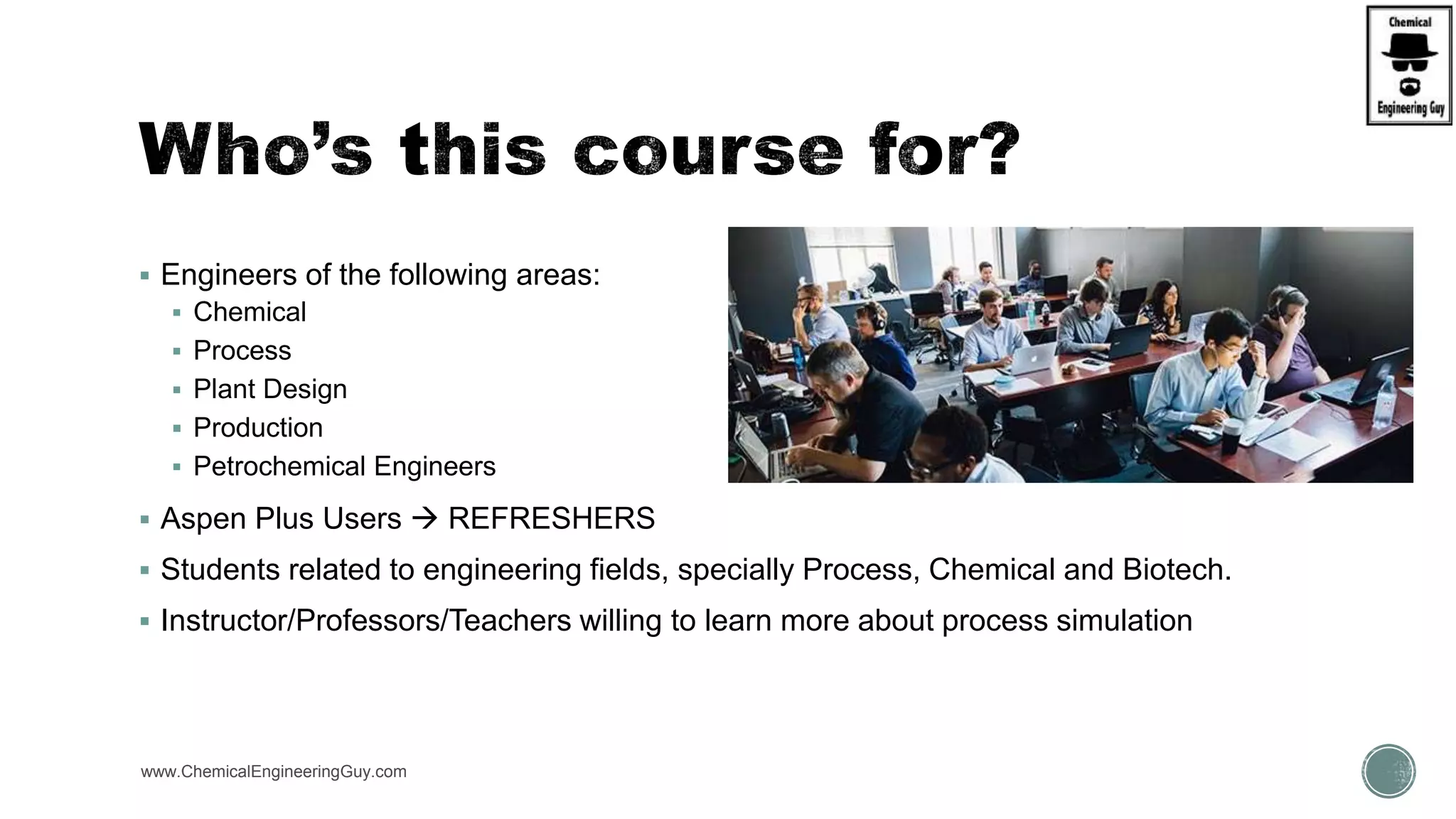
 Engineers of the following areas:
 Chemical
 Process
 Plant Design
 Production
 Petrochemical Engineers
 Aspen Plus Users  REFRESHERS
 Students related to engineering fields, specially Process, Chemical and Biotech.
 Instructor/Professors/Teachers willing to learn more about process simulation
www.ChemicalEngineeringGuy.com
 BOOTCAMP
 programs which enable students with little Process
Simulation proficiency to focus on the most important
aspects of Simulation and immediately apply their new
skills to solve real-world problems.
 The goal of many bootcamps attendees is to
transition into a career in Process Simulation
development.
 They do this by learning to simulate common
processes
 This provides the foundation they need to build
production-ready applications and demonstrate they
have the skills to add real value to the company.
www.ChemicalEngineeringGuy.com
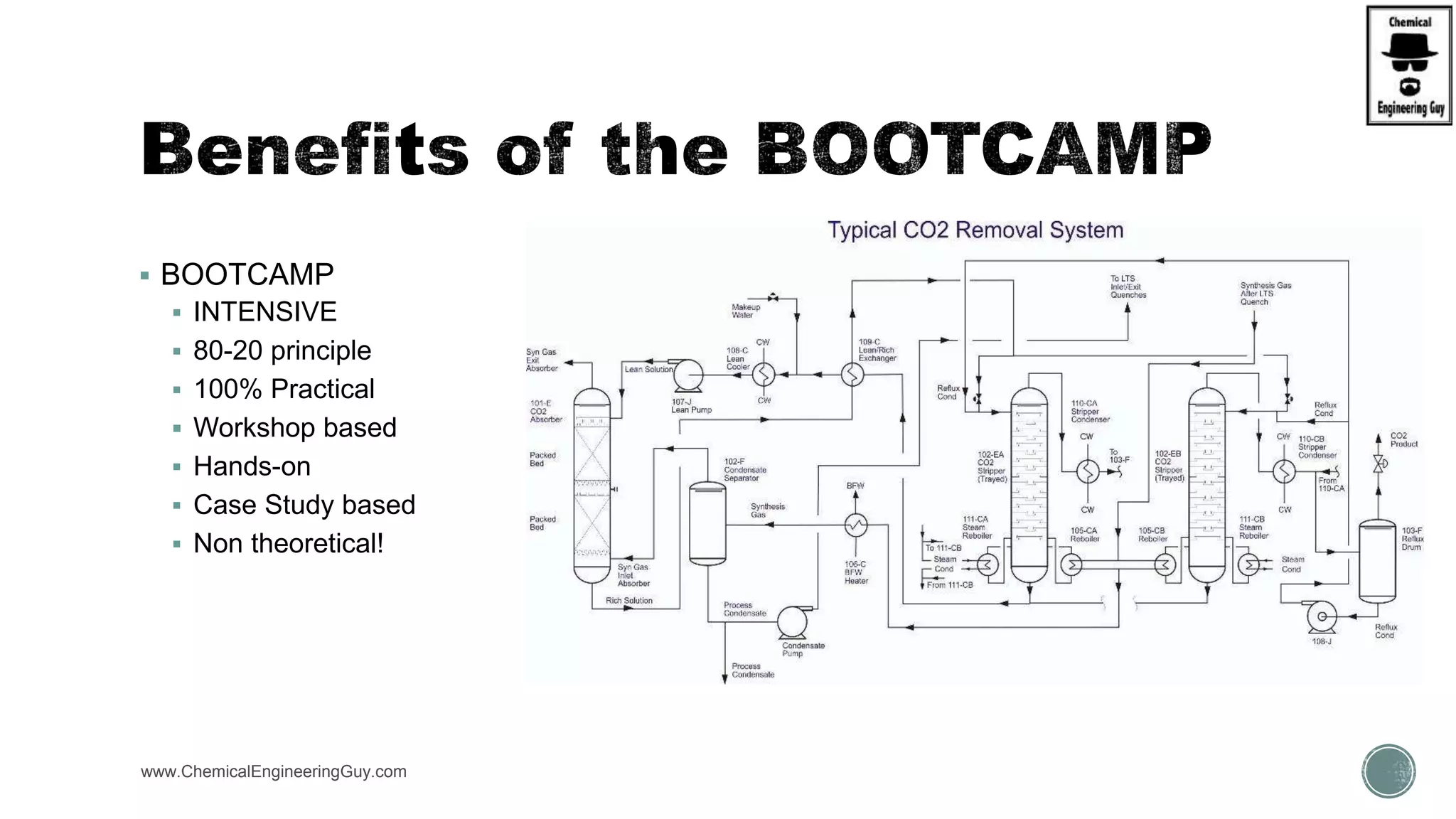
 BOOTCAMP
 INTENSIVE
 80-20 principle
 100% Practical
 Workshop based
 Hands-on
 Case Study based
 Non theoretical!
 Check out:
 Slideshows
 Simulations
 Spreadsheets
 & more… here:
 https://www.chemicalengineeringguy.com/courses/aspen-plus-bootcamp-with-12-case-studies/ap-bootcamp-99512/
 Get Tips & Help here:
 https://www.facebook.com/groups/aspenplushysysforum/
 Also check the “resources” on the course.
www.ChemicalEngineeringGuy.com
 Chemical Processes
1. Hydrocarbon Systems
2. BTX Separation
3. Methanol from Syngas
4. Acetaldehyde Plant
www.ChemicalEngineeringGuy.com
 Case Study 1
 Open New, Saving & Opening Files
 Setup the Physical Property environment (component list + property method)
 Phys.Prop.Env  Binary Parameters, Equations & Models
 Flowsheeting T/P/L labels; reconnecting source/distination
 Add unit operations & streams to the flowsheet
 Operations: Mixing, Splitting, Separation, Heating, Pressurizing
 Units: Fsplit, Mix, Sep1, Sep2 Flash2, Heater, Valve
 Understanding variable (input vs. outputs)
 Running a Simulation & Viewing Results
www.ChemicalEngineeringGuy.com
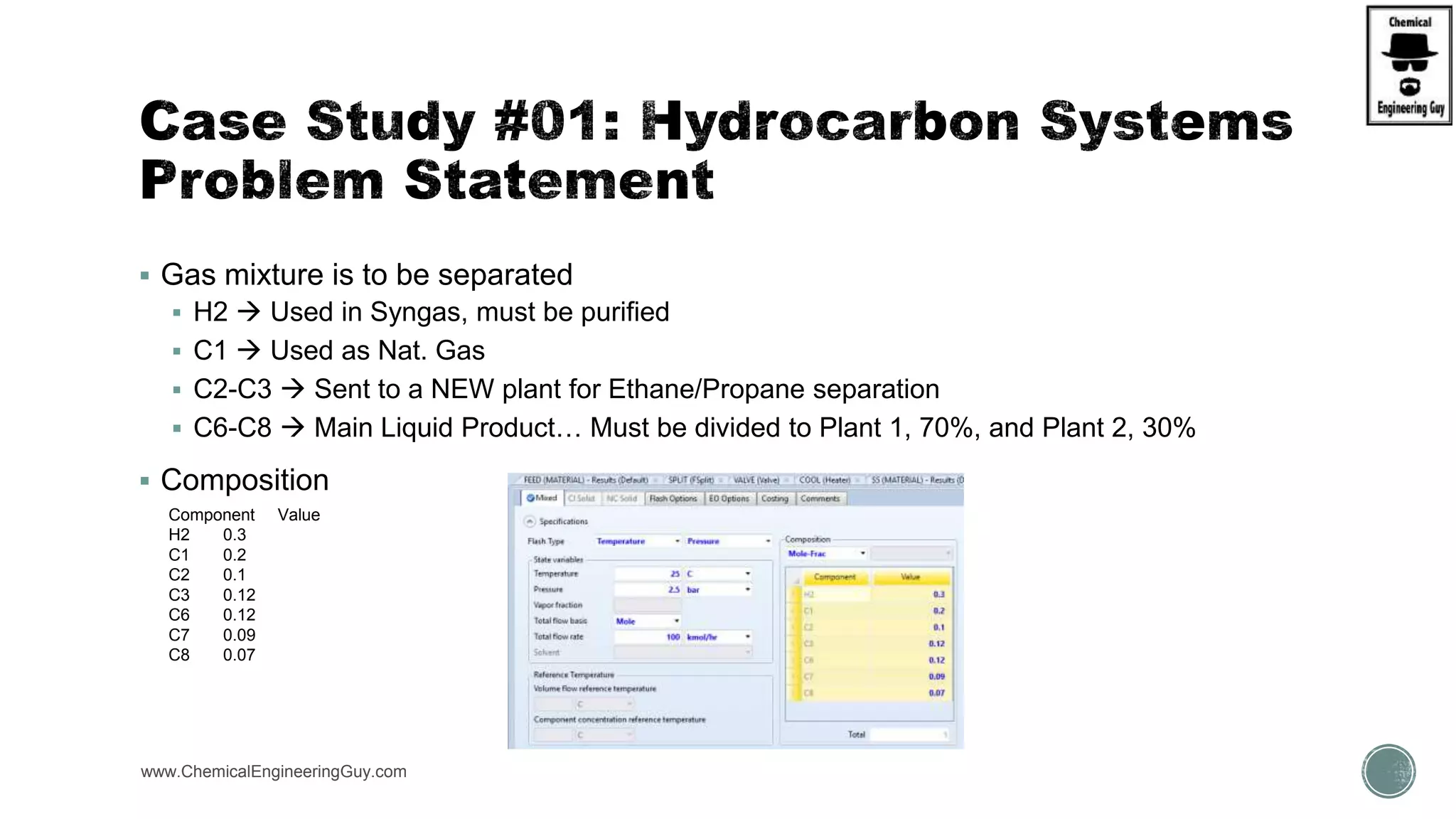
 Gas mixture is to be separated
 H2  Used in Syngas, must be purified
 C1  Used as Nat. Gas
 C2-C3  Sent to a NEW plant for Ethane/Propane separation
 C6-C8  Main Liquid Product… Must be divided to Plant 1, 70%, and Plant 2, 30%
 Composition
www.ChemicalEngineeringGuy.com
Component Value
H2 0.3
C1 0.2
C2 0.1
C3 0.12
C6 0.12
C7 0.09
C8 0.07
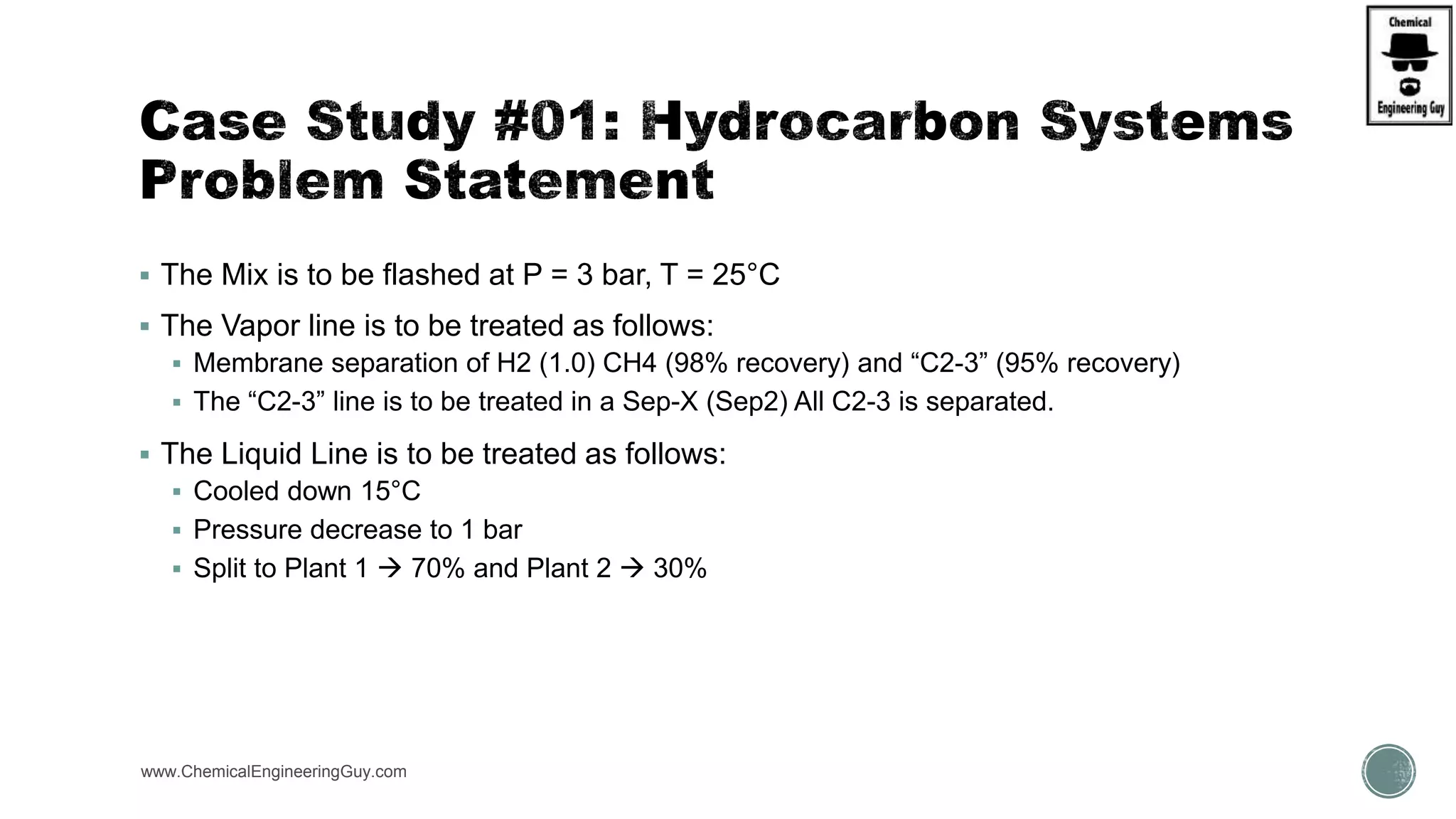
 The Mix is to be flashed at P = 3 bar, T = 25°C
 The Vapor line is to be treated as follows:
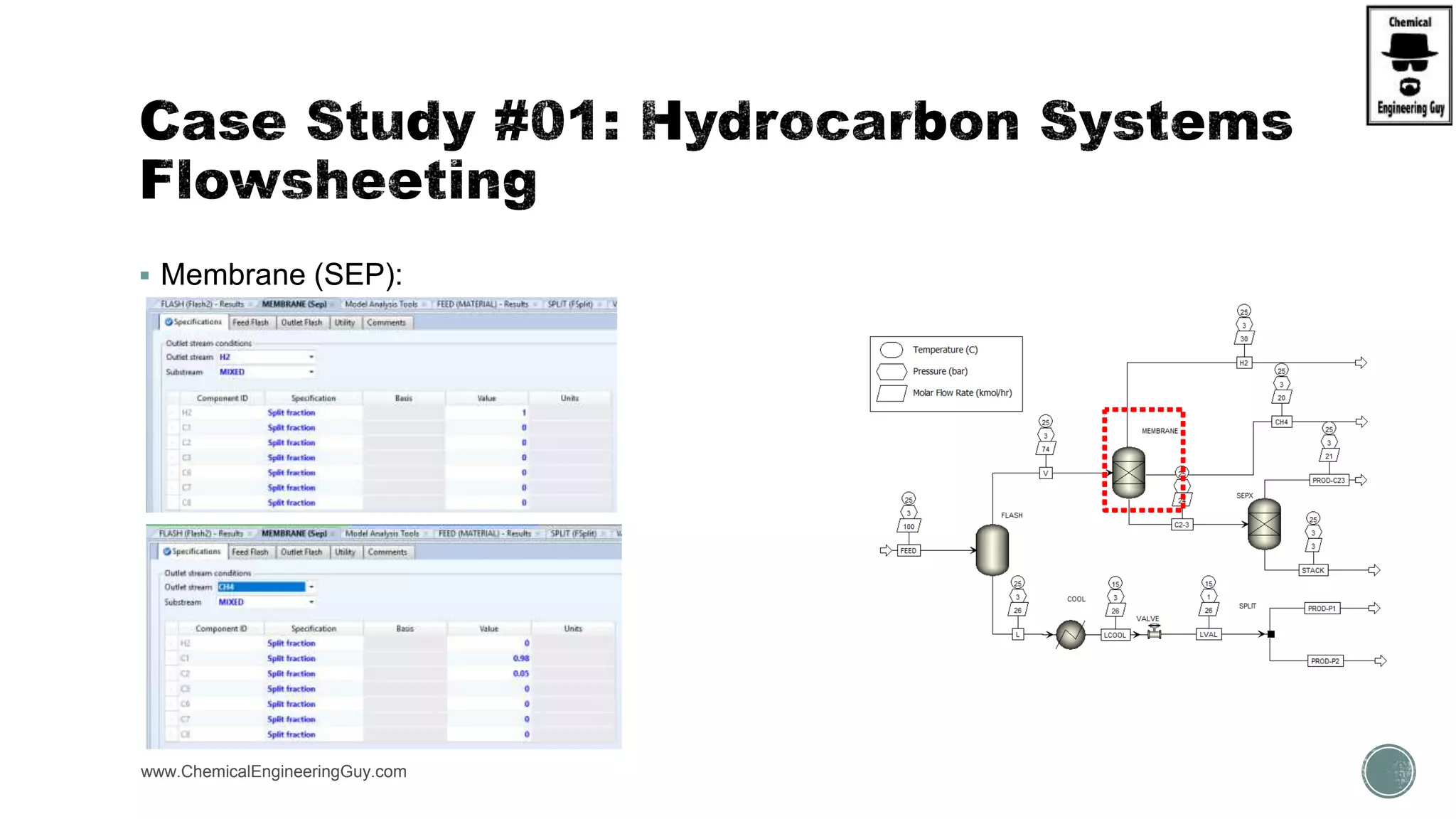
 Membrane separation of H2 (1.0) CH4 (98% recovery) and “C2-3” (95% recovery)
 The “C2-3” line is to be treated in a Sep-X (Sep2) All C2-3 is separated.
 The Liquid Line is to be treated as follows:
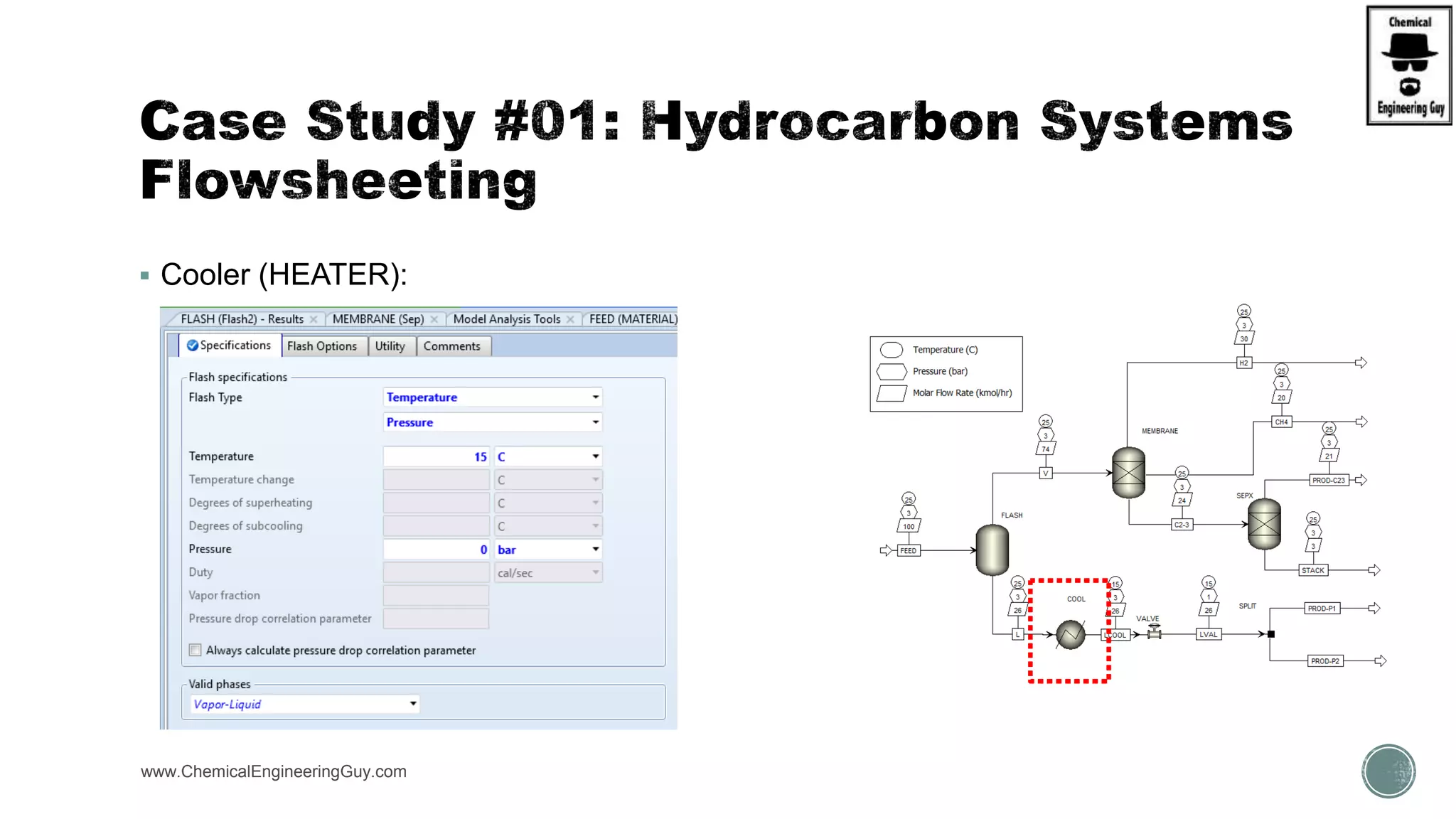
 Cooled down 15°C
 Pressure decrease to 1 bar
 Split to Plant 1  70% and Plant 2  30%
www.ChemicalEngineeringGuy.com
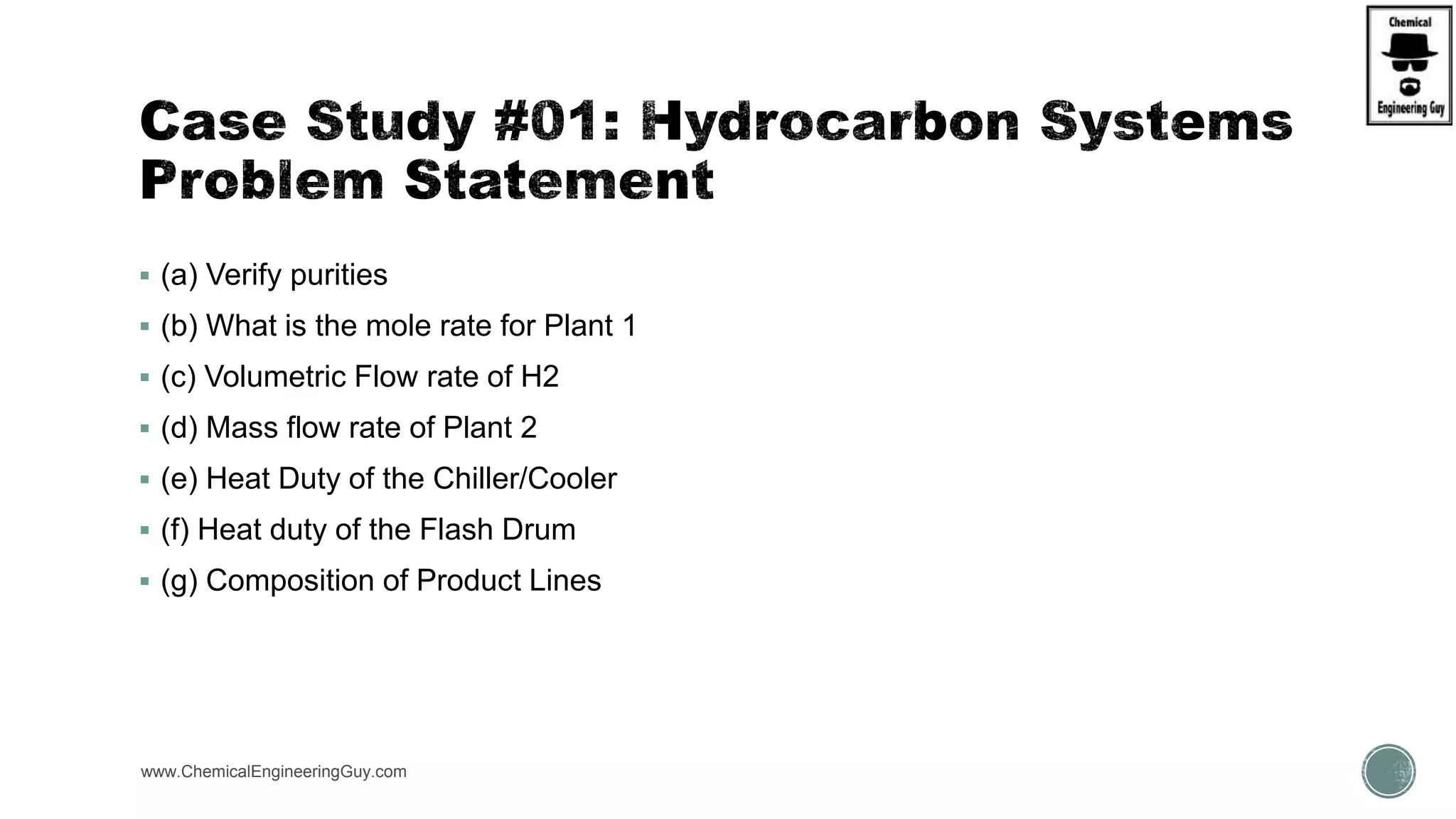
 (a) Verify purities
 (b) What is the mole rate for Plant 1
 (c) Volumetric Flow rate of H2
 (d) Mass flow rate of Plant 2
 (e) Heat Duty of the Chiller/Cooler
 (f) Heat duty of the Flash Drum
 (g) Composition of Product Lines
www.ChemicalEngineeringGuy.com
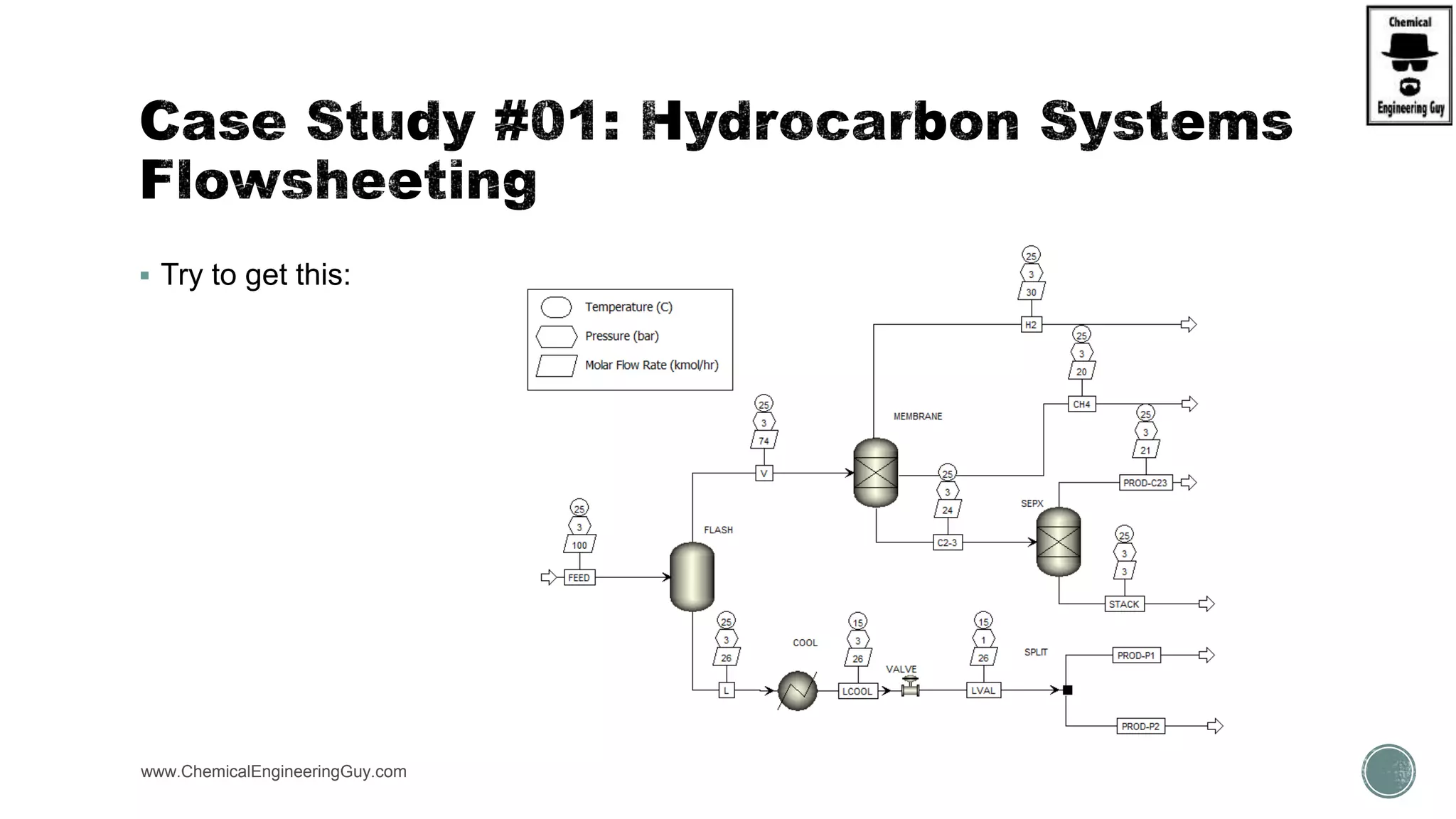
 Try to get this:
www.ChemicalEngineeringGuy.com
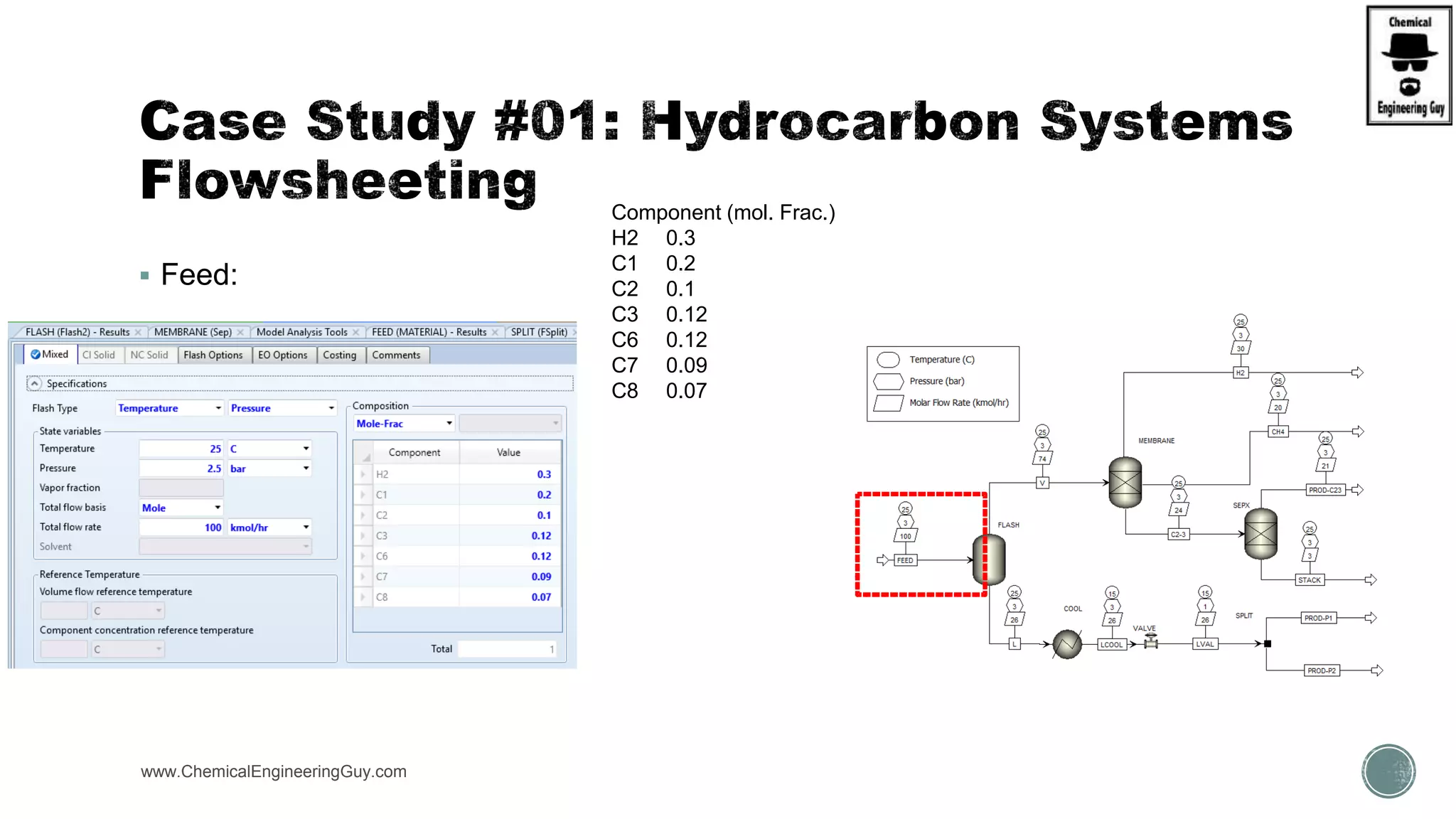
 Feed:
www.ChemicalEngineeringGuy.com
Component (mol. Frac.)
H2 0.3
C1 0.2
C2 0.1
C3 0.12
C6 0.12
C7 0.09
C8 0.07
 Flash (FLASH2):
www.ChemicalEngineeringGuy.com
Enjoying so far?
This is a preview of the BOOTCAMP.
Join NOW here:
https://www.chemicalengineeringguy.com/courses/aspen-plus-bootcamp-with-12-case-studies/
 Cooler (HEATER):
www.ChemicalEngineeringGuy.com
 Valve (VALVE):
www.ChemicalEngineeringGuy.com
Enjoying so far?
This is a preview of the BOOTCAMP.
Join NOW here:
https://www.chemicalengineeringguy.com/courses/aspen-plus-bootcamp-with-12-case-studies/
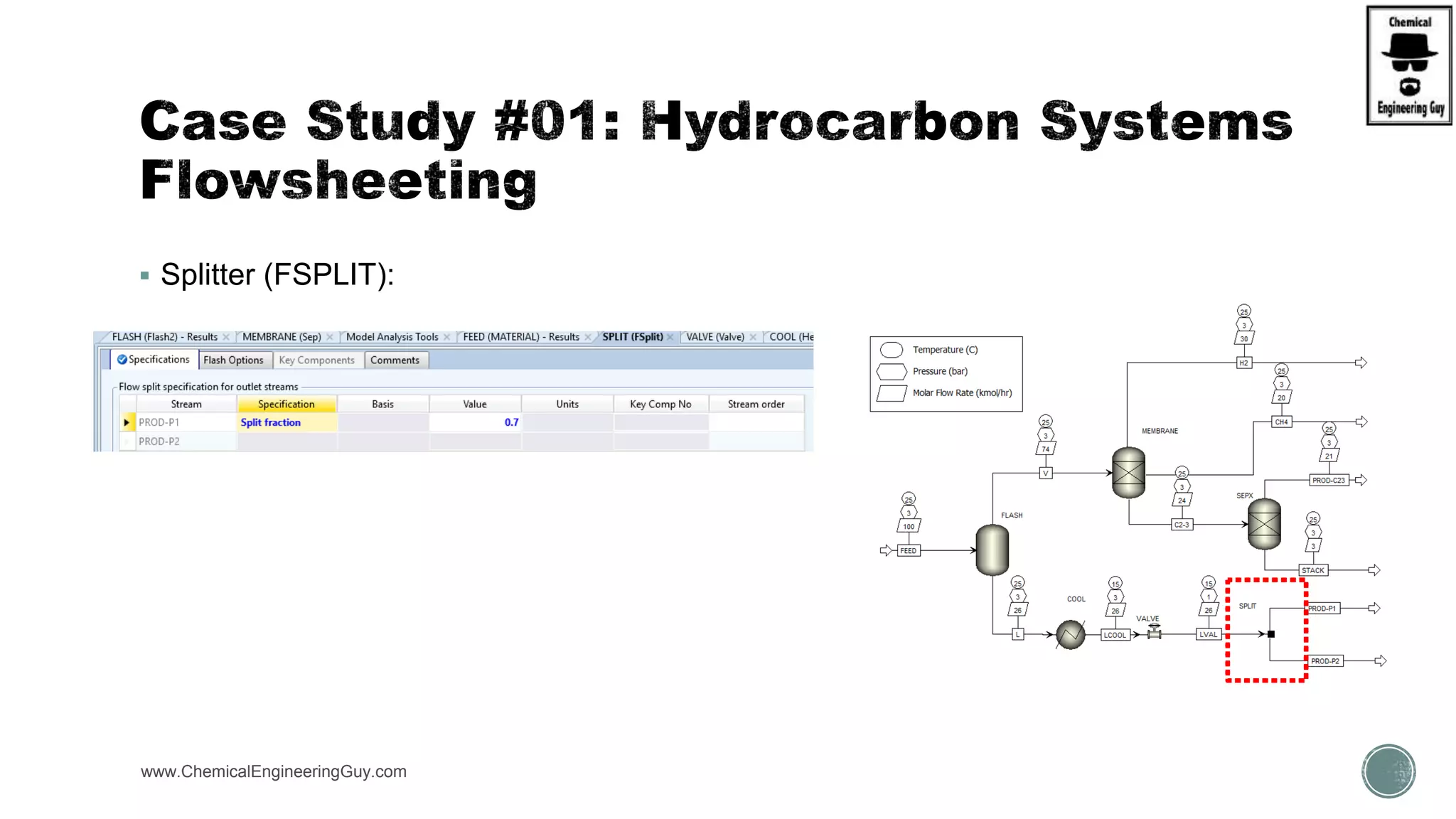
 Splitter (FSPLIT):
www.ChemicalEngineeringGuy.com
 Membrane (SEP):
www.ChemicalEngineeringGuy.com
 SEPX (SEP):
www.ChemicalEngineeringGuy.com
Enjoying so far?
This is a preview of the BOOTCAMP.
Join NOW here:
https://www.chemicalengineeringguy.com/courses/aspen-plus-bootcamp-with-12-case-studies/
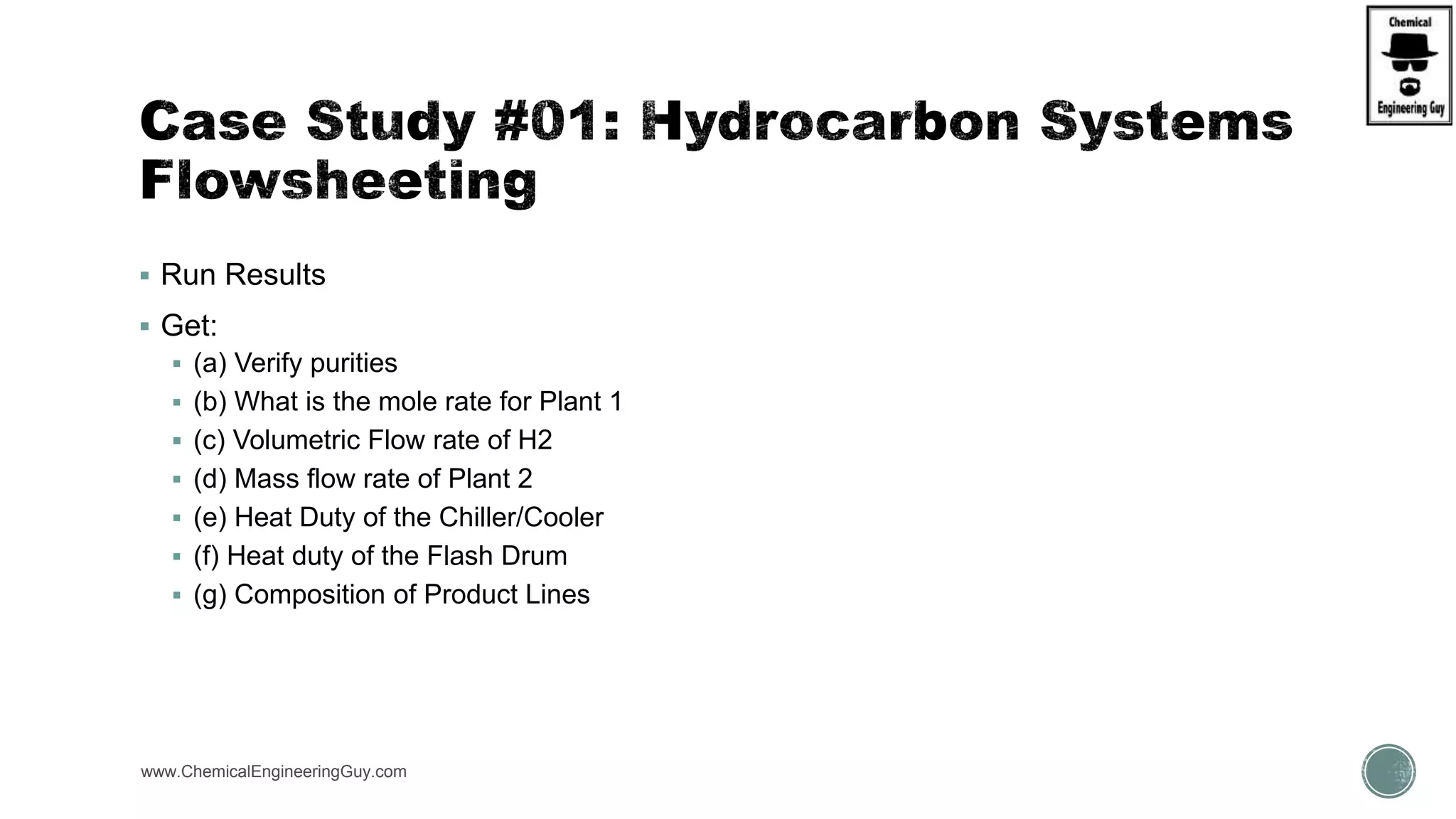
 Run Results
 Get:
 (a) Verify purities
 (b) What is the mole rate for Plant 1
 (c) Volumetric Flow rate of H2
 (d) Mass flow rate of Plant 2
 (e) Heat Duty of the Chiller/Cooler
 (f) Heat duty of the Flash Drum
 (g) Composition of Product Lines
www.ChemicalEngineeringGuy.com
 Case Study 2
 Physical Property  Analysis Tools
 Operations: Distillation, partial & total condensers
 Units: Distil, DSTWU, Pump
 Getting Help in Aspen Plus V10
www.ChemicalEngineeringGuy.com
https://www.youtube.com/watch?v=WZQl_y2ci2w
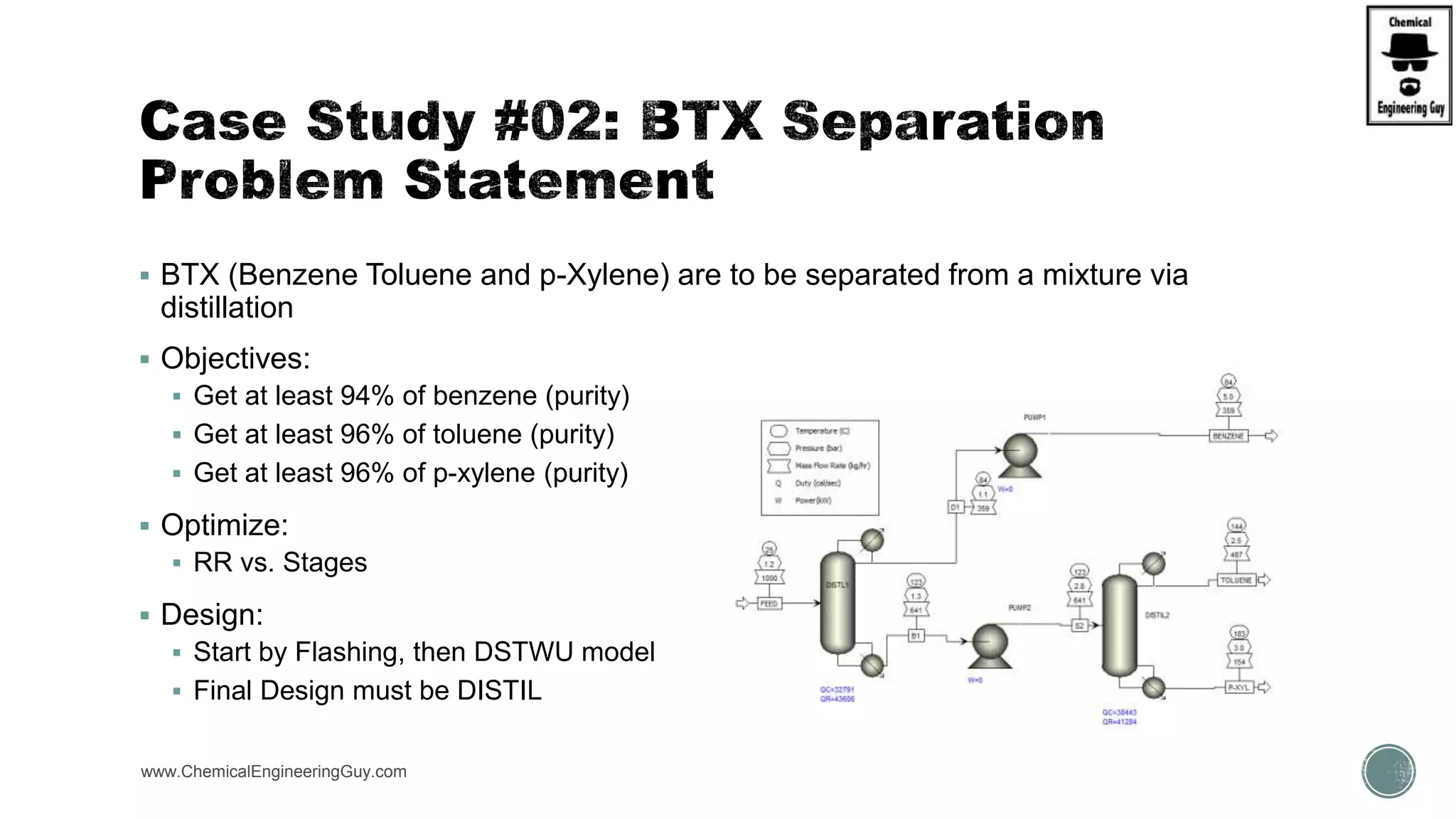
 BTX (Benzene Toluene and p-Xylene) are to be separated from a mixture via
distillation
 Objectives:
 Get at least 94% of benzene (purity)
 Get at least 96% of toluene (purity)
 Get at least 96% of p-xylene (purity)
 Optimize:
 RR vs. Stages
 Design:
 Start by Flashing, then DSTWU model
 Final Design must be DISTIL
www.ChemicalEngineeringGuy.com
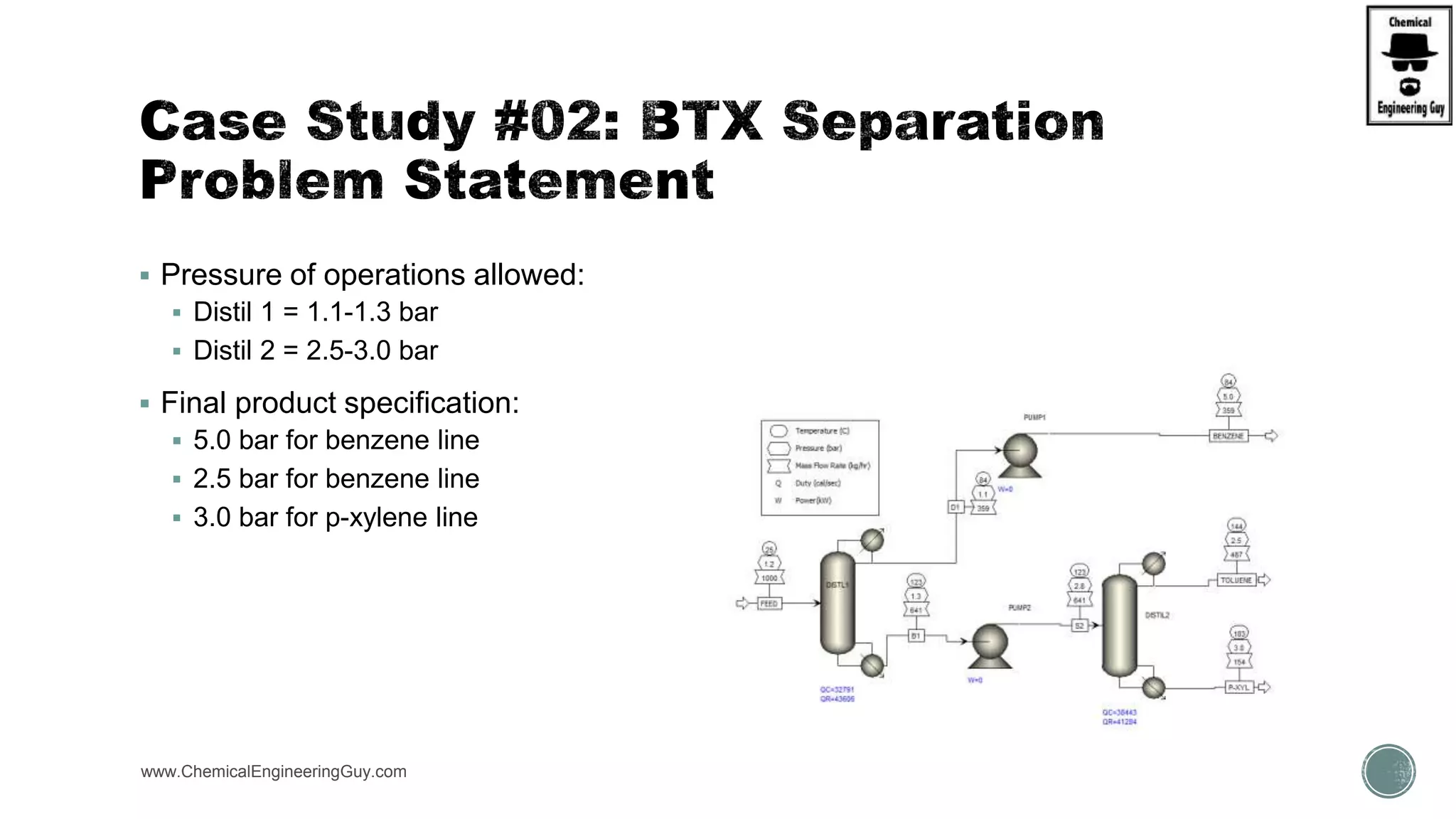
 Pressure of operations allowed:
 Distil 1 = 1.1-1.3 bar
 Distil 2 = 2.5-3.0 bar
 Final product specification:
 5.0 bar for benzene line
 2.5 bar for benzene line
 3.0 bar for p-xylene line
www.ChemicalEngineeringGuy.com
 (A) Use Phys. Props to verify BP of each species at P = 1.2 bar
 (B) Use Flash to verify K values and volatilities (Light and Heavy keys)
 (C) Compare DSTWU vs. Distil Models
 (D) Use DSWTU Model for min. conditions (Column 1)
 (E) Use Distil, for real conditions (Column 1)
 (F) Use Flash to verify K values and volatilities (Light and Heavy keys)
 (G) Use Distil
 (H) Verify Purity
www.ChemicalEngineeringGuy.com
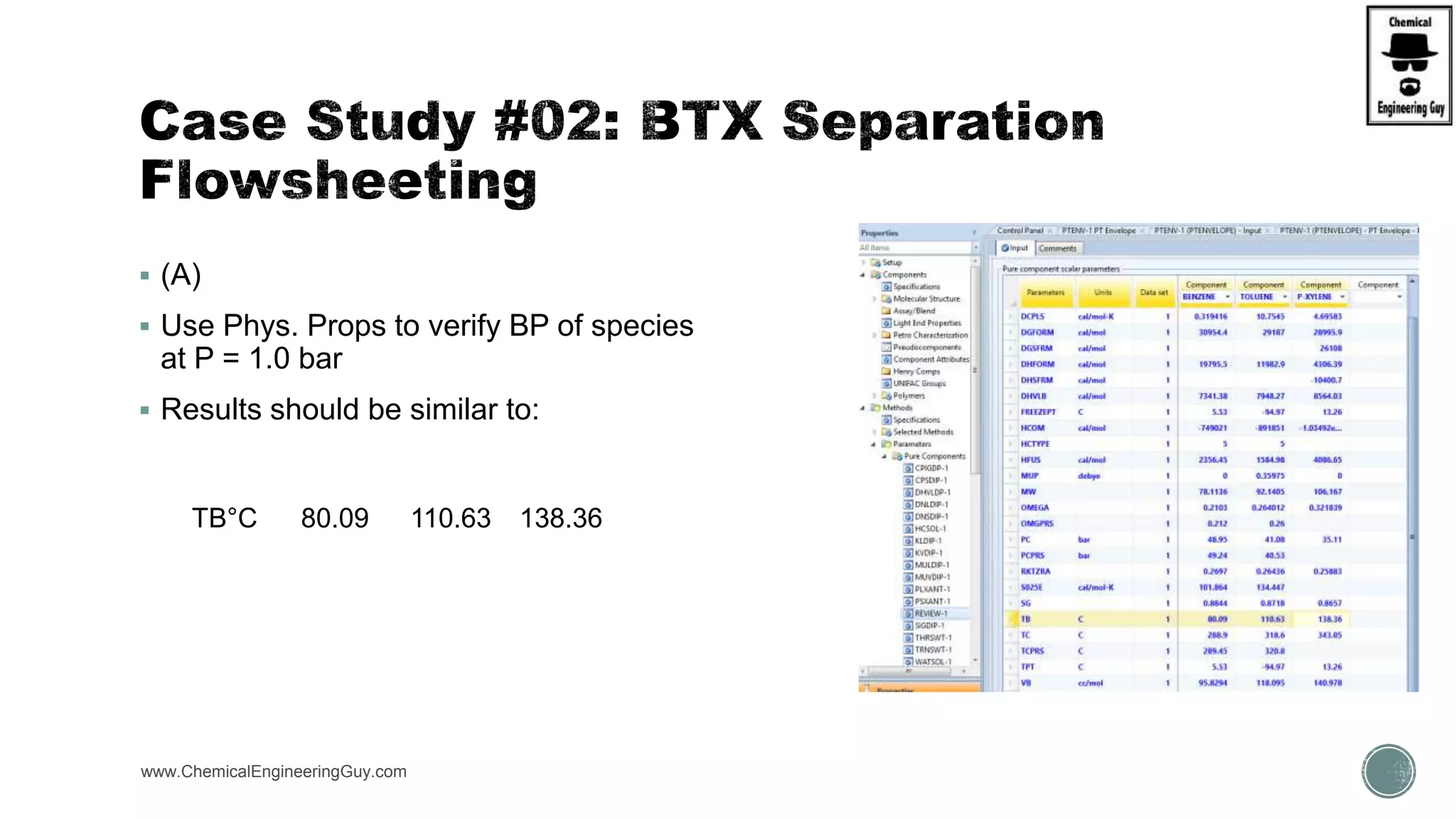
 (A)
 Use Phys. Props to verify BP of species
at P = 1.0 bar
 Results should be similar to:
www.ChemicalEngineeringGuy.com https://www.youtube.com/watch?v=WZQl_y2ci2w
TB°C 80.09 110.63 138.36
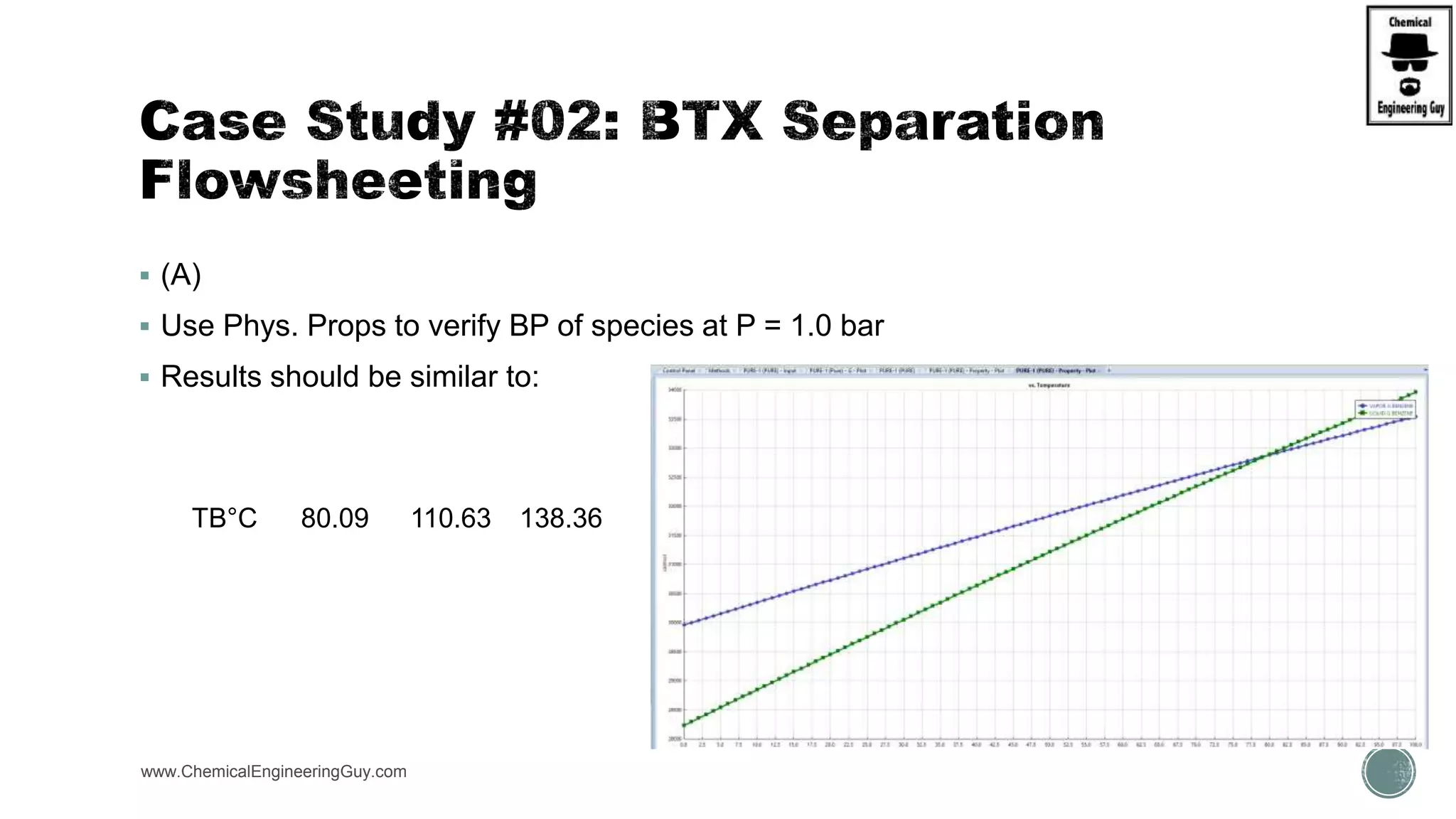
 (A)
 Use Phys. Props to verify BP of species at P = 1.0 bar
 Results should be similar to:
www.ChemicalEngineeringGuy.com https://www.youtube.com/watch?v=WZQl_y2ci2w
TB°C 80.09 110.63 138.36
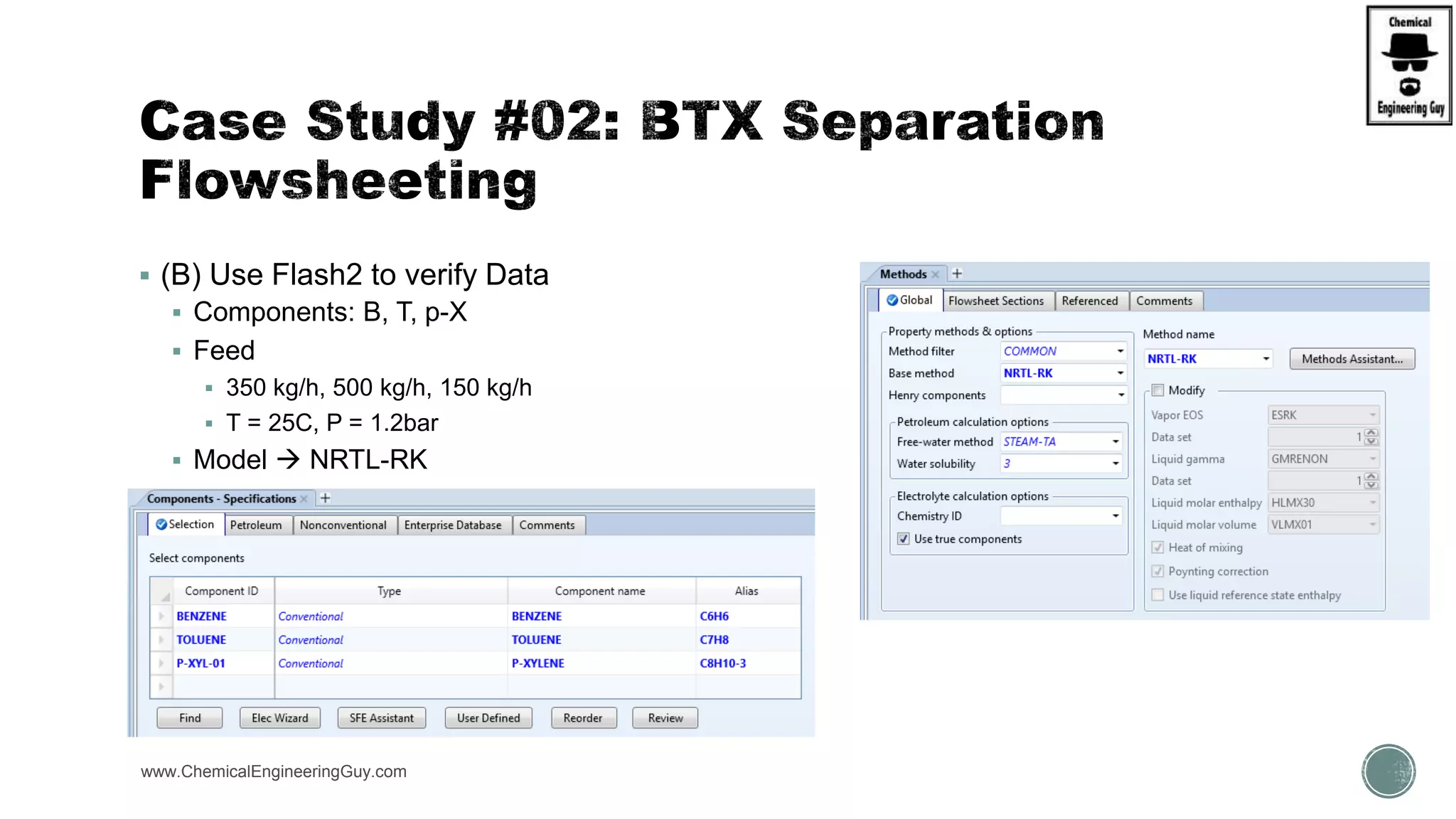
 (B) Use Flash2 to verify Data
 Components: B, T, p-X
 Feed
 350 kg/h, 500 kg/h, 150 kg/h
 T = 25C, P = 1.2bar
 Model  NRTL-RK
www.ChemicalEngineeringGuy.com https://www.youtube.com/watch?v=WZQl_y2ci2w
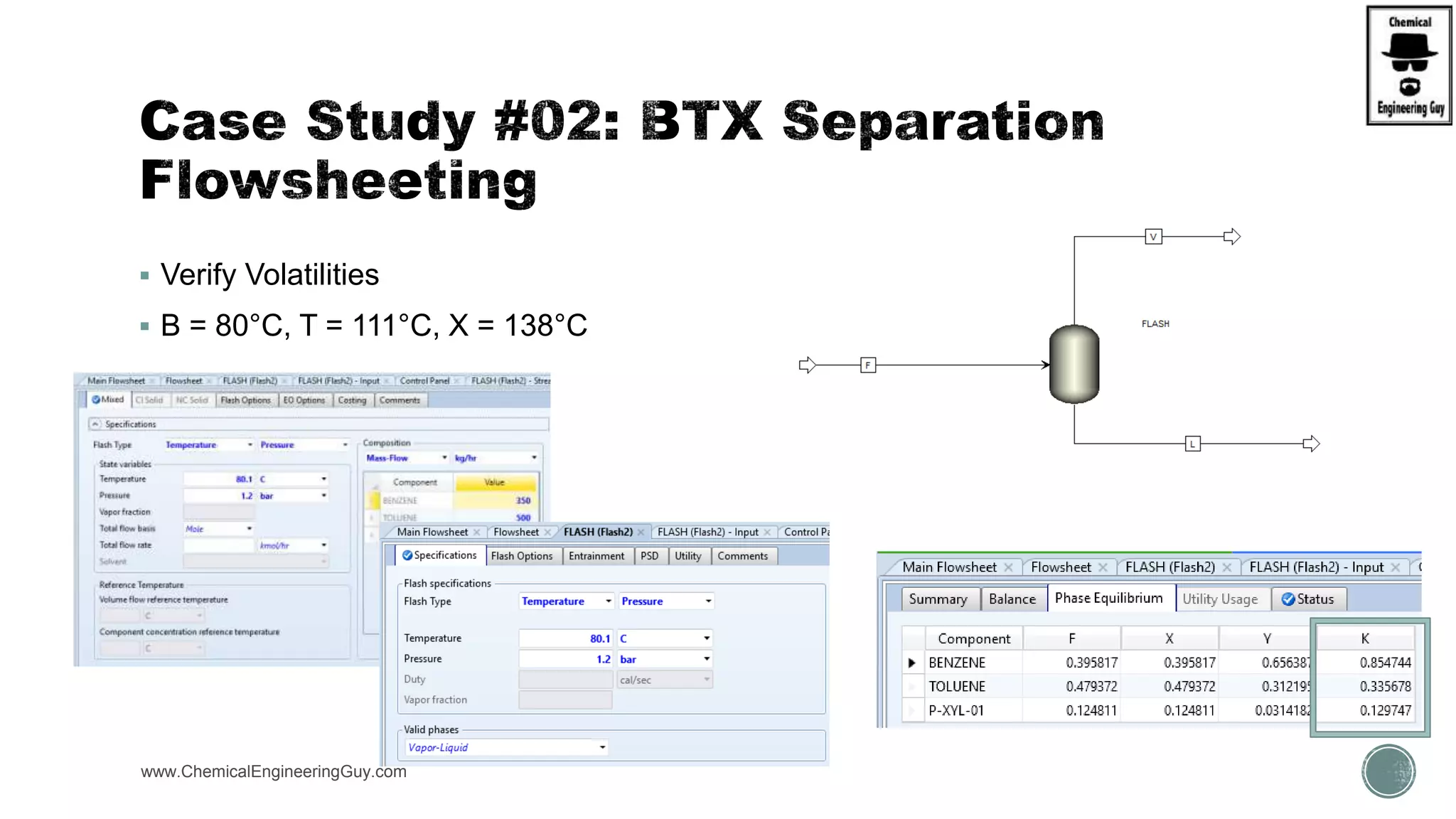
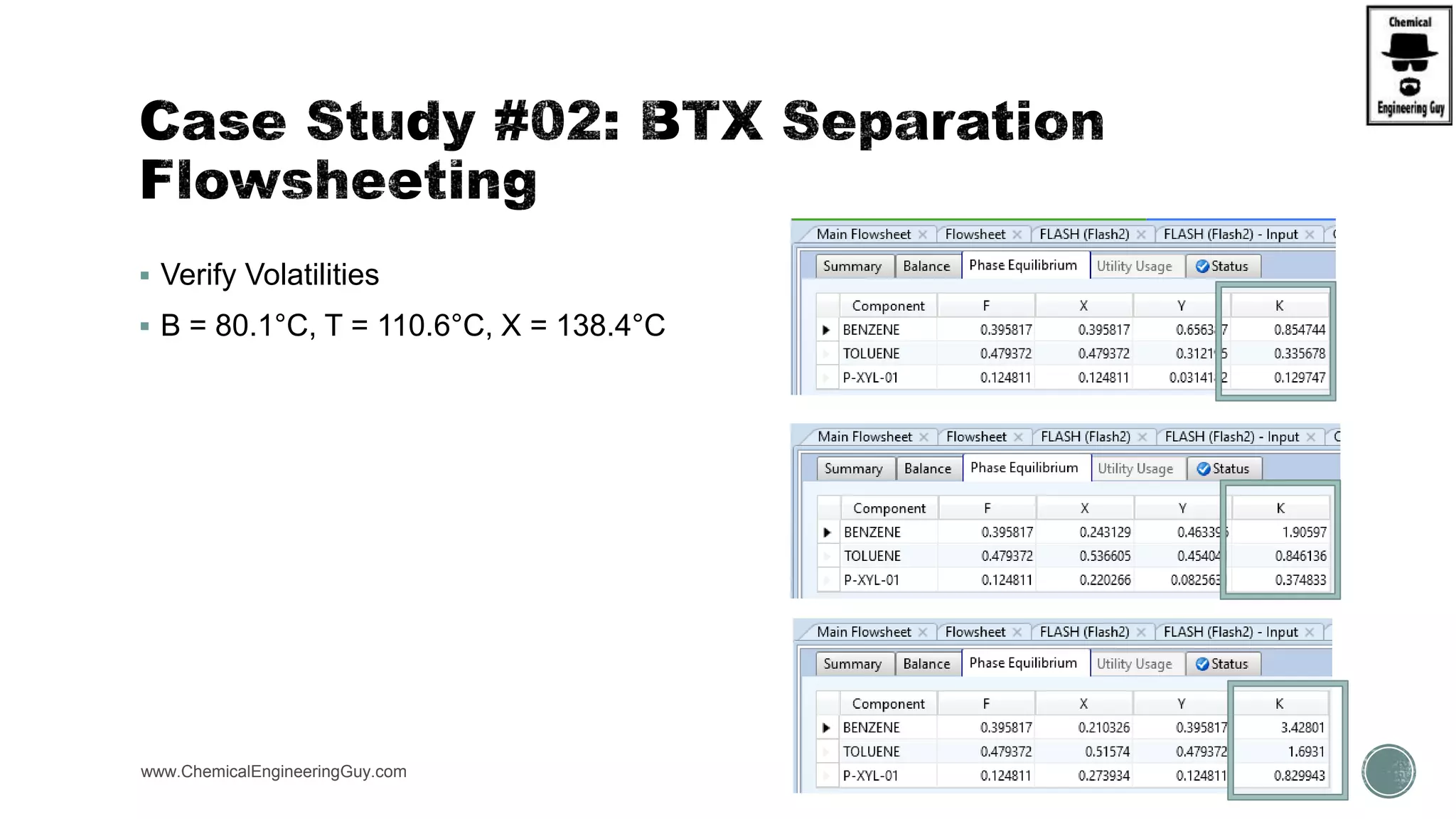
 Verify Volatilities
 B = 80°C, T = 111°C, X = 138°C
www.ChemicalEngineeringGuy.com https://www.youtube.com/watch?v=WZQl_y2ci2w
 Verify Volatilities
 B = 80.1°C, T = 110.6°C, X = 138.4°C
www.ChemicalEngineeringGuy.com https://www.youtube.com/watch?v=WZQl_y2ci2w
 Verify Volatilities
 B = 80.1°C, T = 110.6°C, X = 138.4°C
www.ChemicalEngineeringGuy.com https://www.youtube.com/watch?v=WZQl_y2ci2w
𝛼 =
𝐾𝐿𝑖𝑔ℎ𝑡−𝐾𝑒𝑦
𝐾 𝐻𝑒𝑎𝑣𝑦−𝐾𝑒𝑦
T LK HK a
80.1 0.8547 0.3356 2.547
110.6 1.9059 0.8461 2.253
138.4 3.428 1.6911 2.027
Average
Arithmetic Geometric
2.28 2.27
Enjoying so far?
This is a preview of the BOOTCAMP.
Join NOW here:
https://www.chemicalengineeringguy.com/courses/aspen-plus-bootcamp-with-12-case-studies/
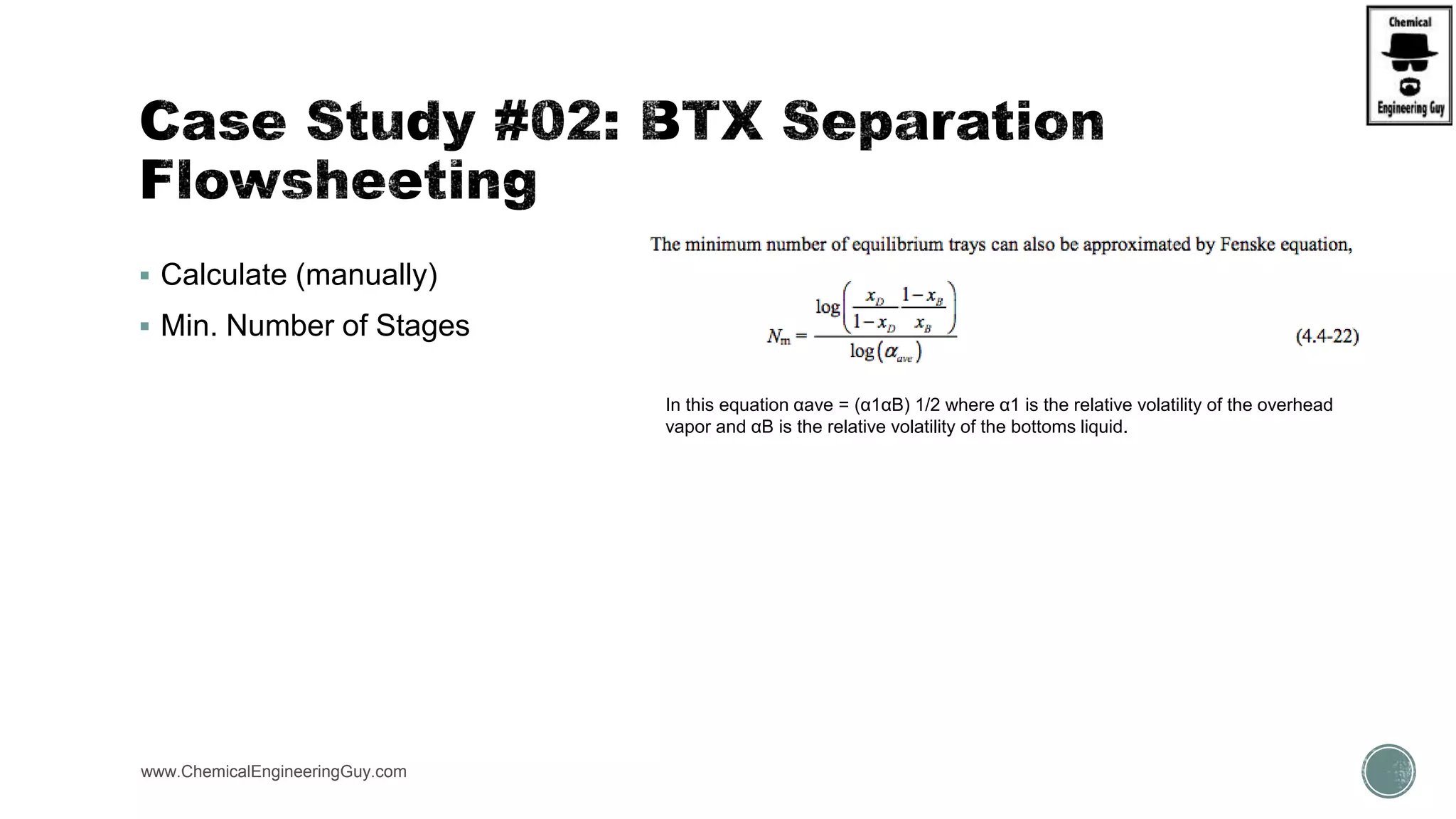
 Calculate (manually)
 Min. Number of Stages
www.ChemicalEngineeringGuy.com https://www.youtube.com/watch?v=WZQl_y2ci2w
In this equation αave = (α1αB) 1/2 where α1 is the relative volatility of the overhead
vapor and αB is the relative volatility of the bottoms liquid.
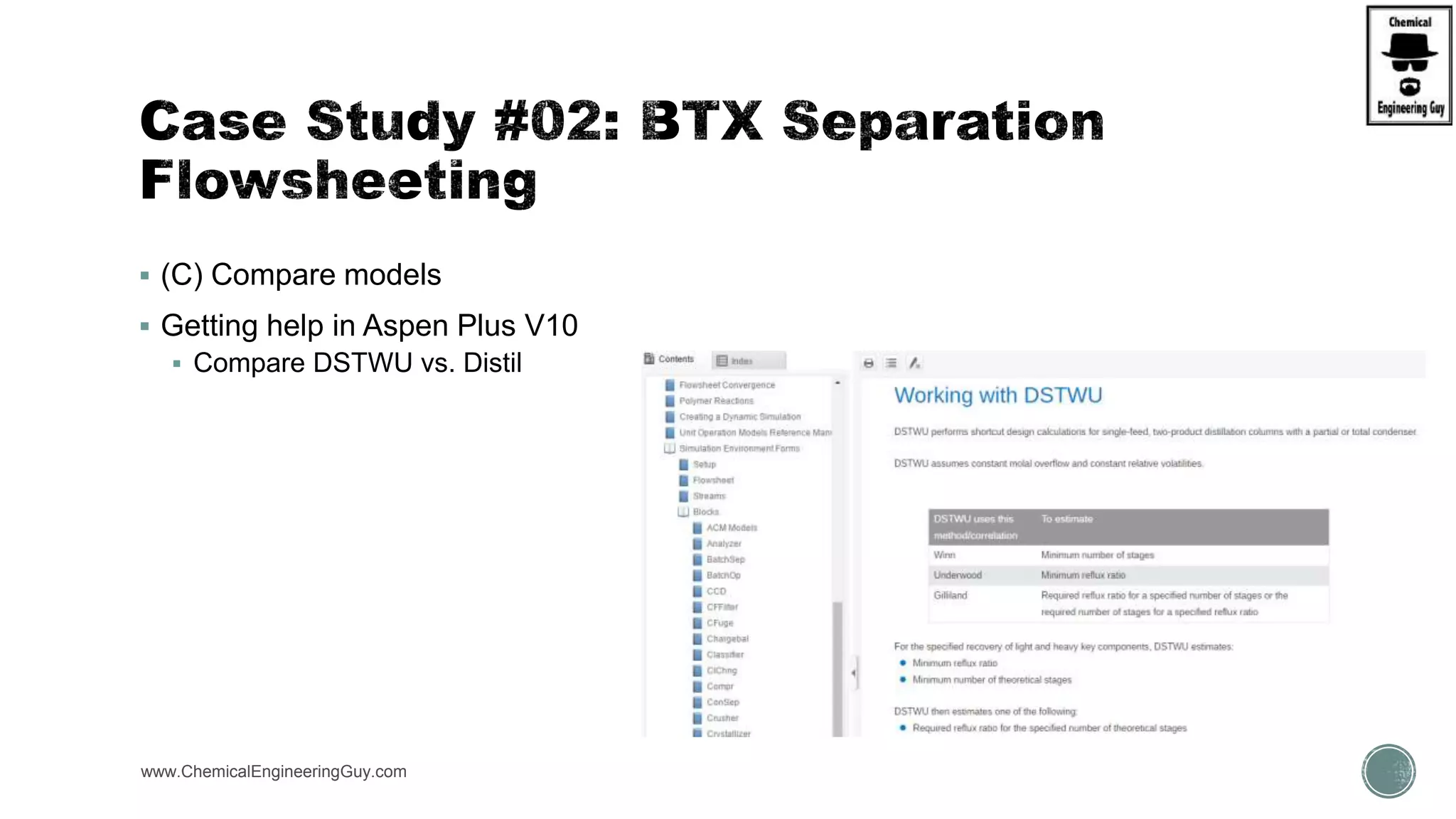
 (C) Compare models
 Getting help in Aspen Plus V10
 Compare DSTWU vs. Distil
www.ChemicalEngineeringGuy.com https://www.youtube.com/watch?v=WZQl_y2ci2w
 Compare DSTWU vs. Distil
www.ChemicalEngineeringGuy.com https://www.youtube.com/watch?v=WZQl_y2ci2w
Enjoying so far?
This is a preview of the BOOTCAMP.
Join NOW here:
https://www.chemicalengineeringguy.com/courses/aspen-plus-bootcamp-with-12-case-studies/
 (D) Separate light material with
 Model Theoretical “DISTIL”
 Use Min. Stages to verify:
 Min. Reflux Ratio
www.ChemicalEngineeringGuy.com https://www.youtube.com/watch?v=WZQl_y2ci2w
Enjoying so far?
This is a preview of the BOOTCAMP.
Join NOW here:
https://www.chemicalengineeringguy.com/courses/aspen-plus-bootcamp-with-12-case-studies/
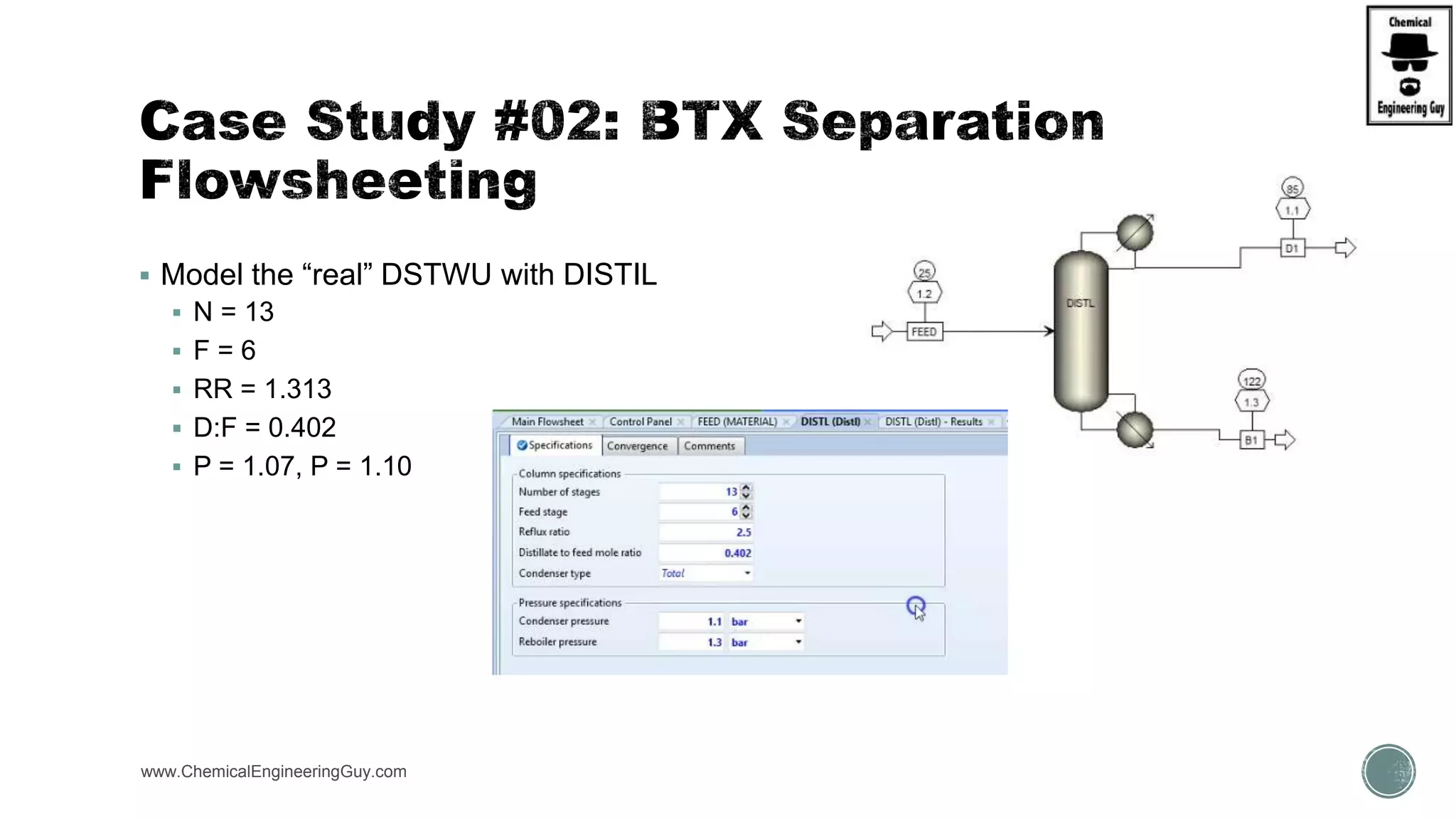
 Model the “real” DSTWU with DISTIL
 N = 13
 F = 6
 RR = 1.313
 D:F = 0.402
 P = 1.07, P = 1.10
www.ChemicalEngineeringGuy.com https://www.youtube.com/watch?v=WZQl_y2ci2w
 (A) Use Phys. Props to verify BP of each species at P = 1.2 bar
 (B) Use Flash to verify K values and volatilities (Light and Heavy keys)
 (C) Compare DSTWU vs. Distil Models
 (D) Use DSWTU Model for min. conditions (Column 1)
 (E) Use Distil, for real conditions (Column 1)
 (F) Use Flash to verify K values and volatilities (Light and Heavy keys)
 (G) Use Distil
 (H) Verify Purity
www.ChemicalEngineeringGuy.com
 (F) Use Flash/DSTWU to verify K values and volatilities (Light and Heavy keys)
 P = 2.5/3.0
 Recovery 
www.ChemicalEngineeringGuy.com
DSTWU2
Enjoying so far?
This is a preview of the BOOTCAMP.
Join NOW here:
https://www.chemicalengineeringguy.com/courses/aspen-plus-bootcamp-with-12-case-studies/
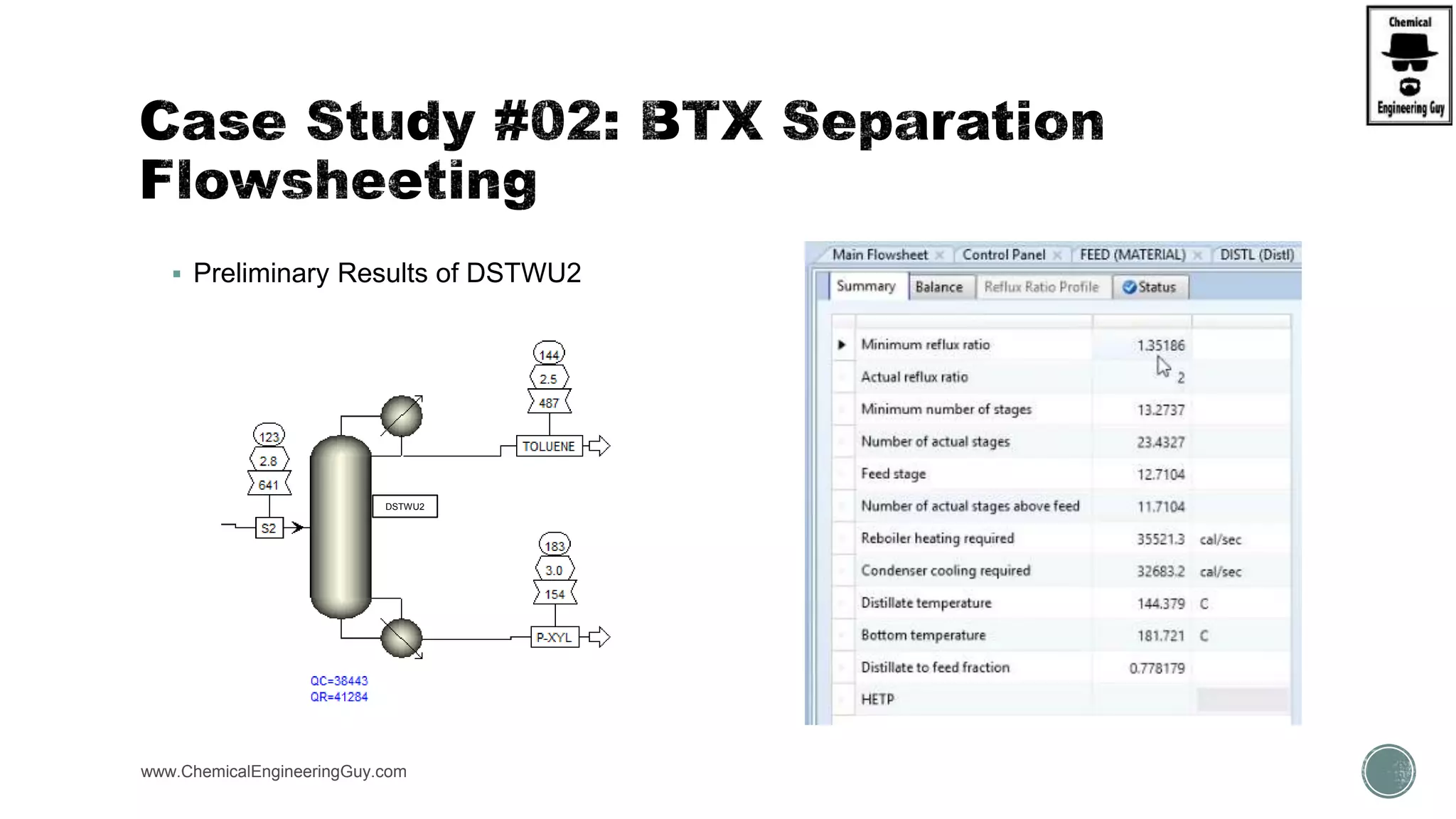
 Preliminary Results of DSTWU2
www.ChemicalEngineeringGuy.com
DSTWU2
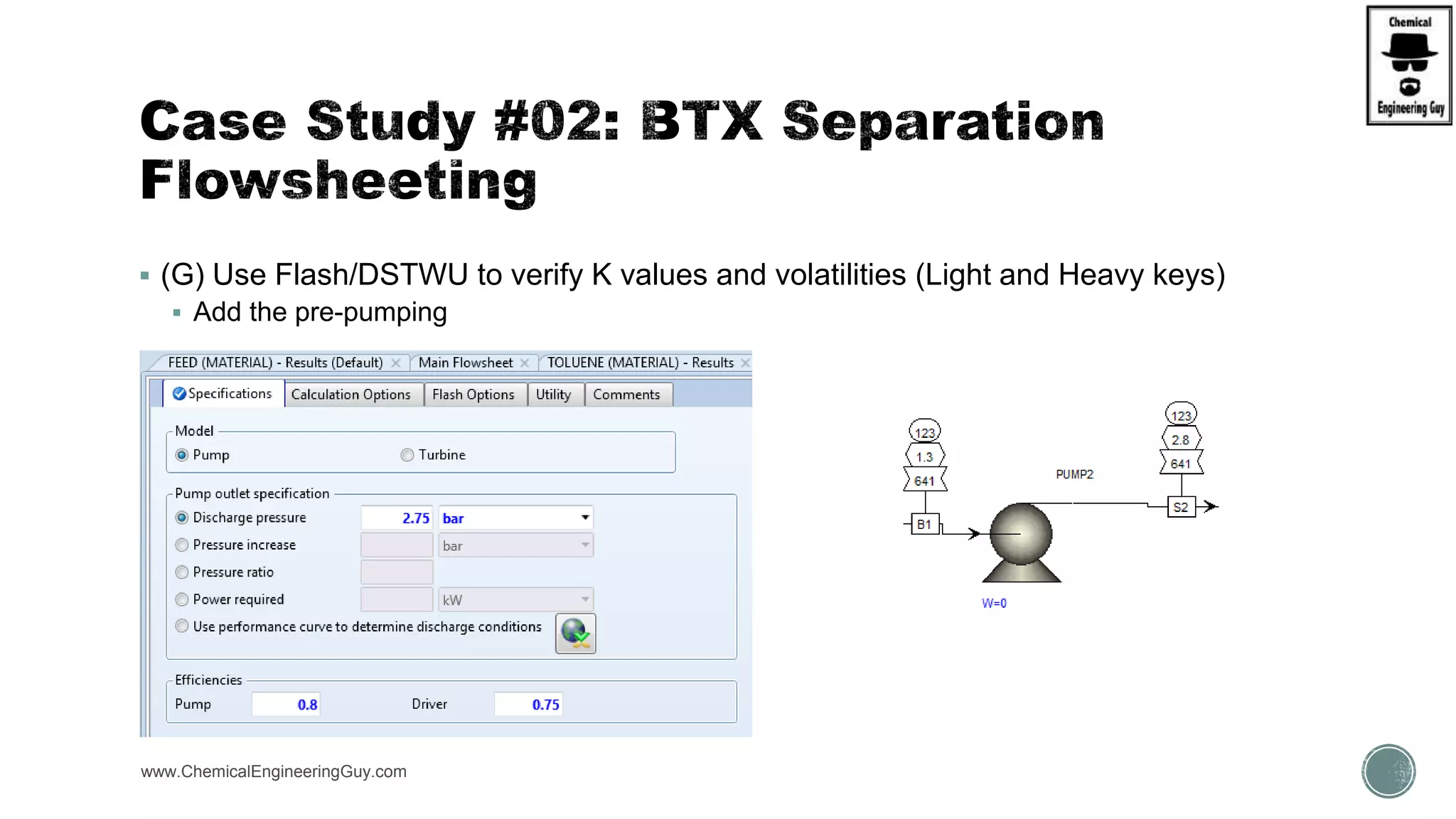
 (G) Use Flash/DSTWU to verify K values and volatilities (Light and Heavy keys)
 Add the pre-pumping
www.ChemicalEngineeringGuy.com
 (G) Use Distil
 P = 2.5/3.0
www.ChemicalEngineeringGuy.com
Enjoying so far?
This is a preview of the BOOTCAMP.
Join NOW here:
https://www.chemicalengineeringguy.com/courses/aspen-plus-bootcamp-with-12-case-studies/
 Case Study 3
 Physical Property Env.  Binary Analysis (Methane : CO2)
 Adding Reactions, and Equilibrium Data
 Operations: Isothermal Reactor, Purging, Recycling
 Compare Claculated Keq vs Built-in Expressions for Keq
 Units: R-CSTR, DSTWU, DISTL, RadFrac, Compressor
 Personalizing Results (mass/vol/mol, etc…)
 Results: Exporting to Spreadsheet, Plotting them
www.ChemicalEngineeringGuy.com
https://www.youtube.com/watch?v=Dgwsgpohxmk
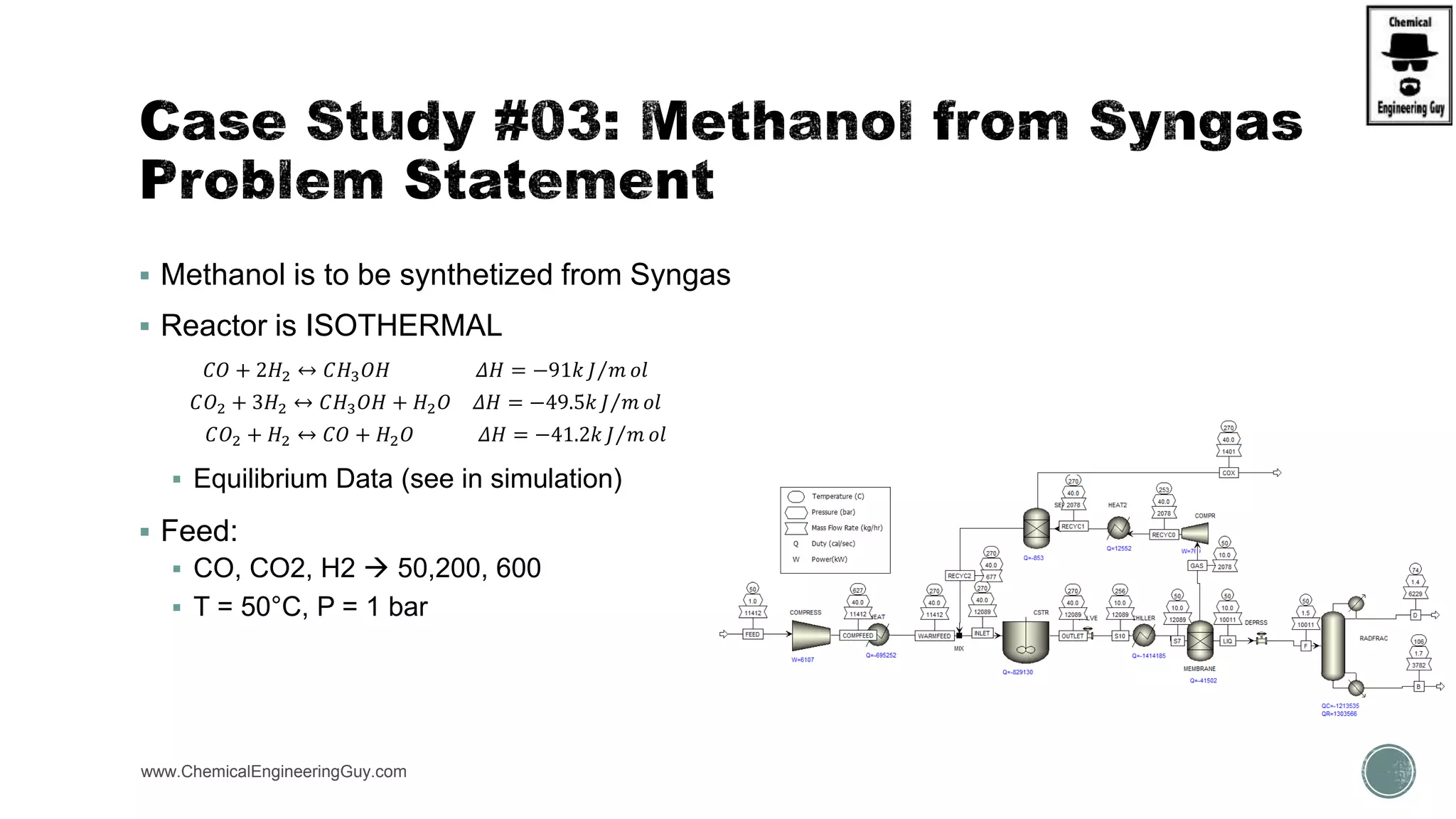
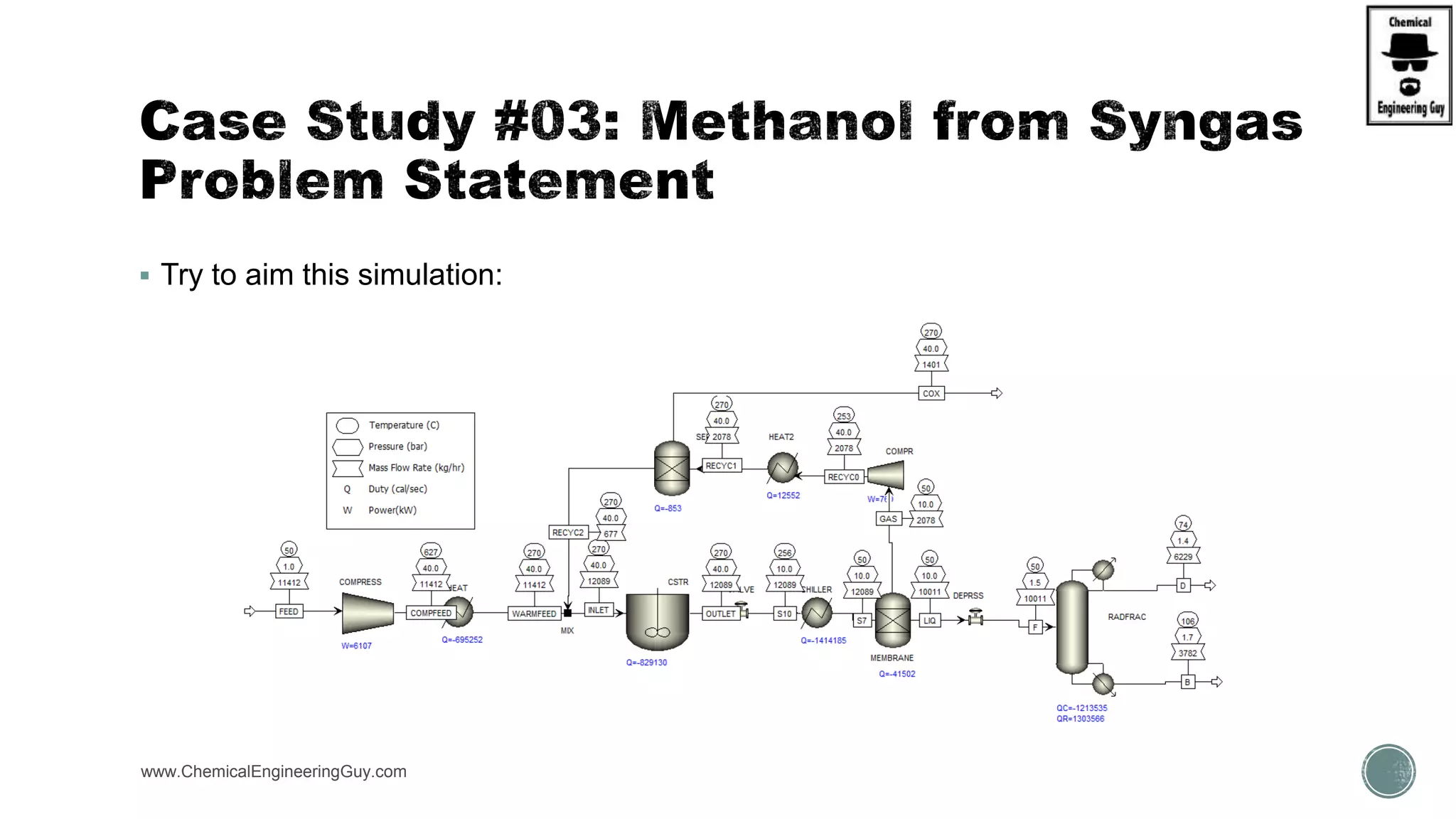
 Methanol is to be synthetized from Syngas
 Reactor is ISOTHERMAL
 Equilibrium Data (see in simulation)
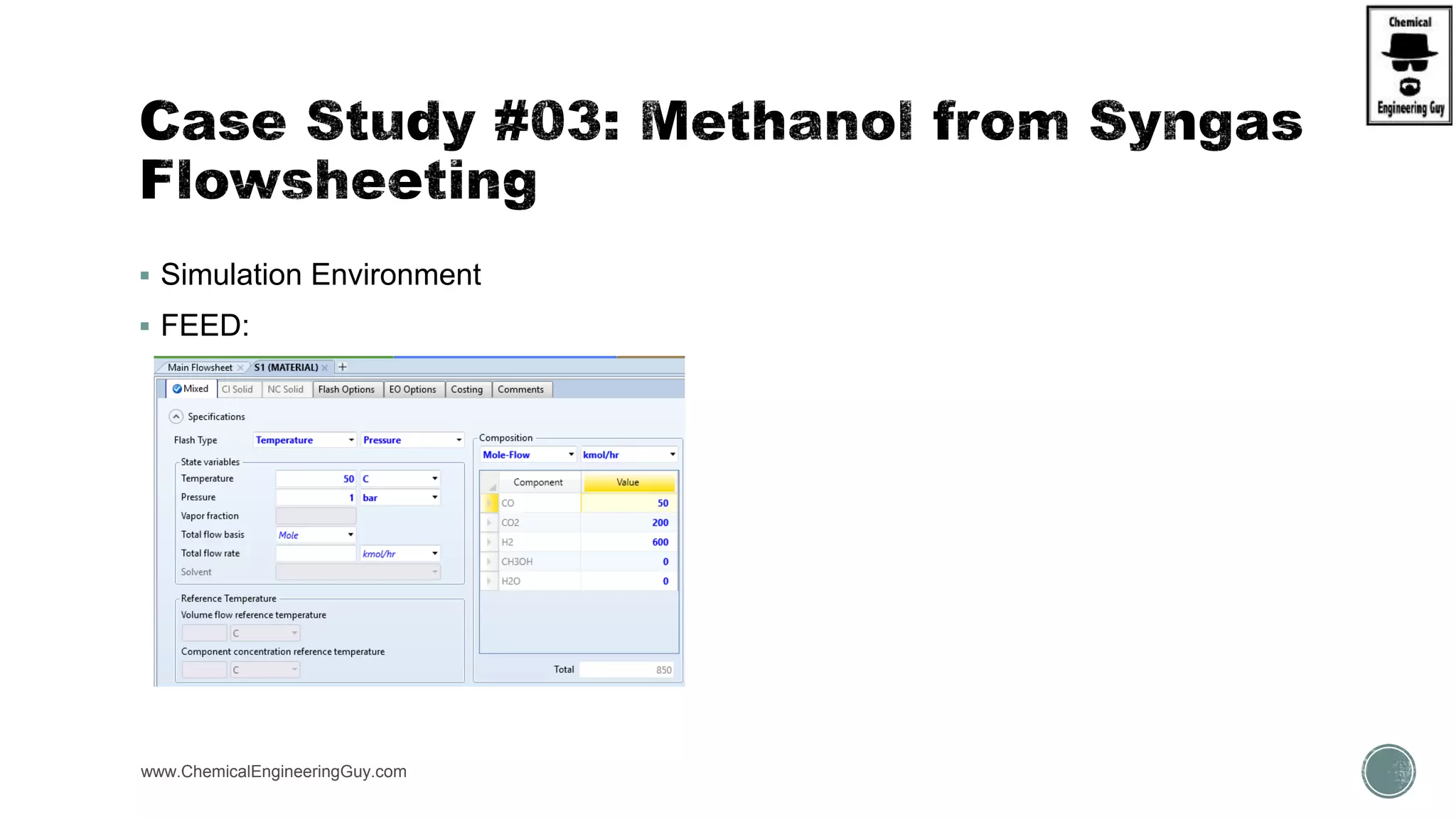
 Feed:
 CO, CO2, H2  50,200, 600
 T = 50°C, P = 1 bar
www.ChemicalEngineeringGuy.com
𝐶𝑂 + 2𝐻2 ↔ 𝐶𝐻3 𝑂𝐻 𝛥𝐻 = −91𝑘 𝐽 𝑚 𝑜𝑙
𝐶𝑂2 + 3𝐻2 ↔ 𝐶𝐻3 𝑂𝐻 + 𝐻2 𝑂 𝛥𝐻 = −49.5𝑘 𝐽 𝑚 𝑜𝑙
𝐶𝑂2 + 𝐻2 ↔ 𝐶𝑂 + 𝐻2 𝑂 𝛥𝐻 = −41.2𝑘 𝐽 𝑚 𝑜𝑙
https://www.youtube.com/watch?v=Dgwsgpohxmk
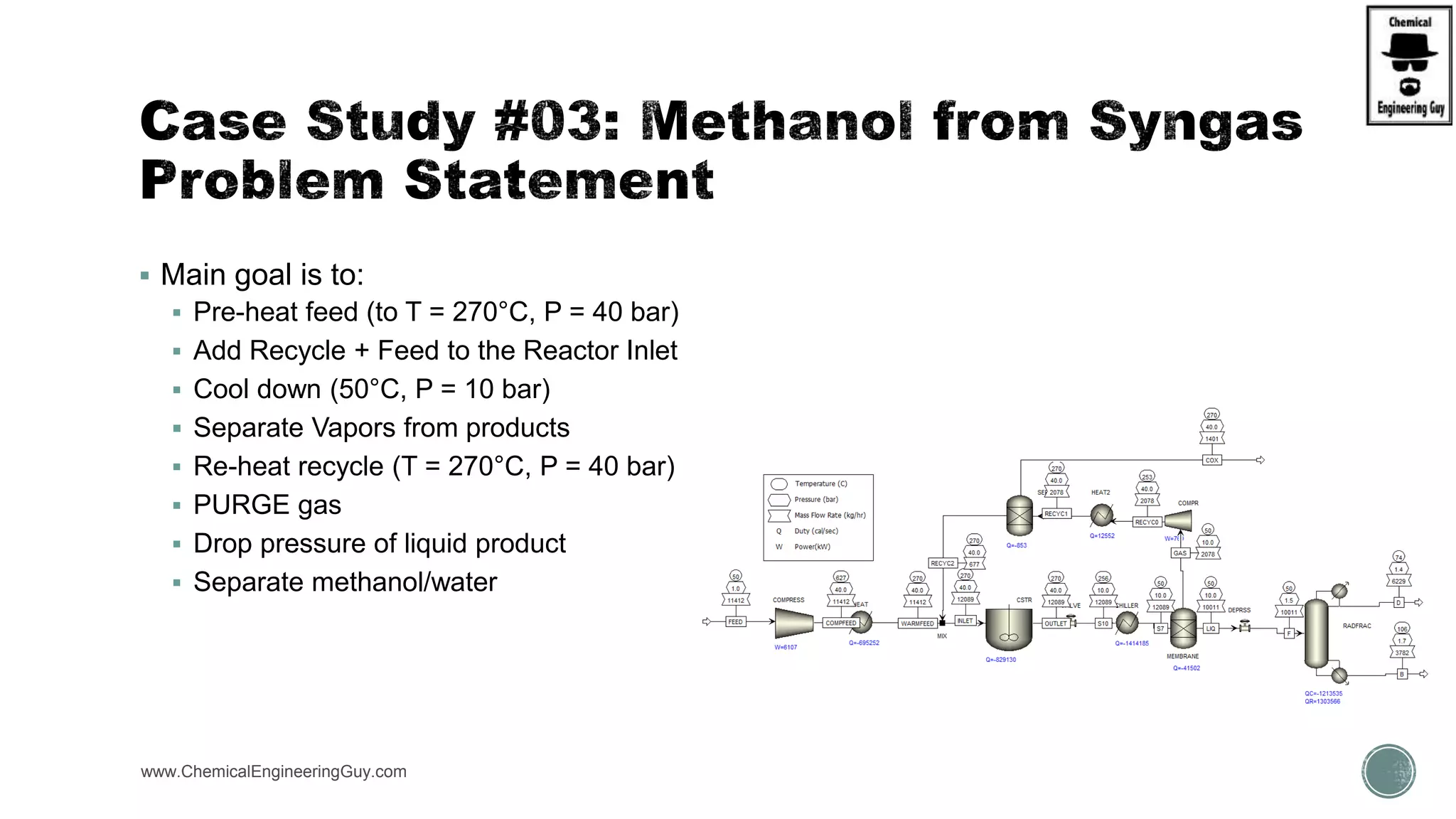
 Main goal is to:
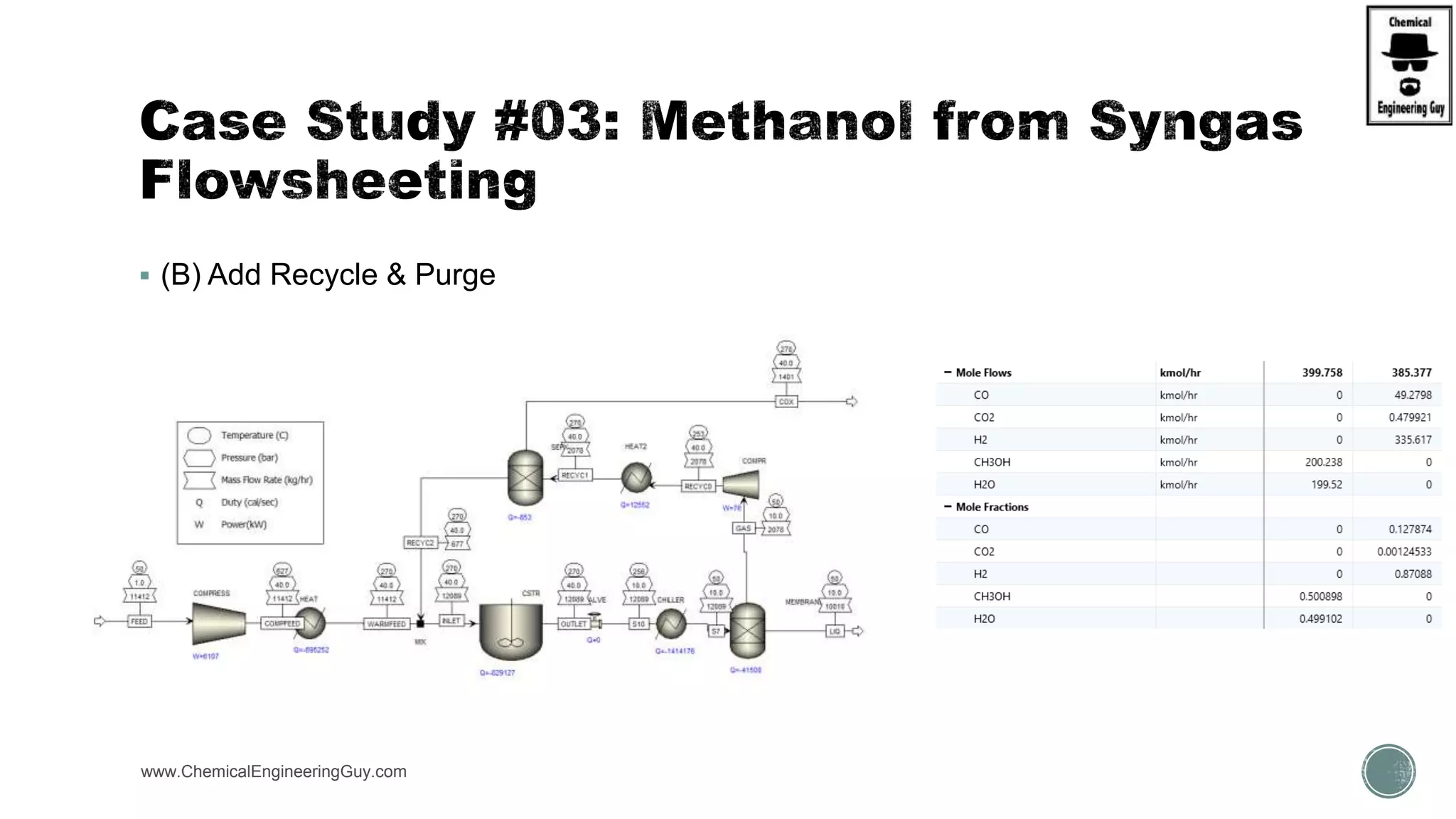
 Pre-heat feed (to T = 270°C, P = 40 bar)
 Add Recycle + Feed to the Reactor Inlet
 Cool down (50°C, P = 10 bar)
 Separate Vapors from products
 Re-heat recycle (T = 270°C, P = 40 bar)
 PURGE gas
 Drop pressure of liquid product
 Separate methanol/water
www.ChemicalEngineeringGuy.com https://www.youtube.com/watch?v=Dgwsgpohxmk
 (Ai) Verify Heat duty of Reactor (pre/after recycle)
 (Aii) For the CSTR, verify Calculated Keq vs. Given Built-in Expressions
 (B) Purge Ratio vs. Recycle
 (C) Use Binary Analysis for Distillation
 (D) DSWTU No. recommended Stages, given RR = 1.5
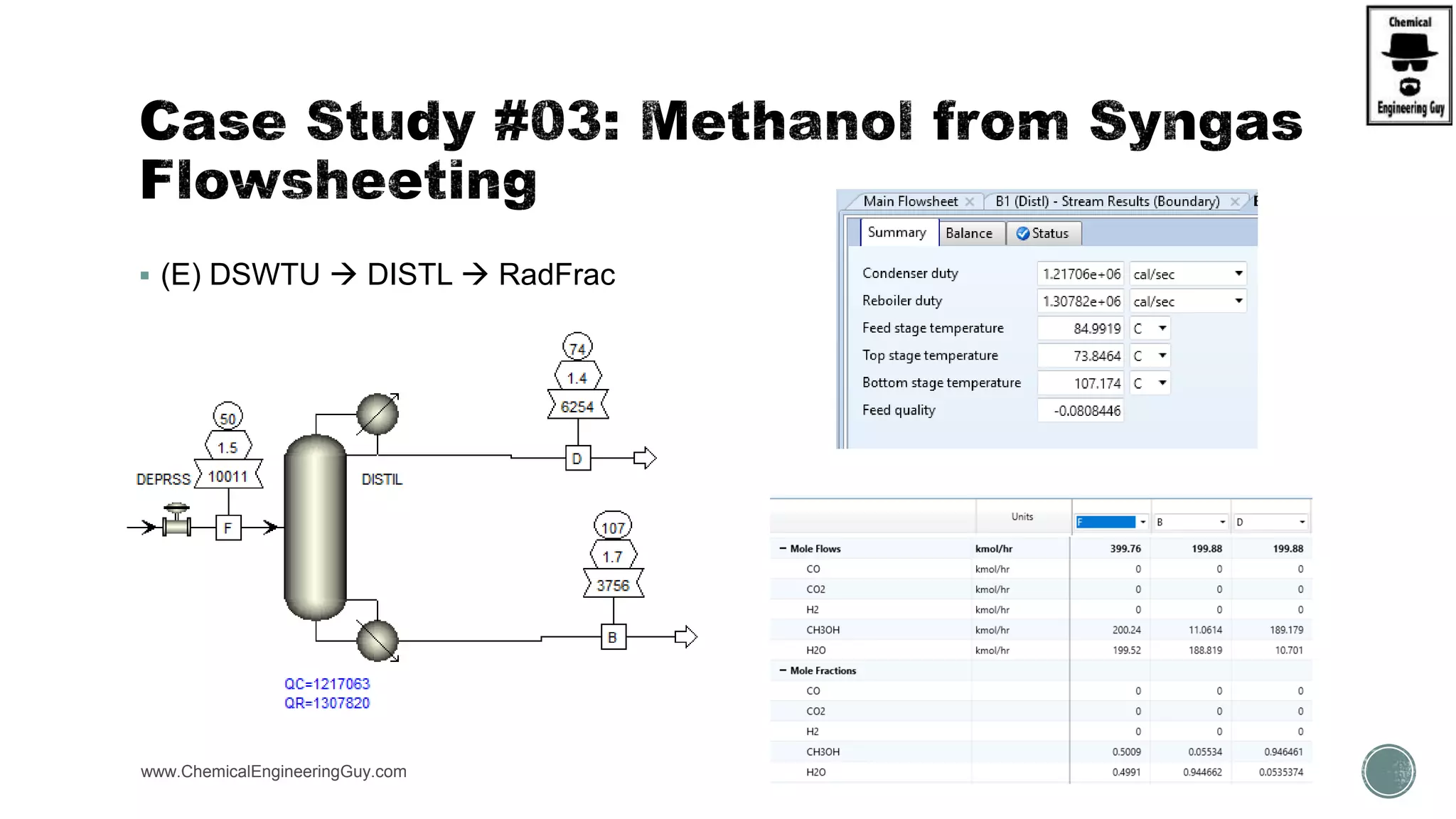
 (E) DSWTU  DISTL  RadFrac
 (F) Reboiler/Condenser Heating Duties of Column
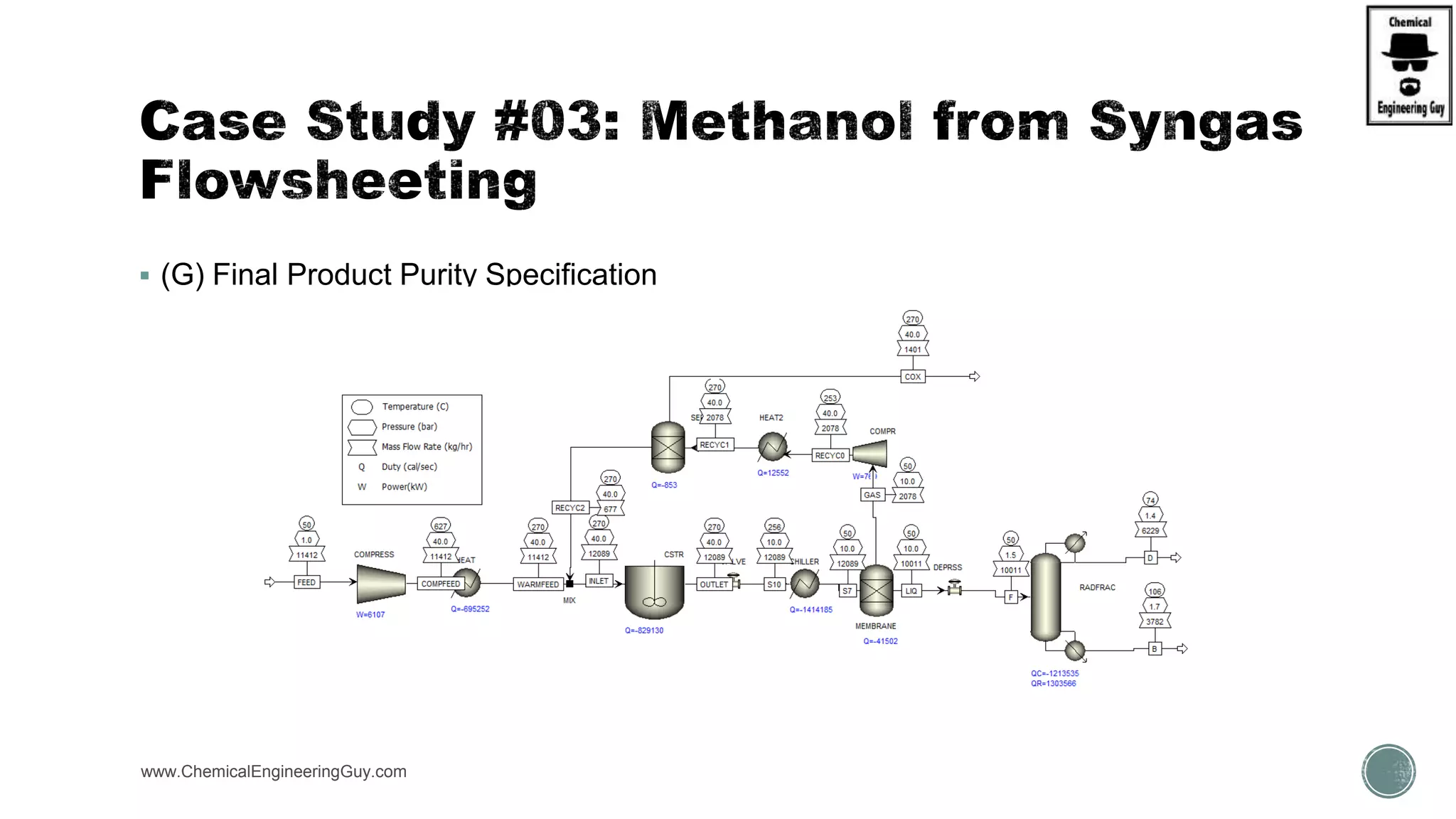
 (G) Final Product Purity Specification
www.ChemicalEngineeringGuy.com
 Try to aim this simulation:
www.ChemicalEngineeringGuy.com
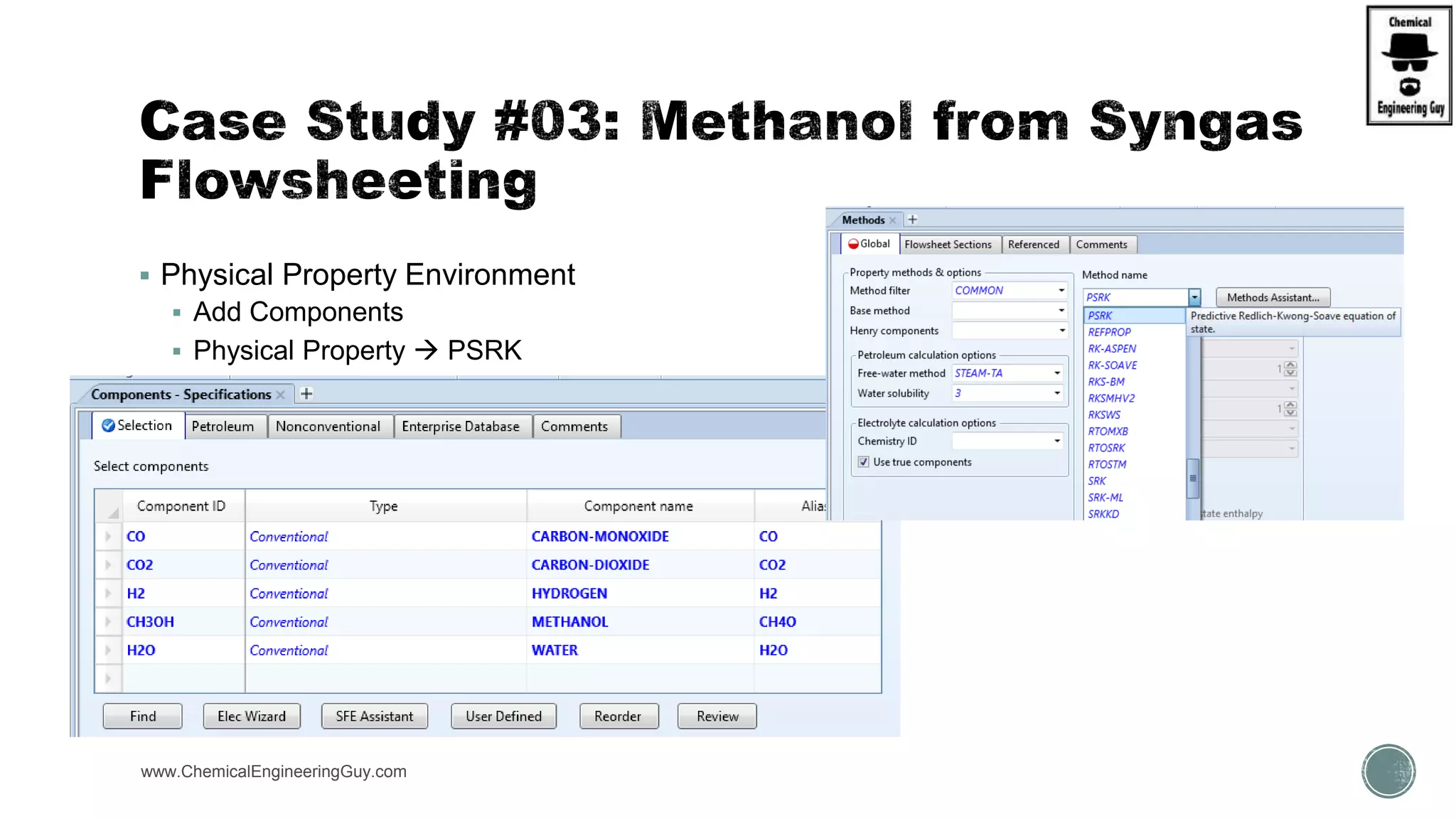
 Physical Property Environment
 Add Components
 Physical Property  PSRK
www.ChemicalEngineeringGuy.com
 Simulation Environment
 FEED:
www.ChemicalEngineeringGuy.com
 HEATER
www.ChemicalEngineeringGuy.com
 R-CSTR
Enjoying so far?
This is a preview of the BOOTCAMP.
Join NOW here:
https://www.chemicalengineeringguy.com/courses/aspen-plus-bootcamp-with-12-case-studies/
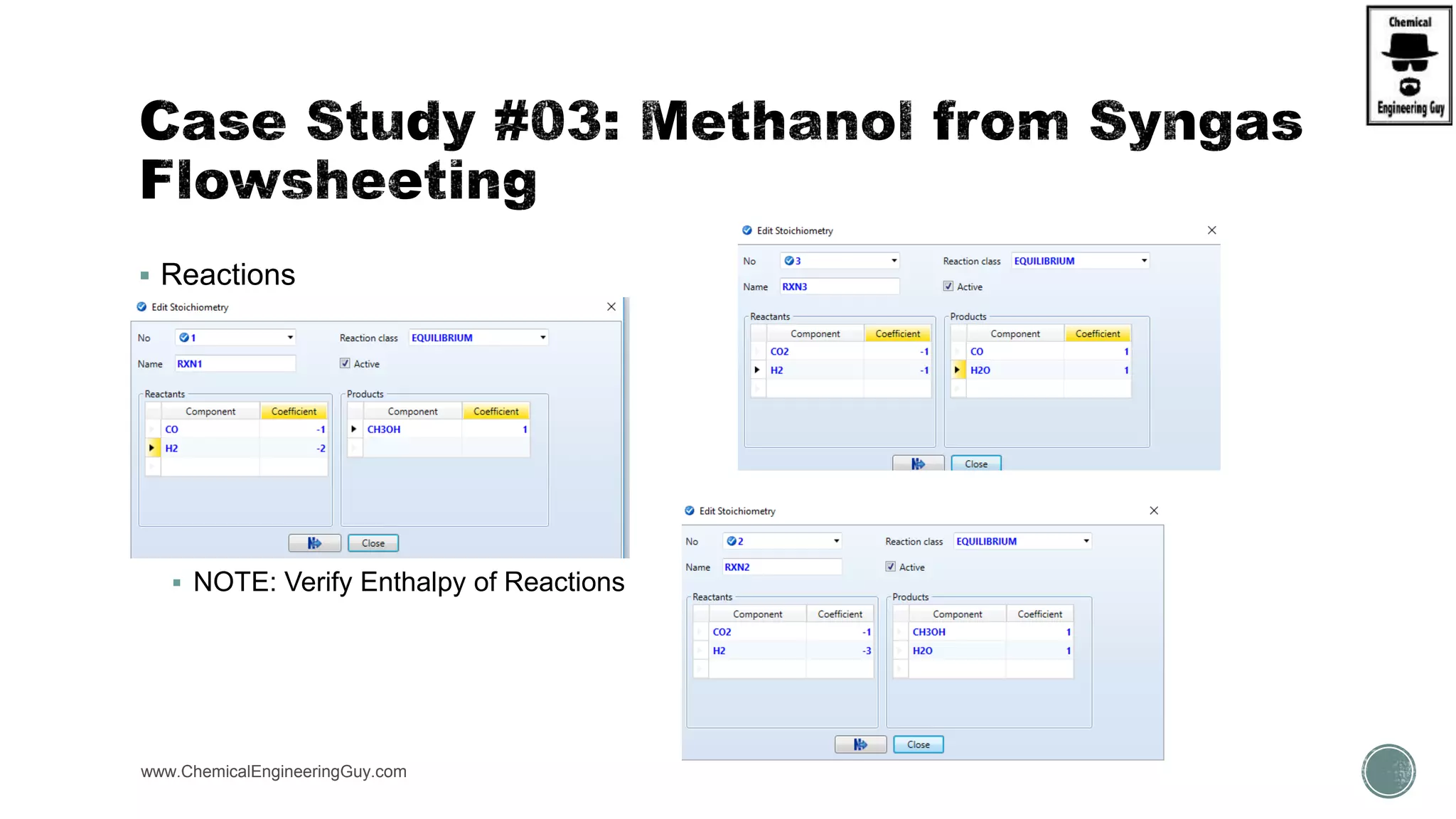
 Reactions
 RXN – LHHW / Equilibium
 NOTE: Verify Enthalpy of Reactions
www.ChemicalEngineeringGuy.com
 Reactions
 RXN –Equilibium
 NOTE: Verify Enthalpy of Reactions
www.ChemicalEngineeringGuy.com
𝐶𝑂 + 2𝐻2 ↔ 𝐶𝐻3 𝑂𝐻 𝛥𝐻 = −91𝑘 𝐽 𝑚 𝑜𝑙
𝐶𝑂2 + 3𝐻2 ↔ 𝐶𝐻3 𝑂𝐻 + 𝐻2 𝑂 𝛥𝐻 = −49.5𝑘 𝐽 𝑚 𝑜𝑙
𝐶𝑂2 + 𝐻2 ↔ 𝐶𝑂 + 𝐻2 𝑂 𝛥𝐻 = −41.2𝑘 𝐽 𝑚 𝑜𝑙
Enjoying so far?
This is a preview of the BOOTCAMP.
Join NOW here:
https://www.chemicalengineeringguy.com/courses/aspen-plus-bootcamp-with-12-case-studies/
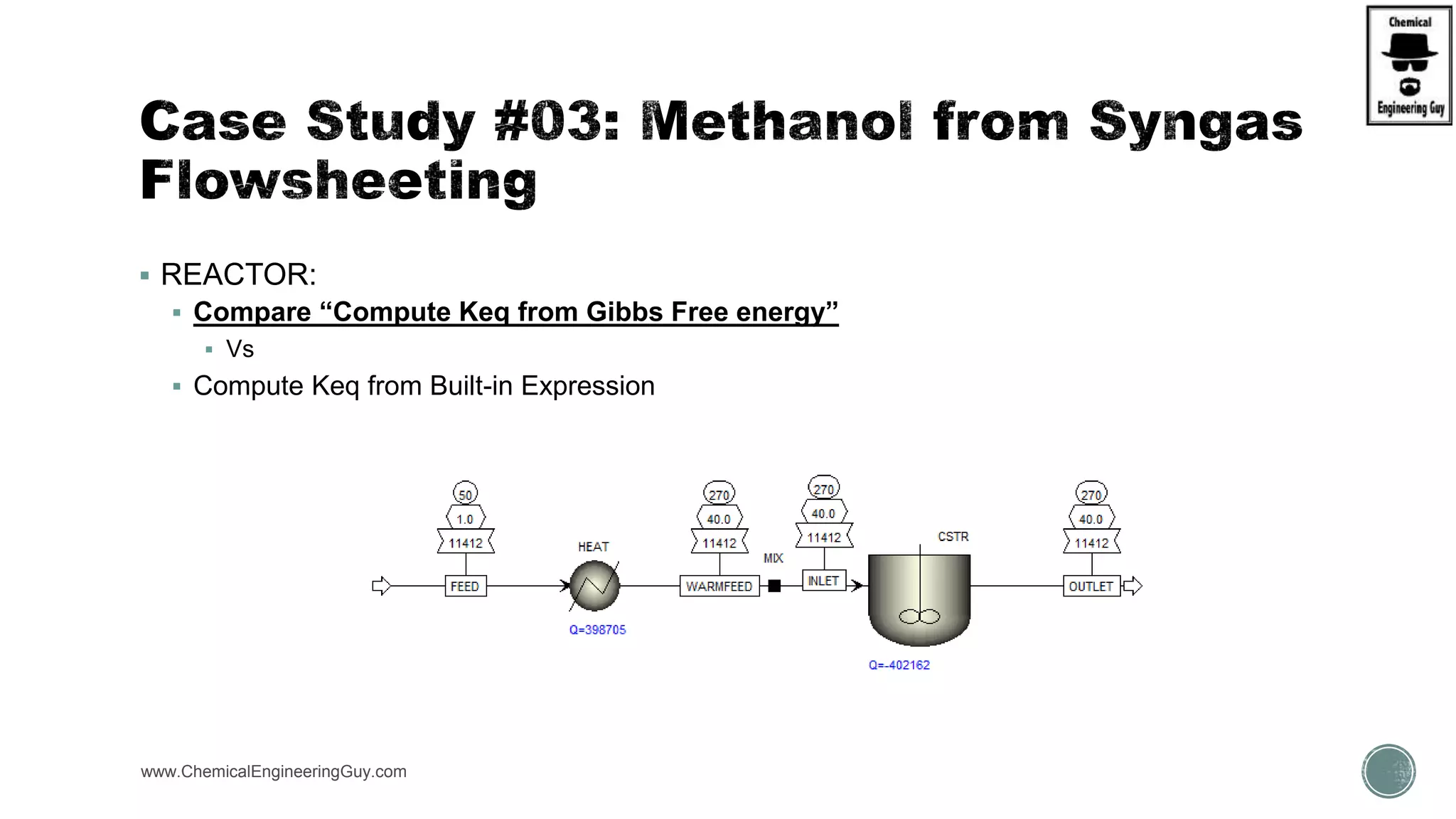
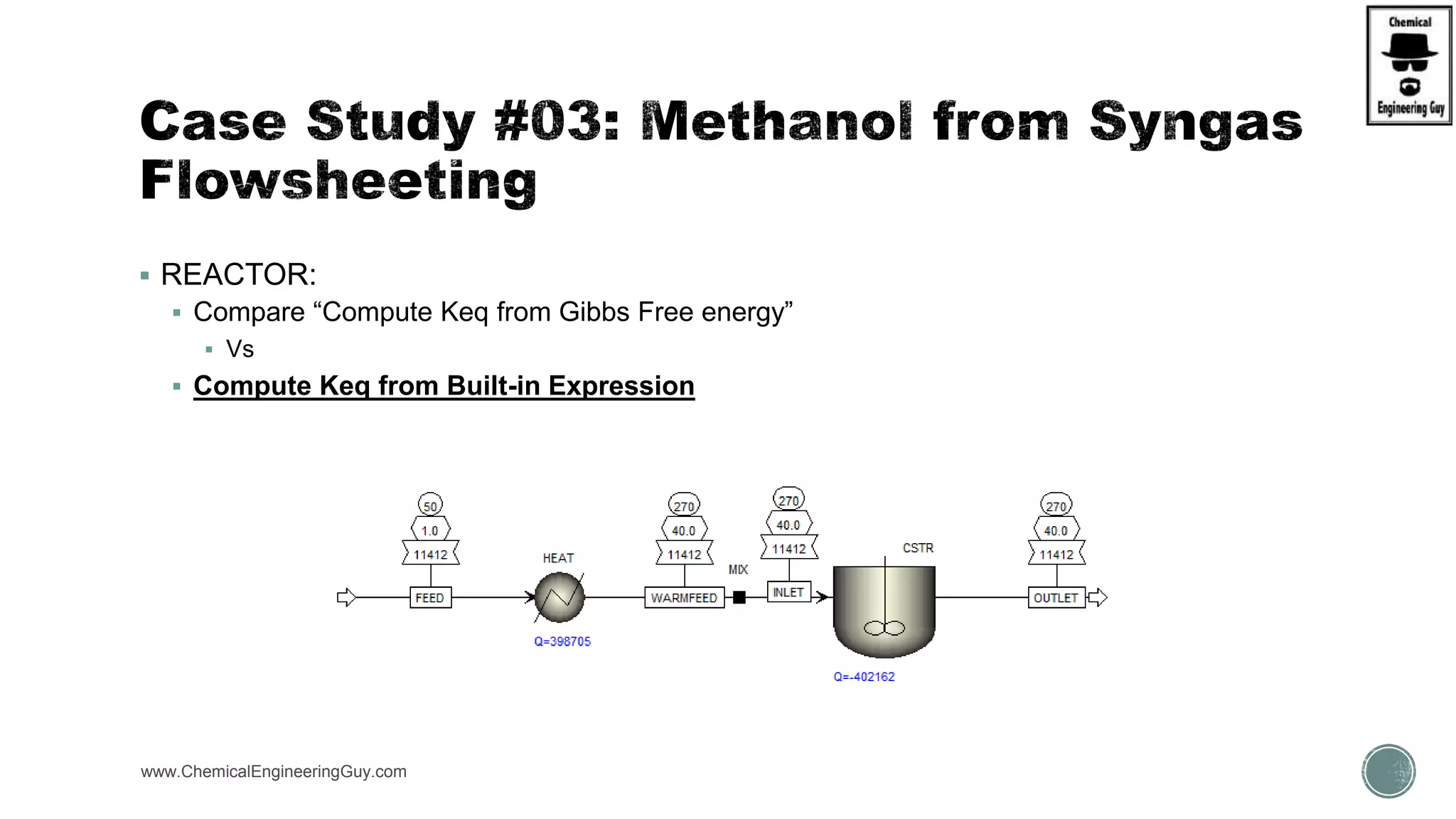
 REACTOR:
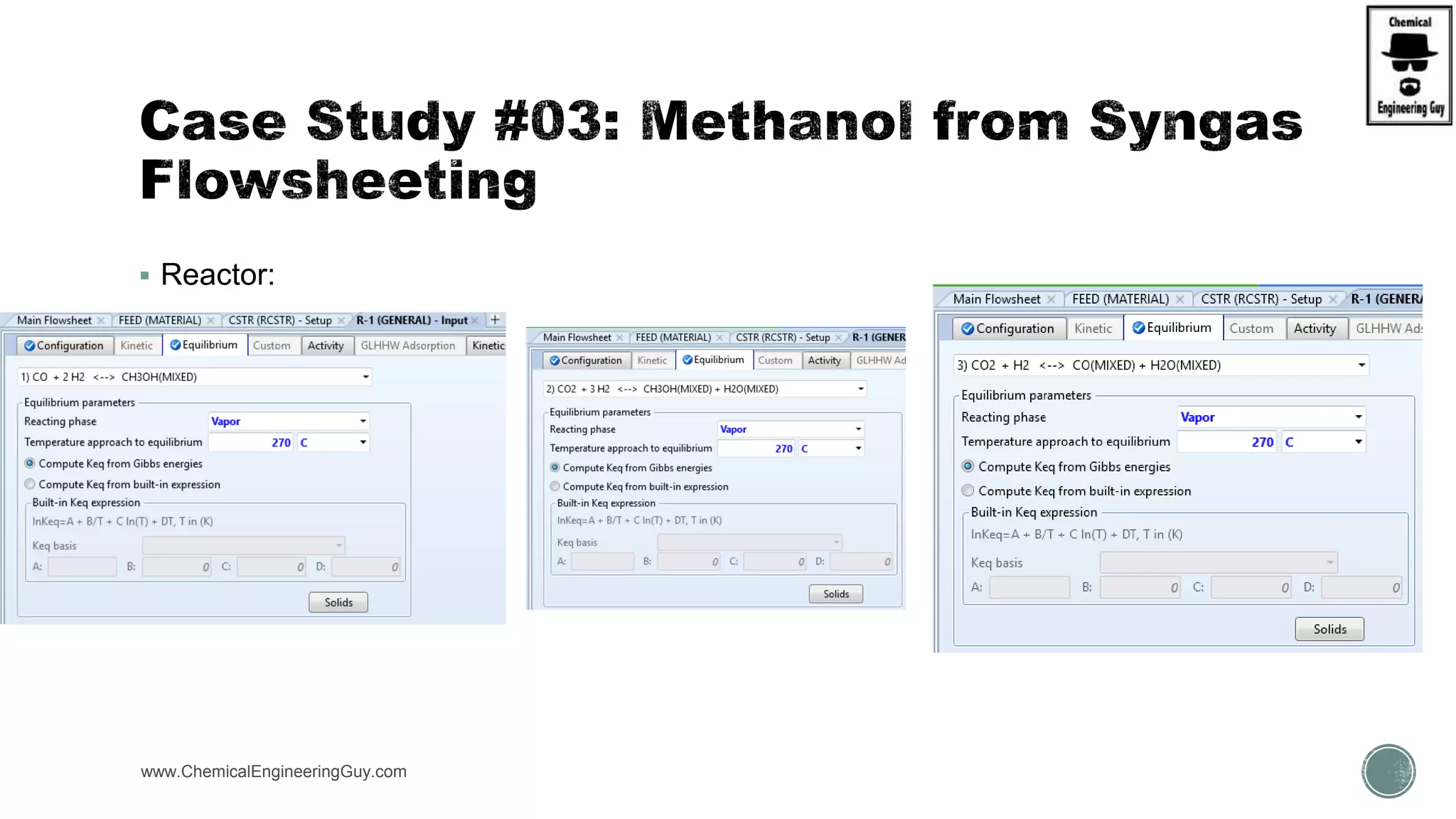
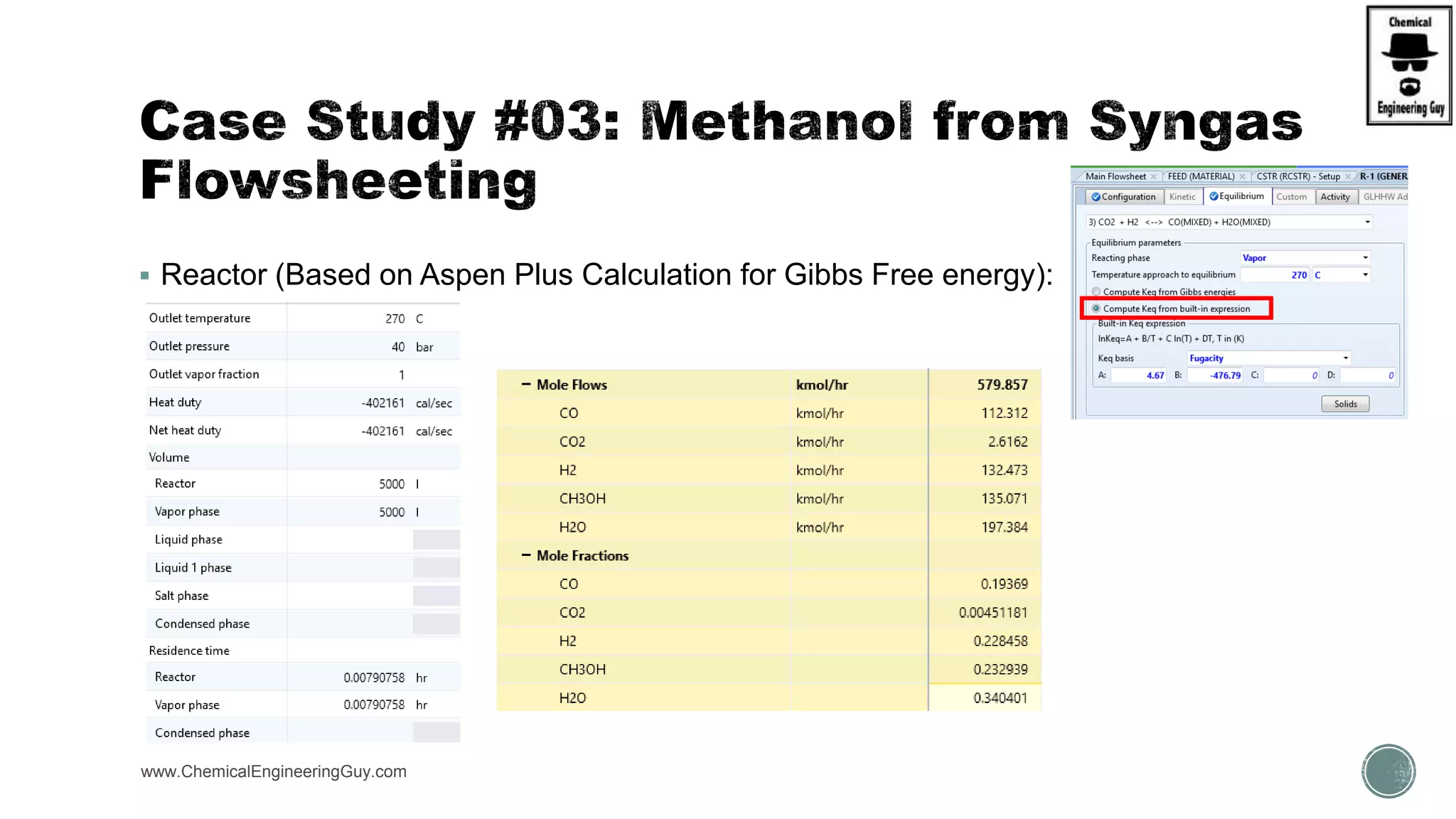
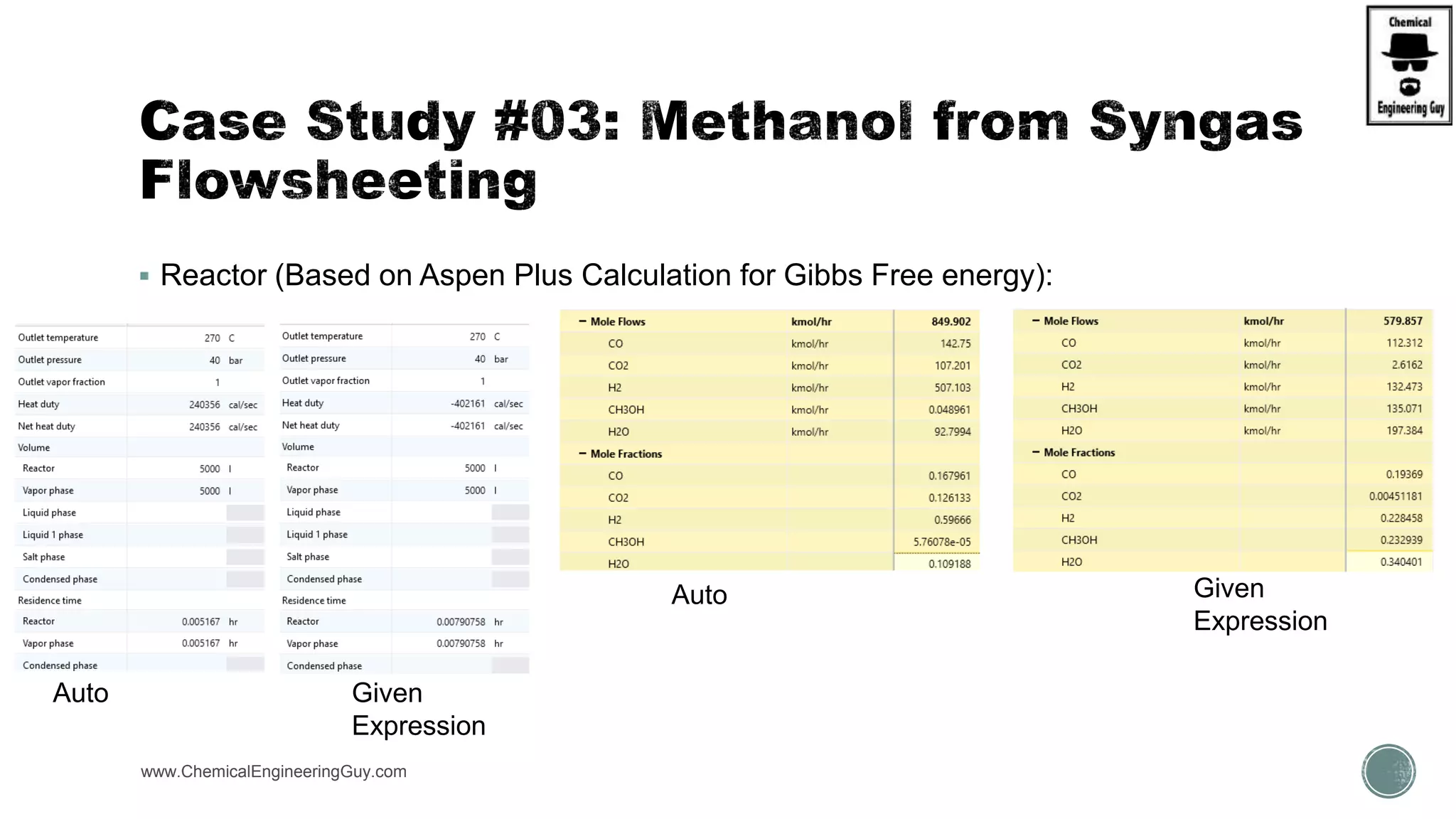
 Compare “Compute Keq from Gibbs Free energy”
 Vs
 Compute Keq from Built-in Expression
www.ChemicalEngineeringGuy.com
 Reactor:
www.ChemicalEngineeringGuy.com
 Reactor (Based on Aspen Plus Calculation for Gibbs Free energy):
www.ChemicalEngineeringGuy.com
Enjoying so far?
This is a preview of the BOOTCAMP.
Join NOW here:
https://www.chemicalengineeringguy.com/courses/aspen-plus-bootcamp-with-12-case-studies/
 REACTOR:
 Compare “Compute Keq from Gibbs Free energy”
 Vs
 Compute Keq from Built-in Expression
www.ChemicalEngineeringGuy.com
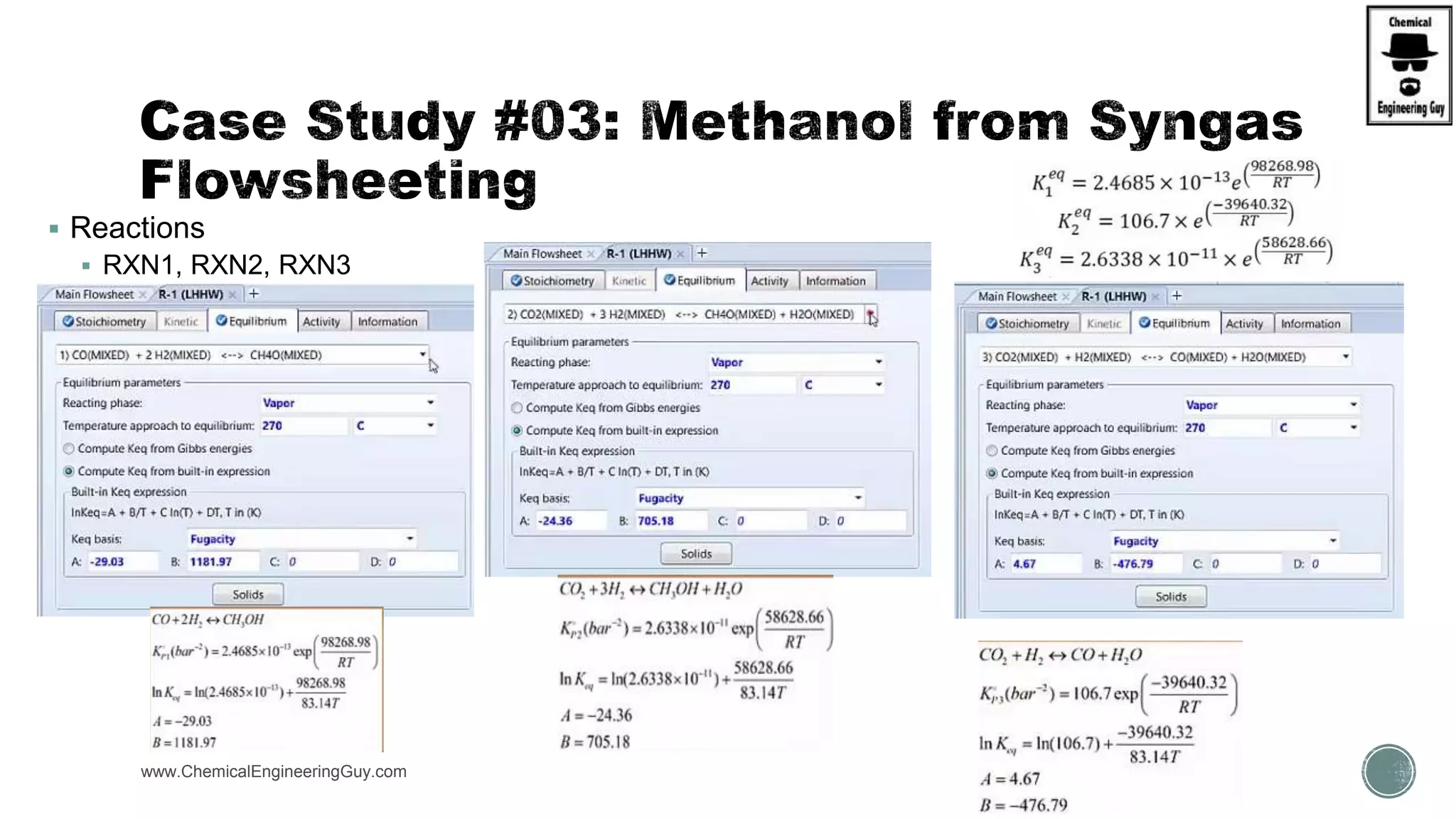
 Reactions
 RXN1, RXN2, RXN3
www.ChemicalEngineeringGuy.com
 Reactions
 RXN1, RXN2, RXN3
www.ChemicalEngineeringGuy.com
Enjoying so far?
This is a preview of the BOOTCAMP.
Join NOW here:
https://www.chemicalengineeringguy.com/courses/aspen-plus-bootcamp-with-12-case-studies/
 Reactor (Based on Aspen Plus Calculation for Gibbs Free energy):
www.ChemicalEngineeringGuy.com
 Reactor (Based on Aspen Plus Calculation for Gibbs Free energy):
www.ChemicalEngineeringGuy.com
Auto Given
Expression
Auto Given
Expression
 Continue with flowsheeting
www.ChemicalEngineeringGuy.com
Enjoying so far?
This is a preview of the BOOTCAMP.
Join NOW here:
https://www.chemicalengineeringguy.com/courses/aspen-plus-bootcamp-with-12-case-studies/
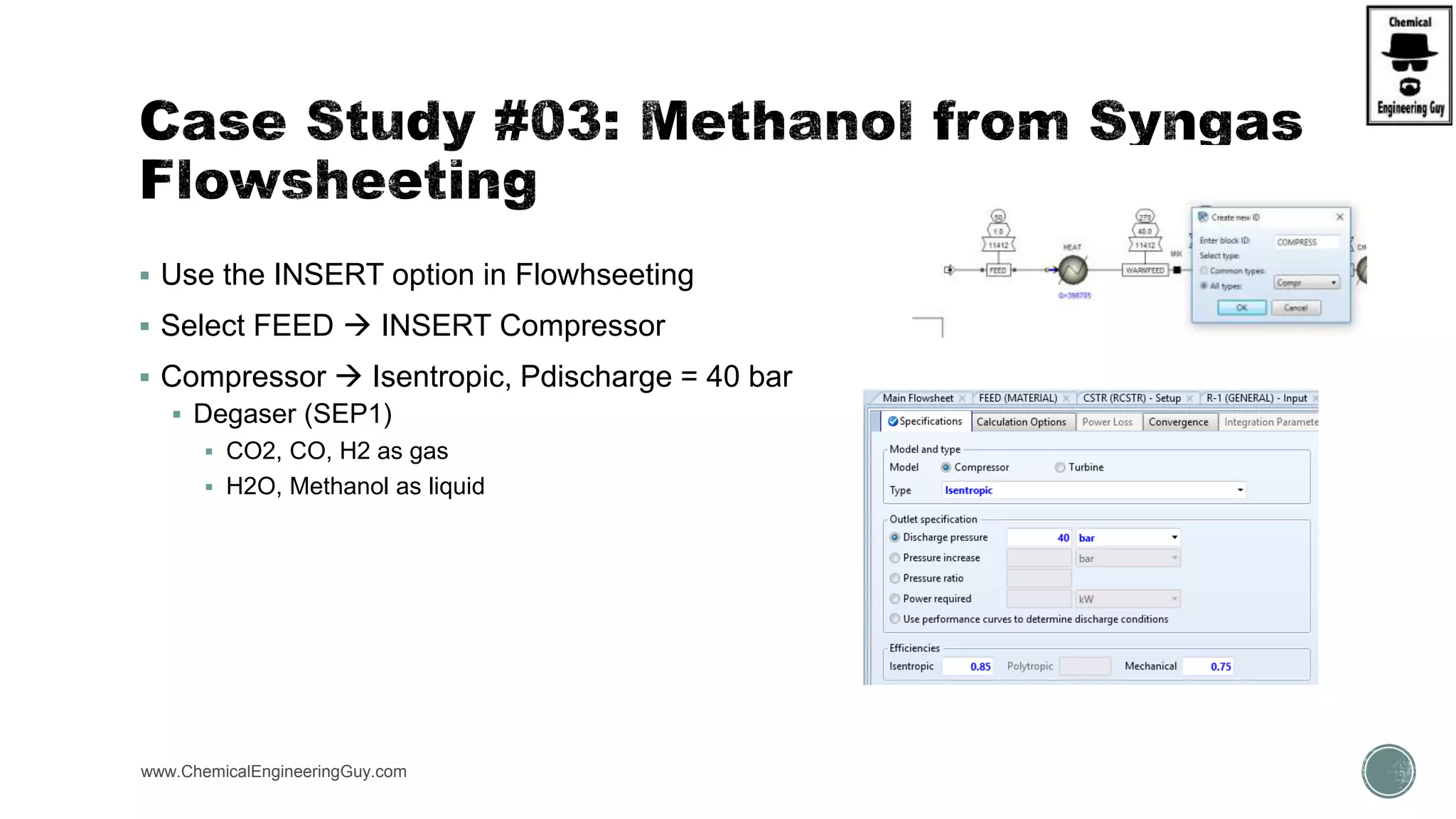
 Use the INSERT option in Flowhseeting
 Select FEED  INSERT Compressor
 Compressor  Isentropic, Pdischarge = 40 bar
 Degaser (SEP1)
 CO2, CO, H2 as gas
 H2O, Methanol as liquid
www.ChemicalEngineeringGuy.com
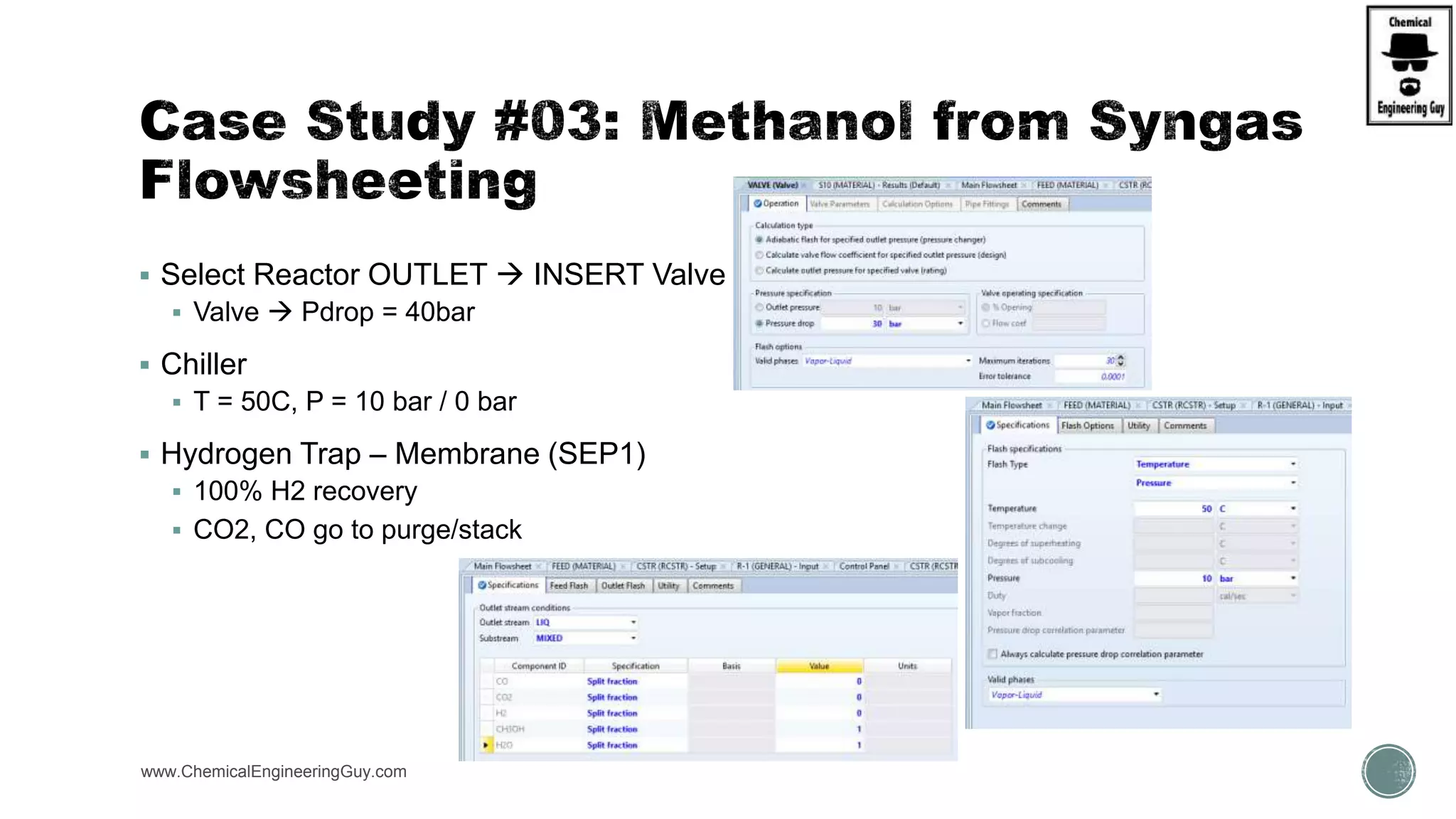
 Select Reactor OUTLET  INSERT Valve
 Valve  Pdrop = 40bar
 Chiller
 T = 50C, P = 10 bar / 0 bar
 Hydrogen Trap – Membrane (SEP1)
 100% H2 recovery
 CO2, CO go to purge/stack
www.ChemicalEngineeringGuy.com
Enjoying so far?
This is a preview of the BOOTCAMP.
Join NOW here:
https://www.chemicalengineeringguy.com/courses/aspen-plus-bootcamp-with-12-case-studies/
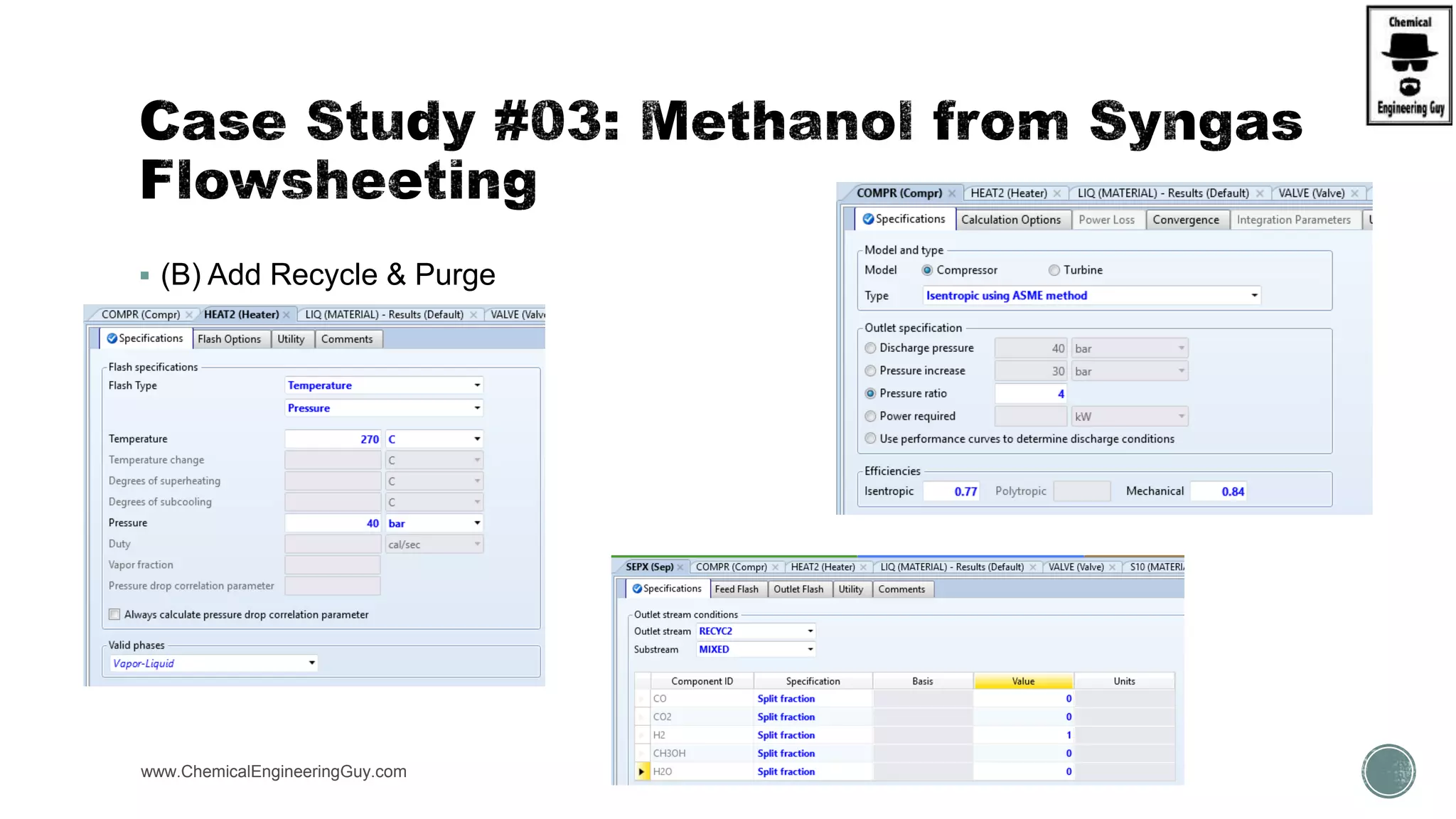
 (B) Add Recycle & Purge
www.ChemicalEngineeringGuy.com
 (B) Add Recycle & Purge
www.ChemicalEngineeringGuy.com
 (B) Add Recycle & Purge
www.ChemicalEngineeringGuy.com
Enjoying so far?
This is a preview of the BOOTCAMP.
Join NOW here:
https://www.chemicalengineeringguy.com/courses/aspen-plus-bootcamp-with-12-case-studies/
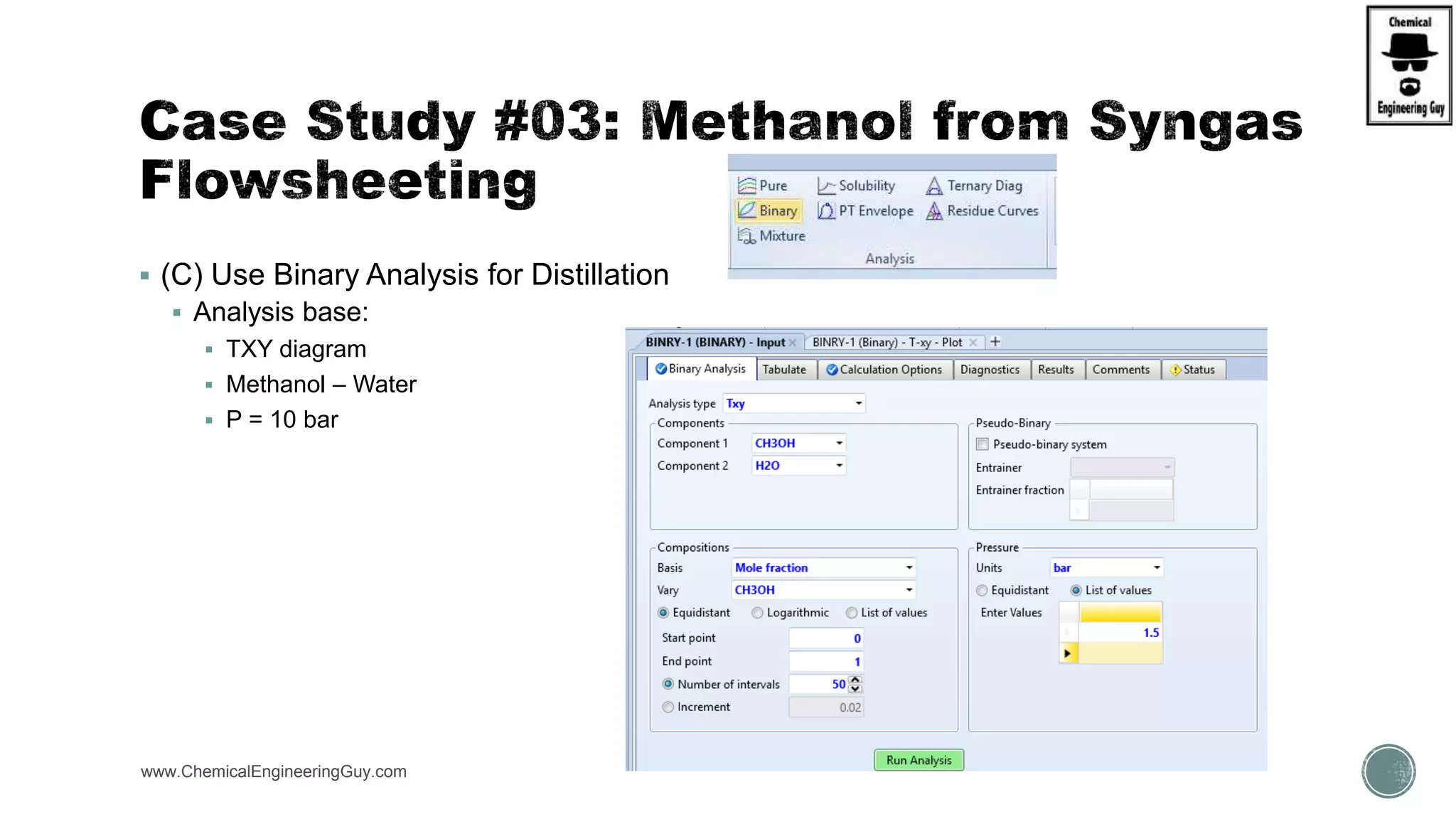
 (C) Use Binary Analysis for Distillation
 Analysis base:
 TXY diagram
 Methanol – Water
 P = 10 bar
www.ChemicalEngineeringGuy.com
Enjoying so far?
This is a preview of the BOOTCAMP.
Join NOW here:
https://www.chemicalengineeringguy.com/courses/aspen-plus-bootcamp-with-12-case-studies/
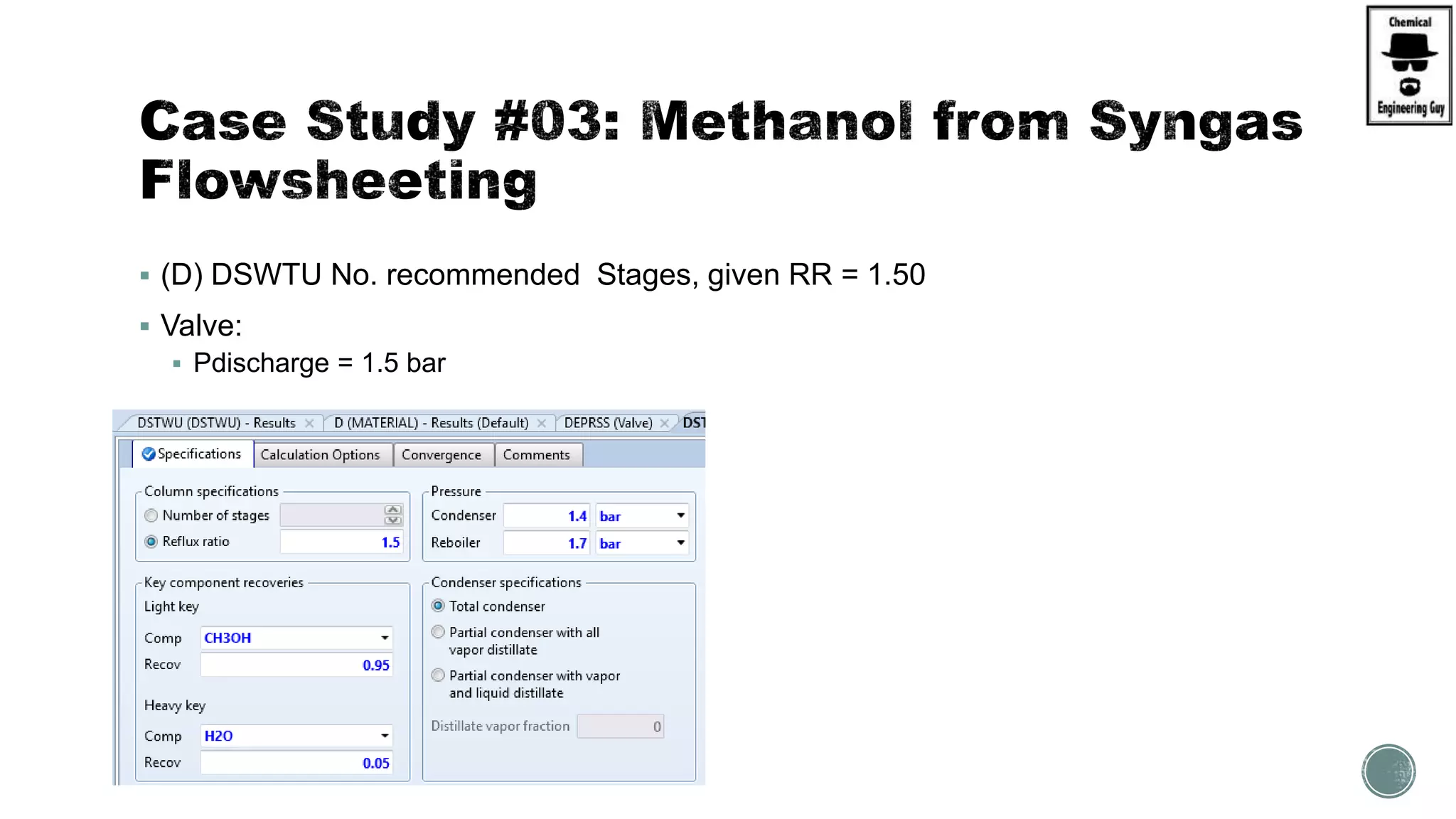
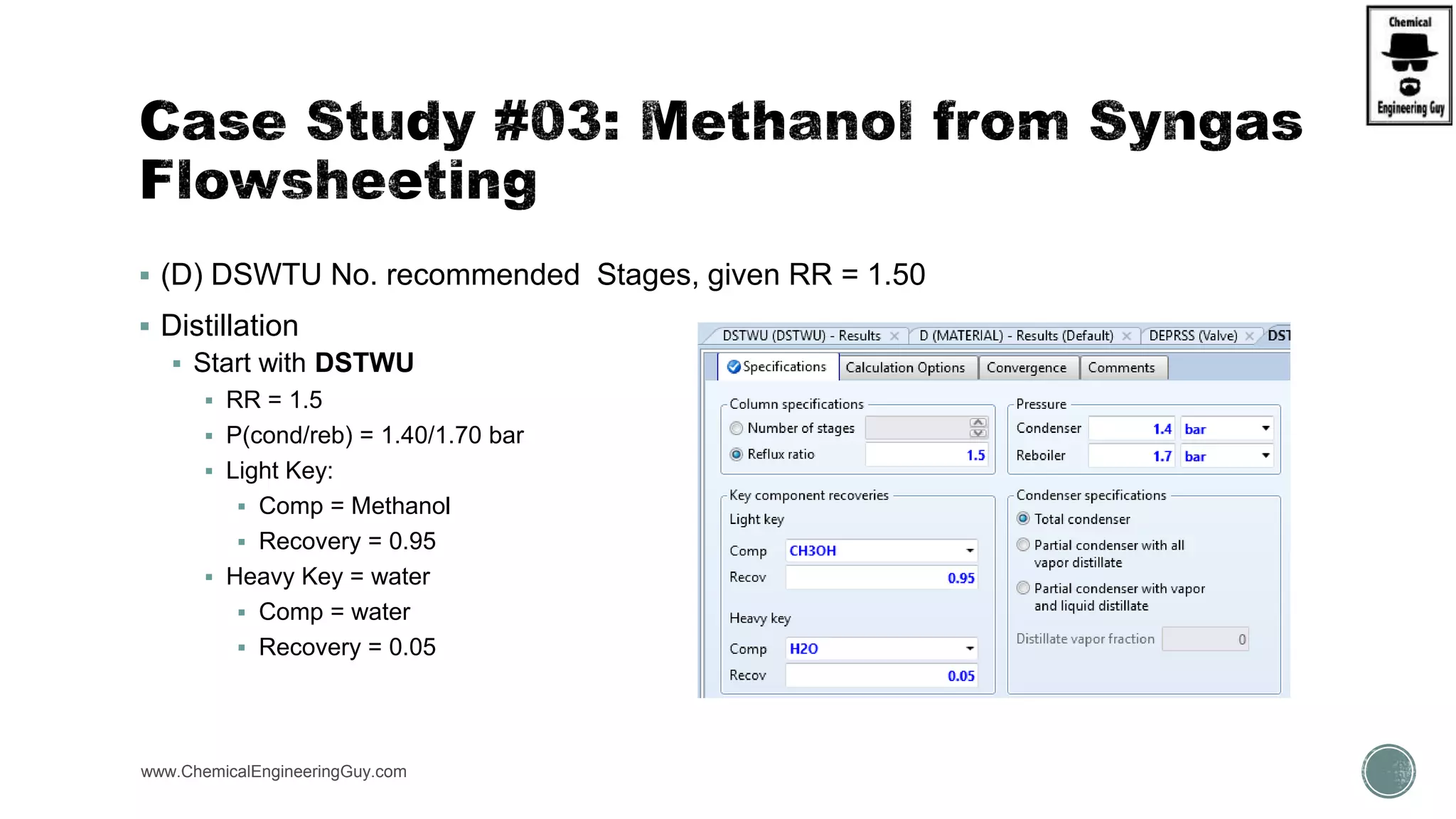
 (D) DSWTU No. recommended Stages, given RR = 1.50
 Valve:
 Pdischarge = 1.5 bar
www.ChemicalEngineeringGuy.com
 (D) DSWTU No. recommended Stages, given RR = 1.50
 Distillation
 Start with DSTWU
 RR = 1.5
 P(cond/reb) = 1.40/1.70 bar
 Light Key:
 Comp = Methanol
 Recovery = 0.95
 Heavy Key = water
 Comp = water
 Recovery = 0.05
www.ChemicalEngineeringGuy.com
 (D) DSWTU No. recommended Stages, given RR = 0.80
 Distillation
 Start with DSTWU
 RR = 1.5
 P(cond/reb) = 1.40/1.70 bar
 Light Key:
 Comp = Methanol
 Recovery = 0.95
 Heavy Key = water
 Comp = water
 Recovery = 0.05
www.ChemicalEngineeringGuy.com
Enjoying so far?
This is a preview of the BOOTCAMP.
Join NOW here:
https://www.chemicalengineeringguy.com/courses/aspen-plus-bootcamp-with-12-case-studies/
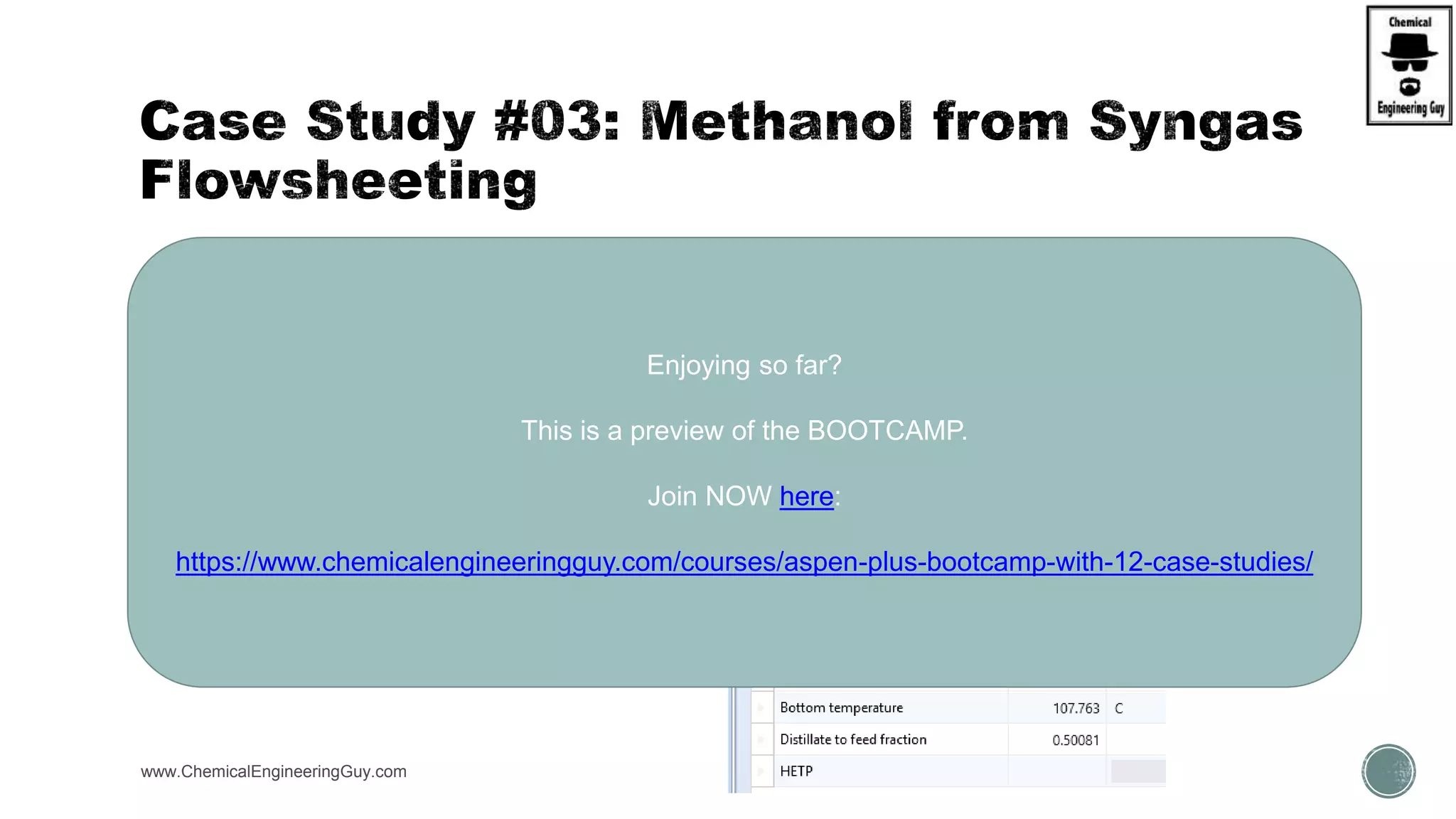
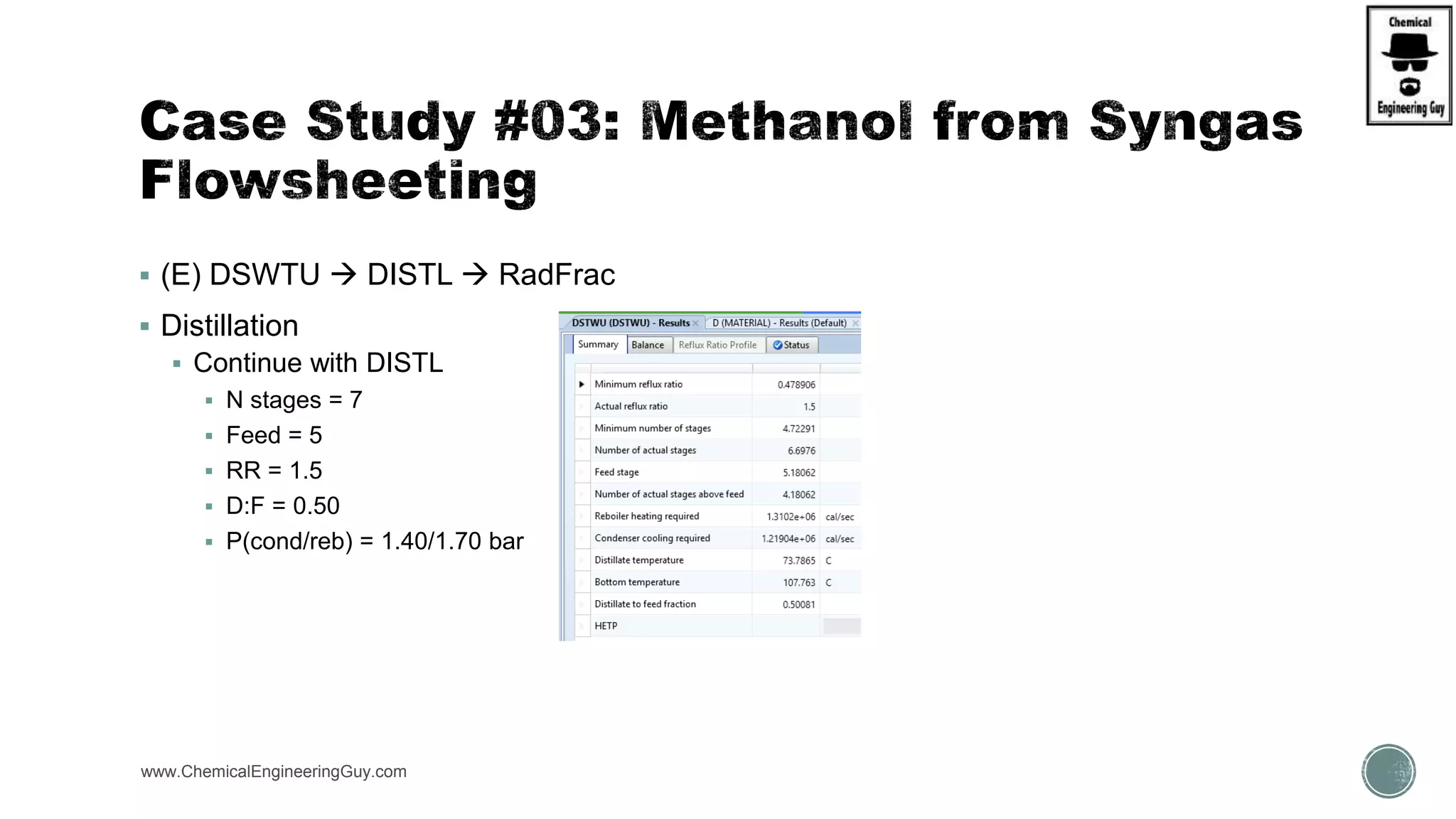
 (E) DSWTU  DISTL  RadFrac
 Distillation
 Continue with DISTL
 N stages = 7
 Feed = 5
 RR = 1.5
 D:F = 0.50
 P(cond/reb) = 1.40/1.70 bar
www.ChemicalEngineeringGuy.com
 (E) DSWTU  DISTL  RadFrac
 Distillation
 Continue with DISTL
 N stages = 7
 Feed = 5
 RR = 1.5
 D:F = 0.50
 P(cond/reb) = 1.40/1.70 bar
www.ChemicalEngineeringGuy.com
Enjoying so far?
This is a preview of the BOOTCAMP.
Join NOW here:
https://www.chemicalengineeringguy.com/courses/aspen-plus-bootcamp-with-12-case-studies/
 (E) DSWTU  DISTL  RadFrac
 Distillation
 Continue with DISTL
 N stages = 7
 Feed = 5
 RR = 1.5
 D:F = 0.50
 P(cond/reb) = 1.40/1.70 bar
www.ChemicalEngineeringGuy.com
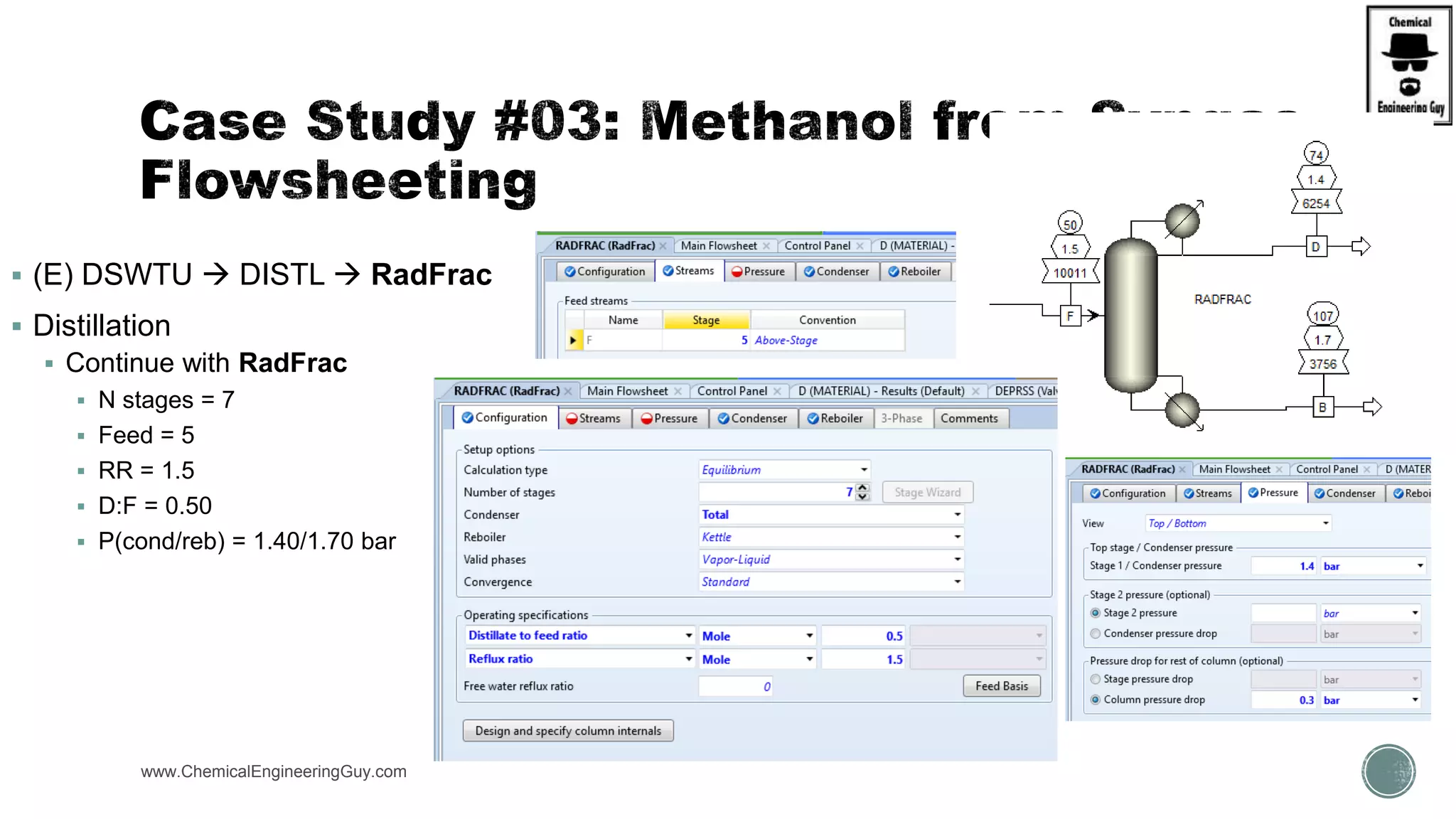
 (E) DSWTU  DISTL  RadFrac
 Distillation
 Continue with RadFrac
 N stages = 7
 Feed = 5
 RR = 1.5
 D:F = 0.50
 P(cond/reb) = 1.40/1.70 bar
www.ChemicalEngineeringGuy.com
Enjoying so far?
This is a preview of the BOOTCAMP.
Join NOW here:
https://www.chemicalengineeringguy.com/courses/aspen-plus-bootcamp-with-12-case-studies/
www.ChemicalEngineeringGuy.com
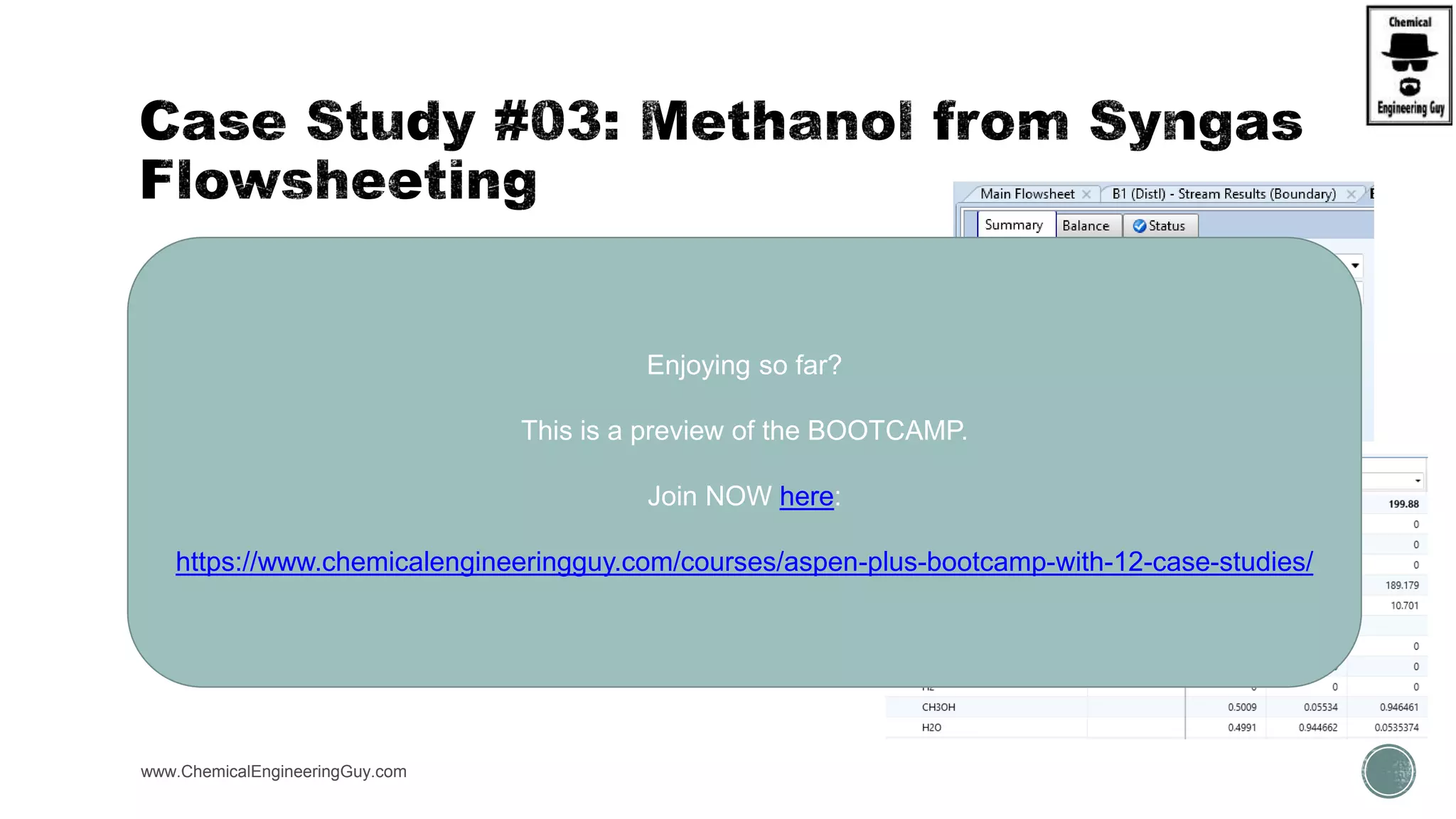
 (G) Final Product Purity Specification
 Case Study 4
 Flowsheeting: “Views” Text/Figures
 Adding Reactions
 Operations: Isothermal Reactions, Purging, Recycling, Condensation / Boiling
 Units: R-PFR, Heat-X (Shortcut / Tube & Shell)
 Plotting Results of PFR
www.ChemicalEngineeringGuy.com
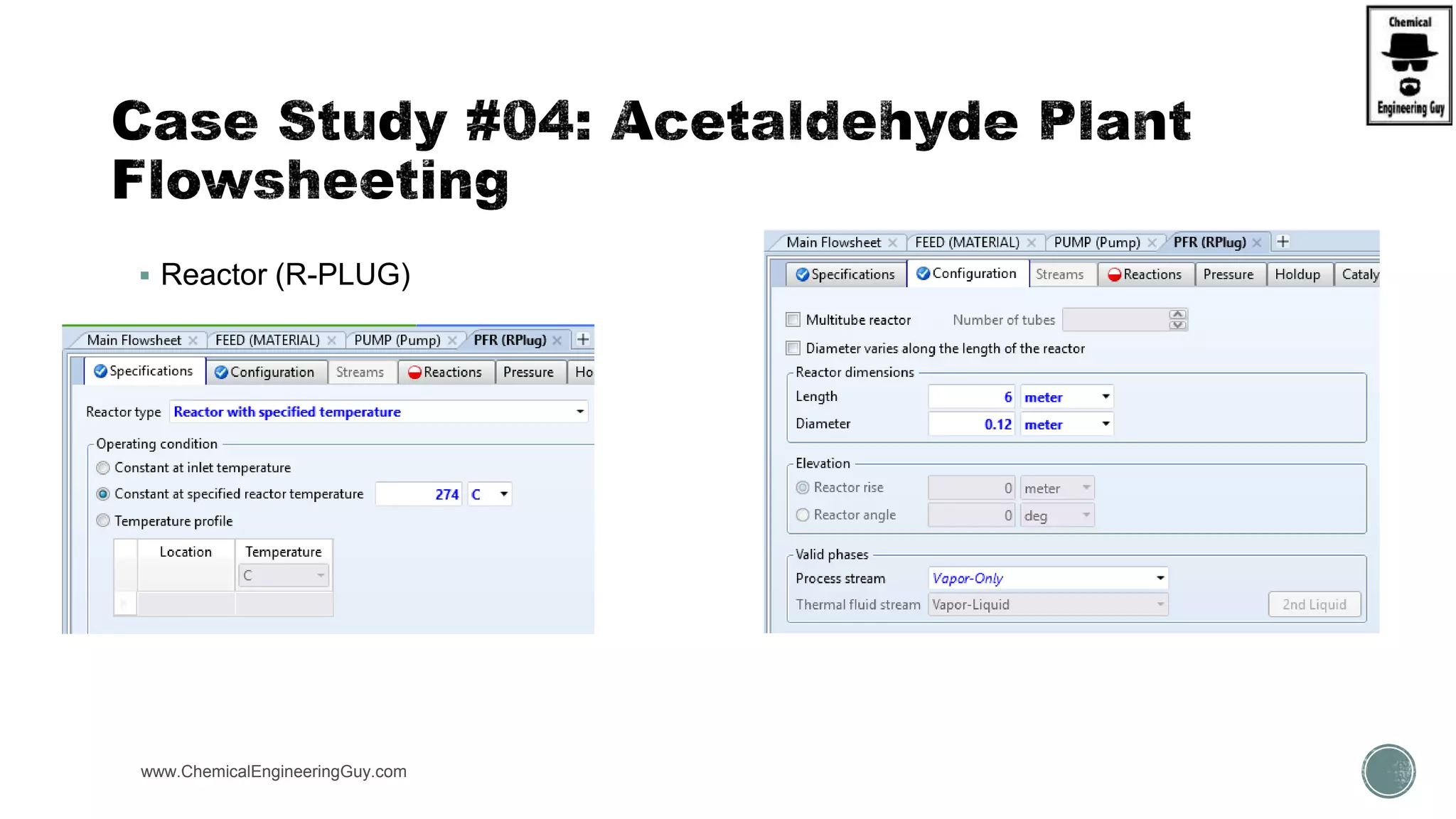
 Ethanol is to be converted to Acetaldehyde using a Plug flow reactor.
 The Reactor is to be isothermal, 274°C, Single-tube  L = 6m, D = 0.12 m
 The reaction kinetics are known
 Ethanol  H2 + Acetaldehyde (desired)
 Ethanol + Acetaldehyde  Ethyl Acetate + H2 (undesired)
 Separation of the gases (H2 ,mostly) is imperative
 Final Product must be separated from the mix, at least 2/3
 Purge can be added, recommended recycle ratio is 90% molar
www.ChemicalEngineeringGuy.com https://www.youtube.com/watch?v=e2MZfVColH8
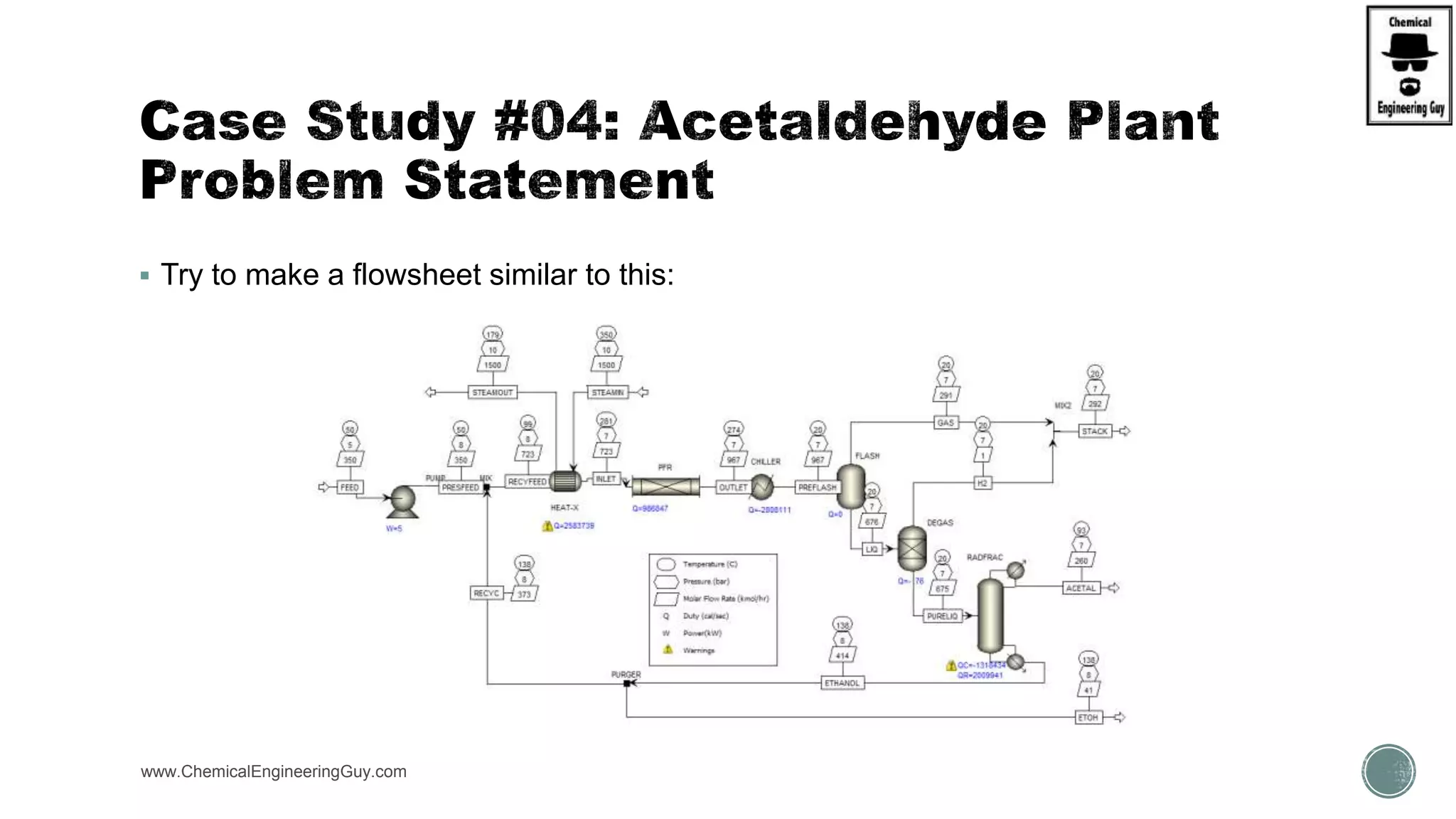
 (A) Run the PFR with no recycle
 (B) Add separation scheme (Flashing, Degasser, Distillation Column)
 (C) Add recycle + purge stream
 (D) Change HEAT1 for Heat-X (Shell & Tube)
 (E) Verify Purity f Products, Specs of Exchanger (Heaters, Reboilers, Condensers)
www.ChemicalEngineeringGuy.com
 Try to make a flowsheet similar to this:
www.ChemicalEngineeringGuy.com
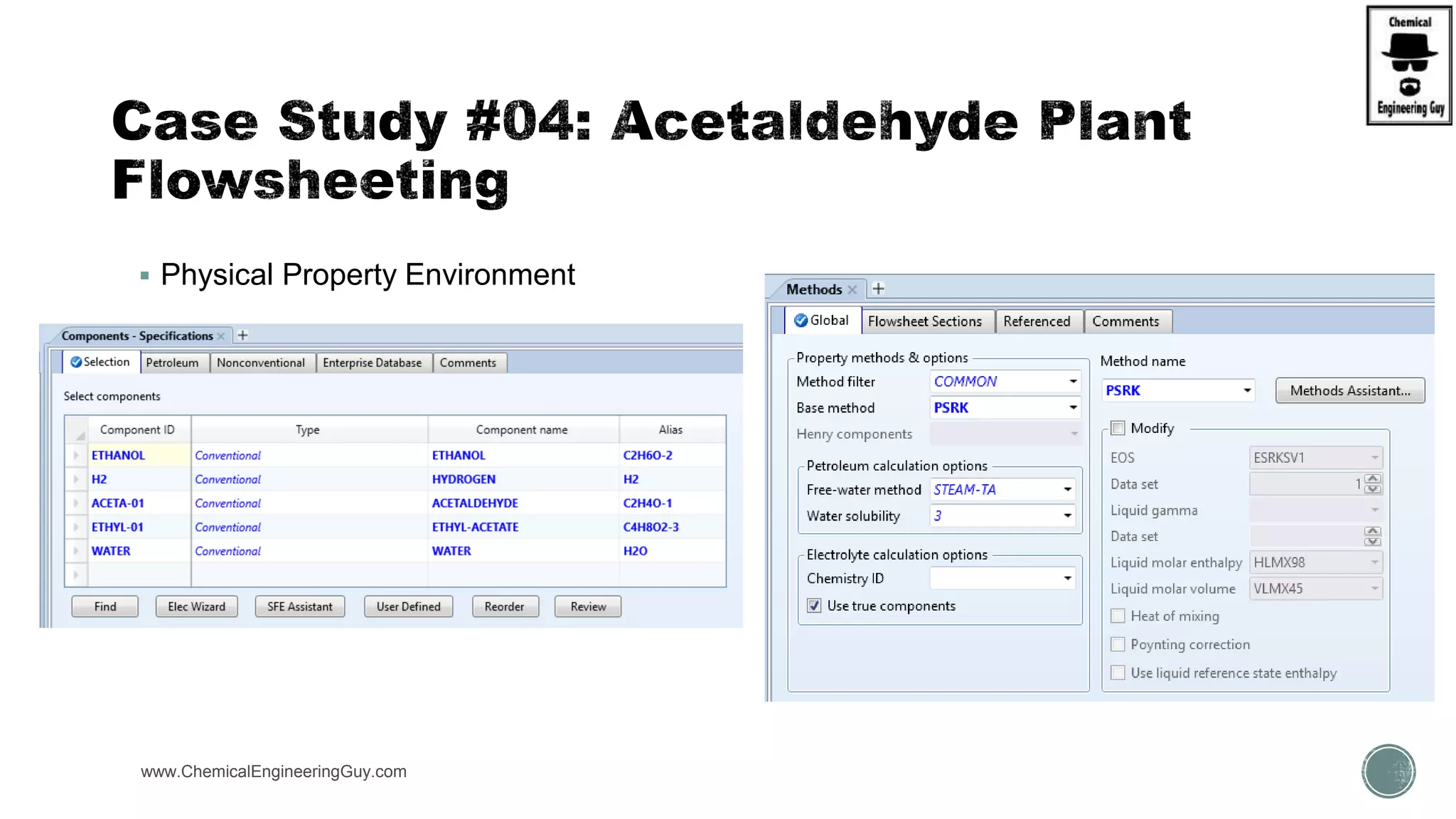
 Physical Property Environment
www.ChemicalEngineeringGuy.com https://www.youtube.com/watch?v=e2MZfVColH8
 Simulation Environment
 Feed + Pump + Mix
www.ChemicalEngineeringGuy.com https://www.youtube.com/watch?v=e2MZfVColH8
Enjoying so far?
This is a preview of the BOOTCAMP.
Join NOW here:
https://www.chemicalengineeringguy.com/courses/aspen-plus-bootcamp-with-12-case-studies/
 Reactor (R-PLUG)
www.ChemicalEngineeringGuy.com https://www.youtube.com/watch?v=e2MZfVColH8
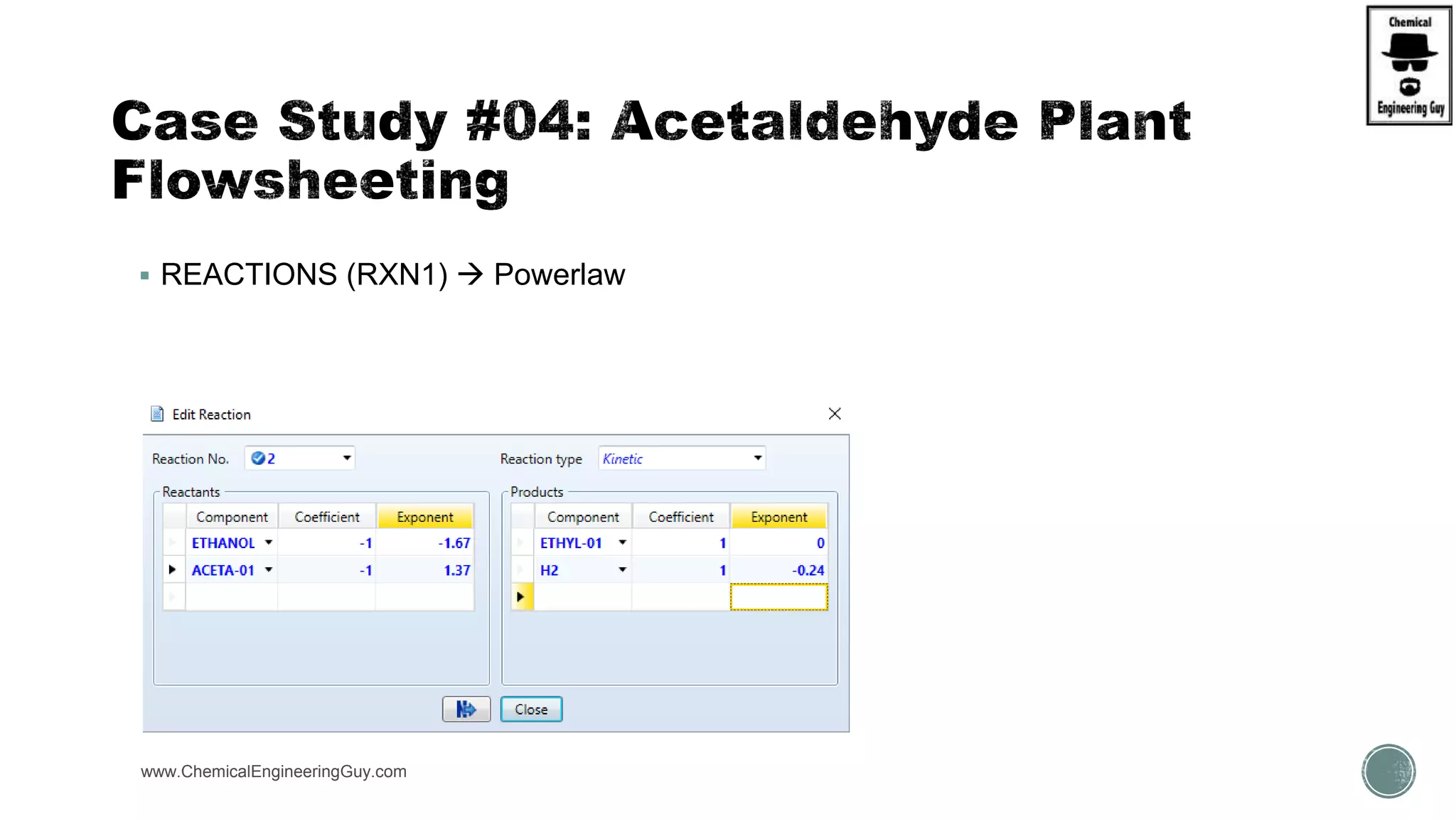
 REACTIONS (RXN1)  Powerlaw
www.ChemicalEngineeringGuy.com https://www.youtube.com/watch?v=e2MZfVColH8
Enjoying so far?
This is a preview of the BOOTCAMP.
Join NOW here:
https://www.chemicalengineeringguy.com/courses/aspen-plus-bootcamp-with-12-case-studies/
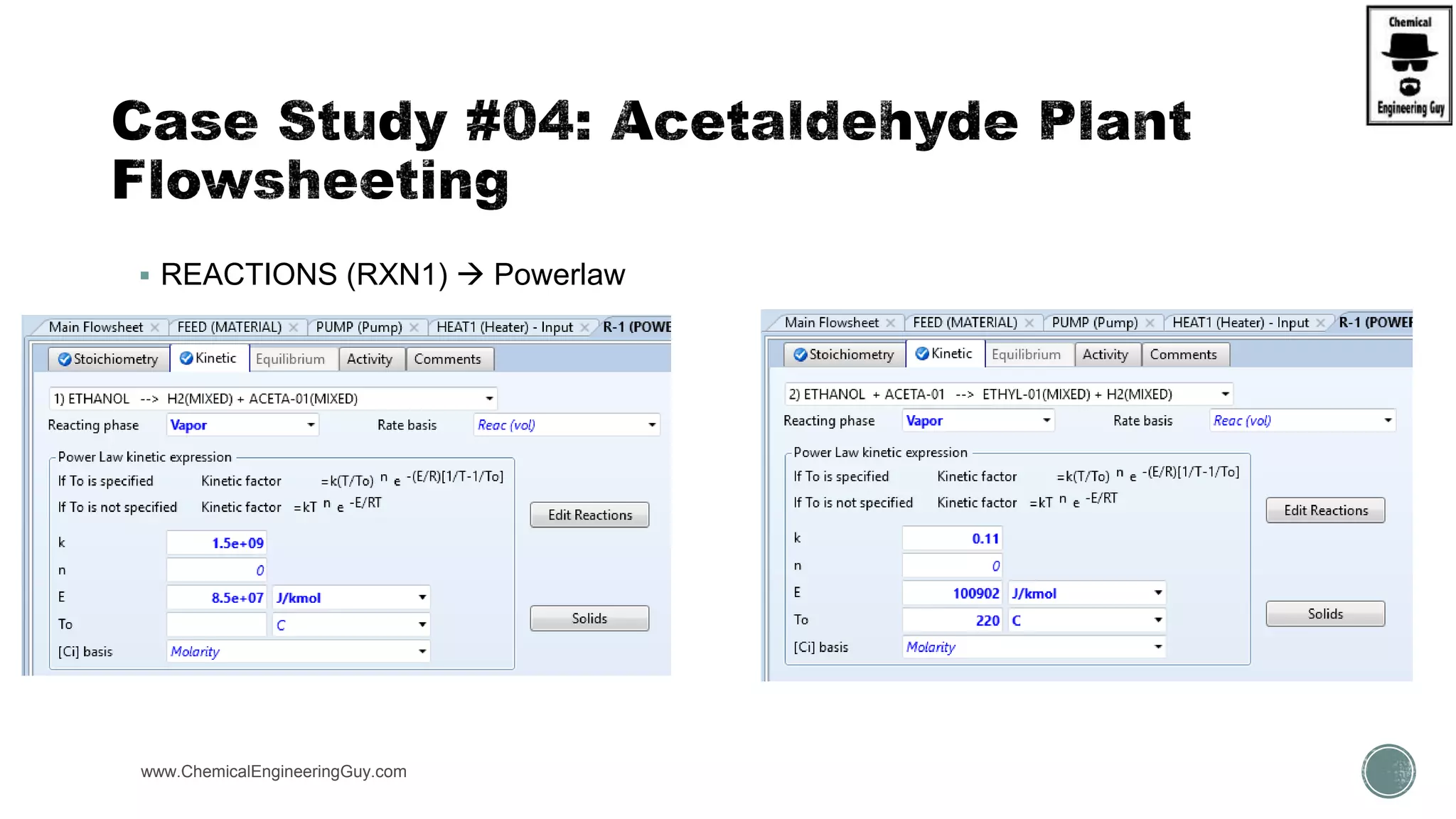
 REACTIONS (RXN1)  Powerlaw
www.ChemicalEngineeringGuy.com https://www.youtube.com/watch?v=e2MZfVColH8
 REACTIONS (RXN1)  Powerlaw
www.ChemicalEngineeringGuy.com https://www.youtube.com/watch?v=e2MZfVColH8
Enjoying so far?
This is a preview of the BOOTCAMP.
Join NOW here:
https://www.chemicalengineeringguy.com/courses/aspen-plus-bootcamp-with-12-case-studies/
 REACTIONS (RXN1)  Powerlaw
www.ChemicalEngineeringGuy.com https://www.youtube.com/watch?v=e2MZfVColH8
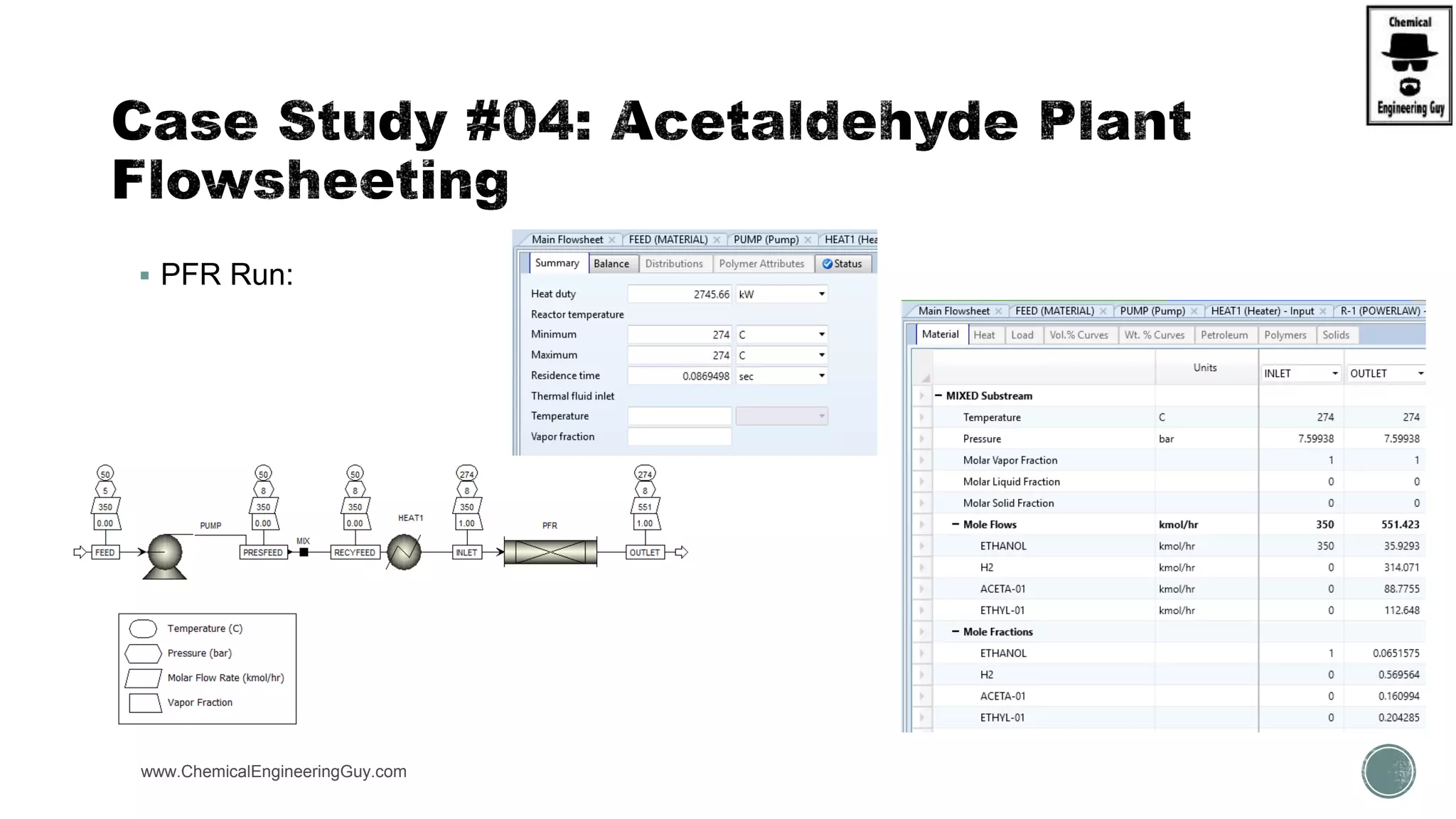
 PFR Run:
www.ChemicalEngineeringGuy.com https://www.youtube.com/watch?v=e2MZfVColH8
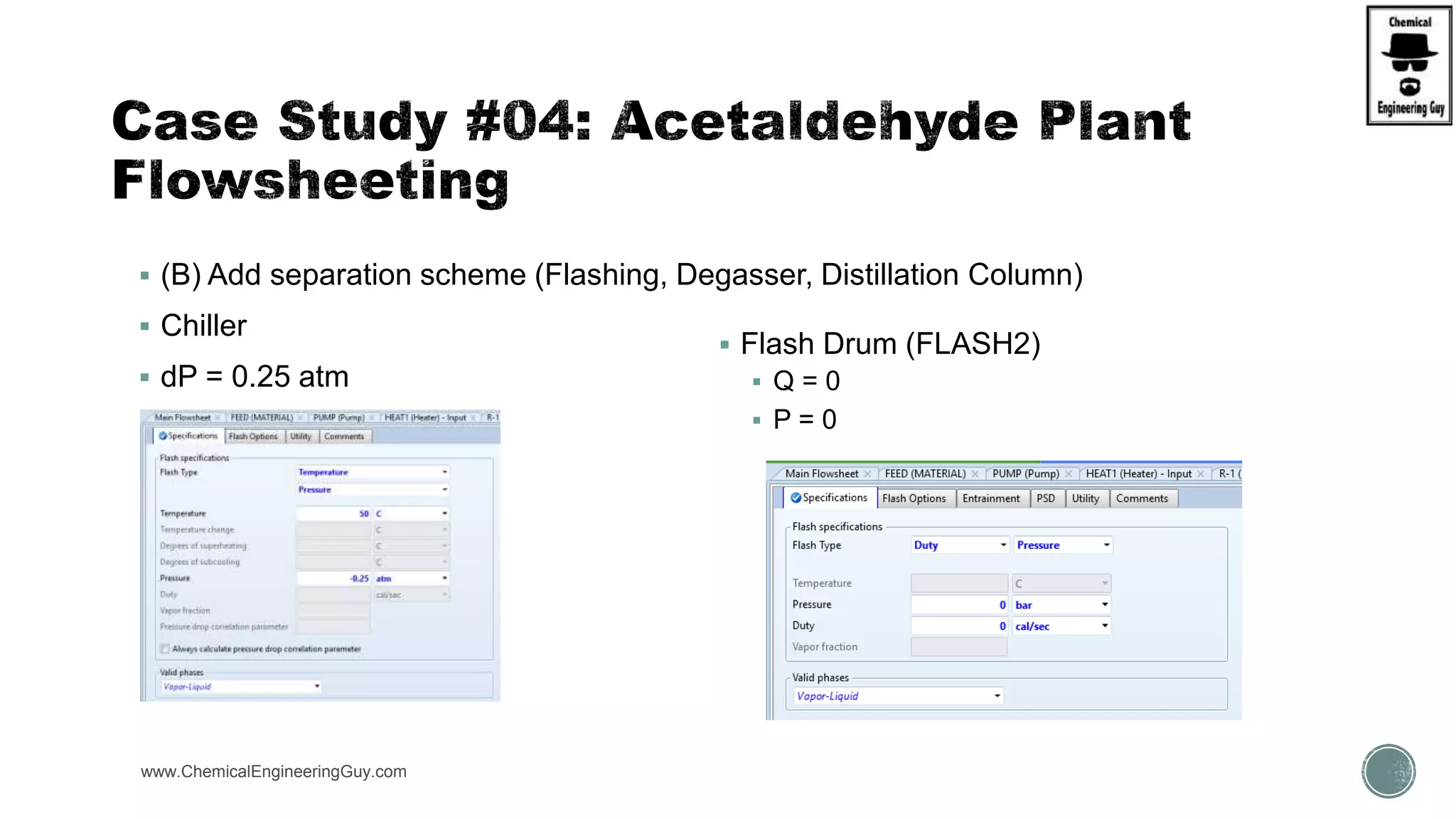
 (B) Add separation scheme (Flashing, Degasser, Distillation Column)
 Chiller
 dP = 0.25 atm
www.ChemicalEngineeringGuy.com https://www.youtube.com/watch?v=e2MZfVColH8
 Flash Drum (FLASH2)
 Q = 0
 P = 0
 Degaser (Sep1)
www.ChemicalEngineeringGuy.com https://www.youtube.com/watch?v=e2MZfVColH8
Enjoying so far?
This is a preview of the BOOTCAMP.
Join NOW here:
https://www.chemicalengineeringguy.com/courses/aspen-plus-bootcamp-with-12-case-studies/
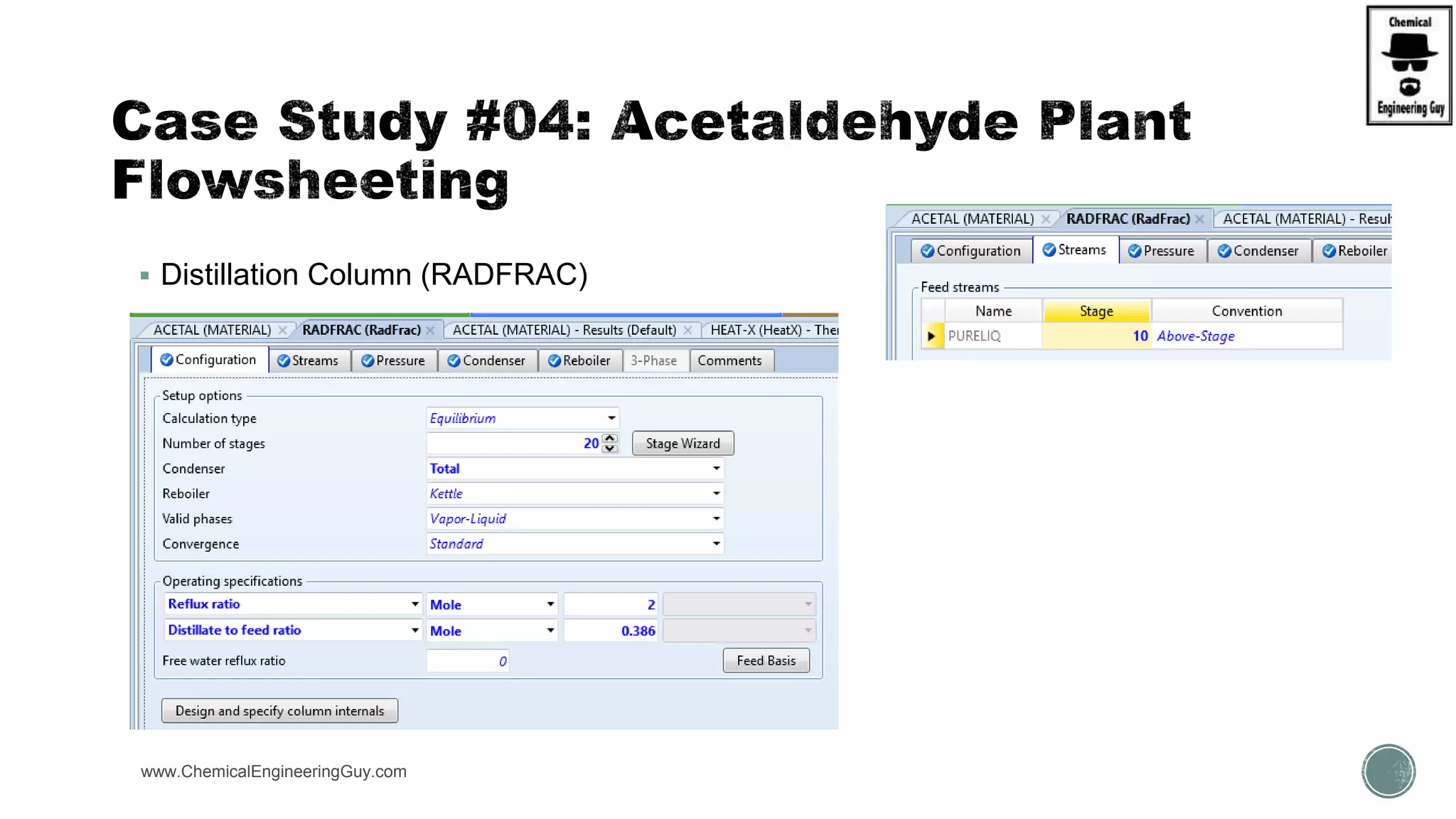
 Distillation Column (RADFRAC)
www.ChemicalEngineeringGuy.com https://www.youtube.com/watch?v=e2MZfVColH8
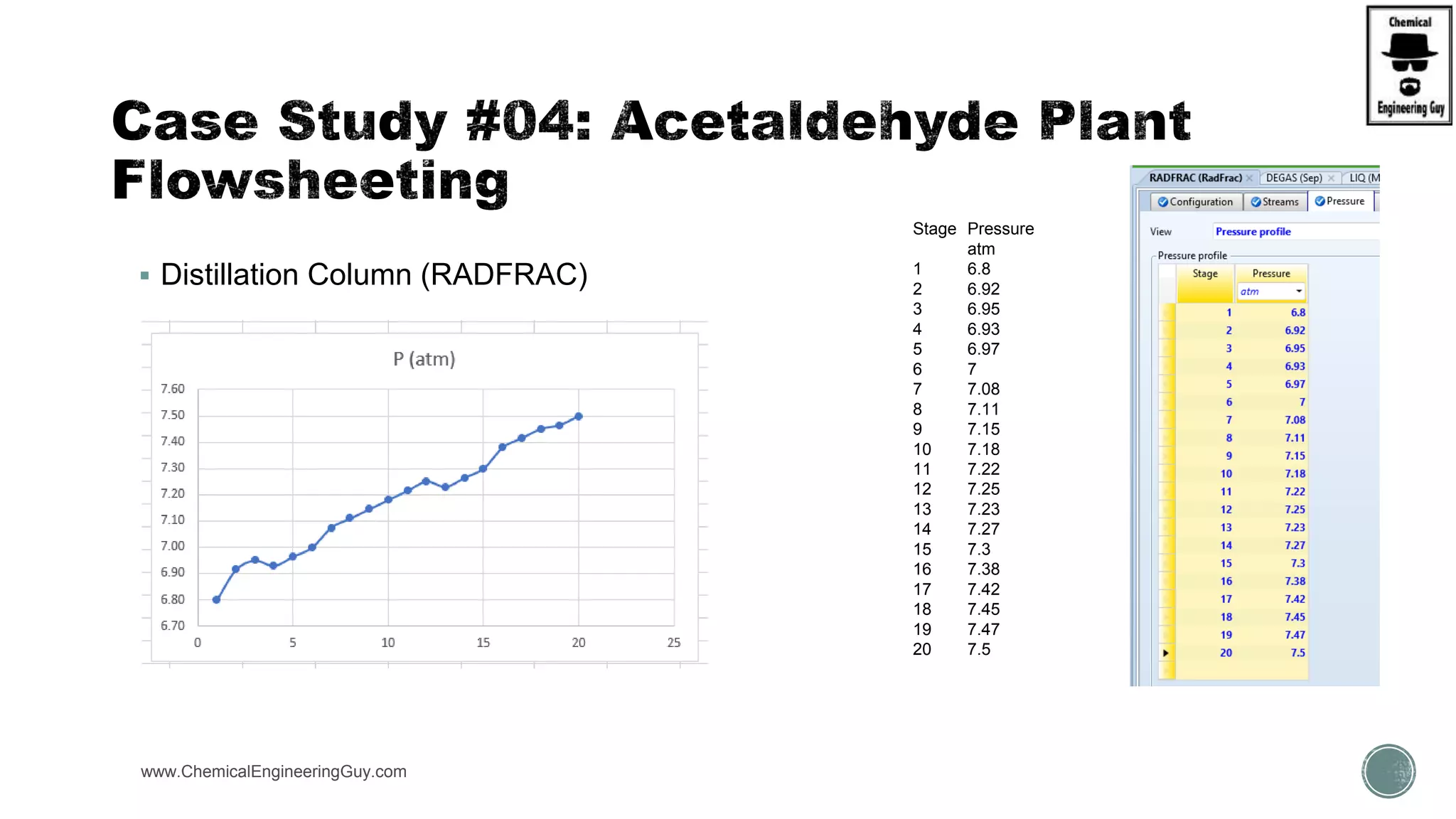
 Distillation Column (RADFRAC)
www.ChemicalEngineeringGuy.com https://www.youtube.com/watch?v=e2MZfVColH8
Stage Pressure
atm
1 6.8
2 6.92
3 6.95
4 6.93
5 6.97
6 7
7 7.08
8 7.11
9 7.15
10 7.18
11 7.22
12 7.25
13 7.23
14 7.27
15 7.3
16 7.38
17 7.42
18 7.45
19 7.47
20 7.5
 Results of Distillation
www.ChemicalEngineeringGuy.com https://www.youtube.com/watch?v=e2MZfVColH8
Enjoying so far?
This is a preview of the BOOTCAMP.
Join NOW here:
https://www.chemicalengineeringguy.com/courses/aspen-plus-bootcamp-with-12-case-studies/
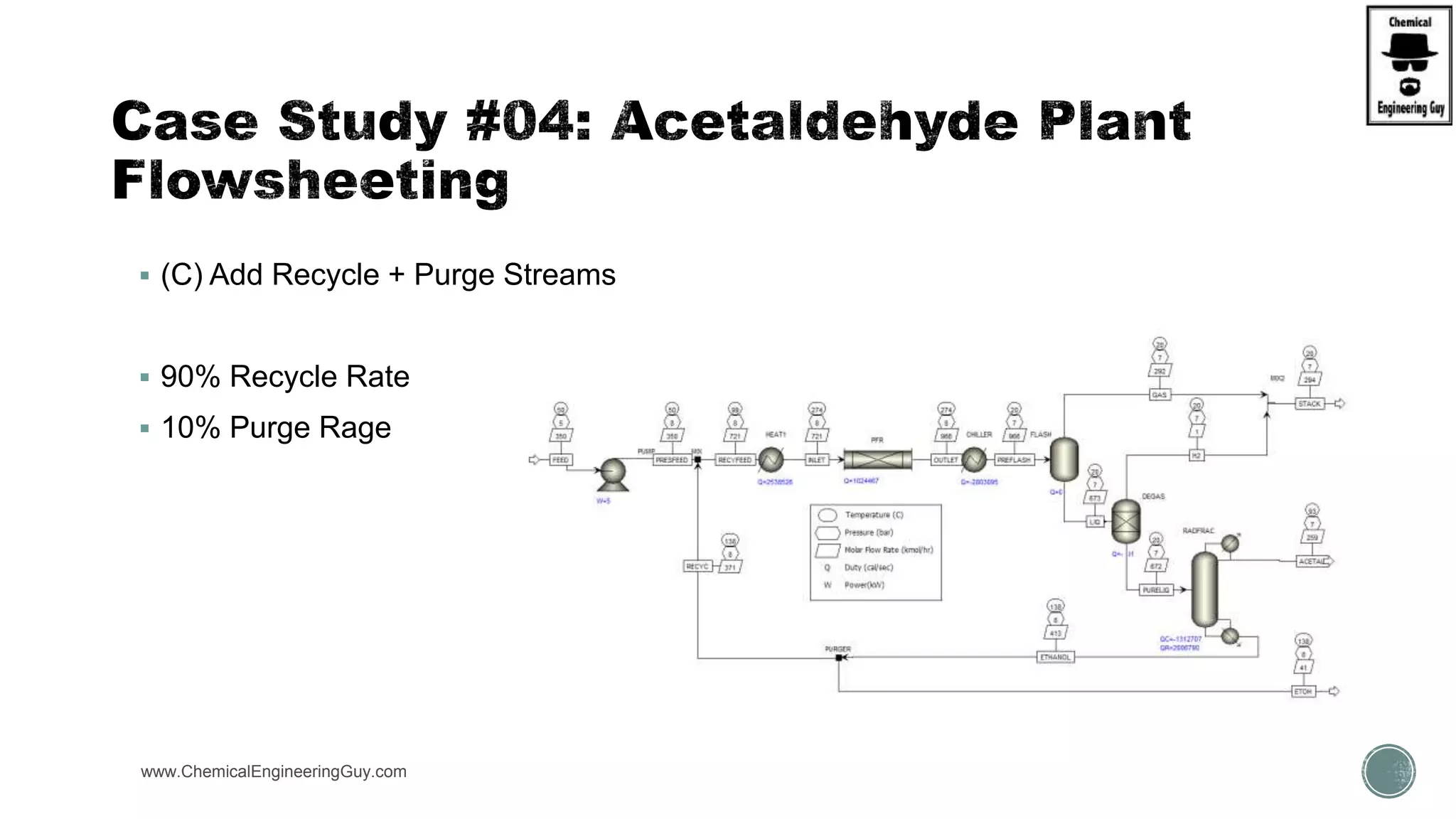
 (C) Add Recycle + Purge Streams
 90% Recycle Rate
 10% Purge Rage
www.ChemicalEngineeringGuy.com https://www.youtube.com/watch?v=e2MZfVColH8
 (C) Add Recycle + Purge Streams
 90% Recycle Rate
 10% Purge Rage
www.ChemicalEngineeringGuy.com https://www.youtube.com/watch?v=e2MZfVColH8
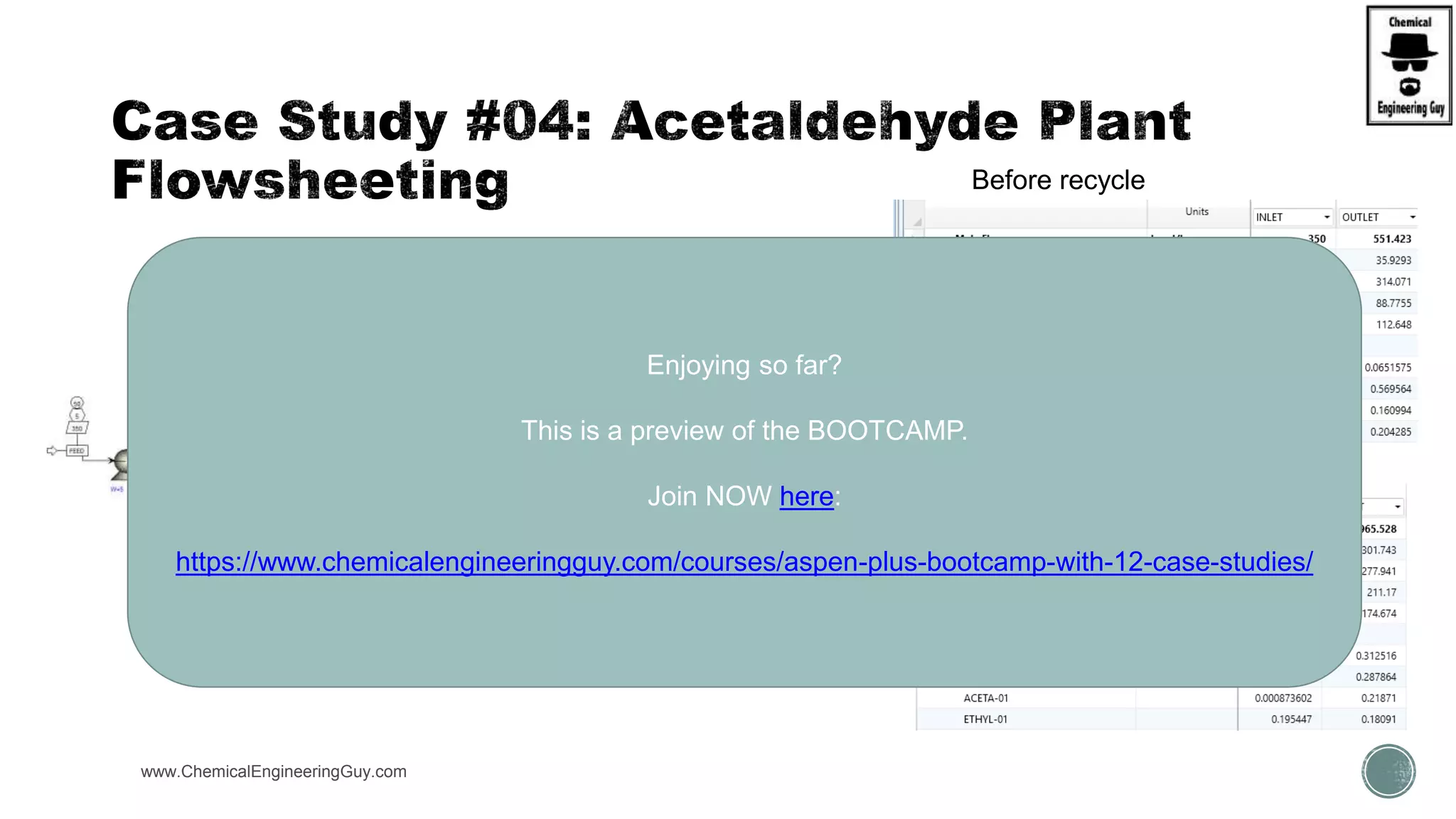
Before recycle
After recycle
Enjoying so far?
This is a preview of the BOOTCAMP.
Join NOW here:
https://www.chemicalengineeringguy.com/courses/aspen-plus-bootcamp-with-12-case-studies/
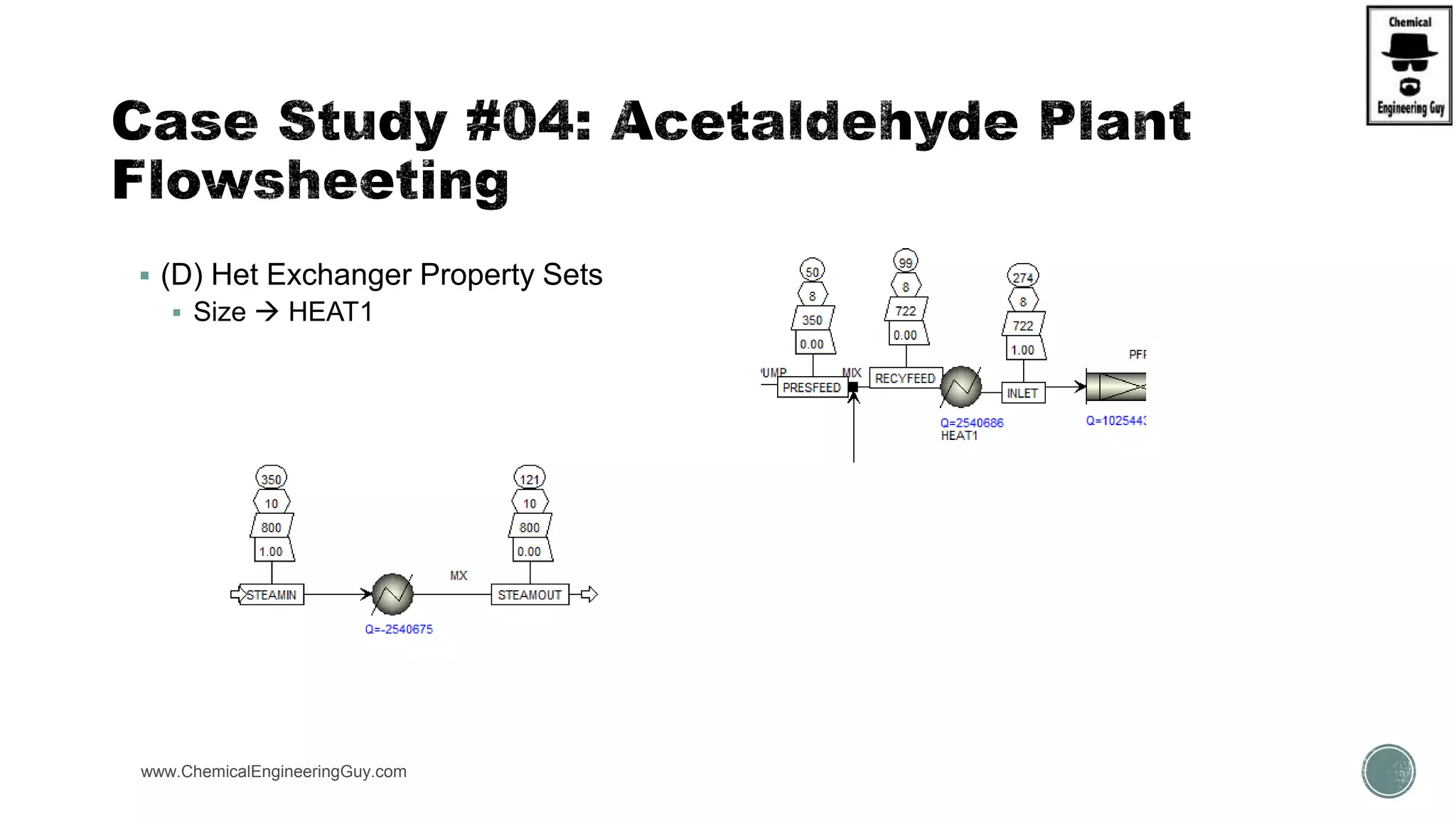
 (D) Het Exchanger Property Sets
 Size  HEAT1
www.ChemicalEngineeringGuy.com https://www.youtube.com/watch?v=e2MZfVColH8
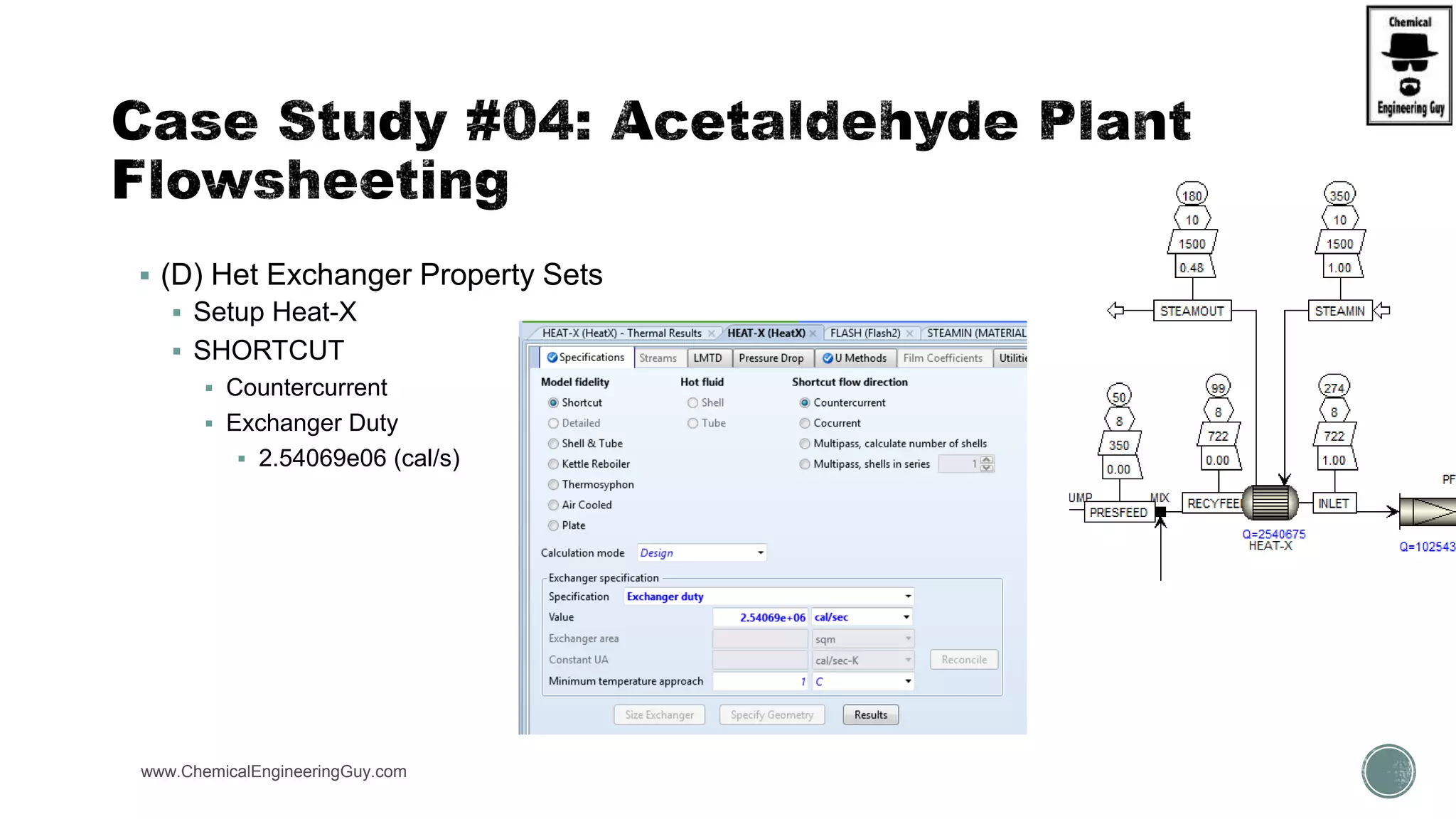
 (D) Het Exchanger Property Sets
 Setup Heat-X
 SHORTCUT
 Countercurrent
 Exchanger Duty
 2.54069e06 (cal/s)
www.ChemicalEngineeringGuy.com https://www.youtube.com/watch?v=e2MZfVColH8
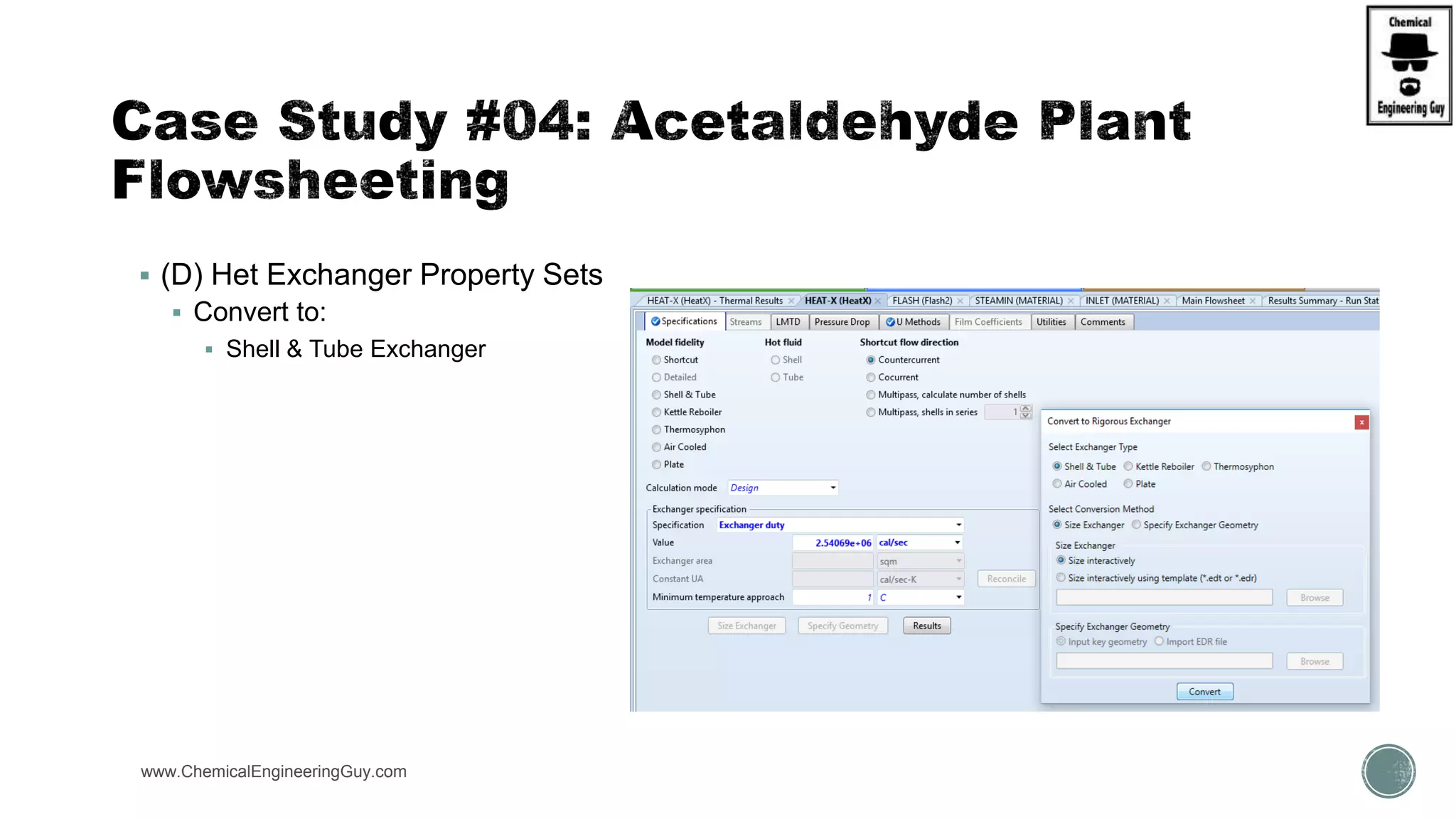
 (D) Het Exchanger Property Sets
 Convert to:
 Shell & Tube Exchanger
www.ChemicalEngineeringGuy.com https://www.youtube.com/watch?v=e2MZfVColH8
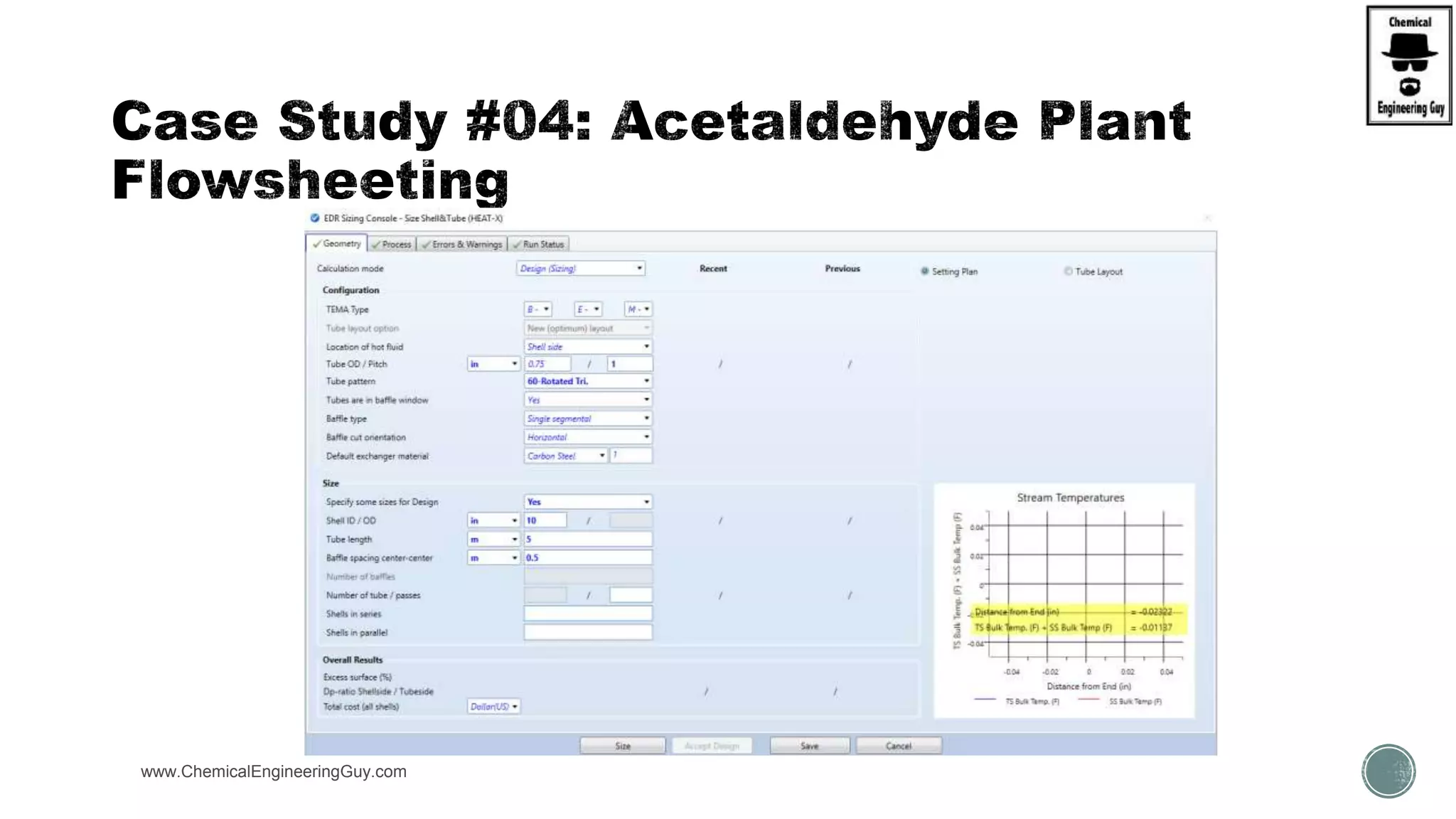
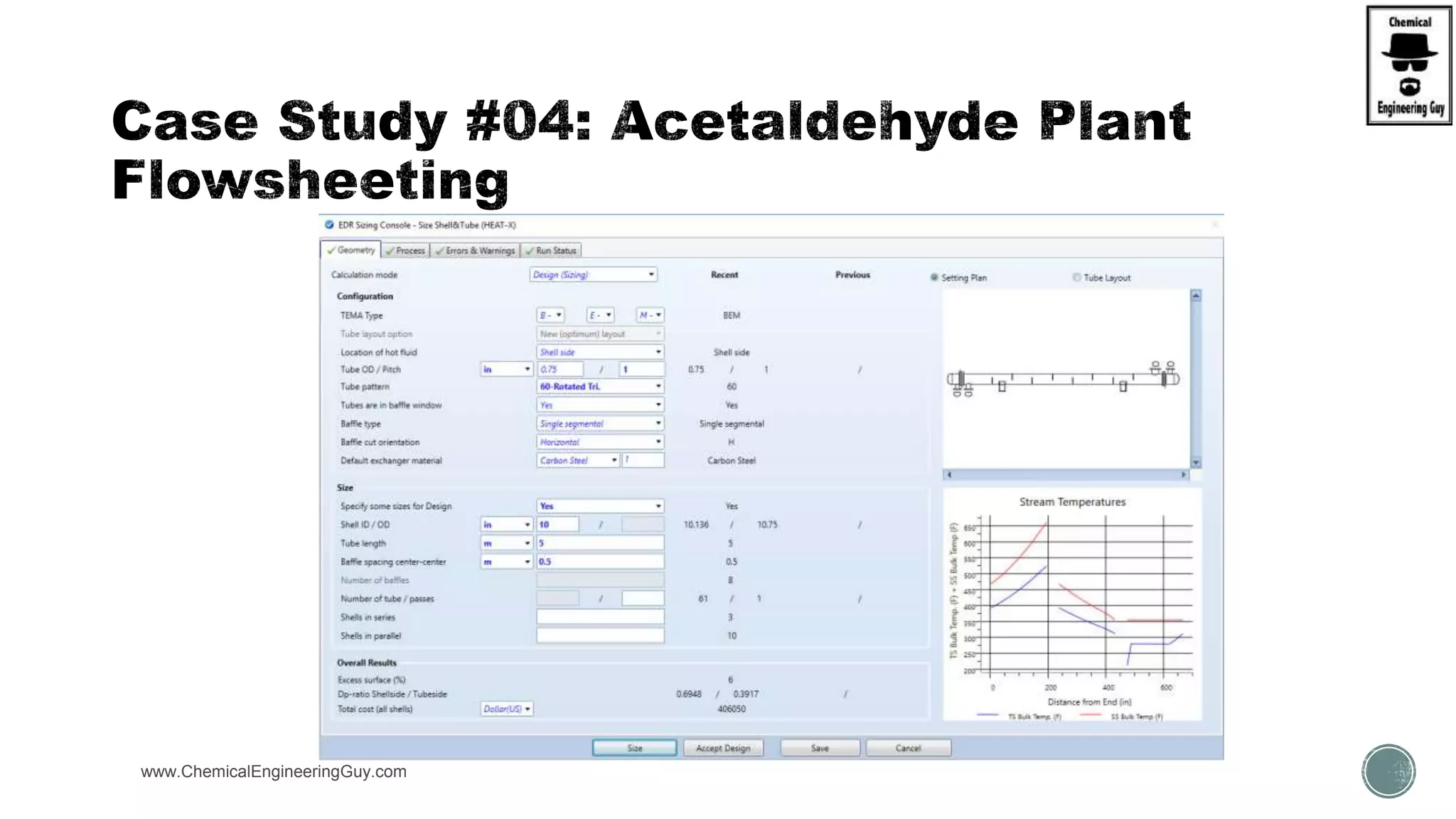
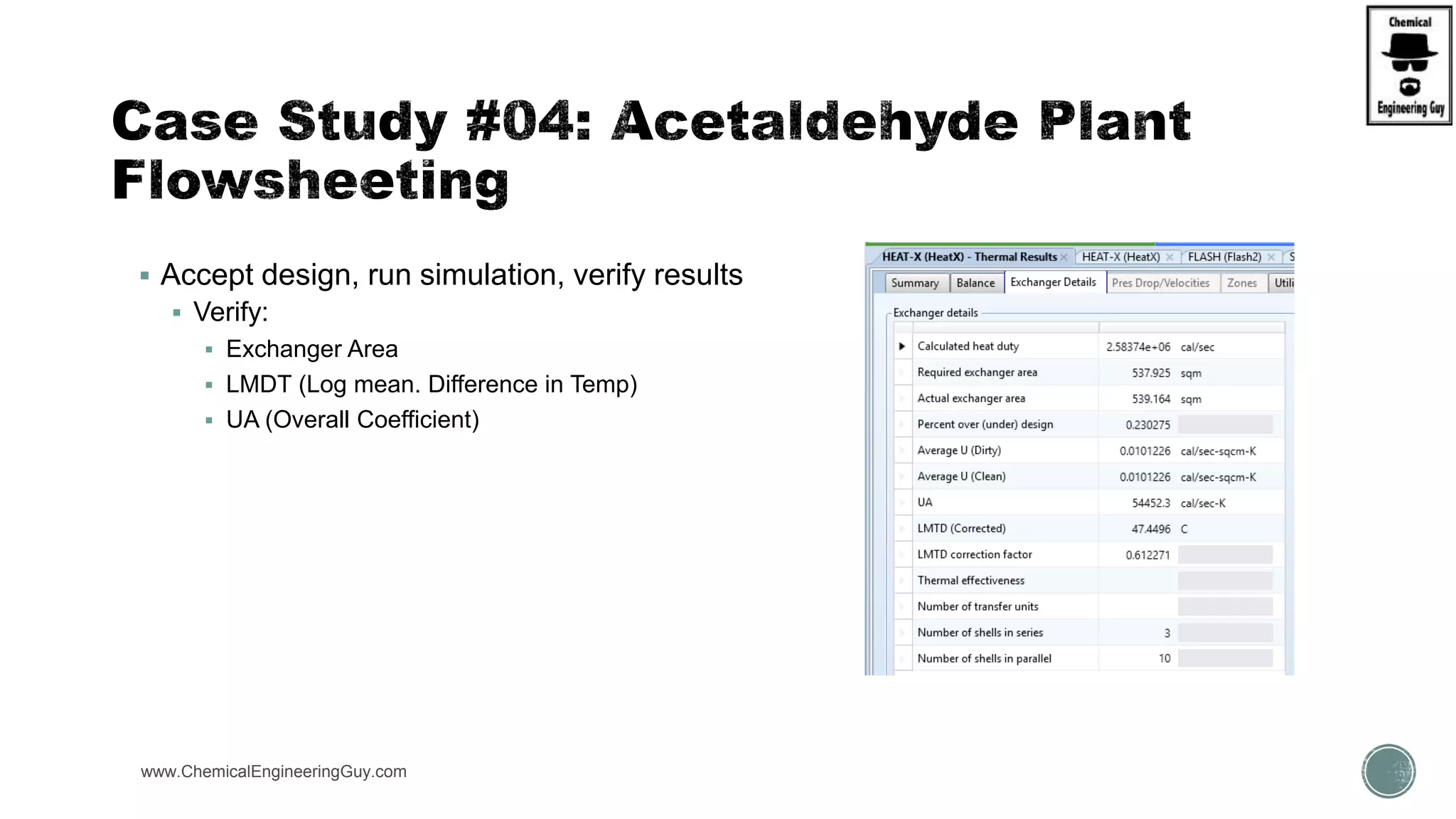
 Accept design, run simulation, verify results
 Verify:
 Exchanger Area
 LMDT (Log mean. Difference in Temp)
 UA (Overall Coefficient)
www.ChemicalEngineeringGuy.com https://www.youtube.com/watch?v=e2MZfVColH8
 (E) Verify Purity of Products, Specs of Exchanger (Heaters, Reboilers, Condensers)
www.ChemicalEngineeringGuy.com https://www.youtube.com/watch?v=e2MZfVColH8
Enjoying so far?
This is a preview of the BOOTCAMP.
Join NOW here:
https://www.chemicalengineeringguy.com/courses/aspen-plus-bootcamp-with-12-case-studies/
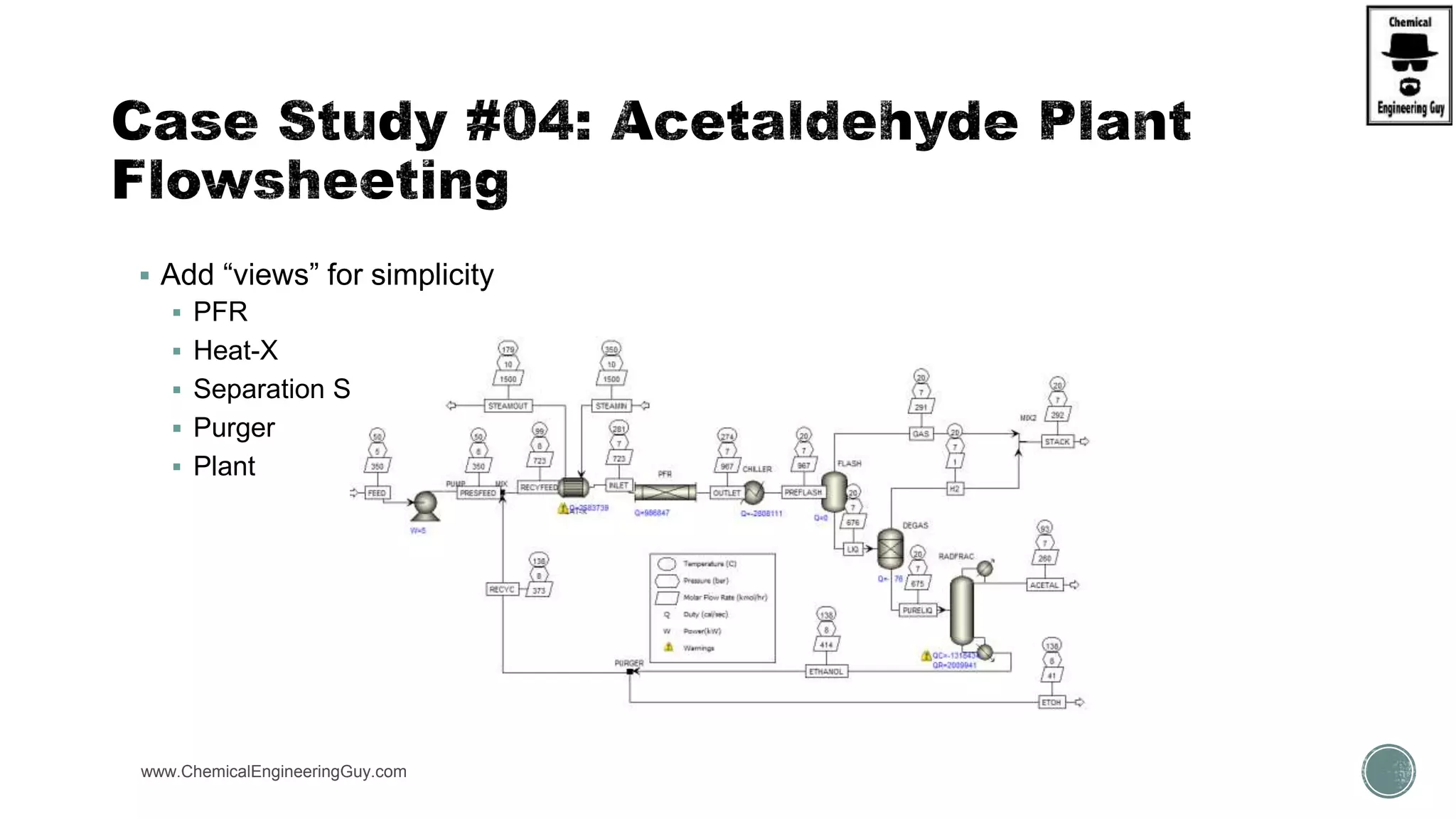
 Add “views” for simplicity
 PFR
 Heat-X
 Separation Scheme
 Purger
 Plant
www.ChemicalEngineeringGuy.com https://www.youtube.com/watch?v=e2MZfVColH8
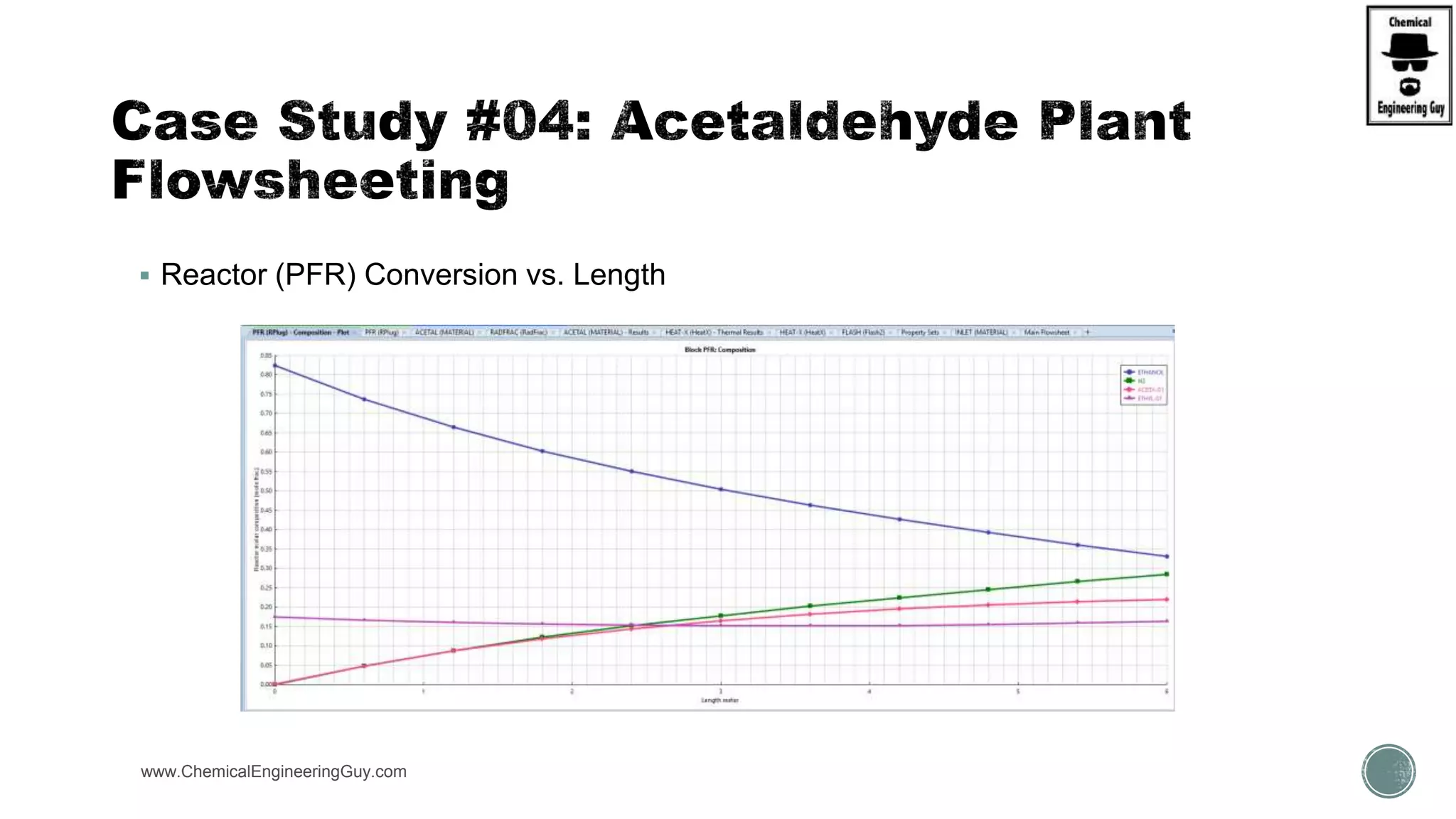
 Reactor (PFR) Conversion vs. Length
www.ChemicalEngineeringGuy.com https://www.youtube.com/watch?v=e2MZfVColH8
 Distillation Column Pressure Profile
www.ChemicalEngineeringGuy.com https://www.youtube.com/watch?v=e2MZfVColH8
Enjoying so far?
This is a preview of the BOOTCAMP.
Join NOW here:
https://www.chemicalengineeringguy.com/courses/aspen-plus-bootcamp-with-12-case-studies/
 Process Analysis
5. Dimethyl Ether Production (Design Spec.)
6. Ammonia in Cryogenics (Optimization & Constraint)
7. Cumene Production (Sensitivity Analysis)
www.ChemicalEngineeringGuy.com
 Case Study 5
 Flowsheeting  Adding Figures & Timestamps, lines to the spreadsheet
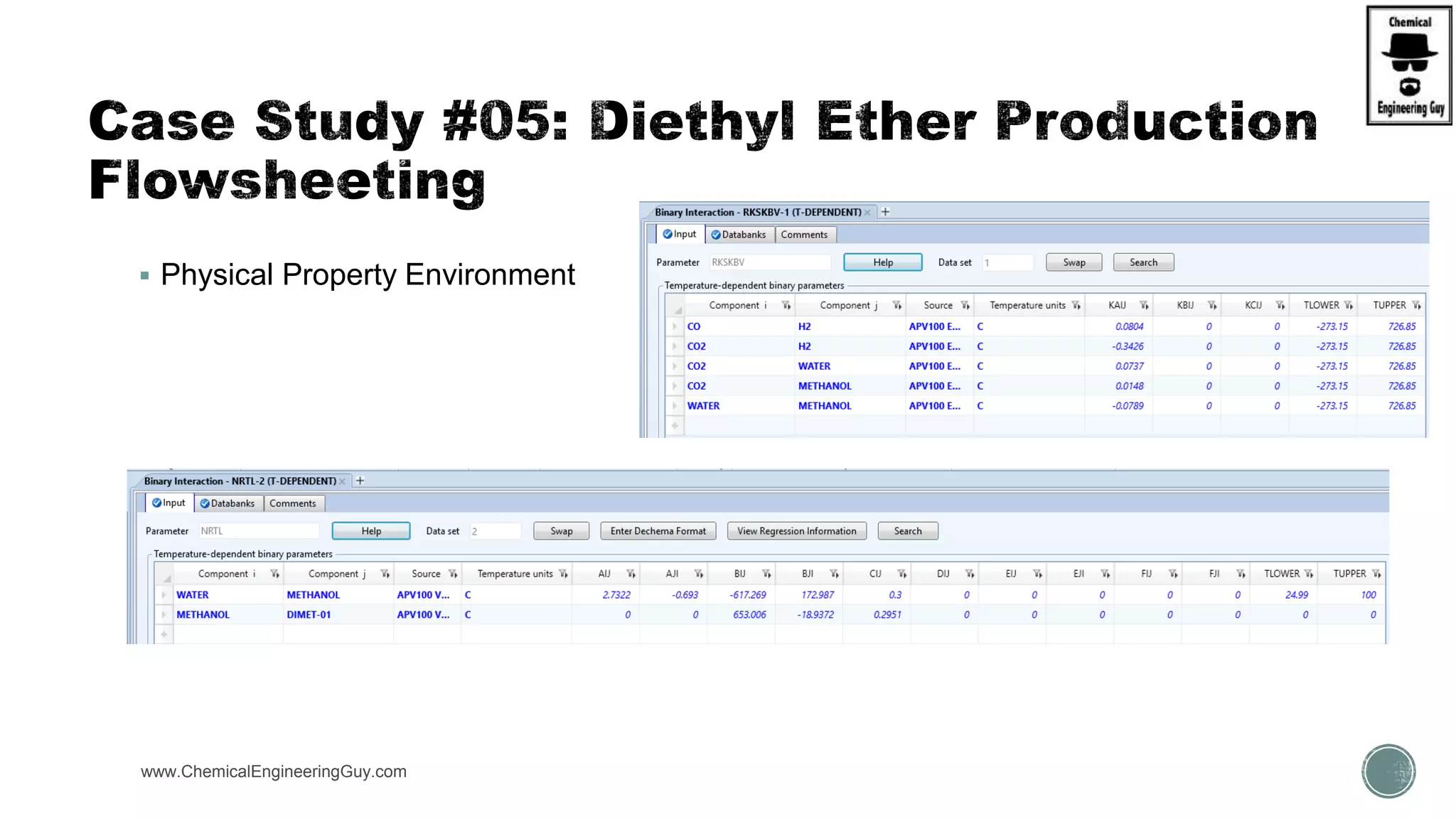
 Physical Property  Binary Parameters
 Design Specification Analysis
 Operations: Multiple Reactions, Purging, Recycling, Flashing
www.ChemicalEngineeringGuy.com
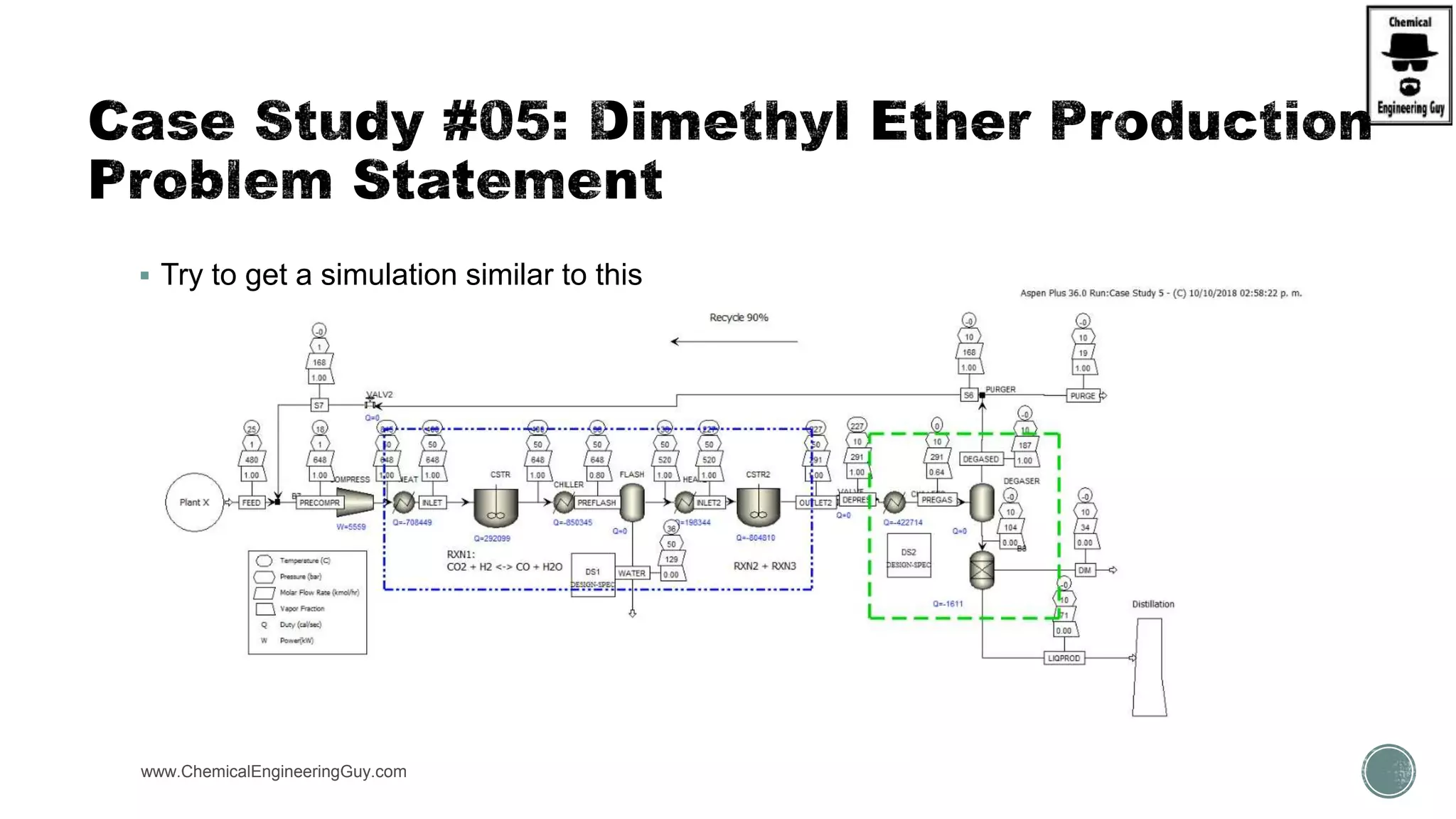
 Dimethyl ether CH3-O-CH3, is to be produced from CO2 & H2. Initially there is
formation of CO + H2O, which is then converted to Methanol and simultaneously to
dimethyl ether.
 This is done in two reactors, stirred tank, at isothermal conditions. No pressure Drop
 Feed is initially 1:3 ratio CO2:H2 at 25°C, P = 1 bar
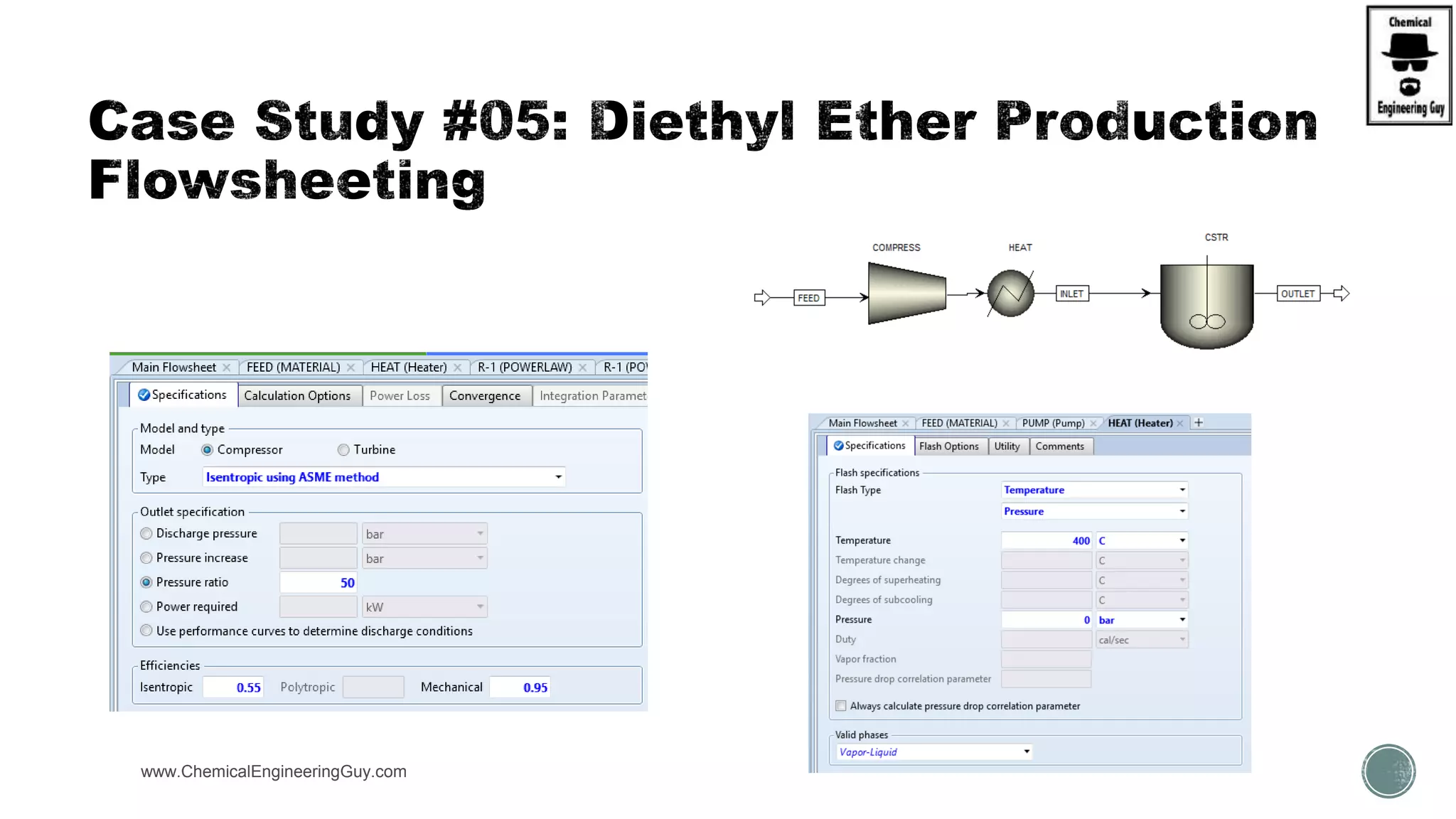
 The First reactor is operated at 50 bar, 400°C, since CO and H2O must be favored
 The second reactor is operated at 50bar, 227°C, since methanol  dimethyl ether is
required. Note that the second reactor must have a very low content of water, for
which a Flash at very cold conditions must be used to separate liquid humidity.
 No more than 0.20 kmol/h of Methanol must be lost in the purge/stack
 The degasser must recover most of the liquid materials (water, methanol and dimethyl
ether)
www.ChemicalEngineeringGuy.com
 There is a special equipment which will recover most of non-polar substances in the
streams (DIM-Trap)
 The dimethyl will be recovered this way
 Al other material, methanol-water mix must be sent to a distillation column
 NOTE  Try using DSTWU at home
 Reaction equilibrium (Ahrrenius) data is to be supplied later.
 USE of Design Specification is REQURIED
www.ChemicalEngineeringGuy.com
 (A) Run CSTR1, verify results
 (B) Use Design Spec For Water flow rate
 (C) Verify Reactor 2 , ensure Dimethyl production
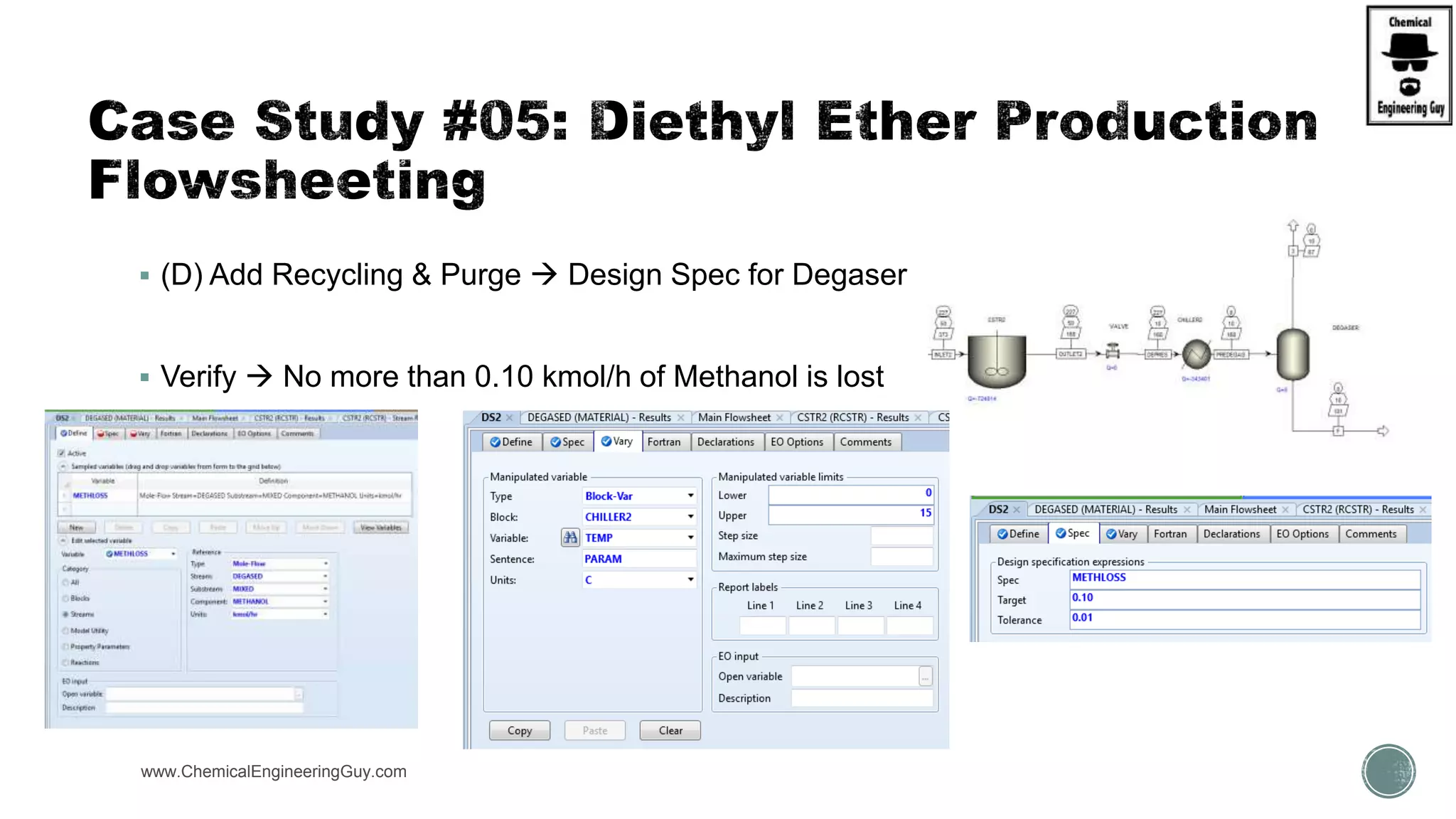
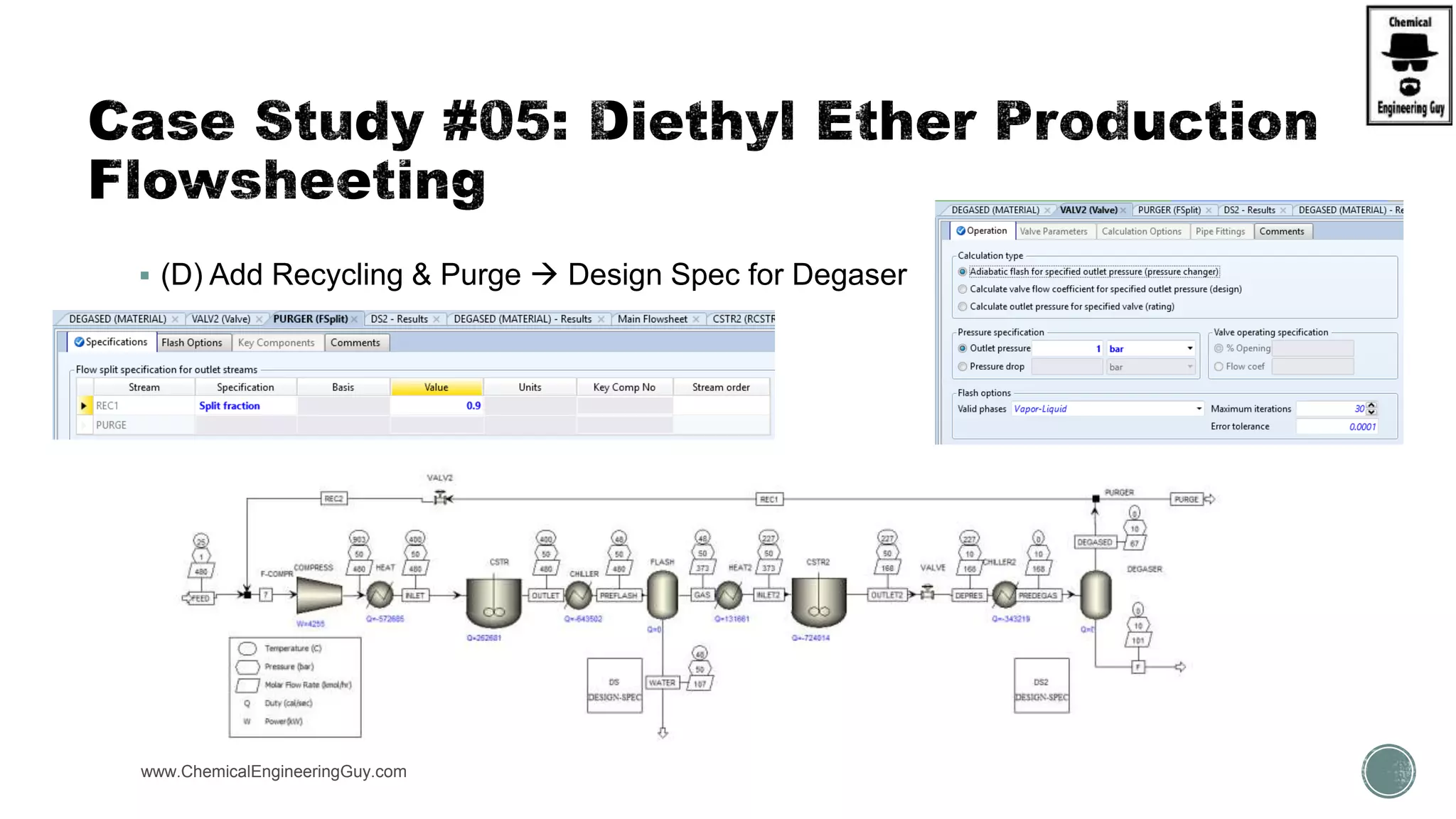
 (D) Add Recycling & Purge  Design Spec for Degaser
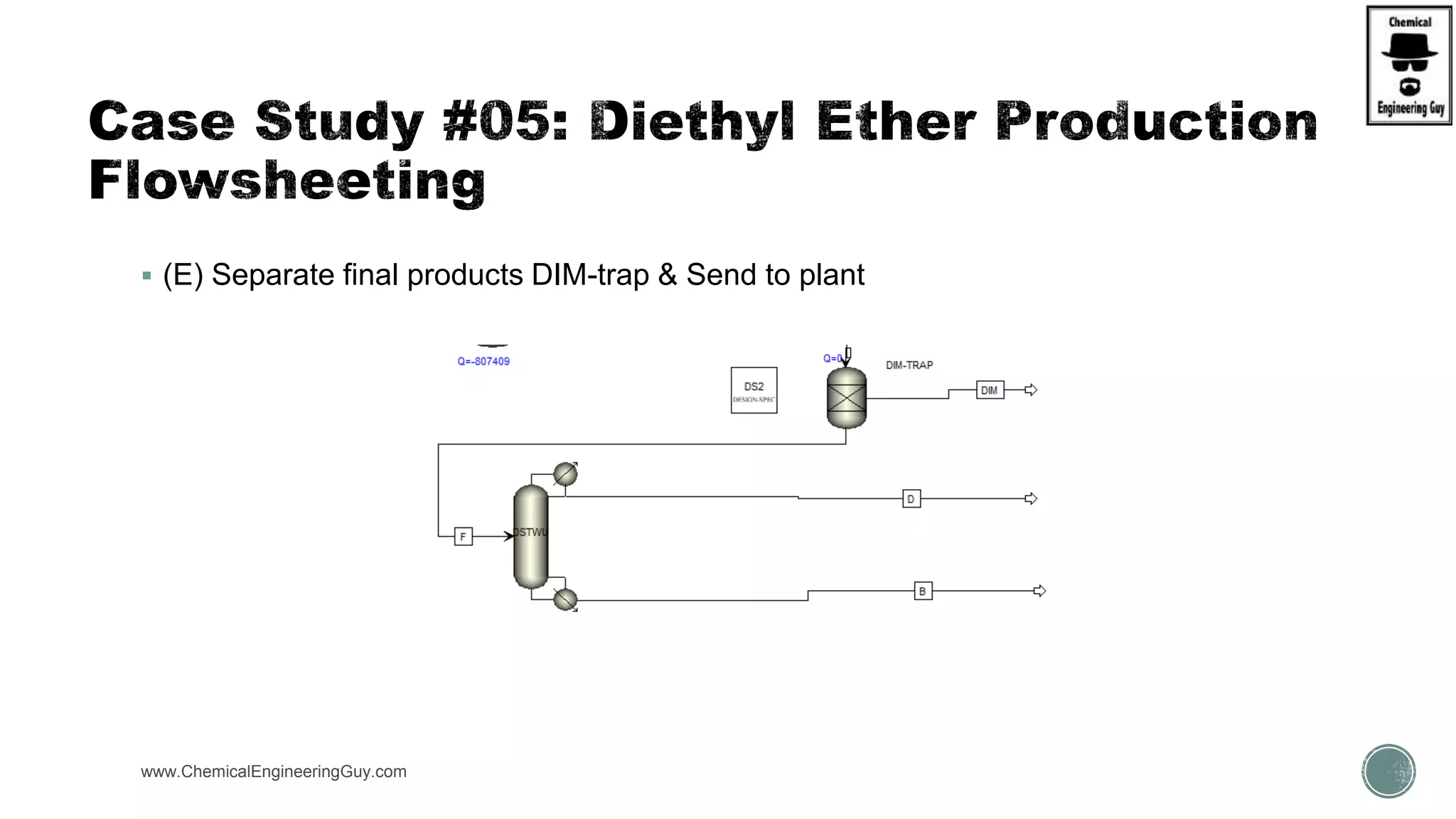
 (E) Separate final products DIM-trap & Send to plant
www.ChemicalEngineeringGuy.com
 Try to get a simulation similar to this
www.ChemicalEngineeringGuy.com https://www.youtube.com/watch?v=3vm91REoFxI
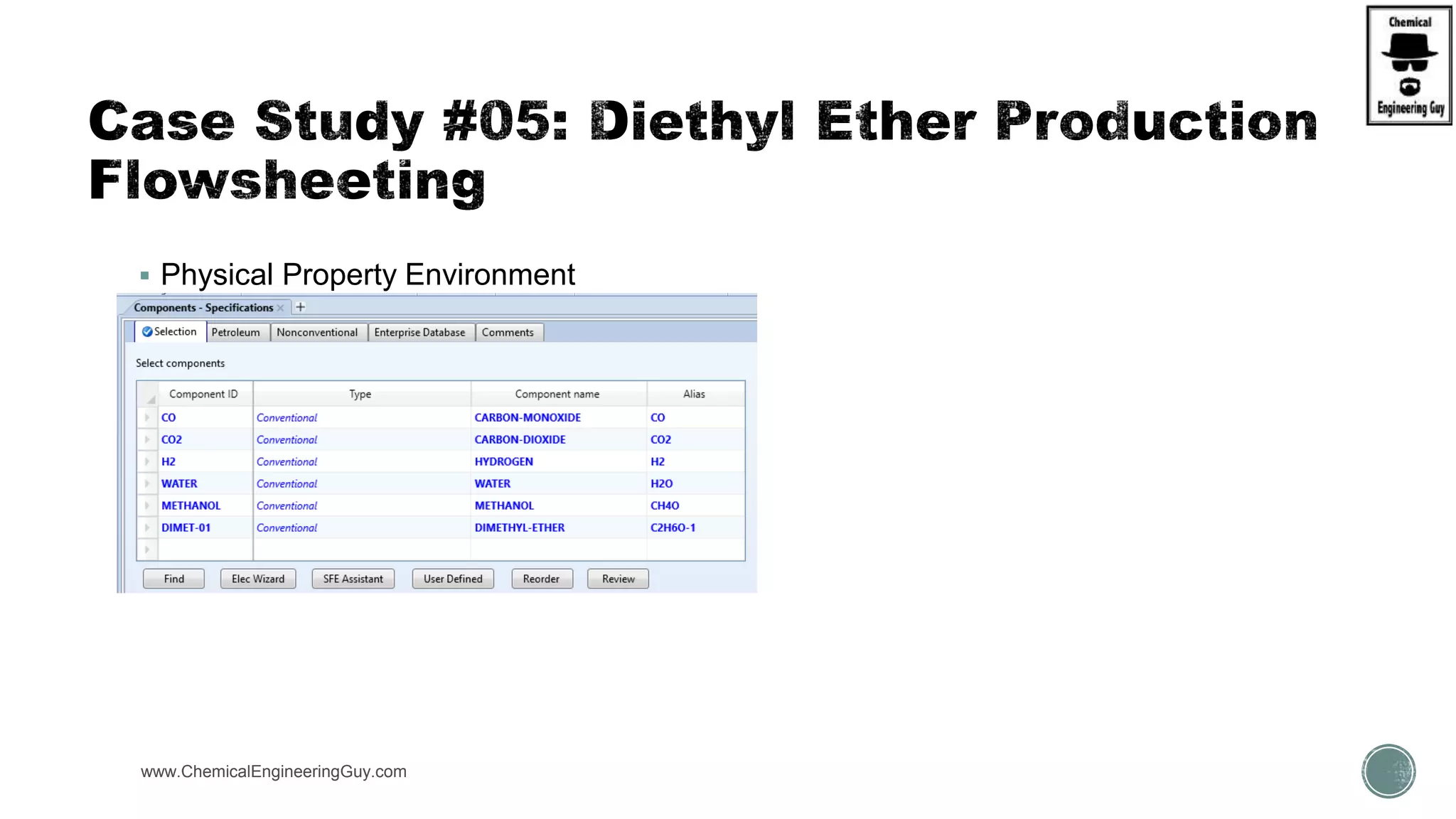
 Physical Property Environment
 First  Method RK-SOAVE / NRTL
www.ChemicalEngineeringGuy.com
 Physical Property Environment
 First  Method RK-SOAVE / NRTL
www.ChemicalEngineeringGuy.com
Enjoying so far?
This is a preview of the BOOTCAMP.
Join NOW here:
https://www.chemicalengineeringguy.com/courses/aspen-plus-bootcamp-with-12-case-studies/
 Physical Property Environment
www.ChemicalEngineeringGuy.com
 (A) Run CSTR
 Simulation Environment
 FEED
www.ChemicalEngineeringGuy.com
Enjoying so far?
This is a preview of the BOOTCAMP.
Join NOW here:
https://www.chemicalengineeringguy.com/courses/aspen-plus-bootcamp-with-12-case-studies/
www.ChemicalEngineeringGuy.com
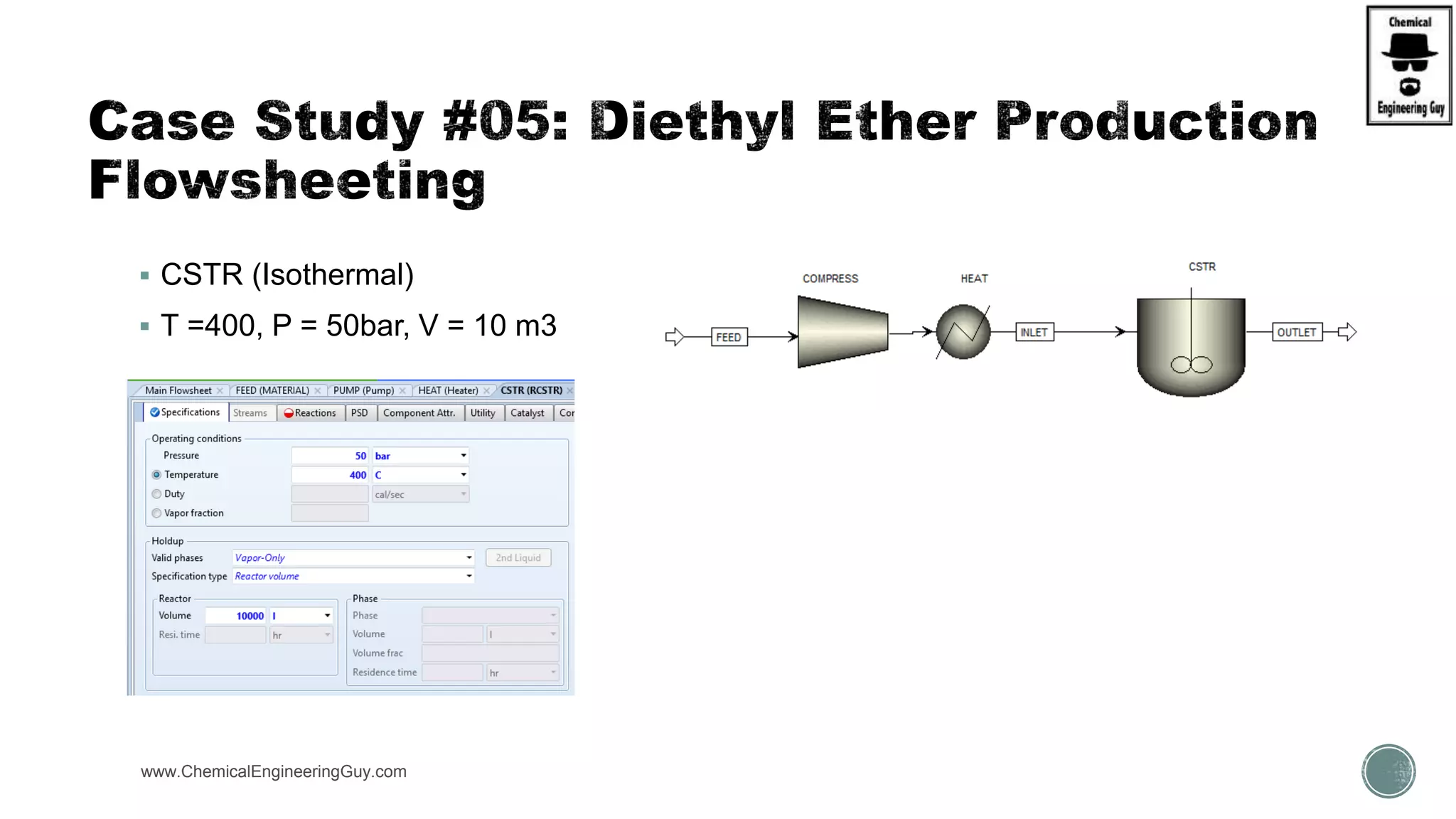
 CSTR (Isothermal)
 T =400, P = 50bar, V = 10 m3
www.ChemicalEngineeringGuy.com
 RXN1  Powerlaw
www.ChemicalEngineeringGuy.com
Enjoying so far?
This is a preview of the BOOTCAMP.
Join NOW here:
https://www.chemicalengineeringguy.com/courses/aspen-plus-bootcamp-with-12-case-studies/
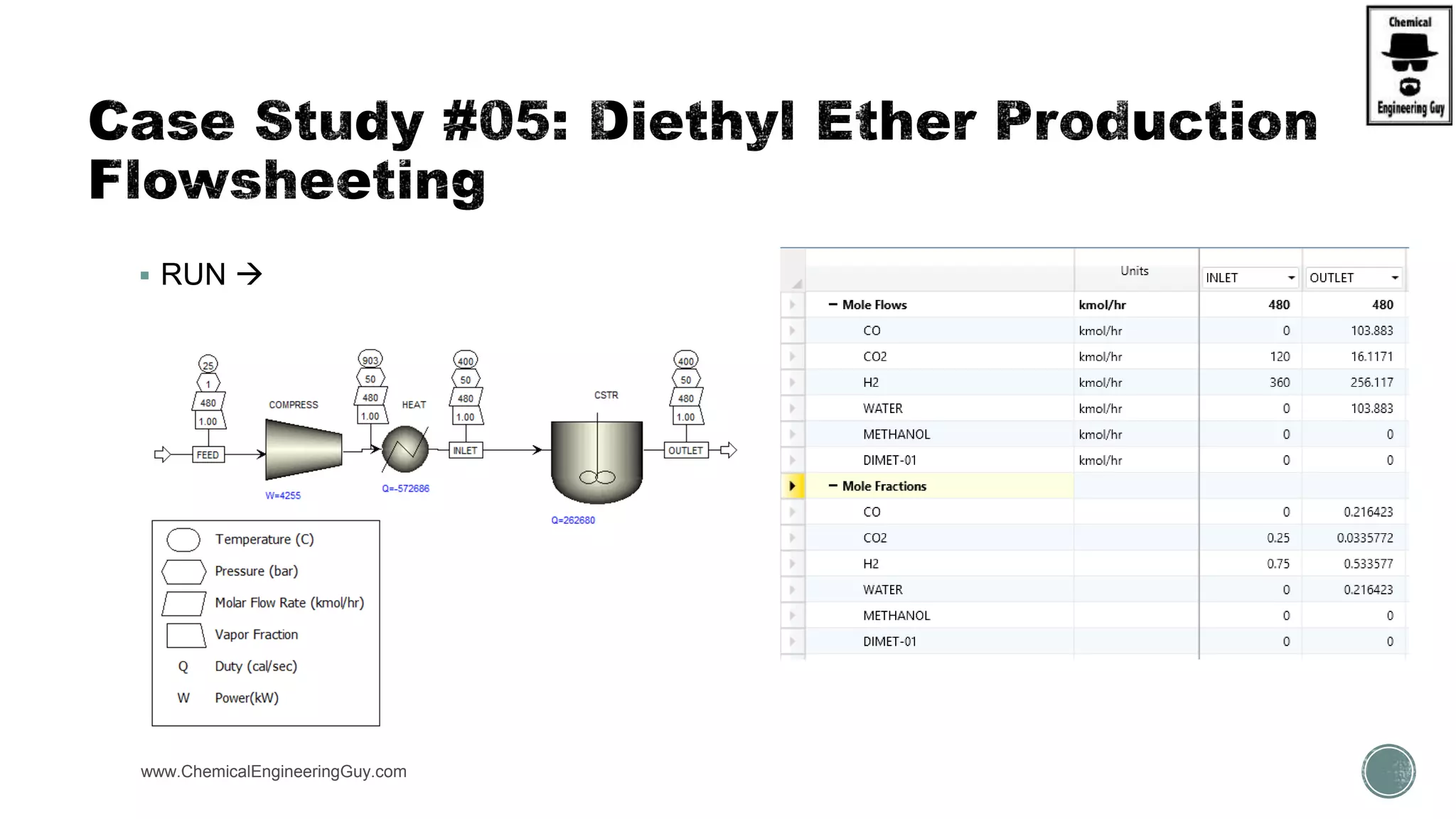
 RUN 
www.ChemicalEngineeringGuy.com
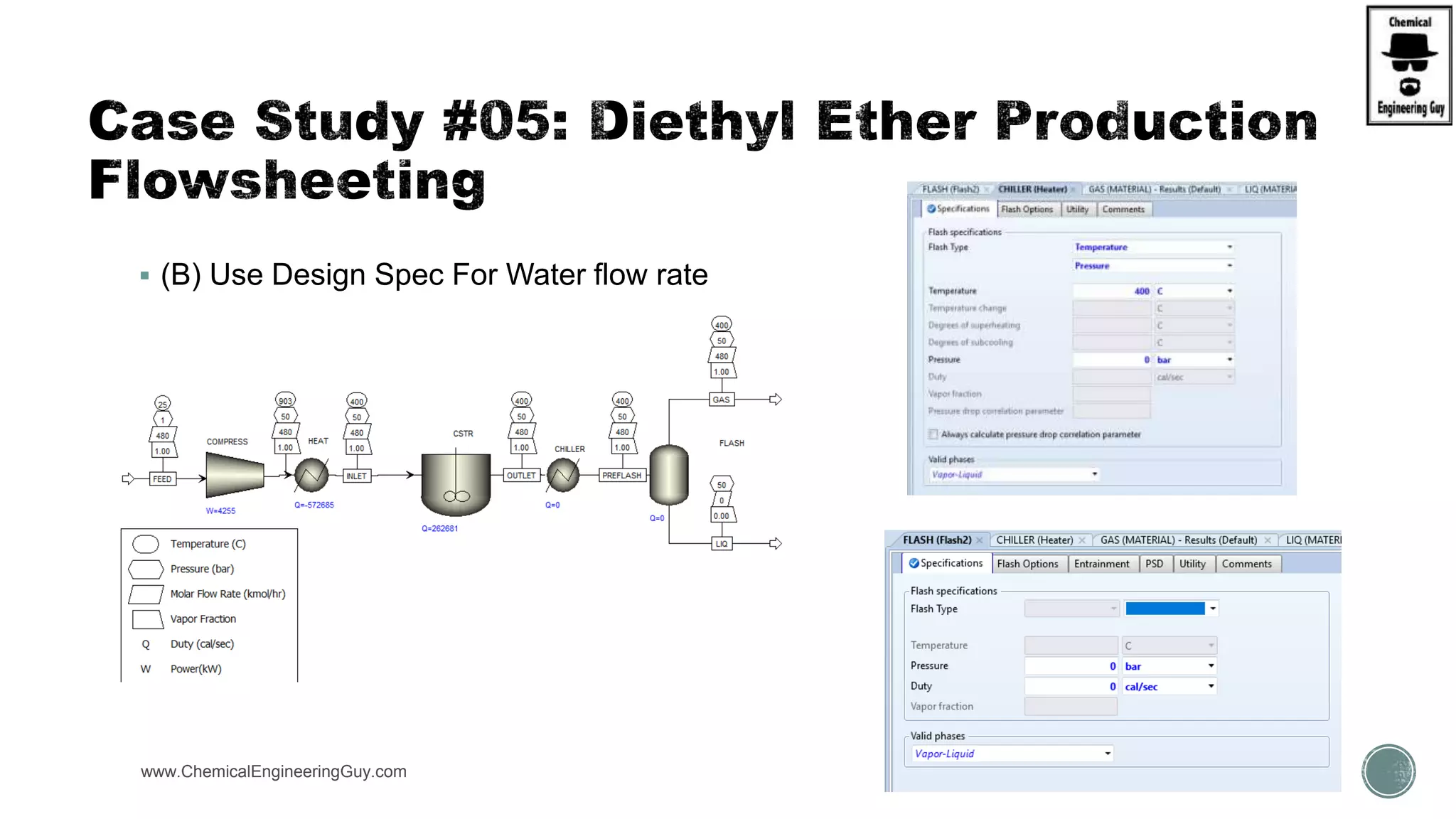
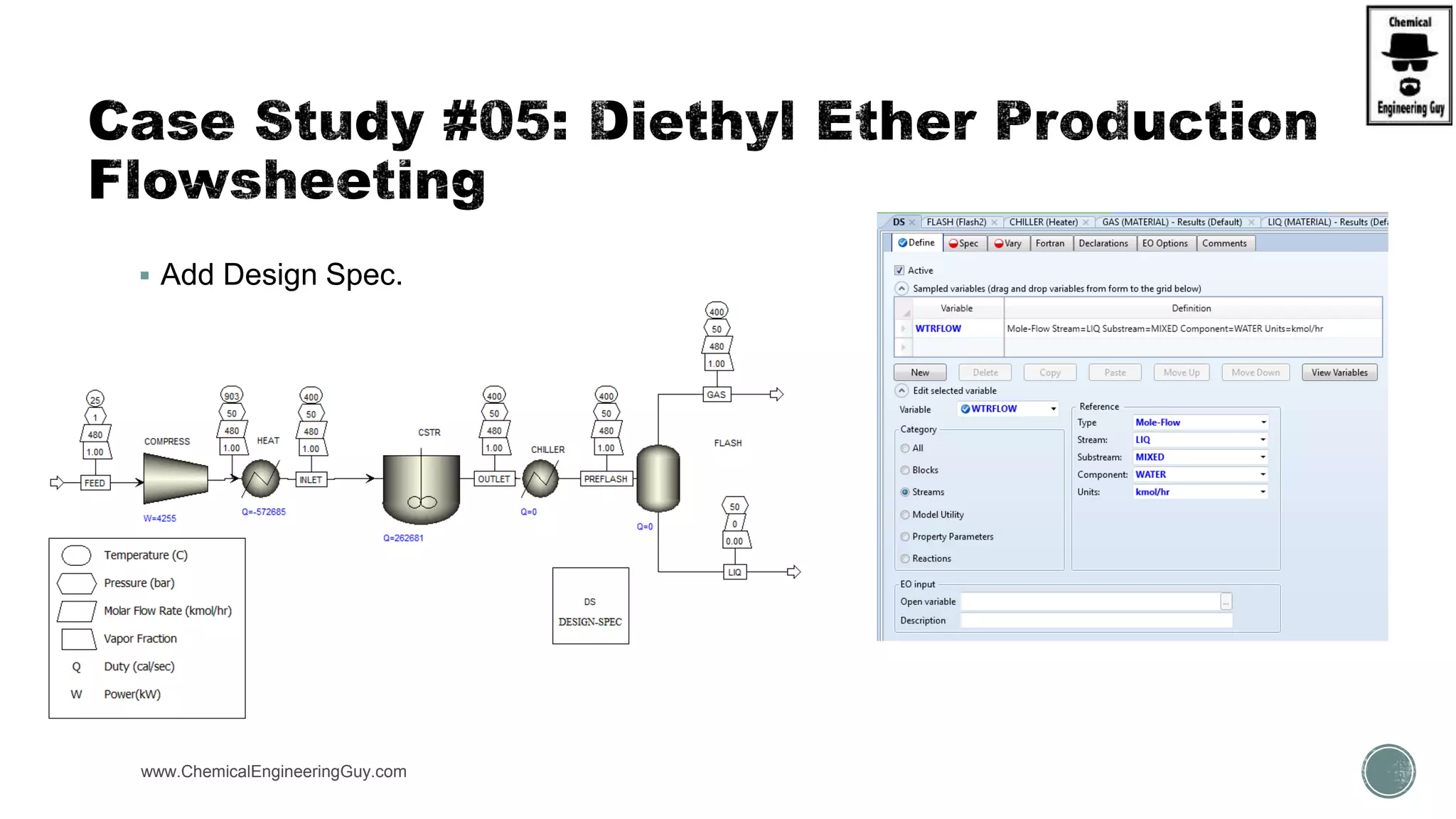
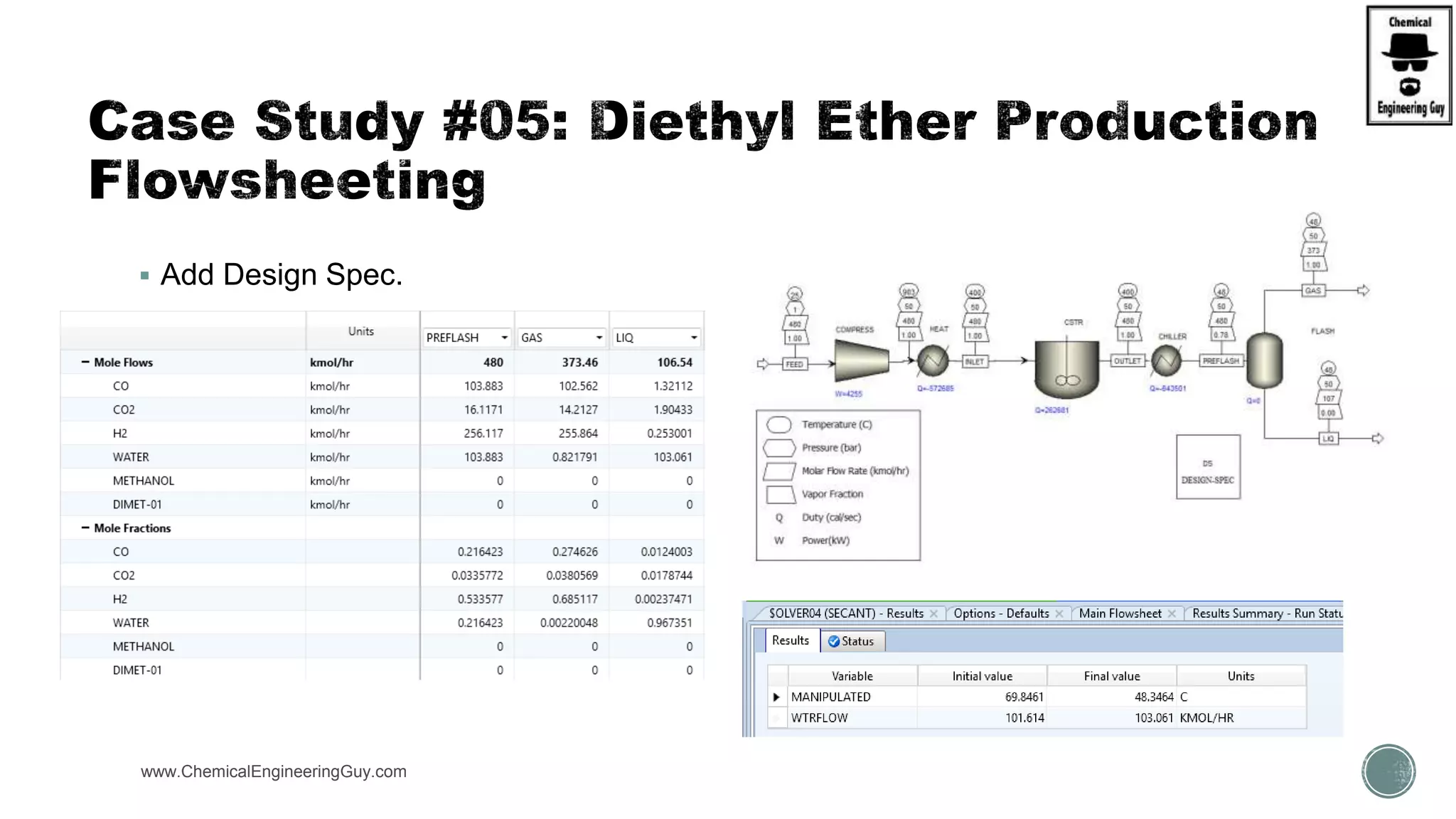
 (B) Use Design Spec For Water flow rate
www.ChemicalEngineeringGuy.com
 (B) Use Design Spec For Water flow rate  We want to remove most of water…
www.ChemicalEngineeringGuy.com
Enjoying so far?
This is a preview of the BOOTCAMP.
Join NOW here:
https://www.chemicalengineeringguy.com/courses/aspen-plus-bootcamp-with-12-case-studies/
 Add Design Spec.
www.ChemicalEngineeringGuy.com
 Add Design Spec.
www.ChemicalEngineeringGuy.com
Enjoying so far?
This is a preview of the BOOTCAMP.
Join NOW here:
https://www.chemicalengineeringguy.com/courses/aspen-plus-bootcamp-with-12-case-studies/
 Add Design Spec.
www.ChemicalEngineeringGuy.com
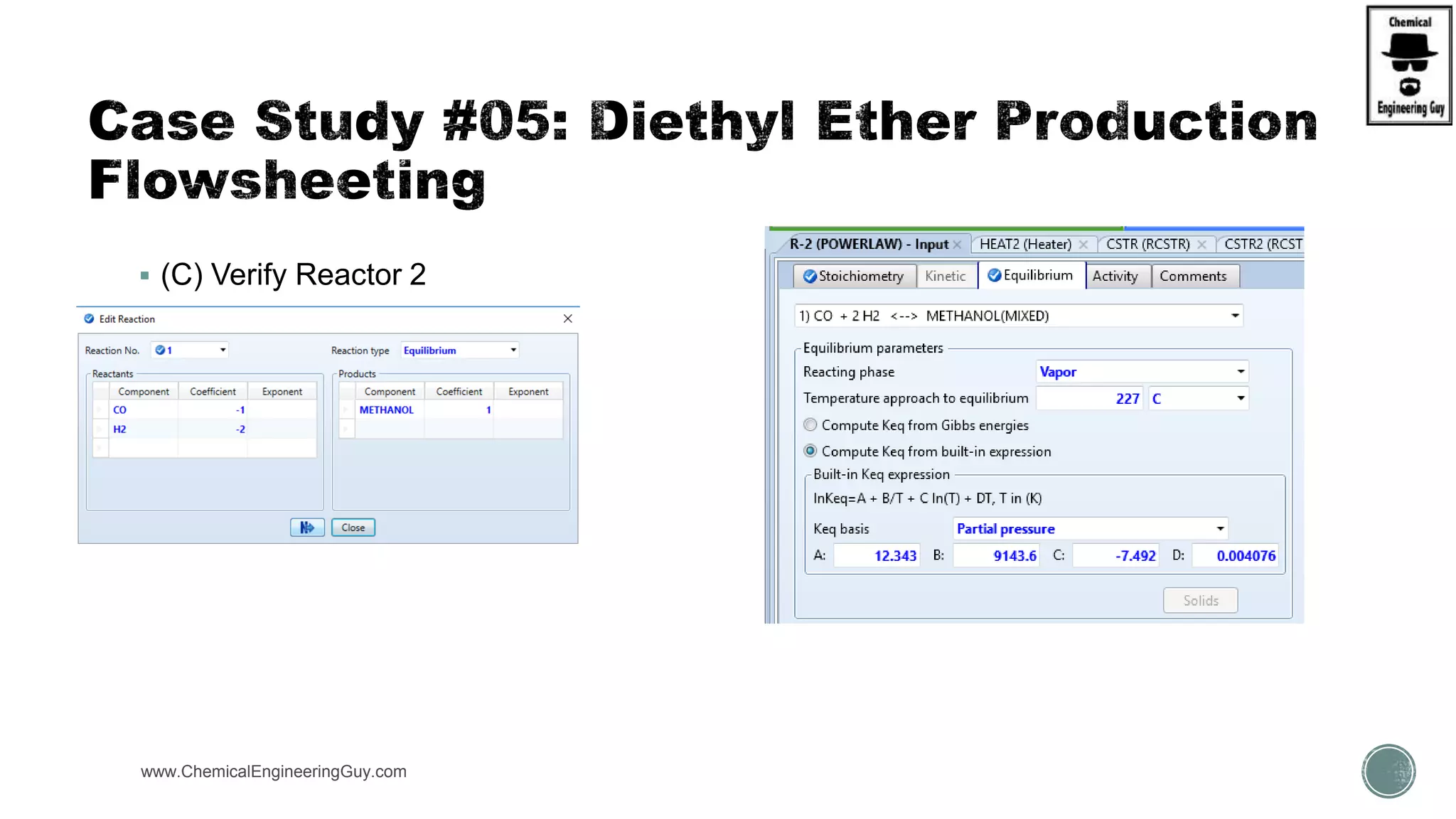
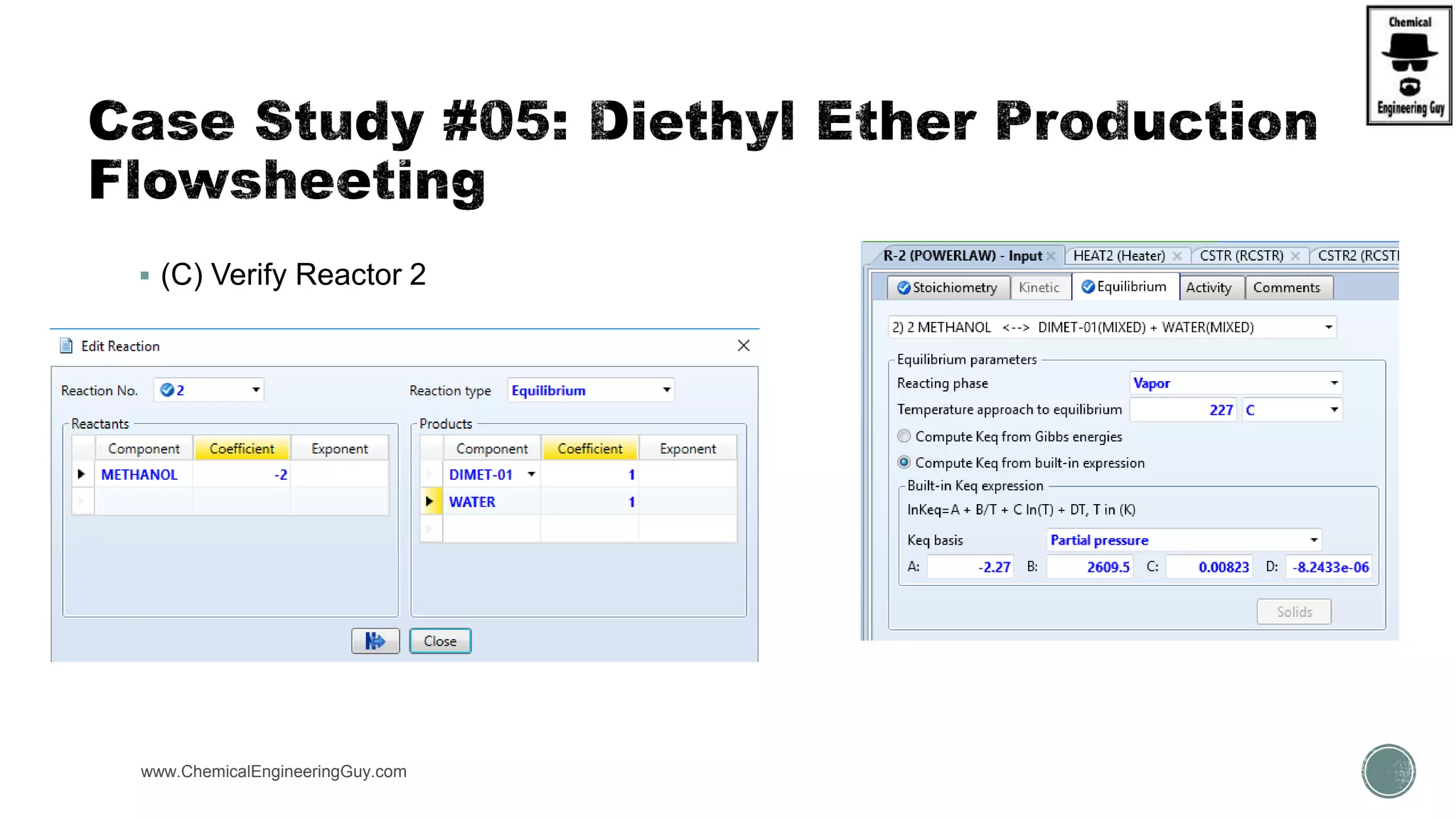
 (C) Verify Reactor 2
www.ChemicalEngineeringGuy.com
Enjoying so far?
This is a preview of the BOOTCAMP.
Join NOW here:
https://www.chemicalengineeringguy.com/courses/aspen-plus-bootcamp-with-12-case-studies/
 (C) Verify Reactor 2
www.ChemicalEngineeringGuy.com
 (C) Verify Reactor 2
www.ChemicalEngineeringGuy.com
 Run Reactor 2
www.ChemicalEngineeringGuy.com
Enjoying so far?
This is a preview of the BOOTCAMP.
Join NOW here:
https://www.chemicalengineeringguy.com/courses/aspen-plus-bootcamp-with-12-case-studies/
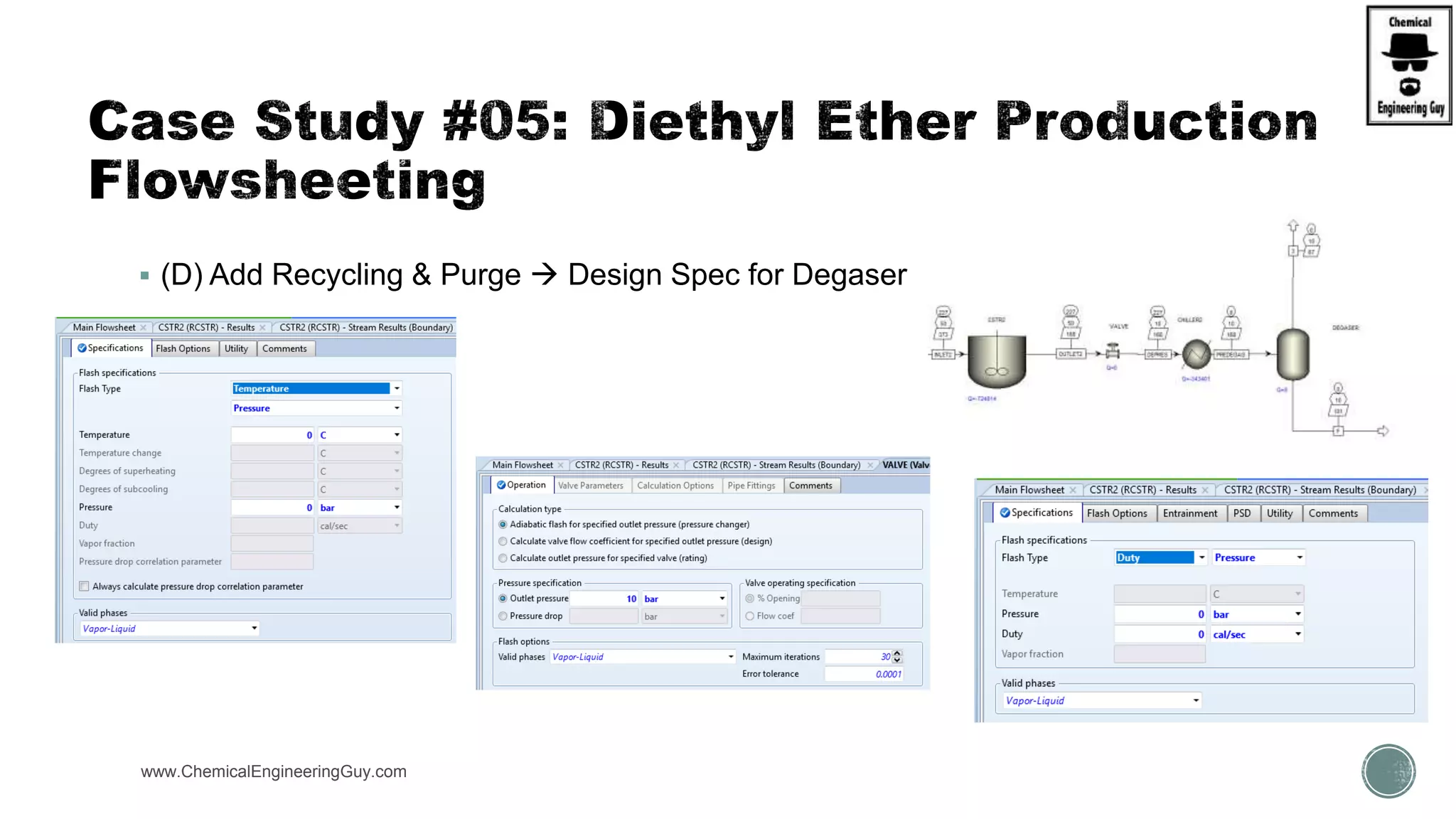
 (D) Add Recycling & Purge  Design Spec for Degaser
www.ChemicalEngineeringGuy.com
 (D) Add Recycling & Purge  Design Spec for Degaser
 Verify  No more than 0.10 kmol/h of Methanol is lost
www.ChemicalEngineeringGuy.com
 (D) Add Recycling & Purge  Design Spec for Degaser
 Verify  No more than 0.10 kmol/h of Methanol is lost
 RESULT  T = 0-1°C
www.ChemicalEngineeringGuy.com
Enjoying so far?
This is a preview of the BOOTCAMP.
Join NOW here:
https://www.chemicalengineeringguy.com/courses/aspen-plus-bootcamp-with-12-case-studies/
 (D) Add Recycling & Purge  Design Spec for Degaser
www.ChemicalEngineeringGuy.com
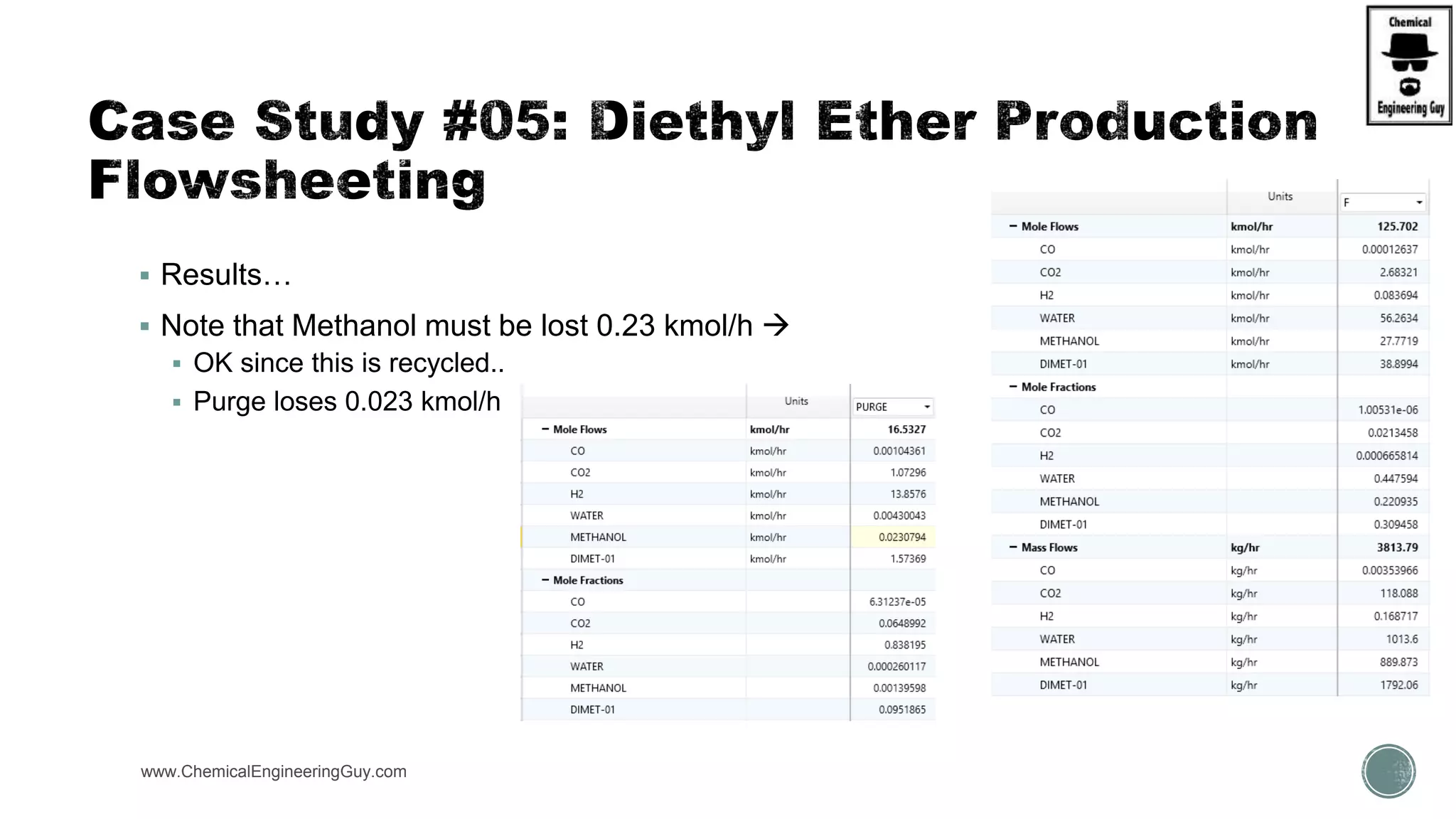
 Results…
 Note that Methanol must be lost 0.23 kmol/h 
 OK since this is recycled..
 Purge loses 0.023 kmol/h
www.ChemicalEngineeringGuy.com
 Verify Water content
 FLASH1  from 103 to
www.ChemicalEngineeringGuy.com
Enjoying so far?
This is a preview of the BOOTCAMP.
Join NOW here:
https://www.chemicalengineeringguy.com/courses/aspen-plus-bootcamp-with-12-case-studies/
 (E) Separate final products DIM-trap & Send to plant
www.ChemicalEngineeringGuy.com
 (E) Separate final products DIM-trap & Send to plant
www.ChemicalEngineeringGuy.com
Enjoying so far?
This is a preview of the BOOTCAMP.
Join NOW here:
https://www.chemicalengineeringguy.com/courses/aspen-plus-bootcamp-with-12-case-studies/
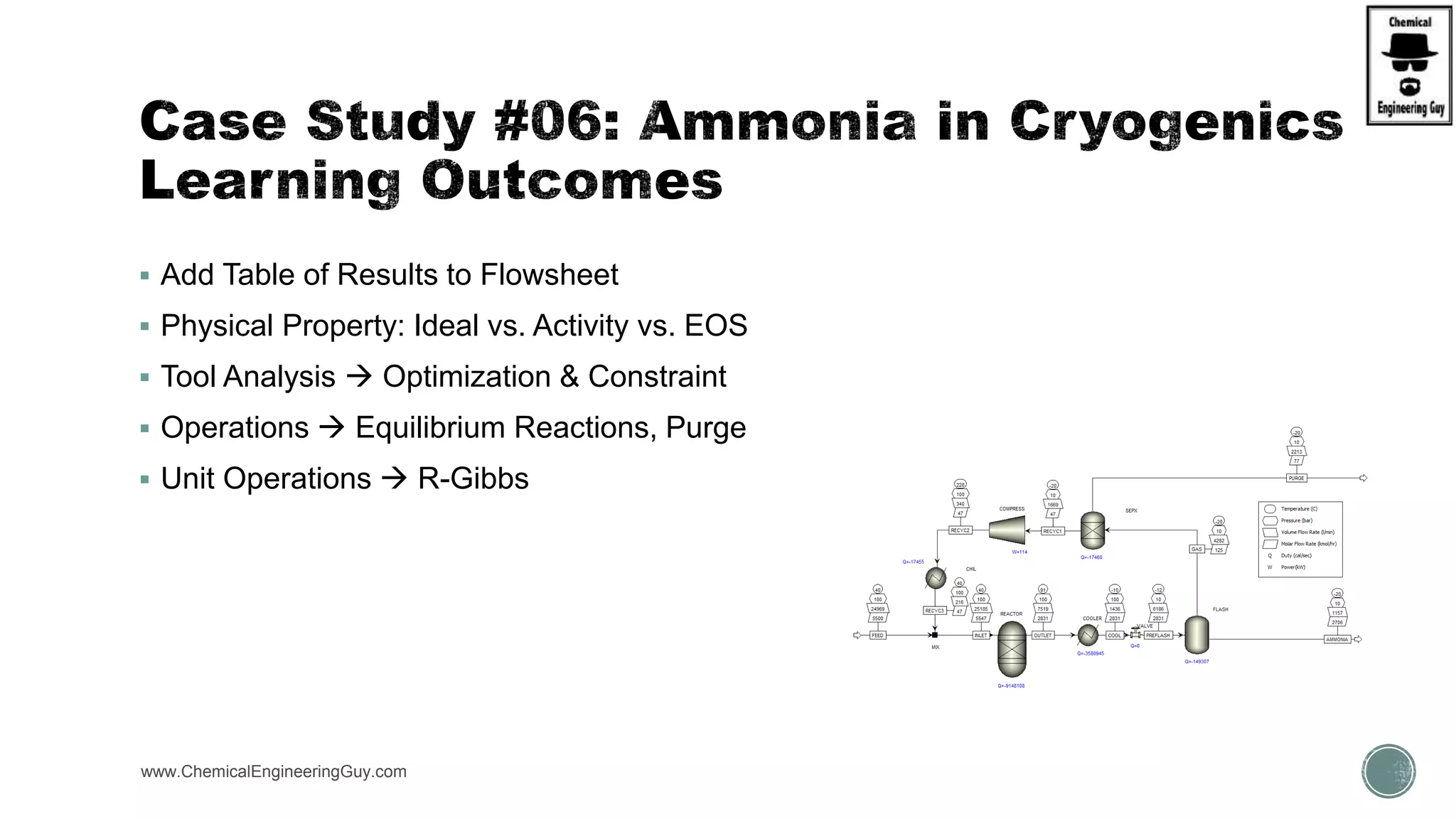
 Add Table of Results to Flowsheet
 Physical Property: Ideal vs. Activity vs. EOS
 Tool Analysis  Optimization & Constraint
 Operations  Equilibrium Reactions, Purge
 Unit Operations  R-Gibbs
www.ChemicalEngineeringGuy.com https://www.youtube.com/watch?v=vevVRwaZXEU
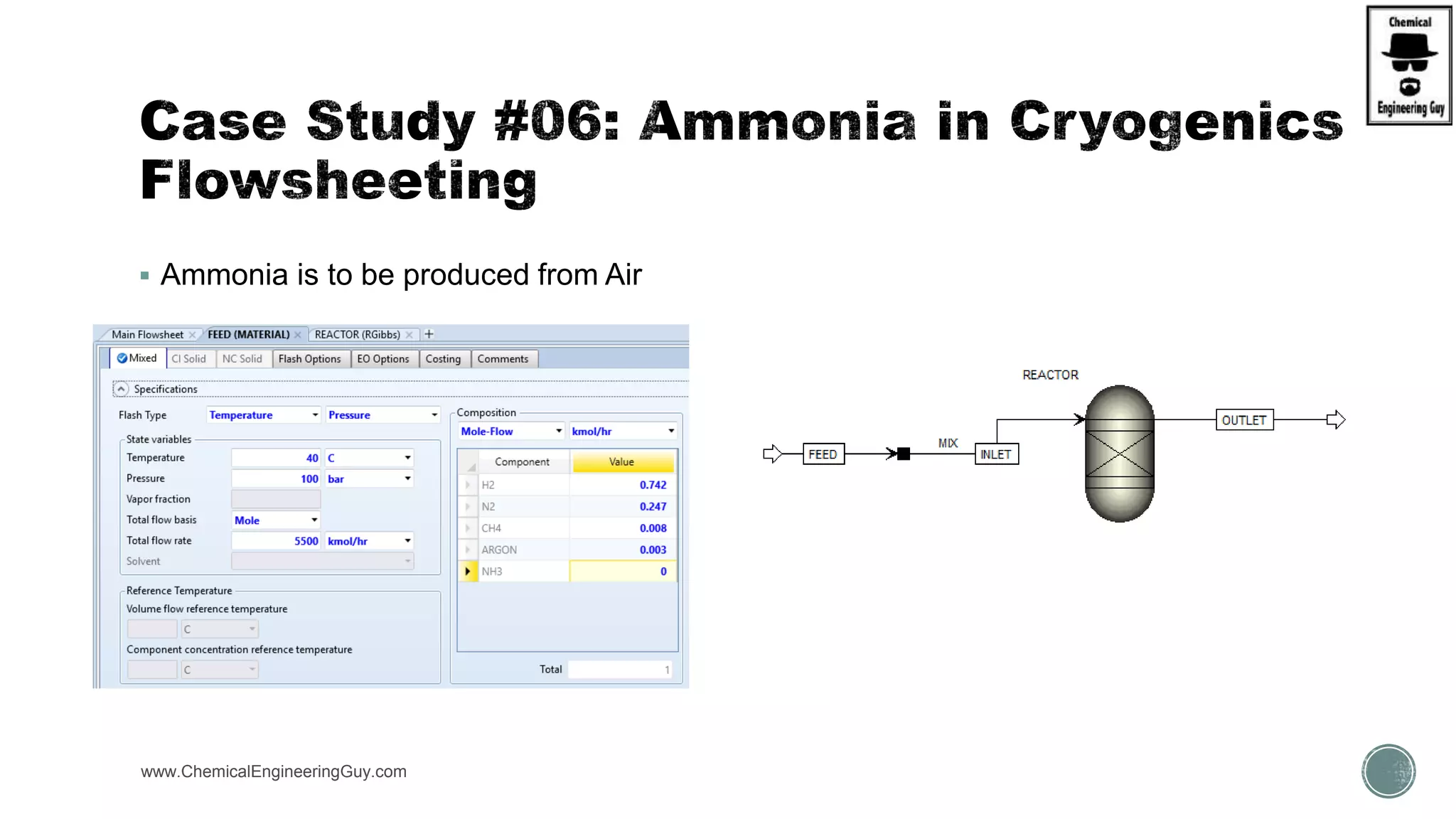
 Ammonia gas is to be produced from a mixture of cryogenic gases, H2, N2,CH4, Ar
and some H2 (74.2, 24.7, 0.8, 0.3%)
 T feed = 40°C, P = 100 bar, F = 5500 kmol/h
 There is a reactor which converts Nitrogen gas and Hydrogen gas to Ammonia, as
given in the Haber Process as: N2 + 3H2  2NH3
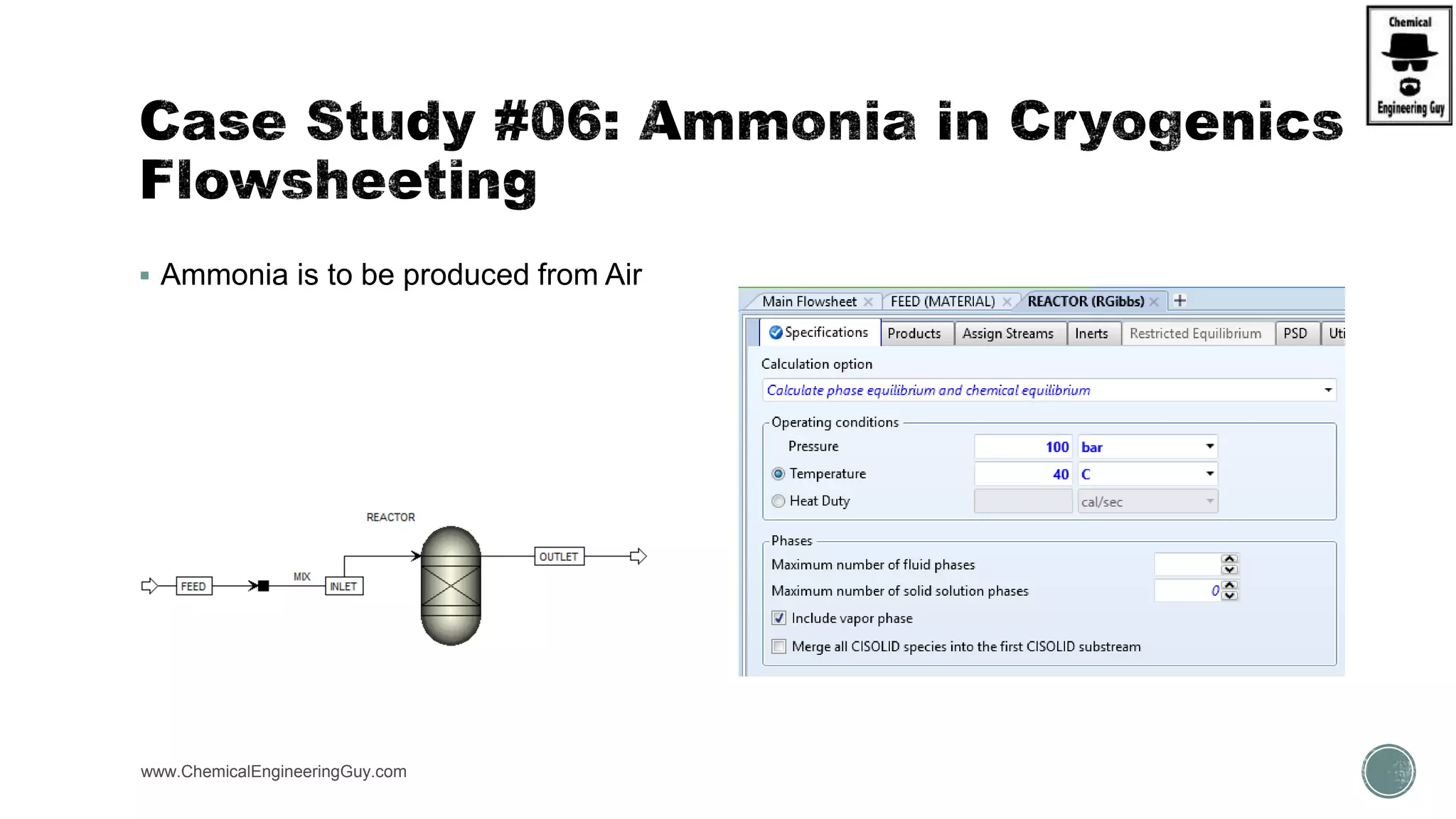
 Use Gibbs Free Energy Reactor 40°C to verify the % composition of the outlet of the
reactor
 The mixture is then separated from Ammonia via flashing at low T… pre-specified T is
-10°C, but the process engineer must verify/optimize the Temperature to maximize
gains.
 Min. Purity is to be 99.5% Molar in the product of NH3
 Purge system has a 90% recovery of reactants, N2, H3 only. All other is purged
www.ChemicalEngineeringGuy.com https://www.youtube.com/watch?v=vevVRwaZXEU
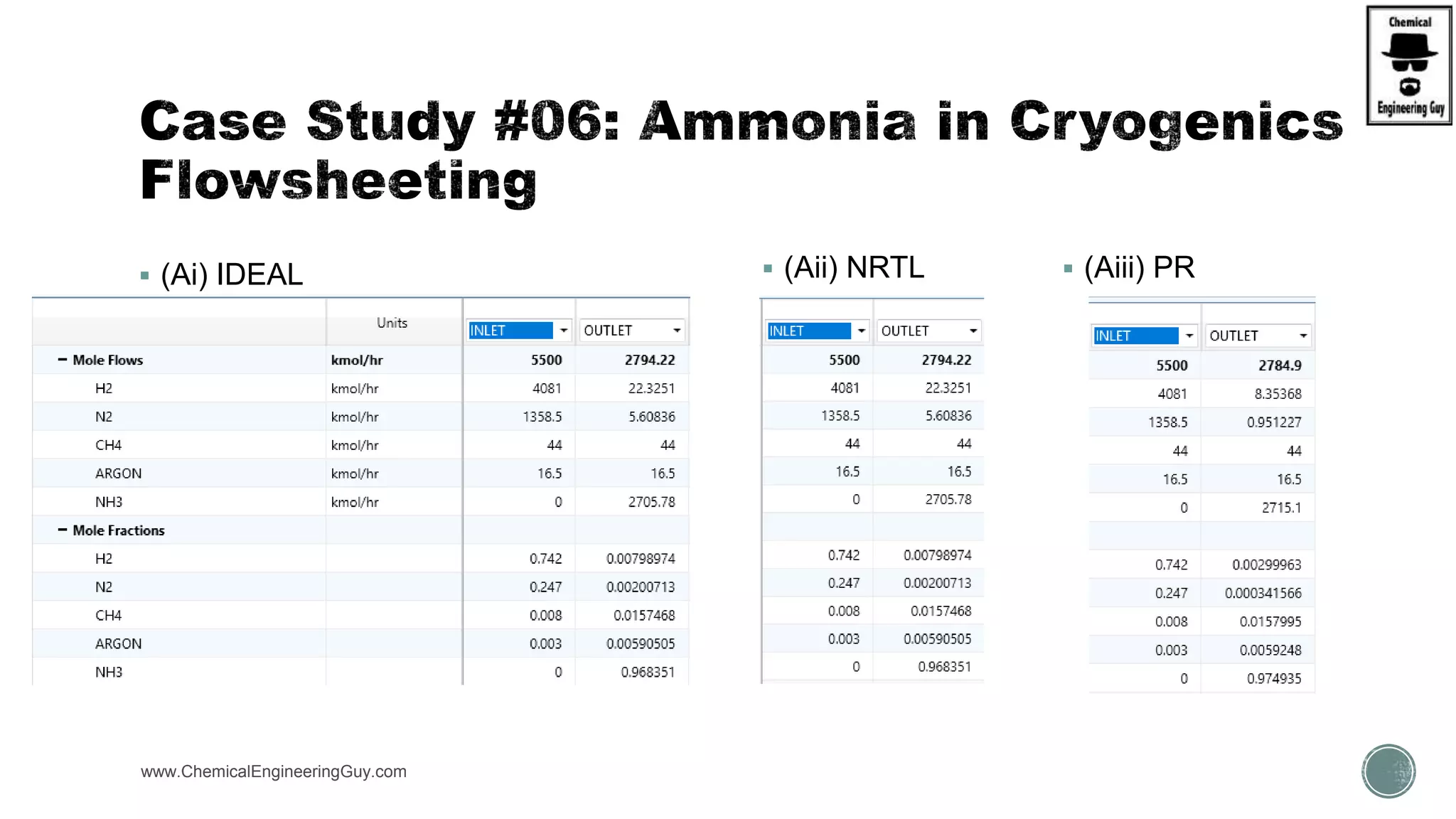
 (A) Run the reactor, verify the composition in the outlet given T-Reactor = 40°C
 (Ai) Verify for IDEAL
 (Aii) Verify for NRTL
 (Aiii) Verify for Peng Robinson (recommended)
 (B) Cool down, then flash mixture  Verify Mole flow of Ammonia and purity
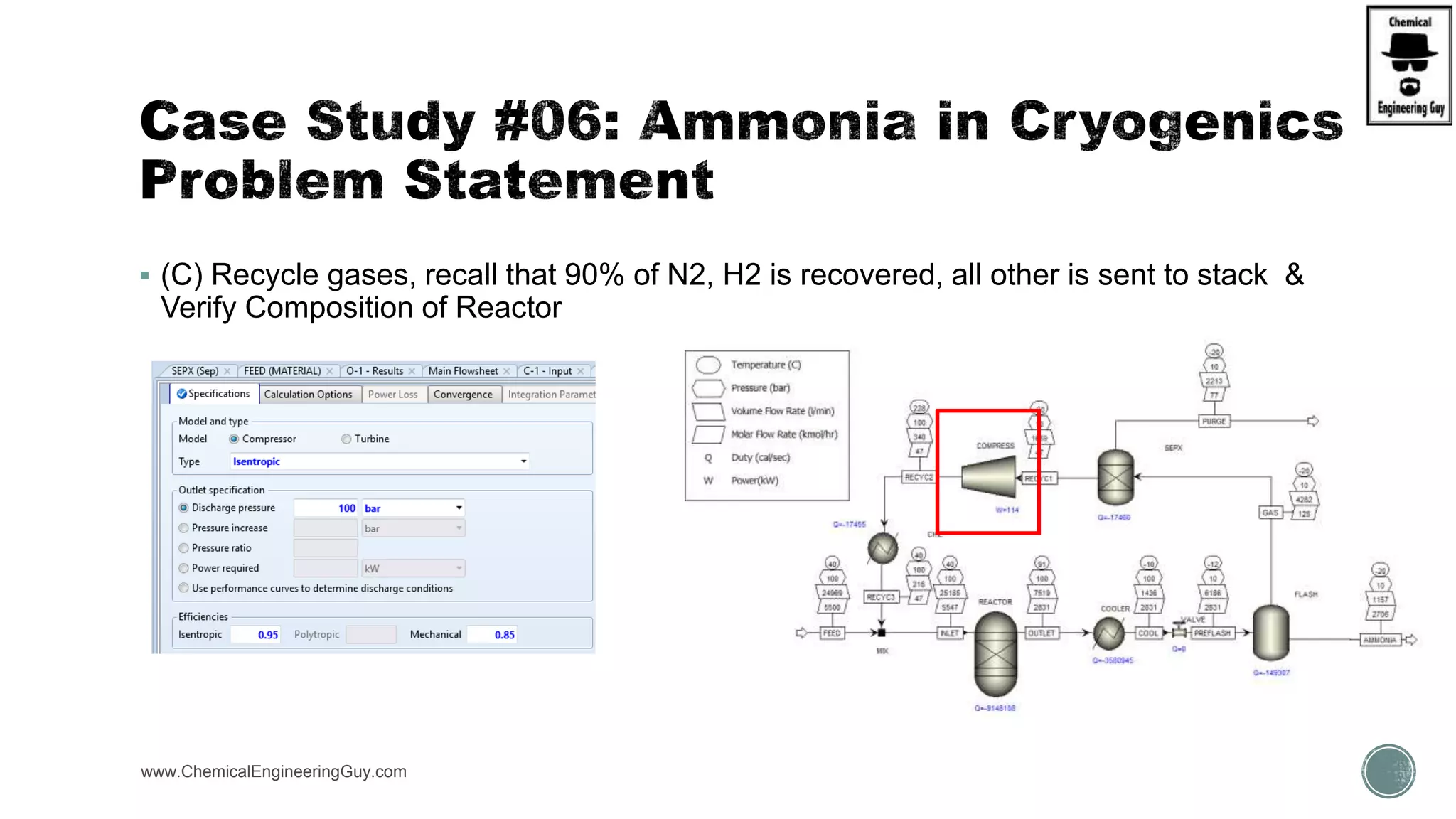
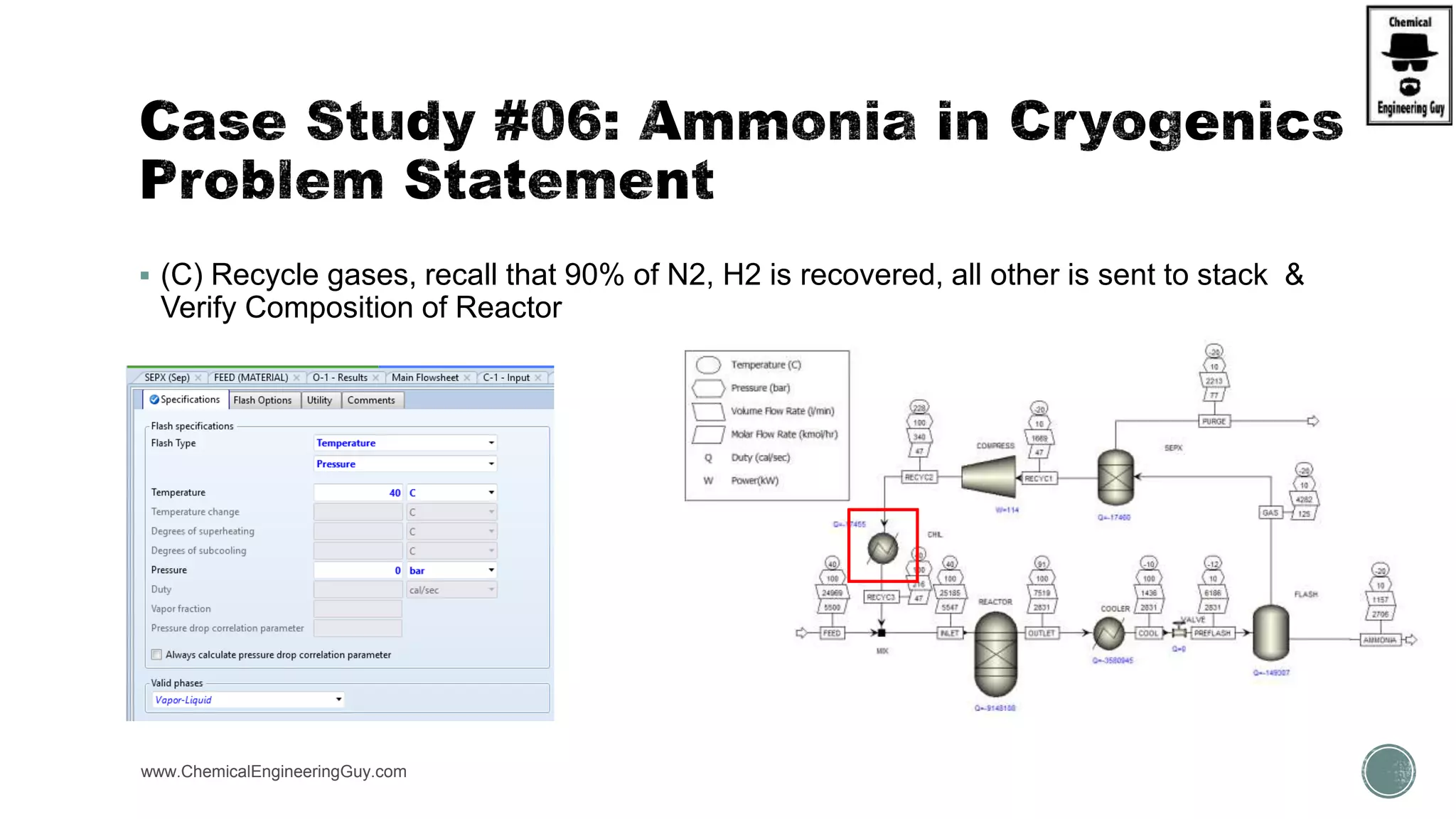
 (C) Recycle gases, recall that 90% of N2, H2 is recovered, all other is sent to stack &
Verify Composition of Reactor
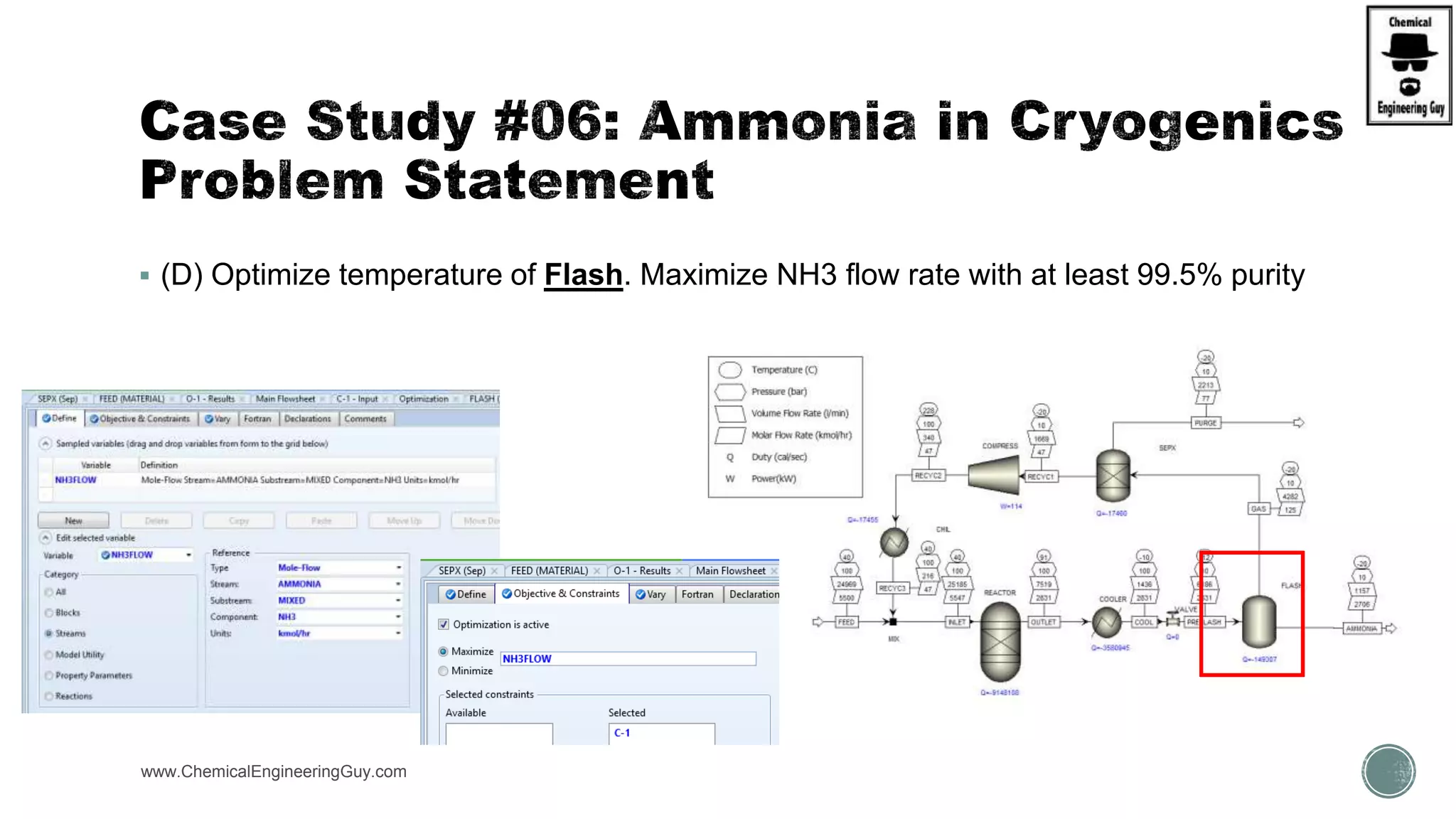
 (D) Optimize temperature of Flash. Maximize NH3 flow rate with at least 99.5% purity
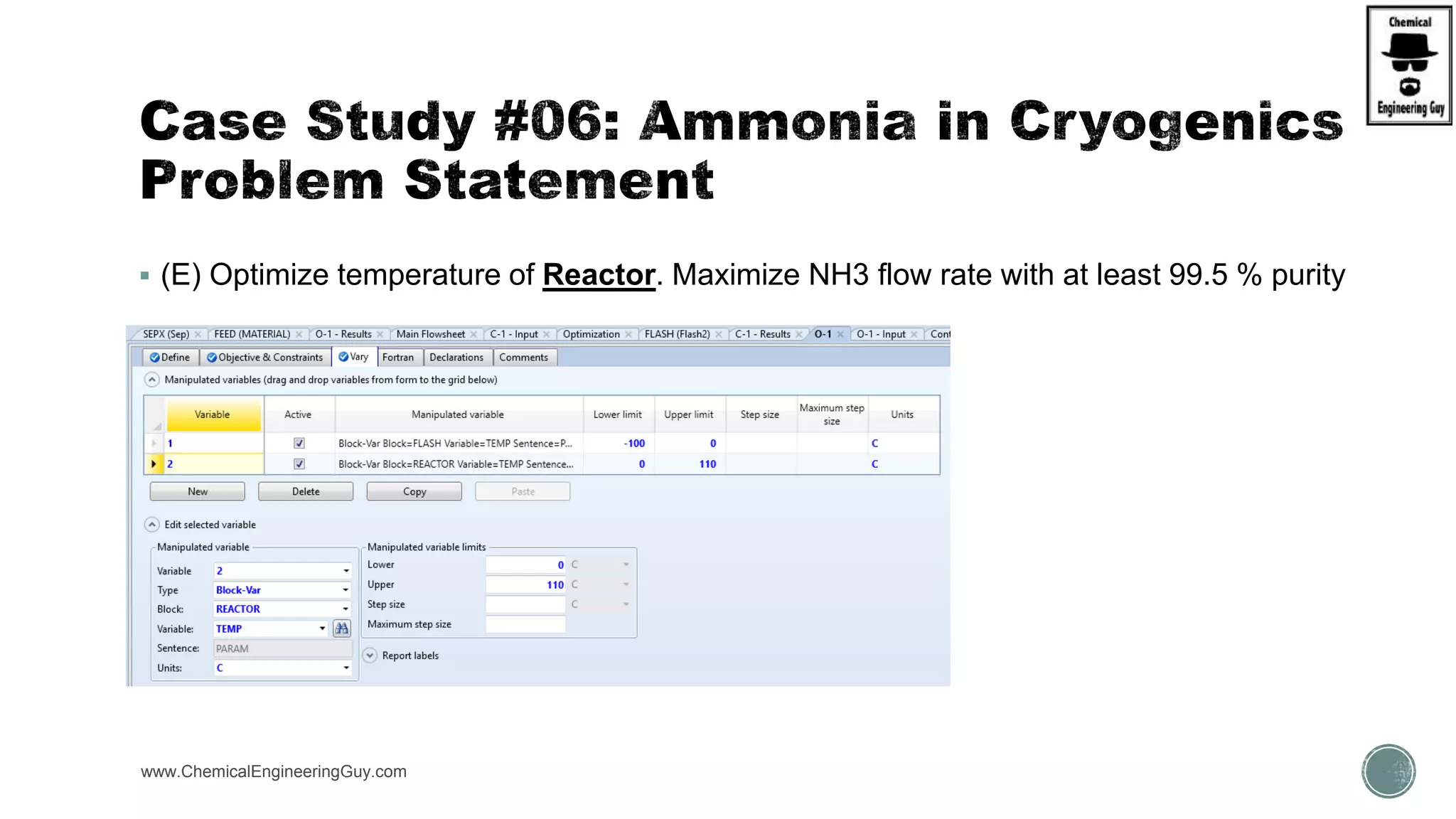
 (E) Optimize temperature of Reactor. Maximize NH3 flow rate with at least 99.5 % purity
www.ChemicalEngineeringGuy.com https://www.youtube.com/watch?v=vevVRwaZXEU
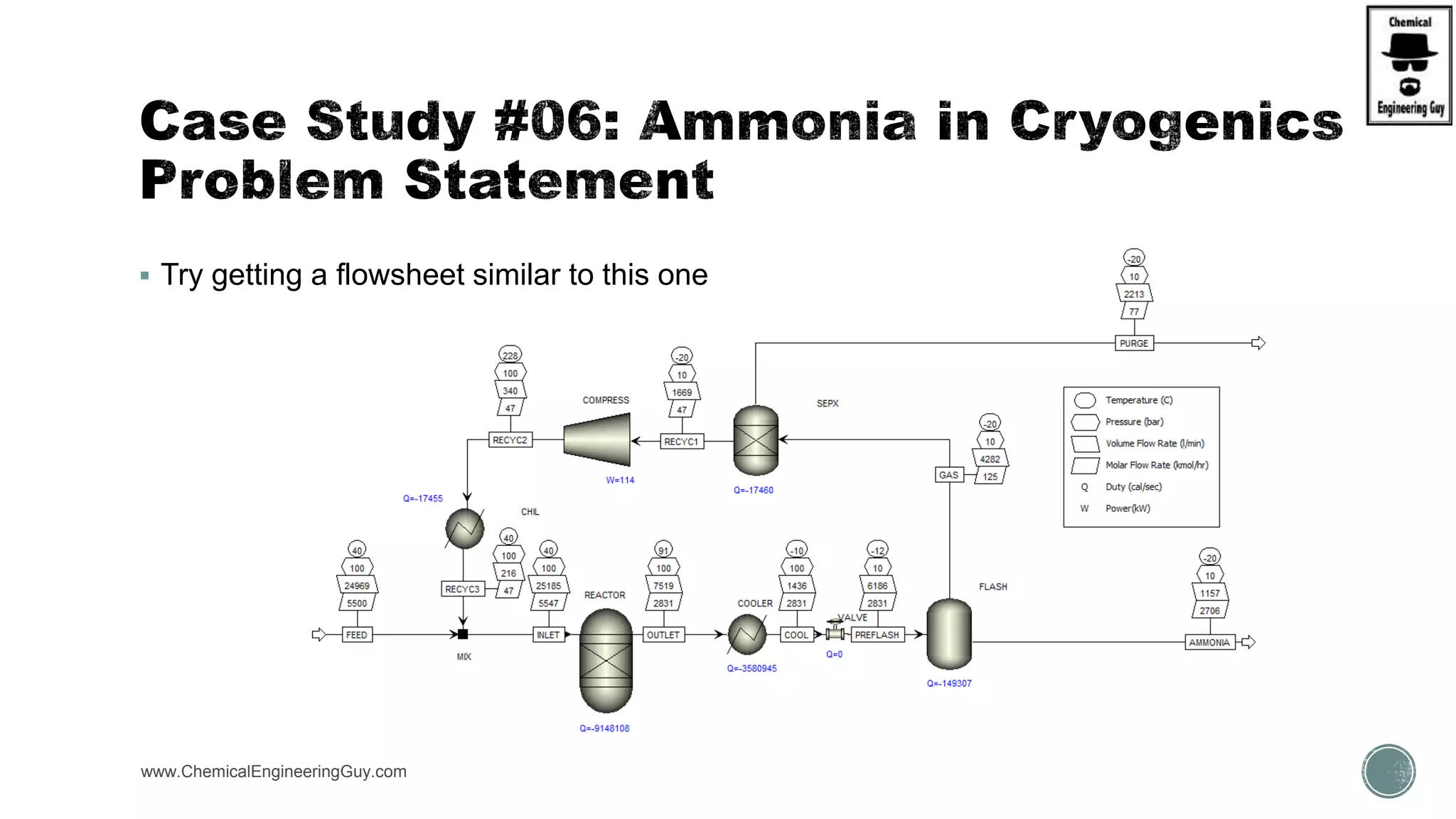
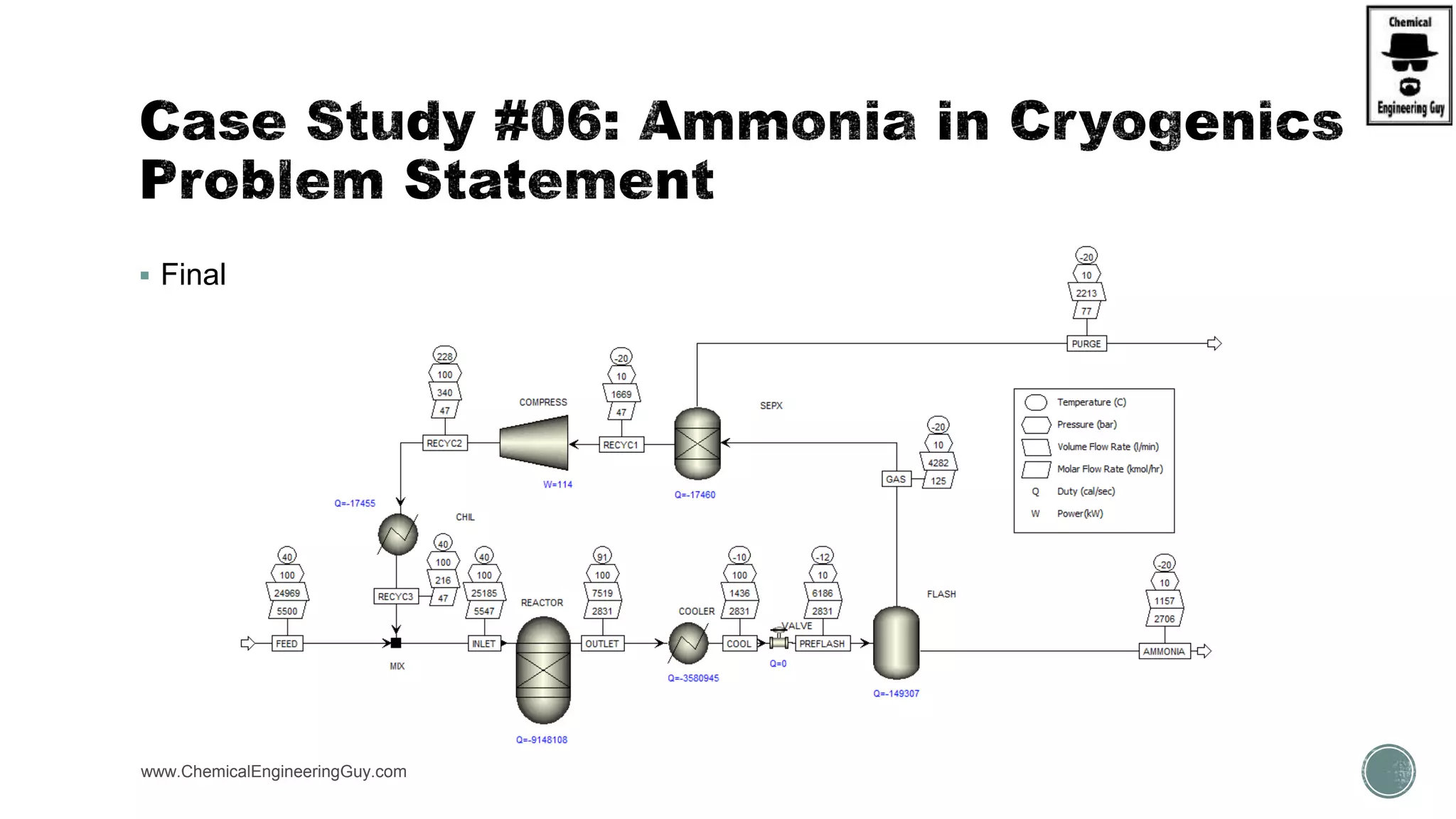
 Try getting a flowsheet similar to this one
www.ChemicalEngineeringGuy.com https://www.youtube.com/watch?v=vevVRwaZXEU
 (A) Run the reactor, verify the composition in the outlet given T-Reactor = 40°C
 (Ai) Verify for IDEAL
 (Aii) Verify for NRTL
 (Aiii) Verify for Peng Robinson (recommended)
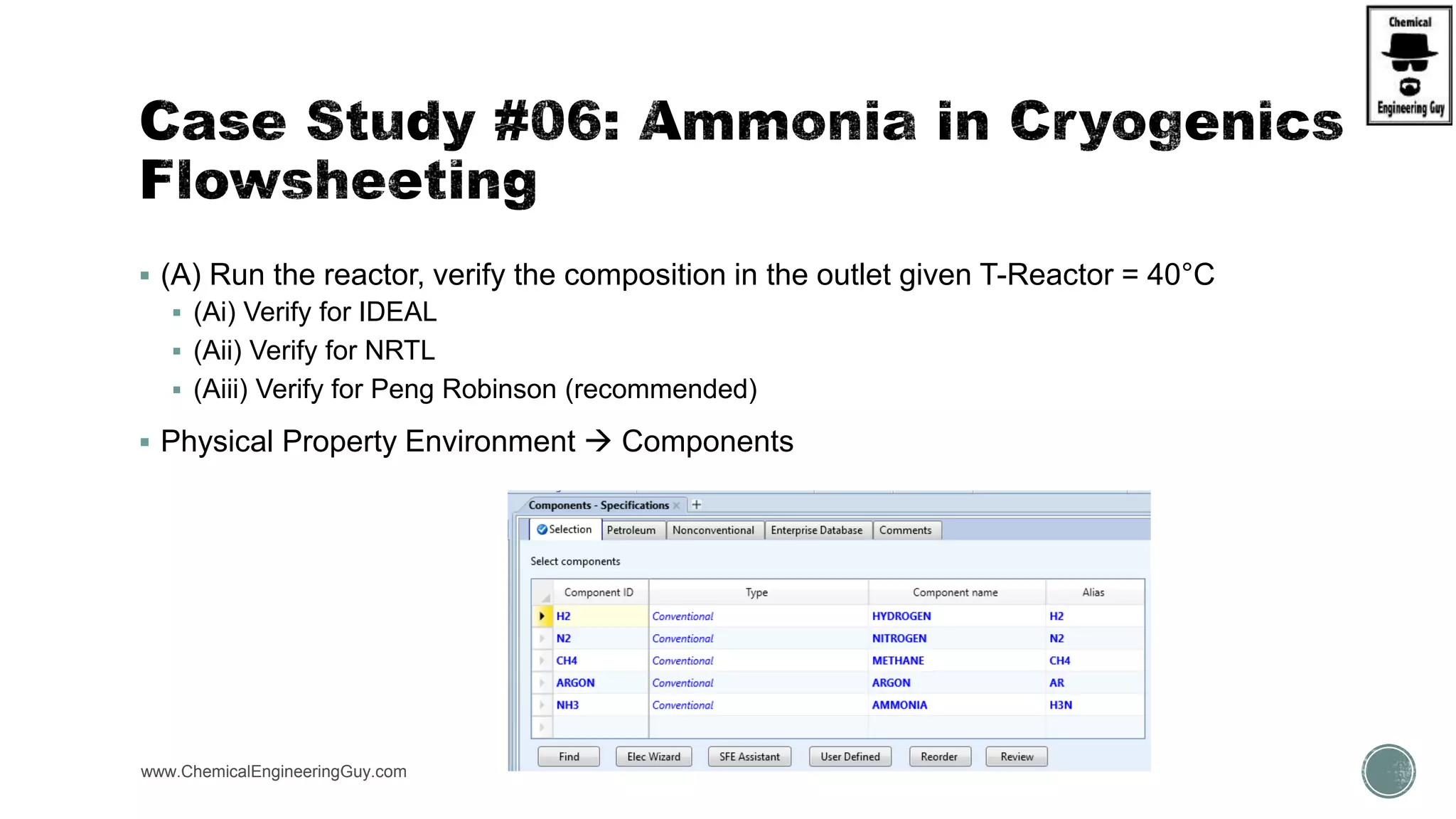
 Physical Property Environment  Components
www.ChemicalEngineeringGuy.com
 Physical Property Environment  Methods (Peng-Robinson)
www.ChemicalEngineeringGuy.com
Enjoying so far?
This is a preview of the BOOTCAMP.
Join NOW here:
https://www.chemicalengineeringguy.com/courses/aspen-plus-bootcamp-with-12-case-studies/
 Ammonia is to be produced from Air
www.ChemicalEngineeringGuy.com
 Ammonia is to be produced from Air
www.ChemicalEngineeringGuy.com
 (Ai) IDEAL
www.ChemicalEngineeringGuy.com
 (Aii) NRTL  (Aiii) PR
 (B) Cool down, then flash mixture  Verify Mole flow of Ammonia and purity
www.ChemicalEngineeringGuy.com https://www.youtube.com/watch?v=vevVRwaZXEU
Enjoying so far?
This is a preview of the BOOTCAMP.
Join NOW here:
https://www.chemicalengineeringguy.com/courses/aspen-plus-bootcamp-with-12-case-studies/
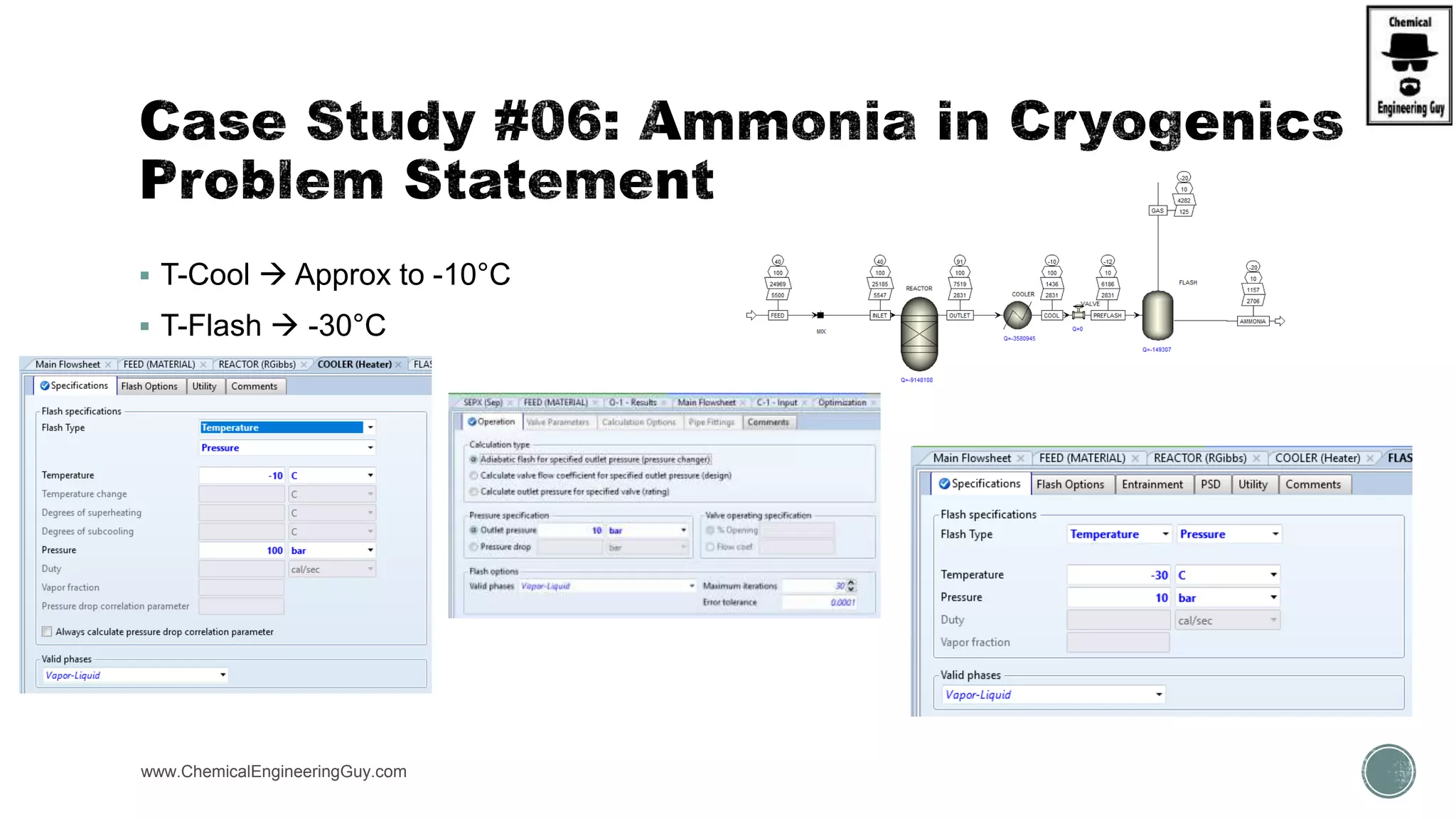
 T-Cool  Approx to -10°C
 T-Flash  -30°C
www.ChemicalEngineeringGuy.com
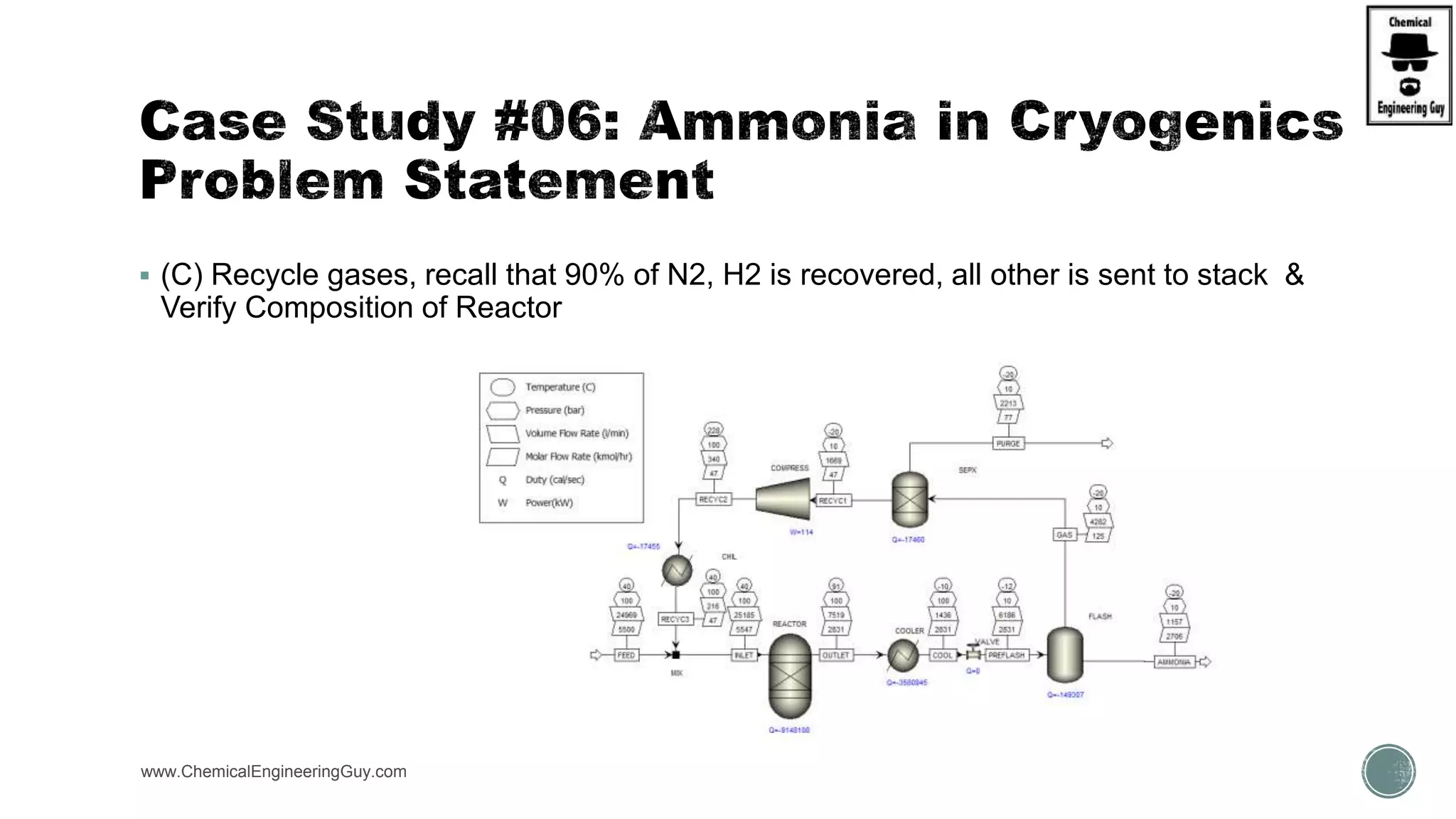
 (C) Recycle gases, recall that 90% of N2, H2 is recovered, all other is sent to stack &
Verify Composition of Reactor
www.ChemicalEngineeringGuy.com https://www.youtube.com/watch?v=vevVRwaZXEU
 (C) Recycle gases, recall that 90% of N2, H2 is recovered, all other is sent to stack &
Verify Composition of Reactor
www.ChemicalEngineeringGuy.com https://www.youtube.com/watch?v=vevVRwaZXEU
Enjoying so far?
This is a preview of the BOOTCAMP.
Join NOW here:
https://www.chemicalengineeringguy.com/courses/aspen-plus-bootcamp-with-12-case-studies/
 (C) Recycle gases, recall that 90% of N2, H2 is recovered, all other is sent to stack &
Verify Composition of Reactor
www.ChemicalEngineeringGuy.com https://www.youtube.com/watch?v=vevVRwaZXEU
 (C) Recycle gases, recall that 90% of N2, H2 is recovered, all other is sent to stack &
Verify Composition of Reactor
www.ChemicalEngineeringGuy.com https://www.youtube.com/watch?v=vevVRwaZXEU
 (D) Optimize temperature of Flash. Maximize NH3 flow rate with at least 99.5% purity
www.ChemicalEngineeringGuy.com https://www.youtube.com/watch?v=vevVRwaZXEU
 (D) Optimize temperature of Flash. Maximize NH3 flow rate with at least 99.5% purity
www.ChemicalEngineeringGuy.com https://www.youtube.com/watch?v=vevVRwaZXEU
Enjoying so far?
This is a preview of the BOOTCAMP.
Join NOW here:
https://www.chemicalengineeringguy.com/courses/aspen-plus-bootcamp-with-12-case-studies/
 (E) Optimize temperature of Reactor. Maximize NH3 flow rate with at least 99.5 % purity
www.ChemicalEngineeringGuy.com https://www.youtube.com/watch?v=vevVRwaZXEU
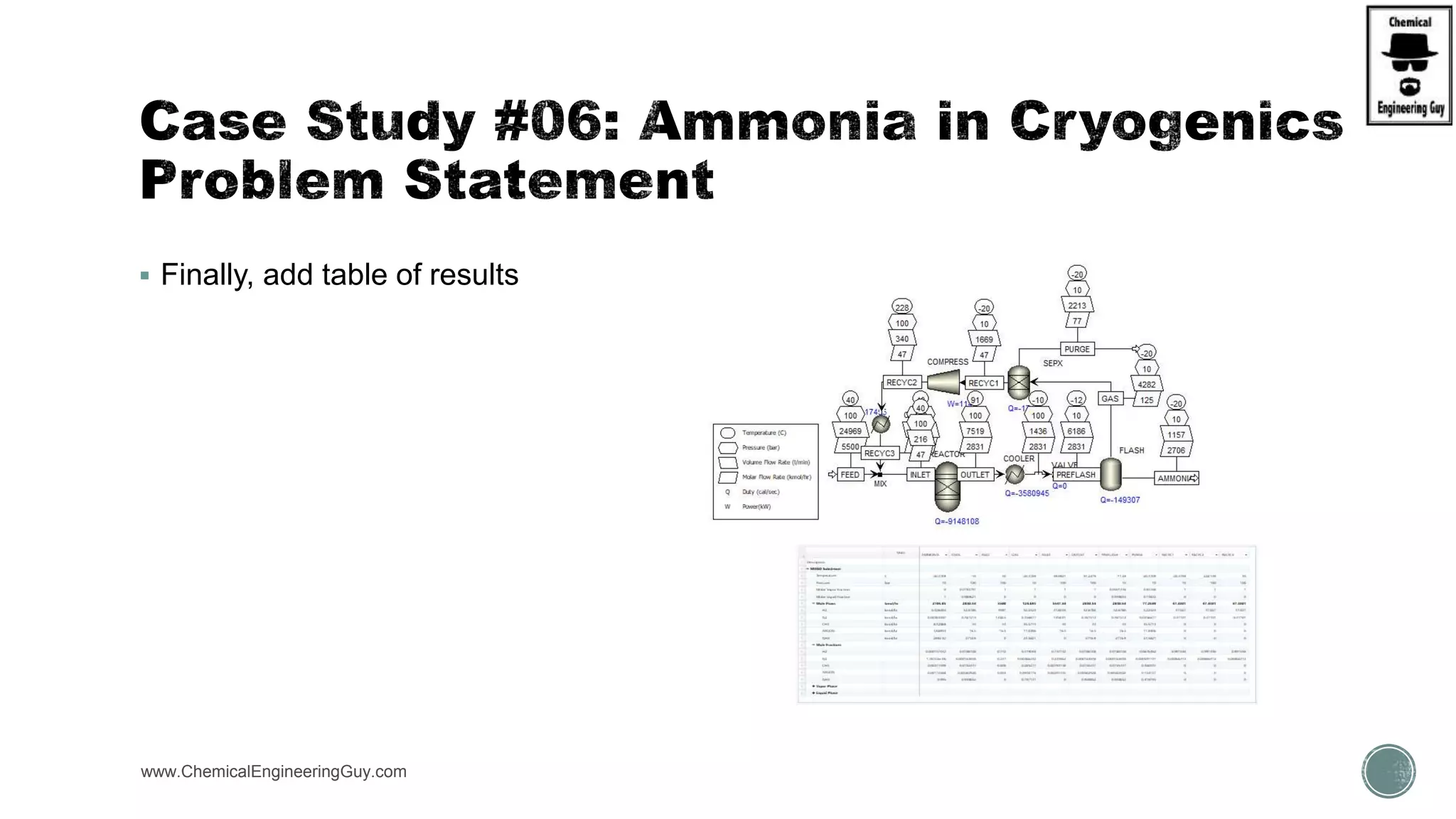
 Finally, add table of results
www.ChemicalEngineeringGuy.com https://www.youtube.com/watch?v=vevVRwaZXEU
 Finally, add table of results
www.ChemicalEngineeringGuy.com https://www.youtube.com/watch?v=vevVRwaZXEU
 Export Table of Results to Spreadsheet/Excel
 Manipulators  Dupl / Mult
 Tool Analysis  Sensitivity Analysis
 Operations  Equilibrium Reactions, Purge
 Unit Operations  R-Gibbs
 Sensitivity Analysis
www.ChemicalEngineeringGuy.com
https://www.youtube.com/watch?v=yWbfzw04SvI
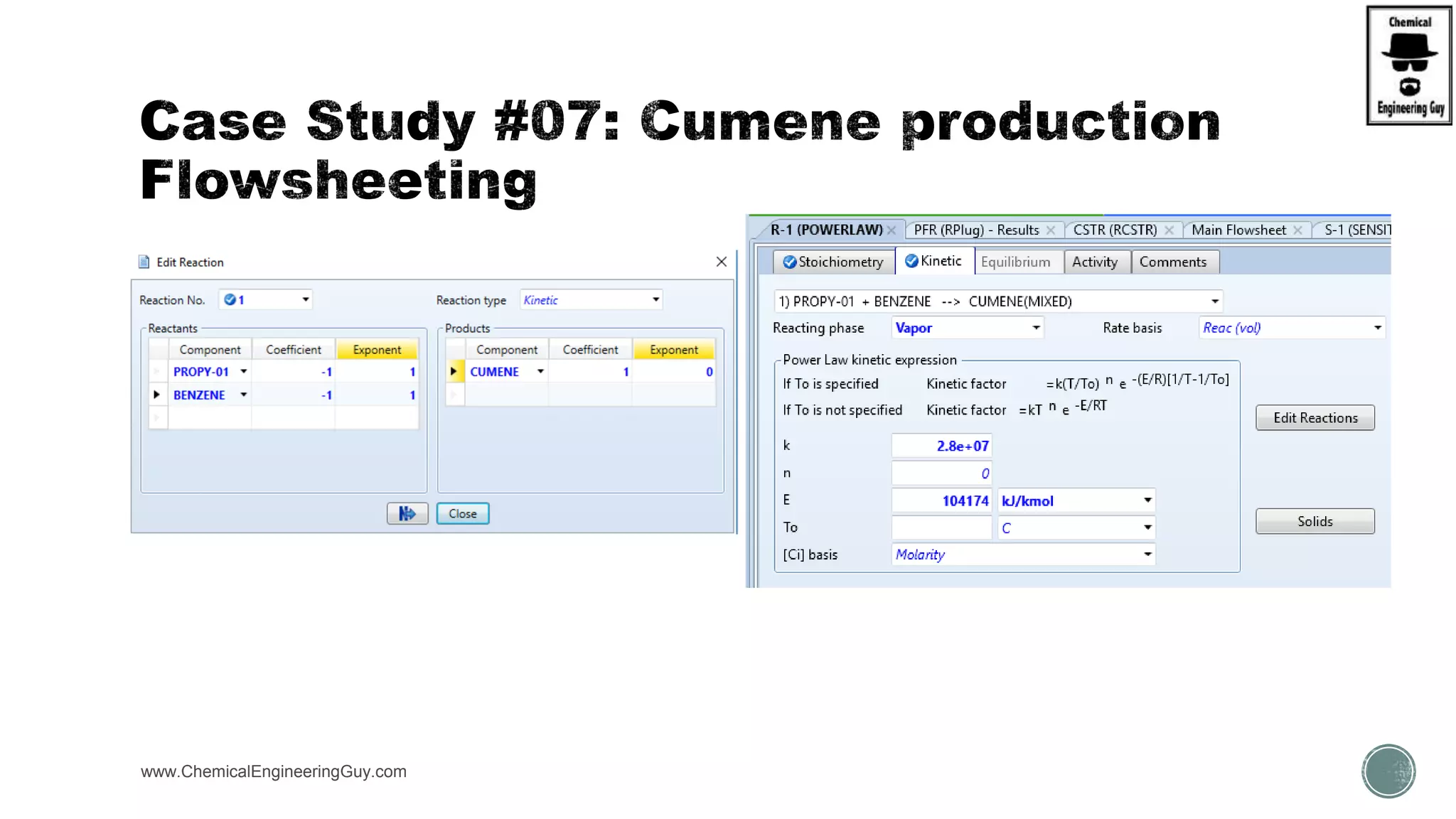
 Cumene (C9H12) is to be produced from the reaction of benzene and propane
 C6H6 propylene  Cumene
 The reactor is to be tested in: Multi-tubular PFR, CSTR with same residence time as
the PFR
 Conditions:
 T = 25°C, 25 bar  pre-heated to 360°C
 Initially, Benzene flow rate = 300 kmol/h,
 Isopropylene source  75 kmol/h butane, 225 kmol/h isopropylene
 The best reactor is to be selected as the one to operate
www.ChemicalEngineeringGuy.com
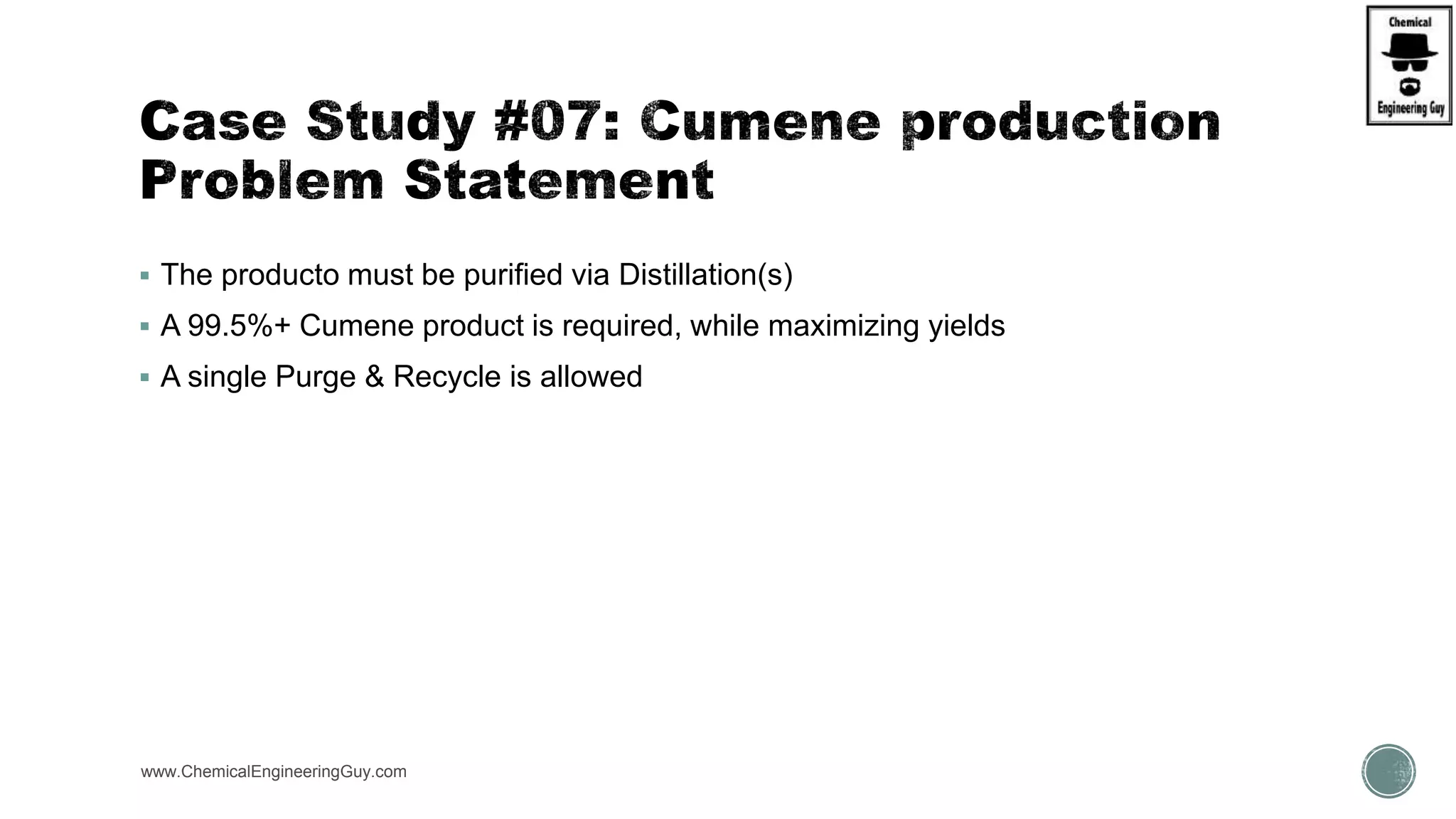
 The producto must be purified via Distillation(s)
 A 99.5%+ Cumene product is required, while maximizing yields
 A single Purge & Recycle is allowed
www.ChemicalEngineeringGuy.com
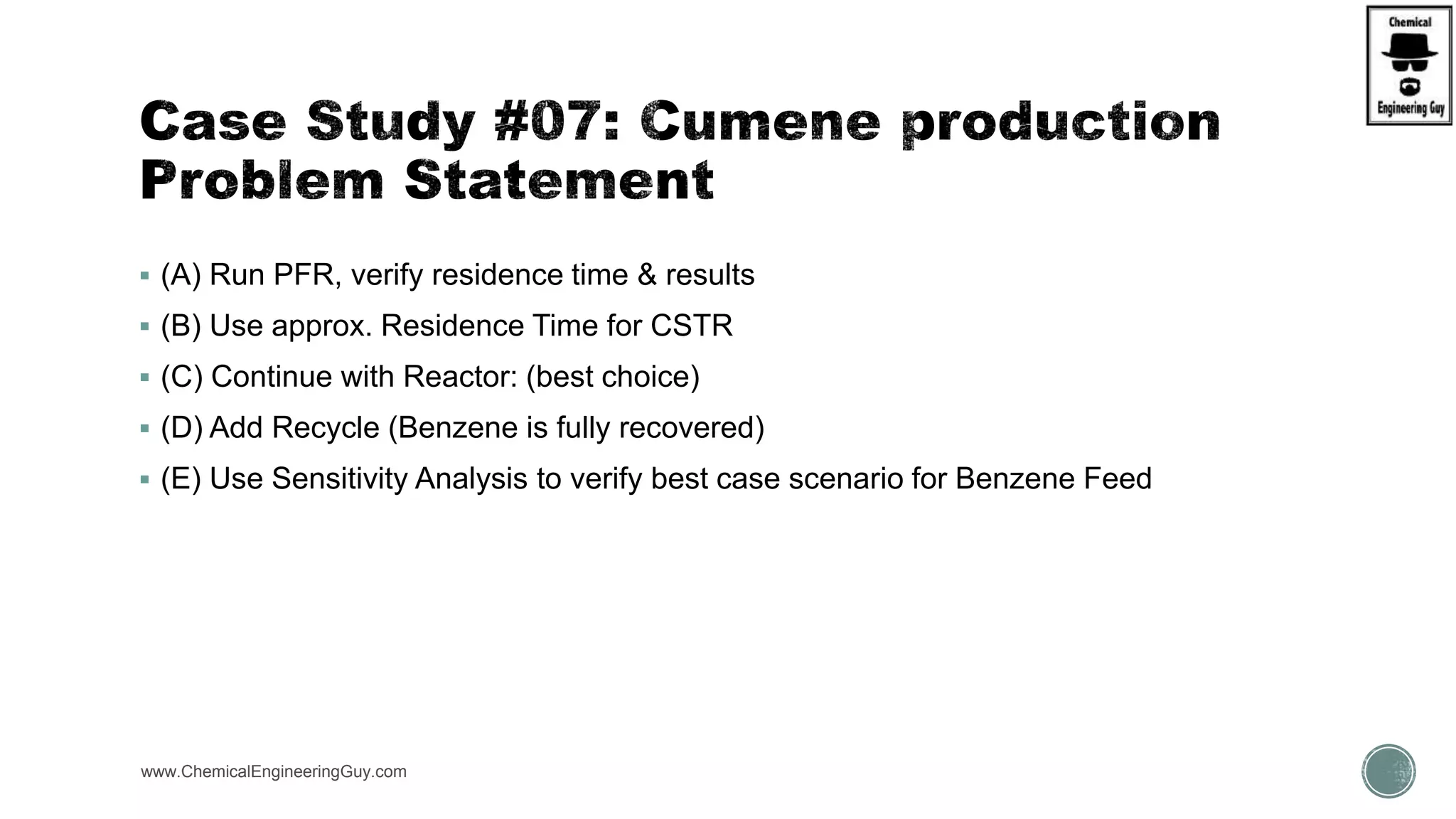
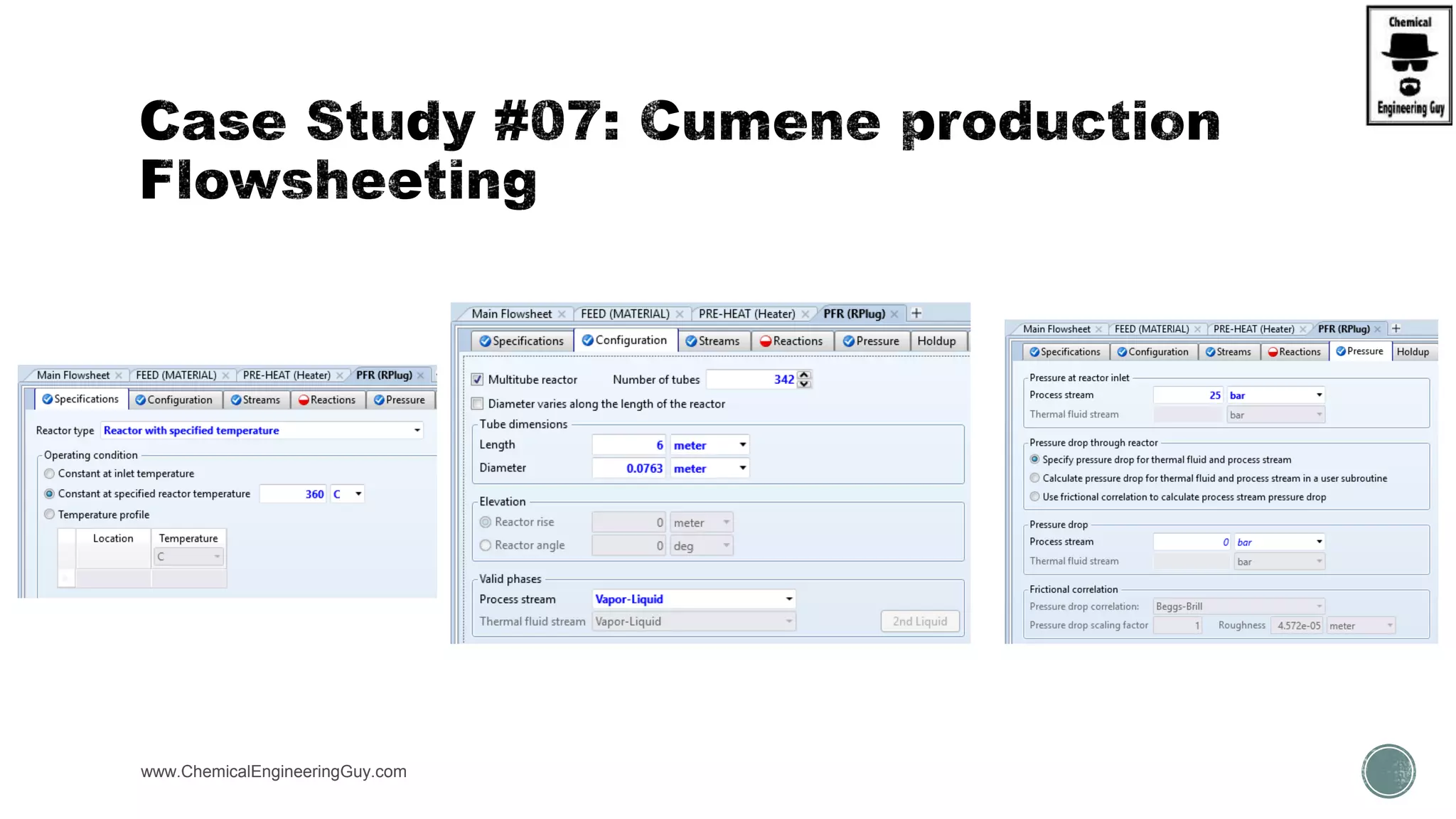
 (A) Run PFR, verify residence time & results
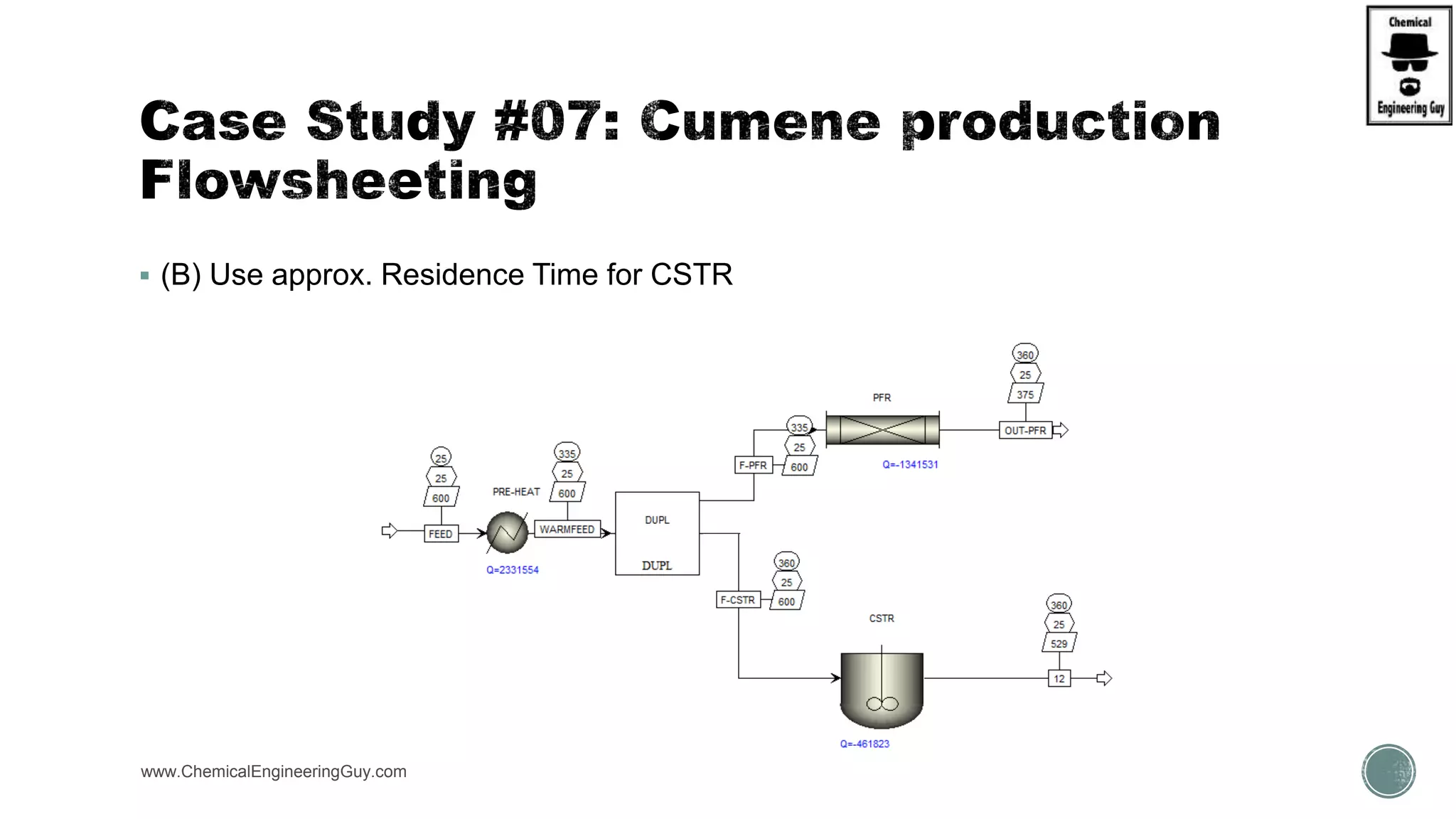
 (B) Use approx. Residence Time for CSTR
 (C) Continue with Reactor: (best choice)
 (D) Add Recycle (Benzene is fully recovered)
 (E) Use Sensitivity Analysis to verify best case scenario for Benzene Feed
www.ChemicalEngineeringGuy.com
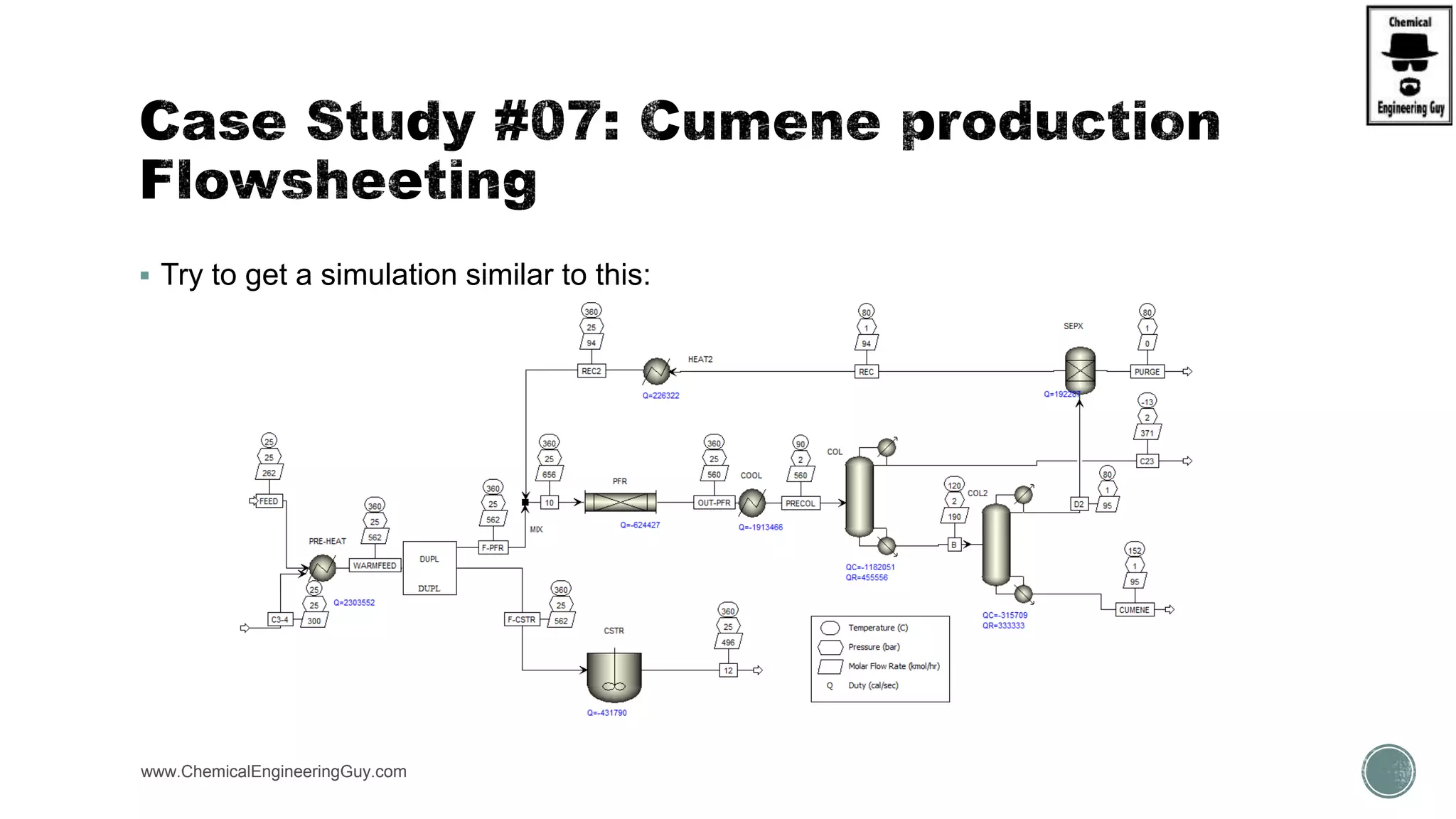
 Try to get a simulation similar to this:
www.ChemicalEngineeringGuy.com https://www.youtube.com/watch?v=yWbfzw04SvI
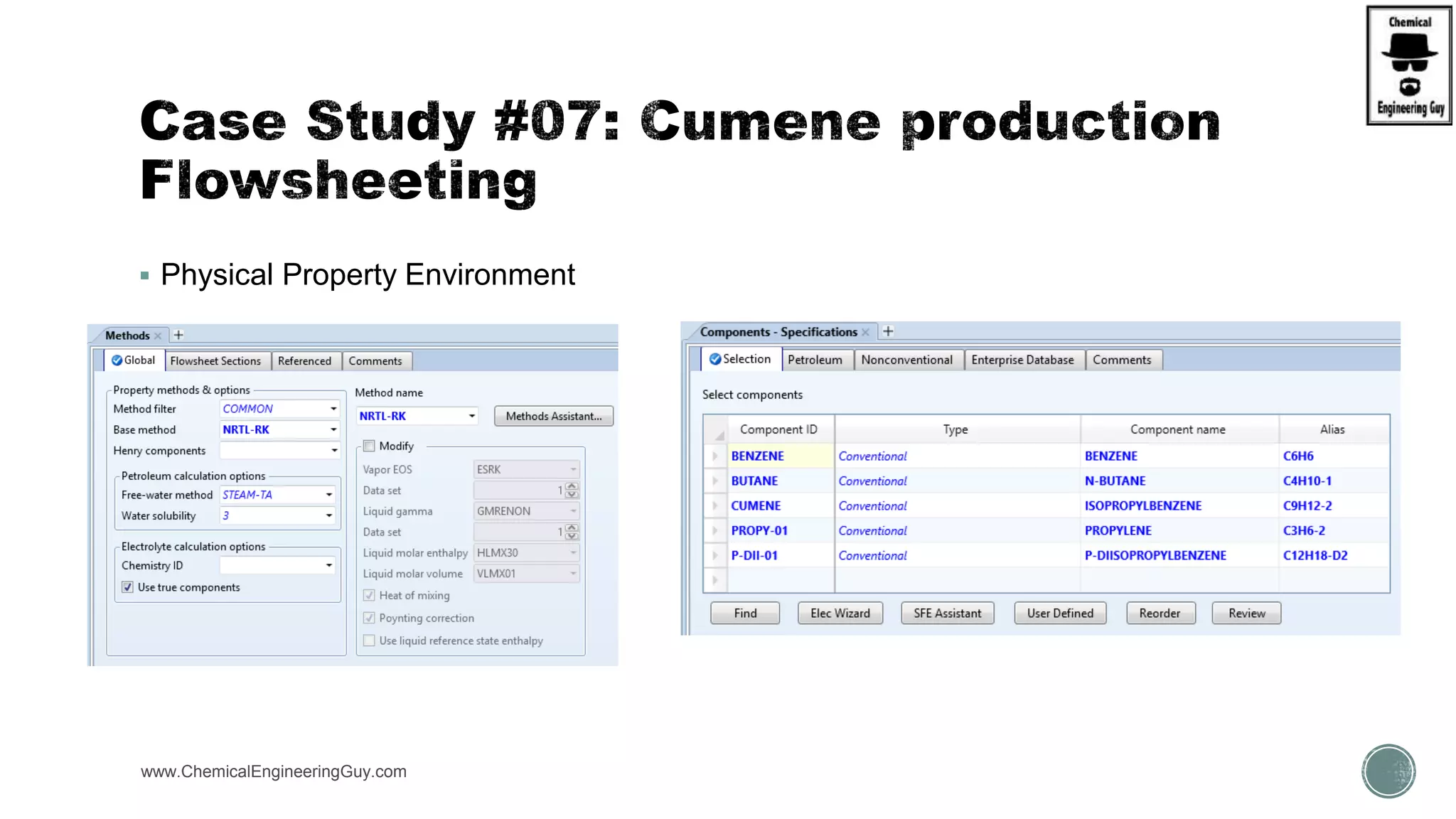
 Physical Property Environment
www.ChemicalEngineeringGuy.com https://www.youtube.com/watch?v=yWbfzw04SvI
 Simulation Environment
 FEED = 300 kmol/h
 0.75 Propylene
 0.25 n-Butane
 T = 25°C, P = 25bar
www.ChemicalEngineeringGuy.com https://www.youtube.com/watch?v=yWbfzw04SvI
Enjoying so far?
This is a preview of the BOOTCAMP.
Join NOW here:
https://www.chemicalengineeringguy.com/courses/aspen-plus-bootcamp-with-12-case-studies/
www.ChemicalEngineeringGuy.com https://www.youtube.com/watch?v=yWbfzw04SvI
Enjoying so far?
This is a preview of the BOOTCAMP.
Join NOW here:
https://www.chemicalengineeringguy.com/courses/aspen-plus-bootcamp-with-12-case-studies/
 (A) Run PFR, verify residence time & results
www.ChemicalEngineeringGuy.com https://www.youtube.com/watch?v=yWbfzw04SvI
Enjoying so far?
This is a preview of the BOOTCAMP.
Join NOW here:
https://www.chemicalengineeringguy.com/courses/aspen-plus-bootcamp-with-12-case-studies/
 (B) Use approx. Residence Time for CSTR
www.ChemicalEngineeringGuy.com https://www.youtube.com/watch?v=yWbfzw04SvI
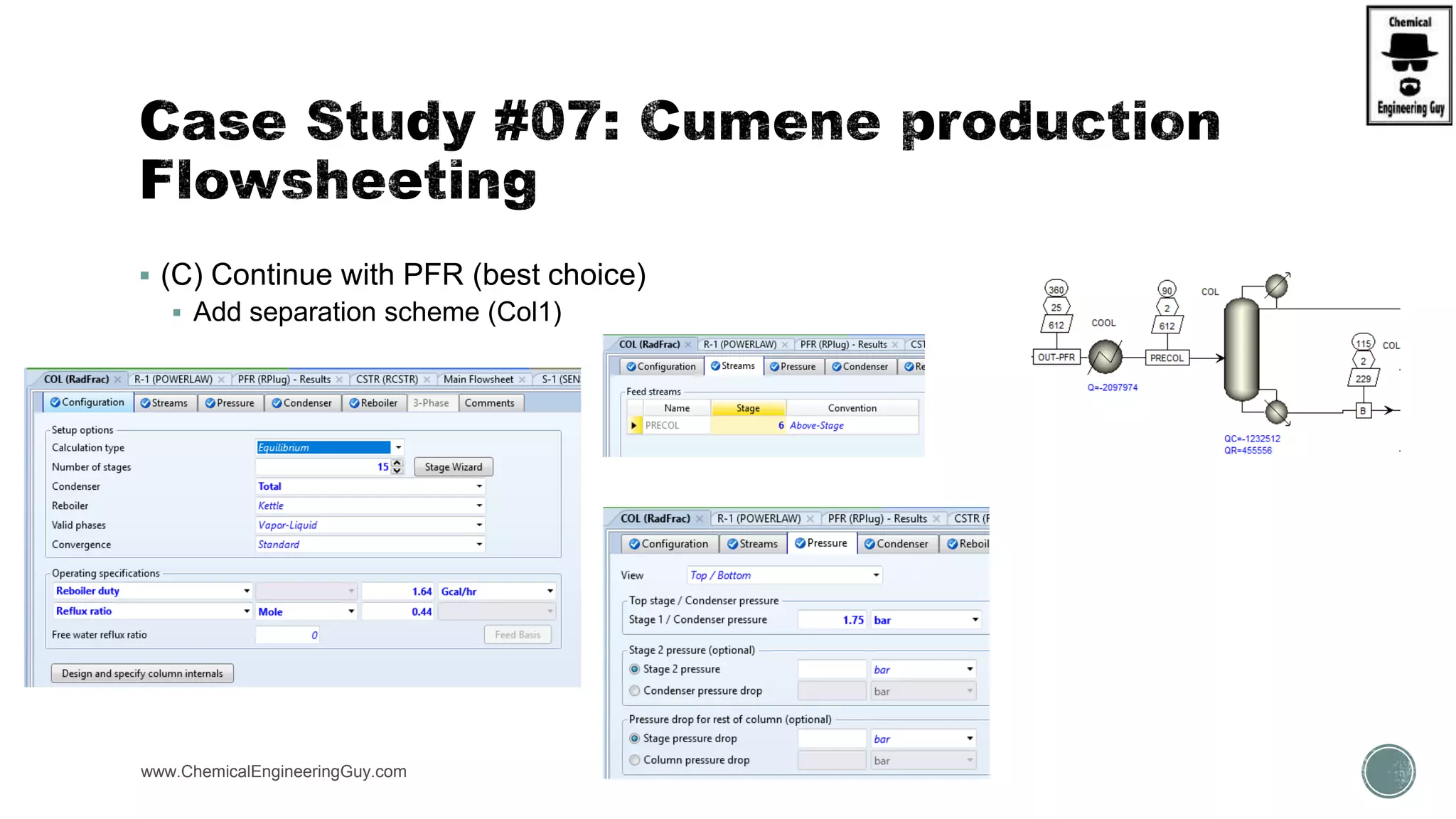
 (C) Continue with PFR (best choice)
 Add separation scheme (Col1)
www.ChemicalEngineeringGuy.com https://www.youtube.com/watch?v=yWbfzw04SvI
 (C) Continue with PFR (best choice)
 Add separation scheme (Col2)
www.ChemicalEngineeringGuy.com https://www.youtube.com/watch?v=yWbfzw04SvI
Enjoying so far?
This is a preview of the BOOTCAMP.
Join NOW here:
https://www.chemicalengineeringguy.com/courses/aspen-plus-bootcamp-with-12-case-studies/
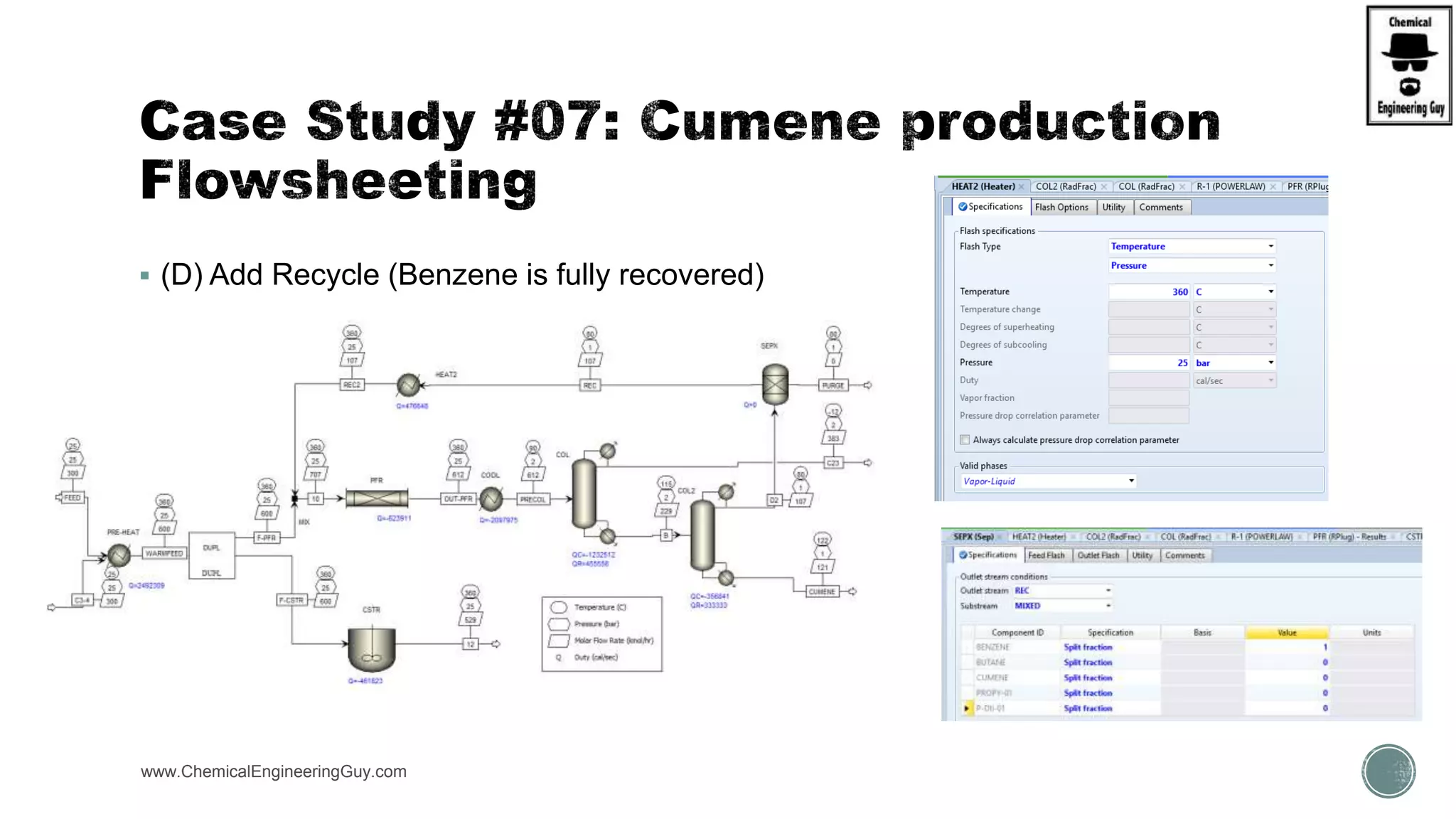
 (D) Add Recycle (Benzene is fully recovered)
www.ChemicalEngineeringGuy.com https://www.youtube.com/watch?v=yWbfzw04SvI
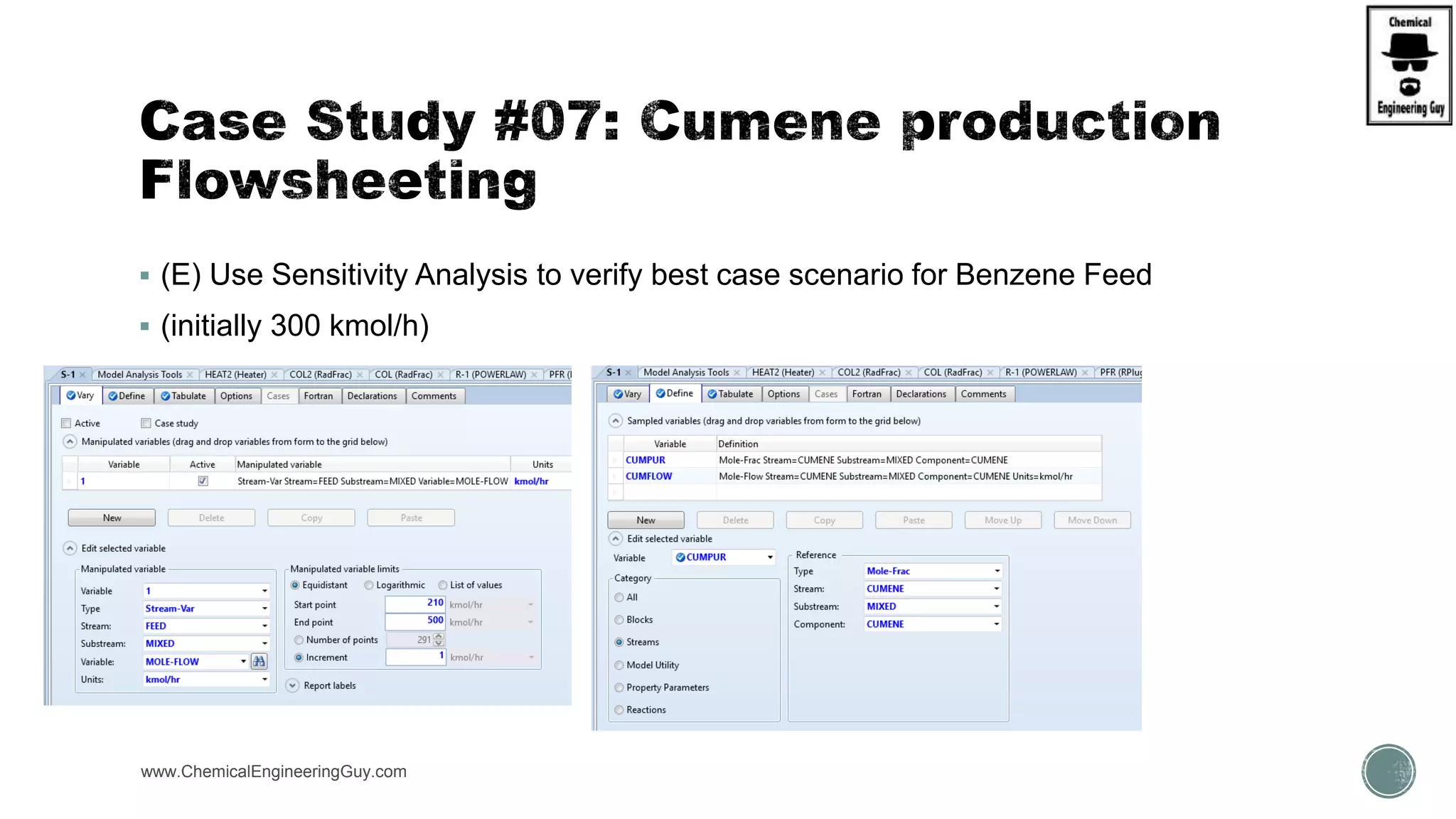
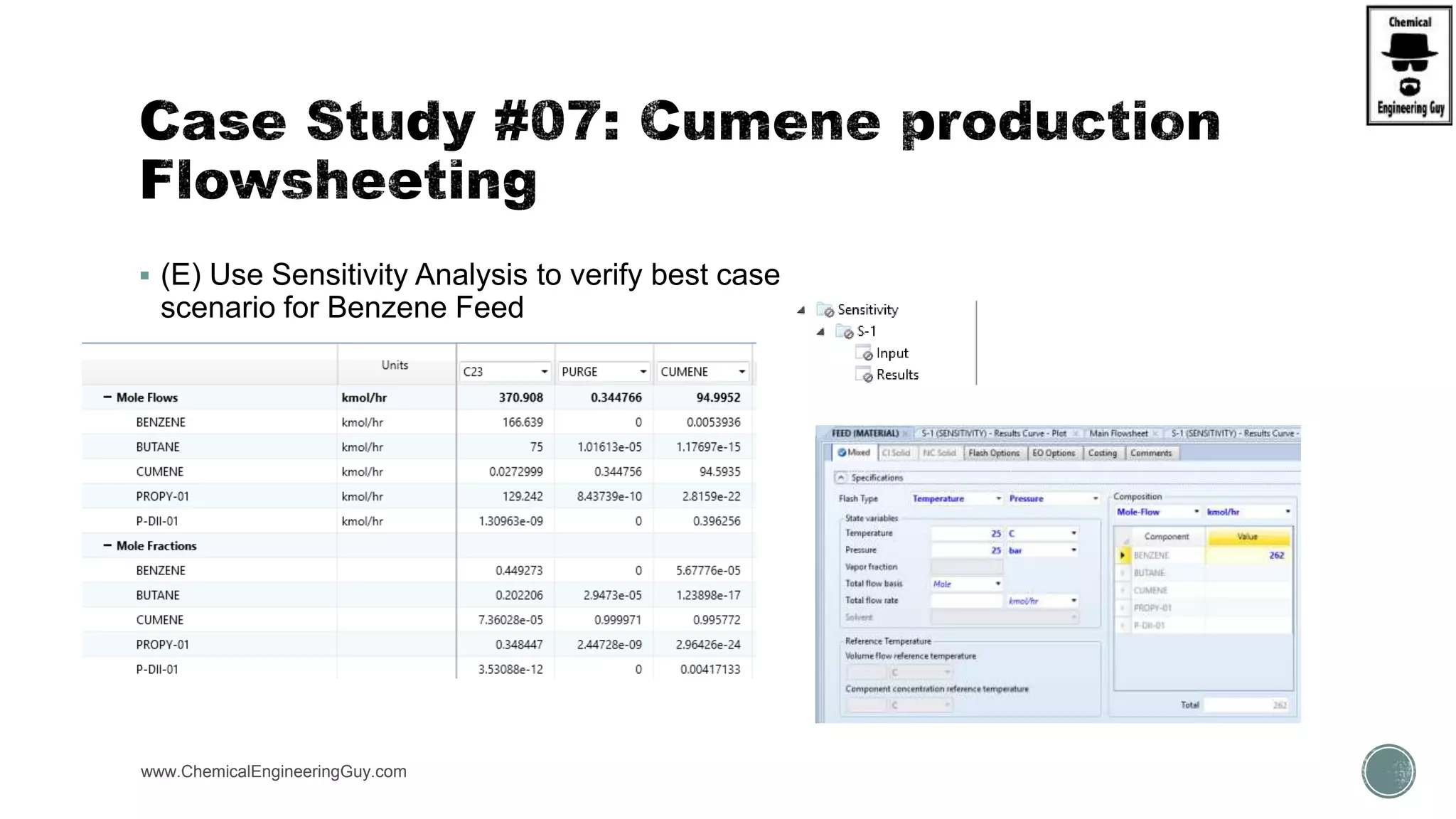
 (E) Use Sensitivity Analysis to verify best case scenario for Benzene Feed
 (initially 300 kmol/h)
www.ChemicalEngineeringGuy.com https://www.youtube.com/watch?v=yWbfzw04SvI
 (E) Use Sensitivity Analysis to verify best case
scenario for Benzene Feed
 (initially 300 kmol/h)
www.ChemicalEngineeringGuy.com https://www.youtube.com/watch?v=yWbfzw04SvI
OK 261 0.995656 92.87585
OK 262 0.995772 94.59557
OK 263 0.990626 94.95583
Enjoying so far?
This is a preview of the BOOTCAMP.
Join NOW here:
https://www.chemicalengineeringguy.com/courses/aspen-plus-bootcamp-with-12-case-studies/
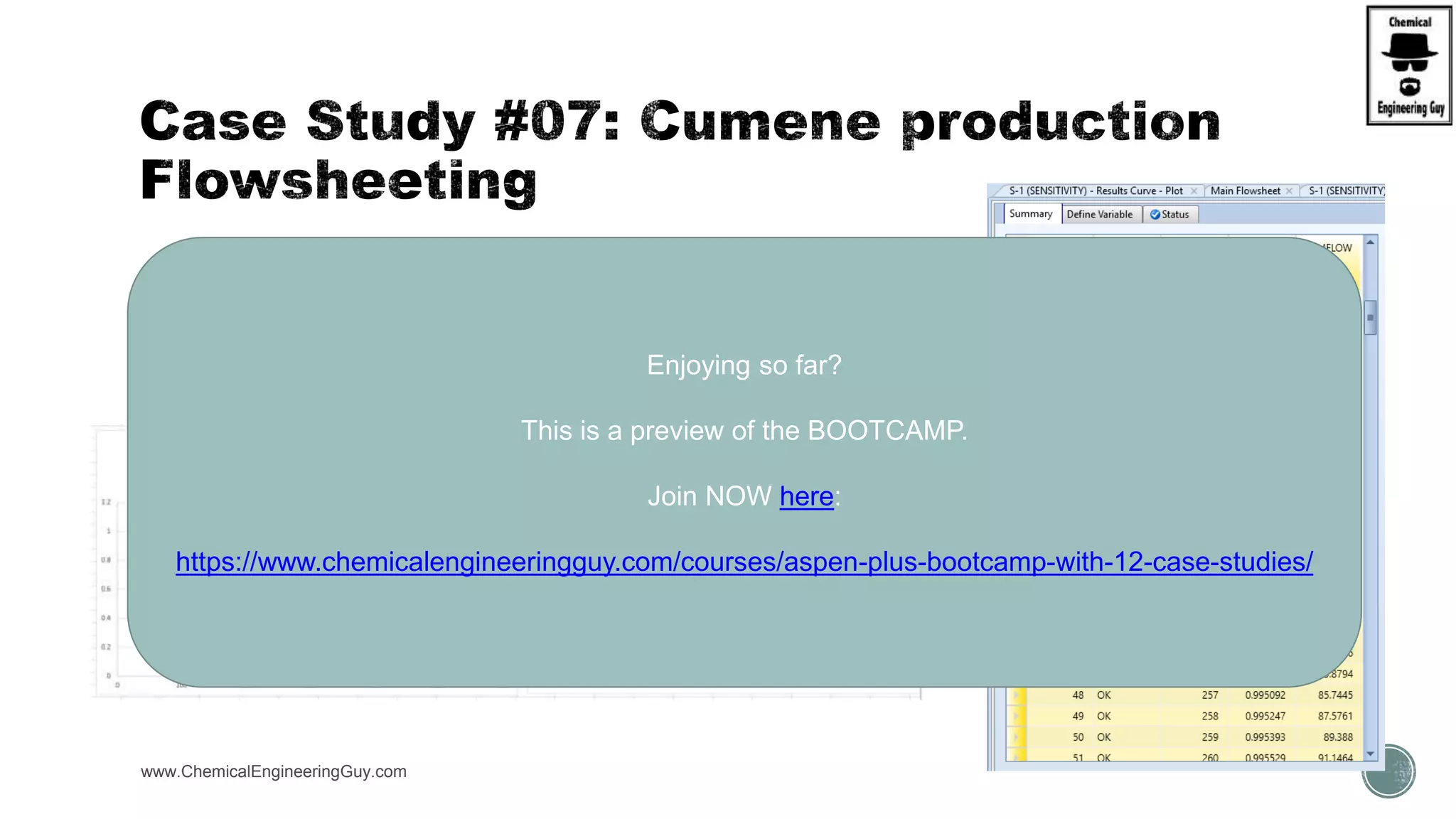
 (E) Use Sensitivity Analysis to verify best case
scenario for Benzene Feed
www.ChemicalEngineeringGuy.com https://www.youtube.com/watch?v=yWbfzw04SvI
 (E) Use Sensitivity Analysis to verify best case
scenario for Benzene Feed
www.ChemicalEngineeringGuy.com https://www.youtube.com/watch?v=yWbfzw04SvI
Enjoying so far?
This is a preview of the BOOTCAMP.
Join NOW here:
https://www.chemicalengineeringguy.com/courses/aspen-plus-bootcamp-with-12-case-studies/

Aspen Plus - Bootcamp - 12 Case Studies (1 of 2) (Slideshare)

  • 1.
  • 2.
    www.ChemicalEngineeringGuy.com Enjoying so far? Thisis a preview of the BOOTCAMP. Join NOW here: https://www.chemicalengineeringguy.com/courses/aspen-plus-bootcamp-with-12-case-studies/
  • 3.
    1. Introduction 2. StudyCases (4x) – Chemical Processes 3. Study Cases (3x) – Process Analysis 4. Study Cases (3x) – Rigorous Unit Operations 5. Study Cases (2x) – Plant Economy & Dynamic Control 6. Conclusion www.ChemicalEngineeringGuy.com
  • 4.
     Chemical Processes 1.Hydrocarbon Systems 2. BTX Separation 3. Methanol from Syngas 4. Acetaldehyde Plant www.ChemicalEngineeringGuy.com
  • 5.
     Process Analysis 5.Dimethyl Ether Production (Design Spec.) 6. Ammonia in Cryogenics (Optimization & Constraint) 7. Cumene Production (Sensitivity Analysis) www.ChemicalEngineeringGuy.com
  • 6.
     Rigorous UnitOperations 8. Heat-X Rigorous Model (Shell & Tube) 9. RadFrac for Absorption Operations 10. RadFrac in Distillation Operations www.ChemicalEngineeringGuy.com
  • 7.
     Plant Economy& Dynamic Control 11. Ammonia Economics 12. Plant Dynamics & Control www.ChemicalEngineeringGuy.com
  • 8.
     Learn aboutAspen Plus and its use in the Industry  Basics of the Physical Property Environment  Flow sheeting techniques  Presenting Results: Plotting, Tables and Results  Model several Chemical Process  Use a variety of unit operations  Converge and debugging  Plant Utilities & Economics www.ChemicalEngineeringGuy.com
  • 9.
     Basic understandingof Plant Design & Operation  Strong Chemical Engineering Fundamentals  Aspen Plus V10 (at least 7.0) www.ChemicalEngineeringGuy.com
  • 10.
     Engineers ofthe following areas:  Chemical  Process  Plant Design  Production  Petrochemical Engineers  Aspen Plus Users  REFRESHERS  Students related to engineering fields, specially Process, Chemical and Biotech.  Instructor/Professors/Teachers willing to learn more about process simulation www.ChemicalEngineeringGuy.com
  • 11.
    www.ChemicalEngineeringGuy.com  BOOTCAMP  programswhich enable students with little Process Simulation proficiency to focus on the most important aspects of Simulation and immediately apply their new skills to solve real-world problems.  The goal of many bootcamps attendees is to transition into a career in Process Simulation development.  They do this by learning to simulate common processes  This provides the foundation they need to build production-ready applications and demonstrate they have the skills to add real value to the company.
  • 12.
    www.ChemicalEngineeringGuy.com  BOOTCAMP  INTENSIVE 80-20 principle  100% Practical  Workshop based  Hands-on  Case Study based  Non theoretical!
  • 13.
     Check out: Slideshows  Simulations  Spreadsheets  & more… here:  https://www.chemicalengineeringguy.com/courses/aspen-plus-bootcamp-with-12-case-studies/ap-bootcamp-99512/  Get Tips & Help here:  https://www.facebook.com/groups/aspenplushysysforum/  Also check the “resources” on the course. www.ChemicalEngineeringGuy.com
  • 14.
  • 15.
     Chemical Processes 1.Hydrocarbon Systems 2. BTX Separation 3. Methanol from Syngas 4. Acetaldehyde Plant www.ChemicalEngineeringGuy.com
  • 16.
     Case Study1  Open New, Saving & Opening Files  Setup the Physical Property environment (component list + property method)  Phys.Prop.Env  Binary Parameters, Equations & Models  Flowsheeting T/P/L labels; reconnecting source/distination  Add unit operations & streams to the flowsheet  Operations: Mixing, Splitting, Separation, Heating, Pressurizing  Units: Fsplit, Mix, Sep1, Sep2 Flash2, Heater, Valve  Understanding variable (input vs. outputs)  Running a Simulation & Viewing Results www.ChemicalEngineeringGuy.com
  • 17.
     Gas mixtureis to be separated  H2  Used in Syngas, must be purified  C1  Used as Nat. Gas  C2-C3  Sent to a NEW plant for Ethane/Propane separation  C6-C8  Main Liquid Product… Must be divided to Plant 1, 70%, and Plant 2, 30%  Composition www.ChemicalEngineeringGuy.com Component Value H2 0.3 C1 0.2 C2 0.1 C3 0.12 C6 0.12 C7 0.09 C8 0.07
  • 18.
     The Mixis to be flashed at P = 3 bar, T = 25°C  The Vapor line is to be treated as follows:  Membrane separation of H2 (1.0) CH4 (98% recovery) and “C2-3” (95% recovery)  The “C2-3” line is to be treated in a Sep-X (Sep2) All C2-3 is separated.  The Liquid Line is to be treated as follows:  Cooled down 15°C  Pressure decrease to 1 bar  Split to Plant 1  70% and Plant 2  30% www.ChemicalEngineeringGuy.com
  • 19.
     (a) Verifypurities  (b) What is the mole rate for Plant 1  (c) Volumetric Flow rate of H2  (d) Mass flow rate of Plant 2  (e) Heat Duty of the Chiller/Cooler  (f) Heat duty of the Flash Drum  (g) Composition of Product Lines www.ChemicalEngineeringGuy.com
  • 20.
     Try toget this: www.ChemicalEngineeringGuy.com
  • 21.
     Feed: www.ChemicalEngineeringGuy.com Component (mol.Frac.) H2 0.3 C1 0.2 C2 0.1 C3 0.12 C6 0.12 C7 0.09 C8 0.07
  • 22.
     Flash (FLASH2): www.ChemicalEngineeringGuy.com Enjoyingso far? This is a preview of the BOOTCAMP. Join NOW here: https://www.chemicalengineeringguy.com/courses/aspen-plus-bootcamp-with-12-case-studies/
  • 23.
  • 24.
     Valve (VALVE): www.ChemicalEngineeringGuy.com Enjoyingso far? This is a preview of the BOOTCAMP. Join NOW here: https://www.chemicalengineeringguy.com/courses/aspen-plus-bootcamp-with-12-case-studies/
  • 25.
  • 26.
  • 27.
     SEPX (SEP): www.ChemicalEngineeringGuy.com Enjoyingso far? This is a preview of the BOOTCAMP. Join NOW here: https://www.chemicalengineeringguy.com/courses/aspen-plus-bootcamp-with-12-case-studies/
  • 28.
     Run Results Get:  (a) Verify purities  (b) What is the mole rate for Plant 1  (c) Volumetric Flow rate of H2  (d) Mass flow rate of Plant 2  (e) Heat Duty of the Chiller/Cooler  (f) Heat duty of the Flash Drum  (g) Composition of Product Lines www.ChemicalEngineeringGuy.com
  • 29.
     Case Study2  Physical Property  Analysis Tools  Operations: Distillation, partial & total condensers  Units: Distil, DSTWU, Pump  Getting Help in Aspen Plus V10 www.ChemicalEngineeringGuy.com https://www.youtube.com/watch?v=WZQl_y2ci2w
  • 30.
     BTX (BenzeneToluene and p-Xylene) are to be separated from a mixture via distillation  Objectives:  Get at least 94% of benzene (purity)  Get at least 96% of toluene (purity)  Get at least 96% of p-xylene (purity)  Optimize:  RR vs. Stages  Design:  Start by Flashing, then DSTWU model  Final Design must be DISTIL www.ChemicalEngineeringGuy.com
  • 31.
     Pressure ofoperations allowed:  Distil 1 = 1.1-1.3 bar  Distil 2 = 2.5-3.0 bar  Final product specification:  5.0 bar for benzene line  2.5 bar for benzene line  3.0 bar for p-xylene line www.ChemicalEngineeringGuy.com
  • 32.
     (A) UsePhys. Props to verify BP of each species at P = 1.2 bar  (B) Use Flash to verify K values and volatilities (Light and Heavy keys)  (C) Compare DSTWU vs. Distil Models  (D) Use DSWTU Model for min. conditions (Column 1)  (E) Use Distil, for real conditions (Column 1)  (F) Use Flash to verify K values and volatilities (Light and Heavy keys)  (G) Use Distil  (H) Verify Purity www.ChemicalEngineeringGuy.com
  • 33.
     (A)  UsePhys. Props to verify BP of species at P = 1.0 bar  Results should be similar to: www.ChemicalEngineeringGuy.com https://www.youtube.com/watch?v=WZQl_y2ci2w TB°C 80.09 110.63 138.36
  • 34.
     (A)  UsePhys. Props to verify BP of species at P = 1.0 bar  Results should be similar to: www.ChemicalEngineeringGuy.com https://www.youtube.com/watch?v=WZQl_y2ci2w TB°C 80.09 110.63 138.36
  • 35.
     (B) UseFlash2 to verify Data  Components: B, T, p-X  Feed  350 kg/h, 500 kg/h, 150 kg/h  T = 25C, P = 1.2bar  Model  NRTL-RK www.ChemicalEngineeringGuy.com https://www.youtube.com/watch?v=WZQl_y2ci2w
  • 36.
     Verify Volatilities B = 80°C, T = 111°C, X = 138°C www.ChemicalEngineeringGuy.com https://www.youtube.com/watch?v=WZQl_y2ci2w
  • 37.
     Verify Volatilities B = 80.1°C, T = 110.6°C, X = 138.4°C www.ChemicalEngineeringGuy.com https://www.youtube.com/watch?v=WZQl_y2ci2w
  • 38.
     Verify Volatilities B = 80.1°C, T = 110.6°C, X = 138.4°C www.ChemicalEngineeringGuy.com https://www.youtube.com/watch?v=WZQl_y2ci2w 𝛼 = 𝐾𝐿𝑖𝑔ℎ𝑡−𝐾𝑒𝑦 𝐾 𝐻𝑒𝑎𝑣𝑦−𝐾𝑒𝑦 T LK HK a 80.1 0.8547 0.3356 2.547 110.6 1.9059 0.8461 2.253 138.4 3.428 1.6911 2.027 Average Arithmetic Geometric 2.28 2.27 Enjoying so far? This is a preview of the BOOTCAMP. Join NOW here: https://www.chemicalengineeringguy.com/courses/aspen-plus-bootcamp-with-12-case-studies/
  • 39.
     Calculate (manually) Min. Number of Stages www.ChemicalEngineeringGuy.com https://www.youtube.com/watch?v=WZQl_y2ci2w In this equation αave = (α1αB) 1/2 where α1 is the relative volatility of the overhead vapor and αB is the relative volatility of the bottoms liquid.
  • 40.
     (C) Comparemodels  Getting help in Aspen Plus V10  Compare DSTWU vs. Distil www.ChemicalEngineeringGuy.com https://www.youtube.com/watch?v=WZQl_y2ci2w
  • 41.
     Compare DSTWUvs. Distil www.ChemicalEngineeringGuy.com https://www.youtube.com/watch?v=WZQl_y2ci2w Enjoying so far? This is a preview of the BOOTCAMP. Join NOW here: https://www.chemicalengineeringguy.com/courses/aspen-plus-bootcamp-with-12-case-studies/
  • 42.
     (D) Separatelight material with  Model Theoretical “DISTIL”  Use Min. Stages to verify:  Min. Reflux Ratio www.ChemicalEngineeringGuy.com https://www.youtube.com/watch?v=WZQl_y2ci2w Enjoying so far? This is a preview of the BOOTCAMP. Join NOW here: https://www.chemicalengineeringguy.com/courses/aspen-plus-bootcamp-with-12-case-studies/
  • 43.
     Model the“real” DSTWU with DISTIL  N = 13  F = 6  RR = 1.313  D:F = 0.402  P = 1.07, P = 1.10 www.ChemicalEngineeringGuy.com https://www.youtube.com/watch?v=WZQl_y2ci2w
  • 44.
     (A) UsePhys. Props to verify BP of each species at P = 1.2 bar  (B) Use Flash to verify K values and volatilities (Light and Heavy keys)  (C) Compare DSTWU vs. Distil Models  (D) Use DSWTU Model for min. conditions (Column 1)  (E) Use Distil, for real conditions (Column 1)  (F) Use Flash to verify K values and volatilities (Light and Heavy keys)  (G) Use Distil  (H) Verify Purity www.ChemicalEngineeringGuy.com
  • 45.
     (F) UseFlash/DSTWU to verify K values and volatilities (Light and Heavy keys)  P = 2.5/3.0  Recovery  www.ChemicalEngineeringGuy.com DSTWU2 Enjoying so far? This is a preview of the BOOTCAMP. Join NOW here: https://www.chemicalengineeringguy.com/courses/aspen-plus-bootcamp-with-12-case-studies/
  • 46.
     Preliminary Resultsof DSTWU2 www.ChemicalEngineeringGuy.com DSTWU2
  • 47.
     (G) UseFlash/DSTWU to verify K values and volatilities (Light and Heavy keys)  Add the pre-pumping www.ChemicalEngineeringGuy.com
  • 48.
     (G) UseDistil  P = 2.5/3.0 www.ChemicalEngineeringGuy.com Enjoying so far? This is a preview of the BOOTCAMP. Join NOW here: https://www.chemicalengineeringguy.com/courses/aspen-plus-bootcamp-with-12-case-studies/
  • 49.
     Case Study3  Physical Property Env.  Binary Analysis (Methane : CO2)  Adding Reactions, and Equilibrium Data  Operations: Isothermal Reactor, Purging, Recycling  Compare Claculated Keq vs Built-in Expressions for Keq  Units: R-CSTR, DSTWU, DISTL, RadFrac, Compressor  Personalizing Results (mass/vol/mol, etc…)  Results: Exporting to Spreadsheet, Plotting them www.ChemicalEngineeringGuy.com https://www.youtube.com/watch?v=Dgwsgpohxmk
  • 50.
     Methanol isto be synthetized from Syngas  Reactor is ISOTHERMAL  Equilibrium Data (see in simulation)  Feed:  CO, CO2, H2  50,200, 600  T = 50°C, P = 1 bar www.ChemicalEngineeringGuy.com 𝐶𝑂 + 2𝐻2 ↔ 𝐶𝐻3 𝑂𝐻 𝛥𝐻 = −91𝑘 𝐽 𝑚 𝑜𝑙 𝐶𝑂2 + 3𝐻2 ↔ 𝐶𝐻3 𝑂𝐻 + 𝐻2 𝑂 𝛥𝐻 = −49.5𝑘 𝐽 𝑚 𝑜𝑙 𝐶𝑂2 + 𝐻2 ↔ 𝐶𝑂 + 𝐻2 𝑂 𝛥𝐻 = −41.2𝑘 𝐽 𝑚 𝑜𝑙 https://www.youtube.com/watch?v=Dgwsgpohxmk
  • 51.
     Main goalis to:  Pre-heat feed (to T = 270°C, P = 40 bar)  Add Recycle + Feed to the Reactor Inlet  Cool down (50°C, P = 10 bar)  Separate Vapors from products  Re-heat recycle (T = 270°C, P = 40 bar)  PURGE gas  Drop pressure of liquid product  Separate methanol/water www.ChemicalEngineeringGuy.com https://www.youtube.com/watch?v=Dgwsgpohxmk
  • 52.
     (Ai) VerifyHeat duty of Reactor (pre/after recycle)  (Aii) For the CSTR, verify Calculated Keq vs. Given Built-in Expressions  (B) Purge Ratio vs. Recycle  (C) Use Binary Analysis for Distillation  (D) DSWTU No. recommended Stages, given RR = 1.5  (E) DSWTU  DISTL  RadFrac  (F) Reboiler/Condenser Heating Duties of Column  (G) Final Product Purity Specification www.ChemicalEngineeringGuy.com
  • 53.
     Try toaim this simulation: www.ChemicalEngineeringGuy.com
  • 54.
     Physical PropertyEnvironment  Add Components  Physical Property  PSRK www.ChemicalEngineeringGuy.com
  • 55.
     Simulation Environment FEED: www.ChemicalEngineeringGuy.com
  • 56.
     HEATER www.ChemicalEngineeringGuy.com  R-CSTR Enjoyingso far? This is a preview of the BOOTCAMP. Join NOW here: https://www.chemicalengineeringguy.com/courses/aspen-plus-bootcamp-with-12-case-studies/
  • 57.
     Reactions  RXN– LHHW / Equilibium  NOTE: Verify Enthalpy of Reactions www.ChemicalEngineeringGuy.com
  • 58.
     Reactions  RXN–Equilibium  NOTE: Verify Enthalpy of Reactions www.ChemicalEngineeringGuy.com 𝐶𝑂 + 2𝐻2 ↔ 𝐶𝐻3 𝑂𝐻 𝛥𝐻 = −91𝑘 𝐽 𝑚 𝑜𝑙 𝐶𝑂2 + 3𝐻2 ↔ 𝐶𝐻3 𝑂𝐻 + 𝐻2 𝑂 𝛥𝐻 = −49.5𝑘 𝐽 𝑚 𝑜𝑙 𝐶𝑂2 + 𝐻2 ↔ 𝐶𝑂 + 𝐻2 𝑂 𝛥𝐻 = −41.2𝑘 𝐽 𝑚 𝑜𝑙 Enjoying so far? This is a preview of the BOOTCAMP. Join NOW here: https://www.chemicalengineeringguy.com/courses/aspen-plus-bootcamp-with-12-case-studies/
  • 59.
     REACTOR:  Compare“Compute Keq from Gibbs Free energy”  Vs  Compute Keq from Built-in Expression www.ChemicalEngineeringGuy.com
  • 60.
  • 61.
     Reactor (Basedon Aspen Plus Calculation for Gibbs Free energy): www.ChemicalEngineeringGuy.com Enjoying so far? This is a preview of the BOOTCAMP. Join NOW here: https://www.chemicalengineeringguy.com/courses/aspen-plus-bootcamp-with-12-case-studies/
  • 62.
     REACTOR:  Compare“Compute Keq from Gibbs Free energy”  Vs  Compute Keq from Built-in Expression www.ChemicalEngineeringGuy.com
  • 63.
     Reactions  RXN1,RXN2, RXN3 www.ChemicalEngineeringGuy.com
  • 64.
     Reactions  RXN1,RXN2, RXN3 www.ChemicalEngineeringGuy.com Enjoying so far? This is a preview of the BOOTCAMP. Join NOW here: https://www.chemicalengineeringguy.com/courses/aspen-plus-bootcamp-with-12-case-studies/
  • 65.
     Reactor (Basedon Aspen Plus Calculation for Gibbs Free energy): www.ChemicalEngineeringGuy.com
  • 66.
     Reactor (Basedon Aspen Plus Calculation for Gibbs Free energy): www.ChemicalEngineeringGuy.com Auto Given Expression Auto Given Expression
  • 67.
     Continue withflowsheeting www.ChemicalEngineeringGuy.com Enjoying so far? This is a preview of the BOOTCAMP. Join NOW here: https://www.chemicalengineeringguy.com/courses/aspen-plus-bootcamp-with-12-case-studies/
  • 68.
     Use theINSERT option in Flowhseeting  Select FEED  INSERT Compressor  Compressor  Isentropic, Pdischarge = 40 bar  Degaser (SEP1)  CO2, CO, H2 as gas  H2O, Methanol as liquid www.ChemicalEngineeringGuy.com
  • 69.
     Select ReactorOUTLET  INSERT Valve  Valve  Pdrop = 40bar  Chiller  T = 50C, P = 10 bar / 0 bar  Hydrogen Trap – Membrane (SEP1)  100% H2 recovery  CO2, CO go to purge/stack www.ChemicalEngineeringGuy.com
  • 70.
    www.ChemicalEngineeringGuy.com Enjoying so far? Thisis a preview of the BOOTCAMP. Join NOW here: https://www.chemicalengineeringguy.com/courses/aspen-plus-bootcamp-with-12-case-studies/
  • 71.
     (B) AddRecycle & Purge www.ChemicalEngineeringGuy.com
  • 72.
     (B) AddRecycle & Purge www.ChemicalEngineeringGuy.com
  • 73.
     (B) AddRecycle & Purge www.ChemicalEngineeringGuy.com Enjoying so far? This is a preview of the BOOTCAMP. Join NOW here: https://www.chemicalengineeringguy.com/courses/aspen-plus-bootcamp-with-12-case-studies/
  • 74.
     (C) UseBinary Analysis for Distillation  Analysis base:  TXY diagram  Methanol – Water  P = 10 bar www.ChemicalEngineeringGuy.com
  • 75.
    www.ChemicalEngineeringGuy.com Enjoying so far? Thisis a preview of the BOOTCAMP. Join NOW here: https://www.chemicalengineeringguy.com/courses/aspen-plus-bootcamp-with-12-case-studies/
  • 76.
     (D) DSWTUNo. recommended Stages, given RR = 1.50  Valve:  Pdischarge = 1.5 bar www.ChemicalEngineeringGuy.com
  • 77.
     (D) DSWTUNo. recommended Stages, given RR = 1.50  Distillation  Start with DSTWU  RR = 1.5  P(cond/reb) = 1.40/1.70 bar  Light Key:  Comp = Methanol  Recovery = 0.95  Heavy Key = water  Comp = water  Recovery = 0.05 www.ChemicalEngineeringGuy.com
  • 78.
     (D) DSWTUNo. recommended Stages, given RR = 0.80  Distillation  Start with DSTWU  RR = 1.5  P(cond/reb) = 1.40/1.70 bar  Light Key:  Comp = Methanol  Recovery = 0.95  Heavy Key = water  Comp = water  Recovery = 0.05 www.ChemicalEngineeringGuy.com Enjoying so far? This is a preview of the BOOTCAMP. Join NOW here: https://www.chemicalengineeringguy.com/courses/aspen-plus-bootcamp-with-12-case-studies/
  • 79.
     (E) DSWTU DISTL  RadFrac  Distillation  Continue with DISTL  N stages = 7  Feed = 5  RR = 1.5  D:F = 0.50  P(cond/reb) = 1.40/1.70 bar www.ChemicalEngineeringGuy.com
  • 80.
     (E) DSWTU DISTL  RadFrac  Distillation  Continue with DISTL  N stages = 7  Feed = 5  RR = 1.5  D:F = 0.50  P(cond/reb) = 1.40/1.70 bar www.ChemicalEngineeringGuy.com Enjoying so far? This is a preview of the BOOTCAMP. Join NOW here: https://www.chemicalengineeringguy.com/courses/aspen-plus-bootcamp-with-12-case-studies/
  • 81.
     (E) DSWTU DISTL  RadFrac  Distillation  Continue with DISTL  N stages = 7  Feed = 5  RR = 1.5  D:F = 0.50  P(cond/reb) = 1.40/1.70 bar www.ChemicalEngineeringGuy.com
  • 82.
     (E) DSWTU DISTL  RadFrac  Distillation  Continue with RadFrac  N stages = 7  Feed = 5  RR = 1.5  D:F = 0.50  P(cond/reb) = 1.40/1.70 bar www.ChemicalEngineeringGuy.com
  • 83.
    www.ChemicalEngineeringGuy.com Enjoying so far? Thisis a preview of the BOOTCAMP. Join NOW here: https://www.chemicalengineeringguy.com/courses/aspen-plus-bootcamp-with-12-case-studies/
  • 84.
  • 85.
     Case Study4  Flowsheeting: “Views” Text/Figures  Adding Reactions  Operations: Isothermal Reactions, Purging, Recycling, Condensation / Boiling  Units: R-PFR, Heat-X (Shortcut / Tube & Shell)  Plotting Results of PFR www.ChemicalEngineeringGuy.com
  • 86.
     Ethanol isto be converted to Acetaldehyde using a Plug flow reactor.  The Reactor is to be isothermal, 274°C, Single-tube  L = 6m, D = 0.12 m  The reaction kinetics are known  Ethanol  H2 + Acetaldehyde (desired)  Ethanol + Acetaldehyde  Ethyl Acetate + H2 (undesired)  Separation of the gases (H2 ,mostly) is imperative  Final Product must be separated from the mix, at least 2/3  Purge can be added, recommended recycle ratio is 90% molar www.ChemicalEngineeringGuy.com https://www.youtube.com/watch?v=e2MZfVColH8
  • 87.
     (A) Runthe PFR with no recycle  (B) Add separation scheme (Flashing, Degasser, Distillation Column)  (C) Add recycle + purge stream  (D) Change HEAT1 for Heat-X (Shell & Tube)  (E) Verify Purity f Products, Specs of Exchanger (Heaters, Reboilers, Condensers) www.ChemicalEngineeringGuy.com
  • 88.
     Try tomake a flowsheet similar to this: www.ChemicalEngineeringGuy.com
  • 89.
     Physical PropertyEnvironment www.ChemicalEngineeringGuy.com https://www.youtube.com/watch?v=e2MZfVColH8
  • 90.
     Simulation Environment Feed + Pump + Mix www.ChemicalEngineeringGuy.com https://www.youtube.com/watch?v=e2MZfVColH8 Enjoying so far? This is a preview of the BOOTCAMP. Join NOW here: https://www.chemicalengineeringguy.com/courses/aspen-plus-bootcamp-with-12-case-studies/
  • 91.
     Reactor (R-PLUG) www.ChemicalEngineeringGuy.comhttps://www.youtube.com/watch?v=e2MZfVColH8
  • 92.
     REACTIONS (RXN1) Powerlaw www.ChemicalEngineeringGuy.com https://www.youtube.com/watch?v=e2MZfVColH8 Enjoying so far? This is a preview of the BOOTCAMP. Join NOW here: https://www.chemicalengineeringguy.com/courses/aspen-plus-bootcamp-with-12-case-studies/
  • 93.
     REACTIONS (RXN1) Powerlaw www.ChemicalEngineeringGuy.com https://www.youtube.com/watch?v=e2MZfVColH8
  • 94.
     REACTIONS (RXN1) Powerlaw www.ChemicalEngineeringGuy.com https://www.youtube.com/watch?v=e2MZfVColH8 Enjoying so far? This is a preview of the BOOTCAMP. Join NOW here: https://www.chemicalengineeringguy.com/courses/aspen-plus-bootcamp-with-12-case-studies/
  • 95.
     REACTIONS (RXN1) Powerlaw www.ChemicalEngineeringGuy.com https://www.youtube.com/watch?v=e2MZfVColH8
  • 96.
     PFR Run: www.ChemicalEngineeringGuy.comhttps://www.youtube.com/watch?v=e2MZfVColH8
  • 97.
     (B) Addseparation scheme (Flashing, Degasser, Distillation Column)  Chiller  dP = 0.25 atm www.ChemicalEngineeringGuy.com https://www.youtube.com/watch?v=e2MZfVColH8  Flash Drum (FLASH2)  Q = 0  P = 0
  • 98.
     Degaser (Sep1) www.ChemicalEngineeringGuy.comhttps://www.youtube.com/watch?v=e2MZfVColH8 Enjoying so far? This is a preview of the BOOTCAMP. Join NOW here: https://www.chemicalengineeringguy.com/courses/aspen-plus-bootcamp-with-12-case-studies/
  • 99.
     Distillation Column(RADFRAC) www.ChemicalEngineeringGuy.com https://www.youtube.com/watch?v=e2MZfVColH8
  • 100.
     Distillation Column(RADFRAC) www.ChemicalEngineeringGuy.com https://www.youtube.com/watch?v=e2MZfVColH8 Stage Pressure atm 1 6.8 2 6.92 3 6.95 4 6.93 5 6.97 6 7 7 7.08 8 7.11 9 7.15 10 7.18 11 7.22 12 7.25 13 7.23 14 7.27 15 7.3 16 7.38 17 7.42 18 7.45 19 7.47 20 7.5
  • 101.
     Results ofDistillation www.ChemicalEngineeringGuy.com https://www.youtube.com/watch?v=e2MZfVColH8 Enjoying so far? This is a preview of the BOOTCAMP. Join NOW here: https://www.chemicalengineeringguy.com/courses/aspen-plus-bootcamp-with-12-case-studies/
  • 102.
     (C) AddRecycle + Purge Streams  90% Recycle Rate  10% Purge Rage www.ChemicalEngineeringGuy.com https://www.youtube.com/watch?v=e2MZfVColH8
  • 103.
     (C) AddRecycle + Purge Streams  90% Recycle Rate  10% Purge Rage www.ChemicalEngineeringGuy.com https://www.youtube.com/watch?v=e2MZfVColH8 Before recycle After recycle Enjoying so far? This is a preview of the BOOTCAMP. Join NOW here: https://www.chemicalengineeringguy.com/courses/aspen-plus-bootcamp-with-12-case-studies/
  • 104.
     (D) HetExchanger Property Sets  Size  HEAT1 www.ChemicalEngineeringGuy.com https://www.youtube.com/watch?v=e2MZfVColH8
  • 105.
     (D) HetExchanger Property Sets  Setup Heat-X  SHORTCUT  Countercurrent  Exchanger Duty  2.54069e06 (cal/s) www.ChemicalEngineeringGuy.com https://www.youtube.com/watch?v=e2MZfVColH8
  • 106.
     (D) HetExchanger Property Sets  Convert to:  Shell & Tube Exchanger www.ChemicalEngineeringGuy.com https://www.youtube.com/watch?v=e2MZfVColH8
  • 107.
  • 108.
  • 109.
     Accept design,run simulation, verify results  Verify:  Exchanger Area  LMDT (Log mean. Difference in Temp)  UA (Overall Coefficient) www.ChemicalEngineeringGuy.com https://www.youtube.com/watch?v=e2MZfVColH8
  • 110.
     (E) VerifyPurity of Products, Specs of Exchanger (Heaters, Reboilers, Condensers) www.ChemicalEngineeringGuy.com https://www.youtube.com/watch?v=e2MZfVColH8 Enjoying so far? This is a preview of the BOOTCAMP. Join NOW here: https://www.chemicalengineeringguy.com/courses/aspen-plus-bootcamp-with-12-case-studies/
  • 111.
     Add “views”for simplicity  PFR  Heat-X  Separation Scheme  Purger  Plant www.ChemicalEngineeringGuy.com https://www.youtube.com/watch?v=e2MZfVColH8
  • 112.
     Reactor (PFR)Conversion vs. Length www.ChemicalEngineeringGuy.com https://www.youtube.com/watch?v=e2MZfVColH8
  • 113.
     Distillation ColumnPressure Profile www.ChemicalEngineeringGuy.com https://www.youtube.com/watch?v=e2MZfVColH8 Enjoying so far? This is a preview of the BOOTCAMP. Join NOW here: https://www.chemicalengineeringguy.com/courses/aspen-plus-bootcamp-with-12-case-studies/
  • 114.
     Process Analysis 5.Dimethyl Ether Production (Design Spec.) 6. Ammonia in Cryogenics (Optimization & Constraint) 7. Cumene Production (Sensitivity Analysis) www.ChemicalEngineeringGuy.com
  • 115.
     Case Study5  Flowsheeting  Adding Figures & Timestamps, lines to the spreadsheet  Physical Property  Binary Parameters  Design Specification Analysis  Operations: Multiple Reactions, Purging, Recycling, Flashing www.ChemicalEngineeringGuy.com
  • 116.
     Dimethyl etherCH3-O-CH3, is to be produced from CO2 & H2. Initially there is formation of CO + H2O, which is then converted to Methanol and simultaneously to dimethyl ether.  This is done in two reactors, stirred tank, at isothermal conditions. No pressure Drop  Feed is initially 1:3 ratio CO2:H2 at 25°C, P = 1 bar  The First reactor is operated at 50 bar, 400°C, since CO and H2O must be favored  The second reactor is operated at 50bar, 227°C, since methanol  dimethyl ether is required. Note that the second reactor must have a very low content of water, for which a Flash at very cold conditions must be used to separate liquid humidity.  No more than 0.20 kmol/h of Methanol must be lost in the purge/stack  The degasser must recover most of the liquid materials (water, methanol and dimethyl ether) www.ChemicalEngineeringGuy.com
  • 117.
     There isa special equipment which will recover most of non-polar substances in the streams (DIM-Trap)  The dimethyl will be recovered this way  Al other material, methanol-water mix must be sent to a distillation column  NOTE  Try using DSTWU at home  Reaction equilibrium (Ahrrenius) data is to be supplied later.  USE of Design Specification is REQURIED www.ChemicalEngineeringGuy.com
  • 118.
     (A) RunCSTR1, verify results  (B) Use Design Spec For Water flow rate  (C) Verify Reactor 2 , ensure Dimethyl production  (D) Add Recycling & Purge  Design Spec for Degaser  (E) Separate final products DIM-trap & Send to plant www.ChemicalEngineeringGuy.com
  • 119.
     Try toget a simulation similar to this www.ChemicalEngineeringGuy.com https://www.youtube.com/watch?v=3vm91REoFxI
  • 120.
     Physical PropertyEnvironment  First  Method RK-SOAVE / NRTL www.ChemicalEngineeringGuy.com
  • 121.
     Physical PropertyEnvironment  First  Method RK-SOAVE / NRTL www.ChemicalEngineeringGuy.com Enjoying so far? This is a preview of the BOOTCAMP. Join NOW here: https://www.chemicalengineeringguy.com/courses/aspen-plus-bootcamp-with-12-case-studies/
  • 122.
     Physical PropertyEnvironment www.ChemicalEngineeringGuy.com
  • 123.
     (A) RunCSTR  Simulation Environment  FEED www.ChemicalEngineeringGuy.com Enjoying so far? This is a preview of the BOOTCAMP. Join NOW here: https://www.chemicalengineeringguy.com/courses/aspen-plus-bootcamp-with-12-case-studies/
  • 124.
  • 125.
     CSTR (Isothermal) T =400, P = 50bar, V = 10 m3 www.ChemicalEngineeringGuy.com
  • 126.
     RXN1 Powerlaw www.ChemicalEngineeringGuy.com Enjoying so far? This is a preview of the BOOTCAMP. Join NOW here: https://www.chemicalengineeringguy.com/courses/aspen-plus-bootcamp-with-12-case-studies/
  • 127.
  • 128.
     (B) UseDesign Spec For Water flow rate www.ChemicalEngineeringGuy.com
  • 129.
     (B) UseDesign Spec For Water flow rate  We want to remove most of water… www.ChemicalEngineeringGuy.com Enjoying so far? This is a preview of the BOOTCAMP. Join NOW here: https://www.chemicalengineeringguy.com/courses/aspen-plus-bootcamp-with-12-case-studies/
  • 130.
     Add DesignSpec. www.ChemicalEngineeringGuy.com
  • 131.
     Add DesignSpec. www.ChemicalEngineeringGuy.com Enjoying so far? This is a preview of the BOOTCAMP. Join NOW here: https://www.chemicalengineeringguy.com/courses/aspen-plus-bootcamp-with-12-case-studies/
  • 132.
     Add DesignSpec. www.ChemicalEngineeringGuy.com
  • 133.
     (C) VerifyReactor 2 www.ChemicalEngineeringGuy.com Enjoying so far? This is a preview of the BOOTCAMP. Join NOW here: https://www.chemicalengineeringguy.com/courses/aspen-plus-bootcamp-with-12-case-studies/
  • 134.
     (C) VerifyReactor 2 www.ChemicalEngineeringGuy.com
  • 135.
     (C) VerifyReactor 2 www.ChemicalEngineeringGuy.com
  • 136.
     Run Reactor2 www.ChemicalEngineeringGuy.com Enjoying so far? This is a preview of the BOOTCAMP. Join NOW here: https://www.chemicalengineeringguy.com/courses/aspen-plus-bootcamp-with-12-case-studies/
  • 137.
     (D) AddRecycling & Purge  Design Spec for Degaser www.ChemicalEngineeringGuy.com
  • 138.
     (D) AddRecycling & Purge  Design Spec for Degaser  Verify  No more than 0.10 kmol/h of Methanol is lost www.ChemicalEngineeringGuy.com
  • 139.
     (D) AddRecycling & Purge  Design Spec for Degaser  Verify  No more than 0.10 kmol/h of Methanol is lost  RESULT  T = 0-1°C www.ChemicalEngineeringGuy.com Enjoying so far? This is a preview of the BOOTCAMP. Join NOW here: https://www.chemicalengineeringguy.com/courses/aspen-plus-bootcamp-with-12-case-studies/
  • 140.
     (D) AddRecycling & Purge  Design Spec for Degaser www.ChemicalEngineeringGuy.com
  • 141.
     Results…  Notethat Methanol must be lost 0.23 kmol/h   OK since this is recycled..  Purge loses 0.023 kmol/h www.ChemicalEngineeringGuy.com
  • 142.
     Verify Watercontent  FLASH1  from 103 to www.ChemicalEngineeringGuy.com Enjoying so far? This is a preview of the BOOTCAMP. Join NOW here: https://www.chemicalengineeringguy.com/courses/aspen-plus-bootcamp-with-12-case-studies/
  • 143.
     (E) Separatefinal products DIM-trap & Send to plant www.ChemicalEngineeringGuy.com
  • 144.
     (E) Separatefinal products DIM-trap & Send to plant www.ChemicalEngineeringGuy.com Enjoying so far? This is a preview of the BOOTCAMP. Join NOW here: https://www.chemicalengineeringguy.com/courses/aspen-plus-bootcamp-with-12-case-studies/
  • 145.
     Add Tableof Results to Flowsheet  Physical Property: Ideal vs. Activity vs. EOS  Tool Analysis  Optimization & Constraint  Operations  Equilibrium Reactions, Purge  Unit Operations  R-Gibbs www.ChemicalEngineeringGuy.com https://www.youtube.com/watch?v=vevVRwaZXEU
  • 146.
     Ammonia gasis to be produced from a mixture of cryogenic gases, H2, N2,CH4, Ar and some H2 (74.2, 24.7, 0.8, 0.3%)  T feed = 40°C, P = 100 bar, F = 5500 kmol/h  There is a reactor which converts Nitrogen gas and Hydrogen gas to Ammonia, as given in the Haber Process as: N2 + 3H2  2NH3  Use Gibbs Free Energy Reactor 40°C to verify the % composition of the outlet of the reactor  The mixture is then separated from Ammonia via flashing at low T… pre-specified T is -10°C, but the process engineer must verify/optimize the Temperature to maximize gains.  Min. Purity is to be 99.5% Molar in the product of NH3  Purge system has a 90% recovery of reactants, N2, H3 only. All other is purged www.ChemicalEngineeringGuy.com https://www.youtube.com/watch?v=vevVRwaZXEU
  • 147.
     (A) Runthe reactor, verify the composition in the outlet given T-Reactor = 40°C  (Ai) Verify for IDEAL  (Aii) Verify for NRTL  (Aiii) Verify for Peng Robinson (recommended)  (B) Cool down, then flash mixture  Verify Mole flow of Ammonia and purity  (C) Recycle gases, recall that 90% of N2, H2 is recovered, all other is sent to stack & Verify Composition of Reactor  (D) Optimize temperature of Flash. Maximize NH3 flow rate with at least 99.5% purity  (E) Optimize temperature of Reactor. Maximize NH3 flow rate with at least 99.5 % purity www.ChemicalEngineeringGuy.com https://www.youtube.com/watch?v=vevVRwaZXEU
  • 148.
     Try gettinga flowsheet similar to this one www.ChemicalEngineeringGuy.com https://www.youtube.com/watch?v=vevVRwaZXEU
  • 149.
     (A) Runthe reactor, verify the composition in the outlet given T-Reactor = 40°C  (Ai) Verify for IDEAL  (Aii) Verify for NRTL  (Aiii) Verify for Peng Robinson (recommended)  Physical Property Environment  Components www.ChemicalEngineeringGuy.com
  • 150.
     Physical PropertyEnvironment  Methods (Peng-Robinson) www.ChemicalEngineeringGuy.com Enjoying so far? This is a preview of the BOOTCAMP. Join NOW here: https://www.chemicalengineeringguy.com/courses/aspen-plus-bootcamp-with-12-case-studies/
  • 151.
     Ammonia isto be produced from Air www.ChemicalEngineeringGuy.com
  • 152.
     Ammonia isto be produced from Air www.ChemicalEngineeringGuy.com
  • 153.
  • 154.
     (B) Cooldown, then flash mixture  Verify Mole flow of Ammonia and purity www.ChemicalEngineeringGuy.com https://www.youtube.com/watch?v=vevVRwaZXEU Enjoying so far? This is a preview of the BOOTCAMP. Join NOW here: https://www.chemicalengineeringguy.com/courses/aspen-plus-bootcamp-with-12-case-studies/
  • 155.
     T-Cool Approx to -10°C  T-Flash  -30°C www.ChemicalEngineeringGuy.com
  • 156.
     (C) Recyclegases, recall that 90% of N2, H2 is recovered, all other is sent to stack & Verify Composition of Reactor www.ChemicalEngineeringGuy.com https://www.youtube.com/watch?v=vevVRwaZXEU
  • 157.
     (C) Recyclegases, recall that 90% of N2, H2 is recovered, all other is sent to stack & Verify Composition of Reactor www.ChemicalEngineeringGuy.com https://www.youtube.com/watch?v=vevVRwaZXEU Enjoying so far? This is a preview of the BOOTCAMP. Join NOW here: https://www.chemicalengineeringguy.com/courses/aspen-plus-bootcamp-with-12-case-studies/
  • 158.
     (C) Recyclegases, recall that 90% of N2, H2 is recovered, all other is sent to stack & Verify Composition of Reactor www.ChemicalEngineeringGuy.com https://www.youtube.com/watch?v=vevVRwaZXEU
  • 159.
     (C) Recyclegases, recall that 90% of N2, H2 is recovered, all other is sent to stack & Verify Composition of Reactor www.ChemicalEngineeringGuy.com https://www.youtube.com/watch?v=vevVRwaZXEU
  • 160.
     (D) Optimizetemperature of Flash. Maximize NH3 flow rate with at least 99.5% purity www.ChemicalEngineeringGuy.com https://www.youtube.com/watch?v=vevVRwaZXEU
  • 161.
     (D) Optimizetemperature of Flash. Maximize NH3 flow rate with at least 99.5% purity www.ChemicalEngineeringGuy.com https://www.youtube.com/watch?v=vevVRwaZXEU Enjoying so far? This is a preview of the BOOTCAMP. Join NOW here: https://www.chemicalengineeringguy.com/courses/aspen-plus-bootcamp-with-12-case-studies/
  • 162.
     (E) Optimizetemperature of Reactor. Maximize NH3 flow rate with at least 99.5 % purity www.ChemicalEngineeringGuy.com https://www.youtube.com/watch?v=vevVRwaZXEU
  • 163.
     Finally, addtable of results www.ChemicalEngineeringGuy.com https://www.youtube.com/watch?v=vevVRwaZXEU
  • 164.
     Finally, addtable of results www.ChemicalEngineeringGuy.com https://www.youtube.com/watch?v=vevVRwaZXEU
  • 165.
     Export Tableof Results to Spreadsheet/Excel  Manipulators  Dupl / Mult  Tool Analysis  Sensitivity Analysis  Operations  Equilibrium Reactions, Purge  Unit Operations  R-Gibbs  Sensitivity Analysis www.ChemicalEngineeringGuy.com https://www.youtube.com/watch?v=yWbfzw04SvI
  • 166.
     Cumene (C9H12)is to be produced from the reaction of benzene and propane  C6H6 propylene  Cumene  The reactor is to be tested in: Multi-tubular PFR, CSTR with same residence time as the PFR  Conditions:  T = 25°C, 25 bar  pre-heated to 360°C  Initially, Benzene flow rate = 300 kmol/h,  Isopropylene source  75 kmol/h butane, 225 kmol/h isopropylene  The best reactor is to be selected as the one to operate www.ChemicalEngineeringGuy.com
  • 167.
     The productomust be purified via Distillation(s)  A 99.5%+ Cumene product is required, while maximizing yields  A single Purge & Recycle is allowed www.ChemicalEngineeringGuy.com
  • 168.
     (A) RunPFR, verify residence time & results  (B) Use approx. Residence Time for CSTR  (C) Continue with Reactor: (best choice)  (D) Add Recycle (Benzene is fully recovered)  (E) Use Sensitivity Analysis to verify best case scenario for Benzene Feed www.ChemicalEngineeringGuy.com
  • 169.
     Try toget a simulation similar to this: www.ChemicalEngineeringGuy.com https://www.youtube.com/watch?v=yWbfzw04SvI
  • 170.
     Physical PropertyEnvironment www.ChemicalEngineeringGuy.com https://www.youtube.com/watch?v=yWbfzw04SvI
  • 171.
     Simulation Environment FEED = 300 kmol/h  0.75 Propylene  0.25 n-Butane  T = 25°C, P = 25bar www.ChemicalEngineeringGuy.com https://www.youtube.com/watch?v=yWbfzw04SvI Enjoying so far? This is a preview of the BOOTCAMP. Join NOW here: https://www.chemicalengineeringguy.com/courses/aspen-plus-bootcamp-with-12-case-studies/
  • 172.
  • 173.
  • 174.
    www.ChemicalEngineeringGuy.com https://www.youtube.com/watch?v=yWbfzw04SvI Enjoying sofar? This is a preview of the BOOTCAMP. Join NOW here: https://www.chemicalengineeringguy.com/courses/aspen-plus-bootcamp-with-12-case-studies/
  • 175.
     (A) RunPFR, verify residence time & results www.ChemicalEngineeringGuy.com https://www.youtube.com/watch?v=yWbfzw04SvI Enjoying so far? This is a preview of the BOOTCAMP. Join NOW here: https://www.chemicalengineeringguy.com/courses/aspen-plus-bootcamp-with-12-case-studies/
  • 176.
     (B) Useapprox. Residence Time for CSTR www.ChemicalEngineeringGuy.com https://www.youtube.com/watch?v=yWbfzw04SvI
  • 177.
     (C) Continuewith PFR (best choice)  Add separation scheme (Col1) www.ChemicalEngineeringGuy.com https://www.youtube.com/watch?v=yWbfzw04SvI
  • 178.
     (C) Continuewith PFR (best choice)  Add separation scheme (Col2) www.ChemicalEngineeringGuy.com https://www.youtube.com/watch?v=yWbfzw04SvI Enjoying so far? This is a preview of the BOOTCAMP. Join NOW here: https://www.chemicalengineeringguy.com/courses/aspen-plus-bootcamp-with-12-case-studies/
  • 179.
     (D) AddRecycle (Benzene is fully recovered) www.ChemicalEngineeringGuy.com https://www.youtube.com/watch?v=yWbfzw04SvI
  • 180.
     (E) UseSensitivity Analysis to verify best case scenario for Benzene Feed  (initially 300 kmol/h) www.ChemicalEngineeringGuy.com https://www.youtube.com/watch?v=yWbfzw04SvI
  • 181.
     (E) UseSensitivity Analysis to verify best case scenario for Benzene Feed  (initially 300 kmol/h) www.ChemicalEngineeringGuy.com https://www.youtube.com/watch?v=yWbfzw04SvI OK 261 0.995656 92.87585 OK 262 0.995772 94.59557 OK 263 0.990626 94.95583 Enjoying so far? This is a preview of the BOOTCAMP. Join NOW here: https://www.chemicalengineeringguy.com/courses/aspen-plus-bootcamp-with-12-case-studies/
  • 182.
     (E) UseSensitivity Analysis to verify best case scenario for Benzene Feed www.ChemicalEngineeringGuy.com https://www.youtube.com/watch?v=yWbfzw04SvI
  • 183.
     (E) UseSensitivity Analysis to verify best case scenario for Benzene Feed www.ChemicalEngineeringGuy.com https://www.youtube.com/watch?v=yWbfzw04SvI Enjoying so far? This is a preview of the BOOTCAMP. Join NOW here: https://www.chemicalengineeringguy.com/courses/aspen-plus-bootcamp-with-12-case-studies/