
www.ChemicalEngineeringGuy.com
Enjoying so far?
This is a preview of the BOOTCAMP.
Join NOW here:
https://www.chemicalengineeringguy.com/courses/aspen-plus-bootcamp-with-12-case-studies/
 Rigorous Unit Operations
8. Heat-X Rigorous Model (Shell & Tube)
9. RadFrac for Absorption Operations
10. RadFrac in Distillation Operations
www.ChemicalEngineeringGuy.com
 Heat Streams
 Rigurous Methods
 Shell & Tube Exchanger
 Plate Exchanger
 Rating vs. Design
 Design vs. Simulation
www.ChemicalEngineeringGuy.com
 Benzene stream is to be heated from 75°F to 145°F @50psia
 O-toluidine is to be used as heating material. It is available at 230°F and should not drop
below 150°F @45 psia
 Max. Pressure dorp is 10 psia per side (Tube/Shell)
 Identify the best Heat Exchanger if this must be a small heater, i.e. use multiple passes (6)
to avoid long sizing
www.ChemicalEngineeringGuy.com https://www.youtube.com/watch?v=wE8TxtWKX18
https://www.youtube.com/watch?v=9-UdleyXfUs
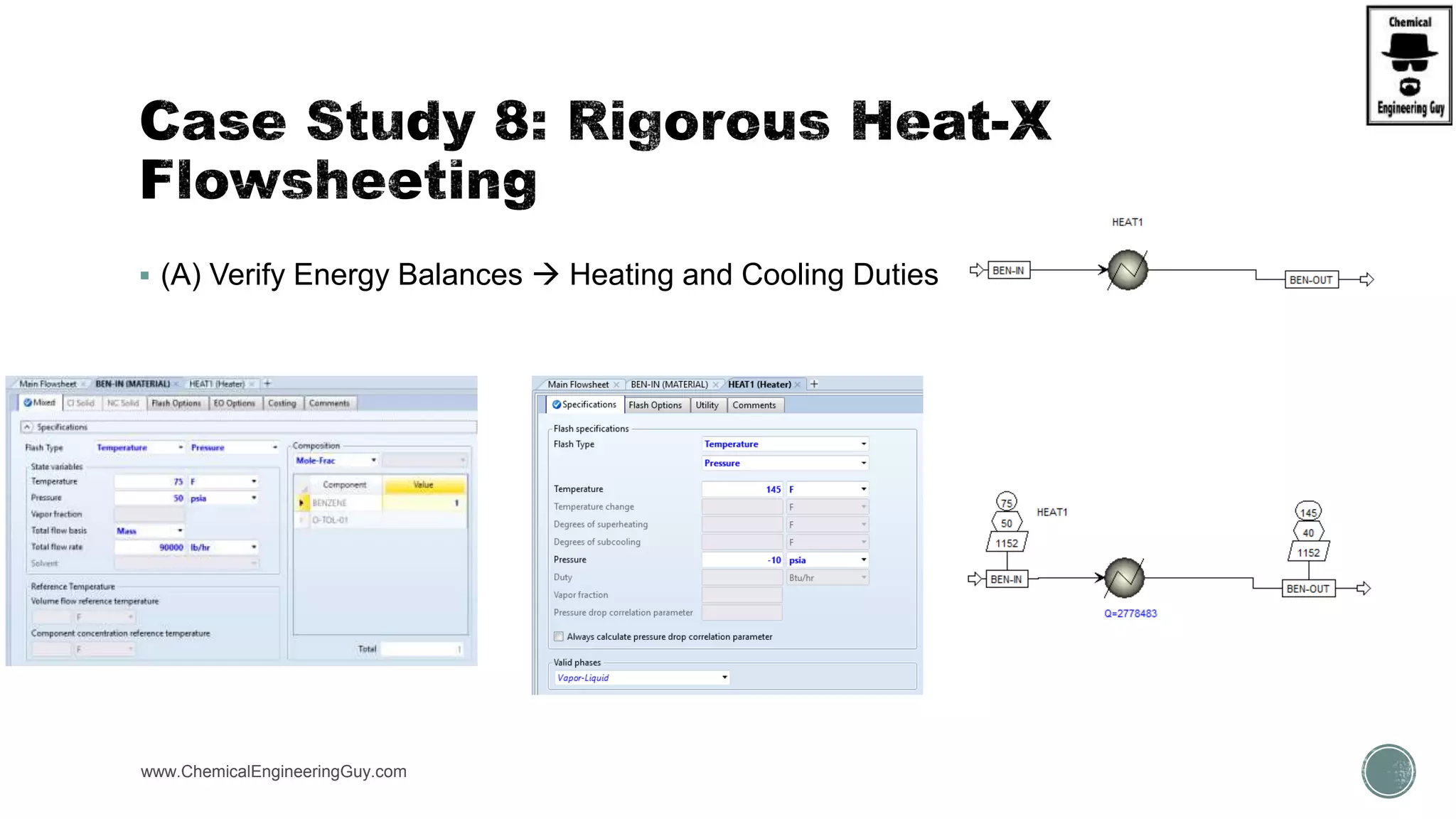
 (A) Verify Energy Balances  Heating and Cooling Duties
 Get Mass require of heating fluid
 Get Heat duty of heat exchanger
 (B) Get Heat-X  Shortcut
 (C) Convert to Rigorous, verify results
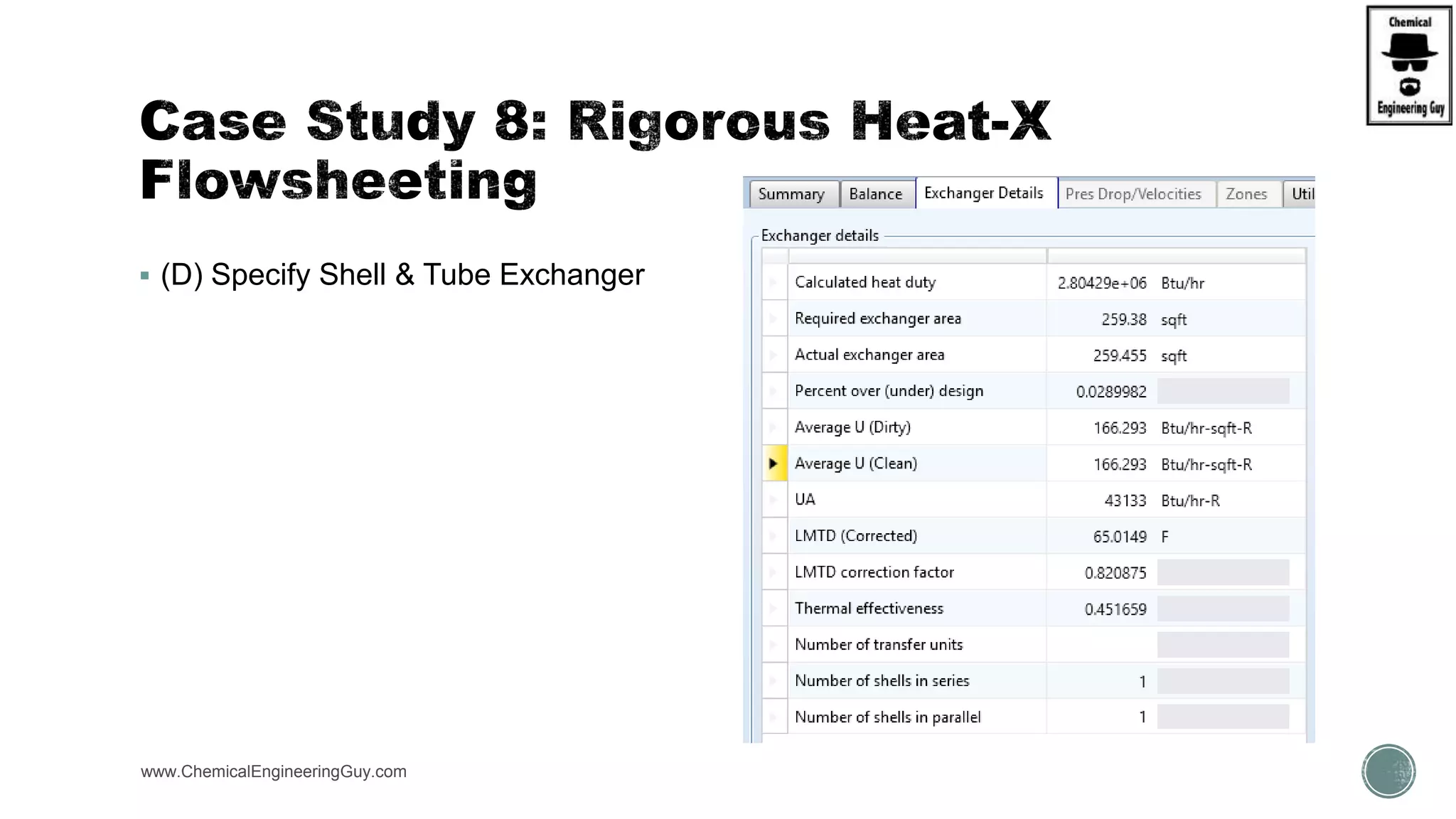
 (D) Specify Shell & Tube Exchanger
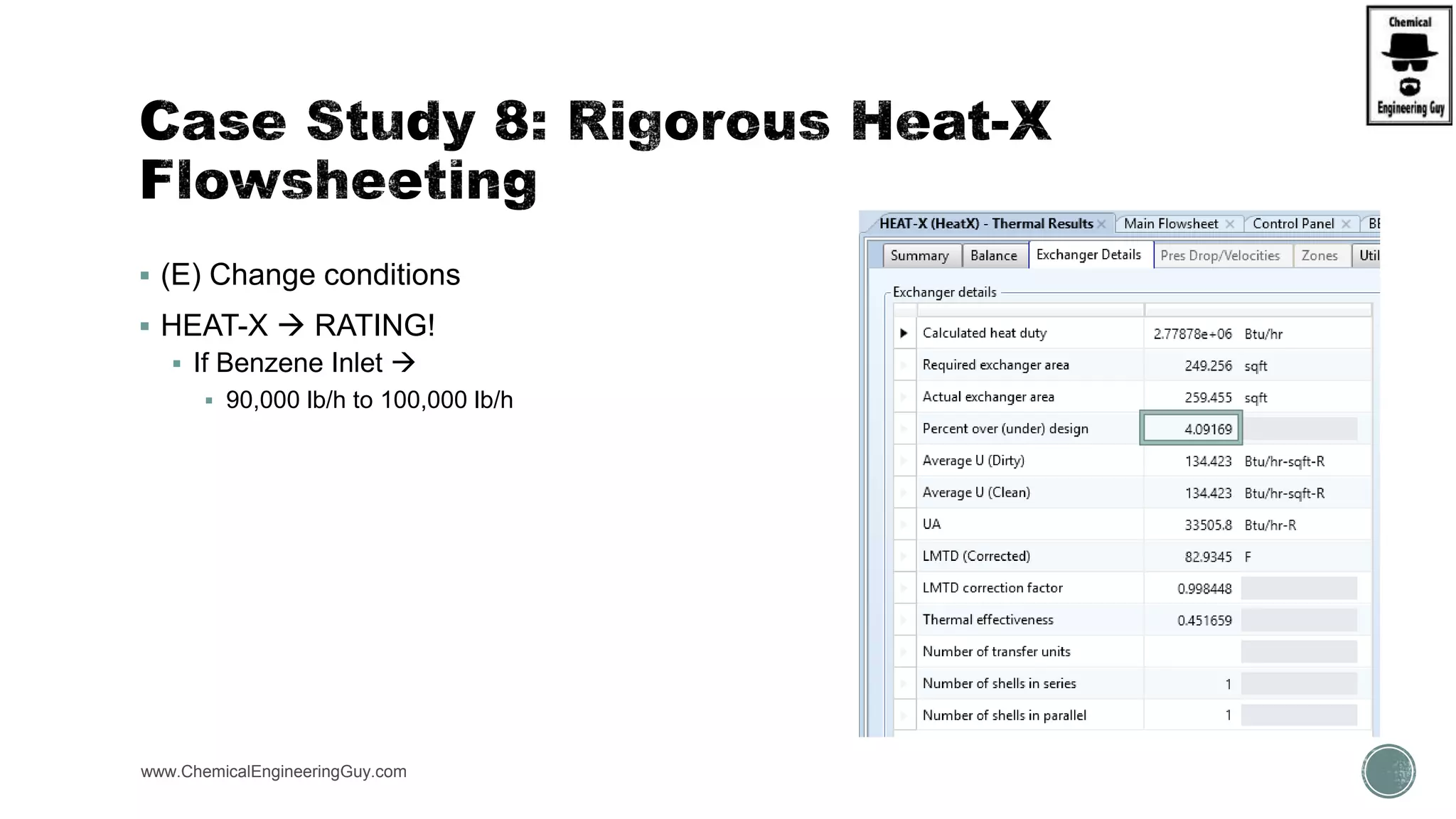
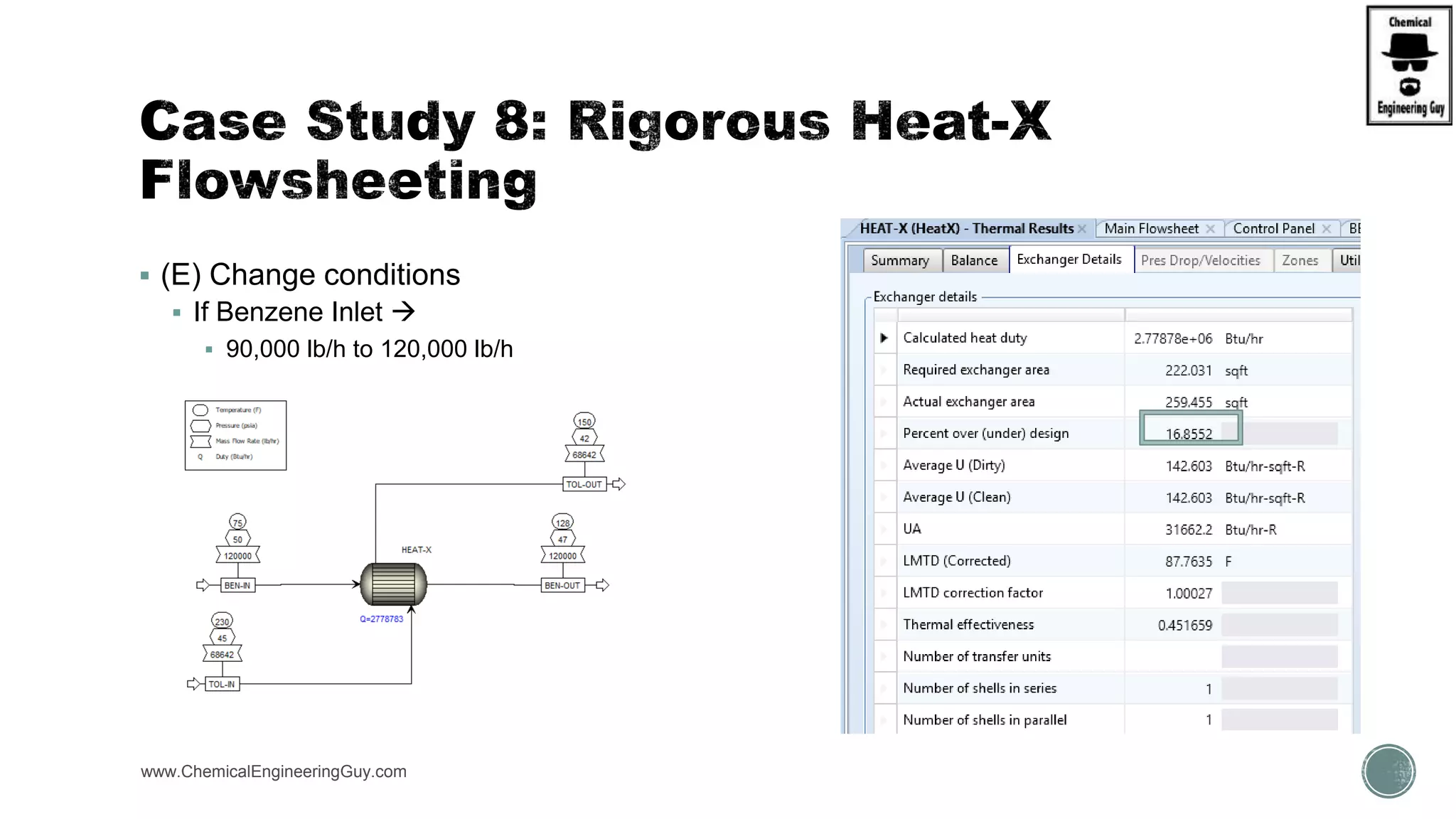
 (E) Change conditions
 HEAT-X  RATING!
 If Benzene Inlet  90,000 lb/h to 100,000 lb/h to 120,000 lb/h to 180,000 lb/h
www.ChemicalEngineeringGuy.com https://www.youtube.com/watch?v=wE8TxtWKX18
https://www.youtube.com/watch?v=9-UdleyXfUs
 (A) Verify Energy Balances  Heating and Cooling Duties
 Get Mass require of heating fluid
 Get Heat duty of heat exchanger
 (B) Get Heat-X  Shortcut
 (C) Convert to Rigorous, verify results
 (D) Specify Shell & Tube Exchanger
 (E) Change conditions
 HEAT-X  RATING!
 If Benzene Inlet  90,000 lb/h to 100,000 lb/h to 120,000 lb/h to 180,000 lb/h
www.ChemicalEngineeringGuy.com https://www.youtube.com/watch?v=wE8TxtWKX18
https://www.youtube.com/watch?v=9-UdleyXfUs
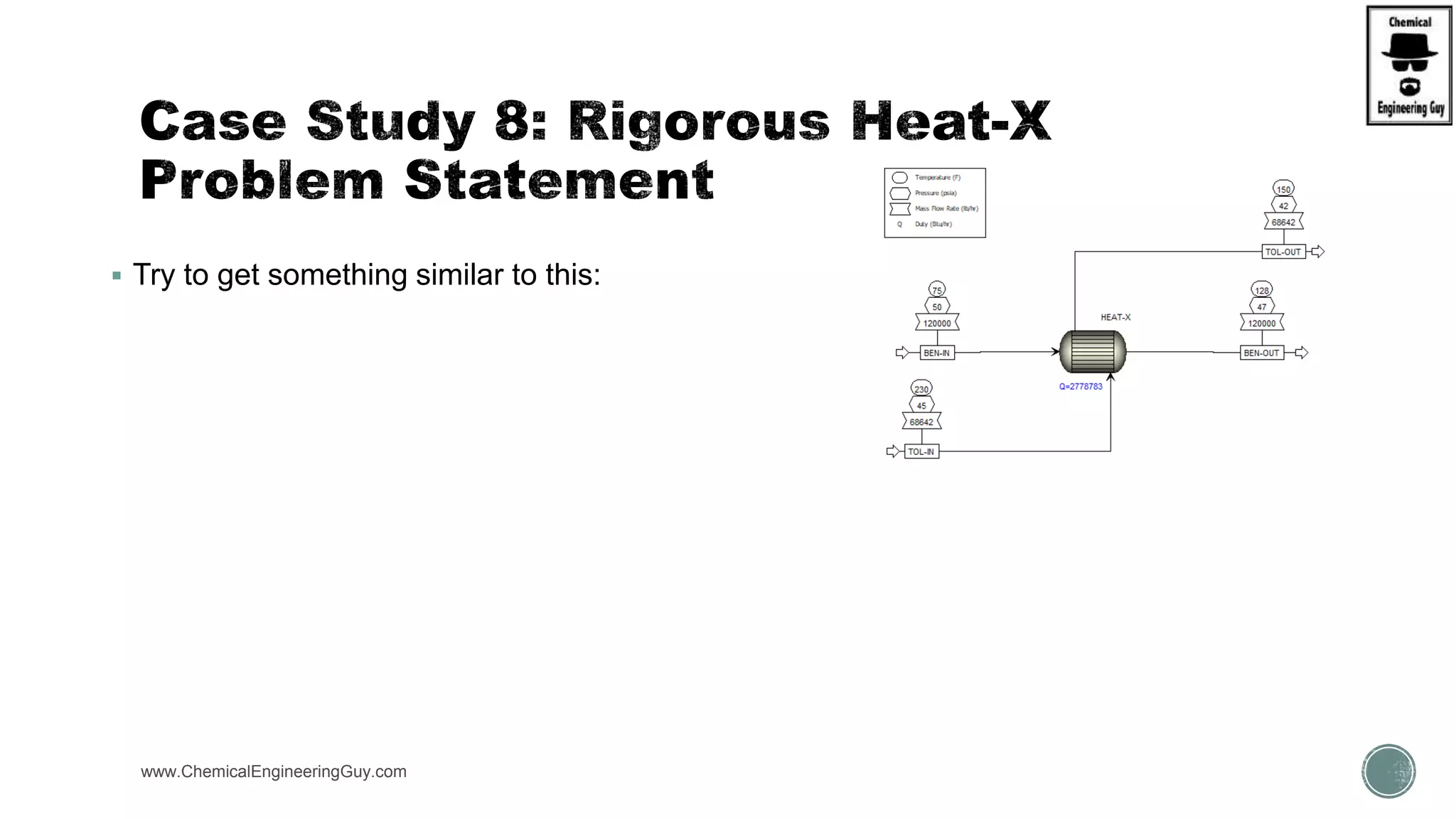
 Try to get something similar to this:
www.ChemicalEngineeringGuy.com https://www.youtube.com/watch?v=wE8TxtWKX18
https://www.youtube.com/watch?v=9-UdleyXfUs
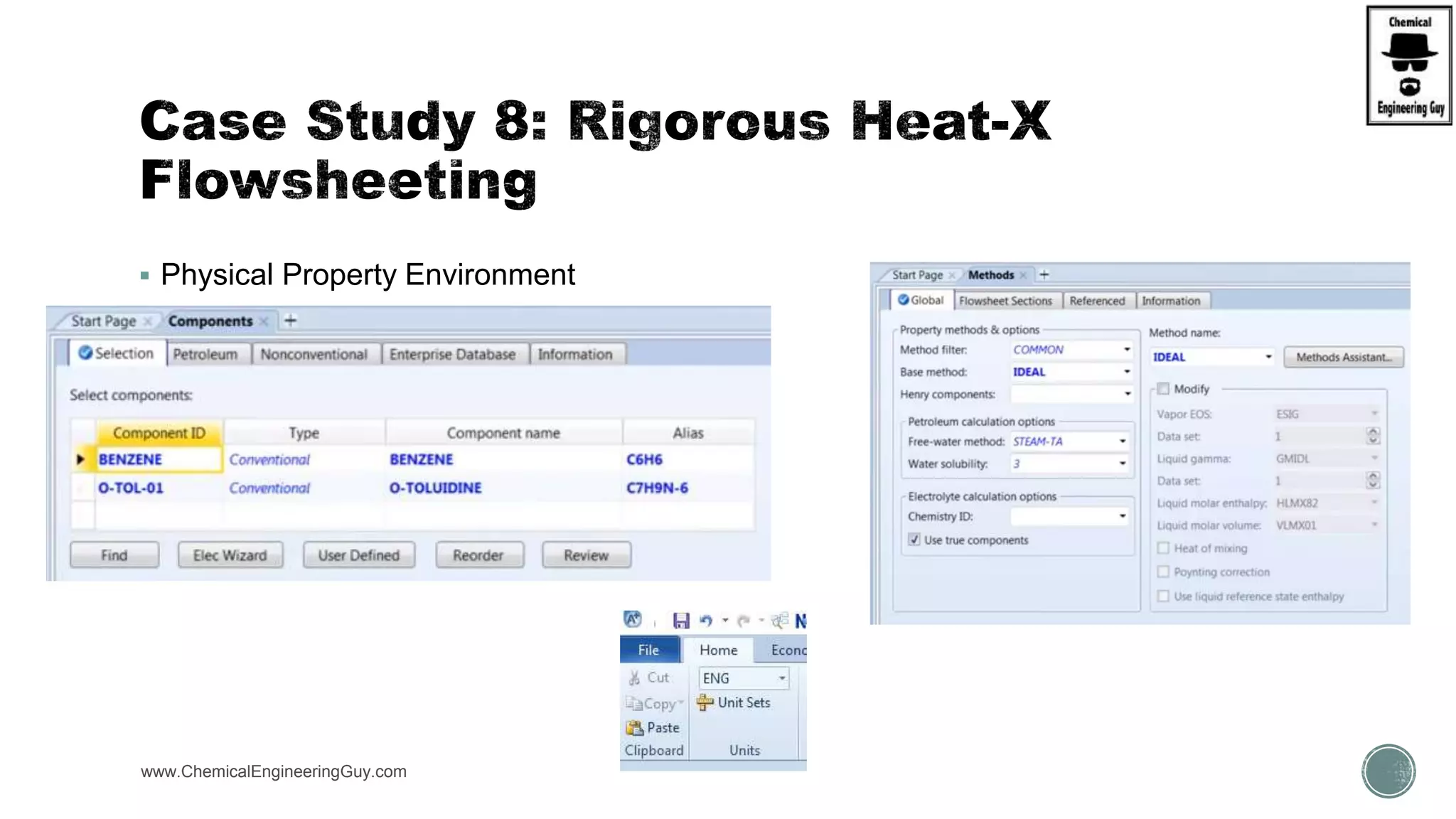
 Physical Property Environment
www.ChemicalEngineeringGuy.com
 (A) Verify Energy Balances  Heating and Cooling Duties
www.ChemicalEngineeringGuy.com
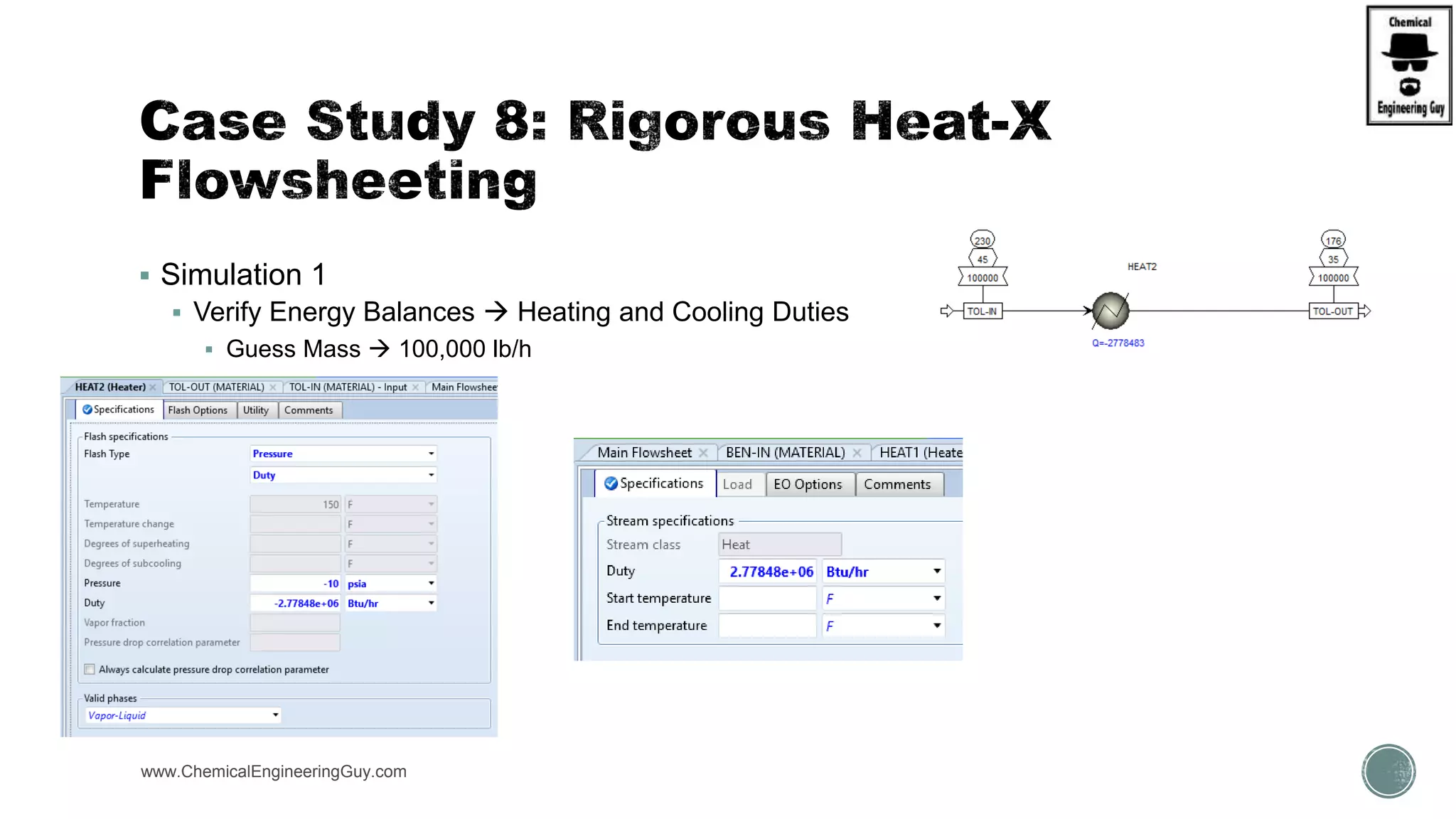
 Simulation 1
 Verify Energy Balances  Heating and Cooling Duties
 Guess Mass  100,000 lb/h
www.ChemicalEngineeringGuy.com
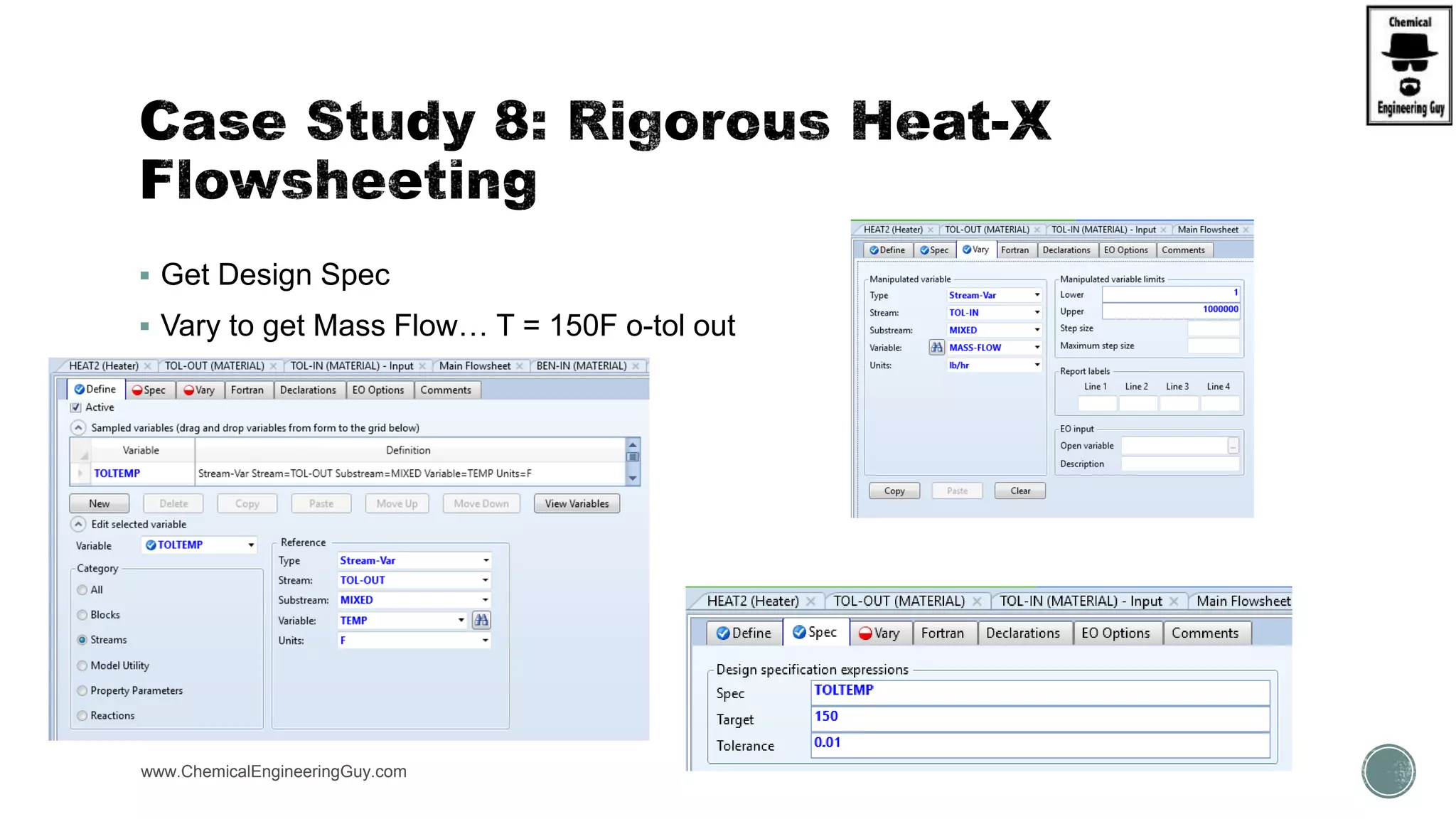
 Get Design Spec
 Vary to get Mass Flow… T = 150F o-tol out
www.ChemicalEngineeringGuy.com
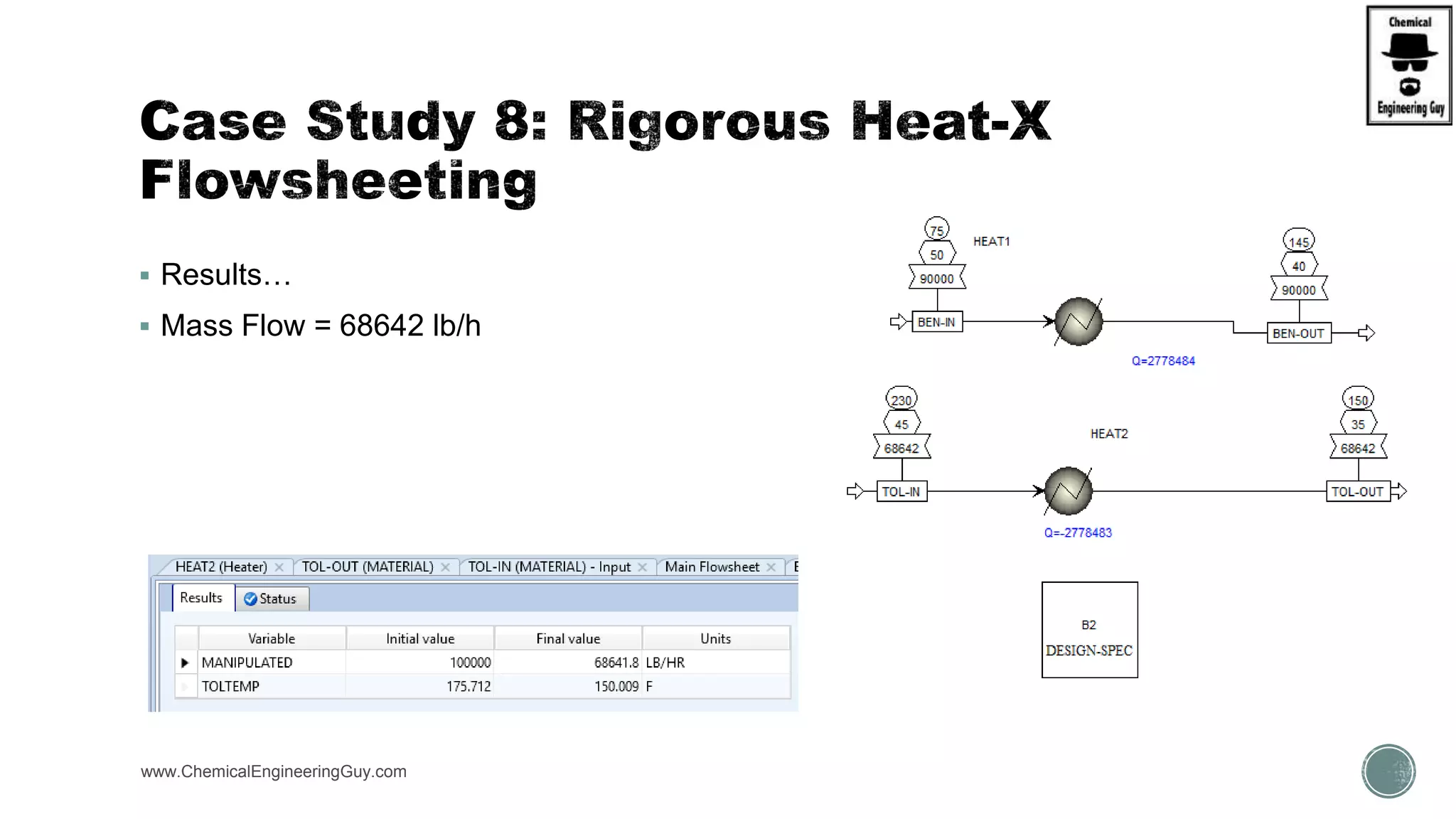
 Results…
 Mass Flow = 68642 lb/h
www.ChemicalEngineeringGuy.com
 Add Heat flow
 No need to specify Heat duties in UNITS
www.ChemicalEngineeringGuy.com
Enjoying so far?
This is a preview of the BOOTCAMP.
Join NOW here:
https://www.chemicalengineeringguy.com/courses/aspen-plus-bootcamp-with-12-case-studies/
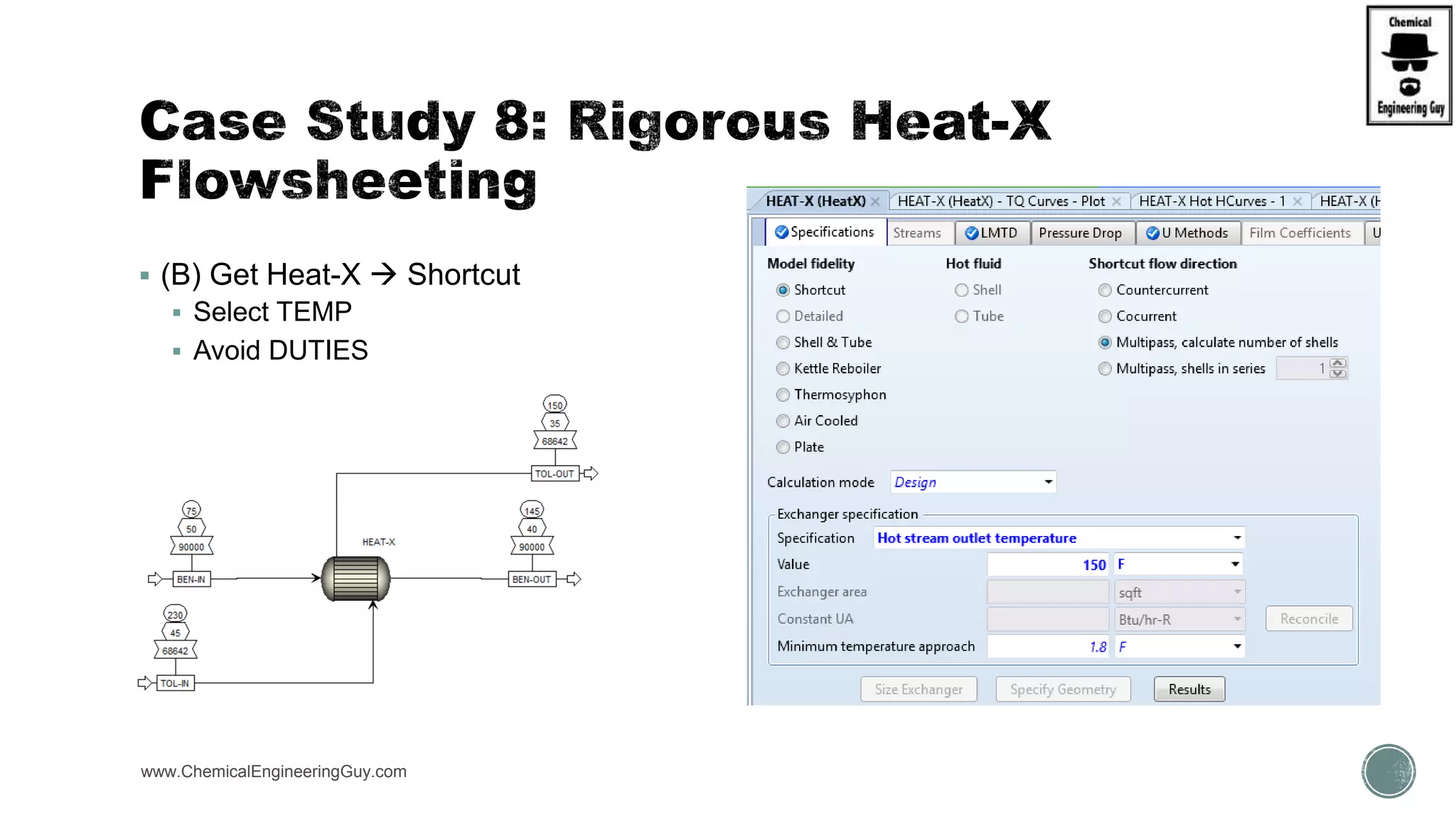
 (B) Get Heat-X  Shortcut
 Select TEMP
 Avoid DUTIES
www.ChemicalEngineeringGuy.com
 (B) Get Heat-X  Shortcut
 Select TEMP
 Avoid DUTIES
www.ChemicalEngineeringGuy.com
Enjoying so far?
This is a preview of the BOOTCAMP.
Join NOW here:
https://www.chemicalengineeringguy.com/courses/aspen-plus-bootcamp-with-12-case-studies/
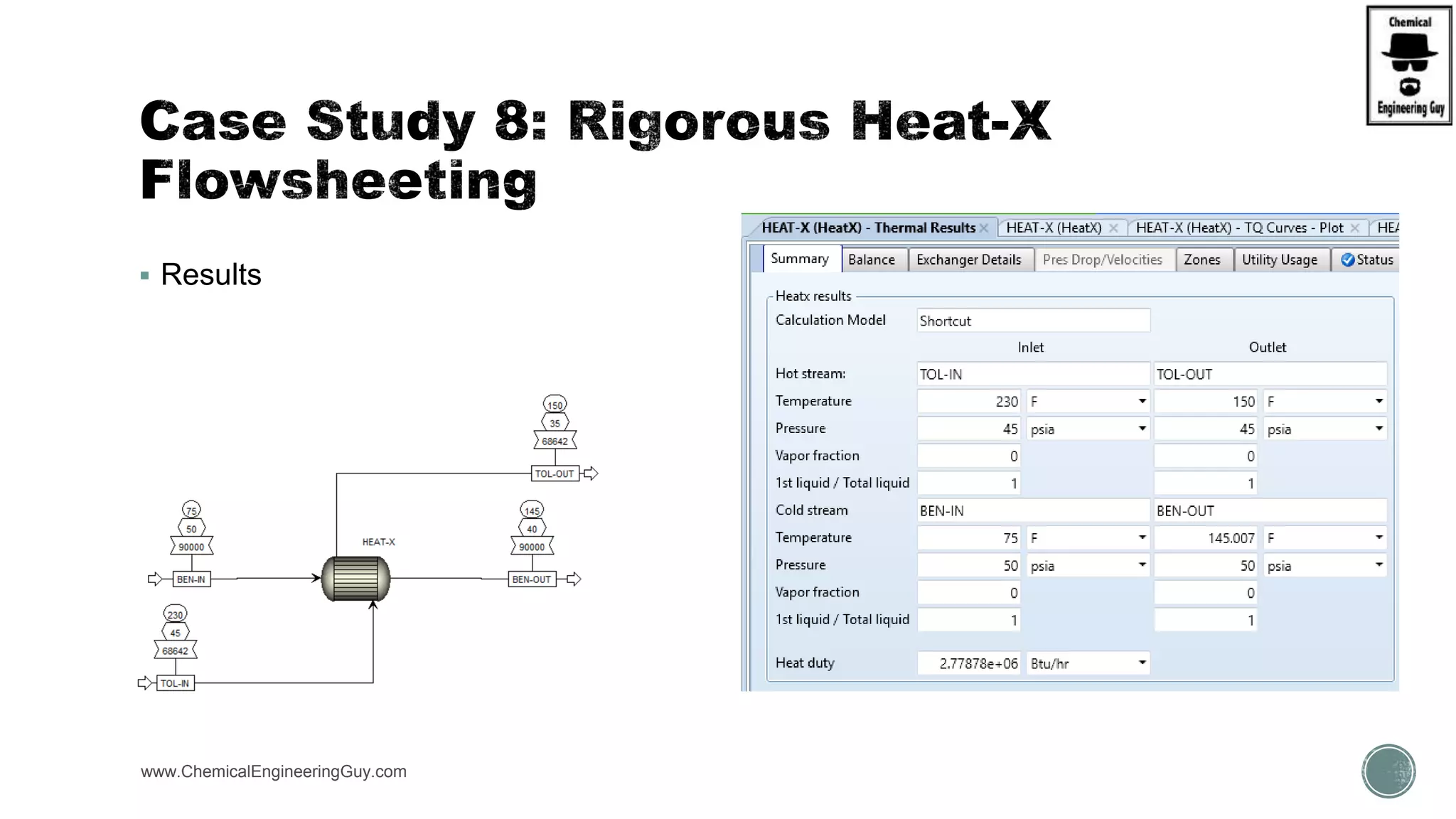
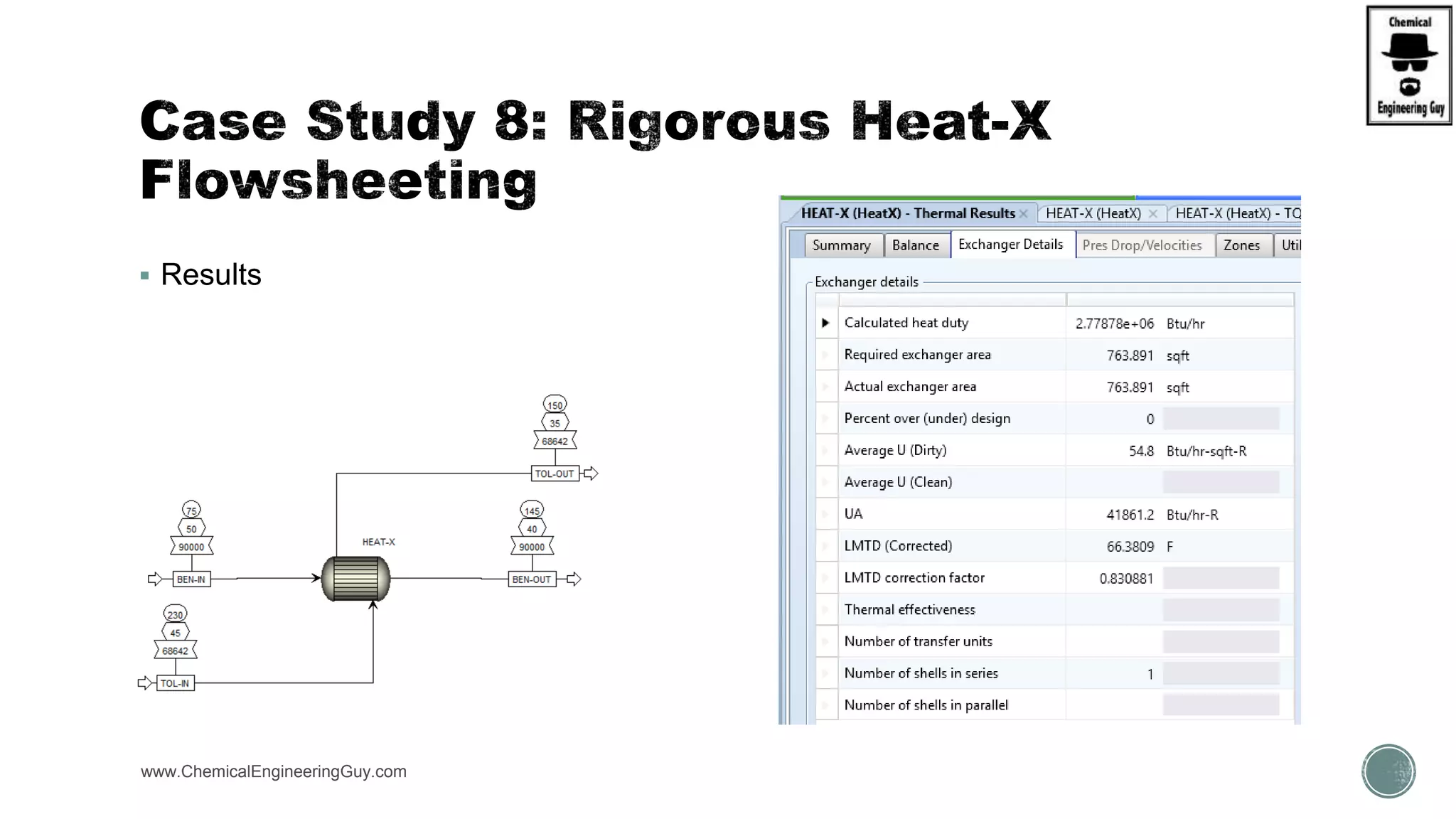
 Results
www.ChemicalEngineeringGuy.com
 Results
www.ChemicalEngineeringGuy.com
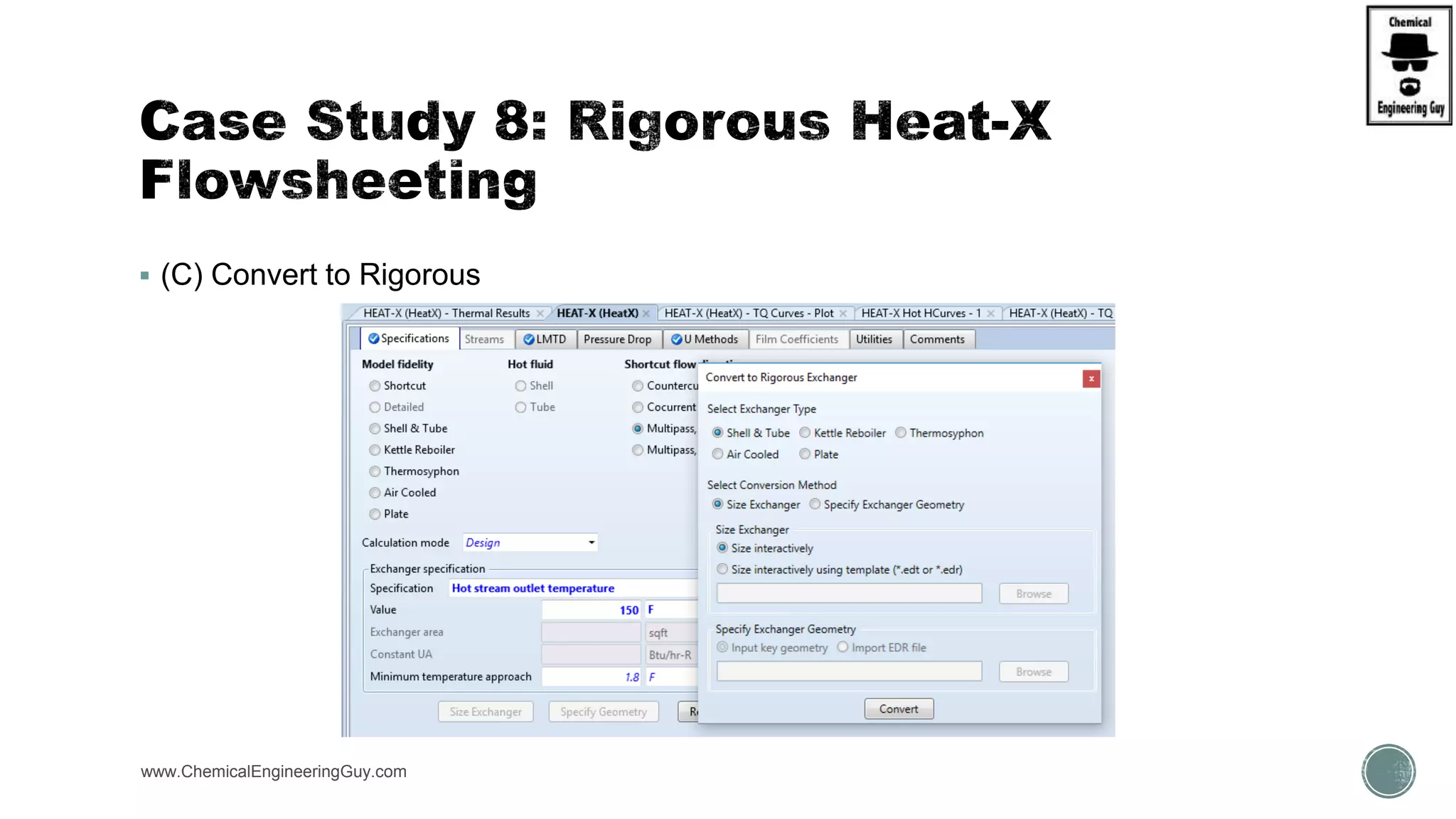
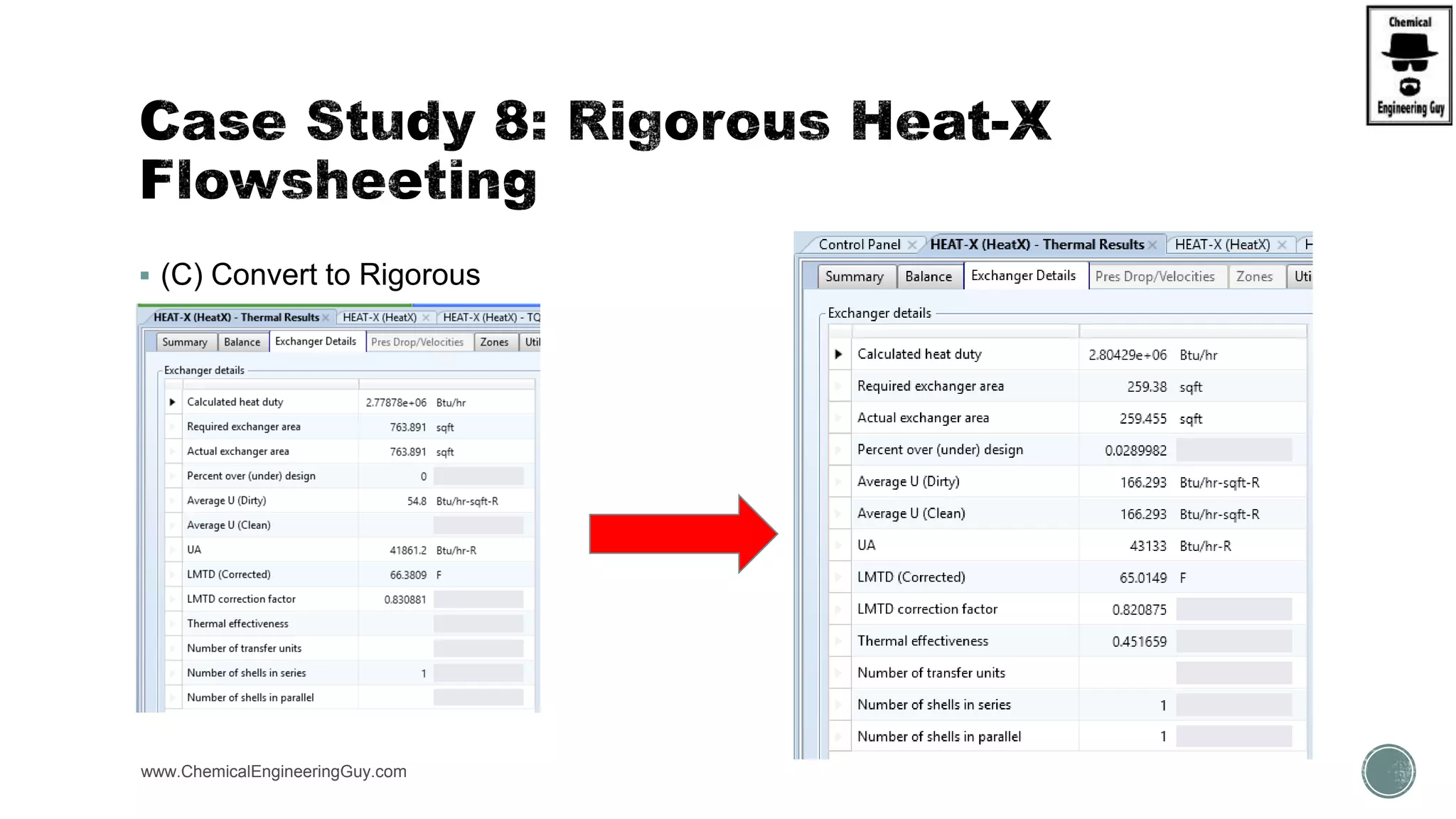
 (C) Convert to Rigorous
www.ChemicalEngineeringGuy.com
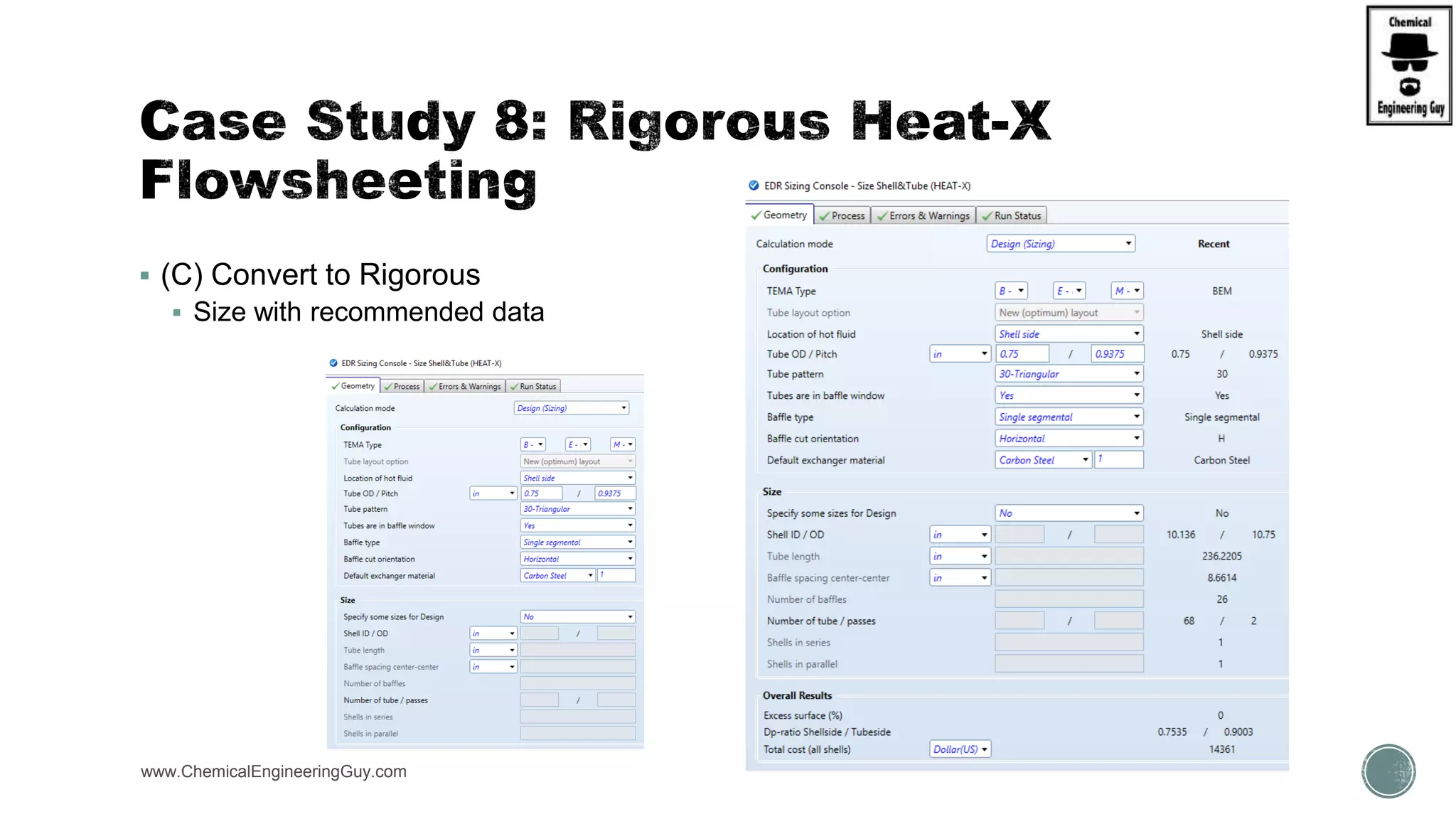
 (C) Convert to Rigorous
 Size with recommended data
www.ChemicalEngineeringGuy.com
Enjoying so far?
This is a preview of the BOOTCAMP.
Join NOW here:
https://www.chemicalengineeringguy.com/courses/aspen-plus-bootcamp-with-12-case-studies/
 (C) Convert to Rigorous
 Size with recommended data
www.ChemicalEngineeringGuy.com
 (C) Convert to Rigorous
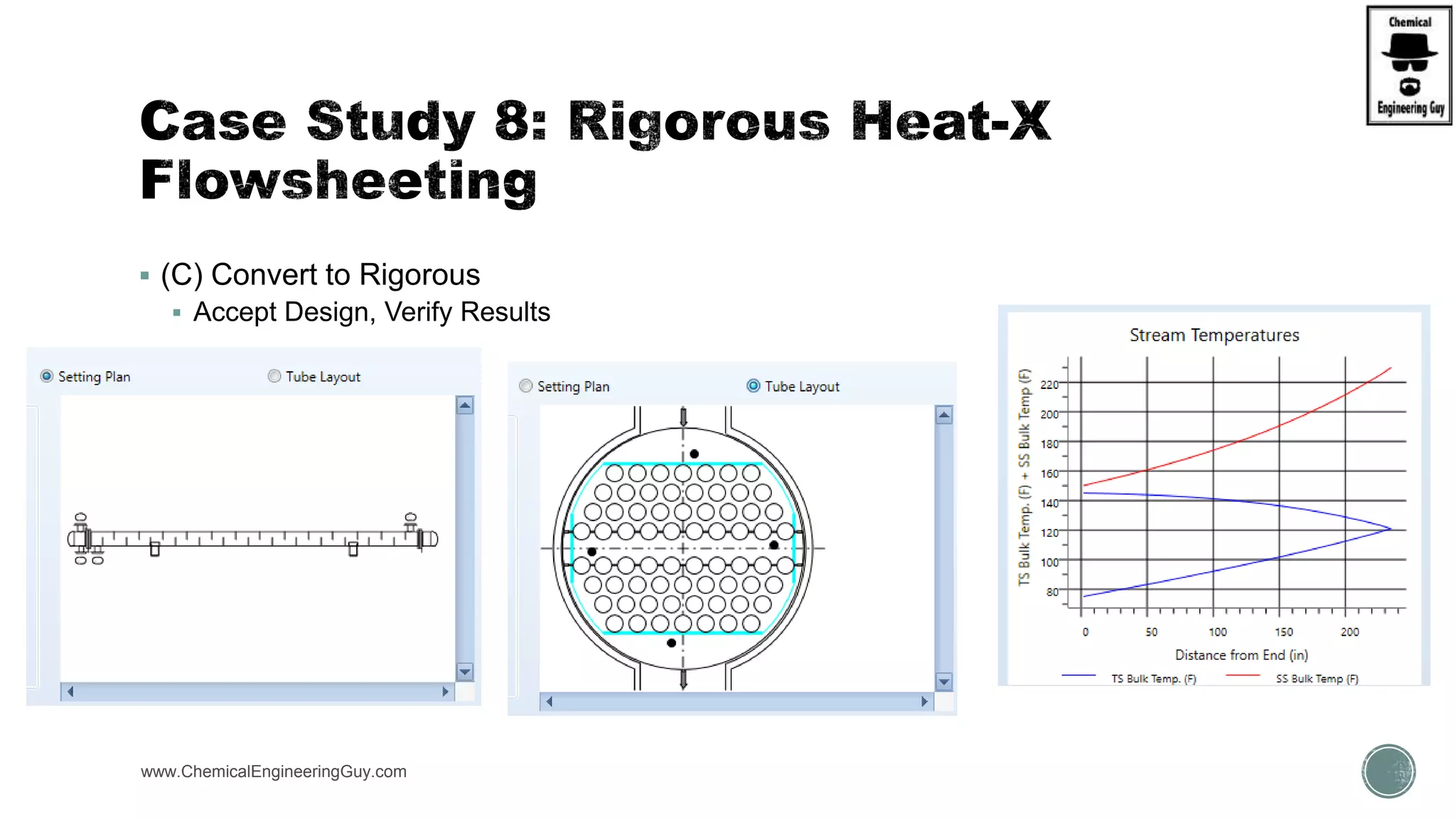
 Accept Design, Verify Results
www.ChemicalEngineeringGuy.com
 (C) Convert to Rigorous
www.ChemicalEngineeringGuy.com
Enjoying so far?
This is a preview of the BOOTCAMP.
Join NOW here:
https://www.chemicalengineeringguy.com/courses/aspen-plus-bootcamp-with-12-case-studies/
 (C) Convert to Rigorous
www.ChemicalEngineeringGuy.com
 (C) Convert to Rigorous
 From EDR Results only:
www.ChemicalEngineeringGuy.com
Enjoying so far?
This is a preview of the BOOTCAMP.
Join NOW here:
https://www.chemicalengineeringguy.com/courses/aspen-plus-bootcamp-with-12-case-studies/
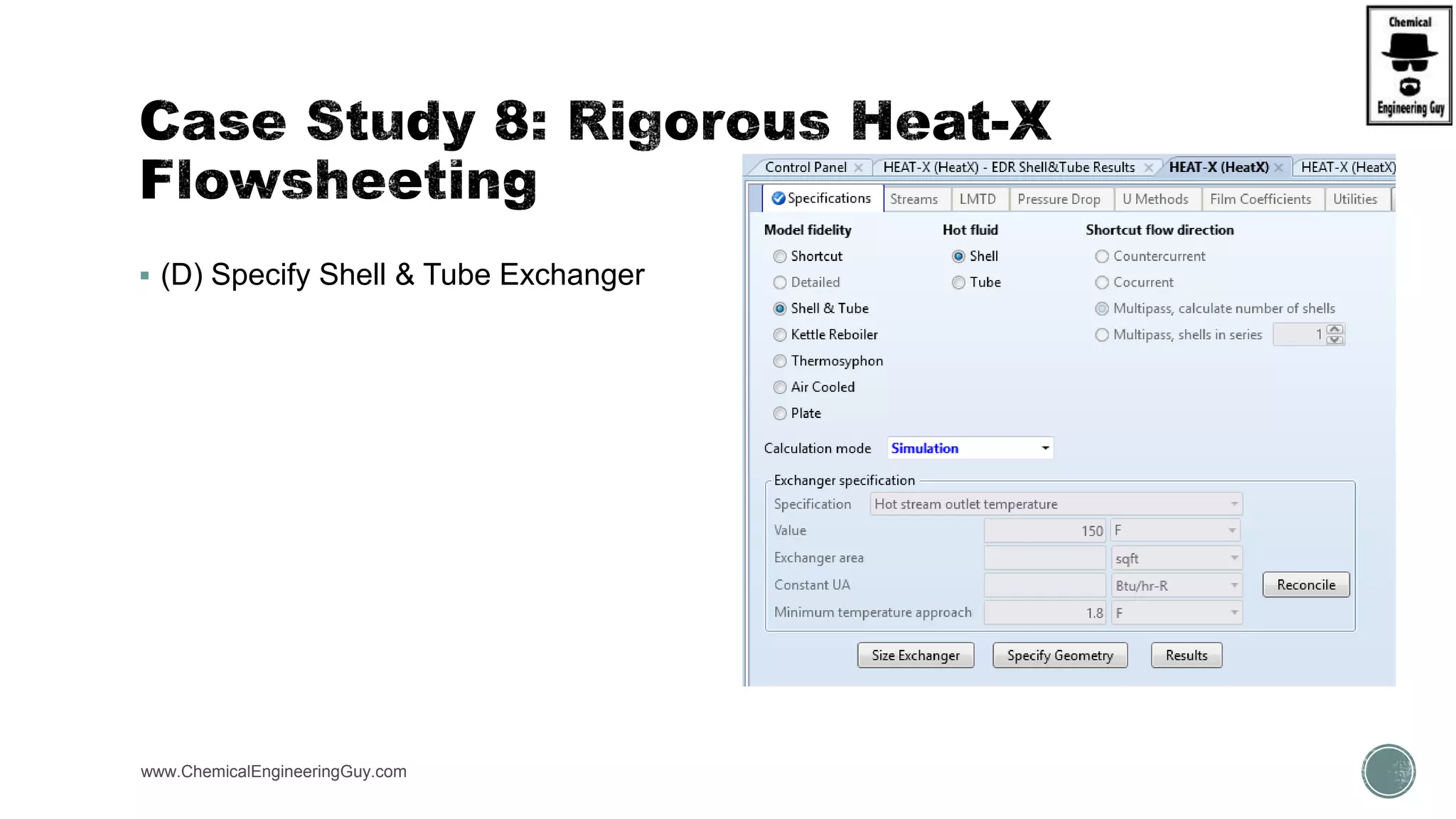
 (D) Specify Shell & Tube Exchanger
www.ChemicalEngineeringGuy.com
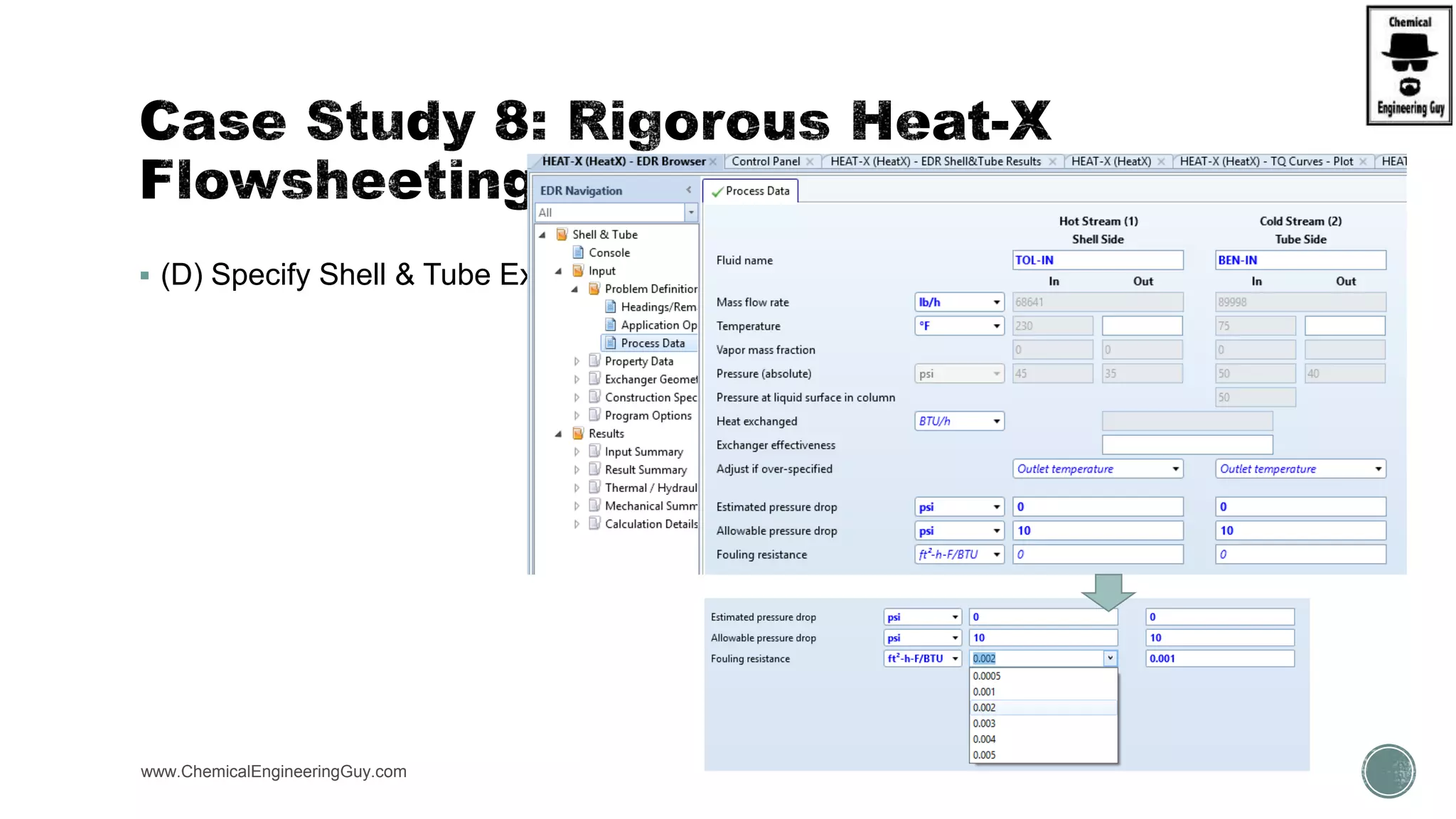
 (D) Specify Shell & Tube Exchanger
www.ChemicalEngineeringGuy.com
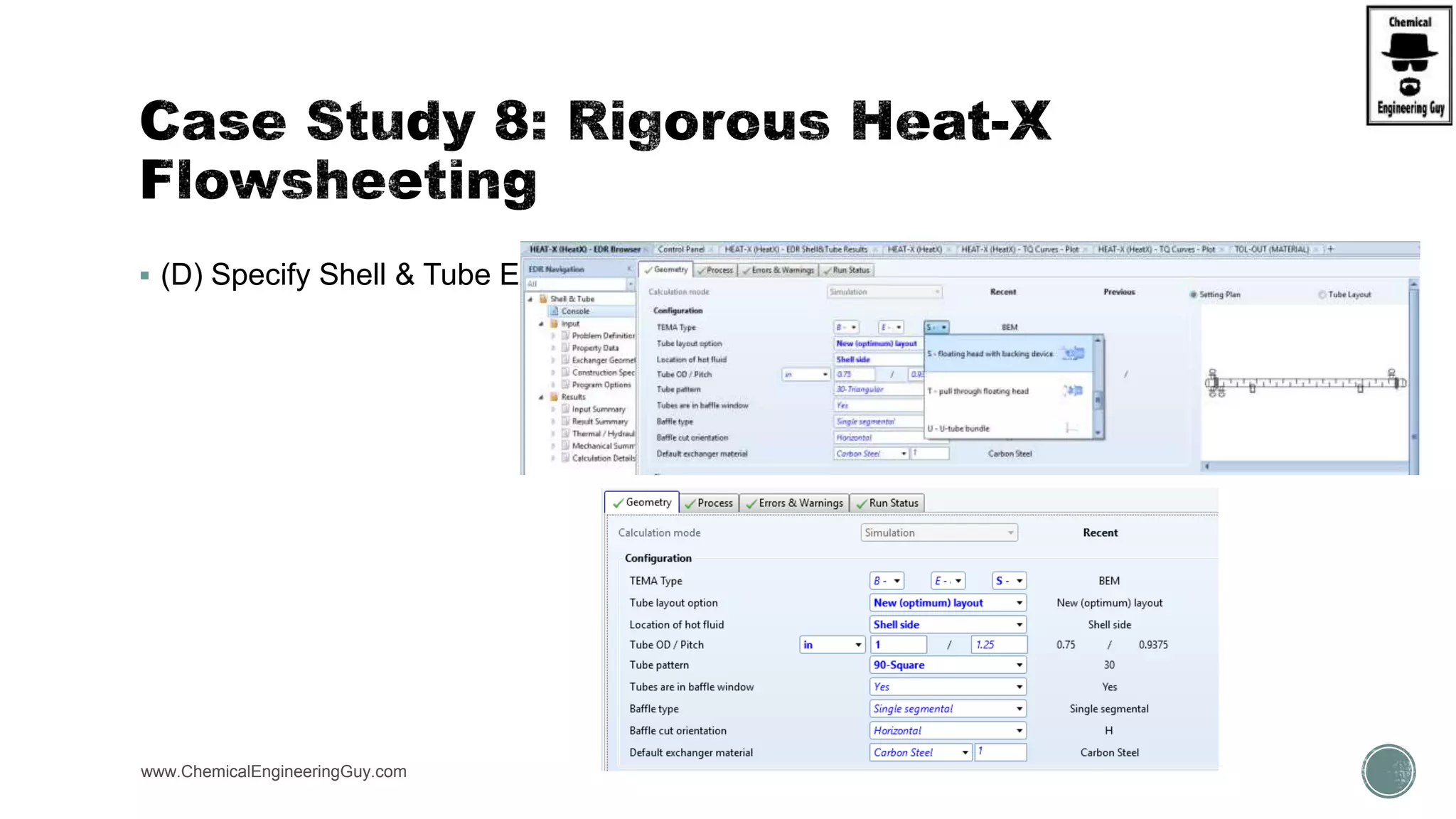
 (D) Specify Shell & Tube Exchanger
www.ChemicalEngineeringGuy.com
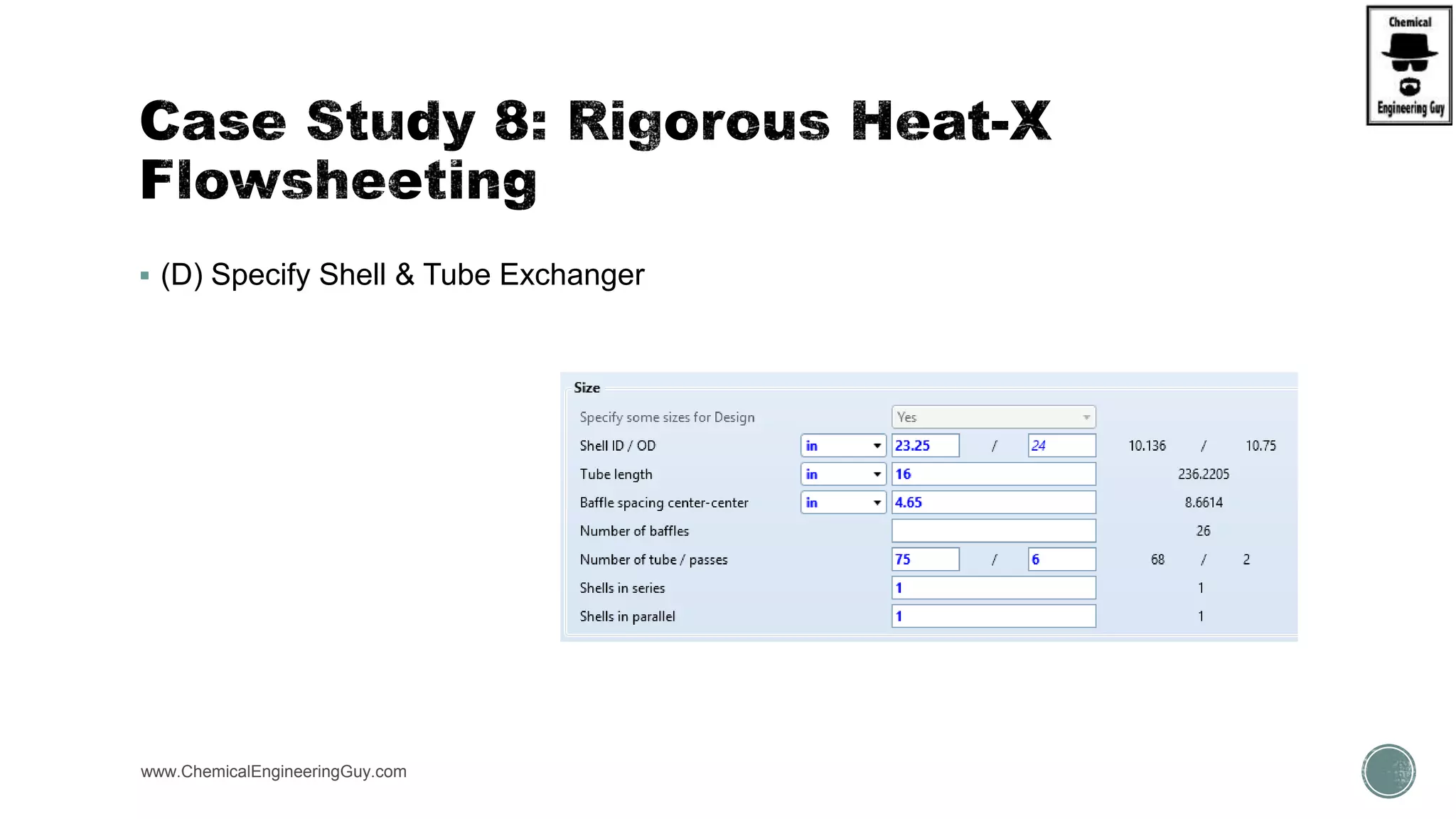
 (D) Specify Shell & Tube Exchanger
www.ChemicalEngineeringGuy.com
 (D) Specify Shell & Tube Exchanger
www.ChemicalEngineeringGuy.com
 (D) Specify Shell & Tube Exchanger
www.ChemicalEngineeringGuy.com
Enjoying so far?
This is a preview of the BOOTCAMP.
Join NOW here:
https://www.chemicalengineeringguy.com/courses/aspen-plus-bootcamp-with-12-case-studies/
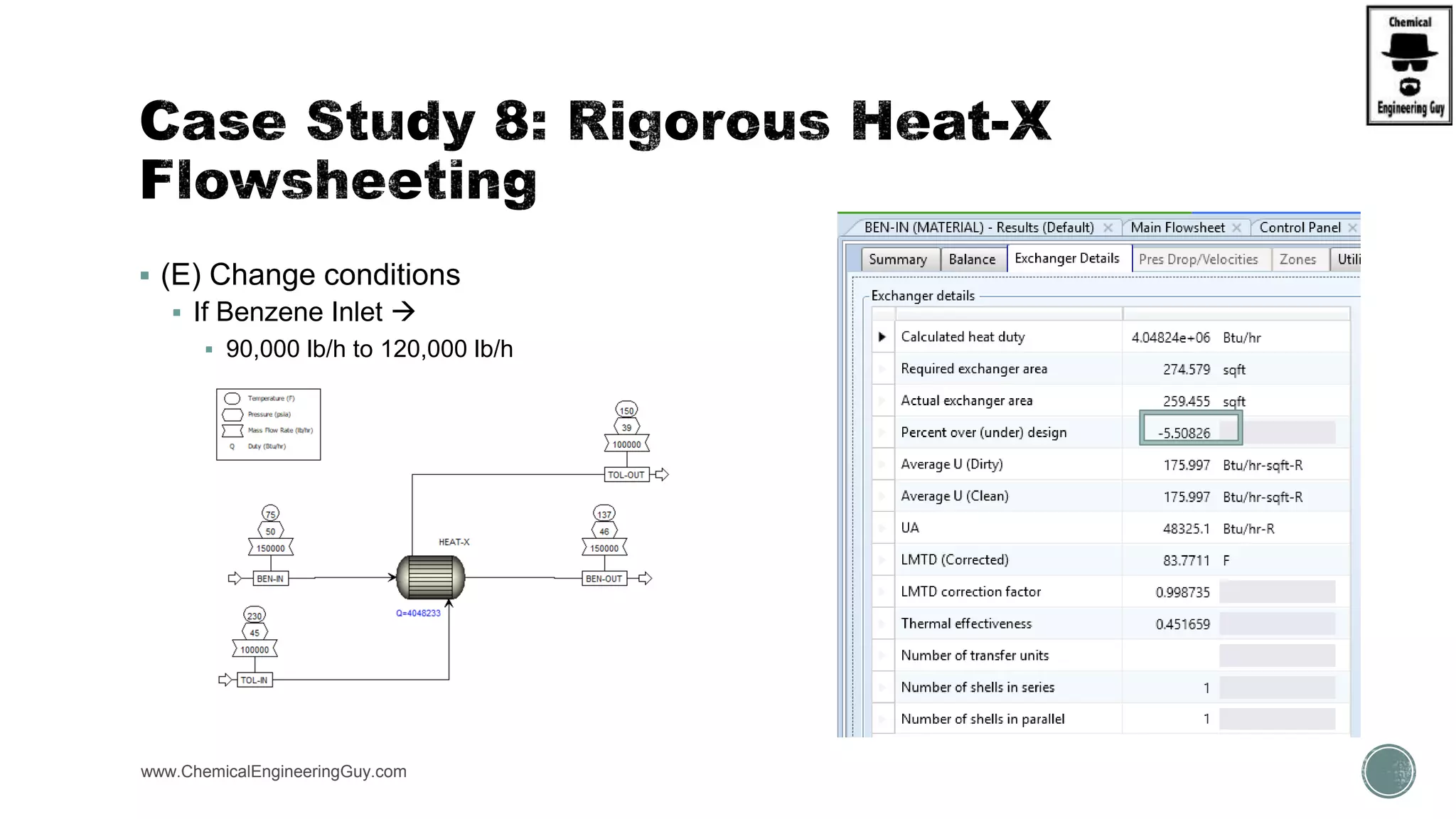
 (E) Change conditions
 HEAT-X  RATING!
 If Benzene Inlet 
 90,000 lb/h to 100,000 lb/h
www.ChemicalEngineeringGuy.com
 (E) Change conditions
 If Benzene Inlet 
 90,000 lb/h to 120,000 lb/h
www.ChemicalEngineeringGuy.com
 (E) Change conditions
 If Benzene Inlet 
 90,000 lb/h to 120,000 lb/h
www.ChemicalEngineeringGuy.com
 Learn to stablish relevant column internals in RadFrac
 Pressure Profile
 Temperature Profile
 Molar Flow Rate Profile
 Selecting between trays and packings
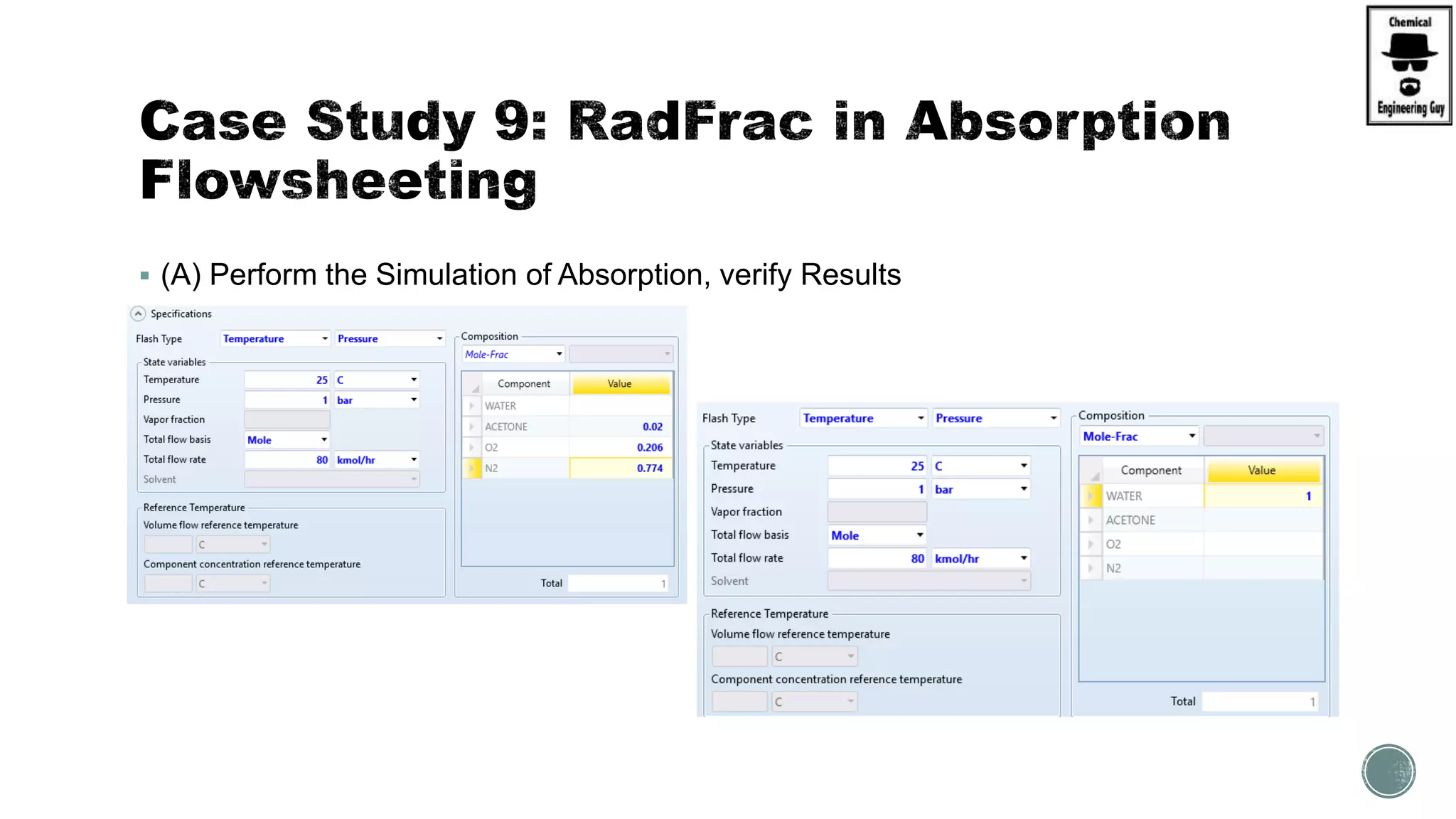
 Acetone is to be absorbed into water from air mixture
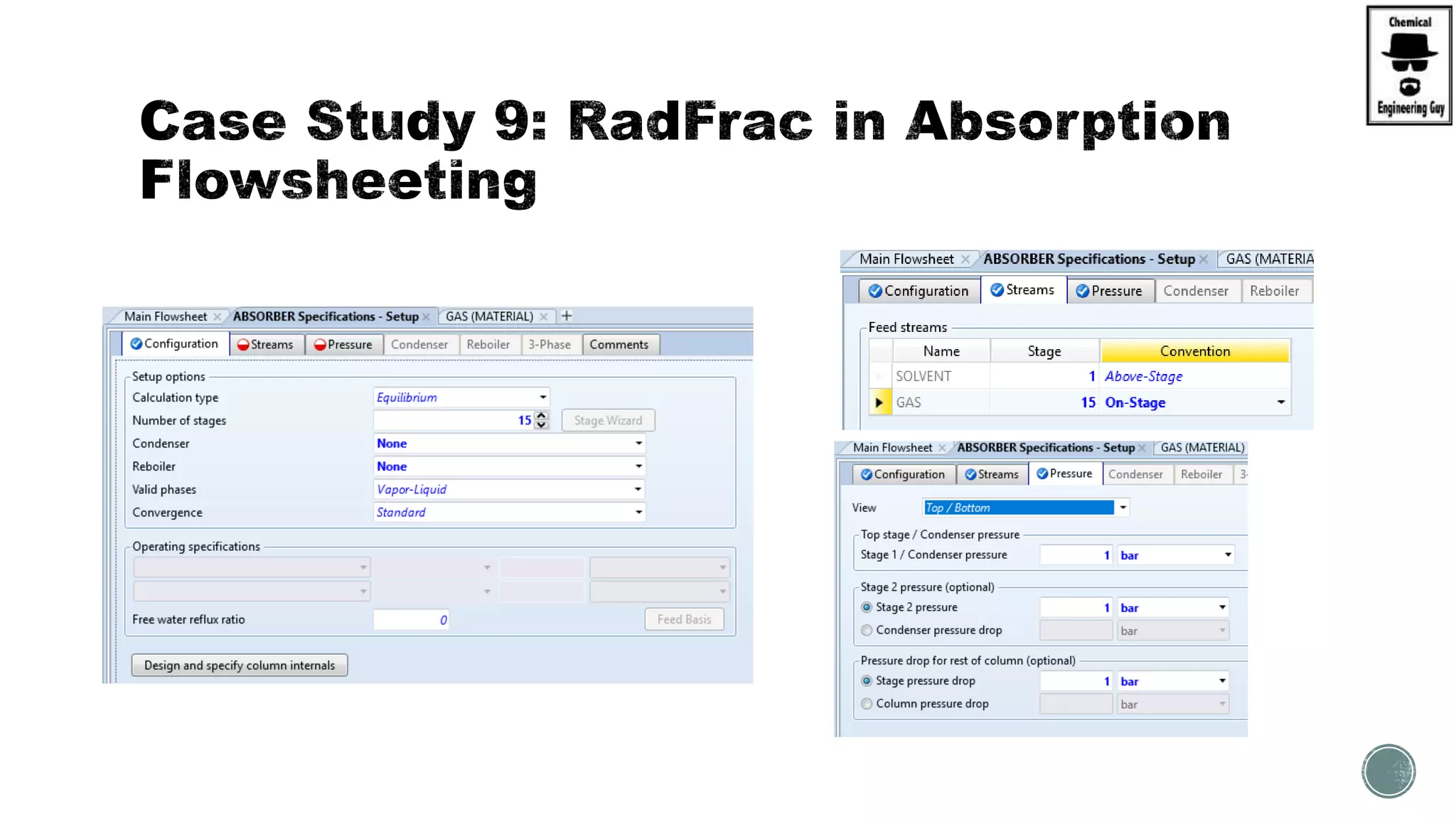
 Specs: 15 Stages, P = 1 atm, Isobaric
 Feed Gas:
 %Acetone = 2%; Air = 98%
 F = 80 kmol/h, T = 25°C, P = 1 atm (101.3 kPa)
 Solvent
 %Water = 100%
 F = 80 kmol/h, T = 25°C, P = 1 atm (101.3 kPa)
 (A) Perform the Simulation of Absorption, verify Results
 (B) Compare Sieve Trays vs. Bubble-Cap Trays
 (C) Change Tray Spacing to verify results
 (D) Change from Tray Columns to Packed Column, verify Results
 Try to get:
Enjoying so far?
This is a preview of the BOOTCAMP.
Join NOW here:
https://www.chemicalengineeringguy.com/courses/aspen-plus-bootcamp-with-12-case-studies/
 (A) Perform the Simulation of Absorption, verify Results
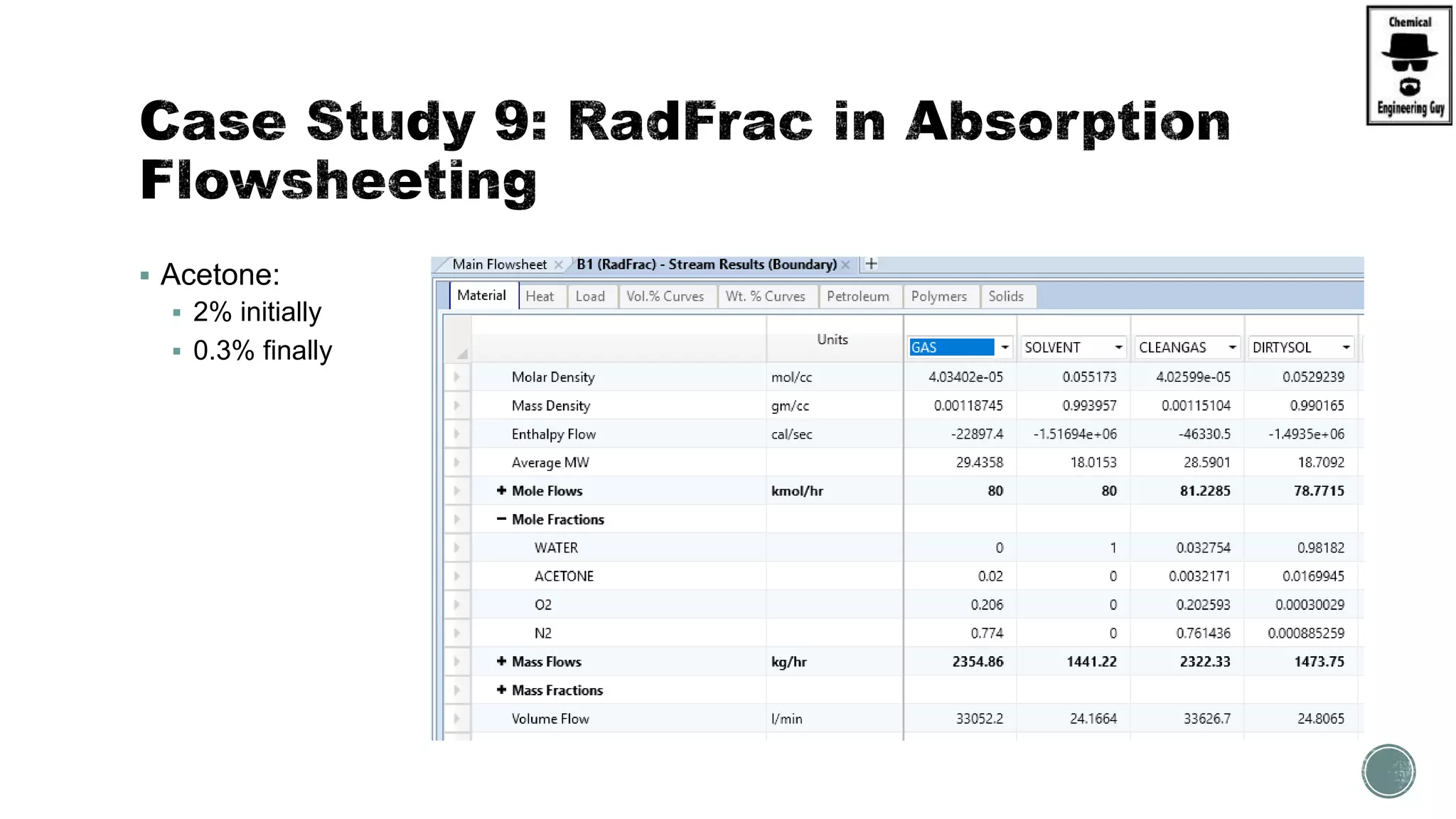
 Acetone:
 2% initially
 0.3% finally
 (B) Compare Sieve Trays vs. Bubble-Cap Trays
 Now, continue to calculate the height and diameters:
 Assume:
 Trays
 Sieves
 Packed column:
 Rashing Rings
Enjoying so far?
This is a preview of the BOOTCAMP.
Join NOW here:
https://www.chemicalengineeringguy.com/courses/aspen-plus-bootcamp-with-12-case-studies/
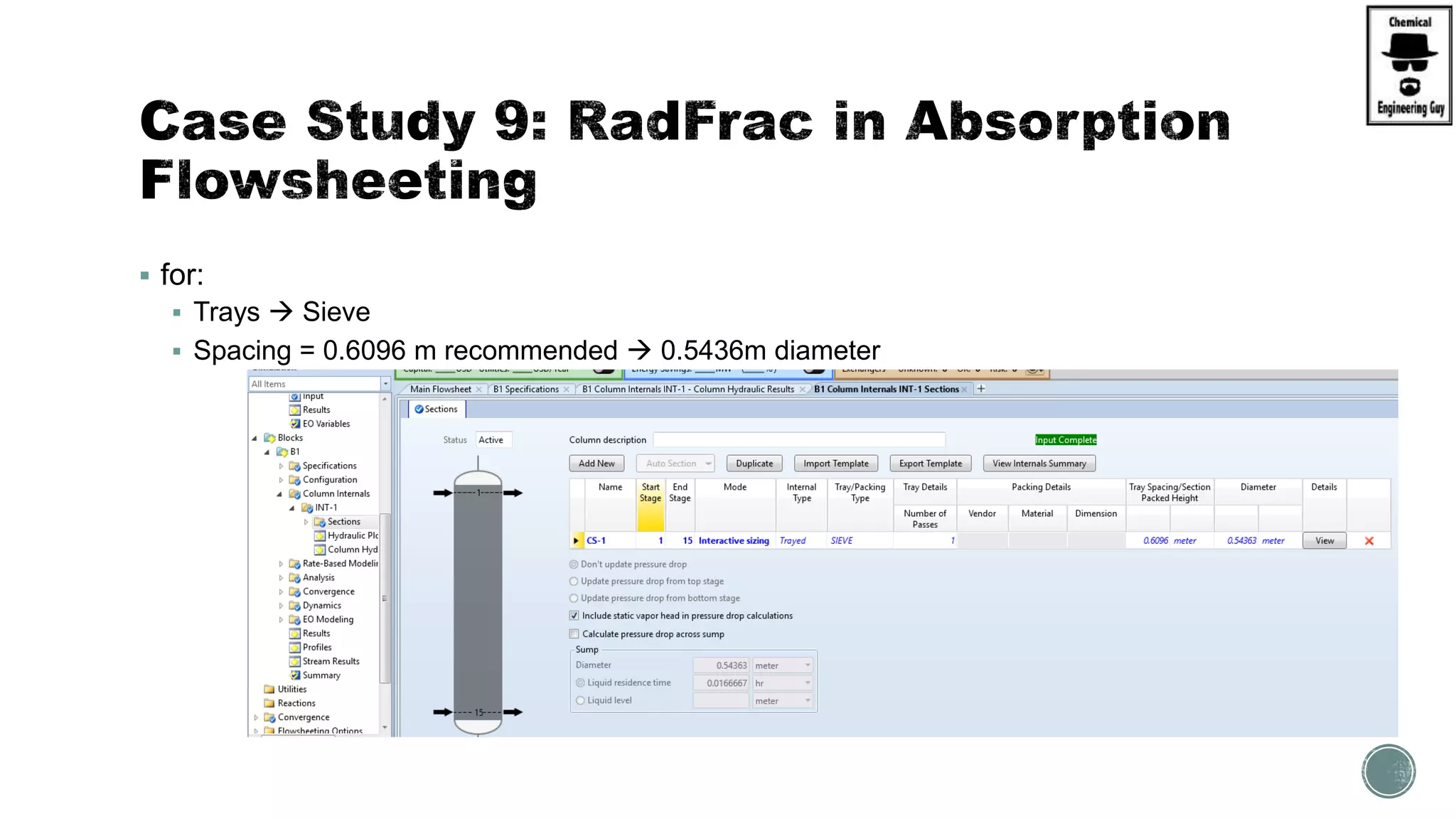
 for:
 Trays  Sieve
 Spacing = 0.6096 m recommended  0.5436m diameter
 RUN an get:
Enjoying so far?
This is a preview of the BOOTCAMP.
Join NOW here:
https://www.chemicalengineeringguy.com/courses/aspen-plus-bootcamp-with-12-case-studies/
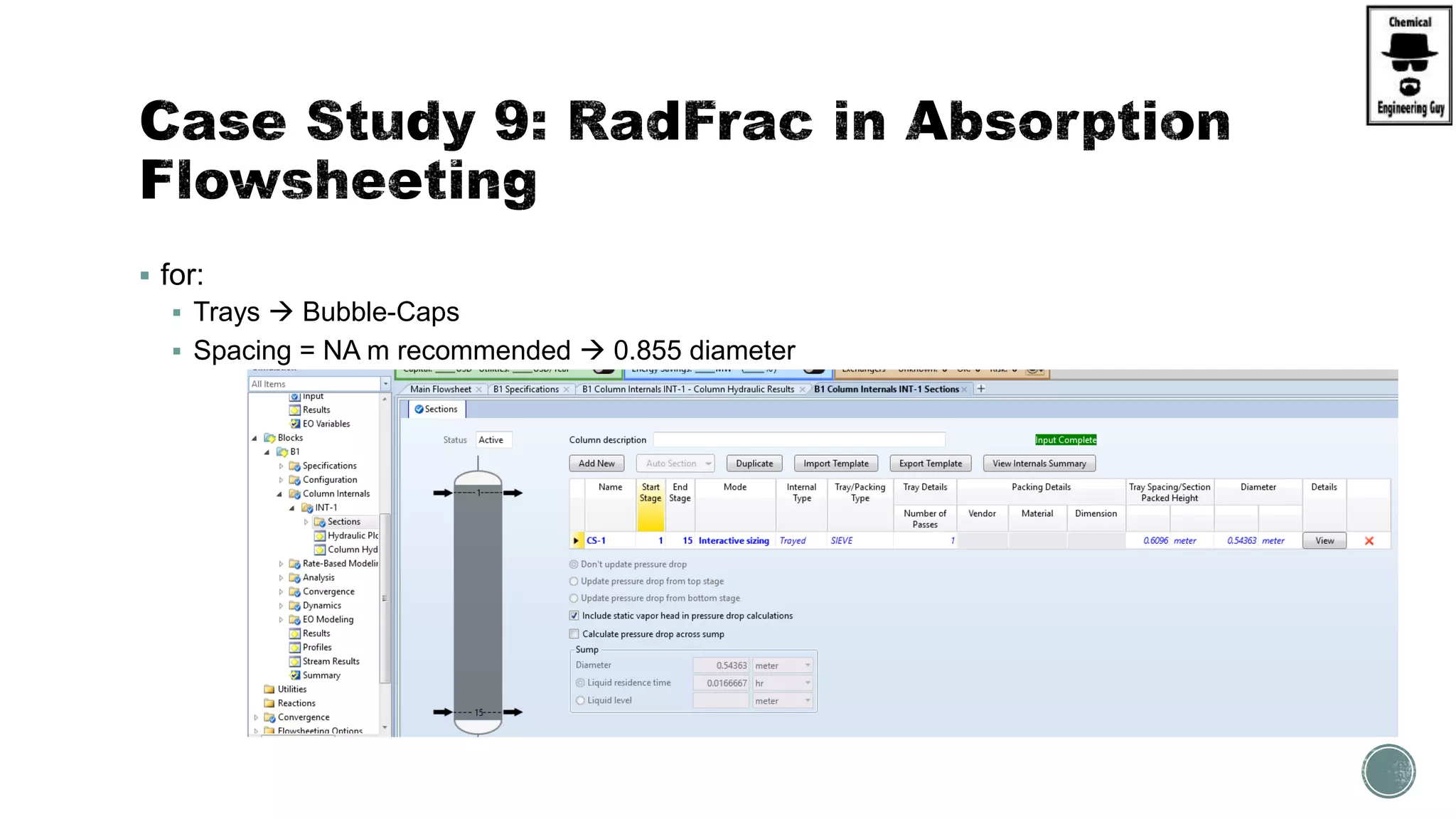
 for:
 Trays  Bubble-Caps
 Spacing = NA m recommended  0.855 diameter
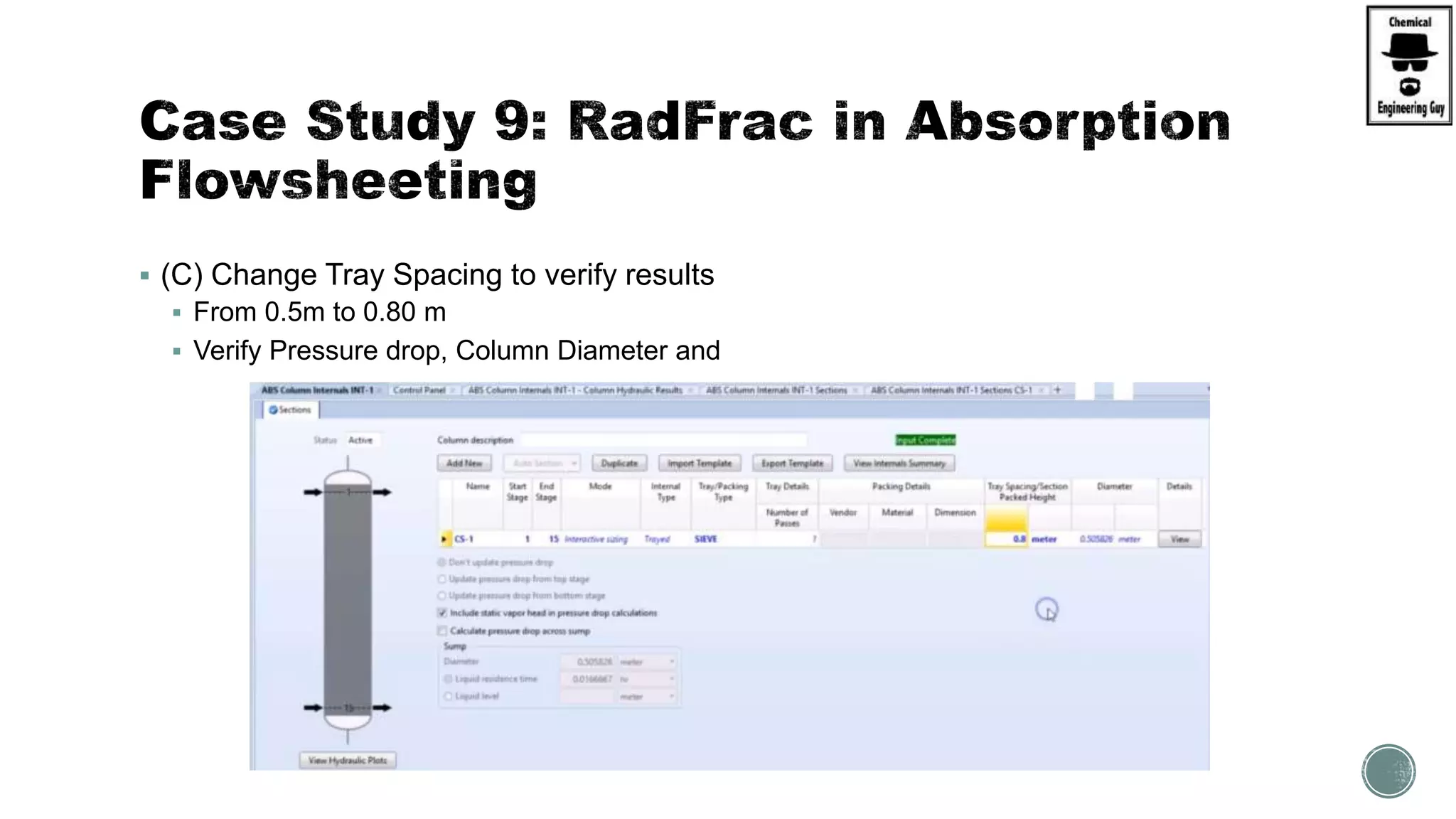
 (C) Change Tray Spacing to verify results
 From 0.5m to 0.80 m
 Verify Pressure drop, Column Diameter and
 (C) Change Tray Spacing to verify results
 From 0.5m to 0.20 m
 Verify Pressure drop, Column Diameter and
Enjoying so far?
This is a preview of the BOOTCAMP.
Join NOW here:
https://www.chemicalengineeringguy.com/courses/aspen-plus-bootcamp-with-12-case-studies/
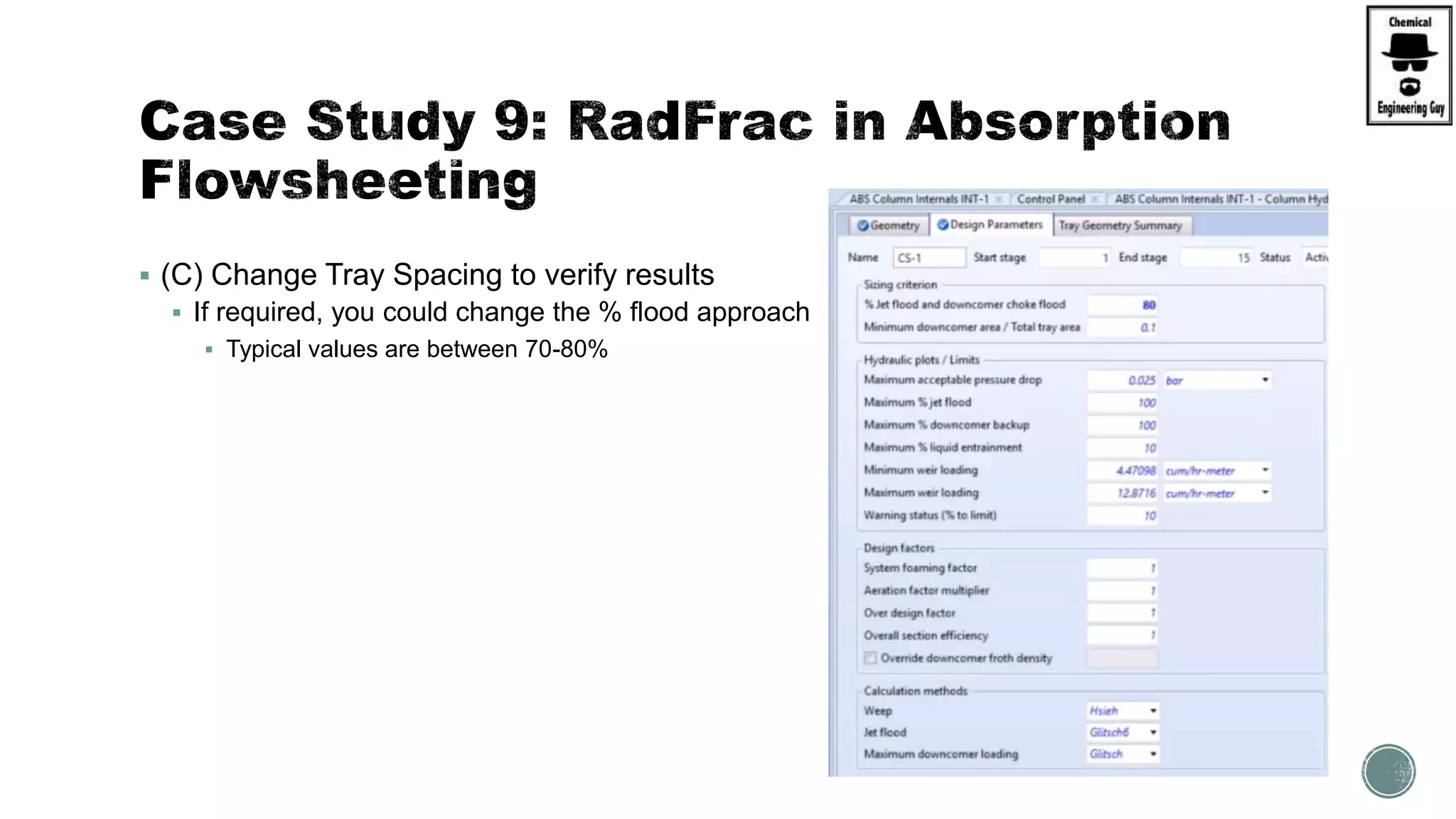
 (C) Change Tray Spacing to verify results
 If required, you could change the % flood approach
 Typical values are between 70-80%
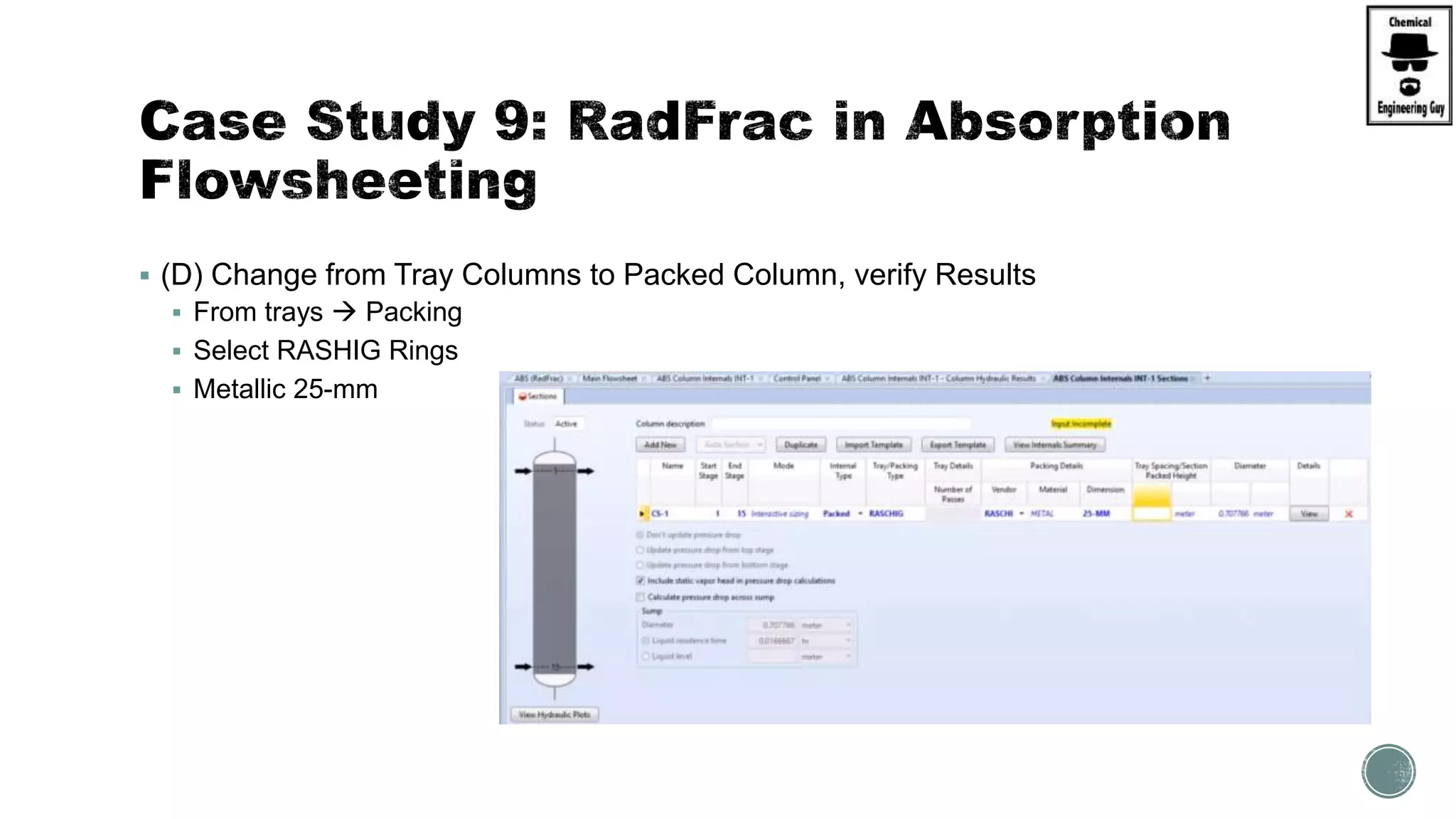
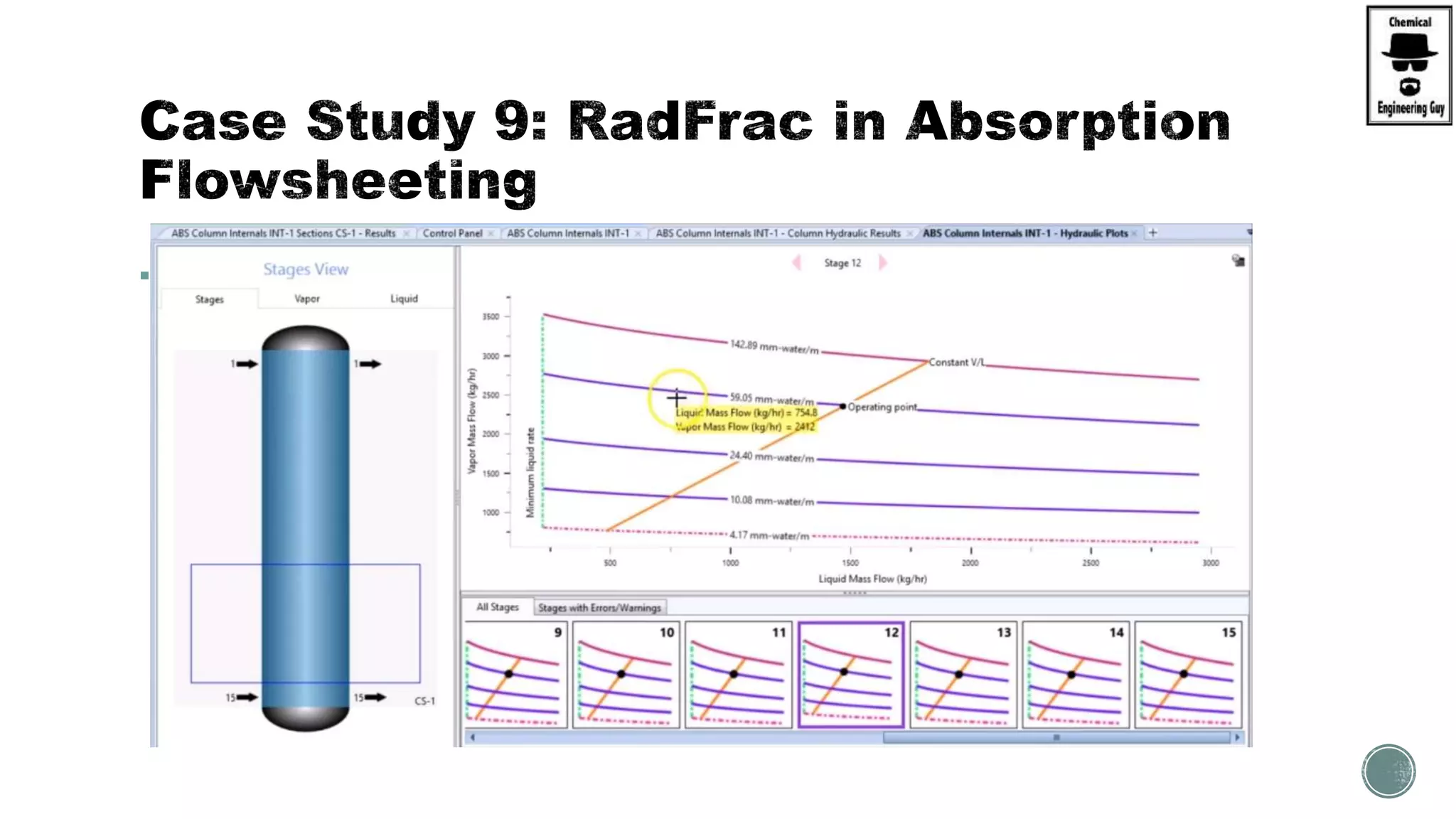
 (D) Change from Tray Columns to Packed Column, verify Results
 From trays  Packing
 Select RASHIG Rings
 Metallic 25-mm
 (D) Change from Tray Columns to Packed Column, verify Results
 Select BETA-Rings
 Metallic No. 2
Enjoying so far?
This is a preview of the BOOTCAMP.
Join NOW here:
https://www.chemicalengineeringguy.com/courses/aspen-plus-bootcamp-with-12-case-studies/
 (D) Change from Tray Columns to Packed Column, verify Results
 Select BETA-Rings
 Metallic No. 2
 Use RadFrac for rigurous distillation operations
 Multiple / Binary Distillation
 D:F, RR, DR effects
 Number of Stages
 Use Sensitivity Analysis
www.ChemicalEngineeringGuy.com
https://www.youtube.com/watch?v=8P3vOOXbiF4
WKS
29
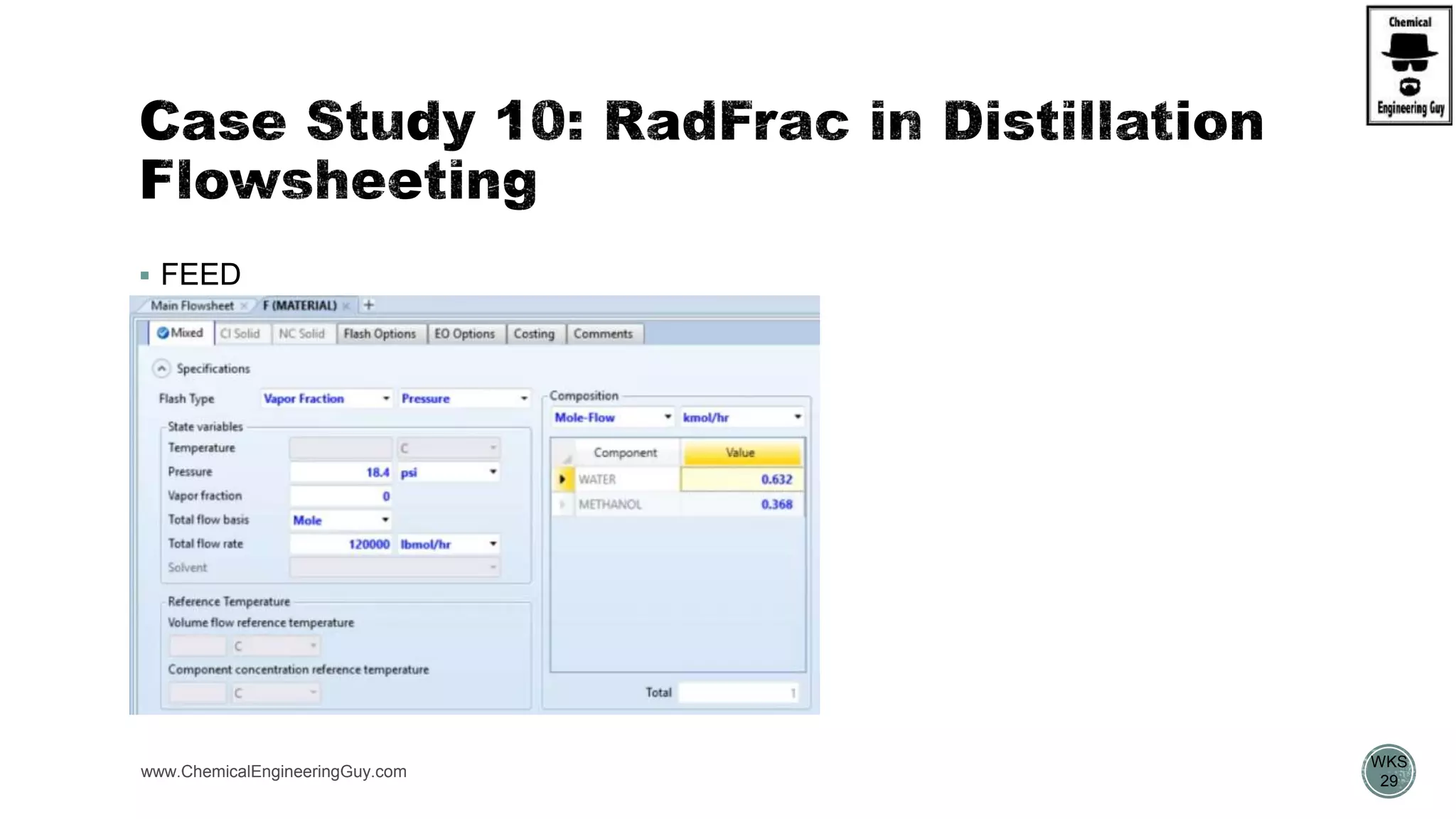
 A 1:2 water-methanol mixture must be separated
 The feed conditions are given as follows:
 P = 18.4 psi, T = ? Unkown, X = saturated vapor, i.e. it is in its dew point
 Water = 0.632 and Methanol = 0.368; asume mol Flow raltes
 Since polar-polar interaction, use activity models such as NRTL / NRTL-RK
 A series of analysis are to be run
www.ChemicalEngineeringGuy.com
https://www.youtube.com/watch?v=8P3vOOXbiF4
WKS
29
 (A) Run a RadFrac for this Distillation Column, optimize No. Stages, Feed, Recycle
Ratio and purities.
 (B) Change Column Internals
 (C) Perform Sensitivty Analysis on the column
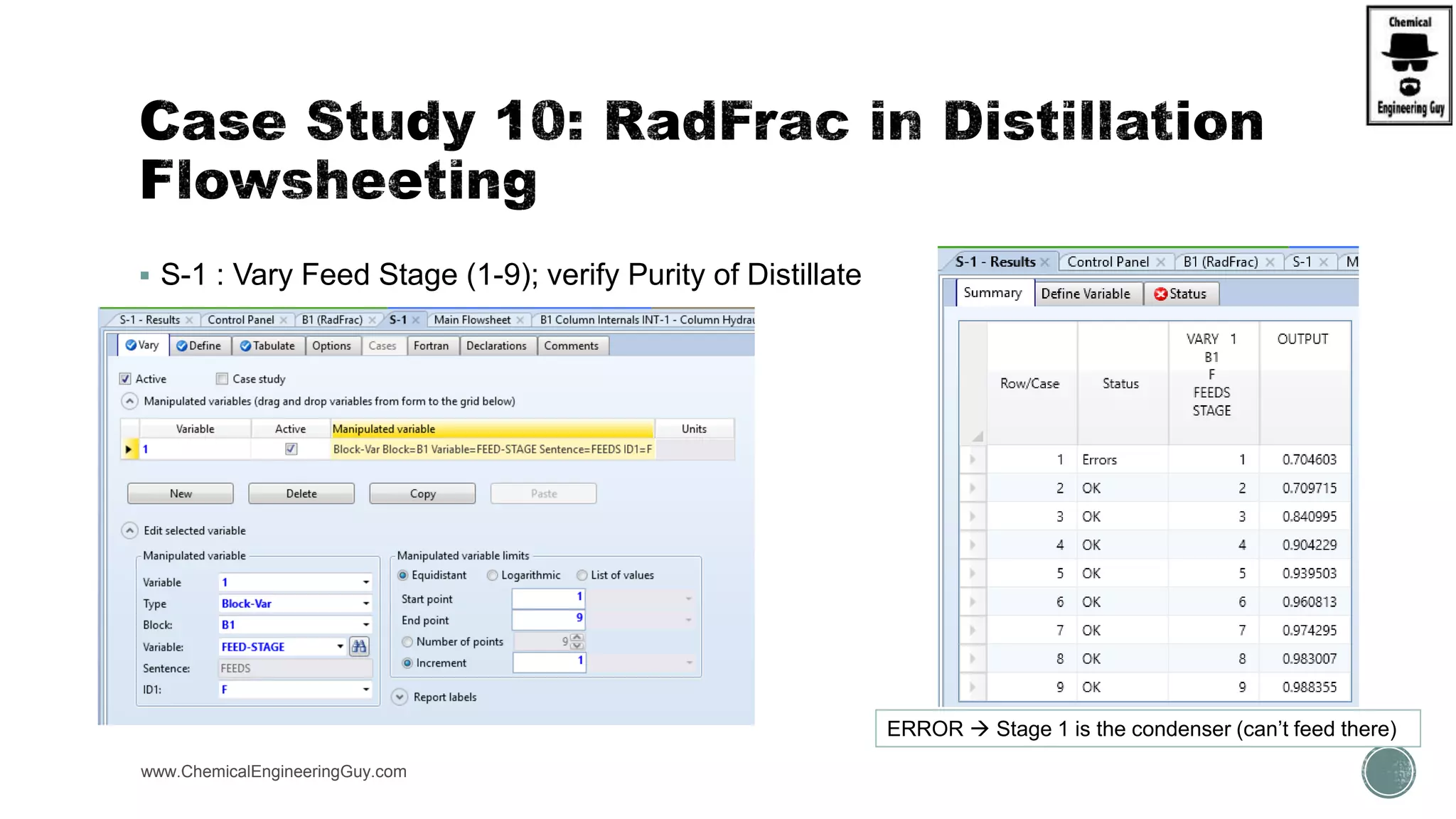
 S-1 : Vary Feed Stage (1-9); verify Purity of Distillate
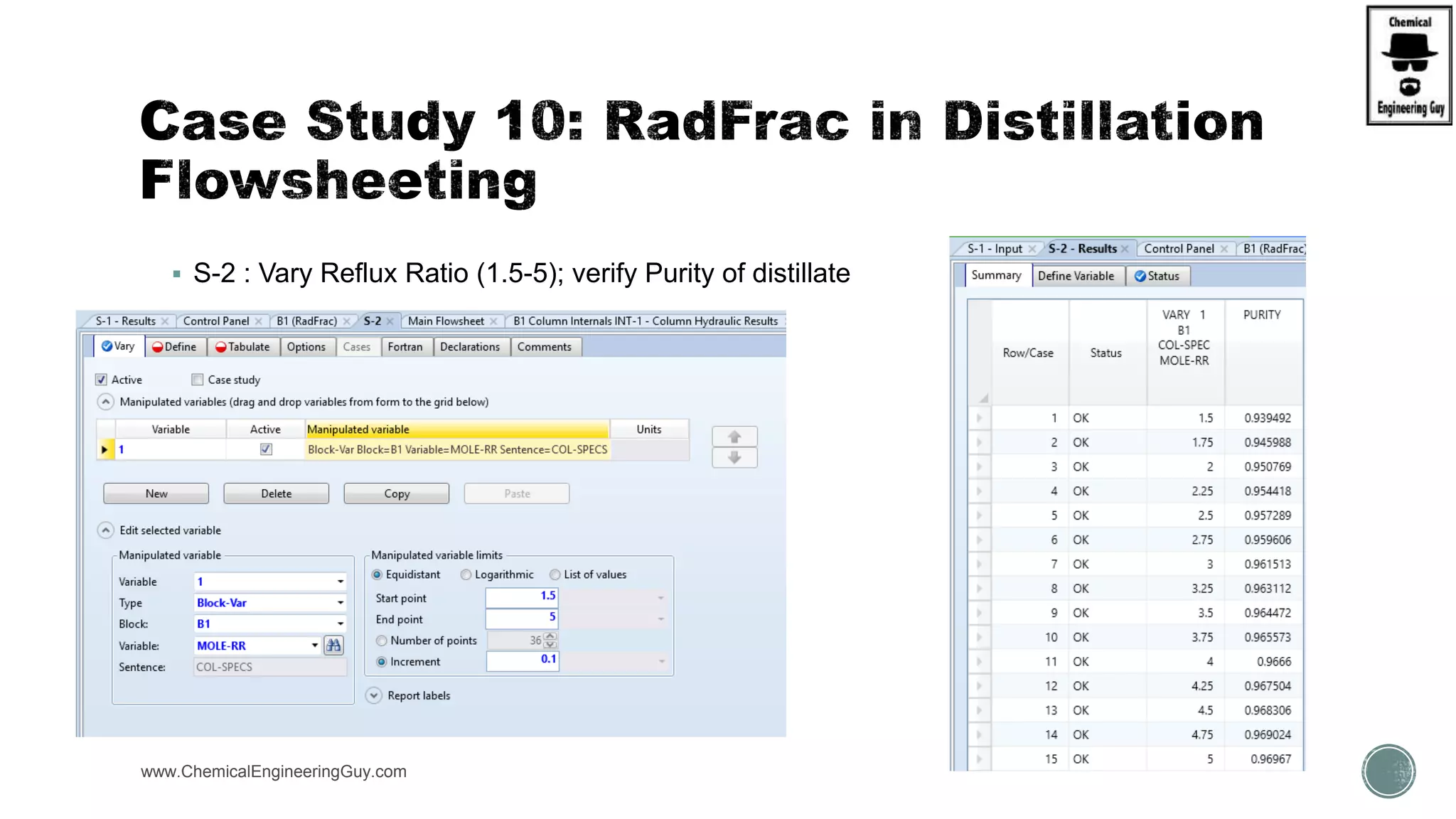
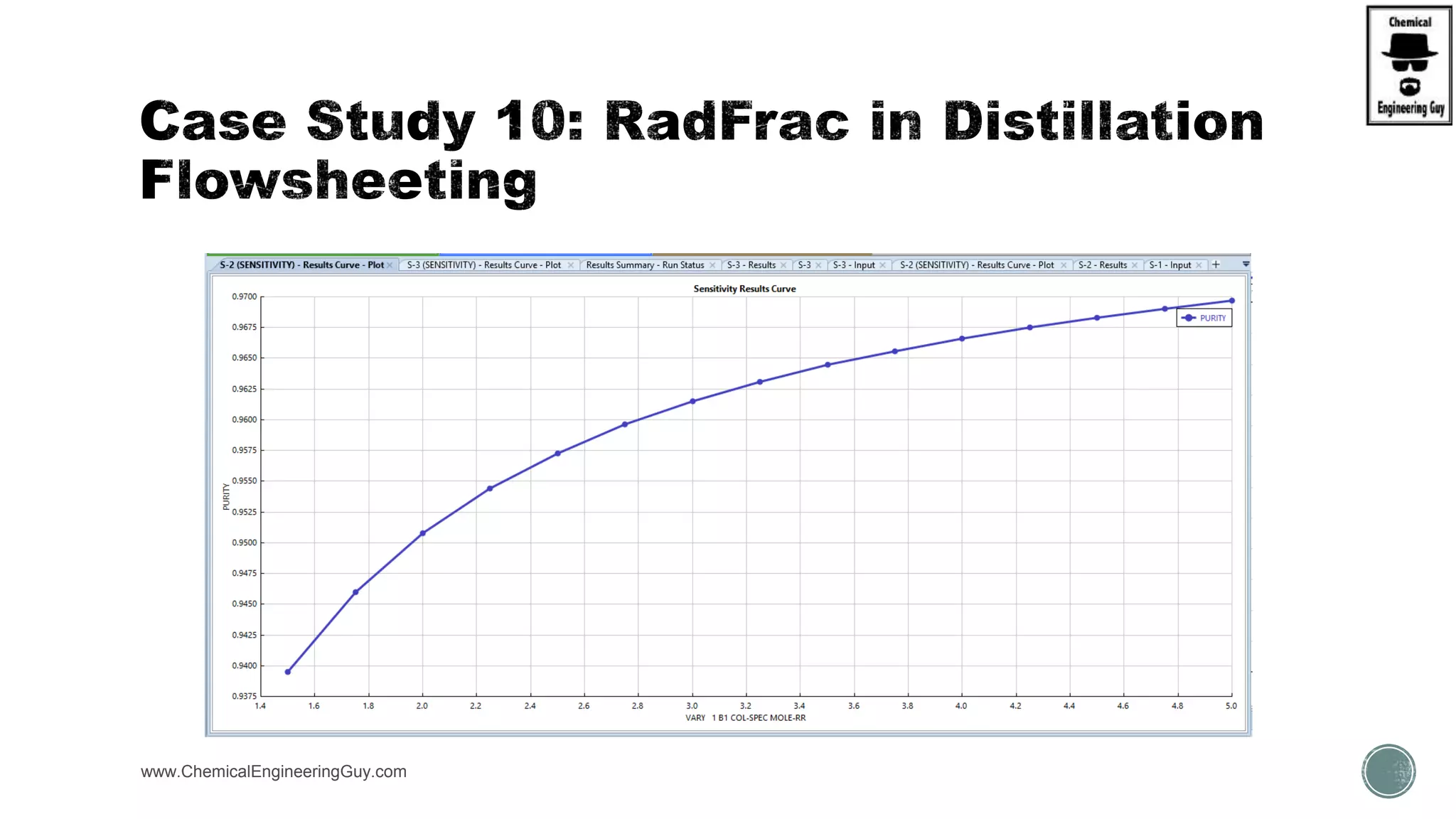
 S-2 : Vary Reflux Ratio (1.5-5); verify Purity of distillate
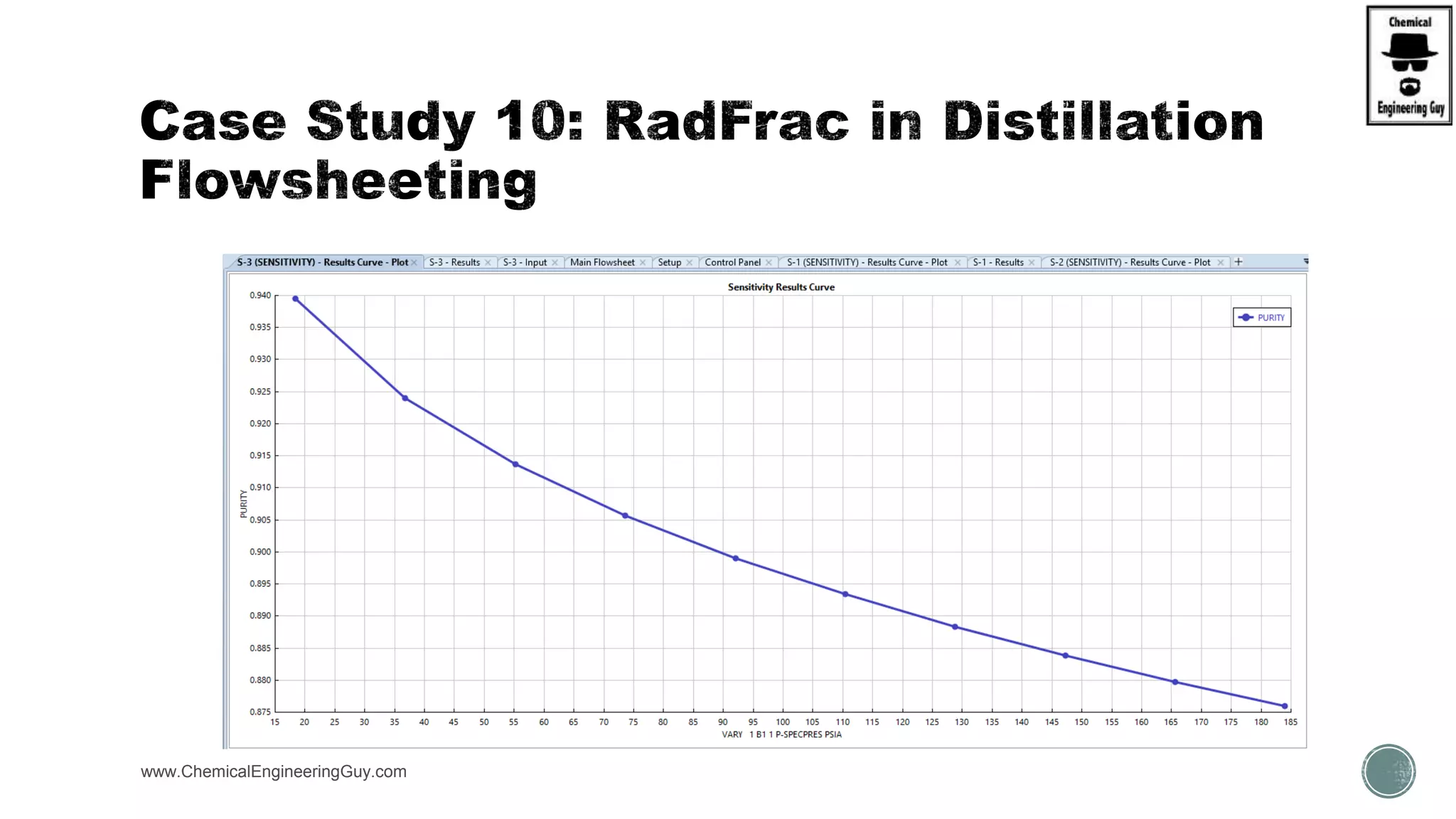
 S-3 : Vary Operating Pressure (Stage 1 – Condenser P = (18.4-184); verify Purity of distillate
www.ChemicalEngineeringGuy.com
https://www.youtube.com/watch?v=8P3vOOXbiF4
WKS
29
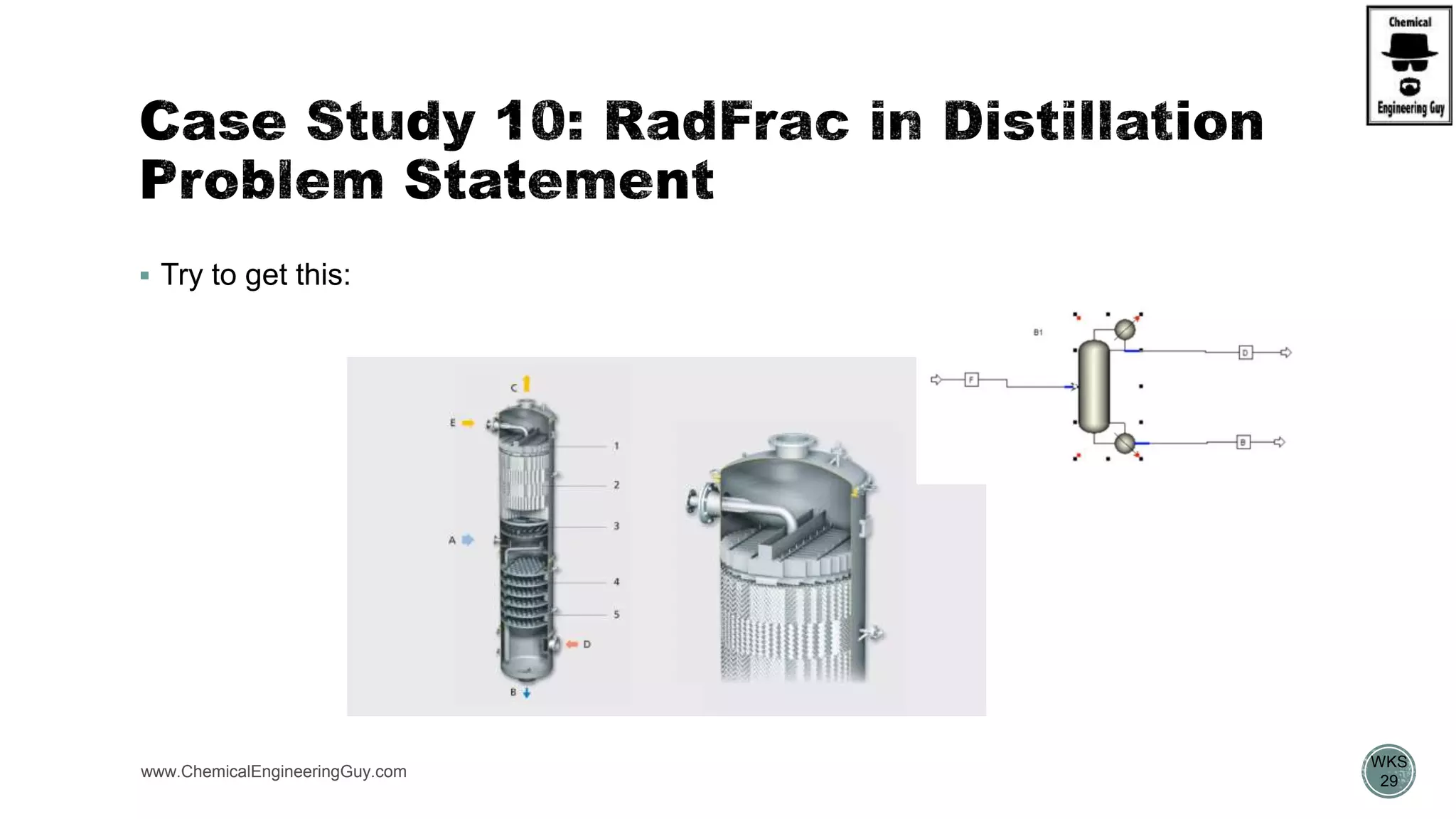
 Try to get this:
www.ChemicalEngineeringGuy.com
https://www.youtube.com/watch?v=8P3vOOXbiF4
WKS
29
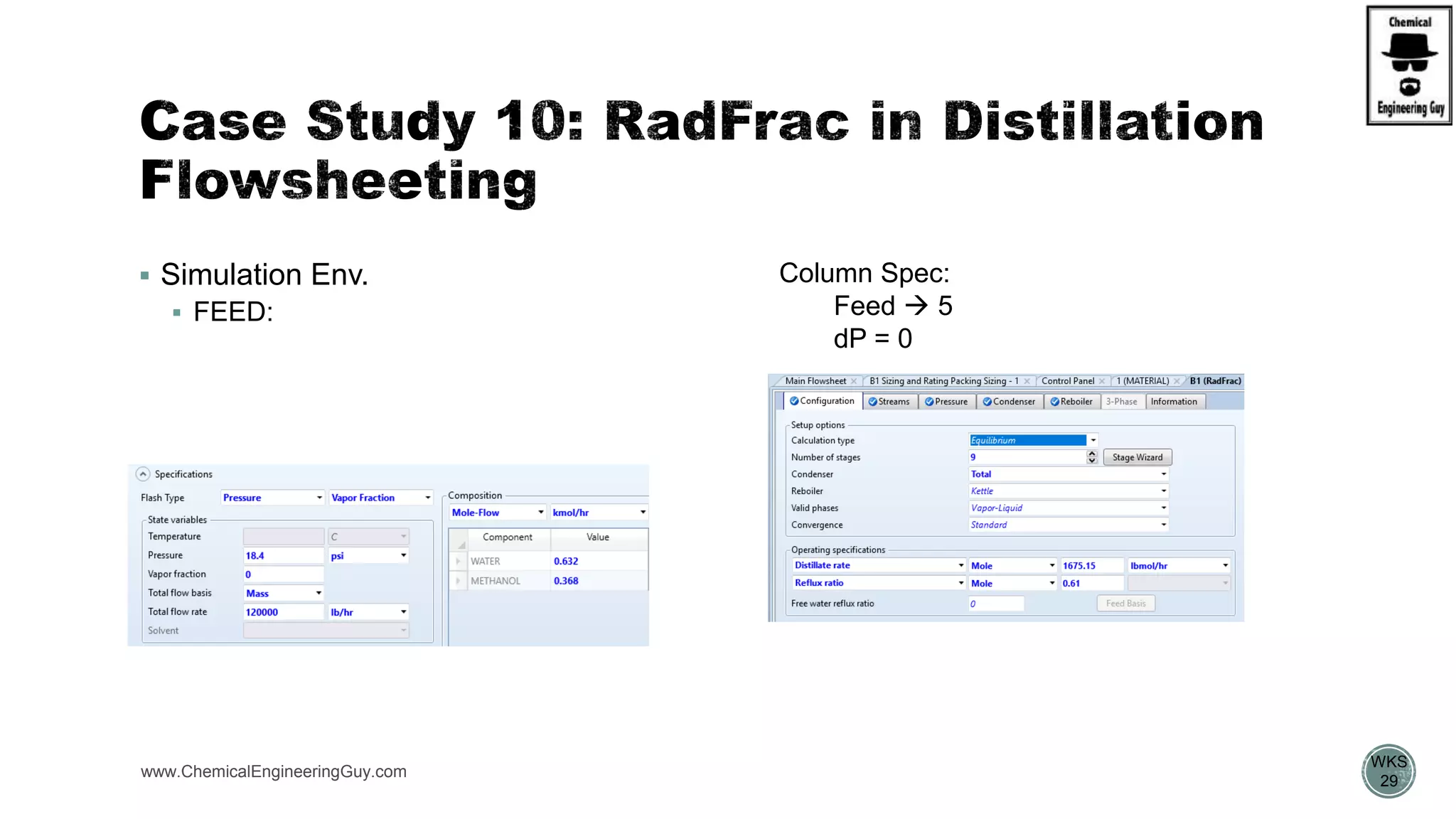
 Simulation Env.
 FEED:
www.ChemicalEngineeringGuy.com
https://www.youtube.com/watch?v=8P3vOOXbiF4
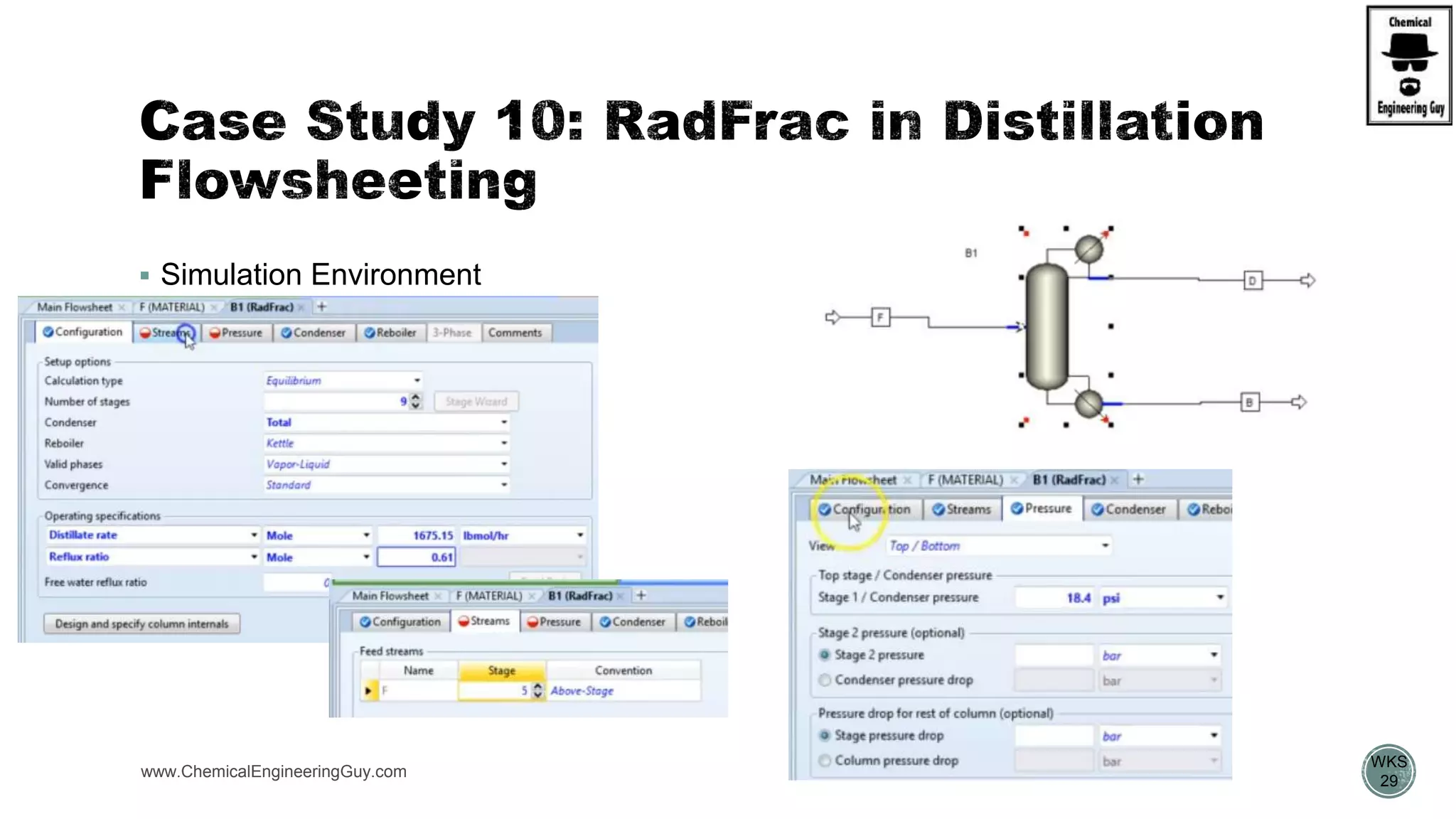
Column Spec:
Feed  5
dP = 0
WKS
29
 Phys.Prop.Env.
 Components  water, metanol
 Prop. Method  NRTL-RK
www.ChemicalEngineeringGuy.com
https://www.youtube.com/watch?v=8P3vOOXbiF4
WKS
29
Enjoying so far?
This is a preview of the BOOTCAMP.
Join NOW here:
https://www.chemicalengineeringguy.com/courses/aspen-plus-bootcamp-with-12-case-studies/
 FEED
www.ChemicalEngineeringGuy.com
https://www.youtube.com/watch?v=8P3vOOXbiF4
WKS
29
 Simulation Environment
www.ChemicalEngineeringGuy.com
https://www.youtube.com/watch?v=8P3vOOXbiF4
WKS
29
www.ChemicalEngineeringGuy.com
https://www.youtube.com/watch?v=8P3vOOXbiF4
 Add 
 Trays
 Packaging
WKS
29
Enjoying so far?
This is a preview of the BOOTCAMP.
Join NOW here:
https://www.chemicalengineeringguy.com/courses/aspen-plus-bootcamp-with-12-case-studies/
www.ChemicalEngineeringGuy.com
https://www.youtube.com/watch?v=8P3vOOXbiF4
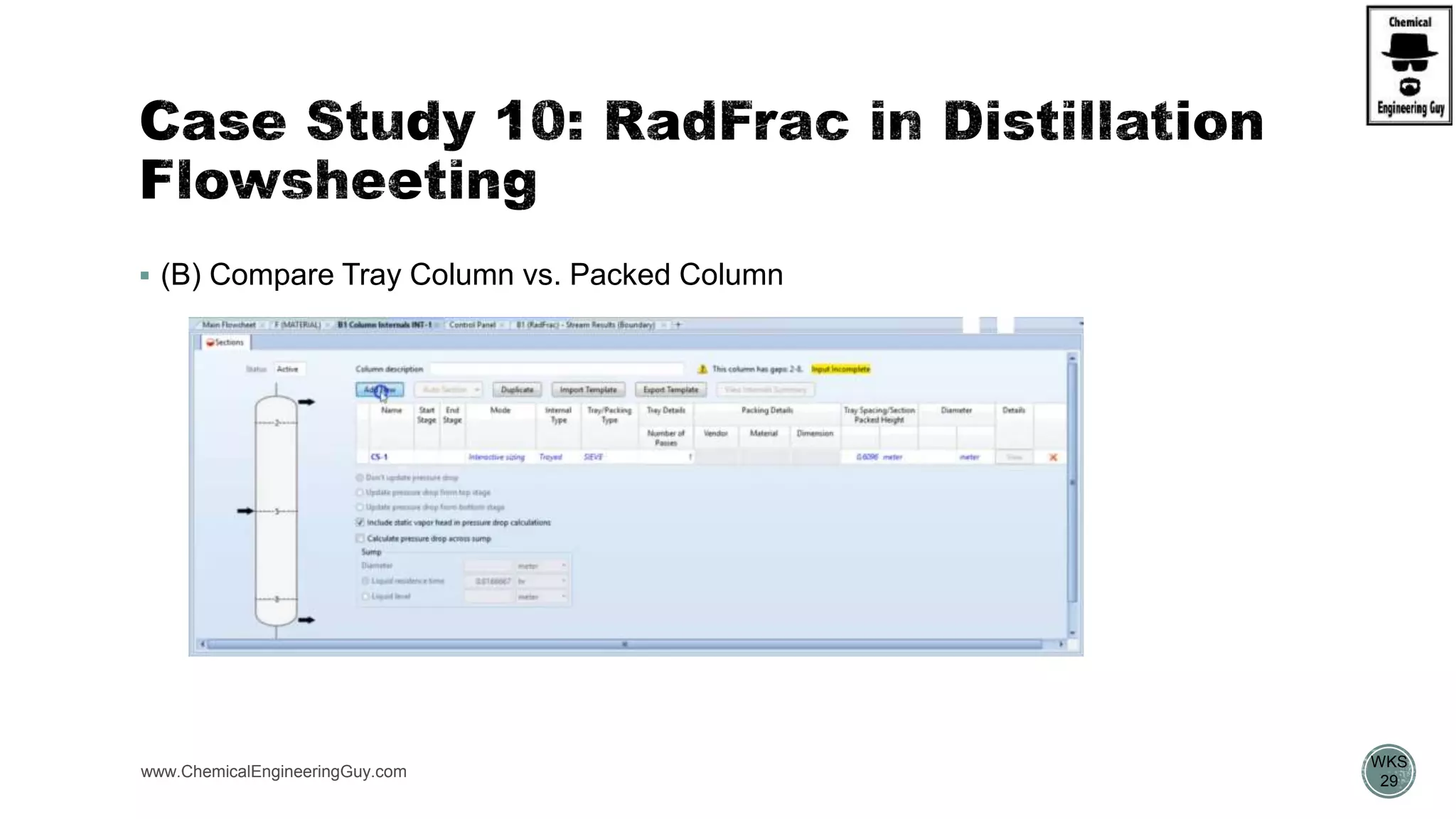
 (B) Compare Tray Column vs. Packed Column
WKS
29
www.ChemicalEngineeringGuy.com
https://www.youtube.com/watch?v=8P3vOOXbiF4
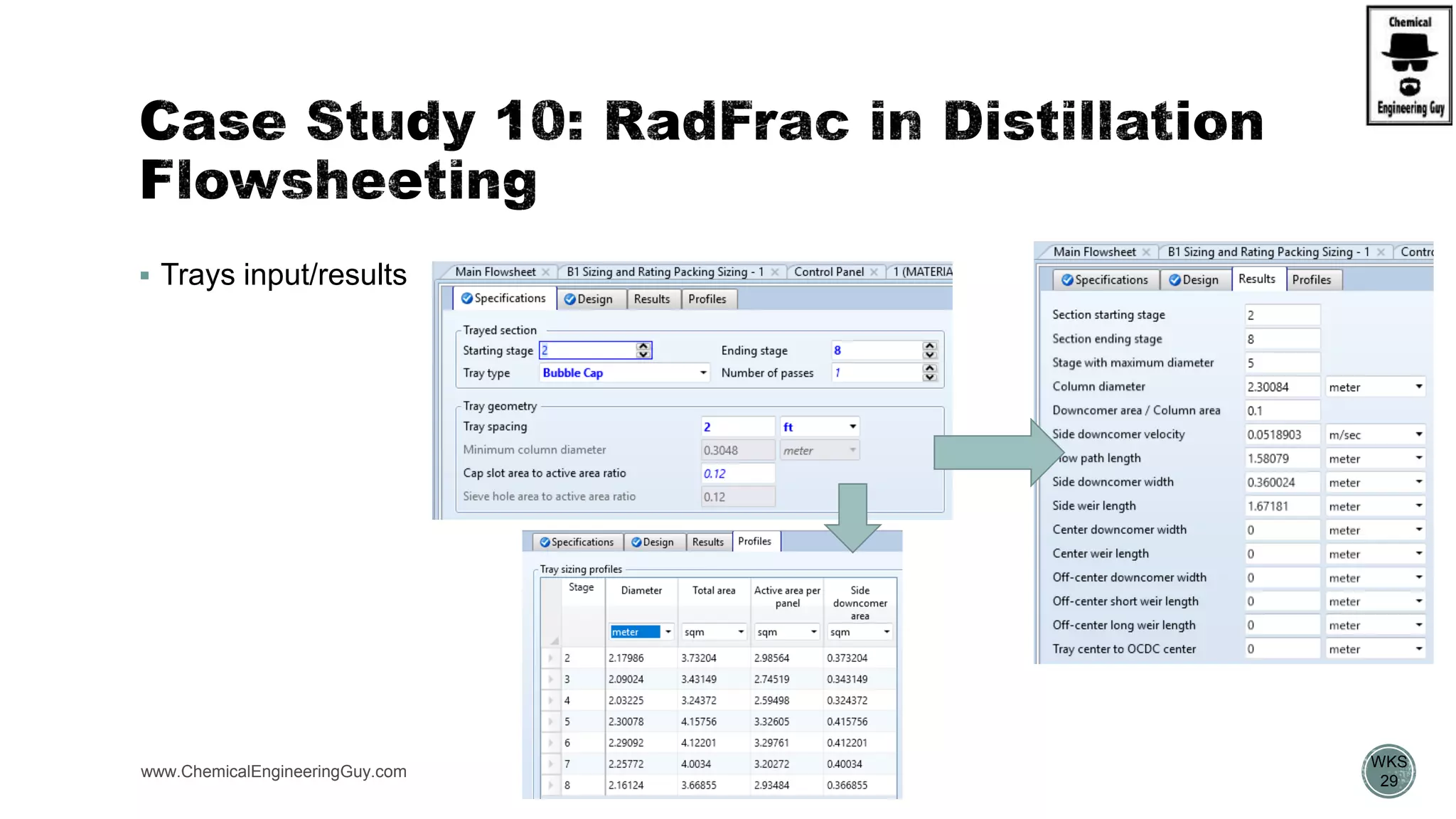
 Trays input/results
WKS
29
www.ChemicalEngineeringGuy.com
https://www.youtube.com/watch?v=8P3vOOXbiF4
 Packing input/results
WKS
29
Enjoying so far?
This is a preview of the BOOTCAMP.
Join NOW here:
https://www.chemicalengineeringguy.com/courses/aspen-plus-bootcamp-with-12-case-studies/
 (C) Apply Sensitivity Analysis for further Analysis
 S-1 : Vary Feed Stage (1-9); verify Purity of Distillate
 S-2 : Vary Reflux Ratio (1.5-5); verify Purity of distillate
 S-3 : Vary Operating Pressure (Stage 1 – Condenser P = (18.4-184); verify Purity of distillate
 Graph each result
www.ChemicalEngineeringGuy.com
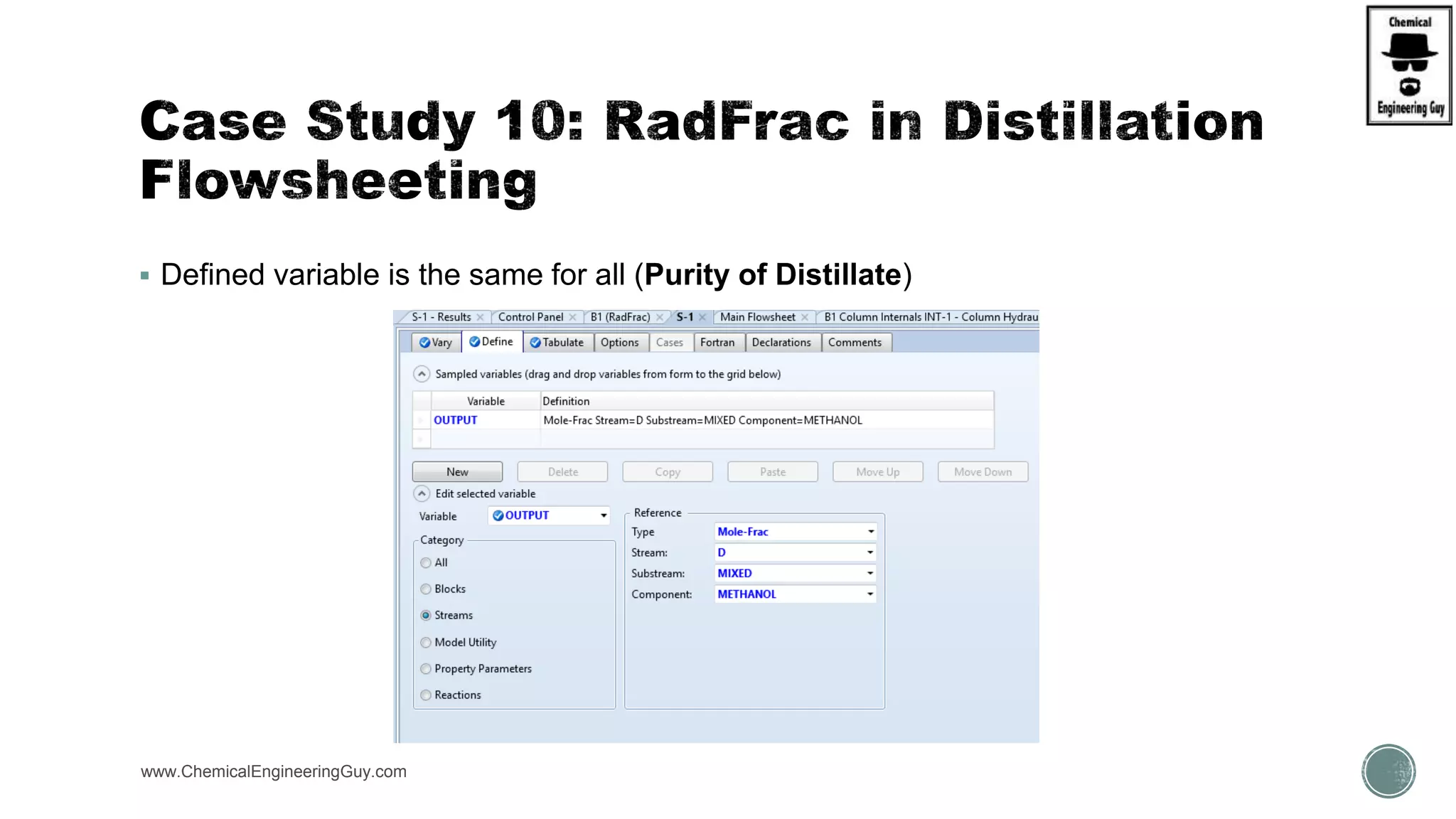
 Defined variable is the same for all (Purity of Distillate)
www.ChemicalEngineeringGuy.com
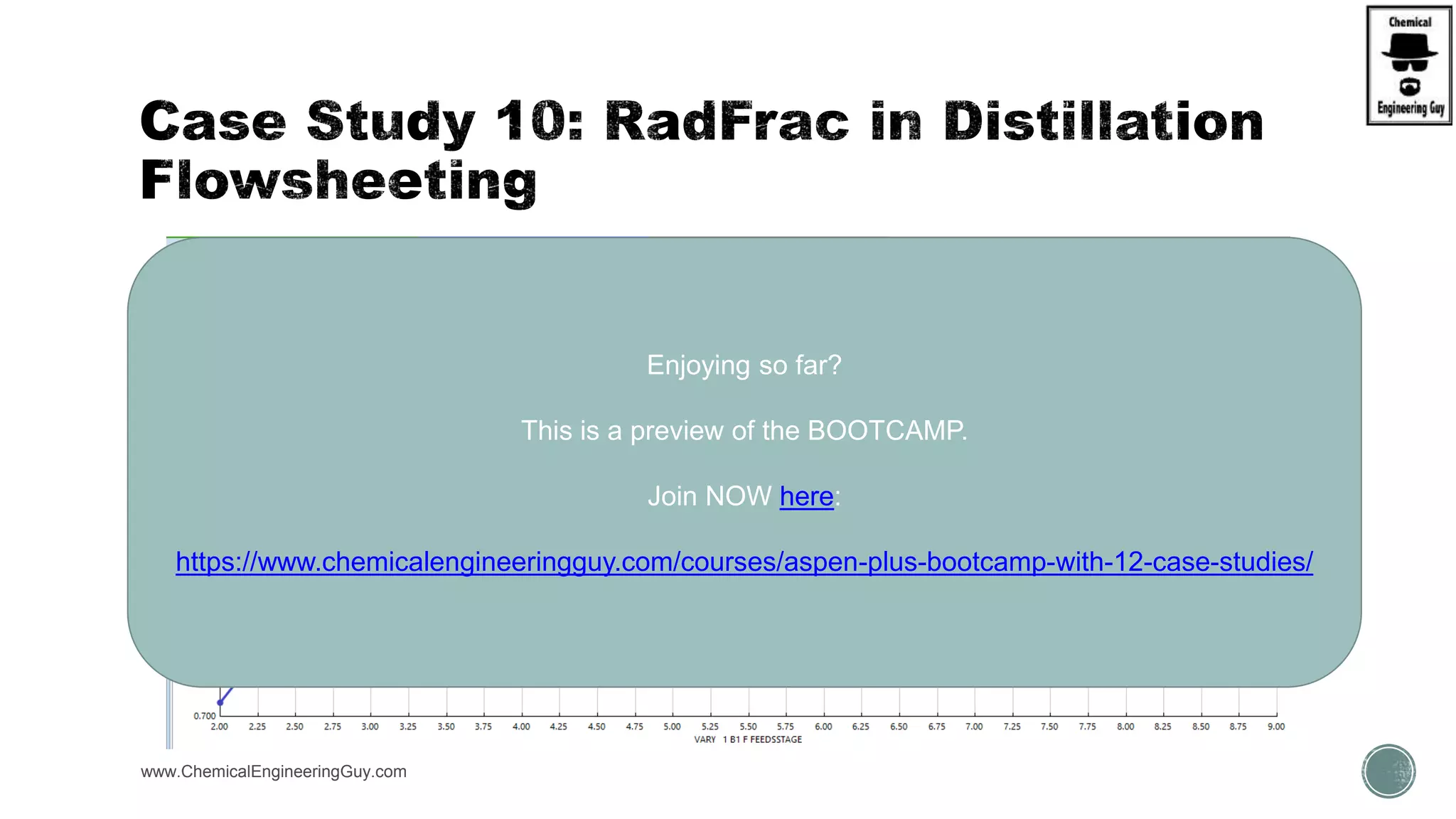
 S-1 : Vary Feed Stage (1-9); verify Purity of Distillate
www.ChemicalEngineeringGuy.com
ERROR  Stage 1 is the condenser (can’t feed there)
www.ChemicalEngineeringGuy.com
Enjoying so far?
This is a preview of the BOOTCAMP.
Join NOW here:
https://www.chemicalengineeringguy.com/courses/aspen-plus-bootcamp-with-12-case-studies/
 S-2 : Vary Reflux Ratio (1.5-5); verify Purity of distillate
www.ChemicalEngineeringGuy.com
 S-3 : Vary Operating Pressure (Stage 1 – Condenser P = (18.4-184); verify Purity of distillate
www.ChemicalEngineeringGuy.com
Enjoying so far?
This is a preview of the BOOTCAMP.
Join NOW here:
https://www.chemicalengineeringguy.com/courses/aspen-plus-bootcamp-with-12-case-studies/
www.ChemicalEngineeringGuy.com
 Plant Economy & Dynamic Control
11. Ammonia Economics
12. Plant Dynamics & Control
www.ChemicalEngineeringGuy.com
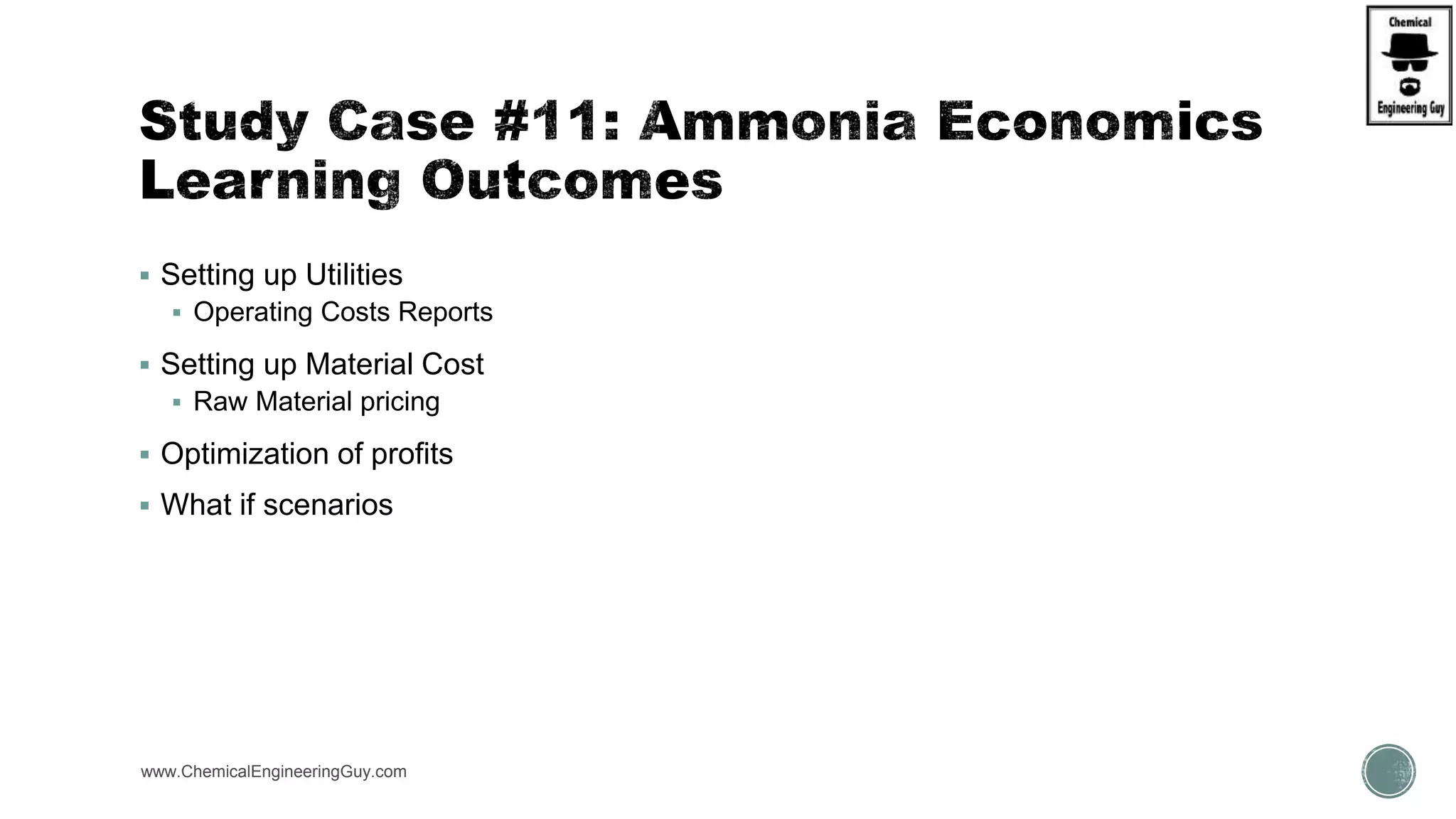
 Setting up Utilities
 Operating Costs Reports
 Setting up Material Cost
 Raw Material pricing
 Optimization of profits
 What if scenarios
www.ChemicalEngineeringGuy.com https://www.youtube.com/watch?v=bWJ2A28oPW0&t=18s
 Ammonia is to be produced via the reaction of N2 and H2 using the Haber process.
There is no oxygen in the feed, only trace material such as methane, argon and
carbon monoxide. The reactor is isothermal, and has a 40% conversion based on the
inlet of nitrogen gas. The cryogenic mix is then cooled down to separate it. The gases,
mostly Nitrogen and Hydrogen gas are recycled, all other material purged and the
liquid product goes to the “Ammonia” product line.
 Pressure is approx. 270 atm through all the system
 Main focus is to produce 95%+ Ammonia product
 Utilities are to be added, as well as some raw materials / products economics
 Analysis is carried out in Europe and USA
www.ChemicalEngineeringGuy.com
 Prices in USA
 Materials
 Syngas = $0.26/kg
 Product = $0.50/kg
 Utilities
 Electricity = $0.06/kWh
 Cooling Water = $0.0251$/tonne  -33.44 kJ/kk
 Natural Gas = $5.8 / MMBTU  $20.63 MBTU/lb
 Prices in EU
 Materials
 Syngas = $0.32/kg
 Product = $0.550/kg
 Utilities
 Electricity = $0.075/kWh
 Cooling Water = $0.0301$/tonne  35.44 kJ/kk
 Natural Gas = $5.2 / MMBTU  $18.49 MBTU/lb
www.ChemicalEngineeringGuy.com
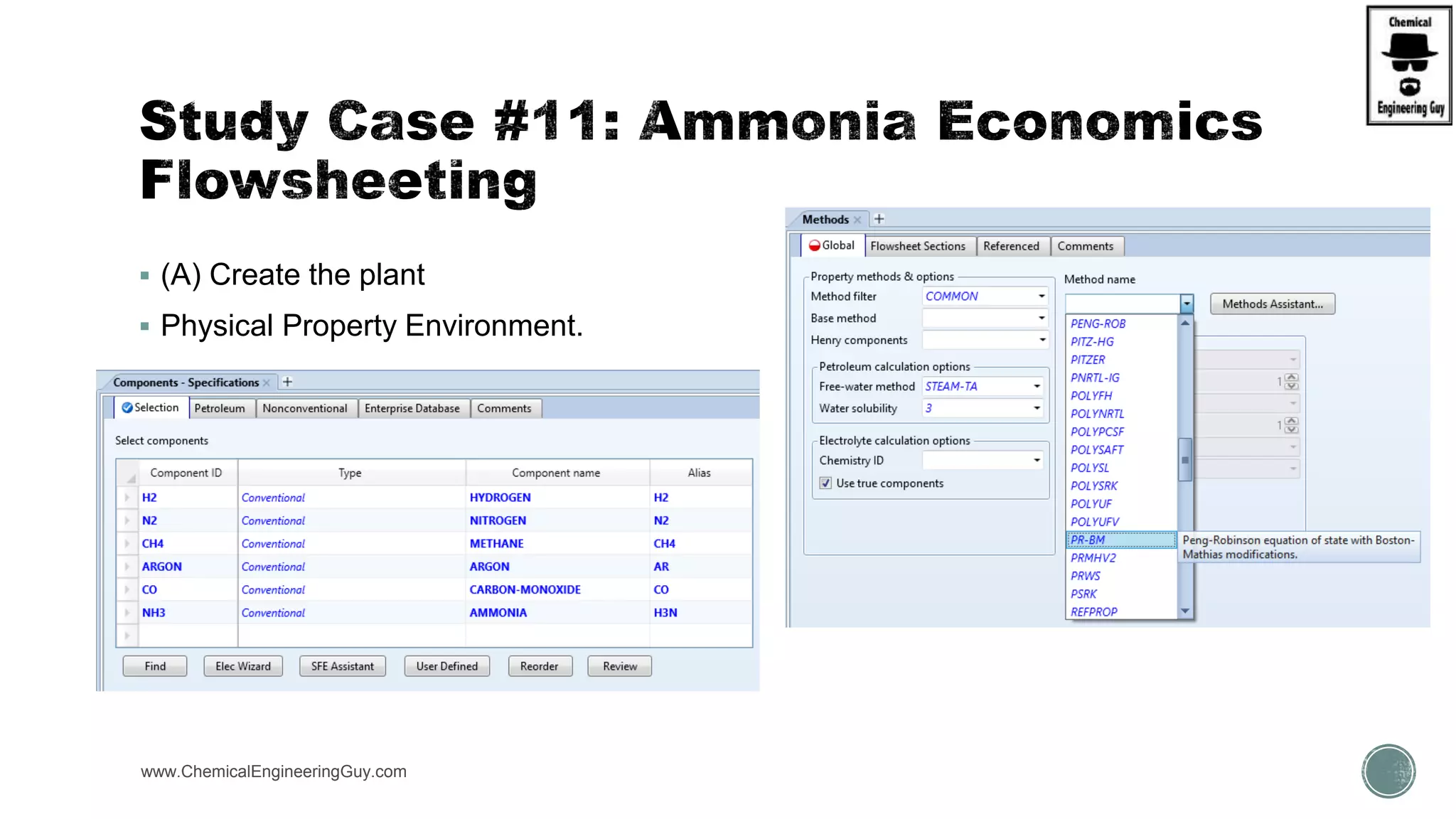
 (A) Create the plant
 (B) Add Materials Costs & Utilities
 (C) Compare USA vs. Europe Costings
 (D) Sensitivity Analysis of Prices
 (E) Verify the “Economic Analysis” and Economic Reports
www.ChemicalEngineeringGuy.com
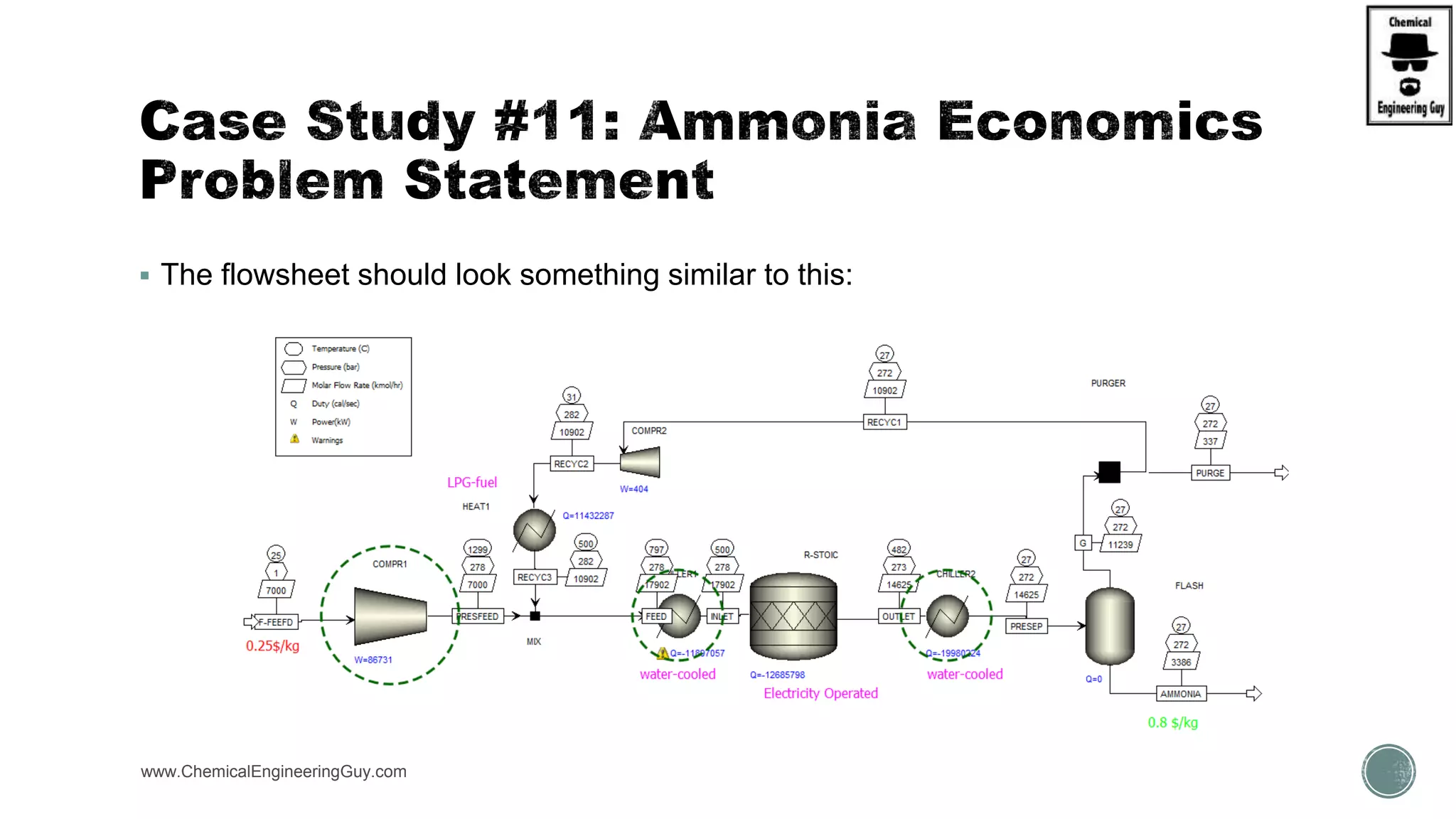
 The flowsheet should look something similar to this:
 (A) Create the plant
 Physical Property Environment.
www.ChemicalEngineeringGuy.com
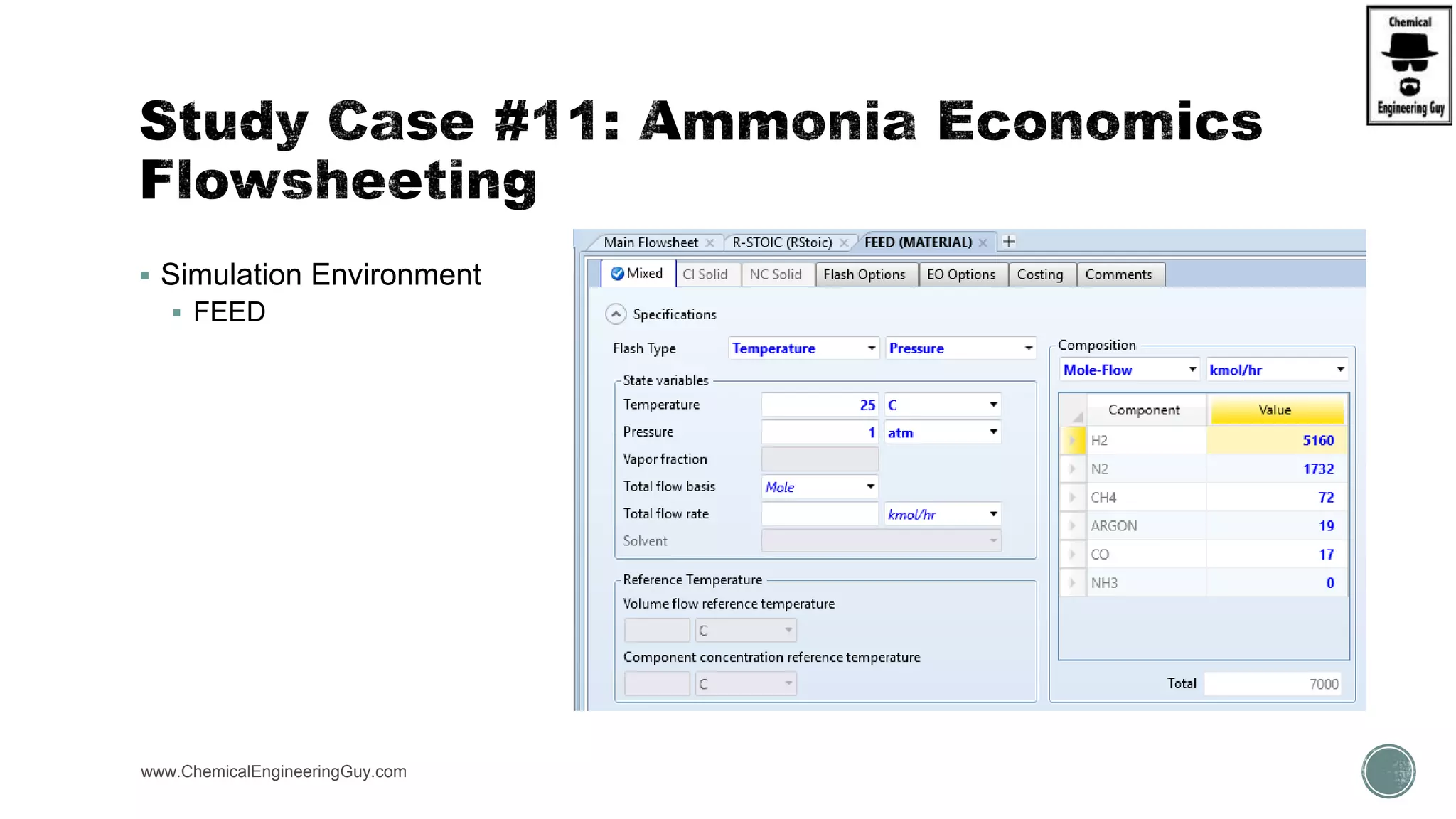
 Simulation Environment
 FEED
www.ChemicalEngineeringGuy.com
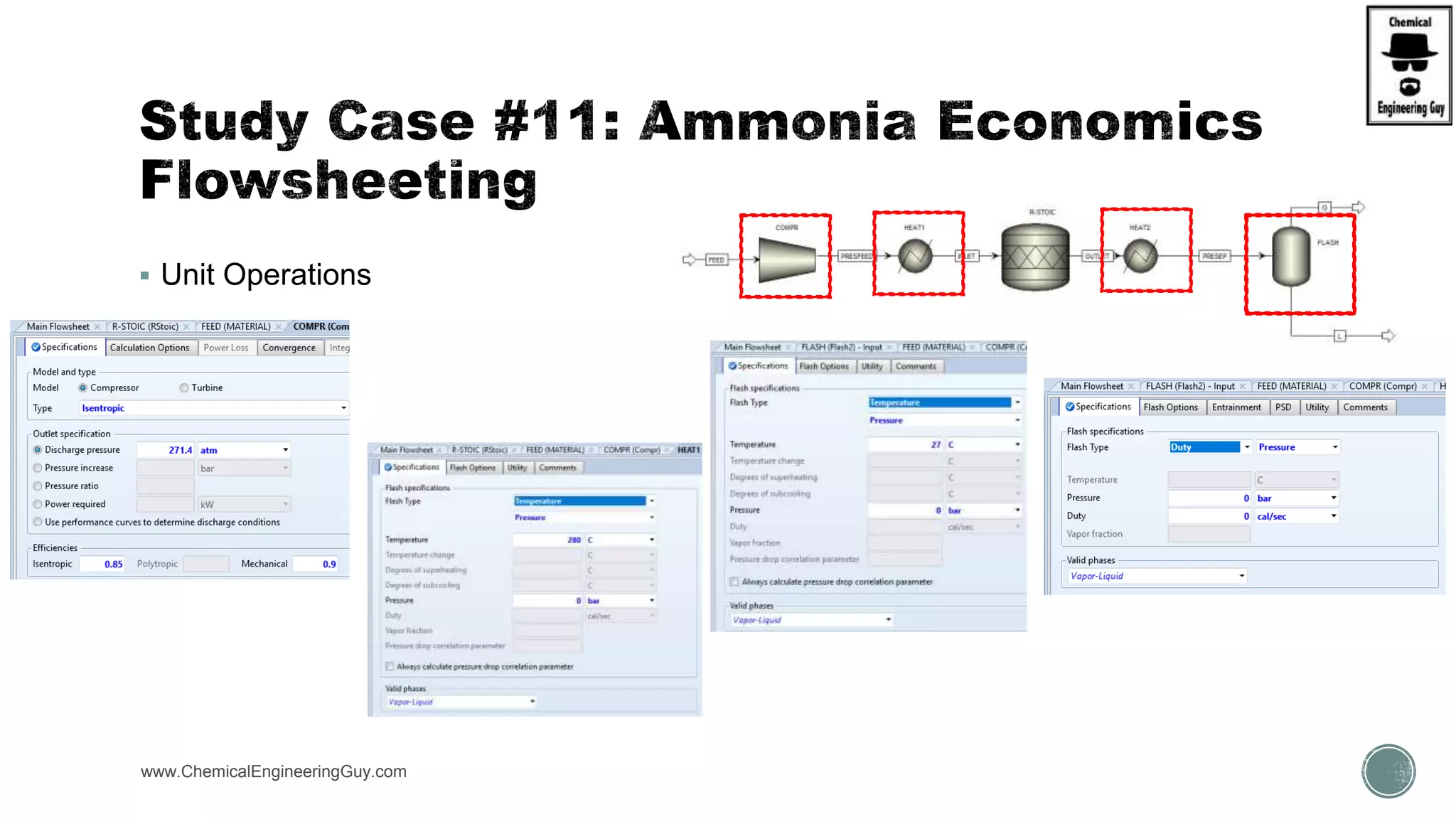
 Unit Operations
www.ChemicalEngineeringGuy.com
 Unit Operations - RKT
www.ChemicalEngineeringGuy.com
Enjoying so far?
This is a preview of the BOOTCAMP.
Join NOW here:
https://www.chemicalengineeringguy.com/courses/aspen-plus-bootcamp-with-12-case-studies/
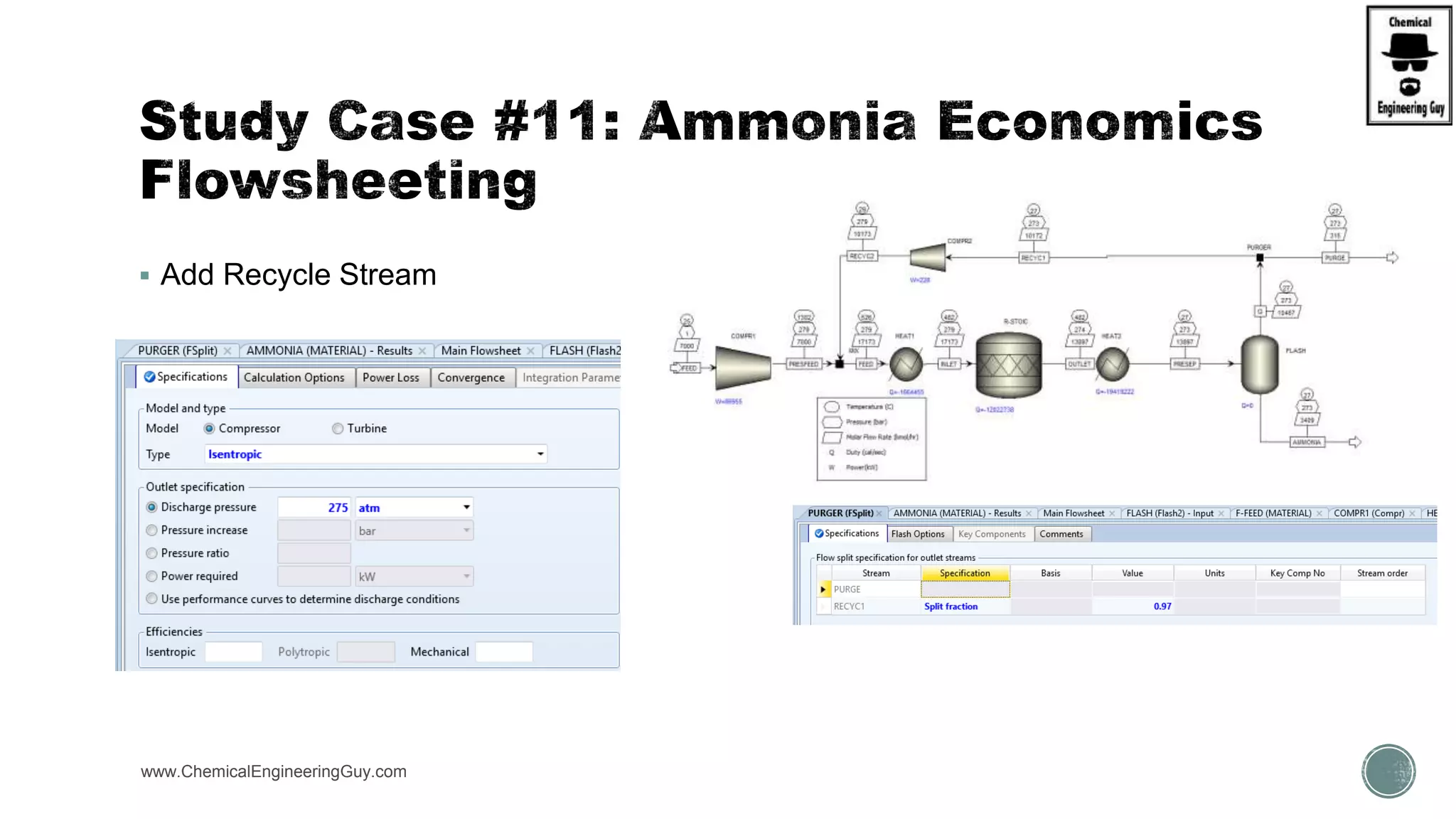
 Add Recycle Stream
www.ChemicalEngineeringGuy.com
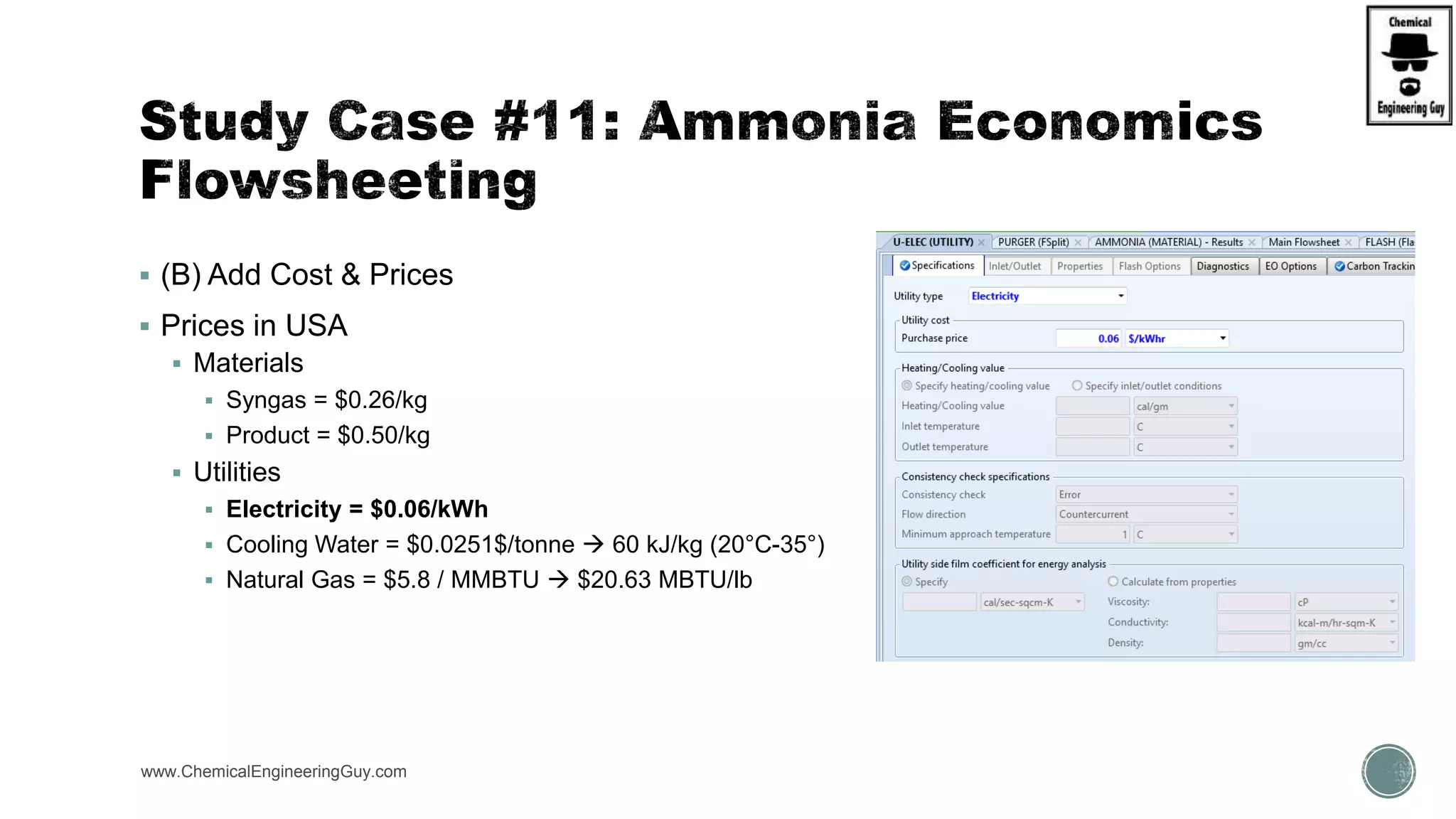
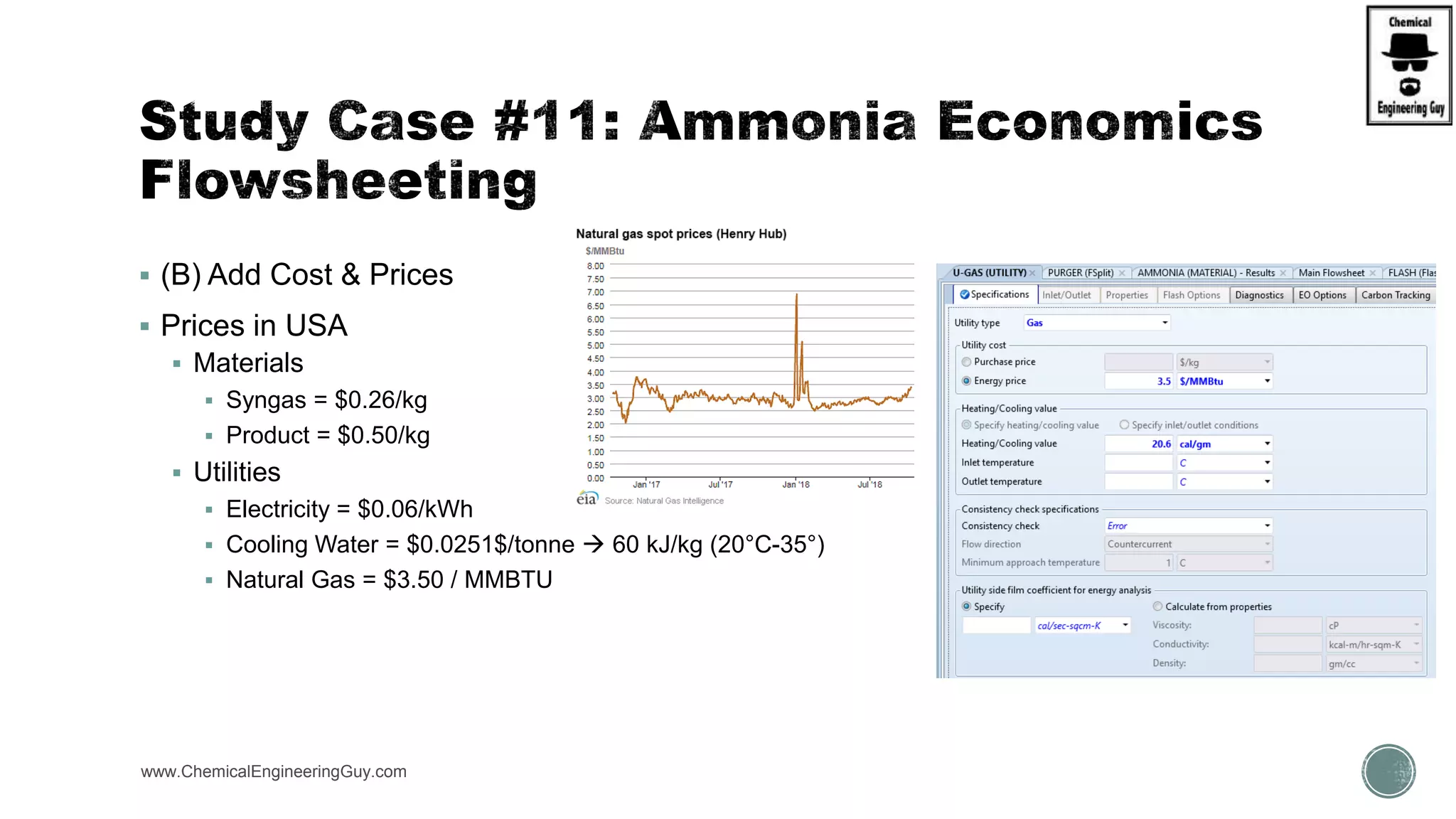
 (B) Add Cost & Prices
 Prices in USA
 Materials
 Syngas = $0.26/kg
 Product = $0.50/kg
 Utilities
 Electricity = $0.06/kWh
 Cooling Water = $0.0251$/tonne  60 kJ/kg (20°C-35°)
 Natural Gas = $5.8 / MMBTU  $20.63 MBTU/lb
www.ChemicalEngineeringGuy.com
Enjoying so far?
This is a preview of the BOOTCAMP.
Join NOW here:
https://www.chemicalengineeringguy.com/courses/aspen-plus-bootcamp-with-12-case-studies/
 (B) Add Cost & Prices
 Prices in USA
 Materials
 Syngas = $0.26/kg
 Product = $0.50/kg
 Utilities
 Electricity = $0.06/kWh
 Cooling Water = $0.0251$/tonne  60 kJ/kg (20°C-35°)
 Natural Gas = $5.8 / MMBTU  $20.63 MBTU/lb
www.ChemicalEngineeringGuy.com
 (B) Add Cost & Prices
 Prices in USA
 Materials
 Syngas = $0.26/kg
 Product = $0.50/kg
 Utilities
 Electricity = $0.06/kWh
 Cooling Water = $0.0251$/tonne  60 kJ/kg (20°C-35°)
 Natural Gas = $5.8 / MMBTU  $20.63 MBTU/lb
www.ChemicalEngineeringGuy.com
Q = m*c*dT
Q=(1kg)(4.18kJ/KgC)(35-25°
Q= 62.4 kJ/kg
Enjoying so far?
This is a preview of the BOOTCAMP.
Join NOW here:
https://www.chemicalengineeringguy.com/courses/aspen-plus-bootcamp-with-12-case-studies/
 (B) Add Cost & Prices
 Prices in USA
 Materials
 Syngas = $0.26/kg
 Product = $0.50/kg
 Utilities
 Electricity = $0.06/kWh
 Cooling Water = $0.0251$/tonne  60 kJ/kg (20°C-35°)
 Natural Gas = $3.50 / MMBTU
www.ChemicalEngineeringGuy.com
 (B) Add Cost & Prices
 Prices in USA
 Materials
 Syngas = $0.26/kg
 Product = $0.50/kg
 Utilities
 Electricity = $0.06/kWh
 Cooling Water = $0.0251$/tonne  33.44 kJ/kk
 Natural Gas = $5.8 / MMBTU  $20.63 MBTU/lb
www.ChemicalEngineeringGuy.com
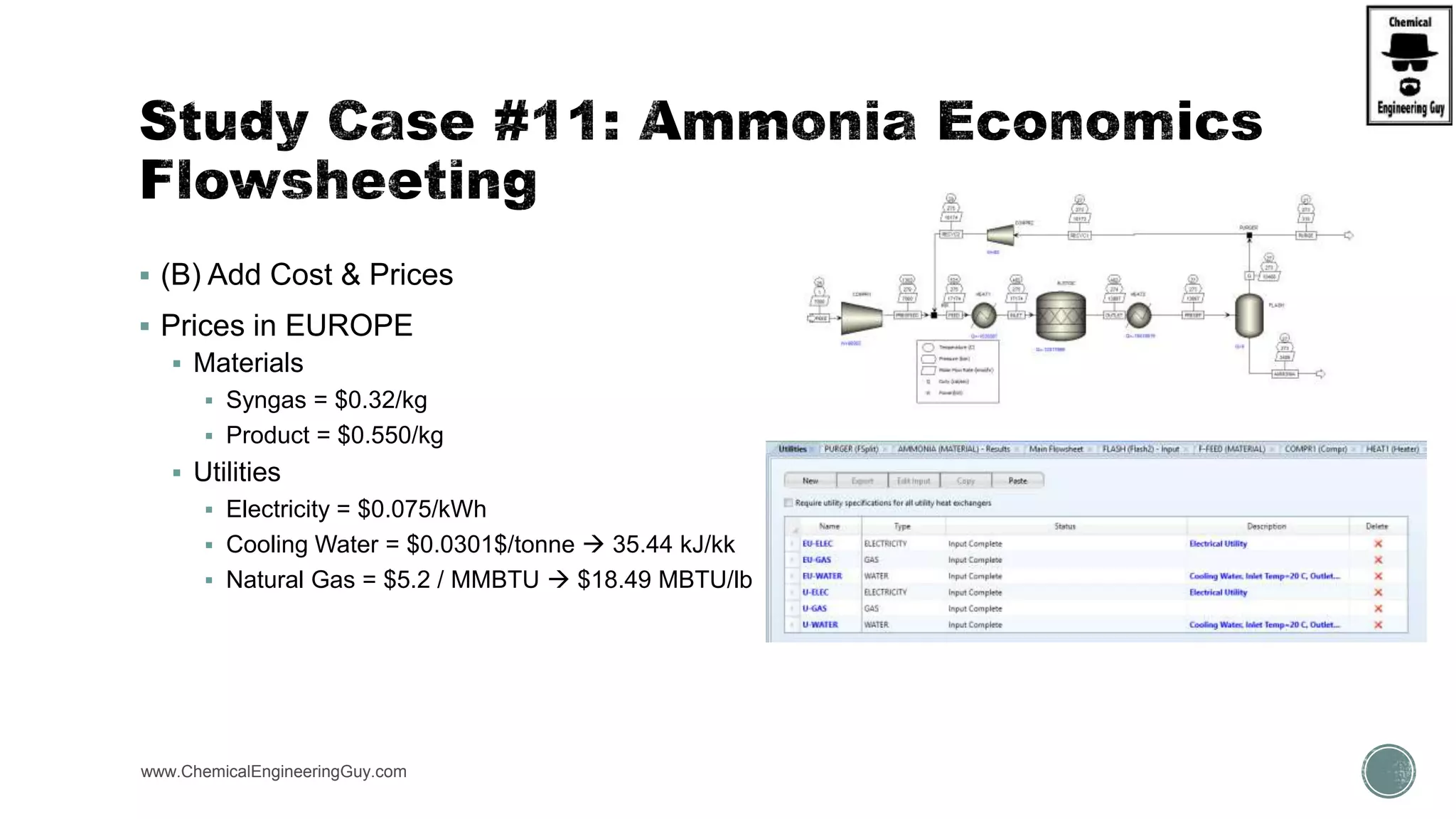
 (B) Add Cost & Prices
 Prices in EUROPE
 Materials
 Syngas = $0.32/kg
 Product = $0.550/kg
 Utilities
 Electricity = $0.075/kWh
 Cooling Water = $0.0301$/tonne  35.44 kJ/kk
 Natural Gas = $5.2 / MMBTU  $18.49 MBTU/lb
www.ChemicalEngineeringGuy.com
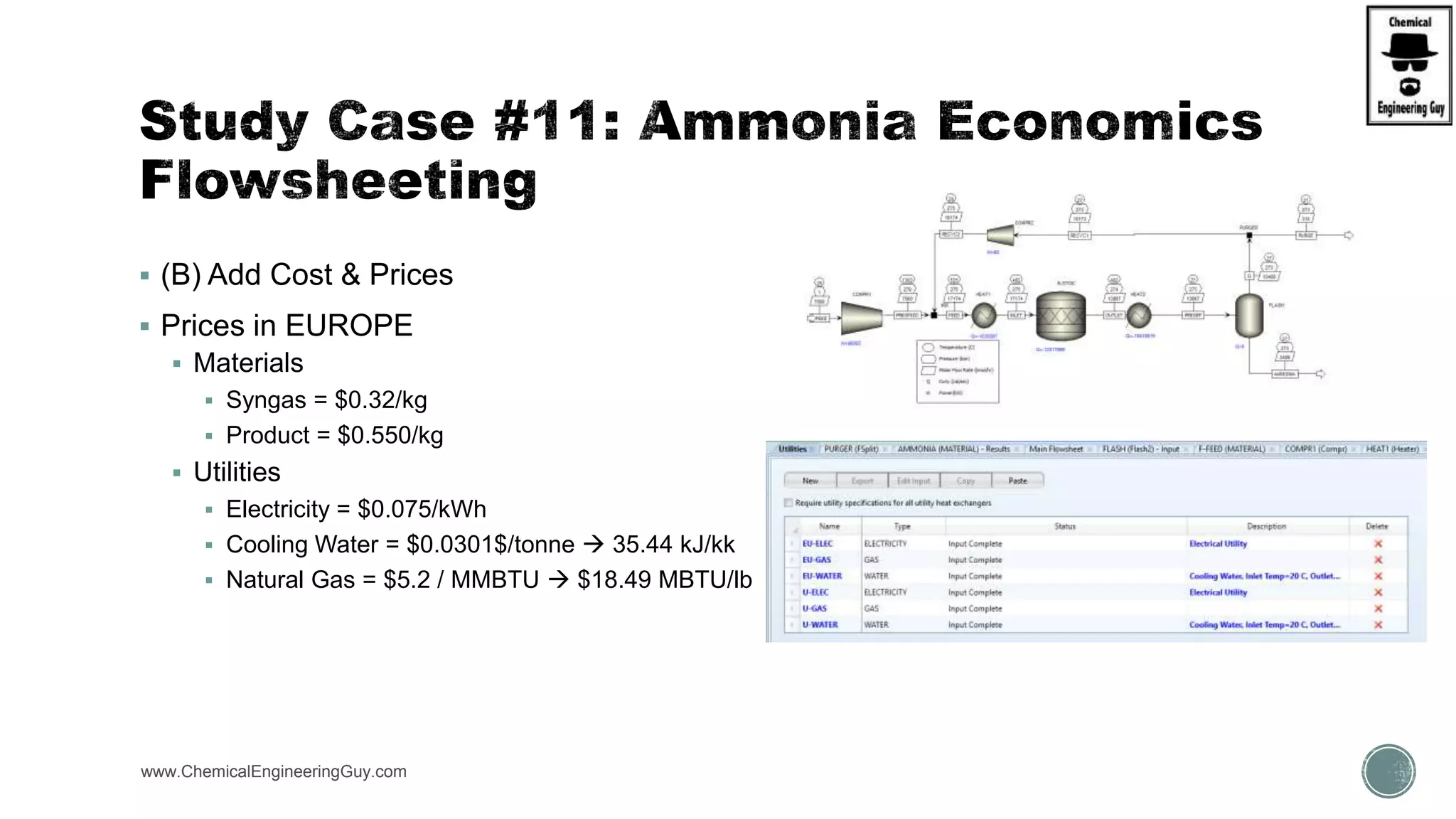
 (B) Add Cost & Prices
 Prices in EUROPE
 Materials
 Syngas = $0.32/kg
 Product = $0.550/kg
 Utilities
 Electricity = $0.075/kWh
 Cooling Water = $0.0301$/tonne  35.44 kJ/kk
 Natural Gas = $5.2 / MMBTU  $18.49 MBTU/lb
www.ChemicalEngineeringGuy.com
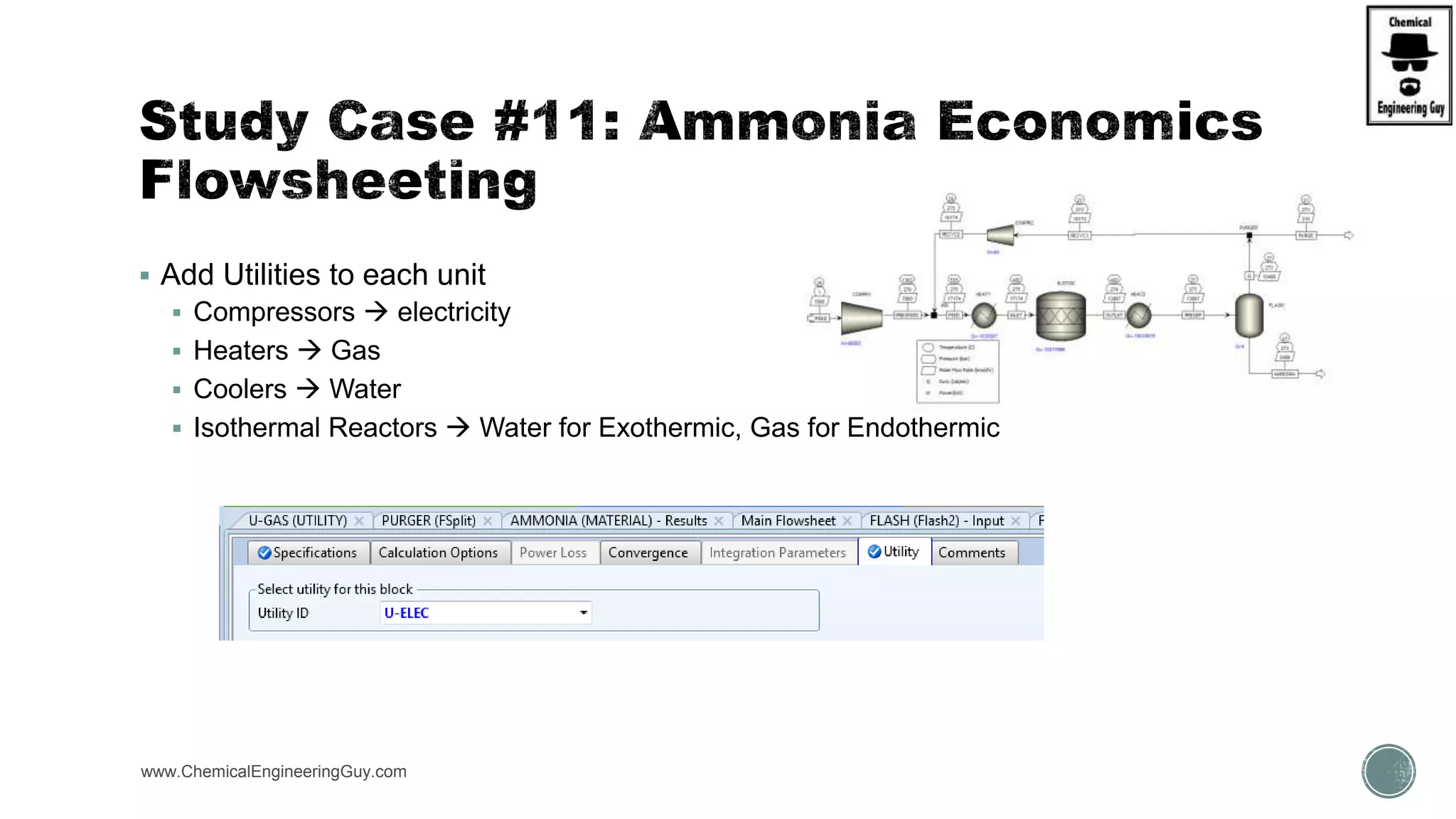
 Add Utilities to each unit
 Compressors  electricity
 Heaters  Gas
 Coolers  Water
 Isothermal Reactors  Water for Exothermic, Gas for Endothermic
www.ChemicalEngineeringGuy.com
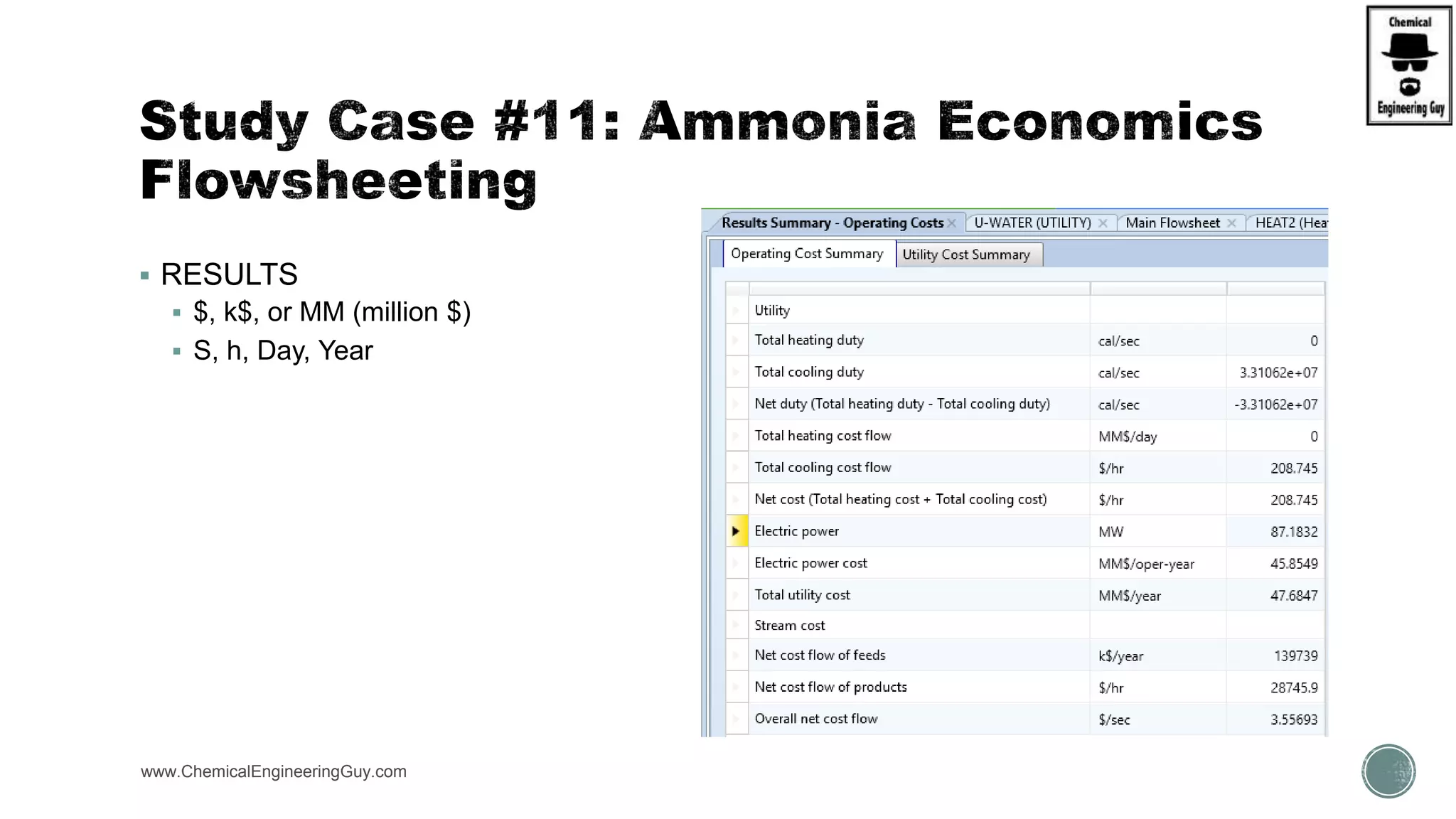
 RESULTS
 $, k$, or MM (million $)
 S, h, Day, Year
www.ChemicalEngineeringGuy.com
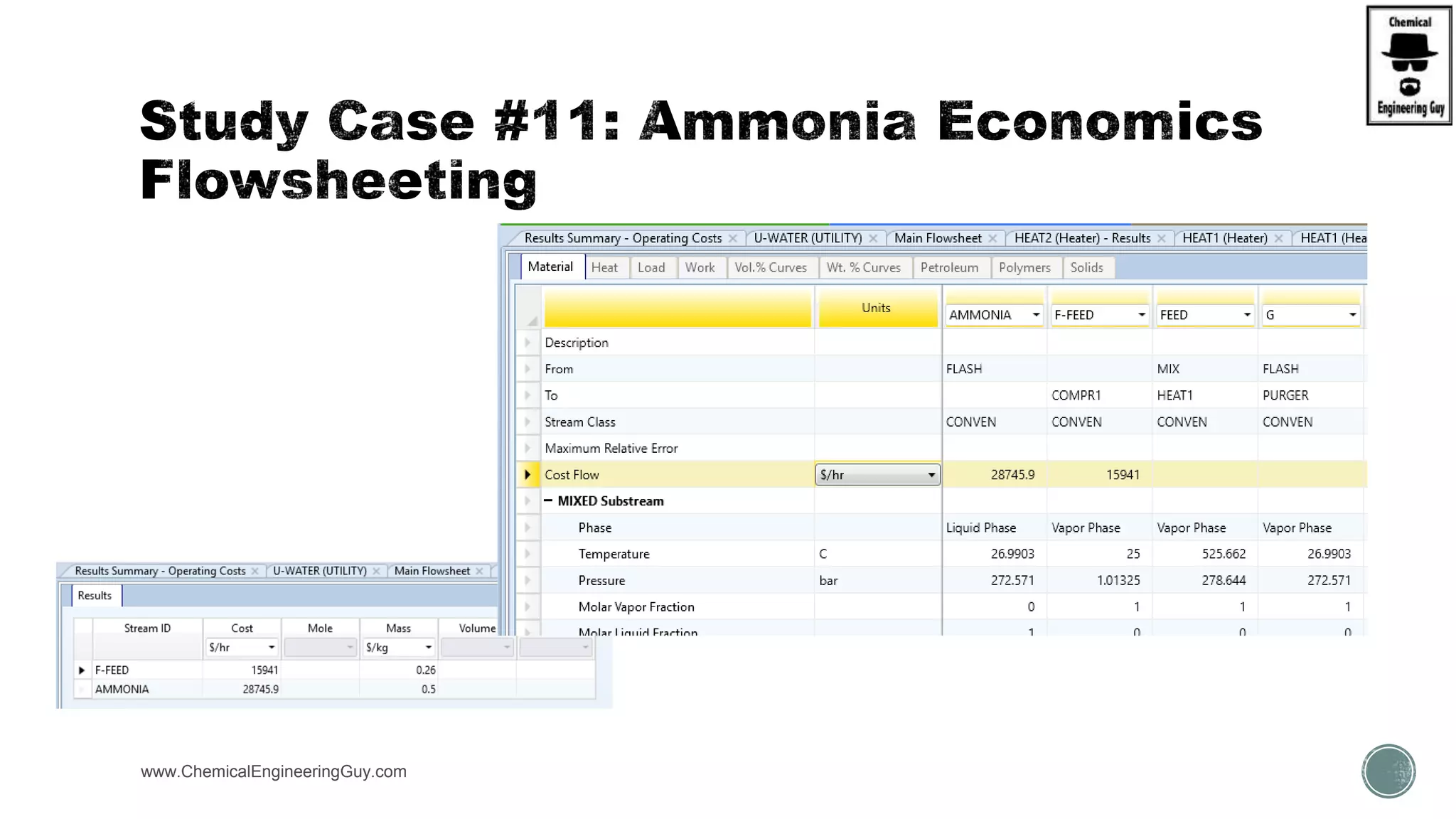
 RESULTS
 $, k$, or MM (million $)
 S, h, Day, Year
www.ChemicalEngineeringGuy.com
Enjoying so far?
This is a preview of the BOOTCAMP.
Join NOW here:
https://www.chemicalengineeringguy.com/courses/aspen-plus-bootcamp-with-12-case-studies/
www.ChemicalEngineeringGuy.com
www.ChemicalEngineeringGuy.com https://www.youtube.com/watch?v=ZPCGXMPtM_U
 Aspen Dynamics Software
 Setting up Dynamic Folders
 Exporting to Dynamics
 Dynamic & Control
 Flow driven simulation
 Pressure driven simulation
 Adding Controllers
 Tuning Controllers
www.ChemicalEngineeringGuy.com https://www.youtube.com/watch?v=ZPCGXMPtM_U
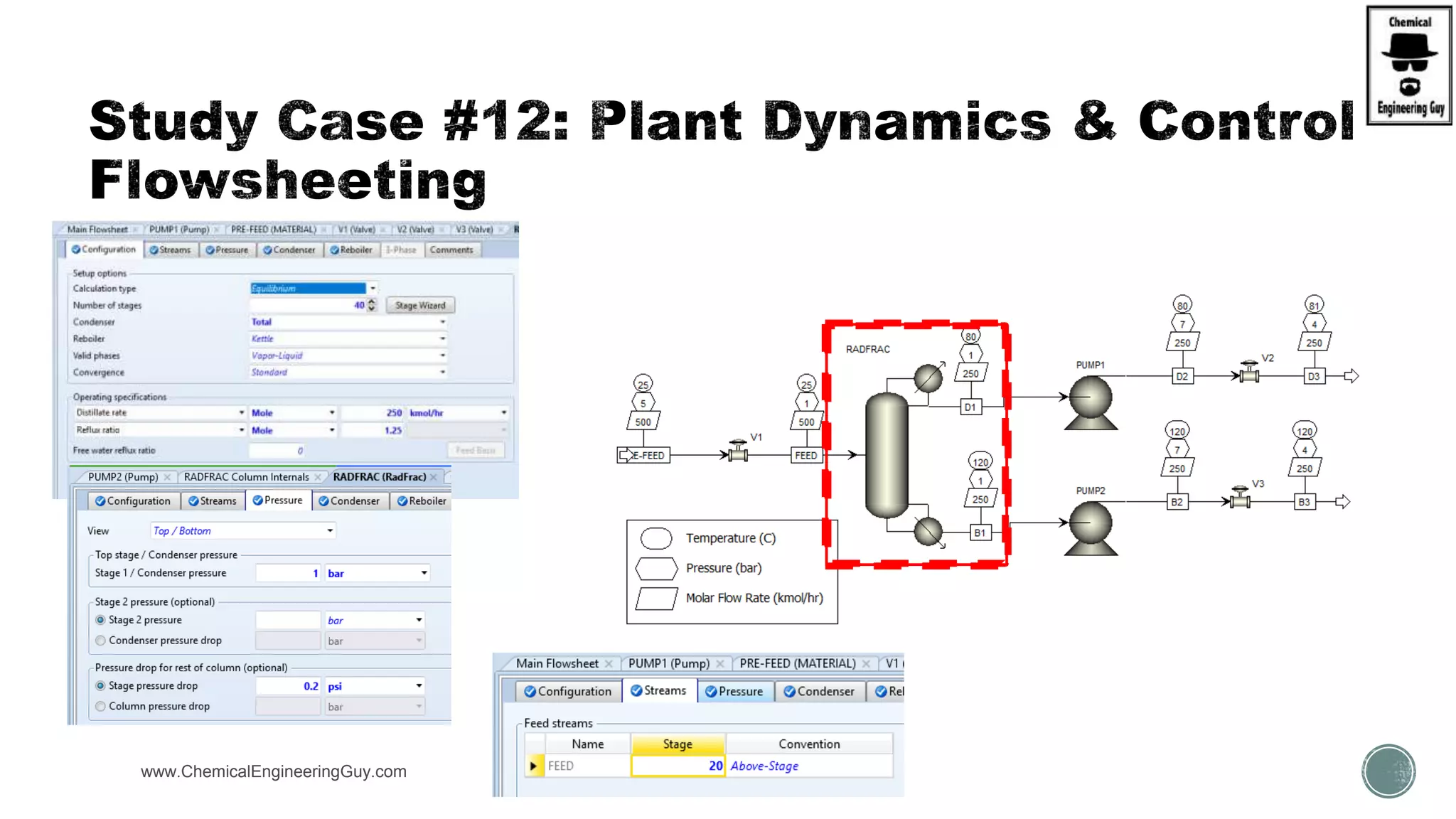
 A distillation column of Benzene-Toluene mix (50-50% molar) is to be separated
 The Pressure of the column is 1 bar, and has a 0.2 psi pressure dropper stage
 Condition of the feed  500 mol/h, 25°C, 5bar
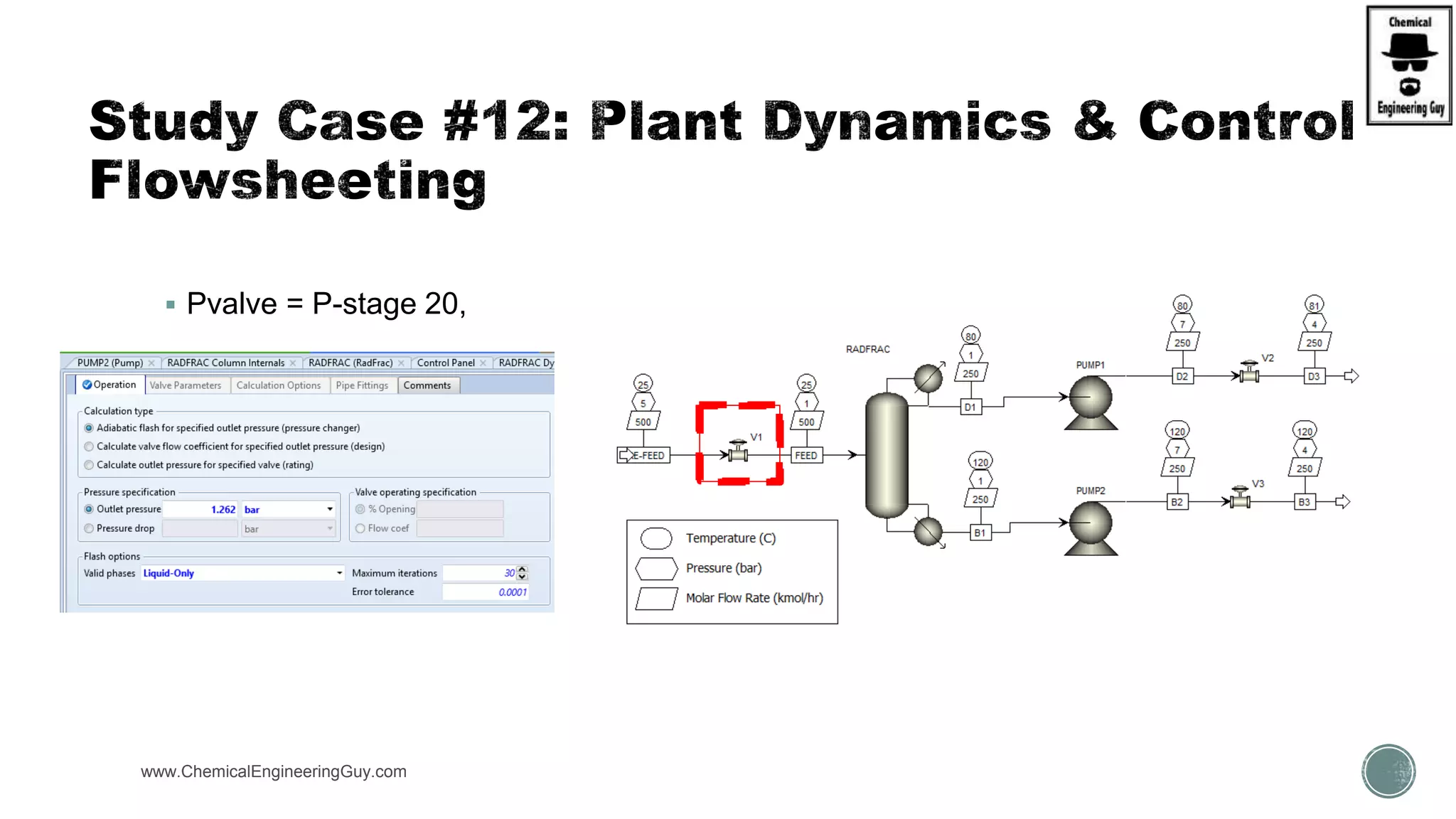
 Valve 1 will adjust pressure to the 20th stage pressure, approx. P = 1.262bar
 D = 250 mol/h approx., 99% purity required
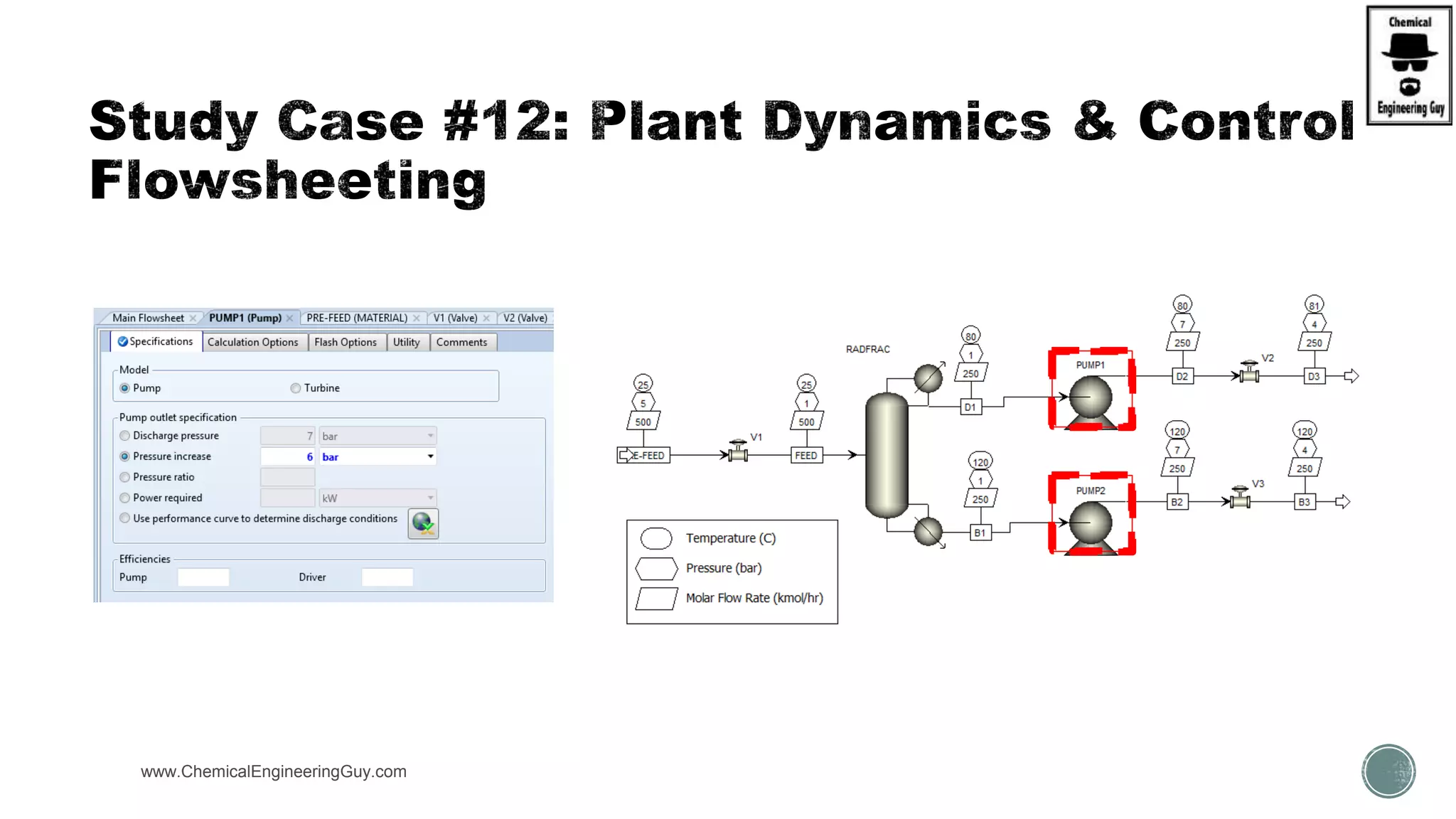
 Ppressure  +6 bar extra
 Pvalve  pressure drop 3 bar
www.ChemicalEngineeringGuy.com https://www.youtube.com/watch?v=ZPCGXMPtM_U
 The idea is to:
 Create Aspen Plus – Simulation
 Add the Dynamic Data Requirements
 Export to Dynamics
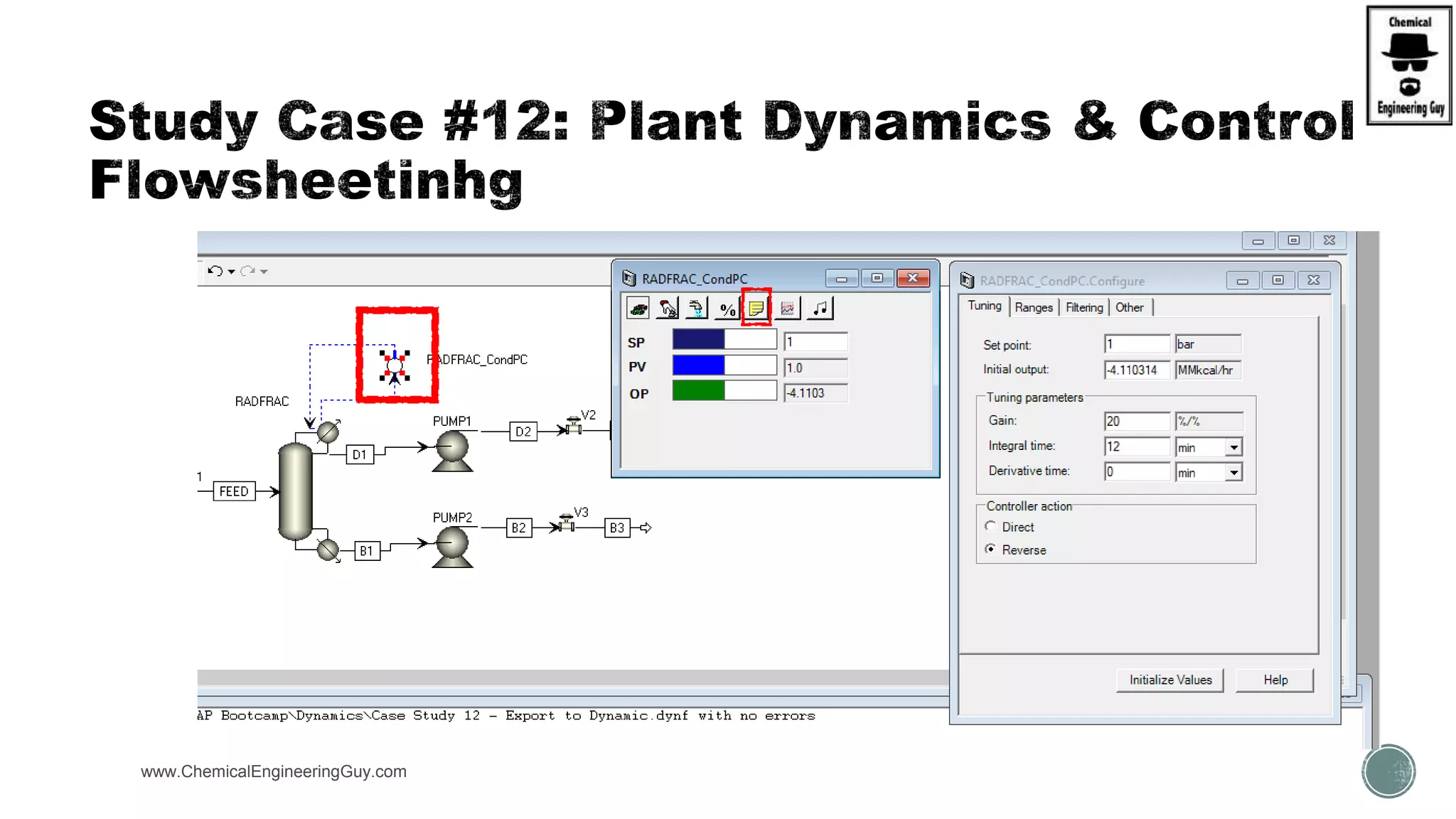
 (a) Verify the pressure Controller
 (b) Add Flow-Controller to the feed
 (c) Add Level-Controllers to the vessels in reflux/reboiler streams
 (d) Add and tune a Temperature-Controller in the 34th stage - Reboiler
www.ChemicalEngineeringGuy.com https://www.youtube.com/watch?v=ZPCGXMPtM_U
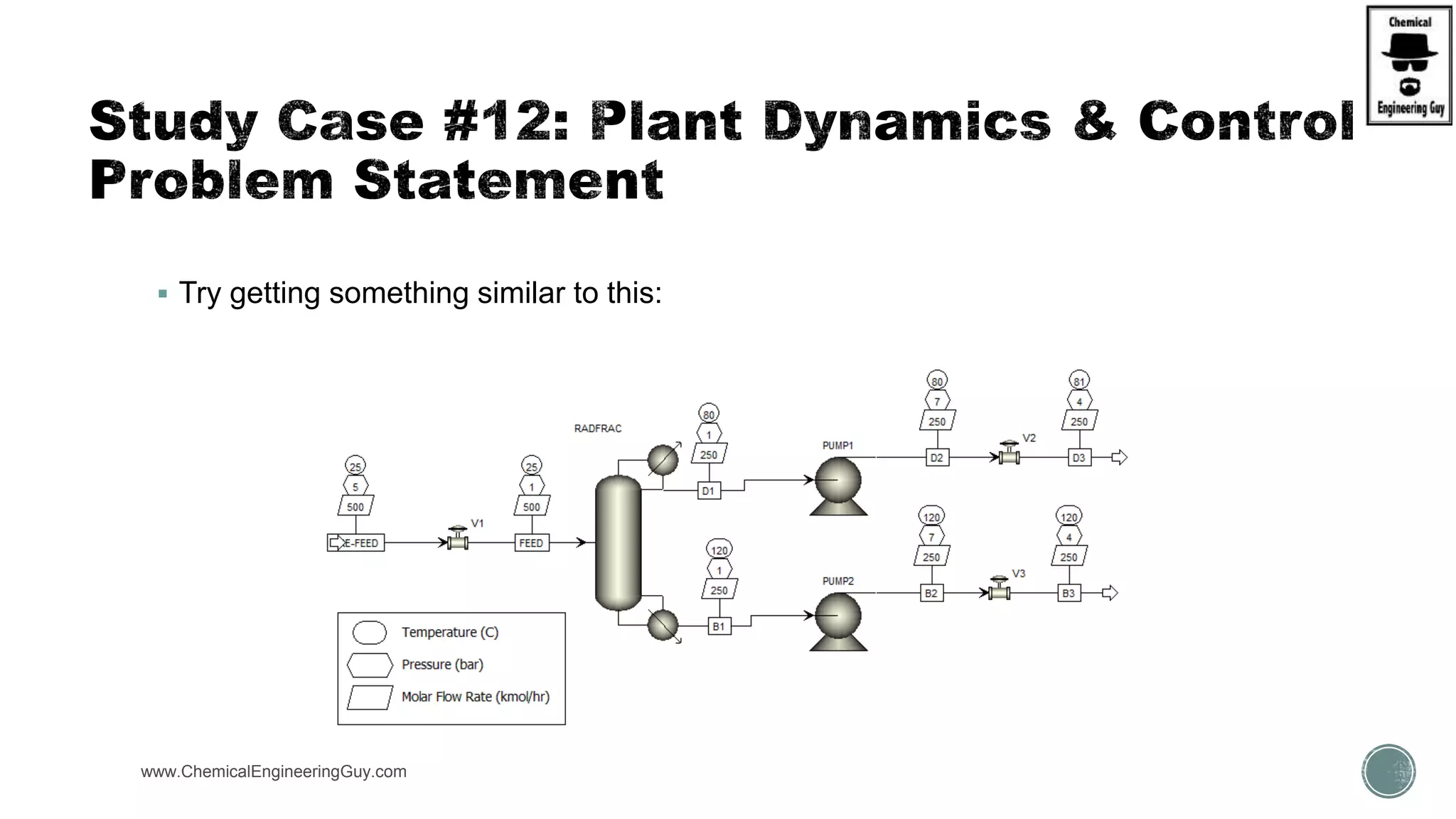
 Try getting something similar to this:
www.ChemicalEngineeringGuy.com
 Pvalve = P-stage 20,
www.ChemicalEngineeringGuy.com
Enjoying so far?
This is a preview of the BOOTCAMP.
Join NOW here:
https://www.chemicalengineeringguy.com/courses/aspen-plus-bootcamp-with-12-case-studies/
www.ChemicalEngineeringGuy.com
Enjoying so far?
This is a preview of the BOOTCAMP.
Join NOW here:
https://www.chemicalengineeringguy.com/courses/aspen-plus-bootcamp-with-12-case-studies/
www.ChemicalEngineeringGuy.com
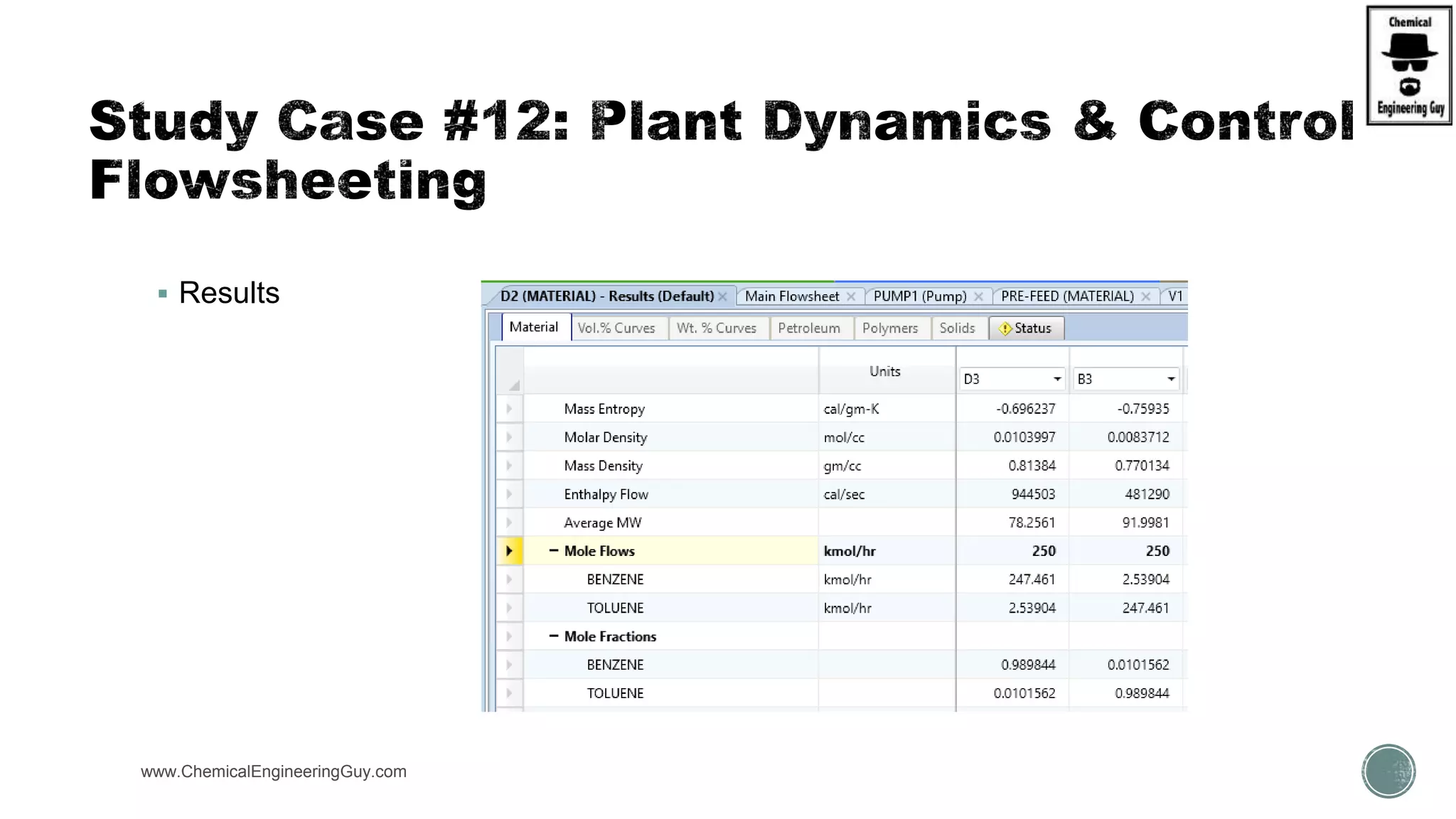
 Results
www.ChemicalEngineeringGuy.com
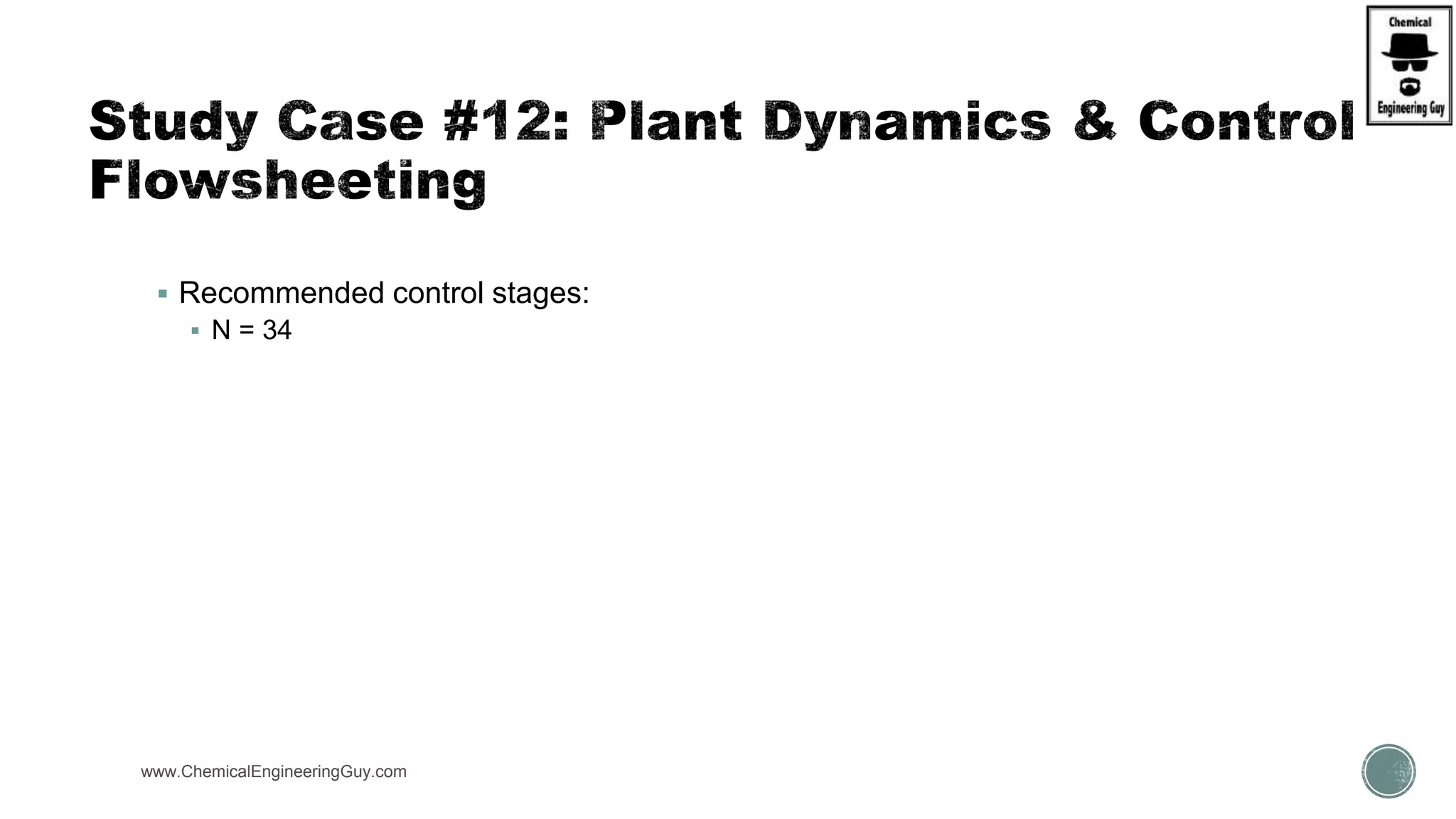
 Recommended control stages:
 N = 34
www.ChemicalEngineeringGuy.com
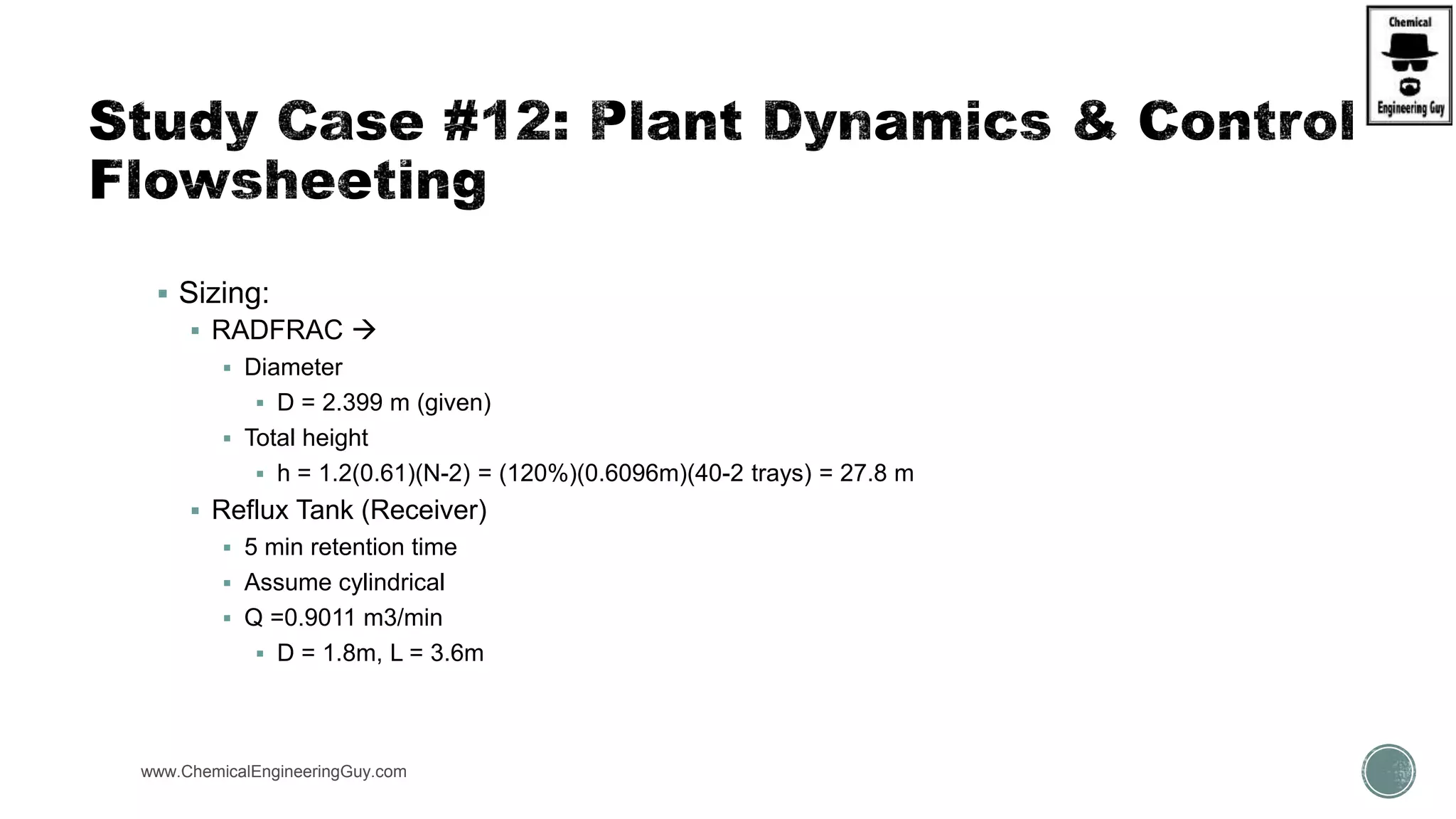
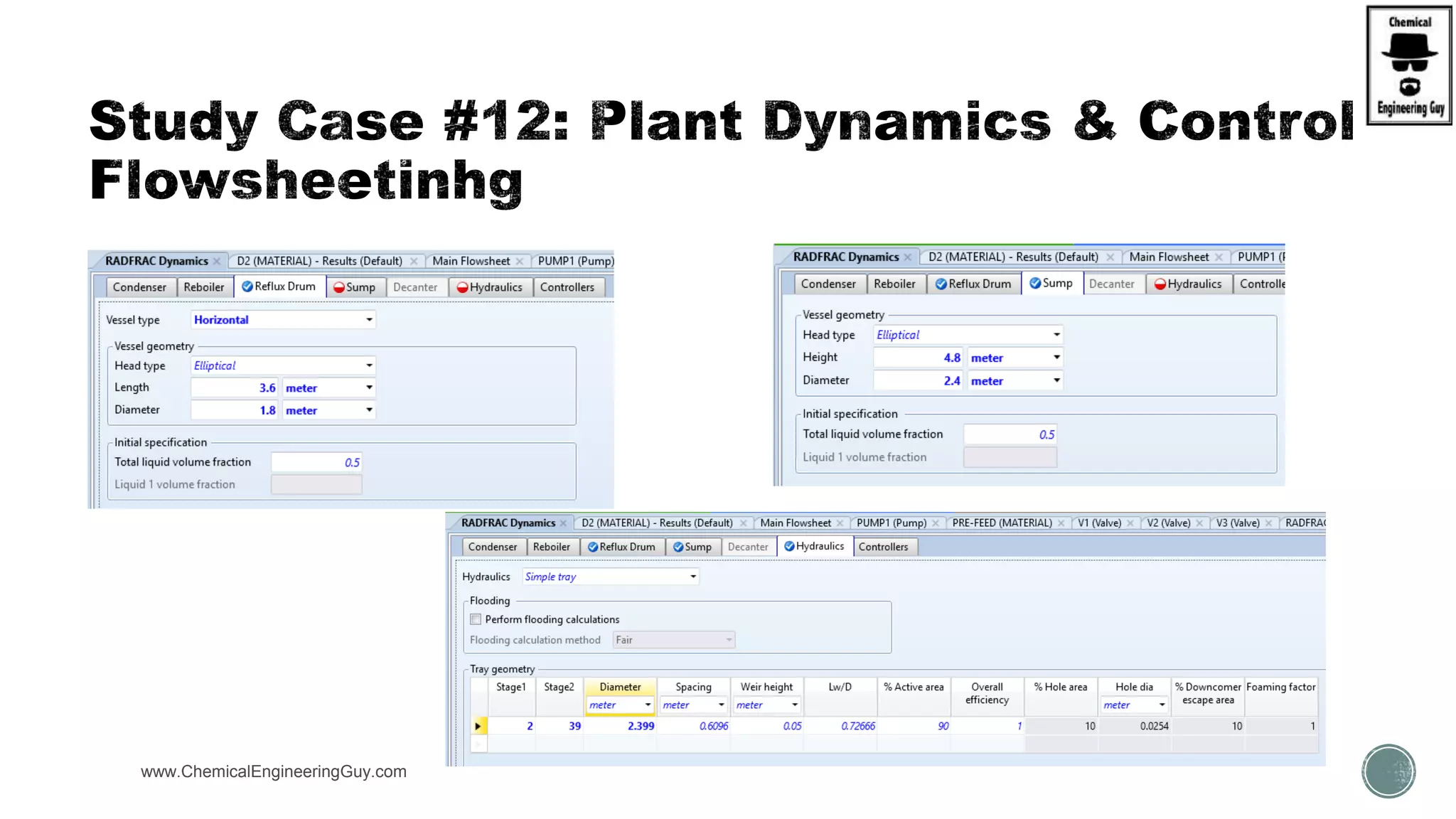
 Sizing:
 RADFRAC 
 Diameter
 D = 2.399 m (given)
 Total height
 h = 1.2(0.61)(N-2) = (120%)(0.6096m)(40-2 trays) = 27.8 m
 Reflux Tank (Receiver)
 5 min retention time
 Assume cylindrical
 Q =0.9011 m3/min
 D = 1.8m, L = 3.6m
www.ChemicalEngineeringGuy.com
 Go dynamics…
Enjoying so far?
This is a preview of the BOOTCAMP.
Join NOW here:
https://www.chemicalengineeringguy.com/courses/aspen-plus-bootcamp-with-12-case-studies/
www.ChemicalEngineeringGuy.com
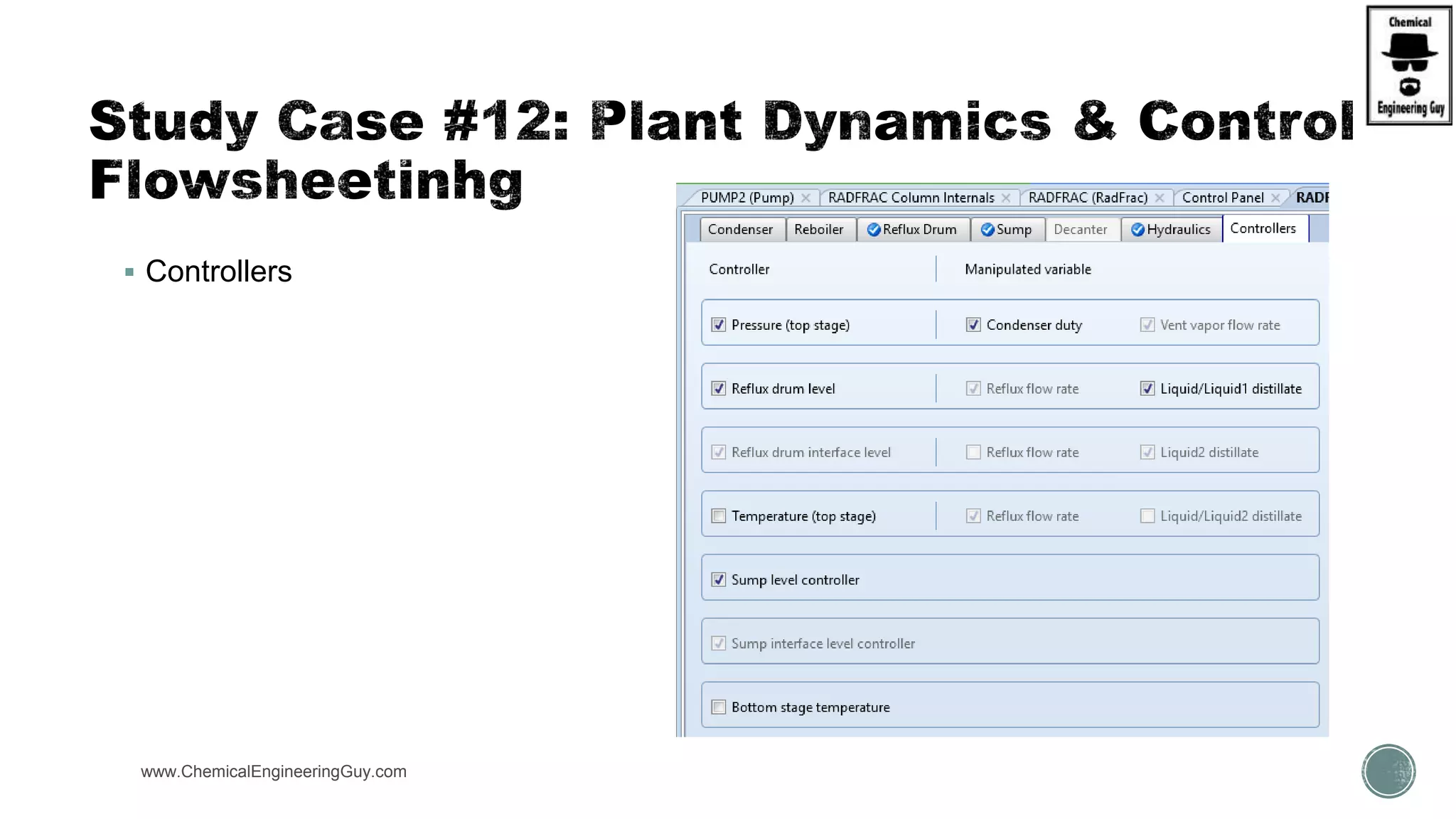
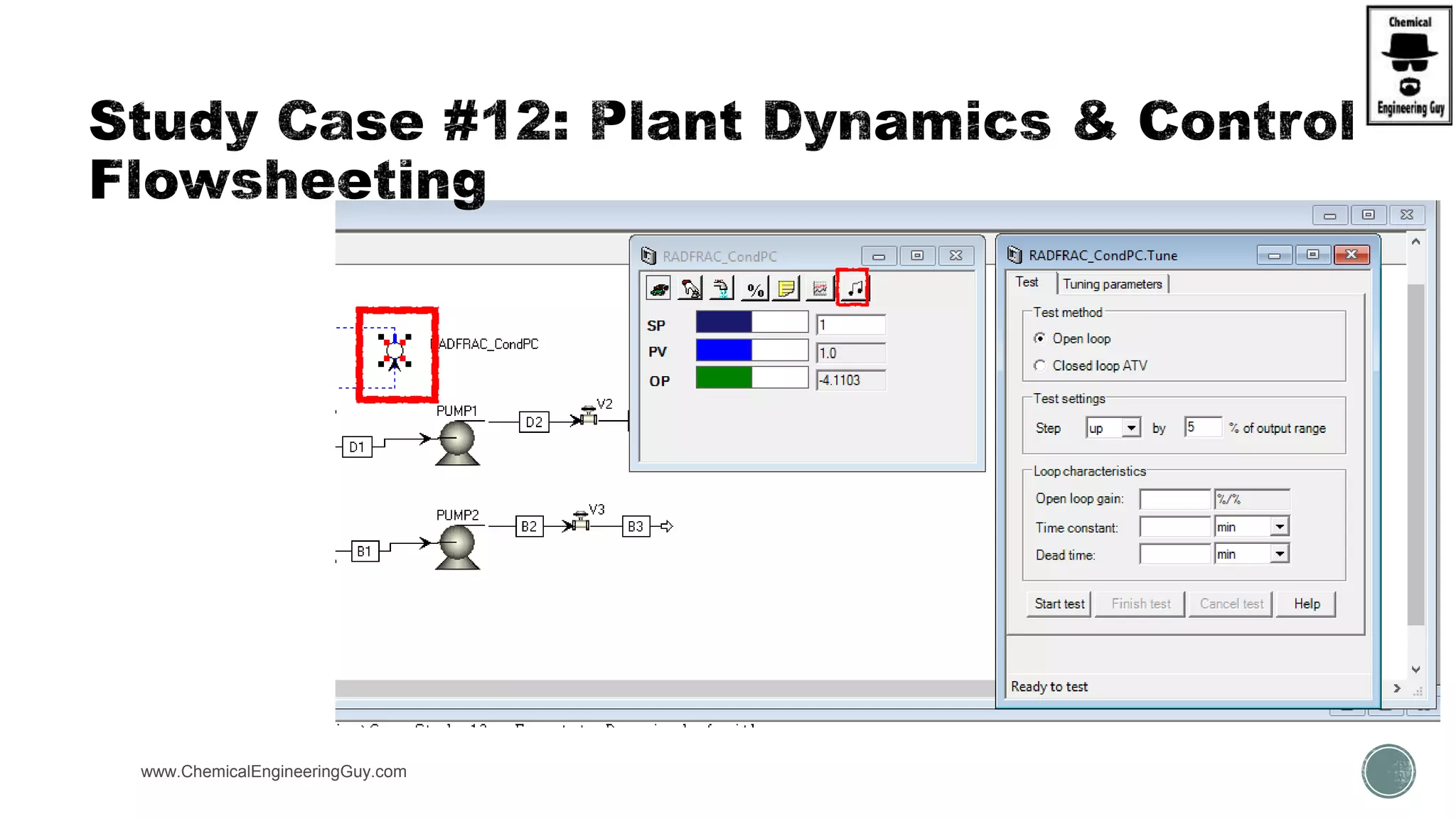
 Controllers
www.ChemicalEngineeringGuy.com
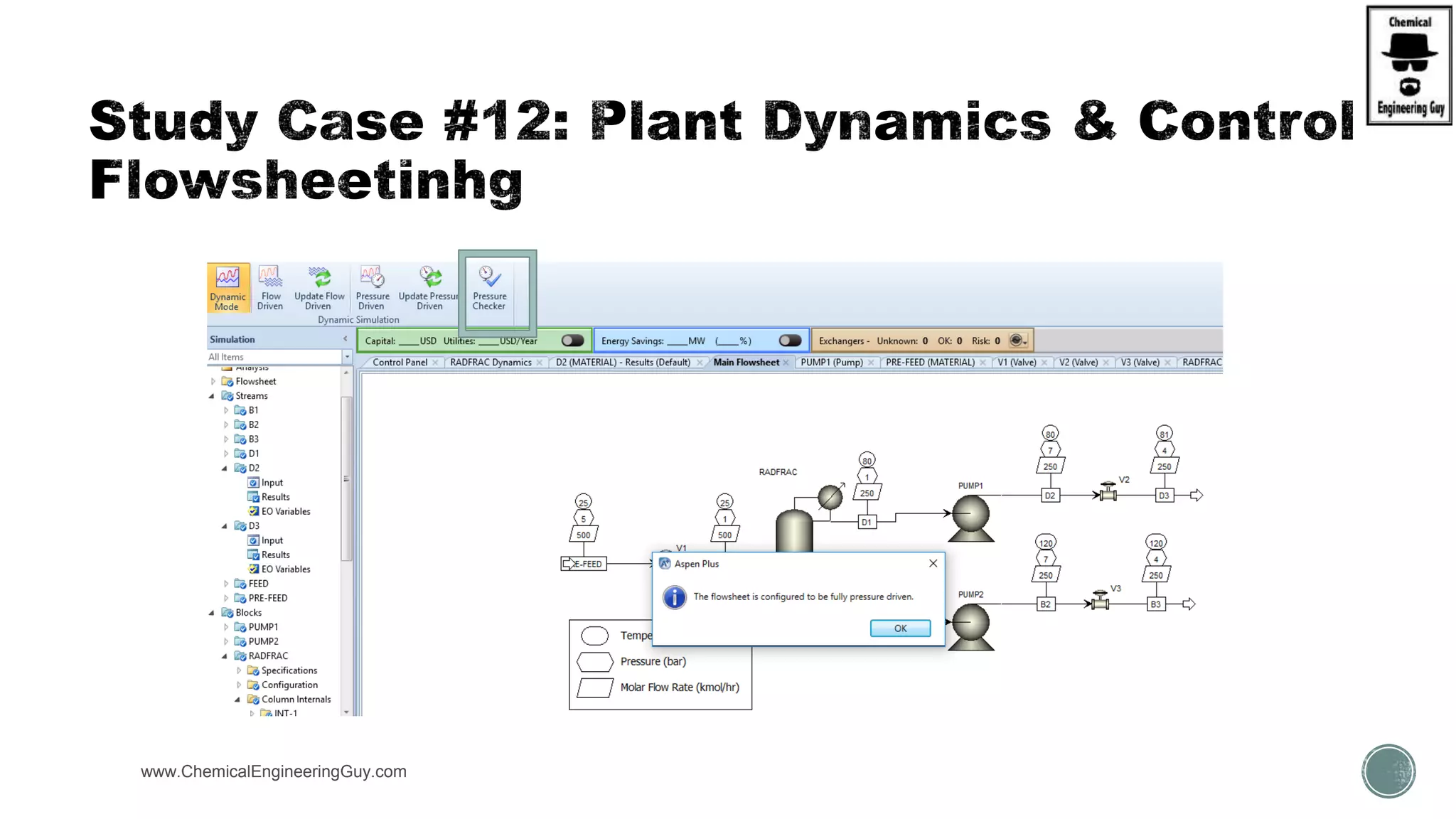
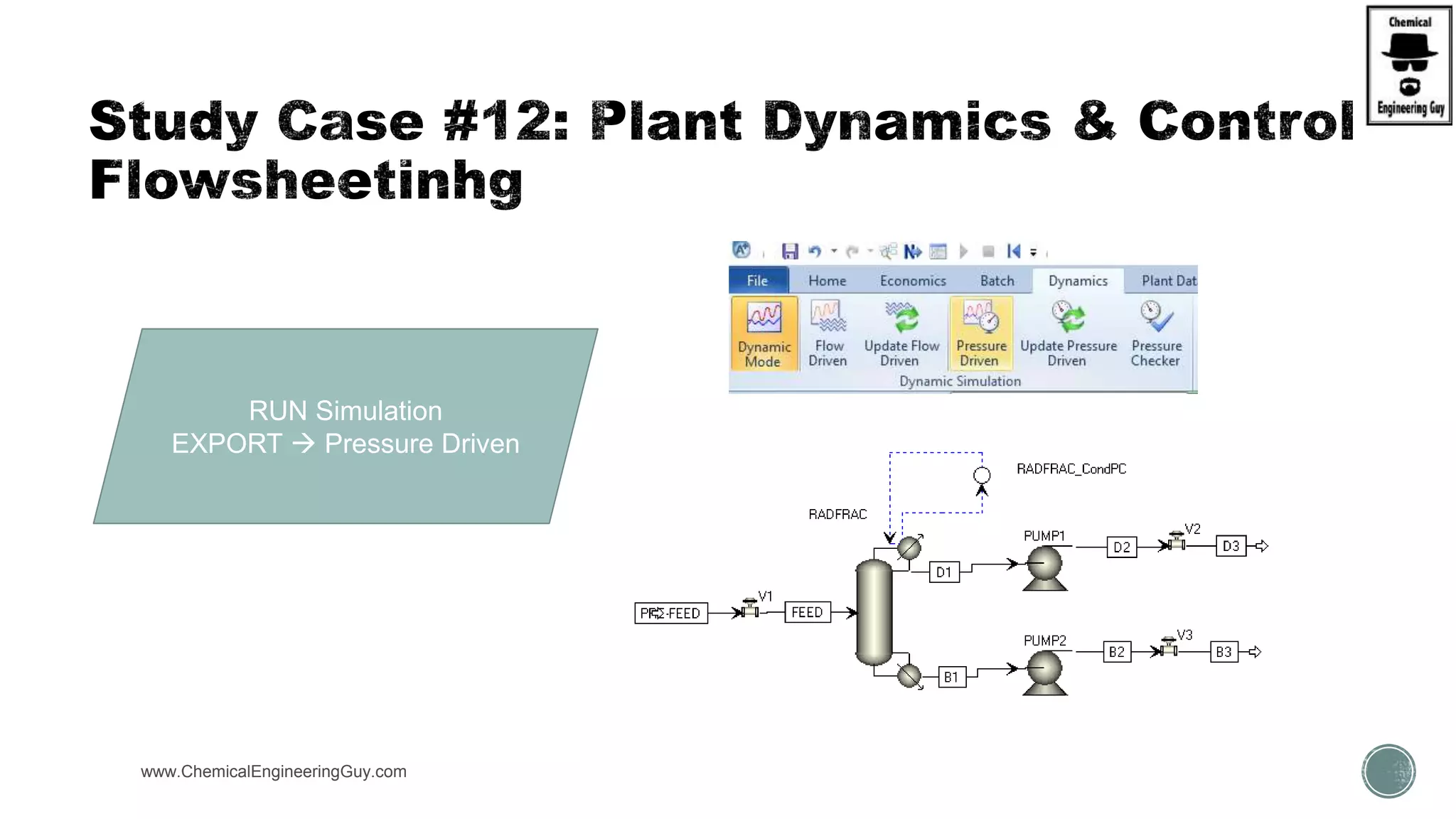
RUN Simulation
EXPORT  Pressure Driven
www.ChemicalEngineeringGuy.com
Enjoying so far?
This is a preview of the BOOTCAMP.
Join NOW here:
https://www.chemicalengineeringguy.com/courses/aspen-plus-bootcamp-with-12-case-studies/
www.ChemicalEngineeringGuy.com
 (a) Verify the pressure Controller
 (b) Add Flow-Controller to the feed
 (c) Add Level-Controllers to the vessels in reflux/reboiler streams
 (d) Add and tune a Temperature-Controller in the 34th stage - Reboiler
www.ChemicalEngineeringGuy.com
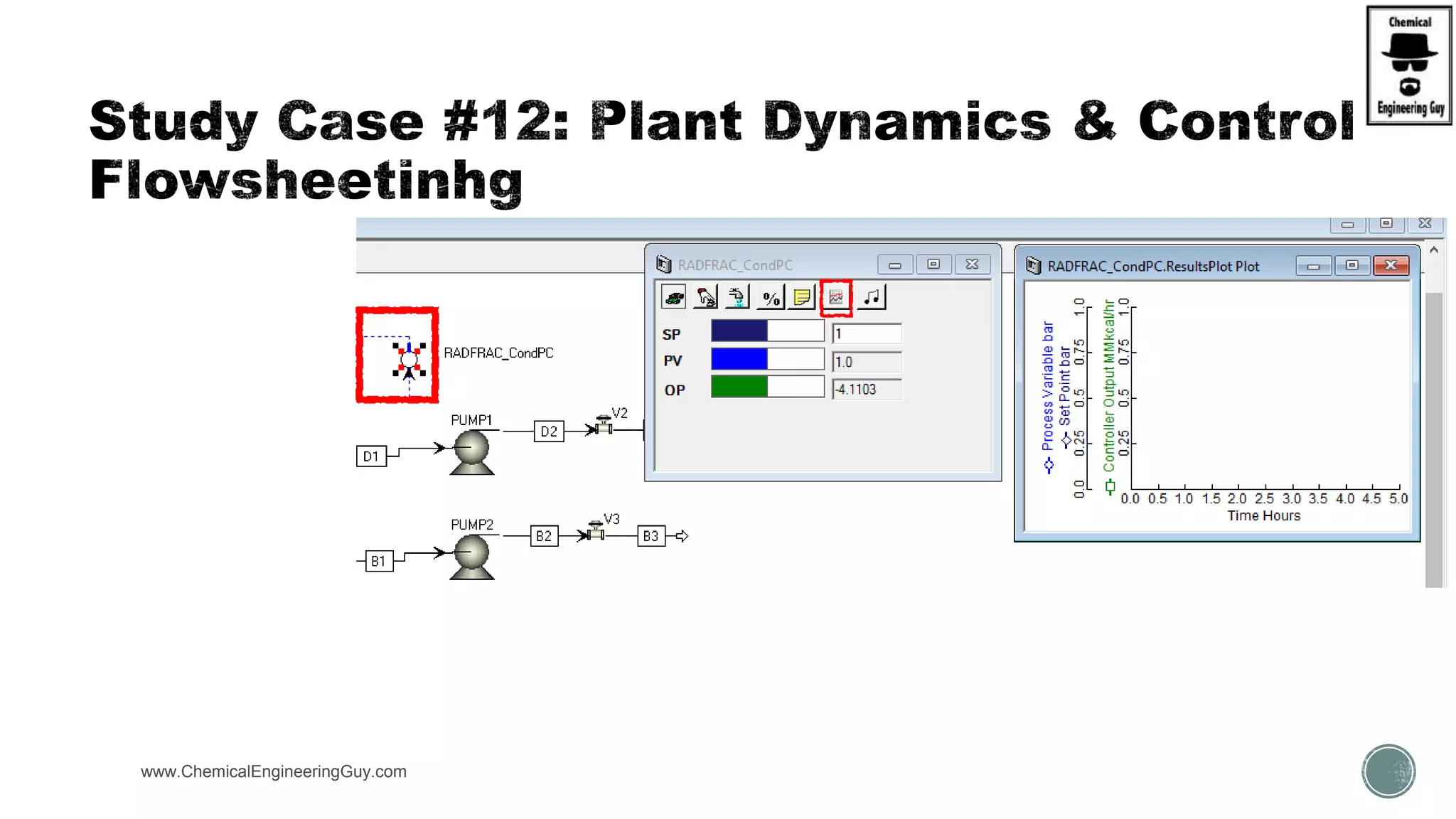
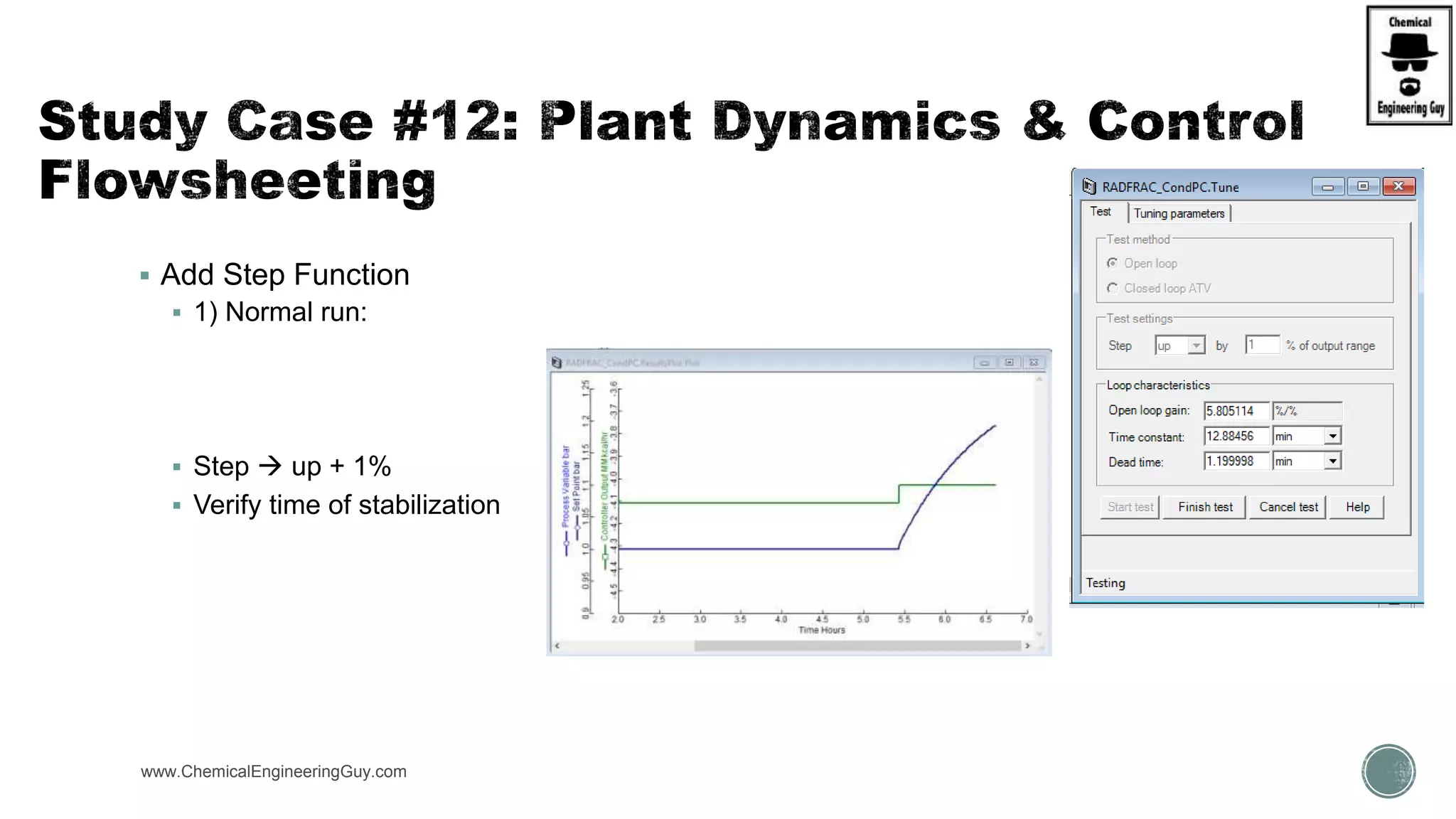
 Add Step Function
 1) Normal run:
 Step  up + 1%
 Verify time of stabilization
www.ChemicalEngineeringGuy.com
Enjoying so far?
This is a preview of the BOOTCAMP.
Join NOW here:
https://www.chemicalengineeringguy.com/courses/aspen-plus-bootcamp-with-12-case-studies/
 Add Step Function
 1) Normal run:
 Step  up + 1%
 Verify time of stabilization
www.ChemicalEngineeringGuy.com
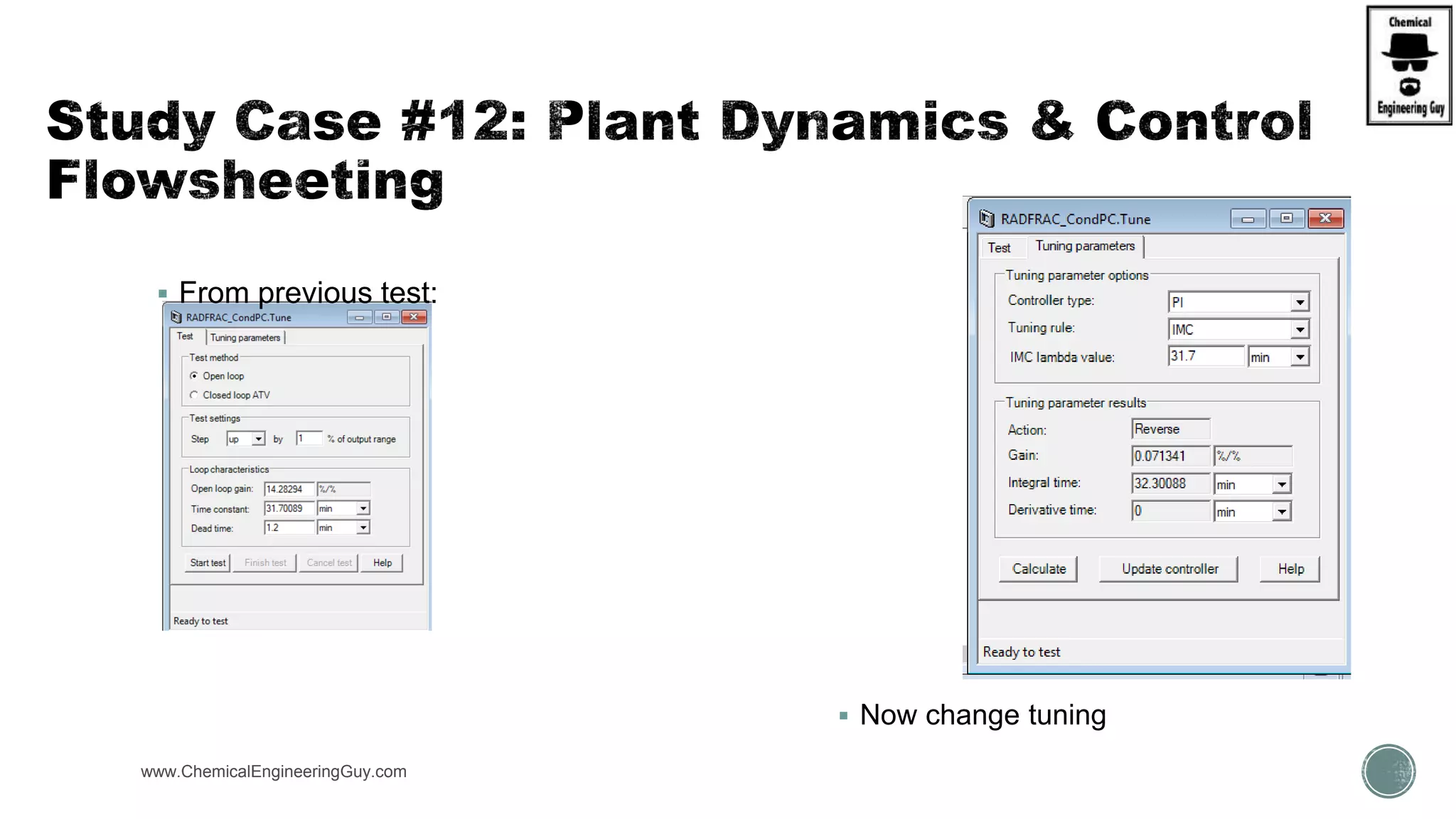
 Now change tuning
www.ChemicalEngineeringGuy.com
 From previous test:
www.ChemicalEngineeringGuy.com
 (a) Verify the pressure Controller
 (b) Add Flow-Controller to the feed
 (c) Add Level-Controllers to the vessels in reflux/reboiler streams
 (d) Add and tune a Temperature-Controller in the 34th stage - Reboiler
Enjoying so far?
This is a preview of the BOOTCAMP.
Join NOW here:
https://www.chemicalengineeringguy.com/courses/aspen-plus-bootcamp-with-12-case-studies/
www.ChemicalEngineeringGuy.com
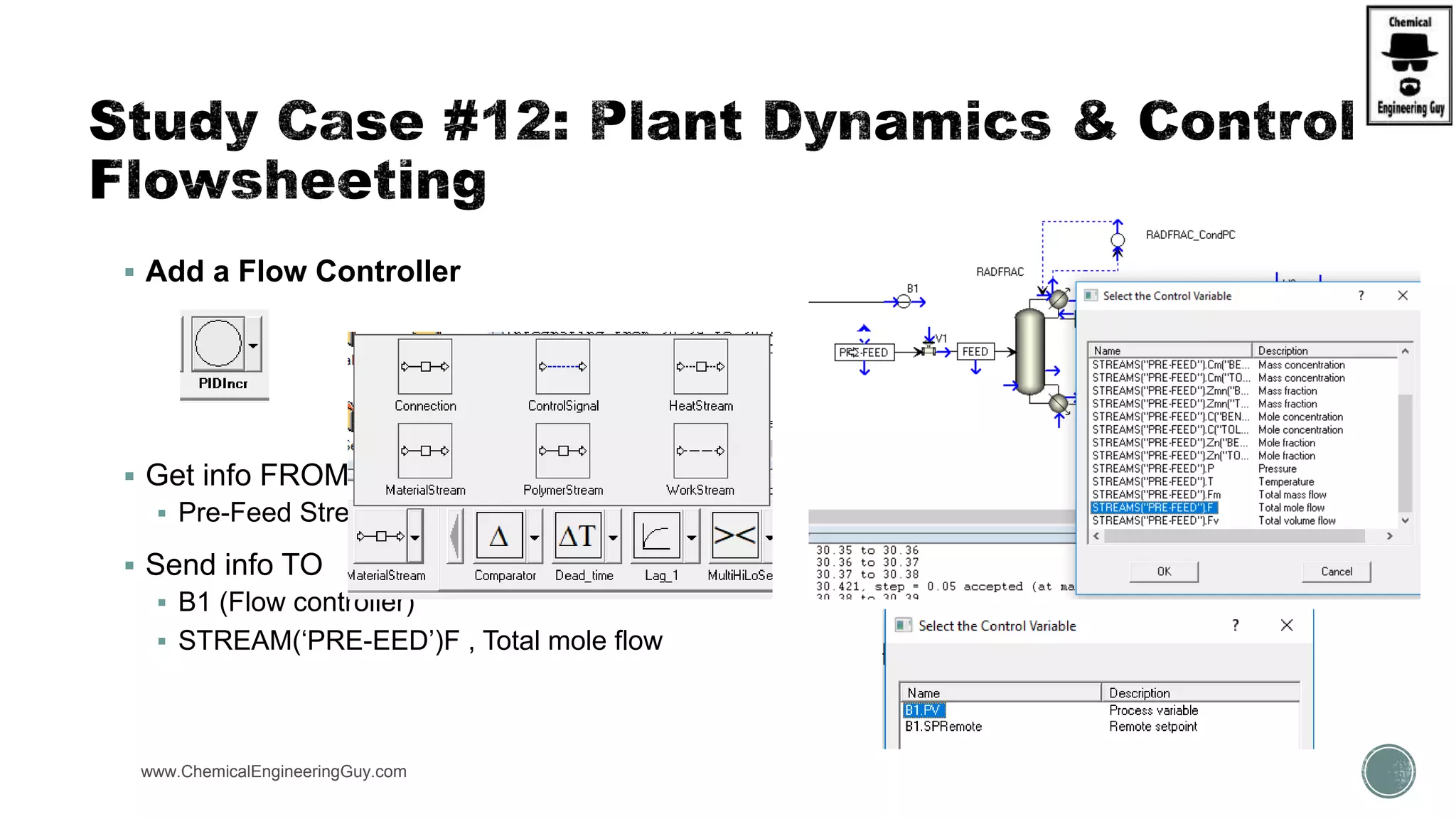
 Add a Flow Controller
 Get info FROM:
 Pre-Feed Stream
 Send info TO
 B1 (Flow controller)
 STREAM(‘PRE-EED’)F , Total mole flow
www.ChemicalEngineeringGuy.com
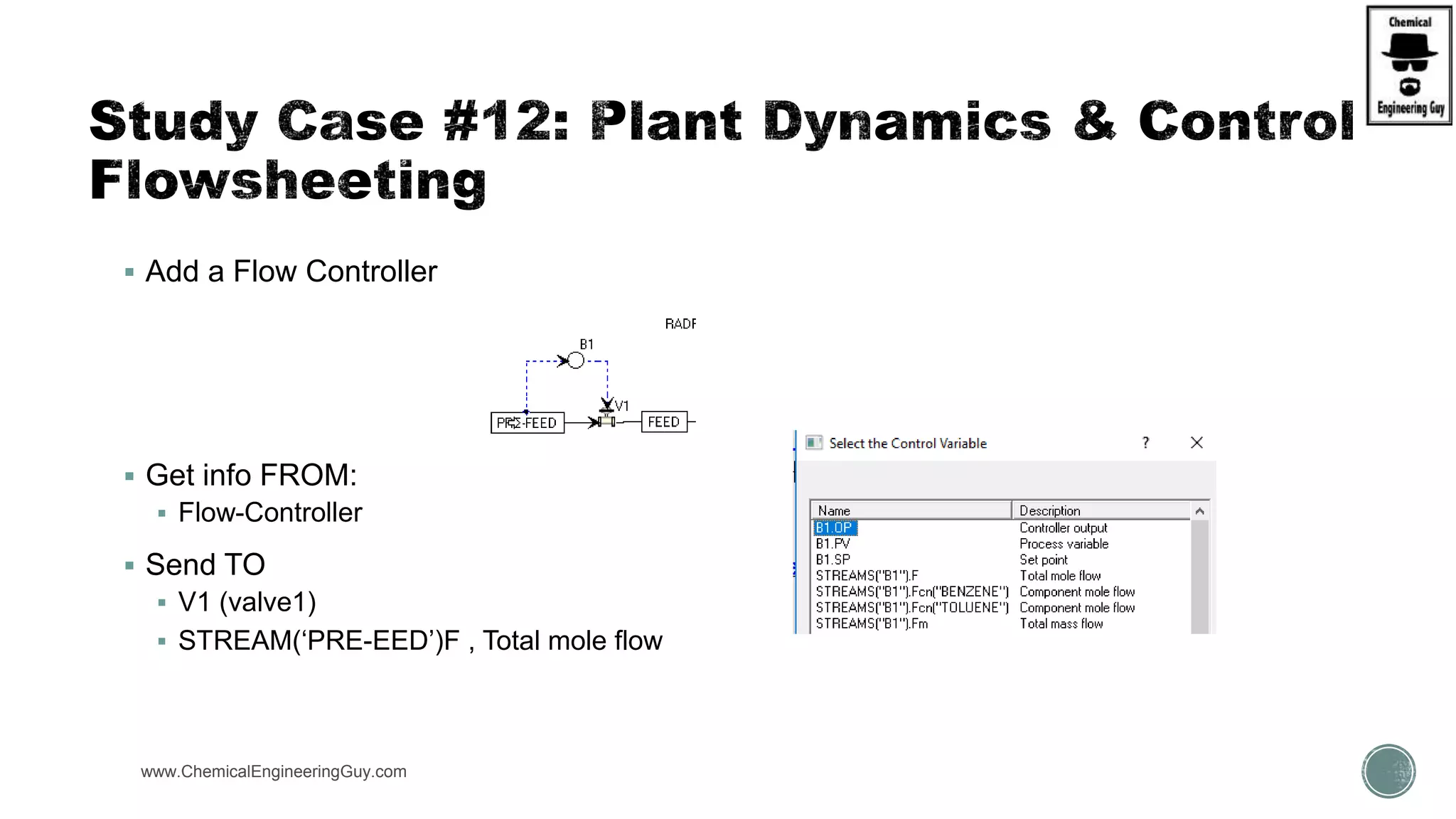
 Add a Flow Controller
 Get info FROM:
 Flow-Controller
 Send TO
 V1 (valve1)
 STREAM(‘PRE-EED’)F , Total mole flow
www.ChemicalEngineeringGuy.com
 (a) Verify the pressure Controller
 (b) Add Flow-Controller to the feed
 (c) Add Level-Controllers to the vessels in reflux/reboiler streams
 (d) Add and tune a Temperature-Controller in the 34th stage - Reboiler
www.ChemicalEngineeringGuy.com
 Add a Level Controller (BOTTOMS)
 Get info FROM:
 Level-Controller
 Send TO
 V3 (valve3)
Enjoying so far?
This is a preview of the BOOTCAMP.
Join NOW here:
https://www.chemicalengineeringguy.com/courses/aspen-plus-bootcamp-with-12-case-studies/
www.ChemicalEngineeringGuy.com
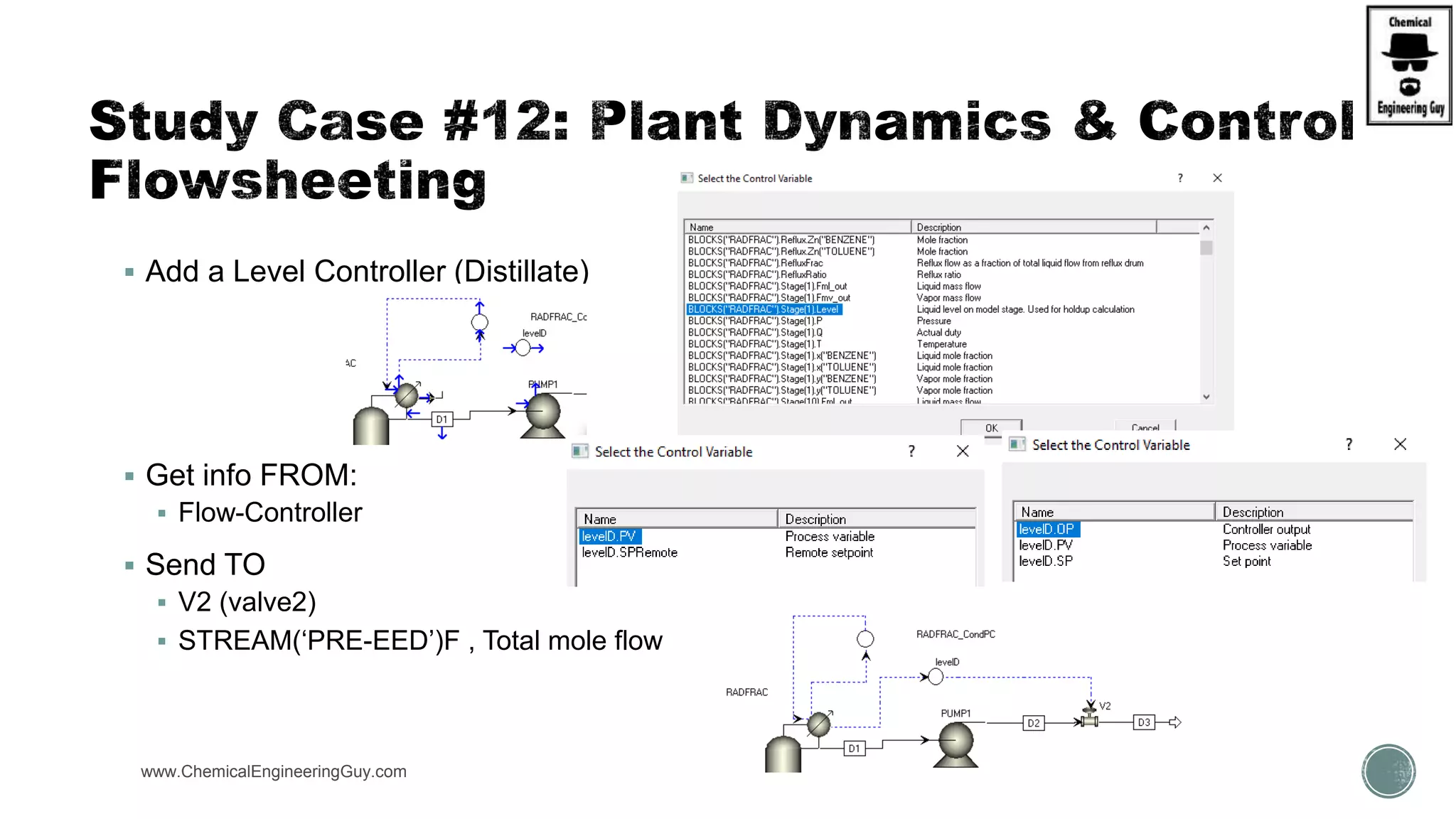
 Add a Level Controller (Distillate)
 Get info FROM:
 Flow-Controller
 Send TO
 V2 (valve2)
 STREAM(‘PRE-EED’)F , Total mole flow
www.ChemicalEngineeringGuy.com
 Flow-Controller
If flow increases, valve must close to avoid
accumulation in tower
Enjoying so far?
This is a preview of the BOOTCAMP.
Join NOW here:
https://www.chemicalengineeringguy.com/courses/aspen-plus-bootcamp-with-12-case-studies/
www.ChemicalEngineeringGuy.com
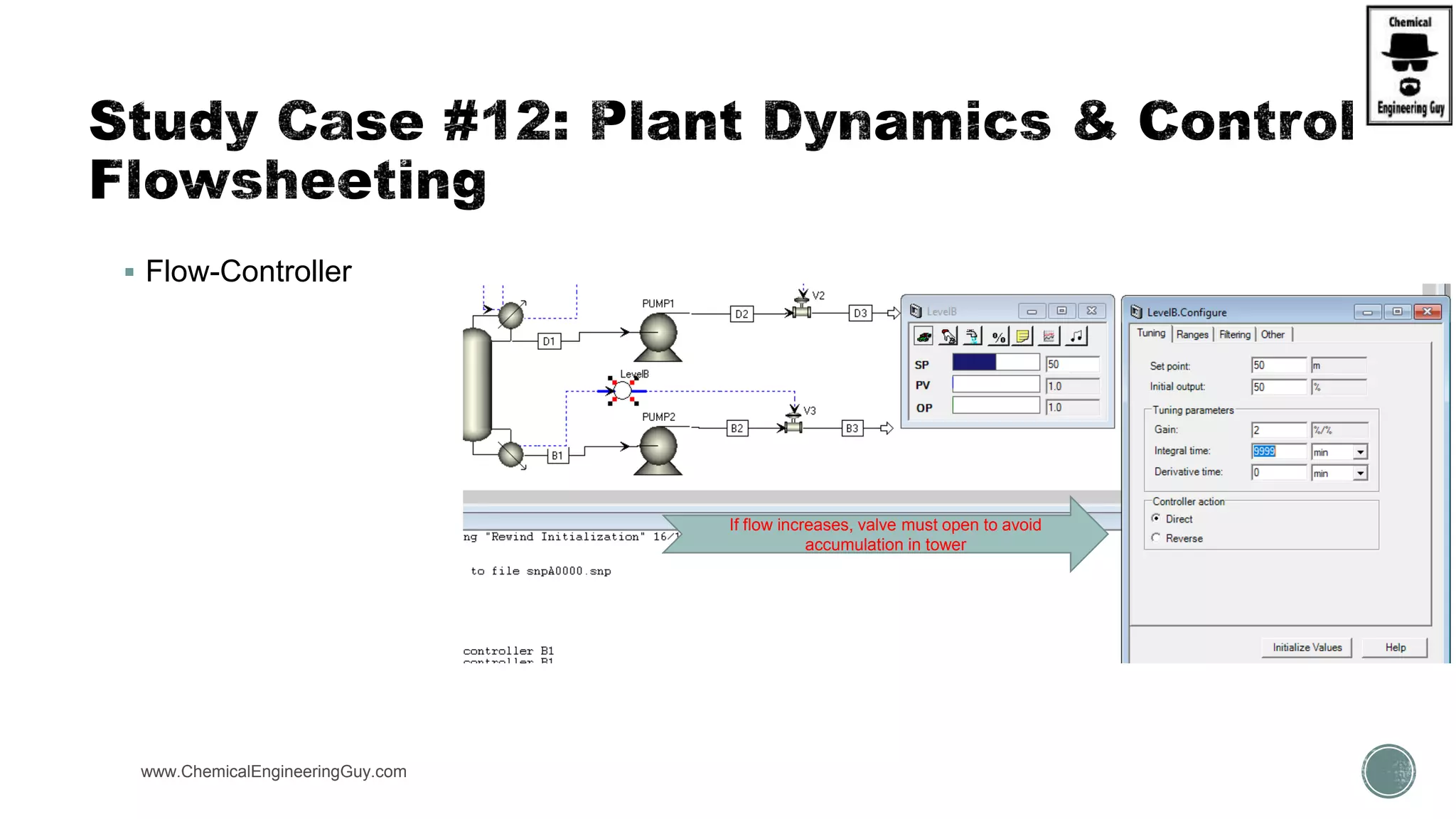
 Flow-Controller
If flow increases, valve must open to avoid
accumulation in tower
www.ChemicalEngineeringGuy.com
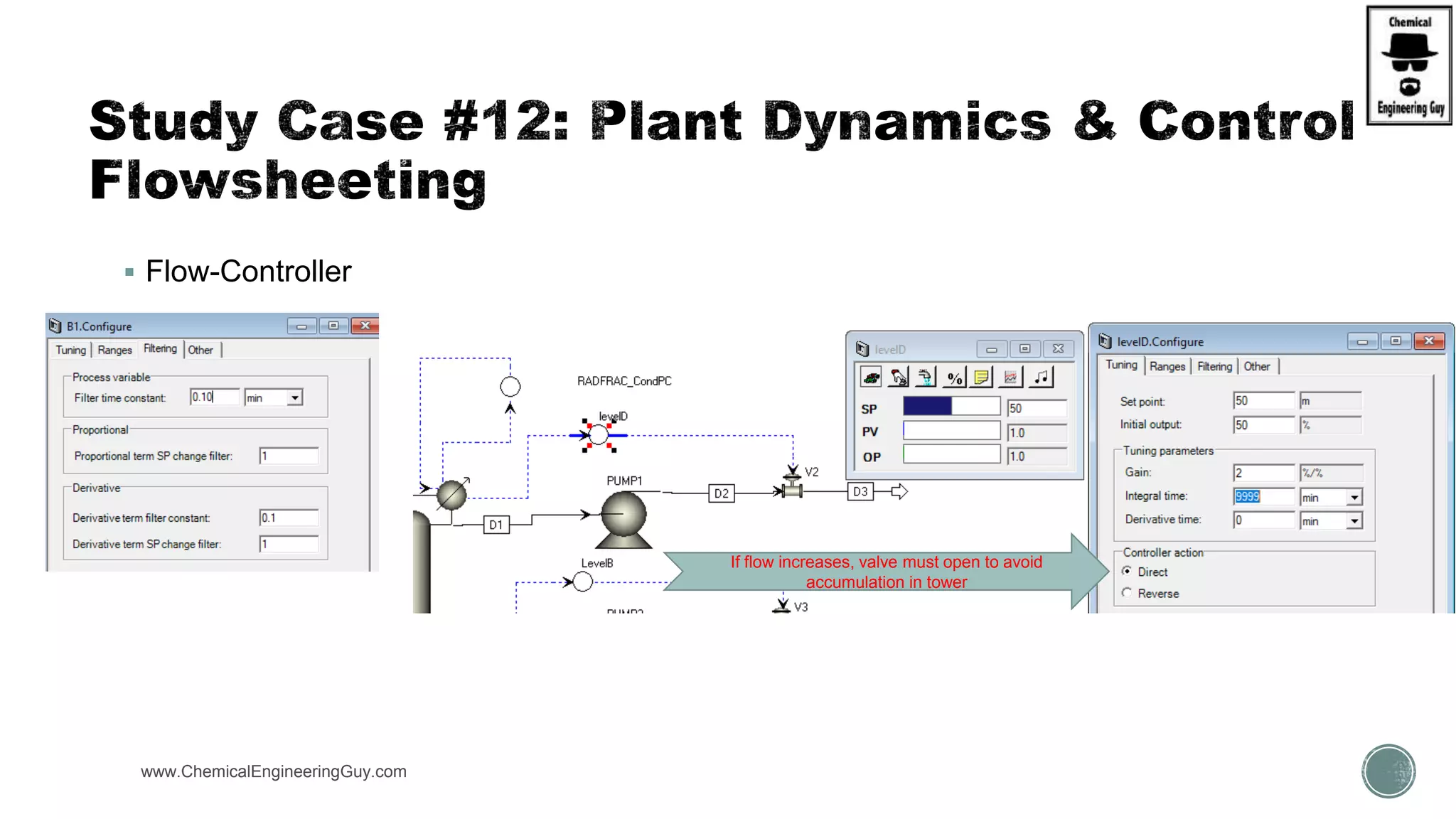
 Flow-Controller
If flow increases, valve must open to avoid
accumulation in tower
www.ChemicalEngineeringGuy.com
 (a) Verify the pressure Controller
 (b) Add Flow-Controller to the feed
 (c) Add Level-Controllers to the vessels in reflux/reboiler streams
 (d) Add and tune a Temperature-Controller in the 34th stage - Reboiler
www.ChemicalEngineeringGuy.com
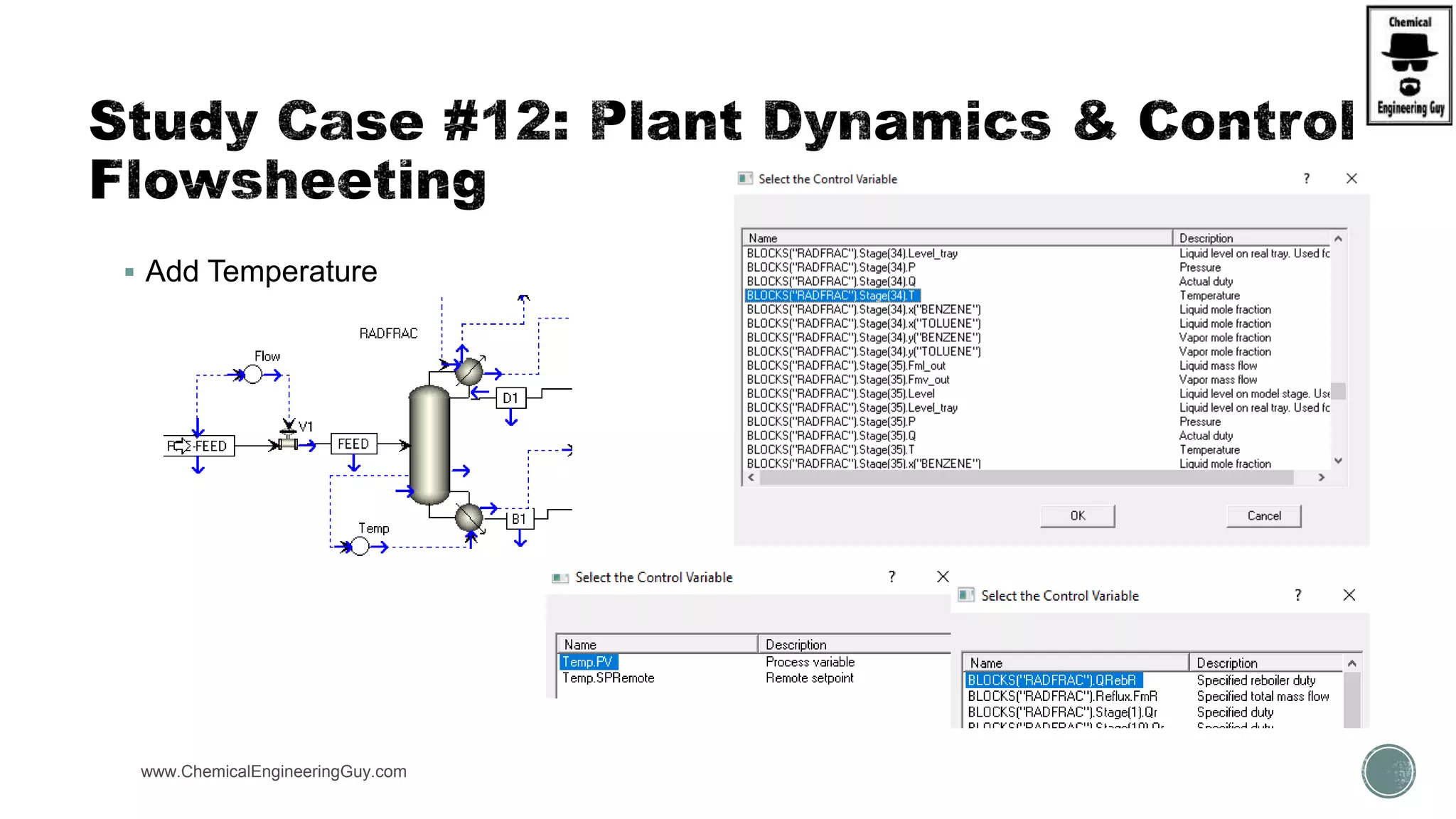
 Add Temperature
www.ChemicalEngineeringGuy.com
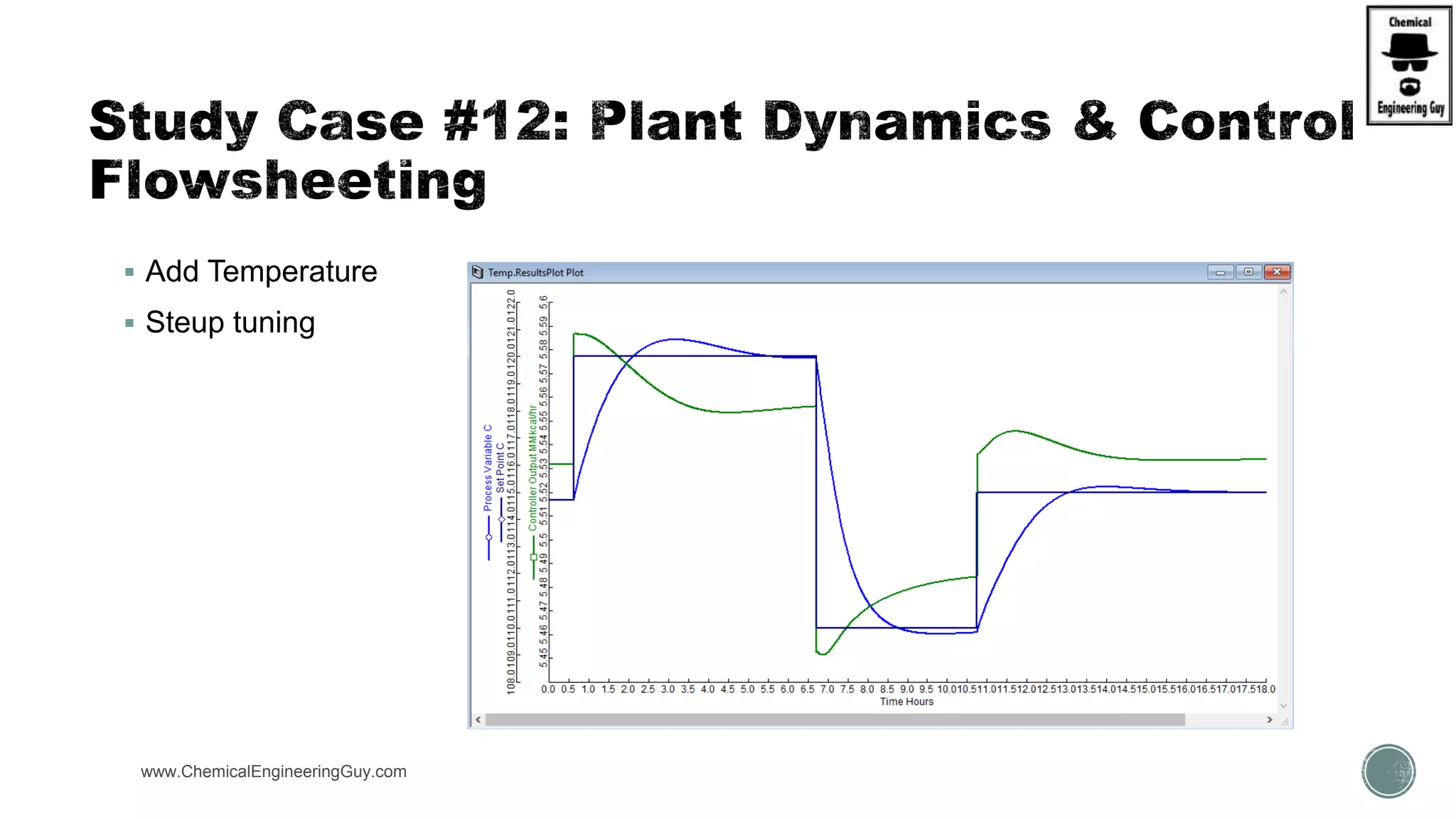
 Add Temperature
 Steup tuning
Enjoying so far?
This is a preview of the BOOTCAMP.
Join NOW here:
https://www.chemicalengineeringguy.com/courses/aspen-plus-bootcamp-with-12-case-studies/
www.ChemicalEngineeringGuy.com
 Add Temperature
 Steup tuning
 Finally! You made it!
 By now you should be able to know:
 General Flowsheet Concepts
 Basic Requirements to set up a Simulation
 Setting the adequate Physical Properties
 Flowsheet “manipulation”
 Major and Common Unit Operations
 Workshop Practice
 Reporting Results (Tables)
 Technical Stuff (extensions, versions, exporting, saving, etc...)
www.ChemicalEngineeringGuy.com

Aspen Plus - Bootcamp - 12 Case Studies (2 of 2) (Slideshare)

  • 1.
    www.ChemicalEngineeringGuy.com Enjoying so far? Thisis a preview of the BOOTCAMP. Join NOW here: https://www.chemicalengineeringguy.com/courses/aspen-plus-bootcamp-with-12-case-studies/
  • 2.
     Rigorous UnitOperations 8. Heat-X Rigorous Model (Shell & Tube) 9. RadFrac for Absorption Operations 10. RadFrac in Distillation Operations www.ChemicalEngineeringGuy.com
  • 3.
     Heat Streams Rigurous Methods  Shell & Tube Exchanger  Plate Exchanger  Rating vs. Design  Design vs. Simulation www.ChemicalEngineeringGuy.com
  • 4.
     Benzene streamis to be heated from 75°F to 145°F @50psia  O-toluidine is to be used as heating material. It is available at 230°F and should not drop below 150°F @45 psia  Max. Pressure dorp is 10 psia per side (Tube/Shell)  Identify the best Heat Exchanger if this must be a small heater, i.e. use multiple passes (6) to avoid long sizing www.ChemicalEngineeringGuy.com https://www.youtube.com/watch?v=wE8TxtWKX18 https://www.youtube.com/watch?v=9-UdleyXfUs
  • 5.
     (A) VerifyEnergy Balances  Heating and Cooling Duties  Get Mass require of heating fluid  Get Heat duty of heat exchanger  (B) Get Heat-X  Shortcut  (C) Convert to Rigorous, verify results  (D) Specify Shell & Tube Exchanger  (E) Change conditions  HEAT-X  RATING!  If Benzene Inlet  90,000 lb/h to 100,000 lb/h to 120,000 lb/h to 180,000 lb/h www.ChemicalEngineeringGuy.com https://www.youtube.com/watch?v=wE8TxtWKX18 https://www.youtube.com/watch?v=9-UdleyXfUs
  • 6.
     (A) VerifyEnergy Balances  Heating and Cooling Duties  Get Mass require of heating fluid  Get Heat duty of heat exchanger  (B) Get Heat-X  Shortcut  (C) Convert to Rigorous, verify results  (D) Specify Shell & Tube Exchanger  (E) Change conditions  HEAT-X  RATING!  If Benzene Inlet  90,000 lb/h to 100,000 lb/h to 120,000 lb/h to 180,000 lb/h www.ChemicalEngineeringGuy.com https://www.youtube.com/watch?v=wE8TxtWKX18 https://www.youtube.com/watch?v=9-UdleyXfUs
  • 7.
     Try toget something similar to this: www.ChemicalEngineeringGuy.com https://www.youtube.com/watch?v=wE8TxtWKX18 https://www.youtube.com/watch?v=9-UdleyXfUs
  • 8.
     Physical PropertyEnvironment www.ChemicalEngineeringGuy.com
  • 9.
     (A) VerifyEnergy Balances  Heating and Cooling Duties www.ChemicalEngineeringGuy.com
  • 10.
     Simulation 1 Verify Energy Balances  Heating and Cooling Duties  Guess Mass  100,000 lb/h www.ChemicalEngineeringGuy.com
  • 11.
     Get DesignSpec  Vary to get Mass Flow… T = 150F o-tol out www.ChemicalEngineeringGuy.com
  • 12.
     Results…  MassFlow = 68642 lb/h www.ChemicalEngineeringGuy.com
  • 13.
     Add Heatflow  No need to specify Heat duties in UNITS www.ChemicalEngineeringGuy.com Enjoying so far? This is a preview of the BOOTCAMP. Join NOW here: https://www.chemicalengineeringguy.com/courses/aspen-plus-bootcamp-with-12-case-studies/
  • 14.
     (B) GetHeat-X  Shortcut  Select TEMP  Avoid DUTIES www.ChemicalEngineeringGuy.com
  • 15.
     (B) GetHeat-X  Shortcut  Select TEMP  Avoid DUTIES www.ChemicalEngineeringGuy.com Enjoying so far? This is a preview of the BOOTCAMP. Join NOW here: https://www.chemicalengineeringguy.com/courses/aspen-plus-bootcamp-with-12-case-studies/
  • 16.
  • 17.
  • 18.
     (C) Convertto Rigorous www.ChemicalEngineeringGuy.com
  • 19.
     (C) Convertto Rigorous  Size with recommended data www.ChemicalEngineeringGuy.com Enjoying so far? This is a preview of the BOOTCAMP. Join NOW here: https://www.chemicalengineeringguy.com/courses/aspen-plus-bootcamp-with-12-case-studies/
  • 20.
     (C) Convertto Rigorous  Size with recommended data www.ChemicalEngineeringGuy.com
  • 21.
     (C) Convertto Rigorous  Accept Design, Verify Results www.ChemicalEngineeringGuy.com
  • 22.
     (C) Convertto Rigorous www.ChemicalEngineeringGuy.com Enjoying so far? This is a preview of the BOOTCAMP. Join NOW here: https://www.chemicalengineeringguy.com/courses/aspen-plus-bootcamp-with-12-case-studies/
  • 23.
     (C) Convertto Rigorous www.ChemicalEngineeringGuy.com
  • 24.
     (C) Convertto Rigorous  From EDR Results only: www.ChemicalEngineeringGuy.com Enjoying so far? This is a preview of the BOOTCAMP. Join NOW here: https://www.chemicalengineeringguy.com/courses/aspen-plus-bootcamp-with-12-case-studies/
  • 25.
     (D) SpecifyShell & Tube Exchanger www.ChemicalEngineeringGuy.com
  • 26.
     (D) SpecifyShell & Tube Exchanger www.ChemicalEngineeringGuy.com
  • 27.
     (D) SpecifyShell & Tube Exchanger www.ChemicalEngineeringGuy.com
  • 28.
     (D) SpecifyShell & Tube Exchanger www.ChemicalEngineeringGuy.com
  • 29.
     (D) SpecifyShell & Tube Exchanger www.ChemicalEngineeringGuy.com
  • 30.
     (D) SpecifyShell & Tube Exchanger www.ChemicalEngineeringGuy.com Enjoying so far? This is a preview of the BOOTCAMP. Join NOW here: https://www.chemicalengineeringguy.com/courses/aspen-plus-bootcamp-with-12-case-studies/
  • 31.
     (E) Changeconditions  HEAT-X  RATING!  If Benzene Inlet   90,000 lb/h to 100,000 lb/h www.ChemicalEngineeringGuy.com
  • 32.
     (E) Changeconditions  If Benzene Inlet   90,000 lb/h to 120,000 lb/h www.ChemicalEngineeringGuy.com
  • 33.
     (E) Changeconditions  If Benzene Inlet   90,000 lb/h to 120,000 lb/h www.ChemicalEngineeringGuy.com
  • 34.
     Learn tostablish relevant column internals in RadFrac  Pressure Profile  Temperature Profile  Molar Flow Rate Profile  Selecting between trays and packings
  • 35.
     Acetone isto be absorbed into water from air mixture  Specs: 15 Stages, P = 1 atm, Isobaric  Feed Gas:  %Acetone = 2%; Air = 98%  F = 80 kmol/h, T = 25°C, P = 1 atm (101.3 kPa)  Solvent  %Water = 100%  F = 80 kmol/h, T = 25°C, P = 1 atm (101.3 kPa)
  • 36.
     (A) Performthe Simulation of Absorption, verify Results  (B) Compare Sieve Trays vs. Bubble-Cap Trays  (C) Change Tray Spacing to verify results  (D) Change from Tray Columns to Packed Column, verify Results
  • 37.
     Try toget: Enjoying so far? This is a preview of the BOOTCAMP. Join NOW here: https://www.chemicalengineeringguy.com/courses/aspen-plus-bootcamp-with-12-case-studies/
  • 38.
     (A) Performthe Simulation of Absorption, verify Results
  • 41.
     Acetone:  2%initially  0.3% finally
  • 42.
     (B) CompareSieve Trays vs. Bubble-Cap Trays  Now, continue to calculate the height and diameters:  Assume:  Trays  Sieves  Packed column:  Rashing Rings Enjoying so far? This is a preview of the BOOTCAMP. Join NOW here: https://www.chemicalengineeringguy.com/courses/aspen-plus-bootcamp-with-12-case-studies/
  • 43.
     for:  Trays Sieve  Spacing = 0.6096 m recommended  0.5436m diameter
  • 44.
     RUN anget: Enjoying so far? This is a preview of the BOOTCAMP. Join NOW here: https://www.chemicalengineeringguy.com/courses/aspen-plus-bootcamp-with-12-case-studies/
  • 45.
     for:  Trays Bubble-Caps  Spacing = NA m recommended  0.855 diameter
  • 46.
     (C) ChangeTray Spacing to verify results  From 0.5m to 0.80 m  Verify Pressure drop, Column Diameter and
  • 47.
     (C) ChangeTray Spacing to verify results  From 0.5m to 0.20 m  Verify Pressure drop, Column Diameter and Enjoying so far? This is a preview of the BOOTCAMP. Join NOW here: https://www.chemicalengineeringguy.com/courses/aspen-plus-bootcamp-with-12-case-studies/
  • 48.
     (C) ChangeTray Spacing to verify results  If required, you could change the % flood approach  Typical values are between 70-80%
  • 49.
     (D) Changefrom Tray Columns to Packed Column, verify Results  From trays  Packing  Select RASHIG Rings  Metallic 25-mm
  • 50.
     (D) Changefrom Tray Columns to Packed Column, verify Results  Select BETA-Rings  Metallic No. 2 Enjoying so far? This is a preview of the BOOTCAMP. Join NOW here: https://www.chemicalengineeringguy.com/courses/aspen-plus-bootcamp-with-12-case-studies/
  • 51.
     (D) Changefrom Tray Columns to Packed Column, verify Results  Select BETA-Rings  Metallic No. 2
  • 52.
     Use RadFracfor rigurous distillation operations  Multiple / Binary Distillation  D:F, RR, DR effects  Number of Stages  Use Sensitivity Analysis www.ChemicalEngineeringGuy.com https://www.youtube.com/watch?v=8P3vOOXbiF4 WKS 29
  • 53.
     A 1:2water-methanol mixture must be separated  The feed conditions are given as follows:  P = 18.4 psi, T = ? Unkown, X = saturated vapor, i.e. it is in its dew point  Water = 0.632 and Methanol = 0.368; asume mol Flow raltes  Since polar-polar interaction, use activity models such as NRTL / NRTL-RK  A series of analysis are to be run www.ChemicalEngineeringGuy.com https://www.youtube.com/watch?v=8P3vOOXbiF4 WKS 29
  • 54.
     (A) Runa RadFrac for this Distillation Column, optimize No. Stages, Feed, Recycle Ratio and purities.  (B) Change Column Internals  (C) Perform Sensitivty Analysis on the column  S-1 : Vary Feed Stage (1-9); verify Purity of Distillate  S-2 : Vary Reflux Ratio (1.5-5); verify Purity of distillate  S-3 : Vary Operating Pressure (Stage 1 – Condenser P = (18.4-184); verify Purity of distillate www.ChemicalEngineeringGuy.com https://www.youtube.com/watch?v=8P3vOOXbiF4 WKS 29
  • 55.
     Try toget this: www.ChemicalEngineeringGuy.com https://www.youtube.com/watch?v=8P3vOOXbiF4 WKS 29
  • 56.
     Simulation Env. FEED: www.ChemicalEngineeringGuy.com https://www.youtube.com/watch?v=8P3vOOXbiF4 Column Spec: Feed  5 dP = 0 WKS 29
  • 57.
     Phys.Prop.Env.  Components water, metanol  Prop. Method  NRTL-RK www.ChemicalEngineeringGuy.com https://www.youtube.com/watch?v=8P3vOOXbiF4 WKS 29 Enjoying so far? This is a preview of the BOOTCAMP. Join NOW here: https://www.chemicalengineeringguy.com/courses/aspen-plus-bootcamp-with-12-case-studies/
  • 58.
  • 59.
  • 60.
    www.ChemicalEngineeringGuy.com https://www.youtube.com/watch?v=8P3vOOXbiF4  Add  Trays  Packaging WKS 29 Enjoying so far? This is a preview of the BOOTCAMP. Join NOW here: https://www.chemicalengineeringguy.com/courses/aspen-plus-bootcamp-with-12-case-studies/
  • 61.
  • 62.
  • 63.
    www.ChemicalEngineeringGuy.com https://www.youtube.com/watch?v=8P3vOOXbiF4  Packing input/results WKS 29 Enjoyingso far? This is a preview of the BOOTCAMP. Join NOW here: https://www.chemicalengineeringguy.com/courses/aspen-plus-bootcamp-with-12-case-studies/
  • 64.
     (C) ApplySensitivity Analysis for further Analysis  S-1 : Vary Feed Stage (1-9); verify Purity of Distillate  S-2 : Vary Reflux Ratio (1.5-5); verify Purity of distillate  S-3 : Vary Operating Pressure (Stage 1 – Condenser P = (18.4-184); verify Purity of distillate  Graph each result www.ChemicalEngineeringGuy.com
  • 65.
     Defined variableis the same for all (Purity of Distillate) www.ChemicalEngineeringGuy.com
  • 66.
     S-1 :Vary Feed Stage (1-9); verify Purity of Distillate www.ChemicalEngineeringGuy.com ERROR  Stage 1 is the condenser (can’t feed there)
  • 67.
    www.ChemicalEngineeringGuy.com Enjoying so far? Thisis a preview of the BOOTCAMP. Join NOW here: https://www.chemicalengineeringguy.com/courses/aspen-plus-bootcamp-with-12-case-studies/
  • 68.
     S-2 :Vary Reflux Ratio (1.5-5); verify Purity of distillate www.ChemicalEngineeringGuy.com
  • 69.
  • 70.
     S-3 :Vary Operating Pressure (Stage 1 – Condenser P = (18.4-184); verify Purity of distillate www.ChemicalEngineeringGuy.com Enjoying so far? This is a preview of the BOOTCAMP. Join NOW here: https://www.chemicalengineeringguy.com/courses/aspen-plus-bootcamp-with-12-case-studies/
  • 71.
  • 72.
     Plant Economy& Dynamic Control 11. Ammonia Economics 12. Plant Dynamics & Control www.ChemicalEngineeringGuy.com
  • 73.
     Setting upUtilities  Operating Costs Reports  Setting up Material Cost  Raw Material pricing  Optimization of profits  What if scenarios www.ChemicalEngineeringGuy.com https://www.youtube.com/watch?v=bWJ2A28oPW0&t=18s
  • 74.
     Ammonia isto be produced via the reaction of N2 and H2 using the Haber process. There is no oxygen in the feed, only trace material such as methane, argon and carbon monoxide. The reactor is isothermal, and has a 40% conversion based on the inlet of nitrogen gas. The cryogenic mix is then cooled down to separate it. The gases, mostly Nitrogen and Hydrogen gas are recycled, all other material purged and the liquid product goes to the “Ammonia” product line.  Pressure is approx. 270 atm through all the system  Main focus is to produce 95%+ Ammonia product  Utilities are to be added, as well as some raw materials / products economics  Analysis is carried out in Europe and USA www.ChemicalEngineeringGuy.com
  • 75.
     Prices inUSA  Materials  Syngas = $0.26/kg  Product = $0.50/kg  Utilities  Electricity = $0.06/kWh  Cooling Water = $0.0251$/tonne  -33.44 kJ/kk  Natural Gas = $5.8 / MMBTU  $20.63 MBTU/lb  Prices in EU  Materials  Syngas = $0.32/kg  Product = $0.550/kg  Utilities  Electricity = $0.075/kWh  Cooling Water = $0.0301$/tonne  35.44 kJ/kk  Natural Gas = $5.2 / MMBTU  $18.49 MBTU/lb www.ChemicalEngineeringGuy.com
  • 76.
     (A) Createthe plant  (B) Add Materials Costs & Utilities  (C) Compare USA vs. Europe Costings  (D) Sensitivity Analysis of Prices  (E) Verify the “Economic Analysis” and Economic Reports www.ChemicalEngineeringGuy.com
  • 77.
    www.ChemicalEngineeringGuy.com  The flowsheetshould look something similar to this:
  • 78.
     (A) Createthe plant  Physical Property Environment. www.ChemicalEngineeringGuy.com
  • 79.
     Simulation Environment FEED www.ChemicalEngineeringGuy.com
  • 80.
  • 81.
     Unit Operations- RKT www.ChemicalEngineeringGuy.com Enjoying so far? This is a preview of the BOOTCAMP. Join NOW here: https://www.chemicalengineeringguy.com/courses/aspen-plus-bootcamp-with-12-case-studies/
  • 82.
     Add RecycleStream www.ChemicalEngineeringGuy.com
  • 83.
     (B) AddCost & Prices  Prices in USA  Materials  Syngas = $0.26/kg  Product = $0.50/kg  Utilities  Electricity = $0.06/kWh  Cooling Water = $0.0251$/tonne  60 kJ/kg (20°C-35°)  Natural Gas = $5.8 / MMBTU  $20.63 MBTU/lb www.ChemicalEngineeringGuy.com Enjoying so far? This is a preview of the BOOTCAMP. Join NOW here: https://www.chemicalengineeringguy.com/courses/aspen-plus-bootcamp-with-12-case-studies/
  • 84.
     (B) AddCost & Prices  Prices in USA  Materials  Syngas = $0.26/kg  Product = $0.50/kg  Utilities  Electricity = $0.06/kWh  Cooling Water = $0.0251$/tonne  60 kJ/kg (20°C-35°)  Natural Gas = $5.8 / MMBTU  $20.63 MBTU/lb www.ChemicalEngineeringGuy.com
  • 85.
     (B) AddCost & Prices  Prices in USA  Materials  Syngas = $0.26/kg  Product = $0.50/kg  Utilities  Electricity = $0.06/kWh  Cooling Water = $0.0251$/tonne  60 kJ/kg (20°C-35°)  Natural Gas = $5.8 / MMBTU  $20.63 MBTU/lb www.ChemicalEngineeringGuy.com Q = m*c*dT Q=(1kg)(4.18kJ/KgC)(35-25° Q= 62.4 kJ/kg Enjoying so far? This is a preview of the BOOTCAMP. Join NOW here: https://www.chemicalengineeringguy.com/courses/aspen-plus-bootcamp-with-12-case-studies/
  • 86.
     (B) AddCost & Prices  Prices in USA  Materials  Syngas = $0.26/kg  Product = $0.50/kg  Utilities  Electricity = $0.06/kWh  Cooling Water = $0.0251$/tonne  60 kJ/kg (20°C-35°)  Natural Gas = $3.50 / MMBTU www.ChemicalEngineeringGuy.com
  • 87.
     (B) AddCost & Prices  Prices in USA  Materials  Syngas = $0.26/kg  Product = $0.50/kg  Utilities  Electricity = $0.06/kWh  Cooling Water = $0.0251$/tonne  33.44 kJ/kk  Natural Gas = $5.8 / MMBTU  $20.63 MBTU/lb www.ChemicalEngineeringGuy.com
  • 88.
     (B) AddCost & Prices  Prices in EUROPE  Materials  Syngas = $0.32/kg  Product = $0.550/kg  Utilities  Electricity = $0.075/kWh  Cooling Water = $0.0301$/tonne  35.44 kJ/kk  Natural Gas = $5.2 / MMBTU  $18.49 MBTU/lb www.ChemicalEngineeringGuy.com
  • 89.
     (B) AddCost & Prices  Prices in EUROPE  Materials  Syngas = $0.32/kg  Product = $0.550/kg  Utilities  Electricity = $0.075/kWh  Cooling Water = $0.0301$/tonne  35.44 kJ/kk  Natural Gas = $5.2 / MMBTU  $18.49 MBTU/lb www.ChemicalEngineeringGuy.com
  • 90.
     Add Utilitiesto each unit  Compressors  electricity  Heaters  Gas  Coolers  Water  Isothermal Reactors  Water for Exothermic, Gas for Endothermic www.ChemicalEngineeringGuy.com
  • 91.
     RESULTS  $,k$, or MM (million $)  S, h, Day, Year www.ChemicalEngineeringGuy.com
  • 92.
     RESULTS  $,k$, or MM (million $)  S, h, Day, Year www.ChemicalEngineeringGuy.com Enjoying so far? This is a preview of the BOOTCAMP. Join NOW here: https://www.chemicalengineeringguy.com/courses/aspen-plus-bootcamp-with-12-case-studies/
  • 93.
  • 94.
    www.ChemicalEngineeringGuy.com https://www.youtube.com/watch?v=ZPCGXMPtM_U  AspenDynamics Software  Setting up Dynamic Folders  Exporting to Dynamics  Dynamic & Control  Flow driven simulation  Pressure driven simulation  Adding Controllers  Tuning Controllers
  • 95.
    www.ChemicalEngineeringGuy.com https://www.youtube.com/watch?v=ZPCGXMPtM_U  Adistillation column of Benzene-Toluene mix (50-50% molar) is to be separated  The Pressure of the column is 1 bar, and has a 0.2 psi pressure dropper stage  Condition of the feed  500 mol/h, 25°C, 5bar  Valve 1 will adjust pressure to the 20th stage pressure, approx. P = 1.262bar  D = 250 mol/h approx., 99% purity required  Ppressure  +6 bar extra  Pvalve  pressure drop 3 bar
  • 96.
    www.ChemicalEngineeringGuy.com https://www.youtube.com/watch?v=ZPCGXMPtM_U  Theidea is to:  Create Aspen Plus – Simulation  Add the Dynamic Data Requirements  Export to Dynamics  (a) Verify the pressure Controller  (b) Add Flow-Controller to the feed  (c) Add Level-Controllers to the vessels in reflux/reboiler streams  (d) Add and tune a Temperature-Controller in the 34th stage - Reboiler
  • 97.
  • 98.
  • 99.
    www.ChemicalEngineeringGuy.com Enjoying so far? Thisis a preview of the BOOTCAMP. Join NOW here: https://www.chemicalengineeringguy.com/courses/aspen-plus-bootcamp-with-12-case-studies/
  • 100.
  • 101.
  • 102.
    www.ChemicalEngineeringGuy.com Enjoying so far? Thisis a preview of the BOOTCAMP. Join NOW here: https://www.chemicalengineeringguy.com/courses/aspen-plus-bootcamp-with-12-case-studies/
  • 103.
  • 104.
  • 105.
    www.ChemicalEngineeringGuy.com  Sizing:  RADFRAC  Diameter  D = 2.399 m (given)  Total height  h = 1.2(0.61)(N-2) = (120%)(0.6096m)(40-2 trays) = 27.8 m  Reflux Tank (Receiver)  5 min retention time  Assume cylindrical  Q =0.9011 m3/min  D = 1.8m, L = 3.6m
  • 106.
    www.ChemicalEngineeringGuy.com  Go dynamics… Enjoyingso far? This is a preview of the BOOTCAMP. Join NOW here: https://www.chemicalengineeringguy.com/courses/aspen-plus-bootcamp-with-12-case-studies/
  • 107.
  • 108.
  • 109.
  • 110.
  • 111.
    www.ChemicalEngineeringGuy.com Enjoying so far? Thisis a preview of the BOOTCAMP. Join NOW here: https://www.chemicalengineeringguy.com/courses/aspen-plus-bootcamp-with-12-case-studies/
  • 112.
    www.ChemicalEngineeringGuy.com  (a) Verifythe pressure Controller  (b) Add Flow-Controller to the feed  (c) Add Level-Controllers to the vessels in reflux/reboiler streams  (d) Add and tune a Temperature-Controller in the 34th stage - Reboiler
  • 113.
  • 114.
  • 115.
  • 116.
     Add StepFunction  1) Normal run:  Step  up + 1%  Verify time of stabilization www.ChemicalEngineeringGuy.com Enjoying so far? This is a preview of the BOOTCAMP. Join NOW here: https://www.chemicalengineeringguy.com/courses/aspen-plus-bootcamp-with-12-case-studies/
  • 117.
     Add StepFunction  1) Normal run:  Step  up + 1%  Verify time of stabilization www.ChemicalEngineeringGuy.com
  • 118.
     Now changetuning www.ChemicalEngineeringGuy.com  From previous test:
  • 119.
    www.ChemicalEngineeringGuy.com  (a) Verifythe pressure Controller  (b) Add Flow-Controller to the feed  (c) Add Level-Controllers to the vessels in reflux/reboiler streams  (d) Add and tune a Temperature-Controller in the 34th stage - Reboiler Enjoying so far? This is a preview of the BOOTCAMP. Join NOW here: https://www.chemicalengineeringguy.com/courses/aspen-plus-bootcamp-with-12-case-studies/
  • 120.
    www.ChemicalEngineeringGuy.com  Add aFlow Controller  Get info FROM:  Pre-Feed Stream  Send info TO  B1 (Flow controller)  STREAM(‘PRE-EED’)F , Total mole flow
  • 121.
    www.ChemicalEngineeringGuy.com  Add aFlow Controller  Get info FROM:  Flow-Controller  Send TO  V1 (valve1)  STREAM(‘PRE-EED’)F , Total mole flow
  • 122.
    www.ChemicalEngineeringGuy.com  (a) Verifythe pressure Controller  (b) Add Flow-Controller to the feed  (c) Add Level-Controllers to the vessels in reflux/reboiler streams  (d) Add and tune a Temperature-Controller in the 34th stage - Reboiler
  • 123.
    www.ChemicalEngineeringGuy.com  Add aLevel Controller (BOTTOMS)  Get info FROM:  Level-Controller  Send TO  V3 (valve3) Enjoying so far? This is a preview of the BOOTCAMP. Join NOW here: https://www.chemicalengineeringguy.com/courses/aspen-plus-bootcamp-with-12-case-studies/
  • 124.
    www.ChemicalEngineeringGuy.com  Add aLevel Controller (Distillate)  Get info FROM:  Flow-Controller  Send TO  V2 (valve2)  STREAM(‘PRE-EED’)F , Total mole flow
  • 125.
    www.ChemicalEngineeringGuy.com  Flow-Controller If flowincreases, valve must close to avoid accumulation in tower Enjoying so far? This is a preview of the BOOTCAMP. Join NOW here: https://www.chemicalengineeringguy.com/courses/aspen-plus-bootcamp-with-12-case-studies/
  • 126.
    www.ChemicalEngineeringGuy.com  Flow-Controller If flowincreases, valve must open to avoid accumulation in tower
  • 127.
    www.ChemicalEngineeringGuy.com  Flow-Controller If flowincreases, valve must open to avoid accumulation in tower
  • 128.
    www.ChemicalEngineeringGuy.com  (a) Verifythe pressure Controller  (b) Add Flow-Controller to the feed  (c) Add Level-Controllers to the vessels in reflux/reboiler streams  (d) Add and tune a Temperature-Controller in the 34th stage - Reboiler
  • 129.
  • 130.
    www.ChemicalEngineeringGuy.com  Add Temperature Steup tuning Enjoying so far? This is a preview of the BOOTCAMP. Join NOW here: https://www.chemicalengineeringguy.com/courses/aspen-plus-bootcamp-with-12-case-studies/
  • 131.
  • 132.
     Finally! Youmade it!  By now you should be able to know:  General Flowsheet Concepts  Basic Requirements to set up a Simulation  Setting the adequate Physical Properties  Flowsheet “manipulation”  Major and Common Unit Operations  Workshop Practice  Reporting Results (Tables)  Technical Stuff (extensions, versions, exporting, saving, etc...) www.ChemicalEngineeringGuy.com
  • 133.