

Applied Fluid Mechanics
P1: Incompressible Flow
Chemical Engineering Guy
www.ChemicalEngineeringGuy.com
Overview
• Difference between Compressible
Flow and Incompressible Flow
• Why is it important to study
Incompressible Flow
• Who should take this course
• What is this course and what is not
• How is PART 1 Structured?
• Textbooks
www.ChemicalEngineeringGuy.com
Part 1 vs. Part 2
• Incompressible flow  constant density
– Easier to model
– Examples:
• Liquids and Gases with no change of T,P
• Compressible flow  density is function of T,P
– Complex to model
– Examples:
• Gases with change in T, P
www.ChemicalEngineeringGuy.com
What is Applied Fluid Mechanics?
Incompressible Flow
• Is the art of Moving Fluids of Constant Density
– Study of the theory behind this Phenomena
– Design of Equipment
– Correct Operation of Equipment
• Keywords
– Pumping, Friction loss, mechanic energy, piping,
incompressible, agitation, mixing
www.ChemicalEngineeringGuy.com
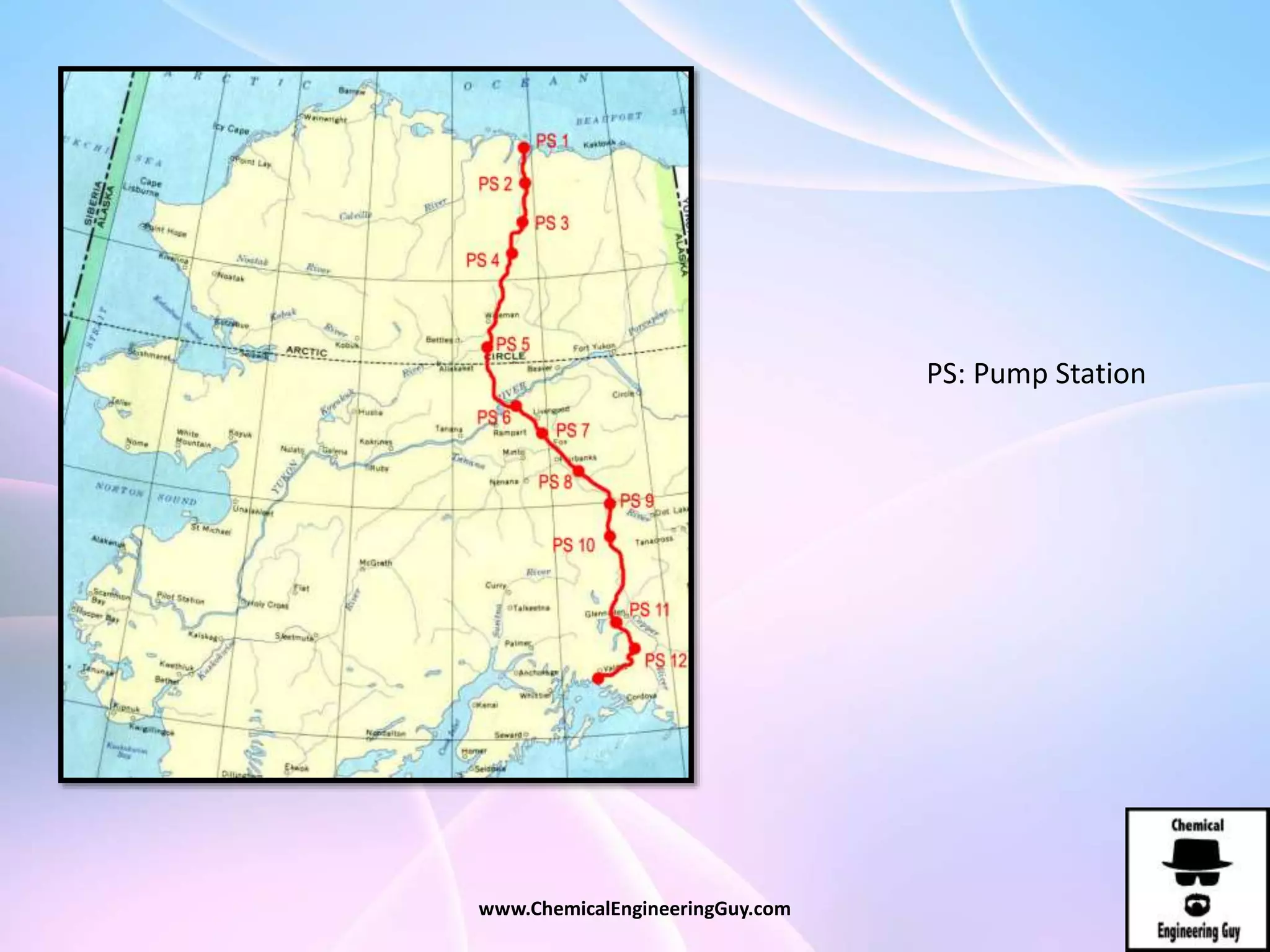
PS: Pump Station
Importance
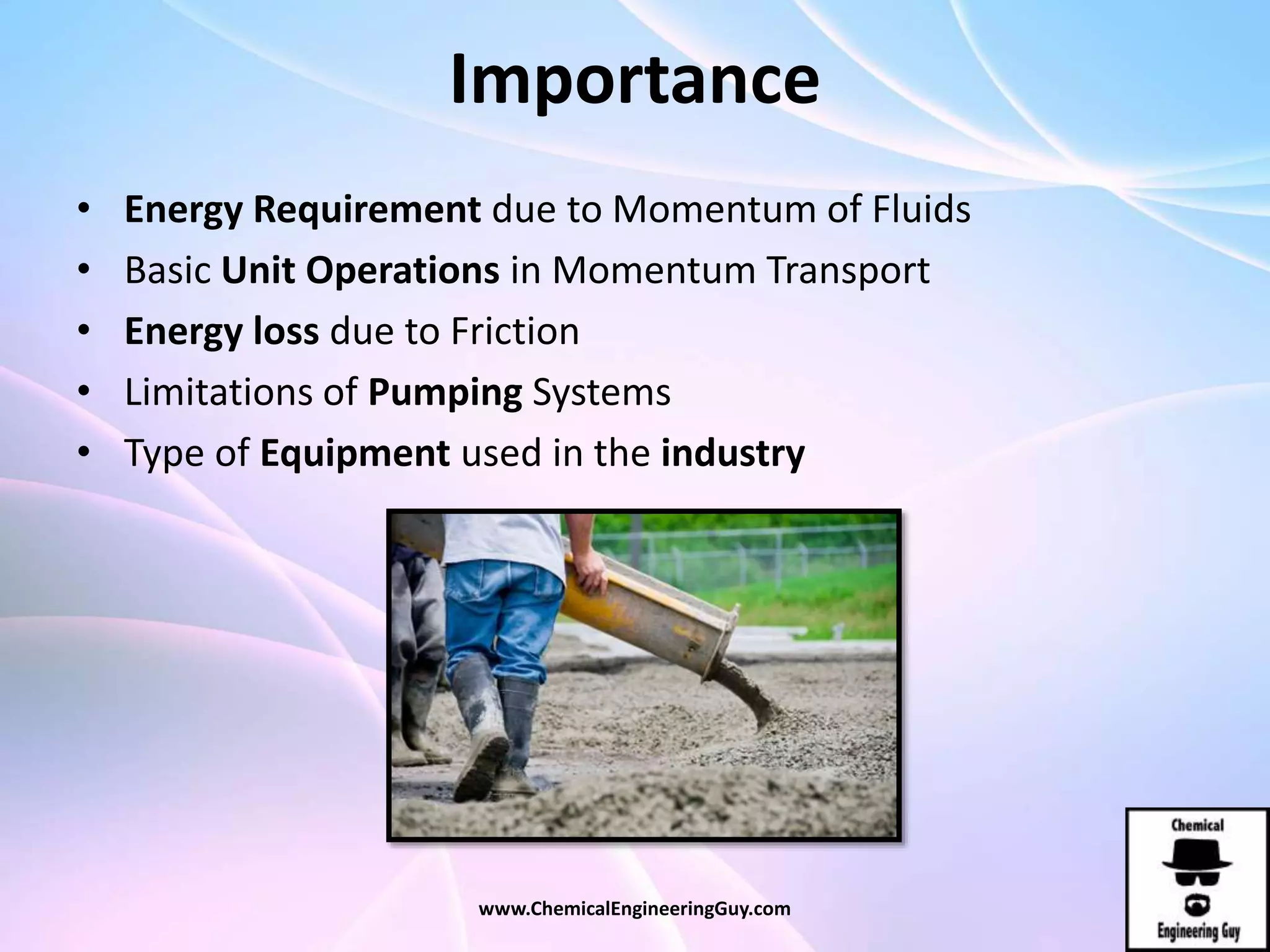
• Energy Requirement due to Momentum of Fluids
• Basic Unit Operations in Momentum Transport
• Energy loss due to Friction
• Limitations of Pumping Systems
• Type of Equipment used in the industry
www.ChemicalEngineeringGuy.com
Importance
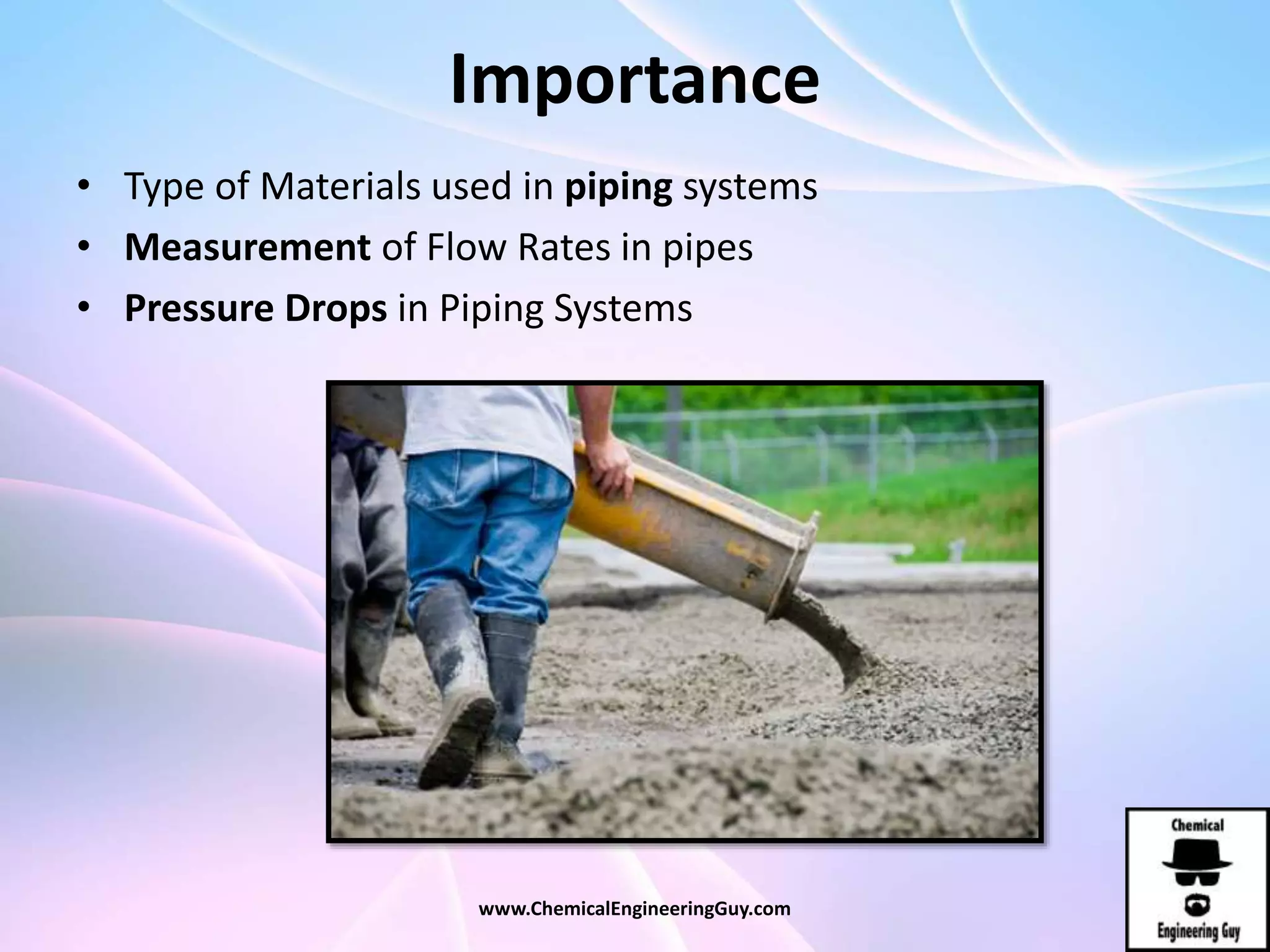
• Type of Materials used in piping systems
• Measurement of Flow Rates in pipes
• Pressure Drops in Piping Systems
www.ChemicalEngineeringGuy.com
Importance
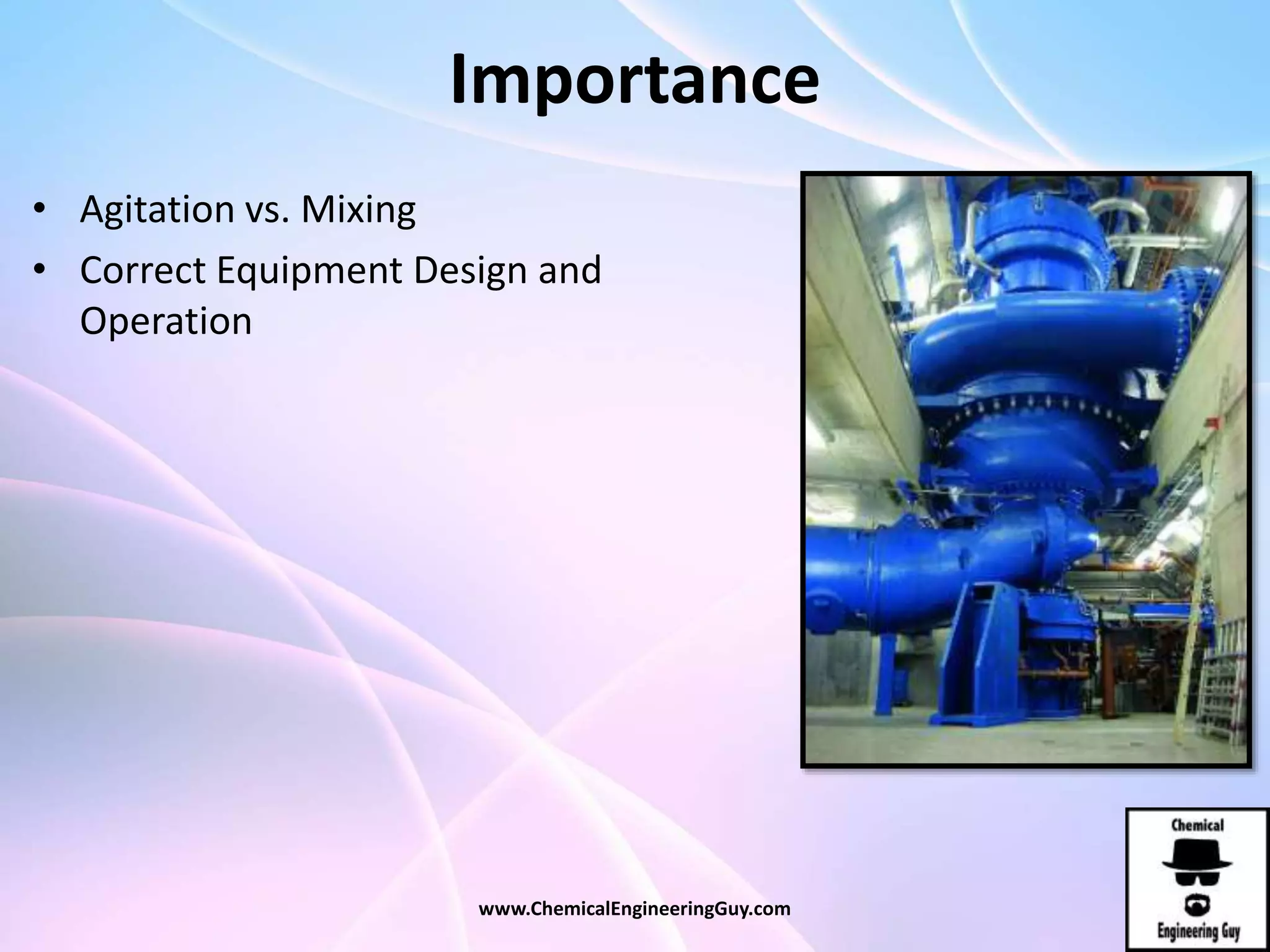
• Agitation vs. Mixing
• Correct Equipment Design and
Operation
www.ChemicalEngineeringGuy.com
Who’s this Course for?
• Students and/or Engineers who want a strong
fundamentals on:
– Fluid Mechanics
– Application of Theoretical Concepts to Real Life
Problems in Engineering
– Equipment Operation and Design related to
moving fluids @ct. density
– Piping and Instrumentation
– Momentum Transport Operations
www.ChemicalEngineeringGuy.com
Who’s this Course for?
• Petroleum Engineers
• Mechanical Engineers
• Chemical Engineers
• Electrical Engineers
• Process Engineers
• Civil Engineers
• Industrial Engineers
www.ChemicalEngineeringGuy.com
What is this course about
• Fluid Mechanics Application
– Incompressible Flow
• Overview of Common Equipment
• Equipment Design
• Equipment Operation
• A little bit of Theory (science behind)
• Application (use theory to solve real life
problems, i.e. engineering)
www.ChemicalEngineeringGuy.com
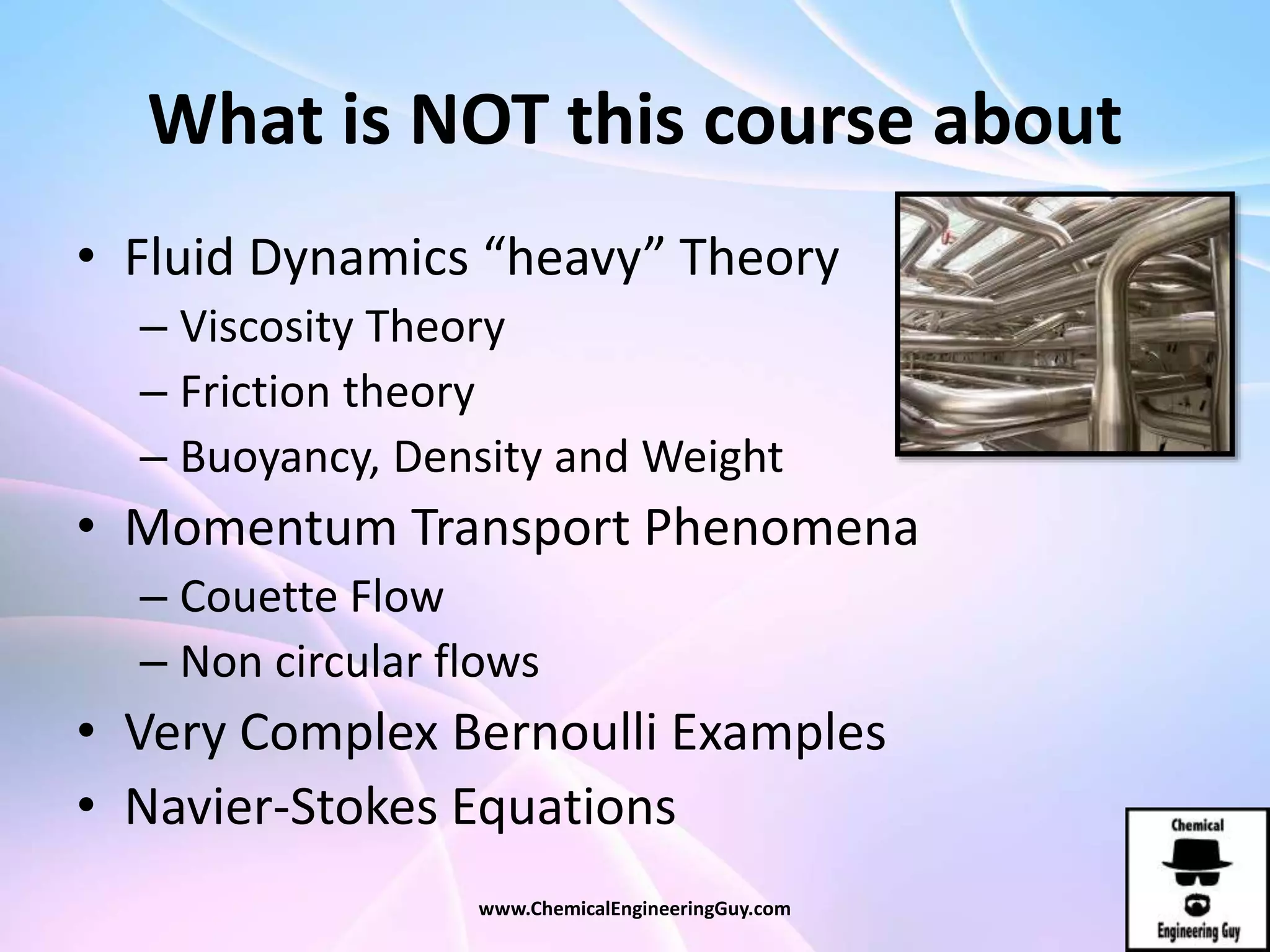
What is NOT this course about
• Fluid Dynamics “heavy” Theory
– Viscosity Theory
– Friction theory
– Buoyancy, Density and Weight
• Momentum Transport Phenomena
– Couette Flow
– Non circular flows
• Very Complex Bernoulli Examples
• Navier-Stokes Equations
www.ChemicalEngineeringGuy.com
What is NOT this course about
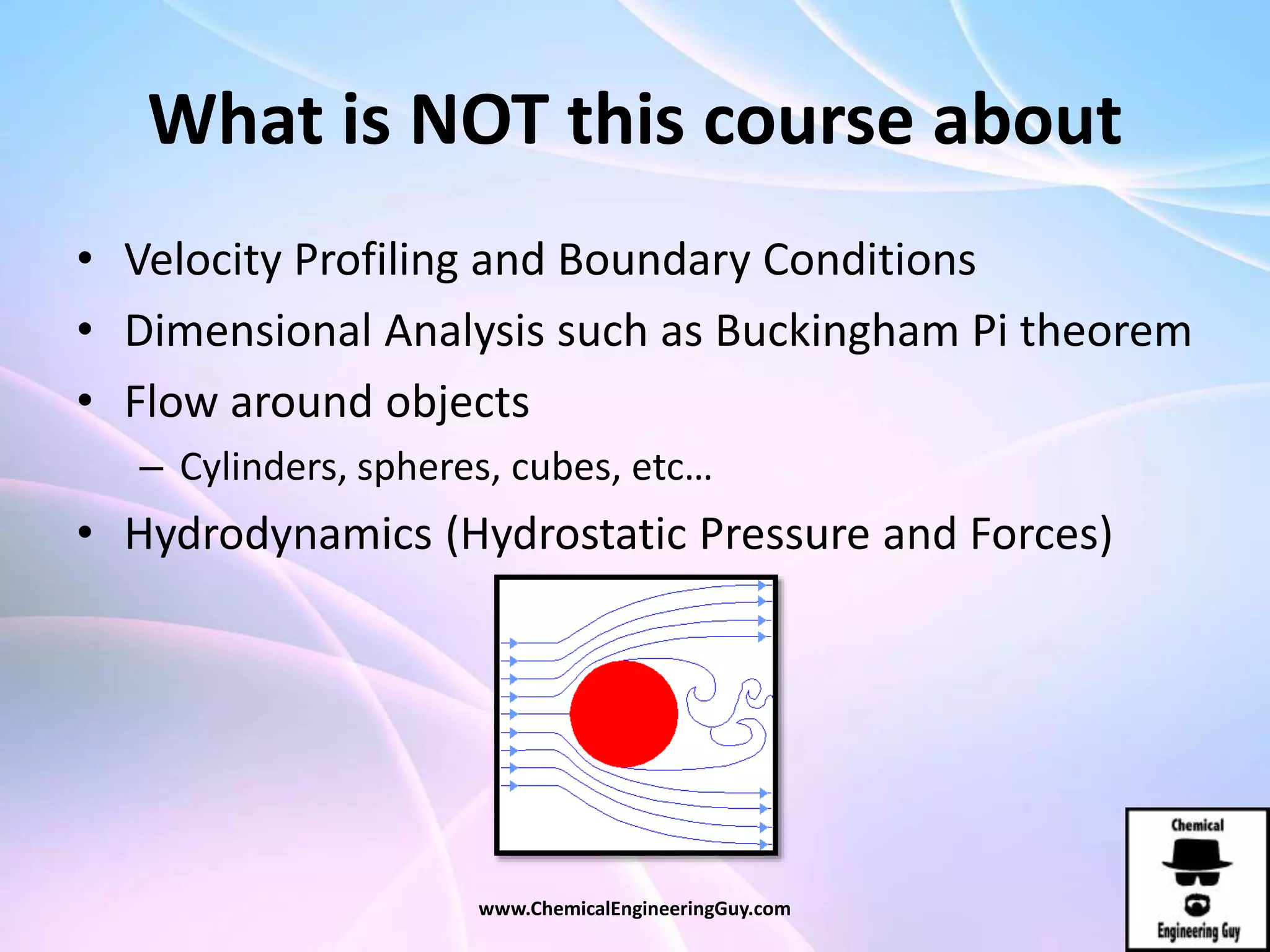
• Velocity Profiling and Boundary Conditions
• Dimensional Analysis such as Buckingham Pi theorem
• Flow around objects
– Cylinders, spheres, cubes, etc…
• Hydrodynamics (Hydrostatic Pressure and Forces)
www.ChemicalEngineeringGuy.com
Why you need it?
• You will need this course…
– Move fluids
– Calculate Pressure Drop
– Measure Flow Rates
– Increase Pressure of Incompressible Fluids
– Will help you in Plant Design
– Mechanic Energy (Generation/Consumption)
– Understand the limitations of a given system
www.ChemicalEngineeringGuy.com
Basic Concepts you need to know…
• If you’ve been tracking my courses:
– Mass Balance (Basic Balancing, Inlet, outlets)
– Energy Balance* (More on the mechanic energy)
– Thermodynamics (Basics)
– Transport Phenomena (The Momentum part)
• Basic  Viscosity, Flow in Pipes, Friction Factor, couette
flow, turbulence, etc.
– Fluid Dynamics ***
• Basic Knowledge
www.ChemicalEngineeringGuy.com
Basic Concepts you need to know…
• Mathematics
– Arithmetic (+,-,*,/)
– Geometry (area, perimeter, volume, etc)
– Conversion of Units (cm to m, kg to g, etc.)
– English System vs. International Systems
– Decimals and scientific notation
– % and fractions
www.ChemicalEngineeringGuy.com
Basic Concepts you need to know…
• Chemistry, Physics
– P vs. F
– Temp (abs) vs. Temp (R, F, K, C)
– Mass =/ weight
– Mol, Mass Weight, molar mass, mass fraction, mole
fraction
– Basic Hydrodynamics and Hydrostatics
www.ChemicalEngineeringGuy.com
Basic Concepts you need to know…
• Fluid Dynamics & Thermodynamics
– Viscosity (kinematic vs. )
– Bernoulli Equation
– Friction Factor Basics
– Efficiency in Work inlet/outlet
www.ChemicalEngineeringGuy.com
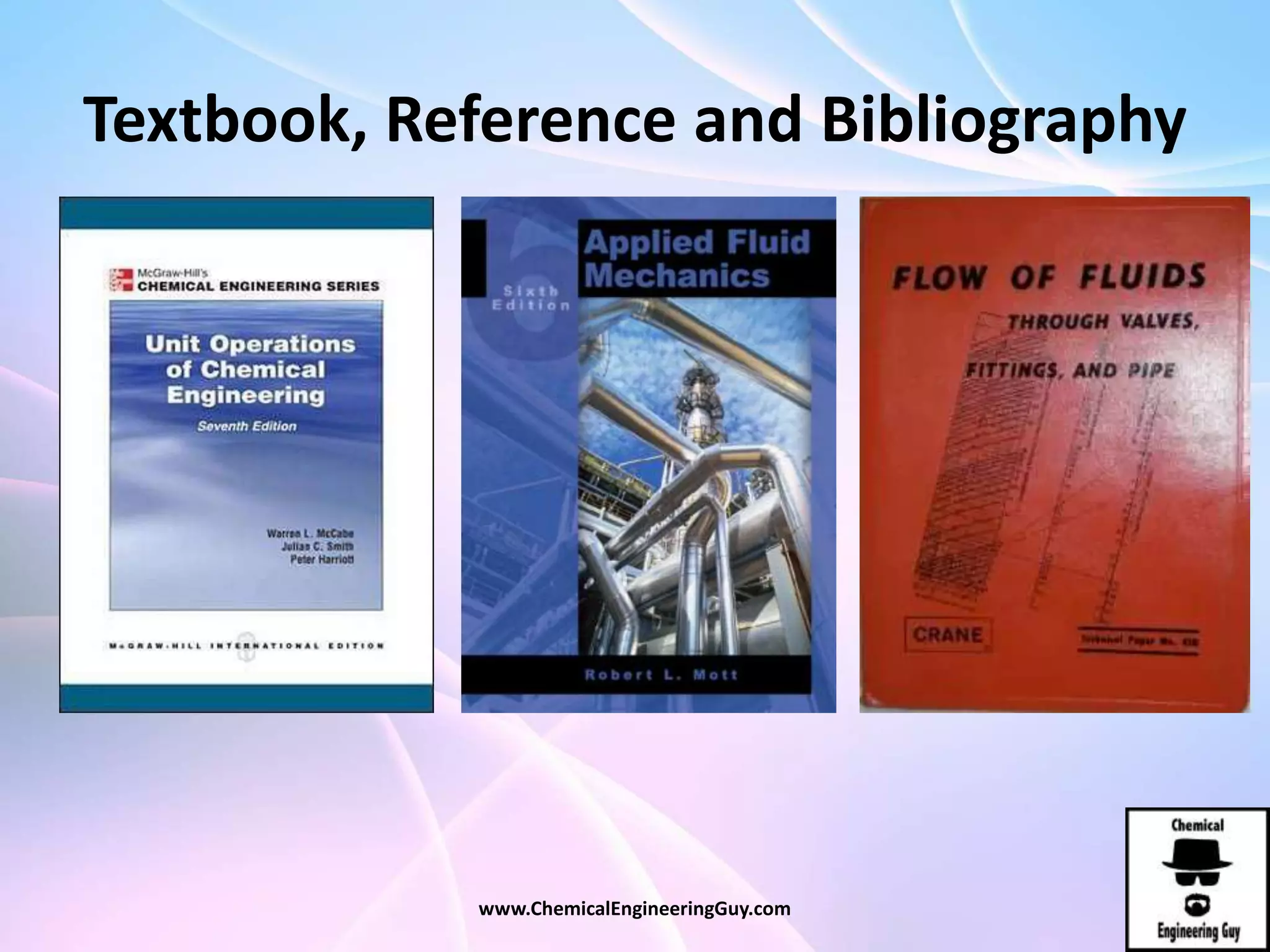
Textbook, Reference and Bibliography
www.ChemicalEngineeringGuy.com
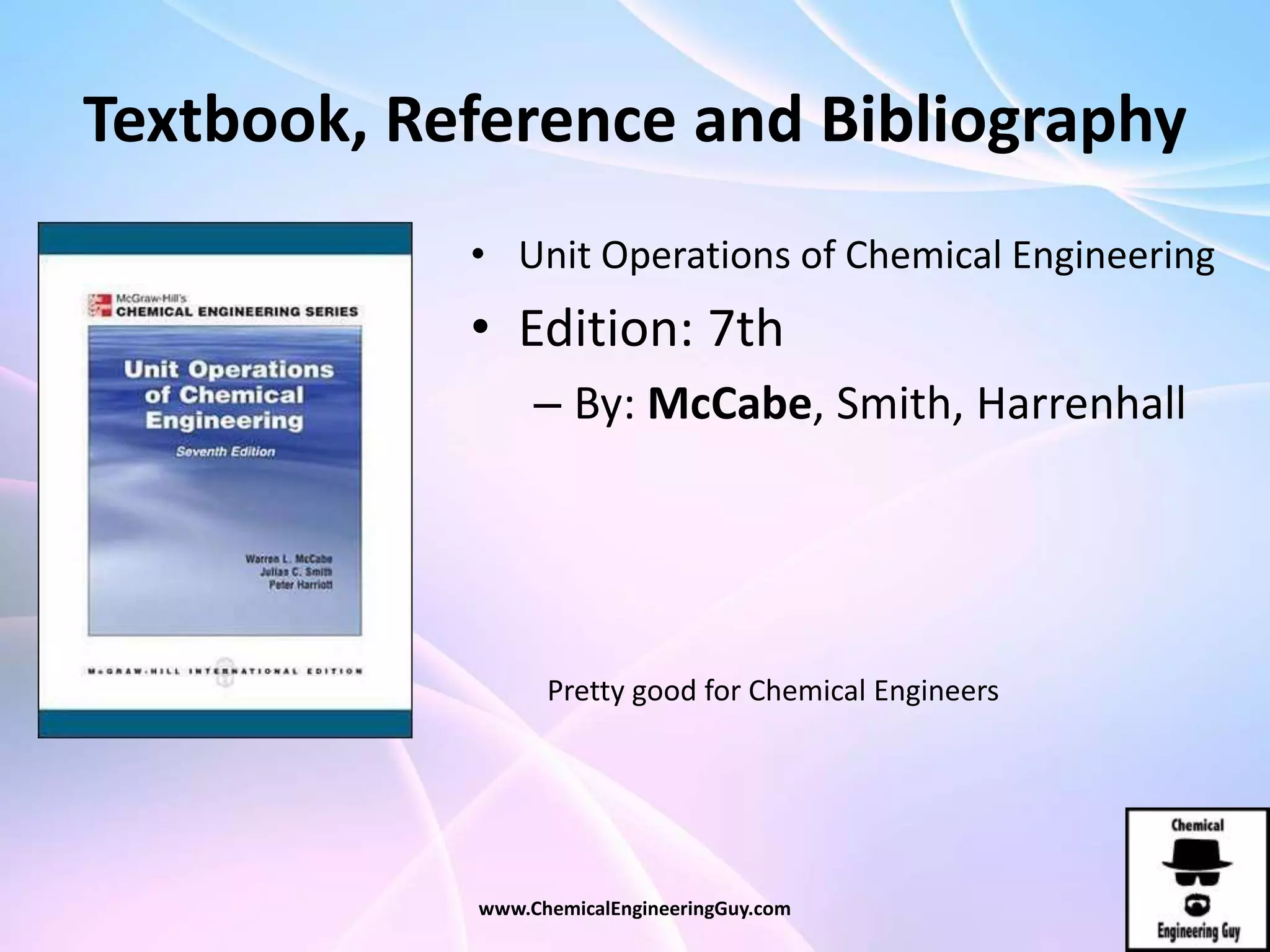
Textbook, Reference and Bibliography
• Unit Operations of Chemical Engineering
• Edition: 7th
– By: McCabe, Smith, Harrenhall
www.ChemicalEngineeringGuy.com
Pretty good for Chemical Engineers
Textbook, Reference and Bibliography
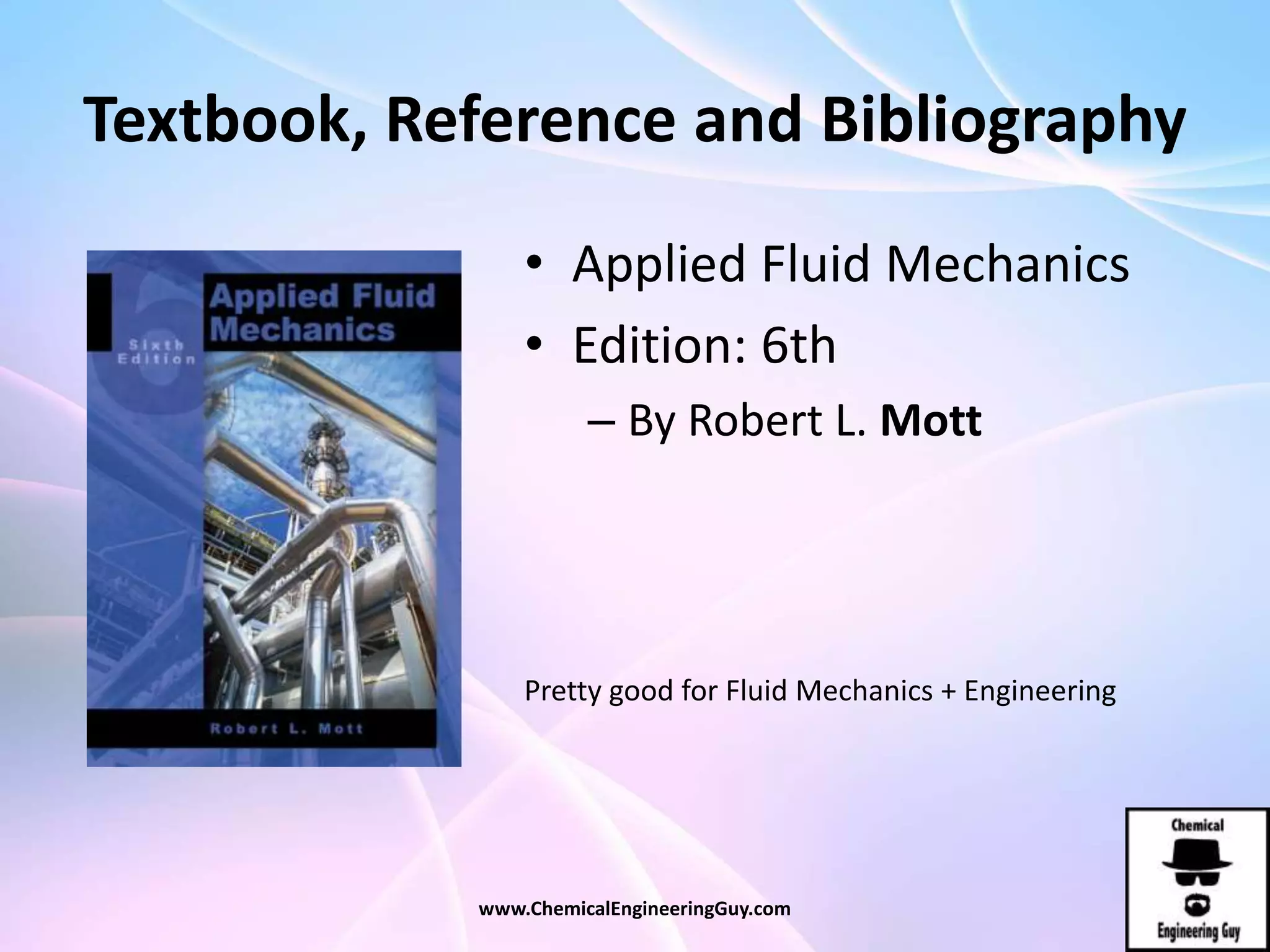
• Applied Fluid Mechanics
• Edition: 6th
– By Robert L. Mott
www.ChemicalEngineeringGuy.com
Pretty good for Fluid Mechanics + Engineering
Textbook, Reference and Bibliography
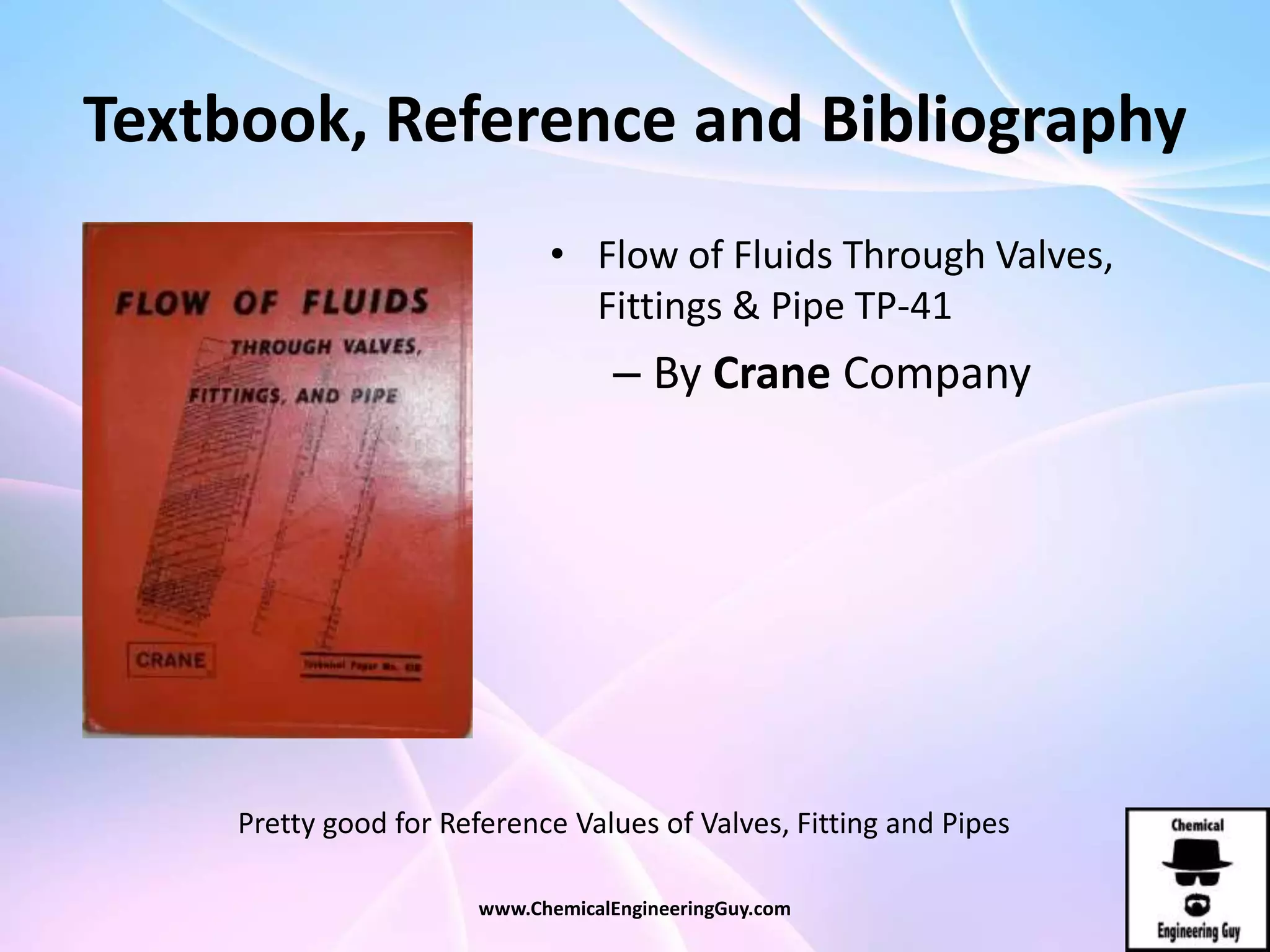
• Flow of Fluids Through Valves,
Fittings & Pipe TP-41
– By Crane Company
www.ChemicalEngineeringGuy.com
Pretty good for Reference Values of Valves, Fitting and Pipes
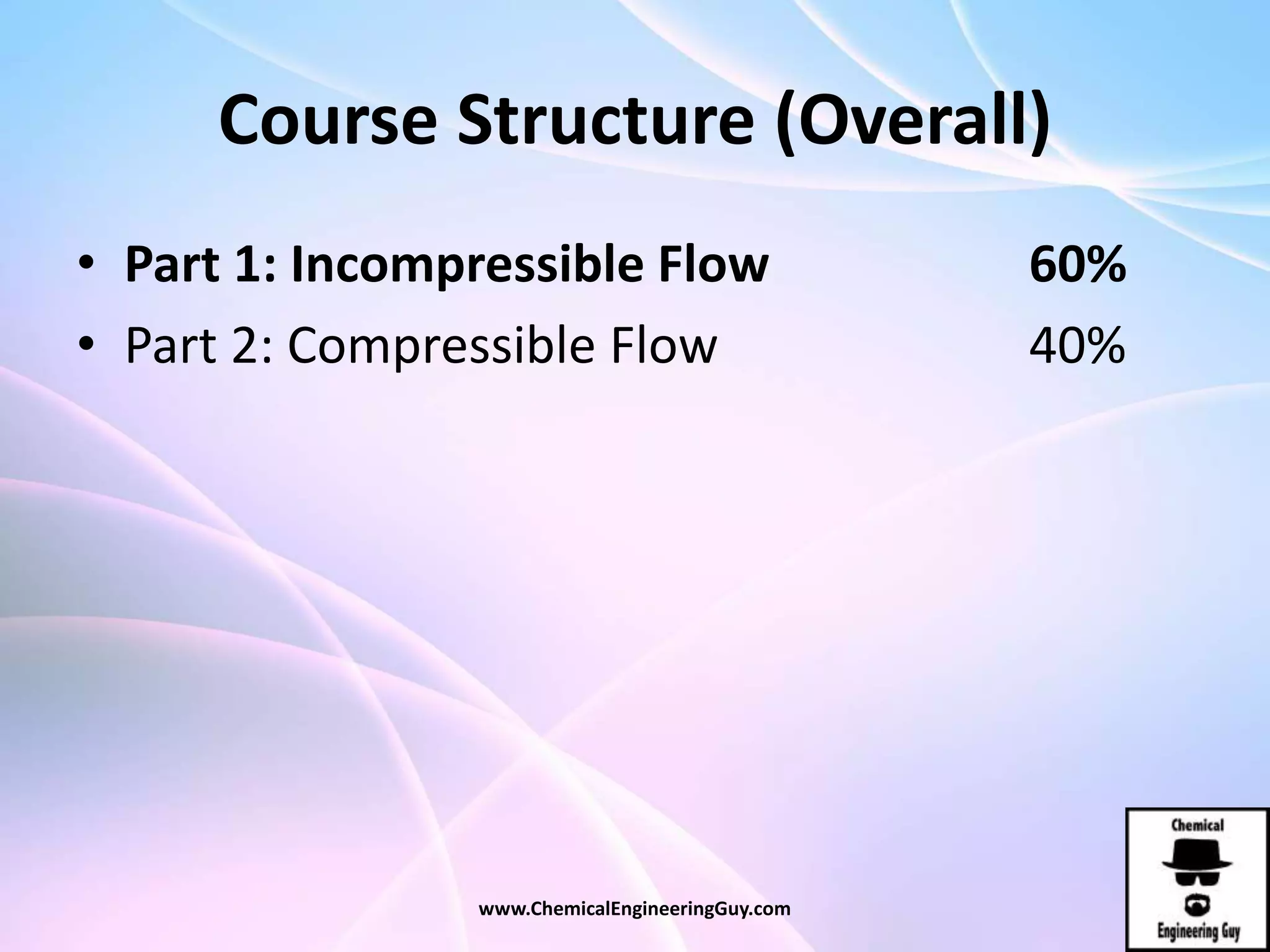
Course Structure (Overall)
• Part 1: Incompressible Flow 60%
• Part 2: Compressible Flow 40%
www.ChemicalEngineeringGuy.com
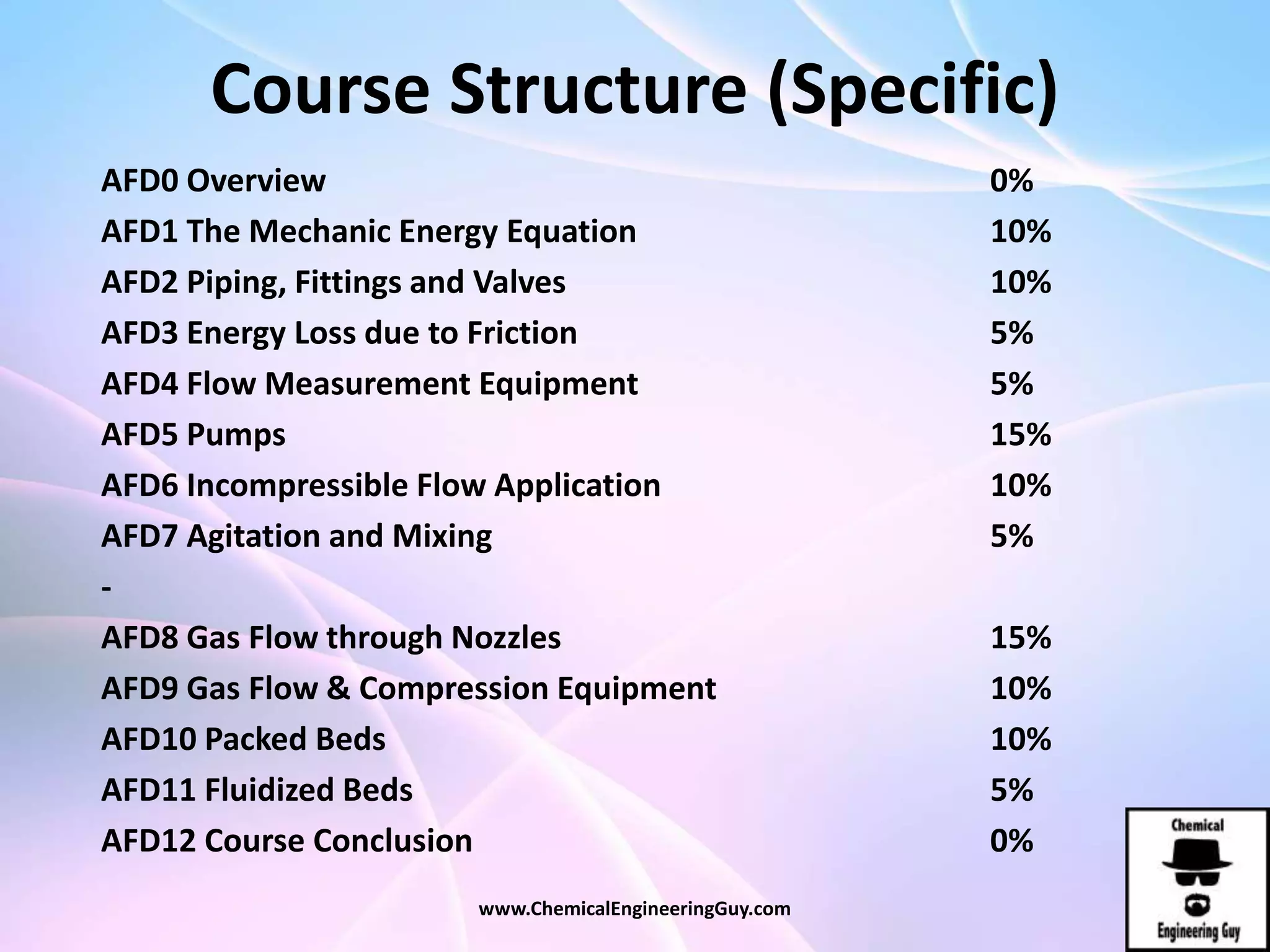
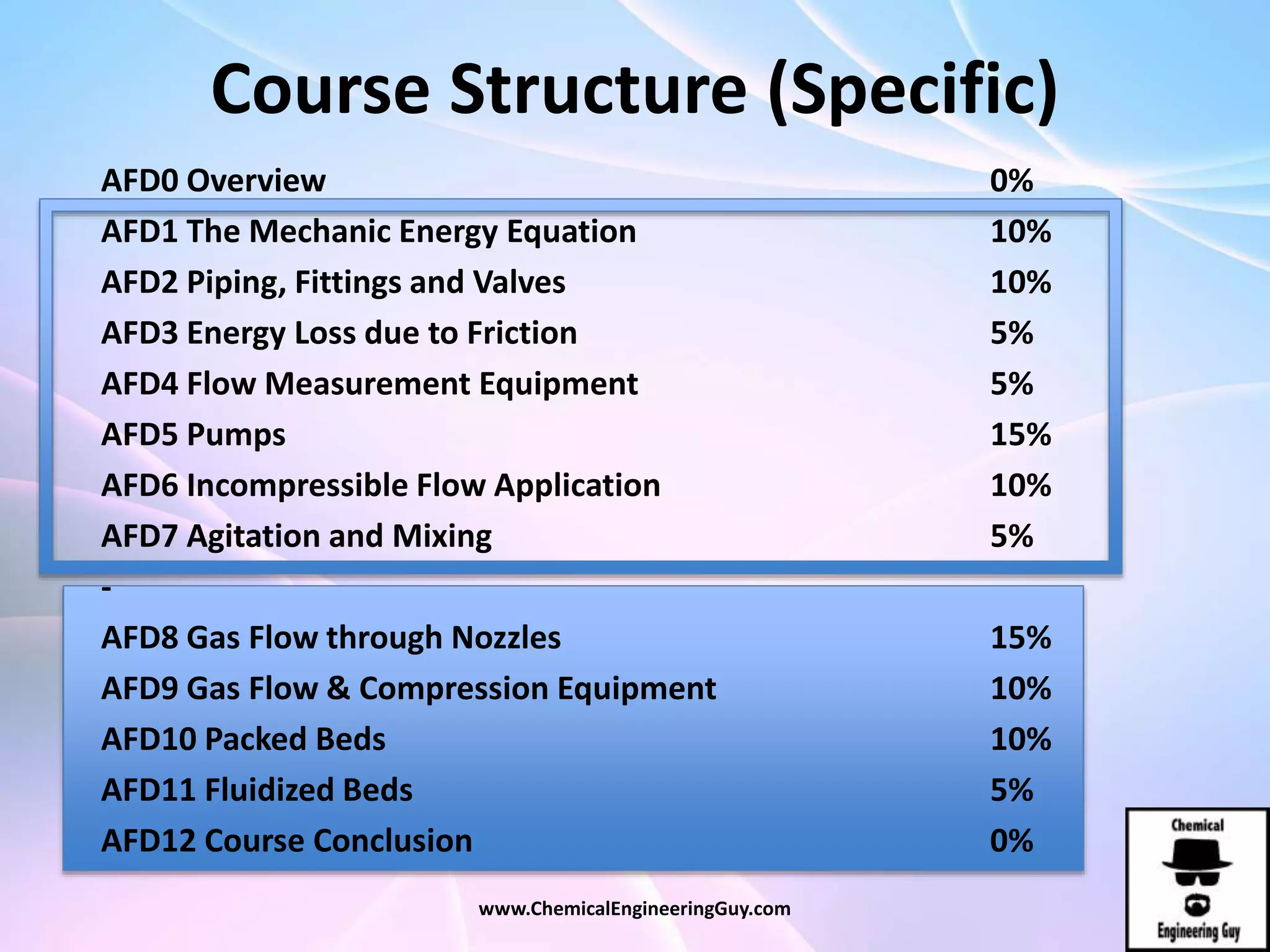
Course Structure (Specific)
AFD0 Overview 0%
AFD1 The Mechanic Energy Equation 10%
AFD2 Piping, Fittings and Valves 10%
AFD3 Energy Loss due to Friction 5%
AFD4 Flow Measurement Equipment 5%
AFD5 Pumps 15%
AFD6 Incompressible Flow Application 10%
AFD7 Agitation and Mixing 5%
-
AFD8 Gas Flow through Nozzles 15%
AFD9 Gas Flow & Compression Equipment 10%
AFD10 Packed Beds 10%
AFD11 Fluidized Beds 5%
AFD12 Course Conclusion 0%
www.ChemicalEngineeringGuy.com
Course Structure (Specific)
www.ChemicalEngineeringGuy.com
AFD0 Overview 0%
AFD1 The Mechanic Energy Equation 10%
AFD2 Piping, Fittings and Valves 10%
AFD3 Energy Loss due to Friction 5%
AFD4 Flow Measurement Equipment 5%
AFD5 Pumps 15%
AFD6 Incompressible Flow Application 10%
AFD7 Agitation and Mixing 5%
-
AFD8 Gas Flow through Nozzles 15%
AFD9 Gas Flow & Compression Equipment 10%
AFD10 Packed Beds 10%
AFD11 Fluidized Beds 5%
AFD12 Course Conclusion 0%
Course Content
www.ChemicalEngineeringGuy.com
PART I: Incompressible Flow
www.ChemicalEngineeringGuy.com
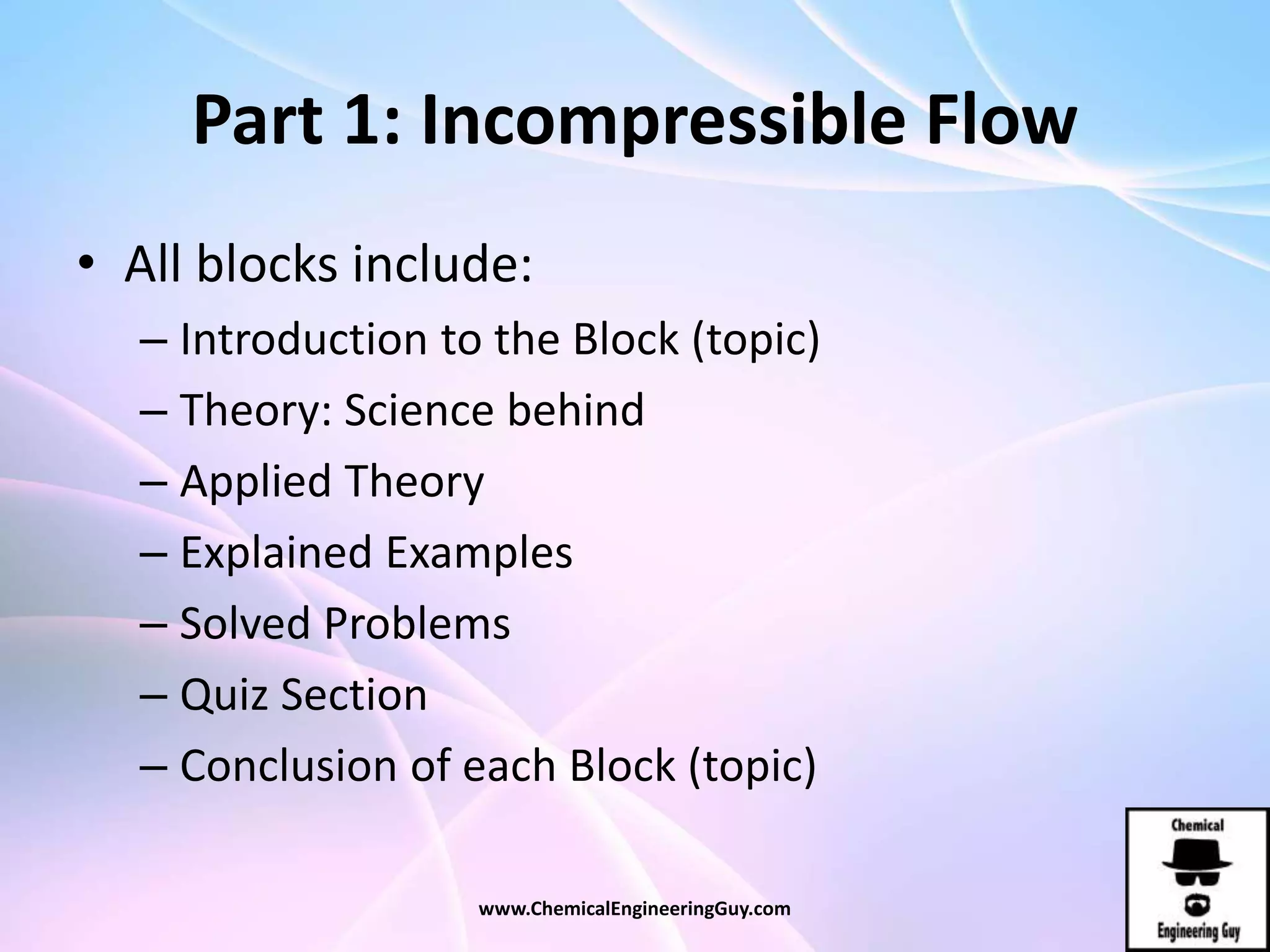
Part 1: Incompressible Flow
• All blocks include:
– Introduction to the Block (topic)
– Theory: Science behind
– Applied Theory
– Explained Examples
– Solved Problems
– Quiz Section
– Conclusion of each Block (topic)
www.ChemicalEngineeringGuy.com
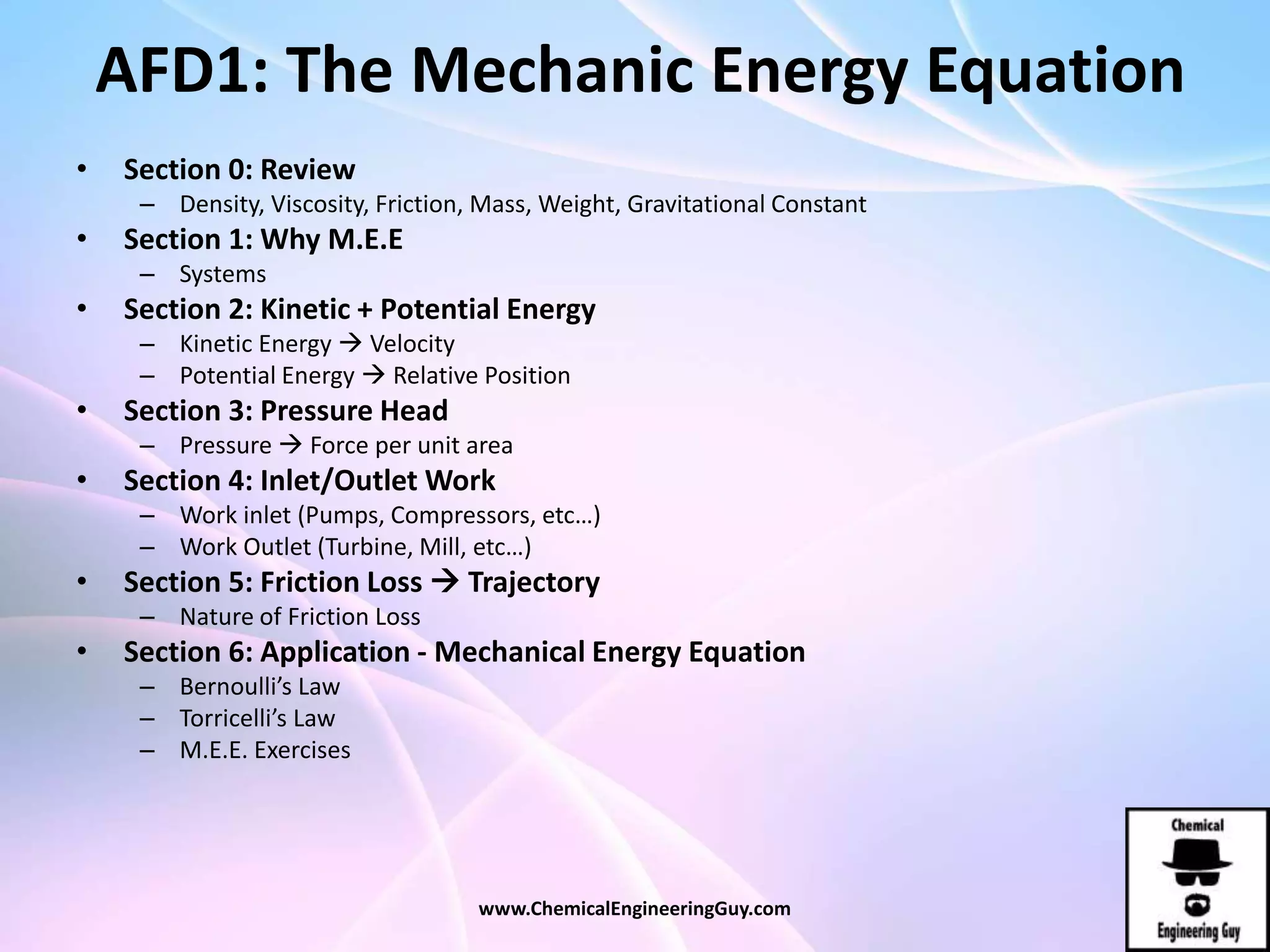
AFD1: The Mechanic Energy Equation
• Section 0: Review
– Density, Viscosity, Friction, Mass, Weight, Gravitational Constant
• Section 1: Why M.E.E
– Systems
• Section 2: Kinetic + Potential Energy
– Kinetic Energy  Velocity
– Potential Energy  Relative Position
• Section 3: Pressure Head
– Pressure  Force per unit area
• Section 4: Inlet/Outlet Work
– Work inlet (Pumps, Compressors, etc…)
– Work Outlet (Turbine, Mill, etc…)
• Section 5: Friction Loss  Trajectory
– Nature of Friction Loss
• Section 6: Application - Mechanical Energy Equation
– Bernoulli’s Law
– Torricelli’s Law
– M.E.E. Exercises
www.ChemicalEngineeringGuy.com
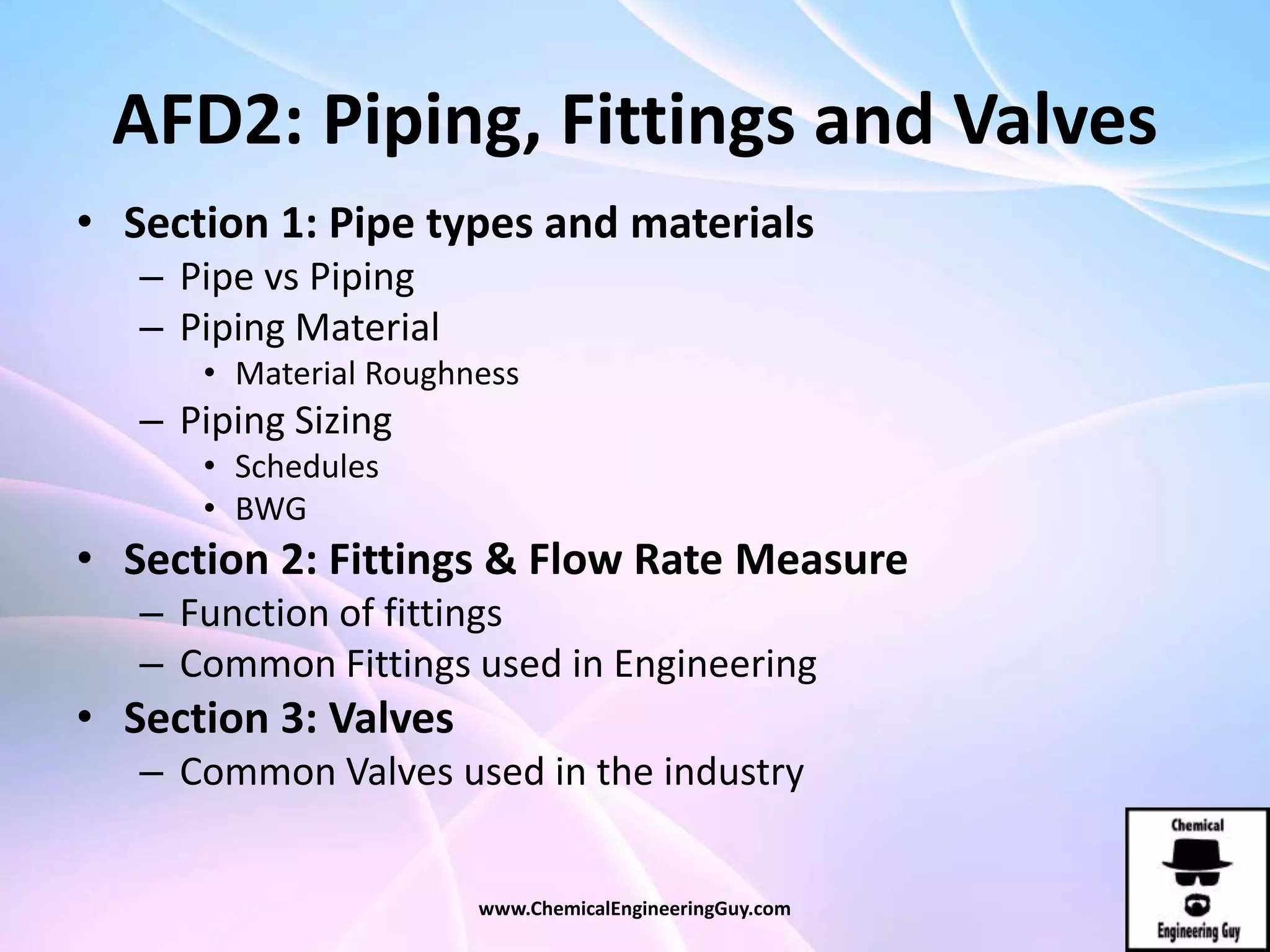
AFD2: Piping, Fittings and Valves
• Section 1: Pipe types and materials
– Pipe vs Piping
– Piping Material
• Material Roughness
– Piping Sizing
• Schedules
• BWG
• Section 2: Fittings & Flow Rate Measure
– Function of fittings
– Common Fittings used in Engineering
• Section 3: Valves
– Common Valves used in the industry
www.ChemicalEngineeringGuy.com
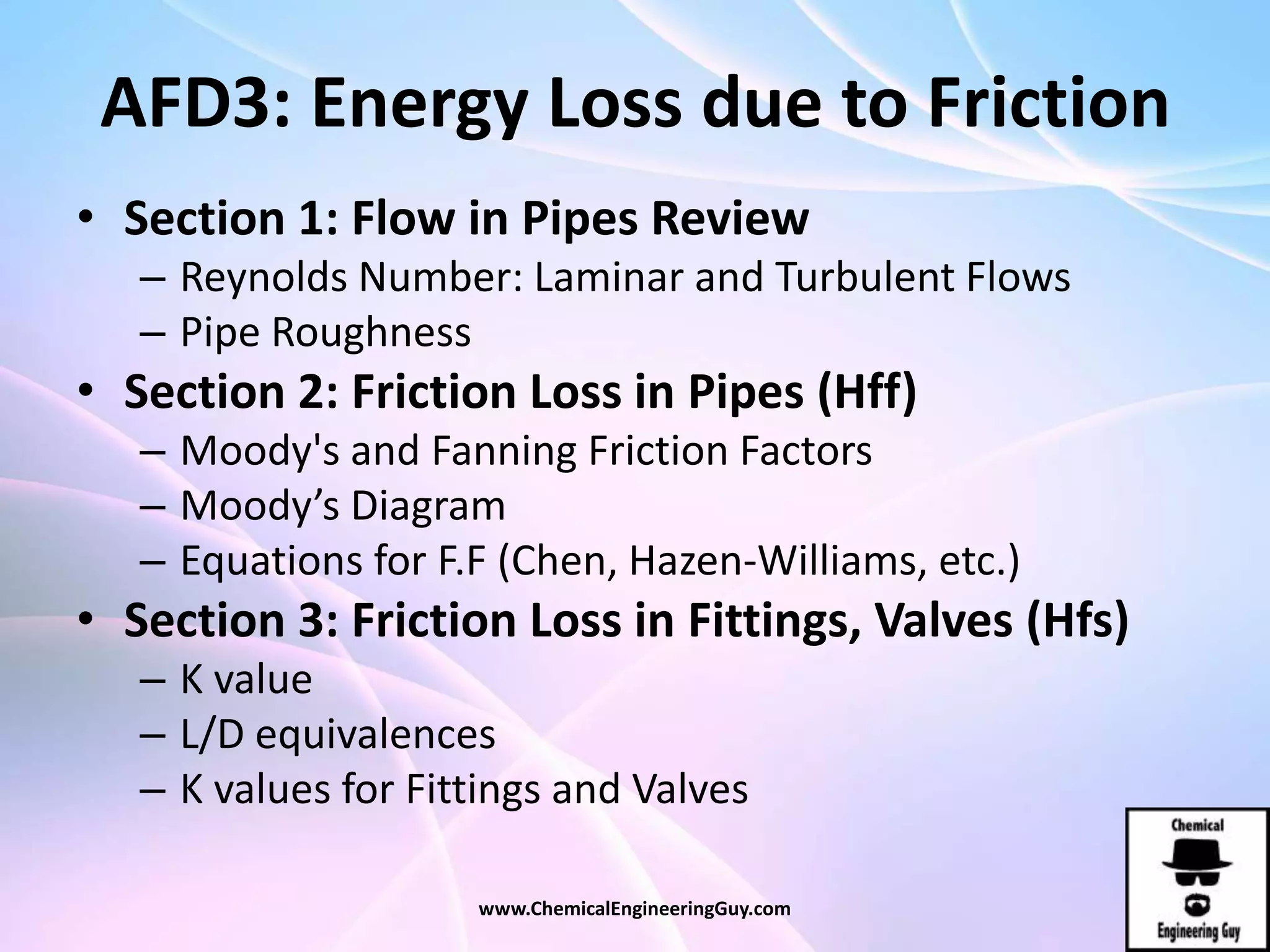
AFD3: Energy Loss due to Friction
• Section 1: Flow in Pipes Review
– Reynolds Number: Laminar and Turbulent Flows
– Pipe Roughness
• Section 2: Friction Loss in Pipes (Hff)
– Moody's and Fanning Friction Factors
– Moody’s Diagram
– Equations for F.F (Chen, Hazen-Williams, etc.)
• Section 3: Friction Loss in Fittings, Valves (Hfs)
– K value
– L/D equivalences
– K values for Fittings and Valves
www.ChemicalEngineeringGuy.com
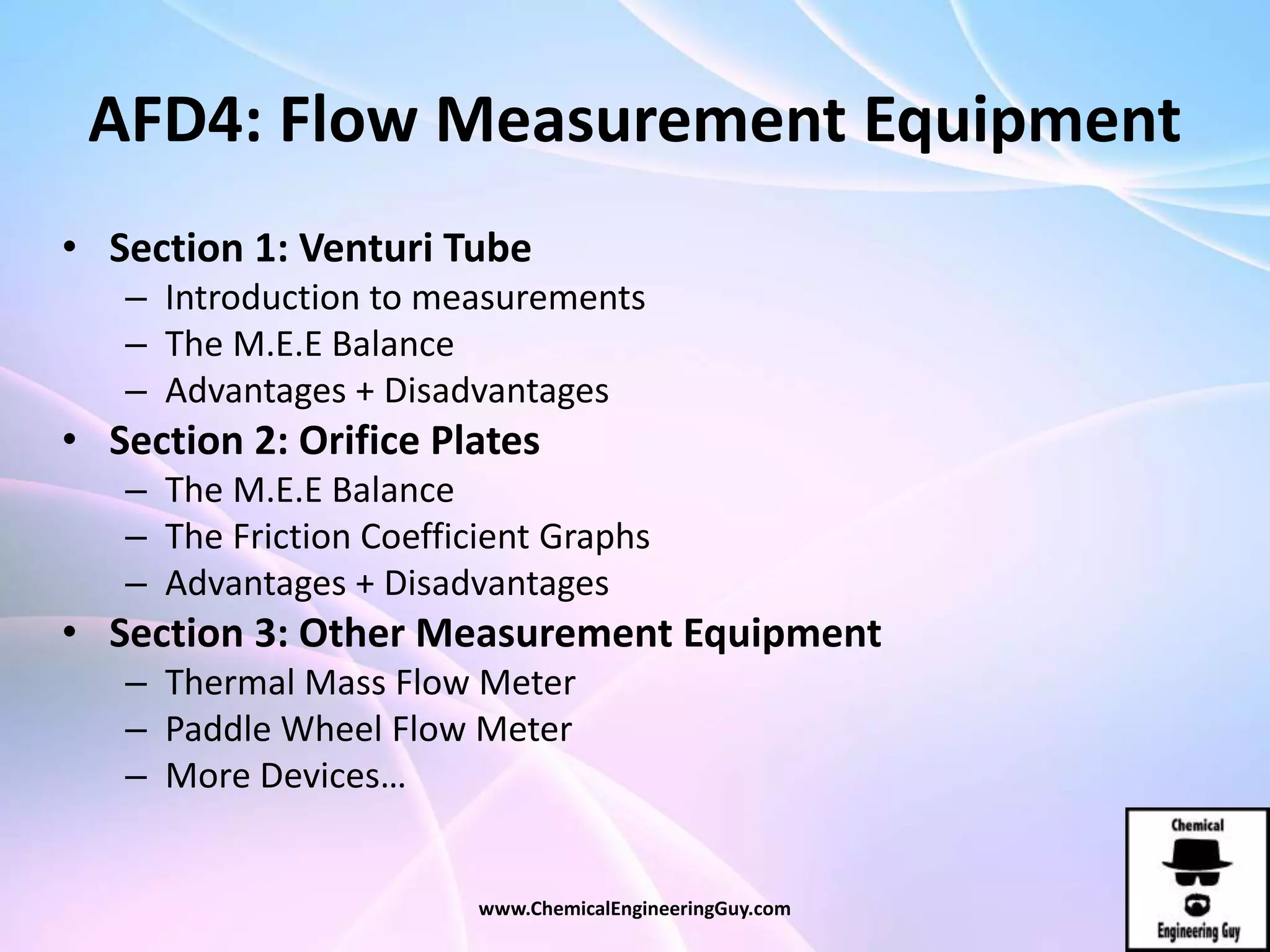
AFD4: Flow Measurement Equipment
• Section 1: Venturi Tube
– Introduction to measurements
– The M.E.E Balance
– Advantages + Disadvantages
• Section 2: Orifice Plates
– The M.E.E Balance
– The Friction Coefficient Graphs
– Advantages + Disadvantages
• Section 3: Other Measurement Equipment
– Thermal Mass Flow Meter
– Paddle Wheel Flow Meter
– More Devices…
www.ChemicalEngineeringGuy.com
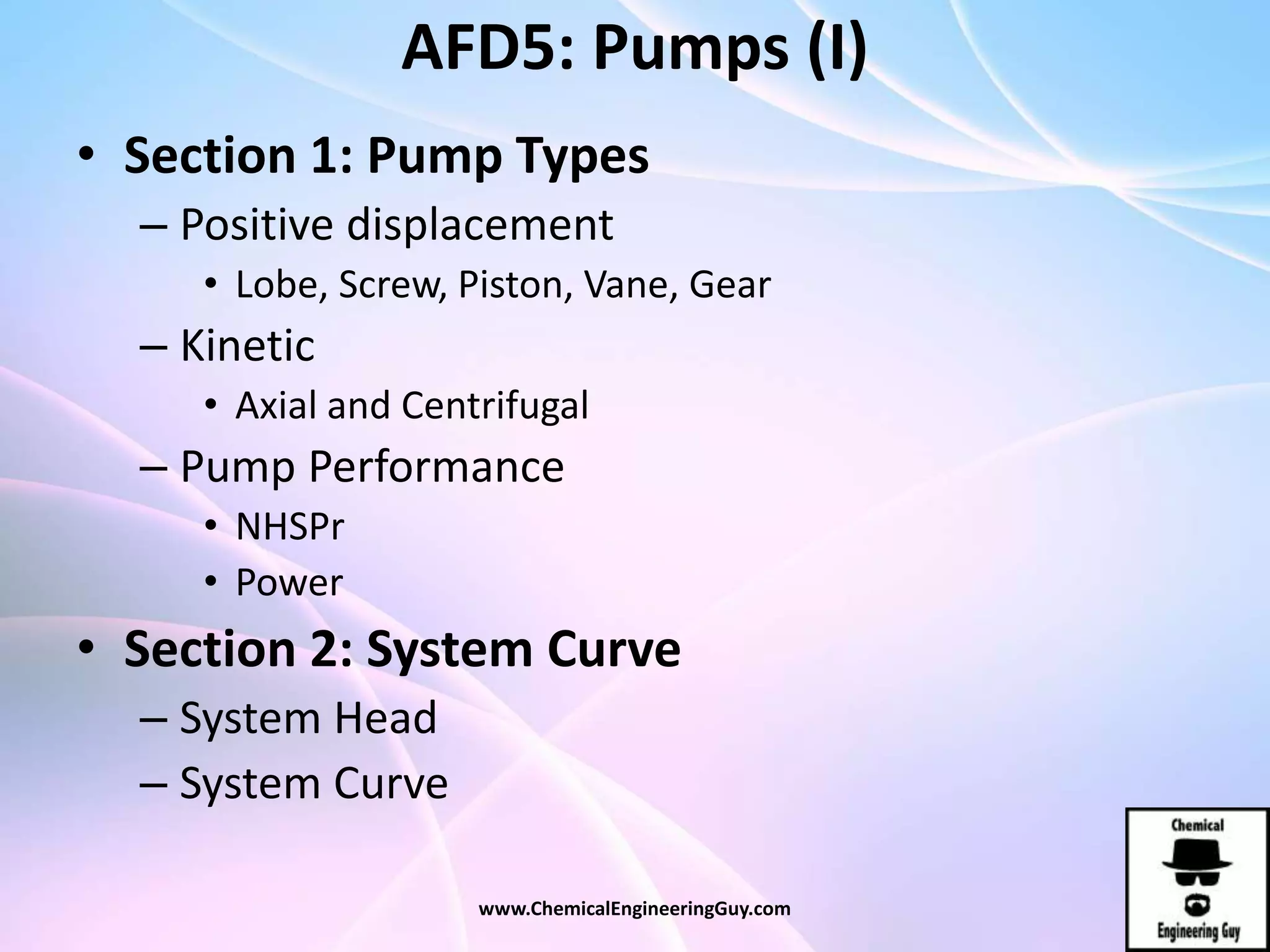
AFD5: Pumps (I)
• Section 1: Pump Types
– Positive displacement
• Lobe, Screw, Piston, Vane, Gear
– Kinetic
• Axial and Centrifugal
– Pump Performance
• NHSPr
• Power
• Section 2: System Curve
– System Head
– System Curve
www.ChemicalEngineeringGuy.com
AFD5: Pumps (II)
• Section 3: Pump Curve
– Pump Head
– Pump Curve
• Impeller Effect
• Efficiency Curves
• Pump Power Curves
• NPSH
• Velocity Effect
• Section 4: Pump Selection
– How to choose a pump
– Supplier Data
– Pump Affinity Laws
• Section 5: Pumping Systems
– Pump in Series
– Parallel Pumps
– Software Modeling
www.ChemicalEngineeringGuy.com
AFD6: Incompressible Flow Application
• Section 1: Series Flow (1 pipe)
– Type of Problems
• Head of the System revisited
• Pipe Size Selection
• Volumetric Flow
• Pump Selection
• Section 2: Parallel and Branch Flow
– Parallel Flow vs. Branched Flow
– Parallel Flow  2 Pipes
– Parallel + Branched Flow  (Software)
www.ChemicalEngineeringGuy.com
AFD7: Agitation and Mixing
• Section 1: Agitation and Mixing Theory
– Agitation vs. Mixing
– Overview of Equipment
• Section 2: Design of Mixing Equipment
– Power Number
– Power Requirement
• Section 3: Static Mixers
– Basic Principle
• Section 4: Software Modeling
www.ChemicalEngineeringGuy.com
End of Introduction to PART 1
• By now you should know:
– The importance of this course in engineering
– The course structure and content
– That this course is Theory – Application
– This is Part 1  Incompressible Flow
– It is highly recommended to start with Part 1
– After studying Part 1. Continue to Part 2.
www.ChemicalEngineeringGuy.com
Need More Problems?
Check out the COURSE
www.ChemicalEngineeringGuy.com
• Courses
A p p l i e d F l u i d D y n a m i c s
I n c o m p r e s s i b l e F l o w ( P A R T 1 )
You’ll get SOLVED problems, Quizzes, Slides, and
much more!
www.ChemicalEngineeringGuy.com
Questions and Problems
• REMEMBER…
– Practice and Repetition makes MASTERY
• Check out All problems and exercises are
solved in the next webpage
– www.ChemicalEngineeringGuy.com
• Courses
– Momentum Transfer Operations
• Don’t Forget to take the Quiz of this Block!
– Theory must be applied and practiced
www.ChemicalEngineeringGuy.com
Contact Information!
• Get extra information here!
– Directly on the WebPage:
• www.ChemicalEngineeringGuy.com/courses
– FB page:
• www.facebook.com/Chemical.Engineering.Guy
– My Twitter:
• www.twitter.com/ChemEngGuy
– Contact me by e-mail:
• Contact@ChemicalEngineeringGuy.com
www.ChemicalEngineeringGuy.com

Applied Fluid Mechanics - Course Overview (AFD0)

  • 1.
    Applied Fluid Mechanics P1:Incompressible Flow Chemical Engineering Guy www.ChemicalEngineeringGuy.com
  • 2.
    Overview • Difference betweenCompressible Flow and Incompressible Flow • Why is it important to study Incompressible Flow • Who should take this course • What is this course and what is not • How is PART 1 Structured? • Textbooks www.ChemicalEngineeringGuy.com
  • 3.
    Part 1 vs.Part 2 • Incompressible flow  constant density – Easier to model – Examples: • Liquids and Gases with no change of T,P • Compressible flow  density is function of T,P – Complex to model – Examples: • Gases with change in T, P www.ChemicalEngineeringGuy.com
  • 4.
    What is AppliedFluid Mechanics? Incompressible Flow • Is the art of Moving Fluids of Constant Density – Study of the theory behind this Phenomena – Design of Equipment – Correct Operation of Equipment • Keywords – Pumping, Friction loss, mechanic energy, piping, incompressible, agitation, mixing www.ChemicalEngineeringGuy.com
  • 5.
  • 6.
  • 7.
    Importance • Energy Requirementdue to Momentum of Fluids • Basic Unit Operations in Momentum Transport • Energy loss due to Friction • Limitations of Pumping Systems • Type of Equipment used in the industry www.ChemicalEngineeringGuy.com
  • 8.
    Importance • Type ofMaterials used in piping systems • Measurement of Flow Rates in pipes • Pressure Drops in Piping Systems www.ChemicalEngineeringGuy.com
  • 9.
    Importance • Agitation vs.Mixing • Correct Equipment Design and Operation www.ChemicalEngineeringGuy.com
  • 10.
    Who’s this Coursefor? • Students and/or Engineers who want a strong fundamentals on: – Fluid Mechanics – Application of Theoretical Concepts to Real Life Problems in Engineering – Equipment Operation and Design related to moving fluids @ct. density – Piping and Instrumentation – Momentum Transport Operations www.ChemicalEngineeringGuy.com
  • 11.
    Who’s this Coursefor? • Petroleum Engineers • Mechanical Engineers • Chemical Engineers • Electrical Engineers • Process Engineers • Civil Engineers • Industrial Engineers www.ChemicalEngineeringGuy.com
  • 12.
    What is thiscourse about • Fluid Mechanics Application – Incompressible Flow • Overview of Common Equipment • Equipment Design • Equipment Operation • A little bit of Theory (science behind) • Application (use theory to solve real life problems, i.e. engineering) www.ChemicalEngineeringGuy.com
  • 13.
    What is NOTthis course about • Fluid Dynamics “heavy” Theory – Viscosity Theory – Friction theory – Buoyancy, Density and Weight • Momentum Transport Phenomena – Couette Flow – Non circular flows • Very Complex Bernoulli Examples • Navier-Stokes Equations www.ChemicalEngineeringGuy.com
  • 14.
    What is NOTthis course about • Velocity Profiling and Boundary Conditions • Dimensional Analysis such as Buckingham Pi theorem • Flow around objects – Cylinders, spheres, cubes, etc… • Hydrodynamics (Hydrostatic Pressure and Forces) www.ChemicalEngineeringGuy.com
  • 15.
    Why you needit? • You will need this course… – Move fluids – Calculate Pressure Drop – Measure Flow Rates – Increase Pressure of Incompressible Fluids – Will help you in Plant Design – Mechanic Energy (Generation/Consumption) – Understand the limitations of a given system www.ChemicalEngineeringGuy.com
  • 16.
    Basic Concepts youneed to know… • If you’ve been tracking my courses: – Mass Balance (Basic Balancing, Inlet, outlets) – Energy Balance* (More on the mechanic energy) – Thermodynamics (Basics) – Transport Phenomena (The Momentum part) • Basic  Viscosity, Flow in Pipes, Friction Factor, couette flow, turbulence, etc. – Fluid Dynamics *** • Basic Knowledge www.ChemicalEngineeringGuy.com
  • 17.
    Basic Concepts youneed to know… • Mathematics – Arithmetic (+,-,*,/) – Geometry (area, perimeter, volume, etc) – Conversion of Units (cm to m, kg to g, etc.) – English System vs. International Systems – Decimals and scientific notation – % and fractions www.ChemicalEngineeringGuy.com
  • 18.
    Basic Concepts youneed to know… • Chemistry, Physics – P vs. F – Temp (abs) vs. Temp (R, F, K, C) – Mass =/ weight – Mol, Mass Weight, molar mass, mass fraction, mole fraction – Basic Hydrodynamics and Hydrostatics www.ChemicalEngineeringGuy.com
  • 19.
    Basic Concepts youneed to know… • Fluid Dynamics & Thermodynamics – Viscosity (kinematic vs. ) – Bernoulli Equation – Friction Factor Basics – Efficiency in Work inlet/outlet www.ChemicalEngineeringGuy.com
  • 20.
    Textbook, Reference andBibliography www.ChemicalEngineeringGuy.com
  • 21.
    Textbook, Reference andBibliography • Unit Operations of Chemical Engineering • Edition: 7th – By: McCabe, Smith, Harrenhall www.ChemicalEngineeringGuy.com Pretty good for Chemical Engineers
  • 22.
    Textbook, Reference andBibliography • Applied Fluid Mechanics • Edition: 6th – By Robert L. Mott www.ChemicalEngineeringGuy.com Pretty good for Fluid Mechanics + Engineering
  • 23.
    Textbook, Reference andBibliography • Flow of Fluids Through Valves, Fittings & Pipe TP-41 – By Crane Company www.ChemicalEngineeringGuy.com Pretty good for Reference Values of Valves, Fitting and Pipes
  • 24.
    Course Structure (Overall) •Part 1: Incompressible Flow 60% • Part 2: Compressible Flow 40% www.ChemicalEngineeringGuy.com
  • 25.
    Course Structure (Specific) AFD0Overview 0% AFD1 The Mechanic Energy Equation 10% AFD2 Piping, Fittings and Valves 10% AFD3 Energy Loss due to Friction 5% AFD4 Flow Measurement Equipment 5% AFD5 Pumps 15% AFD6 Incompressible Flow Application 10% AFD7 Agitation and Mixing 5% - AFD8 Gas Flow through Nozzles 15% AFD9 Gas Flow & Compression Equipment 10% AFD10 Packed Beds 10% AFD11 Fluidized Beds 5% AFD12 Course Conclusion 0% www.ChemicalEngineeringGuy.com
  • 26.
    Course Structure (Specific) www.ChemicalEngineeringGuy.com AFD0Overview 0% AFD1 The Mechanic Energy Equation 10% AFD2 Piping, Fittings and Valves 10% AFD3 Energy Loss due to Friction 5% AFD4 Flow Measurement Equipment 5% AFD5 Pumps 15% AFD6 Incompressible Flow Application 10% AFD7 Agitation and Mixing 5% - AFD8 Gas Flow through Nozzles 15% AFD9 Gas Flow & Compression Equipment 10% AFD10 Packed Beds 10% AFD11 Fluidized Beds 5% AFD12 Course Conclusion 0%
  • 27.
  • 28.
    PART I: IncompressibleFlow www.ChemicalEngineeringGuy.com
  • 29.
    Part 1: IncompressibleFlow • All blocks include: – Introduction to the Block (topic) – Theory: Science behind – Applied Theory – Explained Examples – Solved Problems – Quiz Section – Conclusion of each Block (topic) www.ChemicalEngineeringGuy.com
  • 30.
    AFD1: The MechanicEnergy Equation • Section 0: Review – Density, Viscosity, Friction, Mass, Weight, Gravitational Constant • Section 1: Why M.E.E – Systems • Section 2: Kinetic + Potential Energy – Kinetic Energy  Velocity – Potential Energy  Relative Position • Section 3: Pressure Head – Pressure  Force per unit area • Section 4: Inlet/Outlet Work – Work inlet (Pumps, Compressors, etc…) – Work Outlet (Turbine, Mill, etc…) • Section 5: Friction Loss  Trajectory – Nature of Friction Loss • Section 6: Application - Mechanical Energy Equation – Bernoulli’s Law – Torricelli’s Law – M.E.E. Exercises www.ChemicalEngineeringGuy.com
  • 31.
    AFD2: Piping, Fittingsand Valves • Section 1: Pipe types and materials – Pipe vs Piping – Piping Material • Material Roughness – Piping Sizing • Schedules • BWG • Section 2: Fittings & Flow Rate Measure – Function of fittings – Common Fittings used in Engineering • Section 3: Valves – Common Valves used in the industry www.ChemicalEngineeringGuy.com
  • 32.
    AFD3: Energy Lossdue to Friction • Section 1: Flow in Pipes Review – Reynolds Number: Laminar and Turbulent Flows – Pipe Roughness • Section 2: Friction Loss in Pipes (Hff) – Moody's and Fanning Friction Factors – Moody’s Diagram – Equations for F.F (Chen, Hazen-Williams, etc.) • Section 3: Friction Loss in Fittings, Valves (Hfs) – K value – L/D equivalences – K values for Fittings and Valves www.ChemicalEngineeringGuy.com
  • 33.
    AFD4: Flow MeasurementEquipment • Section 1: Venturi Tube – Introduction to measurements – The M.E.E Balance – Advantages + Disadvantages • Section 2: Orifice Plates – The M.E.E Balance – The Friction Coefficient Graphs – Advantages + Disadvantages • Section 3: Other Measurement Equipment – Thermal Mass Flow Meter – Paddle Wheel Flow Meter – More Devices… www.ChemicalEngineeringGuy.com
  • 34.
    AFD5: Pumps (I) •Section 1: Pump Types – Positive displacement • Lobe, Screw, Piston, Vane, Gear – Kinetic • Axial and Centrifugal – Pump Performance • NHSPr • Power • Section 2: System Curve – System Head – System Curve www.ChemicalEngineeringGuy.com
  • 35.
    AFD5: Pumps (II) •Section 3: Pump Curve – Pump Head – Pump Curve • Impeller Effect • Efficiency Curves • Pump Power Curves • NPSH • Velocity Effect • Section 4: Pump Selection – How to choose a pump – Supplier Data – Pump Affinity Laws • Section 5: Pumping Systems – Pump in Series – Parallel Pumps – Software Modeling www.ChemicalEngineeringGuy.com
  • 36.
    AFD6: Incompressible FlowApplication • Section 1: Series Flow (1 pipe) – Type of Problems • Head of the System revisited • Pipe Size Selection • Volumetric Flow • Pump Selection • Section 2: Parallel and Branch Flow – Parallel Flow vs. Branched Flow – Parallel Flow  2 Pipes – Parallel + Branched Flow  (Software) www.ChemicalEngineeringGuy.com
  • 37.
    AFD7: Agitation andMixing • Section 1: Agitation and Mixing Theory – Agitation vs. Mixing – Overview of Equipment • Section 2: Design of Mixing Equipment – Power Number – Power Requirement • Section 3: Static Mixers – Basic Principle • Section 4: Software Modeling www.ChemicalEngineeringGuy.com
  • 38.
    End of Introductionto PART 1 • By now you should know: – The importance of this course in engineering – The course structure and content – That this course is Theory – Application – This is Part 1  Incompressible Flow – It is highly recommended to start with Part 1 – After studying Part 1. Continue to Part 2. www.ChemicalEngineeringGuy.com
  • 39.
    Need More Problems? Checkout the COURSE www.ChemicalEngineeringGuy.com • Courses A p p l i e d F l u i d D y n a m i c s I n c o m p r e s s i b l e F l o w ( P A R T 1 ) You’ll get SOLVED problems, Quizzes, Slides, and much more! www.ChemicalEngineeringGuy.com
  • 40.
    Questions and Problems •REMEMBER… – Practice and Repetition makes MASTERY • Check out All problems and exercises are solved in the next webpage – www.ChemicalEngineeringGuy.com • Courses – Momentum Transfer Operations • Don’t Forget to take the Quiz of this Block! – Theory must be applied and practiced www.ChemicalEngineeringGuy.com
  • 41.
    Contact Information! • Getextra information here! – Directly on the WebPage: • www.ChemicalEngineeringGuy.com/courses – FB page: • www.facebook.com/Chemical.Engineering.Guy – My Twitter: • www.twitter.com/ChemEngGuy – Contact me by e-mail: • Contact@ChemicalEngineeringGuy.com www.ChemicalEngineeringGuy.com