ASM New Booklet – Neuroscience
P a g e | 1
ASM
New
Booklet
Module 9
C N S
ASM New Booklet – Neuroscience
P a g e | 2
Content
Content ............................................................................... P.2
Chapter “1” Anatomy of Head & neck ................................ P.3
Chapter “2” Neuro-Anatomy .............................................. P.20
Chapter “3” Anatomy of Special sense ............................... P.47
Chapter “4” Embryology of Head & Neck & CNS ................. P.55
Chapter “5” Histology of Central Nervous System .............. P.65
Chapter “6” Histology of Special Sense ................................ P.78
Chapter “7” Medical Biochemistry of CNS ........................... P.87
Chapter “8” Physiology of Autonomic Nervous System ...... P.91
Chapter “9” Physiology of Sensory System ......................... P.106
Chapter “10” Physiology of Motor System ......................... P.121
Chapter “11” Physiology of Central Nervous system ......... P.136
Chapter “12” Physiology of Special Sense .......................... P.156
Chapter “13” Pharmacology of Central Nervous System ... P.164
ASM New Booklet – Neuroscience
P a g e | 3
Chapter “1”
Anatomy of
Head & Neck
ASM New Booklet – Neuroscience
P a g e | 4
1-Scalp:
1. The dense connective tissue
layer of the scalp is called: -
a. Peripheral layer.
b. Fatty layer
c. Vascular layer
d. Central layer
2. The third layer of the scalp is
the aponeurosis of: -
a. buccinators muscle
b. occipitofrontalis muscle
c. masseter muscle
d. none of the above
3. Black eye is caused by
bleeding in: -
a. Aponeurosis of occipitofrontalis
muscle
b. periosteum
c. dense C.T
d. loose connective tissue
4. Which of the following is a
branch from the internal
carotid artery: -
a. supra orbital artery
b. superficial temporal artery
c. posterior auricular artery
d. occipital artery
5. The area of the scalp in front of
the auricle is supplied by all of
the following except: -
a. supra orbital artery
b. supra trochlear artery
c. occipital artery
d. superficial temporal artery
6. The motor nerve to the
preauricular part of the scalp
is: -
a. posterior auricular nerve
b. temporal branch of fascial nerve
c. trigeminal nerve
d. maxillary nerve
7. The occipitofrontalis muscle is
supplied by:
a. temporal branch of fascial nerve
b. posterior auricular branch of facial
nerve
c. occipital nerve
d. A and B
8. All of the following are sensory
supply to the preauricular area
of the scalp except: -
a. auriclo temporal nerve
b. zygomatico temporal nerve
c. great auricular nerve
d. supra orbital nerve
9. All of the following are
branches from cervical spinal
nerves except: -
a. supra orbital nerve
b. lesser occipital nerve
c. great auricular nerve
d. none of the above
10.Occipitofrontalis muscle: -
a. has frontal and occipital bellies
b. supplied by branches of fascial
nerve
c. moves the scalp forward and
backward
d. all of the above
11.About the ophthalmic artery,
what’s true?
a. Branch of internal carotid
b. Share origin with occipital artery
c. give 2 branches supplying scalp
d. A & C
e. A & B
12.About Anastomoses between
internal & external carotid
artery, choose FALSE answer
a. Occurs in front of auricle
b. 3 main arteries form it
c. External carotid share by its
superficial temporal branch.
d. No False Answer
ASM New Booklet – Neuroscience
P a g e | 5
13.T/F Scalp cut may lead to
systemic embolus.
a. True
b. False
14.T/F C.T Septa in the dense
layer limit bleeding of scalp cut
wound.
a. True
b. False
15.T/F C 2,3 is responsible for
nerve supply to anterior part of
scalp in front of auricle.
a. True
b. False
16.Following branches share in
sensory supply of scalp
except:
a. Great auricular
b. Zygomatico temporal
c. Transverse Cervical
d. Lesser occipital
17....... Bleeds profusely if injured
A) skin
B) Pericranium
C) Dense connective tissue
D) Loose connective tissue
18.Black eyes are cause by
A) bleeding in the loose connective
tissue that don't reach the eyelids
B) Bleeding in the skin that reach the
eyelids
C) Massive bleeding of the loose C.T
that reach the eyelids
D) Bleeding of the dense connective
tissue
19.Skin of the scalp extends from
the eyelids ant. To the nuchal
lines post. And temporal lines
on each side
A) true
B) False
20.There are 10 arteries that
supply the scalp on each side
A) true
B) False
21.The scalp is supplied by 10
nerves on each side
A) true
B) False
22.The separation between the
skull and the scalp occurs at ...
A) the fourth layer
B) Loose connective tissue
C) The layer that when bleed
massively, may cause black eyes
D) All of the above
1. C
2. B
3. D
4. A
5. C
6. B
7. D
8. C
9. A
10. D
11. D
12. D
13. A
14. B
15. B
16. C
17. C
18. C
19.B
20.B
21.A
22.D
ASM New Booklet – Neuroscience
P a g e | 6
2- Face
1. Superficial temporal vein unites
with the maxillary vein forming: -
a. external jugular vein
b. internal jugular vein
c. anterior fascial vein
d. posterior fascial vein
2. The only tributary of the
subclavian vein is: -
a. external nasal vein
b. external jugular vein
c. occipital vein
d. common fascial vein
3. Which of the following muscles is
pierced by parotid duct : -
a. buccinators muscle
b. orbicularis oris muscle
c. frontalis muscle
d. mentalis muscle
4. The middle fibers of the
buccinators muscle is inserted
into: -
a. upper lip
b. lower lip
c. A and B
d. none of the above
5. The motor supply of the face is
carried by:
a. Cranial Nerve V
b. Cranial Nerve VII
c. Cranial Nerve X
d. Cranial Nerve V2
6. All of the following are branches
of the facial nerve except: -
a. temporal nerve
b. mandibular nerve
c. buccal nerve
d. maxillary nerve
7. All the face is sensory supplied
by the trigeminal nerve except: -
a. the upper lip
b. the lower lip
c. the area over the angle of the
mandible
d. the mental area
8. The maxillary nerve gives the
following branch except: -
a. zygomaticotemporal
b. zygomatico facial
c. infraorbital
d. external nasal
9. The upper eyelid is supplied by
the following nerves except: -
a. supratrochlear nerve
b. supra orbital nerve
c. palpebral branch of lacrimal
nerve
d. palpebral branch of infra orbital
nerve
10.The buccal nerve is branch from:
a. ophthalmic nerve
b. mandibular nerve
c. maxillary nerve
d. facial nerve
11.All of the following are branches
of the facial artery except: -
a. superior labial
b. inferior labial
c. angular
d. mental
12.The transverse facial artery is a
branch from: -
a. facial artery
b. occipital artery
c. superficial temporal artery
d. internal carotid artery
13.The common facial vein ends in
a. internal jugular vein
b. external jugular vein
c. subclavian vein
d. maxillary vein
ASM New Booklet – Neuroscience
P a g e | 7
14.Concerning parotid gland:
a. its duct pierces the buccinators
muscles.
b. posterior facial nerve begins inside
it.
c. the Cranial Nerve VII divides into its
motor branches inside it.
d. All is true
15.Concerning Cranial Nerve V1
a. Sensory supply to all face
b. Lies within the cavernous sinus
c. Give 2 branches share in sensory
supply of scalp
d. All is true
16.Muscles of the face are attached
to:
A) Bones of the face
B) Skin of the face
C) A&B
D) None of the above
17.All of the following are branches
of external carotid artery
a) Superficial temporal artery
b) Supraorbital artery
c) Maxillary
d) Fascial artery
18.T/F: Pulsation of the fascial artery
can be felt behind the angel of the
mandible.
a) True
b) False
19.All of the following are Branches
of fascial artery except
a) Transverse facial artery
b) Inferior labial
c) Superior labial
d) Lateral nasal
20.Facial nerve gives 6 terminal
branches when it enters inside
the parotid gland
a) True
b) False
21.The skin covering the angle of the
mandible is supplied by
a) Great auricular nerve
b) Trigeminal nerve
c) Fascial nerve
d) None of the above
1. D
2. B
3. A
4. C
5. B
6. D
7. C
8. D
9. D
10. D
11. D
12. C
13. A
14. D
15. C
16. C
17. B
18. B
19. A
20. B
21. A
ASM New Booklet – Neuroscience
P a g e | 8
3-Dural folds &
4-Venous Sinuses
1. From the attachment of falx
cerebri all except:
a. Crista galli.
b. Upper surface of tentorium
cerebelli.
c. to the lips of the sagittal sulcus on
the inner aspect of skull cap.
d. Upper border of petrous temporal
bone
2. Venous sinuses found in falx
cerebri all except ………
a. Superior sagittal sinus
b. Inferior sagittal sinus
c. Superior petrosal sinus
d. Straight sinus
3. The attached margin of
Tentorium cerebelli is attached
to all except ……….
a. crista galli.
b. posterior clinoid process
c. upper border of petrous temporal
bone
d. the margin of the groove for
transverse sinus.
4. Venous sinuses related to
tentorium are all except ………
a. Straight
b. superior sagittal
c. Superior petrosal sinus in the
attached margin.
d. Transverse sinus in the attached
margin.
5. from the single sinuses found
in the cranial cavity are all
except ……
a. Superior sagittal.
b. Inferior sagittal.
c. Straight sinus.
d. Cavernous
6. from the paired sinuses are all
except ………
a. Superior petrosal.
b. Inferior petrosal.
c. Occipital
d. Transverse sinus.
7. It begins at the apex of falx
cerebri above the crista galli
and ends a little to the right of
the internal occipital
protuberance by turning to the
right side and becoming the
right transverse sinus. This is:
a. superior sagittal
b. inferior sagittal
c. straight
d. transverse
8. Uniting with the great cerebral
vein to form the straight sinus
this is ….
a. superior sagittal
b. inferior sagittal
c. straight
d. transverse
9. It is situated at the line of
junction of the falx cerebri with
the tentorium cerebelli this is:
a. superior sagittal
b. inferior sagittal
c. straight
d. transverse
10.at the roof of the cavernous
sinus there is ……….
a. internal carotid artery
b. Body of sphenoid
c. Pituitary gland
d. temporal lobe of the brain
11.nerves found at the lateral wall
of the cavernous sinus are all
except:
a. Oculomotor (III)
b. trochlear (IV)
c. Abducent (VI)
d. Maxillary (V2)
ASM New Booklet – Neuroscience
P a g e | 9
12.T/F: Cranial Nerve IV pierces
the tentorium cerebelli in front
of the point of crossing
a. True
b. False
13.Confluence of sinuses may
receive blood from
a. SSS
b. ISS
c. SS
d. A & B
e. A & C
f. B& C
14.Circular sinuses (Venous
circle) is formed by:
a. SSS & ISS
b. SSS & SS
c. Cavernous & Intercavernous
d. Occipital & Sigmoid
15.Which structure pass
superiorly to cavernous
sinuses?
a. Pituitary gland
b. Sphenoid bone
c. Cranial nerve III
d. Internal Carotid Artery
16.Infection of cavernous sinuses
may cause ophthalmoplegia
due to:
a. Cranial nerve irritation
b. Internal Carotid artery rapture
c. Nerve compression
d. Passage through superficial
middle cerebral vein
17.Fatal problem of cavernous
sinuses infection is:
a. Pulsating exophthalmos
b. Squint
c. Ophthalmoplegia
d. Cavernous sinuses thrombosis
1. D
2. C
3. A
4. B
5. D
6. C
7. A
8. B
9. C
10. A
11. C
12.B
13. E
14. C
15. D
16. C
17. D
ASM New Booklet – Neuroscience
P a g e | 10
5- Posterior Triangle
1. The side of the neck is divided
into anterior and posterior
triangles by: -
a. platysma muscle
b. sternomastiod muscle
c. trapezius muscle
d. levator scapular
2. The posterior border of the
posterior triangle is
a. sternomastiod muscle
b. Scalenus muscle
c. trapezius muscle
d. clavicle
3. The following muscles form
the floor of the posterior
triangle except: -
a. semispinalis capitis
b. splenius capitus
c. levator scabulae
d. omohyoid muscle
4. All of the following pierce the
investing layer of the deep
fascia except: -
a. external jugular vein
b. L.V
c. internal jugular vein
d. supraclavicular nerve
5. The posterior triangle contains
the following nerves except: -
a. spinal part of accessory nerve
b. glossopharyngeal nerve
c. roots and trunks of brachial plexus
d. cutaneous branches of cervical
plexus
6. All of the following are
cutaneous branches of the
cervical plexus except: -
a. great occipital nerve
b. great auricular nerve
c. lesser occipital
d. transverse cervical
7. The nerve running parallel to
the sternomastiod muscle is: -
a. great auricular nerve
b. supra clavicular nerve
c. transverse cervical nerve
d. lesser occipital nerve
8. The supra scapular artery is a
branch from: -
a. common carotid artery
b. facial artery
c. subclavian artery
d. transverse cervical artery
9. The supra scapular vein end
in:
a. internal jugular vein
b. external jugular vein
c. subclavian vein
d. none of the above
10.The Post Triangle is divided
into supraclavicular and
occipital triangles by:
a) Sternomastiod
b) Omohyiod
c) Anterior belly of digastric
d) Posterior belly of digastric
11.Digastric muscle is supplied
by:
a) Spinal accessory
b) Facial Nerve
c) Trigeminal Nerve
d) Ansa Cervicalis
e) A & D
f) B & C
12.Hyoid bone has attachment of
....
a) Sternomastiod
b) Digastric
c) Superior belly of omohyiod.
d) Both B & C
ASM New Booklet – Neuroscience
P a g e | 11
13.T/F: Investing layer of deep
fascia covers the muscles of
floor of Post. Triangle.
a) True
b) False
14.T/F: The Digastric muscle is
derived from the 2nd
pharyngeal arch
a) True
b) False
15.The following structure pass in
the roof of posterior triangle of
neck:
a) Internal carotid artery
b) Facial nerve
c) Suprascapular Artery
d) External jugular vein
16.Concerning sternomastiod
muscle, all are False except:
a) The external jugular vein
begins superficial to it.
b) It Separates the 2 triangles of
the neck
c) Its motor supply is Cranial
Nerve VII
d) A & C
e) A & B
f) All are true
17.Concerning Great Auricular
Nerve, All False except
a) It’s a branch of cervical
plexuses
b) Supplies the skin behind
auricle and all mandible
c) Branch of Trigeminal Nerve.
d) None of Above
18.All of the following can be
considered a part of the neck
triangles except:
a) Scalenus medias
b) Scalenus anterior
c) Splenius capitis
d) Semispinalis capitis
19.Which of the following is the
most superficial muscle?
a. Semi spinalis capitis
b. Splenius capitis
c. Scalenus medias
d. Levator Scapulae
1. B
2. C
3. D
4. C
5. B
6. A
7. D
8. C
9. B
10. B
11. F
12. D
13. B
14. B
15. D
16. E
17. A
18. B
19. A
ASM New Booklet – Neuroscience
P a g e | 12
6- Anterior Triangles of
Neck
1. All of the following are the
boundaries of anterior triangle
of the neck except:
a. Mid line of the neck
b. Inferior border of the maxilla
c. Inferior border of the mandible
d. Anterior border of the
sternomastiod
2. A Structure is found in both
digastric and submental
triangles
a. Omohyiod muscle
b. Hypoglossal
c. Sternihyoid muscle
d. Mylohyoid muscle
3. Superior bellies of omohyiod
muscle is a common boundary
of:
a. Digastric and submental
triangle
b. Digastric and muscular triangle
c. Muscular triangle and carotid
triangle
d. Carotid triangle and digastric
triangle
4. All of the following are
contents of carotid triangle
except:
a. External carotid artery
b. Carotid sheath
c. Superficial cervical lymph
nodes
d. Sympathetic trunk
5. Ansa Cervicalis supply all the
following except:
a. Sternihyoid muscle
b. Sternothyroid muscle
c. Thyrohyoid muscle
d. Infrahyoid muscle
6. A salivary gland can be seen in
which of the following:
a. Digastric triangle
b. Submental triangle
c. Carotid triangle
d. Muscular triangle
7. All of the following are found in
pairs except:
a. Submental triangle
b. Digastric triangle
c. Carotid triangle
d. Muscular triangle
8. All of the following muscles
are attached to hyoid bone
except:
a. Sternomastoid muscle
b. Anterior bellies of Digastric
muscles
c. Superior bellies of omohyiod
muscles
d. Posterior bellies of Digastric
muscles
9. The base of the submental
triangle is:
a. Thyroid cartilage
b. Maxilla
c. Hyoid bone
d. Mandible
10.All of the following are
boundaries of the carotid
triangle except:
a. anterior border of
Sternomastoid
b. anterior belly of digastric
muscle
c. superior belly of omohyiod
d. posterior belly of digastric
muscle
11.Sympathetic trunk is one of the
carotid triangle contents:
a. true
b. false
ASM New Booklet – Neuroscience
P a g e | 13
12.Nerve to thyrohyoid arise from
a. c2
b. c1
c. c3
d. none of the above
13.Hypoglossus and thyrohyoid
form the floor of muscular
triangle:
a. true
b. false
14.Inferior belly of omohyoid is
one of carotid triangle
boundaries
a. true
b. false
15.The floor of carotid triangle is
formed by:
a. Hypoglossus
b. thyrohyoid
c. middle and inferior constrictors
of the pharynx
d. all of the above
16.Vagus nerve is one of the
carotid sheath contents:
a. true
b. false
17.All of the following are
contents of the carotid sheath
except:
a. common carotid artery
b. vagus nerve
c. internal jugular vein
d. external carotid artery
18.Superior belly of omohyoid is
one of the muscular triangle
boundaries:
a. true
b. false
19.Sternohyoid is one of the
muscles forming the deep
layer of Infrahyoid muscles
a. true
b. false
20.The inferior root of Ansa
Cervicalis nerve arises from:
a. c1
b. c5
c. c3
d. c2 &c3
21.The common structure
between submandibular and
submental triangle:
a) Anterior belly of digastric.
b) Superior belly of omohyoid
c) Hyoid bone
d) Nerve to mylohyoid
e) A & D
22.The common structure
between the digastric &
Carotid triangles:
a) Superior belly of omohyoid
b) Hyoid bone
c) Posterior belly of digastric.
d) Nerve to mylohyoid
e) A & B
23.The common structure
between the carotid and
muscular triangle:
a) Ant. border of Sternomastoid.
b) Hyoid bone.
c) Posterior belly of digastric.
d) Inferior belly of omohyoid.
e) A & D.
f) A & C.
24.Hyoid bone is related to:
a) Submandibular triangle
b) Submental triangle
c) Muscular triangle
d) Carotid triangle
25.The nerve passing inside the
carotid sheath is
a) Sympathetic chain
b) Ansa Cervicalis
c) Cranial Nerve VII
d) Vagus Nerve
ASM New Booklet – Neuroscience
P a g e | 14
26.The Superior belly of
omohyoid muscle is a .... of the
muscular triangle
a) Floor
b) Boundary
c) Content
d) A & B
e) B & C
27.Concerning the
Submandibular salivary
glands and Lymph nodes:
a) The ant Facial vein only pass
superficial to them
b) The Facial Artery only passes
superficial to them.
c) Both artery and vein pass
superficial
d) The artery is superficial and
the vein is deep.
28.Ansa Cervicalis pass ... to
carotid sheath, Sympathetic
chain passes ...
a) Anterior, Posterior.
b) Posterior, Anterior.
c) Both Anterior.
d) Both Posterior.
1. B
2. D
3. C
4. C
5. C
6. A
7. A
8. A
9. C
10. B
11. A
12. B
13. B
14. B
15. D
16. A
17. D
18. A
19. B
20. D
21. E
22. C
23. A
24. B
25. D
26. E
27. C
28. A
ASM New Booklet – Neuroscience
P a g e | 15
7- Lymphatic Drainage
of Head & Neck
1. Lymphatic drainage of
preauricular part of the scalp: -
a. parotid L.N
b. mastoid L.N
c. occipital L.N
d. submental L.N
2. The lymph drainage of the tip
of the tongue is into
a. submental L.N
b. submandibular L.N
c. parotid L.N
d. mastoid L.N
3. The terminal destination of the
lymph drainage in the face and
neck is the junction between
subclavian vein and ……
a. Internal jugular vein
b. External jugular vein
c. Anterior facial vein
d. Retromandibular vein
4. Which of the following ducts is
related to the brachial plexus?
a. Tubal tonsil
b. Upper deep cervical lymph node
c. Lower deep cervical lymph nodes
d. Lingual tonsil
5. Which of the following is one
of the tributaries of the jugulo-
omohyoid lymph nodes?
a. Back of the tongue
b. Tonsils
c. Upper part of the pharynx
d. Lower part of the pharynx
6. Jugulo digastric lymph nodes
lie behind the internal jugular
vein
a. true
b. false
7. Jugulo omohyoid lymph nodes
lie behind the intermediate
tendon of omohyiod
a. true
b. false
8. Thyroid gland drains directly
to the jugular trunk
a. true
b. false
9. Adenoid is one of the
transverse superficial lymph
nodes
a. true
b. false
10.Posterior region of the scalp is
drained to:
a. Occipital lymph node
b. Post auricular lymph node
c. Parotid lymph node
d. Submandibular lymph node
11.Nasopharynx can drain
directly to the deep lymph
nodes
a. true
b. false
12.T/F: Post auricular lymph
nodes lie deep to the mastoid
process.
a. true
b. false
13.Above the vocal cord in the
larynx drains to:
a. Upper deep cervical lymph
nodes
b. Lower deep cervical lymph
nodes
c. Submandibular lymph nodes
d. Submental lymph nodes
14.Middle ear drains to:
a. Preauricular lymph nodes
b. Submandibular lymph nodes
c. Mastoid lymph nodes
d. Submental lymph nodes
ASM New Booklet – Neuroscience
P a g e | 16
15.The Tongue is drained by:
a) submental lymph nodes
b) submandibular lymph nodes
c) jugulo-digastric lymph nodes.
d) A & C
e) All of Above
16.Enlarged jugulo-omohyoid
lymph nodes indicates:
a) Pancreatic cancer.
b) Stomach cancer.
c) Hepatoma.
d) All of Above.
17.Which of the following lymph
nodes is the site of drainage of
the scalp and lies in the
posterior triangle of the neck?
a. Mastoid lymph node
b. Occipital lymph node
c. Supraclavicular lymph node
d. Parotid lymph node
18.Whaldyer's ring is considered:
a. Deep vertical lymph nodes
b. Deep transverse lymph nodes
c. Superficial transverse lymph
nodes
d. Superficial vertical lymph
nodes
19.The mastoid lymph nodes
drain all of the following
structures except:
a- lateral surface of the auricle
b- scalp over the auricle
c- posterior wall of the auditory
meatus
d- Medial surface of the auricle
20.The Internal Jugular vein is
related to:
a- Superficial Cervical LN.
b- Deep Cervical LN.
c- Anterior Cervical LN.
d- None of Above.
1 – A
2 – A
3 – A
4 – C
5 – D
6 – B
7 – B
8 – B
9 – B
10 - A
11 – A
12 – B
13 – A
14 – A
15 – E
16 – B
17 – B
18 – B
19 – A
20 – B
ASM New Booklet – Neuroscience
P a g e | 17
8&9 - The Last 4 Cranial
Nerves
1. The following Nerves is pure
motor nerves:
a. Vagus Nerve
b. Cranial Nerve IX
c. Facial Nerve
d. Accessory Nerve
e. All except D
2. The last 4 cranial Nerves
Originate from Medulla
Oblongata only except:
a. Vagus Nerve
b. Cranial Nerve IX
c. Accessory Nerve
d. Hypoglossal Nerve.
3. The nerve passing between
ICA & ECA is
a. Vagus Nerve
b. Cranial Nerve IX
c. Facial Nerve
d. Accessory Nerve
4. The nerve passing between IJV
& ICA is
a. Vagus Nerve
b. Cranial Nerve IX
c. Facial Nerve
d. Accessory Nerve
5. The nerve deep to hyoglossal
muscle is
a. Vagus Nerve
b. Cranial Nerve IX
c. Facial Nerve
d. Accessory Nerve
6. The nerve which pass through
foramen magnum is:
a. Spinal Accessory Nerve
b. Cranial Nerve IX
c. Facial Nerve
d. Cranial Accessory Nerve
7. The deepest Cranial Nerve in
carotid Sheath is:
a. Vagus Nerve
b. Cranial Nerve IX
c. Hypoglossal Nerve
d. Accessory Nerve
8. The nerve pass superficial to
both ICA & ECA is:
a. Vagus Nerve
b. Cranial Nerve IX
c. Accessory Nerve
d. Cranial Nerve XII
9. The nerve piercing
Sternomastoid muscle is:
a. Vagus Nerve.
b. Cranial Nerve IX.
c. Hypoglossal Nerve.
d. Spinal Accessory Nerve.
10.T/F: The Glossopharyngeal
pass between CCA & EJV at
the level of upper border of
thyroid cartilage.
a. True
b. False
11.The nerve passing between
superior and middle
constrictors of pharynx is:
a. Vagus Nerve
b. Cranial Nerve IX
c. Facial Nerve
d. Accessory Nerve
12.Cranial Accessory Nerve joins
the ... ganglion of Vagus.
a. Inferior
b. Superior
13.The longest cranial nerve in
body is:
a. Vagus Nerve
b. Cranial Nerve IX
c. Facial Nerve
d. Accessory Nerve
ASM New Booklet – Neuroscience
P a g e | 18
14.T/F: C5,6,7 share in formation
of Accessory nerve
a. True
b. False
15.The 2 parts of Accessory Nerve
are joined at
a. Foramen Magnum
b. Jugular foramen
c. Below Jugular Foramen
d. Above Jugular Foramen
e. All Except B
16.T/F: Spinal Accessory Nerve
joins the inferior ganglia of
vagus to give supply to larynx
a. True
b. False
17.The nerve appearing in
posterior triangle of neck:
a. Vagus Nerve.
b. Cranial Nerve IX.
c. Hypoglossal Nerve.
d. Accessory Nerve.
18.The superficial Nerve to
Hyoglossal Muscle is:
a. Vagus Nerve
b. Cranial Nerve XII
c. Cranial Nerve IX
d. Accessory Nerve
19.T/F: Inferior root of Ansa
Cervicalis is carried by
Hypoglossal Nerve.
a. True
b. False
20.Parasympathetic secretomotor
supply to Parotid Gland is
carried by a branch of:
a. Vagus Nerve
b. Cranial Nerve XII
c. Cranial Nerve IX
d. Accessory Nerve
21.T/F: Ansa Cervicalis Loop pass
deep to carotid Sheath.
a. True
b. False
22.The most important
parasympathetic nerve in body
is:
a. Vagus Nerve.
b. Cranial Nerve IX.
c. Hypoglossal Nerve.
d. Accessory Nerve
23.T/F: All muscles of larynx are
supplied by external laryngeal
nerve except cricothyroid
supplied by recurrent
laryngeal nerve.
a. true
b. false
24.Thyrohyoid & Geniohyoid are
supplied by
a. Vagus Nerve.
b. C 1.2,3
c. Hypoglossal Nerve.
d. C 1
25.Tensor Palati Muscle is
supplied by:
a. Cranial Nerve VII
b. Cranial Nerve IX.
c. Cranial Nerve V.
d. Cranial Nerve X.
26.Spinal Accessory Nerve
supplies:
a. Trapezius muscle
b. Latissimus Dorsi
c. Sternomastoid
d. Both A & C
27.T/F: Posterior third of tongue
receive motor supply by
Lingual branch of Cranial
Nerve IX.
a. true
b. false
ASM New Booklet – Neuroscience
P a g e | 19
28.The following nerves are mixed
nerves between vagus nerve
and cranial accessory nerve:
a. superior laryngeal Nerve
b. recurrent laryngeal
c. pharyngeal
d. all are true
29.T/F: All mucosa of larynx
above & below the vocal cords
are supplied by both Vagus &
Cranial Accessory Nerve.
a. true
b. false
30.The carotid body is sensory
supplied by:
a. Vagus Nerve
b. Cranial Nerve XII
c. Cranial Nerve IX
d. Accessory Nerve
31.Which nerves shares is
formation of cardiac plexus:
a. Vagus Nerve
b. Cranial Nerve XII
c. Cranial Nerve IX
d. Accessory Nerve
32.The nerve lying deep to
submandibular gland is:
a. Vagus Nerve
b. Cranial Nerve XII
c. Cranial Nerve IX
d. Accessory Nerve
33.T/F: The right recurrent vagus
pass around the aortic arch.
a. true
b. false
34.Site of formation of Ansa
Cervicalis is:
a. At jugular foramen
b. At foramen Magnus
c. Opposite to lower part of
larynx.
d. At level of upper border of
thyroid cartilage
35.Which following has a mixed
supply between Vagus and
Cranial accessory nerve?
a. tensor Palati muscle.
b. cricothyroid muscle.
c. stylopharyngeal muscle.
d. hyoglossal muscle.
1- D
2- C
3- B
4- A
5- B
6- A
7- C
8- D
9- D
10- B
11- B
12- A
13- A
14- B
15- B
16- B
17- D
18- B
19- B
20- C
21- B
22- A
23- B
24- D
25- C
26- D
27- B
28- D
29- A
30- C
31- A
32- B
33- B
34- C
35- B
ASM New Booklet – Neuroscience
P a g e | 20
Chapter “2”
Neuro-Anatomy
ASM New Booklet – Neuroscience
P a g e | 21
1- Cerebral Hemispheres
1. Concerning the inferolateral
border of cerebral
hemisphere:
a) Present the pre-occipital notch.
b) Its anterior part called
supercillary border.
c) None of above
d) All of above
2. Concerning central sulcus:
a) The upper end lies midway
between frontal and occipital
poles.
b) It extends on the medial surface
of cerebral hemispheres.
c) It ends above the horizontal
ramus of lateral sulcus.
d) All of Above
e) All except C
3. The stem of lateral sulcus is
present on the ... surface while
it ends at the ... surface of
cerebral hemisphere.
a) Inferior, Medial.
b) Medial, Superolateral.
c) Inferior, Superolateral.
d) Superolateral, Medial
e) Superolateral, Inferior
4. Area 8 is responsible for:
a) Frontal eye field area
b) Motor speech area
c) Primary somato-motor area.
d) Auditory area
5. Area of Wernicke’s
destruction causes:
a) Sensory aphasia
b) Deadness
c) Word Blindness
d) Somatomotor loss
6. Secondary Motor Area is
a) Area 4
b) Area 6
c) Area 8
d) Area 10
7. Area 8 is present at
a) Superior Parietal Gyrus.
b) Superior Frontal Gyrus
c) Middle Frontal Gyrus
d) Inferior Frontal Gyrus
8. Broca’s Area is responsible
for:
a) Motor Speech.
b) Somatic sensation
c) Auditory
d) Primary motor
9. Somatosensory associated
area is present at
a) Superior frontal gyrus.
b) Superior occipital gyrus
c) Superior parietal gyrus
d) Superior temporal gyrus.
10.The central sulcus separates
between the following areas:
a) Primary & Secondary motor
areas.
b) Primary & secondary sensory
areas.
c) Primary motor & Primary
Sensory areas.
d) Secondary motor &
Secondary sensory areas.
11.All following sulci present on
Superolateral surface of
cerebral hemisphere except:
a) Intraparietal sulcus
b) Collateral Sulcus
c) Anterior ramus of lateral sulcus
d) Lunate Sulcus
12.Which Gyri is not visible on
Superolateral surface of
cerebral hemisphere?
a) Post Central Sulcus
b) Para Central Sulcus
c) Pre Central Sulcus
d) All of Above
13.Motor Area of LL lies in:
a) Post Central Sulcus
b) Para Central Sulcus
c) Pre Central Sulcus
d) Inferior Parietal Lobule.
ASM New Booklet – Neuroscience
P a g e | 22
14.Lower part of precentral gyrus
is:
a) Sensory area
b) Motor area for head
c) Area of hearing
d) Broca’s Area
15.T/F: Temporal lobe is
concerned with speech.
a) True
b) False
16.T/F: Pre central gyrus receives
direct sensory input
a) True
b) False
17.Limbic association area
receives blood supply by
a) ICA
b) Posterior Cerebral Artery.
c) Middle cerebral Artery
d) Anterior Cerebral Artery.
18.Lingual Gyrus is responsible
for:
a) Motor area
b) Sensory area
c) Speech area
d) Visual Area
19.All surfaces of occipital lobe
are supplied by:
a) Anterior cerebral Artery
b) Posterior cerebral Artery
c) Middle cerebral artery
d) All of above
20.Upper 1 inch of Superolateral
surface is supplied by:
a) Anterior cerebral Artery
b) Posterior cerebral Artery
c) Middle cerebral artery
d) All of above
21.The lower 1 inch of
Superolateral surface is
supplied by:
a) Anterior cerebral Artery
b) Posterior cerebral Artery
c) Middle cerebral artery
d) All of above
22.T/F: all tentorial surface of
cerebral hemisphere is
supplied by posterior cerebral
artery.
a) True
b) False
23.The artery passing in the
callosal sulcus is:
a) Anterior cerebral Artery
b) Posterior cerebral Artery
c) Middle cerebral artery
d) All of above
24.Temporal pole is supplied by:
a) Anterior cerebral Artery
b) Posterior cerebral Artery
c) Middle cerebral artery
d) A & B
e) A & C
f) All of above
25.The Motor area of cerebral
cortex is supplied by:
a) Anterior cerebral Artery
b) Posterior cerebral Artery
c) Middle cerebral artery
d) A & B
e) A & C
f) All of above
26.Cerebellar Tonsil is supplied
by:
a) Anterior cerebral Artery
b) Posterior cerebral Artery
c) Middle cerebral artery
d) AICA
e) PICA
27.Inner ear is supplied by:
a) PICA
b) AICA
c) Pontine branches of Basilar A.
d) Labyrinthine A.
28.The largest branch of 4th part
of vertebral artery is:
a) PICA
b) AICA
c) Anterior Spinal Artery.
d) Labyrinthine A.
ASM New Booklet – Neuroscience
P a g e | 23
29.The basilar artery is NOT
related to following nerves:
a) Cranial Nerve III
b) Cranial Nerve VI
c) Cranial Nerve XII
d) No correct answer
30.Pontine Sulcus is site of
passage for the ... artery.
a) Vertebral A
b) Basilar A.
c) AICA
d) PICA
1- D
2- E
3- C
4- A
5- C
6- B
7- C
8- A
9- C
10- C
11- B
12- B
13- B
14- B
15- B
16- B
17- D
18- D
19- B
20- A
21- B
22- B
23- A
24- C
25- E
26- D
27- D
28- A
29- C
30- B
2- Spinal Cord
1. The length of the spinal cord is
about:
a. 10 cm
b. 20 cm
c. 30 cm
d. 45 cm
2. The cervical enlargement
corresponds to:
a. Lumber plexus
b. Brachial plexus
c. Sacral plexus
d. Cervical plexus
3. The uterine period in which the
spinal cord occupies all the
vertebral canal is:
a. 1st month
b. 1st two months
c. 1st three months
d. 1st four months
4. Meninges surrounding the
spinal cord end at the level of:
a. S1
b. S2
c. S3
d. S4
5. All of the following can be
found clearly in the gray matter
except:
a. Blood capillaries
b. Neuroglia
c. Myelinated nerve fibers
d. Nerve soma
6. Lumbosacral nucleus in
central group is present in:
a. C1
b. C2
c. S1
d. C7
ASM New Booklet – Neuroscience
P a g e | 24
7. Lateral group of anterior gray
matter can't be found in:
a. Thoracic
b. Lumber
c. Cervical
d. Sacral
8. T1 has all of the following
except:
a. Visceral gray
b. Medial group
c. Lateral group
d. Nucleus dorsalis
9. Anterior spinal artery arises
from:
a. Basilar artery
b. Subclavian artery
c. Vertebral arteries
d. Aorta
10.Which of the following is the
site where longitudinal
branches of posterior spinal
artery branches?
a. Ventral root
b. Dorsal root
c. Gray matter
d. White matter
11.Radicularis magna supply
origin of:
a. Cervical plexus
b. Pharyngeal plexus
c. Brachial plexus
d. Lumber plexus
12.Anterior spinal vein passes
through:
a. Anteromedian sulcus
b. Posteromedian septum
c. Ventral root
d. Dorsal root
13.Internal venous plexus lies
inside:
a. Dura matter
b. Extra dural space
c. Periosteum
d. Tubular sheath
14.Lumber cistern is found in:
a. Subarachnoid space
b. Pia matter
c. Dura matter
d. Arachnoid matter
15.Linea splendens lies in:
a. Dorsal root
b. Ventral root
c. Anteromedian sulcus
d. Posteromedial septum
16.Last process of ligamneta
denticulate is attached to:
a. L1
b. L2
c. L3
d. L4
17.T/F: Spinal segments lie
opposite to corresponding
vertebrae.
a. True
b. False
18.Posterior intermediate septum
is found at:
a. Lumbar
b. All Thoracic
c. Upper thoracic
d. Cervical
e. B & D
f. C & D
19.T/F: Nucleus suppling the
limbs is found in all segments
of spinal cord.
a. True
b. False
20.Nucleus of Clarke is found in
all following spinal segment
except:
a. Cervical
b. Thoracic
c. Lumbar
d. Sacral
ASM New Booklet – Neuroscience
P a g e | 25
21.Posterior spinal artery
supplies:
a. Anterior 2/3
b. Anterior 2/3
c. Posterior 2/3
d. Posterior 1/3
22.T/F: The spinal dural sheath
joins the epineurium of
neurons.
a. True
b. False
23.Intervertebral venous plexus is
found at:
a. Epidural Space.
b. Subarachnoid space.
c. Septum posticum.
d. Linea splendens.
24.T/F: Spinal dura is formed of 2
layers but do not form dural
sinuses,
a. True
b. False
25.T/F: CSF is found in the space
between dura mater and
arachnoid mater.
a. True
b. False
26.Cauda Equina is found at:
a. Epidural Space.
b. Subarachnoid space.
c. Septum posticum.
d. Linea splendens.
27.T/F: Ligamenta Denticulata is
attached to 1st sacral spinal
nerve.
a. True
b. False
1- D
2- B
3- C
4- B
5- C
6- C
7- A
8- C
9- C
10- B
11- D
12- A
13- B
14- A
15- C
16- A
17- B
18- F
19- B
20- D
21- D
22- A
23- A
24- B
25- B
26- B
27- B
ASM New Booklet – Neuroscience
P a g e | 26
3- Brain Stem
1. Posteromedian sulcus in the
medulla oblongata continue as
a. Intermediate sulcus
b. Anteriomedian fissure
c. Posteromedian septum
d. Dorsal root
2. Which of the following form the
pyramid?
a. Corticospinal nuclei
b. Inferior olivary nuclei
c. Corticospinal fibers
d. Cuneate nuclei
3. All of the following pass
through the posterolateral
sulcus except:
a. Hypoglossal nerve
b. Glossopharyngeal nerve
c. Vagus nerve
d. Cranial accessory nerve
4. The groove found in the
pontine transverse fibers is for
a. Basilar artery
b. Basal vein
c. Vertebral artery
d. Superior cerebellar artery
5. Which of the following nerves
exit through the junction
between pons and pyramid?
a. Trigeminal nerve
b. Abducent nerve
c. Facial nerve
d. Vestibular nerve
6. Motor decussation occurs at:
a. Anteromedial fissure
b. Anterolateral sulcus
c. Posterolateral sulcus
d. Inferior fovea.
7. The medial fasciculus is
a. Gracile.
b. Cuneate.
8. Which tubercle extend to a
higher level?
a. Gracile
b. Cuneate.
9. The area between the 2 inferior
peduncle is called:
a. Inferior fovea
b. Superior fovea
c. Basilar groove.
d. None of above.
10.Nerve emerging through the
junction between the pons and
middle cerebellar peduncle is:
a. Abducent
b. Facial
c. Vagus
d. Trigeminal
11.Nerve emerging at the
anterolateral sulcus is:
a. Glossopharyngeal.
b. Hypoglossal.
c. Vagus.
d. Trigeminal.
12.All of following emerge
through the posterolateral
sulcus except:
a. Cranial Nerve IX
b. Cranial Nerve X
c. Cranial Nerve XI
d. Cranial Nerve XII
13.Which following group of
nerve emerge through the
pons?
a. Cranial nerve I – II – III – IV.
b. Cranial nerve X: XII.
c. Cranial Nerve V – VII
d. None of above.
14.T/F: The medial eminence of
pons is separated from lower
vestibular area by the superior
fovea.
a. True
b. False
ASM New Booklet – Neuroscience
P a g e | 27
15.Which is medial at lower
border of pons?
a. Facial nerve
b. Abducent nerve
c. Vestibule-cochlear.
d. Trigeminal.
16.Cerebral peduncle is formed of
all except:
a. Crus cerebri
b. Substantia nigra
c. Tegmentum
d. Tectum
17.Colliculi are separated by:
a. Cruciform sulcus
b. Posteromedian sulcus
c. Anteromedian sulcus
d. Intermediate sulcus
18.Corpora Quadrigemina is:
a. Cruciform sulcus
b. Colliculi
c. Frenulum velli
d. Brachium
19.Superior colliculi are
associated with:
a. Inferior brachium
b. Lateral geniculate
c. Frenulum vellum
d. Medial geniculate
20.All of the following enters in
the dorsal surface of the pons
except:
a. Lateral vestibular nucleus
b. Medial vestibular nucleus
c. Facial nerve
d. Abducent nerve
21.T/F: Basal vein crosses the
cerebral peduncle
a. True
b. False
22.T/F: Substania nigra is a layer
of white matter
a. True
b. False
23.T/F: Hypoglossal trigone is the
most lateral part of inferior
floor of the 4th ventricle.
a. True
b. False
24.T/F: Groove between pyramid
and olive is called is
posterolateral sulcus
a. True
b. False
25.All following cross the crus
cerebri except:
a. Basal vein.
b. Superior cerebellar artery.
c. Inferior cerebellar artery.
d. Trochlear nerve.
26.T/F: Substania nigra is
pigmented white matter has a
melanin pigment.
a. True
b. False
27.T/F: the colliculi lie below
superior medullary vellum and
above pineal body.
a. True
b. False
28.The only nerve emerging from
posterior aspect of brain stem
is
a. CN II
b. CN III
c. CN IV
d. CN VI
ASM New Booklet – Neuroscience
P a g e | 28
1- C
2- C
3- A
4- A
5- B
6- A
7- A
8- B
9- A
10- D
11- B
12- D
13- C
14- B
15- A
16- D
17- A
18- B
19- B
20- B
21- A
22- B
23- B
24- B
25- C
26- B
27- B
28- C
4- Cranial Nerve Nuclei
1. All of the following are pure
sensory except:
a. Olfactory neve
b. cranial nerve II
c. Abducent nerve
d. Vestibulocochlear
2. Trigeminal nucleus is:
a. pure motor
b. pure sensory
c. mixed nucleus
d. no true answer.
3. Fascial nucleus is … but optic
nucleus is … and accessory is
…
a. mixed, sensory, motor
b. sensory, motor, mixed
c. motor, sensory, mixed
d. sensory, mixed, motor
4. 4.All pure motor nucleus are:
a. GVE
b. GSE
c. GSA
d. SVA
5. Trochlear nerve is present in:
a. pons
b. midbrain
c. medulla
d. none of the above
6. Trochlear nerve supply
a. lateral rectus
b. medial rectus
c. superior rectus
d. inferior rectus
7. The following nerve supply
muscles of eye:
a. oculomotor
b. Abducent
c. trochlear
d. all of the above
ASM New Booklet – Neuroscience
P a g e | 29
8. Abducent nucleus lie in:
a. 3rd ventricle
b. lateral ventricle
c. 4th ventricle
d. lower part of midbrain
9. Sensory nerves arise from
nuclei in the midbrain:
a. True
b. False
10.Edinger Westphal nucleus is
the motor nucleus of
oculomotor nerve:
a. true
b. false
11.Trigeminal nerve has … nuclei:
a. 3
b. 5
c. 4
d. 2
12.The trigeminal nucleus that is
responsible for proprioception
is
a. mesencephalic
b. motor
c. sensory
d. spinal
13.T/F: Superior salivary nucleus
of fascial nerve is sympathetic
nucleus that supply all glands
except parotid
A. true
b. false
14.Superior salivary nucleus is …
but Edinger Westphal nucleus
is ...
a. parasympathetic, sympathetic
b. sympathetic, parasympathetic
c. both are sympathetic
d. both are parasympathetic
15.Spinal part of accessory nerve
arises from
a. Anterior horn cell
b. Lateral horn cell
c. Posterior horn cell
d. none of the above
16.Ambiguous nucleus is the
nucleus of
a. glossopharyngeal
b. accessory
c. both of them
d. none of them
17.Taste and olfaction sensation
is carries by:
a. G.V.E
b. G.V.A
c. S.V.A
d. S.S.A
18.The following nuclei are
presented in the midbrain
except:
a. oculomotor nucleus
b. Edinger Westphal nucleus
c. trochlear nucleus
d. facial nucleus
19.Nucleus ambiguous is found
in:
a. medulla oblongata
b. midbrain
c. pons
d. spinal cord
20.The lateral rectus muscle of
the eye is supplied from:
a. oculomotor nucleus
b. abducent nucleus
c. trochlear nucleus
d. hypoglossal nucleus
21.The trochlear nucleus
supplies:
a. lateral rectus muscle
b. superior oblique muscle
c. palate glossus muscle
d. none of the above
ASM New Booklet – Neuroscience
P a g e | 30
22.The motor nucleus of
trigeminal nerve supplies all of
the following except:
a. anterior belly of digastric
b. mylohyoid
c. stylohyoid
d. tensor tympani
23.Nucleus ambiguous gives
fibers to the following nerve:
a. accessory nerve
b. facial nerve
c. trigeminal nerve
d. hypoglossal nerve
24.The only muscle derived from
the third branchial arch is:
a. tensor palate
b. mylohyoid
c. platysma
d. stylopharyngeal
25.The facial nucleus supplies the
following muscles except:
a. muscles of the face
b. occipitofrontalis muscle
c. stylopharyngeal muscle
d. stylohyoid
26.The fibers forming the cranial
outflow of the parasympathetic
nervous system:
a. G.S.E
b. S.V.E
c. G.V.E
d. G.V.A
27.The parasympathetic part of
the oculomotor nerve is:
a. superior salivary nucleus
b. inferior salivary nucleus
c. solitary nucleus
d. Edinger Westphal nucleus
28.Inferior salivary nucleus gives
preganglionic fibers to:
a. lacrimal glands
b. parotid gland
c. submandibular gland
d. buccal gland
29.The following nucleus gives
rise to general visceral efferent
fibers:
a. Edinger Westphal nucleus
b. superior salivary nucleus
c. inferior salivary nucleus
d. all of the above
30.Which of the following nuclei
receive visceral afferent
fibers?
a. solitary nucleus
b. olivary nucleus
c. hypoglossal nucleus
d. none of the above
31.Solitary nucleus receives
general sensory fibers running
in:
a. vagus nerve
b. glossopharyngeal nerve
c. trigeminal nerve
d. both A and B
32.Sensation from the respiratory
tract, abdominal viscera and
GIT are received by:
a. facial nucleus
b. superior salivary nucleus
c. solitary nucleus
d. trochlear nucleus
33.Taste sensation is carried by
the following except:
a. facial nerve
b. glossopharyngeal nerve
c. vagus nerve
d. trigeminal nerve
34.Cardiorespiratory nucleus
mediates reflex control of:
a. cardiovascular system
b. respiratory system
c. gastrointestinal system
d. all of the above
ASM New Booklet – Neuroscience
P a g e | 31
35.Which of the following is not a
sensory trigeminal nucleus?
a. mesencephalic nucleus
b. solitary nucleus
c. main sensory nucleus
d. none of the above
36.The nucleus responsible for
receiving pain and
temperature from the head is:
a. spinal nucleus of trigeminal
b. main sensory nucleus
c. superior salivary nucleus
d. mesencephalic nucleus
37.S.S.A include the following
except:
a. vestibular nucleus
b. cochlear nucleus
c. solitary nucleus
d. all of the above
1- C
2- C
3- A
4- B
5- B
6- A
7- D
8- C
9- B
10- B
11- C
12- A
13- B
14- D
15- A
16- C
17- B
18- C
19- D
20- A
21- B
22- B
23- C
24- A
25- D
26- C
27- C
28- D
29- B
30- D
31- A
32- D
33- C
34- D
35- D
36- B
37- A
38- C
ASM New Booklet – Neuroscience
P a g e | 32
5- White matter of
cerebrum
1. One of the following lies in the
anterior limb of the internal
capsule:
a. Anterior thalamic radiation
b. Posterior thalamic radiation
c. Superior thalamic radiation
d. Inferior thalamic radiation
2. Where can occipito pontine
fibers be found?
a. Anterior limb of internal
capsule
b. Genu of the internal capsule
c. Thalamo lentiform part of
posterior limb
d. Retro lentiform part of
posterior limb of internal
capsule
3. How internal capsule is related
to the lentiform nucleus?
a. Medially
b. Superiorly
c. Laterally
d. Inferiorly
4. Blood supply of the genu is:
a. Anterior cerebral artery
b. Posterior cerebral artery
c. Internal carotid artery
d. None of the above
5. All of the following receive two
arterial blood supplies except:
a. Anteromedial part of the
anterior limb of internal
capsule
b. Genu of the internal capsule
c. Thalamo lentiform part of
posterior limb
d. Retro lentiform part of
posterior limb
6. Which of the following is
concerned with connection
between two different sides in
the cortex?
a. Commissural fibers
b. Association fibers
c. Projection fibers
d. All of the above
7. Long association fibers lying
in the medial surface is:
a. Uncinate fibers
b. Cingulum
c. Superior longitudinal
fasciculus
d. Fronto occipital fasciculus
8. The lateral boundary of corona
radiata is:
a. Uncinate fibers
b. Cingulum
c. Fronto occipital fasciculus
d. Superior Longitudinal
fasciculus
9. The long association fiber
connecting between occipital
lobe and temporal lobe is:
a. Superior longitudinal
fasciculus
b. Inferior longitudinal fasciculus
c. Fronto occipital fasciculus
d. Cingulum
10.Which of the following are
associated with orbital surface
of the frontal lobe?
a. Cingulum
b. Rostrum of corpus callosum
c. Both
d. None of the above
11.Forceps minor radiates from:
a. Rostrum
b. Genu
c. Body
d. Splenium
ASM New Booklet – Neuroscience
P a g e | 33
12.Splenium of the corpus
callosum radiate fibers related
to:
a. Posterior horn of lateral
ventricle
b. Anterior horn of lateral
ventricle
c. 3rd ventricle
d. 4th ventricle
13.Which of the following is most
superior?
a. Cerebral aqueduct
b. Posterior commissure
c. Habenular commissure
d. None of the above
14.All of the following are
connected by the anterior
commissure except:
a. Olfactory bulb
b. Amygdaloid body
c. Posterior perforated body
d. Pyriform body
15.The following are association
fibers except:
a. Tapetum
b. Cingulum
c. Superior longitudinal bundle
d. Inferior longitudinal bundle
e. Uncinate fasciculus
16.The following are different long
association fibers except:
a. Uncinate fasciculus
b. Cingulum
c. Superior longitudinal bundle
d. Anterior longitudinal bundle
e. Inferior longitudinal bundle
17.The following are commissural
fibers EXCEPT:
a. Corpus callosum
b. Habenular commissure
c. The group of fibers which lies
just above and behind the
upper end of the aqueduct of
Sylvius
d. Internal arcuate fibers
18.The largest commissure in
brain is:
a. Optic chiasma
b. Corpus callosum
c. Internal capsule
d. Corona radiata
19.The type of fibers of corpus
callosum is:
a. Fibers for vision
b. Association fibers
c. Projection fibers
d. Commissural fibers
e. Long association fibers
20.The following are parts of
corpus callosum EXCEPT:
a. Rostrum
b. Truck
c. Genu
d. Tapetum
e. Splenium
1- A
2- D
3- A
4- C
5- B
6- A
7- B
8- D
9- B
10- B
11- B
12- A
13- C
14- C
15- A
16- D
17- D
18- B
19- D
20- D
ASM New Booklet – Neuroscience
P a g e | 34
6- Diencephalon
1. The components of the
diencephalon are all except:
a. thalamus
b. hypothalamus
c. stria habenularis
d. pons.
e. C & D
2. The lateral boundary of the
thalamus is the:
a. the posterior limb of the
internal capsule.
b. the cavity of the third ventricle
c. the lentiform nucleus
d. epi thalamus
3. The superior relations to the
thalamus are:
a. the body of lateral ventricle
b. the thalamo striate vein
c. the choroid plexus
d. all of the above
4. The inferior relations of
thalamus are including all of
the following except
a. tegmentum of the midbrain
b. the hypothalamus
c. fornix
d. sub thalamus
5. The lateral part of the thalamus
lying lateral to the internal
medullary stria is subdivided
into
a. dorsolateral part
b. ventromedial
c. both
d. none of above
6. The function of the thalamus is
integration of the information
from the:
a. cerebellum
b. basal ganglia
c. reticular formation of the brain
stem
d. all of the above
7. The anterior thalamic radiation
connects the anterior and
medial nuclei with the:
a. frontal lobe.
b. parietal lobe.
c. occipital lobe.
d. pre central gyrus.
8. The superior thalamic
radiation connects the lateral
and the ventral nuclei with:
a. temporal lobe
b. the parietal lobe
c. pre and post central gyri
d. occipital lobe
9. The blood supply of the
thalamus is the:
a. posterior cerebral artery
b. anterior cerebral artery
c. basilar artery
d. A & C
10.Epi thalamus consists of all of
the following except:
a. pineal body
b. habenular nuclei
c. habenular commissure
d. the choroid plexus
11.The medial geniculate body is
a relay nucleus in the
a. pathway of hearing
b. pathway of vision
c. pathway of smelling
d. all of above
12.The Meta thalamus consists of:
a. medial geniculate body
b. lateral geniculate body
c. both of them
d. no correct answer
ASM New Booklet – Neuroscience
P a g e | 35
13.the following is true regarding
the thalamus
a. it contains the pulvinar
b. it’s a part of the diencephalon
c. it contains the internal
medullary lamina
d. it shares in the boundaries of
third ventricle
e. it is NOT connected to its
fellow on the other side.
14.The following structures are
related to the superior surface
of thalamus EXCEPT
a. Stria terminalis
b. Body of lentiform nucleus
c. Body of caudate nucleus
d. Body of lateral ventricle
e. None of above
15.The following is true about
medial geniculate body
EXCEPT:
a. It’s situated on inferior aspect
of pulvinar.
b. It’s connected with the
superior colliculus of mid
brain.
c. It’s a relay nucleus in pathway
of hearing.
d. Fibers arising from it forming
the auditory radiation.
16.T/F: thalamus is a mass of
white matter while the stria
medullaris thalami is a band of
grey matter
a. True
b. False
17.T/F: Inter thalamic adhesion is
a white matter band.
a. True
b. False
18.All of the following is from the
white matter except:
a. External medullary lamina
b. Internal medullary lamina
c. Inter thalamic adhesion
d. stria medullaris thalami
e. none of above
19.The only sensation that does
not relay in thalamus is
a. Hearing
b. Vision
c. Touch
d. Olfaction
e. None of above
20.Functions of thalamus include
all of following except:
a. Subjective feelings
b. Integration of information
c. Control voluntary movements
d. None of above
21.The optic radiation connects
the ... with ... lobe of cerebrum.
a. MGB with temporal lobe
b. MGB with occipital lobe
c. LGB with temporal lobe
d. LGB with occipital lobe
e. None of above
ASM New Booklet – Neuroscience
P a g e | 36
1- E
2- A
3- D
4- C
5- C
6- D
7- A
8- C
9- D
10- D
11- A
12- C
13- E
14- B
15- B
16- B
17- B
18- C
19- D
20- D
21- D
6- Ventricular system &
CSF
1. The roof of the anterior horn of
the lateral ventricle is:
a. Body of corpus callosum
b. Genu of corpus callosum
c. Head of caudate Nucleus
d. Rostrum
2. The medial wall of the body of
lateral ventricle is:
a. Septum Pellucidum
b. Head of caudate nucleus
c. Fornix
d. Tapetum
e. A & B
f. A & C
3. Floor of the inferior horn of the
lateral ventricle is formed by:
a. Forceps
b. Calcar avis
c. Tapetum
d. Collateral Eminence.
4. Which of the following lies in
both floor and lateral wall of
the anterior horn of lateral
ventricle?
a. Tail of caudate nucleus
b. Rostrum
c. Septum Pellucidum
d. Head of caudate nucleus
5. Which part of the caudate
nucleus can be found in the
inferior horn of Lateral
ventricle:
a. Body
b. Head
c. Tail
d. All of the above
ASM New Booklet – Neuroscience
P a g e | 37
6. Amygdaloid nucleus lies in the
roof of:
a. Anterior horn of lateral
ventricle
b. Body of lateral ventricle
c. Inferior horn of lateral
ventricle
d. Posterior horn of lateral
ventricle
7. Which of the following is the
cavity of Diencephalon?
a. Lateral ventricle
b. Third ventricle
c. 4th ventricle
d. All of the above
8. All of the following are situated
in the anterior wall of the third
ventricle except:
a. Anterior commissure
b. Anterior column of the fornix
c. Lamina terminalis
d. Habenular commissure
9. Lateral ventricle is connected
to the 3rd ventricle by
a. Interventricular foramen of
Monoro
b. Aqueduct of Silvius
c. Optic recess
d. Pineal recess
10.The upper lateral wall of the 4th
ventricle is formed of:
a. Superior cerebellar peduncle
b. Inferior cerebellar peduncle
c. Cuneate
d. Gracile
11.The cerebellum occupies the
middle part of the roof of:
a. 3rd ventricle
b. 4th ventricle
c. Body of lateral ventricle
d. All of the above
12.The following are parts of
lateral ventricle:
a. Inferior horn
b. Posterior horn
c. Anterior horn
d. Body
e. Lateral horn
13.As regard the anterior horn of
lateral ventricle, all are true
EXCEPT:
a. It extends to the frontal lobe.
b. Corpus callosum forms its
roof.
c. Fornix forms its medial wall.
d. Head of caudate forms the
floor.
14.The fornix forms the following
part of the body of lateral
ventricle.
a. Anterior wall
b. Lateral wall
c. Roof
d. Floor
e. Medial wall
15.The floor of central horn of
lateral ventricle is related to
the following structures except
a. Thalamus
b. Body of caudate nucleus
c. Stria terminalis
d. Basal vein
16.The following structures form
the floor of the central part of
lateral ventricle EXCEPT:
a. Stria terminalis
b. Tail of caudate
c. Thalamus
d. Thalamo striate vein
17.The parts which shares in the
medial wall of the posterior
horn of lateral ventricle is:
a. Tapetum
b. Forceps major
c. Forceps minor
d. Splenium of corpus callosum
ASM New Booklet – Neuroscience
P a g e | 38
18.Roof & lateral wall of posterior
horn of lateral ventricle is
formed by fibers of:
a. Forceps major
b. Forceps minor
c. Tapetum
d. Fornix
19.The cavity between the 2
thalami is
a. Lateral ventricle
b. Third ventricle
c. Forth ventricle
d. The aqueduct of Sylvius
20.Concerning the 3rd ventricle,
all are true EXCEPT:
a. It has a choroid plexus in its
roof.
b. It communicates with the 4th
ventricle by means of cerebral
aqueduct.
c. It communicates with the
lateral ventricle through the
interventricular foramina.
d. The hypothalamus shares in
its floor
e. Communicates with the
subarachnoid spaces through
openings in its roof.
21.The thalamus forms the
following wall of the third
ventricle:
a. Roof
b. Floor
c. Anterior wall
d. Medial wall
e. Lateral wall
22.As regard the 3rd ventricle, all
are correct except:
a. Its anterior wall is formed by
stria terminalis
b. It’s the cavity between 2
thalami
c. Bounded posteriorly by
posterior commissure
d. Optic chiasma forming part of
its floor
23.The following structures form
the anterior wall of the third
ventricle except:
a. Stria terminalis
b. Lamina terminalis
c. Anterior commissure
d. Column of fornix
e. None of above
24.Which of the following parts
form the anterior wall of lateral
ventricle?
a. Lamina terminalis
b. Stria terminalis
c. Stria medullaris
d. Optic chiasma
25.The following structure share
in the floor of 3rd ventricle
EXCPET:
a. Optic chiasma
b. Infundibular recess
c. Mammillary bodies
d. Tapetum
e. Tegmentum
26.As regard the 3rd ventricle,
tegmentum of midbrain is
considered as part of its:
a. Floor
b. Roof
c. Anterior wall
d. Lateral wall
e. Posterior wall
27.The following structures form
the floor of the 3rd ventricle
EXCEPT:
a. Anterior perforated substance
b. Optic chiasma
c. Mammillary bodies
d. Infundibulum of pituitary
gland
28.As regard the 3rd ventricle, the
pineal body is considered as
part of its:
a. Floor
b. Anterior wall
c. Posterior wall
d. Lateral wall
ASM New Booklet – Neuroscience
P a g e | 39
29.The following are foramina
present in the fourth ventricle
except:
a. Magendie
b. Luschka
c. Cerebral aqueduct
d. Interventricular
e. Central canal of spinal cord
30.Concerning the floor of fourth
ventricle, all are true except
a. The abducent nucleus lies
deep to facial colliculus.
b. The facial colliculus lies in its
upper half next to midline.
c. The hypoglossal triangle is
lateral to the vagal triangle.
d. It contains the superior fovea
in its upper part
e. The vestibular area is
adjacent to the lateral triangle.
31.The following nuclei that lie in
the floor of 4th ventricle
except:
a. Vestibulo cochlear
b. Vagal
c. Facial
d. Glossopharyngeal
e. Hypoglossal
32.Concerning the fourth
ventricle, all are correct
except:
a. The cerebellum is behind its
floor
b. The median aperture
connects it with the sub
arachnoid space
c. The abducent nucleus lies
under the facial colliculus
d. The gracile and cuneate
tubercles lie in its floor
33.Concerning the fourth
ventricle, the facial colliculus
overlies:
a. Oculomotor nucleus
b. Abducent nucleus
c. Cochlear nucleus
d. Facial nucleus
1- A
2- F
3- D
4- D
5- C
6- C
7- B
8- D
9- A
10- A
11- B
12- E
13- C
14- E
15- D
16- B
17- B
18- C
19- B
20- E
21- E
22- A
23- A
24- A
25- D
26- A
27- A
28- C
29- D
30- C
31- D
32- D
33- B
ASM New Booklet – Neuroscience
P a g e | 40
8- Basal Ganglia
1. The basal ganglia are formed
of following except:
a. Lentiform nucleus
b. Amygdaloid nucleus
c. Claustrum
d. Internal capsule
2. The basal ganglia include all of
the following except:
a. Globus padillus
b. Caudate nucleus
c. Lentiform nucleus
d. Sub thalamic nucleus
e. None of above
3. Caudate nucleus formed of:
a. Head, body, lateral wall,
medial wall
b. Head, lateral wall, medial
wall, tail
c. Head, body, tail.
d. None of the above
4. The head of Caudate nucleus
is related to:
a. Floor & lateral wall of anterior
horn of lateral ventricle
b. Floor of central part of lateral
ventricle
c. Roof of inferior horn of lateral
ventricle
d. Lentiform nucleus
5. The body of Caudate nucleus
is related to:
a. Floor & lateral wall of anterior
horn of lateral ventricle
b. Floor of central part of lateral
ventricle
c. Roof of inferior horn of lateral
ventricle
d. Lentiform nucleus
6. The tail of Caudate nucleus is
related to:
a. Floor & lateral wall of anterior
horn of lateral ventricle
b. Floor of central part of lateral
ventricle
c. Roof of inferior horn of lateral
ventricle
d. Lentiform nucleus
7. The antero-inferior part of
Caudate nucleus is related to:
a. Floor & lateral wall of anterior
horn of lateral ventricle
b. Floor of central part of lateral
ventricle
c. Roof of inferior horn of lateral
ventricle
d. Lentiform nucleus
8. Corpus striatum are:
a. Caudate & Claustrum
b. Caudate & Lentiform
c. Caudate & Amygdaloid
d. Caudate & corpus callosum
9. Corpus striatum is:
a. Blank
b. White
c. Striated
d. All of the above
10.The Lentiform nucleus is:
a. Biconvex lens like
b. Biconcave lens like
c. Uni convex lens like
d. Uni concave lens like
11.The Lentiform nucleus is
divided by:
a. Medial medullary lamina
b. Medial pallidal segment
c. Lateral medullary lamina
d. Lateral pallidal segment
ASM New Booklet – Neuroscience
P a g e | 41
12.The subdivision of The
Lentiform nucleus are:
a. Cortical medial & Basolateral
b. Basolateral & Central
c. Internal capsule & external
capsule
d. Putamen & Globus pallidas
13.The medial relation of The
Lentiform nucleus:
a. Internal capsule
b. External capsule
c. Corona radiata
d. Anterior commissure
14.The lateral relation of The
Lentiform nucleus:
a. Internal capsule
b. External capsule
c. Corona radiata
d. Anterior commissure
15.The inferior relation of The
Lentiform nucleus:
a. Internal capsule
b. External capsule
c. Corona radiata
d. Anterior commissure
16.The anterior relation of The
Lentiform nucleus:
a. Internal capsule
b. External capsule
c. Corona radiata
d. Anterior commissure
17.The superior relation of The
Lentiform nucleus:
a. Internal capsule
b. External capsule
c. Corona radiata
d. Anterior commissure
18.Claustrum is located between:
a. Caudate & Lentiform
b. Lentiform & amygdaloidal
c. Lentiform & insula
d. None of the above
19.Claustrum is separated from
Lentiform by:
a. Internal capsule
b. External capsule
c. Cerebral cortex
d. Internal pallidal segment
20.Amygdaloid is located:
a. Above tip of inferior horn of
lateral ventricle
b. Below tip of inferior horn of
lateral ventricle
c. Above tip of anterior horn of
lateral ventricle
d. Below tip of anterior horn of
lateral ventricle
21.Axons of Amygdaloid nucleus
is called
a. stria terminalis
b. medullary stria
c. lateral medullary lamina
d. none of above
22.Regarding caudate nucleus, all
are true except
a. It’s a large C shape mass of
grey mater.
b. It’s formed of head, body and
tail.
c. Its head is continuous with the
Globus pallidus.
d. Its head is related to floor of
central horn of lateral
ventricle.
e. Its tail is continuous with the
Amygdaloid body.
23.The structure separating the
head of caudate from the
lentiform is:
a. Anterior commissure
b. Rostrum of corpus callosum
c. Anterior limb of internal
capsule
d. Posterior limb of internal
capsule
e. None of above
ASM New Booklet – Neuroscience
P a g e | 42
24.The following is true regarding
the caudate nucleus EXCEPT:
a. Its tail lies in the floor of the
inferior horn of lateral
ventricle.
b. The lower part of the head
fuses with the lentiform
nucleus.
c. It’s a part of corpus striatum.
d. Its head lies in the lateral wall
of anterior horn of lateral
ventricle.
1- D
2- D
3- C
4- A
5- B
6- C
7- D
8- B
9- C
10- A
11- C
12- D
13- A
14- B
15- D
16- C
17- C
18- C
19- B
20- A
21- A
22- D
23- C
24- A
9- Cerebellum
1. The cerebellum is the posterior
part of the midbrain
a. True
b. False
2. The cerebellum lies in the …
Cranial fossa
a. Anterior
b. Posterior
c. Inferior
d. Superior
3. The pons and medulla are
separated from the cerebellum
anteriorly by the
a. Lateral ventricle
b. Third ventricle
c. Fourth ventricle
d. All of the above
4. … covers superiorly the
cerebellum and separates it
from cerebrum
a. Falx cerebelli
b. Falx cerebri
c. Tentorium cerebelli
d. None of the above
5. …is the most anterior part of
the superior vermis
a. Nodule
b. Uvula
c. Pyramid
d. Lingula
6. The inferior medullary velum
forms the bed of … in
cerebellum
a. Tube vermis
b. Vermis
c. Cerebellar tonsil
d. Medullary vellum
7. superior medullary vellum is a
thin sheet of white matter
forming the tonsillar bed
a. True
b. False
ASM New Booklet – Neuroscience
P a g e | 43
8. The cerebellum shows a wide
U shape anterior notch that
lodges the falx cerebelli
a. True
b. False
9. …separates the anterior lope
from the posterior lobe of
cerebellum
a. Fissure prima
b. Horizontal fissure
c. Post pyramidal fissure
d. Retro tonsillar fissure
10.Which structure passes
through foramen magnum?
a. Lingula
b. Nodule
c. Tuber
d. Cerebellar tonsil
11.T/F: the inferior medullary
velum is a thin sheet of grey
mater forming the tonsillar
bed.
a. True
b. False
12.The superior surface of
cerebellum shows ... lobe/s.
a. One
b. Two
c. Three
d. More than 3
13.The spinal cerebellum is the ...
lobe.
a. Anterior
b. Middle
c. Posterior
d. Flocculonodular.
e. B & C
14.The vestibular nuclei lie in ...
lobe.
a. Anterior
b. Middle
c. Posterior
d. Flocculonodular.
e. B & C
15.The cerebral cerebellum
represents the ... of the
superior cerebellar surface.
a. Anterior 1/3
b. Anterior 2/3
c. Posterior 1/3
d. Posterior 2/3
16.Voluntary muscle movement
coordination is done by:
a. Anterior
b. Middle
c. Posterior
d. Flocculonodular.
e. B & C
17.T/F: PICA supplies the
cerebellum including its tonsil
a. True
b. False
18.The largest cerebellar
peduncle is:
a. Superior
b. Inferior
c. Middle
d. All are same size.
19.The Cerebellar peduncle
containing mainly afferent
fibers is ...
a. Superior
b. Inferior
c. Middle
d. All are same
20.Dentate rubral tract is afferent
of ... peduncle.
a. Superior
b. Inferior
c. Middle
d. Not related to cerebellum
21.Cerebello reticular tract is
efferent of ... peduncle.
a. Superior
b. Inferior
c. Middle
d. All are same size
ASM New Booklet – Neuroscience
P a g e | 44
22.Concerning cerebellum, all are
true EXCEPT:
a. It’s connected with medulla
b. It contains inferior olivary
nucleus
c. Its tonsillar bed is formed by
inferior medullary velum
d. Its anterior lobe receives
spinocerebellar fibers
e. Its middle lobe receives the
cortico -ponto -cerebellar
fibers
23.The fissure between anterior
and posterior lobes of the
cerebellum is:
a. Horizontal fissure
b. Pre pyramidal fissure
c. Post pyramidal fissure
d. Retro tonsillar fissure
e. Fissure prima
24.The posterior notch of the
cerebellum is occupied by
a. Falx cerebri
b. Falx cerebelli
c. Tentorium cerebelli
d. Pons and medulla
25.The following are nuclei of
cerebellum EXCEPT:
a. Dentate
b. Emboliform
c. Solitary
d. Globose
e. Fastigial
26.Concerning the superior
cerebellar peduncle, all are
true EXCEPT:
a. Contain fibers which
decussate in the midbrain
b. Contain the dorsal
spinocerebellar tract
c. Contain fibers to thalamus
d. Shares in lateral boundary of
4th ventricle
e. Contain fibers to red nucleus
27.Which of following tracts pass
through the middle cerebral
peduncle?
a. Cerebro- ponto- cerebellar.
b. Cuneo- cerebellar
c. Dorsal spinocerebellar
d. Ventral spinocerebellar
28.Concerning the cortico ponto
cerebellar tract, all are true
except:
a. Its first neuron arises from the
association area of different
cortical lobes.
b. The second neuron are
present in pons
c. The tract crosses the midline
to reach the middle cerebellar
peduncle
d. Its function is to put the
cerebellum under control of
cortex
e. It controls the muscle tone
29.The inferior cerebellar
peduncle contains the
following tract except:
a. Ventral spinocerebellar
b. Dorsal spinocerebellar
c. Olivo cerebellar tract
d. Vestibulo cerebellar tract
e. Cerebello vestibular tract
30.The most anterior part of the
superior vermis is
a. Nodule
b. Lingula
c. Pyramid
d. Uvula
31.The following are parts of
inferior vermis except:
a. Uvula
b. Pyramid
c. Lingula
d. Nodule
ASM New Booklet – Neuroscience
P a g e | 45
32.The cerebellar lobe which is
concerned with equilibrium is:
a. Superior vermis
b. Flocculonodular
c. Anterior lobe
d. Posterior lobe
33.For Flocculonodular lobe of
cerebellum, all are true except:
a. It includes both floccule and
their peduncles.
b. It includes the nodule
c. Has a vestibular connection
d. Has a spinal connection
e. None of above
34.One of the following arteries
share in supplying the
cerebellum and no a branch of
basilar artery:
a. Pontine branches
b. Superior cerebellar artery
c. Medullary branches
d. Anterior inferior cerebellar
artery
e. Posterior inferior cerebellar
artery
35.As regard the anterior lobe of
cerebellum, all are true except:
a. It’s responsible for controlling
the muscle tone
b. It’s present anterior to fissure
prima on the superior surface
of cerebellum
c. It’s supplied by the superior
cerebellar artery
d. Its connected with the
cerebral cortex
e. None of above
36.As regard the cerebellum, all
are true except:
a. The anterior lobe is smaller
than the posterior lobe
b. Horizontal fissure lies on the
posterior lobe
c. The lingual bed is formed by
the superior medullary velum
d. The tonsillar bed is formed by
anterior medullary velum
e. None of above
ASM New Booklet – Neuroscience
P a g e | 46
1- B
2- B
3- C
4- C
5- D
6- C
7- B
8- B
9- A
10- D
11- B
12- B
13- A
14- D
15- D
16- E
17- B
18- C
19- B
20- A
21- B
22- B
23- E
24- B
25- C
26- B
27- A
28- E
29- A
30- B
31- C
32- B
33- D
34- E
35- D
36- D
ASM New Booklet – Neuroscience
P a g e | 47
Chapter “3”
Anatomy of
Special Sense
ASM New Booklet – Neuroscience
P a g e | 48
1- Extra orbital structures
1. The muscles or nerves that are
responsible for adducting the
eyeball include all of following
except
a. Superior rectus
b. Medial rectus muscle
c. Inferior oblique
d. Oculomotor nerve
e. Inferior rectus muscle
2. The following muscle are
inserted into the eyeball
except:
a. Inferior oblique
b. Superior oblique
c. Levator palpebrae
d. Medial rectus
e. Lateral rectus
3. The oculomotor nerve supply
all of following muscles except
a. Superior rectus
b. Inferior rectus
c. Lateral rectus
d. Medial rectus
e. None of above
4. Concerning the oculomotor
nerve, all are true except
a. Runs in relation to cavernous
sinus.
b. Enter the orbit through the
superior orbital fissure.
c. Its superior branch supplies
the superior oblique muscle.
d. Its inferior branch supplies the
inferior oblique muscle.
e. Contains parasympathetic
fibers
5. The ophthalmic artery gives
the following branches except:
a. Anterior ethmoidal
b. Posterior ethmoidal
c. Central retinal
d. Supratrochlear
e. Intra-orbital
6. The dilator pupillae is supplied
by:
a. Sympathetic through short
ciliary nerve.
b. Sympathetic through long
ciliary nerve.
c. Parasympathetic through
short ciliary nerve.
d. Parasympathetic through
long ciliary nerve.
7. The sphincter pupillae muscle
is supplied by para-
sympathetic NS through fibers
along:
a. CN II
b. CN III
c. CN IV
d. CN VI
8. The short ciliary nerve
supplies all of following
except:
a. Dilator pupillae
b. Ciliary muscle
c. Sphincter pupillae
d. None of above.
9. When the eye is abducted,
which muscle cause
elevation?
a. The recti muscles
b. The oblique muscles
c. The ciliary muscle
d. All of above
ASM New Booklet – Neuroscience
P a g e | 49
10.Superior rectus cause
elevation of eye in which of the
following conditions?
a. Neutral eye
b. Abducted eye
c. Adducted eye
d. A & B
e. All of above
11.The following muscle cause
depression of eye when the
eye is neutral or adducted:
a. Inferior oblique
b. Superior oblique
c. Medial rectus
d. Lateral rectus
12.The smallest branch of
ophthalmic nerve is:
a. Lacrimal
b. Naso ciliary
c. Frontal
d. Optic
13.the smallest nerve is
a. CN III
b. CN X
c. CN V
d. CN IV
14.The highest structure in orbit
is:
a. Lacrimal
b. Naso ciliary
c. Frontal
d. Optic
15.T/F: In the optic canal, the optic
nerve passes above the
ophthalmic nerve.
a. True
b. False
16.T/F: Branch of the ciliary
ganglion supplies the dilator
pupillae muscle.
a. True
b. False
17.All of following pass through
the superior orbital fissure
except
a. Superior & inferior ophthalmic
vein.
b. Naso ciliary nerve.
c. CN VI
d. None of above
e. All of above.
18.All of the following are related
to the roof of the orbit except:
a. Trochlea
b. Optic nerve
c. Infra orbital vessels
d. Lacrimal gland
19.All of the following forms the
medial wall of the orbit except:
a. Lacrimal bone
b. Ethmoid bone
c. Body of sphenoid
d. Greater wing of sphenoid
20.Which of the following bones
forms a part of two boundaries
of the orbit?
a. Zygomatic
b. Maxilla
c. Lacrimal bone
d. Ethmoid
21.Most lateral structure passing
inside the superior orbital
fissure:
a. Lacrimal nerve
b. Frontal nerve
c. Trochlear nerve
d. Abducent nerve
22.All of the following openings
are found in the lateral wall of
the orbit except:
a. Superior orbital fissure
b. Ethmoid fissure
c. Zygomatico temporal canal
d. Zygomatico facial canal
ASM New Booklet – Neuroscience
P a g e | 50
23.All of the following can be
found in the orbit except:
a. Vessels
b. Muscles
c. Nerves
d. Lymph nodes
24.All of the following are intrinsic
muscles in the eye ball except:
a. Sphincter papillae
b. Dilator papillae
c. Lateral rectus
d. Ciliary body
25.One of the following has
different nerve supply from the
others:
a. Superior rectus
b. Lateral rectus
c. Medial rectus
d. Inferior rectus
26.If both superior and inferior
rectus contract together:
a. No motion occurs
b. Deviation to lateral side
c. Deviation to medial side
d. Protrusion of eye ball
27.Optic nerve is the cranial nerve
number:
a. 1
b. 2
c. 3
d. 4
28.Optic nerve is connected to the
other side by:
a. Optic chiasma
b. Anterior perforating process
c. Mammillary body
d. Optic tract
29.Zygomatic nerve is a branch
of:
a. Ophthalmic nerve
b. Maxillary nerve
c. Mandibular nerve
d. None of the above
30.Supratrochlear nerve is a
branch from:
a. Optic nerve
b. Frontal nerve
c. Lacrimal nerve
d. Naso ciliary nerve
31.Length of optic nerve is:
a. 1 cm
b. 2 cm
c. 3 cm
d. 4 cm
32.Terminal branch of the
ophthalmic artery is
a. Dorsal nasal
b. Supero trochlear
c. Both
d. None
33.The sinus to which orbit is
drained to is:
a. Cavernous sinuses
b. Superior sagittal sinuses
c. Inferior sagittal sinuses
d. Transverse sinuses
34.Lateral palpebral artery is
branched from:
a. Ophthalmic artery
b. Lacrimal artery
c. Central artery of the retina
d. Dorsal nasal artery
35.Apex of the orbit is directed:
a. Posteriorly
b. Anteriorly
c. Laterally
d. Medially
ASM New Booklet – Neuroscience
P a g e | 51
1- C
2- C
3- C
4- C
5- E
6- B
7- B
8- A
9- A
10- D
11- B
12- A
13- D
14- C
15- B
16- B
17- D
18- C
19- D
20- A
21- A
22- B
23- D
24- C
25- B
26- C
27- B
28- A
29- B
30- B
31- D
32- C
33- A
34- A
35- A
2- Ear
1. Labyrinth is the middle part of
ear:
a. true
b. false
2. Ear pinna is formed of:
a. elastic cartilage
b. hyaline cartilage
c. white fibro cartilage
d. bone
3. Collection of sound waves is
the function of:
a. auditory meatus
b. auricle
c. middle ear
d. external ear
e. B & C
f. A & B
4. External ear is supplied by:
a. fascial nerve
b. glossopharyngeal nerve
c. vagus nerve
d. chorda tympani
5. The lateral 2/3 of the external
auditory meatus is bone:
a. true
b. false
6. External auditory meatus is:
a. v-shaped curved
b. s-shaped curved
c. c-shaped curved
d. straight
7. Isthmus is the:
a. cartilaginous part of auditory
meatus
b. auricle
c. bony constriction in the
external auditory meatus
d. the whole external auditory
meatus
ASM New Booklet – Neuroscience
P a g e | 52
8. Cartilaginous part of the
auditory meatus is rich in:
a. seruminous glands
b. sebaceous glands
c. goblets cells
d. none of the above
9. All of the following is true
about tympanic membrane
except:
a. separates the external ear
from the middle ear
b. formed of pars flaccid and
pars tense
c. formed of 3 layers
d. all the above are true
10.Cone of light represent the:
a. Postero superior part of
tympanic membrane
b. Postero inferior part of
tympanic membrane
c. Antero inferior part of
tympanic membrane
d. Antero superior part of
tympanic membrane
11.The outer layer of the tympanic
membrane is formed of … but
the middle is formed of … & the
inner layer is formed of …
a. skin, fibrous, mucous
b. fibrous, skin, mucous
c. mucous, fibrous, skin
d. skin, mucous, fibrous
12.T/F: The 3 layers of tympanic
membrane has the same nerve
supply
a. true
b. false
13.T/F: Middle ear has six walls:
a. true
b. false
14.Facial canal is present in:
a. posterior wall
b. anterior wall
c. medial wall
d. lateral wall
e. A&B
f. A&C
15.Stapedius muscle is related to
a. mastoid wall
b. carotid wall
c. medial wall
d. tegmental wall
e. none of above
16.Glossopharyngeal nerve
supplies:
a. inner ear and oropharynx
b. inner ear and nasopharynx
c. middle ear and oropharynx
d. middle ear and nasopharynx
17.Tensor tympani is supplied by:
a. facial
b. maxillary
c. mandibular
d. trigeminal
18.Hyperacusis resulted from
a. paralysis in stapedius muscle
b. lesion in the fascial nerve
c. transmission of sound
vibration without dimenusion
of stapedius muscle
d. all of the above except (C)
e. all of the above
19.T/F: Cochlea is formed of 2
turns
a. true
b. false
20.Receptors of hearing is
present in:
a. utricle
b. semicircular canal
c. cochlear duct
d. saccule
ASM New Booklet – Neuroscience
P a g e | 53
21.The nerve supplies the skin of
the auricle near the external
acoustic meatus
a. Vagus nerve
b. Hypoglossal nerve
c. Vestibulocochlear nerve
d. Glossopharyngeal-nerve
22.T/F: In the bony part (lateral
1/3) of The external acoustic
meatus There is a constriction
called isthmus
a. True
b. False
23.T/F: The subcutaneous tissues
of the cartilaginous part of The
external acoustic meatus are
rich in seruminous glands
which secrete serumin
a. True
b. False
24.Which of the following
statements about the tympanic
membrane is incorrect?
a. When examined by auto
scope or direct light the antero
inferior part of the membrane
appears bright
b. Its Middle is containing
chorda tympani nerve
c. Its inner layer is Formed of
fibrous tissue
d. The outer surface of its inner
layer is innervated by branch
of vagus nerve
e. None of above
25.All of the following about the
relations of the middle ear are
correct except:
a. The Medial wall is related to
the facial canal
b. The anterior wall is related to
aditus to mastoid antrum
c. The Floor is related to the
tympanic branch of the
glossopharyngeal nerve
d. The mastoid wall is Related to
facial canal
26.A branch of the vagus nerve
supplies:
a. the skin of the auricle near the
external acoustic meatus.
b. the outer surface of the
tympanic membrane
c. the inner surface of the
tympanic membrane
d. the middle ear
e. A & B
f. B & C
g. All of above
27.T/F: Hyperacusis can occur in
cases of facial paralysis due to
paralysis of the tensor tympani
muscle
a. true
b. false
28.Which of the following
statements about the
membranous labyrinth is
incorrect?
a. It is in the form of
membranous sac inside the
bony labyrinth
b. Outside the sac lies the
perilymph between the sac
and the bony labyrinth
c. It is composed of: Utricle,
Saccule, semicircular duct
and tympanic membrane
d. Formed of a sac is filled with
a viscous fluid with low Na
content
ASM New Booklet – Neuroscience
P a g e | 54
1- B
2- A
3- E
4- C
5- B
6- B
7- C
8- A
9- D
10- C
11- A
12- B
13- A
14- F
15- A
16- C
17- C
18- E
19- B
20- C
21- A
22- B
23- A
24- C
25- B
26- E
27- B
28- C
ASM New Booklet – Neuroscience
P a g e | 55
Chapter “4”
Embryology of
Head & Neck &
CNS
ASM New Booklet – Neuroscience
P a g e | 56
1- Branchial Arches
1. Branchial arches are:
a.6
b.7
c.5
d.4
2. Branchial arch develop from:
a. above downward around
larynx
b. above downward around
pharynx
c. below upward around larynx
d. below upward around
pharynx
3. TF: The first arch is called
maxillary arch:
a. true
b. false
4. Ectoderm is separated by:
a. pouch
b. arch
c. cleft
d. no true answer
5. T/F: Second arch is divided to
mandibular and maxillary:
a. true
b. false
6. Mandibular arch may be
supplied by:
a. Mandibular nerve
b. chorda tympanic branch of
fascial nerve
c. both of them
d. none of them
7. Which of the following is
correct?
a. second arch contain Meckel’s
cartilage
b. second arch is supplied by
glossopharyngeal nerve
c. second arch is called
mandibular
d. None is true
8. Choose the matching sentence
a. first arch contain Meckel’s
cartilage
b. second arch supplied by
external laryngeal nerve
c. third arch give sternomastiod
muscle
d. fourth arch give thyroid
cartilage
9. TF: All ossicles originate from
Mandibular arch
a. true
b. false
10.Muscles of mastication is
supplied by:
a. Mandibular nerve
b. Maxillary nerve
c. External Laryngeal nerve
d. Glossopharyngeal nerve
11.T/F: Third arch give the lower
part of epiglottis and the fourth
arch give upper part of
epiglottis:
a. true
b. false
12.Embryonic origin of hyoid
bone:
a. second arch only
b. third arch only
c. both of them
d. none of them
13.T/F: Embryonic origin of
thyroid is 6th arch only:
a. true
b. false
14.T/F: The 6th arch give all
muscles of larynx
a. true
b. false
15.T/F: Arytenoid originate from
the 6th arch only
a. true
b. false
ASM New Booklet – Neuroscience
P a g e | 57
16.First cleft will form:
a. Diverticulum
b. Operculum
c. both of them
d. None of them
17.Diverticulum will form:
a. Middle ear cavity
b. Auditory tube
c. both of them
d. None of them
18.Palatine tonsil originate from
a. first pouch
b. second pouch
c. first cleft
d. second cleft
19.T/F: The third arch form the
inferior parathyroid but the
fourth arch form superior
parathyroid:
a. true
b. false
20.The third pouch divide into:
a. superior, inferior wings
b. anterior, posterior wings
c. ventral, dorsal wings
d. doesn't divide at all
21.If there is failure in obliteration
of the cervical sinus
a. Internal cervical sinus
b. branchial cyst
c. branchial fistula
d. external cervical sinus
22.In … there is continuation
between pharynx and outside:
a. branchial fistula
b. branchial cyst
c. internal cervical sinus
d. external cervical sinus
1- A
2- B
3- B
4- C
5- B
6- C
7- D
8- A
9- B
10- A
11- B
12- C
13- B
14- B
15- A
16- A
17- A
18- B
19- B
20- C
21- D
22- A
ASM New Booklet – Neuroscience
P a g e | 58
2- Face Embryology
1. Face originate from:
a. Ectoderm
b. Endoderm
c. Mesoderm
2. Face originate from 3 different
process:
a. true
b. false
3. T/F: Frontonasal process
formed by:
a. Ectoderm
b. Mesoderm
c. Endoderm
4. Frontonasal process is divided
by:
a. medial nasal process
b. Lateral nasal process
c. Nasal pit
d. Tuberculum impair
5. Embryonic origin of eye cavity
a. Maxillary + frontonasal
b. Mandibular + frontonasal
c. only maxillary
d. only mandibular
6. Buried part of medial nasal
process will form:
a. primitive palate
b. definitive palate
c. nose cavity
d. ala of nose
7. Which of the these is
matching?
a. Medial nasal process form ala
of nose
b. lateral nasal process form tip
of nose
c. medial nasal process form
filtrium
d. nasal pits form tip of nose
8. Nasolacrimal groove is formed
by:
a. medial nasal + maxillary
b. lateral nasal + maxillary
c. medial nasal + mandibular
d. lateral nasal + mandibular
9. T/F: Nasolacrimal duct extends
from angle of eye to nose
a. true
b. false
10.Face is supplied by:
a. Ophthalmic nerve
b. Mandibular nerve
c. Maxillary nerve
d. All of them
11.All of the following is multi
origin except:
a. cheek
b. eye lid
c. upper jaw
d. upper lip
12.The most common
abnormality of the face:
a. cleft upper lip
b. cleft lower lip
c. macro stomia
d. micro stomia
13.T/F: Cleft upper lip is more
common in females than
males.
a. true
b. false
14.Nasolacrimal duct is exposed
to surface in:
a. cleft upper lip
b. macro stomia
c. micro stomia
d. oblique fascial cleft
ASM New Booklet – Neuroscience
P a g e | 59
1- A
2- A
3- B
4- C
5- A
6- A
7- C
8- B
9- A
10- D
11- C
12- A
13- B
14- D
3- Palate
Embryology
1. The primitive palate is formed
by:
a. maxillary process +
frontonasal
b. inter maxillary process +
frontonasal
c. mandibular process +
frontonasal
d. inter mandibular process +
frontonasal
2. T/F: The definitive palate is
formed by the buried part of
medial nasal process:
a. true
b. false
3. The processes that arise from
the maxillary process is called:
a. palatine process
b. lingual process
c. tubal process
d. none of the above
4. T/F: The 2 process that form
the palate grow laterally to
meet and fuse until they meet
the tongue and change the
direction of growth:
a. true
b. false
5. When the two palatine process
meet each other the … will be
formed
a. primitive palate
b. definitive palate
c. the whole palate
d. no true answer
ASM New Booklet – Neuroscience
P a g e | 60
6. The nasal septum joins the
newly formed palate in:
a. tuberculum impairs
b. copula of Hiss
c. incisive fossa
d. primitive palate
e. none of above
7. The soft palate is formed by
ossifying:
a. anterior three fifth
b. posterior three fifth
c. anterior two fifth
d. posterior two fifth
8. The anomaly which is
associated with cleft upper lip
is:
a. bifid palate
b. cleft soft palate
c. cleft soft and hard palate
d. perforated palate
9. Failure of fusion of two
palatine process at the mid line
is:
a. cleft soft palate
b. perforated palate
c. cleft hard palate
d. all of the above
1-B
2-B
3-A
4-B
5-A
6-C
7-D
8-C
9-B
4. Tongue
Embryology
1. Muscles of the tongue are
derived from:
a. occipital myotome
b. parietal myotome
c. frontal myotome
d. temporal myotome
2. Muscles of tongue are
supplied by:
a. glossopharyngeal nerve
b. fascial nerve
c. hypoglossal nerve
d. vagus nerve
3. Tongue is developed from:
a. ectoderm of 1st, 2nd, 3rd arch
b. mesoderm of 1st, 2nd, 3rd arch
c. endoderm of 1st, 2nd, 4th arch
d. endoderm of 1st, 2nd, 3rd arch
4. Medial swelling arises from:
a. first arch
b. second arch
c. third arch
d. all of the above
5. Tuberculum impair:
a. medial swelling from first arch
b. medial swelling from second
arch
c. lateral swelling from first arch
d. lateral swelling from second
arch
6. The anterior two third of the
tongue is formed by:
a. Lateral 2 swellings and copula
of Hiss
b. 2 medial swellings and 1
lateral swelling
c. 2 lateral swellings and
tuberculum impair
d. 2 lateral swellings only
ASM New Booklet – Neuroscience
P a g e | 61
7. T/F: The 2 lateral swellings
burry copula of Hiss
a. true
b. false
8. The mucosa of tongue is
supplied by:
a. mandibular nerve
b. glossopharyngeal
c. Internal laryngeal nerves of
vagus
d. all of them
9. Frenulum linguae:
a. between tongue and floor of
mouth
b. between anterior two third
and posterior one third of the
tongue
c. between lateral 2 swellings
d. between copula of Hiss and
tuberculin impair
10.T/F: The fourth arch burry the
third arch
a. true
b. false
11.Choose the matching phrase:
a. bifid tongue: incomplete
fusion of medial lingual
swellings
b. tri fid tongue: abnormal
elongation of copula of Hiss
c. ankloglossia: attachment of
frenulum ligulae to the tip of
the tongue
d. macro glossia: small tongue
12.Hemi glossia occur due to
failure of:
a. fusion of lateral swellings
b. fusion of medial swelling
c. development of lateral swelling
d. development of medial
swelling
13.One of them is responsible for
taste sensation:
a. hypoglossal nerve
b. glossopharyngeal nerve
c. internal laryngeal nerve
d. chorda tympani nerve
1- A
2- C
3- D
4- D
5- A
6- C
7- B
8- D
9- A
10- B
11- C
12- C
13- D
ASM New Booklet – Neuroscience
P a g e | 62
5- Development of
CNS
1. The Origin of CNS:
a. Ectoderm
b. Endoderm
c. Mesoderm
2. Neural plate appears
a. 4th week cranial to primitive
node
b. 4th week caudal to primitive
node
c. 3rd week cranial to primitive
node
d. 3rd week caudal to primitive
node
3. The neural tube is formed by
fusion of 2 neural folds at the
4th month
a. True
b. False
4. The neural tube begins in:
a. cervical region
b. thoracic region
c. lumbar region
d. all of above
5. Diencephalon is formed in
a. 3rd week
b. 4th week
c. 5th week
d. 6th week
6. Optic vesicles are contents of
a. diencephalon
b. mesencephalon
c. telencephalon
d. rhomb encephalon
7. Hind brain is divided into:
a. myelencephalon,
metencephalon
b. diencephalon, telencephalon
c. myelencephalon,
telencephalon
d. diencephalon,
metencephalon
8. Myelencephalon give … but
metencephalon give …
a. pons, medulla
b. medulla, pons
c. midbrain, medulla
d. midbrain, pons
9. Pontine flexure appears
between medulla and pons
a. True
b. False
10.Cephalic flexure appears in:
a. pons
b. medulla
c. midbrain
d. all of the above
11.Ventricles are formed from
a. neural plate
b. flexures
c. neural crest
d. neural canal
12.Neural crest cells originate
from:
a. Ectoderm
b. neural plate
c. Endoderm
d. A & B
e. A & C
13.All of the following are
derivatives from neural crest
cells except:
a. arachnoid
b. dura matter
c. pia matter
d. odontoblast
14.Spinal cord originates from:
a. caudal part of neural tube
b. caudal part of neural plate
c. cranial part of neural tube
d. cranial part of neural plate
ASM New Booklet – Neuroscience
P a g e | 63
15.Mantle layer is:
a. The future white matter
b. The future grey matter
c. Both of them
d. None of them
16.Myelination of the marginal
layer give:
a. white matter
b. grey matter
c. both of them
d. none of them
17.Choose the correct:
a. dorsal thickness: motor area:
alar plate
b. dorsal thickness: sensory
area: basal plate
c. ventral thickness: motor area:
alar plate
d. ventral thickness: motor area:
basal plate
18.The 2 plates are separated
from each other by sulcus
limitans
a. True
b. False
19.The neural tissue is normal in:
a. Meningocele
b. Meningomyocele
c. Syringomyelocele
d. Spina pifida occulta
20.Abnormalities occur in
lumbosacral region only
a. true
b. False
21.Dilatation of neural canal occur
in:
a. Spina pifida occulta
b. Meningocele
c. Meningomyocele
d. Syringomyelocele
22.During development of
medulla, the roof plate is
covered with:
a. Arachnoid
b. pia matter
c. dura matter
d. all of the above
23.Tela choroida is:
a. single layer of ependymal +
dura
b. bilayer of ependymal + dura
c. single layer of ependymal +
pia
d. bilayer of ependymal + dura
24.After extension of the roof
plate the alar plate become …
to basal plate
a. lateral
b. medial
c. above
d. below
25.GSE is motor to skeletal
muscles
a. True
b. False
26.GVE is lateral to SVE
a. True
b. False
ASM New Booklet – Neuroscience
P a g e | 64
1- A
2- C
3- B
4- A
5- C
6- A
7- A
8- B
9- A
10- C
11- D
12- D
13- B
14- A
15- B
16- A
17- D
18- A
19- D
20- A
21- D
22- B
23- C
24- A
25- A
26- A
ASM New Booklet – Neuroscience
P a g e | 65
Chapter “5”
Histology of CNS
ASM New Booklet – Neuroscience
P a g e | 66
1- Synapse & Ganglia
1. The peripheral nervous system
includes
a. Nerve endings
b. Ganglia
c. 12 pairs of cranial nerves
d. All of the previous
e. A and b
2. Synapses are which are
commonly found in the
nervous system are
a. Axodendritic and axosomatic
b. Axoaxonic and dendrodendritic
c. Axodendritic and dendrodendritic
d. Axosomatic and Axoaxonic
3. Which of the following is
incorrect about electrical
synapses?
a. It is a gap junction
b. providing for cells electrical
coupling
c. Transmission of impulse is Direct
and unidirectional
d. Less commonly present in the
nervous system than chemical
synapses
4. When the neurotransmitter
hyperpolarizes the
postsynaptic membrane the
synapse is inhibitory
a. True
b. False
5. Bulbous expansion found at
the termination of the axon
a. Terminal bouton
b. Presynaptic membrane
c. Synaptic cleft
d. Postsynaptic membrane
6. A gap of 20 nm between the pre
and post synaptic membranes
a. Terminal bouton
b. Presynaptic membrane
c. Synaptic cleft
d. Post synaptic membrane
7. An electron dense membrane
of the target neuron at the site
of synapse.
a. Synaptic cleft
b. Postsynaptic membrane
c. Presynaptic membrane
8. Ganglion cells of Craniospinal
ganglia are
a. Unipolar
b. Pseudo unipolar
c. Dipolar
d. Multipolar
9. Septa in the Craniospinal
ganglia are ... to the capsule
a. Parallel
b. Perpendicular
c. Scattered
d. None of the above
10.Nerve fibers in Craniospinal
ganglia are:
a. Unipolar
b. Myelinated
c. Non myelinated
d. Dipolar
11.All of the following are present
in the Craniospinal ganglia
except
a. Synapse
b. Nerve fibers
c. Ganglion cells
d. Capsule
12.All of the following are present
in the autonomic ganglia
except:
a. Synapse
b. Nerve fibers
c. Ganglion cells
d. Thick Capsule surrounding it all
13.Which of them has motor
function?
a. Autonomic ganglia
b. Craniospinal ganglia
ASM New Booklet – Neuroscience
P a g e | 67
14.Where does synapse lie?
a. Bet ganglion and postganglionic
fibers
b. Bet preganglionic fibers and
ganglion
c. Bet ganglion cells
d. In Craniospinal ganglia
15.Craniospinal ganglia exists in:
a. All cranial nerves
b. Spinal nerves as dorsal ganglia
c. Spinal nerves as ventral ganglia
d. All of the above
16.The autonomic ganglia have
incomplete layer of satellite
cells
A. True
B. False
17.The cranio-spinal are thin and
mostly unmyelinated
a. True
b. False
1 – D
2 – A
3 – C
4 – A
5 – A
6 – C
7 – B
8 – B
9 – A
10 – B
11 – A
12 – D
13 – A
14 – B
15 – B
16 – A
17 – B
2- Nerve Endings &
Receptors:
1. Motor nerve endings transmit
impulse to:
a. skeletal muscle
b. gland
c. neuron
d. all of the above
e. all of the above except (c)
2. Which is the receptor
a. motor nerve ending
b. sensory nerve ending
3. The following is naked nerve
fibers:
a. free nerve endings
b. Meissner’s corpuscles
c. Pacinian corpuscle
d. all of the above
4. Naked nerve fibers
a. unmyelinated without neurilemma
b. unmyelinated with neurilemma
c. myelinated without neurilemma
d. myelinated with neurilemma
5. The free nerve endings include:
a. Thermoceptor
b. peritrichail free nerve ending
c. nociceptor
d. all of the above
6. The pain receptors are found in:
a. granular layer of epidermis
b. granular layer of dermis
c. deep layer of dermis
d. deep layer of epidermis
7. Pain receptor is found in all of
the following except:
a. granular layer of epidermis
b. corneal and buccal mucosa
c. around hair follicle
d. tympanic membrane
ASM New Booklet – Neuroscience
P a g e | 68
8.Thermoceptor…. basal lamina,
but the nociceptor …basal lamina
a. penetrates, parallel
b. parallel, penetrate
c. both are parallel
d. both penetrate
9. The mechano receptors are:
a. plexus of Bounet
b. Merkel's disc
c. Meissner’s corpuscle
d. all of the above
10. Which of these encapsulated
receptors is specialized for fine
touch:
a. Pacinian’s corpuscle
b. Ruffini's corpuscle
c. Meissner’s corpuscle
d. Markel’s disc
11. TF: Meissner’s corpuscle
lying with its long axis
perpendicular to the skin:
a. true
b. false
12. The sensory nerve enters the
Meissner’s corpuscle from:
a. lower part
b. side
c. central core
d. any site of the corpuscle
13. T/F: Extrafusal muscle fibers
receive motor nerve supply by
gamma nerve.
a. True
b. False
14. The layers of Schwan cell in
Pacinian is separated from each
other by:
a. collagen fibers
b. fibroblast
c. tissue fluid
d. A&C
15. Which of the nerve ending
penetrate the basal lamina:
a. nociceptor
b. Markel’s
c. both of them
d. None of them
16. Which type of nerve endings is
found near musculotendinous
junction:
a. Muscle spindle
b. Tendon spindle
c. Ruffini’s corpuscle
d. A&B
17. The interior spindle cavity
contains:
a. Intrafusal muscle fibers
b. Gelatinous substance
c. Both of them
d. None of the them
18. TF: The nerve enters the
Pacinian from the central core and
Ruffini’s from the lower part:
a. True
b. False
19. The sensory nerve fiber is:
a. Afferent
b. Efferent
20. Maintaining the sensitivity of
muscle spindle is the function of:
a. Motor nerve
b. Flower spray ending
c. Annulospiral ending
d. all of the above
21. The flower spray is absent
from:
a. Nuclear chain
b. Tendon spindle
c. Nuclear bag
d. All of the above
ASM New Booklet – Neuroscience
P a g e | 69
22.Effernet nerve fibers of muscle
spindles come out from:
a. Lateral horn cell
b. Anterior horn cell
c. Both of them
d. None of them
23.Muscle spindles contain… and
tendon spindles contain….
a. Intrafusal muscle fibers, wavy
collagen fibers
b. wavy collagen fibers, Intrafusal
muscle fibers
c. Both contain wavy collagen fibers.
d. Both contain Intrafusal muscle
fibers
24. Muscle spindles differ from
tendon spindle in:
a. Muscle spindle contain Intrafusal
muscle fibers
b. Muscle spindle has both efferent
and afferent nerve fibers
c. Muscle spindle is monitor for
change in length but tendon
spindles is monitor for force of
contraction
d. All is true
Answers:
1- E
2- B
3- D
4- A
5- D
6- A
7- C
8- B
9- D
10- C
11- A
12- A
13- B
14- D
15- C
16- D
17- C
18- B
19- A
20- A
21- C
22- B
23- A
24- D
ASM New Booklet – Neuroscience
P a g e | 70
3- Cerebrum & BBB
1. The deep grooves that can be
seen in cerebrum are called:
a. Sulci
b. Gyri
2. The two cerebral hemispheres
are connected together by thick
band of grey matter called corpus
callosum.
a. True
b. False
3. All of the following statements
are correctly describing the
pyramidal cells except:
a. The apex is directed to the cortical
surface. a thick branching
dendrite arises from the base of
the cell and passes into the
underlying white matter.
b. form Bitz Cells.
c. they are well developed in motor
centers.
4. Which of the following is in
incorrect about Betz cells
a. It's The largest cells of the cortex
b. It's One of the huge upper motor
neurons
c. It's of stellate type
d. It's found in the motor cortex
5. The stellate cells transmit motor
and sensory impulses from and to
the cerebrum
a. True
b. False
6. The following are examples of
stellate cells except:
a. Horizontal cells of Cajal
b. Fusiform cells
c. Cells of Martinotti
d. Astrocytes
7. the molecular layer is formed
mainly of:
a. small stellate cells
b. neuroglia
c. Axons and Dendrites
d. small horizontal neurons
8. the inner granular layer is
formed mainly of:
a. small stellate nerve cell bodies
b. neuroglia
c. Axons and Dendrites
d. small horizontal neurons
9. All of the following statements
are right about Martinotti cells
except:
a. They are present in the
polymorphic layer
b. They are small and unipolar
c. Their axons proceed towards the
surface giving collaterals on their
way.
10. Martinotti Cells are present
mainly in ... layer.
a. Molecular.
b. Internal Granular.
c. Internal Pyramidal.
d. Multiform.
11. Capillaries of BBB are:
a. Fenestrated.
b. Non fenestrated.
12.Neuropils ae formed of:
a. Processes of Neurons.
b. Processes of Astrocytes.
c. Tissue fluid in-between.
d. All of Above.
13. All of the following are
histological layers of the cerebral
cortex Except:
a. Pyramidal
b. Molecular
c. Granular
d. Purkinje
ASM New Booklet – Neuroscience
P a g e | 71
14.The horizontal cells of the Cajal
are present in:
a. Molecular layer
b. Pyramidal layer
c. Granular layer
d. Multiform layer
15. The Martinotti cells are
prominent in:
a. Molecular layer
b. Pyramidal layer
c. Granular layer
d. Multiform layer
16. The well-developed area in the
motor area of cerebral cortex is:
a. Pyramidal
b. Polymorphic
c. Granular
d. Molecular
1. A
2. B
3. A
4. C
5. B
6. D
7. C
8. A
9. B
10. D
11. B
12. D
13. D
14. A
15. D
16. A
4- Spinal Cord
1. The white matter present in …
of spinal cord but … in the
brain
a. central, peripheral
b. peripheral, central
c. central in both
d. peripheral in both
2. Posteromedian septum and
antero median septum present
in the … but the central canal
present in …
a. grey and white, grey
b. grey and white, white
c. grey, white
d. white, grey
3. T/F: Ventral horn is the motor
nuclei and the posterior horn is
sensory nuclei
a. true
b. false
4. The anterior horn is broad in all
of the following except:
a. cervical
b. lumber
c. thoracic
d. sacral
5. Which of the following nuclei is
absent in thoracic segments?
a. medial group of ant. horn
b. central group of ant. horn
c. lateral group of ant. horn
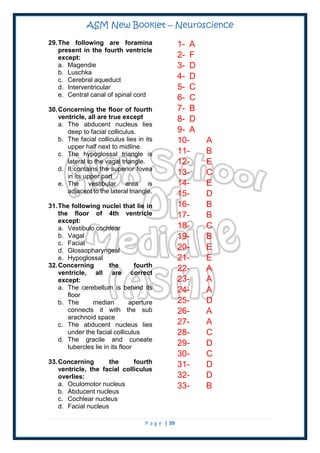
d. all of the above
e. B & C
f. A & B
6. T/F: The dorsal horn contains
afferent neurons
a. true
b. false
ASM New Booklet – Neuroscience
P a g e | 72
7. The large multipolar is …
neurons, but small multipolar
is …
a. afferent, efferent
b. efferent, afferent
c. both efferent
d. both afferent
8. The main sensory nucleus is:
a. Substania gelatinosa of Rolandi
b. nucleus proprius
c. nucleus thoracicus
d. none of the above
9. T/F: All of the nucleus of the
dorsal horn cell present in all
segments of spinal cord
a. true
b. false
10.Substania gelatinosa of
Rolandi continue as:
a. lateral spinothalamic
b. dorsal spinocerebellar
c. ventral spinocerebellar
d. ventral spinothalamic
11.Clark's column is responsible
for:
a. pain sensation
b. crude touch and vibration
c. proprioceptive sensation
d. fine touch
12.Lateral horn is
parasympathetic nuclei
a. true
b. false
13.In … the autonomic neurons
give parasympathetic without
forming lateral horn
a. S1 – S4
b. S2-S4
c. S3 - C4
d. S1-S3
14.T/F: Commissural neurons and
intersegmental neurons are
types of associative nuclei
a. true
b. false
15.The nerves in the white matter
are:
a. myelinated
b. unmyelinated
c. naked
16.T/F: The nucleus is formed by
cell bodies but the nerve fibers
are formed by fibers
a. true
b. false
17.The postero intermediate
sulcus present in the
following:
a. lumber level
b. sacral level
c. cervical level
d. all of the above
18.The white matter is equal to the
grey matter in:
a. Lumbar level
b. sacral level
c. thoracic level
d. cervical level
ASM New Booklet – Neuroscience
P a g e | 73
1- b
2- a
3- a
4- c
5- e
6- a
7- b
8- b
9- b
10- d
11- c
12- b
13- b
14- a
15- a
16- a
17- c
18- a
5- Brain Stem
1. Medulla is connected to the
cerebellum through:
a. superior cerebellar peduncle
b. middle cerebellar peduncle
c. inferior cerebellar peduncle
d. central canal
2. the central canal end is
continuous with:
a. lateral ventricle
b. second ventricle
c. third ventricle
d. fourth ventricle
3. TF: The lower part of the
medulla is called closed medulla
but the middle part of the medulla
is called open medulla
a. true
b. false
4. The lower medulla is called:
a. closed medulla
b. motor decussating
c. both of them
d. none of them
5. The central canal is present in
… of lower medulla and … in the
middle medulla
a. central, posterior
b. posterior, central
c. both central
d. both posterior
6. All of these tracts present in the
lower medulla except:
a. sulco marginal tract
b. corticobulbar tract
c. gracile and cuneate tract
d. corticospinal tract
7. Gracile and cuneate nucleus is
small in:
a. upper medulla
b. lower medulla
c. middle medulla
d. none of above
ASM New Booklet – Neuroscience
P a g e | 74
8. corticospinal tract descend in
the spinal cord as:
a. lateral corticospinal
b. ventral corticospinal
c. both of them
d. none of them
9. Medial longitudinal bundle is
responsible for reflex movement:
a. true
b. false
10. The spinal nucleus of
trigeminal nerve is present in:
a. lower medulla
b. upper medulla
c. middle medulla
d. A&B
e. all of above
11. Middle medulla is called:
a. closed medulla
b. sensory decussation
c. motor decussation
d. A&C
e. A&B
12. Fibers of gracile and cuneate
nucleus ascend in spinal cord as:
a. medial lemniscus
b. lateral lemniscus
c. both of them
d. none of them
13. All of the following are present
in grey matter except:
a. Inferior olivary nucleus
b. arcuate nucleus
c. lemniscus
d. pontine nucleus
14. MLB is found in:
a. lower medulla
b. middle medulla
c. upper medulla
d. A&B
e. all of above
15. The olivary nuclei are related
to:
a. Extrapyramidal tract
b. pyramidal tract
c. Lateral corticospinal
d. medial corticospinal
16. The 4th olivary nucleus is
connected with:
a. visual pathway
b. Auditory pathway
c. olfactory pathway
d. all of the above
17. Choose the true order of
nerves in the 4th ventricle from
medial to lateral:
a. vagus, hypoglossal, vestibular
b. hypoglossal, vagus, vestibular
c. vestibular, vagus, hypoglossal
d. vestibular, hypoglossal, vagus
18. Medial tecto spinal tract
appears at:
a. upper medulla
b. lower medulla
c. middle medulla
d. pons
19.T/F: The lemnisci may be
present at basis pontine
a. True
b. False
20.Cochlear decussation occurs
at:
a. Upper medulla
b. Lower medulla
c. Upper pons
d. Lower pons
21.The medial lemniscus appears
at
a. Upper medulla
b. Middle medulla
c. Upper pons
d. Middle pons
e. None of above
ASM New Booklet – Neuroscience
P a g e | 75
22.The 4 nuclei of trigeminal
nerve are present at ...
a. Upper pons
b. Lower pons
c. Middle pons
d. None of above
23.Facial colliculus is present at:
a. Lower medulla
b. Lower pons
c. Lower mid brain
d. None of above
24.Mesencephalic nucleus of
trigeminal is present in all
following levels except:
a. Upper mid brain
b. Upper pons
c. Upper medulla
d. Lower midbrain
e. None of above
25.Abducent nucleus is present at
... while oculomotor nucleus is
present at ...
a. Upper pons, upper midbrain
b. Lower pons, lower midbrain
c. Upper pons, lower midbrain
d. Lower pons, upper midbrain
e. None of above
26.Decussation of Superior
cerebellar peduncle occurs at
the level of ...
a. Lower medulla
b. Lower midbrain
c. Lower pons
d. None of above
27.T/F: Vagus nuclei are present
in all levels of MO.
a. True
b. False
28.The 4 lemnisci are present at
the level of ...
a. Upper medulla
b. Upper pons
c. Upper midbrain
d. Lower midbrain
29.Near the inferior cerebellar
peduncle in lower pons, lies
the nucleus of ...
a. Vestibular nuclei
b. Facial nuclei
c. Abducent nuclei
d. Trigeminal nuclei
e. None of above
30.At all levels of pons, all of
following is present except:
a. Medial tecto spinal tract
b. MLB
c. Middle cerebellar peduncle
d. The 4 lemnisci
e. None of above
31.Internal arcuate fibers are
related to
a. Upper medulla
b. Lower medulla
c. Middle medulla
d. None of above
32.The arcuate nucleus is
associated with ...
a. Closed medulla
b. Open medulla
c. Lower pons
d. Lower midbrain
33.The olive is associated with ...
a. Pyramidal tract
b. Extrapyramidal tract
c. Dorsal column lemniscus
d. Spinothalamic tract
34.At the level of superior
colliculus, all of following are
present except:
a. Dorsal tegmental decussation
b. Oculomotor nucleus
c. Medial lemniscus
d. Lateral lemniscus
e. None of above
ASM New Booklet – Neuroscience
P a g e | 76
35.Inferior colliculus is
associated with ... reflex and
connected to ...
a. Visual, LGB
b. Auditory, LGB
c. Visual, MGB
d. Auditory, MGB
1- C
2- D
3- B
4- C
5- A
6- B
7- B
8- C
9- A
10- E
11- E
12- A
13- C
14- E
15- A
16- B
17- B
18- A
19- B
20- D
21- B
22- C
23- B
24- C
25- D
26- B
27- B
28- B
29- E
30- D
31- C
32- B
33- B
34- D
35- D
6- Cerebellum
1. One of the following can be
found in the granular layer of
cerebellum:
a. Axon of Purkinjie cells
b. Purkinjie cell bodies
c. Granule cell bodies
d. Dendrites of Purkinjie cells
2. Neuroglia is found in one of the
following layers:
a. Molecular cell layer
b. Granular cell layer
c. Purkinjie cell layer
d. All of the above
3. All of the following synapse
with the dendrites of the
Purkinje cells except:
a. Mossy fibers
b. Granular cells axon
c. Climbing fibers
d. Neurons of molecular layer
4. The most medial cerebellar
nucleus is:
a. Nucleus Dentate
b. Nucleus Fastigial
c. Nucleus emboli
d. Nucleus Globous
5. Basket cells of cerebellum are
found in ... layer
a. Molecular
b. Purkinje
c. Granular
d. None of above
6. T/F: molecular layer of
cerebellum contains
numerous myelinated nerve
fibers
a. True
b. False
ASM New Booklet – Neuroscience
P a g e | 77
7. Axons of Purkinjie cells form:
a. Mossy afferent fibers
b. Climbing afferent fibers
c. Recurrent collateral fibers
d. Efferent fibers
e. C & D
f. All of above
8. Olivo cerebellar fibers form ...
a. Mossy afferent fibers
b. Climbing afferent fibers
c. Recurrent collateral fibers
d. Efferent fibers
9. T/F: Axons of Purkinjie cells
are confined to their layer.
a. True
b. False
10.Dendrites of ... cells fan out in
different planes.
a. Neuroglial cells
b. Purkinjie cells
c. Granular cells
d. Golgi cells
e. None of above
1- C
2- A
3- A
4- B
5- A
6- E
7- B
8- B
9- B
10- D
ASM New Booklet – Neuroscience
P a g e | 78
Chapter “6”
Histology of
Special Sense
ASM New Booklet – Neuroscience
P a g e | 79
1- Eye
1. All of the following are
contents of the orbit except:
a. Eye ball
b. Lacrimal glands
c. Orbital lymph nodes
d. Conjunctiva
2. All of the following are parts of
the uvea except:
a. Choroid
b. Ciliary body
c. Cornea
d. Iris
3. The cornea contains:
a. Blood vessels
b. Lymphatics
c. Nerve endings
d. Muscles
4. All of the following are true
concerning the corneal
epithelium except:
a. The basal cell layer shows
microvilli embedded into the pre
corneal tear film
b. It contains plenty of free nerve
endings
c. Sensitive to pain and touch
d. The basal cell layer responsible for
the epithelial regeneration
5. ... Protects the cornea from
trauma or bacterial invasion
a. Bowman’s membrane
b. Descemet’s membrane
6. All of the following are true
concerning the substantia
propria except:
a. It’s the thickest layer of the cornea
b. It contains 60 regular lamellae of
parallel collagen bundles that
cross parallel to each other
c. Characterized by the presence of
the butterfly cells
d. The fibers and the cells are
embedded into the corneal
proteoglycans
7. All of the following are factors
contributing into the corneal
transparency except:
a. The absences of blood vessels
b. The equal spacing between the
collagen bundles
c. The collagen bundles are oriented
at right angles to each other
d. None of the above
8. All of the following changes
occurs at the limbus except:
a. The corneal epithelium becomes
continuous with the bulbar
conjunctiva
b. The regular lamellae of collagen
fibers of the cornea merge with
the irregular collagen bundles of
the sclera
c. The bowman’s membrane is
replaced by subconjunctival
connective tissue
d. The Descemet’s membrane and
corneal endothelium become
continuous with the discontinuous
layer of fibroblasts and
melanocytes of the sclera
9. ... pierces the sclera:
a. Optic nerve fibers
b. Ciliary nerves and vessels
c. Central artery of the retina
d. All of the above
10.…Is responsible for nutrition
and blood supply of the retina
a. Ciliary body
b. Aqueous humor
c. Choroid
d. Vitreous body
11.All of the following are true
concerning the ciliary body
except:
a. It’s present at the limbus
b. The apex of the triangle is
continuous anteriorly with the
choroid
c. The base faces the anterior
chamber
d. The outer surface faces the sclera
ASM New Booklet – Neuroscience
P a g e | 80
12.The ciliary epithelium is
arranged into 2 layers outer
non-pigmented layer and inner
pigmented one
a. True
b. False
13.The anterior chamber lies
between the lens and the iris
while the posterior chamber
lies between the iris and the
cornea
a. True
b. False
14.… are arranged in circles
concentric to the pupil
a. Dilator pupillae muscles
b. Constrictor pupillae muscles
15.The pumping out of excessive
fluid is done by:
a. Corneal epithelium
b. Bowman’s membrane
c. Descemet’s membrane
d. Corneal endothelium
16.T/F: Aqueous humor is drained
to cavernous sinuses directly
by trabecular meshwork
a. True
b. False
17.Blood aqueous barrier is
formed by:
a. Corneal epithelium
b. Corneal endothelium
c. Corneal stroma
d. Ciliary epithelium
e. Ciliary stroma
18.Aqueous humor is formed by
...
a. Ciliary muscle
b. Ciliary stroma
c. Ciliary epithelium
d. Corneal epithelium
e. None of above
19. … forms the capsule of the
lens
a. Basement membrane material
b. Reticular fibers
c. Collagen fibers
d. A & B
e. A & C
20.The retina extends from …
posteriorly to … anteriorly
a. optic disk, orra serrata
b. orra serrata, optic disk
21.Which of the following
statements isn't correct about
the outer portion of the retina?
a. Formed of pigmented
epithelium
b. it is photosensitive
c. it is firmly attached to the
choroid.
d. None of above.
22.Tight junctions in the Retinal
Pigmented epithelial cells are
present between:
a. numerous invaginations of the
cell base and basal lamina
b. he adjacent cell membranes of
cells
c. The cell apex and the rods and
cones
d. All of above
23.T/F: The blood retinal barrier is
formed from tight junctions
between adjacent cells of
Retinal Pigmented epithelial
cells with the tight junctions
between endothelial cells of
retinal blood vessels
a. true
b. false
ASM New Booklet – Neuroscience
P a g e | 81
24.The layer of the retina that has
a role in Participation in
restoration of photosensitivity
to visual pigments is
a. Retinal Pigmented epithelium
b. Inner plexiform layer
c. The outer plexiform layer
d. The outer limiting membrane
25.Which of the following
statements is incorrect about
the Rod cells present in the
retina?
a. mediate night vision
b. contains rhodopsin
c. extremely sensitive to light
d. doesn't have outer fibers
26.It contains the synapses
between the synaptic
processes of rod and cone
cells and the dendrites of the
bipolar cells and horizontal
cells.
a. Retinal Pigmented epithelium
b. Inner plexiform layer
c. The outer plexiform layer
d. The outer limiting membrane
27.Cell bodies with the nuclei of
the bipolar cells are present in
a. Retinal Pigmented epithelium
b. Inner nuclear layer
c. The outer nuclear layer
d. The outer limiting membrane
28.Cells that extend from the
outer to the inner limiting
membranes. It has supportive,
protective and nutritive
functions.
a. Horizontal cells
b. Muller cells
c. Amacrine cells
d. None of above
29.Few large cells with vesicular
nucleus and basophilic
cytoplasm and The retinal
blood capillaries are present
between them
a. Ganglion nerve cells.
b. Horizontal cells
c. Supporting cells
d. Amacrine cells
30.Myelin of the optic nerve fiber
is formed by
a. melanocytes
b. oligodendrocytes
c. Muller cells
d. Schwann cells.
31.Conjunctiva is made up of
a. non keratinized stratified
squamous epithelium
b. keratinized stratified
squamous epithelium
c. simple columnar epithelium
d. simple cuboidal epithelium
32.Conjunctiva helps in
defending the eye against
infection.
a. True
b. False
33.Muller muscle is inserted in the
superior border of the tarsal
plate and is supplied by
parasympathetic nerves
a. True
b. False
ASM New Booklet – Neuroscience
P a g e | 82
1- C
2- C
3- C
4- A
5- A
6- B
7- D
8- D
9- D
10- C
11- B
12- B
13- B
14- B
15- D
16- B
17- D
18- C
19- D
20- A
21- B
22- B
23- A
24- A
25- D
26- C
27- B
28- B
29- A
30- B
31- A
32- A
33- B
2- Ear
1. T/F: Ear is responsible for
hearing only
a. true
b. false
2. Receiving the sound waves is
the function of:
a. external ear
b. middle ear
c. both of them
d. none of them
3. Elastic collagen is found in all
the following except:
a. ear pinna
b. auditory tube
c. tympanic membrane
d. none of the above
4. External surface of tympanic
membrane is covered with:
a. simple squamous epithelium
b. columnar epithelium
c. stratified squamous epithelium
d. cuboidal epithelium
5. Tympanic membrane is
responsible for transmission
of … but middle ear is
responsible for transmission
of …
a. sound vibration, mechanical
vibration
b. mechanical vibration, sound
vibration
c. both are mechanical vibration
d. both are sound vibration
6. T/F: Middle ear is air-filling
cavity within the petrous part
of temporal membrane
a. true
b. false
ASM New Booklet – Neuroscience
P a g e | 83
7. The oval window of middle ear
is covered by:
a. elastic membrane
b. handle of malleus
c. foot of stapes
d. body of incus
8. Low columnar epithelium
forms:
a. lining of middle ear
b. lining of inner ear
c. inner side of tympanic
membrane
d. all of the above
e. all of the above except (B)
9. The only nerve that pass in the
middle ear is:
a. chorda tympani
b. cochlear branch of VIII nerve
c. vestibular branch of VIII nerve
d. mandibular nerve
10.T/F: The bony labyrinth is full
of endolymph
a. true
b. false
11.The structure connecting the
nasopharynx with the middle
ear is:
a. vestibule
b. cochlea
c. Eustachian tube
d. auditory tube
e. C & D
12.T/F: Scala tympani and Scala
media communicate in
helicotrema
a. true
b. false
13.T/F: Scala tympani begin in
round window
a. true
b. false
14.Organ of corti is inserted in:
a. scala tympani
b. scala vestibule
c. scala media
d. extends in all of the above
15.T/F: The floor of cochlear duct
is formed of squamous
epithelium
a. true
b. false
16.Production of endolymph is
the function of:
a. floor of cochlear duct
b. roof of cochlear duct
c. stria vascularis
d. organ of corti
17.T/F: Phalangeal cells surround
the pillar cells.
a. true
b. false
18.The cells medial to the tunnel
of corti
a. inner hair cells
b. outer hair cells
19.W-shaped pattern resulted
from sterio cilia of
a. inner hair cells
b. outer hair cells
20.The tectorial membrane
contains:
a. elastic fibers
b. collagen fibers
c. both of them
d. none of them
21.T/F: The reticular lamina is
formed of gelatinous mass
surrounding the organ of corti
a. true
b. false
ASM New Booklet – Neuroscience
P a g e | 84
22.T/F: Semicircular canal is
responsible for sensation of
movements during rotation
only
a. true
b. false
23.Calcium carbonate crystals
present in gelatinous
glycoprotein:
a. crista ampularis
b. organ of corti
c. macula
d. all of the above
24.Flask-shaped cells are:
a. type I hair cells
b. type II hair cells
c. inner hair cells
d. outer hair cells
e. all of the above
f. A&C
g. A&D
25.T/F: Vestibular branch of VIII
nerve innervate the organ of
corti
a. true
b. false
26.Between the vestibular scala
and the middle scala is:
a. Reissner's membrane.
b. The basilar membrane.
c. The stria vascularis.
d. The spiral ganglion.
27.Between the middle scala and
the tympanic scala is:
a. Reissner's membrane
b. The basilar membrane
c. The stria vascularis.
d. The spiral ganglion.
28.The stria vascularis is found
in:
a. The middle scala.
b. The vestibular scala.
c. The tympanic scala.
d. The modiolus.
29.The organ of Corti is found in:
a. The middle scala.
b. The vestibular scala.
c. The tympanic scala.
d. The modiolus.
1- B
2- A
3- D
4- C
5- A
6- B
7- C
8- E
9- A
10- B
11- E
12- B
13- B
14- C
15- B
16- C
17- A
18- A
19- B
20- B
21- B
22- A
23- C
24- F
25- B
26- A
27- B
28- A
29- A
ASM New Booklet – Neuroscience
P a g e | 85
3- The Chemical
senses
1. The number of receptors
in the olfactory mucosa is
… number of receptors in
taste buds
a. more
b. less
c. equal
2. The olfactory mucosa
extends on one side of
the septum
a. true
b. false
3. Olfactory epithelium is
a. cuboidal epithelium
b. simple squamous epithelium
c. columnar epithelium
d. pseudostratified columnar
epithelium
4. Sustentancular cells
present in:
a. olfactory mucosa
b. taste buds
c. both of them
d. none of them
5. Pigmented granules
present in:
a. supporting cells
b. olfactory cells
c. basal cells
d. taste cells
6. The color resulted from
the pigmented granules
is:
a. yellowish brown
b. yellowish red
c. yellowish blue
d. pure yellow
7. Supporting cell nuclei are
a. dense
b. vesicular
c. pale
d. none of the above
8. Stem cells of the chemical
senses are
a. basal cells
b. pyramidal cells
c. columnar cells
d. A & B
e. A & C
9. All the neurons in the
adults are unable to
generate
a. true
b. false
10.The olfactory neurons are
replaced every… but, the
taste buds are replaced
every…
a. week, 10 days
b.10 days, week
c. both are week
d. both are 10 days
11.Olfactory cells are
modified unipolar
neurons
a. true
b. false
12.The olfactory vesicle is
formed from
a. axons of olfactory cells
b. cell bodies of olfactory cells
c. dendrites of olfactory cells
d. whole olfactory cell
13.Bowman's gland present
in
a. Lamina propia
b. olfactory bulb
c. both of them
d. none of the above
ASM New Booklet – Neuroscience
P a g e | 86
14.Cilia of the olfactory cells
are motile
a. true
b. false
15.Odour solvent secreted
from … But food solvent
is secreted from …
a. Basal cells, taste cells
b. olfactory cells, taste cells
c. Bowman's gland, taste cells
d. Bowman's gland, basal cells
1- A
2- B
3- D
4- C
5- A
6- A
7- C
8- D
9- B
10- A
11- B
12- C
13- A
14- B
15- C
ASM New Booklet – Neuroscience
P a g e | 87
Chapter “7”
Biochemistry
ASM New Booklet – Neuroscience
P a g e | 88
Neurotransmitters
1. Necrohormones, unlike the
neurotransmitters, are
released into the blood
allowing them to cover shorter
distances
a) True
b) False
2. Each neuron usually releases
one or more type of
neurotransmitters
A) True
b) False
3. The receptors that receive
neurotransmitters are:
A) Peripheral proteins
B) Integral proteins
C) Both A and B
D) None of the above
4. Ionotropic receptors, after
activation, release second
messengers which activate
or protein kinases
A) True
B) False
5. Which ions cause
depolarization of ion tropic
receptors and which cause
hyperpolarization
a) Cl⁻ , Na⁺ - K⁺
b) Ca⁺² , Cl⁻ - Na⁺
c) Na⁺ , k⁺ - Cl⁻
d) Cl⁻ , k⁺ - Ca⁺²
6. Inhibitory transmitters of
ionotropic receptor are:
A) glycine and acetyl choline
B) glutamate, GABA
C) acetyl choline, glutamate
D) GABA and glycine
7. Function of ACh is:
A) Trigger muscle contraction
at NMT
B) Certain parts of brain
C) ANS
D) All of the above
E) None of the above
8. The enzyme that hydrolyzes
ACh is:
A) acetyl cholinesterase
B) Acetyl transferase
C) decarboxylase
D) Methyl-transferase
9) Bioglric amines arise from a.a
by:
A) hydroxylase
B) decarboxylation
C) methylation
D) Dehydrogenase
10) Biogenic amines are .........
EXCEPT
A) Nor epinephrine
B) Dopamine
C) Acetyl Choline
D) Y-amine butyric acid
E) Histamine
11) Catecholamine is formed from
which a.a
A) Tryptophan
B) Tyrosine
C) Cysteine
D) Glycine
12) The enzyme that converts
Dopamine to Norepinephrine is …
A) Hydroxylase
B) B-hydroxylase
C) N-methyl transferase
D) Dehydrogenase
ASM New Booklet – Neuroscience
P a g e | 89
13) Regarding the level of
dopamine, Parkinson’s is due to a
………. level, while Schizophrenia
is due to a ………. Level
A) ↑ , ↑
B) ↑ , ↓
C) ↓ , ↑
D) ↓ , ↓
14) A small percentage of
epinephrine is excreted in …
A) Urine
B) Bile
C) Faeces
D) Sweat
15) Catecholamine can cross BBB
A) True
B) False
16) Norepinephrine is metabolized
in tissues by a series of … to
phenolic group and … to amide
side chains
A) Oxidation, hydroxylation
B) Methylation, Oxidation
C) Phosphorylation, hydroxylation
D) Phosphorylation, methylation
17) In Pheochromocytoma, which
substance is high in urine of
patient?
A) VMA
B) dopamine
C) Epinephrine
D) Norepinephrine
18) Serotonin is found in:
A) Intestine
B) Platelets
C) CNS
D) None of the above
E) All of the above
19) All of the following are
functions of Serotonin EXCEPT …
A) Inhibitory chemical transmitter in
brain
B) mediates platelet aggregation
C) Smooth muscle contraction in
bronchioles
D) GIT transmitter
20) Normal value of HIAA per 24hr
urine is …….
A) 1 - 2 mg
B) 2 - 8 mg
C) 8 - 10 mg
D) 10 – 12 mg
21) An … in Serotonin level will
cause …, while … in Serotonin
level will cause ….
A) decrease, euphoria, decrease,
depression
B) decrease, euphoria, increase,
depression
C) increase, depression, increase,
euphoria
D) increase, euphoria, decrease,
depression.
22) Serotonin is an intermediate
information of Melatonin
A) True
B) False
23) Melatonin is formed in pineal
body and PNS and secreted in
blood and CSF
A) True
B) False
24) Melatonin’s diurnal variation is
brought about by dopamine that
stimulates pineal body cells
A) True
B) False
25) GABA is an inhibitory a.a
derivative in the retina
A) True
B) False
ASM New Booklet – Neuroscience
P a g e | 90
26) glutamate is transformed into
GABA by which enzymes?
A) MAO
B) COMT
C) GAD
D) Hydroxylase
27) GABA is degraded into …, a
CAC intermediate
A) Acetyl COA
B) COASLT
C) Succinate
D) Fumarate
28) Underproduction of GABA is
due to deficiency of ……….
A) GAD
B) Vit B 6
C) Both
D) None
29) Histamine is formed by … of
A) decarboxylation
B) hydroxylation
C) methylation
D) carboxylation
30) P-alanine is a component of …
A) Carnosine
B) Pantothenic acid
C) Both
D) None
31) Endogenous opiates cause:
A) Analgesic
B) Sedative
C) Euphoria
D) None of the above
E) All of the above
32) purine derivatives with
neurotransmitter function are all
derived from ………… containing
nucleotides
A) Adenine
B) Guanine
C) Cytosine
D) A/B
E) B/C
33) Caffeine’s stimulatory effect is
caused by binding to guanosine
receptor
A) True
B) False
1- False. shorter → longer
2- False one or more → only one type
3- B
4- False ionotropic→ metabotropic
5- C
6- D
7- D
8- A
9- B
10- C
11- B
12- B
13- C
14- A
15- B
16- B
17- A
18- E
19- A
20- B
21- D
22- A
23- A
24- B dopamine → norepinephrine
25- A
26- C
27- C
28- C
29- A
30- C
31- E
32- A
33- B guanosine → adenosine
ASM New Booklet – Neuroscience
P a g e | 91
Chapter “8”
Physiology of
ANS
ASM New Booklet – Neuroscience
P a g e | 92
1- Intro:
2- Ganglia:
1. Nervous system is divided
functionally into
a. Somatic and central
b. Somatic and peripheral
c. Somatic and Autonomic
d. Peripheral and Autonomic
2. Choose one odd out word:
a. Brain stem
b. Cerebrum
c. Cerebellum
d. Spinal cord
3. No of segments of spinal cord:
a. 31
b. 32
c. 33
d. 34
4. Which parts of spinal cord has
most number of segments:
a. Cervical
b. Thoracic
c. Lumber
d. Sacral
e. Coccygeal
5. No. of spinal nerves arising
from each segment of spinal
cord:
a. 1
b. 2
c. 3
d. 4
6. All of the following is
controlled by autonomic
nervous system:
a. Heart
b. Viscera
c. Moving hands
d. Glands
7. Unit of function is:
a. Reflex action
b. Neuron
c. All of the above
d. None of the above
8. The center of autonomic reflex
arc is ...... And the receptor of
the somatic reflex arc is ......
a. AHC, skin.
b. LHC, skin
c. LHC, viscus
d. AHC, viscus
9. The difference between The
autonomic N.S. and the
somatic N.S. is
a. Somatic N.S. fibers relay in
ganglia.
b. Center for Somatic is LHC
c. Somatic N.S. controls Skeletal
muscles
d. Autonomic N.S. originates from
all fibers of Spinal cord.
10.The following reflexes are all
autonomic reflex action
except:
a. Salivary secretion.
b. Micturition.
c. Flexion of the arm following a
painful stimulus.
d. Acceleration of the heart after
hemorrhage.
11.The autonomic ganglia all are
true except:
a. They are the site of relay of
efferent neurons.
b. Function as distributing centers.
c. Are located outside the CNS.
d. Are relay stations for all
preganglionic fibers passing
through them.
12.Concerning the autonomic
ganglia, all the following is true
except:
a. They act as distributing centers.
b. They are 3 types.
c. Their chemical transmitter is
acetylcholine.
d. Their receptors are specifically
blocked by atropine.
e. The preganglionic fibers may
pass through them without relay.
ASM New Booklet – Neuroscience
P a g e | 93
13.The sympathetic preganglionic
nerve fibers:
a. Leave the spinal cord in the grey
rami communicants.
b. Originate at the autonomic
ganglia.
c. Are myelinated nerve fibers
belonging to the B group of nerve
fibers.
d. Show minimal divergence in the
autonomic ganglia.
e. Which supply the abdominal
viscera relay in the sympathetic
chain.
1. C
2. D
3. A
4. B
5. B
6. C
7. A
8. B
9. C
10. C
11. D
12. D
13. C
3- Sympathetic Nervous
System:
1. Sympathetic Nervous system
originates from:
a. Ventral root of Thoracic spinal
segments
b. Ventral root of lower lumber
c. Dorsal root of thoracic spinal
Segments
d. Dorsal root of upper lumber
Spinal segments
2. The only organ that supply with
preganglionic fibers:
a. adrenal cortex
b. kidney
c. adrenal medulla
d. renal tubules
3. All of the following muscles
have motor stimulation by
sympathetic except:
a. spleen
b. heart
c. eye
d.intestinal wall muscles
4. Sympathetic nervous system
has vasodilator effect on:
A. coronary blood vessels
B. lacrimal gland blood vessels
C. blood vessels of skeletal muscles
D. a&b
F. a&c
5. T/F: Somatic nervous system is
voluntary:
a. true
b. false
6. T/F: Reflex action only
involuntary:
a. true
b. false
ASM New Booklet – Neuroscience
P a g e | 94
7. The sympathetic nervous
system affects all muscles except:
a. Muller muscle
B. dilator papillae
C. orbicularis oculi
d. superior tarsal muscle
8. Postganglionic fibers that
supply head and neck pass along:
a. carotid artery
b. facial artery
c. internal jugular vein
d. external jugular vein
9. The sympathetic effect on eye
includes all of the following
except:
a. mydriasis
b. miosis
c. exophthalmos
d. wide palpebral fissure
10. The sympathetic nervous
system has a …. on salivary
gland:
a. trophic effect
b. atrophic effect
11. The secretion of salivary gland
under control of sympathetic is:
a. viscid
B. small in amount
C. rich in organic matter
D. all of the above
12.The muscle that cause
protrusion of eye ball is:
a. Muller muscle
B. dilator papillae
C. superior tarsal
D. inferior tarsal
13. The preganglionic fibers that
supply abdomen and pelvis is
called:
A. splanchnic nerve
b. mesenteric
c. celiac
D. all of the above
14. Erection of genitalia and
ejaculation of semen are both
sympathetic functions.
a. true
b. false
15. Orbelli phenomenon is the
influence of sympathetic system
on:
A. skeletal muscle
B. smooth muscles
C. cardiac muscles
D. sphincter of Oddi
16. Increase glycogen lysis in
Orbelli phenomenon is obtained
by the activation of:
A. kinase enzyme
B. oxidase enzyme
C. phosphorylase enzyme
D. decarboxylase enzyme
17. The main function of
sympathetic tone is:
A. maintain heart rate
B. maintain respiratory rate
C. maintain body posture
D. maintain arterial blood pressure
18. T/F: Preganglionic fibers rely
once though it can pass through
much ganglia
A. True
B. False
19. All the following about the
sympathetic N.S. is true except:
A. Its stimulation causes urine
retention.
B. It is involved in stress and
emergency conditions.
C. It has a V.C. effect on skeletal
muscle blood vessels.
D. Its stimulation increases the
cardiac properties.
ASM New Booklet – Neuroscience
P a g e | 95
20. The sympathetic system
cannot be responsible for:
A. Constriction of the pupil.
B. Erection of hair.
C. Bronchodilation.
D. Dilatation of skeletal muscle blood
vessels.
E. Heart more contraction.
21. Which of following has the
longest post ganglionic nerve
fibers:
A. Sympathetic to Muller’s Muscle.
B. Sympathetic to Urinary bladder
C. Parasympathetic to GIT
D. All has same length.
22. Postganglionic nerve suppling
the detrusor muscle has a cell
body at
A. Superior mesenteric ganglia
B. Inferior mesenteric ganglia
C. Celiac ganglia
D. Sympathetic chain.
23.T/F: Sympathetic nervous
system leads to an elevation of
Glucose Level in skeletal muscle
A. True
B. False
24. The alpha adrenergic
receptors mediate all the
following except:
A. Vasoconstriction.
B. Pupil dilatation.
C. Spleen contraction.
D. Relaxation of intestinal wall.
E. increased cardiac activity.
1 - A
2 – C
3 – D
4 – F
5 – A
6 – B
7 – C
8 – A
9 – B
10 – A
11 – D
12 – A
13 – A
14 – B
15 – A
16 – C
17 – D
18 – A
19 – C
20 – A
21 – A
22 – B
23 – A
24 – E
ASM New Booklet – Neuroscience
P a g e | 96
4- Parasympathetic
nervous system:
1. Parasympathetic nervous
system is motor to all following
muscles except:
a. heart
b. Ciliary Muscle
c. GIT muscles
d. Urinary Bladder
2. Parasympathetic cause
vasoconstriction in:
a. coronary BVs
b. Splanchnic Vessels
c. bronchi BVs
d. A&B
3. All of the following muscles are
affected by parasympathetic
except:
a. sphincter papillae
b. dilator papillae
c. ciliary muscle
d. none of the above
4. Oculomotor lesion leads to:
a. mydriasis
b. loss of accommodation
c. both of them
d. none of them
5. The seventh cranial nerve is
responsible for miosis:
a. true
b. false
6. The fascial nerve innervates:
a. tongue
b. lacrimal gland
c. sublingual salivary gland
d. all of the above
7. The tongue is affected by
fascial nerve alone:
a. true
b. false
8. The salivary secretion under the
parasympathetic effect:
a. non-watery.
b. rich in organic materials
c. copious
d. parasympathetic inhibit the
salivary secretion
9. Vasodilatation of BVs in
anterior 23 is caused under the
effect of:
a. oculomotor (III)
b. oculomotor (VII)
c. fascial (III)
d. fascial (VII)
10. Vasodilatation of BVs in ant.
23 is caused by …., but in the
post. 13 is caused by…
a. fascial, glossopharyngeal
b. fascial, oculomotor
c. oculomotor, fascial
d. glossopharyngeal, fascial
11. The following salivary glands
are affected by fascial nerve
except:
a. sublingual
b. submandibular
c. parotid
d. submaxillary
12. The terminal ganglia of the
vagus nerve:
a. thorax
b. abdomen viscera
c. neck
d. A&b
e. B&C
ASM New Booklet – Neuroscience
P a g e | 97
13. The effect of parasympathetic
on pancreas is:
a. secretion of pancreatic juice
b. secretion of insulin
c. both of them
d. none of them
14. Sacral outflow from:
a. S2-S4
b. S2-S3
c. S1-S4
d. L4-S3
15. The terminal ganglia of sacral
outflow is in pelvic viscera:
a. true
b. false
16. Parasympathetic nervous
system is responsible for:
a. defecation
b. micturition
c. ejaculation
d. erection
e. all of the above except “C”
f. all of the above except “D”
17. Parasympathetic cause
inhibition to:
a. internal anal sphincter
b. internal urethral sphincter
c. external anal sphincter
d. external urethral sphincter
e. A&B
f. A&D
h. B&D
g. C&D
18. erectile tissue of penis and
clitoris are vascular system
supplied by parasympathetic:
a. true
b. false
19. The nerve that supplies the
external urethral and anal
sphincter is called:
a. sciatic nerve
b. pudendal nerve
c. fourth lumbar
d. all of the above
20. The nervous erigens is:
a. nerve to anal sphincter
b. nerve to the wall of rectum
c. neve of erection
d. none of the above
21.proximal half of colon is
supplied by…but the distal half is
supplied by…
a. vagus, sacral
b. sacral, vagus
c. pudendal, vagus
d. pudendal, sacral
ASM New Booklet – Neuroscience
P a g e | 98
1-a
2-a
3-b
4-c
5-b
6-d
7-b
8-c
9-d
10-a
11-c
12-d
13-c
14-a
15-a
16-e
17-e
18-a
19-b
20-c
21-a
5- Receptors
1. Adrenergic autonomic fibers
secrete … at their terminations
a. Adrenaline
b. Norepinephrine
c. Both of them
d. Ach.
2. T/F: Cholinergic fibers supply
preganglionic fibers supplying
the adrenal medulla.
a. True
b. False
3. T/F: Preganglionic nerve
endings that innervate sweat
glands and blood vessels in the
skeletal muscles are
cholinergic fibers
a. True
b. False
4. Nicotinic receptors are found in
all of the following sites except:
a. The synapses between the pre and
postganglionic neurons of both the
sympathetic and parasympathetic
systems.
b. In the membranes of skeletal
muscle fibers at the neuromuscular
junction.
c. Supra-renal medulla.
d. Sweat glands and blood vessels of
skeletal muscle innervated by
postganglionic cholinergic neurons of
the sympathetic system.
5. All are nicotine like action of
acetylcholine except:
a. Stimulation of the autonomic
ganglia.
b. stimulation of all postganglionic
parasympathetic endings
c. Secretion of adrenaline and
noradrenaline at adrenal medulla.
d. Contraction of skeletal muscles
due to stimulation at the motor end
plates.
ASM New Booklet – Neuroscience
P a g e | 99
6. T/F: Pseudo cholinesterase
destroys acetylcholine in the
cholinergic nerve terminals
a. True
b. False
7. The transmitters in
sympathetic nervous system
are catechol amines, chiefly
norepinephrine & epinephrine
a. True
b. False
8. All of the following are true
concerning the fate of
adrenaline except:
a. Diffusion away from the nerve
endings into the surroundings body
fluids and thence into the blood.
b. Reuptake into the adrenergic
nerve endings themselves by a
passive transport process.
c. Oxidation by monoamine oxidase
enzyme
d. Methylation by catechol-Omethyl
transferase.
9. Alpha adrenergic receptors
responding to noradrenaline
and adrenaline, but they have
higher affinity for adrenaline
a. True
b. False
10.T/F: Adrenaline has a greater
effect on cardiac stimulation
than noradrenaline.
a. True
b. False
11.T/F: Adrenaline causes only
weak constriction of the blood
vessels, in comparison with the
much stronger constriction
caused by noradrenaline.
a. True
b. False
12.T/F: Noradrenaline has to a
great extent more metabolic
effect than adrenaline.
a. True
b. False
13.T/F: Adrenaline has more
inhibitory effects on the
smooth muscles of the
bronchioles and intestinal wall.
So it is more useful in the
treatment of bronchial asthma.
a. True
b. False
14.All the following glands can
produce their secretion under
the effect of N-Ach except.
a. lacrimal gland
b. sublingual salivary gland
c. submaxillary salivary gland
d. adrenal medulla
15.Which adrenergic receptor
cause a negative feedback
mechanism
a. Alpha 1
b. Alpha 2
c. Beta 1
d. Beta 2
16.There is no difference in
effectiveness between
noradrenaline secreted by
adrenal medulla and the other
released by sympathetic nerve
endings.
a. True
b. False
17.Total Remove of both adrenal
medullae cause:
a. Severe sympathetic failure
leading to death
b. Sudden drop in ABP leading to
death
c. Less effective emergency
response
ASM New Booklet – Neuroscience
P a g e | 100
18.Sympathetic stimulation to
adrenal medulla is
a. N-ACH
b. M-Ach
c. Norepinephrine
d. Histamine
19.Effect of Adrenaline on Alpha &
Beta Receptor is
a. The same
b. Approximately the same
20.A drug which blocks the beta
adrenergic receptors causes:
a. Dilatation of the GIT muscle.
b. Relaxation of the sphincters of
colon
c. Fall in the cardiac output.
d. None of the above
1. C
2. A
3. A
4. D
5. B
6. B
7. A
8. B
9. B
10. A
11. A
12. B
13. A
14. D
15. B
16. A
17. C
18. A
19. B
20. C
6- Control of autonomic
function
1. Control of respiration function
is done by all of following
except
a. Medulla Oblongata
b. Limbic system
c. Mid brain
d. Pons
2. Control of CVS functions is
done by:
a. Medulla Oblongata
b. Limbic system
c. Pons
d. All of Above
e. A & B
3. Visual function is controlled
by:
a. Medulla oblongata
b. Limbic system
c. Pons
d. Mid brain
4. Lesion of anterior
hypothalamus nuclei leads to
loss of ... functions
a. Parasympathetic
b. Sympathetic
5. Sympathetic tone is
responsible for:
a. Decrease heart rate to basal
level.
b. Maintain ABP
6. Emotions control is done by:
a. Limbic system
b. Mid Brain
c. Medulla Oblongata
d. Reticular formation.
7. Vagal Tone is responsible for
a. Decrease heart rate to basal
level.
b. Maintain ABP
1 – C
2 – E
3 – D
4 – A
5 – B
6 – A
7 – A
ASM New Booklet – Neuroscience
P a g e | 101
7- Collection ANS
1. Concerning autonomic reflex
arc:
a) afferent autonomic fibers relay at
ventral horn of the gray matter of the
spinal cord.
b) efferent fibers relay in autonomic
ganglia before supplying the effector
organs.
c) afferent autonomic fibers arise
from the lateral horn cell.
d) supply skeletal muscles.
2. Which of the following neurons
originate from the sacral spinal
cord?
a) preganglionic parasympathetic
neurons.
b) postganglionic parasympathetic
neurons.
c) postganglionic sympathetic
neurons.
d) preganglionic sympathetic
neurons.
e) adrenal medulla.
3. The parasympathetic neurons
are originated from the
following parts of the spinal
cord:
a) sacral spinal cord.
b) cervical spinal cord.
c) thoracic spinal cord.
d) lumbar spinal cord.
e) all of the above are wrong.
4. The sympathetic system
originates from:
a) T1 to L3.
b) T2 to L1.
c) C1 to L2.
d) T1 to S2.
5. The parasympathetic division
of the autonomic nervous
system is characterized by:
a) adrenergic postganglionic fibers.
b) short postganglionic fibers.
c) its origin is only from spinal cord.
d) none of the above are correct.
6. Regarding postganglionic
fibers:
a) of the parasympathetic system are
long.
b) of the sympathetic fibers are short.
c) of all sympathetic fibers are
adrenergic.
d) none of the above.
7. Concerning the sympathetic
nervous system:
a) consists only of cranial nerves.
b) its efferent pathway is made of one
neuron.
c) all postganglionic sympathetic
fibers secrete NE.
d) its stimulation causes dilation of
the airways.
e) it is craniosacral.
8. The sympathetic division of
the autonomic nervous
system:
a) generally has short postganglionic
fibers.
b) has its cell of origin in the lateral
portion of the thoracic and lumbar
cord.
c) is concerned primarily with energy
conservation and secretory activity.
d) has its cells originating from the
brainstem.
ASM New Booklet – Neuroscience
P a g e | 102
9. Which of the following
structure is innervated by
preganglionic sympathetic
nerve fibers?
a) lung.
b) heart.
c) pancreas.
d) adrenal medulla.
e) skeletal muscle.
10.Stimulation of the sympathetic
nervous system causes:
a) bronchoconstriction.
b) constriction of the pupil.
c) increases the heart rate & the force
of ventricle contraction.
d) increases the heart rate but has no
effect on the force of contraction.
11.Stimulation of the sympathetic
nervous system causes:
a) increases the motility of the
intestine.
b) decreases the blood glucose level.
c) increases sweating.
d) increases salivary secretion.
12.Stimulation of the sympathetic
nerve fibers causes all of the
following EXCEPT:
a) decrease insulin secretion.
b) increase heart rate.
c) relaxation of the bronchial
muscles.
d) constriction of the pupil.
13.Sympathetic stimulation:
a) result in increased cutaneous
blood flow.
b) indirectly increase the coronary
blood flow (as a result of increase
heart rate and force of
contraction).
c) results in decrease muscle blood
flow.
d) causes vasodilatation in all
vascular beds.
14.Increased sweating is
mediated by increased:
a) activity of parasympathetic fibers
to skin.
b) secretion of norepinephrine in end
portions of the sympathetic fibers to
skin.
c) secretion of Ach from
postganglionic sympathetic fibers to
skin.
d) secretion of epinephrine in end
portions of the sympathetic fibers to
skin.
e) metabolites.
15.Noradrenaline:
a) increases intestinal motility.
b) is released by postganglionic
sympathetic nerve endings.
c) is a potent vasodilator.
d) is released from adrenal medulla
only.
16.Increases the activity of the
parasympathetic nervous
system causes:
a) bronchoconstriction.
b) dilatation of the pupil.
c) increases the heart rate.
d) decreases the salivary secretion.
17.Generalized parasympathetic
stimulation causes:
a) over ventilation.
b) increase the heart rate.
c) pupillary dilatation.
d) increase the intestinal peristaltic
movement.
e) bronchodilation.
18.Concerning parasympathetic:
a) its stimulation inhibits intestinal
motility.
b) its stimulation causes
bronchodilation.
c) its stimulation causes salivary
secretion.
d) its postganglionic cell bodies are in
the CNS.
ASM New Booklet – Neuroscience
P a g e | 103
19. Stimulation of the
parasympathetic neurons
leads to an increase of:
a) GIT motility.
b) heart rate.
c) blood pressure.
d) sweating.
e) respiratory rate.
20.Vagus nerve stimulation:
a) reduces pancreatic secretion and
HCl secretion.
b) increases HCl secretion and
causes tachycardia.
c) causes bradycardia and increases
HCl secretion.
d) all of the above are correct.
21.Vagus nerve:
a) cut does not affect stomach HCl.
b) acts as afferent fiber for
defecation.
c) increases salivary secretion.
d) decreases intestinal motility.
22.The neurotransmitter at the
piloerector muscles of the hair
is:
a) adrenaline.
b) noradrenaline.
c) acetylcholine (Ach).
d) atropine.
23.The neurotransmitter at the
preganglionic sympathetic
nerve fiber is:
a) noradrenaline.
b) Ach.
c) adrenaline.
d) none of the above is correct.
24.Which of the following is
correct?
a) Noradrenaline (NE) is secreted
from the preganglionic sympathetic
fibers
b) Ach is inactivated by the enzyme
acetylcholinesterase.
c) Ach binds to muscarinic receptors
only.
d) autonomic ganglia are located
inside the CNS.
e) the receptors in the autonomic
ganglia are muscarinic.
25.The chemical transmitter in the
sympathetic ganglia is:
a) adrenaline.
b) noradrenaline.
c) nicotine.
d) Ach.
e) serotonin.
26.Neurotransmitter of the
preganglionic
parasympathetic nerve fiber is:
a) noradrenaline.
b) adrenaline.
c) Ach.
d) dopamine
e) erythropoietin.
27.Concerning cholinergic
receptors:
a) the cholinergic receptors at the
motor end plate (of skeletal muscle)
are muscarinic.
b) the cholinergic receptors of sweat
glands are nicotinic.
c) the cholinergic receptors of the
adrenal medulla are muscarinic.
d) the cholinergic receptors of the
autonomic ganglia are nicotinic.
e) none of the above is correct.
28.The chemical transmitter:
a) in all autonomic ganglia is Ach.
b) in some central synapses is
noradrenaline.
c) at the neuromuscular junction and
sweat gland is Ach.
d) all of the above are correct.
ASM New Booklet – Neuroscience
P a g e | 104
29.Concerning the autonomic
nervous system, it is correct to
say:
a) all the sympathetic postganglionic
neurons are adrenergic.
b) all the sympathetic preganglionic
neurons are adrenergic.
c) all the sympathetic preganglionic
neurons are cholinergic.
d) a & b are correct.
30.Which of the following usually
has adrenaline as its major
secretion?
a) postganglionic sympathetic nerve
fibers.
b) the adrenal medulla.
c) preganglionic sympathetic nerve
fibers.
d) preganglionic parasympathetic
nerve fibers.
e) postganglionic parasympathetic
nerve fibers.
31.Muscarinic receptors can be
distinguished from nicotinic
receptors because muscarinic
receptors are:
a) stimulated by muscarine and
blocked by epinephrine.
b) stimulated by muscarine and
blocked by nicotine.
c) blocked by atropine and
stimulated by nicotine.
d) blocked by atropine and
stimulated by Ach.
32.The autonomic receptors at the
piloerector muscle are:
a) α- adrenergic.
b) β- adrenergic.
c) nicotinic.
d) muscarinic.
e) both β & α adrenergic.
33.Neuromuscular transmission
is inhibited by:
a) Ach.
b) curare.
c) noradrenaline.
d) methacholine.
e) calcium ions.
34.Which of the following is a beta
adrenergic blocking agent?
a) reserpine.
b) propranolol.
c) atropine.
d) phentolamine.
e) tyramine.
35.Atropine injection causes all of
the following except:
a) decreases the intestinal motility.
b) bronchiolar dilatation.
c) increases secretion of sweat
glands.
d) pupil dilatation.
36.The muscarinic action of acetyl
choline can be blocked by:
a) nicotine.
b) atropine.
c) curare.
d) none of the above is correct.
37.It is correct to say:
a) an injection of atropine typically
produces an increase in salivary
flow.
b) adrenal medulla is innervated by
postganglionic sympathetic neurons.
c) preganglionic parasympathetic
neurons originate from the thoracic
and lumbar spinal cord.
d) stimulation of postganglionic
parasympathetic neurons causes
release of noradrenaline.
e) acetylcholine stimulates the
receptors of the autonomic ganglia.
ASM New Booklet – Neuroscience
P a g e | 105
38.Concerning the sympathetic
nervous system:
a) consists only of cranial nerves.
b) its efferent pathway always made
of two neurons.
c) all postganglionic sympathetic
fibers secrete NE.
d) its stimulation causes dilation of
the bronchial airways
39.The chemical transmitter:
a) is always adrenaline.
b) at the neuromuscular junction
and sweat gland is
noradrenaline.
c) in all autonomic ganglia is Ach.
d) all of the above are correct.
40.Concerning cholinergic
receptors:
a) the cholinergic receptors at the
motor end plate (of skeletal
muscle) are muscarinic.
b) the cholinergic receptors of sweat
glands are nicotinic.
c) the cholinergic receptors of the
adrenal medulla are muscarinic.
d) the cholinergic receptors of the
autonomic ganglia are nicotinic.
1- B
2- A
3- A
4- A
5- B
6- D
7- D
8- B
9- D
10- C
11- C
12- D
13- B
14- C
15- B
16- A
17- D
18- C
19- A
20- C
21- C
22- C
23- B
24- B
25- D
26- C
27- D
28- D
29- C
30- B
31- D
32- A
33- B
34- B
35- C
36- B
37- C
38- D
39- C
40- D
ASM New Booklet – Neuroscience
P a g e | 106
Chapter “9”
Physiology of
Sensory System
ASM New Booklet – Neuroscience
P a g e | 107
1- Sensory Receptors
1. The energy of the change in
external or internal environment
of the body is converted to nerve
impulse by:
a. Detectors
b. Transducers
c. Both of them
d. None of the above
2. Proprioceptors respond to
mechanical stimuli and located in
a. Muscle
b. Tendon
c. Joint
d. All of the above
3. In the aortic and carotid sinus
there are mechanoreceptors
called
a. Stretch receptors
b. Proprioceptors
c. Baroreceptors
d. All of the above
4. All of the following are
mechanoreceptors except
a. Touch
b. Stretch receptors
c. Taste receptors
d. Baroreceptors
5. Stretch receptors are located in
the alveoli of the lung and ....
a. Right atrium
b. Left atrium
c. Both of them
d. Aorta
6. The thermoreceptors that
stimulated by thermal form of
energy include warmth receptors
only
a. True
b. False
7. All of the following are chemical
receptors except
a. Taste receptors
b. Pressure receptors
c. Olfactory receptors
d. Glucoreceptors
8. ... stimulated by any form of
energy potent enough to cause
tissue damage
a. Proprioceptors
b. Baroreceptors
c. Stretch receptors
d. Nociceptors
9. Electromagnetic receptors
include:
a. Rods in retina
b. Cons in retina
c. Both of them
d. Iris
10. The sensation perceived as a
result of stimulation of a receptor
is called
a. Adequate stimulus
b. Modality of sensation
c. Action potential
d. None of the above
11. The method of stimulation
affects the type of sensation
a. True
b. False
12. ............ is the ability of the
receptor to respond to stimuli
a. Action potential
b. Adequate stimulus
c. Excitability
d. All of the above
13. The potential that result from
opening of Na + channels in the
receptor membrane is called
a. receptor potential
b. Generator potential
c. Graded potential
d. All of the above
ASM New Booklet – Neuroscience
P a g e | 108
14. An increase in the amplitude of
the receptor potential produced
by … stimulus intensity
a. Decreased
b. Increased
c. No effect
15. The receptor potential has the
following properties except
a. Local
b. Propagated
c. No refractory period
d. No block by anesthetics
16. In adaptation all the following
are true except
a. Increase number of nerve
impulses
b. Constant maintained stimulus.
c. decline in the amplitude of the
receptor potential
d. decrease number of nerve
impulses
17. All of the following are rapidly
adapting receptors except
a. Touch
b. Baroreceptors
c. Olfactory
d. None of the above
18. Coding of sensory information
is the ability of the brain to
discriminate the ... of different
stimuli
a. Modality
b. Locality
c. Intensity
d. All of the above
19. The modality discrimination
depends on
a. Adequate stimulus
b. Area of brain activated
c. Both of them
d. None of the above
20. ... discrimination Depends on
the fact that each receptor has a
specific pathway to the sensory
cortex where different parts of the
body are represented
a. Modality
b. Locality
c. Intensity
d. None of the above
21. Discrimination of intensity
also depends on
a. Frequency of discharge of action
potentials
b. number of receptors stimulated
c. both of them
d. none of the above
22. When you can determine your
position, it is a
a. Conscious proprioceptive
sensations
b. Unconscious proprioceptive
sensations
c. Tactile sensations
d. None of the above
23. All of the following are from
Unconscious proprioceptive
sensations except
a. Movement of joints
b. Muscle length
c. Muscle tension
d. None of the above
24. Crude touch is a touch
sensation that is sharply localized
and needs a relatively strong
stimulus to be elicited
a. True
b. False
25. ... is the ability to localize a
touched cutaneous spot while the
eyes are closed
a. Tactile discrimination
b. Tactile localization
c. Stereo gnosis
d. Pressure sense
ASM New Booklet – Neuroscience
P a g e | 109
26. In Stereo gnosis. All of the
following are true except
a. Recognize an object by touch
b. Eyes are opened
c. Recognize an object by size
d. Recognize an object by weight
27. ... results from rapidly
repetitive sensory signals from
tactile receptors
a. Pressure sense
b. Itch and tickle sensations
c. Vibration sense
d. All of the above
28. About receptor potential
which of the following is true:
A. It obeys the all or none rule.
B. It is a form of a local un-
propagated action potential.
C. Its absolute refractory period is too
short.
D. It is blocked by local anesthetics.
29. The law of projection means
that:
A. Each receptor is specific to a
single stimulus.
B. With increasing the intensity of the
stimulus the receptor action potential
amplitude increases.
C. With stimulation of a receptor, this
sensation is referred to a specific
location in the brain areas.
D. Increasing the number of the
receptors stimulated leads to
increasing number of nerve impulses.
30. All the following are important
for coding of sensory information
except:
A. Modality discrimination
B. Locality discrimination.
C. Cytoplasmic discrimination.
D. Strength discrimination
31. Which of the following is a
phasic adapting receptor:
A. Baroreceptor
B. Muscle spindles
C. Nociceptors
D. Touch receptors
1- B
2- D
3- C
4- C
5- A
6- B
7- B
8- D
9- C
10- B
11- B
12- C
13- D
14- B
15- B
16- A
17- B
18- D
19- C
20- B
21- C
22- A
23- A
24- B
25- B
26- B
27- C
28- B
29- C
30- C
31- D
ASM New Booklet – Neuroscience
P a g e | 110
2- Ascending Tracts &
thermal sensation
1. Gracile and cuneate tracts
Transmits the following
sensations except
a. Vibration sense
b. Conscious proprioceptive
sensations
c. Fine touch
d. Pressure sense
2. In Patients with lesions in the
dorsal column pathway all of
the following are true about the
lesion except
a. Loss of proprioceptive sensations
b. Cannot identify objects by hands
when eyes are closed
c. Identify their position when eyes
are opened
d. Cannot know if their joints is in
flexion or extension
3. Ventral spinothalamic tract
Transmits the following
sensations except
a. Vibration sense
b. Crude touch
c. Pressure sense
d. Itch and tickle
4. Mechanoreceptive sensations
are transmitted by the
following pathways except:
a. Dorsal column lemniscus pathway
b. Lateral spinothalamic tract
c. Ventral spinothalamic tract
d. Ventral spinocerebellar tract
5. All of the following sensations
are transmitted by dorsal
column lemniscus pathway
except:
a. Stereo gnosis
b. Vibration sensation
c. Joint movements and position
d. Pressure sensation
6. All of the following are true
concerning the dorsal column
lemniscus pathway except:
a. 1st order neuron passes to the
dorsal white column of the spinal cord
b. Fibers from the upper part of the
body ascend in the medial part of the
dorsal white column forming the
fasciculus gracilis.
c. Medial lemniscus terminate in the
thalamus.
d. 3rd order neuron terminates in the
sensory cortex
7. A stereo gnosis results from
lesion in the ……….
a. Dorsal column lemniscus pathway
b. Lateral spinothalamic tract
c. Ventral spinothalamic tract
d. Ventral spinocerebellar tract
8. Crude touch is transmitted by:
a. Dorsal column lemniscus pathway
b. Lateral spinothalamic tract
c. Ventral spinothalamic tract
d. Ventral spinocerebellar tract
9. Proprioceptive sensations are
transmitted by
a. Dorsal column lemniscus pathway
b. Ventral spinothalamic tract
c. Ventral spinocerebellar tract
d. A and C
10.The 1st order neuron in the
spinocerebellar pathway are
thick myelinated A delta fiber
which relay in the Clark’s
column at the base of the
dorsal horn of the spinal cord
a. true
b. false
11.2nd order neurons of the
dorsal spinocerebellar tract
ascend in the anterolateral
white column of the spinal
cord reaching the medulla
a. True
b. False
ASM New Booklet – Neuroscience
P a g e | 111
12.All of the following terminate in
the sensory cortex except:
a. Dorsal column lemniscus pathway
b. Ventral spinothalamic tract
c. Ventral spinocerebellar tract
d. Lateral spinothalamic tract
13.2nd order neurons of the
ventral spinocerebellar tract
pass through the superior
peduncle to reach the vermis
while those of the dorsal tract
pass through the inferior
peduncle
a. True
b. False
14.Regarding the ventral
spinothalamic tract, which of
the following is not true:
A. Its afferent fiber is type C fiber.
B. The crossing of the tract to the
midline is mainly in the second order
neuron.
C. It transmits crude touch.
D. The main center of this tract is the
thalamus.
15.Regarding the spinocerebellar,
which of the following is true:
A. The dorsal tract transmits the
impulse to both sides of cerebellum.
B. The ventral tract is faster than the
dorsal one.
C. It controls function of the ipsilateral
group of muscles
D. It is the third fastest pathway
regarding CNS conduction.
16.The gracile pathway:
A. Transmits subconscious
kinesthetic sensation.
B. Its afferent is thin slow afferent.
C. It runs in the spinal cord medially
to the cuneate tract.
D. Its transmission is perceived by
the thalamus.
17.Stereo gnosis depends on the
following except:
A. Touch sensation.
B. Pressure sensation.
C. Spinocerebellar tract, the
uncrossed ventral one
D. Integration of central sensory are.
18.Which of the following is not
an unconscious kinesthetic
sensation?
A. Sense of muscle tone.
B. Momentary state of muscle
contraction.
C. Muscle length.
D. Sense of joint movement.
19.Regarding the cuneate
pathway, which of the
following is true:
A. It transmits vibration sense.
B. It transmits impulses from the
inner aspect of the thigh.
C. The crossing of the pathway fibers
is mainly in the third order neuron.
D. None of the above.
20.Regarding thermal sensation,
all the following is true except:
A. Cold receptors can be stimulated
above 45C.
B. Hot pain receptors stimulated
above 45C.
C. Transmitted by dorsal column
lemnisci pathway
D. Temperature regulation is through
hypothalamus
21. The 1st order neuron of
dorsal column lemniscus tract
is of which fiber?
a- A alpha
b- A Beta
c- C unmyelinated
d- all of the above
e- a & b
ASM New Booklet – Neuroscience
P a g e | 112
22.Fibers from lower half of the
body ascend in fasciculus
gracilis, while those from the
upper half ascend in the
fasciculus cuneate
a- true
b- false
23.Fibers from the gracile and
cuneate tracts relay in the
gracile and cuneate nuclei of
the pons
a- true
b- false
24.Axons of gracile and cuneate
nuclei cross as the ... arcuate
fibers and relay in the ventral
posterolateral nucleus of ...
a- internal-thalamus
b- internal-hypothalamus
c- external-thalamus
d- external-hypothalamus
25.Axons of ventral posterolateral
nucleus ascend as sensory
radiation and terminate in the
sensory cortex in precentral
gyrus.
a- true
b- false
26.Patients with lesions in dorsal
column are presented with ...
EXCEPT
a- sensory ataxia
b- a stereo gnosis
c- loss of proprioception
d- none of the above
27.Anterior spinothalamic tract
transmits all the following
sensations EXCEPT
a- fine touch
b- itch and tickle
c- pressure sense
d- crude touch
28.Dorsal root ganglia of anterior
spinothalamic tract are of
unmyelinated C fibers
a- true
b- false
29.Spinocerebellar tract transmits
conscious proprioceptive
sensation
a- true
b- false
30.The dorsal root ganglia of
spinocerebellar tract are of ...
and terminate in Clarke’s
column
a- thin A alpha
b- thick A beta
c- thick A delta
d- unmyelinated C
31.Dorsal spinocerebellar tract
cross while the ventral
spinocerebellar tract ascends
on the same side
a- true
b- false
32.Dorsal spinocerebellar tract
passes through ... cerebellar
peduncle while the ventral
spinocerebellar tract passes
through ... cerebellar peduncle
a- inferior-middle
b- superior-inferior
c- superior-middle
d- inferior-superior
33.The function of spino-olivary
tract is motor learning and
modifying motor reflexes
a- true
b- false
34.The function of the spino-tectal
tract is integration of spinal
with visual and auditory
reflexes and it relays in the
tectum of medulla
a-true
b-false
ASM New Booklet – Neuroscience
P a g e | 113
35.Cold thermoreceptors respond
to temperature between ...
however there may be a brisk
discharge at ...
a- 10-35 C, 55 C
b- 5-35 C, 45 C
c- 10-35F, 45 F
d- 10-35C, 45C
36.At 0 C all thermoreceptors stop
discharging, a fact used in
local anesthesia
a- true
b- false
37.Information from cutaneous
Thermoceptor reach the
thalamus which initiate
humoral and nervous
mechanisms to maintain
constant body temperatures
a- true
b- false
38.Lesion of the first order neuron
of dorsal column lemniscus
pathway will lead to loss of fine
sensation at:
a- ipsilateral side of the lesion
b- contralateral side of the lesion
.
39. Lesion of the medial
lemniscus will lead to loss of fine
sensation at:
a- ipsilateral side of the lesion
b- contralateral side of the lesion
.
40. Lesion of the ventral column of
the spinal cord leads to loss of
crude touch at:
a- ipsilateral side of the lesion
b- contralateral side of the lesion
.
41. Lesion of nucleus dorsalis of
Clark's will lead to loss of
subconscious kinesthetic
sensation at:
a- ipsilateral side of the lesion
b- contralateral side of the lesion
1- D
2- C
3- A
4- B
5- D
6- B
7- A
8- C
9- D
10-B
11-B
12-C
13-A
14-D
15-C
16-C
17-C
18-D
19-A
20-C
21-E
22-A
23-B
24-A
25-B
26-D
27-A
28-A
29-B
30-B
31-B
32-D
33-A
34-B
35-D
36-A
37-B
38-A
39-B
40-B
41-A
ASM New Booklet – Neuroscience
P a g e | 114
3- Pain Sensation
1. All of the following have
receptors to stimulate the deep
pain except
a. Muscles
b. Tendons
c. Joints
d. Skin
2. Ischemia of the muscle is
produced in the deep pain due
to:
a. Prolonged muscle contraction
b. Prolonged vasoconstriction of
blood vessels
c. Sympathetic effects
d. Hypertension
3. Which type of the following
fibers transmit deep pain?
a. Non myelinated A fiber
b. Myelinated B fibers
c. Non Myelinated C fibers
d. Myelinated C fibers
4. All of the following participates
in the muscle ischemic pain
except:
a. Arterial occlusion
b. Maintained muscle relaxation
c. Increase in Lewis P factor
d. Trauma of the deep structures
5. All of the following have fast
rate of transmission of the pain
except
a. Parietal layer of pericardium
b. Parietal layer of pleura
c. Brain
d. Parietal layer of peritoneum
6. All of the following are
properties of the visceral pain
except
a. Dull aching
b. Radiates to the other structures
c. Sharp
d. Poorly localized
7. One of the following its
afferent is vagus nerve:
a. Colon
b. Urinary bladder
c. Rectum
d. Trachea
8. All of the following are
properties of the referred pain
except:
a. Can be felt in diseased viscus only
b. Felt away from its original site
c. Referred to somatic structure with
the same origin as viscus
d. Felt in the dermatomes
9. Pain always demands both
motor and emotional response
a- true
b- false
10.Nerve endings contain
transient receptor potential
channel that sense and detect
damage
a- true
b- false
11.Which of the following is a type
of pain?
a- somatic pain
b- visceral pain
c- neuropathic pain
d- all of the above
- Regarding the following
questions: choose between
a- epicritic,
b- protopathic receptors,
c- both of them
d- none of them
12.Which fibers are A-delta?
13.Which fibers are C and release
glutamate only?
14.Which conduct at rates of 12-
35m/s?
15.Transmitted on paleo
spinothalamic tract
16.Transmit cutaneous pain
ASM New Booklet – Neuroscience
P a g e | 115
17.Release substance P in
addition to glutamate
18.Somatic pain and thermal
sensation ascend through the
lateral spinothalamic tract
a- true
b- false
19.Fibers carrying slow pain and
thermal sensation pass to the
..., whereas fibers carrying fast
pain pass to ...
a- ventral posterolateral nucleus of
thalamus, reticular formation
b- intra-laminar thalamic nucleus,
reticular formation
c- reticular formation, ventral
posterolateral nucleus of
hypothalamus
d- reticular formation, ventral
posterolateral nucleus of
thalamus
20.Paleo-spinothalamic tract
relays in its third order neuron
in ...
a- all parts of insular cortex
b- all parts of cerebellar cortex
c- all parts of cerebral cortex
d- sensory part of cerebral cortex
only
21.The neo spinothalamic tract
relay in:
a- insular cortex
b- cingulate gyrus
c- postcentral gyrus
d- all of the above
e- none of the above
22.In the brainstem, the lateral
spinothalamic tract joins the
ventral spinothalamic tract
forming the spinal lemniscus,
which joins the lateral side of
the medial lemniscus in the
upper medulla
a- true
b- false
23.The trigeminal nerve synapse
on 2nd order neuron in the
spinal trigeminal nucleus of
the thalamus
a- true
b- false
24.Usually, ... autonomic effect
accompanies pain; however, in
severe cases ... effect occurs
instead
a- parasympathetic- sympathetic
b- sympathetic- emotional
c- parasympathetic- hyperalgesia
d- sympathetic- parasympathetic
25.1ry hyperalgesia occur in area
around injured skin while
2ndry hyperalgesia occurs in
healthy skin around the injured
one
a- true
b- false
26.... hyperalgesia occurs due to
diffusion of pain producing
substances causing VD and
lowering of threshold of pain
and ... hyperalgesia occurs due
to increased excitability of
dorsal horn cell
a- primary-secondary
b- secondary-primary
c- secondary-secondary
d- primary-primary
27.In 1ry hyperalgesia, the
threshold of pain is not
lowered but painful stimuli
cause an increased central
effect
a- true
b- false
ASM New Booklet – Neuroscience
P a g e | 116
28.Central sensitization is….
a- decrease of excitability of neurons
within CNS
b- increase of excitability of neurons
within PNS
c- decrease of excitability of neurons
within PNS
d- increase of excitability of neurons
within CNS
29.Deep pain initiates reflex ... in
nearby skeletal muscle
a- relaxation
b- spasm
c- contraction
d- excitation
30.Prolonged muscle contraction
causes ischemia which in turn
causes accumulation of Lewis
P factor
a- true
b- false
31.Lewis P factor accumulates
due to
a- maintained contraction
b- partial arterial occlusion
c- all of the above
c- none of the above
32.Alveoli, brain & liver
parenchyma has no pain
receptors
a- true
b- false
33.Parietal pain is ..., while
visceral pain is ...
a- Sharp - severe
b- dull - localized
c- aching - sharp
d- severe – dull
34.Visceral pain has ANS effects
and contraction of anterior
abdominal wall muscle
contraction
a- true
b- false
35.Parietal visceral pain is
transmitted by
a- phrenic nerves
b- vagus nerve
c- intercostal nerves
d- a & c
e- none of the above
36.Cause of visceral pain is
a- spasmodic contraction of hollow
viscera
b- distension
c- thrombosis of supplying BVs
d- ulcers and visceral inflammatory
processes
e- all of the above
37.Cardiac referred pain is felt at
... while gall bladder is referred
to ...
a- Loin - umbilicus
b- Abdomen - right shoulder
c- right shoulder - inner part of left
shoulder
d- left shoulder - right shoulder
38.Referred pain occurs due to
shared ...
a- myotome
b- sclerotome
c- dermomyotome
d- dermatome
39.The brain is accustomed to
receiving pain from visceral
more than somatic structures
a- true
b- false
40.Neuropathic pain occurs due
to changes in ... secondary to
... nerve damage
a- CNS - peripheral
b- CNS - central
c- PNS - peripheral
d- CNS – central
ASM New Booklet – Neuroscience
P a g e | 117
41.Neuropathic pain is caused by
all of the following except
a- diabetes mellitus
b- chemotherapy
c- herpes zoster
d- spinal cord injuries
e- none of the above
42.Transmission of information
from pain afferents to
secondary neurons in the
spinal cord is a passive
process
a- true
b- false
43.Activity in nociceptors can be
reduced by simultaneous
stimulation of
mechanoreceptors
a- true
b- false
44.Rubbing or shaking an injured
area increases the pain due to
injury
a- true
b- false
45.High densities of opiate
receptors are found in
a- NRM
b- CAC
c- PGA
d- A & C
e- none of the above
46.The periaqueductal grey area
is around the ... in midbrain
and pons
a- Wernicke’s
b- brodmann’s
c- aqueduct of Silvius
d- schlemm’s
47.The PGA functions mainly on
... receptors while NRM on ...
receptors
a- enkephalinergic –serotonergic
b- enkephanlinergic
c- enkephalinergic-cholinergic
d- serotonergic-cholinergic
48.Encephalin blocks ... The
fibers are ... type
a- presynaptic, a delta
b- postsynaptic, c
c- pre/ post synaptic, a delta
d- pre/postsynaptic, a delta and c
49.All of the following activate the
pain control system except
a- electrical stimulation of NRM and
PGA
b- severe stress
c- acupuncture
d- rubbing of skin and counter-
irritants
e- none of the above
50.Much or most of headache
pain is caused by damage of
brain part
a- true
b- false
51.Intracranial pain sensitive
structures are:
a- tentorium cerebelli
b- dura at base of brain
c- venous sinuses
d- middle meningeal artery
e- all of the above
52.Above tentorial pain is referred
to frontal headache and sub
tentorial is occipital headache
a- true
b- false
53.Above tentorial pain is
transferred by trigeminal n and
sub tentorial is transferred by
third cervical n
a- true
b- false
ASM New Booklet – Neuroscience
P a g e | 118
54.All of the following are types of
intracranial headache except
a- meningitis
b- eye disorder
c- CSF
d- Migraine
55.All the following are true
regarding a pain originated
from biceps muscle except:
A. it is transmitted by thin slow nerve
fibers.
B. usually associated with low heart
rate.
C. the muscle is relaxed to avoid
more pain.
D. this pain may be due to decreasing
the blood supply to the muscle.
56.Regarding cutaneous pain,
which of the following is true:
A. Fast immediate cutaneous pain is
transmitted by paleo spinothalamic
tract
B. Neo spinothalamic tract is
connected to the reticular formation
C. Sever cutaneous pain associated
with hypotension
D. Lateral spinothalamic tract is
specific only for cutaneous pain
transmission
57.About the true visceral pain:
A. it is transmitted by somatic nerve
fibers.
B. cardiac pain is conducted through
afferent sympathetic nerve fibers.
C. pain from the testis is conducted
through dorsal column lemniscus
pathway.
D. it is sharply localized
.
58.About hyperalgesia which of
the following is true:
A. the pain receptor is rapidly
adapting
B. 1ry hyperalgesia is due to central
facilitation.
C. secondary hyperalgesia is due to
decreased receptor threshold.
D. Area of flare is due to release of
histamine from injured area
59.Which of the following is true
regarding referred pain?
A. cutaneous pain felt not only in the
diseased area but also at a viscus a
distance away
B. physiology of referred pain can be
explained by dual thalamus supply
C. dermatomal rule can explain
referred pain
D. None of the above
60.Regarding spinal cord gate
theory of pain, which is true:
A. inhibitory neuron (which is relaying
on the second order neuron of the
lateral spinothalamic tract) is tonically
inactive
B. stimulation of the sensory C fiber
afferent of the lateral spinothalamic
tract will inhibit the tonically active
inhibitory interneuron.
C. stimulation of nearby A myleinated
fibers will activate second order
neuron of the near spinothalamic
pathway by inhibition of the
interneuron.
D. None of the above
ASM New Booklet – Neuroscience
P a g e | 119
61.Regarding brain opiate
analgesic system, which is
true:
A. descending neuron from brain
stem targeting to decrease the
release of acetyl choline chemical
transmitter from first order neuron
(sensory afferent) of lateral
spinothalamic tract
B. the neuron originating from
Raphe nucleus is encephalinergic
neuron
C. Post synaptic inhibition is by
maintaining depolarization.
D. Presynaptic inhibition by the
local neuron is by inhibition of
exocytosis from presynaptic knob
1- D
2- A
3- C
4- B
5- C
6- C
7- D
8- A
9- A
10- A
11- D
12- A
13- D
14- A
15- B
16- C
17- B
18- A
19- D
20- C
21- D
22- A
23- B
24- D
25- A
26- A
27- B
28- D
29- C
30- A
31- C
32- A
33- D
34- A
35- D
36- E
37- D
38- D
39- B
40- A
41- E
42- B
43- A
44- B
45- D
46- C
47- A
48- D
49- E
50- B
51- E
52- A
53- B
54- B
55- C
56- C
57- B
58- D
59- C
60- B
61- D
ASM New Booklet – Neuroscience
P a g e | 120
4- Sensory Cerebral
cortical areas
1. The primary somatic sensory
area I is located in the ... lobe
a- occipital
b- temporal
c- frontal
d- parietal
2. The primary somatic sensory
area I occupies brodmann’s
area ...
a- 1,2
b- 1,3,4
c- 1,3
d- 1,2,3
3. In the primary somatic sensory
area, I the body is represented
inverted but the face is not
inverted.
a- true
b- false
4. In the primary somatic sensory
area, I: foot and leg are
represented in ... and the
trunk, chest, arm and hand in
the ...
a- posterior paracentral lobule -
lower half of postcentral gyrus
b- posterior paracentral lobule -
upper half of postcentral gyrus
c- Anterior paracentral lobule-lower
half of postcentral gyrus
d- anterior paracentral lobule-upper
half of postcentral gyrus
5. The primary somatic sensory
area I is responsible for which
of the following sensations
a- stereo gnosis
b- vibration
c- kinesthetic sensation
d- discrimination of temperature
e- all of the above
6. The function of the primary
somatic sensory area II include
tactile learning and tactile
memory
a- true
b- false
7. Somatic sensory association
area receives afferents from
a- the primary somatic sensory area
I
b- the primary somatic sensory area
II
c- thalamic association nuclei
d- a/c
e- all of the above
8. Damage to somatic sensory
association area causes all of
the following EXCEPT
a- A stereo gnosis
b- failure to perceive complex
sensations
c- loss of simple sensory skills
d- tactile agnosia
e- all of the above
1- D
2- D
3- A
4- B
5- E
6- A
7- E
8- C
ASM New Booklet – Neuroscience
P a g e | 121
Chapter “10”
Physiology of
Motor System
ASM New Booklet – Neuroscience
P a g e | 122
1- Motor Cerebral
Cortical Areas
1. In area 4, the upper face,
respiratory muscle and
abdominal wall muscles are
represented bilaterally.
a- true
b- false
2. Cortical representation in area
4 is according to size not
functional complexity.
a- true
b- false
3. All of the following are
functions of area 6 EXCEPT
a- initiate gross movements
b- automatic associated involuntary
movements
c- motor plans for voluntary
movements
d- facilitates spinal reflexes
4. Motor apraxia occurs due to
lesion of
a- primary motor area
b- premotor area
c- Broca’s
d- hand skill area
5. Supplementary motor area
represents the body bilaterally
and horizontally
a- true
b- false
6. The prefrontal area contains all
these brodmann’s areas
EXCEPT
a- 8,9,11
b- 12,13,14
c- 44,45,46
d- 45,46,47
7. Functions of prefrontal
association area include
EXCEPT
a- immediate memory
b- prevent distractibility
c- coordinates contraction of
skeletal muscles
d- forming goals and devising plan
8. Parieto - occipito - temporal
association area includes all of
the following EXCEPT
a- Wernicke’s
b- area 39
c- naming objects
d- analyzing spatial coordinates
e- none of the above
9. The emotion associated with
an event determine whether or
how long it is remembered
a- true
b- false
10.The primary motor area is
found in:
a. frontal lope
b. parietal lope
c. temporal lope
d. occipital lope
11.All of the following are parts of
the temporal lope except:
a. auditory center
b. auditory association area
c. hippocampus
d. Broca’s area
12.The area occupying the
precentral gyrus in the frontal
lope is:
a. premotor area
b. primary motor area
c. supplementary motor area
d. suppressor area
ASM New Booklet – Neuroscience
P a g e | 123
13.All of the following are
bilaterally represented in the
brain except:
a. upper part of the face
b. lower part of the face
c. abdominal wall muscles
d. respiratory muscle
14.The cells presented in the
primary motor area are:
a. Betz cells
b. Martinotti cells
c. horizontal cell of Cajal
d. none of the above
15.The area responsible for
initiating delicate voluntary
movements is;
a. supplementary area
b. suppressor area
c. primary motor area
d. premotor area
16.The following areas sharing in
planning of voluntary
movements except:
a. premotor area
b. primary motor area
c. supplementary motor area
d. prefrontal association area
17.The area responsible for
conjugate eye movements is:
a. Broca’s area
b. head rotation area
c. frontal eye field
d. Exner’s area
18.Motor apraxia is a lesion of:
a. Broca’s area
b. head rotation area
c. frontal eye field
d. area of hand skills
19.Broca’s area is essential for:
a. walking
b. speech
c. involuntary movements
d. muscle tone
20.All of the following are function
of the prefrontal association
area except:
a. provides the ability to concentrate
b. plays a role in immediate memory
c. control behavior
d. initiate fine movements
21.The most excitable area of the
following is:
a. primary motor area
b. premotor area
c. suppressor area
d. supplementary motor area
TRUE OR FALSE
22.The premotor area gives origin
to pyramidal tracts.
a) true
b) false
23.Motor area 4 is responsible for
delicate voluntary movements.
a) true
b) false
24.Motor apraxia is a lesion of
Broca’s area.
a. True
b. False
25.Motor area 6 is responsible for
facilitation of spinal reflexes.
a. True
b. False
26.Primary motor area (area 4),
which is false?
a. The body is represented in an
inverted manner
b. Cortical representation of any
part of the body in area 4 is
directly proportional to its size
c. It is an area of high excitability
d. It contains large pyramidal
ASM New Booklet – Neuroscience
P a g e | 124
1- A
2- B
3- D
4- D
5- A
6- B
7- C
8- E
9- A
10- A
11- D
12- B
13- B
14- A
15- C
16- B
17- C
18- D
19- B
20- D
21- A
22- A
23- A
24- B
25- B
26- B
2- Descending Tracts
1. All of the following are
considered direct tracts
except:
a. Corticospinal tract
b. Cortico bulbar tract
c. Cortico nuclear tract
d. Rubro spinal tract
2. Most of the corticospinal tracts
Are:
a. Anterior
b. Lateral
c. Ipsilateral
d. Medial
3. All of the following have
bilateral parts in the motor
center except:
a. Upper face
b. Intercostal muscles
c. Abdominal wall
d. Back muscles
4. Which of the following is
supplied by the corticobulbar
tract?
a. Head
b. Hand
c. Foot
d. Abdomen
5. All of the following tracts pass
to the basal ganglia except:
a. Rubro spinal tract
b. Cortico spinal tract
c. Olivo spinal tract
d. Tecto spinal tract
6. Indirect pathway most of it is:
a. Crossed
b. Uncrossed
c. Excitatory
d. Long
ASM New Booklet – Neuroscience
P a g e | 125
7. All of the following occupy the
pyramid in medulla oblongata
except:
a. Corticospinal tract
b. Tecto spinal tract
c. Cortico nuclear tract
d. Corticobulbar tract
8. Where does the Rubro spinal
tract join the corticospinal?
a. Lateral column
b. Medial column
c. Dorsal horn
d. Ventral horn
9. Which of the following is
concerned with audio spinal
reflexes?
a. Medial tecto spinal
b. Lateral tecto spinal
c. Rubro spinal tract
d. Lateral reticulo spinal tract
10.All of the following are
considered to be short tracts
except:
a. Olivo spinal tract
b. Tecto spinal tract
c. Rubro spinal tract
d. Reticulo spinal tract
True and false
11.Most of pyramidal tracts are
Crossed
a. True
b. False
12.Pyramidal tracts are earlier in
life
a. True
b. False
13.Cortical control of pyramidal is
wider
a. True
b. False
14.Pyramidal occupy olive of
spinal cord
a. True
b. False
15.Extrapyramidal fibers
decussate at the lower border
of the medulla oblongata
a. True
b. False
16.Pyramidal are most important
in the equilibrium
a. True
b. False
17.Extrapyramidal are concerned
with body posture
a. True
b. False
18.The cranial nerve nuclei which
receive innervation only from
the contralateral corticobulbar
tract are
a. Nuclei of trigeminal and
vagus nerves
b. Nuclei of vagus and
glossopharyngeal nerves
c. Nuclei of facial and
hypoglossal nerves
d. Nuclei of facial and
glossopharyngeal nerves
19.Regarding corticospinal tracts,
which of the following is true
a. Regulates gross limb
movements
b. Its pathway from the cortex to
the spinal cord involves
multiple neurons and
synapses
c. Only some of its tracts cross
while many others descend
directly
d. It functions is delayed after
the first year of life
ASM New Booklet – Neuroscience
P a g e | 126
20.Which of following descending
tracts inhibit muscle
contraction?
a. Contralateral reticular
formation
b. Corticospinal tract
c. Cortico nuclear tract
d. Tract responsible for audio
spinal reflex
21.Regarding extrapyramidal
tracts:
a. Are only stimulatory to the
AHC
b. The lateral tecto spinal is
concerned with the audio
spinal reflex
c. Basal ganglia are included in
the central control of this tract
d. None of above
1- D
2- B
3- D
4- A
5- B
6- B
7- B
8- A
9- A
10- D
11- A
12- B
13- B
14- B
15- B
16- B
17- A
18- C
19-
20- A
3- Synaptic Transmission
1. The neurotransmitter act on
postsynaptic neuron to modify
its activity either exciting or
inhibiting according to the
nature of the postsynaptic
receptors.
a. True
b. False
2. The threshold for the
postsynaptic neuron
excitation is about:
a. -59 mv
b. -70 mv
c. -50 mv
d. +35 mv.
3. Gamma aminobutyric acid is:
a. an excitatory neurotransmitter
b. an inhibitory neurotransmitter
c. inhibits the release of the
excitatory transmitter from the
excitatory presynaptic fiber.
d. Both A and C
e. Both B and C
4. Binding of the excitatory
transmitter to postsynaptic
receptors increases the
permeability of the
postsynaptic membrane to
a. Na only
b. K only
c. K and CL
d. all ions
5. All of the following are correct
about The EPSP except:
a. propagating
b. lasts for about 15
milliseconds.
c. A single EPSP is not enough
to increase the neuronal
potential to threshold value.
d. Na+ predominates in
permeability.
ASM New Booklet – Neuroscience
P a g e | 127
6. Which of the following is
incorrect about Electrical
events in inhibitory synapses?
a. increases the permeability of the
postsynaptic membrane to K+ /
Cl.
b. increases the degree of
intracellular negativity.
c. leading to a state of hyper-
depolarization.
d. The neurotransmitter is mostly
GABA.
7. Stimulation of several
presynaptic fibers on the
postsynaptic neuron at the
same time to raise the
postsynaptic membrane
potential to the threshold level
is called:
a. Temporal summation
b. Spatial summation
8. Which of the following
properties serves in cessation
of an epileptic fit?
a. Synaptic delay
b. Synaptic fatigue
c. Post-tetanic facilitation
d. Summation
9. Which of the following
properties serves in the recall
of information after a short
time of its reading?
a. Synaptic delay
b. Synaptic fatigue
c. Post-tetanic facilitation
d. Summation
10.Coma in uraemic patients is
mainly due to:
a. acidosis that has inhibitory
effect on synaptic
transmission.
b. alkalosis that has inhibitory
effect on synaptic
transmission.
c. acidosis that has excitatory
effect on synaptic
transmission.
d. acidosis that has excitatory
effect on synaptic
transmission.
11.If the cerebral circulation is
temporarily interrupted for 3-6
seconds that may lead to
a. death.
b. loss of consciousness.
c. epilepsy.
d. migraine.
12.Caffeine enhance synaptic
transmission by:
a. increasing the discharge of
neurotransmitters.
b. decreasing fatigability of the
nerve.
c. decreasing the threshold for
excitation of neurons.
d. accumulation of ions in the
synaptic cleft.
13. About synaptic transmission:
a. it is initiated by closure of the Ca
voltage gated channels.
b. it is only inhibitory.
c. central excitation means that the
post synaptic neurons receives
equal number of stimulatory and
inhibitory neurons.
d. none of the above.
ASM New Booklet – Neuroscience
P a g e | 128
14.About synaptic transmission,
which of the following is false:
a. the direction of conduction is
unidirectional.
b. it can be summated.
c. Post-tetanic facilitation can be
observed after repetitive
stimulation of the presynaptic
neuron.
d. acidosis increases neural
activity.
15.About synaptic transmission,
which of the following is true:
a. Electrical synapse conduction is
slower than chemical synapse
conduction of impulse
b. Exocytosis of chemical
transmitter in synapse is directly
proportional to the Ca influx to the
knob
c. Central inhibitory state means
that post synaptic neuron has
more presynaptic excitatory
neurons
d. There is no synaptic delay in
chemical synapse
16.About synaptic chemical
transmitters, which of the
following is true:
a. Acetyl choline is an inhibitory
transmitter
b. GABA is a stimulatory transmitter
c. Noradrenaline is a stimulatory
transmitter
d. Serotonin is inhibitory
transmitter, while glycine is a
stimulatory one
17.Regarding excitatory post
synaptic potential (EPSP),
which of the following is true:
a. It is a propagated potential
b. It lasts for more than 15
milliseconds
c. It leads to complete
depolarization
d. It increases the neuronal
potential and reach the threshold
(firing) level
e. It increases the excitability of the
post synaptic neuron
18.Pre-synaptic inhibition is
mainly through:
a. Release of GABA inhibitory
transmitter from the interneuron
to inhibit the postsynaptic neuron
b. It is mainly by neurotransmitter
serotonin
c. Inhibitory synaptic knob (of the
interneuron) release GABA to
inhibit the presynaptic neuron
d. None of the above
19.Inhibitory post synaptic
potential (IPSP) is through:
a. Increase the permeability of Na
ion in the post synaptic
membrane
b. Increase the influx of K ion and
the out flux (efflux) of Cl ion in the
post synaptic membrane
c. Produces a hyperpolarization
state at the post synaptic
potential (more intracellular
negativity and more extracellular
positivity)
d. Acetyl choline is the main
neurotransmitter
20.Regarding occlusion, it’s:
a. Recorded after repeated
stimulation of a sensory afferent
b. Due to overlapped discharge
zone
c. A receptor property
d. Recorded in two remote sensory
afferent
ASM New Booklet – Neuroscience
P a g e | 129
21.Presynaptic inhibition
depends upon:
a. Augmented release of
neurotransmitter from
presynaptic neuron
b. Continued depolarization of
presynaptic terminal
c. GABA receptors in
presynaptic terminals
d. Opening of presynaptic Ca
voltage channels
1- A
2- A
3- E
4- A
5- A
6- C
7- B
8- B
9- C
10- A
11- B
12- C
13- D
14- D
15- B
16- C
17- E
18- C
19- C
20- B
21- C
4- Properties of reflexes
5- Stretch Reflex
1. Divergence theory of reflexes
means
a. Extent of the response in a
reflex is directly proportional to
the intensity of the stimulus
b. Summation is important for
propagation
c. Occlusion is for near afferent
neurons
d. None of the above
2. Regarding occlusion, which is
true:
a. Tension developed by the
simultaneous stimulation of 2
near afferents is more than the
sum of tensions developed by
stimulation of each of the 2
afferents separately
b. Due to overlap of the
discharge zones of far afferent
fibers
c. It is due to reverberating
circuits
d. None of the above
3. Regarding subliminal fringe,
which is true:
a. Due to overlap of the
subliminal fringe zones of both
efferent fibers
b. It is due to reverberating
circuits
c. Never occur in somatic reflex
action
d. The tension developed by the
simultaneous stimulation of 2
far afferents is greater than the
sum of tensions developed by
stimulation of each of the 2
afferents separately
ASM New Booklet – Neuroscience
P a g e | 130
4. Reciprocal innervation means
that
a. Muscles fibers contacts
gradually
b. When a certain group of
muscles contracts, the
antagonistic group relaxes to
the same degree
c. Extent of the response in a
reflex is directly proportional to
the intensity of the stimulus
d. None of the above
5. The following may explain
recruitment theory of reflexes:
a. The motor neurons are still
activated by impulses arriving
through the reverberating
circuits and interneurons
b. Presence of inhibitory
interneurons
c. Different conduction velocities
in the afferent fibers
d. None of the above
6. T/F: Nuclear chains have
sensory innervations by
primary and secondary fibers
while the nuclear bags are
innervated by primary fibers
only.
e. True
f. False
7. T/F: Motor fibers innervate the
central receptor areas of
Intrafusal fibers while the
sensory fibers innervate the
peripheral contractile parts of
the Intrafusal fibers
a. True
b. False
8. T/F: Nuclear bags are supplied
by static gamma efferent while
the nuclear chains are
supplied by dynamic gamma
efferent.
a. True
b. False
9. T/F: Gamma motor neurons are
the centers of stretch reflex
a. True
b. False
10.T/F: The dynamic response of
the primary sensory endings
informs the CNS about the rate
of muscle stretch while the
static response of the
secondary sensory endings
informs the CNS about the
amount of stretch.
a. True
b. False.
11.All of the followings
concerning the nuclear bags
are true except:
a. Are innervated by primary
sensory fibers
b. Are innervated by dynamic
gamma fibers
c. Their stretch gives information
about the amount of stretch
d. They are rapidly adapting
receptors
12.... increase gamma fibers
discharge:
a. Anxiety
b. Painful cutaneous stimulation
c. Hooking of fingers together
d. All of the above
13.All of the following are true
concerning the stretch reflex
except:
a. Its total time is short
b. There is no irradiation or
fatigue
c. There is after discharge due to
the presence of the
interneurons
d. There are reciprocal
innervations
ASM New Booklet – Neuroscience
P a g e | 131
14.All of the following are
antigravity muscles except:
a. Flexors of the upper limb
b. Extensors of the lower limb
c. Extensors of the back
d. Flexors of the neck
15.The muscle tone increases in
cold weathers while it
decreases in hot weather
a. True
b. False
16.All of the following is true
concerning the muscle tone
except:
a. The receptor is rapidly
adapting
b. The afferent fibers are
secondary while the motor
fibers are alpha motor fibers
c. The effectors are Extrafusal
fibers
d. It’s responsible for maintaining
the erect posture against
gravity
17.All of the following is true
concerning the tendon jerk
except:
a. The receptor is rapidly
adapting
b. The afferent fibers are primary
while the motor fibers are
alpha motor fibers
c. The effectors are Intrafusal
fibers
d. It’s responsible for diagnosing
neurological disorders
18.All of the following are
inhibitory centers of stretch
reflex except:
a. Paleo cerebellum
b. Inhibitory reticular formation
center
c. Basal ganglia
d. Primary motor area of the
cortex
19.All of the following is true
concerning the inverse stretch
reflex except:
a. It’s relaxation of the over
stretched muscle
b. It occurs by stimulation of the
inhibitory interneurons which
stimulate the antagonistic
muscle
c. Stimulated muscle spindles
cause stimulation of the
antagonistic muscle via
inhibition of the alpha motor
neuron supplying the over
stretched muscle
d. It’s a protective reflex
protecting the muscle from
tearing as a result of over
stretch
20.T/F: All neurons of muscle
spindle are myelinated.
a. True
b. False
21.Centre of the stretch reflex is ...
MN, while center of Golgi
tendon reflex is ... MN.
a. Alpha, Gamma
b. Gamma, Alpha
c. Both Gamma
d. Both Alpha
22.The dynamic response occurs
when the muscle length is ...
a. Increasing
b. Decreasing
c. Steady state
d. All of above.
23.Contraction of ... muscle fibers
cause detectable shortening of
the muscle length.
a. Intrafusal only
b. Extrafusal only
c. Both of them
d. No correct answer.
ASM New Booklet – Neuroscience
P a g e | 132
24.... neuron initiate contraction
indirectly.
a. Gamma MN
b. Alpha MN
c. Both of them
25.T/F: muscle tone is a
neurogenic maintained tetanic
skeletal muscle contraction
during rest state.
a. True
b. False
26.Area 4 in brain activate ... MN,
while the medullary reticular
formation inactivates ... MN.
a. Gamma, Alpha MN.
b. Alpha MN, Gamma MN.
c. Both Alpha MN.
d. Both Gamma MN.
27.Stretch reflex is ... while
inverse stretch reflex is ...
a. Uni synaptic, bi synaptic
b. Bi synaptic, uni synaptic
c. Both are uni synaptic
d. Both are bi synaptic
28.Regarding stretch reflex which
of the following is false:
a. Nuclear bag fiber is
responsible for tendon jerk
reflex.
b. Gamma efferent neuron is
considered as the efferent of
stretch reflex.
c. It is a monosynaptic reflex.
d. After discharge is not from the
properties of this reflex.
29.About stretch reflex:
a. the nuclear bag stimulation
leads to dynamic stretch
reflex.
b. the gamma neuron is the
center of the reflex.
c. the nuclear chain afferent is of
type II fibers only.
d. none of the above
30.Servo-assistant device means
a. increased activity of both
primary and secondary
afferent nerve endings from
muscle spindle
b. absence of reciprocal
innervation in positive
supporting reaction
c. both α- and γ-motor neurons
are activated by descending
stimulatory tracts.
d. all of the above
31.All of the following are related
to stretch reflex except:
a. monosynaptic
b. no after discharge
c. no irradiation
d. no reciprocal innervations.
32.The main stimulus of Golgi
tendon organ is:
a. Increase muscle tetanic
activity
b. Increase in muscle
tension (Correct Answer)
c. Increased muscle period of
contraction
d. none of the above
33.About stretch reflex:
a. The nuclear bag stimulation
leads to dynamic stretch reflex
b. The gamma neuron is the
center of the reflex
c. The nuclear chain afferent is
of type II fibers only
d. None of above
ASM New Booklet – Neuroscience
P a g e | 133
34.Regarding the stretch reflex,
which of the following is
FALSE?
a. Nuclear bag fiber is
responsible for tendon jerk
reflex.
b. Gamma efferent neuron is
considered as the efferent of
stretch reflex.
c. It is a monosynaptic reflex.
d. After discharge is not from the
properties of this reflex.
e. None of above.
35.Which of the following
statements concerning the
spinal motor circuit is true?
a. Dynamic gamma motor
neurons innervate nuclear
chain fibers
b. The contractile element of
Intrafusal fibbers are found at
the central region of the fibers
c. Intrafusal fibers are innervated
by alpha motor neurons
d. Descending supra spinal
axons synapse with gamma
motor neuron
e. None of above
1- A
2- D
3- D
4- B
5- C
6- A
7- B
8- B
9- B
10- A
11- C
12- D
13- C
14- D
15- D
16- A
17- C
18- D
19- C
20- A
21- D
22- A
23- B
24- A
25- B
26- B
27- A
28- B
29- A
30- C
31- D
32- B
33- A
34- B
35- D
ASM New Booklet – Neuroscience
P a g e | 134
6- UMNL & LMNL
7- Spinal Cord Injuries
1. All of the following is true
concerning clast knife
spasticity except:
a. It’s upper motor neuron lesion
b. It’s example of hypertonia
c. There is exaggerated tendon
jerks
d. There is no tendon jerk
2. All of the following are causes
of lower motor neuron lesion
except:
a. Anterior horn cell
b. Somatic nerve
c. Cranial nerve nuclei
d. Motor cortex
3. One of the following is correct
about LMNL:
a. Accompanied by widespread
paralysis
b. Due to lesion in motor cortex
c. Deep spinal reflex is lost
d. No muscle wasting
4. Positive Babinski test
includes:
a. Planter flexion of the toes
b. Dorsiflexion of all toes
c. Fanning of 4 smaller toes only
d. None of the above
5. Hypertonia occurs due to the:
a. Sparing for inhibitory
descending tracts
b. Loss of the crossing inhibitory
tracts
c. Intact inhibitory tracts
d. Lesion in uncrossed excitatory
tract
6. Injury in cranial nerve nuclei
causes:
a. LMNL
b. UMNL
c. Both
d. None
 Choose True or false about
UMNL:
a. True
b. False
7. Localized paralysis
8. Lesion in higher centers
9. A tonia
10.Normal Deep reflex
11.Positive Babinski
12.Which of the following is true
regarding lower motor neuron
lesion?
a. It affects a localized group of
muscles.
b. It affects muscle of the
contralateral side
c. Tendon jerk is exaggerated
d. None of the above
13.Regarding vascular lesion in
the internal capsule, which is
true:
a. It affects a localized group of
muscles
b. Contralateral muscles are
hypertonic
c. It affects muscle of the
ipsilateral side
d. None of the above
14.Male patient has a vascular
lesion of internal capsule,
which of the following may be
found in this patient:
a. Hypo tonia.
b. Deep reflexes are absent
c. No muscle wasting
d. All of the above
ASM New Booklet – Neuroscience
P a g e | 135
15.Which of the following is true
regarding UMNL & LMNL?
a. LMNL is characterized by
hypertonia of the muscle
b. UMNL may be ipsilateral if the
lesion in the descending tracts
is at the level of the spinal cord
c. deep reflexes exaggerated
with appearance of clonus in
LMNL
d. Plantar reflex may be absent
in UMNL
16.Regarding spinal shock phase,
which is FALSE
a. Autonomic bowel and bladder
function is intact
b. Sensations below the lesion
are lost
c. Motor function below lesion is
lost
d. None of above
17.About spinal transaction,
which of the following is NOT
TRUE?
a. The spinal reflexes are lost
during the stage of spinal
shock
b. Mortality is mainly due to
urinary tract infection
c. Patient with spinal transaction
at T1 has a higher blood
pressure than patient with
transaction at T12
d. Denervation sensitivity
explains stage of recovery
18.Regarding Brown Squared
syndrome, which is FALSE?
a. Dorsal column sensations
from ipsilateral part of body
below the lesion are lost
b. Spinothalamic tract
sensations from ipsilateral part
of the body below lesion are
intact
c. Ipsilateral muscles below the
lesion are considered as
UMNL
d. None of the above
19.Which of the following may not
be affected in syringomyelia?
a. Lateral spinothalamic tract
b. Dorsal column lemniscus
pathway
c. Lower motor neuron
d. None of above
1- D
2- D
3- C
4- D
5- B
6- A
7- B
8- A
9- B
10- B
11- A
12- A
13- B
14- C
15- D
16- A
17- C
18- D
19- B
ASM New Booklet – Neuroscience
P a g e | 136
Chapter “11”
Physiology of the
CNS
ASM New Booklet – Neuroscience
P a g e | 137
1- Sleep & Arousal
1. Reticular formation is
associated with all of following
functions except:
a. Modulation of muscle tone
b. Regulating vasomotor activity
of ASN
c. Arousal state
d. Stretch reflex
e. None of above
2. Raphe nuclei secrete ...
a. Serotonin
b. Adrenaline
c. Noradrenaline
d. None of above
3. T/F: reticular formation control
muscle tone and posture by
giving rise to the descending
analgesic tracts
a. True
b. False
4. All the following are true
regarding to the alpha waves
recorded by the EEG except:
a. They are most marked in the
Parieto-occipital lobe
b. They are recorded in an
awake active person
c. Occurring at frequency of
8- 13/sec
d. They are with amplitude of
about 50 μV
5. The following waves are
markedly seen in patients with
brain diseases:
a. theta waves
b. Beta waves
c. Delta waves
d. a & c
e. b & c
6. Which of the following
statements is true regarding to
the Beta waves?
a. They are seen in the parietal
region
b. They are recorded in an
awake person regardless the
mental activity.
c. They have amplitude lower
than 50 mV
d. They are not recorded during
sleep
e. None of the above
7. Which of the following
statements is false about the
Theta waves?
a. They have frequency less than
that of Alpha waves
b. Physiologically, the occur in
children
c. Pathologically, they are seen
in many brain disorders
d. They are seen during stage I
of slow wave sleep
e. None of the above
8. Regarding to the Delta waves,
which of the following
statements is false?
a. they have the lowest
frequency of EEG waves
b. They are recorded only in
stage III of slow wave sleep
c. Normally, they occur in infancy
d. They are the waves of very
deep sleep
e. None of the above
9. Slow wave sleep is
characterized by the following
EXCEPT:
a. Drop in the blood pressure
b. Decrease in the BMR
c. Sympathetic tone on the blood
vessels is lowered
d. This is the stage of no dreams
e. None of the above
ASM New Booklet – Neuroscience
P a g e | 138
10.Regarding to the NREM sleep,
all of the following are false
EXEPT:
a. It occurs at the beginning of
the sleep.
b. the passage from wakefulness
to it is characterized by an
increase in frequencies and
voltage activities
c. It is of duration less than REM
sleep
d. a &b
e. None of the above
11.REM sleep is characterized by:
a. A tonia
b. Variable heart rate
c. Active dreaming
d. a & b
e. None of the above
12.Which of the following
statements about REM sleep is
false?
a. It shows activity similar to the
waking state.
b. Apnea may occur in this stage
due to reduction in the
homeostatic mechanism
c. The Beta waves are mainly
recorded in this stage & other
slow waves are also recorded.
d. Known as paradoxical sleep
and occurs in episodes of
5- 30min
e. None of the above
13.Each of the following produce
sleep EXCEPT:
a. Adenosine
b. GABA
c. Serotonin antagonists
d. None of the above
In front of the following
statements, put
a. True
b. False
14.Stage II of the NREM sleep is
characterized by sleep
spindles superimposed on
Beta waves.
15.NREM sleep is characterized
by marked decrease in muscle
tone.
16.REM sleep is known as
paradoxical sleep and shows
only Beta waves.
17.The sleep cycle consists of
one episode of REM and 4
episodes of NREM.
18.Which is most active at slow
wave sleep?
a. Anterior hypothalamus
b. Posterior hypothalamus
c. Lateral hypothalamus
d. RF
19.Regarding REM sleep, which is
true:
a. Heart rate is regular
b. Respiratory rate is regular
c. Muscle tone is markedly
increased
d. Dreams can be consolidated
20.Regarding non-REM sleep,
which is false:
a. Drop of blood pressure
b. Decrease in heart rate
c. Dreams are consolidated
d. Decrease in peripheral
vascular tone
ASM New Booklet – Neuroscience
P a g e | 139
21.Which of the following is
considered as a sleeping
center?
a. Locus ceruleus
b. Anterior hypothalamus
c. Posterior hypothalamus
d. Basal forebrain
22.Regarding REM sleep, which is
true:
a. heart rate is regular
b. dreams can be consolidated
c. respiratory rate is regular
d. muscle tone is markedly
increased
23.Which of the following is true
regarding reticular formation
physiological function?
a. adrenergic cells of reticular
formation are responsible for
pain modulation
b. it has no role regarding
cardiac and respiratory control
c. reticular formation has an
important role in pain
sensation
d. None of the above
24.Which of the following is true
regarding EEG?
a. Alpha wave has the highest
amplitude
b. delta wave has the highest
frequency
c. beta wave is better to be
detected in occipital lobe
electrodes
d. theta wave occurs in children
25.Which of the following is not
included in arousal centers?
a. pontine reticular formation
b. Locus ceruleus
c. Ventral – Lateral preoptic
nucleus
d. posterior hypothalamus
26.6- Regarding sleep wake cycle,
which is true:
a. REM stage duration is more
than that of NON REM stage
b. toward morning there is less
stage 3&4 of NON REM
c. toward morning there is less
REM stage
d. none of the above
27.Which of the following is true
regarding normal limbic
system physiological
function?
a. amygdala lesion leads to
anorexia
b. rage can be produced by
stimulation of mammillary
bodies
c. addition and pleasure are
controlled by nucleus
accumbens
d. none of the above
ASM New Booklet – Neuroscience
P a g e | 140
1- D
2- A
3- B
4- B
5- D
6- C
7- E
8- B
9- D
10- A
11- D
12- C
13- D
14- B
15- B
16- A
17- B
18- A
19- D
20- C
21- B
22- B
23- C
24- D
25- B
26- B
27- C
2- Diencephalon &
Limbic System
1. All of the following statements
are correctly describing the
intra laminar nuclei except
a. scattered along the internal
medullary lamina.
b. They are connected with the
reticular activating system.
c. It receives fibers carrying slow
pain and thermal sensation
d. Site of relay of the neo
spinocerebellar tract
e. It is one of the Nonspecific
thalamic-nuclei
2. Both the anterior and medial
groups of thalamic nuclei
receive impulses from the
hypothalamus and have a role
in controlling emotions
a. True
b. False
3. Which nuclei is the Main
thalamic motor nucleus?
a. VPLNT
b. ILNT
c. LVNT
d. Medial thalamic nuclei
4. Lateral part of the postero
ventral nucleus receives
a. medial lemniscus
b. trigeminal lemniscus
c. input from the basal ganglia
d. none of above
5. All of the following statements
about the medial geniculate
body are true except:
a. projects auditory impulses to
the temporal lobe
b. connected to inferior colliculus
c. one of the Posterior group of
thalamic nuclei
d. connected to superior
colliculus
e. C & D
ASM New Booklet – Neuroscience
P a g e | 141
6. Which of the following isn't
one of the functions of the
thalamus?
a. It is a relay center in circuits of
the basal ganglia.
b. It is a relay center for visual
and auditory pathways
c. It is a relay center for epicritic
sensations from the opposite
side of the body to the cortex
d. It is a primitive center for
protopathic sensations from
the same side of the body
7. The most affected part in the
thalamic syndrome is:
a. medial division of the postero
ventral nucleus
b. lateral division of the postero
ventral nucleus
c. lateral ventral thalamic nuclei
d. anterior-nuclei
8. What's meant by the thalamic
hyperpathia?
a. the pain felt is following the all
or nothing relationship
b. the pain felt is poorly localized
c. the pain felt is Having a high
threshold
d. A & B
e. A & C
9. T/F: Patient suffering from
thalamic syndrome may have
sensory and motor ataxia
a. true
b. false
10.Patient suffering from
thrombosis of the artery
supplying the right thalamus
can’t identify a pen in his
…hand with closed eyes
a. right
b. left
11.All of the following are
functions of the anterior
hypothalamus except:
a. Regulation of body
temperature
b. Water balance
c. Controlling of sleeping
d. Wakefulness
12.Destruction of the 2
ventromedial nuclei of
hypothalamus leads to:
a. Hypothalamic obesity
b. Hyperphagia
c. Sham rage reaction
d. All of the above
13.Bilateral Amygdaloid lesion
leads to:
a. Placidity
b. Sham rage reaction
c. Aphagia
d. None of the above
14.Stimulation of ventromedial
nuclei of hypothalamus lead to
a. Aphagia
b. Thirst
c. Placidity
d. Both A and c
15.Placidity can be produced by:
a. Stimulation of ventromedial
nuclei
b. Bilateral lesion of Amygdaloid
c. Removal of neocortex
d. Both a & b
16.Central thermo receptors
present in:
a. Supra optic nucleus
b. Preoptic nucleus
c. Supra chiasmic nucleus
d. None of the above
17.Feeding center presents in:
a. Anterior nuclei
b. Posterior nuclei
c. Medial nuclei
d. Lateral nuclei
ASM New Booklet – Neuroscience
P a g e | 142
18.Thirst center presents in:
a. Preoptic nucleus
b. Supra optic nucleus
c. Supra chiasmic nucleus
d. None of the above
19.Thirst center is stimulated by:
a. Increased blood volume
b. Decreased osmolality
c. Decreased blood volume
d. None of the above
20.Cells of supra optic nucleus
are sensitive to:
a. Temperature
b. Blood volume
c. Osmolality
d. B & c
21.Sleep is mediated by:
a. Cholinergic neurons
b. GABA releasing inhibitory
neurons
c. Histaminergic neurons
d. None of the above
22.Arousal is produced by:
a. Inhibition of reticular formation
b. Stimulation of anterior
hypothalamus
c. Stimulation of posterior
hypothalamus
d. None of the above
23. … center is present in
ventromedial nucleus:
a. Thirst center
b. Feeding center
c. Satiety center
d. None of the above
24.Stimulation of anterior
hypothalamus leads to:
a. Sleeping
b. Sedation
c. Arousal
d. None of the above
25.Destruction of satiety center
leads to:
a. Hyperphagia
b. Aphagia
c. Anorexia
d. None of the above
26.Mamillo thalamic tract connect
a. lateral nuclei of the thalamus
and mammillary bodies
b. anterior nuclei of the thalamus
and mammillary bodies
c. lateral nuclei of the
hypothalamus and
mammillary bodies
d. anterior nuclei of the
hypothalamus and
mammillary bodies
27.Which of the following is the
correct sequence of the papez
circuit?
a. Hippocampus >> Cingulate
gyrus >> Anterior thalamus >>
Mammillary bodies
b. Anterior thalamus
>>mammillary bodies >>
Hippocampus >> Cingulate
gyrus
c. Hippocampus >> Anterior
thalamus >> mammillary
bodies >> Cingulate gyrus
d. Hippocampus >>mammillary
bodies >> Anterior thalamus
>> Cingulate gyrus
28.The fornix connects:
a. The hippocampus to the
mammillary bodies
b. Hippocampus to the Anterior
thalamus
c. Mammillary bodies to the
Cingulate gyrus
d. A & B
e. A & C
ASM New Booklet – Neuroscience
P a g e | 143
29.Its lesions cause moderate
Hyperphagia with
indiscriminate ingestion of all
kinds of food
a. hippocampus
b. Cingulate gyrus
c. mammillary bodies
d. amygdale
30.A structure is concerned with
the formation and storage of
memories associated with fear
and love:
a. hippocampus
b. Cingulate gyrus
c. mammillary bodies
d. Amygdaloid nucleus
31.T/F: The limbic system and the
hypothalamus can play a role
in regulating our autonomic
functions
a. true
b. false
32.The following are functions of
the limbic system except
a. Motivation
b. Olfaction
c. relay center for visual and
auditory pathways
d. Regulation of autonomic
functions
33.The ... hypothalamus is
associated with pleasure
emotions while depression is
associated with the ...
hypothalamus
a. Medial, lateral
b. Lateral, medial
c. Both are medial
d. Both are lateral
34.Main pleasure center in the
body is ...
a. Amygdaloid nucleus
b. Medial hypothalamus
c. Lateral hypothalamus
d. Nucleus accumbens
35.Neo cortex affect which
function of the limbic system?
a. Feeding function
b. Sexual behavior function
c. Controlling emotions function
d. Motivations function
36.All of following have
punishment centers except
a. Central gray mater
b. Hypothalamus
c. Thalamus
d. Mid brain
e. None of above
37.Emotional response to
olfactory stimuli is the role of...
a. Anterior hypothalamus
b. Posterior hypothalamus
c. Nucleus accumbens
d. Amygdaloid nucleus
38.Supra chiasmatic nucleus is
associated with the following
function:
a. Temperature regulation
b. Hunger & body weight
c. Sleep & Arousal
d. Cyclic phenomena
39.Which center is common
between ventromedial & lateral
hypothalamus
a. Satiety center
b. Feeding center
c. Thirst center
d. Sleep center
e. None of above
40.The septal nuclei are part of ...
a. Thalamus
b. Hypothalamus
c. Limbic system
d. None of above
ASM New Booklet – Neuroscience
P a g e | 144
41.Retino hypothalamic fibers
reach ... nucleus of
hypothalamus
a. Lateral nuclei
b. Ventromedial nuclei
c. Pre optic nuclei
d. Supra chiasmatic nuclei
e. None of above
42.Amygdaloid nucleus is
associated with following
functions except
a. Olfaction
b. Motivation
c. Rewarding centers
d. Temperature regulation
e. None of above
43.Regarding thalamic syndrome,
which is true
a. Loss of epicritic sensations of
the same side of the body
b. The face sensations are
markedly affected
c. Pain is well localized
d. Pain is following the all or
nothing principle
44.Regarding hypothalamus
function, which is true:
a. Feeding center is chronically
active
b. Stimulation of anterior
hypothalamus increases
arousal state
c. Posterior hypothalamus is
concerned with heat loss
d. Anterior hypothalamus is
concerned with sympathetic
control
45.Regarding hypothalamic
functions, which is true
a. During Sham rage reaction the
activated nucleus is the
anterior hypothalamus
b. Hypothalamus has regulatory
control of all endocrinal glands
except the ovaries
c. Ant hypothalamus stimulation
causes low heart rate
d. The weather is raining, so the
anterior hypothalamus is
active
46.Regarding hunger control,
which is true
a. Satiety center is chronically
active
b. The main regulator of satiety
center activity is the blood
amino acids level
c. Obesity may occur due to
destruction of ventromedial
nucleus of the hypothalamus
d. None of the above
47.Regarding thalamic syndrome,
which is true
a. loss of epicritic sensations of
the same side of the body
b. the face sensations are
markedly affected
c. pain is well localized
d. pain is following the all or
nothing principle
48.Regarding hypothalamus
function, which is true:
a. stimulation of anterior
hypothalamus increases
arousal state
b. feeding center is chronically
active
c. posterior hypothalamus is
concerned with heat loss
d. anterior hypothalamus is
concerned with sympathetic
control
ASM New Booklet – Neuroscience
P a g e | 145
49.Regarding hunger control,
which is true?
a. satiety center is chronically
active
b. the main regulator of satiety
center activity is the blood
amino acids level
c. obesity may occur due to
destruction of ventromedial
nucleus of the hypothalamus
d. none of the above
50.Regarding hypothalamic
functions, which is true?
a. the weather is raining, so the
anterior hypothalamus is
active
b. during Sham rage reaction the
activated nucleus is the
anterior hypothalamus
c. hypothalamus has regulatory
control of all endocrinal glands
except the ovaries
d. ant hypothalamus stimulation
causes low heart rate
1- D
2- B
3- C
4- A
5- D
6- D
7- B
8- E
9- A
10- B
11- D
12- D
13- A
14- D
15- D
16- B
17- D
18- B
19- C
20- D
21- B
22- C
23- C
24- A
25- A
26- B
27- D
28- E
29- D
30- D
31- A
32- C
33- B
34- D
35- B
36- E
37- D
38- D
39- E
40- C
41- D
42- D
43- D
44- A
45- C
46- C
47- D
48- B
49- C
50- D
ASM New Booklet – Neuroscience
P a g e | 146
3- Basal Ganglia
1. The striatum is …
a. Caudate and globus pallidus
b. Caudate and putamen
c. Globus pallidus and putamen
d. None of above
2. The receiving center of the
basal ganglia is …
a. Caudate and putamen.
b. Globus pallidus
c. Globus pallidus and putamen
d. All of above
3. The discharge center of the
basal ganglia is …
a. Caudate and putamen
b. Globus pallidus and putamen
c. Globus pallidus
d. All of above
4. Striate-pallidal projection
utilizes … as a
neurotransmitter
a. GABA
b. ACh
c. Dopamine
d. Glutamate
5. Nigro-striatal projection
utilizes … as a
neurotransmitter
a. GABA
b. ACh
c. Dopamine
d. Glutamate
6. Globus pallidus may project to
all except …
a. Thalamus
b. Subthalamus
c. Brain stem
d. Striatum
7. The direct circuit is … and its
importance is …
a. Excitatory, prevent the
unwanted involuntary
movement.
b. Inhibitory, facilitate the target
movement
c. Excitatory, facilitate the target
movement
d. Inhibitory, prevent the
unwanted involuntary
movement
8. Glutamate is released from …
a. Cortex
b. Striatum
c. Globus pallidus
d. Thalamus
9. The hyperkinetic features of
Parkinsonism are all except …
a. Brady kinesia and akinesia
b. Tremors
c. Rigidity
d. None of above
10.We can use dopamine is
treatment of Parkinsonism
a. True
b. False
11.T/F: pill rolling is one of the
hypokinetic manifestation of
parkinsonism.
a. True
b. False
12.Basal ganglia have a role in
planning of movements
through connection with motor
cortex via ...
a. Hypothalamus
b. Thalamus
c. Brain stem
d. Limbic system
ASM New Booklet – Neuroscience
P a g e | 147
13.Regarding basal ganglia
connections:
a. Destruction of the Substania
nigra leads to disruption of
both direct and indirect
connections.
b. The thalamus is only important
for the indirect internal
connections.
c. Globus pallidus main
neurotransmitter is the
glycine.
d. Cortex main effect on striatum
is inhibitory.
1- B
2- A
3- C
4- A
5- C
6- D
7- C
8- A
9- A
10- B
11- B
12- B
13- A
4- Cerebellum
1. Sensation can be consciously
perceived by the cerebellum
a. true
b. false
2. The part of the cerebellum
concerned mainly with
equilibrium is:
a. Archi cerebellum
b. paleo cerebellum
c. Neo cerebellum
d. All of above
3. Output from the cerebro
cerebellum passes
a. through the fastigial nucleus
then to the brain stem.
b. To the dentate nucleus and
then to the ventrolateral
nucleus of the thalamus.
c. to emboliform and globose,
then to the brainstem.
d. No true answer.
4. The limbs & head are
represented in the vermis of
the spino cerebellum
a. True
b. False
5. To stop the movement
precisely at the intended point
by subconscious signals is
called … and it's achieved by ...
a. Servo comparator function –
Spino cerebellum
b. Damping of movement – spino
cerebellum
c. Damping of movement –
cerebro cerebellum
d. Servo comparator function –
cerebro cerebellum
e. None of above
ASM New Booklet – Neuroscience
P a g e | 148
6. Which of the following centers
is responsible for the
coordination of movement
during writing?
a. Vestibulo cerebellum
b. Cerebro cerebellum
c. Spino cerebellum
d. All of above
7. The following center is
important for preventing the
decomposition of the
movement:
a. Vestibulo cerebellum
b. Cerebro cerebellum
c. Spino cerebellum
d. All of above
8. The cerebro cerebellum has a
leading role in all the following
actions except:
a. Timing of movements
b. coordinates the automatic
associated subconscious
movements
c. Planning of movements
d. Prediction of movements
e. None of above
9. The flocculonodular lobe is
considered as:
a. Vestibulo cerebellum
b. Cerebro cerebellum
c. Spino cerebellum
d. none of above
10.The following tracts are
involved in the process of
maintaining the equilibrium
through the vestibulo
cerebellum except:
a. Reticulo spinal
b. Vestibulo spinal
c. Tecto spinal
d. None of above
11.The output of the cerebellum is
generally excitatory to muscle
tone
a. True
b. False
12.Which of the following
statements is incorrect about
The vermis syndrome?
a. the flocculonodular lobe is
affected
b. Symptoms are often absent
when the child is lying down
c. There is nystagmus
d. There is hypo tonia
e. There is raised intracranial
pressure
13.Efferent of cerebellum that
pass through the opposite
thalamus before leaving is/are
efferent to ...
a. motor cortex
b. basal ganglia
c. reticular formation
d. A & B
e. A & C
14.Decomposition of movements
occurs at:
a. Vermis syndrome
b. Cerebellar hemisphere
syndrome
c. Parkinsonism
d. A & B
e. All of above
15.Symptoms are absent when
the patient is lying down in
which case?
a. Vermis syndrome
b. Cerebellar hemisphere
syndrome
c. Parkinsonism
d. All of above
ASM New Booklet – Neuroscience
P a g e | 149
16.Nystagmus occurs in
cerebellar hemisphere
syndrome due to ...
a. Absence of damping function
b. Absence of servo comparator
function
c. Absence of muscle tone
function
d. None of above
17.Which of following symptoms
are common between patients
of vermis syndrome and
cerebellar hemisphere
syndrome?
a. Increased intra-cranial
pressure
b. Overshooting
c. Hypo tonia
d. Wide based-gait
e. None of above
18.T/F: Tremors of parkinsonism
is identical to tremors of
cerebellar hemisphere
syndrome.
a. True
b. False
19.Which of following disease is
accompanied with tremors that
disappear during rest?
a. Parkinsonism
b. Vermis syndrome
c. Cerebellar hemisphere
syndrome
d. All of above
20.Loss of barking effect of
cerebellum occurs due to:
a. Cerebellar hemisphere
syndrome
b. Vermis syndrome
c. Parkinsonism
d. None of above
21.No tremors occur at:
a. Vermis syndrome
b. Cerebellar hemisphere
syndrome
c. Parkinsonism
d. A & B
e. All of above
22.T/F: cerebellum maintain the
muscle tone via connections
with reticular formation which
send descending reticulo
spinal tract to the alpha motor
neurons of spinal cord.
a. True
b. False
23.Smooth transition from one
movement to another is due to
...
a. Servo comparator function
b. Damping function
c. Coordination of ballistic
movement function
d. Timing of movement function
e. None of above
24.Regarding cerebellum:
a. The outflow from the cerebro
cerebellum is through the
emboliform nucleus.
b. Lesion to flocculonodular lobe
can induce nystagmus.
c. The limbs are represented in
the vermis part of the
cerebellum.
d. The effect of cerebellum is
inhibitory to the muscle tone
through its controlling to the
gamma neuron.
ASM New Booklet – Neuroscience
P a g e | 150
1- B
2- A
3- B
4- B
5- B
6- C
7- B
8- B
9- A
10- C
11- A
12- D
13- D
14- B
15- A
16- A
17- D
18- B
19- C
20- A
21- A
22- B
23- D
24- B
5- Equilibrium
1. T/F: The perilymph is present
within the membranous
labyrinth while the endolymph
is present between it and the
bony labyrinth
a. True
b. False
2. The macula of … is concerned
with vertical linear
acceleration while the macula
of … is concerned with
horizontal linear acceleration
a. Utricle / Saccule
b. Saccule / Utricle
c. both Utricle
d. both Saccule
3. All of the following are
stimulants to the SCC except:
a. Caloric stimulation
b. Rotation
c. Faradic stimulation
d. Vestibular neuritis
4. SCCs are active at …
a. The beginning of rotation
b. The end of rotation
c. Both of them
d. None of the above
5. T/F: Sudden forward horizontal
movement results in
displacement of the otoconia
forwards stretching all the hair
cells of the macula
a. True
b. False
6. T/F: Stereo cilia are located at
one side of the hair cell
a. True
b. False
ASM New Booklet – Neuroscience
P a g e | 151
7. T/F: In case of horizontal SCC
displacement of the cupula
towards the utricle the crista
becomes stimulated
a. True
b. False
8. T/F: The kino cilium of the
superior SCC lies towards the
utricle
a. True
b. False
9. T/F: In the start of rotation from
right to left the endolymph
moves in the same direction
but after 30 sec. in starts to
move in the opposite direction
a. True
b. False
10.When the individual starts to
rotate in horizontal plane from
left to right, the endolymph
moves in the same direction
a. True
b. False
11.T/F: SCC are active only at the
beginning and ending of
rotation or if rate or direction of
rotation is changed
a. True
b. False
12.All of the following are from the
autonomic changes that result
from stimulation of SCC except
a. Nausea
b. Vomiting
c. Bradycardia
d. Hypertension
e. none of above
13.In stimulation of SCC, muscle
tone changes help to
a. Support the posture during
rotation
b. Guard against falling down
towards the activated side
c. Cause motion sickness
d. Both a & b
e. All of above
14.T/F: Stimulation of reticular
formation in the brain stem can
cause bradycardia
a. True
b. False
15. ... is the sensation of rotation
in the absence of actual
rotation
a. Autonomic changes
b. Muscle tone changes
c. Vertigo
d. None of the above
16.All of the following can cause
vertigo except
a. Motion sickness
b. Chronic alcoholism
c. Errors of refraction
d. Beginning of rotation
17. ... is repetitive rhythmic
movement of the eye observed
at the start of rotation
a. Vertigo
b. Rotatory nystagmus
c. Post rotatory nystagmus
d. None of the above
18. ... is repetitive rhythmic
movement of the eye observed
at the end of period of rotation
a. Vertigo
b. Rotatory nystagmus
c. Post rotatory nystagmus
d. None of the above
ASM New Booklet – Neuroscience
P a g e | 152
19.T/F: Angular acceleration is
one of the pathological causes
of nystagmus
a. True
b. False
20.All of the following are from the
pathologic causes of
nystagmus except
a. Cerebellar diseases
b. Inner ear disorders
c. Optokinetic nystagmus
d. Defective vision
e. none of above
21.T/F: In slow component of
nystagmus both eyes move
toward the same direction of
rotation
a. True
b. False
22.T/F: Rapid component of
nystagmus is controlled by
brainstem circuits
a. True
b. False
23.When you look from a window
of a rapidly moving car, it
considers as
a. Physiological nystagmus
b. Pathological nystagmus
c. Optokinetic nystagmus
d. Both A & C
e. Both B & C
24.T/F: Slow component of
nystagmus occurs when the
vestibular nucleus discharges
in secondary direction
a. True
b. False
25.Hair cells of macula are ...
Receptors
a. Fine touch
b. Crude touch
c. Vibration
d. Stretch
26.Macule of saccule is important
in following cases EXCEPT:
a. Lying down
b. Swimming
c. Horizontal linear acceleration
d. Vertical linear acceleration
27.Searching nystagmus is due
to:
a. Cerebellar diseases
b. Inner ear disorders
c. Defective vision
d. Lesion at floor of fourth
ventricle
28.Maintain the visual fixation is
the function of:
a. Slow component of
nystagmus
b. Fast component of nystagmus
c. Both of them
d. None of them
29.T/F: Both components of
nystagmus are controlled
through the vestibular
apparatus.
a. True
b. False
30.Which of the following is
associated with horizontal
rotation from left to right?
a. the anterior SCC is stimulated
b. no stimulation of autonomic
nervous system
c. increased sympathetic
nervous system stimulation
d. decrease muscle tone in the
left side of the body
ASM New Booklet – Neuroscience
P a g e | 153
1- B
2- B
3- C
4- C
5- B
6- B
7- A
8- B
9- B
10- B
11- A
12- D
13- D
14- A
15- C
16- D
17- B
18- C
19- B
20- C
21- B
22- A
23- D
24- B
25- D
26- C
27- C
28- A
29- B
30- D
6- Memory
7- Speech
1. Increase of number of
presynaptic terminals is one of
the mechanisms of ...
a. Short term memory
b. Long term memory
c. Explicit memory
d. Implicit memory
2. Increase sensitivity of
receptors is ...
a. Short term memory
b. Long term memory
c. Explicit memory
d. Implicit memory
3. High flexibility is criteria of ...
a. Short term memory
b. Long term memory
c. Working memory
d. A & C
e. B & C
4. Working memory is
considered:
a. Short term explicit memory
b. Short term implicit memory
c. Long term explicit memory
d. Long term explicit memory
5. Which EEG wave appears
during activity of working
memory
a. Alpha
b. Beta
c. Theta
d. Delta
6. Persistent reverberatory
activity results into ...
a. Short term memory
b. Long term memory
c. Working memory
d. Implicit memory
e. None of above
ASM New Booklet – Neuroscience
P a g e | 154
7. Patients with Parkinsonism
may have problems with their
... memory
a. Long term memory
b. Working memory
c. Implicit memory
d. None of above
8. All of following are involved in
storage of implicit memory
except:
a. Amygdala
b. Striatum
c. Motor system
d. Hippocampus
e. None of above
9. Motor skills learning involves
... while sensitization involves
...
a. Amygdala, sensory system
b. Motor system, sensory system
c. Striatum, cerebellum
d. Striatum, motor system
e. None of above
10.T/F: Closure of K channels by
dopamine released from
facilitator presynaptic neuron
cause maintained
depolarization enhancing
memory trace
a. True
b. False
11.T/F: Synthesis of new
receptors is associated with
the storage state of explicit
memory
a. True
b. False
12.Hippocampus formation
includes all of following
except:
a. Dentate gyrus
b. Limbic cortex
c. Amygdala
d. Subiculum
e. None of above
13.LTP depends on:
a. Increase Ca++ in presynaptic
terminals
b. Decrease Ca++ in presynaptic
nerve terminals
c. Increase Ca++ in post
synaptic terminals
d. Decrease Ca++ in post
synaptic terminals
14.Regarding physiology of
memory, which of the
following is true:
a. Short term memory may be
explained by the action of
reverberating circuits
b. Striatum and cerebellum are
involved in declarative
memory
c. Habituation is an example of
positive memory
d. None of the above
15.Alexia is due to lesion of:
a. auditory association area
b. visual association area
c. Broca’s area
d. Wernicke’s area
16.All of following are none
language areas except:
a. Area 17
b. Area 19
c. Area 22
d. Area 43
e. None of above
17.Understanding auditory
information and choice of
suitable responses is the role
of ...
a. Primary auditory area
b. Auditory association area
c. Wernicke’s area
d. None of above
ASM New Booklet – Neuroscience
P a g e | 155
18.Dysarthria is a disorder of
articulation occurs in following
cases except:
a. Parkinsonism
b. Vermis syndrome
c. LMNL
d. UMNL
e. None of above
19.Grammatical structure of
sentences in the function of:
a. Area 44
b. Area 45
c. Wernicke’s area
d. Angular gyrus “area 39”
e. None of above
20.Patient with paralyzed hand
muscle has ...
a. Word blindness
b. Word deafness
c. Broca’s aphasia
d. Agraphia
e. None of above
1- B
2- B
3- D
4- A
5- B
6- C
7- B
8- D
9- D
10- B
11- B
12- C
13- C
14- A
15- B
16- D
17- C
18- C
19- B
20- E
ASM New Booklet – Neuroscience
P a g e | 156
Chapter “12”
Physiology of
Special Sense
ASM New Booklet – Neuroscience
P a g e | 157
Physiology of Vision
1. Bouncing of light rays of a
surface:
a. refraction
b. reflection
c. absorption
d. none of the above
2. The transfer of light energy to
a particle or surface:
a. refraction
b. absorption
c. reflection
d. none of the above
3. When light passes from one
transparent medium to
another, its speed is constant:
a. true
b. false
4. The greater the incident angle
and the greater the difference
in refractive indices, the lesser
is the bending or refraction
a. true
b. false
5. A line passing through the
centers of curvature of the
lens:
a. principle focus
b. principle focal distance
c. principle axis
d. none of the above
6. The distance between the lens
and the principal focus is:
a. principal focal distance
b. principal axis
c. principal focus
d. none of the above
7. The rays from an object less
than 6 meters are parallel:
a. true
b. false
8. The refractive power of a lens
is measured in:
a. m
b. mm
c. nm
d. diopters
9. The refractive media of the eye
is formed of:
a. cornea
b. lens
c. aqueous and vitreous humor
d. all of the above
10.The refractive index of cornea
is:
a. 1.38
b. 1.4
c. 1.33
d. 1.36
11.The refractive power of cornea
is … diopters:
a. 20
b. 40
c. 30
d. none of the above
12.The refractive index of lens is:
a. 1.36
b. 1.38
c. 1.4
d. 1.33
13.The refractive power of lens is
… diopters:
a. 20
b. 40
c. 30
d. none of the above
14.The total refractive power of
the human eye during
accommodation is 60 diopters:
a. true
b. false
15.Cornea and lens are the chief
refractive media of the eye:
a. true
b. false
ASM New Booklet – Neuroscience
P a g e | 158
16.16. The most important part of
the refractive power of the eye
is:
a. lens
b. cornea
c. aqueous humor
d. all of the above
17.The refractive index of the
cornea is slightly different
from that of the air:
a. true
b. false
18.Protection is the main
importance of corneal reflex:
a. true
b. false
19.The center of corneal reflex is
located in:
a. midbrain
b. pons
c. medulla oblongata
d. none of the above
20.The effector of the corneal
reflex is:
a. orbicularis oculi
b. medial rectus
c. ciliary
d. all of the above
21.The aqueous humor controls
the intraocular volume and
pressure:
a. true
b. false
22.The lens is vascular
transparent biconvex structure
a. true
b. false
23.Clear gelatinous material
filling the space between the
posterior surface of the lens
and the retina:
a. vitreous humor
b. aqueous humor
c. all of the above
d. none of the above
24.Blurred vision is the stimulus
for accommodation reflex:
a. true
b. false
25.The recession of the near
vision with age is called:
a. myopia
b. hyperopia
c. presbyopia
d. none of the above
26.The highest bending of the
light occurs at ...
a. Cornea
b. Aqueous humor
c. Lens
d. Vitreous humor
27.Which refractive powers are
negligible?
a. Lens
b. Aqueous humor
c. Vitreous humor
d. A & B
e. B & C
28.... protect the retina from the
UV rays
a. Cornea
b. Aqueous humor
c. Lens
d. A & C
e. None of above
29.... is responsible for
maintenance the spherical
shape of the eye
a. Cornea
b. Lens
c. Aqueous humor
d. Vitreous humor
ASM New Booklet – Neuroscience
P a g e | 159
30.... prevent the lens backward
displacement
a. Cornea
b. Lens
c. Aqueous humor
d. Vitreous humor
31.The change in the lens is
greatest at which surface?
a. Medial
b. Lateral
c. Anterior
d. Posterior
32.In occipital cortex, Area 19 is ...
area while area 17 is ... area.
a. Primary visual, visual
associated
b. Visual associated, primary
visual
c. Both are primary visual areas
d. Both are visual associated
areas.
33.All following muscle are
involved in near response
except
a. Sphincter pupillae
b. Medial rectus
c. Ciliary muscle
d. Dilator pupillae
e. None of above
34.The muscle responsible for
convergence in near response
is ...
a. Sphincter pupillae
b. Medial rectus
c. Ciliary muscle
d. Dilator pupillae
e. None of above
35.Presbyopia is due to ...
a. Paralysis of ciliary muscle
b. Paralysis of sphincter pupillae
c. Increase hardness of lens
d. Decrease hardness of lens
36.Center for light reflex is
a. Lateral geniculate body
b. Optic chiasma
c. Supra oculomotor area
d. Edinger Westphal nuclei
e. None of above
37.Argyll Robertson pupil is due
to destruction of ...
a. Tecto nuclear tract
b. Optic chiasma
c. Supra oculomotor area
d. None of above
38.Which of the following is true
regarding corneal reflex?
a. the afferent sensory part is the
facial nerve
b. the efferent nerve is the motor
oculomotor nerve
c. facial nucleus is considered
the center of the reflex.
d. the effector of the reflex is the
tarsal muscle
39.What is the main stimulus for
accommodation reflex?
a. object at 8 meters
b. stimulation of rods
c. rapid moved object
d. blurring of vision
40.All of the following are related
to near response except
a. contraction of sphincter
pupillae muscle
b. contraction of medial rectus
muscle
c. stimulation of tecto nuclear
tract
d. contraction of ciliary muscle
41.Which of the following is true
regarding Argyll Robertson
pupil?
a. oculomotor nucleus is affected
b. there is paralysis of sphincter
pupillae muscle
c. short ciliary nerve is affected
d. near response is intact
ASM New Booklet – Neuroscience
P a g e | 160
42.The light reflex involves the
following structures except:
a. Edinger-Westphal nucleus
b. ciliary ganglion
c. lateral geniculate body
d. oculomotor nerve e. occipital
cortex
e. none of above
43.Choose the wrong answer:
When light fell on the eye, the
pupil:
a. does not constrict if the optic
nerve is severed
b. does not respond if the
sympathetic system is not
functioning
c. does not respond if the
cholinergic system is blocked
d. does not respond if the pre
tectal nucleus is damaged
e. does not constrict if the ciliary
ganglion is damaged
44.During accommodation for
near vision, all are true
EXCEPT:
a. The ciliary muscle contracts.
b. The sympathetic nerves to the
eye are activated.
c. The pupil constricts.
d. Images from distant objects
are focused behind the retina.
e. The focusing power of the lens
is increased.
45.Consensual light reflex is
explained by:
a. Partial decussation at optic
chiasma
b. Bilateral innervation of
Edinger Westphal nuclei
c. Brain stem damage
d. A & B
e. All of above
46.The activated form of
rhodopsin is:
a. Batho rhodopsin.
b. Lumi rhodopsin
c. Meta rhodopsin I
d. Meta rhodopsin II
e. All of above.
47.T/F: Activation of rhodopsin
requires ATP.
a. True
b. False
48.T/F: Vitamin A is considered as
the storage form of retinal.
a. True
b. False
49.Rods receptor potential occurs
at the form of:
a. Depolarization
b. Hyperpolarization
50.Concerning the normal dark
conditions, choose the true
answer:
a. The rods are excited, it’s a
depolarization state.
b. The rods are excited, it’s a
hyperpolarization state
c. The rods are not excited, it’s a
depolarization state.
d. The rods are not excited, it’s a
hyperpolarization state.
51.Rods are 4 times faster than
cones in the duration of
receptor potential.
a. True
b. False
52.Deactivation of photo
transduction cascade includes
all of following except:
a. Reconversion of all trans
retinal to cis retinal.
b. Re synthesis of cGMP
c. Action of rhodopsin kinase
enzyme
d. Light fall on the rhodopsin
e. None of above
ASM New Booklet – Neuroscience
P a g e | 161
53.All of the following statements
about the retinal adaptation are
correct except:
a. It depends on the
concentration of the
photosensitive chemicals in
the rods and cones
b. Light adaptation can occur
more rapid than dark
adaptation
c. The sensitivity of the retina in
darkness is lower than its
sensitivity in light
d. Light adaptation is due to the
breakdown of the
photosensitive chemicals in
the rods and cones
e. None of above.
54.All of the following occurs
during dark adaptation except:
a. Visual acuity is small
b. all the retinal and opsins in
rods and cones are converted
into light sensitive pigments
c. Increase in retinal sensitivity to
light
d. the retinal is converted into
vitamin A
55.Exposure to light activates
phosphodiesterase enzyme
PDE that breaks cGMP into 5'
GMP
a. True
b. False
56.Dark adaptation occurs four
times as rapidly in rods as in
cons
a. True
b. False
57.The responsible for color
vision is:
a. Rods only
b. Cones only
c. Both of them
d. None of them
58.T/F: Each kind of retinal cones
can be affected only by its
specific wave length
a. True
b. False
59.Circadian rhythms are
controlled by:
a. Suprachiasmatic nucleus
b. LGN
c. Pre tectal nucleus
d. Superior colliculus
e. None of above
60.Which of the following is true
regarding cones?
a. more condensed at the
periphery of the retina
b. high sensitivity to light rays
c. shows no convergence on
bipolar cells
d. more in number than rods
61. Regarding decomposition of
Rhodopsin by light energy,
which is true?
a. Meta rhodopsin I is the active
form
b. vitamin A deficiency will lead
to high level of cis retinal
c. it is faster than that of cones
pigment
d. decomposition of rhodopsin
will lead to hyperpolarization
of rods
62. Regarding photo transduction
which is true?
a. depolarization is secondary to
Na influx through inner
segment to rods
b. calcium may inhibit
phosphodiesterase enzyme
c. cGMP inhibition will lead to
transmition of impulse through
bipolar cells
d. K is the main ion controlling
rods hyperpolarization
ASM New Booklet – Neuroscience
P a g e | 162
63.Regarding photo transduction,
which is true?
a. light leads to decreased meta
rhodopsin II level
b. rods are faster than cones by
0.3 seconds
c. the main chemical transmitter
is inhibitory Galanine
d. 5GMP level is directly
proportional to the nerve
impulse transmission
64.Visual reflexes are controlled
by:
a. Suprachiasmatic nucleus
b. LGN
c. Pre tectal nucleus
d. Superior colliculus
e. None of above
65.T/F: each optic tract fibers
represent the ipsilateral half of
the visual field.
a. True
b. False
66.Bi temporal hemianopia
occurs due to lesion of:
a. Optic nerve
b. Optic tract
c. Optic chiasma
d. LGN
e. None of above
67.Quadratic hemianopia occurs
due to lesion in:
a. Optic nerve
b. Optic tract
c. Optic radiation
d. Optic chiasma
e. LGN
68.Lesion of optic nerve cause:
a. Ipsilateral monocular visual
loss
b. Bi temporal hemianopia
c. Quadratic hemianopia
d. None of above.
69.T/F: The only pigmented cells
in the retina is rods & cones
True
False
70.Vertical neural column of
primary visual cortex is
associated with ...
Edges and boundaries
Particular orientation
Color perception
A & B
All of above
71.Ventral pathway is associated
all of following except:
Cones
P retinal ganglionic cells
IV C Alpha vertical column
Fine details vision
None of above
72.Lesion of V4 area causes:
Achromatopsia
Motion blindness
Visual neglect
None of above
ASM New Booklet – Neuroscience
P a g e | 163
1- B
2- B
3- B
4- B
5- C
6- A
7- B
8- D
9- D
10- A
11- B
12- C
13- A
14- B
15- A
16- B
17- B
18- A
19- B
20- A
21- A
22- B
23- A
24- A
25- C
26- A
27- E
28- D
29- D
30- D
31- C
32- B
33- D
34- B
35- C
36- E
37- A
38- C
39- D
40- C
41- D
42- C
43- B
44- B
45- D
46- D
47- B
48- A
49- B
50- C
51- B
52- D
53- C
54- D
55- A
56- B
57- B
58- B
59- A
60- C
61- D
62- C
63- D
64- D
65- B
66- C
67- C
68- A
69- B
70- D
71- C
72- A
ASM New Booklet – Neuroscience
P a g e | 164
Chapter “13”
Pharmacology of
CNS
ASM New Booklet – Neuroscience
P a g e | 165
1- Narcotic Analgesics
1. Analgesics are:
a. Drugs that relieve pain due to
multiple causes
b. Drugs that relieve pain due to a
single cause
c. Classified into opioid and nonopioid
analgesics
d. Produce addiction
e. A & C
2. All opium alkaloids can be used
clinically:
a. True
b. False
3. All of the following are opioid
receptors on which opium
alkaloids act EXCEPT:
a. Mu receptors
b. Kappa receptors
c. Alpha receptors
d. Sigma receptors
e. Delta receptors
4. Morphine can be absorbed by
all of the following methods of
administration except:
a. Oral administration
b. Topical administration
c. Intramuscular injection
d. Inhalation
e. Subcutaneous injection
5. It’s not necessary to perform
gastric lavage in case of Morphine
poisoning due to parenteral over
dose:
a. True
b. False
6. All of the following centers are
depressed by Morphine EXCEPT:
a. Cortical pain center
b. Respiratory center
c. Cough center
d. Vasomotor center
e. Oculomotor center
7. Morphine analgesic effect is
done through:
a. Decrease in the threshold of pain
perception in the sensory areas
b. Alteration in the response to pain
c. Reducing the pains effect on the
behavior
d. A& B
e. B & C
8. Large doses of Morphine can
lead to vasodilatation due to:
a. Release of histamine
b. Inhibition of vasomotor center
c. Respiratory depression which
increases the level of CO2
d. All of the above
e. A & B
9. Morphine reduces the rate and
depth of respiration by:
a. Depression of respiration
b. Reduction of the sensitivity of the
respiratory center to CO2
c. Bronchoconstriction
d. All of the above
e. A & B
10. An old male patient came to
the hospital with cancer of
bronchial tree suffering from
severe cough, the doctor took the
patient’s history and figured out
that he has a prostatic
hypertrophy, which of the
following drugs should be given
to the patient:
a. Morphine
b. Methadone
c. Codeine
d. Meperidine
11. Which of these drugs is
contraindicated to the previous
case:
a. Morphine
b. Methadone
c. Codeine
d. Meperidine
ASM New Booklet – Neuroscience
P a g e | 166
12. The reason why the doctor
didn't give it to the patient:
a. It has a side effect of urine retention
more than the prescribed drug.
b. It’s not preferable to patient with the
bronchial tree cancer due to its
respiratory depression.
c. It’s not preferable to patient with the
bronchial tree cancer due to its
histamine release and
bronchoconstriction.
d. All of the above
13. Morphine indirectly stimulates
the Edinger-Westphal nucleus of
the oculomotor (3rd cranial nerve)
and cause severe mydriasis:
a. True
b. False
14. The indirect stimulation of the
Edinger-Westphal nucleus of the
oculomotor (3rd cranial nerve) by
Morphine is produced by:
a. Cortical inhibitory effect on the
Edinger-Westphal nucleus of the
oculomotor (3rd cranial nerve).
b. Stimulation of Cortical inhibitory
effect on the Edinger-Westphal
nucleus of the oculomotor (3rd cranial
nerve).
c. Inhibition of Cortical inhibitory effect
on the Edinger-Westphal nucleus of
the oculomotor (3rd cranial nerve).
d. All of the above
15. One the morphine’s side
effects are constipation which is
produced by all of the following
EXCEPT:
a. Decrease in the peristaltic activity
and increase in segmentation
movement.
b. Increase in the tone of intestinal
smooth muscles.
c. Spasm of biliary passages
d. Spasm of sphincters
e. Decrease in the perception of
defecation reflex
16. All of the following are caused
by Morphine as a result of
histamine release EXCEPT:
a. Urine retention
b. Sweating and itching
c. Vasodilatation
d. Bronchoconstriction
e. Hypotension
17. Urine retention is a side effect
of Morphine due to:
a. Spasm of the urinary bladder
sphincter.
b. Stimulation of the micturition reflex.
c. Decrease in urine formation due to
central release of antidiuretic
hormone.
d. All of the above
e. A & C
18. Tolerance to Morphine is not
developed to:
a. Respiratory depression
b. Constipation
c. Miosis
d. B & C
e. A & C
19. Which of the following
conditions Morphine should be
given with atropine:
a. Renal colic
b. Biliary colic
c. Coronary thrombosis
d. A & C
e. A & B
20. Morphine can be used in all of
the following conditions EXCEPT:
a. Certain cases of severe diarrhea
b. Acute left ventricular failure
c. Pre-anesthetic medication
d. Relieving of severe pain in acute
abdomen.
ASM New Booklet – Neuroscience
P a g e | 167
21. All of the following can be
Minor side effects of Morphine
EXCEPT:
a. Nausea, vomiting and constipation
b. Hypotension
c. Urine retention
d. Addiction
e. Increased intracranial tension
22. Morphine is contra-indicated
in case of head injuries due to:
a. Increase levels of CO2
b. Respiratory depression
c. Cerebral vasodilatation
d. Increase in the CSF pressure
e. All of the above
23. The cause of withdrawal
symptoms following sudden
stoppage of morphine addiction
is:
a. Endogenous opioid is deficient
b. Opioid receptors becomes free of
endogenous and exogenous opioids
c. Opioid receptors are saturated by
exogenous opioids
d. A & C
e. A & B
24. Methadone is used in the in the
treatment of Morphine addiction
because:
a. It has minor side effects
b. It’s also an addicting drug
c. Its withdrawal symptoms are less
than those of morphine
d. A & B
e. B & C
25. Meperidine is characterized by
papaverine-like action because:
a. It has a Para sympatholytic effect.
b. It has an analgesic effect.
c. It has a smooth muscle relaxant
effect.
d. None of the above
26. Morphine and Meperidine are
similar in:
a. Causing Severe Miosis effect.
b. Causing Cough center depression.
c. Causing Respiratory depression.
d. Analgesic effect.
e. Causing Histamine release.
27. All of the following are true
about Naloxone EXCEPT:
a. It’s a competitive narcotic
antagonist at all opioid receptors.
b. It has a rapid onset (1-5 minutes).
c. It has a short duration of action.
d. It can be given orally or by IM or SC
injection.
28. The difference between
Naltrexone and Naloxone is that:
a. Naltrexone has a longer duration of
action than Naloxone.
b. Naltrexone can be given orally
while Naloxone can't.
c. Naltrexone has more rapid onset
than Naloxone.
d. A & B
e. A & C
29. Therapeutic uses of Opioid
antagonists are:
a. Treatment of acute morphine
poisoning.
b. Treatment of morphine addiction.
c. Diagnosis of morphine addiction.
d. A & B
e. A & C
f. B & C
j. All of the above.
30. Tramadol is partially
antagonized by:
a. Atropine.
b. Naloxone.
c. Naltrexone.
d. Morphine.
ASM New Booklet – Neuroscience
P a g e | 168
31. Mechanism of action of
tramadol is:
a) Block serotonin reuptake.
b) Inhibit NE transport.
c) Weak Mu agonist.
d) All of above
32. All following drugs lacks effect
on Respiratory Centre EXCEPT:
a) Tramadol.
b) Naloxone.
c) Pethidine.
d) None of Above.
33. T/F: Pethidine is a much potent
than Morphine
a. True
b. False
34. Which drug is better in renal
colic cases?
a. Morphine.
b. Tramadol.
c. Meperidine.
d. All
35. T/F: Asthmatic patient can
receive treat with morphine.
a. True
b. False
36. Tolerance develops to
constipating and miotic actions of
morphine.
a. True
b. False
37. Atropine antagonizes the
effect of Morphine on:
a. Constipating center.
b. Histamine release.
c. Respiratory center.
d. Biliary Passage.
e. Basal Metabolic rate.
38. T/F: Naloxone has a partial
agonist effect on opioid receptors.
a. True
b. False
39. The oral pure narcotic
antagonist is:
a. Naltrexone.
b. Methadone.
c. Naloxone.
d. pethidine.
e. tramadol.
40. One of following is true about
tolerance occurring in morphine
addicts:
a. Tolerance develops to analgesics &
constipating actions of morphine.
b. tolerance develops to all
pharmacological actions of morphine.
c. no tolerance develops to
respiratory depressant action of
morphine.
d. tolerance develops to morphine
actions after months of continuous
administration.
e. no tolerance develops to miotic
action of morphine.
ASM New Booklet – Neuroscience
P a g e | 169
1. E
2. B
3. C
4. D
5. B
6. E
7. E
8. E
9. E
10. C
11. A
12. A
13. B
14. C
15. C
16. A
17. E
18. D
19. E
20. D
21. D
22. E
23. E
24. E
25. C
26. D
27. D
28. D
29. E
30. B
31. D
32. B
33. B
34. C
35. B
36. B
37. D
38. B
39. A
40. E
2-Analgesics Antipyretics
1. NSAIDs are a group of drugs
that share in common the capacity
to induce:
a. Analgesic effect
b. Antipyretic effect
c. Anti – inflammatory effect
d. All of the above
2. Any drug has analgesic
antipyretic effect classified as
NSAIDs:
a. True
b. False
3. NSAIDs that inhibit
cyclooxygenase enzyme centrally
produce:
a. Analgesic effect
b. Antipyretic effect
c. Anti – inflammatory effect
d. Both A&B
4. NSAIDs that produce the anti –
inflammatory effect inhibits
cyclo–oxygenase enzyme ....
a. Centrally
b. Periphery
c. Both of them
d. None of the above
5. Non selective COX inhibitors
are associated with
gastrointestinal tract upset and
renal impairment on long term use
a. True
b. False
6. salicylates act on ......... level to
produce their analgesic action
a. Thalamus
b. Hypothalamus
c. Subcortical
d. All of the above
ASM New Booklet – Neuroscience
P a g e | 170
7. Raising of the threshold to
painful stimuli relayed from the
thalamus to the sensory cortex is
the way by which salicylates
produce
a. Analgesic effect
b. Antipyretic effect
c. Anti – inflammatory effect
d. Both a, b
8. During fever, there is release of:
a. PGE1
b. PGE2
c. IL-1
d. All of the above
9. Salicylates lower the elevated
body temperature to normal by:
a. Inhibiting prostaglandins
centrally
b. Inhibiting prostaglandins
periphery
c. Inhibiting IL-1 synthesis
d. Both a, c
10. All of the following are the
mechanism that salicylates use to
loss heat by acting on heat
regulating center except:
a. Vasoconstriction of cutaneous
blood vessels
b. Increasing sweating
c. Encouraging evaporation
d. VD of cutaneous blood vessels
11. Decreasing of prostaglandins
and inhibition of chemotaxis is the
mechanism by which salicylates
produce:
a. Analgesic effect
b. Antipyretic effect
c. Anti – inflammatory effect
d. All of the above
12. NSAIDs gastritis is only due to
direct irritation of gastric mucosa
by the released salicylic acid
a. True
b. False
13. ........is/ are produced due to
prolonged use of salicylates
except:
a. Gastric ulceration
b. Peptic bleeding
c. Both of them
d. None of the above
14. Hypersensitivity to Aspirin can
be – theoretically – treated by:
a. Paracetamol instead of Aspirin.
b. Ibuprofen instead of Aspirin.
c. Monte leukast with Aspirin.
d. Misoprostol with Aspirin.
e. A & C.
f. B & D.
j. All are true.
15. In the effect of salicylates on
the blood, all of the following are
true except:
a. Inhibition of COX platelet
b. Reduce production of TXA2
c. Increase sedimentation rate
d. Prolongation of bleeding time
16. Salicylates is used in all the
following cases except:
a. Common cold
b. Coronary thrombosis
c. Cardiac complication of acute
rheumatic fever
d. Toothache
17. Repeated administration of
large doses of salicylates as in
rheumatic fever result in:
a. Visual disturbances
b. Ringing in the ear
c. Confusion
d. All of the above
18. Aspirin allergy may be
manifested in the form of urticaria
only
a. True
b. False
ASM New Booklet – Neuroscience
P a g e | 171
19. Salicylates is the best choice
for treating chicken pox in
children
a. True
b. False
20. ...... is preferred in treatment of
influenza in children
a. Morphine
b. Aspirin
c. Paracetamol
d. All of the above
21. Paracetamol shouldn’t use in
pregnancy
a. True
b. False
22. Therapeutic doses of
paracetamol
may lead to acute hepatic
necrosis
a. True
b. False
23. The most effective analgesic
of NSAID is
a. Ibuprofen.
b. Piroxicam.
c. Ketorolac.
d. Indomethacin.
24. The only irreversible COX-II
inhibitor is:
a. Paracetamol.
b. Ibuprofen.
c. Aspirin.
d. Ketorolac.
25. Selective COX-II may cause:
a. GIT Disturbance.
b. Bronchoconstriction.
c. Nephropathy.
d. Stroke.
26. Aspirin lowers pain threshold
in sensory cortical area.
a. true.
b. false.
27. Decrease in IL-1 synthesis
cause the following effect of
Aspirin Except:
a. Analgesic
b. Antipyretic.
c. Anti-inflammatory.
d. All are true
28. While treating toothache, do
you prefer Aspirin or Ibuprofen?
a. Aspirin
b. Ibuprofen.
29. T/F: We can give Aspirin to
patient already taking Warfarin.
a. true.
b. false.
30. The stomach ulcer
accompanies the chronic Aspirin
use can be avoided by giving:
a. Paracetamol instead of Aspirin.
b. Ibuprofen instead of Aspirin.
c. Zileuton with Aspirin.
d. Misoprostol with Aspirin.
e. A & D.
f. B & C.
j. All are true.
ASM New Booklet – Neuroscience
P a g e | 172
1. D
2. B
3. D
4. B
5. A
6. D
7. A
8. D
9. D
10. A
11. C
12. B
13. C
14. E
15. C
16. C
17. D
18. B
19. B
20. C
21. B
22. B
23. C
24. C
25. C
26. B
27. A
28. B
29. B
30. E

Asm+cns+new+booklet

  • 1.
    ASM New Booklet– Neuroscience P a g e | 1 ASM New Booklet Module 9 C N S
  • 2.
    ASM New Booklet– Neuroscience P a g e | 2 Content Content ............................................................................... P.2 Chapter “1” Anatomy of Head & neck ................................ P.3 Chapter “2” Neuro-Anatomy .............................................. P.20 Chapter “3” Anatomy of Special sense ............................... P.47 Chapter “4” Embryology of Head & Neck & CNS ................. P.55 Chapter “5” Histology of Central Nervous System .............. P.65 Chapter “6” Histology of Special Sense ................................ P.78 Chapter “7” Medical Biochemistry of CNS ........................... P.87 Chapter “8” Physiology of Autonomic Nervous System ...... P.91 Chapter “9” Physiology of Sensory System ......................... P.106 Chapter “10” Physiology of Motor System ......................... P.121 Chapter “11” Physiology of Central Nervous system ......... P.136 Chapter “12” Physiology of Special Sense .......................... P.156 Chapter “13” Pharmacology of Central Nervous System ... P.164
  • 3.
    ASM New Booklet– Neuroscience P a g e | 3 Chapter “1” Anatomy of Head & Neck
  • 4.
    ASM New Booklet– Neuroscience P a g e | 4 1-Scalp: 1. The dense connective tissue layer of the scalp is called: - a. Peripheral layer. b. Fatty layer c. Vascular layer d. Central layer 2. The third layer of the scalp is the aponeurosis of: - a. buccinators muscle b. occipitofrontalis muscle c. masseter muscle d. none of the above 3. Black eye is caused by bleeding in: - a. Aponeurosis of occipitofrontalis muscle b. periosteum c. dense C.T d. loose connective tissue 4. Which of the following is a branch from the internal carotid artery: - a. supra orbital artery b. superficial temporal artery c. posterior auricular artery d. occipital artery 5. The area of the scalp in front of the auricle is supplied by all of the following except: - a. supra orbital artery b. supra trochlear artery c. occipital artery d. superficial temporal artery 6. The motor nerve to the preauricular part of the scalp is: - a. posterior auricular nerve b. temporal branch of fascial nerve c. trigeminal nerve d. maxillary nerve 7. The occipitofrontalis muscle is supplied by: a. temporal branch of fascial nerve b. posterior auricular branch of facial nerve c. occipital nerve d. A and B 8. All of the following are sensory supply to the preauricular area of the scalp except: - a. auriclo temporal nerve b. zygomatico temporal nerve c. great auricular nerve d. supra orbital nerve 9. All of the following are branches from cervical spinal nerves except: - a. supra orbital nerve b. lesser occipital nerve c. great auricular nerve d. none of the above 10.Occipitofrontalis muscle: - a. has frontal and occipital bellies b. supplied by branches of fascial nerve c. moves the scalp forward and backward d. all of the above 11.About the ophthalmic artery, what’s true? a. Branch of internal carotid b. Share origin with occipital artery c. give 2 branches supplying scalp d. A & C e. A & B 12.About Anastomoses between internal & external carotid artery, choose FALSE answer a. Occurs in front of auricle b. 3 main arteries form it c. External carotid share by its superficial temporal branch. d. No False Answer
  • 5.
    ASM New Booklet– Neuroscience P a g e | 5 13.T/F Scalp cut may lead to systemic embolus. a. True b. False 14.T/F C.T Septa in the dense layer limit bleeding of scalp cut wound. a. True b. False 15.T/F C 2,3 is responsible for nerve supply to anterior part of scalp in front of auricle. a. True b. False 16.Following branches share in sensory supply of scalp except: a. Great auricular b. Zygomatico temporal c. Transverse Cervical d. Lesser occipital 17....... Bleeds profusely if injured A) skin B) Pericranium C) Dense connective tissue D) Loose connective tissue 18.Black eyes are cause by A) bleeding in the loose connective tissue that don't reach the eyelids B) Bleeding in the skin that reach the eyelids C) Massive bleeding of the loose C.T that reach the eyelids D) Bleeding of the dense connective tissue 19.Skin of the scalp extends from the eyelids ant. To the nuchal lines post. And temporal lines on each side A) true B) False 20.There are 10 arteries that supply the scalp on each side A) true B) False 21.The scalp is supplied by 10 nerves on each side A) true B) False 22.The separation between the skull and the scalp occurs at ... A) the fourth layer B) Loose connective tissue C) The layer that when bleed massively, may cause black eyes D) All of the above 1. C 2. B 3. D 4. A 5. C 6. B 7. D 8. C 9. A 10. D 11. D 12. D 13. A 14. B 15. B 16. C 17. C 18. C 19.B 20.B 21.A 22.D
  • 6.
    ASM New Booklet– Neuroscience P a g e | 6 2- Face 1. Superficial temporal vein unites with the maxillary vein forming: - a. external jugular vein b. internal jugular vein c. anterior fascial vein d. posterior fascial vein 2. The only tributary of the subclavian vein is: - a. external nasal vein b. external jugular vein c. occipital vein d. common fascial vein 3. Which of the following muscles is pierced by parotid duct : - a. buccinators muscle b. orbicularis oris muscle c. frontalis muscle d. mentalis muscle 4. The middle fibers of the buccinators muscle is inserted into: - a. upper lip b. lower lip c. A and B d. none of the above 5. The motor supply of the face is carried by: a. Cranial Nerve V b. Cranial Nerve VII c. Cranial Nerve X d. Cranial Nerve V2 6. All of the following are branches of the facial nerve except: - a. temporal nerve b. mandibular nerve c. buccal nerve d. maxillary nerve 7. All the face is sensory supplied by the trigeminal nerve except: - a. the upper lip b. the lower lip c. the area over the angle of the mandible d. the mental area 8. The maxillary nerve gives the following branch except: - a. zygomaticotemporal b. zygomatico facial c. infraorbital d. external nasal 9. The upper eyelid is supplied by the following nerves except: - a. supratrochlear nerve b. supra orbital nerve c. palpebral branch of lacrimal nerve d. palpebral branch of infra orbital nerve 10.The buccal nerve is branch from: a. ophthalmic nerve b. mandibular nerve c. maxillary nerve d. facial nerve 11.All of the following are branches of the facial artery except: - a. superior labial b. inferior labial c. angular d. mental 12.The transverse facial artery is a branch from: - a. facial artery b. occipital artery c. superficial temporal artery d. internal carotid artery 13.The common facial vein ends in a. internal jugular vein b. external jugular vein c. subclavian vein d. maxillary vein
  • 7.
    ASM New Booklet– Neuroscience P a g e | 7 14.Concerning parotid gland: a. its duct pierces the buccinators muscles. b. posterior facial nerve begins inside it. c. the Cranial Nerve VII divides into its motor branches inside it. d. All is true 15.Concerning Cranial Nerve V1 a. Sensory supply to all face b. Lies within the cavernous sinus c. Give 2 branches share in sensory supply of scalp d. All is true 16.Muscles of the face are attached to: A) Bones of the face B) Skin of the face C) A&B D) None of the above 17.All of the following are branches of external carotid artery a) Superficial temporal artery b) Supraorbital artery c) Maxillary d) Fascial artery 18.T/F: Pulsation of the fascial artery can be felt behind the angel of the mandible. a) True b) False 19.All of the following are Branches of fascial artery except a) Transverse facial artery b) Inferior labial c) Superior labial d) Lateral nasal 20.Facial nerve gives 6 terminal branches when it enters inside the parotid gland a) True b) False 21.The skin covering the angle of the mandible is supplied by a) Great auricular nerve b) Trigeminal nerve c) Fascial nerve d) None of the above 1. D 2. B 3. A 4. C 5. B 6. D 7. C 8. D 9. D 10. D 11. D 12. C 13. A 14. D 15. C 16. C 17. B 18. B 19. A 20. B 21. A
  • 8.
    ASM New Booklet– Neuroscience P a g e | 8 3-Dural folds & 4-Venous Sinuses 1. From the attachment of falx cerebri all except: a. Crista galli. b. Upper surface of tentorium cerebelli. c. to the lips of the sagittal sulcus on the inner aspect of skull cap. d. Upper border of petrous temporal bone 2. Venous sinuses found in falx cerebri all except ……… a. Superior sagittal sinus b. Inferior sagittal sinus c. Superior petrosal sinus d. Straight sinus 3. The attached margin of Tentorium cerebelli is attached to all except ………. a. crista galli. b. posterior clinoid process c. upper border of petrous temporal bone d. the margin of the groove for transverse sinus. 4. Venous sinuses related to tentorium are all except ……… a. Straight b. superior sagittal c. Superior petrosal sinus in the attached margin. d. Transverse sinus in the attached margin. 5. from the single sinuses found in the cranial cavity are all except …… a. Superior sagittal. b. Inferior sagittal. c. Straight sinus. d. Cavernous 6. from the paired sinuses are all except ……… a. Superior petrosal. b. Inferior petrosal. c. Occipital d. Transverse sinus. 7. It begins at the apex of falx cerebri above the crista galli and ends a little to the right of the internal occipital protuberance by turning to the right side and becoming the right transverse sinus. This is: a. superior sagittal b. inferior sagittal c. straight d. transverse 8. Uniting with the great cerebral vein to form the straight sinus this is …. a. superior sagittal b. inferior sagittal c. straight d. transverse 9. It is situated at the line of junction of the falx cerebri with the tentorium cerebelli this is: a. superior sagittal b. inferior sagittal c. straight d. transverse 10.at the roof of the cavernous sinus there is ………. a. internal carotid artery b. Body of sphenoid c. Pituitary gland d. temporal lobe of the brain 11.nerves found at the lateral wall of the cavernous sinus are all except: a. Oculomotor (III) b. trochlear (IV) c. Abducent (VI) d. Maxillary (V2)
  • 9.
    ASM New Booklet– Neuroscience P a g e | 9 12.T/F: Cranial Nerve IV pierces the tentorium cerebelli in front of the point of crossing a. True b. False 13.Confluence of sinuses may receive blood from a. SSS b. ISS c. SS d. A & B e. A & C f. B& C 14.Circular sinuses (Venous circle) is formed by: a. SSS & ISS b. SSS & SS c. Cavernous & Intercavernous d. Occipital & Sigmoid 15.Which structure pass superiorly to cavernous sinuses? a. Pituitary gland b. Sphenoid bone c. Cranial nerve III d. Internal Carotid Artery 16.Infection of cavernous sinuses may cause ophthalmoplegia due to: a. Cranial nerve irritation b. Internal Carotid artery rapture c. Nerve compression d. Passage through superficial middle cerebral vein 17.Fatal problem of cavernous sinuses infection is: a. Pulsating exophthalmos b. Squint c. Ophthalmoplegia d. Cavernous sinuses thrombosis 1. D 2. C 3. A 4. B 5. D 6. C 7. A 8. B 9. C 10. A 11. C 12.B 13. E 14. C 15. D 16. C 17. D
  • 10.
    ASM New Booklet– Neuroscience P a g e | 10 5- Posterior Triangle 1. The side of the neck is divided into anterior and posterior triangles by: - a. platysma muscle b. sternomastiod muscle c. trapezius muscle d. levator scapular 2. The posterior border of the posterior triangle is a. sternomastiod muscle b. Scalenus muscle c. trapezius muscle d. clavicle 3. The following muscles form the floor of the posterior triangle except: - a. semispinalis capitis b. splenius capitus c. levator scabulae d. omohyoid muscle 4. All of the following pierce the investing layer of the deep fascia except: - a. external jugular vein b. L.V c. internal jugular vein d. supraclavicular nerve 5. The posterior triangle contains the following nerves except: - a. spinal part of accessory nerve b. glossopharyngeal nerve c. roots and trunks of brachial plexus d. cutaneous branches of cervical plexus 6. All of the following are cutaneous branches of the cervical plexus except: - a. great occipital nerve b. great auricular nerve c. lesser occipital d. transverse cervical 7. The nerve running parallel to the sternomastiod muscle is: - a. great auricular nerve b. supra clavicular nerve c. transverse cervical nerve d. lesser occipital nerve 8. The supra scapular artery is a branch from: - a. common carotid artery b. facial artery c. subclavian artery d. transverse cervical artery 9. The supra scapular vein end in: a. internal jugular vein b. external jugular vein c. subclavian vein d. none of the above 10.The Post Triangle is divided into supraclavicular and occipital triangles by: a) Sternomastiod b) Omohyiod c) Anterior belly of digastric d) Posterior belly of digastric 11.Digastric muscle is supplied by: a) Spinal accessory b) Facial Nerve c) Trigeminal Nerve d) Ansa Cervicalis e) A & D f) B & C 12.Hyoid bone has attachment of .... a) Sternomastiod b) Digastric c) Superior belly of omohyiod. d) Both B & C
  • 11.
    ASM New Booklet– Neuroscience P a g e | 11 13.T/F: Investing layer of deep fascia covers the muscles of floor of Post. Triangle. a) True b) False 14.T/F: The Digastric muscle is derived from the 2nd pharyngeal arch a) True b) False 15.The following structure pass in the roof of posterior triangle of neck: a) Internal carotid artery b) Facial nerve c) Suprascapular Artery d) External jugular vein 16.Concerning sternomastiod muscle, all are False except: a) The external jugular vein begins superficial to it. b) It Separates the 2 triangles of the neck c) Its motor supply is Cranial Nerve VII d) A & C e) A & B f) All are true 17.Concerning Great Auricular Nerve, All False except a) It’s a branch of cervical plexuses b) Supplies the skin behind auricle and all mandible c) Branch of Trigeminal Nerve. d) None of Above 18.All of the following can be considered a part of the neck triangles except: a) Scalenus medias b) Scalenus anterior c) Splenius capitis d) Semispinalis capitis 19.Which of the following is the most superficial muscle? a. Semi spinalis capitis b. Splenius capitis c. Scalenus medias d. Levator Scapulae 1. B 2. C 3. D 4. C 5. B 6. A 7. D 8. C 9. B 10. B 11. F 12. D 13. B 14. B 15. D 16. E 17. A 18. B 19. A
  • 12.
    ASM New Booklet– Neuroscience P a g e | 12 6- Anterior Triangles of Neck 1. All of the following are the boundaries of anterior triangle of the neck except: a. Mid line of the neck b. Inferior border of the maxilla c. Inferior border of the mandible d. Anterior border of the sternomastiod 2. A Structure is found in both digastric and submental triangles a. Omohyiod muscle b. Hypoglossal c. Sternihyoid muscle d. Mylohyoid muscle 3. Superior bellies of omohyiod muscle is a common boundary of: a. Digastric and submental triangle b. Digastric and muscular triangle c. Muscular triangle and carotid triangle d. Carotid triangle and digastric triangle 4. All of the following are contents of carotid triangle except: a. External carotid artery b. Carotid sheath c. Superficial cervical lymph nodes d. Sympathetic trunk 5. Ansa Cervicalis supply all the following except: a. Sternihyoid muscle b. Sternothyroid muscle c. Thyrohyoid muscle d. Infrahyoid muscle 6. A salivary gland can be seen in which of the following: a. Digastric triangle b. Submental triangle c. Carotid triangle d. Muscular triangle 7. All of the following are found in pairs except: a. Submental triangle b. Digastric triangle c. Carotid triangle d. Muscular triangle 8. All of the following muscles are attached to hyoid bone except: a. Sternomastoid muscle b. Anterior bellies of Digastric muscles c. Superior bellies of omohyiod muscles d. Posterior bellies of Digastric muscles 9. The base of the submental triangle is: a. Thyroid cartilage b. Maxilla c. Hyoid bone d. Mandible 10.All of the following are boundaries of the carotid triangle except: a. anterior border of Sternomastoid b. anterior belly of digastric muscle c. superior belly of omohyiod d. posterior belly of digastric muscle 11.Sympathetic trunk is one of the carotid triangle contents: a. true b. false
  • 13.
    ASM New Booklet– Neuroscience P a g e | 13 12.Nerve to thyrohyoid arise from a. c2 b. c1 c. c3 d. none of the above 13.Hypoglossus and thyrohyoid form the floor of muscular triangle: a. true b. false 14.Inferior belly of omohyoid is one of carotid triangle boundaries a. true b. false 15.The floor of carotid triangle is formed by: a. Hypoglossus b. thyrohyoid c. middle and inferior constrictors of the pharynx d. all of the above 16.Vagus nerve is one of the carotid sheath contents: a. true b. false 17.All of the following are contents of the carotid sheath except: a. common carotid artery b. vagus nerve c. internal jugular vein d. external carotid artery 18.Superior belly of omohyoid is one of the muscular triangle boundaries: a. true b. false 19.Sternohyoid is one of the muscles forming the deep layer of Infrahyoid muscles a. true b. false 20.The inferior root of Ansa Cervicalis nerve arises from: a. c1 b. c5 c. c3 d. c2 &c3 21.The common structure between submandibular and submental triangle: a) Anterior belly of digastric. b) Superior belly of omohyoid c) Hyoid bone d) Nerve to mylohyoid e) A & D 22.The common structure between the digastric & Carotid triangles: a) Superior belly of omohyoid b) Hyoid bone c) Posterior belly of digastric. d) Nerve to mylohyoid e) A & B 23.The common structure between the carotid and muscular triangle: a) Ant. border of Sternomastoid. b) Hyoid bone. c) Posterior belly of digastric. d) Inferior belly of omohyoid. e) A & D. f) A & C. 24.Hyoid bone is related to: a) Submandibular triangle b) Submental triangle c) Muscular triangle d) Carotid triangle 25.The nerve passing inside the carotid sheath is a) Sympathetic chain b) Ansa Cervicalis c) Cranial Nerve VII d) Vagus Nerve
  • 14.
    ASM New Booklet– Neuroscience P a g e | 14 26.The Superior belly of omohyoid muscle is a .... of the muscular triangle a) Floor b) Boundary c) Content d) A & B e) B & C 27.Concerning the Submandibular salivary glands and Lymph nodes: a) The ant Facial vein only pass superficial to them b) The Facial Artery only passes superficial to them. c) Both artery and vein pass superficial d) The artery is superficial and the vein is deep. 28.Ansa Cervicalis pass ... to carotid sheath, Sympathetic chain passes ... a) Anterior, Posterior. b) Posterior, Anterior. c) Both Anterior. d) Both Posterior. 1. B 2. D 3. C 4. C 5. C 6. A 7. A 8. A 9. C 10. B 11. A 12. B 13. B 14. B 15. D 16. A 17. D 18. A 19. B 20. D 21. E 22. C 23. A 24. B 25. D 26. E 27. C 28. A
  • 15.
    ASM New Booklet– Neuroscience P a g e | 15 7- Lymphatic Drainage of Head & Neck 1. Lymphatic drainage of preauricular part of the scalp: - a. parotid L.N b. mastoid L.N c. occipital L.N d. submental L.N 2. The lymph drainage of the tip of the tongue is into a. submental L.N b. submandibular L.N c. parotid L.N d. mastoid L.N 3. The terminal destination of the lymph drainage in the face and neck is the junction between subclavian vein and …… a. Internal jugular vein b. External jugular vein c. Anterior facial vein d. Retromandibular vein 4. Which of the following ducts is related to the brachial plexus? a. Tubal tonsil b. Upper deep cervical lymph node c. Lower deep cervical lymph nodes d. Lingual tonsil 5. Which of the following is one of the tributaries of the jugulo- omohyoid lymph nodes? a. Back of the tongue b. Tonsils c. Upper part of the pharynx d. Lower part of the pharynx 6. Jugulo digastric lymph nodes lie behind the internal jugular vein a. true b. false 7. Jugulo omohyoid lymph nodes lie behind the intermediate tendon of omohyiod a. true b. false 8. Thyroid gland drains directly to the jugular trunk a. true b. false 9. Adenoid is one of the transverse superficial lymph nodes a. true b. false 10.Posterior region of the scalp is drained to: a. Occipital lymph node b. Post auricular lymph node c. Parotid lymph node d. Submandibular lymph node 11.Nasopharynx can drain directly to the deep lymph nodes a. true b. false 12.T/F: Post auricular lymph nodes lie deep to the mastoid process. a. true b. false 13.Above the vocal cord in the larynx drains to: a. Upper deep cervical lymph nodes b. Lower deep cervical lymph nodes c. Submandibular lymph nodes d. Submental lymph nodes 14.Middle ear drains to: a. Preauricular lymph nodes b. Submandibular lymph nodes c. Mastoid lymph nodes d. Submental lymph nodes
  • 16.
    ASM New Booklet– Neuroscience P a g e | 16 15.The Tongue is drained by: a) submental lymph nodes b) submandibular lymph nodes c) jugulo-digastric lymph nodes. d) A & C e) All of Above 16.Enlarged jugulo-omohyoid lymph nodes indicates: a) Pancreatic cancer. b) Stomach cancer. c) Hepatoma. d) All of Above. 17.Which of the following lymph nodes is the site of drainage of the scalp and lies in the posterior triangle of the neck? a. Mastoid lymph node b. Occipital lymph node c. Supraclavicular lymph node d. Parotid lymph node 18.Whaldyer's ring is considered: a. Deep vertical lymph nodes b. Deep transverse lymph nodes c. Superficial transverse lymph nodes d. Superficial vertical lymph nodes 19.The mastoid lymph nodes drain all of the following structures except: a- lateral surface of the auricle b- scalp over the auricle c- posterior wall of the auditory meatus d- Medial surface of the auricle 20.The Internal Jugular vein is related to: a- Superficial Cervical LN. b- Deep Cervical LN. c- Anterior Cervical LN. d- None of Above. 1 – A 2 – A 3 – A 4 – C 5 – D 6 – B 7 – B 8 – B 9 – B 10 - A 11 – A 12 – B 13 – A 14 – A 15 – E 16 – B 17 – B 18 – B 19 – A 20 – B
  • 17.
    ASM New Booklet– Neuroscience P a g e | 17 8&9 - The Last 4 Cranial Nerves 1. The following Nerves is pure motor nerves: a. Vagus Nerve b. Cranial Nerve IX c. Facial Nerve d. Accessory Nerve e. All except D 2. The last 4 cranial Nerves Originate from Medulla Oblongata only except: a. Vagus Nerve b. Cranial Nerve IX c. Accessory Nerve d. Hypoglossal Nerve. 3. The nerve passing between ICA & ECA is a. Vagus Nerve b. Cranial Nerve IX c. Facial Nerve d. Accessory Nerve 4. The nerve passing between IJV & ICA is a. Vagus Nerve b. Cranial Nerve IX c. Facial Nerve d. Accessory Nerve 5. The nerve deep to hyoglossal muscle is a. Vagus Nerve b. Cranial Nerve IX c. Facial Nerve d. Accessory Nerve 6. The nerve which pass through foramen magnum is: a. Spinal Accessory Nerve b. Cranial Nerve IX c. Facial Nerve d. Cranial Accessory Nerve 7. The deepest Cranial Nerve in carotid Sheath is: a. Vagus Nerve b. Cranial Nerve IX c. Hypoglossal Nerve d. Accessory Nerve 8. The nerve pass superficial to both ICA & ECA is: a. Vagus Nerve b. Cranial Nerve IX c. Accessory Nerve d. Cranial Nerve XII 9. The nerve piercing Sternomastoid muscle is: a. Vagus Nerve. b. Cranial Nerve IX. c. Hypoglossal Nerve. d. Spinal Accessory Nerve. 10.T/F: The Glossopharyngeal pass between CCA & EJV at the level of upper border of thyroid cartilage. a. True b. False 11.The nerve passing between superior and middle constrictors of pharynx is: a. Vagus Nerve b. Cranial Nerve IX c. Facial Nerve d. Accessory Nerve 12.Cranial Accessory Nerve joins the ... ganglion of Vagus. a. Inferior b. Superior 13.The longest cranial nerve in body is: a. Vagus Nerve b. Cranial Nerve IX c. Facial Nerve d. Accessory Nerve
  • 18.
    ASM New Booklet– Neuroscience P a g e | 18 14.T/F: C5,6,7 share in formation of Accessory nerve a. True b. False 15.The 2 parts of Accessory Nerve are joined at a. Foramen Magnum b. Jugular foramen c. Below Jugular Foramen d. Above Jugular Foramen e. All Except B 16.T/F: Spinal Accessory Nerve joins the inferior ganglia of vagus to give supply to larynx a. True b. False 17.The nerve appearing in posterior triangle of neck: a. Vagus Nerve. b. Cranial Nerve IX. c. Hypoglossal Nerve. d. Accessory Nerve. 18.The superficial Nerve to Hyoglossal Muscle is: a. Vagus Nerve b. Cranial Nerve XII c. Cranial Nerve IX d. Accessory Nerve 19.T/F: Inferior root of Ansa Cervicalis is carried by Hypoglossal Nerve. a. True b. False 20.Parasympathetic secretomotor supply to Parotid Gland is carried by a branch of: a. Vagus Nerve b. Cranial Nerve XII c. Cranial Nerve IX d. Accessory Nerve 21.T/F: Ansa Cervicalis Loop pass deep to carotid Sheath. a. True b. False 22.The most important parasympathetic nerve in body is: a. Vagus Nerve. b. Cranial Nerve IX. c. Hypoglossal Nerve. d. Accessory Nerve 23.T/F: All muscles of larynx are supplied by external laryngeal nerve except cricothyroid supplied by recurrent laryngeal nerve. a. true b. false 24.Thyrohyoid & Geniohyoid are supplied by a. Vagus Nerve. b. C 1.2,3 c. Hypoglossal Nerve. d. C 1 25.Tensor Palati Muscle is supplied by: a. Cranial Nerve VII b. Cranial Nerve IX. c. Cranial Nerve V. d. Cranial Nerve X. 26.Spinal Accessory Nerve supplies: a. Trapezius muscle b. Latissimus Dorsi c. Sternomastoid d. Both A & C 27.T/F: Posterior third of tongue receive motor supply by Lingual branch of Cranial Nerve IX. a. true b. false
  • 19.
    ASM New Booklet– Neuroscience P a g e | 19 28.The following nerves are mixed nerves between vagus nerve and cranial accessory nerve: a. superior laryngeal Nerve b. recurrent laryngeal c. pharyngeal d. all are true 29.T/F: All mucosa of larynx above & below the vocal cords are supplied by both Vagus & Cranial Accessory Nerve. a. true b. false 30.The carotid body is sensory supplied by: a. Vagus Nerve b. Cranial Nerve XII c. Cranial Nerve IX d. Accessory Nerve 31.Which nerves shares is formation of cardiac plexus: a. Vagus Nerve b. Cranial Nerve XII c. Cranial Nerve IX d. Accessory Nerve 32.The nerve lying deep to submandibular gland is: a. Vagus Nerve b. Cranial Nerve XII c. Cranial Nerve IX d. Accessory Nerve 33.T/F: The right recurrent vagus pass around the aortic arch. a. true b. false 34.Site of formation of Ansa Cervicalis is: a. At jugular foramen b. At foramen Magnus c. Opposite to lower part of larynx. d. At level of upper border of thyroid cartilage 35.Which following has a mixed supply between Vagus and Cranial accessory nerve? a. tensor Palati muscle. b. cricothyroid muscle. c. stylopharyngeal muscle. d. hyoglossal muscle. 1- D 2- C 3- B 4- A 5- B 6- A 7- C 8- D 9- D 10- B 11- B 12- A 13- A 14- B 15- B 16- B 17- D 18- B 19- B 20- C 21- B 22- A 23- B 24- D 25- C 26- D 27- B 28- D 29- A 30- C 31- A 32- B 33- B 34- C 35- B
  • 20.
    ASM New Booklet– Neuroscience P a g e | 20 Chapter “2” Neuro-Anatomy
  • 21.
    ASM New Booklet– Neuroscience P a g e | 21 1- Cerebral Hemispheres 1. Concerning the inferolateral border of cerebral hemisphere: a) Present the pre-occipital notch. b) Its anterior part called supercillary border. c) None of above d) All of above 2. Concerning central sulcus: a) The upper end lies midway between frontal and occipital poles. b) It extends on the medial surface of cerebral hemispheres. c) It ends above the horizontal ramus of lateral sulcus. d) All of Above e) All except C 3. The stem of lateral sulcus is present on the ... surface while it ends at the ... surface of cerebral hemisphere. a) Inferior, Medial. b) Medial, Superolateral. c) Inferior, Superolateral. d) Superolateral, Medial e) Superolateral, Inferior 4. Area 8 is responsible for: a) Frontal eye field area b) Motor speech area c) Primary somato-motor area. d) Auditory area 5. Area of Wernicke’s destruction causes: a) Sensory aphasia b) Deadness c) Word Blindness d) Somatomotor loss 6. Secondary Motor Area is a) Area 4 b) Area 6 c) Area 8 d) Area 10 7. Area 8 is present at a) Superior Parietal Gyrus. b) Superior Frontal Gyrus c) Middle Frontal Gyrus d) Inferior Frontal Gyrus 8. Broca’s Area is responsible for: a) Motor Speech. b) Somatic sensation c) Auditory d) Primary motor 9. Somatosensory associated area is present at a) Superior frontal gyrus. b) Superior occipital gyrus c) Superior parietal gyrus d) Superior temporal gyrus. 10.The central sulcus separates between the following areas: a) Primary & Secondary motor areas. b) Primary & secondary sensory areas. c) Primary motor & Primary Sensory areas. d) Secondary motor & Secondary sensory areas. 11.All following sulci present on Superolateral surface of cerebral hemisphere except: a) Intraparietal sulcus b) Collateral Sulcus c) Anterior ramus of lateral sulcus d) Lunate Sulcus 12.Which Gyri is not visible on Superolateral surface of cerebral hemisphere? a) Post Central Sulcus b) Para Central Sulcus c) Pre Central Sulcus d) All of Above 13.Motor Area of LL lies in: a) Post Central Sulcus b) Para Central Sulcus c) Pre Central Sulcus d) Inferior Parietal Lobule.
  • 22.
    ASM New Booklet– Neuroscience P a g e | 22 14.Lower part of precentral gyrus is: a) Sensory area b) Motor area for head c) Area of hearing d) Broca’s Area 15.T/F: Temporal lobe is concerned with speech. a) True b) False 16.T/F: Pre central gyrus receives direct sensory input a) True b) False 17.Limbic association area receives blood supply by a) ICA b) Posterior Cerebral Artery. c) Middle cerebral Artery d) Anterior Cerebral Artery. 18.Lingual Gyrus is responsible for: a) Motor area b) Sensory area c) Speech area d) Visual Area 19.All surfaces of occipital lobe are supplied by: a) Anterior cerebral Artery b) Posterior cerebral Artery c) Middle cerebral artery d) All of above 20.Upper 1 inch of Superolateral surface is supplied by: a) Anterior cerebral Artery b) Posterior cerebral Artery c) Middle cerebral artery d) All of above 21.The lower 1 inch of Superolateral surface is supplied by: a) Anterior cerebral Artery b) Posterior cerebral Artery c) Middle cerebral artery d) All of above 22.T/F: all tentorial surface of cerebral hemisphere is supplied by posterior cerebral artery. a) True b) False 23.The artery passing in the callosal sulcus is: a) Anterior cerebral Artery b) Posterior cerebral Artery c) Middle cerebral artery d) All of above 24.Temporal pole is supplied by: a) Anterior cerebral Artery b) Posterior cerebral Artery c) Middle cerebral artery d) A & B e) A & C f) All of above 25.The Motor area of cerebral cortex is supplied by: a) Anterior cerebral Artery b) Posterior cerebral Artery c) Middle cerebral artery d) A & B e) A & C f) All of above 26.Cerebellar Tonsil is supplied by: a) Anterior cerebral Artery b) Posterior cerebral Artery c) Middle cerebral artery d) AICA e) PICA 27.Inner ear is supplied by: a) PICA b) AICA c) Pontine branches of Basilar A. d) Labyrinthine A. 28.The largest branch of 4th part of vertebral artery is: a) PICA b) AICA c) Anterior Spinal Artery. d) Labyrinthine A.
  • 23.
    ASM New Booklet– Neuroscience P a g e | 23 29.The basilar artery is NOT related to following nerves: a) Cranial Nerve III b) Cranial Nerve VI c) Cranial Nerve XII d) No correct answer 30.Pontine Sulcus is site of passage for the ... artery. a) Vertebral A b) Basilar A. c) AICA d) PICA 1- D 2- E 3- C 4- A 5- C 6- B 7- C 8- A 9- C 10- C 11- B 12- B 13- B 14- B 15- B 16- B 17- D 18- D 19- B 20- A 21- B 22- B 23- A 24- C 25- E 26- D 27- D 28- A 29- C 30- B 2- Spinal Cord 1. The length of the spinal cord is about: a. 10 cm b. 20 cm c. 30 cm d. 45 cm 2. The cervical enlargement corresponds to: a. Lumber plexus b. Brachial plexus c. Sacral plexus d. Cervical plexus 3. The uterine period in which the spinal cord occupies all the vertebral canal is: a. 1st month b. 1st two months c. 1st three months d. 1st four months 4. Meninges surrounding the spinal cord end at the level of: a. S1 b. S2 c. S3 d. S4 5. All of the following can be found clearly in the gray matter except: a. Blood capillaries b. Neuroglia c. Myelinated nerve fibers d. Nerve soma 6. Lumbosacral nucleus in central group is present in: a. C1 b. C2 c. S1 d. C7
  • 24.
    ASM New Booklet– Neuroscience P a g e | 24 7. Lateral group of anterior gray matter can't be found in: a. Thoracic b. Lumber c. Cervical d. Sacral 8. T1 has all of the following except: a. Visceral gray b. Medial group c. Lateral group d. Nucleus dorsalis 9. Anterior spinal artery arises from: a. Basilar artery b. Subclavian artery c. Vertebral arteries d. Aorta 10.Which of the following is the site where longitudinal branches of posterior spinal artery branches? a. Ventral root b. Dorsal root c. Gray matter d. White matter 11.Radicularis magna supply origin of: a. Cervical plexus b. Pharyngeal plexus c. Brachial plexus d. Lumber plexus 12.Anterior spinal vein passes through: a. Anteromedian sulcus b. Posteromedian septum c. Ventral root d. Dorsal root 13.Internal venous plexus lies inside: a. Dura matter b. Extra dural space c. Periosteum d. Tubular sheath 14.Lumber cistern is found in: a. Subarachnoid space b. Pia matter c. Dura matter d. Arachnoid matter 15.Linea splendens lies in: a. Dorsal root b. Ventral root c. Anteromedian sulcus d. Posteromedial septum 16.Last process of ligamneta denticulate is attached to: a. L1 b. L2 c. L3 d. L4 17.T/F: Spinal segments lie opposite to corresponding vertebrae. a. True b. False 18.Posterior intermediate septum is found at: a. Lumbar b. All Thoracic c. Upper thoracic d. Cervical e. B & D f. C & D 19.T/F: Nucleus suppling the limbs is found in all segments of spinal cord. a. True b. False 20.Nucleus of Clarke is found in all following spinal segment except: a. Cervical b. Thoracic c. Lumbar d. Sacral
  • 25.
    ASM New Booklet– Neuroscience P a g e | 25 21.Posterior spinal artery supplies: a. Anterior 2/3 b. Anterior 2/3 c. Posterior 2/3 d. Posterior 1/3 22.T/F: The spinal dural sheath joins the epineurium of neurons. a. True b. False 23.Intervertebral venous plexus is found at: a. Epidural Space. b. Subarachnoid space. c. Septum posticum. d. Linea splendens. 24.T/F: Spinal dura is formed of 2 layers but do not form dural sinuses, a. True b. False 25.T/F: CSF is found in the space between dura mater and arachnoid mater. a. True b. False 26.Cauda Equina is found at: a. Epidural Space. b. Subarachnoid space. c. Septum posticum. d. Linea splendens. 27.T/F: Ligamenta Denticulata is attached to 1st sacral spinal nerve. a. True b. False 1- D 2- B 3- C 4- B 5- C 6- C 7- A 8- C 9- C 10- B 11- D 12- A 13- B 14- A 15- C 16- A 17- B 18- F 19- B 20- D 21- D 22- A 23- A 24- B 25- B 26- B 27- B
  • 26.
    ASM New Booklet– Neuroscience P a g e | 26 3- Brain Stem 1. Posteromedian sulcus in the medulla oblongata continue as a. Intermediate sulcus b. Anteriomedian fissure c. Posteromedian septum d. Dorsal root 2. Which of the following form the pyramid? a. Corticospinal nuclei b. Inferior olivary nuclei c. Corticospinal fibers d. Cuneate nuclei 3. All of the following pass through the posterolateral sulcus except: a. Hypoglossal nerve b. Glossopharyngeal nerve c. Vagus nerve d. Cranial accessory nerve 4. The groove found in the pontine transverse fibers is for a. Basilar artery b. Basal vein c. Vertebral artery d. Superior cerebellar artery 5. Which of the following nerves exit through the junction between pons and pyramid? a. Trigeminal nerve b. Abducent nerve c. Facial nerve d. Vestibular nerve 6. Motor decussation occurs at: a. Anteromedial fissure b. Anterolateral sulcus c. Posterolateral sulcus d. Inferior fovea. 7. The medial fasciculus is a. Gracile. b. Cuneate. 8. Which tubercle extend to a higher level? a. Gracile b. Cuneate. 9. The area between the 2 inferior peduncle is called: a. Inferior fovea b. Superior fovea c. Basilar groove. d. None of above. 10.Nerve emerging through the junction between the pons and middle cerebellar peduncle is: a. Abducent b. Facial c. Vagus d. Trigeminal 11.Nerve emerging at the anterolateral sulcus is: a. Glossopharyngeal. b. Hypoglossal. c. Vagus. d. Trigeminal. 12.All of following emerge through the posterolateral sulcus except: a. Cranial Nerve IX b. Cranial Nerve X c. Cranial Nerve XI d. Cranial Nerve XII 13.Which following group of nerve emerge through the pons? a. Cranial nerve I – II – III – IV. b. Cranial nerve X: XII. c. Cranial Nerve V – VII d. None of above. 14.T/F: The medial eminence of pons is separated from lower vestibular area by the superior fovea. a. True b. False
  • 27.
    ASM New Booklet– Neuroscience P a g e | 27 15.Which is medial at lower border of pons? a. Facial nerve b. Abducent nerve c. Vestibule-cochlear. d. Trigeminal. 16.Cerebral peduncle is formed of all except: a. Crus cerebri b. Substantia nigra c. Tegmentum d. Tectum 17.Colliculi are separated by: a. Cruciform sulcus b. Posteromedian sulcus c. Anteromedian sulcus d. Intermediate sulcus 18.Corpora Quadrigemina is: a. Cruciform sulcus b. Colliculi c. Frenulum velli d. Brachium 19.Superior colliculi are associated with: a. Inferior brachium b. Lateral geniculate c. Frenulum vellum d. Medial geniculate 20.All of the following enters in the dorsal surface of the pons except: a. Lateral vestibular nucleus b. Medial vestibular nucleus c. Facial nerve d. Abducent nerve 21.T/F: Basal vein crosses the cerebral peduncle a. True b. False 22.T/F: Substania nigra is a layer of white matter a. True b. False 23.T/F: Hypoglossal trigone is the most lateral part of inferior floor of the 4th ventricle. a. True b. False 24.T/F: Groove between pyramid and olive is called is posterolateral sulcus a. True b. False 25.All following cross the crus cerebri except: a. Basal vein. b. Superior cerebellar artery. c. Inferior cerebellar artery. d. Trochlear nerve. 26.T/F: Substania nigra is pigmented white matter has a melanin pigment. a. True b. False 27.T/F: the colliculi lie below superior medullary vellum and above pineal body. a. True b. False 28.The only nerve emerging from posterior aspect of brain stem is a. CN II b. CN III c. CN IV d. CN VI
  • 28.
    ASM New Booklet– Neuroscience P a g e | 28 1- C 2- C 3- A 4- A 5- B 6- A 7- A 8- B 9- A 10- D 11- B 12- D 13- C 14- B 15- A 16- D 17- A 18- B 19- B 20- B 21- A 22- B 23- B 24- B 25- C 26- B 27- B 28- C 4- Cranial Nerve Nuclei 1. All of the following are pure sensory except: a. Olfactory neve b. cranial nerve II c. Abducent nerve d. Vestibulocochlear 2. Trigeminal nucleus is: a. pure motor b. pure sensory c. mixed nucleus d. no true answer. 3. Fascial nucleus is … but optic nucleus is … and accessory is … a. mixed, sensory, motor b. sensory, motor, mixed c. motor, sensory, mixed d. sensory, mixed, motor 4. 4.All pure motor nucleus are: a. GVE b. GSE c. GSA d. SVA 5. Trochlear nerve is present in: a. pons b. midbrain c. medulla d. none of the above 6. Trochlear nerve supply a. lateral rectus b. medial rectus c. superior rectus d. inferior rectus 7. The following nerve supply muscles of eye: a. oculomotor b. Abducent c. trochlear d. all of the above
  • 29.
    ASM New Booklet– Neuroscience P a g e | 29 8. Abducent nucleus lie in: a. 3rd ventricle b. lateral ventricle c. 4th ventricle d. lower part of midbrain 9. Sensory nerves arise from nuclei in the midbrain: a. True b. False 10.Edinger Westphal nucleus is the motor nucleus of oculomotor nerve: a. true b. false 11.Trigeminal nerve has … nuclei: a. 3 b. 5 c. 4 d. 2 12.The trigeminal nucleus that is responsible for proprioception is a. mesencephalic b. motor c. sensory d. spinal 13.T/F: Superior salivary nucleus of fascial nerve is sympathetic nucleus that supply all glands except parotid A. true b. false 14.Superior salivary nucleus is … but Edinger Westphal nucleus is ... a. parasympathetic, sympathetic b. sympathetic, parasympathetic c. both are sympathetic d. both are parasympathetic 15.Spinal part of accessory nerve arises from a. Anterior horn cell b. Lateral horn cell c. Posterior horn cell d. none of the above 16.Ambiguous nucleus is the nucleus of a. glossopharyngeal b. accessory c. both of them d. none of them 17.Taste and olfaction sensation is carries by: a. G.V.E b. G.V.A c. S.V.A d. S.S.A 18.The following nuclei are presented in the midbrain except: a. oculomotor nucleus b. Edinger Westphal nucleus c. trochlear nucleus d. facial nucleus 19.Nucleus ambiguous is found in: a. medulla oblongata b. midbrain c. pons d. spinal cord 20.The lateral rectus muscle of the eye is supplied from: a. oculomotor nucleus b. abducent nucleus c. trochlear nucleus d. hypoglossal nucleus 21.The trochlear nucleus supplies: a. lateral rectus muscle b. superior oblique muscle c. palate glossus muscle d. none of the above
  • 30.
    ASM New Booklet– Neuroscience P a g e | 30 22.The motor nucleus of trigeminal nerve supplies all of the following except: a. anterior belly of digastric b. mylohyoid c. stylohyoid d. tensor tympani 23.Nucleus ambiguous gives fibers to the following nerve: a. accessory nerve b. facial nerve c. trigeminal nerve d. hypoglossal nerve 24.The only muscle derived from the third branchial arch is: a. tensor palate b. mylohyoid c. platysma d. stylopharyngeal 25.The facial nucleus supplies the following muscles except: a. muscles of the face b. occipitofrontalis muscle c. stylopharyngeal muscle d. stylohyoid 26.The fibers forming the cranial outflow of the parasympathetic nervous system: a. G.S.E b. S.V.E c. G.V.E d. G.V.A 27.The parasympathetic part of the oculomotor nerve is: a. superior salivary nucleus b. inferior salivary nucleus c. solitary nucleus d. Edinger Westphal nucleus 28.Inferior salivary nucleus gives preganglionic fibers to: a. lacrimal glands b. parotid gland c. submandibular gland d. buccal gland 29.The following nucleus gives rise to general visceral efferent fibers: a. Edinger Westphal nucleus b. superior salivary nucleus c. inferior salivary nucleus d. all of the above 30.Which of the following nuclei receive visceral afferent fibers? a. solitary nucleus b. olivary nucleus c. hypoglossal nucleus d. none of the above 31.Solitary nucleus receives general sensory fibers running in: a. vagus nerve b. glossopharyngeal nerve c. trigeminal nerve d. both A and B 32.Sensation from the respiratory tract, abdominal viscera and GIT are received by: a. facial nucleus b. superior salivary nucleus c. solitary nucleus d. trochlear nucleus 33.Taste sensation is carried by the following except: a. facial nerve b. glossopharyngeal nerve c. vagus nerve d. trigeminal nerve 34.Cardiorespiratory nucleus mediates reflex control of: a. cardiovascular system b. respiratory system c. gastrointestinal system d. all of the above
  • 31.
    ASM New Booklet– Neuroscience P a g e | 31 35.Which of the following is not a sensory trigeminal nucleus? a. mesencephalic nucleus b. solitary nucleus c. main sensory nucleus d. none of the above 36.The nucleus responsible for receiving pain and temperature from the head is: a. spinal nucleus of trigeminal b. main sensory nucleus c. superior salivary nucleus d. mesencephalic nucleus 37.S.S.A include the following except: a. vestibular nucleus b. cochlear nucleus c. solitary nucleus d. all of the above 1- C 2- C 3- A 4- B 5- B 6- A 7- D 8- C 9- B 10- B 11- C 12- A 13- B 14- D 15- A 16- C 17- B 18- C 19- D 20- A 21- B 22- B 23- C 24- A 25- D 26- C 27- C 28- D 29- B 30- D 31- A 32- D 33- C 34- D 35- D 36- B 37- A 38- C
  • 32.
    ASM New Booklet– Neuroscience P a g e | 32 5- White matter of cerebrum 1. One of the following lies in the anterior limb of the internal capsule: a. Anterior thalamic radiation b. Posterior thalamic radiation c. Superior thalamic radiation d. Inferior thalamic radiation 2. Where can occipito pontine fibers be found? a. Anterior limb of internal capsule b. Genu of the internal capsule c. Thalamo lentiform part of posterior limb d. Retro lentiform part of posterior limb of internal capsule 3. How internal capsule is related to the lentiform nucleus? a. Medially b. Superiorly c. Laterally d. Inferiorly 4. Blood supply of the genu is: a. Anterior cerebral artery b. Posterior cerebral artery c. Internal carotid artery d. None of the above 5. All of the following receive two arterial blood supplies except: a. Anteromedial part of the anterior limb of internal capsule b. Genu of the internal capsule c. Thalamo lentiform part of posterior limb d. Retro lentiform part of posterior limb 6. Which of the following is concerned with connection between two different sides in the cortex? a. Commissural fibers b. Association fibers c. Projection fibers d. All of the above 7. Long association fibers lying in the medial surface is: a. Uncinate fibers b. Cingulum c. Superior longitudinal fasciculus d. Fronto occipital fasciculus 8. The lateral boundary of corona radiata is: a. Uncinate fibers b. Cingulum c. Fronto occipital fasciculus d. Superior Longitudinal fasciculus 9. The long association fiber connecting between occipital lobe and temporal lobe is: a. Superior longitudinal fasciculus b. Inferior longitudinal fasciculus c. Fronto occipital fasciculus d. Cingulum 10.Which of the following are associated with orbital surface of the frontal lobe? a. Cingulum b. Rostrum of corpus callosum c. Both d. None of the above 11.Forceps minor radiates from: a. Rostrum b. Genu c. Body d. Splenium
  • 33.
    ASM New Booklet– Neuroscience P a g e | 33 12.Splenium of the corpus callosum radiate fibers related to: a. Posterior horn of lateral ventricle b. Anterior horn of lateral ventricle c. 3rd ventricle d. 4th ventricle 13.Which of the following is most superior? a. Cerebral aqueduct b. Posterior commissure c. Habenular commissure d. None of the above 14.All of the following are connected by the anterior commissure except: a. Olfactory bulb b. Amygdaloid body c. Posterior perforated body d. Pyriform body 15.The following are association fibers except: a. Tapetum b. Cingulum c. Superior longitudinal bundle d. Inferior longitudinal bundle e. Uncinate fasciculus 16.The following are different long association fibers except: a. Uncinate fasciculus b. Cingulum c. Superior longitudinal bundle d. Anterior longitudinal bundle e. Inferior longitudinal bundle 17.The following are commissural fibers EXCEPT: a. Corpus callosum b. Habenular commissure c. The group of fibers which lies just above and behind the upper end of the aqueduct of Sylvius d. Internal arcuate fibers 18.The largest commissure in brain is: a. Optic chiasma b. Corpus callosum c. Internal capsule d. Corona radiata 19.The type of fibers of corpus callosum is: a. Fibers for vision b. Association fibers c. Projection fibers d. Commissural fibers e. Long association fibers 20.The following are parts of corpus callosum EXCEPT: a. Rostrum b. Truck c. Genu d. Tapetum e. Splenium 1- A 2- D 3- A 4- C 5- B 6- A 7- B 8- D 9- B 10- B 11- B 12- A 13- C 14- C 15- A 16- D 17- D 18- B 19- D 20- D
  • 34.
    ASM New Booklet– Neuroscience P a g e | 34 6- Diencephalon 1. The components of the diencephalon are all except: a. thalamus b. hypothalamus c. stria habenularis d. pons. e. C & D 2. The lateral boundary of the thalamus is the: a. the posterior limb of the internal capsule. b. the cavity of the third ventricle c. the lentiform nucleus d. epi thalamus 3. The superior relations to the thalamus are: a. the body of lateral ventricle b. the thalamo striate vein c. the choroid plexus d. all of the above 4. The inferior relations of thalamus are including all of the following except a. tegmentum of the midbrain b. the hypothalamus c. fornix d. sub thalamus 5. The lateral part of the thalamus lying lateral to the internal medullary stria is subdivided into a. dorsolateral part b. ventromedial c. both d. none of above 6. The function of the thalamus is integration of the information from the: a. cerebellum b. basal ganglia c. reticular formation of the brain stem d. all of the above 7. The anterior thalamic radiation connects the anterior and medial nuclei with the: a. frontal lobe. b. parietal lobe. c. occipital lobe. d. pre central gyrus. 8. The superior thalamic radiation connects the lateral and the ventral nuclei with: a. temporal lobe b. the parietal lobe c. pre and post central gyri d. occipital lobe 9. The blood supply of the thalamus is the: a. posterior cerebral artery b. anterior cerebral artery c. basilar artery d. A & C 10.Epi thalamus consists of all of the following except: a. pineal body b. habenular nuclei c. habenular commissure d. the choroid plexus 11.The medial geniculate body is a relay nucleus in the a. pathway of hearing b. pathway of vision c. pathway of smelling d. all of above 12.The Meta thalamus consists of: a. medial geniculate body b. lateral geniculate body c. both of them d. no correct answer
  • 35.
    ASM New Booklet– Neuroscience P a g e | 35 13.the following is true regarding the thalamus a. it contains the pulvinar b. it’s a part of the diencephalon c. it contains the internal medullary lamina d. it shares in the boundaries of third ventricle e. it is NOT connected to its fellow on the other side. 14.The following structures are related to the superior surface of thalamus EXCEPT a. Stria terminalis b. Body of lentiform nucleus c. Body of caudate nucleus d. Body of lateral ventricle e. None of above 15.The following is true about medial geniculate body EXCEPT: a. It’s situated on inferior aspect of pulvinar. b. It’s connected with the superior colliculus of mid brain. c. It’s a relay nucleus in pathway of hearing. d. Fibers arising from it forming the auditory radiation. 16.T/F: thalamus is a mass of white matter while the stria medullaris thalami is a band of grey matter a. True b. False 17.T/F: Inter thalamic adhesion is a white matter band. a. True b. False 18.All of the following is from the white matter except: a. External medullary lamina b. Internal medullary lamina c. Inter thalamic adhesion d. stria medullaris thalami e. none of above 19.The only sensation that does not relay in thalamus is a. Hearing b. Vision c. Touch d. Olfaction e. None of above 20.Functions of thalamus include all of following except: a. Subjective feelings b. Integration of information c. Control voluntary movements d. None of above 21.The optic radiation connects the ... with ... lobe of cerebrum. a. MGB with temporal lobe b. MGB with occipital lobe c. LGB with temporal lobe d. LGB with occipital lobe e. None of above
  • 36.
    ASM New Booklet– Neuroscience P a g e | 36 1- E 2- A 3- D 4- C 5- C 6- D 7- A 8- C 9- D 10- D 11- A 12- C 13- E 14- B 15- B 16- B 17- B 18- C 19- D 20- D 21- D 6- Ventricular system & CSF 1. The roof of the anterior horn of the lateral ventricle is: a. Body of corpus callosum b. Genu of corpus callosum c. Head of caudate Nucleus d. Rostrum 2. The medial wall of the body of lateral ventricle is: a. Septum Pellucidum b. Head of caudate nucleus c. Fornix d. Tapetum e. A & B f. A & C 3. Floor of the inferior horn of the lateral ventricle is formed by: a. Forceps b. Calcar avis c. Tapetum d. Collateral Eminence. 4. Which of the following lies in both floor and lateral wall of the anterior horn of lateral ventricle? a. Tail of caudate nucleus b. Rostrum c. Septum Pellucidum d. Head of caudate nucleus 5. Which part of the caudate nucleus can be found in the inferior horn of Lateral ventricle: a. Body b. Head c. Tail d. All of the above
  • 37.
    ASM New Booklet– Neuroscience P a g e | 37 6. Amygdaloid nucleus lies in the roof of: a. Anterior horn of lateral ventricle b. Body of lateral ventricle c. Inferior horn of lateral ventricle d. Posterior horn of lateral ventricle 7. Which of the following is the cavity of Diencephalon? a. Lateral ventricle b. Third ventricle c. 4th ventricle d. All of the above 8. All of the following are situated in the anterior wall of the third ventricle except: a. Anterior commissure b. Anterior column of the fornix c. Lamina terminalis d. Habenular commissure 9. Lateral ventricle is connected to the 3rd ventricle by a. Interventricular foramen of Monoro b. Aqueduct of Silvius c. Optic recess d. Pineal recess 10.The upper lateral wall of the 4th ventricle is formed of: a. Superior cerebellar peduncle b. Inferior cerebellar peduncle c. Cuneate d. Gracile 11.The cerebellum occupies the middle part of the roof of: a. 3rd ventricle b. 4th ventricle c. Body of lateral ventricle d. All of the above 12.The following are parts of lateral ventricle: a. Inferior horn b. Posterior horn c. Anterior horn d. Body e. Lateral horn 13.As regard the anterior horn of lateral ventricle, all are true EXCEPT: a. It extends to the frontal lobe. b. Corpus callosum forms its roof. c. Fornix forms its medial wall. d. Head of caudate forms the floor. 14.The fornix forms the following part of the body of lateral ventricle. a. Anterior wall b. Lateral wall c. Roof d. Floor e. Medial wall 15.The floor of central horn of lateral ventricle is related to the following structures except a. Thalamus b. Body of caudate nucleus c. Stria terminalis d. Basal vein 16.The following structures form the floor of the central part of lateral ventricle EXCEPT: a. Stria terminalis b. Tail of caudate c. Thalamus d. Thalamo striate vein 17.The parts which shares in the medial wall of the posterior horn of lateral ventricle is: a. Tapetum b. Forceps major c. Forceps minor d. Splenium of corpus callosum
  • 38.
    ASM New Booklet– Neuroscience P a g e | 38 18.Roof & lateral wall of posterior horn of lateral ventricle is formed by fibers of: a. Forceps major b. Forceps minor c. Tapetum d. Fornix 19.The cavity between the 2 thalami is a. Lateral ventricle b. Third ventricle c. Forth ventricle d. The aqueduct of Sylvius 20.Concerning the 3rd ventricle, all are true EXCEPT: a. It has a choroid plexus in its roof. b. It communicates with the 4th ventricle by means of cerebral aqueduct. c. It communicates with the lateral ventricle through the interventricular foramina. d. The hypothalamus shares in its floor e. Communicates with the subarachnoid spaces through openings in its roof. 21.The thalamus forms the following wall of the third ventricle: a. Roof b. Floor c. Anterior wall d. Medial wall e. Lateral wall 22.As regard the 3rd ventricle, all are correct except: a. Its anterior wall is formed by stria terminalis b. It’s the cavity between 2 thalami c. Bounded posteriorly by posterior commissure d. Optic chiasma forming part of its floor 23.The following structures form the anterior wall of the third ventricle except: a. Stria terminalis b. Lamina terminalis c. Anterior commissure d. Column of fornix e. None of above 24.Which of the following parts form the anterior wall of lateral ventricle? a. Lamina terminalis b. Stria terminalis c. Stria medullaris d. Optic chiasma 25.The following structure share in the floor of 3rd ventricle EXCPET: a. Optic chiasma b. Infundibular recess c. Mammillary bodies d. Tapetum e. Tegmentum 26.As regard the 3rd ventricle, tegmentum of midbrain is considered as part of its: a. Floor b. Roof c. Anterior wall d. Lateral wall e. Posterior wall 27.The following structures form the floor of the 3rd ventricle EXCEPT: a. Anterior perforated substance b. Optic chiasma c. Mammillary bodies d. Infundibulum of pituitary gland 28.As regard the 3rd ventricle, the pineal body is considered as part of its: a. Floor b. Anterior wall c. Posterior wall d. Lateral wall
  • 39.
    ASM New Booklet– Neuroscience P a g e | 39 29.The following are foramina present in the fourth ventricle except: a. Magendie b. Luschka c. Cerebral aqueduct d. Interventricular e. Central canal of spinal cord 30.Concerning the floor of fourth ventricle, all are true except a. The abducent nucleus lies deep to facial colliculus. b. The facial colliculus lies in its upper half next to midline. c. The hypoglossal triangle is lateral to the vagal triangle. d. It contains the superior fovea in its upper part e. The vestibular area is adjacent to the lateral triangle. 31.The following nuclei that lie in the floor of 4th ventricle except: a. Vestibulo cochlear b. Vagal c. Facial d. Glossopharyngeal e. Hypoglossal 32.Concerning the fourth ventricle, all are correct except: a. The cerebellum is behind its floor b. The median aperture connects it with the sub arachnoid space c. The abducent nucleus lies under the facial colliculus d. The gracile and cuneate tubercles lie in its floor 33.Concerning the fourth ventricle, the facial colliculus overlies: a. Oculomotor nucleus b. Abducent nucleus c. Cochlear nucleus d. Facial nucleus 1- A 2- F 3- D 4- D 5- C 6- C 7- B 8- D 9- A 10- A 11- B 12- E 13- C 14- E 15- D 16- B 17- B 18- C 19- B 20- E 21- E 22- A 23- A 24- A 25- D 26- A 27- A 28- C 29- D 30- C 31- D 32- D 33- B
  • 40.
    ASM New Booklet– Neuroscience P a g e | 40 8- Basal Ganglia 1. The basal ganglia are formed of following except: a. Lentiform nucleus b. Amygdaloid nucleus c. Claustrum d. Internal capsule 2. The basal ganglia include all of the following except: a. Globus padillus b. Caudate nucleus c. Lentiform nucleus d. Sub thalamic nucleus e. None of above 3. Caudate nucleus formed of: a. Head, body, lateral wall, medial wall b. Head, lateral wall, medial wall, tail c. Head, body, tail. d. None of the above 4. The head of Caudate nucleus is related to: a. Floor & lateral wall of anterior horn of lateral ventricle b. Floor of central part of lateral ventricle c. Roof of inferior horn of lateral ventricle d. Lentiform nucleus 5. The body of Caudate nucleus is related to: a. Floor & lateral wall of anterior horn of lateral ventricle b. Floor of central part of lateral ventricle c. Roof of inferior horn of lateral ventricle d. Lentiform nucleus 6. The tail of Caudate nucleus is related to: a. Floor & lateral wall of anterior horn of lateral ventricle b. Floor of central part of lateral ventricle c. Roof of inferior horn of lateral ventricle d. Lentiform nucleus 7. The antero-inferior part of Caudate nucleus is related to: a. Floor & lateral wall of anterior horn of lateral ventricle b. Floor of central part of lateral ventricle c. Roof of inferior horn of lateral ventricle d. Lentiform nucleus 8. Corpus striatum are: a. Caudate & Claustrum b. Caudate & Lentiform c. Caudate & Amygdaloid d. Caudate & corpus callosum 9. Corpus striatum is: a. Blank b. White c. Striated d. All of the above 10.The Lentiform nucleus is: a. Biconvex lens like b. Biconcave lens like c. Uni convex lens like d. Uni concave lens like 11.The Lentiform nucleus is divided by: a. Medial medullary lamina b. Medial pallidal segment c. Lateral medullary lamina d. Lateral pallidal segment
  • 41.
    ASM New Booklet– Neuroscience P a g e | 41 12.The subdivision of The Lentiform nucleus are: a. Cortical medial & Basolateral b. Basolateral & Central c. Internal capsule & external capsule d. Putamen & Globus pallidas 13.The medial relation of The Lentiform nucleus: a. Internal capsule b. External capsule c. Corona radiata d. Anterior commissure 14.The lateral relation of The Lentiform nucleus: a. Internal capsule b. External capsule c. Corona radiata d. Anterior commissure 15.The inferior relation of The Lentiform nucleus: a. Internal capsule b. External capsule c. Corona radiata d. Anterior commissure 16.The anterior relation of The Lentiform nucleus: a. Internal capsule b. External capsule c. Corona radiata d. Anterior commissure 17.The superior relation of The Lentiform nucleus: a. Internal capsule b. External capsule c. Corona radiata d. Anterior commissure 18.Claustrum is located between: a. Caudate & Lentiform b. Lentiform & amygdaloidal c. Lentiform & insula d. None of the above 19.Claustrum is separated from Lentiform by: a. Internal capsule b. External capsule c. Cerebral cortex d. Internal pallidal segment 20.Amygdaloid is located: a. Above tip of inferior horn of lateral ventricle b. Below tip of inferior horn of lateral ventricle c. Above tip of anterior horn of lateral ventricle d. Below tip of anterior horn of lateral ventricle 21.Axons of Amygdaloid nucleus is called a. stria terminalis b. medullary stria c. lateral medullary lamina d. none of above 22.Regarding caudate nucleus, all are true except a. It’s a large C shape mass of grey mater. b. It’s formed of head, body and tail. c. Its head is continuous with the Globus pallidus. d. Its head is related to floor of central horn of lateral ventricle. e. Its tail is continuous with the Amygdaloid body. 23.The structure separating the head of caudate from the lentiform is: a. Anterior commissure b. Rostrum of corpus callosum c. Anterior limb of internal capsule d. Posterior limb of internal capsule e. None of above
  • 42.
    ASM New Booklet– Neuroscience P a g e | 42 24.The following is true regarding the caudate nucleus EXCEPT: a. Its tail lies in the floor of the inferior horn of lateral ventricle. b. The lower part of the head fuses with the lentiform nucleus. c. It’s a part of corpus striatum. d. Its head lies in the lateral wall of anterior horn of lateral ventricle. 1- D 2- D 3- C 4- A 5- B 6- C 7- D 8- B 9- C 10- A 11- C 12- D 13- A 14- B 15- D 16- C 17- C 18- C 19- B 20- A 21- A 22- D 23- C 24- A 9- Cerebellum 1. The cerebellum is the posterior part of the midbrain a. True b. False 2. The cerebellum lies in the … Cranial fossa a. Anterior b. Posterior c. Inferior d. Superior 3. The pons and medulla are separated from the cerebellum anteriorly by the a. Lateral ventricle b. Third ventricle c. Fourth ventricle d. All of the above 4. … covers superiorly the cerebellum and separates it from cerebrum a. Falx cerebelli b. Falx cerebri c. Tentorium cerebelli d. None of the above 5. …is the most anterior part of the superior vermis a. Nodule b. Uvula c. Pyramid d. Lingula 6. The inferior medullary velum forms the bed of … in cerebellum a. Tube vermis b. Vermis c. Cerebellar tonsil d. Medullary vellum 7. superior medullary vellum is a thin sheet of white matter forming the tonsillar bed a. True b. False
  • 43.
    ASM New Booklet– Neuroscience P a g e | 43 8. The cerebellum shows a wide U shape anterior notch that lodges the falx cerebelli a. True b. False 9. …separates the anterior lope from the posterior lobe of cerebellum a. Fissure prima b. Horizontal fissure c. Post pyramidal fissure d. Retro tonsillar fissure 10.Which structure passes through foramen magnum? a. Lingula b. Nodule c. Tuber d. Cerebellar tonsil 11.T/F: the inferior medullary velum is a thin sheet of grey mater forming the tonsillar bed. a. True b. False 12.The superior surface of cerebellum shows ... lobe/s. a. One b. Two c. Three d. More than 3 13.The spinal cerebellum is the ... lobe. a. Anterior b. Middle c. Posterior d. Flocculonodular. e. B & C 14.The vestibular nuclei lie in ... lobe. a. Anterior b. Middle c. Posterior d. Flocculonodular. e. B & C 15.The cerebral cerebellum represents the ... of the superior cerebellar surface. a. Anterior 1/3 b. Anterior 2/3 c. Posterior 1/3 d. Posterior 2/3 16.Voluntary muscle movement coordination is done by: a. Anterior b. Middle c. Posterior d. Flocculonodular. e. B & C 17.T/F: PICA supplies the cerebellum including its tonsil a. True b. False 18.The largest cerebellar peduncle is: a. Superior b. Inferior c. Middle d. All are same size. 19.The Cerebellar peduncle containing mainly afferent fibers is ... a. Superior b. Inferior c. Middle d. All are same 20.Dentate rubral tract is afferent of ... peduncle. a. Superior b. Inferior c. Middle d. Not related to cerebellum 21.Cerebello reticular tract is efferent of ... peduncle. a. Superior b. Inferior c. Middle d. All are same size
  • 44.
    ASM New Booklet– Neuroscience P a g e | 44 22.Concerning cerebellum, all are true EXCEPT: a. It’s connected with medulla b. It contains inferior olivary nucleus c. Its tonsillar bed is formed by inferior medullary velum d. Its anterior lobe receives spinocerebellar fibers e. Its middle lobe receives the cortico -ponto -cerebellar fibers 23.The fissure between anterior and posterior lobes of the cerebellum is: a. Horizontal fissure b. Pre pyramidal fissure c. Post pyramidal fissure d. Retro tonsillar fissure e. Fissure prima 24.The posterior notch of the cerebellum is occupied by a. Falx cerebri b. Falx cerebelli c. Tentorium cerebelli d. Pons and medulla 25.The following are nuclei of cerebellum EXCEPT: a. Dentate b. Emboliform c. Solitary d. Globose e. Fastigial 26.Concerning the superior cerebellar peduncle, all are true EXCEPT: a. Contain fibers which decussate in the midbrain b. Contain the dorsal spinocerebellar tract c. Contain fibers to thalamus d. Shares in lateral boundary of 4th ventricle e. Contain fibers to red nucleus 27.Which of following tracts pass through the middle cerebral peduncle? a. Cerebro- ponto- cerebellar. b. Cuneo- cerebellar c. Dorsal spinocerebellar d. Ventral spinocerebellar 28.Concerning the cortico ponto cerebellar tract, all are true except: a. Its first neuron arises from the association area of different cortical lobes. b. The second neuron are present in pons c. The tract crosses the midline to reach the middle cerebellar peduncle d. Its function is to put the cerebellum under control of cortex e. It controls the muscle tone 29.The inferior cerebellar peduncle contains the following tract except: a. Ventral spinocerebellar b. Dorsal spinocerebellar c. Olivo cerebellar tract d. Vestibulo cerebellar tract e. Cerebello vestibular tract 30.The most anterior part of the superior vermis is a. Nodule b. Lingula c. Pyramid d. Uvula 31.The following are parts of inferior vermis except: a. Uvula b. Pyramid c. Lingula d. Nodule
  • 45.
    ASM New Booklet– Neuroscience P a g e | 45 32.The cerebellar lobe which is concerned with equilibrium is: a. Superior vermis b. Flocculonodular c. Anterior lobe d. Posterior lobe 33.For Flocculonodular lobe of cerebellum, all are true except: a. It includes both floccule and their peduncles. b. It includes the nodule c. Has a vestibular connection d. Has a spinal connection e. None of above 34.One of the following arteries share in supplying the cerebellum and no a branch of basilar artery: a. Pontine branches b. Superior cerebellar artery c. Medullary branches d. Anterior inferior cerebellar artery e. Posterior inferior cerebellar artery 35.As regard the anterior lobe of cerebellum, all are true except: a. It’s responsible for controlling the muscle tone b. It’s present anterior to fissure prima on the superior surface of cerebellum c. It’s supplied by the superior cerebellar artery d. Its connected with the cerebral cortex e. None of above 36.As regard the cerebellum, all are true except: a. The anterior lobe is smaller than the posterior lobe b. Horizontal fissure lies on the posterior lobe c. The lingual bed is formed by the superior medullary velum d. The tonsillar bed is formed by anterior medullary velum e. None of above
  • 46.
    ASM New Booklet– Neuroscience P a g e | 46 1- B 2- B 3- C 4- C 5- D 6- C 7- B 8- B 9- A 10- D 11- B 12- B 13- A 14- D 15- D 16- E 17- B 18- C 19- B 20- A 21- B 22- B 23- E 24- B 25- C 26- B 27- A 28- E 29- A 30- B 31- C 32- B 33- D 34- E 35- D 36- D
  • 47.
    ASM New Booklet– Neuroscience P a g e | 47 Chapter “3” Anatomy of Special Sense
  • 48.
    ASM New Booklet– Neuroscience P a g e | 48 1- Extra orbital structures 1. The muscles or nerves that are responsible for adducting the eyeball include all of following except a. Superior rectus b. Medial rectus muscle c. Inferior oblique d. Oculomotor nerve e. Inferior rectus muscle 2. The following muscle are inserted into the eyeball except: a. Inferior oblique b. Superior oblique c. Levator palpebrae d. Medial rectus e. Lateral rectus 3. The oculomotor nerve supply all of following muscles except a. Superior rectus b. Inferior rectus c. Lateral rectus d. Medial rectus e. None of above 4. Concerning the oculomotor nerve, all are true except a. Runs in relation to cavernous sinus. b. Enter the orbit through the superior orbital fissure. c. Its superior branch supplies the superior oblique muscle. d. Its inferior branch supplies the inferior oblique muscle. e. Contains parasympathetic fibers 5. The ophthalmic artery gives the following branches except: a. Anterior ethmoidal b. Posterior ethmoidal c. Central retinal d. Supratrochlear e. Intra-orbital 6. The dilator pupillae is supplied by: a. Sympathetic through short ciliary nerve. b. Sympathetic through long ciliary nerve. c. Parasympathetic through short ciliary nerve. d. Parasympathetic through long ciliary nerve. 7. The sphincter pupillae muscle is supplied by para- sympathetic NS through fibers along: a. CN II b. CN III c. CN IV d. CN VI 8. The short ciliary nerve supplies all of following except: a. Dilator pupillae b. Ciliary muscle c. Sphincter pupillae d. None of above. 9. When the eye is abducted, which muscle cause elevation? a. The recti muscles b. The oblique muscles c. The ciliary muscle d. All of above
  • 49.
    ASM New Booklet– Neuroscience P a g e | 49 10.Superior rectus cause elevation of eye in which of the following conditions? a. Neutral eye b. Abducted eye c. Adducted eye d. A & B e. All of above 11.The following muscle cause depression of eye when the eye is neutral or adducted: a. Inferior oblique b. Superior oblique c. Medial rectus d. Lateral rectus 12.The smallest branch of ophthalmic nerve is: a. Lacrimal b. Naso ciliary c. Frontal d. Optic 13.the smallest nerve is a. CN III b. CN X c. CN V d. CN IV 14.The highest structure in orbit is: a. Lacrimal b. Naso ciliary c. Frontal d. Optic 15.T/F: In the optic canal, the optic nerve passes above the ophthalmic nerve. a. True b. False 16.T/F: Branch of the ciliary ganglion supplies the dilator pupillae muscle. a. True b. False 17.All of following pass through the superior orbital fissure except a. Superior & inferior ophthalmic vein. b. Naso ciliary nerve. c. CN VI d. None of above e. All of above. 18.All of the following are related to the roof of the orbit except: a. Trochlea b. Optic nerve c. Infra orbital vessels d. Lacrimal gland 19.All of the following forms the medial wall of the orbit except: a. Lacrimal bone b. Ethmoid bone c. Body of sphenoid d. Greater wing of sphenoid 20.Which of the following bones forms a part of two boundaries of the orbit? a. Zygomatic b. Maxilla c. Lacrimal bone d. Ethmoid 21.Most lateral structure passing inside the superior orbital fissure: a. Lacrimal nerve b. Frontal nerve c. Trochlear nerve d. Abducent nerve 22.All of the following openings are found in the lateral wall of the orbit except: a. Superior orbital fissure b. Ethmoid fissure c. Zygomatico temporal canal d. Zygomatico facial canal
  • 50.
    ASM New Booklet– Neuroscience P a g e | 50 23.All of the following can be found in the orbit except: a. Vessels b. Muscles c. Nerves d. Lymph nodes 24.All of the following are intrinsic muscles in the eye ball except: a. Sphincter papillae b. Dilator papillae c. Lateral rectus d. Ciliary body 25.One of the following has different nerve supply from the others: a. Superior rectus b. Lateral rectus c. Medial rectus d. Inferior rectus 26.If both superior and inferior rectus contract together: a. No motion occurs b. Deviation to lateral side c. Deviation to medial side d. Protrusion of eye ball 27.Optic nerve is the cranial nerve number: a. 1 b. 2 c. 3 d. 4 28.Optic nerve is connected to the other side by: a. Optic chiasma b. Anterior perforating process c. Mammillary body d. Optic tract 29.Zygomatic nerve is a branch of: a. Ophthalmic nerve b. Maxillary nerve c. Mandibular nerve d. None of the above 30.Supratrochlear nerve is a branch from: a. Optic nerve b. Frontal nerve c. Lacrimal nerve d. Naso ciliary nerve 31.Length of optic nerve is: a. 1 cm b. 2 cm c. 3 cm d. 4 cm 32.Terminal branch of the ophthalmic artery is a. Dorsal nasal b. Supero trochlear c. Both d. None 33.The sinus to which orbit is drained to is: a. Cavernous sinuses b. Superior sagittal sinuses c. Inferior sagittal sinuses d. Transverse sinuses 34.Lateral palpebral artery is branched from: a. Ophthalmic artery b. Lacrimal artery c. Central artery of the retina d. Dorsal nasal artery 35.Apex of the orbit is directed: a. Posteriorly b. Anteriorly c. Laterally d. Medially
  • 51.
    ASM New Booklet– Neuroscience P a g e | 51 1- C 2- C 3- C 4- C 5- E 6- B 7- B 8- A 9- A 10- D 11- B 12- A 13- D 14- C 15- B 16- B 17- D 18- C 19- D 20- A 21- A 22- B 23- D 24- C 25- B 26- C 27- B 28- A 29- B 30- B 31- D 32- C 33- A 34- A 35- A 2- Ear 1. Labyrinth is the middle part of ear: a. true b. false 2. Ear pinna is formed of: a. elastic cartilage b. hyaline cartilage c. white fibro cartilage d. bone 3. Collection of sound waves is the function of: a. auditory meatus b. auricle c. middle ear d. external ear e. B & C f. A & B 4. External ear is supplied by: a. fascial nerve b. glossopharyngeal nerve c. vagus nerve d. chorda tympani 5. The lateral 2/3 of the external auditory meatus is bone: a. true b. false 6. External auditory meatus is: a. v-shaped curved b. s-shaped curved c. c-shaped curved d. straight 7. Isthmus is the: a. cartilaginous part of auditory meatus b. auricle c. bony constriction in the external auditory meatus d. the whole external auditory meatus
  • 52.
    ASM New Booklet– Neuroscience P a g e | 52 8. Cartilaginous part of the auditory meatus is rich in: a. seruminous glands b. sebaceous glands c. goblets cells d. none of the above 9. All of the following is true about tympanic membrane except: a. separates the external ear from the middle ear b. formed of pars flaccid and pars tense c. formed of 3 layers d. all the above are true 10.Cone of light represent the: a. Postero superior part of tympanic membrane b. Postero inferior part of tympanic membrane c. Antero inferior part of tympanic membrane d. Antero superior part of tympanic membrane 11.The outer layer of the tympanic membrane is formed of … but the middle is formed of … & the inner layer is formed of … a. skin, fibrous, mucous b. fibrous, skin, mucous c. mucous, fibrous, skin d. skin, mucous, fibrous 12.T/F: The 3 layers of tympanic membrane has the same nerve supply a. true b. false 13.T/F: Middle ear has six walls: a. true b. false 14.Facial canal is present in: a. posterior wall b. anterior wall c. medial wall d. lateral wall e. A&B f. A&C 15.Stapedius muscle is related to a. mastoid wall b. carotid wall c. medial wall d. tegmental wall e. none of above 16.Glossopharyngeal nerve supplies: a. inner ear and oropharynx b. inner ear and nasopharynx c. middle ear and oropharynx d. middle ear and nasopharynx 17.Tensor tympani is supplied by: a. facial b. maxillary c. mandibular d. trigeminal 18.Hyperacusis resulted from a. paralysis in stapedius muscle b. lesion in the fascial nerve c. transmission of sound vibration without dimenusion of stapedius muscle d. all of the above except (C) e. all of the above 19.T/F: Cochlea is formed of 2 turns a. true b. false 20.Receptors of hearing is present in: a. utricle b. semicircular canal c. cochlear duct d. saccule
  • 53.
    ASM New Booklet– Neuroscience P a g e | 53 21.The nerve supplies the skin of the auricle near the external acoustic meatus a. Vagus nerve b. Hypoglossal nerve c. Vestibulocochlear nerve d. Glossopharyngeal-nerve 22.T/F: In the bony part (lateral 1/3) of The external acoustic meatus There is a constriction called isthmus a. True b. False 23.T/F: The subcutaneous tissues of the cartilaginous part of The external acoustic meatus are rich in seruminous glands which secrete serumin a. True b. False 24.Which of the following statements about the tympanic membrane is incorrect? a. When examined by auto scope or direct light the antero inferior part of the membrane appears bright b. Its Middle is containing chorda tympani nerve c. Its inner layer is Formed of fibrous tissue d. The outer surface of its inner layer is innervated by branch of vagus nerve e. None of above 25.All of the following about the relations of the middle ear are correct except: a. The Medial wall is related to the facial canal b. The anterior wall is related to aditus to mastoid antrum c. The Floor is related to the tympanic branch of the glossopharyngeal nerve d. The mastoid wall is Related to facial canal 26.A branch of the vagus nerve supplies: a. the skin of the auricle near the external acoustic meatus. b. the outer surface of the tympanic membrane c. the inner surface of the tympanic membrane d. the middle ear e. A & B f. B & C g. All of above 27.T/F: Hyperacusis can occur in cases of facial paralysis due to paralysis of the tensor tympani muscle a. true b. false 28.Which of the following statements about the membranous labyrinth is incorrect? a. It is in the form of membranous sac inside the bony labyrinth b. Outside the sac lies the perilymph between the sac and the bony labyrinth c. It is composed of: Utricle, Saccule, semicircular duct and tympanic membrane d. Formed of a sac is filled with a viscous fluid with low Na content
  • 54.
    ASM New Booklet– Neuroscience P a g e | 54 1- B 2- A 3- E 4- C 5- B 6- B 7- C 8- A 9- D 10- C 11- A 12- B 13- A 14- F 15- A 16- C 17- C 18- E 19- B 20- C 21- A 22- B 23- A 24- C 25- B 26- E 27- B 28- C
  • 55.
    ASM New Booklet– Neuroscience P a g e | 55 Chapter “4” Embryology of Head & Neck & CNS
  • 56.
    ASM New Booklet– Neuroscience P a g e | 56 1- Branchial Arches 1. Branchial arches are: a.6 b.7 c.5 d.4 2. Branchial arch develop from: a. above downward around larynx b. above downward around pharynx c. below upward around larynx d. below upward around pharynx 3. TF: The first arch is called maxillary arch: a. true b. false 4. Ectoderm is separated by: a. pouch b. arch c. cleft d. no true answer 5. T/F: Second arch is divided to mandibular and maxillary: a. true b. false 6. Mandibular arch may be supplied by: a. Mandibular nerve b. chorda tympanic branch of fascial nerve c. both of them d. none of them 7. Which of the following is correct? a. second arch contain Meckel’s cartilage b. second arch is supplied by glossopharyngeal nerve c. second arch is called mandibular d. None is true 8. Choose the matching sentence a. first arch contain Meckel’s cartilage b. second arch supplied by external laryngeal nerve c. third arch give sternomastiod muscle d. fourth arch give thyroid cartilage 9. TF: All ossicles originate from Mandibular arch a. true b. false 10.Muscles of mastication is supplied by: a. Mandibular nerve b. Maxillary nerve c. External Laryngeal nerve d. Glossopharyngeal nerve 11.T/F: Third arch give the lower part of epiglottis and the fourth arch give upper part of epiglottis: a. true b. false 12.Embryonic origin of hyoid bone: a. second arch only b. third arch only c. both of them d. none of them 13.T/F: Embryonic origin of thyroid is 6th arch only: a. true b. false 14.T/F: The 6th arch give all muscles of larynx a. true b. false 15.T/F: Arytenoid originate from the 6th arch only a. true b. false
  • 57.
    ASM New Booklet– Neuroscience P a g e | 57 16.First cleft will form: a. Diverticulum b. Operculum c. both of them d. None of them 17.Diverticulum will form: a. Middle ear cavity b. Auditory tube c. both of them d. None of them 18.Palatine tonsil originate from a. first pouch b. second pouch c. first cleft d. second cleft 19.T/F: The third arch form the inferior parathyroid but the fourth arch form superior parathyroid: a. true b. false 20.The third pouch divide into: a. superior, inferior wings b. anterior, posterior wings c. ventral, dorsal wings d. doesn't divide at all 21.If there is failure in obliteration of the cervical sinus a. Internal cervical sinus b. branchial cyst c. branchial fistula d. external cervical sinus 22.In … there is continuation between pharynx and outside: a. branchial fistula b. branchial cyst c. internal cervical sinus d. external cervical sinus 1- A 2- B 3- B 4- C 5- B 6- C 7- D 8- A 9- B 10- A 11- B 12- C 13- B 14- B 15- A 16- A 17- A 18- B 19- B 20- C 21- D 22- A
  • 58.
    ASM New Booklet– Neuroscience P a g e | 58 2- Face Embryology 1. Face originate from: a. Ectoderm b. Endoderm c. Mesoderm 2. Face originate from 3 different process: a. true b. false 3. T/F: Frontonasal process formed by: a. Ectoderm b. Mesoderm c. Endoderm 4. Frontonasal process is divided by: a. medial nasal process b. Lateral nasal process c. Nasal pit d. Tuberculum impair 5. Embryonic origin of eye cavity a. Maxillary + frontonasal b. Mandibular + frontonasal c. only maxillary d. only mandibular 6. Buried part of medial nasal process will form: a. primitive palate b. definitive palate c. nose cavity d. ala of nose 7. Which of the these is matching? a. Medial nasal process form ala of nose b. lateral nasal process form tip of nose c. medial nasal process form filtrium d. nasal pits form tip of nose 8. Nasolacrimal groove is formed by: a. medial nasal + maxillary b. lateral nasal + maxillary c. medial nasal + mandibular d. lateral nasal + mandibular 9. T/F: Nasolacrimal duct extends from angle of eye to nose a. true b. false 10.Face is supplied by: a. Ophthalmic nerve b. Mandibular nerve c. Maxillary nerve d. All of them 11.All of the following is multi origin except: a. cheek b. eye lid c. upper jaw d. upper lip 12.The most common abnormality of the face: a. cleft upper lip b. cleft lower lip c. macro stomia d. micro stomia 13.T/F: Cleft upper lip is more common in females than males. a. true b. false 14.Nasolacrimal duct is exposed to surface in: a. cleft upper lip b. macro stomia c. micro stomia d. oblique fascial cleft
  • 59.
    ASM New Booklet– Neuroscience P a g e | 59 1- A 2- A 3- B 4- C 5- A 6- A 7- C 8- B 9- A 10- D 11- C 12- A 13- B 14- D 3- Palate Embryology 1. The primitive palate is formed by: a. maxillary process + frontonasal b. inter maxillary process + frontonasal c. mandibular process + frontonasal d. inter mandibular process + frontonasal 2. T/F: The definitive palate is formed by the buried part of medial nasal process: a. true b. false 3. The processes that arise from the maxillary process is called: a. palatine process b. lingual process c. tubal process d. none of the above 4. T/F: The 2 process that form the palate grow laterally to meet and fuse until they meet the tongue and change the direction of growth: a. true b. false 5. When the two palatine process meet each other the … will be formed a. primitive palate b. definitive palate c. the whole palate d. no true answer
  • 60.
    ASM New Booklet– Neuroscience P a g e | 60 6. The nasal septum joins the newly formed palate in: a. tuberculum impairs b. copula of Hiss c. incisive fossa d. primitive palate e. none of above 7. The soft palate is formed by ossifying: a. anterior three fifth b. posterior three fifth c. anterior two fifth d. posterior two fifth 8. The anomaly which is associated with cleft upper lip is: a. bifid palate b. cleft soft palate c. cleft soft and hard palate d. perforated palate 9. Failure of fusion of two palatine process at the mid line is: a. cleft soft palate b. perforated palate c. cleft hard palate d. all of the above 1-B 2-B 3-A 4-B 5-A 6-C 7-D 8-C 9-B 4. Tongue Embryology 1. Muscles of the tongue are derived from: a. occipital myotome b. parietal myotome c. frontal myotome d. temporal myotome 2. Muscles of tongue are supplied by: a. glossopharyngeal nerve b. fascial nerve c. hypoglossal nerve d. vagus nerve 3. Tongue is developed from: a. ectoderm of 1st, 2nd, 3rd arch b. mesoderm of 1st, 2nd, 3rd arch c. endoderm of 1st, 2nd, 4th arch d. endoderm of 1st, 2nd, 3rd arch 4. Medial swelling arises from: a. first arch b. second arch c. third arch d. all of the above 5. Tuberculum impair: a. medial swelling from first arch b. medial swelling from second arch c. lateral swelling from first arch d. lateral swelling from second arch 6. The anterior two third of the tongue is formed by: a. Lateral 2 swellings and copula of Hiss b. 2 medial swellings and 1 lateral swelling c. 2 lateral swellings and tuberculum impair d. 2 lateral swellings only
  • 61.
    ASM New Booklet– Neuroscience P a g e | 61 7. T/F: The 2 lateral swellings burry copula of Hiss a. true b. false 8. The mucosa of tongue is supplied by: a. mandibular nerve b. glossopharyngeal c. Internal laryngeal nerves of vagus d. all of them 9. Frenulum linguae: a. between tongue and floor of mouth b. between anterior two third and posterior one third of the tongue c. between lateral 2 swellings d. between copula of Hiss and tuberculin impair 10.T/F: The fourth arch burry the third arch a. true b. false 11.Choose the matching phrase: a. bifid tongue: incomplete fusion of medial lingual swellings b. tri fid tongue: abnormal elongation of copula of Hiss c. ankloglossia: attachment of frenulum ligulae to the tip of the tongue d. macro glossia: small tongue 12.Hemi glossia occur due to failure of: a. fusion of lateral swellings b. fusion of medial swelling c. development of lateral swelling d. development of medial swelling 13.One of them is responsible for taste sensation: a. hypoglossal nerve b. glossopharyngeal nerve c. internal laryngeal nerve d. chorda tympani nerve 1- A 2- C 3- D 4- D 5- A 6- C 7- B 8- D 9- A 10- B 11- C 12- C 13- D
  • 62.
    ASM New Booklet– Neuroscience P a g e | 62 5- Development of CNS 1. The Origin of CNS: a. Ectoderm b. Endoderm c. Mesoderm 2. Neural plate appears a. 4th week cranial to primitive node b. 4th week caudal to primitive node c. 3rd week cranial to primitive node d. 3rd week caudal to primitive node 3. The neural tube is formed by fusion of 2 neural folds at the 4th month a. True b. False 4. The neural tube begins in: a. cervical region b. thoracic region c. lumbar region d. all of above 5. Diencephalon is formed in a. 3rd week b. 4th week c. 5th week d. 6th week 6. Optic vesicles are contents of a. diencephalon b. mesencephalon c. telencephalon d. rhomb encephalon 7. Hind brain is divided into: a. myelencephalon, metencephalon b. diencephalon, telencephalon c. myelencephalon, telencephalon d. diencephalon, metencephalon 8. Myelencephalon give … but metencephalon give … a. pons, medulla b. medulla, pons c. midbrain, medulla d. midbrain, pons 9. Pontine flexure appears between medulla and pons a. True b. False 10.Cephalic flexure appears in: a. pons b. medulla c. midbrain d. all of the above 11.Ventricles are formed from a. neural plate b. flexures c. neural crest d. neural canal 12.Neural crest cells originate from: a. Ectoderm b. neural plate c. Endoderm d. A & B e. A & C 13.All of the following are derivatives from neural crest cells except: a. arachnoid b. dura matter c. pia matter d. odontoblast 14.Spinal cord originates from: a. caudal part of neural tube b. caudal part of neural plate c. cranial part of neural tube d. cranial part of neural plate
  • 63.
    ASM New Booklet– Neuroscience P a g e | 63 15.Mantle layer is: a. The future white matter b. The future grey matter c. Both of them d. None of them 16.Myelination of the marginal layer give: a. white matter b. grey matter c. both of them d. none of them 17.Choose the correct: a. dorsal thickness: motor area: alar plate b. dorsal thickness: sensory area: basal plate c. ventral thickness: motor area: alar plate d. ventral thickness: motor area: basal plate 18.The 2 plates are separated from each other by sulcus limitans a. True b. False 19.The neural tissue is normal in: a. Meningocele b. Meningomyocele c. Syringomyelocele d. Spina pifida occulta 20.Abnormalities occur in lumbosacral region only a. true b. False 21.Dilatation of neural canal occur in: a. Spina pifida occulta b. Meningocele c. Meningomyocele d. Syringomyelocele 22.During development of medulla, the roof plate is covered with: a. Arachnoid b. pia matter c. dura matter d. all of the above 23.Tela choroida is: a. single layer of ependymal + dura b. bilayer of ependymal + dura c. single layer of ependymal + pia d. bilayer of ependymal + dura 24.After extension of the roof plate the alar plate become … to basal plate a. lateral b. medial c. above d. below 25.GSE is motor to skeletal muscles a. True b. False 26.GVE is lateral to SVE a. True b. False
  • 64.
    ASM New Booklet– Neuroscience P a g e | 64 1- A 2- C 3- B 4- A 5- C 6- A 7- A 8- B 9- A 10- C 11- D 12- D 13- B 14- A 15- B 16- A 17- D 18- A 19- D 20- A 21- D 22- B 23- C 24- A 25- A 26- A
  • 65.
    ASM New Booklet– Neuroscience P a g e | 65 Chapter “5” Histology of CNS
  • 66.
    ASM New Booklet– Neuroscience P a g e | 66 1- Synapse & Ganglia 1. The peripheral nervous system includes a. Nerve endings b. Ganglia c. 12 pairs of cranial nerves d. All of the previous e. A and b 2. Synapses are which are commonly found in the nervous system are a. Axodendritic and axosomatic b. Axoaxonic and dendrodendritic c. Axodendritic and dendrodendritic d. Axosomatic and Axoaxonic 3. Which of the following is incorrect about electrical synapses? a. It is a gap junction b. providing for cells electrical coupling c. Transmission of impulse is Direct and unidirectional d. Less commonly present in the nervous system than chemical synapses 4. When the neurotransmitter hyperpolarizes the postsynaptic membrane the synapse is inhibitory a. True b. False 5. Bulbous expansion found at the termination of the axon a. Terminal bouton b. Presynaptic membrane c. Synaptic cleft d. Postsynaptic membrane 6. A gap of 20 nm between the pre and post synaptic membranes a. Terminal bouton b. Presynaptic membrane c. Synaptic cleft d. Post synaptic membrane 7. An electron dense membrane of the target neuron at the site of synapse. a. Synaptic cleft b. Postsynaptic membrane c. Presynaptic membrane 8. Ganglion cells of Craniospinal ganglia are a. Unipolar b. Pseudo unipolar c. Dipolar d. Multipolar 9. Septa in the Craniospinal ganglia are ... to the capsule a. Parallel b. Perpendicular c. Scattered d. None of the above 10.Nerve fibers in Craniospinal ganglia are: a. Unipolar b. Myelinated c. Non myelinated d. Dipolar 11.All of the following are present in the Craniospinal ganglia except a. Synapse b. Nerve fibers c. Ganglion cells d. Capsule 12.All of the following are present in the autonomic ganglia except: a. Synapse b. Nerve fibers c. Ganglion cells d. Thick Capsule surrounding it all 13.Which of them has motor function? a. Autonomic ganglia b. Craniospinal ganglia
  • 67.
    ASM New Booklet– Neuroscience P a g e | 67 14.Where does synapse lie? a. Bet ganglion and postganglionic fibers b. Bet preganglionic fibers and ganglion c. Bet ganglion cells d. In Craniospinal ganglia 15.Craniospinal ganglia exists in: a. All cranial nerves b. Spinal nerves as dorsal ganglia c. Spinal nerves as ventral ganglia d. All of the above 16.The autonomic ganglia have incomplete layer of satellite cells A. True B. False 17.The cranio-spinal are thin and mostly unmyelinated a. True b. False 1 – D 2 – A 3 – C 4 – A 5 – A 6 – C 7 – B 8 – B 9 – A 10 – B 11 – A 12 – D 13 – A 14 – B 15 – B 16 – A 17 – B 2- Nerve Endings & Receptors: 1. Motor nerve endings transmit impulse to: a. skeletal muscle b. gland c. neuron d. all of the above e. all of the above except (c) 2. Which is the receptor a. motor nerve ending b. sensory nerve ending 3. The following is naked nerve fibers: a. free nerve endings b. Meissner’s corpuscles c. Pacinian corpuscle d. all of the above 4. Naked nerve fibers a. unmyelinated without neurilemma b. unmyelinated with neurilemma c. myelinated without neurilemma d. myelinated with neurilemma 5. The free nerve endings include: a. Thermoceptor b. peritrichail free nerve ending c. nociceptor d. all of the above 6. The pain receptors are found in: a. granular layer of epidermis b. granular layer of dermis c. deep layer of dermis d. deep layer of epidermis 7. Pain receptor is found in all of the following except: a. granular layer of epidermis b. corneal and buccal mucosa c. around hair follicle d. tympanic membrane
  • 68.
    ASM New Booklet– Neuroscience P a g e | 68 8.Thermoceptor…. basal lamina, but the nociceptor …basal lamina a. penetrates, parallel b. parallel, penetrate c. both are parallel d. both penetrate 9. The mechano receptors are: a. plexus of Bounet b. Merkel's disc c. Meissner’s corpuscle d. all of the above 10. Which of these encapsulated receptors is specialized for fine touch: a. Pacinian’s corpuscle b. Ruffini's corpuscle c. Meissner’s corpuscle d. Markel’s disc 11. TF: Meissner’s corpuscle lying with its long axis perpendicular to the skin: a. true b. false 12. The sensory nerve enters the Meissner’s corpuscle from: a. lower part b. side c. central core d. any site of the corpuscle 13. T/F: Extrafusal muscle fibers receive motor nerve supply by gamma nerve. a. True b. False 14. The layers of Schwan cell in Pacinian is separated from each other by: a. collagen fibers b. fibroblast c. tissue fluid d. A&C 15. Which of the nerve ending penetrate the basal lamina: a. nociceptor b. Markel’s c. both of them d. None of them 16. Which type of nerve endings is found near musculotendinous junction: a. Muscle spindle b. Tendon spindle c. Ruffini’s corpuscle d. A&B 17. The interior spindle cavity contains: a. Intrafusal muscle fibers b. Gelatinous substance c. Both of them d. None of the them 18. TF: The nerve enters the Pacinian from the central core and Ruffini’s from the lower part: a. True b. False 19. The sensory nerve fiber is: a. Afferent b. Efferent 20. Maintaining the sensitivity of muscle spindle is the function of: a. Motor nerve b. Flower spray ending c. Annulospiral ending d. all of the above 21. The flower spray is absent from: a. Nuclear chain b. Tendon spindle c. Nuclear bag d. All of the above
  • 69.
    ASM New Booklet– Neuroscience P a g e | 69 22.Effernet nerve fibers of muscle spindles come out from: a. Lateral horn cell b. Anterior horn cell c. Both of them d. None of them 23.Muscle spindles contain… and tendon spindles contain…. a. Intrafusal muscle fibers, wavy collagen fibers b. wavy collagen fibers, Intrafusal muscle fibers c. Both contain wavy collagen fibers. d. Both contain Intrafusal muscle fibers 24. Muscle spindles differ from tendon spindle in: a. Muscle spindle contain Intrafusal muscle fibers b. Muscle spindle has both efferent and afferent nerve fibers c. Muscle spindle is monitor for change in length but tendon spindles is monitor for force of contraction d. All is true Answers: 1- E 2- B 3- D 4- A 5- D 6- A 7- C 8- B 9- D 10- C 11- A 12- A 13- B 14- D 15- C 16- D 17- C 18- B 19- A 20- A 21- C 22- B 23- A 24- D
  • 70.
    ASM New Booklet– Neuroscience P a g e | 70 3- Cerebrum & BBB 1. The deep grooves that can be seen in cerebrum are called: a. Sulci b. Gyri 2. The two cerebral hemispheres are connected together by thick band of grey matter called corpus callosum. a. True b. False 3. All of the following statements are correctly describing the pyramidal cells except: a. The apex is directed to the cortical surface. a thick branching dendrite arises from the base of the cell and passes into the underlying white matter. b. form Bitz Cells. c. they are well developed in motor centers. 4. Which of the following is in incorrect about Betz cells a. It's The largest cells of the cortex b. It's One of the huge upper motor neurons c. It's of stellate type d. It's found in the motor cortex 5. The stellate cells transmit motor and sensory impulses from and to the cerebrum a. True b. False 6. The following are examples of stellate cells except: a. Horizontal cells of Cajal b. Fusiform cells c. Cells of Martinotti d. Astrocytes 7. the molecular layer is formed mainly of: a. small stellate cells b. neuroglia c. Axons and Dendrites d. small horizontal neurons 8. the inner granular layer is formed mainly of: a. small stellate nerve cell bodies b. neuroglia c. Axons and Dendrites d. small horizontal neurons 9. All of the following statements are right about Martinotti cells except: a. They are present in the polymorphic layer b. They are small and unipolar c. Their axons proceed towards the surface giving collaterals on their way. 10. Martinotti Cells are present mainly in ... layer. a. Molecular. b. Internal Granular. c. Internal Pyramidal. d. Multiform. 11. Capillaries of BBB are: a. Fenestrated. b. Non fenestrated. 12.Neuropils ae formed of: a. Processes of Neurons. b. Processes of Astrocytes. c. Tissue fluid in-between. d. All of Above. 13. All of the following are histological layers of the cerebral cortex Except: a. Pyramidal b. Molecular c. Granular d. Purkinje
  • 71.
    ASM New Booklet– Neuroscience P a g e | 71 14.The horizontal cells of the Cajal are present in: a. Molecular layer b. Pyramidal layer c. Granular layer d. Multiform layer 15. The Martinotti cells are prominent in: a. Molecular layer b. Pyramidal layer c. Granular layer d. Multiform layer 16. The well-developed area in the motor area of cerebral cortex is: a. Pyramidal b. Polymorphic c. Granular d. Molecular 1. A 2. B 3. A 4. C 5. B 6. D 7. C 8. A 9. B 10. D 11. B 12. D 13. D 14. A 15. D 16. A 4- Spinal Cord 1. The white matter present in … of spinal cord but … in the brain a. central, peripheral b. peripheral, central c. central in both d. peripheral in both 2. Posteromedian septum and antero median septum present in the … but the central canal present in … a. grey and white, grey b. grey and white, white c. grey, white d. white, grey 3. T/F: Ventral horn is the motor nuclei and the posterior horn is sensory nuclei a. true b. false 4. The anterior horn is broad in all of the following except: a. cervical b. lumber c. thoracic d. sacral 5. Which of the following nuclei is absent in thoracic segments? a. medial group of ant. horn b. central group of ant. horn c. lateral group of ant. horn d. all of the above e. B & C f. A & B 6. T/F: The dorsal horn contains afferent neurons a. true b. false
  • 72.
    ASM New Booklet– Neuroscience P a g e | 72 7. The large multipolar is … neurons, but small multipolar is … a. afferent, efferent b. efferent, afferent c. both efferent d. both afferent 8. The main sensory nucleus is: a. Substania gelatinosa of Rolandi b. nucleus proprius c. nucleus thoracicus d. none of the above 9. T/F: All of the nucleus of the dorsal horn cell present in all segments of spinal cord a. true b. false 10.Substania gelatinosa of Rolandi continue as: a. lateral spinothalamic b. dorsal spinocerebellar c. ventral spinocerebellar d. ventral spinothalamic 11.Clark's column is responsible for: a. pain sensation b. crude touch and vibration c. proprioceptive sensation d. fine touch 12.Lateral horn is parasympathetic nuclei a. true b. false 13.In … the autonomic neurons give parasympathetic without forming lateral horn a. S1 – S4 b. S2-S4 c. S3 - C4 d. S1-S3 14.T/F: Commissural neurons and intersegmental neurons are types of associative nuclei a. true b. false 15.The nerves in the white matter are: a. myelinated b. unmyelinated c. naked 16.T/F: The nucleus is formed by cell bodies but the nerve fibers are formed by fibers a. true b. false 17.The postero intermediate sulcus present in the following: a. lumber level b. sacral level c. cervical level d. all of the above 18.The white matter is equal to the grey matter in: a. Lumbar level b. sacral level c. thoracic level d. cervical level
  • 73.
    ASM New Booklet– Neuroscience P a g e | 73 1- b 2- a 3- a 4- c 5- e 6- a 7- b 8- b 9- b 10- d 11- c 12- b 13- b 14- a 15- a 16- a 17- c 18- a 5- Brain Stem 1. Medulla is connected to the cerebellum through: a. superior cerebellar peduncle b. middle cerebellar peduncle c. inferior cerebellar peduncle d. central canal 2. the central canal end is continuous with: a. lateral ventricle b. second ventricle c. third ventricle d. fourth ventricle 3. TF: The lower part of the medulla is called closed medulla but the middle part of the medulla is called open medulla a. true b. false 4. The lower medulla is called: a. closed medulla b. motor decussating c. both of them d. none of them 5. The central canal is present in … of lower medulla and … in the middle medulla a. central, posterior b. posterior, central c. both central d. both posterior 6. All of these tracts present in the lower medulla except: a. sulco marginal tract b. corticobulbar tract c. gracile and cuneate tract d. corticospinal tract 7. Gracile and cuneate nucleus is small in: a. upper medulla b. lower medulla c. middle medulla d. none of above
  • 74.
    ASM New Booklet– Neuroscience P a g e | 74 8. corticospinal tract descend in the spinal cord as: a. lateral corticospinal b. ventral corticospinal c. both of them d. none of them 9. Medial longitudinal bundle is responsible for reflex movement: a. true b. false 10. The spinal nucleus of trigeminal nerve is present in: a. lower medulla b. upper medulla c. middle medulla d. A&B e. all of above 11. Middle medulla is called: a. closed medulla b. sensory decussation c. motor decussation d. A&C e. A&B 12. Fibers of gracile and cuneate nucleus ascend in spinal cord as: a. medial lemniscus b. lateral lemniscus c. both of them d. none of them 13. All of the following are present in grey matter except: a. Inferior olivary nucleus b. arcuate nucleus c. lemniscus d. pontine nucleus 14. MLB is found in: a. lower medulla b. middle medulla c. upper medulla d. A&B e. all of above 15. The olivary nuclei are related to: a. Extrapyramidal tract b. pyramidal tract c. Lateral corticospinal d. medial corticospinal 16. The 4th olivary nucleus is connected with: a. visual pathway b. Auditory pathway c. olfactory pathway d. all of the above 17. Choose the true order of nerves in the 4th ventricle from medial to lateral: a. vagus, hypoglossal, vestibular b. hypoglossal, vagus, vestibular c. vestibular, vagus, hypoglossal d. vestibular, hypoglossal, vagus 18. Medial tecto spinal tract appears at: a. upper medulla b. lower medulla c. middle medulla d. pons 19.T/F: The lemnisci may be present at basis pontine a. True b. False 20.Cochlear decussation occurs at: a. Upper medulla b. Lower medulla c. Upper pons d. Lower pons 21.The medial lemniscus appears at a. Upper medulla b. Middle medulla c. Upper pons d. Middle pons e. None of above
  • 75.
    ASM New Booklet– Neuroscience P a g e | 75 22.The 4 nuclei of trigeminal nerve are present at ... a. Upper pons b. Lower pons c. Middle pons d. None of above 23.Facial colliculus is present at: a. Lower medulla b. Lower pons c. Lower mid brain d. None of above 24.Mesencephalic nucleus of trigeminal is present in all following levels except: a. Upper mid brain b. Upper pons c. Upper medulla d. Lower midbrain e. None of above 25.Abducent nucleus is present at ... while oculomotor nucleus is present at ... a. Upper pons, upper midbrain b. Lower pons, lower midbrain c. Upper pons, lower midbrain d. Lower pons, upper midbrain e. None of above 26.Decussation of Superior cerebellar peduncle occurs at the level of ... a. Lower medulla b. Lower midbrain c. Lower pons d. None of above 27.T/F: Vagus nuclei are present in all levels of MO. a. True b. False 28.The 4 lemnisci are present at the level of ... a. Upper medulla b. Upper pons c. Upper midbrain d. Lower midbrain 29.Near the inferior cerebellar peduncle in lower pons, lies the nucleus of ... a. Vestibular nuclei b. Facial nuclei c. Abducent nuclei d. Trigeminal nuclei e. None of above 30.At all levels of pons, all of following is present except: a. Medial tecto spinal tract b. MLB c. Middle cerebellar peduncle d. The 4 lemnisci e. None of above 31.Internal arcuate fibers are related to a. Upper medulla b. Lower medulla c. Middle medulla d. None of above 32.The arcuate nucleus is associated with ... a. Closed medulla b. Open medulla c. Lower pons d. Lower midbrain 33.The olive is associated with ... a. Pyramidal tract b. Extrapyramidal tract c. Dorsal column lemniscus d. Spinothalamic tract 34.At the level of superior colliculus, all of following are present except: a. Dorsal tegmental decussation b. Oculomotor nucleus c. Medial lemniscus d. Lateral lemniscus e. None of above
  • 76.
    ASM New Booklet– Neuroscience P a g e | 76 35.Inferior colliculus is associated with ... reflex and connected to ... a. Visual, LGB b. Auditory, LGB c. Visual, MGB d. Auditory, MGB 1- C 2- D 3- B 4- C 5- A 6- B 7- B 8- C 9- A 10- E 11- E 12- A 13- C 14- E 15- A 16- B 17- B 18- A 19- B 20- D 21- B 22- C 23- B 24- C 25- D 26- B 27- B 28- B 29- E 30- D 31- C 32- B 33- B 34- D 35- D 6- Cerebellum 1. One of the following can be found in the granular layer of cerebellum: a. Axon of Purkinjie cells b. Purkinjie cell bodies c. Granule cell bodies d. Dendrites of Purkinjie cells 2. Neuroglia is found in one of the following layers: a. Molecular cell layer b. Granular cell layer c. Purkinjie cell layer d. All of the above 3. All of the following synapse with the dendrites of the Purkinje cells except: a. Mossy fibers b. Granular cells axon c. Climbing fibers d. Neurons of molecular layer 4. The most medial cerebellar nucleus is: a. Nucleus Dentate b. Nucleus Fastigial c. Nucleus emboli d. Nucleus Globous 5. Basket cells of cerebellum are found in ... layer a. Molecular b. Purkinje c. Granular d. None of above 6. T/F: molecular layer of cerebellum contains numerous myelinated nerve fibers a. True b. False
  • 77.
    ASM New Booklet– Neuroscience P a g e | 77 7. Axons of Purkinjie cells form: a. Mossy afferent fibers b. Climbing afferent fibers c. Recurrent collateral fibers d. Efferent fibers e. C & D f. All of above 8. Olivo cerebellar fibers form ... a. Mossy afferent fibers b. Climbing afferent fibers c. Recurrent collateral fibers d. Efferent fibers 9. T/F: Axons of Purkinjie cells are confined to their layer. a. True b. False 10.Dendrites of ... cells fan out in different planes. a. Neuroglial cells b. Purkinjie cells c. Granular cells d. Golgi cells e. None of above 1- C 2- A 3- A 4- B 5- A 6- E 7- B 8- B 9- B 10- D
  • 78.
    ASM New Booklet– Neuroscience P a g e | 78 Chapter “6” Histology of Special Sense
  • 79.
    ASM New Booklet– Neuroscience P a g e | 79 1- Eye 1. All of the following are contents of the orbit except: a. Eye ball b. Lacrimal glands c. Orbital lymph nodes d. Conjunctiva 2. All of the following are parts of the uvea except: a. Choroid b. Ciliary body c. Cornea d. Iris 3. The cornea contains: a. Blood vessels b. Lymphatics c. Nerve endings d. Muscles 4. All of the following are true concerning the corneal epithelium except: a. The basal cell layer shows microvilli embedded into the pre corneal tear film b. It contains plenty of free nerve endings c. Sensitive to pain and touch d. The basal cell layer responsible for the epithelial regeneration 5. ... Protects the cornea from trauma or bacterial invasion a. Bowman’s membrane b. Descemet’s membrane 6. All of the following are true concerning the substantia propria except: a. It’s the thickest layer of the cornea b. It contains 60 regular lamellae of parallel collagen bundles that cross parallel to each other c. Characterized by the presence of the butterfly cells d. The fibers and the cells are embedded into the corneal proteoglycans 7. All of the following are factors contributing into the corneal transparency except: a. The absences of blood vessels b. The equal spacing between the collagen bundles c. The collagen bundles are oriented at right angles to each other d. None of the above 8. All of the following changes occurs at the limbus except: a. The corneal epithelium becomes continuous with the bulbar conjunctiva b. The regular lamellae of collagen fibers of the cornea merge with the irregular collagen bundles of the sclera c. The bowman’s membrane is replaced by subconjunctival connective tissue d. The Descemet’s membrane and corneal endothelium become continuous with the discontinuous layer of fibroblasts and melanocytes of the sclera 9. ... pierces the sclera: a. Optic nerve fibers b. Ciliary nerves and vessels c. Central artery of the retina d. All of the above 10.…Is responsible for nutrition and blood supply of the retina a. Ciliary body b. Aqueous humor c. Choroid d. Vitreous body 11.All of the following are true concerning the ciliary body except: a. It’s present at the limbus b. The apex of the triangle is continuous anteriorly with the choroid c. The base faces the anterior chamber d. The outer surface faces the sclera
  • 80.
    ASM New Booklet– Neuroscience P a g e | 80 12.The ciliary epithelium is arranged into 2 layers outer non-pigmented layer and inner pigmented one a. True b. False 13.The anterior chamber lies between the lens and the iris while the posterior chamber lies between the iris and the cornea a. True b. False 14.… are arranged in circles concentric to the pupil a. Dilator pupillae muscles b. Constrictor pupillae muscles 15.The pumping out of excessive fluid is done by: a. Corneal epithelium b. Bowman’s membrane c. Descemet’s membrane d. Corneal endothelium 16.T/F: Aqueous humor is drained to cavernous sinuses directly by trabecular meshwork a. True b. False 17.Blood aqueous barrier is formed by: a. Corneal epithelium b. Corneal endothelium c. Corneal stroma d. Ciliary epithelium e. Ciliary stroma 18.Aqueous humor is formed by ... a. Ciliary muscle b. Ciliary stroma c. Ciliary epithelium d. Corneal epithelium e. None of above 19. … forms the capsule of the lens a. Basement membrane material b. Reticular fibers c. Collagen fibers d. A & B e. A & C 20.The retina extends from … posteriorly to … anteriorly a. optic disk, orra serrata b. orra serrata, optic disk 21.Which of the following statements isn't correct about the outer portion of the retina? a. Formed of pigmented epithelium b. it is photosensitive c. it is firmly attached to the choroid. d. None of above. 22.Tight junctions in the Retinal Pigmented epithelial cells are present between: a. numerous invaginations of the cell base and basal lamina b. he adjacent cell membranes of cells c. The cell apex and the rods and cones d. All of above 23.T/F: The blood retinal barrier is formed from tight junctions between adjacent cells of Retinal Pigmented epithelial cells with the tight junctions between endothelial cells of retinal blood vessels a. true b. false
  • 81.
    ASM New Booklet– Neuroscience P a g e | 81 24.The layer of the retina that has a role in Participation in restoration of photosensitivity to visual pigments is a. Retinal Pigmented epithelium b. Inner plexiform layer c. The outer plexiform layer d. The outer limiting membrane 25.Which of the following statements is incorrect about the Rod cells present in the retina? a. mediate night vision b. contains rhodopsin c. extremely sensitive to light d. doesn't have outer fibers 26.It contains the synapses between the synaptic processes of rod and cone cells and the dendrites of the bipolar cells and horizontal cells. a. Retinal Pigmented epithelium b. Inner plexiform layer c. The outer plexiform layer d. The outer limiting membrane 27.Cell bodies with the nuclei of the bipolar cells are present in a. Retinal Pigmented epithelium b. Inner nuclear layer c. The outer nuclear layer d. The outer limiting membrane 28.Cells that extend from the outer to the inner limiting membranes. It has supportive, protective and nutritive functions. a. Horizontal cells b. Muller cells c. Amacrine cells d. None of above 29.Few large cells with vesicular nucleus and basophilic cytoplasm and The retinal blood capillaries are present between them a. Ganglion nerve cells. b. Horizontal cells c. Supporting cells d. Amacrine cells 30.Myelin of the optic nerve fiber is formed by a. melanocytes b. oligodendrocytes c. Muller cells d. Schwann cells. 31.Conjunctiva is made up of a. non keratinized stratified squamous epithelium b. keratinized stratified squamous epithelium c. simple columnar epithelium d. simple cuboidal epithelium 32.Conjunctiva helps in defending the eye against infection. a. True b. False 33.Muller muscle is inserted in the superior border of the tarsal plate and is supplied by parasympathetic nerves a. True b. False
  • 82.
    ASM New Booklet– Neuroscience P a g e | 82 1- C 2- C 3- C 4- A 5- A 6- B 7- D 8- D 9- D 10- C 11- B 12- B 13- B 14- B 15- D 16- B 17- D 18- C 19- D 20- A 21- B 22- B 23- A 24- A 25- D 26- C 27- B 28- B 29- A 30- B 31- A 32- A 33- B 2- Ear 1. T/F: Ear is responsible for hearing only a. true b. false 2. Receiving the sound waves is the function of: a. external ear b. middle ear c. both of them d. none of them 3. Elastic collagen is found in all the following except: a. ear pinna b. auditory tube c. tympanic membrane d. none of the above 4. External surface of tympanic membrane is covered with: a. simple squamous epithelium b. columnar epithelium c. stratified squamous epithelium d. cuboidal epithelium 5. Tympanic membrane is responsible for transmission of … but middle ear is responsible for transmission of … a. sound vibration, mechanical vibration b. mechanical vibration, sound vibration c. both are mechanical vibration d. both are sound vibration 6. T/F: Middle ear is air-filling cavity within the petrous part of temporal membrane a. true b. false
  • 83.
    ASM New Booklet– Neuroscience P a g e | 83 7. The oval window of middle ear is covered by: a. elastic membrane b. handle of malleus c. foot of stapes d. body of incus 8. Low columnar epithelium forms: a. lining of middle ear b. lining of inner ear c. inner side of tympanic membrane d. all of the above e. all of the above except (B) 9. The only nerve that pass in the middle ear is: a. chorda tympani b. cochlear branch of VIII nerve c. vestibular branch of VIII nerve d. mandibular nerve 10.T/F: The bony labyrinth is full of endolymph a. true b. false 11.The structure connecting the nasopharynx with the middle ear is: a. vestibule b. cochlea c. Eustachian tube d. auditory tube e. C & D 12.T/F: Scala tympani and Scala media communicate in helicotrema a. true b. false 13.T/F: Scala tympani begin in round window a. true b. false 14.Organ of corti is inserted in: a. scala tympani b. scala vestibule c. scala media d. extends in all of the above 15.T/F: The floor of cochlear duct is formed of squamous epithelium a. true b. false 16.Production of endolymph is the function of: a. floor of cochlear duct b. roof of cochlear duct c. stria vascularis d. organ of corti 17.T/F: Phalangeal cells surround the pillar cells. a. true b. false 18.The cells medial to the tunnel of corti a. inner hair cells b. outer hair cells 19.W-shaped pattern resulted from sterio cilia of a. inner hair cells b. outer hair cells 20.The tectorial membrane contains: a. elastic fibers b. collagen fibers c. both of them d. none of them 21.T/F: The reticular lamina is formed of gelatinous mass surrounding the organ of corti a. true b. false
  • 84.
    ASM New Booklet– Neuroscience P a g e | 84 22.T/F: Semicircular canal is responsible for sensation of movements during rotation only a. true b. false 23.Calcium carbonate crystals present in gelatinous glycoprotein: a. crista ampularis b. organ of corti c. macula d. all of the above 24.Flask-shaped cells are: a. type I hair cells b. type II hair cells c. inner hair cells d. outer hair cells e. all of the above f. A&C g. A&D 25.T/F: Vestibular branch of VIII nerve innervate the organ of corti a. true b. false 26.Between the vestibular scala and the middle scala is: a. Reissner's membrane. b. The basilar membrane. c. The stria vascularis. d. The spiral ganglion. 27.Between the middle scala and the tympanic scala is: a. Reissner's membrane b. The basilar membrane c. The stria vascularis. d. The spiral ganglion. 28.The stria vascularis is found in: a. The middle scala. b. The vestibular scala. c. The tympanic scala. d. The modiolus. 29.The organ of Corti is found in: a. The middle scala. b. The vestibular scala. c. The tympanic scala. d. The modiolus. 1- B 2- A 3- D 4- C 5- A 6- B 7- C 8- E 9- A 10- B 11- E 12- B 13- B 14- C 15- B 16- C 17- A 18- A 19- B 20- B 21- B 22- A 23- C 24- F 25- B 26- A 27- B 28- A 29- A
  • 85.
    ASM New Booklet– Neuroscience P a g e | 85 3- The Chemical senses 1. The number of receptors in the olfactory mucosa is … number of receptors in taste buds a. more b. less c. equal 2. The olfactory mucosa extends on one side of the septum a. true b. false 3. Olfactory epithelium is a. cuboidal epithelium b. simple squamous epithelium c. columnar epithelium d. pseudostratified columnar epithelium 4. Sustentancular cells present in: a. olfactory mucosa b. taste buds c. both of them d. none of them 5. Pigmented granules present in: a. supporting cells b. olfactory cells c. basal cells d. taste cells 6. The color resulted from the pigmented granules is: a. yellowish brown b. yellowish red c. yellowish blue d. pure yellow 7. Supporting cell nuclei are a. dense b. vesicular c. pale d. none of the above 8. Stem cells of the chemical senses are a. basal cells b. pyramidal cells c. columnar cells d. A & B e. A & C 9. All the neurons in the adults are unable to generate a. true b. false 10.The olfactory neurons are replaced every… but, the taste buds are replaced every… a. week, 10 days b.10 days, week c. both are week d. both are 10 days 11.Olfactory cells are modified unipolar neurons a. true b. false 12.The olfactory vesicle is formed from a. axons of olfactory cells b. cell bodies of olfactory cells c. dendrites of olfactory cells d. whole olfactory cell 13.Bowman's gland present in a. Lamina propia b. olfactory bulb c. both of them d. none of the above
  • 86.
    ASM New Booklet– Neuroscience P a g e | 86 14.Cilia of the olfactory cells are motile a. true b. false 15.Odour solvent secreted from … But food solvent is secreted from … a. Basal cells, taste cells b. olfactory cells, taste cells c. Bowman's gland, taste cells d. Bowman's gland, basal cells 1- A 2- B 3- D 4- C 5- A 6- A 7- C 8- D 9- B 10- A 11- B 12- C 13- A 14- B 15- C
  • 87.
    ASM New Booklet– Neuroscience P a g e | 87 Chapter “7” Biochemistry
  • 88.
    ASM New Booklet– Neuroscience P a g e | 88 Neurotransmitters 1. Necrohormones, unlike the neurotransmitters, are released into the blood allowing them to cover shorter distances a) True b) False 2. Each neuron usually releases one or more type of neurotransmitters A) True b) False 3. The receptors that receive neurotransmitters are: A) Peripheral proteins B) Integral proteins C) Both A and B D) None of the above 4. Ionotropic receptors, after activation, release second messengers which activate or protein kinases A) True B) False 5. Which ions cause depolarization of ion tropic receptors and which cause hyperpolarization a) Cl⁻ , Na⁺ - K⁺ b) Ca⁺² , Cl⁻ - Na⁺ c) Na⁺ , k⁺ - Cl⁻ d) Cl⁻ , k⁺ - Ca⁺² 6. Inhibitory transmitters of ionotropic receptor are: A) glycine and acetyl choline B) glutamate, GABA C) acetyl choline, glutamate D) GABA and glycine 7. Function of ACh is: A) Trigger muscle contraction at NMT B) Certain parts of brain C) ANS D) All of the above E) None of the above 8. The enzyme that hydrolyzes ACh is: A) acetyl cholinesterase B) Acetyl transferase C) decarboxylase D) Methyl-transferase 9) Bioglric amines arise from a.a by: A) hydroxylase B) decarboxylation C) methylation D) Dehydrogenase 10) Biogenic amines are ......... EXCEPT A) Nor epinephrine B) Dopamine C) Acetyl Choline D) Y-amine butyric acid E) Histamine 11) Catecholamine is formed from which a.a A) Tryptophan B) Tyrosine C) Cysteine D) Glycine 12) The enzyme that converts Dopamine to Norepinephrine is … A) Hydroxylase B) B-hydroxylase C) N-methyl transferase D) Dehydrogenase
  • 89.
    ASM New Booklet– Neuroscience P a g e | 89 13) Regarding the level of dopamine, Parkinson’s is due to a ………. level, while Schizophrenia is due to a ………. Level A) ↑ , ↑ B) ↑ , ↓ C) ↓ , ↑ D) ↓ , ↓ 14) A small percentage of epinephrine is excreted in … A) Urine B) Bile C) Faeces D) Sweat 15) Catecholamine can cross BBB A) True B) False 16) Norepinephrine is metabolized in tissues by a series of … to phenolic group and … to amide side chains A) Oxidation, hydroxylation B) Methylation, Oxidation C) Phosphorylation, hydroxylation D) Phosphorylation, methylation 17) In Pheochromocytoma, which substance is high in urine of patient? A) VMA B) dopamine C) Epinephrine D) Norepinephrine 18) Serotonin is found in: A) Intestine B) Platelets C) CNS D) None of the above E) All of the above 19) All of the following are functions of Serotonin EXCEPT … A) Inhibitory chemical transmitter in brain B) mediates platelet aggregation C) Smooth muscle contraction in bronchioles D) GIT transmitter 20) Normal value of HIAA per 24hr urine is ……. A) 1 - 2 mg B) 2 - 8 mg C) 8 - 10 mg D) 10 – 12 mg 21) An … in Serotonin level will cause …, while … in Serotonin level will cause …. A) decrease, euphoria, decrease, depression B) decrease, euphoria, increase, depression C) increase, depression, increase, euphoria D) increase, euphoria, decrease, depression. 22) Serotonin is an intermediate information of Melatonin A) True B) False 23) Melatonin is formed in pineal body and PNS and secreted in blood and CSF A) True B) False 24) Melatonin’s diurnal variation is brought about by dopamine that stimulates pineal body cells A) True B) False 25) GABA is an inhibitory a.a derivative in the retina A) True B) False
  • 90.
    ASM New Booklet– Neuroscience P a g e | 90 26) glutamate is transformed into GABA by which enzymes? A) MAO B) COMT C) GAD D) Hydroxylase 27) GABA is degraded into …, a CAC intermediate A) Acetyl COA B) COASLT C) Succinate D) Fumarate 28) Underproduction of GABA is due to deficiency of ………. A) GAD B) Vit B 6 C) Both D) None 29) Histamine is formed by … of A) decarboxylation B) hydroxylation C) methylation D) carboxylation 30) P-alanine is a component of … A) Carnosine B) Pantothenic acid C) Both D) None 31) Endogenous opiates cause: A) Analgesic B) Sedative C) Euphoria D) None of the above E) All of the above 32) purine derivatives with neurotransmitter function are all derived from ………… containing nucleotides A) Adenine B) Guanine C) Cytosine D) A/B E) B/C 33) Caffeine’s stimulatory effect is caused by binding to guanosine receptor A) True B) False 1- False. shorter → longer 2- False one or more → only one type 3- B 4- False ionotropic→ metabotropic 5- C 6- D 7- D 8- A 9- B 10- C 11- B 12- B 13- C 14- A 15- B 16- B 17- A 18- E 19- A 20- B 21- D 22- A 23- A 24- B dopamine → norepinephrine 25- A 26- C 27- C 28- C 29- A 30- C 31- E 32- A 33- B guanosine → adenosine
  • 91.
    ASM New Booklet– Neuroscience P a g e | 91 Chapter “8” Physiology of ANS
  • 92.
    ASM New Booklet– Neuroscience P a g e | 92 1- Intro: 2- Ganglia: 1. Nervous system is divided functionally into a. Somatic and central b. Somatic and peripheral c. Somatic and Autonomic d. Peripheral and Autonomic 2. Choose one odd out word: a. Brain stem b. Cerebrum c. Cerebellum d. Spinal cord 3. No of segments of spinal cord: a. 31 b. 32 c. 33 d. 34 4. Which parts of spinal cord has most number of segments: a. Cervical b. Thoracic c. Lumber d. Sacral e. Coccygeal 5. No. of spinal nerves arising from each segment of spinal cord: a. 1 b. 2 c. 3 d. 4 6. All of the following is controlled by autonomic nervous system: a. Heart b. Viscera c. Moving hands d. Glands 7. Unit of function is: a. Reflex action b. Neuron c. All of the above d. None of the above 8. The center of autonomic reflex arc is ...... And the receptor of the somatic reflex arc is ...... a. AHC, skin. b. LHC, skin c. LHC, viscus d. AHC, viscus 9. The difference between The autonomic N.S. and the somatic N.S. is a. Somatic N.S. fibers relay in ganglia. b. Center for Somatic is LHC c. Somatic N.S. controls Skeletal muscles d. Autonomic N.S. originates from all fibers of Spinal cord. 10.The following reflexes are all autonomic reflex action except: a. Salivary secretion. b. Micturition. c. Flexion of the arm following a painful stimulus. d. Acceleration of the heart after hemorrhage. 11.The autonomic ganglia all are true except: a. They are the site of relay of efferent neurons. b. Function as distributing centers. c. Are located outside the CNS. d. Are relay stations for all preganglionic fibers passing through them. 12.Concerning the autonomic ganglia, all the following is true except: a. They act as distributing centers. b. They are 3 types. c. Their chemical transmitter is acetylcholine. d. Their receptors are specifically blocked by atropine. e. The preganglionic fibers may pass through them without relay.
  • 93.
    ASM New Booklet– Neuroscience P a g e | 93 13.The sympathetic preganglionic nerve fibers: a. Leave the spinal cord in the grey rami communicants. b. Originate at the autonomic ganglia. c. Are myelinated nerve fibers belonging to the B group of nerve fibers. d. Show minimal divergence in the autonomic ganglia. e. Which supply the abdominal viscera relay in the sympathetic chain. 1. C 2. D 3. A 4. B 5. B 6. C 7. A 8. B 9. C 10. C 11. D 12. D 13. C 3- Sympathetic Nervous System: 1. Sympathetic Nervous system originates from: a. Ventral root of Thoracic spinal segments b. Ventral root of lower lumber c. Dorsal root of thoracic spinal Segments d. Dorsal root of upper lumber Spinal segments 2. The only organ that supply with preganglionic fibers: a. adrenal cortex b. kidney c. adrenal medulla d. renal tubules 3. All of the following muscles have motor stimulation by sympathetic except: a. spleen b. heart c. eye d.intestinal wall muscles 4. Sympathetic nervous system has vasodilator effect on: A. coronary blood vessels B. lacrimal gland blood vessels C. blood vessels of skeletal muscles D. a&b F. a&c 5. T/F: Somatic nervous system is voluntary: a. true b. false 6. T/F: Reflex action only involuntary: a. true b. false
  • 94.
    ASM New Booklet– Neuroscience P a g e | 94 7. The sympathetic nervous system affects all muscles except: a. Muller muscle B. dilator papillae C. orbicularis oculi d. superior tarsal muscle 8. Postganglionic fibers that supply head and neck pass along: a. carotid artery b. facial artery c. internal jugular vein d. external jugular vein 9. The sympathetic effect on eye includes all of the following except: a. mydriasis b. miosis c. exophthalmos d. wide palpebral fissure 10. The sympathetic nervous system has a …. on salivary gland: a. trophic effect b. atrophic effect 11. The secretion of salivary gland under control of sympathetic is: a. viscid B. small in amount C. rich in organic matter D. all of the above 12.The muscle that cause protrusion of eye ball is: a. Muller muscle B. dilator papillae C. superior tarsal D. inferior tarsal 13. The preganglionic fibers that supply abdomen and pelvis is called: A. splanchnic nerve b. mesenteric c. celiac D. all of the above 14. Erection of genitalia and ejaculation of semen are both sympathetic functions. a. true b. false 15. Orbelli phenomenon is the influence of sympathetic system on: A. skeletal muscle B. smooth muscles C. cardiac muscles D. sphincter of Oddi 16. Increase glycogen lysis in Orbelli phenomenon is obtained by the activation of: A. kinase enzyme B. oxidase enzyme C. phosphorylase enzyme D. decarboxylase enzyme 17. The main function of sympathetic tone is: A. maintain heart rate B. maintain respiratory rate C. maintain body posture D. maintain arterial blood pressure 18. T/F: Preganglionic fibers rely once though it can pass through much ganglia A. True B. False 19. All the following about the sympathetic N.S. is true except: A. Its stimulation causes urine retention. B. It is involved in stress and emergency conditions. C. It has a V.C. effect on skeletal muscle blood vessels. D. Its stimulation increases the cardiac properties.
  • 95.
    ASM New Booklet– Neuroscience P a g e | 95 20. The sympathetic system cannot be responsible for: A. Constriction of the pupil. B. Erection of hair. C. Bronchodilation. D. Dilatation of skeletal muscle blood vessels. E. Heart more contraction. 21. Which of following has the longest post ganglionic nerve fibers: A. Sympathetic to Muller’s Muscle. B. Sympathetic to Urinary bladder C. Parasympathetic to GIT D. All has same length. 22. Postganglionic nerve suppling the detrusor muscle has a cell body at A. Superior mesenteric ganglia B. Inferior mesenteric ganglia C. Celiac ganglia D. Sympathetic chain. 23.T/F: Sympathetic nervous system leads to an elevation of Glucose Level in skeletal muscle A. True B. False 24. The alpha adrenergic receptors mediate all the following except: A. Vasoconstriction. B. Pupil dilatation. C. Spleen contraction. D. Relaxation of intestinal wall. E. increased cardiac activity. 1 - A 2 – C 3 – D 4 – F 5 – A 6 – B 7 – C 8 – A 9 – B 10 – A 11 – D 12 – A 13 – A 14 – B 15 – A 16 – C 17 – D 18 – A 19 – C 20 – A 21 – A 22 – B 23 – A 24 – E
  • 96.
    ASM New Booklet– Neuroscience P a g e | 96 4- Parasympathetic nervous system: 1. Parasympathetic nervous system is motor to all following muscles except: a. heart b. Ciliary Muscle c. GIT muscles d. Urinary Bladder 2. Parasympathetic cause vasoconstriction in: a. coronary BVs b. Splanchnic Vessels c. bronchi BVs d. A&B 3. All of the following muscles are affected by parasympathetic except: a. sphincter papillae b. dilator papillae c. ciliary muscle d. none of the above 4. Oculomotor lesion leads to: a. mydriasis b. loss of accommodation c. both of them d. none of them 5. The seventh cranial nerve is responsible for miosis: a. true b. false 6. The fascial nerve innervates: a. tongue b. lacrimal gland c. sublingual salivary gland d. all of the above 7. The tongue is affected by fascial nerve alone: a. true b. false 8. The salivary secretion under the parasympathetic effect: a. non-watery. b. rich in organic materials c. copious d. parasympathetic inhibit the salivary secretion 9. Vasodilatation of BVs in anterior 23 is caused under the effect of: a. oculomotor (III) b. oculomotor (VII) c. fascial (III) d. fascial (VII) 10. Vasodilatation of BVs in ant. 23 is caused by …., but in the post. 13 is caused by… a. fascial, glossopharyngeal b. fascial, oculomotor c. oculomotor, fascial d. glossopharyngeal, fascial 11. The following salivary glands are affected by fascial nerve except: a. sublingual b. submandibular c. parotid d. submaxillary 12. The terminal ganglia of the vagus nerve: a. thorax b. abdomen viscera c. neck d. A&b e. B&C
  • 97.
    ASM New Booklet– Neuroscience P a g e | 97 13. The effect of parasympathetic on pancreas is: a. secretion of pancreatic juice b. secretion of insulin c. both of them d. none of them 14. Sacral outflow from: a. S2-S4 b. S2-S3 c. S1-S4 d. L4-S3 15. The terminal ganglia of sacral outflow is in pelvic viscera: a. true b. false 16. Parasympathetic nervous system is responsible for: a. defecation b. micturition c. ejaculation d. erection e. all of the above except “C” f. all of the above except “D” 17. Parasympathetic cause inhibition to: a. internal anal sphincter b. internal urethral sphincter c. external anal sphincter d. external urethral sphincter e. A&B f. A&D h. B&D g. C&D 18. erectile tissue of penis and clitoris are vascular system supplied by parasympathetic: a. true b. false 19. The nerve that supplies the external urethral and anal sphincter is called: a. sciatic nerve b. pudendal nerve c. fourth lumbar d. all of the above 20. The nervous erigens is: a. nerve to anal sphincter b. nerve to the wall of rectum c. neve of erection d. none of the above 21.proximal half of colon is supplied by…but the distal half is supplied by… a. vagus, sacral b. sacral, vagus c. pudendal, vagus d. pudendal, sacral
  • 98.
    ASM New Booklet– Neuroscience P a g e | 98 1-a 2-a 3-b 4-c 5-b 6-d 7-b 8-c 9-d 10-a 11-c 12-d 13-c 14-a 15-a 16-e 17-e 18-a 19-b 20-c 21-a 5- Receptors 1. Adrenergic autonomic fibers secrete … at their terminations a. Adrenaline b. Norepinephrine c. Both of them d. Ach. 2. T/F: Cholinergic fibers supply preganglionic fibers supplying the adrenal medulla. a. True b. False 3. T/F: Preganglionic nerve endings that innervate sweat glands and blood vessels in the skeletal muscles are cholinergic fibers a. True b. False 4. Nicotinic receptors are found in all of the following sites except: a. The synapses between the pre and postganglionic neurons of both the sympathetic and parasympathetic systems. b. In the membranes of skeletal muscle fibers at the neuromuscular junction. c. Supra-renal medulla. d. Sweat glands and blood vessels of skeletal muscle innervated by postganglionic cholinergic neurons of the sympathetic system. 5. All are nicotine like action of acetylcholine except: a. Stimulation of the autonomic ganglia. b. stimulation of all postganglionic parasympathetic endings c. Secretion of adrenaline and noradrenaline at adrenal medulla. d. Contraction of skeletal muscles due to stimulation at the motor end plates.
  • 99.
    ASM New Booklet– Neuroscience P a g e | 99 6. T/F: Pseudo cholinesterase destroys acetylcholine in the cholinergic nerve terminals a. True b. False 7. The transmitters in sympathetic nervous system are catechol amines, chiefly norepinephrine & epinephrine a. True b. False 8. All of the following are true concerning the fate of adrenaline except: a. Diffusion away from the nerve endings into the surroundings body fluids and thence into the blood. b. Reuptake into the adrenergic nerve endings themselves by a passive transport process. c. Oxidation by monoamine oxidase enzyme d. Methylation by catechol-Omethyl transferase. 9. Alpha adrenergic receptors responding to noradrenaline and adrenaline, but they have higher affinity for adrenaline a. True b. False 10.T/F: Adrenaline has a greater effect on cardiac stimulation than noradrenaline. a. True b. False 11.T/F: Adrenaline causes only weak constriction of the blood vessels, in comparison with the much stronger constriction caused by noradrenaline. a. True b. False 12.T/F: Noradrenaline has to a great extent more metabolic effect than adrenaline. a. True b. False 13.T/F: Adrenaline has more inhibitory effects on the smooth muscles of the bronchioles and intestinal wall. So it is more useful in the treatment of bronchial asthma. a. True b. False 14.All the following glands can produce their secretion under the effect of N-Ach except. a. lacrimal gland b. sublingual salivary gland c. submaxillary salivary gland d. adrenal medulla 15.Which adrenergic receptor cause a negative feedback mechanism a. Alpha 1 b. Alpha 2 c. Beta 1 d. Beta 2 16.There is no difference in effectiveness between noradrenaline secreted by adrenal medulla and the other released by sympathetic nerve endings. a. True b. False 17.Total Remove of both adrenal medullae cause: a. Severe sympathetic failure leading to death b. Sudden drop in ABP leading to death c. Less effective emergency response
  • 100.
    ASM New Booklet– Neuroscience P a g e | 100 18.Sympathetic stimulation to adrenal medulla is a. N-ACH b. M-Ach c. Norepinephrine d. Histamine 19.Effect of Adrenaline on Alpha & Beta Receptor is a. The same b. Approximately the same 20.A drug which blocks the beta adrenergic receptors causes: a. Dilatation of the GIT muscle. b. Relaxation of the sphincters of colon c. Fall in the cardiac output. d. None of the above 1. C 2. A 3. A 4. D 5. B 6. B 7. A 8. B 9. B 10. A 11. A 12. B 13. A 14. D 15. B 16. A 17. C 18. A 19. B 20. C 6- Control of autonomic function 1. Control of respiration function is done by all of following except a. Medulla Oblongata b. Limbic system c. Mid brain d. Pons 2. Control of CVS functions is done by: a. Medulla Oblongata b. Limbic system c. Pons d. All of Above e. A & B 3. Visual function is controlled by: a. Medulla oblongata b. Limbic system c. Pons d. Mid brain 4. Lesion of anterior hypothalamus nuclei leads to loss of ... functions a. Parasympathetic b. Sympathetic 5. Sympathetic tone is responsible for: a. Decrease heart rate to basal level. b. Maintain ABP 6. Emotions control is done by: a. Limbic system b. Mid Brain c. Medulla Oblongata d. Reticular formation. 7. Vagal Tone is responsible for a. Decrease heart rate to basal level. b. Maintain ABP 1 – C 2 – E 3 – D 4 – A 5 – B 6 – A 7 – A
  • 101.
    ASM New Booklet– Neuroscience P a g e | 101 7- Collection ANS 1. Concerning autonomic reflex arc: a) afferent autonomic fibers relay at ventral horn of the gray matter of the spinal cord. b) efferent fibers relay in autonomic ganglia before supplying the effector organs. c) afferent autonomic fibers arise from the lateral horn cell. d) supply skeletal muscles. 2. Which of the following neurons originate from the sacral spinal cord? a) preganglionic parasympathetic neurons. b) postganglionic parasympathetic neurons. c) postganglionic sympathetic neurons. d) preganglionic sympathetic neurons. e) adrenal medulla. 3. The parasympathetic neurons are originated from the following parts of the spinal cord: a) sacral spinal cord. b) cervical spinal cord. c) thoracic spinal cord. d) lumbar spinal cord. e) all of the above are wrong. 4. The sympathetic system originates from: a) T1 to L3. b) T2 to L1. c) C1 to L2. d) T1 to S2. 5. The parasympathetic division of the autonomic nervous system is characterized by: a) adrenergic postganglionic fibers. b) short postganglionic fibers. c) its origin is only from spinal cord. d) none of the above are correct. 6. Regarding postganglionic fibers: a) of the parasympathetic system are long. b) of the sympathetic fibers are short. c) of all sympathetic fibers are adrenergic. d) none of the above. 7. Concerning the sympathetic nervous system: a) consists only of cranial nerves. b) its efferent pathway is made of one neuron. c) all postganglionic sympathetic fibers secrete NE. d) its stimulation causes dilation of the airways. e) it is craniosacral. 8. The sympathetic division of the autonomic nervous system: a) generally has short postganglionic fibers. b) has its cell of origin in the lateral portion of the thoracic and lumbar cord. c) is concerned primarily with energy conservation and secretory activity. d) has its cells originating from the brainstem.
  • 102.
    ASM New Booklet– Neuroscience P a g e | 102 9. Which of the following structure is innervated by preganglionic sympathetic nerve fibers? a) lung. b) heart. c) pancreas. d) adrenal medulla. e) skeletal muscle. 10.Stimulation of the sympathetic nervous system causes: a) bronchoconstriction. b) constriction of the pupil. c) increases the heart rate & the force of ventricle contraction. d) increases the heart rate but has no effect on the force of contraction. 11.Stimulation of the sympathetic nervous system causes: a) increases the motility of the intestine. b) decreases the blood glucose level. c) increases sweating. d) increases salivary secretion. 12.Stimulation of the sympathetic nerve fibers causes all of the following EXCEPT: a) decrease insulin secretion. b) increase heart rate. c) relaxation of the bronchial muscles. d) constriction of the pupil. 13.Sympathetic stimulation: a) result in increased cutaneous blood flow. b) indirectly increase the coronary blood flow (as a result of increase heart rate and force of contraction). c) results in decrease muscle blood flow. d) causes vasodilatation in all vascular beds. 14.Increased sweating is mediated by increased: a) activity of parasympathetic fibers to skin. b) secretion of norepinephrine in end portions of the sympathetic fibers to skin. c) secretion of Ach from postganglionic sympathetic fibers to skin. d) secretion of epinephrine in end portions of the sympathetic fibers to skin. e) metabolites. 15.Noradrenaline: a) increases intestinal motility. b) is released by postganglionic sympathetic nerve endings. c) is a potent vasodilator. d) is released from adrenal medulla only. 16.Increases the activity of the parasympathetic nervous system causes: a) bronchoconstriction. b) dilatation of the pupil. c) increases the heart rate. d) decreases the salivary secretion. 17.Generalized parasympathetic stimulation causes: a) over ventilation. b) increase the heart rate. c) pupillary dilatation. d) increase the intestinal peristaltic movement. e) bronchodilation. 18.Concerning parasympathetic: a) its stimulation inhibits intestinal motility. b) its stimulation causes bronchodilation. c) its stimulation causes salivary secretion. d) its postganglionic cell bodies are in the CNS.
  • 103.
    ASM New Booklet– Neuroscience P a g e | 103 19. Stimulation of the parasympathetic neurons leads to an increase of: a) GIT motility. b) heart rate. c) blood pressure. d) sweating. e) respiratory rate. 20.Vagus nerve stimulation: a) reduces pancreatic secretion and HCl secretion. b) increases HCl secretion and causes tachycardia. c) causes bradycardia and increases HCl secretion. d) all of the above are correct. 21.Vagus nerve: a) cut does not affect stomach HCl. b) acts as afferent fiber for defecation. c) increases salivary secretion. d) decreases intestinal motility. 22.The neurotransmitter at the piloerector muscles of the hair is: a) adrenaline. b) noradrenaline. c) acetylcholine (Ach). d) atropine. 23.The neurotransmitter at the preganglionic sympathetic nerve fiber is: a) noradrenaline. b) Ach. c) adrenaline. d) none of the above is correct. 24.Which of the following is correct? a) Noradrenaline (NE) is secreted from the preganglionic sympathetic fibers b) Ach is inactivated by the enzyme acetylcholinesterase. c) Ach binds to muscarinic receptors only. d) autonomic ganglia are located inside the CNS. e) the receptors in the autonomic ganglia are muscarinic. 25.The chemical transmitter in the sympathetic ganglia is: a) adrenaline. b) noradrenaline. c) nicotine. d) Ach. e) serotonin. 26.Neurotransmitter of the preganglionic parasympathetic nerve fiber is: a) noradrenaline. b) adrenaline. c) Ach. d) dopamine e) erythropoietin. 27.Concerning cholinergic receptors: a) the cholinergic receptors at the motor end plate (of skeletal muscle) are muscarinic. b) the cholinergic receptors of sweat glands are nicotinic. c) the cholinergic receptors of the adrenal medulla are muscarinic. d) the cholinergic receptors of the autonomic ganglia are nicotinic. e) none of the above is correct. 28.The chemical transmitter: a) in all autonomic ganglia is Ach. b) in some central synapses is noradrenaline. c) at the neuromuscular junction and sweat gland is Ach. d) all of the above are correct.
  • 104.
    ASM New Booklet– Neuroscience P a g e | 104 29.Concerning the autonomic nervous system, it is correct to say: a) all the sympathetic postganglionic neurons are adrenergic. b) all the sympathetic preganglionic neurons are adrenergic. c) all the sympathetic preganglionic neurons are cholinergic. d) a & b are correct. 30.Which of the following usually has adrenaline as its major secretion? a) postganglionic sympathetic nerve fibers. b) the adrenal medulla. c) preganglionic sympathetic nerve fibers. d) preganglionic parasympathetic nerve fibers. e) postganglionic parasympathetic nerve fibers. 31.Muscarinic receptors can be distinguished from nicotinic receptors because muscarinic receptors are: a) stimulated by muscarine and blocked by epinephrine. b) stimulated by muscarine and blocked by nicotine. c) blocked by atropine and stimulated by nicotine. d) blocked by atropine and stimulated by Ach. 32.The autonomic receptors at the piloerector muscle are: a) α- adrenergic. b) β- adrenergic. c) nicotinic. d) muscarinic. e) both β & α adrenergic. 33.Neuromuscular transmission is inhibited by: a) Ach. b) curare. c) noradrenaline. d) methacholine. e) calcium ions. 34.Which of the following is a beta adrenergic blocking agent? a) reserpine. b) propranolol. c) atropine. d) phentolamine. e) tyramine. 35.Atropine injection causes all of the following except: a) decreases the intestinal motility. b) bronchiolar dilatation. c) increases secretion of sweat glands. d) pupil dilatation. 36.The muscarinic action of acetyl choline can be blocked by: a) nicotine. b) atropine. c) curare. d) none of the above is correct. 37.It is correct to say: a) an injection of atropine typically produces an increase in salivary flow. b) adrenal medulla is innervated by postganglionic sympathetic neurons. c) preganglionic parasympathetic neurons originate from the thoracic and lumbar spinal cord. d) stimulation of postganglionic parasympathetic neurons causes release of noradrenaline. e) acetylcholine stimulates the receptors of the autonomic ganglia.
  • 105.
    ASM New Booklet– Neuroscience P a g e | 105 38.Concerning the sympathetic nervous system: a) consists only of cranial nerves. b) its efferent pathway always made of two neurons. c) all postganglionic sympathetic fibers secrete NE. d) its stimulation causes dilation of the bronchial airways 39.The chemical transmitter: a) is always adrenaline. b) at the neuromuscular junction and sweat gland is noradrenaline. c) in all autonomic ganglia is Ach. d) all of the above are correct. 40.Concerning cholinergic receptors: a) the cholinergic receptors at the motor end plate (of skeletal muscle) are muscarinic. b) the cholinergic receptors of sweat glands are nicotinic. c) the cholinergic receptors of the adrenal medulla are muscarinic. d) the cholinergic receptors of the autonomic ganglia are nicotinic. 1- B 2- A 3- A 4- A 5- B 6- D 7- D 8- B 9- D 10- C 11- C 12- D 13- B 14- C 15- B 16- A 17- D 18- C 19- A 20- C 21- C 22- C 23- B 24- B 25- D 26- C 27- D 28- D 29- C 30- B 31- D 32- A 33- B 34- B 35- C 36- B 37- C 38- D 39- C 40- D
  • 106.
    ASM New Booklet– Neuroscience P a g e | 106 Chapter “9” Physiology of Sensory System
  • 107.
    ASM New Booklet– Neuroscience P a g e | 107 1- Sensory Receptors 1. The energy of the change in external or internal environment of the body is converted to nerve impulse by: a. Detectors b. Transducers c. Both of them d. None of the above 2. Proprioceptors respond to mechanical stimuli and located in a. Muscle b. Tendon c. Joint d. All of the above 3. In the aortic and carotid sinus there are mechanoreceptors called a. Stretch receptors b. Proprioceptors c. Baroreceptors d. All of the above 4. All of the following are mechanoreceptors except a. Touch b. Stretch receptors c. Taste receptors d. Baroreceptors 5. Stretch receptors are located in the alveoli of the lung and .... a. Right atrium b. Left atrium c. Both of them d. Aorta 6. The thermoreceptors that stimulated by thermal form of energy include warmth receptors only a. True b. False 7. All of the following are chemical receptors except a. Taste receptors b. Pressure receptors c. Olfactory receptors d. Glucoreceptors 8. ... stimulated by any form of energy potent enough to cause tissue damage a. Proprioceptors b. Baroreceptors c. Stretch receptors d. Nociceptors 9. Electromagnetic receptors include: a. Rods in retina b. Cons in retina c. Both of them d. Iris 10. The sensation perceived as a result of stimulation of a receptor is called a. Adequate stimulus b. Modality of sensation c. Action potential d. None of the above 11. The method of stimulation affects the type of sensation a. True b. False 12. ............ is the ability of the receptor to respond to stimuli a. Action potential b. Adequate stimulus c. Excitability d. All of the above 13. The potential that result from opening of Na + channels in the receptor membrane is called a. receptor potential b. Generator potential c. Graded potential d. All of the above
  • 108.
    ASM New Booklet– Neuroscience P a g e | 108 14. An increase in the amplitude of the receptor potential produced by … stimulus intensity a. Decreased b. Increased c. No effect 15. The receptor potential has the following properties except a. Local b. Propagated c. No refractory period d. No block by anesthetics 16. In adaptation all the following are true except a. Increase number of nerve impulses b. Constant maintained stimulus. c. decline in the amplitude of the receptor potential d. decrease number of nerve impulses 17. All of the following are rapidly adapting receptors except a. Touch b. Baroreceptors c. Olfactory d. None of the above 18. Coding of sensory information is the ability of the brain to discriminate the ... of different stimuli a. Modality b. Locality c. Intensity d. All of the above 19. The modality discrimination depends on a. Adequate stimulus b. Area of brain activated c. Both of them d. None of the above 20. ... discrimination Depends on the fact that each receptor has a specific pathway to the sensory cortex where different parts of the body are represented a. Modality b. Locality c. Intensity d. None of the above 21. Discrimination of intensity also depends on a. Frequency of discharge of action potentials b. number of receptors stimulated c. both of them d. none of the above 22. When you can determine your position, it is a a. Conscious proprioceptive sensations b. Unconscious proprioceptive sensations c. Tactile sensations d. None of the above 23. All of the following are from Unconscious proprioceptive sensations except a. Movement of joints b. Muscle length c. Muscle tension d. None of the above 24. Crude touch is a touch sensation that is sharply localized and needs a relatively strong stimulus to be elicited a. True b. False 25. ... is the ability to localize a touched cutaneous spot while the eyes are closed a. Tactile discrimination b. Tactile localization c. Stereo gnosis d. Pressure sense
  • 109.
    ASM New Booklet– Neuroscience P a g e | 109 26. In Stereo gnosis. All of the following are true except a. Recognize an object by touch b. Eyes are opened c. Recognize an object by size d. Recognize an object by weight 27. ... results from rapidly repetitive sensory signals from tactile receptors a. Pressure sense b. Itch and tickle sensations c. Vibration sense d. All of the above 28. About receptor potential which of the following is true: A. It obeys the all or none rule. B. It is a form of a local un- propagated action potential. C. Its absolute refractory period is too short. D. It is blocked by local anesthetics. 29. The law of projection means that: A. Each receptor is specific to a single stimulus. B. With increasing the intensity of the stimulus the receptor action potential amplitude increases. C. With stimulation of a receptor, this sensation is referred to a specific location in the brain areas. D. Increasing the number of the receptors stimulated leads to increasing number of nerve impulses. 30. All the following are important for coding of sensory information except: A. Modality discrimination B. Locality discrimination. C. Cytoplasmic discrimination. D. Strength discrimination 31. Which of the following is a phasic adapting receptor: A. Baroreceptor B. Muscle spindles C. Nociceptors D. Touch receptors 1- B 2- D 3- C 4- C 5- A 6- B 7- B 8- D 9- C 10- B 11- B 12- C 13- D 14- B 15- B 16- A 17- B 18- D 19- C 20- B 21- C 22- A 23- A 24- B 25- B 26- B 27- C 28- B 29- C 30- C 31- D
  • 110.
    ASM New Booklet– Neuroscience P a g e | 110 2- Ascending Tracts & thermal sensation 1. Gracile and cuneate tracts Transmits the following sensations except a. Vibration sense b. Conscious proprioceptive sensations c. Fine touch d. Pressure sense 2. In Patients with lesions in the dorsal column pathway all of the following are true about the lesion except a. Loss of proprioceptive sensations b. Cannot identify objects by hands when eyes are closed c. Identify their position when eyes are opened d. Cannot know if their joints is in flexion or extension 3. Ventral spinothalamic tract Transmits the following sensations except a. Vibration sense b. Crude touch c. Pressure sense d. Itch and tickle 4. Mechanoreceptive sensations are transmitted by the following pathways except: a. Dorsal column lemniscus pathway b. Lateral spinothalamic tract c. Ventral spinothalamic tract d. Ventral spinocerebellar tract 5. All of the following sensations are transmitted by dorsal column lemniscus pathway except: a. Stereo gnosis b. Vibration sensation c. Joint movements and position d. Pressure sensation 6. All of the following are true concerning the dorsal column lemniscus pathway except: a. 1st order neuron passes to the dorsal white column of the spinal cord b. Fibers from the upper part of the body ascend in the medial part of the dorsal white column forming the fasciculus gracilis. c. Medial lemniscus terminate in the thalamus. d. 3rd order neuron terminates in the sensory cortex 7. A stereo gnosis results from lesion in the ………. a. Dorsal column lemniscus pathway b. Lateral spinothalamic tract c. Ventral spinothalamic tract d. Ventral spinocerebellar tract 8. Crude touch is transmitted by: a. Dorsal column lemniscus pathway b. Lateral spinothalamic tract c. Ventral spinothalamic tract d. Ventral spinocerebellar tract 9. Proprioceptive sensations are transmitted by a. Dorsal column lemniscus pathway b. Ventral spinothalamic tract c. Ventral spinocerebellar tract d. A and C 10.The 1st order neuron in the spinocerebellar pathway are thick myelinated A delta fiber which relay in the Clark’s column at the base of the dorsal horn of the spinal cord a. true b. false 11.2nd order neurons of the dorsal spinocerebellar tract ascend in the anterolateral white column of the spinal cord reaching the medulla a. True b. False
  • 111.
    ASM New Booklet– Neuroscience P a g e | 111 12.All of the following terminate in the sensory cortex except: a. Dorsal column lemniscus pathway b. Ventral spinothalamic tract c. Ventral spinocerebellar tract d. Lateral spinothalamic tract 13.2nd order neurons of the ventral spinocerebellar tract pass through the superior peduncle to reach the vermis while those of the dorsal tract pass through the inferior peduncle a. True b. False 14.Regarding the ventral spinothalamic tract, which of the following is not true: A. Its afferent fiber is type C fiber. B. The crossing of the tract to the midline is mainly in the second order neuron. C. It transmits crude touch. D. The main center of this tract is the thalamus. 15.Regarding the spinocerebellar, which of the following is true: A. The dorsal tract transmits the impulse to both sides of cerebellum. B. The ventral tract is faster than the dorsal one. C. It controls function of the ipsilateral group of muscles D. It is the third fastest pathway regarding CNS conduction. 16.The gracile pathway: A. Transmits subconscious kinesthetic sensation. B. Its afferent is thin slow afferent. C. It runs in the spinal cord medially to the cuneate tract. D. Its transmission is perceived by the thalamus. 17.Stereo gnosis depends on the following except: A. Touch sensation. B. Pressure sensation. C. Spinocerebellar tract, the uncrossed ventral one D. Integration of central sensory are. 18.Which of the following is not an unconscious kinesthetic sensation? A. Sense of muscle tone. B. Momentary state of muscle contraction. C. Muscle length. D. Sense of joint movement. 19.Regarding the cuneate pathway, which of the following is true: A. It transmits vibration sense. B. It transmits impulses from the inner aspect of the thigh. C. The crossing of the pathway fibers is mainly in the third order neuron. D. None of the above. 20.Regarding thermal sensation, all the following is true except: A. Cold receptors can be stimulated above 45C. B. Hot pain receptors stimulated above 45C. C. Transmitted by dorsal column lemnisci pathway D. Temperature regulation is through hypothalamus 21. The 1st order neuron of dorsal column lemniscus tract is of which fiber? a- A alpha b- A Beta c- C unmyelinated d- all of the above e- a & b
  • 112.
    ASM New Booklet– Neuroscience P a g e | 112 22.Fibers from lower half of the body ascend in fasciculus gracilis, while those from the upper half ascend in the fasciculus cuneate a- true b- false 23.Fibers from the gracile and cuneate tracts relay in the gracile and cuneate nuclei of the pons a- true b- false 24.Axons of gracile and cuneate nuclei cross as the ... arcuate fibers and relay in the ventral posterolateral nucleus of ... a- internal-thalamus b- internal-hypothalamus c- external-thalamus d- external-hypothalamus 25.Axons of ventral posterolateral nucleus ascend as sensory radiation and terminate in the sensory cortex in precentral gyrus. a- true b- false 26.Patients with lesions in dorsal column are presented with ... EXCEPT a- sensory ataxia b- a stereo gnosis c- loss of proprioception d- none of the above 27.Anterior spinothalamic tract transmits all the following sensations EXCEPT a- fine touch b- itch and tickle c- pressure sense d- crude touch 28.Dorsal root ganglia of anterior spinothalamic tract are of unmyelinated C fibers a- true b- false 29.Spinocerebellar tract transmits conscious proprioceptive sensation a- true b- false 30.The dorsal root ganglia of spinocerebellar tract are of ... and terminate in Clarke’s column a- thin A alpha b- thick A beta c- thick A delta d- unmyelinated C 31.Dorsal spinocerebellar tract cross while the ventral spinocerebellar tract ascends on the same side a- true b- false 32.Dorsal spinocerebellar tract passes through ... cerebellar peduncle while the ventral spinocerebellar tract passes through ... cerebellar peduncle a- inferior-middle b- superior-inferior c- superior-middle d- inferior-superior 33.The function of spino-olivary tract is motor learning and modifying motor reflexes a- true b- false 34.The function of the spino-tectal tract is integration of spinal with visual and auditory reflexes and it relays in the tectum of medulla a-true b-false
  • 113.
    ASM New Booklet– Neuroscience P a g e | 113 35.Cold thermoreceptors respond to temperature between ... however there may be a brisk discharge at ... a- 10-35 C, 55 C b- 5-35 C, 45 C c- 10-35F, 45 F d- 10-35C, 45C 36.At 0 C all thermoreceptors stop discharging, a fact used in local anesthesia a- true b- false 37.Information from cutaneous Thermoceptor reach the thalamus which initiate humoral and nervous mechanisms to maintain constant body temperatures a- true b- false 38.Lesion of the first order neuron of dorsal column lemniscus pathway will lead to loss of fine sensation at: a- ipsilateral side of the lesion b- contralateral side of the lesion . 39. Lesion of the medial lemniscus will lead to loss of fine sensation at: a- ipsilateral side of the lesion b- contralateral side of the lesion . 40. Lesion of the ventral column of the spinal cord leads to loss of crude touch at: a- ipsilateral side of the lesion b- contralateral side of the lesion . 41. Lesion of nucleus dorsalis of Clark's will lead to loss of subconscious kinesthetic sensation at: a- ipsilateral side of the lesion b- contralateral side of the lesion 1- D 2- C 3- A 4- B 5- D 6- B 7- A 8- C 9- D 10-B 11-B 12-C 13-A 14-D 15-C 16-C 17-C 18-D 19-A 20-C 21-E 22-A 23-B 24-A 25-B 26-D 27-A 28-A 29-B 30-B 31-B 32-D 33-A 34-B 35-D 36-A 37-B 38-A 39-B 40-B 41-A
  • 114.
    ASM New Booklet– Neuroscience P a g e | 114 3- Pain Sensation 1. All of the following have receptors to stimulate the deep pain except a. Muscles b. Tendons c. Joints d. Skin 2. Ischemia of the muscle is produced in the deep pain due to: a. Prolonged muscle contraction b. Prolonged vasoconstriction of blood vessels c. Sympathetic effects d. Hypertension 3. Which type of the following fibers transmit deep pain? a. Non myelinated A fiber b. Myelinated B fibers c. Non Myelinated C fibers d. Myelinated C fibers 4. All of the following participates in the muscle ischemic pain except: a. Arterial occlusion b. Maintained muscle relaxation c. Increase in Lewis P factor d. Trauma of the deep structures 5. All of the following have fast rate of transmission of the pain except a. Parietal layer of pericardium b. Parietal layer of pleura c. Brain d. Parietal layer of peritoneum 6. All of the following are properties of the visceral pain except a. Dull aching b. Radiates to the other structures c. Sharp d. Poorly localized 7. One of the following its afferent is vagus nerve: a. Colon b. Urinary bladder c. Rectum d. Trachea 8. All of the following are properties of the referred pain except: a. Can be felt in diseased viscus only b. Felt away from its original site c. Referred to somatic structure with the same origin as viscus d. Felt in the dermatomes 9. Pain always demands both motor and emotional response a- true b- false 10.Nerve endings contain transient receptor potential channel that sense and detect damage a- true b- false 11.Which of the following is a type of pain? a- somatic pain b- visceral pain c- neuropathic pain d- all of the above - Regarding the following questions: choose between a- epicritic, b- protopathic receptors, c- both of them d- none of them 12.Which fibers are A-delta? 13.Which fibers are C and release glutamate only? 14.Which conduct at rates of 12- 35m/s? 15.Transmitted on paleo spinothalamic tract 16.Transmit cutaneous pain
  • 115.
    ASM New Booklet– Neuroscience P a g e | 115 17.Release substance P in addition to glutamate 18.Somatic pain and thermal sensation ascend through the lateral spinothalamic tract a- true b- false 19.Fibers carrying slow pain and thermal sensation pass to the ..., whereas fibers carrying fast pain pass to ... a- ventral posterolateral nucleus of thalamus, reticular formation b- intra-laminar thalamic nucleus, reticular formation c- reticular formation, ventral posterolateral nucleus of hypothalamus d- reticular formation, ventral posterolateral nucleus of thalamus 20.Paleo-spinothalamic tract relays in its third order neuron in ... a- all parts of insular cortex b- all parts of cerebellar cortex c- all parts of cerebral cortex d- sensory part of cerebral cortex only 21.The neo spinothalamic tract relay in: a- insular cortex b- cingulate gyrus c- postcentral gyrus d- all of the above e- none of the above 22.In the brainstem, the lateral spinothalamic tract joins the ventral spinothalamic tract forming the spinal lemniscus, which joins the lateral side of the medial lemniscus in the upper medulla a- true b- false 23.The trigeminal nerve synapse on 2nd order neuron in the spinal trigeminal nucleus of the thalamus a- true b- false 24.Usually, ... autonomic effect accompanies pain; however, in severe cases ... effect occurs instead a- parasympathetic- sympathetic b- sympathetic- emotional c- parasympathetic- hyperalgesia d- sympathetic- parasympathetic 25.1ry hyperalgesia occur in area around injured skin while 2ndry hyperalgesia occurs in healthy skin around the injured one a- true b- false 26.... hyperalgesia occurs due to diffusion of pain producing substances causing VD and lowering of threshold of pain and ... hyperalgesia occurs due to increased excitability of dorsal horn cell a- primary-secondary b- secondary-primary c- secondary-secondary d- primary-primary 27.In 1ry hyperalgesia, the threshold of pain is not lowered but painful stimuli cause an increased central effect a- true b- false
  • 116.
    ASM New Booklet– Neuroscience P a g e | 116 28.Central sensitization is…. a- decrease of excitability of neurons within CNS b- increase of excitability of neurons within PNS c- decrease of excitability of neurons within PNS d- increase of excitability of neurons within CNS 29.Deep pain initiates reflex ... in nearby skeletal muscle a- relaxation b- spasm c- contraction d- excitation 30.Prolonged muscle contraction causes ischemia which in turn causes accumulation of Lewis P factor a- true b- false 31.Lewis P factor accumulates due to a- maintained contraction b- partial arterial occlusion c- all of the above c- none of the above 32.Alveoli, brain & liver parenchyma has no pain receptors a- true b- false 33.Parietal pain is ..., while visceral pain is ... a- Sharp - severe b- dull - localized c- aching - sharp d- severe – dull 34.Visceral pain has ANS effects and contraction of anterior abdominal wall muscle contraction a- true b- false 35.Parietal visceral pain is transmitted by a- phrenic nerves b- vagus nerve c- intercostal nerves d- a & c e- none of the above 36.Cause of visceral pain is a- spasmodic contraction of hollow viscera b- distension c- thrombosis of supplying BVs d- ulcers and visceral inflammatory processes e- all of the above 37.Cardiac referred pain is felt at ... while gall bladder is referred to ... a- Loin - umbilicus b- Abdomen - right shoulder c- right shoulder - inner part of left shoulder d- left shoulder - right shoulder 38.Referred pain occurs due to shared ... a- myotome b- sclerotome c- dermomyotome d- dermatome 39.The brain is accustomed to receiving pain from visceral more than somatic structures a- true b- false 40.Neuropathic pain occurs due to changes in ... secondary to ... nerve damage a- CNS - peripheral b- CNS - central c- PNS - peripheral d- CNS – central
  • 117.
    ASM New Booklet– Neuroscience P a g e | 117 41.Neuropathic pain is caused by all of the following except a- diabetes mellitus b- chemotherapy c- herpes zoster d- spinal cord injuries e- none of the above 42.Transmission of information from pain afferents to secondary neurons in the spinal cord is a passive process a- true b- false 43.Activity in nociceptors can be reduced by simultaneous stimulation of mechanoreceptors a- true b- false 44.Rubbing or shaking an injured area increases the pain due to injury a- true b- false 45.High densities of opiate receptors are found in a- NRM b- CAC c- PGA d- A & C e- none of the above 46.The periaqueductal grey area is around the ... in midbrain and pons a- Wernicke’s b- brodmann’s c- aqueduct of Silvius d- schlemm’s 47.The PGA functions mainly on ... receptors while NRM on ... receptors a- enkephalinergic –serotonergic b- enkephanlinergic c- enkephalinergic-cholinergic d- serotonergic-cholinergic 48.Encephalin blocks ... The fibers are ... type a- presynaptic, a delta b- postsynaptic, c c- pre/ post synaptic, a delta d- pre/postsynaptic, a delta and c 49.All of the following activate the pain control system except a- electrical stimulation of NRM and PGA b- severe stress c- acupuncture d- rubbing of skin and counter- irritants e- none of the above 50.Much or most of headache pain is caused by damage of brain part a- true b- false 51.Intracranial pain sensitive structures are: a- tentorium cerebelli b- dura at base of brain c- venous sinuses d- middle meningeal artery e- all of the above 52.Above tentorial pain is referred to frontal headache and sub tentorial is occipital headache a- true b- false 53.Above tentorial pain is transferred by trigeminal n and sub tentorial is transferred by third cervical n a- true b- false
  • 118.
    ASM New Booklet– Neuroscience P a g e | 118 54.All of the following are types of intracranial headache except a- meningitis b- eye disorder c- CSF d- Migraine 55.All the following are true regarding a pain originated from biceps muscle except: A. it is transmitted by thin slow nerve fibers. B. usually associated with low heart rate. C. the muscle is relaxed to avoid more pain. D. this pain may be due to decreasing the blood supply to the muscle. 56.Regarding cutaneous pain, which of the following is true: A. Fast immediate cutaneous pain is transmitted by paleo spinothalamic tract B. Neo spinothalamic tract is connected to the reticular formation C. Sever cutaneous pain associated with hypotension D. Lateral spinothalamic tract is specific only for cutaneous pain transmission 57.About the true visceral pain: A. it is transmitted by somatic nerve fibers. B. cardiac pain is conducted through afferent sympathetic nerve fibers. C. pain from the testis is conducted through dorsal column lemniscus pathway. D. it is sharply localized . 58.About hyperalgesia which of the following is true: A. the pain receptor is rapidly adapting B. 1ry hyperalgesia is due to central facilitation. C. secondary hyperalgesia is due to decreased receptor threshold. D. Area of flare is due to release of histamine from injured area 59.Which of the following is true regarding referred pain? A. cutaneous pain felt not only in the diseased area but also at a viscus a distance away B. physiology of referred pain can be explained by dual thalamus supply C. dermatomal rule can explain referred pain D. None of the above 60.Regarding spinal cord gate theory of pain, which is true: A. inhibitory neuron (which is relaying on the second order neuron of the lateral spinothalamic tract) is tonically inactive B. stimulation of the sensory C fiber afferent of the lateral spinothalamic tract will inhibit the tonically active inhibitory interneuron. C. stimulation of nearby A myleinated fibers will activate second order neuron of the near spinothalamic pathway by inhibition of the interneuron. D. None of the above
  • 119.
    ASM New Booklet– Neuroscience P a g e | 119 61.Regarding brain opiate analgesic system, which is true: A. descending neuron from brain stem targeting to decrease the release of acetyl choline chemical transmitter from first order neuron (sensory afferent) of lateral spinothalamic tract B. the neuron originating from Raphe nucleus is encephalinergic neuron C. Post synaptic inhibition is by maintaining depolarization. D. Presynaptic inhibition by the local neuron is by inhibition of exocytosis from presynaptic knob 1- D 2- A 3- C 4- B 5- C 6- C 7- D 8- A 9- A 10- A 11- D 12- A 13- D 14- A 15- B 16- C 17- B 18- A 19- D 20- C 21- D 22- A 23- B 24- D 25- A 26- A 27- B 28- D 29- C 30- A 31- C 32- A 33- D 34- A 35- D 36- E 37- D 38- D 39- B 40- A 41- E 42- B 43- A 44- B 45- D 46- C 47- A 48- D 49- E 50- B 51- E 52- A 53- B 54- B 55- C 56- C 57- B 58- D 59- C 60- B 61- D
  • 120.
    ASM New Booklet– Neuroscience P a g e | 120 4- Sensory Cerebral cortical areas 1. The primary somatic sensory area I is located in the ... lobe a- occipital b- temporal c- frontal d- parietal 2. The primary somatic sensory area I occupies brodmann’s area ... a- 1,2 b- 1,3,4 c- 1,3 d- 1,2,3 3. In the primary somatic sensory area, I the body is represented inverted but the face is not inverted. a- true b- false 4. In the primary somatic sensory area, I: foot and leg are represented in ... and the trunk, chest, arm and hand in the ... a- posterior paracentral lobule - lower half of postcentral gyrus b- posterior paracentral lobule - upper half of postcentral gyrus c- Anterior paracentral lobule-lower half of postcentral gyrus d- anterior paracentral lobule-upper half of postcentral gyrus 5. The primary somatic sensory area I is responsible for which of the following sensations a- stereo gnosis b- vibration c- kinesthetic sensation d- discrimination of temperature e- all of the above 6. The function of the primary somatic sensory area II include tactile learning and tactile memory a- true b- false 7. Somatic sensory association area receives afferents from a- the primary somatic sensory area I b- the primary somatic sensory area II c- thalamic association nuclei d- a/c e- all of the above 8. Damage to somatic sensory association area causes all of the following EXCEPT a- A stereo gnosis b- failure to perceive complex sensations c- loss of simple sensory skills d- tactile agnosia e- all of the above 1- D 2- D 3- A 4- B 5- E 6- A 7- E 8- C
  • 121.
    ASM New Booklet– Neuroscience P a g e | 121 Chapter “10” Physiology of Motor System
  • 122.
    ASM New Booklet– Neuroscience P a g e | 122 1- Motor Cerebral Cortical Areas 1. In area 4, the upper face, respiratory muscle and abdominal wall muscles are represented bilaterally. a- true b- false 2. Cortical representation in area 4 is according to size not functional complexity. a- true b- false 3. All of the following are functions of area 6 EXCEPT a- initiate gross movements b- automatic associated involuntary movements c- motor plans for voluntary movements d- facilitates spinal reflexes 4. Motor apraxia occurs due to lesion of a- primary motor area b- premotor area c- Broca’s d- hand skill area 5. Supplementary motor area represents the body bilaterally and horizontally a- true b- false 6. The prefrontal area contains all these brodmann’s areas EXCEPT a- 8,9,11 b- 12,13,14 c- 44,45,46 d- 45,46,47 7. Functions of prefrontal association area include EXCEPT a- immediate memory b- prevent distractibility c- coordinates contraction of skeletal muscles d- forming goals and devising plan 8. Parieto - occipito - temporal association area includes all of the following EXCEPT a- Wernicke’s b- area 39 c- naming objects d- analyzing spatial coordinates e- none of the above 9. The emotion associated with an event determine whether or how long it is remembered a- true b- false 10.The primary motor area is found in: a. frontal lope b. parietal lope c. temporal lope d. occipital lope 11.All of the following are parts of the temporal lope except: a. auditory center b. auditory association area c. hippocampus d. Broca’s area 12.The area occupying the precentral gyrus in the frontal lope is: a. premotor area b. primary motor area c. supplementary motor area d. suppressor area
  • 123.
    ASM New Booklet– Neuroscience P a g e | 123 13.All of the following are bilaterally represented in the brain except: a. upper part of the face b. lower part of the face c. abdominal wall muscles d. respiratory muscle 14.The cells presented in the primary motor area are: a. Betz cells b. Martinotti cells c. horizontal cell of Cajal d. none of the above 15.The area responsible for initiating delicate voluntary movements is; a. supplementary area b. suppressor area c. primary motor area d. premotor area 16.The following areas sharing in planning of voluntary movements except: a. premotor area b. primary motor area c. supplementary motor area d. prefrontal association area 17.The area responsible for conjugate eye movements is: a. Broca’s area b. head rotation area c. frontal eye field d. Exner’s area 18.Motor apraxia is a lesion of: a. Broca’s area b. head rotation area c. frontal eye field d. area of hand skills 19.Broca’s area is essential for: a. walking b. speech c. involuntary movements d. muscle tone 20.All of the following are function of the prefrontal association area except: a. provides the ability to concentrate b. plays a role in immediate memory c. control behavior d. initiate fine movements 21.The most excitable area of the following is: a. primary motor area b. premotor area c. suppressor area d. supplementary motor area TRUE OR FALSE 22.The premotor area gives origin to pyramidal tracts. a) true b) false 23.Motor area 4 is responsible for delicate voluntary movements. a) true b) false 24.Motor apraxia is a lesion of Broca’s area. a. True b. False 25.Motor area 6 is responsible for facilitation of spinal reflexes. a. True b. False 26.Primary motor area (area 4), which is false? a. The body is represented in an inverted manner b. Cortical representation of any part of the body in area 4 is directly proportional to its size c. It is an area of high excitability d. It contains large pyramidal
  • 124.
    ASM New Booklet– Neuroscience P a g e | 124 1- A 2- B 3- D 4- D 5- A 6- B 7- C 8- E 9- A 10- A 11- D 12- B 13- B 14- A 15- C 16- B 17- C 18- D 19- B 20- D 21- A 22- A 23- A 24- B 25- B 26- B 2- Descending Tracts 1. All of the following are considered direct tracts except: a. Corticospinal tract b. Cortico bulbar tract c. Cortico nuclear tract d. Rubro spinal tract 2. Most of the corticospinal tracts Are: a. Anterior b. Lateral c. Ipsilateral d. Medial 3. All of the following have bilateral parts in the motor center except: a. Upper face b. Intercostal muscles c. Abdominal wall d. Back muscles 4. Which of the following is supplied by the corticobulbar tract? a. Head b. Hand c. Foot d. Abdomen 5. All of the following tracts pass to the basal ganglia except: a. Rubro spinal tract b. Cortico spinal tract c. Olivo spinal tract d. Tecto spinal tract 6. Indirect pathway most of it is: a. Crossed b. Uncrossed c. Excitatory d. Long
  • 125.
    ASM New Booklet– Neuroscience P a g e | 125 7. All of the following occupy the pyramid in medulla oblongata except: a. Corticospinal tract b. Tecto spinal tract c. Cortico nuclear tract d. Corticobulbar tract 8. Where does the Rubro spinal tract join the corticospinal? a. Lateral column b. Medial column c. Dorsal horn d. Ventral horn 9. Which of the following is concerned with audio spinal reflexes? a. Medial tecto spinal b. Lateral tecto spinal c. Rubro spinal tract d. Lateral reticulo spinal tract 10.All of the following are considered to be short tracts except: a. Olivo spinal tract b. Tecto spinal tract c. Rubro spinal tract d. Reticulo spinal tract True and false 11.Most of pyramidal tracts are Crossed a. True b. False 12.Pyramidal tracts are earlier in life a. True b. False 13.Cortical control of pyramidal is wider a. True b. False 14.Pyramidal occupy olive of spinal cord a. True b. False 15.Extrapyramidal fibers decussate at the lower border of the medulla oblongata a. True b. False 16.Pyramidal are most important in the equilibrium a. True b. False 17.Extrapyramidal are concerned with body posture a. True b. False 18.The cranial nerve nuclei which receive innervation only from the contralateral corticobulbar tract are a. Nuclei of trigeminal and vagus nerves b. Nuclei of vagus and glossopharyngeal nerves c. Nuclei of facial and hypoglossal nerves d. Nuclei of facial and glossopharyngeal nerves 19.Regarding corticospinal tracts, which of the following is true a. Regulates gross limb movements b. Its pathway from the cortex to the spinal cord involves multiple neurons and synapses c. Only some of its tracts cross while many others descend directly d. It functions is delayed after the first year of life
  • 126.
    ASM New Booklet– Neuroscience P a g e | 126 20.Which of following descending tracts inhibit muscle contraction? a. Contralateral reticular formation b. Corticospinal tract c. Cortico nuclear tract d. Tract responsible for audio spinal reflex 21.Regarding extrapyramidal tracts: a. Are only stimulatory to the AHC b. The lateral tecto spinal is concerned with the audio spinal reflex c. Basal ganglia are included in the central control of this tract d. None of above 1- D 2- B 3- D 4- A 5- B 6- B 7- B 8- A 9- A 10- D 11- A 12- B 13- B 14- B 15- B 16- B 17- A 18- C 19- 20- A 3- Synaptic Transmission 1. The neurotransmitter act on postsynaptic neuron to modify its activity either exciting or inhibiting according to the nature of the postsynaptic receptors. a. True b. False 2. The threshold for the postsynaptic neuron excitation is about: a. -59 mv b. -70 mv c. -50 mv d. +35 mv. 3. Gamma aminobutyric acid is: a. an excitatory neurotransmitter b. an inhibitory neurotransmitter c. inhibits the release of the excitatory transmitter from the excitatory presynaptic fiber. d. Both A and C e. Both B and C 4. Binding of the excitatory transmitter to postsynaptic receptors increases the permeability of the postsynaptic membrane to a. Na only b. K only c. K and CL d. all ions 5. All of the following are correct about The EPSP except: a. propagating b. lasts for about 15 milliseconds. c. A single EPSP is not enough to increase the neuronal potential to threshold value. d. Na+ predominates in permeability.
  • 127.
    ASM New Booklet– Neuroscience P a g e | 127 6. Which of the following is incorrect about Electrical events in inhibitory synapses? a. increases the permeability of the postsynaptic membrane to K+ / Cl. b. increases the degree of intracellular negativity. c. leading to a state of hyper- depolarization. d. The neurotransmitter is mostly GABA. 7. Stimulation of several presynaptic fibers on the postsynaptic neuron at the same time to raise the postsynaptic membrane potential to the threshold level is called: a. Temporal summation b. Spatial summation 8. Which of the following properties serves in cessation of an epileptic fit? a. Synaptic delay b. Synaptic fatigue c. Post-tetanic facilitation d. Summation 9. Which of the following properties serves in the recall of information after a short time of its reading? a. Synaptic delay b. Synaptic fatigue c. Post-tetanic facilitation d. Summation 10.Coma in uraemic patients is mainly due to: a. acidosis that has inhibitory effect on synaptic transmission. b. alkalosis that has inhibitory effect on synaptic transmission. c. acidosis that has excitatory effect on synaptic transmission. d. acidosis that has excitatory effect on synaptic transmission. 11.If the cerebral circulation is temporarily interrupted for 3-6 seconds that may lead to a. death. b. loss of consciousness. c. epilepsy. d. migraine. 12.Caffeine enhance synaptic transmission by: a. increasing the discharge of neurotransmitters. b. decreasing fatigability of the nerve. c. decreasing the threshold for excitation of neurons. d. accumulation of ions in the synaptic cleft. 13. About synaptic transmission: a. it is initiated by closure of the Ca voltage gated channels. b. it is only inhibitory. c. central excitation means that the post synaptic neurons receives equal number of stimulatory and inhibitory neurons. d. none of the above.
  • 128.
    ASM New Booklet– Neuroscience P a g e | 128 14.About synaptic transmission, which of the following is false: a. the direction of conduction is unidirectional. b. it can be summated. c. Post-tetanic facilitation can be observed after repetitive stimulation of the presynaptic neuron. d. acidosis increases neural activity. 15.About synaptic transmission, which of the following is true: a. Electrical synapse conduction is slower than chemical synapse conduction of impulse b. Exocytosis of chemical transmitter in synapse is directly proportional to the Ca influx to the knob c. Central inhibitory state means that post synaptic neuron has more presynaptic excitatory neurons d. There is no synaptic delay in chemical synapse 16.About synaptic chemical transmitters, which of the following is true: a. Acetyl choline is an inhibitory transmitter b. GABA is a stimulatory transmitter c. Noradrenaline is a stimulatory transmitter d. Serotonin is inhibitory transmitter, while glycine is a stimulatory one 17.Regarding excitatory post synaptic potential (EPSP), which of the following is true: a. It is a propagated potential b. It lasts for more than 15 milliseconds c. It leads to complete depolarization d. It increases the neuronal potential and reach the threshold (firing) level e. It increases the excitability of the post synaptic neuron 18.Pre-synaptic inhibition is mainly through: a. Release of GABA inhibitory transmitter from the interneuron to inhibit the postsynaptic neuron b. It is mainly by neurotransmitter serotonin c. Inhibitory synaptic knob (of the interneuron) release GABA to inhibit the presynaptic neuron d. None of the above 19.Inhibitory post synaptic potential (IPSP) is through: a. Increase the permeability of Na ion in the post synaptic membrane b. Increase the influx of K ion and the out flux (efflux) of Cl ion in the post synaptic membrane c. Produces a hyperpolarization state at the post synaptic potential (more intracellular negativity and more extracellular positivity) d. Acetyl choline is the main neurotransmitter 20.Regarding occlusion, it’s: a. Recorded after repeated stimulation of a sensory afferent b. Due to overlapped discharge zone c. A receptor property d. Recorded in two remote sensory afferent
  • 129.
    ASM New Booklet– Neuroscience P a g e | 129 21.Presynaptic inhibition depends upon: a. Augmented release of neurotransmitter from presynaptic neuron b. Continued depolarization of presynaptic terminal c. GABA receptors in presynaptic terminals d. Opening of presynaptic Ca voltage channels 1- A 2- A 3- E 4- A 5- A 6- C 7- B 8- B 9- C 10- A 11- B 12- C 13- D 14- D 15- B 16- C 17- E 18- C 19- C 20- B 21- C 4- Properties of reflexes 5- Stretch Reflex 1. Divergence theory of reflexes means a. Extent of the response in a reflex is directly proportional to the intensity of the stimulus b. Summation is important for propagation c. Occlusion is for near afferent neurons d. None of the above 2. Regarding occlusion, which is true: a. Tension developed by the simultaneous stimulation of 2 near afferents is more than the sum of tensions developed by stimulation of each of the 2 afferents separately b. Due to overlap of the discharge zones of far afferent fibers c. It is due to reverberating circuits d. None of the above 3. Regarding subliminal fringe, which is true: a. Due to overlap of the subliminal fringe zones of both efferent fibers b. It is due to reverberating circuits c. Never occur in somatic reflex action d. The tension developed by the simultaneous stimulation of 2 far afferents is greater than the sum of tensions developed by stimulation of each of the 2 afferents separately
  • 130.
    ASM New Booklet– Neuroscience P a g e | 130 4. Reciprocal innervation means that a. Muscles fibers contacts gradually b. When a certain group of muscles contracts, the antagonistic group relaxes to the same degree c. Extent of the response in a reflex is directly proportional to the intensity of the stimulus d. None of the above 5. The following may explain recruitment theory of reflexes: a. The motor neurons are still activated by impulses arriving through the reverberating circuits and interneurons b. Presence of inhibitory interneurons c. Different conduction velocities in the afferent fibers d. None of the above 6. T/F: Nuclear chains have sensory innervations by primary and secondary fibers while the nuclear bags are innervated by primary fibers only. e. True f. False 7. T/F: Motor fibers innervate the central receptor areas of Intrafusal fibers while the sensory fibers innervate the peripheral contractile parts of the Intrafusal fibers a. True b. False 8. T/F: Nuclear bags are supplied by static gamma efferent while the nuclear chains are supplied by dynamic gamma efferent. a. True b. False 9. T/F: Gamma motor neurons are the centers of stretch reflex a. True b. False 10.T/F: The dynamic response of the primary sensory endings informs the CNS about the rate of muscle stretch while the static response of the secondary sensory endings informs the CNS about the amount of stretch. a. True b. False. 11.All of the followings concerning the nuclear bags are true except: a. Are innervated by primary sensory fibers b. Are innervated by dynamic gamma fibers c. Their stretch gives information about the amount of stretch d. They are rapidly adapting receptors 12.... increase gamma fibers discharge: a. Anxiety b. Painful cutaneous stimulation c. Hooking of fingers together d. All of the above 13.All of the following are true concerning the stretch reflex except: a. Its total time is short b. There is no irradiation or fatigue c. There is after discharge due to the presence of the interneurons d. There are reciprocal innervations
  • 131.
    ASM New Booklet– Neuroscience P a g e | 131 14.All of the following are antigravity muscles except: a. Flexors of the upper limb b. Extensors of the lower limb c. Extensors of the back d. Flexors of the neck 15.The muscle tone increases in cold weathers while it decreases in hot weather a. True b. False 16.All of the following is true concerning the muscle tone except: a. The receptor is rapidly adapting b. The afferent fibers are secondary while the motor fibers are alpha motor fibers c. The effectors are Extrafusal fibers d. It’s responsible for maintaining the erect posture against gravity 17.All of the following is true concerning the tendon jerk except: a. The receptor is rapidly adapting b. The afferent fibers are primary while the motor fibers are alpha motor fibers c. The effectors are Intrafusal fibers d. It’s responsible for diagnosing neurological disorders 18.All of the following are inhibitory centers of stretch reflex except: a. Paleo cerebellum b. Inhibitory reticular formation center c. Basal ganglia d. Primary motor area of the cortex 19.All of the following is true concerning the inverse stretch reflex except: a. It’s relaxation of the over stretched muscle b. It occurs by stimulation of the inhibitory interneurons which stimulate the antagonistic muscle c. Stimulated muscle spindles cause stimulation of the antagonistic muscle via inhibition of the alpha motor neuron supplying the over stretched muscle d. It’s a protective reflex protecting the muscle from tearing as a result of over stretch 20.T/F: All neurons of muscle spindle are myelinated. a. True b. False 21.Centre of the stretch reflex is ... MN, while center of Golgi tendon reflex is ... MN. a. Alpha, Gamma b. Gamma, Alpha c. Both Gamma d. Both Alpha 22.The dynamic response occurs when the muscle length is ... a. Increasing b. Decreasing c. Steady state d. All of above. 23.Contraction of ... muscle fibers cause detectable shortening of the muscle length. a. Intrafusal only b. Extrafusal only c. Both of them d. No correct answer.
  • 132.
    ASM New Booklet– Neuroscience P a g e | 132 24.... neuron initiate contraction indirectly. a. Gamma MN b. Alpha MN c. Both of them 25.T/F: muscle tone is a neurogenic maintained tetanic skeletal muscle contraction during rest state. a. True b. False 26.Area 4 in brain activate ... MN, while the medullary reticular formation inactivates ... MN. a. Gamma, Alpha MN. b. Alpha MN, Gamma MN. c. Both Alpha MN. d. Both Gamma MN. 27.Stretch reflex is ... while inverse stretch reflex is ... a. Uni synaptic, bi synaptic b. Bi synaptic, uni synaptic c. Both are uni synaptic d. Both are bi synaptic 28.Regarding stretch reflex which of the following is false: a. Nuclear bag fiber is responsible for tendon jerk reflex. b. Gamma efferent neuron is considered as the efferent of stretch reflex. c. It is a monosynaptic reflex. d. After discharge is not from the properties of this reflex. 29.About stretch reflex: a. the nuclear bag stimulation leads to dynamic stretch reflex. b. the gamma neuron is the center of the reflex. c. the nuclear chain afferent is of type II fibers only. d. none of the above 30.Servo-assistant device means a. increased activity of both primary and secondary afferent nerve endings from muscle spindle b. absence of reciprocal innervation in positive supporting reaction c. both α- and γ-motor neurons are activated by descending stimulatory tracts. d. all of the above 31.All of the following are related to stretch reflex except: a. monosynaptic b. no after discharge c. no irradiation d. no reciprocal innervations. 32.The main stimulus of Golgi tendon organ is: a. Increase muscle tetanic activity b. Increase in muscle tension (Correct Answer) c. Increased muscle period of contraction d. none of the above 33.About stretch reflex: a. The nuclear bag stimulation leads to dynamic stretch reflex b. The gamma neuron is the center of the reflex c. The nuclear chain afferent is of type II fibers only d. None of above
  • 133.
    ASM New Booklet– Neuroscience P a g e | 133 34.Regarding the stretch reflex, which of the following is FALSE? a. Nuclear bag fiber is responsible for tendon jerk reflex. b. Gamma efferent neuron is considered as the efferent of stretch reflex. c. It is a monosynaptic reflex. d. After discharge is not from the properties of this reflex. e. None of above. 35.Which of the following statements concerning the spinal motor circuit is true? a. Dynamic gamma motor neurons innervate nuclear chain fibers b. The contractile element of Intrafusal fibbers are found at the central region of the fibers c. Intrafusal fibers are innervated by alpha motor neurons d. Descending supra spinal axons synapse with gamma motor neuron e. None of above 1- A 2- D 3- D 4- B 5- C 6- A 7- B 8- B 9- B 10- A 11- C 12- D 13- C 14- D 15- D 16- A 17- C 18- D 19- C 20- A 21- D 22- A 23- B 24- A 25- B 26- B 27- A 28- B 29- A 30- C 31- D 32- B 33- A 34- B 35- D
  • 134.
    ASM New Booklet– Neuroscience P a g e | 134 6- UMNL & LMNL 7- Spinal Cord Injuries 1. All of the following is true concerning clast knife spasticity except: a. It’s upper motor neuron lesion b. It’s example of hypertonia c. There is exaggerated tendon jerks d. There is no tendon jerk 2. All of the following are causes of lower motor neuron lesion except: a. Anterior horn cell b. Somatic nerve c. Cranial nerve nuclei d. Motor cortex 3. One of the following is correct about LMNL: a. Accompanied by widespread paralysis b. Due to lesion in motor cortex c. Deep spinal reflex is lost d. No muscle wasting 4. Positive Babinski test includes: a. Planter flexion of the toes b. Dorsiflexion of all toes c. Fanning of 4 smaller toes only d. None of the above 5. Hypertonia occurs due to the: a. Sparing for inhibitory descending tracts b. Loss of the crossing inhibitory tracts c. Intact inhibitory tracts d. Lesion in uncrossed excitatory tract 6. Injury in cranial nerve nuclei causes: a. LMNL b. UMNL c. Both d. None  Choose True or false about UMNL: a. True b. False 7. Localized paralysis 8. Lesion in higher centers 9. A tonia 10.Normal Deep reflex 11.Positive Babinski 12.Which of the following is true regarding lower motor neuron lesion? a. It affects a localized group of muscles. b. It affects muscle of the contralateral side c. Tendon jerk is exaggerated d. None of the above 13.Regarding vascular lesion in the internal capsule, which is true: a. It affects a localized group of muscles b. Contralateral muscles are hypertonic c. It affects muscle of the ipsilateral side d. None of the above 14.Male patient has a vascular lesion of internal capsule, which of the following may be found in this patient: a. Hypo tonia. b. Deep reflexes are absent c. No muscle wasting d. All of the above
  • 135.
    ASM New Booklet– Neuroscience P a g e | 135 15.Which of the following is true regarding UMNL & LMNL? a. LMNL is characterized by hypertonia of the muscle b. UMNL may be ipsilateral if the lesion in the descending tracts is at the level of the spinal cord c. deep reflexes exaggerated with appearance of clonus in LMNL d. Plantar reflex may be absent in UMNL 16.Regarding spinal shock phase, which is FALSE a. Autonomic bowel and bladder function is intact b. Sensations below the lesion are lost c. Motor function below lesion is lost d. None of above 17.About spinal transaction, which of the following is NOT TRUE? a. The spinal reflexes are lost during the stage of spinal shock b. Mortality is mainly due to urinary tract infection c. Patient with spinal transaction at T1 has a higher blood pressure than patient with transaction at T12 d. Denervation sensitivity explains stage of recovery 18.Regarding Brown Squared syndrome, which is FALSE? a. Dorsal column sensations from ipsilateral part of body below the lesion are lost b. Spinothalamic tract sensations from ipsilateral part of the body below lesion are intact c. Ipsilateral muscles below the lesion are considered as UMNL d. None of the above 19.Which of the following may not be affected in syringomyelia? a. Lateral spinothalamic tract b. Dorsal column lemniscus pathway c. Lower motor neuron d. None of above 1- D 2- D 3- C 4- D 5- B 6- A 7- B 8- A 9- B 10- B 11- A 12- A 13- B 14- C 15- D 16- A 17- C 18- D 19- B
  • 136.
    ASM New Booklet– Neuroscience P a g e | 136 Chapter “11” Physiology of the CNS
  • 137.
    ASM New Booklet– Neuroscience P a g e | 137 1- Sleep & Arousal 1. Reticular formation is associated with all of following functions except: a. Modulation of muscle tone b. Regulating vasomotor activity of ASN c. Arousal state d. Stretch reflex e. None of above 2. Raphe nuclei secrete ... a. Serotonin b. Adrenaline c. Noradrenaline d. None of above 3. T/F: reticular formation control muscle tone and posture by giving rise to the descending analgesic tracts a. True b. False 4. All the following are true regarding to the alpha waves recorded by the EEG except: a. They are most marked in the Parieto-occipital lobe b. They are recorded in an awake active person c. Occurring at frequency of 8- 13/sec d. They are with amplitude of about 50 μV 5. The following waves are markedly seen in patients with brain diseases: a. theta waves b. Beta waves c. Delta waves d. a & c e. b & c 6. Which of the following statements is true regarding to the Beta waves? a. They are seen in the parietal region b. They are recorded in an awake person regardless the mental activity. c. They have amplitude lower than 50 mV d. They are not recorded during sleep e. None of the above 7. Which of the following statements is false about the Theta waves? a. They have frequency less than that of Alpha waves b. Physiologically, the occur in children c. Pathologically, they are seen in many brain disorders d. They are seen during stage I of slow wave sleep e. None of the above 8. Regarding to the Delta waves, which of the following statements is false? a. they have the lowest frequency of EEG waves b. They are recorded only in stage III of slow wave sleep c. Normally, they occur in infancy d. They are the waves of very deep sleep e. None of the above 9. Slow wave sleep is characterized by the following EXCEPT: a. Drop in the blood pressure b. Decrease in the BMR c. Sympathetic tone on the blood vessels is lowered d. This is the stage of no dreams e. None of the above
  • 138.
    ASM New Booklet– Neuroscience P a g e | 138 10.Regarding to the NREM sleep, all of the following are false EXEPT: a. It occurs at the beginning of the sleep. b. the passage from wakefulness to it is characterized by an increase in frequencies and voltage activities c. It is of duration less than REM sleep d. a &b e. None of the above 11.REM sleep is characterized by: a. A tonia b. Variable heart rate c. Active dreaming d. a & b e. None of the above 12.Which of the following statements about REM sleep is false? a. It shows activity similar to the waking state. b. Apnea may occur in this stage due to reduction in the homeostatic mechanism c. The Beta waves are mainly recorded in this stage & other slow waves are also recorded. d. Known as paradoxical sleep and occurs in episodes of 5- 30min e. None of the above 13.Each of the following produce sleep EXCEPT: a. Adenosine b. GABA c. Serotonin antagonists d. None of the above In front of the following statements, put a. True b. False 14.Stage II of the NREM sleep is characterized by sleep spindles superimposed on Beta waves. 15.NREM sleep is characterized by marked decrease in muscle tone. 16.REM sleep is known as paradoxical sleep and shows only Beta waves. 17.The sleep cycle consists of one episode of REM and 4 episodes of NREM. 18.Which is most active at slow wave sleep? a. Anterior hypothalamus b. Posterior hypothalamus c. Lateral hypothalamus d. RF 19.Regarding REM sleep, which is true: a. Heart rate is regular b. Respiratory rate is regular c. Muscle tone is markedly increased d. Dreams can be consolidated 20.Regarding non-REM sleep, which is false: a. Drop of blood pressure b. Decrease in heart rate c. Dreams are consolidated d. Decrease in peripheral vascular tone
  • 139.
    ASM New Booklet– Neuroscience P a g e | 139 21.Which of the following is considered as a sleeping center? a. Locus ceruleus b. Anterior hypothalamus c. Posterior hypothalamus d. Basal forebrain 22.Regarding REM sleep, which is true: a. heart rate is regular b. dreams can be consolidated c. respiratory rate is regular d. muscle tone is markedly increased 23.Which of the following is true regarding reticular formation physiological function? a. adrenergic cells of reticular formation are responsible for pain modulation b. it has no role regarding cardiac and respiratory control c. reticular formation has an important role in pain sensation d. None of the above 24.Which of the following is true regarding EEG? a. Alpha wave has the highest amplitude b. delta wave has the highest frequency c. beta wave is better to be detected in occipital lobe electrodes d. theta wave occurs in children 25.Which of the following is not included in arousal centers? a. pontine reticular formation b. Locus ceruleus c. Ventral – Lateral preoptic nucleus d. posterior hypothalamus 26.6- Regarding sleep wake cycle, which is true: a. REM stage duration is more than that of NON REM stage b. toward morning there is less stage 3&4 of NON REM c. toward morning there is less REM stage d. none of the above 27.Which of the following is true regarding normal limbic system physiological function? a. amygdala lesion leads to anorexia b. rage can be produced by stimulation of mammillary bodies c. addition and pleasure are controlled by nucleus accumbens d. none of the above
  • 140.
    ASM New Booklet– Neuroscience P a g e | 140 1- D 2- A 3- B 4- B 5- D 6- C 7- E 8- B 9- D 10- A 11- D 12- C 13- D 14- B 15- B 16- A 17- B 18- A 19- D 20- C 21- B 22- B 23- C 24- D 25- B 26- B 27- C 2- Diencephalon & Limbic System 1. All of the following statements are correctly describing the intra laminar nuclei except a. scattered along the internal medullary lamina. b. They are connected with the reticular activating system. c. It receives fibers carrying slow pain and thermal sensation d. Site of relay of the neo spinocerebellar tract e. It is one of the Nonspecific thalamic-nuclei 2. Both the anterior and medial groups of thalamic nuclei receive impulses from the hypothalamus and have a role in controlling emotions a. True b. False 3. Which nuclei is the Main thalamic motor nucleus? a. VPLNT b. ILNT c. LVNT d. Medial thalamic nuclei 4. Lateral part of the postero ventral nucleus receives a. medial lemniscus b. trigeminal lemniscus c. input from the basal ganglia d. none of above 5. All of the following statements about the medial geniculate body are true except: a. projects auditory impulses to the temporal lobe b. connected to inferior colliculus c. one of the Posterior group of thalamic nuclei d. connected to superior colliculus e. C & D
  • 141.
    ASM New Booklet– Neuroscience P a g e | 141 6. Which of the following isn't one of the functions of the thalamus? a. It is a relay center in circuits of the basal ganglia. b. It is a relay center for visual and auditory pathways c. It is a relay center for epicritic sensations from the opposite side of the body to the cortex d. It is a primitive center for protopathic sensations from the same side of the body 7. The most affected part in the thalamic syndrome is: a. medial division of the postero ventral nucleus b. lateral division of the postero ventral nucleus c. lateral ventral thalamic nuclei d. anterior-nuclei 8. What's meant by the thalamic hyperpathia? a. the pain felt is following the all or nothing relationship b. the pain felt is poorly localized c. the pain felt is Having a high threshold d. A & B e. A & C 9. T/F: Patient suffering from thalamic syndrome may have sensory and motor ataxia a. true b. false 10.Patient suffering from thrombosis of the artery supplying the right thalamus can’t identify a pen in his …hand with closed eyes a. right b. left 11.All of the following are functions of the anterior hypothalamus except: a. Regulation of body temperature b. Water balance c. Controlling of sleeping d. Wakefulness 12.Destruction of the 2 ventromedial nuclei of hypothalamus leads to: a. Hypothalamic obesity b. Hyperphagia c. Sham rage reaction d. All of the above 13.Bilateral Amygdaloid lesion leads to: a. Placidity b. Sham rage reaction c. Aphagia d. None of the above 14.Stimulation of ventromedial nuclei of hypothalamus lead to a. Aphagia b. Thirst c. Placidity d. Both A and c 15.Placidity can be produced by: a. Stimulation of ventromedial nuclei b. Bilateral lesion of Amygdaloid c. Removal of neocortex d. Both a & b 16.Central thermo receptors present in: a. Supra optic nucleus b. Preoptic nucleus c. Supra chiasmic nucleus d. None of the above 17.Feeding center presents in: a. Anterior nuclei b. Posterior nuclei c. Medial nuclei d. Lateral nuclei
  • 142.
    ASM New Booklet– Neuroscience P a g e | 142 18.Thirst center presents in: a. Preoptic nucleus b. Supra optic nucleus c. Supra chiasmic nucleus d. None of the above 19.Thirst center is stimulated by: a. Increased blood volume b. Decreased osmolality c. Decreased blood volume d. None of the above 20.Cells of supra optic nucleus are sensitive to: a. Temperature b. Blood volume c. Osmolality d. B & c 21.Sleep is mediated by: a. Cholinergic neurons b. GABA releasing inhibitory neurons c. Histaminergic neurons d. None of the above 22.Arousal is produced by: a. Inhibition of reticular formation b. Stimulation of anterior hypothalamus c. Stimulation of posterior hypothalamus d. None of the above 23. … center is present in ventromedial nucleus: a. Thirst center b. Feeding center c. Satiety center d. None of the above 24.Stimulation of anterior hypothalamus leads to: a. Sleeping b. Sedation c. Arousal d. None of the above 25.Destruction of satiety center leads to: a. Hyperphagia b. Aphagia c. Anorexia d. None of the above 26.Mamillo thalamic tract connect a. lateral nuclei of the thalamus and mammillary bodies b. anterior nuclei of the thalamus and mammillary bodies c. lateral nuclei of the hypothalamus and mammillary bodies d. anterior nuclei of the hypothalamus and mammillary bodies 27.Which of the following is the correct sequence of the papez circuit? a. Hippocampus >> Cingulate gyrus >> Anterior thalamus >> Mammillary bodies b. Anterior thalamus >>mammillary bodies >> Hippocampus >> Cingulate gyrus c. Hippocampus >> Anterior thalamus >> mammillary bodies >> Cingulate gyrus d. Hippocampus >>mammillary bodies >> Anterior thalamus >> Cingulate gyrus 28.The fornix connects: a. The hippocampus to the mammillary bodies b. Hippocampus to the Anterior thalamus c. Mammillary bodies to the Cingulate gyrus d. A & B e. A & C
  • 143.
    ASM New Booklet– Neuroscience P a g e | 143 29.Its lesions cause moderate Hyperphagia with indiscriminate ingestion of all kinds of food a. hippocampus b. Cingulate gyrus c. mammillary bodies d. amygdale 30.A structure is concerned with the formation and storage of memories associated with fear and love: a. hippocampus b. Cingulate gyrus c. mammillary bodies d. Amygdaloid nucleus 31.T/F: The limbic system and the hypothalamus can play a role in regulating our autonomic functions a. true b. false 32.The following are functions of the limbic system except a. Motivation b. Olfaction c. relay center for visual and auditory pathways d. Regulation of autonomic functions 33.The ... hypothalamus is associated with pleasure emotions while depression is associated with the ... hypothalamus a. Medial, lateral b. Lateral, medial c. Both are medial d. Both are lateral 34.Main pleasure center in the body is ... a. Amygdaloid nucleus b. Medial hypothalamus c. Lateral hypothalamus d. Nucleus accumbens 35.Neo cortex affect which function of the limbic system? a. Feeding function b. Sexual behavior function c. Controlling emotions function d. Motivations function 36.All of following have punishment centers except a. Central gray mater b. Hypothalamus c. Thalamus d. Mid brain e. None of above 37.Emotional response to olfactory stimuli is the role of... a. Anterior hypothalamus b. Posterior hypothalamus c. Nucleus accumbens d. Amygdaloid nucleus 38.Supra chiasmatic nucleus is associated with the following function: a. Temperature regulation b. Hunger & body weight c. Sleep & Arousal d. Cyclic phenomena 39.Which center is common between ventromedial & lateral hypothalamus a. Satiety center b. Feeding center c. Thirst center d. Sleep center e. None of above 40.The septal nuclei are part of ... a. Thalamus b. Hypothalamus c. Limbic system d. None of above
  • 144.
    ASM New Booklet– Neuroscience P a g e | 144 41.Retino hypothalamic fibers reach ... nucleus of hypothalamus a. Lateral nuclei b. Ventromedial nuclei c. Pre optic nuclei d. Supra chiasmatic nuclei e. None of above 42.Amygdaloid nucleus is associated with following functions except a. Olfaction b. Motivation c. Rewarding centers d. Temperature regulation e. None of above 43.Regarding thalamic syndrome, which is true a. Loss of epicritic sensations of the same side of the body b. The face sensations are markedly affected c. Pain is well localized d. Pain is following the all or nothing principle 44.Regarding hypothalamus function, which is true: a. Feeding center is chronically active b. Stimulation of anterior hypothalamus increases arousal state c. Posterior hypothalamus is concerned with heat loss d. Anterior hypothalamus is concerned with sympathetic control 45.Regarding hypothalamic functions, which is true a. During Sham rage reaction the activated nucleus is the anterior hypothalamus b. Hypothalamus has regulatory control of all endocrinal glands except the ovaries c. Ant hypothalamus stimulation causes low heart rate d. The weather is raining, so the anterior hypothalamus is active 46.Regarding hunger control, which is true a. Satiety center is chronically active b. The main regulator of satiety center activity is the blood amino acids level c. Obesity may occur due to destruction of ventromedial nucleus of the hypothalamus d. None of the above 47.Regarding thalamic syndrome, which is true a. loss of epicritic sensations of the same side of the body b. the face sensations are markedly affected c. pain is well localized d. pain is following the all or nothing principle 48.Regarding hypothalamus function, which is true: a. stimulation of anterior hypothalamus increases arousal state b. feeding center is chronically active c. posterior hypothalamus is concerned with heat loss d. anterior hypothalamus is concerned with sympathetic control
  • 145.
    ASM New Booklet– Neuroscience P a g e | 145 49.Regarding hunger control, which is true? a. satiety center is chronically active b. the main regulator of satiety center activity is the blood amino acids level c. obesity may occur due to destruction of ventromedial nucleus of the hypothalamus d. none of the above 50.Regarding hypothalamic functions, which is true? a. the weather is raining, so the anterior hypothalamus is active b. during Sham rage reaction the activated nucleus is the anterior hypothalamus c. hypothalamus has regulatory control of all endocrinal glands except the ovaries d. ant hypothalamus stimulation causes low heart rate 1- D 2- B 3- C 4- A 5- D 6- D 7- B 8- E 9- A 10- B 11- D 12- D 13- A 14- D 15- D 16- B 17- D 18- B 19- C 20- D 21- B 22- C 23- C 24- A 25- A 26- B 27- D 28- E 29- D 30- D 31- A 32- C 33- B 34- D 35- B 36- E 37- D 38- D 39- E 40- C 41- D 42- D 43- D 44- A 45- C 46- C 47- D 48- B 49- C 50- D
  • 146.
    ASM New Booklet– Neuroscience P a g e | 146 3- Basal Ganglia 1. The striatum is … a. Caudate and globus pallidus b. Caudate and putamen c. Globus pallidus and putamen d. None of above 2. The receiving center of the basal ganglia is … a. Caudate and putamen. b. Globus pallidus c. Globus pallidus and putamen d. All of above 3. The discharge center of the basal ganglia is … a. Caudate and putamen b. Globus pallidus and putamen c. Globus pallidus d. All of above 4. Striate-pallidal projection utilizes … as a neurotransmitter a. GABA b. ACh c. Dopamine d. Glutamate 5. Nigro-striatal projection utilizes … as a neurotransmitter a. GABA b. ACh c. Dopamine d. Glutamate 6. Globus pallidus may project to all except … a. Thalamus b. Subthalamus c. Brain stem d. Striatum 7. The direct circuit is … and its importance is … a. Excitatory, prevent the unwanted involuntary movement. b. Inhibitory, facilitate the target movement c. Excitatory, facilitate the target movement d. Inhibitory, prevent the unwanted involuntary movement 8. Glutamate is released from … a. Cortex b. Striatum c. Globus pallidus d. Thalamus 9. The hyperkinetic features of Parkinsonism are all except … a. Brady kinesia and akinesia b. Tremors c. Rigidity d. None of above 10.We can use dopamine is treatment of Parkinsonism a. True b. False 11.T/F: pill rolling is one of the hypokinetic manifestation of parkinsonism. a. True b. False 12.Basal ganglia have a role in planning of movements through connection with motor cortex via ... a. Hypothalamus b. Thalamus c. Brain stem d. Limbic system
  • 147.
    ASM New Booklet– Neuroscience P a g e | 147 13.Regarding basal ganglia connections: a. Destruction of the Substania nigra leads to disruption of both direct and indirect connections. b. The thalamus is only important for the indirect internal connections. c. Globus pallidus main neurotransmitter is the glycine. d. Cortex main effect on striatum is inhibitory. 1- B 2- A 3- C 4- A 5- C 6- D 7- C 8- A 9- A 10- B 11- B 12- B 13- A 4- Cerebellum 1. Sensation can be consciously perceived by the cerebellum a. true b. false 2. The part of the cerebellum concerned mainly with equilibrium is: a. Archi cerebellum b. paleo cerebellum c. Neo cerebellum d. All of above 3. Output from the cerebro cerebellum passes a. through the fastigial nucleus then to the brain stem. b. To the dentate nucleus and then to the ventrolateral nucleus of the thalamus. c. to emboliform and globose, then to the brainstem. d. No true answer. 4. The limbs & head are represented in the vermis of the spino cerebellum a. True b. False 5. To stop the movement precisely at the intended point by subconscious signals is called … and it's achieved by ... a. Servo comparator function – Spino cerebellum b. Damping of movement – spino cerebellum c. Damping of movement – cerebro cerebellum d. Servo comparator function – cerebro cerebellum e. None of above
  • 148.
    ASM New Booklet– Neuroscience P a g e | 148 6. Which of the following centers is responsible for the coordination of movement during writing? a. Vestibulo cerebellum b. Cerebro cerebellum c. Spino cerebellum d. All of above 7. The following center is important for preventing the decomposition of the movement: a. Vestibulo cerebellum b. Cerebro cerebellum c. Spino cerebellum d. All of above 8. The cerebro cerebellum has a leading role in all the following actions except: a. Timing of movements b. coordinates the automatic associated subconscious movements c. Planning of movements d. Prediction of movements e. None of above 9. The flocculonodular lobe is considered as: a. Vestibulo cerebellum b. Cerebro cerebellum c. Spino cerebellum d. none of above 10.The following tracts are involved in the process of maintaining the equilibrium through the vestibulo cerebellum except: a. Reticulo spinal b. Vestibulo spinal c. Tecto spinal d. None of above 11.The output of the cerebellum is generally excitatory to muscle tone a. True b. False 12.Which of the following statements is incorrect about The vermis syndrome? a. the flocculonodular lobe is affected b. Symptoms are often absent when the child is lying down c. There is nystagmus d. There is hypo tonia e. There is raised intracranial pressure 13.Efferent of cerebellum that pass through the opposite thalamus before leaving is/are efferent to ... a. motor cortex b. basal ganglia c. reticular formation d. A & B e. A & C 14.Decomposition of movements occurs at: a. Vermis syndrome b. Cerebellar hemisphere syndrome c. Parkinsonism d. A & B e. All of above 15.Symptoms are absent when the patient is lying down in which case? a. Vermis syndrome b. Cerebellar hemisphere syndrome c. Parkinsonism d. All of above
  • 149.
    ASM New Booklet– Neuroscience P a g e | 149 16.Nystagmus occurs in cerebellar hemisphere syndrome due to ... a. Absence of damping function b. Absence of servo comparator function c. Absence of muscle tone function d. None of above 17.Which of following symptoms are common between patients of vermis syndrome and cerebellar hemisphere syndrome? a. Increased intra-cranial pressure b. Overshooting c. Hypo tonia d. Wide based-gait e. None of above 18.T/F: Tremors of parkinsonism is identical to tremors of cerebellar hemisphere syndrome. a. True b. False 19.Which of following disease is accompanied with tremors that disappear during rest? a. Parkinsonism b. Vermis syndrome c. Cerebellar hemisphere syndrome d. All of above 20.Loss of barking effect of cerebellum occurs due to: a. Cerebellar hemisphere syndrome b. Vermis syndrome c. Parkinsonism d. None of above 21.No tremors occur at: a. Vermis syndrome b. Cerebellar hemisphere syndrome c. Parkinsonism d. A & B e. All of above 22.T/F: cerebellum maintain the muscle tone via connections with reticular formation which send descending reticulo spinal tract to the alpha motor neurons of spinal cord. a. True b. False 23.Smooth transition from one movement to another is due to ... a. Servo comparator function b. Damping function c. Coordination of ballistic movement function d. Timing of movement function e. None of above 24.Regarding cerebellum: a. The outflow from the cerebro cerebellum is through the emboliform nucleus. b. Lesion to flocculonodular lobe can induce nystagmus. c. The limbs are represented in the vermis part of the cerebellum. d. The effect of cerebellum is inhibitory to the muscle tone through its controlling to the gamma neuron.
  • 150.
    ASM New Booklet– Neuroscience P a g e | 150 1- B 2- A 3- B 4- B 5- B 6- C 7- B 8- B 9- A 10- C 11- A 12- D 13- D 14- B 15- A 16- A 17- D 18- B 19- C 20- A 21- A 22- B 23- D 24- B 5- Equilibrium 1. T/F: The perilymph is present within the membranous labyrinth while the endolymph is present between it and the bony labyrinth a. True b. False 2. The macula of … is concerned with vertical linear acceleration while the macula of … is concerned with horizontal linear acceleration a. Utricle / Saccule b. Saccule / Utricle c. both Utricle d. both Saccule 3. All of the following are stimulants to the SCC except: a. Caloric stimulation b. Rotation c. Faradic stimulation d. Vestibular neuritis 4. SCCs are active at … a. The beginning of rotation b. The end of rotation c. Both of them d. None of the above 5. T/F: Sudden forward horizontal movement results in displacement of the otoconia forwards stretching all the hair cells of the macula a. True b. False 6. T/F: Stereo cilia are located at one side of the hair cell a. True b. False
  • 151.
    ASM New Booklet– Neuroscience P a g e | 151 7. T/F: In case of horizontal SCC displacement of the cupula towards the utricle the crista becomes stimulated a. True b. False 8. T/F: The kino cilium of the superior SCC lies towards the utricle a. True b. False 9. T/F: In the start of rotation from right to left the endolymph moves in the same direction but after 30 sec. in starts to move in the opposite direction a. True b. False 10.When the individual starts to rotate in horizontal plane from left to right, the endolymph moves in the same direction a. True b. False 11.T/F: SCC are active only at the beginning and ending of rotation or if rate or direction of rotation is changed a. True b. False 12.All of the following are from the autonomic changes that result from stimulation of SCC except a. Nausea b. Vomiting c. Bradycardia d. Hypertension e. none of above 13.In stimulation of SCC, muscle tone changes help to a. Support the posture during rotation b. Guard against falling down towards the activated side c. Cause motion sickness d. Both a & b e. All of above 14.T/F: Stimulation of reticular formation in the brain stem can cause bradycardia a. True b. False 15. ... is the sensation of rotation in the absence of actual rotation a. Autonomic changes b. Muscle tone changes c. Vertigo d. None of the above 16.All of the following can cause vertigo except a. Motion sickness b. Chronic alcoholism c. Errors of refraction d. Beginning of rotation 17. ... is repetitive rhythmic movement of the eye observed at the start of rotation a. Vertigo b. Rotatory nystagmus c. Post rotatory nystagmus d. None of the above 18. ... is repetitive rhythmic movement of the eye observed at the end of period of rotation a. Vertigo b. Rotatory nystagmus c. Post rotatory nystagmus d. None of the above
  • 152.
    ASM New Booklet– Neuroscience P a g e | 152 19.T/F: Angular acceleration is one of the pathological causes of nystagmus a. True b. False 20.All of the following are from the pathologic causes of nystagmus except a. Cerebellar diseases b. Inner ear disorders c. Optokinetic nystagmus d. Defective vision e. none of above 21.T/F: In slow component of nystagmus both eyes move toward the same direction of rotation a. True b. False 22.T/F: Rapid component of nystagmus is controlled by brainstem circuits a. True b. False 23.When you look from a window of a rapidly moving car, it considers as a. Physiological nystagmus b. Pathological nystagmus c. Optokinetic nystagmus d. Both A & C e. Both B & C 24.T/F: Slow component of nystagmus occurs when the vestibular nucleus discharges in secondary direction a. True b. False 25.Hair cells of macula are ... Receptors a. Fine touch b. Crude touch c. Vibration d. Stretch 26.Macule of saccule is important in following cases EXCEPT: a. Lying down b. Swimming c. Horizontal linear acceleration d. Vertical linear acceleration 27.Searching nystagmus is due to: a. Cerebellar diseases b. Inner ear disorders c. Defective vision d. Lesion at floor of fourth ventricle 28.Maintain the visual fixation is the function of: a. Slow component of nystagmus b. Fast component of nystagmus c. Both of them d. None of them 29.T/F: Both components of nystagmus are controlled through the vestibular apparatus. a. True b. False 30.Which of the following is associated with horizontal rotation from left to right? a. the anterior SCC is stimulated b. no stimulation of autonomic nervous system c. increased sympathetic nervous system stimulation d. decrease muscle tone in the left side of the body
  • 153.
    ASM New Booklet– Neuroscience P a g e | 153 1- B 2- B 3- C 4- C 5- B 6- B 7- A 8- B 9- B 10- B 11- A 12- D 13- D 14- A 15- C 16- D 17- B 18- C 19- B 20- C 21- B 22- A 23- D 24- B 25- D 26- C 27- C 28- A 29- B 30- D 6- Memory 7- Speech 1. Increase of number of presynaptic terminals is one of the mechanisms of ... a. Short term memory b. Long term memory c. Explicit memory d. Implicit memory 2. Increase sensitivity of receptors is ... a. Short term memory b. Long term memory c. Explicit memory d. Implicit memory 3. High flexibility is criteria of ... a. Short term memory b. Long term memory c. Working memory d. A & C e. B & C 4. Working memory is considered: a. Short term explicit memory b. Short term implicit memory c. Long term explicit memory d. Long term explicit memory 5. Which EEG wave appears during activity of working memory a. Alpha b. Beta c. Theta d. Delta 6. Persistent reverberatory activity results into ... a. Short term memory b. Long term memory c. Working memory d. Implicit memory e. None of above
  • 154.
    ASM New Booklet– Neuroscience P a g e | 154 7. Patients with Parkinsonism may have problems with their ... memory a. Long term memory b. Working memory c. Implicit memory d. None of above 8. All of following are involved in storage of implicit memory except: a. Amygdala b. Striatum c. Motor system d. Hippocampus e. None of above 9. Motor skills learning involves ... while sensitization involves ... a. Amygdala, sensory system b. Motor system, sensory system c. Striatum, cerebellum d. Striatum, motor system e. None of above 10.T/F: Closure of K channels by dopamine released from facilitator presynaptic neuron cause maintained depolarization enhancing memory trace a. True b. False 11.T/F: Synthesis of new receptors is associated with the storage state of explicit memory a. True b. False 12.Hippocampus formation includes all of following except: a. Dentate gyrus b. Limbic cortex c. Amygdala d. Subiculum e. None of above 13.LTP depends on: a. Increase Ca++ in presynaptic terminals b. Decrease Ca++ in presynaptic nerve terminals c. Increase Ca++ in post synaptic terminals d. Decrease Ca++ in post synaptic terminals 14.Regarding physiology of memory, which of the following is true: a. Short term memory may be explained by the action of reverberating circuits b. Striatum and cerebellum are involved in declarative memory c. Habituation is an example of positive memory d. None of the above 15.Alexia is due to lesion of: a. auditory association area b. visual association area c. Broca’s area d. Wernicke’s area 16.All of following are none language areas except: a. Area 17 b. Area 19 c. Area 22 d. Area 43 e. None of above 17.Understanding auditory information and choice of suitable responses is the role of ... a. Primary auditory area b. Auditory association area c. Wernicke’s area d. None of above
  • 155.
    ASM New Booklet– Neuroscience P a g e | 155 18.Dysarthria is a disorder of articulation occurs in following cases except: a. Parkinsonism b. Vermis syndrome c. LMNL d. UMNL e. None of above 19.Grammatical structure of sentences in the function of: a. Area 44 b. Area 45 c. Wernicke’s area d. Angular gyrus “area 39” e. None of above 20.Patient with paralyzed hand muscle has ... a. Word blindness b. Word deafness c. Broca’s aphasia d. Agraphia e. None of above 1- B 2- B 3- D 4- A 5- B 6- C 7- B 8- D 9- D 10- B 11- B 12- C 13- C 14- A 15- B 16- D 17- C 18- C 19- B 20- E
  • 156.
    ASM New Booklet– Neuroscience P a g e | 156 Chapter “12” Physiology of Special Sense
  • 157.
    ASM New Booklet– Neuroscience P a g e | 157 Physiology of Vision 1. Bouncing of light rays of a surface: a. refraction b. reflection c. absorption d. none of the above 2. The transfer of light energy to a particle or surface: a. refraction b. absorption c. reflection d. none of the above 3. When light passes from one transparent medium to another, its speed is constant: a. true b. false 4. The greater the incident angle and the greater the difference in refractive indices, the lesser is the bending or refraction a. true b. false 5. A line passing through the centers of curvature of the lens: a. principle focus b. principle focal distance c. principle axis d. none of the above 6. The distance between the lens and the principal focus is: a. principal focal distance b. principal axis c. principal focus d. none of the above 7. The rays from an object less than 6 meters are parallel: a. true b. false 8. The refractive power of a lens is measured in: a. m b. mm c. nm d. diopters 9. The refractive media of the eye is formed of: a. cornea b. lens c. aqueous and vitreous humor d. all of the above 10.The refractive index of cornea is: a. 1.38 b. 1.4 c. 1.33 d. 1.36 11.The refractive power of cornea is … diopters: a. 20 b. 40 c. 30 d. none of the above 12.The refractive index of lens is: a. 1.36 b. 1.38 c. 1.4 d. 1.33 13.The refractive power of lens is … diopters: a. 20 b. 40 c. 30 d. none of the above 14.The total refractive power of the human eye during accommodation is 60 diopters: a. true b. false 15.Cornea and lens are the chief refractive media of the eye: a. true b. false
  • 158.
    ASM New Booklet– Neuroscience P a g e | 158 16.16. The most important part of the refractive power of the eye is: a. lens b. cornea c. aqueous humor d. all of the above 17.The refractive index of the cornea is slightly different from that of the air: a. true b. false 18.Protection is the main importance of corneal reflex: a. true b. false 19.The center of corneal reflex is located in: a. midbrain b. pons c. medulla oblongata d. none of the above 20.The effector of the corneal reflex is: a. orbicularis oculi b. medial rectus c. ciliary d. all of the above 21.The aqueous humor controls the intraocular volume and pressure: a. true b. false 22.The lens is vascular transparent biconvex structure a. true b. false 23.Clear gelatinous material filling the space between the posterior surface of the lens and the retina: a. vitreous humor b. aqueous humor c. all of the above d. none of the above 24.Blurred vision is the stimulus for accommodation reflex: a. true b. false 25.The recession of the near vision with age is called: a. myopia b. hyperopia c. presbyopia d. none of the above 26.The highest bending of the light occurs at ... a. Cornea b. Aqueous humor c. Lens d. Vitreous humor 27.Which refractive powers are negligible? a. Lens b. Aqueous humor c. Vitreous humor d. A & B e. B & C 28.... protect the retina from the UV rays a. Cornea b. Aqueous humor c. Lens d. A & C e. None of above 29.... is responsible for maintenance the spherical shape of the eye a. Cornea b. Lens c. Aqueous humor d. Vitreous humor
  • 159.
    ASM New Booklet– Neuroscience P a g e | 159 30.... prevent the lens backward displacement a. Cornea b. Lens c. Aqueous humor d. Vitreous humor 31.The change in the lens is greatest at which surface? a. Medial b. Lateral c. Anterior d. Posterior 32.In occipital cortex, Area 19 is ... area while area 17 is ... area. a. Primary visual, visual associated b. Visual associated, primary visual c. Both are primary visual areas d. Both are visual associated areas. 33.All following muscle are involved in near response except a. Sphincter pupillae b. Medial rectus c. Ciliary muscle d. Dilator pupillae e. None of above 34.The muscle responsible for convergence in near response is ... a. Sphincter pupillae b. Medial rectus c. Ciliary muscle d. Dilator pupillae e. None of above 35.Presbyopia is due to ... a. Paralysis of ciliary muscle b. Paralysis of sphincter pupillae c. Increase hardness of lens d. Decrease hardness of lens 36.Center for light reflex is a. Lateral geniculate body b. Optic chiasma c. Supra oculomotor area d. Edinger Westphal nuclei e. None of above 37.Argyll Robertson pupil is due to destruction of ... a. Tecto nuclear tract b. Optic chiasma c. Supra oculomotor area d. None of above 38.Which of the following is true regarding corneal reflex? a. the afferent sensory part is the facial nerve b. the efferent nerve is the motor oculomotor nerve c. facial nucleus is considered the center of the reflex. d. the effector of the reflex is the tarsal muscle 39.What is the main stimulus for accommodation reflex? a. object at 8 meters b. stimulation of rods c. rapid moved object d. blurring of vision 40.All of the following are related to near response except a. contraction of sphincter pupillae muscle b. contraction of medial rectus muscle c. stimulation of tecto nuclear tract d. contraction of ciliary muscle 41.Which of the following is true regarding Argyll Robertson pupil? a. oculomotor nucleus is affected b. there is paralysis of sphincter pupillae muscle c. short ciliary nerve is affected d. near response is intact
  • 160.
    ASM New Booklet– Neuroscience P a g e | 160 42.The light reflex involves the following structures except: a. Edinger-Westphal nucleus b. ciliary ganglion c. lateral geniculate body d. oculomotor nerve e. occipital cortex e. none of above 43.Choose the wrong answer: When light fell on the eye, the pupil: a. does not constrict if the optic nerve is severed b. does not respond if the sympathetic system is not functioning c. does not respond if the cholinergic system is blocked d. does not respond if the pre tectal nucleus is damaged e. does not constrict if the ciliary ganglion is damaged 44.During accommodation for near vision, all are true EXCEPT: a. The ciliary muscle contracts. b. The sympathetic nerves to the eye are activated. c. The pupil constricts. d. Images from distant objects are focused behind the retina. e. The focusing power of the lens is increased. 45.Consensual light reflex is explained by: a. Partial decussation at optic chiasma b. Bilateral innervation of Edinger Westphal nuclei c. Brain stem damage d. A & B e. All of above 46.The activated form of rhodopsin is: a. Batho rhodopsin. b. Lumi rhodopsin c. Meta rhodopsin I d. Meta rhodopsin II e. All of above. 47.T/F: Activation of rhodopsin requires ATP. a. True b. False 48.T/F: Vitamin A is considered as the storage form of retinal. a. True b. False 49.Rods receptor potential occurs at the form of: a. Depolarization b. Hyperpolarization 50.Concerning the normal dark conditions, choose the true answer: a. The rods are excited, it’s a depolarization state. b. The rods are excited, it’s a hyperpolarization state c. The rods are not excited, it’s a depolarization state. d. The rods are not excited, it’s a hyperpolarization state. 51.Rods are 4 times faster than cones in the duration of receptor potential. a. True b. False 52.Deactivation of photo transduction cascade includes all of following except: a. Reconversion of all trans retinal to cis retinal. b. Re synthesis of cGMP c. Action of rhodopsin kinase enzyme d. Light fall on the rhodopsin e. None of above
  • 161.
    ASM New Booklet– Neuroscience P a g e | 161 53.All of the following statements about the retinal adaptation are correct except: a. It depends on the concentration of the photosensitive chemicals in the rods and cones b. Light adaptation can occur more rapid than dark adaptation c. The sensitivity of the retina in darkness is lower than its sensitivity in light d. Light adaptation is due to the breakdown of the photosensitive chemicals in the rods and cones e. None of above. 54.All of the following occurs during dark adaptation except: a. Visual acuity is small b. all the retinal and opsins in rods and cones are converted into light sensitive pigments c. Increase in retinal sensitivity to light d. the retinal is converted into vitamin A 55.Exposure to light activates phosphodiesterase enzyme PDE that breaks cGMP into 5' GMP a. True b. False 56.Dark adaptation occurs four times as rapidly in rods as in cons a. True b. False 57.The responsible for color vision is: a. Rods only b. Cones only c. Both of them d. None of them 58.T/F: Each kind of retinal cones can be affected only by its specific wave length a. True b. False 59.Circadian rhythms are controlled by: a. Suprachiasmatic nucleus b. LGN c. Pre tectal nucleus d. Superior colliculus e. None of above 60.Which of the following is true regarding cones? a. more condensed at the periphery of the retina b. high sensitivity to light rays c. shows no convergence on bipolar cells d. more in number than rods 61. Regarding decomposition of Rhodopsin by light energy, which is true? a. Meta rhodopsin I is the active form b. vitamin A deficiency will lead to high level of cis retinal c. it is faster than that of cones pigment d. decomposition of rhodopsin will lead to hyperpolarization of rods 62. Regarding photo transduction which is true? a. depolarization is secondary to Na influx through inner segment to rods b. calcium may inhibit phosphodiesterase enzyme c. cGMP inhibition will lead to transmition of impulse through bipolar cells d. K is the main ion controlling rods hyperpolarization
  • 162.
    ASM New Booklet– Neuroscience P a g e | 162 63.Regarding photo transduction, which is true? a. light leads to decreased meta rhodopsin II level b. rods are faster than cones by 0.3 seconds c. the main chemical transmitter is inhibitory Galanine d. 5GMP level is directly proportional to the nerve impulse transmission 64.Visual reflexes are controlled by: a. Suprachiasmatic nucleus b. LGN c. Pre tectal nucleus d. Superior colliculus e. None of above 65.T/F: each optic tract fibers represent the ipsilateral half of the visual field. a. True b. False 66.Bi temporal hemianopia occurs due to lesion of: a. Optic nerve b. Optic tract c. Optic chiasma d. LGN e. None of above 67.Quadratic hemianopia occurs due to lesion in: a. Optic nerve b. Optic tract c. Optic radiation d. Optic chiasma e. LGN 68.Lesion of optic nerve cause: a. Ipsilateral monocular visual loss b. Bi temporal hemianopia c. Quadratic hemianopia d. None of above. 69.T/F: The only pigmented cells in the retina is rods & cones True False 70.Vertical neural column of primary visual cortex is associated with ... Edges and boundaries Particular orientation Color perception A & B All of above 71.Ventral pathway is associated all of following except: Cones P retinal ganglionic cells IV C Alpha vertical column Fine details vision None of above 72.Lesion of V4 area causes: Achromatopsia Motion blindness Visual neglect None of above
  • 163.
    ASM New Booklet– Neuroscience P a g e | 163 1- B 2- B 3- B 4- B 5- C 6- A 7- B 8- D 9- D 10- A 11- B 12- C 13- A 14- B 15- A 16- B 17- B 18- A 19- B 20- A 21- A 22- B 23- A 24- A 25- C 26- A 27- E 28- D 29- D 30- D 31- C 32- B 33- D 34- B 35- C 36- E 37- A 38- C 39- D 40- C 41- D 42- C 43- B 44- B 45- D 46- D 47- B 48- A 49- B 50- C 51- B 52- D 53- C 54- D 55- A 56- B 57- B 58- B 59- A 60- C 61- D 62- C 63- D 64- D 65- B 66- C 67- C 68- A 69- B 70- D 71- C 72- A
  • 164.
    ASM New Booklet– Neuroscience P a g e | 164 Chapter “13” Pharmacology of CNS
  • 165.
    ASM New Booklet– Neuroscience P a g e | 165 1- Narcotic Analgesics 1. Analgesics are: a. Drugs that relieve pain due to multiple causes b. Drugs that relieve pain due to a single cause c. Classified into opioid and nonopioid analgesics d. Produce addiction e. A & C 2. All opium alkaloids can be used clinically: a. True b. False 3. All of the following are opioid receptors on which opium alkaloids act EXCEPT: a. Mu receptors b. Kappa receptors c. Alpha receptors d. Sigma receptors e. Delta receptors 4. Morphine can be absorbed by all of the following methods of administration except: a. Oral administration b. Topical administration c. Intramuscular injection d. Inhalation e. Subcutaneous injection 5. It’s not necessary to perform gastric lavage in case of Morphine poisoning due to parenteral over dose: a. True b. False 6. All of the following centers are depressed by Morphine EXCEPT: a. Cortical pain center b. Respiratory center c. Cough center d. Vasomotor center e. Oculomotor center 7. Morphine analgesic effect is done through: a. Decrease in the threshold of pain perception in the sensory areas b. Alteration in the response to pain c. Reducing the pains effect on the behavior d. A& B e. B & C 8. Large doses of Morphine can lead to vasodilatation due to: a. Release of histamine b. Inhibition of vasomotor center c. Respiratory depression which increases the level of CO2 d. All of the above e. A & B 9. Morphine reduces the rate and depth of respiration by: a. Depression of respiration b. Reduction of the sensitivity of the respiratory center to CO2 c. Bronchoconstriction d. All of the above e. A & B 10. An old male patient came to the hospital with cancer of bronchial tree suffering from severe cough, the doctor took the patient’s history and figured out that he has a prostatic hypertrophy, which of the following drugs should be given to the patient: a. Morphine b. Methadone c. Codeine d. Meperidine 11. Which of these drugs is contraindicated to the previous case: a. Morphine b. Methadone c. Codeine d. Meperidine
  • 166.
    ASM New Booklet– Neuroscience P a g e | 166 12. The reason why the doctor didn't give it to the patient: a. It has a side effect of urine retention more than the prescribed drug. b. It’s not preferable to patient with the bronchial tree cancer due to its respiratory depression. c. It’s not preferable to patient with the bronchial tree cancer due to its histamine release and bronchoconstriction. d. All of the above 13. Morphine indirectly stimulates the Edinger-Westphal nucleus of the oculomotor (3rd cranial nerve) and cause severe mydriasis: a. True b. False 14. The indirect stimulation of the Edinger-Westphal nucleus of the oculomotor (3rd cranial nerve) by Morphine is produced by: a. Cortical inhibitory effect on the Edinger-Westphal nucleus of the oculomotor (3rd cranial nerve). b. Stimulation of Cortical inhibitory effect on the Edinger-Westphal nucleus of the oculomotor (3rd cranial nerve). c. Inhibition of Cortical inhibitory effect on the Edinger-Westphal nucleus of the oculomotor (3rd cranial nerve). d. All of the above 15. One the morphine’s side effects are constipation which is produced by all of the following EXCEPT: a. Decrease in the peristaltic activity and increase in segmentation movement. b. Increase in the tone of intestinal smooth muscles. c. Spasm of biliary passages d. Spasm of sphincters e. Decrease in the perception of defecation reflex 16. All of the following are caused by Morphine as a result of histamine release EXCEPT: a. Urine retention b. Sweating and itching c. Vasodilatation d. Bronchoconstriction e. Hypotension 17. Urine retention is a side effect of Morphine due to: a. Spasm of the urinary bladder sphincter. b. Stimulation of the micturition reflex. c. Decrease in urine formation due to central release of antidiuretic hormone. d. All of the above e. A & C 18. Tolerance to Morphine is not developed to: a. Respiratory depression b. Constipation c. Miosis d. B & C e. A & C 19. Which of the following conditions Morphine should be given with atropine: a. Renal colic b. Biliary colic c. Coronary thrombosis d. A & C e. A & B 20. Morphine can be used in all of the following conditions EXCEPT: a. Certain cases of severe diarrhea b. Acute left ventricular failure c. Pre-anesthetic medication d. Relieving of severe pain in acute abdomen.
  • 167.
    ASM New Booklet– Neuroscience P a g e | 167 21. All of the following can be Minor side effects of Morphine EXCEPT: a. Nausea, vomiting and constipation b. Hypotension c. Urine retention d. Addiction e. Increased intracranial tension 22. Morphine is contra-indicated in case of head injuries due to: a. Increase levels of CO2 b. Respiratory depression c. Cerebral vasodilatation d. Increase in the CSF pressure e. All of the above 23. The cause of withdrawal symptoms following sudden stoppage of morphine addiction is: a. Endogenous opioid is deficient b. Opioid receptors becomes free of endogenous and exogenous opioids c. Opioid receptors are saturated by exogenous opioids d. A & C e. A & B 24. Methadone is used in the in the treatment of Morphine addiction because: a. It has minor side effects b. It’s also an addicting drug c. Its withdrawal symptoms are less than those of morphine d. A & B e. B & C 25. Meperidine is characterized by papaverine-like action because: a. It has a Para sympatholytic effect. b. It has an analgesic effect. c. It has a smooth muscle relaxant effect. d. None of the above 26. Morphine and Meperidine are similar in: a. Causing Severe Miosis effect. b. Causing Cough center depression. c. Causing Respiratory depression. d. Analgesic effect. e. Causing Histamine release. 27. All of the following are true about Naloxone EXCEPT: a. It’s a competitive narcotic antagonist at all opioid receptors. b. It has a rapid onset (1-5 minutes). c. It has a short duration of action. d. It can be given orally or by IM or SC injection. 28. The difference between Naltrexone and Naloxone is that: a. Naltrexone has a longer duration of action than Naloxone. b. Naltrexone can be given orally while Naloxone can't. c. Naltrexone has more rapid onset than Naloxone. d. A & B e. A & C 29. Therapeutic uses of Opioid antagonists are: a. Treatment of acute morphine poisoning. b. Treatment of morphine addiction. c. Diagnosis of morphine addiction. d. A & B e. A & C f. B & C j. All of the above. 30. Tramadol is partially antagonized by: a. Atropine. b. Naloxone. c. Naltrexone. d. Morphine.
  • 168.
    ASM New Booklet– Neuroscience P a g e | 168 31. Mechanism of action of tramadol is: a) Block serotonin reuptake. b) Inhibit NE transport. c) Weak Mu agonist. d) All of above 32. All following drugs lacks effect on Respiratory Centre EXCEPT: a) Tramadol. b) Naloxone. c) Pethidine. d) None of Above. 33. T/F: Pethidine is a much potent than Morphine a. True b. False 34. Which drug is better in renal colic cases? a. Morphine. b. Tramadol. c. Meperidine. d. All 35. T/F: Asthmatic patient can receive treat with morphine. a. True b. False 36. Tolerance develops to constipating and miotic actions of morphine. a. True b. False 37. Atropine antagonizes the effect of Morphine on: a. Constipating center. b. Histamine release. c. Respiratory center. d. Biliary Passage. e. Basal Metabolic rate. 38. T/F: Naloxone has a partial agonist effect on opioid receptors. a. True b. False 39. The oral pure narcotic antagonist is: a. Naltrexone. b. Methadone. c. Naloxone. d. pethidine. e. tramadol. 40. One of following is true about tolerance occurring in morphine addicts: a. Tolerance develops to analgesics & constipating actions of morphine. b. tolerance develops to all pharmacological actions of morphine. c. no tolerance develops to respiratory depressant action of morphine. d. tolerance develops to morphine actions after months of continuous administration. e. no tolerance develops to miotic action of morphine.
  • 169.
    ASM New Booklet– Neuroscience P a g e | 169 1. E 2. B 3. C 4. D 5. B 6. E 7. E 8. E 9. E 10. C 11. A 12. A 13. B 14. C 15. C 16. A 17. E 18. D 19. E 20. D 21. D 22. E 23. E 24. E 25. C 26. D 27. D 28. D 29. E 30. B 31. D 32. B 33. B 34. C 35. B 36. B 37. D 38. B 39. A 40. E 2-Analgesics Antipyretics 1. NSAIDs are a group of drugs that share in common the capacity to induce: a. Analgesic effect b. Antipyretic effect c. Anti – inflammatory effect d. All of the above 2. Any drug has analgesic antipyretic effect classified as NSAIDs: a. True b. False 3. NSAIDs that inhibit cyclooxygenase enzyme centrally produce: a. Analgesic effect b. Antipyretic effect c. Anti – inflammatory effect d. Both A&B 4. NSAIDs that produce the anti – inflammatory effect inhibits cyclo–oxygenase enzyme .... a. Centrally b. Periphery c. Both of them d. None of the above 5. Non selective COX inhibitors are associated with gastrointestinal tract upset and renal impairment on long term use a. True b. False 6. salicylates act on ......... level to produce their analgesic action a. Thalamus b. Hypothalamus c. Subcortical d. All of the above
  • 170.
    ASM New Booklet– Neuroscience P a g e | 170 7. Raising of the threshold to painful stimuli relayed from the thalamus to the sensory cortex is the way by which salicylates produce a. Analgesic effect b. Antipyretic effect c. Anti – inflammatory effect d. Both a, b 8. During fever, there is release of: a. PGE1 b. PGE2 c. IL-1 d. All of the above 9. Salicylates lower the elevated body temperature to normal by: a. Inhibiting prostaglandins centrally b. Inhibiting prostaglandins periphery c. Inhibiting IL-1 synthesis d. Both a, c 10. All of the following are the mechanism that salicylates use to loss heat by acting on heat regulating center except: a. Vasoconstriction of cutaneous blood vessels b. Increasing sweating c. Encouraging evaporation d. VD of cutaneous blood vessels 11. Decreasing of prostaglandins and inhibition of chemotaxis is the mechanism by which salicylates produce: a. Analgesic effect b. Antipyretic effect c. Anti – inflammatory effect d. All of the above 12. NSAIDs gastritis is only due to direct irritation of gastric mucosa by the released salicylic acid a. True b. False 13. ........is/ are produced due to prolonged use of salicylates except: a. Gastric ulceration b. Peptic bleeding c. Both of them d. None of the above 14. Hypersensitivity to Aspirin can be – theoretically – treated by: a. Paracetamol instead of Aspirin. b. Ibuprofen instead of Aspirin. c. Monte leukast with Aspirin. d. Misoprostol with Aspirin. e. A & C. f. B & D. j. All are true. 15. In the effect of salicylates on the blood, all of the following are true except: a. Inhibition of COX platelet b. Reduce production of TXA2 c. Increase sedimentation rate d. Prolongation of bleeding time 16. Salicylates is used in all the following cases except: a. Common cold b. Coronary thrombosis c. Cardiac complication of acute rheumatic fever d. Toothache 17. Repeated administration of large doses of salicylates as in rheumatic fever result in: a. Visual disturbances b. Ringing in the ear c. Confusion d. All of the above 18. Aspirin allergy may be manifested in the form of urticaria only a. True b. False
  • 171.
    ASM New Booklet– Neuroscience P a g e | 171 19. Salicylates is the best choice for treating chicken pox in children a. True b. False 20. ...... is preferred in treatment of influenza in children a. Morphine b. Aspirin c. Paracetamol d. All of the above 21. Paracetamol shouldn’t use in pregnancy a. True b. False 22. Therapeutic doses of paracetamol may lead to acute hepatic necrosis a. True b. False 23. The most effective analgesic of NSAID is a. Ibuprofen. b. Piroxicam. c. Ketorolac. d. Indomethacin. 24. The only irreversible COX-II inhibitor is: a. Paracetamol. b. Ibuprofen. c. Aspirin. d. Ketorolac. 25. Selective COX-II may cause: a. GIT Disturbance. b. Bronchoconstriction. c. Nephropathy. d. Stroke. 26. Aspirin lowers pain threshold in sensory cortical area. a. true. b. false. 27. Decrease in IL-1 synthesis cause the following effect of Aspirin Except: a. Analgesic b. Antipyretic. c. Anti-inflammatory. d. All are true 28. While treating toothache, do you prefer Aspirin or Ibuprofen? a. Aspirin b. Ibuprofen. 29. T/F: We can give Aspirin to patient already taking Warfarin. a. true. b. false. 30. The stomach ulcer accompanies the chronic Aspirin use can be avoided by giving: a. Paracetamol instead of Aspirin. b. Ibuprofen instead of Aspirin. c. Zileuton with Aspirin. d. Misoprostol with Aspirin. e. A & D. f. B & C. j. All are true.
  • 172.
    ASM New Booklet– Neuroscience P a g e | 172 1. D 2. B 3. D 4. B 5. A 6. D 7. A 8. D 9. D 10. A 11. C 12. B 13. C 14. E 15. C 16. C 17. D 18. B 19. B 20. C 21. B 22. B 23. C 24. C 25. C 26. B 27. A 28. B 29. B 30. E