ASMA JILANI V. THE GOVERNMENT
OF PUNJAB,
PLD 1972 SC 139
TOPIC
Asma Jilani case is the one of those
important cases of the history which
proved landmark in the constitutional
history of Pakistan such as State Vs.
Dosso (1958), Begum Nusrat Bhutto
Vs. Chief of Army Staff (1977), Syed
Zafar Ali Shah Vs. Gen. Musharraf
(1999). In the case of Asma Jilani, a
detailed history of the Martial law is
mentioned.
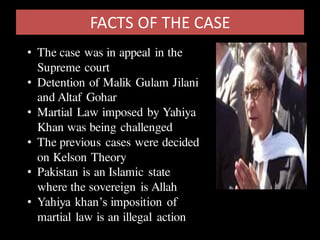
FACTS OF THE CASE
• The case was in appeal in the
Supreme court
• Detention of Malik Gulam Jilani
and Altaf Gohar
• Martial Law imposed by Yahiya
Khan was being challenged
• The previous cases were decided
on Kelson Theory
• Pakistan is an Islamic state
where the sovereign is Allah
• Yahiya khan’s imposition of
martial law is an illegal action
MAJOR ISSUES
• Whether the doctrine of positive law
articulated in the case of State v. Dosso was
correct?
• If Yahiya Khan’s martial law is illegal then
how can it be said that the all of his acts taken
by him were legal?
• Limits to the Doctrine of Necessity The
doctrine of necessity cannot be used to scrap a
constitution or to repeal a part.
The Key Points raised in the Discussion were:
• Detention of Mr Ghulam Jilani and Altaf Gohar
• Marshal law imposed by Yahiya Khan
• The Constitution
• Kelson’s Theory
• Objective Resolution
• Doctrine of condonation
• Question of legality
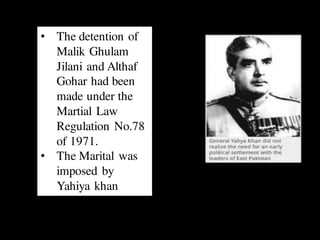
• The detention of
Malik Ghulam
Jilani and Althaf
Gohar had been
made under the
Martial Law
Regulation No.78
of 1971.
• The Marital was
imposed by
Yahiya khan
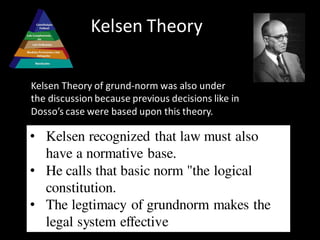
Kelsen Theory
Kelsen Theory of grund-norm was also under
the discussion because previous decisions like in
Dosso’s case were based upon this theory.
• Kelsen recognized that law must also
have a normative base.
• He calls that basic norm "the logical
constitution.
• The legtimacy of grundnorm makes the
legal system effective
Kelsen says the Grundnorm can be a
constitution
The Martial Law should be accepted by
the constitution
Martial law is revolution and the
acceptance of this change shows authority
of Grundnorm
Constitution and Martial law
The Objective Resolution
• In Pakistan our grund-norm is
Objective Resolution
• We do not need to rely upon
western not generally
accepted theories
• For Muslims government is
the sacred trust of Allah
almighty
• Pakistan has its own
Grundnorm
• Law giver is Allah
• Law is Quran & Sunah
Objective Resolution says:
The Decision of the Court
• The appeal for detention of
Malik Ghulam Jilani was
dismissed
• The Supreme court declared
Yahiya Khan as usurper
• The Court declared his
action of imposition of
Martial law as illegal
Justice Hamood ur Rahman declared:
When Asma Jilani's
judgment was released,
Yahya khan was not in
power, but now it was
Bhutto's Martial Law and
Bhutto was the chief
Martial law Administrator
and the president. He was
ordered by the court to
remove the Martial law.
RATIONALE BEHIND THE DECISION
The reverse decision of court in
Asma Jilani case was based on the
Doctrine of stare diesis ----------
Flexible in its application Law
cannot stand still nor can the
Courts and Judges be mere slaves
of precedents.
Impacts of the Decision
• Bhutto was compelled to
remove the martial law
• The case was proved a fresh air
for the democracy
• Weaken the power of
dictatorship
• Reinforcement of objective
resolution
ANALYSIS
• The constitutional change must be reinforced with the
harmony of majority and minority of the country
• Efficacy of the revolution in the country cannot be
measured by any abstract theory
• The trend was set by the previous decisions of the court
that constitution is Grundnorm and it accepts the
revolution as in case State v Dosso
• In Asma Jilani case court did not rely upon Kelsenian
approach because it was failed to built a standard for all
legal systems
• In Pakistan the Grundnorm is Objective Resolution
• Which proved that no theory can dominate over Quran
and Sunah
ANY QUESTION?
PRESENTED BY
HUMAIRA SIDDIQUA MALIK

ASMA JILANI EXPLAINED CASE PLD 1972 FOR CSS

  • 2.
    ASMA JILANI V.THE GOVERNMENT OF PUNJAB, PLD 1972 SC 139 TOPIC
  • 3.
    Asma Jilani caseis the one of those important cases of the history which proved landmark in the constitutional history of Pakistan such as State Vs. Dosso (1958), Begum Nusrat Bhutto Vs. Chief of Army Staff (1977), Syed Zafar Ali Shah Vs. Gen. Musharraf (1999). In the case of Asma Jilani, a detailed history of the Martial law is mentioned.
  • 4.
    FACTS OF THECASE • The case was in appeal in the Supreme court • Detention of Malik Gulam Jilani and Altaf Gohar • Martial Law imposed by Yahiya Khan was being challenged • The previous cases were decided on Kelson Theory • Pakistan is an Islamic state where the sovereign is Allah • Yahiya khan’s imposition of martial law is an illegal action
  • 5.
    MAJOR ISSUES • Whetherthe doctrine of positive law articulated in the case of State v. Dosso was correct? • If Yahiya Khan’s martial law is illegal then how can it be said that the all of his acts taken by him were legal? • Limits to the Doctrine of Necessity The doctrine of necessity cannot be used to scrap a constitution or to repeal a part.
  • 6.
    The Key Pointsraised in the Discussion were: • Detention of Mr Ghulam Jilani and Altaf Gohar • Marshal law imposed by Yahiya Khan • The Constitution • Kelson’s Theory • Objective Resolution • Doctrine of condonation • Question of legality
  • 7.
    • The detentionof Malik Ghulam Jilani and Althaf Gohar had been made under the Martial Law Regulation No.78 of 1971. • The Marital was imposed by Yahiya khan
  • 8.
    Kelsen Theory Kelsen Theoryof grund-norm was also under the discussion because previous decisions like in Dosso’s case were based upon this theory. • Kelsen recognized that law must also have a normative base. • He calls that basic norm "the logical constitution. • The legtimacy of grundnorm makes the legal system effective
  • 9.
    Kelsen says theGrundnorm can be a constitution The Martial Law should be accepted by the constitution Martial law is revolution and the acceptance of this change shows authority of Grundnorm Constitution and Martial law
  • 10.
    The Objective Resolution •In Pakistan our grund-norm is Objective Resolution • We do not need to rely upon western not generally accepted theories • For Muslims government is the sacred trust of Allah almighty
  • 11.
    • Pakistan hasits own Grundnorm • Law giver is Allah • Law is Quran & Sunah Objective Resolution says:
  • 12.
    The Decision ofthe Court • The appeal for detention of Malik Ghulam Jilani was dismissed • The Supreme court declared Yahiya Khan as usurper • The Court declared his action of imposition of Martial law as illegal Justice Hamood ur Rahman declared:
  • 13.
    When Asma Jilani's judgmentwas released, Yahya khan was not in power, but now it was Bhutto's Martial Law and Bhutto was the chief Martial law Administrator and the president. He was ordered by the court to remove the Martial law.
  • 14.
    RATIONALE BEHIND THEDECISION The reverse decision of court in Asma Jilani case was based on the Doctrine of stare diesis ---------- Flexible in its application Law cannot stand still nor can the Courts and Judges be mere slaves of precedents.
  • 15.
    Impacts of theDecision • Bhutto was compelled to remove the martial law • The case was proved a fresh air for the democracy • Weaken the power of dictatorship • Reinforcement of objective resolution
  • 16.
    ANALYSIS • The constitutionalchange must be reinforced with the harmony of majority and minority of the country • Efficacy of the revolution in the country cannot be measured by any abstract theory • The trend was set by the previous decisions of the court that constitution is Grundnorm and it accepts the revolution as in case State v Dosso • In Asma Jilani case court did not rely upon Kelsenian approach because it was failed to built a standard for all legal systems • In Pakistan the Grundnorm is Objective Resolution • Which proved that no theory can dominate over Quran and Sunah
  • 17.
  • 18.