Creating Value by Going GreenFlorida Chapter ASLA 2009Dennis L. Church, ASLA /AICPCommunity Development Advisors LLC
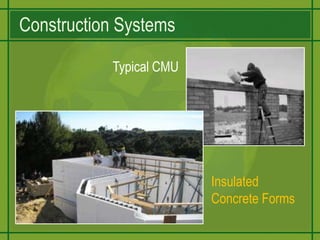
Presentation OutlineGreen Building and Buyer TrendsDevelopment Scale Green Approaches Low Impact DevelopmentConstruction Systems
Green Facts:New home construction consumes 2/5 of all the lumber & plywood used in the U.S. each yearA typical 2000 s.f. wood frame home uses 16,000 b.f. of lumber plus 6,000 s.f. of plywoodA typical 2,000 s.f. wood frame home produces 4 tons of wasteHomes have grown in size while family household has decreased…bigger is not always better…“Southface Energy Institute: Guidelines for the Southeast”
What is Green Building?Green Building is a process that creates buildings which minimize the use of resources, reduce harmful environmental effects and provides a healthier environment.
What is Sustainable Development?  “Sustainable development is development that meets the needs of the present without compromising the ability of future generations to meet their own needs.”
Logos to Recognize
Green Standards Were Created To:Establish a Common Standard of MeasurementPromote Integrated, Whole Building Design PracticesRecognize Environmental Leadership in the Building IndustryStimulate Green CompetitionRaise Consumer AwarenessTransform the Building Market
Advantages of Green HomesDesigned & Built BetterMinimum or No Construction Cost IncreaseLess RiskyLess WasteLower Operating Costs by up to 30% to 100%Cut Water Consumption by up to 50%Tax Incentives & RebatesIncreased Health & Comfort
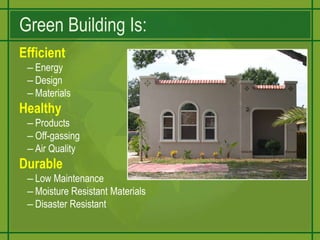
Green Building Is:EfficientEnergyDesignMaterialsHealthyProductsOff-gassingAir QualityDurableLow MaintenanceMoisture Resistant MaterialsDisaster Resistant
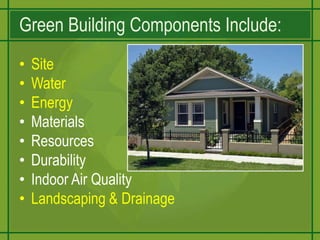
SiteWaterEnergy MaterialsResourcesDurabilityIndoor Air QualityLandscaping & DrainageGreen Building Components Include:
Why Go Green?Some Communities Require GreenLocal, State & Federal Requirements / IncentivesMortgage ProgramsGrowing Public DemandMarketing Advantage63% Motivated by Lower Operating Costs85% More Satisfied with New Green Home than with PreviousIt’s the Right Thing To Do
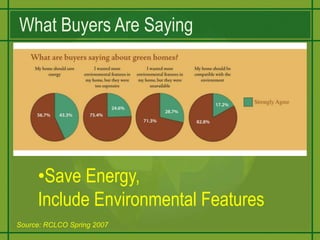
What Buyers Are SayingSave Energy,Include Environmental FeaturesSource: RCLCO Spring 2007
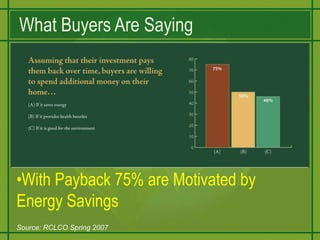
What Buyers Are SayingWith Payback 75% are Motivated by Energy SavingsSource: RCLCO Spring 2007
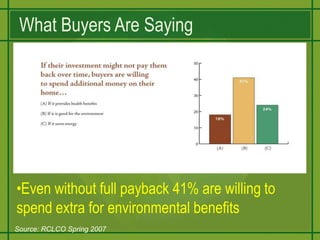
What Buyers Are SayingEven without full payback 41% are willing to spend extra for environmental benefitsSource: RCLCO Spring 2007
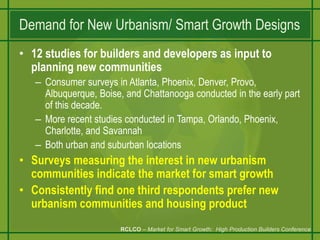
Demand for New Urbanism/ Smart Growth Designs12 studies for builders and developers as input to planning new communitiesConsumer surveys in Atlanta, Phoenix, Denver, Provo, Albuquerque, Boise, and Chattanooga conducted in the early part of this decade.More recent studies conducted in Tampa, Orlando, Phoenix, Charlotte, and SavannahBoth urban and suburban locationsSurveys measuring the interest in new urbanism communities indicate the market for smart growthConsistently find one third respondents prefer new urbanism communities and housing productRCLCO – Market for Smart Growth:  High Production Builders Conference
New Urbanism and Smart Growth DesignSupport Sustainability AgendaNew Urbanism and smart growth designs and products are similar:Compact higher density communitiesConnect with surrounding neighborhoodsIntegrate multiple land uses reducing vehicle tripsHave a definable neighborhood centerSafe streets, andProtect regional open spacesRCLCO – Market for Smart Growth:  High Production Builders Conference
Builder Motivation for Going Green62%: Right Thing to Do62%: Lowering Life Cycle Costs53%: Limit Liability Exposure51%: Competitive Advantage46%: Expand Business Opportunities33%: Publicity Benefits“McGraw Hill Construction: Residential Green Building SmartMarket Report”
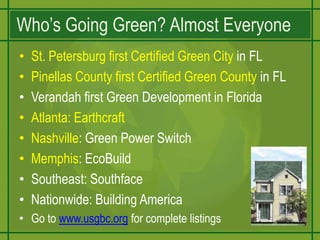
Who’s Going Green? Almost EveryoneSt. Petersburg first Certified Green City in FLPinellas County first Certified Green County in FLVerandah first Green Development in FloridaAtlanta: EarthcraftNashville: Green Power SwitchMemphis: EcoBuildSoutheast: SouthfaceNationwide: Building AmericaGo to www.usgbc.org for complete listings
Market Trends & Outlook circa 200697,000 Homes Have Been Green Certified Since the Mid-1990sGreen Home Building Will Reach Its Tipping Point in 2007...Increase Since 2005 Will be From 35% to 66% More Than 2/3 of Builders Will be Building Green Homes During 2008“McGraw Hill Construction: Residential Green Building SmartMarket Report”
Buyer Profile   There are no age or income barriers. Green Building interests everyone concerned about energy costs, depletion of natural resources and living a healthier and less complicated lifestyle.
Development Scale Green Approaches
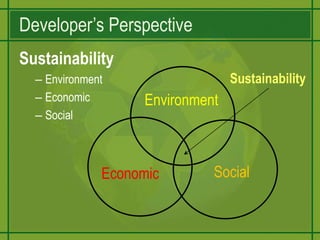
Developer’s PerspectiveSustainabilityEnvironmentEconomic SocialSustainabilityEnvironmentSocialEconomic
Bonita Bay GroupBonita Bay Group is recognized nationally as a leader in environmentally sensitive large scale MPC Design and executionPrivately held development company based in Southwest Florida since 1985Seven master planned communities with 12,000 units9,000 units sold on 9,700 acres15 golf coursesTwo marinasIrrigation utility companySeven communities in planning and entitlement process totaling over 10,000 acres and 25,000 units
BBG Environmental AwardsFive time winner of awards from the council for sustainable FloridaFirst certified Green Development by the Florida Green Building CoalitionHas 15 Audubon certified golf courses and communitiesTwice has won ENVY awards from Florida Association of Realtors for environmental stewardshipTwice has been named environmental Leader in Golf and Golf DigestAnd in 1999 Bonita Bay was awarded the Award of Excellence by the Urban Land Institute for the best Master Planned Community in North America
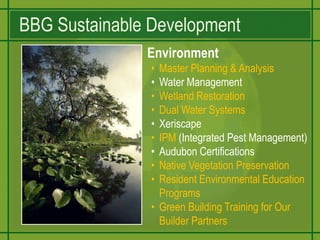
BBG Sustainable DevelopmentEnvironmentMaster Planning & Analysis
Water Management
Wetland Restoration
Dual Water Systems
Xeriscape
IPM (Integrated Pest Management)
Audubon Certifications
Native Vegetation Preservation
Resident Environmental Education   Programs
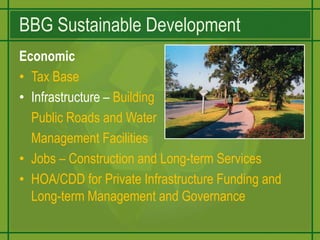
Green Building Training for Our Builder PartnersBBG Sustainable DevelopmentEconomicTax Base
Infrastructure – Building	Public Roads and Water	Management FacilitiesJobs – Construction and Long-term Services
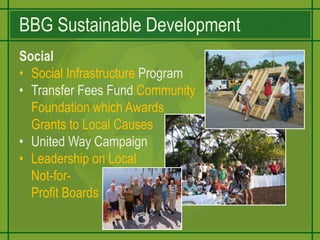
HOA/CDD for Private Infrastructure Funding and Long-term Management and GovernanceBBG Sustainable DevelopmentSocial Social Infrastructure Program
Transfer Fees Fund Community Foundation which Awards Grants to Local Causes
United Way Campaign
Leadership on Local	Not-for-	Profit Boards
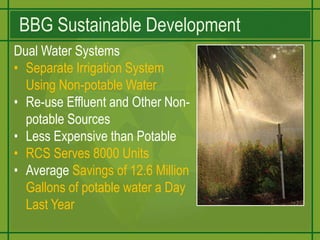
BBG Sustainable DevelopmentDual Water SystemsSeparate Irrigation System Using Non-potable Water
Re-use Effluent and Other Non-potable Sources
Less Expensive than Potable
RCS Serves 8000 Units
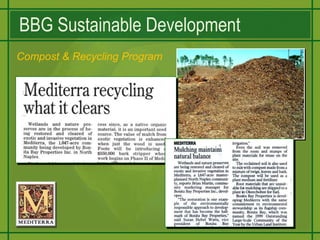
Average Savings of 12.6 Million Gallons of potable water a Day Last YearBBG Sustainable DevelopmentCompost & Recycling Program
FGBC Green DevelopmentProtect Ecosystems and Conserve Natural ResourcesCreate a Green Circulation SystemGreen Utilities PracticesAmenitiesCovenants and Deed RestrictionsProvide Educational Information to Help Achieve and Promote Green Living Practices
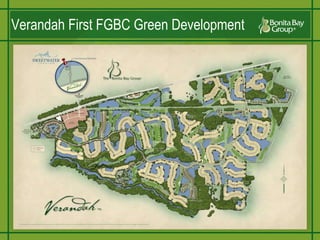
Verandah First FGBC Green Development
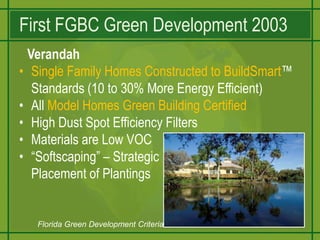
First FGBC Green Development 2003 VerandahSingle Family Homes Constructed to BuildSmart™ Standards (10 to 30% More Energy Efficient)
All Model Homes Green Building Certified
High Dust Spot Efficiency Filters
Materials are Low VOC
“Softscaping” – Strategic	Placement of Plantings  Florida Green Development Criteria
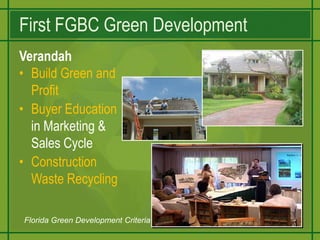
First FGBC Green DevelopmentVerandahBuild Green and Profit
Buyer Education in Marketing & Sales Cycle
Construction Waste Recycling  Florida Green Development Criteria
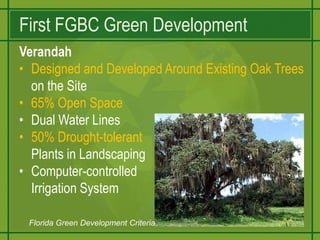
First FGBC Green DevelopmentVerandahDesigned and Developed Around Existing Oak Trees on the Site
65% Open Space
Dual Water Lines
50% Drought-tolerant	Plants in LandscapingComputer-controlled 	Irrigation System  Florida Green Development Criteria
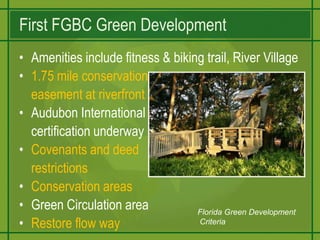
First FGBC Green DevelopmentAmenities include fitness & biking trail, River Village
1.75 mile conservation 	easement at riverfrontAudubon International	certification underway Covenants and deed 	restrictionsConservation areas
Green Circulation area
Restore flow wayFlorida Green Development    Criteria
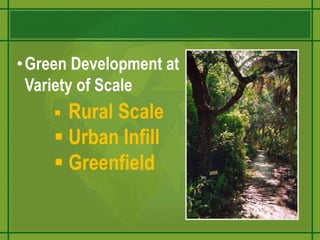
Green Development at Variety of Scale
Rural Scale
 Urban Infill
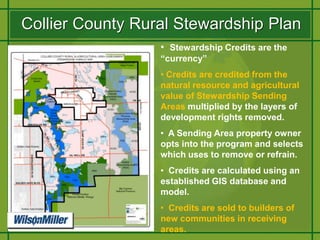
 GreenfieldCollier County Rural Stewardship PlanStewardship Credits are the “currency”
 Credits are credited from the natural resource and agricultural value of Stewardship Sending Areas multiplied by the layers of development rights removed.
  A Sending Area property owner opts into the program and selects which uses to remove or refrain.
  Credits are calculated using an established GIS database and model.
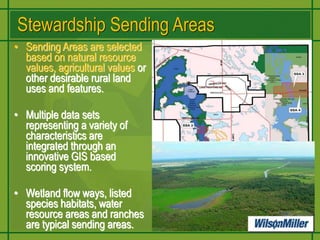
  Credits are sold to builders of new communities in receiving areas.Stewardship Sending AreasSending Areas are selected based on natural resource values, agricultural values or other desirable rural land uses and features.Multiple data sets representing a variety of characteristics are integrated through an innovative GIS based scoring system.Wetland flow ways, listed species habitats, water resource areas and ranches are typical sending areas.
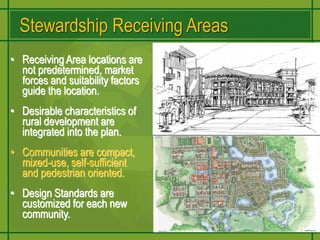
Stewardship Receiving AreasReceiving Area locations are not predetermined, market forces and suitability factors guide the location.Desirable characteristics of rural development are integrated into the plan. Communities are compact, mixed-use, self-sufficient and pedestrian oriented.Design Standards are customized for each new community.
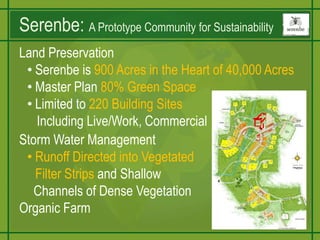
Serenbe: A Prototype Community for SustainabilityLand PreservationSerenbe is 900 Acres in the Heart of 40,000 AcresMaster Plan 80% Green SpaceLimited to 220 Building Sites    Including Live/Work, CommercialStorm Water ManagementRunoff Directed into Vegetated	Filter Strips and Shallow   Channels of Dense VegetationOrganic Farm
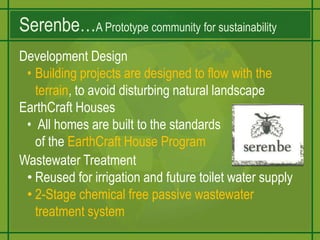
Serenbe…A Prototype community for sustainabilityDevelopment DesignBuilding projects are designed to flow with the terrain, to avoid disturbing natural landscapeEarthCraft Houses All homes are built to the standards	of the EarthCraft House ProgramWastewater TreatmentReused for irrigation and future toilet water supply
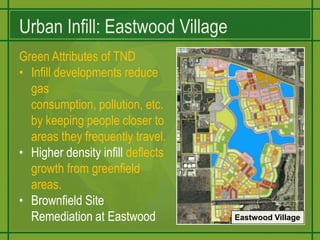
2-Stage chemical free passive wastewater treatment systemUrban Infill: Eastwood VillageGreen Attributes of TNDInfill developments reduce gas consumption, pollution, etc. by keeping people closer to areas they frequently travel.
Higher density infill deflects growth from greenfield areas.
Brownfield Site Remediation at EastwoodEastwood Village
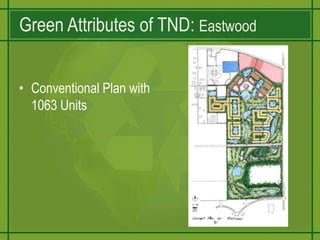
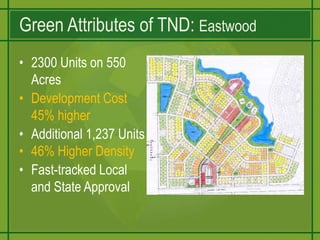
Green Attributes of TND: EastwoodConventional Plan with 1063 UnitsGreen Attributes of TND: Eastwood2300 Units on 550 Acres
Development Cost 45% higher
Additional 1,237 Units
46% Higher Density
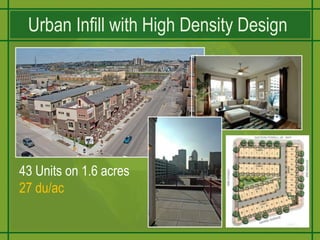
Fast-tracked Local and State ApprovalUrbanInfill with High Density Design43 Units on 1.6 acres27 du/ac
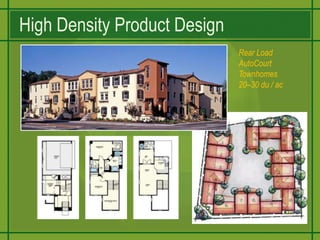
High Density Product Design Rear LoadAutoCourtTownhomes20–30 du / ac
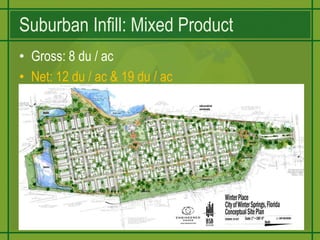
Suburban Infill: Mixed ProductGross: 8 du / acNet: 12 du / ac & 19 du / ac
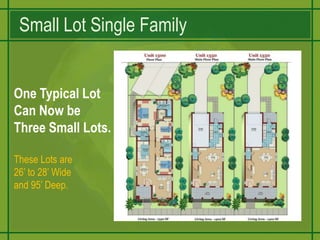
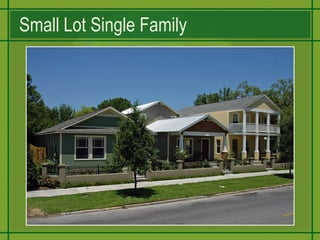
Small Lot Single FamilyOne Typical Lot Can Now be Three Small Lots.These Lots are 26’ to 28’ Wide and 95’ Deep.
Small Lot Single Family
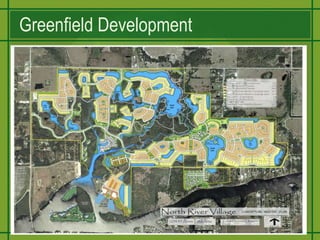
Greenfield Development
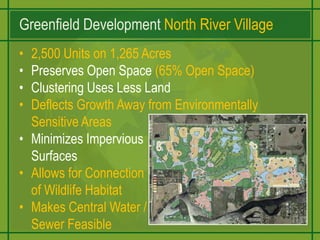
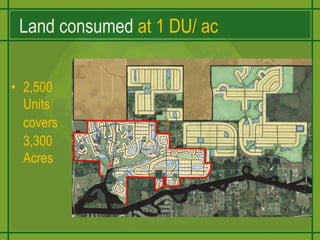
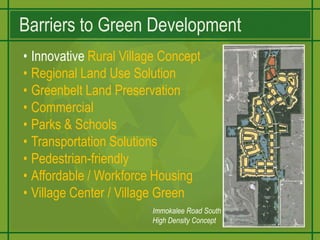
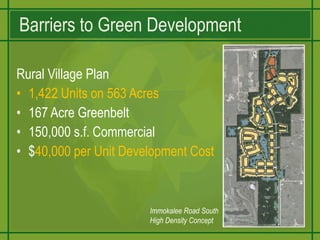
Greenfield Development North River Village2,500 Units on 1,265 Acres
Preserves Open Space (65% Open Space)
Clustering Uses Less Land
Deflects Growth Away from Environmentally Sensitive Areas
Minimizes Impervious	SurfacesAllows for Connection	of Wildlife HabitatMakes Central Water /	Sewer Feasible
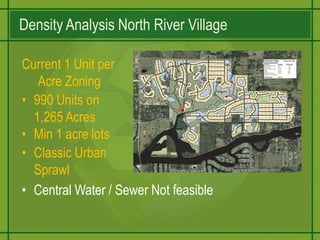
Density Analysis North River VillageCurrent 1 Unit per Acre Zoning990 Units on 	1,265 AcresMin 1 acre lots
Classic Urban	SprawlCentral Water / Sewer Not feasibleLand consumed at 1 DU/ ac2,500 Units 	covers	3,300 Acres
Green Programs at North River VillageFGBC Dev. DesignationLEED Silver for Amenity BuildingsLEED Neighborhood Development ??Clean Marina ProgramLID for Stormwater System DesignDual Water for Irrigation (include recycling stormwater)FGBC Certification for all Single Family HomesEnergy Star
Water StarBuildsmartGreen Advantage Certification for buildersFY&N Standards for Residential LandscapeXeriscape Initiatives for Community LandscapeFirewise Community DesignationGreen Energy?North River Green Programs cont.
Green Programs NRVU.S. Green Building Council Leadership in Energy & Environmental Design (LEED) Certification:LEED is a green building rating system that was developed by the US Green Building Council.  LEED is a point based system where projects earn LEED points for satisfying specific green building criteria in six categorieswhich include sustainable sites, water efficiency, energy and atmosphere, materials and resources, indoor environmental quality, and innovation in design.
Green Programs NRVLEED for Neighborhood Development:The LEED for Neighborhood Development Rating System integrates the principles of smart growth, urbanism and green building into the first national system for neighborhood design. LEED certification provides independent, third-party verification thata development's location and design meet accepted high levels of environmentally responsible, sustainable development.
Green Programs NRVClean Marina Program:This program administered by the Department of Environmental Protection provides pollution prevention educational information and designation to marinas and boat yard owners.  Clean Marinas implement a Clean Marina Action Plan (CMAP) focusing on waste management and pollution prevention.
Green Programs NRVLIDLow Impact Designis an approach to site development that minimizes engineered solutions to water managementand minimizes development impact by:Decreasing Impervious SurfacesReducing Roadway SurfacesPermeable Pavement SurfacesVegetative Roof SystemsNatural Resource Preservation and Xeriscapingwww.lowimpactdevelopment.org/
Green Programs NRVEnergy Star:Energy Star is a voluntary partnership between the US EPA and more than 8,000 organizations, including 3,500 of the nation’s home builders.  The goal is to increase energy efficiency, decrease utility bills, and help to prevent greenhouse gas emissions.  The Energy Star symbol identifies more than 50 types of products such as appliances, lighting, and heating and cooling equipment that are energy efficient.
Green Programs NRVFlorida Water Star:The programencourages water efficiency in household appliances, plumbing fixtures, irrigation systems and landscapes.These promote the economic and environmental benefits of efficiency in new home construction.

Sustainable Development at Master Planned Community Scale

  • 1.
    Creating Value byGoing GreenFlorida Chapter ASLA 2009Dennis L. Church, ASLA /AICPCommunity Development Advisors LLC
  • 2.
    Presentation OutlineGreen Buildingand Buyer TrendsDevelopment Scale Green Approaches Low Impact DevelopmentConstruction Systems
  • 3.
    Green Facts:New homeconstruction consumes 2/5 of all the lumber & plywood used in the U.S. each yearA typical 2000 s.f. wood frame home uses 16,000 b.f. of lumber plus 6,000 s.f. of plywoodA typical 2,000 s.f. wood frame home produces 4 tons of wasteHomes have grown in size while family household has decreased…bigger is not always better…“Southface Energy Institute: Guidelines for the Southeast”
  • 4.
    What is GreenBuilding?Green Building is a process that creates buildings which minimize the use of resources, reduce harmful environmental effects and provides a healthier environment.
  • 5.
    What is SustainableDevelopment? “Sustainable development is development that meets the needs of the present without compromising the ability of future generations to meet their own needs.”
  • 6.
  • 7.
    Green Standards WereCreated To:Establish a Common Standard of MeasurementPromote Integrated, Whole Building Design PracticesRecognize Environmental Leadership in the Building IndustryStimulate Green CompetitionRaise Consumer AwarenessTransform the Building Market
  • 8.
    Advantages of GreenHomesDesigned & Built BetterMinimum or No Construction Cost IncreaseLess RiskyLess WasteLower Operating Costs by up to 30% to 100%Cut Water Consumption by up to 50%Tax Incentives & RebatesIncreased Health & Comfort
  • 9.
    Green Building Is:EfficientEnergyDesignMaterialsHealthyProductsOff-gassingAirQualityDurableLow MaintenanceMoisture Resistant MaterialsDisaster Resistant
  • 10.
    SiteWaterEnergy MaterialsResourcesDurabilityIndoor AirQualityLandscaping & DrainageGreen Building Components Include:
  • 11.
    Why Go Green?SomeCommunities Require GreenLocal, State & Federal Requirements / IncentivesMortgage ProgramsGrowing Public DemandMarketing Advantage63% Motivated by Lower Operating Costs85% More Satisfied with New Green Home than with PreviousIt’s the Right Thing To Do
  • 12.
    What Buyers AreSayingSave Energy,Include Environmental FeaturesSource: RCLCO Spring 2007
  • 13.
    What Buyers AreSayingWith Payback 75% are Motivated by Energy SavingsSource: RCLCO Spring 2007
  • 14.
    What Buyers AreSayingEven without full payback 41% are willing to spend extra for environmental benefitsSource: RCLCO Spring 2007
  • 15.
    Demand for NewUrbanism/ Smart Growth Designs12 studies for builders and developers as input to planning new communitiesConsumer surveys in Atlanta, Phoenix, Denver, Provo, Albuquerque, Boise, and Chattanooga conducted in the early part of this decade.More recent studies conducted in Tampa, Orlando, Phoenix, Charlotte, and SavannahBoth urban and suburban locationsSurveys measuring the interest in new urbanism communities indicate the market for smart growthConsistently find one third respondents prefer new urbanism communities and housing productRCLCO – Market for Smart Growth: High Production Builders Conference
  • 16.
    New Urbanism andSmart Growth DesignSupport Sustainability AgendaNew Urbanism and smart growth designs and products are similar:Compact higher density communitiesConnect with surrounding neighborhoodsIntegrate multiple land uses reducing vehicle tripsHave a definable neighborhood centerSafe streets, andProtect regional open spacesRCLCO – Market for Smart Growth: High Production Builders Conference
  • 17.
    Builder Motivation forGoing Green62%: Right Thing to Do62%: Lowering Life Cycle Costs53%: Limit Liability Exposure51%: Competitive Advantage46%: Expand Business Opportunities33%: Publicity Benefits“McGraw Hill Construction: Residential Green Building SmartMarket Report”
  • 18.
    Who’s Going Green?Almost EveryoneSt. Petersburg first Certified Green City in FLPinellas County first Certified Green County in FLVerandah first Green Development in FloridaAtlanta: EarthcraftNashville: Green Power SwitchMemphis: EcoBuildSoutheast: SouthfaceNationwide: Building AmericaGo to www.usgbc.org for complete listings
  • 19.
    Market Trends &Outlook circa 200697,000 Homes Have Been Green Certified Since the Mid-1990sGreen Home Building Will Reach Its Tipping Point in 2007...Increase Since 2005 Will be From 35% to 66% More Than 2/3 of Builders Will be Building Green Homes During 2008“McGraw Hill Construction: Residential Green Building SmartMarket Report”
  • 20.
    Buyer Profile There are no age or income barriers. Green Building interests everyone concerned about energy costs, depletion of natural resources and living a healthier and less complicated lifestyle.
  • 21.
  • 22.
  • 23.
    Bonita Bay GroupBonitaBay Group is recognized nationally as a leader in environmentally sensitive large scale MPC Design and executionPrivately held development company based in Southwest Florida since 1985Seven master planned communities with 12,000 units9,000 units sold on 9,700 acres15 golf coursesTwo marinasIrrigation utility companySeven communities in planning and entitlement process totaling over 10,000 acres and 25,000 units
  • 24.
    BBG Environmental AwardsFivetime winner of awards from the council for sustainable FloridaFirst certified Green Development by the Florida Green Building CoalitionHas 15 Audubon certified golf courses and communitiesTwice has won ENVY awards from Florida Association of Realtors for environmental stewardshipTwice has been named environmental Leader in Golf and Golf DigestAnd in 1999 Bonita Bay was awarded the Award of Excellence by the Urban Land Institute for the best Master Planned Community in North America
  • 25.
  • 26.
  • 27.
  • 28.
  • 29.
  • 30.
  • 31.
  • 32.
  • 33.
  • 34.
    Green Building Trainingfor Our Builder PartnersBBG Sustainable DevelopmentEconomicTax Base
  • 35.
    Infrastructure – Building PublicRoads and Water Management FacilitiesJobs – Construction and Long-term Services
  • 36.
    HOA/CDD for PrivateInfrastructure Funding and Long-term Management and GovernanceBBG Sustainable DevelopmentSocial Social Infrastructure Program
  • 37.
    Transfer Fees FundCommunity Foundation which Awards Grants to Local Causes
  • 38.
  • 39.
  • 40.
    BBG Sustainable DevelopmentDualWater SystemsSeparate Irrigation System Using Non-potable Water
  • 41.
    Re-use Effluent andOther Non-potable Sources
  • 42.
  • 43.
  • 44.
    Average Savings of12.6 Million Gallons of potable water a Day Last YearBBG Sustainable DevelopmentCompost & Recycling Program
  • 45.
    FGBC Green DevelopmentProtectEcosystems and Conserve Natural ResourcesCreate a Green Circulation SystemGreen Utilities PracticesAmenitiesCovenants and Deed RestrictionsProvide Educational Information to Help Achieve and Promote Green Living Practices
  • 46.
    Verandah First FGBCGreen Development
  • 47.
    First FGBC GreenDevelopment 2003 VerandahSingle Family Homes Constructed to BuildSmart™ Standards (10 to 30% More Energy Efficient)
  • 48.
    All Model HomesGreen Building Certified
  • 49.
    High Dust SpotEfficiency Filters
  • 50.
  • 51.
    “Softscaping” – Strategic Placementof Plantings Florida Green Development Criteria
  • 52.
    First FGBC GreenDevelopmentVerandahBuild Green and Profit
  • 53.
    Buyer Education inMarketing & Sales Cycle
  • 54.
    Construction Waste Recycling Florida Green Development Criteria
  • 55.
    First FGBC GreenDevelopmentVerandahDesigned and Developed Around Existing Oak Trees on the Site
  • 56.
  • 57.
  • 58.
    50% Drought-tolerant Plants inLandscapingComputer-controlled Irrigation System Florida Green Development Criteria
  • 59.
    First FGBC GreenDevelopmentAmenities include fitness & biking trail, River Village
  • 60.
    1.75 mile conservation easement at riverfrontAudubon International certification underway Covenants and deed restrictionsConservation areas
  • 61.
  • 62.
    Restore flow wayFloridaGreen Development Criteria
  • 63.
    Green Development atVariety of Scale
  • 64.
  • 65.
  • 66.
    GreenfieldCollier CountyRural Stewardship PlanStewardship Credits are the “currency”
  • 67.
    Credits arecredited from the natural resource and agricultural value of Stewardship Sending Areas multiplied by the layers of development rights removed.
  • 68.
    ASending Area property owner opts into the program and selects which uses to remove or refrain.
  • 69.
    Creditsare calculated using an established GIS database and model.
  • 70.
    Creditsare sold to builders of new communities in receiving areas.Stewardship Sending AreasSending Areas are selected based on natural resource values, agricultural values or other desirable rural land uses and features.Multiple data sets representing a variety of characteristics are integrated through an innovative GIS based scoring system.Wetland flow ways, listed species habitats, water resource areas and ranches are typical sending areas.
  • 71.
    Stewardship Receiving AreasReceivingArea locations are not predetermined, market forces and suitability factors guide the location.Desirable characteristics of rural development are integrated into the plan. Communities are compact, mixed-use, self-sufficient and pedestrian oriented.Design Standards are customized for each new community.
  • 72.
    Serenbe: A PrototypeCommunity for SustainabilityLand PreservationSerenbe is 900 Acres in the Heart of 40,000 AcresMaster Plan 80% Green SpaceLimited to 220 Building Sites Including Live/Work, CommercialStorm Water ManagementRunoff Directed into Vegetated Filter Strips and Shallow Channels of Dense VegetationOrganic Farm
  • 73.
    Serenbe…A Prototype communityfor sustainabilityDevelopment DesignBuilding projects are designed to flow with the terrain, to avoid disturbing natural landscapeEarthCraft Houses All homes are built to the standards of the EarthCraft House ProgramWastewater TreatmentReused for irrigation and future toilet water supply
  • 74.
    2-Stage chemical freepassive wastewater treatment systemUrban Infill: Eastwood VillageGreen Attributes of TNDInfill developments reduce gas consumption, pollution, etc. by keeping people closer to areas they frequently travel.
  • 75.
    Higher density infilldeflects growth from greenfield areas.
  • 76.
    Brownfield Site Remediationat EastwoodEastwood Village
  • 77.
    Green Attributes ofTND: EastwoodConventional Plan with 1063 UnitsGreen Attributes of TND: Eastwood2300 Units on 550 Acres
  • 78.
  • 79.
  • 80.
  • 81.
    Fast-tracked Local andState ApprovalUrbanInfill with High Density Design43 Units on 1.6 acres27 du/ac
  • 82.
    High Density ProductDesign Rear LoadAutoCourtTownhomes20–30 du / ac
  • 83.
    Suburban Infill: MixedProductGross: 8 du / acNet: 12 du / ac & 19 du / ac
  • 84.
    Small Lot SingleFamilyOne Typical Lot Can Now be Three Small Lots.These Lots are 26’ to 28’ Wide and 95’ Deep.
  • 85.
  • 86.
  • 87.
    Greenfield Development NorthRiver Village2,500 Units on 1,265 Acres
  • 88.
    Preserves Open Space(65% Open Space)
  • 89.
  • 90.
    Deflects Growth Awayfrom Environmentally Sensitive Areas
  • 91.
    Minimizes Impervious SurfacesAllows forConnection of Wildlife HabitatMakes Central Water / Sewer Feasible
  • 92.
    Density Analysis NorthRiver VillageCurrent 1 Unit per Acre Zoning990 Units on 1,265 AcresMin 1 acre lots
  • 93.
    Classic Urban SprawlCentral Water/ Sewer Not feasibleLand consumed at 1 DU/ ac2,500 Units covers 3,300 Acres
  • 94.
    Green Programs atNorth River VillageFGBC Dev. DesignationLEED Silver for Amenity BuildingsLEED Neighborhood Development ??Clean Marina ProgramLID for Stormwater System DesignDual Water for Irrigation (include recycling stormwater)FGBC Certification for all Single Family HomesEnergy Star
  • 95.
    Water StarBuildsmartGreen AdvantageCertification for buildersFY&N Standards for Residential LandscapeXeriscape Initiatives for Community LandscapeFirewise Community DesignationGreen Energy?North River Green Programs cont.
  • 96.
    Green Programs NRVU.S.Green Building Council Leadership in Energy & Environmental Design (LEED) Certification:LEED is a green building rating system that was developed by the US Green Building Council. LEED is a point based system where projects earn LEED points for satisfying specific green building criteria in six categorieswhich include sustainable sites, water efficiency, energy and atmosphere, materials and resources, indoor environmental quality, and innovation in design.
  • 97.
    Green Programs NRVLEEDfor Neighborhood Development:The LEED for Neighborhood Development Rating System integrates the principles of smart growth, urbanism and green building into the first national system for neighborhood design. LEED certification provides independent, third-party verification thata development's location and design meet accepted high levels of environmentally responsible, sustainable development.
  • 98.
    Green Programs NRVCleanMarina Program:This program administered by the Department of Environmental Protection provides pollution prevention educational information and designation to marinas and boat yard owners. Clean Marinas implement a Clean Marina Action Plan (CMAP) focusing on waste management and pollution prevention.
  • 99.
    Green Programs NRVLIDLowImpact Designis an approach to site development that minimizes engineered solutions to water managementand minimizes development impact by:Decreasing Impervious SurfacesReducing Roadway SurfacesPermeable Pavement SurfacesVegetative Roof SystemsNatural Resource Preservation and Xeriscapingwww.lowimpactdevelopment.org/
  • 100.
    Green Programs NRVEnergyStar:Energy Star is a voluntary partnership between the US EPA and more than 8,000 organizations, including 3,500 of the nation’s home builders. The goal is to increase energy efficiency, decrease utility bills, and help to prevent greenhouse gas emissions. The Energy Star symbol identifies more than 50 types of products such as appliances, lighting, and heating and cooling equipment that are energy efficient.
  • 101.
    Green Programs NRVFloridaWater Star:The programencourages water efficiency in household appliances, plumbing fixtures, irrigation systems and landscapes.These promote the economic and environmental benefits of efficiency in new home construction.