Plus: bRING ON THE BOOM TIMES
GLOBAL FIRMS STILL WAITING FOR ‘MYNAMAR MOMENT’ TO ARRIVE
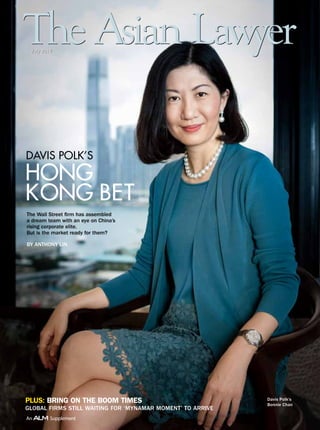
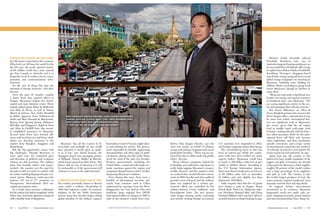
Davis Polk’s
July 2014
Davis Polk’s
Bonnie Chan
The Wall Street firm has assembled
a dream team with an eye on China’s
rising corporate elite.
But is the market ready for them?
By ANTHONY LIN
Kong Bet
Hong
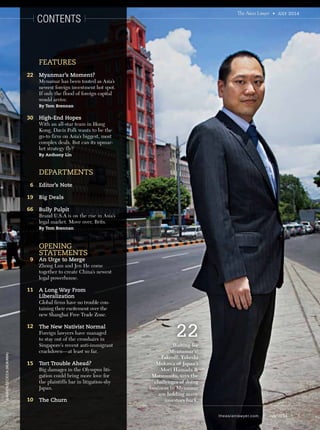
22
Waiting for
(Myanamar’s)
Takeoff: Takeshi
Mukawa of Japan’s
Mori Hamada &
Matsumoto, says the
challenges of doing
business in Mynamar
are holding many
investors back.
theasianlawyer.com | July 2014 | 5
• july 2014
features
Myanmar’s Moment?
Mynamar has been touted as Asia’s
newest foreign investment hot spot.
If only the flood of foreign capital
would arrive.
By Tom Brennan
High-End Hopes
With an all-star team in Hong
Kong, Davis Polk wants to be the
go-to firm on Asia’s biggest, most
complex deals. But can its upmar-
ket strategy fly?
By Anthony Lin
departments
Editor’s Note
Big Deals
Bully Pulpit
Brand U.S.A is on the rise in Asia’s
legal market. Move over, Brits.
By Tom Brennan
OPENING
STATEMENTS
An Urge to Merge
Zhong Lun and Jen He come
together to create China’s newest
legal powerhouse.
A Long Way From
Liberalization
Global firms have no trouble con-
taining their excitement over the
new Shanghai Free Trade Zone.
The New Nativist Normal
Foreign lawyers have managed
to stay out of the crosshairs in
Singapore’s recent anti-immigrant
crackdown—at least so far.
Tort Trouble Ahead?
Big damages in the Olympus liti-
gation could bring more love for
the plaintiffs bar in litigation-shy
Japan.
The Churn
22
30
6
9
11
12
15
10
19
66
CONTENTS
laurendecicca(mukawa)
theasianlawyer.com | Summer 2014 | 9
opening statements
9 china: Zhong lun and Jun He couple up • 11 China: Ho-Hum on Shanghai FTZ • 12 singapore: xenophobia Rising • 14 japan: Ready, Set, Sue?
china
An Urge to Merge
Two of China’s top-tier firms are looking to find out if bigger really is better.
illustration by kelsey dake
A
potential merger between two of China’s
most prominent law firms—Jun He Law
Offices and Zhong Lun Law Firm—has set off a
flurry of speculation in the region about what such a com-
bination would mean, both for the two firms involved and
for the emerging Chinese legal market.
The Asian Lawyer reported in late March that the
two Beijing-based firms, which along with King  Wood
Mallesons are widely considered to be among China’s top
law firms, are discussing a potential merger. If approved, it
would create a new Chinese legal behemoth with almost
1,300 lawyers.
Partners at both firms declined to comment on
their plans, but lawyers at other Chinese firms
said they were surprised the two were contem-
plating a merger, given their different reputa-
tions in the market.
“They are both top-tier firms, but the two
have entirely different cultures,” says Lin Wei, a
Shanghai partner with Zhong Lun WD, a firm
that split off from Zhong Lun in 2003. He
says the general view of Zhong Lun is that it
likes to stoke competition among partners, while
Jun He is widely seen as a firm where collegiality is
prized.
Liu Hongchuan, a partner at Beijing’s Broad  Bright,
echoes that view. “Zhong Lun focuses more on the indi-
vidual ability of lawyers, and core partners have more in-
fluence,” he says. Jun He, on the other hand, has a more
equal partnership. “The culture stresses cooperation
among partners,” he adds.
So why would these two firms want to merge? A num-
ber of Chinese lawyers expressed the view that size actu-
ally does matter—and that the combination would enable
both firms to build on complementary strengths.
“The important thing is to create synergy,” says Vic-
tor Wang, a Shanghai partner with Allbright Law Offic-
es. “The union between two already very strong brands
would enhance the coverage of quality legal service.”
While Jun He has traditionally focused on cross-
peterparks/gettyimages
border work, one Beijing partner with a
Chinese firm notes that that practice has
recently slowed down. “That could be
a bottleneck for Jun He, and it may feel
the need to work on developing domestic
practice.”
Zhong Lun, in contrast, is primarily
known for its expertise in domestic mat-
ters, especially in real estate, says this
lawyer. “It has recently started to get in-
volved in more international transactions,
but still not to the extent of King  Wood,
Jun He or Fangda [Fangda Partners is an-
other leading Chinese firm].”
Local lawyers believe the proposed
merger may well be a response to the
growing reputation of King  Wood,
which has been widely hailed as the first
“Chinese” international law firm. King 
Wood Mallesons is
itself the product of
a 2012 merger be-
tween China’s King
 Wood and Aus-
tralia’s Mallesons
Stephen Jaques.
Last year, it also
moved to acquire
London’s SJ Ber-
win, thus further
enhancing its global
brand.
Though Jun He,
at least, has been
vocal about not wanting to expand over-
seas, the proposed merger with Zhong
Lun would clearly help Jun He lawyers
raise their profile as well.
“This could be a defensive response,”
agrees another Beijing lawyer. “The three
[firms] used to be more equal, but then
King  Wood [Mallesons] merged and
created this ‘superpower.’ The other two
might want to strike a balance.”
Local lawyers have mixed views on
whether a combination between Jun He
and Zhong Lun would give them a signifi-
cant competitive edge.
Zhong Lun WD’s Lin contends that
larger Chinese companies, including
state-owned enterprises, tend to prefer
big law firms, both domestic and inter-
national, because they think they have a
more stable track record. But he thinks
privately owned small and medium-sized
companies are more open to working with
smaller firms and boutiques. “Both will
find their place in the market,” Lin says of
boutiques and large firms.
Even if Zhong Lun and Jun He merge,
it will not be the largest firm in China.
Dacheng Law Offices and Yingke Law
Firm already count 3,000 and 2,400 law-
yers, respectively. Yu Xugang, a Beijing
partner at Dacheng, says large firms gen-
erally are better, even at providing spe-
cialized advice. The smaller size of bou-
tiques, he says, means partners have to
take on more and different types of mat-
ters, hampering their ability to focus on
one practice area.
“I think this is good news for China’s
legal profession if they merge,” Yu says of
the talks between Zhong Lun and Jun He.
“The combination will create a stronger
individual firm, which means within the
firm, particularly in the noncontentious
area, each practice group will be strength-
ened by more law-
yers. For the industry
as a whole, we will
see more specialists.”
Anthony Qiao, a
Zhong Lun partner,
said in a late March
interview that he
expects a wave of
mergers among Chi-
nese firms over the
next decade as the
country’s economy
and legal market con-
tinue to grow and its
domestic law firms emerge as major inter-
national players. He points out that, even
if Zhong Lun merges with Jun He, the
combined firm would still be considerably
smaller than Western firms such as Skad-
den, Arps, Slate, Meagher  Flom, which
has over 1,700 lawyers. “Compared to
them, we are only midsize firms,” he says.
Broad  Bright’s Liu believes that many
Chinese firms also have some catching up
to do in terms of management and infra-
structure, so that they can actually reap
the benefits from greater scale. “Firms like
Skadden and Clifford Chance have a very
different expansion approach than some of
the Chinese firms,” he says. “They have a
more centralized management, so even
with 2,000 lawyers they are able to cooper-
ate smoothly within the firm.”
Liu says that many Chinese firms who
have engaged in mergers, often with firms
in other cities, haven’t done much to in-
tegrate. “Many times it’s just a change of
brand name on the door,” he says.
—Anna Zhang
opening statements
theasianlawyer.com | Summer 2014 | 1110 | Summer 2014 | theasianlawyer.com
The
Churn
Despite the hype, law firms are seeing limited upside so far
from the new Shanghai Free Trade Zone.
china
A Long Way From Liberalization
W
hen the Chinese government
announced last August it was
opening the country’s first
Free Trade Zone in Shanghai, Premier
Li Keqiang said the move would help
turn the city into a world-class financial
center on par with New York and Hong
Kong. Companies that opened there
would enjoy free convertibility of China’s
currency, the renminbi,
and streamlined customs
and administrative pro-
cedures.
Put on a fast track,
the FTZ opened in Sep-
tember. But, over nine
months later, the ben-
efits of locating there
are still far from clear for
many businesses, includ-
ing law firms.
Many law firms had
hoped the FTZ would
bring some easing of re-
strictions that bar foreign
law firms from practicing Chinese law. In
January, China’s Ministry of Justice ap-
proved a plan to test two models for co-
operation between Chinese and foreign
law firms in the FTZ: joint ventures and
mutual secondments.
Local officials hailed the move as
a step toward the full liberalization of
China’s legal market. But to some foreign
lawyers working in China, the policies
don’t seem all that groundbreaking.
The problem with the FTZ, says Wan
Li, a Seyfarth Shaw partner in Shanghai,
“is that, at the mo-
ment, it doesn’t offer
you anything you can’t
do outside the FTZ.”
Though foreign
firms are barred from
practicing Chinese
law, they are allowed
to advise on “the Chi-
nese environment,”
which can mean vir-
tually anything short
of appearing in court,
signing official forms
or issuing legal opin-
ion letters. Wan notes
that international firms have been hir-
ing Chinese lawyers—who must sur-
render their practice licenses when they
join foreign firms—for decades now.
The trouble with
the FTZ, says a
Seyfarth Shaw
partner, “is that,
at the moment,
it doesn’t offer
anything you
can’t do outside
the FTZ.”
shanghai’s
new ftz
hong kong
singapore
melbourne
tokyo
philip hyde
from
Hogan
Lovells
to
KL
Gates
The former head of the Tokyo finance prac-
tice for Hogan Lovells, Hyde will also work in
KL Gates’ Hong Kong office.
sheela moorthy
from
DLA
Piper
to
Norton Rose
Fulbright
Ex-head of DLA Piper’s Singapore corporate
practice, Moorthy focuses on cross-border
MA in Southeast Asia and India.
wayne mcmaster  robert cooper
from
King  Wood
Mallesons
to
Minter
Ellison
The pair led a 10-lawyer intellectual property
team from King  Wood Mallesons, where
McMaster was formerly Australia IP head.
albert cho
from
Kirkland
 Ellis
to
Weil
Gotshal
Cho advises on the formation of private
equity and venture capital funds across the
region, especially in Korea.
john Moore
from
Morrison 
Foerster
to
Slaughter
and May
Capital markets specialist Moore became
Slaughter and May’s first-ever lateral partner
and also its first U.S. law practitioner.
perth
steven mccomish
from
Allens
to
Jones
Day
The litigator launched a Perth office for Jones
Day in April, focusing on projects and project-
related disputes in the energy sector.
david blumental
from
Vinson
 Elkins
to
Latham
 Watkins
Energy partner Blumental has worked on
several cross-border deals for Chinese
state-owned oil companies.
kate allchurch
from
White
 Case
to
Ashurst
Finance specialist Allchurch relocated to
Singapore from White  Case’s London
office in 2009.
mabel lui
from
DLA
Piper
to
Winston
 Strawn
Lui had served as DLA Piper’s Asia corporate
head and holds the same position for
Chicago’s Winston  Strawn.
maurice burke
from
Herbert Smith
Freehills
to
Hogan
Lovells
Before moving to Hogan Lovells, Burke head-
ed the Southeast Asia dispute resolution
practice for Herbert Smith Freehills.
matchmakers: Zhang Xuebing (left), managing part-
ner of Zhong Lun, and Jun He chief David Liu
opening statements
roslanrahman/gettyimages
theasianlawyer.com | Summer 2014 | 1312 | Summer 2014 | theasianlawyer.com
The new secondment regime
would allow foreign and local firms
to exchange lawyers. But though a
Chinese lawyer seconded to a foreign
firm would still be able to provide a
legal opinion, the lawyer would be
required to do so under the Chinese
firm’s name. Moreover, Wan thinks
most foreign firms would prefer Chi-
nese legal opinions to be drafted by
senior partners, who are unlikely to
be seconded.
“How much do you trust [the
secondee]’s legal opinion?” he asks.
Another Shanghai partner with a
U.S. firm agrees that a secondment
regime would not be very attractive,
compared to just seeking out individu-
al Chinese lawyers when needed. “It’s
an interesting idea, but at this point, it
is not clear how much value [second-
ment] would add to the Chinese and
international firms,” he says.
Likewise, this lawyer doesn’t think
there will be much interest in joint
ventures. Firms are already allowed to
have strategic alliances, but not many
have pursued them, he says, because
international firms prefer to work with
several different Chinese firms.
Chinese firms, on the other hand,
seem more eager to take advantage of
the FTZ’s opportunities for cooperation.
Shanghai’s Co-effort Law Firm, which
has more than 200 lawyers, has already
opened an office there. You Minjian,
the Chinese firm’s managing partner,
says Co-effort Law is looking to form a
“close association” with a foreign firm.
Henry Huang, Shanghai office
managing partner for Beijing-based
Grandall Law Firm, which has more
than 1,000 lawyers, says his firm is
also interested in partnering with
a foreign firm. But Huang says the
firm is still awaiting more specifics
about how the FTZ initiatives for law
firms will work. A detailed plan by the
Shanghai Bureau of Justice, including
specific regulations and procedures,
was originally scheduled to be re-
leased by the end of the first quarter.
But at press time the government had
yet to make a further announcement.
A key question is whether the
FTZ’s benefits will extend beyond the
FTZ itself. It officially covers four ar-
eas in the outer suburbs of Shanghai,
far away from the glittering office tow-
ers of Nanjing Road West or Pudong’s
Lujiazui financial district, where most
international firms have their offices.
For now, firms must be located with-
in the FTZ to take part in either the
secondment or joint venture schemes.
“International firms are generally in-
terested and pleased by the relaxation of
regulations,” says a Hong Kong partner at
one global firm. “But if it’s going to be a
nightmare that we’d have to move every-
one around, we’d have to think twice.”
—Anna Zhang
S
ingapore’s government has long
sought to enhance the island
nation’s status as a hub for the
global financial and legal services in-
dustries. But that goal is potentially
coming into conflict with populist sen-
timent against increased immigration
by foreign workers.
Though foreign lawyers and firms
have so far not been specifically tar-
geted, a number who have lived and
worked in Singapore for years say they
are worried the profession will eventu-
ally be affected by more general mea-
sures being implemented in response
to the public outcry.
It’s believed that immigration
politics may have been a factor in the
government’s recent tough stance on
renewal of Qualifying Foreign Law
Practice (QFLP) licenses, which allow
designated foreign firms to practice lo-
cal law in certain areas. In exchange,
those firms agreed to recruitment and
revenue targets for their Singapore
offices, targets that some apparently
failed to meet.
A rising anti-immigrant tide in Singapore is putting international law firms on edge.
singapore
The New Nativist Normal
“You do sense a greater degree of
nationalism creeping in,” says the head
of one global firm’s Singapore office.
“Going forward, it might be more dif-
ficult to bring people here from else-
where in the network.”
The Singapore-based lawyers who
spoke to The Asian Lawyer uniformly
requested anonymity because of the
political sensitivities involved. Some are
with firms that hold QFLP licenses.
Though discontent with the im-
migration-friendly policies of the rul-
ing People’s Action Party has been
long-simmering, a government pro-
posal earlier this year to counteract
the country’s low birthrate and aging
demographic profile by boosting popu-
lation to 6.9 million in 2030 from 5.3
million today has become a rallying cry
for the political opposition. It has also
sparked a series of large protests in a
country long known for its social order.
As elsewhere in the world, much of
the anger is focused at low-skilled mi-
grant workers, who are seen as a drain
on social services. But there is also bit-
terness directed at highly skilled expa-
triates from the West and elsewhere in
Asia, who are believed to be driving
up living costs for everyone else and
taking well-paid jobs that might other-
wise go to locals. That group includes
foreign lawyers, whose numbers have
almost doubled in the past six years to
more than 1,000 today. The number
of local lawyers has also grown in that
time but at a much lower rate.
In September, the Singaporean gov-
ernment announced new rules requir-
ing companies to “consider Singapor-
eans fairly” before applying for permits
for foreign workers. Starting next Au-
gust, employers will need to advertise
positions on a government-sponsored
website before giving jobs to expats,
and their hiring patterns will be scru-
tinized and benchmarked against simi-
lar companies to see if they are acting
in a discriminatory manner.
One Singapore managing partner
says seniors lawyers are unlikely to be
affected, as jobs that pay a base salary of
more than $9,560 a month are exempt
from the advertising requirement. But
support staff and some junior associates
could be a different story.
Another partner with an interna-
tional firm echoed that worry. “We are
concerned that the next time we apply
for work passes for some of our support
staff, this will be an issue,” he says.
Still, many lawyers say Singapore
has been committed for so long to
turning itself into a leading interna-
tional legal and financial center that
they simply can’t see the government
letting things go too far.
“I’m really not too worried,” says
the Asia managing partner for one
U.K. firm. “Singapore is still very much
in the business of encouraging profes-
sionals to operate there.”
Four of the six international law
firms that were given the first QFLP
licenses in December 2008—Allen
 Overy, Clifford Chance, Latham 
Watkins and Norton Rose Fulbright,
received renewals for another five
years in February. But White  Case
was given a one-year conditional re-
newal and Herbert Smith Freehills de-
cided not to reapply.
In December, Singapore’s Min-
istry of Law responded to questions
about its review of firms’ QFLP li-
censes with the following statement:
“The QFLP licenses were awarded
based on the firms’ proposals and
commitments, which include man-
power commitments for their Singa-
pore office. The fulfillment of their
manpower commitments will be one
of the factors taken into account to-
gether with other commitments made
by the firm when the QFLP licence is
due for renewal.”
—Anthony Lin
“You do sense a
greater degree of
nationalism creeping
in,” says one interna-
tional lawyer. “Going
forward, it might be
more difficult to bring
people here.”
An anti-immigrant
rally last February in
singapore.
danpage
14 | Summer 2014 | theasianlawyer.com
opening statements
T
his past April a group of six Japa-
nese banks sued Olympus Corp.
for accounting fraud, requesting
$273 million in damages. The suit, filed
in Tokyo District Court, came on top of a
series of earlier suits against the company
by foreign investors. Olympus is now fac-
ing some 20 lawsuits, seeking a total of
$851 million in damages.
In litigation-averse Japan, the cases,
which stem from the 2011 revelation
that Olympus executives hid losses for
13 years, represent something of a mile-
stone, at least in terms of size.
“Damages from lawsuits against
Olympus will likely set a new record af-
ter the rulings are made public,” says
Makoto Ikeya, a Tokyo-based economist
with consulting firm AlixPartners who
has served as an expert witness in Japa-
nese securities litigation,
Before the Olympus cases, Japan’s
high-water mark for damages was set in
securities litigation against Japanese In-
ternet company Livedoor Co., which was
found to have falsified its earnings, and
produced $490 million in claims. Most of
the claims were later settled for around
$300 million.
Ikeya believes that the even bigger
dollar amounts in the Olympus litigation
could inspire more large-scale litigation
in the future, though obstacles remain.
The fear of sabotaging business re-
lations has historically been one rea-
son litigation is rarer between Japanese
businesses. John Haley, a professor at
Washington University School of Law
who has researched the Japanese legal
system, notes that Japanese use litiga-
tion only when it serves their best in-
terests: “In Japan, companies sue when
they do not have ongoing business rela-
tions,” he says.
Compared with the U.S., litigation
tends to be far more time-consuming
and costly, and damages awards are rela-
tively low. There are no exemplary or pu-
nitive damages in Japan to increase po-
tential awards. A partner with a leading
Japanese firm, who requested anonym-
ity, believes the lack of big damages is a
major reason a “litigious culture” has not
developed among Japanese companies,
and he does not think the Olympus cases
change that dynamic, even if they result
in large awards. “Japanese companies do
not regard litigation as the most effective
and coercive measure to resolve business
disputes because of the courts’ reluc-
tance to grant high damages.”
Moreover, he and other lawyers say,
there is generally an ingrained reluc-
tance to sue in Japan, especially among
the older generation, given a cultural
aversion to confrontation.
Some local lawyers believe this kind
of thinking is already shifting. One To-
kyo litigator, who did not want to be
identified, notes that a younger genera-
tion of investors, who came of age during
Japan’s long downturn, are more suspi-
cious of big corporations. They are also
less dissuaded by the hassles of engaging
in lawsuits. “Perhaps in one or two de-
cades from today, as the younger genera-
tion of investors grow older and continue
to fight the legal battle, we will see a
more prevailing litigation culture among
individual investors,” he says.
“There is obviously a new trend that
Japanese companies are getting more con-
tentious,” he adds. “People are starting to
understand that filing a lawsuit is an ordi-
nary thing to do. I don’t think any of my
clients will hesitate to sue another company
as long as they think the cause is justified.”
A greater availability of lawyers also
helps. In the wake of the Livedoor case,
Ikeya notes that a group of plaintiffs
lawyers has emerged: “The amount is
still smaller than in the U.S., but I think
these lawyers have discovered a good
business model as individual investors
started to seek damages.”
—Anna Zhang
A barrage of accounting fraud claims against Olympus Corp. may help set off a litigation boom in Japan.
japan
Tort Trouble Ahead?
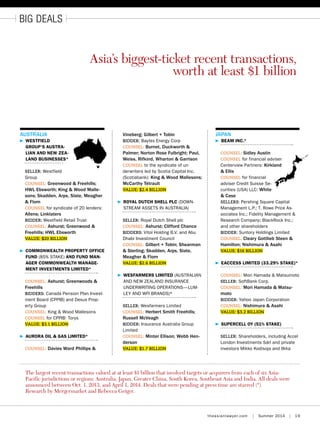
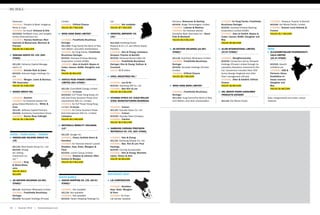
big deals
Australia
Westfield
Group’s Austra-
lian and New Zea-
land businesses*
Seller: Westfield
Group
Counsel: Greenwood  Freehills;
HWL Ebsworth; King  Wood Malle-
sons; Skadden, Arps, Slate, Meagher
 Flom
Counsel for syndicate of 20 lenders:
Allens; Linklaters
Bidder: Westfield Retail Trust
Counsel: Ashurst; Greenwood 
Freehills; HWL Ebsworth
Value: $20 billion
Commonwealth Property Office
Fund (85% Stake) and fund man-
ager Commonwealth Manage-
ment Investments Limited*
Counsel: Ashurst; Greenwoods 
Freehills
Bidders: Canada Pension Plan Invest-
ment Board (CPPIB) and Dexus Prop-
erty Group
Counsel: King  Wood Mallesons
Counsel for CPPIB: Torys
Value: $3.1 billion
Aurora Oil  Gas Limited*
Counsel: Davies Ward Phillips 
Vineberg; Gilbert + Tobin
Bidder: Baytex Energy Corp
Counsel: Burnet, Duckworth 
Palmer; Norton Rose Fulbright; Paul,
Weiss, Rifkind, Wharton  Garrison
Counsel to the syndicate of un-
derwriters led by Scotia Capital Inc.
(Scotiabank): King  Wood Mallesons;
McCarthy Tétrault
Value: $2.4 billion
Royal Dutch Shell Plc (Down-
stream Assets in Australia)
Seller: Royal Dutch Shell plc
Counsel: Ashurst; Clifford Chance
BidderS: Vitol Holding B.V. and Abu
Dhabi Investment Council
Counsel: Gilbert + Tobin; Shearman
 Sterling; Skadden, Arps, Slate,
Meagher  Flom
Value: $2.6 billion
Wesfarmers Limited (Australian
and New Zealand insurance
underwriting operations—LUM-
LEY AND wFI bRANDS)*
Seller: Wesfarmers Limited
Counsel: Herbert Smith Freehills;
Russell McVeagh
Bidder: Insurance Australia Group
Limited
Counsel: Minter Ellison; Webb Hen-
derson
Value: $1.7 billion
Japan
Beam Inc.*
Counsel: Sidley Austin
Counsel for financial adviser
Centerview Partners: Kirkland
 Ellis
Counsel for financial
adviser Credit Suisse Se-
curities (USA) LLC: White
 Case
SellerS: Pershing Square Capital
Management L.P.; T. Rowe Price As-
sociates Inc.; Fidelity Management 
Research Company; BlackRock Inc.;
and other shareholders
Bidder: Suntory Holdings Limited
Counsel: Cleary Gottlieb Steen 
Hamilton; Nishimura  Asahi
Value: $16 billion
eAccess Limited (33.29% Stake)*
Counsel: Mori Hamada  Matsumoto
Seller: SoftBank Corp.
Counsel: Mori Hamada  Matsu-
moto
Bidder: Yahoo Japan Corporation
Counsel: Nishimura  Asahi
Value: $3.2 billion
Supercell Oy (51% Stake)
Seller: Shareholders, including Accel
London Investments Sárl and private
investors Mikko Kodisoja and Ilkka
theasianlawyer.com | Summer 2014 | 19
The largest recent transactions valued at at least $1 billion that involved targets or acquirers from each of six Asia-
Pacific jurisdictions or regions: Australia, Japan, Greater China, South Korea, Southeast Asia and India. All deals were
announced between Oct. 1, 2013, and April 1, 2014. Deals that were pending at press time are starred (*).
Research by Mergermarket and Rebecca Geiger.
Asia’s biggest-ticket recent transactions,
worth at least $1 billion
big deals
20 | Summer 2014 | theasianlawyer.com
Paananen
Counsel: Fenwick  West; Krogerus;
White  Case
Counsel for Accel: Kirkland  Ellis
Bidders: SoftBank Corp. and GungHo
Online Entertainment Inc.
Counsel: Hannes Snellman; Mori
Hamada  Matsumoto; Morrison 
Foerster
Value: $1.5 billion
Kokusai Kogyo Co. Ltd. (55%
Stake)
Seller: Cerberus Capital Manage-
ment L.P.
Counsel: Schulte Roth  Zabel
Bidder: Kokusai Kogyo Holdings Co.
Ltd.
Counsel: Morgan, Lewis  Bockius;
TMI Associates
Value: $1.4 billion
Edgen Group Inc.
Counsel: Dechert
Counsel for financial adviser Citi-
group Global Markets Inc.: White 
Case
Seller: Jefferies Capital Partners
Bidder: Sumitomo Corporation Group
Counsel: Norton Rose Fulbright
Value: $1.2 billion
China / Hong Kong / Taiwan
Greenland Holding Group Co.
Ltd.
Seller: Real Estate Group Co., Ltd.
Bidder: Shang-
hai Jinfeng
Investment Co.
Ltd *
Counsel: King
 Wood Malle-
sons
Value: $10.6
billion
AS Watson Holdings (24.95%
Stake)*
Seller: Hutchison Whampoa Limited
Counsel: Freshfields Bruckhaus
Deringer
Bidder: Temasek Holdings (Private)
Limited
Counsel: Clifford Chance
Value: $5.7 billion
Wing Hang Bank Limited*
Counsel: Freshfields Bruckhaus
Deringer
Sellers: Fung Family;The Bank of New
York Mellon; and other shareholders
COUNSEL for Fung Family: Freshfields
Bruckhaus Deringer
Bidder: Oversea-Chinese Banking
Corporation Limited (OCBC)
Counsel: Allen  Gledhill; Maples 
Calder; Haiwen; MdME; Slaughter and
May
Value: $5 billion
Castle Peak Power Company
Limited (60% Stake)*
Seller: ExxonMobil Energy Limited
Counsel: In-house
Bidders: CLP Power Hong Kong Lim-
ited and China Southern Power Grid
International (HK) Co. Limited
Counsel for CLP Power Hong Kong
Limited: In-house
Counsel for China Southern Power
Grid International (HK) Co. Limited:
Linklaters
Value: $3.1 billion
Motorola Mobility Holdings
LLC*
Seller: Google Inc.
Counsel: Cleary Gottlieb Steen 
Hamilton
Counsel for financial adviser Lazard:
Skadden, Arps, Slate, Meagher 
Flom
Bidder: Lenovo Group Limited
Counsel: Steptoe  Johnson; Weil,
Gotshal  Manges
Value: $2.9 billion
South Korea
Hanjin Shipping Co. Ltd. (63.5%
Stake)*
Counsel: Not available
Seller: Not available
Counsel: Not available
Bidder: Hanjin Shipping Holdings Co.
Ltd.
Counsel: Not available
Value: $7.7 billion
Oriental Brewery Co.
Ltd.*
Sellers: Kohlberg Kravis
Roberts  Co L.P. and Affinity Equity
Partners
Counsel: Kim  Chang; Linklaters;
Simpson Thacher  Bartlett
Bidder: Anheuser-Busch InBev NV
Counsel: Freshfields Bruckhaus
Deringer; Kim  Chang; Sullivan 
Cromwell
Value: $5.8 billion
Cheil Industries Inc.*
Counsel: Lee  Ko
Bidder: Samsung SDI Co. Ltd.
Counsel: Bae Kim  Lee
Value: $3.3 billion
Hyundai Hysco Co. (cold-rolled
steel manufacturing business)
Counsel: Yulchon
Seller: Hyundai Hysco Co. Ltd.
Counsel: Yulchon
Bidder: Hyundai Steel Company
Counsel: Yulchon
Value: $2.6 billion
Samsung Corning Precision
Materials Co. Ltd. (50% Stake)
Counsel: Kim  Chang
Seller: Samsung Display Co. Ltd.
Counsel: Bae, Kim  Lee; Paul
Hastings
Bidder: Corning Incorporated
Counsel: Kim  Chang; Wachtell,
Lipton, Rosen  Katz
Value: $2 billion
Southeast Asia*
LSI Corporation
Counsel: Skadden,
Arps, Slate, Meagher
 Flom
Counsel for finan-
cial adviser Qatalyst
Partners: Shearman  Sterling
Bidder: Avago Technologies Limited
Counsel: Latham  Watkins
Counsel for financial adviser
Deutsche Bank Securities Inc.: Davis
Polk  Wardwell
Value: $6.6 billion
AS Watson Holdings (24.95%
Stake)*
Seller: Hutchison Whampoa Limited
Counsel: Freshfields Bruckhaus
Deringer
Bidder: Temasek Holdings (Private)
Limited
Counsel: Clifford Chance
Value: $5.7 billion
Wing Hang Bank Limited*
Counsel: Freshfields Bruckhaus
Deringer
Sellers: Fung Family;The Bank of New
York Mellon; and other shareholders
Counsel for Fung Family: Freshfields
Bruckhaus Deringer
Bidder: Oversea-Chinese Banking
Corporation Limited (OCBC)
Counsel: Allen  Gledhill; Maples 
Calder; Haiwen; MdME; Slaughter and
May
Value: $5 billion
Olam International Limited
(47.6% Stake)*
Counsel: WongPartnership
Bidder: Consortium led by Temasek
Holdings (Private) Limited through its
subsidiary Breedens Investments Pte.
Ltd. Consortium included Olam CEO
Sunny George Verghese and other
Olam management officials.
Counsel: Allen  Gledhill; Clifford
Chance
Value: $2 billion
Del Monte Foods Consumer
Products Division
Seller: Del Monte Foods
Counsel: Simpson Thacher  Bartlett
Bidder: Del Monte Pacific Limited
Counsel: Kramer Levin Naftalis 
Frankel
Value: $1.7 billion
India
GlaxoSmithKline Pharmaceuti-
cals Limited
(24.3% Stake)
Bidder: GlaxoS-
mithKline plc.
Counsel: AZB 
Partners; Glaxo­
SmithKline in-
house counsel;
Slaughter and
May
Value: $1 billion
Data: mergermarket and Asian Lawyer
research
theasianlawyer.com | Month 2013 | 2322 | July 2014 | theasianlawyer.com
Myanmar’s capital and prime
foreign investment hub:
Downtown yangon
photograph by
christian berg/redux
With its rich natural resources and recent political and economic reforms,
Myanmar has become one of Asia’s “it” destinations for law firms.
But will the widely anticipated boom in foreign investment actually follow?
By Tom Brennan
For more news from the Asian legal markets, go to theasianlawyer.com
Kelvin Chia Yangon director, says the
work was mainly on behalf of Chinese
energy and mining companies and wasn’t
particularly lucrative. “There was no sus-
tained loss but we didn’t make big profits
either,” she says.
Those Chinese companies lacked the
technology and exploration experience to
really begin tapping Myanmar’s resource
wealth, however, and the country’s lead-
ers realized they needed Western invest-
ment. In 2010, Suu Kyi and other political
prisoners were released, and the military
junta was replaced by a civilian gov-
ernment, albeit one controlled by the
military-backed Union Solidarity and
Development Party. The new govern-
ment began relaxing media censorship
and actively seeking foreign investment.
U.S. sanctions were suspended in 2012,
and foreign companies began showing up.
The overwhelming focus to date has
been on natural gas. While few explor-
atory wells have been drilled yet, many
experts believe Myanamar could have
as much as 100 billion cubic feet of gas,
mostly in offshore blocks. According to
the U.S. Energy Information Agency,
that’s more than Canada’s proven reserves
of 68 billion cubic feet or Australia’s
43 billion, and only slightly less than
Indonesia’s 108 billion.
Little surprise then that the oil giants
have beaten a path to Yangon. Royal
Dutch Shell, Total S.A., Malaysian state-
run Petroliam Nasional Bhd. and China
National Offshore Oil Corp. have all been
awarded licenses to begin looking for gas.
Herbert Smith Freehills advised
Woodside Petroleum Ltd., one of
Australia’slargestoilandgasproducers,on
its successful bid with Britain’s BG Group
toexplorefouroffshoreblocks.Freshfields
Bruckhaus Deringer’s Singapore-based
Asia Pacific energy group advised several
global energy companies on investing in
Myanmar, including some bidding for
offshore blocks, according to group head
Gavin MacLaren, though he declines to
name them.
“Myanmar represents a significant new
frontier for energy and natural resources
in Southeast Asia,” says MacLaren. “We
are seeing significant activity in the sec-
tor and anticipate that will only increase.”
But Simon Makinson, an Allen 
Overy Bangkok partner who oversees the
firm’s Yangon office, contends that it may
be some time before international law-
yers see significant work in Myanmar’s
gas sector, given that the oil majors
tend to handle much early-stage work
in-house, working directly with local law-
yers when necessary. Work for the inter-
national firms will likely only increase
when exploration and then production
actually commence, and a large variety
of international contractors get involved.
“It will take at least five years before the
sector reaches its full potential” he says.
Apart from gas, the country is also
believed to have sizable quantities of oil,
copper and gold. Gemstones are already
a big export for Myanmar, which supplies
roughly 90 percent of the world’s rubies
and a large percentage of its sapphires
and jade as well. The country is also
the world’s largest producer of teak, the
water-resistant tropical hardwood most
famously used for boat and ship decks.
To support further international
investment in its economy, Myanmar
desperately needs new roads, rails, air-
ports, shipping terminals, power stations
and telecommunications lines. Many for-
theasianlawyer.com | July 2014 | 2524 | July 2014 | theasianlawyer.com
Perhaps no country On The planet
has Myanmar’s potential at this moment.
Effectively cut off from the world for the
last 50 years, the newly opened country
of 60 million could have more natural
gas than Canada or Australia and is in
desperate need of modern power, trans-
portation and communications infra-
structure.
It’s the sort of thing that gets the
attention of foreign investors—and their
lawyers.
Over the past 18 months, roughly
a dozen firms have opened offices in
Yangon, Myanmar’s largest city, former
capital and main business center, These
include global giants Baker  McKenzie
and Allen  Overy, as well as Duane
Morris  Selvam, New York’s Herzfeld
 Rubin, Japanese firms Nishimura 
Asahi and Mori Hamada  Matsumoto,
Korean firm Jipyong Jisung, Malaysia’s
ZICOlaw and Singapore’s Rajah  Tann
and Allen  Gledhill have also recent-
ly established presences in Myanmar.
Several other firms have formed alli-
ances with local lawyers and firms, while
others are devoting resources to the
market from Bangkok, Singapore and
Hong Kong.
But the big opportunity comes with
big challenges. Though Myanmar is
more open now, the continued pace
and direction of political and economic
reforms are still uncertain. The military
junta that brutally ruled—and impov-
erished—the country over the past five
decades is still very much in control, with
its cronies wielding disproportionate eco-
nomic power. Myanmar ranks near the
bottom—157 out of 177 countries—in
Transparency International’s 2013 cor-
ruption perceptions index.
As a result, some investors’ enthusiasm
for the market has faded completely, while
others have had their optimism tempered
with a healthy dose of skepticism.
Myanmar “has all the reasons to be
successful, and probably no one would
have guessed it would open as quick-
ly as it has,” says David Zemans, the
Singapore-based Asia managing partner
of Milbank, Tweed, Hadley  McCloy,
which hasn’t opened an office there. “But
there’s still no way of knowing if it will
be sustainable or if the government will
continue to move in the right direction.”
A British colony from 1824 to 1948,
the country previously known as Burma
came under a military dictatorship in
1962 that imposed a policy of economic
isolation. In the late 1980s, democracy
activist Aung San Suu Kyi began calling
global attention to the military regime’s
horrendous record of human rights abus-
es and pushing for reform. The govern-
ment responded by brutally suppressing
demonstrations and other signs of politi-
cal dissent, placing Suu Kyi under house
arrest for most of the past two decades.
Western governments, including the
United States, countered with tough eco-
nomic sanctions against the regime and
companies doing business with it, further
deepening Myanmar’s isolation.
Even during this time, there were a
handful of international investors, pri-
marily from countries such as China
undeterred by sanctions from the West.
Singaporean law firm Kelvin Chia and
Southeast Asian regional firm DFDL
both opened offices in Yangon in 1995 to
cater to this business. Cheah Swee Gim,
Photography by lauren deCICCA
Mori Hamada’s Takeshi Mukawa (overlooking downtown
yangon) says his clients insist that their Myanmar part-
ners comply with new anticorruption laws:
“if They say no, we will not make investment.”
eign companies would like to build those
too. Last June, the government award-
ed Norway’s Telenor Group and Qatar
Telecom Myanmar’s first two telecom
licenses. Plus, the government has put
out a $1 billion tender for construction of
a new airport outside Yangon.
The country’s banking sector is also
attracting interest. The government will
soon auction licenses for foreign banks
to operate in the country. At press time,
details of the bidding had yet to be
released, but more than 30 foreign banks
have already opened representative offic-
es in Myanmar; they could all be com-
peting for as few as five licenses.
Though law firms say they receive
lots of inquiries about Myanmar, they
acknowledge relatively few of these lead
to actual deals. “There’s a lot more hype
than reality,” says Makinson.
Christopher Hughes, Baker 
McKenzie’s Yangon managing partner,
estimates that about 85 percent of his
time in the first quarter was spent talking
to investors about possible deals, versus
15 percent on live transactions. He’s hop-
ing it moves to more of a 60-40 split in
the coming months.
What’s holding investors back? Finding
reliable, reputable business partners
isn’t easy. In the energy sector, the bid-
ding process has been run by the state-
owned Myanma Oil and Gas Enterprise
(MOGE), whose non-transparent finan-
cials have long fueled suspicions that it
serves as a slush fund for the regime, at
the expense of the nation’s citizens. Suu
Kyi and Western human rights activists
urged multinationals not to do business
with MOGE for those reasons. The bid-
ding rounds were postponed from 2012
to 2013 after some global oil companies
expressed concern about possible corrup-
tion in the process, and the government
said it took extra steps to ensure transpar-
ency at each step.
Many potential partners in other
sectors are on the U.S. Treasury
Department’s blacklist of Specially
Designated Nationals (SDN) with whom
U.S. citizens are barred from doing busi-
ness. These are individuals or organiza-
tions that have been involved in activities
deemed illegal by the U.S., such as arms
deals with North Korea or drug traf-
ficking—Myanmar is the second-larg-
est source of heroin in the world after
Afghanistan. Some government officials
formerly on the SDN list have been
removed, but many of their cronies in
the country’s business sector are still
blacklisted. The potential penalties for
working with them are stiff: up to a $1
million in fines and 20 years in prison.
“The sanctions for U.S. investors in
particular are still very much an issue and
something [investors] need to be aware of
and careful in how they approach things,”
Hughes says. “That is very high on their
list of concerns when they’re looking at
Myanmar.”
Makinson says SDNs often hide
behind relatives and front companies.
Just the investigations necessary to ferret
them out have provided a stream of work.
“You have to know who works with who
and who has relationships with who,” he
says. “It’s quite complex.”
And just because a potential business
partner isn’t on the SDN list doesn’t
mean he or she won’t raise anticorruption
compliance issues.
Robert Ashworth, Asia managing
partner of Freshfields, which covers
Myanmar out of its Hong Kong, Tokyo
and Hanoi offices, says clients often have
to educate their potential Myanmar part-
ners about their responsibilities under
the U.S. Foreign Corrupt Practices Act
or the U.K. Bribery Act.
“It all turns on finding the right part-
ner,” he says. “Whether there’s enough to
satisfy investor appetite, time will tell.”
Takeshi Mukawa, a partner at Mori
Hamada  Matsumoto in Singapore,
says anticorruption compliance is a para-
mount concern for his clients, and they
let their Myanmar business partners
know that. “If they say no, we will not
make investment,” he says. “But normally
they say yes.”
After they find suitable partners,
potential investors must still confront
Myanmar’s antiquated legal system.
British rule bequeathed the country with
a common law legal system, but it fell out
of use during the dictatorship. Most of
the laws on the books are long outdated,
such as the companies law from 1914
and the arbitration law from 1944. In an
effort to accommodate foreign investors,
Myanmar’s parliament has been racing
to pass new legislation. A foreign invest-
ment law went into effect early last year,
while a new telecommunications law was
passed last October, three months after
the country awarded licenses. “Change
has to be made one step at a time,” says
Hughes. “You don’t start with, ‘OK, how
do we have a fully functioning, perfectly
integrated legal system?’ It’s more like,
‘We need to get mobile phones in peo-
ple’s hands, what kind of laws do we need
to make around that?’”
Working with clients in such condi-
tions is “almost advising in the dark,” says
Krishna Ramachandra, Yangon manag-
ing partner of Duane Morris  Selvam.
He notes that drafts of the telecom law
were circulated before its final pass-
ing but many questions remained unan-
swered. “We had to sound out a few
people we knew just to get a steer on how
those licenses would be awarded and
what the touch points would have been
for the government,” says Ramachandra.
Implementation of the law also remains
inconsistent. On its face, a new law may
appear to permit an activity, explains
Hughes. But actually getting authoriza-
tion can prove difficult, or at least time-
consuming. “It’s a much more dynamic
discussion that you have with the regula-
tors here than in other places,” he says.
The challenges have put off many inves-
tors. “Many people have realized over the
past two years the difficulties in this sys-
tem, whether it’s the legal system or for-
eign investment restrictions, and they’ve
given up,” says Mori Hamada’s Mukawa.
The uncertainties ahead may be
one reason why the Yangon offices
launched by international firms are all
fairly small, typically staffed by only one
partner and a couple of associates. Some
don’t even have a partner—Allen  Overy
only has associates, with partners flying in
on occasion from Bangkok or Singapore.
Among those international firms that are
targeting the market from other Asian
offices are Freshfields; Milbank; Herbert
Smith Freehills; Linklaters; Clifford
Chance; and White  Case.
One obstacle for firms thinking about
opening in the country is the dearth of
Myanmar-qualified lawyers—there was
little demand for them under military
rule and the universities to train them
were frequently shut down in the past
two decades to quell student dissent.
Those who managed to earn degrees and
theasianlawyer.com | July 2014 | 2726 | July 2014 | theasianlawyer.com
Myanmar maven;
cheah swee gim,
yangon director
for singapore’s
kelvin chia
Their Man in
Yangon: Baker
 McKenzie’s
christopher
hughes
establish a working legal practice in spite
of those obstacles are now highly sought
by foreign firms. Both Rajah  Tann
and ZICOlaw tapped Myanmar lawyers
to lead their local offices. Other firms,
including Baker  McKenzie and Duane
Morris  Selvam, employ a small num-
ber of very junior local lawyers, who they
are training themselves to bring them up
to international practice standards.
Other firms prefer to work with a
handful of local and regional firms such
as Myanmar Legal Services Ltd. and
Singapore’s Kelvin Chia, which has clear-
ly benefitted from the uptick in interest
in the country, “For the last two years
we have been kept very, very busy and
the work has gotten progressively intense
and complicated and challenging,” says
Kelvin Chia partner Cheah.
The big international firms disagree
about the importance of being on the
ground in Myanmar. Allen  Overy’s
Makinson contends it’s imperative, as
he believes that only firms working in
Yangon can understand the nuances and
complexities of doing business there.
“So much of what you do in Myanmar
involves personal contact. You have to go
meet ministers and director generals in
person,” he says. “They haven’t interacted
with foreigners for the last 60 years and
they’re a bit wary of foreigners coming
in and dictating things. And you have to
manage clients in how they work in the
local environment.”
But Freshfields’ Ashworth says the
ongoing challenges of doing business in
Myanmar mean the volume of foreign
investment doesn’t yet justify having an
office there. He says he first wants to
see multinationals not just investing but
establishing a presence in the country, as
well as strong local companies emerging.
Then, he says, “there may be more pres-
sure to open an office.”
The country’s presidential election
next year could have a major impact
on multinationals’ plans. A major con-
troversy at the moment is whether Suu
Kyi, who has become the main opposi-
tion leader, will be able to run, given a
provision in the most recent constitution
barring candidates whose spouse or chil-
dren are foreign nationals. (Suu Kyi’s late
husband was British and her two sons
are also British nationals.) Her party,
the National League for Democracy,
and other groups are pushing for an
amendment to allow her to run. If that
effort fails, there will likely be a push
for renewed sanctions from the U.S. and
other nations.
Until that situation becomes clearer,
investors are likely to remain wary. And
even if Suu Kyi runs and wins, not every-
one is convinced her election would lead
to dramatic changes any time soon, Her
advocacy of democratic reforms and rule
of law would be welcomed by foreign
investors, but Duane Morris  Selvam’s
Ramachandra says her lack of executive
experience could prove a hindrance.
Still, most lawyers are optimistic the
progress Myanmar has made in the past
few years will continue. “The sense from
clients and potential clients I’ve been
speaking to is that they are cautiously
optimistic and they expect, having seen
the reforms over the last three years, that
the openness of the economy will con-
tinue,” says Minn Naing Oo, who heads
Allen  Gledhill’s Yangon outpost. “They
don’t think … the economic reforms that
have taken place will be rolled back.”
Hughes agrees. “There’s going to be
stuff going on between now and then.
It’s not like a complete stop. People are
going to keep on rolling in to have a look
at the place and understand it, and that
keeps us fit.”
30 | July 2014 | theasianlawyer.com theasianlawyer.com | Summer 2014 | 31
For more news from the Asian legal markets, go to theasianlawyer.com
In April, Davis Polk  Wardwell managing partner Thomas
Reid gathered the associates in the Hong Kong office for a PowerPoint
presentation on the firm’s recent performance, based on a more detailed
version shared with partners.
In one slide, Reid sought to highlight how the firm was able to capitalize
on good luck and minimize bad. As an example of the former, he cited how
low U.S. interest rates had boosted leveraged finance activity across the
firm. An example of bad luck? Asia capital markets, 2011 to 2013.
Reid didn’t have to say much. Everybody in the room knew exactly what
he was talking about.
The once high-flying Hong Kong market for initial public offerings went
Photography by carsten schael
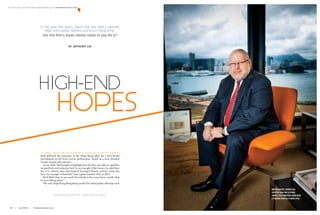
Martin Rogers, Former asia
disputes head for Clifford
Chance, has launched a Hong Kong
litigation practice at davis polk.
Hopes
HIgH-END
By Anthony Lin
In the past five years, Davis Polk has built a premier
MA and capital markets practice in Hong Kong.
Are the firm’s Asian clients ready to pay for it?
Hong Kong offerings available to U.S.
institutional investors under Rule 144A
of the Securities Act. As a result, U.S.
firms have tended to get the most plum
role on Hong Kong IPOs—drafting the
prospectus.
For many of the Wall Street firms,
it wasn’t worth competing for the less
lucrative Hong Kong piece against the
top London firms, which had long prac-
ticed local law in the former British
colony. Thus, on many of the biggest
deals for Chinese companies, a U.S. firm
usually worked in tandem with a Magic
Circle firm advising on Hong Kong law.
For instance, on both the $21.9 billion
IPO of Industrial and Commercial Bank
of China in 2006 and the $22.1 billion
IPO of Agricultural Bank of China in
2010, Davis Polk advised the issuer along
with Freshfields Bruckhaus Deringer.
From roughly 2000 on, some U.S.
firms—such as Skadden, Arps, Slate,
Meagher  Flom; Paul Hastings; and
Sidley Austin—made the move into
Hong Kong law, but others remained
comfortable with the division of labor
with U.K. firms. After all, moving into
Hong Kong law would require the hiring
of lateral partners. Along with some of its
New York peer firms, including Simpson
Thacher and Cleary Gottlieb Steen 
Hamilton, Davis Polk has lockstep com-
pensation, in which partners are paid
strictly according to seniority rather than
revenue generation. Their strong finan-
cial sector client bases make them less
dependent on rainmakers for business.
Lateral partners are generally avoided
because of the difficulty of slotting them
into the lockstep, although Davis Polk’s
healthy profits per partner—$2.9 million
in 2013—makes that calculus easier.
The Magic Circle firms are lockstep
too, but their early focus on going global
has accustomed them to the necessity
of lateral hiring. British firms have also
prided themselves on taking a more stra-
tegic view of overseas markets and their
often challenging economics; many have
different pay scales to help account for
the lower fees. New York firms, hailing
from the most lucrative legal market in
the world, have tended to worry much
more about the dilutive impact of inter-
national expansion. Cravath, Swaine 
Moore, famously closed its Hong Kong
office in 2003 because the firm couldn’t
earn the same kinds of margins on work
there as it could back home. Others,
such as Paul, Weiss, Rifkind, Wharton
 Garrison and Debevoise  Plimpton,
have deliberately kept their offices in the
region small, with two and three partners
in Hong Kong, respectively.
But while cultural concerns and short-
term economics weighed against launch-
ing a Hong Kong law practice, Davis Polk
partners began to grow concerned that
failing to do so could cause them to lose
all they had built in the market.
One of Davis Polk’s major goals in
Hong Kong (and London) is to be a lead-
er in the world’s top three financial cen-
ters in its core capital markets, MA and
financial regulatory practices. It also has
a goal specific to Hong Kong: to become
a go-to firm for China’s rising corpora-
tions and banks, just as it is for America’s.
“There’s no other place in the world
where there’s an opportunity to develop
new relationships with clients that may
become global players,” says Barron.
By the mid-2000s, a dozen years after
opening in Hong Kong, Davis Polk had
racked up an impressive record advising
those kinds of companies on big transac-
tions. Barron credits the fact that the
firm was able to attract a critical mass of
Chinese-speaking U.S. associates in the
first half of the decade. Some, including
James Lin and Miranda So in Hong Kong
and Li He in Beijing, eventually became
partners.
By the second half of the decade
though, the firm’s progress seemed in
jeopardy. Large Chinese state-owned
enterprises had stopped listing in the
U.S., put off by Sarbanes-Oxley and other
regulatory requirements. Listing in Hong
Kong alone was becoming the norm for
Chinese companies that wanted to tap
foreign capital—but Davis Polk didn’t
want to be in a position of drafting a
Chinese company’s Hong Kong IPO pro-
spectus and then having to hand off the
client to other firms for all subsequent
work, says Barron.
“Those companies are now listed on
the Hong Kong Stock Exchange,” he
points out. “If you want to do work for
them in the future as they become global
players, are you going to be able to if you
can’t advise them on Hong Kong Stock
Exchange issues?”
The Hong Kong office’s record on big
deals helped move the needle in New
York. “[ICBC and Agricultural Bank]
were the biggest IPOs in the world—
they tend to get people’s attention,” says
Barron. “And if you tell people that the
world is moving in such a way that, if you
don’t practice Hong Kong law, you aren’t
going to be able do that kind of transac-
tion, that gets their attention.”
When Barron invited Bonnie Chan,
then senior vice president and head
of the IPO department for the Hong
Kong Stock Exchange, out for coffee to
chat about the firm’s possible plans, she
assumed that he just wanted her advice
as someone who knew the market well.
She agreed that it made a lot of sense for
the firm to launch a Hong Kong practice,
given how the competitive landscape had
been shifting.
But then he invited her again, and
again. “By the fifth or sixth time, I began
to think he wanted more than to just pick
my brain,” she recalls. “So I said, ‘Bill,
why are we having so much coffee?’”
In August 2010, the firm announced
that Chan and Dapiran, then a partner
theasianlawyer.com | July 2014 | 3332 | July 2014 | theasianlawyer.com
into a deep freeze in the second half of
2011—just as Davis Polk had embarked
on major expansions in the Asian finan-
cial capital, launching a local law practice
for the first time. The market began to
turn around toward the end of 2013, but,
as of this writing, the failed IPO of meat
processor WH Group in April had raised
fears of a renewed slowdown.
The downturn put the brakes on other
firms’ plans for growth in the region—
but not Davis Polk’s. Since 2009, the
firm has more than tripled the size of
its Hong Kong office, to 89 lawyers from
26. Hong Kong is the 810-lawyer firm’s
largest overseas office now by far and one
of the largest offices of any U.S. firm in
Hong Kong, starting to approach the his-
torically larger offices of the Magic Circle
in size. The scale of the expansion has
surprised many in the market, especially
given Davis Polk’s conservative reputa-
tion; the firm, which has long avoided the
recruitment of lateral partners, added
five partners in Hong Kong in the space
of four years.
By all accounts, the firm’s partners,
both lateral and homegrown, are an
exceptionally strong team. Among Davis
Polk’s standouts are office head and high-
yield bond specialist William Barron,
Hong Kong IPO lawyers Bonnie Chan
and Antony Dapiran, U.S. capital markets
partner James Lin, MA stars Kirtee
Kapoor and Paul Chow, and financial
regulatory litigator Martin Rogers.
The risk is that many clients in China
will still settle for less. Top-tier New York
firms that can command super-premium
fees back home have long been frustrated
by their inability to get better pricing for
their work in Asia. That’s a major factor
in why they’ve limited their footprints in
the market to date.
With its expansion, Davis Polk has
clearly broken with that thinking. As
Chinese companies become global play-
ers, the reasoning goes, they will do more
complex deals for which they will be
wiling to pay higher fees. Davis Polk has
primed itself to be the first firm they call.
Now, it just needs some good luck.
Barron and Reid downplay the
scale of Davis Polk’s expansion. Reid
says it’s comparable to the English law
practice the firm launched in London in
2012, also with a number of high-profile
lateral partners. Davis Polk’s Hong Kong
office is still substantially smaller than
those of Magic Circle firms Clifford
Chance and Linklaters, which respec-
tively count 154 and 150 lawyers—and
Barron points out that those firms also
have offices in Singapore, Shanghai and
Seoul. Davis Polk has a 17-lawyer Beijing
office led by MA partner Howard
Zhang to share the load on China work
but covers Southeast Asia, India and
Korea out of Hong Kong.
Still, among Davis Polk’s major U.S.
competitors, Simpson Thacher  Bartlett
and Sullivan  Cromwell each have fewer
than half the lawyers that Davis Polk has
in Hong Kong, although those firms
expanded into Hong Kong law practice at
around the same time. Kirkland  Ellis,
which recruited eight lateral partners in
Hong Kong in one big push in 2011, now
counts 46 lawyers there.
All of those firms previously only prac-
ticed U.S. law in the market. Until rela-
tively recently, there was little pressing
reason to do otherwise. When Chinese
companies started raising overseas capi-
tal in the late 1990s and early 2000s,
they mostly sought it in the U.S., either
by actually listing on the New York Stock
Exchange or Nasdaq or making their
Cultural concerns and short-term economics weighed
against launching a Hong Kong practice. But partners grew
concerned about the consequences of doing nothing.
Davis Polk’s William Barron (left) recruited capital markets partner
Bonnie Chan (middle) from the Hong Kong Stock Exchange, while
corporate partner Miranda So came up through the ranks.
at Freshfields, would be first on board
in Davis Polk’s Hong Kong law practice,
both focusing on capital markets. Barron
says that the two were exactly the kind of
partners the firm was looking for: highly
respected for their skill and experience
but not the type of egotistical “stars”
the firm feared would clash with its
culture. Chan had a background as an
exchange officer and as former head of
legal for Morgan Stanley’s Asia invest-
ment banking division. Dapiran, a fluent
Mandarin speaker, had worked alongside
Davis Polk on the massive ICBC and
Agricultural Bank IPOs.
A few months later, Davis Polk
announced another incoming Hong
Kong partner, MA specialist Paul Chow
from Linklaters. Chow had headed the
Magic Circle’s Beijing office, where he
led the team advising state-owned China
Telecom on its $16 billion acquisition in
2008 of a wireless network from another
telecom state-owned enterprise.
A Hong Kong-based senior in-house
counsel with a major U.S. investment
bank says the quality of Davis Polk’s Hong
Kong law hires stood out. “They were very
thoughtful about it,” he says. “They looked
around at the market and asked ‘Who can
get us above the rest of the pack?’ and
they had the foresight to pick Bonnie,
Antony and Paul.” Chan’s stock exchange
background set her apart, he says: “Would
you rather have that or just another law
firm partner?”
Over the next few months, Davis Polk’s
biggest New York competitors quickly
followed suit, snatching leading Hong
Kong partners from the Magic Circle
and other British firms. Cleary brought
aboard Freeman Chan from what is now
Norton Rose Fulbright; Simpson Thacher
hired Celia Lam and Christopher Wong
from Linklaters and Freshfields, respec-
tively; and Sullivan  Cromwell wel-
comed Kai Ian Ng and Gwen Wong, both
from Freshfields. Kirkland  Ellis made
a splash in August 2011 with its hiring of
eight Hong Kong partners from Skadden,
Latham  Watkins and Allen  Overy.
But almost as soon as all the firms had
their people in place, the bottom fell out
of the Hong Kong IPO market. In late
2011, IPO activity slid on concerns over
China’s overheated property market and
a host of other structural issues in the
Chinese economy. At the same time,
IPOs for Chinese companies in the U.S.
practically came to a halt as investors
digested claims of accounting fraud at
Chinese companies that had listed in the
U.S. through reverse mergers, the prac-
tice of acquiring U.S. companies solely to
acquire their listing.
Barron says that Davis Polk’s Hong
Kong office remained profitable during
the downturn, with the rise in bond
offerings somewhat making up for the
drop in equity capital markets activity.
And the firm got a good share of the
listings that did take place. Last year,
Davis Polk topped Bloomberg’s league
table of Asia-Pacific IPO advisors on
the issuer side by value, after ranking
second in 2012. MA activity helped
too. In 2012 and 2013, the firm’s Beijing
and Hong Kong partners played a major
role counseling China National Offshore
Oil Corp. in its $15 billion acquisition of
Canadian energy company Nexen Inc.,
the largest ever overseas MA deal by
a Chinese company. Davis Polk also
advised private Chinese conglomerate
Dalian Wanda Group on its 2012 acqui-
sition of U.S. movie theatre chain AMC
Entertainment Holdings Inc. for $2.6 bil-
lion, one of the largest Chinese outbound
deals in the consumer sector.
And the firm hadn’t finished growing.
Last year, Davis Polk brought aboard
partners Martin Rogers and James
Wadham from Clifford Chance to start
a Hong Kong litigation practice. Barron
says Davis Polk would not have launched
that practice if Rogers, who had led
Clifford Chance’s Asia disputes prac-
tice, and Wadham had not joined the
firm. The Asia disputes team has already
grown to 22 lawyers since they did.
There’s no question the firm has
been busy lately. Rogers and Wadham
have advised several other banks on
their Asia hiring practices follow-
ing the U.S. Securities and Exchange
Commission’s probe into JPMorgan
Chase  Co.’s recruitment of the chil-
dren of high-ranking Chinese officials,
the so-called princelings, to try to win
deals. Last year, among other deals,
Chan and Dapiran advised on the $2.5
billion Hong Kong IPO of Cinda Asset
Management, the Chinese “bad bank”
meant to absorb nonperforming loans
from other state-owned financial institu-
tions. They also worked on the $1.1 bil-
lion listing of Chinese brokerage China
Galaxy Securities Co. Ltd., and Dapiran
advised on the $3 billion offering of
China Everbright Bank. Chow recently
represented Chinese department store
chain Intime Retail Group Co. Ltd. on a
$692 million investment by e-commerce
giant Alibaba Group Holding Ltd.
Alibaba ruled Davis Polk out as its
IPO counsel because of the firm’s previ-
ous work for its competitors. Simpson
Thacher got that prized assignment
instead. But Davis Polk has advised
Alibaba archrival Tencent Holdings
Ltd. on a series of big deals and, in
May, served as underwriter’s counsel on
the $1.78 billion IPO of online retailer
JD.com, the biggest Chinese listing in
the U.S. ever, at least until Alibaba bows
later this year.
A partner at a Magic Circle firm thinks
Davis Polk’s Hong Kong partners are
excellent across the board but isn’t sure
that will ultimately translate into insti-
tutional relationships. “I sometimes just
feel Asian clients are less loyal,” he says.
A major reason for that, he explains,
is that large Asian companies, a major-
ity of which are state-owned or closely
held, don’t face the kind of risks on
deals that U.S. corporations do. Though
regulators in the region like Hong Kong’s
Securities and Futures Commission are
becoming more active, they still lack the
resources and range of penalties avail-
able to the U.S. Securities and Exchange
Commission. Activist investors are even
less of a concern. “You don’t have activist
shareholders,” says Lin. “You don’t have
Carl Icahns who can come in. The Hong
Kong corporate world is very different
that way.”
In the absence of such risks, it’s hard
for many clients to see paying some firms
far more than others. “It’s an incred-
ibly fee-conscious environment,” says
the in-house investment banking lawyer.
“[Davis Polk] has a higher-quality prod-
uct and reasonably wants to charge a
higher fee, but there are reputable firms
that can get the deal done, maybe not
to the very highest standard, but good
enough. There are lots and lots of deals
where the issuer dictates to the under-
writing syndicate who to go with, mainly
based on price.”
Back home, Davis Polk rarely competes
with firms that are merely good enough.
It and its Wall Street peers can charge
far more than other Am Law 100 firms
on the biggest deals because clients don’t
want to take a risk on a firm with less
experience. But it’s different when the
risk factor is lower. Hogan Lovells,Sidley
Austin and Reed Smith are not usually
the firms that Davis Polk goes up against
for capital markets assignments in the
U.S., but Chan found those were exactly
the firms she was competing with in a
recent pitch meeting in Beijing for an
issuer’s counsel role.
“I’m sure that, if you were in New
York, going for a bake-off, you wouldn’t
see that lineup.” she says, “and there are
times when we don’t get it and it might be
hard for an outsider to understand why.
But it makes life more interesting.”
Many firms in Asia deal with price
competition in the region by paying
local lawyers less. But Davis Polk pays
all its Hong Kong associates the same as
their New York counterparts. Otherwise,
says Barron, “it would create divisions
in our office that wouldn’t be healthy
for our culture.” However, its leverage
in Hong Kong—seven nonpartners for
every partner—far outstrips its firmwide
leverage of approximately four nonpart-
ners to every partner. One associate in
Hong Kong says he doesn’t see the local
ratio shifting soon. “It’s a New York pric-
ing model and a New York profitability
model imposed in Asia, where you can’t
get the same kind of revenue on deals, so
you have to chase more work to generate
it,” the associate says. “You need to have
a more highly leveraged team.”
Reid and Barron say the firm is in the
region for the long term, and there’s little
doubt that a firm as profitable as Davis
Polk can afford to invest in the future,
though preferably one in which its strong
platform in the region begins to allow it
to charge more. “With the quality of the
team we have,” Reid predicts confidently,
“the price pressure will get better.”
Given how important China has
become to the global economy, Barron
is also confident the firm has made the
right move, and he doesn’t think Davis
Polk could have done it any other way.
“It was actually an obvious and natural
progression the way the world has gone,”
he says. “And, once we decided were
going to do it, we weren’t going to do it in
a half-hearted way.”
theasianlawyer.com | July 2014 | 3534 | July 2014 | theasianlawyer.com
Capital markets partner James Lin says that activist
shareholders aren’t a risk in Hong Kong deals:
“You don’t have Carl Icahns who can come in.”
Many firms deal with price competition in Asia by paying local
lawyers less. But Davis Polk pays its Hong Kong associates the
same as their New York counterparts.

AsianLwyr

  • 1.
    Plus: bRING ONTHE BOOM TIMES GLOBAL FIRMS STILL WAITING FOR ‘MYNAMAR MOMENT’ TO ARRIVE Davis Polk’s July 2014 Davis Polk’s Bonnie Chan The Wall Street firm has assembled a dream team with an eye on China’s rising corporate elite. But is the market ready for them? By ANTHONY LIN Kong Bet Hong
  • 2.
    22 Waiting for (Myanamar’s) Takeoff: Takeshi Mukawaof Japan’s Mori Hamada & Matsumoto, says the challenges of doing business in Mynamar are holding many investors back. theasianlawyer.com | July 2014 | 5 • july 2014 features Myanmar’s Moment? Mynamar has been touted as Asia’s newest foreign investment hot spot. If only the flood of foreign capital would arrive. By Tom Brennan High-End Hopes With an all-star team in Hong Kong, Davis Polk wants to be the go-to firm on Asia’s biggest, most complex deals. But can its upmar- ket strategy fly? By Anthony Lin departments Editor’s Note Big Deals Bully Pulpit Brand U.S.A is on the rise in Asia’s legal market. Move over, Brits. By Tom Brennan OPENING STATEMENTS An Urge to Merge Zhong Lun and Jen He come together to create China’s newest legal powerhouse. A Long Way From Liberalization Global firms have no trouble con- taining their excitement over the new Shanghai Free Trade Zone. The New Nativist Normal Foreign lawyers have managed to stay out of the crosshairs in Singapore’s recent anti-immigrant crackdown—at least so far. Tort Trouble Ahead? Big damages in the Olympus liti- gation could bring more love for the plaintiffs bar in litigation-shy Japan. The Churn 22 30 6 9 11 12 15 10 19 66 CONTENTS laurendecicca(mukawa)
  • 3.
    theasianlawyer.com | Summer2014 | 9 opening statements 9 china: Zhong lun and Jun He couple up • 11 China: Ho-Hum on Shanghai FTZ • 12 singapore: xenophobia Rising • 14 japan: Ready, Set, Sue? china An Urge to Merge Two of China’s top-tier firms are looking to find out if bigger really is better. illustration by kelsey dake A potential merger between two of China’s most prominent law firms—Jun He Law Offices and Zhong Lun Law Firm—has set off a flurry of speculation in the region about what such a com- bination would mean, both for the two firms involved and for the emerging Chinese legal market. The Asian Lawyer reported in late March that the two Beijing-based firms, which along with King Wood Mallesons are widely considered to be among China’s top law firms, are discussing a potential merger. If approved, it would create a new Chinese legal behemoth with almost 1,300 lawyers. Partners at both firms declined to comment on their plans, but lawyers at other Chinese firms said they were surprised the two were contem- plating a merger, given their different reputa- tions in the market. “They are both top-tier firms, but the two have entirely different cultures,” says Lin Wei, a Shanghai partner with Zhong Lun WD, a firm that split off from Zhong Lun in 2003. He says the general view of Zhong Lun is that it likes to stoke competition among partners, while Jun He is widely seen as a firm where collegiality is prized. Liu Hongchuan, a partner at Beijing’s Broad Bright, echoes that view. “Zhong Lun focuses more on the indi- vidual ability of lawyers, and core partners have more in- fluence,” he says. Jun He, on the other hand, has a more equal partnership. “The culture stresses cooperation among partners,” he adds. So why would these two firms want to merge? A num- ber of Chinese lawyers expressed the view that size actu- ally does matter—and that the combination would enable both firms to build on complementary strengths. “The important thing is to create synergy,” says Vic- tor Wang, a Shanghai partner with Allbright Law Offic- es. “The union between two already very strong brands would enhance the coverage of quality legal service.” While Jun He has traditionally focused on cross-
  • 4.
    peterparks/gettyimages border work, oneBeijing partner with a Chinese firm notes that that practice has recently slowed down. “That could be a bottleneck for Jun He, and it may feel the need to work on developing domestic practice.” Zhong Lun, in contrast, is primarily known for its expertise in domestic mat- ters, especially in real estate, says this lawyer. “It has recently started to get in- volved in more international transactions, but still not to the extent of King Wood, Jun He or Fangda [Fangda Partners is an- other leading Chinese firm].” Local lawyers believe the proposed merger may well be a response to the growing reputation of King Wood, which has been widely hailed as the first “Chinese” international law firm. King Wood Mallesons is itself the product of a 2012 merger be- tween China’s King Wood and Aus- tralia’s Mallesons Stephen Jaques. Last year, it also moved to acquire London’s SJ Ber- win, thus further enhancing its global brand. Though Jun He, at least, has been vocal about not wanting to expand over- seas, the proposed merger with Zhong Lun would clearly help Jun He lawyers raise their profile as well. “This could be a defensive response,” agrees another Beijing lawyer. “The three [firms] used to be more equal, but then King Wood [Mallesons] merged and created this ‘superpower.’ The other two might want to strike a balance.” Local lawyers have mixed views on whether a combination between Jun He and Zhong Lun would give them a signifi- cant competitive edge. Zhong Lun WD’s Lin contends that larger Chinese companies, including state-owned enterprises, tend to prefer big law firms, both domestic and inter- national, because they think they have a more stable track record. But he thinks privately owned small and medium-sized companies are more open to working with smaller firms and boutiques. “Both will find their place in the market,” Lin says of boutiques and large firms. Even if Zhong Lun and Jun He merge, it will not be the largest firm in China. Dacheng Law Offices and Yingke Law Firm already count 3,000 and 2,400 law- yers, respectively. Yu Xugang, a Beijing partner at Dacheng, says large firms gen- erally are better, even at providing spe- cialized advice. The smaller size of bou- tiques, he says, means partners have to take on more and different types of mat- ters, hampering their ability to focus on one practice area. “I think this is good news for China’s legal profession if they merge,” Yu says of the talks between Zhong Lun and Jun He. “The combination will create a stronger individual firm, which means within the firm, particularly in the noncontentious area, each practice group will be strength- ened by more law- yers. For the industry as a whole, we will see more specialists.” Anthony Qiao, a Zhong Lun partner, said in a late March interview that he expects a wave of mergers among Chi- nese firms over the next decade as the country’s economy and legal market con- tinue to grow and its domestic law firms emerge as major inter- national players. He points out that, even if Zhong Lun merges with Jun He, the combined firm would still be considerably smaller than Western firms such as Skad- den, Arps, Slate, Meagher Flom, which has over 1,700 lawyers. “Compared to them, we are only midsize firms,” he says. Broad Bright’s Liu believes that many Chinese firms also have some catching up to do in terms of management and infra- structure, so that they can actually reap the benefits from greater scale. “Firms like Skadden and Clifford Chance have a very different expansion approach than some of the Chinese firms,” he says. “They have a more centralized management, so even with 2,000 lawyers they are able to cooper- ate smoothly within the firm.” Liu says that many Chinese firms who have engaged in mergers, often with firms in other cities, haven’t done much to in- tegrate. “Many times it’s just a change of brand name on the door,” he says. —Anna Zhang opening statements theasianlawyer.com | Summer 2014 | 1110 | Summer 2014 | theasianlawyer.com The Churn Despite the hype, law firms are seeing limited upside so far from the new Shanghai Free Trade Zone. china A Long Way From Liberalization W hen the Chinese government announced last August it was opening the country’s first Free Trade Zone in Shanghai, Premier Li Keqiang said the move would help turn the city into a world-class financial center on par with New York and Hong Kong. Companies that opened there would enjoy free convertibility of China’s currency, the renminbi, and streamlined customs and administrative pro- cedures. Put on a fast track, the FTZ opened in Sep- tember. But, over nine months later, the ben- efits of locating there are still far from clear for many businesses, includ- ing law firms. Many law firms had hoped the FTZ would bring some easing of re- strictions that bar foreign law firms from practicing Chinese law. In January, China’s Ministry of Justice ap- proved a plan to test two models for co- operation between Chinese and foreign law firms in the FTZ: joint ventures and mutual secondments. Local officials hailed the move as a step toward the full liberalization of China’s legal market. But to some foreign lawyers working in China, the policies don’t seem all that groundbreaking. The problem with the FTZ, says Wan Li, a Seyfarth Shaw partner in Shanghai, “is that, at the mo- ment, it doesn’t offer you anything you can’t do outside the FTZ.” Though foreign firms are barred from practicing Chinese law, they are allowed to advise on “the Chi- nese environment,” which can mean vir- tually anything short of appearing in court, signing official forms or issuing legal opin- ion letters. Wan notes that international firms have been hir- ing Chinese lawyers—who must sur- render their practice licenses when they join foreign firms—for decades now. The trouble with the FTZ, says a Seyfarth Shaw partner, “is that, at the moment, it doesn’t offer anything you can’t do outside the FTZ.” shanghai’s new ftz hong kong singapore melbourne tokyo philip hyde from Hogan Lovells to KL Gates The former head of the Tokyo finance prac- tice for Hogan Lovells, Hyde will also work in KL Gates’ Hong Kong office. sheela moorthy from DLA Piper to Norton Rose Fulbright Ex-head of DLA Piper’s Singapore corporate practice, Moorthy focuses on cross-border MA in Southeast Asia and India. wayne mcmaster robert cooper from King Wood Mallesons to Minter Ellison The pair led a 10-lawyer intellectual property team from King Wood Mallesons, where McMaster was formerly Australia IP head. albert cho from Kirkland Ellis to Weil Gotshal Cho advises on the formation of private equity and venture capital funds across the region, especially in Korea. john Moore from Morrison Foerster to Slaughter and May Capital markets specialist Moore became Slaughter and May’s first-ever lateral partner and also its first U.S. law practitioner. perth steven mccomish from Allens to Jones Day The litigator launched a Perth office for Jones Day in April, focusing on projects and project- related disputes in the energy sector. david blumental from Vinson Elkins to Latham Watkins Energy partner Blumental has worked on several cross-border deals for Chinese state-owned oil companies. kate allchurch from White Case to Ashurst Finance specialist Allchurch relocated to Singapore from White Case’s London office in 2009. mabel lui from DLA Piper to Winston Strawn Lui had served as DLA Piper’s Asia corporate head and holds the same position for Chicago’s Winston Strawn. maurice burke from Herbert Smith Freehills to Hogan Lovells Before moving to Hogan Lovells, Burke head- ed the Southeast Asia dispute resolution practice for Herbert Smith Freehills. matchmakers: Zhang Xuebing (left), managing part- ner of Zhong Lun, and Jun He chief David Liu
  • 5.
    opening statements roslanrahman/gettyimages theasianlawyer.com |Summer 2014 | 1312 | Summer 2014 | theasianlawyer.com The new secondment regime would allow foreign and local firms to exchange lawyers. But though a Chinese lawyer seconded to a foreign firm would still be able to provide a legal opinion, the lawyer would be required to do so under the Chinese firm’s name. Moreover, Wan thinks most foreign firms would prefer Chi- nese legal opinions to be drafted by senior partners, who are unlikely to be seconded. “How much do you trust [the secondee]’s legal opinion?” he asks. Another Shanghai partner with a U.S. firm agrees that a secondment regime would not be very attractive, compared to just seeking out individu- al Chinese lawyers when needed. “It’s an interesting idea, but at this point, it is not clear how much value [second- ment] would add to the Chinese and international firms,” he says. Likewise, this lawyer doesn’t think there will be much interest in joint ventures. Firms are already allowed to have strategic alliances, but not many have pursued them, he says, because international firms prefer to work with several different Chinese firms. Chinese firms, on the other hand, seem more eager to take advantage of the FTZ’s opportunities for cooperation. Shanghai’s Co-effort Law Firm, which has more than 200 lawyers, has already opened an office there. You Minjian, the Chinese firm’s managing partner, says Co-effort Law is looking to form a “close association” with a foreign firm. Henry Huang, Shanghai office managing partner for Beijing-based Grandall Law Firm, which has more than 1,000 lawyers, says his firm is also interested in partnering with a foreign firm. But Huang says the firm is still awaiting more specifics about how the FTZ initiatives for law firms will work. A detailed plan by the Shanghai Bureau of Justice, including specific regulations and procedures, was originally scheduled to be re- leased by the end of the first quarter. But at press time the government had yet to make a further announcement. A key question is whether the FTZ’s benefits will extend beyond the FTZ itself. It officially covers four ar- eas in the outer suburbs of Shanghai, far away from the glittering office tow- ers of Nanjing Road West or Pudong’s Lujiazui financial district, where most international firms have their offices. For now, firms must be located with- in the FTZ to take part in either the secondment or joint venture schemes. “International firms are generally in- terested and pleased by the relaxation of regulations,” says a Hong Kong partner at one global firm. “But if it’s going to be a nightmare that we’d have to move every- one around, we’d have to think twice.” —Anna Zhang S ingapore’s government has long sought to enhance the island nation’s status as a hub for the global financial and legal services in- dustries. But that goal is potentially coming into conflict with populist sen- timent against increased immigration by foreign workers. Though foreign lawyers and firms have so far not been specifically tar- geted, a number who have lived and worked in Singapore for years say they are worried the profession will eventu- ally be affected by more general mea- sures being implemented in response to the public outcry. It’s believed that immigration politics may have been a factor in the government’s recent tough stance on renewal of Qualifying Foreign Law Practice (QFLP) licenses, which allow designated foreign firms to practice lo- cal law in certain areas. In exchange, those firms agreed to recruitment and revenue targets for their Singapore offices, targets that some apparently failed to meet. A rising anti-immigrant tide in Singapore is putting international law firms on edge. singapore The New Nativist Normal “You do sense a greater degree of nationalism creeping in,” says the head of one global firm’s Singapore office. “Going forward, it might be more dif- ficult to bring people here from else- where in the network.” The Singapore-based lawyers who spoke to The Asian Lawyer uniformly requested anonymity because of the political sensitivities involved. Some are with firms that hold QFLP licenses. Though discontent with the im- migration-friendly policies of the rul- ing People’s Action Party has been long-simmering, a government pro- posal earlier this year to counteract the country’s low birthrate and aging demographic profile by boosting popu- lation to 6.9 million in 2030 from 5.3 million today has become a rallying cry for the political opposition. It has also sparked a series of large protests in a country long known for its social order. As elsewhere in the world, much of the anger is focused at low-skilled mi- grant workers, who are seen as a drain on social services. But there is also bit- terness directed at highly skilled expa- triates from the West and elsewhere in Asia, who are believed to be driving up living costs for everyone else and taking well-paid jobs that might other- wise go to locals. That group includes foreign lawyers, whose numbers have almost doubled in the past six years to more than 1,000 today. The number of local lawyers has also grown in that time but at a much lower rate. In September, the Singaporean gov- ernment announced new rules requir- ing companies to “consider Singapor- eans fairly” before applying for permits for foreign workers. Starting next Au- gust, employers will need to advertise positions on a government-sponsored website before giving jobs to expats, and their hiring patterns will be scru- tinized and benchmarked against simi- lar companies to see if they are acting in a discriminatory manner. One Singapore managing partner says seniors lawyers are unlikely to be affected, as jobs that pay a base salary of more than $9,560 a month are exempt from the advertising requirement. But support staff and some junior associates could be a different story. Another partner with an interna- tional firm echoed that worry. “We are concerned that the next time we apply for work passes for some of our support staff, this will be an issue,” he says. Still, many lawyers say Singapore has been committed for so long to turning itself into a leading interna- tional legal and financial center that they simply can’t see the government letting things go too far. “I’m really not too worried,” says the Asia managing partner for one U.K. firm. “Singapore is still very much in the business of encouraging profes- sionals to operate there.” Four of the six international law firms that were given the first QFLP licenses in December 2008—Allen Overy, Clifford Chance, Latham Watkins and Norton Rose Fulbright, received renewals for another five years in February. But White Case was given a one-year conditional re- newal and Herbert Smith Freehills de- cided not to reapply. In December, Singapore’s Min- istry of Law responded to questions about its review of firms’ QFLP li- censes with the following statement: “The QFLP licenses were awarded based on the firms’ proposals and commitments, which include man- power commitments for their Singa- pore office. The fulfillment of their manpower commitments will be one of the factors taken into account to- gether with other commitments made by the firm when the QFLP licence is due for renewal.” —Anthony Lin “You do sense a greater degree of nationalism creeping in,” says one interna- tional lawyer. “Going forward, it might be more difficult to bring people here.” An anti-immigrant rally last February in singapore.
  • 6.
    danpage 14 | Summer2014 | theasianlawyer.com opening statements T his past April a group of six Japa- nese banks sued Olympus Corp. for accounting fraud, requesting $273 million in damages. The suit, filed in Tokyo District Court, came on top of a series of earlier suits against the company by foreign investors. Olympus is now fac- ing some 20 lawsuits, seeking a total of $851 million in damages. In litigation-averse Japan, the cases, which stem from the 2011 revelation that Olympus executives hid losses for 13 years, represent something of a mile- stone, at least in terms of size. “Damages from lawsuits against Olympus will likely set a new record af- ter the rulings are made public,” says Makoto Ikeya, a Tokyo-based economist with consulting firm AlixPartners who has served as an expert witness in Japa- nese securities litigation, Before the Olympus cases, Japan’s high-water mark for damages was set in securities litigation against Japanese In- ternet company Livedoor Co., which was found to have falsified its earnings, and produced $490 million in claims. Most of the claims were later settled for around $300 million. Ikeya believes that the even bigger dollar amounts in the Olympus litigation could inspire more large-scale litigation in the future, though obstacles remain. The fear of sabotaging business re- lations has historically been one rea- son litigation is rarer between Japanese businesses. John Haley, a professor at Washington University School of Law who has researched the Japanese legal system, notes that Japanese use litiga- tion only when it serves their best in- terests: “In Japan, companies sue when they do not have ongoing business rela- tions,” he says. Compared with the U.S., litigation tends to be far more time-consuming and costly, and damages awards are rela- tively low. There are no exemplary or pu- nitive damages in Japan to increase po- tential awards. A partner with a leading Japanese firm, who requested anonym- ity, believes the lack of big damages is a major reason a “litigious culture” has not developed among Japanese companies, and he does not think the Olympus cases change that dynamic, even if they result in large awards. “Japanese companies do not regard litigation as the most effective and coercive measure to resolve business disputes because of the courts’ reluc- tance to grant high damages.” Moreover, he and other lawyers say, there is generally an ingrained reluc- tance to sue in Japan, especially among the older generation, given a cultural aversion to confrontation. Some local lawyers believe this kind of thinking is already shifting. One To- kyo litigator, who did not want to be identified, notes that a younger genera- tion of investors, who came of age during Japan’s long downturn, are more suspi- cious of big corporations. They are also less dissuaded by the hassles of engaging in lawsuits. “Perhaps in one or two de- cades from today, as the younger genera- tion of investors grow older and continue to fight the legal battle, we will see a more prevailing litigation culture among individual investors,” he says. “There is obviously a new trend that Japanese companies are getting more con- tentious,” he adds. “People are starting to understand that filing a lawsuit is an ordi- nary thing to do. I don’t think any of my clients will hesitate to sue another company as long as they think the cause is justified.” A greater availability of lawyers also helps. In the wake of the Livedoor case, Ikeya notes that a group of plaintiffs lawyers has emerged: “The amount is still smaller than in the U.S., but I think these lawyers have discovered a good business model as individual investors started to seek damages.” —Anna Zhang A barrage of accounting fraud claims against Olympus Corp. may help set off a litigation boom in Japan. japan Tort Trouble Ahead?
  • 7.
    big deals Australia Westfield Group’s Austra- lianand New Zea- land businesses* Seller: Westfield Group Counsel: Greenwood Freehills; HWL Ebsworth; King Wood Malle- sons; Skadden, Arps, Slate, Meagher Flom Counsel for syndicate of 20 lenders: Allens; Linklaters Bidder: Westfield Retail Trust Counsel: Ashurst; Greenwood Freehills; HWL Ebsworth Value: $20 billion Commonwealth Property Office Fund (85% Stake) and fund man- ager Commonwealth Manage- ment Investments Limited* Counsel: Ashurst; Greenwoods Freehills Bidders: Canada Pension Plan Invest- ment Board (CPPIB) and Dexus Prop- erty Group Counsel: King Wood Mallesons Counsel for CPPIB: Torys Value: $3.1 billion Aurora Oil Gas Limited* Counsel: Davies Ward Phillips Vineberg; Gilbert + Tobin Bidder: Baytex Energy Corp Counsel: Burnet, Duckworth Palmer; Norton Rose Fulbright; Paul, Weiss, Rifkind, Wharton Garrison Counsel to the syndicate of un- derwriters led by Scotia Capital Inc. (Scotiabank): King Wood Mallesons; McCarthy Tétrault Value: $2.4 billion Royal Dutch Shell Plc (Down- stream Assets in Australia) Seller: Royal Dutch Shell plc Counsel: Ashurst; Clifford Chance BidderS: Vitol Holding B.V. and Abu Dhabi Investment Council Counsel: Gilbert + Tobin; Shearman Sterling; Skadden, Arps, Slate, Meagher Flom Value: $2.6 billion Wesfarmers Limited (Australian and New Zealand insurance underwriting operations—LUM- LEY AND wFI bRANDS)* Seller: Wesfarmers Limited Counsel: Herbert Smith Freehills; Russell McVeagh Bidder: Insurance Australia Group Limited Counsel: Minter Ellison; Webb Hen- derson Value: $1.7 billion Japan Beam Inc.* Counsel: Sidley Austin Counsel for financial adviser Centerview Partners: Kirkland Ellis Counsel for financial adviser Credit Suisse Se- curities (USA) LLC: White Case SellerS: Pershing Square Capital Management L.P.; T. Rowe Price As- sociates Inc.; Fidelity Management Research Company; BlackRock Inc.; and other shareholders Bidder: Suntory Holdings Limited Counsel: Cleary Gottlieb Steen Hamilton; Nishimura Asahi Value: $16 billion eAccess Limited (33.29% Stake)* Counsel: Mori Hamada Matsumoto Seller: SoftBank Corp. Counsel: Mori Hamada Matsu- moto Bidder: Yahoo Japan Corporation Counsel: Nishimura Asahi Value: $3.2 billion Supercell Oy (51% Stake) Seller: Shareholders, including Accel London Investments Sárl and private investors Mikko Kodisoja and Ilkka theasianlawyer.com | Summer 2014 | 19 The largest recent transactions valued at at least $1 billion that involved targets or acquirers from each of six Asia- Pacific jurisdictions or regions: Australia, Japan, Greater China, South Korea, Southeast Asia and India. All deals were announced between Oct. 1, 2013, and April 1, 2014. Deals that were pending at press time are starred (*). Research by Mergermarket and Rebecca Geiger. Asia’s biggest-ticket recent transactions, worth at least $1 billion
  • 8.
    big deals 20 |Summer 2014 | theasianlawyer.com Paananen Counsel: Fenwick West; Krogerus; White Case Counsel for Accel: Kirkland Ellis Bidders: SoftBank Corp. and GungHo Online Entertainment Inc. Counsel: Hannes Snellman; Mori Hamada Matsumoto; Morrison Foerster Value: $1.5 billion Kokusai Kogyo Co. Ltd. (55% Stake) Seller: Cerberus Capital Manage- ment L.P. Counsel: Schulte Roth Zabel Bidder: Kokusai Kogyo Holdings Co. Ltd. Counsel: Morgan, Lewis Bockius; TMI Associates Value: $1.4 billion Edgen Group Inc. Counsel: Dechert Counsel for financial adviser Citi- group Global Markets Inc.: White Case Seller: Jefferies Capital Partners Bidder: Sumitomo Corporation Group Counsel: Norton Rose Fulbright Value: $1.2 billion China / Hong Kong / Taiwan Greenland Holding Group Co. Ltd. Seller: Real Estate Group Co., Ltd. Bidder: Shang- hai Jinfeng Investment Co. Ltd * Counsel: King Wood Malle- sons Value: $10.6 billion AS Watson Holdings (24.95% Stake)* Seller: Hutchison Whampoa Limited Counsel: Freshfields Bruckhaus Deringer Bidder: Temasek Holdings (Private) Limited Counsel: Clifford Chance Value: $5.7 billion Wing Hang Bank Limited* Counsel: Freshfields Bruckhaus Deringer Sellers: Fung Family;The Bank of New York Mellon; and other shareholders COUNSEL for Fung Family: Freshfields Bruckhaus Deringer Bidder: Oversea-Chinese Banking Corporation Limited (OCBC) Counsel: Allen Gledhill; Maples Calder; Haiwen; MdME; Slaughter and May Value: $5 billion Castle Peak Power Company Limited (60% Stake)* Seller: ExxonMobil Energy Limited Counsel: In-house Bidders: CLP Power Hong Kong Lim- ited and China Southern Power Grid International (HK) Co. Limited Counsel for CLP Power Hong Kong Limited: In-house Counsel for China Southern Power Grid International (HK) Co. Limited: Linklaters Value: $3.1 billion Motorola Mobility Holdings LLC* Seller: Google Inc. Counsel: Cleary Gottlieb Steen Hamilton Counsel for financial adviser Lazard: Skadden, Arps, Slate, Meagher Flom Bidder: Lenovo Group Limited Counsel: Steptoe Johnson; Weil, Gotshal Manges Value: $2.9 billion South Korea Hanjin Shipping Co. Ltd. (63.5% Stake)* Counsel: Not available Seller: Not available Counsel: Not available Bidder: Hanjin Shipping Holdings Co. Ltd. Counsel: Not available Value: $7.7 billion Oriental Brewery Co. Ltd.* Sellers: Kohlberg Kravis Roberts Co L.P. and Affinity Equity Partners Counsel: Kim Chang; Linklaters; Simpson Thacher Bartlett Bidder: Anheuser-Busch InBev NV Counsel: Freshfields Bruckhaus Deringer; Kim Chang; Sullivan Cromwell Value: $5.8 billion Cheil Industries Inc.* Counsel: Lee Ko Bidder: Samsung SDI Co. Ltd. Counsel: Bae Kim Lee Value: $3.3 billion Hyundai Hysco Co. (cold-rolled steel manufacturing business) Counsel: Yulchon Seller: Hyundai Hysco Co. Ltd. Counsel: Yulchon Bidder: Hyundai Steel Company Counsel: Yulchon Value: $2.6 billion Samsung Corning Precision Materials Co. Ltd. (50% Stake) Counsel: Kim Chang Seller: Samsung Display Co. Ltd. Counsel: Bae, Kim Lee; Paul Hastings Bidder: Corning Incorporated Counsel: Kim Chang; Wachtell, Lipton, Rosen Katz Value: $2 billion Southeast Asia* LSI Corporation Counsel: Skadden, Arps, Slate, Meagher Flom Counsel for finan- cial adviser Qatalyst Partners: Shearman Sterling Bidder: Avago Technologies Limited Counsel: Latham Watkins Counsel for financial adviser Deutsche Bank Securities Inc.: Davis Polk Wardwell Value: $6.6 billion AS Watson Holdings (24.95% Stake)* Seller: Hutchison Whampoa Limited Counsel: Freshfields Bruckhaus Deringer Bidder: Temasek Holdings (Private) Limited Counsel: Clifford Chance Value: $5.7 billion Wing Hang Bank Limited* Counsel: Freshfields Bruckhaus Deringer Sellers: Fung Family;The Bank of New York Mellon; and other shareholders Counsel for Fung Family: Freshfields Bruckhaus Deringer Bidder: Oversea-Chinese Banking Corporation Limited (OCBC) Counsel: Allen Gledhill; Maples Calder; Haiwen; MdME; Slaughter and May Value: $5 billion Olam International Limited (47.6% Stake)* Counsel: WongPartnership Bidder: Consortium led by Temasek Holdings (Private) Limited through its subsidiary Breedens Investments Pte. Ltd. Consortium included Olam CEO Sunny George Verghese and other Olam management officials. Counsel: Allen Gledhill; Clifford Chance Value: $2 billion Del Monte Foods Consumer Products Division Seller: Del Monte Foods Counsel: Simpson Thacher Bartlett Bidder: Del Monte Pacific Limited Counsel: Kramer Levin Naftalis Frankel Value: $1.7 billion India GlaxoSmithKline Pharmaceuti- cals Limited (24.3% Stake) Bidder: GlaxoS- mithKline plc. Counsel: AZB Partners; Glaxo­ SmithKline in- house counsel; Slaughter and May Value: $1 billion Data: mergermarket and Asian Lawyer research
  • 9.
    theasianlawyer.com | Month2013 | 2322 | July 2014 | theasianlawyer.com Myanmar’s capital and prime foreign investment hub: Downtown yangon photograph by christian berg/redux With its rich natural resources and recent political and economic reforms, Myanmar has become one of Asia’s “it” destinations for law firms. But will the widely anticipated boom in foreign investment actually follow? By Tom Brennan For more news from the Asian legal markets, go to theasianlawyer.com
  • 10.
    Kelvin Chia Yangondirector, says the work was mainly on behalf of Chinese energy and mining companies and wasn’t particularly lucrative. “There was no sus- tained loss but we didn’t make big profits either,” she says. Those Chinese companies lacked the technology and exploration experience to really begin tapping Myanmar’s resource wealth, however, and the country’s lead- ers realized they needed Western invest- ment. In 2010, Suu Kyi and other political prisoners were released, and the military junta was replaced by a civilian gov- ernment, albeit one controlled by the military-backed Union Solidarity and Development Party. The new govern- ment began relaxing media censorship and actively seeking foreign investment. U.S. sanctions were suspended in 2012, and foreign companies began showing up. The overwhelming focus to date has been on natural gas. While few explor- atory wells have been drilled yet, many experts believe Myanamar could have as much as 100 billion cubic feet of gas, mostly in offshore blocks. According to the U.S. Energy Information Agency, that’s more than Canada’s proven reserves of 68 billion cubic feet or Australia’s 43 billion, and only slightly less than Indonesia’s 108 billion. Little surprise then that the oil giants have beaten a path to Yangon. Royal Dutch Shell, Total S.A., Malaysian state- run Petroliam Nasional Bhd. and China National Offshore Oil Corp. have all been awarded licenses to begin looking for gas. Herbert Smith Freehills advised Woodside Petroleum Ltd., one of Australia’slargestoilandgasproducers,on its successful bid with Britain’s BG Group toexplorefouroffshoreblocks.Freshfields Bruckhaus Deringer’s Singapore-based Asia Pacific energy group advised several global energy companies on investing in Myanmar, including some bidding for offshore blocks, according to group head Gavin MacLaren, though he declines to name them. “Myanmar represents a significant new frontier for energy and natural resources in Southeast Asia,” says MacLaren. “We are seeing significant activity in the sec- tor and anticipate that will only increase.” But Simon Makinson, an Allen Overy Bangkok partner who oversees the firm’s Yangon office, contends that it may be some time before international law- yers see significant work in Myanmar’s gas sector, given that the oil majors tend to handle much early-stage work in-house, working directly with local law- yers when necessary. Work for the inter- national firms will likely only increase when exploration and then production actually commence, and a large variety of international contractors get involved. “It will take at least five years before the sector reaches its full potential” he says. Apart from gas, the country is also believed to have sizable quantities of oil, copper and gold. Gemstones are already a big export for Myanmar, which supplies roughly 90 percent of the world’s rubies and a large percentage of its sapphires and jade as well. The country is also the world’s largest producer of teak, the water-resistant tropical hardwood most famously used for boat and ship decks. To support further international investment in its economy, Myanmar desperately needs new roads, rails, air- ports, shipping terminals, power stations and telecommunications lines. Many for- theasianlawyer.com | July 2014 | 2524 | July 2014 | theasianlawyer.com Perhaps no country On The planet has Myanmar’s potential at this moment. Effectively cut off from the world for the last 50 years, the newly opened country of 60 million could have more natural gas than Canada or Australia and is in desperate need of modern power, trans- portation and communications infra- structure. It’s the sort of thing that gets the attention of foreign investors—and their lawyers. Over the past 18 months, roughly a dozen firms have opened offices in Yangon, Myanmar’s largest city, former capital and main business center, These include global giants Baker McKenzie and Allen Overy, as well as Duane Morris Selvam, New York’s Herzfeld Rubin, Japanese firms Nishimura Asahi and Mori Hamada Matsumoto, Korean firm Jipyong Jisung, Malaysia’s ZICOlaw and Singapore’s Rajah Tann and Allen Gledhill have also recent- ly established presences in Myanmar. Several other firms have formed alli- ances with local lawyers and firms, while others are devoting resources to the market from Bangkok, Singapore and Hong Kong. But the big opportunity comes with big challenges. Though Myanmar is more open now, the continued pace and direction of political and economic reforms are still uncertain. The military junta that brutally ruled—and impov- erished—the country over the past five decades is still very much in control, with its cronies wielding disproportionate eco- nomic power. Myanmar ranks near the bottom—157 out of 177 countries—in Transparency International’s 2013 cor- ruption perceptions index. As a result, some investors’ enthusiasm for the market has faded completely, while others have had their optimism tempered with a healthy dose of skepticism. Myanmar “has all the reasons to be successful, and probably no one would have guessed it would open as quick- ly as it has,” says David Zemans, the Singapore-based Asia managing partner of Milbank, Tweed, Hadley McCloy, which hasn’t opened an office there. “But there’s still no way of knowing if it will be sustainable or if the government will continue to move in the right direction.” A British colony from 1824 to 1948, the country previously known as Burma came under a military dictatorship in 1962 that imposed a policy of economic isolation. In the late 1980s, democracy activist Aung San Suu Kyi began calling global attention to the military regime’s horrendous record of human rights abus- es and pushing for reform. The govern- ment responded by brutally suppressing demonstrations and other signs of politi- cal dissent, placing Suu Kyi under house arrest for most of the past two decades. Western governments, including the United States, countered with tough eco- nomic sanctions against the regime and companies doing business with it, further deepening Myanmar’s isolation. Even during this time, there were a handful of international investors, pri- marily from countries such as China undeterred by sanctions from the West. Singaporean law firm Kelvin Chia and Southeast Asian regional firm DFDL both opened offices in Yangon in 1995 to cater to this business. Cheah Swee Gim, Photography by lauren deCICCA Mori Hamada’s Takeshi Mukawa (overlooking downtown yangon) says his clients insist that their Myanmar part- ners comply with new anticorruption laws: “if They say no, we will not make investment.”
  • 11.
    eign companies wouldlike to build those too. Last June, the government award- ed Norway’s Telenor Group and Qatar Telecom Myanmar’s first two telecom licenses. Plus, the government has put out a $1 billion tender for construction of a new airport outside Yangon. The country’s banking sector is also attracting interest. The government will soon auction licenses for foreign banks to operate in the country. At press time, details of the bidding had yet to be released, but more than 30 foreign banks have already opened representative offic- es in Myanmar; they could all be com- peting for as few as five licenses. Though law firms say they receive lots of inquiries about Myanmar, they acknowledge relatively few of these lead to actual deals. “There’s a lot more hype than reality,” says Makinson. Christopher Hughes, Baker McKenzie’s Yangon managing partner, estimates that about 85 percent of his time in the first quarter was spent talking to investors about possible deals, versus 15 percent on live transactions. He’s hop- ing it moves to more of a 60-40 split in the coming months. What’s holding investors back? Finding reliable, reputable business partners isn’t easy. In the energy sector, the bid- ding process has been run by the state- owned Myanma Oil and Gas Enterprise (MOGE), whose non-transparent finan- cials have long fueled suspicions that it serves as a slush fund for the regime, at the expense of the nation’s citizens. Suu Kyi and Western human rights activists urged multinationals not to do business with MOGE for those reasons. The bid- ding rounds were postponed from 2012 to 2013 after some global oil companies expressed concern about possible corrup- tion in the process, and the government said it took extra steps to ensure transpar- ency at each step. Many potential partners in other sectors are on the U.S. Treasury Department’s blacklist of Specially Designated Nationals (SDN) with whom U.S. citizens are barred from doing busi- ness. These are individuals or organiza- tions that have been involved in activities deemed illegal by the U.S., such as arms deals with North Korea or drug traf- ficking—Myanmar is the second-larg- est source of heroin in the world after Afghanistan. Some government officials formerly on the SDN list have been removed, but many of their cronies in the country’s business sector are still blacklisted. The potential penalties for working with them are stiff: up to a $1 million in fines and 20 years in prison. “The sanctions for U.S. investors in particular are still very much an issue and something [investors] need to be aware of and careful in how they approach things,” Hughes says. “That is very high on their list of concerns when they’re looking at Myanmar.” Makinson says SDNs often hide behind relatives and front companies. Just the investigations necessary to ferret them out have provided a stream of work. “You have to know who works with who and who has relationships with who,” he says. “It’s quite complex.” And just because a potential business partner isn’t on the SDN list doesn’t mean he or she won’t raise anticorruption compliance issues. Robert Ashworth, Asia managing partner of Freshfields, which covers Myanmar out of its Hong Kong, Tokyo and Hanoi offices, says clients often have to educate their potential Myanmar part- ners about their responsibilities under the U.S. Foreign Corrupt Practices Act or the U.K. Bribery Act. “It all turns on finding the right part- ner,” he says. “Whether there’s enough to satisfy investor appetite, time will tell.” Takeshi Mukawa, a partner at Mori Hamada Matsumoto in Singapore, says anticorruption compliance is a para- mount concern for his clients, and they let their Myanmar business partners know that. “If they say no, we will not make investment,” he says. “But normally they say yes.” After they find suitable partners, potential investors must still confront Myanmar’s antiquated legal system. British rule bequeathed the country with a common law legal system, but it fell out of use during the dictatorship. Most of the laws on the books are long outdated, such as the companies law from 1914 and the arbitration law from 1944. In an effort to accommodate foreign investors, Myanmar’s parliament has been racing to pass new legislation. A foreign invest- ment law went into effect early last year, while a new telecommunications law was passed last October, three months after the country awarded licenses. “Change has to be made one step at a time,” says Hughes. “You don’t start with, ‘OK, how do we have a fully functioning, perfectly integrated legal system?’ It’s more like, ‘We need to get mobile phones in peo- ple’s hands, what kind of laws do we need to make around that?’” Working with clients in such condi- tions is “almost advising in the dark,” says Krishna Ramachandra, Yangon manag- ing partner of Duane Morris Selvam. He notes that drafts of the telecom law were circulated before its final pass- ing but many questions remained unan- swered. “We had to sound out a few people we knew just to get a steer on how those licenses would be awarded and what the touch points would have been for the government,” says Ramachandra. Implementation of the law also remains inconsistent. On its face, a new law may appear to permit an activity, explains Hughes. But actually getting authoriza- tion can prove difficult, or at least time- consuming. “It’s a much more dynamic discussion that you have with the regula- tors here than in other places,” he says. The challenges have put off many inves- tors. “Many people have realized over the past two years the difficulties in this sys- tem, whether it’s the legal system or for- eign investment restrictions, and they’ve given up,” says Mori Hamada’s Mukawa. The uncertainties ahead may be one reason why the Yangon offices launched by international firms are all fairly small, typically staffed by only one partner and a couple of associates. Some don’t even have a partner—Allen Overy only has associates, with partners flying in on occasion from Bangkok or Singapore. Among those international firms that are targeting the market from other Asian offices are Freshfields; Milbank; Herbert Smith Freehills; Linklaters; Clifford Chance; and White Case. One obstacle for firms thinking about opening in the country is the dearth of Myanmar-qualified lawyers—there was little demand for them under military rule and the universities to train them were frequently shut down in the past two decades to quell student dissent. Those who managed to earn degrees and theasianlawyer.com | July 2014 | 2726 | July 2014 | theasianlawyer.com Myanmar maven; cheah swee gim, yangon director for singapore’s kelvin chia Their Man in Yangon: Baker McKenzie’s christopher hughes
  • 12.
    establish a workinglegal practice in spite of those obstacles are now highly sought by foreign firms. Both Rajah Tann and ZICOlaw tapped Myanmar lawyers to lead their local offices. Other firms, including Baker McKenzie and Duane Morris Selvam, employ a small num- ber of very junior local lawyers, who they are training themselves to bring them up to international practice standards. Other firms prefer to work with a handful of local and regional firms such as Myanmar Legal Services Ltd. and Singapore’s Kelvin Chia, which has clear- ly benefitted from the uptick in interest in the country, “For the last two years we have been kept very, very busy and the work has gotten progressively intense and complicated and challenging,” says Kelvin Chia partner Cheah. The big international firms disagree about the importance of being on the ground in Myanmar. Allen Overy’s Makinson contends it’s imperative, as he believes that only firms working in Yangon can understand the nuances and complexities of doing business there. “So much of what you do in Myanmar involves personal contact. You have to go meet ministers and director generals in person,” he says. “They haven’t interacted with foreigners for the last 60 years and they’re a bit wary of foreigners coming in and dictating things. And you have to manage clients in how they work in the local environment.” But Freshfields’ Ashworth says the ongoing challenges of doing business in Myanmar mean the volume of foreign investment doesn’t yet justify having an office there. He says he first wants to see multinationals not just investing but establishing a presence in the country, as well as strong local companies emerging. Then, he says, “there may be more pres- sure to open an office.” The country’s presidential election next year could have a major impact on multinationals’ plans. A major con- troversy at the moment is whether Suu Kyi, who has become the main opposi- tion leader, will be able to run, given a provision in the most recent constitution barring candidates whose spouse or chil- dren are foreign nationals. (Suu Kyi’s late husband was British and her two sons are also British nationals.) Her party, the National League for Democracy, and other groups are pushing for an amendment to allow her to run. If that effort fails, there will likely be a push for renewed sanctions from the U.S. and other nations. Until that situation becomes clearer, investors are likely to remain wary. And even if Suu Kyi runs and wins, not every- one is convinced her election would lead to dramatic changes any time soon, Her advocacy of democratic reforms and rule of law would be welcomed by foreign investors, but Duane Morris Selvam’s Ramachandra says her lack of executive experience could prove a hindrance. Still, most lawyers are optimistic the progress Myanmar has made in the past few years will continue. “The sense from clients and potential clients I’ve been speaking to is that they are cautiously optimistic and they expect, having seen the reforms over the last three years, that the openness of the economy will con- tinue,” says Minn Naing Oo, who heads Allen Gledhill’s Yangon outpost. “They don’t think … the economic reforms that have taken place will be rolled back.” Hughes agrees. “There’s going to be stuff going on between now and then. It’s not like a complete stop. People are going to keep on rolling in to have a look at the place and understand it, and that keeps us fit.”
  • 13.
    30 | July2014 | theasianlawyer.com theasianlawyer.com | Summer 2014 | 31 For more news from the Asian legal markets, go to theasianlawyer.com In April, Davis Polk Wardwell managing partner Thomas Reid gathered the associates in the Hong Kong office for a PowerPoint presentation on the firm’s recent performance, based on a more detailed version shared with partners. In one slide, Reid sought to highlight how the firm was able to capitalize on good luck and minimize bad. As an example of the former, he cited how low U.S. interest rates had boosted leveraged finance activity across the firm. An example of bad luck? Asia capital markets, 2011 to 2013. Reid didn’t have to say much. Everybody in the room knew exactly what he was talking about. The once high-flying Hong Kong market for initial public offerings went Photography by carsten schael Martin Rogers, Former asia disputes head for Clifford Chance, has launched a Hong Kong litigation practice at davis polk. Hopes HIgH-END By Anthony Lin In the past five years, Davis Polk has built a premier MA and capital markets practice in Hong Kong. Are the firm’s Asian clients ready to pay for it?
  • 14.
    Hong Kong offeringsavailable to U.S. institutional investors under Rule 144A of the Securities Act. As a result, U.S. firms have tended to get the most plum role on Hong Kong IPOs—drafting the prospectus. For many of the Wall Street firms, it wasn’t worth competing for the less lucrative Hong Kong piece against the top London firms, which had long prac- ticed local law in the former British colony. Thus, on many of the biggest deals for Chinese companies, a U.S. firm usually worked in tandem with a Magic Circle firm advising on Hong Kong law. For instance, on both the $21.9 billion IPO of Industrial and Commercial Bank of China in 2006 and the $22.1 billion IPO of Agricultural Bank of China in 2010, Davis Polk advised the issuer along with Freshfields Bruckhaus Deringer. From roughly 2000 on, some U.S. firms—such as Skadden, Arps, Slate, Meagher Flom; Paul Hastings; and Sidley Austin—made the move into Hong Kong law, but others remained comfortable with the division of labor with U.K. firms. After all, moving into Hong Kong law would require the hiring of lateral partners. Along with some of its New York peer firms, including Simpson Thacher and Cleary Gottlieb Steen Hamilton, Davis Polk has lockstep com- pensation, in which partners are paid strictly according to seniority rather than revenue generation. Their strong finan- cial sector client bases make them less dependent on rainmakers for business. Lateral partners are generally avoided because of the difficulty of slotting them into the lockstep, although Davis Polk’s healthy profits per partner—$2.9 million in 2013—makes that calculus easier. The Magic Circle firms are lockstep too, but their early focus on going global has accustomed them to the necessity of lateral hiring. British firms have also prided themselves on taking a more stra- tegic view of overseas markets and their often challenging economics; many have different pay scales to help account for the lower fees. New York firms, hailing from the most lucrative legal market in the world, have tended to worry much more about the dilutive impact of inter- national expansion. Cravath, Swaine Moore, famously closed its Hong Kong office in 2003 because the firm couldn’t earn the same kinds of margins on work there as it could back home. Others, such as Paul, Weiss, Rifkind, Wharton Garrison and Debevoise Plimpton, have deliberately kept their offices in the region small, with two and three partners in Hong Kong, respectively. But while cultural concerns and short- term economics weighed against launch- ing a Hong Kong law practice, Davis Polk partners began to grow concerned that failing to do so could cause them to lose all they had built in the market. One of Davis Polk’s major goals in Hong Kong (and London) is to be a lead- er in the world’s top three financial cen- ters in its core capital markets, MA and financial regulatory practices. It also has a goal specific to Hong Kong: to become a go-to firm for China’s rising corpora- tions and banks, just as it is for America’s. “There’s no other place in the world where there’s an opportunity to develop new relationships with clients that may become global players,” says Barron. By the mid-2000s, a dozen years after opening in Hong Kong, Davis Polk had racked up an impressive record advising those kinds of companies on big transac- tions. Barron credits the fact that the firm was able to attract a critical mass of Chinese-speaking U.S. associates in the first half of the decade. Some, including James Lin and Miranda So in Hong Kong and Li He in Beijing, eventually became partners. By the second half of the decade though, the firm’s progress seemed in jeopardy. Large Chinese state-owned enterprises had stopped listing in the U.S., put off by Sarbanes-Oxley and other regulatory requirements. Listing in Hong Kong alone was becoming the norm for Chinese companies that wanted to tap foreign capital—but Davis Polk didn’t want to be in a position of drafting a Chinese company’s Hong Kong IPO pro- spectus and then having to hand off the client to other firms for all subsequent work, says Barron. “Those companies are now listed on the Hong Kong Stock Exchange,” he points out. “If you want to do work for them in the future as they become global players, are you going to be able to if you can’t advise them on Hong Kong Stock Exchange issues?” The Hong Kong office’s record on big deals helped move the needle in New York. “[ICBC and Agricultural Bank] were the biggest IPOs in the world— they tend to get people’s attention,” says Barron. “And if you tell people that the world is moving in such a way that, if you don’t practice Hong Kong law, you aren’t going to be able do that kind of transac- tion, that gets their attention.” When Barron invited Bonnie Chan, then senior vice president and head of the IPO department for the Hong Kong Stock Exchange, out for coffee to chat about the firm’s possible plans, she assumed that he just wanted her advice as someone who knew the market well. She agreed that it made a lot of sense for the firm to launch a Hong Kong practice, given how the competitive landscape had been shifting. But then he invited her again, and again. “By the fifth or sixth time, I began to think he wanted more than to just pick my brain,” she recalls. “So I said, ‘Bill, why are we having so much coffee?’” In August 2010, the firm announced that Chan and Dapiran, then a partner theasianlawyer.com | July 2014 | 3332 | July 2014 | theasianlawyer.com into a deep freeze in the second half of 2011—just as Davis Polk had embarked on major expansions in the Asian finan- cial capital, launching a local law practice for the first time. The market began to turn around toward the end of 2013, but, as of this writing, the failed IPO of meat processor WH Group in April had raised fears of a renewed slowdown. The downturn put the brakes on other firms’ plans for growth in the region— but not Davis Polk’s. Since 2009, the firm has more than tripled the size of its Hong Kong office, to 89 lawyers from 26. Hong Kong is the 810-lawyer firm’s largest overseas office now by far and one of the largest offices of any U.S. firm in Hong Kong, starting to approach the his- torically larger offices of the Magic Circle in size. The scale of the expansion has surprised many in the market, especially given Davis Polk’s conservative reputa- tion; the firm, which has long avoided the recruitment of lateral partners, added five partners in Hong Kong in the space of four years. By all accounts, the firm’s partners, both lateral and homegrown, are an exceptionally strong team. Among Davis Polk’s standouts are office head and high- yield bond specialist William Barron, Hong Kong IPO lawyers Bonnie Chan and Antony Dapiran, U.S. capital markets partner James Lin, MA stars Kirtee Kapoor and Paul Chow, and financial regulatory litigator Martin Rogers. The risk is that many clients in China will still settle for less. Top-tier New York firms that can command super-premium fees back home have long been frustrated by their inability to get better pricing for their work in Asia. That’s a major factor in why they’ve limited their footprints in the market to date. With its expansion, Davis Polk has clearly broken with that thinking. As Chinese companies become global play- ers, the reasoning goes, they will do more complex deals for which they will be wiling to pay higher fees. Davis Polk has primed itself to be the first firm they call. Now, it just needs some good luck. Barron and Reid downplay the scale of Davis Polk’s expansion. Reid says it’s comparable to the English law practice the firm launched in London in 2012, also with a number of high-profile lateral partners. Davis Polk’s Hong Kong office is still substantially smaller than those of Magic Circle firms Clifford Chance and Linklaters, which respec- tively count 154 and 150 lawyers—and Barron points out that those firms also have offices in Singapore, Shanghai and Seoul. Davis Polk has a 17-lawyer Beijing office led by MA partner Howard Zhang to share the load on China work but covers Southeast Asia, India and Korea out of Hong Kong. Still, among Davis Polk’s major U.S. competitors, Simpson Thacher Bartlett and Sullivan Cromwell each have fewer than half the lawyers that Davis Polk has in Hong Kong, although those firms expanded into Hong Kong law practice at around the same time. Kirkland Ellis, which recruited eight lateral partners in Hong Kong in one big push in 2011, now counts 46 lawyers there. All of those firms previously only prac- ticed U.S. law in the market. Until rela- tively recently, there was little pressing reason to do otherwise. When Chinese companies started raising overseas capi- tal in the late 1990s and early 2000s, they mostly sought it in the U.S., either by actually listing on the New York Stock Exchange or Nasdaq or making their Cultural concerns and short-term economics weighed against launching a Hong Kong practice. But partners grew concerned about the consequences of doing nothing. Davis Polk’s William Barron (left) recruited capital markets partner Bonnie Chan (middle) from the Hong Kong Stock Exchange, while corporate partner Miranda So came up through the ranks.
  • 15.
    at Freshfields, wouldbe first on board in Davis Polk’s Hong Kong law practice, both focusing on capital markets. Barron says that the two were exactly the kind of partners the firm was looking for: highly respected for their skill and experience but not the type of egotistical “stars” the firm feared would clash with its culture. Chan had a background as an exchange officer and as former head of legal for Morgan Stanley’s Asia invest- ment banking division. Dapiran, a fluent Mandarin speaker, had worked alongside Davis Polk on the massive ICBC and Agricultural Bank IPOs. A few months later, Davis Polk announced another incoming Hong Kong partner, MA specialist Paul Chow from Linklaters. Chow had headed the Magic Circle’s Beijing office, where he led the team advising state-owned China Telecom on its $16 billion acquisition in 2008 of a wireless network from another telecom state-owned enterprise. A Hong Kong-based senior in-house counsel with a major U.S. investment bank says the quality of Davis Polk’s Hong Kong law hires stood out. “They were very thoughtful about it,” he says. “They looked around at the market and asked ‘Who can get us above the rest of the pack?’ and they had the foresight to pick Bonnie, Antony and Paul.” Chan’s stock exchange background set her apart, he says: “Would you rather have that or just another law firm partner?” Over the next few months, Davis Polk’s biggest New York competitors quickly followed suit, snatching leading Hong Kong partners from the Magic Circle and other British firms. Cleary brought aboard Freeman Chan from what is now Norton Rose Fulbright; Simpson Thacher hired Celia Lam and Christopher Wong from Linklaters and Freshfields, respec- tively; and Sullivan Cromwell wel- comed Kai Ian Ng and Gwen Wong, both from Freshfields. Kirkland Ellis made a splash in August 2011 with its hiring of eight Hong Kong partners from Skadden, Latham Watkins and Allen Overy. But almost as soon as all the firms had their people in place, the bottom fell out of the Hong Kong IPO market. In late 2011, IPO activity slid on concerns over China’s overheated property market and a host of other structural issues in the Chinese economy. At the same time, IPOs for Chinese companies in the U.S. practically came to a halt as investors digested claims of accounting fraud at Chinese companies that had listed in the U.S. through reverse mergers, the prac- tice of acquiring U.S. companies solely to acquire their listing. Barron says that Davis Polk’s Hong Kong office remained profitable during the downturn, with the rise in bond offerings somewhat making up for the drop in equity capital markets activity. And the firm got a good share of the listings that did take place. Last year, Davis Polk topped Bloomberg’s league table of Asia-Pacific IPO advisors on the issuer side by value, after ranking second in 2012. MA activity helped too. In 2012 and 2013, the firm’s Beijing and Hong Kong partners played a major role counseling China National Offshore Oil Corp. in its $15 billion acquisition of Canadian energy company Nexen Inc., the largest ever overseas MA deal by a Chinese company. Davis Polk also advised private Chinese conglomerate Dalian Wanda Group on its 2012 acqui- sition of U.S. movie theatre chain AMC Entertainment Holdings Inc. for $2.6 bil- lion, one of the largest Chinese outbound deals in the consumer sector. And the firm hadn’t finished growing. Last year, Davis Polk brought aboard partners Martin Rogers and James Wadham from Clifford Chance to start a Hong Kong litigation practice. Barron says Davis Polk would not have launched that practice if Rogers, who had led Clifford Chance’s Asia disputes prac- tice, and Wadham had not joined the firm. The Asia disputes team has already grown to 22 lawyers since they did. There’s no question the firm has been busy lately. Rogers and Wadham have advised several other banks on their Asia hiring practices follow- ing the U.S. Securities and Exchange Commission’s probe into JPMorgan Chase Co.’s recruitment of the chil- dren of high-ranking Chinese officials, the so-called princelings, to try to win deals. Last year, among other deals, Chan and Dapiran advised on the $2.5 billion Hong Kong IPO of Cinda Asset Management, the Chinese “bad bank” meant to absorb nonperforming loans from other state-owned financial institu- tions. They also worked on the $1.1 bil- lion listing of Chinese brokerage China Galaxy Securities Co. Ltd., and Dapiran advised on the $3 billion offering of China Everbright Bank. Chow recently represented Chinese department store chain Intime Retail Group Co. Ltd. on a $692 million investment by e-commerce giant Alibaba Group Holding Ltd. Alibaba ruled Davis Polk out as its IPO counsel because of the firm’s previ- ous work for its competitors. Simpson Thacher got that prized assignment instead. But Davis Polk has advised Alibaba archrival Tencent Holdings Ltd. on a series of big deals and, in May, served as underwriter’s counsel on the $1.78 billion IPO of online retailer JD.com, the biggest Chinese listing in the U.S. ever, at least until Alibaba bows later this year. A partner at a Magic Circle firm thinks Davis Polk’s Hong Kong partners are excellent across the board but isn’t sure that will ultimately translate into insti- tutional relationships. “I sometimes just feel Asian clients are less loyal,” he says. A major reason for that, he explains, is that large Asian companies, a major- ity of which are state-owned or closely held, don’t face the kind of risks on deals that U.S. corporations do. Though regulators in the region like Hong Kong’s Securities and Futures Commission are becoming more active, they still lack the resources and range of penalties avail- able to the U.S. Securities and Exchange Commission. Activist investors are even less of a concern. “You don’t have activist shareholders,” says Lin. “You don’t have Carl Icahns who can come in. The Hong Kong corporate world is very different that way.” In the absence of such risks, it’s hard for many clients to see paying some firms far more than others. “It’s an incred- ibly fee-conscious environment,” says the in-house investment banking lawyer. “[Davis Polk] has a higher-quality prod- uct and reasonably wants to charge a higher fee, but there are reputable firms that can get the deal done, maybe not to the very highest standard, but good enough. There are lots and lots of deals where the issuer dictates to the under- writing syndicate who to go with, mainly based on price.” Back home, Davis Polk rarely competes with firms that are merely good enough. It and its Wall Street peers can charge far more than other Am Law 100 firms on the biggest deals because clients don’t want to take a risk on a firm with less experience. But it’s different when the risk factor is lower. Hogan Lovells,Sidley Austin and Reed Smith are not usually the firms that Davis Polk goes up against for capital markets assignments in the U.S., but Chan found those were exactly the firms she was competing with in a recent pitch meeting in Beijing for an issuer’s counsel role. “I’m sure that, if you were in New York, going for a bake-off, you wouldn’t see that lineup.” she says, “and there are times when we don’t get it and it might be hard for an outsider to understand why. But it makes life more interesting.” Many firms in Asia deal with price competition in the region by paying local lawyers less. But Davis Polk pays all its Hong Kong associates the same as their New York counterparts. Otherwise, says Barron, “it would create divisions in our office that wouldn’t be healthy for our culture.” However, its leverage in Hong Kong—seven nonpartners for every partner—far outstrips its firmwide leverage of approximately four nonpart- ners to every partner. One associate in Hong Kong says he doesn’t see the local ratio shifting soon. “It’s a New York pric- ing model and a New York profitability model imposed in Asia, where you can’t get the same kind of revenue on deals, so you have to chase more work to generate it,” the associate says. “You need to have a more highly leveraged team.” Reid and Barron say the firm is in the region for the long term, and there’s little doubt that a firm as profitable as Davis Polk can afford to invest in the future, though preferably one in which its strong platform in the region begins to allow it to charge more. “With the quality of the team we have,” Reid predicts confidently, “the price pressure will get better.” Given how important China has become to the global economy, Barron is also confident the firm has made the right move, and he doesn’t think Davis Polk could have done it any other way. “It was actually an obvious and natural progression the way the world has gone,” he says. “And, once we decided were going to do it, we weren’t going to do it in a half-hearted way.” theasianlawyer.com | July 2014 | 3534 | July 2014 | theasianlawyer.com Capital markets partner James Lin says that activist shareholders aren’t a risk in Hong Kong deals: “You don’t have Carl Icahns who can come in.” Many firms deal with price competition in Asia by paying local lawyers less. But Davis Polk pays its Hong Kong associates the same as their New York counterparts.