ASIAPeter, Steph, Cassy, Krysta
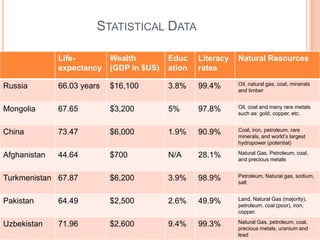
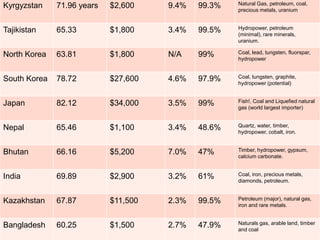
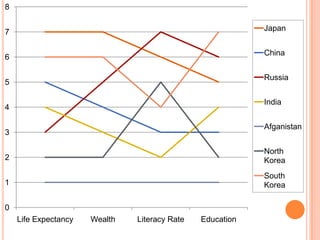
Statistical Data
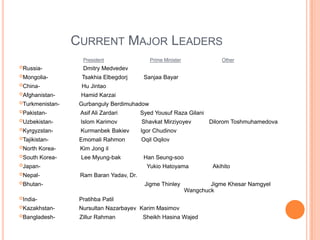
Current Major LeadersPresidentPrime MinisterOtherRussia-		Dmitry MedvedevMongolia-                 Tsakhia Elbegdorj          Sanjaa BayarChina-                     Hu JintaoAfghanistan-          Hamid KarzaiTurkmenistan-            Gurbanguly BerdimuhadowPakistan-                 Asif Ali Zardari              Syed Yousuf Raza GilaniUzbekistan-             Islom KarimovShavkat Mirziyoyev           Dilorom ToshmuhamedovaKyrgyzstan-             KurmanbekBakiev       Igor ChudinovTajikistan-                   EmomaliRahmonOqilOqilovNorth Korea-            Kim JongilSouth Korea-           Lee Myung-bakHan Seung-sooJapan-                                                                  Yukio Hatoyama          AkihitoNepal-                       Ram Baran Yadav, Dr.Bhutan-                                                           JigmeThinleyJigmeKhesarNamgyelWangchuckIndia-                    PratihbaPatilKazakhstan-            NursultanNazarbayevKarimMasimovBangladesh-          ZillurRahman                 Sheikh HasinaWajed
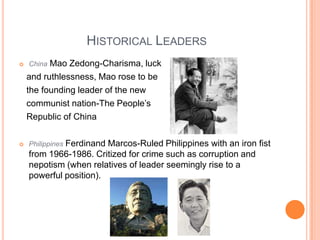
Historical LeadersChina Mao Zedong-Charisma, luck    and ruthlessness, Mao rose to be   the founding leader of the new    communist nation-The People’s    Republic of ChinaPhilippines Ferdinand Marcos-Ruled Philippines with an iron fist from 1966-1986. Critized for crime such as corruption and nepotism (when relatives of leader seemingly rise to a powerful position).
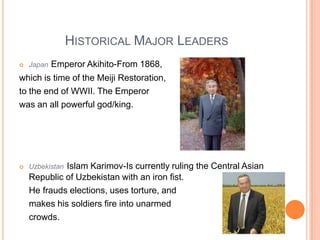
Historical Major LeadersJapanEmperor Akihito-From 1868, which is time of the Meiji Restoration,to the end of WWII. The Emperor was an all powerful god/king.UzbekistanIslam Karimov-Is currently ruling the Central Asian Republic of Uzbekistan with an iron fist.     He frauds elections, uses torture, and     makes his soldiers fire into unarmed     crowds.
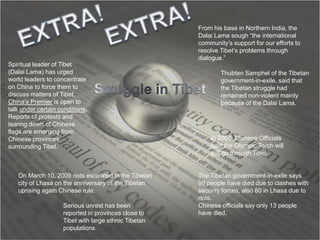
EXTRA!EXTRA!From his base in Northern India, the Dalai Lama sough “the international community’s support for our efforts to resolve Tibet’s problems through dialogue.”Spiritual leader of Tibet (Dalai Lama) has urged world leaders to concentrate on China to force them to discuss matters of Tibet. China’s Premier is open to talk under certain conditions. Reports of protests and tearing down of Chinese flags are emerging from Chinese provinces surrounding Tibet.Thubten Samphel of the Tibetan government-in-exile, said that the Tibetan struggle had remained non-violent mainly because of the Dalai Lama.Struggle in TibetIn 2008, Chinese Officials said the Olympic Torch will still go through Tibet.On March 10, 2009 riots escalated in the Tibetan city of Lhasa on the anniversary of the Tibetan uprising again Chinese rule. The Tibetan government-in-exile says 99 people have died due to clashes with security forces, also 80 in Lhasa due to riots.Chinese officials say only 13 people have died.Serious unrest has been reported in provinces close to Tibet with large ethnic Tibetan populations.
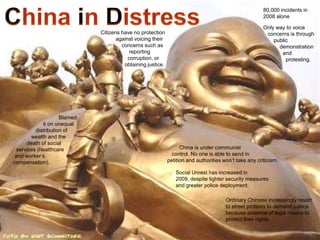
China in Distress80,000 incidents in 2008 aloneOnly way to voice   concerns is through       public            demonstration             and                protesting.Citizens have no protection           against voicing their               concerns such as                    reporting                   corruption, or                 obtaining justice.	         Blamed                    it on unequal                distribution of             wealth and the          death of social   services (healthcare  and worker’s compensation).         China is under communist       control. No one is able to send in    petition and authorities won’t take any criticism.Social Unrest has increased in 2009, despite tighter security measures and greater police deployment.Ordinary Chinese increasingly resort to street protests to demand justice because absence of legal means to protect their rights.
Other Major StoriesYukio Hatoyama plans to cut Greenhouse emissions by 25% from 1990-2020. Their is concern over this by the business sector."They are already the most CO2 efficient around and cutting further is very expensive." explained Martin Schulz of the Fujitsu Research Institute in Tokyo.Swine Flu outbreak in China: Vaccination program has begun. Priority to those participating in National Day Parade (October 1), also children between 5 and 19 and pregnant women. Contamination has increased since schools have reopened.6000 reported infected12 have died in Hong Kong
Major Ethnic GroupsSlavic: The Slavic peoples are an ethnic and linguistic branch of Indo-European peoples. The Russian ethnic group belongs to this larger group. Spreading primarily through Europe, there are also many roots throughout Asia.Han Chinese: The family needs are placed above individual needs, also a strong respect for elders within the Chinese family. This is one of the world’s largest Ethnic groups and dates back 1000s of years. Some Han Chinese believe they share common ancestors back to the Yan (Yellow Emperor).Asian-American: Shows how trade and globalization has affected our ethnic groups and the close correlation between certain nations. Overall, Asian Americans have the lowest poverty rateand the highest educational attainment levels and median household income.
Major Linguistic GroupsSouthwest Asia Indo-Aryan: In Nazi Germany before the World War II, full rights were granted only to people classified as Aryans. Only white-skinned, blue-eyed, fair-haired, or pure ‘Nordic’ peoples. They spoke the parent language of the various Indo-European languages.IndiaDravidian:  Are members of a group of non-Indo-European peoples of the Deccan region of India and northern Sri Lanka. The Dravidian language family is large, with about 20 languages spoken in southern India alone.ChinaMandarin: Mandarin was originally the language spoken by Chinese officials, most of whom came from Beijing. Today Mandarin is the main language of government, the media and education in China and Taiwan, and one of the four official languages in Singapore. There are approximately 870 million Mandarin speakers.
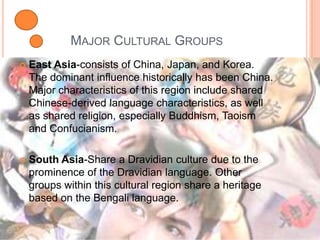
Major Cultural Groups East Asia-consists of China, Japan, and Korea. The dominant influence historically has been China. Major characteristics of this region include shared Chinese-derived language characteristics, as well as shared religion, especially Buddhism, Taoism and Confucianism.South Asia-Share a Dravidian culture due to the prominence of the Dravidian language. Other groups within this cultural region share a heritage based on the Bengali language.
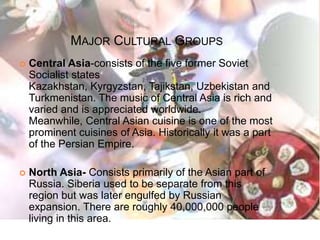
Major Cultural GroupsCentral Asia-consists of the five former Soviet Socialist states Kazakhstan, Kyrgyzstan, Tajikstan, Uzbekistan and Turkmenistan. The music of Central Asia is rich and varied and is appreciated worldwide. Meanwhile, Central Asian cuisine is one of the most prominent cuisines of Asia. Historically it was a part of the Persian Empire.North Asia- Consists primarily of the Asian part of  Russia. Siberia used to be separate from this region but was later engulfed by Russian expansion. There are roughly 40,000,000 people living in this area.
BibliographyCentral Intelligence Agency. (2009). World Leaders. Retrieved September 20, 2009, from CIA World Factbook: https://www.cia.gov/library/publications/world-leaders-1/index.htmlMicrosoft. (2009). Bing Images. Retrieved September 18, 2009, from Bing: http://www.bing.com/?FORM=Z9FD1MMIC. (2009). Japan's Break with Past on Climate. Retrieved September 20, 2009, from BBC News: http://news.bbc.co.uk/2/hi/science/nature/8241609.stmODCSPER. (2009). Asian-American Ethnic Group. Retrieved September 19, 2009, from Fort Gordan Equal Oppurtunity Office: http://www.gordon.army.mil/eoo/asian.htmS., A. (2009). Mandarin. Retrieved September 20, 2009, from Omniglot: http://www.omniglot.com/writing/mandarin.htmS., K. (2009). Current International Events Asia. Retrieved September 20, 2009, from Class of 2010 Humanities 30-1: http://humanities30-1.ning.com/profiles/blogs/current-international-events-1WordPress Entries. (2009). Indo-aryans. Retrieved September 20, 2009, from Aryan: http://www.indoaryans.org/

Asia 2.0

  • 1.
  • 3.
  • 6.
    Current Major LeadersPresidentPrimeMinisterOtherRussia- Dmitry MedvedevMongolia- Tsakhia Elbegdorj Sanjaa BayarChina- Hu JintaoAfghanistan- Hamid KarzaiTurkmenistan- Gurbanguly BerdimuhadowPakistan- Asif Ali Zardari Syed Yousuf Raza GilaniUzbekistan- Islom KarimovShavkat Mirziyoyev Dilorom ToshmuhamedovaKyrgyzstan- KurmanbekBakiev Igor ChudinovTajikistan- EmomaliRahmonOqilOqilovNorth Korea- Kim JongilSouth Korea- Lee Myung-bakHan Seung-sooJapan- Yukio Hatoyama AkihitoNepal- Ram Baran Yadav, Dr.Bhutan- JigmeThinleyJigmeKhesarNamgyelWangchuckIndia- PratihbaPatilKazakhstan- NursultanNazarbayevKarimMasimovBangladesh- ZillurRahman Sheikh HasinaWajed
  • 7.
    Historical LeadersChina MaoZedong-Charisma, luck and ruthlessness, Mao rose to be the founding leader of the new communist nation-The People’s Republic of ChinaPhilippines Ferdinand Marcos-Ruled Philippines with an iron fist from 1966-1986. Critized for crime such as corruption and nepotism (when relatives of leader seemingly rise to a powerful position).
  • 8.
    Historical Major LeadersJapanEmperorAkihito-From 1868, which is time of the Meiji Restoration,to the end of WWII. The Emperor was an all powerful god/king.UzbekistanIslam Karimov-Is currently ruling the Central Asian Republic of Uzbekistan with an iron fist. He frauds elections, uses torture, and makes his soldiers fire into unarmed crowds.
  • 9.
    EXTRA!EXTRA!From his basein Northern India, the Dalai Lama sough “the international community’s support for our efforts to resolve Tibet’s problems through dialogue.”Spiritual leader of Tibet (Dalai Lama) has urged world leaders to concentrate on China to force them to discuss matters of Tibet. China’s Premier is open to talk under certain conditions. Reports of protests and tearing down of Chinese flags are emerging from Chinese provinces surrounding Tibet.Thubten Samphel of the Tibetan government-in-exile, said that the Tibetan struggle had remained non-violent mainly because of the Dalai Lama.Struggle in TibetIn 2008, Chinese Officials said the Olympic Torch will still go through Tibet.On March 10, 2009 riots escalated in the Tibetan city of Lhasa on the anniversary of the Tibetan uprising again Chinese rule. The Tibetan government-in-exile says 99 people have died due to clashes with security forces, also 80 in Lhasa due to riots.Chinese officials say only 13 people have died.Serious unrest has been reported in provinces close to Tibet with large ethnic Tibetan populations.
  • 10.
    China in Distress80,000incidents in 2008 aloneOnly way to voice concerns is through public demonstration and protesting.Citizens have no protection against voicing their concerns such as reporting corruption, or obtaining justice. Blamed it on unequal distribution of wealth and the death of social services (healthcare and worker’s compensation). China is under communist control. No one is able to send in petition and authorities won’t take any criticism.Social Unrest has increased in 2009, despite tighter security measures and greater police deployment.Ordinary Chinese increasingly resort to street protests to demand justice because absence of legal means to protect their rights.
  • 11.
    Other Major StoriesYukioHatoyama plans to cut Greenhouse emissions by 25% from 1990-2020. Their is concern over this by the business sector."They are already the most CO2 efficient around and cutting further is very expensive." explained Martin Schulz of the Fujitsu Research Institute in Tokyo.Swine Flu outbreak in China: Vaccination program has begun. Priority to those participating in National Day Parade (October 1), also children between 5 and 19 and pregnant women. Contamination has increased since schools have reopened.6000 reported infected12 have died in Hong Kong
  • 12.
    Major Ethnic GroupsSlavic:The Slavic peoples are an ethnic and linguistic branch of Indo-European peoples. The Russian ethnic group belongs to this larger group. Spreading primarily through Europe, there are also many roots throughout Asia.Han Chinese: The family needs are placed above individual needs, also a strong respect for elders within the Chinese family. This is one of the world’s largest Ethnic groups and dates back 1000s of years. Some Han Chinese believe they share common ancestors back to the Yan (Yellow Emperor).Asian-American: Shows how trade and globalization has affected our ethnic groups and the close correlation between certain nations. Overall, Asian Americans have the lowest poverty rateand the highest educational attainment levels and median household income.
  • 13.
    Major Linguistic GroupsSouthwestAsia Indo-Aryan: In Nazi Germany before the World War II, full rights were granted only to people classified as Aryans. Only white-skinned, blue-eyed, fair-haired, or pure ‘Nordic’ peoples. They spoke the parent language of the various Indo-European languages.IndiaDravidian: Are members of a group of non-Indo-European peoples of the Deccan region of India and northern Sri Lanka. The Dravidian language family is large, with about 20 languages spoken in southern India alone.ChinaMandarin: Mandarin was originally the language spoken by Chinese officials, most of whom came from Beijing. Today Mandarin is the main language of government, the media and education in China and Taiwan, and one of the four official languages in Singapore. There are approximately 870 million Mandarin speakers.
  • 14.
    Major Cultural GroupsEast Asia-consists of China, Japan, and Korea. The dominant influence historically has been China. Major characteristics of this region include shared Chinese-derived language characteristics, as well as shared religion, especially Buddhism, Taoism and Confucianism.South Asia-Share a Dravidian culture due to the prominence of the Dravidian language. Other groups within this cultural region share a heritage based on the Bengali language.
  • 15.
    Major Cultural GroupsCentralAsia-consists of the five former Soviet Socialist states Kazakhstan, Kyrgyzstan, Tajikstan, Uzbekistan and Turkmenistan. The music of Central Asia is rich and varied and is appreciated worldwide. Meanwhile, Central Asian cuisine is one of the most prominent cuisines of Asia. Historically it was a part of the Persian Empire.North Asia- Consists primarily of the Asian part of Russia. Siberia used to be separate from this region but was later engulfed by Russian expansion. There are roughly 40,000,000 people living in this area.
  • 16.
    BibliographyCentral Intelligence Agency.(2009). World Leaders. Retrieved September 20, 2009, from CIA World Factbook: https://www.cia.gov/library/publications/world-leaders-1/index.htmlMicrosoft. (2009). Bing Images. Retrieved September 18, 2009, from Bing: http://www.bing.com/?FORM=Z9FD1MMIC. (2009). Japan's Break with Past on Climate. Retrieved September 20, 2009, from BBC News: http://news.bbc.co.uk/2/hi/science/nature/8241609.stmODCSPER. (2009). Asian-American Ethnic Group. Retrieved September 19, 2009, from Fort Gordan Equal Oppurtunity Office: http://www.gordon.army.mil/eoo/asian.htmS., A. (2009). Mandarin. Retrieved September 20, 2009, from Omniglot: http://www.omniglot.com/writing/mandarin.htmS., K. (2009). Current International Events Asia. Retrieved September 20, 2009, from Class of 2010 Humanities 30-1: http://humanities30-1.ning.com/profiles/blogs/current-international-events-1WordPress Entries. (2009). Indo-aryans. Retrieved September 20, 2009, from Aryan: http://www.indoaryans.org/