Neural Correlates of Gated
   Word Recognition in
   Bilinguals and Monolinguals

Derick D. Deweber, MS, CCC-SLP
Frank R. Boutsen, PhD, CCC-SLP

2009 ASHA Convention New Orleans, LA
Presentation Overview

• Review of models of word recognition
• Discussion of first bilingual word recognition
  study
• Discussion of pilot EEG study
• Future directions
Word Recognition in Monolinguals

• Methods used to examine spoken word
  recognition

• Findings from studies on word recognition

• Models of spoken word recognition
Experimental Methods
• Lexical decision
   •   Subject required to make decision based on stimulus; could
       be affected by word status, word frequency, and context
• Priming
   •   Subject makes decision following two words that may be
       related or unrelated (i.e., semantic priming) or may inform
       subject which language to use
• Shadowing
   •   Subject required to repeat back word as they hear it; words
       may contain semantically unpredictable errors
• Gating
   •   Subject makes decision about word after hearing increasing
       increments of a target word
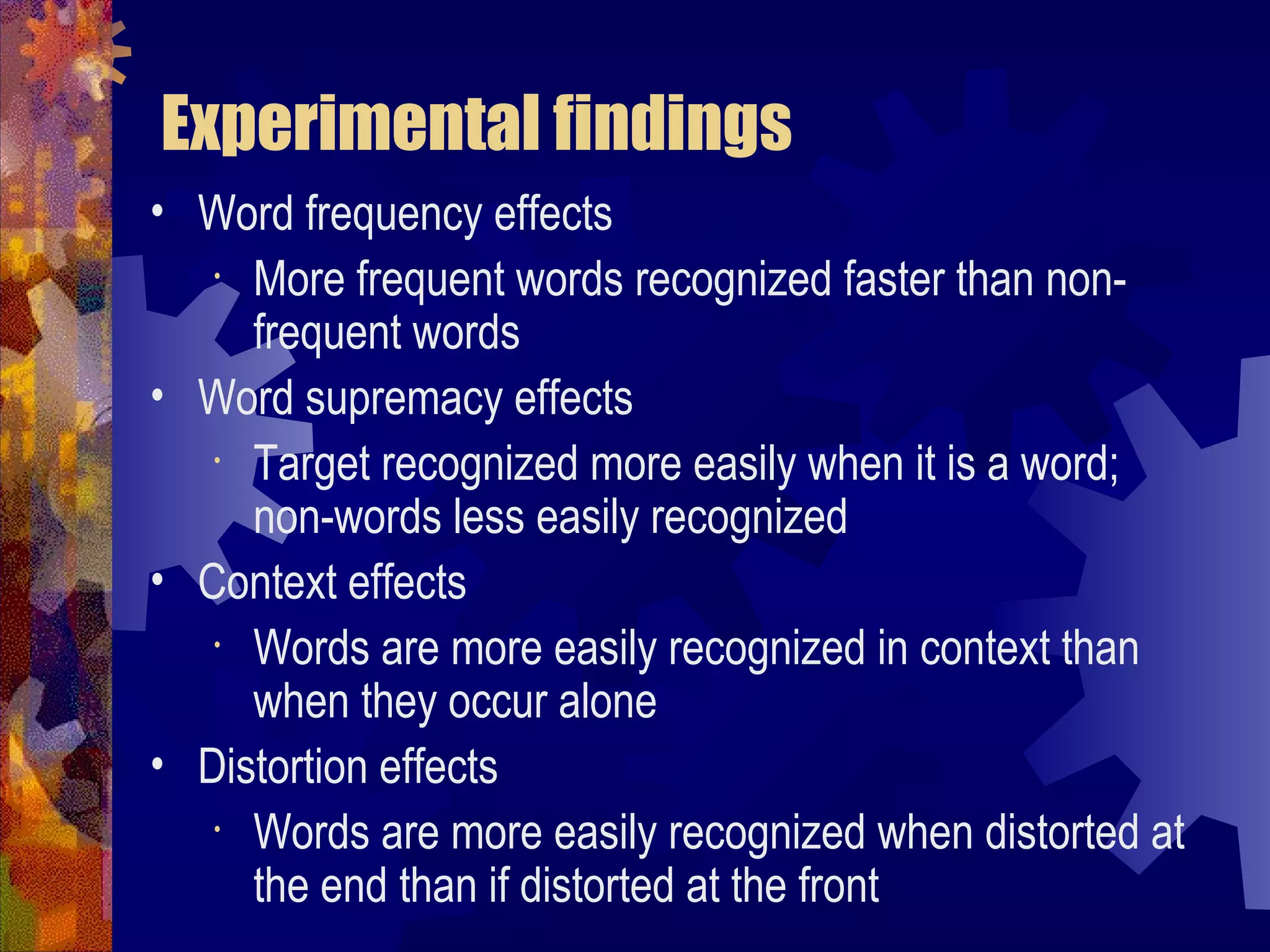
Experimental findings
• Word frequency effects
   • More frequent words recognized faster than non-

     frequent words
• Word supremacy effects
   • Target recognized more easily when it is a word;

     non-words less easily recognized
• Context effects
   • Words are more easily recognized in context than

     when they occur alone
• Distortion effects
   • Words are more easily recognized when distorted at
     the end than if distorted at the front
Models of Word Recognition


• Initial Cohort Model

• Neighborhood Activation Model (NAM)
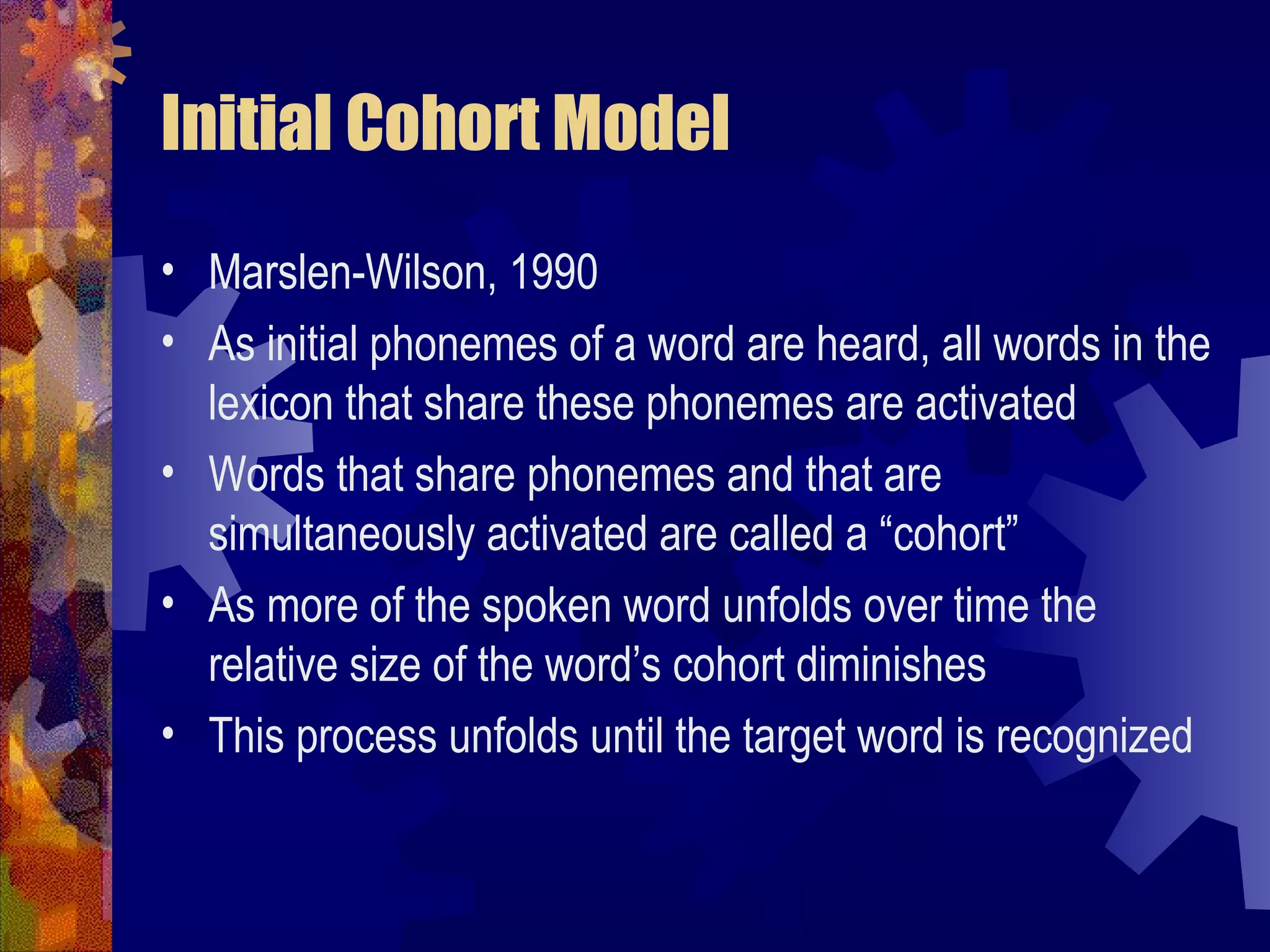
Initial Cohort Model
• Marslen-Wilson, 1990
• As initial phonemes of a word are heard, all words in the
  lexicon that share these phonemes are activated
• Words that share phonemes and that are
  simultaneously activated are called a “cohort”
• As more of the spoken word unfolds over time the
  relative size of the word’s cohort diminishes
• This process unfolds until the target word is recognized
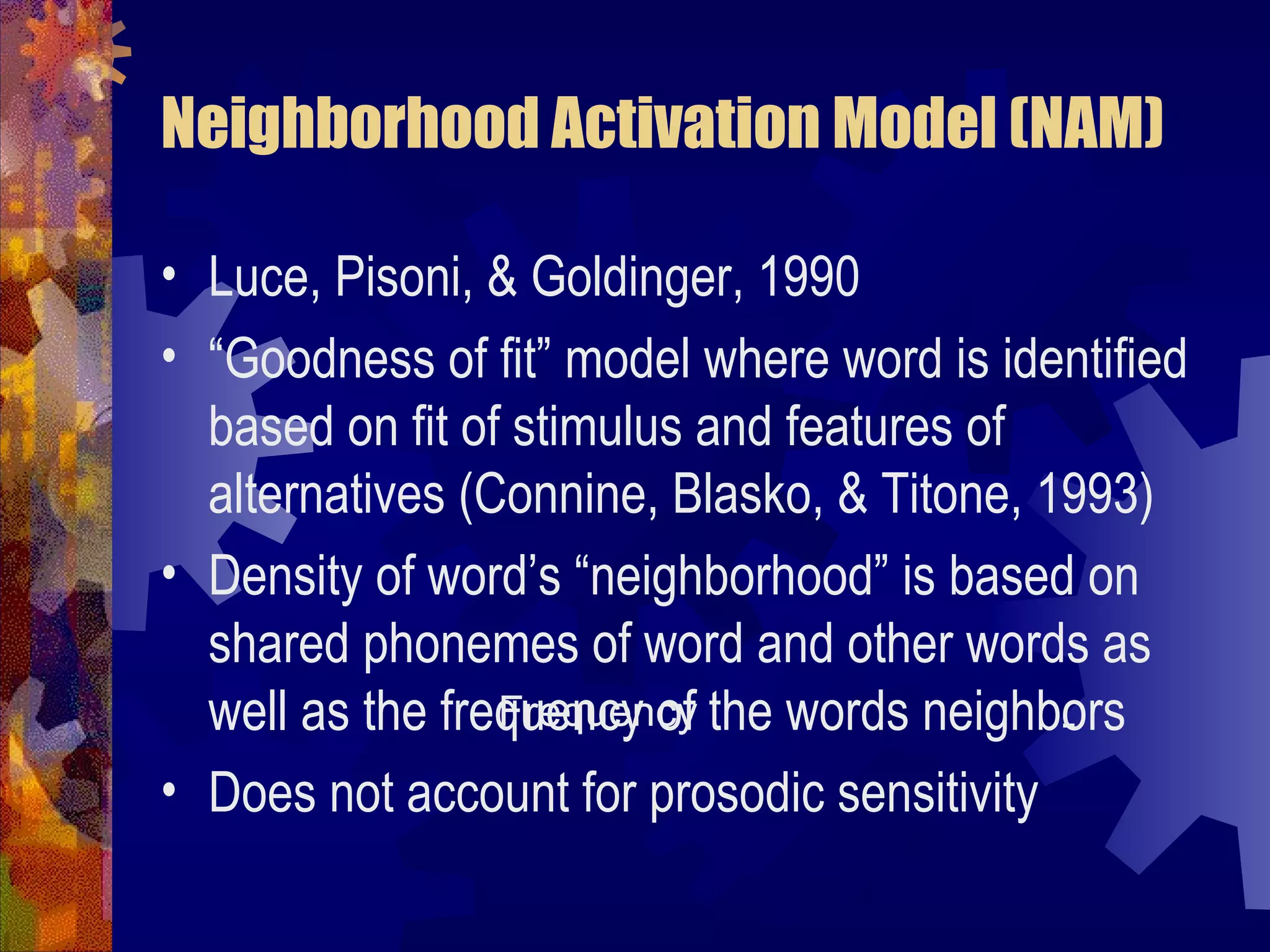
Neighborhood Activation Model (NAM)

• Luce, Pisoni, & Goldinger, 1990
• “Goodness of fit” model where word is identified
  based on fit of stimulus and features of
  alternatives (Connine, Blasko, & Titone, 1993)
• Density of word’s “neighborhood” is based on
  shared phonemes of word and other words as
  well as the frequency of the words neighbors
                 Frequency                  -
• Does not account for prosodic sensitivity
Gating Paradigm in WR Research

• Wingfield et al., 1997
   •   Found that when a word is constrained by stress,
       cohort size is a better predictor of when the word will
       be recognized than when stress pattern is ignored


• Lindfield, Wingfield, and Goodglass, 1999
   •   Found that words were correctly recognized with
       much less segmental (initial cohort) onset
       information when word prosody was available to
       subjects
Experiment 1
• Application of gating paradigm established by Lindfield,
  Wingfield, and Goodglass, 1999

• the effect of prosody on word recognition in adult
   speakers of English,
  early bilingual (Spanish/English)
  late bilingual (Spanish/English)

• How does English “accent” affect word recognition
  scores?
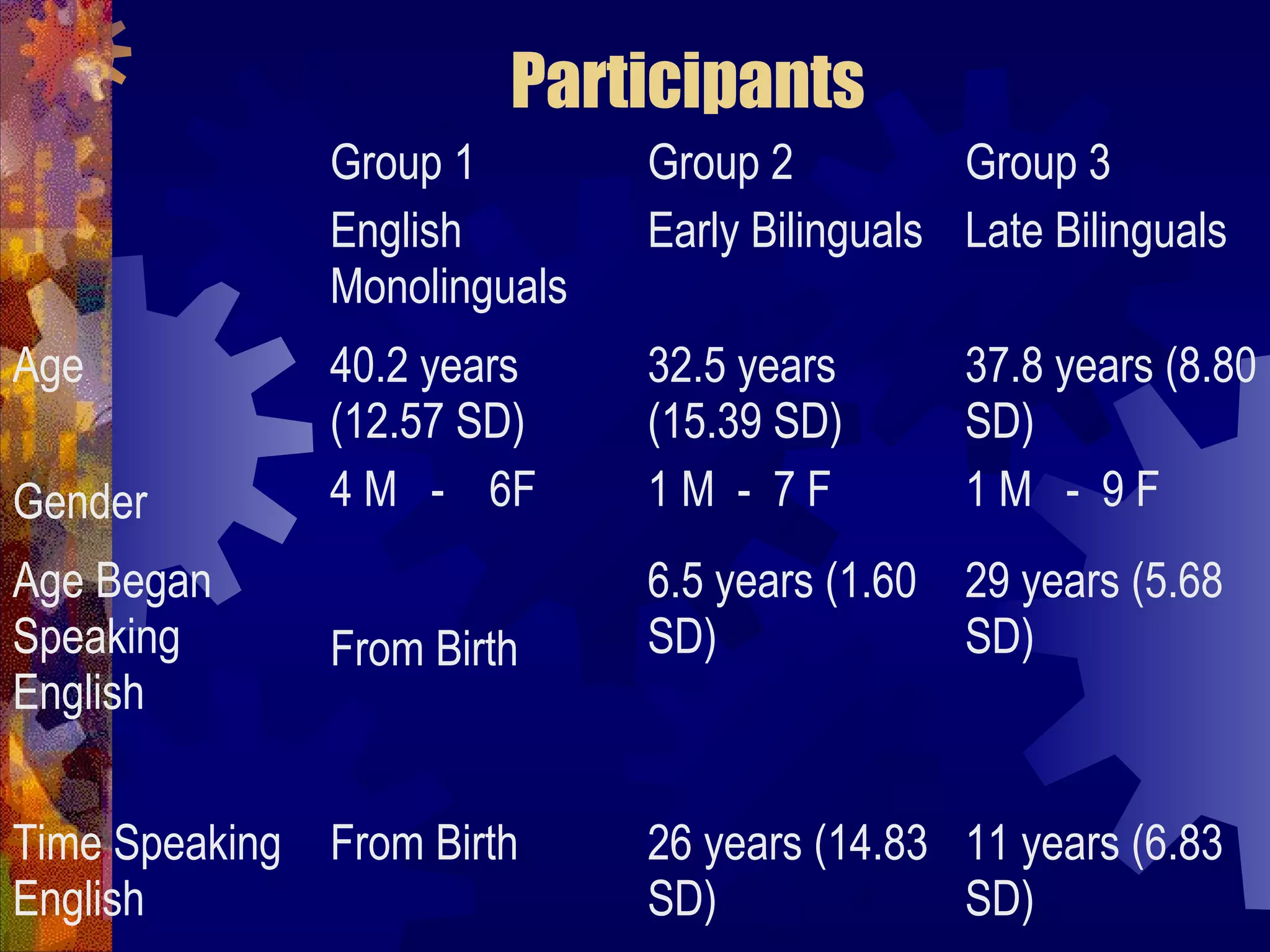
Participants
               Group 1        Group 2          Group 3
               English        Early Bilinguals Late Bilinguals
               Monolinguals
Age            40.2 years     32.5 years       37.8 years (8.80
               (12.57 SD)     (15.39 SD)       SD)
Gender         4 M - 6F       1M - 7F          1M - 9F
Age Began                     6.5 years (1.60 29 years (5.68
Speaking       From Birth     SD)             SD)
English


Time Speaking From Birth      26 years (14.83 11 years (6.83
English                       SD)             SD)
Materials
• 30 English words
   • 12 two-syllable
        •
         6 with stress on 1st syllable
        •
         6 with stress on 2nd syllable
        •
         Ballet, diamond, dolphin, penguin, pumpkin, sparrow,
         window, cartoon, exhaust, guitar, quartet, hotel
   • 18 three-syllable
        •
         6 with stress on 1st syllable
        •
         6 with stress on 2nd syllable
        •
         6 with stress on 3rd syllable
        •
         Celery, photograph, pineapple, radio, stadium, telescope,
         apartment, cathedral, foundation, horizon, umbrella,
         suspender, chandelier, engineer, gasoline, kangaroo,
         referee, violin
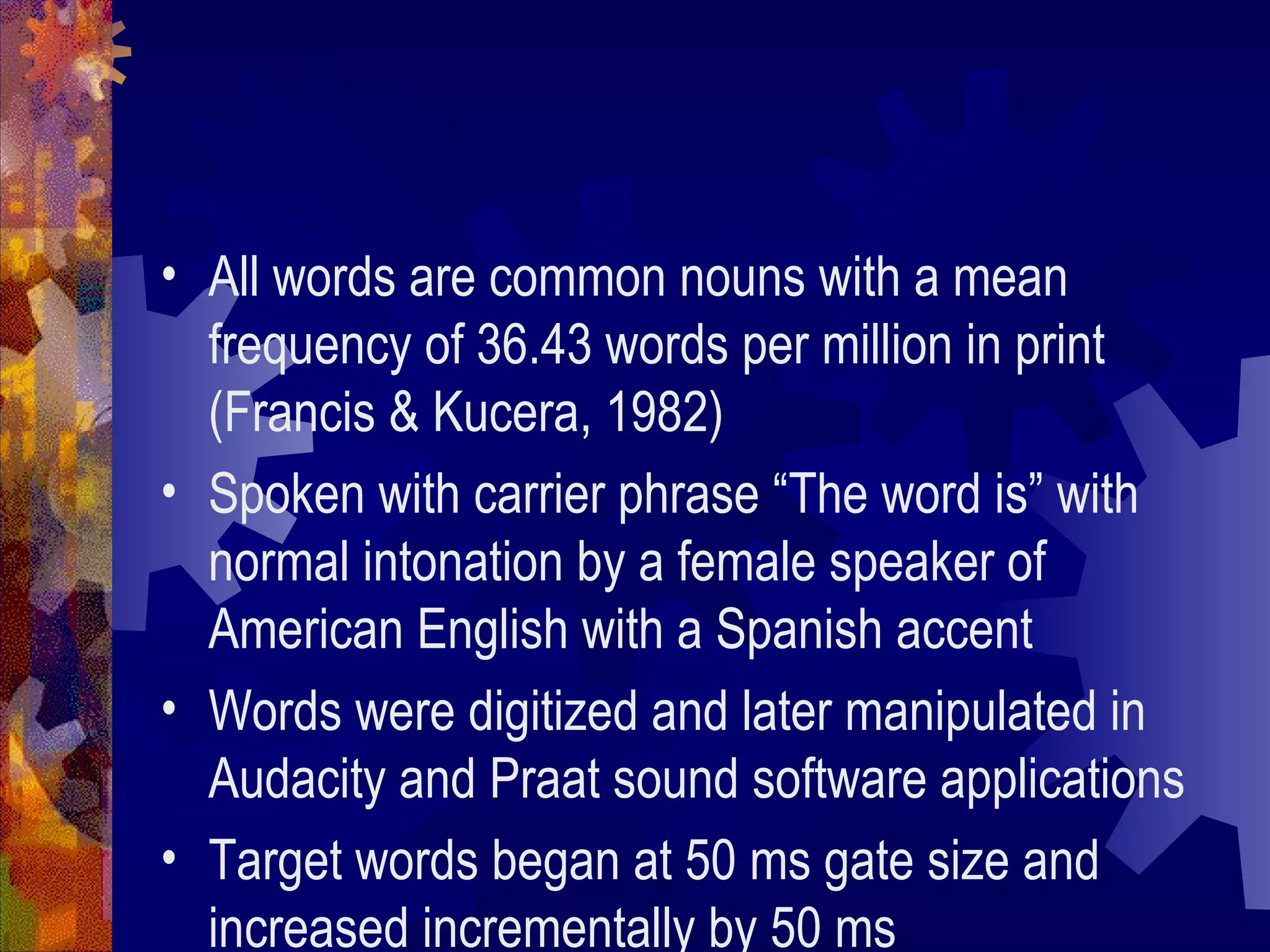
• All words are common nouns with a mean
  frequency of 37 words per million in print
  (Francis & Kucera, 1982)
• Spoken with carrier phrase “The word is” with
  normal intonation by a female speaker of
  American English
• Words were digitized and later manipulated in
  Audacity and Praat sound software applications
• Target words began at 50 ms gate size and
  increased incrementally by 50 ms
•    Gated stimuli were presented in 3 conditions
1.   Onset only
2.   Onset plus duration
3.   Onset plus prosody
Onset Only
50 ms gate

100 ms gate

150 ms gate

200 ms gate

250 ms gate

300 ms gate

350 ms gate

400 ms gate

450 ms gate

500 ms gate
Onset plus Duration
50 ms gate

100 ms gate

150 ms gate

200 ms gate

250 ms gate

300 ms gate

350 ms gate

400 ms gate

450 ms gate

500 ms gate
Onset Plus Prosody
50 ms gate

100 ms gate

150 ms gate

200 ms gate

250 ms gate

300 ms gate

350 ms gate

400 ms gate

450 ms gate

500 ms gate
Procedure

• Each subject heard all 30 words (10 from each
  condition)
• Words presented in increasing increments of 50
  ms beginning with the first presentation at 50 ms
• Procedure continued until subject correctly
  identified word
• Words were blocked by condition, with
  conditions being counter-balanced across
  subjects
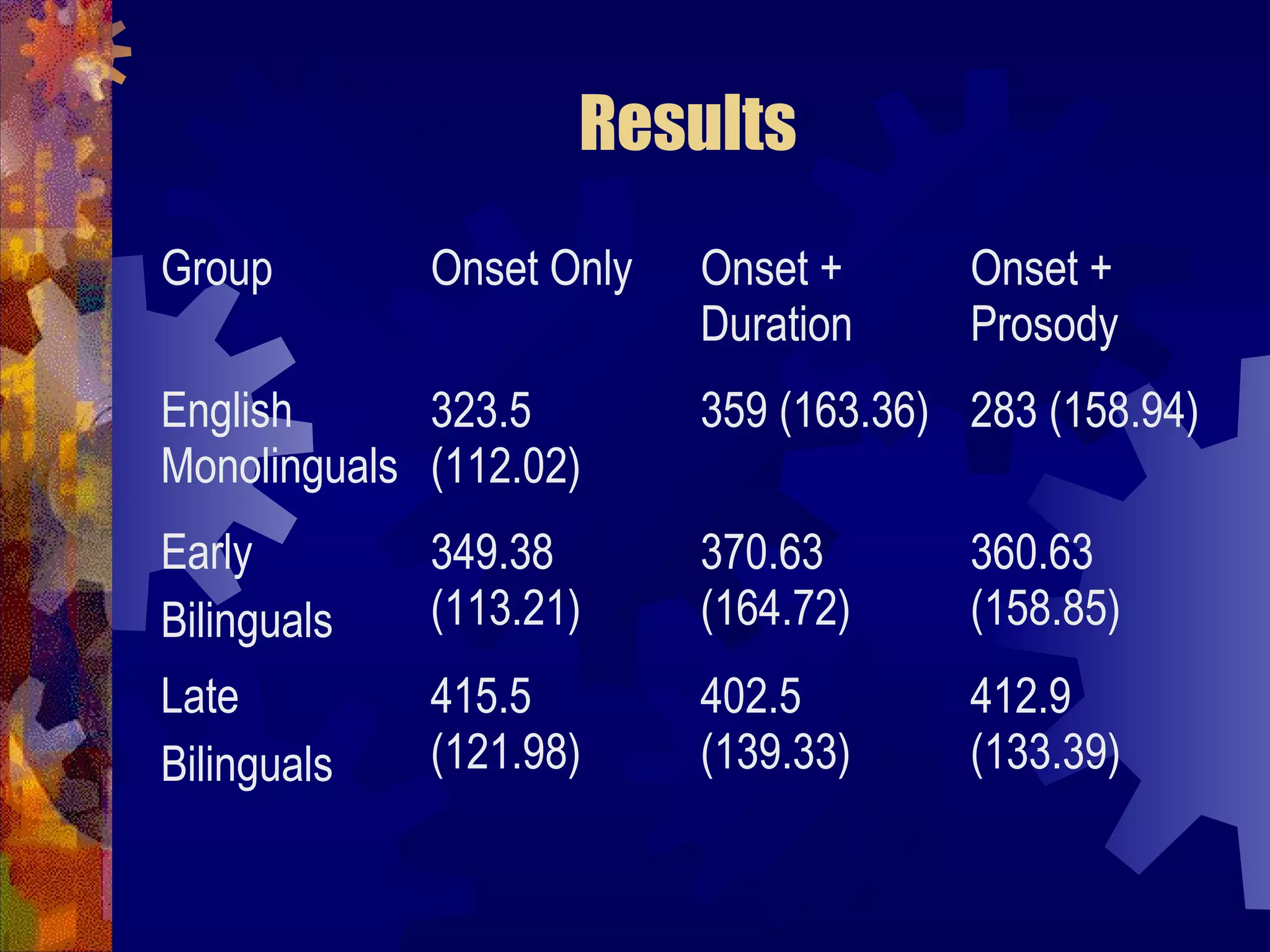
Results
Group        Onset Only   Onset +      Onset +
                          Duration     Prosody
English      323.5        359 (163.36) 283 (158.94)
Monolinguals (112.02)
Early        349.38       370.63       360.63
Bilinguals   (113.21)     (164.72)     (158.85)
Late         415.5        402.5        412.9
Bilinguals   (121.98)     (139.33)     (133.39)
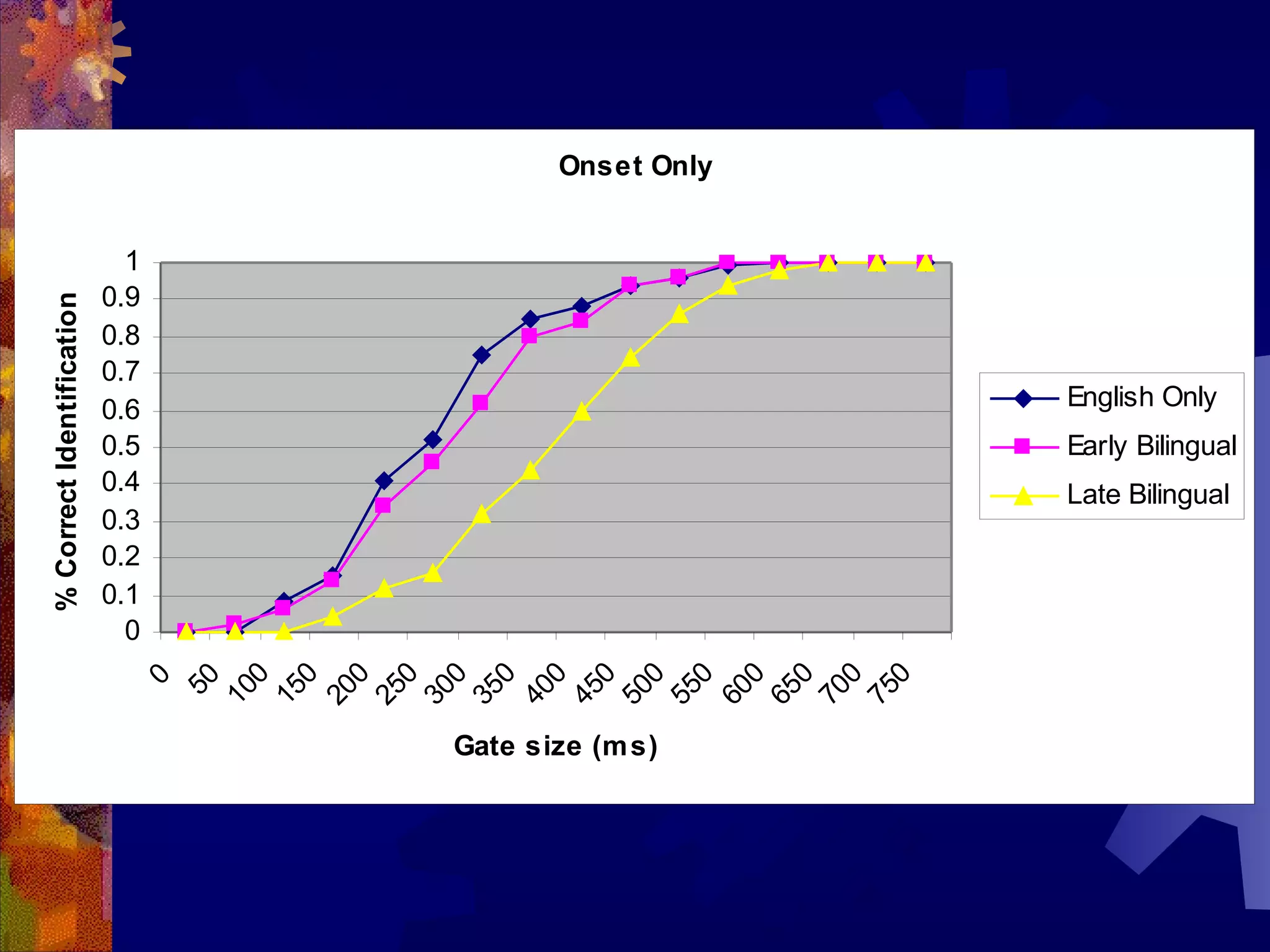
Onset Only


                             1
                           0.9
% Correct Identification


                           0.8
                           0.7
                           0.6                       English Only
                           0.5                       Early Bilingual
                           0.4                       Late Bilingual
                           0.3
                           0.2
                           0.1
                             0
                                0
                                0
                                0
                                0
                                0
                                0
                                0
                                0
                                0
                                0
                                0
                                0
                                0
                                0
                              50
                               0

                             10


                             25


                             45


                             55


                             75
                             15
                             20


                             30
                             35
                             40


                             50


                             60
                             65
                             70
                                 Gate size (m s)
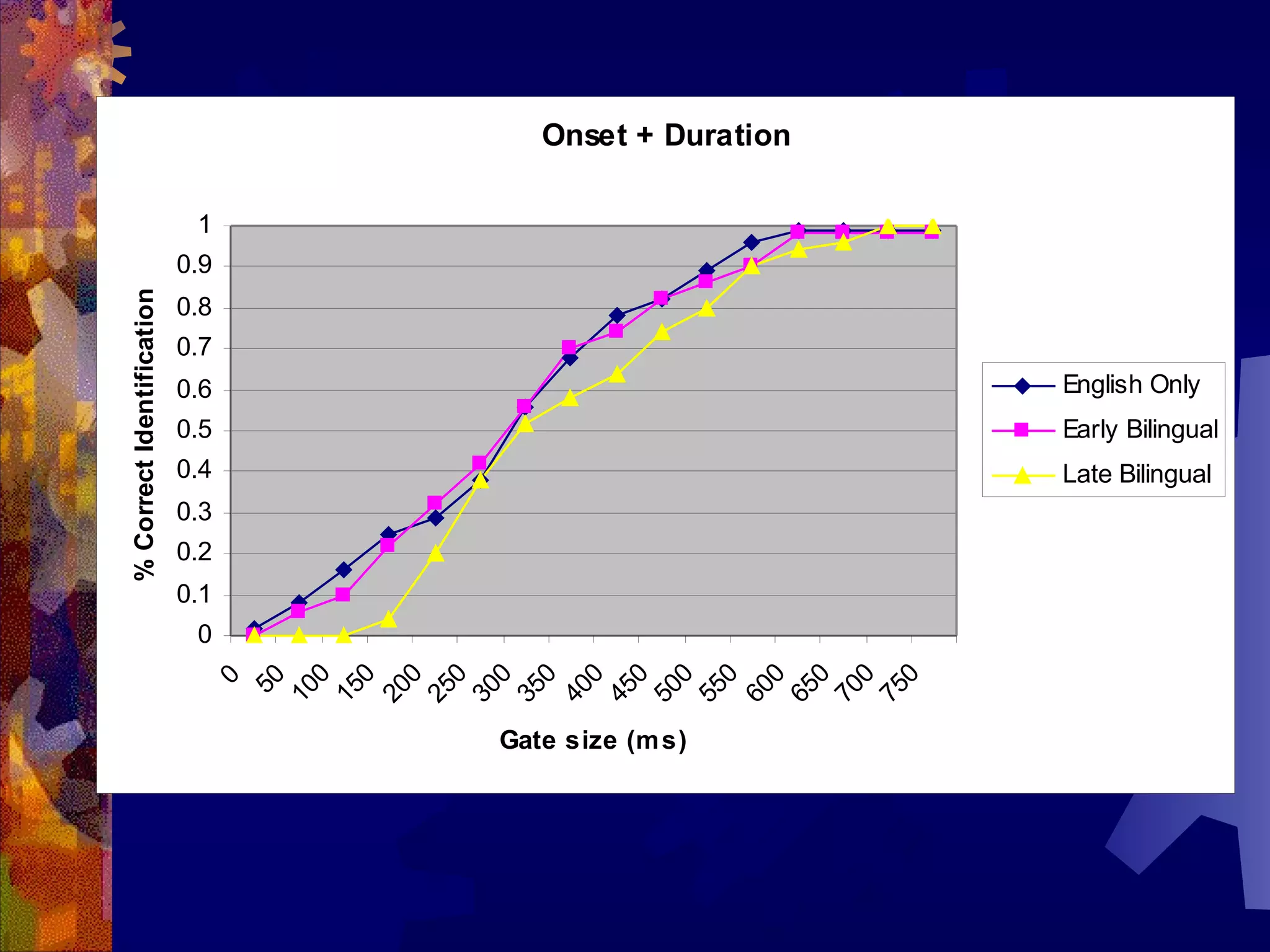
Onset + Duration

                            1
                           0.9
% Correct Identification


                           0.8
                           0.7
                           0.6                         English Only
                           0.5                         Early Bilingual
                           0.4                         Late Bilingual
                           0.3
                           0.2
                           0.1
                            0
                               0
                               0
                               0
                               0
                               0
                               0
                               0
                               0
                               0
                               0
                               0
                               0
                               0
                               0
                              50
                               0


                             15


                             25


                             75
                             10


                             20


                             30
                             35
                             40
                             45
                             50
                             55
                             60
                             65
                             70
                                 Gate size (m s)
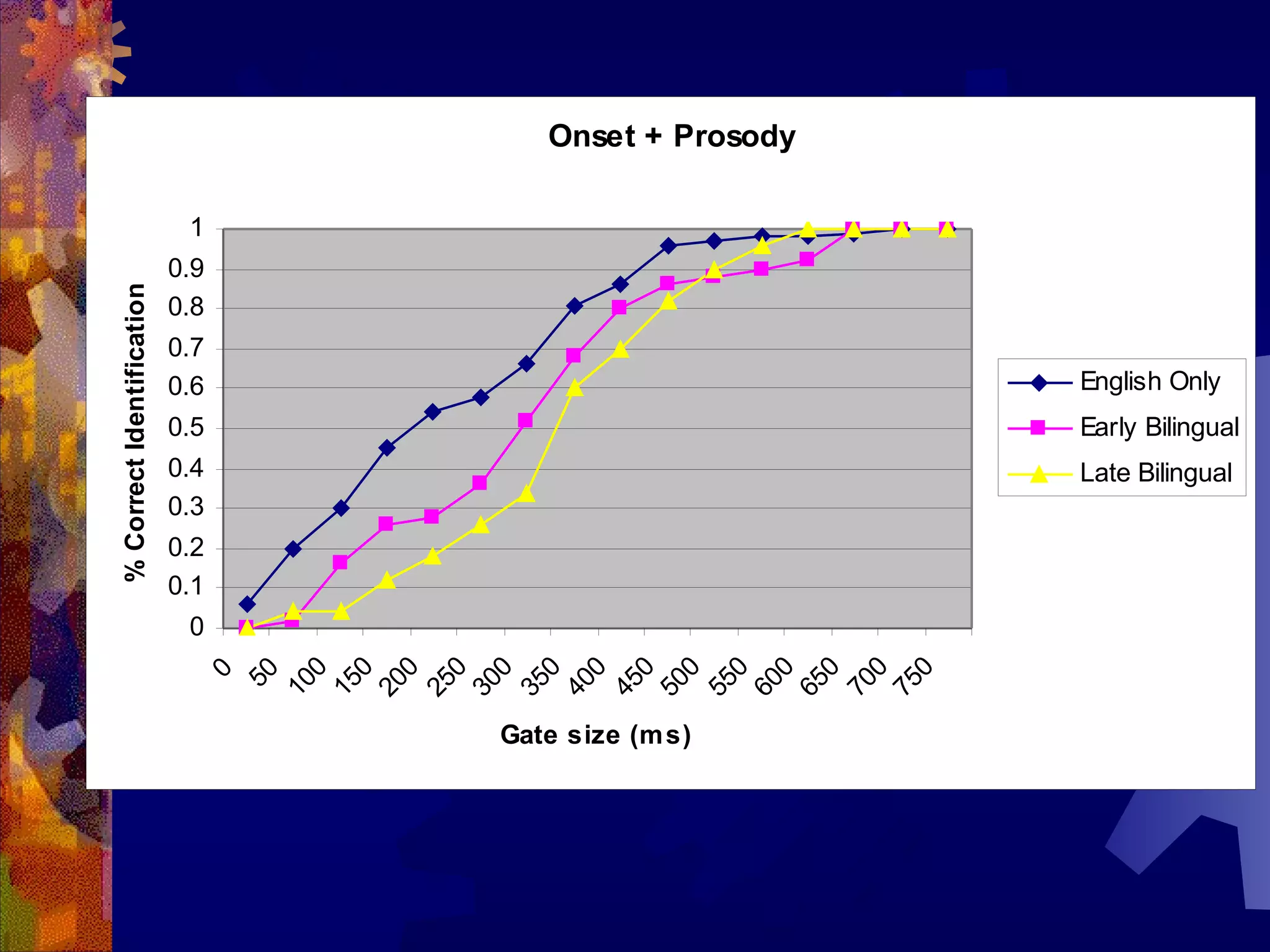
Onset + Prosody

                            1
                           0.9
% Correct Identification


                           0.8
                           0.7
                           0.6                        English Only
                           0.5                        Early Bilingual
                           0.4                        Late Bilingual
                           0.3
                           0.2
                           0.1
                            0
                               0
                               0
                               0
                               0
                               0
                               0
                               0
                               0
                               0
                               0
                               0
                               0
                               0
                               0
                              50
                               0

                             10
                             15
                             20
                             25
                             30
                             35
                             40
                             45
                             50
                             55
                             60
                             65
                             70
                             75
                                 Gate size (m s)
Experiment 2

• Same paradigm as experiment 1

• Speaker with Spanish accent

• How does Spanish “accented” English affect
  word recognition scores?
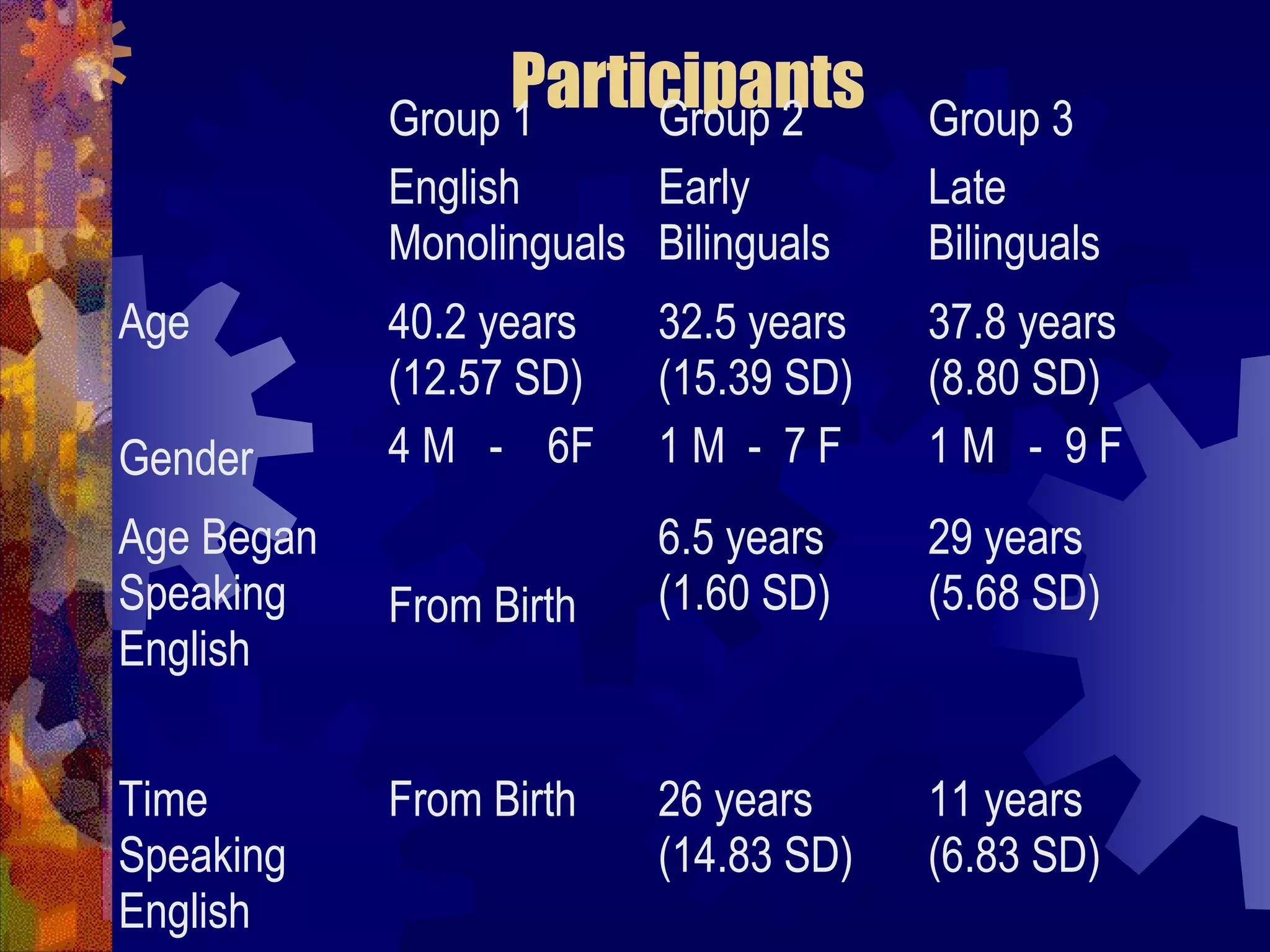
Participants
            Group 1    Group 2         Group 3
            English      Early         Late
            Monolinguals Bilinguals    Bilinguals
Age         40.2 years    32.5 years   37.8 years
            (12.57 SD)    (15.39 SD)   (8.80 SD)
Gender      4 M - 6F      1M - 7F      1M - 9F
Age Began                 6.5 years    29 years
Speaking    From Birth    (1.60 SD)    (5.68 SD)
English


Time        From Birth    26 years     11 years
Speaking                  (14.83 SD)   (6.83 SD)
English
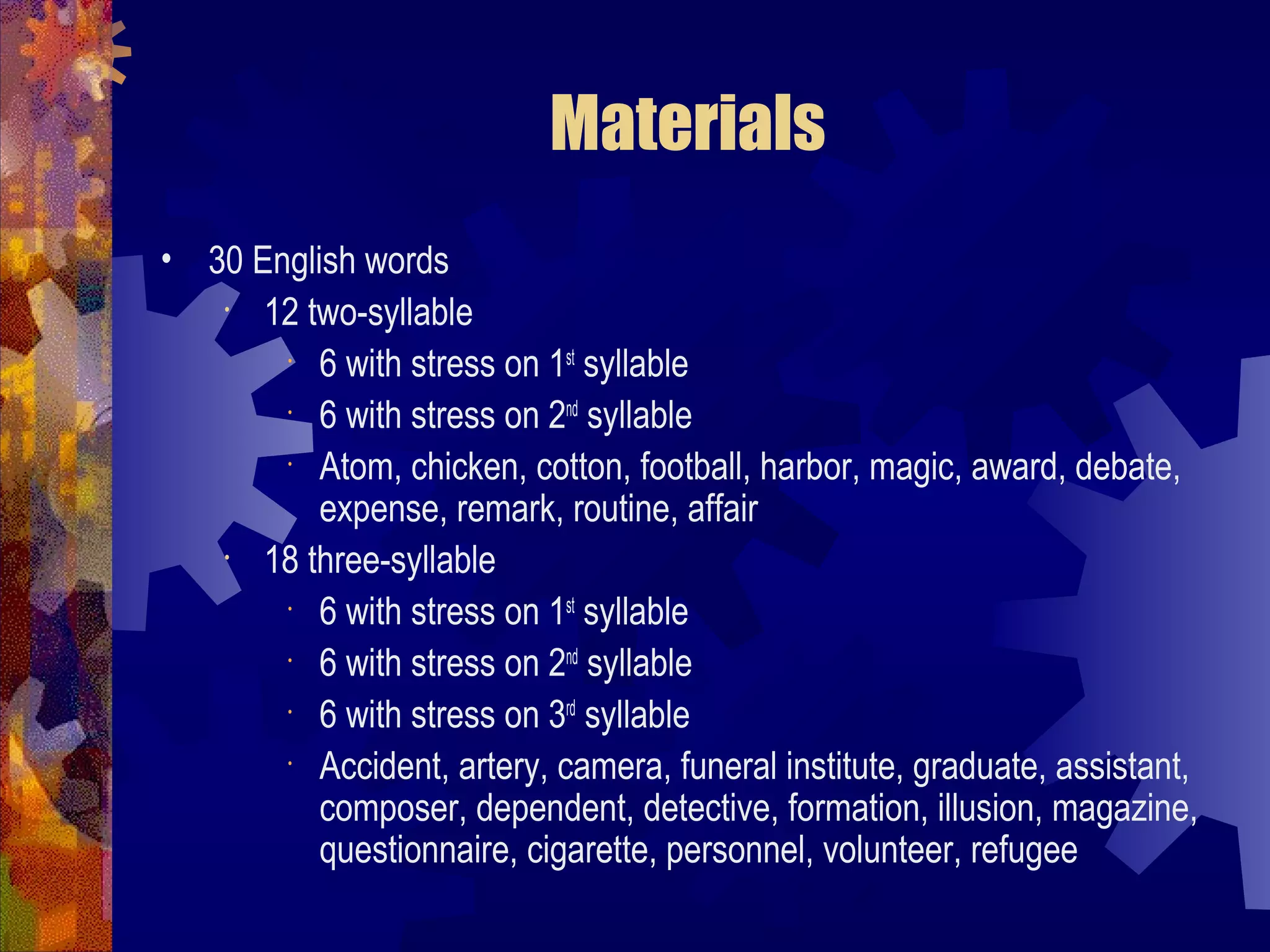
Materials
• 30 English words
   •  12 two-syllable
       •
          6 with stress on 1st syllable
       •
          6 with stress on 2nd syllable
       •
          Atom, chicken, cotton, football, harbor, magic, award, debate,
          expense, remark, routine, affair
   •  18 three-syllable
       •
          6 with stress on 1st syllable
       •
          6 with stress on 2nd syllable
       •
          6 with stress on 3rd syllable
       •
          Accident, artery, camera, funeral institute, graduate, assistant,
          composer, dependent, detective, formation, illusion, magazine,
          questionnaire, cigarette, personnel, volunteer, refugee
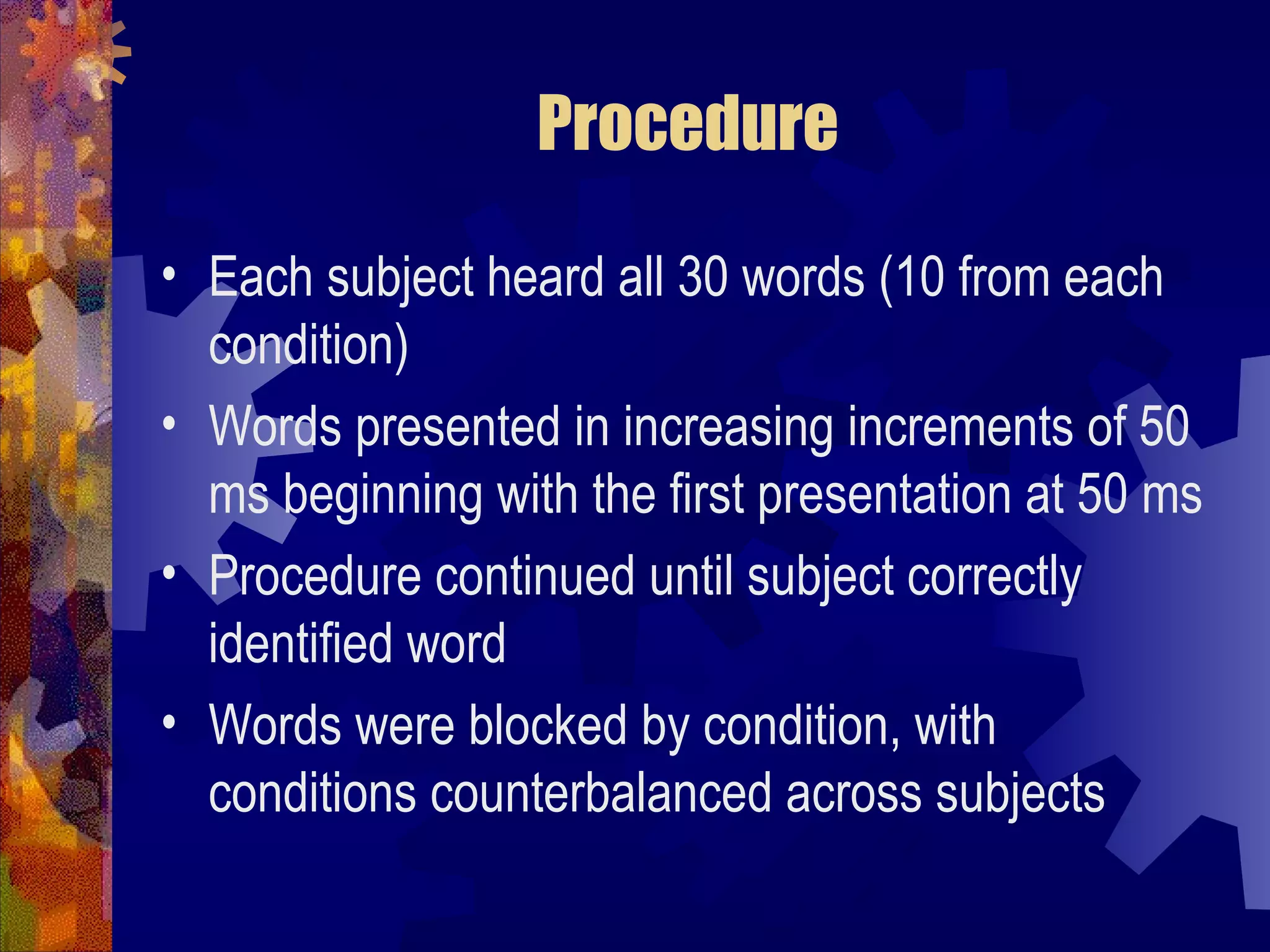
• All words are common nouns with a mean
  frequency of 36.43 words per million in print
  (Francis & Kucera, 1982)
• Spoken with carrier phrase “The word is” with
  normal intonation by a female speaker of
  American English with a Spanish accent
• Words were digitized and later manipulated in
  Audacity and Praat sound software applications
• Target words began at 50 ms gate size and
  increased incrementally by 50 ms
Procedure

• Each subject heard all 30 words (10 from each
  condition)
• Words presented in increasing increments of 50
  ms beginning with the first presentation at 50 ms
• Procedure continued until subject correctly
  identified word
• Words were blocked by condition, with
  conditions counterbalanced across subjects
• Gated stimuli in Experiment 2 were also
   presented in 3 conditions
1. Onset only
2. Onset plus duration
3. Onset plus prosody
Onset Plus Prosody
50 ms gate

100 ms gate

150 ms gate

200 ms gate

250 ms gate

300 ms gate

350 ms gate

400 ms gate

450 ms gate

500 ms gate
Results
Group        Onset Only   Onset +      Onset +
                          Duration     Prosody
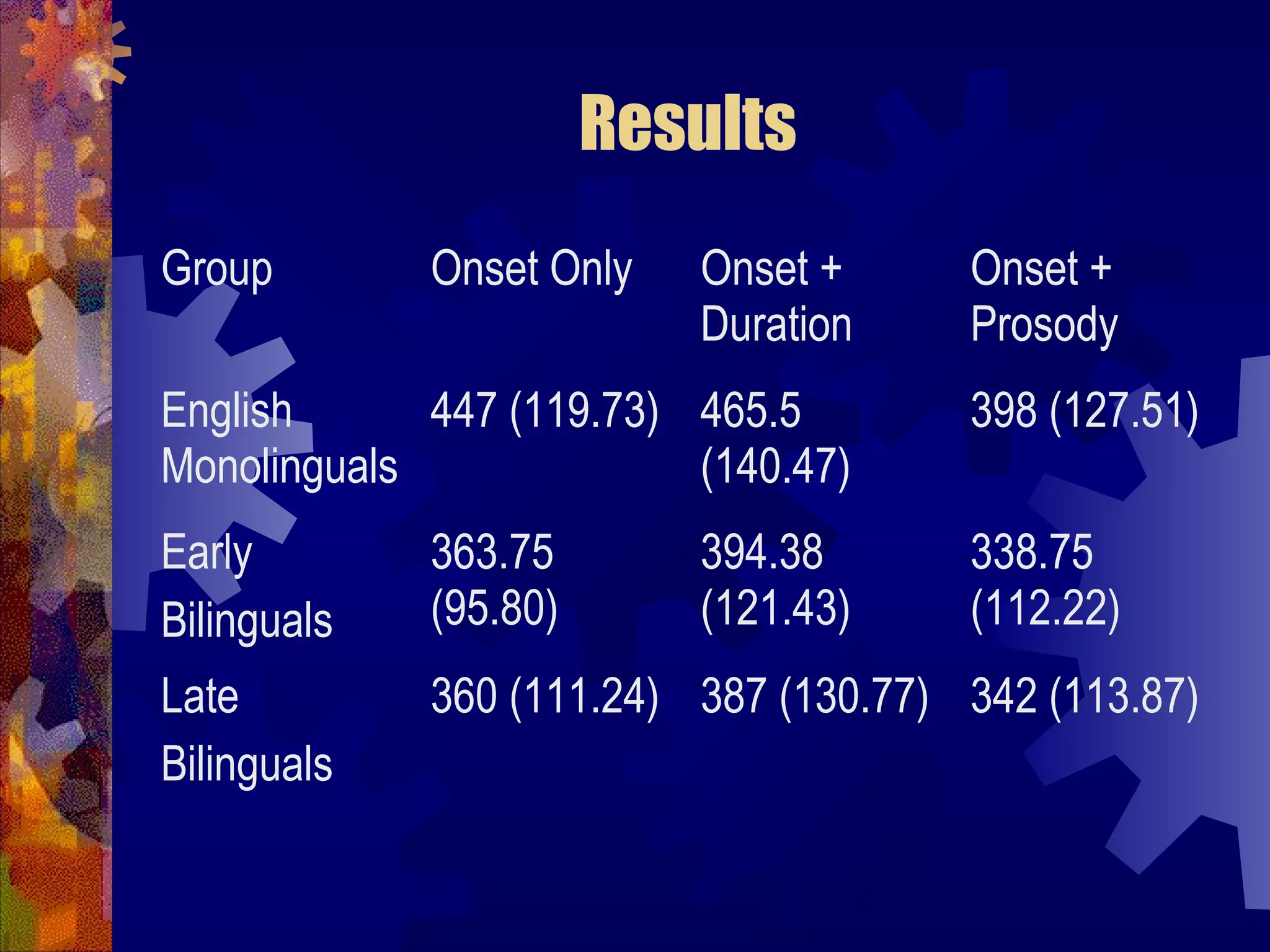
English      447 (119.73) 465.5        398 (127.51)
Monolinguals              (140.47)
Early        363.75       394.38       338.75
Bilinguals   (95.80)      (121.43)     (112.22)
Late         360 (111.24) 387 (130.77) 342 (113.87)
Bilinguals
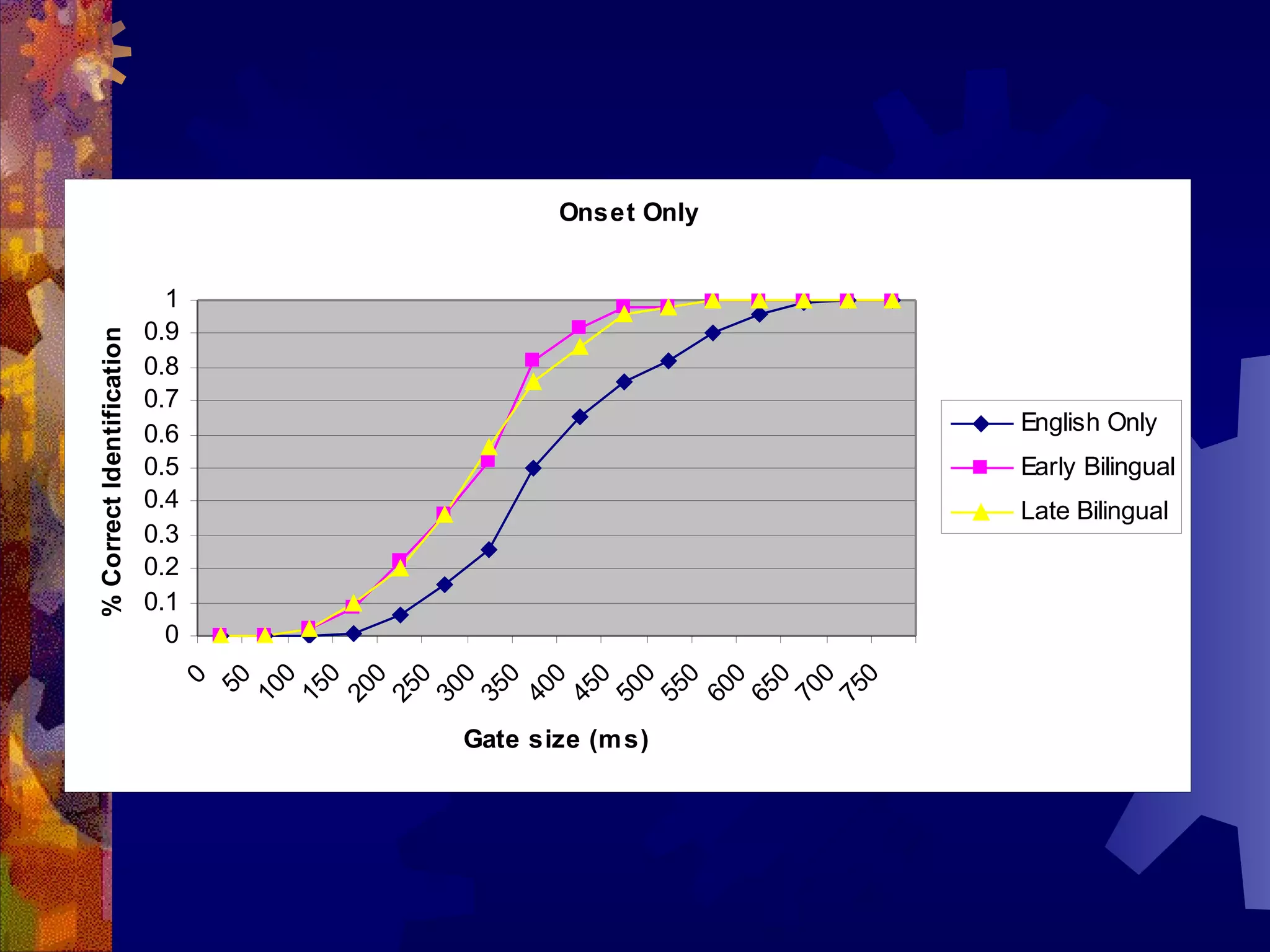
Onset Only


                             1
                           0.9
% Correct Identification


                           0.8
                           0.7
                           0.6                       English Only
                           0.5                       Early Bilingual
                           0.4                       Late Bilingual
                           0.3
                           0.2
                           0.1
                             0
                               0
                               0


                               0
                               0


                               0
                               0


                               0
                               0
                               0
                               0
                               0


                               0
                               0


                               0
                              50
                               0


                             55


                             75
                             10
                             15
                             20
                             25
                             30
                             35
                             40
                             45
                             50


                             60
                             65
                             70
                                 Gate size (m s)
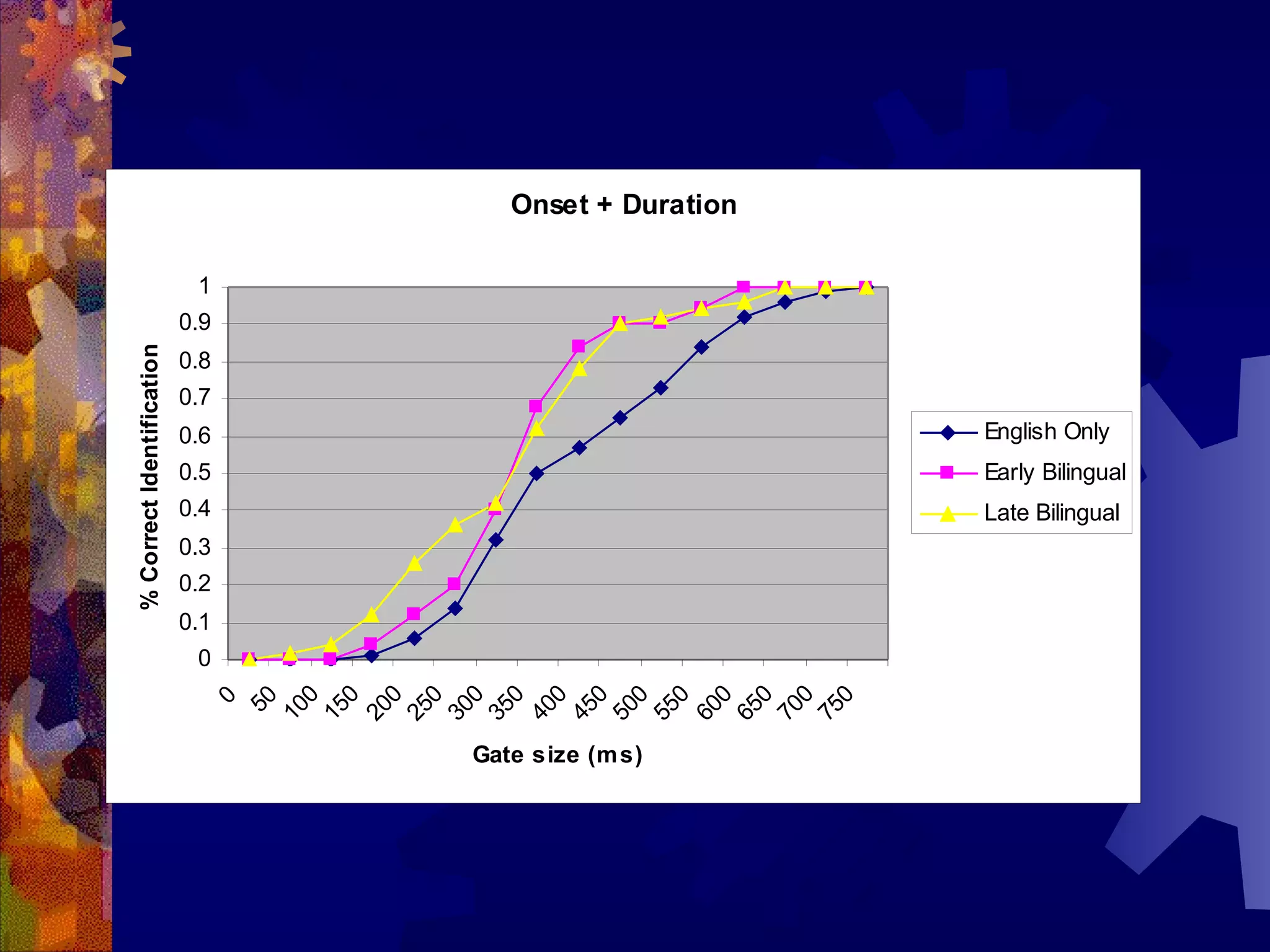
Onset + Duration

                      • 1=
                           0.9
% Correct Identification


                           0.8
                           0.7
                           0.6                         English Only
                           0.5                         Early Bilingual
                           0.4                         Late Bilingual
                           0.3
                           0.2
                           0.1
                            0
                                0
                                0
                                0


                                0
                                0
                                0
                                0


                                0
                                0
                                0
                                0
                               0


                               0


                               0
                              50
                               0

                             10
                             15
                             20
                             25
                             30
                             35
                             40
                             45
                             50
                             55
                             60
                             65
                             70
                             75
                                 Gate size (m s)
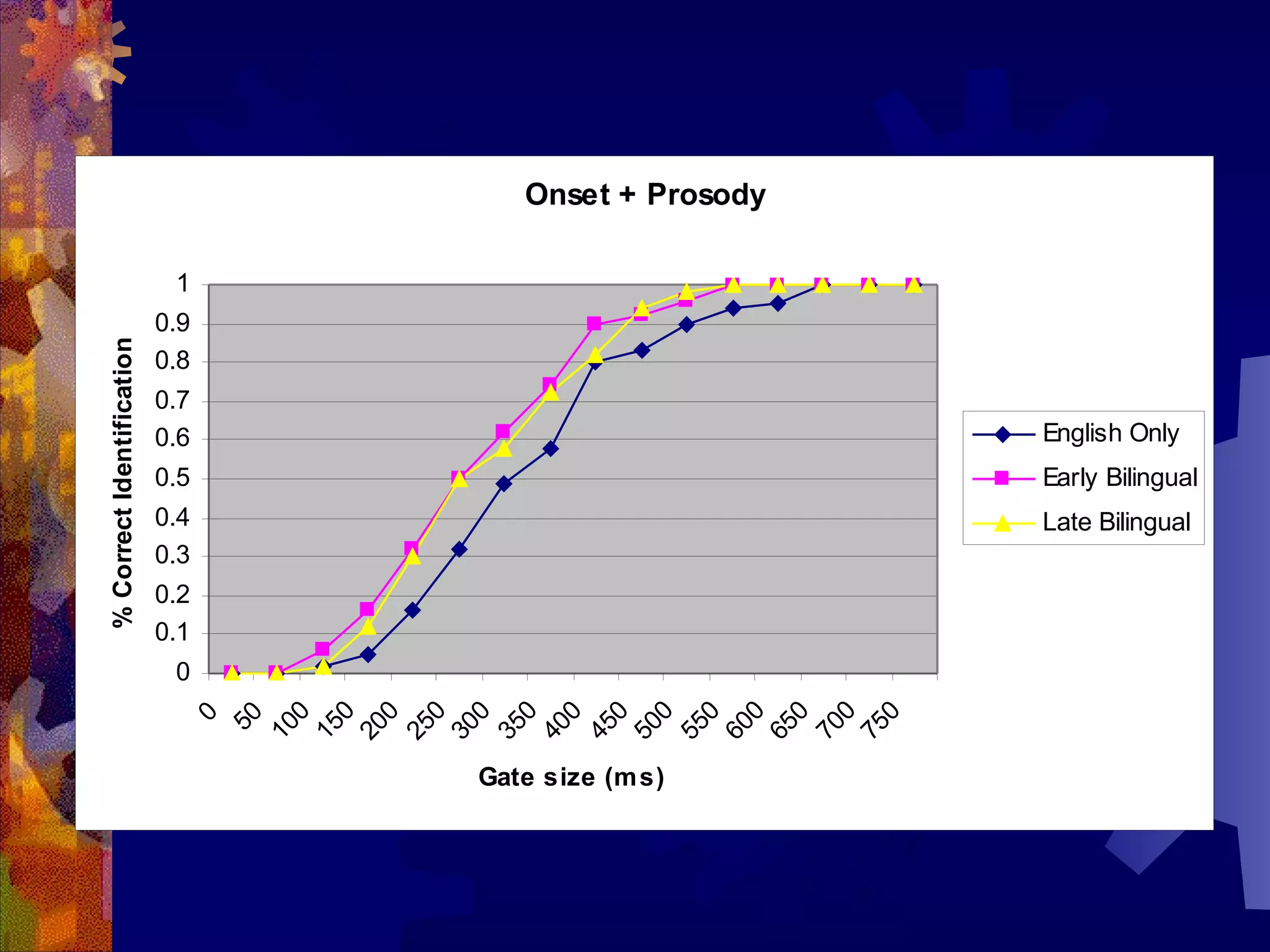
Onset + Prosody

                            1
                           0.9
% Correct Identification


                           0.8
                           0.7
                           0.6                        English Only
                           0.5                        Early Bilingual
                           0.4                        Late Bilingual
                           0.3
                           0.2
                           0.1
                            0
                                0


                                0


                                0


                                0


                                0


                                0
                               0


                               0


                               0


                               0
                               0


                               0


                               0


                               0
                              50
                               0

                             10
                             15


                             25


                             35


                             45
                             50
                             55
                             60


                             70
                             20


                             30


                             40


                             65


                             75
                                 Gate size (m s)
Discussion
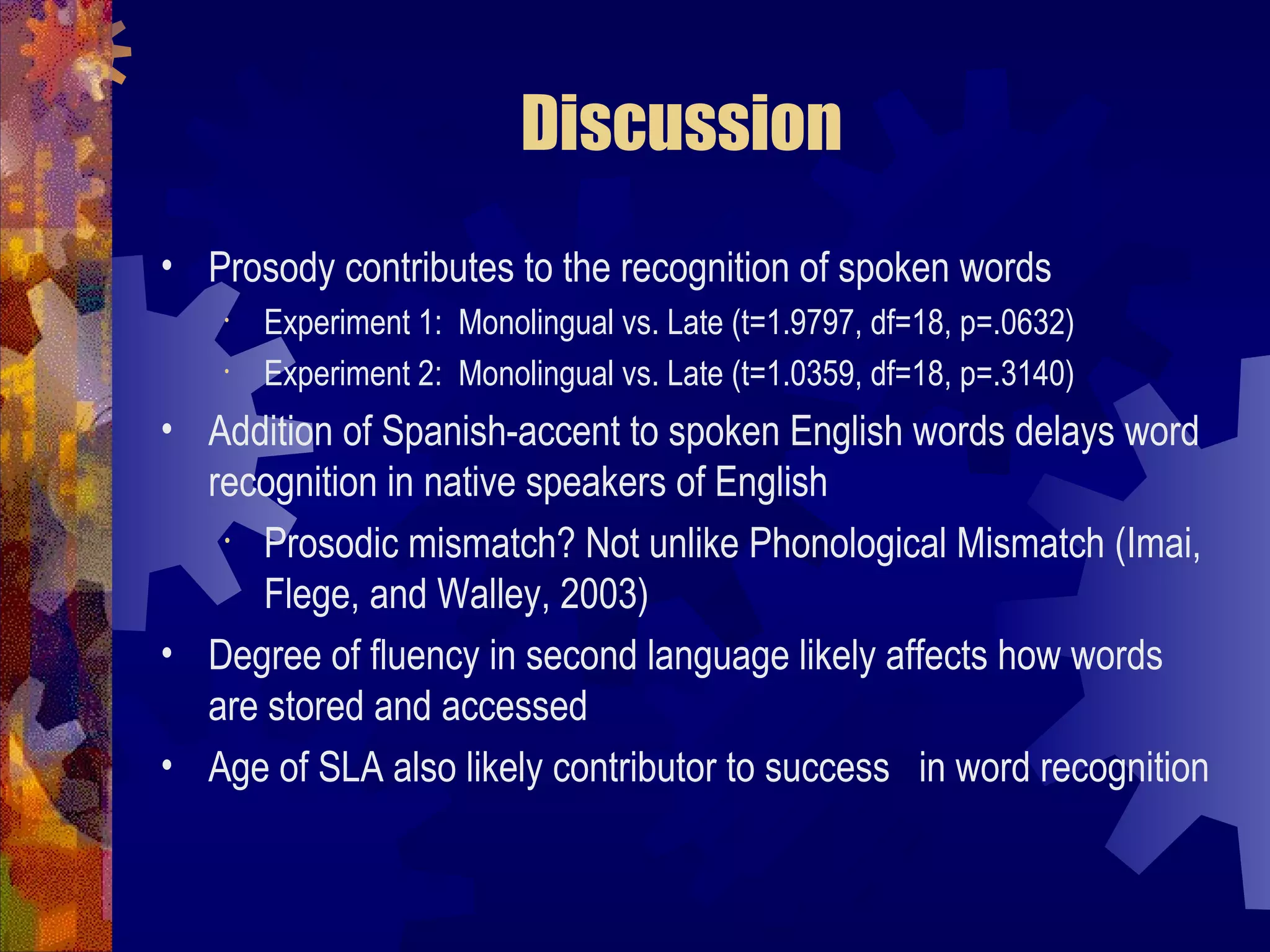
• Prosody contributes to the recognition of spoken words
    •   Experiment 1: Monolingual vs. Late (t=1.9797, df=18, p=.0632)
    •   Experiment 2: Monolingual vs. Late (t=1.0359, df=18, p=.3140)
• Addition of Spanish-accent to spoken English words delays word
  recognition in native speakers of English
   •  Prosodic mismatch? Not unlike Phonological Mismatch (Imai,
      Flege, and Walley, 2003)
• Degree of fluency in second language likely affects how words
  are stored and accessed
• Age of SLA also likely contributor to success in word recognition
Pilot Study
• Application of gating procedure to EEG
  paradigm
• To investigate functional differences that may
  exist been monolinguals and late bilinguals in
  terms of how and when prosody is used in the
  brain to assist with word recognition
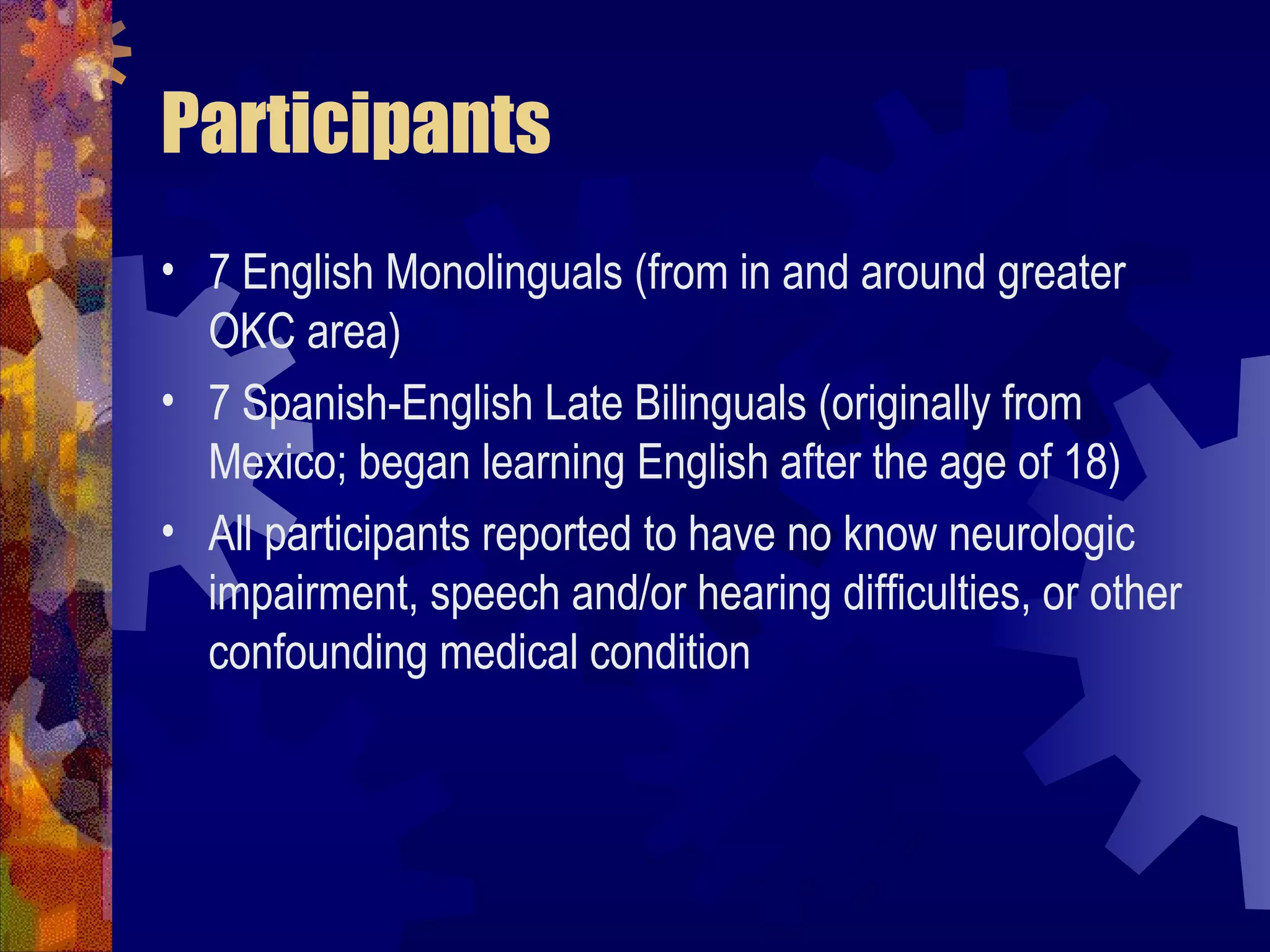
Participants
• 7 English Monolinguals (from in and around greater
  OKC area)
• 7 Spanish-English Late Bilinguals (originally from
  Mexico; began learning English after the age of 18)
• All participants reported to have no know neurologic
  impairment, speech and/or hearing difficulties, or other
  confounding medical condition
Materials
• 50 two syllable and 50 three syllable words
• All words are common nouns with a mean frequency of
  38 words per million in print (Francis & Kucera, 1982)
• Words were digitized and later manipulated in Audacity
  and Praat sound software applications
• Words filtered at 325 hz and gated with prosodic
  information only
• Target words began at 100 ms gate size and increased
  incrementally by 300 ms
Procedure
• Participant is connected to Nicolet version 5.3
  EEG analysis unit according to international 10-
  20 system with waves collected at 19 electrode
  sites (fp1, fp2, f7, f8, t3, t4, t5, t6, 01, 02, f3, f4,
  c3, c4, p3, p4, fz, cz, pz)
• Participants instructed to minimize facial
  movements, eye blinks, swallows, etc
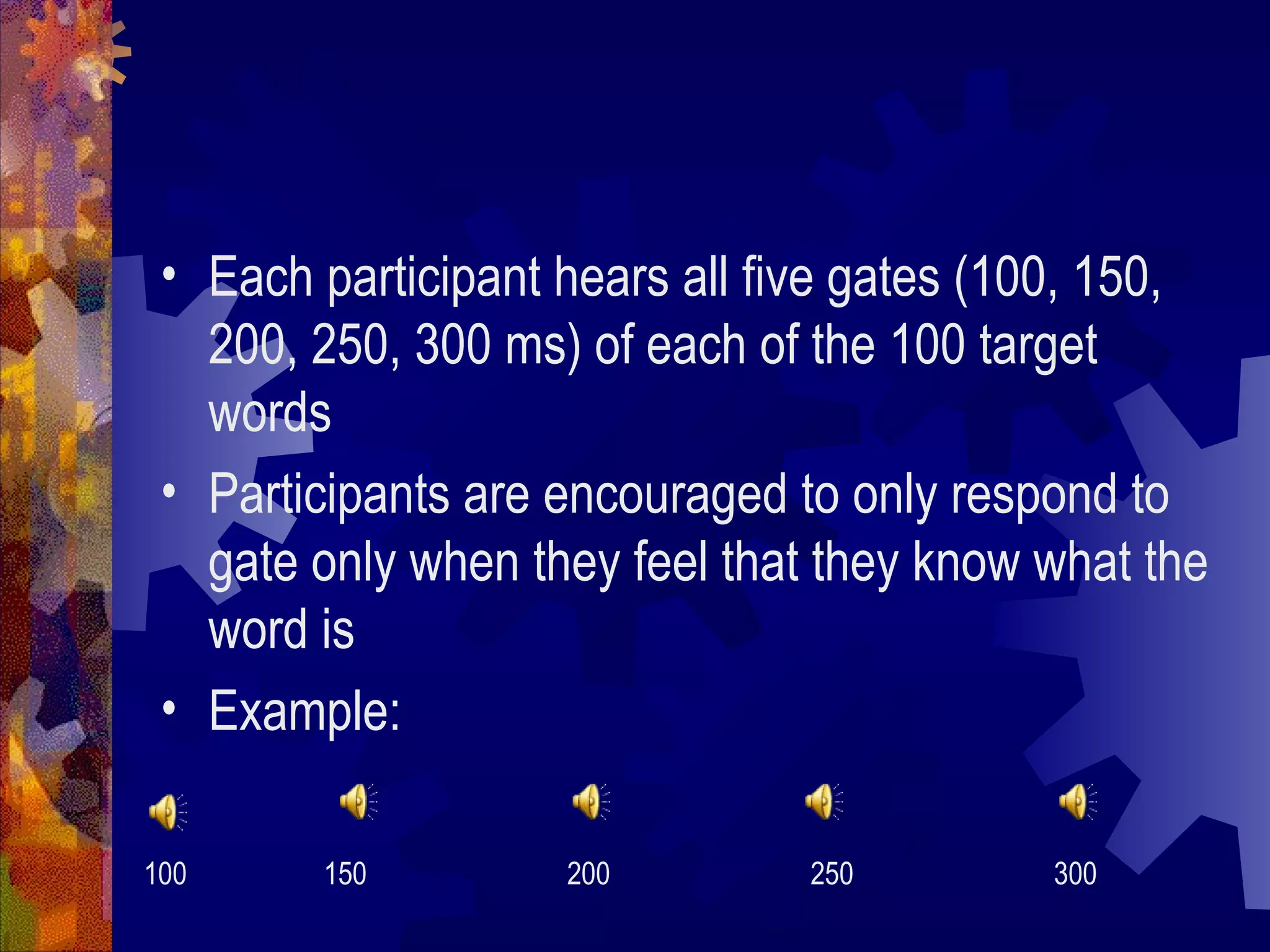
• Each participant hears all five gates (100, 150,
   200, 250, 300 ms) of each of the 100 target
   words
 • Participants are encouraged to only respond to
   gate only when they feel that they know what the
   word is
 • Example:

100     150         200         250        300
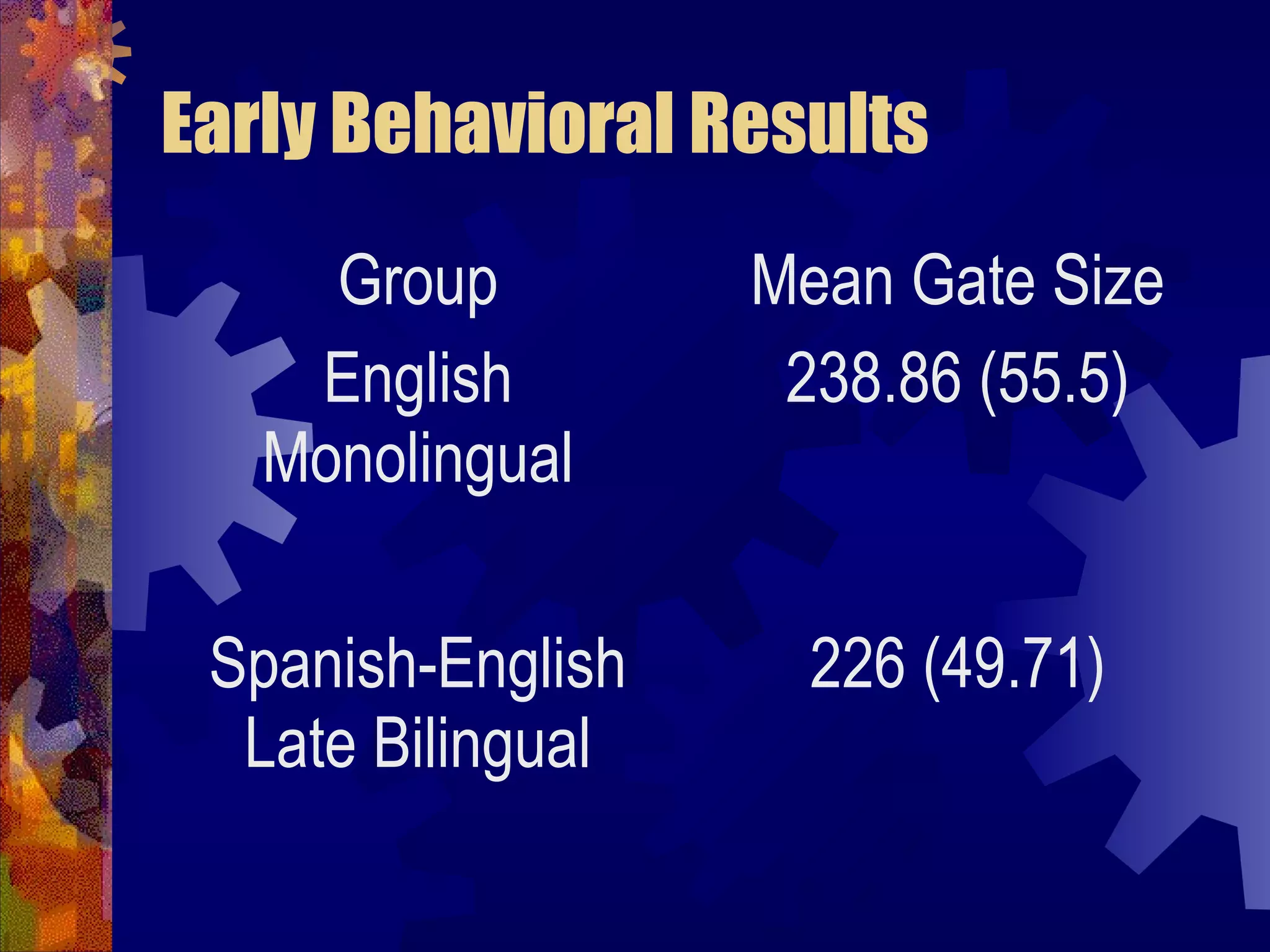
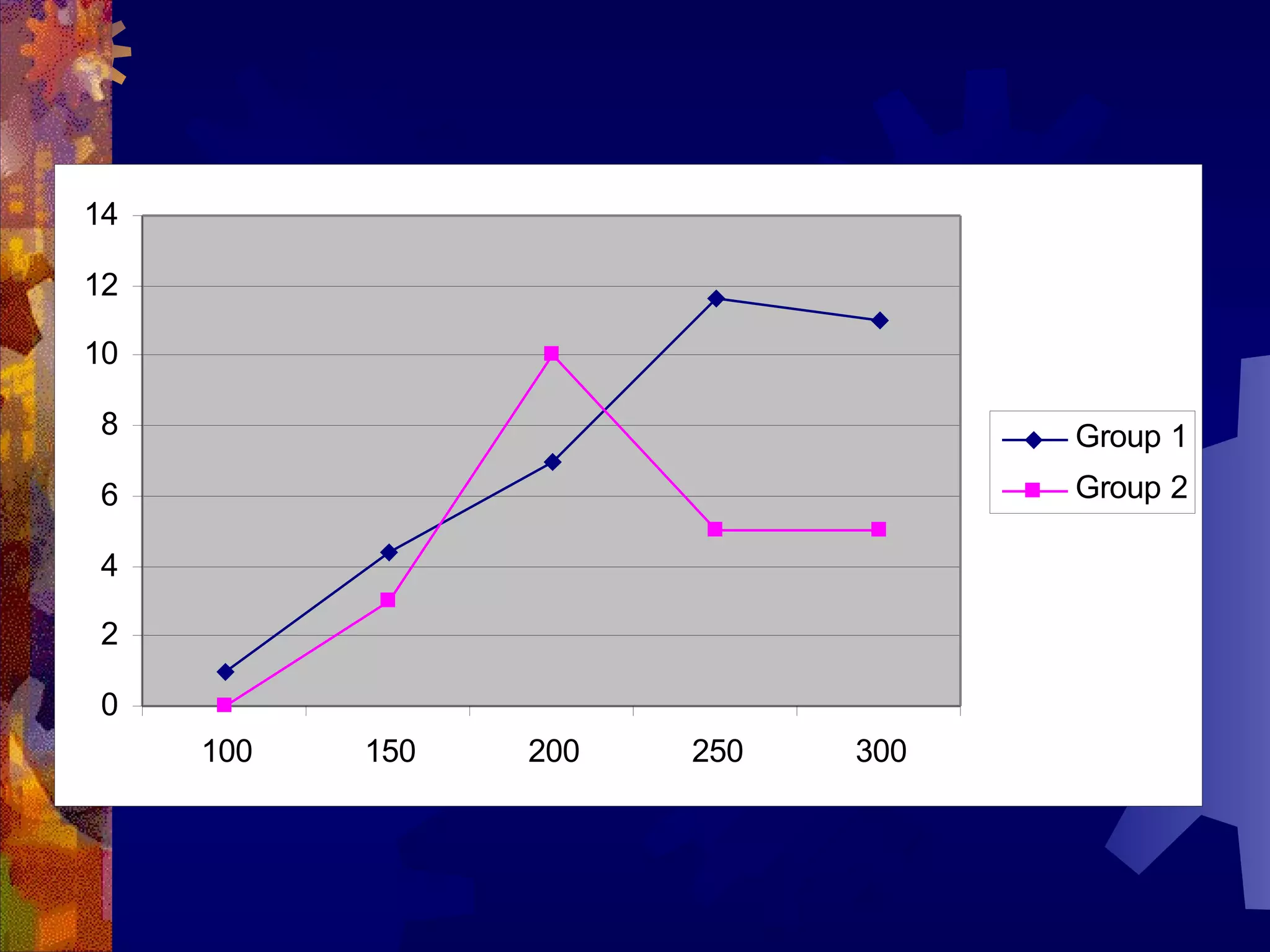
Early Behavioral Results
     Group         Mean Gate Size
    English         238.86 (55.5)
   Monolingual

 Spanish-English     226 (49.71)
  Late Bilingual
14

12

10

8                                  Group 1
6                                  Group 2

4

2

0
     100   150   200   250   300
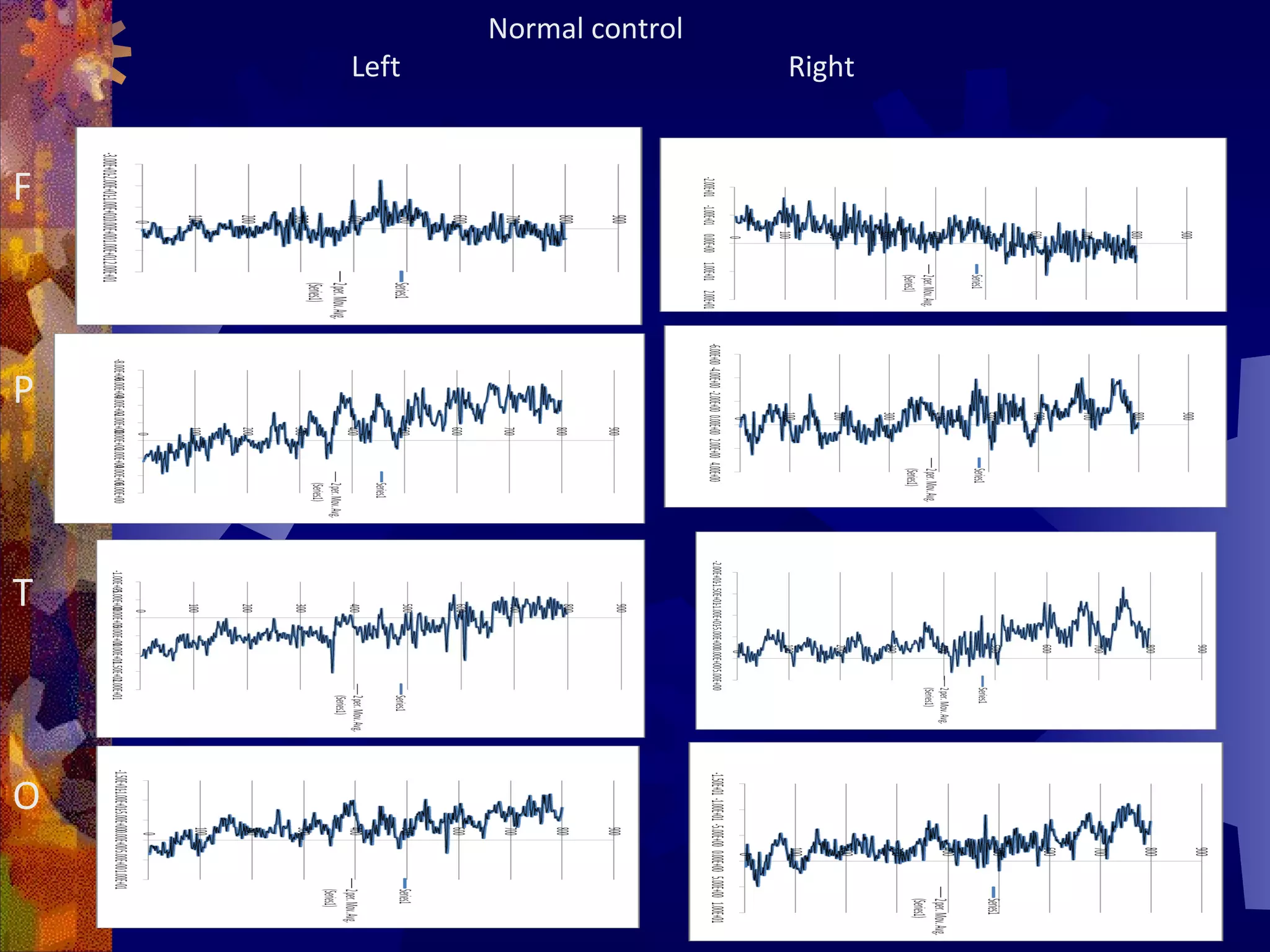
Normal control
    Left                    Right


F


P


T


O
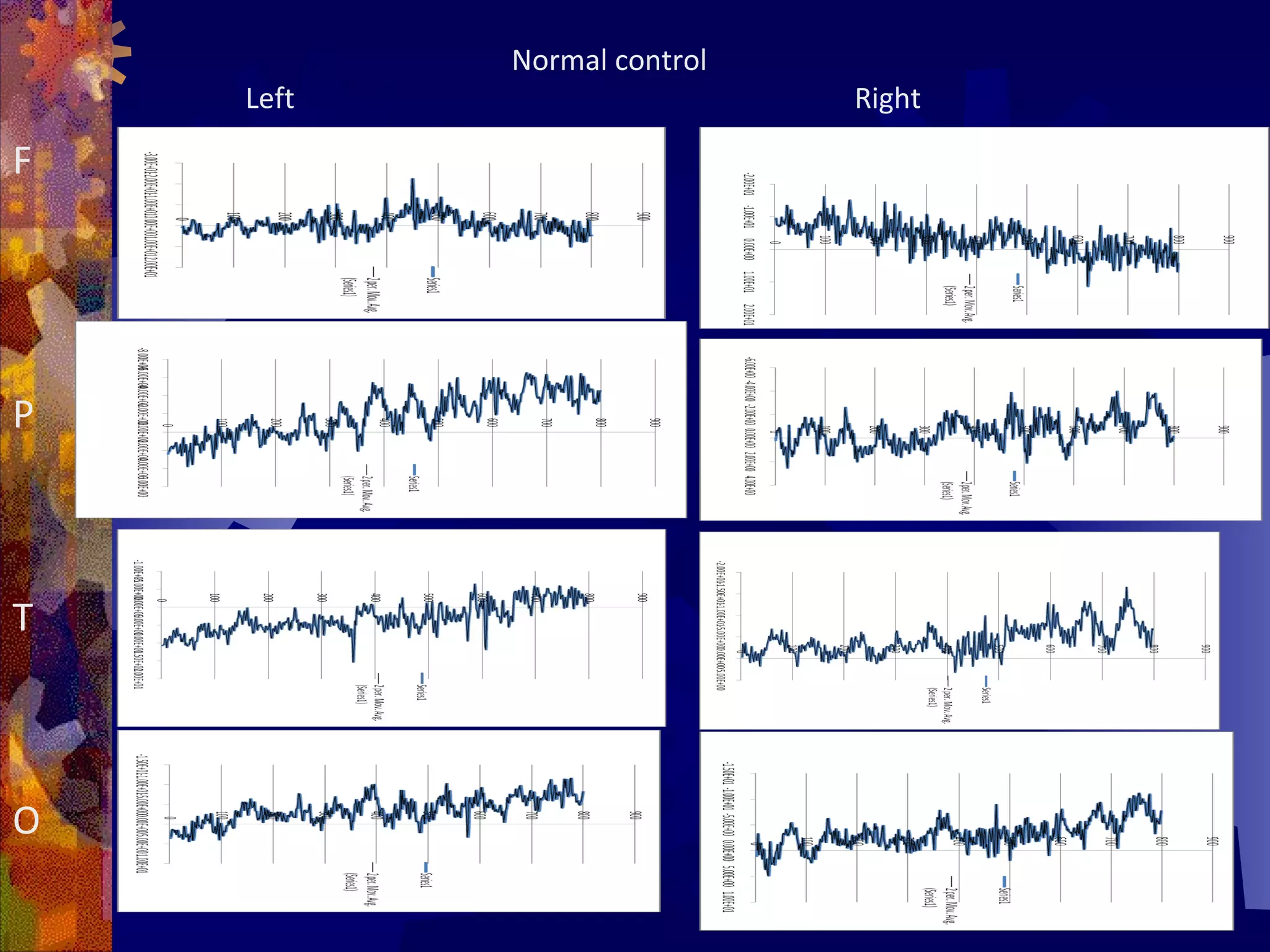
Normal control
    Left                    Right

F


P


T


O
Next Steps
• Deal with obstacles to this paradigm
• Further data analysis
• Possibly investigate word frequency effects
  and/or accent effects on word recognition
  between the two groups (in terms of event
  related potentials)
For more information
       OUHSC Department of
       Communication Sciences and
       Disorders
       1200 N Stonewall
       Oklahoma City, OK 73126
       (405) 271-4214
       Derick-Deweber@ouhsc.edu
       Frank-Boutsen@ouhsc.edu

Neural Correlates of Gated Word Recognition

  • 1.
    Neural Correlates ofGated Word Recognition in Bilinguals and Monolinguals Derick D. Deweber, MS, CCC-SLP Frank R. Boutsen, PhD, CCC-SLP 2009 ASHA Convention New Orleans, LA
  • 2.
    Presentation Overview • Reviewof models of word recognition • Discussion of first bilingual word recognition study • Discussion of pilot EEG study • Future directions
  • 3.
    Word Recognition inMonolinguals • Methods used to examine spoken word recognition • Findings from studies on word recognition • Models of spoken word recognition
  • 4.
    Experimental Methods • Lexicaldecision • Subject required to make decision based on stimulus; could be affected by word status, word frequency, and context • Priming • Subject makes decision following two words that may be related or unrelated (i.e., semantic priming) or may inform subject which language to use • Shadowing • Subject required to repeat back word as they hear it; words may contain semantically unpredictable errors • Gating • Subject makes decision about word after hearing increasing increments of a target word
  • 5.
    Experimental findings • Wordfrequency effects • More frequent words recognized faster than non- frequent words • Word supremacy effects • Target recognized more easily when it is a word; non-words less easily recognized • Context effects • Words are more easily recognized in context than when they occur alone • Distortion effects • Words are more easily recognized when distorted at the end than if distorted at the front
  • 6.
    Models of WordRecognition • Initial Cohort Model • Neighborhood Activation Model (NAM)
  • 7.
    Initial Cohort Model •Marslen-Wilson, 1990 • As initial phonemes of a word are heard, all words in the lexicon that share these phonemes are activated • Words that share phonemes and that are simultaneously activated are called a “cohort” • As more of the spoken word unfolds over time the relative size of the word’s cohort diminishes • This process unfolds until the target word is recognized
  • 8.
    Neighborhood Activation Model(NAM) • Luce, Pisoni, & Goldinger, 1990 • “Goodness of fit” model where word is identified based on fit of stimulus and features of alternatives (Connine, Blasko, & Titone, 1993) • Density of word’s “neighborhood” is based on shared phonemes of word and other words as well as the frequency of the words neighbors Frequency - • Does not account for prosodic sensitivity
  • 9.
    Gating Paradigm inWR Research • Wingfield et al., 1997 • Found that when a word is constrained by stress, cohort size is a better predictor of when the word will be recognized than when stress pattern is ignored • Lindfield, Wingfield, and Goodglass, 1999 • Found that words were correctly recognized with much less segmental (initial cohort) onset information when word prosody was available to subjects
  • 10.
    Experiment 1 • Applicationof gating paradigm established by Lindfield, Wingfield, and Goodglass, 1999 • the effect of prosody on word recognition in adult speakers of English, early bilingual (Spanish/English) late bilingual (Spanish/English) • How does English “accent” affect word recognition scores?
  • 11.
    Participants Group 1 Group 2 Group 3 English Early Bilinguals Late Bilinguals Monolinguals Age 40.2 years 32.5 years 37.8 years (8.80 (12.57 SD) (15.39 SD) SD) Gender 4 M - 6F 1M - 7F 1M - 9F Age Began 6.5 years (1.60 29 years (5.68 Speaking From Birth SD) SD) English Time Speaking From Birth 26 years (14.83 11 years (6.83 English SD) SD)
  • 12.
    Materials • 30 Englishwords • 12 two-syllable • 6 with stress on 1st syllable • 6 with stress on 2nd syllable • Ballet, diamond, dolphin, penguin, pumpkin, sparrow, window, cartoon, exhaust, guitar, quartet, hotel • 18 three-syllable • 6 with stress on 1st syllable • 6 with stress on 2nd syllable • 6 with stress on 3rd syllable • Celery, photograph, pineapple, radio, stadium, telescope, apartment, cathedral, foundation, horizon, umbrella, suspender, chandelier, engineer, gasoline, kangaroo, referee, violin
  • 13.
    • All wordsare common nouns with a mean frequency of 37 words per million in print (Francis & Kucera, 1982) • Spoken with carrier phrase “The word is” with normal intonation by a female speaker of American English • Words were digitized and later manipulated in Audacity and Praat sound software applications • Target words began at 50 ms gate size and increased incrementally by 50 ms
  • 14.
    Gated stimuli were presented in 3 conditions 1. Onset only 2. Onset plus duration 3. Onset plus prosody
  • 15.
    Onset Only 50 msgate 100 ms gate 150 ms gate 200 ms gate 250 ms gate 300 ms gate 350 ms gate 400 ms gate 450 ms gate 500 ms gate
  • 16.
    Onset plus Duration 50ms gate 100 ms gate 150 ms gate 200 ms gate 250 ms gate 300 ms gate 350 ms gate 400 ms gate 450 ms gate 500 ms gate
  • 17.
    Onset Plus Prosody 50ms gate 100 ms gate 150 ms gate 200 ms gate 250 ms gate 300 ms gate 350 ms gate 400 ms gate 450 ms gate 500 ms gate
  • 18.
    Procedure • Each subjectheard all 30 words (10 from each condition) • Words presented in increasing increments of 50 ms beginning with the first presentation at 50 ms • Procedure continued until subject correctly identified word • Words were blocked by condition, with conditions being counter-balanced across subjects
  • 19.
    Results Group Onset Only Onset + Onset + Duration Prosody English 323.5 359 (163.36) 283 (158.94) Monolinguals (112.02) Early 349.38 370.63 360.63 Bilinguals (113.21) (164.72) (158.85) Late 415.5 402.5 412.9 Bilinguals (121.98) (139.33) (133.39)
  • 20.
    Onset Only 1 0.9 % Correct Identification 0.8 0.7 0.6 English Only 0.5 Early Bilingual 0.4 Late Bilingual 0.3 0.2 0.1 0 0 0 0 0 0 0 0 0 0 0 0 0 0 0 50 0 10 25 45 55 75 15 20 30 35 40 50 60 65 70 Gate size (m s)
  • 21.
    Onset + Duration 1 0.9 % Correct Identification 0.8 0.7 0.6 English Only 0.5 Early Bilingual 0.4 Late Bilingual 0.3 0.2 0.1 0 0 0 0 0 0 0 0 0 0 0 0 0 0 0 50 0 15 25 75 10 20 30 35 40 45 50 55 60 65 70 Gate size (m s)
  • 22.
    Onset + Prosody 1 0.9 % Correct Identification 0.8 0.7 0.6 English Only 0.5 Early Bilingual 0.4 Late Bilingual 0.3 0.2 0.1 0 0 0 0 0 0 0 0 0 0 0 0 0 0 0 50 0 10 15 20 25 30 35 40 45 50 55 60 65 70 75 Gate size (m s)
  • 23.
    Experiment 2 • Sameparadigm as experiment 1 • Speaker with Spanish accent • How does Spanish “accented” English affect word recognition scores?
  • 24.
    Participants Group 1 Group 2 Group 3 English Early Late Monolinguals Bilinguals Bilinguals Age 40.2 years 32.5 years 37.8 years (12.57 SD) (15.39 SD) (8.80 SD) Gender 4 M - 6F 1M - 7F 1M - 9F Age Began 6.5 years 29 years Speaking From Birth (1.60 SD) (5.68 SD) English Time From Birth 26 years 11 years Speaking (14.83 SD) (6.83 SD) English
  • 25.
    Materials • 30 Englishwords • 12 two-syllable • 6 with stress on 1st syllable • 6 with stress on 2nd syllable • Atom, chicken, cotton, football, harbor, magic, award, debate, expense, remark, routine, affair • 18 three-syllable • 6 with stress on 1st syllable • 6 with stress on 2nd syllable • 6 with stress on 3rd syllable • Accident, artery, camera, funeral institute, graduate, assistant, composer, dependent, detective, formation, illusion, magazine, questionnaire, cigarette, personnel, volunteer, refugee
  • 26.
    • All wordsare common nouns with a mean frequency of 36.43 words per million in print (Francis & Kucera, 1982) • Spoken with carrier phrase “The word is” with normal intonation by a female speaker of American English with a Spanish accent • Words were digitized and later manipulated in Audacity and Praat sound software applications • Target words began at 50 ms gate size and increased incrementally by 50 ms
  • 27.
    Procedure • Each subjectheard all 30 words (10 from each condition) • Words presented in increasing increments of 50 ms beginning with the first presentation at 50 ms • Procedure continued until subject correctly identified word • Words were blocked by condition, with conditions counterbalanced across subjects
  • 28.
    • Gated stimuliin Experiment 2 were also presented in 3 conditions 1. Onset only 2. Onset plus duration 3. Onset plus prosody
  • 29.
    Onset Plus Prosody 50ms gate 100 ms gate 150 ms gate 200 ms gate 250 ms gate 300 ms gate 350 ms gate 400 ms gate 450 ms gate 500 ms gate
  • 30.
    Results Group Onset Only Onset + Onset + Duration Prosody English 447 (119.73) 465.5 398 (127.51) Monolinguals (140.47) Early 363.75 394.38 338.75 Bilinguals (95.80) (121.43) (112.22) Late 360 (111.24) 387 (130.77) 342 (113.87) Bilinguals
  • 31.
    Onset Only 1 0.9 % Correct Identification 0.8 0.7 0.6 English Only 0.5 Early Bilingual 0.4 Late Bilingual 0.3 0.2 0.1 0 0 0 0 0 0 0 0 0 0 0 0 0 0 0 50 0 55 75 10 15 20 25 30 35 40 45 50 60 65 70 Gate size (m s)
  • 32.
    Onset + Duration • 1= 0.9 % Correct Identification 0.8 0.7 0.6 English Only 0.5 Early Bilingual 0.4 Late Bilingual 0.3 0.2 0.1 0 0 0 0 0 0 0 0 0 0 0 0 0 0 0 50 0 10 15 20 25 30 35 40 45 50 55 60 65 70 75 Gate size (m s)
  • 33.
    Onset + Prosody 1 0.9 % Correct Identification 0.8 0.7 0.6 English Only 0.5 Early Bilingual 0.4 Late Bilingual 0.3 0.2 0.1 0 0 0 0 0 0 0 0 0 0 0 0 0 0 0 50 0 10 15 25 35 45 50 55 60 70 20 30 40 65 75 Gate size (m s)
  • 34.
    Discussion • Prosody contributesto the recognition of spoken words • Experiment 1: Monolingual vs. Late (t=1.9797, df=18, p=.0632) • Experiment 2: Monolingual vs. Late (t=1.0359, df=18, p=.3140) • Addition of Spanish-accent to spoken English words delays word recognition in native speakers of English • Prosodic mismatch? Not unlike Phonological Mismatch (Imai, Flege, and Walley, 2003) • Degree of fluency in second language likely affects how words are stored and accessed • Age of SLA also likely contributor to success in word recognition
  • 35.
    Pilot Study • Applicationof gating procedure to EEG paradigm • To investigate functional differences that may exist been monolinguals and late bilinguals in terms of how and when prosody is used in the brain to assist with word recognition
  • 36.
    Participants • 7 EnglishMonolinguals (from in and around greater OKC area) • 7 Spanish-English Late Bilinguals (originally from Mexico; began learning English after the age of 18) • All participants reported to have no know neurologic impairment, speech and/or hearing difficulties, or other confounding medical condition
  • 37.
    Materials • 50 twosyllable and 50 three syllable words • All words are common nouns with a mean frequency of 38 words per million in print (Francis & Kucera, 1982) • Words were digitized and later manipulated in Audacity and Praat sound software applications • Words filtered at 325 hz and gated with prosodic information only • Target words began at 100 ms gate size and increased incrementally by 300 ms
  • 38.
    Procedure • Participant isconnected to Nicolet version 5.3 EEG analysis unit according to international 10- 20 system with waves collected at 19 electrode sites (fp1, fp2, f7, f8, t3, t4, t5, t6, 01, 02, f3, f4, c3, c4, p3, p4, fz, cz, pz) • Participants instructed to minimize facial movements, eye blinks, swallows, etc
  • 39.
    • Each participanthears all five gates (100, 150, 200, 250, 300 ms) of each of the 100 target words • Participants are encouraged to only respond to gate only when they feel that they know what the word is • Example: 100 150 200 250 300
  • 40.
    Early Behavioral Results Group Mean Gate Size English 238.86 (55.5) Monolingual Spanish-English 226 (49.71) Late Bilingual
  • 41.
    14 12 10 8 Group 1 6 Group 2 4 2 0 100 150 200 250 300
  • 42.
    Normal control Left Right F P T O
  • 43.
    Normal control Left Right F P T O
  • 44.
    Next Steps • Dealwith obstacles to this paradigm • Further data analysis • Possibly investigate word frequency effects and/or accent effects on word recognition between the two groups (in terms of event related potentials)
  • 45.
    For more information OUHSC Department of Communication Sciences and Disorders 1200 N Stonewall Oklahoma City, OK 73126 (405) 271-4214 Derick-Deweber@ouhsc.edu Frank-Boutsen@ouhsc.edu