ASARECA collaboration with CGIAR and RTB 
Joseph Methu 
Head, Partnerships & Capacity Development 
RTB Annual Meeting, Entebbe 
October, 2014
ASARECA Geographic reach 
Established in 1994 by 10 member 
countries; now 11 member countries 
❖ASARECA region covers 8.5 million km2 
with about 350 million people 
❖Agriculture forms the source of livelihood 
for the bulk of the population 
❖Agriculture accounts for 43% of the sub-regional 
GDP.
Why was ASARECA established 
❖ Countries in the region are facing similar challenges and 
opportunities to improve agriculture’s performance. 
❖ Agro-ecological zones cut across political boundaries, 
and therefore, technologies developed in one country 
frequently find application in similar environments of 
other countries. 
❖ Great opportunities to promote agricultural led growth 
through sharing of Agricultural research results 
❖ Need for Regional collective action, collaboration and 
specialization 
❖ Leverage on resources where possible
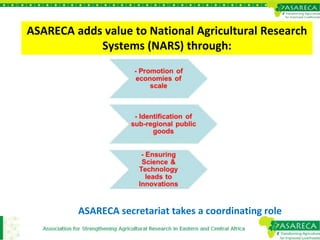
ASARECA adds value to National Agricultural Research 
Systems (NARS) through: 
ASARECA secretariat takes a coordinating role
ASARECA is operating on a 10 year Strategic Plan 
(2008 – 2017) supported mainly via a W/Bank 
managed MDTF 
Strategy being implemented under 2 Operational 
Plans : 2008 – 2013 and 2014 – 2018 
Development of 2014 – 2018 OP completed 
CONSULTATIVE 
PROCESS
OP 2 Thematic areas 
❖Natural Resource management and Eco-system 
services. 
❖Market, market linkages and trade 
❖Sustainable agriculture
ASARECA Outputs for MTOP2 
1. Appropriate technologies, innovations and 
management practices [TIMPs] generated 
2. Appropriate TIMPs disseminated and up-scaled 
3. Appropriate policy analysis and advocacy 
enhanced 
4. Stakeholder capacity for innovation 
strengthened 
5. Communication, information and knowledge 
management improved
PROPOSED ASARECA KI HUB 
Platforms 
for Info 
Exchange 
Learning 
and 
Innovation 
for AR4D 
Techn. & 
Information 
Clearing 
House 
KEY OUTCOME 
Equitable access & 
utilization of agricultural 
knowledge & information 
within and beyond ECA 
sub-region 
AR4D 
Think Tank
Creating Partnerships for Agricultural Innovation: How 
ASARECA operates 
At continental level ASARECA has partnerships with 
FARA, COMESA and AU-NEPAD to contribute to 
the CAADP agenda and the MDG goals 
The CGS is a process of creating partnerships for 
effective agricultural innovation 
Dublin initiative on aligning CGIAR to National 
CAADP processes 
- Linking CG with ASARECA programs 
- Productivity workshop 
- Science Agenda for African Agriculture
Partnerships for delivery of the ASARECA mission in 
the member countries in OP 1 
By end of OP 1, ASARECA will had implemented about 
70 projects in the 11 member countries. 
The projects will have been implemented through about 
420 partnerships (read sub-agreements) under CGS 
The 420 are formalized through sub-agreements. Many 
other informal partnerships could be identified
OP 1: Types of organizations in Partnerships with 
ASARECA 
Type of Institution Number of 
Partnerships 
NARIs 223 
Universities 59 
International Research 
33 
Institutions 
Private sector 22 
Government agents 42 
NGOs 37 
Others 7 
Total partnerships 423
Partnerships with CGIAR and CRPs 
CGIAR were central in implementation of ASARECA 
activities during net-works prior to current 
ASARECA programs 
CGIAR is part of ASARECA Governance through the 
BoD where they are represented by ILRI 
There are a few MoUs with CG Centers currently e.g 
ILRI for capacity building through BecA 
CGIAR CRPs ASARECA Collaboratin summary Oct 
2014.docx
Conclusions 
Huge opportunities for CGIAR to reach NARIs 
(impact??)by working with ASARECA 
Development of specific joint projects is a possibility also 
(Defining roles & responsibilities including finances) 
Need to formalize working relationships through MoUs, 
MoAs, contracts etc
Thank you

ASARECA collaboration with CGIAR and RTB

  • 1.
    ASARECA collaboration withCGIAR and RTB Joseph Methu Head, Partnerships & Capacity Development RTB Annual Meeting, Entebbe October, 2014
  • 2.
    ASARECA Geographic reach Established in 1994 by 10 member countries; now 11 member countries ❖ASARECA region covers 8.5 million km2 with about 350 million people ❖Agriculture forms the source of livelihood for the bulk of the population ❖Agriculture accounts for 43% of the sub-regional GDP.
  • 3.
    Why was ASARECAestablished ❖ Countries in the region are facing similar challenges and opportunities to improve agriculture’s performance. ❖ Agro-ecological zones cut across political boundaries, and therefore, technologies developed in one country frequently find application in similar environments of other countries. ❖ Great opportunities to promote agricultural led growth through sharing of Agricultural research results ❖ Need for Regional collective action, collaboration and specialization ❖ Leverage on resources where possible
  • 4.
    ASARECA adds valueto National Agricultural Research Systems (NARS) through: ASARECA secretariat takes a coordinating role
  • 5.
    ASARECA is operatingon a 10 year Strategic Plan (2008 – 2017) supported mainly via a W/Bank managed MDTF Strategy being implemented under 2 Operational Plans : 2008 – 2013 and 2014 – 2018 Development of 2014 – 2018 OP completed CONSULTATIVE PROCESS
  • 6.
    OP 2 Thematicareas ❖Natural Resource management and Eco-system services. ❖Market, market linkages and trade ❖Sustainable agriculture
  • 7.
    ASARECA Outputs forMTOP2 1. Appropriate technologies, innovations and management practices [TIMPs] generated 2. Appropriate TIMPs disseminated and up-scaled 3. Appropriate policy analysis and advocacy enhanced 4. Stakeholder capacity for innovation strengthened 5. Communication, information and knowledge management improved
  • 8.
    PROPOSED ASARECA KIHUB Platforms for Info Exchange Learning and Innovation for AR4D Techn. & Information Clearing House KEY OUTCOME Equitable access & utilization of agricultural knowledge & information within and beyond ECA sub-region AR4D Think Tank
  • 9.
    Creating Partnerships forAgricultural Innovation: How ASARECA operates At continental level ASARECA has partnerships with FARA, COMESA and AU-NEPAD to contribute to the CAADP agenda and the MDG goals The CGS is a process of creating partnerships for effective agricultural innovation Dublin initiative on aligning CGIAR to National CAADP processes - Linking CG with ASARECA programs - Productivity workshop - Science Agenda for African Agriculture
  • 10.
    Partnerships for deliveryof the ASARECA mission in the member countries in OP 1 By end of OP 1, ASARECA will had implemented about 70 projects in the 11 member countries. The projects will have been implemented through about 420 partnerships (read sub-agreements) under CGS The 420 are formalized through sub-agreements. Many other informal partnerships could be identified
  • 11.
    OP 1: Typesof organizations in Partnerships with ASARECA Type of Institution Number of Partnerships NARIs 223 Universities 59 International Research 33 Institutions Private sector 22 Government agents 42 NGOs 37 Others 7 Total partnerships 423
  • 12.
    Partnerships with CGIARand CRPs CGIAR were central in implementation of ASARECA activities during net-works prior to current ASARECA programs CGIAR is part of ASARECA Governance through the BoD where they are represented by ILRI There are a few MoUs with CG Centers currently e.g ILRI for capacity building through BecA CGIAR CRPs ASARECA Collaboratin summary Oct 2014.docx
  • 13.
    Conclusions Huge opportunitiesfor CGIAR to reach NARIs (impact??)by working with ASARECA Development of specific joint projects is a possibility also (Defining roles & responsibilities including finances) Need to formalize working relationships through MoUs, MoAs, contracts etc
  • 14.