10
Arts
Quarter 4 – Module 2:
Different Roles in Play Production
CO_Q4_Arts 10_ Module 2
Arts – Grade 10
Alternative Delivery Mode
Quarter 4 – Module 2: Different Roles in Play Production
First Edition, 2020
Republic Act 8293, section 176 states that: No copyright shall subsist in any work
of the Government of the Philippines. However, prior approval of the government agency or
office wherein the work is created shall be necessary for exploitation of such work for profit.
Such agency or office may, among other things, impose as a condition the payment of
royalties.
Borrowed materials (i.e., songs, stories, poems, pictures, photos, brand names,
trademarks, etc.) included in this module are owned by their respective copyright holders.
Every effort has been exerted to locate and seek permission to use these materials from
their respective copyright owners. The publisher and authors do not represent nor claim
ownership over them.
Published by the Department of Education
Secretary: Leonor Magtolis Briones
Undersecretary: Diosdado M. San Antonio
Writers: Freddie U. Dalilis Reymond A. Sebastian
Winifredo P. Pe Benito
Editors: Susana V. Vicerra Fatima A. Jimeno
Flora B. Tinaza Frances Jocelle C. Singson
Reviewers: Francis A. Domingo Marlon G. Taloza
Gina A. Amoyen Alma R. Tabilang
Jowell T. Pilotin
Illustrators: Christian Rey A. Ricarze
Layout Artists: Carina B. Buquing Sheryl R. Rialubin
Eugene S. Ignacio
Printed in the Philippines by
Department of Education – Region I
Office Address: Flores St., Catbangen, City of San Fernando, La
Union Telefax: (072) 682-2324; (072) 607-8137
E-mail Address: region1@deped.gov.ph.
Maria Salome R. Abero
Alma R. Tabilang
Management Team: Tolentino G. Aquino
Arlene A. Niro
Gina A. Amoyen
Editha T. Giron
Development Team of the Module
10
Arts
Quarter 4 – Module 2:
Different Roles in Play Production
Introductory Message
This Self-Learning Module (SLM) is prepared so that you, our dear learners, can
continue your studies and learn while at home. Activities, questions, directions,
exercises, and discussions are carefully stated for you to understand each lesson.
Each SLM is composed of different parts. Each part shall guide you step-by- step
as you discover and understand the lesson prepared for you.
Pre-tests are provided to measure your prior knowledge on lessons in each SLM.
This will tell you if you need to proceed on completing this module or if you need to ask
your facilitator or your teacher’s assistance for better understanding of the lesson. At
the end of each module, you need to answer the post-test to self-check your learning.
Answer keys are provided for each activity and test. We trust that you will be honest in
using these.
In addition to the material in the main text, Notes to the Teacher are also
provided to our facilitators and parents for strategies and reminders on how they can
best help you on your home-based learning.
Please use this module with care. Do not put unnecessary marks on any part of
this SLM. Use a separate sheet of paper in answering the exercises and tests. And read
the instructions carefully before performing each task.
If you have any questions in using this SLM or any difficulty in answering the
tasks in this module, do not hesitate to consult your teacher or facilitator.
Thank you.
1 CO_Q4_Arts 10_ Module 2
What I Need to Know
Hello! Learning is a long journey, right? In learning, doing all the prepared
activities is quite challenging, yet it is fun and interesting. In the previous module, you
have learned the different elements of art as applied to performance on stage plays. As
part of it, you were able to explain how ideas or themes of a play are communicated
through the integration of musical sounds, songs, dialogue, and dance.
This module will help you understand and realize how production designs for a
stage play are conceptualized and executed. You will also experience performing the
tasks assigned to the different roles in a play production.
Read the contents in each page before doing and answering the given activities
and assessments. You are advised to seek guidance from any member of your family
or even from your friends to help you achieve the goals set in this learning module.
In understanding and learning the module, you have to do the following:
1. read each page carefully;
2. follow directions strictly;
3. answer all questions on each page correctly and completely;
4. use a separate sheet of paper for your answers;
5. do not write anything on this module; and
6. ask for guidance from your teacher, parents, relatives, or friends if
necessary.
You can check your answers on the different activities and assessments through
the answer key at the latter part of the module. However, you are encouraged to work
independently and honestly.
Ready? Come on, Let us begin!
The Most Essential Learning Competencies:
1. Designs with a group the visual components of a school play (stage design,
costume, props, etc. (A10PR-IVe-1).
2. Assumes the role of a character as an actor/performance, or production staff
(director, choreography, light designer, stage manager). (A10PR-IVh-2); and
3. Contributes to the conceptualization of an original performance. (A10PR-IVd-4)
2 CO_Q4_Arts 10_ Module 2
3 CO_Q4_Arts 10_ Module 2
What I Know
PRE-ASSESSMENT
A. MULTIPLE CHOICE
Directions: Carefully read the questions below. Write the letter of the correct
answer in your activity notebook.
1. Who among the members of the production team takes an idea to an actual
play and delegates tasks to the team members?
A. Director
B. Playwright
C. Producer
D. Production manager
2. Producing a theatre play or movie is not a simple job. The complexity of it
requires people of different tasks which is called production team. Which of the
following is not a member of the team?
A. Audience
B. Choreographer
C. Director
D. Set designer
3. Who is a playwright?
A. A person who takes an idea of an actual play.
B. A person who writes the script plays and also known as dramatist.
C. A person who creates the world that the play’s characters are supposed
to live in.
D. A person who oversees the crews for the sets and props, the sound and
music, the lighting, and the costumes.
4. In a director’s point of view, which of the following questions is considered the
most essential idea to be considered in directing a play?
A. Why would I cast this person in this role?
B. How should the message be communicated to the audience?
C. Has the play been previously produced?
D. Who are the leading characters of the play?
5. Which of the following concepts are the focus of a lighting designer?
A. Role and setting
4 CO_Q4_Arts 10_ Module 2
B. Costume and props
C. Mood and atmosphere
D. Music and dance steps
5 CO_Q4_Arts 10_ Module 2
6. How does a choreographer work in the production of a play?
A. Chooses the sound effects need during the play.
B. Assists the dancers in the preparation of costumes.
C. Leads the actors and actress during dance numbers in the play.
D. Plans the dance steps that are suitable for the dance numbers in the
production.
7. How important props are in a stage play?
A. Makes the set look well-funded and planned.
B. Aids actors in the presentation of dance numbers.
C. Creates the mood and illusion of the entire set or stage.
D. Helps convey scene’s objectives and aid actors in communicating
message.
8. As a makeup designer, how will you make the role of a character look real?
A. Avoid using prosthetics and wigs.
B. Use different makeup colors and shades.
C. Match makeup of the characters with their costumes.
D. Apply simple and light make up that is suitable to each actor.
9. Which of the following visual components of a stage play is used to create an
illusion that reveals the characters portrayed by the performers?
A. Stage settings
B. Lighting design
C. Costume design
D. Properties or props
10. Lighting design enhances or provides the overall mood of the performance.
Which of the following is not a function of light?
A. It serves as a motivation.
B. It involves mood and illusion.
C. It emphasizes structure and rhythm.
D. It conveys meanings, time periods, and historical context.
B. TRUE OR FALSE:
Directions: Write T if the statement is correct or F if the statement is wrong. Write
your answers in your notebook.
1. The way actors dress for their roles is the task of the costume and makeup
designer.
2. The properties of a play include the stage props and hand props.
6 CO_Q4_Arts 10_ Module 2
3. Lighting design enhances the effect of other visual elements.
4. The production team is responsible preparing and setting up every scene in the
play.
5. The producer is not a member of the production team.
7 CO_Q4_Arts 10_ Module 2
Lesson
1
Different Roles in Play
Production
What’s In
From the previous module, you learned about the original performances of
various performing groups in different theaters as well as the art elements applied in
those performances.
In this module, you will be assuming the roles of a character in a particular
performance. You may also be doing the tasks of a production team specifically, design
a visual component of a school play.
What’s New
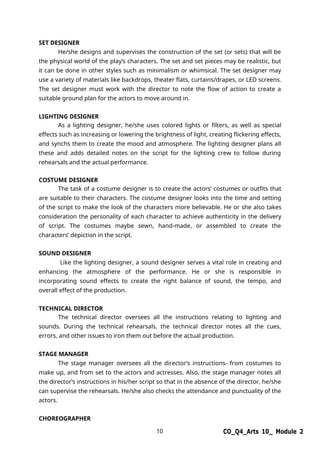
Picture Analysis
Directions: Write at least three sentences about the possible tasks that are being done
as seen in the picture below (Duration: 5 mins.)
www.dickinson.edu/info/20031/theatre_and_dance/259/production_and_performance
8 CO_Q4_Arts 10_ Module 2
What is It
Role of a Character as an Actor/Performer, or Production staff
Producing a theatre play or movie is not a simple job. The complexity of it is
undeniably present which requires people to perform different tasks. Aside from the
actors who take the center stage, much of the work is being done behind the scenes,
and these people are called the production team. Let us look at the different roles of
the members of the production team.
PRODUCER
One of the main roles of a producer is to oversee the overall aspects of the
production. He or she is responsible to the financial and managerial functions of the
production. The producer provides financial backing to the production or invites
investors to pour in financing, and hires the creative staffs like the director, writers,
choreographer, and composer. Though the casting of actors is a job for the director, a
producer has the power of casting approval. A producer acts like a bridge to connect
financing or business in the realization of the playwright’s vision.
However, in school setting, the teacher, or the school itself acts as the producer.
DIRECTOR
The director provides the overall vision and guidance of a performance,
ensuring that all elements are unified, and that production runs smoothly. The director
works closely with the design and production teams and sometimes with the
playwright to hone the vision and define the production schedule. He or she ensures
that all elements are executed perfectly and that everyone in the production are in
tune with his/her artistic vision to create a great impact in the audience.
The director guides and instructs the actors in all the phases of rehearsals.
PLAYWRIGHT
The playwright develops the concepts and puts them into script plays. The script
forms the basis of the entire production. It contains the narrative through dialogues,
and it may also have the description of settings, sounds, mood, lights, costumes, and
makeup of the characters.
PRODUCTION MANAGER
The production manager is tasked in overseeing the crews for the sets and
props, the sound and music, the lighting, and the costumes. He or she manages the
9 CO_Q4_Arts 10_ Module 2
behind-the-scenes of the production.
10 CO_Q4_Arts 10_ Module 2
SET DESIGNER
He/she designs and supervises the construction of the set (or sets) that will be
the physical world of the play’s characters. The set and set pieces may be realistic, but
it can be done in other styles such as minimalism or whimsical. The set designer may
use a variety of materials like backdrops, theater flats, curtains/drapes, or LED screens.
The set designer must work with the director to note the flow of action to create a
suitable ground plan for the actors to move around in.
LIGHTING DESIGNER
As a lighting designer, he/she uses colored lights or filters, as well as special
effects such as increasing or lowering the brightness of light, creating flickering effects,
and synchs them to create the mood and atmosphere. The lighting designer plans all
these and adds detailed notes on the script for the lighting crew to follow during
rehearsals and the actual performance.
COSTUME DESIGNER
The task of a costume designer is to create the actors’ costumes or outfits that
are suitable to their characters. The costume designer looks into the time and setting
of the script to make the look of the characters more believable. He or she also takes
consideration the personality of each character to achieve authenticity in the delivery
of script. The costumes maybe sewn, hand-made, or assembled to create the
characters’ depiction in the script.
SOUND DESIGNER
Like the lighting designer, a sound designer serves a vital role in creating and
enhancing the atmosphere of the performance. He or she is responsible in
incorporating sound effects to create the right balance of sound, the tempo, and
overall effect of the production.
TECHNICAL DIRECTOR
The technical director oversees all the instructions relating to lighting and
sounds. During the technical rehearsals, the technical director notes all the cues,
errors, and other issues to iron them out before the actual production.
STAGE MANAGER
The stage manager oversees all the director’s instructions- from costumes to
make up, and from set to the actors and actresses. Also, the stage manager notes all
the director’s instructions in his/her script so that in the absence of the director, he/she
can supervise the rehearsals. He/she also checks the attendance and punctuality of the
actors.
CHOREOGRAPHER
11 CO_Q4_Arts 10_ Module 2
The choreographer is responsible with the dance steps that are suitable for the
dance numbers of the production. In case there are fight scenes, he or she will
choreograph the scenes in accordance with the director’s vision and ensure safety for
the actors and actresses.
12 CO_Q4_Arts 10_ Module 2
MAKEUP DESIGNER
The makeup designer works closely with the costume designer to achieve a suitable
look. The makeup designer makes the actors look real and believable based on their
emotions, age, personality as well as the time and place of the events of the play. In
some cases, a makeup designer may use prosthetics, wigs, masks, and other
accessories to alter and suit the character’s role.
Take note that an entire production also involves the business aspect as we
mentioned earlier in the role a producer. There are many other possible roles/tasks but
sometimes, in a school production where manpower is limited, a few people might do
multiple tasks. A few of theses tasks include publicity, marketing, box- office, front-of-
house duties, and ushering.
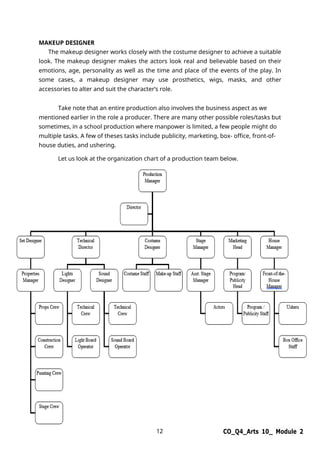
Let us look at the organization chart of a production team below.
13 CO_Q4_Arts 10_ Module 2
Visual Components of Stage Play
The visual elements of a play are things that appeal and give a sensory
experience to the audience such as the stage setting, lighting, costume, and props. It
may also include the composition and physical relationship of the performers on stage
and with the audience through striking displays and spectacle.
STAGE SETTINGS
Stage setting is used to create an environment that will bring the script to life. It
includes the use of composition in art such as line, mass, color, form, and unity that
allows the movements of the performers in space. A stage setting or scenic design
includes the drawing elements such as basic ground plan where the static scenic
elements are placed, the composite ground plan where the moving scenic elements
are placed, section of the stage space, and the front elevations. Scenic designers use
models before the final drawings that are needed to be made or constructed.
LIGHTING DESIGN
The lighting design is as important as the stage settings since it contributes to
the the overall mood of the performance. The functions of light in play include mood
and illusion, structure and rhythm, and lighting motivation. Each function plays
differently in its own way.
COSTUME DESIGN
The costume used by the performers helps convey meanings, time periods and
historical context. It shows vital scenes and the relationship between people, showing,
a particular period, weather, or location of the scene; revealing the characters
portrayed by the performers.
PROPERTIES/PROPS
The properties of a play include the stage props and hand props that are used
as part of the scene setting. The stage props may include jar, lampshades, furniture,
pictures, chairs, and tables, and many more. Hand props, on the other hand, include
ballpen, glasses, cup, pencils, cigarettes, and others. Properties are essential to convey
a scene’s objectives and to aid the actors in communicating a scene
14 CO_Q4_Arts 10_ Module 2
What’s More
Activity 1
Directions: Match the correct roles and functions of the following productions staffs in
the column A to column B.
Production Staffs Roles and Functions
1. Producer
a. He/she creates the storyline of the
play.
2. Director
b. He/she provide the financing and
oversee the overall production.
3. Playwright
c. He/she is tasked to plan out all the
dance steps to suit the music and
rehearses the actors until they can
perform the dance skillfully.
4. Set Designer
d. He/she sets up the actual stage of the
production.
5. Light Designer
e. He/she has the vision of the desired
total effect and impact of the
performance.
6. Costume Designer
f. He/she carefully notes how each
actor and every member of the
stage, sound, lighting, and costume
crews need to be coordinated to
bring the director’s vision to life.
7. Sound Designer
g. He/she is tasked with overseeing the
crews for the sets and props, the
sound and music, the lighting, and
the costumes.
8. Production Manager
h. He/she is tasked to manage the
music needed during the
performance.
9. Technical Director
i. He/she makes the actors look natural
for their respective roles— based on
their characters’ age and
personality, and the time and place
of the story.
10. Choreographer
j. He/she uses colored lights or filters,
as well as special effects such as
gradual dimming or brightening, a
speckled effect like sunlight
through leaves, or
flickering lights to create the mood.
15 CO_Q4_Arts 10_ Module 2
11. Makeup Designer
k. He/she decides what attire will be
used; does not only give the
audience a clear sense of the setting
but will also express each
character’s personality and distinct
qualities.
l. He/she looks at the details searching
for evidence through research to
produce conceptual ideas that best
support the content and values with
visual elements.
Activity 2
Directions: Chose one of the production staffs and imagine yourself getting involved
in the production of a school stage play. After which, write down 3-5 tasks of your
chosen role during the pre-production, show time, and post-production periods.
Role
Pre-production/
Rehearsal Period
Tasks
Show Time Tasks Post-production
Tasks
What I Have Learned
Direction: Express your knowledge and reflections of the lesson by completing the exit
cards.
Things I have learned…
16 CO_Q4_Arts 10_ Module 2
17 CO_Q4_Arts 10_ Module 2
What I Can Do
Costume Making
Directions: If you are going to create character in your own stage play, how would you
showcase it using a costume or make up? Identify the character and write a brief
description about him or her. You can use yourself as a demonstration character. Take
a photo of the result and send it your teacher. Follow the rubrics for your guide.
4 pts. 3 pts. 2 pts. 1 pt. Score
Costume/ Costume/ Costume/ The costume/
makeup wholly makeup makeup makeup is found
represents the relatively inadequately to be out of
Authenticity
character represents
the character
represents the
character.
compliance with
the dress code
and poorly
represents the
character
The costume/ The The The
Things I want to treasure…
Things I want to know more…
18 CO_Q4_Arts 10_ Module 2
Originality
makeup is
unique and
imaginative.
costume/ma
keup is quite
original and
presentable.
costume/mak
eup is
conventional
and like
others.
costume/makeu
p lacks
originality and
imagination.
Creativity
The
costume/make
up is unique,
imaginative,
unexpected,
unusual, and
well thought
out.
Well thought
out and went
to some
trouble to be
creative and
unexpected.
Costume/mak
eup is put
together
adequately.
Expected and
nothing out of
the ordinary.
Presentation
Demonstrator
can represent
the character
WELL and
convinces the
audience.
Demonstrator
can SOMEWHAT
represent the
character and
TRIES to
convince the
audience.
Demonstrator
can POORLY
represent the
character well
and
STRUGGLES
to convince
the audience.
Demonstrator
DOES NOT
represent the
character well
and FAILS to
convince the
audience.
Assessment
A. TRUE OR FALSE:
Direction: Write T if the statement is correct or F if the statement is wrong. Write
your answers in your notebook.
1. The producer is not a member of the production team.
2. Lighting design enhances the effect of other visual elements.
3. The properties of a play include the stage props and hand props.
4. The way actors dress for their roles is the task of the costume and makeup
designer.
5. The production team is responsible preparing and setting up every scene in the
play.
19 CO_Q4_Arts 10_ Module 2
B. MULTIPLE CHOICE
Direction: Carefully read the questions below. Write the letter of the correct
answer in your notebook.
6. Lighting design collaborates and provides the overall mood of the performance.
Which of the following is not a function of light?
A. It serves as a motivation.
B. It involves mood and illusion.
C. It emphasizes structure and rhythm.
D. It conveys meanings, time periods, and historical context.
7. Who among the members of the production team takes an idea to an actual
play and delegates tasks to the team members?
A. Director
B. Playwright
C. Producer
D. Production manager
8. Who is a playwright?
A. A person who takes an idea of an actual play.
B. A person who writes the script plays and also known as dramatist.
C. A person who creates the world that the play’s characters are supposed
to live in.
D. A person who oversees the crews for the sets and props, the sound and
music, the lighting, and the costumes.
9. In a director’s point of view, which of the following questions is considered the
most essential idea to be considered in directing a play?
A. Why would I cast this person in this role?
B. How should the message be communicated to the audience?
C. Has the play been previously produced?
D. Who are the leading characters of the play?
10. Which of the following visual components of a stage play is used to create an
environment that reveals the characters portrayed by the performers?
A. Stage settings
B. Lighting design
C. Costume design
D. Properties/Props
11. Which of the following concepts are the focus of a lighting designer?
20 CO_Q4_Arts 10_ Module 2
A. Role and setting
B. Costume and props
C. Mood and atmosphere
D. Music and dance steps
21 CO_Q4_Arts 10_ Module 2
12. How important props are in a stage play?
A. Makes the set look well-funded and planned.
B. Aids actors in the presentation of dance numbers.
C. Creates the mood and illusion of the entire set or stage.
D. Helps convey scene’s objectives and aid actors in communicating
message.
13. How does a choreographer work in the production of a play?
A. Chooses the sound effects need during the play.
B. Assists the dancers in the preparation of costumes.
C. Leads the actors and actress during dance numbers in the play.
D. Plans the dance steps that are suitable for the dance numbers in the
production.
14. As a makeup designer, how will you make the role of a character looks real?
A. Avoid using prosthetics and wigs.
B. Use different makeup colors and shades.
C. Match makeups of the characters with their costumes.
D. Apply simple and light make up that is suitable to each actor.
15. Producing a theatre play or movie is not a simple job. The complexity of it
requires people of different tasks which is called production team. Which
of the following is not a member of the team?
A. Audience
B. Choreographer
C. Director
D. Set designer
22 CO_Q4_Arts 10_ Module 2
.
.
23 CO_Q4_Arts 10_ Module 2
For inquiries or feedback, please write or call:
Department of Education - Bureau of Learning Resources (DepEd-BLR)
Ground Floor, Bonifacio Bldg., DepEd Complex
Meralco Avenue, Pasig City, Philippines 1600
Telefax: (632) 8634-1072; 8634-1054; 8631-4985
Email Address: blr.lrqad@deped.gov.ph * blr.lrpd@deped.gov.ph

ARTS MAPEH 10-QUARTER 4-MODULE 2(2).docx

  • 1.
    10 Arts Quarter 4 –Module 2: Different Roles in Play Production
  • 2.
  • 3.
    Arts – Grade10 Alternative Delivery Mode Quarter 4 – Module 2: Different Roles in Play Production First Edition, 2020 Republic Act 8293, section 176 states that: No copyright shall subsist in any work of the Government of the Philippines. However, prior approval of the government agency or office wherein the work is created shall be necessary for exploitation of such work for profit. Such agency or office may, among other things, impose as a condition the payment of royalties. Borrowed materials (i.e., songs, stories, poems, pictures, photos, brand names, trademarks, etc.) included in this module are owned by their respective copyright holders. Every effort has been exerted to locate and seek permission to use these materials from their respective copyright owners. The publisher and authors do not represent nor claim ownership over them. Published by the Department of Education Secretary: Leonor Magtolis Briones Undersecretary: Diosdado M. San Antonio Writers: Freddie U. Dalilis Reymond A. Sebastian Winifredo P. Pe Benito Editors: Susana V. Vicerra Fatima A. Jimeno Flora B. Tinaza Frances Jocelle C. Singson Reviewers: Francis A. Domingo Marlon G. Taloza Gina A. Amoyen Alma R. Tabilang Jowell T. Pilotin Illustrators: Christian Rey A. Ricarze Layout Artists: Carina B. Buquing Sheryl R. Rialubin Eugene S. Ignacio Printed in the Philippines by Department of Education – Region I Office Address: Flores St., Catbangen, City of San Fernando, La Union Telefax: (072) 682-2324; (072) 607-8137 E-mail Address: region1@deped.gov.ph. Maria Salome R. Abero Alma R. Tabilang Management Team: Tolentino G. Aquino Arlene A. Niro Gina A. Amoyen Editha T. Giron Development Team of the Module
  • 4.
    10 Arts Quarter 4 –Module 2: Different Roles in Play Production
  • 6.
    Introductory Message This Self-LearningModule (SLM) is prepared so that you, our dear learners, can continue your studies and learn while at home. Activities, questions, directions, exercises, and discussions are carefully stated for you to understand each lesson. Each SLM is composed of different parts. Each part shall guide you step-by- step as you discover and understand the lesson prepared for you. Pre-tests are provided to measure your prior knowledge on lessons in each SLM. This will tell you if you need to proceed on completing this module or if you need to ask your facilitator or your teacher’s assistance for better understanding of the lesson. At the end of each module, you need to answer the post-test to self-check your learning. Answer keys are provided for each activity and test. We trust that you will be honest in using these. In addition to the material in the main text, Notes to the Teacher are also provided to our facilitators and parents for strategies and reminders on how they can best help you on your home-based learning. Please use this module with care. Do not put unnecessary marks on any part of this SLM. Use a separate sheet of paper in answering the exercises and tests. And read the instructions carefully before performing each task. If you have any questions in using this SLM or any difficulty in answering the tasks in this module, do not hesitate to consult your teacher or facilitator. Thank you.
  • 7.
    1 CO_Q4_Arts 10_Module 2 What I Need to Know Hello! Learning is a long journey, right? In learning, doing all the prepared activities is quite challenging, yet it is fun and interesting. In the previous module, you have learned the different elements of art as applied to performance on stage plays. As part of it, you were able to explain how ideas or themes of a play are communicated through the integration of musical sounds, songs, dialogue, and dance. This module will help you understand and realize how production designs for a stage play are conceptualized and executed. You will also experience performing the tasks assigned to the different roles in a play production. Read the contents in each page before doing and answering the given activities and assessments. You are advised to seek guidance from any member of your family or even from your friends to help you achieve the goals set in this learning module. In understanding and learning the module, you have to do the following: 1. read each page carefully; 2. follow directions strictly; 3. answer all questions on each page correctly and completely; 4. use a separate sheet of paper for your answers; 5. do not write anything on this module; and 6. ask for guidance from your teacher, parents, relatives, or friends if necessary. You can check your answers on the different activities and assessments through the answer key at the latter part of the module. However, you are encouraged to work independently and honestly. Ready? Come on, Let us begin! The Most Essential Learning Competencies: 1. Designs with a group the visual components of a school play (stage design, costume, props, etc. (A10PR-IVe-1). 2. Assumes the role of a character as an actor/performance, or production staff (director, choreography, light designer, stage manager). (A10PR-IVh-2); and 3. Contributes to the conceptualization of an original performance. (A10PR-IVd-4)
  • 8.
  • 9.
    3 CO_Q4_Arts 10_Module 2 What I Know PRE-ASSESSMENT A. MULTIPLE CHOICE Directions: Carefully read the questions below. Write the letter of the correct answer in your activity notebook. 1. Who among the members of the production team takes an idea to an actual play and delegates tasks to the team members? A. Director B. Playwright C. Producer D. Production manager 2. Producing a theatre play or movie is not a simple job. The complexity of it requires people of different tasks which is called production team. Which of the following is not a member of the team? A. Audience B. Choreographer C. Director D. Set designer 3. Who is a playwright? A. A person who takes an idea of an actual play. B. A person who writes the script plays and also known as dramatist. C. A person who creates the world that the play’s characters are supposed to live in. D. A person who oversees the crews for the sets and props, the sound and music, the lighting, and the costumes. 4. In a director’s point of view, which of the following questions is considered the most essential idea to be considered in directing a play? A. Why would I cast this person in this role? B. How should the message be communicated to the audience? C. Has the play been previously produced? D. Who are the leading characters of the play? 5. Which of the following concepts are the focus of a lighting designer? A. Role and setting
  • 10.
    4 CO_Q4_Arts 10_Module 2 B. Costume and props C. Mood and atmosphere D. Music and dance steps
  • 11.
    5 CO_Q4_Arts 10_Module 2 6. How does a choreographer work in the production of a play? A. Chooses the sound effects need during the play. B. Assists the dancers in the preparation of costumes. C. Leads the actors and actress during dance numbers in the play. D. Plans the dance steps that are suitable for the dance numbers in the production. 7. How important props are in a stage play? A. Makes the set look well-funded and planned. B. Aids actors in the presentation of dance numbers. C. Creates the mood and illusion of the entire set or stage. D. Helps convey scene’s objectives and aid actors in communicating message. 8. As a makeup designer, how will you make the role of a character look real? A. Avoid using prosthetics and wigs. B. Use different makeup colors and shades. C. Match makeup of the characters with their costumes. D. Apply simple and light make up that is suitable to each actor. 9. Which of the following visual components of a stage play is used to create an illusion that reveals the characters portrayed by the performers? A. Stage settings B. Lighting design C. Costume design D. Properties or props 10. Lighting design enhances or provides the overall mood of the performance. Which of the following is not a function of light? A. It serves as a motivation. B. It involves mood and illusion. C. It emphasizes structure and rhythm. D. It conveys meanings, time periods, and historical context. B. TRUE OR FALSE: Directions: Write T if the statement is correct or F if the statement is wrong. Write your answers in your notebook. 1. The way actors dress for their roles is the task of the costume and makeup designer. 2. The properties of a play include the stage props and hand props.
  • 12.
    6 CO_Q4_Arts 10_Module 2 3. Lighting design enhances the effect of other visual elements. 4. The production team is responsible preparing and setting up every scene in the play. 5. The producer is not a member of the production team.
  • 13.
    7 CO_Q4_Arts 10_Module 2 Lesson 1 Different Roles in Play Production What’s In From the previous module, you learned about the original performances of various performing groups in different theaters as well as the art elements applied in those performances. In this module, you will be assuming the roles of a character in a particular performance. You may also be doing the tasks of a production team specifically, design a visual component of a school play. What’s New Picture Analysis Directions: Write at least three sentences about the possible tasks that are being done as seen in the picture below (Duration: 5 mins.) www.dickinson.edu/info/20031/theatre_and_dance/259/production_and_performance
  • 14.
    8 CO_Q4_Arts 10_Module 2 What is It Role of a Character as an Actor/Performer, or Production staff Producing a theatre play or movie is not a simple job. The complexity of it is undeniably present which requires people to perform different tasks. Aside from the actors who take the center stage, much of the work is being done behind the scenes, and these people are called the production team. Let us look at the different roles of the members of the production team. PRODUCER One of the main roles of a producer is to oversee the overall aspects of the production. He or she is responsible to the financial and managerial functions of the production. The producer provides financial backing to the production or invites investors to pour in financing, and hires the creative staffs like the director, writers, choreographer, and composer. Though the casting of actors is a job for the director, a producer has the power of casting approval. A producer acts like a bridge to connect financing or business in the realization of the playwright’s vision. However, in school setting, the teacher, or the school itself acts as the producer. DIRECTOR The director provides the overall vision and guidance of a performance, ensuring that all elements are unified, and that production runs smoothly. The director works closely with the design and production teams and sometimes with the playwright to hone the vision and define the production schedule. He or she ensures that all elements are executed perfectly and that everyone in the production are in tune with his/her artistic vision to create a great impact in the audience. The director guides and instructs the actors in all the phases of rehearsals. PLAYWRIGHT The playwright develops the concepts and puts them into script plays. The script forms the basis of the entire production. It contains the narrative through dialogues, and it may also have the description of settings, sounds, mood, lights, costumes, and makeup of the characters. PRODUCTION MANAGER The production manager is tasked in overseeing the crews for the sets and props, the sound and music, the lighting, and the costumes. He or she manages the
  • 15.
    9 CO_Q4_Arts 10_Module 2 behind-the-scenes of the production.
  • 16.
    10 CO_Q4_Arts 10_Module 2 SET DESIGNER He/she designs and supervises the construction of the set (or sets) that will be the physical world of the play’s characters. The set and set pieces may be realistic, but it can be done in other styles such as minimalism or whimsical. The set designer may use a variety of materials like backdrops, theater flats, curtains/drapes, or LED screens. The set designer must work with the director to note the flow of action to create a suitable ground plan for the actors to move around in. LIGHTING DESIGNER As a lighting designer, he/she uses colored lights or filters, as well as special effects such as increasing or lowering the brightness of light, creating flickering effects, and synchs them to create the mood and atmosphere. The lighting designer plans all these and adds detailed notes on the script for the lighting crew to follow during rehearsals and the actual performance. COSTUME DESIGNER The task of a costume designer is to create the actors’ costumes or outfits that are suitable to their characters. The costume designer looks into the time and setting of the script to make the look of the characters more believable. He or she also takes consideration the personality of each character to achieve authenticity in the delivery of script. The costumes maybe sewn, hand-made, or assembled to create the characters’ depiction in the script. SOUND DESIGNER Like the lighting designer, a sound designer serves a vital role in creating and enhancing the atmosphere of the performance. He or she is responsible in incorporating sound effects to create the right balance of sound, the tempo, and overall effect of the production. TECHNICAL DIRECTOR The technical director oversees all the instructions relating to lighting and sounds. During the technical rehearsals, the technical director notes all the cues, errors, and other issues to iron them out before the actual production. STAGE MANAGER The stage manager oversees all the director’s instructions- from costumes to make up, and from set to the actors and actresses. Also, the stage manager notes all the director’s instructions in his/her script so that in the absence of the director, he/she can supervise the rehearsals. He/she also checks the attendance and punctuality of the actors. CHOREOGRAPHER
  • 17.
    11 CO_Q4_Arts 10_Module 2 The choreographer is responsible with the dance steps that are suitable for the dance numbers of the production. In case there are fight scenes, he or she will choreograph the scenes in accordance with the director’s vision and ensure safety for the actors and actresses.
  • 18.
    12 CO_Q4_Arts 10_Module 2 MAKEUP DESIGNER The makeup designer works closely with the costume designer to achieve a suitable look. The makeup designer makes the actors look real and believable based on their emotions, age, personality as well as the time and place of the events of the play. In some cases, a makeup designer may use prosthetics, wigs, masks, and other accessories to alter and suit the character’s role. Take note that an entire production also involves the business aspect as we mentioned earlier in the role a producer. There are many other possible roles/tasks but sometimes, in a school production where manpower is limited, a few people might do multiple tasks. A few of theses tasks include publicity, marketing, box- office, front-of- house duties, and ushering. Let us look at the organization chart of a production team below.
  • 19.
    13 CO_Q4_Arts 10_Module 2 Visual Components of Stage Play The visual elements of a play are things that appeal and give a sensory experience to the audience such as the stage setting, lighting, costume, and props. It may also include the composition and physical relationship of the performers on stage and with the audience through striking displays and spectacle. STAGE SETTINGS Stage setting is used to create an environment that will bring the script to life. It includes the use of composition in art such as line, mass, color, form, and unity that allows the movements of the performers in space. A stage setting or scenic design includes the drawing elements such as basic ground plan where the static scenic elements are placed, the composite ground plan where the moving scenic elements are placed, section of the stage space, and the front elevations. Scenic designers use models before the final drawings that are needed to be made or constructed. LIGHTING DESIGN The lighting design is as important as the stage settings since it contributes to the the overall mood of the performance. The functions of light in play include mood and illusion, structure and rhythm, and lighting motivation. Each function plays differently in its own way. COSTUME DESIGN The costume used by the performers helps convey meanings, time periods and historical context. It shows vital scenes and the relationship between people, showing, a particular period, weather, or location of the scene; revealing the characters portrayed by the performers. PROPERTIES/PROPS The properties of a play include the stage props and hand props that are used as part of the scene setting. The stage props may include jar, lampshades, furniture, pictures, chairs, and tables, and many more. Hand props, on the other hand, include ballpen, glasses, cup, pencils, cigarettes, and others. Properties are essential to convey a scene’s objectives and to aid the actors in communicating a scene
  • 20.
    14 CO_Q4_Arts 10_Module 2 What’s More Activity 1 Directions: Match the correct roles and functions of the following productions staffs in the column A to column B. Production Staffs Roles and Functions 1. Producer a. He/she creates the storyline of the play. 2. Director b. He/she provide the financing and oversee the overall production. 3. Playwright c. He/she is tasked to plan out all the dance steps to suit the music and rehearses the actors until they can perform the dance skillfully. 4. Set Designer d. He/she sets up the actual stage of the production. 5. Light Designer e. He/she has the vision of the desired total effect and impact of the performance. 6. Costume Designer f. He/she carefully notes how each actor and every member of the stage, sound, lighting, and costume crews need to be coordinated to bring the director’s vision to life. 7. Sound Designer g. He/she is tasked with overseeing the crews for the sets and props, the sound and music, the lighting, and the costumes. 8. Production Manager h. He/she is tasked to manage the music needed during the performance. 9. Technical Director i. He/she makes the actors look natural for their respective roles— based on their characters’ age and personality, and the time and place of the story. 10. Choreographer j. He/she uses colored lights or filters, as well as special effects such as gradual dimming or brightening, a speckled effect like sunlight through leaves, or flickering lights to create the mood.
  • 21.
    15 CO_Q4_Arts 10_Module 2 11. Makeup Designer k. He/she decides what attire will be used; does not only give the audience a clear sense of the setting but will also express each character’s personality and distinct qualities. l. He/she looks at the details searching for evidence through research to produce conceptual ideas that best support the content and values with visual elements. Activity 2 Directions: Chose one of the production staffs and imagine yourself getting involved in the production of a school stage play. After which, write down 3-5 tasks of your chosen role during the pre-production, show time, and post-production periods. Role Pre-production/ Rehearsal Period Tasks Show Time Tasks Post-production Tasks What I Have Learned Direction: Express your knowledge and reflections of the lesson by completing the exit cards. Things I have learned…
  • 22.
  • 23.
    17 CO_Q4_Arts 10_Module 2 What I Can Do Costume Making Directions: If you are going to create character in your own stage play, how would you showcase it using a costume or make up? Identify the character and write a brief description about him or her. You can use yourself as a demonstration character. Take a photo of the result and send it your teacher. Follow the rubrics for your guide. 4 pts. 3 pts. 2 pts. 1 pt. Score Costume/ Costume/ Costume/ The costume/ makeup wholly makeup makeup makeup is found represents the relatively inadequately to be out of Authenticity character represents the character represents the character. compliance with the dress code and poorly represents the character The costume/ The The The Things I want to treasure… Things I want to know more…
  • 24.
    18 CO_Q4_Arts 10_Module 2 Originality makeup is unique and imaginative. costume/ma keup is quite original and presentable. costume/mak eup is conventional and like others. costume/makeu p lacks originality and imagination. Creativity The costume/make up is unique, imaginative, unexpected, unusual, and well thought out. Well thought out and went to some trouble to be creative and unexpected. Costume/mak eup is put together adequately. Expected and nothing out of the ordinary. Presentation Demonstrator can represent the character WELL and convinces the audience. Demonstrator can SOMEWHAT represent the character and TRIES to convince the audience. Demonstrator can POORLY represent the character well and STRUGGLES to convince the audience. Demonstrator DOES NOT represent the character well and FAILS to convince the audience. Assessment A. TRUE OR FALSE: Direction: Write T if the statement is correct or F if the statement is wrong. Write your answers in your notebook. 1. The producer is not a member of the production team. 2. Lighting design enhances the effect of other visual elements. 3. The properties of a play include the stage props and hand props. 4. The way actors dress for their roles is the task of the costume and makeup designer. 5. The production team is responsible preparing and setting up every scene in the play.
  • 25.
    19 CO_Q4_Arts 10_Module 2 B. MULTIPLE CHOICE Direction: Carefully read the questions below. Write the letter of the correct answer in your notebook. 6. Lighting design collaborates and provides the overall mood of the performance. Which of the following is not a function of light? A. It serves as a motivation. B. It involves mood and illusion. C. It emphasizes structure and rhythm. D. It conveys meanings, time periods, and historical context. 7. Who among the members of the production team takes an idea to an actual play and delegates tasks to the team members? A. Director B. Playwright C. Producer D. Production manager 8. Who is a playwright? A. A person who takes an idea of an actual play. B. A person who writes the script plays and also known as dramatist. C. A person who creates the world that the play’s characters are supposed to live in. D. A person who oversees the crews for the sets and props, the sound and music, the lighting, and the costumes. 9. In a director’s point of view, which of the following questions is considered the most essential idea to be considered in directing a play? A. Why would I cast this person in this role? B. How should the message be communicated to the audience? C. Has the play been previously produced? D. Who are the leading characters of the play? 10. Which of the following visual components of a stage play is used to create an environment that reveals the characters portrayed by the performers? A. Stage settings B. Lighting design C. Costume design D. Properties/Props 11. Which of the following concepts are the focus of a lighting designer?
  • 26.
    20 CO_Q4_Arts 10_Module 2 A. Role and setting B. Costume and props C. Mood and atmosphere D. Music and dance steps
  • 27.
    21 CO_Q4_Arts 10_Module 2 12. How important props are in a stage play? A. Makes the set look well-funded and planned. B. Aids actors in the presentation of dance numbers. C. Creates the mood and illusion of the entire set or stage. D. Helps convey scene’s objectives and aid actors in communicating message. 13. How does a choreographer work in the production of a play? A. Chooses the sound effects need during the play. B. Assists the dancers in the preparation of costumes. C. Leads the actors and actress during dance numbers in the play. D. Plans the dance steps that are suitable for the dance numbers in the production. 14. As a makeup designer, how will you make the role of a character looks real? A. Avoid using prosthetics and wigs. B. Use different makeup colors and shades. C. Match makeups of the characters with their costumes. D. Apply simple and light make up that is suitable to each actor. 15. Producing a theatre play or movie is not a simple job. The complexity of it requires people of different tasks which is called production team. Which of the following is not a member of the team? A. Audience B. Choreographer C. Director D. Set designer
  • 28.
    22 CO_Q4_Arts 10_Module 2 . .
  • 29.
  • 30.
    For inquiries orfeedback, please write or call: Department of Education - Bureau of Learning Resources (DepEd-BLR) Ground Floor, Bonifacio Bldg., DepEd Complex Meralco Avenue, Pasig City, Philippines 1600 Telefax: (632) 8634-1072; 8634-1054; 8631-4985 Email Address: blr.lrqad@deped.gov.ph * blr.lrpd@deped.gov.ph