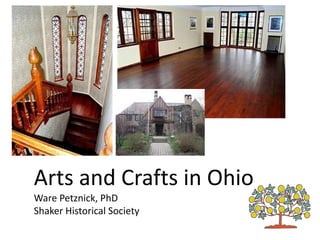
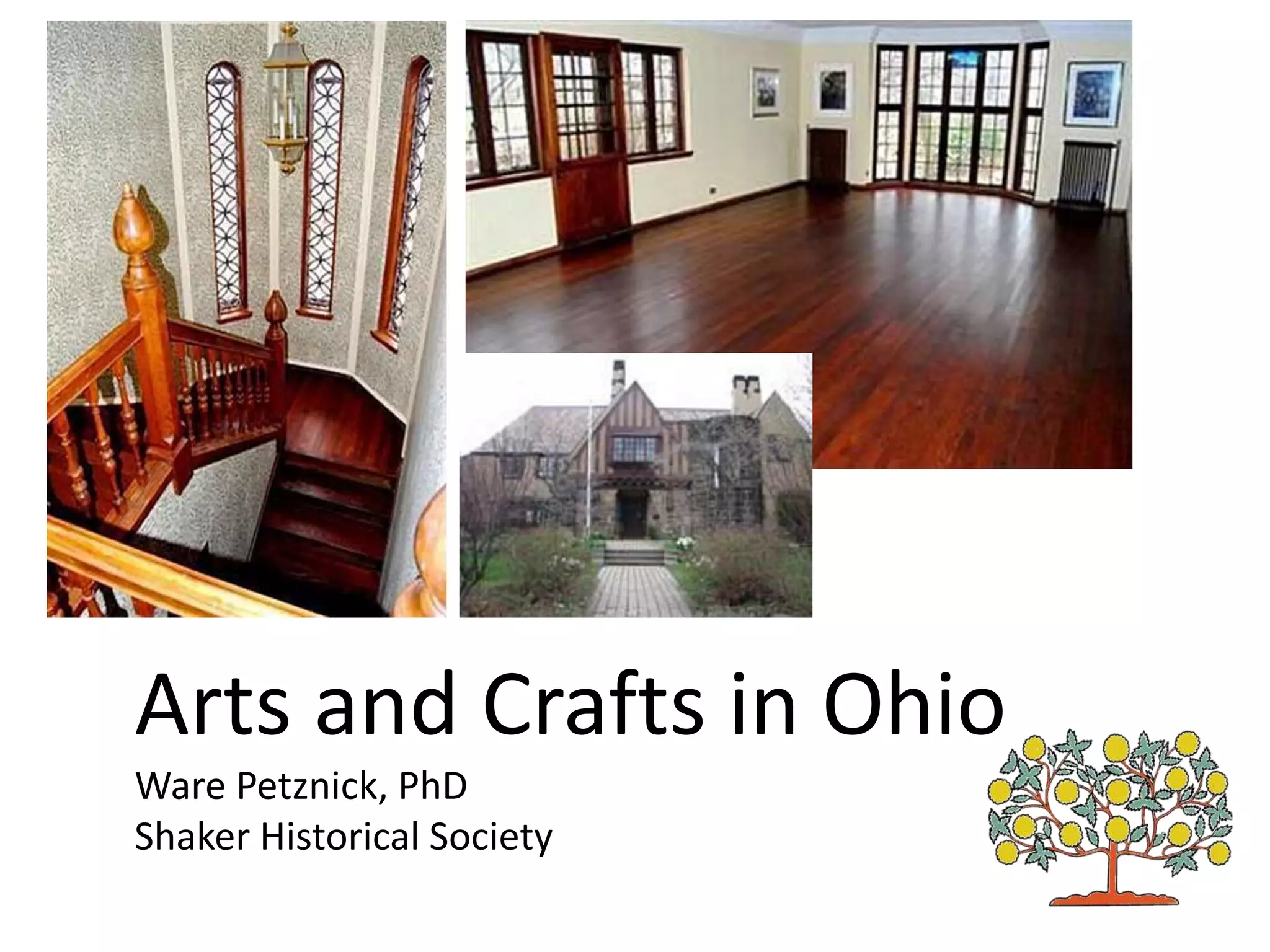
Arts and Crafts in Ohio
Ware Petznick, PhD
Shaker Historical Society
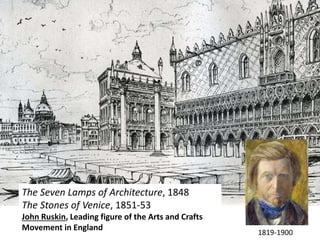
The Seven Lamps of Architecture, 1848
The Stones of Venice, 1851-53
John Ruskin, Leading figure of the Arts and Crafts
Movement in England
1819-1900
Have nothing in your
houses that you do not
know to be useful, or
believe to be beautiful.
William Morris, Leading figure of the
Arts and Crafts Movement in England
1834-1896
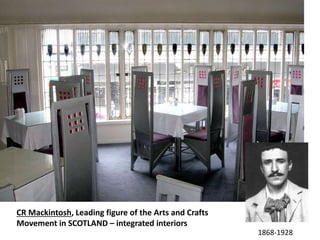
CR Mackintosh, Leading figure of the Arts and Crafts
Movement in SCOTLAND – integrated interiors
1868-1928
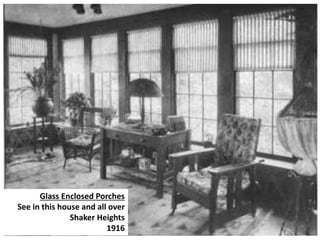
Glass Enclosed Porches
See in this house and all over
Shaker Heights
1916
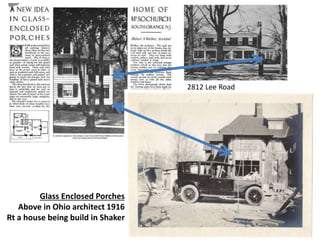
Glass Enclosed Porches
Above in Ohio architect 1916
Rt a house being build in Shaker
2812 Lee Road
Glass Enclosed Porches
See in this house and all over
Shaker Heights
1916
LEATHER & TEXTILES
POTTERY & TILE
METALWORK
FURNITURE
Arts & Crafts
• Roycroft Modeled Leather Department made
boxes, purses, wallets, even wastebaskets.
• Leather craftsmanship became a major part of
the production at Roycroft and leather
products were sold as popular souvenirs.
Leather
• Needlework of the movement is difficult to attribute.
• Textile and needlework societies were fashionable for
women at the time, and embroidery, rug making and
lace were all part of the work in textiles.
• Embroidery kits were advertised and popular for
women to purchase and finish.
• Lace making in particular was important as it was
usually done in the home by recent immigrants. Thus it
met the Arts and Crafts ideal of philanthropic
encouragement of artistic hand labor and the creation
of beautiful and useful objects for the home.
Textiles
POTTERY
OHIO COULD BE CONSIDERED THE CENTER OF THE ART POTTERY MOVEMENT
IN AMERICA. INDEED, AMERICA'S FIRST SCHOOL OF CERAMICS WAS FOUNDED
AT OHIO STATE UNIVERSITY IN 1894. OHIO WAS THE HOME OF THE
ROOKWOOD POTTERY IN CINCINNATI, AND THE WELLER, OWENS, WATT,
ROSEVILLE, MCCOY, HULL AND SHAWNEE POTTERIES NEAR ZANESVILLE.
SOUTHEASTERN OHIO GREW INTO A POTTERY CENTER BECAUSE OF A READY
SUPPLY OF CLAY, COAL, AND TRANSPORTATION LINES. THE EARLY FARM
POTTERIES WERE KNOWN AS "BLUEBIRD" POTTERIES BECAUSE IT WAS WHEN
THE BLUEBIRDS RETURNED FROM THE SOUTH EACH YEAR THAT THE CLAY
COULD BE MINED. AT ONE TIME THERE WERE ABOUT 41 DIFFERENT POTTERIES
OPERATING NEAR ZANESVILLE WITH NAMES LIKE EAL RUN, POSSUM HOLLOW,
BREADLESS, POVERTY HOLLOW AND HENPECK. EVEN THOUGH THE
MOVEMENT ENDED AROUND WORLD WAR I, SEVERAL OHIO ART POTTERIES
CONTINUED PRODUCTION UNTIL MUCH LATER, AND SOME ZANESVILLE
POTTERIES ARE STILL IN PRODUCTION.
Pottery
Rookwood Pottery
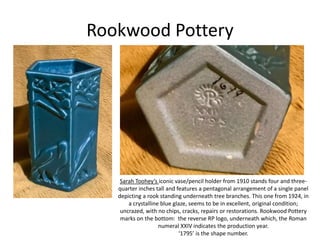
Sarah Toohey’s iconic vase/pencil holder from 1910 stands four and three-
quarter inches tall and features a pentagonal arrangement of a single panel
depicting a rook standing underneath tree branches. This one from 1924, in
a crystalline blue glaze, seems to be in excellent, original condition;
uncrazed, with no chips, cracks, repairs or restorations. Rookwood Pottery
marks on the bottom: the reverse RP logo, underneath which, the Roman
numeral XXIV indicates the production year.
‘1795’ is the shape number.
OHIO COULD BE CONSIDERED THE CENTER OF THE ART POTTERY MOVEMENT
IN AMERICA. INDEED, AMERICA'S FIRST SCHOOL OF CERAMICS WAS FOUNDED
AT OHIO STATE UNIVERSITY IN 1894. OHIO WAS THE HOME OF THE
ROOKWOOD POTTERY IN CINCINNATI, AND THE WELLER, OWENS, WATT,
ROSEVILLE, MCCOY, HULL AND SHAWNEE POTTERIES NEAR ZANESVILLE.
THE FIRST GLAZED TILES WERE MADE IN 1880, EMBOSSED TILES IN 1881,
FAIENCE TILES IN THE 1920S.
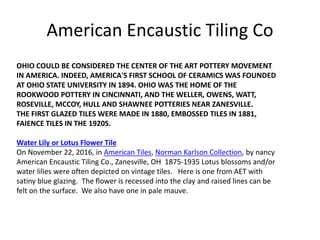
Water Lily or Lotus Flower Tile
On November 22, 2016, in American Tiles, Norman Karlson Collection, by nancy
American Encaustic Tiling Co., Zanesville, OH 1875-1935 Lotus blossoms and/or
water lilies were often depicted on vintage tiles. Here is one from AET with
satiny blue glazing. The flower is recessed into the clay and raised lines can be
felt on the surface. We also have one in pale mauve.
American Encaustic Tiling Co
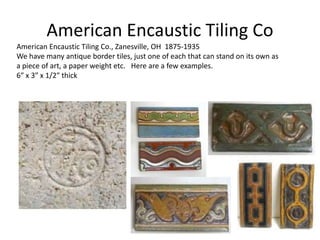
American Encaustic Tiling Co., Zanesville, OH 1875-1935
We have many antique border tiles, just one of each that can stand on its own as
a piece of art, a paper weight etc. Here are a few examples.
6″ x 3″ x 1/2″ thick
American Encaustic Tiling Co
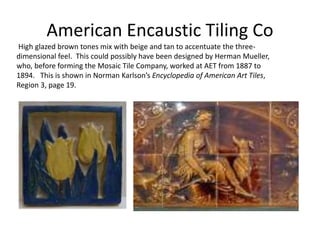
High glazed brown tones mix with beige and tan to accentuate the three-
dimensional feel. This could possibly have been designed by Herman Mueller,
who, before forming the Mosaic Tile Company, worked at AET from 1887 to
1894. This is shown in Norman Karlson’s Encyclopedia of American Art Tiles,
Region 3, page 19.
American Encaustic Tiling Co
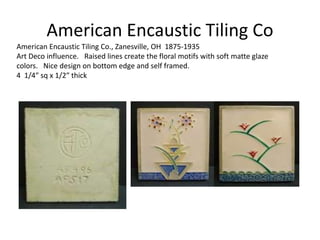
American Encaustic Tiling Co., Zanesville, OH 1875-1935
Art Deco influence. Raised lines create the floral motifs with soft matte glaze
colors. Nice design on bottom edge and self framed.
4 1/4″ sq x 1/2″ thick
American Encaustic Tiling Co
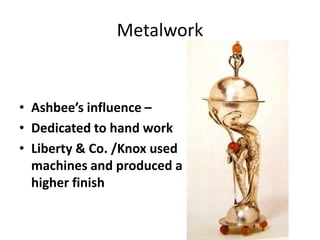
• Ashbee’s influence –
• Dedicated to hand work
• Liberty & Co. /Knox used
machines and produced a
higher finish
Metalwork
• Ashbee’s influence –
• Dedicated to hand work
• Liberty & Co. used machines and produced a
higher finish
Metalwork
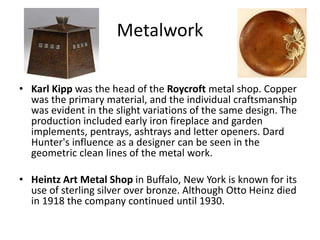
• Karl Kipp was the head of the Roycroft metal shop. Copper
was the primary material, and the individual craftsmanship
was evident in the slight variations of the same design. The
production included early iron fireplace and garden
implements, pentrays, ashtrays and letter openers. Dard
Hunter's influence as a designer can be seen in the
geometric clean lines of the metal work.
• Heintz Art Metal Shop in Buffalo, New York is known for its
use of sterling silver over bronze. Although Otto Heinz died
in 1918 the company continued until 1930.
Metalwork
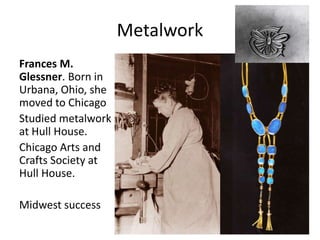
Frances M.
Glessner. Born in
Urbana, Ohio, she
moved to Chicago
Studied metalwork
at Hull House.
Chicago Arts and
Crafts Society at
Hull House.
Midwest success
Metalwork
Potter Studio
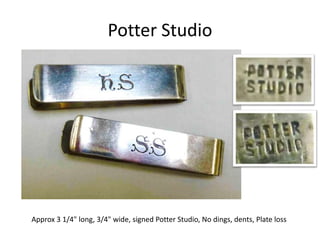
Approx 3 1/4" long, 3/4" wide, signed Potter Studio, No dings, dents, Plate loss
Potter Studio
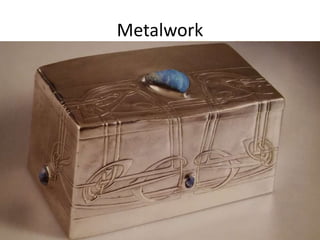
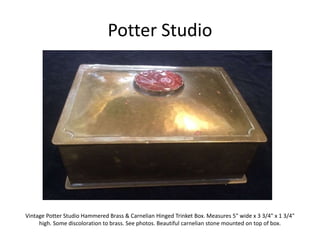
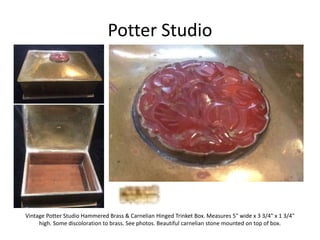
Vintage Potter Studio Hammered Brass & Carnelian Hinged Trinket Box. Measures 5" wide x 3 3/4" x 1 3/4"
high. Some discoloration to brass. See photos. Beautiful carnelian stone mounted on top of box.
Potter Studio
Vintage Potter Studio Hammered Brass & Carnelian Hinged Trinket Box. Measures 5" wide x 3 3/4" x 1 3/4"
high. Some discoloration to brass. See photos. Beautiful carnelian stone mounted on top of box.
Potter Studio
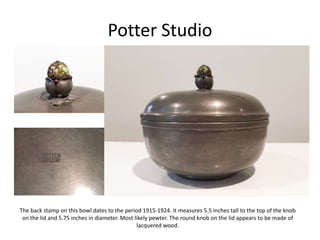
The back stamp on this bowl dates to the period 1915-1924. It measures 5.5 inches tall to the top of the knob
on the lid and 5.75 inches in diameter. Most likely pewter. The round knob on the lid appears to be made of
lacquered wood.
Potter Mellen
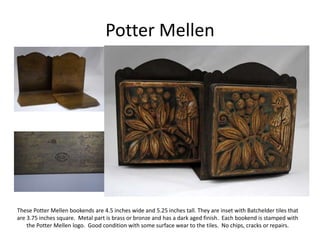
These Potter Mellen bookends are 4.5 inches wide and 5.25 inches tall. They are inset with Batchelder tiles that
are 3.75 inches square. Metal part is brass or bronze and has a dark aged finish. Each bookend is stamped with
the Potter Mellen logo. Good condition with some surface wear to the tiles. No chips, cracks or repairs.
MISSION STYLE
Montgomery Ward Catalog ca 1915
MISSION STYLE
Auglaize Furniture Co.
New Breman, OH, 1912 - ?
desks
Shop Mark:
THE AUGLAIZE FURNITURE CO. / NEW BREMAN, OHIO / THE
AUGLAIZE LINE..?
Beelman Cabinet Co.
Cleveland, OH, at least 1906 - 07
Mission rockers, tables, magazine stands, medicine cabinets;
advertised in the Michigan Artisan (1906, 1907)
Collier Barnett Co.
Toledo, OH, ca. 1920s
Bilt Well Mill Work including built-in buffets, kitchen cabinets,
bookcases, colonnades, fireplace surrounds, and wide range
of door, stair, window and trim mill work
MISSION STYLE
Cron-Kills Co.
Piqua, OH
drop front desks
John Danner Mfg. Co.
Canton, OH, late 1800s - early 1900s
revolving bookcases, stacking bookcases, drop front
desks, drug store cases, cabinets, stools
Victorian era models were carried through to
Mission period with revisions; copied by other
makers
Shop Marks: below, plus oval border decal with
company name in middle
Delaware Chair Co.
Delaware, OH, late 1800s - ca. 1904
chairs, rockers
MISSION STYLE
MISSION STYLE
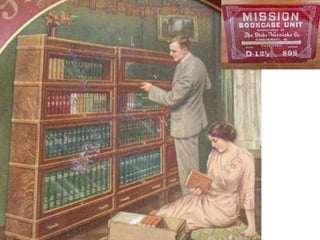
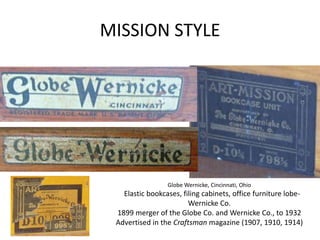
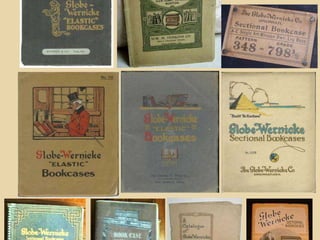
Globe Wernicke, Cincinnati, Ohio
Elastic bookcases, filing cabinets, office furniture lobe-
Wernicke Co.
1899 merger of the Globe Co. and Wernicke Co., to 1932
Advertised in the Craftsman magazine (1907, 1910, 1914)
MISSION STYLE
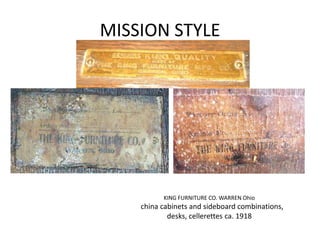
KING FURNITURE CO. WARREN Ohio
china cabinets and sideboard combinations,
desks, cellerettes ca. 1918
MISSION STYLE
Harden-Winders Mfg. Co.
Columbus, OH, at least 1907
Mission style porch settle swing; advertised in the Michigan Artisan (1907)
Hardesty Mfg. Co.
Chicago, IL, Canal Dover, OH, early 1900s
general line, Valet chairs with flip seat and drawer for shoes, hanging clothes,
sewing etc.
Shop Mark: rectangular paper shipping label attached w/tacks, name of
company & Mission Furniture, Opera Chairs, and Counter Stools
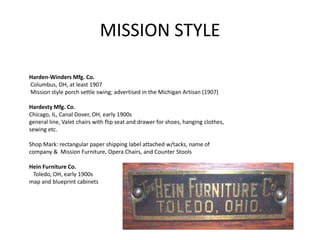
Hein Furniture Co.
Toledo, OH, early 1900s
map and blueprint cabinets
MISSION STYLE
KING FURNITURE CO. WARREN Ohio
china cabinets and sideboard combinations,
desks, cellerettes ca. 1918
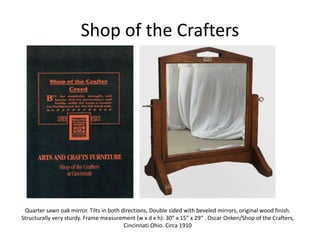
Shop of the Crafters
Quarter sawn oak mirror. Tilts in both directions, Double sided with beveled mirrors, original wood finish.
Structurally very sturdy. Frame measurement (w x d x h): 30″ x 15″ x 29″ . Oscar Onken/Shop of the Crafters,
Cincinnati Ohio. Circa 1910
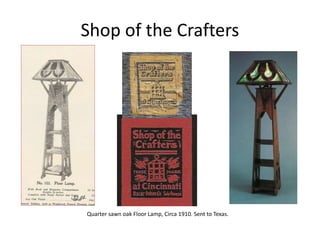
Shop of the Crafters
Quarter sawn oak Floor Lamp, Circa 1910. Sent to Texas.
Shop of the Crafters
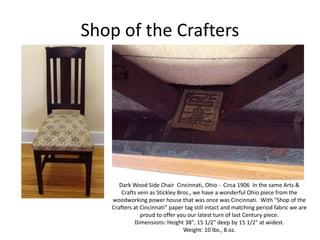
Dark Wood Side Chair Cincinnati, Ohio - Circa 1906 In the same Arts &
Crafts vein as Stickley Bros., we have a wonderful Ohio piece from the
woodworking power house that was once was Cincinnati. With "Shop of the
Crafters at Cincinnati" paper tag still intact and matching period fabric we are
proud to offer you our latest turn of last Century piece.
Dimensions: Height 38", 15 1/2" deep by 15 1/2" at widest.
Weight: 10 lbs., 8 oz.
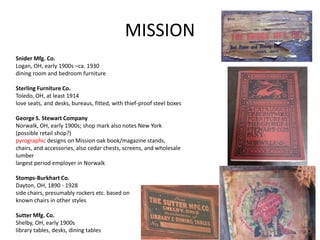
MISSION
Snider Mfg. Co.
Logan, OH, early 1900s –ca. 1930
dining room and bedroom furniture
Sterling Furniture Co.
Toledo, OH, at least 1914
love seats, and desks, bureaus, fitted, with thief-proof steel boxes
George S. Stewart Company
Norwalk, OH, early 1900s; shop mark also notes New York
(possible retail shop?)
pyrographic designs on Mission oak book/magazine stands,
chairs, and accessories, also cedar chests, screens, and wholesale
lumber
largest period employer in Norwalk
Stomps-Burkhart Co.
Dayton, OH, 1890 - 1928
side chairs, presumably rockers etc. based on
known chairs in other styles
Sutter Mfg. Co.
Shelby, OH, early 1900s
library tables, desks, dining tables
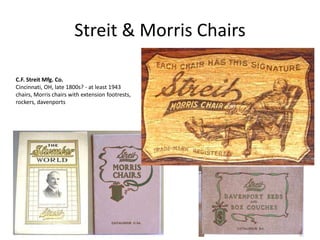
Streit & Morris Chairs
C.F. Streit Mfg. Co.
Cincinnati, OH, late 1800s? - at least 1943
chairs, Morris chairs with extension footrests,
rockers, davenports
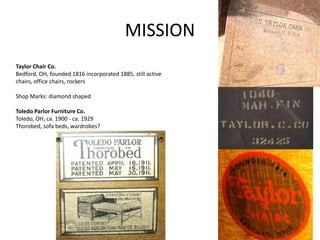
MISSION
Taylor Chair Co.
Bedford, OH, founded 1816 incorporated 1885, still active
chairs, office chairs, rockers
Shop Marks: diamond shaped
Toledo Parlor Furniture Co.
Toledo, OH, ca. 1900 - ca. 1929
Thorobed, sofa beds, wardrobes?
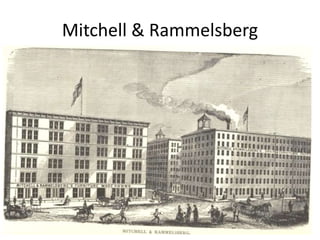
Mitchell & Rammelsberg
• Founded in 1847, this partnership brought
Irish and German craftsmen together
• Rammelsberg d. 1863 but company continued
until 1881 as Mitchell & Rammelsberg
• The Robert Mitchell Furniture Co. carried on
until 1940
Their furniture was shipped across the country
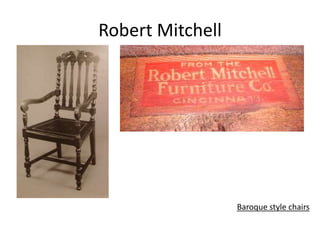
Robert Mitchell
Baroque style chairs
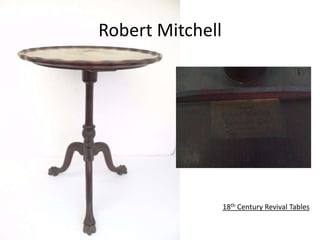
Robert Mitchell
18th Century Revival Tables
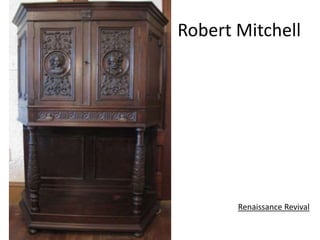
Robert Mitchell
Renaissance Revival
Robert Mitchell
• 1881-1940
• Published catalogues
• 1907, 75th catalog
• Many revival styles, including Arts & Crafts all
together in the same catalog
• Convenient rail links from Cincinnati to most
of the country
The End
• World War I
• Major works fell on hard times/died
• One of many styles
• Other styles – Colonial Revival – Tudor
Revival took the lead
• 1960s revival and interest in Mission/Stickley
style/Arts & Crafts movement
The End
The HAND of the CRAFTSMAN

Arts and crafts in Ohio

  • 1.
    Arts and Craftsin Ohio Ware Petznick, PhD Shaker Historical Society
  • 2.
    The Seven Lampsof Architecture, 1848 The Stones of Venice, 1851-53 John Ruskin, Leading figure of the Arts and Crafts Movement in England 1819-1900
  • 3.
    Have nothing inyour houses that you do not know to be useful, or believe to be beautiful. William Morris, Leading figure of the Arts and Crafts Movement in England 1834-1896
  • 4.
    CR Mackintosh, Leadingfigure of the Arts and Crafts Movement in SCOTLAND – integrated interiors 1868-1928
  • 5.
    Glass Enclosed Porches Seein this house and all over Shaker Heights 1916 Glass Enclosed Porches Above in Ohio architect 1916 Rt a house being build in Shaker 2812 Lee Road
  • 6.
    Glass Enclosed Porches Seein this house and all over Shaker Heights 1916
  • 7.
    LEATHER & TEXTILES POTTERY& TILE METALWORK FURNITURE Arts & Crafts
  • 8.
    • Roycroft ModeledLeather Department made boxes, purses, wallets, even wastebaskets. • Leather craftsmanship became a major part of the production at Roycroft and leather products were sold as popular souvenirs. Leather
  • 9.
    • Needlework ofthe movement is difficult to attribute. • Textile and needlework societies were fashionable for women at the time, and embroidery, rug making and lace were all part of the work in textiles. • Embroidery kits were advertised and popular for women to purchase and finish. • Lace making in particular was important as it was usually done in the home by recent immigrants. Thus it met the Arts and Crafts ideal of philanthropic encouragement of artistic hand labor and the creation of beautiful and useful objects for the home. Textiles
  • 10.
    POTTERY OHIO COULD BECONSIDERED THE CENTER OF THE ART POTTERY MOVEMENT IN AMERICA. INDEED, AMERICA'S FIRST SCHOOL OF CERAMICS WAS FOUNDED AT OHIO STATE UNIVERSITY IN 1894. OHIO WAS THE HOME OF THE ROOKWOOD POTTERY IN CINCINNATI, AND THE WELLER, OWENS, WATT, ROSEVILLE, MCCOY, HULL AND SHAWNEE POTTERIES NEAR ZANESVILLE. SOUTHEASTERN OHIO GREW INTO A POTTERY CENTER BECAUSE OF A READY SUPPLY OF CLAY, COAL, AND TRANSPORTATION LINES. THE EARLY FARM POTTERIES WERE KNOWN AS "BLUEBIRD" POTTERIES BECAUSE IT WAS WHEN THE BLUEBIRDS RETURNED FROM THE SOUTH EACH YEAR THAT THE CLAY COULD BE MINED. AT ONE TIME THERE WERE ABOUT 41 DIFFERENT POTTERIES OPERATING NEAR ZANESVILLE WITH NAMES LIKE EAL RUN, POSSUM HOLLOW, BREADLESS, POVERTY HOLLOW AND HENPECK. EVEN THOUGH THE MOVEMENT ENDED AROUND WORLD WAR I, SEVERAL OHIO ART POTTERIES CONTINUED PRODUCTION UNTIL MUCH LATER, AND SOME ZANESVILLE POTTERIES ARE STILL IN PRODUCTION. Pottery
  • 11.
    Rookwood Pottery Sarah Toohey’siconic vase/pencil holder from 1910 stands four and three- quarter inches tall and features a pentagonal arrangement of a single panel depicting a rook standing underneath tree branches. This one from 1924, in a crystalline blue glaze, seems to be in excellent, original condition; uncrazed, with no chips, cracks, repairs or restorations. Rookwood Pottery marks on the bottom: the reverse RP logo, underneath which, the Roman numeral XXIV indicates the production year. ‘1795’ is the shape number.
  • 12.
    OHIO COULD BECONSIDERED THE CENTER OF THE ART POTTERY MOVEMENT IN AMERICA. INDEED, AMERICA'S FIRST SCHOOL OF CERAMICS WAS FOUNDED AT OHIO STATE UNIVERSITY IN 1894. OHIO WAS THE HOME OF THE ROOKWOOD POTTERY IN CINCINNATI, AND THE WELLER, OWENS, WATT, ROSEVILLE, MCCOY, HULL AND SHAWNEE POTTERIES NEAR ZANESVILLE. THE FIRST GLAZED TILES WERE MADE IN 1880, EMBOSSED TILES IN 1881, FAIENCE TILES IN THE 1920S. Water Lily or Lotus Flower Tile On November 22, 2016, in American Tiles, Norman Karlson Collection, by nancy American Encaustic Tiling Co., Zanesville, OH 1875-1935 Lotus blossoms and/or water lilies were often depicted on vintage tiles. Here is one from AET with satiny blue glazing. The flower is recessed into the clay and raised lines can be felt on the surface. We also have one in pale mauve. American Encaustic Tiling Co
  • 13.
    American Encaustic TilingCo., Zanesville, OH 1875-1935 We have many antique border tiles, just one of each that can stand on its own as a piece of art, a paper weight etc. Here are a few examples. 6″ x 3″ x 1/2″ thick American Encaustic Tiling Co
  • 14.
    High glazed browntones mix with beige and tan to accentuate the three- dimensional feel. This could possibly have been designed by Herman Mueller, who, before forming the Mosaic Tile Company, worked at AET from 1887 to 1894. This is shown in Norman Karlson’s Encyclopedia of American Art Tiles, Region 3, page 19. American Encaustic Tiling Co
  • 15.
    American Encaustic TilingCo., Zanesville, OH 1875-1935 Art Deco influence. Raised lines create the floral motifs with soft matte glaze colors. Nice design on bottom edge and self framed. 4 1/4″ sq x 1/2″ thick American Encaustic Tiling Co
  • 16.
    • Ashbee’s influence– • Dedicated to hand work • Liberty & Co. /Knox used machines and produced a higher finish Metalwork
  • 17.
    • Ashbee’s influence– • Dedicated to hand work • Liberty & Co. used machines and produced a higher finish Metalwork
  • 18.
    • Karl Kippwas the head of the Roycroft metal shop. Copper was the primary material, and the individual craftsmanship was evident in the slight variations of the same design. The production included early iron fireplace and garden implements, pentrays, ashtrays and letter openers. Dard Hunter's influence as a designer can be seen in the geometric clean lines of the metal work. • Heintz Art Metal Shop in Buffalo, New York is known for its use of sterling silver over bronze. Although Otto Heinz died in 1918 the company continued until 1930. Metalwork
  • 19.
    Frances M. Glessner. Bornin Urbana, Ohio, she moved to Chicago Studied metalwork at Hull House. Chicago Arts and Crafts Society at Hull House. Midwest success Metalwork
  • 20.
    Potter Studio Approx 31/4" long, 3/4" wide, signed Potter Studio, No dings, dents, Plate loss
  • 21.
    Potter Studio Vintage PotterStudio Hammered Brass & Carnelian Hinged Trinket Box. Measures 5" wide x 3 3/4" x 1 3/4" high. Some discoloration to brass. See photos. Beautiful carnelian stone mounted on top of box.
  • 22.
    Potter Studio Vintage PotterStudio Hammered Brass & Carnelian Hinged Trinket Box. Measures 5" wide x 3 3/4" x 1 3/4" high. Some discoloration to brass. See photos. Beautiful carnelian stone mounted on top of box.
  • 23.
    Potter Studio The backstamp on this bowl dates to the period 1915-1924. It measures 5.5 inches tall to the top of the knob on the lid and 5.75 inches in diameter. Most likely pewter. The round knob on the lid appears to be made of lacquered wood.
  • 24.
    Potter Mellen These PotterMellen bookends are 4.5 inches wide and 5.25 inches tall. They are inset with Batchelder tiles that are 3.75 inches square. Metal part is brass or bronze and has a dark aged finish. Each bookend is stamped with the Potter Mellen logo. Good condition with some surface wear to the tiles. No chips, cracks or repairs.
  • 25.
  • 26.
    MISSION STYLE Auglaize FurnitureCo. New Breman, OH, 1912 - ? desks Shop Mark: THE AUGLAIZE FURNITURE CO. / NEW BREMAN, OHIO / THE AUGLAIZE LINE..? Beelman Cabinet Co. Cleveland, OH, at least 1906 - 07 Mission rockers, tables, magazine stands, medicine cabinets; advertised in the Michigan Artisan (1906, 1907) Collier Barnett Co. Toledo, OH, ca. 1920s Bilt Well Mill Work including built-in buffets, kitchen cabinets, bookcases, colonnades, fireplace surrounds, and wide range of door, stair, window and trim mill work
  • 27.
    MISSION STYLE Cron-Kills Co. Piqua,OH drop front desks John Danner Mfg. Co. Canton, OH, late 1800s - early 1900s revolving bookcases, stacking bookcases, drop front desks, drug store cases, cabinets, stools Victorian era models were carried through to Mission period with revisions; copied by other makers Shop Marks: below, plus oval border decal with company name in middle Delaware Chair Co. Delaware, OH, late 1800s - ca. 1904 chairs, rockers
  • 28.
  • 29.
    MISSION STYLE Globe Wernicke,Cincinnati, Ohio Elastic bookcases, filing cabinets, office furniture lobe- Wernicke Co. 1899 merger of the Globe Co. and Wernicke Co., to 1932 Advertised in the Craftsman magazine (1907, 1910, 1914)
  • 30.
    MISSION STYLE KING FURNITURECO. WARREN Ohio china cabinets and sideboard combinations, desks, cellerettes ca. 1918
  • 31.
    MISSION STYLE Harden-Winders Mfg.Co. Columbus, OH, at least 1907 Mission style porch settle swing; advertised in the Michigan Artisan (1907) Hardesty Mfg. Co. Chicago, IL, Canal Dover, OH, early 1900s general line, Valet chairs with flip seat and drawer for shoes, hanging clothes, sewing etc. Shop Mark: rectangular paper shipping label attached w/tacks, name of company & Mission Furniture, Opera Chairs, and Counter Stools Hein Furniture Co. Toledo, OH, early 1900s map and blueprint cabinets
  • 32.
    MISSION STYLE KING FURNITURECO. WARREN Ohio china cabinets and sideboard combinations, desks, cellerettes ca. 1918
  • 33.
    Shop of theCrafters Quarter sawn oak mirror. Tilts in both directions, Double sided with beveled mirrors, original wood finish. Structurally very sturdy. Frame measurement (w x d x h): 30″ x 15″ x 29″ . Oscar Onken/Shop of the Crafters, Cincinnati Ohio. Circa 1910
  • 34.
    Shop of theCrafters Quarter sawn oak Floor Lamp, Circa 1910. Sent to Texas.
  • 35.
    Shop of theCrafters Dark Wood Side Chair Cincinnati, Ohio - Circa 1906 In the same Arts & Crafts vein as Stickley Bros., we have a wonderful Ohio piece from the woodworking power house that was once was Cincinnati. With "Shop of the Crafters at Cincinnati" paper tag still intact and matching period fabric we are proud to offer you our latest turn of last Century piece. Dimensions: Height 38", 15 1/2" deep by 15 1/2" at widest. Weight: 10 lbs., 8 oz.
  • 36.
    MISSION Snider Mfg. Co. Logan,OH, early 1900s –ca. 1930 dining room and bedroom furniture Sterling Furniture Co. Toledo, OH, at least 1914 love seats, and desks, bureaus, fitted, with thief-proof steel boxes George S. Stewart Company Norwalk, OH, early 1900s; shop mark also notes New York (possible retail shop?) pyrographic designs on Mission oak book/magazine stands, chairs, and accessories, also cedar chests, screens, and wholesale lumber largest period employer in Norwalk Stomps-Burkhart Co. Dayton, OH, 1890 - 1928 side chairs, presumably rockers etc. based on known chairs in other styles Sutter Mfg. Co. Shelby, OH, early 1900s library tables, desks, dining tables
  • 37.
    Streit & MorrisChairs C.F. Streit Mfg. Co. Cincinnati, OH, late 1800s? - at least 1943 chairs, Morris chairs with extension footrests, rockers, davenports
  • 38.
    MISSION Taylor Chair Co. Bedford,OH, founded 1816 incorporated 1885, still active chairs, office chairs, rockers Shop Marks: diamond shaped Toledo Parlor Furniture Co. Toledo, OH, ca. 1900 - ca. 1929 Thorobed, sofa beds, wardrobes?
  • 39.
    Mitchell & Rammelsberg •Founded in 1847, this partnership brought Irish and German craftsmen together • Rammelsberg d. 1863 but company continued until 1881 as Mitchell & Rammelsberg • The Robert Mitchell Furniture Co. carried on until 1940 Their furniture was shipped across the country
  • 40.
  • 41.
  • 42.
  • 43.
    Robert Mitchell • 1881-1940 •Published catalogues • 1907, 75th catalog • Many revival styles, including Arts & Crafts all together in the same catalog • Convenient rail links from Cincinnati to most of the country
  • 44.
    The End • WorldWar I • Major works fell on hard times/died • One of many styles • Other styles – Colonial Revival – Tudor Revival took the lead • 1960s revival and interest in Mission/Stickley style/Arts & Crafts movement
  • 45.
    The End The HANDof the CRAFTSMAN

Editor's Notes

  • #3  The Ducal Palace, Venice by John Ruskin (1819-1900). 1835. Source: Works, facing XXXV, 182. Scanned image and text by George P. Landow [You may use this image without prior permission for any scholarly or educational purpose as 
  • #21 TWO SCOTTISH WRIGHTS AT DUMFRIES HOUSE Francis Bamford Furniture History Vol. 9 (1973), pp. 80-88 Published by: The Furniture History Society Stable URL: http://www.jstor.org/stable/23403468 Page Count: 17
  • #22 TWO SCOTTISH WRIGHTS AT DUMFRIES HOUSE Francis Bamford Furniture History Vol. 9 (1973), pp. 80-88 Published by: The Furniture History Society Stable URL: http://www.jstor.org/stable/23403468 Page Count: 17
  • #24 Vintage Arts & Crafts Potter Studio Covered Bowl by Horace Potter Cleveland Institute of Art This listing is for a superb vintage Arts & Crafts potter studio covered bowl by Horace Potter. The back stamp on this bowl dates to the period 1915-1924. It measures 5.5 inches tall to the top of the knob on the lid and 5.75 inches in diameter. There are no markings to indicate what type of metal the bowl is made from. Most likely pewter. The round knob on the lid appears to be made of lacquered wood. About the Artist  "Horace Ephraim Potter was born into a prosperous Cleveland family in 1873…. Potter began his studies [at the Cleveland School of Art (CSA)] in 1894, graduating in June 1898…. After graduation from CSA, Potter embarked upon a year of study with Amy Sacker at the Cowles School of Art in Boston. Potter exhibited in [the Boston Society of Arts and Crafts'] second annual exhibition  in Copley Hall in April 1899, and at the conclusion of his studies received a master's degree, specializing in metal­work. Returning to Cleveland, he taught at the Cleveland School of Art from 1900 to 1909, giving classes in decorative design and historic ornament. "While teaching, Potter established a studio in downtown Cleveland. In 1905 he moved to his family's farm on the edge of the city, converting a chicken coop where he and CSA classmates Wilhelmina Stephan and Ferdinand Burgdorff designed and made silver and jewelry…. Potter maintained strong ties with Boston, becoming a "craftsman" member of the Society of Arts and Crafts in 1907 and attaining master classification the following year. "Potter spent four and a half months in England and Europe in the spring and summer of 1907, visiting Ashbee in August…. When Potter returned from his European trip in 1907, it was clear that his experience of Ashbee's Guild of Handicraft had confirmed his belief that the creative spirit was best nurtured when artists worked together. Moving to a series of locations on Euclid Avenue between 1910 and 1928, Potter expanded his space and founded Potter Studio.  "Potter may have been attempting to recreate the interdisciplinary atmosphere of Ashbee's guild by opening his premises to other artists as well. He employed fellow graduates and former students of the Cleveland School of Art, and welcomed artists in other mediums with lodging and studio space. R. Guy Cowan, the founder of Cowan Pottery, came to Cleveland in 1908 to establish a ceramics program at the city's innovative Technical High School. Potter became Cowan's landlord and supported his endeavors. Cowan founded his own business in 1913, but Potter purchased studio-made vessels as early as 1909 and embellished them with silver or pewter lids. "Marrying fellow silversmith Florence Loomis in 1914, he went on to found Potter & Bentley Studios in 1928, and Potter & Mellen in 1933." Silver Magazine May/June 2005 by Leslie Marting
  • #25 Vintage Arts & Crafts Potter Studio Covered Bowl by Horace Potter Cleveland Institute of Art This listing is for a superb vintage Arts & Crafts potter studio covered bowl by Horace Potter. The back stamp on this bowl dates to the period 1915-1924. It measures 5.5 inches tall to the top of the knob on the lid and 5.75 inches in diameter. There are no markings to indicate what type of metal the bowl is made from. Most likely pewter. The round knob on the lid appears to be made of lacquered wood. About the Artist  "Horace Ephraim Potter was born into a prosperous Cleveland family in 1873…. Potter began his studies [at the Cleveland School of Art (CSA)] in 1894, graduating in June 1898…. After graduation from CSA, Potter embarked upon a year of study with Amy Sacker at the Cowles School of Art in Boston. Potter exhibited in [the Boston Society of Arts and Crafts'] second annual exhibition  in Copley Hall in April 1899, and at the conclusion of his studies received a master's degree, specializing in metal­work. Returning to Cleveland, he taught at the Cleveland School of Art from 1900 to 1909, giving classes in decorative design and historic ornament. "While teaching, Potter established a studio in downtown Cleveland. In 1905 he moved to his family's farm on the edge of the city, converting a chicken coop where he and CSA classmates Wilhelmina Stephan and Ferdinand Burgdorff designed and made silver and jewelry…. Potter maintained strong ties with Boston, becoming a "craftsman" member of the Society of Arts and Crafts in 1907 and attaining master classification the following year. "Potter spent four and a half months in England and Europe in the spring and summer of 1907, visiting Ashbee in August…. When Potter returned from his European trip in 1907, it was clear that his experience of Ashbee's Guild of Handicraft had confirmed his belief that the creative spirit was best nurtured when artists worked together. Moving to a series of locations on Euclid Avenue between 1910 and 1928, Potter expanded his space and founded Potter Studio.  "Potter may have been attempting to recreate the interdisciplinary atmosphere of Ashbee's guild by opening his premises to other artists as well. He employed fellow graduates and former students of the Cleveland School of Art, and welcomed artists in other mediums with lodging and studio space. R. Guy Cowan, the founder of Cowan Pottery, came to Cleveland in 1908 to establish a ceramics program at the city's innovative Technical High School. Potter became Cowan's landlord and supported his endeavors. Cowan founded his own business in 1913, but Potter purchased studio-made vessels as early as 1909 and embellished them with silver or pewter lids. "Marrying fellow silversmith Florence Loomis in 1914, he went on to found Potter & Bentley Studios in 1928, and Potter & Mellen in 1933." Silver Magazine May/June 2005 by Leslie Marting
  • #34 Vintage Arts & Crafts Potter Studio Covered Bowl by Horace Potter Cleveland Institute of Art This listing is for a superb vintage Arts & Crafts potter studio covered bowl by Horace Potter. The back stamp on this bowl dates to the period 1915-1924. It measures 5.5 inches tall to the top of the knob on the lid and 5.75 inches in diameter. There are no markings to indicate what type of metal the bowl is made from. Most likely pewter. The round knob on the lid appears to be made of lacquered wood. About the Artist  "Horace Ephraim Potter was born into a prosperous Cleveland family in 1873…. Potter began his studies [at the Cleveland School of Art (CSA)] in 1894, graduating in June 1898…. After graduation from CSA, Potter embarked upon a year of study with Amy Sacker at the Cowles School of Art in Boston. Potter exhibited in [the Boston Society of Arts and Crafts'] second annual exhibition  in Copley Hall in April 1899, and at the conclusion of his studies received a master's degree, specializing in metal­work. Returning to Cleveland, he taught at the Cleveland School of Art from 1900 to 1909, giving classes in decorative design and historic ornament. "While teaching, Potter established a studio in downtown Cleveland. In 1905 he moved to his family's farm on the edge of the city, converting a chicken coop where he and CSA classmates Wilhelmina Stephan and Ferdinand Burgdorff designed and made silver and jewelry…. Potter maintained strong ties with Boston, becoming a "craftsman" member of the Society of Arts and Crafts in 1907 and attaining master classification the following year. "Potter spent four and a half months in England and Europe in the spring and summer of 1907, visiting Ashbee in August…. When Potter returned from his European trip in 1907, it was clear that his experience of Ashbee's Guild of Handicraft had confirmed his belief that the creative spirit was best nurtured when artists worked together. Moving to a series of locations on Euclid Avenue between 1910 and 1928, Potter expanded his space and founded Potter Studio.  "Potter may have been attempting to recreate the interdisciplinary atmosphere of Ashbee's guild by opening his premises to other artists as well. He employed fellow graduates and former students of the Cleveland School of Art, and welcomed artists in other mediums with lodging and studio space. R. Guy Cowan, the founder of Cowan Pottery, came to Cleveland in 1908 to establish a ceramics program at the city's innovative Technical High School. Potter became Cowan's landlord and supported his endeavors. Cowan founded his own business in 1913, but Potter purchased studio-made vessels as early as 1909 and embellished them with silver or pewter lids. "Marrying fellow silversmith Florence Loomis in 1914, he went on to found Potter & Bentley Studios in 1928, and Potter & Mellen in 1933." Silver Magazine May/June 2005 by Leslie Marting
  • #35 Shop of the Crafters (Oscar Onken Co.) �         Cincinnati, OH, ca. 1896 - 1931, Oscar Onken was in business late 1800s but incorporated ca. 1896 with Shop of the Crafters being a purchased trade name subsequently used  from 1904-1919, reverting back to just Oscar Onken Co. 1920 - 1931 �         chief designer was Paul Horti of Budapest who previously worked for Charles Limbert �        general good to high quality diverse line known for inlays, cutouts, and German/Austro-Hungarian style, referred to as �Furniture of Austrian Design�, also Art Nouveau inspired stained glass in doors; also lamps from 1905/1906 �        Oscar Onken Co. ran parallel to Shop of the Crafters, using �Younits� brand name, producing clocks, display cases and store fixtures, mirrors, small painted cabinets, and other novelty pieces, some with Mission style  
  • #45 Dumfries House is also well-known among furniture historians for having the only fully documented furniture made by London cabinetmaker Thomas Chippendale. The Earl’s original plan was to buy a few pieces of furniture from Chippendale and have his local Scottish cabinetmaker—Alexander Peter—copy the London pieces to fill the house.[15] In this way, the Earl could have “status” furniture but at far less cost.[16] Upon visiting Chippendale’s showroom, however, the Earl changed his mind and had the London cabinetmaker provide most of the status furniture.[17] Alexander Peter still received commissions from the Earl. After all, Peter was not an unsophisticated, provincial cabinetmaker—he is considered one of the greatest of Edinburgh’s cabinetmakers.[18] The Earl had Peter supply some status pieces for Dumfries House to augment the furniture made by Chippendale.[19] Most crucial to a study of bedroom tables, Alexander Peter also provided utility furniture for Dumfries House servants and other pieces that English furniture historian Christopher Gilbert referred to as “routine bedroom furniture.”[20] The routine bedroom furniture included the very practical bedroom tables. Peter’s 1758 invoice for Dumfries House labeled four of the bedroom tables he made as “4 sq Mahogany tables 1 leaf & lock’d drawer” (in the eighteenth century, craftsmen used the term “square” to refer to the shape of the corners of a table rather than the shape of its top).[21] Ultimately, Peter made nine bedroom tables for Dumfries House.[22]
  • #46 Dumfries House is also well-known among furniture historians for having the only fully documented furniture made by London cabinetmaker Thomas Chippendale. The Earl’s original plan was to buy a few pieces of furniture from Chippendale and have his local Scottish cabinetmaker—Alexander Peter—copy the London pieces to fill the house.[15] In this way, the Earl could have “status” furniture but at far less cost.[16] Upon visiting Chippendale’s showroom, however, the Earl changed his mind and had the London cabinetmaker provide most of the status furniture.[17] Alexander Peter still received commissions from the Earl. After all, Peter was not an unsophisticated, provincial cabinetmaker—he is considered one of the greatest of Edinburgh’s cabinetmakers.[18] The Earl had Peter supply some status pieces for Dumfries House to augment the furniture made by Chippendale.[19] Most crucial to a study of bedroom tables, Alexander Peter also provided utility furniture for Dumfries House servants and other pieces that English furniture historian Christopher Gilbert referred to as “routine bedroom furniture.”[20] The routine bedroom furniture included the very practical bedroom tables. Peter’s 1758 invoice for Dumfries House labeled four of the bedroom tables he made as “4 sq Mahogany tables 1 leaf & lock’d drawer” (in the eighteenth century, craftsmen used the term “square” to refer to the shape of the corners of a table rather than the shape of its top).[21] Ultimately, Peter made nine bedroom tables for Dumfries House.[22]