Artificial Neural Network
(…or simply Neural
Network)
Earning is inLearning
Data science and AI Certification Course
Visit: Learnbay.co
Agenda
Introduction
Application of analytics in business
Skills required for BusinessAnalytics
Data Mining in a nut shell
Basic number skills
Classification Tree
Visit: Learnbay.co
Artificial Neural Network
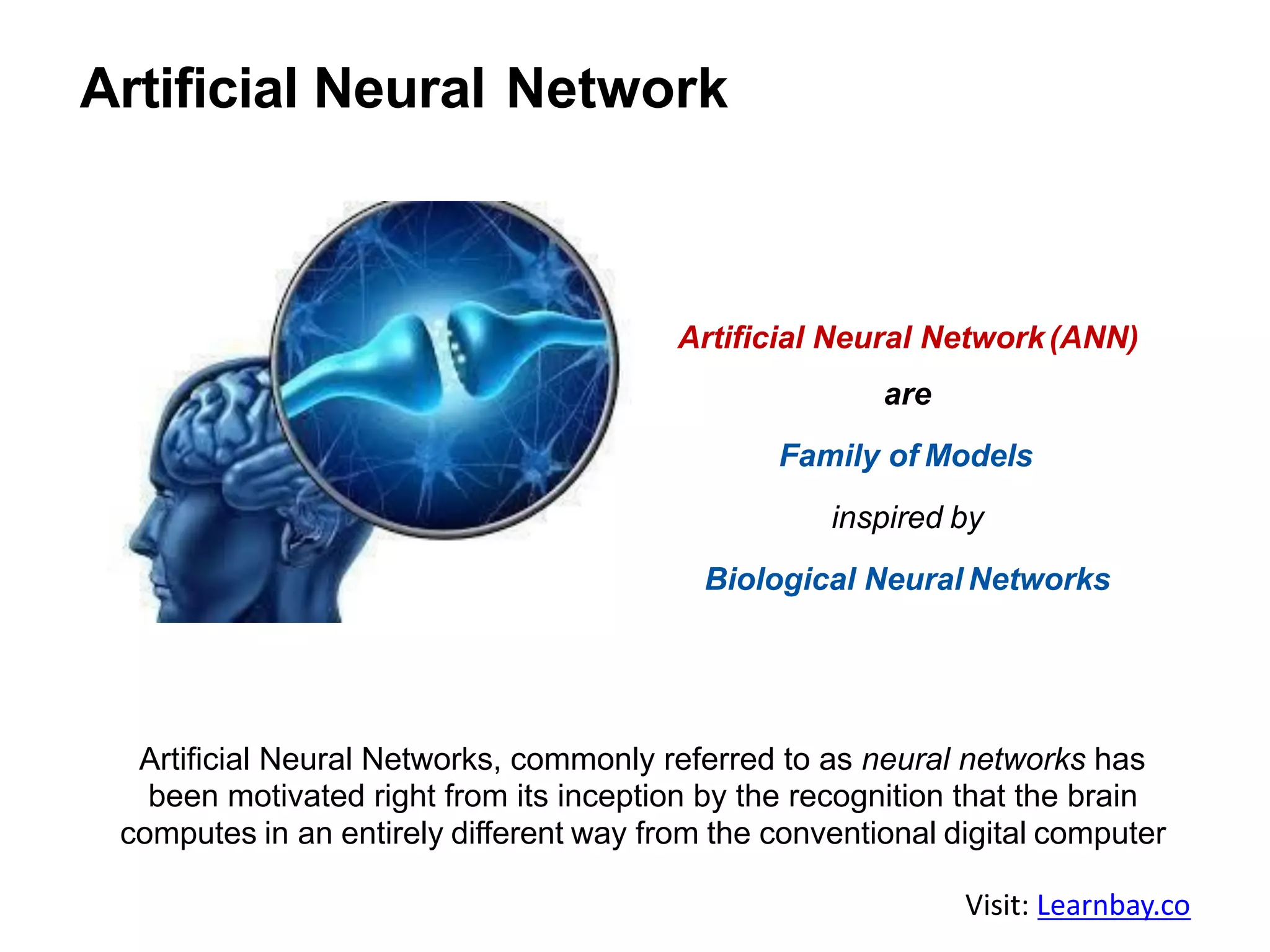
Artificial Neural Network(ANN)
are
Family of Models
inspired by
Biological Neural Networks
Artificial Neural Networks, commonly referred to as neural networks has
been motivated right from its inception by the recognition that the brain
computes in an entirely different way from the conventional digital computer
Visit: Learnbay.co
Biological Neural Network
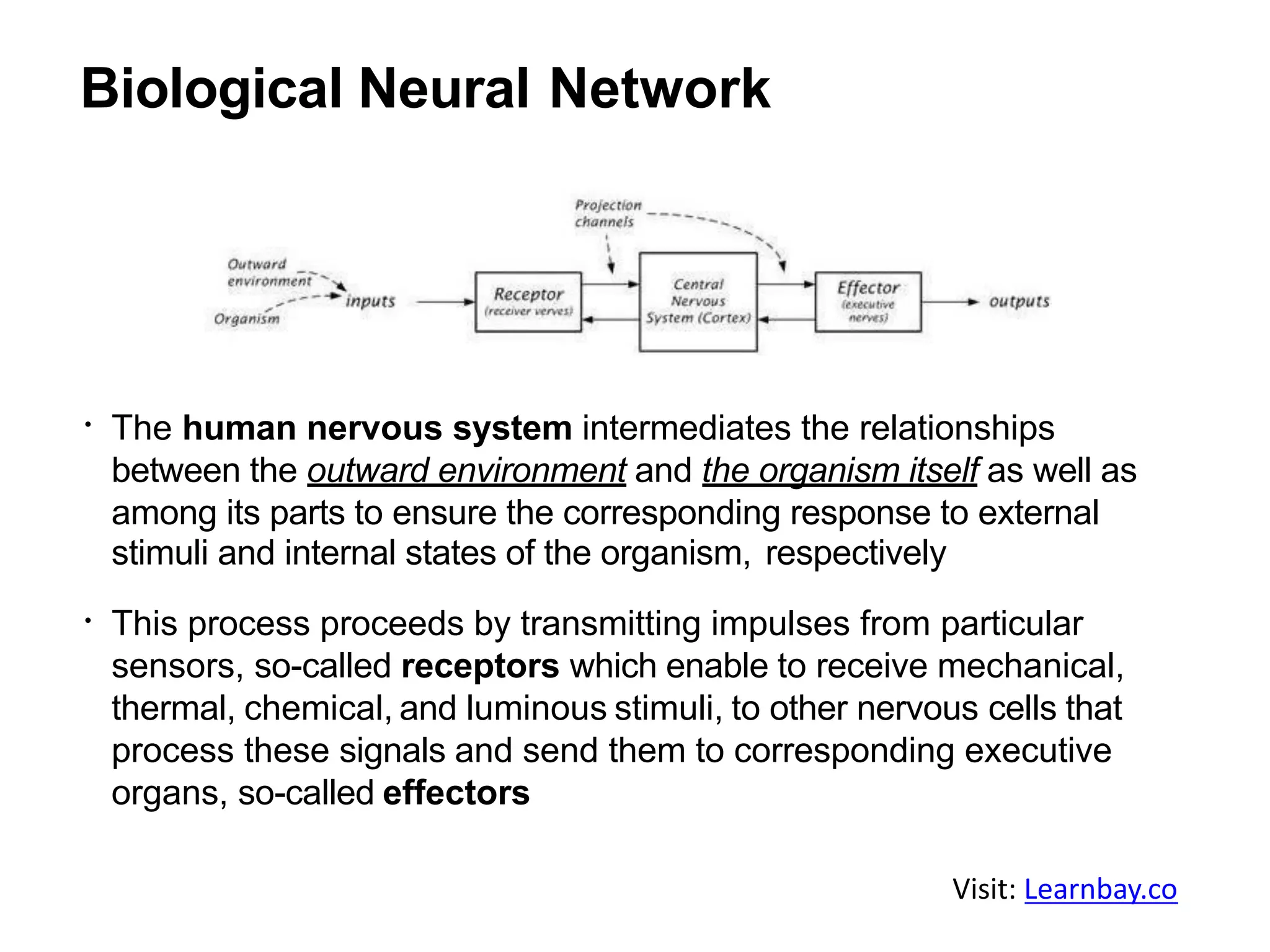
The human nervous system intermediates the relationships
between the outward environment and the organism itself as well as
among its parts to ensure the corresponding response to external
stimuli and internal states of the organism, respectively
This process proceeds by transmitting impulses from particular
sensors, so-called receptors which enable to receive mechanical,
thermal, chemical, and luminous stimuli, to other nervous cells that
process these signals and send them to corresponding executive
organs, so-called effectors
Visit: Learnbay.co
Biological Neurons
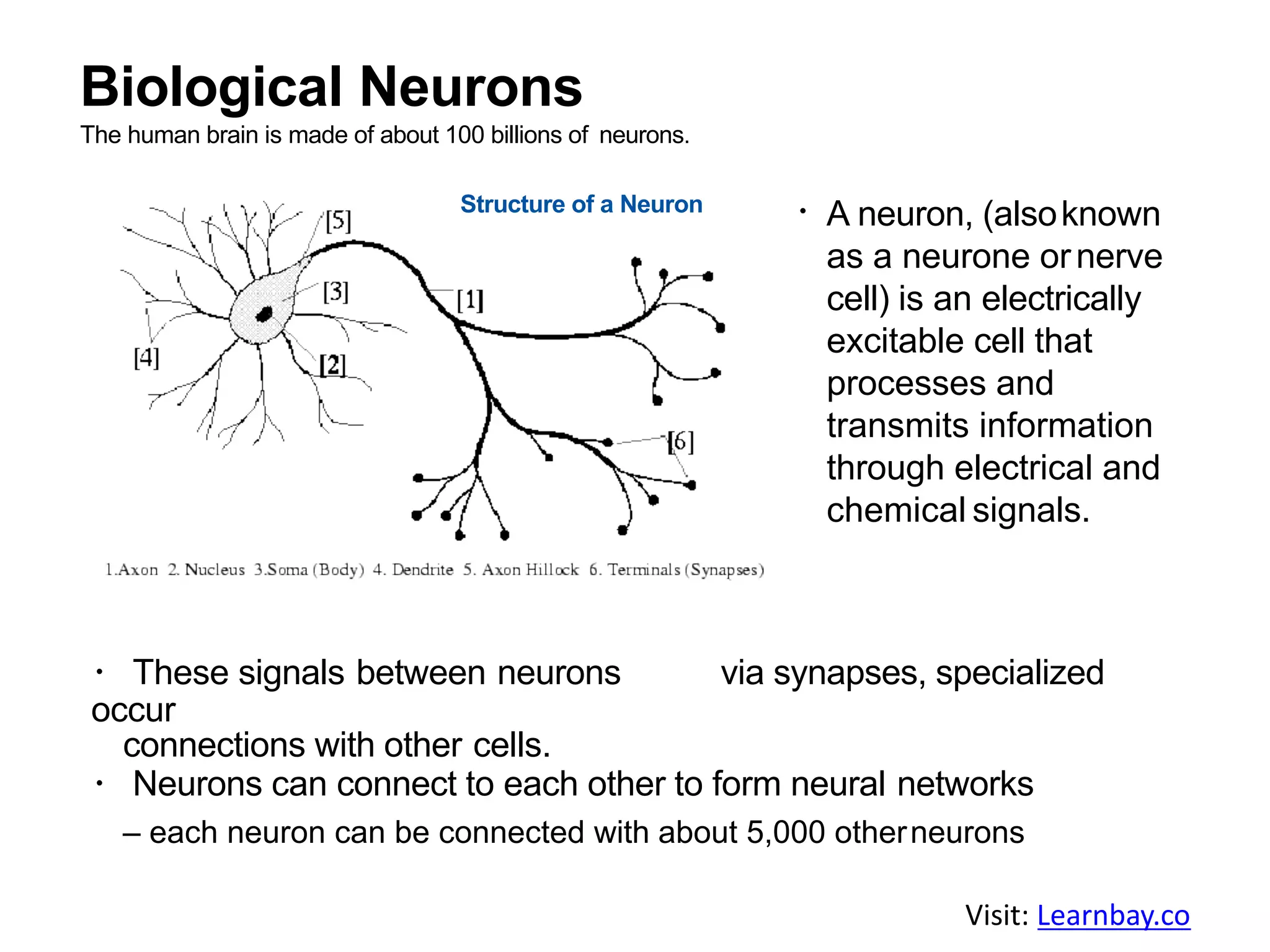
The human brain is made of about 100 billions of neurons.
Structure of a Neuron
A neuron, (alsoknown
as a neurone ornerve
cell) is an electrically
excitable cell that
processes and
transmits information
through electrical and
chemical signals.
These signals between neurons via synapses, specialized
occur
connections with other cells.
Neurons can connect to each other to form neural networks
– each neuron can be connected with about 5,000 otherneurons
Visit: Learnbay.co
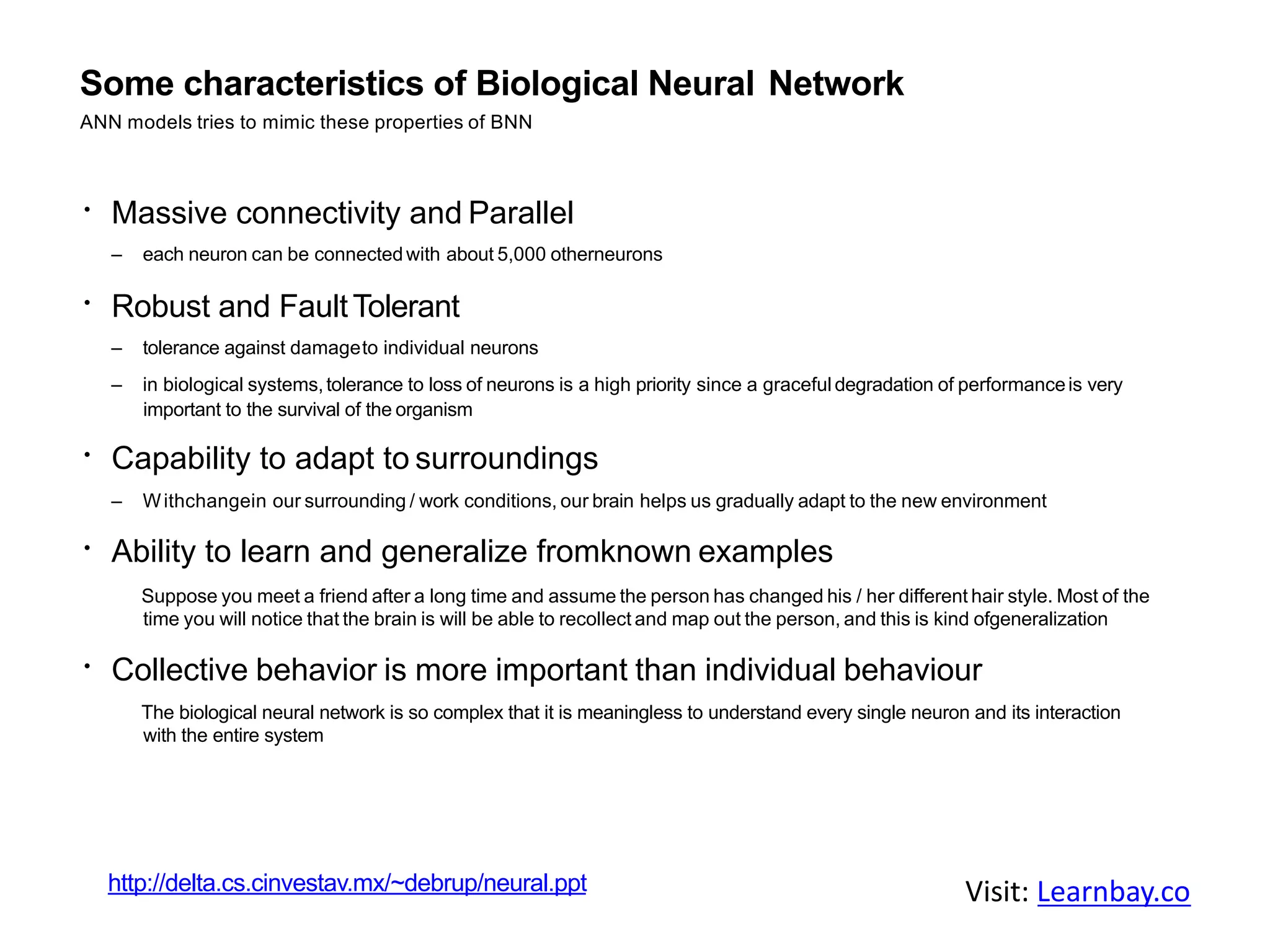
Some characteristics of Biological Neural Network
ANN models tries to mimic these properties of BNN
Massive connectivity and Parallel
– each neuron can be connectedwith about 5,000 otherneurons
Robust and FaultTolerant
– tolerance against damageto individual neurons
– in biological systems,tolerance to loss of neurons is a high priority since a graceful degradation of performanceis very
important to the survival of the organism
Capability to adapt to surroundings
– Withchangein our surrounding / work conditions, our brain helps us gradually adapt to the new environment
Ability to learn and generalize fromknown examples
Suppose you meet a friend after a long time and assume the person has changed his / her different hair style. Most of the
time you will notice that the brain is will be able to recollect and map out the person, and this is kind ofgeneralization
Collective behavior is more important than individual behaviour
The biological neural network is so complex that it is meaningless to understand every single neuron and its interaction
with the entire system
http://delta.cs.cinvestav.mx/~debrup/neural.ppt Visit: Learnbay.co
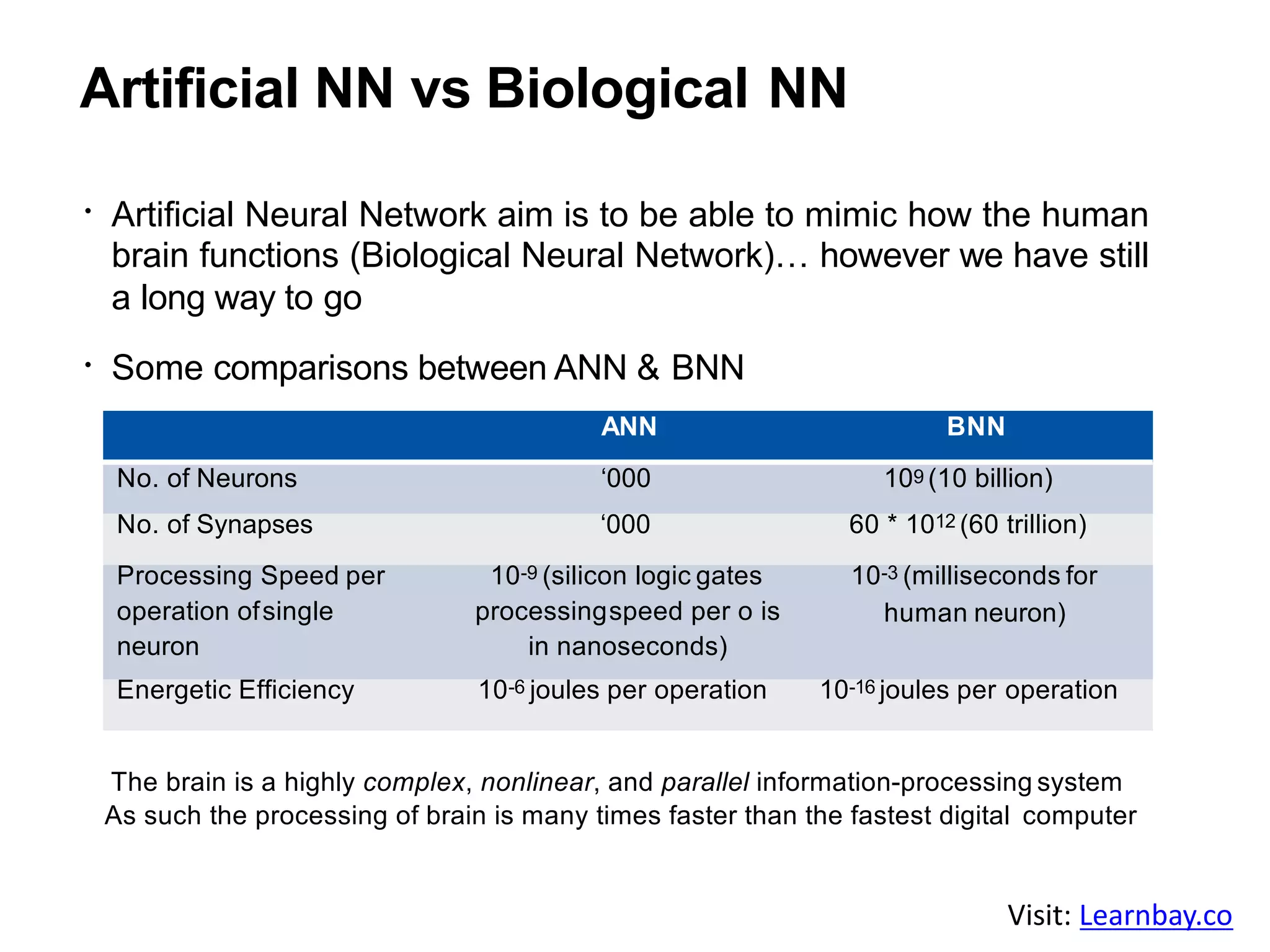
ANN BNN
No. of Neurons ‘000 109 (10 billion)
No. of Synapses ‘000 60 * 1012 (60 trillion)
Processing Speed per
operation ofsingle
neuron
10-9 (silicon logic gates
processingspeed per o is
in nanoseconds)
10-3 (milliseconds for
human neuron)
Energetic Efficiency 10-6 joules per operation 10-16 joules per operation
Artificial NN vs Biological NN
Artificial Neural Network aim is to be able to mimic how the human
brain functions (Biological Neural Network)… however we have still
a long way to go
Some comparisons between ANN & BNN
The brain is a highly complex, nonlinear, and parallel information-processing system
As such the processing of brain is many times faster than the fastest digital computer
Visit: Learnbay.co
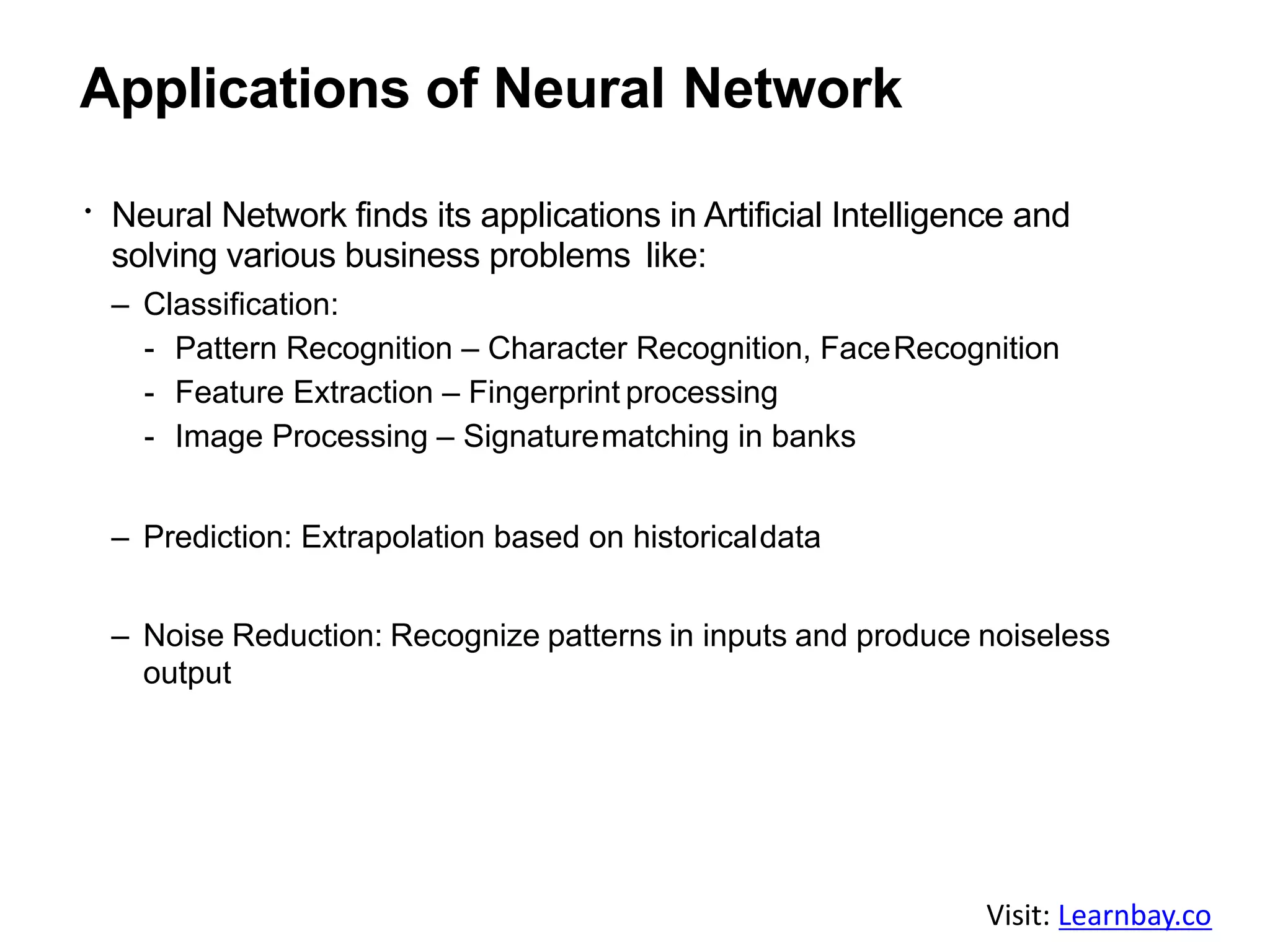
Applications of Neural Network
Neural Network finds its applications in Artificial Intelligence and
solving various business problems like:
– Classification:
- Pattern Recognition – Character Recognition, FaceRecognition
- Feature Extraction – Fingerprint processing
- Image Processing – Signaturematching in banks
– Prediction: Extrapolation based on historicaldata
– Noise Reduction: Recognize patterns in inputs and produce noiseless
output
Visit: Learnbay.co
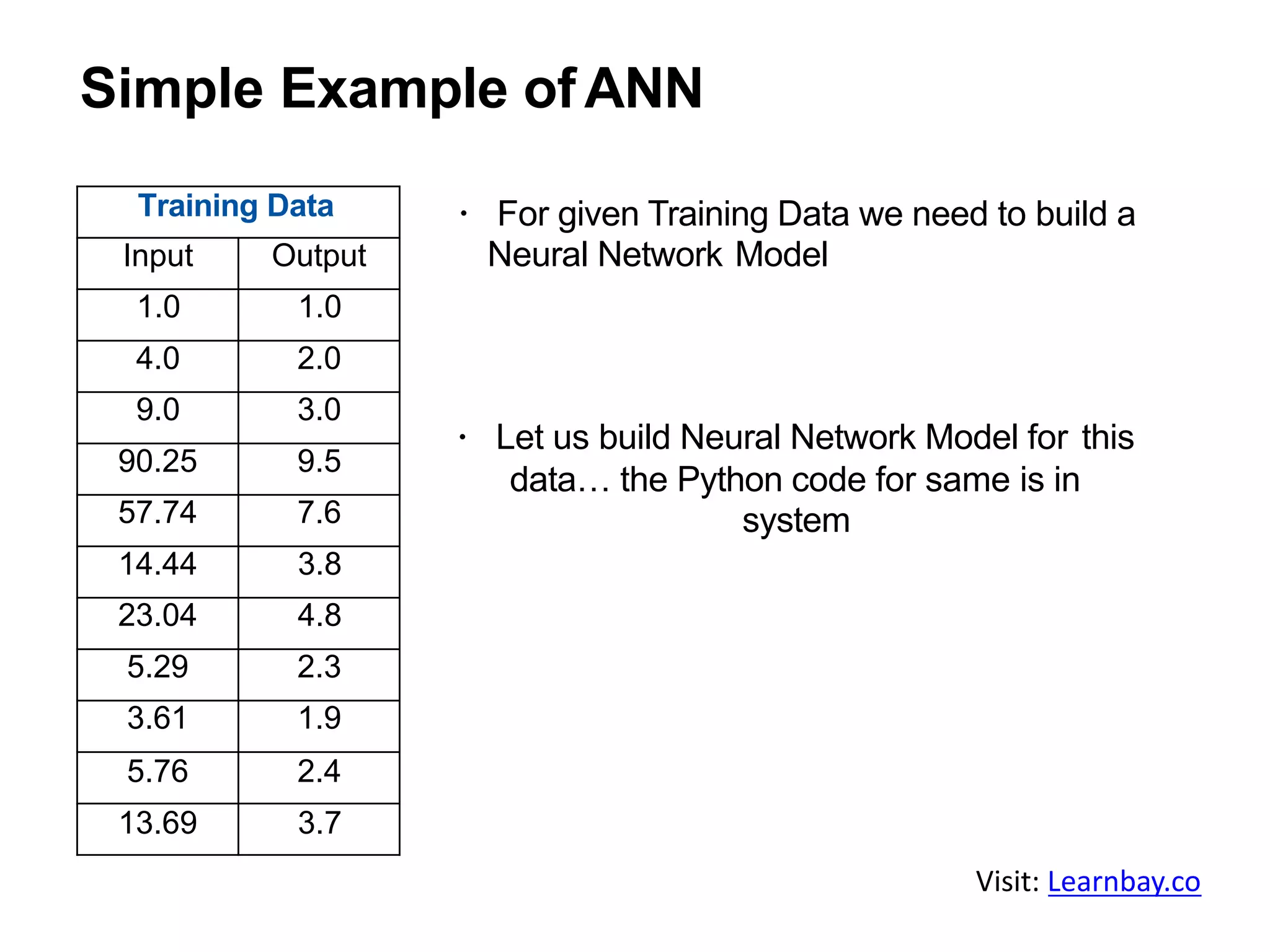
Training Data
Input Output
1.0 1.0
4.0 2.0
9.0 3.0
90.25 9.5
57.74 7.6
14.44 3.8
23.04 4.8
5.29 2.3
3.61 1.9
5.76 2.4
13.69 3.7
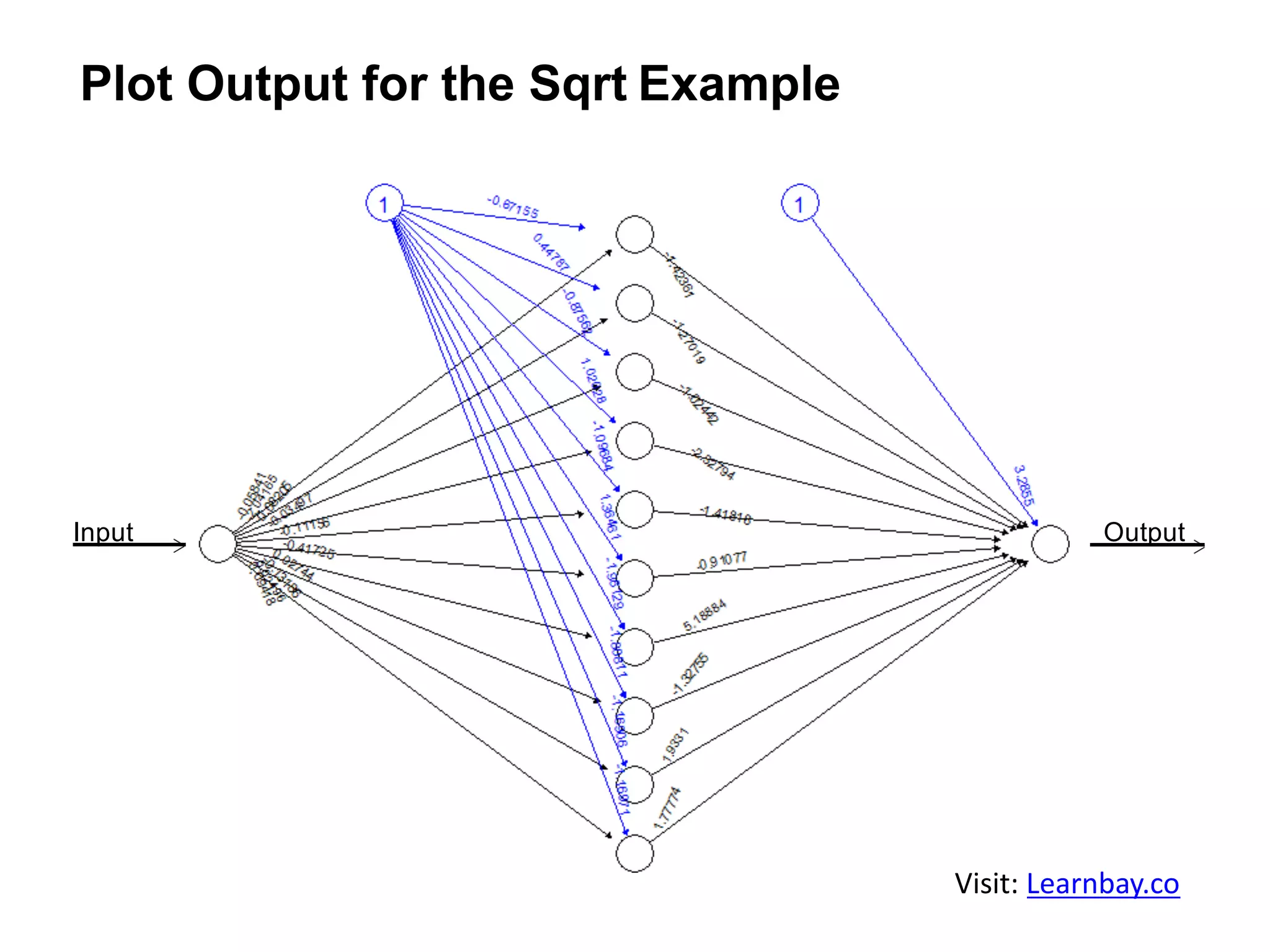
Simple Example ofANN
For given Training Data we need to build a
Neural Network Model
Let us build Neural Network Model for this
data… the Python code for same is in
system
Visit: Learnbay.co
Plot Output for the Sqrt Example
Input Output
Visit: Learnbay.co
Why use Neural Network
Ability to learn
– Neural Networks figure out how to perform their function on their own
– Determine their function based only upon sample inputs
Ability to generalize
–Produce outputs for inputs it has not been taught howto deal with
Fault tolerance
Adaptivity – can be easily retrained to changing environmental
conditions
Visit: Learnbay.co
Perceptrons
Single / Multi Layer Neural Network
Neurons and Activation Functions
Cost Function
Backpropogation
Gradient Descent & Delta Rule
Learning Rate & Epoch
Visit: Learnbay.co
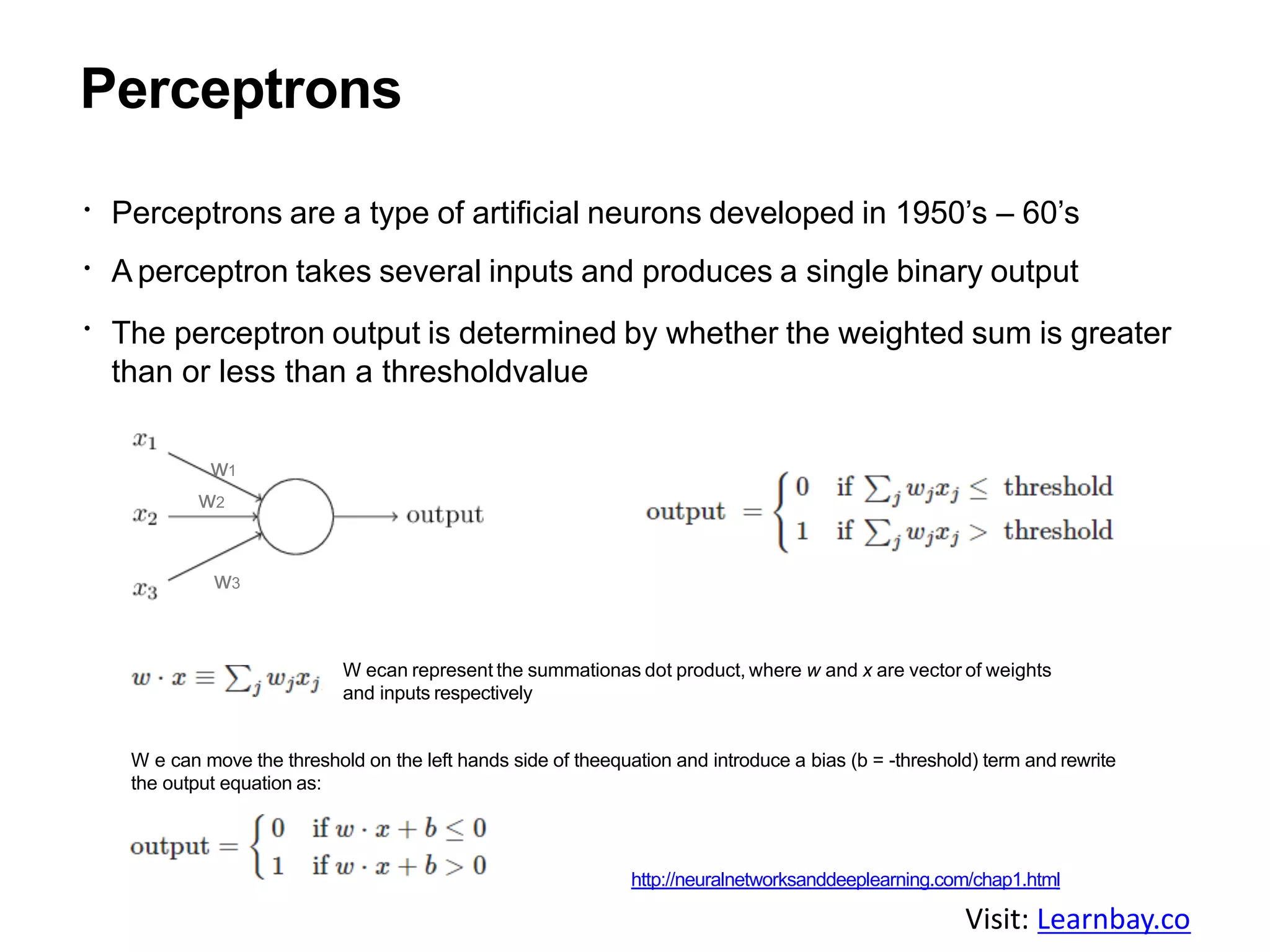
Perceptrons
Perceptrons are a type of artificial neurons developed in 1950’s – 60’s
A perceptron takes several inputs and produces a single binary output
The perceptron output is determined by whether the weighted sum is greater
than or less than a thresholdvalue
w1
w2
w3
W ecan represent the summationas dot product, where w and x are vector of weights
and inputs respectively
W e can move the threshold on the left hands side of theequation and introduce a bias (b = -threshold) term and rewrite
the output equation as:
http://neuralnetworksanddeeplearning.com/chap1.html
Visit: Learnbay.co
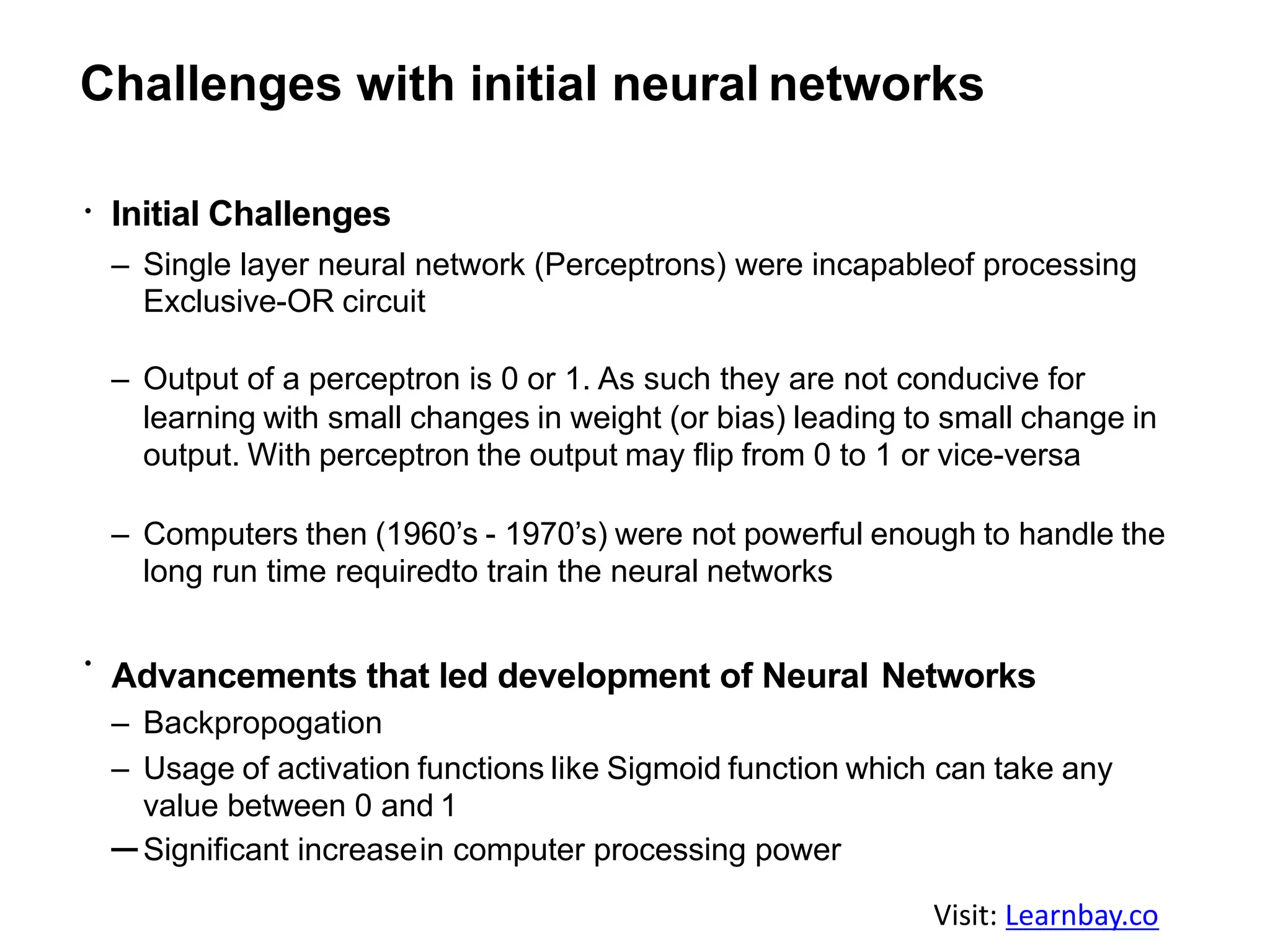
Challenges with initial neural networks
Initial Challenges
– Single layer neural network (Perceptrons) were incapableof processing
Exclusive-OR circuit
– Output of a perceptron is 0 or 1. As such they are not conducive for
learning with small changes in weight (or bias) leading to small change in
output. With perceptron the output may flip from 0 to 1 or vice-versa
– Computers then (1960’s - 1970’s) were not powerful enough to handle the
long run time requiredto train the neural networks
Advancements that led development of Neural Networks
– Backpropogation
– Usage of activation functions like Sigmoid function which can take any
value between 0 and 1
–Significant increasein computer processing power
Visit: Learnbay.co
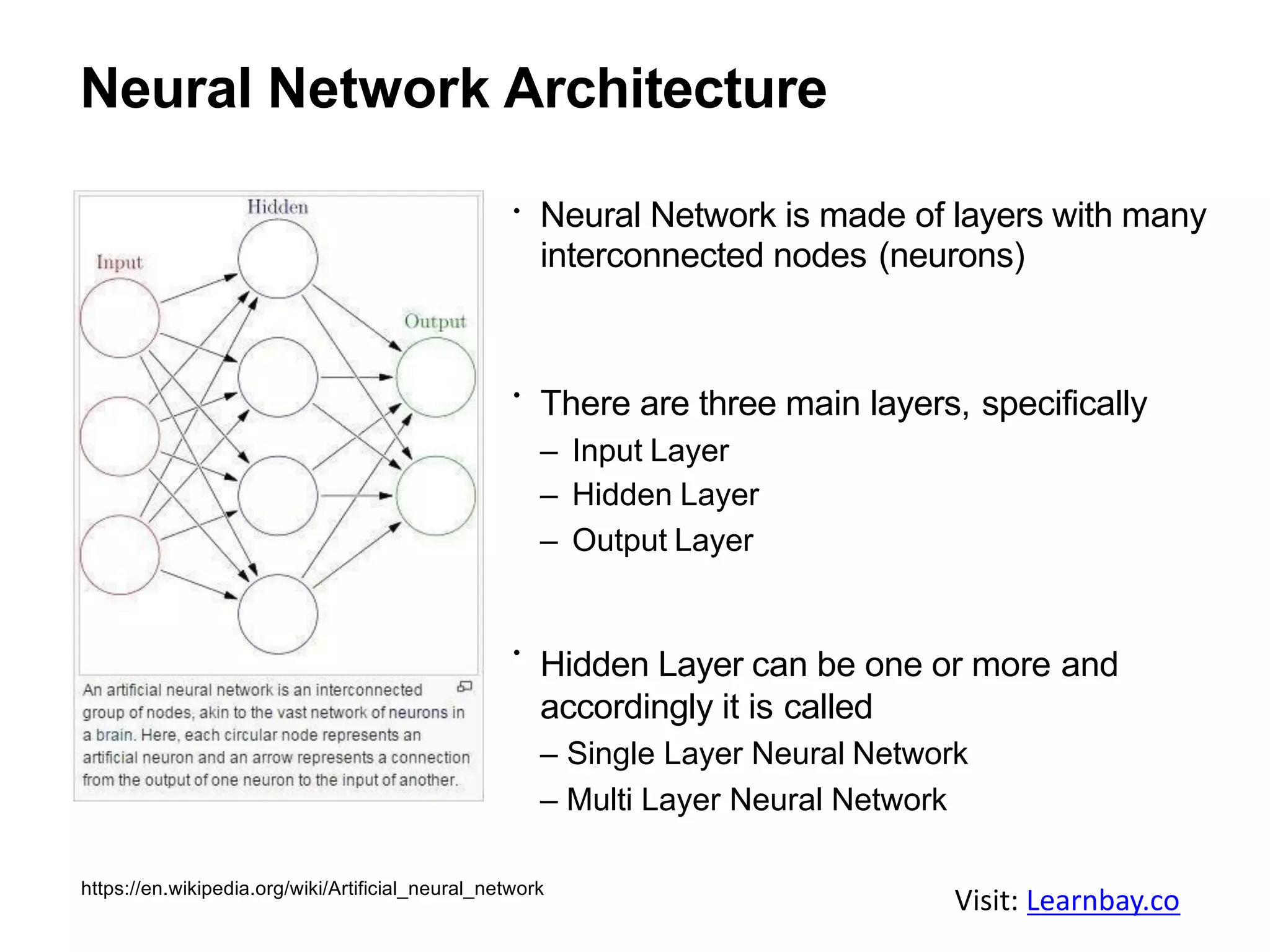
Neural Network Architecture
Neural Network is made of layers with many
interconnected nodes (neurons)
There are three main layers, specifically
– Input Layer
– Hidden Layer
– Output Layer
Hidden Layer can be one or more and
accordingly it is called
– Single Layer Neural Network
– Multi Layer Neural Network
https://en.wikipedia.org/wiki/Artificial_neural_network
Visit: Learnbay.co
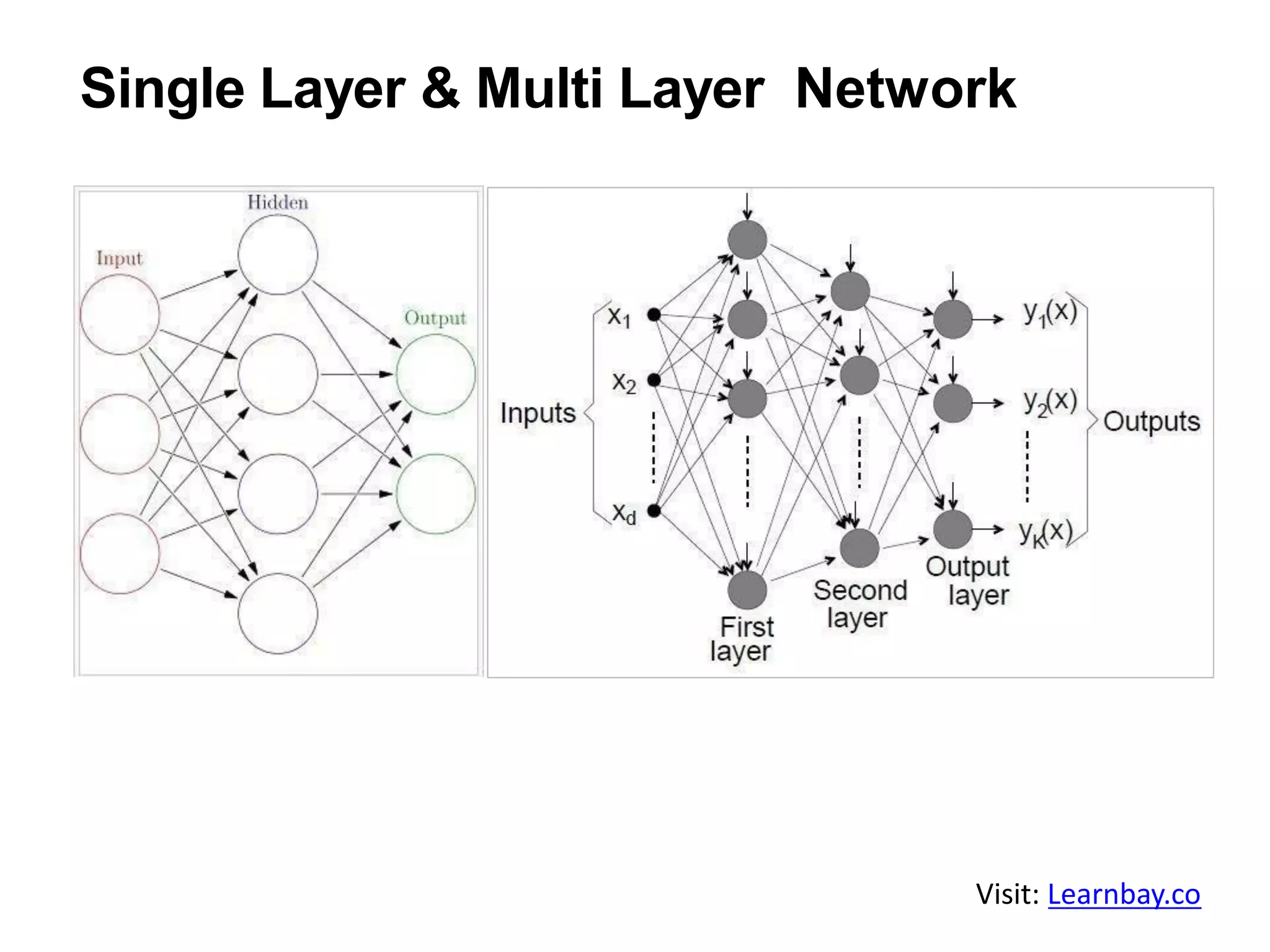
Single Layer & Multi Layer Network
Visit: Learnbay.co
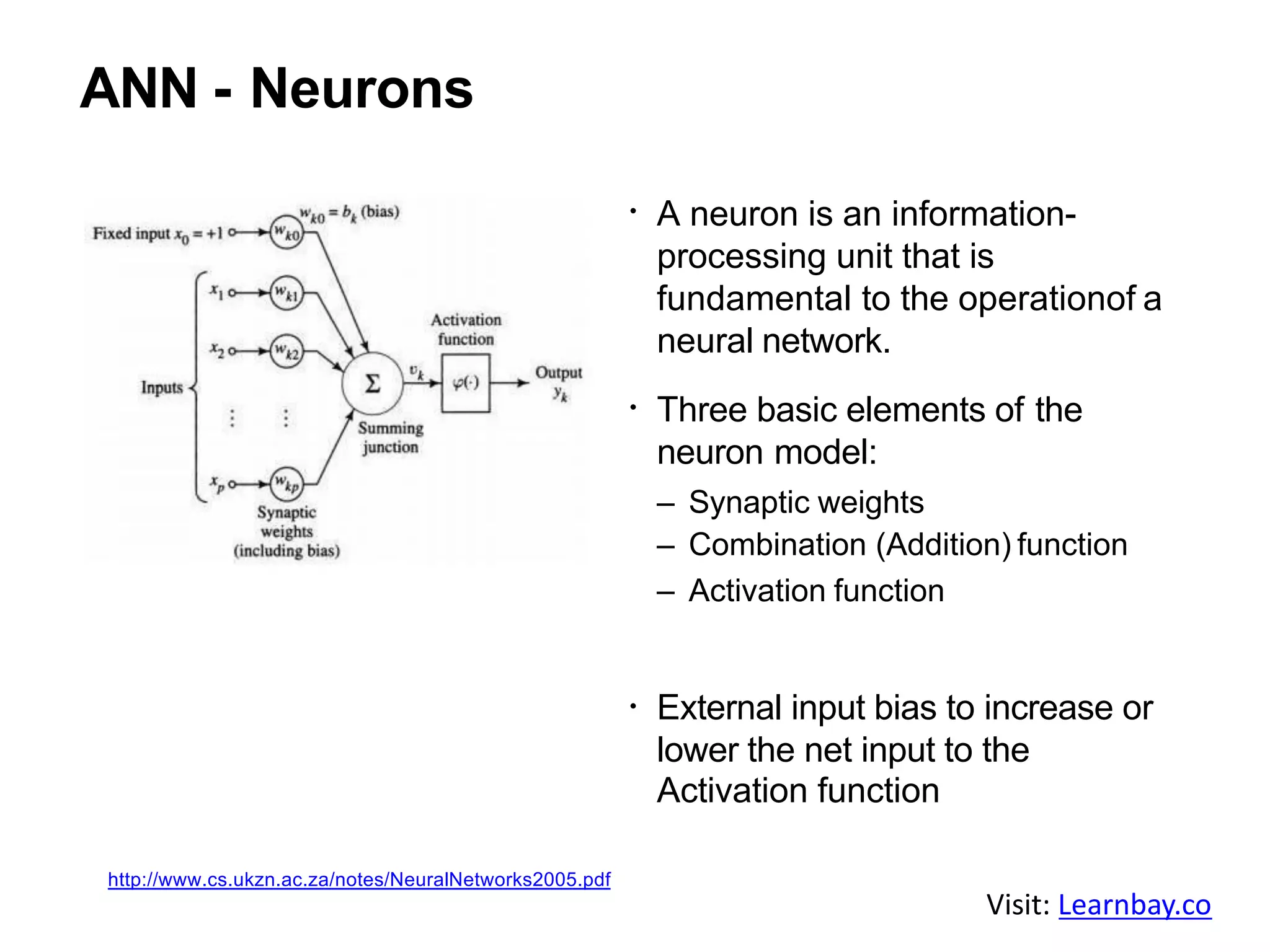
ANN - Neurons
A neuron is an information-
processing unit that is
fundamental to the operationof a
neural network.
Three basic elements of the
neuron model:
– Synaptic weights
– Combination (Addition) function
– Activation function
External input bias to increase or
lower the net input to the
Activation function
http://www.cs.ukzn.ac.za/notes/NeuralNetworks2005.pdf
Visit: Learnbay.co
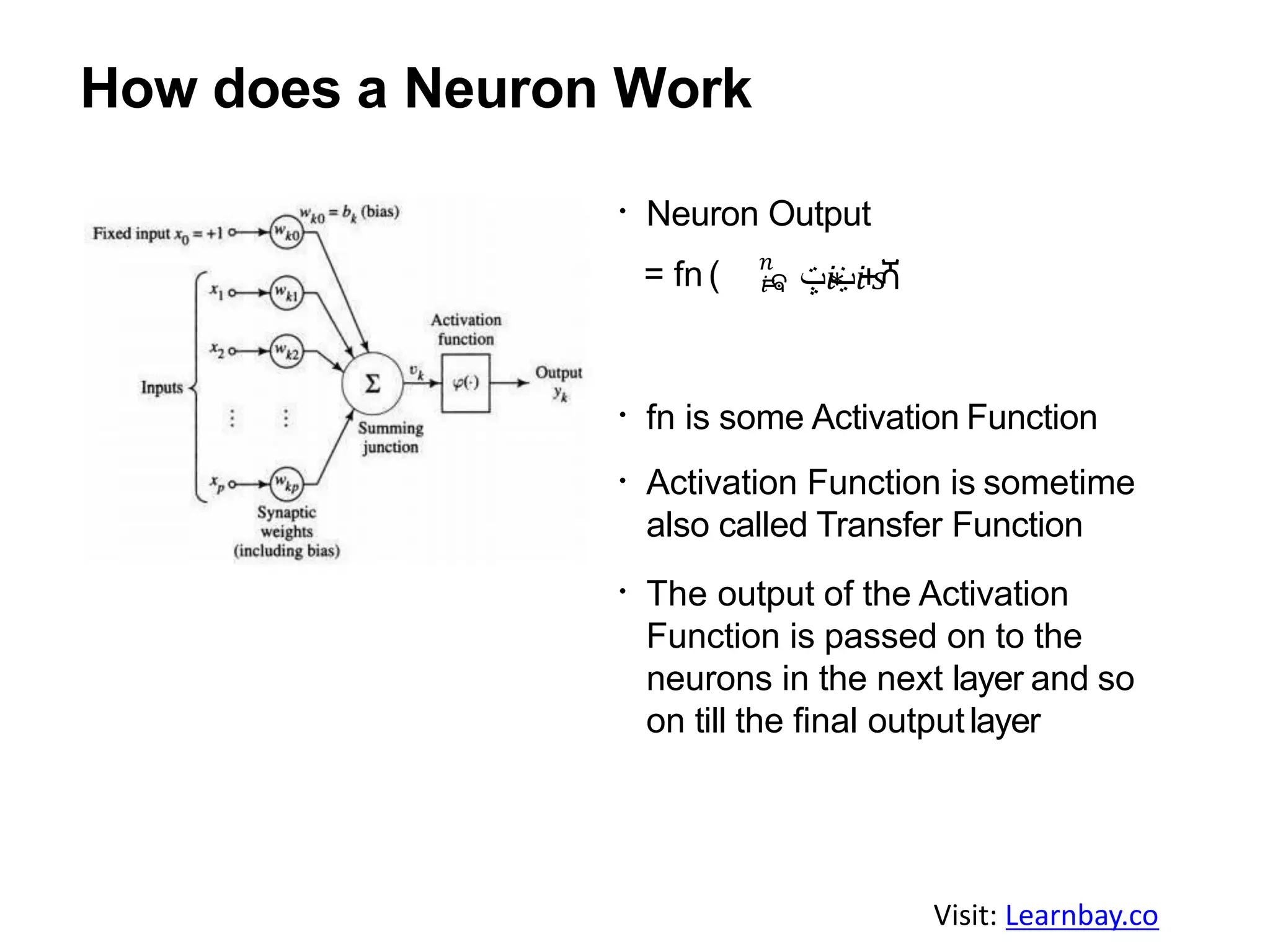
How does a Neuron Work
Neuron Output
𝑛
𝑖=ଵ= fn ( ‫𝑖ݓ‬∗‫ݔ‬ 𝑖+𝑠ሻ
fn is some Activation Function
Activation Function is sometime
also called Transfer Function
The output of the Activation
Function is passed on to the
neurons in the next layer and so
on till the final outputlayer
Visit: Learnbay.co
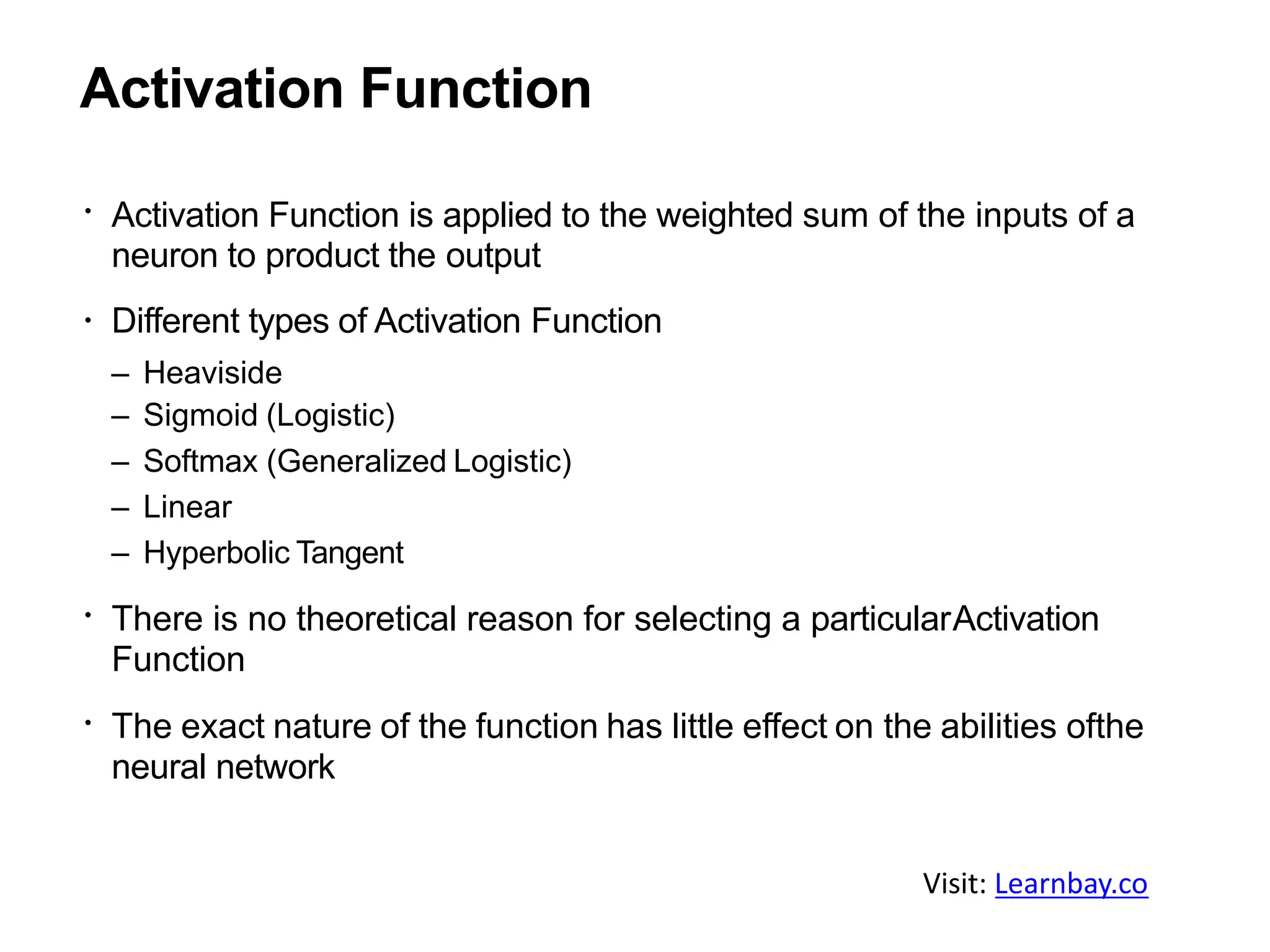
Activation Function
Activation Function is applied to the weighted sum of the inputs of a
neuron to product the output
Different types of Activation Function
– Heaviside
– Sigmoid (Logistic)
– Softmax (Generalized Logistic)
– Linear
– Hyperbolic Tangent
There is no theoretical reason for selecting a particularActivation
Function
The exact nature of the function has little effect on the abilities ofthe
neural network
Visit: Learnbay.co
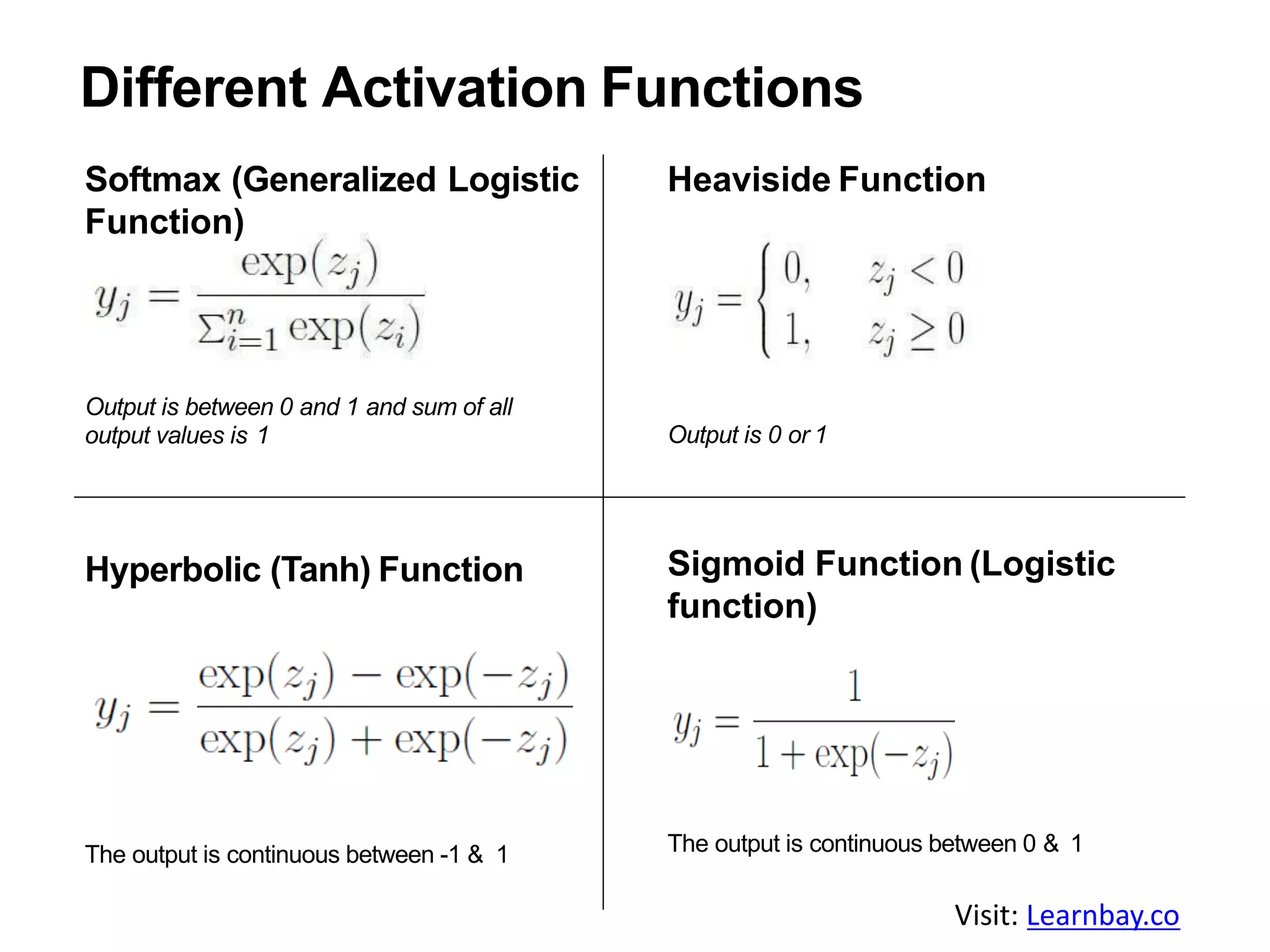
Different Activation Functions
Output is between 0 and 1 and sum of all
output values is 1
Softmax (Generalized Logistic Heaviside Function
Function)
Output is 0 or 1
Hyperbolic (Tanh) Function
The output is continuous between -1 & 1
Sigmoid Function (Logistic
function)
The output is continuous between 0 & 1
Visit: Learnbay.co
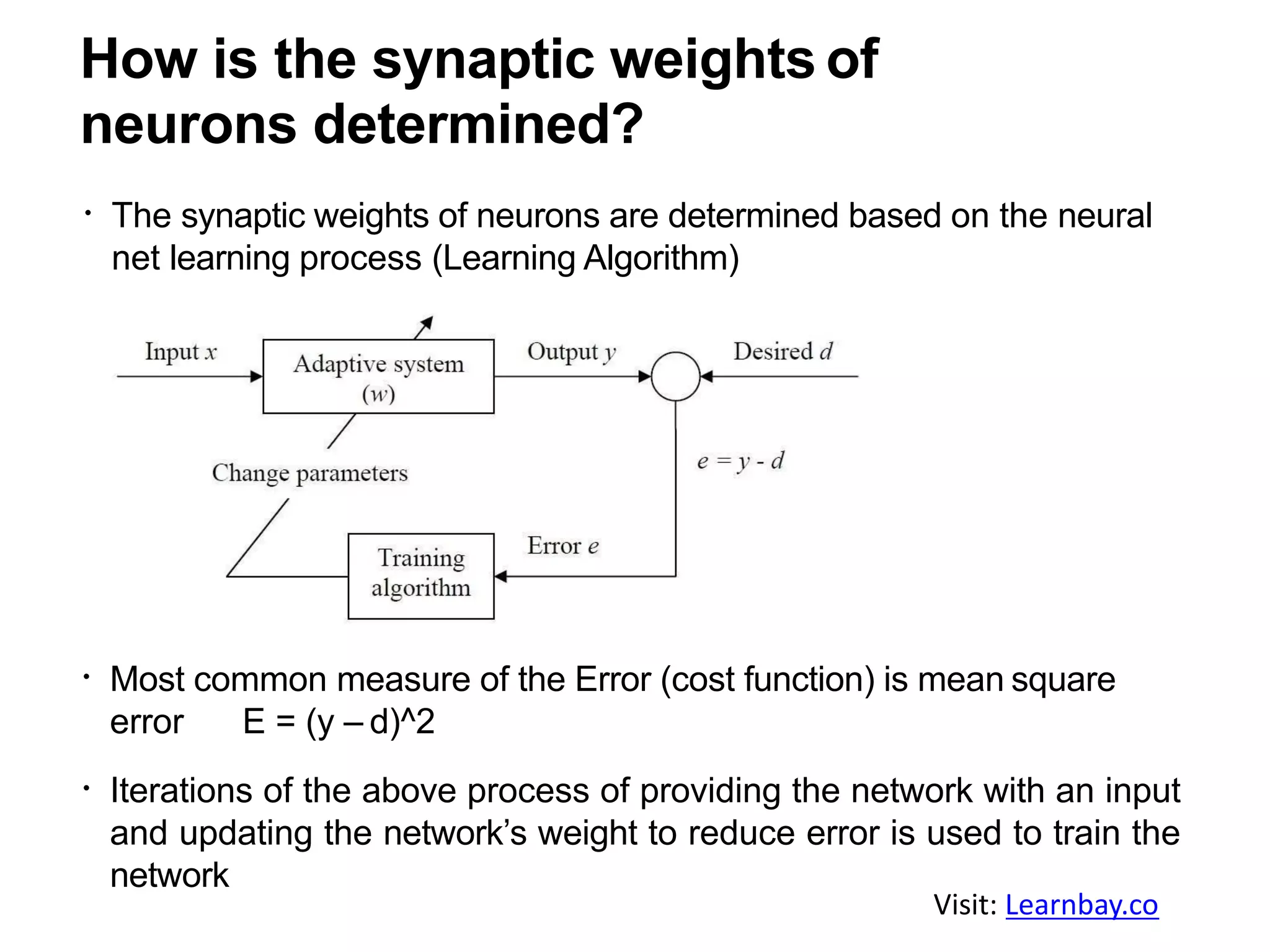
How is the synaptic weights of
neurons determined?
The synaptic weights of neurons are determined based on the neural
net learning process (Learning Algorithm)
Most common measure of the Error (cost function) is mean square
error E = (y – d)^2
Iterations of the above process of providing the network with an input
and updating the network’s weight to reduce error is used to train the
network
Visit: Learnbay.co
Backpropogation
Backpropagation, an abbreviation for "backward propagation of
errors", is a common method of training artificial neural
networks used in conjunction with an optimization method such
as gradient descent.
The method calculates the gradient of a loss function with respect to
all the weights in the network.
The gradient is fed to the optimization method which in turn uses it to
update the weights, in an attempt to minimize the loss function.
Backpropagation requires a known, desired output for each input
value in order to calculate the loss function gradient. It is therefore
usually considered to be a supervised learning method, although it is
also used in some unsupervised networks such as autoencoders.
A Step by Step BackpropagationExample
http://mattmazur.com/2015/03/17/a-step-by-step-backpropagation-example/
file:///D:/K2Analytics/Neural_Network/A%20Step%20by%20Step%20Backpropagation%20Example%20%E2%80%93%20Matt%20Mazur.html
Visit: Learnbay.co
Learning Rate
we must set the learning
rate to an appropriate value
– Too small, we will need too many iterationsfor convergence
– Too large, we may skip the optimalsolution
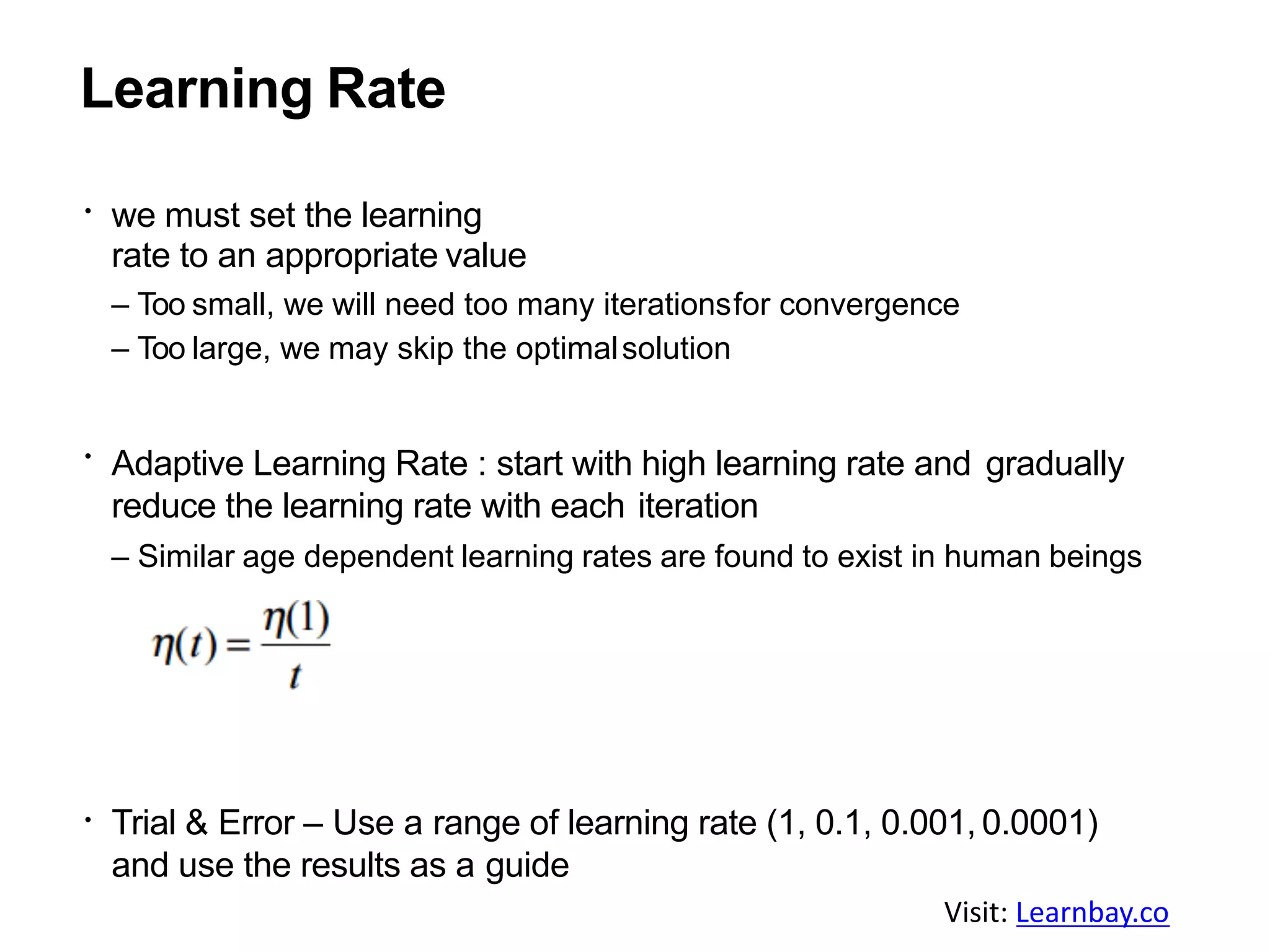
Adaptive Learning Rate : start with high learning rate and gradually
reduce the learning rate with each iteration
– Similar age dependent learning rates are found to exist in human beings
Trial & Error – Use a range of learning rate (1, 0.1, 0.001, 0.0001)
and use the results as a guide
Visit: Learnbay.co
Epoch
An epoch is a measure of the number of times all of the training
vectors are used once to update the weights
Batch training: For batch training all of the training samples pass
through the learning algorithm simultaneously in one epoch before
weights are updated
Sequential training - For sequential training all of the weights are
updated after each training vector is sequentially passed through the
training algorithm.
Visit: Learnbay.co
No Ln(No) Rel. Diff
1 0
2 0.693147 0.693147
3 1.098612 0.405465
4 1.386294 0.287682
5 1.609438 0.223144
6 1.791759 0.182322
7 1.94591 0.154151
8 2.079442 0.133531
9 2.197225 0.117783
10 2.302585 0.105361
11 2.397895 0.09531
12 2.484907 0.087011
13 2.564949 0.080043
14 2.639057 0.074108
15 2.70805 0.068993
16 2.772589 0.064539
17 2.833213 0.060625
18 2.890372 0.057158
19 2.944439 0.054067
20 2.995732 0.051293
21 3.044522 0.04879
Scaling Variables
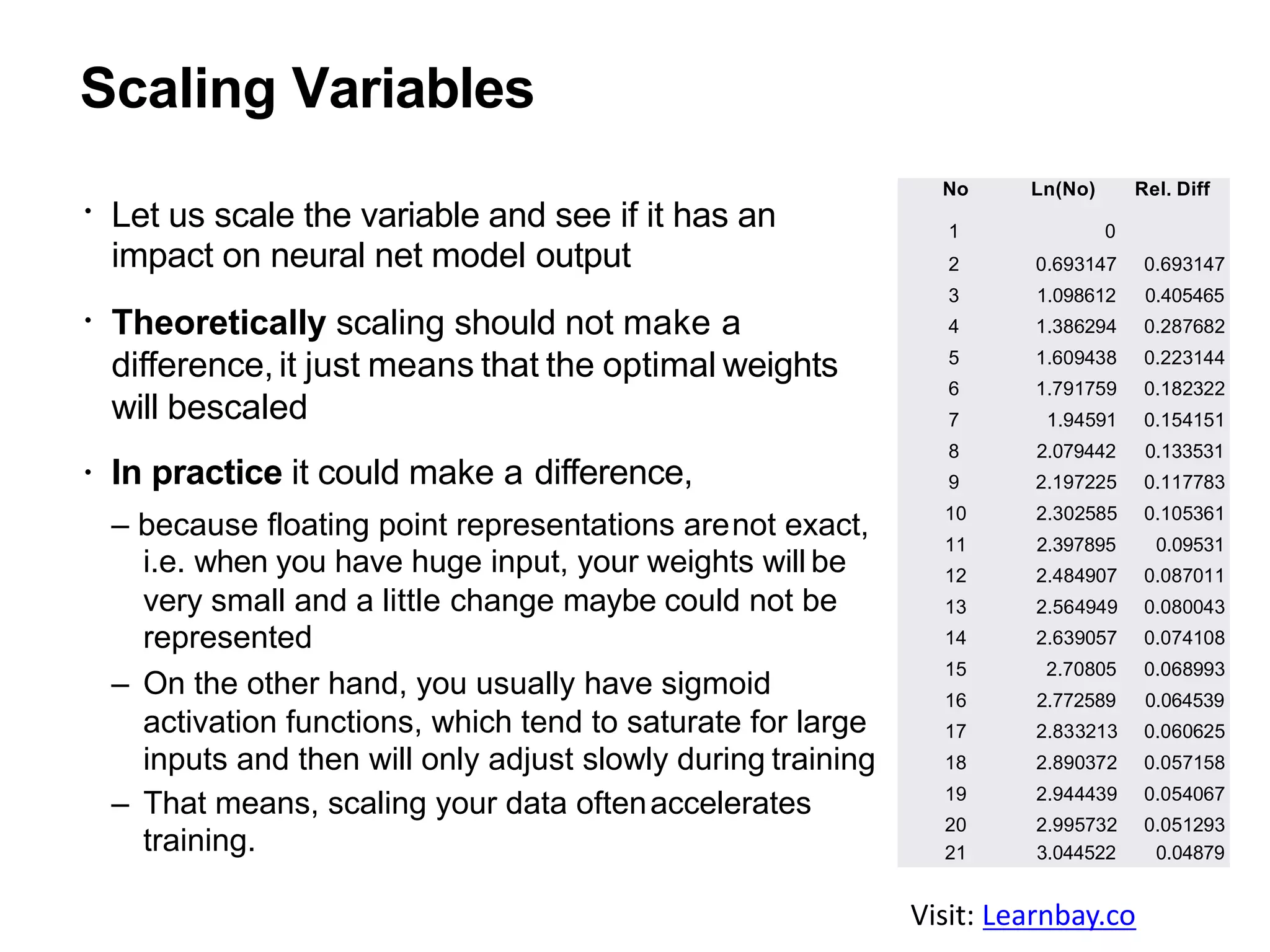
Let us scale the variable and see if it has an
impact on neural net model output
Theoretically scaling should not make a
difference, it just means that the optimal weights
will bescaled
In practice it could make a difference,
– because floating point representations arenot exact,
i.e. when you have huge input, your weights will be
very small and a little change maybe could not be
represented
– On the other hand, you usually have sigmoid
activation functions, which tend to saturate for large
inputs and then will only adjust slowly during training
– That means, scaling your data oftenaccelerates
training.
Visit: Learnbay.co
Overfitting
Overfitting – Neural Network Models are susceptible to overfitting
Main causes being
– Large number of weights and biases
– Excessive learning (Epocs) on trainingdata
Ways to avoid Overfitting
– Increase sample size
– Early stopping
– Reduce Network Size
– Regularization
Visit: Learnbay.co
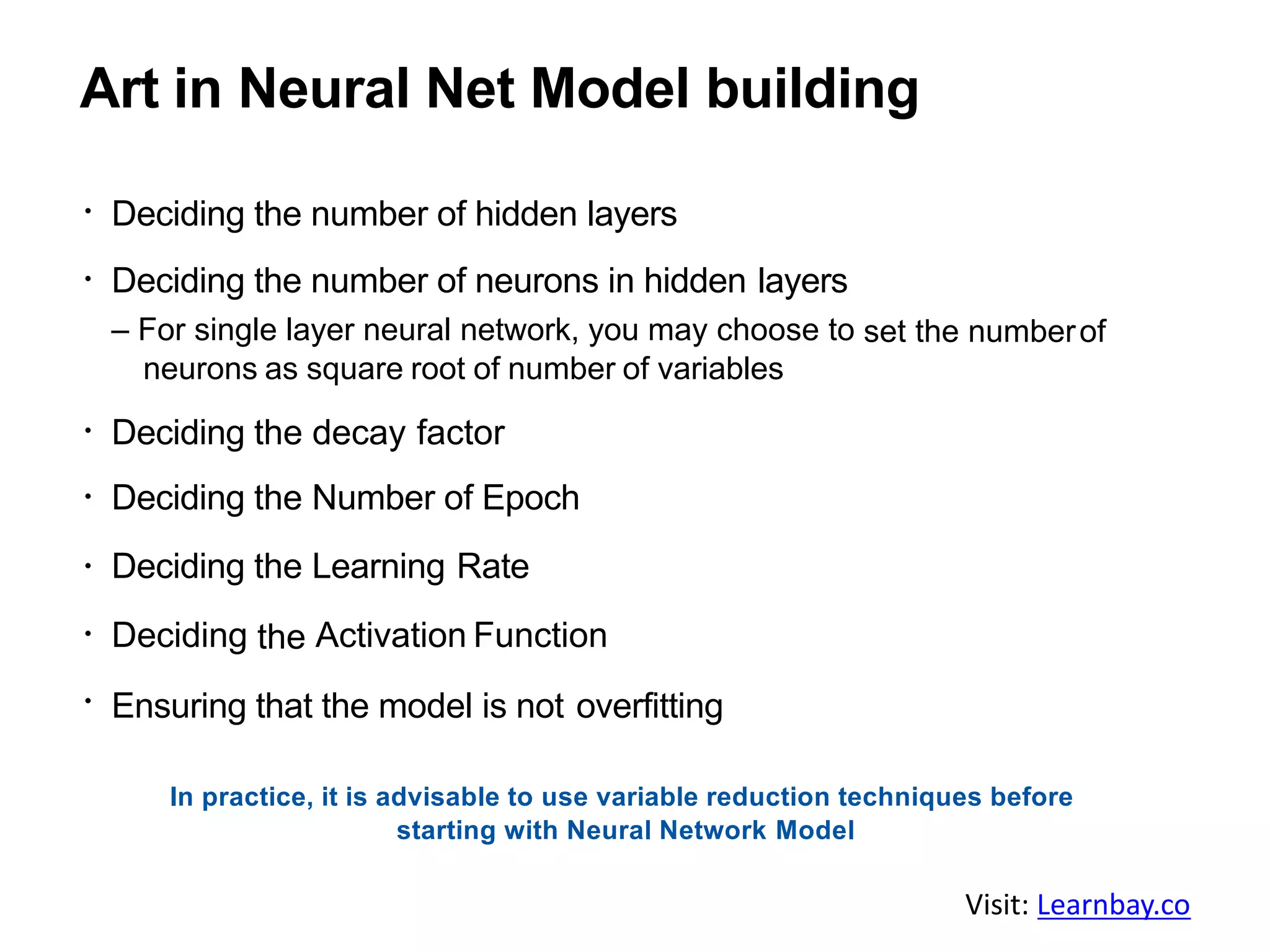
Art in Neural Net Model building
Deciding the number of hidden layers
Deciding the number of neurons in hidden layers
– For single layer neural network, you may choose to set the numberof
neurons as square root of number of variables
Deciding the decay factor
Deciding the Number of Epoch
Deciding the Learning Rate
Deciding the Activation Function
Ensuring that the model is not overfitting
In practice, it is advisable to use variable reduction techniques before
starting with Neural Network Model
Visit: Learnbay.co
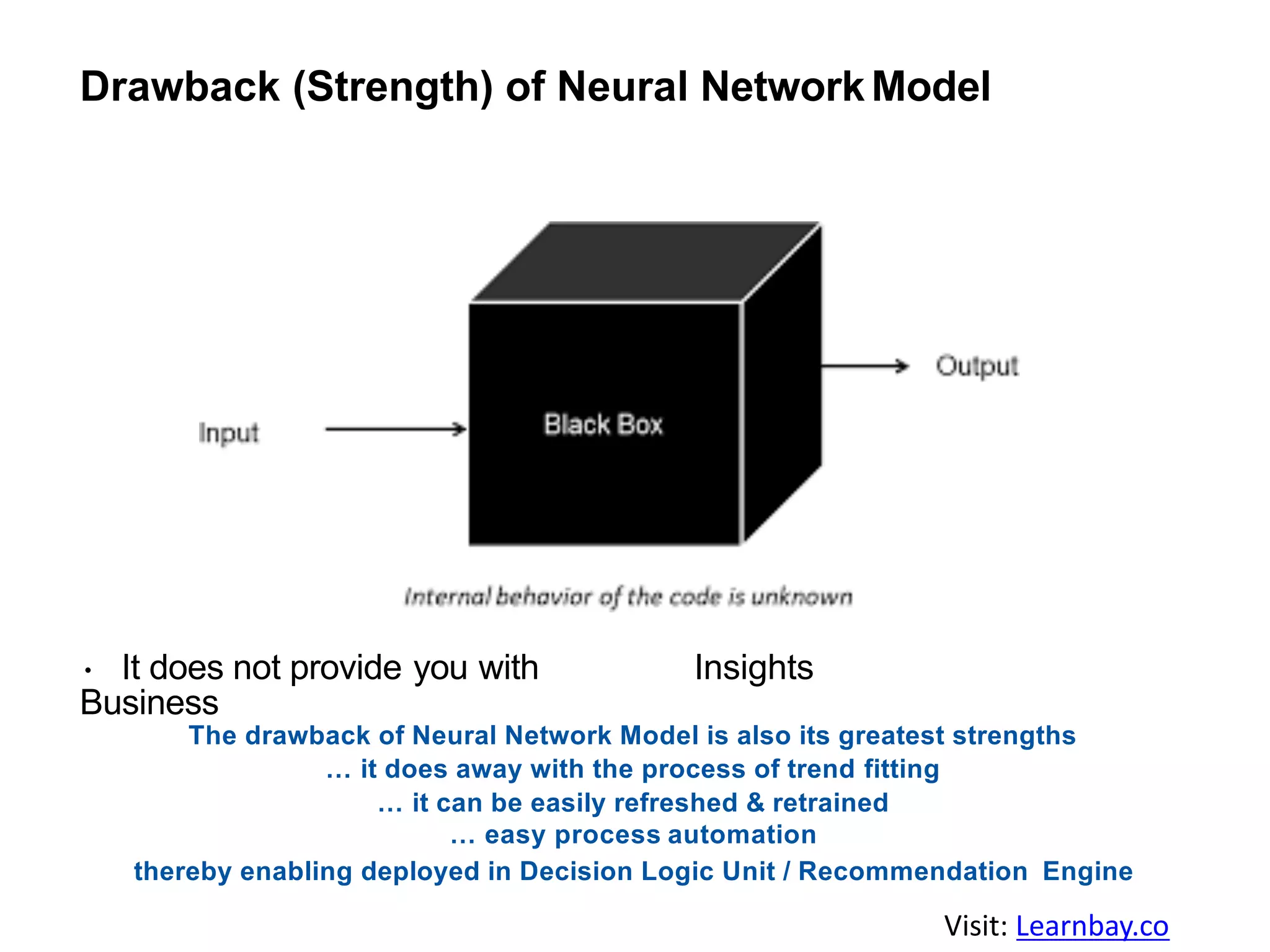
Drawback (Strength) of Neural NetworkModel
It does not provide you with Insights
Business
The drawback of Neural Network Model is also its greatest strengths
… it does away with the process of trend fitting
… it can be easily refreshed & retrained
… easy process automation
thereby enabling deployed in Decision Logic Unit / Recommendation Engine
Visit: Learnbay.co
Thank you
Earning is inLearning
Visit: Learnbay.co

Artificial Neural networks

  • 1.
    Artificial Neural Network (…orsimply Neural Network) Earning is inLearning Data science and AI Certification Course Visit: Learnbay.co
  • 2.
    Agenda Introduction Application of analyticsin business Skills required for BusinessAnalytics Data Mining in a nut shell Basic number skills Classification Tree Visit: Learnbay.co
  • 3.
    Artificial Neural Network ArtificialNeural Network(ANN) are Family of Models inspired by Biological Neural Networks Artificial Neural Networks, commonly referred to as neural networks has been motivated right from its inception by the recognition that the brain computes in an entirely different way from the conventional digital computer Visit: Learnbay.co
  • 4.
    Biological Neural Network Thehuman nervous system intermediates the relationships between the outward environment and the organism itself as well as among its parts to ensure the corresponding response to external stimuli and internal states of the organism, respectively This process proceeds by transmitting impulses from particular sensors, so-called receptors which enable to receive mechanical, thermal, chemical, and luminous stimuli, to other nervous cells that process these signals and send them to corresponding executive organs, so-called effectors Visit: Learnbay.co
  • 5.
    Biological Neurons The humanbrain is made of about 100 billions of neurons. Structure of a Neuron A neuron, (alsoknown as a neurone ornerve cell) is an electrically excitable cell that processes and transmits information through electrical and chemical signals. These signals between neurons via synapses, specialized occur connections with other cells. Neurons can connect to each other to form neural networks – each neuron can be connected with about 5,000 otherneurons Visit: Learnbay.co
  • 6.
    Some characteristics ofBiological Neural Network ANN models tries to mimic these properties of BNN Massive connectivity and Parallel – each neuron can be connectedwith about 5,000 otherneurons Robust and FaultTolerant – tolerance against damageto individual neurons – in biological systems,tolerance to loss of neurons is a high priority since a graceful degradation of performanceis very important to the survival of the organism Capability to adapt to surroundings – Withchangein our surrounding / work conditions, our brain helps us gradually adapt to the new environment Ability to learn and generalize fromknown examples Suppose you meet a friend after a long time and assume the person has changed his / her different hair style. Most of the time you will notice that the brain is will be able to recollect and map out the person, and this is kind ofgeneralization Collective behavior is more important than individual behaviour The biological neural network is so complex that it is meaningless to understand every single neuron and its interaction with the entire system http://delta.cs.cinvestav.mx/~debrup/neural.ppt Visit: Learnbay.co
  • 7.
    ANN BNN No. ofNeurons ‘000 109 (10 billion) No. of Synapses ‘000 60 * 1012 (60 trillion) Processing Speed per operation ofsingle neuron 10-9 (silicon logic gates processingspeed per o is in nanoseconds) 10-3 (milliseconds for human neuron) Energetic Efficiency 10-6 joules per operation 10-16 joules per operation Artificial NN vs Biological NN Artificial Neural Network aim is to be able to mimic how the human brain functions (Biological Neural Network)… however we have still a long way to go Some comparisons between ANN & BNN The brain is a highly complex, nonlinear, and parallel information-processing system As such the processing of brain is many times faster than the fastest digital computer Visit: Learnbay.co
  • 8.
    Applications of NeuralNetwork Neural Network finds its applications in Artificial Intelligence and solving various business problems like: – Classification: - Pattern Recognition – Character Recognition, FaceRecognition - Feature Extraction – Fingerprint processing - Image Processing – Signaturematching in banks – Prediction: Extrapolation based on historicaldata – Noise Reduction: Recognize patterns in inputs and produce noiseless output Visit: Learnbay.co
  • 9.
    Training Data Input Output 1.01.0 4.0 2.0 9.0 3.0 90.25 9.5 57.74 7.6 14.44 3.8 23.04 4.8 5.29 2.3 3.61 1.9 5.76 2.4 13.69 3.7 Simple Example ofANN For given Training Data we need to build a Neural Network Model Let us build Neural Network Model for this data… the Python code for same is in system Visit: Learnbay.co
  • 10.
    Plot Output forthe Sqrt Example Input Output Visit: Learnbay.co
  • 11.
    Why use NeuralNetwork Ability to learn – Neural Networks figure out how to perform their function on their own – Determine their function based only upon sample inputs Ability to generalize –Produce outputs for inputs it has not been taught howto deal with Fault tolerance Adaptivity – can be easily retrained to changing environmental conditions Visit: Learnbay.co
  • 12.
    Perceptrons Single / MultiLayer Neural Network Neurons and Activation Functions Cost Function Backpropogation Gradient Descent & Delta Rule Learning Rate & Epoch Visit: Learnbay.co
  • 13.
    Perceptrons Perceptrons are atype of artificial neurons developed in 1950’s – 60’s A perceptron takes several inputs and produces a single binary output The perceptron output is determined by whether the weighted sum is greater than or less than a thresholdvalue w1 w2 w3 W ecan represent the summationas dot product, where w and x are vector of weights and inputs respectively W e can move the threshold on the left hands side of theequation and introduce a bias (b = -threshold) term and rewrite the output equation as: http://neuralnetworksanddeeplearning.com/chap1.html Visit: Learnbay.co
  • 14.
    Challenges with initialneural networks Initial Challenges – Single layer neural network (Perceptrons) were incapableof processing Exclusive-OR circuit – Output of a perceptron is 0 or 1. As such they are not conducive for learning with small changes in weight (or bias) leading to small change in output. With perceptron the output may flip from 0 to 1 or vice-versa – Computers then (1960’s - 1970’s) were not powerful enough to handle the long run time requiredto train the neural networks Advancements that led development of Neural Networks – Backpropogation – Usage of activation functions like Sigmoid function which can take any value between 0 and 1 –Significant increasein computer processing power Visit: Learnbay.co
  • 15.
    Neural Network Architecture NeuralNetwork is made of layers with many interconnected nodes (neurons) There are three main layers, specifically – Input Layer – Hidden Layer – Output Layer Hidden Layer can be one or more and accordingly it is called – Single Layer Neural Network – Multi Layer Neural Network https://en.wikipedia.org/wiki/Artificial_neural_network Visit: Learnbay.co
  • 16.
    Single Layer &Multi Layer Network Visit: Learnbay.co
  • 17.
    ANN - Neurons Aneuron is an information- processing unit that is fundamental to the operationof a neural network. Three basic elements of the neuron model: – Synaptic weights – Combination (Addition) function – Activation function External input bias to increase or lower the net input to the Activation function http://www.cs.ukzn.ac.za/notes/NeuralNetworks2005.pdf Visit: Learnbay.co
  • 18.
    How does aNeuron Work Neuron Output 𝑛 𝑖=ଵ= fn ( ‫𝑖ݓ‬∗‫ݔ‬ 𝑖+𝑠ሻ fn is some Activation Function Activation Function is sometime also called Transfer Function The output of the Activation Function is passed on to the neurons in the next layer and so on till the final outputlayer Visit: Learnbay.co
  • 19.
    Activation Function Activation Functionis applied to the weighted sum of the inputs of a neuron to product the output Different types of Activation Function – Heaviside – Sigmoid (Logistic) – Softmax (Generalized Logistic) – Linear – Hyperbolic Tangent There is no theoretical reason for selecting a particularActivation Function The exact nature of the function has little effect on the abilities ofthe neural network Visit: Learnbay.co
  • 20.
    Different Activation Functions Outputis between 0 and 1 and sum of all output values is 1 Softmax (Generalized Logistic Heaviside Function Function) Output is 0 or 1 Hyperbolic (Tanh) Function The output is continuous between -1 & 1 Sigmoid Function (Logistic function) The output is continuous between 0 & 1 Visit: Learnbay.co
  • 21.
    How is thesynaptic weights of neurons determined? The synaptic weights of neurons are determined based on the neural net learning process (Learning Algorithm) Most common measure of the Error (cost function) is mean square error E = (y – d)^2 Iterations of the above process of providing the network with an input and updating the network’s weight to reduce error is used to train the network Visit: Learnbay.co
  • 22.
    Backpropogation Backpropagation, an abbreviationfor "backward propagation of errors", is a common method of training artificial neural networks used in conjunction with an optimization method such as gradient descent. The method calculates the gradient of a loss function with respect to all the weights in the network. The gradient is fed to the optimization method which in turn uses it to update the weights, in an attempt to minimize the loss function. Backpropagation requires a known, desired output for each input value in order to calculate the loss function gradient. It is therefore usually considered to be a supervised learning method, although it is also used in some unsupervised networks such as autoencoders. A Step by Step BackpropagationExample http://mattmazur.com/2015/03/17/a-step-by-step-backpropagation-example/ file:///D:/K2Analytics/Neural_Network/A%20Step%20by%20Step%20Backpropagation%20Example%20%E2%80%93%20Matt%20Mazur.html Visit: Learnbay.co
  • 23.
    Learning Rate we mustset the learning rate to an appropriate value – Too small, we will need too many iterationsfor convergence – Too large, we may skip the optimalsolution Adaptive Learning Rate : start with high learning rate and gradually reduce the learning rate with each iteration – Similar age dependent learning rates are found to exist in human beings Trial & Error – Use a range of learning rate (1, 0.1, 0.001, 0.0001) and use the results as a guide Visit: Learnbay.co
  • 24.
    Epoch An epoch isa measure of the number of times all of the training vectors are used once to update the weights Batch training: For batch training all of the training samples pass through the learning algorithm simultaneously in one epoch before weights are updated Sequential training - For sequential training all of the weights are updated after each training vector is sequentially passed through the training algorithm. Visit: Learnbay.co
  • 25.
    No Ln(No) Rel.Diff 1 0 2 0.693147 0.693147 3 1.098612 0.405465 4 1.386294 0.287682 5 1.609438 0.223144 6 1.791759 0.182322 7 1.94591 0.154151 8 2.079442 0.133531 9 2.197225 0.117783 10 2.302585 0.105361 11 2.397895 0.09531 12 2.484907 0.087011 13 2.564949 0.080043 14 2.639057 0.074108 15 2.70805 0.068993 16 2.772589 0.064539 17 2.833213 0.060625 18 2.890372 0.057158 19 2.944439 0.054067 20 2.995732 0.051293 21 3.044522 0.04879 Scaling Variables Let us scale the variable and see if it has an impact on neural net model output Theoretically scaling should not make a difference, it just means that the optimal weights will bescaled In practice it could make a difference, – because floating point representations arenot exact, i.e. when you have huge input, your weights will be very small and a little change maybe could not be represented – On the other hand, you usually have sigmoid activation functions, which tend to saturate for large inputs and then will only adjust slowly during training – That means, scaling your data oftenaccelerates training. Visit: Learnbay.co
  • 26.
    Overfitting Overfitting – NeuralNetwork Models are susceptible to overfitting Main causes being – Large number of weights and biases – Excessive learning (Epocs) on trainingdata Ways to avoid Overfitting – Increase sample size – Early stopping – Reduce Network Size – Regularization Visit: Learnbay.co
  • 27.
    Art in NeuralNet Model building Deciding the number of hidden layers Deciding the number of neurons in hidden layers – For single layer neural network, you may choose to set the numberof neurons as square root of number of variables Deciding the decay factor Deciding the Number of Epoch Deciding the Learning Rate Deciding the Activation Function Ensuring that the model is not overfitting In practice, it is advisable to use variable reduction techniques before starting with Neural Network Model Visit: Learnbay.co
  • 28.
    Drawback (Strength) ofNeural NetworkModel It does not provide you with Insights Business The drawback of Neural Network Model is also its greatest strengths … it does away with the process of trend fitting … it can be easily refreshed & retrained … easy process automation thereby enabling deployed in Decision Logic Unit / Recommendation Engine Visit: Learnbay.co
  • 29.
    Thank you Earning isinLearning Visit: Learnbay.co