Artificial Intelligence and Its Role in Shaping Our Future
An invited Alumni Talk that gives a gentle non-technical overview of Artifical Intelligence: history, current status and future directions. It ends with concrete career advice targetting underrepreseted groups (especially from Africa).
Artificial Intelligence and Its Role in Shaping Our Future
1.
Artificial Intelligence andIts
Role in Shaping Our Future
Yusuf Brima,
Biomedical Research Scientist | Postdoctoral Fellow
Fraunhofer Institute for Algorithms and Scientific Computing
Bonn, Germany
August 28, 2025
Alumni Talk
2.
AGENDA
01 A briefTour of Today’s AI
What AI really is and how it
works
Current applications and
limitations
02 Looking Ahead
Where AI is headed
Impact on work,
healthcare, education, and
daily life, etc
03 Navigating Challenges
Key risks and ethical
considerations
The need for responsible
development
04 Your Role
How you can shape AI's
development
Preparing for an
AI-powered world
05 Q&A
Questions
Thank You
2
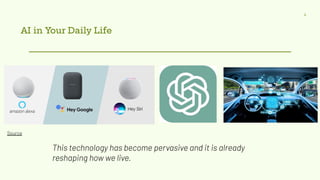
AI in YourDaily Life
4
Source
This technology has become pervasive and it is already
reshaping how we live.
5.
What AI ReallyIs?
5
Computer systems that can perform tasks typically requiring
human intelligence.
Key Characteristics:
● Learning from data
● Recognizing patterns and making predictions
● Adapting to new situations
● Solving complex problems
● Making decisions based on available information
6.
Advent of theField of AI
6
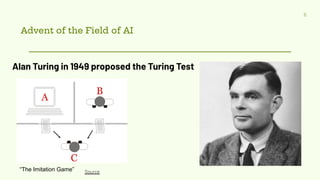
Alan Turing in 1949 proposed the Turing Test
“The Imitation Game” Source
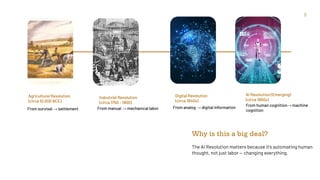
From analog →digital information
From manual → mechanical labor
Agricultural Revolution
(circa 10,000 BCE)
From survival → settlement
From human cognition→ machine
cognition
The AI Revolution matters because it's automating human
thought, not just labor — changing everything.
Why is this a big deal?
Industrial Revolution
(circa 1750 - 1900)
Digital Revolution
(circa 1940s)
AI Revolution (Emerging)
(circa 1950s)
9
10.
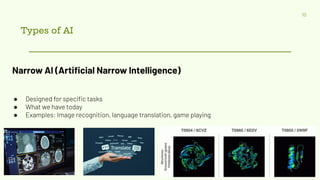
Types of AI
10
NarrowAI (Artificial Narrow Intelligence)
● Designed for specific tasks
● What we have today
● Examples: Image recognition, language translation, game playing
11.
Types of AI
11
GeneralAI (Artificial General Intelligence)
● Human-level intelligence across all domains
● Still mostly theoretical
● The long-term goal of AI research
Current Reality: All AI today is narrow AI, excelling in
specific domains.
12.
Approaches to AI
12
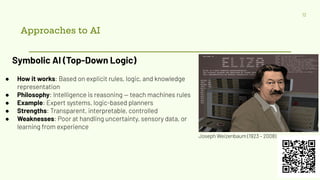
SymbolicAI (Top-Down Logic)
● How it works: Based on explicit rules, logic, and knowledge
representation
● Philosophy: Intelligence is reasoning — teach machines rules
● Example: Expert systems, logic-based planners
● Strengths: Transparent, interpretable, controlled
● Weaknesses: Poor at handling uncertainty, sensory data, or
learning from experience
Joseph Weizenbaum (1923 – 2008)
13.
Approaches to AI
13
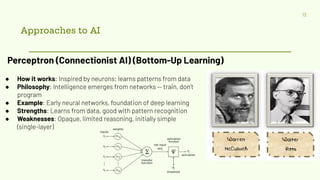
Perceptron(Connectionist AI) (Bottom-Up Learning)
● How it works: Inspired by neurons; learns patterns from data
● Philosophy: Intelligence emerges from networks — train, don’t
program
● Example: Early neural networks, foundation of deep learning
● Strengths: Learns from data, good with pattern recognition
● Weaknesses: Opaque, limited reasoning, initially simple
(single-layer)
14.
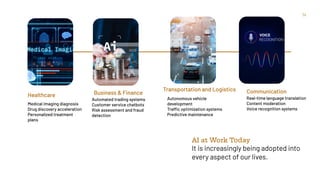
Autonomous vehicle
development
Traffic optimizationsystems
Predictive maintenance
Automated trading systems
Customer service chatbots
Risk assessment and fraud
detection
Healthcare
Medical imaging diagnosis
Drug discovery acceleration
Personalized treatment
plans
Real-time language translation
Content moderation
Voice recognition systems
It is increasingly being adopted into
every aspect of our lives.
AI at Work Today
Business & Finance
Transportation and Logistics Communication
14
15.
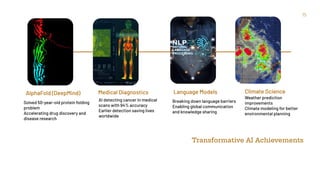
Breaking down languagebarriers
Enabling global communication
and knowledge sharing
AI detecting cancer in medical
scans with 94% accuracy
Earlier detection saving lives
worldwide
AlphaFold (DeepMind)
Solved 50-year-old protein folding
problem
Accelerating drug discovery and
disease research
Weather prediction
improvements
Climate modeling for better
environmental planning
Transformative AI Achievements
Medical Diagnostics Language Models Climate Science
15
16.
What AI CannotDo (Yet) 16
Technical Limitations
● Requires massive amounts of data (e.g., ChatGPT 5 with 52.5T
parameters used the whole Internet and proprietary data for
training)
● Struggles with tasks humans find easy (common sense reasoning)
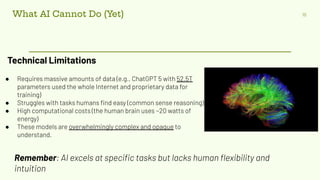
● High computational costs (the human brain uses ~20 watts of
energy)
● These models are overwhelmingly complex and opaque to
understand.
Remember: AI excels at specific tasks but lacks human flexibility and
intuition
17.
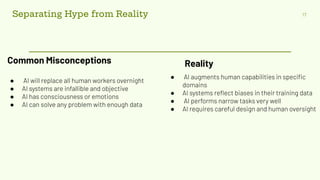
Separating Hype fromReality 17
Common Misconceptions
● AI will replace all human workers overnight
● AI systems are infallible and objective
● AI has consciousness or emotions
● AI can solve any problem with enough data
Reality
● AI augments human capabilities in specific
domains
● AI systems reflect biases in their training data
● AI performs narrow tasks very well
● AI requires careful design and human oversight
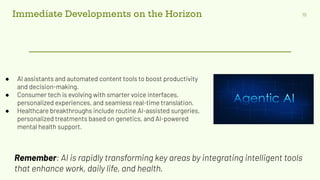
Immediate Developments onthe Horizon 19
● AI assistants and automated content tools to boost productivity
and decision-making.
● Consumer tech is evolving with smarter voice interfaces,
personalized experiences, and seamless real-time translation.
● Healthcare breakthroughs include routine AI-assisted surgeries,
personalized treatments based on genetics, and AI-powered
mental health support.
Remember: AI is rapidly transforming key areas by integrating intelligent tools
that enhance work, daily life, and health.
20.
Next 5-10 Years20
● Fully Autonomous systems like self-driving vehicles, fully automated supply
chains, and AI research assistants will reshape industries.
● Human-AI collaboration will personalize education, inspire creativity in art and
design, and enhance complex decision-making.
● Scientific breakthroughs include AI-discovered medicines, climate change
solutions, and the design of innovative new materials.
Theme: AI becomes a true partner in solving complex global challenges.
Key Risks andConcerns 22
● Technical risks include critical errors, opaque decision-making,
and security vulnerabilities.
● Economic disruption threatens jobs, risks widening inequality, and
concentrates market power.
● Social concerns involve privacy loss, manipulation through
personalized persuasion, and diminished human agency.
Reality Check: These risks are real but manageable with proper planning.
Things we must have in mind
23.
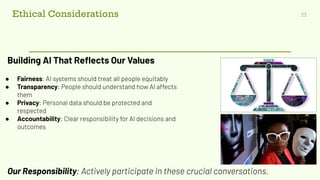
Ethical Considerations 23
●Fairness: AI systems should treat all people equitably
● Transparency: People should understand how AI affects
them
● Privacy: Personal data should be protected and
respected
● Accountability: Clear responsibility for AI decisions and
outcomes
Our Responsibility: Actively participate in these crucial conversations.
Building AI That Reflects Our Values
How You CanGet Involved 25
● Increase your awareness of the potentials and limitations of
current AI technologies
● Participate in policies shaping the discourse around AI either at
local, national or international platforms
● Upskill or reskill to fit the changing landscape of work and how
our society functions because AI is a disruptive technology
Remember: to be a lifelong learner.
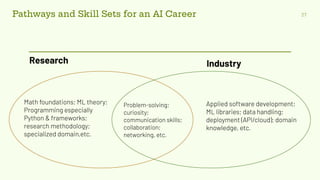
Pathways and SkillSets for an AI Career 27
Research Industry
Math foundations; ML theory;
Programming especially
Python & frameworks;
research methodology;
specialized domain,etc.
Applied software development;
ML libraries; data handling;
deployment (API/cloud); domain
knowledge, etc.
Problem-solving;
curiosity;
communication skills;
collaboration;
networking, etc.