Industrial 4.0
Koya University | Faculty of Engineering | Department of Manufacturing Engineering
Industry 4.0
What is Artificial Intelligence
References :
1. Learn about Industry 4.0 at https://dupress.deloitte.com/dup-us-
en/focus/industry-4-0.html.
2. https://futureoflife.org/background/benefits-risks-of-artificial-
intelligence/
3. Mussomeli, Laaper, and Gish, The rise of the digital supply network.
Prepared By 4th Stage Students :
Shaista E Mohammadamin
Eman Hama saeed
Bahar S Radha
Supervisor:
Dr. Rastee D.Ali
Academic year 2017 - 2018
AI (artificial intelligence) is the simulation of
human intelligence processes by machines,
especially computer systems. These processes
include learning (the acquisition of information
and rules for using the information), reasoning
(using the rules to reach approximate or
definite conclusions) and self-correction.
Particular applications of AI include expert
systems, speech recognition and machine
vision. Artificial intelligence today is properly
known as narrow AI (or weak AI), in that it is
designed to perform a narrow task (e.g. only
facial recognition or only internet searches or
only driving a car). However, the long-term
goal of many researchers is to create general
AI (AGI or strong AI). While narrow AI may
outperform humans at whatever its specific
task is, like playing chess or solving equations,
AGI would outperform humans at nearly
every cognitive task.
Industry 4.0 creates what has been called a
"smart factory". Within the modular
structured smart factories, cyber-physical
systems monitor physical processes, create a
virtual copy of the physical world and make
decentralized decisions. The term "Industry
4.0" originates from a project in the high-tech
strategy of the German government, which
promotes the computerization of
manufacturing. The term "Industry 4.0" was
revived in 2011 at the Hannover Fair. In
October 2012 the Working Group on
Industry 4.0 presented a set of Industry 4.0
implementation recommendations to the
German federal government. The Industry 4.0
workgroup members are recognized as the
founding fathers and driving force behind
Industry 4.0. On 8 April 2013 at the Hannover
Fair, the final report of the Working Group
Industry 4.0 was presented.
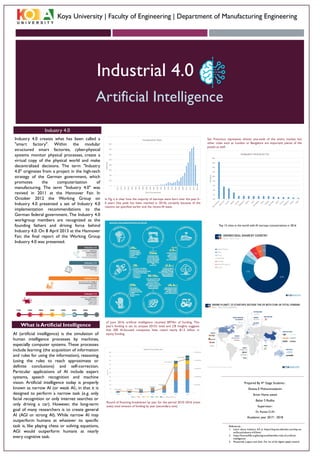
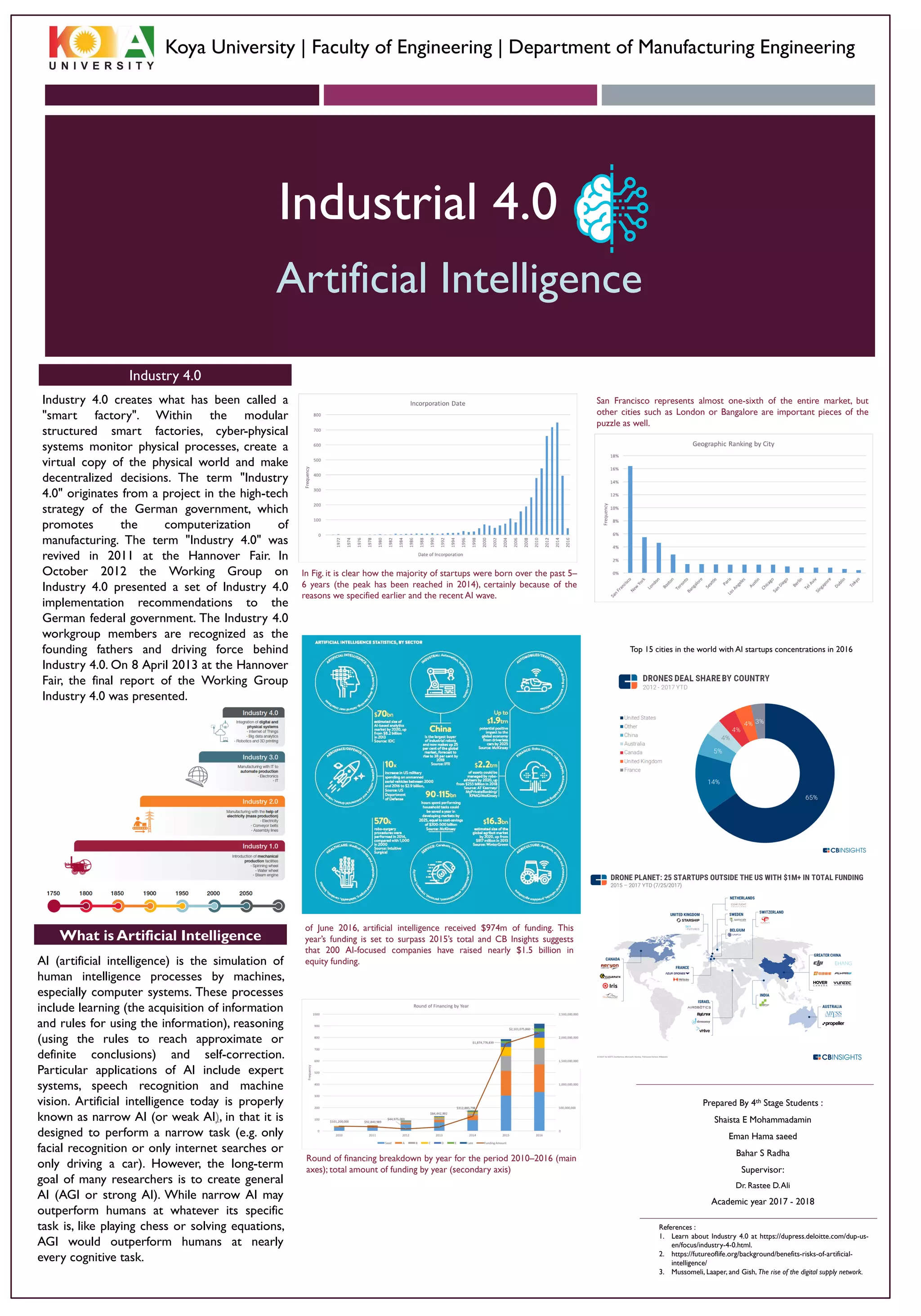
In Fig. it is clear how the majority of startups were born over the past 5–
6 years (the peak has been reached in 2014), certainly because of the
reasons we specified earlier and the recent AI wave.
Round of financing breakdown by year for the period 2010–2016 (main
axes); total amount of funding by year (secondary axis)
Top 15 cities in the world with AI startups concentrations in 2016
San Francisco represents almost one-sixth of the entire market, but
other cities such as London or Bangalore are important pieces of the
puzzle as well.
Artificial Intelligence
of June 2016, artificial intelligence received $974m of funding. This
year’s funding is set to surpass 2015’s total and CB Insights suggests
that 200 AI-focused companies have raised nearly $1.5 billion in
equity funding.

Artificial intelligence

  • 1.
    Industrial 4.0 Koya University| Faculty of Engineering | Department of Manufacturing Engineering Industry 4.0 What is Artificial Intelligence References : 1. Learn about Industry 4.0 at https://dupress.deloitte.com/dup-us- en/focus/industry-4-0.html. 2. https://futureoflife.org/background/benefits-risks-of-artificial- intelligence/ 3. Mussomeli, Laaper, and Gish, The rise of the digital supply network. Prepared By 4th Stage Students : Shaista E Mohammadamin Eman Hama saeed Bahar S Radha Supervisor: Dr. Rastee D.Ali Academic year 2017 - 2018 AI (artificial intelligence) is the simulation of human intelligence processes by machines, especially computer systems. These processes include learning (the acquisition of information and rules for using the information), reasoning (using the rules to reach approximate or definite conclusions) and self-correction. Particular applications of AI include expert systems, speech recognition and machine vision. Artificial intelligence today is properly known as narrow AI (or weak AI), in that it is designed to perform a narrow task (e.g. only facial recognition or only internet searches or only driving a car). However, the long-term goal of many researchers is to create general AI (AGI or strong AI). While narrow AI may outperform humans at whatever its specific task is, like playing chess or solving equations, AGI would outperform humans at nearly every cognitive task. Industry 4.0 creates what has been called a "smart factory". Within the modular structured smart factories, cyber-physical systems monitor physical processes, create a virtual copy of the physical world and make decentralized decisions. The term "Industry 4.0" originates from a project in the high-tech strategy of the German government, which promotes the computerization of manufacturing. The term "Industry 4.0" was revived in 2011 at the Hannover Fair. In October 2012 the Working Group on Industry 4.0 presented a set of Industry 4.0 implementation recommendations to the German federal government. The Industry 4.0 workgroup members are recognized as the founding fathers and driving force behind Industry 4.0. On 8 April 2013 at the Hannover Fair, the final report of the Working Group Industry 4.0 was presented. In Fig. it is clear how the majority of startups were born over the past 5– 6 years (the peak has been reached in 2014), certainly because of the reasons we specified earlier and the recent AI wave. Round of financing breakdown by year for the period 2010–2016 (main axes); total amount of funding by year (secondary axis) Top 15 cities in the world with AI startups concentrations in 2016 San Francisco represents almost one-sixth of the entire market, but other cities such as London or Bangalore are important pieces of the puzzle as well. Artificial Intelligence of June 2016, artificial intelligence received $974m of funding. This year’s funding is set to surpass 2015’s total and CB Insights suggests that 200 AI-focused companies have raised nearly $1.5 billion in equity funding.