October 2012 • CANADIAN PACKAGING WWW.CANADIANPACKAGING.COM • 21
Education
ANDREW JOSEPH, FEATURES EDITOR
PHOTOS BY COLE GARSIDE
As one of Canada’s largest manufacturing
industries, food processing has long been
a vital cog in the country’s economic
engine—generating a healthy contribution to the
country’s employment growth, exporting oppor-
tunities, and overall national economic prosperity.
Employing an estimated 300,000 Canadians, about
1.7 per cent of the total workforce, the sector sup-
plies nearly 80 per cent of all the processed foods
and beverages retailing in Canada at any one time,
according to industry statistics.
For all that, there is no getting around the fact
that Canada’s food manufacturing industry is faced
with the challenge of improving its competitive-
ness in the global market in a big way in com-
ing years, which is unlikely to happen without a
meaningful infusion of new human resources and
talent armed with the right skillsets and technical
know-how to fill the many important jobs and
positions that often go begging—due to the puz-
zling lack of qualified candidates.
Which is exactly the labor market riddle that
folks at the Kitchener, Ont.-based Conestoga
College Institute of Technology and
Advanced Learning have set out to resolve in
a big way with the recent opening of the school’s
Institute of Food Processing Technology (IFPT)
center—located at the school’s satellite campus in
the nearby city of Cambridge.
While the fledgling new program is only in its
second year of existence, it has already attracted
solid backing and support from influential backers
like the Alliance of Ontario Food Processors,
Ontario Ministry of Agriculture, Food and
Rural Affairs (OMAFRA), Food Processing
Human Resources Council, and other organ-
izations with a vested interest in seeing the col-
lege succeed in developing new training tools and
competencies to lift the critically-important food
processing sector to new heights.
“The Alliance of Food Processors was actually
the industry group that conceived the idea of this
program,” explains IFPT chair Luis Garcia. “Its
members got involved with the concept right away
and pushed the idea along to make it a reality.
“The bottom line is that we all want to make
it easier for well-trained individuals to get a job
in the industry,” says Garcia, describing IFPT’s
intensive, two-year training program—the only
one of its kind in Canada—that will turn out
properly-trained food-processing technicians
ready to take on and conquer the many day-to-
day challenges of the fiercely competitive global
food-processing industries.
Skill Shortage
Says Garcia: “Our industry acknowledges that
there is a lack of skilled employees available for our
workforce, which is why companies always seem
to have positions available for people who have the
appropriate abilities and training.
“Alas, many companies just aren’t able to find
the qualified people they really need, which is
really a major problem for all Canadian industries
in general.
“And that is where the IFPT program is designed
to help the industry out,” Garcia told Canadian
Packaging during a recent visit to the new
260,000-square-foot LEED (Leadership in Energy
and Environmental Design) silver-certified building
where the IFPT offers part-time adult education
in advanced sanitation, and food-processing super-
visor skill and food safety training—on top of its
full-time co-op food processing technician and
food processing techniques programs.
In addition, IFPT administers an apprenticeship
program for aspiring food manufacturing process
operators—delivered as a combination of online
and in-class sessions with extensive complement-
PACK TO SCHOOL BASICS
Continues on page 24
Community college sets out to create the next generation of high-skill food-processing
operators to safeguard the industry’s future growth prospects
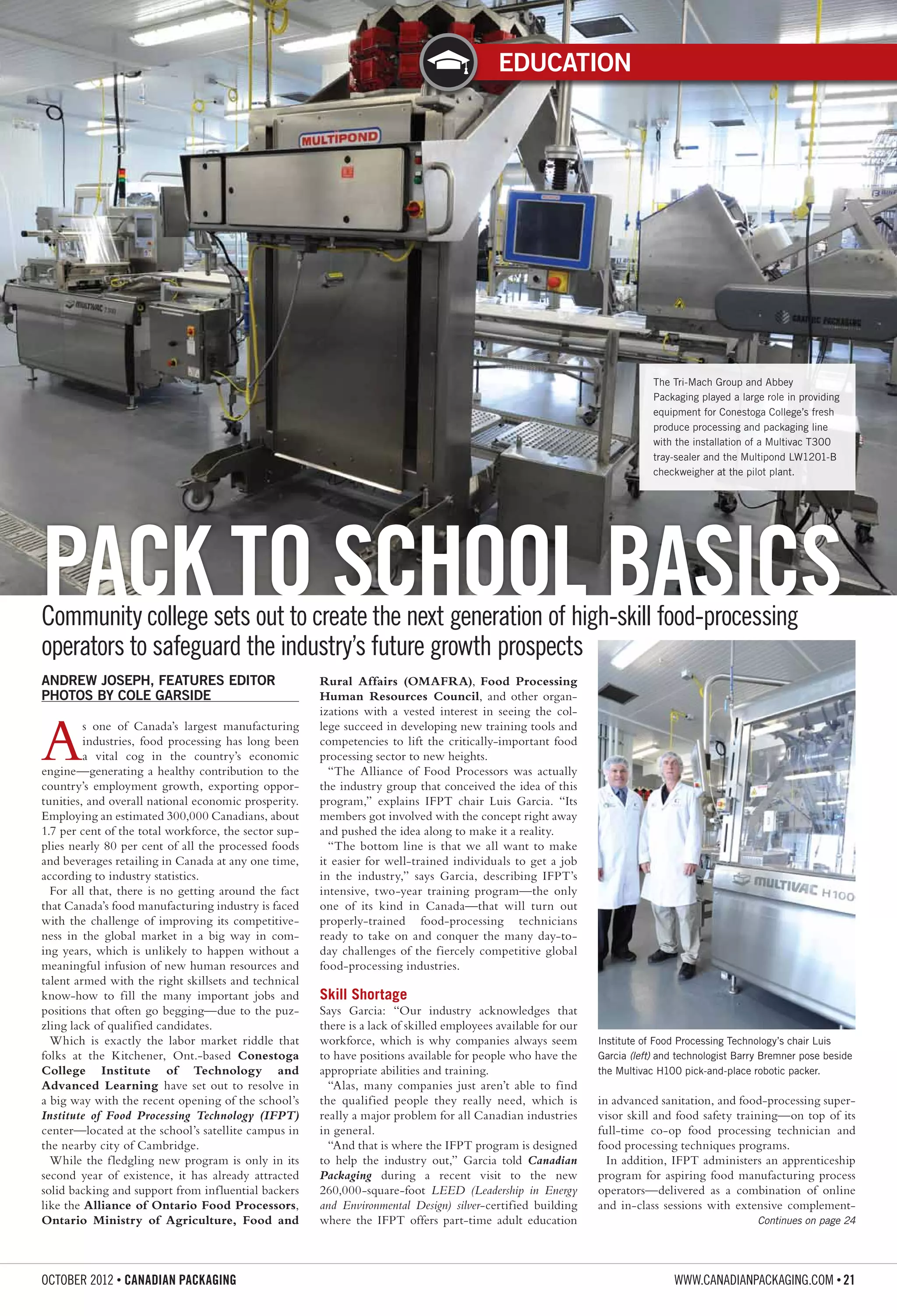
The Tri-Mach Group and Abbey
Packaging played a large role in providing
equipment for Conestoga College’s fresh
produce processing and packaging line
with the installation of a Multivac T300
tray-sealer and the Multipond LW1201-B
checkweigher at the pilot plant.
Institute of Food Processing Technology’s chair Luis
Garcia (left) and technologist Barry Bremner pose beside
the Multivac H100 pick-and-place robotic packer.
Education
24 • WWW.CANADIANPACKAGING.COM CANADIAN PACKAGING • October 2012
ary hands-on experience.
“The IFPT opened its doors to students in
September of 2011 with six students,” recalls Garcia.
“This year we already have 13 students, and the
eventual goal is to be enrolling 24 new full-time
students per year,” says Garcia, estimating that
there are well over 3,000 food-and-beverage pro-
ducers operating in the province of Ontario alone.
“The food-processing industry is always in need
of highly-skilled workers, and that is exactly what
we are going to provide,” says Garcia, pointing
out that the college’s three-level process operator
apprenticeship program comprises 300 hours of
in-class instruction and 4,000 apprenticeship hours
supervised by qualified industry professionals.
“Our focus is to provide a skilled equipment
operator and maintenance staff employee,” Garcia
explains, “which is why we teach both mechanical
and electrical theory in combination with hands-
on application and extensive food-testing training.
“We want our students to really appreciate the
importance of product quality testing in the food
industry,” he says, “even if its something they will
not have to perform after they enter the workforce.”
To attract bright students into the program,
Conestoga College made a substantial $5-million
capital investment to equip the new pilot plant
with the highest-quality processing and packaging
line equipment available, Garcia relates, with both
the provincial and federal government chipping in
to get the project rolling.
Best Buy
“To give our students the best hands-on experience
possible, we purchased components to construct
a bakery line, a beverage/pasteurization bottling
line, and a fresh vegetable line,” says Garcia.
“A bid for proposals was placed on a govern-
ment website requesting the installation of a full
line,” relates IFPT technologist Barry Bremner,
saying that the winning bid submitted by the
Elmira, Ont.-based engineering services provider
Tri-Mach Group Inc. specified the best way to
purchase, install and commission the pilot-plant’s
fresh-vegetable line.
Working closely with a group of suppliers selected
from an intensive bidding process, Tri-Mach pro-
ceeded to assemble and integrate the pilot plant’s
fresh vegetable line with an array of new equip-
ment, including:
• a Nilma vegetable peeler, powered by a
Bonfiglioli motor;
• a Kronen GS10 slicer and VG010 washer;
• a Multivac T300 tray-sealer and model MR 6411
labeler;
• a plastic tray denester from Graphic Packaging
International;
• a Multipond LW1201-B 12-head weigh-
scale with a Schneider Electric Magelis HMI
(human-machine interface);
• a Multivac H100 pick-and-place robot;
• a Mettler-Toledo checkweigher;
• an S+S Inspection metal detection system;
Pack to school
Continued from page 21
Continues on page 26
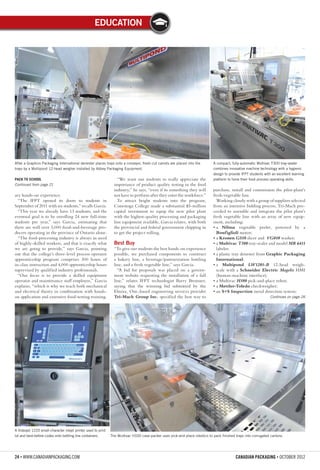
After a Graphics Packaging International denester places trays onto a conveyor, fresh-cut carrots are placed into the
trays by a Multipond 12-head weigher installed by Abbey Packaging Equipment.
The Multivac H100 case-packer uses pick-and-place robotics to pack finished trays into corrugated cartons.
A compact, fully-automatic Multivac T300 tray-sealer
combines innovative machine technology with a hygienic
design to provide IFPT students with an excellent learning
platform to hone their food process operating skills.
A Videojet 1220 small-character inkjet printer used to print
lot and best-before codes onto bottling line containers.
Education
26 • WWW.CANADIANPACKAGING.COM CANADIAN PACKAGING • October 2012
• Tri-Mach-made sorting tables and custom-
designed ‘everclean’ conveyors.
“If this all seems like a lot of equipment or event
overkill—it’s not,” Garcia asserts.
“It’s pretty much what any standard fresh-pro-
duce line is going to encompass equipment-wise,
and we want to ensure students get a proper edu-
cation here,” says Garcia, reserving special praise
to the Burlington, Ont.-based distributor Abbey
Packaging Equipment Ltd. for finding and
purchasing the Multipond pre-weighing and por-
tioning equipment that could handle portioned
fresh vegetables like carrots, onions, potatoes., etc.,
as specified by Tri-Mach.
“We have dealt with hundreds of suppliers on this
undertaking, and working with Abbey Packaging
was really outstanding great experience,” extols
Bremner.
“It became very apparent that Abbey Packaging
was a great choice—the lawless equipment, a
superb training professional, and an easy-to-work-
with team made the whole experience a good
one,” he says, recalling that Abbey Packaging’s
service technician was right there on the pot when
the Multipond systems was first started up.
Perfect Start
“It ran perfectly from the onset,” explains Bremner,
“but the service tech believed it could run even
better, and spent the better part of the day making
it happen.”
According the Bremner, the Abbey Packaging
technician discovered that the pulsing cone that
distributes product to the 12 weighscales was better
suited for harder-to-move products, and suggested
installing a vibratory unit and trays would facilitate
better movement for the non-leafy products.
“Their technician installed the new equipment,
added the vibration electronics controls, software
and wiring,” recounts Bremner. “But unlike with
many other suppliers, there was no work-order,
change notice, invoice or restocking charges.
“They just wanted to make sure their equipment
was working perfectly for the customer—a con-
cept which seems to have become forgotten in the
world of engineered solutions,” Bremner remarks.
As pleased as they are with the fresh-vegetable
line, Bremner and Garcia are also justifiable proud
of the impressive baked goods line at the pilot
plant, featuring:
• Planetary and spiral mixers supplied by Globe
and Abrigio, respectively;
• a Vemag PC878 model portioner from Reiser;
• a Konig Harvest bun-maker and MiniRex Futura
portioner;
• indexing and retracting conveyors supplied by
Tri-Mach;
• two Tagliavini Rotovent TVT 665E model
ovens and a double retarder proofer;
• A spiral conveyor from Tri-Mach, controlled via
a Magelis HMI terminal, used for cooling the
fresh-baked product;
• a Zenith form/fill/seal vertical bagger, manufac-
tured by PFM Packaging Machinery Corp.
For its part, the pilot plant’s bottling line consists
of:
• liquid mixing and dispersion equipment sup-
plied by Quadro Engineering, IKA Works,
Silverson, Viking Canada, Idex, Highland
Pack to school
Continued from page 24
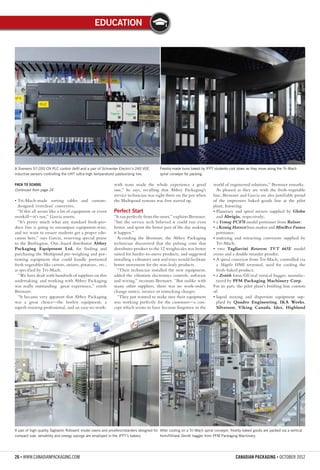
A Siemens S7-200 CN PLC control (left) and a pair of Schneider Electric’s 240 VDC
inductive sensors controlling the UHT (ultra-high temperature) pasteurizing line.
A pair of high-quality Tagliavini Rotovent model ovens and proofers/retarders designed for
compact size, versatility and energy savings are employed in the IFPT’s bakery.
Freshly-made buns baked by IFPT students cool down as they move along the Tri-Mach
spiral conveyor for packing.
After cooling on a Tri-Mach spiral conveyor, freshly-baked goods are packed via a vertical
form/fill/seal Zenith bagger from PFM Packaging Machinery.
October 2012 • CANADIAN PACKAGING WWW.CANADIANPACKAGING.COM • 27
Education
Equipment and Stainless Process;
• an UHT (ultra-high temperature) SPX pasteur-
izer that heats up and chills product in a few
seconds;
• an Accutek Packaging Equipment bottle
unscrambler and bottle rinser;
• an SPX aseptic tank with a Magelis HMI;
• a rotary bottle-filler capable of running at 60 bot-
tles per minute, manufactured by Biner Ellison
High Speed Packaging Machinery, outfitted
with a Delta Electronics HMI;
• plastic bottles donated by Lassonde Beverages
Canada;
• bottle caps donated by Pano Caps;
• a Pillar Technologies capper capable of utiliz-
ing twistoff caps or caps outfitted with induction
safety seals;
• Tri-Mach conveyors;
• a self-adhesive label-applicating system from
Labelette;
• an Aesus Systems heat tunnel and shrinks-
leeving equipment to apply full-body film wrap
and/or tamper-evident neck bands, featur-
ing a Rockwell Automation Allen-Bradley
PanelView C300 control terminal;
• a small-character Videojet 1220 inkjet printer
and a P3400 label printer;
• a Biner Ellison trayformer;
• corrugated cartons supplied by Integrated
Packaging Systems;
• a Phase Fire Shrink Technologies shrinkwrap
and heat tunnel.
Win-Win
“Equally important to learning how to operate a
food processing line is the clean-up and sanitation
issues that surround it,” explains Garcia, “which is
why we offer a strong course on this subject.”
Garcia mentions that the IFPT has achieved a
win-win partnership with Sani-Marc Group,
who provide chemical products and technical
assistance to the school in exchange for being
allowed to schedule RD (research  develop-
ment) time in the facility, along with training for
their clients.
As well, the facility also boasts a Qualtech
CIP (clean-in-place) system that is used to sani-
tize the preparation equipment, filler, UHT and
septic tanks.
“In addition, we have a COP (clean-out-of-place)
tank and all the equipment necessary to effectively
clean and sanitize conveyors, floors, walls and ceil-
ings,” says Garcia. “We use foaming and gelling
technologies that are proven to be more effective
both from a cleaning and a cost point of view.”
Bremner points out that IFPT also has a liquid
process training system—a large, hands-on work-
board—supplied by fluid control experts Bürkert
featuring Siemen’s Simatic Panel Touch HMI that
allows the students to design and build an auto-
mated efficient set up of a liquid process line.
Auto Pilot
Says Bremner: “We have had some very good sup-
pliers and contributors as we built the pilot plant.
“Working with Abbey Packaging was an absolute
pleasure, as they provided the right equipment, the
right service and expertise and a commitment to
make it perfectly fit our requirements,” he adds.
Aside from the mechanical and electrical know-
ledge imparted to each student, Garcia is adamant
that the IFPT program teach them something
equally as important.
“You can have all the knowledge in the world,
but if you are unable to work as part of a team,
your career in this industry will be short-lived,”
relates Garcia.
“We teach teamwork, as workers should be
conscious of the entire production line and be in
agreement to the best operating solution that won’t
impact the overall quality, safety or productivity
of the line.”
Sums up Garcia: “We don’t want to produce
graduates simply to be part of a business: We want
our graduates to help that business grow!”
For More Information:
Abbey Packaging Equipment Ltd. 402
Tri-Mach Group Inc. 403
Bonfiglioli Canada 404
Kronen GmbH 405
Multivac Canada Inc. 406
Graphic Packaging International 407
Multipond America Inc. 408
Schneider Electric Canada 409
Mettler-Toledo International Inc. 410
S+S Inspection Inc. 411
Globe Equipment Company 412
Abrigo Industrial Machines Inc. 413
Reiser (Canada) Co. 414
Delta Electronics, Inc. 415
Tagliavini S.p.a. 416
PFM Packaging Machinery Corp. 417
Accutek Packaging Equipment Co. 418
SPX Corporation 419
Biner Ellison High Speed Packaging Machinery 420
Pano Caps Canada Limited 421
Pillar Technologies, Inc. 422
Labelette Labelers 423
Rockwell Automation Canada 424
Aesus Systems 425
Videojet Technologies Canada 426
Phase Fire Shrink Technologies 427
Integrated Packaging Systems Inc. 428
Christian Bürkert GmbH  Co. KG 429
Siemens Canada 430
Sani-Marc Group 431
Qualtech Inc. 432
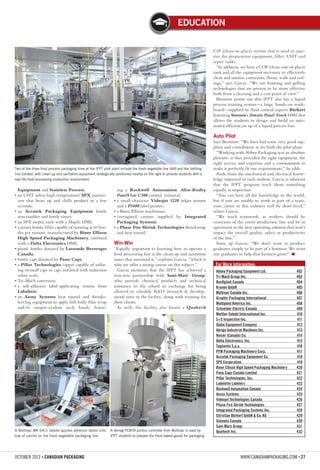
Two of the three food process packaging lines at the IFPT pilot plant include the fresh-vegetable line (left) and the bottling
line (center), with clean-up and sanitation equipment strategically positioned nearby on the right to provide students with a
real-life food-processing production environment.
A Multivac MR 6411 labeler applies adhesive labels onto
tray of carrots on the fresh-vegetable packaging line.
A Vemag PC878 portion controller from Multivac is used by
IFPT students to prepare the fresh-baked goods for packaging.
article09PAC-EDU-TAB

article09PAC-EDU-TAB

  • 1.
    October 2012 •CANADIAN PACKAGING WWW.CANADIANPACKAGING.COM • 21 Education ANDREW JOSEPH, FEATURES EDITOR PHOTOS BY COLE GARSIDE As one of Canada’s largest manufacturing industries, food processing has long been a vital cog in the country’s economic engine—generating a healthy contribution to the country’s employment growth, exporting oppor- tunities, and overall national economic prosperity. Employing an estimated 300,000 Canadians, about 1.7 per cent of the total workforce, the sector sup- plies nearly 80 per cent of all the processed foods and beverages retailing in Canada at any one time, according to industry statistics. For all that, there is no getting around the fact that Canada’s food manufacturing industry is faced with the challenge of improving its competitive- ness in the global market in a big way in com- ing years, which is unlikely to happen without a meaningful infusion of new human resources and talent armed with the right skillsets and technical know-how to fill the many important jobs and positions that often go begging—due to the puz- zling lack of qualified candidates. Which is exactly the labor market riddle that folks at the Kitchener, Ont.-based Conestoga College Institute of Technology and Advanced Learning have set out to resolve in a big way with the recent opening of the school’s Institute of Food Processing Technology (IFPT) center—located at the school’s satellite campus in the nearby city of Cambridge. While the fledgling new program is only in its second year of existence, it has already attracted solid backing and support from influential backers like the Alliance of Ontario Food Processors, Ontario Ministry of Agriculture, Food and Rural Affairs (OMAFRA), Food Processing Human Resources Council, and other organ- izations with a vested interest in seeing the col- lege succeed in developing new training tools and competencies to lift the critically-important food processing sector to new heights. “The Alliance of Food Processors was actually the industry group that conceived the idea of this program,” explains IFPT chair Luis Garcia. “Its members got involved with the concept right away and pushed the idea along to make it a reality. “The bottom line is that we all want to make it easier for well-trained individuals to get a job in the industry,” says Garcia, describing IFPT’s intensive, two-year training program—the only one of its kind in Canada—that will turn out properly-trained food-processing technicians ready to take on and conquer the many day-to- day challenges of the fiercely competitive global food-processing industries. Skill Shortage Says Garcia: “Our industry acknowledges that there is a lack of skilled employees available for our workforce, which is why companies always seem to have positions available for people who have the appropriate abilities and training. “Alas, many companies just aren’t able to find the qualified people they really need, which is really a major problem for all Canadian industries in general. “And that is where the IFPT program is designed to help the industry out,” Garcia told Canadian Packaging during a recent visit to the new 260,000-square-foot LEED (Leadership in Energy and Environmental Design) silver-certified building where the IFPT offers part-time adult education in advanced sanitation, and food-processing super- visor skill and food safety training—on top of its full-time co-op food processing technician and food processing techniques programs. In addition, IFPT administers an apprenticeship program for aspiring food manufacturing process operators—delivered as a combination of online and in-class sessions with extensive complement- PACK TO SCHOOL BASICS Continues on page 24 Community college sets out to create the next generation of high-skill food-processing operators to safeguard the industry’s future growth prospects The Tri-Mach Group and Abbey Packaging played a large role in providing equipment for Conestoga College’s fresh produce processing and packaging line with the installation of a Multivac T300 tray-sealer and the Multipond LW1201-B checkweigher at the pilot plant. Institute of Food Processing Technology’s chair Luis Garcia (left) and technologist Barry Bremner pose beside the Multivac H100 pick-and-place robotic packer.
  • 2.
    Education 24 • WWW.CANADIANPACKAGING.COMCANADIAN PACKAGING • October 2012 ary hands-on experience. “The IFPT opened its doors to students in September of 2011 with six students,” recalls Garcia. “This year we already have 13 students, and the eventual goal is to be enrolling 24 new full-time students per year,” says Garcia, estimating that there are well over 3,000 food-and-beverage pro- ducers operating in the province of Ontario alone. “The food-processing industry is always in need of highly-skilled workers, and that is exactly what we are going to provide,” says Garcia, pointing out that the college’s three-level process operator apprenticeship program comprises 300 hours of in-class instruction and 4,000 apprenticeship hours supervised by qualified industry professionals. “Our focus is to provide a skilled equipment operator and maintenance staff employee,” Garcia explains, “which is why we teach both mechanical and electrical theory in combination with hands- on application and extensive food-testing training. “We want our students to really appreciate the importance of product quality testing in the food industry,” he says, “even if its something they will not have to perform after they enter the workforce.” To attract bright students into the program, Conestoga College made a substantial $5-million capital investment to equip the new pilot plant with the highest-quality processing and packaging line equipment available, Garcia relates, with both the provincial and federal government chipping in to get the project rolling. Best Buy “To give our students the best hands-on experience possible, we purchased components to construct a bakery line, a beverage/pasteurization bottling line, and a fresh vegetable line,” says Garcia. “A bid for proposals was placed on a govern- ment website requesting the installation of a full line,” relates IFPT technologist Barry Bremner, saying that the winning bid submitted by the Elmira, Ont.-based engineering services provider Tri-Mach Group Inc. specified the best way to purchase, install and commission the pilot-plant’s fresh-vegetable line. Working closely with a group of suppliers selected from an intensive bidding process, Tri-Mach pro- ceeded to assemble and integrate the pilot plant’s fresh vegetable line with an array of new equip- ment, including: • a Nilma vegetable peeler, powered by a Bonfiglioli motor; • a Kronen GS10 slicer and VG010 washer; • a Multivac T300 tray-sealer and model MR 6411 labeler; • a plastic tray denester from Graphic Packaging International; • a Multipond LW1201-B 12-head weigh- scale with a Schneider Electric Magelis HMI (human-machine interface); • a Multivac H100 pick-and-place robot; • a Mettler-Toledo checkweigher; • an S+S Inspection metal detection system; Pack to school Continued from page 21 Continues on page 26 After a Graphics Packaging International denester places trays onto a conveyor, fresh-cut carrots are placed into the trays by a Multipond 12-head weigher installed by Abbey Packaging Equipment. The Multivac H100 case-packer uses pick-and-place robotics to pack finished trays into corrugated cartons. A compact, fully-automatic Multivac T300 tray-sealer combines innovative machine technology with a hygienic design to provide IFPT students with an excellent learning platform to hone their food process operating skills. A Videojet 1220 small-character inkjet printer used to print lot and best-before codes onto bottling line containers.
  • 3.
    Education 26 • WWW.CANADIANPACKAGING.COMCANADIAN PACKAGING • October 2012 • Tri-Mach-made sorting tables and custom- designed ‘everclean’ conveyors. “If this all seems like a lot of equipment or event overkill—it’s not,” Garcia asserts. “It’s pretty much what any standard fresh-pro- duce line is going to encompass equipment-wise, and we want to ensure students get a proper edu- cation here,” says Garcia, reserving special praise to the Burlington, Ont.-based distributor Abbey Packaging Equipment Ltd. for finding and purchasing the Multipond pre-weighing and por- tioning equipment that could handle portioned fresh vegetables like carrots, onions, potatoes., etc., as specified by Tri-Mach. “We have dealt with hundreds of suppliers on this undertaking, and working with Abbey Packaging was really outstanding great experience,” extols Bremner. “It became very apparent that Abbey Packaging was a great choice—the lawless equipment, a superb training professional, and an easy-to-work- with team made the whole experience a good one,” he says, recalling that Abbey Packaging’s service technician was right there on the pot when the Multipond systems was first started up. Perfect Start “It ran perfectly from the onset,” explains Bremner, “but the service tech believed it could run even better, and spent the better part of the day making it happen.” According the Bremner, the Abbey Packaging technician discovered that the pulsing cone that distributes product to the 12 weighscales was better suited for harder-to-move products, and suggested installing a vibratory unit and trays would facilitate better movement for the non-leafy products. “Their technician installed the new equipment, added the vibration electronics controls, software and wiring,” recounts Bremner. “But unlike with many other suppliers, there was no work-order, change notice, invoice or restocking charges. “They just wanted to make sure their equipment was working perfectly for the customer—a con- cept which seems to have become forgotten in the world of engineered solutions,” Bremner remarks. As pleased as they are with the fresh-vegetable line, Bremner and Garcia are also justifiable proud of the impressive baked goods line at the pilot plant, featuring: • Planetary and spiral mixers supplied by Globe and Abrigio, respectively; • a Vemag PC878 model portioner from Reiser; • a Konig Harvest bun-maker and MiniRex Futura portioner; • indexing and retracting conveyors supplied by Tri-Mach; • two Tagliavini Rotovent TVT 665E model ovens and a double retarder proofer; • A spiral conveyor from Tri-Mach, controlled via a Magelis HMI terminal, used for cooling the fresh-baked product; • a Zenith form/fill/seal vertical bagger, manufac- tured by PFM Packaging Machinery Corp. For its part, the pilot plant’s bottling line consists of: • liquid mixing and dispersion equipment sup- plied by Quadro Engineering, IKA Works, Silverson, Viking Canada, Idex, Highland Pack to school Continued from page 24 A Siemens S7-200 CN PLC control (left) and a pair of Schneider Electric’s 240 VDC inductive sensors controlling the UHT (ultra-high temperature) pasteurizing line. A pair of high-quality Tagliavini Rotovent model ovens and proofers/retarders designed for compact size, versatility and energy savings are employed in the IFPT’s bakery. Freshly-made buns baked by IFPT students cool down as they move along the Tri-Mach spiral conveyor for packing. After cooling on a Tri-Mach spiral conveyor, freshly-baked goods are packed via a vertical form/fill/seal Zenith bagger from PFM Packaging Machinery.
  • 4.
    October 2012 •CANADIAN PACKAGING WWW.CANADIANPACKAGING.COM • 27 Education Equipment and Stainless Process; • an UHT (ultra-high temperature) SPX pasteur- izer that heats up and chills product in a few seconds; • an Accutek Packaging Equipment bottle unscrambler and bottle rinser; • an SPX aseptic tank with a Magelis HMI; • a rotary bottle-filler capable of running at 60 bot- tles per minute, manufactured by Biner Ellison High Speed Packaging Machinery, outfitted with a Delta Electronics HMI; • plastic bottles donated by Lassonde Beverages Canada; • bottle caps donated by Pano Caps; • a Pillar Technologies capper capable of utiliz- ing twistoff caps or caps outfitted with induction safety seals; • Tri-Mach conveyors; • a self-adhesive label-applicating system from Labelette; • an Aesus Systems heat tunnel and shrinks- leeving equipment to apply full-body film wrap and/or tamper-evident neck bands, featur- ing a Rockwell Automation Allen-Bradley PanelView C300 control terminal; • a small-character Videojet 1220 inkjet printer and a P3400 label printer; • a Biner Ellison trayformer; • corrugated cartons supplied by Integrated Packaging Systems; • a Phase Fire Shrink Technologies shrinkwrap and heat tunnel. Win-Win “Equally important to learning how to operate a food processing line is the clean-up and sanitation issues that surround it,” explains Garcia, “which is why we offer a strong course on this subject.” Garcia mentions that the IFPT has achieved a win-win partnership with Sani-Marc Group, who provide chemical products and technical assistance to the school in exchange for being allowed to schedule RD (research develop- ment) time in the facility, along with training for their clients. As well, the facility also boasts a Qualtech CIP (clean-in-place) system that is used to sani- tize the preparation equipment, filler, UHT and septic tanks. “In addition, we have a COP (clean-out-of-place) tank and all the equipment necessary to effectively clean and sanitize conveyors, floors, walls and ceil- ings,” says Garcia. “We use foaming and gelling technologies that are proven to be more effective both from a cleaning and a cost point of view.” Bremner points out that IFPT also has a liquid process training system—a large, hands-on work- board—supplied by fluid control experts Bürkert featuring Siemen’s Simatic Panel Touch HMI that allows the students to design and build an auto- mated efficient set up of a liquid process line. Auto Pilot Says Bremner: “We have had some very good sup- pliers and contributors as we built the pilot plant. “Working with Abbey Packaging was an absolute pleasure, as they provided the right equipment, the right service and expertise and a commitment to make it perfectly fit our requirements,” he adds. Aside from the mechanical and electrical know- ledge imparted to each student, Garcia is adamant that the IFPT program teach them something equally as important. “You can have all the knowledge in the world, but if you are unable to work as part of a team, your career in this industry will be short-lived,” relates Garcia. “We teach teamwork, as workers should be conscious of the entire production line and be in agreement to the best operating solution that won’t impact the overall quality, safety or productivity of the line.” Sums up Garcia: “We don’t want to produce graduates simply to be part of a business: We want our graduates to help that business grow!” For More Information: Abbey Packaging Equipment Ltd. 402 Tri-Mach Group Inc. 403 Bonfiglioli Canada 404 Kronen GmbH 405 Multivac Canada Inc. 406 Graphic Packaging International 407 Multipond America Inc. 408 Schneider Electric Canada 409 Mettler-Toledo International Inc. 410 S+S Inspection Inc. 411 Globe Equipment Company 412 Abrigo Industrial Machines Inc. 413 Reiser (Canada) Co. 414 Delta Electronics, Inc. 415 Tagliavini S.p.a. 416 PFM Packaging Machinery Corp. 417 Accutek Packaging Equipment Co. 418 SPX Corporation 419 Biner Ellison High Speed Packaging Machinery 420 Pano Caps Canada Limited 421 Pillar Technologies, Inc. 422 Labelette Labelers 423 Rockwell Automation Canada 424 Aesus Systems 425 Videojet Technologies Canada 426 Phase Fire Shrink Technologies 427 Integrated Packaging Systems Inc. 428 Christian Bürkert GmbH Co. KG 429 Siemens Canada 430 Sani-Marc Group 431 Qualtech Inc. 432 Two of the three food process packaging lines at the IFPT pilot plant include the fresh-vegetable line (left) and the bottling line (center), with clean-up and sanitation equipment strategically positioned nearby on the right to provide students with a real-life food-processing production environment. A Multivac MR 6411 labeler applies adhesive labels onto tray of carrots on the fresh-vegetable packaging line. A Vemag PC878 portion controller from Multivac is used by IFPT students to prepare the fresh-baked goods for packaging.