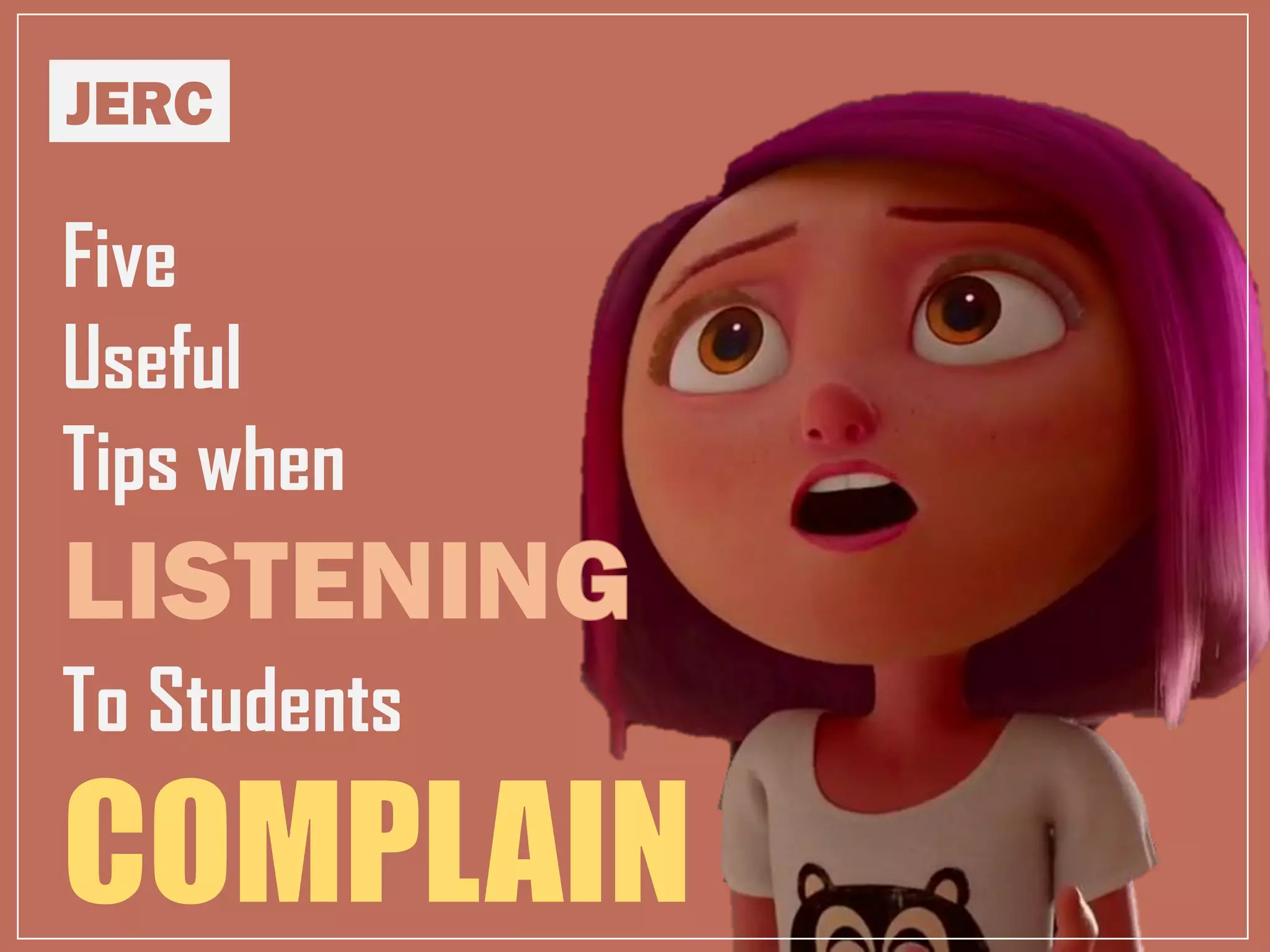
Five
Useful
Tips when
To Students
JERC
Do not interrupt
When students explain a grudge to you, I suppose it is important
to carefully hear them out and avoid ruining the moment by
stopping them or constantly interrupting the flow of information.
Although, we all know many students use circumlocution or might
not express themselves coherently, and probably you really
wanted to listen but you have so many pending tasks or you are
conversant with such student’s complaint. Nonetheless, please
hear them out even if you can tell the end of the conversation
from the beginning or you are bored to death in your mind.
Believe them
Students can be annoyingly fussy sometimes or overly particular
about some petty issues in class between them and other
students. Even worse, they often exaggerate when relating a
complaint to their teachers with the intention to achieve justice by
conviction. However, I am of the opinion that no matter what
students say, teachers should believe them and not wave off their
complaints. Maybe he said, another student is starring at him, or
she said someone in class is making jest of her, please believe
them and don’t assume they are lying.
Act immediately
When students lay complaint then they certainly want something
to be done about it and if possible, immediately. Teachers often
make the mistake of delaying or postponing their response to the
situation and this might leave the students unhappy or with the
notion that justice is unnecessary, slow, passive and not fair. Acting
immediately does not only mean punishing the guilty or setting a
wrong right but in the many cases, it could also involve the process
of investigating the occurrence. The slightest delay might change
the story or create room for neglect or injustice ultimately.
Fulfil your promise
Maybe you were too busy to respond to a student complaint at the
time, considering the opportunity cost of another task then you
should make a promise to the student to redress the matter later.
By the way, ‘later’ in this context should not be when you are done
with every pending assignments or observing a break. Instead, it is
a convenient time for the students and you to redress the
complaint based on agreement. This means, you can either
propose a period of redress while the student accede or vice versa
but what is most important is keeping to one’s promise.
Listen with your ears and Heart
Listening to a student complaint with one’s ear should be focused
on understanding the complete details of complaint and this is
majorly centered on what the complainant said and when he or
she made the complaint. Listening to a student with one’s heart
should be focused on understanding the nitty-gritty of the
complaint from the student’s point of view and this is majorly
centered on how the complainant expressed himself or herself and
why the students is making the complaint. This helps you as a
teacher to comprehend why sometimes a student has picked you
for a particular complaint in the cases where there are alternatives.
Send your suggestion
and questions to JERC via mail
jercinfodesk@gmail.com

Article jerc complaints

  • 1.
  • 2.
    Do not interrupt Whenstudents explain a grudge to you, I suppose it is important to carefully hear them out and avoid ruining the moment by stopping them or constantly interrupting the flow of information. Although, we all know many students use circumlocution or might not express themselves coherently, and probably you really wanted to listen but you have so many pending tasks or you are conversant with such student’s complaint. Nonetheless, please hear them out even if you can tell the end of the conversation from the beginning or you are bored to death in your mind.
  • 3.
    Believe them Students canbe annoyingly fussy sometimes or overly particular about some petty issues in class between them and other students. Even worse, they often exaggerate when relating a complaint to their teachers with the intention to achieve justice by conviction. However, I am of the opinion that no matter what students say, teachers should believe them and not wave off their complaints. Maybe he said, another student is starring at him, or she said someone in class is making jest of her, please believe them and don’t assume they are lying.
  • 4.
    Act immediately When studentslay complaint then they certainly want something to be done about it and if possible, immediately. Teachers often make the mistake of delaying or postponing their response to the situation and this might leave the students unhappy or with the notion that justice is unnecessary, slow, passive and not fair. Acting immediately does not only mean punishing the guilty or setting a wrong right but in the many cases, it could also involve the process of investigating the occurrence. The slightest delay might change the story or create room for neglect or injustice ultimately.
  • 5.
    Fulfil your promise Maybeyou were too busy to respond to a student complaint at the time, considering the opportunity cost of another task then you should make a promise to the student to redress the matter later. By the way, ‘later’ in this context should not be when you are done with every pending assignments or observing a break. Instead, it is a convenient time for the students and you to redress the complaint based on agreement. This means, you can either propose a period of redress while the student accede or vice versa but what is most important is keeping to one’s promise.
  • 6.
    Listen with yourears and Heart Listening to a student complaint with one’s ear should be focused on understanding the complete details of complaint and this is majorly centered on what the complainant said and when he or she made the complaint. Listening to a student with one’s heart should be focused on understanding the nitty-gritty of the complaint from the student’s point of view and this is majorly centered on how the complainant expressed himself or herself and why the students is making the complaint. This helps you as a teacher to comprehend why sometimes a student has picked you for a particular complaint in the cases where there are alternatives.
  • 7.
    Send your suggestion andquestions to JERC via mail jercinfodesk@gmail.com