Perhaps it’s because of the relatively
mild nature of the virus so far. Or
maybe it is memories of the bird flu
scare that came and went 3 years ago
with little impact. Whatever the reason,
only one in three organizations is cur-
rently prepared to deal with a wide-
spread swine flu outbreak, according
to a study by the Harvard School of
Public Health (Boston) released in early
September.
This includes water and wastewater
utilities, which have been designated
by the U.S. Department of Homeland
Security as critical to the nation’s securi-
ty and economic vitality. According to the
Harvard study, these “critical” businesses
are no more likely to have a pandemic
plan in place than nonessential ones.
And that’s a concern, emergency
planning experts say.
“We don’t want people to be
alarmed, but we do want them to be
prepared,” said Michael Zanker, direc-
tor of health security coordination for
the U.S. Department of Homeland
Security’s Office of Health Affairs.
A White House report has projected
a big influx of swine flu — formally
known as the H1N1 virus — in the
coming months, with anywhere from
30% to 50% of the population poten-
tially contracting the virus.
“Based on our modeling, that
means utilities should prepare to have
as many as 40% of their employees
absent during the pandemic, either
because they have the H1N1 virus
themselves or they are caring for
someone who has it,” Zanker said.
Because the virus is highly transmis-
sible, a utility could experience absen-
teeism in waves as it sweeps through
individual departments, Zanker added.
Worker shortages could potentially
stretch out beyond a few days if the
pandemic grows and schools or day-
care centers are closed.
November/December 2009 Volume 12 | Number 6
Have you ever given a team an
assignment, only to have it fail to
achieve the results you were seeking?
I have. I have witnessed teams that
seemed doomed from inception, while
others blew the doors off of expecta-
tions. Why don’t some teams ever get
off the ground?
Some teams fail even if they are
composed of smart people and
appear to have done everything right.
Recently, a colleague asked me for
help with a team he was working with
at a major utility. The senior managers
had selected team members who rep-
resented a cross section of the utility.
They gave them specific assignments
and provided them with time away
from their regularly assigned duties so
they could meet. They required routine
progress reports and swore commit-
ment to support them. So why were
these teams struggling?
Creating High-Performing Teams
Why some teams fail to get off the ground, and what you can do to prevent that from happening
David M. Mason
continued on p. 3
	 continued on p. 2
The H1N1 Challenge:
Is your utility prepared for a swine flu outbreak?
inside this issue
utility
executive
Improve OM Efficiency 5
WWTPs Convert to
Solar Power for Energy
and Cost Savings
9
Determining Service
Levels Using Reliability-
Centered Maintenance
12
Briefs 15
2
Utility Executive
Editor: LaShell Stratton-Childers
Contributing Editors: Mary Bufe and Allison
Torres Burtka
Editorial Assistant: Margaret Richards
Editorial Director: Melissa H. Jackson
Production Director: Laura Leslie
Production Assistant: Jessica Rozek
Production Artist: Jeff Frederick
Publisher: William J. Bertera
Copyediting provided by Fox River
Communications
Editorial Advisory Board:
Chair: Diane Taniguchi-Dennis;
City of Albany, Albany, Ore.
John B. Cook; Advanced Data Mining
International, Greenville, S.C.
Dominick DiGangi; First Taxing District
Water Department, Norwalk, Conn.
Kathi Mestayer; KMA Consulting,
Williamsburg, Va.
Karen Pallansch; Alexandria Sanitation
Authority, Alexandria, Va.
The Editorial Advisory Board does not
necessarily approve, disapprove, or
endorse the contents of Utility Executive.
Editorial Offices:
Water Environment Federation
601 Wythe St.
Alexandria, VA 22314-1994
Telephone 1-703-684-2400
Fax 1-703-684-2492
Water Environment Federation Officers
President: Paul Freedman
President-Elect: Jeanette Brown
Vice President: Matt Bond
Treasurer: Chris Browning
Past President: Rebecca West
Executive Director and Secretary:
William J. Bertera
Utility Executive (E-ISSN: 1944-6616) is published 6
times/yr © 2009 by the Water Environment Federation,
601 Wythe St., Alexandria, VA 22314 USA; (703) 684-
2400.
Subscriptions are $129/yr ($89: WEF members). Single
copy price is $22 ($18: WEF members). Editorial
correspondence should be sent to the editor. Send
changes of address (8 weeks advance notice) and
claims for missing issues to pubs@wef.org.
Bulk reprinting of articles is prohibited.
The Water Environment Federation assumes no
responsibility for opinions or statements of fact
expressed by contributors or staff, and articles do not
necessarily represent official organization policy.
utility
executive “You may have cases where staff
must stay home and care for their chil-
dren — even if no one is ill,” Zanker said.
Absenteeism also could affect a util-
ity’s supply chain, including chemical
suppliers and power companies. Utilities
must think beyond their work force and
anticipate that up to 40% of their sup-
pliers’ work forces could be affected as
well, Zanker said.
And what if they don’t? Utilities that
don’t have contingency plans in place
may find themselves short-staffed and
lacking the chemicals and other supplies
they need to treat wastewater or provide
safe drinking water.
How To Prepare
Pandemic planning should be inte-
grated into a utility’s existing business
continuity and emergency response
plans, according to U.S. Environmental
Protection Agency guidance documents
on the subject.
This is the approach that the
Massachusetts Water Resources Authority
(WRA) is taking, said Marcis Kempe,
WRA’s director of operations support.
“A swine flu outbreak isn’t a prob-
lem that a utility can plan its way out
of,” Kempe said. “But developing an
approach makes the problem more
manageable.”
For WRA, that approach included
defining critical services and functions,
then creating contingency plans in the
event that staff or outside vendors are
unavailable to perform them.
The process began with internal dis-
cussions last spring after the first cases
of swine flu emerged in Mexico. Working
initially from its 2006 bird flu pandemic
plan, WRA leaders met with unit manag-
ers to make sure they understood their
roles in a pandemic.
“Our discussions weren’t only about
providing water and sewer service,”
Kempe explained. “We also talked
about being able to make payroll and
pay our bills.”
“We didn’t solve every potential
problem in our planning,” Kempe said,
“but we identified certain triggers and
the approaches we would take should
they occur.”
Those triggers centered on both the
number of suspected H1N1 cases as
well as their severity.
In anticipation of an outbreak, WRA
has begun tracking attendance daily,
rather than waiting for employees to turn
in weekly time sheets.
“If we notice a department that is
taking a hit, we want as early notifi-
cation as possible so we can fill the
gaps,” Kempe said.
How will those gaps be filled?
“We have critical infrastructure to
operate, and we need a work force
to help us do that,” Kempe said.
“Employees who don’t have a critical
function must be on reserve to staff one
when needed.”
“Business will be normal until it can’t
be,” Kempe said. “If a staff person is
out for 2 days with swine flu and then is
right back, it’s not a big concern,” said
Kempe. “But if the virus would somehow
change and we see mortality rates are
on the rise nationally, that would trigger
a different, more aggressive response.”
That response might include more
on-the-job training for persons required
to cover an unfamiliar role or even lend a
hand to other utilities in need.
“We’re a wholesaler, so we serve
smaller cities and towns with their own
work forces,” Kempe said. “When winter
comes, they may be asking us for help,
and we’d like to be able to provide it.”
To ensure that the necessary supplies
are on hand in the event of an outbreak,
WRA has begun topping off chemical
tanks more frequently and identifying
backup suppliers. In some cases, ven-
dors are being asked to provide copies of
their own pandemic plans. If necessary, it
may become more aggressive in ordering
and stockpiling chemicals.
“We have our shopping lists ready,”
Kempe said.
Communication Is Key
The key lesson to be learned from this
and other emergency planning efforts is
to involve the people who perform essen-
The H1N1 Challenge continued from p. 1
3
November | December 2009
The process of creating teams may not
be as intuitive as it may seem at first. I’ve
learned some tough lessons from some
very unpleasant experiences that I’ve had
the misfortune of creating. I’ve learned
that several steps that make teams suc-
cessful also can lead them to failure if not
handled properly. They include
defining the objective;■■
setting realistic expectations;■■
identifying the teams’ and members’■■
roles, responsibilities, and decision-
making authority;
identifying the right composition of■■
the team;
communicating what’s going on to oth-■■
ers throughout the organization; and
choosing the right place to start the■■
work.
Framing the Objective
Before you can select team members,
you must know specifically what you
want the team to do. Most teams fail to
get anything done because their mem-
bers are not aligned with the purpose at
hand and don’t understand what they
are — and are not — supposed to do.
Linda and Ron Turner have stated that a
“fuzzy purpose statement leads to fuzzy
results” and that “mission creep occurs
when a team charter is too vague.” [See
Linda Turner and Ron Turner, “Creating
a Team Charter,” How to Grow Effective
Teams and Run Meetings That Aren’t a
Waste of Time (The Ends of the Earth
Learning Group 1998).]
Teams often are formed in haste
under a heightened sense of urgency
and without clearly defining their objec-
tive. The desire to get something done
quickly leads to teams being formed
prematurely. In the absence of clear
direction, they create their own purpose.
The manager who created the team
Creating High-Performing Teams continued from p. 1
More Things Utilities Should Know About Swine Flu
Does working for a water or wastewater utility put you at risk
in a swine flu outbreak? Only if your co-workers are showing
symptoms, experts said.
People don’t catch the flu from drinking water, said Michael
Zanker of the U.S. Office of Homeland Security. “THE H1N1
virus is a respiratory virus,” he noted. “It is typically transmitted
by coughing and sneezing.”
Similarly, while H1N1, like other viruses, may find its way
into wastewater, it requires no special handling procedures
beyond those already in place. “Contact with wastewater is
always to be avoided,” Zanker said. “Workers who follow stan-
dard safety procedures are [at] no greater risk if this virus is
added to the mix.”
Want to learn more? Additional information about the H1N1
flu pandemic and how your utility can prepare for it is available
at several Web sites:
Flu.gov
www.flu.gov
This is the U.S. federal government’s clearinghouse for
flu-related information.
Pandemic Influenza Preparedness, Response,
and Recovery Guide for Critical Infrastructure
and Key Resources
http://www.avianflu.gov/professional/pdf/
cikrpandemicinfluenzaguide.pdf
This is a publication from the U.S. Department of Homeland
Security’s Office of Infrastructure Protection.
Pandemic Flu Planning for the Water Sector
http://cfpub.epa.gov/safewater/watersecurity/pandemicflu.cfm
This is a U.S. Environmental Protection Agency Web page
offering free tools and guidance materials to help utilities
develop plans to prepare for and respond to pandemic influ-
enza outbreaks.
National Rural Water Association
www.nrwa.org
This is the National Rural Water Association (Duncan, Okla.)
Web site, where smaller utilities can find a pandemic influenza
checklist specifically for smaller systems and utilities.
tial functions in the planning process.
“They know better than anyone what
must be done,” Kempe said.
Once planning is complete, utilities
should develop internal and external
communications strategies and work
with community pandemic planners to
minimize an outbreak’s impact.
Internally, this includes everything
from promoting good handwashing
practices to sending employees home
at the first sign of flu symptoms. It
also means making sure that employ-
ees are educated on the H1N1 virus
and its transmission, particularly as it
relates to water and wastewater (see
sidebar, below).
What if your utility isn’t as prepared
as it should be?
“It is never too late to plan,” said
Robert Davis, director of external affairs
for the U.S. Department of Homeland
Security’s Office of Health Affairs. “There
are numerous pandemic flu documents
and readiness materials available online
to help. Utilities that have not yet done
so should start today.”
— Mary Bufe, UE
4
Utility Executive
often assumes that the objective is self-
evident and understood by all stakehold-
ers without the need for a structured
chartering process. Herein lies one of the
biggest mistakes leaders make and one
of the principal causes of failure. To avoid
common pitfalls, you must follow a formal
chartering process. But even that doesn’t
ensure success. It is as important to
define clearly what you do not want the
team to do as it is to define what the
team should do. You should frame the
objective in terms of “is” and “is not.”
Several years ago, in a presentation
to a group of key managers and supervi-
sors at a planning meeting of a Fortune
500 company, Ron Moore, managing
partner of The RM Group (Knoxville,
Tenn.) said, “Empowerment without
training leads to dumb decisions faster!”
That quote has stuck with me.
As you are defining the team’s objec-
tive, it is important to consider the level
of decision-making authority the team
will have and to make certain that the
team members understand it. Too often,
teams are led to believe that they are
going to make decisions when they are
merely being asked to provide input
about a decision.
Teams are rarely, if ever, asked to cre-
ate policy. Creating policy is an executive
management responsibility. However,
teams should be asked to provide input
on the policy, particularly on how the pol-
icy should be deployed. The team mem-
bers need to know from the start whether
they are providing input, conducting an
investigation, stating the findings of an
investigation, making recommendations
for further action, or providing recom-
mendations for implementation. You must
communicate clearly to the team in the
chartering process not only what they are
expected to do but also what they are
not expected to do.
Selecting Team Members
After clearly defining the objective
and delegating a level of decision-
making authority to the team, you are
ready to begin the process of populat-
ing the team. Time and time again, this
has proved more difficult than expected
and not nearly as intuitive. Too often,
in an attempt to foster engagement,
managers simply select employees to
represent each department or division.
Instead, team members should be
selected based on the knowledge they
can bring to the team.
Creating high-performing teams
involves more than assembling a group
of smart people and giving them an
assignment. You must think about who
might be the right people to accomplish
a specific, well-defined task. Then, you
must ask whether resolving the issue is
within their decision-making capability
and authority.
One way to make this process easier
is to develop selection criteria. Criteria
for potential team members might
include
being viewed as credible, so that oth-■■
ers will believe what they say;
being viewed as leaders, so others■■
will accept their decisions;
being technically knowledgeable —■■
not necessarily the most skilled or
educated, but knowledgeable about
how work is performed;
possessing the power to make■■
decisions;
being change agents or anti-status■■
quo, so that they are interested in
finding better ways to do things and
improve, rather than rationalizing
things as they are;
having the ability to communicate■■
effectively with peers and with people
who report to them; and
being consensus builders.■■
This is not a definitive list of selection
criteria; others might be more appropri-
ate in your situation. But the process of
establishing criteria is important. Teams
created without selection criteria often
fail, not because the team did not put
forth the necessary effort, the objec-
tives were not well enough defined, or
the team was not chartered, but rather
because it was simply made up of the
wrong people.
Different people have different needs
for information and widely divergent
styles. People are naturally originators or
implementers, analyzers or initiators, or
varying shades in between. Some people
are analytic, while others prefer quick,
immediate action. Some think that talking
about a topic is action, whereas others
assume nothing can be accomplished
without a flurry of activity. Some people
are planners and process thinkers; every
idea has a beginning, middle, and end.
Others can come up with new ideas
and change direction smoothly, moving
seamlessly from one topic to another.
The fact is that every team needs
diversity in styles, behaviors, and think-
ing processes. Too little diversity can
lead to problems. For example, if every-
one on a team were focused on quick
action, they would take action without
sufficient thought. Conversely, we are all
familiar with “paralysis through analysis,”
where nothing gets done. Several psy-
chometric tools can help assess peo-
ple’s styles, including the Myers–Briggs
Type Indicator, the Benziger Thinking
Styles Assessment, and other tests that
characterize people as one of six hats,
various colors, or compass quadrants.
Deciding Where To Start
The next decision that should be
made before work begins is the right
place to start working — but this is
not as easy as it might seem. Creating
selection criteria for where to start can
help you design a proof of concept and
give you some direction. Experience
has shown that creating a proof of con-
cept is more effective than wholesale
change. Some government agencies
select their best-performing department
to begin a project, anticipating a strong
likelihood of success. Others choose
their worst-performing areas, so they
can demonstrate the full potential of
the opportunity, and yet others begin
with their core services. But no mat-
ter where you decide to begin, taking
the time to create selection criteria
and then make a deliberate decision
based on those criteria is proven to
accomplish the most effective results.
For example, managers could select an
area that
has high external customer visibility;■■
is big and complex enough to dem-■■
onstrate that the effort is worthwhile;
has a strong likelihood of success;■■
can provide experience and lessons■■
5
November | December 2009
learned that can be leveraged in the
future; or
is small enough that it can be con-■■
trolled, catastrophic failure is unlikely,
or failure — such as a service interrup-
tion — can be mitigated.
Again, there is no definitive list of
selection criteria. The real value comes
from the process of deliberating about
pertinent selection criteria.
Communication Planning
Communicating up front what the
team is doing can avoid a project being
derailed down the road. Managers com-
monly overlook the need for developing
a communication plan. Communication
planning begins with chartering the team.
The team will begin to understand
its responsibilities,■■
what decisions it can make,■■
to whom it reports,■■
what lies beyond its boundaries,■■
the roles of people on the team,■■
when it will be evaluated, and■■
when its work is completed.■■
However, it’s also important to com-
municate to others in the organization
what the team is doing. In the absence
of information, people will naturally make
things up, and you can expect that
what is made up can be worse than the
actual situation. Creating a communica-
tion plan can help avoid problems later
in the process.
Some questions you might consider
when developing a communication plan
include the following:
Who are the potential interested■■
parties?
What questions will they have, and■■
what will they want to know?
What is the message?■■
How will the message be crafted to■■
communicate it effectively to different
interested parties and stakeholders?
When will they want to know, and■■
what information will be available?
How will each of the parties be■■
informed?
Who should deliver the message?■■
Internal staff will be inquisitive about
what’s going on when they become aware
of the effort. The public and other external
parties can be influenced significantly not
only by the message but also by when,
how, and from whom they hear it.
Some messages can be simple
take-back messages that team members
can deliver to the workplace. Developing
take-back messages following each ses-
sion or workshop will ensure that all
team members tell the same story. Other
communications might include public
outreach and education programs, adver-
tisements, public service announcements,
newsletters, a city manager’s hotline,
billing stuffers, or public-access televi-
sion or public-radio talk shows. The team
members can develop the communica-
tion plan, or you may decide to charter a
separate communications team.
The team’s work often results in noise
of one sort or another and disruption
of business as usual. You can bet that
some affected parties will be reticent
about the work being performed. An
effective communication plan can pre-
pare the executive management team
and other affected stakeholders to
anticipate and deal with noise. I’ve seen
effective communication plans help pre-
pare managers and elected officials by
increasing their threshold for dealing with
the pain and disruption and by increasing
their resolve to see things through.
You should begin communication
planning before the team begins work,
rather than waiting for noise to develop.
Forewarned is forearmed. In some situa-
tions, noise caused too much pain, and
management decided that the desired
outcomes were not worth the disruption.
In many cases of failure, managers
could have taken steps to improve the
team’s likelihood of success. Clearly
defining the work to be done, picking the
right people and the right place to start,
and developing an effective communica-
tion plan would have made the differ-
ence. All these steps can enhance the
team’s effectiveness and ensure that the
project’s full benefits are achieved and
communicated.
David M. Mason is director of Utility
Services at Infrastructure Management
Group Inc. (Bethesda, Md.).
Looking Past the Low-Hanging Fruit
Using asset management techniques to find the best and most proficient way to improve
OM efficiency
Steve McNicol, Dan Stark, and Cal Leckington
Operations and maintenance (OM)
efficiency in a wastewater facility is
often defined in terms of labor hours
and the variable costs of chemicals,
energy, and solids disposal. Reducing
the time and–or cost of these factors
is generally considered the measure-
ment of efficiency. We also recognize
that meeting service levels for health
and safety targets and responsiveness
to our customers, as well as meeting
regulatory requirements and other simi-
lar measurements, are all part of OM
efficiency.
But how do managers determine
which areas within the organization need
improvement? And when improvements
are made, how is the apparent success
or failure of these efforts measured?
Changes in expenditures or in key per-
formance indicator data are some ways
to measure success, but when faced with
many possible options for improvement,
how does a manager know which option
will have the greatest impact on the
organization? In a time of financial stress,
how can an organization focus its limited
expenditures on the areas that will ben-
efit it the most?
Some managers make the right
improvements due to instinct, experi-
ence, or just common sense. But with-
out a rigorous method for prioritizing
options and measuring results, there is
no way to verify that a more urgent task
is being left undone. To take the guess-
work out of improving OM efficiency,
we can simply borrow the methodology
generally used for managing the physical
assets in our public works organizations.
Asset Conditions and
Consequences of Failure
A typical risk-based asset manage-
ment methodology for a wastewater
treatment plant starts with identifying
the major assets of the organization.
The next step is to determine the
consequence to the organization if an
individual asset fails. Based on the
organization’s prioritized categories
of risk (for example, “Are health and
safety concerns more important than
financial concerns?”), the list of assets
can be ordered by their impact to the
organization.
Starting with the asset whose fail-
ure would cause the greatest negative
consequence to the organization, we
determine the likelihood of that asset
failing mostly by evaluating its physical
condition. The combination of an asset’s
consequence of failure and the likelihood
that the asset will fail is the asset’s risk
to the organization. Obviously, assets
that are in poor condition but which
pose no real consequence to the organi-
zation will have a lower risk than assets
that could cause death or other signifi-
cant consequences if they failed.
What makes this process significant
is the repeatable and quantitative sys-
tem used to measure both consequence
and likelihood for each asset. Poor-
quality asset management practices
use a subjective evaluation method.
The asset is ranked as “good,” “fair,” or
“poor” or is evaluated by some similar
arbitrary method that will vary according
to who is doing the evaluation. A rigor-
ous method uses documented questions
for such assets as pumps, pipes, com-
pressors, and blowers, with a scale of
responses, each having a value. In this
way, two different people can evaluate
the same asset, and their results can be
compared to measure a decline in the
asset’s condition.
Borrowing from this rigorous method,
we identify each work process in a facil-
ity as an asset. Just as with our physical
assets, we need to determine what con-
sequences would occur if a particular
work process asset failed. This is done
through a discussion among the most
knowledgeable staff involved with the
work process.
A typical discussion would begin
with a question such as, “What would
6
Utility Executive
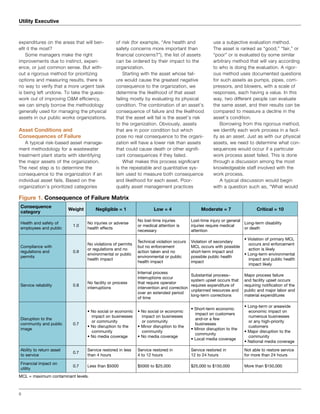
Figure 1. Consequence of Failure Matrix
Consequence
category
Weight Negligible = 1 Low = 4 Moderate = 7 Critical = 10
Health and safety of
employees and public
1.0
No injuries or adverse
health effects
No lost-time injuries
or medical attention is
necessary
Lost-time injury or general
injuries require medical
attention
Long-term disability
or death
Compliance with
regulations and
permits
0.9
No violations of permits
or regulations and no
environmental or public
health impact
Technical violation occurs
but no enforcement
action taken and no
environmental or public
health impact
Violation of secondary
MCL occurs with possible
short-term impact and
possible public health
impact
• Violation of primary MCL
occurs and enforcement
action is likely
• Long-term environmental
impact and public health
impact likely
Service reliability 0.8
No facility or process
interruptions
Internal process
interruptions occur
that require operator
intervention and correction
over an extended period
of time
Substantial process–
system upset occurs that
requires expenditure of
unplanned resources and
long-term corrections
Major process failure
and facility upset occurs
requiring notification of the
public and major labor and
material expenditures
Disruption to the
community and public
image
0.7
• No social or economic
impact on businesses
or community
• No disruption to the
community
• No media coverage
• No social or economic
impact on businesses
or community
• Minor disruption to the
community
• No media coverage
• Short-term economic
impact on customers
and–or a few
businesses
• Minor disruption to the
community
• Local media coverage
• Long-term or areawide
economic impact on
numerous businesses
or any high-priority
customers
• Major disruption to the
community
• National media coverage
Ability to return asset
to service
0.7
Service restored in less
than 4 hours
Service restored in
4 to 12 hours
Service restored in
12 to 24 hours
Not able to restore service
for more than 24 hours
Financial impact on
utility
0.7 Less than $5000 $5000 to $25,000 $25,000 to $150,000 More than $150,000
MCL = maximum contaminant levels.
7
November | December 2009
happen if … ?” followed by alternative
hypothetical situations if the asset failed
to varying degrees. For example, acti-
vated sludge operating procedures are
considered an asset. The total failure of
this asset means that the procedures
do not exist. A partial failure might
mean the procedures are not updated
regularly or are not easily accessible.
We consider what might happen if
these procedures do not exist. Safety
procedures make up a portion of this
asset, so with no safety procedures, a
person could be injured severely or die.
Therefore, a total failure of this asset
would receive a high criticality rating.
No procedures could also result in a
process upset, leading to compliance
failure. This also would add to its criti-
cal rating.
Prior to rating its assets, the organiza-
tion must create a structure of risk cat-
egories that include areas such as health
and safety, and regulatory compliance.
Within each category, the organization
gives a numerical rating with four to six
levels and a general description of what
each level means. For example, Level 1 in
the regulator compliance category might
mean “no effect,” and Level 6 might
mean a major permit violation. The result-
ing matrix allows staff to describe and
measure exactly how serious each asset
failure might be (see Figure 1, p. 6).
If activated sludge operating proce-
dures are a critical asset, how do we
assess its condition to know if it is likely to
fail? For each asset type (in this case, writ-
ten procedures and documentation), we
need to create a series of questions (four
to six is average) about the asset that indi-
cates its quality, completeness, or status
(see sample questions in Figure 2, right).
Condition assessment questions must
be specific to the asset type in order to
reflect the actual status or quality of the
asset. They also must be as quantifiable
as possible to reduce the subjectivity
of the person making the assessment.
Responses of “good,” “fair,” or “poor”
cannot be quantified. While they repre-
sent the opinion of the person making
the judgment, such tools have little value
in measuring the condition of a physical
or work process asset. Answers should
be given in ranges that measure com-
pleteness. While answer ranges may
be somewhat arbitrary, using the same
answer ranges from one assessment to
the next will measure change in the qual-
ity of the asset.
Assigning values to each potential
answer is the last step in creating a
condition assessment system. With
poor condition answers getting high
numbers, and good conditions given
low numbers, assets in the worst con-
dition will have the highest combined
number values. A consistent range of
values should be used (for example,
value ranges of 1 through 5), but the
weighting of questions can be changed
to stress specific parameters if they
are more important. The emphasis is
to achieve a combined condition score
for each asset which represents that
asset’s current physical status.
The Risk Equation
In general, “risk” can be defined as
Consequence of Failure x Likelihood
of Failure. Of course, there are many
variations on this fundamental equation,
since it is used in almost every business
enterprise. Because our goal is to iden-
tify the OM assets that are the greatest
risk to our facility, a simple calculation
can be used to produce a risk value that
is relative:
Total Risk to the Organization =
Asset Consequence of Failure Rating x
Likelihood of Failure
So, for each asset, Risk =
Consequence Rating x Condition Score.
Once set by the organization, conse-
quence ratings generally do not change.
What does change is the condition of the
asset over time.
For physical assets, such as pumps,
the constant use of the equipment
causes wear and tear, and the condition
of the asset will show a steady deteriora-
tion over the years. Graphing the condi-
tion score of a physical asset produces a
“condition decay curve” that can predict
when the asset will require major rehabili-
tation or replacement (see Figure 3, p. 8).
Soft assets, such as work processes,
often require periodic investment by the
organization so their effectiveness is
maintained. This is the same as perform-
ing routine maintenance on a pump. In
some cases, soft assets may need sig-
nificant investment to improve the asset
from a long-term poor condition to an
acceptable one. Rewriting a facility OM
manual that has not been updated for
Figure 2. Condition Assessment Questions
Condition questions Response Score
Are the procedures written?
yes 1
no 5
How often are the procedures updated?
monthly 0
quarterly 2
semiannually 3
annually 4
never 5
Where are the procedures located?
in office only 5
local within process 3
local/mobile 1
Are the procedures accurate?
= 20% accurate 5
20 – 50% accurate 3
50 – 80% accurate 1
 80% accurate 0
8
Utility Executive
decades is an example. Larger invest-
ments typically are needed to correct
long-term neglect and can be equated
with rehabilitating a pump that has not
been maintained over the years. As with
a pump, the investments made in our soft
assets improve their condition and, there-
fore, reduce their risk to the organization.
A total risk score is created for each
asset by combining the asset’s conse-
quence value from the consequence
matrix with its likelihood score from the
condition assessment. Sorting our list of
assets by this total risk score provides
us with a prioritized list of the work pro-
cesses within our facility. The highest on
the list could cause the greatest damage
to the organization in the case of failure
and, therefore, demands attention first.
If you look at this list and do not
clearly understand why certain work pro-
cesses demand high priority, you should
review how you rated each for conse-
quence and how the condition questions
were answered. In most cases, the logic
will become apparent, though it also may
be surprising. But in a few cases, you
may want to readjust your consequence
or likelihood–condition scoring.
Developing a Solution
After developing a total risk score for
each identified work process, we can
use the list as a tool for targeting invest-
ments to improve OM efficiency. Based
on total risk scores, we know that failure
of the assets at the top of the list could
have the greatest negative effect on the
organization and should be targeted
for priority investment. We then must
determine the specific tasks and costs
required to improve each asset. The best
way to accomplish this is to re-examine
the condition assessment questions
for that asset, if the condition score is
high, or the reasoning behind the conse-
quence score, or both. Development of
the solution will be unique to each asset,
but the direction should be obvious.
In our previous example, if there are
no written procedures for the activated
sludge process, high condition and
consequence scores are likely. The task
is to lower these scores and thereby
to reduce the risk to the organization.
We simply must identify and budget for
the creation of the necessary process,
safety, and other procedures that will
mitigate expected problems. It is not
hard to see how this change will increase
OM efficiency. In other cases, the tasks
required may not be as apparent. But if
the consequence and condition scores
are realistic, improving these work pro-
cesses will increase OM efficiency, for
example, by reducing accidents, improv-
ing process performance, and increasing
staff knowledge.
Estimating the cost of tasks and
projects to improve work processes
may require compromises, and using a
risk-based approach to improve OM
efficiency still requires good management
judgment. While the cost to correct an
asset problem completely might be more
than the average OM budget can sup-
port, a smaller task that makes progress
will reduce that asset’s risk somewhat
and leave money to reduce risk in other
areas. The risk-based system is a tool
that helps identify and rank problems.
Resolving those problems will always be
a management task.
Reassessment: A Repeatable
Measure
The primary strength of the risk-based
methodology for managing assets is
its repeatable and measureable struc-
ture. When assets are reassessed in 1
to 3 years, the condition of a particular
asset can be compared to its previous
assessed value, even if the assess-
ments are performed by different staff.
Comparing condition ratings from one
evaluation to the next provides a realistic
trend of the asset’s condition. A subjec-
tive “good,” “fair,” or “poor” technique
would not provide the same type of reli-
able data.
For soft assets, such as work pro-
cesses, the condition assessment struc-
ture provides an additional and critical
Conditionscore
Assessment year
Influent pump #1
Condition decay curve
No data
Minimum acceptable service level
0.5
1.0
1.5
2.0
2.5
3.0
3.5
4.0
4.5
5.0
98 99 00 01 02 03 04 05 06
x
Figure 3. Condition Decay Curve
9
November | December 2009
Awastewater treatment plant (WWTP)
considers many things before
investing in new technology: cost-
effectiveness, system requirements,
and state and federal regulations, to
name a few. But when they invest in a
renewable energy such as solar power,
saving energy and improving their envi-
ronmental footprint are usually the two
biggest reasons given for the techno-
logical shift.
Atlantic County (N.J.) Utilities
Authority (ACUA) had these consider-
ations when it decided to install 2700
photovoltaic panels in 2006 at five
locations around its WWTP in Atlantic
City. The solar arrays provide 500 kW,
or roughly 3%, of the facility’s annual
energy consumption, said Kate Vesey,
comptroller and director of research
and development at ACUA. Much of
the other power is provided by wind
turbines around the plant. “Wind power
accounts for 56% of our energy,”
Vesey said.
ACUA hired WorldWater and Power
Corp. (now Entech Solar in Fort
Worth, Texas) and SunDurance Energy
(Plainfield, N.J.) to design and build
its $3.25 million project, which was
funded through a Customer Onsite
Renewable Credit Rebate from the New
Jersey Board of Public Utilities Clean
Energy Program and a low-interest loan
from the New Jersey Environmental
Infrastructure Trust Program.
The project was completed in two
phases in 1 year, Vesey said. ACUA now
has one ground-mounted array, two
roof-mounted arrays, and a 3-m (10-ft)
canopy array over the employee parking
lot near the plant. As an added bonus,
the canopy also “provides shade for the
employees’ cars and protects them from
the elements of the beach,” Vesey said.
element: metrics. After you decide to
invest in a work process, how can you
tell if you have succeeded? How do you
measure your return on investment?
The answer is to re-evaluate the asset.
To gauge whether your investment has
achieved its desired effect, you reas-
sess the asset using the same condi-
tion questions. The resulting condition
score will be lower if your investments
have made a difference. The improve-
ment may be slight or significant, but
the rating will measure what you have
achieved in very practical terms that
can be shared with upper management
and other stakeholders.
What if the condition does not
improve or even declines after an invest-
ment? In most cases, this means the
tasks developed to improve the asset’s
condition either were not executed fully
or were inappropriate for the mission.
No matter the cause, both the condition
and the tasks used to improve it should
be reviewed and additional steps taken.
This process is the tool by which we
can prioritize our investments to improve
OM efficiency, then measure the results
and continue improvements. Fortunately,
most improvements are successful. The
question is, does the improved condi-
tion remove that asset from its high-risk
position, or is more effort needed?
Conclusion
In most wastewater facilities, improv-
ing OM efficiency is accomplished by
applying the available funds, which are
usually inadequate, to the most obvious
or glaring issues. Reducing the impact
of major problem areas by addressing
these “low-hanging fruits” does result
in improvement, but the unorganized
approach does not always lead to sys-
temwide improvements.
To have a better chance at success,
an organization must do the following:
It should have a rigorous, measur-■■
able, and repeatable system that
1) identifies the work processes
presenting the greatest risk to the
efficiency of the organization, and
2) measures the condition of each
process, which is invaluable for long-
term improvements.
It must identify each work process■■
in the facility and establish how each
would affect the organization if it failed.
This is the foundation of understanding
how your organization actually works.
It should create a system to evalu-■■
ate routinely the condition of each
physical asset or work process. This
determines whether it is likely to fail
in the near future and sets a standard
for future comparisons.
It must create an investment strategy■■
based on the risk and condition of its
work process assets, which estab-
lishes the improvement plan.
It should re-evaluate the condition■■
of each asset on an annual basis to
measure the success of the invest-
ments made and to support modifying
its investment strategy for the next
fiscal cycle.
It must create and maintain a struc-■■
tured, measurable process for
managing investments that improve
OM efficiency. This demonstrates
to upper management and custom-
ers that your organization is carefully
expending their scarce resources and
that each investment is justified.
Steve McNicol is senior director of
technical services at CH2M Hill OMI
world headquarters in Denver; Dan
Stark is regional director of technical
services at CH2M Hill in Naples, Fla.;
and Cal Leckington is vice president,
OM Business Group, at CH2M Hill in
Corvallis, Ore.
Utilities See the Light
WWTPs that convert to solar power find energy and cost savings and, in some cases, fast
return on investment
10
Utility Executive
The solar panels require little main-
tenance, and even though the project is
only 3 years old, ACUA has already got-
ten a return on its investment, Vesey said.
ACUA is now considering plans to
erect solar arrays along some of its
pump stations and on the unused 6
ha (15 ac) near its solid waste facility.
“We could then sell the energy to our
neighbors,” Vesey said.
The success of the solar project has
made ACUA a big believer in solar ener-
gy. “From our experience, it does work,”
Vesey said. “The solar system compa-
nies are pretty proven.”
Vesey said she would encourage other
wastewater utilities to consider solar
power. “The best time to do it would defi-
nitely be now,” she said. “It offsets our
peak electricity, and the federal govern-
ment is offering a lot of incentives.”
Trading Diesel for Solar in Hawaii
Real estate developer Dowling Co.
Inc. (Wailuku, Hawaii) also considered
environmental stewardship when it
hired Hoku Solar (Honolulu) to install
In December 2008, Lake County Sanitation District (LACOSAN) completed the installation of 6.1 ha (15.5 ac) of solar panels
that provide 2169 kW, or 91% of the electricity load, for two wastewater treatment plants and one correctional facility. Here
is a photo of the solar panels installed near LACOSAN’s Northwest Wastewater Plant.
LakeCountySanitationDistrict
11
November | December 2009
549 195-W solar panels on the roof of
its 2800-m3
/d (750,000-gal/d) Makena
Wastewater Reclamation Plant and two
pump stations.
The reclamation plant serves
Dowling’s 730-ha (1800-ac) Makena
Resort in Maui, which includes the
beachfront Maui Prince Hotel and two
18-hole golf courses.
In Hawaii, energy is a limited resource
with high costs, explained Jennifer
Stites, green development manager at
Dowling. “In Maui, we pay 30 cents a
kilowatt hour,” she said. “Over 90% of
our energy we receive is through burn-
ing diesel. Boats have to bring it in, and
needless to say, this is not the best
thing to do environmentally.”
The solar panels, installed in May,
have proven to be a more ecofriendly
alternative to diesel by supplying
150,000 kWh annually, or roughly 75%
of the energy needed to operate the
reclamation plant. The facility is also on
a net metering system, so only enough
energy needed to sustain the plant
is produced. The net metering also
serves as a no-cost way of banking
excess electricity production for future
retail credit.
“For us, net metering was the most
cost-effective,” Stites said.
Dowling spent $1 million on its solar
project but received rebates in the form
of federal tax (30% of total cost) and
state tax credits (35% of total cost) to
help fund the project. Stites said the
return on investment for the solar power
project with tax credits will be approxi-
mately 7 years.
The first phase is complete. The sec-
ond phase will entail the installation of
498 additional panels, thereby increas-
ing the total system size from 107 kW to
204 kW. This phase will be done in 2 to
3 years “after we build up the rest of the
resort,” Stites said. Also, the hope is to
one day make the entire resort a zero-en-
ergy community through a roof-mounted
photovoltaic solar farm, she said.
The Biggest in the West
Like Dowling, Lake County (Calif.)
Sanitation District also has entered
the solar energy arena in a big way. In
December 2008, it completed installa-
tion of 6.1 ha (15.5 ac) of solar panels
that provide 2169 kW, or 91% of the
electricity load, for two wastewater
treatment facilities — the Northwest
Wastewater Plant and the Southeast
Wastewater Plant — and one correc-
tional facility. The project has been cited
as the biggest local public agency instal-
lation in the western United States, said
Mark Dellinger, special districts adminis-
trator for Lake County.
Dellinger said the solar panel instal-
lation is an extension of the county’s
belief in energy efficiency and sustain-
ability that began with its participation in
the Southeast Geysers Effluent Pipeline
Project, which pumps treated waste-
water 50 km (30 mi) through pipelines
to recharge geysers. The project also
serves as a source for geothermal ener-
gy for the region.
Thanks to both the geysers and solar
power projects, “our entire county has
a net surplus of renewable energy,”
Dellinger said.
Lake County’s solar energy project
was 4 years in the making, though the
sanitation district did not first consider
solar energy when it was seeking a
viable, cost-effective renewable energy
source. The district had hoped to install
a microturbine along the geyser recharge
pipeline, but a feasibility study showed
that it would take too long to get a return
on investment, Dellinger said.
The county also considered wind
energy but discounted it because there
was not good wind potential at any of
the prospective locations, and the dis-
trict administrators did not like the visual
impact of wind turbines, Dellinger said.
Lake County finally decided to use solar
power after visiting several solar power
installations in California.
Along the way, the Lake County
Correctional Facility joined the project
because it had similar energy needs.
“Of all the agencies in Lake County, we
have the highest electricity bills because
of the amount of water we pump daily,”
Dellinger said. “When we told the [board
of supervisors] about our project idea,
they suggested including the jails,
because they have high electricity bills
too.” However, the jails did not have
enough land for solar arrays. “But luckily
they were next door to one of our facili-
ties, so they could just use the energy
from the arrays near one of our plants,”
Dellinger explained.
Dellinger said the sanitation district
went through a competitive selection
process and decided to give the con-
tract to SunPower Corp. (San Jose,
Calif.), which agreed to own, operate,
and maintain the solar arrays but sell
the electricity to the sanitation district
and the correctional facility. “We felt
that because neither our agency nor
the sheriff’s office had large capital,
we should go with a purchasing agree-
ment,” he explained.
The installation took 6 months to
complete and only had a few small con-
struction complications, such as under-
ground utilities that had to be relocated
and high clay content in some of the soil
that required special handling and exca-
vation, Dellinger said. In the end, 9430
panels were installed.
“These solar panels … track the sun
on a daily basis, which I heard increases
their output of energy between 20% to
30% more than a fixed array,” Dellinger
said. “You can hear and see them slowly
moving when you go out there.”
Dellinger estimates that the two
WWTPs are saving annually between
$20,000 and $30,000, because they
are buying electricity from SunPower
instead of the local utility company. He
also said that though SunPower receives
the renewable energy credits and tax
breaks, “there will be times when there
is [an electricity] surplus, and it can go
back to the utility power grid. Through a
net metering agreement, the sanitation
district receives credit for it through a
‘true-up process’ that is accessed at the
end of the year.”
Dellinger said the sanitation district is
evaluating the possibility of adding more
solar capacity to its Middletown waste-
water facility in conjunction with plant
upgrades. “Though we may have to fund
that through another purchasing agree-
ment,” he said.
– LaShell Stratton–Childers, UE
12
Utility Executive
Things break. It’s a fact of life that
every utility must reckon with.
In recent decades, utilities have
applied a variety of maintenance strate-
gies to keep both failures and their asso-
ciated costs to a minimum. Following
the lead of private industry, some have
used preventive maintenance approaches
that call for routine checks and equip-
ment overhauls on a preset schedule. If a
device can be repaired just before it fails,
they reason, they can minimize the risk
and cost of failure.
Others say that maintenance is about
managing the way things fail. Rather
than overhauling equipment when it
may still have useful life, these organi-
zations have developed maintenance
approaches that require people to
monitor the condition of each system
component to determine when a repair
is necessary and then take the proper
actions to maintain it.
This reliability-centered approach to
maintenance requires a formal process
to determine a maintenance strategy
for every asset. But as the Metropolitan
Sewer District (MSD) of Greater Cincinnati
recently discovered, such an approach
has other applications as well.
Specifically, MSD chose to apply
a reliability-centered maintenance
approach to determine the service
levels called for in its asset-manage-
ment-centric strategic plan. The plan
attempts to align the utilities’ many
departments — from engineering and
operations to human resources and
maintenance — with its mission, vision,
and values. MSD then manages its
operations using the principles of asset
management.
The Link Between Service
Levels and Reliability-Centered
Maintenance
If reliability-centered maintenance is
about managing the way a system fails,
then service levels could be about man-
aging the way those systems are intended
to perform, the leaders of MSD reasoned.
A utility, the thinking went, is really
a collection of processes that can be
grouped together as a system. Assets
within this system include not only
equipment but also employees, orga-
nizational knowledge, and business
processes — each of which requires
a strategy for effective implementation
and usage.
Service levels define what a utility’s
customers and other stakeholders should
be able to expect of these assets in
terms of quality and quantity of service,
reliability, responsiveness, environmental
acceptability, and cost. Those expecta-
tions must be defined in clear and mea-
surable terms that actual performance
can be measured against — just as main-
tenance needs should be defined in clear
and measurable terms that staff can use
to determine repair needs.
At least that was MSD’s reason-
ing. The utility’s goal was to develop a
straightforward process for determining
service levels that would be consistent
with the underlying assumptions of its
strategic plan.
The assignment of defining these
service levels was handed to a diverse
group of employees representing a range
of skills and backgrounds. Candidates
were selected based on defined core
competencies to ensure that the team
had the necessary technical and non-
technical skills for success. While each
candidate did not necessarily possess
all the identified core competencies, the
final team balanced creative, free-thinking
people with more-organized, methodical,
and facilitator types.
After defining its objective, reviewing
level-of-service theory, and studying how
others had tackled similar assignments,
the team still struggled with the age-old
question, “Where do we go from here?”
Their first job was to reach consensus on
some key points:
Customers would have to be involved■■
in setting the service levels. Surveys,
focus groups, and willingness-to-pay
studies all would help capture what
customers are thinking. MSD’s chal-
lenge was to ensure that customers
also understood the costs associated
with meeting these expectations. The
service-level team agreed to collect
and report service-level data regularly
to customers, boards, elected officials,
regulators, and other stakeholders.
Service levels would have to be■■
expressed in clear, measurable, and
auditable terms and delivered consis-
tently across the utility’s entire cus-
tomer base.
Service levels would have to be■■
consistent with customer expecta-
tions, as well as legal and regulatory
requirements. They would have to
reflect customer priorities, address
levels of customer satisfaction, and
be linked to performance manage-
ment while also aligning with the
utility’s strategic plan, budget, and
capital improvement projects.
Service levels eventually will be used■■
to educate customers, develop ser-
vice-level delivery strategies, identify
the costs and benefits of the services
offered, and enable customers to
assess the suitability, affordability, and
equitable delivery of services.
This is not to say that members of
the service-level team were in com-
plete agreement throughout the pro-
cess. Before the reliability-centered
maintenance approach was adopted,
the team renamed itself for a time as
the Level of Service Team or L.O.S.T.
— a reflection of the confusion and
discomfort they felt undertaking a proj-
ect that seemed foreign to them and
for purposes that did not always seem
clear. The reliability-centered approach
provided the focus and organization
they needed.
Determining Service Levels Using Reliability-
Centered Maintenance
Scott Maring, Dan Siler, and Scott Haskins
13
November | December 2009
Adapting the Reliability-Centered
Maintenance Process
A classic reliability-centered mainte-
nance process begins with the project
team defining the systems and pro-
cesses to be assessed. Seven questions
typically are asked about each one:
What are its functions and the asso-■■
ciated asset performance standards
in its present operating condition?
In what ways might it fail to fulfill its■■
functions?
What causes each functional failure?■■
What happens when each failure■■
occurs?
In what way does each failure matter?■■
What can be done to predict or pre-■■
vent each failure?
What should be done if a suitable■■
proactive task cannot be found?
While the process begins by look-
ing at the system level for functions and
functional failures, it quickly digs down
to the component level to find failure
modes and eventually the appropriate
maintenance strategy.
In MSD’s case, the team used these
questions as a starting point, developing
a 10-step process for defining service
levels for each of the utility’s assets:
Step 1 — Define the business pro-
cess. This first step was to define the
services the utility organization per-
formed and convert them into “process
maps,” or high-level representations that
clearly label each system component,
any inputs and outputs associated with
it, as well as flow direction. The inputs at
a wastewater treatment plant (WWTP),
for example, are combined and sanitary
wastewater. The outputs include air and
water streams.
Step 2 — Establish system boundary.
The process map then was reviewed
to ensure that the utility’s key business
concerns were represented. For exam-
ple, consider the outputs of a WWTP.
While air and water are certainly dis-
charged from the plant, another “output”
is odor — something that is of special
concern to customers and should be
considered in establishing service levels.
Step 3 — Begin at the end. In defining
service levels for each component, the
team began with the end goal in mind
and then defined the necessary inputs
and outputs that make each component
successful.
Step 4 — Develop functional state-
ments. Next, the project team developed
functional statements that described
each component’s function. These typi-
cally mentioned the inputs and outputs
— particularly in early drafts — to help
ensure that all components’ functions
were understood. For a WWTP, a func-
tional statement might read something
like this: “MSD shall protect public air
and water streams by processing com-
bined and sanitary wastewater, allow-
ing byproducts to be disposed of in
accordance with all stakeholder require-
ments.”
Step 5 — Define functional failures.
Next, the project team described all the
ways a component function might fail.
For example, see how a component’s
function and failure are described in
the table “The Relationship Between
Component Function and Failure” below.
Step 6 — Convert functional failures
into service-level statements. Functional
failure statements were converted into
service-level statements that described
how the utility protects against those
functional failures. For a functional fail-
ure such as “WWTP does not protect
the public air stream,” a correspond-
ing service-level statement might be
“WWTP protects the public air stream in
accordance with air permits.” In another
example where the functional failure is
“WWTP does not dispose of byproducts
in accordance with stakeholder require-
ments,” the service-level statement
would be, “WWTP disposes of byprod-
ucts to support the treatment process.”
Step 7 — Define performance mea-
sures for service-level statements. The
team next defined how MSD would
measure each service-level statement so
the agency later could assess progress
and discuss potential improvements. For
example, a statement such as “WWTP
protects the public air stream in accor-
dance with air permits,” the performance
measure would be the percentage of
time used to accomplish that goal.
Step 8 — Define targets for service-
level performance measures. MSD
now knew how it was going to mea-
sure performance. The question then
became what targets it should expect
to hit. For example, what percent-
The Relationship Between Component Function and Failure
Component Component function Functional failure
WWTP MSD shall protect the public air and water streams by
accepting, treating, and discharging combined and sanitary
wastewater, allowing the byproducts to be disposed of in
accordance with all stakeholder requirements.
MSD does not protect the public air stream.
MSD does not protect the public water stream.
MSD does not accept combined wastewater.
MSD does not treat combined wastewater.
MSD does not discharge combined wastewater.
MSD does not accept sanitary wastewater.
MSD does not treat sanitary wastewater.
MSD does not discharge sanitary wastewater.
MSD does not dispose of byproducts in accordance with
stakeholder requirements.
WWTP = wastewater treatment plant.
MSD = Metropolitan Sewer District of Greater Cincinnati.
14
Utility Executive
age of the time should a WWTP be
expected to protect the public water
stream in accordance with discharge
permits? The service-level target MSD
chose was 100% permit compliance.
Targets like this can be developed in
many ways. They can be borrowed
from other utilities or based on regula-
tor or stakeholder input, taking finan-
cial, social, and environmental costs
into consideration.
Step 9 — Repeat the process for the
next system component. The process
for the first system component was now
complete. The team returned to Step
3 and repeated the same exercise for
each system component until each one
had been analyzed.
Step 10 — Verify, review, and align
service levels with your organization.
Once the process was complete, the
team doubled back to make sure the
service-level statements fit the utility’s
mission, vision, and values and aligned
with its strategic plan. Since the service-
level process was born out of the stra-
tegic plan, all should be in alignment.
Nonetheless, it was helpful to perform a
check at the end to be sure.
Not all items developed from this
process were necessarily service levels.
In some cases, the outcome of the pro-
cess was an organizational performance
measure, rather than a service level.
For example, the team developed one
statement that said, “WWTP disposes
of byproducts to support the treatment
process.” This is an important perfor-
mance measure for MSD as a whole but
plays only a supporting role for service
levels related to air and water permit
compliance.
Benefits of a Reliability-Centered
Maintenance Approach
In the end, a process to establish
service levels is a discussion of asset
failures and performance, work pro-
cesses, measures, and targets, all of
which relate ultimately to customers,
their expectations, the cost of service,
and the acceptable level of risk to be
assumed. This is information that a util-
ity can use in many ways and for differ-
ent purposes.
On an organizational system level,
this reliability-centered approach can be
used to develop a service-level frame-
work; on an asset level, it can be used
to develop a maintenance strategy.
This structured process also can
be used as a tool for change manage-
ment. If change is a utility’s goal, then
team involvement is especially vital for
success. Without input from a diverse
group, the results may be skewed
toward a particular ideology or point
of view that has not been subjected
to necessary analysis, discussion, and
debate.
By drawing from a wide range of
perspectives and opinions, the outcome
can more closely reflect the overall best
interests of the utility and its customers.
This team approach leads to long-term
ownership of the results and process. It
also creates champions within an orga-
nization to communicate direction and
rationale, and helps facilitate an under-
standing of major asset management
activities and strategic plan goals.
By applying this structured
approach, Cincinnati MSD found that
the journey to the final outcome is well
documented and defensible to stake-
holders. The structured approach also
kept the group focused on the task at
hand, reducing the tendency to chase
issues down to a low level when team
members should stay focused at a
higher strategic level.
Not only did the process streamline
the development of the utility’s first
service-level framework, it also allows
for continuous improvement by setting
the stage for the orderly review of ser-
vice levels in the future. A review team
can verify systems, inputs, outputs,
boundaries, and historical stakeholder
input to ensure the service levels still
hold true.
Service-Level Applications
Once the service-level framework was
complete, MSD’s Wastewater Treatment
Division began the process of tying its
firm sustainable-capacity service level to
its ongoing operation and maintenance
activities.
In this case, “firm sustainable
capacity” means that only one major
piece of equipment or tank can be out
of service for a particular process at a
particular time. For example, a primary
treatment process with eight identically
sized primary settling tanks would have
a firm sustainable capacity of seven
primary settling tanks.
MSD applied this service-level
measure and target at its Mill Creek
WWTP, one of the utility’s seven
WWTPs. The Mill Creek plant previ-
ously had used an equipment-avail-
ability measure based on the amount
of equipment available. While it is
important to have sufficient equip-
ment available, the measure did not
reflect whether the “right” equipment
was available. A spreadsheet was
developed to capture the raw data
for available equipment and convert
it into available capacity. By analyz-
ing capacity, the plant could focus on
the maintenance activities and capital
expenditures needed to ensure firm
capacity is met.
Data then were entered into a data-
base to track the percent of time firm
capacity is available through primary
and secondary treatment, as well as
during wet weather flows. Now that the
process to track this service level has
been developed and implemented suc-
cessfully, it will be rolled out to the six
remaining MSD WWTPs.
Meanwhile, a service-level frame-
work has been developed for the entire
organization. Service levels have been
prioritized, and small, focused teams
are working on measures and targets.
In coming months, these teams will
present and implement their find-
ings with the goal of identifying other
areas of MSD that will benefit from this
approach. Ultimately, the process is
making us a more asset-management-
centric organization.
Scott Maring and Dan Siler are
assistant superintendents of wastewater
treatment at the Metropolitan Sewer
District of Greater Cincinnati. Scott
Haskins is a vice president at CH2M Hill
(Englewood, Colo.).
15
November | December 2009
in briefin brief
U.S. EPA Announces Plan to
Revamp Clean Water Enforcement
Program
U.S. Environmental Protection
Agency Administrator Lisa P. Jackson
announced on Oct.15 during a U.S.
House Transportation and Infrastructure
Committee hearing that the agency is
increasing its Clean Water Act enforce-
ment efforts.
The Clean Water Action Enforcement
Plan is a first step in revamping the
compliance and enforcement program.
It seeks to improve the protection of our
U.S.’s water quality, raise the bar in fed-
eral and state performance, and enhance
public transparency. The plan outlines
how the agency will strengthen how it
addresses the water pollution challenges
of this century. These challenges include
pollution caused by numerous dispersed
sources, such as concentrated animal
feeding operations, wastewater over-
flows, construction sites, some industrial
facilities and runoff from urban streets.
The goals of the plan are to target
enforcement to the most significant pol-
lution problems; to improve transparency
and accountability by providing the public
access to better data about water quality
in their communities; and to strengthen
enforcement performance at the state
and federal levels. Elements of the plan
include the following:
Develop more comprehensive
approaches to ensure enforcement is tar-
geted to the most serious violations and
the most significant sources of pollution.
Work with states to ensure greater
consistency throughout the country with
respect to compliance and water quali-
ty. Ensure that states are issuing protective
permits and taking appropriate enforce-
ment to achieve compliance, and removing
economic incentives to violate the law.
Use 21st-century information tech-
nology to collect, analyze and use data
more efficiently and to make it readily
accessible to the public. Better tools will
help federal and state regulators identify
serious compliance problems quickly and
take prompt actions to correct them.
A copy of the action plan can be
found at www.epa.gov/compliance/civil/
cwa/cwaenfplan.html.
Bill Seeks More Enforcement
of States Failing To Reduce
Chesapeake Bay Pollution
Sen. Ben Cardin (D–Md.) introduced
on Oct. 19 the Chesapeake Clean Water
and Ecosystem Act, a measure that
would make the six states sharing the
Chesapeake Bay watershed face federal
enforcement action if their efforts to reduce
pollution entering the ecosystem fall short.
The bill, H.R. 3852, would codify and
replace Sec. 117 of the Clean Water
Act, which governs the Chesapeake Bay
program. The bill also would codify U.S.
President Barack Obama’s May 12 exec-
utive order requiring other federal agen-
cies to work with the U.S. Environmental
Protection Agency (EPA) to develop
annual action plans for restoring the bay.
A copy of the bill can be found at
http://frwebgate.access.gpo.gov/cgi-
bin/getdoc.cgi?dbname=111_cong_
billsdocid=f:h3852ih.txt.pdf.
The bill requires a 2025 deadline for
the six states to have in place all the
pollution reduction efforts considered
necessary for the ecosystem’s recovery.
The bill also would establish in federal
law a series of deadlines meant to ensure
that each state makes steady progress
toward the restoration goal and retains
the program. EPA and the states would
be required to perform a series of actions
to improve water quality in the bay.
For example, the legislation would
require creation of an interstate nutri-
ent trading program by 2015. Also, the
measure would make legally binding a
Chesapeake Bay Program plan for EPA
and the states that would finalize a baywide
total maximum daily load (TMDL) for pollut-
ants by Dec. 31, 2010, followed by estab-
lishment of consistent local TMDLs. The
bill specifically prohibits any net increase in
pollutant loading from impervious surfaces,
combined animal feeding operations, trans-
portation systems, and septic tanks.
Each of the bay states would have to
develop and implement a series of pro-
grams to reduce pollution to TMDL levels
by 2025, such as
watershed implementation plans
for each of their tidal water segments,
including enforceable pollution reduc-
tion targets and schedules that apply to
upstream and tidal point sources, septic
systems, agricultural runoff, and nonpoint
stormwater runoff;
TMDL-compliant, enforceable pollution
permits for each pollution source with
state law requiring pollution reductions
for agricultural and other lands outside
EPA jurisdiction; and
submission of progress reports to EPA
every 2 years beginning in 2014, with
states obligated to be either on track to
meet their local TMDLs by 2025, or ready
to implement an alternative plan.
The bill also would create a new
stormwater permitting program, under
which developers, beginning Jan. 1,
2013, would be compelled to replicate
the natural hydrology of the land and
compensate for any unavoidable impacts.
Only projects resulting in more than an
EPA-specified amount of impervious sur-
face would be regulated.
The legislation also would authorize a
new $1.5 billion federal grant program to
help states, localities, and farmers pay
for projects that reduce the amount of
urban and suburban stormwater enter-
ing the watershed’s rivers and streams.
Also, bay states would have to ban
phosphates in detergents within 3 years
of the bill’s enactment.
U.S. House Committee Approves
Chemical and Water Security Bills
The U.S. House Energy and
Commerce Committee approved two bills
on Oct. 21 that would extend and expand
the authority of the U.S. Department of
Homeland Security (DHS) to regulate the
security of chemical plants and give the
U.S. Environmental Protection Agency
(EPA) authority to regulate drinking water
and wastewater treatment plant security.
The bills — the Chemical Facility Anti-
Terrorism Act of 2009 (H.R. 2868) and
16
Utility Executive
the Drinking Water System Security Act of
2009 (H.R. 3258) — both require inher-
ently safer technology (IST) or methods to
reduce the consequences of a chemical
release from an intentional act. Majority of
the revisions were made to H.R. 2868.
House Democrats voted down
Republican-sponsored amendments to
eliminate requirements for plants and
water systems to use safer chemicals
and processes and eliminate provisions
that would allow states to enact stricter
security laws.
Under the latest version of H.R. 2868,
DHS would have to increase the number
of chemical facility inspectors by at least
100 in fiscal years 2010 and 2011. The
bill also would limit the number of facilities
placed by DHS in the highest two risk tiers
that are designated for facilities that pose
a risk of releasing a “chemical substance
of concern.” The compromise version
approved by the subcommittee would not
include those facilities that pose a risk of
theft of a substance of concern.
H.R. 2868 also eliminates the ability of
citizens to sue companies that fall under
the purview of this bill. Instead, it would
enable people with concerns to petition
DHS to look into problems at neighboring
chemical plants.
H.R. 3258 would give EPA the authority
to implement chemical security antiter-
rorism standards for community-based
drinking water and wastewater systems.
The compromise version approved by the
committee includes a provision that would
require the state or EPA to provide a water
system with an opportunity for appeal if it
disagrees with a determination that an IST
was implemented. EPA also would have
to provide guidance to water systems in
the lower risk tiers to streamline the IST
assessment process for these systems.
The text of H.R. 2868 can be found
at www.govtrack.us/congress/billtext.
xpd?bill=h111-2868. The text of H.R.
3258 can be found www.govtrack.us/
congress/billtext.xpd?bill=h111-3258.
Climate Legislation Seeks Deeper
Cuts in Greenhouse Gas Emissions
Sens. Barbara Boxer (D–Calif.) and
John Kerry (D–Mass.) of the Environment
and Public Works Committee introduced
climate legislation on Sept. 30 that would
require deeper cuts in greenhouse gas
emissions than a similar bill introduced
in the U.S. House of Representatives.
The Senate bill also would protect U.S.
Environmental Protection Agency (EPA)
authority over emissions from coal-fired
power plants. The legislation would require
greenhouse gas emissions to be cut 20%
by 2020 from 2005 levels. (At press time,
no bill number had been assigned.)
Unlike the House bill, the Boxer–Kerry
Clean Energy Jobs and American Power
Act would not block EPA from exerting
much of its Clean Air Act authority —
including new source review provisions
— over greenhouse gases at coal-fired
power plants.
The 20% by 2020 cut drew fire later
in the day from several coal state and
Midwestern Democrats, including Senate
Commerce, Science, and Transportation
Committee Chairman John D. Rockefeller
IV (D–W.Va.), Senate Budget Committee
Chairman Kent Conrad (D–N.D.), and
Sen. Byron Dorgan (D–N.D.), who have
said cuts of that magnitude will hurt the
coal industry and leave consumers with
higher energy bills.
The Boxer–Kerry bill also differs from
the House bill on carbon offsets: Projects
that reduce emissions at a low cost,
such as tree plantings and could be
used by power plants and other opera-
tions to meet their mandated emissions
reductions. In the House bill, the U.S.
Department of Agriculture, rather than
EPA, would oversee the offsets program,
a compromise that brought support from
rural Democrats but angered environmen-
tal groups who want assurances of more
vigorous oversight. The Senate bill would
leave that decision up to the president. It
also would establish a new independent
Offsets Integrity Advisory Board to help
the president determine what projects
should be eligible and assure that they
represent “verifiable, additional, and per-
manent” reductions in greenhouse gas
emissions. The House bill would establish
a similar advisory panel but would put it
under EPA. The Senate bill would estab-
lish another offsets oversight panel not
mentioned in the House bill — an Office
of Offsets Integrity — that would be
placed in the U.S. Department of Justice.
Access the bill at http://kerry.senate.
gov/cleanenergyjobsandamericanpower/
intro.cfm.
Join fellow water and wastewater professionals in San Francisco to hear the latest
in approaches, practices, processes, techniques, case studies, and research,
covering the entire spectrum of utility management.
Stay at the InterContinental San Francisco and receive a discounted room rate, only
available for a limited time. Be sure to mention the Water Environment Federation.
www.wef.org/UtilityManagement
or visit by clicking this ad
Jointly sponsored by the American
Water Works Association and the Water
Environment Federation.
The Utility Management Conference 2010
February 21 – 24, 2010 | InterContinental San Francisco Hotel
San Francisco, California

Article creating high performing teams

  • 1.
    Perhaps it’s becauseof the relatively mild nature of the virus so far. Or maybe it is memories of the bird flu scare that came and went 3 years ago with little impact. Whatever the reason, only one in three organizations is cur- rently prepared to deal with a wide- spread swine flu outbreak, according to a study by the Harvard School of Public Health (Boston) released in early September. This includes water and wastewater utilities, which have been designated by the U.S. Department of Homeland Security as critical to the nation’s securi- ty and economic vitality. According to the Harvard study, these “critical” businesses are no more likely to have a pandemic plan in place than nonessential ones. And that’s a concern, emergency planning experts say. “We don’t want people to be alarmed, but we do want them to be prepared,” said Michael Zanker, direc- tor of health security coordination for the U.S. Department of Homeland Security’s Office of Health Affairs. A White House report has projected a big influx of swine flu — formally known as the H1N1 virus — in the coming months, with anywhere from 30% to 50% of the population poten- tially contracting the virus. “Based on our modeling, that means utilities should prepare to have as many as 40% of their employees absent during the pandemic, either because they have the H1N1 virus themselves or they are caring for someone who has it,” Zanker said. Because the virus is highly transmis- sible, a utility could experience absen- teeism in waves as it sweeps through individual departments, Zanker added. Worker shortages could potentially stretch out beyond a few days if the pandemic grows and schools or day- care centers are closed. November/December 2009 Volume 12 | Number 6 Have you ever given a team an assignment, only to have it fail to achieve the results you were seeking? I have. I have witnessed teams that seemed doomed from inception, while others blew the doors off of expecta- tions. Why don’t some teams ever get off the ground? Some teams fail even if they are composed of smart people and appear to have done everything right. Recently, a colleague asked me for help with a team he was working with at a major utility. The senior managers had selected team members who rep- resented a cross section of the utility. They gave them specific assignments and provided them with time away from their regularly assigned duties so they could meet. They required routine progress reports and swore commit- ment to support them. So why were these teams struggling? Creating High-Performing Teams Why some teams fail to get off the ground, and what you can do to prevent that from happening David M. Mason continued on p. 3 continued on p. 2 The H1N1 Challenge: Is your utility prepared for a swine flu outbreak? inside this issue utility executive Improve OM Efficiency 5 WWTPs Convert to Solar Power for Energy and Cost Savings 9 Determining Service Levels Using Reliability- Centered Maintenance 12 Briefs 15
  • 2.
    2 Utility Executive Editor: LaShellStratton-Childers Contributing Editors: Mary Bufe and Allison Torres Burtka Editorial Assistant: Margaret Richards Editorial Director: Melissa H. Jackson Production Director: Laura Leslie Production Assistant: Jessica Rozek Production Artist: Jeff Frederick Publisher: William J. Bertera Copyediting provided by Fox River Communications Editorial Advisory Board: Chair: Diane Taniguchi-Dennis; City of Albany, Albany, Ore. John B. Cook; Advanced Data Mining International, Greenville, S.C. Dominick DiGangi; First Taxing District Water Department, Norwalk, Conn. Kathi Mestayer; KMA Consulting, Williamsburg, Va. Karen Pallansch; Alexandria Sanitation Authority, Alexandria, Va. The Editorial Advisory Board does not necessarily approve, disapprove, or endorse the contents of Utility Executive. Editorial Offices: Water Environment Federation 601 Wythe St. Alexandria, VA 22314-1994 Telephone 1-703-684-2400 Fax 1-703-684-2492 Water Environment Federation Officers President: Paul Freedman President-Elect: Jeanette Brown Vice President: Matt Bond Treasurer: Chris Browning Past President: Rebecca West Executive Director and Secretary: William J. Bertera Utility Executive (E-ISSN: 1944-6616) is published 6 times/yr © 2009 by the Water Environment Federation, 601 Wythe St., Alexandria, VA 22314 USA; (703) 684- 2400. Subscriptions are $129/yr ($89: WEF members). Single copy price is $22 ($18: WEF members). Editorial correspondence should be sent to the editor. Send changes of address (8 weeks advance notice) and claims for missing issues to pubs@wef.org. Bulk reprinting of articles is prohibited. The Water Environment Federation assumes no responsibility for opinions or statements of fact expressed by contributors or staff, and articles do not necessarily represent official organization policy. utility executive “You may have cases where staff must stay home and care for their chil- dren — even if no one is ill,” Zanker said. Absenteeism also could affect a util- ity’s supply chain, including chemical suppliers and power companies. Utilities must think beyond their work force and anticipate that up to 40% of their sup- pliers’ work forces could be affected as well, Zanker said. And what if they don’t? Utilities that don’t have contingency plans in place may find themselves short-staffed and lacking the chemicals and other supplies they need to treat wastewater or provide safe drinking water. How To Prepare Pandemic planning should be inte- grated into a utility’s existing business continuity and emergency response plans, according to U.S. Environmental Protection Agency guidance documents on the subject. This is the approach that the Massachusetts Water Resources Authority (WRA) is taking, said Marcis Kempe, WRA’s director of operations support. “A swine flu outbreak isn’t a prob- lem that a utility can plan its way out of,” Kempe said. “But developing an approach makes the problem more manageable.” For WRA, that approach included defining critical services and functions, then creating contingency plans in the event that staff or outside vendors are unavailable to perform them. The process began with internal dis- cussions last spring after the first cases of swine flu emerged in Mexico. Working initially from its 2006 bird flu pandemic plan, WRA leaders met with unit manag- ers to make sure they understood their roles in a pandemic. “Our discussions weren’t only about providing water and sewer service,” Kempe explained. “We also talked about being able to make payroll and pay our bills.” “We didn’t solve every potential problem in our planning,” Kempe said, “but we identified certain triggers and the approaches we would take should they occur.” Those triggers centered on both the number of suspected H1N1 cases as well as their severity. In anticipation of an outbreak, WRA has begun tracking attendance daily, rather than waiting for employees to turn in weekly time sheets. “If we notice a department that is taking a hit, we want as early notifi- cation as possible so we can fill the gaps,” Kempe said. How will those gaps be filled? “We have critical infrastructure to operate, and we need a work force to help us do that,” Kempe said. “Employees who don’t have a critical function must be on reserve to staff one when needed.” “Business will be normal until it can’t be,” Kempe said. “If a staff person is out for 2 days with swine flu and then is right back, it’s not a big concern,” said Kempe. “But if the virus would somehow change and we see mortality rates are on the rise nationally, that would trigger a different, more aggressive response.” That response might include more on-the-job training for persons required to cover an unfamiliar role or even lend a hand to other utilities in need. “We’re a wholesaler, so we serve smaller cities and towns with their own work forces,” Kempe said. “When winter comes, they may be asking us for help, and we’d like to be able to provide it.” To ensure that the necessary supplies are on hand in the event of an outbreak, WRA has begun topping off chemical tanks more frequently and identifying backup suppliers. In some cases, ven- dors are being asked to provide copies of their own pandemic plans. If necessary, it may become more aggressive in ordering and stockpiling chemicals. “We have our shopping lists ready,” Kempe said. Communication Is Key The key lesson to be learned from this and other emergency planning efforts is to involve the people who perform essen- The H1N1 Challenge continued from p. 1
  • 3.
    3 November | December2009 The process of creating teams may not be as intuitive as it may seem at first. I’ve learned some tough lessons from some very unpleasant experiences that I’ve had the misfortune of creating. I’ve learned that several steps that make teams suc- cessful also can lead them to failure if not handled properly. They include defining the objective;■■ setting realistic expectations;■■ identifying the teams’ and members’■■ roles, responsibilities, and decision- making authority; identifying the right composition of■■ the team; communicating what’s going on to oth-■■ ers throughout the organization; and choosing the right place to start the■■ work. Framing the Objective Before you can select team members, you must know specifically what you want the team to do. Most teams fail to get anything done because their mem- bers are not aligned with the purpose at hand and don’t understand what they are — and are not — supposed to do. Linda and Ron Turner have stated that a “fuzzy purpose statement leads to fuzzy results” and that “mission creep occurs when a team charter is too vague.” [See Linda Turner and Ron Turner, “Creating a Team Charter,” How to Grow Effective Teams and Run Meetings That Aren’t a Waste of Time (The Ends of the Earth Learning Group 1998).] Teams often are formed in haste under a heightened sense of urgency and without clearly defining their objec- tive. The desire to get something done quickly leads to teams being formed prematurely. In the absence of clear direction, they create their own purpose. The manager who created the team Creating High-Performing Teams continued from p. 1 More Things Utilities Should Know About Swine Flu Does working for a water or wastewater utility put you at risk in a swine flu outbreak? Only if your co-workers are showing symptoms, experts said. People don’t catch the flu from drinking water, said Michael Zanker of the U.S. Office of Homeland Security. “THE H1N1 virus is a respiratory virus,” he noted. “It is typically transmitted by coughing and sneezing.” Similarly, while H1N1, like other viruses, may find its way into wastewater, it requires no special handling procedures beyond those already in place. “Contact with wastewater is always to be avoided,” Zanker said. “Workers who follow stan- dard safety procedures are [at] no greater risk if this virus is added to the mix.” Want to learn more? Additional information about the H1N1 flu pandemic and how your utility can prepare for it is available at several Web sites: Flu.gov www.flu.gov This is the U.S. federal government’s clearinghouse for flu-related information. Pandemic Influenza Preparedness, Response, and Recovery Guide for Critical Infrastructure and Key Resources http://www.avianflu.gov/professional/pdf/ cikrpandemicinfluenzaguide.pdf This is a publication from the U.S. Department of Homeland Security’s Office of Infrastructure Protection. Pandemic Flu Planning for the Water Sector http://cfpub.epa.gov/safewater/watersecurity/pandemicflu.cfm This is a U.S. Environmental Protection Agency Web page offering free tools and guidance materials to help utilities develop plans to prepare for and respond to pandemic influ- enza outbreaks. National Rural Water Association www.nrwa.org This is the National Rural Water Association (Duncan, Okla.) Web site, where smaller utilities can find a pandemic influenza checklist specifically for smaller systems and utilities. tial functions in the planning process. “They know better than anyone what must be done,” Kempe said. Once planning is complete, utilities should develop internal and external communications strategies and work with community pandemic planners to minimize an outbreak’s impact. Internally, this includes everything from promoting good handwashing practices to sending employees home at the first sign of flu symptoms. It also means making sure that employ- ees are educated on the H1N1 virus and its transmission, particularly as it relates to water and wastewater (see sidebar, below). What if your utility isn’t as prepared as it should be? “It is never too late to plan,” said Robert Davis, director of external affairs for the U.S. Department of Homeland Security’s Office of Health Affairs. “There are numerous pandemic flu documents and readiness materials available online to help. Utilities that have not yet done so should start today.” — Mary Bufe, UE
  • 4.
    4 Utility Executive often assumesthat the objective is self- evident and understood by all stakehold- ers without the need for a structured chartering process. Herein lies one of the biggest mistakes leaders make and one of the principal causes of failure. To avoid common pitfalls, you must follow a formal chartering process. But even that doesn’t ensure success. It is as important to define clearly what you do not want the team to do as it is to define what the team should do. You should frame the objective in terms of “is” and “is not.” Several years ago, in a presentation to a group of key managers and supervi- sors at a planning meeting of a Fortune 500 company, Ron Moore, managing partner of The RM Group (Knoxville, Tenn.) said, “Empowerment without training leads to dumb decisions faster!” That quote has stuck with me. As you are defining the team’s objec- tive, it is important to consider the level of decision-making authority the team will have and to make certain that the team members understand it. Too often, teams are led to believe that they are going to make decisions when they are merely being asked to provide input about a decision. Teams are rarely, if ever, asked to cre- ate policy. Creating policy is an executive management responsibility. However, teams should be asked to provide input on the policy, particularly on how the pol- icy should be deployed. The team mem- bers need to know from the start whether they are providing input, conducting an investigation, stating the findings of an investigation, making recommendations for further action, or providing recom- mendations for implementation. You must communicate clearly to the team in the chartering process not only what they are expected to do but also what they are not expected to do. Selecting Team Members After clearly defining the objective and delegating a level of decision- making authority to the team, you are ready to begin the process of populat- ing the team. Time and time again, this has proved more difficult than expected and not nearly as intuitive. Too often, in an attempt to foster engagement, managers simply select employees to represent each department or division. Instead, team members should be selected based on the knowledge they can bring to the team. Creating high-performing teams involves more than assembling a group of smart people and giving them an assignment. You must think about who might be the right people to accomplish a specific, well-defined task. Then, you must ask whether resolving the issue is within their decision-making capability and authority. One way to make this process easier is to develop selection criteria. Criteria for potential team members might include being viewed as credible, so that oth-■■ ers will believe what they say; being viewed as leaders, so others■■ will accept their decisions; being technically knowledgeable —■■ not necessarily the most skilled or educated, but knowledgeable about how work is performed; possessing the power to make■■ decisions; being change agents or anti-status■■ quo, so that they are interested in finding better ways to do things and improve, rather than rationalizing things as they are; having the ability to communicate■■ effectively with peers and with people who report to them; and being consensus builders.■■ This is not a definitive list of selection criteria; others might be more appropri- ate in your situation. But the process of establishing criteria is important. Teams created without selection criteria often fail, not because the team did not put forth the necessary effort, the objec- tives were not well enough defined, or the team was not chartered, but rather because it was simply made up of the wrong people. Different people have different needs for information and widely divergent styles. People are naturally originators or implementers, analyzers or initiators, or varying shades in between. Some people are analytic, while others prefer quick, immediate action. Some think that talking about a topic is action, whereas others assume nothing can be accomplished without a flurry of activity. Some people are planners and process thinkers; every idea has a beginning, middle, and end. Others can come up with new ideas and change direction smoothly, moving seamlessly from one topic to another. The fact is that every team needs diversity in styles, behaviors, and think- ing processes. Too little diversity can lead to problems. For example, if every- one on a team were focused on quick action, they would take action without sufficient thought. Conversely, we are all familiar with “paralysis through analysis,” where nothing gets done. Several psy- chometric tools can help assess peo- ple’s styles, including the Myers–Briggs Type Indicator, the Benziger Thinking Styles Assessment, and other tests that characterize people as one of six hats, various colors, or compass quadrants. Deciding Where To Start The next decision that should be made before work begins is the right place to start working — but this is not as easy as it might seem. Creating selection criteria for where to start can help you design a proof of concept and give you some direction. Experience has shown that creating a proof of con- cept is more effective than wholesale change. Some government agencies select their best-performing department to begin a project, anticipating a strong likelihood of success. Others choose their worst-performing areas, so they can demonstrate the full potential of the opportunity, and yet others begin with their core services. But no mat- ter where you decide to begin, taking the time to create selection criteria and then make a deliberate decision based on those criteria is proven to accomplish the most effective results. For example, managers could select an area that has high external customer visibility;■■ is big and complex enough to dem-■■ onstrate that the effort is worthwhile; has a strong likelihood of success;■■ can provide experience and lessons■■
  • 5.
    5 November | December2009 learned that can be leveraged in the future; or is small enough that it can be con-■■ trolled, catastrophic failure is unlikely, or failure — such as a service interrup- tion — can be mitigated. Again, there is no definitive list of selection criteria. The real value comes from the process of deliberating about pertinent selection criteria. Communication Planning Communicating up front what the team is doing can avoid a project being derailed down the road. Managers com- monly overlook the need for developing a communication plan. Communication planning begins with chartering the team. The team will begin to understand its responsibilities,■■ what decisions it can make,■■ to whom it reports,■■ what lies beyond its boundaries,■■ the roles of people on the team,■■ when it will be evaluated, and■■ when its work is completed.■■ However, it’s also important to com- municate to others in the organization what the team is doing. In the absence of information, people will naturally make things up, and you can expect that what is made up can be worse than the actual situation. Creating a communica- tion plan can help avoid problems later in the process. Some questions you might consider when developing a communication plan include the following: Who are the potential interested■■ parties? What questions will they have, and■■ what will they want to know? What is the message?■■ How will the message be crafted to■■ communicate it effectively to different interested parties and stakeholders? When will they want to know, and■■ what information will be available? How will each of the parties be■■ informed? Who should deliver the message?■■ Internal staff will be inquisitive about what’s going on when they become aware of the effort. The public and other external parties can be influenced significantly not only by the message but also by when, how, and from whom they hear it. Some messages can be simple take-back messages that team members can deliver to the workplace. Developing take-back messages following each ses- sion or workshop will ensure that all team members tell the same story. Other communications might include public outreach and education programs, adver- tisements, public service announcements, newsletters, a city manager’s hotline, billing stuffers, or public-access televi- sion or public-radio talk shows. The team members can develop the communica- tion plan, or you may decide to charter a separate communications team. The team’s work often results in noise of one sort or another and disruption of business as usual. You can bet that some affected parties will be reticent about the work being performed. An effective communication plan can pre- pare the executive management team and other affected stakeholders to anticipate and deal with noise. I’ve seen effective communication plans help pre- pare managers and elected officials by increasing their threshold for dealing with the pain and disruption and by increasing their resolve to see things through. You should begin communication planning before the team begins work, rather than waiting for noise to develop. Forewarned is forearmed. In some situa- tions, noise caused too much pain, and management decided that the desired outcomes were not worth the disruption. In many cases of failure, managers could have taken steps to improve the team’s likelihood of success. Clearly defining the work to be done, picking the right people and the right place to start, and developing an effective communica- tion plan would have made the differ- ence. All these steps can enhance the team’s effectiveness and ensure that the project’s full benefits are achieved and communicated. David M. Mason is director of Utility Services at Infrastructure Management Group Inc. (Bethesda, Md.). Looking Past the Low-Hanging Fruit Using asset management techniques to find the best and most proficient way to improve OM efficiency Steve McNicol, Dan Stark, and Cal Leckington Operations and maintenance (OM) efficiency in a wastewater facility is often defined in terms of labor hours and the variable costs of chemicals, energy, and solids disposal. Reducing the time and–or cost of these factors is generally considered the measure- ment of efficiency. We also recognize that meeting service levels for health and safety targets and responsiveness to our customers, as well as meeting regulatory requirements and other simi- lar measurements, are all part of OM efficiency. But how do managers determine which areas within the organization need improvement? And when improvements are made, how is the apparent success or failure of these efforts measured? Changes in expenditures or in key per- formance indicator data are some ways to measure success, but when faced with many possible options for improvement, how does a manager know which option will have the greatest impact on the organization? In a time of financial stress, how can an organization focus its limited
  • 6.
    expenditures on theareas that will ben- efit it the most? Some managers make the right improvements due to instinct, experi- ence, or just common sense. But with- out a rigorous method for prioritizing options and measuring results, there is no way to verify that a more urgent task is being left undone. To take the guess- work out of improving OM efficiency, we can simply borrow the methodology generally used for managing the physical assets in our public works organizations. Asset Conditions and Consequences of Failure A typical risk-based asset manage- ment methodology for a wastewater treatment plant starts with identifying the major assets of the organization. The next step is to determine the consequence to the organization if an individual asset fails. Based on the organization’s prioritized categories of risk (for example, “Are health and safety concerns more important than financial concerns?”), the list of assets can be ordered by their impact to the organization. Starting with the asset whose fail- ure would cause the greatest negative consequence to the organization, we determine the likelihood of that asset failing mostly by evaluating its physical condition. The combination of an asset’s consequence of failure and the likelihood that the asset will fail is the asset’s risk to the organization. Obviously, assets that are in poor condition but which pose no real consequence to the organi- zation will have a lower risk than assets that could cause death or other signifi- cant consequences if they failed. What makes this process significant is the repeatable and quantitative sys- tem used to measure both consequence and likelihood for each asset. Poor- quality asset management practices use a subjective evaluation method. The asset is ranked as “good,” “fair,” or “poor” or is evaluated by some similar arbitrary method that will vary according to who is doing the evaluation. A rigor- ous method uses documented questions for such assets as pumps, pipes, com- pressors, and blowers, with a scale of responses, each having a value. In this way, two different people can evaluate the same asset, and their results can be compared to measure a decline in the asset’s condition. Borrowing from this rigorous method, we identify each work process in a facil- ity as an asset. Just as with our physical assets, we need to determine what con- sequences would occur if a particular work process asset failed. This is done through a discussion among the most knowledgeable staff involved with the work process. A typical discussion would begin with a question such as, “What would 6 Utility Executive Figure 1. Consequence of Failure Matrix Consequence category Weight Negligible = 1 Low = 4 Moderate = 7 Critical = 10 Health and safety of employees and public 1.0 No injuries or adverse health effects No lost-time injuries or medical attention is necessary Lost-time injury or general injuries require medical attention Long-term disability or death Compliance with regulations and permits 0.9 No violations of permits or regulations and no environmental or public health impact Technical violation occurs but no enforcement action taken and no environmental or public health impact Violation of secondary MCL occurs with possible short-term impact and possible public health impact • Violation of primary MCL occurs and enforcement action is likely • Long-term environmental impact and public health impact likely Service reliability 0.8 No facility or process interruptions Internal process interruptions occur that require operator intervention and correction over an extended period of time Substantial process– system upset occurs that requires expenditure of unplanned resources and long-term corrections Major process failure and facility upset occurs requiring notification of the public and major labor and material expenditures Disruption to the community and public image 0.7 • No social or economic impact on businesses or community • No disruption to the community • No media coverage • No social or economic impact on businesses or community • Minor disruption to the community • No media coverage • Short-term economic impact on customers and–or a few businesses • Minor disruption to the community • Local media coverage • Long-term or areawide economic impact on numerous businesses or any high-priority customers • Major disruption to the community • National media coverage Ability to return asset to service 0.7 Service restored in less than 4 hours Service restored in 4 to 12 hours Service restored in 12 to 24 hours Not able to restore service for more than 24 hours Financial impact on utility 0.7 Less than $5000 $5000 to $25,000 $25,000 to $150,000 More than $150,000 MCL = maximum contaminant levels.
  • 7.
    7 November | December2009 happen if … ?” followed by alternative hypothetical situations if the asset failed to varying degrees. For example, acti- vated sludge operating procedures are considered an asset. The total failure of this asset means that the procedures do not exist. A partial failure might mean the procedures are not updated regularly or are not easily accessible. We consider what might happen if these procedures do not exist. Safety procedures make up a portion of this asset, so with no safety procedures, a person could be injured severely or die. Therefore, a total failure of this asset would receive a high criticality rating. No procedures could also result in a process upset, leading to compliance failure. This also would add to its criti- cal rating. Prior to rating its assets, the organiza- tion must create a structure of risk cat- egories that include areas such as health and safety, and regulatory compliance. Within each category, the organization gives a numerical rating with four to six levels and a general description of what each level means. For example, Level 1 in the regulator compliance category might mean “no effect,” and Level 6 might mean a major permit violation. The result- ing matrix allows staff to describe and measure exactly how serious each asset failure might be (see Figure 1, p. 6). If activated sludge operating proce- dures are a critical asset, how do we assess its condition to know if it is likely to fail? For each asset type (in this case, writ- ten procedures and documentation), we need to create a series of questions (four to six is average) about the asset that indi- cates its quality, completeness, or status (see sample questions in Figure 2, right). Condition assessment questions must be specific to the asset type in order to reflect the actual status or quality of the asset. They also must be as quantifiable as possible to reduce the subjectivity of the person making the assessment. Responses of “good,” “fair,” or “poor” cannot be quantified. While they repre- sent the opinion of the person making the judgment, such tools have little value in measuring the condition of a physical or work process asset. Answers should be given in ranges that measure com- pleteness. While answer ranges may be somewhat arbitrary, using the same answer ranges from one assessment to the next will measure change in the qual- ity of the asset. Assigning values to each potential answer is the last step in creating a condition assessment system. With poor condition answers getting high numbers, and good conditions given low numbers, assets in the worst con- dition will have the highest combined number values. A consistent range of values should be used (for example, value ranges of 1 through 5), but the weighting of questions can be changed to stress specific parameters if they are more important. The emphasis is to achieve a combined condition score for each asset which represents that asset’s current physical status. The Risk Equation In general, “risk” can be defined as Consequence of Failure x Likelihood of Failure. Of course, there are many variations on this fundamental equation, since it is used in almost every business enterprise. Because our goal is to iden- tify the OM assets that are the greatest risk to our facility, a simple calculation can be used to produce a risk value that is relative: Total Risk to the Organization = Asset Consequence of Failure Rating x Likelihood of Failure So, for each asset, Risk = Consequence Rating x Condition Score. Once set by the organization, conse- quence ratings generally do not change. What does change is the condition of the asset over time. For physical assets, such as pumps, the constant use of the equipment causes wear and tear, and the condition of the asset will show a steady deteriora- tion over the years. Graphing the condi- tion score of a physical asset produces a “condition decay curve” that can predict when the asset will require major rehabili- tation or replacement (see Figure 3, p. 8). Soft assets, such as work processes, often require periodic investment by the organization so their effectiveness is maintained. This is the same as perform- ing routine maintenance on a pump. In some cases, soft assets may need sig- nificant investment to improve the asset from a long-term poor condition to an acceptable one. Rewriting a facility OM manual that has not been updated for Figure 2. Condition Assessment Questions Condition questions Response Score Are the procedures written? yes 1 no 5 How often are the procedures updated? monthly 0 quarterly 2 semiannually 3 annually 4 never 5 Where are the procedures located? in office only 5 local within process 3 local/mobile 1 Are the procedures accurate? = 20% accurate 5 20 – 50% accurate 3 50 – 80% accurate 1 80% accurate 0
  • 8.
    8 Utility Executive decades isan example. Larger invest- ments typically are needed to correct long-term neglect and can be equated with rehabilitating a pump that has not been maintained over the years. As with a pump, the investments made in our soft assets improve their condition and, there- fore, reduce their risk to the organization. A total risk score is created for each asset by combining the asset’s conse- quence value from the consequence matrix with its likelihood score from the condition assessment. Sorting our list of assets by this total risk score provides us with a prioritized list of the work pro- cesses within our facility. The highest on the list could cause the greatest damage to the organization in the case of failure and, therefore, demands attention first. If you look at this list and do not clearly understand why certain work pro- cesses demand high priority, you should review how you rated each for conse- quence and how the condition questions were answered. In most cases, the logic will become apparent, though it also may be surprising. But in a few cases, you may want to readjust your consequence or likelihood–condition scoring. Developing a Solution After developing a total risk score for each identified work process, we can use the list as a tool for targeting invest- ments to improve OM efficiency. Based on total risk scores, we know that failure of the assets at the top of the list could have the greatest negative effect on the organization and should be targeted for priority investment. We then must determine the specific tasks and costs required to improve each asset. The best way to accomplish this is to re-examine the condition assessment questions for that asset, if the condition score is high, or the reasoning behind the conse- quence score, or both. Development of the solution will be unique to each asset, but the direction should be obvious. In our previous example, if there are no written procedures for the activated sludge process, high condition and consequence scores are likely. The task is to lower these scores and thereby to reduce the risk to the organization. We simply must identify and budget for the creation of the necessary process, safety, and other procedures that will mitigate expected problems. It is not hard to see how this change will increase OM efficiency. In other cases, the tasks required may not be as apparent. But if the consequence and condition scores are realistic, improving these work pro- cesses will increase OM efficiency, for example, by reducing accidents, improv- ing process performance, and increasing staff knowledge. Estimating the cost of tasks and projects to improve work processes may require compromises, and using a risk-based approach to improve OM efficiency still requires good management judgment. While the cost to correct an asset problem completely might be more than the average OM budget can sup- port, a smaller task that makes progress will reduce that asset’s risk somewhat and leave money to reduce risk in other areas. The risk-based system is a tool that helps identify and rank problems. Resolving those problems will always be a management task. Reassessment: A Repeatable Measure The primary strength of the risk-based methodology for managing assets is its repeatable and measureable struc- ture. When assets are reassessed in 1 to 3 years, the condition of a particular asset can be compared to its previous assessed value, even if the assess- ments are performed by different staff. Comparing condition ratings from one evaluation to the next provides a realistic trend of the asset’s condition. A subjec- tive “good,” “fair,” or “poor” technique would not provide the same type of reli- able data. For soft assets, such as work pro- cesses, the condition assessment struc- ture provides an additional and critical Conditionscore Assessment year Influent pump #1 Condition decay curve No data Minimum acceptable service level 0.5 1.0 1.5 2.0 2.5 3.0 3.5 4.0 4.5 5.0 98 99 00 01 02 03 04 05 06 x Figure 3. Condition Decay Curve
  • 9.
    9 November | December2009 Awastewater treatment plant (WWTP) considers many things before investing in new technology: cost- effectiveness, system requirements, and state and federal regulations, to name a few. But when they invest in a renewable energy such as solar power, saving energy and improving their envi- ronmental footprint are usually the two biggest reasons given for the techno- logical shift. Atlantic County (N.J.) Utilities Authority (ACUA) had these consider- ations when it decided to install 2700 photovoltaic panels in 2006 at five locations around its WWTP in Atlantic City. The solar arrays provide 500 kW, or roughly 3%, of the facility’s annual energy consumption, said Kate Vesey, comptroller and director of research and development at ACUA. Much of the other power is provided by wind turbines around the plant. “Wind power accounts for 56% of our energy,” Vesey said. ACUA hired WorldWater and Power Corp. (now Entech Solar in Fort Worth, Texas) and SunDurance Energy (Plainfield, N.J.) to design and build its $3.25 million project, which was funded through a Customer Onsite Renewable Credit Rebate from the New Jersey Board of Public Utilities Clean Energy Program and a low-interest loan from the New Jersey Environmental Infrastructure Trust Program. The project was completed in two phases in 1 year, Vesey said. ACUA now has one ground-mounted array, two roof-mounted arrays, and a 3-m (10-ft) canopy array over the employee parking lot near the plant. As an added bonus, the canopy also “provides shade for the employees’ cars and protects them from the elements of the beach,” Vesey said. element: metrics. After you decide to invest in a work process, how can you tell if you have succeeded? How do you measure your return on investment? The answer is to re-evaluate the asset. To gauge whether your investment has achieved its desired effect, you reas- sess the asset using the same condi- tion questions. The resulting condition score will be lower if your investments have made a difference. The improve- ment may be slight or significant, but the rating will measure what you have achieved in very practical terms that can be shared with upper management and other stakeholders. What if the condition does not improve or even declines after an invest- ment? In most cases, this means the tasks developed to improve the asset’s condition either were not executed fully or were inappropriate for the mission. No matter the cause, both the condition and the tasks used to improve it should be reviewed and additional steps taken. This process is the tool by which we can prioritize our investments to improve OM efficiency, then measure the results and continue improvements. Fortunately, most improvements are successful. The question is, does the improved condi- tion remove that asset from its high-risk position, or is more effort needed? Conclusion In most wastewater facilities, improv- ing OM efficiency is accomplished by applying the available funds, which are usually inadequate, to the most obvious or glaring issues. Reducing the impact of major problem areas by addressing these “low-hanging fruits” does result in improvement, but the unorganized approach does not always lead to sys- temwide improvements. To have a better chance at success, an organization must do the following: It should have a rigorous, measur-■■ able, and repeatable system that 1) identifies the work processes presenting the greatest risk to the efficiency of the organization, and 2) measures the condition of each process, which is invaluable for long- term improvements. It must identify each work process■■ in the facility and establish how each would affect the organization if it failed. This is the foundation of understanding how your organization actually works. It should create a system to evalu-■■ ate routinely the condition of each physical asset or work process. This determines whether it is likely to fail in the near future and sets a standard for future comparisons. It must create an investment strategy■■ based on the risk and condition of its work process assets, which estab- lishes the improvement plan. It should re-evaluate the condition■■ of each asset on an annual basis to measure the success of the invest- ments made and to support modifying its investment strategy for the next fiscal cycle. It must create and maintain a struc-■■ tured, measurable process for managing investments that improve OM efficiency. This demonstrates to upper management and custom- ers that your organization is carefully expending their scarce resources and that each investment is justified. Steve McNicol is senior director of technical services at CH2M Hill OMI world headquarters in Denver; Dan Stark is regional director of technical services at CH2M Hill in Naples, Fla.; and Cal Leckington is vice president, OM Business Group, at CH2M Hill in Corvallis, Ore. Utilities See the Light WWTPs that convert to solar power find energy and cost savings and, in some cases, fast return on investment
  • 10.
    10 Utility Executive The solarpanels require little main- tenance, and even though the project is only 3 years old, ACUA has already got- ten a return on its investment, Vesey said. ACUA is now considering plans to erect solar arrays along some of its pump stations and on the unused 6 ha (15 ac) near its solid waste facility. “We could then sell the energy to our neighbors,” Vesey said. The success of the solar project has made ACUA a big believer in solar ener- gy. “From our experience, it does work,” Vesey said. “The solar system compa- nies are pretty proven.” Vesey said she would encourage other wastewater utilities to consider solar power. “The best time to do it would defi- nitely be now,” she said. “It offsets our peak electricity, and the federal govern- ment is offering a lot of incentives.” Trading Diesel for Solar in Hawaii Real estate developer Dowling Co. Inc. (Wailuku, Hawaii) also considered environmental stewardship when it hired Hoku Solar (Honolulu) to install In December 2008, Lake County Sanitation District (LACOSAN) completed the installation of 6.1 ha (15.5 ac) of solar panels that provide 2169 kW, or 91% of the electricity load, for two wastewater treatment plants and one correctional facility. Here is a photo of the solar panels installed near LACOSAN’s Northwest Wastewater Plant. LakeCountySanitationDistrict
  • 11.
    11 November | December2009 549 195-W solar panels on the roof of its 2800-m3 /d (750,000-gal/d) Makena Wastewater Reclamation Plant and two pump stations. The reclamation plant serves Dowling’s 730-ha (1800-ac) Makena Resort in Maui, which includes the beachfront Maui Prince Hotel and two 18-hole golf courses. In Hawaii, energy is a limited resource with high costs, explained Jennifer Stites, green development manager at Dowling. “In Maui, we pay 30 cents a kilowatt hour,” she said. “Over 90% of our energy we receive is through burn- ing diesel. Boats have to bring it in, and needless to say, this is not the best thing to do environmentally.” The solar panels, installed in May, have proven to be a more ecofriendly alternative to diesel by supplying 150,000 kWh annually, or roughly 75% of the energy needed to operate the reclamation plant. The facility is also on a net metering system, so only enough energy needed to sustain the plant is produced. The net metering also serves as a no-cost way of banking excess electricity production for future retail credit. “For us, net metering was the most cost-effective,” Stites said. Dowling spent $1 million on its solar project but received rebates in the form of federal tax (30% of total cost) and state tax credits (35% of total cost) to help fund the project. Stites said the return on investment for the solar power project with tax credits will be approxi- mately 7 years. The first phase is complete. The sec- ond phase will entail the installation of 498 additional panels, thereby increas- ing the total system size from 107 kW to 204 kW. This phase will be done in 2 to 3 years “after we build up the rest of the resort,” Stites said. Also, the hope is to one day make the entire resort a zero-en- ergy community through a roof-mounted photovoltaic solar farm, she said. The Biggest in the West Like Dowling, Lake County (Calif.) Sanitation District also has entered the solar energy arena in a big way. In December 2008, it completed installa- tion of 6.1 ha (15.5 ac) of solar panels that provide 2169 kW, or 91% of the electricity load, for two wastewater treatment facilities — the Northwest Wastewater Plant and the Southeast Wastewater Plant — and one correc- tional facility. The project has been cited as the biggest local public agency instal- lation in the western United States, said Mark Dellinger, special districts adminis- trator for Lake County. Dellinger said the solar panel instal- lation is an extension of the county’s belief in energy efficiency and sustain- ability that began with its participation in the Southeast Geysers Effluent Pipeline Project, which pumps treated waste- water 50 km (30 mi) through pipelines to recharge geysers. The project also serves as a source for geothermal ener- gy for the region. Thanks to both the geysers and solar power projects, “our entire county has a net surplus of renewable energy,” Dellinger said. Lake County’s solar energy project was 4 years in the making, though the sanitation district did not first consider solar energy when it was seeking a viable, cost-effective renewable energy source. The district had hoped to install a microturbine along the geyser recharge pipeline, but a feasibility study showed that it would take too long to get a return on investment, Dellinger said. The county also considered wind energy but discounted it because there was not good wind potential at any of the prospective locations, and the dis- trict administrators did not like the visual impact of wind turbines, Dellinger said. Lake County finally decided to use solar power after visiting several solar power installations in California. Along the way, the Lake County Correctional Facility joined the project because it had similar energy needs. “Of all the agencies in Lake County, we have the highest electricity bills because of the amount of water we pump daily,” Dellinger said. “When we told the [board of supervisors] about our project idea, they suggested including the jails, because they have high electricity bills too.” However, the jails did not have enough land for solar arrays. “But luckily they were next door to one of our facili- ties, so they could just use the energy from the arrays near one of our plants,” Dellinger explained. Dellinger said the sanitation district went through a competitive selection process and decided to give the con- tract to SunPower Corp. (San Jose, Calif.), which agreed to own, operate, and maintain the solar arrays but sell the electricity to the sanitation district and the correctional facility. “We felt that because neither our agency nor the sheriff’s office had large capital, we should go with a purchasing agree- ment,” he explained. The installation took 6 months to complete and only had a few small con- struction complications, such as under- ground utilities that had to be relocated and high clay content in some of the soil that required special handling and exca- vation, Dellinger said. In the end, 9430 panels were installed. “These solar panels … track the sun on a daily basis, which I heard increases their output of energy between 20% to 30% more than a fixed array,” Dellinger said. “You can hear and see them slowly moving when you go out there.” Dellinger estimates that the two WWTPs are saving annually between $20,000 and $30,000, because they are buying electricity from SunPower instead of the local utility company. He also said that though SunPower receives the renewable energy credits and tax breaks, “there will be times when there is [an electricity] surplus, and it can go back to the utility power grid. Through a net metering agreement, the sanitation district receives credit for it through a ‘true-up process’ that is accessed at the end of the year.” Dellinger said the sanitation district is evaluating the possibility of adding more solar capacity to its Middletown waste- water facility in conjunction with plant upgrades. “Though we may have to fund that through another purchasing agree- ment,” he said. – LaShell Stratton–Childers, UE
  • 12.
    12 Utility Executive Things break.It’s a fact of life that every utility must reckon with. In recent decades, utilities have applied a variety of maintenance strate- gies to keep both failures and their asso- ciated costs to a minimum. Following the lead of private industry, some have used preventive maintenance approaches that call for routine checks and equip- ment overhauls on a preset schedule. If a device can be repaired just before it fails, they reason, they can minimize the risk and cost of failure. Others say that maintenance is about managing the way things fail. Rather than overhauling equipment when it may still have useful life, these organi- zations have developed maintenance approaches that require people to monitor the condition of each system component to determine when a repair is necessary and then take the proper actions to maintain it. This reliability-centered approach to maintenance requires a formal process to determine a maintenance strategy for every asset. But as the Metropolitan Sewer District (MSD) of Greater Cincinnati recently discovered, such an approach has other applications as well. Specifically, MSD chose to apply a reliability-centered maintenance approach to determine the service levels called for in its asset-manage- ment-centric strategic plan. The plan attempts to align the utilities’ many departments — from engineering and operations to human resources and maintenance — with its mission, vision, and values. MSD then manages its operations using the principles of asset management. The Link Between Service Levels and Reliability-Centered Maintenance If reliability-centered maintenance is about managing the way a system fails, then service levels could be about man- aging the way those systems are intended to perform, the leaders of MSD reasoned. A utility, the thinking went, is really a collection of processes that can be grouped together as a system. Assets within this system include not only equipment but also employees, orga- nizational knowledge, and business processes — each of which requires a strategy for effective implementation and usage. Service levels define what a utility’s customers and other stakeholders should be able to expect of these assets in terms of quality and quantity of service, reliability, responsiveness, environmental acceptability, and cost. Those expecta- tions must be defined in clear and mea- surable terms that actual performance can be measured against — just as main- tenance needs should be defined in clear and measurable terms that staff can use to determine repair needs. At least that was MSD’s reason- ing. The utility’s goal was to develop a straightforward process for determining service levels that would be consistent with the underlying assumptions of its strategic plan. The assignment of defining these service levels was handed to a diverse group of employees representing a range of skills and backgrounds. Candidates were selected based on defined core competencies to ensure that the team had the necessary technical and non- technical skills for success. While each candidate did not necessarily possess all the identified core competencies, the final team balanced creative, free-thinking people with more-organized, methodical, and facilitator types. After defining its objective, reviewing level-of-service theory, and studying how others had tackled similar assignments, the team still struggled with the age-old question, “Where do we go from here?” Their first job was to reach consensus on some key points: Customers would have to be involved■■ in setting the service levels. Surveys, focus groups, and willingness-to-pay studies all would help capture what customers are thinking. MSD’s chal- lenge was to ensure that customers also understood the costs associated with meeting these expectations. The service-level team agreed to collect and report service-level data regularly to customers, boards, elected officials, regulators, and other stakeholders. Service levels would have to be■■ expressed in clear, measurable, and auditable terms and delivered consis- tently across the utility’s entire cus- tomer base. Service levels would have to be■■ consistent with customer expecta- tions, as well as legal and regulatory requirements. They would have to reflect customer priorities, address levels of customer satisfaction, and be linked to performance manage- ment while also aligning with the utility’s strategic plan, budget, and capital improvement projects. Service levels eventually will be used■■ to educate customers, develop ser- vice-level delivery strategies, identify the costs and benefits of the services offered, and enable customers to assess the suitability, affordability, and equitable delivery of services. This is not to say that members of the service-level team were in com- plete agreement throughout the pro- cess. Before the reliability-centered maintenance approach was adopted, the team renamed itself for a time as the Level of Service Team or L.O.S.T. — a reflection of the confusion and discomfort they felt undertaking a proj- ect that seemed foreign to them and for purposes that did not always seem clear. The reliability-centered approach provided the focus and organization they needed. Determining Service Levels Using Reliability- Centered Maintenance Scott Maring, Dan Siler, and Scott Haskins
  • 13.
    13 November | December2009 Adapting the Reliability-Centered Maintenance Process A classic reliability-centered mainte- nance process begins with the project team defining the systems and pro- cesses to be assessed. Seven questions typically are asked about each one: What are its functions and the asso-■■ ciated asset performance standards in its present operating condition? In what ways might it fail to fulfill its■■ functions? What causes each functional failure?■■ What happens when each failure■■ occurs? In what way does each failure matter?■■ What can be done to predict or pre-■■ vent each failure? What should be done if a suitable■■ proactive task cannot be found? While the process begins by look- ing at the system level for functions and functional failures, it quickly digs down to the component level to find failure modes and eventually the appropriate maintenance strategy. In MSD’s case, the team used these questions as a starting point, developing a 10-step process for defining service levels for each of the utility’s assets: Step 1 — Define the business pro- cess. This first step was to define the services the utility organization per- formed and convert them into “process maps,” or high-level representations that clearly label each system component, any inputs and outputs associated with it, as well as flow direction. The inputs at a wastewater treatment plant (WWTP), for example, are combined and sanitary wastewater. The outputs include air and water streams. Step 2 — Establish system boundary. The process map then was reviewed to ensure that the utility’s key business concerns were represented. For exam- ple, consider the outputs of a WWTP. While air and water are certainly dis- charged from the plant, another “output” is odor — something that is of special concern to customers and should be considered in establishing service levels. Step 3 — Begin at the end. In defining service levels for each component, the team began with the end goal in mind and then defined the necessary inputs and outputs that make each component successful. Step 4 — Develop functional state- ments. Next, the project team developed functional statements that described each component’s function. These typi- cally mentioned the inputs and outputs — particularly in early drafts — to help ensure that all components’ functions were understood. For a WWTP, a func- tional statement might read something like this: “MSD shall protect public air and water streams by processing com- bined and sanitary wastewater, allow- ing byproducts to be disposed of in accordance with all stakeholder require- ments.” Step 5 — Define functional failures. Next, the project team described all the ways a component function might fail. For example, see how a component’s function and failure are described in the table “The Relationship Between Component Function and Failure” below. Step 6 — Convert functional failures into service-level statements. Functional failure statements were converted into service-level statements that described how the utility protects against those functional failures. For a functional fail- ure such as “WWTP does not protect the public air stream,” a correspond- ing service-level statement might be “WWTP protects the public air stream in accordance with air permits.” In another example where the functional failure is “WWTP does not dispose of byproducts in accordance with stakeholder require- ments,” the service-level statement would be, “WWTP disposes of byprod- ucts to support the treatment process.” Step 7 — Define performance mea- sures for service-level statements. The team next defined how MSD would measure each service-level statement so the agency later could assess progress and discuss potential improvements. For example, a statement such as “WWTP protects the public air stream in accor- dance with air permits,” the performance measure would be the percentage of time used to accomplish that goal. Step 8 — Define targets for service- level performance measures. MSD now knew how it was going to mea- sure performance. The question then became what targets it should expect to hit. For example, what percent- The Relationship Between Component Function and Failure Component Component function Functional failure WWTP MSD shall protect the public air and water streams by accepting, treating, and discharging combined and sanitary wastewater, allowing the byproducts to be disposed of in accordance with all stakeholder requirements. MSD does not protect the public air stream. MSD does not protect the public water stream. MSD does not accept combined wastewater. MSD does not treat combined wastewater. MSD does not discharge combined wastewater. MSD does not accept sanitary wastewater. MSD does not treat sanitary wastewater. MSD does not discharge sanitary wastewater. MSD does not dispose of byproducts in accordance with stakeholder requirements. WWTP = wastewater treatment plant. MSD = Metropolitan Sewer District of Greater Cincinnati.
  • 14.
    14 Utility Executive age ofthe time should a WWTP be expected to protect the public water stream in accordance with discharge permits? The service-level target MSD chose was 100% permit compliance. Targets like this can be developed in many ways. They can be borrowed from other utilities or based on regula- tor or stakeholder input, taking finan- cial, social, and environmental costs into consideration. Step 9 — Repeat the process for the next system component. The process for the first system component was now complete. The team returned to Step 3 and repeated the same exercise for each system component until each one had been analyzed. Step 10 — Verify, review, and align service levels with your organization. Once the process was complete, the team doubled back to make sure the service-level statements fit the utility’s mission, vision, and values and aligned with its strategic plan. Since the service- level process was born out of the stra- tegic plan, all should be in alignment. Nonetheless, it was helpful to perform a check at the end to be sure. Not all items developed from this process were necessarily service levels. In some cases, the outcome of the pro- cess was an organizational performance measure, rather than a service level. For example, the team developed one statement that said, “WWTP disposes of byproducts to support the treatment process.” This is an important perfor- mance measure for MSD as a whole but plays only a supporting role for service levels related to air and water permit compliance. Benefits of a Reliability-Centered Maintenance Approach In the end, a process to establish service levels is a discussion of asset failures and performance, work pro- cesses, measures, and targets, all of which relate ultimately to customers, their expectations, the cost of service, and the acceptable level of risk to be assumed. This is information that a util- ity can use in many ways and for differ- ent purposes. On an organizational system level, this reliability-centered approach can be used to develop a service-level frame- work; on an asset level, it can be used to develop a maintenance strategy. This structured process also can be used as a tool for change manage- ment. If change is a utility’s goal, then team involvement is especially vital for success. Without input from a diverse group, the results may be skewed toward a particular ideology or point of view that has not been subjected to necessary analysis, discussion, and debate. By drawing from a wide range of perspectives and opinions, the outcome can more closely reflect the overall best interests of the utility and its customers. This team approach leads to long-term ownership of the results and process. It also creates champions within an orga- nization to communicate direction and rationale, and helps facilitate an under- standing of major asset management activities and strategic plan goals. By applying this structured approach, Cincinnati MSD found that the journey to the final outcome is well documented and defensible to stake- holders. The structured approach also kept the group focused on the task at hand, reducing the tendency to chase issues down to a low level when team members should stay focused at a higher strategic level. Not only did the process streamline the development of the utility’s first service-level framework, it also allows for continuous improvement by setting the stage for the orderly review of ser- vice levels in the future. A review team can verify systems, inputs, outputs, boundaries, and historical stakeholder input to ensure the service levels still hold true. Service-Level Applications Once the service-level framework was complete, MSD’s Wastewater Treatment Division began the process of tying its firm sustainable-capacity service level to its ongoing operation and maintenance activities. In this case, “firm sustainable capacity” means that only one major piece of equipment or tank can be out of service for a particular process at a particular time. For example, a primary treatment process with eight identically sized primary settling tanks would have a firm sustainable capacity of seven primary settling tanks. MSD applied this service-level measure and target at its Mill Creek WWTP, one of the utility’s seven WWTPs. The Mill Creek plant previ- ously had used an equipment-avail- ability measure based on the amount of equipment available. While it is important to have sufficient equip- ment available, the measure did not reflect whether the “right” equipment was available. A spreadsheet was developed to capture the raw data for available equipment and convert it into available capacity. By analyz- ing capacity, the plant could focus on the maintenance activities and capital expenditures needed to ensure firm capacity is met. Data then were entered into a data- base to track the percent of time firm capacity is available through primary and secondary treatment, as well as during wet weather flows. Now that the process to track this service level has been developed and implemented suc- cessfully, it will be rolled out to the six remaining MSD WWTPs. Meanwhile, a service-level frame- work has been developed for the entire organization. Service levels have been prioritized, and small, focused teams are working on measures and targets. In coming months, these teams will present and implement their find- ings with the goal of identifying other areas of MSD that will benefit from this approach. Ultimately, the process is making us a more asset-management- centric organization. Scott Maring and Dan Siler are assistant superintendents of wastewater treatment at the Metropolitan Sewer District of Greater Cincinnati. Scott Haskins is a vice president at CH2M Hill (Englewood, Colo.).
  • 15.
    15 November | December2009 in briefin brief U.S. EPA Announces Plan to Revamp Clean Water Enforcement Program U.S. Environmental Protection Agency Administrator Lisa P. Jackson announced on Oct.15 during a U.S. House Transportation and Infrastructure Committee hearing that the agency is increasing its Clean Water Act enforce- ment efforts. The Clean Water Action Enforcement Plan is a first step in revamping the compliance and enforcement program. It seeks to improve the protection of our U.S.’s water quality, raise the bar in fed- eral and state performance, and enhance public transparency. The plan outlines how the agency will strengthen how it addresses the water pollution challenges of this century. These challenges include pollution caused by numerous dispersed sources, such as concentrated animal feeding operations, wastewater over- flows, construction sites, some industrial facilities and runoff from urban streets. The goals of the plan are to target enforcement to the most significant pol- lution problems; to improve transparency and accountability by providing the public access to better data about water quality in their communities; and to strengthen enforcement performance at the state and federal levels. Elements of the plan include the following: Develop more comprehensive approaches to ensure enforcement is tar- geted to the most serious violations and the most significant sources of pollution. Work with states to ensure greater consistency throughout the country with respect to compliance and water quali- ty. Ensure that states are issuing protective permits and taking appropriate enforce- ment to achieve compliance, and removing economic incentives to violate the law. Use 21st-century information tech- nology to collect, analyze and use data more efficiently and to make it readily accessible to the public. Better tools will help federal and state regulators identify serious compliance problems quickly and take prompt actions to correct them. A copy of the action plan can be found at www.epa.gov/compliance/civil/ cwa/cwaenfplan.html. Bill Seeks More Enforcement of States Failing To Reduce Chesapeake Bay Pollution Sen. Ben Cardin (D–Md.) introduced on Oct. 19 the Chesapeake Clean Water and Ecosystem Act, a measure that would make the six states sharing the Chesapeake Bay watershed face federal enforcement action if their efforts to reduce pollution entering the ecosystem fall short. The bill, H.R. 3852, would codify and replace Sec. 117 of the Clean Water Act, which governs the Chesapeake Bay program. The bill also would codify U.S. President Barack Obama’s May 12 exec- utive order requiring other federal agen- cies to work with the U.S. Environmental Protection Agency (EPA) to develop annual action plans for restoring the bay. A copy of the bill can be found at http://frwebgate.access.gpo.gov/cgi- bin/getdoc.cgi?dbname=111_cong_ billsdocid=f:h3852ih.txt.pdf. The bill requires a 2025 deadline for the six states to have in place all the pollution reduction efforts considered necessary for the ecosystem’s recovery. The bill also would establish in federal law a series of deadlines meant to ensure that each state makes steady progress toward the restoration goal and retains the program. EPA and the states would be required to perform a series of actions to improve water quality in the bay. For example, the legislation would require creation of an interstate nutri- ent trading program by 2015. Also, the measure would make legally binding a Chesapeake Bay Program plan for EPA and the states that would finalize a baywide total maximum daily load (TMDL) for pollut- ants by Dec. 31, 2010, followed by estab- lishment of consistent local TMDLs. The bill specifically prohibits any net increase in pollutant loading from impervious surfaces, combined animal feeding operations, trans- portation systems, and septic tanks. Each of the bay states would have to develop and implement a series of pro- grams to reduce pollution to TMDL levels by 2025, such as watershed implementation plans for each of their tidal water segments, including enforceable pollution reduc- tion targets and schedules that apply to upstream and tidal point sources, septic systems, agricultural runoff, and nonpoint stormwater runoff; TMDL-compliant, enforceable pollution permits for each pollution source with state law requiring pollution reductions for agricultural and other lands outside EPA jurisdiction; and submission of progress reports to EPA every 2 years beginning in 2014, with states obligated to be either on track to meet their local TMDLs by 2025, or ready to implement an alternative plan. The bill also would create a new stormwater permitting program, under which developers, beginning Jan. 1, 2013, would be compelled to replicate the natural hydrology of the land and compensate for any unavoidable impacts. Only projects resulting in more than an EPA-specified amount of impervious sur- face would be regulated. The legislation also would authorize a new $1.5 billion federal grant program to help states, localities, and farmers pay for projects that reduce the amount of urban and suburban stormwater enter- ing the watershed’s rivers and streams. Also, bay states would have to ban phosphates in detergents within 3 years of the bill’s enactment. U.S. House Committee Approves Chemical and Water Security Bills The U.S. House Energy and Commerce Committee approved two bills on Oct. 21 that would extend and expand the authority of the U.S. Department of Homeland Security (DHS) to regulate the security of chemical plants and give the U.S. Environmental Protection Agency (EPA) authority to regulate drinking water and wastewater treatment plant security. The bills — the Chemical Facility Anti- Terrorism Act of 2009 (H.R. 2868) and
  • 16.
    16 Utility Executive the DrinkingWater System Security Act of 2009 (H.R. 3258) — both require inher- ently safer technology (IST) or methods to reduce the consequences of a chemical release from an intentional act. Majority of the revisions were made to H.R. 2868. House Democrats voted down Republican-sponsored amendments to eliminate requirements for plants and water systems to use safer chemicals and processes and eliminate provisions that would allow states to enact stricter security laws. Under the latest version of H.R. 2868, DHS would have to increase the number of chemical facility inspectors by at least 100 in fiscal years 2010 and 2011. The bill also would limit the number of facilities placed by DHS in the highest two risk tiers that are designated for facilities that pose a risk of releasing a “chemical substance of concern.” The compromise version approved by the subcommittee would not include those facilities that pose a risk of theft of a substance of concern. H.R. 2868 also eliminates the ability of citizens to sue companies that fall under the purview of this bill. Instead, it would enable people with concerns to petition DHS to look into problems at neighboring chemical plants. H.R. 3258 would give EPA the authority to implement chemical security antiter- rorism standards for community-based drinking water and wastewater systems. The compromise version approved by the committee includes a provision that would require the state or EPA to provide a water system with an opportunity for appeal if it disagrees with a determination that an IST was implemented. EPA also would have to provide guidance to water systems in the lower risk tiers to streamline the IST assessment process for these systems. The text of H.R. 2868 can be found at www.govtrack.us/congress/billtext. xpd?bill=h111-2868. The text of H.R. 3258 can be found www.govtrack.us/ congress/billtext.xpd?bill=h111-3258. Climate Legislation Seeks Deeper Cuts in Greenhouse Gas Emissions Sens. Barbara Boxer (D–Calif.) and John Kerry (D–Mass.) of the Environment and Public Works Committee introduced climate legislation on Sept. 30 that would require deeper cuts in greenhouse gas emissions than a similar bill introduced in the U.S. House of Representatives. The Senate bill also would protect U.S. Environmental Protection Agency (EPA) authority over emissions from coal-fired power plants. The legislation would require greenhouse gas emissions to be cut 20% by 2020 from 2005 levels. (At press time, no bill number had been assigned.) Unlike the House bill, the Boxer–Kerry Clean Energy Jobs and American Power Act would not block EPA from exerting much of its Clean Air Act authority — including new source review provisions — over greenhouse gases at coal-fired power plants. The 20% by 2020 cut drew fire later in the day from several coal state and Midwestern Democrats, including Senate Commerce, Science, and Transportation Committee Chairman John D. Rockefeller IV (D–W.Va.), Senate Budget Committee Chairman Kent Conrad (D–N.D.), and Sen. Byron Dorgan (D–N.D.), who have said cuts of that magnitude will hurt the coal industry and leave consumers with higher energy bills. The Boxer–Kerry bill also differs from the House bill on carbon offsets: Projects that reduce emissions at a low cost, such as tree plantings and could be used by power plants and other opera- tions to meet their mandated emissions reductions. In the House bill, the U.S. Department of Agriculture, rather than EPA, would oversee the offsets program, a compromise that brought support from rural Democrats but angered environmen- tal groups who want assurances of more vigorous oversight. The Senate bill would leave that decision up to the president. It also would establish a new independent Offsets Integrity Advisory Board to help the president determine what projects should be eligible and assure that they represent “verifiable, additional, and per- manent” reductions in greenhouse gas emissions. The House bill would establish a similar advisory panel but would put it under EPA. The Senate bill would estab- lish another offsets oversight panel not mentioned in the House bill — an Office of Offsets Integrity — that would be placed in the U.S. Department of Justice. Access the bill at http://kerry.senate. gov/cleanenergyjobsandamericanpower/ intro.cfm. Join fellow water and wastewater professionals in San Francisco to hear the latest in approaches, practices, processes, techniques, case studies, and research, covering the entire spectrum of utility management. Stay at the InterContinental San Francisco and receive a discounted room rate, only available for a limited time. Be sure to mention the Water Environment Federation. www.wef.org/UtilityManagement or visit by clicking this ad Jointly sponsored by the American Water Works Association and the Water Environment Federation. The Utility Management Conference 2010 February 21 – 24, 2010 | InterContinental San Francisco Hotel San Francisco, California