Communication inemployment Interview
Fairness of impression management in employment interviews
Implicit sources of bias in employment interview judgments and decisions
 Focus on the use of Impression Management (IM)Impression management (IM) refers to individuals’ attempts at determining the impression others form of them regarding their behavior, motivation, morality and other characteristic
Interviewee and interviewer IM style may have an impact on interview outcome,Raise concern on the possibleeffect of IM on Validity and fairnessof selection decision.
HypothesesH1-interviewee perception of interviewers’ IM use as being fair will contribute to the prediction of perception of interviewees’ IM use as being fair too H2-interview perceptions of greater IM attempts by the organization in the ad of an employment vacancy will contribute to the prediction of greater perceived fairness of IM use by applicants.H3- Individuals’ experience of interview will contribute
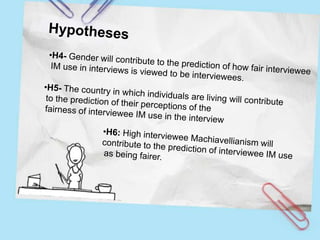
to the prediction of perception of interviewee IM use as being fair HypothesesH4- Gender will contribute to the prediction of how fair interviewee IM use in interviews is viewed to be interviewees. H5- The country in which individuals are living will contribute to the prediction of their perceptions of the fairness of interviewee IM use in the interviewH6: High interviewee Machiavellianism will contribute to the prediction of interviewee IM use as being fairer.
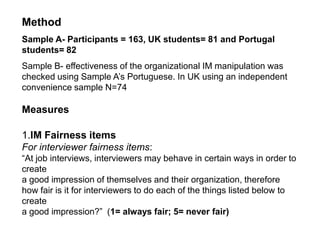
MethodSample A- Participants = 163, UK students= 81 and Portugal students= 82Sample B- effectiveness of the organizational IM manipulation was checked using Sample A’s Portuguese. In UK using an independent convenience sample N=74Measures1.IM Fairness itemsFor interviewer fairness items:“At job interviews, interviewers may behave in certain ways in order to create a good impression of themselves and their organization, therefore how fair is it for interviewers to do each of the things listed below to create a good impression?”  (1= always fair; 5= never fair)
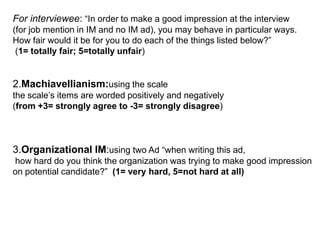
For interviewee: “In order to make a good impression at the interview (for job mention in IM and no IM ad), you may behave in particular ways. How fair would it be for you to do each of the things listed below?” (1= totally fair; 5=totally unfair)2.Machiavellianism:using the scale the scale’s items are worded positively and negatively(from +3= strongly agree to -3= strongly disagree) 3.Organizational IM:using two Ad “when writing this ad, how hard do you think the organization was trying to make good impression on potential candidate?”  (1= very hard, 5=not hard at all)
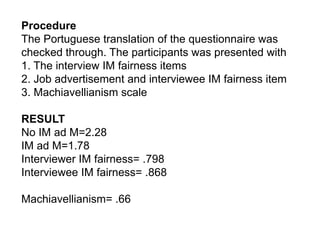
ProcedureThe Portuguese translation of the questionnaire was checked through. The participants was presented with 1. The interview IM fairness items2. Job advertisement and interviewee IM fairness item3. Machiavellianism scale RESULTNo IM ad M=2.28IM ad M=1.78Interviewer IM fairness= .798Interviewee IM fairness= .868Machiavellianism= .66
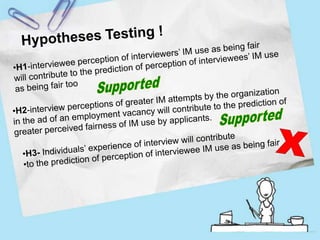
Hypotheses Testing !H1-interviewee perception of interviewers’ IM use as being fair will contribute to the prediction of perception of interviewees’ IM use as being fair too SupportedH2-interview perceptions of greater IM attempts by the organization in the ad of an employment vacancy will contribute to the prediction of greater perceived fairness of IM use by applicants.SupportedxH3- Individuals’ experience of interview will contribute
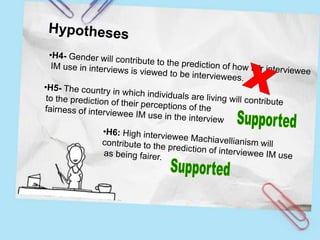
to the prediction of perception of interviewee IM use as being fair HypothesesH4- Gender will contribute to the prediction of how fair interviewee IM use in interviews is viewed to be interviewees. xH5- The country in which individuals are living will contribute to the prediction of their perceptions of the fairness of interviewee IM use in the interviewSupportedH6: High interviewee Machiavellianism will contribute to the prediction of interviewee IM use as being fairer.Supported
RelevanceOf this Research
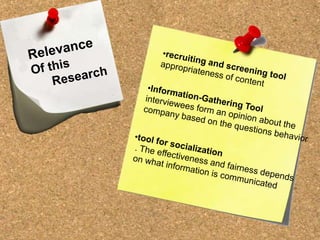
RelevanceOf this Researchrecruiting and screening toolappropriateness of content
Information-Gathering Toolinterviewees form an opinion about thecompany based on the questions behaviortool for socialization . The effectiveness and fairness depends on what information is communicated
Implicit sources of bias in employment interview judgments and decisions
H2- typeH1-typeeHypotheses
Type here

Article analysis

  • 1.
  • 2.
    Fairness of impressionmanagement in employment interviews
  • 3.
    Implicit sources ofbias in employment interview judgments and decisions
  • 4.
    Focus onthe use of Impression Management (IM)Impression management (IM) refers to individuals’ attempts at determining the impression others form of them regarding their behavior, motivation, morality and other characteristic
  • 5.
    Interviewee and interviewerIM style may have an impact on interview outcome,Raise concern on the possibleeffect of IM on Validity and fairnessof selection decision.
  • 6.
    HypothesesH1-interviewee perception ofinterviewers’ IM use as being fair will contribute to the prediction of perception of interviewees’ IM use as being fair too H2-interview perceptions of greater IM attempts by the organization in the ad of an employment vacancy will contribute to the prediction of greater perceived fairness of IM use by applicants.H3- Individuals’ experience of interview will contribute
  • 7.
    to the predictionof perception of interviewee IM use as being fair HypothesesH4- Gender will contribute to the prediction of how fair interviewee IM use in interviews is viewed to be interviewees. H5- The country in which individuals are living will contribute to the prediction of their perceptions of the fairness of interviewee IM use in the interviewH6: High interviewee Machiavellianism will contribute to the prediction of interviewee IM use as being fairer.
  • 8.
    MethodSample A- Participants= 163, UK students= 81 and Portugal students= 82Sample B- effectiveness of the organizational IM manipulation was checked using Sample A’s Portuguese. In UK using an independent convenience sample N=74Measures1.IM Fairness itemsFor interviewer fairness items:“At job interviews, interviewers may behave in certain ways in order to create a good impression of themselves and their organization, therefore how fair is it for interviewers to do each of the things listed below to create a good impression?” (1= always fair; 5= never fair)
  • 9.
    For interviewee: “Inorder to make a good impression at the interview (for job mention in IM and no IM ad), you may behave in particular ways. How fair would it be for you to do each of the things listed below?” (1= totally fair; 5=totally unfair)2.Machiavellianism:using the scale the scale’s items are worded positively and negatively(from +3= strongly agree to -3= strongly disagree) 3.Organizational IM:using two Ad “when writing this ad, how hard do you think the organization was trying to make good impression on potential candidate?” (1= very hard, 5=not hard at all)
  • 10.
    ProcedureThe Portuguese translationof the questionnaire was checked through. The participants was presented with 1. The interview IM fairness items2. Job advertisement and interviewee IM fairness item3. Machiavellianism scale RESULTNo IM ad M=2.28IM ad M=1.78Interviewer IM fairness= .798Interviewee IM fairness= .868Machiavellianism= .66
  • 11.
    Hypotheses Testing !H1-intervieweeperception of interviewers’ IM use as being fair will contribute to the prediction of perception of interviewees’ IM use as being fair too SupportedH2-interview perceptions of greater IM attempts by the organization in the ad of an employment vacancy will contribute to the prediction of greater perceived fairness of IM use by applicants.SupportedxH3- Individuals’ experience of interview will contribute
  • 12.
    to the predictionof perception of interviewee IM use as being fair HypothesesH4- Gender will contribute to the prediction of how fair interviewee IM use in interviews is viewed to be interviewees. xH5- The country in which individuals are living will contribute to the prediction of their perceptions of the fairness of interviewee IM use in the interviewSupportedH6: High interviewee Machiavellianism will contribute to the prediction of interviewee IM use as being fairer.Supported
  • 13.
  • 14.
    RelevanceOf this Researchrecruitingand screening toolappropriateness of content
  • 15.
    Information-Gathering Toolinterviewees forman opinion about thecompany based on the questions behaviortool for socialization . The effectiveness and fairness depends on what information is communicated
  • 16.
    Implicit sources ofbias in employment interview judgments and decisions
  • 18.
  • 20.