• contains 28 sections divided
                           into two parts.
   The first part: Enumerates the principles of
          the State such as the democratic and
 republican nature of the Philippine State; the
      supremacy of civilian authority over the
military; the people's duty to defend the State;
            separation of Church and State; and
       renunciation of war as an instrument of
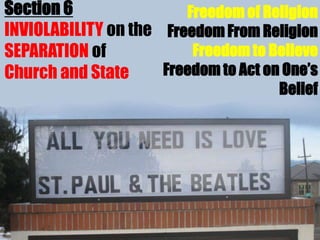
                                national policy.
           The second part: stipulates the State policies
          such as the promotion of an independent foreign policy;
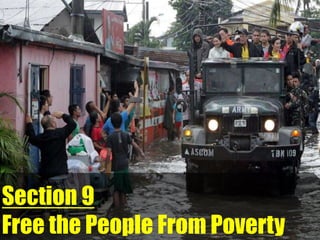
            recognition of the youth's and women's role in nation-
                    building; promotion of a comprehensive rural
          development and agrarian reform; and the promotion of
                                                   social justice.
The                 These rests with the executive and
                      legislative departments, and the
political              electorate cannot demand their
creed of the          enforcement through the courts.
                                The remedy is political.
nation.        But indirectly, some of these principles
                  may guide the courts in determining
                   the validity of statutes or executive
                               acts in justiciable cases.


                      Lays down the fundamental
                       principles and policies the
                              government in their
                    policy-determining functions.
Section 1:

The Philippines, a DEMOCRATIC and
REPUBLICAN State.
Sovereignty resides in
the people.
All Government Authority
Emanates from the
people.
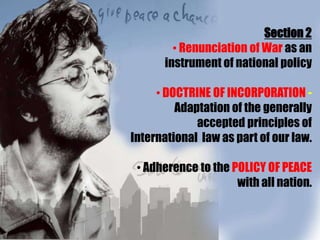
Section 2
        • Renunciation of War as an
      instrument of national policy

     • DOCTRINE OF INCORPORATION -
         Adaptation of the generally
             accepted principles of
International law as part of our law.

 • Adherence to the POLICY OF PEACE
                     with all nation.
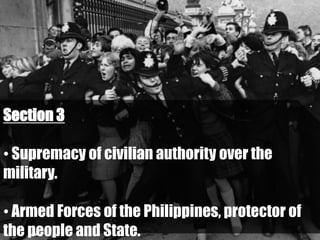
Section 3

• Supremacy of civilian authority over the
military.

• Armed Forces of the Philippines, protector of
the people and State.
Section 4
Prime duty of the Government:
          SERVE and PROTECT the PEOPLE
•     Defending the State: Personal, Military and civil
        service.
Section 5

BLESSINGS OF DEMOCRACY: Maintenance of
Peace and Order, Protection of Life, Liberty
and Property and Promotion of the General
Welfare
Section 6               Freedom of Religion
INVIOLABILITY on the Freedom From Religion
SEPARATION of            Freedom to Believe
Church and State     Freedom to Act on One’s
                                      Belief
Section 7
• Independent Foreign Policy of
        the Philippines.
Section 8
• Freedom from nuclear
weapons.
Section 9
Free the People From Poverty
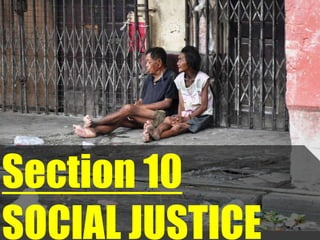
Section 10
SOCIAL JUSTICE
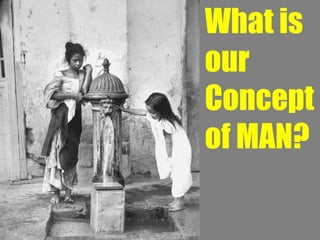
What is
our
Concept
of MAN?
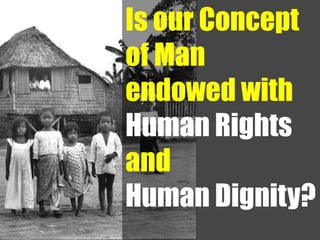
Is our Concept
of Man
endowed with
Human Rights
and
Human Dignity?
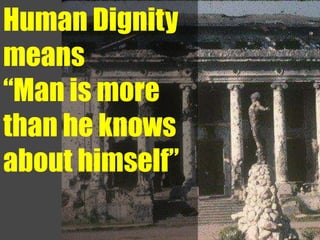
Human Dignity
means
“Man is more
than he knows
about himself”
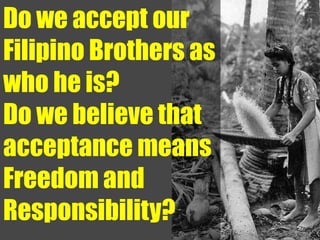
Do we accept our
Filipino Brothers as
who he is?
Do we believe that
acceptance means
Freedom and
Responsibility?
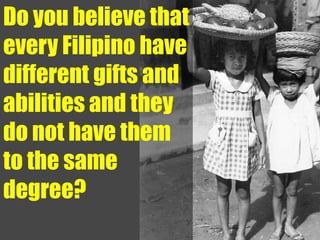
Do you believe that
every Filipino have
different gifts and
abilities and they
do not have them
to the same
degree?
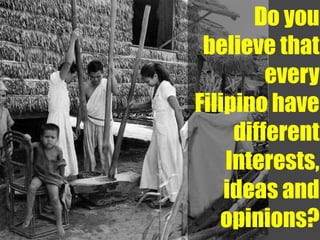
Do you
 believe that
         every
Filipino have
     different
    Interests,
    ideas and
   opinions?
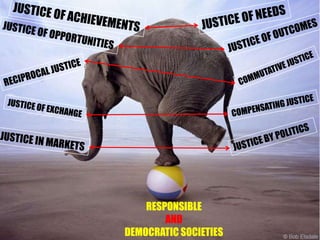
As a Filipino Nation, how
do we understand the
Basic Concept of
JUSTICE?
RESPONSIBLE
        AND
DEMOCRATIC SOCIETIES
RESPONSIBLE
        AND
DEMOCRATIC SOCIETIES
TO BENEFIT FROM THE
PROSPERITY OF THE SOCIETY

           =
   TO PARTICIPATE IN THE
  CREATION, GROWTH AND
PRESERVATION OF SOCIETY’S
         WEALTH
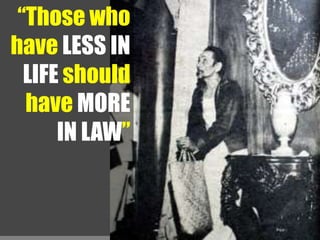
“Those who
have LESS IN
  LIFE should
  have MORE
      IN LAW”
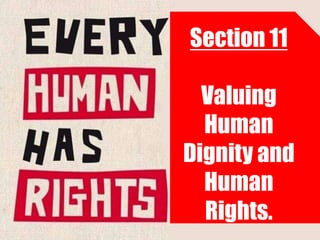
Section 11

  Valuing
  Human
Dignity and
  Human
  Rights.
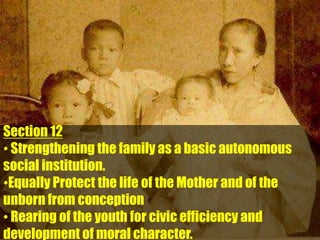
Section 12
• Strengthening the family as a basic autonomous
social institution.
•Equally Protect the life of the Mother and of the
unborn from conception
• Rearing of the youth for civic efficiency and
development of moral character.
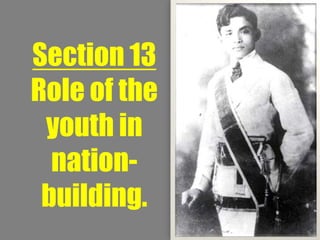
Section 13
Role of the
 youth in
  nation-
 building.
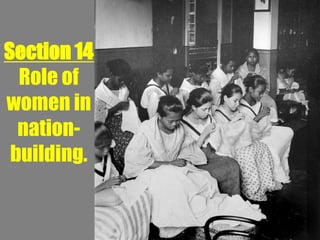
Section 14
  Role of
women in
  nation-
 building.
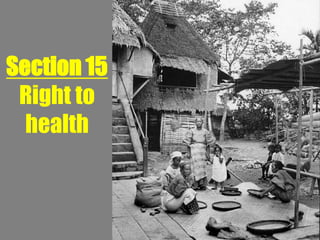
Section 15
 Right to
  health
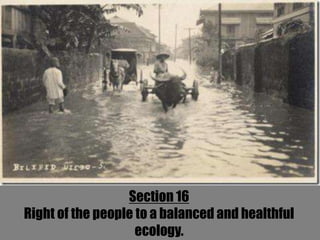
Section 16
Right of the people to a balanced and healthful
                    ecology.
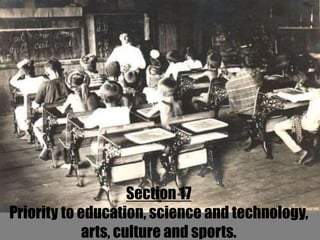
Section 17
Priority to education, science and technology,
             arts, culture and sports.
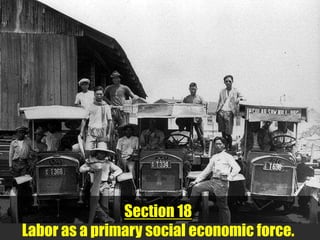
Section 18
Labor as a primary social economic force.
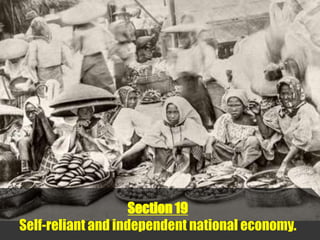
Section 19
Self-reliant and independent national economy.
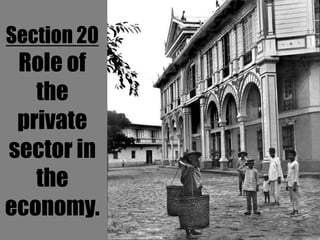
Section 20
 Role of
   the
 private
sector in
   the
economy.
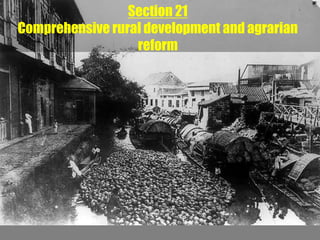
Section 21
Comprehensive rural development and agrarian
                  reform
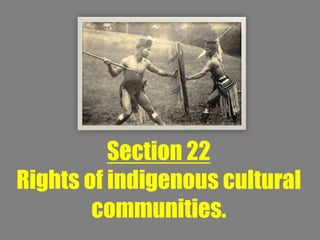
Section 22
Rights of indigenous cultural
        communities.
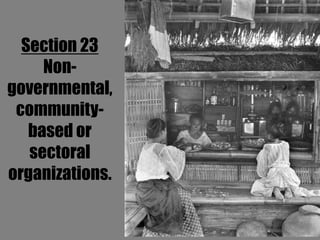
Section 23
     Non-
governmental,
 community-
   based or
   sectoral
organizations.
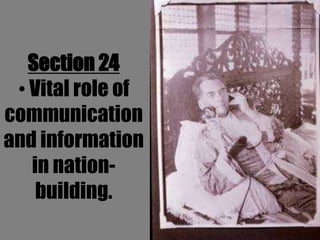
Section 24
 • Vital role of
communication
and information
   in nation-
    building.
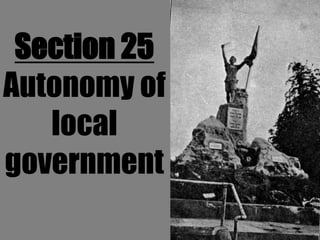
Section 25
Autonomy of
   local
government
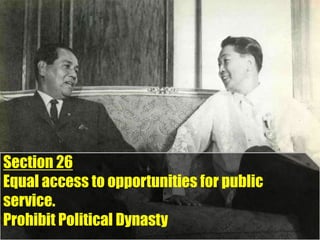
Section 26
Equal access to opportunities for public
service.
Prohibit Political Dynasty
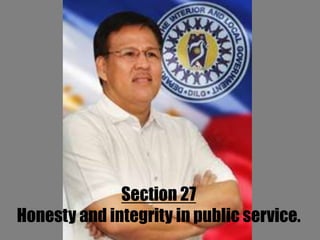
Section 27
Honesty and integrity in public service.
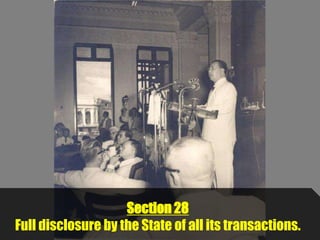
Section 28
Full disclosure by the State of all its transactions.

Article 2

  • 2.
    • contains 28sections divided into two parts. The first part: Enumerates the principles of the State such as the democratic and republican nature of the Philippine State; the supremacy of civilian authority over the military; the people's duty to defend the State; separation of Church and State; and renunciation of war as an instrument of national policy. The second part: stipulates the State policies such as the promotion of an independent foreign policy; recognition of the youth's and women's role in nation- building; promotion of a comprehensive rural development and agrarian reform; and the promotion of social justice.
  • 3.
    The These rests with the executive and legislative departments, and the political electorate cannot demand their creed of the enforcement through the courts. The remedy is political. nation. But indirectly, some of these principles may guide the courts in determining the validity of statutes or executive acts in justiciable cases. Lays down the fundamental principles and policies the government in their policy-determining functions.
  • 4.
    Section 1: The Philippines,a DEMOCRATIC and REPUBLICAN State. Sovereignty resides in the people. All Government Authority Emanates from the people.
  • 5.
    Section 2 • Renunciation of War as an instrument of national policy • DOCTRINE OF INCORPORATION - Adaptation of the generally accepted principles of International law as part of our law. • Adherence to the POLICY OF PEACE with all nation.
  • 6.
    Section 3 • Supremacyof civilian authority over the military. • Armed Forces of the Philippines, protector of the people and State.
  • 7.
    Section 4 Prime dutyof the Government: SERVE and PROTECT the PEOPLE • Defending the State: Personal, Military and civil service.
  • 8.
    Section 5 BLESSINGS OFDEMOCRACY: Maintenance of Peace and Order, Protection of Life, Liberty and Property and Promotion of the General Welfare
  • 9.
    Section 6 Freedom of Religion INVIOLABILITY on the Freedom From Religion SEPARATION of Freedom to Believe Church and State Freedom to Act on One’s Belief
  • 10.
    Section 7 • IndependentForeign Policy of the Philippines.
  • 11.
    Section 8 • Freedomfrom nuclear weapons.
  • 12.
    Section 9 Free thePeople From Poverty
  • 13.
  • 14.
  • 15.
    Is our Concept ofMan endowed with Human Rights and Human Dignity?
  • 16.
    Human Dignity means “Man ismore than he knows about himself”
  • 17.
    Do we acceptour Filipino Brothers as who he is? Do we believe that acceptance means Freedom and Responsibility?
  • 18.
    Do you believethat every Filipino have different gifts and abilities and they do not have them to the same degree?
  • 19.
    Do you believethat every Filipino have different Interests, ideas and opinions?
  • 20.
    As a FilipinoNation, how do we understand the Basic Concept of JUSTICE?
  • 21.
    RESPONSIBLE AND DEMOCRATIC SOCIETIES
  • 22.
    RESPONSIBLE AND DEMOCRATIC SOCIETIES
  • 23.
    TO BENEFIT FROMTHE PROSPERITY OF THE SOCIETY = TO PARTICIPATE IN THE CREATION, GROWTH AND PRESERVATION OF SOCIETY’S WEALTH
  • 25.
    “Those who have LESSIN LIFE should have MORE IN LAW”
  • 26.
    Section 11 Valuing Human Dignity and Human Rights.
  • 27.
    Section 12 • Strengtheningthe family as a basic autonomous social institution. •Equally Protect the life of the Mother and of the unborn from conception • Rearing of the youth for civic efficiency and development of moral character.
  • 28.
    Section 13 Role ofthe youth in nation- building.
  • 29.
    Section 14 Role of women in nation- building.
  • 30.
  • 31.
    Section 16 Right ofthe people to a balanced and healthful ecology.
  • 32.
    Section 17 Priority toeducation, science and technology, arts, culture and sports.
  • 33.
    Section 18 Labor asa primary social economic force.
  • 34.
    Section 19 Self-reliant andindependent national economy.
  • 35.
    Section 20 Roleof the private sector in the economy.
  • 36.
    Section 21 Comprehensive ruraldevelopment and agrarian reform
  • 37.
    Section 22 Rights ofindigenous cultural communities.
  • 38.
    Section 23 Non- governmental, community- based or sectoral organizations.
  • 39.
    Section 24 •Vital role of communication and information in nation- building.
  • 40.
    Section 25 Autonomy of local government
  • 41.
    Section 26 Equal accessto opportunities for public service. Prohibit Political Dynasty
  • 42.
    Section 27 Honesty andintegrity in public service.
  • 43.
    Section 28 Full disclosureby the State of all its transactions.