ARTICLE 16 OF INDIAN CONSTITUTION
PART 3: FUNDAMENTAL RIGHTS
INTRODUCTION
● Equality in opportunities for employment
● Put an obligation on the state to create opportunities for the weaker or the
backward section of the society.
● Positive discrimination
● Qualified individuals will not face any kind of discrimination in the process of
employment.
“There shall be equality of opportunity for all citizens in matters
relating to employment or appointment to any office under the
State.”
1.The qualifications criteria may entail minimum educational
qualification, physical fitness, mental stability, moral integrity
etc.
2. Applicable to the initial employment, promotion and even to
the termination of the period of employment
CLAUSE (1)
CLAUSE(2)
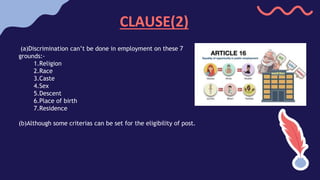
(a)Discrimination can’t be done in employment on these 7
grounds:-
1.Religion
2.Race
3.Caste
4.Sex
5.Descent
6.Place of birth
7.Residence
(b)Although some criterias can be set for the eligibility of post.
CLAUSE-3
1.Power to provide reservation on basis of residence
2,Exception of clause (2)
3.Was introduced for backward and slow developing parts of a state.
4.Objectives of this clause:-
(a)Accelerated development
(b)Equality in state opportunities.
CLAUSE-4
1.For social and economical prosperity of disadvantaged sections of society
2.Some posts reserved for backward classes (SC/ST).
BALAJI VS. STATE OF MYSORE (1963) :-
Who are backward class?
1.Socially and educationally backward
2.Inadequate representation in services under state
1.Carry forward rule case
2. 17% seats reserved for backward classes.
3.If some reserved seats are left vacant in an year then they will get added to the
number of reserved seats in next year.
4.In 1961, about 29 out of 45 seats were reserved which is 64%
5.If number of reserved seats exceeds ceiling of 50%,carry forward rule will be invalid.
DEVDASAN VS. UNION OF INDIA (1964) :-
1.Also known as mandal case
2.B.P. Mandal - Investigation on SEBC (1979)
3.1980- 3743 SEBC were reported by committee and 27% reservation was suggested
for them.
4.In 1990 PM V.P. Singh implemented 27% reservation for SEBC.
5.In Indira Sawhney case,3 major decisions were made-
(a)27% reservation was allowed.
(b)Reservation was limited to only the process of appointment and not
Promotion.
(c)Reservation shouldn’t exceed 50% ceiling.
Indira sawhney vs. union of india (1993) :-
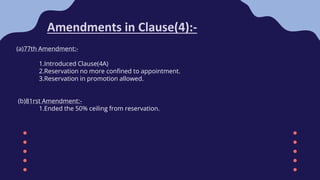
Amendments in Clause(4):-
(a)77th Amendment:-
1.Introduced Clause(4A)
2.Reservation no more confined to appointment.
3.Reservation in promotion allowed.
(b)81rst Amendment:-
1.Ended the 50% ceiling from reservation.
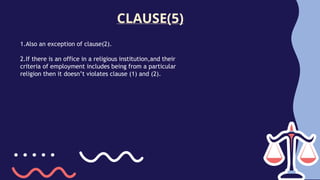
CLAUSE(5)
1.Also an exception of clause(2).
2.If there is an office in a religious institution,and their
criteria of employment includes being from a particular
religion then it doesn’t violates clause (1) and (2).
Did you like the resources on this template? Get them for free at our other websites:
Vectors
● Hand drawn flat design law firm template
● Coronavirus country map infographic
Photos
● Person putting spain flag card into ballot box
● Top view over career guidance items for judges
● Mature lawyer turning pages of law book in the courtroom
● Colleagues working together on project
● Teacher holding english class
Resources

ARTICLE 16.pptx

  • 1.
    ARTICLE 16 OFINDIAN CONSTITUTION PART 3: FUNDAMENTAL RIGHTS
  • 2.
    INTRODUCTION ● Equality inopportunities for employment ● Put an obligation on the state to create opportunities for the weaker or the backward section of the society. ● Positive discrimination ● Qualified individuals will not face any kind of discrimination in the process of employment.
  • 3.
    “There shall beequality of opportunity for all citizens in matters relating to employment or appointment to any office under the State.” 1.The qualifications criteria may entail minimum educational qualification, physical fitness, mental stability, moral integrity etc. 2. Applicable to the initial employment, promotion and even to the termination of the period of employment CLAUSE (1)
  • 4.
    CLAUSE(2) (a)Discrimination can’t bedone in employment on these 7 grounds:- 1.Religion 2.Race 3.Caste 4.Sex 5.Descent 6.Place of birth 7.Residence (b)Although some criterias can be set for the eligibility of post.
  • 5.
    CLAUSE-3 1.Power to providereservation on basis of residence 2,Exception of clause (2) 3.Was introduced for backward and slow developing parts of a state. 4.Objectives of this clause:- (a)Accelerated development (b)Equality in state opportunities.
  • 6.
    CLAUSE-4 1.For social andeconomical prosperity of disadvantaged sections of society 2.Some posts reserved for backward classes (SC/ST). BALAJI VS. STATE OF MYSORE (1963) :- Who are backward class? 1.Socially and educationally backward 2.Inadequate representation in services under state
  • 7.
    1.Carry forward rulecase 2. 17% seats reserved for backward classes. 3.If some reserved seats are left vacant in an year then they will get added to the number of reserved seats in next year. 4.In 1961, about 29 out of 45 seats were reserved which is 64% 5.If number of reserved seats exceeds ceiling of 50%,carry forward rule will be invalid. DEVDASAN VS. UNION OF INDIA (1964) :-
  • 8.
    1.Also known asmandal case 2.B.P. Mandal - Investigation on SEBC (1979) 3.1980- 3743 SEBC were reported by committee and 27% reservation was suggested for them. 4.In 1990 PM V.P. Singh implemented 27% reservation for SEBC. 5.In Indira Sawhney case,3 major decisions were made- (a)27% reservation was allowed. (b)Reservation was limited to only the process of appointment and not Promotion. (c)Reservation shouldn’t exceed 50% ceiling. Indira sawhney vs. union of india (1993) :-
  • 9.
    Amendments in Clause(4):- (a)77thAmendment:- 1.Introduced Clause(4A) 2.Reservation no more confined to appointment. 3.Reservation in promotion allowed. (b)81rst Amendment:- 1.Ended the 50% ceiling from reservation.
  • 10.
    CLAUSE(5) 1.Also an exceptionof clause(2). 2.If there is an office in a religious institution,and their criteria of employment includes being from a particular religion then it doesn’t violates clause (1) and (2).
  • 11.
    Did you likethe resources on this template? Get them for free at our other websites: Vectors ● Hand drawn flat design law firm template ● Coronavirus country map infographic Photos ● Person putting spain flag card into ballot box ● Top view over career guidance items for judges ● Mature lawyer turning pages of law book in the courtroom ● Colleagues working together on project ● Teacher holding english class Resources