By:
Name :- Vairagar Shreeansh Madhavrao
Class :- llb.2yr
Roll no :- 198
College name :- Shri Shivaji Law college,Parbhani
 Introduction
 Meaning
 History
 Need of Article 141
 Objective of Article 141
 Article 141 of constitution of India
 The law declared by the Supreme Court shall be binding on all courts within the territory of
India
 Precedent signifies a judgement or decision of a superior court of law cited as an authority for
deciding a similar set of facts. A precedent which creates and applies a new rule is called an
original precedent and when the precedent does not create a new rule that merely apply on
existing rule of law then it is termed as Declaratory precedent. In India the Supreme Court is
the highest court in hierarchy and decisions of the Supreme Court are binding on all courts of
India.
Article 141 of the Constitution of India stipulates that the law
declared by the Supreme Court shall be binding on all Courts within the territory of India. Thus,
the general principles laid down, by the Supreme Court are binding on each individual including
those who are not a party to an order.
 To record and analyses other case structure.
 To provide fast and accurate suggestion.
 To control on other courts
 To be binding decision given by supreme court
 To Make uniformality in decision making process
Article 141 of the Constitution of India stipulates
that the law declared by the Supreme Court shall be binding on all Courts within the territory of
India. Thus, the general principles laid down, by the Supreme Court are binding on each
individual including those who are not a party to an order.
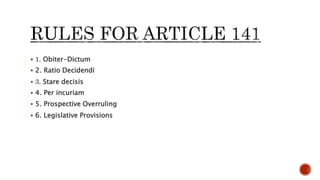
 1. Obiter-Dictum
 2. Ratio Decidendi
 3. Stare decisis
 4. Per incuriam
 5. Prospective Overruling
 6. Legislative Provisions
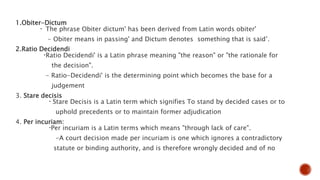
1.Obiter-Dictum
- The phrase Obiter dictum' has been derived from Latin words obiter'
- Obiter means in passing' and Dictum denotes something that is said’.
2.Ratio Decidendi
-Ratio Decidendi' is a Latin phrase meaning "the reason" or "the rationale for
the decision".
- Ratio-Decidendi' is the determining point which becomes the base for a
judgement
3. Stare decisis
- Stare Decisis is a Latin term which signifies To stand by decided cases or to
uphold precedents or to maintain former adjudication
4. Per incuriam:
-Per incuriam is a Latin terms which means "through lack of care".
-A court decision made per incuriam is one which ignores a contradictory
statute or binding authority, and is therefore wrongly decided and of no
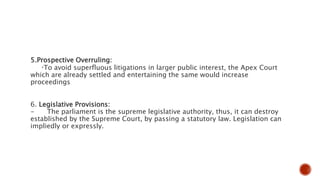
5.Prospective Overruling:
-To avoid superfluous litigations in larger public interest, the Apex Court
which are already settled and entertaining the same would increase
proceedings
6. Legislative Provisions:
- The parliament is the supreme legislative authority, thus, it can destroy
established by the Supreme Court, by passing a statutory law. Legislation can
impliedly or expressly.
 Union of India v. Raghubir Singh (AIR 1989 SC 1933)
 Lalu Jela and Ors. v State Of Gujarat (AIR 1962 Guj 250)
 Sajjan Singh Vs. State of Rajasthan [AIR 1965, SC 845],
 Source
- From books available
- Internet

Article 141

  • 1.
    By: Name :- VairagarShreeansh Madhavrao Class :- llb.2yr Roll no :- 198 College name :- Shri Shivaji Law college,Parbhani
  • 2.
     Introduction  Meaning History  Need of Article 141  Objective of Article 141  Article 141 of constitution of India
  • 3.
     The lawdeclared by the Supreme Court shall be binding on all courts within the territory of India  Precedent signifies a judgement or decision of a superior court of law cited as an authority for deciding a similar set of facts. A precedent which creates and applies a new rule is called an original precedent and when the precedent does not create a new rule that merely apply on existing rule of law then it is termed as Declaratory precedent. In India the Supreme Court is the highest court in hierarchy and decisions of the Supreme Court are binding on all courts of India.
  • 4.
    Article 141 ofthe Constitution of India stipulates that the law declared by the Supreme Court shall be binding on all Courts within the territory of India. Thus, the general principles laid down, by the Supreme Court are binding on each individual including those who are not a party to an order.
  • 5.
     To recordand analyses other case structure.  To provide fast and accurate suggestion.  To control on other courts
  • 6.
     To bebinding decision given by supreme court  To Make uniformality in decision making process
  • 7.
    Article 141 ofthe Constitution of India stipulates that the law declared by the Supreme Court shall be binding on all Courts within the territory of India. Thus, the general principles laid down, by the Supreme Court are binding on each individual including those who are not a party to an order.
  • 8.
     1. Obiter-Dictum 2. Ratio Decidendi  3. Stare decisis  4. Per incuriam  5. Prospective Overruling  6. Legislative Provisions
  • 9.
    1.Obiter-Dictum - The phraseObiter dictum' has been derived from Latin words obiter' - Obiter means in passing' and Dictum denotes something that is said’. 2.Ratio Decidendi -Ratio Decidendi' is a Latin phrase meaning "the reason" or "the rationale for the decision". - Ratio-Decidendi' is the determining point which becomes the base for a judgement 3. Stare decisis - Stare Decisis is a Latin term which signifies To stand by decided cases or to uphold precedents or to maintain former adjudication 4. Per incuriam: -Per incuriam is a Latin terms which means "through lack of care". -A court decision made per incuriam is one which ignores a contradictory statute or binding authority, and is therefore wrongly decided and of no
  • 10.
    5.Prospective Overruling: -To avoidsuperfluous litigations in larger public interest, the Apex Court which are already settled and entertaining the same would increase proceedings 6. Legislative Provisions: - The parliament is the supreme legislative authority, thus, it can destroy established by the Supreme Court, by passing a statutory law. Legislation can impliedly or expressly.
  • 11.
     Union ofIndia v. Raghubir Singh (AIR 1989 SC 1933)  Lalu Jela and Ors. v State Of Gujarat (AIR 1962 Guj 250)  Sajjan Singh Vs. State of Rajasthan [AIR 1965, SC 845],
  • 12.
     Source - Frombooks available - Internet