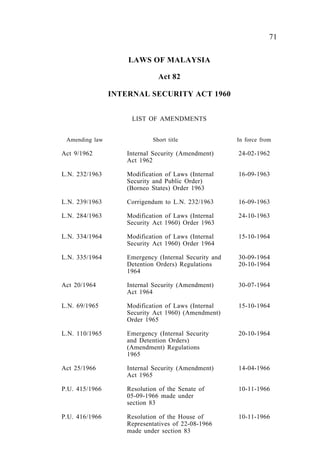
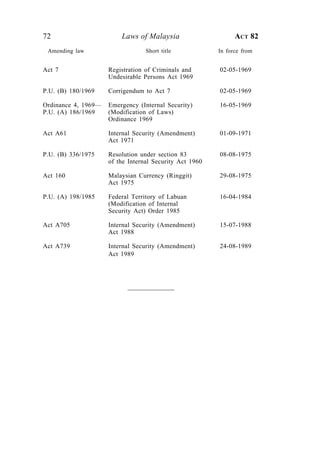
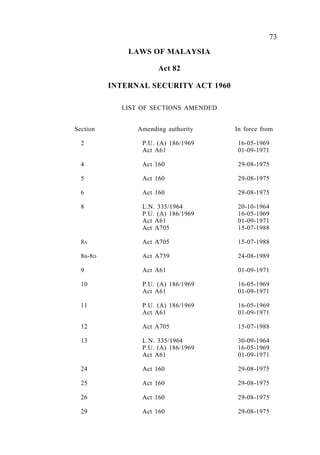
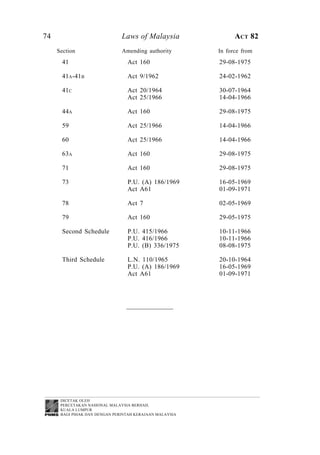
LAWS OF MALAYSIA
                         REPRINT


                         Act 82

    INTERNAL SECURITY
         ACT 1960
Incorporating all amendments up to 1 January 2006


                          PUBLISHED BY
          THE COMMISSIONER OF LAW REVISION, MALAYSIA
       UNDER THE AUTHORITY OF THE REVISION OF LAWS ACT 1968
                     IN COLLABORATION WITH
               PERCETAKAN NASIONAL MALAYSIA BHD
                              2006
2                              Laws of Malaysia                   ACT 82


                 INTERNAL SECURITY ACT 1960


First enacted      …     ...    …    …     …        …   1960 (Act No. 18
                                                        of 1960)

Revised            …     ...    …    …     …        …   1972 (Act 82
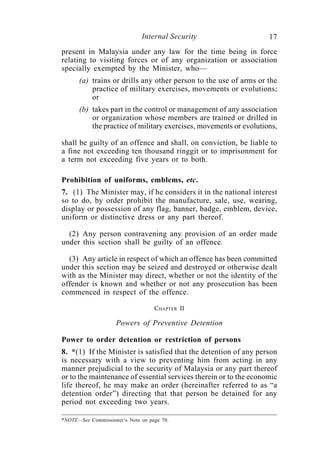
                                                        w.e.f. 1 August
                                                        1972)


                                PREVIOUS REPRINTS

                First Reprint       … … … … …           1994
                Second Reprint      … … … … …           1999
Internal Security                              3
                              LAWS OF MALAYSIA


                                        Act 82


                    INTERNAL SECURITY ACT 1960


                           ARRANGEMENT OF SECTIONS


                                        PART I

                                    PRELIMINARY

Section
   1.     Short title
   2.     Interpretation


                                        PART II

                    GENERAL PROVISIONS RELATING TO
                          INTERNAL SECURITY

                                       C HAPTER I

              Prohibition of Organizations and Associations of
          a Political or Quasi-Military Character and Uniforms, etc.

   3.     Prohibition of uniforms of political or quasi-military organisations
   4.     Penalty
   5.     Prohibition of quasi-military organisations
   6.     Illegal drilling
   7.     Prohibition of uniforms, emblems, etc.


                                       CHAPTER II

                             Powers of Preventive Detention

   8.     Power to order detention or restriction of persons
   8A. Detention order not to be invalid or inoperative on certain grounds
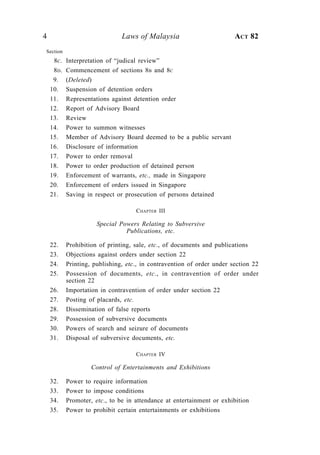
   8B. Judicial review of act or decision of Yang di-Pertuan Agong and Minister
4                               Laws of Malaysia                         ACT 82
Section
     8 C.   Interpretation of “judical review”
     8D.    Commencement of sections 8B and 8C
     9.     (Deleted)
    10.     Suspension of detention orders
    11.     Representations against detention order
    12.     Report of Advisory Board
    13.     Review
    14.     Power to summon witnesses
    15.     Member of Advisory Board deemed to be a public servant
    16.     Disclosure of information
    17.     Power to order removal
    18.     Power to order production of detained person
    19.     Enforcement of warrants, etc., made in Singapore
    20.     Enforcement of orders issued in Singapore
    21.     Saving in respect or prosecution of persons detained

                                     CHAPTER III

                       Special Powers Relating to Subversive
                                 Publications, etc.

    22.     Prohibition of printing, sale, etc., of documents and publications
    23.     Objections against orders under section 22
    24.     Printing, publishing, etc., in contravention of order under section 22
    25.     Possession of documents, etc., in contravention of order under
            section 22
    26.     Importation in contravention of order under section 22
    27.     Posting of placards, etc.
    28.     Dissemination of false reports
    29.     Possession of subversive documents
    30.     Powers of search and seizure of documents
    31.     Disposal of subversive documents, etc.

                                     CHAPTER IV

                     Control of Entertainments and Exhibitions

    32.     Power to require information
    33.     Power to impose conditions
    34.     Promoter, etc., to be in attendance at entertainment or exhibition
    35.     Power to prohibit certain entertainments or exhibitions
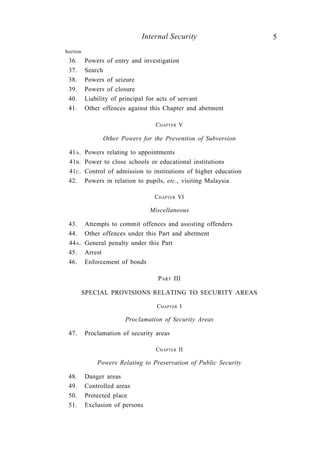
Internal Security                      5
Section
 36.      Powers of entry and investigation
 37.      Search
 38.      Powers of seizure
 39.      Powers of closure
 40.      Liability of principal for acts of servant
 41.      Other offences against this Chapter and abetment

                                   CHAPTER V

                Other Powers for the Prevention of Subversion

 41A.     Powers relating to appointments
 41B.     Power to close schools or educational institutions
 41C.     Control of admission to institutions of higher education
 42.      Powers in relation to pupils, etc., visiting Malaysia

                                   CHAPTER VI

                                 Miscellaneous

 43.      Attempts to commit offences and assisting offenders
 44.      Other offences under this Part and abetment
 44A.     General penalty under this Part
 45.      Arrest
 46.      Enforcement of bonds

                                    PART III

          SPECIAL PROVISIONS RELATING TO SECURITY AREAS

                                   C HAPTER I

                        Proclamation of Security Areas

 47.      Proclamation of security areas

                                   CHAPTER II

              Powers Relating to Preservation of Public Security

 48.      Danger areas
 49.      Controlled areas
 50.      Protected place
 51.      Exclusion of persons
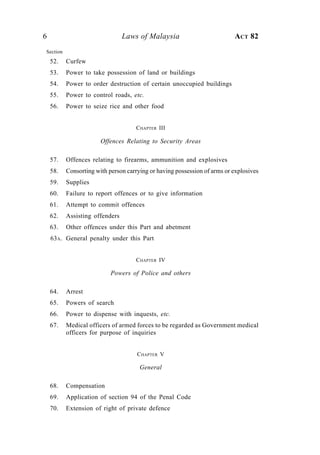
6                               Laws of Malaysia                          ACT 82
Section
    52.   Curfew
    53.   Power to take possession of land or buildings
    54.   Power to order destruction of certain unoccupied buildings
    55.   Power to control roads, etc.
    56.   Power to seize rice and other food


                                    CHAPTER III

                       Offences Relating to Security Areas

    57.   Offences relating to firearms, ammunition and explosives
    58.   Consorting with person carrying or having possession of arms or explosives
    59.   Supplies
    60.   Failure to report offences or to give information
    61.   Attempt to commit offences
    62.   Assisting offenders
    63.   Other offences under this Part and abetment
    63A. General penalty under this Part


                                    CHAPTER IV

                           Powers of Police and others

    64.   Arrest
    65.   Powers of search
    66.   Power to dispense with inquests, etc.
    67.   Medical officers of armed forces to be regarded as Government medical
          officers for purpose of inquiries


                                     C HAPTER V

                                      General

    68.   Compensation
    69.   Application of section 94 of the Penal Code
    70.   Extension of right of private defence
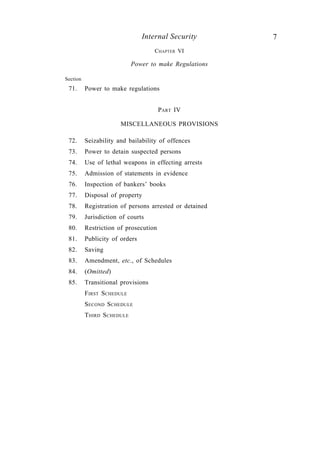
Internal Security        7
                                    CHAPTER VI

                            Power to make Regulations

Section
 71.      Power to make regulations


                                       PART IV

                       MISCELLANEOUS PROVISIONS

 72.      Seizability and bailability of offences
 73.      Power to detain suspected persons
 74.      Use of lethal weapons in effecting arrests
 75.      Admission of statements in evidence
 76.      Inspection of bankers’ books
 77.      Disposal of property
 78.      Registration of persons arrested or detained
 79.      Jurisdiction of courts
 80.      Restriction of prosecution
 81.      Publicity of orders
 82.      Saving
 83.      Amendment, etc., of Schedules
 84.      (Omitted)
 85.      Transitional provisions
          FIRST SCHEDULE
          SECOND SCHEDULE
          THIRD S CHEDULE
8   Laws of Malaysia   ACT 82
Internal Security                                                 9
                                 LAWS OF MALAYSIA


                                                Act 82


                      INTERNAL SECURITY ACT 1960

An Act to provide for the internal security of Malaysia, preventive
detention, the prevention of subversion, the suppression of organized
violance against persons and property in specified areas of Malaysia,
and for matters incidental thereto.

              [Peninsular Malaysia—1 August 1960, Act 18 of 1960;
              Sabah, Sarawak*—16 September 1963, L.N. 232/1963;]

  WHEREAS action has been taken and further action is threatened
by a substantial body of persons both inside and outside Malaysia—
     (1) to cause, and to cause a substantial number of citizens to
         fear, organised violence against persons and property; and
     (2) to procure the alteration, otherwise than by lawful means,
         of the lawful Government of Malaysia by law established;

  AND WHEREAS the action taken and threatened is prejudicial to
the security of Malaysia;

  AND WHEREAS Parliament considers it necessary to stop or prevent
that action;

  Now therefore PURSUANT to Article 149 of the Constitution
BE IT ENACTED by the Seri Paduka Baginda Yang di-Pertuan
Agong with the advice and consent of the Dewan Negara and
Dewan Rakyat in Parliament assembled, and by the authority of
the same, as follows:

                                                 PART I

                                         PRELIMINARY

Short title
1.     This Act may be cited as the Internal Security Act 1960.
*NOTE—Modification to Federal Territory of Labuan shall come into force on 16-04-1984 –see P.U. (A) 198/1984.
10                      Laws of Malaysia                    ACT 82

Interpretation

2.   In this Act, unless the context otherwise requires—

  “Advisory Board” means an advisory board constituted under
Article 151(2) of the Federal Constitution;

  “ammunition” means ammunition for any firearm as hereafter
defined and includes grenades, bombs and other like missiles whether
capable of use with such a firearm or not and any ammunition
containing or designed or adapted to contain any noxious liquid,
gas or other thing;

   “Chief Police Officer” includes a Deputy Chief Police Officer
and any police officer for the time being lawfully authorized to
exercise the powers and perform the duties conferred or imposed
upon a Chief Police Officer by this Act and in the application of
this Act to Sabah and Sarawak references to a Chief Police Officer
shall be construed as references to a Divisional Superintendent of
Police;

  “controlled area” means any area declared to be a controlled
area under section 49;

  “danger area” means any area declared to be a danger area under
section 48;

  “document” includes any substance on which is recorded any
matter, whether by letters, figures, marks, pictorial or other
representation, or by more than one of those means;

  “entertainment” means any game, sport, diversion, concert or
amusement of any kind to which the public has or is intended to
have access and in which members of the public may or may not
take part, whether on payment or otherwise;

   “exhibition” includes every display of goods, books, pictures,
films or articles to which the public has or is intended to have
access, whether on payment or otherwise;

  “explosive” shall have the meaning assigned thereto in the
Explosives Act 1957 [Act 207], and includes any substance deemed
to be an explosive under that Act;
Internal Security                        11
   “firearm” means any lethal barrelled weapon of any description
from which any shot, bullet or other missile can be discharged or
which can be adapted for the discharge of any such shot, bullet
or other missile and any weapon of whatever description designed
or adapted for the discharge of any noxious liquid, gas or other
thing, and includes any component part of any such weapon as
aforesaid;

  “Inspector General” means the Inspector General of Police and,
in relation to Sabah and Sarawak, includes the Commissioner in
control of members of the Royal Malaysia Police in each of those
States;

  “offence against this Act” includes an offence against any
regulations made under section 71;

  “periodical publication” includes every publication issued
periodically or in parts or numbers at intervals, whether regular
or irregular;

  “Police District” has the same meaning as “police district” in
the Police Act 1967 [Act 344];

  “police officer” includes a reserve police officer, an auxilliary
police officer and a special police officer appointed in accordance
with any written law for the time being in force;

   “promoter”, in the case of an entertainment or exhibition promoted
by a society, includes the secretary and officials of the society and,
in the case of a society organized or having its headqurters outside
Malaysia, the officials in Malaysia of the society;

  “proprietor” includes the owner, tenant or other person in
possession or control of premises and any person who receives
payment for the use of premises;

 “protected place” means any place or premises in relation to
which an order made under section 50 is in force;

   “publication” includes all written, pictorial or printed matter,
and everything of a nature similar to written or printed matter,
whether or not containing any visible representation, or by its
form, shape or in any other manner capable of suggesting words
or ideas, and every copy, translation and reproduction or substantial
translation or reproduction in part or in whole thereof;
12                       Laws of Malaysia                     ACT 82

   “public place” includes any highway, public street, public road,
public park or garden, any sea beach, water-way, public bridge,
lane, footway, square, court, alley or passage, whether a thoroughfare
or not, any unalienated land, any rubber estate, any plantation, any
land alienated for agricultural or mining purposes, any theatre or
place of public entertainment of any kind or other place of general
resort admission to which is obtained by payment or to which the
public have access, and any open space to which for the time being
the public have or are permitted to have access, whether on payment
or otherwise;

  “public road” means any public highway or any road over which
the public have a right of way or are granted access, and includes
every road, street, bridge, passage, footway or square over which
the public have a right of way or are granted access;

  “security area” means any area in respect of which a proclamation
under section 47 is for the time being in force;

  “security forces” includes the Royal Malaysia Police, the Police
Volunteer Reserve, the Auxiliary Police, persons commissioned or
appointed under the Essential (Special Constabulary) Regulations
1948 [G.N. 1694 of 1948], the armed forces, any local force
established under any written law in force in Malaysia, and any
force which is a visiting force for the purposes of Part I of the
Visiting Forces Act 1960 [Act 432], and in respect of whom all
or any of the powers exercisable by the armed forces or their
members under this Act have been made exercisable by an order
made under any such law;

  “supplies” includes ammunition, explosives, firearms, money,
food, drink, clothing, medicines, drugs and any other stores,
instruments, commodities, articles or things whatsoever;

  “terrorist” means any person who—
     (a) by the use of any firearm, explosive or ammunition acts
         in a manner prejudicial to the public safety or to the
         maintenance of public order or incites to violence or
         counsels disobedience to the law or to any lawful order;
     (b) carries or has in his possession or under his control any
         firearm, ammunition or explosive without lawful authority
         therefor; or
Internal Security                       13
     (c) demands, collects or receives any supplies for the use of
         any person who intends or is about to act, or has recently
         acted, in a manner prejudicial to public safety or the
         maintenance of public order.

                             PART II

            GENERAL PROVISIONS RELATING TO
                  INTERNAL SECURITY

                            CHAPTER I

     Prohibition of Organizations and Associations of a
   Political or Quasi-Military Character and Uniforms, etc.

Prohibition of uniforms of political or quasi-military
organizations

3. The Minister may from time to time by order prohibit the
wearing in public places or at meetings or gatherings to which the
public or any section of the public have access, of—
     (a) any uniform or dress which signifies association with
         any political organization or with the promotion of any
         political object; or
     (b) any uniform, dress or emblem by members or adherents
         of any organization or association specified or described
         in the order, whether incorporated or not—
           (i) when, in the opinion of the Minister, members of
               that organization or association are organized or
               trained or equipped for the purpose of enabling
               them to be employed in usurping the functions of
               the police or of the armed forces; or
           (ii) when, in the opinion of the Minister, members of
                that organization or association are organized or
                trained or equipped for the purpose of enabling
                them to be employed for the use or display of
                physical force in promoting any political or other
                object or in such a manner as to arouse reasonable
                apprehension that they are organized or trained or
                equipped for that purpose.
14                       Laws of Malaysia                      ACT 82

Penalty

4. Every person who wears any prohibited uniform, dress or
emblem in contravention of an order made under section 3 shall
be guilty of an offence and shall, on conviction, be liable to a fine
not exceeding two thousand ringgit or to imprisonment for a term
not exceeding one year or to both.


Prohibition of quasi-military organisations

5. (1) If the members or adherents of any association of persons,
whether incorporated or not, are—
     (a) organized or trained or equipped for the purpose of enabling
         them to be employed in usurping the functions of the
         police or of the armed forces; or
     (b) organized or trained or equipped either for the purpose
         of enabling them to be employed for the use or display
         of physical force in promoting any political or other
         object, or in such a manner as to arouse reasonable
         apprehension that they are organized or trained or equipped
         for that purpose,

then every member or adherent of the association shall be guilty
of an offence and shall, on conviction, be liable to a fine not
exceeding two thousand ringgit or to imprisonment for a term not
exceeding one year or to both; and any person who promotes or
conspires with another to promote, or who takes part in the control
or management of, the association, or in so organising or training
as aforesaid any member or adherent thereof, shall be guilty of an
offence and shall, on conviction, be liable to a fine not exceeding
ten thousand ringgit or to imprisonment for a term not exceeding
five years or to both:

   Provided that in any proceedings against any person charged
with the offence of taking part in the control or management of
such an association as aforesaid it shall be a defence to that charge
to prove that he neither consented to nor connived at the organisation,
training or equipment of any member or adherent of the association
in contravention of this section.

  (2) No prosecution for any offence under this section shall be
instituted except with the consent of the Public Prosecutor.
Internal Security                          15
  (3) If upon application being made by or on behalf of the Public
Prosecutor it appears to the High Court that any association is an
association of which members or adherents are organised, trained
or equipped in contravention of this section, the Court may—
     (a) make such order as appears necessary to prevent any
         disposition without the leave of the Court of property
         held by or for the association;
     (b) direct an inquiry and report to be made as to any such
         property as aforesaid and as to the affairs of the association;
     (c) make such further order as appears to the Court to be just
         and equitable for the application of that property in or
         towards the discharge of the liabilities of the association
         lawfully incurred before the date of the application or,
         with the approval of the Court, since that date in or
         towards the repayment of moneys to persons who became
         subscribers or contributors to the association in good
         faith and without knowledge of any such contravention
         as aforesaid, and in or towards any costs incurred in
         connection with any such inquiry and report as aforesaid
         or in winding up or dissolving the association; and
     (d) order that any property which is not directed by the Court
         to be so applied as aforesaid shall be forfeited to the
         Government.

  (4) In any criminal or civil proceeding under this section proof
of things done or of words written, spoken or published (whether
or not in the presence of any party to the proceedings) by any
person taking part in the control or management of an association
or in organising, training or equipping members or adherents of
an association shall be admissible as evidence of the purposes for
which, or the manner in which, members or adherents of the
association were organized or trained or equipped.

  (5) If a Magistrate or Chief Police Officer is satisfied by
information that there is reasonable ground for suspecting that an
offence under this section has been committed, and that evidence
of the commission thereof is to be found at any premises or place
specified in the information, he may, on an application made by
a police officer not below the rank of Inspector, grant a search
warrant authorizing any such officer with or without assistance to
enter the premises or place at any time within one month from the
date of the warrant, if necessary by force, and to search the premises
16                       Laws of Malaysia                    ACT 82

or place and every person found therein, and to seize anything
found on the premises or place or on any such person which the
officer has reasonable ground for suspecting to be evidence of the
commission of such an offence as aforesaid.

  (6) No woman shall, in pursuance of any warrant issued under
subsection (5), be searched except by a woman.

  (7) Nothing in this section shall be construed as prohibiting the
employment of a reasonable number of persons as stewards at any
public meeting held upon private premises with the permission of
the owner of those premises, or the making of arrangements for
that purpose or the instruction of the persons to be so employed
in their lawful duties as such stewards, or their being furnished
with badges or other distinguishing signs.

Illegal drilling

6. (1) Any person other than a member of the armed forces or
the police or of a volunteer force or local force constituted under
any written law in force in Malaysia, or of any other force which
is a visiting force for the purposes of Part I of the Visiting Forces
Act 1960, or of any organization or association specially exempted
by the Minister, who—
     (a) is present at or attends any meeting or assembly of persons
         for the purpose of training or drilling themselves to the
         use of arms or of being so trained or drilled, or for the
         purposes of practising military exercises, movements or
         evolutions; or
     (b) is present at or attends any such meeting or assembly for
         the purpose of training or drilling any other person or
         persons to the use of arms or the practice of military
         exercises, movements or evolutions,

shall be guilty of an offence and shall, on conviction, be liable to
a fine not exceeding two thousand ringgit or to imprisonment for
a term not exceeding one year or to both.

  (2) Any person other than a member of the armed forces or the
police or of a volunteer force or local force constituted under any
written law in force in Malaysia, or of any other force lawfully
Internal Security                    17
present in Malaysia under any law for the time being in force
relating to visiting forces or of any organization or association
specially exempted by the Minister, who—
      (a) trains or drills any other person to the use of arms or the
          practice of military exercises, movements or evolutions;
          or
      (b) takes part in the control or management of any association
          or organization whose members are trained or drilled in
          the practice of military exercises, movements or evolutions,

shall be guilty of an offence and shall, on conviction, be liable to
a fine not exceeding ten thousand ringgit or to imprisonment for
a term not exceeding five years or to both.

Prohibition of uniforms, emblems, etc.
7. (1) The Minister may, if he considers it in the national interest
so to do, by order prohibit the manufacture, sale, use, wearing,
display or possession of any flag, banner, badge, emblem, device,
uniform or distinctive dress or any part thereof.

  (2) Any person contravening any provision of an order made
under this section shall be guilty of an offence.

  (3) Any article in respect of which an offence has been committed
under this section may be seized and destroyed or otherwise dealt
with as the Minister may direct, whether or not the identity of the
offender is known and whether or not any prosecution has been
commenced in respect of the offence.

                                   CHAPTER II

                    Powers of Preventive Detention

Power to order detention or restriction of persons
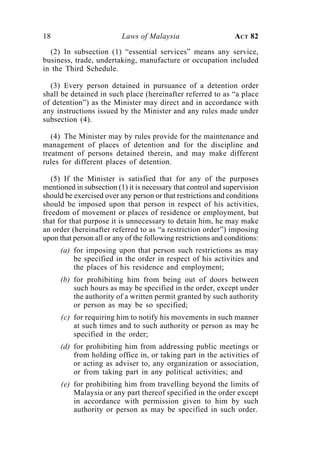
8. *(1) If the Minister is satisfied that the detention of any person
is necessary with a view to preventing him from acting in any
manner prejudicial to the security of Malaysia or any part thereof
or to the maintenance of essential services therein or to the economic
life thereof, he may make an order (hereinafter referred to as “a
detention order”) directing that that person be detained for any
period not exceeding two years.

*NOTE—See Commissioner’s Note on page 70.
18                        Laws of Malaysia                      ACT 82

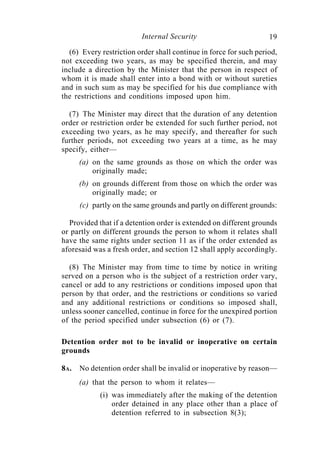
  (2) In subsection (1) “essential services” means any service,
business, trade, undertaking, manufacture or occupation included
in the Third Schedule.

  (3) Every person detained in pursuance of a detention order
shall be detained in such place (hereinafter referred to as “a place
of detention”) as the Minister may direct and in accordance with
any instructions issued by the Minister and any rules made under
subsection (4).

   (4) The Minister may by rules provide for the maintenance and
management of places of detention and for the discipline and
treatment of persons detained therein, and may make different
rules for different places of detention.

   (5) If the Minister is satisfied that for any of the purposes
mentioned in subsection (1) it is necessary that control and supervision
should be exercised over any person or that restrictions and conditions
should be imposed upon that person in respect of his activities,
freedom of movement or places of residence or employment, but
that for that purpose it is unnecessary to detain him, he may make
an order (hereinafter referred to as “a restriction order”) imposing
upon that person all or any of the following restrictions and conditions:
     (a) for imposing upon that person such restrictions as may
         be specified in the order in respect of his activities and
         the places of his residence and employment;
     (b) for prohibiting him from being out of doors between
         such hours as may be specified in the order, except under
         the authority of a written permit granted by such authority
         or person as may be so specified;
      (c) for requiring him to notify his movements in such manner
          at such times and to such authority or person as may be
          specified in the order;
     (d) for prohibiting him from addressing public meetings or
         from holding office in, or taking part in the activities of
         or acting as adviser to, any organization or association,
         or from taking part in any political activities; and
      (e) for prohibiting him from travelling beyond the limits of
          Malaysia or any part thereof specified in the order except
          in accordance with permission given to him by such
          authority or person as may be specified in such order.
Internal Security                        19
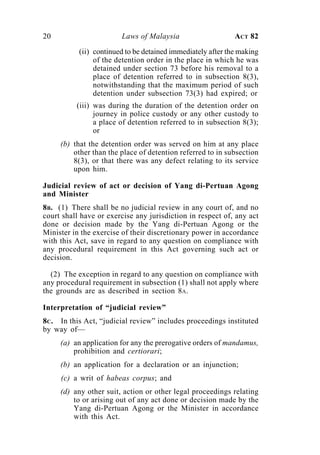
  (6) Every restriction order shall continue in force for such period,
not exceeding two years, as may be specified therein, and may
include a direction by the Minister that the person in respect of
whom it is made shall enter into a bond with or without sureties
and in such sum as may be specified for his due compliance with
the restrictions and conditions imposed upon him.

  (7) The Minister may direct that the duration of any detention
order or restriction order be extended for such further period, not
exceeding two years, as he may specify, and thereafter for such
further periods, not exceeding two years at a time, as he may
specify, either—
      (a) on the same grounds as those on which the order was
          originally made;
      (b) on grounds different from those on which the order was
          originally made; or
      (c) partly on the same grounds and partly on different grounds:

  Provided that if a detention order is extended on different grounds
or partly on different grounds the person to whom it relates shall
have the same rights under section 11 as if the order extended as
aforesaid was a fresh order, and section 12 shall apply accordingly.

  (8) The Minister may from time to time by notice in writing
served on a person who is the subject of a restriction order vary,
cancel or add to any restrictions or conditions imposed upon that
person by that order, and the restrictions or conditions so varied
and any additional restrictions or conditions so imposed shall,
unless sooner cancelled, continue in force for the unexpired portion
of the period specified under subsection (6) or (7).

Detention order not to be invalid or inoperative on certain
grounds

8A.   No detention order shall be invalid or inoperative by reason—
      (a) that the person to whom it relates—
            (i) was immediately after the making of the detention
                order detained in any place other than a place of
                detention referred to in subsection 8(3);
20                      Laws of Malaysia                     ACT 82

           (ii) continued to be detained immediately after the making
                of the detention order in the place in which he was
                detained under section 73 before his removal to a
                place of detention referred to in subsection 8(3),
                notwithstanding that the maximum period of such
                detention under subsection 73(3) had expired; or
          (iii) was during the duration of the detention order on
                journey in police custody or any other custody to
                a place of detention referred to in subsection 8(3);
                or
     (b) that the detention order was served on him at any place
         other than the place of detention referred to in subsection
         8(3), or that there was any defect relating to its service
         upon him.

Judicial review of act or decision of Yang di-Pertuan Agong
and Minister
8B. (1) There shall be no judicial review in any court of, and no
court shall have or exercise any jurisdiction in respect of, any act
done or decision made by the Yang di-Pertuan Agong or the
Minister in the exercise of their discretionary power in accordance
with this Act, save in regard to any question on compliance with
any procedural requirement in this Act governing such act or
decision.

  (2) The exception in regard to any question on compliance with
any procedural requirement in subsection (1) shall not apply where
the grounds are as described in section 8A.

Interpretation of “judicial review”
8C. In this Act, “judicial review” includes proceedings instituted
by way of—
     (a) an application for any the prerogative orders of mandamus,
         prohibition and certiorari;
     (b) an application for a declaration or an injunction;
     (c) a writ of habeas corpus; and
     (d) any other suit, action or other legal proceedings relating
         to or arising out of any act done or decision made by the
         Yang di-Pertuan Agong or the Minister in accordance
         with this Act.
Internal Security                        21
Commencement of sections 8B and 8C

8D. (1) Sections 8B and 8C shall apply to any proceedings instituted
by way of judicial review of any act done or decision made by the
Yang di-Pertuan Agong or the Minister under this Act, whether
such proceedings were instituted before or after the coming into
force of the Internal Security (Amendment) Act 1989 [Act A739].

   (2) A reference to proceedings in subsection (1) shall not include
a reference to proceedings which had concluded and in respect of
which final decision of the court had been given before the coming
into force of the Internal Security (Amendment) Act 1989, or to
any appeal or application to appeal against such final decision.

9.   (Deleted by Act A61).

Suspension of detention orders

10. (1) The Minister may at any time direct that the operation of
any detention order be suspended subject to all or any of the
restrictions and conditions which he is empowered by subsection
8(5) to impose by a restriction order, and subject, if the Minister
so directs, to the requirement that the person against whom the
detention order was made shall enter into a bond as provided in
subsection 8(6).

  (2) Where a detention order is suspended as aforesaid subsection
8(8) shall have effect as if the restrictions and conditions on which
the detention order is suspended were restrictions and conditions
imposed by a restriction order.

   (3) Where a detention order is suspended as aforesaid the Minister
may permit the person against whom the detention order was made
to return to the country to which he belongs or to go to any other
country of his choice provided that the Government of that other
country consents to receive him.

  (4) The Minister may revoke the suspension of any detention
order if he is satisfied that the person against whom the detention
order was made has failed to observe any restriction or condition
imposed upon him or that it is necessary in the interests of security
that the suspension should be revoked, and in any such case the
22                      Laws of Malaysia                    ACT 82

revocation of the suspension shall be sufficient authority to any
police officer to re-arrest without warrant the person against whom
the detention order was made, and that person shall as soon as
practicable be returned to his former place of detention or, if the
Minister so directs, sent to another place of detention.

   (5) The suspension of any detention order as aforesaid shall,
subject to subsection 8(8) as applied by subsection (2) and subject
also to subsection (4), continue in force for the unexpired portion
of the period of the detention order specified under
subsection 8(6) or (7).


Representations against detention order

11. (1) A copy of every order made by the Minister under subsection
8(1) shall as soon as may be after the making thereof be served
on the person to whom it relates, and every such person shall be
entitled to make representations against the order to an Advisory
Board.

  (2) For the purpose of enabling a person to make representations
under subsection (1) he shall, at the time of the service on him of
the order—
     (a) be informed of his right to make representations to an
         Advisory Board under subsection (1); and
     (b) be furnished by the Minister with a statement in writing—
           (i) of the grounds on which the order is made;
           (ii) of the allegations of fact on which the order is
                based; and
          (iii) of such other particulars, if any, as he may in the
                opinion of the Minister reasonably require in order
                to make his representations against the order to the
                Advisory Board.

   (3) The Yang di-Pertuan Agong may make rules as to the manner
in which representations may be made under this section and for
regulating the procedure of Advisory Boards.
Internal Security                                        23
Report of Advisory Board
12. (1) Whenever any person has made any representations under
subsection 11(1) to an Advisory Board, the Advisory Board shall,
within three months of the date on which the representations are
received by it, or within such longer period as the Yang di-Pertuan
Agong may allow, consider the representations and make
recommendations thereon to the Yang di-Pertuan Agong.

  (2) Upon considering the recommendations of the Advisory
Board under this section the Yang di-Pertuan Agong may give the
Minister such directions, if any, as he shall think fit regarding the
order made by the Minister; and every decision of the Yang
di-Pertuan Agong thereon shall, subject to section 13, be final, and
shall not be called into question in any court.

Review
13. *(1) Every order or direction made or given by the Minister
under subsection 8(1), (5) or (7) or under section 10 shall, so long
as it remains in force, be reviewed not less often than once in every
six months by an Advisory Board:

   Provided that in the case of a detention order against which
representations have been made the first of such reviews, whether
of a detention order made under subsection 8(1) or of a detention
order extended under subsection 8(7) to which the proviso to the
last mentioned subsection applies, shall be held not later than six
months after the completion of the hearing of the representations
by the Advisory Board to which they were made.

  (2) The Advisory Board shall on completing every review under
subsection (1) forthwith submit to the Minister a written report of
every such review, and may make therein such recommendations
as it shall think fit.

Power to summon witnesses
14. Every Advisory Board shall, for the purposes of this Act, but
subject to section 16, have all the powers of a court for the summoning
and examination of witnesses, the administration of oaths or
affirmations, and for compelling the production of documents.

*NOTE—This subsection was introduced by Act A61 and comes into force on 01-09-1972 until
which date the following provision which was introduced by Ordinance No. 4 of 1969
[P.U. (A) 186/1969] applies:
   “(1) Every order made by the Minister under paragraph 8(1)(a) may, so long as it shall remain
in force, be reviewed from time to time by an Advisory Board at the discretion of the Chairman
thereof.”
24                        Laws of Malaysia                      ACT 82

Member of Advisory Board deemed to be a public servant

15. Every member of an Advisory Board shall be deemed to be
a public servant within the meaning of the Penal Code [Act 574],
and shall have in case of any action or suit brought against him
for any act done or omitted to be done in the execution of his duty
under this Chapter the like protection and privileges as are by law
given to a Judge in the execution of his office.

Disclosure of information

16. Nothing in this Chapter or in any rules made thereunder shall
require the Minister or any member of an Advisory Board or any
public servant to disclose facts or to produce documents which he
considers it to be against the national interest to disclose or produce.

Power to order removal

17. (1) The Minister may by order direct the removal of any
person detained in pursuance of this Chapter from any place of
detention in Malaysia to another place of detention in Malaysia to
be specified in the order, and may by arrangement with the
Government of Singapore direct the removal of any such person
(not being a citizen) to Singapore, to be there detained for the
whole or any part of the period for which it has been ordered that
the person shall be detained.

  (2) Any person in course of removal under subsection (1) shall
be deemed to be in lawful custody.

Power to order production of detained person

18. (1) On proof to his satisfaction that the presence at any place
of any person detained under this Chapter, or lawfully in the
custody of the police or confined in any prison whether in pursuance
of this Chapter or under an order of any court or otherwise howsoever,
and notwithstanding any order of any court or other authority
whatsoever, is required in the interests of justice, or for the purpose
of any public or other inquiry, or in the national interest, or in the
interests of the person detained, in custody, or confined, the Minister
may order that such person be taken to that place.
Internal Security                         25
  (2) Any person in course of being taken to any place in pursuance
of subsection (1) and whilst at such place shall be kept in such
custody as the Minister may direct and whilst in that custody shall
be deemed to be in lawful custody.

Enforcement of warrants, etc., made in Singapore
19. (1) Any document which purports to be a warrant or an order
made in Singapore under any written law in force in Singapore and
similar or equivalent to section 8 and which has been received
from any police officer or other Government officer of Singapore
shall be enforceable as if it were an order which had been duly
made under section 8, and if the person named therein enters or
is within Malaysia shall be enforced accordingly by arrest and
detention under this Chapter:

  Provided that no such document shall be so enforceable unless
the Minister shall have signified his approval thereto by endorsement
thereon.

   (2) Where any person is arrested under this section he shall be
returned in custody to Singapore unless the Minister is satisfied
that there are special circumstances which warrant his detention
in Malaysia.

   (3) Without prejudice to section 8, where any person arrested
and detained under this section satisfies the Minister that he is a
citizen such person shall be forthwith released.

   (4) Whenever a request is made by a Minister of the Government
of Singapore that a person detained in Singapore under any written
law in force in Singapore and similar or equivalent to section 8
should be transferred to Malaysia there to be detained, the Minister
may direct that such person, when delivered up in Malaysia by the
Government of Singapore, be received into the custody of such
police officers as the Inspector General shall appoint for the purpose;
and such person shall thereafter be detained in Malaysia, as if the
order under which he was detained in Singapore had been duly
made under section 8:

  Provided that a copy of any objection made by that person
against the order for his detention shall be lodged by the Minister
with the appropriate authority in Singapore, and that person shall
for the purpose of prosecuting his objection be returned to the
custody of the appropriate police officers of Singapore.
26                              Laws of Malaysia                               ACT 82

   (5) The Minister may, either at the request of a Minister of the
Government of Singapore or otherwise, order any person who is
not a citizen and who is detained in Malaysia under subsection (4)
to be returned to Singapore, and may for that purpose direct such
person to be delivered into the custody of police officers of Singapore.

  (6) This section shall have no application in Sabah and Sarawak*.

Enforcement of orders issued in Singapore
20. (1) Any person who is not a citizen and who has been lawfully
ordered to leave and remain out of Singapore is, unless the Minister
shall otherwise direct, prohibited from entering or residing in
Malaysia so long as the order ordering him to leave and remain
out of Singapore remains in force; and such person brought in
custody to Malaysia may be detained in custody by any police
officer or immigration officer in such place as the Minister may
direct until he can conveniently be placed on board any ship, train,
motor vehicle or aircraft, and any such person may be lawfully
detained on board so long as such conveyance is within the territories
and territorial waters of Malaysia.

   (2) Except in the case of a citizen or a person detained under
subsection (1), any person who having left Singapore in pursuance
of any lawful order enters Malaysia or is found therein whilst such
order is in force shall be guilty of an offence and, whether or not
a prosecution for that offence has been instituted against him, may
be detained on board any ship, train, motor vehicle or aircraft for
the purpose of removing him from Malaysia.

  (3) Any person who has been detained in accordance with
subsection (1) or (2) shall be deemed to be in lawful custody.

  (4) This section shall have no application in Sabah and Sarawak*.

Saving in respect of prosecution of persons detained
21. The detention of any person under this Chapter shall be
without prejudice to the taking of any criminal proceeding against
that person, whether during or after the period of his detention.

*NOTE—Reference to “Sabah and Sarawak” shall be construed as including references to “the
Federal Territory of Labuan”–see P.U. (A) 198/1985.
Internal Security                        27
                            Chapter III

   Special Powers Relating to Subversive Publications, etc.

Prohibition of printing, sale, etc., of documents and publications
22. (1) Where it appears to the Minister charged with responsibility
for printing presses and publications that any document or
publication—
     (a) contains any incitement to violence;
     (b) counsels disobedience to the law or to any lawful order;
     (c) is calculated or likely to lead to a breach of the peace,
         or to promote feelings of hostility between different races
         or classes of the population; or
     (d) is prejudicial to the national interest, public order, or
         security of Malaysia,

he may by order published in the Gazette prohibit either absolutely
or subject to such conditions as may be prescribed therein the
printing, publication, sale, issue, circulation or possession of such
document or publication.

  (2) An order under subsection (1) may, if the order so provides,
be extended so as—
     (a) in the case of a periodical publication, to prohibit the
         publication, sale, issue, circulation, possession or
         importation of any past or future issue thereof; and
     (b) in the case of a publication which has or appears or
         purports to have issued from a specified publishing house,
         agency or other source, to prohibit the publication, sale,
         issue, circulation or importation of any other publication
         which may at any time whether before or after the date
         of the order have or appear or purport to have issued
         from the specified publishing house, agency or other
         source.

Objections against orders under section 22
23. The proprietor or agent in Malaysia of the proprietor of any
publication which is the subject of an order under section 22 may,
within one month of the date of publication of the order in the
28                      Laws of Malaysia                   ACT 82

Gazette, make an objection against the order to the Yang
di-Pertuan Agong, whose decision thereon shall be final and shall
not be called into question in any court.

Printing, publishing, etc., in contravention of order under
section 22

24. Any person who prints, publishes, sells, issues, circulates or
reproduces a document or publication which is the subject of an
order under section 22, or any extract therefrom, shall be guilty
of an offence and shall, on conviction, be liable to a fine not
exceeding two thousand ringgit or to imprisonment for a term not
exceeding three years or to both:

   Provided that no person shall be convicted of an offence under
this section if he proves to the satisfaction of the court that the
document or publication in respect of which he is charged was
printed, published, sold, issued, circulated or reproduced, as the
case may be, without his authority, consent and knowledge, and
without any want of due care or caution on his part, and that he
did not know and had no reason to suspect the nature of the
document or publication.

Possession of documents, etc., in contravention of order under
section 22

25. (1) Any person who without lawful excuse has in his possession
any document or publication the possession of which is prohibited
by an order under section 22, or any extract therefrom, shall be
guilty of an offence and shall, on conviction, be liable in respect
of a first offence to a fine not exceeding one thousand ringgit or
to imprisonment for a term not exceeding one year or to both and,
in respect of a subsequent offence, to imprisonment for a term not
exceeding two years.

   (2) In any proceedings against any person for an offence against
this section the person shall be presumed, until the contrary is
proved, to have known the contents and the nature of the contents
of any document or publication immediately after the document
or publication came into his possession.
Internal Security                        29
Importation in contravention of order under section 22
26. Any person who imports or attempts to import or abets the
importation of any document or publication or without lawful
excuse has in his possession any document or publication imported
in contravention of an order under section 22 shall be guilty of an
offence and shall, on conviction, be liable in respect of a first
offence to a fine not exceeding one thousand ringgit or to
imprisonment for a term not exceeding two years or to both and,
in respect of a subsequent offence, to imprisonment for a term not
exceeding three years.

Posting of placards, etc.
27. Any person who posts or distributes any placard, circular or
other document containing any incitement to violence, or counselling
disobedience to the law or to any lawful order, or likely to lead
to any breach of the peace, shall be guilty of an offence.

Dissemination of false reports

28. Any person who, by word of mouth or in writing or in any
newspaper, periodical, book, circular or other printed publication
or by any other means spreads false reports or makes false statements
likely to cause public alarm, shall be guilty of an offence.

Possession of subversive documents
29. (1) Any person who without lawful excuse carries or has in
his possession or under his control any subversive document shall
be guilty of an offence and shall, on conviction, be liable to a fine
not exceeding ten thousand ringgit or to imprisonment for a term
not exceeding five years or to both.

   (2) Any person or any office bearer of any association or any
responsible member or agent of any organization who receives any
subversive document shall deliver the same without delay to a
police officer; and any person, office bearer, member or agent who
fails to do so, or who, unless authorized so to do by a police officer
not below the rank of Superintendent of Police, communicates to
any other person, or publishes or causes to be published the contents
of any such document, shall be guilty of an offence and shall, on
conviction, be liable to a fine not exceeding ten thousand ringgit
or to imprisonment for a term not exceeding five years or to both.
30                      Laws of Malaysia                     ACT 82

  (3) In this section “subversive document” means any document
having in part or in whole a tendency—
     (a) to excite organized violence against persons or property
         in Malaysia;
     (b) to support, propagate or advocate any act prejudicial to
         the security of Malaysia or the maintenance or restoration
         of public order therein or inciting to violence therein or
         counselling disobedience to the law thereof or to any
         lawful order therein; or
     (c) to invite, request or demand support for or on account of
         any collection, subscription, contribution or donation,
         whether in money or in kind, for the direct or indirect
         benefit or use of persons who intend to act or are about
         to act, or have acted, in a manner prejudicial to the
         security of Malaysia or to the maintenance of public
         order therein, or who incite to violence therein or counsel
         disobedience to the law thereof or any lawful order therein.

   (4) Every document purporting to be a subversive document
shall be presumed to be a subversive document until the contrary
is proved; and where in any prosecution under this section it is
proved that a person was carrying or had in his possession or under
his control a subversive document he shall be deemed to have
known the contents and the nature of the contents of such document:

   Provided that no person shall be convicted of an offence under
this section if he proves to the satisfaction of the court—
     (a) that he was not aware of the contents and the nature of
         the contents of the subversive document which he was
         carrying or had in his possession or under his control;
         and
     (b) that he was carrying or had the subversive document in
         his possession or under his control in such circumstances
         that at no time did he have reasonable cause to believe
         or suspect that the document was a subversive document.

Powers of search and seizure of documents

30. (1) Any police officer not below the rank of Inspector may,
without warrant and with or without assistance—
     (a) enter and search any premises; or
Internal Security                        31
     (b) stop and search any vehicle, vessel, train, aircraft or
         individual, whether in a public place or not,

if he suspects that any document, publication, material or article
being evidence of the commission of an offence against this Chapter
is likely to be found in that vehicle, vessel, train, aircraft or on
that individual, and may seize any document, publication, material
or article so found.

  (2) Any document, publication, material or article seized under
subsection (1) shall be destroyed or otherwise disposed of in such
manner as the Inspector General may order.

  (3) The Inspector General shall, on making an order under
subsection (2), if he has reason to believe that the owner, or person
who was in possession immediately before the document, publication,
material or article was seized, is in Malaysia, cause a notice to be
served on that person informing him of the terms of the order.

  (4) Any person aggrieved by an order made under subsection
(2) may appeal against the order to the Minister:

   Provided that no appeal against an order shall be allowed unless
notice of appeal in writing, together with the reasons for the appeal,
is given to the Inspector General and to the Minister within fourteen
days of service of notice of the order under subsection (3).

  (5) Where an order has been made under subsection (2) it shall
only be carried into effect if the order has not been appealed
against or if any appeal against the order has been dismissed or
abandoned.

  (6) No woman shall be searched under this section except by
a woman.

Disposal of subversive documents, etc.

31. (1) Where proceedings are taken in respect of any offence
against this Chapter the court by or before which the alleged
offender is tried shall, on the request of any police officer not
below the rank of Assistant Superintendent, on the final determination
of those proceedings order that any document, publication, material
or article being an exhibit in the proceedings be delivered to the
officer for disposal under subsection 30(2).
32                       Laws of Malaysia                    ACT 82

  (2) For the purpose of this section proceedings shall not be
deemed to have been finally determined so long as there is any
appeal pending in the matter of the proceedings; and an appeal in
the matter shall be deemed to be pending during the ordinary time
within which an appeal may be lodged, and if an appeal be duly
lodged the appeal shall be deemed to be pending until it is decided
or withdrawn.

                             CHAPTER IV

           Control of Entertainments and Exhibitions

Power to require information

32. (1) The promoter and every person concerned in the promotion
of any entertainment or exhibition and the proprietor of any premises
upon which any such entertainment or exhibition is held or is
intended to be held shall upon the order in writing of the Minister
or of any officer authorized by the Minister in that behalf furnish
to the Minister or the officer such information as he may specify
relating to the following matters:
     (a) particulars of persons concerned in the promotion of the
         entertainment or exhibition and the interests represented
         by those persons;
     (b) particulars of the persons who have agreed to participate
         or have participated in the entertainment or exhibition or
         have been invited to do so and the interests represented
         by those persons;
     (c) the purposes to which any profits from the entertainment
         or exhibition are intended to be or have been applied; and
     (d) such other matters as the Minister may direct.

   (2) Any person furnishing as true information required under
subsection (1) which he knows or has reason to believe to be false
or incomplete shall be guilty of an offence and shall, on conviction,
be liable to the penalties set out in section 41.

  (3) In the event of any entertainment or exhibition in respect
of which information has been furnished under subsection (1)
being conducted in any manner contrary to the information so
furnished the person by whom the information was furnished shall
be guilty of an offence and shall, on conviction, be liable to the
penalties set out in section 41.
Internal Security                        33
Power to impose conditions

33. (1) The Minister may, if he is satisfied that it is necessary to
do so in order to ensure that any entertainment or exhibition shall
not be an entertainment or exhibition to which section 35 would
apply, by order in writing require the promoter and every person
concerned in the promotion of the entertainment or exhibition and
the proprietor of any premises upon which any such entertainment
or exhibition is held or is intended to be held to observe such
conditions relating to the holding of the entertainment or exhibition
as he may specify.

  (2) Every person who commits any breach of or fails to comply
with any condition imposed under subsection (1) shall be guilty
of an offence and shall, on conviction, be liable to the penalties
set out in section 41:

   Provided that no person shall be convicted of an offence under
this section if he proves that the breach of or failure to comply
with the conditions in respect of which he is charged was done
without his authority, consent and knowledge, and without any
want of due care or caution on his part.

   (3) The Minister may, if in any particular case he shall think
it necessary, require any person in respect of whom an order under
subsection (1) has been made to enter into a bond, with or without
sureties, in such sum as the Minister may direct, that the conditions
contained in the order shall be observed.


Promoter, etc., to be in attendance at entertainment or exhibition

34. (1) The promoter and every person concerned in the promotion
of any entertainment or exhibition which is the subject of an order
under section 33 and the proprietor of any premises upon which
any such entertainment or exhibition is held shall severally, and
either personally or by a duly authorized agent approved in that
behalf by a police officer not below the rank of Inspector, be
present throughout the period of every performance or display of
every such entertainment or exhibition.

   (2) The Minister may by writing exempt any person either
absolutely or subject to such conditions as the Minister may prescribe
from subsection (1).
34                       Laws of Malaysia                      ACT 82

Power to prohibit certain entertainments or exhibitions

35. (1) The Minister may by order prohibit the holding of or may
direct the closing of any entertainment or exhibition—
     (a) if he is satisfied that the entertainment or exhibition is
         or is likely to be in any way detrimental to the national
         interest;
     (b) if there has been in respect of the entertainment or exhibition
         any refusal of or failure to furnish any information required
         to be furnished under section 32, or if any information
         so furnished shall be false or incomplete; or
     (c) if there has been in respect of the entertainment or exhibition
         any breach of or failure to comply with any condition
         imposed under section 33.

  (2) The promoter and every person concerned in the promotion
of any entertainment or exhibition which is held or continued in
contravention of an order under subsection (1) and the proprietor
of any premises upon which the exhibition is held shall be guilty
of an offence and shall, on conviction, be liable to the penalties
set out in section 41:

   Provided that no person shall be convicted of an offence under
this section if he proves that the entertainment or exhibition in
respect of which he is charged was promoted or continued without
his authority, consent and knowledge and without any want of due
care or caution on his part.


Powers of entry and investigation

36. (1) Any police officer not below the rank of Inspector or any
person authorized by the Minister in writing in that behalf may
without warrant enter any premises upon which any entertainment
or exhibition is being held or is intended to be held with a view
to ascertaining whether this Chapter or of any order made thereunder
are being complied with, and may make such investigation and
inspection of the premises and call upon any person to produce
such articles, books, accounts, tickets or other documents or things
and to furnish any information as that officer or person may consider
necessary for the purpose:
Internal Security                       35
  Provided that any person not in uniform purporting to exercise
any powers under this subsection shall on demand produce his
written authority to exercise these powers to any person lawfully
demanding the same.

  (2) Any person who—
     (a) obstructs any officer or authorized person lawfully
         exercising any powers conferred on him by or under
         subsection (1) in entering or inspecting any premises or
         delays to produce any articles, books, accounts or other
         documents or things which he has been called upon by
         that officer or authorized person to produce and which
         are or ought to be in the ordinary course of business in
         his power to produce;
     (b) refuses to furnish any information which he may be required
         to furnish by that officer or authorized person or who,
         being required to furnish information by that officer or
         authorized person, furnishes false or misleading
         information; or
     (c) obstructs the seizure of any document or other thing
         under section 38, or the closure of any entertainment or
         exhibition under section 39,

shall be guilty of an offence and shall, on conviction, be liable to
the penalties set out in section 41.


Search

37. (1) Any officer or person authorized to exercise the powers
of entry or investigation under section 36 may without warrant and
with or without assistance enter any premises if he considers it to
be necessary and has reason to believe that an offence under this
Chapter or any order made thereunder has been committed and
may search the place and any person whom he reasonably believes
to be concerned in the management or promotion of any entertainment
or exhibition or to be a servant or agent of the promoter or of the
proprietor of those premises.

  (2) No woman shall be searched under this section except by
a woman.
36                       Laws of Malaysia                     ACT 82

Powers of seizure

38. Any officer or person authorized to exercise the powers of
entry or investigation under section 36 may seize any document
or other thing in respect of which he reasonably believes an offence
to have been committed under this Chapter or any order made
thereunder or which he reasonably believes to be or to contain
evidence relating to such an offence:

  Provided that nothing in this section shall be deemed to affect
the powers of a police officer under the Criminal Procedure Code
[Act 593].


Powers of closure

39. Any officer or person authorized to exercise the powers of
entry or investigation under section 36 may, without prejudice to
the exercise of the powers conferred on him by that section, forthwith
take such steps as he may consider necessary to close any
entertainment or exhibition which he is satisfied is kept open in
contravention of any order under section 33 or 35.


Liability of principal for acts of servant

40. For the purposes of this Chapter and any orders made thereunder
every person shall be liable for every act, omission, neglect or
default of any agent or servant employed by him, as fully and
effectually as if the act, omission, neglect or default were done or
committed by that person; but so that nothing in this section shall
affect the liability of the agent or servant, and provided that the
liability of a principal shall not extend to imprisonment unless he
is privy to the offence.


Other offences against this Chapter and abetment

41. Any person who contravenes or fails to comply with any
provision of this Chapter or any order made or any condition
imposed thereunder, or abets the contravention or failure, shall be
guilty of an offence and shall, on conviction, be liable to a fine
not exceeding ten thousand ringgit or to imprisonment for a term
not exceeding three years or to both.
Internal Security                       37
                             CHAPTER V

        Other Powers for the Prevention of Subversion

Powers relating to appointments
41A. (1) Where any written law confers any power relating to any
appointment upon any person, body or authority constituted under
such law, the Minister may by order require that before making
any appointment, that person, body or authority shall submit to
him—
     (a) a list of the names of the persons from whom the
         appointment will be made; and
     (b) such other information as may be specified in the order.

  (2) Such person, body or authority shall not appoint or recruit
any person whose appointment is in the opinion of the Minister
prejudicial to the interests of Malaysia.

  (3) No person otherwise than in the course of his official duty
shall disclose to any person any communication which he may
have received from the Minister under subsection (2).

Power to close schools or educational institutions
41B. (1) The Minister, if he is satisfied at any time that a school
or educational institution is being used—
     (a) for a purpose detrimental to the interests of Malaysia or
         of the public;
     (b) for the purpose of instruction detrimental to the interests
         of the public or of the pupils; or
     (c) as a meeting place of an unlawful society,

and that the circumstances so require, may make an order closing
the school or educational institution for such period, not exceeding
six months at any one time, as may be specified in the order.

  (2) The board of managers or governors or other authority in
charge of any school or educational institution, aggrieved by any
order made under subsection (1), may within one month of the date
of the order make an objection against the order to the Yang
di-Pertuan Agong whose decision thereon shall be final and shall
not be called into question in any court.
38                              Laws of Malaysia                    ACT 82

  (3) In this section, “school” and “educational institution” have
the same meanings as in the Education Act 1996 [Act 550]*.

Control of admission to institutions of higher education

41C. (1) Notwithstanding anything in any other written law, no
person shall be admitted as a student to any institution of higher
education to which this section applies unless he holds a certificate
of suitability for admission thereto issued to him in accordance
with the following provisions of this section:

   Provided that this subsection shall not apply to—
       (i) any person ordinarily resident outside Malaysia whose
           admission to any such institution is recommended by any
           person or body designated for the purposes of this section
           by the Minister charged with the responsibility for
           education;
      (ii) members of the teaching staff of that institution who
           intended to do post-graduate work;
     (iii) persons not being students already admitted, who propose
           to attend extra-mural classes organized by the institution;
           and
      (iv) such other persons as the Minister may at his discretion
           exempt from this section.

   (2) Any person requiring a certificate of suitability for admission
to any institution of higher education shall apply therefor in writing
to the principal education officer of the State in which he ordinarily
resides or, if he is ordinarily resident outside Malaysia, to the
Director General of Education; and the principal education officer
or Director General of Education, as the case may be, after making
such enquiries as he may consider appropriate, shall issue the
certificate unless there appear to him to be reasonable grounds for
believing that the applicant, if admitted to the institution in question,
would be likely to promote, or otherwise participate in, action
prejudicial to the interest or security of Malaysia or any part
thereof.

  (3) Any person whose application for a certificate under this
section is refused may, at any time within the period of twenty-

*NOTE—This Act has repealed the Education Act 1961 [Act 43/1961].
Internal Security                                     39
eight days beginning with the date on which he is notified of the
decision, appeal against it to the Minister; and on any such appeal,
the Minister—
       (a) if he is satisfied of the existence of the grounds referred
           to in subsection (2), shall confirm the decision; and
       (b) in any other case, shall direct the issue of a certificate.

  (4) The decision of the Minister on any appeal under
subsection (3) shall be final, and shall not be called into question
in any court.

  (5) The institutions of higher education to which this section
applies are as follows:
       (a) the University of Malaya; and
       (b) any other institution of higher education which the Minister
           may designate for the purposes of this section by a
           notification in the Gazette,

and references in this section to a person's admission as a student
to any such institution are references to his registration or enrolment
for attendance at any course of study provided by the institution.

   (6) Nothing in this section shall exempt from this section any
student whose studies have been interrupted for a period of one
year on disciplinary or other grounds, notwithstanding that the
student has previously been admitted or that his name still remains
in the register of the institution.

Powers in relation to pupils, etc., visiting Malaysia

42. (1) The Minister may from time to time by order in writing
forbid, except in accordance with the written permission of the
Inspector General first obtained, all or any named or any class of
pupils, students, teachers or members of any school, college,
educational institution or students’ union or association, specified
in the order and—
       (i) situated or established outside Peninsular Malaysia*
           entering into or travelling therein; or

*NOTE—Reference to “Peninsular Malaysia” shall be construed as including references to “the
Federal Territory of Labuan”–see P.U. (A) 198/1985.
40                              Laws of Malaysia                               ACT 82
      (ii) situated or established outside Sabah and Sarawak entering
           into or travelling in those States or either of them,

as a group, or as one of a group of five or more such pupils,
students, teachers, or members, or, for the purpose of effecting as
one of a group of such persons some common object within Peninsular
Malaysia* or within the States of Sabah and Sarawak or either of
them, as the case may be, otherwise to enter into or travel therein.

  (2) The Inspector General may grant the permission under
subsection (1) subject to such conditions as he may think fit to
impose, and, as a condition precedent thereto, he may require the
pupil, student, teacher or member concerned or the parent of the
pupil, student or member, or such other person as he thinks
satisfactory, to furnish such security by bond or otherwise as he
may think sufficient to secure the due observance and fulfilment
of the conditions imposed.

  (3) Where any Chief Police Officer has reason to believe—
       (a) that any person is a pupil, student, teacher or member
           affected by an order made under subsection (1), and that
           he;
               (i) has entered Peninsular Malaysia* or Sabah or
                   Sarawak from a place outside and has not since the
                   date of such entry continuously remained therein
                   for a period exceeding three months;
              (ii) is not the holder of a valid identity card issued to
                   him in, and bearing an address within, Peninsular
                   Malaysia* or Sabah or Sarawak in accordance with
                   the written law relating to identity cards for the
                   time being in force; and
             (iii) has contravened or intends to contravene any such
                   order; or
       (b) that any person having obtained written permission under
           subsection (1) has failed to observe any condition imposed
           upon him under subsection (2) in respect of such permission,

the Chief Police Officer may by order in writing—
       (i) direct that the person be required to leave Peninsular
           Malaysia* or Sabah and Sarawak, as the case may be,
           within such time as may be specified in the order and
*NOTE—Reference to “Peninsular Malaysia” shall be construed as references to “the Federal
Territory of Labuan”–see P.U. (A) 198/1985.
Internal Security                                    41
            thereafter remain out of that territory for a period of six
            months from the date of the service of the order upon
            him, or for such lesser period as the Chief Police Officer
            may specify; or
      (ii) direct that such person be taken into custody and, as
           speedily as may be, conducted across the frontier, and
           such person may lawfully be detained for so long as may
           be necessary for his removal to take effect; and such
           person so removed shall remain out of the aforesaid territory
           for a period of six months from the date of the removal.

  (4) Any person who contravenes or fails to obey any order
made under this section or who commits a breach of any condition
imposed under subsection (2) shall be guilty of an offence.

  (5) This section shall not operate to authorize the removal from
Peninsular Malaysia* of any person who is a citizen or from Sabah
and Sarawak any person who is a citizen by virtue of paragraph 2 of
Part I of the Second Schedule to the Federal Constitution.

   (6) The powers of the Inspector General under subsections (1)
and (2) may be exercised by any police officer not below the rank
of Superintendent authorized in writing in that behalf by the Inspector
General.

                                     CHAPTER VI

                                  Miscellaneous

Attempts to commit offences and assisting offenders

43. (1) Without prejudice to the operation of Chapter V of the
Penal Code, any person who attempts to commit, or does any act
preparatory to the commission of an offence against this Part shall
be deemed to be guilty of that offence and shall, on conviction,
be liable to the penalties provided for that offence.

  (2) No person knowing or having reasonable cause to believe
that another person is guilty of an offence against this Part shall
give that other person any assistance with intent thereby to prevent,
hinder, or interfere with the apprehension, trial or punishment of
that person for that offence.
*NOTE—Reference to “Peninsular Malaysia” shall be construed as references to “the Federal
Territory of Labuan”–see P.U. (A) 198/1985.
42                        Laws of Malaysia                      ACT 82

Other offences under this Part and abetment

44. Any person who contravenes or fails to comply with any
provision of this Part or any order made or any direction or instruction
given or requirement imposed thereunder or abets such contravention
or failure not otherwise declared to be an offence shall be guilty
of an offence.


General penalty under this Part

44A. Any person guilty of an offence against this Part for which
no special penalty is provided shall, on conviction, be liable to a
fine not exceeding one thousand ringgit or to imprisonment for a
term not exceeding one year or to both.


Arrest

45. Any police officer may without warrant arrest any person
suspected of the commission of an offence against this Part
or of being a person ordered in pursuance of this Part to be
detained.


Enforcement of bonds

46. (1) Where any person is required to enter into a bond under
subsection 8(6), or under subsection 10(1), or under subsection
33(3), such bond may be enforced by any Magistrate on the application
of any police officer not below the rank of Inspector, in the same
manner as under the Criminal Procedure Code the Court of the
Magistrate may enforce a bond required by that Court to be executed
under such Code.

   (2) Nothing in this section shall be deemed to prevent the penalty
or any part thereof of any such bond from being recovered by suit
or action in a court from the person entering into the bond or from
his sureties, in accordance with any law for the time being in force
relating to Government proceedings.
Internal Security                         43
                               PART III

   SPECIAL PROVISIONS RELATING TO SECURITY AREAS

                              CHAPTER 1

                  Proclamation of Security Areas

Proclamation of security areas
47. (1) If in the opinion of the Yang di-Pertuan Agong public
security in any area in Malaysia is seriously disturbed or threatened
by reason of any action taken or threatened by any substantial
body of persons, whether inside or outside Malaysia, to cause or
to cause a substantial number of citizens to fear organized violence
against persons or property, he may, if he considers it to be necessary
for the purpose of suppressing such organized violence, proclaim
that area as a security area for the purposes of this Part.

  (2) Every proclamation made under subsection (1) shall apply
only to such area as is therein specified and shall remain in force
until it is revoked by the Yang di-Pertuan Agong or is annulled
by resolutions passed by both Houses of Parliament:

  Provided that any such revocation or annulment shall be without
prejudice to anything previously done by virtue of the proclamation.

   (3) A proclamation made under subsection (1) shall be published
in such manner as the Minister thinks necessary for bringing it to
the notice of all persons who in his opinion ought to have notice
thereof and shall have effect as soon as such notice has been given,
without publication in the Gazette.

  (4) A copy of every proclamation made under subsection (1)
shall be published in the Gazette and laid before Parliament as
soon as possible after it has been made.

                              CHAPTER II

       Powers Relating to Preservation of Public Security

Danger areas
48. (1) The Minister, if he considers it necessary or expedient in
the public security so to do, may, by order to be published in the
Gazette, declare any area within a security area to be a danger
area.
44                       Laws of Malaysia                     ACT 82

   (2) The limits and extent of every danger area shall be demarcated
at the site by such means as will, in the opinion of the Minister,
make apparent to persons in or about the area concerned that the
area has been declared a danger area.

  (3) No person shall enter or remain in a danger area, and any
person who fails to comply with this subsection shall be guilty of
an offence:

  Provided that this subsection shall not apply to members of the
security forces in the performance of their duty or to any person
accompanied by any such member.

   (4) Any member of the security forces may within a danger area
take such measures, including means dangerous or fatal to human
life, as he considers necessary to ensure that no person prohibited
from entering or remaining in a danger area shall enter or remain
in the area.

   (5) No claim of any kind shall accrue to, or in respect of any
injury sustained by, any person as a result of his having entered
or remained in a danger area in contravention of subsection (3):

   Provided that this subsection shall not preclude the award of
compensation under any regulations made under section 71 if, in
the particular circumstances under which a person sustaining the
injury entered or remained in a danger area, the authority empowered
to award compensation thereunder considers it equitable to award
such compensation.

  (6) Where any land, building or other immovable property is
within a danger area, a claim for compensation in respect of the
land, building or other immovable property may be made in the
manner prescribed by regulations made under section 71.

Controlled areas

49. (1) The Minister may, if he considers it expedient in the
public security so to do, make an order, which shall be published
in the Gazette, declaring any area within a security area to be a
controlled area, and in the same or any subsequent order may
declare any specified part of that controlled area to be a residential
part.
Internal Security                           45
  (2) Every such order shall declare—
     (a) that after the expiration of a period to be specified in the
         order (which shall not be less than seven days from the
         date thereof) and subject to any exemption for which
         provision may be made by the same or by a subsequent
         order and to any conditions upon which such exemption
         may be granted, no person shall reside or continue to
         reside in any part of a controlled area other than a residential
         part; and
     (b) that between such hours or at such times as may be
         specified in the order and subject to any exemption for
         which provision may be made by the same or by a
         subsequent order and to any conditions upon which such
         exemption may be granted, no person shall enter or remain
         in any part of the controlled area other than a residential
         part.

  (3) Any person who contravenes an order made under this section
shall be guilty of an offence.

  (4) No order under this section shall apply to—
     (a) the Yang di-Pertuan Agong, a Ruler or Yang di-Pertua
         Negeri;
     (b) any member of the security forces when acting in the
         course of his duty; and
     (c) any person or class of persons exempted from the order
         by the Chief Police Officer or the Officer in Charge of
         the Police District.

Protected place
50. (1) If, as respects any place or premises in any security area,
it appears to a Chief Police Officer to be necessary or expedient
in the interests of public security or order, or for the maintenance
of supplies or services essential to the life of the community, that
special precautions should be taken to prevent the entry of
unauthorized persons, he may by order declare the place or premises
to be a protected place for the purposes of this Part; and so long
as the order is in force, no person shall, subject to any exemptions
for which provision may be made in the order, enter or remain in
that place or those premises without the permission of such authority
or person as may be specified in the order.
46                        Laws of Malaysia                     ACT 82

  (2) Where, in pursuance of this section, any person is granted
permission to be in a protected place, that person shall, while
acting under that permission, comply with such directions for
regulating his conduct as may be given by the Chief Police Officer
or by the authority or person granting the permission.

  (3) Any police officer, or any person authorized in that behalf
by the Officer in Charge of the Police District, may search any
person entering or seeking to enter, or being in, a protected place,
and may detain any such person for the purpose of searching him.

  (4) If any person is in a protected place in contravention of this
section, or, while in such a place, fails to comply with any directions
given under this section, then without prejudice to any proceedings
which may be taken against him, he may be removed from the
place by any police officer or any person authorized in that behalf
by the occupier of the premises.

   (5) Any person who is in a protected place in contravention of
this section or who on being challenged by a police officer wilfully
fails to stop or who unlawfully refuses to submit to search shall
be guilty of an offence.

  (6) It shall be lawful for the Chief Police Officer to take or
cause to be taken such steps as he may deem necessary for the
protection of any protected place, and such steps may extend to
the taking of defensive measures which involve or may involve
danger to the life of any person entering or attempting to enter the
protected place.

  (7) Where any measures involving such danger as aforesaid are
adopted, the Chief Police Officer shall cause such precautions to
be taken, including the prominent display of warning notices, as
he deems reasonably necessary to prevent inadvertent or accidental
entry into any protected place, and where such precautions have
been duly taken, no person shall be entitled to compensation or
damages in respect of injury received or death caused as a result
of any unauthorized entry into any such protected place.

  (8) For the purposes of this section “police officer” shall include—
     (a) any member of the security forces;
     (b) any prison officer; and
Internal Security                        47
     (c) any other person performing the duties of guard or
         watchman in a protected place, the appointment of whom
         has been either specially or generally authorized by a
         Chief Police Officer.

  (9) No woman shall be searched under this section except by
a woman.

Exclusion of persons

51. The Officer in Charge of a Police District may by order in
writing exclude any person from the Police District under his
charge or from any part thereof, the District or part being part of
a security area.

Curfew

52. (1) Every person within any Police District or part thereof
within a security area which may be designated by order by the
Officer in Charge of the Police District shall remain within doors,
or within such area as may be defined in the order, between such
hours as may be specified in the order, unless in possession of a
written permit in that behalf issued by a police officer of or above
the rank of Sub-Inspector.

  (2) No order under this section shall apply to—
     (a) the Yang di-Pertuan Agong, a Ruler or Yang di-Pertua
         Negeri;
     (b) any member of the security forces when acting in the
         course of his duty; or
     (c) any person or class of persons exempted from the order
         by the Chief Police Officer or the Officer in Charge of
         the Police District.

Power to take possession of land or buildings

53. (1) The Minister may if it appears to him to be necessary or
expedient so to do in the interests of public security, or for the
accommodation of any security forces, take possession of any land
or of any building or part of a building in any security area and
may give such directions as appear to him necessary or expedient
in connection with the taking of possession of that land or building.
48                        Laws of Malaysia                     ACT 82

   (2) Any police officer may take such steps and use such force
as appears to him to be reasonably necessary for securing compliance
with directions given to any person under subsection (1).

   (3) While any land or building is in possession of the Minister
by virtue of this section, the land or building may, notwithstanding
any restriction imposed on the use thereof (whether by any written
law or other instrument or otherwise), be used by, or under the
authority of, the Minister for such purpose, and in such manner,
as the Minister thinks expedient in the interests of public security
or for the accommodation of any security forces; and the Minister,
so far as appears to him to be necessary or expedient in connection
with the taking of possession or use of the land or building in
pursuance of this subsection—
     (a) may do, or authorize persons using the land or building
         as aforesaid to do, in relation to the land or building,
         anything any person having an interest in the land or
         building would be entitled to do by virtue of that interest;
         and
     (b) may by order provide for prohibiting or restricting the
         exercise of rights of way over the land or building, and
         of other rights relating thereto which are enjoyed by any
         person, whether by virtue of an interest in the land or
         otherwise.

   (4) The owner or occupier of any land or building shall, if
requested by or on behalf of the Minister so to do, furnish to such
authority or person as may be specified in the request such information
in his possession relating to the land or building (being information
which may reasonably be demanded of him in connection with the
execution of this section) as may be so specified.

  (5) For the purposes of this section there shall be one or more
advisory committee consisting of persons appointed by the Minister;
and any such committee may make rules for the conduct of its
proceedings.

   (6) Any person aggrieved by reason of the taking possession of
any land or building under this section may within fourteen days
after possession has been taken give notice of his objection thereto
to an advisory committee appointed under subsection (5).
Internal Security                        49
  (7) The chairman of an advisory committee to which such notice
has been given by an aggrieved person shall inform any person on
whose behalf possession of the land or building has been taken,
and the advisory committee shall thereupon consider the objection
made by the aggrieved person and any grounds which may be put
forward against the objections by the person on whose behalf
possession has been taken, and shall forward its recommendations
to the Minister.

   (8) The Minister after considering the recommendations of the
advisory committee shall give such directions thereon as he may
think fit.

Power to order destruction of certain unoccupied buildings
54. (1) Where in any security area any building or structure is
left unoccupied by reason of the operation of any order made
under this Chapter, the Officer in Charge of the Police District in
which the building or structure is situate may if it appears to him—
     (a) to be likely that the building or structure will if left
         standing be used by any person who intend, or are about,
         to act or have recently acted in a manner prejudicial to
         public security or by any other person who is likely to
         harbour any such persons; and
     (b) to be impracticable in any other way to prevent such use,

destroy or authorize the destruction of that building or structure.
  (2) Compensation shall be payable in respect of the destruction
of any building or structure under this section if the claimant
satisfies the Minister—
     (a) that the building or structure was erected by or with the
         consent of the person lawfully entitled to the land on
         which the same was erected; and
     (b) that the building or structure was not liable to forfeiture
         under any regulations made under section 71:

  Provided that compensation may be paid to the owner or occupier
of any building or structure erected by or with the consent of the
person lawfully entitled to the land on which it was erected,
notwithstanding that the building or structure is liable to forfeiture
under any regulations made under section 71, if the owner or
occupier satisfies the Minister that the building or structure was
50                       Laws of Malaysia                     ACT 82

used by persons who intend, or are about, to act or have recently
acted, in a manner prejudicial to public security or that those
persons were being or had been harboured by his servant or agent,
as the case may be, without his knowledge or consent, and that
he exercised all due diligence to prevent the building or structure
being so used or the harbouring of those persons, as the case may
be.

  (3) Any compensation payable under this section shall be assessed
in accordance with regulations made under section 71.


Power to control roads, etc.

55. (1) Any Officer in Charge of a Police District or any person
duly authorized by any such Officer may by order, or by giving
directions, or in any other manner, regulate, restrict, control or
prohibit the use of any road or water-way in any security area by
any person or class of persons or any vehicle or vessel or type or
description of vehicle or vessel or close any road or water-way in
such area.

  (2) Any Officer in Charge of a Police District may, by the issue
of permits to which conditions may be attached or in any other
manner, regulate, restrict, control or prohibit the travelling by any
person or class of persons in any train, motor car, motor bus or
vehicle of any description in any security area, and may similarly
regulate, restrict, control or prohibit the travelling by any person
in any vessel in such area.


Power to seize rice and other food

56. (1) When on duty, any police officer of or above the rank of
Corporal or any member of the security forces of or above the
rating or rank of leading rate or non-commissioned officer, as the
case may be, or any person authorized in writing so to do by the
Officer in Charge of the Police District may seize any rice or any
other article of food in any security area which by reason of its
quantity or its situation is or is likely to or may become available
to any persons who intend or are about to act or have recently
acted in a manner prejudicial to public security or to the maintenance
of public order.
Internal Security                        51
   (2) Any such police officer or member of the forces as aforesaid
may without warrant enter and search any premises if he suspects
that any rice or any food liable to seizure under this section is
likely to be found on those premises.

  (3) When on duty any police officer or any member of the
security forces or any person who is authorized in writing so to
do by the Officer in Charge of the Police District may stop and
search any vessel, vehicle, or individual in any security area,
whether in a public place or not, if he suspects that any rice or
any food liable to seizure under this section is likely to be found
on that vessel, vehicle or individual.

  (4) No woman shall be searched under this section except by
a woman.

                            CHAPTER III
              Offences Relating to Security Areas

Offences relating to firearms, ammunition and explosives
57. (1) Any person who without lawful excuse, the onus of proving
which shall be on that person, in any security area carries or has
in his possession or under his control—
     (a) any firearm without lawful authority therefor; or
     (b) any ammunition or explosive without lawful authority
         therefor,

shall be guilty of an offence and shall, on conviction, be punished
with death.

  (2) A person shall be deemed to have lawful authority for the
purposes of this section only if he—
     (a) is a police officer or a member of the security forces, or
         any person employed in the Prisons Department of
         Malaysia, and in every such case is carrying or is in
         possession of or has under his control that firearm,
         ammunition or explosive in or in connection with the
         performance of his duty;
     (b) is a person duly licensed, or authorized without a licence,
         under any written law for the time being in force to carry,
         possess or have under his control that firearm, ammunition
         or explosive; or
52                       Laws of Malaysia                    ACT 82

     (c) is a person exempted from this section by an Officer in
         Charge of a Police District, or is a member of any class
         of persons so exempted by the Inspector General by
         notification in the Gazette:

   Provided that no person shall be deemed to have lawful authority
for the purposes of this section or to be exempt from this section
if he carries or has in his possession or under his control any such
firearm, ammunition or explosive for the purpose of using the
same in a manner prejudicial to public security or the maintenance
of public order.

  (3) A person shall be deemed to have lawful excuse for the
purposes of this section only if he proves—
     (a) that he acquired the firearm, ammunition or explosive in
         a lawful manner and for a lawful purpose; and
     (b) that he has not at any time while carrying or having in
         his possession or under his control the firearm, ammunition
         or explosive, acted in a manner prejudicial to public
         security or the maintenance of public order.

  (4) A person charged with an offence against this section shall
not be granted bail.

Consorting with person carrying or having possession of arms
or explosives

58. (1) Any person who in any security area consorts with or is
found in the company of another person who is carrying or has
in his possession or under his control any firearm, ammunition or
explosive in contravention of section 57, in circumstances which
raise a reasonable presumption that he intends, or is about, to act,
or has recently acted, with that other person in a manner prejudicial
to public security or the maintenance of public order shall be
guilty of an offence and shall, on conviction, be punished with
death or with imprisonment for life.

   (2) Any person who in any security area consorts with, or is
found in the company of, another person who is carrying or has
in his possession, or under his control any firearm, ammunition or
explosive in contravention of section 57, in circumstances which
raise a reasonable presumption that he knew that that other person
was carrying or had in his possession or under his control any such
Internal Security                        53
firearm, ammunition or explosive, shall be guilty of an offence and
shall, on conviction, be liable to imprisonment for a term not
exceeding ten years.

   (3) Where, in any prosecution for an offence under this section,
it is established to the satisfaction of the court that the accused
person was consorting with or in the company of any person who
was carrying or had in his possession or under his control any
firearm, ammunition or explosive, it shall be presumed, until the
contrary is proved, that the last mentioned person was carrying or
had in his possession or under his control the firearm, ammunition
or explosive in contravention of section 57.

Supplies

59. (1) Any person who whether within or outside a security area
demands, collects or receives any supplies from any other person
in circumstances which raise a reasonable presumption that he
intends, or is about, to act, or has recently acted, in a manner
prejudicial to public security or the maintenance of public order,
or that the supplies so demanded, collected or received are intended
for the use of any person who intends or is about, so to act, or has
recently so acted, or for the use of any terrorist, shall be guilty
of an offence and shall, on conviction, be punished with death in
cases where the supplies in respect of which he is convicted consist
of firearms, ammunition or explosives, or with imprisonment for
life in other cases.

   (2) Any person who whether within or outside a security area
is found in possession of any supplies for which he cannot
satisfactorily account in circumstances which raise a reasonable
presumption that the supplies are intended for the use of any
person who intends, or is about, to act, or has recently acted, in
a manner prejudicial to public security or the maintenance of
public order, or that the supplies are intended for the use of any
terrorist, shall be guilty of an offence and shall, on conviction, be
punished with death in cases where the supplies in respect of
which he is convicted consist of firearms, ammunition or explosives,
or with imprisonment for life in other cases.

  (3) Any person who whether within or outside a security area
provides, whether directly, or indirectly, any supplies to any other
person in circumstances which raise a reasonable presumption that
that other person intends, or is about, to act, or has recently acted,
54                       Laws of Malaysia                     ACT 82

in a manner prejudicial to public security or the maintenance of
public order, or that the supplies so provided are intended for the
use of any person who intends or is about, so to act, or has recently
so acted, or that the supplies are intended for the use of any
terrorist, shall be guilty of an offence and shall, on conviction, be
punished with death in cases where the supplies in respect of
which he is convicted consist of firearms, ammunition or explosives,
or with imprisonment for life in other cases:

   Provided that no person shall be convicted of any offence against
this subsection if he proves that prior to being arrested by a police
officer or a person in authority he voluntarily gave full information
of the offence to a police officer.

  (4) In any charge for an offence against this section it shall not
be necessary to specify the person from whom any supplies were
demanded, collected or received or to whom any supplies were
provided or intended to be provided.

Failure to report offences or to give information

60. Any person who whether within or outside a security area,
while any proclamation under section 47 is in force—
     (a) knowing or having reasonable cause to believe that another
         person has committed an offence against this Part fails
         to report the same to a police officer; or
     (b) having in his possession any information as to the present
         or intended movements or whereabouts of any person
         whom he knows or has reasonable cause to believe to be
         a terrorist fails to report the same to a police officer,

shall be guilty of an offence and shall, on conviction, be liable to
imprisonment for a term not exceeding ten years:

   Provided that no person shall be convicted of any offence against
this section if he proves that prior to being arrested by a police
officer or a person in authority, he voluntarily gave full information
of that other offence or of those movements or whereabouts to a
police officer.
Internal Security                        55
Attempt to commit offences
61. Without prejudice to the operation of Chapter V of the Penal
Code, any person who whether within or outside a security area,
while any proclamation under section 47 is in force attempts to
commit, or does any act preparatory to the commission of an
offence against this Part shall be deemed to be guilty of that
offence and shall, on conviction, be liable to the penalties provided
for that offence.

Assisting offenders
62. No person, knowing or having reasonable cause to believe
that another person has committed an offence against this Part
shall, whether within or outside a security area, give that other
person any assistance with intent thereby to prevent, hinder or
interfere with the apprehension, trial or punishment of that person
for the said offence.

Other offences under this Part and abetment
63. If any person contravenes or fails to comply with any provision
of this Part, or any order made or direction given or requirement
imposed under any such provision or, whether within or outside
a security area, abets such contravention or failure not otherwise
declared to be an offence shall be guilty of an offence.

General penalty under this Part
63A. Any person guilty of an offence against this Part for which
no special penalty is provided shall, subject to any special provision
contained in this Part or any regulation made under section 71, be
liable, on conviction, to a fine not exceeding five thousand ringgit
or to imprisonment for a term not exceeding three years or to both.


                             CHAPTER IV

                   Powers of Police and Others

Arrest
64. (1) Any police officer may without warrant arrest any person
suspected of the commission of an offence against this Part.
56                       Laws of Malaysia                    ACT 82

   (2) The powers conferred upon a police officer by
subsection (1) may be exercised by any member of the security
forces, by any person performing the duties of guard or watchman
in a protected place, and by any other person generally authorized
in that behalf by a Chief Police Officer.

Powers of search

65. (1) When on duty any police officer or any member of the
security forces or any person who is authorized in writing so to
do by the Officer in Charge of a Police District, may without
warrant and with or without assistance stop and search any vehicle,
vessel, train, aircraft or individual, whether in a public place or
not, if he suspects that any article or material being evidence of
the commission of an offence against this Part is likely to be found
in the vehicle, vessel, train, aircraft or on the individual, and may
seize any article or material so found.

   (2) When on duty any police officer of or above the rank of
Corporal or any member of the security forces of or above the
rating or rank of leading rate or non-commissioned officer, as the
case may be, or any person authorized in writing so to do by the
Officer in Charge of a Police District may without warrant and
with or without assistance enter and search any premises or place
if he suspects that any article or material being evidence of the
commission of any offence against this Part is likely to be found
on the premises or place and may seize any article or material so
found.

  (3) No woman shall be searched under this section except by
a woman.

Power to dispense with inquests, etc.

66. Notwithstanding anything to the contrary in any written law,
in any security area—
     (a) a Magistrate or a Coroner may dispense with the holding
         of a death inquiry or inquest on the dead body of any
         police officer or of any member of the security forces;
         and
     (b) where the Magistrate or Coroner responsible for holding
         a death inquiry or inquest upon the body of any person
         is satisfied that the person has been killed in a security
Internal Security                        57
         area as a result of operations by the police or by the
         security forces for the purpose of suppressing organized
         violence, the Magistrate or Coroner, as the case may be,
         may dispense with the holding of a death inquiry or
         inquest on the body of the person.

Medical officers of armed forces to be regarded as Government
medical officers for purpose of inquiries

67. Chapter XXXII and section 399 of the Criminal Procedure
Code shall, in respect of any inquiries into any death in any
security area, have effect as if reference therein to a Government
Medical Officer and to a Medical Officer included reference in
each case to a medical officer of the armed forces when acting in
the course of his duty:

  Provided that—
     (a) it shall not be necessary under section 330 of the Criminal
         Procedure Code to inform a medical officer of the armed
         forces of any death in any such area if it is possible to
         inform the nearest Government Medical Officer, other
         than a medical officer of the armed forces, without undue
         delay; and
     (b) no medical officer of the armed forces shall, without his
         consent, be required by any order or otherwise to perform
         a post-mortem examination of any body.


                            CHAPTER V

                             General


Compensation

68. (1) Where in the exercise of the powers conferred by section
53 or by any regulations made under section 71, possession is
taken of any land, building or other structure or of any movable
property or of any space or accommodation in any vessel, aircraft,
train or vehicle, compensation in respect of the possession shall
be assessed in accordance with regulations made under section 71.
58                       Laws of Malaysia                    ACT 82

  (2) For the avoidance of doubt it is hereby declared that no
compensation shall be payable to any person in respect of any
damage or injury to his person or property caused by or consequent
upon any act authorized by this Part or any regulations made under
section 71, unless provision for such compensation is made by this
Part or any regulations made under section 71.

Application of section 94 of the Penal Code
69. Section 94 of the Penal Code (which relates to an act to
which a person is compelled by threats) shall have effect as if
offences punishable with death under this Part were offences included
in Chapter VI of the Penal Code punishable with death.

Extension of right of private defence
70. The right of private defence of property conferred by section
103 of the Penal Code shall be deemed to extend to any mischief
by fire or explosive committed on a railway engine, railway rolling
stock or a motor vehicle in any security area, as it applies to
mischief by fire committed on a building used as a human dwelling
or as a place for the custody of property.


                             CHAPTER VI

                   Power to make Regulations

Power to make regulations
71. (1) When a proclamation has been made under section 47 it
shall be lawful for the Yang di-Pertuan Agong to make in respect
of any security area any regulations whatsoever which he considers
desirable for the public security.

  (2) Without prejudice to the generality or scope of the powers
conferred by subsection (1), regulations may be made under
subsection (1) in respect of any matters coming within the classes
of subjects hereinafter specified:
     (a) the assessment and payment of remuneration, compensation
         and allowances in respect of all matters done under this
         Act or in respect of injuries occasioned by or resulting
         from any proclamation under section 47;
Internal Security                         59
(b) the restriction of the movement of persons in any security
    area;
(c) processions and meetings in any security area;
(d) the supply and distribution of food, water, fuel, light and
    other necessities in any security area;
(e) the declaration of fences or barriers surrounding any area
    in a security area as perimeter fences, and the regulation
    of traffic and supplies from within and outside any such
    areas;
 (f) the eviction of persons unlawfully in occupation of land
     within any security area;
(g) the seizure, occupation and forfeiture of land, buildings
    and other structures and movable property within any
    security area belonging to or used by persons who intend
    or are about to act or have acted in a manner prejudicial
    to the public security of Malaysia, or belonging to or
    used by persons who are harbouring or have harboured
    or who by their servants or agents are harbouring or have
    harboured any such persons;
(h) the appropriation, control, forfeiture, disposition and use
    of property in any security area;
 (i) the requisition or space or accommodation in any vessel,
     aircraft, train or vehicle within any security area;
 (j) the destruction of buildings and other structures within
     any security area;
(k) the clearance of lands within any security area, the recovery
    of the costs of and the payment of compensation in respect
    of such clearance;
 (l) the payment of gratuities to workmen injured or to the
     dependants of workmen killed by acts of terrorism in any
     security area;
(m) the restriction and prohibition in any security area of
    foodstuffs and other supplies;
(n) the registration of persons or any class of persons and the
    control of occupations and industries within any security
    area;
(o) the control of the movement of rubber and the protection
    of rubber plants in any security area;
60                      Laws of Malaysia                    ACT 82

     (p) the modification, amendment, supression or suspension
         of the provisions of any written law for the time being
         in force in any security area;
     (q) the powers of the Menteri Besar or Chief Minister of any
         State under any regulations made under this section;
     (r) entry into and search of premises or other places and the
         arrest, search and interrogation of persons within any
         security area;
     (s) the formation of tribunals and other bodies for the purpose
         of deciding any matters specified in such regulations, but
         having no powers to inflict fines or imprisonment;
      (t) the prescription of fees and other payments; and
     (u) any other matter in respect of which it is in the opinion
         of the Yang di-Pertuan Agong desirable in the interests
         of public security that regulations should be made.

  (3) Any regulations made under this section may provide for
the infliction in the event of a contravention thereof of a fine not
exceeding two thousand ringgit or of imprisonment for a term not
exceeding three years or of both such fine and imprisonment.

  (4) Any regulations made under this section shall—
     (a) unless the Yang di-Pertuan Agong otherwise directs, come
         into force on the day on which they are made, and shall
         then continue in force so long as the proclamation under
         section 47 is in force, unless sooner revoked; and
     (b) have effect only within the security area to which the
         said proclamation applies.

  (5) All subsidiary legislation under this Act in force in any
security area immediately before the revocation or annulment of
any proclamation under section 47, shall cease to have effect in
the area upon the revocation or annulment, but without prejudice
to the taking or continuance of any proceedings in respect of
anything previously done or omitted to be done, or to the payment
of any compensation or allowance thereunder.
Internal Security                        61
                              PART IV

                 MISCELLANEOUS PROVISIONS

Seizability and bailability of offences

72. (1) Every offence against this Act shall be seizable for the
purposes of the Criminal Procedure Code.

  (2) Every offence against this Act punishable with imprisonment
for a term exceeding three years shall be non-bailable for the
purposes of the Criminal Procedure Code.

Power to detain suspected persons

73. (1) Any police officer may without warrant arrest and detain
pending enquiries any person in respect of whom he has reason
to believe—
     (a) that there are grounds which would justify his detention
         under section 8; and
     (b) that he has acted or is about to act or is likely to act in
         any manner prejudicial to the security of Malaysia or any
         part thereof or to the maintenance of essential services
         therein or to the economic life thereof.

  (2) Any police officer may without warrant arrest and detain
pending enquiries any person, who upon being questioned by the
officer fails to satisfy the officer as to his identity or as to the
purposes for which he is in the place where he is found, and who
the officer suspects has acted or is about to act in any manner
prejudicial to the security of Malaysia or any part thereof or to the
maintenance of essential services therein or to the economic life
thereof.

  (3) Any person arrested under this section may be detained for
a period not exceeding sixty days without an order of detention
having been made in respect of him under section 8:

  Provided that—
     (a) he shall not be detained for more than twenty-four hours
         except with the authority of a police officer of or above
         the rank of Inspector;
62                       Laws of Malaysia                     ACT 82

     (b) he shall not be detained for more than forty-eight hours
         except with the authority of a police officer of or above
         the rank of Assistant Superintendent; and
     (c) he shall not be detained for more than thirty days unless
         a police officer of or above the rank of Deputy
         Superintendent has reported the circumstances of the arrest
         and detention to the Inspector General or to a police
         officer designated by the Inspector General in that behalf,
         who shall forthwith report the same to the Minister.

(4)-(5) (Deleted by Act A61).

  (6) The powers conferred upon a police officer by subsections
(1) and (2) may be exercised by any member of the security forces,
any person performing the duties of guard or watchman in a protected
place and by any other person generally authorized in that behalf
by a Chief Police Officer.

  (7) Any person detained under the powers conferred by this
section shall be deemed to be in lawful custody, and may be
detained in any prison, or in any police station, or in any other
similar place authorized generally or specially by the Minister.

Use of lethal weapons in effecting arrests

74. (1) Notwithstanding anything to the contrary contained in
any other written law it shall be lawful for any police officer in
order—
     (a) to effect the arrest of any person liable to detention under
         any order made under section 8;
     (b) to effect the arrest of any person liable to arrest and
         detention under subsection 73(1) or (2);
     (c) to effect the arrest of any person whom he has, in all the
         circumstances of the case, reasonable grounds for suspecting
         to have committed an offence against this Act or against
         any provision of any written law for the time being specified
         in the First Schedule;
     (d) to overcome forcible resistance offered by any person to
         the arrest; or
Internal Security                         63
     (e) to prevent the escape from arrest or the rescue of any
         person arrested as aforesaid,

to use such force as, in the circumstances of the case, may be
reasonably necessary, which force may extend to the use of lethal
weapons.

  (2) Every person arrested for any of the offences referred to in
subsection (1) shall as soon as possible after his arrest be clearly
warned of his liability to be shot at if he endeavours to escape from
custody.

  (3) The powers conferred upon a police officer by subsection
(1) may be exercised by any member of the security forces, and
by any person performing the duties of guard or watchman in a
protected place, and by any other person generally authorized in
that behalf by a Chief Police Officer.

   (4) Nothing in this section contained shall derogate from the
right of private defence contained in sections 96 to 106 of the
Penal Code.

Admission of statements in evidence
75. (1) Where any person is charged with any offence against this
Act or against any written law for the time being specified in the
Second Schedule any statement, whether the statement amounts to
a confession or not or is oral or in writing, made at any time,
whether before or after the person is charged and whether in the
course of a police investigation or not and whether or not wholly
or partly in answer to questions, by the person to or in the hearing
of any police officer of or above the rank of Inspector and whether
or not interpreted to him by any other police officer or any other
person concerned, or not, in the arrest, shall notwithstanding anything
to the contrary contained in any written law, be admissible at his
trial in evidence and, if the person tenders himself as a witness,
any such statement may be used in cross-examination and for the
purpose of impeaching his credit:

  Provided that—
     (a) no such statement shall be admissible or used as aforesaid—
            (i) if the making of the statement appears to the court
                to have been caused by any inducement, threat or
                promise having reference to the charge against such
64                       Laws of Malaysia                     ACT 82

                person, proceeding from a person in authority and
                sufficient in the opinion of the court to give such
                person grounds which would appear to him reasonable
                for supposing that by making it he would gain any
                advantage or avoid any evil of a temporal nature
                in reference to the proceeding against him; or
           (ii) in the case of a statement made by such person
                after his arrest, unless the court is satisfied that a
                caution was administered to him in the following
                words or words to the like effect:

                  “It is my duty to warn you that you are not
                  obliged to say anything or to answer any question,
                  but anything you say, whether in answer to a
                  question or not, may be given in evidence”; and

     (b) a statement made by any person before there is time to
         caution him shall not be rendered inadmissible in evidence
         merely by reason of no such caution having been
         administered if it has been administered as soon as possible.

  (2) Notwithstanding anything to the contrary contained in any
written law a person accused of an offence to which subsection
(1) applies shall not be bound to answer any questions relating to
the case after any such caution as aforesaid has been administered
to him.

   (3) This section shall apply in relation to any person tried after
the commencement of this Act, whether or not the proceedings
against the person were instituted and whether or not the relevant
statement was made before such commencement.


Inspection of bankers’ books

76. The Minister may, if he is satisfied that any evidence of the
commission of an offence against this Act or against any written
law for the time being specified in the Second Schedule is likely
to be found in any banker’s book, by order authorize any police
officer to inspect any such book, and a police officer so authorized
may, at all reasonable times, enter the bank specified in the order
and inspect the banker’s books kept therein, and may take copies
of any entry in any such book.
Internal Security                        65
Disposal of property

77. (1) Subject to subsection (2) the provisions of the Criminal
Procedure Code relating to the disposal of property the subject of
an offence shall apply to any article coming into the possession
of a police officer or any other person having any functions in
connection with the operation of this Act which the officer or
person has reasonable ground for believing to be evidence of the
commission of an offence against this Act; and in relation to any
such article any reference therein to a police officer shall have
effect as if it included a reference to any such person.

  (2) Any article or material coming into the possession of a
police officer under section 65 may be disposed of in such manner
as the Minister may order.

   (3) Nothing in this section shall be taken to prejudice any right
to retain or dispose of property which may exist in law apart from
the provisions of this section.


Registration of persons arrested or detained

78. (1) The Registration of Criminals and Undesirable Persons
Act 1969 [Act 7], relating to the taking of finger impressions and
photographs of persons under arrest and accused of any crime
shall apply to persons arrested and detained under this Act as if
they were persons accused of any crime within the meaning of that
Act.

  (2) The Registration of Criminals and Undesirable Persons Act
1969 shall apply to persons convicted of an offence against this
Act as if the offence were a crime included in the First Schedule
to that Act.


Jurisdiction of courts

79. Without prejudice to the jurisdiction of the High Court, a
Sessions Court shall have jurisdiction to try any offence against
this Act, other than an offence punishable with death, and to pass
any sentence prescribed therefor not exceeding a fine of five thousand
ringgit or five years’ imprisonment or both.
66                       Laws of Malaysia                      ACT 82

Restriction of prosecution

80. A prosecution for any offence against this Act punishable
with imprisonment for a term of seven years or more shall not be
instituted except with the consent of the Public Prosecutor:

   Provided that, subject to the law for the time being in force
relating to criminal procedure—
     (a) a person charged with such an offence may be arrested,
         or a warrant for his arrest may be issued and executed,
         and any such person may be remanded in custody or on
         bail, notwithstanding that the consent of the Public
         Prosecutor to the institution of a prosecution for the offence
         has not been obtained, but the case shall not be further
         prosecuted until that consent has been obtained; and
     (b) when a person is brought before a court under this section
         before the Public Prosecutor has consented to the
         prosecution the charge shall be explained to him but he
         shall not be called upon to plead, and the provisions of
         such law shall be modified accordingly.


Publicity of orders

81. (1) When any order or regulation is made or direction or
instruction is given under this Act, the Minister or other authority
making such order or regulation or giving such direction or instruction
shall cause notice of its effect to be given as soon as may be in
such manner as he thinks necessary for bringing it to the notice
of all persons who in his opinion ought to have notice of it, and
such order, regulation, direction or instruction shall have effect as
soon as notice as aforesaid has been given, without publication in
the Gazette.

   (2) Without prejudice to any special provisions contained in
this Act or in any rules or regulations made thereunder, a notice
to be served on any person for the purposes of any section may
be served by leaving it at, or by sending it by post in a letter
addressed to that person at, his last or usual place of abode or place
of business.
Internal Security                                        67
  (3) Any order or regulation made or any direction or instruction
given under this Act may at any time during its continuance be
cancelled by the person empowered to make the order or regulation
or to give the direction or instruction, but without prejudice to the
previous validity or to anything done thereunder or to the power
of the person to make a fresh order or regulation or give a fresh
direction or instruction under those provisions.

Saving
82. Nothing in this Act shall affect any other law relating to
criminal offences:
  Provided that no person shall be punished twice for the same
offence.

Amendment, etc., of Schedules
83. The Schedules to this Act may be added to, varied or amended
by resolution passed by both Houses of Parliament.

84. (Omitted).

Transitional provisions
85. (1) Every person who is detained in pursuance of an order of
detention issued under this Act before 1 September 1971, whether
or not he has made written representations to an Advisory Board
under the Internal Security (Detained Persons Advisory Board)
Rules 1964 [L.N. 23/1964]* (hereinafter referred to as “the Rules”)
as modified by the Emergency (Internal Security) (Modification
of Laws) Ordinance 1969 [Ord. 4 of 1969] (hereinafter referred
to as “the Ordinance”), shall, notwithstanding the modifications
made to the Rules by the Ordinance, if by reason of the Ordinance
he has been prevented from appearing in person or being represented
before an Advisory Board either for the hearing of his representations
against, or for the review of, his order of detention, be given an
opportunity of so appearing or being represented, or both, as he
may elect.
   (2) The opportunity aforesaid shall be given to the persons
mentioned in subsection (1) by notice in writing issued by direction
of the Chairman of an Advisory Board, who on receipt of a reply
stating that any such person wishes to appear or be represented
before the Board shall proceed as if subrule 3(3) and rule 4 of the
Rules in the case of representations, or rule 6 thereof in the case
of a review, were in force.
*NOTE—The Internal Security (Detained Persons Advisory Board) Rules 1964 has been revoked
and replaced by the Internal Security (Advisory Board Procedure) Rules 1972 [P.U. (A) 324/1992].
68                          Laws of Malaysia                        ACT 82


  (3) The arrangements mentioned in subsection (2) shall so far
as practicable be made so as to give priority to those persons who
have been longest under detention, but so that in any case all
representations made under this section shall have been considered
and recommendations made thereon to the Yang di-Pertuan Agong,
and all reviews held thereunder completed and reports made thereon
to the Minister, before 1 September 1972.

  (4) This section shall cease to have effect on 1 September
1972.


                              FIRST SCHEDULE

                            [Sections 74 and 83]

           USE OF LETHAL WEAPONS IN EFFECTING ARRESTS

1.   Penal Code    …      …      …     …             Sections 435 and 436

2.   Corrosive and Explosive Substances and          Sections 3, 4 and 5
     Offensive Weapons Act 1958


                              SECOND S CHEDULE

                          [Sections 75, 76 and 83]

             ADMISSIONS OF STATEMENTS IN EVIDENCE

Act 77.             1.   Armed Forces Act 1972—any offence under sections
                         20, 56, 63 and 180;

Act 335.            2.   Societies Act 1966—any offence under sections 42,
                         43, 44 and 52;

Act 15.             3.   Sedition Act 1948—any offence under the Act;

Act 357.            4.   Corrosive and Explosive Substances and Offensive
                         Weapons Act 1958—any offence under the Act;

Act 78.             5.   National Registration Act 1959—any offence under
                         any regulations made under the Act;
Internal Security                           69
Act 206.                 6.    Arms Act 1960—any offence under section 9;

*Act 191.                7.    Abduction and Criminal Intimidation of Witnesses Act
                               1947—any offence under the Act;

M.U. 8/1948.             8.    (a) Railway Ordinance 1948—any offence under
                                   sections 108, 110 and 111;

Cap. 116.                      (b) Railways Ordinance of Sabah—any offence under
                                   sections 24, 25 and 26;

Act 207.                 9.    Explosive Act 1957—any offence under sections 9,
                               10, 11 and 12;

                       10.     Any abetment of or attempt to commit any offence
                               specified in this Schedule.

Act 37.                11.     Firearms (Increased Penalties) Act 1971.


                                      THIRD S CHEDULE

                           [Subsection 8(2) and Section 83]

                                ESSENTIAL SERVICES

    1.    Water services.
    2.    Electricity services.
    3.    Public health services.
    4.    Fire services.
    5.    Prison services.
    6.    Postal services.
    7.    Telephone services.
    8.    Telegraph services.
    9.    Radio Communication services, including broadcasting and television
          services.
   10.    Port, dock and harbour services and undertakings.
   11.    Public transport services by land, sea or air.
   12.    Bulk distribution of fuel and lubricants.


*NOTE—This Act shall only apply in Peninsular Malaysia.
70                           Laws of Malaysia                            ACT 82

                            Commissioner’s Note

     VALIDATION OF DETENTION ORDERS AND DETENTIONS,
                     AND INDEMNITY

The Internal Security (Amendment) Act 1988 [Act A705] by section 5 amended
the Internal Security Act 1960 (hereinafter referred to as “the principal Act”)
to be read together with the following new provision with effect from 15 July
1988:

     “5. (1) Where a detention order was made under subsection 8(1) of the
     principal Act against any person during the period between the date of
     the commencement of the principal Act and the commencement of this
     Act (hereinafter referred to as “the transitional period”), the detention
     order and the detention effected in pursuance thereof during the transitional
     period, and its continuation thereafter, if any, are hereby declared lawful
     and valid, and shall be deemed to be, and to have always and at all times
     been, lawful and valid, notwithstanding that at any time during the duration
     of the detention order he was detained at any place other than the place
     of detention referred to in subsection 8(3) of the principal Act, or continued
     to be detained in the place in which he was detained under section 73 of
     the principal Act after the expiry of the maximum period provided therefor
     under subsection 73(3) of the principal Act, or was on journey in police
     custody or any other custody to the place of detention as aforesaid, or that
     there was any delay in the service of the detention order on him, or that
     it was served on him at any place other than the place of detention, or
     that there was any defect relating to its service upon him.

        (2) No action, suit, prosecution, or other legal proceeding whatsoever
     of any description or in any form, shall be brought, instituted or maintained
     in any court on any ground after the commencement of this Act, or, if
     brought or instituted before the commencement of this Act, shall continue
     to be maintained, for or on account of, or in respect of, anything lawfully
     done in relation to the detention order or the detention declared lawful
     and valid under subsection (1), save that the provisions of this subsection
     shall not apply to any such legal proceeding which had concluded and the
     final decision of the court in respect of which had been given before the
     commencement of this Act, or to any appeal in respect of such final
     decision.”
Internal Security                         71


                    LAWS OF MALAYSIA

                               Act 82

                INTERNAL SECURITY ACT 1960


                     LIST OF AMENDMENTS


 Amending law                Short title               In force from

Act 9/1962          Internal Security (Amendment)      24-02-1962
                    Act 1962

L.N. 232/1963       Modification of Laws (Internal     16-09-1963
                    Security and Public Order)
                    (Borneo States) Order 1963

L.N. 239/1963       Corrigendum to L.N. 232/1963       16-09-1963

L.N. 284/1963       Modification of Laws (Internal     24-10-1963
                    Security Act 1960) Order 1963

L.N. 334/1964       Modification of Laws (Internal     15-10-1964
                    Security Act 1960) Order 1964

L.N. 335/1964       Emergency (Internal Security and   30-09-1964
                    Detention Orders) Regulations      20-10-1964
                    1964

Act 20/1964         Internal Security (Amendment)      30-07-1964
                    Act 1964

L.N. 69/1965        Modification of Laws (Internal     15-10-1964
                    Security Act 1960) (Amendment)
                    Order 1965

L.N. 110/1965       Emergency (Internal Security       20-10-1964
                    and Detention Orders)
                    (Amendment) Regulations
                    1965

Act 25/1966         Internal Security (Amendment)      14-04-1966
                    Act 1965

P.U. 415/1966       Resolution of the Senate of        10-11-1966
                    05-09-1966 made under
                    section 83

P.U. 416/1966       Resolution of the House of         10-11-1966
                    Representatives of 22-08-1966
                    made under section 83
72                       Laws of Malaysia                      ACT 82
 Amending law                     Short title            In force from


Act 7                Registration of Criminals and       02-05-1969
                     Undesirable Persons Act 1969

P.U. (B) 180/1969    Corrigendum to Act 7                02-05-1969

Ordinance 4, 1969—   Emergency (Internal Security)       16-05-1969
P.U. (A) 186/1969    (Modification of Laws)
                     Ordinance 1969

Act A61              Internal Security (Amendment)       01-09-1971
                     Act 1971

P.U. (B) 336/1975    Resolution under section 83         08-08-1975
                     of the Internal Security Act 1960

Act 160              Malaysian Currency (Ringgit)        29-08-1975
                     Act 1975

P.U. (A) 198/1985    Federal Territory of Labuan         16-04-1984
                     (Modification of Internal
                     Security Act) Order 1985

Act A705             Internal Security (Amendment)       15-07-1988
                     Act 1988

Act A739             Internal Security (Amendment)       24-08-1989
                     Act 1989
Internal Security                73
               LAWS OF MALAYSIA

                       Act 82

           INTERNAL SECURITY ACT 1960

             LIST OF SECTIONS AMENDED


Section          Amending authority     In force from

  2               P.U. (A) 186/1969     16-05-1969
                  Act A61               01-09-1971

  4               Act 160               29-08-1975

  5               Act 160               29-08-1975

  6               Act 160               29-08-1975

  8               L.N. 335/1964         20-10-1964
                  P.U. (A) 186/1969     16-05-1969
                  Act A61               01-09-1971
                  Act A705              15-07-1988

  8A              Act A705              15-07-1988

  8B-8 D          Act A739              24-08-1989

  9               Act A61               01-09-1971

  10              P.U. (A) 186/1969     16-05-1969
                  Act A61               01-09-1971

  11              P.U. (A) 186/1969     16-05-1969
                  Act A61               01-09-1971

  12              Act A705              15-07-1988

  13              L.N. 335/1964         30-09-1964
                  P.U. (A) 186/1969     16-05-1969
                  Act A61               01-09-1971

  24              Act 160               29-08-1975

  25              Act 160               29-08-1975

  26              Act 160               29-08-1975

  29              Act 160               29-08-1975
74                             Laws of Malaysia                ACT 82
     Section                   Amending authority        In force from
       41                        Act 160                 29-08-1975

       41A-41B                   Act 9/1962              24-02-1962

       41C                       Act 20/1964             30-07-1964
                                 Act 25/1966             14-04-1966

       44A                       Act 160                 29-08-1975

       59                        Act 25/1966             14-04-1966

       60                        Act 25/1966             14-04-1966

       63A                       Act 160                 29-08-1975

       71                        Act 160                 29-08-1975

       73                        P.U. (A) 186/1969       16-05-1969
                                 Act A61                 01-09-1971

       78                        Act 7                   02-05-1969

       79                        Act 160                 29-05-1975

       Second Schedule           P.U. 415/1966           10-11-1966
                                 P.U. 416/1966           10-11-1966
                                 P.U. (B) 336/1975       08-08-1975

       Third Schedule            L.N. 110/1965           20-10-1964
                                 P.U. (A) 186/1969       16-05-1969
                                 Act A61                 01-09-1971


      DICETAK OLEH
      PERCETAKAN NASIONAL MALAYSIA BERHAD,
      KUALA LUMPUR
      BAGI PIHAK DAN DENGAN PERINTAH KERAJAAN MALAYSIA

Act 82

  • 1.
    LAWS OF MALAYSIA REPRINT Act 82 INTERNAL SECURITY ACT 1960 Incorporating all amendments up to 1 January 2006 PUBLISHED BY THE COMMISSIONER OF LAW REVISION, MALAYSIA UNDER THE AUTHORITY OF THE REVISION OF LAWS ACT 1968 IN COLLABORATION WITH PERCETAKAN NASIONAL MALAYSIA BHD 2006
  • 2.
    2 Laws of Malaysia ACT 82 INTERNAL SECURITY ACT 1960 First enacted … ... … … … … 1960 (Act No. 18 of 1960) Revised … ... … … … … 1972 (Act 82 w.e.f. 1 August 1972) PREVIOUS REPRINTS First Reprint … … … … … 1994 Second Reprint … … … … … 1999
  • 3.
    Internal Security 3 LAWS OF MALAYSIA Act 82 INTERNAL SECURITY ACT 1960 ARRANGEMENT OF SECTIONS PART I PRELIMINARY Section 1. Short title 2. Interpretation PART II GENERAL PROVISIONS RELATING TO INTERNAL SECURITY C HAPTER I Prohibition of Organizations and Associations of a Political or Quasi-Military Character and Uniforms, etc. 3. Prohibition of uniforms of political or quasi-military organisations 4. Penalty 5. Prohibition of quasi-military organisations 6. Illegal drilling 7. Prohibition of uniforms, emblems, etc. CHAPTER II Powers of Preventive Detention 8. Power to order detention or restriction of persons 8A. Detention order not to be invalid or inoperative on certain grounds 8B. Judicial review of act or decision of Yang di-Pertuan Agong and Minister
  • 4.
    4 Laws of Malaysia ACT 82 Section 8 C. Interpretation of “judical review” 8D. Commencement of sections 8B and 8C 9. (Deleted) 10. Suspension of detention orders 11. Representations against detention order 12. Report of Advisory Board 13. Review 14. Power to summon witnesses 15. Member of Advisory Board deemed to be a public servant 16. Disclosure of information 17. Power to order removal 18. Power to order production of detained person 19. Enforcement of warrants, etc., made in Singapore 20. Enforcement of orders issued in Singapore 21. Saving in respect or prosecution of persons detained CHAPTER III Special Powers Relating to Subversive Publications, etc. 22. Prohibition of printing, sale, etc., of documents and publications 23. Objections against orders under section 22 24. Printing, publishing, etc., in contravention of order under section 22 25. Possession of documents, etc., in contravention of order under section 22 26. Importation in contravention of order under section 22 27. Posting of placards, etc. 28. Dissemination of false reports 29. Possession of subversive documents 30. Powers of search and seizure of documents 31. Disposal of subversive documents, etc. CHAPTER IV Control of Entertainments and Exhibitions 32. Power to require information 33. Power to impose conditions 34. Promoter, etc., to be in attendance at entertainment or exhibition 35. Power to prohibit certain entertainments or exhibitions
  • 5.
    Internal Security 5 Section 36. Powers of entry and investigation 37. Search 38. Powers of seizure 39. Powers of closure 40. Liability of principal for acts of servant 41. Other offences against this Chapter and abetment CHAPTER V Other Powers for the Prevention of Subversion 41A. Powers relating to appointments 41B. Power to close schools or educational institutions 41C. Control of admission to institutions of higher education 42. Powers in relation to pupils, etc., visiting Malaysia CHAPTER VI Miscellaneous 43. Attempts to commit offences and assisting offenders 44. Other offences under this Part and abetment 44A. General penalty under this Part 45. Arrest 46. Enforcement of bonds PART III SPECIAL PROVISIONS RELATING TO SECURITY AREAS C HAPTER I Proclamation of Security Areas 47. Proclamation of security areas CHAPTER II Powers Relating to Preservation of Public Security 48. Danger areas 49. Controlled areas 50. Protected place 51. Exclusion of persons
  • 6.
    6 Laws of Malaysia ACT 82 Section 52. Curfew 53. Power to take possession of land or buildings 54. Power to order destruction of certain unoccupied buildings 55. Power to control roads, etc. 56. Power to seize rice and other food CHAPTER III Offences Relating to Security Areas 57. Offences relating to firearms, ammunition and explosives 58. Consorting with person carrying or having possession of arms or explosives 59. Supplies 60. Failure to report offences or to give information 61. Attempt to commit offences 62. Assisting offenders 63. Other offences under this Part and abetment 63A. General penalty under this Part CHAPTER IV Powers of Police and others 64. Arrest 65. Powers of search 66. Power to dispense with inquests, etc. 67. Medical officers of armed forces to be regarded as Government medical officers for purpose of inquiries C HAPTER V General 68. Compensation 69. Application of section 94 of the Penal Code 70. Extension of right of private defence
  • 7.
    Internal Security 7 CHAPTER VI Power to make Regulations Section 71. Power to make regulations PART IV MISCELLANEOUS PROVISIONS 72. Seizability and bailability of offences 73. Power to detain suspected persons 74. Use of lethal weapons in effecting arrests 75. Admission of statements in evidence 76. Inspection of bankers’ books 77. Disposal of property 78. Registration of persons arrested or detained 79. Jurisdiction of courts 80. Restriction of prosecution 81. Publicity of orders 82. Saving 83. Amendment, etc., of Schedules 84. (Omitted) 85. Transitional provisions FIRST SCHEDULE SECOND SCHEDULE THIRD S CHEDULE
  • 8.
    8 Laws of Malaysia ACT 82
  • 9.
    Internal Security 9 LAWS OF MALAYSIA Act 82 INTERNAL SECURITY ACT 1960 An Act to provide for the internal security of Malaysia, preventive detention, the prevention of subversion, the suppression of organized violance against persons and property in specified areas of Malaysia, and for matters incidental thereto. [Peninsular Malaysia—1 August 1960, Act 18 of 1960; Sabah, Sarawak*—16 September 1963, L.N. 232/1963;] WHEREAS action has been taken and further action is threatened by a substantial body of persons both inside and outside Malaysia— (1) to cause, and to cause a substantial number of citizens to fear, organised violence against persons and property; and (2) to procure the alteration, otherwise than by lawful means, of the lawful Government of Malaysia by law established; AND WHEREAS the action taken and threatened is prejudicial to the security of Malaysia; AND WHEREAS Parliament considers it necessary to stop or prevent that action; Now therefore PURSUANT to Article 149 of the Constitution BE IT ENACTED by the Seri Paduka Baginda Yang di-Pertuan Agong with the advice and consent of the Dewan Negara and Dewan Rakyat in Parliament assembled, and by the authority of the same, as follows: PART I PRELIMINARY Short title 1. This Act may be cited as the Internal Security Act 1960. *NOTE—Modification to Federal Territory of Labuan shall come into force on 16-04-1984 –see P.U. (A) 198/1984.
  • 10.
    10 Laws of Malaysia ACT 82 Interpretation 2. In this Act, unless the context otherwise requires— “Advisory Board” means an advisory board constituted under Article 151(2) of the Federal Constitution; “ammunition” means ammunition for any firearm as hereafter defined and includes grenades, bombs and other like missiles whether capable of use with such a firearm or not and any ammunition containing or designed or adapted to contain any noxious liquid, gas or other thing; “Chief Police Officer” includes a Deputy Chief Police Officer and any police officer for the time being lawfully authorized to exercise the powers and perform the duties conferred or imposed upon a Chief Police Officer by this Act and in the application of this Act to Sabah and Sarawak references to a Chief Police Officer shall be construed as references to a Divisional Superintendent of Police; “controlled area” means any area declared to be a controlled area under section 49; “danger area” means any area declared to be a danger area under section 48; “document” includes any substance on which is recorded any matter, whether by letters, figures, marks, pictorial or other representation, or by more than one of those means; “entertainment” means any game, sport, diversion, concert or amusement of any kind to which the public has or is intended to have access and in which members of the public may or may not take part, whether on payment or otherwise; “exhibition” includes every display of goods, books, pictures, films or articles to which the public has or is intended to have access, whether on payment or otherwise; “explosive” shall have the meaning assigned thereto in the Explosives Act 1957 [Act 207], and includes any substance deemed to be an explosive under that Act;
  • 11.
    Internal Security 11 “firearm” means any lethal barrelled weapon of any description from which any shot, bullet or other missile can be discharged or which can be adapted for the discharge of any such shot, bullet or other missile and any weapon of whatever description designed or adapted for the discharge of any noxious liquid, gas or other thing, and includes any component part of any such weapon as aforesaid; “Inspector General” means the Inspector General of Police and, in relation to Sabah and Sarawak, includes the Commissioner in control of members of the Royal Malaysia Police in each of those States; “offence against this Act” includes an offence against any regulations made under section 71; “periodical publication” includes every publication issued periodically or in parts or numbers at intervals, whether regular or irregular; “Police District” has the same meaning as “police district” in the Police Act 1967 [Act 344]; “police officer” includes a reserve police officer, an auxilliary police officer and a special police officer appointed in accordance with any written law for the time being in force; “promoter”, in the case of an entertainment or exhibition promoted by a society, includes the secretary and officials of the society and, in the case of a society organized or having its headqurters outside Malaysia, the officials in Malaysia of the society; “proprietor” includes the owner, tenant or other person in possession or control of premises and any person who receives payment for the use of premises; “protected place” means any place or premises in relation to which an order made under section 50 is in force; “publication” includes all written, pictorial or printed matter, and everything of a nature similar to written or printed matter, whether or not containing any visible representation, or by its form, shape or in any other manner capable of suggesting words or ideas, and every copy, translation and reproduction or substantial translation or reproduction in part or in whole thereof;
  • 12.
    12 Laws of Malaysia ACT 82 “public place” includes any highway, public street, public road, public park or garden, any sea beach, water-way, public bridge, lane, footway, square, court, alley or passage, whether a thoroughfare or not, any unalienated land, any rubber estate, any plantation, any land alienated for agricultural or mining purposes, any theatre or place of public entertainment of any kind or other place of general resort admission to which is obtained by payment or to which the public have access, and any open space to which for the time being the public have or are permitted to have access, whether on payment or otherwise; “public road” means any public highway or any road over which the public have a right of way or are granted access, and includes every road, street, bridge, passage, footway or square over which the public have a right of way or are granted access; “security area” means any area in respect of which a proclamation under section 47 is for the time being in force; “security forces” includes the Royal Malaysia Police, the Police Volunteer Reserve, the Auxiliary Police, persons commissioned or appointed under the Essential (Special Constabulary) Regulations 1948 [G.N. 1694 of 1948], the armed forces, any local force established under any written law in force in Malaysia, and any force which is a visiting force for the purposes of Part I of the Visiting Forces Act 1960 [Act 432], and in respect of whom all or any of the powers exercisable by the armed forces or their members under this Act have been made exercisable by an order made under any such law; “supplies” includes ammunition, explosives, firearms, money, food, drink, clothing, medicines, drugs and any other stores, instruments, commodities, articles or things whatsoever; “terrorist” means any person who— (a) by the use of any firearm, explosive or ammunition acts in a manner prejudicial to the public safety or to the maintenance of public order or incites to violence or counsels disobedience to the law or to any lawful order; (b) carries or has in his possession or under his control any firearm, ammunition or explosive without lawful authority therefor; or
  • 13.
    Internal Security 13 (c) demands, collects or receives any supplies for the use of any person who intends or is about to act, or has recently acted, in a manner prejudicial to public safety or the maintenance of public order. PART II GENERAL PROVISIONS RELATING TO INTERNAL SECURITY CHAPTER I Prohibition of Organizations and Associations of a Political or Quasi-Military Character and Uniforms, etc. Prohibition of uniforms of political or quasi-military organizations 3. The Minister may from time to time by order prohibit the wearing in public places or at meetings or gatherings to which the public or any section of the public have access, of— (a) any uniform or dress which signifies association with any political organization or with the promotion of any political object; or (b) any uniform, dress or emblem by members or adherents of any organization or association specified or described in the order, whether incorporated or not— (i) when, in the opinion of the Minister, members of that organization or association are organized or trained or equipped for the purpose of enabling them to be employed in usurping the functions of the police or of the armed forces; or (ii) when, in the opinion of the Minister, members of that organization or association are organized or trained or equipped for the purpose of enabling them to be employed for the use or display of physical force in promoting any political or other object or in such a manner as to arouse reasonable apprehension that they are organized or trained or equipped for that purpose.
  • 14.
    14 Laws of Malaysia ACT 82 Penalty 4. Every person who wears any prohibited uniform, dress or emblem in contravention of an order made under section 3 shall be guilty of an offence and shall, on conviction, be liable to a fine not exceeding two thousand ringgit or to imprisonment for a term not exceeding one year or to both. Prohibition of quasi-military organisations 5. (1) If the members or adherents of any association of persons, whether incorporated or not, are— (a) organized or trained or equipped for the purpose of enabling them to be employed in usurping the functions of the police or of the armed forces; or (b) organized or trained or equipped either for the purpose of enabling them to be employed for the use or display of physical force in promoting any political or other object, or in such a manner as to arouse reasonable apprehension that they are organized or trained or equipped for that purpose, then every member or adherent of the association shall be guilty of an offence and shall, on conviction, be liable to a fine not exceeding two thousand ringgit or to imprisonment for a term not exceeding one year or to both; and any person who promotes or conspires with another to promote, or who takes part in the control or management of, the association, or in so organising or training as aforesaid any member or adherent thereof, shall be guilty of an offence and shall, on conviction, be liable to a fine not exceeding ten thousand ringgit or to imprisonment for a term not exceeding five years or to both: Provided that in any proceedings against any person charged with the offence of taking part in the control or management of such an association as aforesaid it shall be a defence to that charge to prove that he neither consented to nor connived at the organisation, training or equipment of any member or adherent of the association in contravention of this section. (2) No prosecution for any offence under this section shall be instituted except with the consent of the Public Prosecutor.
  • 15.
    Internal Security 15 (3) If upon application being made by or on behalf of the Public Prosecutor it appears to the High Court that any association is an association of which members or adherents are organised, trained or equipped in contravention of this section, the Court may— (a) make such order as appears necessary to prevent any disposition without the leave of the Court of property held by or for the association; (b) direct an inquiry and report to be made as to any such property as aforesaid and as to the affairs of the association; (c) make such further order as appears to the Court to be just and equitable for the application of that property in or towards the discharge of the liabilities of the association lawfully incurred before the date of the application or, with the approval of the Court, since that date in or towards the repayment of moneys to persons who became subscribers or contributors to the association in good faith and without knowledge of any such contravention as aforesaid, and in or towards any costs incurred in connection with any such inquiry and report as aforesaid or in winding up or dissolving the association; and (d) order that any property which is not directed by the Court to be so applied as aforesaid shall be forfeited to the Government. (4) In any criminal or civil proceeding under this section proof of things done or of words written, spoken or published (whether or not in the presence of any party to the proceedings) by any person taking part in the control or management of an association or in organising, training or equipping members or adherents of an association shall be admissible as evidence of the purposes for which, or the manner in which, members or adherents of the association were organized or trained or equipped. (5) If a Magistrate or Chief Police Officer is satisfied by information that there is reasonable ground for suspecting that an offence under this section has been committed, and that evidence of the commission thereof is to be found at any premises or place specified in the information, he may, on an application made by a police officer not below the rank of Inspector, grant a search warrant authorizing any such officer with or without assistance to enter the premises or place at any time within one month from the date of the warrant, if necessary by force, and to search the premises
  • 16.
    16 Laws of Malaysia ACT 82 or place and every person found therein, and to seize anything found on the premises or place or on any such person which the officer has reasonable ground for suspecting to be evidence of the commission of such an offence as aforesaid. (6) No woman shall, in pursuance of any warrant issued under subsection (5), be searched except by a woman. (7) Nothing in this section shall be construed as prohibiting the employment of a reasonable number of persons as stewards at any public meeting held upon private premises with the permission of the owner of those premises, or the making of arrangements for that purpose or the instruction of the persons to be so employed in their lawful duties as such stewards, or their being furnished with badges or other distinguishing signs. Illegal drilling 6. (1) Any person other than a member of the armed forces or the police or of a volunteer force or local force constituted under any written law in force in Malaysia, or of any other force which is a visiting force for the purposes of Part I of the Visiting Forces Act 1960, or of any organization or association specially exempted by the Minister, who— (a) is present at or attends any meeting or assembly of persons for the purpose of training or drilling themselves to the use of arms or of being so trained or drilled, or for the purposes of practising military exercises, movements or evolutions; or (b) is present at or attends any such meeting or assembly for the purpose of training or drilling any other person or persons to the use of arms or the practice of military exercises, movements or evolutions, shall be guilty of an offence and shall, on conviction, be liable to a fine not exceeding two thousand ringgit or to imprisonment for a term not exceeding one year or to both. (2) Any person other than a member of the armed forces or the police or of a volunteer force or local force constituted under any written law in force in Malaysia, or of any other force lawfully
  • 17.
    Internal Security 17 present in Malaysia under any law for the time being in force relating to visiting forces or of any organization or association specially exempted by the Minister, who— (a) trains or drills any other person to the use of arms or the practice of military exercises, movements or evolutions; or (b) takes part in the control or management of any association or organization whose members are trained or drilled in the practice of military exercises, movements or evolutions, shall be guilty of an offence and shall, on conviction, be liable to a fine not exceeding ten thousand ringgit or to imprisonment for a term not exceeding five years or to both. Prohibition of uniforms, emblems, etc. 7. (1) The Minister may, if he considers it in the national interest so to do, by order prohibit the manufacture, sale, use, wearing, display or possession of any flag, banner, badge, emblem, device, uniform or distinctive dress or any part thereof. (2) Any person contravening any provision of an order made under this section shall be guilty of an offence. (3) Any article in respect of which an offence has been committed under this section may be seized and destroyed or otherwise dealt with as the Minister may direct, whether or not the identity of the offender is known and whether or not any prosecution has been commenced in respect of the offence. CHAPTER II Powers of Preventive Detention Power to order detention or restriction of persons 8. *(1) If the Minister is satisfied that the detention of any person is necessary with a view to preventing him from acting in any manner prejudicial to the security of Malaysia or any part thereof or to the maintenance of essential services therein or to the economic life thereof, he may make an order (hereinafter referred to as “a detention order”) directing that that person be detained for any period not exceeding two years. *NOTE—See Commissioner’s Note on page 70.
  • 18.
    18 Laws of Malaysia ACT 82 (2) In subsection (1) “essential services” means any service, business, trade, undertaking, manufacture or occupation included in the Third Schedule. (3) Every person detained in pursuance of a detention order shall be detained in such place (hereinafter referred to as “a place of detention”) as the Minister may direct and in accordance with any instructions issued by the Minister and any rules made under subsection (4). (4) The Minister may by rules provide for the maintenance and management of places of detention and for the discipline and treatment of persons detained therein, and may make different rules for different places of detention. (5) If the Minister is satisfied that for any of the purposes mentioned in subsection (1) it is necessary that control and supervision should be exercised over any person or that restrictions and conditions should be imposed upon that person in respect of his activities, freedom of movement or places of residence or employment, but that for that purpose it is unnecessary to detain him, he may make an order (hereinafter referred to as “a restriction order”) imposing upon that person all or any of the following restrictions and conditions: (a) for imposing upon that person such restrictions as may be specified in the order in respect of his activities and the places of his residence and employment; (b) for prohibiting him from being out of doors between such hours as may be specified in the order, except under the authority of a written permit granted by such authority or person as may be so specified; (c) for requiring him to notify his movements in such manner at such times and to such authority or person as may be specified in the order; (d) for prohibiting him from addressing public meetings or from holding office in, or taking part in the activities of or acting as adviser to, any organization or association, or from taking part in any political activities; and (e) for prohibiting him from travelling beyond the limits of Malaysia or any part thereof specified in the order except in accordance with permission given to him by such authority or person as may be specified in such order.
  • 19.
    Internal Security 19 (6) Every restriction order shall continue in force for such period, not exceeding two years, as may be specified therein, and may include a direction by the Minister that the person in respect of whom it is made shall enter into a bond with or without sureties and in such sum as may be specified for his due compliance with the restrictions and conditions imposed upon him. (7) The Minister may direct that the duration of any detention order or restriction order be extended for such further period, not exceeding two years, as he may specify, and thereafter for such further periods, not exceeding two years at a time, as he may specify, either— (a) on the same grounds as those on which the order was originally made; (b) on grounds different from those on which the order was originally made; or (c) partly on the same grounds and partly on different grounds: Provided that if a detention order is extended on different grounds or partly on different grounds the person to whom it relates shall have the same rights under section 11 as if the order extended as aforesaid was a fresh order, and section 12 shall apply accordingly. (8) The Minister may from time to time by notice in writing served on a person who is the subject of a restriction order vary, cancel or add to any restrictions or conditions imposed upon that person by that order, and the restrictions or conditions so varied and any additional restrictions or conditions so imposed shall, unless sooner cancelled, continue in force for the unexpired portion of the period specified under subsection (6) or (7). Detention order not to be invalid or inoperative on certain grounds 8A. No detention order shall be invalid or inoperative by reason— (a) that the person to whom it relates— (i) was immediately after the making of the detention order detained in any place other than a place of detention referred to in subsection 8(3);
  • 20.
    20 Laws of Malaysia ACT 82 (ii) continued to be detained immediately after the making of the detention order in the place in which he was detained under section 73 before his removal to a place of detention referred to in subsection 8(3), notwithstanding that the maximum period of such detention under subsection 73(3) had expired; or (iii) was during the duration of the detention order on journey in police custody or any other custody to a place of detention referred to in subsection 8(3); or (b) that the detention order was served on him at any place other than the place of detention referred to in subsection 8(3), or that there was any defect relating to its service upon him. Judicial review of act or decision of Yang di-Pertuan Agong and Minister 8B. (1) There shall be no judicial review in any court of, and no court shall have or exercise any jurisdiction in respect of, any act done or decision made by the Yang di-Pertuan Agong or the Minister in the exercise of their discretionary power in accordance with this Act, save in regard to any question on compliance with any procedural requirement in this Act governing such act or decision. (2) The exception in regard to any question on compliance with any procedural requirement in subsection (1) shall not apply where the grounds are as described in section 8A. Interpretation of “judicial review” 8C. In this Act, “judicial review” includes proceedings instituted by way of— (a) an application for any the prerogative orders of mandamus, prohibition and certiorari; (b) an application for a declaration or an injunction; (c) a writ of habeas corpus; and (d) any other suit, action or other legal proceedings relating to or arising out of any act done or decision made by the Yang di-Pertuan Agong or the Minister in accordance with this Act.
  • 21.
    Internal Security 21 Commencement of sections 8B and 8C 8D. (1) Sections 8B and 8C shall apply to any proceedings instituted by way of judicial review of any act done or decision made by the Yang di-Pertuan Agong or the Minister under this Act, whether such proceedings were instituted before or after the coming into force of the Internal Security (Amendment) Act 1989 [Act A739]. (2) A reference to proceedings in subsection (1) shall not include a reference to proceedings which had concluded and in respect of which final decision of the court had been given before the coming into force of the Internal Security (Amendment) Act 1989, or to any appeal or application to appeal against such final decision. 9. (Deleted by Act A61). Suspension of detention orders 10. (1) The Minister may at any time direct that the operation of any detention order be suspended subject to all or any of the restrictions and conditions which he is empowered by subsection 8(5) to impose by a restriction order, and subject, if the Minister so directs, to the requirement that the person against whom the detention order was made shall enter into a bond as provided in subsection 8(6). (2) Where a detention order is suspended as aforesaid subsection 8(8) shall have effect as if the restrictions and conditions on which the detention order is suspended were restrictions and conditions imposed by a restriction order. (3) Where a detention order is suspended as aforesaid the Minister may permit the person against whom the detention order was made to return to the country to which he belongs or to go to any other country of his choice provided that the Government of that other country consents to receive him. (4) The Minister may revoke the suspension of any detention order if he is satisfied that the person against whom the detention order was made has failed to observe any restriction or condition imposed upon him or that it is necessary in the interests of security that the suspension should be revoked, and in any such case the
  • 22.
    22 Laws of Malaysia ACT 82 revocation of the suspension shall be sufficient authority to any police officer to re-arrest without warrant the person against whom the detention order was made, and that person shall as soon as practicable be returned to his former place of detention or, if the Minister so directs, sent to another place of detention. (5) The suspension of any detention order as aforesaid shall, subject to subsection 8(8) as applied by subsection (2) and subject also to subsection (4), continue in force for the unexpired portion of the period of the detention order specified under subsection 8(6) or (7). Representations against detention order 11. (1) A copy of every order made by the Minister under subsection 8(1) shall as soon as may be after the making thereof be served on the person to whom it relates, and every such person shall be entitled to make representations against the order to an Advisory Board. (2) For the purpose of enabling a person to make representations under subsection (1) he shall, at the time of the service on him of the order— (a) be informed of his right to make representations to an Advisory Board under subsection (1); and (b) be furnished by the Minister with a statement in writing— (i) of the grounds on which the order is made; (ii) of the allegations of fact on which the order is based; and (iii) of such other particulars, if any, as he may in the opinion of the Minister reasonably require in order to make his representations against the order to the Advisory Board. (3) The Yang di-Pertuan Agong may make rules as to the manner in which representations may be made under this section and for regulating the procedure of Advisory Boards.
  • 23.
    Internal Security 23 Report of Advisory Board 12. (1) Whenever any person has made any representations under subsection 11(1) to an Advisory Board, the Advisory Board shall, within three months of the date on which the representations are received by it, or within such longer period as the Yang di-Pertuan Agong may allow, consider the representations and make recommendations thereon to the Yang di-Pertuan Agong. (2) Upon considering the recommendations of the Advisory Board under this section the Yang di-Pertuan Agong may give the Minister such directions, if any, as he shall think fit regarding the order made by the Minister; and every decision of the Yang di-Pertuan Agong thereon shall, subject to section 13, be final, and shall not be called into question in any court. Review 13. *(1) Every order or direction made or given by the Minister under subsection 8(1), (5) or (7) or under section 10 shall, so long as it remains in force, be reviewed not less often than once in every six months by an Advisory Board: Provided that in the case of a detention order against which representations have been made the first of such reviews, whether of a detention order made under subsection 8(1) or of a detention order extended under subsection 8(7) to which the proviso to the last mentioned subsection applies, shall be held not later than six months after the completion of the hearing of the representations by the Advisory Board to which they were made. (2) The Advisory Board shall on completing every review under subsection (1) forthwith submit to the Minister a written report of every such review, and may make therein such recommendations as it shall think fit. Power to summon witnesses 14. Every Advisory Board shall, for the purposes of this Act, but subject to section 16, have all the powers of a court for the summoning and examination of witnesses, the administration of oaths or affirmations, and for compelling the production of documents. *NOTE—This subsection was introduced by Act A61 and comes into force on 01-09-1972 until which date the following provision which was introduced by Ordinance No. 4 of 1969 [P.U. (A) 186/1969] applies: “(1) Every order made by the Minister under paragraph 8(1)(a) may, so long as it shall remain in force, be reviewed from time to time by an Advisory Board at the discretion of the Chairman thereof.”
  • 24.
    24 Laws of Malaysia ACT 82 Member of Advisory Board deemed to be a public servant 15. Every member of an Advisory Board shall be deemed to be a public servant within the meaning of the Penal Code [Act 574], and shall have in case of any action or suit brought against him for any act done or omitted to be done in the execution of his duty under this Chapter the like protection and privileges as are by law given to a Judge in the execution of his office. Disclosure of information 16. Nothing in this Chapter or in any rules made thereunder shall require the Minister or any member of an Advisory Board or any public servant to disclose facts or to produce documents which he considers it to be against the national interest to disclose or produce. Power to order removal 17. (1) The Minister may by order direct the removal of any person detained in pursuance of this Chapter from any place of detention in Malaysia to another place of detention in Malaysia to be specified in the order, and may by arrangement with the Government of Singapore direct the removal of any such person (not being a citizen) to Singapore, to be there detained for the whole or any part of the period for which it has been ordered that the person shall be detained. (2) Any person in course of removal under subsection (1) shall be deemed to be in lawful custody. Power to order production of detained person 18. (1) On proof to his satisfaction that the presence at any place of any person detained under this Chapter, or lawfully in the custody of the police or confined in any prison whether in pursuance of this Chapter or under an order of any court or otherwise howsoever, and notwithstanding any order of any court or other authority whatsoever, is required in the interests of justice, or for the purpose of any public or other inquiry, or in the national interest, or in the interests of the person detained, in custody, or confined, the Minister may order that such person be taken to that place.
  • 25.
    Internal Security 25 (2) Any person in course of being taken to any place in pursuance of subsection (1) and whilst at such place shall be kept in such custody as the Minister may direct and whilst in that custody shall be deemed to be in lawful custody. Enforcement of warrants, etc., made in Singapore 19. (1) Any document which purports to be a warrant or an order made in Singapore under any written law in force in Singapore and similar or equivalent to section 8 and which has been received from any police officer or other Government officer of Singapore shall be enforceable as if it were an order which had been duly made under section 8, and if the person named therein enters or is within Malaysia shall be enforced accordingly by arrest and detention under this Chapter: Provided that no such document shall be so enforceable unless the Minister shall have signified his approval thereto by endorsement thereon. (2) Where any person is arrested under this section he shall be returned in custody to Singapore unless the Minister is satisfied that there are special circumstances which warrant his detention in Malaysia. (3) Without prejudice to section 8, where any person arrested and detained under this section satisfies the Minister that he is a citizen such person shall be forthwith released. (4) Whenever a request is made by a Minister of the Government of Singapore that a person detained in Singapore under any written law in force in Singapore and similar or equivalent to section 8 should be transferred to Malaysia there to be detained, the Minister may direct that such person, when delivered up in Malaysia by the Government of Singapore, be received into the custody of such police officers as the Inspector General shall appoint for the purpose; and such person shall thereafter be detained in Malaysia, as if the order under which he was detained in Singapore had been duly made under section 8: Provided that a copy of any objection made by that person against the order for his detention shall be lodged by the Minister with the appropriate authority in Singapore, and that person shall for the purpose of prosecuting his objection be returned to the custody of the appropriate police officers of Singapore.
  • 26.
    26 Laws of Malaysia ACT 82 (5) The Minister may, either at the request of a Minister of the Government of Singapore or otherwise, order any person who is not a citizen and who is detained in Malaysia under subsection (4) to be returned to Singapore, and may for that purpose direct such person to be delivered into the custody of police officers of Singapore. (6) This section shall have no application in Sabah and Sarawak*. Enforcement of orders issued in Singapore 20. (1) Any person who is not a citizen and who has been lawfully ordered to leave and remain out of Singapore is, unless the Minister shall otherwise direct, prohibited from entering or residing in Malaysia so long as the order ordering him to leave and remain out of Singapore remains in force; and such person brought in custody to Malaysia may be detained in custody by any police officer or immigration officer in such place as the Minister may direct until he can conveniently be placed on board any ship, train, motor vehicle or aircraft, and any such person may be lawfully detained on board so long as such conveyance is within the territories and territorial waters of Malaysia. (2) Except in the case of a citizen or a person detained under subsection (1), any person who having left Singapore in pursuance of any lawful order enters Malaysia or is found therein whilst such order is in force shall be guilty of an offence and, whether or not a prosecution for that offence has been instituted against him, may be detained on board any ship, train, motor vehicle or aircraft for the purpose of removing him from Malaysia. (3) Any person who has been detained in accordance with subsection (1) or (2) shall be deemed to be in lawful custody. (4) This section shall have no application in Sabah and Sarawak*. Saving in respect of prosecution of persons detained 21. The detention of any person under this Chapter shall be without prejudice to the taking of any criminal proceeding against that person, whether during or after the period of his detention. *NOTE—Reference to “Sabah and Sarawak” shall be construed as including references to “the Federal Territory of Labuan”–see P.U. (A) 198/1985.
  • 27.
    Internal Security 27 Chapter III Special Powers Relating to Subversive Publications, etc. Prohibition of printing, sale, etc., of documents and publications 22. (1) Where it appears to the Minister charged with responsibility for printing presses and publications that any document or publication— (a) contains any incitement to violence; (b) counsels disobedience to the law or to any lawful order; (c) is calculated or likely to lead to a breach of the peace, or to promote feelings of hostility between different races or classes of the population; or (d) is prejudicial to the national interest, public order, or security of Malaysia, he may by order published in the Gazette prohibit either absolutely or subject to such conditions as may be prescribed therein the printing, publication, sale, issue, circulation or possession of such document or publication. (2) An order under subsection (1) may, if the order so provides, be extended so as— (a) in the case of a periodical publication, to prohibit the publication, sale, issue, circulation, possession or importation of any past or future issue thereof; and (b) in the case of a publication which has or appears or purports to have issued from a specified publishing house, agency or other source, to prohibit the publication, sale, issue, circulation or importation of any other publication which may at any time whether before or after the date of the order have or appear or purport to have issued from the specified publishing house, agency or other source. Objections against orders under section 22 23. The proprietor or agent in Malaysia of the proprietor of any publication which is the subject of an order under section 22 may, within one month of the date of publication of the order in the
  • 28.
    28 Laws of Malaysia ACT 82 Gazette, make an objection against the order to the Yang di-Pertuan Agong, whose decision thereon shall be final and shall not be called into question in any court. Printing, publishing, etc., in contravention of order under section 22 24. Any person who prints, publishes, sells, issues, circulates or reproduces a document or publication which is the subject of an order under section 22, or any extract therefrom, shall be guilty of an offence and shall, on conviction, be liable to a fine not exceeding two thousand ringgit or to imprisonment for a term not exceeding three years or to both: Provided that no person shall be convicted of an offence under this section if he proves to the satisfaction of the court that the document or publication in respect of which he is charged was printed, published, sold, issued, circulated or reproduced, as the case may be, without his authority, consent and knowledge, and without any want of due care or caution on his part, and that he did not know and had no reason to suspect the nature of the document or publication. Possession of documents, etc., in contravention of order under section 22 25. (1) Any person who without lawful excuse has in his possession any document or publication the possession of which is prohibited by an order under section 22, or any extract therefrom, shall be guilty of an offence and shall, on conviction, be liable in respect of a first offence to a fine not exceeding one thousand ringgit or to imprisonment for a term not exceeding one year or to both and, in respect of a subsequent offence, to imprisonment for a term not exceeding two years. (2) In any proceedings against any person for an offence against this section the person shall be presumed, until the contrary is proved, to have known the contents and the nature of the contents of any document or publication immediately after the document or publication came into his possession.
  • 29.
    Internal Security 29 Importation in contravention of order under section 22 26. Any person who imports or attempts to import or abets the importation of any document or publication or without lawful excuse has in his possession any document or publication imported in contravention of an order under section 22 shall be guilty of an offence and shall, on conviction, be liable in respect of a first offence to a fine not exceeding one thousand ringgit or to imprisonment for a term not exceeding two years or to both and, in respect of a subsequent offence, to imprisonment for a term not exceeding three years. Posting of placards, etc. 27. Any person who posts or distributes any placard, circular or other document containing any incitement to violence, or counselling disobedience to the law or to any lawful order, or likely to lead to any breach of the peace, shall be guilty of an offence. Dissemination of false reports 28. Any person who, by word of mouth or in writing or in any newspaper, periodical, book, circular or other printed publication or by any other means spreads false reports or makes false statements likely to cause public alarm, shall be guilty of an offence. Possession of subversive documents 29. (1) Any person who without lawful excuse carries or has in his possession or under his control any subversive document shall be guilty of an offence and shall, on conviction, be liable to a fine not exceeding ten thousand ringgit or to imprisonment for a term not exceeding five years or to both. (2) Any person or any office bearer of any association or any responsible member or agent of any organization who receives any subversive document shall deliver the same without delay to a police officer; and any person, office bearer, member or agent who fails to do so, or who, unless authorized so to do by a police officer not below the rank of Superintendent of Police, communicates to any other person, or publishes or causes to be published the contents of any such document, shall be guilty of an offence and shall, on conviction, be liable to a fine not exceeding ten thousand ringgit or to imprisonment for a term not exceeding five years or to both.
  • 30.
    30 Laws of Malaysia ACT 82 (3) In this section “subversive document” means any document having in part or in whole a tendency— (a) to excite organized violence against persons or property in Malaysia; (b) to support, propagate or advocate any act prejudicial to the security of Malaysia or the maintenance or restoration of public order therein or inciting to violence therein or counselling disobedience to the law thereof or to any lawful order therein; or (c) to invite, request or demand support for or on account of any collection, subscription, contribution or donation, whether in money or in kind, for the direct or indirect benefit or use of persons who intend to act or are about to act, or have acted, in a manner prejudicial to the security of Malaysia or to the maintenance of public order therein, or who incite to violence therein or counsel disobedience to the law thereof or any lawful order therein. (4) Every document purporting to be a subversive document shall be presumed to be a subversive document until the contrary is proved; and where in any prosecution under this section it is proved that a person was carrying or had in his possession or under his control a subversive document he shall be deemed to have known the contents and the nature of the contents of such document: Provided that no person shall be convicted of an offence under this section if he proves to the satisfaction of the court— (a) that he was not aware of the contents and the nature of the contents of the subversive document which he was carrying or had in his possession or under his control; and (b) that he was carrying or had the subversive document in his possession or under his control in such circumstances that at no time did he have reasonable cause to believe or suspect that the document was a subversive document. Powers of search and seizure of documents 30. (1) Any police officer not below the rank of Inspector may, without warrant and with or without assistance— (a) enter and search any premises; or
  • 31.
    Internal Security 31 (b) stop and search any vehicle, vessel, train, aircraft or individual, whether in a public place or not, if he suspects that any document, publication, material or article being evidence of the commission of an offence against this Chapter is likely to be found in that vehicle, vessel, train, aircraft or on that individual, and may seize any document, publication, material or article so found. (2) Any document, publication, material or article seized under subsection (1) shall be destroyed or otherwise disposed of in such manner as the Inspector General may order. (3) The Inspector General shall, on making an order under subsection (2), if he has reason to believe that the owner, or person who was in possession immediately before the document, publication, material or article was seized, is in Malaysia, cause a notice to be served on that person informing him of the terms of the order. (4) Any person aggrieved by an order made under subsection (2) may appeal against the order to the Minister: Provided that no appeal against an order shall be allowed unless notice of appeal in writing, together with the reasons for the appeal, is given to the Inspector General and to the Minister within fourteen days of service of notice of the order under subsection (3). (5) Where an order has been made under subsection (2) it shall only be carried into effect if the order has not been appealed against or if any appeal against the order has been dismissed or abandoned. (6) No woman shall be searched under this section except by a woman. Disposal of subversive documents, etc. 31. (1) Where proceedings are taken in respect of any offence against this Chapter the court by or before which the alleged offender is tried shall, on the request of any police officer not below the rank of Assistant Superintendent, on the final determination of those proceedings order that any document, publication, material or article being an exhibit in the proceedings be delivered to the officer for disposal under subsection 30(2).
  • 32.
    32 Laws of Malaysia ACT 82 (2) For the purpose of this section proceedings shall not be deemed to have been finally determined so long as there is any appeal pending in the matter of the proceedings; and an appeal in the matter shall be deemed to be pending during the ordinary time within which an appeal may be lodged, and if an appeal be duly lodged the appeal shall be deemed to be pending until it is decided or withdrawn. CHAPTER IV Control of Entertainments and Exhibitions Power to require information 32. (1) The promoter and every person concerned in the promotion of any entertainment or exhibition and the proprietor of any premises upon which any such entertainment or exhibition is held or is intended to be held shall upon the order in writing of the Minister or of any officer authorized by the Minister in that behalf furnish to the Minister or the officer such information as he may specify relating to the following matters: (a) particulars of persons concerned in the promotion of the entertainment or exhibition and the interests represented by those persons; (b) particulars of the persons who have agreed to participate or have participated in the entertainment or exhibition or have been invited to do so and the interests represented by those persons; (c) the purposes to which any profits from the entertainment or exhibition are intended to be or have been applied; and (d) such other matters as the Minister may direct. (2) Any person furnishing as true information required under subsection (1) which he knows or has reason to believe to be false or incomplete shall be guilty of an offence and shall, on conviction, be liable to the penalties set out in section 41. (3) In the event of any entertainment or exhibition in respect of which information has been furnished under subsection (1) being conducted in any manner contrary to the information so furnished the person by whom the information was furnished shall be guilty of an offence and shall, on conviction, be liable to the penalties set out in section 41.
  • 33.
    Internal Security 33 Power to impose conditions 33. (1) The Minister may, if he is satisfied that it is necessary to do so in order to ensure that any entertainment or exhibition shall not be an entertainment or exhibition to which section 35 would apply, by order in writing require the promoter and every person concerned in the promotion of the entertainment or exhibition and the proprietor of any premises upon which any such entertainment or exhibition is held or is intended to be held to observe such conditions relating to the holding of the entertainment or exhibition as he may specify. (2) Every person who commits any breach of or fails to comply with any condition imposed under subsection (1) shall be guilty of an offence and shall, on conviction, be liable to the penalties set out in section 41: Provided that no person shall be convicted of an offence under this section if he proves that the breach of or failure to comply with the conditions in respect of which he is charged was done without his authority, consent and knowledge, and without any want of due care or caution on his part. (3) The Minister may, if in any particular case he shall think it necessary, require any person in respect of whom an order under subsection (1) has been made to enter into a bond, with or without sureties, in such sum as the Minister may direct, that the conditions contained in the order shall be observed. Promoter, etc., to be in attendance at entertainment or exhibition 34. (1) The promoter and every person concerned in the promotion of any entertainment or exhibition which is the subject of an order under section 33 and the proprietor of any premises upon which any such entertainment or exhibition is held shall severally, and either personally or by a duly authorized agent approved in that behalf by a police officer not below the rank of Inspector, be present throughout the period of every performance or display of every such entertainment or exhibition. (2) The Minister may by writing exempt any person either absolutely or subject to such conditions as the Minister may prescribe from subsection (1).
  • 34.
    34 Laws of Malaysia ACT 82 Power to prohibit certain entertainments or exhibitions 35. (1) The Minister may by order prohibit the holding of or may direct the closing of any entertainment or exhibition— (a) if he is satisfied that the entertainment or exhibition is or is likely to be in any way detrimental to the national interest; (b) if there has been in respect of the entertainment or exhibition any refusal of or failure to furnish any information required to be furnished under section 32, or if any information so furnished shall be false or incomplete; or (c) if there has been in respect of the entertainment or exhibition any breach of or failure to comply with any condition imposed under section 33. (2) The promoter and every person concerned in the promotion of any entertainment or exhibition which is held or continued in contravention of an order under subsection (1) and the proprietor of any premises upon which the exhibition is held shall be guilty of an offence and shall, on conviction, be liable to the penalties set out in section 41: Provided that no person shall be convicted of an offence under this section if he proves that the entertainment or exhibition in respect of which he is charged was promoted or continued without his authority, consent and knowledge and without any want of due care or caution on his part. Powers of entry and investigation 36. (1) Any police officer not below the rank of Inspector or any person authorized by the Minister in writing in that behalf may without warrant enter any premises upon which any entertainment or exhibition is being held or is intended to be held with a view to ascertaining whether this Chapter or of any order made thereunder are being complied with, and may make such investigation and inspection of the premises and call upon any person to produce such articles, books, accounts, tickets or other documents or things and to furnish any information as that officer or person may consider necessary for the purpose:
  • 35.
    Internal Security 35 Provided that any person not in uniform purporting to exercise any powers under this subsection shall on demand produce his written authority to exercise these powers to any person lawfully demanding the same. (2) Any person who— (a) obstructs any officer or authorized person lawfully exercising any powers conferred on him by or under subsection (1) in entering or inspecting any premises or delays to produce any articles, books, accounts or other documents or things which he has been called upon by that officer or authorized person to produce and which are or ought to be in the ordinary course of business in his power to produce; (b) refuses to furnish any information which he may be required to furnish by that officer or authorized person or who, being required to furnish information by that officer or authorized person, furnishes false or misleading information; or (c) obstructs the seizure of any document or other thing under section 38, or the closure of any entertainment or exhibition under section 39, shall be guilty of an offence and shall, on conviction, be liable to the penalties set out in section 41. Search 37. (1) Any officer or person authorized to exercise the powers of entry or investigation under section 36 may without warrant and with or without assistance enter any premises if he considers it to be necessary and has reason to believe that an offence under this Chapter or any order made thereunder has been committed and may search the place and any person whom he reasonably believes to be concerned in the management or promotion of any entertainment or exhibition or to be a servant or agent of the promoter or of the proprietor of those premises. (2) No woman shall be searched under this section except by a woman.
  • 36.
    36 Laws of Malaysia ACT 82 Powers of seizure 38. Any officer or person authorized to exercise the powers of entry or investigation under section 36 may seize any document or other thing in respect of which he reasonably believes an offence to have been committed under this Chapter or any order made thereunder or which he reasonably believes to be or to contain evidence relating to such an offence: Provided that nothing in this section shall be deemed to affect the powers of a police officer under the Criminal Procedure Code [Act 593]. Powers of closure 39. Any officer or person authorized to exercise the powers of entry or investigation under section 36 may, without prejudice to the exercise of the powers conferred on him by that section, forthwith take such steps as he may consider necessary to close any entertainment or exhibition which he is satisfied is kept open in contravention of any order under section 33 or 35. Liability of principal for acts of servant 40. For the purposes of this Chapter and any orders made thereunder every person shall be liable for every act, omission, neglect or default of any agent or servant employed by him, as fully and effectually as if the act, omission, neglect or default were done or committed by that person; but so that nothing in this section shall affect the liability of the agent or servant, and provided that the liability of a principal shall not extend to imprisonment unless he is privy to the offence. Other offences against this Chapter and abetment 41. Any person who contravenes or fails to comply with any provision of this Chapter or any order made or any condition imposed thereunder, or abets the contravention or failure, shall be guilty of an offence and shall, on conviction, be liable to a fine not exceeding ten thousand ringgit or to imprisonment for a term not exceeding three years or to both.
  • 37.
    Internal Security 37 CHAPTER V Other Powers for the Prevention of Subversion Powers relating to appointments 41A. (1) Where any written law confers any power relating to any appointment upon any person, body or authority constituted under such law, the Minister may by order require that before making any appointment, that person, body or authority shall submit to him— (a) a list of the names of the persons from whom the appointment will be made; and (b) such other information as may be specified in the order. (2) Such person, body or authority shall not appoint or recruit any person whose appointment is in the opinion of the Minister prejudicial to the interests of Malaysia. (3) No person otherwise than in the course of his official duty shall disclose to any person any communication which he may have received from the Minister under subsection (2). Power to close schools or educational institutions 41B. (1) The Minister, if he is satisfied at any time that a school or educational institution is being used— (a) for a purpose detrimental to the interests of Malaysia or of the public; (b) for the purpose of instruction detrimental to the interests of the public or of the pupils; or (c) as a meeting place of an unlawful society, and that the circumstances so require, may make an order closing the school or educational institution for such period, not exceeding six months at any one time, as may be specified in the order. (2) The board of managers or governors or other authority in charge of any school or educational institution, aggrieved by any order made under subsection (1), may within one month of the date of the order make an objection against the order to the Yang di-Pertuan Agong whose decision thereon shall be final and shall not be called into question in any court.
  • 38.
    38 Laws of Malaysia ACT 82 (3) In this section, “school” and “educational institution” have the same meanings as in the Education Act 1996 [Act 550]*. Control of admission to institutions of higher education 41C. (1) Notwithstanding anything in any other written law, no person shall be admitted as a student to any institution of higher education to which this section applies unless he holds a certificate of suitability for admission thereto issued to him in accordance with the following provisions of this section: Provided that this subsection shall not apply to— (i) any person ordinarily resident outside Malaysia whose admission to any such institution is recommended by any person or body designated for the purposes of this section by the Minister charged with the responsibility for education; (ii) members of the teaching staff of that institution who intended to do post-graduate work; (iii) persons not being students already admitted, who propose to attend extra-mural classes organized by the institution; and (iv) such other persons as the Minister may at his discretion exempt from this section. (2) Any person requiring a certificate of suitability for admission to any institution of higher education shall apply therefor in writing to the principal education officer of the State in which he ordinarily resides or, if he is ordinarily resident outside Malaysia, to the Director General of Education; and the principal education officer or Director General of Education, as the case may be, after making such enquiries as he may consider appropriate, shall issue the certificate unless there appear to him to be reasonable grounds for believing that the applicant, if admitted to the institution in question, would be likely to promote, or otherwise participate in, action prejudicial to the interest or security of Malaysia or any part thereof. (3) Any person whose application for a certificate under this section is refused may, at any time within the period of twenty- *NOTE—This Act has repealed the Education Act 1961 [Act 43/1961].
  • 39.
    Internal Security 39 eight days beginning with the date on which he is notified of the decision, appeal against it to the Minister; and on any such appeal, the Minister— (a) if he is satisfied of the existence of the grounds referred to in subsection (2), shall confirm the decision; and (b) in any other case, shall direct the issue of a certificate. (4) The decision of the Minister on any appeal under subsection (3) shall be final, and shall not be called into question in any court. (5) The institutions of higher education to which this section applies are as follows: (a) the University of Malaya; and (b) any other institution of higher education which the Minister may designate for the purposes of this section by a notification in the Gazette, and references in this section to a person's admission as a student to any such institution are references to his registration or enrolment for attendance at any course of study provided by the institution. (6) Nothing in this section shall exempt from this section any student whose studies have been interrupted for a period of one year on disciplinary or other grounds, notwithstanding that the student has previously been admitted or that his name still remains in the register of the institution. Powers in relation to pupils, etc., visiting Malaysia 42. (1) The Minister may from time to time by order in writing forbid, except in accordance with the written permission of the Inspector General first obtained, all or any named or any class of pupils, students, teachers or members of any school, college, educational institution or students’ union or association, specified in the order and— (i) situated or established outside Peninsular Malaysia* entering into or travelling therein; or *NOTE—Reference to “Peninsular Malaysia” shall be construed as including references to “the Federal Territory of Labuan”–see P.U. (A) 198/1985.
  • 40.
    40 Laws of Malaysia ACT 82 (ii) situated or established outside Sabah and Sarawak entering into or travelling in those States or either of them, as a group, or as one of a group of five or more such pupils, students, teachers, or members, or, for the purpose of effecting as one of a group of such persons some common object within Peninsular Malaysia* or within the States of Sabah and Sarawak or either of them, as the case may be, otherwise to enter into or travel therein. (2) The Inspector General may grant the permission under subsection (1) subject to such conditions as he may think fit to impose, and, as a condition precedent thereto, he may require the pupil, student, teacher or member concerned or the parent of the pupil, student or member, or such other person as he thinks satisfactory, to furnish such security by bond or otherwise as he may think sufficient to secure the due observance and fulfilment of the conditions imposed. (3) Where any Chief Police Officer has reason to believe— (a) that any person is a pupil, student, teacher or member affected by an order made under subsection (1), and that he; (i) has entered Peninsular Malaysia* or Sabah or Sarawak from a place outside and has not since the date of such entry continuously remained therein for a period exceeding three months; (ii) is not the holder of a valid identity card issued to him in, and bearing an address within, Peninsular Malaysia* or Sabah or Sarawak in accordance with the written law relating to identity cards for the time being in force; and (iii) has contravened or intends to contravene any such order; or (b) that any person having obtained written permission under subsection (1) has failed to observe any condition imposed upon him under subsection (2) in respect of such permission, the Chief Police Officer may by order in writing— (i) direct that the person be required to leave Peninsular Malaysia* or Sabah and Sarawak, as the case may be, within such time as may be specified in the order and *NOTE—Reference to “Peninsular Malaysia” shall be construed as references to “the Federal Territory of Labuan”–see P.U. (A) 198/1985.
  • 41.
    Internal Security 41 thereafter remain out of that territory for a period of six months from the date of the service of the order upon him, or for such lesser period as the Chief Police Officer may specify; or (ii) direct that such person be taken into custody and, as speedily as may be, conducted across the frontier, and such person may lawfully be detained for so long as may be necessary for his removal to take effect; and such person so removed shall remain out of the aforesaid territory for a period of six months from the date of the removal. (4) Any person who contravenes or fails to obey any order made under this section or who commits a breach of any condition imposed under subsection (2) shall be guilty of an offence. (5) This section shall not operate to authorize the removal from Peninsular Malaysia* of any person who is a citizen or from Sabah and Sarawak any person who is a citizen by virtue of paragraph 2 of Part I of the Second Schedule to the Federal Constitution. (6) The powers of the Inspector General under subsections (1) and (2) may be exercised by any police officer not below the rank of Superintendent authorized in writing in that behalf by the Inspector General. CHAPTER VI Miscellaneous Attempts to commit offences and assisting offenders 43. (1) Without prejudice to the operation of Chapter V of the Penal Code, any person who attempts to commit, or does any act preparatory to the commission of an offence against this Part shall be deemed to be guilty of that offence and shall, on conviction, be liable to the penalties provided for that offence. (2) No person knowing or having reasonable cause to believe that another person is guilty of an offence against this Part shall give that other person any assistance with intent thereby to prevent, hinder, or interfere with the apprehension, trial or punishment of that person for that offence. *NOTE—Reference to “Peninsular Malaysia” shall be construed as references to “the Federal Territory of Labuan”–see P.U. (A) 198/1985.
  • 42.
    42 Laws of Malaysia ACT 82 Other offences under this Part and abetment 44. Any person who contravenes or fails to comply with any provision of this Part or any order made or any direction or instruction given or requirement imposed thereunder or abets such contravention or failure not otherwise declared to be an offence shall be guilty of an offence. General penalty under this Part 44A. Any person guilty of an offence against this Part for which no special penalty is provided shall, on conviction, be liable to a fine not exceeding one thousand ringgit or to imprisonment for a term not exceeding one year or to both. Arrest 45. Any police officer may without warrant arrest any person suspected of the commission of an offence against this Part or of being a person ordered in pursuance of this Part to be detained. Enforcement of bonds 46. (1) Where any person is required to enter into a bond under subsection 8(6), or under subsection 10(1), or under subsection 33(3), such bond may be enforced by any Magistrate on the application of any police officer not below the rank of Inspector, in the same manner as under the Criminal Procedure Code the Court of the Magistrate may enforce a bond required by that Court to be executed under such Code. (2) Nothing in this section shall be deemed to prevent the penalty or any part thereof of any such bond from being recovered by suit or action in a court from the person entering into the bond or from his sureties, in accordance with any law for the time being in force relating to Government proceedings.
  • 43.
    Internal Security 43 PART III SPECIAL PROVISIONS RELATING TO SECURITY AREAS CHAPTER 1 Proclamation of Security Areas Proclamation of security areas 47. (1) If in the opinion of the Yang di-Pertuan Agong public security in any area in Malaysia is seriously disturbed or threatened by reason of any action taken or threatened by any substantial body of persons, whether inside or outside Malaysia, to cause or to cause a substantial number of citizens to fear organized violence against persons or property, he may, if he considers it to be necessary for the purpose of suppressing such organized violence, proclaim that area as a security area for the purposes of this Part. (2) Every proclamation made under subsection (1) shall apply only to such area as is therein specified and shall remain in force until it is revoked by the Yang di-Pertuan Agong or is annulled by resolutions passed by both Houses of Parliament: Provided that any such revocation or annulment shall be without prejudice to anything previously done by virtue of the proclamation. (3) A proclamation made under subsection (1) shall be published in such manner as the Minister thinks necessary for bringing it to the notice of all persons who in his opinion ought to have notice thereof and shall have effect as soon as such notice has been given, without publication in the Gazette. (4) A copy of every proclamation made under subsection (1) shall be published in the Gazette and laid before Parliament as soon as possible after it has been made. CHAPTER II Powers Relating to Preservation of Public Security Danger areas 48. (1) The Minister, if he considers it necessary or expedient in the public security so to do, may, by order to be published in the Gazette, declare any area within a security area to be a danger area.
  • 44.
    44 Laws of Malaysia ACT 82 (2) The limits and extent of every danger area shall be demarcated at the site by such means as will, in the opinion of the Minister, make apparent to persons in or about the area concerned that the area has been declared a danger area. (3) No person shall enter or remain in a danger area, and any person who fails to comply with this subsection shall be guilty of an offence: Provided that this subsection shall not apply to members of the security forces in the performance of their duty or to any person accompanied by any such member. (4) Any member of the security forces may within a danger area take such measures, including means dangerous or fatal to human life, as he considers necessary to ensure that no person prohibited from entering or remaining in a danger area shall enter or remain in the area. (5) No claim of any kind shall accrue to, or in respect of any injury sustained by, any person as a result of his having entered or remained in a danger area in contravention of subsection (3): Provided that this subsection shall not preclude the award of compensation under any regulations made under section 71 if, in the particular circumstances under which a person sustaining the injury entered or remained in a danger area, the authority empowered to award compensation thereunder considers it equitable to award such compensation. (6) Where any land, building or other immovable property is within a danger area, a claim for compensation in respect of the land, building or other immovable property may be made in the manner prescribed by regulations made under section 71. Controlled areas 49. (1) The Minister may, if he considers it expedient in the public security so to do, make an order, which shall be published in the Gazette, declaring any area within a security area to be a controlled area, and in the same or any subsequent order may declare any specified part of that controlled area to be a residential part.
  • 45.
    Internal Security 45 (2) Every such order shall declare— (a) that after the expiration of a period to be specified in the order (which shall not be less than seven days from the date thereof) and subject to any exemption for which provision may be made by the same or by a subsequent order and to any conditions upon which such exemption may be granted, no person shall reside or continue to reside in any part of a controlled area other than a residential part; and (b) that between such hours or at such times as may be specified in the order and subject to any exemption for which provision may be made by the same or by a subsequent order and to any conditions upon which such exemption may be granted, no person shall enter or remain in any part of the controlled area other than a residential part. (3) Any person who contravenes an order made under this section shall be guilty of an offence. (4) No order under this section shall apply to— (a) the Yang di-Pertuan Agong, a Ruler or Yang di-Pertua Negeri; (b) any member of the security forces when acting in the course of his duty; and (c) any person or class of persons exempted from the order by the Chief Police Officer or the Officer in Charge of the Police District. Protected place 50. (1) If, as respects any place or premises in any security area, it appears to a Chief Police Officer to be necessary or expedient in the interests of public security or order, or for the maintenance of supplies or services essential to the life of the community, that special precautions should be taken to prevent the entry of unauthorized persons, he may by order declare the place or premises to be a protected place for the purposes of this Part; and so long as the order is in force, no person shall, subject to any exemptions for which provision may be made in the order, enter or remain in that place or those premises without the permission of such authority or person as may be specified in the order.
  • 46.
    46 Laws of Malaysia ACT 82 (2) Where, in pursuance of this section, any person is granted permission to be in a protected place, that person shall, while acting under that permission, comply with such directions for regulating his conduct as may be given by the Chief Police Officer or by the authority or person granting the permission. (3) Any police officer, or any person authorized in that behalf by the Officer in Charge of the Police District, may search any person entering or seeking to enter, or being in, a protected place, and may detain any such person for the purpose of searching him. (4) If any person is in a protected place in contravention of this section, or, while in such a place, fails to comply with any directions given under this section, then without prejudice to any proceedings which may be taken against him, he may be removed from the place by any police officer or any person authorized in that behalf by the occupier of the premises. (5) Any person who is in a protected place in contravention of this section or who on being challenged by a police officer wilfully fails to stop or who unlawfully refuses to submit to search shall be guilty of an offence. (6) It shall be lawful for the Chief Police Officer to take or cause to be taken such steps as he may deem necessary for the protection of any protected place, and such steps may extend to the taking of defensive measures which involve or may involve danger to the life of any person entering or attempting to enter the protected place. (7) Where any measures involving such danger as aforesaid are adopted, the Chief Police Officer shall cause such precautions to be taken, including the prominent display of warning notices, as he deems reasonably necessary to prevent inadvertent or accidental entry into any protected place, and where such precautions have been duly taken, no person shall be entitled to compensation or damages in respect of injury received or death caused as a result of any unauthorized entry into any such protected place. (8) For the purposes of this section “police officer” shall include— (a) any member of the security forces; (b) any prison officer; and
  • 47.
    Internal Security 47 (c) any other person performing the duties of guard or watchman in a protected place, the appointment of whom has been either specially or generally authorized by a Chief Police Officer. (9) No woman shall be searched under this section except by a woman. Exclusion of persons 51. The Officer in Charge of a Police District may by order in writing exclude any person from the Police District under his charge or from any part thereof, the District or part being part of a security area. Curfew 52. (1) Every person within any Police District or part thereof within a security area which may be designated by order by the Officer in Charge of the Police District shall remain within doors, or within such area as may be defined in the order, between such hours as may be specified in the order, unless in possession of a written permit in that behalf issued by a police officer of or above the rank of Sub-Inspector. (2) No order under this section shall apply to— (a) the Yang di-Pertuan Agong, a Ruler or Yang di-Pertua Negeri; (b) any member of the security forces when acting in the course of his duty; or (c) any person or class of persons exempted from the order by the Chief Police Officer or the Officer in Charge of the Police District. Power to take possession of land or buildings 53. (1) The Minister may if it appears to him to be necessary or expedient so to do in the interests of public security, or for the accommodation of any security forces, take possession of any land or of any building or part of a building in any security area and may give such directions as appear to him necessary or expedient in connection with the taking of possession of that land or building.
  • 48.
    48 Laws of Malaysia ACT 82 (2) Any police officer may take such steps and use such force as appears to him to be reasonably necessary for securing compliance with directions given to any person under subsection (1). (3) While any land or building is in possession of the Minister by virtue of this section, the land or building may, notwithstanding any restriction imposed on the use thereof (whether by any written law or other instrument or otherwise), be used by, or under the authority of, the Minister for such purpose, and in such manner, as the Minister thinks expedient in the interests of public security or for the accommodation of any security forces; and the Minister, so far as appears to him to be necessary or expedient in connection with the taking of possession or use of the land or building in pursuance of this subsection— (a) may do, or authorize persons using the land or building as aforesaid to do, in relation to the land or building, anything any person having an interest in the land or building would be entitled to do by virtue of that interest; and (b) may by order provide for prohibiting or restricting the exercise of rights of way over the land or building, and of other rights relating thereto which are enjoyed by any person, whether by virtue of an interest in the land or otherwise. (4) The owner or occupier of any land or building shall, if requested by or on behalf of the Minister so to do, furnish to such authority or person as may be specified in the request such information in his possession relating to the land or building (being information which may reasonably be demanded of him in connection with the execution of this section) as may be so specified. (5) For the purposes of this section there shall be one or more advisory committee consisting of persons appointed by the Minister; and any such committee may make rules for the conduct of its proceedings. (6) Any person aggrieved by reason of the taking possession of any land or building under this section may within fourteen days after possession has been taken give notice of his objection thereto to an advisory committee appointed under subsection (5).
  • 49.
    Internal Security 49 (7) The chairman of an advisory committee to which such notice has been given by an aggrieved person shall inform any person on whose behalf possession of the land or building has been taken, and the advisory committee shall thereupon consider the objection made by the aggrieved person and any grounds which may be put forward against the objections by the person on whose behalf possession has been taken, and shall forward its recommendations to the Minister. (8) The Minister after considering the recommendations of the advisory committee shall give such directions thereon as he may think fit. Power to order destruction of certain unoccupied buildings 54. (1) Where in any security area any building or structure is left unoccupied by reason of the operation of any order made under this Chapter, the Officer in Charge of the Police District in which the building or structure is situate may if it appears to him— (a) to be likely that the building or structure will if left standing be used by any person who intend, or are about, to act or have recently acted in a manner prejudicial to public security or by any other person who is likely to harbour any such persons; and (b) to be impracticable in any other way to prevent such use, destroy or authorize the destruction of that building or structure. (2) Compensation shall be payable in respect of the destruction of any building or structure under this section if the claimant satisfies the Minister— (a) that the building or structure was erected by or with the consent of the person lawfully entitled to the land on which the same was erected; and (b) that the building or structure was not liable to forfeiture under any regulations made under section 71: Provided that compensation may be paid to the owner or occupier of any building or structure erected by or with the consent of the person lawfully entitled to the land on which it was erected, notwithstanding that the building or structure is liable to forfeiture under any regulations made under section 71, if the owner or occupier satisfies the Minister that the building or structure was
  • 50.
    50 Laws of Malaysia ACT 82 used by persons who intend, or are about, to act or have recently acted, in a manner prejudicial to public security or that those persons were being or had been harboured by his servant or agent, as the case may be, without his knowledge or consent, and that he exercised all due diligence to prevent the building or structure being so used or the harbouring of those persons, as the case may be. (3) Any compensation payable under this section shall be assessed in accordance with regulations made under section 71. Power to control roads, etc. 55. (1) Any Officer in Charge of a Police District or any person duly authorized by any such Officer may by order, or by giving directions, or in any other manner, regulate, restrict, control or prohibit the use of any road or water-way in any security area by any person or class of persons or any vehicle or vessel or type or description of vehicle or vessel or close any road or water-way in such area. (2) Any Officer in Charge of a Police District may, by the issue of permits to which conditions may be attached or in any other manner, regulate, restrict, control or prohibit the travelling by any person or class of persons in any train, motor car, motor bus or vehicle of any description in any security area, and may similarly regulate, restrict, control or prohibit the travelling by any person in any vessel in such area. Power to seize rice and other food 56. (1) When on duty, any police officer of or above the rank of Corporal or any member of the security forces of or above the rating or rank of leading rate or non-commissioned officer, as the case may be, or any person authorized in writing so to do by the Officer in Charge of the Police District may seize any rice or any other article of food in any security area which by reason of its quantity or its situation is or is likely to or may become available to any persons who intend or are about to act or have recently acted in a manner prejudicial to public security or to the maintenance of public order.
  • 51.
    Internal Security 51 (2) Any such police officer or member of the forces as aforesaid may without warrant enter and search any premises if he suspects that any rice or any food liable to seizure under this section is likely to be found on those premises. (3) When on duty any police officer or any member of the security forces or any person who is authorized in writing so to do by the Officer in Charge of the Police District may stop and search any vessel, vehicle, or individual in any security area, whether in a public place or not, if he suspects that any rice or any food liable to seizure under this section is likely to be found on that vessel, vehicle or individual. (4) No woman shall be searched under this section except by a woman. CHAPTER III Offences Relating to Security Areas Offences relating to firearms, ammunition and explosives 57. (1) Any person who without lawful excuse, the onus of proving which shall be on that person, in any security area carries or has in his possession or under his control— (a) any firearm without lawful authority therefor; or (b) any ammunition or explosive without lawful authority therefor, shall be guilty of an offence and shall, on conviction, be punished with death. (2) A person shall be deemed to have lawful authority for the purposes of this section only if he— (a) is a police officer or a member of the security forces, or any person employed in the Prisons Department of Malaysia, and in every such case is carrying or is in possession of or has under his control that firearm, ammunition or explosive in or in connection with the performance of his duty; (b) is a person duly licensed, or authorized without a licence, under any written law for the time being in force to carry, possess or have under his control that firearm, ammunition or explosive; or
  • 52.
    52 Laws of Malaysia ACT 82 (c) is a person exempted from this section by an Officer in Charge of a Police District, or is a member of any class of persons so exempted by the Inspector General by notification in the Gazette: Provided that no person shall be deemed to have lawful authority for the purposes of this section or to be exempt from this section if he carries or has in his possession or under his control any such firearm, ammunition or explosive for the purpose of using the same in a manner prejudicial to public security or the maintenance of public order. (3) A person shall be deemed to have lawful excuse for the purposes of this section only if he proves— (a) that he acquired the firearm, ammunition or explosive in a lawful manner and for a lawful purpose; and (b) that he has not at any time while carrying or having in his possession or under his control the firearm, ammunition or explosive, acted in a manner prejudicial to public security or the maintenance of public order. (4) A person charged with an offence against this section shall not be granted bail. Consorting with person carrying or having possession of arms or explosives 58. (1) Any person who in any security area consorts with or is found in the company of another person who is carrying or has in his possession or under his control any firearm, ammunition or explosive in contravention of section 57, in circumstances which raise a reasonable presumption that he intends, or is about, to act, or has recently acted, with that other person in a manner prejudicial to public security or the maintenance of public order shall be guilty of an offence and shall, on conviction, be punished with death or with imprisonment for life. (2) Any person who in any security area consorts with, or is found in the company of, another person who is carrying or has in his possession, or under his control any firearm, ammunition or explosive in contravention of section 57, in circumstances which raise a reasonable presumption that he knew that that other person was carrying or had in his possession or under his control any such
  • 53.
    Internal Security 53 firearm, ammunition or explosive, shall be guilty of an offence and shall, on conviction, be liable to imprisonment for a term not exceeding ten years. (3) Where, in any prosecution for an offence under this section, it is established to the satisfaction of the court that the accused person was consorting with or in the company of any person who was carrying or had in his possession or under his control any firearm, ammunition or explosive, it shall be presumed, until the contrary is proved, that the last mentioned person was carrying or had in his possession or under his control the firearm, ammunition or explosive in contravention of section 57. Supplies 59. (1) Any person who whether within or outside a security area demands, collects or receives any supplies from any other person in circumstances which raise a reasonable presumption that he intends, or is about, to act, or has recently acted, in a manner prejudicial to public security or the maintenance of public order, or that the supplies so demanded, collected or received are intended for the use of any person who intends or is about, so to act, or has recently so acted, or for the use of any terrorist, shall be guilty of an offence and shall, on conviction, be punished with death in cases where the supplies in respect of which he is convicted consist of firearms, ammunition or explosives, or with imprisonment for life in other cases. (2) Any person who whether within or outside a security area is found in possession of any supplies for which he cannot satisfactorily account in circumstances which raise a reasonable presumption that the supplies are intended for the use of any person who intends, or is about, to act, or has recently acted, in a manner prejudicial to public security or the maintenance of public order, or that the supplies are intended for the use of any terrorist, shall be guilty of an offence and shall, on conviction, be punished with death in cases where the supplies in respect of which he is convicted consist of firearms, ammunition or explosives, or with imprisonment for life in other cases. (3) Any person who whether within or outside a security area provides, whether directly, or indirectly, any supplies to any other person in circumstances which raise a reasonable presumption that that other person intends, or is about, to act, or has recently acted,
  • 54.
    54 Laws of Malaysia ACT 82 in a manner prejudicial to public security or the maintenance of public order, or that the supplies so provided are intended for the use of any person who intends or is about, so to act, or has recently so acted, or that the supplies are intended for the use of any terrorist, shall be guilty of an offence and shall, on conviction, be punished with death in cases where the supplies in respect of which he is convicted consist of firearms, ammunition or explosives, or with imprisonment for life in other cases: Provided that no person shall be convicted of any offence against this subsection if he proves that prior to being arrested by a police officer or a person in authority he voluntarily gave full information of the offence to a police officer. (4) In any charge for an offence against this section it shall not be necessary to specify the person from whom any supplies were demanded, collected or received or to whom any supplies were provided or intended to be provided. Failure to report offences or to give information 60. Any person who whether within or outside a security area, while any proclamation under section 47 is in force— (a) knowing or having reasonable cause to believe that another person has committed an offence against this Part fails to report the same to a police officer; or (b) having in his possession any information as to the present or intended movements or whereabouts of any person whom he knows or has reasonable cause to believe to be a terrorist fails to report the same to a police officer, shall be guilty of an offence and shall, on conviction, be liable to imprisonment for a term not exceeding ten years: Provided that no person shall be convicted of any offence against this section if he proves that prior to being arrested by a police officer or a person in authority, he voluntarily gave full information of that other offence or of those movements or whereabouts to a police officer.
  • 55.
    Internal Security 55 Attempt to commit offences 61. Without prejudice to the operation of Chapter V of the Penal Code, any person who whether within or outside a security area, while any proclamation under section 47 is in force attempts to commit, or does any act preparatory to the commission of an offence against this Part shall be deemed to be guilty of that offence and shall, on conviction, be liable to the penalties provided for that offence. Assisting offenders 62. No person, knowing or having reasonable cause to believe that another person has committed an offence against this Part shall, whether within or outside a security area, give that other person any assistance with intent thereby to prevent, hinder or interfere with the apprehension, trial or punishment of that person for the said offence. Other offences under this Part and abetment 63. If any person contravenes or fails to comply with any provision of this Part, or any order made or direction given or requirement imposed under any such provision or, whether within or outside a security area, abets such contravention or failure not otherwise declared to be an offence shall be guilty of an offence. General penalty under this Part 63A. Any person guilty of an offence against this Part for which no special penalty is provided shall, subject to any special provision contained in this Part or any regulation made under section 71, be liable, on conviction, to a fine not exceeding five thousand ringgit or to imprisonment for a term not exceeding three years or to both. CHAPTER IV Powers of Police and Others Arrest 64. (1) Any police officer may without warrant arrest any person suspected of the commission of an offence against this Part.
  • 56.
    56 Laws of Malaysia ACT 82 (2) The powers conferred upon a police officer by subsection (1) may be exercised by any member of the security forces, by any person performing the duties of guard or watchman in a protected place, and by any other person generally authorized in that behalf by a Chief Police Officer. Powers of search 65. (1) When on duty any police officer or any member of the security forces or any person who is authorized in writing so to do by the Officer in Charge of a Police District, may without warrant and with or without assistance stop and search any vehicle, vessel, train, aircraft or individual, whether in a public place or not, if he suspects that any article or material being evidence of the commission of an offence against this Part is likely to be found in the vehicle, vessel, train, aircraft or on the individual, and may seize any article or material so found. (2) When on duty any police officer of or above the rank of Corporal or any member of the security forces of or above the rating or rank of leading rate or non-commissioned officer, as the case may be, or any person authorized in writing so to do by the Officer in Charge of a Police District may without warrant and with or without assistance enter and search any premises or place if he suspects that any article or material being evidence of the commission of any offence against this Part is likely to be found on the premises or place and may seize any article or material so found. (3) No woman shall be searched under this section except by a woman. Power to dispense with inquests, etc. 66. Notwithstanding anything to the contrary in any written law, in any security area— (a) a Magistrate or a Coroner may dispense with the holding of a death inquiry or inquest on the dead body of any police officer or of any member of the security forces; and (b) where the Magistrate or Coroner responsible for holding a death inquiry or inquest upon the body of any person is satisfied that the person has been killed in a security
  • 57.
    Internal Security 57 area as a result of operations by the police or by the security forces for the purpose of suppressing organized violence, the Magistrate or Coroner, as the case may be, may dispense with the holding of a death inquiry or inquest on the body of the person. Medical officers of armed forces to be regarded as Government medical officers for purpose of inquiries 67. Chapter XXXII and section 399 of the Criminal Procedure Code shall, in respect of any inquiries into any death in any security area, have effect as if reference therein to a Government Medical Officer and to a Medical Officer included reference in each case to a medical officer of the armed forces when acting in the course of his duty: Provided that— (a) it shall not be necessary under section 330 of the Criminal Procedure Code to inform a medical officer of the armed forces of any death in any such area if it is possible to inform the nearest Government Medical Officer, other than a medical officer of the armed forces, without undue delay; and (b) no medical officer of the armed forces shall, without his consent, be required by any order or otherwise to perform a post-mortem examination of any body. CHAPTER V General Compensation 68. (1) Where in the exercise of the powers conferred by section 53 or by any regulations made under section 71, possession is taken of any land, building or other structure or of any movable property or of any space or accommodation in any vessel, aircraft, train or vehicle, compensation in respect of the possession shall be assessed in accordance with regulations made under section 71.
  • 58.
    58 Laws of Malaysia ACT 82 (2) For the avoidance of doubt it is hereby declared that no compensation shall be payable to any person in respect of any damage or injury to his person or property caused by or consequent upon any act authorized by this Part or any regulations made under section 71, unless provision for such compensation is made by this Part or any regulations made under section 71. Application of section 94 of the Penal Code 69. Section 94 of the Penal Code (which relates to an act to which a person is compelled by threats) shall have effect as if offences punishable with death under this Part were offences included in Chapter VI of the Penal Code punishable with death. Extension of right of private defence 70. The right of private defence of property conferred by section 103 of the Penal Code shall be deemed to extend to any mischief by fire or explosive committed on a railway engine, railway rolling stock or a motor vehicle in any security area, as it applies to mischief by fire committed on a building used as a human dwelling or as a place for the custody of property. CHAPTER VI Power to make Regulations Power to make regulations 71. (1) When a proclamation has been made under section 47 it shall be lawful for the Yang di-Pertuan Agong to make in respect of any security area any regulations whatsoever which he considers desirable for the public security. (2) Without prejudice to the generality or scope of the powers conferred by subsection (1), regulations may be made under subsection (1) in respect of any matters coming within the classes of subjects hereinafter specified: (a) the assessment and payment of remuneration, compensation and allowances in respect of all matters done under this Act or in respect of injuries occasioned by or resulting from any proclamation under section 47;
  • 59.
    Internal Security 59 (b) the restriction of the movement of persons in any security area; (c) processions and meetings in any security area; (d) the supply and distribution of food, water, fuel, light and other necessities in any security area; (e) the declaration of fences or barriers surrounding any area in a security area as perimeter fences, and the regulation of traffic and supplies from within and outside any such areas; (f) the eviction of persons unlawfully in occupation of land within any security area; (g) the seizure, occupation and forfeiture of land, buildings and other structures and movable property within any security area belonging to or used by persons who intend or are about to act or have acted in a manner prejudicial to the public security of Malaysia, or belonging to or used by persons who are harbouring or have harboured or who by their servants or agents are harbouring or have harboured any such persons; (h) the appropriation, control, forfeiture, disposition and use of property in any security area; (i) the requisition or space or accommodation in any vessel, aircraft, train or vehicle within any security area; (j) the destruction of buildings and other structures within any security area; (k) the clearance of lands within any security area, the recovery of the costs of and the payment of compensation in respect of such clearance; (l) the payment of gratuities to workmen injured or to the dependants of workmen killed by acts of terrorism in any security area; (m) the restriction and prohibition in any security area of foodstuffs and other supplies; (n) the registration of persons or any class of persons and the control of occupations and industries within any security area; (o) the control of the movement of rubber and the protection of rubber plants in any security area;
  • 60.
    60 Laws of Malaysia ACT 82 (p) the modification, amendment, supression or suspension of the provisions of any written law for the time being in force in any security area; (q) the powers of the Menteri Besar or Chief Minister of any State under any regulations made under this section; (r) entry into and search of premises or other places and the arrest, search and interrogation of persons within any security area; (s) the formation of tribunals and other bodies for the purpose of deciding any matters specified in such regulations, but having no powers to inflict fines or imprisonment; (t) the prescription of fees and other payments; and (u) any other matter in respect of which it is in the opinion of the Yang di-Pertuan Agong desirable in the interests of public security that regulations should be made. (3) Any regulations made under this section may provide for the infliction in the event of a contravention thereof of a fine not exceeding two thousand ringgit or of imprisonment for a term not exceeding three years or of both such fine and imprisonment. (4) Any regulations made under this section shall— (a) unless the Yang di-Pertuan Agong otherwise directs, come into force on the day on which they are made, and shall then continue in force so long as the proclamation under section 47 is in force, unless sooner revoked; and (b) have effect only within the security area to which the said proclamation applies. (5) All subsidiary legislation under this Act in force in any security area immediately before the revocation or annulment of any proclamation under section 47, shall cease to have effect in the area upon the revocation or annulment, but without prejudice to the taking or continuance of any proceedings in respect of anything previously done or omitted to be done, or to the payment of any compensation or allowance thereunder.
  • 61.
    Internal Security 61 PART IV MISCELLANEOUS PROVISIONS Seizability and bailability of offences 72. (1) Every offence against this Act shall be seizable for the purposes of the Criminal Procedure Code. (2) Every offence against this Act punishable with imprisonment for a term exceeding three years shall be non-bailable for the purposes of the Criminal Procedure Code. Power to detain suspected persons 73. (1) Any police officer may without warrant arrest and detain pending enquiries any person in respect of whom he has reason to believe— (a) that there are grounds which would justify his detention under section 8; and (b) that he has acted or is about to act or is likely to act in any manner prejudicial to the security of Malaysia or any part thereof or to the maintenance of essential services therein or to the economic life thereof. (2) Any police officer may without warrant arrest and detain pending enquiries any person, who upon being questioned by the officer fails to satisfy the officer as to his identity or as to the purposes for which he is in the place where he is found, and who the officer suspects has acted or is about to act in any manner prejudicial to the security of Malaysia or any part thereof or to the maintenance of essential services therein or to the economic life thereof. (3) Any person arrested under this section may be detained for a period not exceeding sixty days without an order of detention having been made in respect of him under section 8: Provided that— (a) he shall not be detained for more than twenty-four hours except with the authority of a police officer of or above the rank of Inspector;
  • 62.
    62 Laws of Malaysia ACT 82 (b) he shall not be detained for more than forty-eight hours except with the authority of a police officer of or above the rank of Assistant Superintendent; and (c) he shall not be detained for more than thirty days unless a police officer of or above the rank of Deputy Superintendent has reported the circumstances of the arrest and detention to the Inspector General or to a police officer designated by the Inspector General in that behalf, who shall forthwith report the same to the Minister. (4)-(5) (Deleted by Act A61). (6) The powers conferred upon a police officer by subsections (1) and (2) may be exercised by any member of the security forces, any person performing the duties of guard or watchman in a protected place and by any other person generally authorized in that behalf by a Chief Police Officer. (7) Any person detained under the powers conferred by this section shall be deemed to be in lawful custody, and may be detained in any prison, or in any police station, or in any other similar place authorized generally or specially by the Minister. Use of lethal weapons in effecting arrests 74. (1) Notwithstanding anything to the contrary contained in any other written law it shall be lawful for any police officer in order— (a) to effect the arrest of any person liable to detention under any order made under section 8; (b) to effect the arrest of any person liable to arrest and detention under subsection 73(1) or (2); (c) to effect the arrest of any person whom he has, in all the circumstances of the case, reasonable grounds for suspecting to have committed an offence against this Act or against any provision of any written law for the time being specified in the First Schedule; (d) to overcome forcible resistance offered by any person to the arrest; or
  • 63.
    Internal Security 63 (e) to prevent the escape from arrest or the rescue of any person arrested as aforesaid, to use such force as, in the circumstances of the case, may be reasonably necessary, which force may extend to the use of lethal weapons. (2) Every person arrested for any of the offences referred to in subsection (1) shall as soon as possible after his arrest be clearly warned of his liability to be shot at if he endeavours to escape from custody. (3) The powers conferred upon a police officer by subsection (1) may be exercised by any member of the security forces, and by any person performing the duties of guard or watchman in a protected place, and by any other person generally authorized in that behalf by a Chief Police Officer. (4) Nothing in this section contained shall derogate from the right of private defence contained in sections 96 to 106 of the Penal Code. Admission of statements in evidence 75. (1) Where any person is charged with any offence against this Act or against any written law for the time being specified in the Second Schedule any statement, whether the statement amounts to a confession or not or is oral or in writing, made at any time, whether before or after the person is charged and whether in the course of a police investigation or not and whether or not wholly or partly in answer to questions, by the person to or in the hearing of any police officer of or above the rank of Inspector and whether or not interpreted to him by any other police officer or any other person concerned, or not, in the arrest, shall notwithstanding anything to the contrary contained in any written law, be admissible at his trial in evidence and, if the person tenders himself as a witness, any such statement may be used in cross-examination and for the purpose of impeaching his credit: Provided that— (a) no such statement shall be admissible or used as aforesaid— (i) if the making of the statement appears to the court to have been caused by any inducement, threat or promise having reference to the charge against such
  • 64.
    64 Laws of Malaysia ACT 82 person, proceeding from a person in authority and sufficient in the opinion of the court to give such person grounds which would appear to him reasonable for supposing that by making it he would gain any advantage or avoid any evil of a temporal nature in reference to the proceeding against him; or (ii) in the case of a statement made by such person after his arrest, unless the court is satisfied that a caution was administered to him in the following words or words to the like effect: “It is my duty to warn you that you are not obliged to say anything or to answer any question, but anything you say, whether in answer to a question or not, may be given in evidence”; and (b) a statement made by any person before there is time to caution him shall not be rendered inadmissible in evidence merely by reason of no such caution having been administered if it has been administered as soon as possible. (2) Notwithstanding anything to the contrary contained in any written law a person accused of an offence to which subsection (1) applies shall not be bound to answer any questions relating to the case after any such caution as aforesaid has been administered to him. (3) This section shall apply in relation to any person tried after the commencement of this Act, whether or not the proceedings against the person were instituted and whether or not the relevant statement was made before such commencement. Inspection of bankers’ books 76. The Minister may, if he is satisfied that any evidence of the commission of an offence against this Act or against any written law for the time being specified in the Second Schedule is likely to be found in any banker’s book, by order authorize any police officer to inspect any such book, and a police officer so authorized may, at all reasonable times, enter the bank specified in the order and inspect the banker’s books kept therein, and may take copies of any entry in any such book.
  • 65.
    Internal Security 65 Disposal of property 77. (1) Subject to subsection (2) the provisions of the Criminal Procedure Code relating to the disposal of property the subject of an offence shall apply to any article coming into the possession of a police officer or any other person having any functions in connection with the operation of this Act which the officer or person has reasonable ground for believing to be evidence of the commission of an offence against this Act; and in relation to any such article any reference therein to a police officer shall have effect as if it included a reference to any such person. (2) Any article or material coming into the possession of a police officer under section 65 may be disposed of in such manner as the Minister may order. (3) Nothing in this section shall be taken to prejudice any right to retain or dispose of property which may exist in law apart from the provisions of this section. Registration of persons arrested or detained 78. (1) The Registration of Criminals and Undesirable Persons Act 1969 [Act 7], relating to the taking of finger impressions and photographs of persons under arrest and accused of any crime shall apply to persons arrested and detained under this Act as if they were persons accused of any crime within the meaning of that Act. (2) The Registration of Criminals and Undesirable Persons Act 1969 shall apply to persons convicted of an offence against this Act as if the offence were a crime included in the First Schedule to that Act. Jurisdiction of courts 79. Without prejudice to the jurisdiction of the High Court, a Sessions Court shall have jurisdiction to try any offence against this Act, other than an offence punishable with death, and to pass any sentence prescribed therefor not exceeding a fine of five thousand ringgit or five years’ imprisonment or both.
  • 66.
    66 Laws of Malaysia ACT 82 Restriction of prosecution 80. A prosecution for any offence against this Act punishable with imprisonment for a term of seven years or more shall not be instituted except with the consent of the Public Prosecutor: Provided that, subject to the law for the time being in force relating to criminal procedure— (a) a person charged with such an offence may be arrested, or a warrant for his arrest may be issued and executed, and any such person may be remanded in custody or on bail, notwithstanding that the consent of the Public Prosecutor to the institution of a prosecution for the offence has not been obtained, but the case shall not be further prosecuted until that consent has been obtained; and (b) when a person is brought before a court under this section before the Public Prosecutor has consented to the prosecution the charge shall be explained to him but he shall not be called upon to plead, and the provisions of such law shall be modified accordingly. Publicity of orders 81. (1) When any order or regulation is made or direction or instruction is given under this Act, the Minister or other authority making such order or regulation or giving such direction or instruction shall cause notice of its effect to be given as soon as may be in such manner as he thinks necessary for bringing it to the notice of all persons who in his opinion ought to have notice of it, and such order, regulation, direction or instruction shall have effect as soon as notice as aforesaid has been given, without publication in the Gazette. (2) Without prejudice to any special provisions contained in this Act or in any rules or regulations made thereunder, a notice to be served on any person for the purposes of any section may be served by leaving it at, or by sending it by post in a letter addressed to that person at, his last or usual place of abode or place of business.
  • 67.
    Internal Security 67 (3) Any order or regulation made or any direction or instruction given under this Act may at any time during its continuance be cancelled by the person empowered to make the order or regulation or to give the direction or instruction, but without prejudice to the previous validity or to anything done thereunder or to the power of the person to make a fresh order or regulation or give a fresh direction or instruction under those provisions. Saving 82. Nothing in this Act shall affect any other law relating to criminal offences: Provided that no person shall be punished twice for the same offence. Amendment, etc., of Schedules 83. The Schedules to this Act may be added to, varied or amended by resolution passed by both Houses of Parliament. 84. (Omitted). Transitional provisions 85. (1) Every person who is detained in pursuance of an order of detention issued under this Act before 1 September 1971, whether or not he has made written representations to an Advisory Board under the Internal Security (Detained Persons Advisory Board) Rules 1964 [L.N. 23/1964]* (hereinafter referred to as “the Rules”) as modified by the Emergency (Internal Security) (Modification of Laws) Ordinance 1969 [Ord. 4 of 1969] (hereinafter referred to as “the Ordinance”), shall, notwithstanding the modifications made to the Rules by the Ordinance, if by reason of the Ordinance he has been prevented from appearing in person or being represented before an Advisory Board either for the hearing of his representations against, or for the review of, his order of detention, be given an opportunity of so appearing or being represented, or both, as he may elect. (2) The opportunity aforesaid shall be given to the persons mentioned in subsection (1) by notice in writing issued by direction of the Chairman of an Advisory Board, who on receipt of a reply stating that any such person wishes to appear or be represented before the Board shall proceed as if subrule 3(3) and rule 4 of the Rules in the case of representations, or rule 6 thereof in the case of a review, were in force. *NOTE—The Internal Security (Detained Persons Advisory Board) Rules 1964 has been revoked and replaced by the Internal Security (Advisory Board Procedure) Rules 1972 [P.U. (A) 324/1992].
  • 68.
    68 Laws of Malaysia ACT 82 (3) The arrangements mentioned in subsection (2) shall so far as practicable be made so as to give priority to those persons who have been longest under detention, but so that in any case all representations made under this section shall have been considered and recommendations made thereon to the Yang di-Pertuan Agong, and all reviews held thereunder completed and reports made thereon to the Minister, before 1 September 1972. (4) This section shall cease to have effect on 1 September 1972. FIRST SCHEDULE [Sections 74 and 83] USE OF LETHAL WEAPONS IN EFFECTING ARRESTS 1. Penal Code … … … … Sections 435 and 436 2. Corrosive and Explosive Substances and Sections 3, 4 and 5 Offensive Weapons Act 1958 SECOND S CHEDULE [Sections 75, 76 and 83] ADMISSIONS OF STATEMENTS IN EVIDENCE Act 77. 1. Armed Forces Act 1972—any offence under sections 20, 56, 63 and 180; Act 335. 2. Societies Act 1966—any offence under sections 42, 43, 44 and 52; Act 15. 3. Sedition Act 1948—any offence under the Act; Act 357. 4. Corrosive and Explosive Substances and Offensive Weapons Act 1958—any offence under the Act; Act 78. 5. National Registration Act 1959—any offence under any regulations made under the Act;
  • 69.
    Internal Security 69 Act 206. 6. Arms Act 1960—any offence under section 9; *Act 191. 7. Abduction and Criminal Intimidation of Witnesses Act 1947—any offence under the Act; M.U. 8/1948. 8. (a) Railway Ordinance 1948—any offence under sections 108, 110 and 111; Cap. 116. (b) Railways Ordinance of Sabah—any offence under sections 24, 25 and 26; Act 207. 9. Explosive Act 1957—any offence under sections 9, 10, 11 and 12; 10. Any abetment of or attempt to commit any offence specified in this Schedule. Act 37. 11. Firearms (Increased Penalties) Act 1971. THIRD S CHEDULE [Subsection 8(2) and Section 83] ESSENTIAL SERVICES 1. Water services. 2. Electricity services. 3. Public health services. 4. Fire services. 5. Prison services. 6. Postal services. 7. Telephone services. 8. Telegraph services. 9. Radio Communication services, including broadcasting and television services. 10. Port, dock and harbour services and undertakings. 11. Public transport services by land, sea or air. 12. Bulk distribution of fuel and lubricants. *NOTE—This Act shall only apply in Peninsular Malaysia.
  • 70.
    70 Laws of Malaysia ACT 82 Commissioner’s Note VALIDATION OF DETENTION ORDERS AND DETENTIONS, AND INDEMNITY The Internal Security (Amendment) Act 1988 [Act A705] by section 5 amended the Internal Security Act 1960 (hereinafter referred to as “the principal Act”) to be read together with the following new provision with effect from 15 July 1988: “5. (1) Where a detention order was made under subsection 8(1) of the principal Act against any person during the period between the date of the commencement of the principal Act and the commencement of this Act (hereinafter referred to as “the transitional period”), the detention order and the detention effected in pursuance thereof during the transitional period, and its continuation thereafter, if any, are hereby declared lawful and valid, and shall be deemed to be, and to have always and at all times been, lawful and valid, notwithstanding that at any time during the duration of the detention order he was detained at any place other than the place of detention referred to in subsection 8(3) of the principal Act, or continued to be detained in the place in which he was detained under section 73 of the principal Act after the expiry of the maximum period provided therefor under subsection 73(3) of the principal Act, or was on journey in police custody or any other custody to the place of detention as aforesaid, or that there was any delay in the service of the detention order on him, or that it was served on him at any place other than the place of detention, or that there was any defect relating to its service upon him. (2) No action, suit, prosecution, or other legal proceeding whatsoever of any description or in any form, shall be brought, instituted or maintained in any court on any ground after the commencement of this Act, or, if brought or instituted before the commencement of this Act, shall continue to be maintained, for or on account of, or in respect of, anything lawfully done in relation to the detention order or the detention declared lawful and valid under subsection (1), save that the provisions of this subsection shall not apply to any such legal proceeding which had concluded and the final decision of the court in respect of which had been given before the commencement of this Act, or to any appeal in respect of such final decision.”
  • 71.
    Internal Security 71 LAWS OF MALAYSIA Act 82 INTERNAL SECURITY ACT 1960 LIST OF AMENDMENTS Amending law Short title In force from Act 9/1962 Internal Security (Amendment) 24-02-1962 Act 1962 L.N. 232/1963 Modification of Laws (Internal 16-09-1963 Security and Public Order) (Borneo States) Order 1963 L.N. 239/1963 Corrigendum to L.N. 232/1963 16-09-1963 L.N. 284/1963 Modification of Laws (Internal 24-10-1963 Security Act 1960) Order 1963 L.N. 334/1964 Modification of Laws (Internal 15-10-1964 Security Act 1960) Order 1964 L.N. 335/1964 Emergency (Internal Security and 30-09-1964 Detention Orders) Regulations 20-10-1964 1964 Act 20/1964 Internal Security (Amendment) 30-07-1964 Act 1964 L.N. 69/1965 Modification of Laws (Internal 15-10-1964 Security Act 1960) (Amendment) Order 1965 L.N. 110/1965 Emergency (Internal Security 20-10-1964 and Detention Orders) (Amendment) Regulations 1965 Act 25/1966 Internal Security (Amendment) 14-04-1966 Act 1965 P.U. 415/1966 Resolution of the Senate of 10-11-1966 05-09-1966 made under section 83 P.U. 416/1966 Resolution of the House of 10-11-1966 Representatives of 22-08-1966 made under section 83
  • 72.
    72 Laws of Malaysia ACT 82 Amending law Short title In force from Act 7 Registration of Criminals and 02-05-1969 Undesirable Persons Act 1969 P.U. (B) 180/1969 Corrigendum to Act 7 02-05-1969 Ordinance 4, 1969— Emergency (Internal Security) 16-05-1969 P.U. (A) 186/1969 (Modification of Laws) Ordinance 1969 Act A61 Internal Security (Amendment) 01-09-1971 Act 1971 P.U. (B) 336/1975 Resolution under section 83 08-08-1975 of the Internal Security Act 1960 Act 160 Malaysian Currency (Ringgit) 29-08-1975 Act 1975 P.U. (A) 198/1985 Federal Territory of Labuan 16-04-1984 (Modification of Internal Security Act) Order 1985 Act A705 Internal Security (Amendment) 15-07-1988 Act 1988 Act A739 Internal Security (Amendment) 24-08-1989 Act 1989
  • 73.
    Internal Security 73 LAWS OF MALAYSIA Act 82 INTERNAL SECURITY ACT 1960 LIST OF SECTIONS AMENDED Section Amending authority In force from 2 P.U. (A) 186/1969 16-05-1969 Act A61 01-09-1971 4 Act 160 29-08-1975 5 Act 160 29-08-1975 6 Act 160 29-08-1975 8 L.N. 335/1964 20-10-1964 P.U. (A) 186/1969 16-05-1969 Act A61 01-09-1971 Act A705 15-07-1988 8A Act A705 15-07-1988 8B-8 D Act A739 24-08-1989 9 Act A61 01-09-1971 10 P.U. (A) 186/1969 16-05-1969 Act A61 01-09-1971 11 P.U. (A) 186/1969 16-05-1969 Act A61 01-09-1971 12 Act A705 15-07-1988 13 L.N. 335/1964 30-09-1964 P.U. (A) 186/1969 16-05-1969 Act A61 01-09-1971 24 Act 160 29-08-1975 25 Act 160 29-08-1975 26 Act 160 29-08-1975 29 Act 160 29-08-1975
  • 74.
    74 Laws of Malaysia ACT 82 Section Amending authority In force from 41 Act 160 29-08-1975 41A-41B Act 9/1962 24-02-1962 41C Act 20/1964 30-07-1964 Act 25/1966 14-04-1966 44A Act 160 29-08-1975 59 Act 25/1966 14-04-1966 60 Act 25/1966 14-04-1966 63A Act 160 29-08-1975 71 Act 160 29-08-1975 73 P.U. (A) 186/1969 16-05-1969 Act A61 01-09-1971 78 Act 7 02-05-1969 79 Act 160 29-05-1975 Second Schedule P.U. 415/1966 10-11-1966 P.U. 416/1966 10-11-1966 P.U. (B) 336/1975 08-08-1975 Third Schedule L.N. 110/1965 20-10-1964 P.U. (A) 186/1969 16-05-1969 Act A61 01-09-1971 DICETAK OLEH PERCETAKAN NASIONAL MALAYSIA BERHAD, KUALA LUMPUR BAGI PIHAK DAN DENGAN PERINTAH KERAJAAN MALAYSIA