CITIZEN’S APPEAL
ENSURING EXPEDITIOUS AND TIMELY JUSTICE TO ALL
1. Abhishek Kumar
2. Mayank Garg
3. Raghav Aggarwal
4. Rishabh Tripathi
5. Shivam Mittal
TEAM MEMBERS:
JSS Academy Of Technical Education, Noida
1
TEAM:
THE ARRMS
 Our Judiciary Is Blind For A Victim And A Seat Of Immunity For A
Culprit From Where He Goes Scot Free To Commit More Crimes.
Too Much Harassment And Too Little Justice
Pending
from
previous
month
A
Registered
during
month
B
Disposed
off during
month
C
Disposed off
matters
pertaining to
previous
months, but
updated this
month
D
Pending at
the end of
month
A+B-(C+D)
Admission
matters
40279 7263 8921 183 38438
Regular
hearing
matters
29167 1100 727 14 29526
Total 69446 8363 9648 197 67964
The monthly statement of pending cases in SUPREME COURT as on July 2013
Out of 67964
pending matters
as on 31/7/13,
23965 matters
are upto one
year old and
thus arrears (i.e.
cases pending
more than a
year) are only of
43999 matters
as on 31/7/13.
Table No. 1:
2
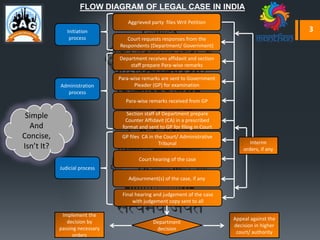
Aggrieved party files Writ Petition
Court requests responses from the
Respondents (Department/ Government)
Department receives affidavit and section
staff prepare Para-wise remarks
Para-wise remarks are sent to Government
Pleader (GP) for examination
Para-wise remarks received from GP
Section staff of Department prepare
Counter Affidavit (CA) in a prescribed
format and sent to GP for filing in Court
GP files CA in the Court/ Administrative
Tribunal
Court hearing of the case
Adjournment(s) of the case, if any
Final hearing and judgement of the case
with judgement copy sent to all
Department
decision
Appeal against the
decision in higher
court/ authority
Implement the
decision by
passing necessary
orders
Interim
orders, if any
Initiation
process
Administration
process
Judicial process
FLOW DIAGRAM OF LEGAL CASE IN INDIA
Simple
And
Concise,
Isn’t It?
3
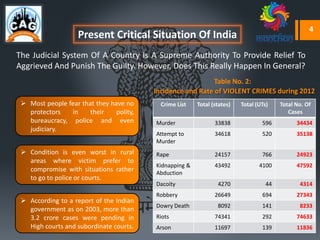
Crime List Total (states) Total (UTs) Total No. Of
Cases
Murder 33838 596 34434
Attempt to
Murder
34618 520 35138
Rape 24157 766 24923
Kidnapping &
Abduction
43492 4100 47592
Dacoity 4270 44 4314
Robbery 26649 694 27343
Dowry Death 8092 141 8233
Riots 74341 292 74633
Arson 11697 139 11836
Incidence and Rate of VIOLENT CRIMES during 2012
Present Critical Situation Of India
The Judicial System Of A Country Is A Supreme Authority To Provide Relief To
Aggrieved And Punish The Guilty. However, Does This Really Happen In General?
 Most people fear that they have no
protectors in their polity,
bureaucracy, police and even
judiciary.
 Condition is even worst in rural
areas where victim prefer to
compromise with situations rather
to go to police or courts.
 According to a report of the Indian
government as on 2003, more than
3.2 crore cases were pending in
High courts and subordinate courts.
Table No. 2:
4
How Healthy Is Indian Judiciary System?
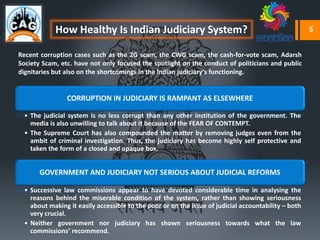
CORRUPTION IN JUDICIARY IS RAMPANT AS ELSEWHERE
• The judicial system is no less corrupt than any other institution of the government. The
media is also unwilling to talk about it because of the FEAR OF CONTEMPT.
• The Supreme Court has also compounded the matter by removing judges even from the
ambit of criminal investigation. Thus, the judiciary has become highly self protective and
taken the form of a closed and opaque box.
GOVERNMENT AND JUDICIARY NOT SERIOUS ABOUT JUDICIAL REFORMS
• Successive law commissions appear to have devoted considerable time in analysing the
reasons behind the miserable condition of the system, rather than showing seriousness
about making it easily accessible to the poor or on the issue of judicial accountability – both
very crucial.
• Neither government nor judiciary has shown seriousness towards what the law
commissions’ recommend.
Recent corruption cases such as the 2G scam, the CWG scam, the cash-for-vote scam, Adarsh
Society Scam, etc. have not only focused the spotlight on the conduct of politicians and public
dignitaries but also on the shortcomings in the Indian judiciary’s functioning.
5
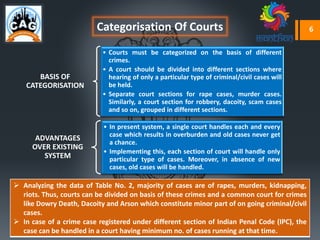
Categorisation Of Courts
BASIS OF
CATEGORISATION
• Courts must be categorized on the basis of different
crimes.
• A court should be divided into different sections where
hearing of only a particular type of criminal/civil cases will
be held.
• Separate court sections for rape cases, murder cases.
Similarly, a court section for robbery, dacoity, scam cases
and so on, grouped in different sections.
ADVANTAGES
OVER EXISTING
SYSTEM
• In present system, a single court handles each and every
case which results in overburden and old cases never get
a chance.
• Implementing this, each section of court will handle only
particular type of cases. Moreover, in absence of new
cases, old cases will be handled.
 Analyzing the data of Table No. 2, majority of cases are of rapes, murders, kidnapping,
riots. Thus, courts can be divided on basis of these crimes and a common court for crimes
like Dowry Death, Dacoity and Arson which constitute minor part of on going criminal/civil
cases.
 In case of a crime case registered under different section of Indian Penal Code (IPC), the
case can be handled in a court having minimum no. of cases running at that time.
6
Flexible Court Timings
 Extension in the timing of courts has become a necessity. Increasing number of cases
day by day and a huge backlog has become a drastic problem in Indian Judiciary.
 When senior executives in a private firm can work over time, reach home late and
forego holidays, why can’t our judiciary do the same to clear the backlog and handle
the cases more efficiently. It is in the nation’s interest only.
Increase the number of public hours/day by two (to handle more
cases) – [considering present annual useful working days as 200
with 8 hr./day working days] = saving of 2 hours/day
No. of working days saved/year = (2*200)/8 = 50 days (a)
Cut the summer vacations by (in the interest of the nation) = 30 days (b)
• Make every Saturday half or 2 Saturdays working every month
No. of working days saved/year = 26 days (c)
Total working days saved/year (a+b+c) = 106 days say 100
Improving efficiency and discipline by the lawyers and clients = by 20%
Thus, EXTRA CASES DISPOSED/YEAR = (200+100)*1.2/200 = 1.8 times
Impact of Proposed Solution
7
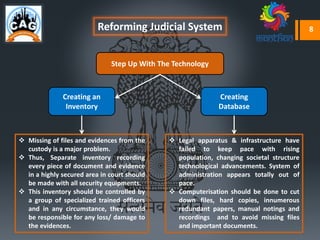
Reforming Judicial System
 Missing of files and evidences from the
custody is a major problem.
 Thus, Separate inventory recording
every piece of document and evidence
in a highly secured area in court should
be made with all security equipments.
 This inventory should be controlled by
a group of specialized trained officers
and in any circumstance, they would
be responsible for any loss/ damage to
the evidences.
 Legal apparatus & infrastructure have
failed to keep pace with rising
population, changing societal structure
technological advancements. System of
administration appears totally out of
pace.
 Computerisation should be done to cut
down files, hard copies, innumerous
redundant papers, manual notings and
recordings and to avoid missing files
and important documents.
Creating an
Inventory
Creating
Database
Step Up With The Technology
8
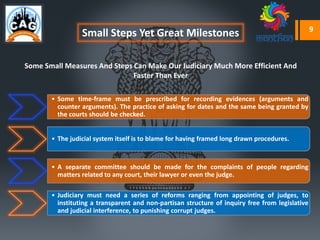
Small Steps Yet Great Milestones
Some Small Measures And Steps Can Make Our Judiciary Much More Efficient And
Faster Than Ever
• Some time-frame must be prescribed for recording evidences (arguments and
counter arguments). The practice of asking for dates and the same being granted by
the courts should be checked.
• The judicial system itself is to blame for having framed long drawn procedures.
• A separate committee should be made for the complaints of people regarding
matters related to any court, their lawyer or even the judge.
• Judiciary must need a series of reforms ranging from appointing of judges, to
instituting a transparent and non-partisan structure of inquiry free from legislative
and judicial interference, to punishing corrupt judges.
9
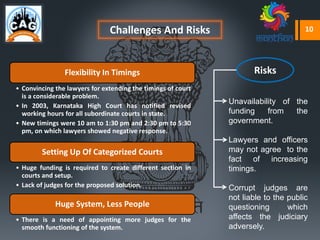
Challenges And Risks
Flexibility In Timings
• Convincing the lawyers for extending the timings of court
is a considerable problem.
• In 2003, Karnataka High Court has notified revised
working hours for all subordinate courts in state.
• New timings were 10 am to 1:30 pm and 2:30 pm to 5:30
pm, on which lawyers showed negative response.
Setting Up Of Categorized Courts
• Huge funding is required to create different section in
courts and setup.
• Lack of judges for the proposed solution.
Huge System, Less People
• There is a need of appointing more judges for the
smooth functioning of the system.
Risks
Unavailability of the
funding from the
government.
Lawyers and officers
may not agree to the
fact of increasing
timings.
Corrupt judges are
not liable to the public
questioning which
affects the judiciary
adversely.
10
References
 www.Supremecourtofindia.nic.in
 www.Indiacode.nic.in
 www.Doj.gov.in
 Indian Penal Code, 1860
 The Times Of India
 Shaping India of our dreams, K.C.Agrawal published by Knowledge Book Inc.
 Positive lessons in administration, Rakesh K. Mittal
11

ARRMS

  • 1.
    CITIZEN’S APPEAL ENSURING EXPEDITIOUSAND TIMELY JUSTICE TO ALL 1. Abhishek Kumar 2. Mayank Garg 3. Raghav Aggarwal 4. Rishabh Tripathi 5. Shivam Mittal TEAM MEMBERS: JSS Academy Of Technical Education, Noida 1 TEAM: THE ARRMS
  • 2.
     Our JudiciaryIs Blind For A Victim And A Seat Of Immunity For A Culprit From Where He Goes Scot Free To Commit More Crimes. Too Much Harassment And Too Little Justice Pending from previous month A Registered during month B Disposed off during month C Disposed off matters pertaining to previous months, but updated this month D Pending at the end of month A+B-(C+D) Admission matters 40279 7263 8921 183 38438 Regular hearing matters 29167 1100 727 14 29526 Total 69446 8363 9648 197 67964 The monthly statement of pending cases in SUPREME COURT as on July 2013 Out of 67964 pending matters as on 31/7/13, 23965 matters are upto one year old and thus arrears (i.e. cases pending more than a year) are only of 43999 matters as on 31/7/13. Table No. 1: 2
  • 3.
    Aggrieved party filesWrit Petition Court requests responses from the Respondents (Department/ Government) Department receives affidavit and section staff prepare Para-wise remarks Para-wise remarks are sent to Government Pleader (GP) for examination Para-wise remarks received from GP Section staff of Department prepare Counter Affidavit (CA) in a prescribed format and sent to GP for filing in Court GP files CA in the Court/ Administrative Tribunal Court hearing of the case Adjournment(s) of the case, if any Final hearing and judgement of the case with judgement copy sent to all Department decision Appeal against the decision in higher court/ authority Implement the decision by passing necessary orders Interim orders, if any Initiation process Administration process Judicial process FLOW DIAGRAM OF LEGAL CASE IN INDIA Simple And Concise, Isn’t It? 3
  • 4.
    Crime List Total(states) Total (UTs) Total No. Of Cases Murder 33838 596 34434 Attempt to Murder 34618 520 35138 Rape 24157 766 24923 Kidnapping & Abduction 43492 4100 47592 Dacoity 4270 44 4314 Robbery 26649 694 27343 Dowry Death 8092 141 8233 Riots 74341 292 74633 Arson 11697 139 11836 Incidence and Rate of VIOLENT CRIMES during 2012 Present Critical Situation Of India The Judicial System Of A Country Is A Supreme Authority To Provide Relief To Aggrieved And Punish The Guilty. However, Does This Really Happen In General?  Most people fear that they have no protectors in their polity, bureaucracy, police and even judiciary.  Condition is even worst in rural areas where victim prefer to compromise with situations rather to go to police or courts.  According to a report of the Indian government as on 2003, more than 3.2 crore cases were pending in High courts and subordinate courts. Table No. 2: 4
  • 5.
    How Healthy IsIndian Judiciary System? CORRUPTION IN JUDICIARY IS RAMPANT AS ELSEWHERE • The judicial system is no less corrupt than any other institution of the government. The media is also unwilling to talk about it because of the FEAR OF CONTEMPT. • The Supreme Court has also compounded the matter by removing judges even from the ambit of criminal investigation. Thus, the judiciary has become highly self protective and taken the form of a closed and opaque box. GOVERNMENT AND JUDICIARY NOT SERIOUS ABOUT JUDICIAL REFORMS • Successive law commissions appear to have devoted considerable time in analysing the reasons behind the miserable condition of the system, rather than showing seriousness about making it easily accessible to the poor or on the issue of judicial accountability – both very crucial. • Neither government nor judiciary has shown seriousness towards what the law commissions’ recommend. Recent corruption cases such as the 2G scam, the CWG scam, the cash-for-vote scam, Adarsh Society Scam, etc. have not only focused the spotlight on the conduct of politicians and public dignitaries but also on the shortcomings in the Indian judiciary’s functioning. 5
  • 6.
    Categorisation Of Courts BASISOF CATEGORISATION • Courts must be categorized on the basis of different crimes. • A court should be divided into different sections where hearing of only a particular type of criminal/civil cases will be held. • Separate court sections for rape cases, murder cases. Similarly, a court section for robbery, dacoity, scam cases and so on, grouped in different sections. ADVANTAGES OVER EXISTING SYSTEM • In present system, a single court handles each and every case which results in overburden and old cases never get a chance. • Implementing this, each section of court will handle only particular type of cases. Moreover, in absence of new cases, old cases will be handled.  Analyzing the data of Table No. 2, majority of cases are of rapes, murders, kidnapping, riots. Thus, courts can be divided on basis of these crimes and a common court for crimes like Dowry Death, Dacoity and Arson which constitute minor part of on going criminal/civil cases.  In case of a crime case registered under different section of Indian Penal Code (IPC), the case can be handled in a court having minimum no. of cases running at that time. 6
  • 7.
    Flexible Court Timings Extension in the timing of courts has become a necessity. Increasing number of cases day by day and a huge backlog has become a drastic problem in Indian Judiciary.  When senior executives in a private firm can work over time, reach home late and forego holidays, why can’t our judiciary do the same to clear the backlog and handle the cases more efficiently. It is in the nation’s interest only. Increase the number of public hours/day by two (to handle more cases) – [considering present annual useful working days as 200 with 8 hr./day working days] = saving of 2 hours/day No. of working days saved/year = (2*200)/8 = 50 days (a) Cut the summer vacations by (in the interest of the nation) = 30 days (b) • Make every Saturday half or 2 Saturdays working every month No. of working days saved/year = 26 days (c) Total working days saved/year (a+b+c) = 106 days say 100 Improving efficiency and discipline by the lawyers and clients = by 20% Thus, EXTRA CASES DISPOSED/YEAR = (200+100)*1.2/200 = 1.8 times Impact of Proposed Solution 7
  • 8.
    Reforming Judicial System Missing of files and evidences from the custody is a major problem.  Thus, Separate inventory recording every piece of document and evidence in a highly secured area in court should be made with all security equipments.  This inventory should be controlled by a group of specialized trained officers and in any circumstance, they would be responsible for any loss/ damage to the evidences.  Legal apparatus & infrastructure have failed to keep pace with rising population, changing societal structure technological advancements. System of administration appears totally out of pace.  Computerisation should be done to cut down files, hard copies, innumerous redundant papers, manual notings and recordings and to avoid missing files and important documents. Creating an Inventory Creating Database Step Up With The Technology 8
  • 9.
    Small Steps YetGreat Milestones Some Small Measures And Steps Can Make Our Judiciary Much More Efficient And Faster Than Ever • Some time-frame must be prescribed for recording evidences (arguments and counter arguments). The practice of asking for dates and the same being granted by the courts should be checked. • The judicial system itself is to blame for having framed long drawn procedures. • A separate committee should be made for the complaints of people regarding matters related to any court, their lawyer or even the judge. • Judiciary must need a series of reforms ranging from appointing of judges, to instituting a transparent and non-partisan structure of inquiry free from legislative and judicial interference, to punishing corrupt judges. 9
  • 10.
    Challenges And Risks FlexibilityIn Timings • Convincing the lawyers for extending the timings of court is a considerable problem. • In 2003, Karnataka High Court has notified revised working hours for all subordinate courts in state. • New timings were 10 am to 1:30 pm and 2:30 pm to 5:30 pm, on which lawyers showed negative response. Setting Up Of Categorized Courts • Huge funding is required to create different section in courts and setup. • Lack of judges for the proposed solution. Huge System, Less People • There is a need of appointing more judges for the smooth functioning of the system. Risks Unavailability of the funding from the government. Lawyers and officers may not agree to the fact of increasing timings. Corrupt judges are not liable to the public questioning which affects the judiciary adversely. 10
  • 11.
    References  www.Supremecourtofindia.nic.in  www.Indiacode.nic.in www.Doj.gov.in  Indian Penal Code, 1860  The Times Of India  Shaping India of our dreams, K.C.Agrawal published by Knowledge Book Inc.  Positive lessons in administration, Rakesh K. Mittal 11