CITIZENS APPEAL: AN EFFECTIVE TOOL
FOR ENSURING CHEAP AND SPEEDY
JUSTICE
TEAM:
1. WISHVESH RANJAN ( TEAM CO-ORDINATOR)
2. ARUSHI CHANDRA
3. KEVIN JAMES
4. SHREYA SHRIVASTAVA
5. SHRUTI KHETAN
1st Year BA.LL.B(Hons.) Students, Hidayatullah National Law University, Chhattisgarh
INTRODUCTION
“In USA, there are 125 judges for 1 million citizens and in India we have 6 judges
for 1 million,"
-Ex-Chief Justice of India, Altamas Kabir, on the ground reality of India.
 The Constitution of India reflects the quest and aspiration of the mankind for justice when its
preamble speaks of justice in all its forms: social, economic and political.
 Those who have suffered physically, mentally or economically, approach the Courts, with
great hope, for obtaining remedies for their grievances.
 A major problem being faced by the Indian Judicial system, is the huge backlog of cases.
 Like Martin Luther King said, "Injustice anywhere is a threat to justice everywhere."
 Justice is something meant to be handled at the present moment.
 William Gladstone Rightly put, "Justice Delayed is Justice Denied“
 Delay in disposal of cases not only creates disillusionment among the litigants, but also
undermines the very capability of the system to impart justice in an efficient and effective
manner.
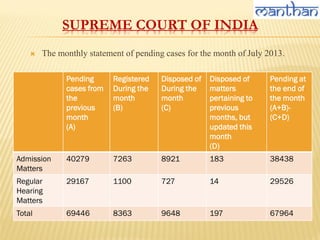
SUPREME COURT OF INDIA
 The monthly statement of pending cases for the month of July 2013.
Pending
cases from
the
previous
month
(A)
Registered
During the
month
(B)
Disposed of
During the
month
(C)
Disposed of
matters
pertaining to
previous
months, but
updated this
month
(D)
Pending at
the end of
the month
(A+B)-
(C+D)
Admission
Matters
40279 7263 8921 183 38438
Regular
Hearing
Matters
29167 1100 727 14 29526
Total 69446 8363 9648 197 67964
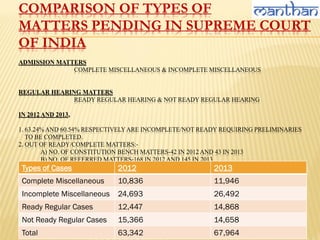
COMPARISON OF TYPES OF
MATTERS PENDING IN SUPREME COURT
OF INDIA
ADMISSION MATTERS
COMPLETE MISCELLANEOUS & INCOMPLETE MISCELLANEOUS
REGULAR HEARING MATTERS
READY REGULAR HEARING & NOT READY REGULAR HEARING
IN 2012 AND 2013,
1. 63.24% AND 60.54% RESPECTIVELYARE INCOMPLETE/NOT READY REQUIRING PRELIMINARIES
TO BE COMPLETED.
2. OUT OF READY/COMPLETE MATTERS:-
A) NO. OF CONSTITUTION BENCH MATTERS-42 IN 2012 AND 43 IN 2013
B) NO. OF REFERRED MATTERS-168 IN 2012 AND 145 IN 2013
Types of Cases 2012 2013
Complete Miscellaneous 10,836 11,946
Incomplete Miscellaneous 24,693 26,492
Ready Regular Cases 12,447 14,868
Not Ready Regular Cases 15,366 14,658
Total 63,342 67,964
DELAY LEADS TO MENTAL ANGUISH
Hussainara Khatoon v. State of Bihar
 This case formed the basis of the concept of the Speedy Trial, it was held that
where under trial prisoners have been in jail for duration longer than prescribed, if convicted, their
detention in jail is totally unjustified and in violation to fundamental rights under article 21.
 Inordinate delays violates article 21 of the constitution: for more than 11 years the trial is pending
without any progress for no faults of the accused-petitioner.
 Expeditious rights are a basic right to everybody and cannot be trampled upon unless any of the
parties can be accused of the delay.
 Delay in trial unnecessarily confers a right upon the accused to apply for bail. Under sec. 482 read
with 483, Cr. P.C lays that every possible measure to be taken to dispose off the case within
6months from today.
 No adjournments to be granted until n unless circumstances are beyond the control of judiciary. It
is the responsibility of the judiciary to keep a check on under trial prisoners and bring them to trial.
Overcrowded courts, inadequate resources, fiscal deficiency cannot be the reasons for deprivation
of a person.
DELAY IN DISPOSAL AND
ITS INJUSTICE
 Studies have shown that cases under certain statutes and areas of law are
choking the dockets of magisterial and specialized courts.
 Some bottlenecks which are quite essential to be removed so as to ensure
expeditious and timely justice to all:
1) Matrimonial cases/ Cases under section 498A of the Indian Penal Code
2) Cases under the Prevention of Corruption Act, 1988.
3) Regular murder cases/appeals.
4) Civil cases, including suits which may have been rendered infructuous.
5) Petty cases such as Traffic Challans.
6) Motor Accident Claims.
While attempting to clear out these bottlenecks, we must remember to PRIORITIZE.
To be worked out for an expeditious resolution of certain category of cases, such as
those filed by senior citizens, terminally ill persons, cases pertaining to Pretrial and
Juvenile prisoners, women who are victims of violence.
REMOVAL- PENDENCY OF CASES
 Time frame work should be there for the disposal of
cases.
 Setting up of more courts
 Increasing no of judges
 Stipulating time period for disposal of each cases.
 Setting up of specialized tribunals
 Use of compromise. Improvement of adaalat systems.
 Establishment of Village courts for petty cases.
(Contd.)
 Prevention of unnecessary postponement by setting up
stringent rules regarding postponement.
 Establishment of Ombudsman system
 E-courts- Online documentation as well as video
conferencing for evidence collection.
 Imposing penalty for unnecessary litigants.
 Simplifying the procedural laws.
 Improving the quality and manpower of government
pleaders.
 Establishment of Village courts for petty cases.
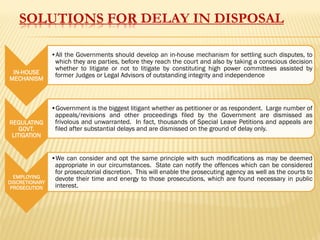
SOLUTIONS FOR DELAY IN DISPOSAL
IN-HOUSE
MECHANISM
•All the Governments should develop an in-house mechanism for settling such disputes, to
which they are parties, before they reach the court and also by taking a conscious decision
whether to litigate or not to litigate by constituting high power committees assisted by
former Judges or Legal Advisors of outstanding integrity and independence
REGULATING
GOVT.
LITIGATION
•Government is the biggest litigant whether as petitioner or as respondent. Large number of
appeals/revisions and other proceedings filed by the Government are dismissed as
frivolous and unwarranted. In fact, thousands of Special Leave Petitions and appeals are
filed after substantial delays and are dismissed on the ground of delay only.
EMPLOYING
DISCRETIONARY
PROSECUTION
•We can consider and opt the same principle with such modifications as may be deemed
appropriate in our circumstances. State can notify the offences which can be considered
for prosecutorial discretion. This will enable the prosecuting agency as well as the courts to
devote their time and energy to those prosecutions, which are found necessary in public
interest.
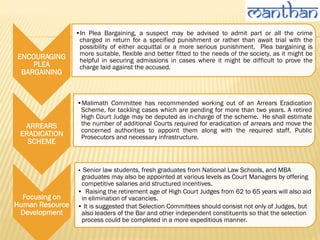
ENCOURAGING
PLEA
BARGAINING
•In Plea Bargaining, a suspect may be advised to admit part or all the crime
charged in return for a specified punishment or rather than await trial with the
possibility of either acquittal or a more serious punishment. Plea bargaining is
more suitable, flexible and better fitted to the needs of the society, as it might be
helpful in securing admissions in cases where it might be difficult to prove the
charge laid against the accused.
ARREARS
ERADICATION
SCHEME
•Malimath Committee has recommended working out of an Arrears Eradication
Scheme, for tackling cases which are pending for more than two years. A retired
High Court Judge may be deputed as in-charge of the scheme. He shall estimate
the number of additional Courts required for eradication of arrears and move the
concerned authorities to appoint them along with the required staff, Public
Prosecutors and necessary infrastructure.
Focusing on
Human Resource
Development
• Senior law students, fresh graduates from National Law Schools, and MBA
graduates may also be appointed at various levels as Court Managers by offering
competitive salaries and structured incentives.
• Raising the retirement age of High Court Judges from 62 to 65 years will also aid
in elimination of vacancies.
• It is suggested that Selection Committees should consist not only of Judges, but
also leaders of the Bar and other independent constituents so that the selection
process could be completed in a more expeditious manner.
CONCLUSION
Law is an important instrument of social and political change. For the Rule of Law to be a
reality, there is an urgent need to reduce the pendency of cases in courts and also reduce the average life
span of litigation. The time for change is now.
• Litigation in future on those sections , who have remained oppressed and unaware of their
legal rights, become more aware of their rights due to spread of legal literacy. So the problem on hand,
if not dealt with immediately, and effectively, will only become more acute.
We will conclude by referring to the observation made by Justice Warran Burger, former
Chief Justice of the American Supreme Court observed in the American context : “…….People with legal
problems, like people with pain, want relief and they want it as quickly and inexpensively, as possible.” Let
us strive to meet this need, and make justice certain, and timely.
• Speedy justice is sine qua non for a free democratic country.
• There is a need to revamp the existing justice delivery system
• The motto is speedy justice to all without any discrimination.
REFERENCES
 “Towards Timely Delivery of Justice to All”, National mission for delivery of Justice
and Legal Reforms, 2009 – 2012
 “On Delayed Justice”, Ex-CJI Hon’ble Shri Y.K. Sabarwal, 2006
 GB Reddy, Judicial Activism in India, publisher name, place, (2nd edn.-Year of
publication)
 Mamta Rao, Public interest Litigation, eastern book company, (2007)
 SP sathe, Judicial Activism in India, Oxford University Press, USA (August 29, 2002)
 Report of Justice V.S. Malimath Committee on reforms of criminal justice system, 2003
It is our firm belief that the steps proposed in this presentation, if
taken in the right earnest will go a long way in reducing the pendency of cases and
thereby ensuring speedy justice.
THANK YOU

Need4Speed

  • 1.
    CITIZENS APPEAL: ANEFFECTIVE TOOL FOR ENSURING CHEAP AND SPEEDY JUSTICE TEAM: 1. WISHVESH RANJAN ( TEAM CO-ORDINATOR) 2. ARUSHI CHANDRA 3. KEVIN JAMES 4. SHREYA SHRIVASTAVA 5. SHRUTI KHETAN 1st Year BA.LL.B(Hons.) Students, Hidayatullah National Law University, Chhattisgarh
  • 2.
    INTRODUCTION “In USA, thereare 125 judges for 1 million citizens and in India we have 6 judges for 1 million," -Ex-Chief Justice of India, Altamas Kabir, on the ground reality of India.  The Constitution of India reflects the quest and aspiration of the mankind for justice when its preamble speaks of justice in all its forms: social, economic and political.  Those who have suffered physically, mentally or economically, approach the Courts, with great hope, for obtaining remedies for their grievances.  A major problem being faced by the Indian Judicial system, is the huge backlog of cases.  Like Martin Luther King said, "Injustice anywhere is a threat to justice everywhere."  Justice is something meant to be handled at the present moment.  William Gladstone Rightly put, "Justice Delayed is Justice Denied“  Delay in disposal of cases not only creates disillusionment among the litigants, but also undermines the very capability of the system to impart justice in an efficient and effective manner.
  • 3.
    SUPREME COURT OFINDIA  The monthly statement of pending cases for the month of July 2013. Pending cases from the previous month (A) Registered During the month (B) Disposed of During the month (C) Disposed of matters pertaining to previous months, but updated this month (D) Pending at the end of the month (A+B)- (C+D) Admission Matters 40279 7263 8921 183 38438 Regular Hearing Matters 29167 1100 727 14 29526 Total 69446 8363 9648 197 67964
  • 4.
    COMPARISON OF TYPESOF MATTERS PENDING IN SUPREME COURT OF INDIA ADMISSION MATTERS COMPLETE MISCELLANEOUS & INCOMPLETE MISCELLANEOUS REGULAR HEARING MATTERS READY REGULAR HEARING & NOT READY REGULAR HEARING IN 2012 AND 2013, 1. 63.24% AND 60.54% RESPECTIVELYARE INCOMPLETE/NOT READY REQUIRING PRELIMINARIES TO BE COMPLETED. 2. OUT OF READY/COMPLETE MATTERS:- A) NO. OF CONSTITUTION BENCH MATTERS-42 IN 2012 AND 43 IN 2013 B) NO. OF REFERRED MATTERS-168 IN 2012 AND 145 IN 2013 Types of Cases 2012 2013 Complete Miscellaneous 10,836 11,946 Incomplete Miscellaneous 24,693 26,492 Ready Regular Cases 12,447 14,868 Not Ready Regular Cases 15,366 14,658 Total 63,342 67,964
  • 5.
    DELAY LEADS TOMENTAL ANGUISH Hussainara Khatoon v. State of Bihar  This case formed the basis of the concept of the Speedy Trial, it was held that where under trial prisoners have been in jail for duration longer than prescribed, if convicted, their detention in jail is totally unjustified and in violation to fundamental rights under article 21.  Inordinate delays violates article 21 of the constitution: for more than 11 years the trial is pending without any progress for no faults of the accused-petitioner.  Expeditious rights are a basic right to everybody and cannot be trampled upon unless any of the parties can be accused of the delay.  Delay in trial unnecessarily confers a right upon the accused to apply for bail. Under sec. 482 read with 483, Cr. P.C lays that every possible measure to be taken to dispose off the case within 6months from today.  No adjournments to be granted until n unless circumstances are beyond the control of judiciary. It is the responsibility of the judiciary to keep a check on under trial prisoners and bring them to trial. Overcrowded courts, inadequate resources, fiscal deficiency cannot be the reasons for deprivation of a person.
  • 6.
    DELAY IN DISPOSALAND ITS INJUSTICE  Studies have shown that cases under certain statutes and areas of law are choking the dockets of magisterial and specialized courts.  Some bottlenecks which are quite essential to be removed so as to ensure expeditious and timely justice to all: 1) Matrimonial cases/ Cases under section 498A of the Indian Penal Code 2) Cases under the Prevention of Corruption Act, 1988. 3) Regular murder cases/appeals. 4) Civil cases, including suits which may have been rendered infructuous. 5) Petty cases such as Traffic Challans. 6) Motor Accident Claims. While attempting to clear out these bottlenecks, we must remember to PRIORITIZE. To be worked out for an expeditious resolution of certain category of cases, such as those filed by senior citizens, terminally ill persons, cases pertaining to Pretrial and Juvenile prisoners, women who are victims of violence.
  • 7.
    REMOVAL- PENDENCY OFCASES  Time frame work should be there for the disposal of cases.  Setting up of more courts  Increasing no of judges  Stipulating time period for disposal of each cases.  Setting up of specialized tribunals  Use of compromise. Improvement of adaalat systems.  Establishment of Village courts for petty cases. (Contd.)
  • 8.
     Prevention ofunnecessary postponement by setting up stringent rules regarding postponement.  Establishment of Ombudsman system  E-courts- Online documentation as well as video conferencing for evidence collection.  Imposing penalty for unnecessary litigants.  Simplifying the procedural laws.  Improving the quality and manpower of government pleaders.  Establishment of Village courts for petty cases.
  • 9.
    SOLUTIONS FOR DELAYIN DISPOSAL IN-HOUSE MECHANISM •All the Governments should develop an in-house mechanism for settling such disputes, to which they are parties, before they reach the court and also by taking a conscious decision whether to litigate or not to litigate by constituting high power committees assisted by former Judges or Legal Advisors of outstanding integrity and independence REGULATING GOVT. LITIGATION •Government is the biggest litigant whether as petitioner or as respondent. Large number of appeals/revisions and other proceedings filed by the Government are dismissed as frivolous and unwarranted. In fact, thousands of Special Leave Petitions and appeals are filed after substantial delays and are dismissed on the ground of delay only. EMPLOYING DISCRETIONARY PROSECUTION •We can consider and opt the same principle with such modifications as may be deemed appropriate in our circumstances. State can notify the offences which can be considered for prosecutorial discretion. This will enable the prosecuting agency as well as the courts to devote their time and energy to those prosecutions, which are found necessary in public interest.
  • 10.
    ENCOURAGING PLEA BARGAINING •In Plea Bargaining,a suspect may be advised to admit part or all the crime charged in return for a specified punishment or rather than await trial with the possibility of either acquittal or a more serious punishment. Plea bargaining is more suitable, flexible and better fitted to the needs of the society, as it might be helpful in securing admissions in cases where it might be difficult to prove the charge laid against the accused. ARREARS ERADICATION SCHEME •Malimath Committee has recommended working out of an Arrears Eradication Scheme, for tackling cases which are pending for more than two years. A retired High Court Judge may be deputed as in-charge of the scheme. He shall estimate the number of additional Courts required for eradication of arrears and move the concerned authorities to appoint them along with the required staff, Public Prosecutors and necessary infrastructure. Focusing on Human Resource Development • Senior law students, fresh graduates from National Law Schools, and MBA graduates may also be appointed at various levels as Court Managers by offering competitive salaries and structured incentives. • Raising the retirement age of High Court Judges from 62 to 65 years will also aid in elimination of vacancies. • It is suggested that Selection Committees should consist not only of Judges, but also leaders of the Bar and other independent constituents so that the selection process could be completed in a more expeditious manner.
  • 11.
    CONCLUSION Law is animportant instrument of social and political change. For the Rule of Law to be a reality, there is an urgent need to reduce the pendency of cases in courts and also reduce the average life span of litigation. The time for change is now. • Litigation in future on those sections , who have remained oppressed and unaware of their legal rights, become more aware of their rights due to spread of legal literacy. So the problem on hand, if not dealt with immediately, and effectively, will only become more acute. We will conclude by referring to the observation made by Justice Warran Burger, former Chief Justice of the American Supreme Court observed in the American context : “…….People with legal problems, like people with pain, want relief and they want it as quickly and inexpensively, as possible.” Let us strive to meet this need, and make justice certain, and timely. • Speedy justice is sine qua non for a free democratic country. • There is a need to revamp the existing justice delivery system • The motto is speedy justice to all without any discrimination.
  • 12.
    REFERENCES  “Towards TimelyDelivery of Justice to All”, National mission for delivery of Justice and Legal Reforms, 2009 – 2012  “On Delayed Justice”, Ex-CJI Hon’ble Shri Y.K. Sabarwal, 2006  GB Reddy, Judicial Activism in India, publisher name, place, (2nd edn.-Year of publication)  Mamta Rao, Public interest Litigation, eastern book company, (2007)  SP sathe, Judicial Activism in India, Oxford University Press, USA (August 29, 2002)  Report of Justice V.S. Malimath Committee on reforms of criminal justice system, 2003 It is our firm belief that the steps proposed in this presentation, if taken in the right earnest will go a long way in reducing the pendency of cases and thereby ensuring speedy justice. THANK YOU