Downloaded 13 times


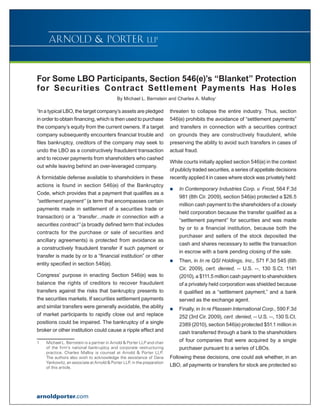
![Tribune Co. (cont’d)
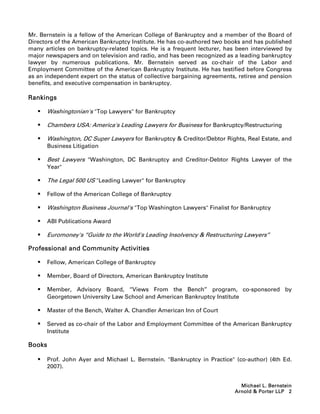
In December 2010, Tribune ceded its rights to bring suits to the Committee,
which obtained permission to file a claim alleging intentional f d against
hi h bt i d i i t fil l i ll i i t ti l fraud i t
shareholders before the two-year statute of limitations expired.
– The bankruptcy court recently granted the Committee’s motion to dismiss claims
against former named shareholders who received less than $50,000 in proceeds
from the LBO.
The bankruptcy judge stayed the suit pending the completion of the Chapter
11 process, hoping that the various parties could find a way to settle the
charges.
The Committee let the statute of limitations lapse on the constructive
fraudulent conveyance claims in December 2010, which meant that
individual creditors could bring claims under state law, arguably beyond the
reach of the Section 546(e) safe harbor.
In March 2011 creditors sought authority from the bankruptcy court to bring
state law fraudulent conveyance actions.
25
Tribune Co. (cont’d)
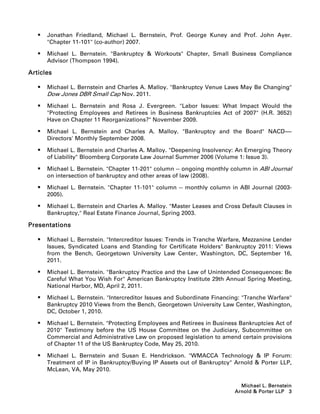
Several parties objected to the state law fraudulent conveyance actions arguing that,
among other things:
– the debtor has exclusive authority to pursue the claims; and
– the prohibition on pursuing avoidance of transfers subject to Section 546(e) has preempted
state law and cannot be avoided by pursuing the claims in state court instead of bankruptcy
court.
In April 2011, the bankruptcy court issued an order allowing noteholders to file their
avoidance actions in state court, stating:
– “Because no state law constructive fraudulent conveyance claims against shareholders
whose stock was redeemed or purchased in connection with the [LBO] were commenced by
or on behalf of the Debtors’ estates before the expiration of the applicable statute of
limitations under 11 U.S.C. § 546(a), the Debtors’ creditors have regained the right, if any, to
prosecute their respective state law constructive fraudulent conveyance claims against [the
shareholders] to recover stock redemption/purchase payments made to such shareholders in
connection with the LBO.”
– The bankruptcy court, however, specifically stated that it was making no finding regarding the
standing of the noteholders or any creditors to assert the state fraudulent conveyance claims
or whether such claims were preempted or otherwise impacted by Section 546(e).
26](https://image.slidesharecdn.com/arnoldporterfraudulentconveyance-130324180741-phpapp02/85/Arnold-Porter-on-Fraudulent-Conveyance-18-320.jpg)
![Michael L. Bernstein
Partner Contact Information
Michael.Bernstein@aporter.com
tel: +1 202.942.5577
Michael Bernstein is chair of the Firm’s
fax: +1 202.942.5999
national bankruptcy and corporate
restructuring practice. He is consistently 555 Twelfth Street, NW
distinguished as one of the top bankruptcy Washington, DC 20004-1206
and restructuring lawyers in Washington,
DC by Chambers USA Leading Lawyers Practice Areas
for Business, which praises him as a creative and loyal Bankruptcy and Corporate
Restructuring (practice chair)
advocate whose knowledge of the Bankruptcy Code makes him
Financial Services
incredible at getting the best results for his clients’’ (2011), an
outstanding lawyer [with] fantastic analytical skills and Education
intellectual prowess’’ (2009), for being ‘‘creative and practical JD, Northwestern University
(2008), noting that he ‘‘completely understands [his client’s] School of Law, 1989
business’’ (2007), and has ‘‘an ability to assess risks in a BA, Brandeis University, 1986
meaningful way and address the tribunal in a strong and Admissions
tenacious manner’’ (2006). District of Columbia
Supreme Court of the United
He represents secured and unsecured creditors, creditors' States
committees, bondholders, investors, asset purchasers, debtors,
and other parties in a wide variety of bankruptcy and workout
matters, and in related litigation throughout the United States.
He has been involved in large bankruptcy cases, including
Chrysler, Lehman Brothers, US Airways, LandAmerica, TWA,
Adelphia, Asarco, G-1 Holdings, Mirant, Criimi Mae, Enron,
FoxMeyer Drug, Alterra Healthcare Corporation, Fruit of the
Loom and Continental Airlines, as well as many other cases
throughout the United States.
Mr. Bernstein's bankruptcy experience spans many industries,
including telecommunications, energy, real estate, finance,
mining, manufacturing, technology, retail, airline, healthcare,
and pharmaceuticals. His clients have included AOL, American
Capital, American Red Cross, Ardent Communications Creditors'
Committee, Bear Stearns, Boehringer Ingelheim, BBT, Cingular
Wireless, Criimi Mae Creditors' Committee, Dynex Bondholders
Committee, Gate Gourmet, Glaxo, Guinness Import Company,
Health Care REIT, Hilton Worldwide, Lennar Partners, Major
League Baseball, Perseus LLC, Sodexo, Texas Pacific Group, The
George Washington University, and the Washington
Corporations, among others.
arnoldporter.com](https://image.slidesharecdn.com/arnoldporterfraudulentconveyance-130324180741-phpapp02/85/Arnold-Porter-on-Fraudulent-Conveyance-27-320.jpg)


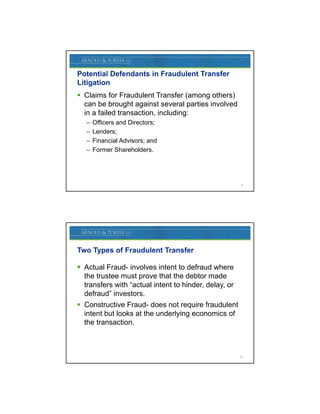
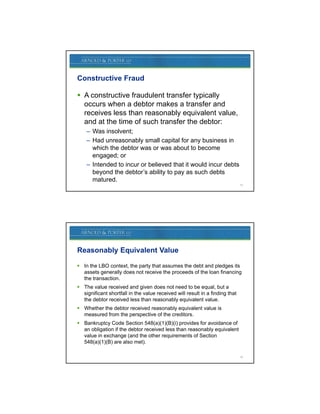
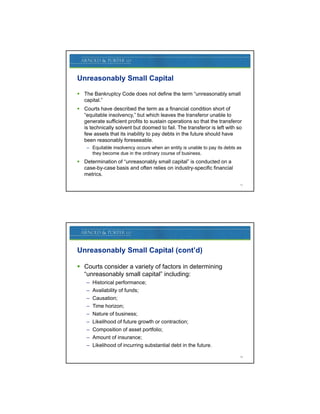
The document discusses fraudulent conveyance principles used to overturn leveraged buyout (LBO) transactions. It notes that fraudulent conveyance laws exist to protect companies and creditors from transactions that extract value without providing reasonable value in return. When an LBO fails, parties may initiate litigation to avoid liens granted to lenders that financed the LBO and recover payments made to former shareholders. There are two types of fraudulent transfers - actual fraud which requires proving intent to defraud, and constructive fraud which looks at the underlying economics without requiring intent. Potential defendants in such cases include officers, directors, lenders, financial advisors, and former shareholders.


