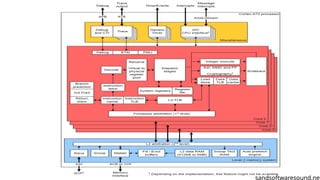
sandsoftwaresound.net
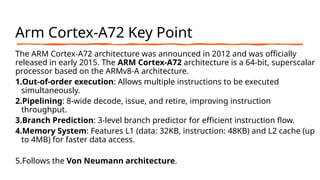
The ARM Cortex-A72 architecture was announced in 2012 and was officially
released in early 2015. The ARM Cortex-A72 architecture is a 64-bit, superscalar
processor based on the ARMv8-A architecture.
1.Out-of-order execution: Allows multiple instructions to be executed
simultaneously.
2.Pipelining: 8-wide decode, issue, and retire, improving instruction
throughput.
3.Branch Prediction: 3-level branch predictor for efficient instruction flow.
4.Memory System: Features L1 (data: 32KB, instruction: 48KB) and L2 cache (up
to 4MB) for faster data access.
5.Follows the Von Neumann architecture.
Arm Cortex-A72 Key Point
Instruction
Set
Architectur
e (ISA)
1. Advanced SIMD and Floating-Point Unit:
Supports ARMv8 SIMD instructions
2. AArch64: The 64-bit instruction set, designed for
performance and efficiency.
3. AArch32: The 32-bit instruction set, providing
backward compatibility with existing ARM
software.
4. SIMD and Floating-Point Support
NEON Technology:
The ARM Cortex-A72 supports NEON SIMD (Single
Instruction, Multiple Data) instructions for efficient
processing of multimedia and signal processing
tasks.
Floating-Point Instructions: The architecture
includes support for both single-precision and
double-precision floating-point operations.
Applications
1. Mobile Devices
2. Embedded Systems
3. Automotive
4. Networking Equipment
Routers and Switches:
5. Consumer Electronics
Smart TVs and Set-Top Boxes: Powers devices that require high-quality
video playback and gaming capabilities, enhancing the viewing
experience.
Streaming Devices: Used in devices that provide streaming services
6. Gaming Consoles
7 Machine Learning and AI
Advantages
1. High Performance
Advanced out-of-order execution and deep pipeline for efficient processing.
2. Energy Efficiency
Low power consumption, ideal for mobile and battery-operated devices.
3. 64-bit Architecture
Supports larger addressable memory and improved performance for high
bandwidth applications.
4. Advanced Cache System
Sophisticated caching architecture reduces memory latency.
5. NEON SIMD Support
Enhances performance for multimedia, graphics, and machine learning tasks.
6. Scalability
Flexible configurations from single-core to multi-core setups.
7. Robust Security Features
Supports ARM Trust Zone for secure execution environments.
8. Rich Ecosystem
Extensive software and development tools for application optimization.
Disadvantages
1. cost
Higher implementation costs compared to lower-end ARM processors.
2. Complexity
Advanced features lead to increased design complexity.
3. Heat Generation
High performance may result in increased heat in multi-core configurations.
4. Limited Market Share
Less support in legacy applications and enterprise environments compared to x86.
5. Dependency on Ecosystem
Performance relies heavily on the surrounding software ecosystem.
6. Performance Variability
Performance can vary based on workload distribution and memory access patterns.
References
1. ARM, "Cortex-A72," [Online]. Available:
https://www.arm.com/products/silicon-ip-cpu/cortex-a/cor
tex-a72
. [Accessed: 25-Oct-2024].
2. ARM, "Arm Cortex-A72 Core Technical Reference Manual,"
[Online]. Available:
https://developer.arm.com/documentation/102826/latest/.
[Accessed: 25-Oct-2024].

Arm cortex a72 processor is the presentation.pptx

  • 2.
  • 3.
    The ARM Cortex-A72architecture was announced in 2012 and was officially released in early 2015. The ARM Cortex-A72 architecture is a 64-bit, superscalar processor based on the ARMv8-A architecture. 1.Out-of-order execution: Allows multiple instructions to be executed simultaneously. 2.Pipelining: 8-wide decode, issue, and retire, improving instruction throughput. 3.Branch Prediction: 3-level branch predictor for efficient instruction flow. 4.Memory System: Features L1 (data: 32KB, instruction: 48KB) and L2 cache (up to 4MB) for faster data access. 5.Follows the Von Neumann architecture. Arm Cortex-A72 Key Point
  • 4.
    Instruction Set Architectur e (ISA) 1. AdvancedSIMD and Floating-Point Unit: Supports ARMv8 SIMD instructions 2. AArch64: The 64-bit instruction set, designed for performance and efficiency. 3. AArch32: The 32-bit instruction set, providing backward compatibility with existing ARM software. 4. SIMD and Floating-Point Support NEON Technology: The ARM Cortex-A72 supports NEON SIMD (Single Instruction, Multiple Data) instructions for efficient processing of multimedia and signal processing tasks. Floating-Point Instructions: The architecture includes support for both single-precision and double-precision floating-point operations.
  • 5.
    Applications 1. Mobile Devices 2.Embedded Systems 3. Automotive 4. Networking Equipment Routers and Switches: 5. Consumer Electronics Smart TVs and Set-Top Boxes: Powers devices that require high-quality video playback and gaming capabilities, enhancing the viewing experience. Streaming Devices: Used in devices that provide streaming services 6. Gaming Consoles 7 Machine Learning and AI
  • 6.
    Advantages 1. High Performance Advancedout-of-order execution and deep pipeline for efficient processing. 2. Energy Efficiency Low power consumption, ideal for mobile and battery-operated devices. 3. 64-bit Architecture Supports larger addressable memory and improved performance for high bandwidth applications. 4. Advanced Cache System Sophisticated caching architecture reduces memory latency. 5. NEON SIMD Support Enhances performance for multimedia, graphics, and machine learning tasks. 6. Scalability Flexible configurations from single-core to multi-core setups. 7. Robust Security Features Supports ARM Trust Zone for secure execution environments. 8. Rich Ecosystem Extensive software and development tools for application optimization.
  • 7.
    Disadvantages 1. cost Higher implementationcosts compared to lower-end ARM processors. 2. Complexity Advanced features lead to increased design complexity. 3. Heat Generation High performance may result in increased heat in multi-core configurations. 4. Limited Market Share Less support in legacy applications and enterprise environments compared to x86. 5. Dependency on Ecosystem Performance relies heavily on the surrounding software ecosystem. 6. Performance Variability Performance can vary based on workload distribution and memory access patterns.
  • 8.
    References 1. ARM, "Cortex-A72,"[Online]. Available: https://www.arm.com/products/silicon-ip-cpu/cortex-a/cor tex-a72 . [Accessed: 25-Oct-2024]. 2. ARM, "Arm Cortex-A72 Core Technical Reference Manual," [Online]. Available: https://developer.arm.com/documentation/102826/latest/. [Accessed: 25-Oct-2024].